Blog

  • The Games of the 29th Olympiad: Triumph and Tragedy

    The Games of the 29th Olympiad: Triumph and Tragedy

    << Read all John Kamm Remembers stories

    Download this story as PDF

    Listen to Dragon Years: 2000 podcast episode.

    A photo of the 2008 Olympics Opening Ceremony in Beijing National Stadium. Image credit: WuQiang_Beijing / CC BY-SA 3.0

    L

    ess than four years after the events of May and June 1989, Beijing applied, in 1993, to host the 2000 Summer Olympics. It lost the bid by two votes to Sydney. One of the votes was cast by the US representative on the Olympic Committee.

    The loss to Sydney was a great disappointment for China. A senior official with whom I met to discuss human rights, including political prisoners, told me that the US had created a great deal of good will among the Chinese people and Chinese officials alike over its criticism of China’s human rights but, despite this, its decision to maintain China’s trade status. “That goodwill has been lost.” That was the beginning of the decline in the United States’ popularity in China. It has never recovered.

    George W. Bush and Sandy Randt
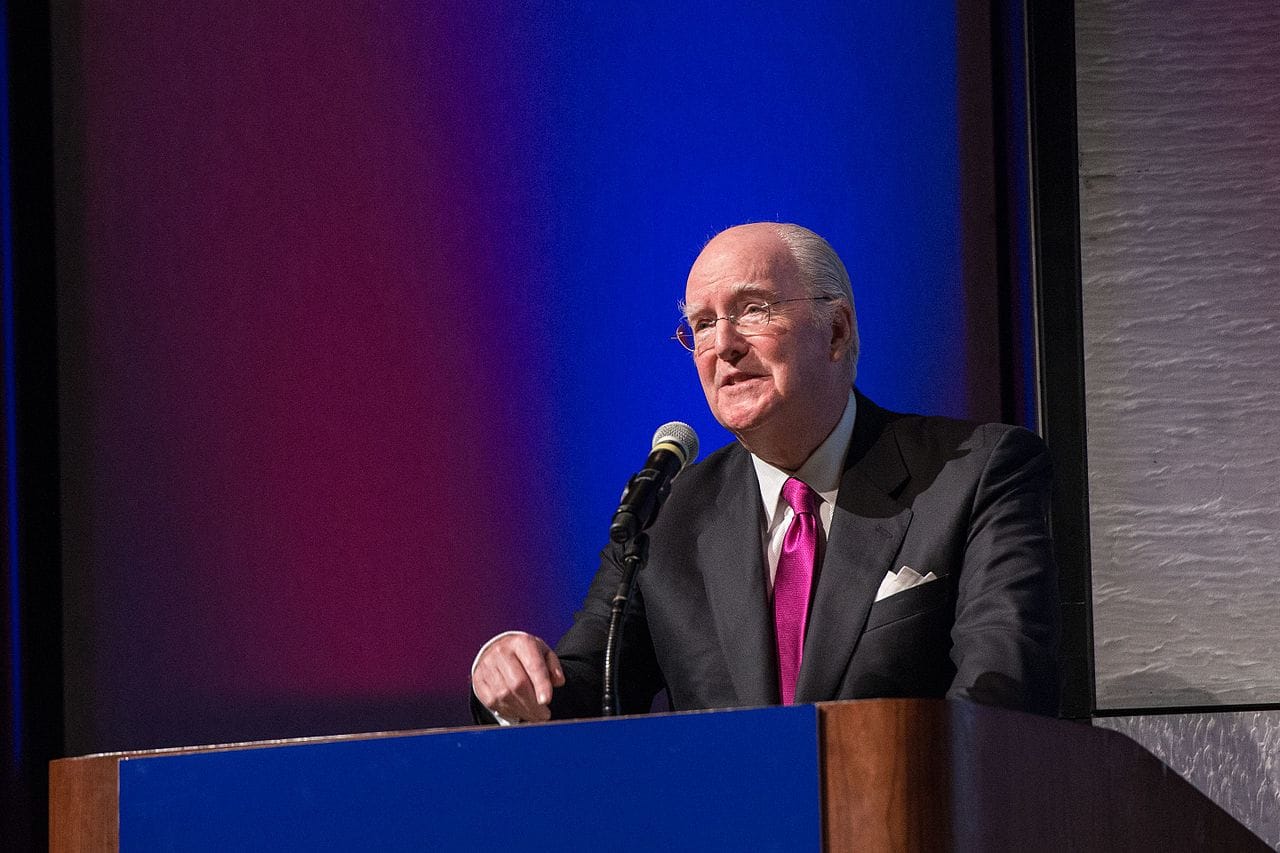
    Clark “Sandy” T. Randt photographed on March 31, 2015 speaking at the China-US Private Investment Summit at the LBJ Presidential Library. Image credit: Lauren Gerson / CC BY 2.0

    Amidst this backdrop of Chinese disappointment, George W. Bush was elected the 43rd president of the United States in November 2000. His election was challenged by his opponent Al Gore, touching off a three-week battle that was eventually settled by the Supreme Court.

    George W. Bush’s father was George H. W. Bush. The senior Bush served as the second US envoy to Beijing, serving as the head of the US Liaison Office (USLO) in Beijing between 1974 to 1975. He went on to become the 41st president of the United States. George W. Bush and his sister spent time in Beijing while his father was head of the USLO; he became familiar with the country and its senior officials long before he became president.
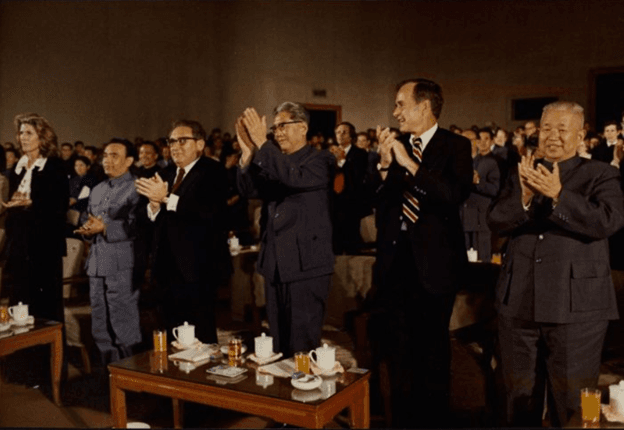
    George H.W.Bush (second from right) with US Secretary of State Kissinger, Chinese Foreign Minister Qiao Guanhua, Director of the Liaison Office of the People’s Republic of China in the United States Huang Zhen, during Kissinger’s visit to China, 1975. Image credit: George H.W. Bush Presidential Library & Museum

    George W. Bush took office in January 2001. Not long afterwards, he nominated his friend and classmate Clark (Sandy) Randt as the US Ambassador to Beijing. He was confirmed by the Senate in July 2001 and sworn in by Deputy Secretary of State Richard Armitage. I was honored to attend his swearing in. He presented his credentials in Beijing on July 28, 2001.

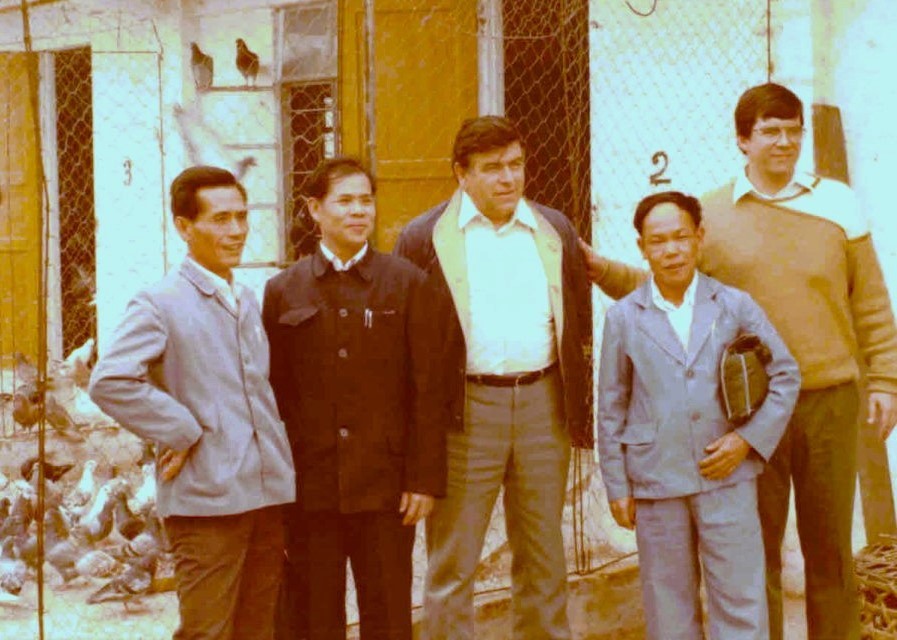
    Sandy Randt had spent 18 years in Hong Kong. He was an attorney, a recognized expert in Chinese law, and a keen observer of developments in China. He had served as a commercial attaché and First Secretary at the US embassy in Beijing from 1982 to 1984. He was also an officer of the American Chamber of Commerce (AmCham) while I was president of the chamber. Our friendship predated his time as an AmCham officer by several decades. We were, and remain, close friends, as were our families. Our children grew up together. Our friendship proved to be decisive for my human rights work in China.

    Sandy Randt, who was to become the longest serving US ambassador to China, spoke excellent Chinese, but may not have been as fluent as other US ambassadors to the country, two of whom were born in China. Nor did he have the deep knowledge of the ins and outs of how US state and federal governments work as other ambassadors, two of whom served in the Senate and two of whom were elected governors. Nor was he as well versed in matters of national security as other US ambassadors, one of whom had served in the CIA.

    Yet Sandy Randt proved to be more effective than any other ambassador who held the position since the countries normalized relations in 1979. He was able to pick up the phone and speak directly to the president of the United States without having to go through layers of bureaucrats. For this reason, he was respected and even feared by senior Chinese officials.

    Third Time Lucky

    A little over a month after George W. Bush was sworn in as president in 2001, China once again put in a bid to host an Olympics, this time for the 2008 Summer Games to be held in Beijing. Its application was considered by the Olympic Committee in July and was accepted on the third ballot. The Chinese government and the Chinese people were overjoyed.

    To win the right to host the 2008 Summer Olympics, the Chinese government made a number of commitments. It is said to have promised to stop parading offenders who were sentenced to death, and to stop executing them in public. It committed to an unprecedented degree of openness, allowing free access by media to different parts of the country and to its own citizens for unsupervised interviews, and to lifting the blocking of the websites of human rights groups.
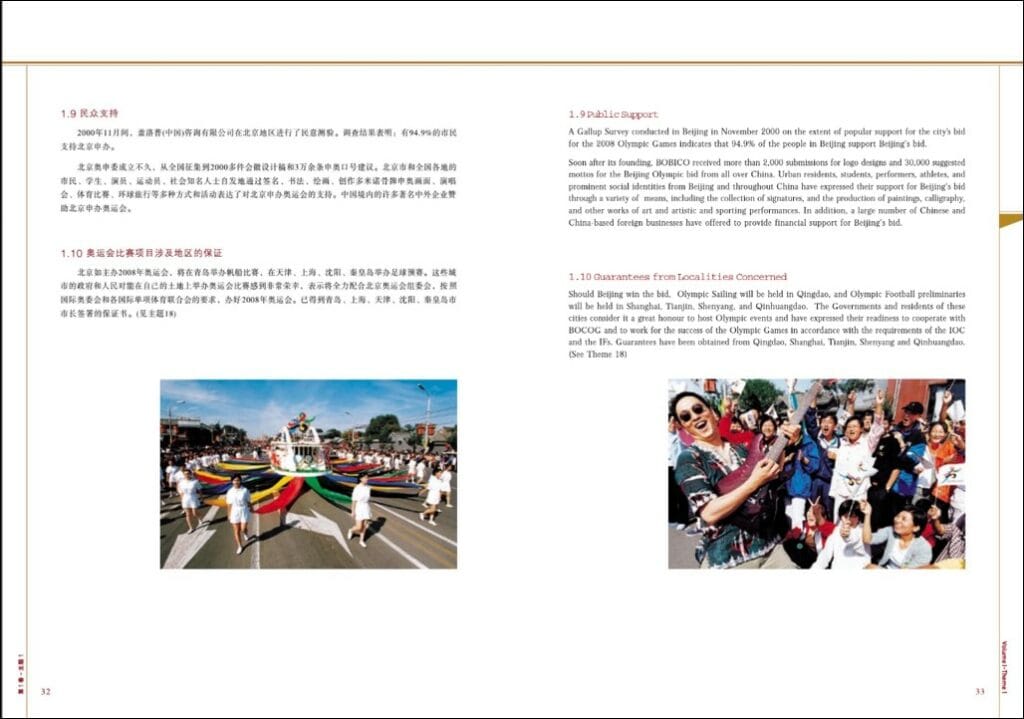
    A page spread from China’s candidature booklet for its bid to host the 2008 Olympics. The booklet was part of Beijing’s application submitted in 2001. Image credit: Issuu

    Beijing failed to live up to its promises. Parading of those condemned to death continued, as did public executions, albeit in parts of the country outside major urban areas. The websites of Amnesty International and Human Rights Watch were unblocked, but others continued to be blocked, including the website of Dui Hua. I protested to China’s Ministry of Foreign Affairs, to no avail.

    Tibet Erupts

    Tibet’s Ganden Monastery photographed in March 2008. Image credit: Christopher Johnson / CC BY-SA 2.0

    On March 10, 2008, five months before the Games were set to begin, protests broke out in Tibet and other Tibetan areas of the country. By the Chinese government’s count, demonstrations, some violent, occurred in 150 locations in Tibet and Tibetan areas of other provinces, from March 10 to March 25, 2008. Human rights groups’ estimates of the number of demonstrations that occurred after March 10 were much higher.

    Hundreds of people were killed by protesters and police. Thousands were arrested and thousands more remain unaccounted for. Buildings and critical infrastructure were destroyed. The Tibetan uprising prompted increased attention to China’s human rights in general, and political prisoners in particular.

    In response to the crisis, Dui Hua proposed an Olympics Special Pardon for political prisoners in a speech I delivered in Hong Kong on March 29, 2008. The foundation focused on two long-suffering groups: those still in jail for their participation in the June 4 protests, and counterrevolutionaries. Counterrevolution had been removed from the Criminal Law in 1997.
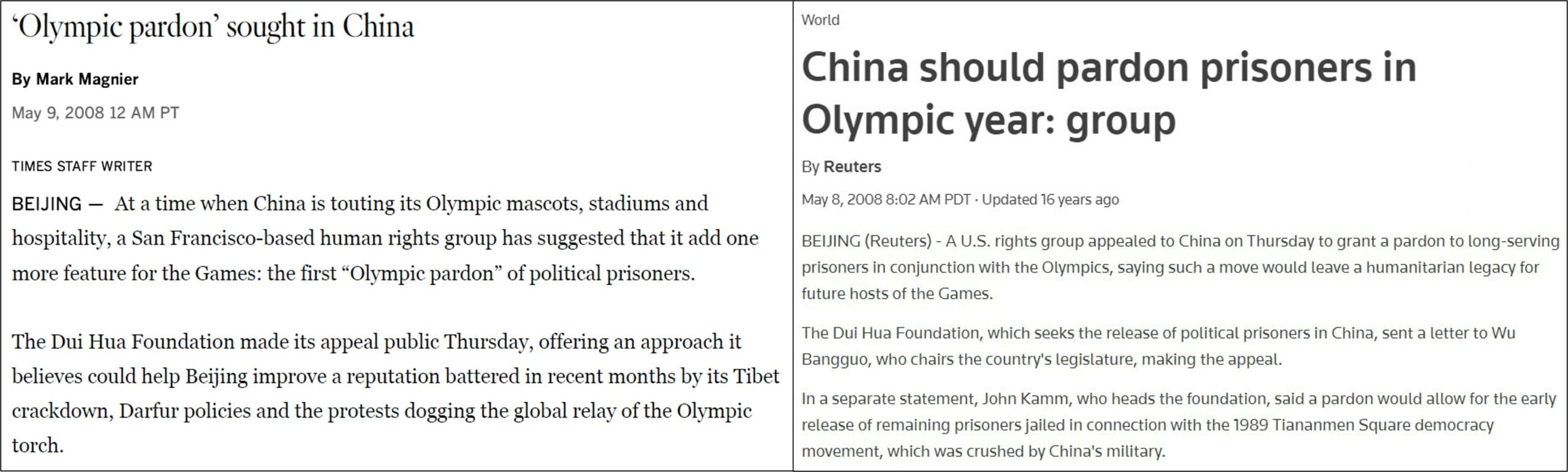
    Screenshots of reporting on Kamm’s appeal for pardons in the lead-up to the 2008 Olympics: the Los Angeles Times (left) and Reuters. Image credit: LA Times & Reuters / Fair Use

    Special pardons are provided for under Chinese law. Dui Hua followed up the Hong Kong speech with a letter to Wu Bangguo, chairman of the National People’s Congress (NPC), the body that grants special pardons.

    The proposal was received favorably by Chinese officials, relatives of Chinese prisoners, and foreign human rights groups. Unfortunately, the NPC failed to act, but several well-known prisoners were granted a measure of clemency, including the Hong Kong journalist Ching Cheong (程翔), who was released and allowed to return to Hong Kong, and American citizen Jude Shao, who was granted parole but forced to remain in China. Jude Shao had been visited by US Ambassador Randt in the Shanghai prison where he was incarcerated.

    Tragically, one Chinese citizen who should have received clemency did not. Wo Weihan (沃维汉), a member of the small Daur minority residing in Heilongjiang Province, was executed on November 28, 2008, for espionage. The charges against him were ludicrous and violated the policy of granting leniency to members of ethnic minorities. I had worked hard on his case, having gotten to know his daughters, both of whom are Austrian citizens. I denounced the execution in print and in face-to-face meetings with Chinese officials.

    Wo (center) at the wedding of his daughter Ran Chen (left). His other daughter, Di Chen, is to the right. Source: Ran Chen.

    In 2015 and 2019, President Xi Jinping proposed special pardons that the NPC went on to grant. In all, 47,000 prisoners were pardoned. Principal beneficiaries of the pardon were juveniles and elderly prisoners, two groups that Dui Hua’s advocacy work has focused on.

    I supported the decision to grant the 2008 games to China, though other commentators and human rights activists opposed. One journalist likened granting the games to Beijing to the decision to hold the 1936 games in Nazi Germany. The journalist criticized Dui Hua’s support for the Beijing Olympics. This was especially hurtful to me. Growing up, I knew Holocaust survivors, and my uncle had been an investigator at the Nuremburg trials of Nazi war criminals.

    Sichuan Earthquake

    On May 12, 2008 – three months before the Games were set to begin — a massive earthquake measuring 8.0 on the Richter scale struck Sichuan Province near the capital city of Chengdu. An estimated 90,000 people were killed, thousands more injured, and countless buildings destroyed. Journalists and all unessential personnel were ordered to leave Sichuan.

    Damage caused by the 2008 Sichuan earthquake on the road heading to Wenchuan, the quake’s epicenter, taken on May 14, 2008. Image credit: Miniwiki / Public Domain

    On June 10, 2008, activist Huang Qi (黄琦)was detained in Chengdu on suspicion of trafficking in state secrets related to his accusations of shoddy construction that resulted in the collapse of buildings after the earthquake. He was subsequently sentenced to three years in prison. Huang continued his activism after his release. He is currently serving a 12-year sentence for endangering state security, his third imprisonment.

    Ai Weiwei (艾未未), a famous artist who was a design consultant for the stunning National Stadium (colloquially known as the Bird’s Nest and built specifically for the Games), was impacted by the quake. In April 2011, he was detained at Beijing Airport and subsequently placed under residential surveillance in a designated location. Although Ai was later released on bail some 80 days later, he was confined to his Beijing home, akin to house arrest. He was accused of tax evasion. Many suspected that the real reason he was detained was his vocal support for victims of the Sichuan earthquake, many of them children, and the work of other activists.

    Beijing National Stadium, known as the Bird’s Nest. Image credit: Peter 23 / CC BY-SA 3.0

    The Bird’s Nest was rarely used after the Games, as were other structures erected for the occasion. They became White Elephants. No one knows how much China spent on the Games, but it was doubtless a large sum.

    As for Dui Hua, the impact of the quake was immediate. We had been planning our first juvenile justice exchange with Chinese judges to take place in the United States in June. I insisted that the program be postponed, and our Chinese partners eventually agreed. Instead, they arrived in October and visited courts, carceral facilities, and other sites in Chicago, Washington D.C., Maryland, and San Francisco. The program was a success. It opened the door to Dui Hua’s cooperation with China’s Supreme People’s Court in the field of juvenile justice, an important area of human rights.

    Before the earthquake related crackdowns, other human rights activists were being impacted by the Games. Hu Jia (胡佳), a prominent dissident sentenced to prison for criticizing the Chinese government’s failure to improve human rights before the Games, was sentenced to three and a half years in prison. He was serving the sentence while the Games took place. His wife at the time, Zeng Jinyan, had supported the proposal to grant an Olympics Special Pardon.

    Hu Jia was nominated for the 2008 Nobel Peace Prize. The Beijing Games were very much on the minds of those who put him forward. He was the odds-on favorite to be chosen as the 2008 laureate, but in the end the Nobel Committee chose someone else. Two years later, Liu Xiaobo (刘晓波) became the first Chinese to be chosen by the committee for the peace prize. Liu died in 2017 because of poor treatment while serving his sentence.

    Torch Run

    In keeping with tradition, an Olympic torch relay began in Greece, and ended in the city where the games would be held, in 2008, Beijing. The torch passed through six continents and covered 85,000 miles before arriving in Beijing. The relay lasted 129 days and is the longest distance covered of the modem games.

    The relay was marred by protests over Tibet and human rights abuses, which disrupted the relay in London and Paris. Violence occurred in Nepal, home to a large Tibetan population.
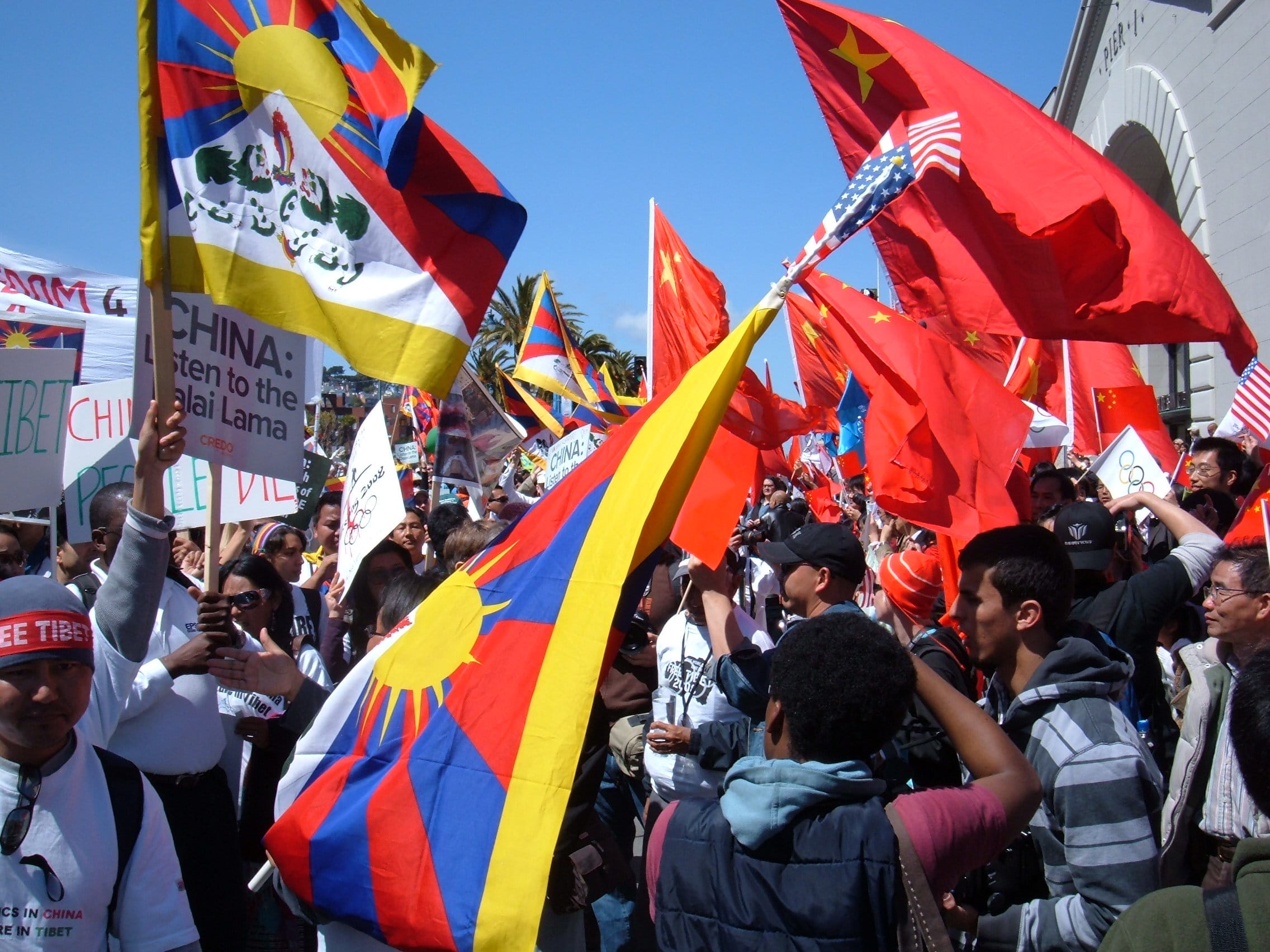
    A group of pro-Tibetan protesters confront pro-Chinese protesters near Pier 1 during the 2008 torch run in San Francisco. Image credit: Broken Sphere / CC BY-SA 3.0

    China learned lessons from these protests. I was in San Francisco when the relay took place and witnessed changes. With the help of the San Francisco Police Department, the route was changed to the outskirts of the city. The Chinese consulate arranged for counter protesters from the Bay Area’s large ethnic Chinese community to show up. Buses filled with students were laid on. The result of this effort was film footage used in a propaganda film to give the impression that Americans enthusiastically welcomed the torch relay, and by extension, the holding of the Games in Beijing.

    The Games Begin

    Shortly after the torch arrived in Beijing, the opening ceremony was held with a stunning display of fireworks and music.

    President Bush had been urged by European leaders to join them in boycotting the opening ceremony on account of China’s human rights record. Bush declined to do so and wound up attending the opening ceremony. He stuck to the position that politics and sports should not be mixed.

    While in Beijing, President George W. Bush presided over the opening of the new US embassy in Beijing with Sandy Randt. He was joined by his father, mother, and Henry Kissinger.

    On August 8, 2008, President George W. Bush is greeted by US Ambassador Sandy Randt at the US Embassy in Beijing. Former President George H.W. Bush is behind them. Image credit: Eric Draper / White House photo

    The day after the glittering opening ceremony, tragedy struck. A US citizen, the father of an Olympian who played on the 2004 volleyball team, was knifed to death on the Drum Tower. His guide was also murdered, and the Olympian’s mother was badly injured trying to protect her husband. Their assailant jumped to his death from the Drum Tower, sparing him from execution.

    Results of the Games
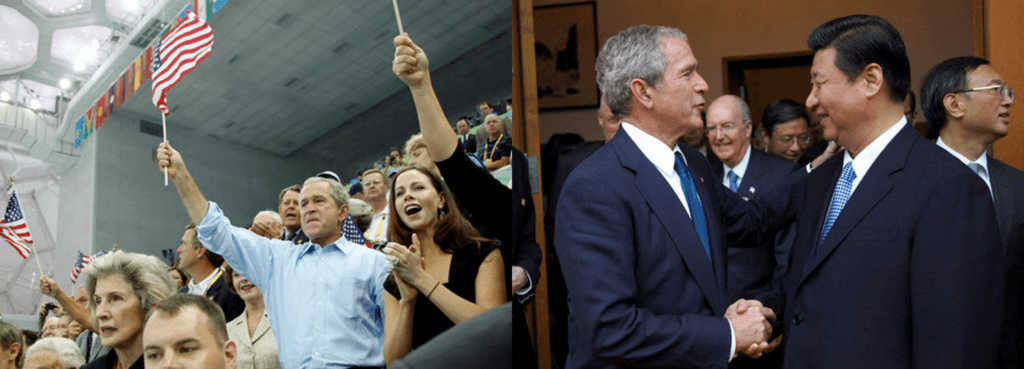
    (Left) US President George W. Bush, Laura Bush and daughter Barbara Bush cheer on US swimmer Michael Phelps at the 400-Meter Individual Medley event in Beijing on August 10, 2008; (right) President Bush is greeted by Chinese Vice President Xi Jinping during his visit to Zhongnanhai, the Chinese leadership compound in Beijing on August 10, 2008. Image credit: Eric Draper / White House photo

    China won the most gold medals at the 2008 Summer Olympics, and the United States won the most medals overall. But the games did little to improve China’s international image thanks largely to its brutal crackdown in Tibet, its detentions of Chinese citizens for the peaceful expression of their views, and its failure to honor commitments to greater openness and more restraints on capital punishment.

    The success of the games did not help Chinese President Hu Jintao’s reputation either. He left office in 2012, widely seen as a weak leader. He was humiliated at the closing session of the National People’s Congress in October 2023 when documents were snatched from his hands, and he was denied the opportunity to speak. He was led off the stage a broken old man. He reappeared at the funeral of Jiang Zemin in December 2023 but has not been seen in public since.


    Listen to the Encounters with China podcast.

    Subscribe to receive notifications about new episodes. 

    Read all John Kamm Remembers stories.

  • Curious Timing: SPC Death Penalty Reviews Posted after Universal Periodic Review (Part I)

    Curious Timing: SPC Death Penalty Reviews Posted after Universal Periodic Review (Part I)

    This Human Rights Journal entry is the first in a two-part series that explores the Supreme People’s Court’s recent disclosures of death penalty decisions made shortly after its human rights review in Geneva in January 2024. This post, Part I, looks at the demographics of those sentenced to death as well as trends in types of crime and decision review times. Part II explores reasons for disapprovals, the presence of counsel, and inconsistencies in the disclosures.  

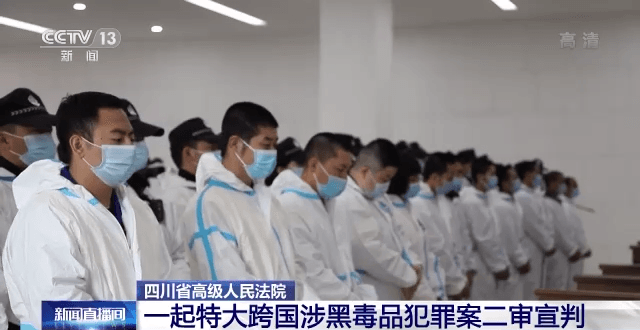
    The Sichuan High People’s Court upheld the judgments for a case of organized crime group and drug trafficking with 12 defendants in June 2022. Three principal defendants were sentenced to death. Image credit: Sichuan High People’s Court, CCTV13

    Three years after a large number of judgments and judicial decisions involving the use of the death penalty were removed from China Judgements Online (CJO) in 2021, the Supreme People’s Court (SPC) added a new batch of death penalty review decisions in February 2024. The posting of these death penalty reviews occurred one month after China’s human rights record was reviewed by the United Nations Human Rights Council’s Universal Periodic Review (UPR) in January 2024.

    CJO & Review Decisions

    The posting of judgments and judicial decisions on CJO began in 2013. The effort to boost transparency was applauded by legal scholars and professionals inside and outside of the country. CJO judgments and decisions were not confined to ordinary civil and criminal cases, but also cases considered to be sensitive. Hundreds of endangering state security (ESS) cases and thousands of cult-related cases were made available on CJO.

    Significant media attention from Western countries and NGOs like Dui Hua may have contributed to the Chinese government’s decision to purge documents related to ESS and cult cases in July 2021. Around the same time, CJO also removed SPC review decisions on the application of the death penalty.
    Death penalty review decisions re-surfaced on CJO in 2022. In July 2022, Dui Hua found that decisions taken offline a year ago had been reuploaded to CJO. However, CJO did not post new information until the submission of China’s report at the country’s fourth UPR in January 2024. The new information came from a batch of 86 newly uploaded review decisions issued from 2022 to 2023 concerning 93 individuals. Dui Hua also found that decisions originally posted in July 2022 had been reposted, with CJO showing December 1, 2022 as the new posting date.
    At the time of publication, CJO has not published any new death penalty reviews after March 2024. Also noteworthy is that seven months into 2024 no review decisions issued within the year 2024 have been published. This article reviews the batch of death penalty documents posted in February 2024. While the documents present some insights into an increasingly opaque system, there are omissions and inconsistencies that raise questions about the timing of the documents’ release.
    Source: CJO
    China’s trial system follows a two-hearing system in the trial process. The SPC’s decisions on the first- and second-hearing cases are final and must be enforced once promulgated. Cases that may result in a death penalty are first tried by an intermediate people’s court, and appellate trials are conducted by the relevant high people’s court. If the sentence is upheld, the judgment is submitted to the SPC for review. In death penalty cases, appeal is not an automatic process. In the batch of judgments examined in this post, all but one of the 93 convicted filed for appeal. All appeals were rejected by the high courts before they were submitted to the SPC for final review.
     
    Demographics of Those Sentenced to Death 
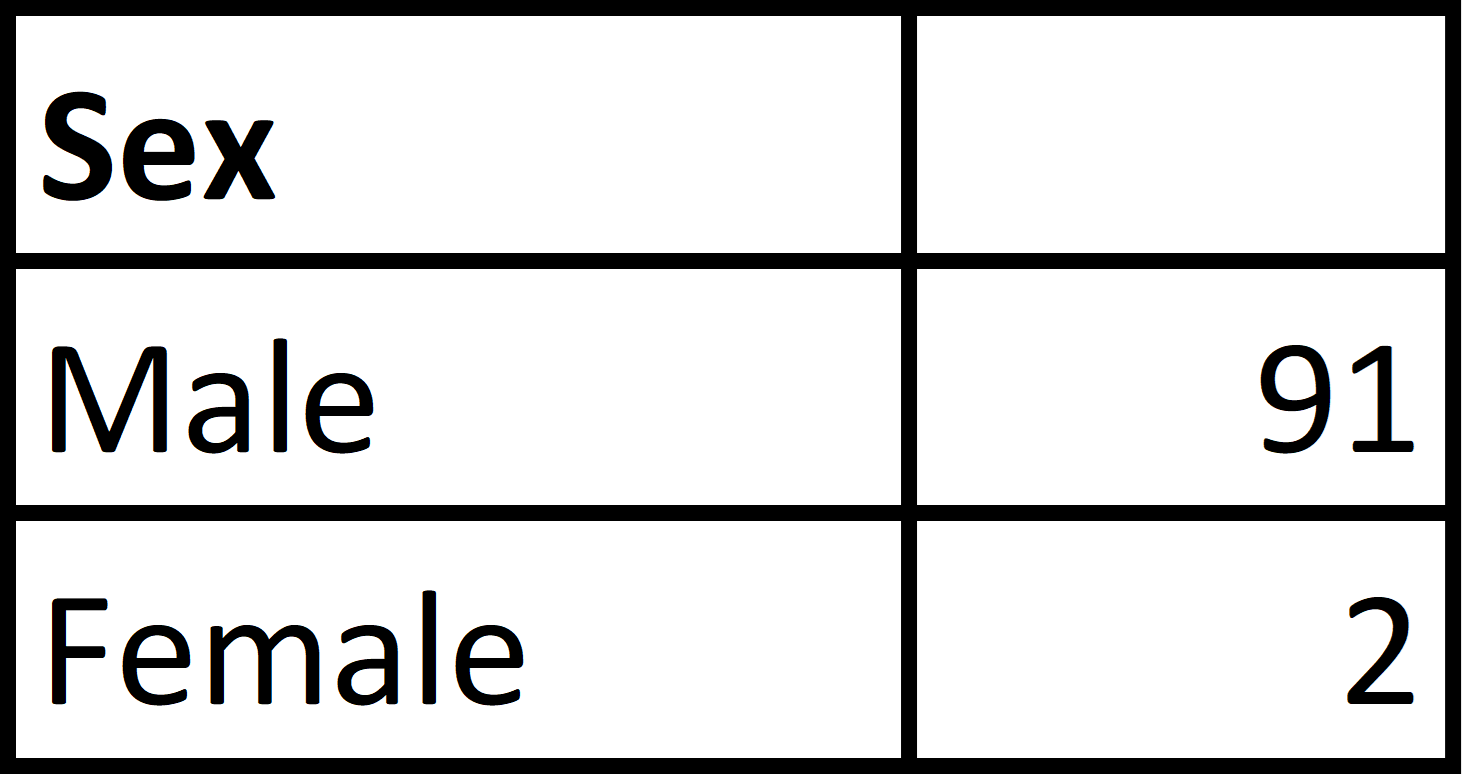
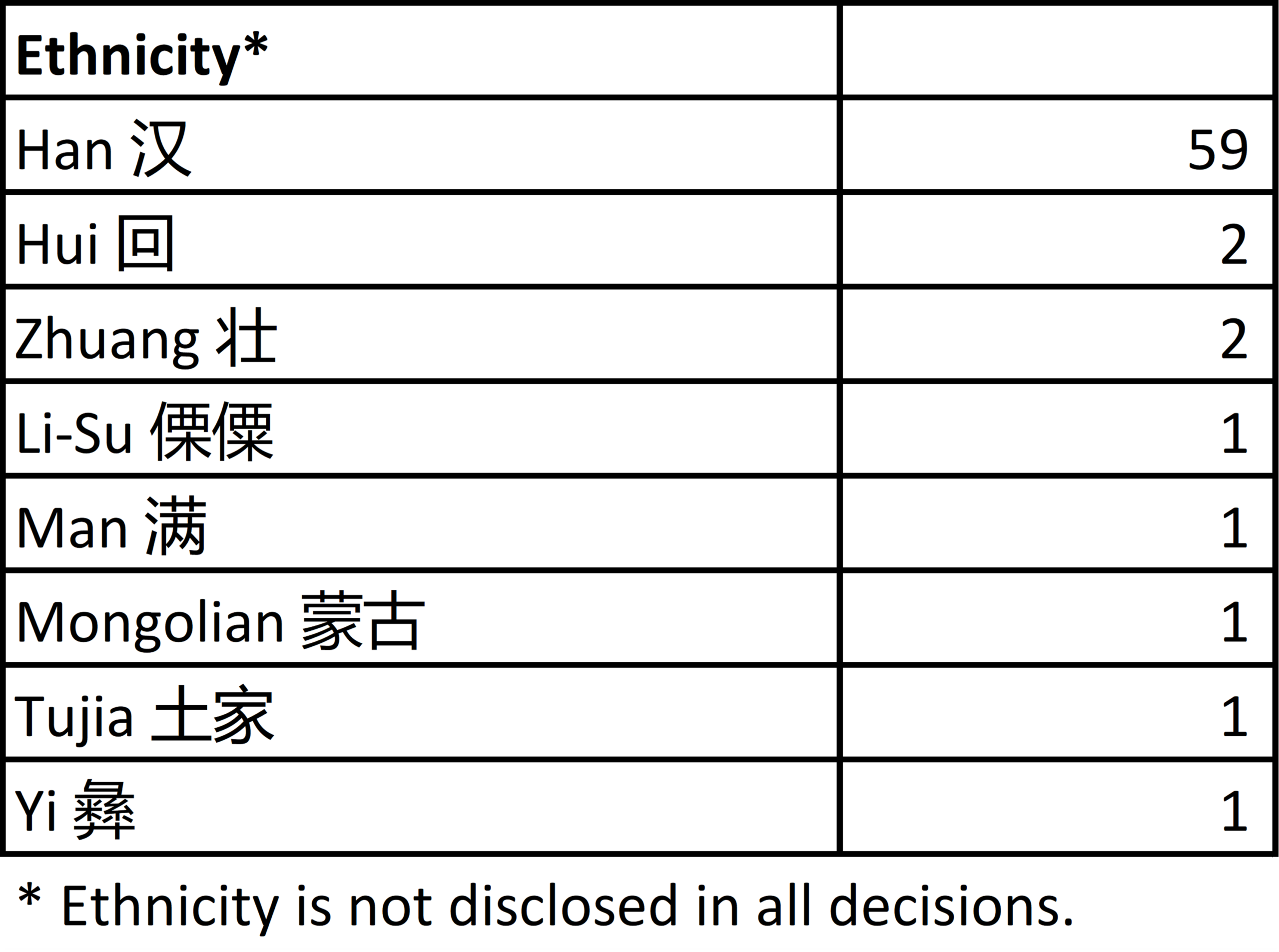
    Individuals in death penalty cases are mostly male and of Han ethnicity (see below). Notably absent from the newly posted death penalty reviews are cases involving Uyghurs, who are often accused of terrorism and ESS crimes, both of which carry the maximum penalty of death.
    Another group for whom no information was given is foreign nationals, despite such executions being reported during the period. For example, in 2023, the Chinese government executed a South Korean citizen who was convicted of drug trafficking.
    Table 1. Sex of those sentenced
    Table 2. Ethnicity of those sentenced
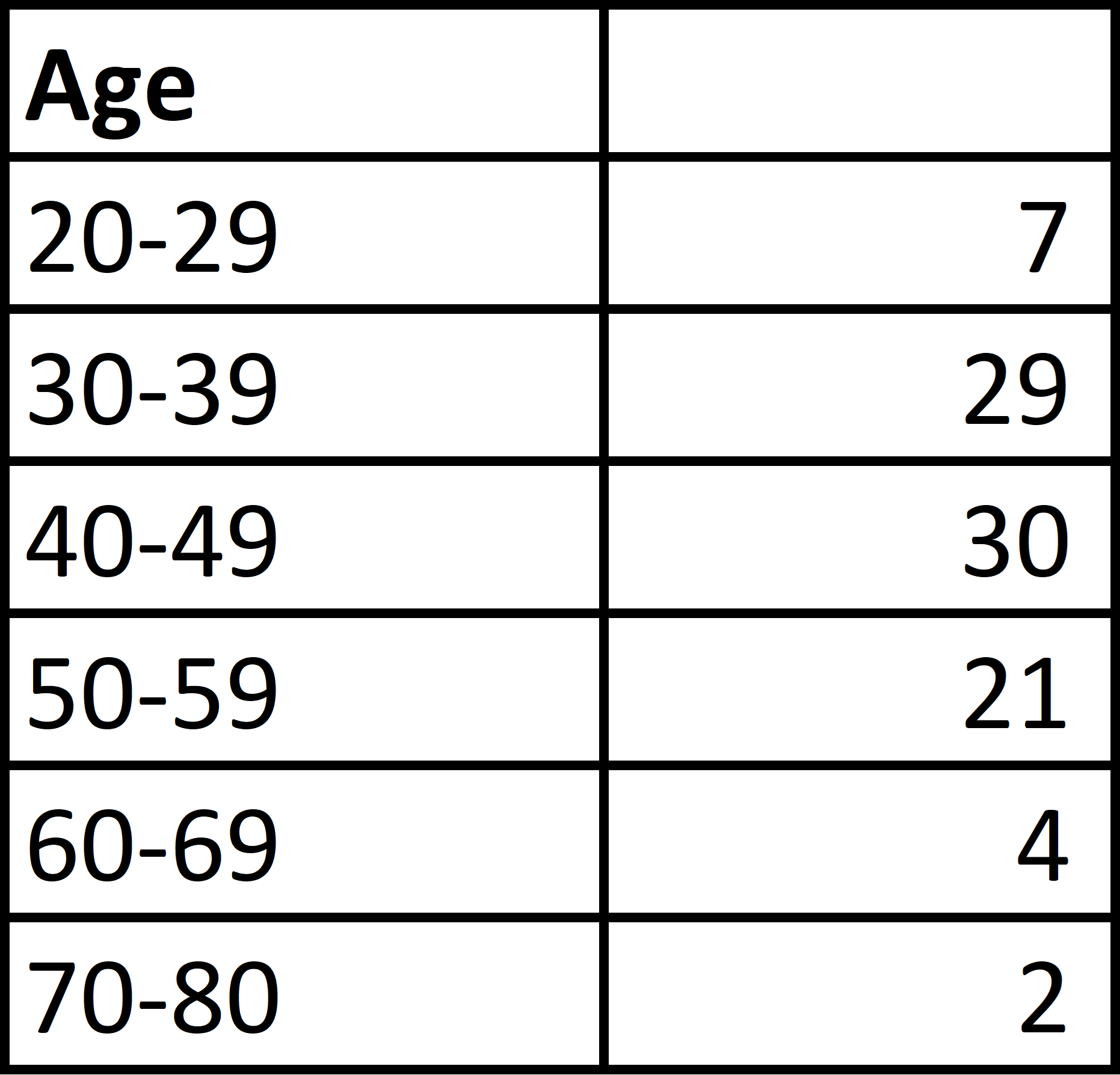
    The majority of individuals sentenced to death are aged between 30 to 59.
    Table 3. Age of those sentenced
    While the Criminal Law stipulates lighter punishments for elderly offenders, two individuals over 70 years old were given death sentences. The SPC approved the sentence for a man from Changchun who committed robbery. That man was 69 years old at the time of the crime, and the SPC took 268 days to complete the review.
    The SPC disapproved the death sentence for another man who murdered his neighbor on the grounds that the crime started as a civil dispute between two neighbors. Additionally, the offender surrendered to police. The case was sent back for retrial at the Jilin High People’s Court. The offender, an ethnic Mongolian, was 68 years old at the time of the crime. The SPC took 798 days to complete the review.
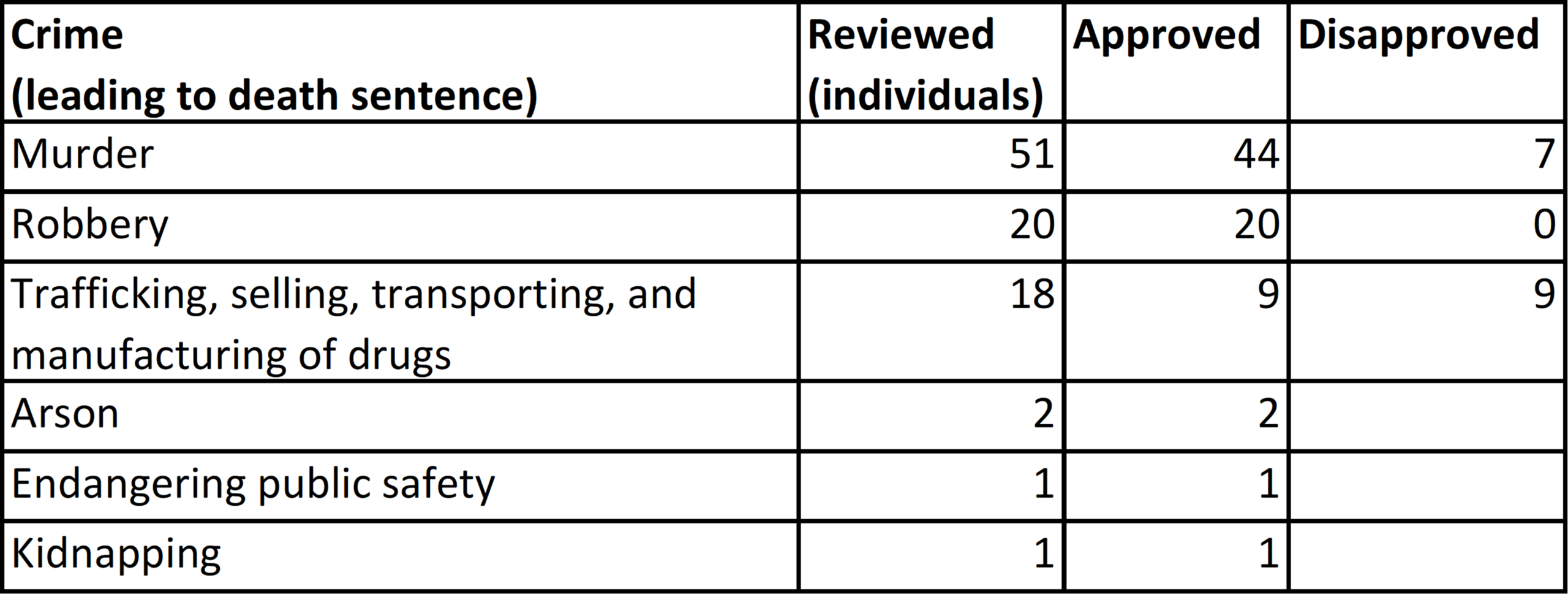
    In all, the SPC approved 77 death sentences and disapproved 16 of them.
    Crime
    The death penalty in China is typically invoked when the offender commits a violent crime resulting in the death of the victim. In the new batch of decisions, murder accounted for more than half of those sentenced while robbery made up a fifth of the documents. Drug-related crimes—trafficking, selling, transporting, and manufacturing—accounted for another fifth of those sentenced.
    When an individual was convicted of multiple crimes, the court typically applied the sentence of death to the crime considered to be the most severe. Life or fixed-term sentences were applied to the other crimes.

    Table 4. Crime type

    Dui Hua keeps track of the number of executions in China. The crimes committed in death penalty cases are similar to what we see in CJO. Of the 153 executions recorded by Dui Hua in 2023, 94 were of individuals convicted of murder, 13 of robbery, and 29 of drug crimes. In 2022, Dui Hua recorded 120 executions: 61 for murder, 11 for robbery, and 42 for drug crimes.
    Review Time 
    Review time refers to the number of days between the final high court trial and the SPC review decision. In instances where no appeal is filed, the first-instance trial is considered the final trial.
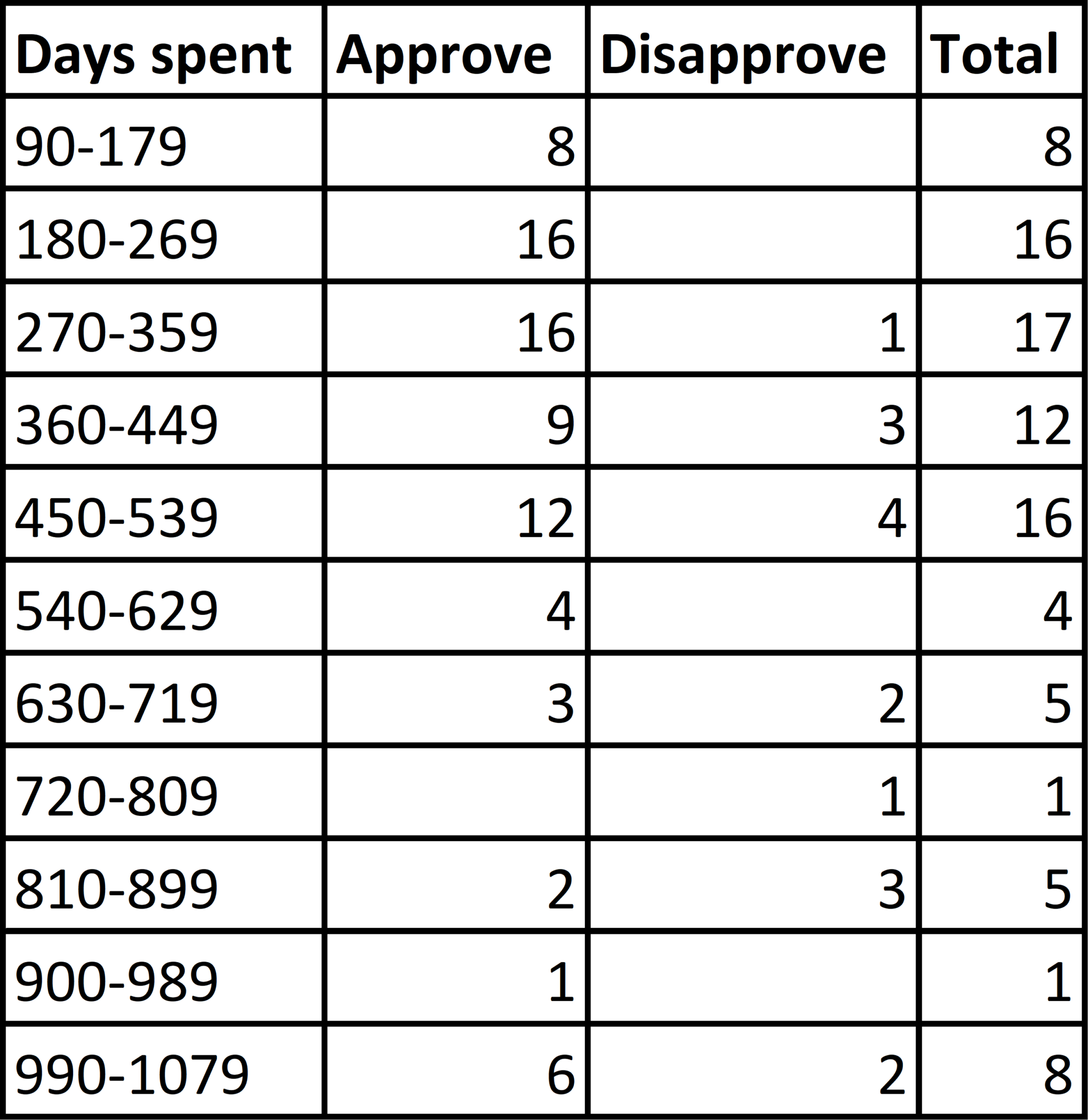
    In May 2020, Dui Hua examined a sample of 261 review decisions issued between 2015 and 2019 and made observations on the length of time between trial and the review decision. The SPC took an average of 190 days to issue a decision after the final trial by the court of second instance, with a median of 169 days. The longest review time was 573 days while the shortest was 20 days.
    In the newly published death penalty reviews, the SPC took an average of 461 days to issue the decisions, with a median of 390 days. The lengthiest review concerns a drug manufacturing case with five offenders. All of them were first-time offenders who manufactured hundreds of kilos of methamphetamine. The first-instance trial was concluded in Changde, Hunan, on January 25, 2019. The high court upheld the sentences on December 27, 2019. All five had been convicted of manufacturing drugs and had been sentenced to death by the lower courts. The SPC completed its review 1,079 days (almost three years) on November 28, 2022. In its decision, the SPC approved the death sentences for three of them and disapproved the sentences for two. One of the disapproved sentences was revised to death with two-year reprieve and the other was revised to a life sentence.
    The shortest SPC review took 93 days. The case involved drug trafficking, in which the convict was a recidivist who has been sentenced twice to short prison sentences for selling drugs. In his latest trial, Mr. Xiao was convicted of organizing and funding the trafficking of a large quantity of drugs obtained in Yunnan. He was sentenced to death by an intermediate court at the first-instance trial on February 15, 2022. The sentence was upheld by the high court on July 28, 2022. On October 29 of the same year, the SPC completed the review and approved the death sentence.
    Table 5. Review time
    Given the small (and selective) sample size, it is difficult to conclude with certainty that longer review times would necessarily result in disapproval. That said, the probability of disapproval rises when the Court takes longer to review. On the surface, the SPC appears to be more judicious. More reviews took a year or longer to complete compared to those completed within nine months.  

    Read Part II

  • Curious Timing: Disapprovals & Presence of Counsel in SPC Death Penalty Reviews (Part II)

    Curious Timing: Disapprovals & Presence of Counsel in SPC Death Penalty Reviews (Part II)

    This Human Rights Journal entry is the second in a two-part series that explores the Supreme
    People’s Court’s recent disclosures of death penalty decisions, which were
    made following China’s human rights review in Geneva in January 2024.
    Part I
    explored the demographics of those sentenced to death as well as trends in
    types of crime and decision review times. This entry, Part II, looks at why
    some decisions were disapproved, the presence of counsel during rulings, and
    inconsistencies in the information provided by the
    disclosures.  

    The Sichuan High People’s Court upheld the judgments for a case of
    organized crime group and drug trafficking with 12 defendants in June
    2022. Three principal defendants were sentenced to death. Image
    credit: Sichuan High People’s Court, CCTV13

    Disapprovals & Reasons for

    This batch of death penalty reviews included 16 disapprovals (individuals).
    Prior to this, Dui Hua had only learned of four disapprovals from 2018 to
    2021 from CJO. Few disapprovals were recorded when the judgment
    website was still posting review decisions.
    In this batch, the SPC disapproved the death sentences for seven individuals
    convicted of murder and for nine people convicted of drug crimes. The SPC
    only issued four revised sentences along with the disapproval decisions in
    the new batch. The rest were sent back to provincial high courts to be
    retried. Of the SPC-revised sentences, three were resentenced to death with
    two-year reprieve and one was given a life sentence.
    In the reviews for the seven murder cases, one recurring reason for
    disapproval was that the defendant made amends to the victims’ families
    and/or received forgiveness by the families. “Receiving forgiveness”
    typically means that the defendant made monetary compensation to the
    victim’s family. Of the seven cases, five defendants made compensation
    and/or received forgiveness, but the exact amounts were not disclosed.
    There were two other disapproval reviews. One was the aforementioned case in
    which the SPC acknowledged as mitigating factors: the murder occurred during
    a civil dispute and the defendant had voluntarily surrendered. The other
    case involved two defendants, during which the SPC considered the younger
    male defendant to be an accessory offender to the female defendant in the
    killing. The SPC approved the execution of the female defendant and decided
    that the male defendant should not be executed immediately. Both of their
    death sentences were disapproved and sent back to the high court for
    retrial.
    For the nine drug crime convictions, the common reason for disapproval was
    that the SPC determined that the defendants were accessories to the crime.
    This was cited as one of the main reasons for disapproval in the reviews of
    seven defendants.
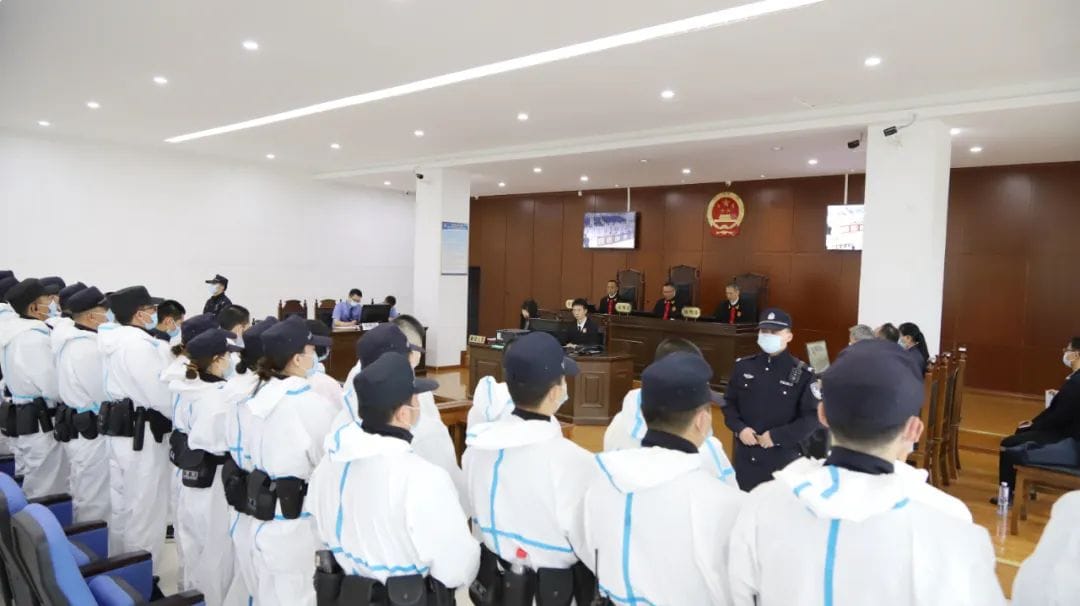
    A court room in Jiangsu Province. Image credit: Wikimedia Commons 
    In reviews for the other two defendants of drug cases, the SPC agreed with
    the lower courts that the defendants were the main offenders and had
    committed serious crimes (involving large quantities of drugs). However, the
    SPC still considered the defendants’ voluntary surrender and expressions of
    remorse as mitigating factors. Both cases were sent back to the Guangdong
    High Court for retrial.
    The SPC doesn’t seem to factor in the defendant’s age when considering
    whether or not to approve the death sentence. This batch of reviews suggests
    that the SPC has a higher threshold for accepting voluntary surrender as a
    reason for leniency. In reviewing the death penalty, the SPC often disputed
    whether the surrender itself was truly voluntary or if it occurred too long
    after the crime.
    Presence of Defense Counsel During Review 
    China passed the Legal Aid Law in August 2021, which expanded the scope for
    providing legal aid during the death penalty review process. The law went
    into effect on January 1, 2022. Prior to this, the convicted had to
    retain their own counsel during the final review.

    Although the sample size is small, Dui Hua sees the impact of the new law
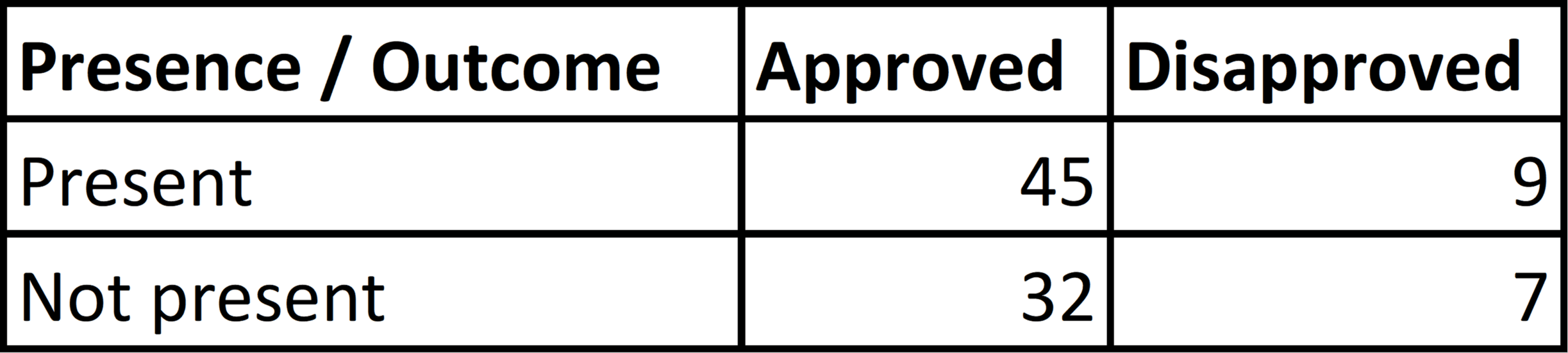
    reflected in the decisions. For the 93 convicted, 54 individuals had legal
    counsel during the review process while 39 did not.

    Of those with legal counsel, the decisions revealed that 40 individuals
    had requested legal aid and that they received counsel in accordance with
    the law. Twelve individuals or their families retained their own counsel.
    Legal counsel was present at two reviews, but the decisions did not
    disclose details. This can be seen as a positive development insofar as
    the defendant’s due process rights are concerned. The possibility of
    having legal counsel present during the review process was made known to
    those under review and many accepted legal assistance.

    The documents do not disclose the reasons why individuals did not have
    legal representation during the review. This omission raises questions as
    to whether the individuals were aware of the opportunity or if they
    refused legal assistance.

    Table 6. Presence of counsel & review time
     
    If there was an impact on review time due to the presence of counsel, the
    result is not obvious. Their presence did not seem to significantly prolong
    the review process when compared to cases without counsel.
    Table 7. Presence of counsel & outcome


    The presence (or absence) of a counsel did not appear to have an impact on the
    outcome of the SPC review. The SPC seems to have based its decisions on
    evidence (findings presented by the procuratorate and the lower courts), the
    seriousness of the crime, its social impact, and the role played by the
    offenders. Also taken into account are the mitigating factors discussed above,
    mainly expressions of remorse and obtaining forgiveness from the victim’s
    family.
    Inconsistencies & Omissions
    Considering the importance of a review decision on the application of the
    death penalty by China’s highest court, there are important omissions in
    several documents.
    • The details of legal counsel were not disclosed in the decisions.
    • The ethnicity of 25 individuals, more than a quarter of the batch, were
      also omitted in the decisions.
    The new batch of documents also seems to break with past releases. Only one
    decision included the full name of the convicted, Lao Rongzhi (劳荣枝). Lao
    was accused of having been involved in several kidnappings and murders from
    1997 to 1999 and had been on the run for 20 years before she was apprehended
    in November 2019 in Xiamen, Fujian. Her case was sensationalized on social
    media. The SPC took slightly more than a year to complete the review. She
    was executed on December 18, 2023, in Nanchang, eight days after the SPC’s
    approval.
    Lao Rongzhi, at the Zhejiang High People’s Court for the appeal trial.
    The judgment was upheld by the court in November 2022. Image credit:
    Supreme People’s Procuratorate 

    All other documents did not disclose the full names of the convicted. A
    possible reason for obscuring the names might be to protect the victims’
    privacy, especially in cases where the victims were underage. However, even
    the SPC itself does not always follow this reasoning. In May 2023, to
    highlight the country’s determination to protect the rights of juveniles, the
    SPC announced in a news release that it had approved the executions of three
    individuals accused of serious assaults against underage girls. The SPC’s news
    release disclosed the full names and some details of the crimes. And even
    though the three cases were categorized as case study examples for crimes
    against juveniles, the full review decisions for the approvals were not
    released.

    In 2021, the SPC established the Office of Juvenile Trial Work with
    the purpose of protecting the rights of the child, such as by
    implementing trial procedures for juvenile defendants and
    strengthening punishments for crimes against juveniles. Image
    credit:
    chinacourt.org

    Curious Timing

    The timing of the release of this new batch of decisions is interesting. The
    first post date was almost immediately after the submission of China’s UPR
    in January 2024. Dui Hua,
    in its submission as an NGO with special consultative status, highlighted issues such as judicial transparency in death penalty review
    decisions. Other states parties and NGOs also highlighted the death penalty
    in China. In its response to UPR recommendations, China rejected 17
    recommendations from other countries concerning its use of the death
    penalty. Of these, 14 recommendations – almost all of them from European
    nations – called on China to enact a moratorium on the use of the death
    penalty or abolish it outright. Three recommendations urged China to
    restrict the number of crimes punishable by death and to stop applying it to
    non-violent crimes.
    Chen Xu (front, center), permanent representative of China to
    the UN office at Geneva, attends China’s UPR on January 26, 2024.
    Image credit: UNWebTVUNWebTV
    Issues surrounding the death penalty in China have long been a focus of UPRs.
    China is believed to be the world’s leading executioner, and the opacity with
    which it conducts executions was a recurring issue in the most recent review.
    The UN High Commissioner for Human Rights has repeatedly called for a
    moratorium on the executions, particularly executions in non-violent drug
    cases. The brief resumption of posting death penalty review decisions might be
    a reaction to these criticisms. The selected reviews give the impression that
    China’s judicial system is more deliberative and judicious, not simply a
    rubber stamp for decisions reached by lower courts as is often assumed. If
    these disclosures were an attempt to anticipate and mitigate such concerns,
    the omission of decisions on Uyghurs and Tibetans undermines confidence in the
    disclosures.
    A possible reason for the timing of the release is to showcase review time
    lengths and the Court’s efforts to arrive at fair, cautious decisions. These
    features refute criticisms that the SPC, and China’s justice system in
    general, simply validate rulings in cases that have already been decided.
    Additionally, even though the presence of legal counsel seemingly does not
    influence review times or outcomes, the provision of legal counsel during the
    review can nonetheless be seen as an indication that “due process” is
    respected throughout China’s judicial system.
    The launch of CJO in 2013 raised hopes about judicial transparency and
    legal reform in China. In its submission to China’s 2018 UPR, Dui Hua
    applauded this step and other measures that strengthened judicial
    transparency. Conversely, Dui Hua’s 2024 UPR submission detailed how the
    steady retreat from transparency has undermined the achievements that so many
    practitioners had applauded a decade ago.
    In the spirit of promoting judicial transparency, the Chinese government
    should be encouraged to continue releasing judgments, even for sensitive cases
    that can draw criticism and controversy, including cases involving the death
    penalty. A court’s willingness to explain itself can also build trust in a
    legal system that still remains partially in the shadows.
  • Li Yan: Life Sentence Commuted, 25-Year Sentence Reduced

    SAN FRANCISCO (JULY 2, 2024) – Information posted on the websites of Sichuan judicial authorities provides an update on Li Yan (李彦), a Sichuan woman and victim of domestic abuse who was convicted of murdering her abusive husband in 2010. She was subsequently sentenced to death, a decision that was reversed by the Supreme People’s Court (SPC). The SPC ordered the Sichuan High People’s Court to conduct a retrial, which resulted in a sentence of death with two-year reprieve.

    In consequential decisions, the Sichuan High Court commuted Li’s death penalty with two-year reprieve sentence to a life sentence in 2017. Then, in March 2021, the court commuted her life sentence to a 25-year fixed-term sentence with nine years’ deprivation of political rights.

    Below is Dui Hua’s translation of the recommendation for sentence reduction submitted to the Chengdu Intermediate People’s Court on July 17, 2023, by the Sichuan Women’s Prison, where Li is currently being held. Two months later, the Chengdu Intermediate People’s Court approved a seven-month sentence reduction for Li. This marks the first act of clemency Li received since her sentence was commuted from a life sentence to a fixed–term sentence.

    The women’s prison determined that Li had displayed good behavior, showed remorse, and engaged in labor and ideological reform. Moreover, the prison noted that Li had paid the financial compensation ordered in the accompanying civil lawsuit. Courts often view paying compensation to victims and their families as evidence that the prisoner has accepted criminal responsibility.

    Li, now 53, is scheduled for release on August 18, 2045, when she will be 74 years old. It is possible, if not likely, that she will be granted more sentence reductions.

    Dui Hua learned of the clemency given to Li a decade after hosting a 2014 international symposium which brought together Chinese and international expert presenters in Hong Kong to discuss women in prison and the Bangkok Rules. At the time, Li’s case was the subject of intense domestic and international interest. More than 400 Chinese lawyers and legal scholars had signed a letter to the Supreme People’s Court pleading for Li’s life to be spared. International human rights organizations, including Dui Hua, also urged clemency.

    For questions, please contact The Dui Hua Foundation.


    (Translated by The Dui Hua Foundation)

    SICHUAN WOMEN’S PRISON

    SUBMISSION FOR SENTENCE REDUCTION SUGGESTION

    (2023) Sichuan Women’s Prison Criminal Penalty Change No. 482

    Prisoner Li Yan, female, born February 3, 1971, Han ethnicity, middle-school education; occupation prior to arrest: worker; original residence: Anyue County, Sichuan; currently incarcerated in Ward Six of the Sichuan Women’s Prison.

    [Li] was convicted for murder and sentenced by the Sichuan Province Ziyang Intermediate People’s Court on August 24, 2011, in the criminal judgment (2011) Ziyang First Instance Criminal Trial No. 27 with a supplemental civil litigation decision. Li was sentenced to death with a deprivation of political rights for life and obligated to pay compensation of 58,212 yuan to the plaintiff of civil lawsuit.

    Defendant Li Yan appealed the judgment. The Sichuan High People’s Court on February 27, 2015 issued criminal judgment (2014) Sichuan Final Instance Criminal Trial No. 411 and revoked the first decision of the Ziyang Intermediate People’s Court criminal judgment (2011) Ziyang First Instance Criminal Trial No. 27, namely, the defendant Li Yan was convicted of murder and sentenced to death with deprivation of political rights for life; [the High Court] convicted Li Yan of murder and sentenced [her] to death with reprieve of two years, with deprivation of political rights for life. The period of reprieve lasted from April 24, 2015, to April 23, 2017.

    [Li] was admitted to this prison on August 14, 2015.

    Penalty changes during incarceration: the Sichuan High People’s Court issued the (2017) Sichuan Criminal Penalty Change Decision No. 509 on September 8, 2017, commuting [Li’s sentence] to life imprisonment; the Sichuan High People’s Court issued (2021) Sichuan Criminal Penalty Change Decision No. 156 on March 19, 2021, commuted [Li’s sentence] to a fixed term imprisonment of twenty-five years with deprivation of political rights for nine years, sentence after commutation to expire on March 18, 2046.

    The said prisoner has demonstrated repentance during serving the sentence. Specific facts are as follows:

    1. In respect to ideological understanding: under the education by the prison wardens, the prisoner admits and repents her crime, deeply understands the crime she committed violated the personal rights of the victim, and [she] is determined to act as a law-abiding person for the rest of [her] life.
    2. In respect to observing and obeying regulations and rules: she was able to earnestly study “Prisoner Behavior Standards” and “Rules for Twenty Strictly Forbidden Acts by Prisoners,” able to observe and obey prison regulations and rules in general, abide by administration, and accept education and reform.
    3. In respect of education: [Li] vigorously participated in the courses of ideology, education, and work skills organized by the prison.
    4. In respect of reform through labor: the said prisoner was able to vigorously learn work procedures, and able to complete work assignments.

    Moreover, [Li] has fulfilled the obligation of compensating the plaintiff in the supplemental civil litigation decision, for a total of 58,212 yuan.

    During the current evaluation period, prisoner Li Yan has received seven commendations. The assessment concludes that [Li] has demonstrated repentance.

    In sum, prisoner Li Yan admitted and repented her crime, observed and obeyed regulations and rules, observed and obeyed prison regulations and rules in general, accepted education and reform, participated in ideology, education, and work skills learning, participated in labor and completed work assignments, and has demonstrated repentance while incarcerated. The said prisoner is a criminal sentenced for murder to death with reprieve of two years, and was severely punished in accordance with the law.

    Therefore, in accordance with the provisions of Article 29 of the Prison Law, Article 78 of the Criminal Law, and Article 273(2) of the Criminal Procedure Law of the People’s Republic of China, [the prison] recommends granting prisoner Li Yan a sentence reduction of seven months while her nine-year deprivation of political rights remains unchanged. Hereby submitting for decision.


    [TO] Sichuan Chengdu Intermediate People’s Court

    Sichuan Women’s Prison

    July 17, 2023


  • Dragon Years: Remembrance of Times Past (2000)

    Dragon Years: Remembrance of Times Past (2000)

    JKR: Encounters with China | S01E10 June 26, 2024

    It’s the Year of the Metal Dragon, a new millennium, and Dui Hua’s debut as an official NGO. John Kamm and China trade pioneer-turned-Dui Hua board member Bill Simon find themselves trying to explain the Supreme Court’s Bush v. Gore decision to a confused Chinese audience. This episode of Dragon Years: Remembrance of Times Past journeys to 2000 for a discussion of how China has changed and how it has stayed the same.

    Kamm and Simon discuss their time in the Middle Kingdom during Dui Hua’s first year. Their discussion traverses the 1990s, dips back into 1988, and explores how the events of Tiananmen and the MFN trade policy have shaped this century so far. The duo reflects on their work with Dui Hua and what US officials got wrong about increased trade with China while finding reasons to be optimistic for the future of US-China relations.

    Related for this episode:

    Listen to the latest episodes of JKR: Encounters with China


    You can listen to our podcast on our website and RSS.com or on your favorite app. You can find us on Apple Podcasts, Spotify, Amazon Music, YouTube, or any podcast directory. Search for “JKR: Encounters with China.”

  • Bai Li

    Bai Li

    << Read all John Kamm Remembers stories

    Download this story as a PDF

    Listen to Dragon Years: 2000 podcast episode.

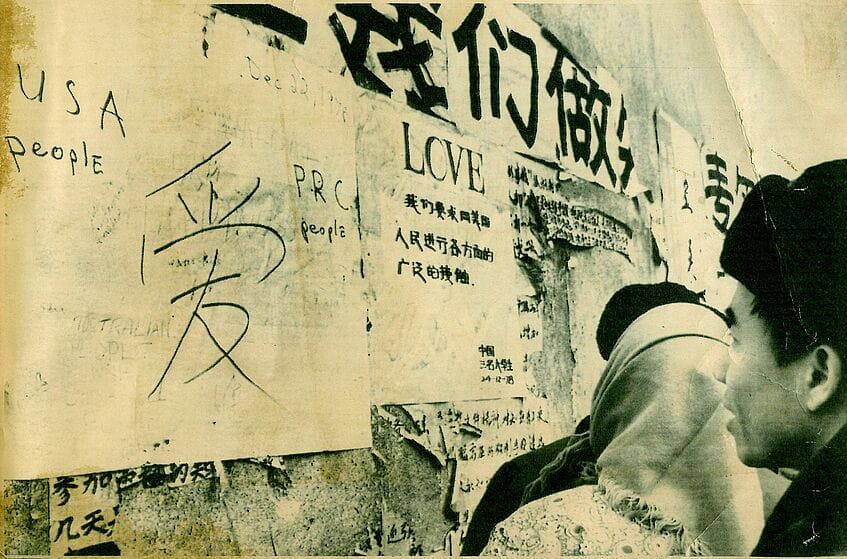
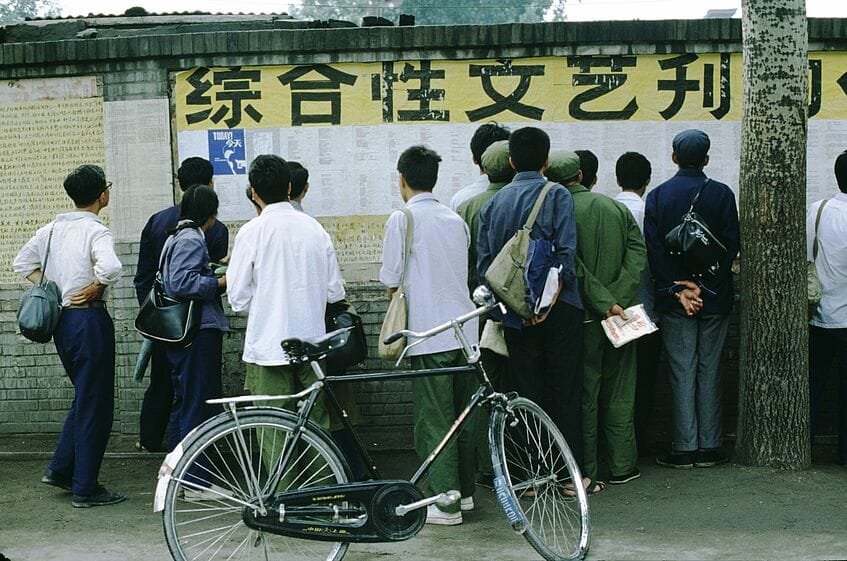
    A poster on the Xidan Democracy Wall extolling “Love between China and the US.” Image credit: University of Vienna Department of East Asian Studies

    A

     s my tenure as President of the American Chamber of Commerce in Hong Kong (AmCham) drew to a close in 1990, I began speaking out on Hong Kong issues and political prisoners in China. In remarks delivered to the Australian Chamber of Commerce in Hong Kong, I called for the release of prisoners detained during the June 1989 protests in Beijing. In a speech to the National Committee on US-China Relations in New York in December, I called for legislation to protect the people of Hong Kong as well as US interests in the colony.

    In attendance at the Australian Chamber event was an AmCham staff member. She quickly told the incoming leadership what I had said. Retribution was swift. I was no longer invited to American consulate briefings and meetings with visiting members of Congress, many of whom I got to know during my trips to Washington between 1990 and 1992, when I testified six times before committees of the House of Representatives and Senate.

    In 1991, my successor as AmCham leader sent me a letter on AmCham stationary asking me to make sure the press did not mention my tenure as chamber president when writing about me. In the letter, he claimed that a big AmCham member was threatening to leave the body unless the press stopped mentioning my leadership when reporting on my human rights work. (He also offered the services of his public relations firm.) At the AmCham dinner to kick off 1991, he refused to say my name or acknowledge my work on a raft of issues I had dealt with on behalf of the business community, a snub that did not go unnoticed by Hong Kong officials in attendance. Not all AmCham directors supported what my successor did, but several backed him up.

    “Pay Me with Information on Prisoners”

    Unlike the American business community and other hostile businesspeople, Chinese officials were friendly. In January 1991, a party official based in Guangzhou came to see me in Hong Kong. This meeting led to a visit to Guangzhou in March during which I handed over my first list of ten prisoners, individuals detained during the Democracy Wall movement and the June 4, 1989 protests.

    People read the fourth edition of the journal Jintian (Today) displayed on the Xidan Wall shortly after the edition was published on June 20, 1979. Image credit: University of Vienna Department of East Asian Studies

    In April I was invited to come to the office of the Xinhua News Agency in Wanchai. Xinhua acted as the de facto Chinese embassy in the colony. Upon arrival I was ushered into a room where two officials in charge of economic and trade matters were awaiting. After thanking me for my work on Most Favored Nation (MFN), one of them, Mr. Wang made me an unusual offer.

    “Would you like to do some business with China?” he asked. “We can grant you exclusive agencies for products much in demand in Hong Kong, including silk.” Agencies oversee distributors and as such do very little work. In effect, all they do is collect commissions. I was being offered a sweetheart deal to compensate me for my work on MFN.

    I politely rebuffed the official. I cautioned them that the threat to MFN was not over and was likely to come up again for years to come. “I want to invest in the issue. If you want to pay me, pay me with information on prisoners,” I said.

    They were taken aback by my response. “Who do you have in mind?” I brought up the name of an activist detained after June 4. Mr. Wang jotted down his name.

    Not long afterwards, I received a fax with information on the activist, sent from a Beijing number that I did not recognize. This turned out to be an office under the State Council Information Office (SCIO) whose leaders would come to be known, collectively, by the pseudonym Bai Li.

    Bai Li

    Bai Li was a principal source of information on prisoners from April 1991 to April 1995. Bai Li was by no means the only source of information. I also received information on prisoners from the Ministry of Justice (MOJ), the Ministry of Public Security (MPS), the Supreme People’s Court, the Supreme People’s Procuratorate, and the Religious Affairs Bureau, but Bai Li was, on balance, the most important source of information on Chinese political prisoners during those four years.

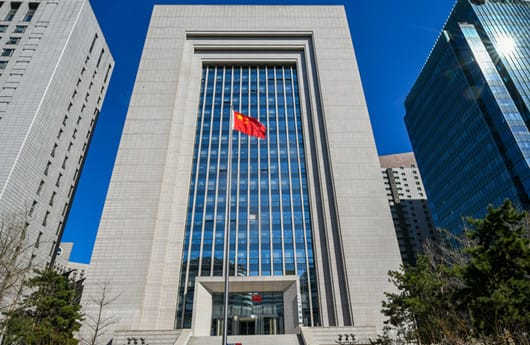
    The Ministry of Justice Building in Beijing. Image credit: Ministry of Justice, Beijing

    In all, the Bai Li channel provided information on more than 100 Chinese prisoners, most of whom were serving sentences for counterrevolution, a crime removed from the Criminal Law in 1997. Many of those prisoners were released early from prison after my intervention.

    Information from Bai Li was conveyed by fax to my office in Hong Kong or handed over in person at Bai Li’s office, a run-down structure on the outskirts of Beijing with furniture held together by masking tape. Initially, meetings with Bai Li were arranged by my host in Beijing, the China Council for the Promotion of International Trade (CCPIT). Eventually, I was able to set up the meetings directly by myself, by fax or phone.

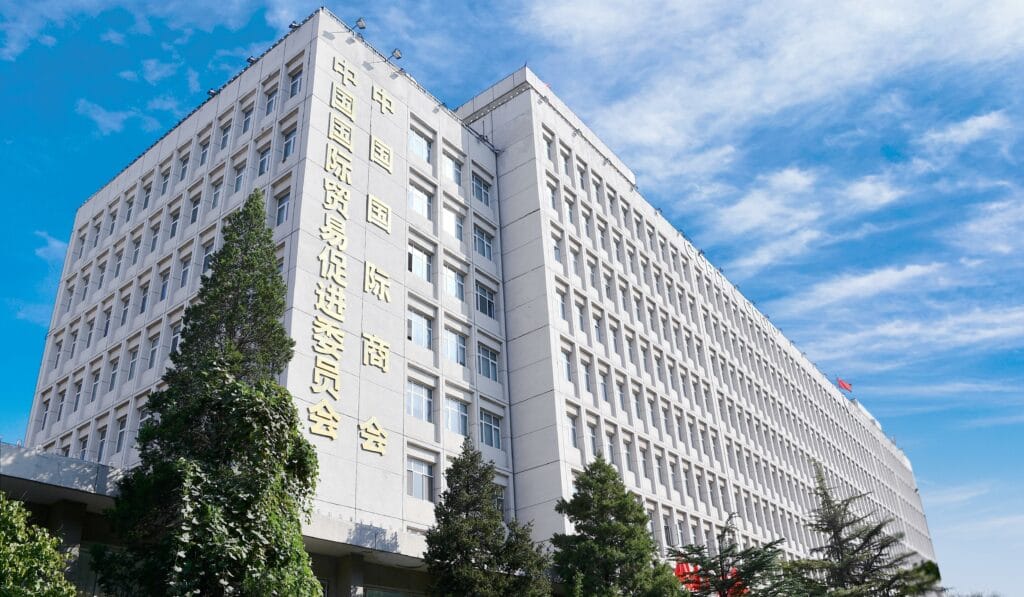
    The CCPIT building in Beijing in 2021. Image credit: CCPIT

    Which Prisoners Would Make a Difference?

    On one occasion, I hosted a banquet for SCIO and other ministries at a Beijing hotel. Officials of both the justice ministry and the public security ministry were in attendance, a rare occurrence as there was bad blood between the two entities. (MPS used to oversee all prisons in China but in 1980 prisons were put under the administration of MOJ, with one exception, the notorious Qincheng Prison in Beijing.)

    At the banquet in Beijing, I was asked which prisoners, if released, would make a difference in Washington. I replied that the release of Catholic clergy would make a difference, pointing out that 40 percent of members of Congress were Catholics. Soon thereafter, Catholic bishops and other clergy began to be released.

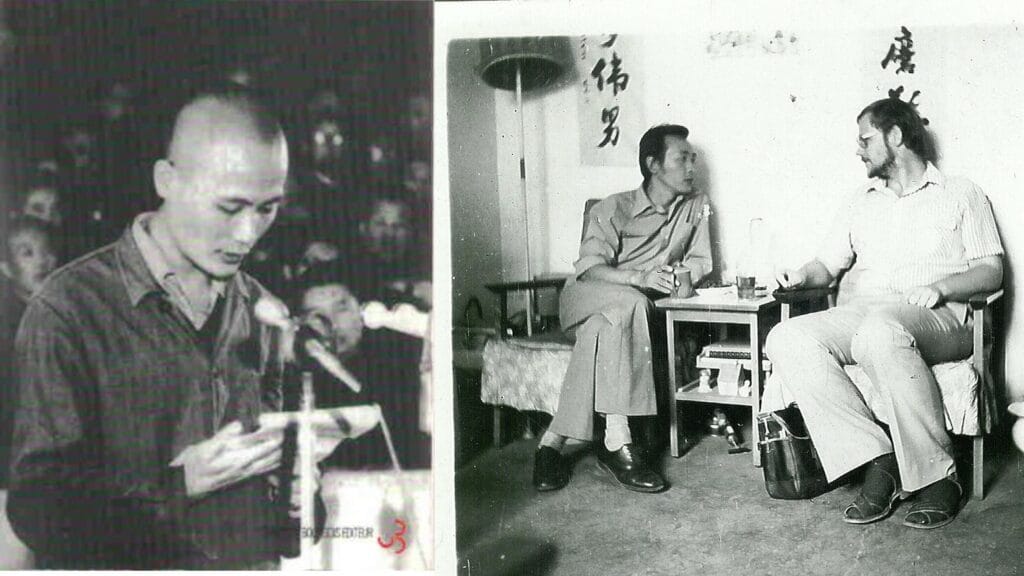
    (Left) Wei Jingsheng at the Beijing Intermediate People’s Court on October 17, 1979, as shown on the French-language cover of The Fifth Modernization. (Right) Xu Wenli interviewed by Helmut Opletal on June 23, 1979. Image credits: Abe Books; Vienna University

    On another occasion, I was sitting in the back seat of a car with Bai Li. He was pleased with the result of the Catholic releases and asked who else should be released. I replied that no Democracy Wall prisoners, a group that emerged in the late 1970s that included Wei Jingsheng (魏京生) and Xu Wenli (徐文立), had ever been released early from prison. Releases began in 1992.

    Information from Bai Li: A Sampling

    June 4th Prisoners in Qingdao

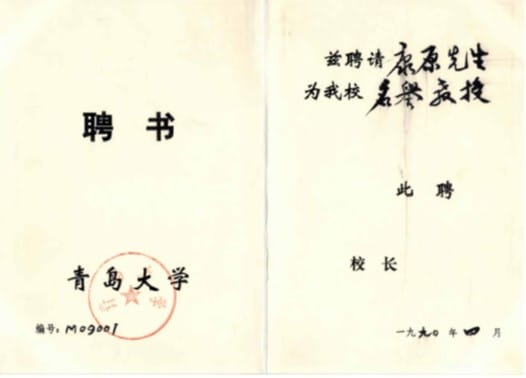
    Kamm appointed honorary professor by the Qingdao University in April 1990. Image credit: Dui Hua

    In 1990 and 1991, I made three business trips to Qingdao, a port city in Shandong Province with deep ties to the United States. (Jimmy Carter was based at the US navy base in Qingdao during World War II.) On one of the visits, I spoke to the students and faculty of Qingdao University, where I was made an honorary professor. During a later visit, I spoke to a faculty member and asked her to help a political prisoner, whose family she knew.

    Qingdao University in the 1990s, with the library under construction. Image credit: Eric Walter via Qindaonese.com

    Shandong Province courts gave the longest prison sentences to June 4 prisoners, and they had done so sooner than courts in any other province. Two protesters were reportedly executed in Jinan, capital of Shandong Province. Two of the longest sentences were given to two young men who were sent to Shandong Number Three Prison in Weifang to serve their 18-year sentences. In those days, political prisoners in Shandong were sent to Shandong Number Three Prison where they were all housed in the same cell block.

    I continued to advocate for the Shandong prisoners in my meetings and correspondence with the Chinese government in the 1990s, including in 1999, the year I set up Dui Hua. In March 1999 I visited Qingdao on business and met with the local branch of the CCPIT, later rebranded as the Qingdao International Chamber of Commerce. I was asked to be their honorary advisor, but I was reluctant to do so. I mentioned that Shandong was known for giving long sentences to June 4 protesters. They asked me for some names, and I handed over a list. In my oral presentation, I focused on six protesters on the list who had been detained in Qingdao following the June 1989 protests. All were released before their sentences expired.

    Early in my work, I learned from a good source that one of Qingdao prisoners had neither appealed the judgment to the Shandong High People’s Court nor filed a petition for a retrial with China’s Supreme People’s Court. Bai Li encouraged me to suggest to the family that a petition be filed with the Supreme People’s Court. Eventually, a family member did so. The prisoner was released several years before his sentence expired.

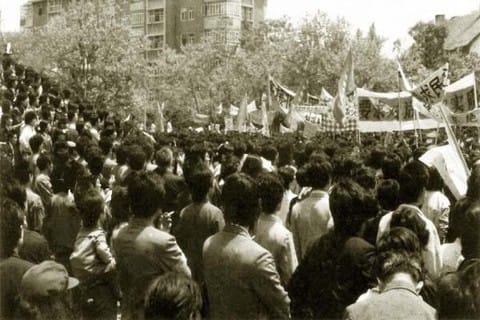
    Student protesters gather at the Qingdao Municipal Government Building, Shandong Province, in June 1989. Image credit: duping.net

    I was given the news of a Shandong prisoner’s release at the end of a visit to Beijing Prison in Daxing Municipality in May 2000. An official from the MOJ who had accompanied me on the visit told me “I have some good news for you,” she said. “The prisoner you care about has just been released.” She was excited and happy to tell me this news.

    People of Faith: Catholic Clergy

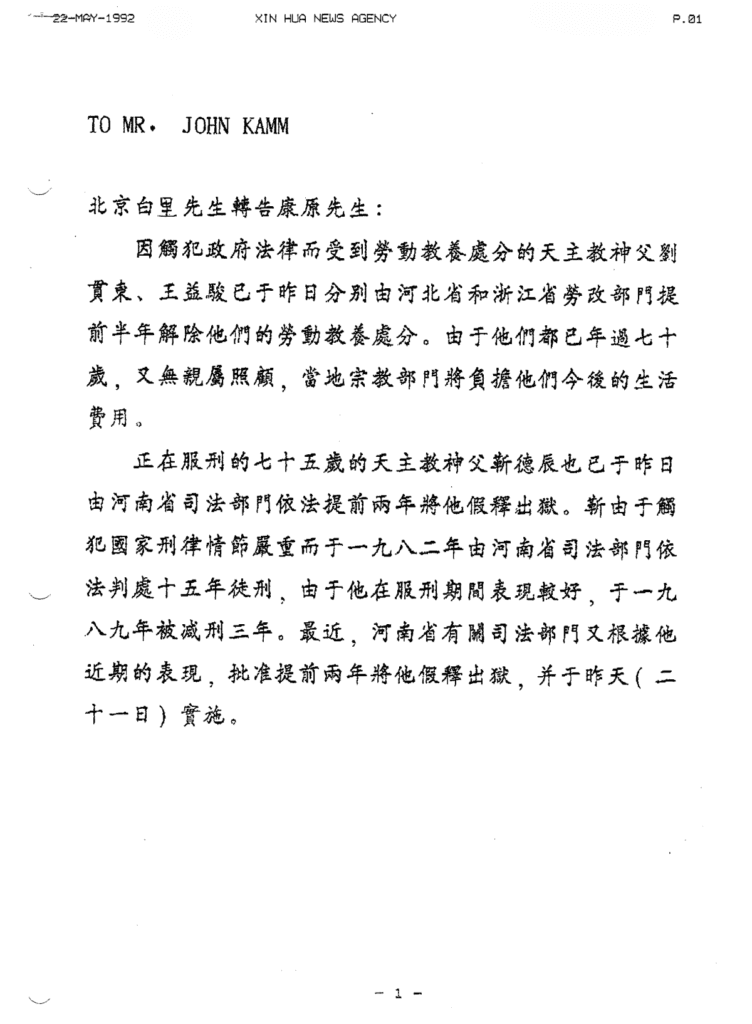
    Not long after the banquet in Beijing at which I pushed for the release elderly Catholic clergy, I submitted lists of priests to the Religious Affairs Bureau and the SCIO. On May 26, 1992, I received a fax from Bai Li addressed to my Chinese name Kang Yuan (康原). It was one of the earliest messages from Bai Li and contained information on three priests: Hebei Bishop Peter Liu Guandong (刘冠东), Henan Vicar General Joseph Jin Dechen (靳德辰), and Zhejiang monsignor Francesco Wang Yijun (王益骏). Liu was the elected head of the Chinese Bishops Congress and as such was the leader of the underground Catholic Church in China. Wang Yijun, like Liu Guandong, had spent decades in Chinese prisons for practicing his faith.

    TO MR. JOHN KAMM

    Relayed communiqué from Mr. Bai Li of Beijing to Mr. Kang Yuan:

    Catholic priests Liu Guandong and Wang Yijun, who were sentenced to Reeducation through Labor (RTL) for violating the law, had their punishments lifted yesterday by the Hebei and Zhejiang Provincial RTL organs, respectively, a half a year early. Because they are both more than 70 years old and have no close relatives to care for them, the local religious affairs organs will be responsible for their daily living expenses.

    The Catholic priest Jin Decheng, who is seventy-five years old and has been serving a sentence in prison, was paroled yesterday by the Henan Provincial Justice Bureau two years early, in accordance with the law. Jin was sentenced by the Henan judicial organ in 1982 to fifteen years of imprisonment for serious violation of the law. Due to good behavior during incarceration, he was granted a sentence reduction of three years in 1989. Recently, based on his behavior, the relevant judicial organ in Henan approved granting him parole, two years before expiration of the sentence. The parole took effect yesterday (on the 21st of the month).

    A response from Bai Li from 1992 on acts of clemency for three Catholic priests, with the English translation. Image credit: Dui Hua

    The next year three Catholic prisoners on my lists were released before the end of their terms. Casimir Wang Milu (王弥禄), the underground bishop of Tianshui Diocese in Gansu Province, sometimes called the “Black Bishop of Tianshui” for ordaining priests without the blessing of the pope, Hebei priest Placid Pei Ronggui (裴荣贵), and Henan priest Giuseppe Li Fangchun (李芳春) were released a couple of years before their sentences were set to expire.

    The Vatican determined that, on release, Bishop Wang Milu’s mental health had deteriorated to the point that he could no longer carry out his pastoral duties. He was succeeded by his brother, John Wang Ruowang (王若望), as bishop of Tianshui.

    In April 1989 – two months before the quelling of pro-democracy protests in Tiananmen Square – public security officers descended on the Catholic village of Youtong in Hebei Province, injuring hundreds, and killing two villagers. The village priest, Pei Ronggui, was detained and subsequently sentenced to five years in prison for disturbing the social order.

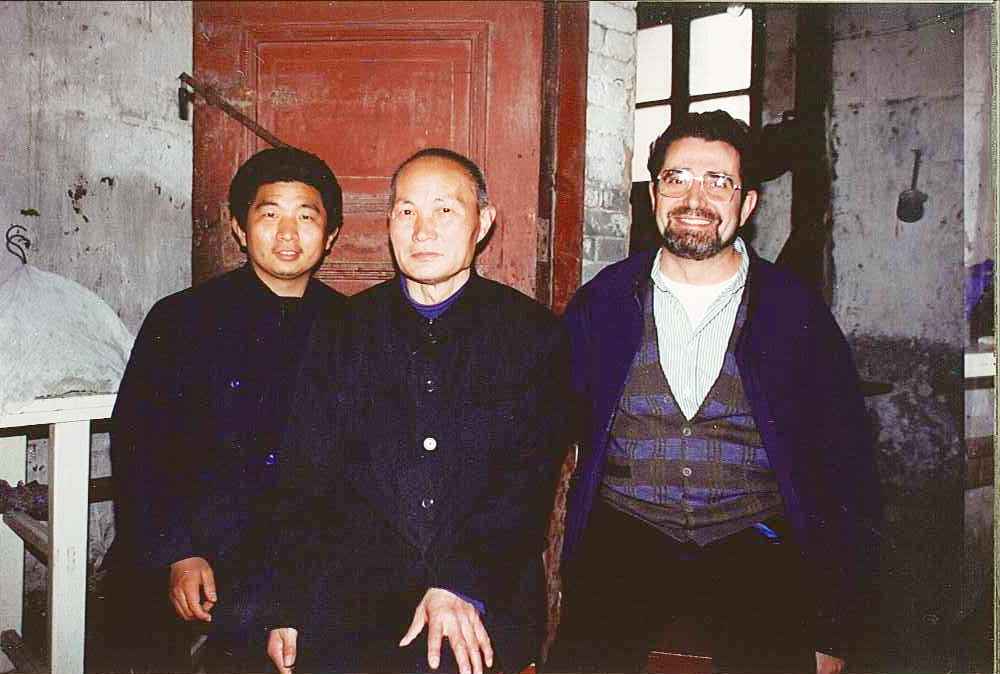
    Father Li Fangchun (center) at Kaifeng monastery in Henan in 1993. Image credit: Father Politi

    Li Fangchun served two long prison terms for counterrevolution. Father Giancarlo Politi of Hong Kong and I worked hard to secure his early release in early 1993. For the story of Father Li and other Catholic and Protestant clergy released early from prison, please see “Two Good Priests.”

    During this period, I asked about 22 Catholics and received written responses for ten of them.

    Democracy Wall: Xu Wenli (徐文立), Wang Xizhe (王希哲), Wei Jingsheng (魏京生)

    On a visit to Beijing in early 1993, Bai Li asked me a “theoretical” question. “If we want to maximize favorable press coverage in the United States, when should we release a prisoner?” I replied that major media outlets like the New York Times, the Washington Post, and the Wall Street Journal start putting their issues to bed no later than midnight the day before publication.

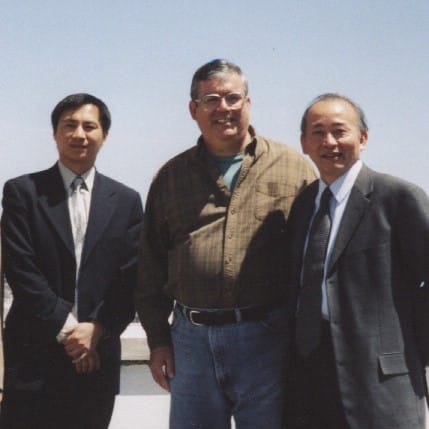
    Kamm (center) with Wang Dan (left) and Xu Wenli, taken in San Francisco in 2002. Image credit: Dui Hua

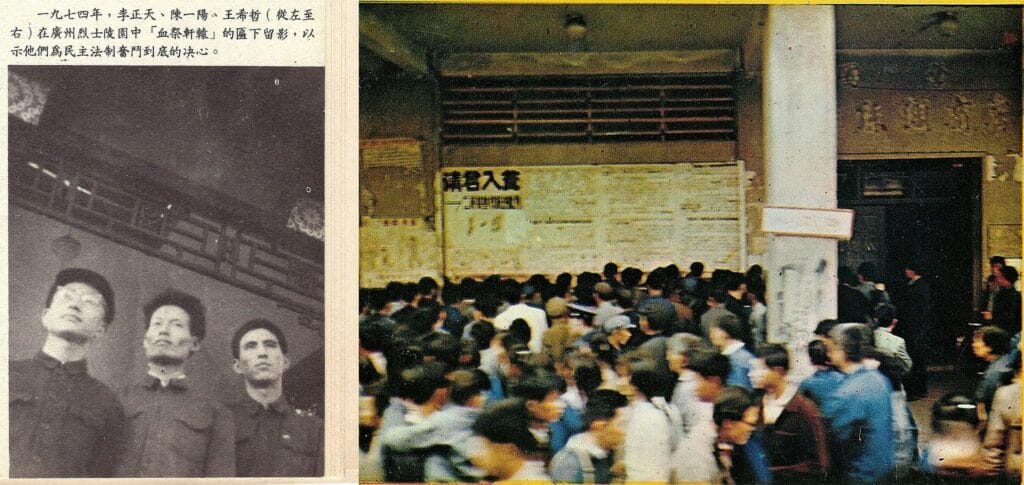
    On May 26, 1993, I received a fax from Bai Li. “Xu Wenli will be released from Prison at 10 AM, on May 26, 1993,” two hours before midnight on the East Coast. A few months before Xu Wenli was released, Wang Xizhe, a prominent activist based in Guangzhou, was released from Huaiji Prison in western Guangdong Province. He was serving his second prison sentence, having served time for a big character poster written with Li Zhengtian and two other activists in 1974, a Cultural Revolution group that came to be known as Li Yizhe. Like Xu Wenli, Wang Xizhe now lives in the United States where they have remained active in promoting respect for human rights in China.

    I received a fax from Bai Li (misspelled as Bei Li) on September 9, 1993, advising me that Wei Jingsheng had been granted parole. This was surprising as I had been told that the chance of an early release was small due to Wei’s attitude in prison and his passion for arguing with the guards. According to the fax, he had his own cell and could smoke cigarettes.

    (Left) The Li Yizhe group — Li Zhengtian, Chen Yiyang, and Wang Xizhe — at the Guangzhou Martyrs’ Memorial Garden in 1974. (Right) People crowd around a big-character poster by “Li Yizhe” in the Guangzhou city center in 1974. Image credit: University of Vienna Department of East Asian Studies

    Prior to his release in 1993, Wei had been taken on a tour of cities near Beijing so that he could “see for himself” the progress China had been making in economic and social development. Wei was a leading dissident figure well known in the West due to his authoring the seminal wall poster “The Fifth Modernization” which he posted on Democracy Wall in Beijing.

    After another arrest in 1994 and imprisonment, Wei was released in 1997. He now lives in exile in the United States where he has testified before Congress and met with members of the House of Representatives and the Senate to lobby for legislation meant to advance human rights and rule of law in China.

    Obscure Prisoners: Zhang Chengjian (张成俭)

    In late November 1994, I flew to Beijing, hoping to have a meeting with the MOJ. They were not available to see me. I secured a meeting with Bai Li on December 2, 1994, where I advised him that I had hoped to hand over a list of little-known prisoners list directly to the justice ministry. He told me to give it to him. He would fax me the response to my Hong Kong office.

    A few weeks later, as 1994 drew to a close, I received a fax from Bai Li with information on 13 names on the list.

    One of the names that information was provided for was a prisoner by the name of Zhang Chengjian. I had found his name in a book on counterrevolutionaries that I had purchased in a Beijing bookstore. Unhappy with reforms introduced by Deng Xiaoping, Zhang had gathered a group of like-minded people to overthrow the leadership of the Chinese Communist Party, constituting crimes of inciting counterrevolution and establishing a counterrevolutionary group. He was sentenced to 20 years in prison by a Shandong court in 1983, which was extended by seven years for a murder charge in 1998. After several sentence reductions, he was released from prison in 2005.

    Ethnic Prisoners

    Early in my work with Bai Li, I inquired into the status of prisoners held in Xinjiang and Tibet, including the Kazakh poet Kajikhumar (Qazhyghumar) Shabdan, held in Urumqi Prison Number One, Tibetan activist Jampel Changchub (江白强久) and Tibetan teacher Jigme Sangpo (晋美桑布), both held in Drapchi Prison.

    Kamm meeting with Jigme Sangpo in Switzerland. Image credit: Dui Hua

    Compared to Han prisoners, getting information on ethnic prisoners proved difficult, as was securing clemency. Jampel Changchub’s sentence was reduced by three years at the end of 1994. Elderly prisoners Kajikhumar Shabdan and Jigme Sangpo both served many years in prison but were released before their long sentences ended. The two Tibetans have passed away, Jigme Sangpo in Switzerland in 2020 where he had been granted political asylum and Jampel Changchub in Tibet.

    The List of 100

    In February 1995, I traveled to Beijing where I met with Bai Li and a representative of the MOJ. Prior to the meeting I had gathered all the information that Bai Li had given me in 1993 and 1994 into a booklet that I faxed to Bai Li. At our meeting in February, I asked for my interlocutor’s reaction to the booklet. “You have accurately reported what we told you,” Bai Li’s responded. I then asked, “Shall we continue?” Bai Li nodded yes.

    I apologized for giving them so much work and suggested presenting four lists of 25 names, one each quarter. They agreed. We shook on this “deal,” and I handed over the first list of 25 names.

    I returned to Beijing in April and met with Bai Li and a representative of the MOJ. It was a frosty meeting. I was nevertheless given a response to my February list. Information was provided on 18 prisoners including Zhao Fengping (赵凤平), a political dissident in Jilin Province and Yang Lianzi (杨连子), a June 4 poet and troubadour from Gansu Province.

    Zhao Fengping was the leader of a group of counterrevolutionaries based in Jilin Province. I tracked him down by searching through state newspapers at the Universities Service Center in Hong Kong. Zhao had put up Wei Jingsheng’s “Fifth Modernization” on a wall in Shenyang. He was sentenced to life in prison, subsequently reduced to 13 years.

    Yang Lianzi roamed Tiananmen Square singing ballads to the protesters. He became friends with Hong Kong-based human rights activist Robin Munro, who asked me to put Yang on one of my lists. Yang had been given a 15-year sentence for counterrevolutionary propaganda soon after the quelling of the protests.

    Both Zhao Fengping and Yang Lianzi were released before their sentences expired.

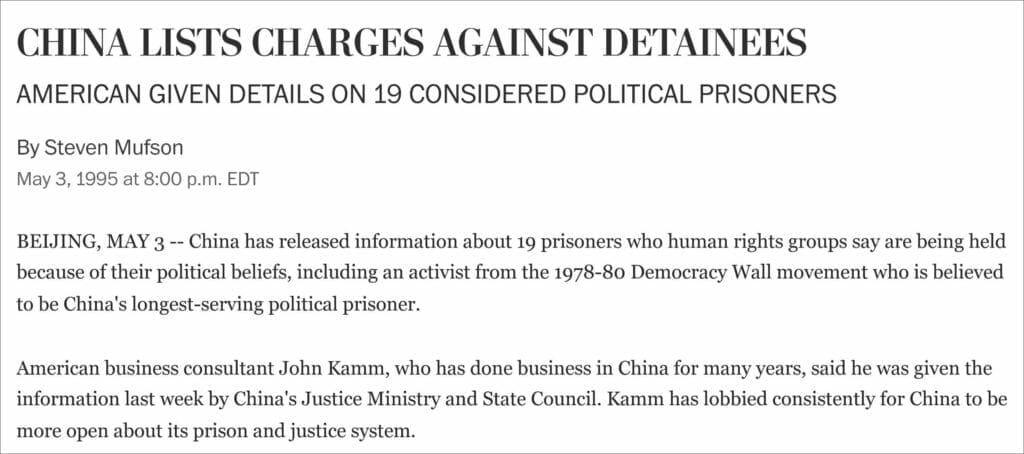
    The Washington Post reporting on Kamm’s prisoner list initiative in 1995. Image credit: Washington Post / Fair use

    The Bai Li Channel Closes

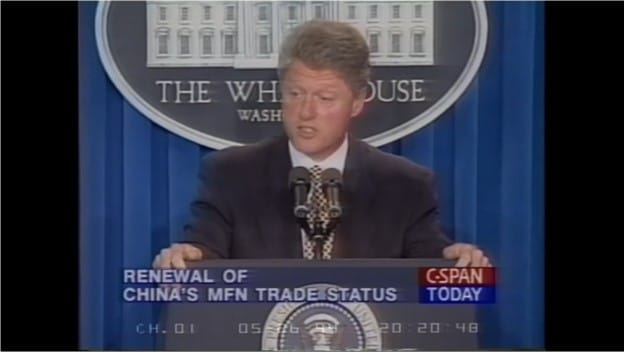
    In late May 1994, President Bill Clinton renewed China’s (MFN) without linking the trade status to human rights. One of the conditions that Mr. Clinton and Congress had imposed on renewing MFN was the accounting of prisoners detained after the June 1989 protests.

    The Chinese government no longer had an incentive to provide information on prisoners, but they continued to give me information through the Bai Li channel and other channels. One of the reasons was that former US Ambassador to China Winston Lord had pointed out that the Chinese government had said that, if the pressure of MFN revocation were taken off the table, China would take steps on human rights. Ambassador Lord challenged the Chinese government to make good on that promise.

    On May 26, 1994, President Clinton announcing his support to renew China’s Most Favored Nation status for China despite no significant progress on human rights, during a press conference on May 26, 1994. Image credit: C-Span

    At the Spring 1995 session of the Geneva-based Human Rights Commission (renamed the Human Rights Council in 2005), the United States and the European Union lobbied for the adoption of a resolution condemning China’s human rights record. I received a fax from China’s MOJ advising me that it would stop providing me with information on prisoners. (The resolution failed by one vote.)

    In May 1995, the State Department issued a visa to Taiwan president Lee Teng-hui (李登辉) so that he could give a speech at his alma mater, Cornell University in which he criticized China. Beijing was furious. Among several other dialogues, China’s Ministry of Foreign Affairs announced that the human rights dialogue with the United States would be suspended. The People’s Liberation Army began firing missiles over Taiwan, and the United States responded by deploying two aircraft carrier groups to waters around the island. Tensions between the two countries were high. The Bai Li channel closed, never to reopen. After my 1995 meetings, I never saw Bai Li again. I continued to submit lists and receive information from other entities, however, and continue to do so to the present day.


    Read all John Kamm Remembers stories.

    Listen to the Encounters with China podcast.

    Subscribe to receive notifications about new episodes. 


  • Prisoner Updates 2024 #5

    Sentencing for Guangzhou activists months after closed-door trial

    Nearly ten months after their closed trial for inciting subversion took place, women’s rights advocate Huang Xueqin (黄雪琴) and labor activist Wang Jianbin (王建兵) were sentenced to five years and three and a half years, respectively, by the Guangzhou Intermediate People’s Court on June 14, 2024. Inciting subversion is an endangering state security (ESS) crime. Huang said that she will appeal.

    Each also received a supplemental deprivation of political rights sentence of four years and three years, respectively.

    Their trial commenced in September 2023, two years after the duo was first detained in Guangzhou for subversion, an ESS crime, on September 21, 2021. At the time, Huang was en route to Hong Kong, where she was set to depart to the United Kingdom to study.

    According to online updates posted by supporters, prosecutors accused the pair of using overseas communication apps to organize gatherings at Wang’s home, among other “criminal” activities. The alleged purpose of these gatherings was to discuss social issues that would incite participants’ “dissatisfaction” with the Chinese government. Huang and Wang also participated in training sessions on non-violent activism organized by foreign NGOs. Wang received the training while studying in the United Kingdom while Huang hosted the online course from China.

    Connections with overseas NGOs have become a focus of the state security laws and policies in recent years. The official messaging for the new anti-espionage law paints a dire picture of Western forces infiltrating Chinese society and suggests that people with overseas connections could be potential culprits.


    Disappeared Chinese scholar sentenced to six years for espionage 

    Former professor at the Hokkaido University of Education Yuan Keqin (袁克勤) was reportedly sentenced to six years’ imprisonment for espionage in Changchun, Jilin, on January 31, 2024. The news only emerged in May 2024. His conviction came more than four years after he went missing in May 2019 while in China on a temporary visit.

    Since the trial was held behind closed doors, information about the case remains sparse. When asked about Yuan’s condition at a regular press conference in Beijing on May 14, the spokesperson of the Ministry of Foreign Affairs vaguely responded that China is a country under the rule of law and handles the relevant case in accordance with the law. No updates were provided.

    Yuan is not the first Japan-based Chinese academic to go missing after returning to China. In February 2023, Fan Yuntao (范云涛), professor at Japan’s Asia University, could not be contacted after going back to China. Fan was scheduled to teach when the semester began in April that year, but he did not return for the new semester.

    In March 2024, Kobe Gaulin University disclosed that the whereabouts of a Chinese scholar from the college, Hu Shiyun (胡士云), was not known following his visit to China in 2023. Professor Hu was born in Jiangsu and is said to have served as a policy advisor to the Chinese Consul General in Osaka. The reasons for Fan and Hu’s disappearances are unclear and their whereabouts are unknown.


    Former New Citizens’ Movement supporter reincarcerated 

    Veteran activist Chen Jianxiong (陈剑雄. aka Chen Jinxin 陈进新) was sentenced to four years’ imprisonment for picking quarrels and provoking trouble (PQPT) in Hubei on April 8, 2024. This is the third time he has been imprisoned since 2013. Chen is a supporter of Xu Zhiyong’s New Citizens’ Movement which advocated for responsible use of civil and political rights and called on government officials to disclose their assets.

    Chen was detained in May 2022 for voicing support for Wang Aizhong (王爱忠), a fellow New Citizens’ Movement activist. Accused of using social media to repost “false” reports about China from overseas media, Wang was detained and subsequently sentenced to three years in prison, also for PQPT.

    Chen is scheduled for release on April 11, 2026. By the time of his release, he will have served more than 10 years in prison.


    Zhejiang Christian bookseller released early on parole 

    On April 4, 2024, Taizhou-based Christian bookseller Chen Yu (陈煜) was released on parole, two years and five months early. Chen was sentenced to seven years in prison for illegal business activity for operating an online bookstore in September 2020. In addition to prison, he was ordered to pay a fine of 200,000 yuan.

    One of the titles he sold was written by pastor Wang Yi (王怡) of the Chengdu Early Rain Church. Wang is serving his nine-year prison sentence in Sichuan for inciting subversion and illegal business activity.

  • Subversion in Xi’an: The Trials of Guo Ran & Kou Ji

    Subversion in Xi’an: The Trials of Guo Ran & Kou Ji

    The Xi’an Intermediate People’s Court building. Image credit: Xi’an court website 

    Dui Hua’s research into Chinese government sources uncovered new information concerning Guo Ran (果然) and Kou Ji (寇稽). The two men received lengthy prison sentences in a closed-door trial for subversion held in Xi’an in 2013. Subversion is a crime of endangering state security and carries a maximum sentence of life imprisonment. 

    Dui Hua first discovered their names in an annual work report an annual work report released by the Xi’an Intermediate People’s Court in June 2013. The report stated that Guo and Kou were tried for subversion, but the trial outcome was not disclosed. Their fate was only subsequently revealed by sentence reduction decisions posted on China Judgements Online around 2016.  

    The first reduction decision Dui Hua found stated that Kou, born in 1969, was serving his 10-year prison sentence in Shaanxi’s Weinan Prison. Because of good behavior and meritorious service, Kou received his first sentence reduction of nine months in February 2016, about four years into his sentence. Two years later, in May 2018, Kou received his second sentence reduction of seven months.  

    That same year, Guo, born in 1981, received his first sentence reduction of five months in September. The sentence reduction decision stated that Guo was serving his 14-year prison sentence for subversion in the same prison as Kou. The clemency he received took place seven years into his prison sentence. Kou completed his prison sentence on July 13, 2020, and his three-year supplemental sentence of deprivation of political rights (DPR) is thought to have expired on July 12, 2023. Guo’s sentence is expected to end on July 1, 2025, after which he will begin his five years of DPR. All three sentence reduction decisions have since been removed from China Judgements Online. 

    A search for “inciting subversion of state power” that yielded no results in July 2021. Dui Hua conducted another search in May 2024. As in 2021, the search yielded no results. Image credit: China Judgements Online

    The court documents did not provide other case specifics beyond their background, crime, sentences, sentence reductions, and new release dates. The acts leading to their imprisonment were unknown. Around 2019, information from unofficial news sources concerning this subversion case began to surface. However, it was only briefly reported that Guo frequently held gatherings on his own business premises to discuss pathways to achieve freedom and democracy. The duo was reportedly detained in 2012 and formally arrested on February 20, 2013. 

    A Chinese government publication Dui Hua uncovered in 2022 sheds light on this mysterious case of subversion. Guo operated a private gallery, and Kuo was an architect. The two were accused of establishing a political group known as the “Xingya Party” (兴亚党, lit “Thriving Asia Party”). Guo published posts online and recruited people online to join the group. Members were to become citizens of the “Chinese Federal Republic” (中华联邦共和国). Guo allegedly called on online recruits to carry out violent activities.  

    As part of their operation, which they named “Dawn of Liberty,” Kou was allegedly tasked with collecting intelligence about troop deployment and military facilities on Chongming Island, China’s third largest island located on the estuary of Yangtze River in Shanghai. Guo intended to launch a military occupation there and create the “Chinese Federal Republic,” according to the official narrative. Kuo was also accused of scheming and drafting the “state creed.” Guo was arrested for subversion, and Kuo was initially arrested for kidnapping.

    Military patrol on Chongming Island. Image credit: Sohu 
    While this account is likely the only official source which provides information about the acts of Guo and Kou, Dui Hua is unable to assess how truthful the description of criminal activities is. Assuming this account is accurate, Guo and Kou are not the first people to have been sentenced to lengthy terms for subversion for founding opposition parties and advocating for a violent overthrow of the Chinese government.  
    According to Records of People’s Courts Historical Judicial Statistics: 1949-2016, Chinese courts accepted 162 subversion cases involving 347 individuals in the 18-year period from 1998 to 2016. Many of these subversion cases are by nature sensitive, and information pertaining to these cases is far from transparent. 
    Among the earliest cases of subversion involved leaders of the so-called “Southwest Yangtze Column of the Chinese Anti-Corruption Army” (中国人民农工反腐败大军西南长江纵队) in Chongqing. Established by farmers in 1998, the group called itself a democratic alternative to the Chinese Communist Party (CCP). It opposed excessive agricultural taxes and distributed fliers calling for the rehabilitation of June Fourth prisoners on the tenth anniversary of the 1989 pro-democracy movement. Sentenced to 12 years’ imprisonment for subversion in the early 2000s, Song Bukun (宋步坤) is believed to be the last member of the group to be released from prison in September 2013. Dui Hua received two responses from inquiries dating back to 2008 in which government sources said Song received an 11-month sentence reduction in February 2009. 

    In March 2006, dissident writer Ren Ziyuan (任自元) was sentenced to 10 years in prison for subversion because he established the “Mainland Democracy Frontline” to promote the right to end tyranny by violent means. He reportedly published anti-government views on the Internet, including a tract entitled “The Road to Democracy” and other essays. Some human rights organizations claim that some of his essays asserted citizens’ rights to violently overthrow tyranny. Ren was released from Shandong No.1 Prison on May 9, 2015, without receiving a single sentence reduction. 

    Dui Hua uncovered details of another political party that was accused of “violent intent” in 2019. The “People’s Party,” later renamed the “New Era Communist Party of China,” was founded by Dong Zhanyi (董占义). The group aimed to fight corruption and recruit aggrieved workers and petitioners to overthrow the CCP. Dong and another founding member Chen Guohua (陈国华) established a corporate entity called Tongkang to operate a supermarket project. The plan, according to official documents, was to use the supermarket project to employ online recruits and raise money to fund their political activities, including assassination plots and procuring weapons. Dong was convicted of subversion and fraud and was sentenced to life in 2011 by a Beijing intermediate court. The sentence later was commuted to a fixed 19 years’ imprisonment in 2015. Chen was convicted of subversion and sentenced to 14 years. Other key party members were also given long sentences. 

    Xu Zhiyong (left) and Ding Jiaxi. Image credit: VOA 

    Subversion is not exclusively used to criminalize leaders of opposition parties nor is it confined to suppressing calls for the violent overthrow of the Chinese government. As recently as April 2023, prominent rights activist and legal scholar Xu Zhiyong (许志永) and rights lawyer Ding Jiaxi (丁家喜) were both convicted of subversion. Unlike Guo and Kou’s case, Xu and Ding did not establish a dissident party. They are advocates of non-violent resistance and the responsible use of civil and social rights. In late 2019, they organized an informal gathering with around 20 activists and lawyers in Xiamen to discuss current political affairs and activism. Xu and Ding were sentenced to 14 and 12 years in prison, respectively, and their appeals were rejected in November 2023. Despite their rejection of violence, Xu and Ding’s sentences are among the harshest for a subversion conviction, exceeding in length even cases where the accused allegedly called for the use of force. 

    The fates of Kuo and Guo may no longer be shrouded in secrecy, but the acts leading to their imprisonment were revealed only a decade after they were incarcerated. Such gaps in disclosure further concerns that vague laws with ambiguous wording and low levels of legal transparency are eroding confidence in China’s judicial system.  

  • Dui Hua Digest, May/June 2024

    Dui Hua Digest, May/June 2024

    EVENTS

    After Report on China’s Human Rights Practices, US-China Agreements Come into View

    Department of State spokesperson Matthew Miller (right) introduces Secretary of State Antony Blinken to deliver remarks following the release of the Country Reports on Human Rights Practices. Image credit: Chuck Kennedy / Official State Department photo

    On April 22, 2024, the Department of State released its 2023 Country Reports on Human Rights Practices. Mandated by law, the reports, which have been released every year since 1977, inform the executive branch (e.g., executive orders mandating sanctions) and congressional legislation (bills and resolutions). The reports cover developments in nearly 200 countries that took place in 2023 and reflect US priorities as far as human right practices in those countries is concerned.

    The China section, which covers developments on the Mainland, Hong Kong, Macau, and Tibet (there is also coverage of developments in Xinjiang), is typically released in March. The April 22 release date is the latest release date in recent memory.

    Secretary Antony Blinken made opening remarks that provide a glimpse of US priorities in formulating human rights policies. There were no mentions of Mainland China, Hong Kong, Tibet, or Xinjiang. He then turned over the podium to the senior officer of the Bureau of Democracy, Human Rights, and Labor, Robert Gilchrist. Blinken took no questions on China while Gilchrist took one.

    Scant Attention to Rahile Dawut

    In the country report on China, there was only one mention of imprisoned scholar Rahile Dawut. She was lumped together with other Uyghur and Han political prisoners. The report ignores the press statement put out in late September by Dui Hua which confirmed her life sentence despite the fact that the statement formed the basis of dozens of articles in English language media. (The statement garnered more than 10,000 page views on Dui Hua’s website.) The State Department report mentions Xinjiang 82 times and Uyghurs 51 times.

    The 2023 country report is similar to reports filed in recent years. It refers to China as an authoritarian state (as opposed to a totalitarian state) and refers to “genocide” in Xinjiang (the government of the United States remains the only government in the world to call what’s going on in Xinjiang “genocide.”) There are no changes in the titles or order of the sections of the report.

    An entrance to a school in Turpan, Xinjiang, with a sign that says “Entrance to the school grounds. Please speak ‘Guoyu‘ (national language, i.e. Mandarin Chinese).” Image credit: Kubilayaxun / CC BY-SA 4.0

    The Hong Kong section dwells at length on the national security legislation imposed by Beijing in 2022, and the run-up to the legislation passed by the Legislative Council in 2024. It mentions the arrests, forced exiles, shutting down of publications, and denial of visas to journalists and academics. The trial of Jimmy Lai is covered. The section on Macau states that there were no significant changes in 2023. It praised Macau, compared to Hong Kong.

    The section on Tibet reported no significant changes in 2023 before listing a long series of human rights abuses in the Tibet Autonomous Region.

    As with past country reports on China, the 2023 report focuses solely on negative developments and ignores positive developments. There is no mention, for instance, of juvenile justice reform that has led to significant improvements in the treatment of juvenile offenders. Nor is there any mention of Dui Hua’s dialogue with the Chinese government on prisoners and prison conditions. This has not always been the case.

    Secretary Blinken in a discussion with business leaders in Shanghai on April 25, 2024. Image credit: Chuck Kennedy / Official State Department photo

    The day after the report was issued, Secretary Blinken departed for a three-day trip to China where he met with Foreign Minister Wang Yi and President Xi Jinping. On the day Blinken arrived in China, Ministry of Foreign Affairs spokesman Wang Wenbin issued a strongly worded, lengthy rebuttal of the country report, accusing the United States of having a double standard and pointing out that the United States is plagued by many human rights violations including racism, poverty, and gun violence. To date, the State Council Information Office has not released its report on human rights violations in the United States.

    Following Blinken’s meeting with Xi on April 26, he gave a press conference and individual interviews to journalists at the US embassy. He said that he had raised human rights, presumably with Wang Yi, including individual cases. 

    US Secretary of State Antony Blinken with China’s Foreign Minister Wang Yi. Image credit: Chuck Kennedy / Official State Department Photo

    In the interview with NPR, Blinken described the US and China as being far apart on important international issues, especially on the Russian invasion of Ukraine. When Blinken told Chinese leaders that it would be in their interest to stop helping Russia, China responded by accusing the United States of being a “hypocrite” for making such a complaint while supporting Ukraine.

    The priority for Blinken was raising China’s supply of material to Russia to assist them in its war on Ukraine. Other subjects he may have raised include China’s role in fentanyl trafficking; the detention of American citizens in China (priorities are Mark Swidan, Pastor Davin Lin, and Kai Li); aggression in the Taiwan Strait, the South China Sea, and the East China Sea; China’s failure to rein in the nuclear threat posed by North Korea; predatory trade practices; and alleged Chinese support of Iran and Hamas.

    Chinese President Xi Jinping meets with US Secretary of State Anthony Blinken at the Great Hall of the People, April 26, 2024. Image credit: Xinhua News

    China’s Ministry of Foreign Affairs issued its own summary of the meeting with Wang Yi, claiming that Wang and Blinken reached a five-point consensus, including:

    • working to stabilize and develop China-US relations;
    • maintaining high-level exchanges and contacts at all levels;
    • holding the first meeting of the China-US Intergovernmental Dialogue on Artificial Intelligence;
    • expanding people-to-people and cultural exchanges, and;
    • maintaining consultations on international and regional hotspots.

    Developments on these agreements have been slow going, with the State Department largely staying mum about these agreements until mid-May. The first meeting of the China-US Intergovernmental Dialogue on Artificial Intelligence took place in Geneva on May 14, 2024. The meeting to discuss “technical risks” took place as the United States rolled out new tariffs on “strategically sensitive” imports such as semiconductors, electric vehicles, and solar equipment, only days after a climate talk on May 8 in Washington, DC. China’s Commerce Ministry said that it “firmly opposes” the tariffs and that they “impact the atmosphere of bilateral cooperation.”

    On May 13, 2024, China announced that it is open to talks on cross-border smuggling and deportation of Chinese illegal immigrants. As of publication, no further details were made available.

    Competitors & Enemies: US Voters’ Views of China and Biden

    Americans increasingly view China as an enemy and think that the United States should prioritize limiting its influence, according to recent polling.

    Pew Polling conducted April 1-7 shows widespread dislike of China among the American public: 81 percent of respondents view the country unfavorably, including 43 percent who view the country “very unfavorably.” Pew noted that “China has been seen unfavorably by three-quarters or more of US adults since 2020.”

    Also of note, 42 percent see China as an enemy, an increase from 38 percent in 2023. This is the largest share of the population to describe China as an enemy since Pew began asking the question, even though an even larger share of Americans view China as a competitor – 50 percent of respondents. In a NewsNation poll asking about “the bigger threat to the United States today,” China was the most popular answer, with 41 percent. Its closest competitor was Russia at 27 percent.

    An Economist/YouGov poll taken April 21-23 also shows that China’s favorability remains at historically low levels: 76 percent view China as unfriendly or an enemy, 10 percent see China as friendly or an ally, and 13 percent are not sure. In a 2023 Economist/YouGov poll taken April 22-25, 72 percent answered unfriendly/enemy; 17 percent answered friend/ally; and 10 percent were not sure.

    US public opinion of China appeared to slip again in October 2023 survey in the run-up to the APEC summit in San Francisco, reaching 76 percent. Favorability rebounded slightly in December, with 72 percent viewing China as unfriendly/an enemy, but favorability ratings have since returned to October levels.

    TIPP’s polling conducted May 1-3 asked Americans to grade Biden’s handling of China, and his administration’s marks are largely unsatisfactory: 27 percent give him a failing grade; 19 percent a poor grade; 21 percent an average one; 14 percent a good one; and 8 percent an excellent one; 9 percent were unsure. While Democrats are more satisfied with Biden’s China policy, disapproval is high among independents (52 percent) and Republications (75 percent).


    PUBLICATIONS HIGHLIGHTS

    Dragon Years: Remembrance of Times Past: 1988  

    From the Encounters with China podcast, Dragon Years is a limited podcast series exploring key periods of the US-China relationship and John Kamm’s advocacy. Each episode in this five-part series focuses on a different Year of the Dragon, beginning in 1976 and concluding with 2024. 

    Image credit: Dui Hua

    The latest episode of Dui Hua’s limited podcast series, Dragon Years: Remembrance of Times Past flashes back to 1988, the Year of the Earth Dragon. China is reckoning with floods, increased foreign trade, and calls for reform. In Episode 2, John Kamm speaks with Richard Glover, a pioneer and veteran of US-China trade. The two former colleagues discuss how their paths crossed, the politics of doing business in China in the lead-up to Tiananmen, and what lessons 1988 has for today’s China watchers.

    Listen now


    All Business is Local: The Macau Subcommittee

    From John Kamm Remembers, a series written by Dui Hua’s founder recounting his advocacy for prisoners in China.

    Image credit: Dui Hua

    John Kamm Remembers goes back to 1980s Macau. Working in the chemicals trade in China, Kamm becomes more active in the Hong Kong American Chamber of Commerce. In this role, he arranges a business delegation to the former Portuguese territory of Macau. The delegation sends Kamm back to Macau, where he learns important lessons about business, politics, and life in a changing China.

    Read more


    Gray Matters: China’s Aging Prisoners  

    From the Human Rights Journal, a blog offering original analysis and translations related to human rights and rule of law developments in China. 

    Men play chess inside the “elderly” prisoner cell block of Henan No. 3 Prison. Image credit: Pan Xiaoling / Southern Weekly

    There is a dearth of information about elderly prisoners in China (Dui Hua estimates the figure to be between 88,000 and 104,000), but Chinese legal experts generally agree that the number of elderly prisoners has been surging. This Human Rights Journal entry explores the different types of elderly crime, trends in leniency and clemency for elderly prisoners, and how elderly political prisoners may face discriminatory treatment when incarcerated.

    Read more


    PRISONER UPDATES

    Dui Hua’s Prisoner Updates provide the latest information staff researchers have uncovered through online and library research and through direct dialogue with the Chinese government.

    Hainan teacher sentenced for inciting subversion; Peng Yuhua – convicted with Li Ming-cheh in a 2017 subversion case – released; China Democracy Party leader, Xu Guang, sentenced again; Migrant worker turned labor activist arrested; Falun Gong practitioner received third clemency in Guangdong; Falun Gong practitioner in Beijing facing trial again; Wang Quanzhang & family live under surveillance & harassment, four years after his release.

    Read more


    Subscribe to receive Dui Hua’s publications by email

  • Dragon Years: Remembrance of Times Past (1988)

    Dragon Years: Remembrance of Times Past (1988)

    JKR: Encounters with China | S01E09 May 8, 2024

    The latest episode of Dui Hua’s limited podcast series, Dragon Years: Remembrance of Times Past flashes back to 1988, the Year of the Earth Dragon. China is reckoning with floods, increased foreign trade, and calls for reform. In Episode 2, John Kamm speaks with Richard Glover, a pioneer and veteran of US-China trade. The two former colleagues discuss how their paths crossed, the politics of doing business in China in the lead-up to Tiananmen, and what lessons 1988 has for today’s China watchers.

    Kamm and Glover’s recollections on their work selling chemicals in China in the late 1980s range from the humorous to the poignant. From the golf course to Tiananmen Square in the days before the nation hurtles toward a great tragedy, the two men witness a run on the banks and come face-to-face with the increasingly tense student movement.

    Related for this episode:

    Listen to the latest episodes of JKR: Encounters with China


    You can listen to our podcast on our website and RSS.com or on your favorite app. You can find us on Apple Podcasts, Spotify, Amazon Music, YouTube, or any podcast directory. Search for “JKR: Encounters with China.”

  • All Business is Local: The Macau Subcommittee

    All Business is Local: The Macau Subcommittee

    << Read all John Kamm Remembers stories

    Download this story as a PDF

    Listen to Dragon Years:1988 podcast episode.

    At Kun Iam Temple, the table were the Treaty of Wangxia was signed. Image credit: Wikimedia Commons

    A

     short walk from where I was teaching in Macau in 1972 was the Kun Iam Temple, one of Macau’s three oldest temples. I enjoyed going there because it was quiet and verdant, and because of its historic significance for US-China relations. On a table at the temple, the United States and China signed the Treaty of Wangxia on July 3, 1844, which marked the start of formal relations between the two countries.

    After I left Macau for Hong Kong on Christmas Day 1972, I maintained interest in the Portuguese territory. I visited Macau as often as possible, staying at the Bela Vista, a colonial-style hotel which now houses the Portuguese Consulate, whenever I could. The Bela Vista sat on a hill overlooking the Praia Grande and the bay. Unfortunately, the bay was subsequently filled in.

    The Hotel Bela Vista, which opened in 1890: (left) the hotel in the 1980s and (right) in 2023. Image credit: Dui Hua; Cultural Heritage of Macau

    I became friends with prominent Macanese residents of the British Crown Colony, including Sir Roger Lobo, and dined whenever I could at the Club Lusitano, the Macanese eating club in Hong Kong.

    American Chamber of Commerce

    I became active in the American Chamber of Commerce (AmCham) in the early 1980s. I focused on the China Commercial Relations Committee (CCRC), the largest committee in the chamber with members involved in the burgeoning trade relationship that followed the normalization of relations with China in 1979.

    In the summer of 1984, I got the idea of setting up the Macau Subcommittee under the CCRC. Chamber leadership, then under American lawyer Gage McAfee, bought into the idea. Planning began to send an AmCham delegation to Macau.

    “AmCham Visits Macau!” – coverage of the delegation in AmCham’s journal. Image credit: Journal of the American Chamber of Commerce in Hong Kong

    The delegation took place in January 1985. It was to be made up of AmCham leaders, senior officials from the American consulate including the deputy consul general and the head of the commercial services department, and businessmen and businesswomen, including two Diamond Shamrock colleagues. The fledgling subcommittee conducted a survey to determine the level of business activities and government plans to increase investment and trade. We prepared papers based on statistics on imports and exports and plans to improve infrastructure.

    The survey was sent out to 800 CCRC members, of whom 60 replied. We discovered that the level of trade and investment was low, as were returns on investment. Respondents listed several problems, including government red tape – getting export licenses was slow – and there was a lack of reliable information on imports and exports. Five of the 12 respondents who had offices there were considering shutting down and pulling out.

    Snapshots of Macau fishing villages. Image credit: Dui Hua

    One number stood out. In 1983, there were only 28,000 telephones in Macau for a population of 266,000.

    Macau was woefully underdeveloped. Aside from the low per capita ownership of telephones, a major problem was the depth of the harbor. Silt washed down the West River, requiring frequent, costly dredging.

    Delegation Meeting

    Our first meeting was with Secretary for Economic Affairs, Luis Filipe Ferreira Simoes and other officials. He outlined the territory’s three economic priorities: diversify overseas markets for Macau products, develop a service industry sector to serve Macau and adjacent areas of Guangdong Province, and develop Macau’s infrastructure to attract private sector and foreign investment. Mr. Simoes said the efforts were yielding good results: textiles made up 85 percent of exports in 1980, but in 1983 they made up 71 percent. There had been a significant increase in the number of banks in Macau.

    An aerial view of Macau. Image credit: Dui Hua

    Ma Man-kei, President of the Macau Chinese Chamber of Commerce

    On the morning of January 24, 1985, the AmCham group met with Ma Man-kei, President of the Chinese Chamber of Commerce as well as members of the chamber and the Macau Exporters Association. Mr. Ma was an outspoken proponent of China’s resumption of sovereignty as soon as possible. He would go on to become one of the highest-ranking Chinese citizens in Macau, serving as Vice Chairman of the Chinese People’s Political Consultative Congress for many years.

    Ma Man-kei with Gage McAfee. Image credit: Journal of the American Chamber of Commerce in Hong Kong

    Unfortunately for Mr. Ma, Beijing decided to take a go-slow approach when it came to resuming sovereignty of Macau. This was despite Lisbon’s offer to transfer sovereignty to Beijing after the Carnation Revolution of April 1974, when Portugal gave up all its overseas territories. Beijing did not want anything to disturb Hong Kong, which was due for the return of sovereignty to China in 1997.

    After listening to AmCham’s report and recommendations, Mr. Ma said he supported them and that he would make his support known to the Macau government. Ma then said: “The delta counties near Macau have a large amount of foreign currency and can now import goods directly. They often send buying groups to Macau. However, American companies don’t do much promotion work in Macau, so they mostly buy Japanese products, or American products through middlemen in Macau.”

    A building in Macau planned for demolition, with a poster showing the building that will be erected in its place. Image credit: Dui Hua

    Leal Senado

    After our meeting with Mr. Ma, we passed by the Leal Senado (meaning “the loyal senate” in Portuguese), so named because Macau had stayed loyal to Lisbon after Spain seized Portugal in the sixteenth century. The Leal Senado lay in a stately building opposite the post office. It was the site of the municipal government made up mostly of Macanese. The Leal Senado had a library of old books which I enjoyed viewing during my time in Macau in 1972.

    Leal Senado in 1993. Image credit: Cronicas Macaenses

    Importance of Delegation to Macau

    The importance of the January 1985 AmCham delegation to Macau was three-fold

    It propelled me into leadership positions of the Chamber. After my stint as chairman of the Macau Subcommittee, I moved quickly to more senior positions, including one of the vice presidents, followed by first vice president and then, despite an effort to deny me the position, President of AmCham in 1990, the first year of the debate in Congress over China’s Most Favored Nation (MFN) status.

    The AmCham delegation poses for a photograph, with Kamm in the first row, third from the right. Image credit: Journal of the American Chamber of Commerce in Hong Kong

    It was my first experience of organizing an AmCham delegation. I followed this up in 1990 with delegations to Laos and Mongolia, the first American commercial delegations to these countries by a chamber of commerce. Connections made during the AmCham delegation to Macau also helped me organize the three delegations to Washington in 1990 to testify on MFN. I asked for and was given a letter from the Macau government on the impact of China’s possible loss of MFN on the Macau economy.

    Views of Macau landmarks in the 1980s: (left) the ruins of St. Paul’s religious complex, (right) the Lisboa hotel. Image credit: Dui Hua

    It gave birth to the idea of selling to foreign trade companies near Macau: After Ma Man-kei’s remarks, I began doing research with an eye to selling products manufactured by companies that I represented in China. I confirmed what Ma said. Companies in the delta could retain 30 percent of the foreign currency generated by their exports. They were very active in Macau, not only sending buying missions but also holding trade fairs and exhibitions.

    Kamm (far right) visiting the Shekki pigeon farm in Zhongshan County. Source: The Dui Hua Foundation

    My research led me to look into the Shekki Foodstuffs Corporation, a sub-branch of the Guangdong Cereals, Oils and Foodstuffs Branch.* Shekki Foodstuffs had their own farms, including pigeon farms where the prized Shekki Pigeons were raised. These farms were suffering from an infection of bird flu. My company represented a European vaccine manufacturer. We arranged to carry out tests on a pigeon farm, the results of which were outstanding. Direct sales began shortly thereafter.

    There’s a popular saying in the United States: “All politics is local.” I gradually came to realize that all business is local, including the business of human rights.


    *Note: My research is summarized in a chapter in Macau: City of Commerce and Culture, Rolf Cremer (ed.), Hong Kong, 1987.

    Read all John Kamm Remembers stories.

    Listen to the Encounters with China podcast.

    Subscribe to receive notifications about new episodes.