Created in 2000, Dui Hua’s Political Prisoner Database (PPDB) contains information about political and religious prisoners incarcerated in China since 1980.
Please note: Dui Hua stopped updating the PPDB as of December 31, 2025. The database remains available as an archival resource.
Using mostly open-source materials, Dui Hua collects information on non-violent:
- Political dissidents: people imprisoned for expressing their opposition to one-party rule by exercising universally recognized rights to free speech and association and often charged with “counterrevolution” crimes before 1997 or “endangering state security” crimes after 1997, such as “subversion” and “incitement.”
- Religious practitioners: people persecuted for holding or practicing religious beliefs, including practitioners of non-state-sanctioned groups—particularly Falun Gong, followed by the Church of Almighty God and house churches—charged under Article 300 of the Criminal Law with “organizing or using a cult to undermine implementation of the law,” as well as members of state-sanctioned churches accused of various economic crimes.
- Ethnic minorities: particularly Tibetans and Uyghurs labeled “splittists” and jailed for participating in cultural and pro-independence movements.
- Petitioners: people jailed for seeking redress to grievances related to land seizure, labor activism, demolition, corruption, miscarriages of justice, and other issues.
- Foreign nationals: non-violent foreign nationals—particularly Americans detained or subject to exit bans in China. These cases may or may not be political in nature, but are included because of their potential impact on the US–China relationship.
- Individuals charged under national security or sedition provisions in Hong Kong or Macau, including those prosecuted under post‑2019 national security legislation.
Methodology
The PPDB was built by reviewing a wide range of official and independent sources to identify people deprived of their liberty in China for political, religious, or other sensitive activities. Researchers checked names and case details, used clear rules for including or excluding records, and gave priority to official information when available while also using independent reporting to find cases missing from government sources.
Each person received a profile and a separate record for each detention or prosecution, which researchers updated as new information emerged. Sources were monitored and preserved where possible, but censorship, deleted records, incomplete reporting, and limited access mean that some cases contain gaps and the database does not capture every political or religious detention.
Purpose
The purpose of the PPDB is to advance clemency and better treatment for at-risk detainees by analyzing trends in the persecution of individuals who exercise their universal human rights to free speech, association, and expression; documenting the treatment of political and religious prisoners in the criminal justice system; providing raw material for the drafting of prisoner lists of concern; and informing dialogue with government officials inside and outside China.
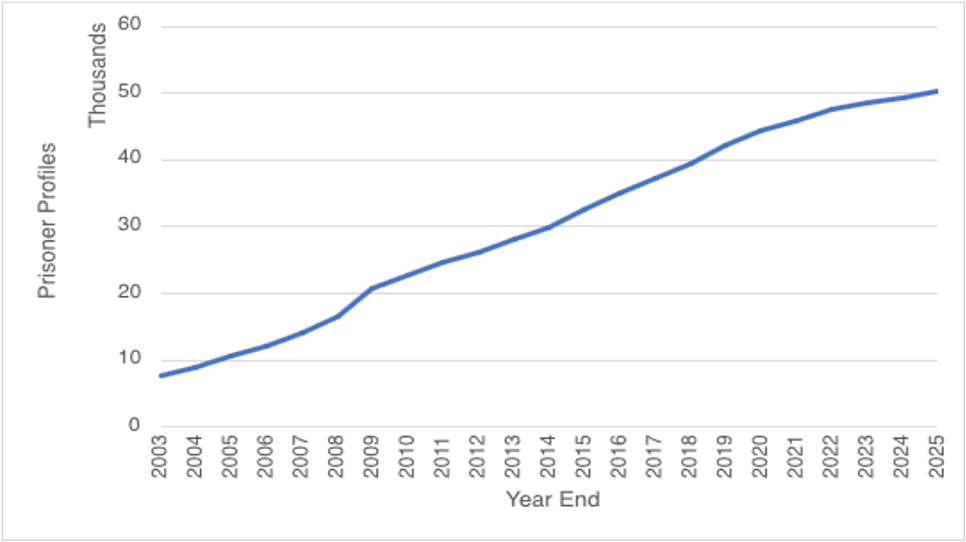
Names: 50,209
Male: 16,990
Female: 15,814
Unknown: 17,405
as of December 31, 2025
Key Metrics for Active (under coercive measures) Cases (as of December 31, 2025)
Top Crimes
| Organizing/using a cult to undermine implementation of the law | 2,414 |
| Picking quarrels and provoking troubles | 426 |
| Endangering State Security – Splittism; Inciting splittism | 216 |
| Endangering State Security – State Secrets; Espionage | 170 |
| Endangering State Security – Subversion; Inciting subversion | 74 |
Top Provinces
| Xinjiang | 1,206 |
| Sichuan | 491 |
| Shandong | 360 |
| Liaoning | 291 |
| Jilin | 275 |
| Heilongjiang | 262 |
Gender by Top Crimes
| M | F | |
| Organizing/using a cult to undermine implementation of the law | 547 | 1,208 |
| Picking quarrels and provoking troubles | 192 | 148 |
| Endangering State Security – Splittism; Inciting splittism | 125 | 11 |
The information above is based on information Dui Hua has obtained, the information does not represent all cases involving political prisoners in China.