Blog

  • Prisoner Updates #10

    Xi’an Church Worker Fu Juan Serving Three-and-a-Half-Year Sentence

    An October report provided details of the three-and-a-half-year sentence imposed on Fu Juan (付娟), a preacher and worker at Xi’an’s Fengsheng Church (丰盛教会), for fraud. Her conviction by Xi’an’s Baqiao District People’s Court became known in August 2026, although the sentencing date remains unclear. She is reportedly held at Shaanxi Women’s Prison, with her sentence scheduled to end on December 5, 2026. Her health reportedly deteriorated during detention.

    Fu handled donation records, accounts, and administrative work for the church. She was detained in August 2022 alongside pastors Lian Changnian (廉长年) and Lian Xuliang (廉旭亮) and spent approximately six months under residential surveillance at a designated location, where she reportedly suffered torture. Authorities banned the church shortly after their detention. Prosecutors subsequently brought a fraud case involving RMB 390,000. The three were released on bail in April 2025 but taken back into custody in November that year.

    Li Yuanfeng Defends Free Expression at Subversion Trial

    An October update was issued marking two years since Hunan independent journalist and rights defender Li Yuanfeng (李原风) was detained. It reported that Li defended his articles and online comments in court as freedom of expression. Li was tried on a charge of “inciting subversion of state power” at Yiyang Intermediate People’s Court on August 13, 2026. No verdict was announced at the hearing, and the October update did not report an outcome.

    Li, originally named Li Weizhong (李维忠), has long reported on labor rights and social injustice. Police took him away on October 10, 2024, initially placing him under administrative detention. He was subsequently placed in criminal detention on suspicion of “picking quarrels and provoking trouble.” On November 13, 2024, authorities changed the suspected offense to inciting subversion and placed him under residential surveillance at a designated location.

    Zhang Chao Sentenced After June Fourth Memorial Post

    Shandong rights activist Zhang Chao (张超) has reportedly been sentenced to one year and two months in prison for “picking quarrels and provoking trouble. His trial took place at Zaozhuang’s Shanting District People’s Court on September 23, 2026, after the presiding judge reportedly excluded members of the public who had arrived to observe. The sentencing date remains unclear. He is reportedly held at Zaozhuang No. 1 Detention Center, with his sentence scheduled to end on August 4, 2027.

    On June 4, 2026, Zhang photographed the area outside the railings surrounding Tiananmen Square and shared the pictures with a commemorative poem on WeChat Moments. Zaozhuang state security officers took him from Beijing in the early hours of June 5. He was placed in criminal detention the following day and formally arrested on June 18. Zhang, a Buddhist monk also known as Shi Daoguo (释道果), has long promoted democratic ideas online and assisted fellow activists. He was previously detained in 2014 and 2019.

    Jia Pin’s Judgment Details Four-Year Sentence for Facebook and Twitter Posts

    A judgment published in October details the four-year prison sentence imposed on Henan rights defender Jia Pin (贾榀)for posts on Facebook and Twitter. Nanyang’s Wolong District People’s Court sentenced him on September 8, 2023, for “picking quarrels and provoking trouble.” The court characterized information he posted between 2014 and July 2022 as false and asserted that it caused serious disruption to public order. Jia acknowledged posting the material but disputed its characterization and denied committing the offense. The judgment did not identify specific posts or explain what disruption they caused.

    Police from Nanyang detained Jia in Beihai, Guangxi, on September 22, 2022, and returned him to Henan. He reportedly completed his sentence and was released from Yuxi Prison on September 21, 2026.

    Liang Qin Completes Ten-Year Sentence in Yunnan Church Case

    Liang Qin (梁琴) was reportedly released on October 20, 2026, after completing a ten-year prison sentence. She had served her term at Yunnan No. 1 Women’s Prison following her conviction for “organizing and using a cult to undermine implementation of the law” in a case involving alleged links to the Three Grades of Servants (三班仆人派), a Christian doomsday sect.

    Liang, an assistant to preacher Ju Dianhong (鞠殿红), was among dozens of Christians detained in Yunnan’s Yun County on October 21, 2016. Authorities accused the group of holding secret gatherings, preaching, recruiting followers, and rebuilding the Three Grades of Servants’ organizational network. On December 28, 2017, the Yun County People’s Court sentenced six defendants, giving Liang ten years and a RMB 100,000 fine and Ju thirteen years. Liang’s sentence was upheld on appeal. She maintained that her faith was not criminal and rejected its characterization as a cult.

    Labor Rights Advocate Feng Rui Released on Bail

    Labor rights advocate Feng Rui (冯睿), known online as “Xiao Wu” (小五), was released on bail and returned to his hometown on October 21, 2026, according to information from his lawyer. Guangzhou’s Yuexiu District police had detained him on September 14 on suspicion of “picking quarrels and provoking trouble.” He was held at Yuexiu District Detention Center. His release on bail does not mean the case has been closed.

    Feng operates the WeChat account “Chiapas Dongfeng TV” (恰帕斯东风电视机), which covers the rights of delivery riders, office workers, and migrant workers. He has published annual reviews of labor rights incidents for several years. His detention may be linked to the account’s review of events in 2025, which was deleted. The account stopped updating on September 14. A 2017 graduate of Beijing Normal University’s Chinese department, Feng previously worked at Beijing Workers’ Home and the 706 Youth Space.

    Former Ragya Abbot Receives Five-Year Sentence After Monastery Raid

    Tenpa Gyatso (丹巴嘉措), also known as Lobsang Tenpa (洛桑丹巴), a former abbot of Ragya Monastery (拉加寺) in Qinghai’s Golog Tibetan Autonomous Prefecture, was reportedly sentenced to five years in prison around October 5, 2026. He was subsequently transferred to Xichuan Prison in Xining, according to Tibetan sources. The charge and sentencing court remain unknown, as does whether he had legal representation or his family was notified.

    Police detained him in August after searching his monastic quarters and reportedly finding photographs of the Dalai Lama and the monastery’s head lama, Shingza Rinpoche, alongside a USB drive containing the Dalai Lama’s teachings. He had previously been detained for several months in 2025 after encouraging local residents to recite long-life prayers for the Dalai Lama’s ninetieth birthday. Born in 1965, he served as Ragya Monastery’s abbot from 2000 to 2005.
  • Dui Hua Digest, Fall 2026

    EVENT

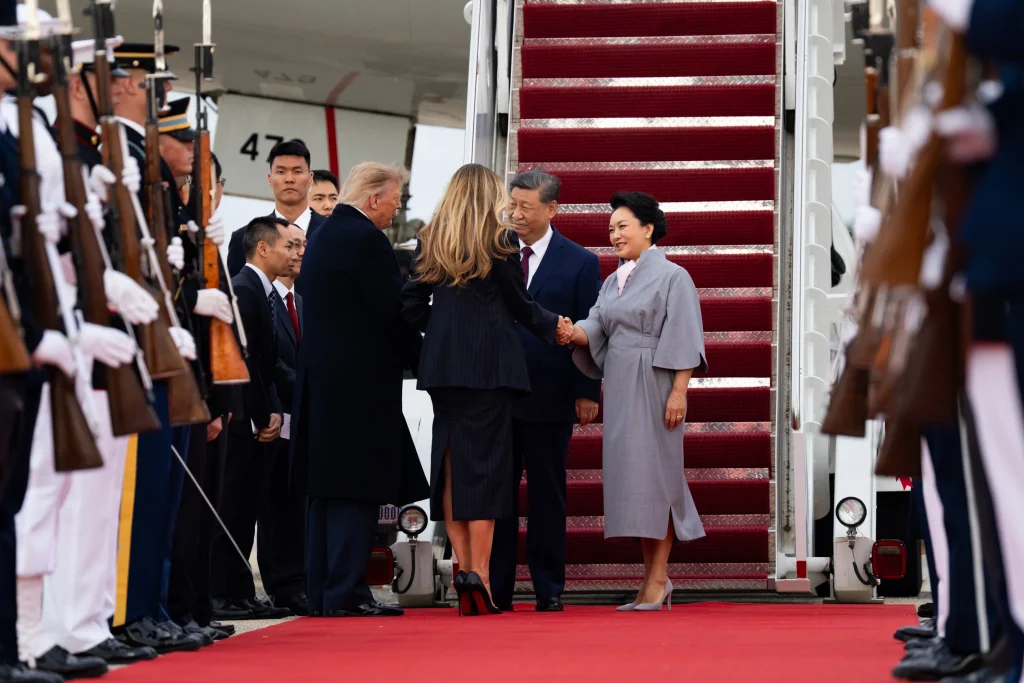
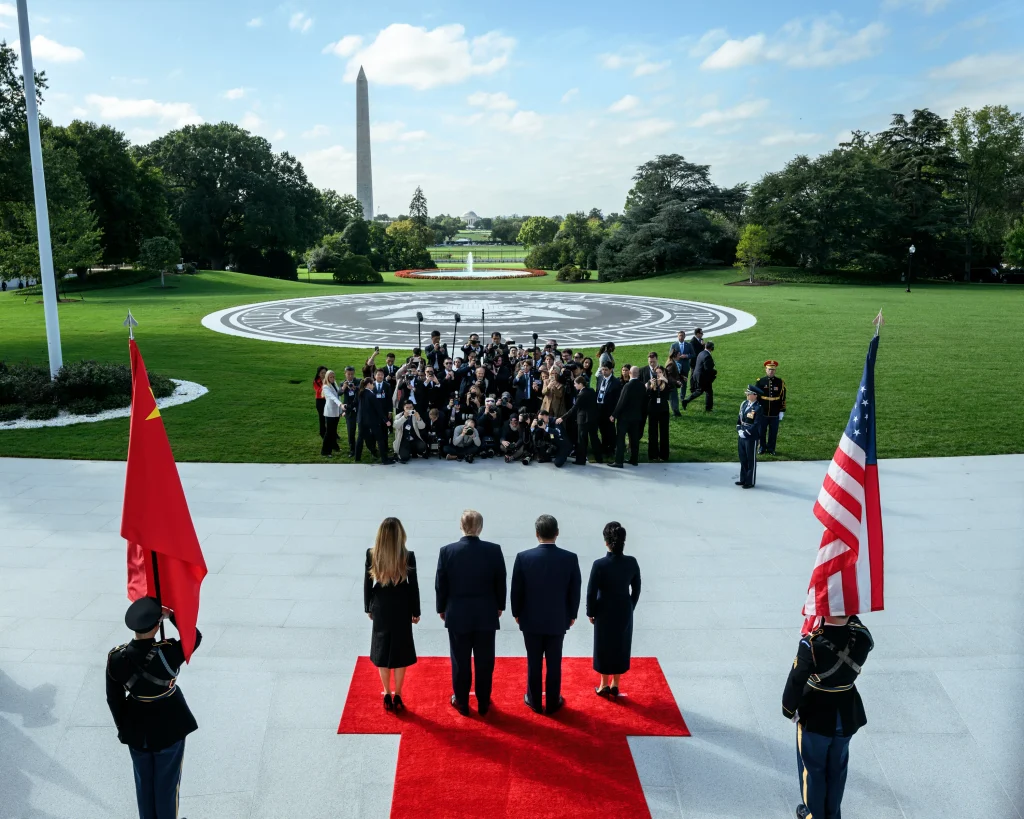
    Trump–Xi Washington Summit: Progress on Some Fronts

    Chinese President Xi Jinping and his wife Peng Liyuan arriving at Joint Base Andrews,
    Maryland, September 23, 2026. Image source: The Whitehouse

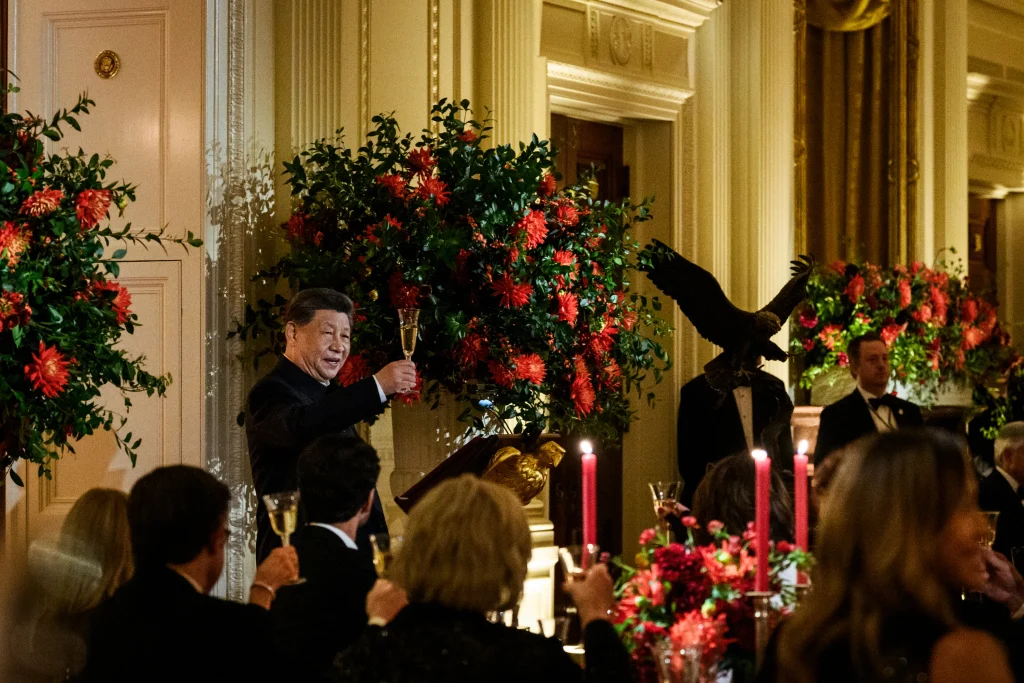
    Trump takes Xi on a tour of the Whitehouse and hosts a state dinner for the Chinese president,
    September 24, 2026. Image source: The Whitehouse

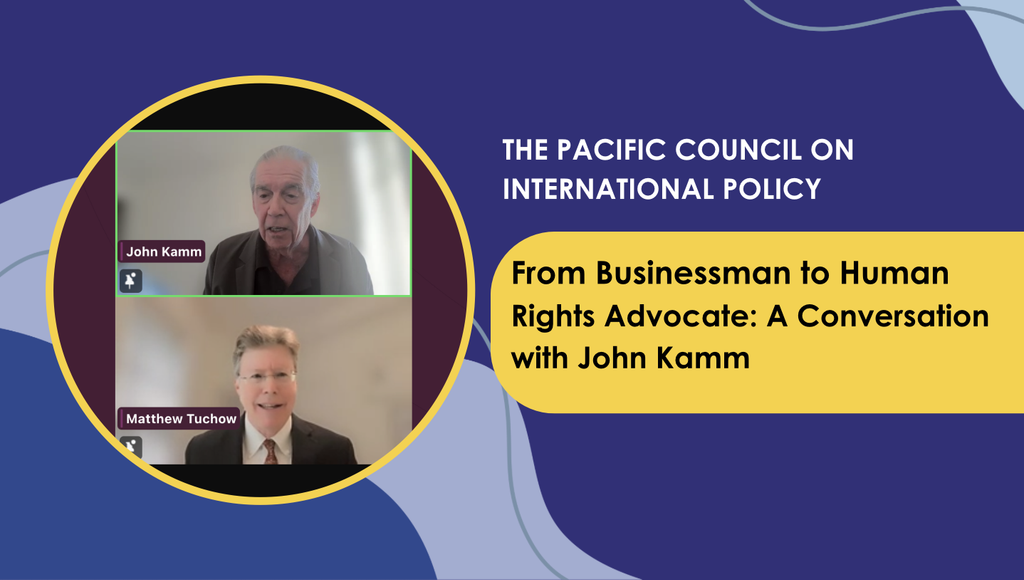
    From Businessman to Human Rights Advocate:
    A Conversation with John Kamm

    On October 15, 2026, Dui Hua Executive Director John Kamm spoke with Matthew Tuchow of the Pacific Council on International Policy about Dui Hua and its work. During the hour-long webinar, Tuchow asked Kamm about his long relationship with China and where he sees US-China relations today. The two also discussed Dui Hua’s most memorable case, why Chinese officials continue to engage with Kamm, and an important lesson he has learned over the years. We will post a recording of the webinar here as soon as it becomes available.


    PUBLICATIONS HIGHLIGHTS

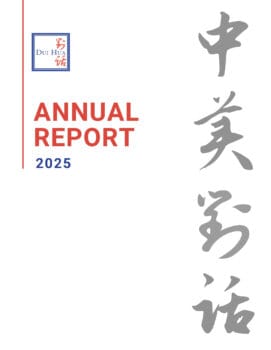
    Dui Hua 2025 Annual Report 

    In 2025, Dui Hua recorded achievements and encountered challenges brought about by fraying US-China relations, and the worsening human rights environments in both countries. Despite these difficulties, we continued to advocate for at-risk detainees.We also launched our Legacy Archive project, bringing together in one place our irreplaceable collection of materials from more than 25 years of Dui Hua’s work. Read the report.

    John Kamm Remembers  

    From John Kamm Remembers, a series written by Dui Hua’s founder recounting his advocacy for prisoners in China. 

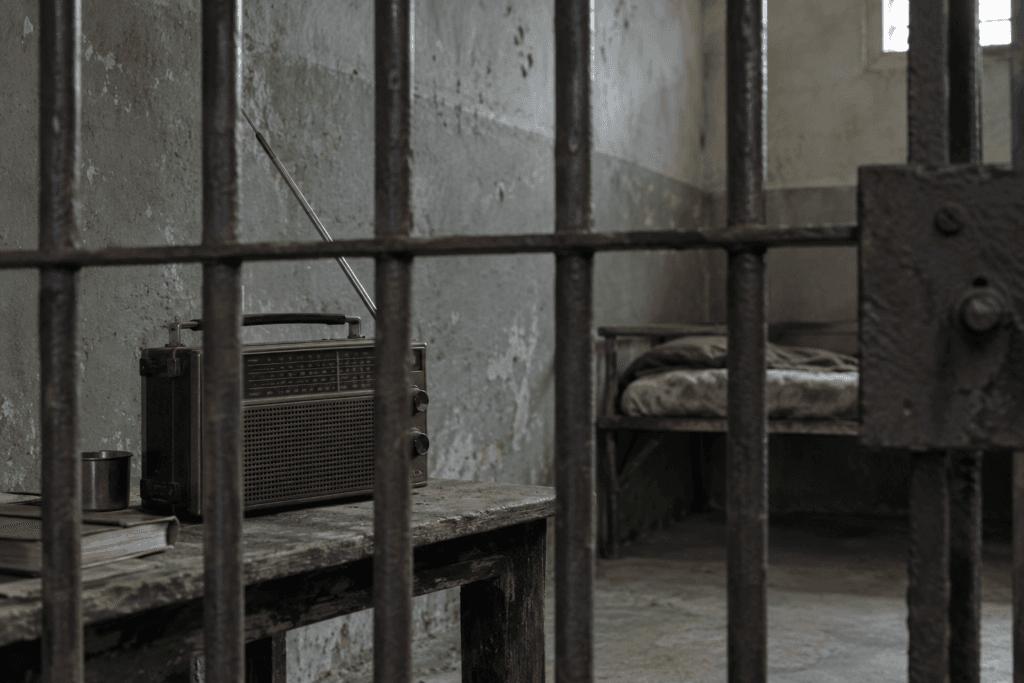
    Enemy Station

    Drawing on John Kamm’s involvement and documents in the Dui Hua Legacy Archive, John Enemy Station, tells the story of Han Chunsheng, sentenced in 1996 to eight years in prison for listening to Voice of America. It looks at VOA’s place in China-US relations, China’s view of VOA as an “enemy station”, and the station’s long service as a window on the world for listeners across China. Read the story

    Clinton’s Choice

    In the spring of 1993, Bill Clinton faced a decision: whether to make good on his campaign promise to hold Beijing accountable for human rights abuses, or to renew China’s trade status, subject to human rights conditions, and keep the door open to Deng Xiaoping’s economic reforms. Read the story

    Prisoner Updates 

    Dui Hua’s Prisoner Updates provide the latest information staff researchers have uncovered through online and library research and through direct dialogue with the Chinese government. 

    Eight Detained for Fraud in Beijing Church Anniversary Raid 

    The detention of eight members of Beijing’s Jiaquan Church (佳全教会) marks yet another case in China’s intensifying religious crackdown. In an open letter, Pastor Zhou Zixun (周子逊)’s South Korean wife said more than 100 police officers raided a hotel conference room on September 4, 2026, where about 50 congregants were preparing for the church’s twentieth anniversary. Read more

    Gao Zhen Sentenced to Three Years for Mao-Related Artwork  

    Gao Zhen (高兟) was sentenced by the Sanhe City People’s Court, Hebei, to three years in prison for “infringing the reputation and honor of heroes and martyrs.” The court found that Gao had created sculptures that deliberately distorted and vilified Mao Zedong’s image. Some of the artworks were created before China enacted the Law on the Protection of Heroes and Martyrs in 2018. Read more

    China Indicts Eight Zion Church Members 

    Eight Beijing Zion Church leaders and staff remain detained at Beihai’s No. 1 and No. 2 detention centers in Guangxi: Wang Lin (王林), Gao Yingjia (高颖佳), Yin Huibin (尹会彬), Wang Cong (王聪), Liu Zhenbin (刘桢彬), Lin Shucheng (林书铖), Wang Zhong (汪中), and Wu Qiuyu (吴秋雨). Read more

    Early Release of Erza Jin 

    Ezra Jin (Jin Mingri, 金明日), founder and pastor of Beijing’s Zion Church, was released on July 3 after nearly nine months in detention following the October 2025 crackdown on the church. He arrived in Los Angeles on July 4 and reunited with his family after years of separation. Read more


    Dui Hua in the News 

    Lex 19: Family fights for American scholar detained in China 

    New York Times: Families Urge Trump to Press Xi to Free Detained Americans

    New York Times: China Frees Pastor Detained in Crackdown on Religion After Trump’s Urging

  • Prisoner Updates #9 

    Nelson Wells Receives Eight-Month Sentence Reduction 

    Nelson Wells Jr., an American detained in China since May 2014, was granted an eight-month sentence reduction on September 18, 2026. For years, Dui Hua has advocated for his early release with the Chinese government. The reduction comes amid continued appeals from his family, who remain concerned about his deteriorating health. 

    Wells, from Louisiana, was convicted on drug-smuggling charges and initially sentenced to life imprisonment. His sentence was commuted to 22 years in 2019, with release previously expected in 2041. He is serving his sentence in a prison in Chongqing. His family says he is battling serious illnesses and his parents continue to urge US officials to secure his return home. 


    Eight Detained for Fraud in Beijing Church Anniversary Raid 

    The detention of eight members of Beijing’s Jiaquan Church (佳全教会) marks yet another case in China’s intensifying religious crackdown. In an open letter, Pastor Zhou Zixun (周子逊)’s South Korean wife said more than 100 police officers raided a hotel conference room on September 4, 2026, where about 50 congregants were preparing for the church’s twentieth anniversary. She also described repeated closures of the church’s worship venues and difficulties facing their family, saying refusals of her family reunion visa have prevented her from entering China for three years. 

    Seven church workers were taken away during the raid, while Zhou, whose real name is Cui Xianfeng (崔献峰), was summoned separately. Two workers were later released, but two others were detained, leaving Zhou and seven church workers in criminal detention on suspicion of fraud. The church was founded in 2006. 


    Chen Yunfei Formally Arrested After Detention During Gansu Trip 

    Human rights activist and Early Rain Covenant Church member Chen Yunfei (陈云飞) was formally arrested in Chengdu’s Wenjiang District on September 23, 2026, on suspicion of “picking quarrels and provoking trouble.” His relatives learned of the arrest from state security officers but had not received a written arrest notice. Authorities have not disclosed the specific conduct alleged to constitute “picking quarrels and provoking trouble.” 

    Chen was placed under twelve days of administrative detention in Gansu on August 5 while traveling. When that detention ended on August 17, he was transferred to Chengdu police and subsequently placed in criminal detention. His precise place of detention remains unclear. A participant in the 1989 democracy movement, Chen has been repeatedly imprisoned and subjected to surveillance and harassment. 


    Wu Huaiyun Receives Another Four-Year Sentence After Brief Freedom 

    Anhui online writer Wu Huaiyun (吴怀云) has received a four-year prison sentence and was transferred to Anhui Women’s Prison in September 2026. She was detained again in May 2025, only months after completing an earlier sentence. The charge underlying her latest conviction and the date of sentencing remain unclear. 

    Wu, known online as “Xinyue Baiyun” (心悦白云), previously served three years and ten months for “picking quarrels and provoking trouble” over posts on Twitter, now X. After her release in January 2025, police reportedly continued visiting her home and questioning her about her internet activity before detaining her again. 


    Huang Xueqin Completes Prison Term but Remains Deprived of Political Rights 

    Journalist and #MeToo activist Huang Xueqin (黄雪琴) completed her five-year prison sentence on September 18, 2026. She had been held at Guangdong Women’s Prison. Although her prison term has ended, she remains subject to four years’ deprivation of political rights, extending to September 2030. The initial report did not confirm whether she had returned home. 

    Huang was detained on September 19, 2021, a day before she planned to leave for postgraduate study in the United Kingdom. On June 14, 2024, the Guangzhou Intermediate People’s Court sentenced her for “inciting subversion.” Her case involved gatherings to discuss social issues with labor activist Wang Jianbing (王建兵), who received three years and six months in prison for the same offense. 


    Qin Weijin Released After Lung Cancer Diagnosis and Disbarment 

    Guangxi lawyer Qin Weijin (覃伟进) was released on September 12, 2026, after completing a two-and-a-half-year sentence. He was diagnosed with lung cancer on August 8 while imprisoned and reportedly underwent two rounds of chemotherapy. Following his release, he was described as having little appetite and being too weak to walk. The Guangxi Department of Justice revoked his law license on August 20, citing his criminal conviction. 

    Qin, a former judge based in Liuzhou, was detained on March 15, 2024, on suspicion of “inciting ethnic hatred and ethnic discrimination.” He was subsequently sentenced for “picking quarrels and provoking trouble” on May 25, 2025. He had previously supported fellow lawyers facing prosecution or disbarment. 


    Shi Tingfu Dies in Prison Months Before Scheduled Release 

    Nanjing human rights defender Shi Tingfu (史庭福) died in Xinjiang’s Shahe Prison on September 22, 2026, less than four months before his scheduled release on January 14, 2027. Prison authorities reportedly told his son that he had died of a heart attack. His son, who had recently visited him, said Shi appeared well and had reported no discomfort. 

    Shi was detained on January 15, 2024, after helping fruit growers in Xinjiang defend their rights and sharing their petition materials with overseas journalists. He received a three-year sentence for “picking quarrels and provoking trouble.” A longtime advocate for democracy and human rights, he received the Cao Shunli Memorial Award for Human Rights Defenders in 2025. 

  • Enemy Station (敌台)

    Image source: AI-generated image

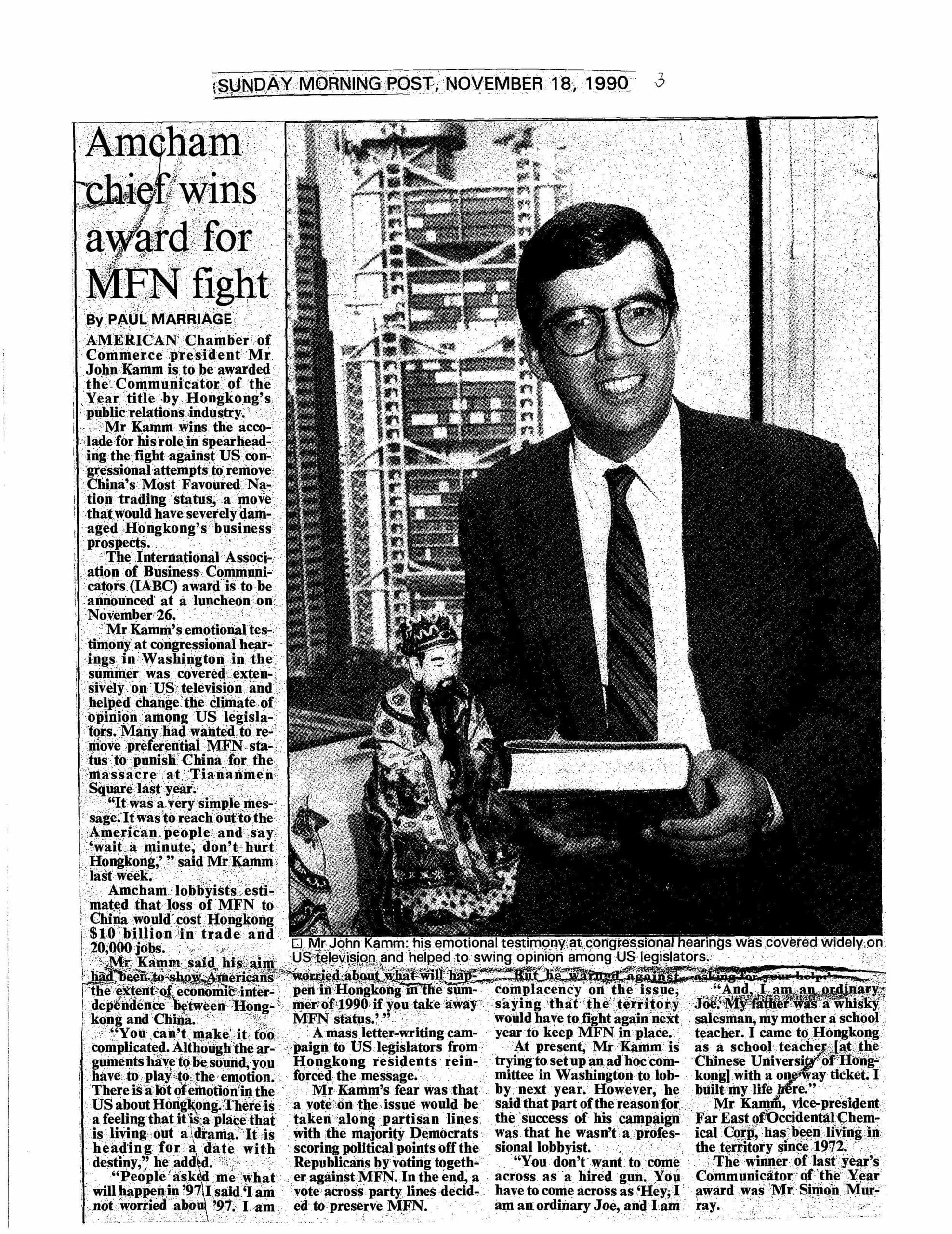
    Sunday Morning Post, November 18, 1990: “AmCham chief wins award for MFN fight.”

    Media coverage was extensive. It wasn’t long before I was asked to host a radio talk show on Hong Kong’s newest station, Metro, but I didn’t like the format. Sometimes no one would call in, so I had to resort to calling friends in the early evening, around cocktail hour.

    Nevertheless, I was able to use my show to advocate for releasing prisoners. In May 1991, I announced the release of the Li Brothers on Metro Radio.

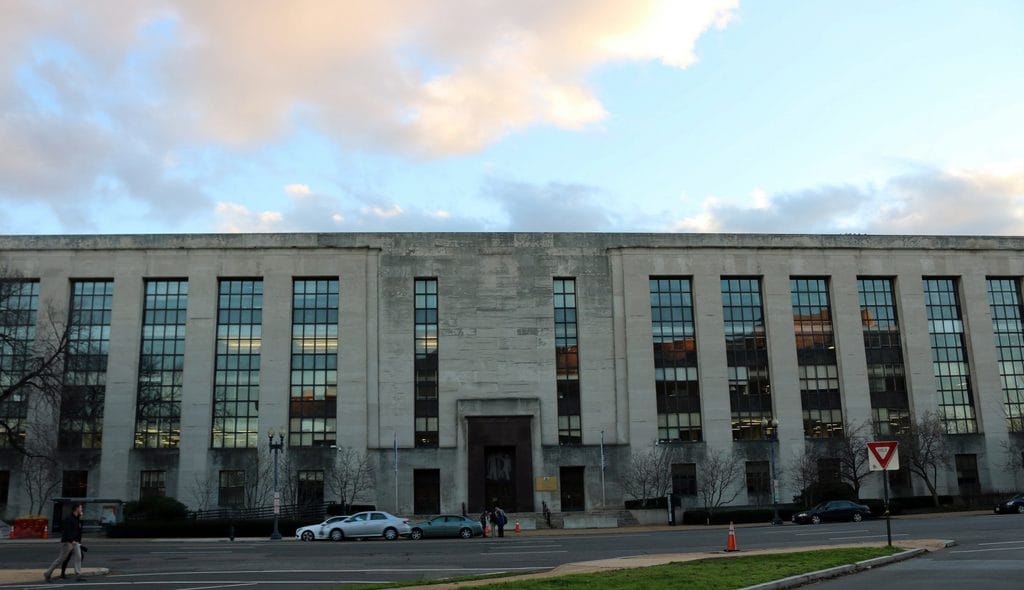
    Voice of America headquarters, Washington, DC, 2016. Image source: Persian Dutch Network

    In September 2001 I was in Hong Kong taping shows for my program. After I returned to my room following dinner with Chinese officials, there was a voice message on the phone. It was my producer in Washington. “Turn on your TV.” I did so and watched the second plane crash into the World Trade Center. The date was September 11. I lost a family member in the attack.

    I traveled to Beijing the day after the attack. I met with Chinese officials to obtain information on political prisoners but came away empty-handed. I returned to Hong Kong and shortly after, I received a call from the hotel lobby. One of the officials I had met in Beijing had flown to Hong Kong to give me information on Takna Jigme Sangpo, an elderly Tibetan teacher serving a long sentence for counterrevolution. Jigme Sangpo was released and flown to the United States in 2002.

    Han Chunsheng

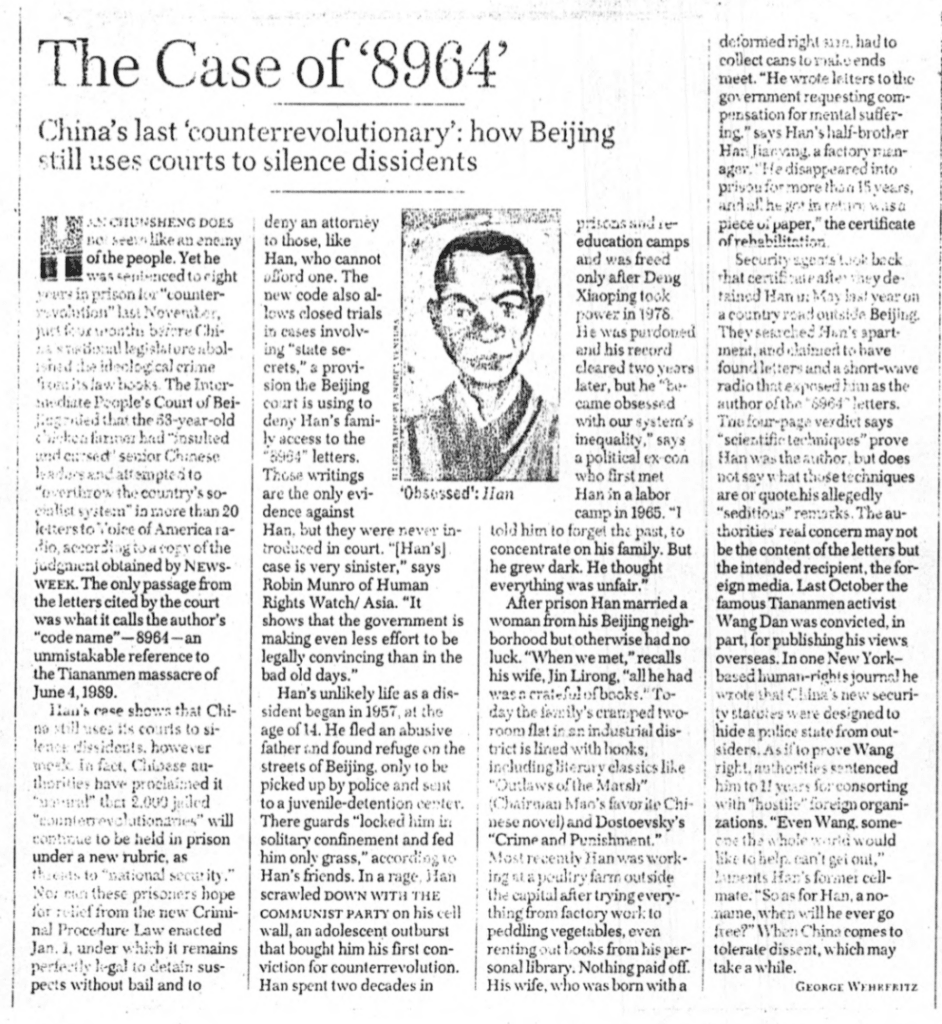
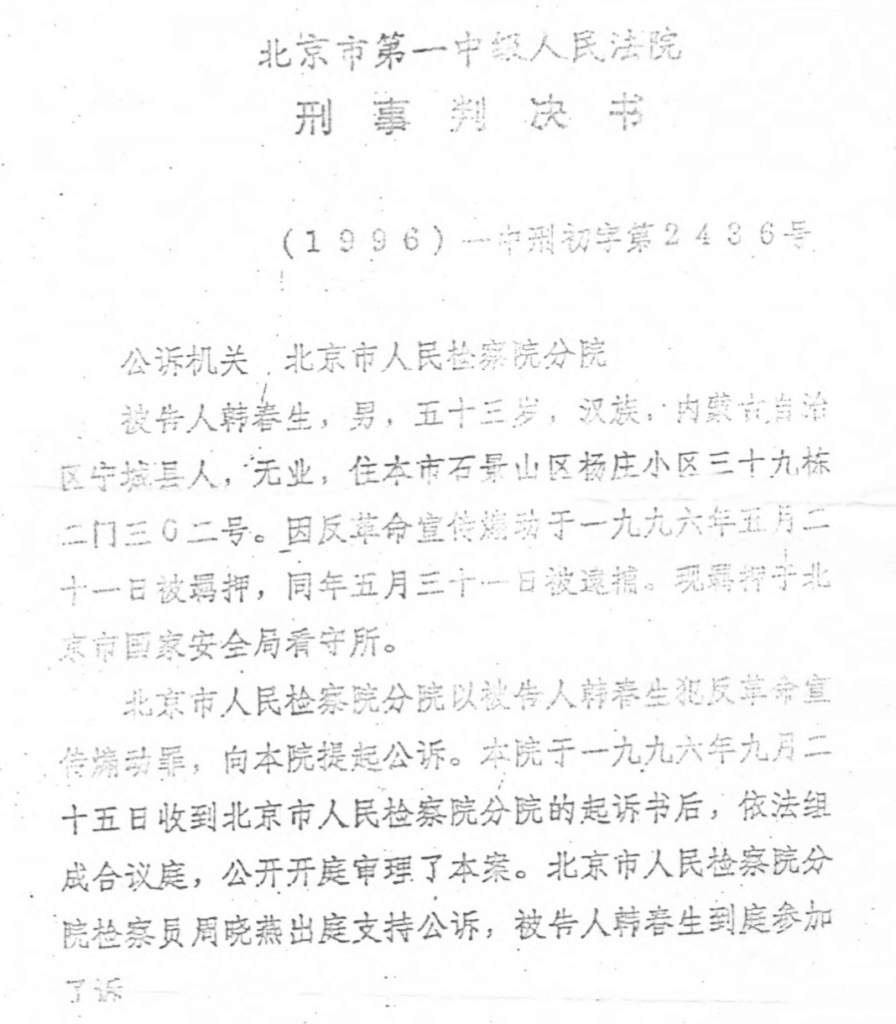
    Left, article about The Case of ‘8964’ in Newsweek, September 29, 1997. Right, Criminal Judgement of Han Chunsheng

    Han was one of the last people convicted of counterrevolution before it was removed from the criminal law in 1997. He spent his internment in Beijing Number Two Prison, used to house many political and religious prisoners including Xu Wenli and American citizen Pastor David Lin

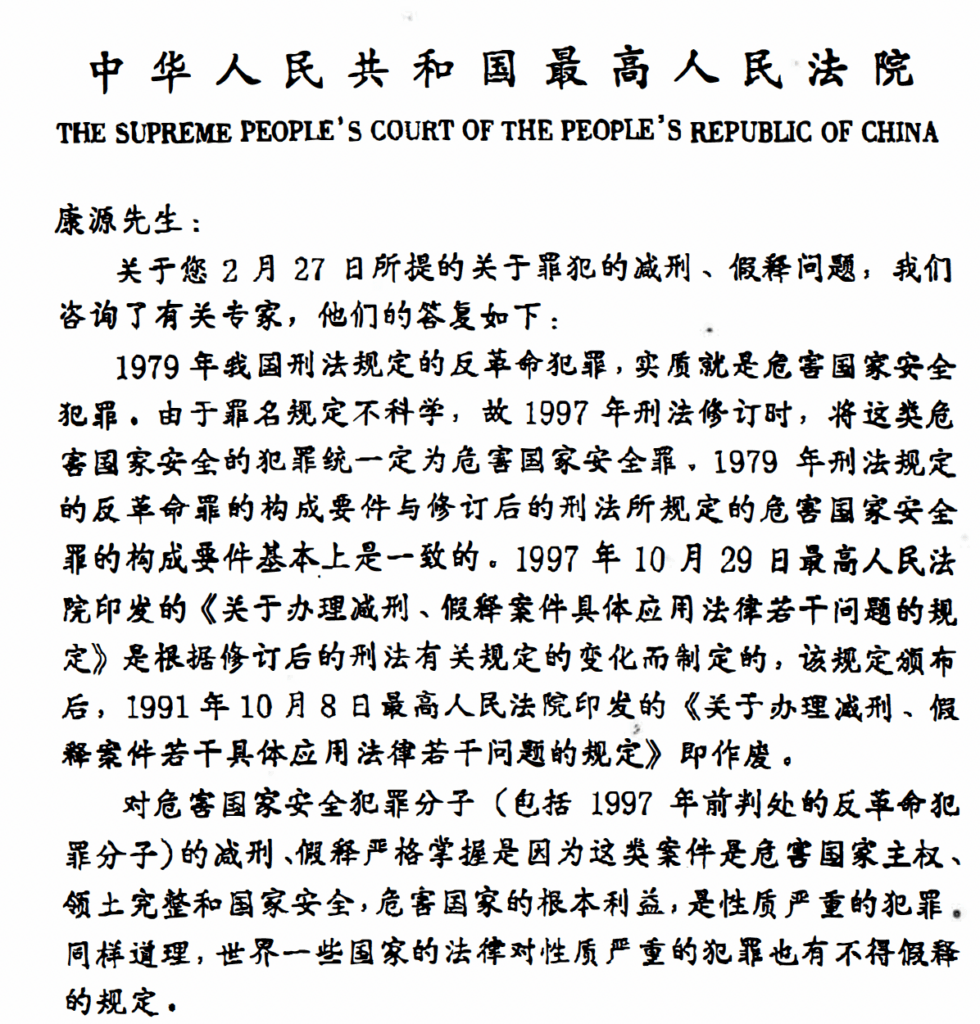
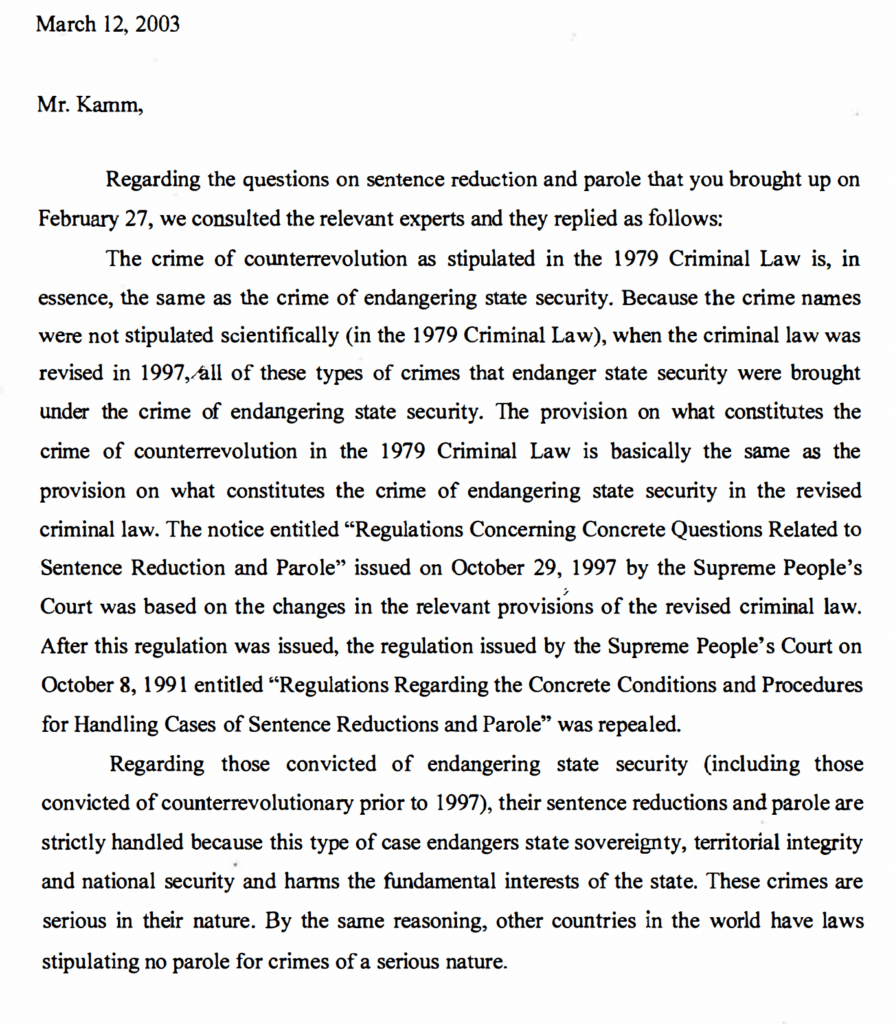
    Letter to the Executive Director John Kamm from the Supreme People’s Court, March 12, 2003,
    in response to Kamm’s written query about Han Chunsheng’s counterrevolution sentencing,
    a crime removed from China’s Criminal Law in 1997.

    VOA Today

  • Prisoner Updates #8 

    Gao Zhen Sentenced to Three Years for Mao-Related Artwork  

    Gao Zhen (高兟) was sentenced by the Sanhe City People’s Court, Hebei, to three years in prison for “infringing the reputation and honor of heroes and martyrs.” His sentence runs from August 26, 2024, to August 25, 2027. The court found that Gao had created sculptures that deliberately distorted and vilified Mao Zedong’s image and later disseminated images of the works online. Some of the artworks were created before China enacted the Law on the Protection of Heroes and Martyrs in 2018. 

    According to the judgment, Gao and others created three sculpture series, including Repentance, at a studio in Beijing’s 798 Art District between 2005 and 2009, then exhibited them overseas between 2010 and 2013. From 2013 to 2024, they continued to circulate images of the sculptures through an overseas X account, formerly Twitter. Gao also authorized use of the images on book covers and participated in related award ceremonies. Citing the prolonged online dissemination and alleged harm to Mao’s reputation and the public interest, the court found the offense “serious.” Gao denied the charges, arguing that the sculptures did not specifically depict Mao and that his conduct constituted artistic expression, but the court rejected both arguments. 


    Update: Three Leaders of Wheatseed Reformed Church Sentenced 

    On August 10, 2026, the Fuyang City People’s Court, Anhui, sentenced three Wheatseed Reformed Church leaders for “organizing illegal gatherings.” Pastor Zhang Sen (张森) received a sentence of one year and seven months, ending January 24, 2027. Pastor Chang Shun (常顺) was sentenced to one year and six months, while elder Ma Shutao (马树涛) received one year and four months. 

    Authorities transferred the case to the procuratorate in October 2025. The charges arose from the three leaders’ roles in unregistered religious gatherings and allegations that they had preached to minors. 


    Update: Du Bin Sentenced to 18 Months 

    On August 28, 2026, Du Bin (杜斌) was sentenced to one year and six months in prison, with his sentence reportedly ending on April 14, 2027. His June 24 trial in Beijing’s Shunyi District Court reportedly relied on about 40 social-media posts, reposts and comments as evidence. Before sentencing, Du requested permission to see his critically ill mother but was denied; she subsequently died. 

    Du, a prominent human-rights photographer, documentary filmmaker, and former journalist, was detained in Beijing on October 15, 2025, while preparing to travel to Japan, and charged with “picking quarrels and provoking trouble.” He had previously been detained in 2013 and 2020 over his work. 


    Sun Chao Detained Over Christian House-Church Activities 

    A Christian preacher from Qujing, Yunnan, Sun Chao (孙超) has served in an unregistered house church since 2015 and was repeatedly detained for his religious activities. He was administratively detained in Kunming in April 2024 and Qujing in June 2025, and on July 25, 2026, was again detained in Xuanwei for 12 days for allegedly engaging in “illegal religious activities.” When his detention was due to expire on August 7, authorities instead converted it to criminal detention on suspicion of “illegal organization of gatherings.” Sun, who reportedly has epilepsy and requires regular medication, is currently held at the Xuanwei City Detention Center; his wife has expressed concern about his access to necessary medication and the impact of his detention on their family.


    Lu Huihuang Released After Serving Four-and-a-Half-Year Sentence for Supporting the “Chained Woman” Victim  

    Lu Huihuang (陆辉煌), a Guangxi-based democracy activist and online writer, was sentenced to four years and six months in prison for “inciting subversion” after publicly calling for an investigation into the “chained woman” case in Xuzhou. The incident came to light in January 2022 when a video showed a woman in Feng County, Xuzhou, chained by the neck in a dilapidated building; she was reportedly found to have been trafficked and subjected to prolonged abuse and unlawful confinement. 

    Lu’s appeal was rejected, and he completed his sentence and was released on August 17, 2026. He had previously served two years and six months for “picking quarrels and provoking trouble” over articles advocating political reform and criticizing the authorities. After his release in 2021, he continued his online activism and was detained again on February 18, 2022, after publicly supporting the Xuzhou “chained woman” victim. He was subsequently transferred to Qinzhou Prison in March 2023 to serve his sentence. 


    Uyghur Rapper Yashar Shohret Released After Three-Year Sentence 

    Yashar Shohret (亚夏尔·肖合拉提), a Uyghur rapper known by the stage name Uigga, was released on August 10, 2026, after completing a three-year prison sentence. He was sentenced in June 2024 by the Bole City People’s Court in Xinjiang for “promoting extremism” and “illegally possessing items promoting extremism.” 

    Shohret was detained after participating in a November 27, 2022, White Paper Movement gathering in Chengdu, where he knelt before candles and sang a mourning song in Uyghur for victims of the Urumqi apartment fire. He was subsequently arrested twice and held for several months before his conviction. His whereabouts, health, and conditions following his release remain unknown. 

  • Clinton’s Choice: Elections have Consequences 

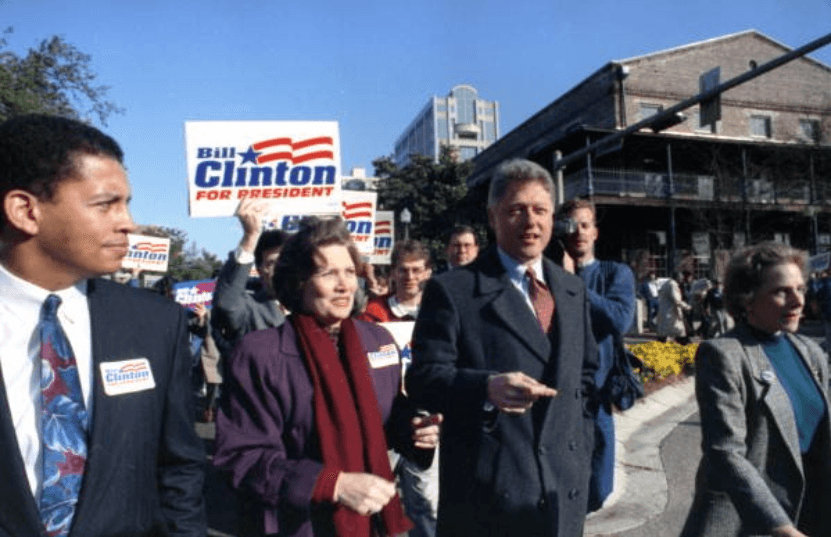
    Clinton campaigning in Tallahassee during the 1992 presidential election. Source: Wikipedia 

    In the 1992 United States’ presidential campaign, Democratic candidate Bill Clinton excoriated then-president George W. Bush for being soft on China on human rights and trade, accusing the incumbent of coddling “the butchers of Beijing.” He aligned himself with Democrats in Congress, notably Democratic Majority Leader George Mitchell (D-ME) and Congresswoman Nancy Peloisi (D-CA), who had introduced legislation to place conditions on China’s Most Favored Nation (MFN) trading status. Bills placing conditions on China’s MFN had passed in both 1991 and 1992, but Bush vetoed both. Efforts to override his veto failed in both years. With Clinton as president, it was widely assumed that Clinton would sign the legislation after he took office. 

    Bills placing conditions on China’s MFN were framed as reasonable alternatives to a resolution of disapproval introduced by Congressman Gerald Solomon (R-NY) in the early 1990s. If passed into law, these resolutions would have resulted in revocation of China’s trade status. 

    In the event, Clinton decided not to sign legislation conditioning China’s MFN and instead renewed China’s MFN in 1993 by means of an executive order which mandated “significant progress” on human rights including releasing and accounting for political prisoners, allowing international media broadcasts to be listened to in China, and granting access by international humanitarian and human rights organizations to China’s prisons. (Executive orders are less constraining on a president than legislation passed by Congress and signed into law.) Under the Executive Order, Clinton was required to confirm that China had made significant progress on human rights when MFN came up for renewal in 1994.  

    Bound by the Trade Act of 1974, Clinton needed to make his decision no later than June 3, 1993 (June 4 in Beijing). By June 1993, I had testified six times to Congress on MFN and human rights. Maintaining access to the US market was crucial to achieving paramount leader Deng Xiaoping’s economic policies. 

    Southern Tour 

    In the spring of 1992, Deng Xiaoping makes his famous southern tour. Source: Global Times 

    Deng revitalized his “reform and opening” policies (sometimes referred to as China’s economic miracle) with his “Southern Tour” in 1992. The policies had been initiated at the Third Plenary Session of the 11th Central Committee in December 1978, but momentum had slowed after the Tiananmen Square killings of June 1989.

    To a large extent, the economic miracle needed access to the US market and the dollars it generated. Loss of MFN would cripple that access. At the time, Chinese exports to the US were small, hit by boycotts and sanctions, but Deng, who had personally seen the vibrancy of the consumer market when he toured the US in 1979, was convinced Chinese exports were poised for growth.

    As the June 1993 deadline to renew MFN neared, I began planning a visit to Beijing to see what human rights concessions might be possible. I reached out to individuals and families and friends of those persecuted in China for their political and religious beliefs.  

    I met with American journalist Todd Carell in San Francisco and Father Politi in Hong Kong, as well as a retired academic well-versed in the situation in Tibet; he provided information on Tibetan political prisoners. I spoke by phone with Bao Pu, son of Bao Tong, Zhao Ziyang’s private secretary, and met with dissidents sheltering at Princeton University, my alma mater, under the college’s “China Initiative.” I communicated with human rights NGOs in the United States, Europe, and Asia, to find out what they knew about the prisoners I intended asking about. 

    Prior to my visit to Beijing in May 1993, I sent prisoner lists to the Ministry of Justice, the Ministry of Public Security, the Ministry of Foreign Affairs, and the State Council Information Office. 

    Todd Carrel 

    Todd Carrel was Bureau Chief of ABC News in Beijing when, in June 1992, he went to Tiananmen Square, site of the 1989 killings of protesters, to record protests that were expected to take place on the anniversary of the killings. Carrel was seized by the police, bundled into a car, and savagely beaten. (Other foreign correspondents were likewise treated roughly). The year before, in May 1991, three members of Congress had mounted a protest in Tiananmen Square. Journalists had been roughed up. Fearing a repeat, China’s police were on high alert in 1992. 

    Carrel suffered serious injuries when he went to the square in June 1992, necessitating his return to San Francisco, where I had purchased an apartment. I met with Todd at a pastry shop in San Francisco’s Little Italy on April 18, 1993. He described the assault in graphic detail; he had been beaten with steel ball bearings wrapped in thick socks, the purpose being to hide bruises. Mr. Carrel walked with difficulty, often stopping to get his footing before carrying on. 

    There is no record of the Chinese government apologizing to Todd Carrel for the assault he endured in Tiananmen Square in June 1992, much less compensating him for the injuries he suffered there. 

    There is a long history of Chinese police targeting foreign journalists doing their jobs in Beijing. During the late 1960s, when the Cultural Revolution was underway, Reuters correspondent Anthony Grey, was placed under house arrest for 27 months by the Red Guards; they killed his house cat. In 2005, Wall Street Journal correspondent Matt Pottinger was physically assaulted at a Starbucks in Beijing. Mr. Pottinger went on to serve as Deputy National Security Advisor in the first Trump administration where he became known as an influential “China hawk.” 

    Xu Wenli (徐文立) and June 4 Activists 

    On the mid-May 1993 visit to Beijing, I was informed that veteran activist and leader of the Democracy Wall movement, Xu Wenli, would be released on May 26, 1993, in anticipation of the MFN decisions. Dui Hua prepared a press statement for distribution upon his release. The statement was heavily covered in international media. He was again detained, arrested, and sentenced for endangering state security in November 1998 and released in December 2002, after which he travelled to the US to be reunited with his wife and daughter. 

    Wang Xizhe. Source: Internet 

    I brought up Wang Xizhe (王希哲), a Guangdong-based member of the Liyizhe group (1974) and, later, Democracy Wall activist, with the Supreme People’s Court. He had been sentenced to 14 years in prison in 1982 but was released early. He fled to the US via Hong Kong in 1996. 

    Courts in Shandong Province had imposed the harshest sentences on those involved in the June 1989 protests.  I requested information on Chen Lantao (陈兰涛) and Hao Fuyuan (郝付元). Both were released years before their sentences expired. 

    I raised the situation of June 4 activist Liu Gang (刘刚) with the Ministry of Justice (MOJ). A Liaoning-based June 4 activist who was the sixth name on the Chinese government’s “most wanted list,” he was sentenced to six years in prison, and never granted clemency. He left China for the US in 1996. 

    Catholics 

    Father Politi. Source: Internet 

    I worked closely with Father Politi, a Catholic priest based in Hong Kong, in the early 1990s. On the May 1993 visit to Beijing, I raised the cases of Zhang Dapeng (张大鹏), a Catholic lay leader based in Baoding, Hebei Province, an area with a large Catholic population. I also inquired about Catholic priest Zhang Youshen (张有申). Both had been detained in 1990 and released early in 1992. I announced both releases in late May 1993. 

    I had placed Bishop Wang Milu (王弥禄), called the “Black Bishop of Gansu” for ordaining priests without the Vatican’s approval, on my lists sent in advance of the trip to Beijing. He was released early on April 30, 1993. 

    Tibetans

    For the first time, I put the names of Tibetan counterrevolutionaries on a list to the MOJ: Yulo Dawa Tsering, Ngawang Phulchung, and Tseten Norgye. All had been given long sentences for counterrevolution. Yulo Dawa Tsering was paroled in 1994, around three years early. Ngawang Phultsong was given a six-month sentence reduction. Tseten Norgyue is believed to have served his full sentence.   

    I brought up Tibetan teacher Takna Jigme Sangpo with the MOJ. He was thought to be, at the time, the longest serving Tibetan political prisoner. He was granted early release and flown to Switzerland via the US in 2002. 

    Counterrevolutionaries and Those Sentenced to Death 

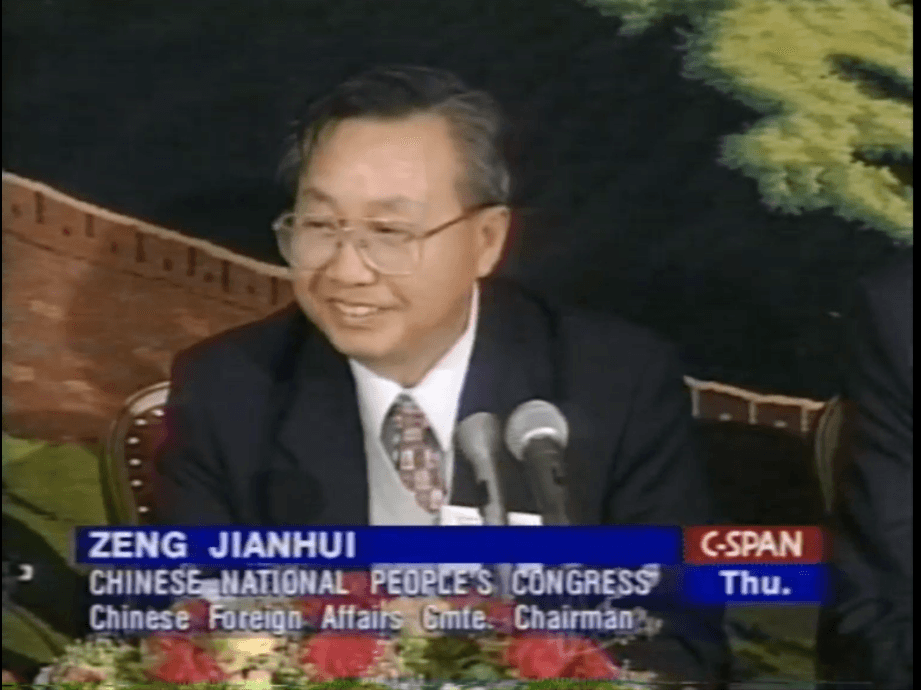
    On the May visit I met with senior officials – Zheng Hongye of the China Council for International Trade, which served as my host on visits to Beijing; Chen Mingming of the Ministry of Foreign Affairs (MFA); Zhu Entao of the Ministry of Public Security; Wang Genliang of the Supreme People’s Court; Wang Mingdi of the MOJ; and Minister Zeng Jianhui of the State Council Information Office – to discuss prisoners and issues. With respect to issues, I was given information on the number of prisoners serving sentences for counterrevolution but failed to get information on the number of people executed in China. 

    I was interested in finding out what had happened to Zheng Qiuwu (郑酋午), an academic who had advocated economic reform, including the establishment of stock markets. He was sentenced to 14 years in prison for counterrevolutionary incitement and propaganda, to be served in Hainan Province. His sentence was reduced to 13 years on appeal. 

    China’s 007 

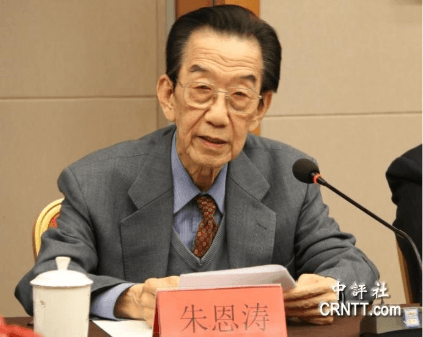
    Zhu Entao. Source: CRNTT.com  

    While the cases of all those persecuted who were on my lists or who I had raised verbally in my Beijing meetings, I placed special emphasis on that of Todd Carell. I suggested that the Chinese government apologize to Todd Carrel and pay compensation for the injuries suffered at the hands of the police. I got push-back or, in the case of Zhu Entao (China’s 007), stunned silence. I brought up Mr. Carrel at a banquet hosted by Zhu at the Kunlun Hotel, owned by the Public Security Ministry. Zhu and colleagues were not happy. I also raised Mr. Carrel’s assault with the MFA’s Chen Mingming. 

    Zeng Jianhui, October 14, 1990. Zeng talked to US reporters after meeting with members of the US Congress. Image: C-Span 

    The most consequential session was with Minister Zeng Jianhui of the State Council Information Office. He oversaw China’s external propaganda efforts and realized the impact on US public opinion of an assault on an American journalist by the Chinese police. China was already thinking of applying to host the Olympic Games, and he realized that this kind of publicity, as well as reports of how China treated Catholics, was not good for China’s chances of securing the games. 

    In June 1993, journalists covering activities in Tiananmen Square were treated relatively well. I heard that the police were courteous and wore white gloves. Since I wasn’t present, I cannot say for sure. 

    Of the 20 people I asked about in May 1993, either in person or by list, nine are known to have received a form of clemency (parole, medical parole, sentence reduction) including two Tibetans and three Catholics. 

  • Prisoner Updates #7 

    China Indicts Eight Zion Church Members 

    Eight Beijing Zion Church leaders and staff remain detained at Beihai’s No. 1 and No. 2 detention centers in Guangxi: Wang Lin (王林), Gao Yingjia (高颖佳), Yin Huibin (尹会彬), Wang Cong (王聪), Liu Zhenbin (刘桢彬), Lin Shucheng (林书铖), Wang Zhong (汪中), and Wu Qiuyu (吴秋雨). On 17 July, prosecutors indicted them in the Yinhai District People’s Court without first notifying defense lawyers or inviting formal defense submissions. Indictments delivered to their families in late July accuse Wang Lin, Gao Yingjia, Yin Huibin, Wang Cong, Liu Zhenbin, and Lin Shucheng of “fraud” for allegedly collecting more than RMB 10 million in tithes and offerings. Wang Lin, Wang Zhong, and Wu Qiuyu also face “illegal business operations” charges over online religious-training packages which are said to have generated more than RMB 2 million between 2020 and 2025. 

    The “10·9 Case” arose from a crackdown on Beijing Zion Church, a large Protestant house-church, and its pastors and co-workers. Church leaders—including founding pastor Ezra Jin Mingri, released in early July—deny the allegations. They say tithes and pastoral support were voluntary and overseen by church elders, while course fees were non-profit commitment deposits largely refunded after completion.  


    Administrative Detention Escalates to Criminal Charges for Yueyang Rock Bible Church Members 

    Three members of the Rock Bible Christian Church in Yueyang, Hunan, Pastor Huang Lei (黄磊), Yang Jianjun (杨建军), and Hu Hongtao (胡洪涛), were transferred from administrative detention to criminal detention in late July 2026 on suspicion of “illegal use of an information network.” The three were initially given 15-day administrative detention orders on July 11. However, instead of being released after completing their sentences, they were taken into criminal custody. As of late July, family members and lawyers reported significant restrictions on legal access, with only Huang permitted a brief meeting with his defense lawyer. 

    The case stems from the men’s involvement in the unregistered Rock Bible Christian Church, where they participated in routine pastoral ministry and online religious gatherings. Police initially accused them of “organizing illegal religious activities” and used administrative detention before escalating the matter to criminal charges linked to their online communications. The case reflects a broader nationwide trend toward tighter restrictions on unauthorized online preaching: authorities are increasingly using the charge of “illegally using information networks” to criminalize independent house churches engaged in online fellowship, prayer groups, and the distribution of religious materials. 


    Henan Student Returning from the Netherlands Tried for “Picking Quarrels” Following Airport Interception 

    Hu Yang (胡洋), a Henan native who earned a master’s degree in philosophy from Leiden University in the Netherlands, stood trial in mid-July 2026 before the Erqi District People’s Court in Zhengzhou on charges of “picking quarrels and provoking trouble.” The court did not issue an immediate judgment, and Hu remains detained at the Zhengzhou No. 3 Detention Center. He was intercepted by police at Shanghai Pudong International Airport on 26 July 2025 while returning to China with fellow student Wu Haoyu (吴昊宇) of the Polytechnic University of Milan. Both were subsequently placed under criminal detention by Zhengzhou police and formally arrested in September 2025. 

    The case is based on Hu’s online speech and activities while studying in Europe. It highlights a growing pattern in which Chinese authorities target overseas students for engaging in political discussion and rights advocacy while overseas. Following Hu’s detention, authorities reportedly intimidated his family and prevented defense lawyers from meeting with him for more than 100 days, until access was finally granted in November 2025. 


    Former 1989 Student Leader Arrested in Lhasa on “Inciting Splittism” Charges 

    Zhang Yi (张毅), a former student leader in the 1989 democracy movement, was criminally detained by the Lhasa Public Security Bureau on July 18 on suspicion of “inciting splittism.” He is currently being held at the Lhasa Detention Center. Earlier, on July 1, while traveling in Tibet with his brother, Zhang Xuan (张玄), he was taken into custody by police in Lhasa’s Chengguan District and placed under 15 days of administrative detention. Instead of being released when the detention period ended, authorities escalated the case and transferred him to criminal detention. 

    Zhang Yi previously served two years in prison for his participation in the 1989 Tiananmen Square movement and has remained under state surveillance for decades. The case marks an unusual application of the offence of “inciting splittism” against a Han Chinese participant in the 1989 democracy movement. The charge is more commonly used in cases involving Tibet and Xinjiang. 


    Additional Charge Added in Case Against Early Rain Preacher Dai Zhichao 

    In mid-July 2026, the case of Early Rain Covenant Church preacher Dai Zhichao (戴志超) was transferred to prosecutors for review and prosecution, with authorities adding a second charge of “organizing illegal gatherings” alongside his initial charge of “inciting subversion of state power.” Dai remains held at the Deyang Detention Center in Sichuan following a pre-transfer visit from his defense attorney. 

    Dai was detained on January 6, 2026, in a crackdown on Early Rain Covenant Church leaders in Chengdu and Deyang. A longtime minister and former student of Pastor Wang Yi, he has endured years of police raids, house arrests, and short-term detentions for persisting in unregistered pastoral ministry. 

  • Prisoner Update #6 

    Early Release of Erza Jin 

    Ezra Jin (Jin Mingri, 金明日), founder and pastor of Beijing’s Zion Church, was released on July 3 after nearly nine months in detention following the October 2025 crackdown on the church. He arrived in Los Angeles on July 4 and reunited with his family after years of separation. His release followed high-level diplomatic engagement between the United States and China, during which his case was raised with Chinese leader Xi Jinping, and was described by Chinese officials as a humanitarian gesture.  

    In November 2025, Dui Hua had included Ezra’s name on a prisoner list submitted to Chinese authorities, urging that his case be reviewed and that he be released. His subsequent release follows months of international advocacy, although several other Zion Church leaders remain in detention. 


    Partial Bail Releases and Charge Escalation in Zion Church Case 

    Sun Cong (孙聪), Liu Jiang (刘江), Li Shengjuan (李胜娟), Wei Yunfei (魏云飞), An Mei (安梅), Zhan Ge (战歌), Hu Yanzi (胡燕子), Mei Liming (梅丽明), and Zhu Mingli (朱明丽) were released on bail on June 18, after more than eight months in detention. Proceedings against the remaining eight church leaders continue. Charges against those still in custody have reportedly been escalated from earlier allegations such as “illegal use of information networks” to more serious offences including “illegal business operations” and “fraud,” 

    Those still detained include Wang Lin (王林), Gao Yingjia (高颖佳), Yin Huibin (尹会彬), Liu Zhenbin (刘桢彬), Lin Shucheng (林书铖), Wang Cong (王聪), Wang Zhong (汪中), and Wu Qiuyu (吴秋雨). 


    Sisters sentenced to Eight-and-a-Half Years for “Picking Quarrels and Provoking Trouble” 

    Sisters Jin Hanyan (金汉艳) and Jin Hanxin (金汉欣) were convicted of “picking quarrels and provoking trouble” and sentenced to eight years and six months and seven years and six months of imprisonment, respectively. The sentences are exceptionally severe for this offence. Although Chinese law permits sentences of more than five years in particularly serious cases involving repeated conduct deemed to have seriously disrupted public order, such lengthy terms remain uncommon, especially in cases involving nonviolent activists and petitioners. 

    The sisters began petitioning after seeking accountability for the unresolved death of Jin Hanyan’s son and the authorities’ alleged failure to properly investigate the case. Over the years, they repeatedly petitioned higher-level authorities, publicly expressed their grievances, and joined collective petitioning activities. The prosecution alleged that their conduct constituted the offence of “picking quarrels and provoking trouble,” resulting in the unusually heavy prison sentences. 


    Among the Youngest Known Political Dissidents in China 

    Zhang Qiyuan (张琪沅), a 15-year-old from Baoding, Hebei, is among the youngest known political dissident in mainland China. At age 14, he attracted official attention after publicly questioning whether Xi Jinping was a “dictator” during a livestream in July 2025. Before being summoned by police, Zhang recorded a video declaring that he would “never compromise” and that any future televised confession should be regarded as coerced. Shortly afterward, he disappeared. In a newly released appeal video, Zhang says that during his disappearance he was involuntarily confined for several months in the Hebei Provincial Sixth People’s Hospital, a psychiatric institution, before being transferred to a behavioral correctional school, where he says he was subjected to intimidation and unlawful deprivation of liberty. Following the publication of the video in June 2026, Zhang has reportedly disappeared again, raising renewed concerns over his safety and whereabouts. 


    Sentence Completed, but No Clear Route Back to Taiwan 

    Li Yanhe (李延贺), a Taiwanese publisher and writer, has completed his prison sentence in mainland China following his conviction for inciting splittism, a charge linked to his work publishing and editing materials that authorities alleged promoted or supported Taiwan independence-related views. The case stems from his professional activities in the publishing sector, through which Chinese authorities alleged that he disseminated politically sensitive content. 

    Despite completing his custodial sentence, Li remains unable to return to Taiwan, partly because he is still subject to a supplemental one-year deprivation of political rights. He remains in mainland China while arrangements for his departure are unresolved, leaving him unable to exit freely despite having finished his prison term.  


    Appellate Sentence Update for Zhang Wenpeng 

    Zhang Wenpeng (张文鹏), a human rights lawyer, was detained on September 24, 2024, after representing the Haiyun Group and speaking out online on behalf of his client. He was subsequently charged with “picking quarrels and provoking trouble.” Before his detention, Zhang had also become known for publicly criticizing the official lawyers’ association and exposing alleged corruption within the justice system. During his detention, reports alleged that he was subjected to torture. 

    On May 26, the Hainan appellate court rejected Zhang’s appeal and upheld his four-year-and-six-month prison sentence. He was transferred to Hainan Xincheng Prison on May 29 to serve his sentence, which is scheduled to end on March 22, 2028. 


    Relocation to Canada Following Escape from China 

    Dong Guangping (董广平), a Chinese democracy activist and former police officer, has arrived in Toronto, Canada, after completing a perilous escape from China that began with a journey across the Yellow Sea in an inflatable boat to South Korea in May 2026. After being detained by South Korean authorities for illegal entry, he was transferred to a refugee reception center, interviewed by the UN refugee agency, and subsequently allowed to travel to Canada with assistance from the Canadian officials. He landed in Toronto on June 26, reuniting with his wife and daughter, who had previously resettled there after his earlier failed escape attempts. 

    Dong’s arrival marks the culmination of more than a decade of repeated efforts to escape political persecution in China. Before his successful journey, he had been imprisoned multiple times for pro-democracy activism and had unsuccessfully sought refuge via Thailand, Taiwan, and Vietnam, with Thai and Vietnamese authorities returning him to China on previous occasions. Following his arrival in Canada, Dong expressed relief at finally regaining his freedom and said he intends to continue advocating for democracy and human rights in China while rebuilding his life with his family. 

  • Dui Hua Digest, Summer 2026

    EVENT

    May Summit Prioritizes Trade and Security,

    Downplays Human Rights 

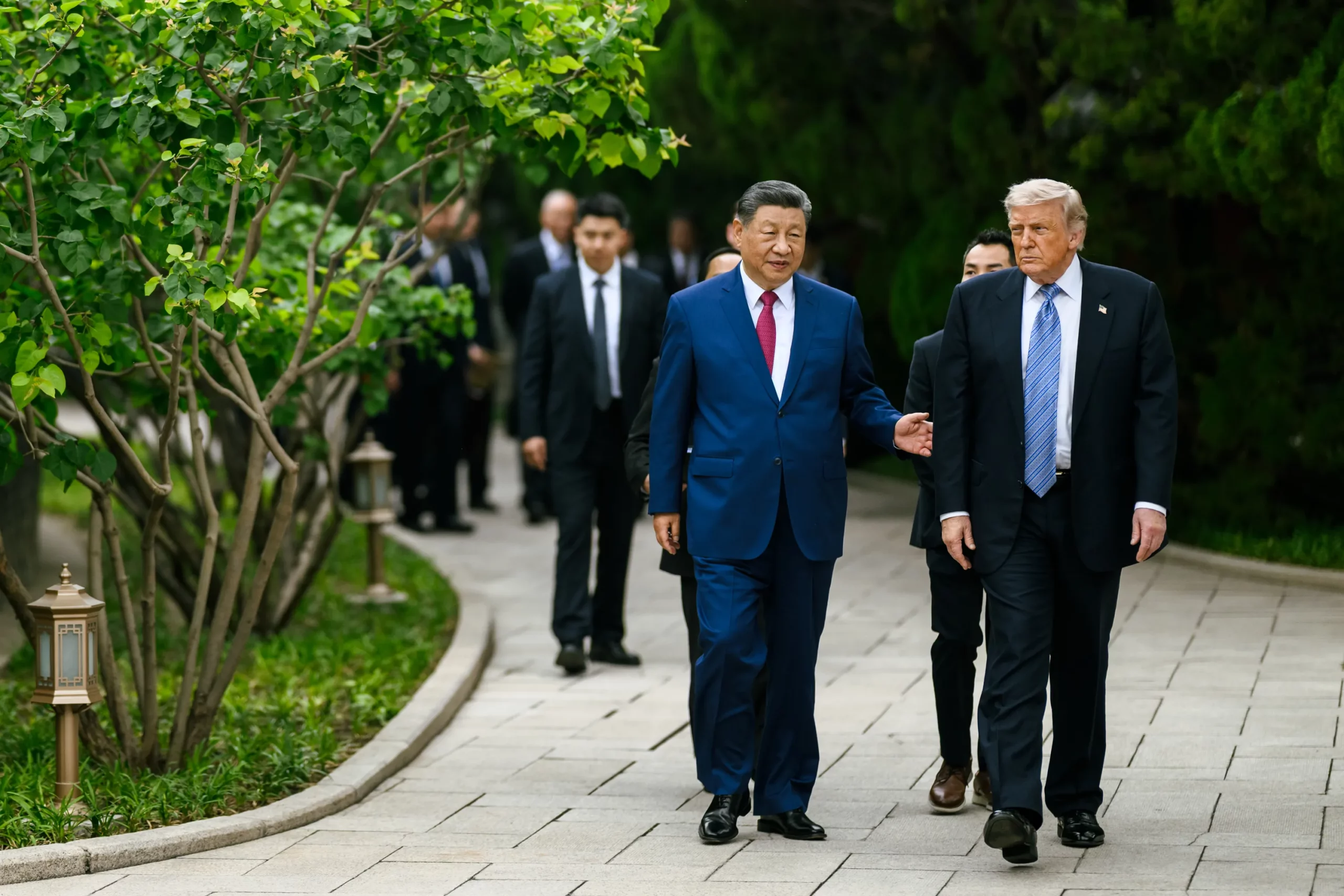
    China President Xi Jinping and US President Donald Trump touring Zhongnanhai on May 15, 2026. Image source: The Whitehouse

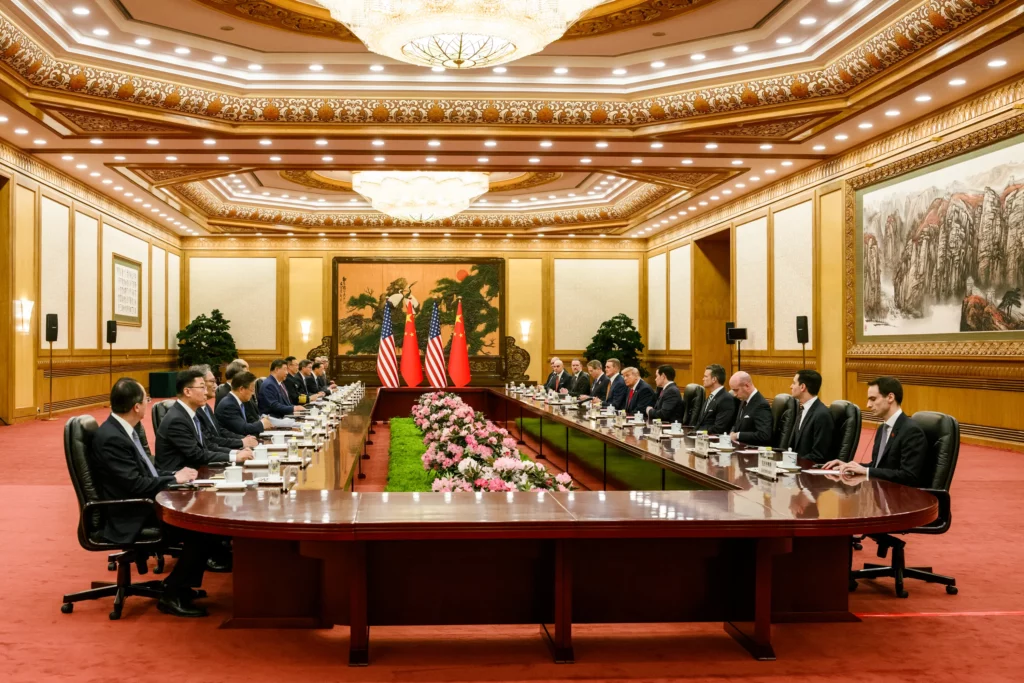
    Assessing the results of the May summit in Beijing between President Donald Trump and President Xi Jinping is difficult. No joint statement was issued (the last one was issued in 2016), and both parties have offered different takes on what was achieved.

    Although the truce in the trade war between the two countries in Busan, South Korea in October 2025 was not formally extended, it remains in force with new commitments on agricultural trade and export controls.  

    Taiwan was discussed at length. Mr. Xi warned Mr. Trump not to provoke “pro-independence separatists in Taiwan,” and specifically warned against selling arms to Taiwan. After initially suggesting that he would speak by telephone to Taiwan’s president, Mr. Trump appears to have backed down – no call is expected to take place. Mr. Trump has paused future arms sales to Taiwan. Under the Six Assurances Policy dating back to Ronald Reagan’s presidency, the United States committed to not discussing arms sales to Taiwan with China. Mr. Trump made it clear he no longer feels bound by that policy. 

    The United States was looking for a Chinese commitment to purchase 500 Boeing aircraft. In the event, China indicated it would purchase 200, subject to conditions. The United States agreed not to impose new sanctions on Chinese companies. However, after the summit, the Pentagon announced that major Chinese companies like Alibaba, EV maker BYD, and tech giant Baidu would be added to its “military company” blacklist. On June 22, 2026, China’s Commerce Ministry retaliated by announcing that Chinese firms would be barred from selling “dual-use” products to 10 American military-related firms. China’s Finance Ministry then announced that Chinese government entities would be prohibited from buying products from 46 American companies.  

    US-China talks, Beijing, May 14, 2026. Image source: The Whitehouse

    The Chinese side indicated it would extend the policy on rare earths export allowing for the purchase of materials critical for the manufacture of a wide range of products. On June 10, 2026, the US-China Business Council issued a statement that certain rare earth elements and permanent finished magnets were “nearly unobtainable” by American companies. 

    The Chinese side is said to have agreed to buy a minimum of $17 billion in farm goods in 2026, 2027, and 2028. Breakdown of which products in what quantities are covered is not available. According to the Americans, it pledged to lift the ban on purchases of American beef and to follow through on commitments to purchase large quantities of soybeans. The two countries agreed to establish boards of trade and investment. 

    The Israeli American war on Iran was discussed. China supported the effort to reopen the Strait of Hormuz. After the ceasefire agreement was extended for 60 days on June 18, Mr. Trump thanked China for “staying neutral” during the conflict between the United States and Iran. 

    Trump reportedly asked for Xi’s help in ending the war between Ukraine and Russia, which invaded Ukraine in 2022. According to the White House, both sides agreed to “build on progress” to halt the flow of fentanyl precursors to the United States. 

    Human Rights 

    Mr. Trump claims to have raised the cases of Hong Kong pro-democracy publisher and activist Jimmy Lai and house church leader Pastor Ezra Jin. According to Trump, Mr. Xi made it clear that clemency for Jimmy Lai is difficult to consider (Trump likened Lai to his political foe James Comey), but that he is “open” to considering clemency for Ezra Jin. The Chinese side has not confirmed this news. In any event, both men remain in custody. Pastor Jin’s family maintains that he is very ill and needs medical treatment. 

    Prior to the summit, the U.S. State Department compiled a list of American citizens and permanent residents to be handed over to China’s Ministry of Foreign Affairs. It is not known whether the list was in fact submitted. In any event, none of the names on the list have been granted clemency, to the best of Dui Hua’s knowledge. 

    The New York Times published a story on the detention of American citizen and activist on Burmese human rights and democracy activist U Min Zin in Kunming, Yunnan. The detention, said to have taken place on June 10, 2026, accuses U Min Zin of espionage, a crime of endangering state security. Dui Hua is aware of another detention of an American citizen, this time for an economic crime, a serious accusation, that could lead to severe punishment, if tried and convicted. 

    Pagaentry and Speeches 

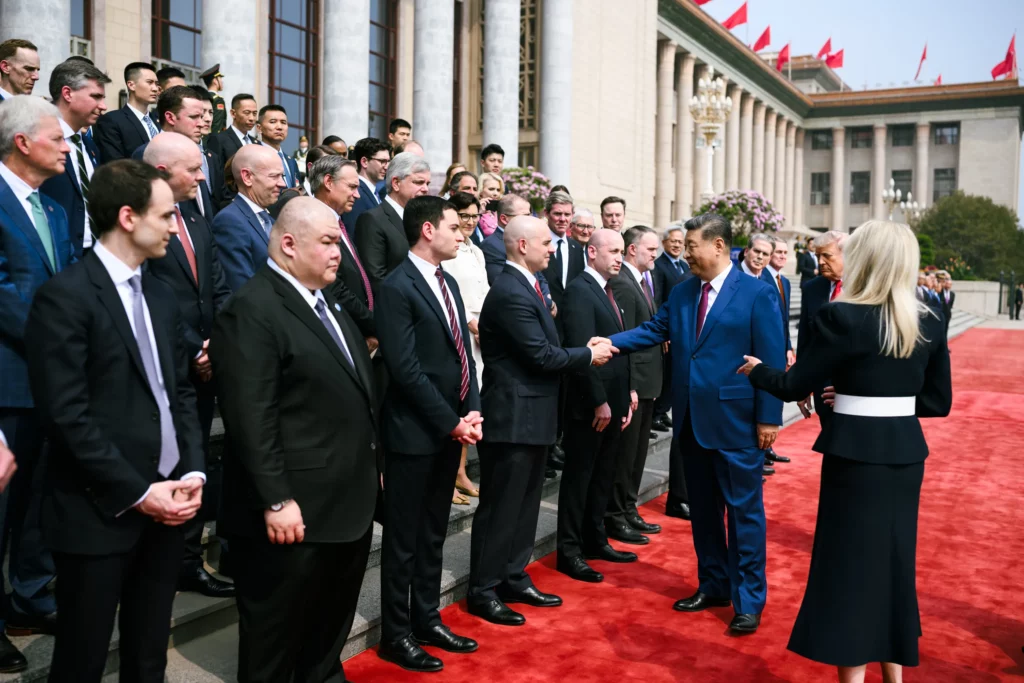
    Xi meets the US delegation in Beijing, May 14, 2026. Image source: The Whitehouse

    The summit between the two presidents will be remembered for the pomp and pageantry, the visits to historic sites (including the seat of power, Zhongnanhai), and, to a lesser extent, the speeches. 

    In his remarks at the summit, Mr. Trump praised Mr. Xi effusively. He remarked that it is an honor to call Xi a friend and called him a “very smart man” with “great stature.”  Xi sat nearby as encomiums were spoken, silent with the faint glimmer of a smile on his face. What was the president of China thinking? 

    Perhaps he was reflecting on the words of China’s ancient military strategist, Sun Tzu in his Art of War, believed to have been authored more than 2,000 years ago: “Don’t be afraid of enemies who attack you. Be afraid of friends who flatter you.” 


    PUBLICATIONS HIGHLIGHTS

    John Kamm Remembers  

    From John Kamm Remembers, a series written by Dui Hua’s founder recounting his advocacy for prisoners in China. 

    Lists and Prisons


    In the aftermath of the 1989 Tiananmen Square crackdown, many governments around the world imposed sanctions on China, and a quiet, painstaking effort began to account for the thousands of people detained in the protests’ wake. Read more 

    A Prison for Women 

    One of the late Thai Princess Bajrakitiyabha’s greatest legacies was the adoption of universal standards for the treatment of women prisoners by the United Nations. Known as the Bangkok rules, Dui Hua organized an international symposium in 2014 to discuss its impact. This is the story of that symposium. Read more 

    Prisoner Updates 

    Dui Hua’s Prisoner Updates provide the latest information staff researchers have uncovered through online and library research and through direct dialogue with the Chinese government. 

    Thirty-One Christians Sentenced in Major Suizhou Church Case

    Thirty-one Christians associated with the Full Scope Church (全范围教会) in Suizhou, Hubei, have received prison sentences in one of the largest recent crackdowns of Christian believers in recent years. Read more

    Student Sentenced to Six Years After Returning to China

    Chinese national Cheng Fangwei (程方维), a former student at the University of Sydney, has been sentenced to six years’ imprisonment for splittism. After returning to China in late 2024, he lost contact with his famil yand was later confirmed to have been detained and convicted. Read more 


    Dui Hua in the News 

    New York Times: China Arrests U.S. Scholar on Spying Charges

  • Prisoner Updates 2026 #5

    Thirty-One Christians Sentenced in Major Suizhou Church Case

    Thirty-one Christians associated with the Full Scope Church (全范围教会) in Suizhou, Hubei, have received prison sentences in one of the largest recent crackdowns of Christian believers in recent years. The defendants were prosecuted in separate trials and sentenced to prison terms ranging from two years and four months to four years. Among those sentenced were Pastor Song Yude (宋玉德), who received the longest sentence of four years, and Yang Zhijin (杨治金), a 77-year-old Christian who was sentenced to three years and two months. 

    Court documents cited by rights groups indicate that the defendants were convicted of “using a cult organization to undermine implementation of the law.” Prosecutors relied on evidence such as organizing fellowship gatherings, conducting ministry training, evangelizing, and assisting fellow believers in obtaining legal representation. Rights advocates argue that the case reflects a broader pattern of criminalizing peaceful religious activity through the use of anti-cult and public-order provisions, while information about the proceedings has remained tightly restricted.


    Six Christians in Guizhou Approved for Arrest Over Religious Activities Involving Minors

    Authorities in Kaili, Guizhou, have approved the arrests of six Christians associated with a local house church: Yang Aimin (杨爱民), Zhang Chunlei (张春雷), Wang Honglan (王洪兰), Li Guizhen (李桂珍), Wu Guifang (吴贵芳), and Luo Xianping (罗显平). Prosecutors have accused them of “organizing minors to engage in activities that undermine public order,” a charge linked to church activities involving children, including religious instruction, Bible study, and preaching to minors.


    Yunnan House Church Members Prosecuted After Police Raid

    In Yunnan, authorities formally approved the arrests of Yu Shaolin (虞少林), Li Qin (李勤), and Luo Ping (罗平), members of the Century New City Church (世纪新城教会) in Kunming on May 20. The three were detained after police raided a church gathering on April 12 and are now accused of “organizing illegal gatherings.” The church, which serves a small congregation that includes cancer patients, people suffering from depression, and other socially vulnerable individuals, has appealed for legal and public support. Concerns have also been raised about Yu Shaolin (虞少林)’s health, as he suffers from multiple serious medical conditions while being held at the Guandu District Detention Center.


    Three Guangzhou Christians Released on Bail in Church Publishing Case

    Three Christians from Guangzhou — Zheng Zhoulin (郑周林), Li Yuesui (李岳遂), and Xiong Zhuo (熊卓) — have been released on bail pending trial after being accused of “illegal business operations” for producing, distributing, and selling Christian books and religious materials. The case had recently advanced to the prosecutorial review stage, but defense lawyers stated that prosecutors found insufficient evidence to show that the defendants acted with a profit motive. The materials involved were non-political Christian publications focused on apologetics, science and faith, and the historical reliability of the Bible.


    Guizhou Activist Sentenced for Online Speech and Rights Advocacy

    Guizhou rights activist Zhang Zhongshun (张忠顺) was sentenced to three years and three months’ imprisonment for “picking quarrels and provoking trouble.” The case was linked to his online comments, petitioning activities, and participation in rights defense efforts. Authorities accused him of repeatedly posting information deemed disruptive to public order and of engaging in activities connected to other petitioners and activists. Based on available information, his projected release date is around May 2028. 

    Zhang has a long history of activism and has a prior detention related to public-interest advocacy and criticism of local authorities. Over the years, he has supported fellow petitioners and used online platforms to raise concerns about alleged official misconduct and other social issues.


    Dong Guangping Reaches South Korea After Sea Escape

    Chinese dissident Dong Guangping (董广平) fled China in May 2026 by crossing the Yellow Sea in a small rubber boat, reaching South Korean waters after a journey of more than 30 hours. South Korean authorities detained him on arrival on suspicion of violating immigration laws, though a court later declined to approve a formal arrest warrant. Dong is seeking protection abroad and hopes to reunite with family members who previously resettled in Canada. 

    Dong, a former police officer turned human rights activist, has been repeatedly imprisoned for his political activities. He was sentenced in 2001 for “inciting subversion of state power” and was again detained after participating in activities commemorating the 1989 Tiananmen Square crackdown. After fleeing to Thailand in 2015 and being recognized as a refugee by the UN, he was forcibly returned to China, where he was later sentenced again on charges including inciting subversion and illegal border crossing.

  • Lists and Prisons 

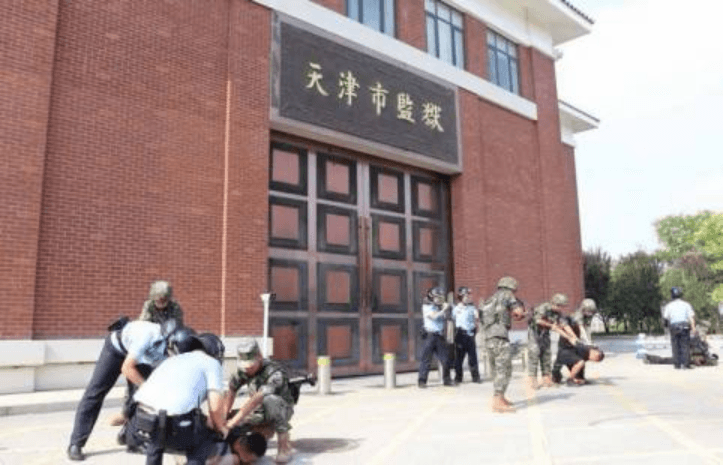
    Tianjin Prison. Image source: Baidu

    Baker List, Craner List 

    In the wake of the suppression of nation-wide protests that took place in the late spring of 1989, countries around the world imposed sanctions on the Chinese government. For the most part, the sanctions were imposed as a result of decisions by the executive branch, but in the United States, where trade and tariffs are the responsibility of the legislative branch under the constitution, sanctions took the form of bills introduced first in Congress, and then, if passed, by the Senate. The bill would then be sent to the president’s desk and then, if signed, become law. If vetoed, the bill would be sent back to Congress to face “veto-override” votes. 

    By law, the president was required to waive the requirement of the Trade Act of 1974 that non-market economies – a group that included Cuba, North Korea, and China – practice free emigration, known as the Jackson-Vanik Amendment before renewing the countries’ most favored nation (MFN) status. Once the waiver was issued, Congress had its say. 


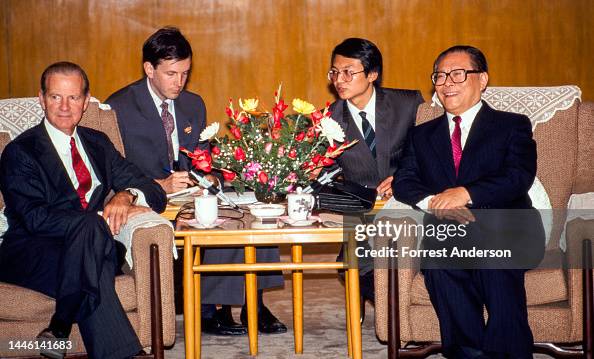
    U.S. Secretary of State James Baker and Chinese Party Secretery Jiang Zemin, Beijing, China, November 1991. (Photo by Forrest Anderson/Getty Images)

    In November 1991, James Baker, George H. W. Bush’s Secretary of State, visited Beijing. In advance of his visit, Baker had sent a list of more than 800 prisoners (it was a flawed list: partial names were listed, no Chinese characters were provided.) China’s Ministry of Foreign Affairs (MoFA) provided a response to the list during the meeting with Baker. (Years later, I met Mr. Baker at a private gathering at the American Consul General’s residence in Hong Kong. He told me his success in getting a response to the list was the greatest achievement of his visit to Beijing.) 

    Although I was not consulted in drawing up the list, I was much involved in analyzing the response. 

    Robin Munro. Photo by David Frazier

    Working with Robin Munro of Human Rights Watch Asia, I deciphered the list. Names were presented left to right with no breaks. Names were divided into “sentenced” and “not sentenced” (a group that included those who had been detained but not charged, and those sentenced to reeducation through labor). Names were listed, again with no breaks, by province, starting with Beijing and followed by Shanghai and Guangdong, and then others but, in all only, 17 provinces were covered. 

    Despite these limitations, the response proved useful. Individuals thought to have been executed, including a group of workers in Shanghai, were listed as “sentenced,” suggesting they had been spared from the executioner’s bullet. And names were included in the response that were not on the list itself. 

    Robin Munro took a special interest in one of the names in the response: a friend by the name of Yang Lianzi (杨连子). Yang was a troubadour who sang protest songs for the students and workers in Tiananmen Square. He was arrested and subsequently sentenced to 15 years in prison by the Beijing authorities but then transferred to a prison in Gansu Province. He was released three years early. (Prior to his release, I had put Yang’s name on nine lists, receiving two responses). 

    In 1992, Congress passed a law that required China to meet certain conditions before MFN could be renewed. Conditions included respecting the bilateral agreement to stop the export of product made by prisoners and, most importantly for me, the accounting and freeing of prisoners jailed for their participation in the 1989 protests and the earlier Democracy Wall movement. 

    Later in 1992, Bill Clinton won the general election. During the campaign, Clinton pledged to get tough on China and endorsed the conditions on renewing China’s MFN included in congressional legislation. Once elected, Clinton released an executive order in May 1993 that mirrored the China MFN legislation. But then, President Clinton renewed China’s MFN in May 1994, without human rights conditions, delinking China’s trade status from its human rights record. 

    Lorne Craner. Image source: Archive of U.S. Department of State 

    In November 2000, George H.W. Bush’s son, George W. Bush, was elected president. After taking office in January 2001, he appointed Lorne Craner to be the Assistant Secretary of State for Democracy, Rights, and Labor (DRL). I had gotten to know Lorne while he was President of the International Republican Institute. In anticipation of an upcoming human rights dialogue with China, Craner asked me to suggest names for a prisoner list to be submitted to his Chinese counterpart in the Ministry of Foreign Affairs. Dui Hua, which was established in 1999, provided 50 names of counterrevolutionaries believed to be undergoing coercive measures. China responded, providing information on more than 90 percent of the names. 

    In subsequent testimony to Congress, I estimated that being on a prisoner list tripled the chance of clemency.

    In the period from April 1999 to December 2025, Dui Hua submitted over 550 lists with more than 2,000 prisoner names. Lists were mostly submitted directly to the Chinese government, but the foundation also helped other countries – including the European Union, Switzerland, Norway and others – in compiling lists. More than 500 people on our lists received clemency in the form of sentence reductions and parole (medical and good behavior). 

    Potemkin Prison 

    A few months after Bush was inaugurated in 2001, I traveled to Beijing in March to meet with Chinese government ministries to discuss prison visits. I met with both MoFA and the Ministry of Justice (MoJ) to review prisons I had visited. We agreed that the next prison I would visit would be a “model prison” in nearby Tianjin. (Before I was banned from visiting Chinese prisons in 2005, I was taken to see prisons or detention centers in Beijing, Shanghai, Fujian, Guangdong, Hubei, and Tianjin. I later visited two prisons in Hong Kong.)

    My visit to Tianjin Prison took place on March 6, 2001, the day after I met with the MoJ’s Wang Lixian.

     I was picked up at my hotel in Beijing at 8 AM by officers Zhang Qing and Bai Ping. We left promptly for Tianjin where we were met by Mr. Guo Wei of the Tianjin Prison Administration Bureau, Tianjin Prison Warden Mr. Kang and his deputy Ms. Wang. After a short drive, we arrived at the gate of Tianjin Prison, a massive, multi-story structure covered from top to bottom with red tiles. 

    Tianjin Prison was a Potemkin Prison, no prisoners in sight (they were “working in the fields,” I was told.) We would be taken on a “tour of prison architecture,” a phrase I learned from Swiss officials who had visited many Chinese prisons. Everything in Tianjin Prison was clean and orderly. The cells, each housing six to eight prisoners, were relatively spacious with plenty of sunshine. The prisoners’ clothes were neatly folded and placed on the bunk beds

    There was a television in the common area. Inmates were allowed to watch government stations presenting China’s version of the news.

    I was taken to the prison hospital and classrooms, one of which was used to teach computer skills. The computers had been donated by a European company. I asked my hosts for information on a couple of people thought to be incarcerated in Tianjin Prison. My questions drew silence.

    It was a short, two-hour visit. We headed to a restaurant where the prison bureau hosted us to a banquet. Alcohol was liberally consumed. Soon the Tianjin officials were tipsy. They made jokes at the expense of the female officers and played drinking games with me. After lunch, we scurried back to Beijing where I was deposited at my hotel.  

    In the evening, I was joined by officers from the U.S. embassy. Over dinner, I debriefed them on my disappointing visit to Tianjin Prison. 

  • Prisoner Updates 2026 #4

    Student Sentenced to Six Years After Returning to China 

    Chinese national Cheng Fangwei (程方维), a former student at the University of Sydney, has been sentenced to six years’ imprisonment for splittism. After returning to China in late 2024, he lost contact with his familyand was later confirmed to have been detained and convicted. 

    Reports indicate that the case is linked to his participation in pro-democracy and minority rights advocacy activities while studying abroad. His family has not received a copy of the judgment. 


    Uyghur Poet Serving 20-Year Sentence 

    Uyghur poet and educator Qasim Sidiq is serving a 20-year prison sentence for “provoking ethnic hatred,” according to updated information. Earlier reports had not confirmed the length of his imprisonment. Detained in Xinjiang in 2017, his case has long been linked to his literary work and past writings, which authorities reportedly cited as evidence against him. 

    The updated information also provides a projected release date based on the 20-year sentence, indicating that he could remain imprisoned until approximately 2037. His case continues to raise serious concerns among rights groups regarding the targeting of Uyghur intellectuals and the use of broadly defined charges related to the risks associated with academic and cultural research among ethnic minorities. 


    Uyghur Academic Sentenced to 18-Year Sentence 

    Uyghur academic Aihemaiti Tuerxun (艾合买提*吐尔逊) is reported to have been sentenced to 18 years’ imprisonment. He is currently held in a prison in Urumqi. This marks the first disclosure of both the length of his sentence and his place of incarceration, along with an estimated release year of around 2035—details that were not previously available and constitute a significant update on his case. 

    The specific criminal charge against Aihemaiti Tuerxun has not been clearly disclosed in available reports. A leading scholar in the field of ethnic minority languages and literature, he was detained in Xinjiang amid the broader crackdown on Uyghur individuals, and his case forms part of a wider pattern in which highly educated Uyghur professionals—particularly those working on ethnic language and cultural studies—have faced prosecution, often with limited transparency regarding legal proceedings. 


    Trial Begins for Pastor Huang Yizi 

    On April 24, 2026, the trial of house church pastor Huang Yizi (黄益梓) began at the Pingyang County People’s Court in Wenzhou, Zhejiang. He is charged with “illegal business operations,” reportedly linked to the distribution of audio Bible players containing his sermons. 

    Huang was detained in June 2025 and formally arrested the following month. His case is widely viewed in the context of ongoing restrictions on unregistered Christian churches in China, particularly the state’s use of economic-related charges to prosecute religious activities. 


    Journalist Dong Yuyu Transferred to Tianjin 

    Veteran Chinese journalist Dong Yuyu (董郁玉), who is serving a seven-year sentence on espionage charges, was transferred in March 2026 from a prison in Beijing to Tianjin Chaobai Prison. Dong, a former Nieman Fellow at Harvard University, was originally sentenced in November 2024, and his appeal was rejected in November 2025. 

    Rights groups have criticized his imprisonment and note that transfers of detainees can affect family access and detention conditions. Reports also indicate ongoing restrictions on Dong’s family’s visits and his access to legal counsel. Dong was hospitalized in April 2026 after experiencing heart palpitations and other health problems, and a CT scan revealed a tumor in his lung.