
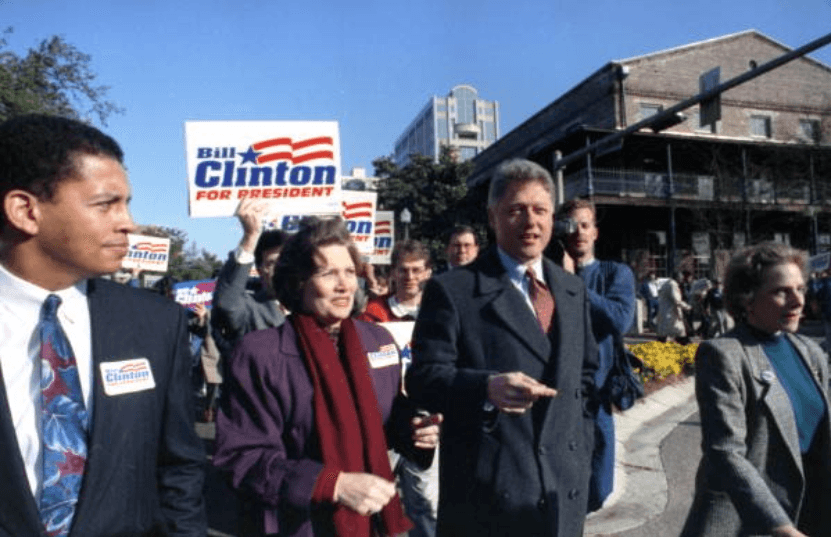
Clinton campaigning in Tallahassee during the 1992 presidential election. Source: Wikipedia
In the 1992 United States’ presidential campaign, Democratic candidate Bill Clinton excoriated then-president George W. Bush for being soft on China on human rights and trade, accusing the incumbent of coddling “the butchers of Beijing.” He aligned himself with Democrats in Congress, notably Democratic Majority Leader George Mitchell (D-ME) and Congresswoman Nancy Peloisi (D-CA), who had introduced legislation to place conditions on China’s Most Favored Nation (MFN) trading status. Bills placing conditions on China’s MFN had passed in both 1991 and 1992, but Bush vetoed both. Efforts to override his veto failed in both years. With Clinton as president, it was widely assumed that Clinton would sign the legislation after he took office.
Bills placing conditions on China’s MFN were framed as reasonable alternatives to a resolution of disapproval introduced by Congressman Gerald Solomon (R-NY) in the early 1990s. If passed into law, these resolutions would have resulted in revocation of China’s trade status.
In the event, Clinton decided not to sign legislation conditioning China’s MFN and instead renewed China’s MFN in 1993 by means of an executive order which mandated “significant progress” on human rights including releasing and accounting for political prisoners, allowing international media broadcasts to be listened to in China, and granting access by international humanitarian and human rights organizations to China’s prisons. (Executive orders are less constraining on a president than legislation passed by Congress and signed into law.) Under the Executive Order, Clinton was required to confirm that China had made significant progress on human rights when MFN came up for renewal in 1994.
Bound by the Trade Act of 1974, Clinton needed to make his decision no later than June 3, 1993 (June 4 in Beijing). By June 1993, I had testified six times to Congress on MFN and human rights. Maintaining access to the US market was crucial to achieving paramount leader Deng Xiaoping’s economic policies.
Southern Tour
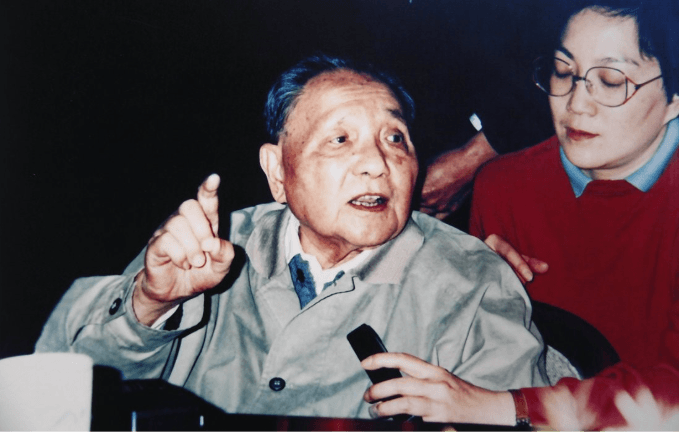
In the spring of 1992, Deng Xiaoping makes his famous southern tour. Source: Global Times
Deng revitalized his “reform and opening” policies (sometimes referred to as China’s economic miracle) with his “Southern Tour” in 1992. The policies had been initiated at the Third Plenary Session of the 11th Central Committee in December 1978, but momentum had slowed after the Tiananmen Square killings of June 1989.
To a large extent, the economic miracle needed access to the US market and the dollars it generated. Loss of MFN would cripple that access. At the time, Chinese exports to the US were small, hit by boycotts and sanctions, but Deng, who had personally seen the vibrancy of the consumer market when he toured the US in 1979, was convinced Chinese exports were poised for growth.
As the June 1993 deadline to renew MFN neared, I began planning a visit to Beijing to see what human rights concessions might be possible. I reached out to individuals and families and friends of those persecuted in China for their political and religious beliefs.
I met with American journalist Todd Carell in San Francisco and Father Politi in Hong Kong, as well as a retired academic well-versed in the situation in Tibet; he provided information on Tibetan political prisoners. I spoke by phone with Bao Pu, son of Bao Tong, Zhao Ziyang’s private secretary, and met with dissidents sheltering at Princeton University, my alma mater, under the college’s “China Initiative.” I communicated with human rights NGOs in the United States, Europe, and Asia, to find out what they knew about the prisoners I intended asking about.
Prior to my visit to Beijing in May 1993, I sent prisoner lists to the Ministry of Justice, the Ministry of Public Security, the Ministry of Foreign Affairs, and the State Council Information Office.
Todd Carrel
Todd Carrel was Bureau Chief of ABC News in Beijing when, in June 1992, he went to Tiananmen Square, site of the 1989 killings of protesters, to record protests that were expected to take place on the anniversary of the killings. Carrel was seized by the police, bundled into a car, and savagely beaten. (Other foreign correspondents were likewise treated roughly). The year before, in May 1991, three members of Congress had mounted a protest in Tiananmen Square. Journalists had been roughed up. Fearing a repeat, China’s police were on high alert in 1992.
Carrel suffered serious injuries when he went to the square in June 1992, necessitating his return to San Francisco, where I had purchased an apartment. I met with Todd at a pastry shop in San Francisco’s Little Italy on April 18, 1993. He described the assault in graphic detail; he had been beaten with steel ball bearings wrapped in thick socks, the purpose being to hide bruises. Mr. Carrel walked with difficulty, often stopping to get his footing before carrying on.
There is no record of the Chinese government apologizing to Todd Carrel for the assault he endured in Tiananmen Square in June 1992, much less compensating him for the injuries he suffered there.
There is a long history of Chinese police targeting foreign journalists doing their jobs in Beijing. During the late 1960s, when the Cultural Revolution was underway, Reuters correspondent Anthony Grey, was placed under house arrest for 27 months by the Red Guards; they killed his house cat. In 2005, Wall Street Journal correspondent Matt Pottinger was physically assaulted at a Starbucks in Beijing. Mr. Pottinger went on to serve as Deputy National Security Advisor in the first Trump administration where he became known as an influential “China hawk.”
Xu Wenli (徐文立) and June 4 Activists
On the mid-May 1993 visit to Beijing, I was informed that veteran activist and leader of the Democracy Wall movement, Xu Wenli, would be released on May 26, 1993, in anticipation of the MFN decisions. Dui Hua prepared a press statement for distribution upon his release. The statement was heavily covered in international media. He was again detained, arrested, and sentenced for endangering state security in November 1998 and released in December 2002, after which he travelled to the US to be reunited with his wife and daughter.
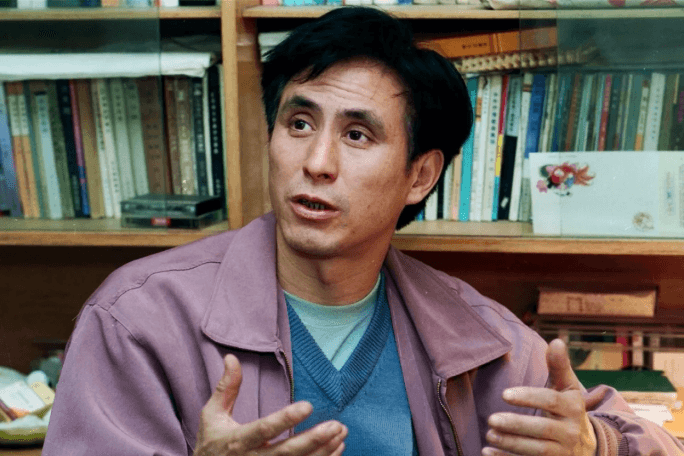
Wang Xizhe. Source: Internet
I brought up Wang Xizhe (王希哲), a Guangdong-based member of the Liyizhe group (1974) and, later, Democracy Wall activist, with the Supreme People’s Court. He had been sentenced to 14 years in prison in 1982 but was released early. He fled to the US via Hong Kong in 1996.
Courts in Shandong Province had imposed the harshest sentences on those involved in the June 1989 protests. I requested information on Chen Lantao (陈兰涛) and Hao Fuyuan (郝付元). Both were released years before their sentences expired.
I raised the situation of June 4 activist Liu Gang (刘刚) with the Ministry of Justice (MOJ). A Liaoning-based June 4 activist who was the sixth name on the Chinese government’s “most wanted list,” he was sentenced to six years in prison, and never granted clemency. He left China for the US in 1996.
Catholics
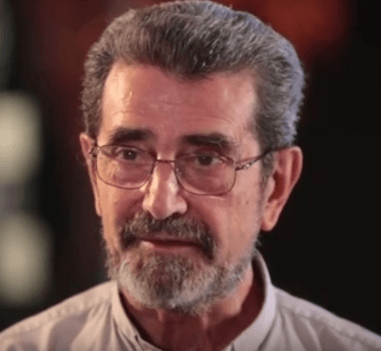
Father Politi. Source: Internet
I worked closely with Father Politi, a Catholic priest based in Hong Kong, in the early 1990s. On the May 1993 visit to Beijing, I raised the cases of Zhang Dapeng (张大鹏), a Catholic lay leader based in Baoding, Hebei Province, an area with a large Catholic population. I also inquired about Catholic priest Zhang Youshen (张有申). Both had been detained in 1990 and released early in 1992. I announced both releases in late May 1993.
I had placed Bishop Wang Milu (王弥禄), called the “Black Bishop of Gansu” for ordaining priests without the Vatican’s approval, on my lists sent in advance of the trip to Beijing. He was released early on April 30, 1993.
Tibetans
For the first time, I put the names of Tibetan counterrevolutionaries on a list to the MOJ: Yulo Dawa Tsering, Ngawang Phulchung, and Tseten Norgye. All had been given long sentences for counterrevolution. Yulo Dawa Tsering was paroled in 1994, around three years early. Ngawang Phultsong was given a six-month sentence reduction. Tseten Norgyue is believed to have served his full sentence.
I brought up Tibetan teacher Takna Jigme Sangpo with the MOJ. He was thought to be, at the time, the longest serving Tibetan political prisoner. He was granted early release and flown to Switzerland via the US in 2002.
Counterrevolutionaries and Those Sentenced to Death
On the May visit I met with senior officials – Zheng Hongye of the China Council for International Trade, which served as my host on visits to Beijing; Chen Mingming of the Ministry of Foreign Affairs (MFA); Zhu Entao of the Ministry of Public Security; Wang Genliang of the Supreme People’s Court; Wang Mingdi of the MOJ; and Minister Zeng Jianhui of the State Council Information Office – to discuss prisoners and issues. With respect to issues, I was given information on the number of prisoners serving sentences for counterrevolution but failed to get information on the number of people executed in China.
I was interested in finding out what had happened to Zheng Qiuwu (郑酋午), an academic who had advocated economic reform, including the establishment of stock markets. He was sentenced to 14 years in prison for counterrevolutionary incitement and propaganda, to be served in Hainan Province. His sentence was reduced to 13 years on appeal.
China’s 007
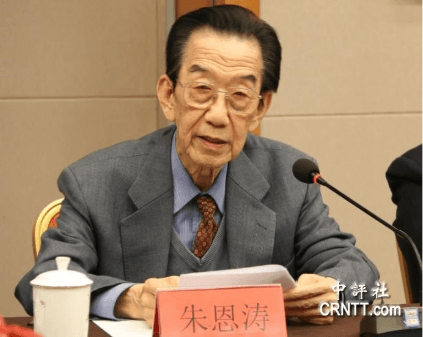
Zhu Entao. Source: CRNTT.com
While the cases of all those persecuted who were on my lists or who I had raised verbally in my Beijing meetings, I placed special emphasis on that of Todd Carell. I suggested that the Chinese government apologize to Todd Carrel and pay compensation for the injuries suffered at the hands of the police. I got push-back or, in the case of Zhu Entao (China’s 007), stunned silence. I brought up Mr. Carrel at a banquet hosted by Zhu at the Kunlun Hotel, owned by the Public Security Ministry. Zhu and colleagues were not happy. I also raised Mr. Carrel’s assault with the MFA’s Chen Mingming.
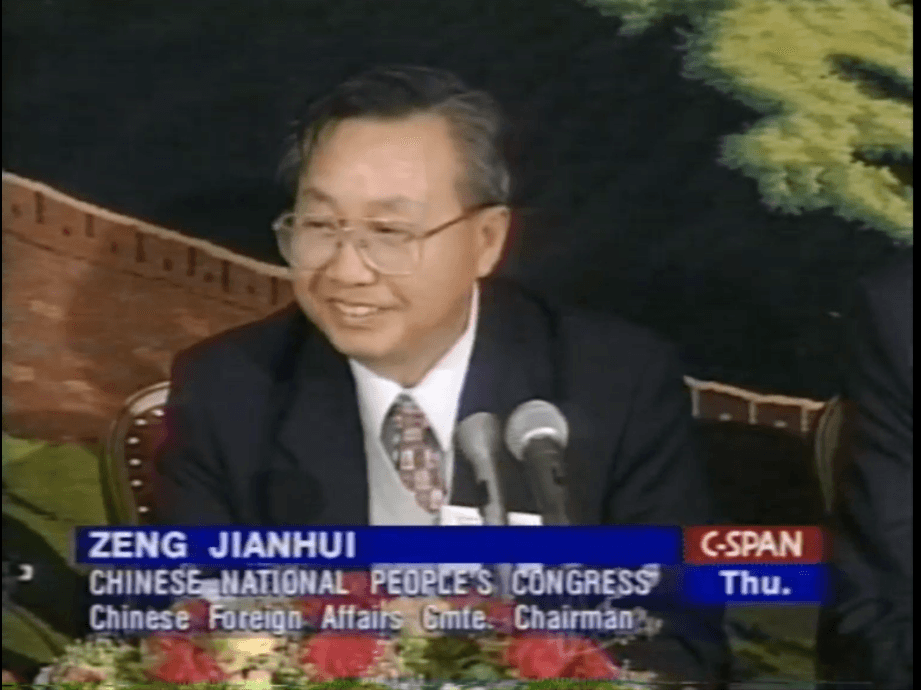
Zeng Jianhui, October 14, 1990. Zeng talked to US reporters after meeting with members of the US Congress. Image: C-Span
The most consequential session was with Minister Zeng Jianhui of the State Council Information Office. He oversaw China’s external propaganda efforts and realized the impact on US public opinion of an assault on an American journalist by the Chinese police. China was already thinking of applying to host the Olympic Games, and he realized that this kind of publicity, as well as reports of how China treated Catholics, was not good for China’s chances of securing the games.
In June 1993, journalists covering activities in Tiananmen Square were treated relatively well. I heard that the police were courteous and wore white gloves. Since I wasn’t present, I cannot say for sure.
Of the 20 people I asked about in May 1993, either in person or by list, nine are known to have received a form of clemency (parole, medical parole, sentence reduction) including two Tibetans and three Catholics.