Blog

  • Prisoner Updates 2025 #8

    Zhang Zhan receives second prison sentence

    Zhang Zhan (张展), a lawyer turned civil journalist and rights activist was sentenced to four years’ imprisonment for picking quarrels and provoking trouble (PQPT) on September 19, 2025. This marks her second conviction for the same crime, less than two years after her release in May 2024.

    Shortly after completing her four-year prison term, Zhang traveled to Gansu in November 2024 to support fellow activist Zhang Pancheng (张盼成), who had finished serving a three-year sentence for PQPT in February 2024 but was detained again in July.

    Zhang Zhan was taken into police custody in her hometown of Xianyang, Shaanxi, and later detained in Shanghai before being formally arrested in November 2024.

    Zhang’s friend shared a copy of the indictment, which was filed in January 2025. The document revealed that she had been briefly released between September and November 2024 to undergo psychological evaluation.

    Zhang’s alleged criminal activity was summarized in a short paragraph in the three-page indictment. The Shanghai Pudong People’s Procuratorate claimed that between June and August 2024, Zhang posted false information on X (formerly Twitter) and YouTube that insulted others and harmed China’s national image. It was alleged that her posts caused serious disruption to public order.

    The procuratorate submitted its sentence recommendation at the same time. Under Chinese law, the maximum sentence for PQPT is a fixed term of up to five years. Citing Zhang as a recidivist who committed multiple offenses, the procuratorate recommended a sentence of four to five years.


    Chengdu activist inspired by Peng Lifa detained after fanner protest

    Mei Shilin (梅世林), a young activist from Chengdu inspired by Peng Lifa (彭立发, also known as the “Bridge Man”), was arrested on July 16, 2025 for PQPT.

    On April 15, Mei hung three long banners over a pedestrian bridge near a Chengdu transit station, calling for political reform. He was detained the following day and is currently held at the Chengdu Detention Center.  

    The lawyer retained by Mei’s family faced difficulties visiting him. The detention center provided a handwritten note, supposedly by Mei, stating that he would only accept representation from a lawyer appointed through the legal aid program.  


    China cracks down on overseas students after they return 

    Overseas Chinese students are increasingly coming under scrutiny from Chinese authorities for their activities overseas, both online or offline. 

    In a statement released by the overseas student group Chinese Youth Stands for Tibet (CYSFT or CYFT), one of its member, Zhang Yadi (张雅笛), has been detained by Changsha state security on charges of inciting splittism—an endangering state security (ESS). Zhang, a student residing in France, was about to begin her graduate studies at SOAS in London.

    According to CYSFT’s website, the group is primarily composed of overseas Chinese students and young professionals of Han ethnicity dedicated to promoting Tibetan culture and Tibetan Buddhism. The statement says Zhang is a native of Changsha, Hunan and has contributed articles to the group’s Substack. She was detained while visiting her parents this summer. It is unclear which of her activities abroad drew the attention from state security.  

    Rights lawyer Jiang Tianyong (江天勇) was reportedly briefly detained on September 16 while meeting Zhang’s mother in Changsha to provide legal advice.  

    The detention of Zhang occurred around the same time that another overseas Chinese student, Hu Yang (胡洋), was reportedly held incommunicado in Zhengzhou, Henan. According to a post by Hu’s mother, he was taken into custody by police on July 26 at the Shanghai airport for PQPT upon returning from a visit to the Netherlands. Hu was transferred to Zhengzhou and placed in detention. The reason for his detention was not immediately clear. The Twitter account claiming to belong to Hu’s mother later deleted several posts and is now deactivated. 

    Persecution against returned overseas Chinese, including students, for their online activities has escalated in recent years. In 2020, Luo Daiqing (罗岱青), a student at the University of Minnesota in the US, was detained in July of 2019 upon returning to his hometown of Wuhan, Hubei. He was accused of posting tweets and images that insulted Xi Jinping in 2018 and was sentenced to six months in prison for PQPT in November 2019. In the same year, a Chinese cartoonist Lu Shining (卢世宁) was sentenced to one and a half years for PQPT by a court in Dalian, Liaoning. Luo had lived in Japan for several years prior to his arrest. Police accused him of posting “insulting cartoons” on overseas social media that attacked Chinese people and hurt their feelings. He was released in October 2020 and reportedly returned to Japan in 2022. 


    Elderly man convicted of cult crimes granted clemency in Hunan 

    Han Wenhua (韩文华), an 85 years old resident of Shangqiu, Henan, was allowed to  temporarily serve his sentence outside of prison in April 2025.  

    Han was convicted in 2021 by a district court in Shangqiu of using a cult to undermine implementation of law and sentenced to three years. For undisclosed reasons, he was not admitted to Zhengzhou prison until August 2023, when he was already 83 years old. He was scheduled for release in August 2026.  

    About halfway through his sentence, Zhengzhou Prison submitted a request in March citing Han’s serious illness.  

    Admitting seniors in their eighties to prison poses practical challenges, as the warden may need to assign other prisoners to assist with daily routines and additional medical needs.  

    China does not have a formal age limit for admitting prisoners. Prison authorities may allow prisoners over 70 who are seriously ill or physically disabled to temporarily serve sentences outside of prison. However, authorities have shown little leniency toward individuals convicted of ESS crimes.
  • Dui Hua Digest, Fall 2025

    EVENT

    U.S. State Department’s 2024 Country Reports on Human Rights Practices: The Shift to Targeted Pressure 

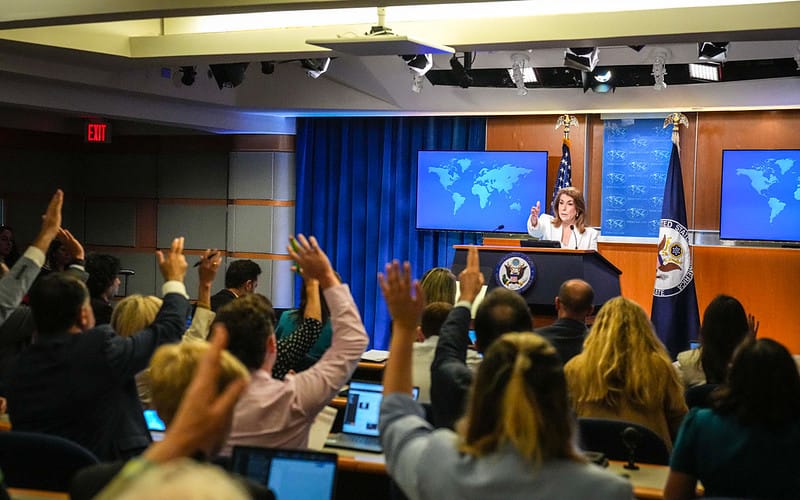
    Tammy Bruce presser August 12
    U.S State Department Spokesperson Tammy Bruce holds a press briefing. August 12, 2025. Image source: U.S. Department of State 

    The U.S. Department of State’s (DoS) 2024 Country Reports on Human Rights Practices (HRR), released on August 12, 2025, marked a departure from previous editions in both scope and approach. According to the media, the report’s release was delayed so that a previous draft could be reworked to line up with the administration’s ‘America First’ policy framework. Secretary of State Marco Rubio bypassed traditional presentation protocols and did not submit a written commentary or make formal press remarks. Instead, the HRR was released directly to reporters with department spokesperson Tammy Bruce fielding questions during a routine briefing.  

    Reorientation 

    Bruce described the new structure as “responsive to the legislative mandates…. rather than an expansive list of politically biased demands and assertions.” In other words, it did the bare minimum required by Congress. Comprehensive details of countries with documented human rights abuses were scaled back. Instead, focus was re-directed toward traditional allies France, Germany and the U.K. for curtailing freedom of speech which likely raised some eyebrows. 

    China: Selected Focus 

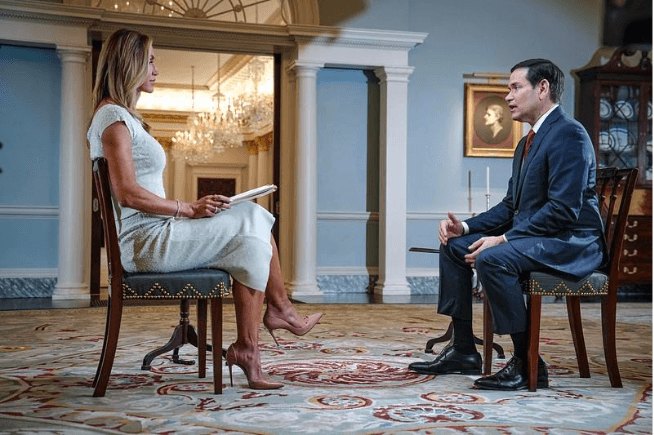
    The China analysis, compressed from 91 pages in 2023 to 42 pages, maintained its critical stance, with specific focus on the systemic persecution of Uyghurs in almost all sections of the main report. This targeted emphasis aligns with Rubio’s hawkish position on China — in press interviews he’s called China an adversary nation state and the U.S.’s number one geopolitical foe. His advocacy of Uyghurs began in 2018 after news emerged that over a million Uyghurs were in extra-judicial internment camps.   

    U.S. Secretary of State Marco Rubio interview with Fox News, July 21, 2025. Image Source: U.S. Department of State   

    The U.S. first used the word “genocide” in 2020 to describe the situation in Xinjiang. It was in 2023 that the DoS began its executive summary with “Genocide”. 

    The 2024 report did the same. And it sustained criticism of China’s judicial opacity, tight control over media, forced labor programs particularly affecting Uyghurs as well as transnational repression targeting diasporas and students abroad and dissidents through surveillance. Of the 44 names of human rights defenders singled out, Dui Hua has submitted 22 to the Chinese government on its lists.  

    Gone from the analysis was a heading that had been a fixture for 14 years — Political Prisoners and Detainees. Omitted also were exit bans which are becoming an issue for foreigners in China and have been used against dissidents, activists and lawyers. 

    One area of the assessment which appeared to be positive was a single sentence — almost begrudgingly written — on child marriage: “The legal minimum age for marriage was 22 for men and 20 for women; authorities effectively enforced the law.”  

    Hong Kong’s Expanding Crackdown  

    The Hong Kong chapter centered on the expansion of the National Security Law (NSL) in the form of the Safeguarding National Security Ordinance (SNSO/Article 23). The assessment called out Hong Kong’s use of both laws to clamp down on vaguely defined forms of sedition predating the NSL enactment, to issue overseas arrest warrants and apply stringent bail conditions. The mass sentencing of 45 pro-democracy activists and the mistreatment of Jimmy Lai were highlighted. Trump said he would raise Lai’s case during tariff negotiations. 

    China’s Response 

    A day after, the U.S. earned the predictable rebuke from the Office of China’s Foreign Ministry in Hong Kong, who dismissed the assessment as disregarding facts. The Global Times said the HRR “fully exposes the US politicizing and instrumentalizing human rights issues in a despicable attempt to contain China’s development by exploiting Hong Kong.” On August 17, China’s State Council released its 2024 report on human rights in the United States, calling American style democracy “A Game of Thrones carnival.” 

    Shifting Winds 

    The HRR was released a day after the White House issued a statement on China-U.S. trade talks on August 11. The timing, together with this streamlined version of the HRR, using targeted instead of comprehensive analysis and low-key distribution to reporters, represents a more transactional approach to diplomacy. 

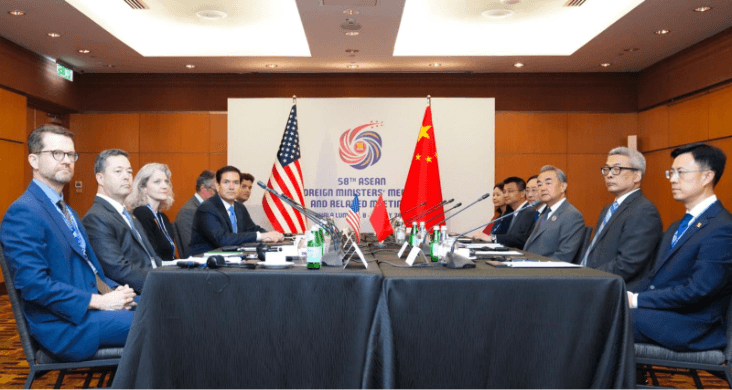
    Rubio meets with Chinese Foreign Minister Wang Yi in Kuala Lumpur, Malaysia, July 11, 2025. Image source: U.S. Department of State  

    This is evident in Rubio’s limited engagement with China – only two documented discussions with Director of the CCP Central Foreign Affairs Commission and Foreign Minister Wang Yi in 2025 – while Treasury Secretary Scott Bessent and Vice Minister He Lifeng have held multiday discussions, including the latest on September 14th. These talks led to the call on September 19th between Xi Jinping and Donald Trump. The two leaders are now expected to meet in South Korea at the Asia Pacific Economic Cooperation forum in October.

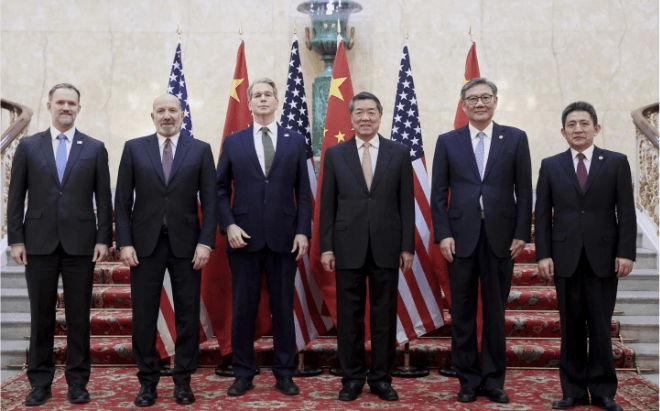
    Chinese Vice Premier He Lifeng, center right, and U.S. Treasury Secretary Scott Bessent,  center left, pose for a group photo in London, June 9, 2025. Image source: Xinhua via AP 

    On July 10, the DoS announced it had begun another round of layoffs, this time over 3,400 employees, including those who worked in the foreign assistance and political affairs divisions. The news could not have come at a worse time. In the following weeks, the news of a U.S. bank executive and a U.S. government employee who had been under exit bans for months shocked the public.  

    These layoffs at the DoS, including losing staff with crucial foreign language skills such as Mandarin Chinese, could impedes its ability to aid citizens in China.  

    Dui Hua has learned directly from families of U.S. citizens under coercive measures in China about the impact of the DoS cuts. In one major city on the east coast, the understaffed American Citizen Service (ACS) has been delaying what were monthly consular visits to imprisoned American citizens by weeks or sometimes months. The duration of visits also reportedly has to been cut short. Junior staff morale is understandably low.   

    The bank executive has since been released and returned on September 16, according to the U.S. Special Presidential Envoy for Hostage Affairs. However, there are many American citizen’s fates which are still in legal limbo. Dui Hua has estimated about 30 American citizens are subject to exit bans. 


    PUBLICATIONS HIGHLIGHTS

    DUI HUA 2024 ANNUAL REPORT

    Befitting our 25th anniversary, 2024 was an eventful year for us. In September and November 2024, American citizens on whose cases Dui Hua worked for many years, were released and returned home to their loved ones in the United States, the result of a first-ever prisoner swap with China. Read the report here


    JOHN KAMM REMEMBERS

    From John Kamm Remembers, a series written by Dui Hua’s founder recounting his advocacy for prisoners in China.

    Pastor David Lin: A Servant of the Lord

    Kamm with Lin

    On September 15, 2024, Pastor David Lin walked out of a Chinese prison in freedom. On the anniversary of his release, we tell the story of Dui Hua’s involvement. Read more

    No Way Out

    John recounts an unsettling visit to Beijing Number Two Prison in 2001 and learns that even in a hopeless and oppressive environment, opportunities surface. Read more


    PRISONER UPDATES

    Veteran democracy activist sentenced for third time in Gansu 

    Veteran democracy activist Long Kehai (龙克海) was sentenced to two and a half years on July 19 by the Hui County People’s Court for picking quarrels and provoking trouble (PQPT) — a pocket crime often used against dissidents and activists. Read more

    Leaders of house churches facing legal challenges in Anhui, Zhejiang, and Shanxi 

    Authorities continue to criminalize house churches that refuse to comply with official religious regulations. Read more


    PRESS RELEASE

    Dui Hua Decries Exit Ban on Seven-Year-Old American Citizen. Read the press release


    Subscribe here to receive Dui Hua publications by email.

  • Pastor David Lin—Servant of the Lord

    Pastor David Lin—Servant of the Lord

    Lin and Kamm
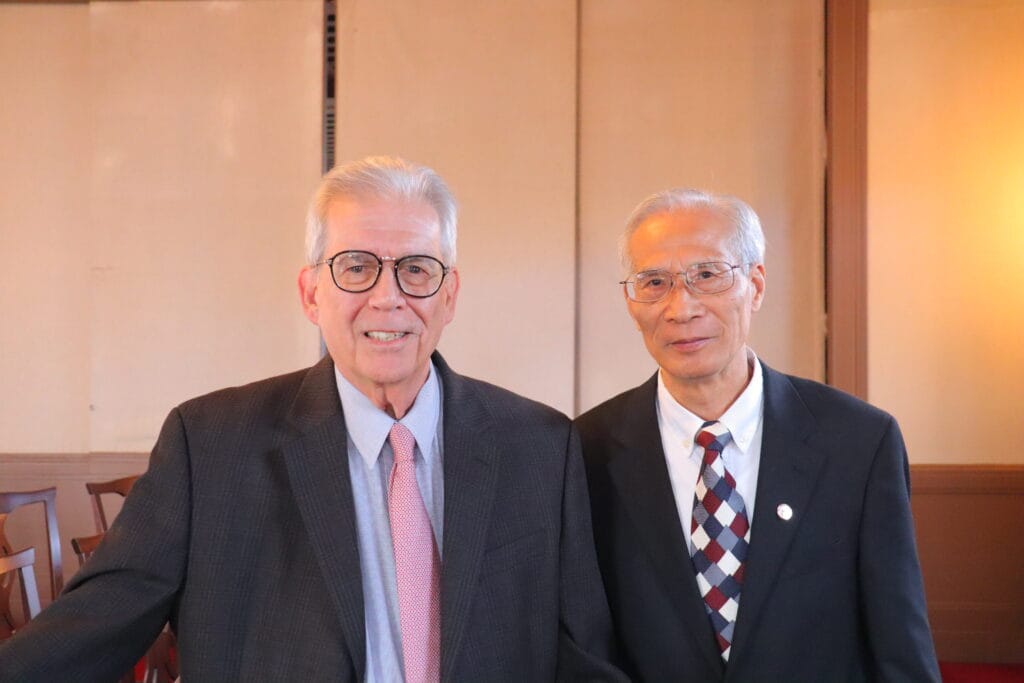
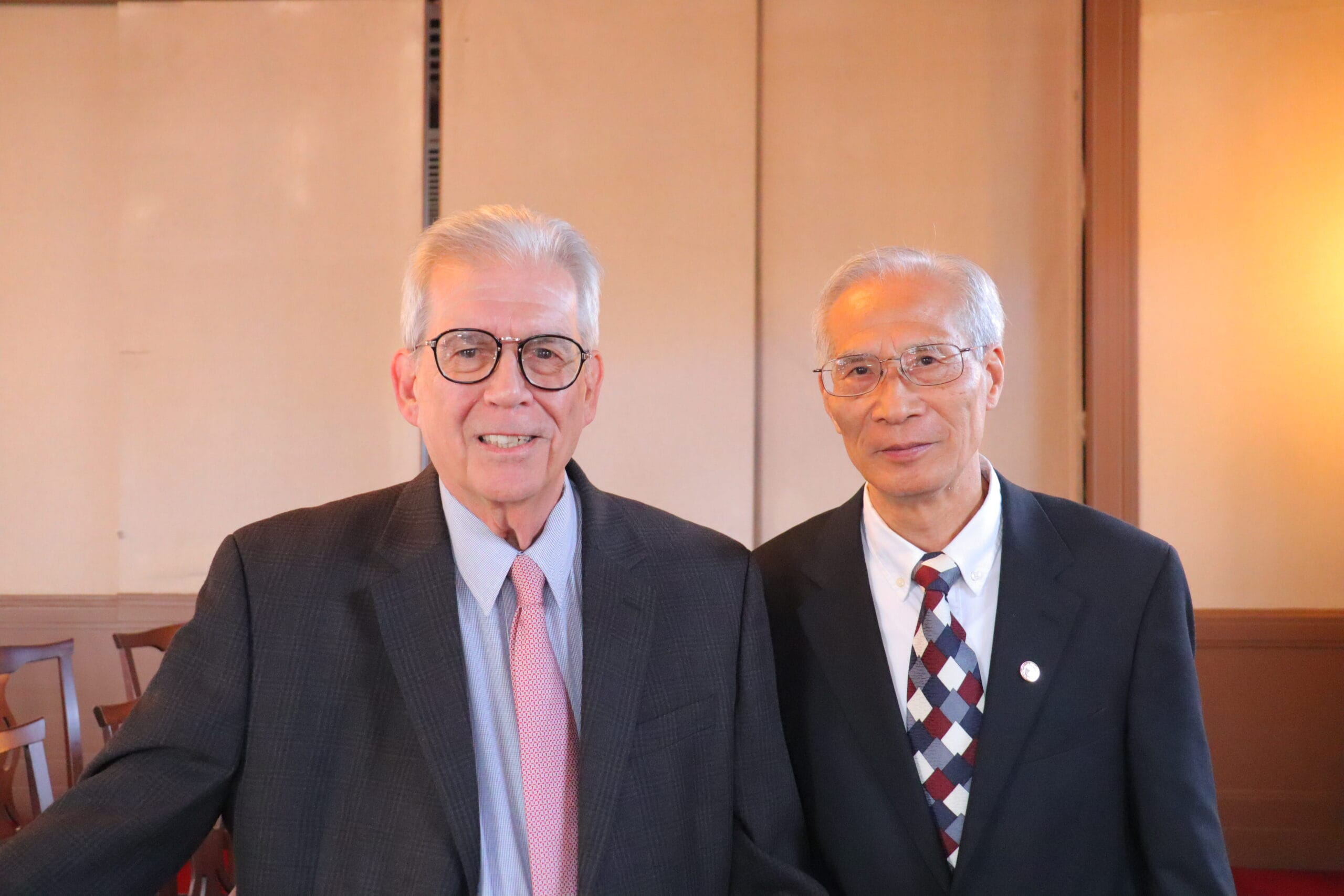
    Dui Hua Executive Director John Kamm and Pastor David Lin (right) at the University Club San Francisco, June 5, 2025. Image source: Dui Hua Foundation 

    I began working on a press statement. I sent her a draft so that she could review it on arrival in San Antonio, and before Dui Hua published it. She approved the draft, and we released a statement.

    Special Presidential Envoy for Hostage Affairs (SPEHA)

    To counter the growing trend of adversaries seizing American citizens for use as bargaining chips, U.S. President Barack Obama established the office of the Special Presidential Envoy for Hostage Affairs (SPEHA) in October 2015. The office was buttressed by passage of the Levinson Act by the Senate in July 2020.  

    In September 2020, because of advocacy work by his son Harrison Li, Kai Li was designated by the State Department as wrongfully detained. He was serving a 10-year sentence in Shanghai’s Qingpu Prison for espionage.

    Not long thereafter, Texas resident Mark Swidan and California resident David Lin were designated as wrongfully detained. At the time they were designated, both Lin and Swidan were serving long prison sentences, Lin in Beijing Number Two Prison and Swidan in Jiangmen Detention Center. 

    Prior to September 2020, no American citizen had been designated as “wrongfully detained,” reflecting a decision not to take on China. 

    Roger Carstens (right), October 6, 2024. Image source: U.S. Embassy Jerusalem

    At the time of their releases—Lin in September 2024, Swidan and Li in November 2024—SPEHA was headed by Roger Carstens, a former Marine known for his no-nonsense approach to dealing with adversarial states. Carstens was appointed Special Presidential Envoy during the first Trump term, He remained in that position throughout Joe Biden’s term in office but was not reappointed at the beginning of the second Trump term that began in 2025. During his tenure, Carstens helped secure the release of nearly 70 Americans held as hostages in foreign prisons.  

    The releases of Lin, Swidan, and Li—as well as three Uyghurs—were a part of the first-ever prisoner exchange between China and the U.S. Hopes were raised that more exchanges were in the works. Thus far, none have happened. 

    Pastor David Lin‘s Story 

    David Lin was born in Taiwan in 1955. He emigrated to the U.S. as a young man and became a citizen. He converted to Christianity and began a lucrative career as a businessman and as an economic advisor to state governments. He began traveling to China on business in the early 1990s and got to know many Christians in the house church movement. 

    Lin
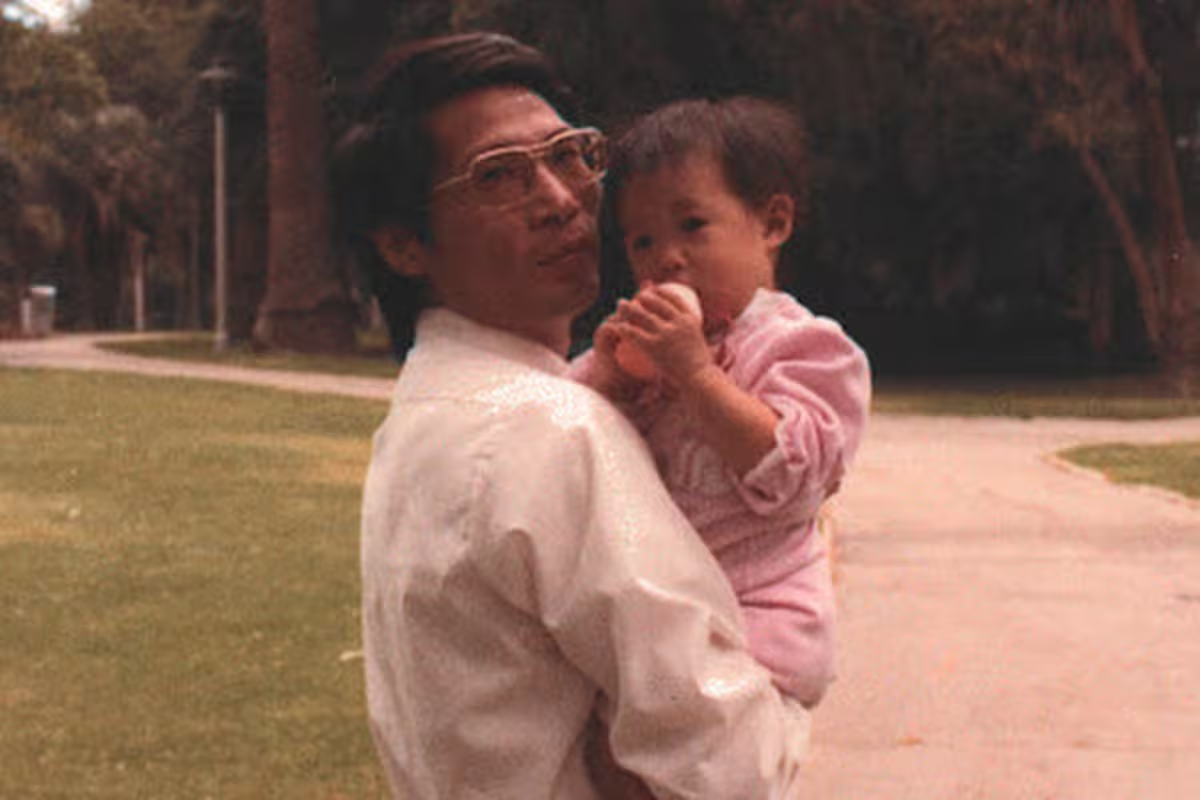
    Pastor Lin and daughter Alice in 1984. Image source: Lin’s family 

    David Lin went to China in 2006 to establish a Christian missionary training center in Beijing. He had hoped to register his ministry with the Chinese government and received positive signals that this would be possible when he next visited Beijing. It was a trap. 

    He was detained and placed under residential surveillance in a designated location, a coercive measure determined by the United Nations to constitute arbitrary detention, then transferred to Beijing Number One Detention Center. He was formally arrested, tried, and convicted in 2009 for contract fraud, an economic crime. He was sentenced to life in prison. Fraud and illegal fund raising are crimes often used against house church leaders as well as leaders of unorthodox religions. 

    After conviction, Pastor Lin was placed in Beijing Number Two Prison, a maximum-security facility that houses violent offenders serving long sentences as well as foreign prisoners and political prisoners, including religious prisoners like David Lin. Lin also qualified for placement in Beijing Number Two because he is a foreign national. In 2010, while Pastor Lin was serving his sentence, there were five other Americans in Beijing prisons. 

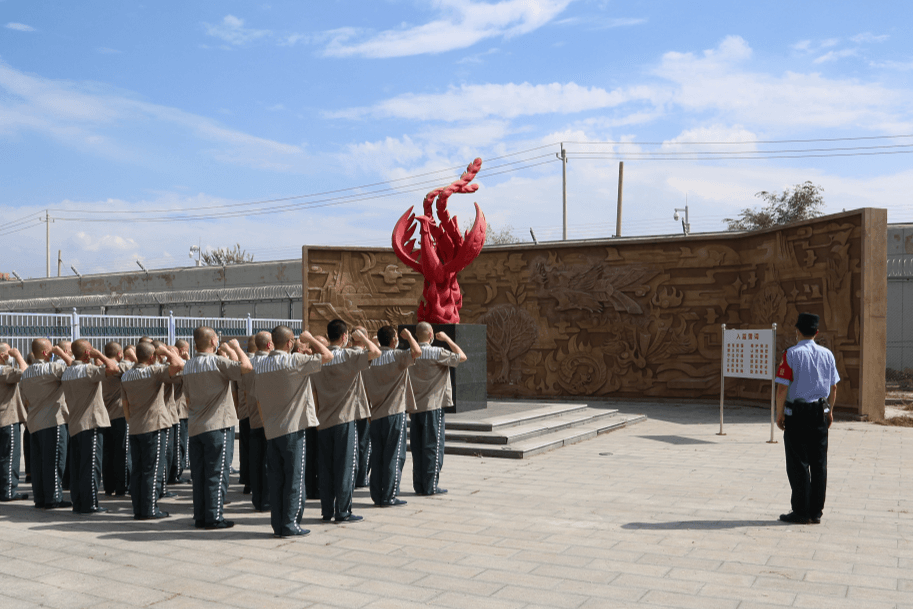
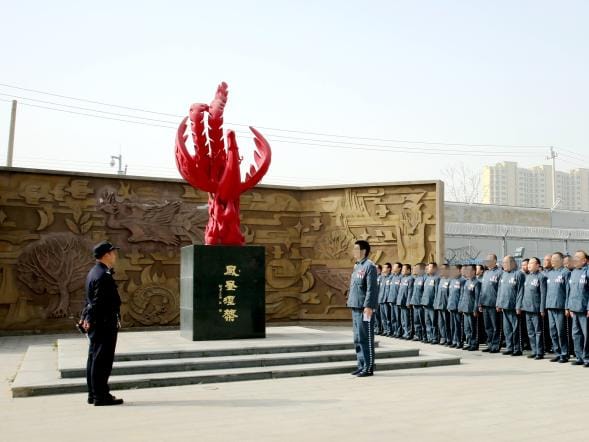
    New inmates at the Beijing Number Two Prison pledge to obey laws and prison rules.  Image source: Beijing Daily, 2022. 

    While in prison, Lin set up prayer groups and worked on translating the Bible. He claims he was not mistreated in Beijing Number Two but didn’t receive enough to eat. The prison authorities took away his Bible on three occasions but eventually returned it. On one occasion the Bible was mailed to his family in the U.S. The prison authorities came up with other ways to punish David Lin for spreading the gospel: denying mail and telephone privileges (at least two care packages never arrived from Alice) and restricting access to the prison commissary.  

    Dui Hua’s Role

    For ten years, David Lin told his daughter he didn’t want help in getting his sentence reduced, believing that his imprisonment was part of God’s plan. When he realized his health was failing—he was quickly losing his teeth—he asked Alice to help. One of her first steps was reaching out to me at the recommendation of Jeff Gillis, whose wife, Sandy Phan-Gillis, was released from prison in 2017. I had helped Jeff and Sandy secure her early release. 

    I received an email from Alice on March 27, 2019, requesting that we speak by phone. We did so the next day. I asked her to draw up a fact sheet, with a photograph of her father.  

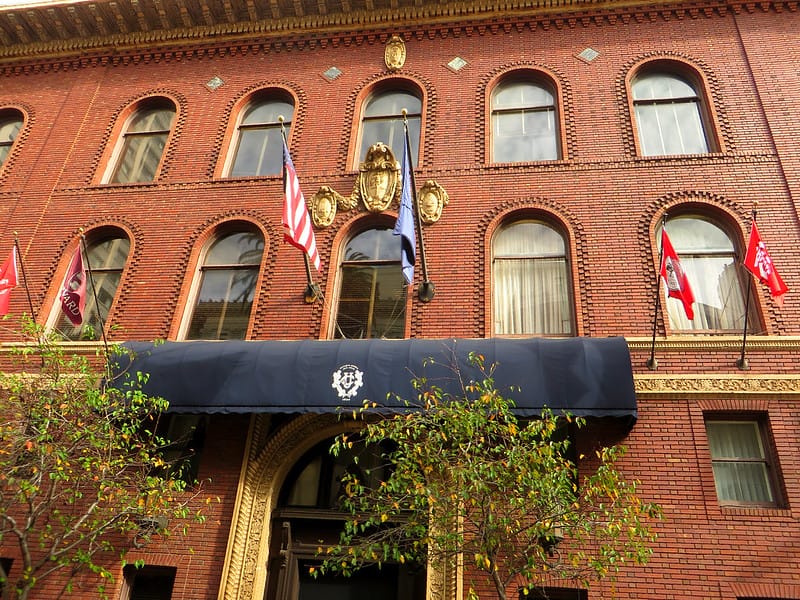
    University Club of San Francisco. Image source: Ken Lund, Flickr. Copyrights License: Creative Commons 

    In recent years, I have frequently spoken at San Francisco’s historic University Club. I was asked to deliver remarks on May 28, 2019, and called Alice to see if she and her husband David would like to attend the event. She replied in the affirmative. 

    While speaking, I glimpsed at Alice. When I brought up her father, her eyes filled with tears, her face reflecting deep anguish. After my speech, we returned, with a colleague, to Dui Hua’s office on Sutter Street.  

    Alice feared that she would never see her father again and wondered aloud what to do. I asked how sure she was that her father was serving a life sentence and offered to confirm his sentence. My colleague stepped out of the conference room and had a look at a judgment website we used to track actions by Chinese courts. He found a sentence reduction granted to David Lin in November 2014. The decision revealed that the life sentence had been commuted to 19.5 years by the Beijing Number Two Intermediate Court in 2012, followed by a 10-month reduction in 2013. The November 2014 decision granted a one-year reduction. Three reductions in the space of two years are rare and often reflect good behavior in prison. 

    All these changes were unknown to Alice, and presumably the Department of State, which rarely looks at court websites in China. She was, at turns, surprised, happy, and hopeful. 

    I called the National Security Council and the State Department to let them know what Dui Hua had discovered. Like Alice, they were surprised. They promised to pay more attention to judgment websites. 

    Momentum was building. On April 9, 2019, the Commission on International Religious Freedom adopted Lin through their Religious Prisoners of Conscience Project. On June 4, 2019, I met with the Chinese Consulate General in San Francisco. I raised Pastor Lin’s case verbally and then handed over the fact sheet. After looking it over, the consul remarked that Lin deserved another reduction. Later that month, I travelled to Geneva to attend the Human Rights Council meeting, taking advantage of the Special Consultative Status Dui Hua enjoys with ECOSOC. 

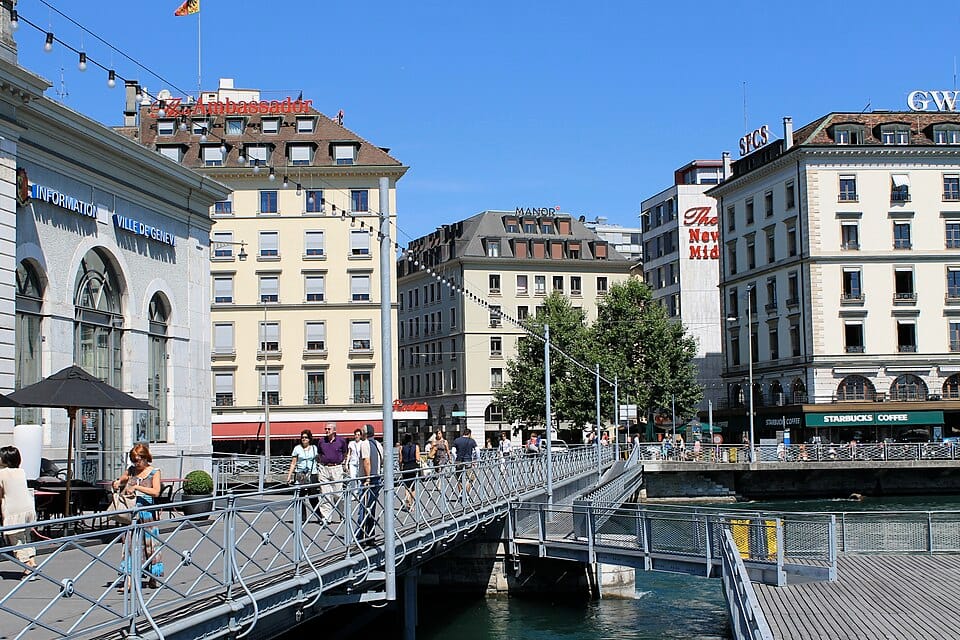
    The Ambassador Hotel, looking from Pont des Machines. Image source: Wiki Commons 

    I hosted a small dinner at Geneva’s The Ambassador Hotel for China’s Special Representative for Human Rights Dialogues and her colleague, on June 24, 2019. I handed over the fact sheet and the official promised to look into it. The official remarked that, if she found good news, she hoped I’d give it positive publicity for the sake of better U.S.-China relations. Four months later, in October 2019, Lin was granted a four-month reduction. Taken together, the reductions meant that Lin would be released in 2029. That’s where things stood prior to Lin’s release on September 15, 2024. 

    In all, Dui Hua raised Lin’s case with the Chinese government 28 times after learning of his plight in 2019 and received four responses. Dui Hua covered David Lin’s case in eight publications, including press statements.

    In October 2023, California Governor Gavin Newsom visited China to drum up business for businesses located in the state and discuss climate change. Phelim Kine coauthored an article in Politico to mark the occasion. Alice Lin told Phelim that she wanted Newsom to raise her father’s name with the Chinese government. I weighed in to say his failure to do so would be “shameful and disqualifying.” At the time, Newsom was toying with the idea of running for President in 2024. At a speech at the Hong Kong University after this trip to the Mainland, Newsom said he had raised human rights issues with Minister of Foreign Affairs Wang Yi in Beijing but did not offer specifics on what was said.  

    When the news of Lin’s release finally came, it represented the culmination of a multifaceted approach—persistence, close consultation with family and governments, solid media work, and good relationships with NGOs. All came together to achieve a good result. 


     Listen to the Encounters with China podcast.

    Subscribe to receive notifications about new episodes. 

    Read all John Kamm Remembers stories.


  • Prisoner Updates 2025 #7

    Blogger admitted into Tilanqiao Prison after long delays

    Ruan Xiaohuan (阮晓寰) was admitted into a prison in Shanghai, more than seven months after the appellate trial was concluded on December 13, 2024. The Shanghai High People’s Court rejected Ruan’s appeal and upheld the sentence of seven years imprisonment with two years of deprivation of political rights.

    Since being detained in May 2021 for inciting subversion, an endangering state security crime, Ruan had spent more than four years in Yangpu Detention Center. On August 18, Ruan’s wife Bei wrote on Twitter that he was transferred at the end of July to the infamous Tilanqiao Prison (提篮桥监狱) at its new location in Qingpu District.

    Ruan is the author of the well-known blog, “Program Thinking 编程随想,” where he shared his thoughts on society and politics and tools to bypass internet censorship in China. Many of his readers credited Ruan’s blog as a source of their political enlightenment.

    Bei visited Ruan on August 22 for 20 minutes and posted the latest updates on Twitter. Ruan is allowed to read books in his cell, which he shares with seven other prisoners. While he was at the detention center, he lost weight and some teeth because of vitamin deficiency. However, Ruan remains in good spirits.

    Ruan’s sentence expires in May 2028.


    Rights lawyer released, remains in China

    Rights lawyer Lu Siwei (卢思位) was released on August 5 in Sichuan, after severing 11 months for illegal border crossing.

    Lu is renowned for defending other rights lawyers, dissidents, and activists. In 2020, Lu represented Guangxi lawyer Chen Jiahong (陈家鸿) and Beijing Lawyer Yu Wensheng (余文生). Both Chen and Yu were later convicted of inciting subversion.

    In the same year, Lu provided legal aid to the twelve Hong Kong activists detained in Shenzhen for illegal border crossing. Lu’s legal practice license was revoked by the Sichuan Justice Department in January 2021 due to his involvement.

    In July 2023, Lu was intercepted by Laotian police as he was about to board a train to visit his friends in Thailand, despite holding a valid passport and tourist visa. He was repatriated to China in September 2023 and arrested 13 months later.


    Dissident author, songwriter sentenced in Guangzhou

    Dissident author and songwriter Xu Lin (徐琳) was sentenced to three years and nine months in prison for picking quarrels and provoking trouble by a district court in Guangzhou on August 8. This is his second imprisonment for the same crime.

    Xu was born in Zhuzhou, Hunan, and has resided in Guangzhou since 2010. In 2012, he composed a protest song based on a poem by another veteran activist Zhu Yufu (朱虞夫) and was detained in April for inciting subversion. Xu was later placed under residential surveillance in a designated location. In 2015, his protest song in support of the lawyers apprehended amid the “7.09” crackdown, landed him in residential surveillance for a month in Guangzhou. In September 2017, Xu was detained by Guangzhou police and sentenced to three years for PQPT in December.

    Xu was detained again in May 2024 and tried in March 2025. He is expected to be released in February 2028.


    Activist imprisoned for incitement denied family visitation

    Hainan activist Wu Kongda (吴孔大) wrote in letters to his family that he has been denied visitation rights since April this year. No reasons have been given by the prison authority.

    Wu’s family claimed that State Security police visited and warned supporters not to send letters anymore.

    Wu, a former primary school teacher in Hainan, was convicted of inciting subversion for expressing political opinions online and raising protest banners in public. He was sentenced to three and a half years and is due to be released in April 2027. He is serving his sentence at the Meilanxu Prison, Hainan.

    Authorities often deprive political and religious prisoners of family visitations for refusing to admit guilt or comply with reform.

  • Prisoner Updates 2025 #6, Part II

    Leaders of house churches facing legal challenges in Anhui, Zhejiang, and Shanxi

    Authorities continue to criminalize house churches that refuse to comply with official religious regulations.

    Three leaders of Anhui A Kernel of Wheat Reformed Church were placed under criminal detention between July 2 and 9. Pastor Chang Shun (常顺) and Elder Ma Tao (马涛) were detained by Fuyang police for “illegal gathering.” Pastor Zhang Shen (张森) was detained in Xuzhou for unknown causes when visiting friends.He was brought back to Fuyang. Zhang’s wife claimed that she had not received notice from the police. Pastor Zhang had previously been placed in 15-day administrative detention for “praying without permission” outside a detention center in 2024. The church has faced harassment from local authorities and has publicly denounced the official “Three-Self Patriotic Movement (aka ‘Three-Self’ Church).”

    Pastor Huang Yizi (黄益梓) and Pastor Li Yongfeng (李永峰) of a house church in Pingyang County, Zhejiang were formally arrested on August 3 for illegal business operation, a crime routinely used by the authorities against house churches. Huang was one of the church leaders protesting the removal of crosses by the government from 2014-2015. He was sentenced to one year imprisonment in 2015 for gathering a crowd to disturb social order. Shortly after his release, he was accused of illegally providing state secrets to an overseas entity and placed under residential surveillance in a designated place from September 2015 to February 2016. Huang and Li were detained on June 26, 2025. Four other church members were also reportedly detained for the same charge.

    First detained in September 2021 and, after repeated trial postponements, Shanxi Pastor Wang Xiaoguan (王晓光) and his wife Yang Lirong (杨荣丽) of the Golden Lampstand Church were both harshly sentenced in July by the Linfen district court to nine years and seven months and 15 years, respectively. Both were convicted of fraud. The couple has served their church since 1998, but also repeatedly refused to join the Three-Self Church and run afoul of the regulations that require them to register with the local religious affairs bureau. The couple were detained in November 2009 for illegally occupying farmland and gathering a crowd to disrupt traffic. Wang was sentenced to one years’ imprisonment. The couple was again detained in August 2021 then later arrested for fraud in September. Wang and Yang were tried separately in April. Wang and Yang were also fined 100,000 yuan and 500,000 yuan, respectively.


    First arrest under Macau’s National Security Law

    Leading Macau democrat Au Kam-san (区锦新) was arrested for collusion with foreign forces and placed in detention on July 31, 2025. The case is the first known arrest under the city’s national security law.

    Au was a teacher and a former representative of the Legislative Assembly of Macau. He is a veteran activist and participated in Macau’s June 4 vigils to remember the 1989 student movement crackdown.

    In 2023, both Hong Kong and Macau attempted to push through national security legislation. However, Macau decided to postpone its own bill following the widespread protests in Hong Kong against the legislation. The law was then passed by the Legislative Assembly of Macau in January 2009. The law was revised for the first time in May 2023 and expanded to criminalize non-violent acts and speeches.

    In its press release, Macau Polícia Judiciária accused Au of colluding with several overseas anti-China entities, providing false information to media for propaganda purposes, and inciting hatred from Macau residents against the central and Macau SAR governments.


    Prisoner Updates 2025 #6, Part I

  • Prisoner Updates 2025 #6, Part I

    Veteran democracy activist sentenced for third time in Gansu

    Veteran democracy activist Long Kehai (龙克海) was sentenced to two and a half years on July 19 by the Hui County People’s Court for picking quarrels and provoking trouble (PQPT) — a pocket crime often used against dissidents and activists.

    This is Long’s third imprisonment. In 2020, he was sentenced to one and a half years for PQPT by a court in Baoji, Shaanxi. After release, he converted to Christianity and joined the Early Rain Covenant Church in Chengdu, Sichuan. In December 2022, Long was again sentenced by a court in Hui County, Gansu to two years for PQPT for expressing concern about rights lawyer Chang Weiping.

    Long, undeterred by jail, continued to express dissenting views and offer support to other activists. He was detained in Hui County in March 2025 and his trial started in June. His latest sentence reportedly expires in September 2027.


    Independent journalist awaiting trial for ESS

    Hunan independent journalist Li Yuanfeng (李原风) is awaiting trial ten months after he was detained for PQPT in October 2024. Li was later arrested for inciting subversion, an endangering state security crime.

    Li is well known for the critical comments he has posted on social media platforms and overseas websites. He is currently in custody at Yiyang No.1 Detention Center in Hunan.


    Dissident author released after serving full sentence for ESS

    Renowned dissent author Lü Gengsong (吕耿松) completed his sentence of 11 years for subversion, an endangering state security crime, on July 6, 2025, and was released from Zhejiang Changhu Prison. It is reported that local police arranged for Lü and his wife to stay at a farmhouse and warned his friends not to visit him. He is currently serving a deprivation of political rights (DPR) supplemental sentence.

    Lü has been imprisoned twice for his key role in the China Democracy Party (CDP) — the first major opposition political party in the People’s Republic of China. Lü was a lecturer at the Zhejiang Police College and wrote several books exposing government corruption and organized criminal groups. He was first sentenced to four years with one year of DPR for inciting subversion, by the Hangzhou Intermediate People’s Court in 2008.

    Lü continued his activism after being released in 2011. In 2016, Lü was convicted and sentenced in a closed trial by the Hangzhou Intermediate People’s Court to 11 years with five years of DPR for subversion. He was accused of organizing the Zhejiang branch of CDP. He served his jail terms in full without receiving any of clemency.

    Lü will be closely monitored by police as part of the “targeted population” while serving the supplemental sentence of five years of DPR. He will likely be prohibited from speaking to foreign media and restricted from traveling.


    Prisoner Updates 2025 #6, Part II

  • Dui Hua Decries Exit Ban on Seven-Year-Old American Citizen 

    SAN FRANCISCO (AUGUST 7, 2025) – On August 27, 2024, well-known Chinese dissident artist Gao Zhen (高兟), a permanent resident of the United States, was detained on a family trip to China. He was accused of “slandering China’s heroes and martyrs,” a law that came into effect in 2018. Gao and his brother, Gao Qiang – known collectively as the “Gao Brothers” – had created works mocking China’s leadership in the 1990s to 2009, long before the law against slandering heroes and martyrs came into effect. 

    At the same time as Gao Zhen was taken into custody, his wife, Zhao Yaliang (赵雅良), and son, Gao Jia (高嘉), were placed under exit bans. Gao Jia is an American citizen, born in the U.S. and living in New York. He has been unable to attend school for a full year. He is seven years old. No charges have been filed against him. 

    Like Gao Zhen, Zhao Yaliang is a permanent resident of the United States. 

    Neither the mother nor the son has been accused of criminal wrongdoing. Neither are needed for cooperation with a criminal investigation undertaken by the Chinese authorities.  

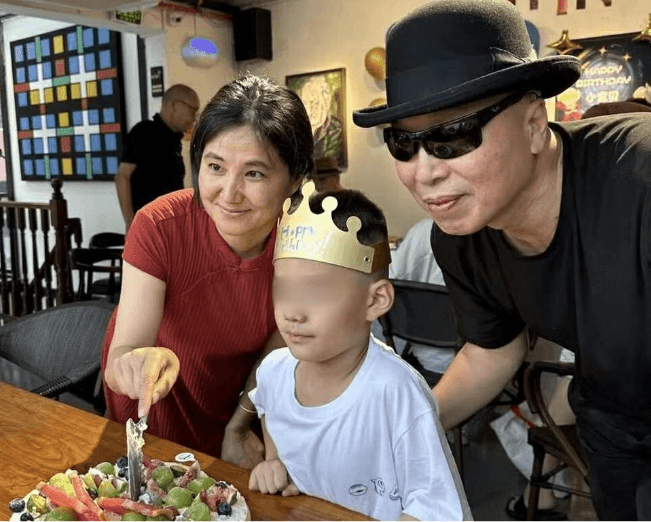
    Gao Zhen, Zhao Yaliang, and Gao Jia celebrating Gao Jia’s birthday. Photo provided by Gao family. 

    China’s treatment of Gao Jia is a violation of the United Nations Convention on the Rights of the Child, to which China is a party. More generally, exit bans violate the United Nations Civil and Political Rights (ICCPR) provisions regarding freedom of travel. 

    The treatment of Gao Jia represents a setback to China’s efforts to reform the country’s juvenile justice system, an effort that Dui Hua has supported with multiple expert exchanges with Chinese judges over the course of many years. 

    Gao Zhen is expected to be tried and sentenced in the coming weeks. The implications for freedom of expression in China are big. The world will be watching. 

    Gao Zhen has refused to plead guilty, and, despite the efforts of famed defense lawyer Mo Shaoping, he will likely be given a long sentence. “Charging someone with a crime that was not a crime at the time the alleged offense took place, ” said John Kamm, executive director of the Dui Hua Foundation, “is a violation of a fundamental principle of justice, the principle of non-retroactive application of the law.” 

    “It’s one thing to slap exit bans on adult Americans like bankers or government employees, it’s an entirely different matter to impose an exit ban on a young child,” remarked Kamm. “The Chinese government must stop persecuting the Gao family. It must free Gao Zhen and lift the exit bans on Gao Jia and his mother and allow them to return to the United States.” 

  • No Way Out

    << Read all John Kamm Remembers stories

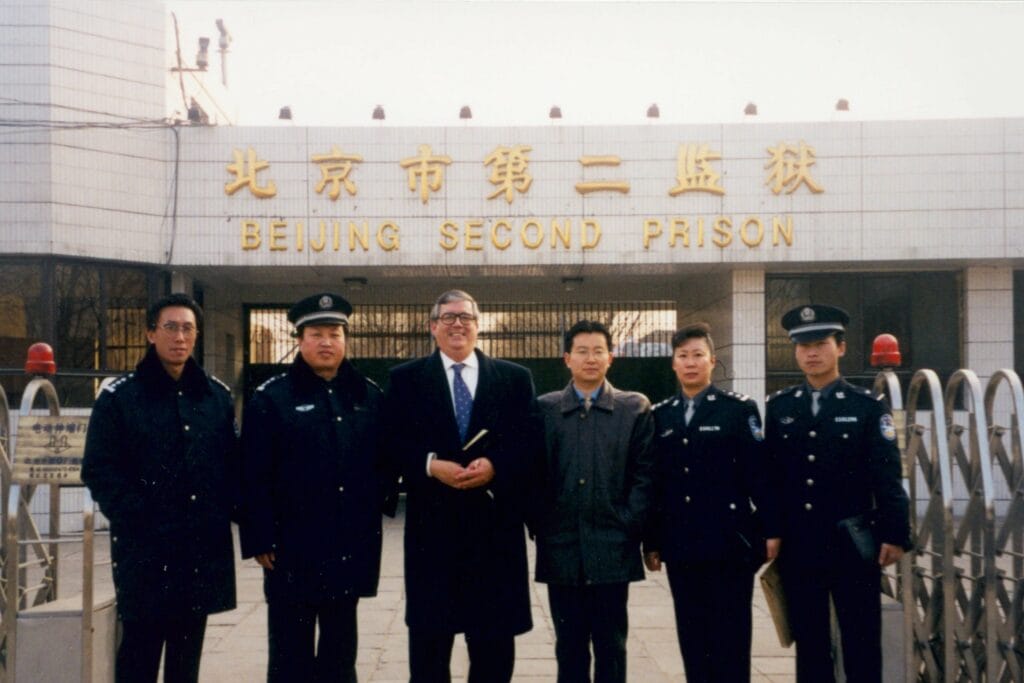
    Kamm (third from left) with officials from the Ministry of Justice and the Beijing Prison Administration Bureau and prison wardens in front of the Beijing Number Two Prison, December 18, 2001.

    In August 2001, I was contacted by a New York Times journalist, Tina Rosenberg, to ascertain if I was willing to be featured in an article examining the nexus between business and human rights. Among the companies to be featured were an oil company operating in Africa and a sporting goods company sourcing products from an Asian country.  

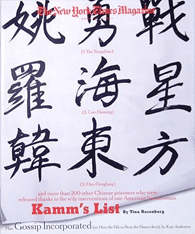
    Cover of the New York Times Magazine, March 3, 2002

    Not long afterward, and following a trip to Washington, Ms. Rosenberg informed me that her editor had decided to focus on my work to the exclusion of others. The article would eventually be published in the New York Times Magazine March 2002 issue as “John Kamm’s Third Way,” but, because it was a cover story, it would also be titled “Kamm’s List” on the cover.

    Reflecting China’s desire to improve its relationship with the United States in the aftermath of the September 11, 2001, attacks on New York and Washington, the Chinese government agreed to let Ms. Rosenberg and a photographer, Zeng Nian, enter the country to observe me in action.

    I arrived in Beijing a day before The New York Times team to finalize arrangements. It was an aggressive schedule. Meetings were arranged with Chinese officials from the Ministry of Foreign Affairs and the Supreme People’s Court, the US Embassy, including Ambassador Clark Randt, foreign diplomats, and American business leaders. We spent a day traveling around the city photographing locations that I frequented – the Beijing Train Station, the Procuratorate bookstore, and shopping districts. I asked whether the New York Times team could accompany me on a visit to a prison, but the Ministry of Justice flatly denied this request, claiming that my visits to prisons were “personal” matters between me and the ministry.  

    Visit to a Maximum Security Prion in Beijing

    And so, on December 18, 2001, I visited Beijing Municipality Number Two Prison, accompanied by officials of the Ministry of Justice and the Beijing Municipality Prison Administration Bureau. The visit lasted approximately two hours.

    Beijing Number Two Prison is a maximum-security facility housing, in 2001, approximately 2000 male prisoners. It is located just off the Beijing-Shenyang Expressway in east Beijing (now part of Beijing-Harbin Expressway). A large percentage of the prisoners have committed violent crimes. It was designated a maximum-security prison—one in which most of the prisoners serve sentences of at least 15 years in length in 1990. For 40 years before 1990, Beijing Number Two Prison was an agricultural prison brigade housing prisoners with light sentences. 

    Beijing Number Two Prison was, and still is, a maximum-security facility. Unlike other prisons I had visited in China, including Tianjin Prison earlier in 2001, Beijing Number Two Prison has not been designated a model prison by the Ministry of Justice. Its facilities, including its clinic, are less extensive and more poorly equipped, and the cellblocks are more crowded and less well-appointed than those of model prisons. Its 18 wards are housed in six three-storied cell blocks. The tour revealed a physical plant badly in need of repair and better maintenance. Foreigners were rarely taken to the prison; I was the only foreign visitor to have visited in the previous 12 months. 

    Prisoners are under strict control at the facililty. No contact of any kind was permitted between me and the prison population. The wardens stated that there had been no escapes, riots, or suspicious deaths in the prison since 1995. 

    The Prisoner Distribution Center of the Beijing Prison Administration decides where to incarcerate people sentenced to prison by Beijing courts. I knew that, although Beijing Number Two is designated a facility for housing violent offenders with long sentences (including several sentenced to life imprisonment), many of the prisoners convicted of counterrevolution and endangering state security by Beijing courts — including several with sentences ranging from four to eight years — were sent there.  

    Prisoners who have served their sentences at Beijing Number Two Prison include Xu Wenli (徐文立), Zha Jianguo (查建国), and numerous practitioners of unorthodox religions. More recently, American religious prisoner Pastor David Lin (林大卫) spent most of the time in carceral facilities in Beijing Number Two Prison. He encountered prisoners from 39 countries of whom around were 15 American citizens. 

    Prisoners of the Beijing Number Two Prison making a pledge to obey prison regulations and rules, in front of a statue that symbolizes rebirth. Image source: Beijing Prison Administration Bureau, April 2018.

    Of the 40 Beijing prisoners on Dui Hua’s list of “important prisoners” in 2001, 26 were believed to be incarcerated in Beijing Number Two Prison. The wardens admitted that there was a “small number” of prisoners with light sentences — including those convicted of counterrevolution and endangering state security—in Beijing Number Two. I asked questions about several of them, but the wardens were not in a position to provide information. 

    Liu Jingsheng 

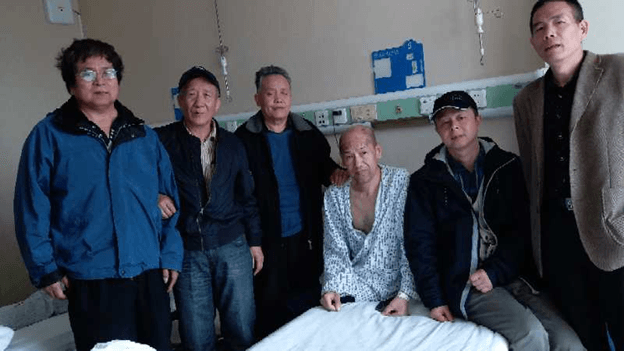
    One of the prisoners I wanted to find information about was Liu Jingsheng (刘京生), a labor leader from the Democracy Wall period who co-edited an underground magazine, Tansuo 探索, with Wei Jingsheng. He was detained in May 1992 and subsequently sentenced to 15 years in prison. Since the wardens would not provide information about prisoners, I tried a tactic to at least bring up Liu’s name. As we were walking by the prison basketball court, I remarked that Liu Jingsheng was a good basketball player. If a foreigner mentions a Chinese prisoner to a prison official, the official must inform senior levels. 

    Dui Hua put Liu’s name on 17 lists submitted to the Chinese government and received 16 responses. After several sentence reductions, Liu was released in November 2004. He remained active for a few years – accepting an award from Wei Jingsheng, giving interviews, contributing articles to pro–democracy websites. He visited June 4 prisoner Zhang Yansheng in April 2019. Nothing has been heard of him and his work since the visit. 

    Liu Jingsheng (second from left) and other activists visited Zhang Yansheng in April 2019. Image source: Sun Liyong, Twitter @sunliyong8964.

    I asked whether or not the prison had considered adopting the fen lei gai zao (分类改造) system being used in Tilanqiao. In this system, prisoners convicted of a certain crime are housed together and kept apart from prisoners convicted of other crimes. The wardens replied that Beijing Number Two Prison was in fact practicing a kind of fen lei gai zao: prisoners are grouped into four broad categories – 1) violent criminals, 2) sexual offenders, 3) those convicted of economic crimes and 4) others. Those convicted of counterrevolution and endangering state security are considered category 4 prisoners. 

    A detailed account of the point system used to reward prisoners with sentence reductions, good behavior parole and other benefits (e.g., more frequent family visits, conjugal visits, use of two outside telephone lines to receive calls from family members) was given. Points are assigned according to how well a prisoner performs with respect to following regulations, “accepting re-education,” and performing physical labor. The prisoners make handicraft items and undertake unspecified “value adding” work for light industrial products. The wardens claimed that the prison’s combined rate of sentence reduction and parole exceeded 25 percent per year; that is, more than one in four prisoners receive either a reduction or parole every year. 

    No Way Out 

    The warden did not know the sentence reduction or parole rate for counterrevolutionaries and those convicted of endangering state security. I brought up an October 1997 Notice issued by the Supreme People’s Court that states “Sentence reduction and parole for prisoners convicted of seriously endangering state security…should be strictly controlled.” In practice, what does this mean? Do such prisoners receive parole and sentence reductions at a rate less than the rate of the prisoner population as a whole? The wardens did not deny that prisoners convicted of political offenses benefit from fewer paroles and sentence reductions but maintained that there was no discrimination among prisoners in the point system itself. “Strict control” is exercised by the courts, which examine and rule on applications for sentence reduction and parole (but not medical parole, which is decided by prison authorities). 

    To better understand how the parole and sentence reduction system works, I asked if a prisoner like Han Chunsheng (韩春生) – an avid listener of VOA broadcasts who had always maintained his innocence and refused to acknowledge guilt – can ever qualify for parole or sentence reduction. The warden replied that prisoners who continue to maintain their innocence can file petitions with the courts for release and/or retrial.

    And if those petitions are rejected?  

    “Then the prisoner has no way out.” 


     Listen to the Encounters with China podcast.

    Subscribe to receive notifications about new episodes. 

    Read all John Kamm Remembers stories.


  • Prisoner Updates 2025 #5

    First sentence reduction for leader of unorthodox Christian group five years into his imprisonment 

    Wang Yongmin (王永民), leader of the Mainland China Administrative Deacon Station (MCADS 中华大陆行政执事站), likely received an eight-month sentence reduction in May 2025.

    Wang founded MCADS as an offshoot of the “Shouters.” The Shouters and many of its variations are among the first religious groups designated as “cult organizations” in China.

    In 1996, Wang was sentenced to twenty years for disturbing social order and fraud. He was released three years early on parole in 2012.

    Wang, together with Li Yuhong (李玉红) and five others , tried to revive the group following Wang’s release. They purchased printers to produce propaganda materials and attempted to contact overseas religious groups in the hope of gaining official recognition.

    In December 2019, the Xiao County People’s Court in Anhui Province convicted Wang of organizing a cult to undermine implementation of the law (Article 300) and sentenced him to ten years with three years of deprivation of political rights. Other defendants received suspended sentences of up to seven years in prison.

    The sentence reduction is Wang’s first since being admitted to Anhui Chaohu Prison in June 2020.

    Wang, now in his early 70s, is the only remaining MCADS member in prison. His sentence is expected to expire in July 2027 following the reduction.

    Dui Hua has covered Wang and MCADS in its publications.


    Beijing environmental activist detained in Shandong

    Huo Jiangpo (霍江坡), an environmental activist from Beijing, was placed under nine-day administrative detention by the Dongying Public Security Bureau on June 29, 2025.

    In May 2025, Huo and colleagues probed into a pharmaceutical company in Dongying after receiving tip-offs from local residents about illegal wastewater discharge . The company had previously been fined multiple times by the authorities for harming the environment in 2016.

    The activists took videos of the polluted sites using a drone and posted clips on several social media platforms. The local government publicly refuted the allegations, and the online video clips were purged.

    On June 29, Huo and two colleagues were detained by the local police while revisiting the town in an attempt to collect additional evidence. According to reports from official media, the police accused Huo of disrupting social order with falsified information and placed him under administrative detention from June 29 to July 8. Huo’s colleagues have been released.


    Two environmental activists in detention in Shaanxi

    Known only by his pseudonym “Brother Nut 坚果兄弟,” the performance artist and environmental activist reportedly went missing on June 30 in Kunming, Yunnan while visiting family. On the same evening, his friend and longtime collaborator Zheng Hongbin (郑宏彬) was held incommunicado after being detained by the police in Xi’an.

    The work of “Brother Nut” became known in 2015 when he made a brick from air pollutants he collected in Beijing, which he left at a construction site. His art projects focus on environmental issues and censorship. Zheng is an independent art curator who has organized exhibitions to raise public awareness about environmental issues.

    The duo gained traction with their investigations aimed at exposing illegal waste discharge and pollution at Xiaohaotuxiang, a natural gas and coal mining town in Yulin, Shaanxi. Billed as a public art project, the duo first started the exposure in 2018 and made annual visits to the town.

    On the same day when the two went missing, articles related to the subject were purged from their WeChat public accounts.

    At the time of posting, it is reported “Brother Nut” has been taken to Yulin and that both men are placed in administrative detention for twenty days for picking quarrels and provoking trouble by the Yulin Public Security Bureau.


    Two Church of Almighty God members received clemency in Chongqing

    Ran Mengqun (冉孟群), a member of Church of Almighty God (CAG), received an eight-month sentence reduction in May 2025.

    As a district leader of CAG, Ran was in charge of daily operations and distributing propaganda materials. She had been previously placed under administrative detention and in legal education classes for Article 300 in 2017. In August 2019, Ran and two other members were convicted of Article 300 by the Kaizhou District People’s Court and sentenced to seven and a half years in prison.

    This appears to be Ran’s first sentence reduction. Ran, now in her early fifties, is expected to be released from Chongqing Women’s Prison in January 2026.

    Also in May, another CAG branch leader Xiang Minqiong (向明琼) received a five-month sentence reduction.

    Xiang was in charge of bookkeeping and distributing propaganda materials. In August 2019, Xiang was convicted of Article 300 by the Kaizhou District People’s Court and sentenced to seven years and three months in prison.

    This also appears to be Xiang’s first sentence reduction. Xiang, now in her early sixties, is expected to be released from Chongqing Women’s Prison in July 2025.

  • Dui Hua Digest, Summer 2025

    EVENT

    (From left to right) Wilcox, Kamm, and Lin at the University Club San Francisco event on June 5, 2025. Image source: Dui Hua.

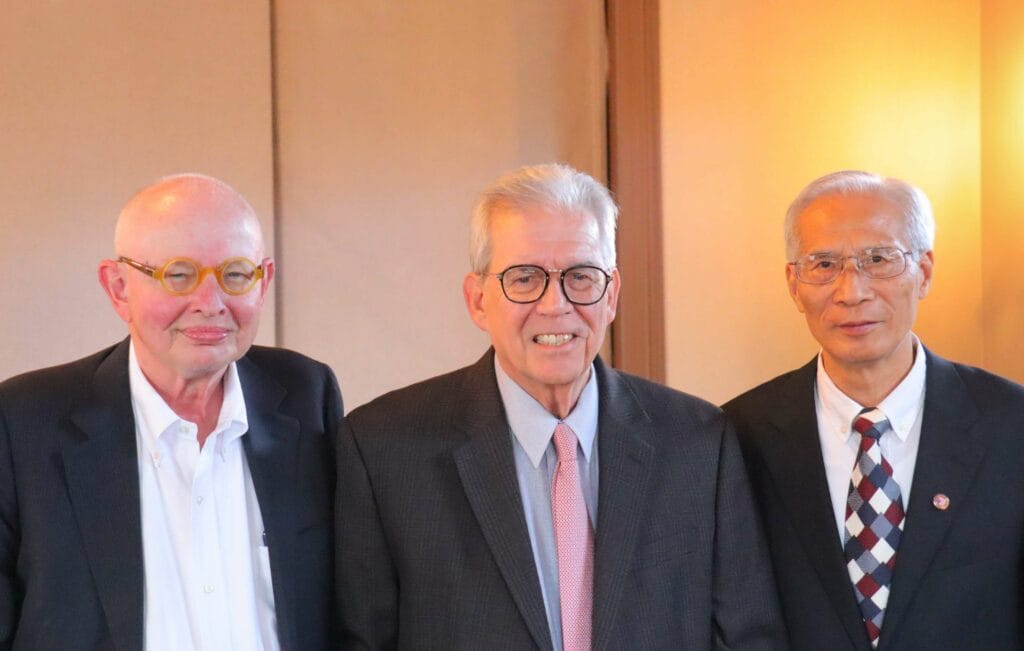
    On Thursday, June 5, President Donald Trump and President Xi Jinping had a 90-minute telephone conversation. A few hours later, Ken Wilcox, retired business leader and author of The China Business Conundrum, and John Kamm, Executive Director of The Dui Hua Foundation (Dui Hua), spoke to the members of the University Club of San Francisco. The event was titled “US-China Relations on the Precipice.”

    Knoll opening the event. Image source: Dui Hua.

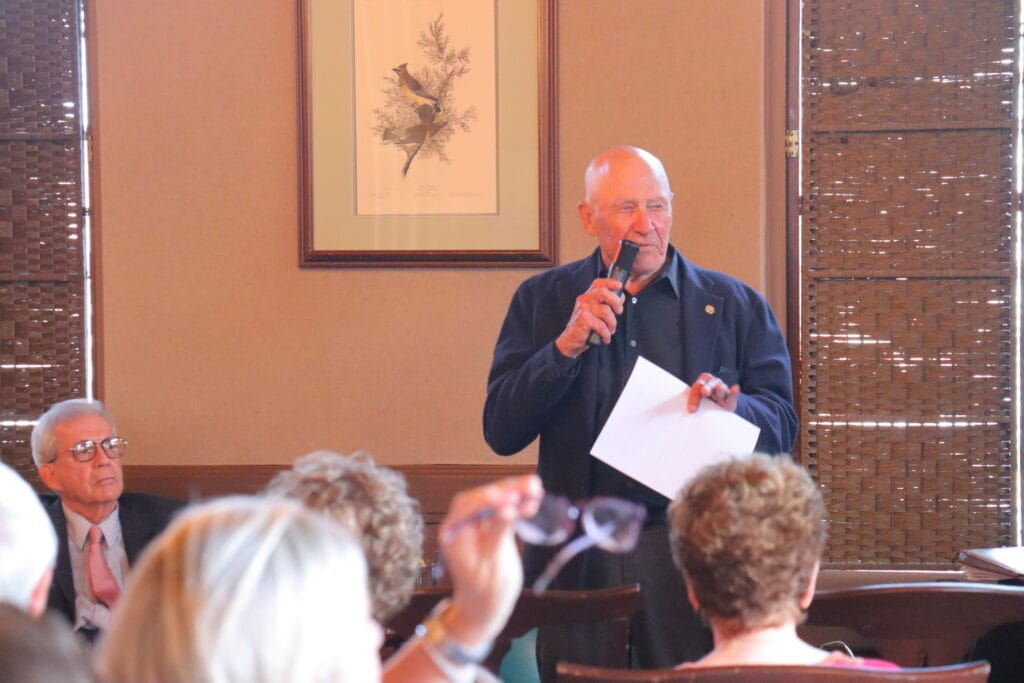
    The evening opened with remarks from Al Knoll, longtime club member and chairman of the Events Committee. He briefly introduced Kamm, Pastor David Lin, and Wilcox. 

    Knoll asked Kamm to say a few words. Kamm introduced Maragret Conley, Executive Director of the Asia Society of Northern California, William Simon, Dui Hua director and experienced businessman (he joined Kamm on his first trip to Mainland China in January 1976), and Lin. 

    Pastor Lin (foreground). Image source: Dui Hua

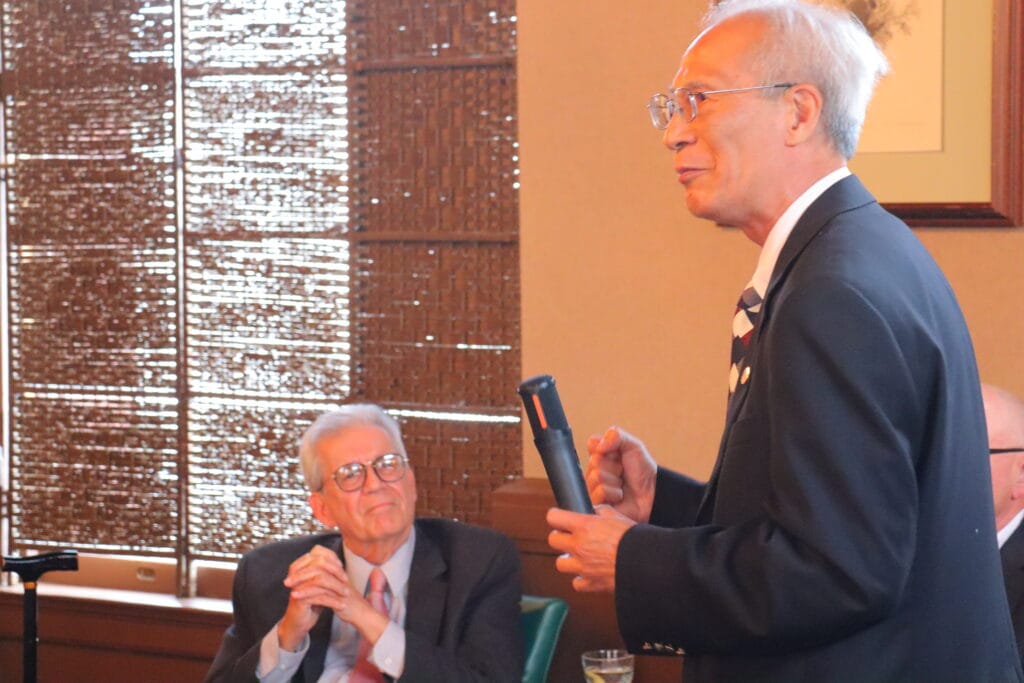
    In his remarks, Lin thanked Kamm and others who had helped secure his release, including his family members, notably his daughter Alice, Secretary of State Antony Blinken, Ambassador Nick Burns and his staff, and Christians who had prayed for him in China and the United States. In conversations with Kamm after the event, Lin spoke of his time in different carceral facilities including residential surveillance in a designated location, a detention center, and, finally, Beijing Number Two Prison. In the prison, he encountered inmates from 39 different countries, and over the years, around 15 American citizens. 

    Kamm. Image source: Dui Hua.

    Lin told Kamm that while he was not mistreated, he didn’t receive sufficient nutrition and could not freely practice his religion. Also, for the 27 months before entering prison, he couldn’t communicate with his family.

    Kamm’s remarks focused on the impact of the “New Cold War with China” on the San Francisco Bay Area. He pointed out that there are four Chinatowns in the Bay Area – three in San Francisco and one in Oakland. The shops and restaurants are bracing for the high tariffs imposed by the Trump administration. Other areas of concern are the sharp drop in container traffic and tourist arrivals. Students at Bay Area colleges are seeing their visas revoked.  

    Wilcox, a veteran banker who spent years living and working in Shanghai that included running the first joint venture bank established in China, outlined the prospects and perils of doing business in China. 

    Wilcox. Image source: Dui Hua.

    He spoke about the challenges of working together with the Chinese Communist Party as well as the structure of the capital market system in China and why it is difficult to insert a Western bank into that system. He quoted a well-known Chinese proverb: 同床异梦 (same bed, different dreams).

    Following the remarks of Lin, Kamm, and Wilcox, Al Knoll opened the floor to questions. A lively give-and-take ensued.


    PUBLICATIONS HIGHLIGHTS

    JOHN KAMM REMEMBERS

    From John Kamm Remembers, a series written by Dui Hua’s founder recounting his advocacy for prisoners in China.

    Lost but not Forgotten: Wuhan’s Democracy Wall Movement

    China’s Democracy Wall movement’s most prominent activist was Wei Jingsheng. A lesser-known dissident was Zhu Jianbin (朱建斌). of Wuhan, whose name I first came across in a New York Times article by Pulitzer Prize winner Nicholas Kristof.

    ENCOUNTER WITH CHINA (PODCAST)

    Dragon Years: Remembrance of Times Past is a limited series about founder John Kamm’s work from 1976 to Dui Hua’s founding in 2000, culminating in the Foundation’s 25th Anniversary in 2024.

    Dragon Years: Remembrance of Times Past 2024 (Special Series)

    Dragon Years podcast

    The Year of the Wood Dragon sees Trump’s return to the presidency and the easing of US-China tensions following the release of several U.S. citizens from prisons in China. In this final episode of Dragon Years: Remembrance of Times Past, John Kamm and Dui Hua board member and seasoned diplomat Bill McCahill discuss the events that shaped US-China ties in 2024 and their impact on Dui Hua’s work.

    Listen to the full series


    PRISONER UPDATES

    Dui Hua’s Prisoner Updates provide the latest information uncovered through research and direct dialogue with the Chinese government.

    Seven members of a house church in Xi’an, Shaanxi Province, have been placed in criminal detention for Article 300. Pastor Gao Quanfu (⾼全福), Pastor Jiao Yong (焦勇), Pastor Tang Bingyi (唐秉义) and others of the Light of Zion house church were taken by police from their home on May 16 and 17. One preacher, Liu Ce (刘策) was placed under administrative detention for ten days.

    Liu Jinling (刘金玲), a follower of “Master Dishen” and a Longkou resident of Shandong Province, was detained on May 29 for “using a cult to undermine implementation of law” (Article 300). She is currently held at the Yantai Detention Center.

    Read more

  • Prisoner Updates 2025 #4

    Members of House Church in Xi’an detained for “cult”

    Seven members of a house church in Xi’an, Shaanxi Province, have been placed in criminal detention for Article 300.

    Pastor Gao Quanfu (⾼全福), Pastor Jiao Yong (焦勇), Pastor Tang Bingyi (唐秉义) and others of the Light of Zion house church were taken by police from their home on May 16 and 17. One preacher, Liu Ce (刘策) was placed under administrative detention for ten days.

    It is unclear why the church was accused of cult activities. The church has existed for forty years in Xi’an with members across the country.

    It is increasingly evident that Article 300 has been used to target beyond unorthodox religions groups. Authorities also press cult charges against house church leaders who are defiant of religious regulations. Unauthorized gatherings such as sermons and religious festivals are also under the scope of “cult” activities.


    Hong Kong activist charged with new national security crime while imprisoned

    Joshua Wong, who is serving a four-year sentence for subversion under the Beijing-imposed Hong Kong National Security Law, was additionally charged with colluding with foreign forces on June 6. The charge allegedly stemmed from Wong “colluding” with exiled activist Nathan Law.

    Prior to the new charge, Wong was scheduled for release in January 2027. Critics believe that the new charge against him is designed to prolong his stay behind bars.


    Buddhist group targeted in police crackdown

    A Buddhist group in China is facing crackdown from the government.

    Liu Jinling (刘金玲), a follower of “Master Dishen” and a Longkou resident of Shandong Province, was detained on May 29 for “using a cult to undermine implementation of law” (Article 300). She is currently held at the Yantai Detention Center.

    The group, led by “Master Dishen” (谛深大师), started around 2000 and reportedly operates many meditation centers in Mainland China and Taiwan. The group also claims that numerous Buddhist temples are practicing and propagating his teachings. Unlike other unorthodox Buddhist groups, Dishen does not proclaim himself to be a reincarnation of a buddha. Neither do his teachings form a new school.

    Little is known about the background of Master Dishen. It is only reported that his surname is Lü (吕) and he was born in Liaoning Province in 1963. It is not clear when and where he became a monk. Dishen is said to be currently residing overseas and continues his teaching on a YouTube channel.

    Dishen is critical of other unorthodox religions in China, including Falun Gong (FLG). In a 2003 blog post, he called out FLG as a fraud and its practitioners ignorant of true Buddhist teachings.

    In recent years, Dishen has also been critical of the Chinese government and the Communist Party of China (CCP). In one of his YouTube videos, he claims that CCP is annihilating Buddhism in China which will lead to unimaginable catastrophes.

    It is unclear when the government started branding Dishen’s teaching as a cult. According to reports, police raided meditation centers in several cities, including Beijing, Qingdao, and Dalian on May 29. Partitioners, including visitors from Taiwan, were rounded up and coerced into signing letters of repentance.


    Two elderly FLG practitioners received sentence reductions in Liaoning

    Two elderly women have received clemency when imprisoned for Article 300 at the Liaoning Provincial Women’s Prison. Both are FLG practitioners.

    In her mid-sixties, Xu Xiuyun (许秀云) of Fushun likely received a four-month sentence reduction in 2025. She was sentenced to six years in prison in 2020 for distributing pamphlets of FLG teachings. Her sentence should have expired in May 2025 following the reduction. Xu has previously served a 13-year sentence from 2002 to 2015 for the same crime.

    Sun Jiping (孙继萍) of Jinzhou is in her early seventies and received an eight-month sentence reduction in 2025. Sun and her husband were both sentenced to five years in 2021 for Article 300. The elderly couple have practiced FLG for a long time and had previously been sentenced to Reeducation Through Labor in 2000 and 2004. Her sentence should have expired in May 2025 after the reduction.

  • Lost but not Forgotten: Wuhan’s Democracy Wall Movement

    Lost but not Forgotten: Wuhan’s Democracy Wall Movement

    << Read all John Kamm Remembers stories

    Democracy Wall in Beijing, August 20, 1979. Source: Internet

    I was nearing the end of my one-year term as president of the American Chamber of Commerce in Hong Kong in 1990 when an article appeared in The New York Times about an obscure Democracy Wall activist by the name of Zhu Jianbin (朱建斌). The author of the piece, which appeared on December 5, 1990, was Nicholas Kristof, the paper’s Beijing bureau chief, who had traveled to Zhu’s hometown of Wuhan to seek information on Zhu. Kristof and his wife, Sheryl WuDunn, were to win the 1990 Pulitzer Prize for International Reporting for their coverage of the 1989 Tiananmen Square protests. 

    Zhu Jianbin had organized workers at the Wuhan Steel Works and edited an underground journal on worker grievances and worker rights, a samizdat known as The Bell Tolls. Zhu, a keen analyst of social and political trends, had authored an important article that argued that China was an anomalous society caught between feudalism, capitalism, and socialism. Only workers could resolve the contradictions arising from the realities of life in contemporary China. 

    In the Times article, Kristof had written: “[Zhu’s] very existence has been virtually obliterated, for most democracy advocates here and abroad have never heard of him, and even in this city where he worked and dreamed of democracy, people shake their heads and say they have never heard his name.” 

    New York-based human rights activist Sharon Lee followed up the Kristof article by recounting what she had learned about Zhu from a mutual friend in Wuhan. The friend was a teacher who had heard that Zhu was in prison. He set about trying to get more information and eventually went to the security department of the factory to ask them what had happened to Zhu. 

    Not such a good idea. The teacher was suspected of being a member of a counterrevolutionary group under the control of a foreign power. He was placed under round the clock surveillance and turned down for a scholarship to study in the United States.  

    The writings of Kristof and Lee led, in part, to my focus on obscure political and religious prisoners, the “disappeared.” I resolved to find out what had happened to Zhu Jianbin by directly approaching the Chinese government. 

    What little was known about Zhu came from media and NGO accounts from the early 1980s. Born in 1957, he was one of more than 100,000 workers employed at Wuhan Steel Works, China’s first giant steel factory. He edited a journal about democracy, “The Bell Tolls,” and in the summer of 1980, attempted to form the All-China Association of the Democratic Press. He signed a petition calling for the release of Liu Qing, an editor of the April Fifth Forum, who was to go on to serve as chairman of Human Rights in China, soon after his arrival in the United States in 1992. 

    Police detained Zhu in April 1981, then tried and sentenced him to prison for counterrevolutionary crimes. He wound up serving 11 years in prison. 

    John Kamm meets with Li Ruihuan at the Great Hall of the People in 1991.

    I didn’t get a chance to ask about Zhu Jianbin until May 1992, after I had met with Politburo Standing Committee Member Li Ruihuan in November 1991 and Vice Minister of Justice Jin Jian in April 1992. I added Zhu’s name to a prisoner list and asked about him in face-to-face meetings with senior officials of the State Council Information Office and the Ministry of Justice (MOJ). These officials agreed to look into the case. 

    I returned to Beijing three months later and was again received by Deputy Director Wang at the MOJ headquarters on a lane off the highway to the airport. Zhu had been sentenced to six years in prison in 1981 but had had his sentence extended by five years for getting into a fight with another inmate. Zhu “had changed his attitude,” and had recently been released prior to my trip to Beijing in September. I was told that Zhu had gone back to Wuhan where he got a job and had resumed working. Deputy Director Wang said Zhu had not been sent to a re-education through labor camp. 

    I asked Deputy Director Wang where Zhu lived and where he worked. With a dismissive wave of the hand he replied that he didn’t know: “My fingers do not extend that far.” 

    Zhu’s case was the first of several Democracy Wall dissidents and labor leaders whose cases I worked on in the 1980s and 1990s after the events of June 4, 1989. One by one, the most prominent Democracy Wall prisoners were granted early release, including Wang Xizhe in February 1993, Xu Wenli in May 1993, and finally Wei Jingsheng in September 1993. I helped secure the release of and safe passage to Hong Kong of Tiananmen Square worker leader Han Dongfang in 1992. He has continued his work while based in Hong Kong. 

    In 2007, I traveled to Hubei Province with a colleague. We visited Wuhan and Yichang. One of our goals was to obtain information on imprisoned dissident Qin Yongmin (秦永敏). Like Zhu Jianbin, Qin was active in the Democracy Wall movement in Wuhan. He was convicted of counterrevolution and served eight years in prison. My colleague and I were unable to get basic information on Qin. Our interlocutors refused to answer our questions, nor would they accept a list with Qin’s name on it. Like Zhu Jianbin, Qin, it seemed, had been disappeared. 

    We later learned that Qin was released at the end of his sentence in 2010. There is no record of his being granted clemency. He was put back in prison to serve a 13-year sentence for subversion in 2015. He is currently serving his fourth sentence in Guanghua Prison in Hubei. Qin’s wife, Zhao Suli, a member of a house church, was reported missing alongside him. She was later released in 2018 and able to return to her home in Wuhan but under strict surveillance.

    Dui Hua’s advocacy on behalf of Qin has continued. To date, the foundation has placed his name on 22 lists submitted to the Chinese government. We have received 25 responses. 


     Listen to the Encounters with China podcast.

    Subscribe to receive notifications about new episodes. 

    Read all John Kamm Remembers stories.