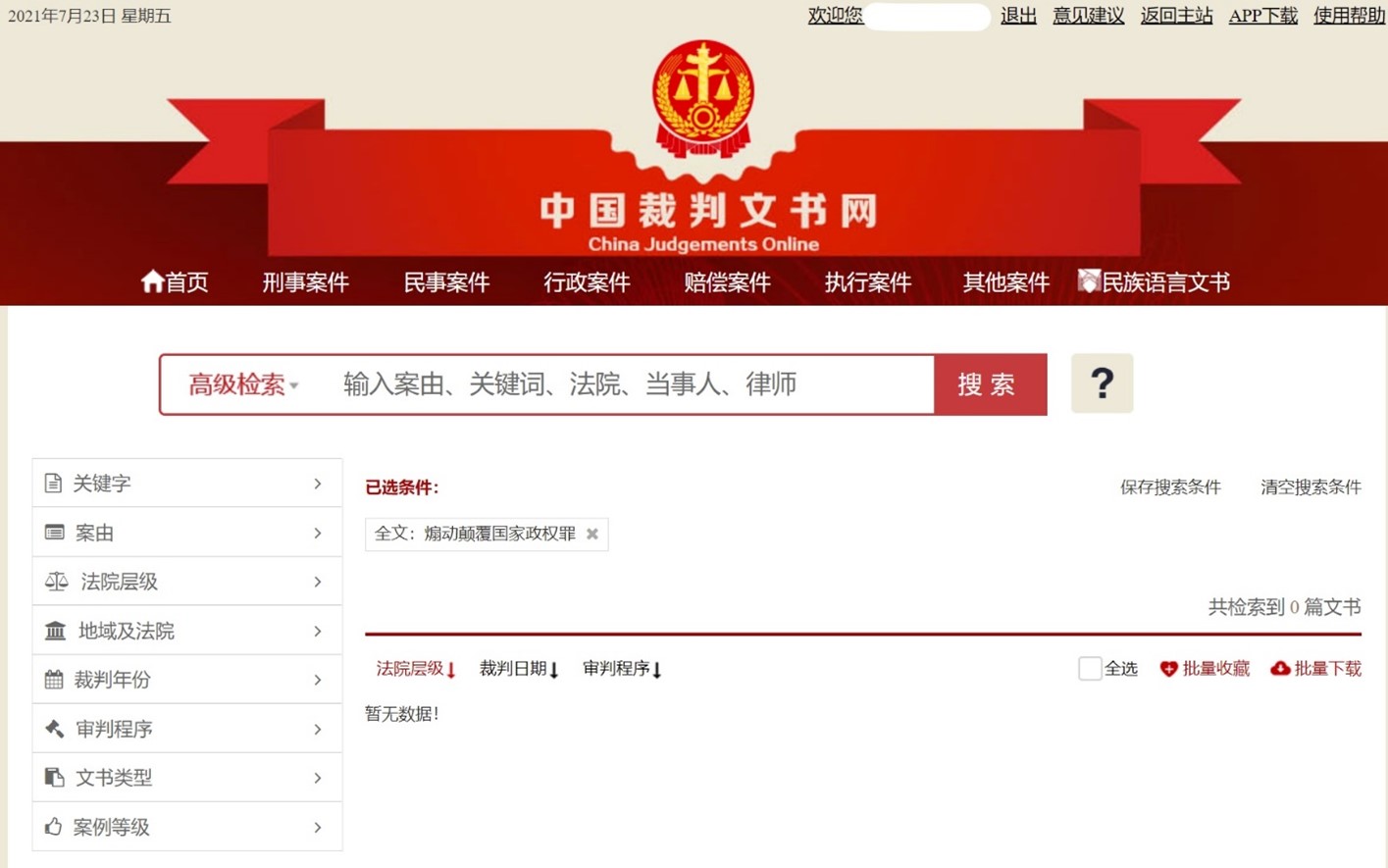
On March 19, the Haikou Intermediate People’s Court sentenced Wu Kongda (吴孔⼤) to three years and six months’ imprisonment for inciting subversion. Wu was detained in November 2023 after disseminating news about the persecution of human rights lawyers Wang Quanzhang and Li Heping. He also voiced support for He Fangming, a female petitioner who is facing trial for picking quarrels and provoking trouble (PQPT) by raising funds for families affected by faulty vaccines.
According to the judgment, Wu was accused of writing multiple “reactionary” slogans in public places between 2012-2013 and posting and forwarding over 18,000 “politically harmful” messages online since 2017.
The YouTube account was removed soon after the video was posted.
Wu is scheduled for release on April 8, 2027.
Peng Yuhua, convicted in 2017 Li Ming-cheh subversion case, released
On November 28, 2017, Taiwan resident Lee Ming-cheh (李明哲) was sentenced to five years’ imprisonment for subversion by the Yueyang Intermediate People’s Court. Peng Yuhua (彭宇华), a codefendant in the same case, was convicted of the same crime and sentenced to seven years’ imprisonment. On March 26, 2024, Peng completed his full sentence at Chishan Prison in Hunan without a sentence reduction.
State news media sources reported that Peng roped in dozens of people, including Lee, to establish the Plum Blossom Company. Peng instructed members to amplify sensitive issues and make defamatory statements about the Chinese government and political system.
Despite completing his subversion sentence, Peng is still serving his two-year deprivation of political rights (DPR) sentence, which expires in March 2026.
China Democracy Party leader sentenced again
China Democracy Party leader Xu Guang (徐光) was convicted of PQPT and sentenced to four years’ imprisonment in Hangzhou on April 3. The charges against Xu stemmed from his protesting police officers who confiscated his mobile phone prior to June Fourth in 2022. Xu was a student leader of the 1989 pro-democracy protests at Hangzhou University in Zhejiang.
He was arrested in July 2022 and tried in April 2023.
The Chinese government declared the China Democracy Party an illegal organization in 1998. Chinese courts have sentenced scores of the party leaders to lengthy jail terms for subversion or inciting subversion. In November 1999, Xu was among those who were sentenced to five years in prison for subversion. He completed his last prison sentence in September 2004.
Migrant worker turned labor activist arrested
Jing Shuren (景树仁), a migrant worker turned labor activist from Gansu, was formerly arrested for PQPT in April by Lanzhou police.
The news of Jing’s detention in March was first announced by sociologist Professor Yu Jianrong on Weibo. Jing started his activism in 2018, raising funds online to provide aid to the elderly during winter, and donating books to women in his hometown. After gaining attention online, he used his grassroots influence to help other migrant workers in disputes over back wages.
The reason for Jing’s legal predicament isn’t clear. Other activists and petitioners speculated that it might be related to Jing sharing other petitioners’ grievance letters in a WeChat group.
Falun Gong practitioner received third clemency in Guangdong
Deng Xiufeng (邓秀芬), a Falun Gong practitioner from Meizhou, Guangdong, received a sentence reduction in April 2024. This is her third sentence reduction, which comes more than three years after her second one in 2020.
Deng and her husband Liang Shujing (梁顺景) were convicted in May 2016 of using a cult to undermine the implementation of the law after police confiscated a large number of Falun Gong books, audio files, and other materials. Deng was sentenced to ten years in prison with two years of DPR while Liang was sentenced to ten years and three months in prison as well as DPR of an unknown length. Both filed appeals, and the judgments were upheld by the Meizhou Intermediate Court in July 2016.
Dui Hua learned that the Guangdong Women’s Prison has deemed that Deng has demonstrated remorse in prison and participated vigorously in reform through labor and political education. Deng was given seven commendations during the latest evaluation period. The prison requested a seven-month reduction for Deng. The Guangzhou Intermediate Court approved the request for reduction; however, in accordance with the regulations that mandate restrictions for sensitive crimes such as cult-related ones, the court granted a five-month reduction.
Deng previously received two sentence reductions. Her first reduction, of five months, was granted in February 2019 and a second reduction, of seven months, was granted in December 2020.
Dui Hua has inquired about Deng’s case since 2017 as part of its increased focus on women in prison.
Following the latest act of clemency, Deng is expected to be released in October 2024.
Falun Gong practitioner in Beijing facing trial again
Yang Xingling (杨兴玲), a Beijing resident and Falun Gong practitioner, is facing trial in Beijing for the second time.
Little is known about Yang. She was first tried in October 2016 and sentenced in December of the same year to one and a half years in prison. She was convicted of using a cult to undermine the implementation of the law and released in January 2018.
Dui Hua learned that Yang has been tried again for the same crime. The first court hearing was held in March 2024 at the Miyun District Court. No conviction or judgment has been reported.
Wang Quanzhang & family live under surveillance & harassment, four years after release
Rights lawyer Wang Quanzhang (王全璋) and his family continue facing daily harassment and life under surveillance four years after Wang’s release from prison.
Wang defended several Falun Gong partitioners and was one of the first lawyers to work on such sensitive cases. During the 2015 “7.09” crackdown on lawyers, Wang was accused of hyping “rights defense” and posting “inflammatory articles.” He was detained for inciting subversion and convicted of subversion in January 2019. The Tianjin Number Two Intermediate Court sentenced him to four and a half years with five years of DPR. Wang was released in April 2020.
In a March interview with a Japanese media outlet, a reporter witnessed several surveillance personnel occupying the hallway and stairs outside Wang’s home in Beijing. Wang claimed he and his wife were constantly followed everywhere. Wang’s young son also expressed symptoms of depression since his school life was also often disrupted by unidentified people.
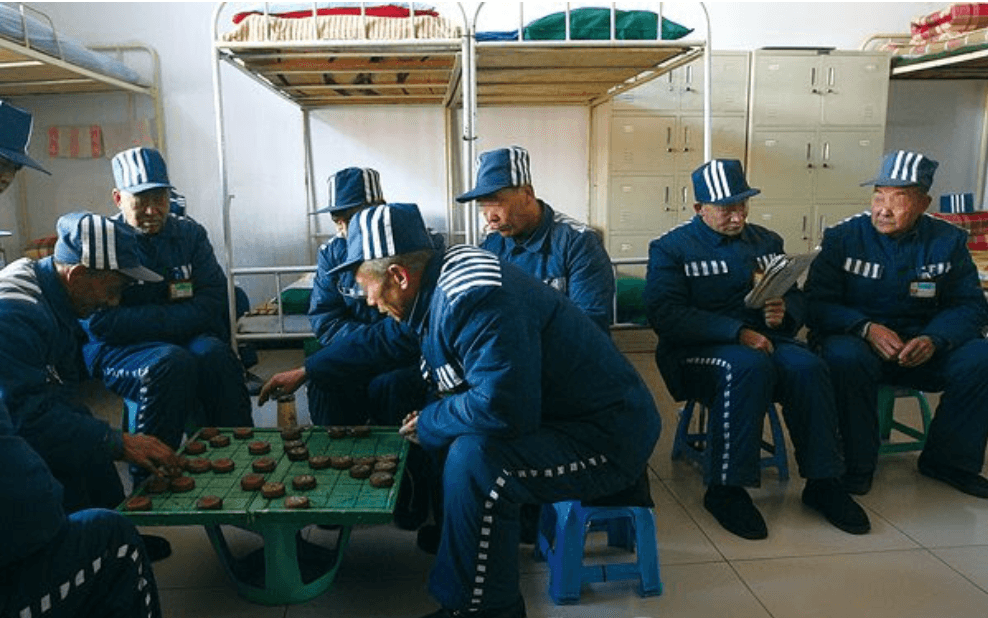
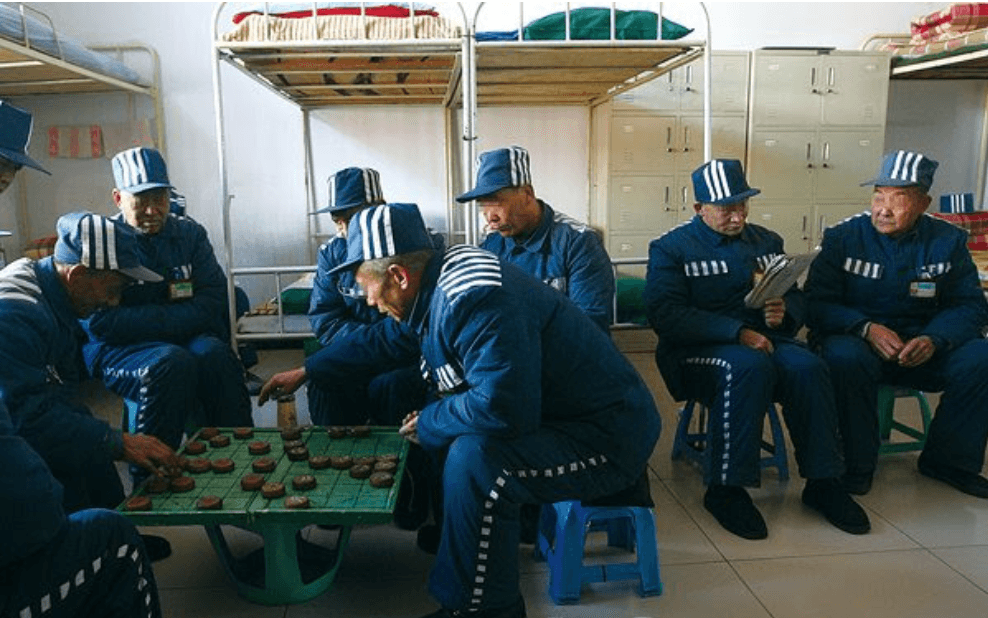
Men play chess inside the “elderly” prisoner cell block of Henan No. 3 Prison. Image credit: Pan Xiaoling / Southern Weekly
Decades of falling birth rates and rising life expectancy have made China one of the fastest aging countries. In 2023, its population aged 60 and above reached 297 million, or 21.1 percent of the population. While the aging population puts pressure on the already strained pension system and economic growth, elderly prisoners represent another pressing issue that requires more attention.
Unlike juvenile justice, there is a dearth of information about elderly prisoners. They don’t seem to be an area of concern prevalent or pervasive enough to warrant careful consideration. Even the Ministry of Justice acknowledged the lack of relevant statistical data and academic research, and that judicial organs and law enforcement have yet to develop sensitivity with regard to the conviction, sentencing, rehabilitation, and management of elderly offenders.
A Rising Estimate
The World Prison Brief indicated that that there were 1.69 million prisoners in China in 2017, the latest year for which statistics are available. According to Chinese sources, the number increased to two million in 2022 although it has not been officially verified. While publicly available sources have not disaggregated the prison population by age, a 2021 article by the China Prison Association estimated that elderly prisoners accounted for about 5.2 percent of the prison population, and of them 65 percent were male and 35 percent were female. If we extrapolate the estimate from the prison population, an estimated 88,000-104,000 elderly people are in jail today.
Chinese legal experts generally agree that the number of elderly prisoners has been surging. First, a substantial portion have aged naturally after serving long prison sentences. Following the 2011 eighth amendment to the Criminal Law, more people who were already serving lengthy terms have had to spend more time in jail. The amendment also increased the mandatory minimum time served for life sentences before their sentences can be commuted to fixed terms. In 2015, China introduced the sentence of life without the possibility of parole for people convicted of corruption and bribery.
Elderly crime has also soared over the years. Statistics provided by the Supreme People Court indicated that the number of defendants aged 60 or above increased fourfold from 5,759 in 1998 to 23,817 in 2016 (See Table 1). However, not all of those tried and convicted ended up in jail. The 2011 Criminal Law amendment allows courts to grant offenders aged 75 or older lighter punishments, such as suspended sentences, because they are seen to pose a smaller risk to society.
Table 1. Elderly Defendants from 1998-2016
Source: Dui Hua, Records of People’s Courts Historical Judicial Statistics: 1949-2016
Types of Elderly Crime
In 2012, China Court Website published its findings on this under-researched topic and summarized the types of elderly crime:
Most crimes were committed solitarily and could be classified into two distinct categories:
(i) crimes reflecting lower-level needs for survival or safety;
(ii) crimes committed for obtaining economic benefits, venting negative emotions, or satisfying physiological needs;
The crimes of bribery, abetting, deception, and harboring tended to be perpetrated by elderly people with good education, social status, and work experience attained from their careers;
Violent crimes such as homicide, aggravated assault, and robbery were rare. Perpetrators typically had poor education and targeted vulnerable groups such as women and children as victims;
Elderly males committed crimes such as molestation, rape, fraud, theft and harboring while women tended to commit crimes of disrupting social order;
An increasing number of elderly people were involved in Article 300 “organizing/using a cult to undermine implementation of the law.”
Although the 2012 article did not provide relevant figures, Dui Hua’s research into court statistics released by the Supreme People’s Court showed a clear upward trend in “cult,” or unorthodox religion, cases involving elderly prisoners from 1998-2016. In 2016, the last year for which statistics are available, 523 defendants aged 60 or above were tried for Article 300, or 2.2 percent of all elderly defendants. In 1998, when Article 300 was in force for the first year, only three elderly people were tried. The number rose to 103 in 2003 when the crackdown on Falun Gong was in full swing.
Table 2. Elderly Defendants Tried for Article 300, 1998-2016
Source: Dui Hua, Records of People’s Courts Historical Judicial Statistics: 1949-2016
Endangering State Security
Elderly offenders are not prominently represented in cases of endangering state security (ESS), China’s most serious political crimes. Statistics released by the Supreme People’s Court indicated that only 63 defendants aged over 60 or above were tried for ESS from 1998-2016. No elderly people were tried in ESS cases in 2013, 2014, and 2016.
Table 3. Elderly defendants in ESS cases, 1998-2016
Source: Dui Hua, Records of People’s Courts Historical Judicial Statistics: 1949-2016
Dui Hua previously reported the case of Chen Zhaolu (陈兆祿), one of the China’s oldest ESS prisoners. Born on December 9, 1917, in Guangzhou, Chen became a Hong Kong resident in 1968 when he started working for Xinhua News Agency – then China’s de facto consulate in Hong Kong. Eighteen years after his retirement, on November 25, 2003, Chen was detained in Guangzhou on suspicion of espionage. On January 19, 2004, the Guangzhou Intermediate People’s Court sentenced Chen to 13 years’ imprisonment. At age 86, he was incarcerated in the elderly prisoner cell block of Guangzhou Prison, Guangdong’s “model prison.” Chen was given a nine-month sentence reduction in 2006 and a 16-month sentence reduction in 2008. He was granted medical parole for a period of three years on September 2, 2009. His sentence expired in October 2014.
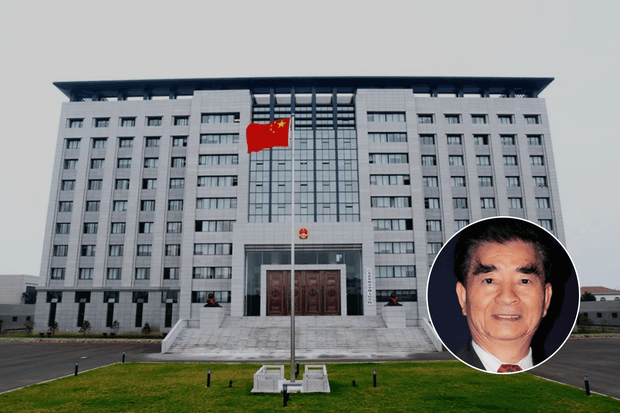
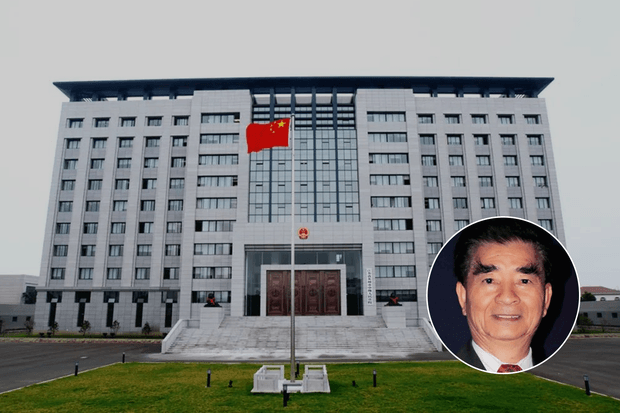
More recently, US citizen and Hong Kong resident Leung Shing-wan (梁成运, aka John Leung) was convicted of espionage and sentenced to life imprisonment in 2023 in Suzhou at the age of 78. Such heavy terms are rare for elderly offenders and for foreign nationals in China. Leung was the chairman of the Association for the Promotion of the Peaceful Reunification of China in Texas. The association is believed to be connected to the Chinese Communist Party’s United Front Work Department tasked with promoting Beijing’s claim over Taiwan. His case was showcased on the 10th National Security Education Day on April 15, 2024.
The Intermediate People’s Court of Suzhou, Jiangsu. (Inset) Leung Shing-wan, who was 78 years old when the court convicted him. Image credit: Cantonese Group Cartography / Radio Free Asia
Leniency & Clemency
While individuals aged 60 or above are generally considered elderly, leniency is now granted at a higher age threshold. The Public Security Administration Punishments Law grants public security the discretion to not impose administrative detention on elderly people over 70 years old, even in cases of serious violations of public security management.
Additionally, the Criminal Law stipulates lighter punishments for individuals over age 75. Following the 2011 amendment, they cannot be subjected to the death penalty unless the offender has committed an act of particular cruelty. As an indication of the impact this has had, the number of Chinese capital cases involving people over 70 is fewer than 10 cases per year in the early 2010s, compared to the estimated 4,000 people executed in China in 2011.
The amendment also expanded the scope of leniency by encouraging the use of lighter punishment and suspended sentences to those who commit an intentional crime at the age of 75 or greater. Some critics have similarly argued that this age is too high to have any real impact.
Provincial authorities have also taken it upon themselves to expound on how elderly offenders are treated with more leniency. In 2014, the Sichuan High People’s Court issued a guiding opinion on the sentencing of elderly prisoners. Offenders of intentional crimes aged 65-74 can have their sentences mitigated by 30 percent. The mitigation length increases to 40 percent for those aged 75 or above. Elderly offenders who commit crimes of negligence can also have their penalty mitigated by 50 percent. The extent of leniency is also determined by the motive, time, method, severity of the crime, truthfulness of their confessions, and willingness to repent.
In 1991, businessman John Kamm, now executive director of Dui Hua, visited a prison in Guangdong Province. He went to the prison to ask about two members of the Shouters, an “unorthodox religious group.” Upon arrival, Kamm was told that both men had been granted medical parole shortly before he arrived at the prison. The warden claimed that the prison authorities had the discretion to grant medical parole to prisoners over the age of 70. Dui Hua was unable to verify this claim.
In January 2011, provincial authorities in Anhui grant parole or sentence reductions to 151 elderly or disabled prisoners. Image credit: Legal Daily
Since Xi Jinping became President in 2012, he has issued two special pardons benefitting specific groups of elderly prisoners (Xi was the first leader to use his power to grant special pardons since Mao Zedong. No special pardons were issued between 1975 and 2015).
Of the 31,527 people pardoned in 2015, fifty were veterans of the War of Resistance Against Japan (World War II) and the War of Liberation (the Chinese Civil War), 1,428 were veterans of foreign wars who were not convicted of serious crimes, and 122 were over 75 years old “with serious physical difficulties” and “unable to take care of themselves.”
In 2019, Xi announced the second special pardon to mark the 70th founding anniversary of the People’s Republic of China. This resulted in 15,858 people receiving clemency. It remains to be seen whether Xi will announce a third pardon in 2025 to celebrate the 80th anniversary of the end of World War II.
Besides the special pardons, releases of elderly prisoners have been rare. An exception was in 2009, when Chinese news media reported that approximately 2,000 elderly, sick, and disabled prisoners were given parole or allowed to temporarily serve sentences outside prison in part to alleviate prison overcrowding. At the time, 5,000 elderly, sick, and disabled prisoners were reportedly held in Sichuan prisons. Another mass release, albeit on a lesser scale, took place in Ningxia also in 2009. Nearly 100 elderly prisoners were granted parole. This clemency took place following a study which revealed that 117 or almost half of the elderly, sick, and handicapped prisoners in Yingchuan Prison and Ningxia Women’s Prison had not received any clemency from 2007-2009.
On December 15, 2008, a 54-year-old female prisoner returns home after receiving parole and being released from Chengdu Women’s Prison. Her sentence was set to expire in March 2010. Image credit: Sina News
In carceral facilities, restraint devices are prohibited on elderly prisoners under normal circumstances. Alongside the weak, ill, and handicapped, elderly prisoners are also exempt from prison labor. While Chinese government sources confirmed that around 10 percent of the prison population in 1990 were exempt from physical labor, recent figures have not been made publicly available. Instead, elderly prisoners are assessed by their willingness to express remorse and their performance in education rehabilitation.
Health Issues
Prisons are designed to prevent criminals from escaping, not to cater to the elderly. They often have poor lighting, steep stairs, and dim corridors unsuited for elderly prisoners. While these prisoners are typically held in special prison wards along with the ill, weak, and disabled, high bunk beds and pit-style urinals are commonplace and can be physically challenging for elderly prisoners.
An article published in an academic journal in 2021 examined the health problems of elderly prisoners. The author cited a survey conducted in an elderly ward in Hebei. Of them, over half suffered from cardiovascular diseases, followed by 7.3 percent from tuberculosis, 6.7 percent from diabetes, 2.8 percent from hepatitis, 2.3 percent from asthma, and 2.2 percent from spondylitis. Citing research published in 2018, the study revealed that 57 percent of the elderly in an unnamed Shanghai prison were on daily or regular medication.
The cost of incarcerating elderly prisoners has surged because of their medical needs. Hospitalization expenses for elderly prisoners in an unnamed prison in a western province rose 77 percent in three years to 15,900 yuan in 2016. Hospitalization alone exceeded 76 percent of the budget allocated for medical care. In a women’s prison also in the western province, the government’s financial allocation for inmates’ medical costs in 2015 could only meet one-sixth of its actual medical expenses. In most provinces, actual medical expenses for inmates similarly exceeded the standard financial allocation by more than 50 percent. Elderly prisoners are said to be the leading cause of the surge in medical costs, according to the author.
Discriminatory Treatment
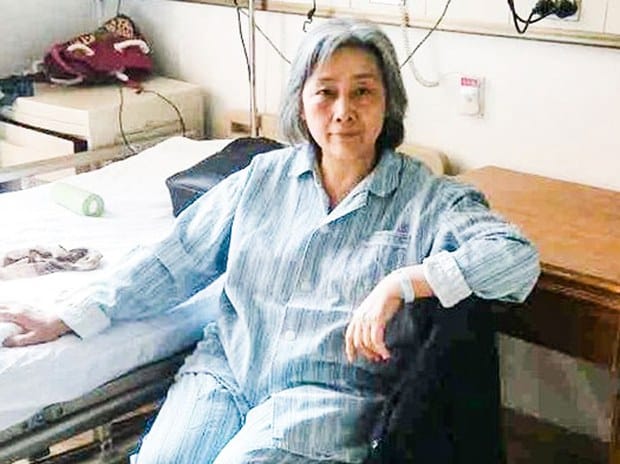
Many elderly political prisoners are known to be ailing, but they have been denied sufficient care in prison. Prominent journalist Gao Yu (高瑜) began serving her five-year prison sentence for illegally trafficking in state secrets for a foreign entity at age 71. The crime stemmed from her leaking “Document No.9,” an internal notice by the Chinese government warning members against promoting “universal values” such as human rights. While incarcerated, she suffered from chronic heart pain, high blood pressure, a form of inner ear disorder called Ménière’s disease, and an undiagnosed chronic skin allergy. She was denied medications she took when living at home and access to specialists to assess and treat her. Gao had to wait two full years before she was admitted to a Beijing hospital to receive treatment.
Journalist Gao Yu in the Beijing’s Anzhen Hospital after her garden and office were demolished, April 5, 2016. Image credit: Su Yutong / Radio Free Asia
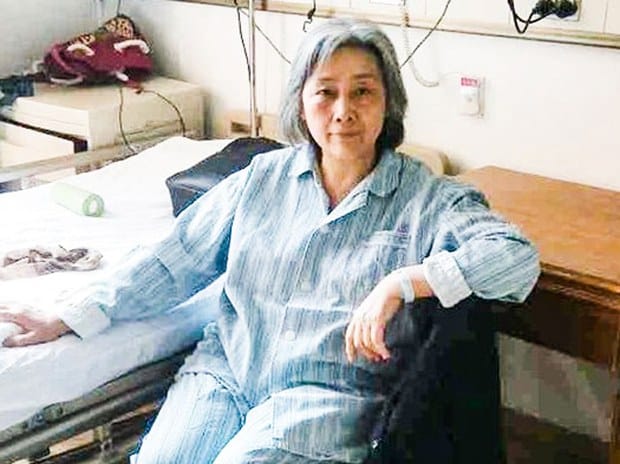
Despite their failing health, clemency is not guaranteed for prisoners convicted of politically motivated crimes. Wang Bingzhang (王炳章), born in 1947, continues to serve his life sentence in Guangdong’s Shaoguan Prison 22 years into his sentence. Wang is a veteran dissident who founded the China Democracy & Justice Party. In 2003, he was sentenced to life imprisonment for espionage and organizing a terrorist organization. Information given to Dui Hua by a Chinese government interlocutor confirmed that Wang suffered from thrombophlebitis, varicose veins, “sudden” bradycardia, tinea, and allergic rhinitis. He had suffered a mild stroke. Wang was in prolonged solitary confinement and subjected to daily “political study” meant to get him to write confessions and admit his crimes. Updates provided by his family in March 2023 revealed that Wang had contracted Covid-19 earlier that year, and that he was in constant dental pain and needed dental implants after eight of his teeth had fallen out. However, such dental care is not available in Shaoguan Prison.
China has a track record in depriving political prisoners of medical care. Nobel Peace Prize Laureate Liu Xiaobo died from liver cancer in 2017 at age 61. Medical parole was granted only when his cancer had advanced. Wang Bingzhang, aged 77 this year, has yet to have his life sentence commuted despite repeated applications for medical parole and clemency over the past two decades. Such discriminatory treatment strengthens the fear that the Chinese government will simply let ailing elderly political prisoners die behind bars.
Wang Bingzhang, aged 77 this year, has yet to have his life sentence commuted despite repeated applications for medical parole. Image credit: Raoul Wallenberg Centre
Prisons are responsible for the well-being of all prisoners regardless of their crimes. They should ensure that everyone has immediate access to the specialist care they need. If such care is unavailable in prison, prisoners should be transferred to a hospital before their conditions worsen. Rule 27 of the UN Standard Minimum Rules for the Treatment of Prisoners states that “All prisons shall ensure prompt access to medical attention in urgent cases. Prisoners who require specialized treatment or surgery shall be transferred to specialized institutions or civil hospitals. Where a prison service has its own hospital facilities, they shall be adequately staffed and equipped to provide prisoners transferred to them with appropriate treatment and care.”
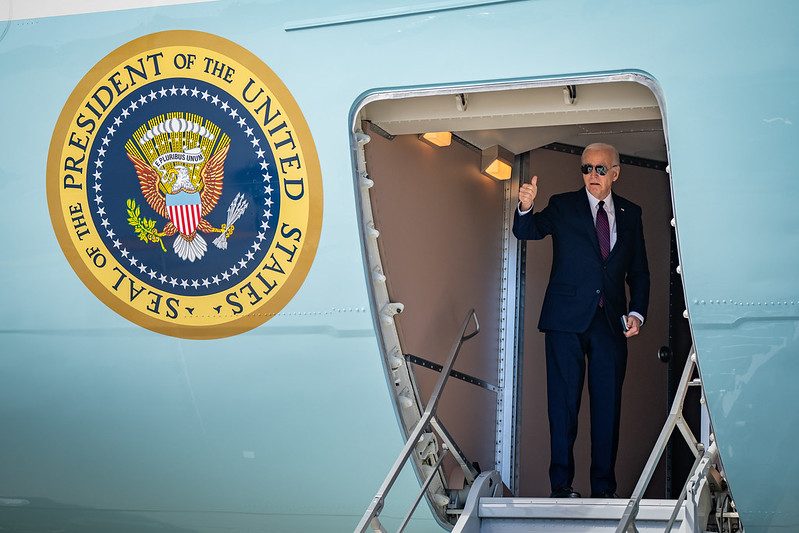
President Joe Biden boards Air Force One at Los Angeles International Airport, Wednesday, February 21, 2024, en route to San Francisco. Image credit: Adam Schultz / Official White House Photo
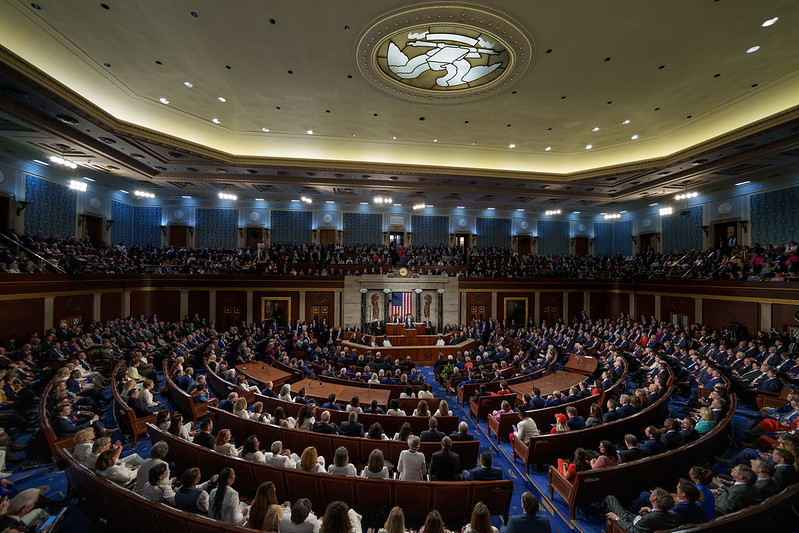
Foreign policy is typically not a top issue in national elections in the United States. According to Redfield & Wilton Strategies, between two and four percent of Americans polled in 2020 ranked foreign policy as a key policy area most likely to determine how they would vote. This election year is shaping up to be different. Polls of voters in primary elections and caucuses suggest that foreign policy has become a major concern for the American public. Similarly, US voters support tougher measures on China.
While voters consistently cite immigration and the economy as the most important issues, exit polls from GOP primaries show stronger than usual concern for foreign policy. In South Carolina, 13 percent of Republican voters cited it as their top issue as did 15 percent in New Hampshire in 12 percent in Iowa. In a YouGov poll taken March 3-5, 2024, 88 percent said foreign policy was an important issue for them.
While wide swathes of Americans view foreign policy as important, they are divided on how it should be conducted. In a Wall Street Journal poll from late February 2024 that asked about US support for Ukraine, 36 percent said it was too much, 30 percent answered not enough, and 25 percent said it was “about the right amount.” Views on support for Israel followed the same trend: 30 percent answered too much, 25 percent too little, 32 percent said it was about right.
Voters’ View of China
On China, years of declining favorability among the US public appear to have metastasized into support for tougher measures and more restrictions on engagement. A February 2024 Marist poll found broad support for legislation that restricts China’s access to US markets and removes Chinese telecommunications equipment from critical infrastructure. It also found that the US public is concerned about US assets and investment supporting countries considered to be adversaries, with China named specifically. Across all areas, Republicans expressed the most concern and support for counter measures, but support among Democrats and independents was also well above 50 percent.
Gallup’s poll conducted February 1-20, 2024, further illustrates how much US concerns over China have changed. Americans still view China as the United States’ greatest enemy, especially among Republicans and independents, but this figure decreased from 50 percent in 2023 to 41 percent. Favorable opinions of China increased by five percentage points since last year, reaching 20 percent. Unfavorable views of China, while still high, dropped from 84 percent in 2023 to 77 percent.
Despite these shifts, a majority of Americans – 63 percent – see China’s military power as a critical threat, and 50 percent see a conflict between China and Taiwan as a critical threat. Since 2004, Americans’ view of the threat posed by China’s military power has increased by 24 percentage points while concerns over a conflict with Taiwan have increased by 27 percentage points. While 51 percent of respondents view China’s economic power as a critical threat, this view declined 13 percentage points from last year. In an Economist/YouGov poll conducted March 24-26, 2024, 73 percent described China as an immediate or somewhat serious threat to the United States.
How Much Trouble for Biden?
Like Republican primary voters, Democrats signaled interest in foreign policy albeit in a different way. Sizable numbers of primary voters in Michigan, Minnesota, and Hawaii declined to vote for Biden, instead writing in “uncommitted” to protest the White House’s support for Israel’s response to the October 7, 2023, terrorist attacks.
President Biden during a video conference with G7 leaders and Ukraine President Zelenskyy on February 24, 2024. Image credit: Oliver Contreras / Official White House Photo
More than 100,000 Michigan voters opted for “uncommitted” as did more than 45,000 in Minnesota. “Uncommitted” votes made up 29 percent of the final tally in Hawaii’s primary and 7.5 percent in the Washington primary. There was more bad news for Team Biden in the April 2, 2024 primaries. Connecticut voters delivered a 10.5 percent uncommitted verdict, Rhode Island voters delivered an uncommitted tally of 16.5 percent and Wisconsin, which has the highest Muslim population in the United States, cast 8.3 percent for “uninstructed” and 3.1 percent for Dean Phillips, a long-shot candidate with no chance to win, making a total “protest vote” of 11.4 percent.
In Ohio, where neither “uninstructed” nor “uncommitted” were not on the ballot, 13 percent of Democratic voters chose Phillips in the March 19, 2024, primary.
The president’s approval rating on foreign policy hovers between 30 and 40 percent. A February 2024 YouGov survey found 39 percent approval vs. 52 percent disapproval. A February 2024 Harvard/Harris poll found approval at 41 percent while a Monmouth poll in the same month tracked it at 33 percent.
Polls from the past two months show that this trend extends to his approval on specific foreign policy issues, namely Ukraine, Gaza, and China. In February 2024, a Fox News poll showed 31 percent approval for Biden’s handling of the Israel/Hamas conflict while a Harvard/Harris poll cited 38 percent approval. Similarly, a March 2024 ABC News/Ipsos poll found that 30 percent approved of Biden’s handling of the Israel/Hamas conflict while 41 percent approved of his handling of the Ukraine war.
Biden on China
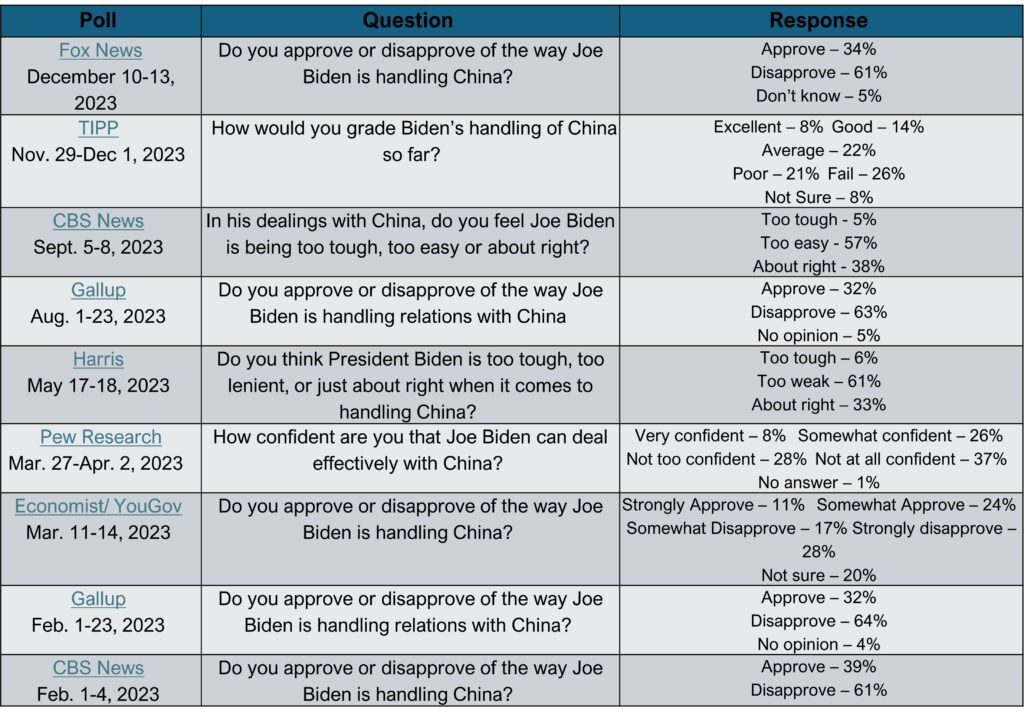
Polls suggest that President Biden’s handling of China could negatively impact his chances for reelection. A TIPP poll conducted from January 31 to February 2, 2024, asked respondents how they would grade Biden’s handling of China: nine percent answered “excellent”, 16 percent “good”, 22 percent “average”, 17 percent “poor”, and 27 percent gave him a failing grade. In the late February Harvard/Harris poll, 19 percent said that Biden’s biggest failure was not doing enough to counter Iran, Russia, and China while the late February 2024 Fox News poll found that 35 percent approved of his handling of China and 61 percent disapproved.
In a poll conducted by Hart Research for CNBC in March 2024, a sample of 1,001 registered voters were asked who did a better job handling China, Trump or Biden. Of those who answered, 33 percent replied Trump versus 17 percent who chose Biden. In six key swing states polled by Redfield & Wilton Strategies in late November 2023, Americans who were polled favor Trump over Biden when it comes to being tough on China – by large margins.
Biden’s own approval ratings and US public opinion of China have been low for most of the administration’s term. The table below shows polling on Biden’s handling of China in 2023.
Biden Takes Aim
The Biden administration seems aware of these issues as it ramps up its reelection campaign. His State of the Union address on March 7, 2024 took aim at both China and Trump. On the former, Biden said that “our trade deficit with China is down to the lowest point in over a decade” while “we’re standing up against China’s unfair economic practices.” In the speech, he also cited technology transfer controls and revitalized partnerships in the Pacific while repeating what has become a common refrain: “We want competition with China, but not conflict.” Citing the technology controls his administration has put in place, he said “…for all his tough talk on China, it never occurred to my predecessor to do that.”
President Biden delivers his State of the Union address on March 7, 2024. Image credit: Oliver Contreras / Official White House Photo
Since the end of February 2024, the administration has taken multiple actions targeting China. As US lawmakers press forward on a ban of TikTok unless it is sold from ByteDance, Biden has said that he would sign a ban should Congress pass it. A Congressional probe into Chinese-built cargo cranes in US ports has raised concerns about security and if components in the cranes could be remotely accessed. The Biden administration has also begun an investigation in Chinese-made electric vehicles which may also contain components that could be used for espionage or otherwise undermine national security.
A Congress Consumed
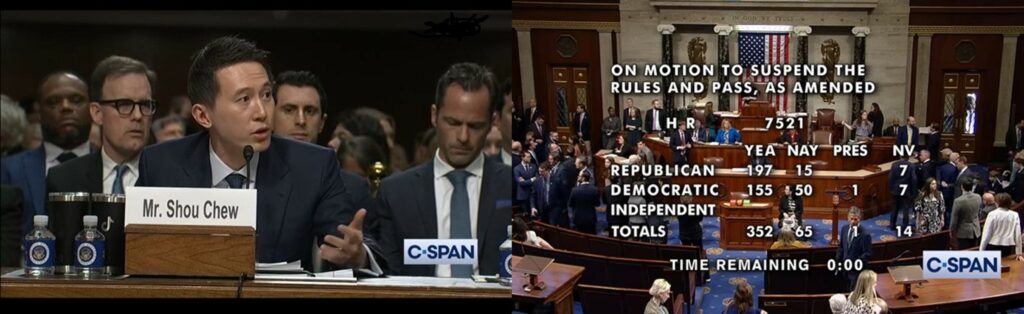
(Left) TikTok CEO Shou Zi Chew during a Senate hearing on Online Child Sexual Exploitation on January 31, 2024. (Right) The House of Representatives passes HR 7521 forcing TikTok to divest from ByteDance or be banned in the United States. Image credits: C-Span
In the past year, numerous Congressional bills have focused on China. According to Responsible Statecraft, Congressional members introduced 616 pieces of legislation that referenced China in 2023, an average of 3.5 bills for each day Congress was in session during a year in which only 22 bills were signed into law. Many on Capitol Hill see being tough on China as a rare stance that enjoys bipartisan support. In March 2024, the House of Representatives’ Foreign Affairs Committee approved a bill that imposes new conditions on future extensions of the Science and Technology Agreement (STA) between the United States and China, casting into doubt whether the agreement will be extended when it expires on August 27, 2024. (The current six-month extension was first reported by Politico’s Phelim Kine). The STA was the first bilateral agreement between the United States and China and was signed in 1979 by President Jimmy Carter and Vice Premier Deng Xiaoping.
The agreement is now set to expire nine weeks before the presidential election.
Aside from California, China policy has not played a role in local legislative battles. In the Golden State, Democrat Adam Schiff is favored to win the November election for Senate against Republican candidate Steve Garvey. Schiff is under scrutiny for allegedly being in denial over China’s role in the fentanyl crisis. Voters remain unhappy with San Francisco Mayor Londen Breed’s role in handling the APEC meeting in November 2023. City police are said to have refused to investigate attacks on anti-China protests by pro-China groups. Breed’s election chances are not good.
From the Human Rights Journal, a blog offering original analysis and translations related to human rights and rule of law developments in China.
Image credit: Dui Hua
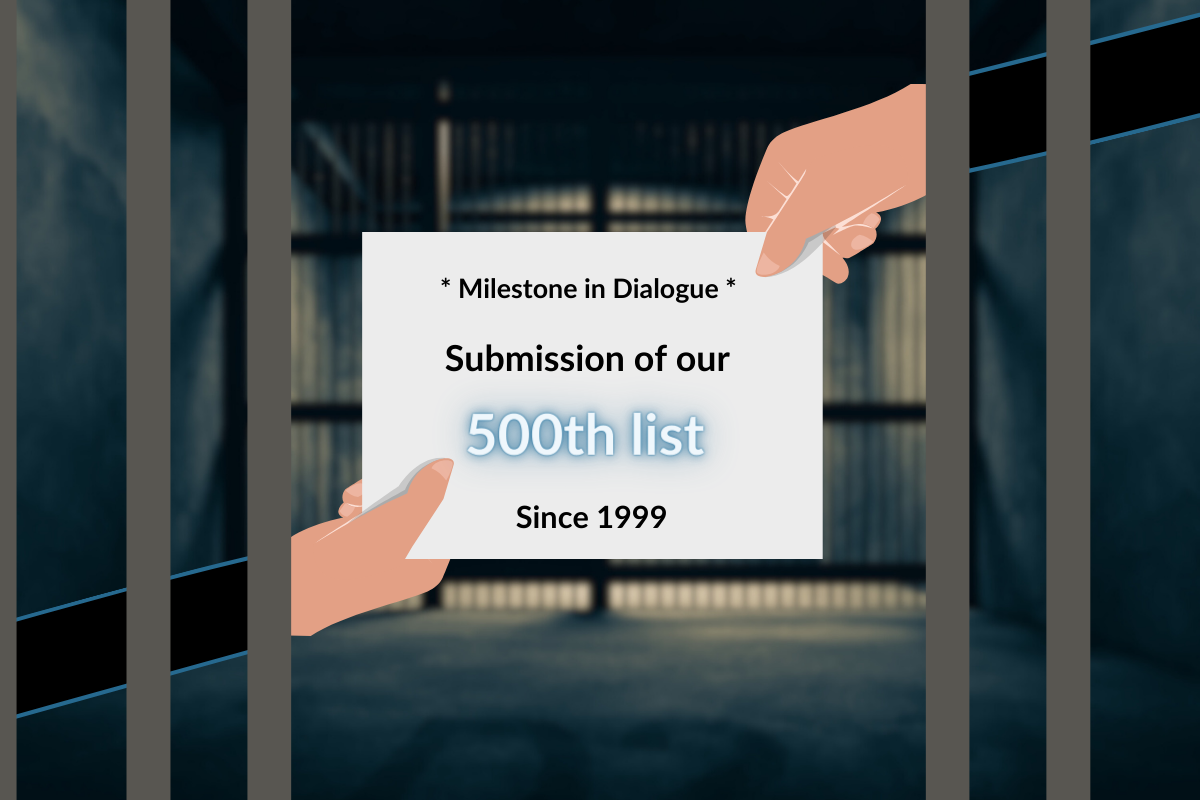
This year Dui Hua hit an important milestone: 500 prisoner lists submitted to the Chinese government. We look back at key metrics, the growth of the Political Prisoner Database, and important achievements in our advocacy.
Dragon Years: Remembrance of Times Past is a new podcast series that explores key periods of the US-China relationship and John Kamm’s advocacy. Each episode in this five-part series focuses on a different Year of the Dragon, beginning in 1976 and concluding with 2024. As Dui Hua celebrates its 25th anniversary, this podcast captures moments that define Kamm’s work and illuminate the history of the increasingly troubled US-China relationship.
In the inaugural episode, Dui Hua’s John Kamm recounts his early days in China as a trade representative in 1976, the Year of the Fire Dragon, and during the waning days of the Cultural Revolution. He runs afoul of the Gang of Four, publishes the first Western advert in a Chinese publication, and sees a side of China that causes him to change his perspective.
From John Kamm Remembers, a series written by Dui Hua’s founder recounting his advocacy for prisoners in China.
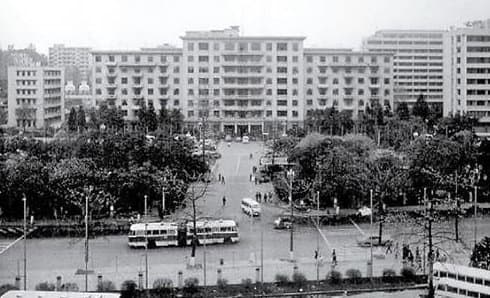
A bridge spanning the Pearl River in Guangzhou, circa 1976. Image credit: Dui Hua archives
John Kamm began attending trade fairs in mainland China in 1976, an eventful Dragon Year during which China experienced the Tangshan earthquake, death of Mao, and the downfall of the Gang of Four. The young Kamm found himself in the midst of historical events during a period of political upheaval. As his work takes him throughout Guangzhou and the Guangdong province, he sees aspects of Chinese life unknown to those in the West.
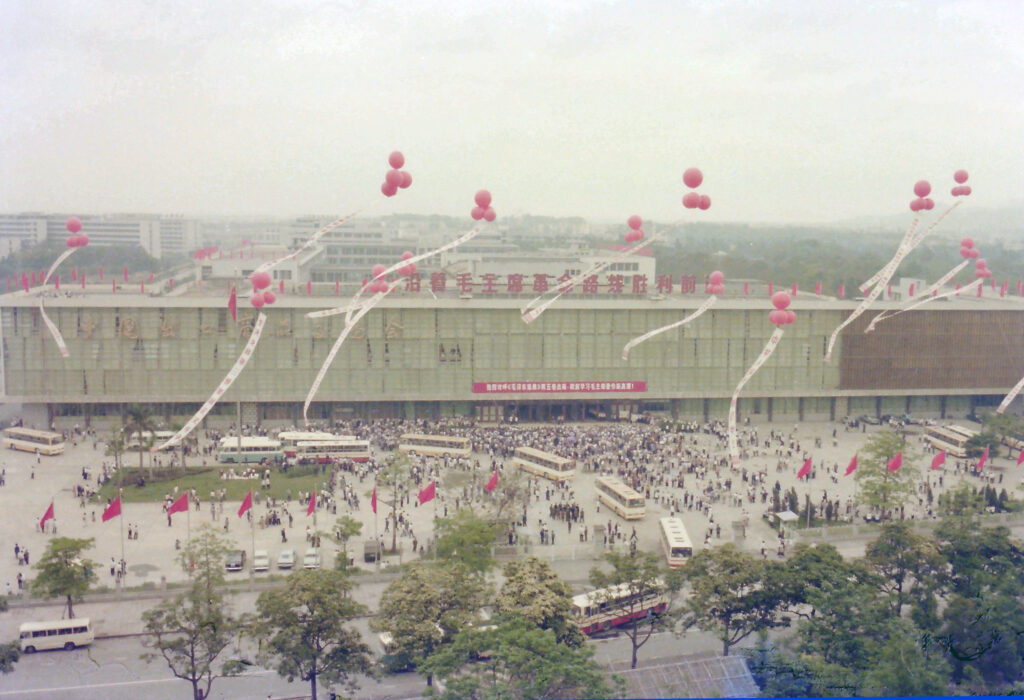
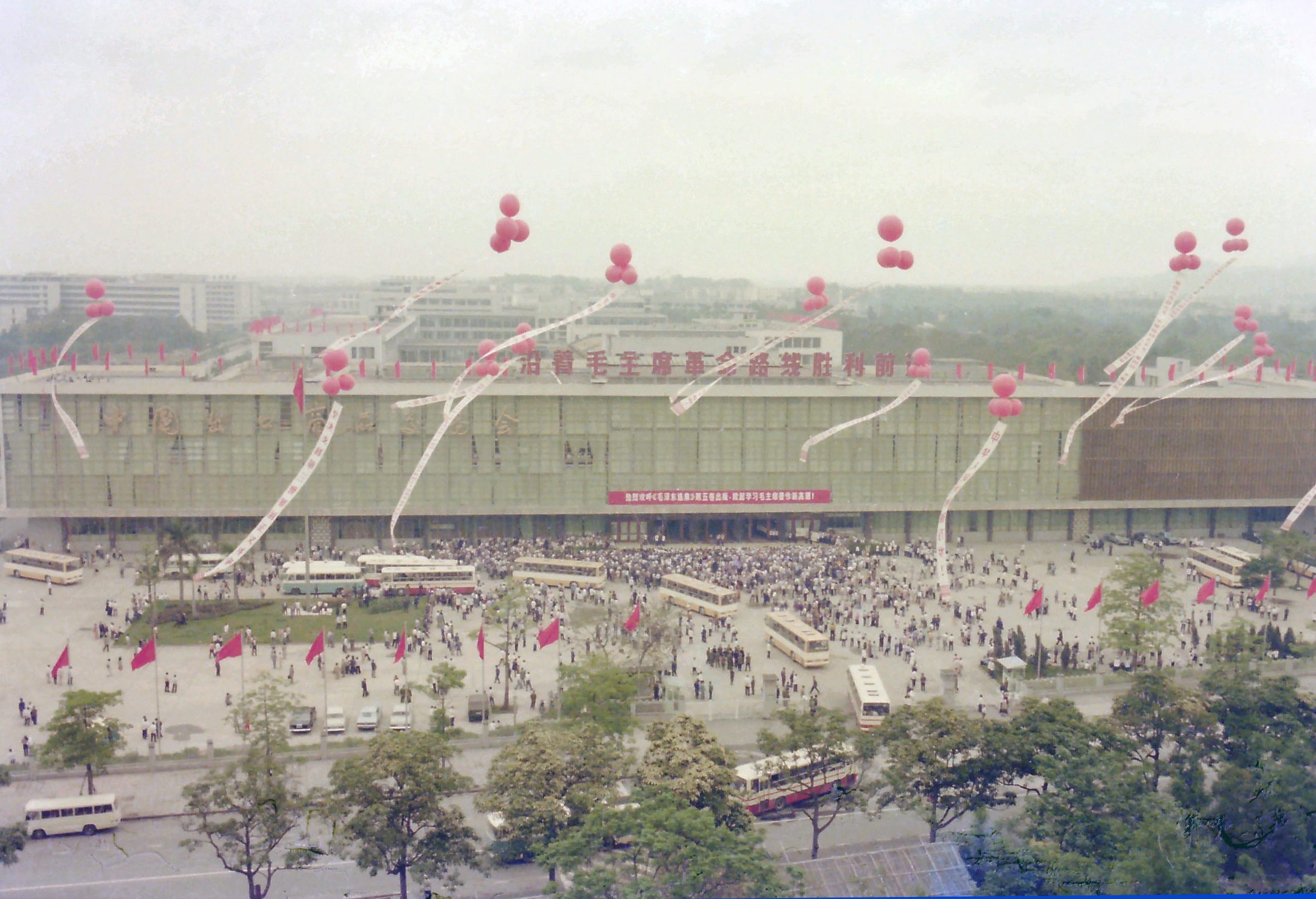
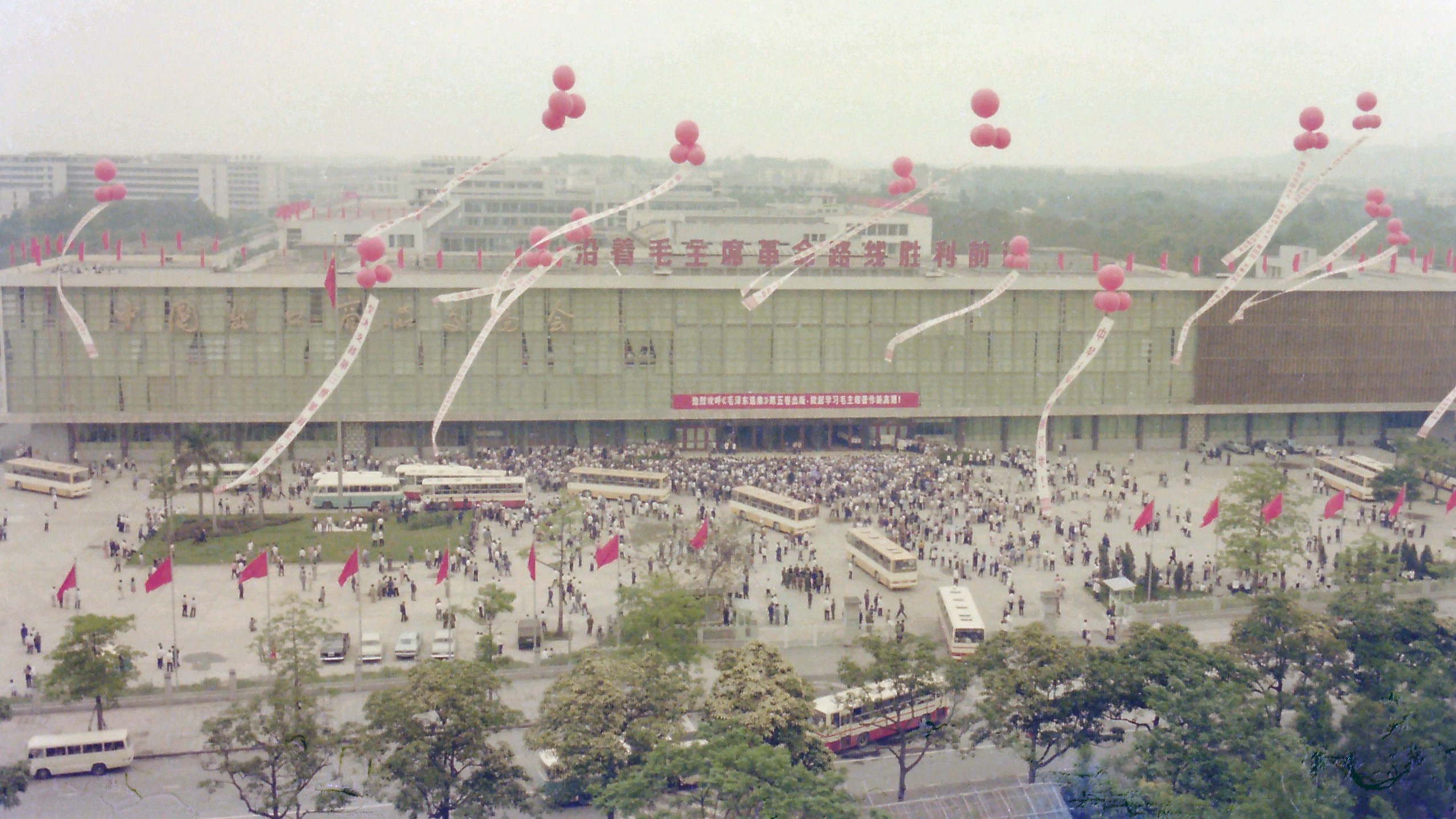
A photo of the Canton Trade Fair, taken in April 1977. Image credit: Dui Hua archives
John Kamm learned salesmanship from his father. This invaluable skill opened China up to John and led to the publication of The Canton Companion, a magazine for foreign businesses that broke new ground during the Cultural Revolution era.
Dui Hua’s Prisoner Updates provide the latest information staff researchers have uncovered through online and library research and through direct dialogue with the Chinese government.
Independent filmmaker arrested in Shanghai; Yang Hengjun will not appeal, ex-girlfriend indicted on same charge; Hubei activist detained before provincial “Two Meetings”; Two elderly FLG practitioners granted clemency in Henan; Lawyer still missing in China, daughter passed away in Japan
Australian author sentenced in Beijing; Feminist labor activist sentenced in Shandong; Crackdown on 2019 “Xiamen Gathering” continues; Case of lawyer Yu and wife transferred to Suzhou; Tibetan monk released in Sichuan after completed sentence; Hong Kong Christian detained in Hubei for illegal business operations
To mark the Year of the Dragon and Dui Hua’s 25th anniversary, we are excited to bring you a limited podcast series, Dragon Years: Remembrance of Times Past. This five-parter explores key developments in John Kamm’s life and Dui Hua’s history, spanning the Dragon Years between 1976 and 2024. And through conversations, we gain insights from friends and colleagues who have been integral to Dui Hua’s mission.
In this inaugural podcast, Kamm discusses the decisions that led to his first trip to China as a trade representative in 1976 and subsequent experiences on the Chinese Mainland during the waning days of the Cultural Revolution. He recalls the death of Premier Zhou Enlai, being caught in the Tangshan Earthquake, acupuncture anesthesia, and interactions with a senior liaison officer in Guangzhou.
In 1976, China was gripped by ideological fervor. John Kamm, Hong Kong representative of the National Council for US-China Trade, began attending mini-fairs in mainland China in January that same year. A journalist, researcher, and trade promoter, Kamm was in a unique position to witness China in flux, rife with contradictions and tensions — between past and present, East and West, tradition and modernity. As a two-part look back on those years in Guangzhou, this instalment of John Kamm Remembers focuses on those trade fairs, his China trade publications and efforts as a trade promoter.
A photo of the Canton Trade Fair, taken in April 1977. Image credit: Dui Hua archives
S
alesmanship is the art of convincing people to buy something they don’t think they need, whether it’s chemicals or human rights.
I learned how to sell from my father, who sold whiskey and beer for the Trenton Beverage Company in the 1950s and 1960s. He was, in his words, a purveyor of alcoholic beverages.
I would watch him ply his trade as he covered his sales route in central New Jersey. Salesmanship enabled me to embark on my journey of becoming first a journalist, then a businessman, and finally a human rights advocate.
I started writing about business in China in 1975 as an assistant editor of Asian Business and Industry, a monthly magazine published by Far East Trade Press in Hong Kong. In 1976, after being appointed the Hong Kong representative of the National Council for US-China Trade (“National Council”) I began promoting trade with China by attending “mini-trade fairs” in Shanghai (Feather and Down) and Beijing (Fur) in January, and Tianjin (Carpets) in February.
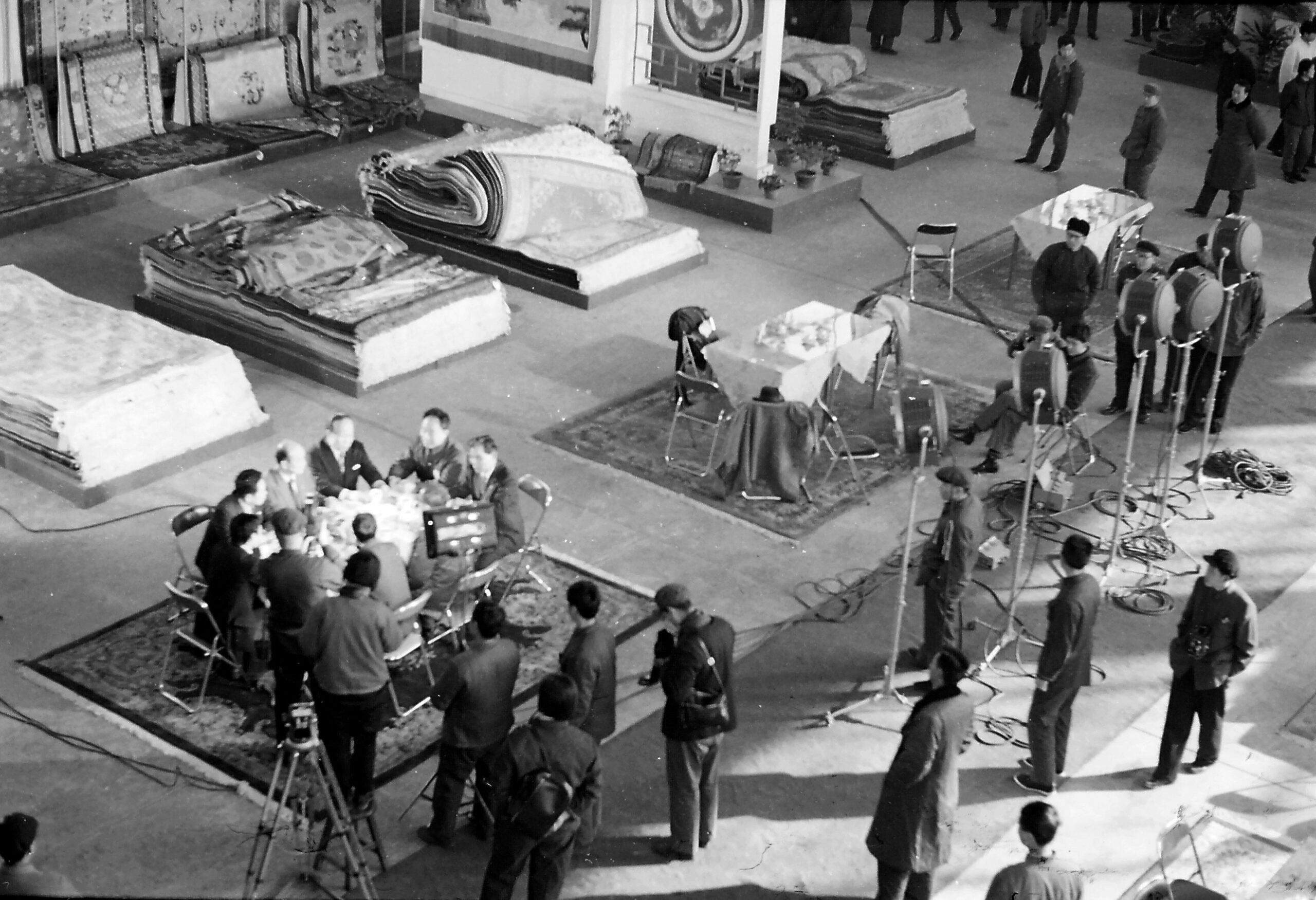
A photograph taken at the Tianjin carpet fair in 1976. Image credit: Dui Hua archives
Back then, trade fairs served as a rare window of opportunity for foreigners to enter China, and my work there led to many poignant and memorable moments, such as attending China’s Premier Zhou Enlai’s funeral in Beijing in January 1976 and getting caught in the devastating Tangshan Earthquake in July, while travelling to the Chemicals Trade Fair in Tianjin. In 1976 and 1977, I attended the Spring and Autumn Export Commodities Fairs in Guangzhou, also known as the Canton Trade Fair. Seizing the opportunity, my wife and I led a small team of writers to put together the Guide to Chinese Export Commodities Fair, a publication that would serve as a guide to the trade fair for foreigners. With the help of the Far East Trade Press, it was published in time for the 1976 autumn trade fair.
(Left to right) From Guide to Chinese Export Commodities Fair, issued 1976: the cover of the publication; a map of the Canton Trade Fair; dining recommendations for fair attendees. Image credit: Dui Hua archives
This was followed by Guide to Canton for the spring 1977 fair and, subsequently by Canton Companion for the next six biannual fairs. I also started working on in depth business and trade reports including the China Trade Quarterly and the China Economic Times.
A spread from China Trade Quarterly, researched and written by Kamm’s business research organization Primary Sources. Image credit: Dui Hua archives
We had to haul hundreds of copies of these magazines and equipment across the border from Hong Kong, passing through the border town Shenzhen where the crates, more than 40, were opened and inspected by Chinese Customs. Upon arrival in Guangzhou, we settled into the National Council’s office on the seventh floor of the Dongfang Hotel, which would serve as our residence for five-week stays. We then unpacked the boxes and set up the office in time for the opening of the fairs, which ran from April 15 – May 15 and October 15 – November 15, respectively.
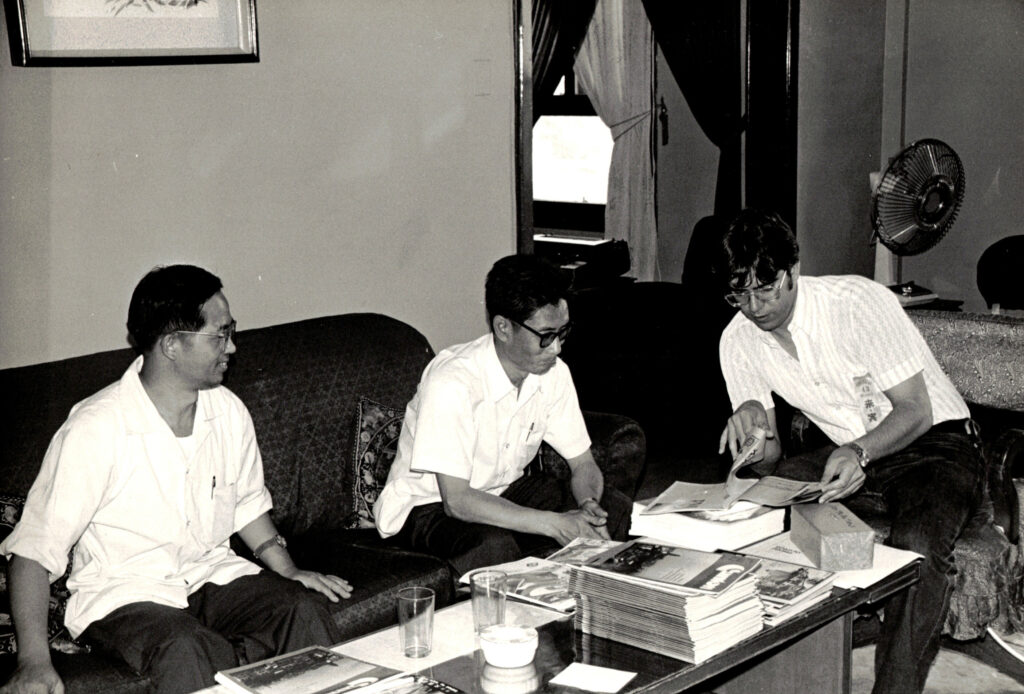
Kamm showing the Chinese trade fair officials his Canton Companion magazines in an office in the Dongfang Hotel. Image credit: Dui Hua archives
On the eighth floor of the hotel was the storied “Top of the Fang,” a brightly lit place with tables covered by white cloths. It served soft drinks and cold beer, notably Tsingtao beer, and offered peanuts. Tipping was not allowed (and was considered insulting to the staff who viewed their work there as service to the people). A jar full of Chinese coins and bank notes was placed at the entrance for errant tippers to reclaim their money.
The Council’s office was equipped with an IBM electric typewriter, a Xerox 660 copier, and a telex tape-punching machine. The office was well-stocked with soft drinks, beer, and spirits. To send a telex, we would go to the ground floor, punch a tape, and wait in line until a telex machine became available. Occasionally, we visited offices of foreign trade corporations in downtown Guangzhou. Most were dark, cold, and damp.
Canton Companion
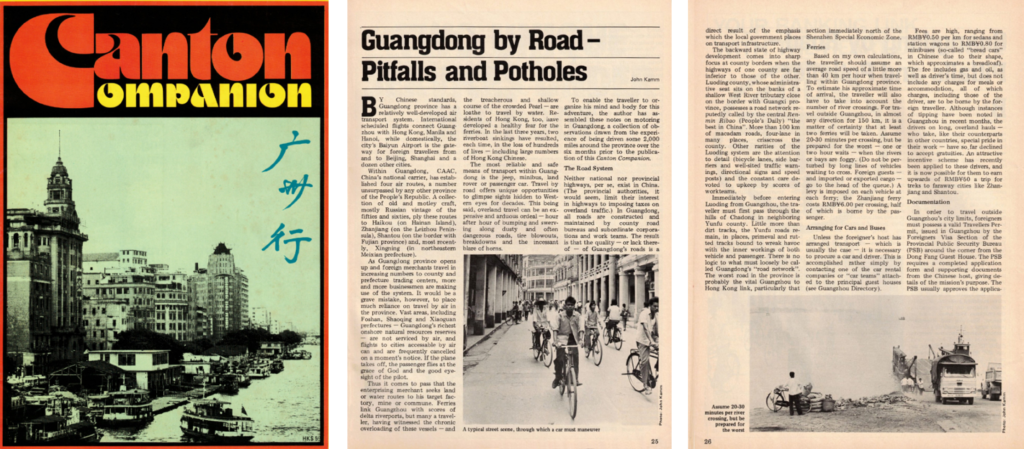
A cover and a feature story from a 1977 issue of Canton Companion. Image credit: Dui Hua archives
Publications released by Far East Trade Press for the trade fairs turned out to be hits: not only were they the only English-language publications covering the trade fair, they were also one of the few English-language publications distributed, on a limited basis, in China. Back then, we were in the waning days of the Great Proletarian Cultural Revolution*, a period of turmoil that damaged many facets of life in China including the economy and the conduct of foreign trade. To the lucky few businesspeople able to make it into China for the trade fairs, the twice-yearly magazine was a lifesaver, not only for its advice on accessing essentials like making phone calls, finding food, etc., but also for offering insights into the oddities of Cultural Revolution-era culture.
Besides services on offer in Guangzhou, Canton Companion featured articles on topics like Cantonese opera and dissent in Guangzhou where the “counterrevolutionary Li Yizhe group” was based. The group consisted of a few dozen local dissidents led by Li Zhengtian.” It was “struggled” in sessions at a theater near the train station, served long sentences in prison, and were nearly executed for their 1974 big character poster calling for democracy and rule of law. Mao Zedong is said to have intervened. He famously said “We should not fear criticism. The sky won’t fall.”
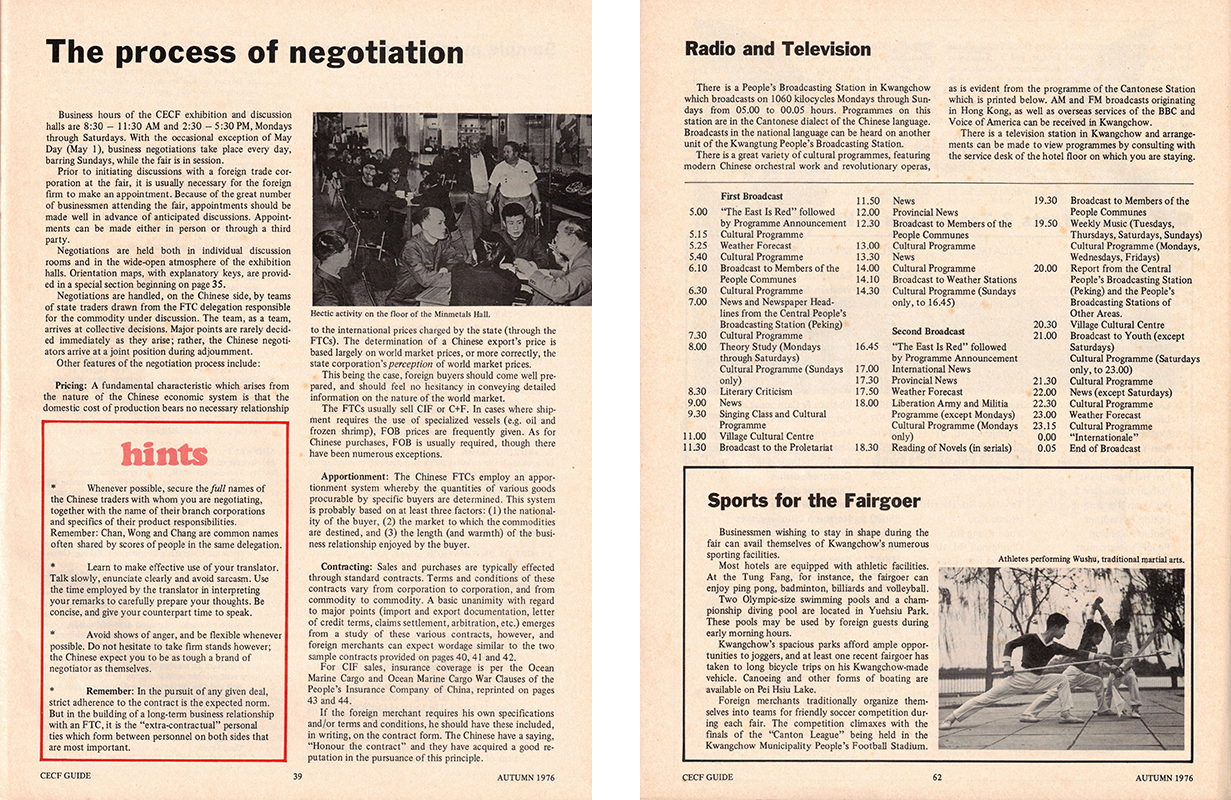
Guide to business negotiation (left) and information on radio, television, and sports for fairgoers (right) featured in Guide to Chinese Export Commodities Fair, issued 1976. Image credit: Dui Hua archives
Sourcing basic information for Canton Companion was a daunting task: many publications were deemed to include state secrets. Local newspapers could not be read by foreigners; photographing locals reading them was forbidden. (I once heard of an Australian couple detained in Shanghai in 1976 for photographing locals reading a newspaper on a small glass-enclosed billboard).
The contents of the Guangzhou phone book – the phone numbers – were also considered state secrets. Every floor of the hotel had a copy of the phone book at the reception desk in a locked drawer that was often kept open. I stole furtive glances and memorized the numbers of foreign trade corporations. There were no private phones in Guangzhou in those days and the numbers for state enterprises, including for branches of foreign trade corporations, consisted of five digits.
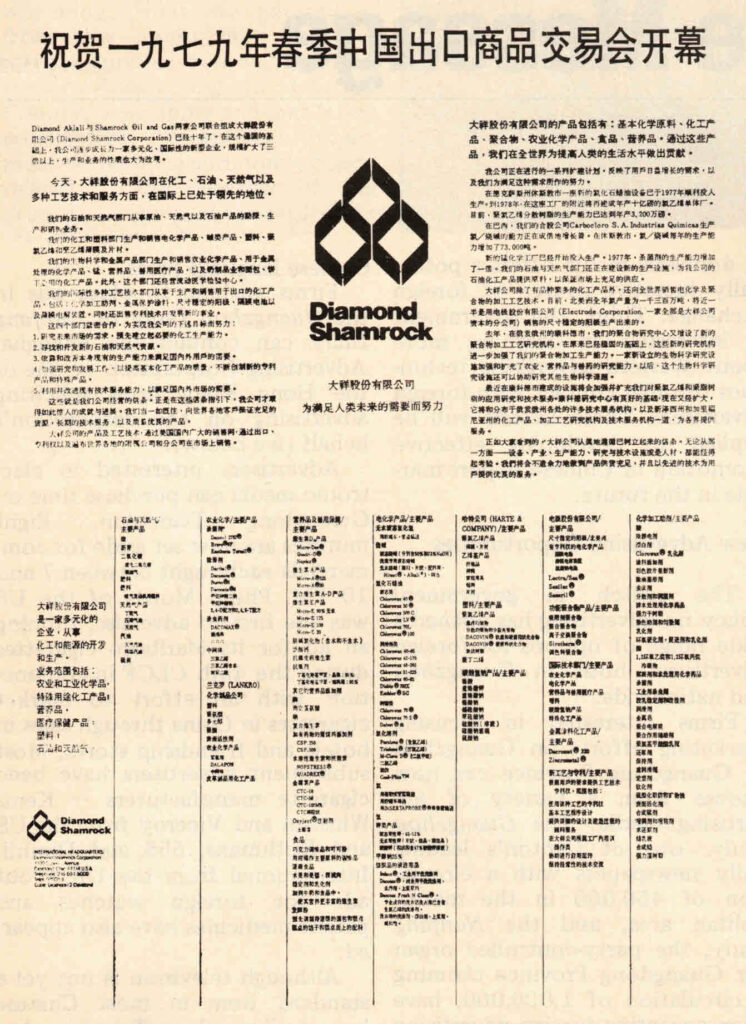
While Canton Companion was distributed free of charge, it was supported by advertisements of companies doing business at the trade fair. This was yet another practice unheard of during the height of the Cultural Revolution. As an agent for chemical company Diamond Shamrock, my company Primary Sources placed an advertisement in a local newspaper – the Guangzhou Daily – on April 14, 1979. This was one of my team’s greatest achievements
The advertisement for Diamond Shamrock products published in the April 14, 1979 issue of Guangzhou Daily. Source: Guangzhou Daily
Liaison offices, staffed by foreign affairs and public security officers, were established in each hotel housing foreigners during the trade fair (the Dongfang Hotel for most Western foreigners; the Baiyun Hotel for the Japanese and the Guangzhou Hotel on Haizhu Square for Hong Kong businesspeople). One job of the liaison offices, besides registering the attendees, was to organize visits to places of interest inside and outside Guangzhou. I availed myself of chances to go on these excursions, visiting people’s communes, tea farms, factories, hospitals, and other locales. By the time I stopped attending the trade fairs in the 1980s, I had visited most of the counties in Guangdong Province.
Kamm getting a lift on a ferry during one of his road trips in Guangdong Province in 1979. Image credit: Dui Hua archives
I experienced both humorous and terrifying events on these travels. On one trip to a commune in Zhanjiang, I came across an elderly man early one morning. My colleagues and I needed to call the commune management to let them know we’d arrived and to get directions. The fellow would dial a number and immediately hang up the phone. On another trip to the hinterlands, we found out why driving at night on Guangdong roads was so hazardous. Many drivers, who got their licenses by merely passing a vision test, would turn their headlights on high beams and then suddenly turn them off. Back and forth, from blinding lights to total darkness.
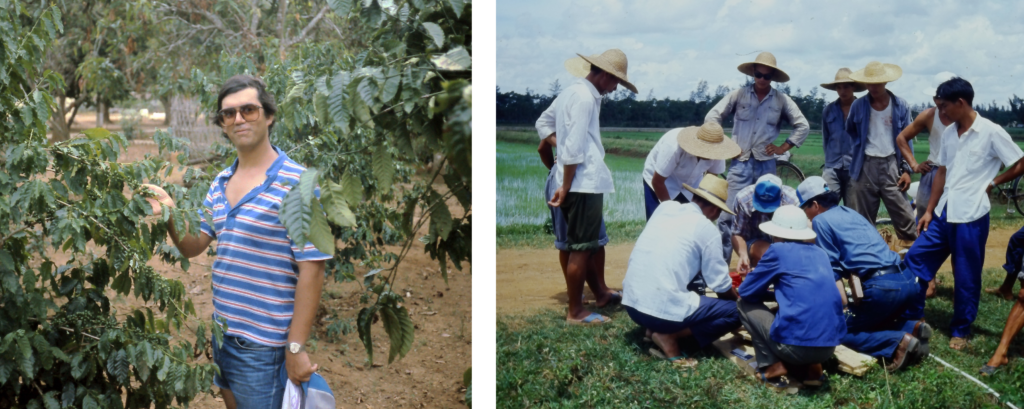
After my company, Primary Sources, secured the agency for Diamond Shamrock in 1979, I began travelling to remote corners of Guangdong Province to find raw materials for Diamond’s products. The company produced a herbicide based on arsenic trioxide. In Guangdong, two counties – Yunfu and Yangshan – had large reserves of arsenic, mined and roasted in traditional dragon kilns. Primary Sources colleagues made three trips to these counties, during which there were several humorous adventures.
Kamm meets with local farmers in Zhanjiang in 1980. Image credit: Dui Hua archives
On my visit to Zhongshan, I worked with a Swiss vaccine manufacturer to quell an epidemic of pigeon flu. The trial was a success and resulted in the first-known sale of a foreign product to a sub-provincial foreign trade corporation.
In addition to trips to Yunfu and Yangshan, I visited communes, state farms, ports, and factories in Jiangmen, Zhanjiang, Hainan (then part of Guangdong Province, now a separate province), Zhongshan, Zhuhai, Dongguan, Luoding, Yunfu (said to have the best roads in China – “in building roads, learn from Yunfu!”), Whampoa, and Baoan (now Shenzhen). These places were rarely visited by foreigners.
Kamm with officials of Luoding County during a 1979 trip. Image credit: Dui Hua Archive.
Although the trade fairs were primarily venues for cutting export contracts, two commodities were purchased in large quantities: plastic resins and industrial chemicals. I met representatives of American chemical firms and in 1979 when the United States and China reestablished relations, I took on the agencies of several companies, most importantly Diamond Shamrock, based in Cleveland, Ohio.
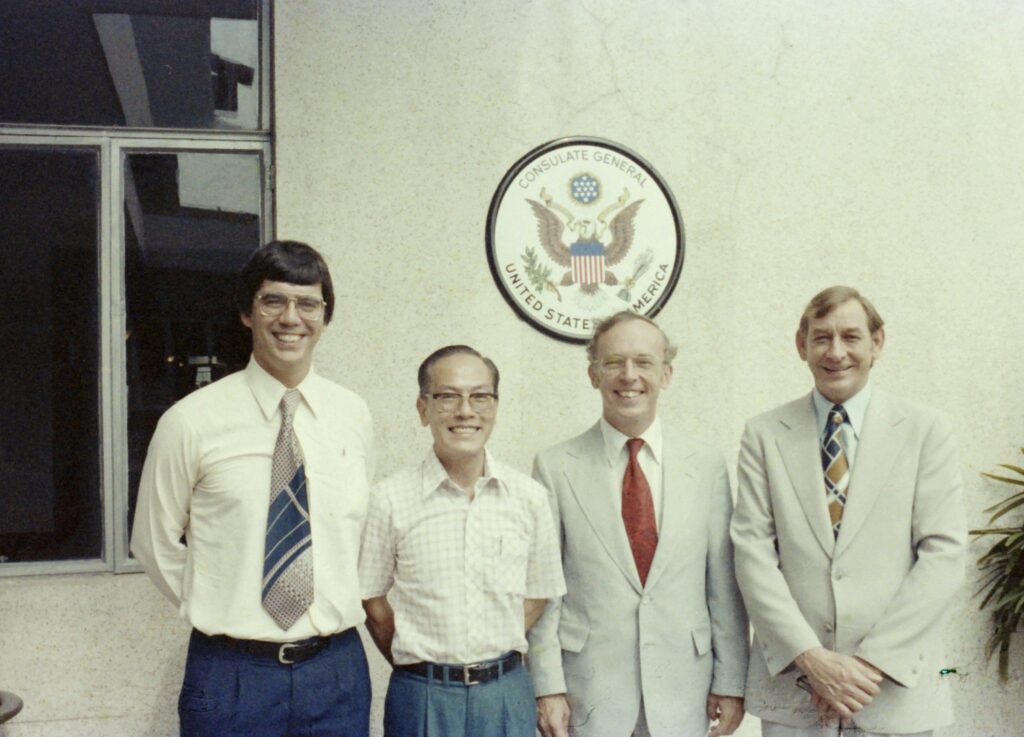
Kamm (left-most) and Consul General Richard Williams (third from the left) at the opening of the US Embassy in Canton in 1980. Image credit: Dui Hua archives
I opened the first foreign office in Guangzhou, well before regulations governing the establishment of foreign offices were promulgated. Beijing was often unaware of what was happening in the southern city. As the saying goes, “The mountains are high, the emperor is far away.”
I finally got to use what my father taught me: I became a salesman.
*Note: While there is general agreement that the Cultural Revolution began in 1966, there is no general agreement on when it ended. A leading authority on the Cultural Revolution in the West, Professor Fred Teiwes, has laid out four possible dates in the 1968-1978 period. Professor Teiwes and other experts date the end of the Cultural Revolution to 1966-1968, when the worst excesses took place. For this episode of John Kamm Remembers, I take the end of 1977, when Deng Xiaoping was rehabilitated, as the culmination of the Cultural Revolution.
Since the Dui Hua Foundation was established in 1999, it has composed and handed over 500 written requests for information on prisoners to the Chinese government. The Chinese government has never refused to accept a list from Dui Hua.
In the past 25 years, Dui Hua has asked about 2,210 prisoners, of whom 396 were females and 1,316 were males (gender is not known in all cases). The foundation received responses on 1,070 prisoners, of whom 235 were females and 726 were male (gender is not known in all cases). Dui Hua has learned of 454 acts of clemency and better treatment afforded to 294 prisoners on its lists.
Dui Hua’s Political Prisoner Database, used to generate prisoner lists, has grown from a few hundred names on notecards in 1999 to 48,699 names at the end of 2023.
Individuals in the PPDB from 2004-2023. Image credit: Dui Hua
Prior to Dui Hua’s establishment in 1999, founder John Kamm actively engaged the Chinese government in a dialogue focused on prisoners, submitting hundreds of lists and receiving responses on more than a thousand prisoners. Unfortunately, good records were not kept.
Dui Hua advocates for at-risk detainees — political and religious prisoners and other individuals facing coercive measures. Individuals have been subjected to coercive measures including detention, arrest, imprisonment, and residential surveillance in a designated location, among others. Most names raised by Dui Hua are largely unknown outside of China.
Recipients of Dui Hua lists have included the State Council Information Office, Ministry of Justice, Ministry of Foreign Affairs, Supreme People’s Court, State Administration for Religious Affairs, provincial and municipal governments, and government backed policy thinktanks.
As judicial transparency deteriorated, the number of prisoners about whom information has been provided has decreased but has nevertheless continued. In 2024, nine lists have thus far been accepted and two responses on eight prisoners have been received.
Sample of prisoner lists from August 1999 (left) and June 2000 (right). Image credit: Dui Hua
Important acts of clemency that Dui Hua has learned of through active interventions include:
Xu Wenli (徐文立). Xu was a prominent political dissident who was dubbed “China’s special prisoner number one.” Xu co-founded the China Democracy Party (CDP) and organized activities during the 1979 Democracy Wall Movement leading to his sentence of 15 years in prison in 1982. Kamm’s intervention contributed to parole in 1993. Xu was subsequently convicted of subversion and sentenced to 13 years in prison and three years DPR in 1998. This was Xu’s second imprisonment. Dui Hua inquired about his case eight times during 2000 and 2002. China provided eight responses. Those efforts contributed to Xu being granted medical parole in 2002 and receiving permission to seek medical treatment abroad. Kamm and Dui Hua also successfully advocated for other June 4 protesters and members of the CDP, including Wang Youcai (王有才).
Zhang Lin (张林). A veteran activist, Zhang was tried and convicted in five separate trials between 1991 and 2014. Kamm and Dui Hua raised his name on ten lists and received eight responses. Dui Hua assisted a women’s rights activist to bring Zhang’s daughters to the United States, then with stakeholders to secure his passage to the United States in 2018.
Jigme Sangpo (晋美桑布). Takna Jigme Sangpo was a Tibetan school teacher and advocate for Tibetan independence. He was believed to be the longest serving prisoner convicted of counterrevolution. Dui Hua assisted in negotiations, one of which took place in Lhasa. Jigme Sangpo was released in 2002 on medical parole and allowed to come to the United States for medical treatment before taking up residence outside Zurich, Switzerland. Dui Hua submitted eight inquiries between 1999 and 2003, and Kamm submitted at least two in 1995 before the foundation’s establishment. He received six responses. Takna Jigme Sangpo passed away on October 17, 2020, at the age of 91.
Ngawang Sangdrol (阿旺桑珍). At the age of 13, Ngawang Sangdrol was convicted of counterrevolutionary propaganda and incitement and sentenced to three years of imprisonment with one year deprivation of political rights (DPR) in 1992. Her sentence was then extended three times to 23 years. Ngawang was the youngest of 13 women known as the “singing nuns of Drapchi.” They secretly recorded and smuggled protest songs out of prison. Ngawang was granted a sentence reduction in 2001 and parole in 2002. John Kamm visited Lhasa in early 2003 and met with Ngawang. Dui Hua helped secure her departure to the United States for medical treatment that same year. Dui Hua made 11 inquiries between 2001 and 2003, either directly to the Chinese government or through governments that held human rights dialogues with China. The Chinese government provided ten responses. Dui Hua also assisted in efforts to secure the early release of another “singing nun,” Phuntsog Nyidron, in 2004.
Xu Zerong (徐泽荣). Xu, a Hong Kong resident and respected expert on China’s military history, was detained in 2000 and accused of stealing state secrets and illegal business activity. He received a combined sentence of 13 years, with three years of DPR. From 2002 to 2011, Dui Hua raised Xu’s case on 28 lists, directly or through stakeholders, and received 26 responses. Those efforts contributed to three sentence reductions, totaling 24 months. Kamm visited the prison where Xu was first incarcerated and pressed the warden to provide better treatment. Xu was transferred to a “model prison” and released in 2011.
Rebiya Kadeer (热比亚•卡德尔). A prominent Uyghur businesswoman and representative to the Chinese People’s Political Consultative Conference, Rebiya was placed in custody in August 1999 after attempting to meet with staff of a US congressional delegation that was visiting Urumqi. She was convicted of illegally providing state secrets to an overseas entity in 2000 and sentenced to eight years in prison and two years of DPR. Dui Hua submitted eight inquiries between 2002 and 2004 to the Chinese government and received more than 20 responses. Dui Hua’s efforts contributed to a one-year sentence reduction in 2004 and medical parole in 2005. She was allowed to seek medical treatment aboard.
Liang Jiantian (梁鉴添). Owner of a small printing shop in Guangzhou, Liang was convicted of illegal business activities, including publishing Falun Gong materials, and sentenced to life in prison in 2000. Dui Hua put Liang’s name on 20 lists and received 18 responses contributing to seven sentence reductions. Liang was released in October 2021.
Tenzin Delek Rinpoche (丹增德勒仁波切, 阿安扎西). An influential Tibetan monk from Ganzi, Sichuan. An outspoken advocate for local Tibetan autonomy, he led efforts to provide education to poor children and orphans in the region. The authorities accused Tenzin Delek of involvement in several explosions in Chengdu and Ganzi. He was convicted of inciting splittism and setting off explosions and given a sentence of death with two-year reprieve in 2002. The sentence was later commuted to life in 2005. Dui Hua raised the case directly and through governments on 31 lists and received 31 responses during 2002 and 2015. Despite being in poor health, the prison authorities refused to grant him medical parole. Tenzin Delek Rinpoche passed away in July 2015 at the age of 65. The authorities refused to release the body back to the family for a proper burial, fearing potential social unrest. Dui Hua found and provided the family with government regulations that required the body to be treated with respect for ethnic traditions. The government relented.
Shi Tao (师涛). Shi was an editor of a provincial newspaper in Hunan. In 2005, he received an internal notice instructing reporters not to cover the upcoming 15th anniversary of the June 4th crackdown, Shi described the post on an overseas website. He was detained in 2004 and sentenced to ten years for providing state secrets to an overseas entity. Dui Hua uncovered the connection between a US internet company and the case and attended a congressional hearing on the case. Shi was released in 2013.
Yao Wentian (姚文田). Publisher and bookstore owner based in Hong Kong. (He is the father of Yao Yongzhan, John Kamm’s first intervention that took place in 1990.) He was convicted for smuggling common goods and sentenced to ten years in 2013. He received a short sentence reduction in 2019. Although the prison authorities refused to consider medical parole for Yao, he was placed in the medical ward of the prison for most of his sentence, exempted from physical labor, and allowed to receive monthly visits from his wife. Yao returned to Hong Kong on February 27, 2023.
Li Yan (李彦). A woman from Anyue County in Sichuan was sentenced to death for murdering her abusive husband in 2012. The Supreme People’s Court affirmed the judgment in January 2013. In February 2014, Dui Hua convened an international conference on women in prison in which judges from the Supreme People’s Court took part. Topics of domestic violence were discussed. A judge and another official from the court told Dui Hua that what they heard was helpful in reversing the lower court’s decision. In June 2014, the SPC issued a decision to the Sichuan High Court to hold a retrial. The sentence was changed to death with two-year reprieve in April 2015.
Chen Taihe (陈泰和). A lawyer in Guilin, Guangxi, an associate professor at Guilin Electronic Technology University Law School, and an advocate of adopting the jury system, Chen was one of more than 300 lawyers and activists interrogated or detained in the “709” a national-wide police action in 2015, later known as the “7.09” crackdown. Dui Hua worked closely with Chinese officials and diplomats from China and the United States to secure a passport and permission for Chen’s departure for the United States in 2016.
In November 2023, a documentary named Wurumuqi Middle Road was posted on YouTube. “Plato如是说,” a self-described independent filmmaker, made the film to commemorate the one-year anniversary of the White Paper Protest, a movement that started in the wake of a deadly Urumqi fire before exploding into open protests against China’s zero-Covid lockdown policy. The protest later became known as the “White Paper Movement.”
The documentary is based on footage recorded on November 26, 2022 and online footage from other mass incidents in the days before and after. The YouTube channel description says that the film serves as a record of a personal political awakening as well as the experiences and suffering of the people over a period of three years.
The YouTube account was removed soon after the video was posted.
Filmmaker Chen Pinlin (陈品霖) has been arrested for picking quarrels and provoking trouble. A photo of the arrest notice states that Chen was formally arrested on January 5, 2024, by Baoshan District police in Shanghai.
Sources indicate that the case was already submitted to the procuratorate for indictment review on February 18.
Yang Hengjun will not appeal; ex-girlfriend indicted on same charge
Yang Hengjun (杨恒均) will not appeal his death with two-year reprieve sentence for espionage, according to a statement released by his family on February 21. Yang, a naturalized Australian citizen, was convicted and sentenced by Bejing Number Two Intermediate People’s Court on February 5. The statement reiterates that Yang maintains his innocence.
Just as China has a low acquittal rate in criminal trials, the appeal reversal rate is similarly low. The latest 2022 trial statistics released by the Supreme People’s Court (SPC) show that reverse decisions accounted for 9.4 percent of appeal cases concluded. For a politically sensitive case such as Yang’s, the conviction will almost certainly be upheld and affirmed by the high people’s court.
In a partial copy of indictment posted online, Yang was accused of spying for a Taiwan intelligence agency when he was a state security officer in Hainan. Yang’s ex-girlfriend Wu Yanyan (吴彦谚), a Hong Kong resident, has also been indicted for the same crime. She was placed under residential surveillance in Beijing at the same time as Yang, but she was tried separately. The status of her case and outcome of the trial are unknown.
Hubei activist detained before provincial “Two Meetings”
Mao Shanchun (毛善春), an activist from Hubei and a former member of Qin Yongmin’s China Human Rights Observer Group, was detained on January 31, 2024.
Mao has participated in Qin’s organization. He announced his withdrawal from the Communist Party of China in 2020.
Mao sent a message to friends informing them that he was asked to leave Wuhan before the provincial Two Meetings. He was detained when he arrived in his hometown in Gongan County.
The exact charge against Mao is unclear, but family members were informed that Mao is being investigated for endangering state security.
Two elderly FLG practitioners granted clemency in Henan
Dui Hua has learned that the Henan Provincial Prison Bureau granted clemency to two elderly Falun Gong practitioners in January 2024. Both men were incarcerated in Zhengzhou Prison for violating Criminal Law Article 300, “using a cult to undermine implementation of the law.”
Wang Tiezhuang (王铁壮), who is in his 70s, has been allowed to temporarily serve his sentence outside prison due to serious illness. Wang was sentenced to seven years in prison in May 2021. His sentence will expire in August 2026.
Zhu Chuanqi (朱传其), also in his 70s, has also been allowed to temporarily serve his sentence outside of prison due to serious illness. Zhu was sentenced to two and a half years’ imprisonment in February 2023. His sentence will expire in March 2025. This is Zhu’s second prison term. He was previously convicted of the same crime in 2008 and received a five-year sentence. His last sentence was completed in 2012.
Lawyer still missing in China, daughter passed away in Japan
Well-known rights lawyer Tang Jitian (唐吉田) has been incommunicado since November 2023, ten months after he regained his freedom. His daughter died on February 20, 2024, in Tokyo in a Tuberculosis-induced coma.
Tang has been an avid advocate for at-risk groups, including practitioners of unorthodox religions, HIV patients, and petitioners.
Although never imprisoned, Tang has been repeatedly placed in administrative detention and has been on the receiving end of extrajudicial measures.
He was subject to extrajudicial measures during the crackdown on the “Jasmine Revolution” in February 2011. On December 10, 2021, Tang was taken away while en route to an International Human Rights Day event hosted by the EU Mission in Beijing. Although he was released days later, he was then taken back to Yanji, Jilin, where he was barred from traveling.
Tang has been placed on an exit ban. In November 2017, he was prevented from leaving the country to seek medical treatment in Hong Kong. In June 2021, he was barred from leaving again when he tried to visit his sick daughter in Japan. On both occasions, he was told that his leaving China might “endanger state security.”
Human rights groups have called on China to allow Tang to attend his daughter funeral.
With the opening of China in 1972, a young John Kamm embarked on his China venture, starting in Macau and then Hong Kong. In 1976, he began attending trade fairs in mainland China in the waning days of the Cultural Revolution. A journalist and trade promoter during a period of political upheaval, Kamm’s work took him throughout the largest cities and surrounding countryside, including Guangzhou and the Pearl River Delta. Kamm saw aspects of Chinese life largely unknown to those living in the West. This instalment of John Kamm Remembers details some of Kamm’s experiences during this period. In March, we will release a companion piece, “Nothing Starts Without a Sale: Learning to Sell in Cultural Revolution China,” focusing on the bi-annual Chinese Export Commodities Fair held in Guangzhou.
A bridge spanning the Pearl River in Guangzhou, circa 1976. Image credit: Dui Hua archives
I
moved to Hong Kong (then a British crown colony) in 1972 and started working as an assistant editor of Asian Business & Industry, a business magazine published by Far East Trade Press, in the summer of 1975. Though I mainly wrote about business in China, up till then I had not set foot in the Chinese mainland, as it was closed to most foreigners.
The chance to realize my dream of visiting China finally came by in 1976 when, as a freshly minted representative of the National Council for US-China Trade, I was asked to attend trade fairs in China, starting with so-called mini-fairs. Reforms introduced in 1975, which permitted practices like sewing foreign labels in Chinese garments, were reversed in early 1976, casualties of the Cultural Revolution’s dictates to refrain from “worshipping things foreign.”
Back then, trade fairs provided the only opportunities for foreign businesses to meet their Chinese suppliers face-to-face, so invitations were highly sought after. One of the largest trade fairs was the Canton Trade Fair in Guangzhou. It was a month-long affair that was held twice a year, from April to May and October to November, respectively.
Memories of the Dongfang Hotel
During the Canton Trade Fair, Europeans and Americans stayed at a hotel designated for foreigners (Japanese and Hong Kong businesspeople had their own designated hotels) called the Dongfang Hotel. The US Consulate, established in 1979, was located on the 11th floor of the hotel’s new wing. The place was a hotbed for networking and exchanging insights into China, and I still remember it fondly as the home base for my first forays into China during the waning days of the Cultural Revolution.*
Liaison offices, manned by foreign affairs and public security officers, were established in each hotel. This is where one registered for the fair and was given a red ribbon which one wore to enter the vast trade fair complex.
The Dongfang had a large dining hall open for three meals a day. At the 1977 autumn fair a hamburger stand was opened on the ground floor. The management of the hotel took other steps to make it more livable for foreigners. Not all were successful. The management purchased a large quantity of imported rodenticide which they deployed liberally throughout the hotel. While many rats were killed, others were routed from their lairs and were seen scurrying around the halls. One fairgoer spoke of rats as big as cats. Another was rudely awakened from his sleep by a rat that had fallen into the fan in his room. Yet another thought she had trapped a rat in a desk. The rat gnawed its way out of the desk and found a place to live elsewhere in the room.
Unlike other Asian cities visited by businesspeople, there were no night clubs or massage parlors in Guangzhou. There was a bar on the eighth floor of the Dongfang Hotel, the storied “Top of the Fang,” and dozens of restaurants in the city where businesspeople could rent rooms (mingling with locals was not encouraged) for lavish banquets.
Kamm talking to locals to order a taxi outside the Dongfang Hotel. Image credit: Dui Hua archives
To compensate for the loss of Japanese life in the 1976 Tangshan quake, China purchased Japanese cars and air conditioners. The latter were placed in the courtyard of the Dongfang, exposed to the elements. When a small number were eventually turned on, the fuses were blown, shutting off power at the Dongfang. The Japanese cars were stripped of everything that could be used, including tires. They wound up on cinder blocks sitting forlornly in the lot in front of the Dongfang.
Excursions & Sports Around Guangzhou
The liaison office at Dongfang Hotel organized visits to sites inside and outside Guangzhou. One could join tours to visit communes, factories, and tourist locations like the Birds Paradise in Xinhui District. I remember visiting a hospital to observe operations under acupuncture anesthesia. The patient, on cue, would sit up and wave to the foreign guests. Not a few members of the audience fainted. Fireworks manufacturing was booming in Dongguan County, as fireworks factories in Guangdong started displacing the firework factories in Macau starting in the late 1960s.
Kamm and a colleague getting into a car surrounded by onlookers. Image credit: Dui Hua archives
Though I had studied Mandarin when I was at Princeton, while living in Hong Kong, I ditched it in favor of Cantonese, a very different language, akin to the difference between Dutch and English. Chinese officials who came to Guangzhou from Beijing could neither speak nor understand Cantonese (the common dialect used in Guangdong Province). When they joined tours of communes, I often wound up interpreting for them.
Table tennis tables were set up in the hotels where foreigners stayed, as well as the occasional pool table. There were clay tennis courts on Shamian Island where an enterprising American businessman tried to organize a tennis tournament (“the Canton Cup”) at the autumn fair. Unfortunately, the Chinese Tennis Association, which we did not know existed, stepped in, and ordered a halt to the tournament. That did not stop several of us from playing a few sets at the appointed date and time. The businessman, who represented a sporting goods firm, distributed cans of tennis balls, tennis hats, and other paraphernalia.
During the autumn fair, a football game was organized between foreigners and Chinese players on a pitch at Zhongshan University. The Chinese team invariably won, but, true to the motto “Friendship first, competition second,” the Chinese team let the foreigners keep it close by scoring one or two goals.
Streets of Guangzhou
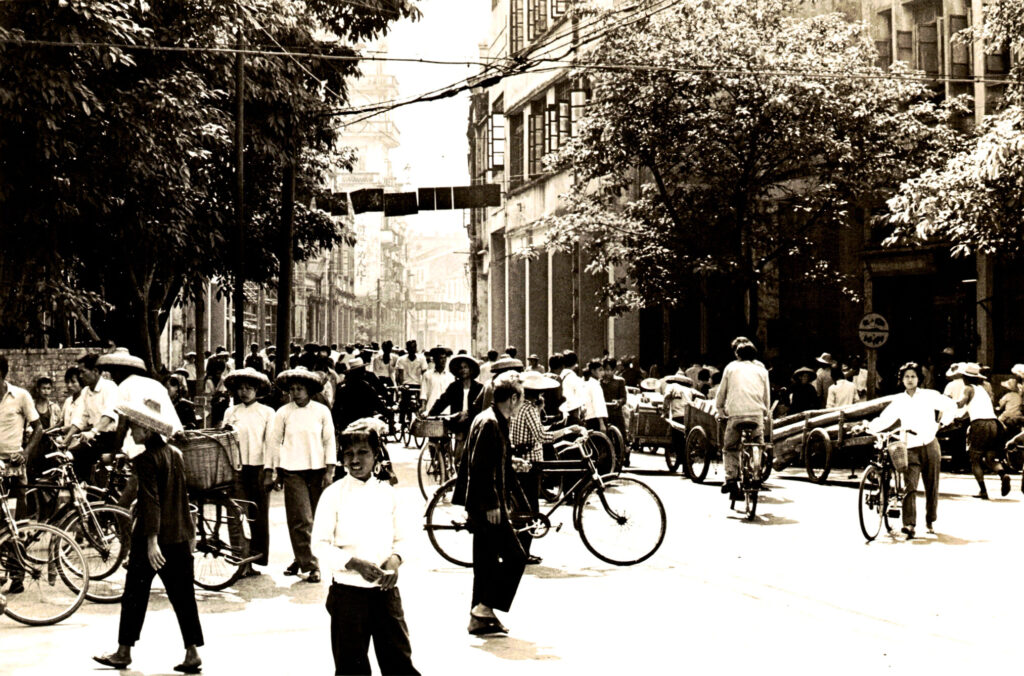
The streets of Guangzhou, circa 1976. Image credit: Dui Hua archives
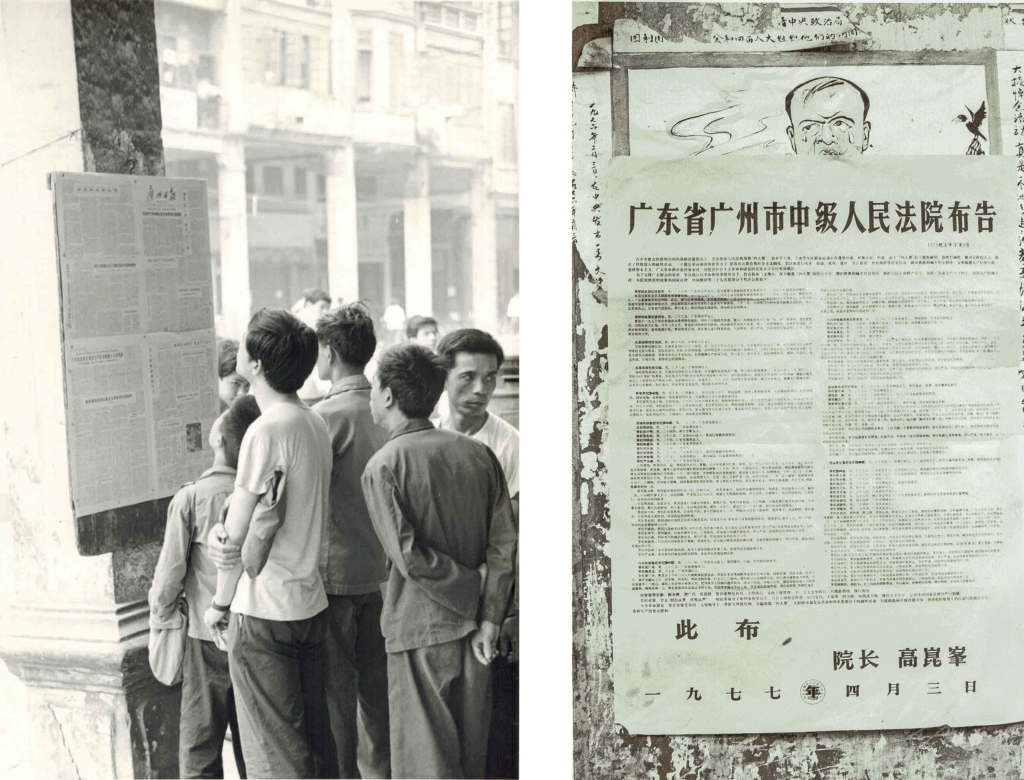
There was plenty of time to wander the streets of Guangzhou. Occasionally, I would see a court notice of executions of convicted criminals, including counterrevolutionaries, posted on walls in the city. Such notices, common during the Cultural Revolution, are no longer seen today.
(Left) Crowds of readers gather to read copies of Canton’s dailies posted on street-side bulletin boards, (right) an execution announcement that was posted in Guangzhou in 1977. Image credit: Dui Hua archives
In 1983, I learned of the executions of two Hong Kong young men who had hung a large banner with counterrevolutionary slogans outside their hotel room. They went outside the hotel and took photographs after which they headed to the train station to return to Hong Kong. There they were taken into custody, after which they were tried, convicted, and executed. The Supreme People’s Court (SPC) in Beijing approved the execution. In those days, the only executions that needed to get the approval of the SPC were those for counterrevolution. (Now all executions need to be approved by the SPC).
The execution of these two men for hanging a poster out of their window prompted outrage among the people of Hong Kong. It marked the last time that Hong Kong people were executed for political crimes. Executions for other crimes, notably drug offenses, have continued to the present day.
I often wandered into stores to see what was on offer. The only foreign consumer goods available for purchase in those days were Swiss watches, Albanian cigarettes, North Korean brandy, and books by leaders of friendly countries like Enver Hoxha of Albania. Japanese televisions began to be available for sale in 1977.
On one occasion, I befriended a taxi driver outside the Dongfang. He asked me to buy a Chinese watch (which were rationed for locals) at a local department store with renminbi he gave me. I did so and handed it over. Later, I saw him again and went into the back seat of his car. He pretended not to recognize me. Such was the fear among locals of fraternizing with foreigners.
The public security bureau did their best to make sure disturbances like fights did not take place, but they couldn’t stop all deviant behavior. On one occasion, I witnessed a fight between youth hurling rotten vegetables at the crews of sampans tied up on the shoreline of Shamian Island. On an arranged visit to Dongguan County, I witnessed a fight between an individual and a group of gangsters. On a walk near the trade fair building with a female colleague a fast-moving bicyclist tried to harass her physically and sped away.
Worshiping was another deviant behavior discouraged by the authorities, but it was known to take place in private dwellings. Churches, including the massive Sacred Heart Catholic Cathedral, were boarded up. Priests, including Father Tan Tiande, who suffered greatly during the Cultural Revolution, could not be visited. It took until the early 1990s for visits to be allowed, under the watchful eye of Religious Affairs officials.
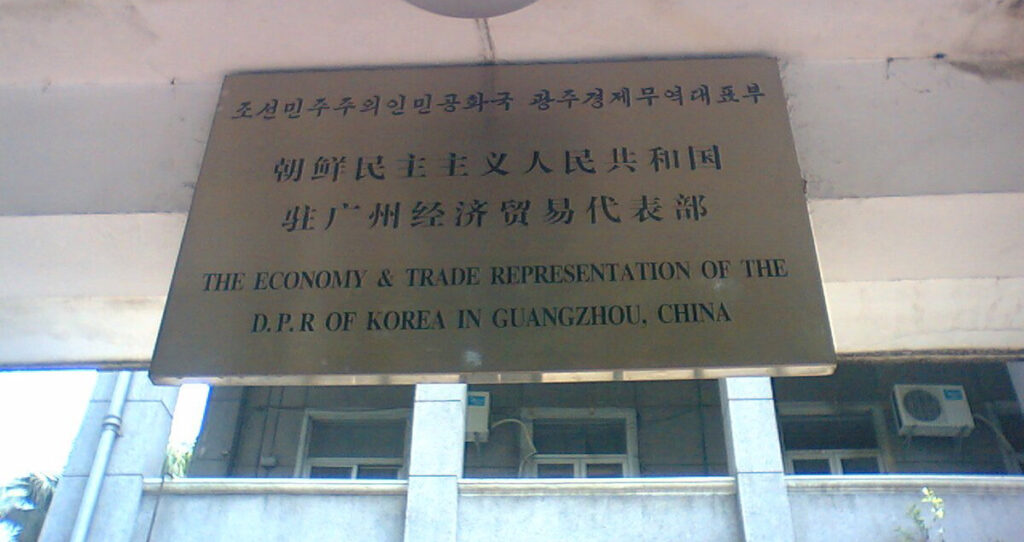
The North Korean Trade Office on Shamian Island
Our Lady of Lourdes Chapel on Shamian Island in the city of Guangzhou circa 2005. Image credit: Anthony Hartman / CC BY 2.0
Shamian Island is a sandbar located in the southern part of Guangzhou. Prior to 1949, it was the site of the British and French concessions. In the early 1950s, most foreigners left Guangzhou, leaving behind stately Western edifices and a couple of churches, one Anglican and one Catholic. Eventually two new foreign offices opened on the island: a Polish consulate was set up to service crews of the Sino-Polish shipping company and a North Korean trade office was established to conduct business in Macau and Hong Kong.
Colonial architecture on Shamian Island. Image credit: Canton Companion
During the US presidential election campaign of 1976, candidate Jimmy Carter pledged to remove US troops from South Korea. This was a popular position among the North Koreans who worked at the trade office on Shamian. North Korean trade representatives had little opportunity to meet foreign businesspeople, but they were invited to attend receptions put on by foreign governments, notably the Swiss government. During the autumn 1976 trade fair, I met several North Korean officials who were very friendly, unlike the way I was greeted at the spring 1976 trade fair. On that occasion they scowled, refused to shake my hand, and turned their backs to me.
The North Korean Economy and Trade Representation Office in Guangzhou. Photo taken in 2008. Image credit: Chintunglee / CC BY-SA 4.0
At the autumn 1976 fair I was invited to visit the North Korean trade office on Shamian. Before accepting, I went to the liaison office and asked if there were objections to my going to the trade office. The response I received was surprising. I was told not to visit the North Koreans. “You are here at our invitation, not theirs. Stay away from them.” This was an early indication that relations between Beijing and Pyongyang were not as close as many in the West thought they were.
Recollections of the Cultural Revolution
My wife and I became good friends of the Polish Consul General and his wife. We frequently visited the consulate on Shamian Island and invited them to our office at the Dongfang Hotel where small parties took place.
Polish officials lived in Guangzhou throughout the Cultural Revolution. Sitting on the balcony of the consulate they witnessed fierce shelling between rebel factions on Baiyun Mountain and the army on the south bank of the Pearl River. As Catholics, they attended mass at Our Lady of Lourdes Chapel on Shamian for as long as they could. First, the Red Guards ordered the congregants to stop singing, and then harsh measures were adopted against the Chinese priests, who were beaten and executed, strung up on Renmin Road lamp posts in downtown Guangzhou.
The Consulate General of the Republic of Poland in Guangzhou. Image credit: Chintunglee / CC BY-SA 4.0
A Hong Kong businessman who visited our office recalled: “I lived in Guangzhou during the 1966-1968 period. There was a breakdown of social order. One stayed in one’s own neighborhood and was careful not to enter other neighborhoods as a stranger. On one occasion, a stranger entered a neighborhood near where I lived. The residents beat pans and drums and set upon him. He died a terrible death.”
Before visiting China in the mid-1970s, I fancied myself an admirer of Chairman Mao and the sayings in his “Little Red Book.” What I saw and heard back then changed me. I lost my innocence and adopted a skeptical view. I was no longer a “panda hugger,” a term applied to those who hold that China can do no harm.
*Note: While there is general agreement that the Cultural Revolution began in 1966, there is no general agreement on when it ended. A leading authority on the Cultural Revolution in the West, Professor Fred Teiwes, has laid out four possible dates in the 1968-1978 period. Professor Teiwes and other experts date the end of the Cultural Revolution to 1966-1968, when the worst excesses took place. For this episode of John Kamm Remembers, I take the end of 1977, when Deng Xiaoping was rehabilitated, as the culmination of the Cultural Revolution.
A week before China starts its week-long celebration of Lunar New Year, the Beijing Number Two Intermediate People’s Court sentenced Australian citizen and author Dr. Yang Hengjun (杨恒均) to death with two-year reprieve on February 5, 2024. The sentence, which came five years after Yang was first detained on espionage charges, is among the harshest given to a foreign national convicted of endangering state security crimes.
The sentence came three months after Australian Premier Minister Anthony Albanese visited China. The trip was meant to mend the relationship between the two countries. Albanese reportedly raised Yang’s case directly with Xi Jinping during the visit but did not disclose how Xi responded.
Yang is known for his moderate views and advocates for making gradual changes to improve governance and benefit ordinary people. He was believed to have been placed under residential surveillance in a designated location in January 2019 while visiting his elderly parents. He was arrested in August of the same year and indicted in October 2020. The first court hearing began October 2021.
Death with two-year reprieve is a unique punishment in China. The sentence is typically commuted to life at the end of the two years if the prisoner does not commit new crimes and no new serious crimes are discovered. However, the two years do not count as time served.
Yang will face more restrictions in obtaining clemency than ordinary prisoners do because he was convicted of endangering state security. Should his death with two-year reprieve sentence be commuted in 2026, these restrictions mean that he will have to wait longer for his life sentence to be commuted to a fixed-term one and to receive shorter sentence reductions. There will also be longer intervals between sentence reductions.
Feminist labor activist sentenced in Shandong
Li Qiaochu (李翘楚) was convicted of inciting subversion of state power and sentenced to three years and eight months in prison by Linyi Intermediate People’s Court in Shandong on February 5, 2024. While the closed trial commenced in June 2023, it was suspended then resumed in December, and then suspended again when Li’s lawyers quit in protest.
In a copy of part of the judgment posted online, the court largely focused on Li’s relationship with her fiancé Xu Zhiyong (许志永) and her helping him post articles online. The court denied Li’s defenses and found that Li was fully aware of the subversive content of Xu’s writings and thus must have acted with the intent to incite subversion when posting those articles online.
Li suffers from serious symptoms of depression and auditory hallucinations. During the prolonged detention waiting for trial, her requests for bail were repeatedly rejected.
Li’s sentence will expire on August 3, 2024. It is not immediately clear if she intends to appeal.
Crackdown on 2019 “Xiamen Gathering” continues
Xu Zhiyong and Ding Jiaixi (丁家喜) were among those who were apprehended following a private gathering joined by rights lawyers and activists in the southeastern city of Xiamen to discuss current events and public affairs. Approximately 20 people were detained for participating in the gathering. Five years on, the crackdown on those who took part in this “Xiamen Gathering” ensues.
In January 2024, Zhang Zhongshun (张忠顺) was indicted for inciting subversion. He is currently held in Linshu County, Shandong.
Zhang was a lecturer at Yantai University and was sentenced in 2008 to three years’ imprisonment for “using a cult to undermine implementation of the law.” In his lectures, Zhang introduced controversial perspectives on topics like June Fourth and the crackdown on Falun Gong.
Case of lawyer Yu and wife transferred to Suzhou
Human rights lawyer Yu Wensheng (余文生) and his wife Xu Yan (徐艳) have been transferred from Shijingshan District in Beijing to Suzhou, Zhejiang.
On April 13, while en route to attend an event at the German Embassy in Beijing, the couple were taken away by police for “picking quarrels and provoking trouble.” They were arrested on May 21 and indicted. Police have reportedly added inciting subversion to Xu’s charges.
Tibetan monk released in Sichuan after completed sentence
Rinchen Tsultrim, a Tibetan monk from Sichuan Aba known for his blog posts that advocate for Tibetan culture and language, was released from Mianyang Prison in Sichuan on January 31 after completing his prison sentence of four and a half years.
Tsultrim was convicted of inciting splittism and sentenced by Aba Tibetan & Qiang Minorities [Ngaba] Autonomous Prefecture Intermediate People’s Court in March 2021.
Hong Kong Christian detained in Hubei for illegal business operations
Chen Yueli (陈越利, Stephen), a Christian from Hong Kong was reportedly detained in Chibi City, Hubei.
Chen was taken away by mainland police on December 19, 2023 in the West Kowloon Station Mainland Port Area, a custom entry point under the jurisdiction of Guangdong Customs. He was later arrested for illegal business operations. It is reported that Chen helped Xianning house churches print Sunday School materials for children.
Chen’s lawyer has been unable to visit him since January 2024. The police have denied requests on the grounds that the case involves “state security.”
At China’s Fourth UPR, Dui Hua Decries Drop in Judicial Transparency
The Palace of Nations during China’s UPR during the United States’ recommendations. Image credit: UN WebTV
On January 23, 2024, China underwent its fourth Universal Periodic Review (UPR) at the United Nations. Dui Hua has made submissions at all four of China’s UPRs. The UPR is a process to review the human rights records of every member nation every four and a half years. China’s previous UPRs took place in 2009, 2013, and 2018, and Dui Hua made its submission to China’s fourth UPR in July 2023.
This UPR lasted three and a half hours, during which more than 160 member states, a record number, made 428 recommendations on China’s human rights performance. Each member state representative had 45 seconds to speak, a record low for time allotted.
In the period leading up to the UPR, non-governmental organizations (NGOs) like Dui Hua made submissions identifying human rights concerns in China. As part of the process, the Chinese government submits a national report (which is meant to reflect broad input, including from independent civil society in China) and an additional report compiled from the findings of UN human rights mechanisms’ reviews of China since its last 2018 UPR. Inputs from all three are incorporated into the UPR.
Prior to the UPR, US Senators Marco Rubio (R-FL), Tim Kaine (D-VA), Jeff Merkley (D-OR), and Marsha Blackburn (R-TN) sent a letter to Secretary of State Blinken requesting that he highlight human rights violations, identifying the treatment of American citizens, Xinjiang, Tibet, Hong Kong, and rights defenders as key issues. Similarly, rights groups including the World Uyghur Congress, Chinese Human Rights Defenders (CHRD), and the Tibet Action Group urged member states to raise human rights violations during the UPR.
Dui Hua’s Submission
The Dui Hua Foundation has been in Special Consultative Status with the Economic and Social Council of the United Nations (ECOSOC), the body overseeing the UN’s Human Rights Council in Geneva, since 2005.
In its submission to China’s 2018 UPR, Dui Hua acknowledged progress made in judicial transparency, citing thousands of judgments in sensitive cases, especially the Supreme People’s Court’s (SPC) China Judgements Online (CJO) website. At the time, Dui Hua’s 2018 submission was welcomed by China’s Ministry of Foreign Affairs.
In July 2021, a search for “inciting subversion of state power” on China Judgements Online yielded no results. Image credit: China Judgements Online
In its submission for China’s fourth UPR, Dui Hua walked back its acknowledgement of progress in judicial transparency over the last two years. The submission chronicles several negative developments, including:
The purging of the Information Website of the National Courts’ Sentence Reduction, Parole, and Temporary Service of Sentences Outside Prisons.
The purging from CJO of the entire category of endangering state security (ESS) crimes as well as most of the crimes covered by Article 300 of the Criminal Law, “using a cult to sabotage implementation of the law.” The purge was carried out in June 2021. Dui Hua notes that, prior to the purge, 4,000 judgments of these crimes could be found on CJO.
The removal from the website of the Supreme People’s Procuratorate of all indictments related to ESS and nearly all indictments related to Article 300 crimes. Prior to the purge there were more than 5,000 documents related to Article 300 arrests or indictments. Now, the Supreme People’s Procuratorate website contains 30 indictments related to this crime.
The suspension of foreign access to the China National Knowledge Infrastructure website, on which foreign researchers could find publications and statistics on sensitive crimes.
Difficulties acquiring yearbooks and other publications related to political crime in libraries and bookstores, including those in Hong Kong.
The reduction of Chinese government responses to United Nations Special Procedures, notably to their queries on ethnic minorities.
Dui Hua’s submission also addresses the heavily criticized use of televised confessions by the Chinese police, as well as the dearth of information on death sentences and executions. There have been no death penalty judgments or review decisions posted on the SPC’s Court News section since July 2022. China Statistical Yearbook stopped releasing statistics on the number of women in prison in 2013.
The deterioration of judicial transparency in China has continued since Dui Hua’s submission in July 2023. In a notice issued on November 21, 2023, the SPC revealed that it will establish and launch a “national court judgment and decision document database” on January 1, 2024. Unlike the existing public judgment website, the new database is only accessible by the court and other judicial personnel on a dedicated internal network. The SPC also indicated that, in the future, only selected highlighted cases will be released to the public judgment website. The development has met with worries and dismay from legal scholars and lawyers. Besides the dwindling number of documents for criminal cases posted to the public judgment website, another indicator for judicial and governing transparency is also diminishing. The number of Administrative Reconsideration decisions has been reduced to almost nil in the recent two years.
How the Event Went
Chen Yu, Permanent Representative of China to the United Nations Office at Geneva, delivering remarks during the UPR. Image credit: UN WebTV
China’s UPR included a mix of criticisms, often advanced by Western nations and those friendly to the United States, and laudatory statements praising China’s “whole process democracy” and “poverty alleviation” from countries that typically support China’s motions at the UN. Among the issues raised repeatedly, according to CHRD, were those related to the use of the death penalty, Hong Kong, Tibet, the treatment of Uyghurs, women’s rights, protections for the LGBTIQ+ community, the persecution of human rights defenders, and the use of enforced disappearances.
Some criticisms took on a more regional focus, for example multiple South American countries raised concerns over China’s overseas business operations and called for more action on business and human rights. Others — in particular calls for China to end its use of the death penalty — enjoyed support across geopolitical lines. As CHRD reported, many states recommended that China ratify the International Covenant on Civil Political Rights and cooperate with UN Special Procedures. Turkey was the rare Muslim majority country to expressly ask China to respect the identity and rights of Uyghurs. Human rights activists held protests outside the Palace of Nations in Geneva to coincide with China’s UPR.
Protestors outside the Palace of Nations. Image credit: ICT Brussels X account
In a press conference following the UPR, Foreign Ministry Spokesperson Wang Wenbin said that more than 120 countries had applauded China’s human rights progress, and the Chinese government has since issued a white paper titled “China’s Legal Framework and Measures for Counterterrorism,” that is thought to be a response to criticisms about its declines in judicial transparency. Dui Hua executive director John Kamm previously discussed the UPR submission and the importance of judicial transparency in a recent episode of the Encounters with China podcast.
Speaking Up, Speaking Out
After the January 23 UPR meeting, China met with the Troika, the three-nation group comprised of Albania, Malawi, and the United Arab Emirates that managed China’s UPR. Together, they decided on the recommendations that will be incorporated into the final report. These will be presented at the summary meeting held in June during the Human Rights Council’s second meeting of the year. On that occasion, NGOs with ECOSOC consultative status like Dui Hua can speak.
Dui Hua’s work at the UN is one part of its unique form of advocacy that seeks to encourage the United States and China to bind themselves to international human rights norms. In addition to all four of China’s UPRs, Dui Hua also made submissions to the United States’ UPRs in 2010 and 2020. These submissions focused on the use of the death penalty and injustices in parole and immigration policy.
US Permanent Representative to the United Nations Human Rights Council Michelle Taylor makes the United States’ recommendations. Image credit: UN WebTV
An aspect of Dui Hua’s UN advocacy has been the submission of prisoner lists. In its 2018 submission to China’s third UPR, Dui Hua attached a list of 23 names of prisoners found on the CJO, 17 of whom were in prison at the time the submission was made in March 2018. Subsequent to the submission, four of those named were granted clemency. In its 2023 submission, Dui Hua includes 19 names believed to be subject to coercive measures. The foundation is monitoring their situations and pressing for clemency.
Significant developments at China’s UPR include:
China’s senior representative was its ambassador in Geneva. At previous UPRs, China was represented by a vice minister or a Special Envoy for Human Rights.
The United States was represented by an ambassador based in Geneva. No one came out for the event from Washington.
China no longer refers to Tibet. It uses the term Xizang; and
China no longer refers to Uyghurs. It uses the term “Chinese citizens from the autonomous region.”
From the Human Rights Journal, a blog offering original analysis and translations related to human rights and rule of law developments in China, published January 30, 2024.
The Ihlas Supermarket entrance in Kashgar city center in August 2018. Various banners and posters in Mandarin and Uyghur promote speaking Mandarin and ethnic unity. Image credit: Kubilayaxun / CC BY-SA 4.0
On February 1, 2024, the Xinjiang Uyghur Autonomous Region’s (XUAR) new Religious Affairs Regulation came into effect. The regional regulations place new restrictions on religious institutions in the restive province and have implications for religious life in Xinjiang. The XUAR People’s Congress based these new regulations in large part on the 2018 National Religious Affairs Regulation issued by the State Council, but the Xinjiang regulations introduce several provisions “in consideration of [the] actual circumstances in the autonomous region.” Using translations done by the China Law Translation, Dui Hua has put together a side-by-side comparison of the XUAR Religious Affairs Regulations (2024), hereafter referred to as XJ regulations, and the State Council Religious Affairs Regulations (2018), hereafter SC regulations.
Published in Juvenile Justice Update and republished on January 18, 2024 in the Human Rights Journal.
Photos from juvenile justice exchanges. Image credit: Dui Hua
In an article for Juvenile Justice Update’s winter issue, executive director John Kamm details how Dui Hua’s expert exchanges with the SPC on juvenile justice have helped facilitate dialogue and contributed to improvements in policy. The article describes how Dui Hua’s first expert exchange with the SPC, which marked its 15th anniversary last year, brought legal practitioners from both countries together for meaningful discussions on juvenile justice and best practices. Kamm also details progress since then, noting a continuous drop in juvenile convictions in China since 2013, with convictions declining by more than 50 percent.
Suqian, Jiangsu, where a House of Joseph leader was arrested. Image credit: Invercargill City Council
Since the release of its report “The Persecution of Unorthodox Religious Groups in China” in March 2022, Dui Hua continues to identify more unorthodox religious groups, including the House of Joseph, or yuesejia (约瑟家). The House of Joseph is an indigenous Christian group founded in 1992 as an offshoot of the Spirit Church. Like other unorthodox religious groups, the House of Joseph has been accused of illegally amassing a fortune from superstitious believers through “indoctrination” and “mind control.”
In the lead-up to China’s human rights review at the United Nations on January 23, host Samy Amanatullah speaks with Dui Hua executive director John Kamm about Dui Hua’s work at the United Nations, the Universal Periodic Review of human rights, and how an NGO like Dui Hua can advocate for political and religious prisoners at the United Nations. This far-reaching conversation also dissects how the Universal Periodic Review works, the international treaties that underpin human rights norms, and how the United States and China compare when it comes to adhering to human rights treaties.
Dui Hua’s Prisoner Updates provide the latest information staff researchers have uncovered through online and library research and through direct dialogue with the Chinese government.
Independent investigative journalist sentenced for multiple charges; feminist labor rights activist Li Qiaochu trial commenced & suspended; Shanxi lawyer briefly taken by police without cause.
The entrance to Ihlas Supermarket in the Kashgar city center in August 2018. Various banners and posters bearing political slogans in Mandarin and Uyghur, with slogans promoting speaking Mandarin and ethnic unity. Image credit: Kubilayaxun / CC BY-SA 4.0
Near the end of 2023, the Xinjiang Uyghur Autonomous Region (XUAR) issued new regulations on administrating religious affairs in the region. The restive province remains a source of international controversy — Western nations have decried widespread surveillance and religious repression while China has refuted these as politically motivated criticisms and pointed to its support from Muslim-majority nations to validate its policies. The Office of the UN High Commissioner for Human Rights (OHCHR) 2022 report concluded that “serious human rights violations” that may constitute crimes against humanity have been committed in the region, and the new regulations passed more than a year after that report and China’s rejection of its findings.
The fourteenth XUAR People’s Congress passed the Religious Affairs Regulation on December 22, 2023, at its seventh session. The new regulations will take effect on February 1, 2024, a week after its human rights record was examined in the United Nations Universal Periodic Review in Geneva. Xinjiang was notably a recurring issue during this review, which took place on January 23, 2024.
The regional regulations are based in large part on the 2018 National Religious Affairs Regulation issued by the State Council. The Xinjiang regulations introduce several provisions “in consideration of [the] actual circumstances in the autonomous region.” (XJ Article 1)
Using translations done by the China Law Translation, Dui Hua has put together a side-by-side comparison (link) of the XUAR Religious Affairs Regulations (2024), hereafter referred to as XJ regulations, and the State Council Religious Affairs Regulations (2018), hereafter SC regulations.
In the XJ regulations, some provisions from the SC regulations are re-arranged and combined. They also omit details of some provisions included in the SC version by simply referring to them as “in accordance with the national laws, regulations, and rules.”
Such regulations and rules include the Measures for Administration of Religious Venues introduced by the State Religious Affairs Bureau, which went into effect on September 1, 2023. Some of the notable differences between the XJ and SC versions are highlighted below.
Battling Against Endangering State Security, Extremism, & Ethnic Hatred
The stated goal of the XJ regulations is to protect citizens’ freedom of religious worship and to maintain religious and social harmony. Both the XJ regulations and the SC regulations highlight the responsibility of religious groups and believers to fight criminal activities carried out in the name of religion.
Both regulations reference the need to battle extremism (SC Article 3. XJ Article 4) and activities that might endanger state security (SC Article 4, 63, 64. XJ Article 5), especially splittism (SC Article 4, 63, 73(1). XJ Article 5, 49(2)). While both versions strongly emphasize the importance of promoting and maintaining “ethnic harmony” the XJ regulations also reference “inciting ethnic hatred” in its text (XJ Article 5, 49(2)), which is not mentioned in the SC text.
XJ expands on the emphasis against religious extremism and includes specific behavior in Article 47:
…must not use appearances, apparel, signs, symbols, and so forth to play up religious fanaticism;
[must] not coerce or force others to wear religious extremist clothing or wear religious extremist symbols or signs.
Publishing & Personal Consumption of Religious Materials
While SC Article 45 permits religious groups, religious schools, and churches and temples to print materials for internal use (“in accordance with relevant laws on publishing”), XJ Article 48 requires such publications to be reviewed and approved by the regional religious affairs bureau. A printing permit issued by the regional news and press department is required and distribution can only be within the approved scope.
SC Article 45 stipulates religious materials cannot contain content:
that undermines harmonious co-existence between religious and non-religious citizens;
that undermines the harmony between different religions or within a religion;
that discriminates against or insults religious or non-religious citizens;
that advocates religious extremism;
that contravenes the principle of religions’ independence and self-governance.
XJ Article 49 expands on this by prohibiting five more types of illegal content:
(1) that undermines national unity, social stability, economic development, and scientific and technological progress;
(2) that incites ethnic hatred, ethnic discrimination, and undermines ethnic unity;
(3) that promotes ethnic separatism, religious extremism, and violent terrorism;
(7) that endangers social morality or the traditional culture of China; and
(8) Other content prohibited by laws, regulations, and state provisions.
XJ Article 50 further restricts individual consumption of contents that are deemed illegal (as defined by Article 49) on the internet or other digital formats, including mobile phones and portable data storage. The article adds that “Organizations and individuals must not illegally listen to, watch, or transmit overseas religious radio and television programs.”
However, the XJ version omits SC Article 46 which regulates importing religious materials from overseas for personal use.
The XJ regulations largely follow the SC regulations in “Chapter II: Religious Groups” (on rules for personnel appointments) and “Chapter III: Religious Schools” (on religious training), but it adds the requirement that religious schools and religious training should contribute to social harmony and Chinese culture by incorporating “Chinese characteristics.”
XJ Article 11(3) stipulates that research on religious culture and texts should:
“… thoroughly uncover content in religious teachings and rules that are conducive to social harmony, modern progress, and health and civilization; and make interpretations of religious teachings and rules in line with contemporary China’s requirements for development and improvement, and in line with the outstanding traditional Chinese culture.”
XJ Article 14 also asks religious schools to:
“…follow the path of school operations with Chinese characteristics, running the school in accordance with law, advancing educational and teaching reforms, and increasing the quality of school operations.”
Sinicization reappears in “Chapter IV: Religious Activity Sites” which regulates building, renovation, and expansion of religious sites and venues. XJ Article 26 adds that sites that are newly built or renovated, expanded, or rebuilt shall “reflect Chinese characteristics and style in areas such as their architecture, sculptures, paintings, and decorations.”
Conduct of Religious Professionals
While the SC regulations includes brief, generalized provisions regulating the conduct of religious professionals, including the requirement to follow relevant laws and rules and to protect their rites, the XJ regulations call on personnel to also follow orthodoxy and anti-extremism measures.
XJ Article 38 further defines specific acts that are not permitted, including:
Making “edicts” [DH: Idhn—permission, promise], appointing religious presiding officiants, and restoring or indirectly restoring feudal privileges;
Accepting canonization, appointments, or honorary titles from overseas organizations or individuals;
Accepting instruction on engaging in religious and educational activities from overseas organizations or individuals;
Setting up private meeting places and establishing illegal religious organizations;
Conducting unauthorized “living Buddha reincarnation” activities.
Of these, (1) is a common practice among Chinese Hui Muslims, and (5) is specific to Tibetan Buddhism.
A roadside sign in Turpan, Xinjiang Uygur Autonomous Region, written in both Uyghur and Chinese with the phrase “I liken the party to my mother.” Image credit: Kubilayaxun / CC BY-SA 4.0
An Expansion of Past Regulations
It is important to note that the XJ regulations are an expansion of the SC regulations. On the surface, it appears that the XJ regulations include fewer mentions of the phrase “extremism.” However, the regional version refers in places to being “in accordance with the relevant national laws and regulations,” which is a clear reference to the SC regulations. The regional regulations also made combating splittism and extremism a top priority, including allocating these responsibilities to religious schools and religious professionals. Additionally, the XUAR previously passed de-extremification regulations in 2017.
The XJ regulations build on the SC ones to further dictate how individuals and institutions can engage with state-sanctioned religions. Beyond the restrictions and obligations outlined above, both regulations also place restrictions on adhering to specific pillars of Islam. For example, going abroad for the Hajj is permitted only when organized by a national Islamic group (in this case the Islamic Association of China), and both regulations include rules against accepting overseas funds (SC Article 57; XJ Article 45) with a few exceptions, which may impinge on the third pillar of Islam known as Zakat, or almsgiving).
Similarly, other regions like Qinghai and the Tibet Autonomous Region have their own religious affairs regulations. Qinghai’s went into effect on October 1, 2021 and Tibet’s a month later on November 1, 2021. The Tibetan regulations also include some provisions specific to Tibetan Buddhist tradition and beliefs, such as reincarnation. The Chinese government’s insistence on controlling all aspects of religious practice, from what materials adherents can possess to transnational processes, reflect how national security and social stability concerns drive policies that demand adherence to the state above all.
Dui Hua has compiled a side-by-side comparison of the XJ and SC regulations and provided comments where appropriate: Comparison of XJ and SC Regulations