Category: John Kamm Remembers

John Kamm Remembers are stories written by Dui Hua’s founder recounting Kamm’s advocacy for prisoners in China. In addition to these stories, the 50 Years in China timeline visualizes Kamm’s human rights work alongside the history of US-China relations.

  • My First Testimony to Congress

    My First Testimony to Congress

    << Read all John Kamm Remembers stories

    Download & read this story as a PDF
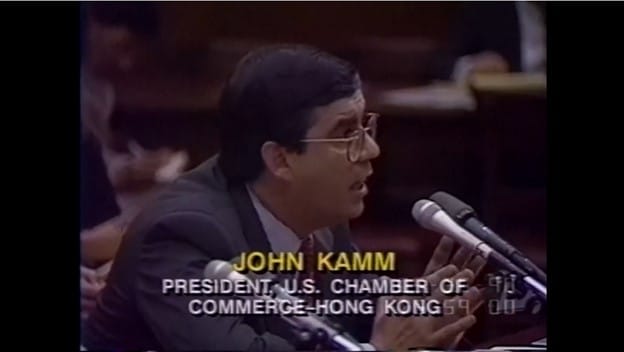
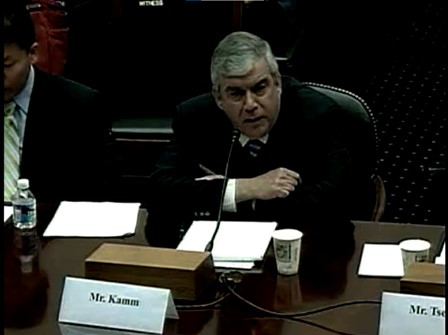
    On May 16, 1990, John Kamm testified to Congress about the impact of removing China’s MFN status would have on Hong Kong. Image credit: C-Span

    I

    n the summer of 1989, I was a vice president of the American Chamber of Commerce in Hong Kong (AmCham), in line to become president in 1990. I had overseen the chamber’s committees and was popular among the smaller members. I was unpopular with larger members, however, mostly on account of my pushing through a resolution condemning the killings in Beijing and other cities in June 1989.

    When it came time for the nominating committee to appoint the next president, a meeting was held at which a former president of AmCham claimed that, if I were to be the next president, the Hong Kong government would be unhappy and would have nothing to do with the chamber. When it came time to vote, the nominating committee chose someone else to be president, leaving me in second place.

    When the soon-to-be president called his boss in New York to give him the good news, he got an unexpected response: “You can be president of AmCham, or you can work for me. Those are your options. Your choice.” The fellow chose to keep his job — so I became the chamber’s president, by default, in 1990.

    I began speaking out against Beijing’s actions, and my speeches were well-covered in Hong Kong media. It was an active year: during my tenure, I doubled chamber dues without losing members, shepherded the first woman to become a chamber vice president, and planned delegations to Mongolia and Myanmar (I had led a delegation to Laos in 1989). The joke around town was that I was the first AmCham president to have a foreign policy.
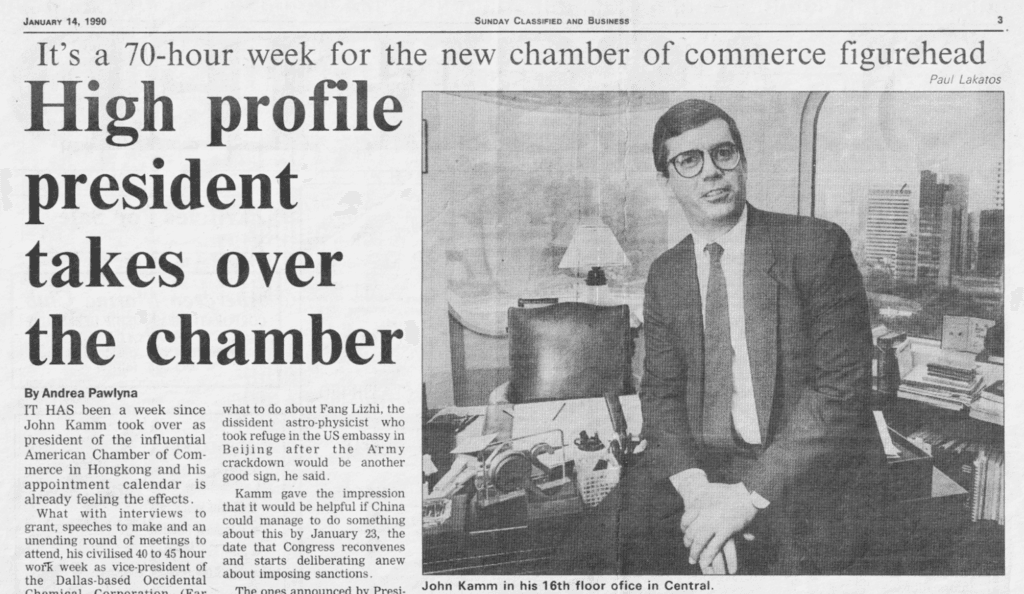
    A news report on Kamm’s ascension to AmCham president, January 14, 1990. Image credit: Dui Hua archive news clipping from South China Morning Post

    One day in March 1990, I was driving to work when I heard on the radio that Senate Majority Leader George Mitchell (D-Maine) and a junior member of the House of Representatives, Congresswoman Nancy Pelosi (D-Ca), would introduce resolutions to strip China of its Most Favored Nation (MFN) trading status. Although few in the colony were concerned that they would succeed in their efforts, I sensed the danger and began making preparations.

    I assembled a “Council of War” and began planning to form a delegation to go to Washington. The team raised more than $100,000. One of the Council members, the local manager of a prominent lobbying firm, offered its services at a discounted rate. Another, the local representative of an American airline, gave us a break on the plane tickets.

    In April 1990, the chamber was advised that a hearing on “Most Favored Nation Status for the People’s Republic of China” would be held in Washington on May 16, 1990. The hearing would be jointly held by three subcommittees of the House of Representatives Committee on Foreign Affairs: Human Rights and International Organizations, chaired by Gus Yatron (D-Pennsylvania), Asian and Pacific Affairs, chaired by Stephen Solarz (D-New York), and International Economic Policy and Trade, chaired by Sam Gejdenson (D-Connecticut). (The House Ways and Means Committee has jurisdiction over trade matters, including granting MFN to foreign countries, but Mr. Solarz decided to move forward regardless.)
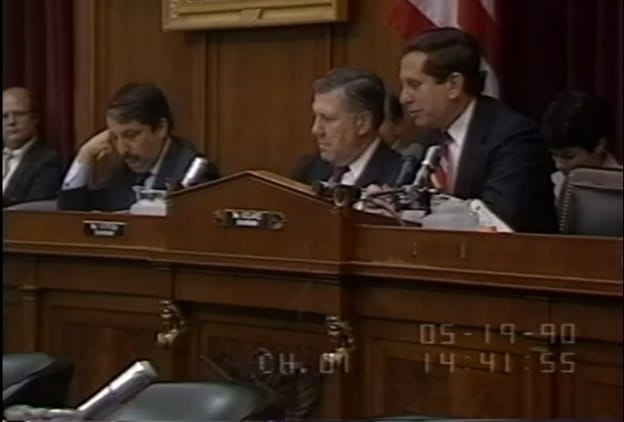
    (Left to right) Representatives Gejdenson, Yatron, and Solarz. Image credit: C-Span

    I was contacted by Richard Bush — then a staff consultant to Mr. Solarz, now a widely recognized expert on US-China-Taiwan relations — and invited to testify at the hearing. Fools rush in where angels fear to tread. I readily accepted Mr. Bush’s invitation, even though I had never testified to Congress. In fact, AmCham had never testified to Congress, either.

    A Novel Strategy

    I hit upon an unusual strategy. Instead of avoiding human rights as businesspeople are inclined to do, I would embrace human rights. To do so, I needed to get evidence that businesspeople could do business and advocate for human rights at the same time.

    In late April 1990, I led a delegation to Qingdao 青岛, in Shandong Province 山东省. I had been negotiating a joint venture with the Qingdao Sodium Silicate Factory and was familiar with the city’s leaders, including deputy party secretary Yu Zhengsheng 俞正声 (who later became a member of the Politburo Standing Committee, China’s highest political body, as well as a chairman of the Chinese People’s Political Consultative Congress).

    While in Qingdao, I met with the local chamber of commerce. I was asked to be its honorary chairman, but I turned down the offer. Qingdao courts had handed down some of the longest sentences to June 4 protesters, including an eighteen-year prison sentence for counterrevolutionary incitement and propaganda for marine biologist and student leader Chen Lantao 陈兰涛. Under the circumstances, I couldn’t associate myself with state organizations in the city. To my surprise, the chamber officials said they understood, and asked me for the names of protesters who had been given long sentences.
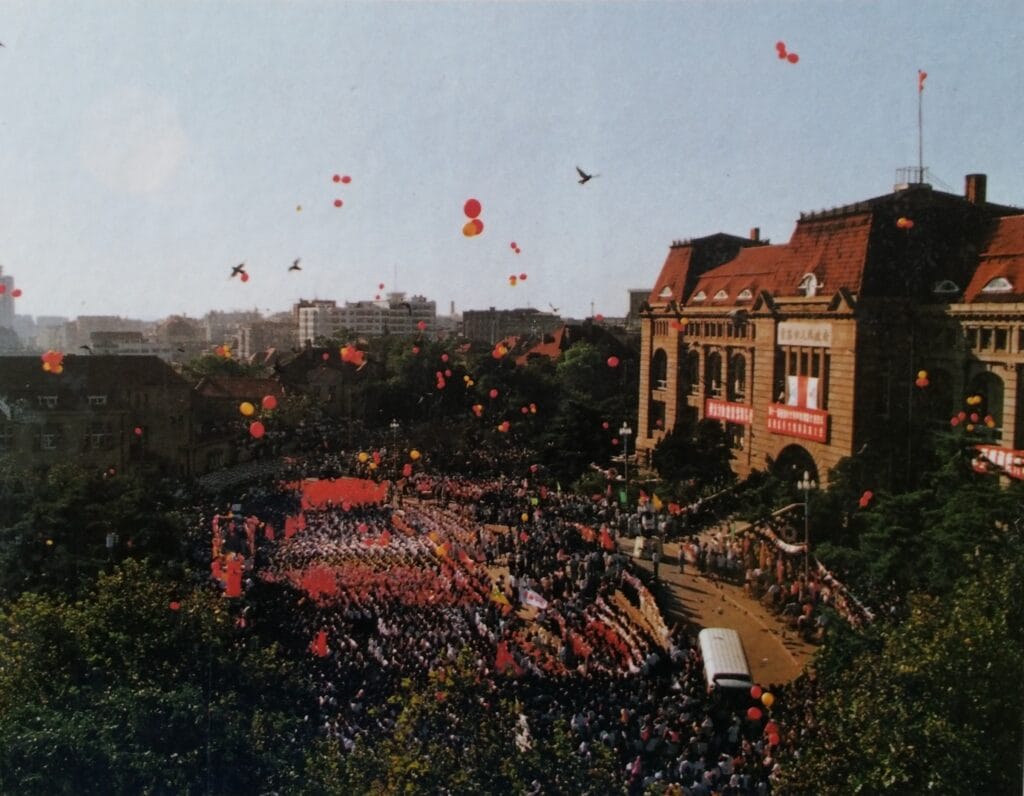
    Former German Governor Office Building in Qingdao. Image credit: 青岛年鉴编辑委员会 (Qingdao Yearbook Editorial Committee)

    Another highlight of my visit to Qingdao was accepting an honorary professorship at Qingdao University. In my acceptance speech at the conferral ceremony, I spoke of the relationship between MFN and human rights. After my remarks, a professor approached me. She knew Chen Lantao’s family and offered to help. (After many interventions, Chen was released in 2000, seven years early.)

    I returned to Hong Kong on April 28. I gave two press conferences on the visit to Qingdao and the MFN state of play, met three times with the MFN War Council to make preparations for the chamber’s delegation to Washington, and met with a Chinese official who would later become an important source of information on political prisoners. I also dined with Hong Kong Governor Murray MacLehose on May 4, 1990, and met separately with Hong Kong’s Financial Secretary Piers Jacobs.

    On May 9, AmCham’s leadership joined me at a banquet hosted by the Director of the Xinhua News Agency, China’s de facto embassy in Hong Kong, Zhou Nan 周南. I interrupted his toast to urge him to help secure the release of Hong Kong student Yao Yongzhan 姚勇战 from detention in Shanghai. Zhou was furious. Many of my AmCham colleagues were outraged — but shortly after I returned to Hong Kong after testifying to Congress, Yao was released.

    The day after the dinner with Zhou Nan, I flew to Seoul on business, and on May 12 I continued my business trip in Tokyo. On Sunday, May 13, I holed up in my room at the Okura Hotel. Fortified by a dinner of sushi and a bottle of sake, I wrote my testimony for the May 16 hearing. I flew to Newark on May 14 and immediately took the train down to Washington, DC, where I checked into the Marriott Hotel.

    On the long flight to Newark, I went over in my mind what questions House members might ask me after I finished my testimony. One in particular haunted me. I called my mother in Florida and asked her this question: what does the Bible tell us about a situation in which a majority of city residents are evil, but a small minority are without sin — should the city be spared? She was quick to reply: in the Book of Genesis, Abraham negotiates with the Lord to spare the lives of a small number of good people in Sodom, even though the overwhelming majority of residents were evil and worthy of death.

    May 15 was full of meetings, many arranged by our lobbyists Hal Furman and Rick Spees. AmCham vice president Jeff Muir accompanied me on my meetings while other AmCham delegates fanned out to meet members of Congress and their staff. Jeff and I met with senior staff of Senators Bradley, Gordon, Lugar, and Simpson. We also huddled with the leadership of the National Council for US-China Trade and the Hong Kong Economic and Trade Office.

    Words of Advice

    One meeting stands out. We met for lunch at the office of leading law firm Jones Day, which had recently brought on board retired Senator Charles “Mac” Mathias (R-Maryland). Mathias gave me good advice on how to behave when testifying: “Whatever is said to you by a member, don’t overreact. Don’t get angry, and make sure to humbly respond. Coming from Hong Kong, you understand the importance of ‘face.’ Never make a member lose face.”

    We arrived early at Rayburn House Office Building and settled into seats behind the front row in Room 2172. The hearing began at 9:40 a.m. The order of the witnesses was former ambassador to China Winston Lord, followed by advocates for Tiananmen Square victims and human rights NGO representatives, followed by US-China relations and trade leaders, and then business community representatives, of whom we were three.
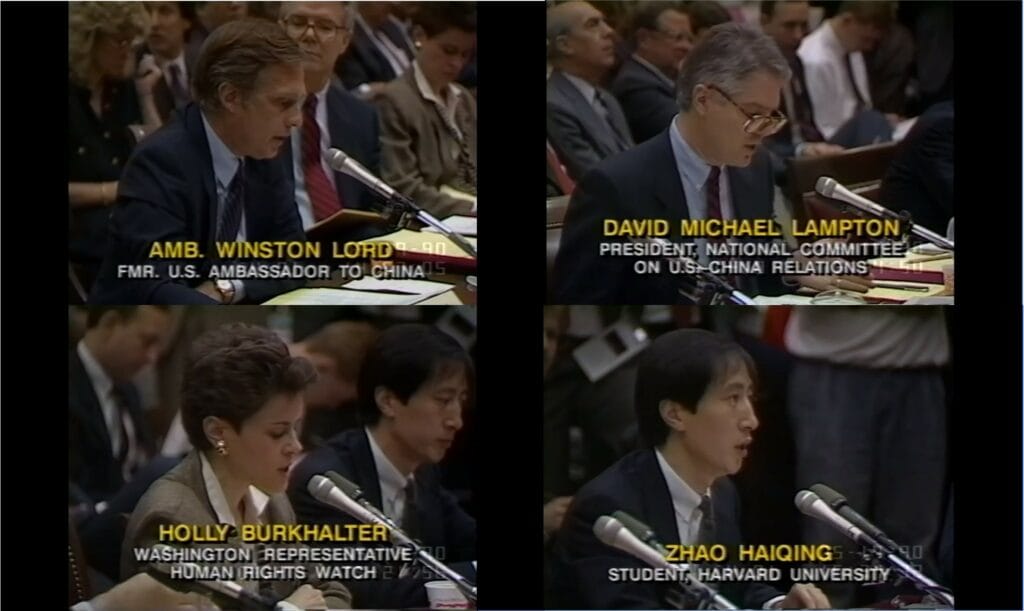
    The first group of witnesses to testify. Image credit: C-Span

    Ambassador Lord, a Chinese student leader, and the Washington head of Human Rights Watch were given pride of place, and they delivered powerful testimonies in favor of sanctioning the Chinese government. David Lampton of the National Committee on US-China Relations and Roger Sullivan of the National Council for US-China Trade represented the establishment view that no sanctions should be imposed on account of China’s rights abuses. Now it was the turn of the businessmen.

    By now, the hearing had dragged on for several hours, and I grew fearful that I would miss my flight to Dallas, headquarters of Occidental Chemical. Most of the members of the subcommittees had departed, including Congresswoman Pelosi, leaving Congressman Solarz and Congressman Chris Smith (R-New Jersey) on the podium. Smith represented a district adjacent to the district on the Jersey shore where I had grown up.

    I took my seat at the witness table and tried my hand at “soaring oratory”: I spoke of the people of Hong Kong and their support for the pro-democracy movement in China. “Who knows better than the people of Hong Kong how bad the situation is? We are on the front lines. There are young Hong Kong people in Chinese jails. I take the opportunity to call once more for China’s leaders to release them to their families in Hong Kong. We, the American Chamber of Commerce in Hong Kong, will continue to speak out and work as hard as we can to realize their freedom.”

    I then made a fateful promise: “Whatever capital we might earn by fighting further sanctions, we will gladly spend in the effort to free all Chinese prisoners of conscience.” In the thirty-three years since I made that promise, I have tried my best to honor it.

    Meeting Nancy Pelosi

    C-SPAN was a fledgling network that broadcast political events, hearings, and votes in Congress. My testimony was beamed into offices all over Capitol Hill. It caused quite a commotion. Congresswoman Pelosi scurried back to the hearing and took her seat, even though she wasn’t a member of any of the subcommittees holding the hearing. She took the microphone and accused me of being dismissive of Chai Ling 柴玲 and other democracy activists.
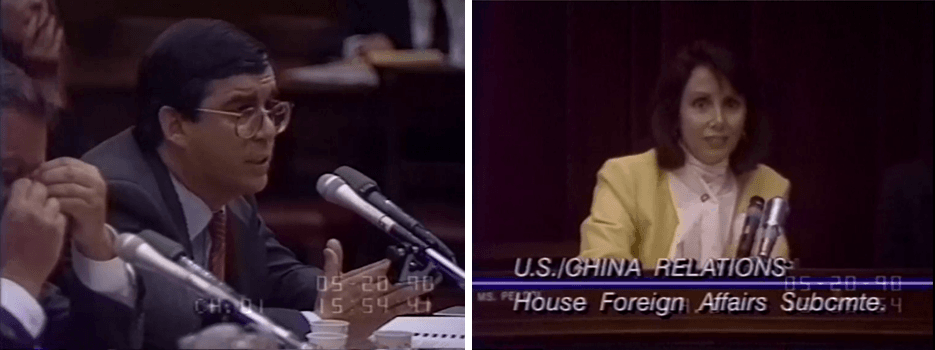
    Representative Pelosi (top right) and Kamm (bottom left) during a spirited exchange. Image credit: C-Span

    I promptly forgot Senator Mathias’s advice and pushed back hard. I denied that my intention was to dismiss Chai Ling, spoke of my respect for her and other leaders of the protests, and went on to remind Mrs. Pelosi that the people of Hong Kong had marched in their millions in support of democracy in China. “All we are saying is, if you knock the underpinnings out from under our economy, we cannot continue to support reform and democratization.” After taking another shot at me, Mrs. Pelosi backed off.

    Chairman Solarz took over. He asked a hypothetical question: if in fact removing China’s MFN would lead to better human rights in China, would I still oppose revoking the trade status for the sake of Hong Kong? “Are you saying Hong Kong uber alles?” he asked to laughter.

    I had prepared for this very question. I brought up Abraham’s negotiating with the Lord to spare the wicked for the sake of the righteous.
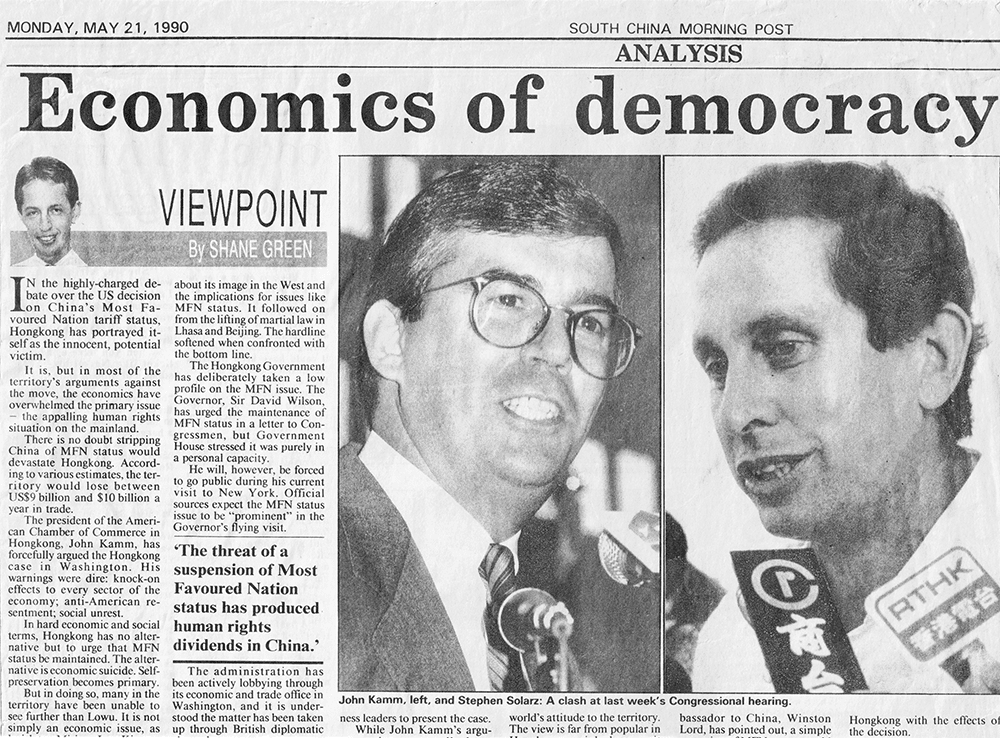
    A news report on the Congressional hearing, May 21, 1990. Image credit: Dui Hua archive news clippings from South China Morning Post

    The hearing ended at 3:22 p.m. Fortunately, Jeff Muir had left the hearing earlier and returned to the hotel, where he picked up our luggage and hired a cab to pick me up outside Rayburn. The driver knew the back roads to National Airport. I arrived in time for my flight. I needn’t have worried about Occidental’s reaction to my testimony: Chairman Armand Hammer fancied himself a friend of China, and I was told he loved my testimony.

    “A Hero in Hong Kong”

    I returned to Hong Kong where my work was applauded. Media coverage was heavy, with the front page of USA Today hailing me as “A Hero in Hong Kong.” I became known as Mr. MFN. Most importantly, I was told by Zhou Nan’s assistant that Yao Yongzhan would be released. I was elated but not convinced that this success was anything other than a fluke.

    I cohosted Chinese Premier Zhu Rongji 朱镕基 on his visit to Hong Kong in June 1990. He let it be known that he had personally ordered the release of Yao Yongzhan. He had heard of what I had done at the Zhou Nan banquet and didn’t want to be upbraided by me in front of hundreds of people. It was a pleasant lunch. Zhu returned the favor by telling Newsweek that China didn’t care whether the country retained MFN or not. He claimed that only AmCham cared!
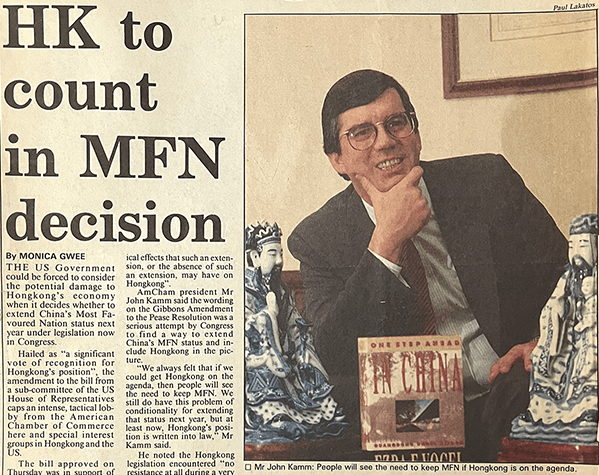
    A news report “HK to count in MFN decision,” July 15, 1990. Image credit: Dui Hua archive news clippings from South China Morning Post

    In early June 1990, President George H. W. Bush renewed China’s MFN for another year. In his extension statement, he mentioned testimony that Hong Kong would suffer if China’s trade status were revoked. It marked the first time in American history that Hong Kong had factored into an important foreign policy decision by the American government.


    Listen to the Encounters with China podcast.

    Subscribe to receive notifications about new episodes. 

    Read all John Kamm Remembers stories.

  • Half the Sky

    Half the Sky

    << Read all John Kamm Remembers stories

    Download & read this story as a PDF

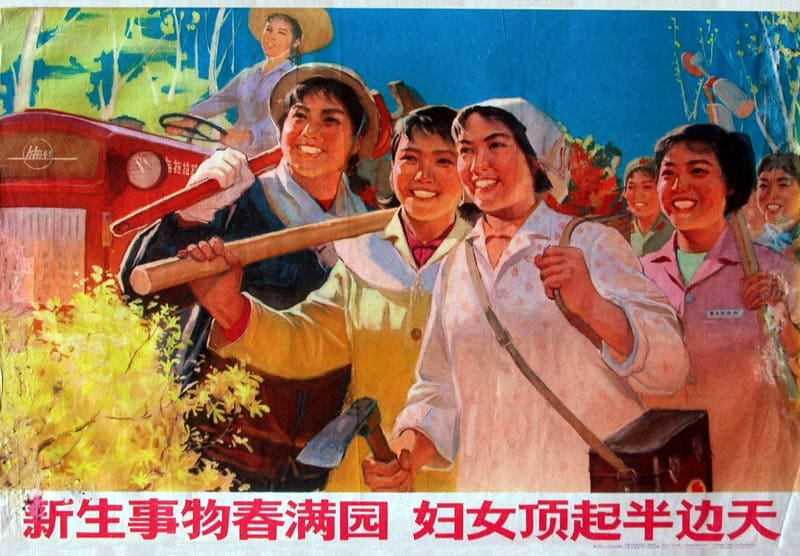
    A Chinese poster from the 1970s with Mao Zedong’s slogan “Women hold up half the sky” at the bottom.

    In March 2006, the United Nations Human Rights Council (HRC) was established, replacing the much-criticized Human Rights Commission. One of the principal tasks of the HRC is to oversee the process known as Universal Periodic Review (UPR). Every four to five years, the human rights records of United Nations member states are examined with respect to their compliance with international human rights norms.

    China’s first UPR was held in Geneva in 2009, followed by its second UPR in 2013 and its third UPR in 2018. China’s next UPR will take place in early 2024. The Dui Hua Foundation (Dui Hua), which is in Special Consultative Status with the Economic and Social Council of the United Nations (ECOSOC), has attended all of China’s UPRs, and has made submissions at each one. It will make a submission to China’s January 2024 UPR in July 2023. It intends attending China’s fourth UPR.

    One of the subjects examined at UPRs is whether the reporting state has issued invitations to special procedures (special rapporteurs and treaty bodies) to the reporting state. There are currently 59 special procedures.

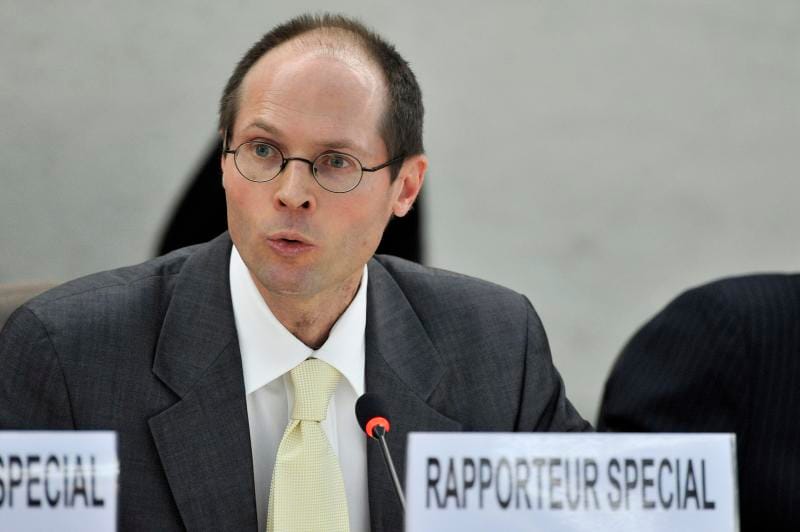
    After China’s first UPR, it invited the Special Rapporteur on the Right to Food, Mr. Olivier de Schutter, to visit the country at the end of 2010, no doubt thinking that this would be a relatively benign and risk-free visit. Beijing is very sensitive to any criticism of its human rights record by international bodies, especially HRC and its special rapporteurs and treaty bodies.

    Upon his return to Geneva from his mid-December 2010 visit, Mr. de Schutter made a report. While noting the advances made by China, the report also referenced “specific challenges” that needed to be addressed, including agricultural sustainability and food insecurity in poor and rural areas, food safety, and land degradation and pollution. An entire section was devoted to criticizing China’s policies targeting nomadic herders in Tibet and other minority areas. Beijing was not happy, and no more invitations to special procedures were issued in 2011 and 2012.

    Olivier de Schutter, Special Rapporteur on the Right to Food addresses during the 16th Session of the Council of Human Rights in 2011. Image credit: Jean-Marc Ferre, UN photo / CC BY-NC-ND 2.0

    As China approached its third UPR to take place in October 2013, its Ministry of Foreign Affairs considered whether or not to invite a special procedure to visit the country. I was asked for my advice. I was inclined to recommend the Working Group on the Issue of Discrimination Against Women in Law and Practice (WGIDAWLP) but first I needed to ascertain whether the working group was interested in making a formal visit.

    I asked friends in Geneva and was told that the group had only been established in 2010 and as such it was the “new kid on the block.” Many other special procedures were waiting for invitations. I decided to ask the working group anyway and was pleasantly surprised to learn that it was interested to visit China. I made a suggestion to the MFA that the group be invited.

    I arrived in Geneva from Oslo on Sunday October 20, 2013, and checked into my usual haunt, the Hotel Ambassador. I had dinner at a nearby Chinese restaurant and settled in for the night. In addition to attending China’s UPR, where I was informed that the Ministry of Foreign Affairs had accepted my suggestion to invite the working group, I met with American and Chinese diplomats, UN officials, the Working Group on Arbitrary Detention, the Special Rapporteur on Freedom of Assembly, and the president of the International Committee of the Red Cross, Peter Maurer.

    At my meeting with the WGIDAWLP on October 24, I was thanked for my work lobbying the Chinese government to issue the invitation – the visit took place two months later in December 2013 – and discussed their and UNOHCHR’s possible attendance at Dui Hua’s international symposium on Women in Prison (the Bangkok Rules), set to take place in Hong Kong in February 2014.

    Women in Prison

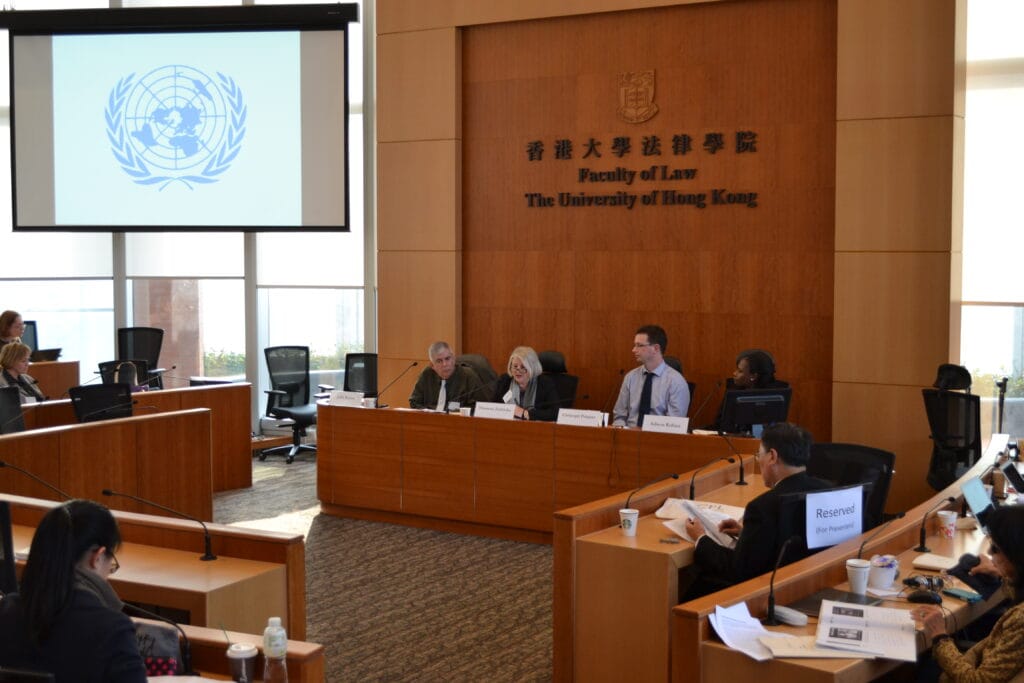
    The symposium took place as planned. Dui Hua partnered with the University of Hong Kong and China’s Renmin University. A member of the WGIDAWLP, Elenora Zielinska, attended and presented a paper on the group’s 2010 visit to China. The OHCHR sent a representative, Adwoa Kufuor, to make a presentation on the treatment of women prisoners under international human rights law.

    The Women in Prison symposium on February 25, 2014. Seated in front (left to right) Kamm, lawyer Eleonora Zielińska, Christoph Polajner of the International Committee of the Red Cross, and OHCHR representative Adwoa Kufuor. Image credit: The Dui Hua Foundation

    China sent the largest delegation to the symposium; it included scholars from the Supreme People’s Court and several research institutes and law schools who presented papers on domestic violence, women law enforcement officers, and treatment of female juvenile offenders in Beijing, and, separately, treatment of female prisoners in Hong Kong. (Hong Kong has one of the highest percentages of women prisoners of any country or territory in the world). Findings of a survey of five places of detention for women in China, commissioned by Dui Hua and conducted by scholars at Renmin University led by Professor Cheng Lei, were presented.

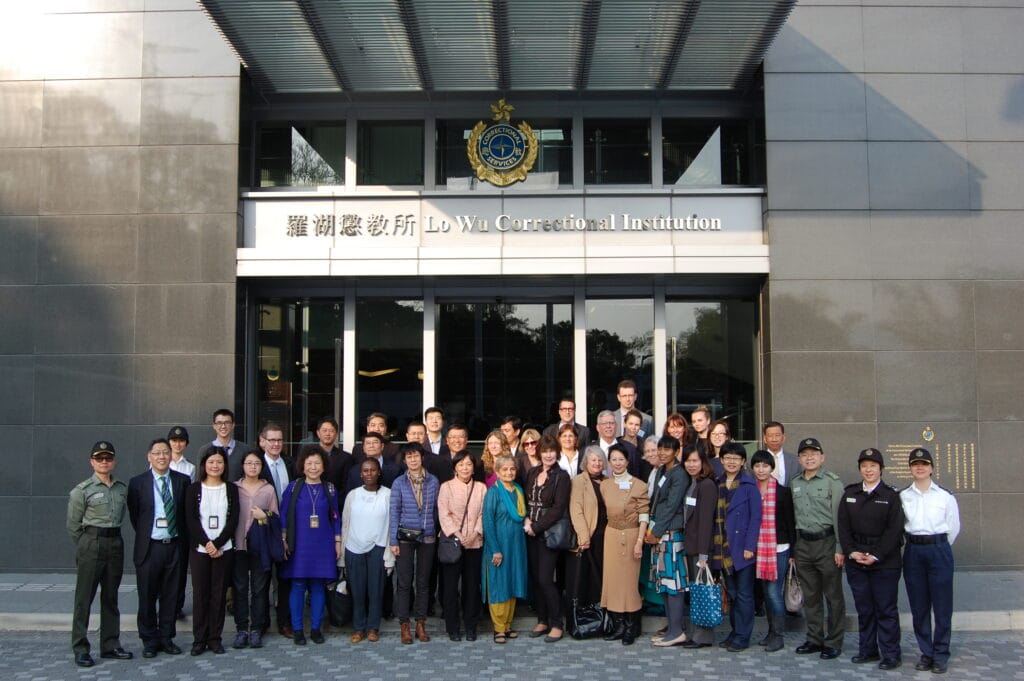
    The symposium’s delegates visited Hong Kong’s largest women’s prison and held discussions with the territory’s authorities in charge of women prisoners. Most important, the symposium, attended by one of the judges tasked with reviewing death penalty decisions, contributed to the overturning of a death sentence for a victim of domestic abuse who murdered her husband.

    The US and Chinese delegations after their visit to Lo Wu Correctional Institution in 2014. Image credit: The Dui Hua Foundation

    On a follow-up visit to Beijing, I was advised by a senior official of China’s National People’s Congress that the legislative body would consider where the Bangkok Rules could be incorporated into Chinese legislation.

    Girls in Conflict with the Law

    The International Symposium on Women in Prison set the table for the International Symposium on Girls in Conflict with the Law. Unlike the women in prison symposium, which was held in person, the girls in conflict with the law (GCIL) symposium was held virtually due to the Covid-19 pandemic. From October 2020 to March 2021, 12 webinars featured experts from 18 countries discussed topics related to the treatment of girls in the justice systems of countries on five continents.

    The banner for the International Symposium on Girls in Conflict with the Law. Image credit: The Dui Hua Foundation

    The final topic was a presentation by China’s Supreme People’s Court – “Special and Priority Protection of the Legitimate Rights and Interests of Underage Girls in Accordance with the Law,” featuring Dui Hua’s long-time partner Judge Jiang Jihai and his colleagues.

    There is no contradiction between Dui Hua’s work on women prisoners and girls in conflict with the law, on the one hand, and our work on political and religious prisoners on the other. From the earliest days of my advocacy to the present, I have worked on numerous cases of women and girls who have been detained and imprisoned, including Ngawang Sangdrol and the Drapchi nuns, Liang Shaolin and dozens of other women subjected to coercive measures for practicing unorthodox religions, American citizen Sandy Phan-Gillis, and Rebiya Kadeer and other Uyghur women. To Dui Hua, Mao Zedong’s claim that “Women hold up half the sky” is more than a slogan. It is a core belief at the center of our work.


    Listen to the Encounters with China podcast.

    Subscribe to receive notifications about new episodes. 

    Read all John Kamm Remembers stories.

  • Black Hands

    << Read all John Kamm Remembers stories

    Download & read this story as a PDF. 

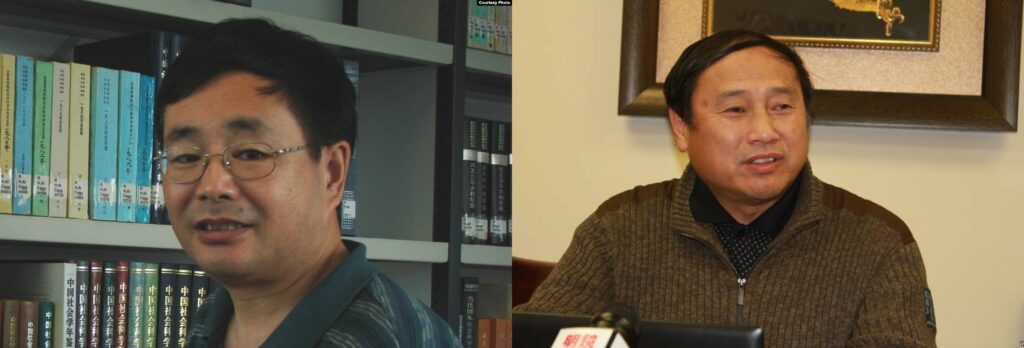
    (Left to right) Chen Ziming and Wang Juntao. Image credits: Public Domain

    It didn’t take long for the Chinese government to blame foreign and domestic forces for the May-June 1989 protests that rocked Beijing and hundreds of other cities, large and small, throughout the country. The targets of their ire included the United States and other western democracies, which maintained embassies and media offices, in China’s capital. Another target was The Hong Kong Alliance in Support of Patriotic Democratic Movements in China, established in May 1989, which organized huge protests and vigils in the British colony. The alliance was disbanded in late 2021 following the arrest of three of its leaders, part of the ongoing crackdown on opposition figures in the Hong Kong Special Administrative Region.

    Less organized than the Alliance were groups of activists who set up Operation Yellow Bird to spirit activists out of China. Working out of Hong Kong, this loosely organized group managed to extricate as many as 300 hunted dissidents and activists out of China, sometimes with the help of disgruntled Chinese officials.

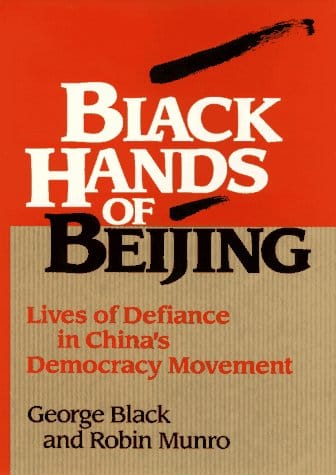
    A cover of the first edition of Black Hands in Beijing, published in 1993. Image credit: Biblio

    Closer to home, the Public Security Ministry identified 21 student leaders allegedly behind the protests in Tiananmen Square. The list included Wang Dan, Wu’er Kaixi, Chai Ling, and Liu Gang. “Black Hands” were singled out in the “Six Important Criminals List.” Prominent on this list were Chen Ziming (陈子明) and Wang Juntao (王军涛), founders of the Beijing Economic and Social Sciences Research Institute (SESRI), an influential think tank established in 1987 that published books, undertook public polling, and even fielded candidates in local elections. Another black hand was labor leader Han Dongfang (韩东方), founder of the Beijing Autonomous Workers Federation. (A good account of Chen Ziming, Han Dongfang, and Wang Juntao’s activities in the run-up to Tiananmen can be found in Black Hands of Beijing by Robin Munro and George Black. My memories are also informed by communications with Wang Juntao.)

    Chen and Wang were hunted down and arrested, Chen on October 10, 1989, in Mongolia, and Wang on October 20, 1989, at the Changsha Train Station in Hunan Province. Liu Gang (刘刚), founder of the Beijing Independent Students Federation, was detained weeks after the protests, on June 19, 1989. Han Dongfang was never tried but was kept in a detention center where he contracted tuberculosis. The prosecution chose not to charge him and eventually let him leave for Hong Kong, where he still lives.

    After detention, Chen Ziming and Wang Juntao were held in local detention centers where they were interrogated. They then spent several months in the notorious Qincheng Prison where political prisoners were held.

    Chen, Liu, and Wang were all tried and convicted by the Beijing Intermediate People’s Court in 1991. Chen and Wang were given 13-year prison sentences. They were sent back to Qincheng Prison, and eventually sent to Beijing Number Two Prison and Beijing’s Yanching Prison to serve their sentences.

    Liu served his prison sentence in Lingyuan Prison in Liaoning Province. It is common practice that individuals who are tried and sentenced in Beijing are returned to their home provinces to serve their sentences.

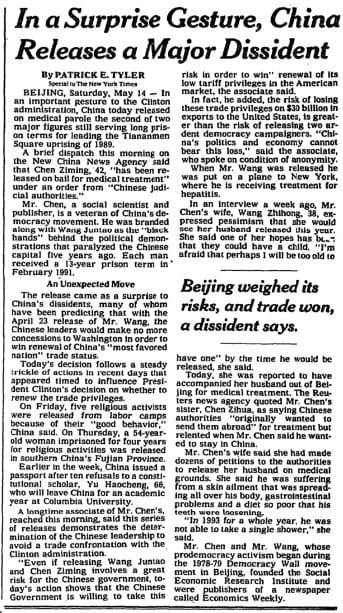
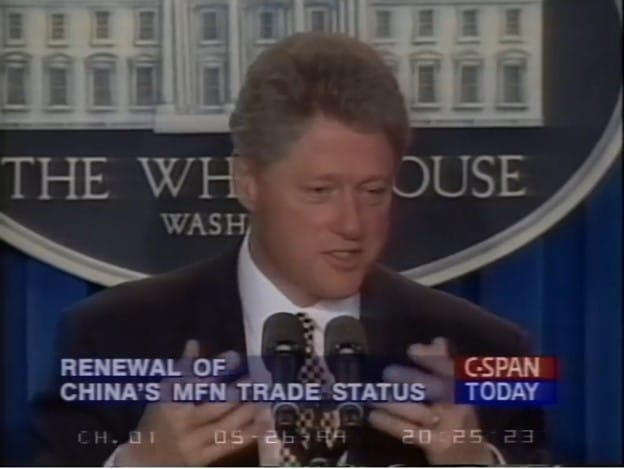
    Reflecting intense international pressure from governments and human rights groups, including Dui Hua, both Wang and Chen were released on medical parole in April 1994 and May 1994, respectively. The releases were tied to President Bill Clinton’s decision to renew China’s Most Favored Relations trade status, without conditions, in May 1994. (Chinese officials repeatedly told me the releases were part of a “special arrangement.”)

    President Clinton during his announcement on May 26, 1994, to support Most Favored Nation status for China despite no significant progress on human rights. Clinton also announced extended sanctions on China and the banning of munitions sales. Image credit: C-Span

    Chen Ziming had been diagnosed with cancer, heart disease, and Hepatitis C while Wang had been diagnosed with Hepatitis B. Wang Juntao left China immediately after he was released and relocated to New York, where he has lived to the present day, distinguishing himself in both academics and activism. Neither he nor his family were provided with the documentation necessary for granting medical parole.

    Chen opted to stay in China. He was imprisoned again in June 1995 but was again released on medical parole in November 1996. He was placed under residential surveillance until his sentence expired in 2002. Chen Ziming passed away in 2014.

    Liu served his entire sentence without a sentence reduction. He was released on June 18, 1995. He departed in May 1996 for the United States. He forged a successful business career in technology and finance, working for Bell Labs and Morgan Stanley. Like Wang Juntao, he has remained active in promoting democracy in China.

    As recounted in “Operation Yellow Bird,” Hong Kong businessman Lo Hoi-sing (Luo Haixing) was sentenced to five years in prison for trying to get Chen Ziming and Wang Juntao out of China. He was granted early release from Huaiji Prison in western Guangdong Province in 1991, after which he returned to Hong Kong.

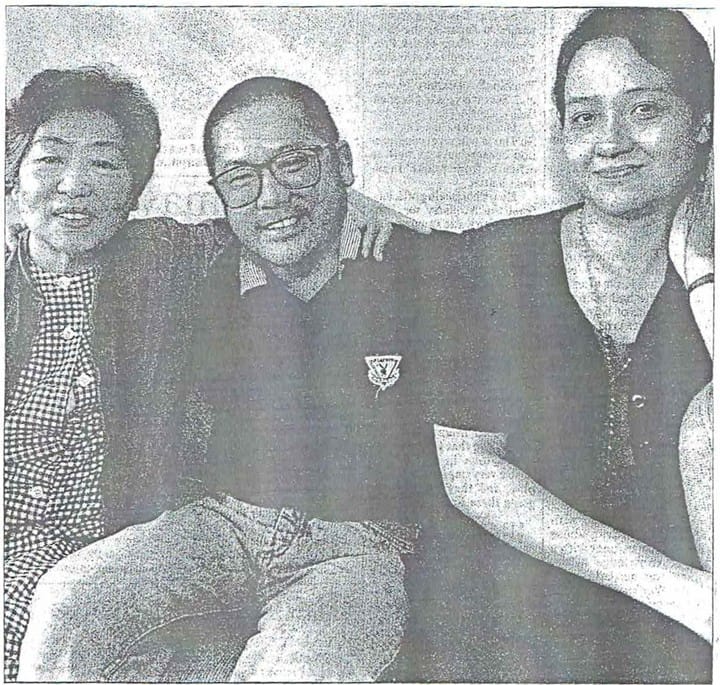
    A scan of a photo that appeared in the South China Morning Post after Lo’s release. Lo (center) with his mother and wife (left and right, respectively). Image credit: South China Morning Post via Dui Hua archives

    My work on these cases established a modus operandi that I have relied on for prisoner interventions to the present day. I submitted prisoner lists to the Chinese government and pressed Chinese officials for responses, met with family members of the imprisoned, informed the US government of my activities and coordinated efforts with the American embassy in Beijing, obtained letters from members of Congress that were forwarded to the Chinese government, held press conferences (including in Beijing), and gave speeches, many in Hong Kong.

    Although governments met with the Ministry of Foreign Affairs (MFA) to press for clemency for political prisoners, what set my work apart was my ability to meet with other key bodies, including the State Council Information Office, the Ministry of Public Security, the Ministry of Justice (MOJ), and the People’s Institute of Foreign Affairs, as well as the MFA. I met with officials of all these bodies to discuss the Chen Ziming/Wang Juntao case.

    Photographs

    On my May 1992 visit to Beijing, I met with Minister Zeng Jianhui of the State Council Information Office (SCIO). We met in his rather rundown office in the Asian Games Village. Zeng handed me three photographs of Wang Juntao and two of Chen Ziming. Wang was shown watching a performance at Yanqing while Chen was photographed in his cell, books stacked high on his bunk bed. Yanqing is near a hospital operated by the MOJ. Zeng told me that Wang was being treated for Hepatitis there but had been returned to his cell. Both Wang and Chen were in four-man cells that were not, at the time of my meeting with Zeng, fully occupied.

    I provided the photographs to the media in Beijing. Hong Kong’s South China Morning Post ran the pictures the next day.

    The photos of Chen and Wang published in the South China Morning Post on May 7, 1992. The caption acknowledges Kamm as the source.

    Not everyone was happy with my releasing the photographs of Chen Ziming and Wang Juntao. At a congressional hearing held on June 29, 1992, Human Rights Watch (HRW) Washington representative, Mike Jendrzejczyk attacked me for releasing photographs of Liu Gang playing volleyball. HRW had claimed that Liu had had his arm broken. In fact, I hadn’t been given any photographs of Liu, which I pointed out to the congressman running the hearing. Jendrzejczyk’s response was classic: while Kamm may not have released the photos, he could have!

    Around the same time, another HRW staff person attacked me in a letter to the Los Angeles Times, implying I was being used by the Chinese government to spread disinformation. In a similar vein, Harry Wu told the San Francisco Chronicle that he had warned me against being used by the Chinese government (in fact, he hadn’t). I ignored these and other attacks on me and my work. As the old saying goes, “Living well is the best revenge.”

    Interrogation

    On my August 1992 visit to Beijing, I met with Assistant Minister of Public Security Zhu Entao at his headquarters near Tiananmen Square. (Zhu’s nickname was China’s 007). He gave details of the interrogation of Hou Xiaotian, Wang Juntao’s wife at the time. The interrogation lasted four days. “At first she was very uncooperative,” Zhu related, “but her attitude changed as time went on, so we released her. We promised to look into her complaints about her husband’s treatment.” After her release from public security detention, the police kept her under surveillance.

    On August 25, 1992, I was hosted by Zhou Jue, Vice Minister of the SCIO and former Chinese Ambassador to France, to dinner. Zhou told me that Wang Juntao had staged a hunger strike but that he was now eating normally. A photograph of Wang Juntao eating with his relatives the night after his release was circulated by Beijing.

    The following evening, August 26, 1992, I hosted a banquet for most of the senior officials I worked with on prisoners including Yang Jiechi (MFA), Zhou Jue (SCIO), Zhu Entao (PSM), and Li Yucheng (SPC). In light of the looming US presidential election, I stressed the importance of releasing Wang Juntao and Chen Ziming and other high-priority prisoners.

    An article from the Washington Post published on May 6, 1992. Image credit: Washington Post archives / Fair Use

    “Special Privileges”

    On my March 1993 visit to Beijing, I met with Mr. Wang Mingdi, director of the MOJ’s Prison Administration Department, at the MOJ’s dilapidated office building on a dusty side road off the main highway to the old airport. (Across from the office gate, a pool table occupied the street. Players were muscular young men wearing police fatigues.) Wang told me that Chen Ziming had been granted “special privileges” so that he could study for his doctorate. Wang Mingdi listed them as “better lighting, more paper, more books.” I relayed Chen’s family’s concern that he was sharing his cell with common criminals and that he was not being treated for a skin disorder.

    Reporting on the releases of Chen and Wang from The New York Times article published on May 14, 1994. Image credit: The New York Times archive / Fair use

    Clinton, Wang, Chen

    In my meeting with Wang Mingdi on my June 1994 trip, shortly after Chen and Wang had been released, he spoke sarcastically about Wang Juntao’s activities in the United States: “When he was in jail, you kept telling us how seriously ill he was. We spent lots of money — more than RMBl00,000 — on medical treatment for Wang Juntao. He wouldn’t have been able to travel to the United States in such good shape had we not treated him so well. But now I read that he is undertaking all kinds of strenuous activities — traveling here and there for speeches and meetings. I’m tempted to ask you Americans: if Wang Juntao’s medical situation is so serious, aren’t you afraid you’ll endanger his health by arranging so many programs for him?” Wang Mingdi did not characterize Wang Juntao’s activities as illegal or as representing violations of the terms of his parole.

    On the same trip I met with Ambassador Zhang Wenpu, Vice President of the People’s Institute of Foreign Affairs, a top America watcher who played a key role in what he called the “Wang Juntao/Chen Ziming deal for MFN.”

    An agitated Zhang Wenpu had this to say: “I and many other Chinese officials find it abhorrent for China to trade prisoner releases for concessions from foreign powers.” He went on: “We released two of the five names on the State Department’s final list. Do people in the West appreciate that President Clinton raised both Wang Juntao and Chen Ziming’s names during his meeting with President Jiang Zemin in Seattle, and that subsequent to their names being raised, both were released? Is the significance of this understood? I have been in the Chinese government for my entire working career, and I think this is quite extraordinary.”

    A year after my June 1994 trip to Beijing, I moved with my family to San Francisco, where I have stayed to the present day. With close friends, I established Dui Hua in 1999. The foundation continues to intervene on behalf of political and religious prisoners in China, using the modus operandi established during the work on the Wang Juntao and Chen Ziming cases in the early 1990s.


    Listen to the Encounters with China podcast.

    Subscribe to receive notifications about new episodes. 

    Read all John Kamm Remembers stories.

  • Operation Yellow Bird

    Operation Yellow Bird

    << Read all John Kamm Remembers stories

    Download & read this story as a PDF. 

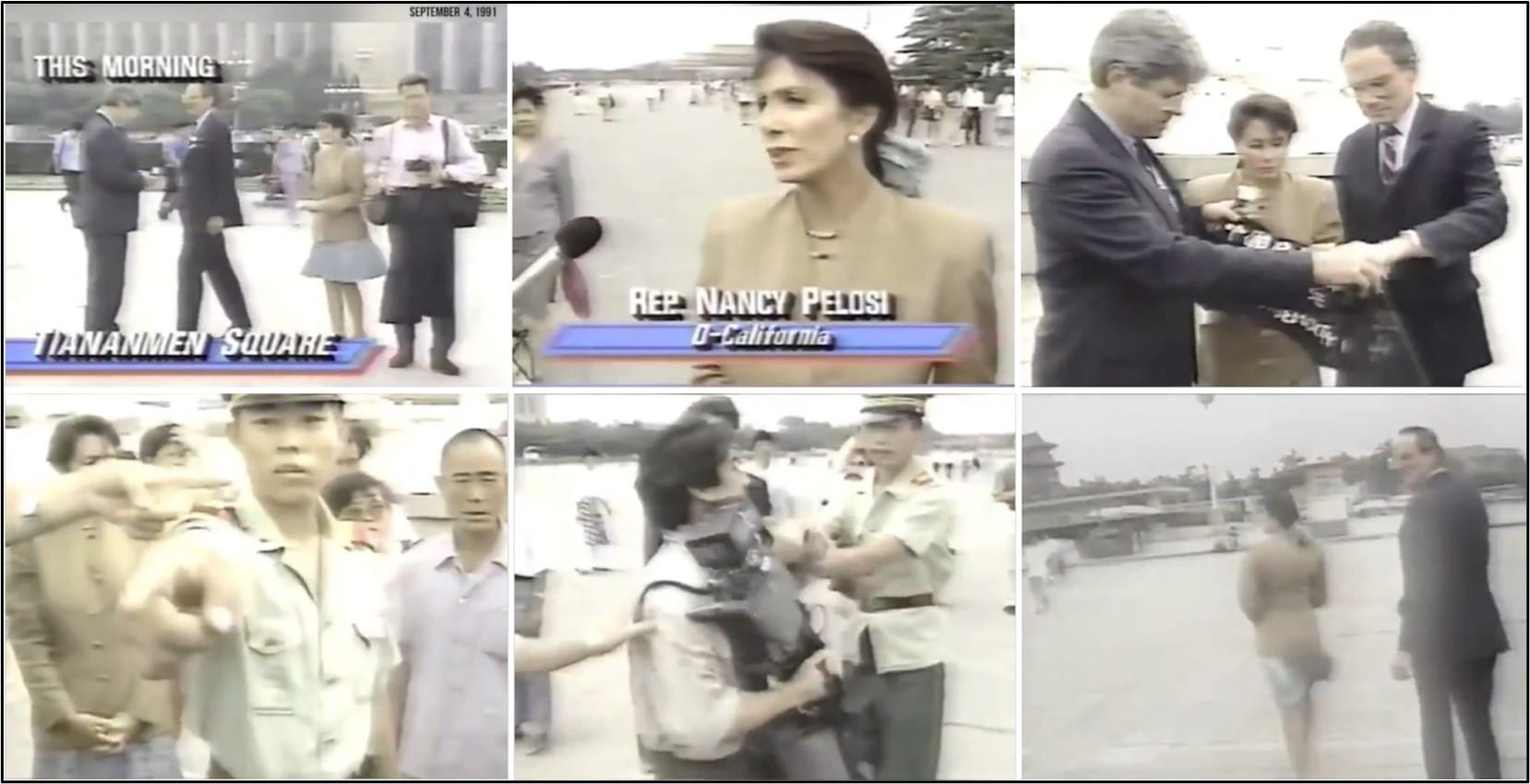
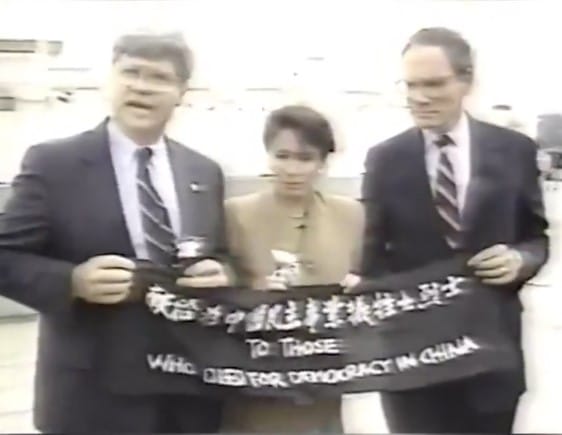
    Images from a video of Representatives Jones, Miller, and Pelosi in Tiananmen Square in 1991. Image credit: Nancy Pelosi Facebook account

    Speaker of the House Nancy Pelosi’s trip to Taiwan in early August 2022 was praised and criticized in equal measure. It resulted in massive Chinese military drills as well as a surge in foreign delegations to the island. China’s President Xi Jinping asked US President Joe Biden to intervene to stop Pelosi, but Mr. Biden declined to do so. The Biden administration did, however, take steps to discourage the speaker from making the trip.

    After Speaker Pelosi’s visit, China canceled or suspended cooperation with the United States on a range of issues, including military talks, climate change, and law enforcement, notably involving narcotics.

    Her Taiwan visit was not Mrs. Pelosi’s first foray to Greater China to promote democracy and human rights.

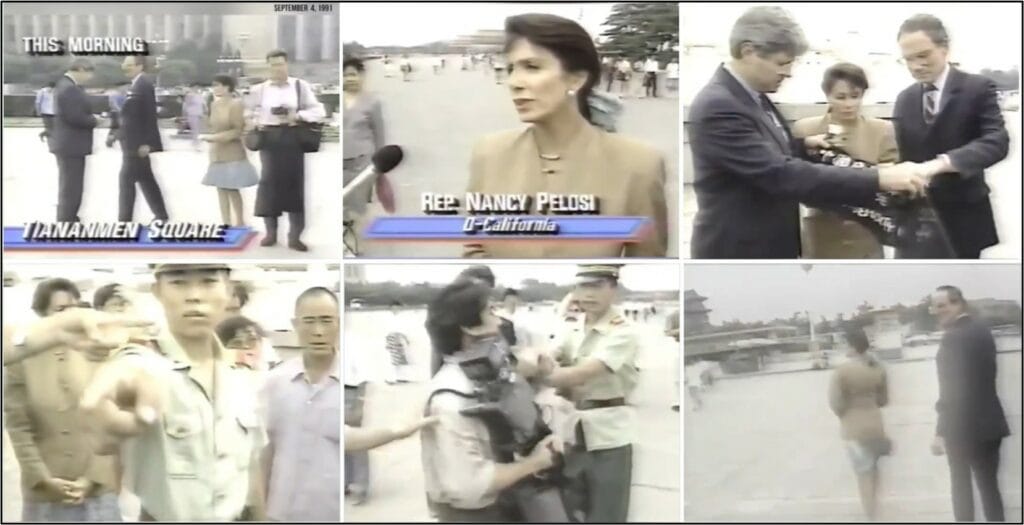
    In September 1991, Pelosi and two other members of Congress, Ben Jones and John Miller, traveled to Beijing accompanied by staff and representatives of NGOs, including the AFL-CIO. While there, they slipped out of their hotel, unbeknownst to their host, and went to Tiananmen Square where they unfurled a banner that read “To Those who Died for Democracy in China.” The police quickly moved in, and Pelosi tried to run away in high heels. The Representatives were questioned and let go.

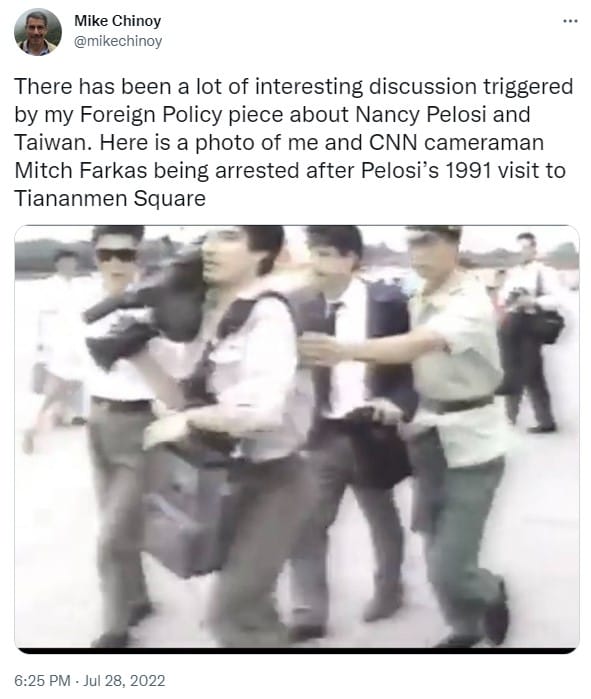
    “It was my first experience with Pelosi’s penchant for high-profile gestures designed to poke China’s communist rulers in the eye – regardless of the consequences” wrote Mike Chinoy, CNN’s bureau chief in Beijing. Chinoy, who had not been forewarned of Mrs. Pelosi’s plans, and his cameraman were roughed up by the police and placed under arrest. Journalists from two other networks, ABC and CBC, were similarly treated. Officials at Pelosi’s host organization were punished. American ambassador Stapleton Roy was furious and confronted Pelosi in the lobby of the hotel. Congresswoman Pelosi did not care about any of this. Her mission had been accomplished; her profile had been lifted.

    Screenshot of Mike Chinoy’s post on Twitter with an image of the arrest after unfurling the banner. Image credit: Mike Chinoy Twitter account

    In fact, I am grateful to Congresswoman Pelosi for what she did in Tiananmen Square that day in September 1991. Though she has no idea why I’m grateful, in fact her protest led directly to some of my early successes, including the release of Hong Kong Trade Development Council representative Lo Hoi-sing, son of a senior journalist at a Hong Kong left-wing paper.

    Operation Yellow Bird

    In the aftermath of the killings in Chinese cities in June 1989, loosely coordinated efforts began to spirit protesters out of China to safe havens outside of the mainland, notably Hong Kong, then a British crown colony. These efforts involved more than 40 people, some of whom were members of triads, others of whom were local Chinese officials. The efforts were dubbed “Operation Yellow Bird 黄雀行动,” and they led to the saving of more than 130 of China’s leading dissident students and intellectuals, including Wu’er Kaixi, Yan Jiaqi, and Su Xiaokang.

    These efforts were risky, and some operatives were caught and punished. Lo Hoi-sing (pinyin: Luo Haixing, simple: 罗海星, traditional: 羅海星), a Hong Kong businessman, was detained on October 14, 1989, and formally arrested on December 18 the same year. He was tried with two “co-conspirators,” Hong Kong residents surnamed Li Peicheng (黎沛成) and Li Longqing (李龙庆), on March 4, 1991. After Lo was released, he told me that he didn’t know either Li; he had met them for the first time at trial.

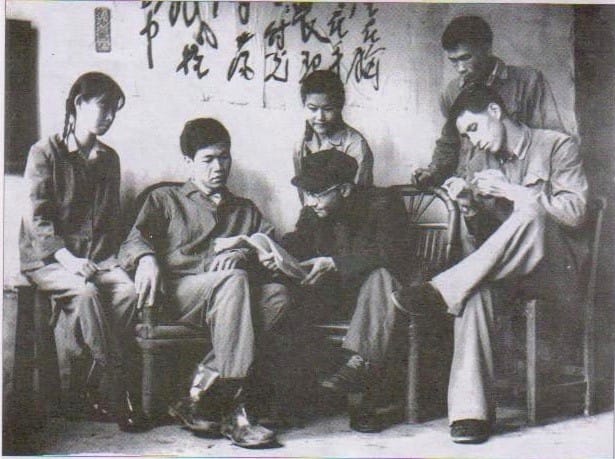
    For the crimes of harboring criminals and belonging to a counterrevolutionary group, Lo was sentenced to five years in prison, with three years deprivation of political rights (DPR). Lo was accused of trying to help Chen Ziming and Wang Juntao escape China. He was shipped off to Huaiji Prison in western Guangdong Province. He occupied a cell next to that of Wang Xizhe of “Li Yi Zhe” fame. Li Yi Zhe referred to a group of Guangzhou dissidents who put up posters calling for democracy in the mid-1970s.

    Members of the Liyizhe group. Image credit: Duping.net via MLCL Resource Center at Ohio State University

    Shortly after Lo Hoi-sing’s trial, his wife, Zhou Mimi (Chow Mat-mat), came to see me at my office in Hopewell Center, a high-rise office building in Hong Kong’s Wanchai District. Ms. Zhou, an author of children’s books, asked me to try to secure her husband’s release. I agreed and began putting Lo’s name on prisoner lists submitted to the Chinese government.

    Flight to Beijing

    On June 10, 1991, I flew to Beijing for a two-day visit. I was determined to seek clemency for Lo Hoi-sing and the Li Brothers (Li Lin and Li Zhi), two young Hunan labor activists who had escaped China after June 4, but who had returned to Hunan where they were detained. On June 11, at 2:00 PM, I met Supreme People’s Court Vice President Lin Zhen and State Council Deputy Secretary General He Chunlin. I had met He a few weeks earlier in Hong Kong. At that meeting I raised the cases of Lo Hoi-sing and the Li Brothers.

    I asked Vice President Lin if Lo Hoi-sing could be considered for early release. His response was hopeful: Lo could be considered for early release under certain conditions. I then asked, in English, about Li Peicheng and Li Longing. Vice President Lin misunderstood me and thought I was referring to the Li Brothers. “In accordance with policy, if they have not committed new crimes after returning to China, they will be released from detention,” the vice president intoned. The next month, the Li Brothers arrived in Hong Kong. They were granted political asylum in the United States. It was my first major success.

    North-South Strategy

    I returned to Beijing in August 1991. By then, I had garnered a great deal of positive media attention that resulted from my AmCham initiatives, my three congressional testimonies, and the release of the Li Brothers. I had been awarded “Communicator of the Year” by the International Association of Business Communicators. I was considered a media “guru.”

    A screenshot of the video of Representatives Jones, Miller, and Pelosi unfurling the banner saying “To Those Who Died for Democracy in China” in Tiananmen Square in 1991. Image credit: Nancy Pelosi Facebook account

    In my meetings with Chinese officials, I made a bold prediction. It was already known that Nancy Pelosi would visit Beijing. I predicted that she would do something “that would make the Chinese government unhappy.” Following the principle that the best way to counter bad news is to release good news, I suggested a “North-South Strategy.” To counter bad news in the north, release good news in the south.” I recommended that Hong Kong resident Lo Hoi-sing be released from prison on medical parole and sent back to Hong Kong with as much fanfare as possible. My interlocutors paid attention and took careful notes.

    When Nancy Pelosi unfurled her banner on September 4, 1991, the Chinese government acted quickly. A call was made to the Guangdong government which ordered the immediate release of Lo Hoi-sing. A car was sent to Huaiji Prison from Guangzhou to pick up Lo, but the officers forgot to take Lo’s travel documents with them. The car returned to Huaji before going back to Guangzhou, but Lo Hoi-sing’s release had to be delayed.

    A scan of a photo that appeared in the South China Morning Post after Lo’s release. Lo (center) with his mother and wife (left and right, respectively). Image credit: South China Morning Post via Dui Hua archives.

    Lo was granted medical parole and he arrived in Hong Kong on September 9, 1991, met with banner headlines and photographs of beaming family members reunited with their loved one. Lo never served his DPR sentence.

    British Prime Minister John Major had been in Beijing at the same time as Nancy Pelosi. He flew to Hong Kong’s Kai Tak Airport where he learned of Lo’s release. He immediately set about claiming credit, advancing the preposterous notion that Beijing was grateful for the prime minister being the first Western leader to visit China’s capital since the events of June 1989. I said nothing to contradict Major’s claims, relying on an adage that Ronald Reagan was fond of: “There is no limit to what a man can achieve if he doesn’t care who gets credit for it.”


    Listen to the Encounters with China podcast.

    Subscribe to receive notifications about new episodes. 

    Read all John Kamm Remembers stories.

  • A Very Special Status

    A Very Special Status

    << Read all John Kamm Remembers stories

    Download & read this story as a PDF.

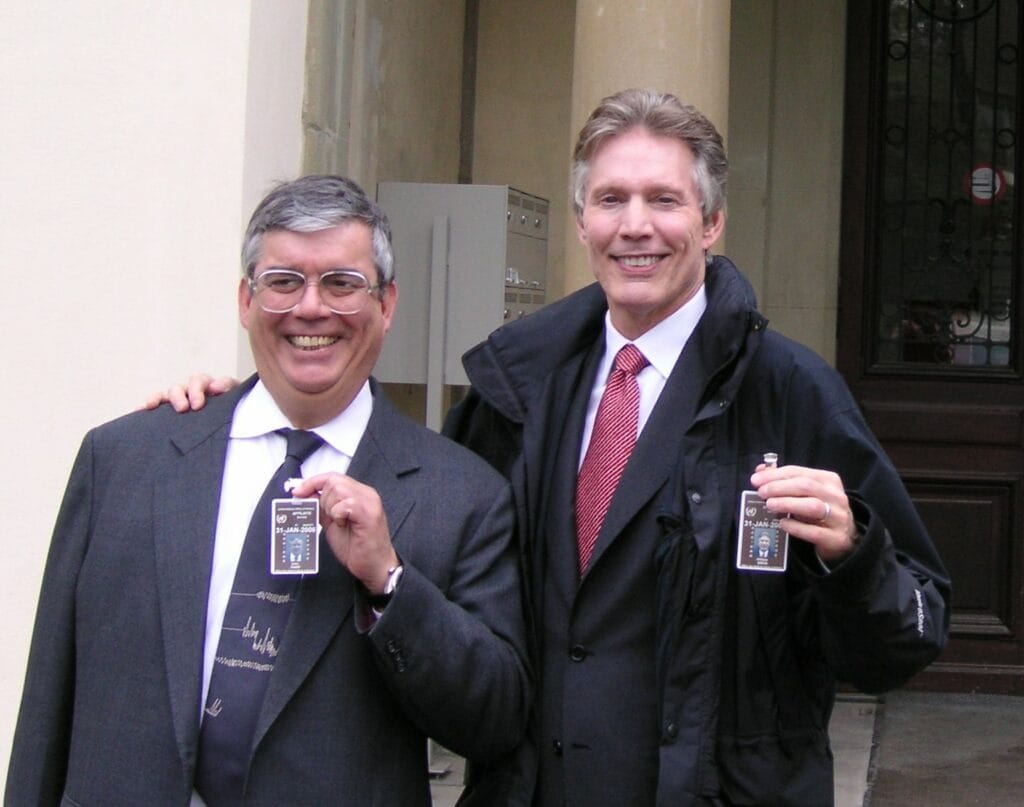
    Kamm and Dui Hua director William Simon holding up their United Nations grounds passes in Geneva in 2005. Image credit: The Dui Hua Foundation

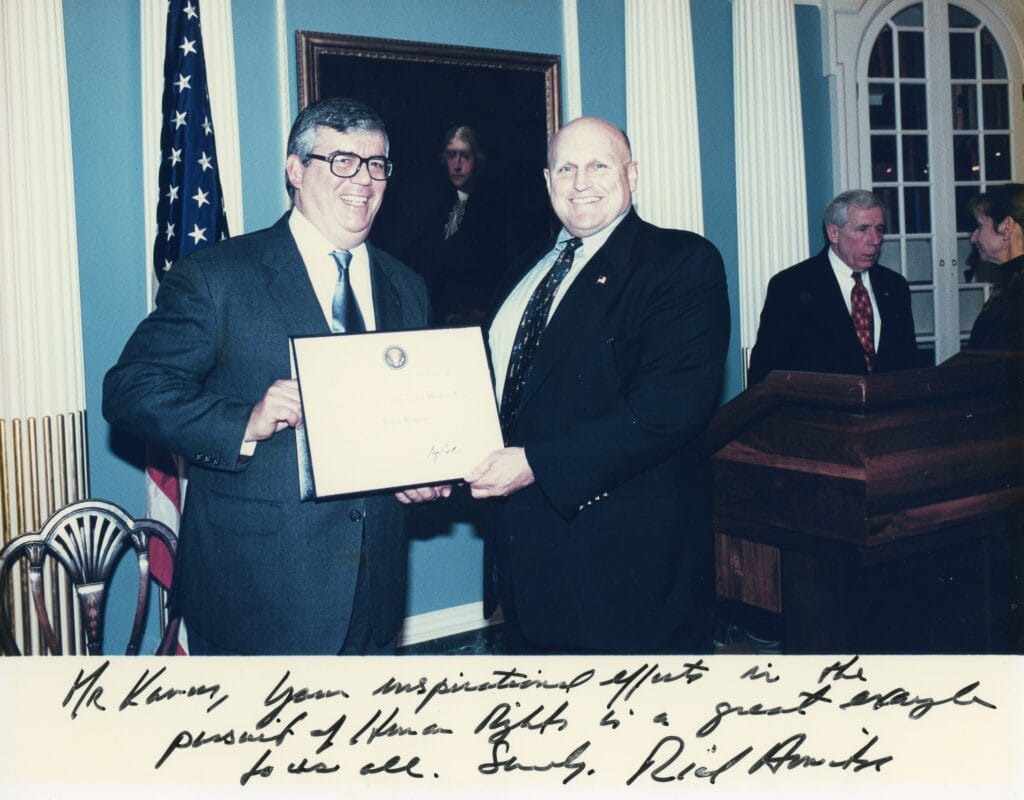
    Three months after the 9/11 terror attacks, I resumed my travels. My first trip was to Washington DC, where I accepted the Eleanor Roosevelt Human Rights Award at the State Department on December 13, 2001. I was joined at the ceremony by two other awardees – Congressman Frank Wolf, a lion of human rights advocacy, and Barbara Elliott, a fierce advocate for refugees fleeing communism – and members of my family.

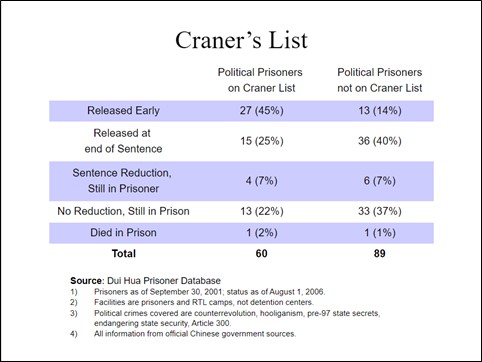
    For the next two-and-a-half years. I kept to a grueling schedule of domestic and international travel. I made frequent trips to Washington DC, where I met with members of Congress and the Bush Administration, including Lorne Craner, Assistant Secretary of State for Human Rights, for whom Dui Hua crafted numerous prisoner lists for use at the annual human rights dialogues between the United States and China. (The dialogue has been suspended since 2016.) A highlight was my testimony to the Congressional Executive Commission on China (CECC), a body I lobbied to establish in the aftermath of President Clinton’s decision to extend China’s Most Favored Nation status without conditions. My testimony – An Arsenal of Human Rights – was delivered on April 11, 2002.

    I traveled to other cities in the United States as well, visiting with NGO representatives and supporters, as well as speaking at universities around the country. I also traveled to Australia where I met with government officials and spoke at gatherings at universities and elsewhere.

    Kamm being awarded the Eleanor Roosevelt Human Rights Award by then-Deputy Secretary of State Richard Armitage. Image credit: The Dui Hua Foundation

    On my many trips to China during this period I focused on helping secure the release of long-serving counterrevolutionaries, including the ethno-musicologist Ngawang Choephel. I logged two trips to Lhasa where I helped gain freedom for the elderly teacher Jigme Sangpo and the young nun Ngawang Sangdrol. In Beijing I worked with officials of the Ministry of Justice and Ministry of Foreign Affairs to secure the early release of Democracy Party activists Xu Wenli and Wang Youcai. Of special importance was the early release of American citizen Fong Fuming, a businessman, convicted of state secrets violations. This was the first case of an American citizen imprisoned in China that I worked on. It would not be the last.

    On my trips to Europe, I focused on securing support from European governments, including those of Switzerland and Scandinavian countries. These efforts were successful and helped ensure the financial viability of Dui Hua for years to come.

    June 2004: Washington and New York

    On June 5, 2004, I flew to Washington DC for five days of meetings and events. I briefed staff of the CECC on Dui Hua’s work, and addressed a gathering organized by a grantor where I updated the group on developments in Hong Kong, notably the debate over Article 23 in which I had played a role.

    Meetings were held with State Department officials in charge of China and human rights, members of Congress, including Senator Chuck Hagel (R-Nebraska), Congressman Doug Bereuter (R-Nebraska), and Congressman Frank Wolf (R-Virginia), as well as senior staff of committees dealing with China. I met with Minister Lan of the Chinese Embassy and staff of human rights groups including Amnesty International.

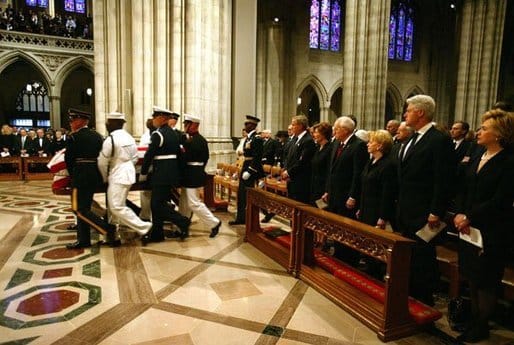
    The day I arrived in Washington, former president Ronald Reagan passed away. I followed news of his death closely, watching unfolding events on my hotel room television. I have painful memories of doing so, not least because I was suffering from a bout of kidney stones, two of which I passed with considerable discomfort.

    At Ronald Reagan’s funeral, then-President George W. Bush, Laura Bush, then-Vice-President Richard Cheney, Lynne Cheney, Bill Clinton, and Hillary Clinton watch as the casket is carried into the cathedral. Image credit: Public domain

    On June 10, I took a morning train to New York. The same day I met with Wang Guangya, China’s ambassador to the United Nations. We met at the Chinese Mission. Before meeting me, Ambassador Wang had signed the book of condolences for President Reagan at the US Mission.

    Our meeting was an exceptionally friendly one. I mentioned that I was interested in applying for Special Consultative Status with the Economic and Social Committee (ECOSOC) of the United Nations, the body that oversaw the Human Rights Commission, now the Human Rights Council, in Geneva. Ambassador Wang replied: “I will support you, and if any of my colleagues give you a hard time, let me know.” In the meeting were other diplomats assigned to the mission, including Li Xiaomei, then China’s representative on the NGO Committee, now Special Representative for Human Rights of the Ministry of Foreign Affairs in Beijing.

    I left the mission and headed to my sister-in-law’s brownstone in the city for dinner. Pat worked at the United Nations, and she offered to introduce me to the person in charge of NGO accreditation the next day, June 11, 2004. The person in charge was a French woman, a longtime UN employee.

    The lady was getting ready for her long summer vacation in France and had little time for me. She asked what I wanted, and I told her that I’d like to apply for ECOSOC consultative status. She handed me the application form and asked, “Which country do you work on?” “China,” I replied. “Forget it,” she remarked, with a wave of the hand. China and its allies had blocked applications of virtually all human rights groups, like Human Rights in China, that worked exclusively on China.

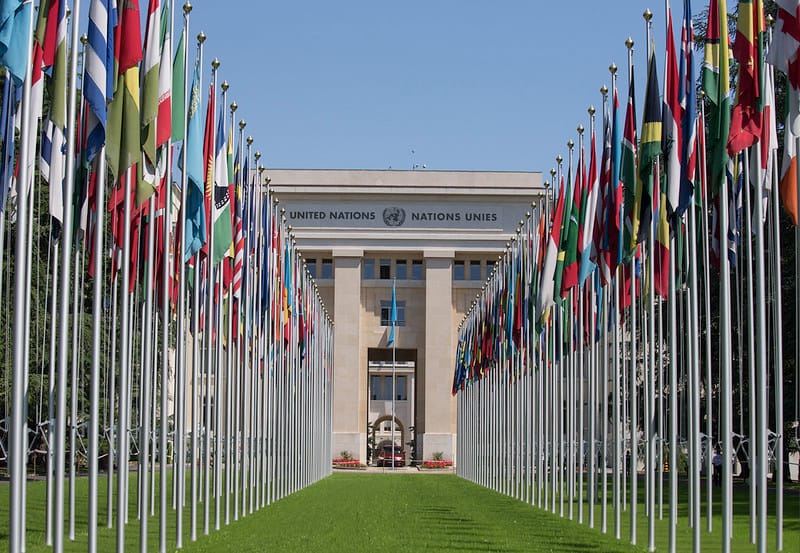
    The Palais des Nations in Geneva, Switzerland. Image credit: Eric Bridiers, US Mission Geneva / CC BY-ND 2.0

    I straightened her out. “I met with Chinese Ambassador Wang Guangya yesterday, and he told me that he would personally support Dui Hua’s application.” You could have knocked her over with a feather.

    At the next meeting of the NGO committee, applications by NGOs for consultative status were considered. One by one, the committee chairperson read out the names of the applicants. It was a lengthy list. Typically, if a country objects to an NGO’s application, the committee registers its objection, and the chairperson moves on. “The Dui Hua Foundation,” the chairperson intoned. Waiting to object were Chinese allies Pakistan and Cuba who looked for a signal from the Chinese representative. Li Xiaomei sat motionless as other representatives shifted in their seats.

    After the chairperson finished ticking off the names of NGO applicants, he or she returned to Dui Hua. “I ask again. Are there any objections to The Dui Hua Foundation’s application for Special Consultative Status.” Li Xiaomei told me later: “I was very embarrassed, but I registered no objection.” Dui Hua was granted the much-coveted status, becoming the only independent human rights group focused on China to be given this status. That remains the case to this day.

    Making Use of our UN Status

    Early in 2005, a fellow Dui Hua director, Bill Simon, traveled to Geneva with me to obtain our badges that granted us privileges at the Palais des Nations, home of the Human Rights Commission. Since 2005, I traveled to Geneva at least once a year before the Covid-19 pandemic made international travel impossible.

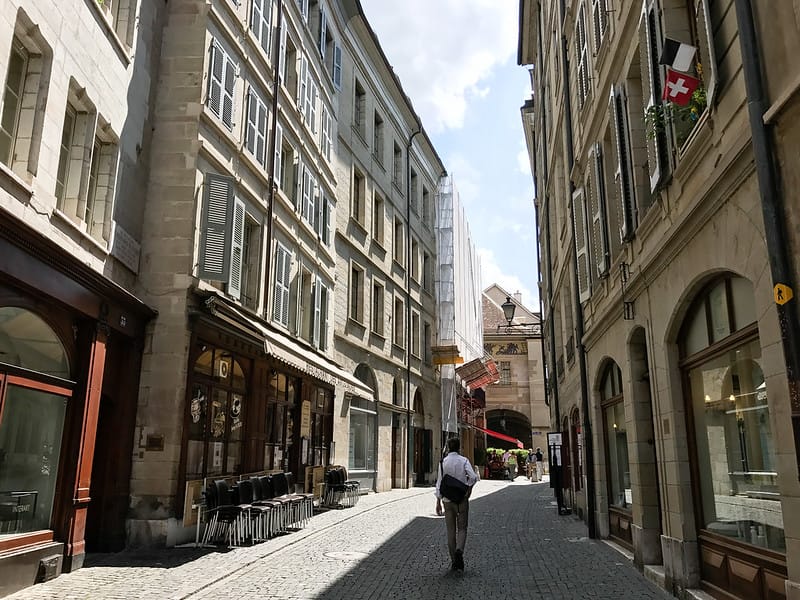
    In Geneva I stayed at the Hotel Ambassador through the generous support of the hotel’s owner, Madame Rossotto. I fell in love with the city, and took long walks along the lake to Palais Wilson, site of the Office of the High Commissioner for Human Rights and many of the special procedures of the Human Rights Council. I particularly enjoyed spending time in the Old City, dining at its restaurants with an old friend, Christophe Swinarski, a distinguished human rights scholar who had served for many years with the International Committee of the Red Cross, also headquartered in Geneva.

    The Grand Rue in Geneva’s old city. Image credit: Terekhova / CC BY-NC-ND 2.0

    Dui Hua has made good use of its special consultative status. The foundation has made submissions to all of China’s and the United States’ Universal Periodic Reviews (UPR), a process whereby every member of the United Nations’ human rights record is scrutinized every 4-5 years. Our submission to China’s third UPR in 2018 was of special importance. We focused on judicial transparency, examining the decision to post judgments on the Supreme People’s Court’s China Judgments Online (CJO), which we hailed (attached to our statement were prisoner lists of names found on CJO). Unfortunately, in 2021 the court purged the website of judgments involving cases of endangering state security and other sensitive crimes, dealing a blow to Dui Hua’s work compiling prisoner lists for submission to the Chinese government. For both the Chinese and US UPRs we examined capital punishment; when it comes to the death penalty, both countries are outliers.

    Kamm making a statement on China’s Initial Report under the International Covenant on Economic, Social and Cultural Rights, to the UN Committee on Economic, Social, and Cultural Rights, April 25, 2005. Image credit: The Dui Hua Foundation

    In addition to its work on UPRs, Dui Hua has worked on issues related to women prisoners and arbitrary detention. We lobbied for China to invite a delegation from the newly established Working Group on Discrimination Against Women in Law and Practice. The group visited China in December 2013, not long after China’s UPR.

    Dui Hua has worked closely with the Working Group on Arbitrary Detention to secure favorable opinions on the cases of American citizens judged to have been arbitrarily detained by Chinese authorities: US businesswoman Sandy Phan-Gillis and US businessmen Mark Swidan and Li Kai, both of whom remain imprisoned as of this writing.


    Listen to the Encounters with China podcast.

    Subscribe to receive notifications about new episodes. 

    Read all John Kamm Remembers stories.


  • Names Embedded in Truth, Spoken to Power

    Names Embedded in Truth, Spoken to Power

    << Read all John Kamm Remembers stories

    Download & read this story as a PDF.

    This “John Kamm Remembers” entry was originally published as part of the Dui Hua’s
    September/October Digest (Issue 90), published October 19, 2022.

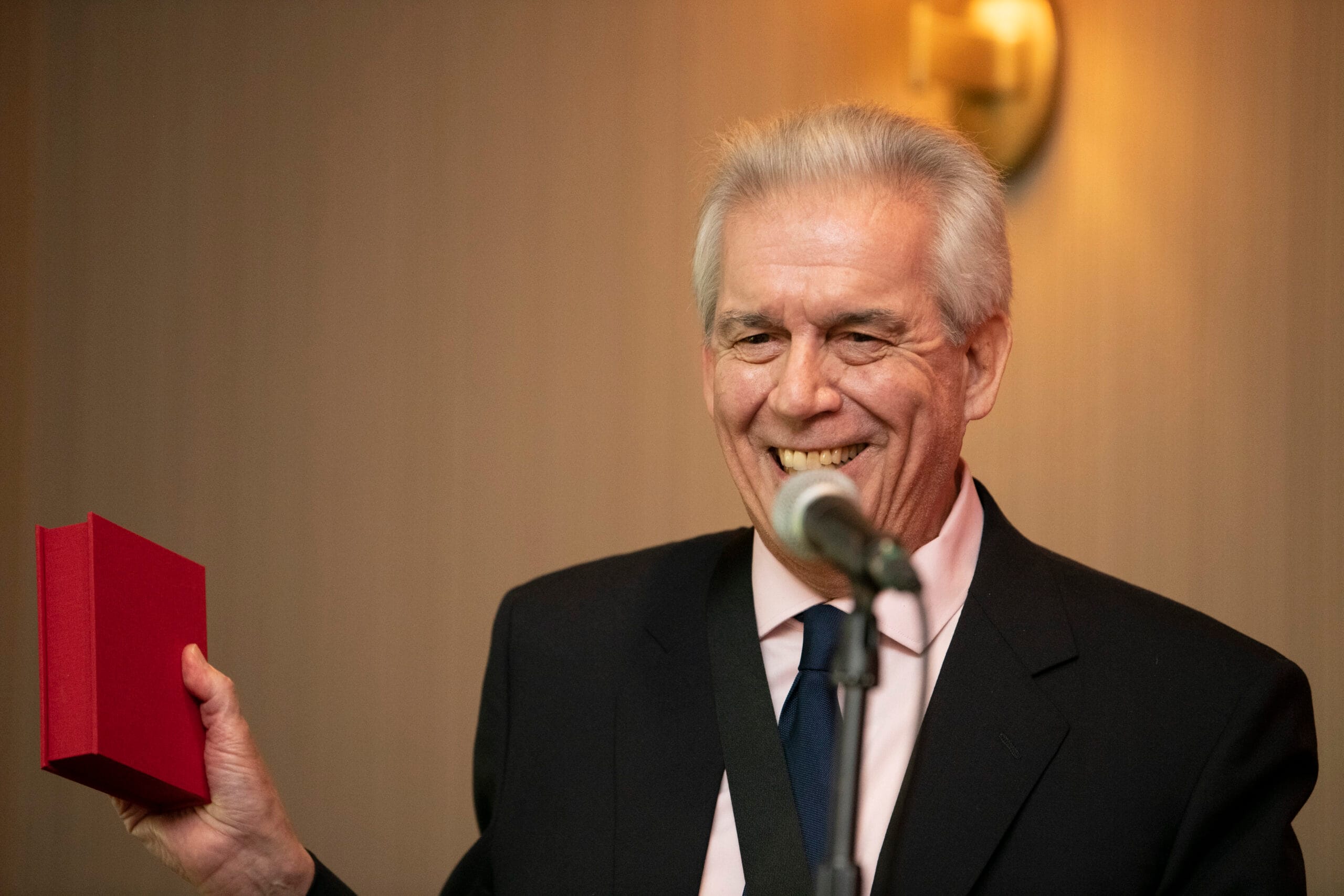
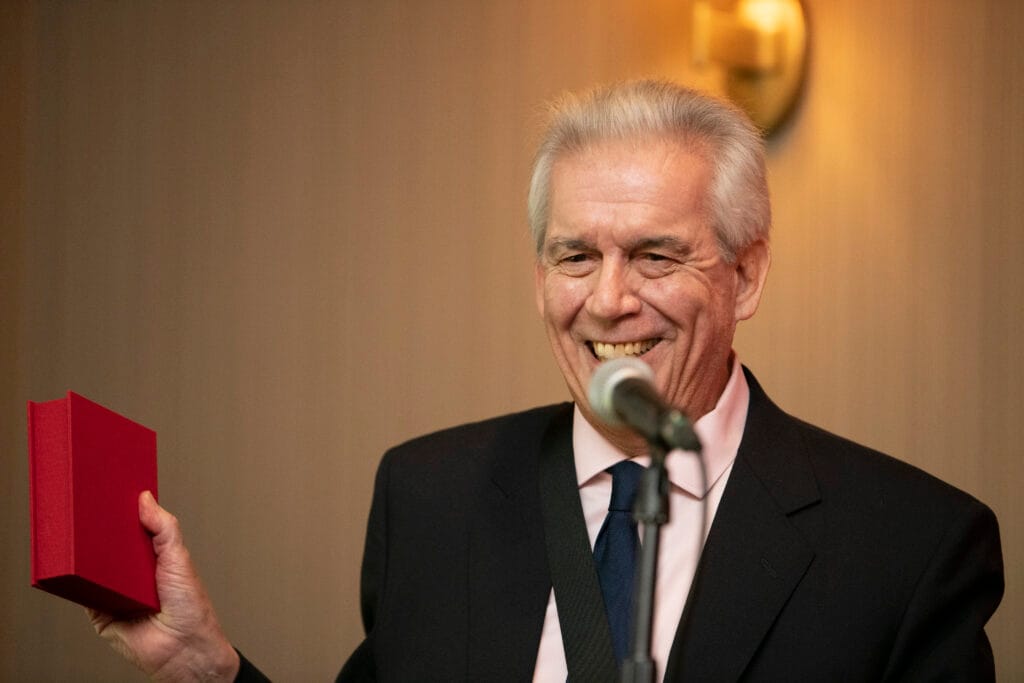
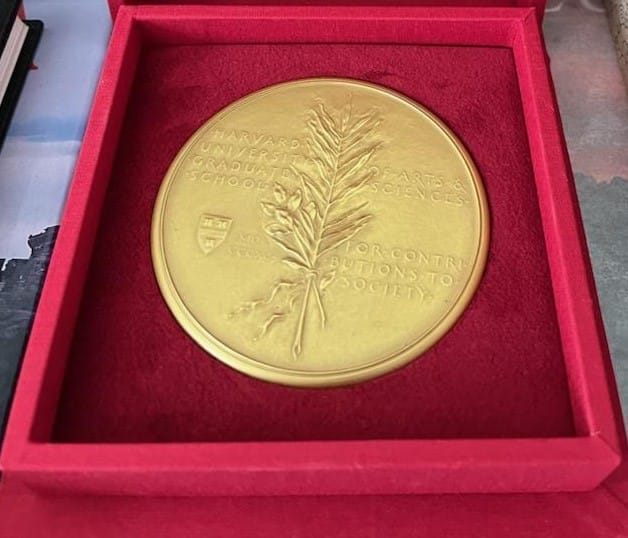
    Kamm accepting the Centennial Medal. Image credit: Tony Rinaldo via GSAS

    On February 11, 2022, I received an email from the Director of Alumni Services and Events at Harvard Graduate School of Arts and Sciences (GSAS). I was told that I had been nominated to receive the GSAS Centennial Medal, the highest honor bestowed on an alumnus of GSAS, given for significant contributions to society. First bestowed in 1989, the Centennial Medal had been given to around 140 GSAS alumni, including the essayist Susan Sontag and the political scientists Joseph Nye and Francis Fukuyama. I felt humbled and elated to join such a distinguished group of previous awardees. To me, this award was not only a personal honor, but a culmination of Harvard University’s enduring influence on my life and mission.

    I enrolled in Harvard for my master’s degree at the age of 23. Though I had only spent two semesters there from 1974-75, they were among the happiest days of my life for both personal and academic reasons. In those two semesters, I learned to read classical Chinese by working through materials I gathered in Kam Tin in Hong Kong’s New Territories with Professor Yang Liensheng, wrote a paper on Chinese foreign trade corporations for Professor Dwight Perkins, and met my first Chinese counterrevolutionary in Professor Jerry Cohen’s seminar on Chinese law, laying the foundation of my human rights activism that began 15 years later. 

    The Role of Harvard’s Libraries in Prisoner Advocacy

    When I was invited to attend the ceremony for the conferring of the GSAS Centennial Medal, I was informed that each of the honorands were allowed to invite a limited number of members of the Harvard community. I focused on inviting librarians who had helped me over the years. 

    As a human rights organization whose work is founded on its open-source research and advocacy for political and religious prisoners, Dui Hua’s researchers have managed to glean the names of hundreds of political and religious prisoners from the libraries in Harvard. Many of these prisoners were still serving sentences at the time their names were uncovered. Dui Hua placed their names on lists submitted to the Chinese government, after which several received clemency. 

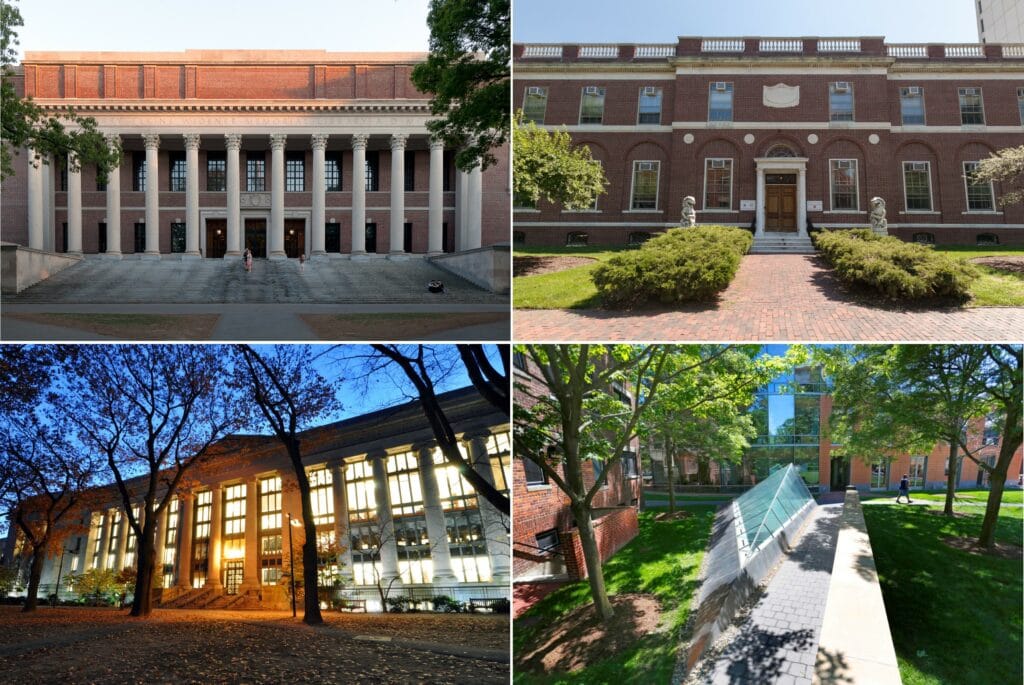
    There are four libraries at Harvard holding materials with information on political crime in China: the H.C. Fung Library at the Fairbank Center for Chinese Studies, the Harvard Law School Library, the Harvard Yenqing Library, and the Widener Library, the university’s largest library. 

    The four libraries at Harvard that hold materials with information on political crime in China: (clockwise from top) the Widener Library, the university’s largest library; the Harvard Yenqing Library; the H.C. Fung Library at the Fairbank Center for Chinese Studies; the Harvard Law School Library. Image credits: Caroline Culler; Shelley Zatsky; Fairbank Center; Chensiyuan / CC BY-SA 4.0

    These libraries contain publications such as local gazettes, records, and yearbooks published by state security bureaus, public security bureaus, procuratorates, courts, and justice bureaus. They provide information on and insights into how China deals with political crimes through case examples, regulations, accounts of events (e.g., June 4, 1989), and statistics.

    For a time, Dui Hua found useful materials in libraries in mainland China, but that is no longer possible as a result of Covid and political surveillance and harassment of our researchers. Such data is becoming harder to come by even in Hong Kong libraries, including Hong Kong University’s Fung Ping Shan Library and the Universities Services Centre at the Chinese University of Hong Kong. In the years after Dui Hua’s founding in 1999, most of the names were found by the foundation’s researchers, including me, at these two libraries. However, as China has increasingly asserted its control over the former colony, especially in the runup to the imposition of the National Security Law in 2020, materials deemed “sensitive” have been removed from the libraries, and no new ones have been ordered. The collections have been “harmonized.” 

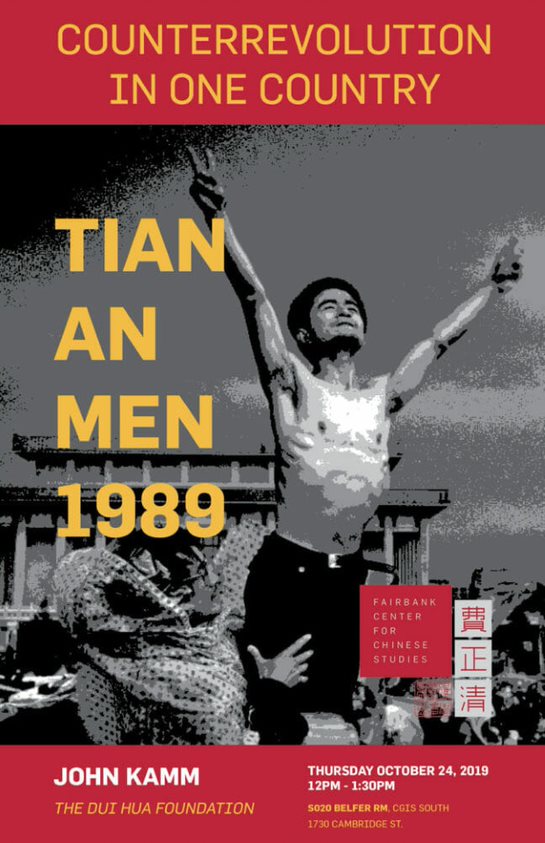
    Poster for Speech by John Kamm, Fairbank Center for Chinese Studies, October 24, 2019

    The libraries at Harvard are today one of the biggest repositories of names used by Dui Hua in its research and advocacy work and have filled the void left by their Chinese counterparts, but even these libraries are finding it more difficult to acquire volumes on political crime in China.  

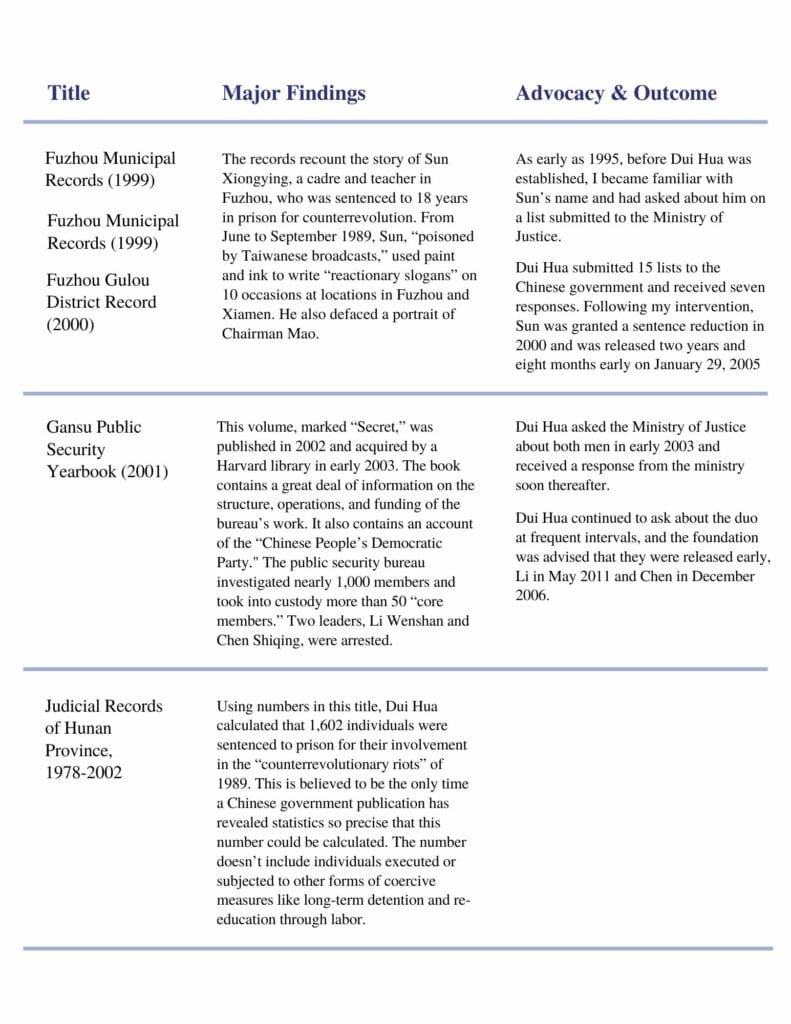
    Some of our most notable findings from Harvard Libraries are listed at the end of this article.

    Glorious May at Harvard 

    During the four days spent at Harvard in May 2022 as the awardee of the GSAS Centennial Medal, I attended several functions, including the medal ceremony on May 25. I also met with professors, including Professor Tian Xiaofei, who nominated me for the medal, Dwight Perkins – under whom I had studied in 1975 – and professors Mark Elliot, Michael Szonyi, and Bill Alford, before whose law school classes I had delivered remarks on several occasions. Of course, colleagues and I spent many fruitful hours in Harvard’s libraries.

    The highlight of the visit was the May 25 medal ceremony held at the Faculty Club. It was the first time I had stepped foot in the club. The time came to accept the Centennial Medal. I stepped to the podium where GSAS Dean and classicist Emma Dench, niece of famed British actress Judi Dench, read the citation and handed me the medal.  

    The Harvard GSAS Centennial Medal award to Kamm. Image credits: The Dui Hua Foundation

    I was honored to stand alongside three other 2022 Centennial Medalists. They are:

    • Neil Harris, PhD ’65, History, for his “pioneering work in shaping the field of cultural history”
    • Vicki Sato, AB ’69, AM ’72, PhD ’72, Cellular and Developmental Biology, for her “visionary leadership and life-changing breakthroughs in the biopharmaceutical industry”
    • Robert Zimmer, AM ’71, PhD ’75, Mathematics, for his “superlative leadership of [University of Chicago],” and his “principled advocacy for the core mission and values of higher education on the national and global stage”

    More about the event:
    My award acceptance speech

    GSAS Centennial Medal Citation

    The 2022 Centennial Medalists

    Given Harvard GSAS’s pivotal role in shaping and aiding Dui Hua’s mission, the award is more than a personal honor. I am grateful to the GSAS, not only for myself but on behalf of the prisoner whose names were unknown but to God until they were found at Harvard — names embedded in truth, spoken to power.

    Notable Findings from Harvard Libraries in May 2022 

    Baoshan Prefecture Public Security Records (2019) 

    • In late 2021, Dui Hua published Persecution of Unorthodox Religions in China, an exhaustive treatment of a rarely examined subject. Dui Hua identified 41 so-called cults operating in China in recent years. As many as 40 percent of “cult” prisoners in Dui Hua’s political prisoner database are women (women account for 8.5 percent of prisoners in China). Unorthodox religious groups often have extensive international links, and they are for the most part nonviolent. 
    • Baoshan Prefecture in Yunnan Province has a population of 2.5 million people with a substantial number of ethnic minorities. The Baoshan Prefecture Public Security Records identifies 10 unorthodox religious groups operating in the prefecture in recent years and gives the names of 79 adherents subjected to coercive measures, though few have been sentenced to prison. The four largest groups in terms of adherents subjected to coercive measures are Yi Guan Dao, Falun Gong, the Shouters, and Mentu Hui. 

    Records of Trials in Gansu Province (2018) 

    • It is not unusual to find statistics on crime in volumes found at Harvard University libraries. These statistics, when coupled with the set of Supreme People’s Court statistics, help fine-tune our knowledge of how political and religious crimes are handled in China. 

    Records of Trials in Gansu Province

    • Contains tables of cases of endangering state security (ESS) and “using an evil cult to sabotage implementation of the law” (Article 300 of the Criminal Law) tried in Gansu from 1990 to 2015. We learned from the Supreme People’s Court statistics that the vast majority of splittism and inciting splittism cases are tried in provinces with large ethnic minority populations – Xinjiang, Tibet, Sichuan, Yunnan, and Gansu. From the Gansu volume we now know how many such trials took place in Gansu, which sports a large Tibetan population. 
    • In 1999, the Chinese government banned Falun Gong. The impact of this decision is evident in the table covering Article 300 trials in Gansu. From 1999 to 2015, 486 Article 300 trials took place in Gansu, with more than 40 percent taking place in the four-year period of 2012-2015. The Gansu table on trials of endangering state security uses the term “counterrevolution” to enumerate ESS trials for the entire period. In 1997 China removed the crime of counterrevolution from the criminal law and inserted the crime of endangering state security. The Gansu table confirms what has long been suspected: in the eyes of China’s judiciary, ESS is the same as counterrevolution, a crime defined by motive that is not based on “scientific forensics.”  

    Jiangsu Province Public Security Records (2010) 

    • It is widely believed that the Spring 1989 protests were confined to Beijing and a few other large cities. In fact, demonstrations and strikes took place in more than 300 cities and counties across China. The Jiangsu Province Public Security Records chronicles what took place in Nanchang, Jiangxi’s capital, from April 15 to June 25, 1989, including the dates and times of protests and transport disruptions and the names of organizations – chiefly autonomous student federations and independent worker’s unions – that were declared illegal and disbanded.  
    • Numbers of students and worker leaders and key members of the organizations are given, though no individual names are provided. Ten members of the Nanchang United Worker’s Union were “secretly arrested” but the term “secretly arrested” is not defined. 
    • The Nanchang account of the spring 1989 protests is but one of many found in Harvard libraries since Dui Hua began its research in 2000. Books published over the last few years rarely mention the events of 1989 as China’s leadership seeks to erase memory of the largest political protests to take place in the country since 1949. 

    Earlier Findings from Harvard Libraries & Their Contribution to Advocacy

    Image credit: The Dui Hua Foundation

    Listen to the Encounters with China podcast.

    Subscribe to receive notifications about new episodes. 

    Read all John Kamm Remembers stories.

  • Right Time, Right Place, Right People

    Right Time, Right Place, Right People

    << Read all John Kamm Remembers stories

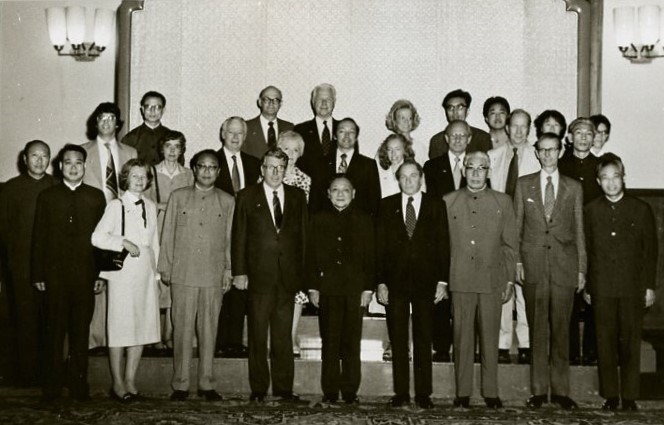
    On June 5, 1979, Kamm (second row, far left) is photographed with a National Council for US-China Trade delegation to Beijing during the delegation’s meeting with paramount leader Deng Xiaoping (front row, center). Source: National Council for US China Trade

    Throughout the 1970s and 1980s, before I began intervening on behalf of political prisoners in the wake of Tiananmen, I was active in the China trade, buying, selling, and investing on the mainland. I was in the right place at the right time, taking advantage of China’s opening by launching a number of pioneering initiatives, including establishing some of the first foreign offices in the country, making the first sales to county-level corporations, helping Chinese enterprises register products with the Food and Drug Administration, and placing the first advertisements in Chinese newspapers since the 1950s.

    Foreign Offices

    On June 5, 1979, I joined a National Council for US-China Trade delegation to Beijing. There I met paramount leader Deng Xiaoping and shook his hand. I was introduced to him as Kang Yuan, a name I adopted upon writing a eulogy for Zhou Enlai, whose funeral I attended in January 1976.

    Building on the experience of running the National Council for US-China Trade office at the Guangzhou Trade Fair, I established the first office of a foreign company in Guangzhou in 1979 and the second office of a foreign firm in Shanghai in 1980. These two offices reported to my office in Hong Kong, serving as advance posts for activities throughout the mainland.

    The offices were used to plan and carry out technical exchanges to introduce agricultural and industrial chemicals manufactured by the companies we represented and to explore opportunities to buy and sell raw materials and finished products.

    My team and I were helping our principal client to find sources of arsenic trioxide, a deadly powder used to manufacture weed killers. We ventured to two remote locations in Guangdong Province, Yunfu County in the western part of the province, and Yangshan County in the northern part. In these places we witnessed arsenic being refined in so-called “dragon kilns,” a technology developed in the Tang Dynasty (618-907 AD.)

    Kamm in Yangshan in 1979. Source: The Dui Hua Foundation

    On the trip to Yunfu, I travelled with Mr. Mulligan, a mining engineer who worked for a large New York bank. Accompanied by county officials, we hiked up a steep mountain until we reached a ridge, where we could peer down at the countryside below, dotted with abandoned mines where arsenic-laden rocks had been mined, tailings leaching out from the mouths of the mine.

    We stopped for a cup of tea. The county boss remarked that the tea plants were the only thing that could grow in the arsenic-laden soil. We spit out the tea, but Mulligan asked for a bag of what we called “arsenic tea,” which he was given. Turning to me, he said, in a low voice, “I’ll bring this home and give it to my mother-in-law!”

    Selling Vaccines to Pigeon Farms

    One of the companies we represented was a European manufacturer of vaccines for animals, especially poultry whose flocks were frequently ravaged by disease. We ventured to Zhongshan County north of Macau, there to conduct a technical exchange on vaccines for pigeons. Zhongshan is famous for its “Shekki Pigeons,” named after Zhongshan County’s seat. These birds, roasted in a time-honored way that resulted in succulent meat and crispy skin, fetched high prices in Hong Kong.

    On the same trip we introduced a Swiss product to counter swine flu, a perennial problem in South China.

    The pigeon exchange was a complete success. County officials, who had their own stash of US dollars, wanted to buy the vaccines from us, but wanted to do so quickly rather than going through the provincial foreign trade corporation.

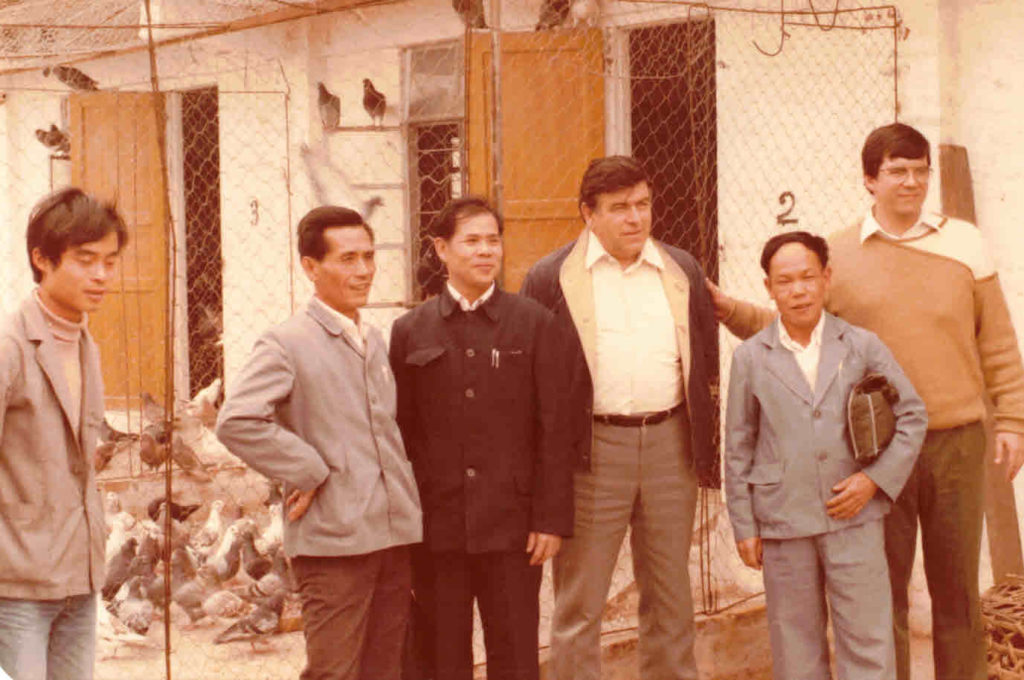
    Kamm (far right) visiting the Shekki pigeon farm in Zhongshan County. Source: The Dui Hua Foundation

    We decided to use their standard Chinese-language contract used to buy things from mainland companies. Things moved quickly. We signed the contract, the county corporation opened the letter of credit for US$ 30,000, and we arranged the shipment in refrigerated containers. This transaction is believed to be the first sale to a county foreign trade company (known as “sub-branches”) during the reform and opening period.

    Low-Acid Canned Foodstuffs

    China manufactures a wide variety of canned foodstuffs, including mushrooms and beans, that can be found in stores in Chinatowns around the United States. In 1977 I was asked, as the National Council’s Hong Kong representative, to assist China’s National Cereals, Oils, and Foodstuffs Corporation’s Hong Kong agent register its low-acid canned goods with the United States Food and Drug Administration.

    The paperwork was prepared and submitted. All went smoothly, and dozens of products were registered.

    The contacts made in this exercise were to serve me in good stead when, in 1978, I was asked by China’s largest firm in Hong Kong, China Resources, to introduce American companies based in the colony who might be interested in investing in the areas bordering Hong Kong and Macau, areas that were slated to become China’s first special economic zones. Investing took the form of “compensation trade” and rudimentary value adding, but they paved the way for joint ventures which began to proliferate in 1979.

    Advertisements for Foreign Products

    In April 1979, immediately before the Spring Guangzhou Fair which was to open on April 15, I was alerted to an opportunity by a friend who worked for Ta Kung Pao (TKP), a leftist newspaper in Hong Kong. The Chinese government had decided to allow foreign companies, on an “experimental basis,” to place advertisements in Chinese newspapers. One of the newspapers selected to accept advertisements was the Guangzhou Daily (Guangzhou Ryh Bao).

    We settled on a price: US$5,000 for a full page, in color, ad. An advertisement for the products of Diamond Shamrock Corporation was laid out and submitted to TKP. It ran in the Guangzhou paper on April 14, 1979.

    The advertisement for Diamond Shamrock products published in the April 14, 1979 issue of Guangzhou Daily. Source: Guangzhou Daily

    The appearance of this advertisement caused an immediate sensation. Vendors would fold the paper so that the advertisement, which ran on the back page, showed up as the front page. The novelty added to robust sales for the newspaper which was well known for boring official reporting.

    Operating at the Local Level

    There is a popular saying in China used to denote Beijing’s limited power to determine what goes on in the provinces and localities: “The mountains are high, the emperor is far away.”

    Posing outside the entrance to a People’s Commune. Source: The Dui Hua Foundation

    My experiences doing business, particularly in Guangdong Province, prepared me for my human rights work. While the outcome of major political cases is determined at the highest level in Beijing, most cases are handled by local government and party officials including prison bureaus and prison wardens, local courts and local procuratorates. Today, most of the information on political prisoners that Dui Hua obtains is provided by local entities, bypassing Beijing.


    Listen to the Encounters with China podcast.

    Subscribe to receive notifications about new episodes. 

    Read all John Kamm Remembers stories.

  • Remembering Orrin Hatch

    Remembering Orrin Hatch

    << Read all John Kamm Remembers stories

    (Left to right) John Kamm, Orrin Hatch, and Kamm’s son during a visit to Hatch’s office in the summer of 2000. Image credit: Office of Senator Hatch courtesy of the Kamm family

    Orrin G. Hatch, the longest serving Republican senator and longest serving Utah senator, passed away on April 23, 2022, in Salt Lake City, Utah. He was 88 years old. He served six terms in the United States Senate and chaired the Senate Judiciary Committee for a total of eight years.

    Senator Hatch was born in Pennsylvania to Jesse Hatch and Helen Kamm, both of whom grew up in Utah. His grandfather was John Kamm, a fabled man of the Old West. Orrin Hatch was a bishop of the Church of Latter Day Saints and a staunch supporter of religious freedom.

    Sens. Orrin Hatch and Ted Kennedy, sometimes called “the odd couple.” Image credit: Office of Senator Hatch via Wikimedia Commons

    Senator Orrin Hatch was an original. Although he was a rock-solid conservative, he reached across the aisle to work on legislation with Democratic leaders. One of his best friends was liberal icon Senator Edward Kennedy. A talented musician and songwriter, Senator Hatch appeared in cameo roles in several movies. He generally supported good ties with China and favored renewing China’s trade status in the United States and admitting the country into the World Trade Organization.

    Senator Hatch was a friend, strong supporter of my work, and a relative who wrote 11 letters to senior Chinese and American officials, including President Bill Clinton, urging cooperation with my work on Chinese political and religious prisoners. He welcomed me to his office on every trip I made to Washington, including one I made with my oldest son Jack in the summer of 2000. In December 2018, weeks before he stepped down as a senator, Senator Hatch nominated me for the Nobel Peace Prize.

    Trip to China

    I met Orrin Hatch and his wife Elaine in Beijing in October 1997, shortly before Chinese President Jiang Zemin made his final state visit to the United States. The trip had been arranged by an American foundation specializing in making grants to support work on international relations. Upon seeing me for the first time, Senator Hatch remarked to his wife that I resembled his grandfather. I gave Senator Hatch a prisoner list with 37 names from 20 provinces, and he in turn handed the list to Minister Xiao Yang, then Minister of Justice and President Jiang Zemin. For more details on Senator Hatch’s visit to China, see “Cousin Orrin.”

    The prisoner list Kamm gave to Senator Hatch. Hatch then submitted the list Minister Xiao Yang. Image credit: The Dui Hua Foundation

    Not long after Senator Hatch gave the list to Minister Xiao Yang, several of the prisoners whose names were on the list were released from prison, some with months and years of time left to serve. Clemency began within weeks of Minister Xiao’s accepting the letter. Eventually as many as one-third of the prisoners on the Hatch List were granted commutations, sentence reductions leading to release, and medical parole. Those who benefited included long-serving counterrevolutionaries, June 4 prisoners, and the Tibetan ethnomusicologist Ngawang Choephel.

    Letters to Chinese and American Leaders

    In early 1998, Senator Hatch began writing letters to senior Chinese and American officials including Minister Xiao Yang, his successor Gao Changli, and President Bill Clinton.

    On February 25, 1998, the senator wrote to Minister of Justice Xiao Yang to thank him for recently providing me with information on prisoners. He stressed that the prisoner information project between me and the ministry was heralded as one of the accomplishments of the previous autumn’s Jiang-Clinton summit.

    On May 22, 1998, Senator Hatch wrote to Xiao Yang’s successor as Minister of Justice, Gao Changli, reminding the minister that he had had several positive exchanges with his predecessor regarding John Kamm’s prisoner information project. “I hope that we can continue to discuss this valuable project which has garnered the attention of many leaders and citizens in this country.”

    Hatch, then Chairman of the Senate Committee on Finance meeting with Chinese Vice Premier Liu He on May 16, 2018. Image credit: United States Senate Committee on Finance

    In a letter sent to President Bill Clinton on September 28, 1998, Senator Hatch advised the president that he had taken a strong personal interest in my work and asked him to raise the recent lack of progress on the project with visiting Chinese Foreign Minister Tang Jiaxuan.

    On October 28, 1998, President Clinton responded. “We are in complete agreement about the importance of promoting Mr. Kamm’s project.” He went on: “In her meeting with Foreign Minister Tang, Secretary Albright urged the Chinese to resume cooperation with Mr. Kamm. In my meeting with Tang, I urged release of prisoners detained under laws that have been repealed, a reference to the Law on Counterrevolution that is no longer on the books. Mr. Kamm has been very active raising Chinese consciousness on this issue.”

    Senator Hatch’s interest in my work had a direct impact on my work to free Chinese prisoners. For this, and for many other kindnesses, I will always be grateful to my “Cousin Orrin.”


    Listen to the Encounters with China podcast.

    Subscribe to receive notifications about new episodes. 

    Read all John Kamm Remembers stories.

  • Prisoner Lists, Past and Present

    Prisoner Lists, Past and Present

    << Read all John Kamm Remembers stories

    John Kamm testifying to the House Foreign Affairs Committee on November 4, 2011. Image credit: The Dui Hua Foundation

    Beginning in 1990, I testified on a dozen occasions to Congressional committees in Washington DC. My last testimony was delivered in 2011. On different occasions, I appeared before the House Ways and Means Committee, the House Foreign Affairs Committee, the Senate Finance Committee, and the Congressional Executive Commission on China (CECC), a body whose establishment I had called for in the wake of President Bill Clinton’s decision to unconditionally renew China’s Most Favored Nation trade status in May 1994.

    A screenshot of the CECC’s political prisoner database taken on November 24, 2004. Image credit: The Wayback Machine

    Of special importance was my testimony delivered to the CECC on September 20, 2006. In this testimony I described what had happened to 75 political prisoners whose names were on a list of prisoners handed to China’s Ministry of Foreign Affairs by Assistant Secretary of State for Democracy, Rights, and Labor Lorne Craner in the summer of 2001. I concluded that “If you were on the list, you had a better than 50 percent chance of being released or given a sentence reduction in the ensuing five years. That’s three times better than the rate of early release for political prisoners that we know of who were serving sentences in September 2001 but who weren’t on Craner’s list.”

    On March 4, 2022, Craner spoke to reporters about Country Reports on Human Rights Practices for 2001, the annual review of the status of human rights around the world. Image credit: C-Span

    I based my conclusion that being on a prisoner list significantly increased the chance of early release both on my analysis of the Craner list and on interactions with the Chinese government in the 15 years prior to my testimony, including communications with the State Council Information Office (SCIO) from 1991 to 1994. During this period, I asked about and was provided information on more than 70 prisoners, including Democracy Wall prisoner Xu Wenli (徐文立); the information I was given specified the hour and the day he would be released. I was given information on several elderly Catholic priests, as well as many other political prisoners.

    A slide of statistics about the Craner list that Kamm presented during his testimony to the CECC in 2006. Image credit: The Dui Hua Foundation

    Of special significance was a fax received from the SCIO in December 1994. For the first time, I was given written responses to a prisoner list I had submitted earlier that year to the Ministry of Justice. A number of the prisoners on the list received early releases from prison after I had given it to the Ministry of Justice, including:

    • Ge Hu (葛湖): A teacher in Taiyuan, Shanxi Province, was 35 years old at the time of his arrest in 1989. He was sentenced to seven years in prison in November 1989 for committing counterrevolutionary offences during the 1989 pro-democracy protests. He developed multiple health issues, but the prison refused to grant him medical parole. Seven days after I requested information on him from the MOJ, he was granted medical release. He returned home to be with his wife and young child.
    • Hao Fuyuan (郝付元): A farmer from Shandong Province, a hotbed of counterrevolution, Hao was active in the 1989 protests. He circulated a tape condemning Deng Xiaoping and pushed students to boycott classes and listen to Voice of America. He was sentenced to 10 years in prison. I asked the MOJ about Hao, after which he was granted early release, probably in 1996.
    • Zhang Chengjian (张成俭): Another farmer from Shandong Province, Zhang claimed to be Mao Zedong’s son. He was sentenced to 20 years in prison in 1984 for committing counterrevolutionary offenses. The sentence was extended by seven years in 1988 for killing a fellow inmate. I had put his name on the same list as Ge Hu, handed to the Ministry of Justice on October 31, 1994. In 1995, his sentence was reduced, followed by two more sentence reductions in 1998 and 2001, respectively. Dui Hua learned of his release in December 2001.

    Although early releases of political and religious prisoners on Dui Hua lists have become fewer in recent years, especially after the Covid pandemic when prisons adopted the unofficial “entry only, no exit” policy, notable acts of clemency still in take place. Among the most noteworthy is the early release of Liang Jiantian (梁鉴添), a printer of Falun Gong literature, announced by Dui Hua in March 2022.

    I began asking about him shortly after he was sentenced to life in prison in 2000, not long after Falun Gong was banned. I put his name on 20 lists submitted to the Guangdong Government. In 2007 his life sentence was commuted to 20 years in prison. Multiple sentence reductions were granted until the final six-month reduction in October 2021.

    On September 3, 2016, then-Secretary of State Kerry arrived in Hangzhou, China, where he was greeted by Shi Yuanqiang, Counselor of Chinese Ministry of Foreign Affairs. The bilateral human rights dialogue was discontinued shortly after. Image credit: US government work

    Despite strong evidence to the contrary, policy makers in Washington generally dismiss the importance of submitting prisoner lists to the Chinese government. A principal venue for submitting lists and discussing cases used to be the bilateral human rights dialogue. This was suspended by the Obama administration in late 2016 and has not been resumed, even though Beijing has signaled a willingness to hold another session.


    Listen to the Encounters with China podcast.

    Subscribe to receive notifications about new episodes. 

    Read all John Kamm Remembers stories.
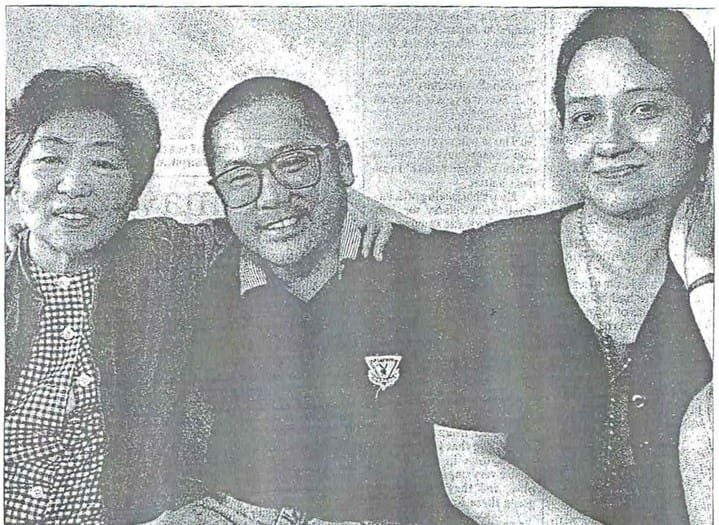

  • Two Flights to Freedom

    Two Flights to Freedom

    << Read all John Kamm Remembers stories

    A sign held at a protest in July 2015 in Los Angeles against the 709 Crackdown in China. The sign reads, “When being a lawyer is a type of crime.” Image credit: Voice of America

    In the early morning hours of July 9, 2015, Chinese police moved against human rights lawyers, legal assistants, and rights activists across China, but mostly those living and working in Beijing. Over the coming days and weeks, an estimated 300 lawyers and activists were detained or had exit bans placed on them. Power was cut off at their residences. Many were stripped of their lawyers’ licenses, forcing law firms to close. Several of those detained were subsequently tried and convicted of state security offenses. A few are still in prison, including Wu Gan, an activist known as “Super Vulgar Butcher,” who was sentenced to eight years in prison for subversion in December 2017.

    International reaction to what became known as the 709 Crackdown was sharply critical. Governments, bar associations, law schools, and experts from United Nations Special Procedures condemned the action, to no avail. In an early indication of China’s current policy of ignoring international opinion, Beijing has become defiant and increasingly oblivious to criticism. Even requests for information on the status of political prisoners are now considered assaults on China’s judicial sovereignty constituting interference in China’s internal affairs.

    A Brave Lawyer

    A photo of Chen Taihe. Image credit: Dui Hua Foundation

    Prior to his detention by public security agents for inciting subversion, picking quarrels and provoking trouble, and embezzlement on July 12, 2015, and his subsequent departure from China in March 2016, Guilin-based lawyer and associate professor of law at the Guilin University of Electronic Science and Technology Chen Taihe was a well-known advocate of China adopting the jury trial system. He researched the jury system in the United Kingdom as a visiting professor and summarized his findings in an eloquent and well-argued book entitled The Most Common Right.

    It is not known why Chen Taihe was detained. It might have been because of his friendship with leading rights lawyer, Li Heping, who was himself detained on July 10, 2015. Chen had called for his release. It could have been because of his extensive ties to the United States. It might have been because of his advocacy for China adopting the jury trial system. Or it might have been because of a vendetta against him by a Guilin official. China’s justice system is anything but transparent.

    Undated photograph of Li Heping. Chen Taihe called for his release prior to Chen’s detention. Image credit: Provided by Li’s supporters via RFA

    Chen Taihe’s activism brought him to the attention of the domestic security division of the public security bureau, a unit known as guo bao. They invited him “to drink tea” – a euphemism used for police questioning – on multiple occasions.

    His successful law practice, which focused on civil and criminal litigations, brought him fame and wealth, enabling him to purchase three apartments in high-class developments. He gave that all away to find freedom for himself and his family in the United States, assisted by retired Judge Shackley Raffetto, the Dui Hua Foundation, and American diplomats in China. He is believed to be the only 709 lawyer to have successfully left China for the West with the permission of the domestic security bureau of the Chinese government.

    Time on the Cross

    Upon detention, Chen Taihe was placed in the Guilin Number Two Detention Center. He endured physical mistreatment, including being forced to squat for hours in a stress position, and threats from prisoners, one of whom had been sentenced to death. Chen was in a crowded cell with 12 other detainees; he was not given a bowl, spoons, and other necessary utensils to eat food and drink water for nearly three days.

    Guilin Number 2 Detention Center, where Chen was held. Image credit: dcnnlawyer.com

    Finally, on July 16, 2015, he was allowed a visit by a lawyer, who was a spy sent by the government. The second lawyer that visited him was Qin Yongpei. He posted Chen’s situation and mistreatment online after he interviewed Chen in a prison meeting room. (Lawyer Qin was detained in 2019; he has not been released and is currently under indictment for inciting subversion.) Chen was then moved to another detention center where his treatment slightly improved. A month after his detention, he was moved to a location outside the detention center and then on August 22, 2015, he was allowed to return home and placed under residential surveillance, but even then, he continued to be subjected to interrogation and threats by the police right up to the day he departed China.

    Lawyer Qin Yongpei, who visited Chen Taihe in detention center. He was tried for inciting subversion on December 31, 2021. Image credit: Boxun.com

    While keeping the police advised of his whereabouts, he was allowed to move around Guilin and even to travel to other cities. The police monitored his communications and his movements. The family’s bank accounts were frozen, heaping misfortune on top of misery.

    Judge Shackley Raffetto

    On July 21, 2015, nine days after Chen Taihe’s detention, I received an email from Shackley F. Raffetto, a retired Hawaii state trial judge and US Navy judge who had befriended Chen Taihe following an introduction by a lawyer based at the US Embassy in Beijing. Judge Raffetto invited Chen and three other Chinese lawyers to visit Hawaii in September 2013. While there, the small group of Chinese lawyers observed a jury trial and were able to interview the jurors after the trial concluded. They met with the Chief Justice of the Hawaii Supreme Court as well as law professors and lawyers from firms involved in legal exchanges with lawyers in China.

    Judge Raffetto addressing an audience at the US Consulate General in Chengdu, since closed, in 2014. Image credit: Judge Raffetto

    Judge Raffetto had already lectured and conducted a US style jury trial moot program at two PRC law schools. In April 2014 he travelled to Beijing, at the invitation of the US Embassy, with the intention of providing the jury trial moot at a number of law schools that had requested the program. The first school at which the trial moot program would be presented was Chen Taihe’s law school. Chen had advised the Guilin police that he had invited Judge Raffetto to conduct the program at his university.

    Upon arrival in Beijing, Judge Raffetto was told that the entire program had been cancelled. No explanation was given. Chen Taihe was ordered not to participate in the program. Judge Raffetto adjusted the program and proceeded to give lectures on the American justice system at law schools around China, arranged by the US government. Police tried to block people from attending his lecture in Beijing. They were admitted by a side door.

    In July 2015, Judge Raffetto noticed that Chen Taihe’s name was on a list of lawyers and activists detained in the 709 crackdown drawn up by Amnesty International. He contacted the US Embassy in Beijing, the people with whom he had worked on programs, but never received a response. He then reached out to human rights groups, including Dui Hua, to see what could be done for his friend.

    Role of China’s San Francisco Consulate

    In my work on Chinese political prisoners, I have used different channels to submit lists and discuss cases. One of the most important channels has been the Chinese consulate general in San Francisco. I reached out to my point of contact, Consul Wang, and asked for a meeting to discuss Chen Taihe’s case. We agreed to meet on Monday, July 27, 2015, at the consulate on Laguna Street.

    A picture of Consulate General of the People’s Republic of China in San Francisco. Image credit: Steve Rhodes / CC BY-NC-ND 2.0

    I submitted a detailed memo on what I knew about the case. I pointed out that Chen was the only law professor to have been detained in the 709 crackdown and pointed out that President Obama was also a law professor. Guangxi Zhuang Autonomous Region, whose capital is Guilin, is the sister state of Montana, home state of US Ambassador Max Baucus. For these reasons, Chen Taihe’s case was now a high priority for the US government.

    Wang took action. He impressed on his superiors in Beijing the importance of the case. A few weeks later Chen Taihe was moved out of the detention center and eventually placed under residential surveillance. Unfortunately, his ordeal was far from over.

    Throughout my work on the case, I stayed in close touch with officers at the United States Department of State and the National Security Council in Washington as well as the US Embassy in Beijing. Washington-based officials were a source of good advice and assistance arranging Chen’s departure and providing limited financial support. Chen Taihe was well known to the Department of State prior to his detention in 2015. In both 2011 and 2012, Chen Taihe had participated in legal exchange programs and in 2012 he visited Washington DC at the invitation of the State Department’s International Visitor Leadership Program.

    Ms. Jiang Jie Flees China, Arrives in US

    While their loved ones are suffering in prison, families of political detainees suffer on the outside, often denied visitation rights and telephone calls, not knowing if their spouses are still alive. Sometimes, spouses are urged to divorce their partners so that their children can lead a “normal life,” free of stigma.

    Jiang Jie, the wife of Chen Taihe, was interrogated by the police attached to the domestic security division (guo bao) of the Guilin public security bureau, and their apartment was searched on two occasions. The police told Jiang Jie, four months pregnant with the couple’s second child, that she was violating the one-child-per -family policy in force at the time. They tried to convince her to abort the baby. Jiang Jie refused.

    Chen Taihe had a US visa, a J2, in his passport; this entitled Jiang Jie to a dependent visa in her passport. Despite limited English and not having friends or family in the United States, Jiang Jie decided to leave Guilin and fly to San Francisco. She purchased two separate tickets, one for her, one for her son, as close as possible to departure. She took these steps to throw the police off her scent. On August 3, she flew to Guangzhou, on the pretext of looking for a lawyer, and, on August 4, together with her son, she boarded a flight to Seoul. From there she flew to San Francisco, arriving on August 4, 2015.

    Upon deplaning at the cavernous arrival hall at SFO, Jiang Jie and her son faced a stern Customs officer. He told her that her visa entitled her to enter the United States with her husband, not by herself. They were taken to a room where she had to deal with an unfriendly interpreter over the telephone. This person tried to convince her to return to China. Jiang Jie stood her ground and refused to be sent back.

    Moving walkway of San Francisco International Airport. Image credit: Nissy-KITAQ / CC BY-SA 3.0

    Finally she was moved to another room where she was dealt with by a friendly immigration officer. He eventually allowed her to enter the United States after she told him where she planned to stay. It had been nearly 24 hours since she arrived at the airport.

    Jiang Jie and son Zuoan went to Fremont where she rented a place to stay. After her husband was released from the detention center, he called her on her mobile. She was overjoyed to hear his voice. At the end of August, at the suggestion of an official at the American embassy in Beijing, she made contact with Dui Hua. We began to assist her. At the end of September, she contacted the legal aid center at the University of California Berkeley. They proved to be very helpful to her and her husband in starting a new life in the United States.

    Trips to Guangzhou and Beijing

    After his release from detention to residential surveillance, Chen Taihe was summoned every two weeks for interrogation by guo bao. These sessions took place either at the guo bao office or in a hotel. These were extremely stressful events during which Chen was threatened with rearrest.

    The final straw was when the case of arrested lawyer Pu Zhiqiang was brought up in an interrogation session. Pu had been detained in May 2014 for creating a disturbance and inciting ethnic hatred by posting seven Weibo messages between 2011 and 2014. At the time of Chen Taihe’s interrogations in Guilin, Pu had yet to be brought to trial. One of his interrogators pointed out to Chen that Pu had only posted seven Weibo messages whereas Chen had posted thousands. (Pu was subsequently tried and given a three-year suspended sentence. He was stripped of his license to practice law.)

    Pu Zhiqing, who was sentenced for posting seven messages on Weibo. Interrogators threatened Chen Taihe: “You’ve posted thousands!” Image credit: Voice of America East / Public Domain

    At around the same time, lawyer Bao Longjun’s son was arrested trying to leave the country for Myanmar and Hong Kong bookseller Gui Minhai was kidnapped in Thailand and taken back to China.

    Fearing his rearrest was imminent and that he would die if he were put back in detention, Chen decided to leave China. He would travel to Guangzhou, site of a large US consulate. Not knowing that one cannot apply for political asylum at a consulate, Chen went to the consulate where he sought entry. He was turned away, and he made his way back to Guilin.

    Chen then sought permission from guo bao to travel to Beijing. Permission was granted. The first trip was used to tie up loose ends of cases he was working on. The second trip, undertaken in February 2016, was to apply for a new visa to enter the United States. The visa was granted on February 24, 2016 whereupon Chen briefed American officers on what he had endured.

    The US consulate in Guangzhou. Image credit: US Consulate General Guangzhou

    Airport Scenes: Guilin and San Francisco

    All was ready. Chen Taihe went to Guilin Liangjiang International Airport to board a plane to Hong Kong where he was to board a plane to San Francisco. After checking in with his luggage on March 1, 2016, he approached immigration. They cleared him to leave, but after entering the departure area officers of wu jing, the people’s armed police deployed at the airport, stopped him and refused to let him board the flight. Chen called guo bao who intervened on his behalf. After half an hour wu jing relented and Chen was allowed to board the flight.

    It was a nervous 320-mile flight to Hong Kong on a Chinese carrier through China airspace. After arrival at Hong Kong international airport, he boarded a flight to San Francisco.

    Unlike his treatment at Guilin Airport and Jiang Jie’s treatment at SFO, Chen entered the United States without incident. At the arrival hall he was met by Jiang Jie, his oldest son, and me.

    (Left to right) Jiang Jie, their son, Chen Taihe, and John Kamm meet at San Francisco International Airport upon Chen’s arrival. Image credit: Dui Hua Foundation

    Doubtless exhausted, he nevertheless was upbeat and full of energy. He and his small family boarded a taxi for their small apartment in Fremont.

    A New Life

    After he arrived in the United States, Chen Taihe applied for political asylum through his Berkley-based legal aid team. Judge Shackley and I wrote letters supporting his application, which was eventually granted.  It allowed him to not only stay in the United States but to seek employment as well.

    Chen wanted to practice law but he needed the support of the Guilin Bar Association, issue a certificate of good standing which they refused to provide. Fortunately, the California Bar Association can grant permission to take the bar examination if the applicant is supported by letters from practicing lawyers. With the of his legal aid team, Chen Taihe gathered five support letters and sent them along. The California Bar Association accepted his application to take the bar examination.

    Chen Taihe decided to put off taking the examination to make some money to support his family. He joined California’s largest landscaping firm working in the red-hot San Francisco Bay Area property market as a landscaping designer and project manager. Always good with his hands and with a keen eye for detail, Chen was an immediate success, his efforts praised by colleagues and customers alike. He eventually set up his own company.

    Chen Taihe and John Kamm during a visit to Dui Hua’s office. Chen is holding a copy of his book The Most Common Right. Image credit: Dui Hua Foundation

    Today, Chen Taihe, Jiang Jie and their three children (a daughter, Stephanie, was born in September 2021) are living the American dream. A successful businessman, Chen owns his own firm and his own home. He continues to fight for democracy and human rights in China by posting on social media, delivering a lecture at Hastings Law School where he was granted a position of visiting professor, and asking me to intervene on behalf of imprisoned lawyers and members of their families in China.


    Listen to the Encounters with China podcast.

    Subscribe to receive notifications about new episodes. 

    Read all John Kamm Remembers stories.
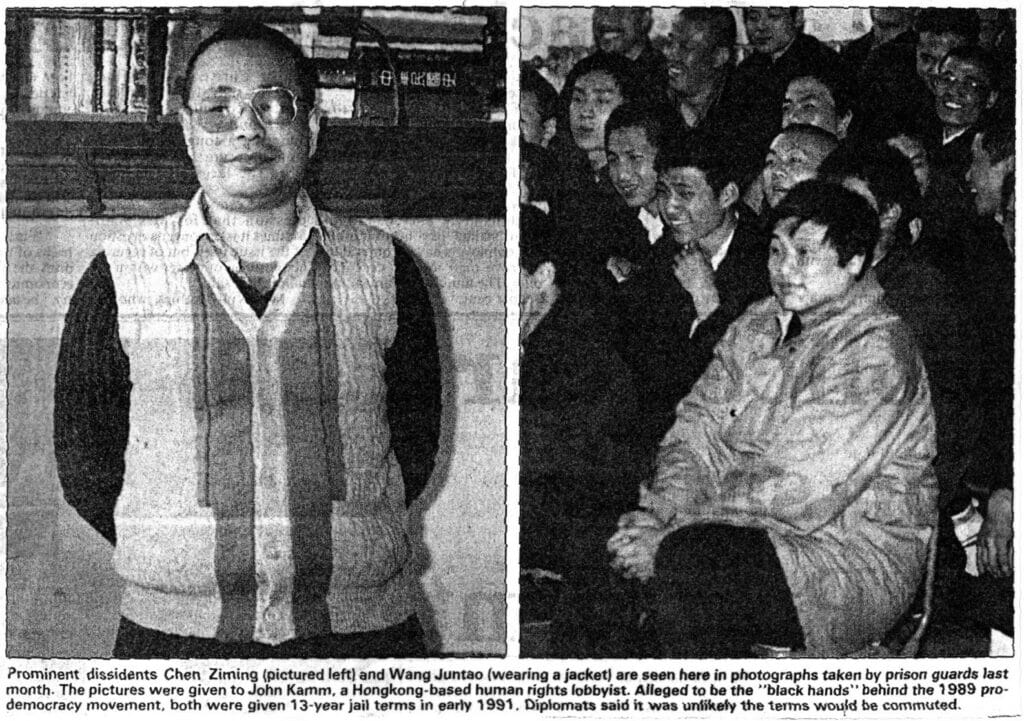

  • Two Good Priests

    Two Good Priests

    << Read all John Kamm Remembers stories

    Shangqiu South Church before the removal of its crosses in 2020. They were replaced with smaller crucifixes. Image credit: Union of Catholic Asia News

    In October 1992, I was in Hong Kong preparing for a trip to China the next month. It would be my tenth human rights trip to Beijing since January 1991. Many of the names of prisoners I raised on those trips had been granted early release, a reflection of Beijing’s concerns over the possibility of losing its bid for the 2000 Olympic Games and the prospect of Bill Clinton defeating George H. W. Bush in the November 3, 1992 presidential election. Clinton had campaigned on stripping China of its Most Favored Nation (MFN) trading status if elected.

    Preparations for trips to Beijing typically took several weeks. Appointments with officials in the Chinese government needed to be requested and, if granted, followed up with details including, on my part, the submission of political and religious prisoner lists. More mundanely, I needed to contact my regular driver and book a room at my usual hotel. Appointments with foreign diplomats and Beijing-based journalists also had to be fixed.

    For the November 1992 prisoner list, I wanted to include imprisoned Roman Catholic clergy and senior laity, of whom there were more than 100 at that time. In January 1992, I submitted lists to the central government, including to the Religious Affairs Bureau of the State Council, with names of imprisoned Catholic prelates. In May 1992, I was informed of the early release from prison of three high priority underground leaders I had advocated for. This experience was on my mind as I put together my list for the mid-November 1992 trip to Beijing.

    Father Giancarlo Politi, a Good Priest

    For that first list of Catholic prisoners submitted in January 1992, I had relied for information from Father Giancarlo Politi, a Pontifical Institute for Foreign Missions (PIME) missionary assigned to Hong Kong. Father Politi produced and edited authoritative materials on the Catholic Church in China, gained from first-hand readings, observation, and experience in the field. The priest arrived in Hong Kong in 1970 and began traveling widely in China to make contact with Catholic communities in 1986. He was deeply concerned about the fate of imprisoned Catholic clergy. Politi usually travelled alone on his trips to the mainland, though he was occasionally accompanied by Hong Kong Catholics. These were dangerous trips, fraught with peril.

    I reached out to Father Politi for assistance. I gave him a call at his place of work and residence, the PIME House in Sai Kung, Hong Kong. We agreed to meet for a “simple lunch” the next day. I contacted my driver – I was still a consultant to Occidental Chemical drawing salary and benefits, including use of a Mercedes 280SE. I arranged to be picked up at my apartment on Coombe Road the following morning.

    A photo of Father Giancarlo Politi, Kaifeng, Henan, 1993. Image credit: Father Giancarlo Politi

    Upon arrival at PIME House on November 5, 1992, I was met by Father Politi. He would later recall me as “a big man in a business suit with a driver and a Mercedes.” He ushered me into his office, where desks and shelves were piled high with publications and notes from his trips to China. I thanked Politi for sending me copies of PIME’s AsiaNews – he was editor at the time – and his latest mimeographed list of imprisoned Catholic bishops, priests, and senior laity. These lists informed virtually all of the publications of Western human rights groups that dealt with jailed Catholics.

    I asked Father Politi for a complete set of the lists, going back several years. He demurred, saying that the most recent list had incorporated the names of all imprisoned clergy on previous lists.  

    Politi’s Samizdat

    I insisted: “As a businessman, I always try to collect as much information as possible on a transaction,” I said. “It sometimes happens that critically important information is inadvertently omitted from the record.” Politi relented. He called his assistant, a young seminarian, and asked him to put together a complete set of the mimeographed lists, which I likened to samizdat of the old Soviet Union, unofficial publications of dissidents and activists that were widely circulated among networks in the country and abroad.

    Politi escorted me to the dining hall, where we were joined by a dozen PIME monsignors and priests. The “simple lunch” turned out to be a feast with plates full of pasta, vegetables, meat and fish, washed down with glasses of chianti. After finishing up, I headed for my car. I was met at the door by the seminarian. He gave me a stack of Politi’s lists.

    I was driven back to Hopewell Centre in Wanchai, site of my office. I spread out the copies of Politi’s lists on my conference table and began going through them. I quickly discovered that a name – that of Father Li Fangchun 李芳春 – had been dropped from the most recent list. I called Politi and he confirmed that a terrible mistake had been made. I then prepared an urgent appeal and faxed it, on November 7, 1992, to Vice Minister of Justice Jin Jian with whom I had established a good relationship.

    Father Giuseppe Li Fangchun, born in Shangqiu County, Henan Province, in 1935, underwent formation at the Kaifeng Seminary, a regional seminary that served the Kaifeng Archdiocese and other dioceses in Henan Province and Shanxi Province. The seminary was considered one of China’s best, on a par with Shanghai’s Shesan Seminary. It was for many years under the administration of PIME. Kaifeng itself was one of the most Christian cities in the country, sometimes called the Galilee of China. It was also home to China’s largest Jewish community.

    Li was ordained in secret in 1957. (Around one dozen Kaifeng seminarians were secretly ordained during the 1953-1957 period.) The last PIME missionary in Kaifeng was expelled from China in 1954. The seminary was closed in 1958 due to “lack of enrollment.”

    The main gate of the Kaifeng Seminary, where Father Li spent some time. Closed in 1958, the building has been used to shoot film and television programs. Image credit: PIME Hong Kong China

    According to the Chronicles of the Kaifeng Seminary published by the official Henan Catholic Administrative Commission, Li Fangchun was detained for counterrevolutionary activities together with other clergy, including the dean of the seminary, Ma Changren, around the time the seminary closed in 1958. The detentions took place during the Sufan (肃反) Movement to purge counterrevolutionaries. (Ma died in prison in 1962.) Li and the others had allegedly formed a “counterrevolutionary group” that secretly held masses, opposed the consecration of the officially appointed bishop of the Kaifeng Archdiocese, and criticized the official Catholic Patriotic Association. The Sufan Movement took place from July 1955 until early 1958. An estimated 214,000 people were detained; approximately 53,000 died, many by execution.

    After his detention in 1958 Father Li was tried and sentenced to 14 years in prison for counterrevolution. He served his sentence at Kaifeng Prison, currently known as Henan Number One Prison, a maximum-security prison that has housed many political prisoners and those awaiting execution over many decades.

    He was due to be released from prison in 1972. In that year, the Cultural Revolution, which began in April 1966, was still underway, although its worst excesses had for the most part passed. The Cultural Revolution was a period when the Catholic Church, or what was left of it, was under fierce attack. Churches were ransacked, priests “struggled” and beaten, and worse. I vividly recall being told by the Polish Consul General in Guangzhou – where there was a joint venture shipping company between China and Poland – that the priests at the Catholic church on Shamian Island had been frog marched by Red Guards from the church and lynched from lamp posts on Renmin Road in those horrifying days.

    The summer of 1966 was a period of intense persecution of Catholics. Here Red Guards sack St. Ignatius Cathedral in Shanghai on August 23, 1966. Image credit: Botanwang

    It is not known whether Li Fangchun was released on schedule in 1972 or had his sentence extended. He might have been placed in a re-education through labor camp, maybe in a remote area. He eventually returned to Shangqiu, a city of some 20,000 Catholics, probably in the late 1970s at the start of the Opening and Reform period when repression against Catholics eased. He began his ministry at the reopened Shangqiu South Church.

    Father Li’s freedom proved to be short-lived. He was detained again in February 1983 and sentenced to 12 years in prison for counterrevolutionary activities, including membership in a counterrevolutionary group and counterrevolutionary propaganda and incitement. He was sent back to Kaifeng Prison to serve his sentence.

    Henan Number One Prison, formerly Kaifeng Prison, where Father Li Fangcun was imprisoned. Image credit: Baike.sogou

    November 1992 Trip to Beijing

    I flew to Beijing on a Dragonair flight on November 16, 1992. I was picked up by an officer of my host organization, the China Council for the Promotion of International Trade (CCPIT). After checking into the Great Wall Sheraton and taking the obligatory “rest,” I was whisked away to a welcoming banquet hosted by CCPIT Vice Chairman Xie Peijing at the nearby Kunlun Hotel.

    The next five days were filled with meetings. I sat down for discussions with senior officials of the Ministry of Foreign Affairs, the State Council Information Office, the Ministry of Public Security, the Ministry of Justice, the Ministry of Foreign Economic Relations and Trade, and the Chinese People’s Institute of Foreign Affairs. Bill Clinton had just been elected, and his name was on everybody’s lips. They asked if I thought that Mr. Clinton would revoke China’s MFN status.

    On Thursday November 19, 1992, I met with Wang Mingdi, director of the Ministry of Justice’s Laogai (Reform through Labor) Bureau (later renamed the Prison Administration Bureau). Wang gave me information on Li Fangchun. Li had been detained on February 23, 1983. He was sentenced to 12 years in prison for counterrevolution, reduced by one year in 1984 and one year in 1988. His sentence was to expire on February 22, 1993. No information was provided on any supplemental sentences including whether a sentence of deprivation of political rights had been imposed.

    Wang didn’t mention that Father Li had already been released from prison on medical parole a short time before our meeting, in late October or early November 1992. He likely had not heard of the release, which suggested that the release had been sudden. Wang Mingdi would confirm the release at our next meeting in March 1993. Medical parole is the simplest way to secure an early release as it doesn’t need the approval of a court.

    After briefing the American ambassador at his office in Beijing, I flew back to Hong Kong on Saturday, November 21. I got in touch with Father Politi and we agreed to meet at the Holy Spirit Centre in Aberdeen on Tuesday, November 24. There I told him what I had learned about Father Li Fangchun.

    A picture of the Holy Spirit Seminary in Aberdeen taken in 2006. Image credit: Isaac Wong (惡德神父) / CC BY-SA 3.0 via Wikimedia Commons

    Politi activated the old PIME network in Kaifeng. He was told that the prison wardens had opened the prison gate and unceremoniously tossed Li Fangchun out onto the street around the time of my appeal to Minister Jin Jian. Li was found wandering the streets by a Catholic couple surnamed Cai, a priest and his sister, a Catholic nun.

    Li was in bad shape. He could not remember his name, nor even remember that he had been a priest. He walked with difficulty. The couple nursed him back to health. He gradually recalled how he had suffered in prison; he had experienced two heart attacks.

    Under Cover of Darkness

    Politi travelled to Kaifeng in January 1993. He met Father Li at the couple’s house. After a period spent building trust, the Kaifeng priest, Politi, and Li Fangchun decided to leave Kaifeng early the next morning. A driver who could be trusted — probably a local Catholic — was hired, and at 5:00 AM, after a sleepless night, the group — Li, Politi, and Father and Sister Cai — left Kaifeng in the cold and dark. Politi was under surveillance. As he later put it, “In China, you learn to move under cover of darkness.”

    The journey to Shangqiu from Kaifeng — 200 kilometers (about half the length of New York State) — took more than two hours on rough roads (this was long before a freeway was opened to link the two cities.) Father Li was mostly silent, tracking progress by ticking off the stones marking kilometers. Politi told him of our effort to secure his release. Li Fangchun wept.

    His home village was about 20 kilometers from Shangqiu. As he approached it, he could see the spire of his old church. He called out for the taxi to stop, and he leapt from the car. As Politi put it, “he ran like a child” to the doors of his church. There he fell on his knees and kissed the earth. The church had long been abandoned; no priests were in sight. A villager, a Catholic, emerged from the shadows and led Father Li away, but not before telling Father Politi to leave right away and never come back. “It’s too dangerous for you, and for us.”

    A photo of Father Li Fangchun, Kaifeng, Henan, 1993. Image credit: Father Giancarlo Politi

    Not long after his return to Hong Kong, Father Politi was recalled to Italy. Those in the local Catholic community believed he was called back in part due to his activism on behalf of Catholic bishops and priests in China, including his trips to the mainland to gain information on local Catholic communities and imprisoned Catholics. Beijing was also said to be angered by Father Politi’s role in leaking photographs of the deceased Bishop Fan Xueyan, lying on a slab. The photos suggested that Bishop Fan, his body covered with bruises, had been mistreated.

    Politi’s last trip to the mainland was the one he made to Kaifeng in January 1993 to bring Li Fangchun home to Shangqiu. Shortly after his return to Hong Kong and as he was preparing to return to Milan, Father Politi learned that Li Fangchun had died from his third heart attack.

    The Italian missionary never returned to Hong Kong, working in Milan on China issues until he passed away at the age of 75 from complications from a long illness in December 2019. Father Politi gave an on-camera interview to my son Rene and his Oberlin College classmate Jake Hochendoner in October 2013. Much of the information on Politi’s trip to save Li Fangchun comes from that interview.

    Father Politi is remembered as a good shepherd by Catholics on the mainland and in Hong Kong, where he served as a parish priest in Yuen Long and Tsuen Wan before taking up his position at PIME House in 1986. He fought to save the Roman Catholic Church from extinction in China during the darkest days of the second half of the 20th century. He will long be remembered.


    Listen to the Encounters with China podcast.

    Subscribe to receive notifications about new episodes. 

    Read all John Kamm Remembers stories.
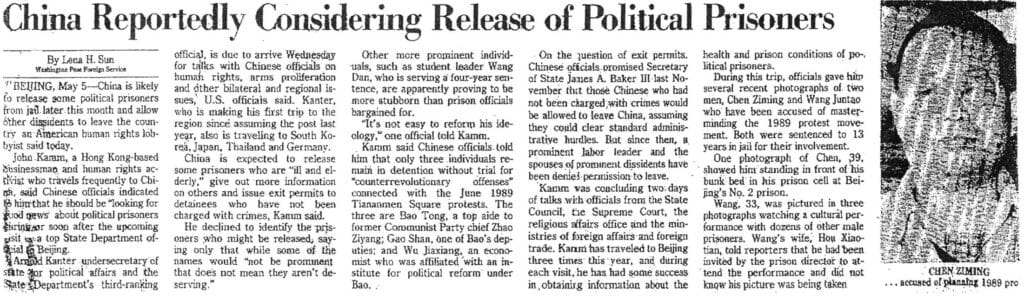

  • Kamm’s List

    Kamm’s List

    << Read all John Kamm Remembers stories

    The US theatrical poster for Schindler’s List (left) and the cover for the Chinese VCD bootleg (right). People in China watched the film on pirated copies of VCDs since the film was not released in Chinese theaters. Image credit: Wikipedia; Knews.cc

    This John Kamm Remembers is a continuation of last month’s installment, “Memories of 9/11,”  which recounted August-September 2001, when Kamm was approached by Tina Rosenberg about being the subject of a New York Times Magazine profile, and Kamm’s experience in China in the wake of the September 11 attacks.

    State Security


    Tina and the photographer retained by the Times to cover our visit, Zeng Nian, arrived in Beijing from New York in the late afternoon of December 17, 2001. I met them in the lobby of the Jianguo. From the moment of their arrival going forward, we were the objects of attention by state security. One of my drivers later told me that he was summoned for questioning and shown photographs of our arrival at different ministries.

    Tina and I had dinner at the Jianguo. We discussed the schedule for the days ahead.

    Ngawang Choepel speaks to an audience about his work while holding a traditional Tibetan lute. SFT HQ / CC BY 2.0

    On December 18, Tina, Zeng Nian, and I went to the MFA for a meeting with Li Baodong. The purpose was to discuss the possible release of Ngawang Choepel, a Tibetan musicologist who had studied at Middlebury College in Vermont and had been detained in September 1995 on a trip back to Tibet to film folk dances and record traditional music, and to see his mother. His had become an important case for Senator Jim Jeffords, R-Vermont, a pro-trade politician who had nevertheless voted against China’s Most Favored Nation (MFN) in 2001 over the way Ngawang Choepel and his family were being treated.

    While we were introducing ourselves in came Foreign Minister Li Zhaoxing, who had recently returned to Beijing from Washington where he had served as ambassador. Li was familiar with the Ngawang Choephel case. Senator Jeffords’ vote against MFN had made an impression. After 9/11 Li Zhaoxing had recommended, to President Jiang Zemin, that political prisoners be released to improve the relationship with the United States, a seemingly contrarian move. Why make concessions to the United States when it was the United States that was seeking support from China?

    At the MFA, Foreign Minister Li introduced Tina to Li Baodong. “This is the good Mr. Li,” he quipped. “There’s another Li who lives in Taiwan. He’s the bad Mr. Li.” The foreign minister was referring to President Lee Tenghui, seen by the Chinese government as enemy number one. After the foreign minister left the room, Li Baodong and I discussed the Ngawang Choepel case in cryptic terms. We agreed that we would meet again the next day.

    For lunch, Tina and I were hosted by a large group of foreign diplomats assembled by Mark Lambert, the US embassy’s human rights officer, in the best Italian restaurant in Beijing, Aria. They spoke one-by-one about their dealings with China on human rights. In those days, China was engaged in around 10 human rights dialogues with foreign countries. Now there are none.
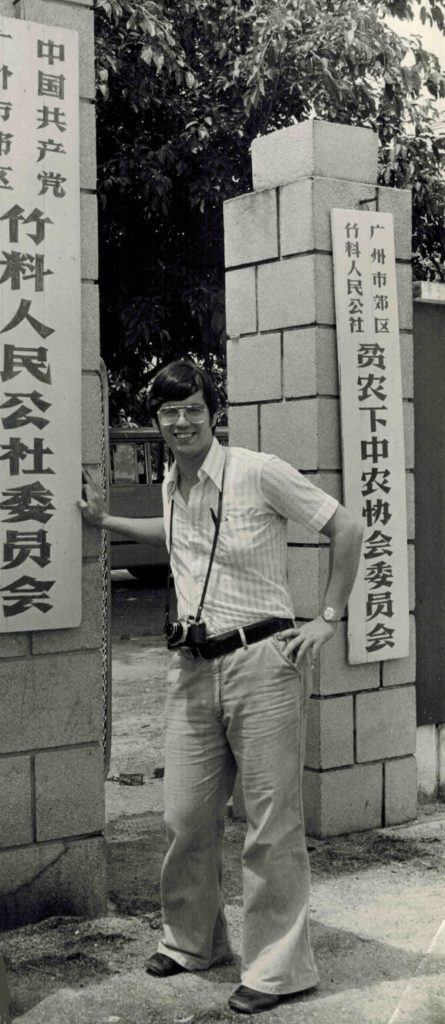
    Offices of the Foreign minister: John Kamm with the First Vice Foreign Minister Li Zhaoxing (also former Chinese ambassador to the United States). On the left, Li Baodong, Chief of International Affairs Department of the Foreign Ministry. Image credit: Zeng Nian / Gamma-Rapho via Getty Images

    Tina and I parted ways. I went on a visit to Beijing Number Two Prison. The MOJ had denied a request for Tina to join me. She went back to the MFA for a private interview with Li Baodong. We reconnected for dinner with Mark Lambert.

    Not surprisingly. Tina wanted to gauge the opinion of American businesspeople about what I was up to, promoting respect for human rights on the part of the American business community in Beijing. I had set up a breakfast with the American Chamber of Commerce for 7:30 AM on December 19. Those at the table were defensive, citing the good work done for orphans and flood victims. Tina adopted a skeptical air. Outside the room, state security was listening.

    After the breakfast, we went to the Supreme People’s Court for yet another uncomfortable meeting. The head of the Foreign Affairs Bureau, Mr. Liu Hehua, had clearly been caught off guard. I presented a letter from “my cousin,” Senator Orrin Hatch, and pummeled him with questions about the fate of the China Plum Blossom Party and the pamphleteer Yu Rong. I offered to provide assistance to Mr. Liu with materials on the American justice system.

    As we were leaving, Mr. Liu took our photographer aside and sharply asked him about what was going on. The photographer was told that that he should be careful about who he worked for. It was not what the photographer, a French citizen with family in China, had anticipated.

    There are two bookstores that were selling volumes related to judicial matters, including those related to trials for political offenses, near the Supreme Court. (NB: The bookstores no longer offer such books.) We surveyed their offerings under the watchful eyes of suspicious shopkeepers. I bought a couple, and then we were off for a photoshoot at the old Beijing railway station.

    Dinner at the Beijing International Trade Center with 17 European ambassadors and the staff of European embassies working for human rights in China. John Kamm holds the book Annual judgements of the Sichuan Province in 2000. Image credit: Zeng Nian / Gamma-Rapho via Getty Images

    I departed Beijing on the 5:30 PM Dragon Air flight to Hong Kong. After three days doing research and briefing clients I returned to San Francisco on December 23, in time for Christmas.

    On January 16, 2002, Tina called me with the news that her editor had decided that the entire article – now a profile – would be devoted to my work. The aim was to publish it on February 16. There followed more calls between Tina and me, one on February 5 devoted entirely to Ngawang Choephel’s release that had taken place on January 20. “Wrap up” interviews followed.

    A photograph of Tina Rosenberg, the author of “Kamm’s List.” Image credit: Emmanuel Upegui provided by Ms. Rosenberg

    The first of two fact-checking interviews with the Times editorial staff followed. I was asked to estimate how many prisoners I had helped in the years since I began intervening on behalf of Chinese prisoners in May 1990. This entailed going over trip reports and notes. Finally, I estimated that I had helped around 250 political prisoners win early release or better treatment. During the last of these fact-checking interviews, I managed to tease the title of the article, now billed as a cover story for the Times’ Sunday Magazine, out of the fact-checker: “John Kamm’s Third Way.” I concluded that Chinese feathers would not be ruffled by this title. The story was slated to appear on Sunday March 3, 2002.

    I left for Hong Kong on February 26, thence to Beijing on March 10. In Hong Kong, I intended having dinner with my Guangdong interlocutors, taping a show for VOA, giving a speech to the Asia Society, and conducting research in Hong Kong libraries. Most important, I wanted to gauge reactions to the cover story, due for publication during my days in Hong Kong.
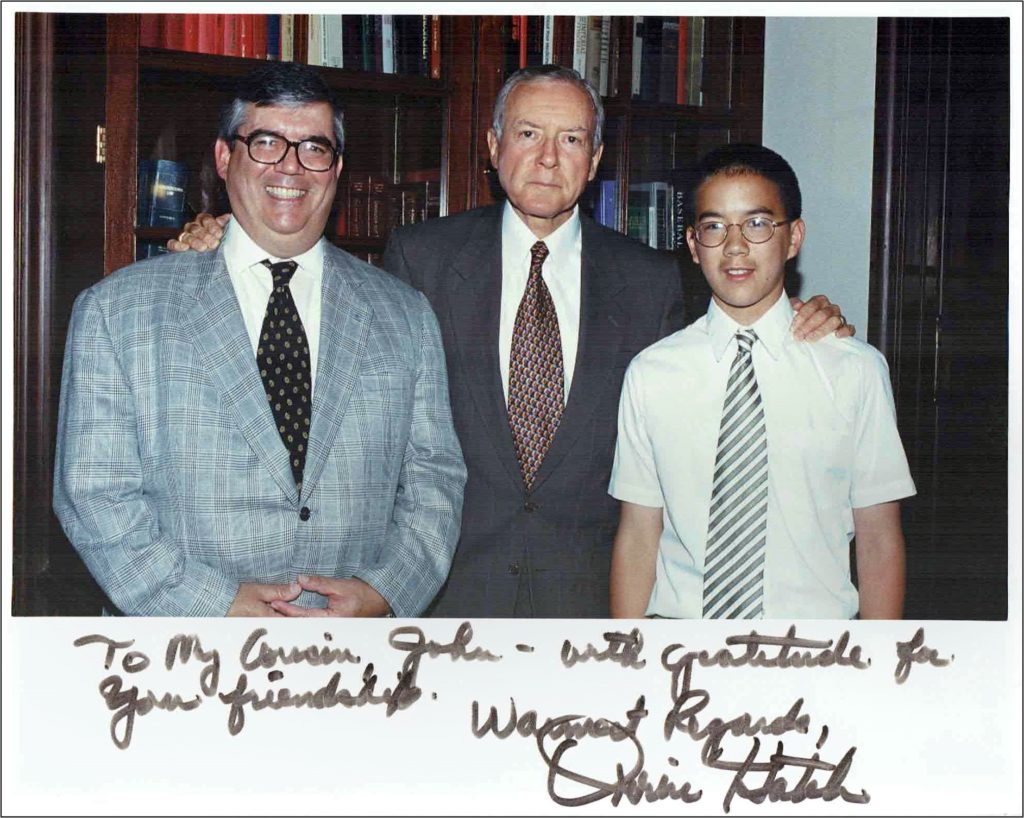
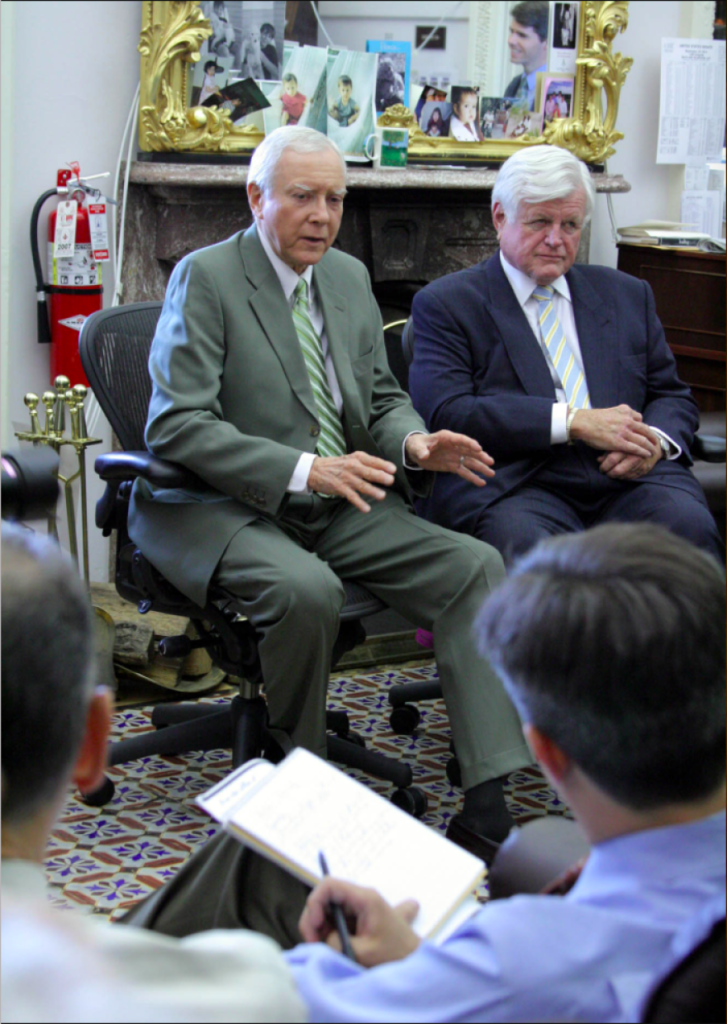
    On Friday, March 1, my cell phone went off while I was in the stacks of the Hong Kong University library. I stepped outside to take the call from my wife. The story had been published on the Times’ website on Thursday, February 28. “I thought you said that the title of the story was ‘John Kamm’s Third Way,”’ she said. “In fact, the title on the cover is ‘Kamm’s List.’” That’s when I learned that there are in fact two titles for a cover story. One for the cover, which is decided by the graphics people, the other inside the body of the article decided by the editorial staff.

    The latter was in fact “John Kamm’s Third Way.” The cover was a mockup of a movie poster that closely resembled one of the movie posters for Steven Spielberg’s 1993 hit movie Schindler’s List.

    Schindler’s List

    I shuddered. It would be hard to avoid the comparison between Kamm, saving Chinese prisoners from the Chinese government, and Schindler, saving Jews from the Nazis. I anticipated a sharp reaction from Chinese officials in Beijing – assuming I was allowed to enter the country.

    A still from Schindler’s List with Chinese subtitles. Image credit: Knews.cc

    I need not have worried. I entered China on March 10, 2002, without incident. The next day I met with Li Baodong and La Yifan. La advised me that he was monitoring reactions to the article among Chinese officials and National People’s Congress and political Consultative Congress deputies, assembled in Beijing for their annual meetings, the so-called “Two Sessions.” Thus far there had been no negative reactions. I told them that there was unhappiness with the article among American businessmen. Li Baodong airily waved his hand: “Don’t worry. They’ll get over it.”

    A young official escorted me from the ministry to my car. “Imagine,” he said. “An article about human rights in China in which the Chinese government is not the biggest villain!”

    On the afternoon of March 11, I went to the MOJ’s headquarters where I was received by two directors: Wang Lixian, head of the International Department, and Liu Fuchen, head of the Prison Administration Bureau. We sat down and director Liu fixed his eyes on me. “Mr. Kamm, wasn’t there an article about you published in the United States recently?” I said yes, there had been a story about me in the New York Times Sunday Magazine published a few days before.

    The cover of a Chinese version of the book Schindler’s List, written by Thomas Keanelly and originally titled Schindler’s Ark, published after the movie received international acclaim. Image credit: Abebooks

    “What was the title of the article,” Liu asked. “John Kamm’s Third Way,” I replied. Liu shot back. “No, that’s not the title I remember.” I explained that “Kamm’s List” was the title on the cover of the magazine. “John Kamm’s Third Way” was the title listed in the table of contents and inside the issue itself. Liu continued his line of questioning. “Wasn’t there a movie with a title similar to that?” I confessed that there was: “Schindler’s List.”

    Liu rubbed his hands and exclaimed: “Won an Oscar, didn’t it? Excellent!”

    An Unhappy Exchange

    After a final meeting with Li Baodong on the morning of March 13, I went to the Supreme People’s Court where I was received by Liu Hehua. He was not happy, taking special umbrage at a line in the story: “Kamm not only speaks Mandarin and Cantonese but also the language of the party which is just as important.” Liu adopted a threatening tone. “This will not end well for you.” It turned out that Liu was relying on a translation of the article and not the actual article itself. I admonished him to read the original, and not rely on a translation.

    I returned to Hong Kong on March 14 and flew back to San Francisco on March 17, satisfied that, while members business community were not happy – the head of a large business group that promotes trade with China was especially angry – the Chinese government was, for the most part, satisfied with the article, as was the case with the human rights community.

    Today, “John Kamm’s Third Way” is required reading in courses on business and human rights, including those taught at Harvard Law School, Columbia Law School, and Princeton University. A testament to Tina Rosenberg’s writing, it has stood the test of time.


    Listen to the Encounters with China podcast.

    Subscribe to receive notifications about new episodes. 

    Read all John Kamm Remembers stories.