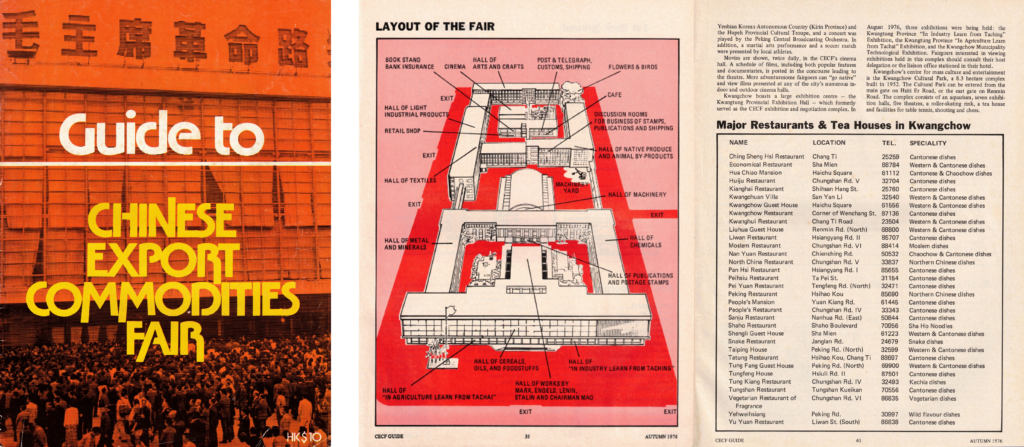
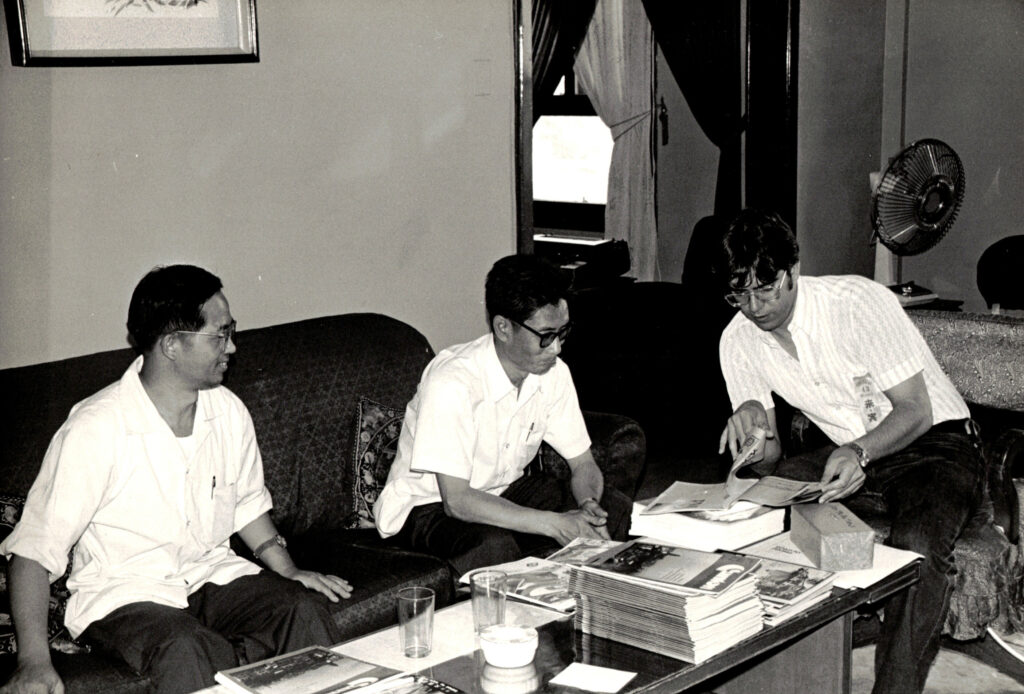
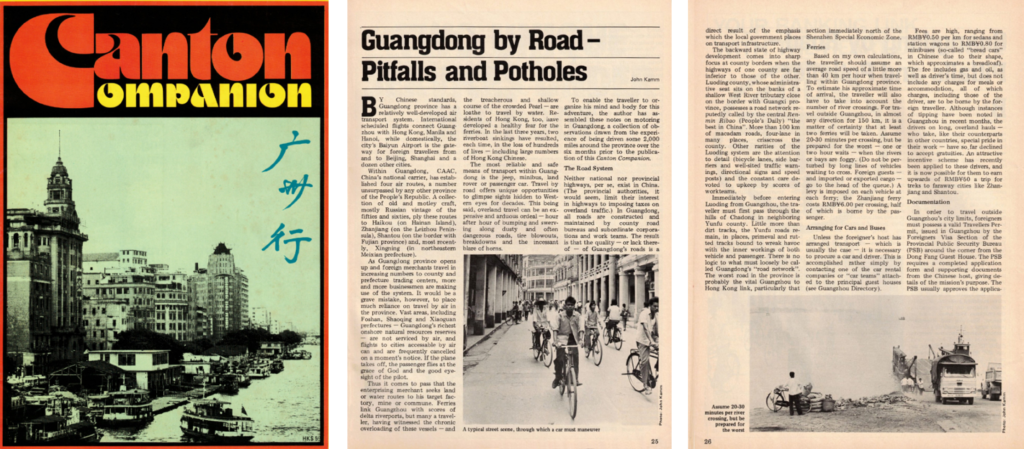
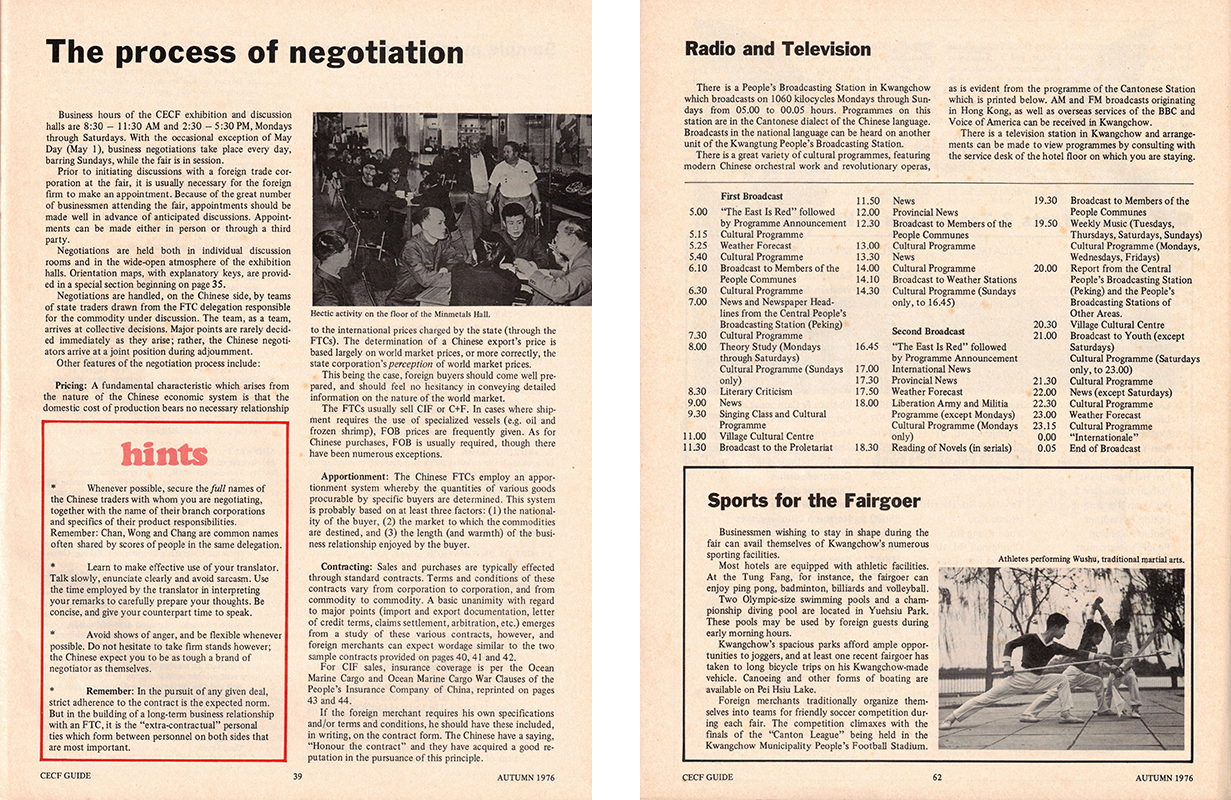
John Kamm Remembers are stories written by Dui Hua’s founder recounting Kamm’s advocacy for prisoners in China. In addition to these stories, the 50 Years in China timeline visualizes Kamm’s human rights work alongside the history of US-China relations.
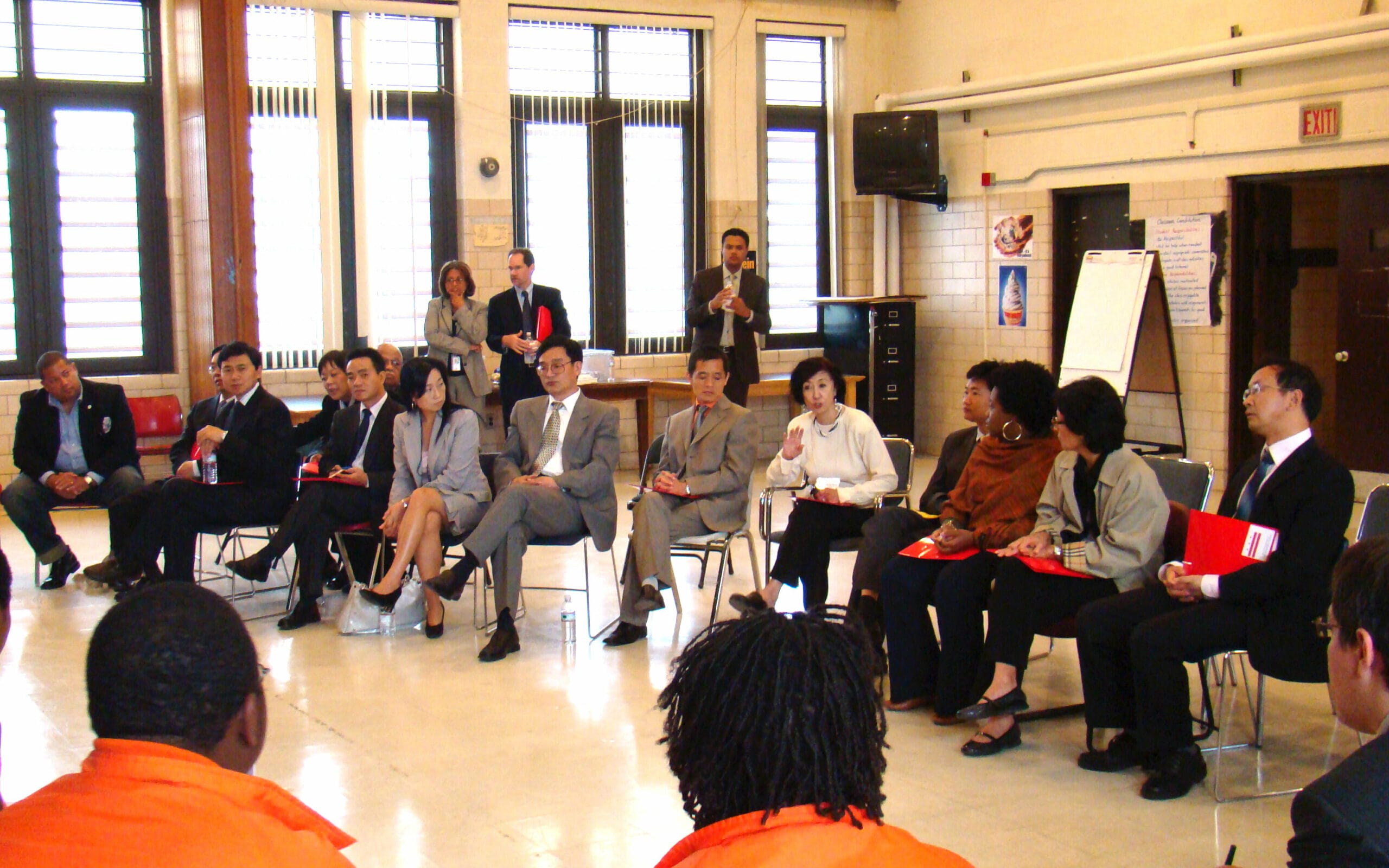
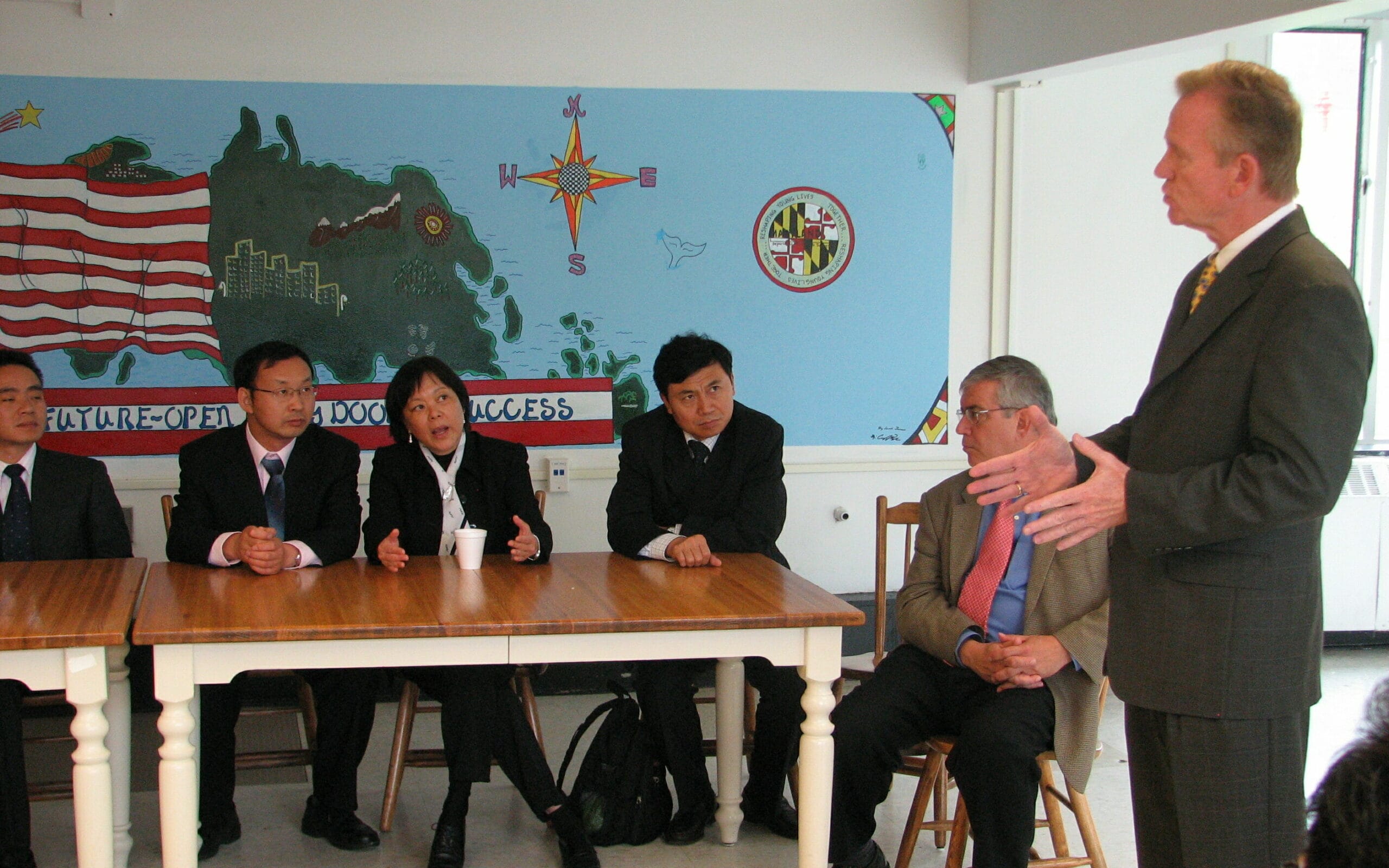
In 2007, Kamm journeyed to China’s Hubei province with a colleague to see how different judicial bodies interacted at the provincial level. Despite a promising start, the itinerary didn’t go as planned, perhaps an early indicator of a fraying relationship between Dui Hua and China’s Ministry of Justice.
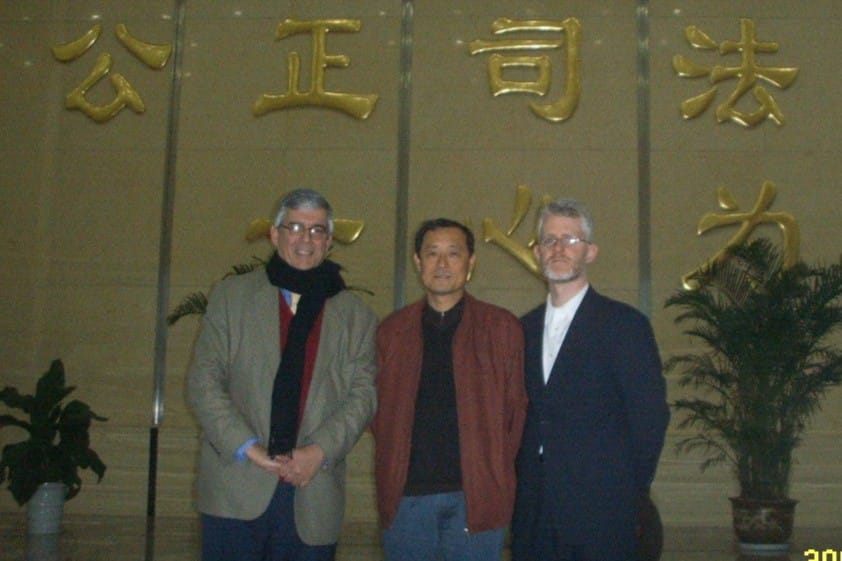
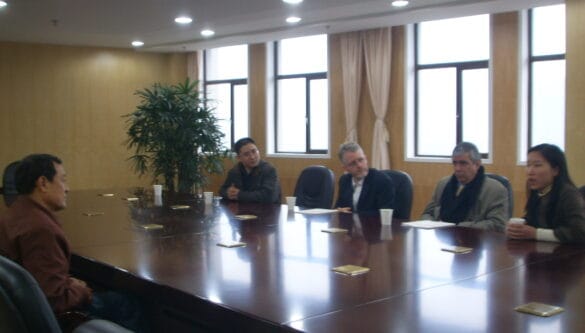
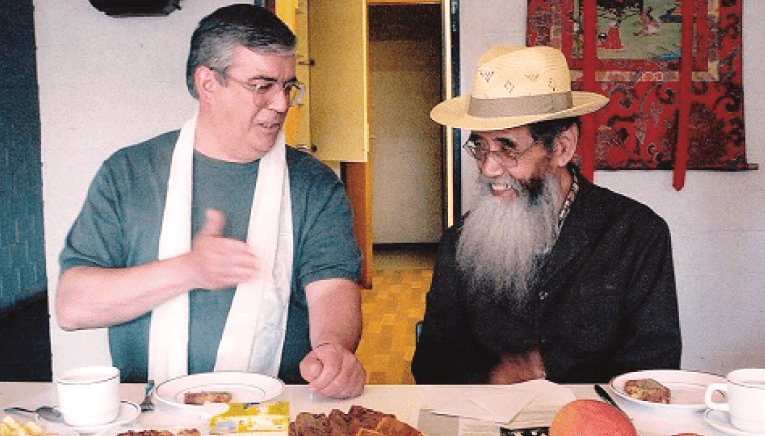
Kamm (left) and Rosenzweig (right) with an official from the Hubei Procuratorate in Wuhan, November 16, 2007. Image source: Dui Hua.
In 2007, I toured Hubei Province with a colleague. The visit did not go well and was an early indicator of a fraying relationship between Dui Hua and China’s Ministry of Justice (MOJ). It represented a low point in my dialogue on human rights with the Chinese government.
Earlier on in the year, I had began discussions with a senior official who worked for the Supreme People’s Procuratorate. I had met him in Europe, and then, later, on a visit to the United States.
For a long time, I had wanted to visit a Chinese province other than Guangdong to look at how different judicial bodies interacted at the provincial level. We settled on Hubei in central China. The official with whom I was holding discussions had good connections there.
My idea was to visit a prison, a detention center, and a court, where we could attend a trial. Prisons are under the provincial prison bureau which in turn reports to the prison administration bureau of the Ministry of Justice. Detention centers report to the provincial public security bureau under the Public Security Ministry, while intermediate people’s courts are under the provincial high court. We also wanted to meet with officials to ask about political prisoners and interact with students and professors at a law school. I was especially interested in getting information about Qin Yongmin (秦永敏), one of the founders of the Democracy Party of China. Qin was released at the end of his sentence in 2010. There is no record of his being granted clemency. He was put back in prison to serve a 13-year sentence for subversion in 2015. He is currently serving his fourth sentence in Guanghua Prison in Hubei. Qin’s wife, Zhao Suli, is reported missing. Dui Hua’s advocacy on behalf of Qin Yongmin has continued. To date, the foundation has placed his name on 22 lists submitted to the Chinese government. We have received 25 responses.
I suggested that Joshua Rosenzweig, my colleague at Dui Hua, and I make presentations on, respectively, application of the death penalty in the United States, with a focus on lethal injection, and citizen oversight of police forces in the San Francisco Bay Area. My suggestion was accepted.
The official assured me that my requests would be met, so we moved to the next stage: logistics – dates, transportation, and lodging.
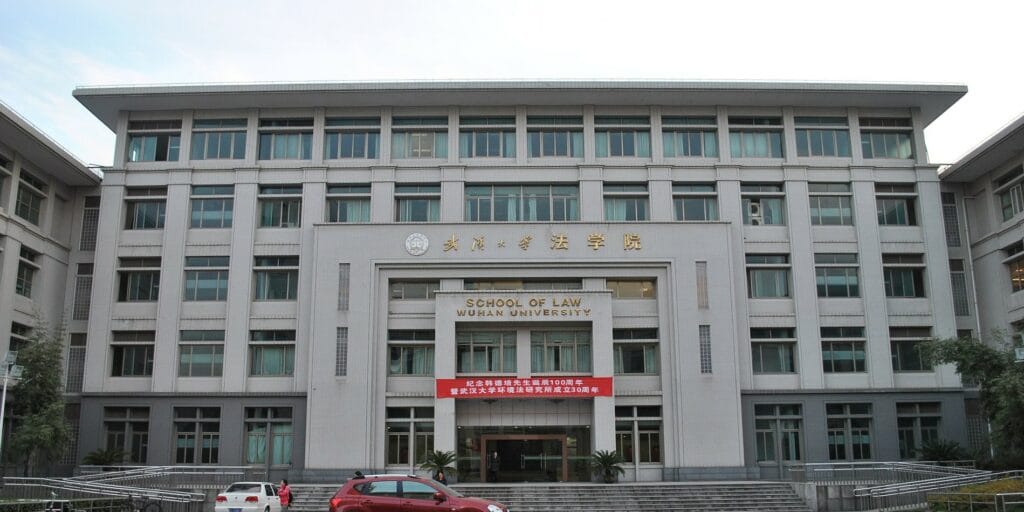
Wuhan University School of Law
Josh and I departed Hong Kong at 8:30 AM on November 14, 2007, aboard a Dragon Air flight, arriving in Wuhan two hours later. It was a cool and misty day. After landing, we went by car to Wuhan University School of Law. There we were met by Dean Ma Kechang. Dean Ma was known for his work as a defense counsel in the trial of the Gang of Four, the group of radicals blamed for many of the excesses of the Cultural Revolution. Ma had represented followers of the disgraced leftist premier Lin Biao, who had reportedly died in a plane crash as he was attempting to flee to the Soviet Union.
Wuhan University School of Law. Image source: Wikimedia Commons
Josh made his presentation on lethal injection, in flawless Chinese. It was well received and prompted many questions. I spoke, in English, on Dui Hua’s work on behalf of Chinese political and religious prisoners. Despite the sensitivity of the topic, my remarks were also well received by an enthusiastic audience of students and professors.
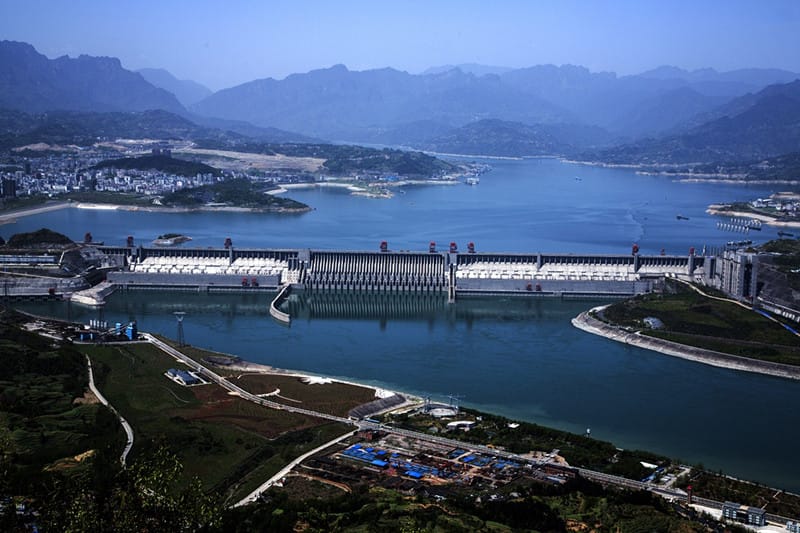
After our presentations at the law school, Josh and I left by car for the four-hour drive to Yichang, a city of more than three million residents most famous for its proximity to the Three Gorges Dam. Upon arrival, we were taken to a banquet room in the hotel at which we would make our presentations the next day. During dinner, I remarked how much Josh and I were looking forward to our visits to a prison and a detention center. Our hosts started to fidget in their seats and stare off into space.
The Three Gorges Dam. Image source: hubei.gov.cn
After dinner, the officials came to my room. There they told Josh and me that there would not be a visit to the Yichang Prison. Nor would there be a visit to a detention center. We could not attend a trial. I registered my disappointment. I told them that I would have to consider returning to Wuhan and flying back to Hong Kong. They asked me not to do so. Eventually, I relented, and the show went on as planned.
Citizen Oversight of Police Forces
The next day, November 15, 2007, I began what was to be a three-hour presentation on citizen oversight of police forces. This being a seldom-explored topic in China, where civilian oversight of the police (not to mention state security agents) does not exist, there was considerable interest in my remarks. We were told that this was the first-ever presentation to Chinese officials on the subject.
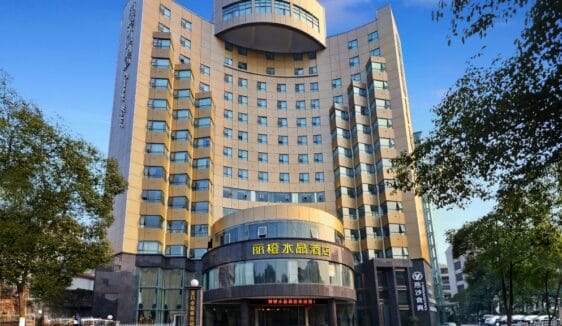
The presentation took place in the main hall of the Bailong Hotel, site of the Yichang Procuratorate Training Center. The audience consisted of more than 100 officials from the procuratorate and public security bureaus, as well as other judicial bodies in Yichang. It was taped for rebroadcast on closed-circuit television to procuratorates throughout the province. The interpretation was not the best, so Josh jumped in to help. I fielded questions from the audience, after which we went to lunch in the hotel.
Bailong Hotel (later renamed to Licheng Shuijing Hotel in 2011) is the site of the Yichang procuratorate training center. Image source: c-ctrip.com
Our hosts made one more effort to visit Yichang Prison. The effort failed, and they were reproached for defying instructions. We decided to leave Yichang right away, and we returned to Wuhan. That night we were hosted at a banquet by the Hanjiang Municipal Procuratorate.
A Waste of Time with the “No” Official
Meeting with officials from Hubei Procuratorate and Prison Bureau. Image source: Dui Hua.
We began November 16 with a meeting with officials of the Hubei Procuratorate and the Hubei Prison Bureau. It was a frustrating waste of time. The prison bureau official showed up in his uniform bedecked with ribbons and medals. He arrogantly refused to answer the most basic questions, including how many prisons the bureau administered in Hubei. We pointed out that this information was freely available on-line, and we showed him the Wikipedia entry. He refused to answer questions on prisoners, and he refused to accept a prisoner list from us.
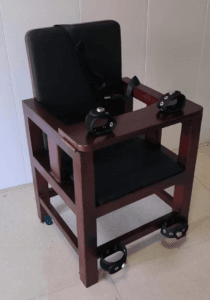
A wooden interrogation chair, with straps. Image source: internet
We then went to a detention center, run by the procuratorate, for detained corrupt officials. It was fitted out with video equipment to record the interrogation. Video recording was a new tool integrated to combat coerced confession during interrogation, something our hosts clearly wanted to show off. On the wall was a clock with markings for 24 hours, the time given to the procuratorate to question suspects before handing them over to the police or party inspection committee. Suspects were strapped to a solid wooden chair where they would sit for 24 hours without a break.
Although we were not able to attend a trial, we were invited to meet with judges of the Jiangnan Intermediate People’s Court. We held an interesting discussion on access to court documents and access to trials by foreign observers.
The Hankou Foreign Concession
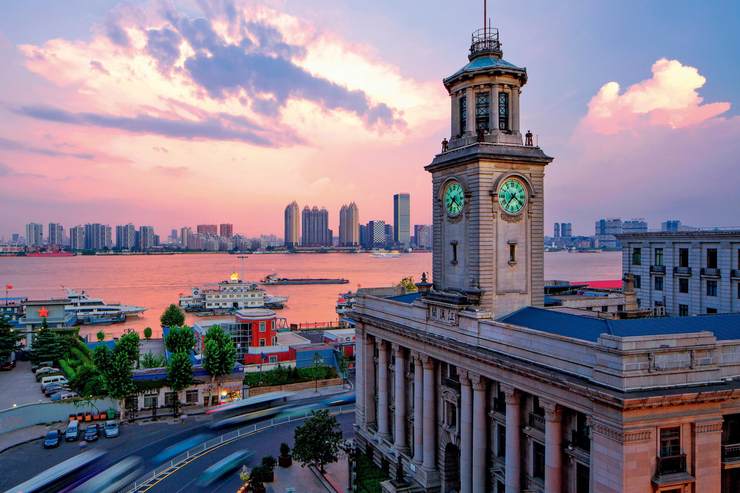
Hankou Concession District. Image source: Chinese National Geographic, dili360
Saturday, November 17, was given over to sightseeing. We walked around the Old Hankou Concession District. At one point, Hankou was the sight of five foreign concessions: British, French, German, Russian, and Japanese. We sat for a while on an embankment of the Yangzi River. I was reminded by an accompanying official that, in July 1966, Chairman Mao swam the Yangzi near this spot, a seminal incident in the early days of the Cultural Revolution. After our tour, we passed by a souvenir shop and a bookstore. There, I purchased RMB 150 worth of books.
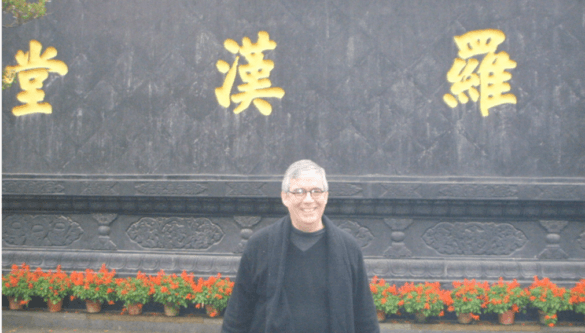
Kamm at Luohan Temple. Image source: Dui Hua
Finally, we visited a Buddhist temple after which we returned to the hotel for an early turn-in. Our flight to Hong Kong, KA851, would leave early on November 18.
Wu Aiying, Enemy of Dialogue
I eventually found out why our visit to Yichang Prison was scrapped. Wu Aiying became Minister of Justice in 2005, and she set about dismantling what had been a good working relationship between the Ministry of Justice and Dui Hua. Wu was widely seen as an ignoramus who knew nothing about the law or policy. She preferred talking about cooking. On foreign trips she accepted expensive gifts, which eventually contributed to her downfall. What finally did her in was her promotion of a conman to a senior position in the ministry. Both this fellow and Wu were expelled from the Communist Party, and the conman was tried. It is not known what happened to Wu Aiying, but many judicial officials fervently hoped she would receive her just desserts – a term of imprisonment in a women’s prison.
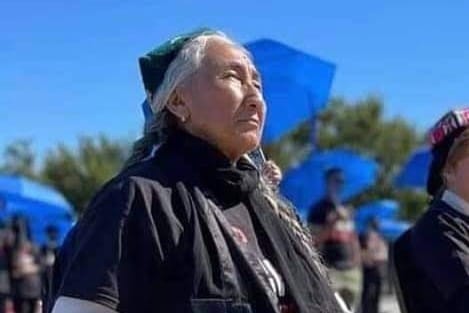
In 2005, Rebiya Kadeer – Uyghur entrepreneur and activist – had been given a rapturous welcome on her arrival in the United States. John Kamm recounts his contribution to Rebiya’s release, following her fall from grace from Chinese politics and subsequent arrest and imprisonment.
Rebiya Kadeer, seen at a 2021 rally in Washington, DC. Image source: Twitter @KadeerRebiya
The senior Chinese diplomat and I agreed to meet at the usual time and place: breakfast at 8:00 AM at the historic Mayflower Hotel, not far from the White House in Washington D.C. The date was May 19, 2005. It was a cool and cloudy day.
The Mayflower was the site of China’s first diplomatic presence in the United States after the two countries resumed contact in the early 1970s following many years of not talking to each other. For several months in 1973, the hotel housed China’s Liaison Office, the forerunner of its embassy. The establishment of the Liaison Office was the result of the Nixon-Kissinger foray into China in 1972.
While the Mayflower had a historic significance for Chinese officials, my interest in dining there was more prosaic. It offered outstanding breakfasts, including, among my favorites, eggs benedict and corned beef hash and eggs.
My guest arrived in a poorly tailored western suit, adorned with a scowl on his face. He sat down, and we exchanged pleasantries. The source of his displeasure soon became apparent: the March arrival in Washington of the Uyghur entrepreneur and activist Rebiya Kadeer. She had been given a rapturous welcome at Dulles Airport by members of her family, the Uyghur diaspora, and officials of the U.S. government. The welcoming ceremony featured a victory dance.
I had met with Rebiya and her family the day before my breakfast with the diplomat.
As was the custom when I met Chinese officials, I intended handing over a prisoner list. The official raised his hand as if to signal “Not now,” saying, “Before we get to that, you and I need to talk.”
The embassy official claimed that the reception given to Rebiya Kadeer violated an understanding between Washington and Beijing not to “hype” her arrival in the U.S. Specifically, it went against the tacit agreement between the U.S. ambassador Clark Randt to keep Rebiya quiet. There would be consequences, the diplomat threatened.
I said that I was confident that the State Department could take care of itself. “But what about you, Mr. Kamm? You have business in China. Can you take care of yourself?”
“What do you mean by that?”
His response was a sloppy smile and silence. The threat was clear.
I was not able to hand over my list.
A few days after this breakfast, I flew to Dallas Texas and resigned from the board of directors of an U.S. telecommunications company. Such was the end of my business career.
August 1999
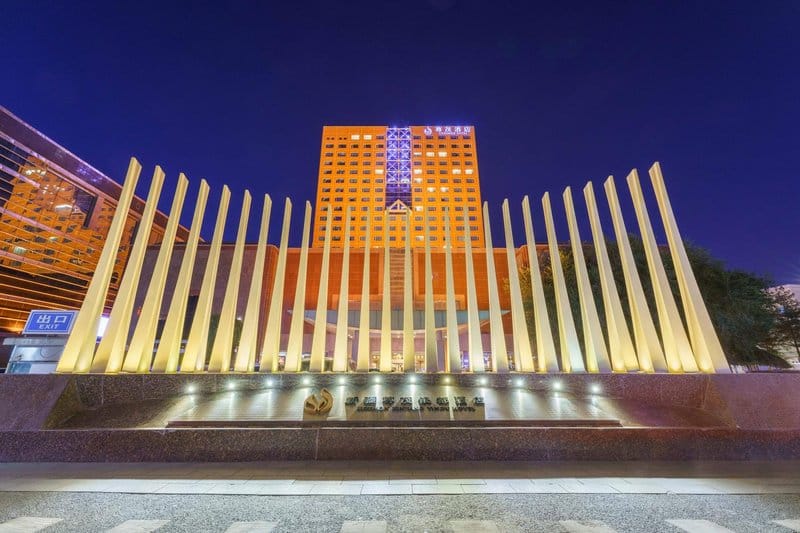
On August 11, 1999, Rebiya Kadeer, a son, and her secretary, were taken into custody in Urumqi on the way to meet a U.S. congressional staff delegation at the Yindu Hotel, a luxury business hotel in the center of the city. She was carrying newspaper clippings that she hoped the delegation would give to her husband, Rouzi Sidik, in Washington D.C. Rebiya had earlier mailed him clippings from Urumqi, Kashgar, and Ili newspapers, as well as clippings from the Xinjiang Legal News. These newspapers were freely available and sold on the streets of Xinjiang’s cities.
The Yindu Hotel at night. Image source: Luxemon Xinjiang Yindu
In addition to the newspaper clippings, Rebiya was planning to hand over a list of Uyghur political prisoners, and a list of the victims of the killings in Ghuljia, the capital of Ili Kazakh Autonomous Prefecture, in 1997.
Rebiya was formally detained two days later and placed in the Liudaowan Detention Center where she would stay for more than 12 months. She later revealed, in an interview with American media, that, although she herself was not tortured, she could hear other detainees screaming from torture.
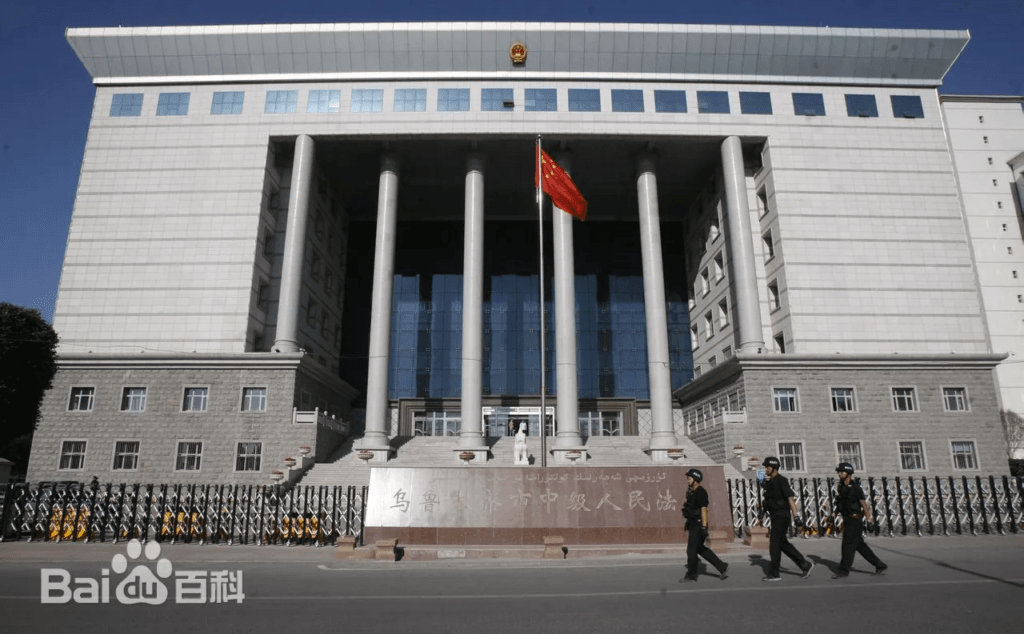
Rebiya was formally arrested on September 2, 1999, and subsequently tried and convicted by the Urumqi Intermediate People’s Court of illegally providing state secrets abroad, a crime of endangering state security. She was sentenced on March 10, 2000, to eight years in prison, and was given a supplemental sentence of two years deprivation of political rights. Rebiya appealed her eight-year sentence but in November 2000, the Xinjiang High People’s Court rejected her appeal and upheld the intermediate court’s sentence. She was sent to Xinjiang Women’s Prison to serve her sentence. Her sentence was due to expire on August 12, 2007.
When she was detained, the international media referred to Rebiya as a successful businesswoman. That was certainly the case. Starting as a seamstress sewing undergarments, she went on to build a vast business empire consisting of department stores and real estate in China and central Asia. She was to become one of the richest people in China, said to be the richest businesswoman in the country with assets worth hundreds of million renminbi. She served in high positions in industrial and commercial bodies in the Xinjiang Uyghur Autonomous Region.
In addition to her business acumen, Rebiya was a philanthropist who invested in schools throughout Xinjiang. She was a political leader who served as a delegate to the Chinese People’s Political Consultative Conference (the top advisory body to the Communist Party) and a delegate to the National People’s Congress (NPC). She would criticize Chinese government policies and was an outspoken advocate for greater Uyghur autonomy. She founded the “Thousand Mother’s Movement” to promote job training and employment opportunities for Uyghur women.
In September 1995, Rebiya attended the United Nation’s Fourth World Conference on Women, held in Beijing. At that conference, Hilary Clinton delivered a speech titled “Women’s Rights are Human Rights.” Beijing was not happy with her remarks.
A year later, her husband Rouzi Sidik left China and applied for political asylum in the U.S., which was promptly granted (he had served time in prison for his political activities). At the same time Rebiya delivered a speech on the plight of Uyghurs to the NPC. She had torn up her approved speech and in response to these events, the Chinese government cancelled her official positions and seized her passport.
Dui Hua Gets Involved
In early 2000, I was asked by a member of the congressional delegation that went to Urumqi to help Rebiya get early release and better treatment.
The first thing I did was to seek out a trusted source of information and advice in the Chinese government. How is it possible, I asked, for clippings from freely available publications to be considered state secrets?
The answer: it is not the content of the clippings, but their choice. Why those clippings? Why those newspapers on those dates? What is the hidden message? These were grounds for suspicion in the eyes of the Chinese government.
I began raising Rebiya’s name in meetings with party and state officials. Dui Hua started including her name on prisoner lists submitted to Chinese government ministries. In all, Dui Hua submitted eight prisoner lists before 2004 and received more than 20 responses.
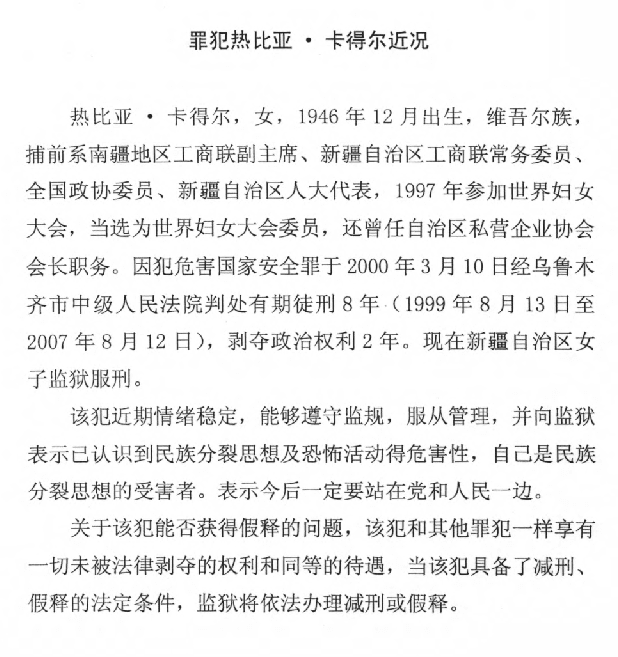
One response was especially significant. On September 10, 2003, while in Beijing, I met with Gong Xiaobing, the newly appointed Director General of the Ministry of Justice’s Bureau of International Cooperation. (I had faxed a request for information on Rebiya to the ministry two weeks earlier.) Mr. Gong gave me a detailed account of Rebiya behavior in Xinjiang Women’s Prison. The response stated that “the prisoner recognized the harmful nature of minority splittist ideology and terrorist activities” and went on to say that “from now on she would definitely stand on the side of the Party and the people.” This was a strong indication that Rebiya could be considered for clemency.
Image of the original document received at the September 10, 2003, meeting with MOJ. Image source: Dui Hua
Response to Dui Hui by the Chinese government, September 2003 (translation)
Rebiya Kadeer, female, born in December 1946, Uyghur ethnicity, prior to arrest was vice-chairperson of the Xinjiang Uyghur Autonomous Region’s Nanjiang District Industry and Commerce Association, a standing committee member of the Xinjiang Autonomous Region Industry and Commerce Association, a member of the C.P.P.C.C., and a representative from Xinjiang of the National People’s Congress. In 1997, she attended the World Conference on Women and was elected to be a committee member of the World Conference on Women. She has also held the position of president of the Autonomous Region Private Business and Industry Association. Sentenced on March 10, 2000, to eight years’ imprisonment (sentence to run from August 13, 1999, to August 12, 2007) with two years’ subsequent deprivation of political rights by the Urumqi Municipality Intermediate People’s Court for committing the crime of endangering state security. Currently serving her sentence in the Xinjiang Autonomous Region Women’s Prison.
Recently, this prisoner’s emotions have been stable, and she is able to respect prison regulations and obey supervision. She has expressed to prison officials that she recognizes the harmful nature of minority splittist ideology and terrorist activities, and that she herself is a victim of minority splittist ideology. She also said that from now on, she would definitely stand on the side of the Party and the people.
As for the question of whether or not this prisoner will be granted parole, this prisoner enjoys all the rights not otherwise deprived by law and exactly the same treatment as other prisoners. When this prisoner meets the legal requirements for sentence reduction or parole, the prison will handle these matters according to law.
On December 11, 2001, the United Nations Working Group on Arbitrary Detention ruled that Rebiya had been arbitrarily detained. In December 2002, the U.S. Department of State’s Assistant Secretary of State for Democracy, Rights, and Labor, Lorne Craner, went to Xinjiang to press for her release. On October 3, 2003, the U.S. Senate passed SR 230 calling on China to immediately and unconditionally release the Uyghur political prisoner Rebiya Kadeer.
At the same time, senior Chinese foreign affairs officials traveled to Urumqi to press local leaders to release Rebiya. They encountered resistance. It took a decision by the Standing Committee of the Politburo to order her release.
In September 2004, Rebiya was awarded the Rafto Prize in Bergen, Norway. Around the same time, she was nominated for the 2005 Nobel Peace Prize. Ultimately, the prize was jointly awarded to the International Atomic Energy Agency and its Director General Mohamed ElBaradei.
In response to intense media attention and international pressure, Rebiya was granted a one-year sentence reduction in March 2004. I was told that the original plan had been to release her immediately and allow her to join her family in the U.S. However, the U.S. sponsored a resolution criticizing China at the United Nations Human Rights Commission in Geneva and the plan was put on hold.
The U.S., citing progress on human rights in China, decided not to sponsor what China called an “anti-China resolution” in Geneva. Rebiya was granted medical parole. Accompanied by a U.S. diplomat, she boarded a flight to Chicago, thence to Washington D.C.
In March 2005, I was at Notre Dame University in South Bend, Indiana to deliver the third annual O’Grady Lecture. On March 16, I was enjoying a farewell dinner when I received a message from China: Rebiya Kadeer had been released and was flying to Chicago. Dui Hua released a press statement that attracted considerable media attention.
Prior to leaving China, Rebiya was warned: If you step out of line, your businesses will be ruined and your family will suffer. After her rapturous reception at Dulles International Airport and her interviews with foreign journalists, reaction by the Chinese government was swift. By mid-2006, her sons and other relatives and friends had been detained, and the process of seizing her assets begun. Initially, she was fined the equivalent of US$ 2.8 million. Eventually, the sum would amount to several hundred million dollars. (Levying massive fines and seizing assets has become a favorite technique of the central and local governments. It serves two purposes: bankrupt the opposition, including house churches, and funding local governments).
On January 6, 2006, the car in which Rebiya was travelling was rammed by a truck outside Washington D.C. The truck backed up and rammed her again. The license plates were traced to the Chinese embassy.
In early 2006, Rebiya went to Stanford University to deliver remarks to a small crowd in a seminar room. My son Jack was in the audience. She recognized him and expressed gratitude for what I had done to help her.
Developments Infuriate Beijing, Lead to Accusations
Dui Hua was by no means the only entity that worked hard to secure the release of Rebiya Kadeer. The U.S. government, other governments, and the United Nations all weighed in, in different ways at different times. Especially impactful were the written responses received by the U.S. Department of State. One response claimed that special dining and living arrangements had been made for the prisoner and that she was allowed a one-hour family visit once a month, extended upon request. It detailed a family visit from her nephew. The response said that she would be allowed to join her husband after her release.
What set Dui Hua’s interventions apart were its ability to wrest written responses from both the Ministry of Foreign Affairs and the Ministry of Justice, and its being immediately notified of acts of clemency, which allowed Dui Hua to release its press statements.
On November 27, 2006, Rebiya Kadeer was elected President of the World Uyghur Congress (WUC). She was to serve until November 12, 2017.
The position gave her greater stature and more access to senior U.S. officials, notably President George W. Bush who met the WUC president in Prague on June 7, 2007. Bush welcomed Rebiya to the White House on July 20, 2008. Beijing lodged “strong representations” and registered “strong objections” to this interference in the internal affairs of China.
Neither President Barack Obama nor President Donald Trump ever met Rebiya . President Joe Biden, perhaps careful not to damage already strained US-China relations, has never met her either.
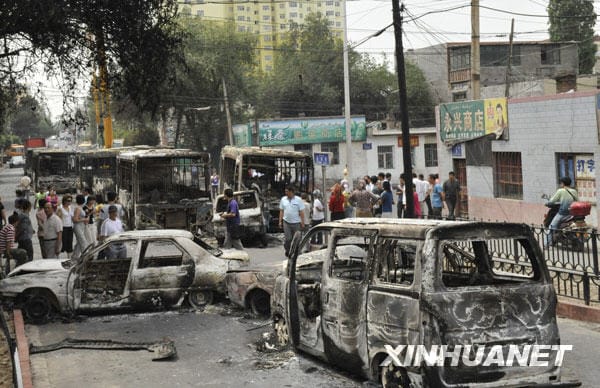
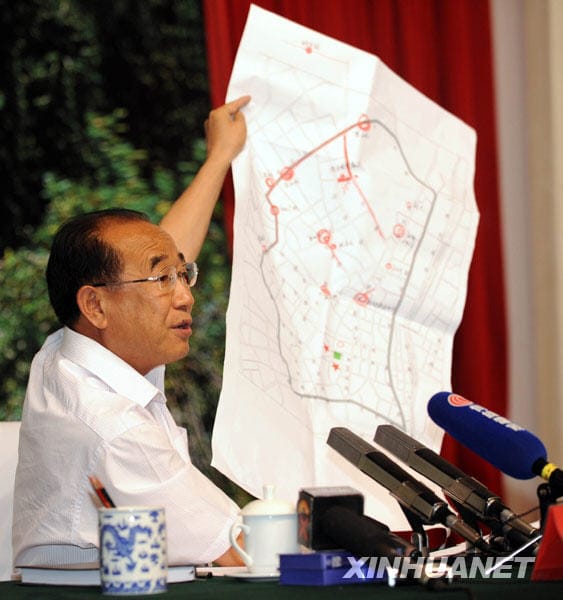
On the evening of June 26, 2009, Han Chinese men, enraged by the alleged rape of a Han Chinese woman by a Uyghur man, set upon Uyghur workers in Shaoguan, Guangdong Province, killing at least two of them. Days later, rioting broke out in Urumqi as Uyghurs attacked Han Chinese, killing around 200 and wounding many more. Despite offering no evidence to support its claim, Beijing blamed Rebiya and the WUC for instigating the riots. The Chinese government launched a campaign to label the WUC president a terrorist, and to further limit her international travel.
A street in Urumqi, aftermath of the “7.5 Riot.” Image source: Xinhua.net
Li Zhi, then Party Secretary of Urumqi holding up a map at the July 6 press conference, marked where the incidents occurred. Image source: Xinhua.net
In July 2009, the Chinese Consulate in Melbourne Australia wrote to the organizers of the Melbourne International Film Festival, demanding that they cancel the showing of “The 10 Conditions of Love,” a documentary about Rebiya and the struggle of the Uyghur people against Chinese oppression. When the organizers refused, China pulled all seven Chinese films, including those from Hong Kong, from the festival. In Xinjiang, seven Uyghurs were arrested in December 2011 for possessing DVDs of the Rebiya documentary.
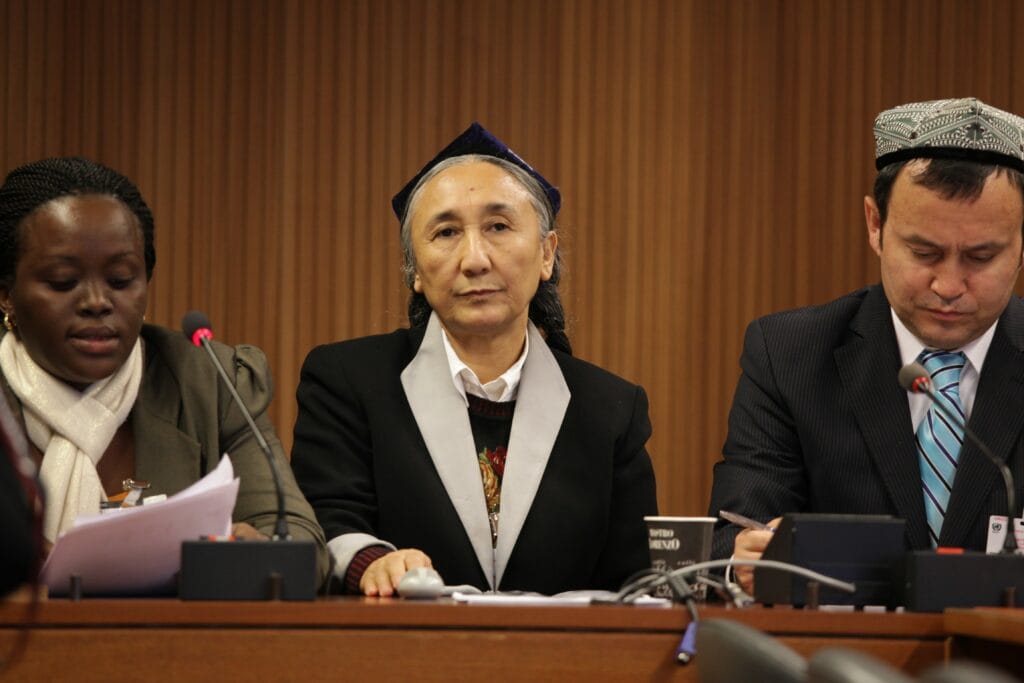
Over Chinese objections, Rebiya delivered remarks at the Fourth Session of the United Nations Forum on Minority Issues at the Human Rights Council in Geneva in November 2011.
Rebiya Kadeer attending the Panel discussion “Guaranteeing the Rights of Minority Women” at the Forum on Minority Issues, United Nations at Geneva. U.S. Mission Photo by Eric Bridiers. Image source: Wikimedia Common. Copyright CC BY 2.0
Like the U.S., Japan issued visas to Rebiya in 2009, 2015, and 2019. She met with government officials, parliamentarians, and civic society leaders, and spoke at universities. Tokyo brushed off China’s protests. Surprisingly, Taiwan barred Rebiya from visiting the island in July 2010.
Although retired, Rebiya has remained active. In June 2024, she criticized the visit to Xinjiang of Hakan Fidan, Turkey’s foreign minister, claiming that he failed to condemn China’s treatment of the Uyghurs, who are a Turkic people. There is a large Uyghur exile community in Turkey.
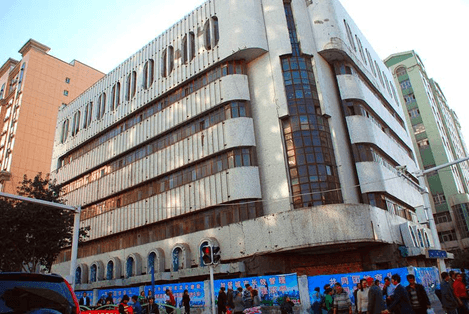
The Rebiya Trade Center. A symbol of Rebiya’s contribution to the economic improvement of the Uyghur minority. Most of its tenants were Uyghur small business owners. Image source: Internet
In late 2024, the Urumqi city authorities razed the Rebiya Kadeer Trade Center, demolishing one of the last remaining reminders of her work in the city. What they haven’t been able to demolish are the memories and deep affection the Uyghur people have for Rebiya Kadeer.
When it came to media coverage of the 1989 protests in China, the protests in Beijing received the most attention. This was largely because of the presence of international media outlets in China’s capital. Their ranks were bolstered by journalists from around the world who were in Beijing for a Sino-Soviet Summit that featured Mikhail Gorbachev.
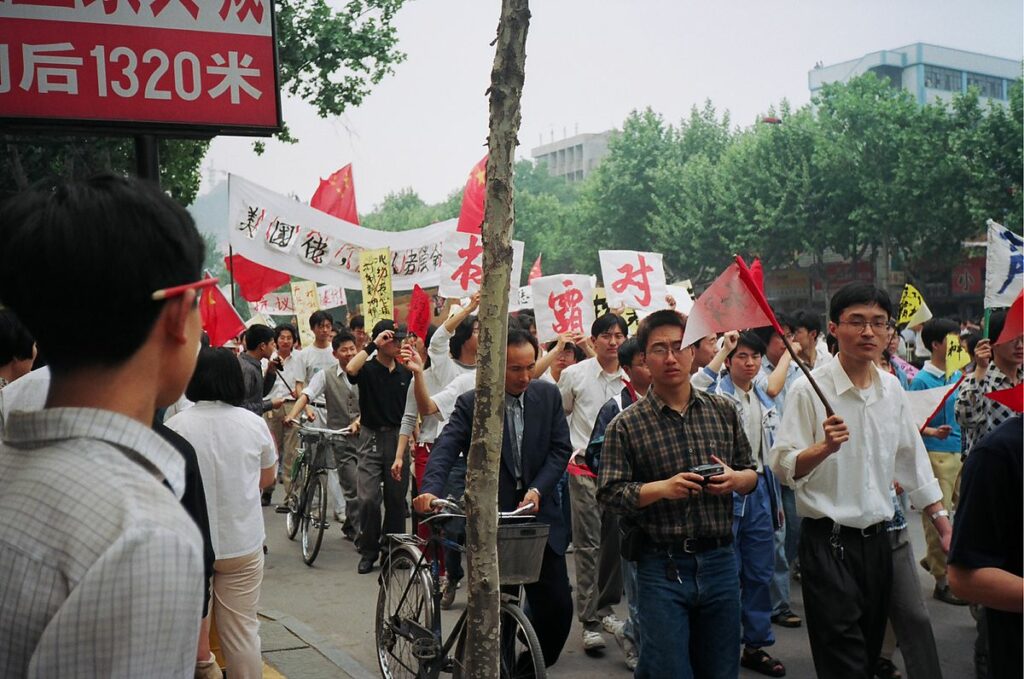
Leaders of the June 4 protests in Beijing became household names. But Beijing was by no means the only city that experienced mass protests. According to one estimate, as many as 300 medium and large cities across China experienced large protests. Any city with a college or university was the site of protests.
I was in Zhuhai, Guangdong Province, one of the 300 cities where protests took place, when the killings in Tiananmen Square happened. Sitting with a group of Chinese officials, we watched events unfold on a Hong Kong television network. I was horrified by what I saw, as was one of the Chinese officials. (The others were silent, with the exception of a party member who admonished the official who expressed anger at what was broadcast from Beijing.) The next day, as my colleagues and I drove back to Macau, we passed signs of the unrest that had taken place the night before, with placards strewn across the roads and sidewalks, and graffiti condemning China’s leaders. In Macau we passed long lines of people withdrawing money from the Bank of China.
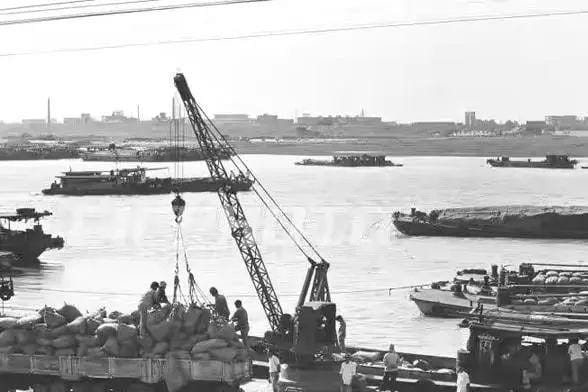
Bengbu Port in 1989. Image source: 163.com
Bengbu, a city in northern Anhui Province with nearly a million urban residents at the time, was among the locations where protests erupted. This important transportation and trade hub, home to a medical school, saw tens of thousands of students and citizens march in response to the bloodshed in Beijing. As I was to discover, the protests were organized and led by a charismatic graduate of Tsinghua University–Zhang Lin (张林).
The Green Bible and Zhang Lin
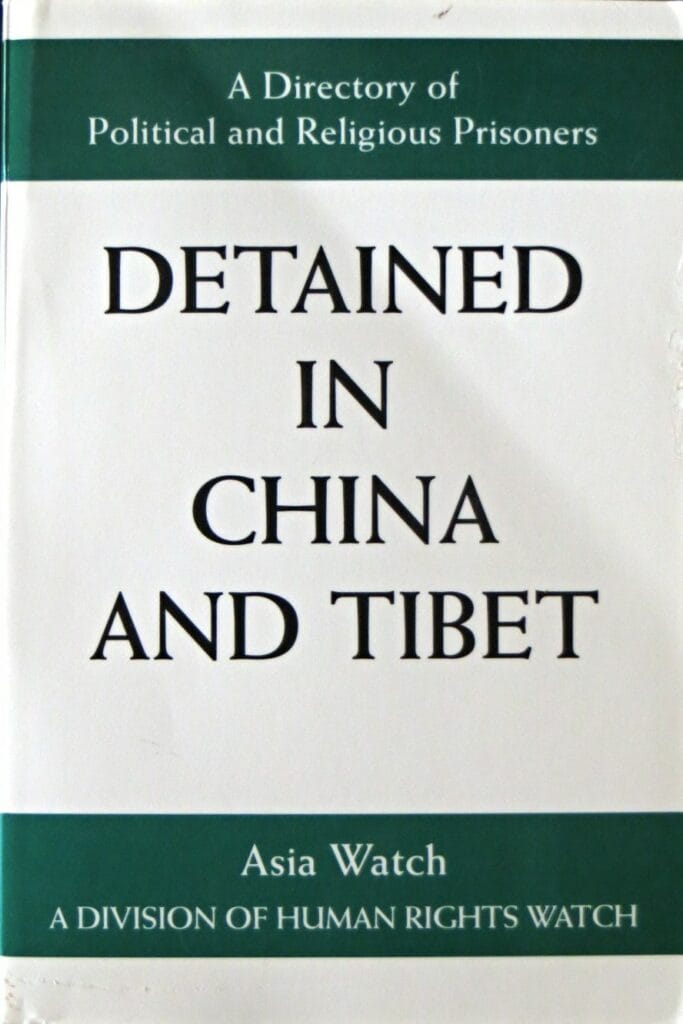
In February 1994, Human Rights Watch published Detained in China and Tibet (DICAT). Robin Munro, a co-author, came to my office in Hong Kong to deliver an inscribed copy of the book. Because DICAT had a green stripe that adorned the front and back covers, my inner circle dubbed it “The Green Bible.” I used DICAT to populate my prisoner lists submitted to the Chinese government throughout the 1990s and well into the 2000s.
Cover of DICAT
DICAT is a 632-page tome that documents the treatment of 1,700 hundred political prisoners in China, including hundreds detained in the aftermath of the spring 1989 protests in Beijing and other cities. One section in particular drew my attention: “Status Unclear.”
The first entry was for an activist from Anhui Province by the name of Zhang Lin, the head of the Bengbu Autonomous Student Union. The account of Zhang’s activities in Bengbu in May and June 1989 was based on a broadcast program on Anhui Radio that took place on June 14, 1989.
Not long afterward, I went to the Universities Service Centre (USC) in Hong Kong which had an extensive collection of provincial newspapers that included the Anhui Daily. I scoured the editions printed in May and June 1989 and found two articles that mentioned Zhang Lin. One article, published on June 15, 1989, ran with a headline “Zhang Lin Detained According to Law by the Public Security Bureau.” Another article concerned Zhao Fengrong (赵凤荣), an elderly farmer who had requested pamphlets and asked for advice from Zhang Lin.
This method of cross-referencing DICAT’s transcribed radio broadcasts with contemporary newspaper articles proved invaluable in my work identifying and inquiring about political prisoners in China. I used this technique in other cases as well, such as uncovering the correct spelling of three leading members of the Preparatory Committee for the Northeast China People’s Autonomous Republic, a shadowy group that operated in Jilin Province in the early 1980s.
In writing this John Kamm Remembers about Zhang Lin, I interviewed and asked him if he remembered Zhao Fengrong. He replied that he did; in fact, as the leader of the protests, Zhang had interacted with hundreds of people providing them with support and guidance.
Unbeknownst to the outside world at the time of my initial research in 1994, Zhang had actually been released in 1991 after serving his sentence over his role in the 1989 protests. By the time I came across his name in DICAT, Zhang had been sent to a reeducation through labor (RTL) camp for hooliganism in 1994, when he tried to organize independent labor unions in Anhui.
Portrait of Zhang Lin’s Activism
Put together, the Anhui Radio broadcast and the Anhui Daily articles found at Hong Kong’s USC, paint a picture of Zhang Lin’s activism during April, May, and June 1989. He comes across as a dedicated and innovative leader with strong organizational and oratory skills. He inspired others to protest the events that unfolded in Beijing in the spring of 1989.
An avid listener to Voice of America broadcasts, Zhang established the Bengpu Student Autonomous Union on May 19, 1989, and subsequently set up two political parties; he organized a large protest march, blocked roads, staged sit-ins, and led a hunger strike outside the city’s party headquarters. He encouraged students to travel to Beijing to take part in the Tiananmen protests and he formed a “Dare-to-Die Corps” against Bengpu’s party committee and government. The purpose of these corps, formed in many cities, was to block roads and otherwise disrupt traffic, in an attempt to delay armed police from entering the cities. Zhang himself traveled to Beijing in an unsuccessful attempt to meet Fang Lizhi, the dissident astrophysicist. He established a Democracy Center and Human Rights Office at Bengbu Medical School. All of these activities were non-violent.
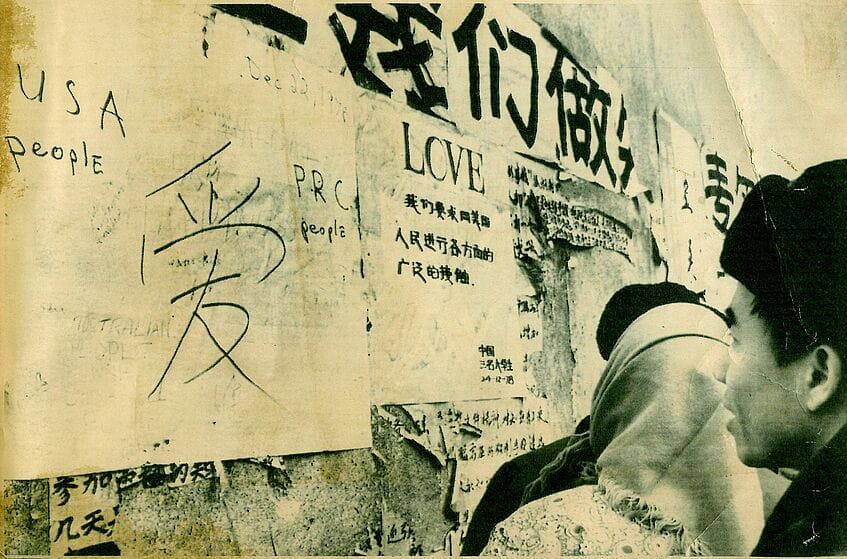
The June 1989 protests were not the first time Zhang Lin had caught the attention of the Chinese police. In 1980, while a student, he traveled to Beijing to copy posters on Xidan’s Democracy Wall, and to purchase books and magazines on democracy. He shared them with fellow students at school who promptly informed on him. He was designated as a member of “targeted people (zhongdian renkou 重点人口),” a group including politically unreliable people subjected to strict surveillance.
First imprisonment
After he was detained and arrested in 1989, Zhang Lin was put in the Bengbu Detention Center, where he was mistreated. He would have been sentenced to a longer period behind bars, or even sentenced to death for allegedly having committed five different crimes, but he negotiated a deal with the authorities. In exchange for not appealing, he received a two-year prison sentence with the understanding that he would be granted a three-month early release. He served 21 months at the detention center until he was granted medical parole. While inside, Zhang learned of the visit of United States (US) National Security Advisor Brent Scowcroft to Beijing in July 1989. Thereafter, the harsh interrogations ended.
Thanks to a sympathetic party leader, protests in Anhui were dealt with a relatively light hand. Aside from Zhang Lin, one other protester was sentenced to prison: Wei Hui (魏辉). He was sentenced to one year in prison and became a businessman after release. Treatment of June 4 protesters varied widely from province to province. In Shandong Province, for example, protesters were treated harshly – at least two were sentenced to 18 years in prison–while in Guangdong, like Anhui, protesters received relatively light sentences.
Hitting a Roadblock
By the end of 1994 I had pulled together all available information on Zhang Lin. I moved to the next stage of advocacy: compiling prisoner lists for submission to the Chinese government. I resolved to do so in 1995.
In February 1995, I flew to Beijing for a meeting with the State Council Information Office and the Ministry of Justice (MOJ). I suggested that for the year, I would submit quarterly lists of 25 names each. They agreed, whereupon I handed over my first list of 25 names. I returned to Beijing in April and was given a response. Then I handed over the next list. My plan was to add Zhang Lin’s name in the third quarter. (Eventually, I resorted to sending this list by fax.)
But in May of the same year, my advocacy effort on behalf of Chinese prisoners came to an abrupt halt. On May 22, the US Department of State announced that a visa would be granted to Taiwan president Lee Teng-hui so that he could attend his reunion at Cornell University. Beijing was furious, threatened retaliation, and began firing missiles over and near Taiwan. The US sent two carrier groups to the sea around the island. US-China relations went into a deep freeze.
On May 29, I returned to Beijing. I was questioned by immigration officers and ordered to wait in a small room before being cleared. When they were told to let me through, an officer threw my passport at me.
At the hotel, I found that my reservation had been cancelled. I was under surveillance the entire time in Beijing and unable to meet with anyone other than officials of the Ministry of Foreign Affairs, who lectured me on the bad behavior and broken promises of the Clinton administration.
It wasn’t until early 1998 that I received a response on Zhang Lin from the MOJ. Soon after he was released from a labor camp, completing his second imprisonment.
Founding a Political Party in New York, Illegally Crossing the Border to China
In early 1998, Zhang Lin traveled to the US. There he met with prominent activist and broadcast journalist Ann Noonan (now Executive Director of the Committee for US International Broadcasting) and veteran pro-democracy leader Wang Bingzhang, a Chinese citizen and US permanent resident. Together, Wang and Zhang established the China Democracy Justice Party, a forerunner of the China Democracy Party.
In October, Zhang attempted to return to China via Hong Kong. He rented a boat in the former British colony and tried to enter Guangdong Province, but he was apprehended in Guangzhou where he was detained and subsequently arrested for illegal border crossing, a crime used to imprison Protestant missionaries who sought to enter China to proselytize. Many have suffered this fate in recent years.
Zhang was sentenced to three years of RTL which he served in a labor camp in Guangzhou. In our conversation, he recalled that particular experience to be the worst out of all his incarcerations.
Then, in 2004, Zhang joined with Yang Tongyan (杨同彦, aka Yang Tianshui 杨天水) to establish the Anhui-Jiangsu chapter of the CDP. Zhang’s fate mirrored his previous experiences: in 2005, he was incarcerated for the fourth time, charged with inciting subversion. The sentence carried five years imprisonment with four years deprivation of political rights.
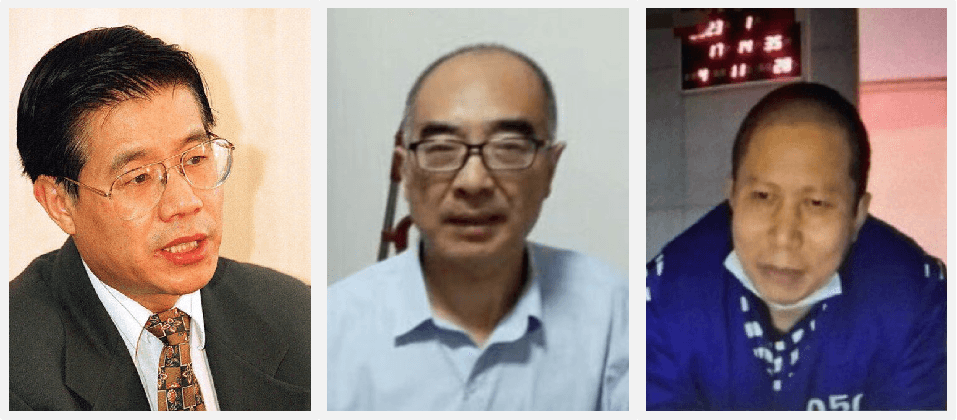
(left to right) Wang Bingzhang, Yang Tongyan, Xu Zhiyong, and many more activists and dissidents shared the same fate as Zhang Lin. (Image source: Wang, archived photo. Yang, before his death. Xu in prison, photo taken by lawyer in 2023)
Zhang’s fellow activists suffered similar outcomes. Wang disappeared while traveling in Vietnam and was convicted of espionage and for organizing a terrorist organization in 2003. He is now serving a life sentence in Shaoguan Prison in Guangdong Province. Yang was charged with subversion in 2005. He served three prison terms, a total of 22 years in Chinese prisons and died of cancer shortly after he was released on medical parole in 2017.
Exploring different channels
In 1999, after his arrest for illegal border crossing, I switched tactics and began asking about Zhang Lin through a different interlocutor, a party-controlled policy research association. In 2006, following his arrest for inciting subversion, I switched tactics again, filing inquiries through governments including the US, the European Union, and the United Kingdom. Altogether Dui Hua submitted 10 lists with Zhang Lin’s name and received written responses to five of them.
Zhang Lin’s case was taken up by four United Nations (UN) Special Procedures on three occasions – in 2005, 2011, and 2014. (Dui Hua was granted Special Consultative Status with ECOSOC, the committee that oversees the UNs’ human rights mechanisms, in 2005.) The Special Procedures brought to the Chinese government’s attention “the alleged detention and conviction of Mr. Zhang Lin and the harassment of family members.” Aside from responding to the first UN inquiry in 2005, Beijing took no other action and declined to respond to the 2011 and 2014 requests.
Anni and Ruli Zhang
The 2014 UN inquiry was related to events in February 2013, when Zhang Lin and his youngest daughter Anni moved to be with his eldest daughter Ruli who was in college in Hefei, capital of Anhui Province.
On February 27, Zhang Lin was taken into custody by the local police, and, on the same day, Anni was taken from the school where she had recently been enrolled by guobao, the national security police operating under the public security bureau. Both Zhang Lin and Anni were taken back to Bengpu where Anni was placed in a police station. She was held there for 20 hours unaccompanied by female officers, in violation of the recently passed Criminal Procedure Law. The next day, Anni was released. Both she and her father stayed in Bengbu.
On April 7, lawyers Xu Zhiyong, Zhao Yonglin, Tang Jianhao, and others arrived in Bengbu to start a coordinated protest. The next day, Zhang Lin, Anni, and his supporters returned to Hefei. Another attempt to enroll Anni in school failed, prompting a 24-hour hunger strike by Xu Zhiyong and others outside the school. Anni, assisted by Zhang Lin’s supporters, penned an open letter to Peng Liyuan, wife of Xi Jinping, pleading for her assistance in enrolling at school.
Police moved in and cleared the protesters, several of whom were taken into custody. Some were given short sentences of administrative detention while others were sent back to their homes. Zhang and Anni were sent back to Bengbu, where Zhang was detained in July for “gathering a crowd to disrupt traffic and public order.” He was tried and sentenced a year later to three and a half years in prison, his fifth imprisonment.
Fearing for the safety of Zhang’s children, supporters in and out of the country worked to bring them abroad. In September 2013, Yao Cheng, a friend of Zhang Lin’s, took Ruli, Anni, and their mother to the US consulate in Shanghai to apply for a visa so that the children could study in the US. On September 3, 2013, Yao Cheng was detained and subsequently sentenced, in December 2014, to one year and 10 months in prison for gathering a crowd to disrupt public order. He was released in June 2015.
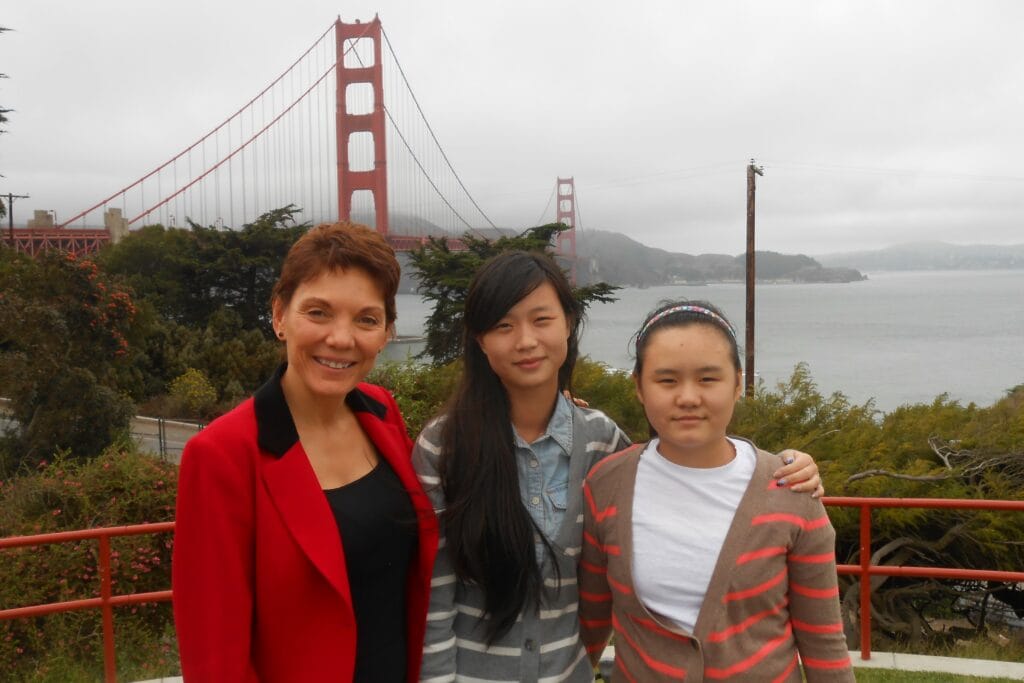
Around the same time, activists in the US also went to work. Ann Noonan introduced Reggie Littlejohn, a fierce advocate for the rights of women and children in China, to me. Together we coordinated frequent exchanges with the Department of State in Washington DC, the embassy in Beijing, and the Shanghai consulate. Being informed, the consulate was prepared for the girls’ visit. The visa was issued and on September 7, 2013, Zhang Lin’s daughters boarded a flight to San Francisco. They were greeted on arrival by Reggie and her husband Robert. Both Ruli and Anni have been granted political asylum in the US.
A short while later, Reggie, Robert, Ruli, and Anni came to visit me in San Francisco where we enjoyed lunch at a Japanese restaurant near the office. Reggie and Robert provided a safe and caring home for the girls in the ensuing years, all the while continuing to advocate for Zhang Lin in China.
Reggie Littlejohn with Ruli and Anni at the Golden Gate Bridge, 2013. Image credit: Littlejohn
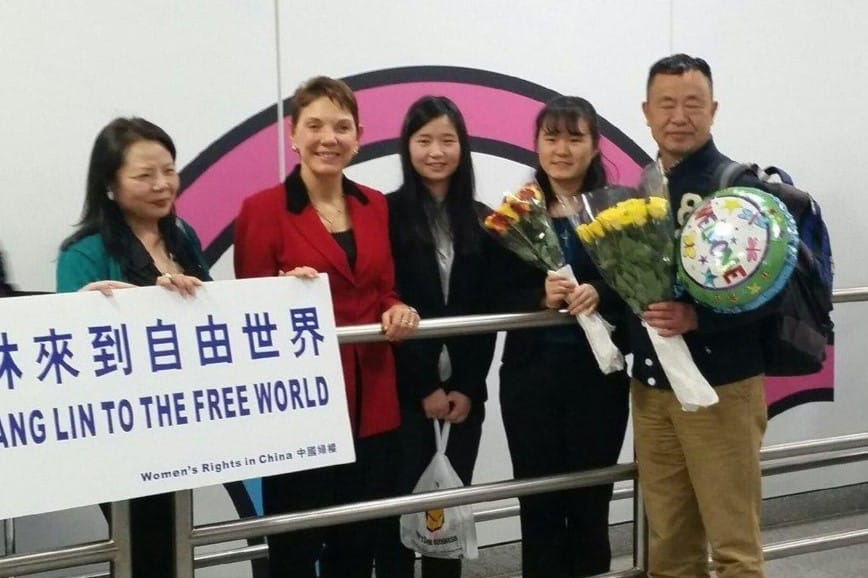
Reggie and I, along with Jing Zhang, President of Women’s Rights in China, continued to work closely together to get the Chinese government to allow Zhang to leave China and to secure a visa for his travel to the US.
Heart of an Activist
Zhang Lin (right most) arrived in New York on January 5, 2018, reuniting with his two daughters. Image source: RFA
Since his arrival in the US in January 2018, Zhang Lin has been at the forefront of criticizing the Chinese Communist Party (CCP). He has spoken at public events in New York, Washington DC, Seattle and elsewhere. He has organized protests and been a columnist at two newspapers. He established his own YouTube channel, Zhang Lin’s Vision, with more than 100,000 subscribers. It garners about one million views every month.
Zhang Lin is pessimistic about the future of democracy in China. He has no plans to return to the country where he was born and where he toiled for decades, in and out of prison, to realize the dream of democracy and respect for human rights.
The Significance of Zhang Lin’s Case
Of the hundreds of cases I’ve worked on for more than three decades, Zhang Lin’s case stands out:
He has been under surveillance by agents of the CCP and the government it controls for nearly his entire adult life, from the time he was placed on the list of “targeted people” in 1980 to the present day in the US;
It marked one of the first instances of my using “open sources” — radio broadcasts and provincial newspapers – to identify political prisoners;
Zhang witnessed and participated in three of the major pro-democracy movements in China since the end of the Cultural Revolution in 1976 – Democracy Wall, the June 4th protests, and the China Democracy Party. Members of the New Citizens Movement joined protests over the refusal of authorities to allow Zhang Lin’s daughter to attend school;
He was incarcerated in the major carceral facilities used to house political prisoners: police stations where administrative detention is served, detention centers, designated locations for residential surveillance, and prisons;
He was deprived of his political rights on multiple occasions;
He was convicted of five offenses used to incarcerate political and religious prisoners: counterrevolution, hooliganism (counterrevolution and hooliganism were removed from the Criminal Law in 1997), illegal border crossing, inciting subversion, and gathering a crowd to disrupt traffic or public order;
Despite obstacles, Zhang Lin was able to escape China, with the assistance of Reggie Littlejohn, American officials, and me, to reunite with his daughters in the US.
Time Spent in Detention
When I interviewed Zhang Lin for this JKR, we discussed many topics, including his experiences of incarceration. In addition to time spent in police stations, locations used for residential surveillance and prisons, Zhang Lin spent more than five years in 10 different detention centers.
“Cruelest jails in the world”
Based on his experience, Chinese detention centers are the cruelest jails in the world. The Chinese prison authorities studied all four of the detention models – traditional Chinese, Russian, Japanese, and British – and incorporated features of each into China’s current detention model.
“…I was severely mistreated in detention and reform through labor centers. The worst was the Guangzhou labor camp where the guards acted like wild beasts. I was subjected to electric shocks and beaten mercilessly in Chinese detention centers. I was kicked in the back, which contributed to cervical stenosis, a condition that plagues me to the present day. I have to move my neck every 30 minutes, or it will become very stiff. I developed a bad tooth ache in Tongling Prison but was denied medical treatment.”
In detention and reform though labor centers, Zhang Lin encountered at- risk detainees including Christian missionaries, Falun Gong practitioners, and those awaiting execution.
“…I tried to help the missionaries and unorthodox religion practitioners, even challenging a guard to a fight to dissuade him from hurting an elderly Protestant.”
(Members of Zhang Lin’s family were Christian for several generations. He converted to Christianity in 2020, after his arrival in the US.)
Zhang had less opportunity to interact with at-risk prisoners in prisons. Such prisoners would meet occasionally in the prison yard, but they were not grouped together in cell blocks devoted to political prisoners as is the case in some Chinese prisons.
Those awaiting execution
Knowing that China keeps those convicted of death penalty in detention centers while pending appeals or waiting for executions, I asked Zhang if he had seen any of those inmates.
He recalls being part of a group of 20 inmates assigned while at the Bengbu Detention Center to keep watch over those awaiting execution.
“…After an inmate received a death sentence, he was immediately shackled and handcuffed and then transferred to a new cell. The “watch” group was divided into five smaller groups of four inmates who monitored the death row inmates to insure they didn’t assault other inmates or commit suicide or otherwise hurt themselves.”
According to Zhang, a possible reason for the surveillance was to make sure that their organs could be harvested, if necessary, for use in organ transplants.
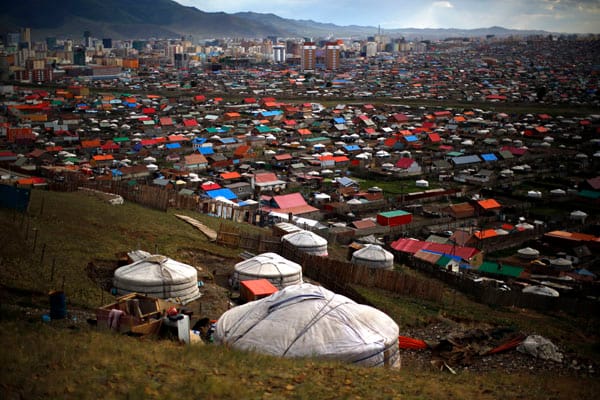
A photo of gers, traditional Mongolian lodging, on a hill in Ulaanbaatar’s Ger District taken June 22, 2013. Image credit: Passegio
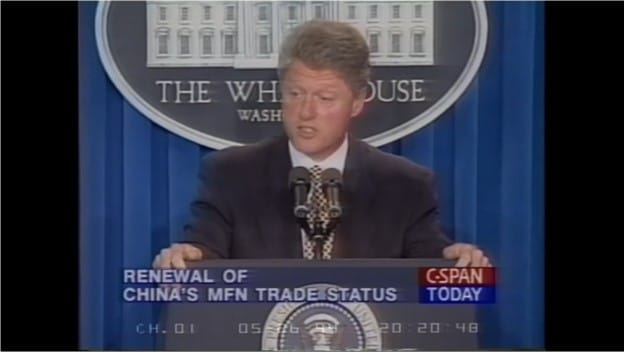
In my two years in leadership positions at the American Chamber of Commerce in Hong Kong (AmCham HK) – 1989 when I was First Vice President and 1990 when I was President – I focused on maintaining and expanding trade with Communist countries. I led the fight to maintain China’s Most Favored Nation (MFN) trading status, testifying to Congress three times when I was president, and many more times in ensuing years. I coupled my support for China’s MFN with advocacy on behalf of political prisoners.
In June 1989, two weeks after the killings in Tiananmen Square, I led a small AmCham HK delegation to Laos, then firmly in Vietnam’s orbit. Then in September 1990, I led another small delegation to Mongolia, which had just begun the transition to democracy after decades in the Soviet Union’s orbit. According to Joseph Lake, the first resident US ambassador to Mongolia, ours was the first US trade mission to that landlocked nation. Although AmCham HK was invited to Myanmar (formerly known as Burma) by the ruling junta that had seized power in a coup, the visit didn’t take place due to government bureaucratic incompetence, and because of the junta’s hostility towards the US ambassador, Burt Levin, a former consul general in Hong Kong and friend of AmCham.
Despite setbacks, I still hoped to visit Myanmar before the end of my tenure as AmCham president. I also hoped to visit Vietnam. Neither trip came to pass.
Beijing
Prior to travelling to Mongolia, I spent five days in Beijing, from September 6 to10, 1990, to work on joint venture opportunities, especially one in Qingdao to produce sodium silicate. This was to be the first 50:50 venture between the United States and China in the chemical industry. At the last minute, however, my employer walked away from the opportunity. Not long after this decision, I resigned from the company.
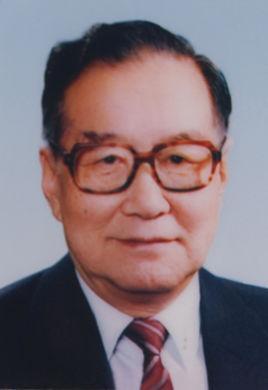
On September 7, I met with Li Hou, Secretary General and Deputy Director-General of the Hong Kong and Macau Affairs Office under the State Council. Li had participated in both the Sino-British negotiations on the transfer of Hong Kong to China and the Sino-Portuguese negotiations on the transfer of Macau to China. As such, Li was the most experienced and knowledgeable Chinese official dealing with the two territories.
Li Hou, Secretary General and Deputy Director-General of the Hong Kong and Macau Affairs Office, with whom Kamm had a meeting during his September 1990 trip to China. Image credit: Douyin Baike
Our discussions centered around developments in Congress on China’s MFN and other matters, notably a bill that would offer protection to Chinese students in the United States. Li listened intently and took copious notes on what I said. As he didn’t seem so interested in the legislation offering visa protection to Chinese students, I took as a sign that he did not particularly care about the subject. After the meeting, AmCham issued a press statement on our meeting saying Li wasn’t opposed to the bill Li took exception to that interpretation and sent me a letter after I returned to Hong Kong clarifying his position.
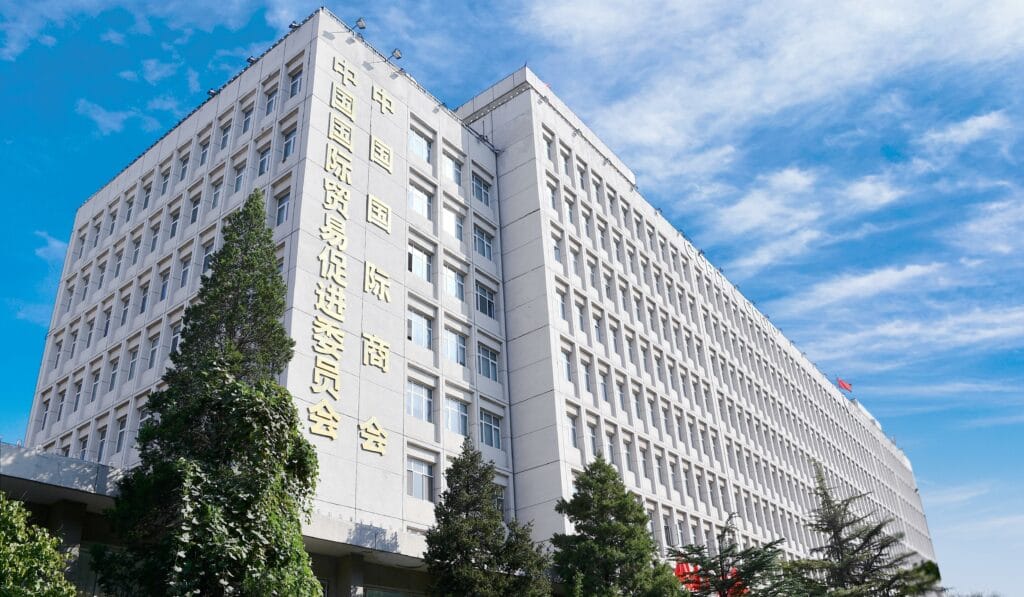
With what time I had, I went book shopping, had breakfast with the American Chamber of Commerce in Beijing, attended an American embassy reception in our honor, and spent time with the China Council for the Promotion of International Trade, AmCham’s longtime hosts in China. On September 9, 1990, I had dinner with members of the delegation at a well-regarded Japanese restaurant in Beijing.
Flight to Ulaanbaatar
On September 10, 1990, I was joined at Beijing airport by six AmCham members and the American Consul General in Hong Kong, Richard Williams, for the 90-minute flight to Ulaanbaatar, the capital of Mongolia. Ambassador Williams had served as the first American ambassador to Mongolia but unlike his successor he was never resident in the country.
We were greeted at the airport by our hosts, the Ministry of Trade and Cooperation, the Mongolian Chamber of Commerce and Industry, and the US Embassy. We were taken to the guest house on the grounds of the presidential palace, where we’d be staying for our four-day visit to the country,
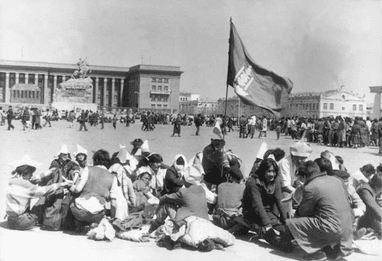
We glimpsed a small group of individuals in traditional Mongolian dress sitting by the gate. I learned that they were the remnants of a group of hunger strikers that had gathered to protest the former pro-Soviet Mongolian government.
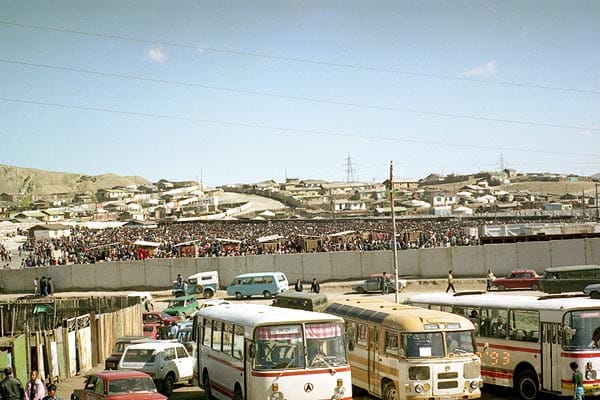
A photograph of Ulaanbaatar’s Sunday market taken in 1993. Image credits: Tabisite
We ventured out to see the sites, returning for dinner at the guest house. Some of us wanted to try local fish, but were told that Mongolians don’t eat fish, believing that fish embodied spirits. I resolved to try to order fish at a future meal. In the meantime, we would enjoy dishes of mutton served in a variety of ways.
We had an opportunity to discuss Mongolia’s economy with staff and management of the guest house. The Soviet Union had stopped assisting Mongolia, resulting in a serious economic crisis. A member of the staff remarked that the principal indicator of the economy’s strength was the size of the coal reserves. At the time of our visit, Ulaanbaatar had sufficient supplies of coal to run its power plant for just two days.
Sites of Ulaanbaatar
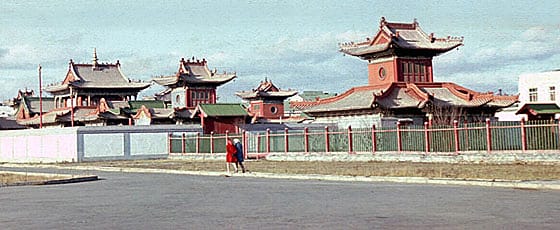
Choijin Lama Temple
Our first stop was the Temple of the Choijin Lama. Our guide, a lively young woman with excellent English, told us that this lama was the third ranking lama in the hierarchy of Lamaist Buddhism after the Dalai Lama and the Panchen Lama.
We were unable to enter the palace. Buddhism had been repressed in Mongolia beginning in the 1930s; hundreds of temples were destroyed, thousands of monks subjected to forced labor, and thousands were sentenced to death. No one was home to receive us.
With the advent of democracy in 1990, the year of our visit to Ulaanbaatar, Buddhism gradually returned to Mongolia, where an estimated 50 percent of the population today are Buddhists.
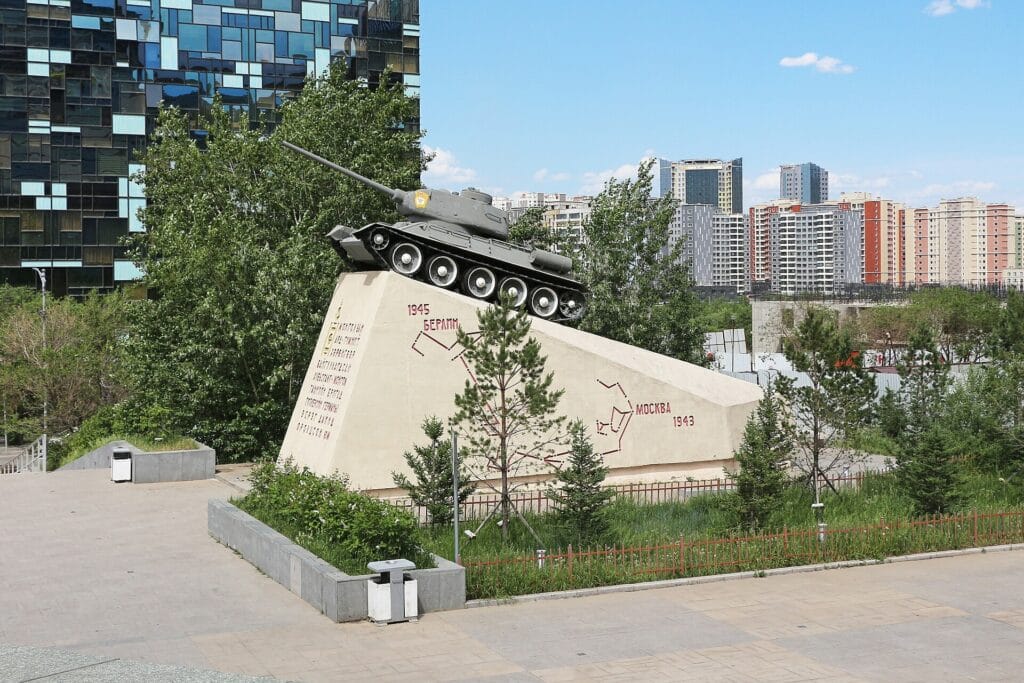
Monument to the Revolutionary Tank Division
Nearby the palace was another reminder of Soviet influence. Mounted atop a striking pedestal was a Soviet T-34 tank used by the 112th Revolutionary Mongolian Tank Division in its battle against German troops during World War Two. The refurbished structure is now known as the Zaisan Memorial.
The 112th Revolutionary Mongolian Tank Division suffered huge casualties but ultimately scored victories against the Nazi invaders, notably at the Battle of Moscow. It was among the most decorated units that fought the Wehrmacht.
Toys Exhibition
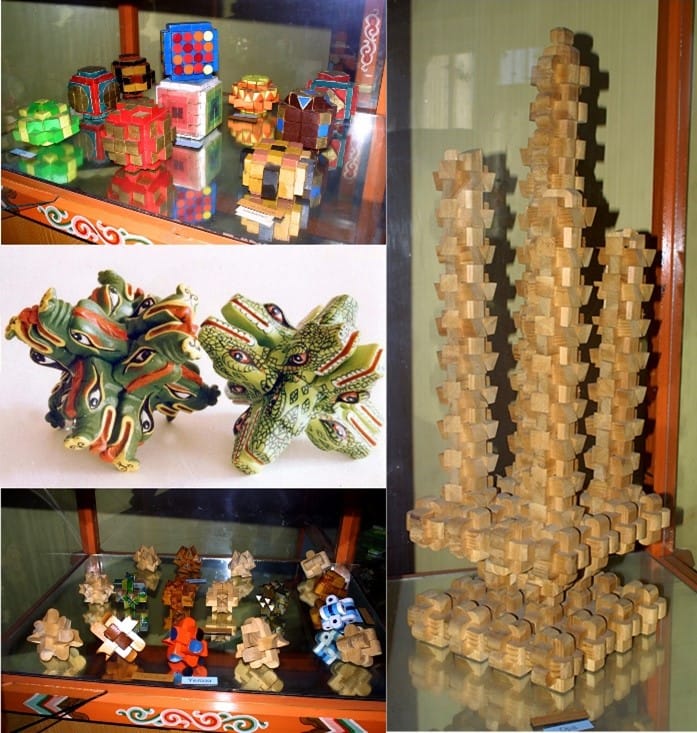
On September 11, we visited an exhibition of Mongolian toys and puzzles, now known as International Intellectual and Puzzle Museum. The Mongolian people are renowned for puzzle creation and solution. The exhibition featured thousands of puzzles and toys, some of which had never been solved.
A selection of traditional Mongolian puzzle games from the International Intellectual and Puzzle Museum’s collection. Image credits: IQ Museum
Meetings
Briefing by Ambassador Lake
The delegation’s meetings kicked off with a briefing at the guest house by Ambassador Joseph Lake on September 11, 1990. Ambassador Lake went over the history of the Mongolian Revolution from early demonstrations, hunger strikes, and protests that began in late 1989 with a few hundred demonstrators and eventually swelled to a crowd of 100,000. A milestone in the transition to democracy took place two days before our visit when the Prime Minister, his deputies, cabinet members, and members of parliament were elected.
Hunger strikers near the government palace in Ulaanbaatar, 1990. Image credit: Democratic Union Archives / Fair Use
Mongolian Chamber of Commerce and Industry
We spent most of the day with our host, the Mongolian Chamber of Commerce and Industry (MCCI). We started with a round-table discussion before a large audience of businesspeople and officials. I delivered prepared remarks in which I urged Mongolians to have courage as they embarked on the path of reform.
After lunch we met with the State Bank, the Union of Cooperatives, and Mongolimpex, the largest foreign trade corporation in Mongolia. We finished the day with a reception and dinner hosted by MCCI.
State Commission for Technology
We started September 12with a meeting with the State Commission of Technology. At that meeting we were introduced to Mongolia’s traditional drink: fermented mare’s milk, also known as airag. I did not like the taste, but Dick Williams quaffed a full glass without hesitation.
The delegation was hosted to lunch in a ger—called a yurt in Central Asia and Russia— by the Deputy Minister of Trade after which we headed to the presidential palace.
Dashin Byambasiin
Our hour-long meeting with Prime Minister Byambasiin centered on plans to reform the economy, the goal of which was to sharply reduce dependence on the Soviet Union. The key features of the reform were the privatization of state enterprises, establishment of a stock exchange, full convertibility of the tugrik (Mongolia’s currency), price reform to achieve all prices set by the market, private land ownership, and an open-door policy to attract foreign investment.
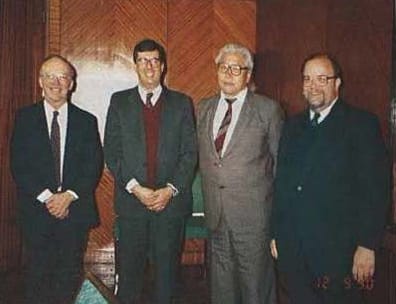
(Pictured, from left) Amb. Richard Williams, AmCham HK President John Kamm, Prime Minister Byambasiin, Amb. Joseph Lake. Image credit: AmCham Magazine.
The prime minister disclosed that talks were underway with the Soviet Union to value the debt that Mongolia owed to the communist country. The Soviets wanted to use a rate of two rubles to the tugrik, while the Mongolians wanted to use 10 rubles to the tugrik. Despite this sizable difference, the two sides had agreed to delay payments until 1995.
Business meetings
After the meeting with the prime minister, the delegation broke up for discussions with Mongolian government bodies and corporations to discuss business opportunities. I had convinced my employer to underwrite the cost of my trip to Ulaanbaatar to explore what trade and investment might be done in this new market.
I met with the Chemical Institute. I was told that there was not a single chemical plant in the country. I wondered if there was interest in importing technology for producing caustic soda but encountered resistance due to concern over pollution. I was told that the United Nations had concluded that Mongolia was the only country in the world where one could dip a cup into a river and drink the water without fear of contamination from pollutants.
I met with representatives of Arimpex to gauge interest in purchasing chrome chemicals for the tanning industry. Sodim bichromate was purchased in small quantities from Japanese trading companies. Transport costs were prohibitive and made selling chrome chemicals from American plants impossible.
Farewell Reception and Dinner
Our trip ended with a reception and dinner at the guest house. We were served mutton and salmon, which I finally had a chance to eat. It was delicious.
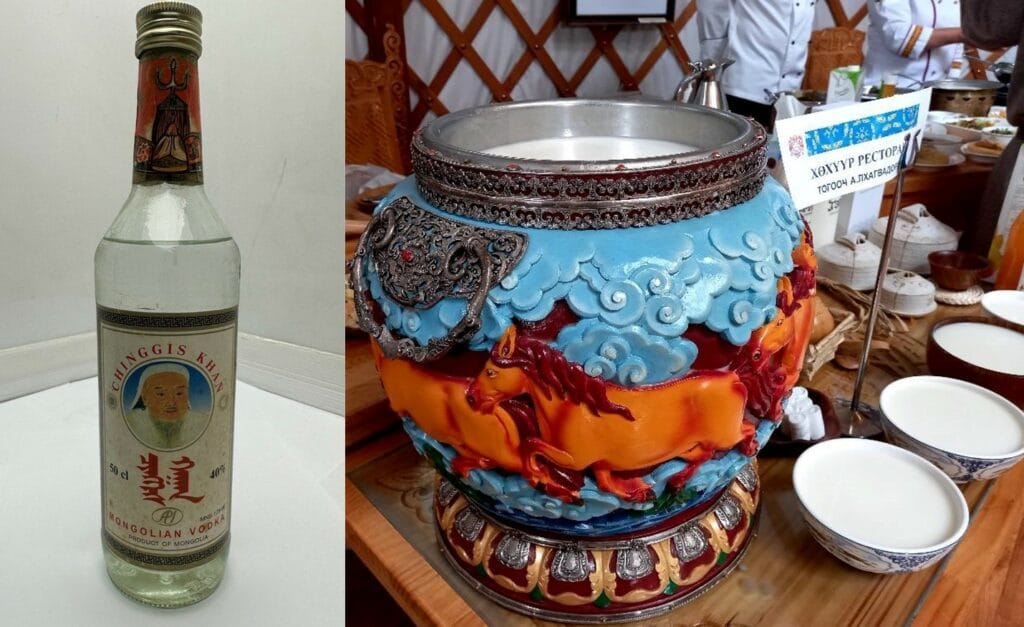
We also were able to sample Mongolian drinks, including Chinggis Khan vodka and suutei tsai, the Mongolian milk tea.
(Left) A bottle of Chinggis Khan vodka; (right) an urn of Mongolian milk tea. Image credits: Carousell / Visit Ulaanbaatar
By Train to Beijing
We arrived at the train station early on September 13 to secure our cabins for the long train ride back to Beijing. While the once-weekly flight to Ulaanbaatar took 90 minutes, the overnight train ride back to Beijing would take 30 hours. The train departed promptly at 9:30 AM.
Our delegation took two cabins and shared one of them with a rough-looking Japanese explorer who had been trekking around Mongolia for several weeks. He sustained himself with a leg of cured mutton. He took out a knife and offered us slices.
We ate all the meals on the train. Nothing special, standard railway fare.
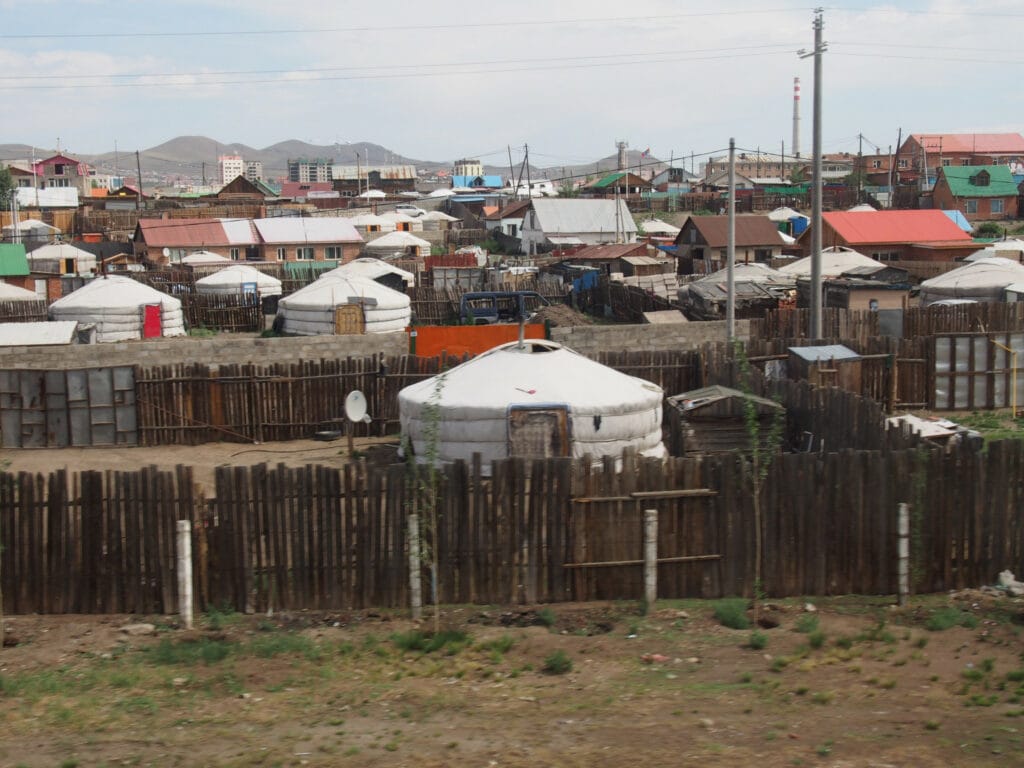
On our way out of Ulaanbaatar, we passed the Ger District. As far as the eye could see, ger populated the landscape. It was mid-September, but the air had turned cold. Smoke from coal burning stoves filled the sky. Although there was no water pollution in Mongolia, air pollution was a different matter.
One of Ulaanbaatar’s ger districts. Image credit: Dornogovi
Heading south, the train stopped in Choyr and Sainshand, both provincial capitals, before arriving at Zamyn-Uud, a town on the border with Inner Mongolia. At the railway towns of Choyr and Sainshand we got off the train to check out the environs. We were mobbed by local children, curious to see foreigners traveling by rail in Mongolia. The daily arrival of the train of the Trans Mongolian Railway was a big event in those parts.
At Zamyn-Uud, we got off the train with our valuables and went into the reception room at the station. There we went had our passports stamped before we walked to Erinhot on the Chinese side of the border. Our passports were checked and stamped with exit and entry chops, respectively. AmCham delegates all had Chinese visas.
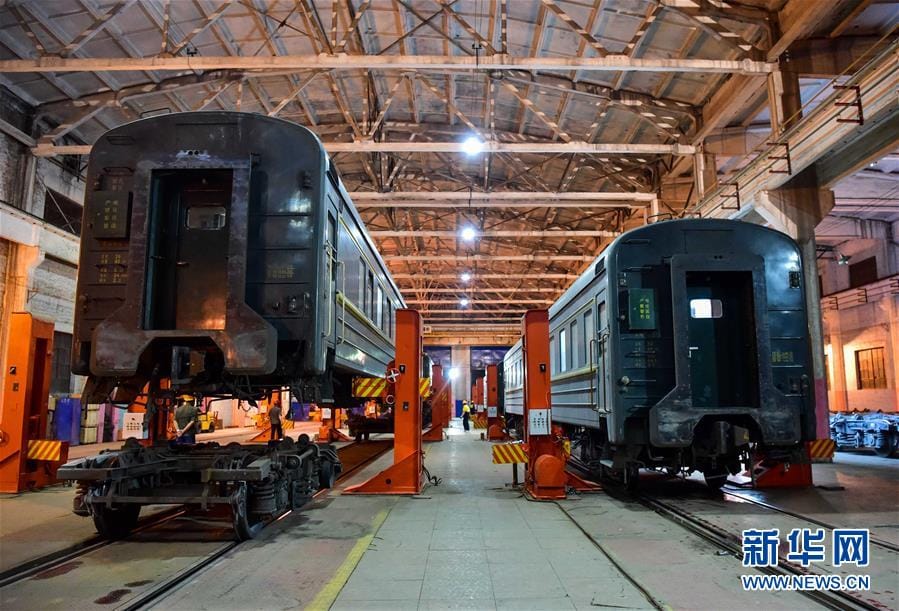
While we underwent exit and entry formalities, the Mongolian railcars were lifted off their bogies by huge cranes and moved to the Chinese side of the border, where they were placed on new bogies. Railroads operated on different gauges in Mongolia and China, a move designed to forestall invasion from the Soviet Union.
Changing train wheels at the Erenhot Port in Inner Mongolia in 2020. Image credit: Xinhua
The train passed by eight cities in Inner Mongolia and Hebei before arriving in Beijing at 3:30 PM on September 14. Some of us returned to Hong Kong on Cathay flight 329 the next day.
Inner Mongolia
Aside from taking steps to forestall a Soviet invasion, the difference in rail gauges served another purpose. Inability to travel between Mongolia and Inner Mongolia reduced interaction between Mongolians on both sides of the border. This in turn engendered resentment against China among Mongolians.
Over time, the Chinese government began encountering an indigenous independence movement in Inner Mongolia. This movement arose as a response to measures to seize grazing pastures and discourage the use of the Mongolian language as well as the practice of Mongolian customs, much as language and customs have been curtailed in Tibet and Xinjiang.
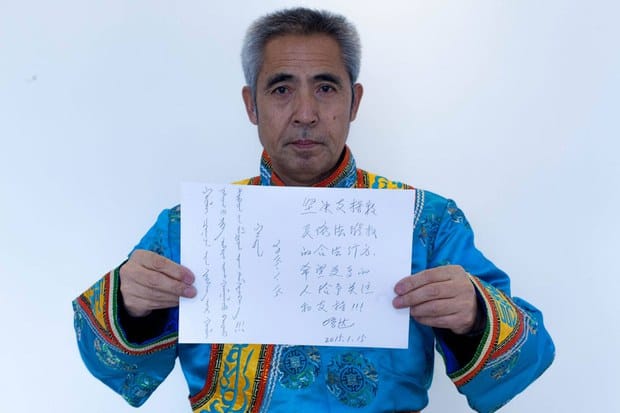
Mongolian dissident Hada with a sign in Mongolian and Chinese expressing support for herders on January 15, 2015. Image credit: RFA
Dissidents were arrested and sentenced to long terms. The most famous was Hada, a Mongolian entrepreneur and member of the Southern Mongolian Democracy Alliance who was detained in December 1995 and subsequently sentenced to 15 years in prison and four years deprivation of political rights for the crime of counterrevolution. During the latter period Hada could not receive visitors. I placed his names on 36 lists and received 32 responses, a high list-to-response ratio, but my advocacy was for nought. He served his entire sentence without reduction or parole.
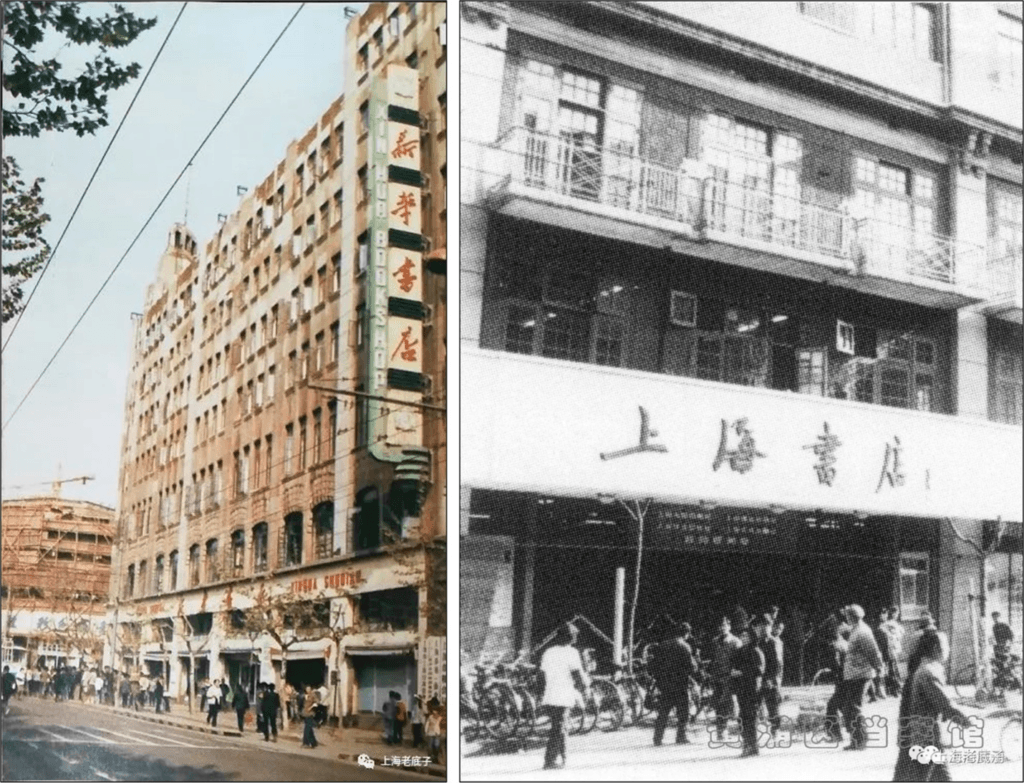
Bookstores in Shanghai: (left) Xinhua Bookstore on Nanjing Road in 1981; (right) Shanghai Bookstore on Fuzhou Road in the 1970’s. Image source: The Paper)
Even before my first trips to China in early 1976, I frequented state-run bookstores. It was at the Commercial Press outlet in Hong Kong that I found On Exercising All-Round Dictatorship over the Bourgeoisie, the 1975 treatise by Zhang Chunqiao, theoretician of the Gang of Four. That booklet formed the basis for the purge of Deng Xiaoping and persecution of countless “bourgeois counterrevolutionaries.” Its removal from the Commercial Press bookstore in October 1976 was a sign that Zhang, Jiang Qing (Madame Mao), Yao Wenyuan, and Wang Hongwen, collectively known as the Gang of Four, had fallen from power.
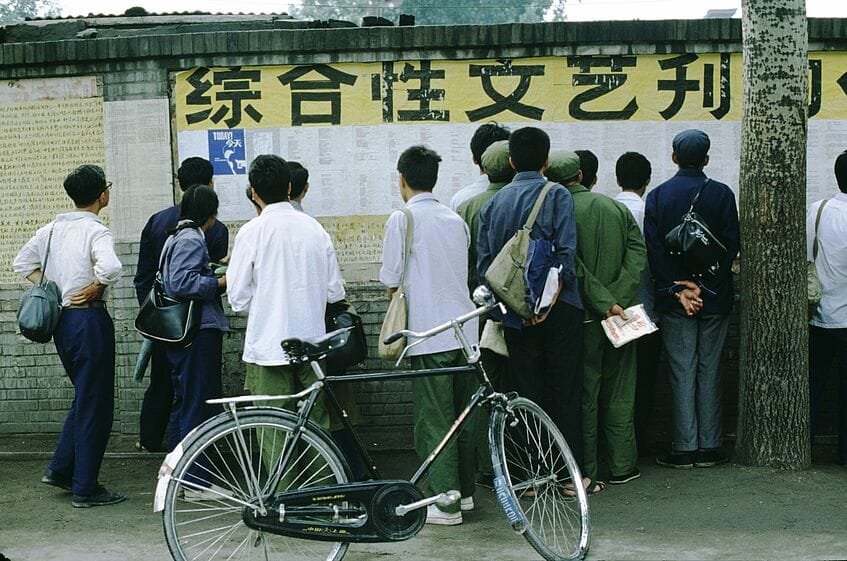
For decades I visited bookstores in China, first to identify political and social trends, later to find cases to enter into Dui Hua databases from which prisoner lists were crafted.
Shanghai
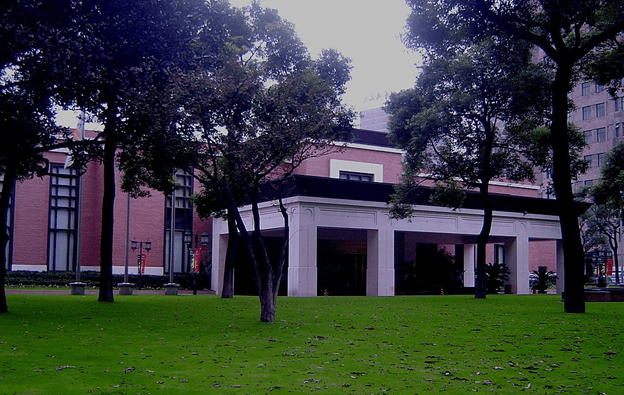
Hall at Jinjiang Hotel, site of the signing of the Shanghai Communiqué in February 1972. Image source: Wikipedia
The morning after my arrival in Shanghai in January 1976, I walked to the Xinhua bookstore on Nanjing Road. It was a bitterly cold day, and the store was insulated from the weather by thick canvas curtains at the front door. I walked up the stairs to the second floor where I tried to enter the area where internal (neibu 内部) books were on display. I was told to leave. Later, upon my return, I was blocked from going upstairs.
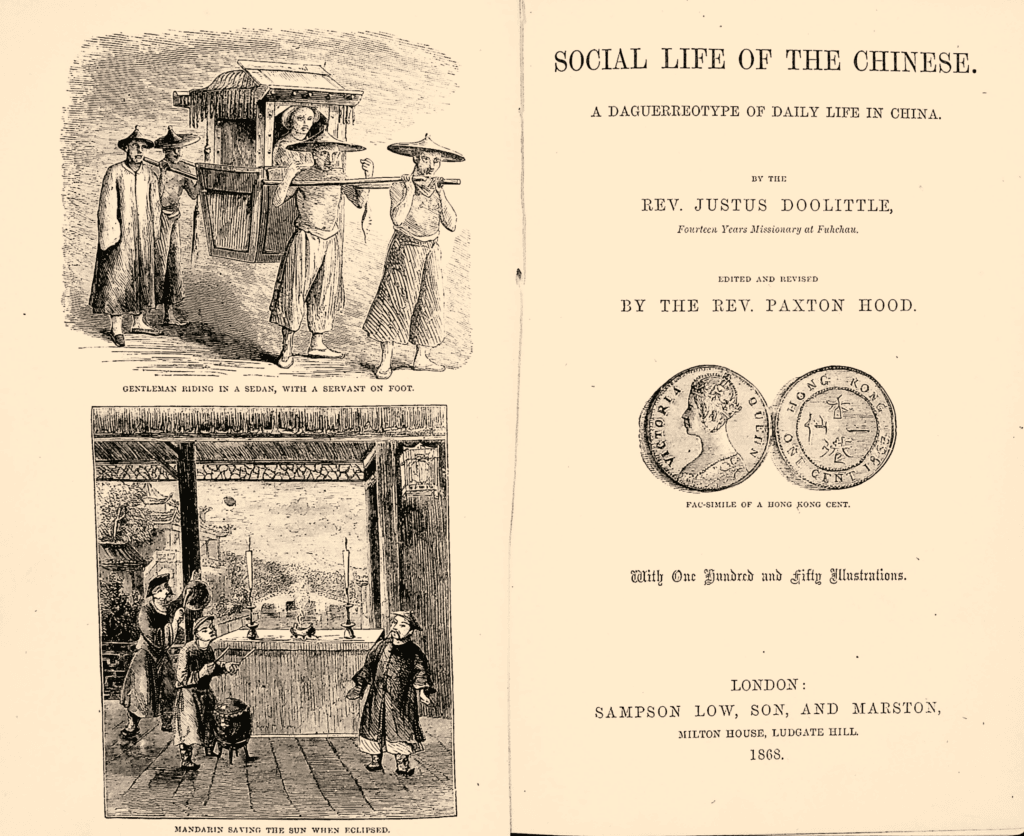
On future visits to Shanghai, I visited the Shanghai Bookstore on Fuzhou Road that sells secondhand books. I found a special bookstore on the grounds of the Jinjiang Hotel. There I found a trove of English-language books that had been taken from the libraries of European residents of Shanghai who had fled the city in 1949. I spirited more than 50 such books out of China, including Social Life of the Chinese by Justus Doolittle, first published in 1865. Such books are no longer available for sale in Shanghai.
The opening pages of Social Life of the Chinese by Justus Doolittle. Image credit: Dui Hua
Beijing
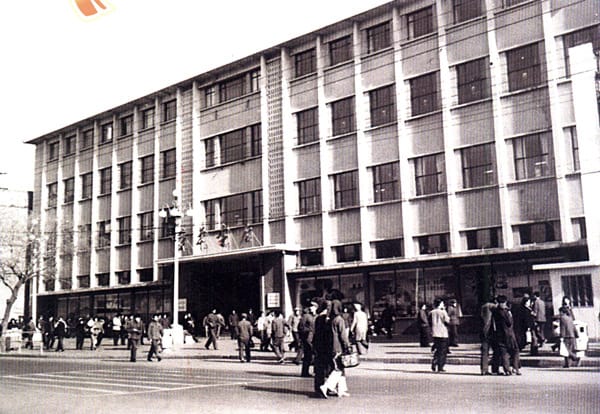
After attending the Feather and Down Fair in Shanghai, I flew to Beijing to attend the Fur Products Fair. I stayed at the Beijing (Peking) Hotel. Across the street from the hotel, on Wangfujing Avenue, stood a large Xinhua bookstore. Upon entering the store, one confronted an expansive display of Quotations from Chairman Mao, the Little Red Book, a staple of Cultural Revolution China.
The Xinhua Bookstore at Wangfujing (after expansion in the 1970’s). The bookstore is now commonly called Wangfujing Bookstore. Source: CCDI.gov
On every trip to Beijing over the next two years, I paid a visit to the Xinhua bookstore. The display grew in size until 1978 when it was replaced by a display of books about Chinese law. Deng Xiaoping had been rehabilitated and Mao was in decline.
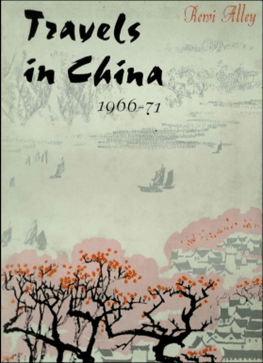
Further up Wangfujing, there was a Foreign Language Bookstore. It featured books by socialist writers who loved China, including New Zealand writer Rewi Alley. I purchased his Travels in China that covered the Cultural Revolution years of 1966 to 1971.
The cover of Rewi Alley’s Travels in China 1966-1971, published in 1973. Image credit: Book Grocer
Further still was a second-hand bookstore in a market. It featured hard to find books published before the Cultural Revolution.
On my visits to the Supreme People’s Court, I passed by a bookstore that featured books published by the Supreme People’s Procuratorate. I found a volume entitled Selection of Criminal Cases: Counterrevolution. One of the cases covered in that volume was that of Zhang Chengjian (张成俭), a disgruntled farmer from Shandong Province who tried to set up an opposition party to oppose the Chinese Communist Party. He had been sentenced to death. I promptly added him to prisoner lists submitted to the Ministry of Justice. His sentence was commuted, and he received sentence reductions that resulted in his release from prison in April 2005.
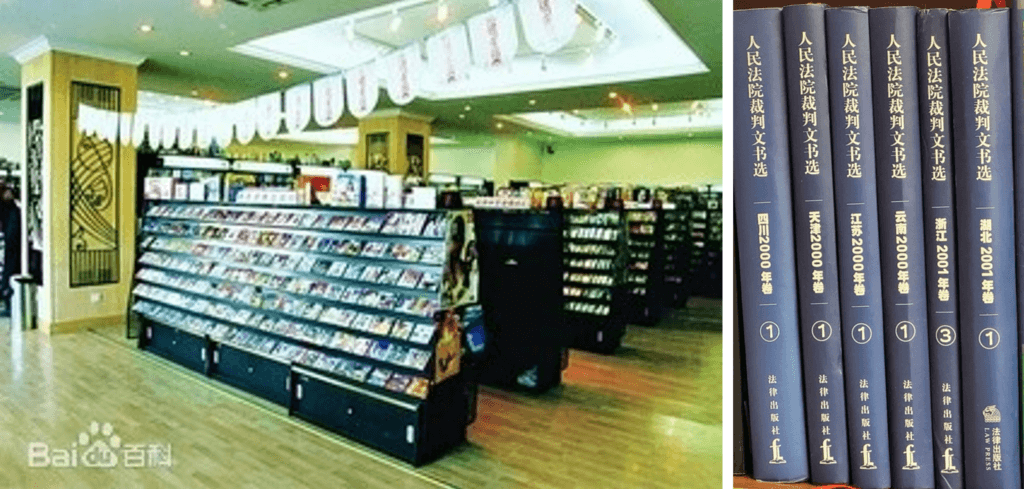
The most valuable bookstore for finding important volumes on political crime was the Law Press Bookstore, operated by the Ministry of Justice, an hour’s drive from my hotel. Among the volumes I found was a series of books that covered a selection of crimes, including endangering state security and so-called “cult” crimes, covered by Article 300 of the Criminal Law. Cases in those volumes included those of Yue Zhengzhong (岳正中), convicted of espionage by a Tianjin court; Lobsang Tenzin and Zege, two Tibetans convicted of splittism by a Sichuan court; Wang Meiping (王梅平), convicted of robbery and espionage by a Zhejiang court; and Kong Junlin (孔峻凌), convicted of subversion by a Hubei court.
Inside the Law Press Bookstore (left. Image source: Baidu Baidke). Volumes of Judicial Documents Selections of the People’s Court, books that Kamm acquired at the Law Press Bookstore (right).
It did not take long before volumes that interested me in Beijing bookstores were taken off the shelves. In recent years I had found nothing that would inform my work advocating for political and religious prisoners. I continued to find books on such topics as juvenile crime, the treatment of juvenile offenders, and how to apply for medical parole.
I grew concerned about what I would say to Chinese Customs if, upon exit from China, they found books marked neibu. I asked an interlocutor in the Chinese government. Her advice? Save the receipts!
My concern proved to be prescient. Shortly after this conversation, a buyer of used books marked neibu, a retired provincial archivist by the name of Jin Zhangqin (金章嵚), was arrested for trafficking in state secrets. Jin had purchased used and discarded books from two vendors in China and resold them to a research center in Hong Jong. He was tried, convicted, and sentenced to 10 years in prison. Dui Hua worked on his case. He was granted two sentence reductions and was released before the end of his sentence. More recently, the Ministry of State Security (MSS) announced in June 2024 that it had been tipped off by a collector of military books and documents that he had found more than 200 documents some of which were marked top secret in two bags outside a recycling center. The collector called the local MSS bureau which in turn arrested two men surnamed Guo and Li for violating China’s Law on Guarding State Secrets.
Tianjin
I attended the Carpet Fair in Tianjin in February 1976. The “Campaign to Beat Back the Right Deviationist Wind,” a thinly veiled attack on Deng Xiaoping and other “right deviationists,’” had begun. I was curious to see if I could find volumes that reflected the nascent campaign, so I hired a taxi and headed for the biggest Xinhua bookstore I could find.
As the taxi turned onto the street, it was as if an electric current had passed up the street. People began to assemble. Finally, the taxi arrived at the location. It was mobbed, faces pressed up against the glass. I struggled to exit the cab. The crowd followed me into the bookstore where they surrounded me. I left as quickly as I could, not having found anything of interest.
Even though Tianjin was and remains one the three most important ports in China, the crowd behaved as if it had never seen a foreigner. This was in sharp contrast to the people of Shanghai and Guangzhou who went about their business paying no mind to foreigners in their midst.
Guangzhou
I found little of interest in bookstores in Guangzhou. The Foreign Languages Bookstore carried a complete set of the works of Enver Hoxha, the Albanian dictator who was, for many years, China’s best friend in Europe. The works of Enver Hoxha had few buyers. They gathered dust until they were taken down.
As in the Foreign Language bookstore in Beijing, Enver Hoxha was not accompanied by the Works of Kim Il-Sung, the North Korean leader. This was another sign that Mr. Kim was not a favorite of Chinese officials based in or visiting Guangzhou for the bi-annual trade fairs.
Pyongyang Jiegenghua Restaurant
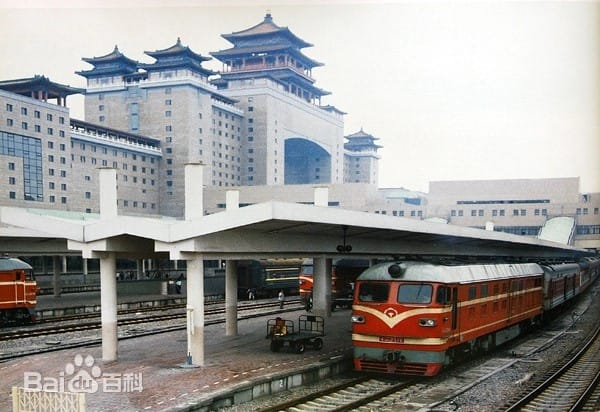
In the early summer of 2013, as I went looking for a bookstore near the Beijing West Railway Station, I spied a Korean restaurant – Pyongyang Jiegenghua 平壤桔梗花 – with the windows papered over and large burly men guarding the door. I did some research and found out it was one of several North Korean restaurants in Beijing. (Many are now closed, including Jiegenghua.)
While they were operating, North Korean restaurants were a major source of foreign currency for the Democratic People’s Republic of Korea (DPRK). According to North Korea Confidential, a revealing book by Damiel Pearson and James Pearson. At one time there were 40 North Korean restaurants in China, including many in Beijing.
While they were operating, North Korean restaurants were a major source of foreign currency for the Democratic People’s Republic of Korea (DPRK). According to North Korea Confidential, a revealing book by Damiel Pearson and James Pearson. At one time there were 40 North Korean restaurants in China, including many in Beijing.
Beijing West Railway Station, shortly after it opened in 1996. Source: Baidu Baike
Mindful that American citizens were forbidden from spending money that might benefit Pyongyang, I asked a local Chinese friend to accompany me to Jiegenghua, promising to reimburse him after the visit.
What we found upon entering was a space from a different world. Dark and forbidding, with young Korean women serving tables. Propaganda posters adorned the walls.
I wondered aloud who the waitresses were. My friend, who understood and spoke English perfectly, overheard me and offered an answer. It turned out he was familiar with North Korean restaurants and had frequented them over the years. He was an afficionado of Korean food and Korean alcoholic beverages.
“The young women are the daughters of high-ranking government and party officials who live in Pyongyang,” he replied. “They spend a year in this place and are not allowed to walk around outside.”
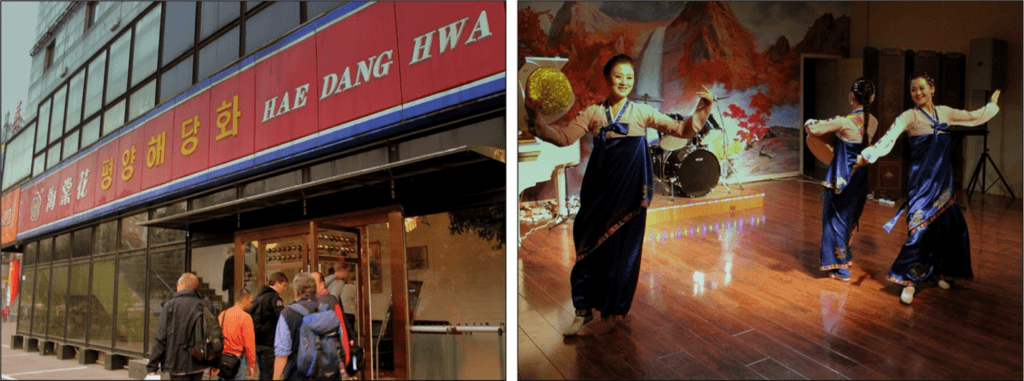
Photographs of a North Korea restaurant in Beijing taken in October 2012: (left) the front of Hae Dang Hwa restaurant in Beijing’s Chaoyang District; (right) waitresses at the restaurant perform for diners. Image credit: Calflier001 / CC BY-SA 2.0
He continued: “It is considered a great honor to be selected to serve tables at North Korean restaurants in Beijing. All the money earned – including tips – goes straight to the government in Pyongyang. It sometimes happens that the women form close relationships with Chinese officials and businessmen in Beijing. They give the women expensive gifts – watches and gold bars. These too must be surrendered upon their return to Pyongyang.”
We sat at a table with a group of Chinese businessmen who had just gotten back to Beijing from Pyongyang. They were clearly happy to be back home. One of them had drunk far too much North Korean fiery liquor. His head sank until it landed in a bowl of kimchi.
As we sat at the table, my friend saw a People’s Liberation Army officer come in with an aide carrying his briefcase. My friend recognized him and muttered, “This man is a corrupt officer.”
I was invited to go to the second floor to meet the ladies who were entertaining guests. I passed on the opportunity. Sometimes, discretion is truly the better part of valor.
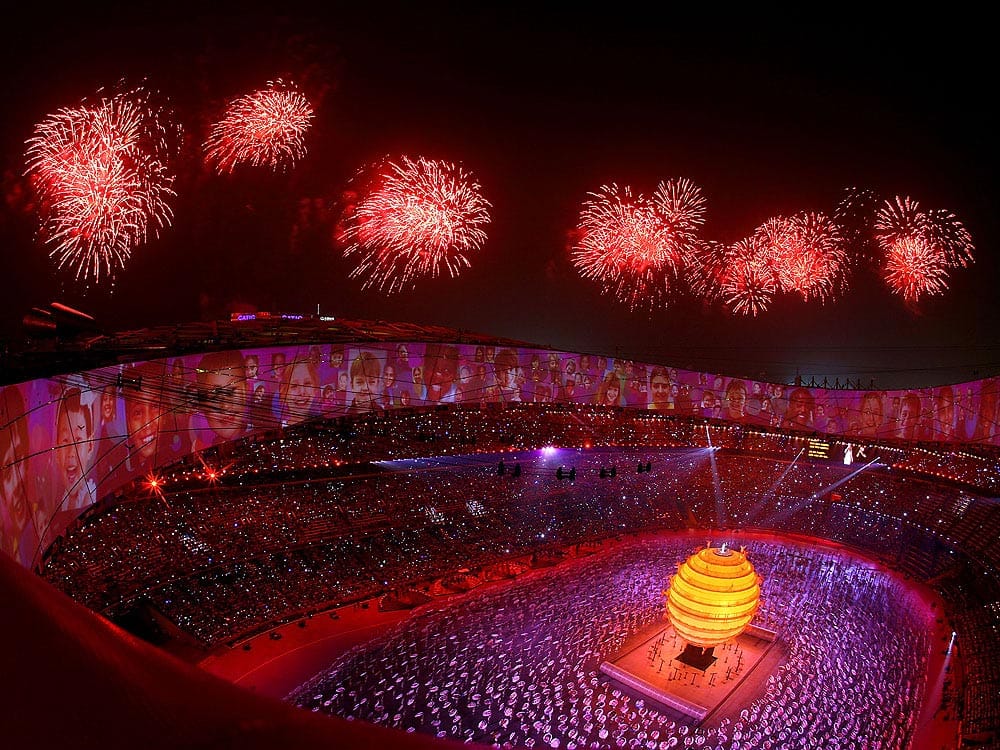
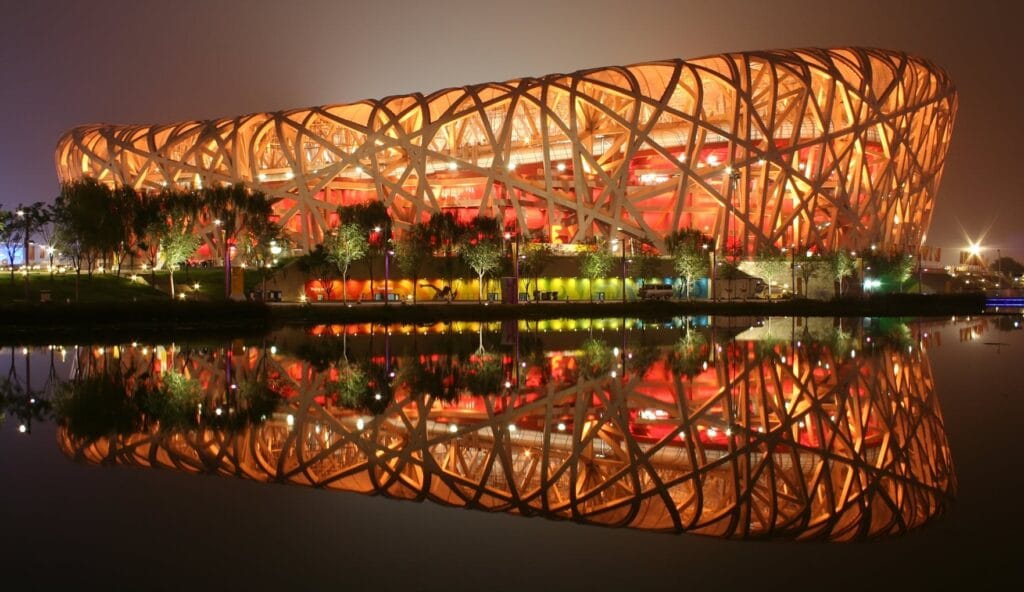
A photo of the 2008 Olympics Opening Ceremony in Beijing National Stadium. Image credit: WuQiang_Beijing / CC BY-SA 3.0
L
ess than four years after the events of May and June 1989, Beijing applied, in 1993, to host the 2000 Summer Olympics. It lost the bid by two votes to Sydney. One of the votes was cast by the US representative on the Olympic Committee.
The loss to Sydney was a great disappointment for China. A senior official with whom I met to discuss human rights, including political prisoners, told me that the US had created a great deal of good will among the Chinese people and Chinese officials alike over its criticism of China’s human rights but, despite this, its decision to maintain China’s trade status. “That goodwill has been lost.” That was the beginning of the decline in the United States’ popularity in China. It has never recovered.
George W. Bush and Sandy Randt
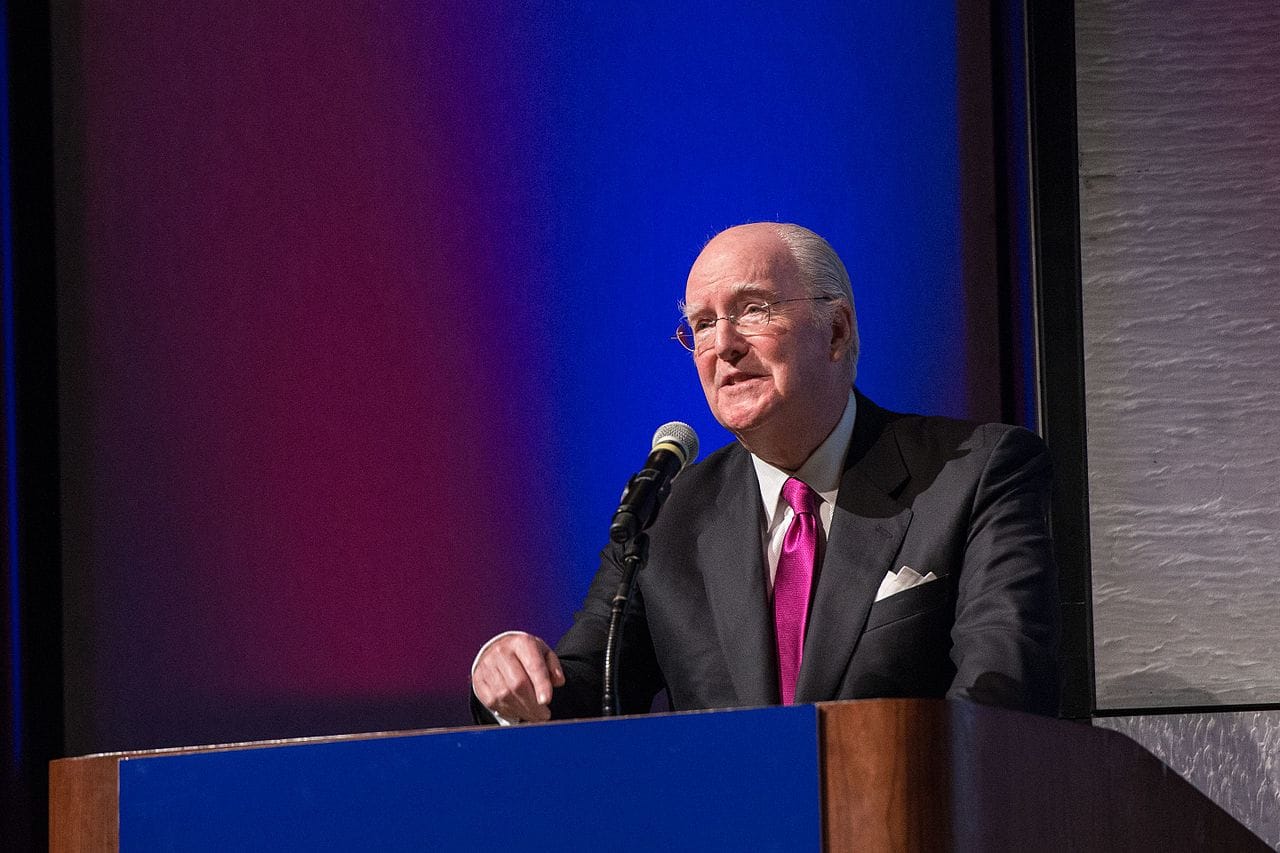
Clark “Sandy” T. Randt photographed on March 31, 2015 speaking at the China-US Private Investment Summit at the LBJ Presidential Library. Image credit: Lauren Gerson / CC BY 2.0
Amidst this backdrop of Chinese disappointment, George W. Bush was elected the 43rd president of the United States in November 2000. His election was challenged by his opponent Al Gore, touching off a three-week battle that was eventually settled by the Supreme Court.
George W. Bush’s father was George H. W. Bush. The senior Bush served as the second US envoy to Beijing, serving as the head of the US Liaison Office (USLO) in Beijing between 1974 to 1975. He went on to become the 41st president of the United States. George W. Bush and his sister spent time in Beijing while his father was head of the USLO; he became familiar with the country and its senior officials long before he became president.
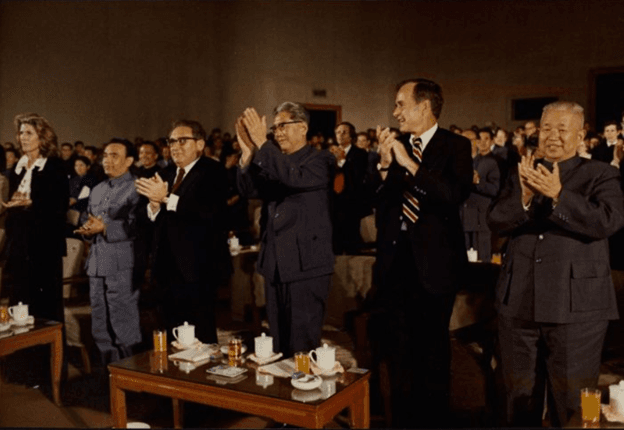
George H.W.Bush (second from right) with US Secretary of State Kissinger, Chinese Foreign Minister Qiao Guanhua, Director of the Liaison Office of the People’s Republic of China in the United States Huang Zhen, during Kissinger’s visit to China, 1975. Image credit: George H.W. Bush Presidential Library & Museum
George W. Bush took office in January 2001. Not long afterwards, he nominated his friend and classmate Clark (Sandy) Randt as the US Ambassador to Beijing. He was confirmed by the Senate in July 2001 and sworn in by Deputy Secretary of State Richard Armitage. I was honored to attend his swearing in. He presented his credentials in Beijing on July 28, 2001.
Sandy Randt had spent 18 years in Hong Kong. He was an attorney, a recognized expert in Chinese law, and a keen observer of developments in China. He had served as a commercial attaché and First Secretary at the US embassy in Beijing from 1982 to 1984. He was also an officer of the American Chamber of Commerce (AmCham) while I was president of the chamber. Our friendship predated his time as an AmCham officer by several decades. We were, and remain, close friends, as were our families. Our children grew up together. Our friendship proved to be decisive for my human rights work in China.
Sandy Randt, who was to become the longest serving US ambassador to China, spoke excellent Chinese, but may not have been as fluent as other US ambassadors to the country, two of whom were born in China. Nor did he have the deep knowledge of the ins and outs of how US state and federal governments work as other ambassadors, two of whom served in the Senate and two of whom were elected governors. Nor was he as well versed in matters of national security as other US ambassadors, one of whom had served in the CIA.
Yet Sandy Randt proved to be more effective than any other ambassador who held the position since the countries normalized relations in 1979. He was able to pick up the phone and speak directly to the president of the United States without having to go through layers of bureaucrats. For this reason, he was respected and even feared by senior Chinese officials.
Third Time Lucky
A little over a month after George W. Bush was sworn in as president in 2001, China once again put in a bid to host an Olympics, this time for the 2008 Summer Games to be held in Beijing. Its application was considered by the Olympic Committee in July and was accepted on the third ballot. The Chinese government and the Chinese people were overjoyed.
To win the right to host the 2008 Summer Olympics, the Chinese government made a number of commitments. It is said to have promised to stop parading offenders who were sentenced to death, and to stop executing them in public. It committed to an unprecedented degree of openness, allowing free access by media to different parts of the country and to its own citizens for unsupervised interviews, and to lifting the blocking of the websites of human rights groups.
A page spread from China’s candidature booklet for its bid to host the 2008 Olympics. The booklet was part of Beijing’s application submitted in 2001. Image credit: Issuu
Beijing failed to live up to its promises. Parading of those condemned to death continued, as did public executions, albeit in parts of the country outside major urban areas. The websites of Amnesty International and Human Rights Watch were unblocked, but others continued to be blocked, including the website of Dui Hua. I protested to China’s Ministry of Foreign Affairs, to no avail.
On March 10, 2008, five months before the Games were set to begin, protests broke out in Tibet and other Tibetan areas of the country. By the Chinese government’s count, demonstrations, some violent, occurred in 150 locations in Tibet and Tibetan areas of other provinces, from March 10 to March 25, 2008. Human rights groups’ estimates of the number of demonstrations that occurred after March 10 were much higher.
Hundreds of people were killed by protesters and police. Thousands were arrested and thousands more remain unaccounted for. Buildings and critical infrastructure were destroyed. The Tibetan uprising prompted increased attention to China’s human rights in general, and political prisoners in particular.
In response to the crisis, Dui Hua proposed an Olympics Special Pardon for political prisoners in a speech I delivered in Hong Kong on March 29, 2008. The foundation focused on two long-suffering groups: those still in jail for their participation in the June 4 protests, and counterrevolutionaries. Counterrevolution had been removed from the Criminal Law in 1997.
Screenshots of reporting on Kamm’s appeal for pardons in the lead-up to the 2008 Olympics: the Los Angeles Times (left) and Reuters. Image credit: LA Times & Reuters / Fair Use
Special pardons are provided for under Chinese law. Dui Hua followed up the Hong Kong speech with a letter to Wu Bangguo, chairman of the National People’s Congress (NPC), the body that grants special pardons.
The proposal was received favorably by Chinese officials, relatives of Chinese prisoners, and foreign human rights groups. Unfortunately, the NPC failed to act, but several well-known prisoners were granted a measure of clemency, including the Hong Kong journalist Ching Cheong (程翔), who was released and allowed to return to Hong Kong, and American citizen Jude Shao, who was granted parole but forced to remain in China. Jude Shao had been visited by US Ambassador Randt in the Shanghai prison where he was incarcerated.
Tragically, one Chinese citizen who should have received clemency did not. Wo Weihan (沃维汉), a member of the small Daur minority residing in Heilongjiang Province, was executed on November 28, 2008, for espionage. The charges against him were ludicrous and violated the policy of granting leniency to members of ethnic minorities. I had worked hard on his case, having gotten to know his daughters, both of whom are Austrian citizens. I denounced the execution in print and in face-to-face meetings with Chinese officials.
Wo (center) at the wedding of his daughter Ran Chen (left). His other daughter, Di Chen, is to the right. Source: Ran Chen.
In 2015 and 2019, President Xi Jinping proposed special pardons that the NPC went on to grant. In all, 47,000 prisoners were pardoned. Principal beneficiaries of the pardon were juveniles and elderly prisoners, two groups that Dui Hua’s advocacy work has focused on.
I supported the decision to grant the 2008 games to China, though other commentators and human rights activists opposed. One journalist likened granting the games to Beijing to the decision to hold the 1936 games in Nazi Germany. The journalist criticized Dui Hua’s support for the Beijing Olympics. This was especially hurtful to me. Growing up, I knew Holocaust survivors, and my uncle had been an investigator at the Nuremburg trials of Nazi war criminals.
Sichuan Earthquake
On May 12, 2008 – three months before the Games were set to begin — a massive earthquake measuring 8.0 on the Richter scale struck Sichuan Province near the capital city of Chengdu. An estimated 90,000 people were killed, thousands more injured, and countless buildings destroyed. Journalists and all unessential personnel were ordered to leave Sichuan.
Damage caused by the 2008 Sichuan earthquake on the road heading to Wenchuan, the quake’s epicenter, taken on May 14, 2008. Image credit: Miniwiki / Public Domain
On June 10, 2008, activist Huang Qi (黄琦)was detained in Chengdu on suspicion of trafficking in state secrets related to his accusations of shoddy construction that resulted in the collapse of buildings after the earthquake. He was subsequently sentenced to three years in prison. Huang continued his activism after his release. He is currently serving a 12-year sentence for endangering state security, his third imprisonment.
Ai Weiwei (艾未未), a famous artist who was a design consultant for the stunning National Stadium (colloquially known as the Bird’s Nest and built specifically for the Games), was impacted by the quake. In April 2011, he was detained at Beijing Airport and subsequently placed under residential surveillance in a designated location. Although Ai was later released on bail some 80 days later, he was confined to his Beijing home, akin to house arrest. He was accused of tax evasion. Many suspected that the real reason he was detained was his vocal support for victims of the Sichuan earthquake, many of them children, and the work of other activists.
Beijing National Stadium, known as the Bird’s Nest. Image credit: Peter 23 / CC BY-SA 3.0
The Bird’s Nest was rarely used after the Games, as were other structures erected for the occasion. They became White Elephants. No one knows how much China spent on the Games, but it was doubtless a large sum.
As for Dui Hua, the impact of the quake was immediate. We had been planning our first juvenile justice exchange with Chinese judges to take place in the United States in June. I insisted that the program be postponed, and our Chinese partners eventually agreed. Instead, they arrived in October and visited courts, carceral facilities, and other sites in Chicago, Washington D.C., Maryland, and San Francisco. The program was a success. It opened the door to Dui Hua’s cooperation with China’s Supreme People’s Court in the field of juvenile justice, an important area of human rights.
Before the earthquake related crackdowns, other human rights activists were being impacted by the Games. Hu Jia (胡佳), a prominent dissident sentenced to prison for criticizing the Chinese government’s failure to improve human rights before the Games, was sentenced to three and a half years in prison. He was serving the sentence while the Games took place. His wife at the time, Zeng Jinyan, had supported the proposal to grant an Olympics Special Pardon.
Hu Jia was nominated for the 2008 Nobel Peace Prize. The Beijing Games were very much on the minds of those who put him forward. He was the odds-on favorite to be chosen as the 2008 laureate, but in the end the Nobel Committee chose someone else. Two years later, Liu Xiaobo (刘晓波) became the first Chinese to be chosen by the committee for the peace prize. Liu died in 2017 because of poor treatment while serving his sentence.
Torch Run
In keeping with tradition, an Olympic torch relay began in Greece, and ended in the city where the games would be held, in 2008, Beijing. The torch passed through six continents and covered 85,000 miles before arriving in Beijing. The relay lasted 129 days and is the longest distance covered of the modem games.
The relay was marred by protests over Tibet and human rights abuses, which disrupted the relay in London and Paris. Violence occurred in Nepal, home to a large Tibetan population.
A group of pro-Tibetan protesters confront pro-Chinese protesters near Pier 1 during the 2008 torch run in San Francisco. Image credit: Broken Sphere / CC BY-SA 3.0
China learned lessons from these protests. I was in San Francisco when the relay took place and witnessed changes. With the help of the San Francisco Police Department, the route was changed to the outskirts of the city. The Chinese consulate arranged for counter protesters from the Bay Area’s large ethnic Chinese community to show up. Buses filled with students were laid on. The result of this effort was film footage used in a propaganda film to give the impression that Americans enthusiastically welcomed the torch relay, and by extension, the holding of the Games in Beijing.
The Games Begin
Shortly after the torch arrived in Beijing, the opening ceremony was held with a stunning display of fireworks and music.
President Bush had been urged by European leaders to join them in boycotting the opening ceremony on account of China’s human rights record. Bush declined to do so and wound up attending the opening ceremony. He stuck to the position that politics and sports should not be mixed.
While in Beijing, President George W. Bush presided over the opening of the new US embassy in Beijing with Sandy Randt. He was joined by his father, mother, and Henry Kissinger.
On August 8, 2008, President George W. Bush is greeted by US Ambassador Sandy Randt at the US Embassy in Beijing. Former President George H.W. Bush is behind them. Image credit: Eric Draper / White House photo
The day after the glittering opening ceremony, tragedy struck. A US citizen, the father of an Olympian who played on the 2004 volleyball team, was knifed to death on the Drum Tower. His guide was also murdered, and the Olympian’s mother was badly injured trying to protect her husband. Their assailant jumped to his death from the Drum Tower, sparing him from execution.
Results of the Games
(Left) US President George W. Bush, Laura Bush and daughter Barbara Bush cheer on US swimmer Michael Phelps at the 400-Meter Individual Medley event in Beijing on August 10, 2008; (right) President Bush is greeted by Chinese Vice President Xi Jinping during his visit to Zhongnanhai, the Chinese leadership compound in Beijing on August 10, 2008. Image credit: Eric Draper / White House photo
China won the most gold medals at the 2008 Summer Olympics, and the United States won the most medals overall. But the games did little to improve China’s international image thanks largely to its brutal crackdown in Tibet, its detentions of Chinese citizens for the peaceful expression of their views, and its failure to honor commitments to greater openness and more restraints on capital punishment.
The success of the games did not help Chinese President Hu Jintao’s reputation either. He left office in 2012, widely seen as a weak leader. He was humiliated at the closing session of the National People’s Congress in October 2023 when documents were snatched from his hands, and he was denied the opportunity to speak. He was led off the stage a broken old man. He reappeared at the funeral of Jiang Zemin in December 2023 but has not been seen in public since.
s my tenure as President of the American Chamber of Commerce in Hong Kong (AmCham) drew to a close in 1990, I began speaking out on Hong Kong issues and political prisoners in China. In remarks delivered to the Australian Chamber of Commerce in Hong Kong, I called for the release of prisoners detained during the June 1989 protests in Beijing. In a speech to the National Committee on US-China Relations in New York in December, I called for legislation to protect the people of Hong Kong as well as US interests in the colony.
In attendance at the Australian Chamber event was an AmCham staff member. She quickly told the incoming leadership what I had said. Retribution was swift. I was no longer invited to American consulate briefings and meetings with visiting members of Congress, many of whom I got to know during my trips to Washington between 1990 and 1992, when I testified six times before committees of the House of Representatives and Senate.
In 1991, my successor as AmCham leader sent me a letter on AmCham stationary asking me to make sure the press did not mention my tenure as chamber president when writing about me. In the letter, he claimed that a big AmCham member was threatening to leave the body unless the press stopped mentioning my leadership when reporting on my human rights work. (He also offered the services of his public relations firm.) At the AmCham dinner to kick off 1991, he refused to say my name or acknowledge my work on a raft of issues I had dealt with on behalf of the business community, a snub that did not go unnoticed by Hong Kong officials in attendance. Not all AmCham directors supported what my successor did, but several backed him up.
“Pay Me with Information on Prisoners”
Unlike the American business community and other hostile businesspeople, Chinese officials were friendly. In January 1991, a party official based in Guangzhou came to see me in Hong Kong. This meeting led to a visit to Guangzhou in March during which I handed over my first list of ten prisoners, individuals detained during the Democracy Wall movement and the June 4, 1989 protests.
People read the fourth edition of the journal Jintian (Today) displayed on the Xidan Wall shortly after the edition was published on June 20, 1979. Image credit: University of Vienna Department of East Asian Studies
In April I was invited to come to the office of the Xinhua News Agency in Wanchai. Xinhua acted as the de facto Chinese embassy in the colony. Upon arrival I was ushered into a room where two officials in charge of economic and trade matters were awaiting. After thanking me for my work on Most Favored Nation (MFN), one of them, Mr. Wang made me an unusual offer.
“Would you like to do some business with China?” he asked. “We can grant you exclusive agencies for products much in demand in Hong Kong, including silk.” Agencies oversee distributors and as such do very little work. In effect, all they do is collect commissions. I was being offered a sweetheart deal to compensate me for my work on MFN.
I politely rebuffed the official. I cautioned them that the threat to MFN was not over and was likely to come up again for years to come. “I want to invest in the issue. If you want to pay me, pay me with information on prisoners,” I said.
They were taken aback by my response. “Who do you have in mind?” I brought up the name of an activist detained after June 4. Mr. Wang jotted down his name.
Not long afterwards, I received a fax with information on the activist, sent from a Beijing number that I did not recognize. This turned out to be an office under the State Council Information Office (SCIO) whose leaders would come to be known, collectively, by the pseudonym Bai Li.
Bai Li
Bai Li was a principal source of information on prisoners from April 1991 to April 1995. Bai Li was by no means the only source of information. I also received information on prisoners from the Ministry of Justice (MOJ), the Ministry of Public Security (MPS), the Supreme People’s Court, the Supreme People’s Procuratorate, and the Religious Affairs Bureau, but Bai Li was, on balance, the most important source of information on Chinese political prisoners during those four years.
In all, the Bai Li channel provided information on more than 100 Chinese prisoners, most of whom were serving sentences for counterrevolution, a crime removed from the Criminal Law in 1997. Many of those prisoners were released early from prison after my intervention.
Information from Bai Li was conveyed by fax to my office in Hong Kong or handed over in person at Bai Li’s office, a run-down structure on the outskirts of Beijing with furniture held together by masking tape. Initially, meetings with Bai Li were arranged by my host in Beijing, the China Council for the Promotion of International Trade (CCPIT). Eventually, I was able to set up the meetings directly by myself, by fax or phone.
The CCPIT building in Beijing in 2021. Image credit: CCPIT
Which Prisoners Would Make a Difference?
On one occasion, I hosted a banquet for SCIO and other ministries at a Beijing hotel. Officials of both the justice ministry and the public security ministry were in attendance, a rare occurrence as there was bad blood between the two entities. (MPS used to oversee all prisons in China but in 1980 prisons were put under the administration of MOJ, with one exception, the notorious Qincheng Prison in Beijing.)
At the banquet in Beijing, I was asked which prisoners, if released, would make a difference in Washington. I replied that the release of Catholic clergy would make a difference, pointing out that 40 percent of members of Congress were Catholics. Soon thereafter, Catholic bishops and other clergy began to be released.
(Left) Wei Jingsheng at the Beijing Intermediate People’s Court on October 17, 1979, as shown on the French-language cover of The Fifth Modernization. (Right) Xu Wenli interviewed by Helmut Opletal on June 23, 1979. Image credits: Abe Books; Vienna University
On another occasion, I was sitting in the back seat of a car with Bai Li. He was pleased with the result of the Catholic releases and asked who else should be released. I replied that no Democracy Wall prisoners, a group that emerged in the late 1970s that included Wei Jingsheng (魏京生) and Xu Wenli (徐文立), had ever been released early from prison. Releases began in 1992.
Information from Bai Li: A Sampling
June 4th Prisoners in Qingdao
Kamm appointed honorary professor by the Qingdao University in April 1990. Image credit: Dui Hua
In 1990 and 1991, I made three business trips to Qingdao, a port city in Shandong Province with deep ties to the United States. (Jimmy Carter was based at the US navy base in Qingdao during World War II.) On one of the visits, I spoke to the students and faculty of Qingdao University, where I was made an honorary professor. During a later visit, I spoke to a faculty member and asked her to help a political prisoner, whose family she knew.
Qingdao University in the 1990s, with the library under construction. Image credit: Eric Walter via Qindaonese.com
Shandong Province courts gave the longest prison sentences to June 4 prisoners, and they had done so sooner than courts in any other province. Two protesters were reportedly executed in Jinan, capital of Shandong Province. Two of the longest sentences were given to two young men who were sent to Shandong Number Three Prison in Weifang to serve their 18-year sentences. In those days, political prisoners in Shandong were sent to Shandong Number Three Prison where they were all housed in the same cell block.
I continued to advocate for the Shandong prisoners in my meetings and correspondence with the Chinese government in the 1990s, including in 1999, the year I set up Dui Hua. In March 1999 I visited Qingdao on business and met with the local branch of the CCPIT, later rebranded as the Qingdao International Chamber of Commerce. I was asked to be their honorary advisor, but I was reluctant to do so. I mentioned that Shandong was known for giving long sentences to June 4 protesters. They asked me for some names, and I handed over a list. In my oral presentation, I focused on six protesters on the list who had been detained in Qingdao following the June 1989 protests. All were released before their sentences expired.
Early in my work, I learned from a good source that one of Qingdao prisoners had neither appealed the judgment to the Shandong High People’s Court nor filed a petition for a retrial with China’s Supreme People’s Court. Bai Li encouraged me to suggest to the family that a petition be filed with the Supreme People’s Court. Eventually, a family member did so. The prisoner was released several years before his sentence expired.
Student protesters gather at the Qingdao Municipal Government Building, Shandong Province, in June 1989. Image credit: duping.net
I was given the news of a Shandong prisoner’s release at the end of a visit to Beijing Prison in Daxing Municipality in May 2000. An official from the MOJ who had accompanied me on the visit told me “I have some good news for you,” she said. “The prisoner you care about has just been released.” She was excited and happy to tell me this news.
People of Faith: Catholic Clergy
Not long after the banquet in Beijing at which I pushed for the release elderly Catholic clergy, I submitted lists of priests to the Religious Affairs Bureau and the SCIO. On May 26, 1992, I received a fax from Bai Li addressed to my Chinese name Kang Yuan (康原). It was one of the earliest messages from Bai Li and contained information on three priests: Hebei Bishop Peter Liu Guandong (刘冠东), Henan Vicar General Joseph Jin Dechen (靳德辰), and Zhejiang monsignor Francesco Wang Yijun (王益骏). Liu was the elected head of the Chinese Bishops Congress and as such was the leader of the underground Catholic Church in China. Wang Yijun, like Liu Guandong, had spent decades in Chinese prisons for practicing his faith.
TO MR. JOHN KAMM
Relayed communiqué from Mr. Bai Li of Beijing to Mr. Kang Yuan:
Catholic priests Liu Guandong and Wang Yijun, who were sentenced to Reeducation through Labor (RTL) for violating the law, had their punishments lifted yesterday by the Hebei and Zhejiang Provincial RTL organs, respectively, a half a year early. Because they are both more than 70 years old and have no close relatives to care for them, the local religious affairs organs will be responsible for their daily living expenses.
The Catholic priest Jin Decheng, who is seventy-five years old and has been serving a sentence in prison, was paroled yesterday by the Henan Provincial Justice Bureau two years early, in accordance with the law. Jin was sentenced by the Henan judicial organ in 1982 to fifteen years of imprisonment for serious violation of the law. Due to good behavior during incarceration, he was granted a sentence reduction of three years in 1989. Recently, based on his behavior, the relevant judicial organ in Henan approved granting him parole, two years before expiration of the sentence. The parole took effect yesterday (on the 21st of the month).
A response from Bai Li from 1992 on acts of clemency for three Catholic priests, with the English translation. Image credit: Dui Hua
The next year three Catholic prisoners on my lists were released before the end of their terms. Casimir Wang Milu (王弥禄), the underground bishop of Tianshui Diocese in Gansu Province, sometimes called the “Black Bishop of Tianshui” for ordaining priests without the blessing of the pope, Hebei priest Placid Pei Ronggui (裴荣贵), and Henan priest Giuseppe Li Fangchun (李芳春) were released a couple of years before their sentences were set to expire.
The Vatican determined that, on release, Bishop Wang Milu’s mental health had deteriorated to the point that he could no longer carry out his pastoral duties. He was succeeded by his brother, John Wang Ruowang (王若望), as bishop of Tianshui.
In April 1989 – two months before the quelling of pro-democracy protests in Tiananmen Square – public security officers descended on the Catholic village of Youtong in Hebei Province, injuring hundreds, and killing two villagers. The village priest, Pei Ronggui, was detained and subsequently sentenced to five years in prison for disturbing the social order.
Father Li Fangchun (center) at Kaifeng monastery in Henan in 1993. Image credit: Father Politi
Li Fangchun served two long prison terms for counterrevolution. Father Giancarlo Politi of Hong Kong and I worked hard to secure his early release in early 1993. For the story of Father Li and other Catholic and Protestant clergy released early from prison, please see “Two Good Priests.”
During this period, I asked about 22 Catholics and received written responses for ten of them.
On a visit to Beijing in early 1993, Bai Li asked me a “theoretical” question. “If we want to maximize favorable press coverage in the United States, when should we release a prisoner?” I replied that major media outlets like the New York Times, the Washington Post, and the Wall Street Journal start putting their issues to bed no later than midnight the day before publication.
Kamm (center) with Wang Dan (left) and Xu Wenli, taken in San Francisco in 2002. Image credit: Dui Hua
On May 26, 1993, I received a fax from Bai Li. “Xu Wenli will be released from Prison at 10 AM, on May 26, 1993,” two hours before midnight on the East Coast. A few months before Xu Wenli was released, Wang Xizhe, a prominent activist based in Guangzhou, was released from Huaiji Prison in western Guangdong Province. He was serving his second prison sentence, having served time for a big character poster written with Li Zhengtian and two other activists in 1974, a Cultural Revolution group that came to be known as Li Yizhe. Like Xu Wenli, Wang Xizhe now lives in the United States where they have remained active in promoting respect for human rights in China.
I received a fax from Bai Li (misspelled as Bei Li) on September 9, 1993, advising me that Wei Jingsheng had been granted parole. This was surprising as I had been told that the chance of an early release was small due to Wei’s attitude in prison and his passion for arguing with the guards. According to the fax, he had his own cell and could smoke cigarettes.
(Left) The Li Yizhe group — Li Zhengtian, Chen Yiyang, and Wang Xizhe — at the Guangzhou Martyrs’ Memorial Garden in 1974. (Right) People crowd around a big-character poster by “Li Yizhe” in the Guangzhou city center in 1974. Image credit: University of Vienna Department of East Asian Studies
Prior to his release in 1993, Wei had been taken on a tour of cities near Beijing so that he could “see for himself” the progress China had been making in economic and social development. Wei was a leading dissident figure well known in the West due to his authoring the seminal wall poster “The Fifth Modernization” which he posted on Democracy Wall in Beijing.
After another arrest in 1994 and imprisonment, Wei was released in 1997. He now lives in exile in the United States where he has testified before Congress and met with members of the House of Representatives and the Senate to lobby for legislation meant to advance human rights and rule of law in China.
Obscure Prisoners: Zhang Chengjian (张成俭)
In late November 1994, I flew to Beijing, hoping to have a meeting with the MOJ. They were not available to see me. I secured a meeting with Bai Li on December 2, 1994, where I advised him that I had hoped to hand over a list of little-known prisoners list directly to the justice ministry. He told me to give it to him. He would fax me the response to my Hong Kong office.
A few weeks later, as 1994 drew to a close, I received a fax from Bai Li with information on 13 names on the list.
One of the names that information was provided for was a prisoner by the name of Zhang Chengjian. I had found his name in a book on counterrevolutionaries that I had purchased in a Beijing bookstore. Unhappy with reforms introduced by Deng Xiaoping, Zhang had gathered a group of like-minded people to overthrow the leadership of the Chinese Communist Party, constituting crimes of inciting counterrevolution and establishing a counterrevolutionary group. He was sentenced to 20 years in prison by a Shandong court in 1983, which was extended by seven years for a murder charge in 1998. After several sentence reductions, he was released from prison in 2005.
Ethnic Prisoners
Early in my work with Bai Li, I inquired into the status of prisoners held in Xinjiang and Tibet, including the Kazakh poet Kajikhumar (Qazhyghumar) Shabdan, held in Urumqi Prison Number One, Tibetan activist Jampel Changchub (江白强久) and Tibetan teacher Jigme Sangpo (晋美桑布), both held in Drapchi Prison.
Kamm meeting with Jigme Sangpo in Switzerland. Image credit: Dui Hua
Compared to Han prisoners, getting information on ethnic prisoners proved difficult, as was securing clemency. Jampel Changchub’s sentence was reduced by three years at the end of 1994. Elderly prisoners Kajikhumar Shabdan and Jigme Sangpo both served many years in prison but were released before their long sentences ended. The two Tibetans have passed away, Jigme Sangpo in Switzerland in 2020 where he had been granted political asylum and Jampel Changchub in Tibet.
The List of 100
In February 1995, I traveled to Beijing where I met with Bai Li and a representative of the MOJ. Prior to the meeting I had gathered all the information that Bai Li had given me in 1993 and 1994 into a booklet that I faxed to Bai Li. At our meeting in February, I asked for my interlocutor’s reaction to the booklet. “You have accurately reported what we told you,” Bai Li’s responded. I then asked, “Shall we continue?” Bai Li nodded yes.
I apologized for giving them so much work and suggested presenting four lists of 25 names, one each quarter. They agreed. We shook on this “deal,” and I handed over the first list of 25 names.
I returned to Beijing in April and met with Bai Li and a representative of the MOJ. It was a frosty meeting. I was nevertheless given a response to my February list. Information was provided on 18 prisoners including Zhao Fengping (赵凤平), a political dissident in Jilin Province and Yang Lianzi (杨连子), a June 4 poet and troubadour from Gansu Province.
Zhao Fengping was the leader of a group of counterrevolutionaries based in Jilin Province. I tracked him down by searching through state newspapers at the Universities Service Center in Hong Kong. Zhao had put up Wei Jingsheng’s “Fifth Modernization” on a wall in Shenyang. He was sentenced to life in prison, subsequently reduced to 13 years.
Yang Lianzi roamed Tiananmen Square singing ballads to the protesters. He became friends with Hong Kong-based human rights activist Robin Munro, who asked me to put Yang on one of my lists. Yang had been given a 15-year sentence for counterrevolutionary propaganda soon after the quelling of the protests.
Both Zhao Fengping and Yang Lianzi were released before their sentences expired.
The Washington Post reporting on Kamm’s prisoner list initiative in 1995. Image credit: Washington Post / Fair use
The Bai Li Channel Closes
In late May 1994, President Bill Clinton renewed China’s (MFN) without linking the trade status to human rights. One of the conditions that Mr. Clinton and Congress had imposed on renewing MFN was the accounting of prisoners detained after the June 1989 protests.
The Chinese government no longer had an incentive to provide information on prisoners, but they continued to give me information through the Bai Li channel and other channels. One of the reasons was that former US Ambassador to China Winston Lord had pointed out that the Chinese government had said that, if the pressure of MFN revocation were taken off the table, China would take steps on human rights. Ambassador Lord challenged the Chinese government to make good on that promise.
On May 26, 1994, President Clinton announcing his support to renew China’s Most Favored Nation status for China despite no significant progress on human rights, during a press conference on May 26, 1994. Image credit: C-Span
At the Spring 1995 session of the Geneva-based Human Rights Commission (renamed the Human Rights Council in 2005), the United States and the European Union lobbied for the adoption of a resolution condemning China’s human rights record. I received a fax from China’s MOJ advising me that it would stop providing me with information on prisoners. (The resolution failed by one vote.)
In May 1995, the State Department issued a visa to Taiwan president Lee Teng-hui (李登辉) so that he could give a speech at his alma mater, Cornell University in which he criticized China. Beijing was furious. Among several other dialogues, China’s Ministry of Foreign Affairs announced that the human rights dialogue with the United States would be suspended. The People’s Liberation Army began firing missiles over Taiwan, and the United States responded by deploying two aircraft carrier groups to waters around the island. Tensions between the two countries were high. The Bai Li channel closed, never to reopen. After my 1995 meetings, I never saw Bai Li again. I continued to submit lists and receive information from other entities, however, and continue to do so to the present day.
At Kun Iam Temple, the table were the Treaty of Wangxia was signed. Image credit: Wikimedia Commons
A
short walk from where I was teaching in Macau in 1972 was the Kun Iam Temple, one of Macau’s three oldest temples. I enjoyed going there because it was quiet and verdant, and because of its historic significance for US-China relations. On a table at the temple, the United States and China signed the Treaty of Wangxia on July 3, 1844, which marked the start of formal relations between the two countries.
After I left Macau for Hong Kong on Christmas Day 1972, I maintained interest in the Portuguese territory. I visited Macau as often as possible, staying at the Bela Vista, a colonial-style hotel which now houses the Portuguese Consulate, whenever I could. The Bela Vista sat on a hill overlooking the Praia Grande and the bay. Unfortunately, the bay was subsequently filled in.
The Hotel Bela Vista, which opened in 1890: (left) the hotel in the 1980s and (right) in 2023. Image credit: Dui Hua; Cultural Heritage of Macau
I became friends with prominent Macanese residents of the British Crown Colony, including Sir Roger Lobo, and dined whenever I could at the Club Lusitano, the Macanese eating club in Hong Kong.
American Chamber of Commerce
I became active in the American Chamber of Commerce (AmCham) in the early 1980s. I focused on the China Commercial Relations Committee (CCRC), the largest committee in the chamber with members involved in the burgeoning trade relationship that followed the normalization of relations with China in 1979.
In the summer of 1984, I got the idea of setting up the Macau Subcommittee under the CCRC. Chamber leadership, then under American lawyer Gage McAfee, bought into the idea. Planning began to send an AmCham delegation to Macau.
“AmCham Visits Macau!” – coverage of the delegation in AmCham’s journal. Image credit: Journal of the American Chamber of Commerce in Hong Kong
The delegation took place in January 1985. It was to be made up of AmCham leaders, senior officials from the American consulate including the deputy consul general and the head of the commercial services department, and businessmen and businesswomen, including two Diamond Shamrock colleagues. The fledgling subcommittee conducted a survey to determine the level of business activities and government plans to increase investment and trade. We prepared papers based on statistics on imports and exports and plans to improve infrastructure.
The survey was sent out to 800 CCRC members, of whom 60 replied. We discovered that the level of trade and investment was low, as were returns on investment. Respondents listed several problems, including government red tape – getting export licenses was slow – and there was a lack of reliable information on imports and exports. Five of the 12 respondents who had offices there were considering shutting down and pulling out.
Snapshots of Macau fishing villages. Image credit: Dui Hua
One number stood out. In 1983, there were only 28,000 telephones in Macau for a population of 266,000.
Macau was woefully underdeveloped. Aside from the low per capita ownership of telephones, a major problem was the depth of the harbor. Silt washed down the West River, requiring frequent, costly dredging.
Delegation Meeting
Our first meeting was with Secretary for Economic Affairs, Luis Filipe Ferreira Simoes and other officials. He outlined the territory’s three economic priorities: diversify overseas markets for Macau products, develop a service industry sector to serve Macau and adjacent areas of Guangdong Province, and develop Macau’s infrastructure to attract private sector and foreign investment. Mr. Simoes said the efforts were yielding good results: textiles made up 85 percent of exports in 1980, but in 1983 they made up 71 percent. There had been a significant increase in the number of banks in Macau.
An aerial view of Macau. Image credit: Dui Hua
Ma Man-kei, President of the Macau Chinese Chamber of Commerce
On the morning of January 24, 1985, the AmCham group met with Ma Man-kei, President of the Chinese Chamber of Commerce as well as members of the chamber and the Macau Exporters Association. Mr. Ma was an outspoken proponent of China’s resumption of sovereignty as soon as possible. He would go on to become one of the highest-ranking Chinese citizens in Macau, serving as Vice Chairman of the Chinese People’s Political Consultative Congress for many years.
Ma Man-kei with Gage McAfee. Image credit: Journal of the American Chamber of Commerce in Hong Kong
Unfortunately for Mr. Ma, Beijing decided to take a go-slow approach when it came to resuming sovereignty of Macau. This was despite Lisbon’s offer to transfer sovereignty to Beijing after the Carnation Revolution of April 1974, when Portugal gave up all its overseas territories. Beijing did not want anything to disturb Hong Kong, which was due for the return of sovereignty to China in 1997.
After listening to AmCham’s report and recommendations, Mr. Ma said he supported them and that he would make his support known to the Macau government. Ma then said: “The delta counties near Macau have a large amount of foreign currency and can now import goods directly. They often send buying groups to Macau. However, American companies don’t do much promotion work in Macau, so they mostly buy Japanese products, or American products through middlemen in Macau.”
A building in Macau planned for demolition, with a poster showing the building that will be erected in its place. Image credit: Dui Hua
Leal Senado
After our meeting with Mr. Ma, we passed by the Leal Senado (meaning “the loyal senate” in Portuguese), so named because Macau had stayed loyal to Lisbon after Spain seized Portugal in the sixteenth century. The Leal Senado lay in a stately building opposite the post office. It was the site of the municipal government made up mostly of Macanese. The Leal Senado had a library of old books which I enjoyed viewing during my time in Macau in 1972.
The importance of the January 1985 AmCham delegation to Macau was three-fold
It propelled me into leadership positions of the Chamber. After my stint as chairman of the Macau Subcommittee, I moved quickly to more senior positions, including one of the vice presidents, followed by first vice president and then, despite an effort to deny me the position, President of AmCham in 1990, the first year of the debate in Congress over China’s Most Favored Nation (MFN) status.
The AmCham delegation poses for a photograph, with Kamm in the first row, third from the right. Image credit: Journal of the American Chamber of Commerce in Hong Kong
It was my first experience of organizing an AmCham delegation. I followed this up in 1990 with delegations to Laos and Mongolia, the first American commercial delegations to these countries by a chamber of commerce. Connections made during the AmCham delegation to Macau also helped me organize the three delegations to Washington in 1990 to testify on MFN. I asked for and was given a letter from the Macau government on the impact of China’s possible loss of MFN on the Macau economy.
Views of Macau landmarks in the 1980s: (left) the ruins of St. Paul’s religious complex, (right) the Lisboa hotel. Image credit: Dui Hua
It gave birth to the idea of selling to foreign trade companies near Macau: After Ma Man-kei’s remarks, I began doing research with an eye to selling products manufactured by companies that I represented in China. I confirmed what Ma said. Companies in the delta could retain 30 percent of the foreign currency generated by their exports. They were very active in Macau, not only sending buying missions but also holding trade fairs and exhibitions.
Kamm (far right) visiting the Shekki pigeon farm in Zhongshan County. Source: The Dui Hua Foundation
My research led me to look into the Shekki Foodstuffs Corporation, a sub-branch of the Guangdong Cereals, Oils and Foodstuffs Branch.* Shekki Foodstuffs had their own farms, including pigeon farms where the prized Shekki Pigeons were raised. These farms were suffering from an infection of bird flu. My company represented a European vaccine manufacturer. We arranged to carry out tests on a pigeon farm, the results of which were outstanding. Direct sales began shortly thereafter.
There’s a popular saying in the United States: “All politics is local.” I gradually came to realize that all business is local, including the business of human rights.
In 1976, China was gripped by ideological fervor. John Kamm, Hong Kong representative of the National Council for US-China Trade, began attending mini-fairs in mainland China in January that same year. A journalist, researcher, and trade promoter, Kamm was in a unique position to witness China in flux, rife with contradictions and tensions — between past and present, East and West, tradition and modernity. As a two-part look back on those years in Guangzhou, this instalment of John Kamm Remembers focuses on those trade fairs, his China trade publications and efforts as a trade promoter.
A photo of the Canton Trade Fair, taken in April 1977. Image credit: Dui Hua archives
S
alesmanship is the art of convincing people to buy something they don’t think they need, whether it’s chemicals or human rights.
I learned how to sell from my father, who sold whiskey and beer for the Trenton Beverage Company in the 1950s and 1960s. He was, in his words, a purveyor of alcoholic beverages.
I would watch him ply his trade as he covered his sales route in central New Jersey. Salesmanship enabled me to embark on my journey of becoming first a journalist, then a businessman, and finally a human rights advocate.
I started writing about business in China in 1975 as an assistant editor of Asian Business and Industry, a monthly magazine published by Far East Trade Press in Hong Kong. In 1976, after being appointed the Hong Kong representative of the National Council for US-China Trade (“National Council”) I began promoting trade with China by attending “mini-trade fairs” in Shanghai (Feather and Down) and Beijing (Fur) in January, and Tianjin (Carpets) in February.
A photograph taken at the Tianjin carpet fair in 1976. Image credit: Dui Hua archives
Back then, trade fairs served as a rare window of opportunity for foreigners to enter China, and my work there led to many poignant and memorable moments, such as attending China’s Premier Zhou Enlai’s funeral in Beijing in January 1976 and getting caught in the devastating Tangshan Earthquake in July, while travelling to the Chemicals Trade Fair in Tianjin. In 1976 and 1977, I attended the Spring and Autumn Export Commodities Fairs in Guangzhou, also known as the Canton Trade Fair. Seizing the opportunity, my wife and I led a small team of writers to put together the Guide to Chinese Export Commodities Fair, a publication that would serve as a guide to the trade fair for foreigners. With the help of the Far East Trade Press, it was published in time for the 1976 autumn trade fair.
(Left to right) From Guide to Chinese Export Commodities Fair, issued 1976: the cover of the publication; a map of the Canton Trade Fair; dining recommendations for fair attendees. Image credit: Dui Hua archives
This was followed by Guide to Canton for the spring 1977 fair and, subsequently by Canton Companion for the next six biannual fairs. I also started working on in depth business and trade reports including the China Trade Quarterly and the China Economic Times.
A spread from China Trade Quarterly, researched and written by Kamm’s business research organization Primary Sources. Image credit: Dui Hua archives
We had to haul hundreds of copies of these magazines and equipment across the border from Hong Kong, passing through the border town Shenzhen where the crates, more than 40, were opened and inspected by Chinese Customs. Upon arrival in Guangzhou, we settled into the National Council’s office on the seventh floor of the Dongfang Hotel, which would serve as our residence for five-week stays. We then unpacked the boxes and set up the office in time for the opening of the fairs, which ran from April 15 – May 15 and October 15 – November 15, respectively.
Kamm showing the Chinese trade fair officials his Canton Companion magazines in an office in the Dongfang Hotel. Image credit: Dui Hua archives
On the eighth floor of the hotel was the storied “Top of the Fang,” a brightly lit place with tables covered by white cloths. It served soft drinks and cold beer, notably Tsingtao beer, and offered peanuts. Tipping was not allowed (and was considered insulting to the staff who viewed their work there as service to the people). A jar full of Chinese coins and bank notes was placed at the entrance for errant tippers to reclaim their money.
The Council’s office was equipped with an IBM electric typewriter, a Xerox 660 copier, and a telex tape-punching machine. The office was well-stocked with soft drinks, beer, and spirits. To send a telex, we would go to the ground floor, punch a tape, and wait in line until a telex machine became available. Occasionally, we visited offices of foreign trade corporations in downtown Guangzhou. Most were dark, cold, and damp.
Canton Companion
A cover and a feature story from a 1977 issue of Canton Companion. Image credit: Dui Hua archives
Publications released by Far East Trade Press for the trade fairs turned out to be hits: not only were they the only English-language publications covering the trade fair, they were also one of the few English-language publications distributed, on a limited basis, in China. Back then, we were in the waning days of the Great Proletarian Cultural Revolution*, a period of turmoil that damaged many facets of life in China including the economy and the conduct of foreign trade. To the lucky few businesspeople able to make it into China for the trade fairs, the twice-yearly magazine was a lifesaver, not only for its advice on accessing essentials like making phone calls, finding food, etc., but also for offering insights into the oddities of Cultural Revolution-era culture.
Besides services on offer in Guangzhou, Canton Companion featured articles on topics like Cantonese opera and dissent in Guangzhou where the “counterrevolutionary Li Yizhe group” was based. The group consisted of a few dozen local dissidents led by Li Zhengtian.” It was “struggled” in sessions at a theater near the train station, served long sentences in prison, and were nearly executed for their 1974 big character poster calling for democracy and rule of law. Mao Zedong is said to have intervened. He famously said “We should not fear criticism. The sky won’t fall.”
Guide to business negotiation (left) and information on radio, television, and sports for fairgoers (right) featured in Guide to Chinese Export Commodities Fair, issued 1976. Image credit: Dui Hua archives
Sourcing basic information for Canton Companion was a daunting task: many publications were deemed to include state secrets. Local newspapers could not be read by foreigners; photographing locals reading them was forbidden. (I once heard of an Australian couple detained in Shanghai in 1976 for photographing locals reading a newspaper on a small glass-enclosed billboard).
The contents of the Guangzhou phone book – the phone numbers – were also considered state secrets. Every floor of the hotel had a copy of the phone book at the reception desk in a locked drawer that was often kept open. I stole furtive glances and memorized the numbers of foreign trade corporations. There were no private phones in Guangzhou in those days and the numbers for state enterprises, including for branches of foreign trade corporations, consisted of five digits.
While Canton Companion was distributed free of charge, it was supported by advertisements of companies doing business at the trade fair. This was yet another practice unheard of during the height of the Cultural Revolution. As an agent for chemical company Diamond Shamrock, my company Primary Sources placed an advertisement in a local newspaper – the Guangzhou Daily – on April 14, 1979. This was one of my team’s greatest achievements
The advertisement for Diamond Shamrock products published in the April 14, 1979 issue of Guangzhou Daily. Source: Guangzhou Daily
Liaison offices, staffed by foreign affairs and public security officers, were established in each hotel housing foreigners during the trade fair (the Dongfang Hotel for most Western foreigners; the Baiyun Hotel for the Japanese and the Guangzhou Hotel on Haizhu Square for Hong Kong businesspeople). One job of the liaison offices, besides registering the attendees, was to organize visits to places of interest inside and outside Guangzhou. I availed myself of chances to go on these excursions, visiting people’s communes, tea farms, factories, hospitals, and other locales. By the time I stopped attending the trade fairs in the 1980s, I had visited most of the counties in Guangdong Province.
Kamm getting a lift on a ferry during one of his road trips in Guangdong Province in 1979. Image credit: Dui Hua archives
I experienced both humorous and terrifying events on these travels. On one trip to a commune in Zhanjiang, I came across an elderly man early one morning. My colleagues and I needed to call the commune management to let them know we’d arrived and to get directions. The fellow would dial a number and immediately hang up the phone. On another trip to the hinterlands, we found out why driving at night on Guangdong roads was so hazardous. Many drivers, who got their licenses by merely passing a vision test, would turn their headlights on high beams and then suddenly turn them off. Back and forth, from blinding lights to total darkness.
After my company, Primary Sources, secured the agency for Diamond Shamrock in 1979, I began travelling to remote corners of Guangdong Province to find raw materials for Diamond’s products. The company produced a herbicide based on arsenic trioxide. In Guangdong, two counties – Yunfu and Yangshan – had large reserves of arsenic, mined and roasted in traditional dragon kilns. Primary Sources colleagues made three trips to these counties, during which there were several humorous adventures.
Kamm meets with local farmers in Zhanjiang in 1980. Image credit: Dui Hua archives
On my visit to Zhongshan, I worked with a Swiss vaccine manufacturer to quell an epidemic of pigeon flu. The trial was a success and resulted in the first-known sale of a foreign product to a sub-provincial foreign trade corporation.
In addition to trips to Yunfu and Yangshan, I visited communes, state farms, ports, and factories in Jiangmen, Zhanjiang, Hainan (then part of Guangdong Province, now a separate province), Zhongshan, Zhuhai, Dongguan, Luoding, Yunfu (said to have the best roads in China – “in building roads, learn from Yunfu!”), Whampoa, and Baoan (now Shenzhen). These places were rarely visited by foreigners.
Kamm with officials of Luoding County during a 1979 trip. Image credit: Dui Hua Archive.
Although the trade fairs were primarily venues for cutting export contracts, two commodities were purchased in large quantities: plastic resins and industrial chemicals. I met representatives of American chemical firms and in 1979 when the United States and China reestablished relations, I took on the agencies of several companies, most importantly Diamond Shamrock, based in Cleveland, Ohio.
Kamm (left-most) and Consul General Richard Williams (third from the left) at the opening of the US Embassy in Canton in 1980. Image credit: Dui Hua archives
I opened the first foreign office in Guangzhou, well before regulations governing the establishment of foreign offices were promulgated. Beijing was often unaware of what was happening in the southern city. As the saying goes, “The mountains are high, the emperor is far away.”
I finally got to use what my father taught me: I became a salesman.
*Note: While there is general agreement that the Cultural Revolution began in 1966, there is no general agreement on when it ended. A leading authority on the Cultural Revolution in the West, Professor Fred Teiwes, has laid out four possible dates in the 1968-1978 period. Professor Teiwes and other experts date the end of the Cultural Revolution to 1966-1968, when the worst excesses took place. For this episode of John Kamm Remembers, I take the end of 1977, when Deng Xiaoping was rehabilitated, as the culmination of the Cultural Revolution.
With the opening of China in 1972, a young John Kamm embarked on his China venture, starting in Macau and then Hong Kong. In 1976, he began attending trade fairs in mainland China in the waning days of the Cultural Revolution. A journalist and trade promoter during a period of political upheaval, Kamm’s work took him throughout the largest cities and surrounding countryside, including Guangzhou and the Pearl River Delta. Kamm saw aspects of Chinese life largely unknown to those living in the West. This instalment of John Kamm Remembers details some of Kamm’s experiences during this period. In March, we will release a companion piece, “Nothing Starts Without a Sale: Learning to Sell in Cultural Revolution China,” focusing on the bi-annual Chinese Export Commodities Fair held in Guangzhou.
A bridge spanning the Pearl River in Guangzhou, circa 1976. Image credit: Dui Hua archives
I
moved to Hong Kong (then a British crown colony) in 1972 and started working as an assistant editor of Asian Business & Industry, a business magazine published by Far East Trade Press, in the summer of 1975. Though I mainly wrote about business in China, up till then I had not set foot in the Chinese mainland, as it was closed to most foreigners.
The chance to realize my dream of visiting China finally came by in 1976 when, as a freshly minted representative of the National Council for US-China Trade, I was asked to attend trade fairs in China, starting with so-called mini-fairs. Reforms introduced in 1975, which permitted practices like sewing foreign labels in Chinese garments, were reversed in early 1976, casualties of the Cultural Revolution’s dictates to refrain from “worshipping things foreign.”
Back then, trade fairs provided the only opportunities for foreign businesses to meet their Chinese suppliers face-to-face, so invitations were highly sought after. One of the largest trade fairs was the Canton Trade Fair in Guangzhou. It was a month-long affair that was held twice a year, from April to May and October to November, respectively.
Memories of the Dongfang Hotel
During the Canton Trade Fair, Europeans and Americans stayed at a hotel designated for foreigners (Japanese and Hong Kong businesspeople had their own designated hotels) called the Dongfang Hotel. The US Consulate, established in 1979, was located on the 11th floor of the hotel’s new wing. The place was a hotbed for networking and exchanging insights into China, and I still remember it fondly as the home base for my first forays into China during the waning days of the Cultural Revolution.*
Liaison offices, manned by foreign affairs and public security officers, were established in each hotel. This is where one registered for the fair and was given a red ribbon which one wore to enter the vast trade fair complex.
The Dongfang had a large dining hall open for three meals a day. At the 1977 autumn fair a hamburger stand was opened on the ground floor. The management of the hotel took other steps to make it more livable for foreigners. Not all were successful. The management purchased a large quantity of imported rodenticide which they deployed liberally throughout the hotel. While many rats were killed, others were routed from their lairs and were seen scurrying around the halls. One fairgoer spoke of rats as big as cats. Another was rudely awakened from his sleep by a rat that had fallen into the fan in his room. Yet another thought she had trapped a rat in a desk. The rat gnawed its way out of the desk and found a place to live elsewhere in the room.
Unlike other Asian cities visited by businesspeople, there were no night clubs or massage parlors in Guangzhou. There was a bar on the eighth floor of the Dongfang Hotel, the storied “Top of the Fang,” and dozens of restaurants in the city where businesspeople could rent rooms (mingling with locals was not encouraged) for lavish banquets.
Kamm talking to locals to order a taxi outside the Dongfang Hotel. Image credit: Dui Hua archives
To compensate for the loss of Japanese life in the 1976 Tangshan quake, China purchased Japanese cars and air conditioners. The latter were placed in the courtyard of the Dongfang, exposed to the elements. When a small number were eventually turned on, the fuses were blown, shutting off power at the Dongfang. The Japanese cars were stripped of everything that could be used, including tires. They wound up on cinder blocks sitting forlornly in the lot in front of the Dongfang.
Excursions & Sports Around Guangzhou
The liaison office at Dongfang Hotel organized visits to sites inside and outside Guangzhou. One could join tours to visit communes, factories, and tourist locations like the Birds Paradise in Xinhui District. I remember visiting a hospital to observe operations under acupuncture anesthesia. The patient, on cue, would sit up and wave to the foreign guests. Not a few members of the audience fainted. Fireworks manufacturing was booming in Dongguan County, as fireworks factories in Guangdong started displacing the firework factories in Macau starting in the late 1960s.
Kamm and a colleague getting into a car surrounded by onlookers. Image credit: Dui Hua archives
Though I had studied Mandarin when I was at Princeton, while living in Hong Kong, I ditched it in favor of Cantonese, a very different language, akin to the difference between Dutch and English. Chinese officials who came to Guangzhou from Beijing could neither speak nor understand Cantonese (the common dialect used in Guangdong Province). When they joined tours of communes, I often wound up interpreting for them.
Table tennis tables were set up in the hotels where foreigners stayed, as well as the occasional pool table. There were clay tennis courts on Shamian Island where an enterprising American businessman tried to organize a tennis tournament (“the Canton Cup”) at the autumn fair. Unfortunately, the Chinese Tennis Association, which we did not know existed, stepped in, and ordered a halt to the tournament. That did not stop several of us from playing a few sets at the appointed date and time. The businessman, who represented a sporting goods firm, distributed cans of tennis balls, tennis hats, and other paraphernalia.
During the autumn fair, a football game was organized between foreigners and Chinese players on a pitch at Zhongshan University. The Chinese team invariably won, but, true to the motto “Friendship first, competition second,” the Chinese team let the foreigners keep it close by scoring one or two goals.
Streets of Guangzhou
The streets of Guangzhou, circa 1976. Image credit: Dui Hua archives
There was plenty of time to wander the streets of Guangzhou. Occasionally, I would see a court notice of executions of convicted criminals, including counterrevolutionaries, posted on walls in the city. Such notices, common during the Cultural Revolution, are no longer seen today.
(Left) Crowds of readers gather to read copies of Canton’s dailies posted on street-side bulletin boards, (right) an execution announcement that was posted in Guangzhou in 1977. Image credit: Dui Hua archives
In 1983, I learned of the executions of two Hong Kong young men who had hung a large banner with counterrevolutionary slogans outside their hotel room. They went outside the hotel and took photographs after which they headed to the train station to return to Hong Kong. There they were taken into custody, after which they were tried, convicted, and executed. The Supreme People’s Court (SPC) in Beijing approved the execution. In those days, the only executions that needed to get the approval of the SPC were those for counterrevolution. (Now all executions need to be approved by the SPC).
The execution of these two men for hanging a poster out of their window prompted outrage among the people of Hong Kong. It marked the last time that Hong Kong people were executed for political crimes. Executions for other crimes, notably drug offenses, have continued to the present day.
I often wandered into stores to see what was on offer. The only foreign consumer goods available for purchase in those days were Swiss watches, Albanian cigarettes, North Korean brandy, and books by leaders of friendly countries like Enver Hoxha of Albania. Japanese televisions began to be available for sale in 1977.
On one occasion, I befriended a taxi driver outside the Dongfang. He asked me to buy a Chinese watch (which were rationed for locals) at a local department store with renminbi he gave me. I did so and handed it over. Later, I saw him again and went into the back seat of his car. He pretended not to recognize me. Such was the fear among locals of fraternizing with foreigners.
The public security bureau did their best to make sure disturbances like fights did not take place, but they couldn’t stop all deviant behavior. On one occasion, I witnessed a fight between youth hurling rotten vegetables at the crews of sampans tied up on the shoreline of Shamian Island. On an arranged visit to Dongguan County, I witnessed a fight between an individual and a group of gangsters. On a walk near the trade fair building with a female colleague a fast-moving bicyclist tried to harass her physically and sped away.
Worshiping was another deviant behavior discouraged by the authorities, but it was known to take place in private dwellings. Churches, including the massive Sacred Heart Catholic Cathedral, were boarded up. Priests, including Father Tan Tiande, who suffered greatly during the Cultural Revolution, could not be visited. It took until the early 1990s for visits to be allowed, under the watchful eye of Religious Affairs officials.
The North Korean Trade Office on Shamian Island
Our Lady of Lourdes Chapel on Shamian Island in the city of Guangzhou circa 2005. Image credit: Anthony Hartman / CC BY 2.0
Shamian Island is a sandbar located in the southern part of Guangzhou. Prior to 1949, it was the site of the British and French concessions. In the early 1950s, most foreigners left Guangzhou, leaving behind stately Western edifices and a couple of churches, one Anglican and one Catholic. Eventually two new foreign offices opened on the island: a Polish consulate was set up to service crews of the Sino-Polish shipping company and a North Korean trade office was established to conduct business in Macau and Hong Kong.
Colonial architecture on Shamian Island. Image credit: Canton Companion
During the US presidential election campaign of 1976, candidate Jimmy Carter pledged to remove US troops from South Korea. This was a popular position among the North Koreans who worked at the trade office on Shamian. North Korean trade representatives had little opportunity to meet foreign businesspeople, but they were invited to attend receptions put on by foreign governments, notably the Swiss government. During the autumn 1976 trade fair, I met several North Korean officials who were very friendly, unlike the way I was greeted at the spring 1976 trade fair. On that occasion they scowled, refused to shake my hand, and turned their backs to me.
The North Korean Economy and Trade Representation Office in Guangzhou. Photo taken in 2008. Image credit: Chintunglee / CC BY-SA 4.0
At the autumn 1976 fair I was invited to visit the North Korean trade office on Shamian. Before accepting, I went to the liaison office and asked if there were objections to my going to the trade office. The response I received was surprising. I was told not to visit the North Koreans. “You are here at our invitation, not theirs. Stay away from them.” This was an early indication that relations between Beijing and Pyongyang were not as close as many in the West thought they were.
Recollections of the Cultural Revolution
My wife and I became good friends of the Polish Consul General and his wife. We frequently visited the consulate on Shamian Island and invited them to our office at the Dongfang Hotel where small parties took place.
Polish officials lived in Guangzhou throughout the Cultural Revolution. Sitting on the balcony of the consulate they witnessed fierce shelling between rebel factions on Baiyun Mountain and the army on the south bank of the Pearl River. As Catholics, they attended mass at Our Lady of Lourdes Chapel on Shamian for as long as they could. First, the Red Guards ordered the congregants to stop singing, and then harsh measures were adopted against the Chinese priests, who were beaten and executed, strung up on Renmin Road lamp posts in downtown Guangzhou.
The Consulate General of the Republic of Poland in Guangzhou. Image credit: Chintunglee / CC BY-SA 4.0
A Hong Kong businessman who visited our office recalled: “I lived in Guangzhou during the 1966-1968 period. There was a breakdown of social order. One stayed in one’s own neighborhood and was careful not to enter other neighborhoods as a stranger. On one occasion, a stranger entered a neighborhood near where I lived. The residents beat pans and drums and set upon him. He died a terrible death.”
Before visiting China in the mid-1970s, I fancied myself an admirer of Chairman Mao and the sayings in his “Little Red Book.” What I saw and heard back then changed me. I lost my innocence and adopted a skeptical view. I was no longer a “panda hugger,” a term applied to those who hold that China can do no harm.
*Note: While there is general agreement that the Cultural Revolution began in 1966, there is no general agreement on when it ended. A leading authority on the Cultural Revolution in the West, Professor Fred Teiwes, has laid out four possible dates in the 1968-1978 period. Professor Teiwes and other experts date the end of the Cultural Revolution to 1966-1968, when the worst excesses took place. For this episode of John Kamm Remembers, I take the end of 1977, when Deng Xiaoping was rehabilitated, as the culmination of the Cultural Revolution.
Ngawang Choephel (left) with traditional Tibetan dancers during the making of Tibet in Song. Image credit: Imagine Peace
I
n 1992, Ngawang Choephel, a 26-year-old Tibetan ethnomusicologist born in a small village in Tibet and educated in India, accepted a Fulbright Scholarship to study music and film at Middlebury College in Vermont, thereby establishing a strong personal connection with the people of the Green Mountain State. The connection was to prove crucial in winning his freedom from captivity 10 years later, in 2002.
After getting his diploma, Ngawang traveled to Tibet Autonomous Region (TAR), accompanied by an American photographer, in the summer of 1995. They recorded 16 hours of traditional Tibetan song and dance. Not long after the American photographer departed in mid-September 1995, Ngawang was detained by officers from the state security bureau in Xigatse on September 5, 1995. Fortunately, he had given the tapes to a western tourist before he was detained, thereby saving these valuable materials from confiscation and destruction.
After detention, Mr. Choephel was placed in Nyari Detention Center in Xigatse, Tibet, where he was mistreated. Not long after Ngawang Choephel was formally arrested, Vermont Senator Jim Jeffords wrote, in October 1996, to the Chinese Embassy in Washington seeking information on Ngawang Choephel, beginning a years-long effort to secure his freedom. China’s ambassador to the United States, Li Zhaoqing, responded to Senator Jeffords’ letter with information on Ngawang’s health. Ambassador Li acknowledged that the prisoner had contracted bronchitis, pulmonary infection, and hepatitis around October 1998. (Another source in the Chinese government told me that Ngawang had developed a urinary infection.)
Senator Jim Jeffords addressing Congress in 1996. Image credit: C-Span
In the letter, Ambassador Li accused Ngawang of spying for the Dalai Lama (the “Dalai Clique” in his words). Two months later, Ngawang Choephel was tried and convicted for espionage and counterrevolutionary propaganda and incitement and sentenced to 18 years in prison with four years deprivation of political rights. Ngawang appealed the sentence, but on September 24, 1997, the TAR Higher People’s Court rejected his appeal and upheld the intermediate court’s judgment. He was first admitted to the infamous Drapchi Prison and then transferred to the Powo Tramo Prison, where he was treated somewhat better.
I began my work on Ngawang Choephel’s case in 1997, placing his name on a list of political prisoners handed over to the Ministry of Justice (MOJ) in Beijing. The following year I submitted another list to the ministry. The ministry confirmed details of his conviction and sentencing. I raised his case in meetings with the justice ministry and the Ministry of Foreign Affairs (MFA) in both 1997 and 1998. At the same time, I researched Chinese law to see what I could find that might be useful in lobbying for the young Tibetan’s release.
I came up with this article from the Measures for Carrying Out Medical Parole for Prisoners issued by the MOJ in 1990: “Prisoners who have contracted serious and chronic illnesses that have not been successfully treated for a long period of time…and who have served at least one-third of their fixed-term sentence” are eligible for medical parole. These measures were to provide the legal justification for Ngawang Choephel’s liberation and flight to the United States.
On April 19, 1999, a group of friends and I registered the Dui Hua Foundation as a 501c3 charity with the State of California Secretary of State. One week later, on April 26, 1999, the United States introduced a resolution critical of China at the Human Rights Commission’s meeting in Geneva. China mobilized its allies who together introduced a “no action” motion. This motion passed handily, prompting celebrations by Chinese officials and their allies. I received a fax from the MOJ advising me that, “for reasons known to all,” it would no longer provide responses to my requests for information on prisoners.
On May 7, 1999, NATO warplanes launched five US guided bombs at the Chinese embassy in Belgrade, Yugoslavia. The attack, organized and directed by the US Central Intelligence Agency, did extensive damage to the building, killed three Chinese journalists and wounded at least 20 other embassy staff. China was furious. Large crowds attacked and damaged the US embassy in Beijing, as well as other US diplomat posts in the country. A friend of mine who worked at the US consulate in Guangzhou was hit in the head with a brick.
I wrote to the Chinese embassy in Washington, expressing my regrets and enclosing a small donation for the families of those who were killed in the bombing. I received a letter from Li Zhaoqing thanking me. I was subsequently told that I was the only American who donated money to the families.
Anti-American protests in Nanjing following US bombing of the Chinese embassy in Belgrade, 1999. Image credit: Ray_LAC / CC BY 2.0
China cancelled virtually all programs with the United States, including the human rights dialogue. However, since Dui Hua’s dialogue had already been suspended, we were not affected. This enabled me to quickly resume talks with the Chinese government on prisoners. I flew to Beijing from Hong Kong in early September 1999, where I met with both the MOJ and the MFA as well as the China Society for Human Rights Studies. I handed over a list and received written information on several political prisoners. This was the first time Dui Hua submitted lists to the Chinese government.
In Washington, Senator Jeffords and members of the Vermont congressional delegation, including Congressman Bernie Sanders, continued to press Ambassador Li Zhaoxing to release Ngawang Choephel, or to at least treat him better. Their efforts began to pay off. In July 2000, Ngawang Choephel was moved from Powo Tramo Prison (aka Bomi Prison) in Tibet to Deyang Prison, a model prison in Chengdu, Sichuan Province. The next month, Ngawang was permitted two one-hour visits by his mother, Sonam Dekyi, and his uncle. The meetings were very emotional.
This gesture was likely related to an impending vote in Congress on granting China permanent Most Favored Nation, which had been renamed Permanent Normal Trade Relations (PNTR). If that was the intent, the effort failed. On September 9, 2000, Senator Jeffords, a pro-trade Republican, voted no on the resolution to grant China PNTR. The motion passed 85-15. Jeffords’s vote made a big impression on Ambassador Li.
On September 11, 2001, planes hijacked by terrorists flew into the Twin Towers of the World Trade Center in lower Manhattan and the Pentagon in Washington. A fourth attack, on the White House, was thwarted by passengers, forcing it to crash into a field in Pennsylvania. Chinese President Jiang Zemin went against the advice of advisors to distance China from the United States, and decided to do the opposite, He would use the terror attacks to bring China closer to the United States. But how to do so?
He summoned Li Zhaoqing, who had recently returned from Washington to become China’s foreign minister, for advice. Li advised Jiang that China should release high profile prisoners convicted of political crimes, starting with Ngawang Choephel.
A few weeks before the 9/11 terror attacks, I received a phone call from New York Times journalist Tina Rosenberg. Ms. Rosenberg was – and is – one of America’s most accomplished journalists having won a Pulitzer Prize, a National Book Award, and a MacArthur Fellowship. Ms. Rosenberg told me that she had begun writing a story on how businesses dealt with human rights abuses in countries where they did business. She wanted to tell my story as part of this article. (The story evolved into a cover story in the Times’ Sunday Magazine, Kamm’s List, that run in early March 2002.)
Tina began interviewing me over the phone and in person. The Times requested a visa for Ms. Rosenberg to visit Beijing to watch me at work. To my surprise she was granted one. A Chinese official told me “We don’t expect her to write a story like one that would appear in the Peking Review, but we hope she’ll be fair.”
Ms. Rosenberg and I took different flights to Beijing, where we met for dinner on December 17, 2001. In the following days she attended my meetings with the MFA and the Supreme Court, accompanied by a photographer. (The MOJ refused to allow Tina to attend our meeting. Nor was she allowed to accompany me on my visit to Beijing Number Two Prison on December 18.) The journalist did however attend a breakfast meeting with the American Chamber of Commerce. There she witnessed the chamber’s blunt rejection of my request for help.
The meetings with the MFA on December 18 and 19 took place at a critical time for my effort to help Ngawang Choephel. Writing of the December 18, 2021, meeting with the MFA. Ms. Rosenberg writes: “Kamm was nervous as we sat in the reception room of the enormous foreign ministry. Then, with a great flourish, in walked Li Zhaoxing, who had written the letter (to Senator Jeffords). He stayed only a minute and exchanged pleasantries, but Kamm had received the signal he was hoping for. Li Zhaoxing’s welcoming presence, if only for a moment, meant that Kamm’s concerns had been heard and that the release had been approved.”
After Zhao left, Director General Li Baodong agreed to a code name – “Mr. X. from Xanadu” – which facilitated my discussion about Choephel with Li Baodong on December 19, 2001. At that meeting we reached agreement on key points: Choephel would fly from Beijing to the United States, the US government would pay for his flight, and Ngawang Choephel was free to speak to the media on his time in Tibet and in prison in both the TAR and Sichuan.
One month later, on January 20, 2002, Ngawang Choephel, accompanied by an officer of the US Embassy, boarded Northwest Airlines flight NW88 to Detroit, arriving the same day. The MFA authorized me to release a statement on the release, which I did. According to the Dui Hua statement, “After receiving a medical examination and appropriate medical treatment in the United States, it is expected that Ngawang Choephel will return to India to be with his mother and other members of his family.”
Ngawang Choephel (right) and a friend, prepare a traditional song for the documentary Tibet in Song in October 2010. Image credit: David Huang / Public Domain
The release of Ngawang Choephel marked the first time that China released a Tibetan political prisoner in response to foreign pressure. In the months after his release, other Tibetan prisoners were released, including Jigme Sangpo and the Drapchi nuns Ngawang Sangdrol and Phuntsong Nyidron. Sadly, Beijing no longer grants clemency to Tibetan political prisoners.
The lessons I learned during my work on the Choephel case formed a template for my human rights activism. These included:
Close work with the US embassy in Beijing, and the Department of State in Washington. My partners were Ambassador Clark Randt and Assistant Secretary for Democracy, Human Rights, and Labor Lorne Craner.
Close work with members of Congress, including Senator Jeffords. Senator Craig Thomas and others, including their staff.
Coordination with human rights NGOs, including those working on Tibet. We insured that Ngawang’s name was on prisoner lists used in bilateral human rights dialogues, notably the dialogue between the United States and China that took place a few weeks before the release.
Joint efforts with other governments, including Australia, which placed Ngawang Choephel’s name at the top of the short list of names submitted for their rights dialogue with China.
Research into Chinese law. The “one-third” rule was deployed not only in the Choephel release, but in the releases of other dissidents.
Outreach to audiences and media outlets.
Posters of Choephel’s films Tibet in Song and Ganden: A Joyful Land. Image credit: Fair use
Since his release in early 2002, Ngawang Choephel has continued his documentary filmmaking. His first film, Tibet in Song, was a Sundance Festival Jury Award Winner. Most recently, his movie, Ganden: A Joyful Land, debuted at the International Buddhist Film Festival in San Rafael, California, on April 30, 2023. Ngawang’s work has made an important contribution to preserving Tibetan culture and telling the story of the struggle for freedom of the Tibetan people.
On March 14, 2007, Dan Wei and John Kamm visited the San Francisco District Attorney’s Office and were photographed with then-District Attorney Kamala Harris. Image credit: Dui Hua archives
I
n March 2007, Dui Hua hosted Mr. Dan Wei, a senior Chinese prosecutor and legal scholar with close ties to China’s judiciary. The visit to the San Francisco Bay Area lasted eight days.
It was an event-filled eight days. Together we went to the University of California Berkeley, Hastings School of Law, and Stanford University, where the prosecutor gave lectures and spoke with law students and professors. We also attended trials and pre-trial hearings in San Francisco and San Mateo counties, dined at a prisoner-rehabilitation restaurant, held meetings with local law enforcement officials, judges and prosecutors, visited San Quentin Prison and jails in San Francisco and San Mateo, and met with San Francisco District Attorney (now Vice President of the United States) Kamala Harris.
On March 16, 2007, we attended a hearing in juvenile court presided over by Judge Lillian Sing, the first Chinese American woman to serve as a judge in Northern California. At the end of the hearing, Dan took me aside: “Reforming the juvenile justice system is a key priority of China’s reform of the criminal justice system. This subject is high on the agenda of senior leaders. I suggest you contact your friends at the Supreme People’s Court (SPC) to explore doing joint programs. I will also get in touch with them,” he said.
Dan speaking at Stanford. Image credit: Dui Hua archives
I sent an email to Ms. Yu Xiaoyu, a member of the leadership team of the SPC’s foreign affairs department. She replied, confirming that reform of the juvenile justice system was a priority and promising to follow up with the Research Department, the body in charge of juvenile justice reform.
In August 2007, I was invited to attend a meeting with the MacArthur Foundation in Chicago to discuss possible human rights programs in China. I had been given a MacArthur Fellowship in 2005, and MacArthur was a recognized leader in reforming juvenile justice in the United States. I urged MacArthur senior staff as well as the others in attendance to fund a program in juvenile justice reform in China. It would entail inviting a delegation from the SPC and other judicial authorities to the United States. MacArthur endorsed the idea and we quickly agreed on the terms of the grant.
Having secured funding, Dui Hua began discussions with the SPC Research Department and the SPC International Department to fix the dates, make-up, delegation interests, and itinerary. I also began working with Judge Sing and the MacArthur Foundation on details of the delegation’s tour of juvenile justice facilities. All parties agreed that the delegation would take place in June 2008.
A Late but Promising Start
On May 8, 2008, a devastating earthquake rocked Sichuan Province. Tens of thousands died and there was great loss of property. Travel in and out of China was suspended, as were delegations and programs. Dui Hua and the SPC agreed to reschedule the delegation to October 2008.
The delegation, led by Senior Judge and Deputy-Director General of the Research Department Hu Weixin, arrived in Chicago, the delegation’s first stop, on October 12, 2008, at 6 PM. The delegation included another senior SPC judge, a senior judge of the Qingdao Intermediate Court in Shandong Province, a judge from the Beijing High Court, a senior official of the Communist Party of China’s Central Institute of Politics and Law, and a division director of the SPC’s International Department.
The delegation at Cook County Juvenile Center, Illinois. Image credit: Dui Hua archives
After arrival, the group checked into their hotel. We went looking for a Chinese Restaurant and found one specializing in Shanghai cuisine. As we were about to enter the restaurant, I took Judge Hu aside and asked him “Do you know what kind of work I do?” referring to my efforts on behalf of Chinese political and religious prisoners that began in 1990. “We know about your work, but this will not affect our cooperation,” he replied.
After Chicago we visited juvenile facilities – juvenile courts, places of detention, and other institutions – and held meetings with more than 50 American judges, scholars, police and probation officers, State Department and Justice Department officials (including from the Justice Department’s Office of Juvenile Justice and Delinquency Prevention), district attorneys and juvenile defenders, and community leaders of groups working on juvenile justice. We heard from juvenile detainees. We stopped in Washington DC, Maryland, and the San Francisco Bay Area. The delegation departed San Francisco and returned to China on October 23, 2008.
At each stop, Judge Hu and colleagues gave presentations on China’s juvenile justice situation, its past and current state, and its plans for the future.
A Momentous Encounter with Justice Anthony Kennedy
On October 16, 2008, the delegation, joined by the Chinese Deputy Chief of Mission (now China’s Ambassador to the United States) Xie Feng, Judge Sing and me, met with Justice Anthony Kennedy of the Supreme Court. Justice Kennedy is a towering figure in juvenile justice reform in the United States, having authored the Roper vs. Simmons decision in 2005. In this 5-4 decision, the Court decided that executing a person for crimes committed before the age of 18 is unconstitutional. In the decision, Judge Kennedy reversed his previous support for executing juveniles, and he cited the fact that China had long ago banned executing juveniles. The Chinese judges provided background on how China’s judiciary decided to take this step.
Justice Kennedy with members of the delegation. Image credit: Dui Hua archive
Justice Kennedy had just returned to Washington from a trip to Europe. He was struck at how severe sentences handed down by American courts were compared to sentences passed by courts in western Europe, reflecting a culture of punishment instead of rehabilitation of offenders.
Judge Sing was impressed by Justice Kennedy’s grasp of research that showed that the adolescent brain is very different from the adult brain. These findings underpinned his decision in the Roper vs. Simmons case. The Chinese judges were not surprised by the findings.
Two Sites in Maryland
The day after our meeting with Justice Kennedy, we boarded our bus, packed with lunch boxes, and headed to two locations in Maryland: The Oak Hill Youth Center in Laurel, and the Victor Cullen Center in Sabillasville. Both facilities had been recommended by the MacArthur Foundation.
The Oak Hill Youth Center was, at the time of our visit, a maximum-security detention facility for Washington DC youth convicted of committing serious crimes. Upon arrival we were told that the center could house 60 male youths.
We had a look at the living quarters, the kitchen, the gym, and a new building under construction. We had the opportunity to speak with detainees both before and after the tour.
The delegation meeting with detainees at Oak Hill. Image credit: Dui Hua archive
As we got ready to leave, Judge Hu took me aside and offered me a cigarette. “When will we see the detention center for white youth?” he asked. On our walk around the facility, we interacted with youth of color, nearly all of whom were African American.
Housed in a historic building in Sabillasville, the Victor Cullen Center is the headquarters of the Maryland Department of Youth Services. We listened to a presentation on the “Maryland Model” and engaged in a roundtable discussion with state officials, staff of the center, and detainees.
Tough Love: A Meeting of Unlike Minds
A focus of the discussion was recidivism. Maryland was proud to have lowered recidivism among youth detainees to under 50 percent. Our Chinese guests were asked what the recidivism rate for youth offenders was in China.
The Chinese judges were reluctant to answer. After prodding, Judge Zou Chuanning of the Qingdao Intermediate Court replied that, in Shandong, the recidivism rate was “around five percent.” American officials were astonished. They asked how this low rate was achieved. Judge Zou and Judge Hu responded:
A moment from the presentation on the “Maryland Model.” Image credit: Dui Hua archives
“Time spent in detention is not easy. We make it tough. Youth rise early, have a simple meal and then start marching. They march for a couple of hours after which lunch is served. Youth then attend a lecture on state and party practices and ideology, after which they march for another two hours. They have another meal and then they go to bed. We practice what you call, in America, tough love,” said Judge Zou.
Judge Hu weighed in: “Being sentenced to a detention center or a juvenile prison is a matter of great shame for Chinese families. Upon release, the youth is put under the care of a family member who is preferably a retired soldier or officer of the People’s Liberation Army. This person handles the youth very strictly to make sure he respects the law and policies of the Chinese government and the Communist Party.”
This was not the answer the Americans wanted to hear.
Dialogue is a Two-Way Mirror
The last event of the delegation took place on October 23, 2008, at San Francisco’s historic University Club. Judge Leonard Edwards, a leading authority on juvenile justice in the United States, made a presentation on “Building a Juvenile Justice System.”
Judge Edwards remarked that, in fact, there is not a single, unified juvenile justice system in the United States. Referring to the number of counties in America, he remarked that there are more than 2,800 juvenile justice systems in the country. It is not unusual for a system in one county to be radically different from an adjacent county.
Dialogue is a two-way mirror. One learns about how other countries handle issues related to law and, at the same time, one learns about our own laws and practices as they relate to juveniles under detention. On this visit, American deficiencies in juvenile justice were laid bare: executions of juveniles until 2005, racial disparity in the treatment of youth, and abuse of juveniles. United by a common concern for youths, both parties also had the opportunity to rethink how youth offenders could best be supported.
Finding Common Ground: Juvenile Rights are Human Rights
Members of the US and Chinese delegations at the University Club of San Francisco. Image credit: Dui Hua archives
The 2008 juvenile justice program marked the beginning of Dui Hua’s cooperation with the SPC in areas of law that affect juveniles and women in prison, including girls in conflict with the law. In the ensuing 15 years, Dui Hua and the SPC cooperated on eight programs, some in person, others held virtually. Each exchange with the SPC required a great deal of preparation—selecting topics, identifying presenters, resolving a multitude of logistical issues.
Juvenile justice is one of the few areas in the realm of human rights where the two countries can talk with each other rather than talking past each other. Experts from both countries are committed to continuing cooperation in this vitally important area of human rights and engaging in meaningful dialogue. For Dui Hua, our work on juvenile justice facilitated our work on political and religious prisoners, many of whom are juveniles.