“Say the names. Focus on individual prisoners.” In this episode, host Erik Tharalsen introduces the Prisoner Information Project (PIP), an initiative launched by businessman-turned-activist John Kamm after the 1989 Tiananmen Incident. During his first testimony to Congress in support of Most Favored Nation (MFN) trade status for China, Kamm pledged to use all capital gained as a result of giving market access to China to advocate for political and religious prisoners, the PIP became part of that pledge. Kamm also discusses how this led to the founding of the Dui Hua Foundation and the important role of prisoner lists for human rights dialogue with China then and now.
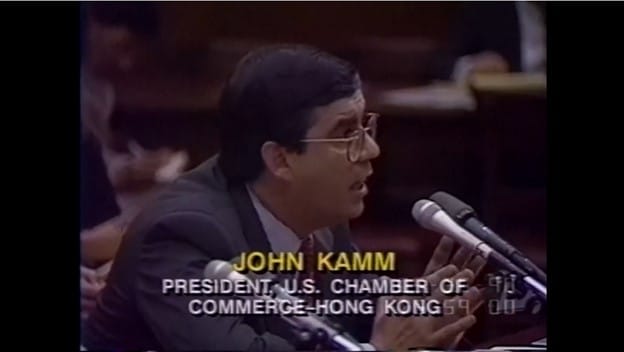
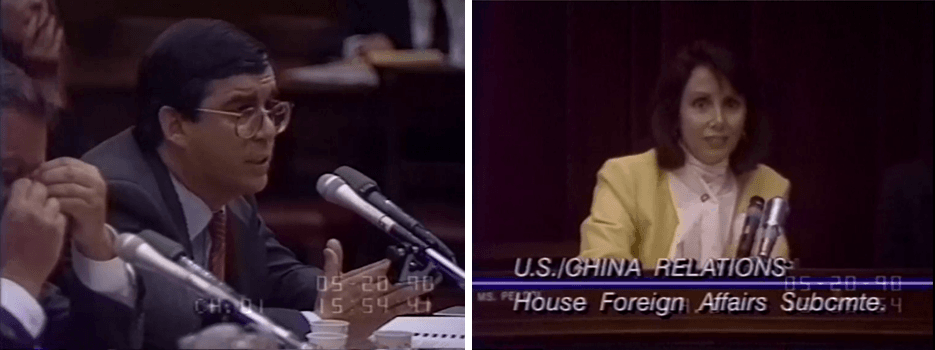
On May 16, 1990, John Kamm testified to Congress about the impact of removing China’s MFN status would have on Hong Kong. Image credit: C-Span
I
n the summer of 1989, I was a vice president of the American Chamber of Commerce in Hong Kong (AmCham), in line to become president in 1990. I had overseen the chamber’s committees and was popular among the smaller members. I was unpopular with larger members, however, mostly on account of my pushing through a resolution condemning the killings in Beijing and other cities in June 1989.
When it came time for the nominating committee to appoint the next president, a meeting was held at which a former president of AmCham claimed that, if I were to be the next president, the Hong Kong government would be unhappy and would have nothing to do with the chamber. When it came time to vote, the nominating committee chose someone else to be president, leaving me in second place.
When the soon-to-be president called his boss in New York to give him the good news, he got an unexpected response: “You can be president of AmCham, or you can work for me. Those are your options. Your choice.” The fellow chose to keep his job — so I became the chamber’s president, by default, in 1990.
I began speaking out against Beijing’s actions, and my speeches were well-covered in Hong Kong media. It was an active year: during my tenure, I doubled chamber dues without losing members, shepherded the first woman to become a chamber vice president, and planned delegations to Mongolia and Myanmar (I had led a delegation to Laos in 1989). The joke around town was that I was the first AmCham president to have a foreign policy.
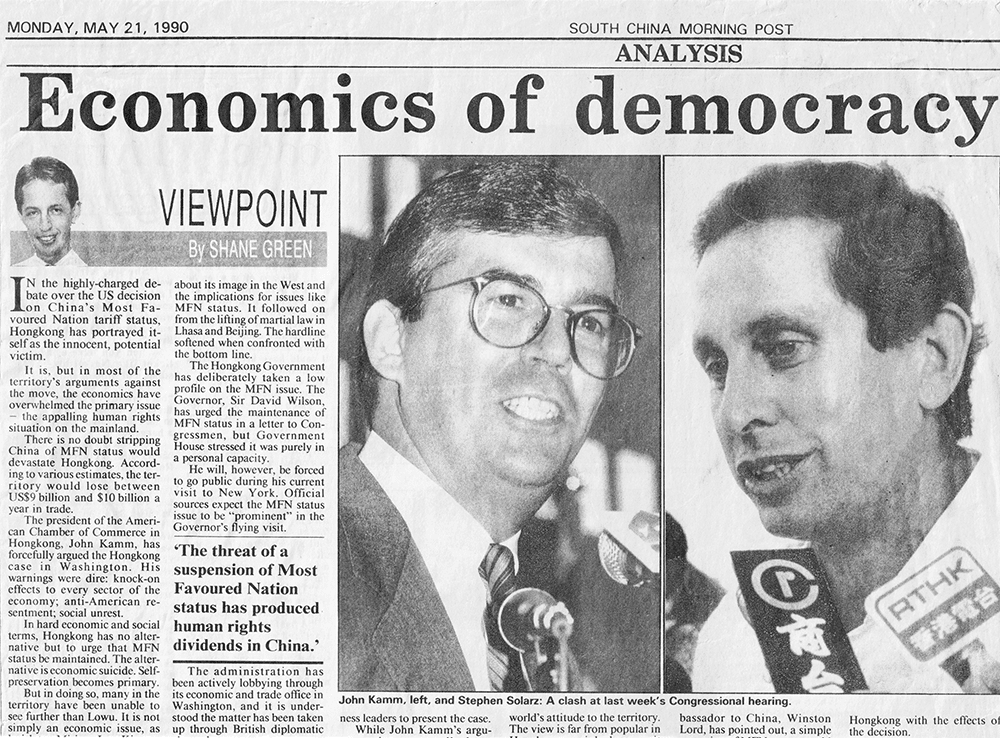
A news report on Kamm’s ascension to AmCham president, January 14, 1990. Image credit: Dui Hua archive news clipping from South China Morning Post
One day in March 1990, I was driving to work when I heard on the radio that Senate Majority Leader George Mitchell (D-Maine) and a junior member of the House of Representatives, Congresswoman Nancy Pelosi (D-Ca), would introduce resolutions to strip China of its Most Favored Nation (MFN) trading status. Although few in the colony were concerned that they would succeed in their efforts, I sensed the danger and began making preparations.
I assembled a “Council of War” and began planning to form a delegation to go to Washington. The team raised more than $100,000. One of the Council members, the local manager of a prominent lobbying firm, offered its services at a discounted rate. Another, the local representative of an American airline, gave us a break on the plane tickets.
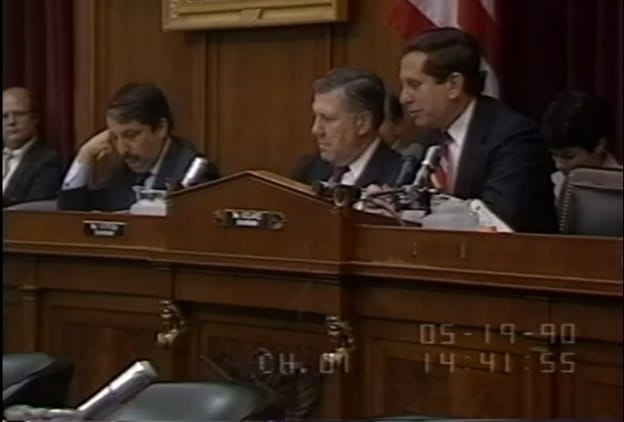
In April 1990, the chamber was advised that a hearing on “Most Favored Nation Status for the People’s Republic of China” would be held in Washington on May 16, 1990. The hearing would be jointly held by three subcommittees of the House of Representatives Committee on Foreign Affairs: Human Rights and International Organizations, chaired by Gus Yatron (D-Pennsylvania), Asian and Pacific Affairs, chaired by Stephen Solarz (D-New York), and International Economic Policy and Trade, chaired by Sam Gejdenson (D-Connecticut). (The House Ways and Means Committee has jurisdiction over trade matters, including granting MFN to foreign countries, but Mr. Solarz decided to move forward regardless.)
(Left to right) Representatives Gejdenson, Yatron, and Solarz. Image credit: C-Span
I was contacted by Richard Bush — then a staff consultant to Mr. Solarz, now a widely recognized expert on US-China-Taiwan relations — and invited to testify at the hearing. Fools rush in where angels fear to tread. I readily accepted Mr. Bush’s invitation, even though I had never testified to Congress. In fact, AmCham had never testified to Congress, either.
A Novel Strategy
I hit upon an unusual strategy. Instead of avoiding human rights as businesspeople are inclined to do, I would embrace human rights. To do so, I needed to get evidence that businesspeople could do business and advocate for human rights at the same time.
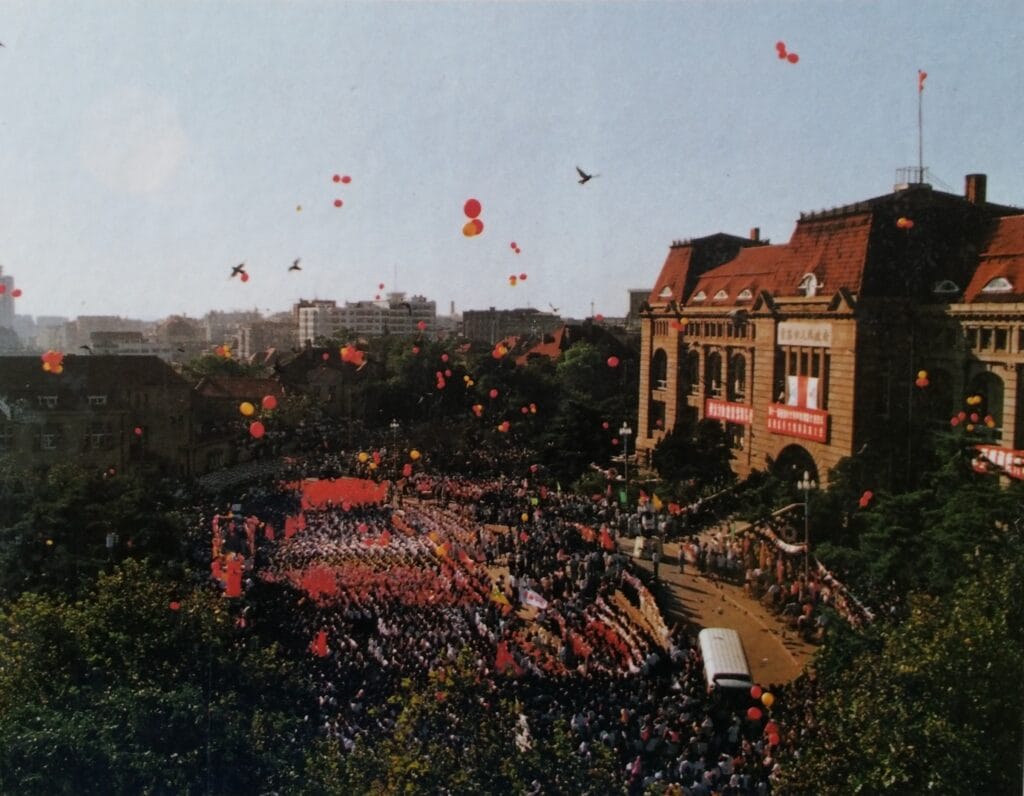
In late April 1990, I led a delegation to Qingdao 青岛, in Shandong Province 山东省. I had been negotiating a joint venture with the Qingdao Sodium Silicate Factory and was familiar with the city’s leaders, including deputy party secretary Yu Zhengsheng 俞正声 (who later became a member of the Politburo Standing Committee, China’s highest political body, as well as a chairman of the Chinese People’s Political Consultative Congress).
While in Qingdao, I met with the local chamber of commerce. I was asked to be its honorary chairman, but I turned down the offer. Qingdao courts had handed down some of the longest sentences to June 4 protesters, including an eighteen-year prison sentence for counterrevolutionary incitement and propaganda for marine biologist and student leader Chen Lantao 陈兰涛. Under the circumstances, I couldn’t associate myself with state organizations in the city. To my surprise, the chamber officials said they understood, and asked me for the names of protesters who had been given long sentences.
Former German Governor Office Building in Qingdao. Image credit: 青岛年鉴编辑委员会 (Qingdao Yearbook Editorial Committee)
Another highlight of my visit to Qingdao was accepting an honorary professorship at Qingdao University. In my acceptance speech at the conferral ceremony, I spoke of the relationship between MFN and human rights. After my remarks, a professor approached me. She knew Chen Lantao’s family and offered to help. (After many interventions, Chen was released in 2000, seven years early.)
I returned to Hong Kong on April 28. I gave two press conferences on the visit to Qingdao and the MFN state of play, met three times with the MFN War Council to make preparations for the chamber’s delegation to Washington, and met with a Chinese official who would later become an important source of information on political prisoners. I also dined with Hong Kong Governor Murray MacLehose on May 4, 1990, and met separately with Hong Kong’s Financial Secretary Piers Jacobs.
On May 9, AmCham’s leadership joined me at a banquet hosted by the Director of the Xinhua News Agency, China’s de facto embassy in Hong Kong, Zhou Nan 周南. I interrupted his toast to urge him to help secure the release of Hong Kong student Yao Yongzhan 姚勇战 from detention in Shanghai. Zhou was furious. Many of my AmCham colleagues were outraged — but shortly after I returned to Hong Kong after testifying to Congress, Yao was released.
The day after the dinner with Zhou Nan, I flew to Seoul on business, and on May 12 I continued my business trip in Tokyo. On Sunday, May 13, I holed up in my room at the Okura Hotel. Fortified by a dinner of sushi and a bottle of sake, I wrote my testimony for the May 16 hearing. I flew to Newark on May 14 and immediately took the train down to Washington, DC, where I checked into the Marriott Hotel.
On the long flight to Newark, I went over in my mind what questions House members might ask me after I finished my testimony. One in particular haunted me. I called my mother in Florida and asked her this question: what does the Bible tell us about a situation in which a majority of city residents are evil, but a small minority are without sin — should the city be spared? She was quick to reply: in the Book of Genesis, Abraham negotiates with the Lord to spare the lives of a small number of good people in Sodom, even though the overwhelming majority of residents were evil and worthy of death.
May 15 was full of meetings, many arranged by our lobbyists Hal Furman and Rick Spees. AmCham vice president Jeff Muir accompanied me on my meetings while other AmCham delegates fanned out to meet members of Congress and their staff. Jeff and I met with senior staff of Senators Bradley, Gordon, Lugar, and Simpson. We also huddled with the leadership of the National Council for US-China Trade and the Hong Kong Economic and Trade Office.
Words of Advice
One meeting stands out. We met for lunch at the office of leading law firm Jones Day, which had recently brought on board retired Senator Charles “Mac” Mathias (R-Maryland). Mathias gave me good advice on how to behave when testifying: “Whatever is said to you by a member, don’t overreact. Don’t get angry, and make sure to humbly respond. Coming from Hong Kong, you understand the importance of ‘face.’ Never make a member lose face.”
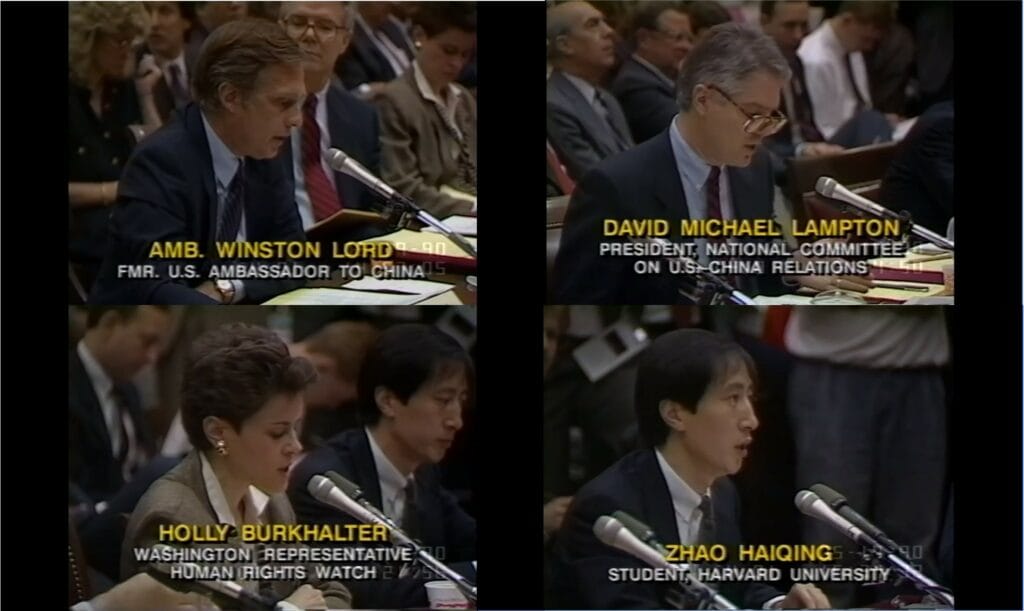
We arrived early at Rayburn House Office Building and settled into seats behind the front row in Room 2172. The hearing began at 9:40 a.m. The order of the witnesses was former ambassador to China Winston Lord, followed by advocates for Tiananmen Square victims and human rights NGO representatives, followed by US-China relations and trade leaders, and then business community representatives, of whom we were three.
The first group of witnesses to testify. Image credit: C-Span
Ambassador Lord, a Chinese student leader, and the Washington head of Human Rights Watch were given pride of place, and they delivered powerful testimonies in favor of sanctioning the Chinese government. David Lampton of the National Committee on US-China Relations and Roger Sullivan of the National Council for US-China Trade represented the establishment view that no sanctions should be imposed on account of China’s rights abuses. Now it was the turn of the businessmen.
By now, the hearing had dragged on for several hours, and I grew fearful that I would miss my flight to Dallas, headquarters of Occidental Chemical. Most of the members of the subcommittees had departed, including Congresswoman Pelosi, leaving Congressman Solarz and Congressman Chris Smith (R-New Jersey) on the podium. Smith represented a district adjacent to the district on the Jersey shore where I had grown up.
I took my seat at the witness table and tried my hand at “soaring oratory”: I spoke of the people of Hong Kong and their support for the pro-democracy movement in China. “Who knows better than the people of Hong Kong how bad the situation is? We are on the front lines. There are young Hong Kong people in Chinese jails. I take the opportunity to call once more for China’s leaders to release them to their families in Hong Kong. We, the American Chamber of Commerce in Hong Kong, will continue to speak out and work as hard as we can to realize their freedom.”
I then made a fateful promise: “Whatever capital we might earn by fighting further sanctions, we will gladly spend in the effort to free all Chinese prisoners of conscience.” In the thirty-three years since I made that promise, I have tried my best to honor it.
Meeting Nancy Pelosi
C-SPAN was a fledgling network that broadcast political events, hearings, and votes in Congress. My testimony was beamed into offices all over Capitol Hill. It caused quite a commotion. Congresswoman Pelosi scurried back to the hearing and took her seat, even though she wasn’t a member of any of the subcommittees holding the hearing. She took the microphone and accused me of being dismissive of Chai Ling 柴玲 and other democracy activists.
Representative Pelosi (top right) and Kamm (bottom left) during a spirited exchange. Image credit: C-Span
I promptly forgot Senator Mathias’s advice and pushed back hard. I denied that my intention was to dismiss Chai Ling, spoke of my respect for her and other leaders of the protests, and went on to remind Mrs. Pelosi that the people of Hong Kong had marched in their millions in support of democracy in China. “All we are saying is, if you knock the underpinnings out from under our economy, we cannot continue to support reform and democratization.” After taking another shot at me, Mrs. Pelosi backed off.
Chairman Solarz took over. He asked a hypothetical question: if in fact removing China’s MFN would lead to better human rights in China, would I still oppose revoking the trade status for the sake of Hong Kong? “Are you saying Hong Kong uber alles?” he asked to laughter.
I had prepared for this very question. I brought up Abraham’s negotiating with the Lord to spare the wicked for the sake of the righteous.
A news report on the Congressional hearing, May 21, 1990. Image credit: Dui Hua archive news clippings from South China Morning Post
The hearing ended at 3:22 p.m. Fortunately, Jeff Muir had left the hearing earlier and returned to the hotel, where he picked up our luggage and hired a cab to pick me up outside Rayburn. The driver knew the back roads to National Airport. I arrived in time for my flight. I needn’t have worried about Occidental’s reaction to my testimony: Chairman Armand Hammer fancied himself a friend of China, and I was told he loved my testimony.
“A Hero in Hong Kong”
I returned to Hong Kong where my work was applauded. Media coverage was heavy, with the front page of USA Today hailing me as “A Hero in Hong Kong.” I became known as Mr. MFN. Most importantly, I was told by Zhou Nan’s assistant that Yao Yongzhan would be released. I was elated but not convinced that this success was anything other than a fluke.
I cohosted Chinese Premier Zhu Rongji 朱镕基 on his visit to Hong Kong in June 1990. He let it be known that he had personally ordered the release of Yao Yongzhan. He had heard of what I had done at the Zhou Nan banquet and didn’t want to be upbraided by me in front of hundreds of people. It was a pleasant lunch. Zhu returned the favor by telling Newsweek that China didn’t care whether the country retained MFN or not. He claimed that only AmCham cared!
A news report “HK to count in MFN decision,” July 15, 1990. Image credit: Dui Hua archive news clippings from South China Morning Post
In early June 1990, President George H. W. Bush renewed China’s MFN for another year. In his extension statement, he mentioned testimony that Hong Kong would suffer if China’s trade status were revoked. It marked the first time in American history that Hong Kong had factored into an important foreign policy decision by the American government.
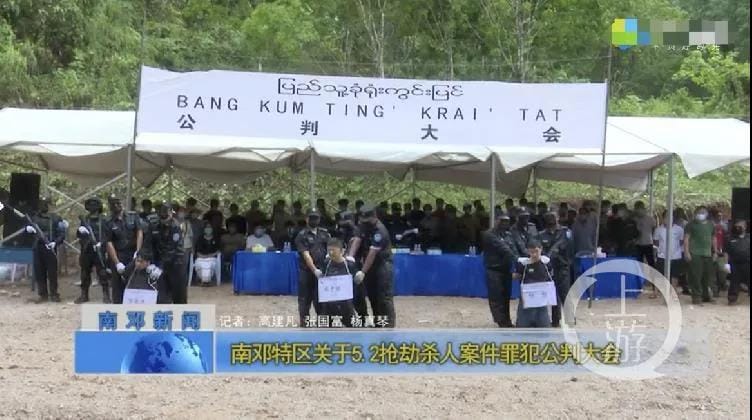
Three Chinese nationals were executed in a public sentencing rally in Wa State, a Chinese-speaking region in Northern Myanmar on May 14, 2020. Image credit: The Paper
In May 2020, a video clip featuring the execution of three men in a public sentencing rally in Wa State of Myanmar became a trending topic on domestic social media. The three executed men were Chinese nationals who had reportedly robbed a gold shop and murdered the owner. While calling on the public to obey laws and customs overseas, Chinese news media sources appear to have expressed shock that the shaming ritual was replicated in Myanmar even though it has “long vanished in China.”
Historically, public sentencing rallies were widely used in and outside China to crush political opponents and consolidate the power of the ruling class. In the first three decades of the People’s Republic of China, mass rallies served to educate the public about the errors of class enemies, including Kuomintang members and landlords.
While there are signs that these rallies have fallen into disuse in recent years, they continue to take place in some localities where they target drug offenders and members of organized crime. In these rallies, which continue to serve as propaganda to “frighten criminals, educate people, and maintain social stability,” judges hand out mass sentencing and mete out harsh punishments, including death sentences. Because of the nationwide lockdowns and stringent social distancing measures accompanying China’s zero-COVID policy in the two full years since 2020, the rallies that are typically held in large public venues like plazas, stadiums, and auditoriums in front of crowds numbering in the thousands seemingly vanished from public sight.
However, Chinese government sources continued to report on small rallies that have been convened. Many of these rallies appeared no different from regular court trials when they were held indoors or virtually with no or limited public attendance. Regardless of the forms and scale, Chinese courts continue to retain the campaign-style rallies which legal experts have decried for years, arguing that the rallies disregard the presumption of innocence and mainly serve to shame prisoners.
Indoor & Virtual Rallies
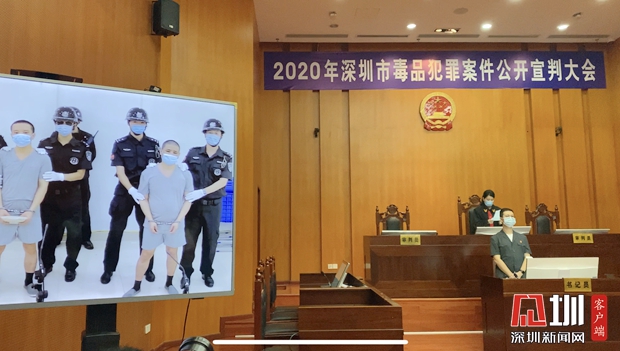
A group of 14 drug traffickers were sentenced in what a Shenzhen court called a “public sentencing rally” on June 23, 2020. Image credit: Shenzhen News Network website
China continued to feature a series of high-profile public sentencing rallies on the International Day against Drugs and Illicit Trafficking amid the outbreak of the pandemic. In Shenzhen, a rally was held on June 23, 2020 to announce the death sentences of two traffickers of methamphetamine. The sentences had previously been determined by the Shenzhen Intermediate People’s Court and subsequently approved by the Supreme People’s Court. On the same day, the intermediate court also publicly sentenced ten people involved in a drug case.
The duo was executed on the same day immediately after the rally ended. In the same rally, the judge announced that another drug trafficker was sentenced to life imprisonment and that ten other defendants were convicted of manufacturing, selling and transporting drugs, and illegal possession of firearms.
Courts outside of Guangdong have also been eager to convene sentencing rallies in campaigns against drug abuse on or before the International Day Against Drug Abuse and Illicit Trafficking. In 2021, the Dandong Intermediate People’s Court of Liaoning Province held a rally in a courtroom where 13 handcuffed drug offenders stood in front of the judge in a courtroom to receive prison sentences ranging from nine years’ imprisonment to death with a two-year reprieve. A post published on the Liaoning High Court website claimed that the rally, which was attended by less than two dozen spectators, manifested “a high-pressure crackdown on drug crimes, effectively suppressed the arrogance of drug criminals, and contributed to the construction of a harmonious and safe Dandong.”
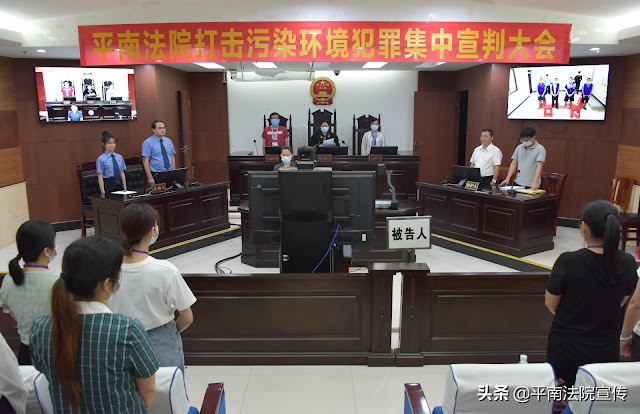
Four defendants received judgments in a public sentencing rally convened by the Pingnan County People’s Court of Guangxi Zhuang Autonomous Region as part of the campaign to combat environmental pollution. Photo image: Pingnan County People’s Court website
It must be noted that sentencing rallies are not exclusively used against drug traffickers. In May 2021, a local court in Guangxi convened a virtual rally for four people convicted of illegally disposing of hazardous substances. As with the 2020 Shenzhen rally, the defendants received their judgments via video while handcuffed in a detention center. This rally was held as part of the open day organized by the Pingnan County People’s Court to educate the public about environmental protection. It was sparsely attended by only 12 people from the local community, according to information provided by the court website.
200-Spectator Rally in Yancheng, Jiangsu
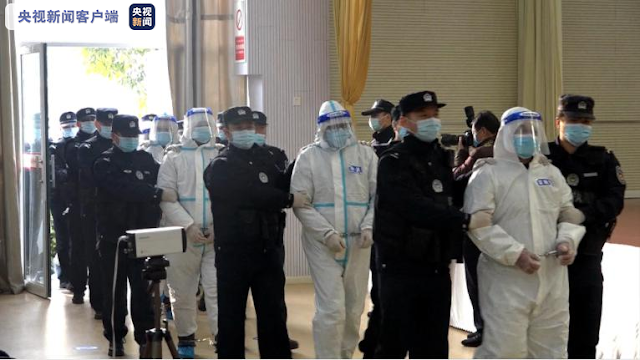
Twenty-two criminal suspects were hauled into a sentencing rally attended by over 200 people in Yancheng, Jiangsu on October 28, 2020. Image credit: China Central Television
Despite the onerous zero-COVID measures that were in full swing in 2020, public attendees were occasionally allowed to take part in sentencing rallies of a smaller scale. The Yancheng Intermediate People’s Court in Jiangsu Province invited over 200 people from the National People’s Congress, members of the Chinese People’s Political Consultative Conference, journalists, village cadres, and resident representatives to the rally in Longgang Township on December 28, 2020. The 22 defendants manufactured banned substances including hydroxylamine hydrochloride, chlorophenyl, hydrochloric acid, and toluene. They could be seen wearing white hazmat suits with face masks while receiving judgments in front of the judge and the spectators.
Of the 22 defendants, three were sentenced to death with a two-year reprieve. Each of them was accused of selling methamphetamine weighing 4,000 to 6,000 grams (about 8.82 to 13.23 pounds). The other defendants received prison sentences from 22 months to 11 years for manufacturing hydroxylamine hydrochloride totaling 1,106 grams (about 2.44 pounds).
Student Spectators in Hainan
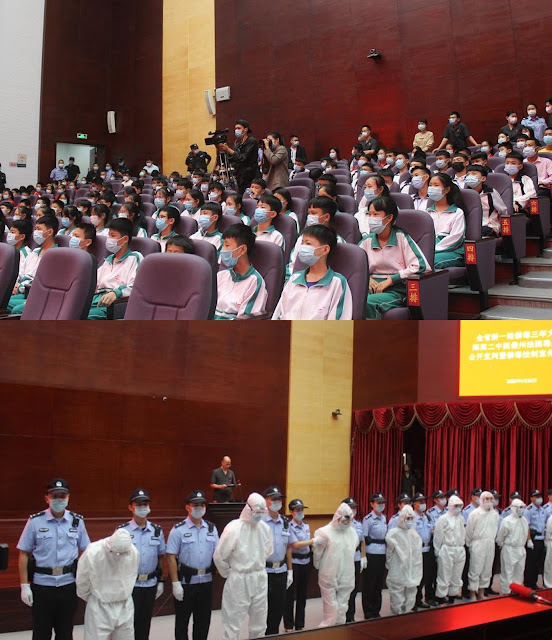
(Top to bottom) Dozens of Hainan school students, all seen wearing uniforms and face masks, sat in rows in a public sentencing rally held at the Danzhou District People’s Court on April 24, 2020. Image credit: The Paper
As public sentencing rallies serve as sites of expressive punishment, teenage students are also required to attend such events as part of their legal education (法制教育). Images published by the Hainan court website show dozens of students in school uniforms sitting in rows to watch nine drug defendants receive prison sentences from ten months to 15 years’ imprisonment on April 24, 2020. The defendants were accused of selling large quantities of ecstasy and other counterfeit drugs.
Traditional sentencing rallies held in large outdoor public spaces did not entirely vanish during the pandemic. On June 28, 2020, an outdoor rally was held in Donglan County, Guangxi, to publicly arrest and sentence gangland criminals. The rally was not held in a courtroom but in a sports stadium. Available sources did not state how many spectators attended, but the image below shows rows of police officers alongside dozens of public spectators. At the back of the crowds, criminal suspects and defendants stood in a row in front of the judge’s podium. They could be seen wearing the typical white hazmat protective suits and facing the group of public spectators.
An outdoor rally in Donglan County, Guangxi, on June 28, 2020, during which alleged criminals were publicly arrested and sentenced. Image credit: Wei Hao / Weixin
Efforts to ban public executions
China’s decision to ban public executions dates back to 1979, while “perp walks” for sex workers were banned more recently in 2010. The Supreme People’s Court, Supreme People’s Procuratorate, Ministry of Public Security, and Ministry of Justice jointly issued notices in 1984 and 1986 prohibiting public parades before executions, saying that such events provided opportunities for overseas counterrevolutionary propaganda to “slander” China.
Public executions (as well as the broader use of capital punishment) were thought to be one of many human rights-related objections to China’s bid to host the 2008 Summer Olympics in Beijing, a point Dui Hua executive director John Kamm recalled in a 2010 Washington Postop-ed. In the run-up to the opening of the Games, another joint opinion was issued in March 2007 to prohibit public parades before executions as well as to enforce the rights of the executed, including last visitation rights for the family. Criminal Procedure Law also stipulates that while the public should be notified of executions, the execution itself should not be held in public.
Going Forward
Over the years, legal experts have spoken out against public arrests and sentencings, branding them “campaign-style justice” that emphasize swift and severe punishment. However, the general public tends to empathize with the need to deter crimes by publicly shaming the offenders. In its seventh annual report, the Collaborative Innovation Center of Judicial Civilization released its latest data collected over 24,354 surveys across 31 provinces, municipalities, and autonomous regions. It finds that over 62.5 percent of respondents expressed support for public arrest and sentencing rallies in 2018. The following year, the approval rate declined to 55.5 percent but bounced back to 61.3 percent in 2020-2021. Of them, 19.1 percent in 2020-2021 expressed strong support for retaining the practice, lower than 23.7 percent in 2018 but higher than the 15.8 percent in 2019.
A public trial is intended to boost transparency by informing the public about who the accusers are, the nature of the charges, and the evidence against the accused. It is fundamentally different from a public sentencing rally — a form of show trial where the judgment and sentence of a criminal case already determined in court is publicly announced in front of crowds of public spectators. Such rallies serve a political agenda to demonstrate the government’s determination to fight crimes, blame and shame criminals, and educate the public about their alleged crimes. In response to a controversial sentencing rally held in Langzhong, Sichuan, in 2016, Professor Yu Qilin of China University of Political Science and Law remarked that trial fairness and justice is maintained through procedure transparency in the courtroom, not public spectacle.
The use of public sentencing rallies to shame the accused appears to be on a downward trend in recent years thanks to China’s strict adherence to the hard-line zero-COVID policy. A decade ago, people accused of endangering state security, terrorism, and religious extremism in Xinjiang, as well as well as “wild imams” who preached illegally in the restive region, were condemned in front of crowds of thousands. At the very least, the rallies discussed in this post were downsized and used in a narrower scope to target drug traffickers and members of organized crime. Additionally, individuals shamed in the rallies were no longer seen wearing confessional placards or driven through the streets in open trucks.
The practice of public shaming never really vanished even when strict pandemic measures were in force. On December 28, 2021, four men accused of smuggling people across an international border were publicly shamed in Guangxi. They were flanked by police officers and paraded through the streets of Jingxi City. Although authorities claimed that the parade served as a warning of what could happen if people violated the pandemic curbs, a Beijing News editorial remarked that “the measure seriously violates the spirit of the rule of law and cannot be allowed to happen again.” With the lifting of pandemic curbs following nationwide protests in late 2022, it remains to be seen whether large-scale sentencing rallies will reemerge.
After more than two years in custody, two activists sentenced in Guangzhou
In mid-November 2020, a crackdown of activists took place in Guangzhou. Several people – among them veteran pro-democracy activist Fan Yiping (范一平), Hu Tianfeng (胡天峰), and Lai Jianjun (赖⻅君) – were placed under residential surveillance in a designated location (RSDL) for subversion. Later, two others were reportedly detained and arrested for the same charge: Fan Wencheng (范文成) and Wei Ya’ni (⻙亚妮), the only woman known to be detained in this case.
All five had been indicted in August 2021. A closed trial took place sometime in April 2022 at Guangzhou Intermediate People’s Court.
More than a year later, sentencings of the two activists were reported. In early June, Fang Yiping was sentenced to four years following a conviction for subversion, and Hu Tianfeng was sentenced to two years and eight months. Fang is expected to be released in November 2024 while Hu’s release is expected to take place in September 2023.
The fates of the other three activists remain unknown.
Nearly a year after trial, rights lawyer sentenced in Shaanxi Province
Chang Weiping (常玮平), a well-known rights lawyer, was convicted of subversion and sentenced to three and a half years by Baoji Intermediate People’s Court on June 8, 2023.
Chang attended a private gathering in Shenzhen at the end of 2019. Among the participants were Xu Zhiyong and Ding Jiaxi, who were recently sentenced. Chang was placed under RSDL in January 2020 for “endangering state security” and released ten days later.
However, after posting a video online detailing his harsh treatment while in RSDL, Chang was again placed under RSDL in October 2020 and formally arrested in April 2021 for inciting subversion, a crime of endangering state security.
Chang was tried by Baoji Intermediate Court in a closed trial at the Feng County Court on July 26, 2022. The sentencing was also announced at the county court. When the trial commenced, Chang’s wife, Chen Zijuan, was prevented from attending the hearing. Several activists and supporters were also detained.
According to the law, every two days under RSDL is counted as one day served for imprisonment. Chang’s sentence is expected to expire in July 2024.
Legal scholar & activist remains in judicial limbo after more than three years of detention
Hao Jinsong (郝劲松), a graduate of China University of Political Science and Law turned legal activist, remains at the Wutai County Detention Center in Shanxi for picking quarrels and provoking trouble (PQPT) and defamation since January 2, 2020.
Hao gained prominence when he launched several lawsuits against government agencies for practices that he deemed unlawful, including the State Administration of Taxation and several railroad operators.
In 2017, Hao reported on possible environmental pollution by a textile factory in Dingxiang County, Shanxi. He was first placed under administrative detention in December 2019, then criminally detained for PQPT on January 2, 2020. A charge of defamation was added when he was arrested, and an additional fraud charge was added during the indictment.
A trial reportedly took place in October 2021 at the Dingxiang Country Court. However, no conviction or sentence has been issued.
Li Qiaochu inciting subversion trial commenced in Linyi
More than two years after being detained and more than a year after being indicted, the trial of rights activist Li Qiaochu (李翘楚) for inciting subversion reportedly commenced on June 19, 2023.
Luo Shengchun, wife of lawyer Ding Jiaxi, posted a trial hearing notice on her Twitter account. Luo also claims that Li’s mother was told the trial would be closed to the public and her request for a post-trial meeting with Li was rejected.
The 32-year-old Li, though often referred to in the media by her relationship with Xu Zhiyong, is a long-time labor rights advocate whose activism began in her college years. Multiple sources have raised concerns over Li’s health. Despite being diagnosed with depression and prescribed long-term medication to treat the illness, the family said Li has not received proper care while in custody.
In the indictment filed by the Shandong Linyi People’s Procuratorate, Li’s relationship to Xu was seen as the cause of her subversive thinking. Her crime, summarized in a short paragraph, was allegedly committed under the influence of her boyfriend as she operated a personal blog for Xu and posted numerous alleged subversive articles written by him.
The trial is being held at the Linyi Economic and Technological Development Zone District Court by the Linyi Intermediate People’s Court, which convicted and sentenced Ding and Xu to lengthy terms for subversion in April 2023. At the time of writing, Li has lost her own legal representation after one of her lawyers was barred from entering the courtroom for refusing to comply with a security check. Another lawyer resigned in protest of the court’s refusal to summon witnesses and grant him access to case documents.
Activist’s trial in Shanghai for posting anti-pandemic lockdown messages postponed
Activist Ji Xiaolong (季孝龙) is being tried in Shanghai for the second time. Originally scheduled to begin on June 21, 2023, the trial has reportedly been postponed.
Ji has been indicted for PQPT by the Pudong New District People’s Procuratorate. The charge is a “pocket crime” often used against activists based on vague or trumped-up “criminal activities” that have “negative impacts on society.”
Ji is accused of posting and reposting large numbers of content with “false information” on overseas social media platforms between April and August 2022. The procuratorate claims those posts seriously harmed the national image. Shanghai, like many places in China, had a prolonged lockdown in many parts of the city during the spring of 2022 to combat the COVID-19 pandemic.
Ji was detained and released on bail on May 1, 2022 then formally detained on August 31 and arrested on September 23, 2022. The indictment also accused Ji of remaining active online while on bail and continuing to post false information.
Ji was convicted of the same crime in 2019 by the same court and sentenced to three and a half years in prison. In 2018, he gained attention by writing anti-CCP graffiti on restroom walls in public buildings and posting photos on overseas social media platforms.
Legal activist released from Tianjin
Wu Gan (吳淦), better known by his online alias “Super Vulgar Butcher 超级低俗屠夫”, was released in May 2023 after serving his full eight-year prison sentence. Wu worked at Beijing Fengrui Law Firm, which was established by lawyer Zhou Shifeng and partners such as well-known rights lawyers Wang Yu and Liu Xiaoyuan. Although not a licensed lawyer, Wu gained prominence for advocating on behalf of the socially vulnerable. He also attracted controversy for staging vocal protests outside courthouses and government buildings against unfair treatment of lawyers and defendants.
On May 20, 2015, Wu staged a protest outside the Jiangxi High People’s Court in Nanchang when the court denied the lawyers of three falsely accused defendants access to case documents. Wu was placed under administrative detention for ten days but was criminally detained on May 27 for PQPT and defamation. The charges were changed to inciting subversion and PQPT when Wu was arrested by the Xiamen Public Security Bureau in July 2015.
The case then was transferred to Tianjin where it became part of the nation-wide crackdown on rights lawyers that would become known as the “7.09 arrests.” Wu was convicted of subversion and PQPT and sentenced to eight years with five years of deprivation of political rights (DPR) by the Tianjin Number Two Intermediate People’s Court in December 2017.
The same court also sentenced six other lawyers and activists — Zha Yanmin, Hu Shigen, Zhou Shifeng, Gou Hongguo, Li Heping, and Wang Quanzhang — for subversion between August 2016 and January 2019. In a letter to a friend after his release, Wu confirmed that he was safe and sound. However, while serving the supplemental sentence of DPR, he will likely be under strict monitoring and surveillance.
Freelance journalist reportedly missing in Laos
Qiao Xinxin (乔鑫鑫), a young activist who fled China in 2013, has been reported missing in Laos since the evening of June 4, 2023. Friends fear that he might have been taken away by China state security agents.
Qiao drew international attention when he and several dissidents launched the online movement “Ban the GFW” (Chinese: 拆墙运动 lit. tearing down the Great Fire Wall) in early 2023. They sent mass messages on social media platforms promoting techniques and tools to circumvent the firewall and evade censorship. Prior to his disappearance, he claimed that his family in Hunan were warned and threatened.
Qiao also works as a freelance journalist for Radio Free Asia.
Yang Maodong’s appeal rejected
Guangdong High People’s Court rejected Yang Maodong’s (杨茂东) appeal and upheld the judgment in a closed trial on June 26, 2023, Yang’s sister says.
Yang was sentenced to eight years’ imprisonment and three years of DPR for inciting subversion by Guangzhou Intermediate People’s Court on May 11, 2023. He was accused of publishing critical essays online.
This will be Yang’s third prison sentence since 2006. He previously was sentenced to five years for illegal business activity in 2007. From 2013 to August 2019, he served six years for PQPT and gathering a crowd to disrupt a public place.
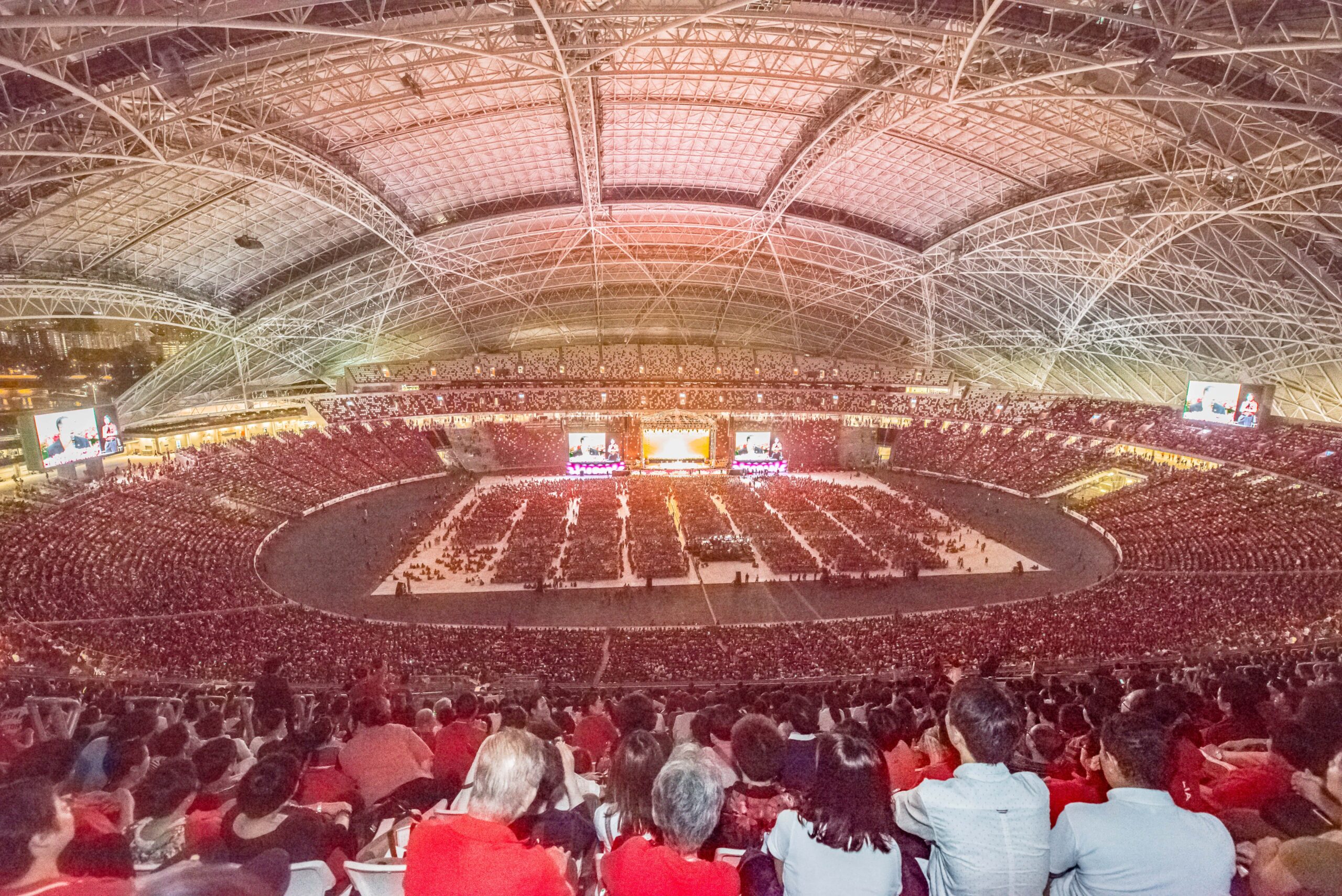
Junhong Lu giving the “Grand Dharma Talk” in Singapore’s National Stadium in 2017. Image credit: Ginny Gray / CC BY-SA 4.0
In March 2022, Dui Hua released a study titled “The Persecution of Unorthodox Religious Groups in China” identifying 41 religious groups whose members are at risk of arrest and imprisonment. Dui Hua has since uncovered another unorthodox religious group called Xinling Famen (心灵法门) that is facing similar repression. Other recently uncovered unorthodox groups include Corporate Christ (团体基督), which is thought to have splintered from the Church of Almighty God (全能神), and the House of Joseph (约瑟家), which originated from the Spirit Church (灵灵教).
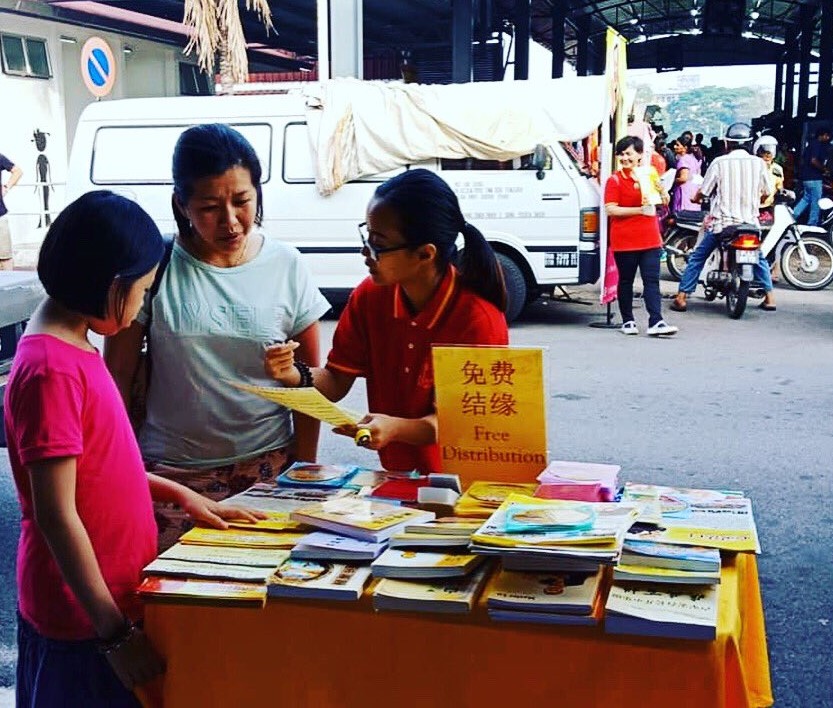
Xinling Famen, also known as the Guanyin Citta Dharma Door, is among the newly emerged Buddhist groups which have gained traction in China and overseas. Its founder Lu Junhong (卢军宏, aka Richard Lu) was born in 1959 in Shanghai, studied in Sydney, and eventually obtained Australian citizenship. After graduating from university in the 1990s, Lu promoted Buddhism and traditional Chinese culture while serving as a director of Australia Oriental Media Group, a Chinese-language radio station operated in Sydney. In 2010, Lu founded Xinling Famen. The group has gained popularity among Chinese immigrants in the United States, Canada, Europe, and Southeast Asia.
According to public statements made by Chinese government agencies, Xinling Famen has attracted three million followers. The group, however, claims to have as many as seven million members worldwide, and hundreds of thousands tune in daily to listen to Lu’s ideas online. Lu’s teachings were reportedly introduced to China in 2009, one year before the group was founded.
Unorthodox Buddhism
While Xinling Famen describes itself as a Buddhist group, its worship style is similar to that of some Pentecostal churches and charismatic healing cults, according to Chinese Religions Going Global. Adherents are said to burst into tears with their arms outstretched as Lu performs spiritual healing. Lu instructed his followers to read different combinations of sutras from Buddhist canons known as “little houses” to get rid of bad karma. He also provided a list of specific rules that followers must abide by in order to maximize good karma.
Nevertheless, China’s anti-cult propaganda accuses Lu of appropriating Buddhist terms to mobilize a cultic movement centered on his personality. Lu called himself a reincarnation of Guanyin Bodhisattva and said that he had divine power to read one’s totems (referring to Chinese zodiac signs) in heaven and see a person’s past, present, and future. Lu is also said to have amassed a fortune by selling “little houses” and charging exorbitant apprenticeship fees. China imposed an entry ban on Lu before he passed away from illness in November 2021.
Xinling Famen also stirred up controversy overseas. Buddhist communities from Singapore, Malaysia, and Hong Kong have claimed that Lu’s healing power is a complete fabrication and that his so-called divine power deviates from mainstream Buddhist ideology. Despite the controversy, China remains the only place in the world where Xinling Famen members are arrested and imprisoned.
Promoting the “Chinese Dream”
Lu’s Australia Oriental Media Group (AOMG) had an intricate relationship with Chinese state media in its infancy. Prior to the radio station’s official launch in December 2007, state media including China News Service lauded it as a new force of the ever-expanding Chinese language media in Australia and the first such radio station operated in Sydney established by a mainland Chinese immigrant. Less than two years later, in the summer of 2009, China National Radio (CNR) announced that it had signed a content collaboration agreement with AOMG, under which AOMG would broadcast some CNR regular programs and conduct local interviews for CNR special programs.
Agreement signing ceremony between CNR and AOMG on July 4, 2009, in Sydney. Zhao Hui, then vice president of CNR (standing) and Lu (seated left of Zhao) attended. Image credit: CNR
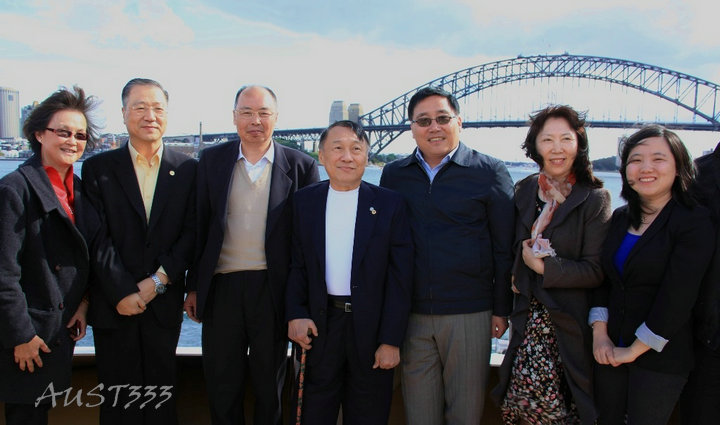
In October 2013, Lu and Xinling Famen appeared in an interview profile conducted by a former People’s Daily correspondent for Aust333, another Chinese-language media outlet based in Sydney. The profile mentioned that Lu received a “British Community Honours Award” in 2012, repeating Lu’s false claim that it was awarded by the UK House of Lords. In fact, the award is given by a UK-registered charity that holds the ceremony at the House of Lords. The profile also praised Lu for promoting Chinese culture through his radio station and his Buddhist organization.
The interview ended by asking Lu how Xinling Famen would contribute to Xi Jinping’s idea of the “Chinese Dream.” Lu responded with talking points typically seen in Chinese propaganda, saying that the realization of the dream was “of greater and far-reaching significance to those of us overseas Chinese living overseas and leaders of overseas Chinese circles” and that “only when the country is strong, we overseas Chinese will be prouder and not be bullied.” He further stated that realizing the dream “requires the selfless dedication of Chinese people all over the world” and closed by discussing Xinling Famen’s recent event in Taiwan as an example of how the organization could promote cross-Strait understanding and would contribute to the realization of the “Chinese Dream.”
Lu (second from left) with a group of Chinese delegates during a visit to Sydney: Zhan Yannong (third from left), then president of People’s Daily; Ambassador Li Huaxin (fifth from left), then Chinese Consul General in Sydney, and Xue Meng (far right), then head of People.cn Australia. Date unknown. Image credit: Aust333
Within two years of the interview, the relationship had soured. State Media started to label Xinling Famen as a cult, Lu’s books were banned, and his dubious awards came into question.
Conviction under Article 300
The first known case of imprisonment involving Xinling Famen was concluded in Inner Mongolia in 2015. The Ewenki Minority Autonomous Banner People’s Court convicted a woman surnamed Meng of “organizing a cult to undermine implementation of the law,” and gave her to a suspended sentence of three years. This is the only case with information in Dui Hua’s Political Prisoner Database in which a Xinling Famen member was convicted of Article 300.
The court judgment stated that Meng converted to Xinling Famen in July 2014. In December, police searched her home and found 133 “cultic” books and 37 copies of CD-ROMS she stored in a refrigerator and a cupboard. That same month, police confiscated 100 copies of publicity materials that Meng was preparing to mail out from a supermarket.
The punishment in this case is considered lenient because Meng admitted her guilt. The court mitigated her prison sentence also because the books and publicity materials had not yet been publicly circulated.
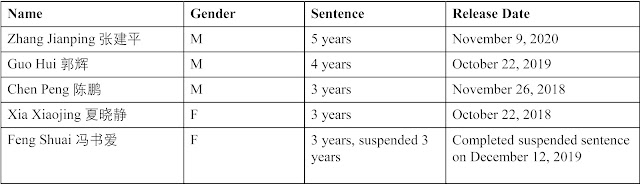
In the first case, five Xinling Famen members received criminal punishment ranging from suspended sentences to five years in prison in Neixiang County, Henan, for printing 101,480 copies books worth ¥276,494. Although the publishing company owned by one of the defendants only made a profit of ¥28,480, the court ordered that each of the defendants pay a fine of ¥30,000.
Table 1. Criminal punishment for Xinling Famen members
The longest prison sentence of five years was given to Zhang Jianping, an apprentice of Lu Junhong. He admitted to printing books without a license. He stated in his defense that his original intent was to promote Buddhism and guide people towards a good path. He pleaded for leniency because his books were not reactionary, nor did he intend to profit from them financially. Guo Hui (郭辉), considered another principal offender in the case, received a four-year prison sentence. All the defendants have completed their prison sentences as of this writing.
The second case, also concluded in Neixiang County, involved three defendants: Wang Xiaoyan (王小燕), Xia Songzhi (夏松芝), and Li Kehua (栗克华). Only Wang was known to be an adherent of Xinling Famen; she completed a five-year prison sentence on January 5, 2021. She received a remittance of over ¥300,000 from Xinling Famen members across China and entrusted Xia and Li to print 154,230 copies of books.
Xia and Lu were the print shop owners and each of them received a suspended sentence of three years. Available sources did not state whether Xia and Lu were members of Xinling Famen.
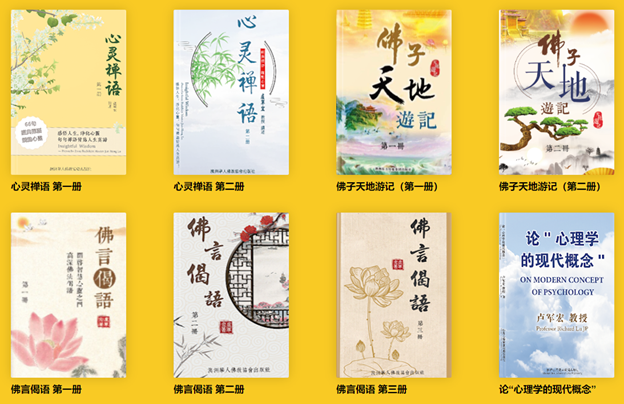
A screenshot of Xinling Famen materials offered through the organization’s website. Image credit: Xinling Famen eBooks
The third case in Taiyuan, Shanxi only involved one male defendant. Liu Shuangjian (刘双建), also a printshop owner, was accused of printing 13,260 copies of Xinling Famen sutras and 3,780 copies of Buddhist books which were not related to Xinling Famen. The Taiyuan Intermediate People’s Court ruled that only the Xinling Famen sutras, but not the Buddhist books, were illegal. Liu received a ¥5,000 down payment for the order to print the Xinling Famen sutras. The standard of conviction does not necessarily require an intent to establish a profitable business, but in this case the court did not accept the other Buddhist books he printed as evidence because he did not gain any profit from them. Assuming Liu served his full term without a sentence reduction, Liu was released from prison on July 15, 2018.
Arrests & Prosecutions
Dui Hua’s research into legal documents also found three cases involving Xinling Famen illegal religious books. The fate of these individuals remains uncertain because Dui Hua is unable to confirm whether they were convicted and given fixed-term prison sentences.
In December 2016, Zhao Kun (赵坤) and Guo Hongmei (郭红梅) were prosecuted for illegal business activity in Tongshan District, Jiangsu. Zhao was accused of printing 30,000 volumes of Xinling Famen books worth approximately ¥60,000, while Guo allegedly printed 20,000 copies also worth around ¥60,000.
Evidence suggests that Xinling Famen has made inroads with Chinese ethnic minorities. A Hui mother surnamed Ma and her son surnamed Han were indicted in Ji’nan, Shandong, also for illegal business activity on May 17, 2018. The prosecutors alleged that they sold 175,467 copies of Xinling Famen books worth ¥534,889.85 in the 14 months since May 2016. When the duo was detained on July 4, 2017, police also discovered 103,838 copies of Buddhism in Plain Terms, a book authored by Lu Hongjun, in their residence, storeroom, factory, and vehicles. Given the large number of publications which had been in public circulation, they are unlikely to have been given lenient punishment.
An outreach event in Malaysia. Image credit: Guan Yin Citta Dharma Buddhism Twitter account
In the third case, Fan, a Han Chinese who resided in Urumqi, was criminally detained for “gathering a crowd to disturb social order” on June 25, 2020, but the charge was changed to Article 300 on July 9. The indictment stated that Fan organized an illegal religious activity for Krishna, a major deity in Hinduism. Police found in his residence 127 copies of Yuandun Famen propaganda and six “cultic” Xinling Famen publications. (Yuandun Famen 圆顿法门 is another unorthodox Buddhist group which has been banned by the Chinese government since December 1999). Available sources did not explain a connection between Xinling Famen and the Hindu deity.
The cases discussed in this post indicate that Xinling Famen members accused of printing and selling religious books written by Lu Hongjung face criminal charges, including violating Article 300 and illegal business activity. These cases likely only represent a small portion of criminal cases, and Dui Hua believes that many more Xinling Famen members may have been prosecuted and sentenced in China, the only place in the world which criminalizes this unorthodox Buddhist group.
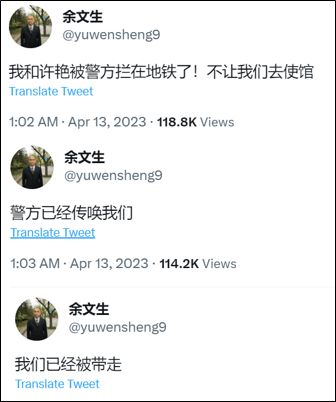
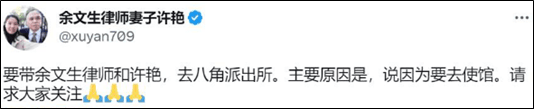
More than a month after lawyer Yu Wensheng (余文生) and wife Xu Yan (许艳) were taken away by police for “picking quarrels and provoking trouble,” the couple were arrested on May 21. Yu’s brother disclosed the news to the public.
At the time of publication, it was reported that the police have added inciting subversion to Xu’s charges. Several sources claimed that Xu’s lawyer was unable to visit her even with a scheduled appointment.
Yu and Xu were en route to an event hosted by the EU officials on April 14. They were followed on the subway and then detained when they refused to comply with a request to not attend the meeting.
Secrecy around alleged cases of state secrets & spying
In late April, overseas news media outlets reported the case of Dong Yuyu (董郁玉), who was placed under Residential Surveillance at a Designated Location (RSDL) on February 21, 2022 after meeting with a Japanese diplomat. He was indicted for espionage in March 2023.
Dong wrote political and social commentary for Guangming Daily, a Party propaganda newspaper. Part of his job as a senior editor was to regularly meet with diplomats and other journalists to inform his own prolific writing.
It is unclear when Dong will stand trial. The charge related to his alleged offense is shrouded in secrecy and can carry a prison sentence of 10 years or more. Such trials are typically conducted behind closed doors.
The month of May marked Yuan Keqin’s (袁克勤) fourth anniversary in custody and second anniversary since being indicted for espionage. The Chinese government has not provided new information about the case or about Yuan, who taught history in a Japanese university.
Yuan was taken into custody in June 2019. About 10 months after his disappearance, a spokesperson for China’s foreign ministry confirmed that Yuan had “made a full confession to his crimes.” The spokesperson said the evidence was clear but did not elaborate on what that evidence was. At a recent regular press conference on May 26., the spokesperson again claimed she is not aware of specifics of Yuan’s case. Yuan obtained permanent Japanese residency but remains a Chinese national. According to a Japanese news outlet, at least 17 Japanese nationals have been detained for allegedly engaging in espionage since 2015.
The aforementioned cases underscore the increasing risks journalists and academics face in China when they engage in activities that are meant to facilitate discussion or better understanding but that can be perceived as problematic by ill-defined national security elements or concerns.
The eighth national state security education day
April 15 is China’s National State Security Education Day, and 2023 marks the event’s eighth anniversary.
Official propaganda disclosed six recent examples of security violations and called on the public to be vigilant. Though not always the case, the 2023 examples disclosed the full name of several offenders.
The case that drew most attention is that of an aerospace expert named Zhao Xuejun (赵学军) who worked as a researcher at a state institute, with clearance for classified information. According to the news, his downfall can be traced to 2009 when he attended an exchange study program in a western country. Zhao was targeted by intelligence agents. One of the agents invited Zhao to dinner and befriended him. He also paid Zhao for consultation fees on aerospace “projects.”
Before Zhao returned to China, the agent confessed his identity and offered Zhao money (US$1,000 per month) to continue providing sensitive information about China’s aerospace programs. Zhao was shocked by the revelation but also felt his expertise wasn’t appreciated at the institute. He chose to cooperate with the foreign agency.
Zhao collected many documents and received tens of thousands of dollars. He was placed in custody in June 2019. In August 2022, Zhao was convicted of espionage and sentenced to seven years in prison with three years of DPR.
Another case involved a local level government clerk in Xinjiang. Han Xiao (韩潇) met a “friend” through an app while traveling aboard in 2016. Han often complained online about his low salary. The friend then introduced him to opportunities to make “extra bucks.” Han was asked to provide sensitive information on party and administrative organs and, eventually, to provide internal documents. According to the news, Han provided a total of 19 classified documents, including five that contained intelligence, and received more than 120,000 yuan. Han was sentenced to 11.5 years in prison for espionage.
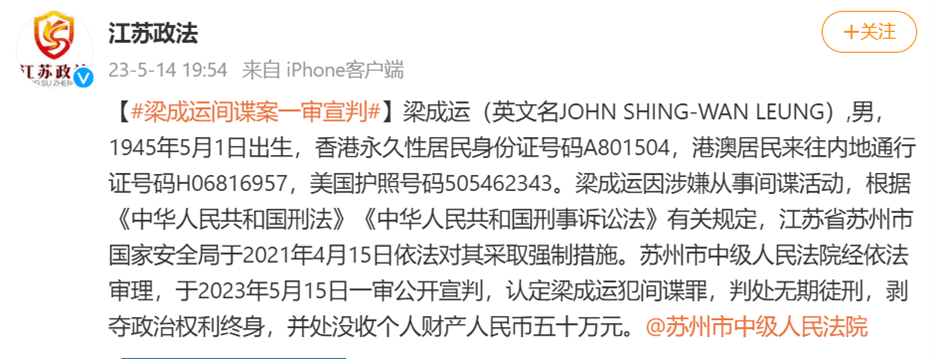
US citizen John Shing-wan Leung (梁成运, pinyin: Liang Chengyun) was sentenced to life in prison for espionage by the Suzhou Intermediate Court on May 15, 2023. The news was first reported by the provincial Political-Legal Affairs Commissions. Leung, 78-years old, is a permanent resident of Hong Kong, but he apparently used his US passport to enter China. He was detained upon entering China in April 2021. The US State Department has said that it is aware of the case, but it is not known whether US officials attended his trial nor is it known if they have been allowed to pay Leung visits in the detention center.
Leung joins Li Kai as a US citizen serving a long sentence for “endangering state security” (ESS) in a Shanghai prison. Leung and Li are thought to be the only US citizens serving sentences for ESS in China.
On May 11, the Guangzhou Intermediate People’s Court sentenced prominent activist Yang Maodong (杨茂东), also known by his penname Guo Feixiong (郭飞雄), to eight years’ imprisonment with three years’ deprivation of political rights (DPR) for subversion. Prior to this, Yang was sentenced to five years and six years in 2007 and 2015, respectively, and served a total of 11 years in prison without a single sentence reduction.
Yang had attempted to travel to the United States in 2021 to take care of his wife who was battling terminal cancer but was prohibited from leaving China on the grounds of ESS. In response, Yang staged an indefinite hunger strike and called upon the West to use diplomatic means to assist him to see his dying wife. In November 2021, he issued an open letter to Xi Jinping and then premier Li Keqiang about his request to have the exit ban lifted.
Less than a month later, Yang was accused of “smearing” the Chinese political system through dozens of “incitement” essays he published online, a website he founded to promote constitutional democracy, and interviews he gave to the foreign media about the exit ban. Yang will have spent 19 years in prison over the course of his life by the time of his scheduled release in 2029.
Dui Hua vigorously intervened on Yang’s behalf in 2018, contributing to the Guangdong Prison’s decision to move Yang from a prison where he was badly treated to a prison where he was treated better.
In another ESS case which has garnered little overseas attention, Hong Kong resident Qin Qiuyan (覃秋艶) received a six-year prison sentence for inciting subversion in Liuzhou, Guangxi. The exact date of her sentence is unknown. She was en route to her hometown in Guangxi but was intercepted in Shenzhen in March 2021.
Unofficial news media sources reported that Qin actively participated in the anti-extradition bill protests in the former British colony and posted frequent updates about the civil unrest on her Twitter account. Qin returned to China when lockdowns and quarantine were in place the second year into the COVID-19 pandemic. Upon completing the 14-day mandatory quarantine in Shenzhen, she was criminally detained and transferred to Liuzhou.
Veteran activist sentenced in Guangzhou after two years in custody
Convicted of “picking quarrels and provoking trouble,” veteran activist Wang Aizhong (王爱忠) was sentenced to three years of prison by Guangzhou Tianhe District People’s Court on May 18.
Wang has been in custody since May 28, 2021. The Tianhe District Procuratorate filed an indictment in January 2022. His imprisonment stemmed from vague accusations that he spread false news from foreign media on his WeChat account and made false statements on overseas social media. However, other than Wang’s social media accounts, the procuratorate did not present evidence of the content of Wang’s supposedly false posts nor the specific incidents on which Wang commented. The court nonetheless determined Wang caused “harmful results of creating chaos in public order.”
Wang is expected to complete his sentence on May 27, 2024.
Taiwan resident formally arrested in Wenzhou for inciting splittism
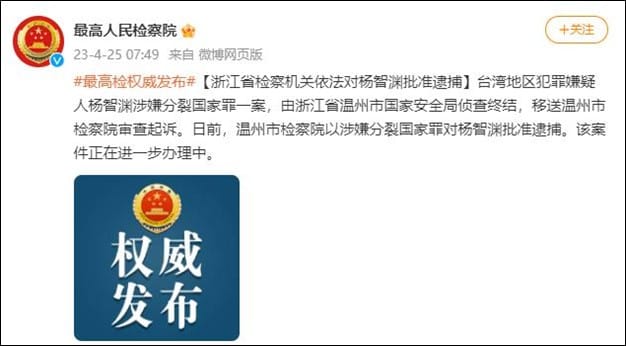
Yang Zhiyuan (Yang Chih-yuan 杨智渊), a Taiwan resident, has been formally arrested for inciting splittism, an ESS crime. The news was made public by the Supreme People’s Procuratorate on its official Weibo account on April 25.
According to the Weibo post, the Wenzhou State Security Bureau in Zhejiang Province has completed the investigation. The case is being transferred to the Wenzhou People’s Procuratorate, pending indictment.
Yang was taken into custody on August 3, 2022, and placed under Residential Surveillance in a Designated Location (RSDL) on August 5. RSDL is a coercive measure frequently employed by state security in ESS cases, often at undisclosed locations, to prevent suspects from receiving legal counsel and family visits. RSDL can last up to six months.
This is the first known case of a Taiwan resident being charged with ESS for activities not conducted in mainland China, but in the democratic island of Taiwan. Yang is a career community activist in Taiwan and founded several minor political parties in the 2000s that promote Taiwan statehood. It is believed that China is using the case to warn Taiwanese activists that advocating for independence – even when outside of mainland China – could result in criminal prosecution.
However, friends and acquaintances claimed Yang had shifted his view to pan-unification and had taken up permanent residence a couple of years ago in the mainland to explore business opportunities. Despite this, a CCTV report following his detention accused Yang of “colluding” with “Hong Kong independence” forces during the 2019 Anti-Extradition Law Amendment Bill Movement.
Taiwanese publisher Li Yanhe disappeared
One day after China formally pressed splittism charges against Yang, the Taiwan Affairs Office responded at a press conference that Li Yanhe (李延贺, aka Fuchsia ) was “under investigation by national security organs on suspicion of engaging in activities endangering state security.” It was later revealed that Li has been under RSDL for inciting splittism since March 21, 2023.
Li, born in China, married a Taiwanese woman and settled in Taiwan in 2009. He is the editor-in-chief of Gusa Publishing, which has published books on politics and history critical of the Chinese Communist Party. He went to Shanghai to revoke his mainland residence registration (hukou) in addition to visiting relatives. Despite obtaining his Taiwan ID card, Li was mandated by Taiwanese law to revoke his mainland hukou to obtain the right of abode on the island.
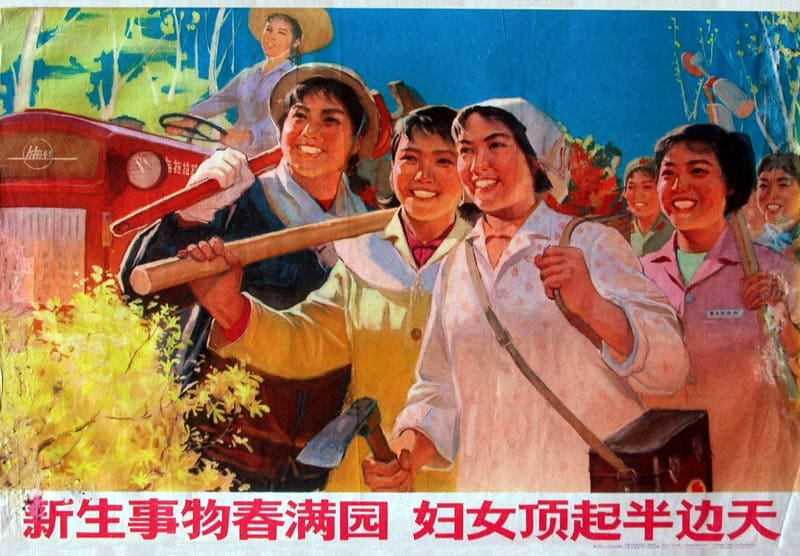
A Chinese poster from the 1970s with Mao Zedong’s slogan “Women hold up half the sky” at the bottom.
In March 2006, the United Nations Human Rights Council (HRC) was established, replacing the much-criticized Human Rights Commission. One of the principal tasks of the HRC is to oversee the process known as Universal Periodic Review (UPR). Every four to five years, the human rights records of United Nations member states are examined with respect to their compliance with international human rights norms.
China’s first UPR was held in Geneva in 2009, followed by its second UPR in 2013 and its third UPR in 2018. China’s next UPR will take place in early 2024. The Dui Hua Foundation (Dui Hua), which is in Special Consultative Status with the Economic and Social Council of the United Nations (ECOSOC), has attended all of China’s UPRs, and has made submissions at each one. It will make a submission to China’s January 2024 UPR in July 2023. It intends attending China’s fourth UPR.
One of the subjects examined at UPRs is whether the reporting state has issued invitations to special procedures (special rapporteurs and treaty bodies) to the reporting state. There are currently 59 special procedures.
After China’s first UPR, it invited the Special Rapporteur on the Right to Food, Mr. Olivier de Schutter, to visit the country at the end of 2010, no doubt thinking that this would be a relatively benign and risk-free visit. Beijing is very sensitive to any criticism of its human rights record by international bodies, especially HRC and its special rapporteurs and treaty bodies.
Upon his return to Geneva from his mid-December 2010 visit, Mr. de Schutter made a report. While noting the advances made by China, the report also referenced “specific challenges” that needed to be addressed, including agricultural sustainability and food insecurity in poor and rural areas, food safety, and land degradation and pollution. An entire section was devoted to criticizing China’s policies targeting nomadic herders in Tibet and other minority areas. Beijing was not happy, and no more invitations to special procedures were issued in 2011 and 2012.
Olivier de Schutter, Special Rapporteur on the Right to Food addresses during the 16th Session of the Council of Human Rights in 2011. Image credit: Jean-Marc Ferre, UN photo / CC BY-NC-ND 2.0
As China approached its third UPR to take place in October 2013, its Ministry of Foreign Affairs considered whether or not to invite a special procedure to visit the country. I was asked for my advice. I was inclined to recommend the Working Group on the Issue of Discrimination Against Women in Law and Practice (WGIDAWLP) but first I needed to ascertain whether the working group was interested in making a formal visit.
I asked friends in Geneva and was told that the group had only been established in 2010 and as such it was the “new kid on the block.” Many other special procedures were waiting for invitations. I decided to ask the working group anyway and was pleasantly surprised to learn that it was interested to visit China. I made a suggestion to the MFA that the group be invited.
I arrived in Geneva from Oslo on Sunday October 20, 2013, and checked into my usual haunt, the Hotel Ambassador. I had dinner at a nearby Chinese restaurant and settled in for the night. In addition to attending China’s UPR, where I was informed that the Ministry of Foreign Affairs had accepted my suggestion to invite the working group, I met with American and Chinese diplomats, UN officials, the Working Group on Arbitrary Detention, the Special Rapporteur on Freedom of Assembly, and the president of the International Committee of the Red Cross, Peter Maurer.
At my meeting with the WGIDAWLP on October 24, I was thanked for my work lobbying the Chinese government to issue the invitation – the visit took place two months later in December 2013 – and discussed their and UNOHCHR’s possible attendance at Dui Hua’s international symposium on Women in Prison (the Bangkok Rules), set to take place in Hong Kong in February 2014.
Women in Prison
The symposium took place as planned. Dui Hua partnered with the University of Hong Kong and China’s Renmin University. A member of the WGIDAWLP, Elenora Zielinska, attended and presented a paper on the group’s 2010 visit to China. The OHCHR sent a representative, Adwoa Kufuor, to make a presentation on the treatment of women prisoners under international human rights law.
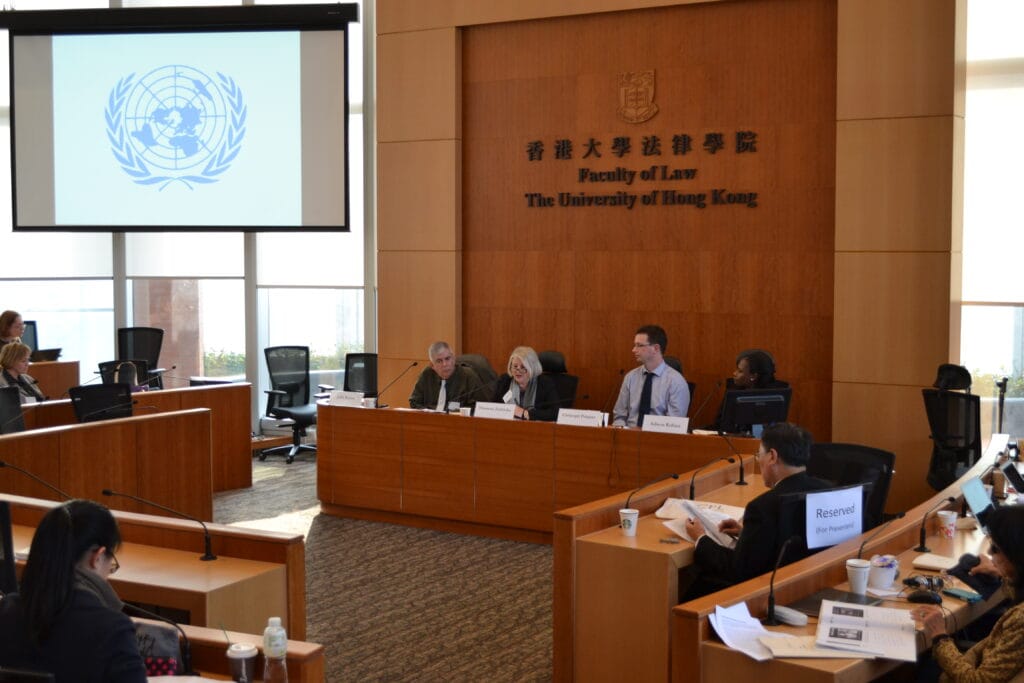
The Women in Prison symposium on February 25, 2014. Seated in front (left to right) Kamm, lawyer Eleonora Zielińska, Christoph Polajner of the International Committee of the Red Cross, and OHCHR representative Adwoa Kufuor. Image credit: The Dui Hua Foundation
China sent the largest delegation to the symposium; it included scholars from the Supreme People’s Court and several research institutes and law schools who presented papers on domestic violence, women law enforcement officers, and treatment of female juvenile offenders in Beijing, and, separately, treatment of female prisoners in Hong Kong. (Hong Kong has one of the highest percentages of women prisoners of any country or territory in the world). Findings of a survey of five places of detention for women in China, commissioned by Dui Hua and conducted by scholars at Renmin University led by Professor Cheng Lei, were presented.
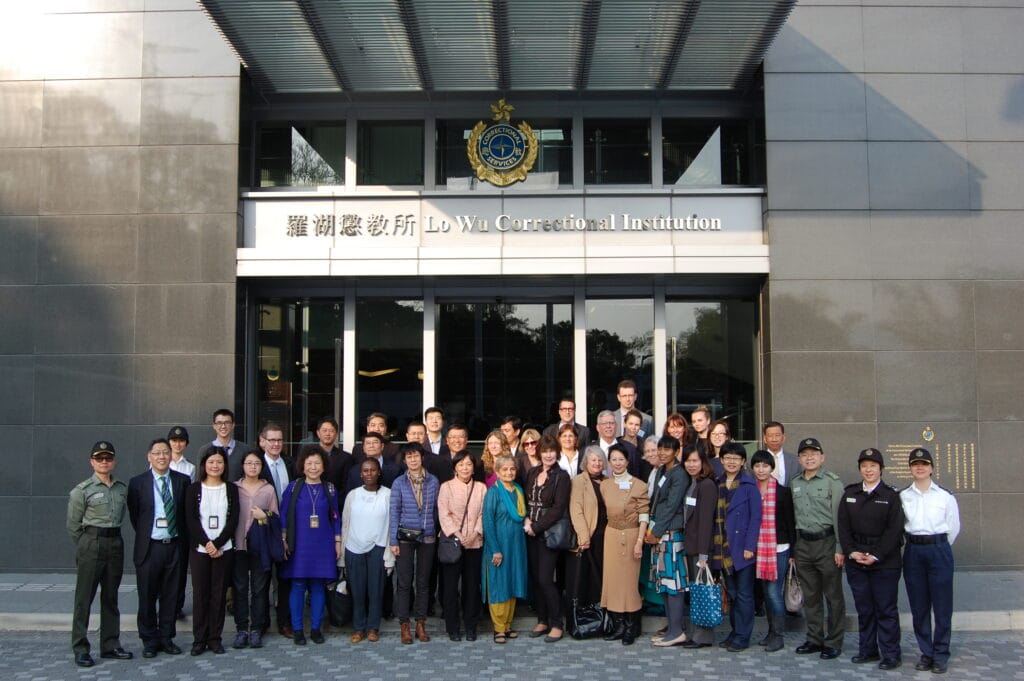
The symposium’s delegates visited Hong Kong’s largest women’s prison and held discussions with the territory’s authorities in charge of women prisoners. Most important, the symposium, attended by one of the judges tasked with reviewing death penalty decisions, contributed to the overturning of a death sentence for a victim of domestic abuse who murdered her husband.
The US and Chinese delegations after their visit to Lo Wu Correctional Institution in 2014. Image credit: The Dui Hua Foundation
On a follow-up visit to Beijing, I was advised by a senior official of China’s National People’s Congress that the legislative body would consider where the Bangkok Rules could be incorporated into Chinese legislation.
Girls in Conflict with the Law
The International Symposium on Women in Prison set the table for the International Symposium on Girls in Conflict with the Law. Unlike the women in prison symposium, which was held in person, the girls in conflict with the law (GCIL) symposium was held virtually due to the Covid-19 pandemic. From October 2020 to March 2021, 12 webinars featured experts from 18 countries discussed topics related to the treatment of girls in the justice systems of countries on five continents.
The banner for the International Symposium on Girls in Conflict with the Law. Image credit: The Dui Hua Foundation
The final topic was a presentation by China’s Supreme People’s Court – “Special and Priority Protection of the Legitimate Rights and Interests of Underage Girls in Accordance with the Law,” featuring Dui Hua’s long-time partner Judge Jiang Jihai and his colleagues.
There is no contradiction between Dui Hua’s work on women prisoners and girls in conflict with the law, on the one hand, and our work on political and religious prisoners on the other. From the earliest days of my advocacy to the present, I have worked on numerous cases of women and girls who have been detained and imprisoned, including Ngawang Sangdrol and the Drapchi nuns, Liang Shaolin and dozens of other women subjected to coercive measures for practicing unorthodox religions, American citizen Sandy Phan-Gillis, and Rebiya Kadeer and other Uyghur women. To Dui Hua, Mao Zedong’s claim that “Women hold up half the sky” is more than a slogan. It is a core belief at the center of our work.
Dui Hua and China’s Supreme People’s Court Hold Webinar on Juvenile Justice Reform
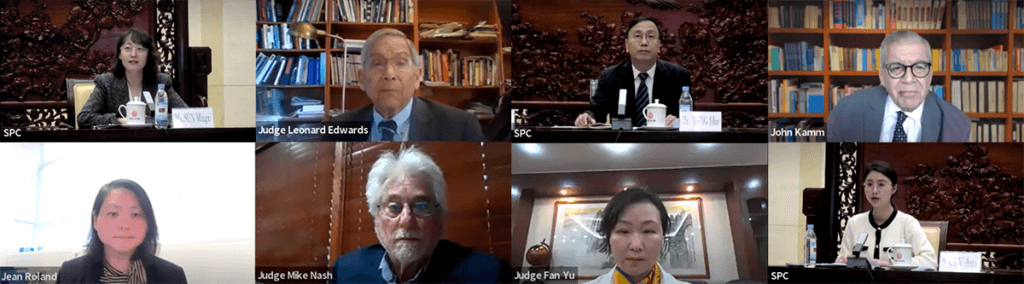
The panelists of the “Topics in Juvenile Justice Reform” webinar. Image credit: The Dui Hua Foundation
On April 13 in San Francisco, April 14 in Beijing, the Dui Hua Foundation (Dui Hua) co-hosted an expert exchange with the Research Department of China’s Supreme People’s Court (SPC). The exchange, which was held virtually, brought together judges, judicial experts, and youth workers from both countries to discuss “Topics in Juvenile Justice Reform.” A short video of the key points and highlights is now online.
The program, which lasted nearly two hours, was months in the planning and featured two panels – one from the United States and one from China – exchanging presentations on topics relevant to juvenile justice. Simultaneous translation for the event was provided by the SPC. The full program is available on Dui Hua’s dedicated website, GirlsJustice.org, which also hosts videos and materials of past exchanges.
Deputy Director General Jiang Jihai of the SPC Research Department moderated the Chinese presentations while Dui Hua Executive Director John Kamm, assisted by Judge Leonard Edwards, moderated the US presentations.
The panelists addressed multiple topics, ranging from new areas like cyberspace regulations to long-discussed topics like record sealing for juveniles. The US panelists were:
Judge Leonard Edwards, Judge (Retired) Santa Clara County Superior Court and juvenile justice reform activist, presenting on “Recent Developments in Record Sealing of Juvenile Offenders”
Judge Mike Nash, Head of the Los Angeles Office of Child Protection and former Presiding Judge of the Los Angeles Juvenile Court, presenting on “Congregate Care in the United States”
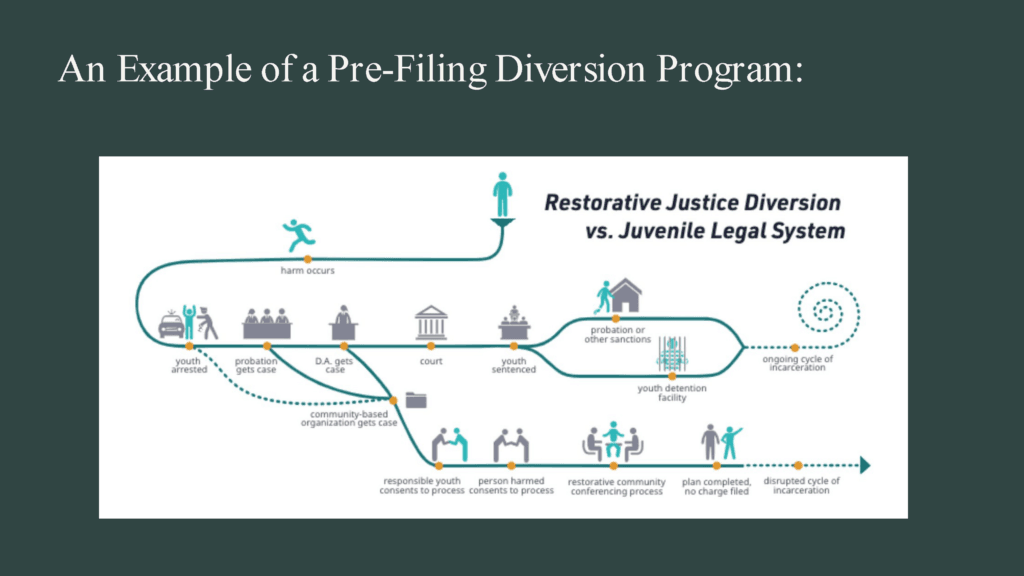
Jean Roland, Managing Attorney of the Juvenile Division of San Francisco District Attorney’s Office, presenting on “The Role of the Prosecutor in Juvenile Court.”
A slide from Managing Attorney Roland’s presentation. Image credit: Jean Roland
The Chinese panelists were:
Chief Judge Sun Mingxi, of the Juvenile Division of Beijing Internet Court, presenting on “Practices of Beijing Internet Court on the Protection of Legitimate Rights and Interests of Juveniles in Cyberspace”
Deputy Chief Judge Fan Yu, of No.1 Criminal Division of Sichuan High People’s Court, presenting on “Practices of Family Education Guidance System in Sichuan Province”
Lü Anqi, an official of Juvenile Rights and Interests Department of the Central Committee of the Communist Youth League, presenting on “Actively Promoting the Role of Popular Organizations, Improving the Social Support System for Judicial Protection of Juveniles.”
The American audience consisted of experts from the Child Welfare Council, the Los Angeles office of the Department of Justice, Child Custody Evaluation Services, San Francisco Superior Court, the University of Hawaii, and the San Francisco Public Defender’s Office. Among Chinese audience members, the SPC invited judges and officials of the No. 1 Criminal Division, No.1 Civil Division, Research Department(研究室), Law Reseach Institute(法研所), and the International Cooperation Department of SPC.
The event included a Q&A session, during which US and Chinese panelists answered submitted questions from their counterparts. The Chinese panel asked US presenters about topics including preconditions for unsealing juvenile records, regulations on cybercrimes affecting minors, and trends in juvenile delinquency. The US panel asked their Chinese counterparts about congregate care procedures, treating juvenile offenders as adults, and about the decline in the number of juveniles sentenced by Chinese courts over a ten-year period.
In response to the latter question, Judge Jiang provided valuable information on recent developments in juvenile justice reform in China. The number of juveniles tried by Chinese court fell from 56,000 in 2013, the year the amended Criminal Procedure Law (CPL) with juvenile protections took place, to 28,000 in 2022. Seven percent of those tried were females, and the majority of all juveniles tried were 16 or 17 years old. Trials of juveniles took place without interruption during the Covid pandemic. Judge Jiang attributed the drop in the number of juveniles tried to the implementation of revised laws, notably the CPL and the Juvenile Delinquency Prevention Law.
The number of women incarcerated in Chinese prisons has grown faster than the population of incarcerated men over the past decade, and women are disproportionately represented in criminal cases involving unorthodox religious groups. These are two of the findings highlighted by Dui Hua in its submission to the Committee on the Elimination of All Forms of Discrimination against Women (CEDAW)’s review of China.
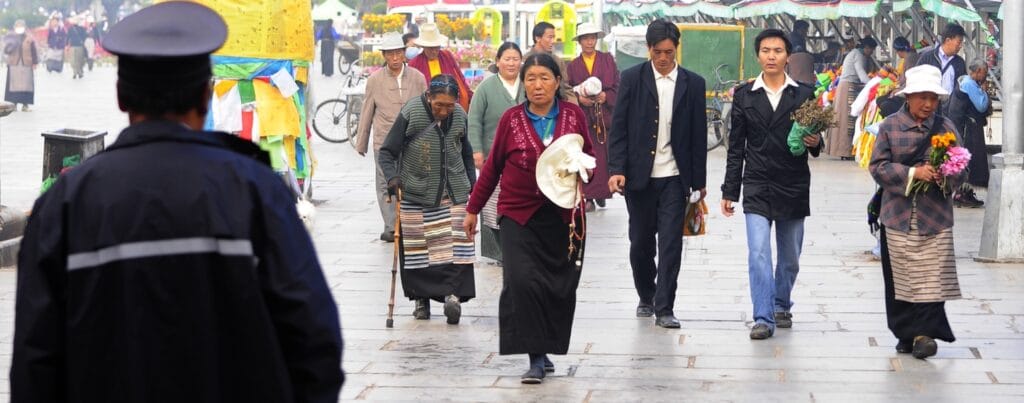
Protests swept across the Tibetan plateau ahead of the 2008 Beijing Olympics. More than a decade later, China continues to track down and punish pro-independence protesters who took part in the unrest, some episodes of which turned deadly. An indictment uncovered by Dui Hua reveals how one protester was ultimately found and punished years after their alleged crime.
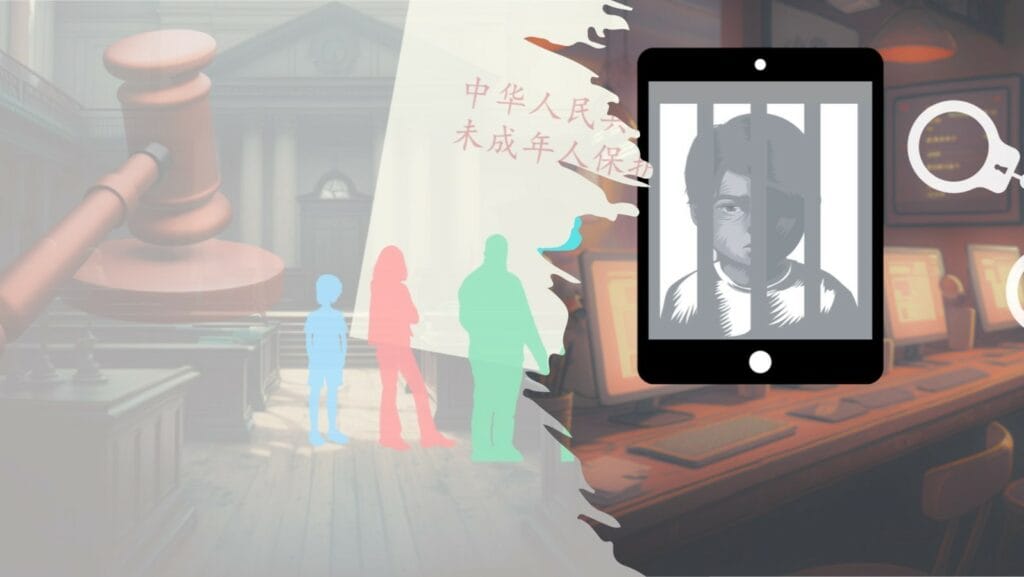
On June 1, 2021, the second revision of the Law of the People’s Republic of China on Protection of Minors (hereafter Protection of Minors Law) came into effect. The revision introduced 60 new articles into law. During the Joint Program on Child Welfare Laws (JPCW) webinar hosted by Dui Hua in April 2022, panelists from the Supreme People’s Court of China (SPC) spoke in depth about the revisions to the Protection of Minors Law across six key protection areas: family, school, society, internet, government, and the judiciary.
This article explores China’s child welfare legislation by drawing on the relevant legislation, white papers issued by Chinese Communist Party organs, and remarks made during Dui Hua’s 2022 JPCW webinar. Part I focuses on the obligations of the family unit and educational institutions in child welfare. Part II looks at the designated roles of online entities, government bodies, the judiciary, and society at large in ensuring the welfare of the child.
John Kamm Remembers is a feature that explores Kamm’s human rights advocacy prior to and since Dui Hua’s establishment in 1999.
Half the Sky
A Chinese poster from the 1970s with Mao Zedong’s slogan “Women hold up half the sky” at the bottom.
In March 2006, the United Nations Human Rights Council (HRC) was established, replacing the much-criticized Human Rights Commission. One of the principal tasks of the HRC is to oversee the process known as Universal Periodic Review (UPR). Every four to five years, the human rights records of United Nations member states are examined with respect to their compliance with international human rights norms.
China’s first UPR was held in Geneva in 2009, followed by its second UPR in 2013 and its third UPR in 2018. China’s next UPR will take place in early 2024. The Dui Hua Foundation (Dui Hua), which is in Special Consultative Status with the Economic and Social Council of the United Nations (ECOSOC), has attended all of China’s UPRs, and has made submissions at each one. It will make a submission to China’s January 2024 UPR in July 2023. It intends on attending China’s fourth UPR.
One of the subjects examined at UPRs is whether the reporting state has issued invitations to special procedures (special rapporteurs and treaty bodies) to the reporting state. There are currently 59 special procedures.
After China’s first UPR, it invited the Special Rapporteur on the Right to Food, Mr. Olivier de Schutter, to visit the country at the end of 2010, no doubt thinking that this would be a relatively benign and risk-free visit. Beijing is very sensitive to any criticism of its human rights record by international bodies, especially the HRC and its special rapporteurs and treaty bodies.
Upon his return to Geneva from his mid-December 2010 visit, Mr. de Schutter made a report. While noting the advances made by China, the report also referenced “specific challenges” that needed to be addressed, including agricultural sustainability and food insecurity in poor and rural areas, food safety, and land degradation and pollution. An entire section was devoted to criticizing China’s policies targeting nomadic herders in Tibet and other minority areas. Beijing was not happy, and no more invitations to special procedures were issued in 2011 and 2012.
Olivier de Schutter, Special Rapporteur on the Right to Food addresses during the 16th Session of the Council of Human Rights in 2011. Image credit: Jean-Marc Ferre, UN photo / CC BY-NC-ND 2.0
As China approached its third UPR to take place in October 2013, its Ministry of Foreign Affairs considered whether or not to invite a special procedure to visit the country. I was asked for my advice. I was inclined to recommend the Working Group on the Issue of Discrimination Against Women in Law and Practice (WGIDAWLP) but first I needed to ascertain whether the working group was interested in making a formal visit.
I asked friends in Geneva and was told that the group had only been established in 2010 and as such it was the “new kid on the block.” Many other special procedures were waiting for invitations. I decided to ask the working group anyway and was pleasantly surprised to learn that it was interested to visit China. I made a suggestion to the MFA that the group be invited.
I arrived in Geneva from Oslo on Sunday October 20, 2013, and checked into my usual haunt, the Hotel Ambassador. I had dinner at a nearby Chinese restaurant and settled in for the night. In addition to attending China’s UPR, where I was informed that the Ministry of Foreign Affairs had accepted my suggestion to invite the working group, I met with American and Chinese diplomats, UN officials, the Working Group on Arbitrary Detention, the Special Rapporteur on Freedom of Assembly, and the president of the International Committee of the Red Cross, Peter Maurer.
At my meeting with the WGIDAWLP on October 24, I was thanked for my work lobbying the Chinese government to issue the invitation – the visit took place two months later in December 2013 – and discussed their and UNOHCHR’s possible attendance at Dui Hua’s international symposium on Women in Prison (the Bangkok Rules), set to take place in Hong Kong in February 2014.
Women in Prison
The symposium took place as planned. Dui Hua partnered with the University of Hong Kong and China’s Renmin University. A member of the WGIDAWLP, Elenora Zielinska, attended and presented a paper on the group’s 2010 visit to China. The OHCHR sent a representative, Adwoa Kufuor, to make a presentation on the treatment of women prisoners under international human rights law.
The Women in Prison symposium on February 25, 2014. Seated in front (left to right) Kamm, lawyer Eleonora Zielińska, Christoph Polajner of the International Committee of the Red Cross, and OHCHR representative Adwoa Kufuor. Image credit: The Dui Hua Foundation
China sent the largest delegation to the symposium; it included scholars from the Supreme People’s Court and several research institutes and law schools who presented papers on domestic violence, women law enforcement officers, and treatment of female juvenile offenders in Beijing, and, separately, treatment of female prisoners in Hong Kong. (Hong Kong has one of the highest percentages of women prisoners of any country or territory in the world). Findings of a survey of five places of detention for women in China, commissioned by Dui Hua and conducted by scholars at Renmin University led by Professor Cheng Lei, were presented.
The symposium’s delegates visited Hong Kong’s largest women’s prison and held discussions with the territory’s authorities in charge of women prisoners. Most important, the symposium, attended by one of the judges tasked with reviewing death penalty decisions, contributed to the overturning of a death sentence for a victim of domestic abuse who murdered her husband.
The US and Chinese delegations after their visit to Lo Wu Correctional Institution in 2014. Image credit: The Dui Hua Foundation
On a follow-up visit to Beijing, I was advised by a senior official of China’s National People’s Congress that the legislative body would consider where the Bangkok Rules could be incorporated into Chinese legislation.
Girls in Conflict with the Law
The International Symposium on Women in Prison set the table for the International Symposium on Girls in Conflict with the Law. Unlike the women in prison symposium, which was held in person, the girls in conflict with the law (GCIL) symposium was held virtually due to the Covid-19 pandemic. From October 2020 to March 2021, 12 webinars featured experts from 18 countries discussing topics related to the treatment of girls in the justice systems of countries on five continents.
The banner for the International Symposium on Girls in Conflict with the Law. Image credit: The Dui Hua Foundation
The final topic was a presentation by China’s Supreme People’s Court – “Special and Priority Protection of the Legitimate Rights and Interests of Underage Girls in Accordance with the Law,” featuring Dui Hua’s long-time partner Judge Jiang Jihai and his colleagues.
There is no contradiction between Dui Hua’s work on women prisoners and girls in conflict with the law, on the one hand, and our work on political and religious prisoners on the other. From the earliest days of my advocacy to the present, I have worked on numerous cases of women and girls who have been detained and imprisoned, including Ngawang Sangdrol and the Drapchi nuns, Liang Shaolin and dozens of other women subjected to coercive measures for practicing unorthodox religions, American citizen Sandy Phan-Gillis, and Rebiya Kadeer and other Uyghur women. To Dui Hua, Mao Zedong’s claim that “Women hold up half the sky” is more than a slogan. It is a core belief at the center of our work.
Visit the “John Kamm Remembers” page to read more stories like this, view photos from this period in history, watch videos about the origins of modern US-China engagement and learn how the decisions of the past are shaping our future.
Subscribe here to receive Dui Hua publications by email.
The logo for the Committee on the Elimination of Discrimination against Women, which monitors compliance with the Convention, both of which are abbreviated as CEDAW. Image credit: UN Office of the High Commission for Human Rights
The number of women incarcerated in Chinese prisons has grown faster than the population of incarcerated men over the past decade, and women are disproportionately represented in criminal cases involving unorthodox religious groups. These are the main points highlighted by Dui Hua in its submission to the Committee on the Elimination of All Forms of Discrimination against Women (CEDAW)’s review of China.
CEDAW, which also stands for the Convention on the Elimination of All Forms of Discrimination against Women and is sometimes described as an “international bill of rights for women,” is the treaty and human rights instrument adopted by the United Nations that provides guidance for nations to combat discrimination faced by women. Nations that have signed and ratified CEDAW – which includes all but six UN member states – are required to submit reports to the Committee on their compliance with the Convention every four years. NGOs are invited to make submissions informing country reports, which Dui Hua did for China’s, considered during CEDAW’s 85th session in the week of May 8, 2023.
Dui Hua’s statement largely focused on female prisoners charged under Article 300, “organizing or using a cult to undermine implementation of the law.” The statement noted that women account for 8 percent of the prison population in China – a figure similar to that of the United States – but are thought to make up more than 40 percent of prisoners incarcerated for violating Article 300 from 1998-2016. More so, court records suggest that sentencing for these cases is comparatively harsh and that instances of clemency are rare. (The statement notes that there may have been an increase in clemency over the last two years but the lack of consistent data and transparency in legal processes makes this difficult to confirm.)
Charts 1 and 2: Gender breakdown of unorthodox religious prisoners accused of violating Article 300 in the PPDB as of March 31, 2023.*
*Gender is not known for all cases. Image credit: The Dui Hua Foundation
The submission builds on the research Dui Hua initially published in its report “The Persecution of Unorthodox Religious Groups in China,” which identified a gender imbalance in sentencing under Article 300. Dui Hua’s Political Prisoner Database (PPDB) holds records on 11,400 women who have been subject to coercive measures for violating Article 300 due to their participation in unorthodox religious groups, which the Chinese Communist Party regards as cult organizations practicing non-state sanctioned faiths.
The statement also noted that women are the main target of negative stereotypes in China’s anti-cult propaganda. This messaging often relies on stereotypes of middle-aged, rural women being “weak-willed and psychologically vulnerable” and more vulnerable to “coercion or monetary enticements from cult organizations.” Such messaging, which comes from both national and regional organizations, itself seems to violate Article 5 of CEDAW which mandates that state parties take all appropriate measures to eliminate “prejudices and customary and all other practices which are based on the idea of inferiority or the superiority of either of the sexes or on stereotyped roles for men and women.”
An image from the opening session of CEDAW’s 85th session on May 8, 2023. Image credit: UN Web TV
Another focus of Dui Hua’s submission to China’s state report was the decline in judicial transparency. Dui Hua ended its submissions by recommending that the Chinese government increase the use of non-custodial measures and clemency for women prisoners and improve judicial transparency, writing:
Dui Hua urges the Chinese government to resume providing meaningful access for the public to judicial documents, including indictments, court judgments, and decisions of all cases, regardless of the criminal offense involved. Transparency is particularly lacking in provinces with high populations of ethnic minorities. It also helps the public understand the reasons why women are placed in custody for peacefully pursuing their religious faith and other criminal offenses.
Of the 193 UN member states, 189 have ratified CEDAW, binding them to the treaty and mandating that they participate in regular review every four years. The United States has not ratified CEDAW, placing it among a small group of countries – Iran, Somalia, Sudan, Tonga, Palau – and the Holy See that have yet to bind themselves to the treaty.
Barkhor Square in Lhasa, Tibet, on 22 September 2008. Image credit: Reurinkjan / CC BY 2.0
Protests swept across the Tibetan plateau ahead of the 2008 Beijing Olympics. More than a decade later, China continues to track down and punish pro-independence protesters who took part in the unrest, some episodes of which turned deadly. An indictment uncovered by Dui Hua reveals how one protester was ultimately found and punished years after their alleged crime.
This case revolves around a Tibetan known by the name of Kelsang Cheron (格桑谢郎) who was accused of robbery. He was formally arrested on October 18, 2019 in Zhuoni County, Gansu, for a crime he allegedly committed 11 years ago during the Tibetan protests that began on March 17, 2008. The case was transferred to the procuratorate for prosecution on January 7, 2020.
Cropped image of the indictment confirming that arrest of Kelsang Cheron in October 2019 for robbery. His name was partially redacted, but the full name was revealed later in the indictment.
Zhuoni County (Jonê County 卓尼县) is located in the southeast of Gannan Tibetan Autonomous Prefecture, one of the hardest hit regions during the 2008 Tibetan unrest. State news media reported that as of April 8, 2008 (about three weeks after the outbreak), 2,204 protesters reportedly turned themselves in and 432 people were in criminal detention for “beating, smashing, looting, and burning” (da 打za 砸 qiang 抢 shao 烧) across the prefecture. Derived from the denunciation of the Red Guards during the Cultural Revolution, the phrase “beating, smashing, looting and burning” is highly ideological and permeates official accounts of popular protests, including June Fourth, regardless of whether violence is involved.
It is questionable whether the robbery charge against Cheron is justified. Throughout the indictment the prosecutors failed to present evidence of him looting properties by means of force or fear. The allegations focused on his role as the principal organizer of the protests in Zhuoni County. First, he was accused of convening a secret meeting on March 17 with over 60 Tibetan monks in a forest near the Gongba Monastery to discuss the specifics of the protests and their plans to “smash” the public security bureau and county government office. The following morning, he gave Snow Lion flags to a group of 200 Buddhist monks to be used in a Buddhist ceremony. After the ceremony was over, the monks proceeded to march to the public security bureau and county government offices, where they allegedly waved the Snow Lion flags and chanted slogans about independence and “Long Live the Dalai Lama.”
Cropped image of the indictment showing the facts pertaining to Cheron’s crime of robbery. There is no evidence that Cheron engaged in looting or using force or intimidation, important requirements for the crime in many other jurisdictions outside of China.
Similarly, the indictment did not say whether the Tibetan monks looted anything valuable. However, evidence is cited of them damaging public property. They allegedly set fire and threw bricks and stones, destroying more than four million yuan worth of property such as fences, gates, computers, televisions, vehicles, and various data files. During the destruction, some protesters entered a primary school where they lowered the Chinese national flag and replaced it with the Snow Lion flag, which remained hoisted for days until police took the flag down on March 20.
In May 2008, Tibetans in Dharamsala, India, protest China’s occupation while holding the Snow Lion flag. Image credit: Kiran Jonnalagadda / CC BY 2.0
Cheron was on the run for 11 years until he was apprehended by Zhuoni Public Security on September 11, 2019. The indictment did not say whether he took part in the actual protests when the alleged violence occurred. It is only clear that he was the person who gave the protesters the Snow Lion flags on the morning of March 18 prior to the protests. The prosecutor argued that he was complicit in the commission of robbery with other Tibetan protesters. According to the indictment, Cheron refused to confess to his crimes during interrogation.
The case of Cheron calls into question of the allegations of robbery, a crime many Tibetan monks were also accused of violating in 2008. Official accounts of his case bear resemblance to some of the problematic evidence about “beating, smashing, looting and burning” by pro-democracy protesters in 1989, with a notable example being Wang Jun (王军). Wang, 18 years old at the time, was caught at the scene during the April disturbance in Xi’an. In May, the Xi’an Intermediate People’s Court convicted Wang for arson and robbery and sentenced him to death for the two crimes. Upon appeal, the Shaanxi High Court, following the review instruction from the Supreme People’s Court, revised the combined sentence to death with two-year reprieve. The crime of robbery, which afforded him a life sentence, stemmed from Wang allegedly “taking advantage of the unrest and stealing an electronic calculator, cassette tapes, and pens.” Wang ultimately spent a total of twenty years in Shaanxi’s Fuping Prison before he was released in May 2009.
Common charges against Tibetan protesters who participated in the 2008 unrest include robbery, arson, and gathering a crowd to disturb social order or to attack state organs. In the same year, the number of people tried for splittism nationwide doubled from 459 in the previous year to 926. By now, many of these Tibetan protesters are believed to have completed their prison sentences, but the fate of Kelsang Cheron remains shrouded in mystery. Dui Hua has been unable to find the judgment of his case. Given the abysmally low acquittal rates and his refusal to confess, it is likely that Kelsang Cheron is still behind bars for a disputable crime that he committed 14 years ago.
After spending over three years in pretrial detention, legal scholar Xu Zhiyong (许志永) and lawyer Ding Jiaxi (丁家喜) were sentenced to 14 years and 12 years in prison, respectively, on April 10. The harsh sentences given to them not only garnered extensive media coverage but also evoked a response from UN High Commissioner for Human Rights Volker Turk, who described the punishment as being “at variance with international human rights law standards.”
Xu and Ding were convicted of subversion, a crime of endangering state security. The trials were conducted by Linyi Intermediate People Court, with sentencing announced at Linshu County Court, Shandong. The trial commenced behind closed doors in June 2022.
Both men are leading figures of the New Citizens Movement, which sought greater transparency into the wealth of officials. Ding was first taken by police in December 2019 not long after attending a gathering with 20 lawyers and activists to discuss politics and current affairs. Xu went into hiding after penning an essay calling on Xi Jinping to step down over his handling of the COVID-19 pandemic but was eventually tracked down by the national surveillance camera system in Guangzhou. Both of them have been denied meetings with defense attorneys and visits from family members for prolonged periods of time.
Xu is expected to complete his prison sentence in February 2034 at the age of 61. Additionally, he is obliged to serve a supplemental deprivation of political rights (DPR) for four years until 2042. Ding will be 65 years old when he is scheduled for release on March 21, 2032; his three-year DPR sentence expires in 2035.
Guangxi lawyer sentenced
In a separate endangering state security case, the Nanning Intermediate People’s Court convicted Qin Yongpei (覃永沛) of inciting subversion on March 31 and sentenced him to five years in prison with a supplemental DPR sentence of three years. The case has similarly elicited a response from the United Nations. In September 2022, the Working Group on Arbitrary Detention ruled that Qin has been subject to arbitrary detention because his alleged crime is ill-defined and fails to meet the principle of legal certainty.
The conviction stemmed from the critical Weibo posts he published and his role in forming a support group for disbarred human rights lawyers. In a legal career spanning more than ten years, Qin has defended other human rights lawyers who faced reprisals from authorities and provided legal assistance to vulnerable groups.
Qin has lodged an appeal in an attempt to overturn the conviction. Even though he has less than 19 months of sentence remaining, the long delays in the sentencing might have deprived Qin of a chance for clemency after being admitted into a prison. The 2016 sentence reduction and parole regulations by the SPC restrict clemency applications for crimes such as endangering state security. To qualify for a reduction, Qin would have to serve at least 24 months in a prison.
Qin’s sentence expires on October 30, 2024.
Lawyer and wife missing in Beijing
Lawyer Yu Wensheng (余文生) and wife Xu Yan (许艳), were reportedly missing in Beijing on April 13, when the couple were en route to attend an event at the German Embassy in Beijing. The couple has been placed under criminal detention for “picking quarrels and provoking trouble.”
The incident unfolded quickly on a subway train shortly after 4:00pm in Beijing. Yu fired off three short tweets:
“Xu Yan and I are blocked by police at a subway station! Not permitting us to go to the embassy”
“The police have issued a summon to us”
“We are being taken away”
A screenshot of the three tweets Yu posted from the subway. Image credit: Yu Wensheng’s Twitter account
Xu posted six tweets on her account around the same time, including video clips of her exchanges with a plain-clothes police officer who repeatedly tried to prevent them from going to the EU mission. The police evaded Xu’s questions as to why they were being blocked. Xu can be heard in the video loudly protesting and refusing to “just return home” as other passengers looked on.
In another video clip, the police verbally informed the couple that they had been summoned by the Shijingshan District Sub Bureau for “picking quarrels and provoking trouble” while refusing to provide any justification. Xu requested that the police produce his police badge and the police complied. They were then seen being removed from the train at the Erligou Station. In her last tweet, the couple were seen being put in a vehicle. Xu claimed they were being taken to Bajiao Police Station (in the Shijingshan District). However, friends claimed on social media that they have been unable to receive confirmation from the police station.
A tweet from Xu’s account as they were reportedly being taken to the police station. Image credit: Xu Yan’s Twitter account
Yu was released from prison on March 1, 2022, after serving four years in prison. Yu was detained in January 2018 after he posted an open letter calling for constitutional amendment. He was convicted in a closed trial of inciting subversion in June 2020. Yu is serving his supplemental three-year DPR sentence, which prohibits him exercising rights such as standing for elections, voting, and engaging in activities like speaking to the press or participating in public gatherings. Even though DPR does not restrict a person’s freedom of movements, in practice high-profile individuals such as Yu are considered “important targeted population” and are known to be under constant surveillance and face harassment by the police.
Yu was an outspoken rights lawyer before his license was revoked. He had defended partitioners of unorthodox religions, activists, and dissidents. Yu had been detained twice before in 2014 and 2015 for “picking quarrels and provoking trouble” when he spoke out against crackdowns on lawyers. The night before his more recent ordeal, Yu criticized the harsh sentencings of Xu Zhiyong and Ding Jiaxi in their high-profile cases. Xu Yan was herself summoned by police for incitement in April 2018 for advocating for Yu’s release. She was released after.
Christian protester released
On April 4, Gao Heng (高恒) completed his prison sentence of one year and 10 months for “picking quarrels and provoking trouble,” about two weeks after he was convicted by the Panyu District People’s Court on March 21. Gao was placed under criminal detention on June 5, 2021, one day after he stood at a subway station in Guangzhou holding a sign: “June 4, Pray for the Country” on the 32nd anniversary of the brutal crackdown on the student-led pro-democracy movement in Beijing and other cities. Gao also posted on social media about the tragedy and called on the Chinese government to officially redress the wrongs of June 4.
Citizen journalist who exposed dire situation in Wuhan under COVID lockdown to be released
Fang Bin (方斌), a citizen journalist who posted a series of livestreams online showing the dire situation in Wuhan under COVID lockdown, is expected to complete his three-year prison sentence on April 30, 2023. His sentence was not known to the public until this month when news media provided updates about his case three years after he was taken into police custody. His family was reportedly informed by the authorities pending his release and told to keep an eye on him.
Fang’s videos taken at morgues during February 2020 helped call attention to the high death rate when the world was just beginning to grasp the seriousness of the pandemic. He publicly criticized the situation in the city as a “man-made disaster.” The charge against Fang was never made public nor was it communicated to the family. Fang was convicted of “picking quarrels and provoking trouble” in a closed trial by a court in Wuhan, but exact the date when he received the prison sentence is unclear.
The young women of the “white paper” protests
The world witnessed self-organized vigils for the Urumqi fire victims and “white paper” protests against zero-COVID policies across China at the end of 2022. Young people, particularly women, were at the front line of those gatherings. The authorities did not immediately make the arrests, but in January numerous reports emerged about the “white paper” protestors being detained. Even though many have reportedly been released on bail, several remain in custody and their cases are used as examples to dissuade further activism.
Among those taken into custody are a group of young women from Beijing who attended the gathering at the riverbank of Liangmaqiao in Beijing in November. The women are a group of writers, journalists, artists, and filmmakers with no prior activism experience. Six of them were originally detained for gathering a crowd to disturb social order but were arrested for “picking quarrels and provoking trouble” in late January.
At the time of writing, according to various messages posted across social media by supporters and independent reports from NGOs, four young women – Li Yuanjing (李元婧), Zhai Dengrui (翟登瑞), Cao Zhixin (曹芷馨), and Li Siqi (李思琪) – had been released from detention centers by April 19, four months after their initial detention. It is likely they were released on bail (取保候审). Li Yuanjing is being targeted as the leader of the group; Cao recently terminated the agreement with her lawyer on March 29. Two other young women, Yang Liu (杨柳) and Guo Yi (郭艺, aka Edith), were reportedly released on bail in January and late February, respectively.
Release on bail (取保候审) is a non-custodial measure in China. The measure has a one-year investigation period, during which the suspect must comply with certain requirements, including responding to summons in a timely manner and not leaving their residential city or county without permission. There can also be restrictions on meeting or communicating with certain people or participating in certain activities. The measure does not exempt suspects from criminal penalties; however, the procuratorate may opt to not file an indictment when the term expires.