The revised Law of the People’s Republic of China on Protection of Minors (hereafter Protection of Minors Law) came into effect in June 2021, introducing 60 new articles into law. During Dui Hua’s Joint Program on Child Welfare Laws (JPCW) webinar in April 2022, experts from the United States and the Supreme People’s Court of China (SPC) discussed best practices for child protection legislation and the revisions to the Protection of Minors Law across six protection areas. Part I explored the roles of family and schools in child protection. This installment looks at the roles assigned to broader society, online content providers, government, and the judiciary.
Child Protection Online
China’s regulation of youth gaming online drew international attention, partly because these measures were among the first of their kind. Even countries that balk at online censorship and lack of user privacy have expressed positive attitudes towards China’s efforts to set limits on youth online consumption.
Much of this has been necessitated by the nation’s high internet penetration. According to the white paper Youth of China in a New Era, at the end of 2020 the number of netizens in China aged 6 to 18 reached 180 million, with the internet available to 94.9 percent of minors nationwide.
Online content regulations focus on reducing internet addiction and cyberbullying and combating sexual exploitation of minors. Article 74 states that internet product and service providers “shall not offer minors products and services that induce addiction,” and Article 75 specifically limits the time minors spend playing online games by minors and also restricts in-game purchases.
During the JPCW, Li Chen, Deputy Director of the Division of Supervision of Minors’ Protection at the Child Welfare Department of the Ministry of Civil Affairs, stated that the Office of the Central Cyberspace Affairs Commission and the Ministry of Industry and Information Technology have created reporting channels for minor-related issues in order to help standardize reporting mechanisms and response times. The amendments require service providers to take measures to stop cyberbullying, stipulating that the parent or guardian of a minor who is cyberbullied has the right to inform service providers to delete, block, or disconnect links. If service providers are unresponsive to these complaints, the reporting channels should be leveraged to stop the illegal behavior. If found complicit or guilty, the website, individual, or platform may have their operating licenses revoked and face fines of up to one million yuan (roughly $150,000 USD).
In May 2022, China Daily reported that prosecutors had obtained evidence of 2,584 cyberbullying cases through the compulsory reporting system since 2020 and found 1,604 cases in which staff (those working at schools, hospitals, hotels and in other industries related to minors) failed to report violations despite having compulsory reporting obligations, with 299 individuals being held accountable.
The United States’ approach is less centralized. According to the Cyberbullying Research Center, 48 states or territories (including Washington, DC) include cyberbullying or electronic harassment in their anti-bullying legislation. While most states have criminal and school sanctions for cyberbullying, these laws vary by state in terms of scope.
Former Facebook product manager Frances Heughen testifying to Congress on the effects of social media on youth mental health. Image credit: C-Span YouTube account
In terms of online regulation, the clearest equivalent in the United States would be the Children’s Online Privacy Protection Act (COPPA), which was enacted in 1998, entered into force in 2000, and was revised in 2013. COPPA places requirements on websites that are directed to children under 13, with a focus on the collection, use, and disclosure of personal information of their data. Efforts to further revise COPPA have been underway – among the most recent being the “Protecting the Information of our Vulnerable Children and Youth Act” or the “Kids PRIVCY Act” introduced in 2021 by Representative Kathy Castor (R-Fla.) – but it is unclear if these will address issues beyond data collection or those affecting adolescents older than 13. The current law has also come under fire, both for being ineffective and outdated (for example, by the CEO of NGO Common Sense Media) and for being too restrictive (Facebook founder and Meta CEO Mark Zuckerberg famously argued that these restrictions impede early child education).
In 2019, China instituted restrictions on the amount of time minors could play online games to 90 minutes a day on weekdays, and minors were banned from online gaming from 10 PM to 8 AM. In 2021, online gaming for minors was restricted further to Fridays, weekends, and public holidays for one hour per day. Restrictions like these and limitations on in-game purchases for minors were meant to combat gaming addictions that state officials sometimes refer to as “spiritual opium.”
While federal implementation of such a law is unlikely, the state of Utah recently approved the Utah Social Media Regulation Act restricting minors’ use of social media in ways that bear some similarities to China’s gaming restrictions. The bill, signed by Governor Cox in March 2023, requires minors to obtain the consent of a guardian before joining social media platforms, marking the most aggressive step yet by state or federal lawmakers to regulate minors’ online behavior. It requires social media platforms to conduct age verification for all Utah residents and provide parents’ access to their teens’ accounts. The law also bans all ads for minors and bans minors from using such sites from 10:30 PM to 6:30 AM.
Judiciary, Government & the “China Dream”
Included in the Protection of Minors Law is the establishment of a special juvenile court office. According to the Global Times, citing Vice President of the SPC and juvenile court office director Yang Wanming, the new office is responsible for coordinating, guiding, and managing all juvenile trials and cases.
In an effort to implement the new office’s mandate, the Protection of Minors Law amendments impose new requirements on public security organs, procuratorates, courts, and judicial administrative departments. These include Article 101 (designating dedicated institutions and appointing dedicated personnel to handle cases involving minors), Article 103 (keeping information about minors confidential), and Articles 110 to 112 (stipulating that adult representatives be present when minors – suspects, victims, or witnesses – are interviewed by judicial organs). Article 112 in particular requires female staff be present when the minor involved is female.
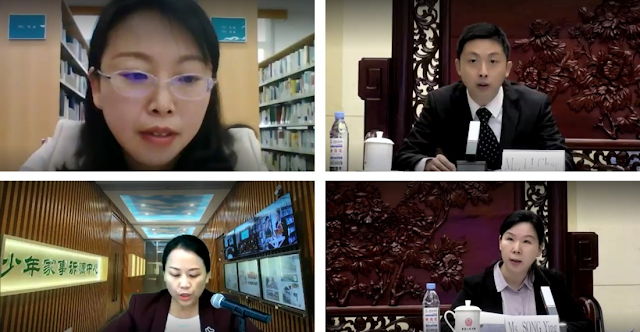
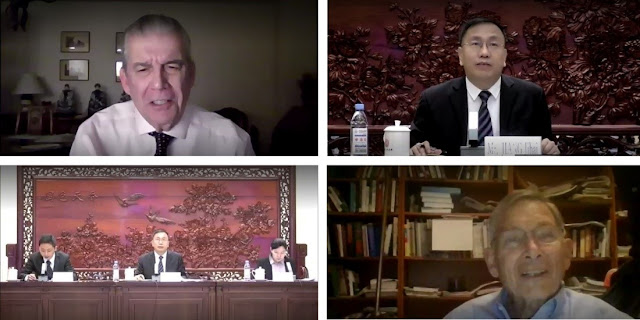
(Clockwise top left) Judge Wang, Deputy Director Li, Judge Song, and Committee Member Chen during the JPCW. Image credit: The Dui Hua Foundation
In 2021, Beijing News reported that 24,035 criminal cases involving the infringement upon the rights and interests of minors (including trafficking, child molestation, and forced begging) were tried nationwide between 2016 and 2020. Of those cases, 24,386 offenders received punishment. From 2016 to 2020, more than 1.2 million civil cases involving the upbringing and guardianship of minors were brought to trial.
The amendments to the Protection of Minors Law speak to an increased awareness by the Supreme People’s Court and the Chinese government that China’s youth face new challenges to their welfare that require novel approaches. These amendments also call on government social service agencies to improve the quality of support received by minors without guardianship. Li Chen, speaking during the JPCW shared that in 2021 13 authorities including the Ministry of Civil Affairs – which houses the Department of Children’s Welfare Affairs – jointly issued Opinions on Further Promoting Improvement, Upgrade and Innovation-Driven Transformation of Child Welfare Institutions to Pursue High-Quality Development. The opinions aimed to improve child welfare institutions at the provincial and municipal levels, and to foster increased integration between the upbringing of children and wraparound services like community-based medical treatment, rehabilitation, education, and social work.
The Protection of Minors Law differs from the United States’ approach to juvenile justice and child welfare, which is defined both by its child-focused, rights-based approach and its federalist orientation that creates variations between states with some federal regulation. By contrast, Beijing’s top-down approach stresses uniformity, setting responsibilities for various stakeholders to ensure compliance at the local level. A lingering question is how far the law will go in holding parents, schools, and other community stakeholders responsible for violations and derogations of child welfare.
The Youth of China in the New Era white paper paints a rosy picture of the future of child welfare in China:
In the future, with successive efforts from one generation of young people to the next, China will scale new heights in every dimension, achieving economic, political, cultural, ethical, social, and eco-environmental progress. The Chinese people will enjoy a happier and healthier life and the Chinese nation will become a proud and active member of the community of nations. The great Chinese Dream will eventually become a reality.
The continued emphasis on rule of law and legal responsibility is evident in the changes to the Protection of Minors Law. What is less clear is if these changes will yield a system that is fair, enforceable, and subject to rule of law in line with that Chinese Dream.
An All-of-Society Effort
The revised Protection of Minors Law also recognizes broader societal obligations to protect minors. Article 11 grants any organization or individual “the right to discourage, prevent, or report or make an accusation against an act…which is not conducive to the physical or mental health of minors or infringes upon the lawful rights and interests of minors.” These regulations share many of the same principles as those placed on schools and educational institutions. Using sexual or physical abuse as an example, Article 9 of the Opinion on Punishing Sexual Violations of Minors in Accordance of Law (2013) states that anyone with a special responsibility to minors – including supervising, educating, training, or providing medical treatment – has a right and obligation to report to the public security organ or the people’s procuratorate if they discover that a minor under their supervision has been abused.
As with the obligations for schools, the Protection of Minors Law’s view to societal obligations has similarities to CAPTA in the United States; however, by making reporting a legal responsibility through national legislation, China’s law potentially elevates the issue and could help create a uniform process for reporting, response, and resolution. Currently in the United States, each state may or does have different definitions, processes and responses to any reported abuse, of any kind. According to a 2019 report by the Child Welfare Information Gateway, approximately 47 States, the District of Columbia, American Samoa, Guam, the Northern Mariana Islands, Puerto Rico, and the Virgin Islands designate professions whose members are mandated by law to report child maltreatment. Individuals designated as mandatory reporters are those who typically have frequent contact with children. The circumstances under which a mandatory reporter must make a report, and the process for doing so, vary by state.
According to China Daily, Chinese procuratorates nationwide prosecuted 60,553 people for crimes against minors in 2021, up 5.7 percent year-on-year, of which 27,851 were for crimes involving sexual assault against minors. The Opinions on Establishing the Compulsory Reporting System for Cases regarding Infringement on Minors (Provisional) is meant to combat this trend by standardizing the compulsory reporting procedure system and specifying the parties considered mandated reporters. The reporting procedures enabled procuratorates, public security organs, and women’s federations to set up more than 1,600 “one-stop” interview and rescue areas to shield minor victims from “secondary injuries” or re-traumatization that can occur during the reporting process.
The revisions to the Protection of Minors Law reflect renewed appreciation for the role of society in protecting minors. The European Union’s Civil Society Roadmap for China notes that the revised Protection of Minors Law makes 13 mentions of “social organizations.” Furthermore, a State Council working group was established to assist civil society organizations focused on child protection in an effort to “achieve full coverage” of child protection by civil society organizations by 2025.
Achieving such comprehensive child welfare mechanisms remains a challenge for any government. China’s recent developments reflect a top-down, all-of-government mentality that outlines obligations for all stakeholders, from the parent who might have to leave their child with relatives to centralized government bodies. China’s approach speaks to the adage that it “takes a village to raise a child,” and both the JPCW presenters and the legislation suggest that there is room for civil society organizations and grassroots participation. Whether or not these entities have the space and agency to fill these roles remains to be seen.
The information in both parts of this article was gathered over the past year since the JPCW concluded. Dui Hua continues its dialogue with the SPC in an effort to stay abreast of developments and best practices for juvenile justice reform and the improvement of child welfare systems. These are areas in which countries the world over struggle to identify policies that will meaningfully address the issues facing youth, and dialogue on these issues is a reminder that sound child welfare policies help pave the way for a bright future.
On June 1, 2021, the second revision of the Law of the People’s Republic of China on Protection of Minors (hereafter Protection of Minors Law) came into effect. The revision introduced 60 new articles into law. During the Joint Program on Child Welfare Laws (JPCW) webinar hosted by Dui Hua in April 2022, panelists from the Supreme People’s Court of China (SPC) spoke in depth about the revisions to the Protection of Minors Law across six key protection areas: family, school, society, internet, government, and the judiciary.
The current Protection of Minors Law is the result of decades of revision and reform. First adopted at the 21st Meeting of the Standing Committee of the Seventh National People’s Congress on September 4, 1991, the law was revised in 2006; in 2012, it was amended in accordance with the Decision on Revising the Law of the People’s Republic of China on Protection of Minors made by the Standing Committee of the 11th National People’s Congress at the 29th Meeting. In 2020, it was revised at 13th National People’s Congress and came into effect in its current iteration in June 2021.
The amendments are meant to fill in the gaps of the previous law and safeguard children’s rights to the greatest extent possible. During the JPCW, Li Chen, Deputy Director of the Department of Children’s Welfare Affairs from the Ministry of Civil Affairs (MCA) stated that the revisions to the Protection of Minors Law “explicitly provide that the people’s governments at or above the county level shall establish a coordination mechanism for the protection of minors…so as to further consolidate the legal groundwork for the protection of minors (in China).” On April 21, 2022, the State Council Information Office of China issued a white paper titled Youth of China in a New Era. The paper stated that China’s aim is to “create a future of prosperity, health, safety, mutual respect, mutual learning, and shared benefits” for young people all over the world.
China’s reforms in child welfare and juvenile justice have made strides towards a more comprehensive national policy, and certain aspects of its system stand in contrast to the US child reform and juvenile justice systems which are largely decided at the state level. Yet, the vagueness surrounding the Protection of Minors Law’s scope may open the door to practices that are harsh on parents and guardians, place undue stress on families, or present issues for enforcement.
Screenshots from the April 7 expert exchange. (Clockwise top left) Host John Kamm, moderator Dr. Jiang Jihai, moderator Judge Len Edwards, Dr. Jiang with members of his panel. Image credit: The Dui Hua Foundation
This article explores China’s child welfare legislation by drawing on the relevant legislation, white papers issued by Chinese Communist Party organs, and remarks made during Dui Hua’s 2022 JPCW webinar. Part I focuses on the obligations of the family unit and educational institutions in child welfare. Part II looks at the designated roles of online entities, government bodies, the judiciary, and society at large in ensuring the welfare of the child.
“A Good, Harmonious & Civilized Family Environment”
Like many legal systems, China’s child welfare laws center the family as the foundation for child protection. During the JPCW, Judge Wang Wei, Deputy Chief Judge of the First Criminal Division of Jiangsu Province High People’s Court, spoke on guardianship revocation cases in China, stating that “raising children is both an ethical and affectionate need and a statutory responsibility.” The Protection of Minors Law contains ten articles that specify the guardian’s responsibility to the child, with emphasis on when and how guardianship can be revoked and possibly restored.
Issues of guardianship and child neglect have particular relevance in China due to the number of children who are left in the care of grandparents or other relatives in rural villages while their parents work in cities. A combination of factors – among them the household registration system known as hukou, the high cost of living in cities, and limited economic opportunities in rural areas – has resulted in millions of “left behind” children (留守儿童), so-called because they live apart from their parents for much of their childhood.
The cover of an individual household’s register, or hukou, booklet. Image credit: Wikimedia Commons / Public Domain
Article 21, a more recent addition to the Protection of Minors Law, stipulates that children under the age of eight cannot be left unattended or in the care of unsuitable guardianship. Minors under the age of 16 should not be forced out of the home or forced to live without a guardian. Article 15 states that “parents or other guardians of minors shall learn family education, accept guidance on family education, and create a good, harmonious and civilized family environment.” Article 15 also requires any adult family members living in the same house to bear some guardianship responsibilities, which are detailed in Article 16:
To provide minors with life, health, safety, and other aspects of protection;
To care for the physical, psychological and emotional needs of minors;
To educate and guide minors to abide by the law, to be diligent and thrifty, and to develop a good moral character and behavior habits;
To conduct safety education for minors to improve their self-protection awareness and ability;
To respect minors’ right to receive education and ensure that school-age minors receive and complete compulsory education in accordance with the law;
To ensure the time of rest, entertainment, and physical exercise for minors, and guide them to carry out activities beneficial to their physical and mental health;
To properly manage and protect the property of minors;
To act for minors to carry out civil legal acts in accordance with law;
To prevent and stop the bad behaviors and illegal and criminal behaviors of minors and conduct reasonable discipline; and
Other duties under guardianship that should be performed.
This list raises the issue of whether parents or guardians can be liable for violating the above responsibilities and whether courts can mandate revocation of guardianship. The broad sweep of section 10 could lead to highly discretionary implementation.
Articles 22 and 23 address instances when a minor’s parent or guardian is temporarily unable to perform their duties. Article 22 states that the parents or guardians “shall entrust a person with full capacity for performing civil juristic acts to attend minors,” and Article 23 requires the parent or guardian to promptly inform the child’s school and local authorities of the guardianship arrangement. The articles instruct guardians to follow specific reporting mechanisms but provide little guidance about how to determine if a guardian is “temporarily unable to perform duties.” Judge Wang of the Jiangsu Province High People’s Court clarified in his remarks that revocation of guardianship “is only applicable to serious circumstances; judicial power shall only intervene in family relations in a way of minimal damage as the ‘last resort.’ It should strictly distinguish between guardianship infringement and improper education/slight physical punishment.”
Article 36 of the Civil Code of China lists three circumstances when guardianship may be revoked either permanently or temporarily. During the JPCW, Judge Wang of Jiangsu Province High People’s Court described them thusly:
the guardian engaged in any act which damages the physical and mental health of the ward, such as sexual assault, sale, abandonment, abuse, and violence against the ward;
the guardian fails to perform the duties of guardianship or is unable to perform such duties but refuses to delegate all or part of the duties to others, i.e., drug use, gambling, or being alcoholic, in jail serving sentences, unable to perform their obligations (as a clause designed to cover all other circumstances);
the guardian is engaged in any other act which infringes upon the lawful rights and interests of the ward, such as instigating or using minors to commit crimes of a severe nature; coercing, deceiving, using minors to beg on the street, and refusing to rectify after censure and education being conducted three times by the public security authority.
Dr. Jiang Jihai, then-Director of the Juvenile Justice Guidance Division of the Supreme People’s Court of China, stated that the Family Education Promotion Law, which was also revised in 2021, escalated family education from traditional “family affairs” to “state affairs.” The law stipulates that parents bear principal responsibility such that “if they fail to fulfill this responsibility, or do not implement family education correctly, they should bear the corresponding legal responsibility.”
Safe Schools, Peaceful Campuses
Beyond the family, the Protection of Minors Law similarly introduced and amended regulations on the responsibility of schools in child protection. The law and its amendments provide a blueprint for child protection in educational institutions by assigning new responsibilities to institutions as well as specifying special-purpose schemes, administrative requirements, work mechanisms, and measures for support and supervision.
Chinese elementary school students on their way to school in Nanyou. Image credit: Wabbit Wanderer Flickr Account / CC BY-SA 2.0
Education environments – including kindergartens, special education institutions, primary, secondary, and vocational schools – have mandatory measures to fight campus bullying and sexual misconduct, and they also mandate the inclusion of sex education curriculum. Kiosks and businesses that sell alcohol, cigarettes, or lottery tickets are barred from operating near schools to prevent minors from developing unhealthy habits. To prevent sex trafficking, hotels and short-term accommodation facilities must ask underage guests for their guardians’ contact information and the nature of their relationship with fellow guests. Hotel staff are obligated to call police if they observe suspicious activity involving child sex trafficking. The Ministry of Education (MOE) and other authorities launched pilot programs at schools, organized training workshops, and provided guidance to students, including:
Initiating the “safe school and peaceful campus” campaign;
Launching a national safety education day for primary and secondary school students;
Holding special activities around water safety to prevent drowning accidents;
Launching an anti-bullying initiative for primary and secondary school students;
Implementing measures such as regulating extracurricular sports training and strengthening the physical health management of primary and secondary school students.
In 2016, China Daily reported on new measures to combat school bullying, including that authorities will hold regions and schools responsible if they are found to have serious bullying problems. Issues of bullying and sexual assault continue to draw widespread public attention. A 2016 survey of seven Chinese cities found that 26 percent of urban children had been bullied during the previous year. As such, the law includes implementation rules and procedures to help schools and other authorities identify and intervene in bullying, abuse, and harassment at schools. For example, Article 130 provides a legal definition of bullying, and Article 39 provides a mandate for schools to establish a formal system of control and prevention of bullying.
The national reach of the Protection of Minors Law is distinct from federal efforts in the United States to curtail bullying. The law is unique in its far-reaching nature and its placement of legal responsibility on multiple different actors, including schools, parents, public security organs, and law enforcement. The closest US analog to the Protection of Minors Law is the Federal Child Abuse Prevention and Treatment Act (CAPTA). CAPTA is primarily concerned with physical and sexual abuse against minors, but its impact is limited as it depends on individual states to pass legislation on mandated reporting of child abuse neglect.
The roles of family and schools in child welfare present an emerging picture of how legislation differs between China and the United States. While both legislate obligations for different parties and manifest this largely through mandatory reporting requirements, China’s top-down legislation stands in contrast to the United States’ approach. The US system offers guidance but leaves actual definition and implementation to states to induce localized systems. How these obligations – and the differences in systems – manifest across cyberspace, government, judicial bodies, and society at large will be discussed in Part II.
Author of a well-known blog sentenced for incitement in Shanghai
On March 20, 2023, lawyer Shan Baojun shared a screenshot on Twitter with a simple message: “It seems we might have the whereabouts of Ruan Xiaohuan.”
The screenshot showed messages supposedly posted on WeChat by Ruan’s wife, Bei. In the messages, she confirms that Ruan Xiaohuan (阮晓寰) was detained in May 2021 and was convicted and sentenced for “inciting subversion of state power” on February 10, 2023; she is now under pressure from police for trying to seek legal representation for Ruan’s appeal. In the messages, Bei also claims that Ruan is the anonymous author behind the blog “编程随想” (programthinking) and that he was the chief engineer of network security for the 2008 Beijing Summer Olympics.
The news caused a stir. Ruan’s blog is well known among the Chinese-speaking tech community and the intellectually curious. It started in 2009 as a place where the author shared summaries of the latest developments in computing, programming, and network security; later, on the eve of the 20th anniversary of June 4th, tips on how to circumvent China’s notorious Great Firewall were added. In 2010, the then-unknown author started sharing his opinions and commentaries on social incidents and broader political issues. The blog also uploaded eBooks on social and political subjects for visitors to download and share. Many people, after learning of Ruan’s ordeal, credited the blog as the reason they began seeking information outside of China’s strict censorship regime.
The identity of the author was carefully concealed, though there was much speculation and possibly even attempts at doxing. When the blog suddenly stopped updating – its last post is from May 9, 2021 – rumors and worries started to emerge as to the host’s whereabouts.
Su Yutong, an independent journalist based in Berlin, filled in more details and later posted the full judgment on her Twitter account.
Shanghai Number Two Intermediate Court convicted and sentenced Ruan to seven years in prison with two years of deprivation of political rights (DPR) for the crime of endangering state security. Twenty thousand yuan from his personal assets was also confiscated. The police searched and detained Ruan at his home on May 10, 2021. The police investigation presented some circumstantial evidence linking Ruan and the blog – a local archive or log file automatically generated on the computer when the author has logged on to the blog. The judgment also revealed that the procuratorate accused Ruan of authoring over a hundred articles falsely attacking the CCP and China’s socialism political system and posting his writings on overseas platforms.
How the police were able to track Ruan to his home remains unknown. He might have inadvertently used the same or similarly constructed email addresses on different services or platforms, which could have revealed his identity. Some China observers also speculated on the reason the police waited so long to go after Ruan. In addition to the blog, Ruan appears to have kept an account on GitHub, a popular code repository platform, with the same name as his blog “编程随想 programthinking.” Under that account, there is an open-source project started in early 2016, with the intention to map out connections among the princelings – the descendants of CCP elites and elders. The project was the target of a take-down request from China’s Central Cyberspace Affairs Commission to GitHub in June 2016. GitHub, however, rejected the request but made the project inaccessible to IPs from China.
Lawyer Shan also provided updates on the progress of Bei’s effort for Ruan’s appeal. Bei had to file an official complaint to the court because the presiding judge at the Shanghai High Court installed two court-appointed lawyers from the legal assistance program, replacing lawyers Shan and Mo Shaoping who were hired by the family. Shan also claimed that neither he nor Mo could receive calls from overseas phone numbers.
The appeal has been filed with the Shanghai High Court, while Ruan is in custody at Shanghai Yangpu District Detention Center.
Clemency granted to “cult” prisoners in Guangdong women’s prison
A response from a Chinese interlocutor given to Dui Hua in March 2023 confirmed that two female Falun Gong practitioners in Guangdong received clemency at the end of 2022.
Guo Yafen (郭雅芬), a resident of Meizhou in her 50s, received a six-month reduction at the end of 2022. Guo was sentenced to six and a half years for using a cult to undermine implementation of the law (Article 300 of the Criminal Law) in 2019 by the Mei County Court. This is Guo’s second incarceration. She was previously convicted and sentenced to 11 years for the same crime by the Mei County Court in 2005. Guo was granted parole in 2012 and subsequently released in 2013. Because Guo is considered a recidivist, clemency is applied more strictly – meaning there is a longer waiting time for the first reduction and longer intervals between reductions. Guo is expected to be released in June 2024.
Xu Ruiping (徐瑞萍), a resident of Jieyang in her 60s, was granted a seven-month reduction at the end of the 2022. This is Xu’s second reduction. The first, a six-month reduction, was granted in 2020. Xu was convicted and sentenced to 10 years’ imprisonment for Article 300 in 2016 by the Jiedong District Court. She was also given a supplemental sentence of three years of DPR, rare in cult cases. Her DPR supplemental sentence starts after release and means that Xu will be designated as a “targeted population” member and subject to strict police monitoring. Her movements will also likely be restricted. Xu is expected to be released in January 2025.
House church leaders released
Prominent Christian activist Hu Shigen (胡石根) completed his seven-year-and-six-month sentence for subversion in Tianjin’s Changtai Prison on March 23, 2023. Hu was among the approximately 300 human rights lawyers, legal professionals, and activists who were detained nationwide amid the “709” crackdown that began on July 9, 2015.
Hu’s activism began after June Fourth, and he was a leader of underground churches in Beijing. In 1992, Hu was detained for two years and then served 14 years in prison for now-defunct counterrevolutionary crimes until his release in 2008. While he was granted two sentence reductions totaling 24 months during his first prison stint, Hu completed his second full jail term in 2023 without a sentence reduction. Hu remains obliged to serve his five-year DPR sentence until March 22, 2028.
Another house church leader, Geng Zejun (耿则军), was released from prison in Ningxia on March 19, 2023, also without a sentence reduction. Geng is a pastor from the Church of Rock in Shizuishan. He is believed to have been punished for refusing to join the state-run Three Self Patriotic Church. In January 2022, he was criminally detained for holding an unlawful assembly and later sentenced to 15 months in prison.
Veteran activist Dong Guangping remains missing
In a response to the request from the UN Office of the United Nations High Commissioner for Human Rights dated March 15, 2023, the Permanent Mission of Vietnam denies that the country knows the whereabouts of Chinese activist Dong Guangping (董广平), who reportedly had been detained in Hanoi in 2022.
Dong, a resident from Zhengzhou, Henan, had been incarcerated several times for his advocacy on political reform and vindication of the June Fourth protest. He was first convicted and sentenced to three years in prison with one year of DPR for inciting subversion in 2001. In 2015 he fled to Thailand with fellow activist Jiang Yefei. Despite having obtained refugee status and awaiting resettlement in Canada, the duo was caught by Thai police and subsequently turned over to Chinese state security. Dong was convicted and sentenced to three and a half years in prison with one year of DPR for subversion and illegal border crossing in 2018. Jiang was sentenced to six and a half years for the same crimes.
Dong made another attempt to leave China after his release in 2019. He was detained by Vietnamese authorities in Hanoi in August 2022, where Dong has been residing since January 2020. His whereabouts remain unknown. It is feared that Dong has been sent back or is at risk of being sent back to China, in violation of Vietnam’s obligation to respect the principle of non-refoulement and despite its seats on the UN Human Rights Council.
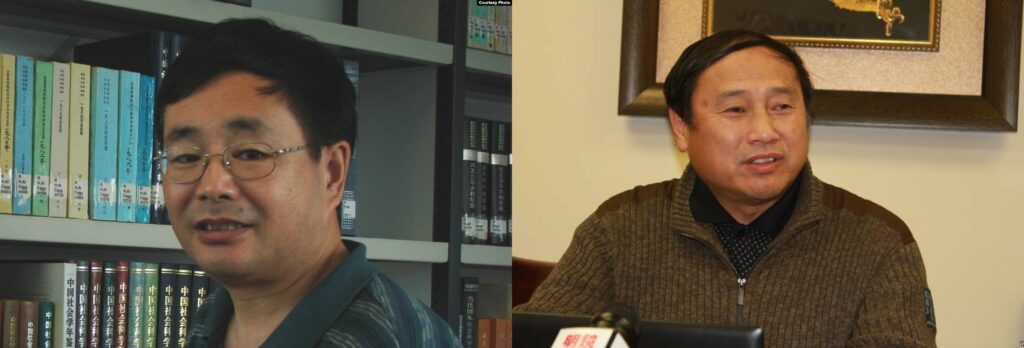
(Left to right) Chen Ziming and Wang Juntao. Image credits: PublicDomain
It didn’t take long for the Chinese government to blame foreign and domestic forces for the May-June 1989 protests that rocked Beijing and hundreds of other cities, large and small, throughout the country. The targets of their ire included the United States and other western democracies, which maintained embassies and media offices, in China’s capital. Another target was The Hong Kong Alliance in Support of Patriotic Democratic Movements in China, established in May 1989, which organized huge protests and vigils in the British colony. The alliance was disbanded in late 2021 following the arrest of three of its leaders, part of the ongoing crackdown on opposition figures in the Hong Kong Special Administrative Region.
Less organized than the Alliance were groups of activists who set up Operation Yellow Bird to spirit activists out of China. Working out of Hong Kong, this loosely organized group managed to extricate as many as 300 hunted dissidents and activists out of China, sometimes with the help of disgruntled Chinese officials.
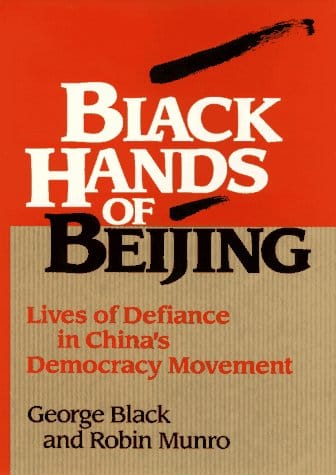
A cover of the first edition of Black Hands in Beijing, published in 1993. Image credit: Biblio
Closer to home, the Public Security Ministry identified 21 student leaders allegedly behind the protests in Tiananmen Square. The list included Wang Dan, Wu’er Kaixi, Chai Ling, and Liu Gang. “Black Hands” were singled out in the “Six Important Criminals List.” Prominent on this list were Chen Ziming (陈子明) and Wang Juntao (王军涛), founders of the Beijing Economic and Social Sciences Research Institute (SESRI), an influential think tank established in 1987 that published books, undertook public polling, and even fielded candidates in local elections. Another black hand was labor leader Han Dongfang (韩东方), founder of the Beijing Autonomous Workers Federation. (A good account of Chen Ziming, Han Dongfang, and Wang Juntao’s activities in the run-up to Tiananmen can be found in Black Hands of Beijing by Robin Munro and George Black. My memories are also informed by communications with Wang Juntao.)
Chen and Wang were hunted down and arrested, Chen on October 10, 1989, in Mongolia, and Wang on October 20, 1989, at the Changsha Train Station in Hunan Province. Liu Gang (刘刚), founder of the Beijing Independent Students Federation, was detained weeks after the protests, on June 19, 1989. Han Dongfang was never tried but was kept in a detention center where he contracted tuberculosis. The prosecution chose not to charge him and eventually let him leave for Hong Kong, where he still lives.
After detention, Chen Ziming and Wang Juntao were held in local detention centers where they were interrogated. They then spent several months in the notorious Qincheng Prison where political prisoners were held.
Chen, Liu, and Wang were all tried and convicted by the Beijing Intermediate People’s Court in 1991. Chen and Wang were given 13-year prison sentences. They were sent back to Qincheng Prison, and eventually sent to Beijing Number Two Prison and Beijing’s Yanching Prison to serve their sentences.
Liu served his prison sentence in Lingyuan Prison in Liaoning Province. It is common practice that individuals who are tried and sentenced in Beijing are returned to their home provinces to serve their sentences.
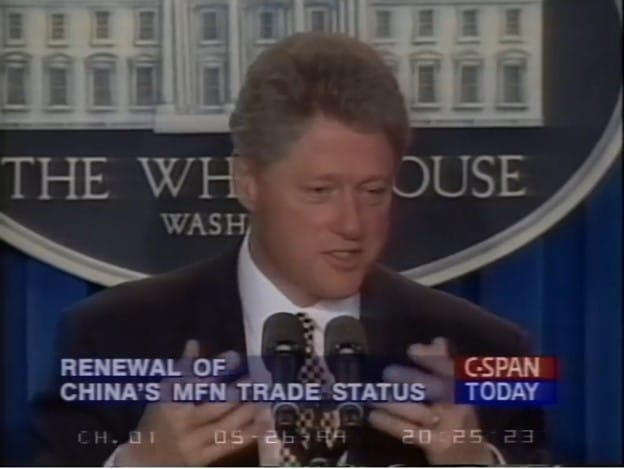
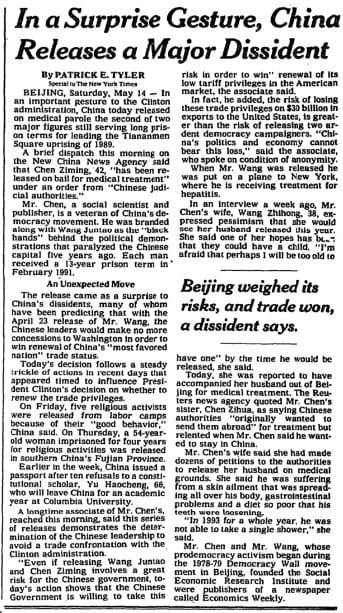
Reflecting intense international pressure from governments and human rights groups, including Dui Hua, both Wang and Chen were released on medical parole in April 1994 and May 1994, respectively. The releases were tied to President Bill Clinton’s decision to renew China’s Most Favored Relations trade status, without conditions, in May 1994. (Chinese officials repeatedly told me the releases were part of a “special arrangement.”)
President Clinton during his announcement on May 26, 1994, to support Most Favored Nation status for China despite no significant progress on human rights. Clinton also announced extended sanctions on China and the banning of munitions sales. Image credit: C-Span
Chen Ziming had been diagnosed with cancer, heart disease, and Hepatitis C while Wang had been diagnosed with Hepatitis B. Wang Juntao left China immediately after he was released and relocated to New York, where he has lived to the present day, distinguishing himself in both academics and activism. Neither he nor his family were provided with the documentation necessary for granting medical parole.
Chen opted to stay in China. He was imprisoned again in June 1995 but was again released on medical parole in November 1996. He was placed under residential surveillance until his sentence expired in 2002. Chen Ziming passed away in 2014.
Liu served his entire sentence without a sentence reduction. He was released on June 18, 1995. He departed in May 1996 for the United States. He forged a successful business career in technology and finance, working for Bell Labs and Morgan Stanley. Like Wang Juntao, he has remained active in promoting democracy in China.
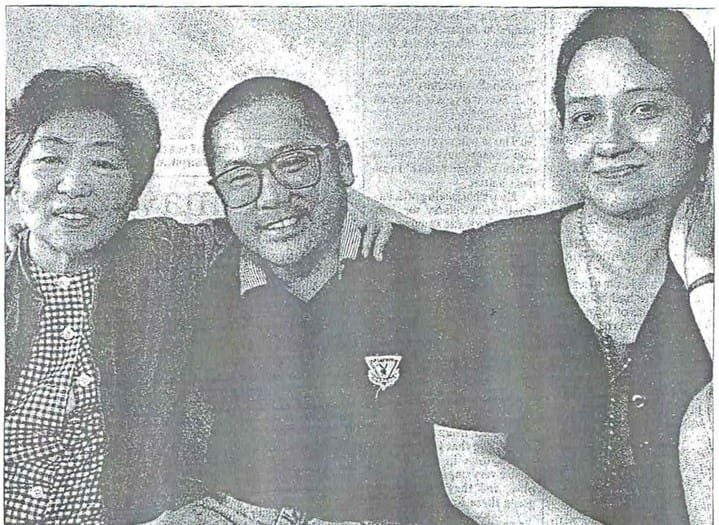
As recounted in “Operation Yellow Bird,” Hong Kong businessman Lo Hoi-sing (Luo Haixing) was sentenced to five years in prison for trying to get Chen Ziming and Wang Juntao out of China. He was granted early release from Huaiji Prison in western Guangdong Province in 1991, after which he returned to Hong Kong.
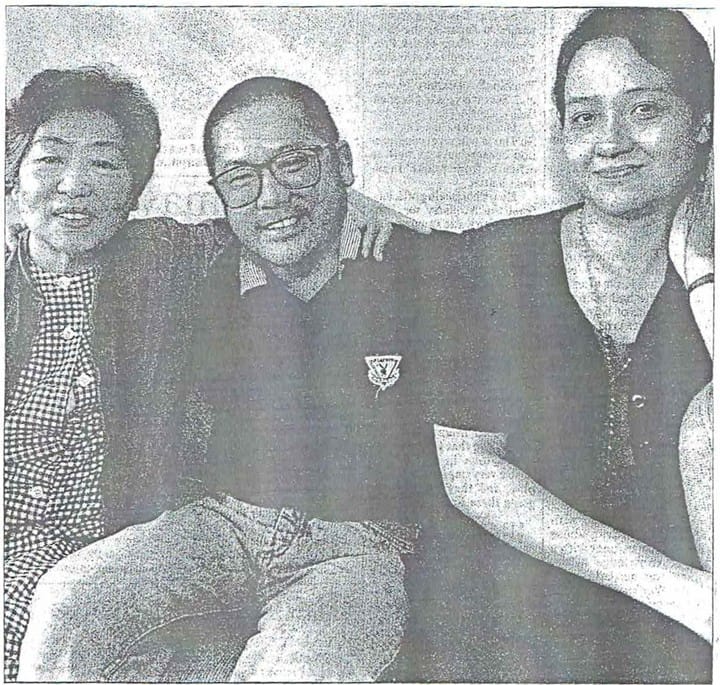
A scan of a photo that appeared in the South China Morning Post after Lo’s release. Lo (center) with his mother and wife (left and right, respectively). Image credit: South China Morning Post via Dui Hua archives
My work on these cases established a modus operandi that I have relied on for prisoner interventions to the present day. I submitted prisoner lists to the Chinese government and pressed Chinese officials for responses, met with family members of the imprisoned, informed the US government of my activities and coordinated efforts with the American embassy in Beijing, obtained letters from members of Congress that were forwarded to the Chinese government, held press conferences (including in Beijing), and gave speeches, many in Hong Kong.
Although governments met with the Ministry of Foreign Affairs (MFA) to press for clemency for political prisoners, what set my work apart was my ability to meet with other key bodies, including the State Council Information Office, the Ministry of Public Security, the Ministry of Justice (MOJ), and the People’s Institute of Foreign Affairs, as well as the MFA. I met with officials of all these bodies to discuss the Chen Ziming/Wang Juntao case.
Photographs
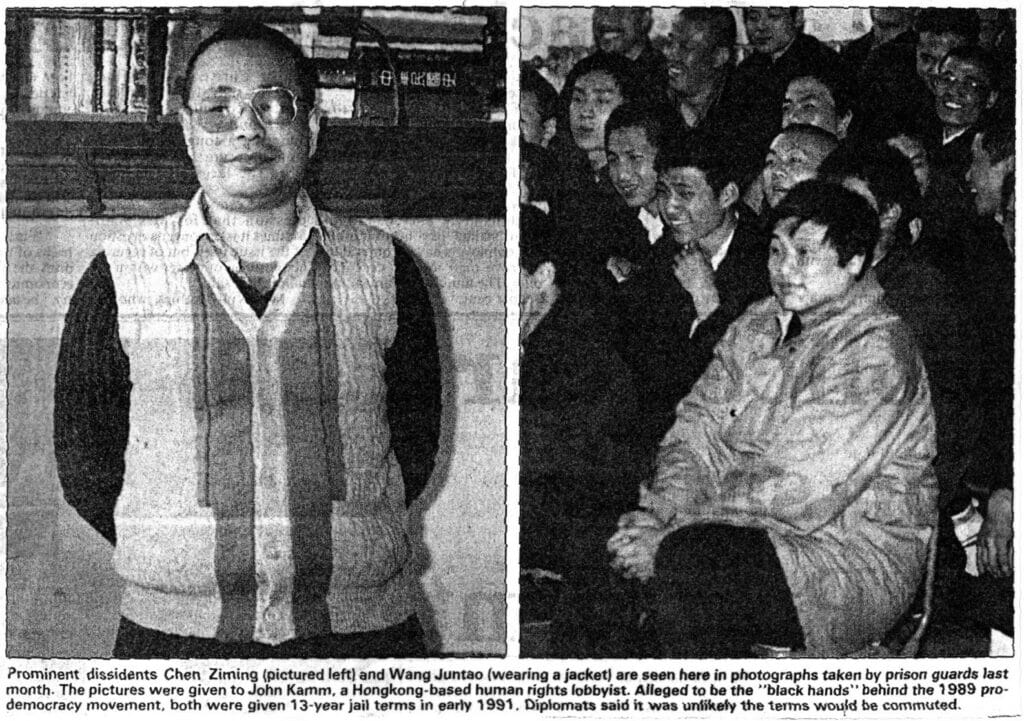
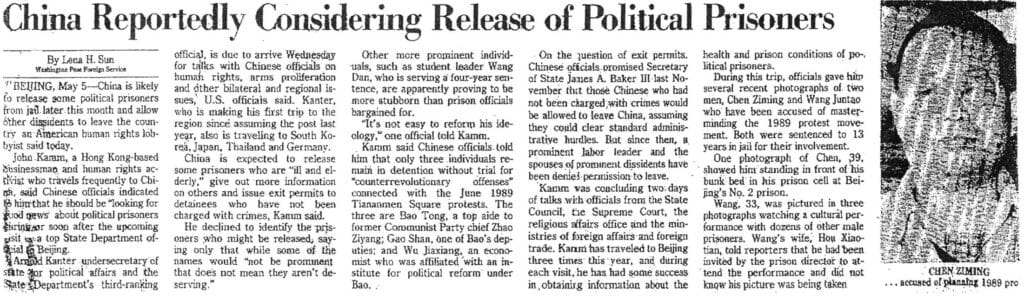
On my May 1992 visit to Beijing, I met with Minister Zeng Jianhui of the State Council Information Office (SCIO). We met in his rather rundown office in the Asian Games Village. Zeng handed me three photographs of Wang Juntao and two of Chen Ziming. Wang was shown watching a performance at Yanqing while Chen was photographed in his cell, books stacked high on his bunk bed. Yanqing is near a hospital operated by the MOJ. Zeng told me that Wang was being treated for Hepatitis there but had been returned to his cell. Both Wang and Chen were in four-man cells that were not, at the time of my meeting with Zeng, fully occupied.
I provided the photographs to the media in Beijing. Hong Kong’s South China Morning Post ran the pictures the next day.
The photos of Chen and Wang published in the South China Morning Post on May 7, 1992. The caption acknowledges Kamm as the source.
Not everyone was happy with my releasing the photographs of Chen Ziming and Wang Juntao. At a congressional hearing held on June 29, 1992, Human Rights Watch (HRW) Washington representative, Mike Jendrzejczyk attacked me for releasing photographs of Liu Gang playing volleyball. HRW had claimed that Liu had had his arm broken. In fact, I hadn’t been given any photographs of Liu, which I pointed out to the congressman running the hearing. Jendrzejczyk’s response was classic: while Kamm may not have released the photos, he could have!
Around the same time, another HRW staff person attacked me in a letter to the Los Angeles Times, implying I was being used by the Chinese government to spread disinformation. In a similar vein, Harry Wu told the San Francisco Chronicle that he had warned me against being used by the Chinese government (in fact, he hadn’t). I ignored these and other attacks on me and my work. As the old saying goes, “Living well is the best revenge.”
Interrogation
On my August 1992 visit to Beijing, I met with Assistant Minister of Public Security Zhu Entao at his headquarters near Tiananmen Square. (Zhu’s nickname was China’s 007). He gave details of the interrogation of Hou Xiaotian, Wang Juntao’s wife at the time. The interrogation lasted four days. “At first she was very uncooperative,” Zhu related, “but her attitude changed as time went on, so we released her. We promised to look into her complaints about her husband’s treatment.” After her release from public security detention, the police kept her under surveillance.
On August 25, 1992, I was hosted by Zhou Jue, Vice Minister of the SCIO and former Chinese Ambassador to France, to dinner. Zhou told me that Wang Juntao had staged a hunger strike but that he was now eating normally. A photograph of Wang Juntao eating with his relatives the night after his release was circulated by Beijing.
The following evening, August 26, 1992, I hosted a banquet for most of the senior officials I worked with on prisoners including Yang Jiechi (MFA), Zhou Jue (SCIO), Zhu Entao (PSM), and Li Yucheng (SPC). In light of the looming US presidential election, I stressed the importance of releasing Wang Juntao and Chen Ziming and other high-priority prisoners.
An article from the Washington Post published on May 6, 1992. Image credit: Washington Post archives / Fair Use
“Special Privileges”
On my March 1993 visit to Beijing, I met with Mr. Wang Mingdi, director of the MOJ’s Prison Administration Department, at the MOJ’s dilapidated office building on a dusty side road off the main highway to the old airport. (Across from the office gate, a pool table occupied the street. Players were muscular young men wearing police fatigues.) Wang told me that Chen Ziming had been granted “special privileges” so that he could study for his doctorate. Wang Mingdi listed them as “better lighting, more paper, more books.” I relayed Chen’s family’s concern that he was sharing his cell with common criminals and that he was not being treated for a skin disorder.
Reporting on the releases of Chen and Wang from The New York Times article published on May 14, 1994. Image credit: The New York Times archive / Fair use
Clinton, Wang, Chen
In my meeting with Wang Mingdi on my June 1994 trip, shortly after Chen and Wang had been released, he spoke sarcastically about Wang Juntao’s activities in the United States: “When he was in jail, you kept telling us how seriously ill he was. We spent lots of money — more than RMBl00,000 — on medical treatment for Wang Juntao. He wouldn’t have been able to travel to the United States in such good shape had we not treated him so well. But now I read that he is undertaking all kinds of strenuous activities — traveling here and there for speeches and meetings. I’m tempted to ask you Americans: if Wang Juntao’s medical situation is so serious, aren’t you afraid you’ll endanger his health by arranging so many programs for him?” Wang Mingdi did not characterize Wang Juntao’s activities as illegal or as representing violations of the terms of his parole.
On the same trip I met with Ambassador Zhang Wenpu, Vice President of the People’s Institute of Foreign Affairs, a top America watcher who played a key role in what he called the “Wang Juntao/Chen Ziming deal for MFN.”
An agitated Zhang Wenpu had this to say: “I and many other Chinese officials find it abhorrent for China to trade prisoner releases for concessions from foreign powers.” He went on: “We released two of the five names on the State Department’s final list. Do people in the West appreciate that President Clinton raised both Wang Juntao and Chen Ziming’s names during his meeting with President Jiang Zemin in Seattle, and that subsequent to their names being raised, both were released? Is the significance of this understood? I have been in the Chinese government for my entire working career, and I think this is quite extraordinary.”
A year after my June 1994 trip to Beijing, I moved with my family to San Francisco, where I have stayed to the present day. With close friends, I established Dui Hua in 1999. The foundation continues to intervene on behalf of political and religious prisoners in China, using the modus operandi established during the work on the Wang Juntao and Chen Ziming cases in the early 1990s.
Kamm Engages Community, Students on Social Justice, Open-Source Research
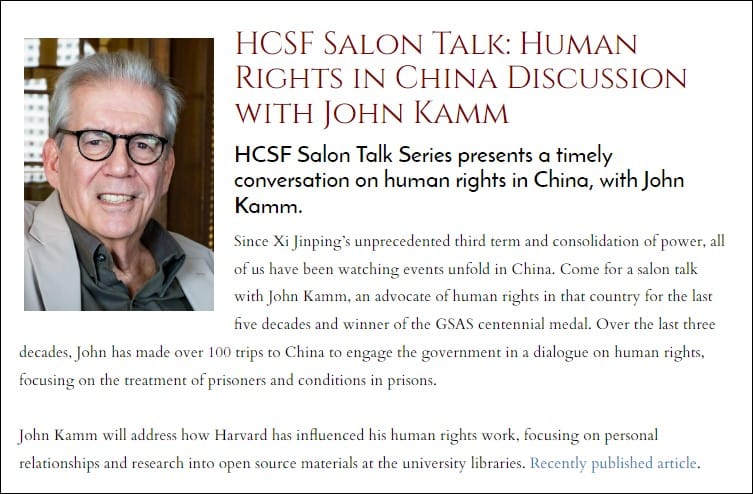
The Harvard Club of San Francisco’s announcement of Kamm’s speaking event. Image credit: Harvard Club of San Francisco
It was a busy February for Dui Hua Executive Director John Kamm. He delivered remarks about Dui Hua’s work and his own evolution from businessman to human rights activist to two diverse audiences: the Harvard Club of San Francisco and the students and faculty of the University of New Haven. Both remarks were delivered virtually.
The speeches were followed by lively Q&A sessions during which Kamm responded to 15-20 questions from engaged audiences.
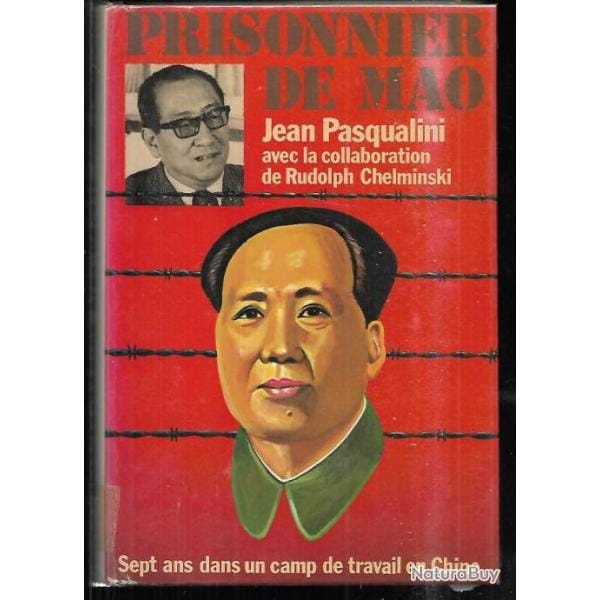
The cover of the 1975 edition of Prisoner of Mao. Image credit: NaturaBuy
Kamm encountered Harvard in two different periods. In 1974-1975, he studied for a master’s degree in the Regional Studies Department in the Graduate School of Arts and Sciences. During these two years he took classes from three of the most eminent sinologists in the United States: Yang Liensheng, Dwight Perkins, and Jerry Cohen. In Cohen’s class, Kamm heard from former counterrevolutionary Jean Pasqualini, author of Prisoner of Mao.
After graduation, Kamm returned to Hong Kong and not long afterward he began traveling to China. In the 25 years since his graduation in 1975, Kamm transitioned from businessman to human rights activist, making his first prisoner intervention in May 1990 and establishing Dui Hua in 1999. Right after founding Dui Hua, Kamm began traveling to Cambridge to conduct research in Harvard libraries, speaking to students and community groups, and meeting with alumni and teachers, some of whom were friends and relatives of political prisoners in China.
Kamm gave examples of cases of political prisoners found in Harvard libraries, estimating that more than 1,000 names had been found during many trips back to the university.
On February 23, 2023, Kamm spoke to students and faculty of the University of New Haven as part of the Brehm Boucher Speakers Series. He spoke about his days battling racism at the New Jersey Shore as well as working on human rights in China and US-China relations. The Dui Hua executive director recounted his experience in a town that was a stronghold of the Ku Klux Klan, but which also had a small Chinese restaurant where his mother struck up a friendship with the Chinese woman who ran the eatery.
Kamm during his time at Harvard University. Image credit: The Dui Hua Foundation
Kamm then talked about his time at Princeton University. Like many of the students at the University of New Haven, he was the first member of the Kamm family to graduate from college.
Greeting sign for Ramah Valley in New Mexico, where Kamm once taught. Image credit: Public Domain
At Princeton, Kamm began his life-long study of the Chinese language, but he dropped Chinese after his freshman year and a summer at Middlebury Language School. He concentrated on anthropology and spent the summer of 1971 teaching school to the Ramah Navajos in New Mexico. While at Ramah, he heard on the radio that Henry Kissinger had returned from China to announce that President Richard Nixon were to travel to China in 1972. Kamm resolved to follow in his footsteps. He left the United States for South China in August 1972.
Kamm then described the current state of human rights in China from the perspective of an activist, referring to the “challenging” situations in Xinjiang and Hong Kong and the perils faced by political and religious prisoners. From there he pivoted to a discussion of the state of US-China relations, which Kamm characterized as the worst in his fifty years working in China.
Kamm laced his remarks with “life lessons” he’d picked up on his journey, referencing the importance of learning what his mother called “an exotic language” and studying a major that would enable maximum flexibility in choosing a career. Kamm singled out anthropology as a good major for a business career. Kamm concluded his remarks with a stirring call to work on social justice in the United States and abroad.
PUBLICATIONS ROUND UP
Featured: Guest essay in USALI Perspectives, February 13, 2023: “Of Dialogues and Prisoner Lists” (republished in the Human Rights Journal)
Of Dialogues and Prisoner Lists
As China prepares to resume bilateral human rights dialogues, a human rights advocate reflects on their record
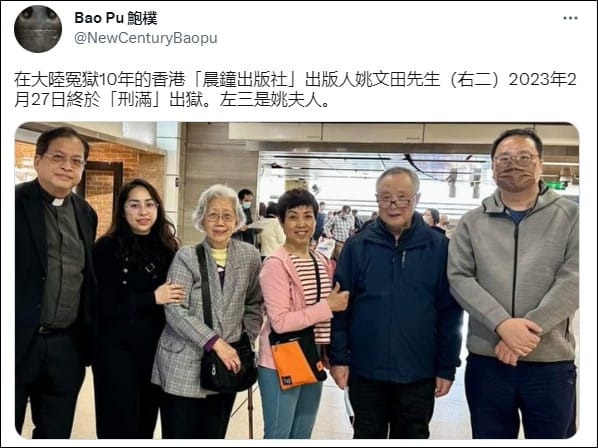
A tweet showing Yao Wentian (second from right) welcomed by family and friends after his release from prison on February 26, 2023. Image credit: Bao Pu Twitter account
SAN FRANCISCO (MARCH 2, 2023) — Hong Kong publisher Yao Wentian (姚文田) was released from Dongguan Prison in Guangdong province on February 26, 2023. With the exception of an eight-month sentence reduction for good behavior that was granted by the Dongguan Intermediate People’s Court in April 2019, Yao served his entire sentence in Dongguan Prison. News of this reduction was not reported in the media at the time. Dui Hua learned of the sentence reduction decision from an interlocutor and thereafter informed the family. He returned to Hong Kong on February 27, 2023.
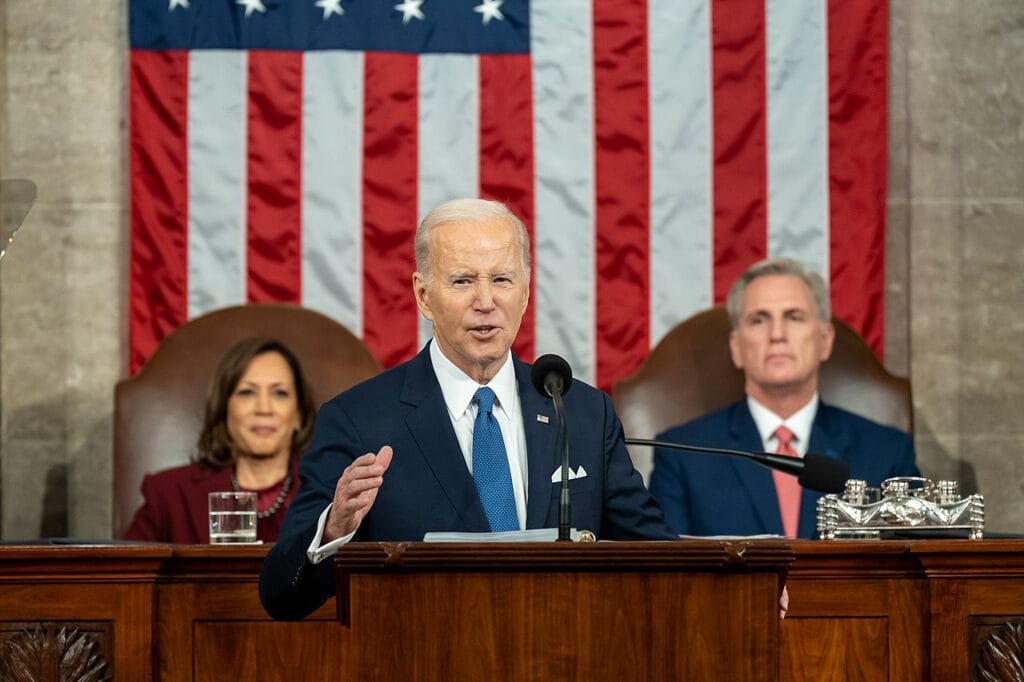
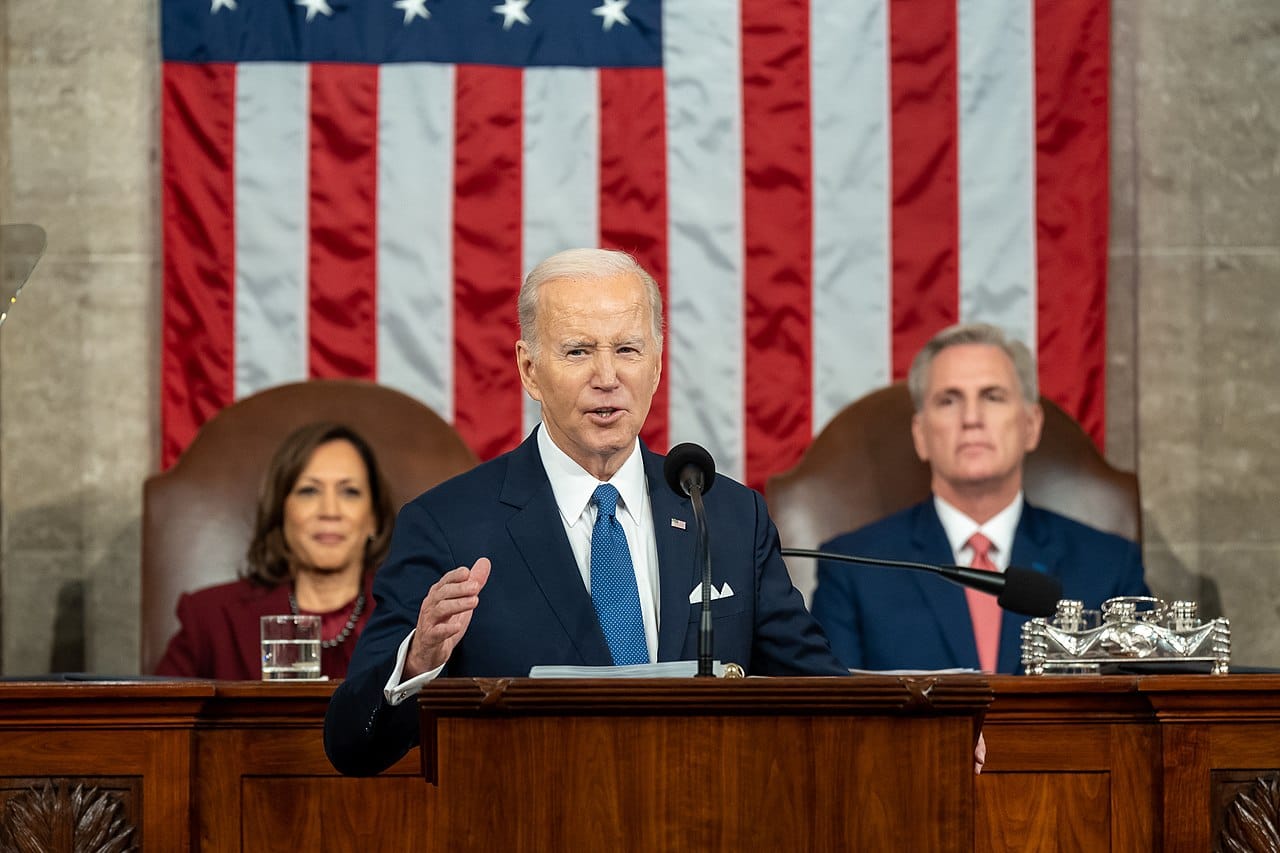
US President Joe Biden delivering the 2023 State of the Union Address on January 7, 2023 with Vice President Harris and House Speaker McCarthy seated behind him. Image credit: Public Domain
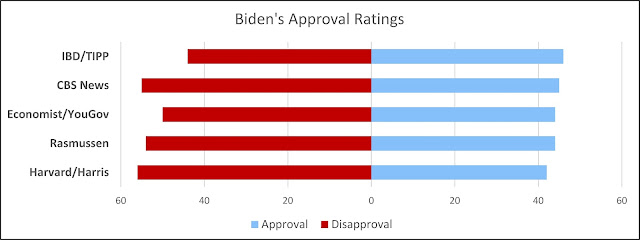
Polling from the start of 2023 suggests that China is increasingly unpopular in the United States as well as in other regions. A majority of Americans are dissatisfied with the Biden administration’s handling of the US-China relationship. Approval ratings for Biden as president are hovering in the 40s, a modest increase from the lows of summer 2022. As per the Harvard/Harris poll from January 18-19: “Biden’s approval is stable but underwater.”
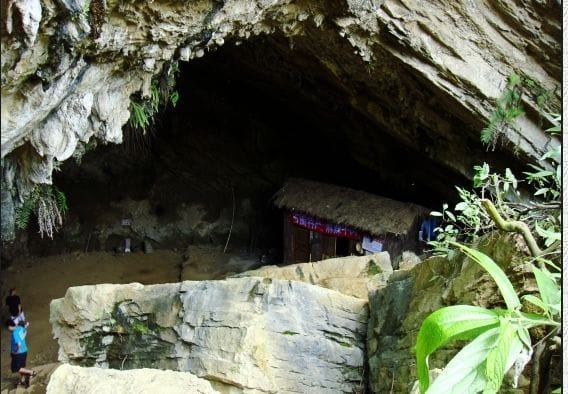
Daheidong Cave in Luzhou, Sichuan, where the Southwest Buddha League was headquartered in 1996. Image credit: Sogou
The criminal acts of armed rebellion (武装叛乱) and armed rioting (武装暴乱), defined in Article 104 of the Criminal Law, are among the least understood crimes of endangering state security (ESS). They are also among the least frequently invoked in the country. Statistics published by the 12-volume Records of People’s Courts Historical Judicial Statistics: 1949-2016 indicated that Chinese courts only tried 11 cases involving 39 defendants in the 18 years beginning in 1998.
An artist who recorded daily Covid tests still missing, an academic sentenced for inciting subversion, a Hong Kong publisher freed after almost 10 years, a Wuhan medical welfare protester detained, a political dissenter serving for second jail term, a notable prisoner release, clemency for inmates at Guangdong Provincial Women’s Prison, and Falun Gong practitioners facing trials again in Beijing.
John Kamm Remembers is a feature that explores Kamm’s human rights advocacy prior to and since Dui Hua’s establishment in 1999.
Black Hands
(Left to right) Chen Ziming and Wang Juntao. Image credits: PublicDomain
It didn’t take long for the Chinese government to blame foreign and domestic forces for the May-June 1989 protests that rocked Beijing and hundreds of other cities, large and small, throughout the country. The targets of their ire included the United States and other western democracies, which maintained embassies and media offices, in China’s capital. Another target was The Hong Kong Alliance in Support of Patriotic Democratic Movements in China, established in May 1989, which organized huge protests and vigils in the British colony. The alliance was disbanded in late 2021 following the arrest of three of its leaders, part of the ongoing crackdown on opposition figures in the Hong Kong Special Administrative Region.
Less organized than the Alliance were groups of activists who set up Operation Yellow Bird to spirit activists out of China. Working out of Hong Kong, this loosely organized group managed to extricate as many as 300 hunted dissidents and activists out of China, sometimes with the help of disgruntled Chinese officials.
A cover of the first edition of Black Hands in Beijing, published in 1993. Image credit: Biblio
Closer to home, the Public Security Ministry identified 21 student leaders allegedly behind the protests in Tiananmen Square. The list included Wang Dan, Wu’er Kaixi, Chai Ling, and Liu Gang. “Black Hands” were singled out in the “Six Important Criminals List.” Prominent on this list were Chen Ziming (陈子明) and Wang Juntao (王军涛), founders of the Beijing Economic and Social Sciences Research Institute (SESRI), an influential think tank established in 1987 that published books, undertook public polling, and even fielded candidates in local elections. Another black hand was labor leader Han Dongfang (韩东方), founder of the Beijing Autonomous Workers Federation. (A good account of Chen Ziming, Han Dongfang, and Wang Juntao’s activities in the run-up to Tiananmen can be found in Black Hands of Beijing by Robin Munro and George Black. My memories are also informed by communications with Wang Juntao.)
Chen and Wang were hunted down and arrested, Chen on October 10, 1989, in Mongolia, and Wang on October 20, 1989, at the Changsha Train Station in Hunan Province. Liu Gang (刘刚), founder of the Beijing Independent Students Federation, was detained weeks after the protests, on June 19, 1989. Han Dongfang was never tried but was kept in a detention center where he contracted tuberculosis. The prosecution chose not to charge him and eventually let him leave for Hong Kong, where he still lives.
After detention, Chen Ziming and Wang Juntao were held in local detention centers where they were interrogated. They then spent several months in the notorious Qincheng Prison where political prisoners were held.
Chen, Liu, and Wang were all tried and convicted by the Beijing Intermediate People’s Court in 1991. Chen and Wang were given 13-year prison sentences. They were sent back to Qincheng Prison, and eventually sent to Beijing Number Two Prison and Beijing’s Yanching Prison to serve their sentences.
Liu served his prison sentence in Lingyuan Prison in Liaoning Province. It is common practice that individuals who are tried and sentenced in Beijing are returned to their home provinces to serve their sentences.
Reflecting intense international pressure from governments and human rights groups, including Dui Hua, both Wang and Chen were released on medical parole in April 1994 and May 1994, respectively. The releases were tied to President Bill Clinton’s decision to renew China’s Most Favored Relations trade status, without conditions, in May 1994. (Chinese officials repeatedly told me the releases were part of a “special arrangement.”)
President Clinton during his announcement on May 26, 1994, to support Most Favored Nation status for China despite no significant progress on human rights. Clinton also announced extended sanctions on China and the banning of munitions sales. Image credit: C-Span
Chen Ziming had been diagnosed with cancer, heart disease, and Hepatitis C while Wang had been diagnosed with Hepatitis B. Wang Juntao left China immediately after he was released and relocated to New York, where he has lived to the present day, distinguishing himself in both academics and activism. Neither he nor his family were provided with the documentation necessary for granting medical parole.
Chen opted to stay in China. He was imprisoned again in June 1995 but was again released on medical parole in November 1996. He was placed under residential surveillance until his sentence expired in 2002. Chen Ziming passed away in 2014.
Liu served his entire sentence without a sentence reduction. He was released on June 18, 1995. He departed in May 1996 for the United States. He forged a successful business career in technology and finance, working for Bell Labs and Morgan Stanley. Like Wang Juntao, he has remained active in promoting democracy in China.
As recounted in “Operation Yellow Bird,” Hong Kong businessman Lo Hoi-sing (Luo Haixing) was sentenced to five years in prison for trying to get Chen Ziming and Wang Juntao out of China. He was granted early release from Huaiji Prison in western Guangdong Province in 1991, after which he returned to Hong Kong.
A scan of a photo that appeared in the South China Morning Post after Lo’s release. Lo (center) with his mother and wife (left and right, respectively). Image credit: South China Morning Post via Dui Hua archives
My work on these cases established a modus operandi that I have relied on for prisoner interventions to the present day. I submitted prisoner lists to the Chinese government and pressed Chinese officials for responses, met with family members of the imprisoned, informed the US government of my activities and coordinated efforts with the American embassy in Beijing, obtained letters from members of Congress that were forwarded to the Chinese government, held press conferences (including in Beijing), and gave speeches, many in Hong Kong.
Although governments met with the Ministry of Foreign Affairs (MFA) to press for clemency for political prisoners, what set my work apart was my ability to meet with other key bodies, including the State Council Information Office, the Ministry of Public Security, the Ministry of Justice (MOJ), and the People’s Institute of Foreign Affairs, as well as the MFA. I met with officials of all these bodies to discuss the Chen Ziming/Wang Juntao case.
Photographs
On my May 1992 visit to Beijing, I met with Minister Zeng Jianhui of the State Council Information Office (SCIO). We met in his rather rundown office in the Asian Games Village. Zeng handed me three photographs of Wang Juntao and two of Chen Ziming. Wang was shown watching a performance at Yanqing while Chen was photographed in his cell, books stacked high on his bunk bed. Yanqing is near a hospital operated by the MOJ. Zeng told me that Wang was being treated for Hepatitis there but had been returned to his cell. Both Wang and Chen were in four-man cells that were not, at the time of my meeting with Zeng, fully occupied.
I provided the photographs to the media in Beijing. Hong Kong’s South China Morning Post ran the pictures the next day.
The photos of Chen and Wang published in the South China Morning Post on May 7, 1992. The caption acknowledges Kamm as the source.
Not everyone was happy with my releasing the photographs of Chen Ziming and Wang Juntao. At a congressional hearing held on June 29, 1992, Human Rights Watch (HRW) Washington representative, Mike Jendrzejczyk attacked me for releasing photographs of Liu Gang playing volleyball. HRW had claimed that Liu had had his arm broken. In fact, I hadn’t been given any photographs of Liu, which I pointed out to the congressman running the hearing. Jendrzejczyk’s response was classic: while Kamm may not have released the photos, he could have!
Around the same time, another HRW staff person attacked me in a letter to the Los Angeles Times, implying I was being used by the Chinese government to spread disinformation. In a similar vein, Harry Wu told the San Francisco Chronicle that he had warned me against being used by the Chinese government (in fact, he hadn’t). I ignored these and other attacks on me and my work. As the old saying goes, “Living well is the best revenge.”
Interrogation
On my August 1992 visit to Beijing, I met with Assistant Minister of Public Security Zhu Entao at his headquarters near Tiananmen Square. (Zhu’s nickname was China’s 007). He gave details of the interrogation of Hou Xiaotian, Wang Juntao’s wife at the time. The interrogation lasted four days. “At first she was very uncooperative,” Zhu related, “but her attitude changed as time went on, so we released her. We promised to look into her complaints about her husband’s treatment.” After her release from public security detention, the police kept her under surveillance.
On August 25, 1992, I was hosted by Zhou Jue, Vice Minister of the SCIO and former Chinese Ambassador to France, to dinner. Zhou told me that Wang Juntao had staged a hunger strike but that he was now eating normally. A photograph of Wang Juntao eating with his relatives the night after his release was circulated by Beijing.
The following evening, August 26, 1992, I hosted a banquet for most of the senior officials I worked with on prisoners including Yang Jiechi (MFA), Zhou Jue (SCIO), Zhu Entao (PSM), and Li Yucheng (SPC). In light of the looming US presidential election, I stressed the importance of releasing Wang Juntao and Chen Ziming and other high-priority prisoners.
An article from the Washington Post published on May 6, 1992. Image credit: Washington Post archives / Fair Use
“Special Privileges”
On my March 1993 visit to Beijing, I met with Mr. Wang Mingdi, director of the MOJ’s Prison Administration Department, at the MOJ’s dilapidated office building on a dusty side road off the main highway to the old airport. (Across from the office gate, a pool table occupied the street. Players were muscular young men wearing police fatigues.) Wang told me that Chen Ziming had been granted “special privileges” so that he could study for his doctorate. Wang Mingdi listed them as “better lighting, more paper, more books.” I relayed Chen’s family’s concern that he was sharing his cell with common criminals and that he was not being treated for a skin disorder.
Clinton, Wang, Chen
Reporting on the releases of Chen and Wang from The New York Times article published on May 14, 1994. Image credit: The New York Times archive / Fair use
In my meeting with Wang Mingdi on my June 1994 trip, shortly after Chen and Wang had been released, he spoke sarcastically about Wang Juntao’s activities in the United States: “When he was in jail, you kept telling us how seriously ill he was. We spent lots of money — more than RMBl00,000 — on medical treatment for Wang Juntao. He wouldn’t have been able to travel to the United States in such good shape had we not treated him so well. But now I read that he is undertaking all kinds of strenuous activities — traveling here and there for speeches and meetings. I’m tempted to ask you Americans: if Wang Juntao’s medical situation is so serious, aren’t you afraid you’ll endanger his health by arranging so many programs for him?” Wang Mingdi did not characterize Wang Juntao’s activities as illegal or as representing violations of the terms of his parole.
On the same trip I met with Ambassador Zhang Wenpu, Vice President of the People’s Institute of Foreign Affairs, a top America watcher who played a key role in what he called the “Wang Juntao/Chen Ziming deal for MFN.”
An agitated Zhang Wenpu had this to say: “I and many other Chinese officials find it abhorrent for China to trade prisoner releases for concessions from foreign powers.” He went on. “We released two of the five names on the State Department’s final list. Do people in the West appreciate that President Clinton raised both Wang Juntao and Chen Ziming’s names during his meeting with President Jiang Zemin in Seattle, and that subsequent to their names being raised, both were released? Is the significance of this understood? I have been in the Chinese government for my entire working career, and I think this is quite extraordinary.”
A year after my June 1994 trip to Beijing, I moved with my family to San Francisco, where I have stayed to the present day. With close friends, I established Dui Hua in 1999. The foundation continues to intervene on behalf of political and religious prisoners in China, using the modus operandi established during the work on the Wang Juntao and Chen Ziming cases in the early 1990s.
Artist who recorded daily Covid tests still missing
Performance artist Si Yuan Zhu Ji (司原逐冀) has reportedly been missing since last October, shortly after he gave an interview to the BBC in September, in which he discussed his art project at the time: recording his mandatory Covid tests with a micro spy cam in his mouth.
Si had made several art projects and posted them online prior to the three-year anniversary of the pandemic to commemorate the impact of China’s zero-COVID policy on regular life, including blowing a whistle to commemorate Dr. Li Wenliang and making photographs and a short animation of Shanghai under lockdown. However, it was his interview with the BBC that caught the authorities’ attention. His friends attempted to file a missing person report, but the request was rejected by the police on the grounds they are not Si’s immediate family.
Academic sentenced for inciting subversion
Wang Gang (王刚), former Associate Professor of the School of Clinical Medicine at the Hebei University of Engineering, received a 30-month prison sentence for inciting subversion in December 2022. In 2018, Wang was removed from his post because he made critical remarks about current affairs and the Cultural Revolution. Ahead of the 33rd anniversary of June Fourth, police warned Wang not to post negative comments online. He was criminally detained the same month. Wang is currently serving his sentence in Hebei Xingtai Prison and is scheduled for release in December 2024.
Hong Kong publisher freed after almost ten years
Yao Wentian (姚文田), an independent publisher from Hong Kong, was released from Dongguan Prison in Guangdong Province on February 26, 2023. He returned to Hong Kong the following day. Yao, who is 82-years old, is widely believed to have been imprisoned for preparing a book about Xi Jinping. He was convicted and sentenced to ten years in prison for trafficking in common goods in 2014. He received an eight-month sentence reduction in 2019. Read Dui Hua’s press statement about his case and the foundation’s efforts to secure early release and better treatment for Yao.
Wuhan medical welfare protester detained
In February, hundreds of pensioners took to the streets of Wuhan and Dalian to protest changes to state health insurance that reduced their monthly medical allowances. The cuts were initiated by local governments whose coffers had been depleted by the mass testing quarantines and lockdowns accompanying China’s zero-COVID policy. Videos circulating online showed protesters singing “The Internationale,” a communist song which has been favored by dissenters from time to time to blame the Chinese Communist Party for straying from its communist roots.
Zhang Hai (张海) is among the participants known to have been detained following the Wuhan protests. Zhang is an outspoken critic against China’s zero-COVID policy following the death of his father during the pandemic. His detainment around February 20 in Shenzhen came after he reposted video clips of the Wuhan protests alongside media reports and comments to his Twitter account. The charges against him remain unclear at the time of writing.
Political dissenter serving for second jail term
Yang Mingyu (杨明玉), who completed his three-year sentence for inciting subversion in June 2016, is serving his second prison stint after he was sentenced to eight years in prison for picking quarrels and provoking trouble in 2022. His plight came to light only after a recent news report provided updates about his case. The specifics leading to his re-imprisonment remain unclear. In 2013, Yang was a vocal supporter of Xu Zhiyong’s New Citizens Movement and took part in street protests calling on government officials to disclose their private assets.
Notable prisoner release
Lawyer-turned-environmental activist Chen Wuquan (陈武权) was released from Guangdong Sihui Prison without a sentence reduction on February 8. Chen launched the “War to Protect the Sea” campaign to protest alleged illegal land appropriation and reclamation in his hometown. He was convicted of picking quarrels and provoking trouble and sentenced to five years’ imprisonment in January 2019.
Clemency for inmates at Guangdong Provincial Women’s Prison
Outspoken activist Li Biyun (李碧云) completed her prison sentence in Guangdong Women’s Prison 15 months early on February 24, 2022, according to information recently provided by unofficial news media reports. Li was sentenced to four years and three months’ imprisonment for theft and disrupting public service in January 2020. She had previously been imprisoned three times because of her efforts to run in elections as an independent candidate, with criminal charges ranging from sabotaging elections to disrupting public service.
A Falun Gong practitioner from Meizhou also received clemency. Liu Meiling (刘美玲) was convicted for organizing/using a cult to undermine implementation of the law in 2015 and sentenced to ten years in prison with a two-year deprivation of political rights sentence. Dui Hua learned that she was granted an eight-month reduction twice in 2018 and 2020, respectively. for good behavior and willingness to reform. Dui Hua also learned that Liu is up for review for a third reduction by the Guangzhou Intermediate Court. If approved, Liu could be released as early as April 2023.
Falun Gong practitioners facing trials again in Beijing
Shan Shan (单珊), a Falun Gong practitioner in Beijing, previously served a four-year sentence for organizing/using a cult to undermine implementation of the law from 2017 to May 2021. Dui Hua learned that Shan is facing trial again in Beijing, less than two years following her release. The Haidian District Court held the first hearing on Shan for the same crime in November 2022.
Yang Xiliang (杨喜亮), a man in his 60s, has also stood trial for organizing/using a cult to undermine implementation of the law at the end of February at the Daxing District Court. Yang was previously convicted of disturbing social order and sentenced to two and a half years. He was released in 2009.
As recidivists, if convicted, both Shan and Yang are likely to receive harsher punishment.
SAN FRANCISCO (MARCH 2, 2023) — Hong Kong publisher Yao Wentian (姚文田) was released from Dongguan Prison in Guangdong province on February 26, 2023. With the exception of an eight-month sentence reduction for good behavior that was granted by the Dongguan Intermediate People’s Court in April 2019, Yao served his entire sentence in Dongguan Prison. News of this reduction was not reported in the media at the time. Dui Hua learned of the sentence reduction decision from an interlocutor and thereafter informed the family. He returned to Hong Kong on February 27, 2023.
A tweet showing Yao Wentian (second from right) welcomed by family and friends after his release from prison on February 26, 2023. Image credit: Bao Pu Twitter account
Dui Hua advocated strongly for Yao Wentian, putting his name on 30 prisoner lists and receiving nine responses. In recent years, Dui Hua pressed the authorities to grant him medical parole, but despite multiple serious illnesses, the authorities refused to do so. Yao’s refusal to “bend the knee” was respected by prison officials, according to a reliable source in Guangdong province.
During his time in prison, he was placed in the medical ward of the prison, exempted from physical labor, and allowed monthly visits from his wife.
Yao Wentian’s independent publishing house published books on “sensitive” subjects, often on politics and political figures in the mainland. Before his arrest, Yao was preparing to publish an unauthorized biography of Xi Jinping by Yu Jie. While his publishing books like the one by Yu Jie was almost certainly the reason for his imprisonment, he was detained and charged for “smuggling common goods.” Yao had brought construction materials into China to assist a friend who was refurbishing his apartment. He was accused of failing to declare the value of the goods at customs.
Yao was detained by the Luohu Customs in late October 2013 and formally arrested in January 2014. He was convicted by the Shenzhen Intermediate People’s Court on April 30, 2014 and sentenced to ten years of imprisonment with a fine of 250 thousand yuan. The Guangdong High People’s Court rejected Yao’s appeal and upheld the judgment on July 18 of the same year. Yao was 73-years old when he was admitted into prison.
In the aftermath of Yao’s detention, several other Hong Kong publishers were detained, including Swedish citizen Gui Minhai (桂敏海), currently serving a 10-year sentence for endangering state security in a prison in eastern China. Gui was also accused of publishing sensitive material on Xi Jinping.
Yao Wentian was a special case for Dui Hua executive director John Kamm. Yao’s son Yao Yongzhan (姚勇战) was a student leader living in Shanghai during the 1989 protests. Kamm intervened on his behalf at a banquet hosted byZhou Nan (周南), director of the New China News Agency and China’s most senior official in Hong Kong, on May 9, 1990. It was Kamm’s first intervention. Yao was released and allowed to return to Hong Kong after Kamm testified to Congress on May 16, 1990. He is now a citizen of the United States.
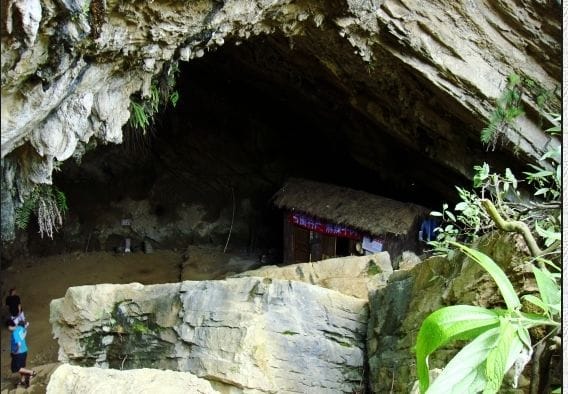
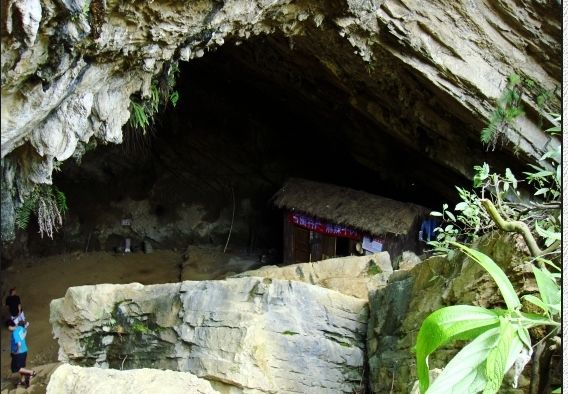
Daheidong Cave in Luzhou, Sichuan, where the Southwest Buddha League was headquartered in 1996. Image credit: Sogou
The criminal acts of armed rebellion (武装叛乱) and armed rioting (武装暴乱), defined in Article 104 of the Criminal Law, are among the least understood crimes of endangering state security (ESS). They are also among the least frequently invoked in the country. Statistics published by the 12-volume Records of People’s Courts Historical Judicial Statistics: 1949-2016 indicated that Chinese courts only tried 11 cases involving 39 defendants in the 18 years beginning in 1998.
Trials of armed rebellion and rioting intermittently took place in 1999, 2001-2003, 2006, 2008, 2011-2012, and 2015. The largest case involved 24 defendants and was tried in 1999. Two years later, six people were tried in two separate cases. Only one to two people were tried each year in the remainder of the years.
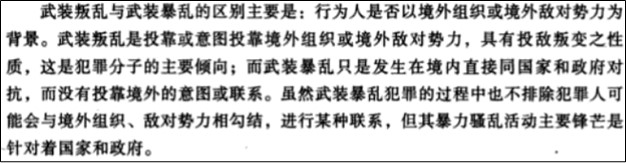
Both armed rebellion and armed rioting are capital crimes that are punishable by death when cases are deemed to be particularly severe, but the acts are not identical. One key difference, according to Chinese legal practitioners and scholars, is that armed rebellion requires an intent to seek refuge with or assistance from an entity perceived by the Chinese government to be a hostile foreign organization. Armed rioting, however, occurs when a group of people take up weapons or use explosives as an act of resistance against the Chinese Communist Party without seeking assistance from abroad.
Armed rebellion and armed rioting are not the same, as explained in Illustration of Standards and Application of Law for Filing a Case, Evidence Assessment, Conviction, and Sentencing (tu jie li an zheng ju ding zui liang xing biao zhun yu fa lü shi yong 图解立案证据定罪量刑标准与法律适用). Image credit:Illustration of Standards and Application of Law for Filing a Case, Evidence Assessment, Conviction, and Sentencing,China Legal Publishing House
As public information about armed rebellion or armed rioting cases is almost non-existent, the defendants and their acts remain shrouded in secrecy. However, Dui Hua found evidence that these cases could be connected to an armed riot which broke out 24 years ago in Luzhou, Sichuan.
Luzhou, Sichuan
The 24 people convicted in 1999 were all sentenced in a closed trial in Luzhou, Sichuan. Official sentencing records report that they participated in an anti-government militia called the Southwest Buddha League (西南佛联盟). Guizhou native Chen Faqing(陈发清) founded the militia in Yongxu County, Sichuan, in the early 1990s. Chen allegedly aimed to overthrow the Communist regime and save the Chinese people from an apocalypse that he said would occur between 1997 and 2000. The militia issued its own work permits, organized an independent household registration system, and established more than 30 bureaucratic divisions and a military academy. At its peak, the Southwest Buddha League had 1,120 registered members, according to provincial records.
The militia attempted to stage an armed riot in April 1998 after two members were detained. On June 5, armed police surrounded the group’s stronghold in Daheidong Cave in Gulin County, detaining 48 core members and confiscating more than 400 pounds of explosives. The most lenient sentence in the case was three years in prison. However, Chen Faqing and three others were sentenced to death.
A photograph of Luzhou, Sichuan, from August 2008. Image credit: Philip / CC BY-SA 4.0
Another three were sentenced to 15 years’ imprisonment: two of them were released early while the third died in custody. In the early 2010s, Dui Hua inquired about the fate of two of the surviving members. Chen Yunhua (陈云华) was released on November 7, 2011, after receiving a 19-month sentence reduction. Zeng Xiangui (曾显桂) received four sentence reductions totaling 60 months between 2002 and 2008. Zeng was released on June 7, 2008.
More Trials in Luzhou
Dui Hua’s research has uncovered more armed rioting trials after the case of Southwest Buddha League was concluded in 1999. Coincidentally, all the trials took place in Luzhou. In April 2008, Liu Zhonglin(刘中林) received a 10-year prison sentence and a one-year supplemental sentence of deprivation of political rights. In 2012, his sentence was reduced by one year. In 2015, Sichuan’s Ya’an Prison recommended that an additional 18-month sentence reduction be given to Liu because he demonstrated diligence in prison labor. If the recommendation was approved, Liu would have completed his sentence early in June 2015.
An armed rioting trial as recently as 2019 was also concluded in Luzhou. The case involved three defendants: Li Guanghong(李光洪), Long Xianyao(龙先尧), and Wang Anhua(王安华). The judgment, which was published online on December 25, 2019, has since been removed amid the mass purge of court judgments beginning in June 2021. The specifics of the case are unclear because the contents of the judgment had not been disclosed. Precedent suggests that prison sentences for people convicted of armed rioting tend to be lengthier and more severe, and it is very likely that the three are serving their sentences somewhere in Sichuan.
Intermediate People’s Court of Luzhou City, Sichuan Province. Image credit: Baike
The 1998 incident in Luzhou took place at a time when the internet was at its infancy. It is the only armed riot known to have been documented online over the past two decades. It is difficult assess how truthful this official narrative is. Were there a recent outbreak of an armed riot, it is likely that some Chinese netizens would still have recorded and posted what they witnessed on blogging and messaging services.
Dui Hua could not find information about any other armed riots or rebellion beyond what happened in Luzhou in 1998. The fact that all three known trials of armed rioting cases occurred in the same place can hardly be a coincidence. It is possible that those tried in 2008 and 2019 took part in the same 1998 incident and eluded police for an extended period. ESS cases are by nature sensitive and are subject to low transparency. Unless the Chinese government publishes more information about these trials, the incident officially labeled “Luzhou armed riot” will join the ranks of other mysterious ESS cases about which extremely little is known.
This essay, written by Dui Hua Executive Director John Kamm, was originally published in the US-Asia Law Institute’s journal USALI Perspectives, Volume 3, Number 16 on February 13, 2023. You can view the original posting here.
As China prepares to resume bilateral human rights dialogues, a human rights advocate reflects on their record.
Since then, Beijing has strenuously lobbied and spent significant resources to make sure nothing like this ever happened again. Instead of multilateral discussions about its treatment of dissidents and minorities in open UN fora, the Chinese government persuaded Western countries to present their criticisms in closed-door, bilateral human rights dialogues. One of the main features of such dialogues was the presentation by the foreign party (and acceptance by the Chinese side) of prisoner lists. As China prepares now to revive its dialogues with some Western governments, it’s worth reflecting on the role that dialogues and prisoner lists have played.
Switzerland and the United States were the first two countries that China invited to launch these dialogues, which began in 1991. Geneva was home to the Human Rights Commission (now the Human Rights Council), and China hoped to discourage future critical resolutions by lobbying Swiss officials in Geneva and Berne. Geneva also was home to the International Committee of the Red Cross (ICRC). Access to Chinese prisons by the ICRC has been a key demand of Western governments for decades.
As for the United States, China was not fazed by the sanctions put in place by the George H.W. Bush administration after Tiananmen, but it was deeply worried by the prospect of Congress revoking its trade privileges, notably its MFN status. To avoid this outcome, Beijing made many concessions to prevent the loss of its trade status, including releasing dozens of political prisoners, agreeing to a memorandum on prison labor in 1992, and initiating numerous bilateral human rights dialogues.
Throughout the early 1990s, other governments agreed to hold their own bilateral human rights dialogues with China. These included the European Union, the United Kingdom, Germany, Norway, Canada, Australia, and Japan. In addition to periodic human rights dialogues, the United States and China held seven sessions of a legal experts’ dialogue, focusing on rule of law issues. China also held human rights consultations with the Netherlands, New Zealand, and developing countries such as Brazil.
In addition to the submission of prisoner lists, bilateral human rights dialogues featured visits to Chinese and American courts and prisons, and, in rare instances, meetings with representatives of civil society groups. All told, more than 120 sessions of human rights dialogues took place between China and foreign countries between 1991 and 2019, according to my count.
As time went by, China held fewer and fewer dialogues with foreign governments. It also downgraded the status of officials leading the dialogues, from vice-minister to assistant minister, then to director general, and finally to deputy director general or special representative. According to a senior Chinese official, once China achieved its goals of lifting post-1989 economic sanctions and entering the World Trade Organization, it no longer felt the need to hold human rights dialogues or otherwise make human rights concessions.
The last governmental dialogue, a session with the European Union, took place in 2019. China cited various reasons for suspending or cancelling dialogues: with Norway, it was the 2010 award of the Nobel Peace Prize to Liu Xiaobo; with Japan, it was visits to the Yasukuni Shrine by senior Japanese officials.
However, alarmed by the deterioration of China’s image in the West, Beijing decided in late 2022 to resume human rights dialogues with Western governments. On February 11, Hong Kong’s South China Morning Post reported that the EU and China would hold the 38th session of their human rights dialogue in Brussels at the end of the week of February 13. Beijing has hinted that it is willing to resume its dialogue with Australia.
China suspended the dialogue with the United States on at least three occasions, most recently in 2016 after then-President Barack Obama met with the Dalai Lama. Then-assistant secretary of state for democracy, human rights, and labor, Tom Malinowski, declared that the dialogue with China had been a waste of time anyway. No efforts have been made to revive it.
The suspension of both the human rights dialogue and the legal experts’ dialogue that same year were but two of the official US-China dialogues in various issue areas that were done away with immediately before or during the Trump administration. More recently, dialogues with the Biden administration on climate change and narcotics were frozen in the wake of then-House Speaker Nancy Pelosi’s visit to Taiwan in August 2022.
The submission of prisoner lists to the Chinese government was always the most valuable part of rights dialogues. Some of these lists have been very long, containing hundreds of names of individuals subjected to coercive measures in virtually every province and autonomous region. Lists promote transparency and force the Chinese government to focus on specific individuals whose rights have been violated, drawing in ministries and courts responsible for the violations. In response to prisoner lists, over the years the government released information about the location and status of hundreds of political and religious prisoners who had simply dropped into a black hole.
The lists also have played a role in gaining clemency for political and religious prisoners. According to a survey submitted by the Dui Hua Foundation to Congress in 2005, presence on a prisoner list tripled the chance that a prisoner would be granted clemency. Even when the Chinese government declines to respond to a list, evidence suggests that the inquiry is passed along to ministries and courts, where, occasionally, action is taken.
For the same reasons that it downgraded human rights dialogues, China’s Ministry of Foreign Affairs increasingly resisted accepting prisoner lists. In one instance, a list was left on the table while the Chinese official leading the dialogue played video games on a cell phone. No written responses to prisoner lists submitted by governments have been recorded since 2012.
While governments have been unable to hand over lists, my organization, the Dui Hua Foundation (whose name means “dialogue” in Chinese), has been able to submit lists continuously since it was established in 1999. By the end of December 2022, Dui Hua had handed over 463 lists containing altogether more than 2000 “unique” names of prisoners (“unique” means names are only counted once; it is not uncommon for a name to appear on dozens of Dui Hua lists). Interlocutors responded on 282 occasions, providing information on more than 1,000 unique names. In 2022, Dui Hua submitted 21 lists, received 27 responses, and learned of instances of clemency or better treatment for 22 names on its lists.
The degradation of human rights dialogues that intensified after Xi Jinping assumed power in 2012 is not the only blow to judicial transparency during the strongman’s reign. In June 2021, China’s Supreme People’s Court purged all cases involving state security, “cults,” and death sentences from its judgment website. Crafting prisoner lists has become increasingly difficult for Dui Hua, but it has found new sources and new channels to continue submitting lists and getting responses.
Experience tells us that dialogues cannot immediately solve China’s human rights problems, but they can increase transparency. Prisoner lists in particular have benefited prisoners and their families, and should be part of any resumed dialogues. Dui Hua, which remains committed to a mutually respectful dialogue with the Chinese government, plans to continue submitting lists for as long as it is able to do so.
US President Joe Biden delivering the 2023 State of the Union Address on January 7, 2023 with Vice President Harris and House Speaker McCarthy seated behind him. Image credit: Public Domain
Polling from the start of 2023 suggests that China is increasingly unpopular in the United States as well as in other regions. A majority of Americans are dissatisfied with the Biden administration’s handling of the US-China relationship.
“Stable but Underwater”
Approval ratings for Biden as president are hovering in the 40s, a modest increase from the lows of summer 2022. As per the Harvard/Harris poll from January 18-19: “Biden’s approval is stable but underwater.” That poll of 2,050 registered voters showed 56 percent disapproval for Biden’s job as president, against 42 percent that approve. Rasmussen’s poll from February 2-6 of 1,500 likely voters pegged Biden’s approval at 44 percent, with 54 percent disapproval. Among a Economist/YouGov poll from February 4-7 of 1,500 registered voters, 41 percent approval versus 50 percent disapproval. A CBS News Poll taken from February 1-4 of 2,030 adults found that 45 percent approve of Biden’s job as president compared to 55 percent who disapprove.
Biden’s approval rating did surpass his disapproval rating in one poll, the IBD/TIPP poll which found 46 percent approval among Americans, compared to 44 percent disapproval. However, the poll noted that “Biden’s improvement is strictly among self-described investors and higher earners.”
Biden’s handling of classified documents has also damaged optics around his presidency. The YouGov poll found that 34 percent said that Biden was trustworthy against 46 percent that said he wasn’t (20 percent answered “not sure”). An NBC News poll of 810 registered voters from January 20-24 found that 67 percent of those polled are concerned about the handling of classified documents by both Biden and Trump. The classified documents scandal is likely to play into the hands of China hawks who view Biden as either soft on China or benefiting financially from ties to the CCP. In the Harvard/Harris poll, 83 percent of voters supported an FBI investigation into Biden’s handling of the documents, and 66 percent said that Biden’s dealings with the University of Pennsylvania raise questions that should be investigated.
Biden’s handling of China also reflects a lack of confidence among Americans. Redfield & Wilton Strategies’ January 19 poll found that 39 percent of respondents disapproved of Biden’s handling of relations with China, compared to 29 percent who expressed some form of approval (24 percent neither approved or disapproved). In the CBS News Poll, 61 percent disapproved of the way Biden is handling issues with China, compared to 39 percent that approved.
Similar attitudes abound for Biden’s handling of foreign policy. The Quinnipiac Poll shows 38 percent approval to 54 percent disapproval. The January 29-31 Economist/YouGov poll puts it as 31 percent approval to 53 percent disapproval. The NBC News poll found 41 percent approval to 50 percent disapproval. Across two polls, one from January 28-29 and the other from February 4-5, Morning Consult found that Biden’s foreign policy approval rates remained above 40 percent “while approval of his handling of national security rose from 42 percent to 45 percent during that time period.”
Friends & Enemies
Negative views of China have persisted into 2023. In the Harvard Harris poll, 66 percent of respondents had an unfavorable view of China. A YouGov/Economist poll from February 4-7 found 13 percent view China as a friend or ally versus 72 percent that answered unfriendly or an enemy. That poll also asked about attitudes toward Taiwan, of which respondents had a much more positive view: 61 percent see Taiwan as a friend or ally compared to 10 percent that see it as unfriendly or an enemy and 29 percent that were unsure. A majority of respondents, 74 percent, said that the US government made the right decision to shoot down the Chinese balloon, and 60 percent rejected China’s explanation that it was a weather balloon blown off course.
Morning Consult’s US-China Relations Barometer currently holds that 62 percent of US respondents have an unfavorable view of China, with 14 percent favorable. Chinese perceptions of the United States are similar: 69 percent unfavorable to 20 percent favorable; however, the share of Chinese adults with unfavorable views of the United States has declined since November 2022. Across Central and Eastern Europe, a survey of 13 countries by the International Republican Institute found worsening approval for China across all 13 countries, and 34 percent of respondents reported increasingly negative views of China in the past year. Of those, 66 percent cited China’s support for Russia as the main factor.
While China is expected to play a large part of Congress’ foreign policy agenda in the 118th Congress, Morning Consult’s US Foreign Policy Tracker suggests that voters’ concerns are split. US-China relations are not a top issue, with only 27 percent of respondents ranking it as the biggest concern, while protecting human rights globally came in at 25 percent. Upholding democracy globally ranked the lowest, at 14 percent. The biggest foreign policy concerns were terrorism, followed by immigration, cyberattacks, drug trafficking, and climate change.
However, Republicans express much more concern for US-China relations, with 31 percent citing it as the most important issue. On a list of Republican foreign policy concerns, US-China relations ranked fifth out of 14; for Democrats, it ranked 12th out of 14 issues, with 23 percent citing it as the most important issue. Partisan preference switched when it came to support for Ukraine: 16 percent of Republicans cited it as the most important issue while 32 percent of Democrats said it was the most important issue.
Unfavorable opinions abound, but a December 2022 Rasmussen Reports poll suggests that Americans believe their biggest enemy is domestic. When asked “Who is America’s biggest enemy as 2022 draws to a close – Russia, China, Iran, North Korea, Republicans, or Democrats?” as The Hill reported, “nearly 40 percent of Americans don’t choose a foreign power but name a domestic political party.”
Source: Rasmussen Reports
Biden’s China policy, which has largely followed that of the Trump administration, has drawn criticism for being more reactive than proactive. In recent weeks, this approach has been publicly criticized by high-profile figures. Former Trump-era national security advisor John Bolton authored an article for The Hill asking, “When will Biden get tough with China?”, and former treasury secretary Henry Paulson declared “America’s China Policy Is Not Working” in Foreign Affairs. A divided Congress, a divided populace, and a president lacking in approval are all reckoning with the future of US-China relations, with little other than “hawkism” uniting them.
Images from a video of Representatives Jones, Miller, and Pelosi in Tiananmen Square in 1991. Image credit: Nancy Pelosi Facebook account
Speaker of the House Nancy Pelosi’s trip to Taiwan in early August 2022 was praised and criticized in equal measure. It resulted in massive Chinese military drills as well as a surge in foreign delegations to the island. China’s President Xi Jinping asked US President Joe Biden to intervene to stop Pelosi, but Mr. Biden declined to do so. The Biden administration did, however, take steps to discourage the speaker from making the trip.
After Speaker Pelosi’s visit, China canceled or suspended cooperation with the United States on a range of issues, including military talks, climate change, and law enforcement, notably involving narcotics.
Her Taiwan visit was not Mrs. Pelosi’s first foray to Greater China to promote democracy and human rights.
In September 1991, Pelosi and two other members of Congress, Ben Jones and John Miller, traveled to Beijing accompanied by staff and representatives of NGOs, including the AFL-CIO. While there, they slipped out of their hotel, unbeknownst to their host, and went to Tiananmen Square where they unfurled a banner that read “To Those who Died for Democracy in China.” The police quickly moved in, and Pelosi tried to run away in high heels. The Representatives were questioned and let go.
“It was my first experience with Pelosi’s penchant for high-profile gestures designed to poke China’s communist rulers in the eye – regardless of the consequences” wrote Mike Chinoy, CNN’s bureau chief in Beijing. Chinoy, who had not been forewarned of Mrs. Pelosi’s plans, and his cameraman were roughed up by the police and placed under arrest. Journalists from two other networks, ABC and CBC, were similarly treated. Officials at Pelosi’s host organization were punished. American ambassador Stapleton Roy was furious and confronted Pelosi in the lobby of the hotel. Congresswoman Pelosi did not care about any of this. Her mission had been accomplished; her profile had been lifted.
Screenshot of Mike Chinoy’s post on Twitter with an image of the arrest after unfurling the banner. Image credit: Mike Chinoy Twitter account
In fact, I am grateful to Congresswoman Pelosi for what she did in Tiananmen Square that day in September 1991. Though she has no idea why I’m grateful, in fact her protest led directly to some of my early successes, including the release of Hong Kong Trade Development Council representative Lo Hoi-sing, son of a senior journalist at a Hong Kong left-wing paper.
Operation Yellow Bird
In the aftermath of the killings in Chinese cities in June 1989, loosely coordinated efforts began to spirit protesters out of China to safe havens outside of the mainland, notably Hong Kong, then a British crown colony. These efforts involved more than 40 people, some of whom were members of triads, others of whom were local Chinese officials. The efforts were dubbed “Operation Yellow Bird 黄雀行动,” and they led to the saving of more than 130 of China’s leading dissident students and intellectuals, including Wu’er Kaixi, Yan Jiaqi, and Su Xiaokang.
These efforts were risky, and some operatives were caught and punished. Lo Hoi-sing (pinyin: Luo Haixing, simple: 罗海星, traditional: 羅海星), a Hong Kong businessman, was detained on October 14, 1989, and formally arrested on December 18 the same year. He was tried with two “co-conspirators,” Hong Kong residents surnamed Li Peicheng (黎沛成) and Li Longqing (李龙庆), on March 4, 1991. After Lo was released, he told me that he didn’t know either Li; he had met them for the first time at trial.
For the crimes of harboring criminals and belonging to a counterrevolutionary group, Lo was sentenced to five years in prison, with three years deprivation of political rights (DPR). Lo was accused of trying to help Chen Ziming and Wang Juntao escape China. He was shipped off to Huaiji Prison in western Guangdong Province. He occupied a cell next to that of Wang Xizhe of “Li Yi Zhe” fame. Li Yi Zhe referred to a group of Guangzhou dissidents who put up posters calling for democracy in the mid-1970s.
Shortly after Lo Hoi-sing’s trial, his wife, Zhou Mimi (Chow Mat-mat), came to see me at my office in Hopewell Center, a high-rise office building in Hong Kong’s Wanchai District. Ms. Zhou, an author of children’s books, asked me to try to secure her husband’s release. I agreed and began putting Lo’s name on prisoner lists submitted to the Chinese government.
Flight to Beijing
On June 10, 1991, I flew to Beijing for a two-day visit. I was determined to seek clemency for Lo Hoi-sing and the Li Brothers (Li Lin and Li Zhi), two young Hunan labor activists who had escaped China after June 4, but who had returned to Hunan where they were detained. On June 11, at 2:00 PM, I met Supreme People’s Court Vice President Lin Zhen and State Council Deputy Secretary General He Chunlin. I had met He a few weeks earlier in Hong Kong. At that meeting I raised the cases of Lo Hoi-sing and the Li Brothers.
I asked Vice President Lin if Lo Hoi-sing could be considered for early release. His response was hopeful: Lo could be considered for early release under certain conditions. I then asked, in English, about Li Peicheng and Li Longing. Vice President Lin misunderstood me and thought I was referring to the Li Brothers. “In accordance with policy, if they have not committed new crimes after returning to China, they will be released from detention,” the vice president intoned. The next month, the Li Brothers arrived in Hong Kong. They were granted political asylum in the United States. It was my first major success.
North-South Strategy
I returned to Beijing in August 1991. By then, I had garnered a great deal of positive media attention that resulted from my AmCham initiatives, my three congressional testimonies, and the release of the Li Brothers. I had been awarded “Communicator of the Year” by the International Association of Business Communicators. I was considered a media “guru.”
A screenshot of the video of Representatives Jones, Miller, and Pelosi unfurling the banner saying “To Those Who Died for Democracy in China” in Tiananmen Square in 1991. Image credit: Nancy Pelosi Facebook account
In my meetings with Chinese officials, I made a bold prediction. It was already known that Nancy Pelosi would visit Beijing. I predicted that she would do something “that would make the Chinese government unhappy.” Following the principle that the best way to counter bad news is to release good news, I suggested a “North-South Strategy.” To counter bad news in the north, release good news in the south.” I recommended that Hong Kong resident Lo Hoi-sing be released from prison on medical parole and sent back to Hong Kong with as much fanfare as possible. My interlocutors paid attention and took careful notes.
When Nancy Pelosi unfurled her banner on September 4, 1991, the Chinese government acted quickly. A call was made to the Guangdong government which ordered the immediate release of Lo Hoi-sing. A car was sent to Huaiji Prison from Guangzhou to pick up Lo, but the officers forgot to take Lo’s travel documents with them. The car returned to Huaji before going back to Guangzhou, but Lo Hoi-sing’s release had to be delayed.
A scan of a photo that appeared in the South China Morning Post after Lo’s release. Lo (center) with his mother and wife (left and right, respectively). Image credit: South China Morning Post via Dui Hua archives.
Lo was granted medical parole and he arrived in Hong Kong on September 9, 1991, met with banner headlines and photographs of beaming family members reunited with their loved one. Lo never served his DPR sentence.
British Prime Minister John Major had been in Beijing at the same time as Nancy Pelosi. He flew to Hong Kong’s Kai Tak Airport where he learned of Lo’s release. He immediately set about claiming credit, advancing the preposterous notion that Beijing was grateful for the prime minister being the first Western leader to visit China’s capital since the events of June 1989. I said nothing to contradict Major’s claims, relying on an adage that Ronald Reagan was fond of: “There is no limit to what a man can achieve if he doesn’t care who gets credit for it.”