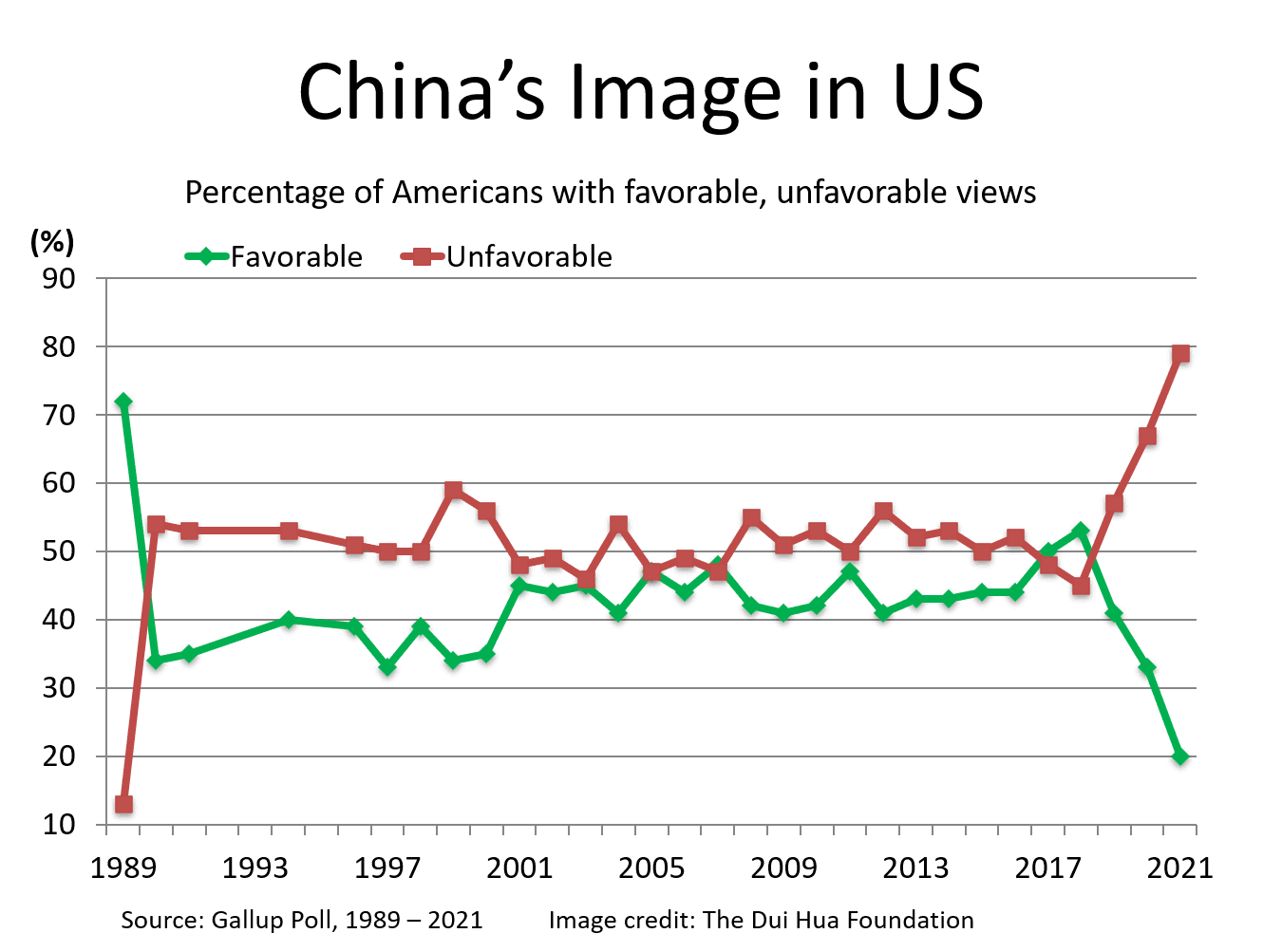
Reflecting a year of tense relations between the United States and China, China’s favorability rating among Americans as measured by the annual Gallup Poll has dropped to its lowest level in at least 40 years. The survey of 1,021 adults, carried out from February 3 to 28, 2021, found that 20 percent of American adults have a favorable view of China – down 13 points from the 2020 result – while 79 percent have an unfavorable view, an increase of 12 points over the 2020 result.
Clashes over how China has handled the coronavirus (polls show that large majorities of Americans fault China for how it handled the outbreak), human rights in Xinjiang and Hong Kong, trade, China’s militarization of the South China Sea, and China’s threats to Taiwan have taken a toll.
Unfavorable views of China in the Gallup poll outweighed favorable views in every demographic – gender, race, education, political party, and ideology. Only two countries – Iran and North Korea – are less popular than China. Taiwan has a favorability to unfavorability ratio of 72:24.
The results will bolster those in Congress and the Biden administration who favor tough policies towards China, and they will make efforts to ease tension and find common ground more difficult. A Pew poll taken in early February found that 48 percent of Americans believe that limiting the power and influence of China should be the United States’ top foreign policy priority. The same poll found that a slim majority of Americans – 53 to 46 percent – have confidence that President Biden will deal effectively with China.
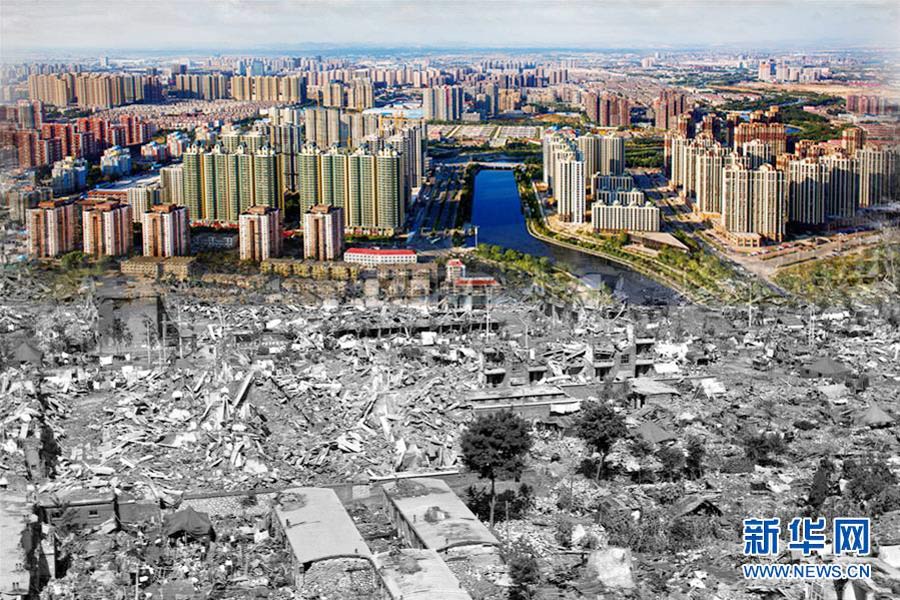
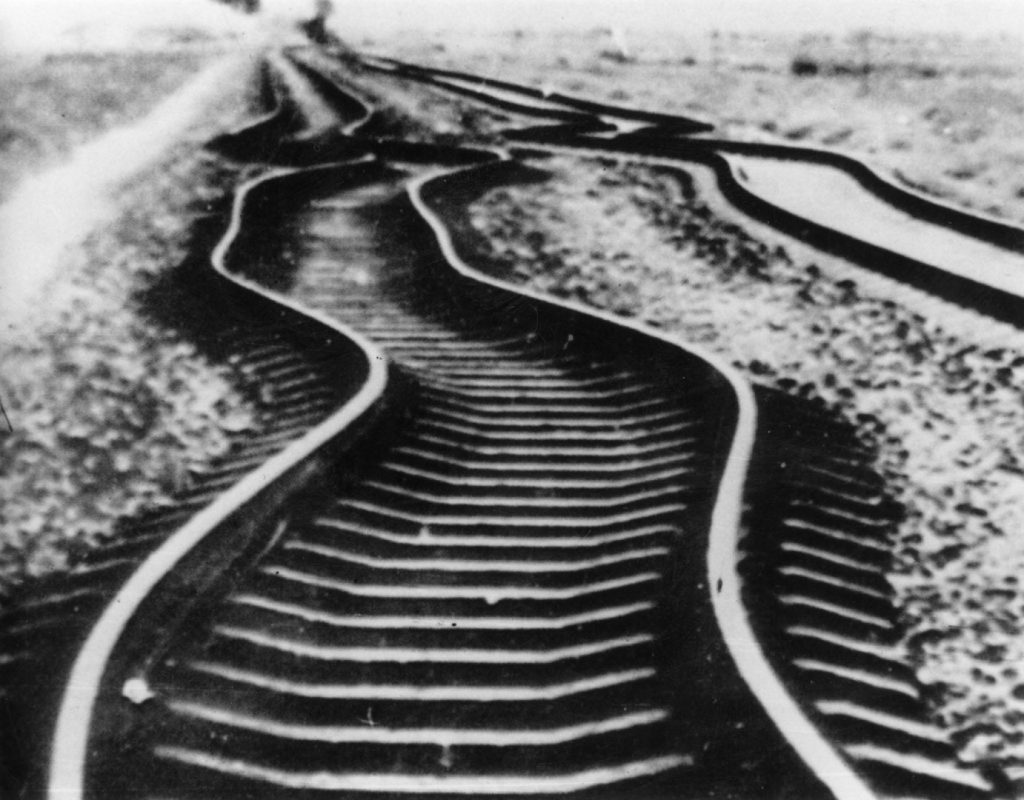
The black-and-white section of the image shows the damage of the earthquake that hit Tangshan on July 28, 1976. The colored part shows the city on July 9, 2016. Image credit: Chinadaily.com.cn
Amulet
In late July 1976, I found myself strolling the streets of Kyoto with my wife Irene and her sister Pat. It was a warm day, and we had taken the train from Tokyo to Kyoto and headed to the Heian Shrine. The seat of the imperial court of Japan from 794 to 1869, Kyoto was modeled on the ancient Chinese capital of Chang’an and was laid out in accordance with the principles of Feng Shui, the traditional practice of Chinese geomancy. Kyoto has long been considered the cultural capital of Japan, and is home to numerous temples, shrines, and palaces.
The courtyard in front of the shrine was lined with stalls selling amulets. We stopped at a stall displaying hundreds of amulets, colorful pouches meant to ward off all manner of evil spirits and natural disasters. One amulet in particular caught my eye. Dark blue with a hint of white. After settling on a price, I asked Pat to ask the trader what the amulet was meant for. The trader replied that it was meant to protect against earthquakes.
This trip to Kyoto had been a hasty adjustment of plans. Irene and I were meant to be in Hong Kong with my parents, who were traveling across the world for a belated celebration of our nuptials. My parents had been unable to attend our wedding the previous year, when Irene and I had said our vows at the Causeway Bay Marriage Registry in Hong Kong, followed by a traditional Chinese wedding banquet organized by Irene’s family.
Shortly before my parents were to arrive in Hong Kong, however, fate intervened. I was asked by Ambassador Christopher Phillips, president of the National Council for US-China Trade, to join him on a week-long visit to Beijing in late July 1976. At the time, I was the Hong Kong representative of the National Council for US-China Trade, one of three “people-to-people” organizations set up in the wake of Richard Nixon’s February 1972 trip to China.
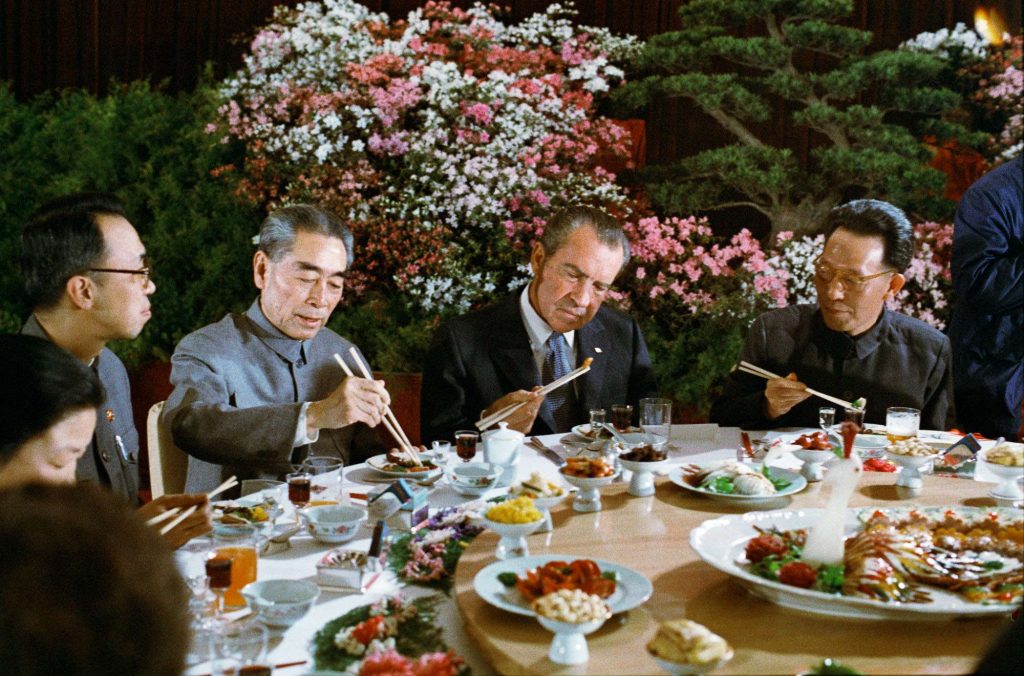
President Nixon sitting next to Premier Zhou Enlai at a banquet given in Nixon’s honor on February 21, 1972. Image credit: docsteach.org
I agreed to join Ambassador Phillips in Beijing, and Irene and I went about changing the arrangements for my parents’ visit. My parents would meet us in Tokyo, where Irene’s sister Pat and her husband Kenji lived. After a few days in Japan, I would fly to Beijing and my parents would travel to Hong Kong to meet Irene’s family and celebrate our marriage.
First Day in Beijing
On Wednesday, July 21, 1976, Ambassador Phillips joined me at Tokyo’s Haneda Airport, and together we flew to Beijing on the Japan Airlines flight that departed at 9:00 AM. We were met on our arrival at 12:35 PM by American officials from the Liaison Office and Mr. Guo Simian, head of the American and Oceanian Division of the Liaison Department of our host, the China Council for the Promotion of International Trade (CCPIT). (I learned later that Guo was party secretary of the Liaison Department. He was removed after the downfall of the “Gang of Four.”)
We were driven to the Peking Hotel, one of two locations for visiting dignitaries, the other being the Diaoyutai Guest House. After checking in, we took the elevator to the 14th floor and went to our rooms to unpack and prepare ourselves for the welcoming banquet.
Around 5:00 PM, Ambassador Phillips came knocking on my door. He told me that he had just drunk a tall glass of water from the tap, thus violating the number one rule against drinking unboiled water in a Third World country. I admonished him not to do this again, but it was too late. He would pay a heavy price.
The welcoming banquet was hosted by CCPIT Chairman Wang Yaoting at one of Beijing’s Peking duck restaurants. He was joined by Vice Chairman Li Chuan. Over helpings of Peking duck, washed down by shots of Mao Tai—the fiery sorghum-based and high proof liquor—and chased by beer, it dawned on me why Ambassador Phillips had insisted that I join him in Beijing. He was an old-school diplomat, a former deputy ambassador on the United Nations Security Council and Republican state senator in Massachusetts, but he couldn’t drink. By contrast, I was quite familiar with alcoholic beverages, my father having been a whiskey salesman in New Jersey in the 1950s and 1960s.
My capacity was put to the test. I matched Wang Yaoting glass for glass. Wang was one of China’s most accomplished Mao Tai drinkers. Every time we finished a shot, Li Chuan placed a match on the table. A bottle of Mao Tai contains 33 small glasses, each about the size of a shot glass. By the end of the banquet, there were 25 matches on the tablecloth. Such was the start of our visit.
Tensions
China’s domestic political situation and the state of US-China relations, including the trade relationship, were fraught with tensions leading up to my July 1976 visit. After his 1972 trip to China, Nixon and his National Security Advisor Henry Kissinger wanted to have diplomatic relations with both the People’s Republic of China (PRC), whose capital was in Beijing, and the Republic of China, whose capital was in Taipei, Taiwan. Beijing would have none of it, so the United States maintained its embassy in Taipei and the PRC and the United States opened liaison offices in their respective capitals.
In 1976, after Premier Zhou Enlai’s death in January—I attended the funeral on my first visit to Beijing—a large demonstration that honored him and criticized leftist leaders took place on April 5 in Tiananmen Square. The protest was brutally put down. Vice-Premier Deng Xiaoping was blamed for the protest, removed from his government positions, and placed under house arrest. Radical leftists were now firmly in control of the Communist Party and the government it controlled.
Mourners at Zhou Enlai’s funeral. Image credit: news.sina.com
Beijing was angered by steps the United States took in 1976 to show support for the Republic of China on Taiwan, with whom the United States maintained diplomatic relations, much to China’s chagrin. They protested Taiwan’s establishment of new consulates in the United States, Vice President Nelson Rockefeller’s attendance at Chiang Kai-shek’s funeral in Taipei, and the setting up of the US-Taiwan Economic Council, several members of which were also members of the National Council for US-China Trade.
Two-way trade between the United States and China dropped sharply in both 1975 and 1976. Radical leftists criticized Deng’s policy of purchasing Western technology, including complete plants, and ended a policy that saw Western brand names sewn into Chinese garments. Purchases of agricultural products dropped to zero in 1976. Beijing was especially incensed by an American company’s drilling for oil in the South China Sea.
The Meetings Begin
On July 22, a day after arriving, Ambassador Phillips and I began our visit in earnest. The next two days called for meetings with our host, the CCPIT, the Ministry of Foreign Affairs, the Bank of China, and most of China’s 12 state-owned foreign trade corporations. The plan was for all meetings to wrap up by July 26, after which Ambassador Phillips would leave for Washington on July 27 and I would travel to Tianjin on July 28 to attend an export fair. The weekend (July 24-25) would be given over to trips to tourist sites—the Great Wall, the Summer Palace, the Temple of Heaven.
Following a slew of expected meetings, our second day in Beijing was capped off by a reception at the American Liaison Office, the body that represented American interests in the absence of an embassy. Prior to the reception, Ambassador Tom Gates welcomed Ambassador Phillips to his office. He spoke of a recent meeting with Zhang Chunqiao, considered the leftists’ principal theoretician. It was an unhappy meeting, with Zhang issuing crude threats of what China would do if the United States did not sever all ties with Taiwan. “There will be big trouble,” Ambassador Gates remarked, “if this guy ever takes control of China’s government.”
Two meetings on July 23 stand out: one with the China National Chemicals Import and Export Corporation (Sinochem) and one with the Bank of China. Both were unpleasant, but unpleasant in different and telling ways.
We met with senior Sinochem managers in their office. Once I knew I would be traveling to Beijing with Ambassador Phillips, colleagues in the Washington office managed to wrangle an invitation for the China Chemicals and Pharmaceuticals Special Fair to be held in Tianjin from July 27 to August 19, 1976. I had already attended three mini-fairs thus far in 1976.
I thanked Sinochem’s deputy managing director, but he ignored me, thinking perhaps that I was too junior to warrant an acknowledgement. He only said that the corporation expects a full report from the National Council on the market for chemicals in the United States at the event, a market about which I knew very little. Through Guo Simian, I was given an invitation to the fair. The CCPIT helped me buy a train ticket departing Beijing for Tangshan/Tianjin at 7:32 AM Beijing time on July 28.
I asked this official what he could tell the National Council about Sinochem’s Petroleum Department. He became hostile. “Why do you want to know?” he asked, suggesting that this was secret information. Ambassador Phillips stepped in and said that the council had recently set up a petroleum committee and its members wanted to establish contact with their counterparts in China. The official gave a curt answer to the effect that they should write a letter to Sinochem’s head office requesting that the letter be transferred to the Petroleum Department.
After blasting American companies for exploring for oil in China’s “sovereign territory,” the deputy managing director showed us the door.
Our meeting with the Bank of China was the last official meeting of the trip. It took place in the bank’s headquarters just off Tiananmen Square. We were greeted by an urbane senior manager in a starched Mao suit. After an exchange of pleasantries, the gentleman adopted a stern demeanor. He had heard about the establishment of the “so-called” US-Taiwan Economic Council and had noticed that several American banks that were members of the National Council for US-China Trade had joined this organization. “This is unacceptable,” he intoned. “There will be consequences for them. Your own Council might pay a price as well.”
Ambassador Phillips took these threats calmly, with aplomb, making the point that the National Council could not control the activities of its members.
A Visit to the Subway and the Hospital
After the meeting with the Bank of China, Mr. Guo took us to a nearby Beijing subway station. The first subway lines were constructed in 1969, but the system was frequently closed for technical and political reasons. For several years it was operated by the People’s Liberation Army, but in 1976 it was returned to civilian control and foreign dignitaries were sometimes invited to have a look. The subway had both civilian and military uses. In the event of a nuclear attack, civilians would shelter there.
A performance in the newly-opened Beijing subway in 1969. Image credit: 3g.163.com
We took an escalator down to the platform. Few passengers were waiting. A train pulled up and we boarded. Sitting in our car were several passengers, including a young mother whose child exploded in tears when we said hello. There was also an elderly peasant from the countryside, looking a bit worse for the wear. Mr. Guo approached him and told him to push off. The peasant ignored him, and given the tenor of the times, Mr. Guo did not press the point. The three of us alighted at the next stop.
When we made it to the street, Ambassador Phillips told Guo and me that he wasn’t feeling well. We went to a hospital and Phillips was given a battery of tests. Exhausted, we returned to the Peking Hotel. At midnight, we were roused from our sleep by calls from the lobby. Ambassador Phillips had been diagnosed with dysentery and a rare salmonella infection resistant to antibiotics.
With two CCPIT officials, we headed for the First Infectious Diseases Hospital where Phillips was given a private room. Dr. Zhang Dongbo, one of China’s top infectious diseases specialists, arrived and declared he would be in charge of the ambassador’s treatment. He would spend sleepless nights looking after Phillips.
Over the next three days I visited Ambassador Phillips on several occasions, sometimes accompanied by a member of the Liaison Office, sometimes accompanied by Guo Simian. Phillips seemed comfortable and in good spirits.
Wandering About Beijing
That left plenty of time for me to walk around Beijing. I had visited Beijing twice earlier in 1976, and I had identified several places of interest including bookstores and the large Beijing Department Store on Wangfujing. The department store offered made-in-China products with one exception: Swiss watches, which carried a hefty price tag. The Xinhua Bookstore had an impressive display of “Little Red Books” – quotations of Chairman Mao Zedong – laid out beneath the chairman’s portrait. Further down the street were a couple of second-hand bookstores, where I spent happy hours.
In the evening I would go to dinner with American businesspeople who happened to be in Beijing. We would meet in the lobby of the hotel. I was armed with tips of restaurants. One evening we ate curries and breads at the Pakistani Restaurant on the top floor of the Hua Qiao Hotel. The next evening we went to the Minzu Hotel’s restaurant, famous for its spicy dandan noodles.
Finally, on the evening of July 27, I joined two New York garments buyers for a meal at the Moscow Restaurant on the west side of the Beijing Exhibition Hall, a massive Stalinist structure with halls and theaters and a great tower that could have been airlifted out of Moscow.
A photograph of the Beijing Exhibition Hall. Image credit: j.17qq.com
The restaurant was mostly empty, so we settled down at a small table and ordered Russian dishes from the menu. The restaurant did not have a wine list, but they sported a cellar full of Russian vodka. The vodka had been shipped to China under the 1956 barter trade agreement between the Soviet Union and China. It was very cheap, and very good. We consumed a bottle and then some. We happily returned to the Peking Hotel for what I hoped would be a good night’s sleep.
In the early morning hours of July 28, 1976, I lay awake in my room on the 14th floor of the Peking Hotel. It was a hot, humid evening, and the windows were open an inch or so for fresh air. I was unable to sleep, worried about what I would say when asked to give a report on the chemicals market in the United States after I arrived in Tianjin.
Suddenly, at 3:42 AM, my bed began to heave violently up and down. This lasted around 20 seconds. Then, the swaying, like a pendulum, began, east to west. The windows flew open as much as they could, the ceiling cracked, and the bed slid across the room, first in one direction, then in the other. On each swing of the pendulum, the hotel, by now creaking and moaning, tilted more and more to the point that I thought the next would be the building’s last. But when it reached the apogee, the pendulum paused and gradually settled down, stroke by stroke, until the building came to rest. The violent shaking and swinging together lasted around 80 seconds.
The quake had hit Tangshan, a city 68 miles east of Beijing. It was rated a magnitude 7.5 quake (some estimates are higher) and it caused massive damage to large parts of Hebei Province, Tianjin, and Beijing. The official death toll was put at 242,000 people, though several estimates are much higher, making it one of the greatest natural disasters in history. Thousands of miners were entombed in the underground coal mines around Tangshan, China’s principal source of energy.
I jumped out of bed and threw on my clothes, but I couldn’t find my shoes. I went to the window and looked out over the neighborhoods, made up of a maze of hutong, to the north of the hotel. Children were crying, dogs were barking. On the horizon I made out explosions that I later found out were collapsing power stations. There was an eerie green hue to the early morning sky. I feared, for an instant, that the Soviets had carried out an attack on Beijing.
I decided not to look for my shoes any longer. I exited my room to pandemonium in the hall. Staff attendants were directing people to take the stairs down to the ground floor. People were nervous and excited, and some were nauseous, others expectorating after clearing their throats. It wasn’t long before my feet were filthy with spittle and dirt.
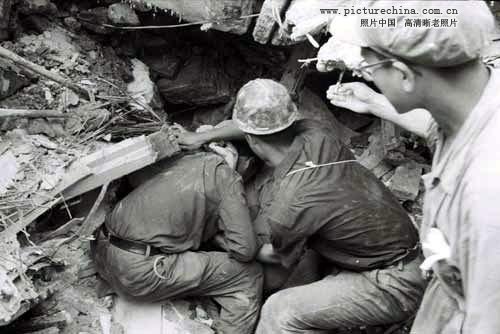
Rescuers dig through the rubble after the earthquake. Image credit: China.org.cn
We poured out onto Chang’an Dajie, Beijing’s main street. The city was coming to life. Trucks full of watermelons were barreling down the streets. Residents of nearby hutong began building makeshift street-side structures from pipes, plastic sheets, mats, and tarpaulin. These elaborate structures were to stay in place for more than a year.
Determined to wash my feet, I went back into the hotel. The lobby was cloaked in dust, and staff attendants were inspecting damage with flashlights. No one stopped me, so I took the still operating elevator back to my room on the 14th floor and immediately turned on the tap. Water! I washed myself the best I could and then lay down on my bed where I fell into a deep sleep.
Shortly after 7 AM, I was awakened by the phone. It was Guo Simian. “Mr. Kamm,” he said. “Last night there was an earthquake.”
“I know, Mr. Guo.” He told me to come down to the lobby.
As soon as I saw him, I asked him if there had been damage and casualties. He replied, “No, nothing serious. A few damaged buildings. You can take a train to Tianjin later today.” After his reassurances, he disappeared.
An officer of the Liaison Office stopped by to check on us, I asked him to call my wife in Hong Kong, letting her know I was okay. Not long after this call, my mother, who was in Hawaii, called Irene’s brother who let her know I was safe.
The Party Speaks
Mr. Guo returned in the late afternoon. He called his charges together and announced that the Standing Committee of the Political Bureau of the Communist Party of China had met and determined that there had in fact been an earthquake earlier that day. Foreigners should leave Beijing as soon as possible. If assistance was required, the relevant departments would do what they could to provide it.
I told Guo that I would stay until I was sure that Ambassador Phillips was safely evacuated. We agreed to go to the Number One Infectious Disease Hospital the next morning.
We found Phillips in a tent on the hospital grounds. The tent was stifling hot, but he was stoic, nary a complaint. Sharing the tent were three Laotian soldiers who had been bombed by US forces and who were being treated for hepatitis. The daughter of the Tanzanian ambassador was also housed in the tent. While we were there, trucks with casualties from Tangshan began to arrive.
Returning to the hotel, I went to the restaurant for lunch. Suddenly an aftershock rattled the windows, making them look like flowing water. I later learned that this aftershock was measured as 7.1 on the Richter scale. I decided to sleep on the ground floor, accompanied by three CCPIT officials. I returned to my room for the next two nights.
On July 29, I ventured out of the hotel to survey the damage. The building with the most damage was the department store I had just visited. The southeast corner of the building had crumbled, and bricks were strewn everywhere.
Mandate of Heaven
The foreign missions organized evacuation flights, and Ambassador Phillips departed on one that left on July 30. I decided to take a flight to Guangzhou on July 31, thence by train to Hong Kong. On checking out, I was told that there were only 50 foreign guests left in the hotel, down from 300 on July 28.
On the CAAC flight to Guangzhou I was seated next to a survivor of the quake, a Frenchman who had been in Tangshan on a friendship tour. His wife had been killed. When he went to use the washroom, the Chinese official accompanying him insisted that the man’s hair had turned white as a result of what he had experienced.
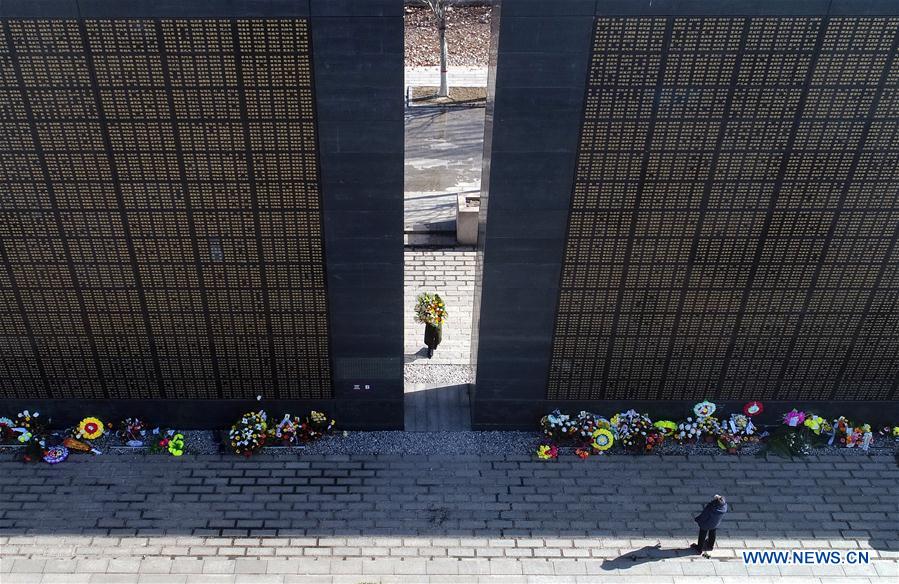
On April 4, 2018, a person visits a memorial wall in remembrance of victims in the 1976 Tangshan earthquake. Image credit: Dong Jun/Xinhua
Upon arrival in Guangzhou, I went to the Dong Fang Hotel, where I had stayed at the trade fairs, and took a room. The previous four days had taken a toll on my mental state. I had grown accustomed to uncertainty, to not knowing if the ground beneath me was solid. Gradually, the tension eased, leaving me with a splitting migraine headache.
The next morning, I took the train down to Lo Wu, where I crossed the wooden railway bridge and entered Hong Kong. I boarded the Kowloon-Canton Railway where I was met by a gaggle of local journalists eager to hear what I had experienced. I was featured on the evening news and wrote an op-ed for the Ta Kung Pao, a local left-wing newspaper. The op-ed compared the earthquake to the death of Premier Zhou Enlai. I later learned that the leftist leadership in Shanghai was greatly angered by what I had written. They refused to let it run in the local edition of Reference News.
I also gave an interview to the Washington Post’s Jay Matthews. The story ran in the paper on August 2, 1976.
Six weeks after the earthquake, Mao Zedong died, and four weeks later Hua Guofeng, the Communist Party’s new chairman, carried out the arrest of the “Gang of Four,” one of whose members was Zhang Chunqiao, the man Tom Gates had warned us about. In traditional Chinese belief, natural disasters presage the end of an emperor’s reign. Thus, in the eyes of many Chinese, the North China Earthquake of July 28, 1976 was a sign that Emperor Mao was losing the Mandate of Heaven.
The Casino Hotel Lisboa, which began construction in 1964 and opened to the public in 1970. Image credit: Nentavaiconta
Ientered Princeton University with the Class of 1973 in September 1969, fresh out of Neptune High School, New Jersey. The Class of 1973 was the first class to admit women; at the same time that it took this “revolutionary step,” it sharply increased the number of admitted students of color and New Jersey High School graduates.
Not long after I arrived on campus, I heard about the “University Scholars Program,” designed to acknowledge and support students of exceptional scholastic skills who wished to pursue an independent curriculum. I hadn’t been invited to the meeting at which the dean of studies introduced the program, but a couple of dorm mates had gone and brought back materials that outlined what the program was all about.
I went to the Dean’s office and submitted an application to undertake a course of study combining anthropology (my major) and East Asian Studies (my minor). To my surprise my application was accepted. I was no longer required to fulfill university requirements to graduate (no calculus for me!); I only needed to fulfill department requirements: take the requisite number of courses and write a senior thesis.
In February of my junior year, President Nixon visited China. I was determined to go to China, but I didn’t want to spend time in Taiwan, then run by the Kuomintang, Hong Kong, a British crown colony, or Singapore, ruled with an iron fist by Lee Kwan Yew. That left Macau, a sleepy Portuguese settlement across the Pearl River from Hong Kong.
Macau Governor Apologizes
Macau was the next best thing to going to China. Red Guards had mounted city-wide protests in December 1966, and they were met with force, resulting in death and injury to many. Local Chinese residents boycotted Portuguese products and refused to sell products to Portuguese families. Eventually, the Portuguese government was brought to its knees. The governor, Jose Carvalho, signed a humiliating letter of apology for the actions of troops and police against the protesters; he did so under a portrait of Chairman Mao.
The Portuguese governor of Macau signing a statement of apology for cracking down on political demonstrations known as the 12-3 incident and other riots. Image credit: The Stand News
Carvalho sat atop a local government bureaucracy made up officials from Lisbon and local Macanese, who enjoyed a distinct culture and spoke their own dialect, but the real power was wielded by Ho Yin, a Beijing loyalist. Ho Yin’s son would go on to become the first Chinese governor of Macau after the December 1999 reversion to China.
To everyone’s surprise, Beijing did not force the Portuguese to leave Macau as they had been forced out of Goa by India in 1961. Portuguese traders had settled Macau in the early 16th century, making it the first foreign settlement in China. It was destined to be the last. After the Portuguese “Carnation Revolution” in 1974, Portugal tried to give Macau back to China, but Beijing demurred out of concern that such a development would destabilize Hong Kong. Macau was eventually returned two years after Hong Kong’s 1997 return to China.
Having made up my mind to graduate from Princeton a year early, I went to see Bob Atmore, who headed the Princeton-in-Asia office in Jones Hall. I asked him what he had in Macau. He pulled open a box of index cards, blew off the dust, and pulled out a card for Linson College, a secondary school in Macau established and run by the first Chinese graduate of West Point, Linson Edward Dzau. I wrote to the headmaster, and was offered a job as a teacher, for 500 patacas (US$100) a month, room included.
The college and the anthropology department approved my application to graduate with the Class of 1972. I got my degree in June and then went to Middlebury College for several weeks of Chinese language training before packing my bags and heading to JFK airport for my August 22, 1972 flight to Hong Kong. I arrived in the British colony on August 23, 1972. The next day I took the hydrofoil to Macau, arriving around noon.
I was met by the school’s groundskeeper, and together we went in a cab to the school, a stately if rundown family mansion that had once been the residence of a fireworks manufacturer. Americans of a certain age will remember that Macau was a major source of firecrackers and other fireworks set off during the Fourth of July. By the time I arrived in Macau in 1972, most production had shifted to southern China.
I was shown to my room on the third floor. I had a simple meal and turned in. I awoke in the middle of the night to have a glass of water from a thermos. That’s when I learned that Chinese prefer drinking hot water to drinking cold water. I burned my mouth taking a swig of boiling hot water.
Tipping the Dogs
By the time I arrived in Macau, Linson College was in dire financial straits. Headmaster Dzau’s principal benefactor, a fellow West Point graduate, had passed away and tuition from students wasn’t enough to keep the school going. In October, the headmaster told the teachers that he could no longer pay salaries. They left in droves, leaving me to teach all subjects. I earned money by “tipping the dogs” at Macau’s Canidrome for a Hong Kong tabloid and enjoyed a string of luck at the casinos.
Finally, I left Macau on Christmas Day, 1972 – four months after I had arrived. I had visited the British colony on several occasions including one memorable one when I sat on the upper of a Chinese ferry drinking North Korea brandy and smoking Albanian cigars. After settling in Hong Kong, I landed a teaching position at the Chinese University of Hong Kong in Shatin.
A postcard of the Macau Palace floating casino. Image credit: Nentavaiconta
Reflecting its 400 years as a Portuguese-governed territory, there was much evidence of Portugal’s presence in Macau in 1972. The architecture, the cuisine, even the colorful uniforms of those in the police force recruited from African colonies, all reflected the deep historical ties between Macau and the mother country. Yet, as I had suspected, China’s influence in and control over Macau was everywhere to be seen. Let me relate a few experiences that speak to this observation.
Ilha Verde (Green Island)
A group of teachers at Linson College decided to teach me mahjong, the tile-based games invented in China during the Qing Dynasty. On weekends we would visit mahjong parlors in different parts of the city. Being a novice, I spent long hours observing how the game is played.
On one occasion the group traveled to Ilha Verde, a district in northwestern Macau on the border with the mainland. At some point I decided to take a break and wander around the neighborhood. As the name implies, Ilha Verde was originally an island. It sported a military barracks, a convent, and a cement factory. Over the years, land was reclaimed with the result that it was no longer an island.
I walked into an area of undeveloped land. There were no buildings. To my left was a stream that apparently marked the boundary with China. Suddenly, a few yards away, a young soldier of the People’s Liberation Army (PLA) stood up. He was guarding the border with a rifle. I froze, as did the soldier. I smiled, waved, and quickly retreated.
The next week the group decided to visit the same parlor. As we approached it in our car, we found our way blocked by a police barricade. Foreigners were barred from entering the area. It had been closed by order of the Chinese government. I never again entered the area.
Taipa
Macau consists of three parts, the city, which sits on a peninsula, and two offshore islands, Taipa and Coloane. In 1972, the peninsula had not yet been joined by a bridge to Taipa. (It was said that Chinese workers worked slowly in order to make sure that a causeway linking two islands opposite Macau would be completed first.) Access to the islands was by a ferry run by a Chinese company and staffed with Chinese sailors. As the ferry approached Taipa, one could see large hoardings praising Chairman Mao on a nearby Chinese island. There was also a sign prohibiting photographs of Chinese territory. Ferry staff were vigilant in enforcing this rule. Tourists who took photos had their cameras seized.
I loved visiting the islands. They provided a glimpse of rural China, as well as a number of beautiful churches and chapels. Some of the best Macanese restaurants were to be found on the islands. On Coloane, there was a wonderful beach with a villa above it. This building would eventually become the Pousada de Coloane, a traditional Portuguese Inn.
On one trip I was invited to dinner by the police commander of Taipa. He was a former Portuguese officer who had lost an arm in the colonial wars in Angola and Mozambique. He related a story that deeply affected me.
The night before, a refugee fleeing from China had scaled his garden wall and appealed to the commander for shelter. Much as he would have liked to do so, he was unable to shelter the refugee. Under an agreement with China, individuals who fled China to Macau were promptly returned to China. (At the same time that the Macau government issued its apology, it handed over seven Kuomintang “spies,” setting the tone for what was to come.) Sometimes, PLA troops entered the territory to enforce this policy. The officer had informed his commander, and the refugee was picked up and delivered to the PLA.
The People’s Republic of China was admitted to the United Nations in 1971. At the time, Macau housed an office of the United Nations High Commissioner for Refugees, managed by a Norwegian national and his Australian secretary. The office’s principal work was to help refugees from China, those who had managed to escape forcible repatriation to the mainland, as well as refugees from Southeast Asian countries including Myanmar and Cambodia. China took the position that the office needed to close since there were no Chinese refugees in Macau, which was Chinese territory. The office closed in 1973, shortly after I left the territory.
National Day
Following the December 1966 disturbances, the government of Macau declared that China’s National Day would be celebrated as public holidays on October 1 and October 2. Marches of “patriotic” Macau residents and large rallies took place. The largest rally took place at a sports field adjacent to the Lisboa Casino. Thousands of people gathered in a festive atmosphere marked by singing and dancing. There were political speeches and signs praising Chairman Mao and the Chinese Communist Party. A few called for the “liberation of Taiwan.”
Shortly before the holiday, I was approached by a teacher who advised me not to go out in public during the National Day holidays. Not a few people thought I was a CIA spy. If, my friend advised, I went out, then I should not take public transport (the drivers were members of a left-wing union) and, most important, I was told not to take a camera with me.
On December 3, 1966, a crowd tore down a statue of a Portuguese military officer during the anti-Portuguese rule 12-3 incident. Image credit: HKC News
I took my friend’s advice and walked south to the Leal Senado, the seat of the Municipal Council, in downtown Macau. Afterwards I set out in the direction of the Lisboa Hotel. On the way I passed a bookshop owned by a PRC company. In the window was a large aquarium with a model of a sunken American submarine resting on the bottom.
I figured that were I stopped, I would simply say I was on my way to the casino to play blackjack. When challenged, this seemed to work. Aside from hostile looks, I was not disturbed. I watched the rally from the steps of the Lisboa and then walked back to the Linson College.
First Impressions
My first and most enduring impressions of China were formed during the four months I spent in Macau in 1972. I began to see China as both intensely ideological but also very practical – it could have seized Macau in 1966 but chose not to out of concern that doing so would undermine stability in Hong Kong.
China was determined to protect its boundaries, but at the same time it was reasonable and non-violent. The young soldier could have shot me at close range, but he let me go. Finally, I came to understand that the Chinese government would seek to maximize control over the movements its citizens. Those who dared to flee China to Macau would be captured by the Portuguese and forcibly returned to the mainland to face an uncertain fate.
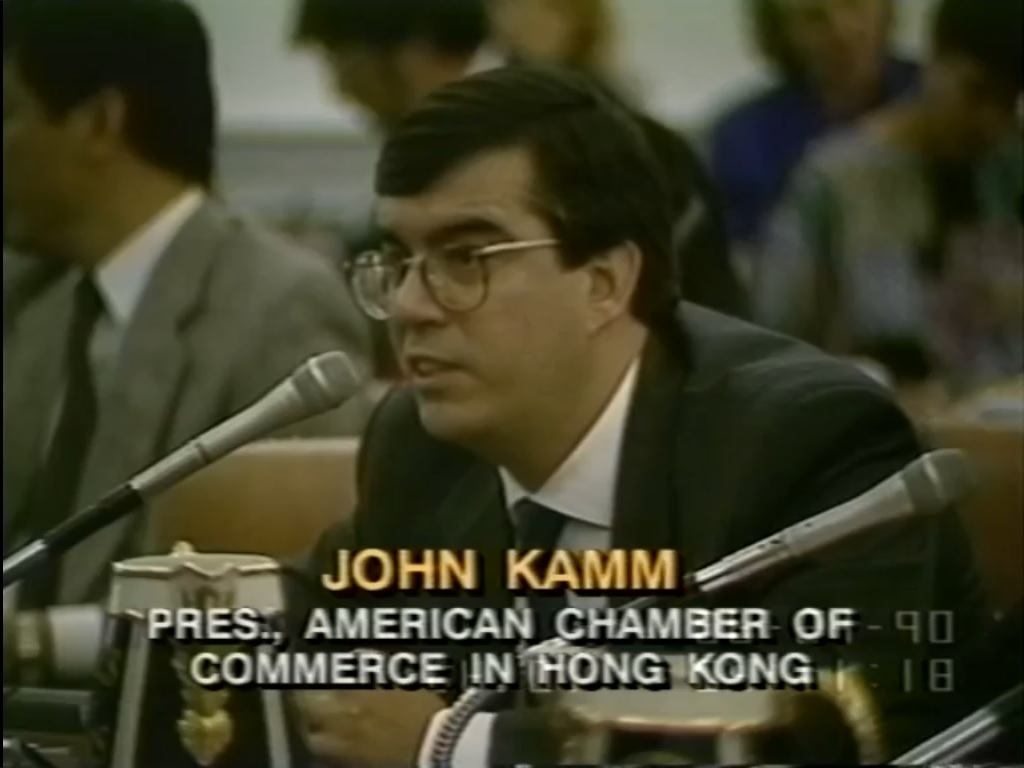
John Kamm testifying before the House Ways and Means Subcommittee on Trade on June 19, 1990. Image credit: C-Span
On January 1, 1990, I began my one-year term as president of the American Chamber of Commerce (Amcham) in Hong Kong. As recounted elsewhere, there was opposition from large corporate members to my becoming president. Many of them resented my having pushed through a resolution condemning the June 4, 1989 killings. A former president of Amcham claimed, with no evidence, that the Hong Kong government opposed the prospect of my becoming Amcham president and would refuse to work with me.
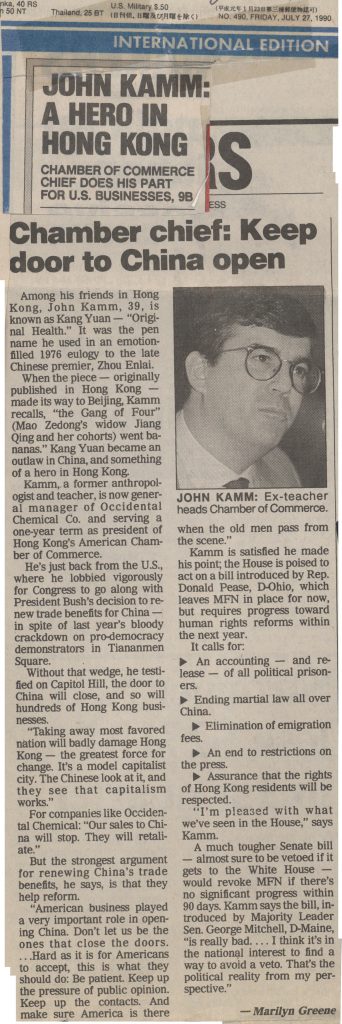
1990 would prove to be an eventful year marked by my testifying three times to Congress on China’s Most Favored Nation (MFN) trade status – before subcommittees of the House Foreign Affairs Committee (May 16, 1990), the Trade Subcommittee of the House Ways and Means Committee (June 19, 1990), and the Senate Finance Committee (June 20, 1990). My argument – that withdrawing MFN from China would cause massive collateral damage to Hong Kong – was cited by President George H. W. Bush in his May 24, 1990 statement renewing China’s MFN.
The MFN decision is thought to have been the first time in American history where the then-colony had played a role in a major foreign policy decision.
The chamber also successfully lobbied the Bush administration to issue an executive order protecting visas for Chinese students, and it urged the normalization of relations with Vietnam. In September 1990, I led the first American delegation to Mongolia after that country’s democratic revolution.
Internally, I oversaw the raising of membership dues by a large percentage; the chamber lost very few members. This hike in dues resulted in the chamber banking a significant sum, which enabled it to purchase its own premises in the Bank of America Building, a property it occupies to the present day. I was proud to have welcomed the first businesswoman onto the chamber’s executive council, a long overdue step.
Towards a Hong Kong Policy
Clippings of USA Today’s coverage of Kamm’s testimony as it appeared in the international edition on July 27, 1990. Image credit: Dui Hua media log
On November 16, 1990, as my term of office was about to expire, I traveled to New York. I gave a speech at the Harvard Club in which I called for legislation to protect Hong Kong’s special status under United States law, an initiative that contributed to the enactment of the Hong Kong Policy Act in 1992. The speech, titled “Towards a Hong Kong Policy,” was hosted by the National Committee on US-China Relations.” It was attended by more than 60 local and state officials, journalists, businesspeople and traders, and lawyers, including President John F. Kennedy’s speech writer Ted Sorenson and the celebrated China expert Jerome A. Cohen. It didn’t take long for my speech to find its way to Washington D.C.
I started my remarks by noting that little thought had been given to fashioning a national policy to protect and enhance America’s substantial interests in Hong Kong, and then went on to list what those substantial interests were: America’s 14th largest trading partner, home for more than 160 American-owned factories worth $1.4 billion in investment, shared culture and values, and an American population of more than 20,000 citizens. I estimated that 200,000 Hong Kong people would emigrate to the United States over the next ten years.
I declared that “The United States has a special responsibility with respect to the Sino-British Joint Declaration on Hong Kong. . .Ours was the first government to recognize the declaration, later leading the vote in the United Nations on registering the Joint Declaration as an international treaty.” I stressed that the United States has a moral responsibility to be true to our own ideology of free enterprise and respect for human rights. “If America is a shining city on a hill, nowhere is the glow reflected more brilliantly than Hong Kong.”
I questioned how well the Joint Declaration was being honored, and I gave a somewhat tepid response. It was being honored “in the main.” I pointed out that there had been a series of disagreements between the United Kingdom and China on such matters as the pace of democratization, the British Nationality Act, the Port and Airport Development Strategy (which called for the building of a new airport), and cross border controls. “Fortunately, neither side has accused the other of breaking the Joint Declaration.” How times have changed!
I concluded my remarks by suggesting initiatives for the American government and institutions to preserve and protect Hong Kong:
Washington should keep Hong Kong interests in mind when considering policies towards China. Institutions, whether academic, professional, religious or public-service oriented, should strengthen ties with counterparts in Hong Kong.
Government should examine Hong Kong’s Basic Law and make comments and suggestions on areas where it can be improved. “I have been particularly vocal on the article relating to subversion and state secrets (Article 23). China’s insistence that Hong Kong pass laws against possession of undefined state secrets represents a serious threat to the free flow of information crucial to Hong Kong’s commercial vitality.”
The United States should seek to negotiate directly with the Hong Kong government on trade, investment, and taxation treaties necessary for the further development of US-Hong Kong economic relations. The trade treaty should cover separate tariff treatment, trade quotas, bilateral dispute settlement, protection against expropriation, and the establishment of trade offices on each other’s territory.
Washington should seek treaties with the sovereign powers (China and the United Kingdom) guaranteeing consular access, port visits by military vessels, and reciprocal air traffic rights.
The United States should support Hong Kong’s full participation in international trade and financial organizations. “We need to work harder to insure Hong Kong’s admission to the Asia Pacific Economic Council.” I suggested that Congress enact legislation to ensure that Hong Kong continues to have access to American companies offering high technology goods and services.
“Congress should reinforce legislation on Hong Kong’s separate immigration status after 1997.”
I recommended that the executive branch pressure the Hong Kong government to demonstrate greater commitment to the internationalization of Hong Kong. I cited the “pressing need to involve foreign nationals in as many areas of public life as possible.” I suggested that the Hong Kong civil service be internationalized.
I wound up my speech with these words: “Inasmuch as legislative authority and direction will be required for granting Hong Kong separate trade and immigration benefits, Congress should, at an early date, enact a Hong Kong Relations Act.”
On September 20, 1991, Senator Mitch McConnell (R-Kentucky) – whom I had met when he visited Hong Kong in 1990 – introduced the Hong Kong Policy Act. The legislation included most of my recommendations. It was eventually signed into law by President George H. W. Bush on October 5, 1992. It was amended by the Hong Kong Human Rights and Democracy Act on November 27, 2019.
The Beijing Kunlun Hotel, where Kamm met with interlocutors to discuss at-risk political prisoners. Image Credit: Jiaju.Sina
As winter turned to spring in 1992, Chinese officials increasingly turned their attention to the possibility that the country’s coveted trade privilege – Most Favored Nation (MFN) status in the United States – might be removed if the White House changed hands in November. Deng Xiaoping’s friend George H. W. Bush, the incumbent, was expected to be a shoo-in on account of the success of the Gulf War. But after Super Tuesday, March 10, 1992, polls suggested that in a three-way race involving President George H. W. Bush, Arkansas Democratic Governor Bill Clinton, and independent Ross Perot, Bush would poll less than 50 percent.
Furthermore, in December 1991, Beijing had applied to hold the 2000 Olympics, and officials knew full well that its human rights record would prove to be an impediment. I decided to exploit their fears and ambitions by planning a week-long trip to Beijing beginning April 5, 1992.
It would prove to be a remarkable trip, marked by meetings with senior officials and opportunities to intervene on behalf of political and religious prisoners, the latter mostly Catholics. I would also be given information on China’s most famous political prisoner, Wei Jingsheng, and Wang Dan, a leader of the June 4 protests. Concerning Wei, this would be the first time that the Chinese government would address his living conditions, health, and state of mind.
I flew up to Beijing from Hong Kong on the afternoon of April 5. I was picked up by my driver and taken to the Great Wall Sheraton Hotel, near the Embassy District. The Great Wall Hotel was managed by a friend who offered me a generous rate and lots of hospitality, including the occasional drink at the hotel’s well-stocked bar.
The next day, April 6, I met with my host, Vice Chairman of the China Council for the Promotion of International Trade (CCPIT), Liu Fugui. This was followed by a meeting with the Deputy Director of the American and Oceanian Department of the Ministry of Foreign Economic Relations and Trade (MOFERT), Shi Jianxin. These meetings focused on the situation in Congress with respect to MFN, which was grim, in my estimation.
In the afternoon I met with the Supreme People’s Court and, later, Luosang Chinai, a Tibetan official who was a senior official in the Religious Affairs Bureau (RAB, now the State Administration of Religious Affairs). He was accompanied by a lady who was in charge of the department overseeing Roman Catholics, known as the Second Department.
At this meeting I pressed for the release of elderly Catholic clerics Bishop Liu Guandong, president of the underground Catholic Bishops Conference, serving a sentence in a reeducation through labor (RTL) camp, Father Jin Dechen, serving a 15-year sentence in prison for counterrevolution, and Monsignor Wang Yijun, one of China’s longest serving religious prisoners, then serving a three-year sentence in an RTL camp. Luosang Chinai seemed sympathetic.
Six weeks after this meeting, all three of the clerics, held in facilities around the country, were released on the same day.
That evening I was hosted to a welcome banquet by the CCPIT’s Liu Fugui. Mao Tai, the fiery, sorghum-based spirit (120 proof) was poured liberally, and not wanting to be a bad guest, I partook liberally. I returned to the Great Wall Sheraton, where I was met by my friend the manager. We repaired to the bar where we had shots of Black Label chased by beer. Bad idea.
Vice Minister “Gold Prison”
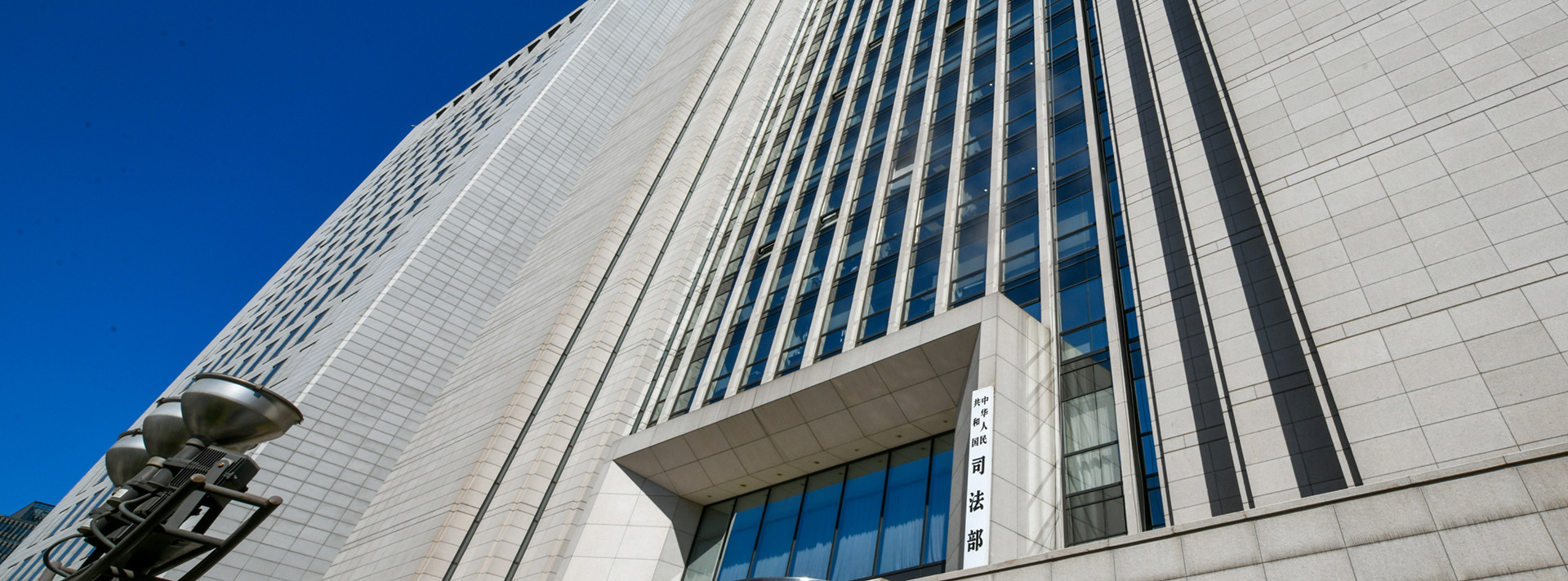
The next morning, I woke up with a ferocious headache. I had a bolt of caffeine and soldiered on, as businesspeople do, meeting my driver and being driven to the nearby Kunlun Hotel, said to be owned by China’s Ministry of State Security. Up the escalator, I was ushered into a large room where I was met with Ministry of Justice Vice Minister Jin Jian (synonymous with “gold prison”) and the Director of the Reform through Labor Bureau (now the Prison Administration Bureau) Wang Mingdi. I had met Wang in October 1991, so we were “old friends.” Wang was a tough prison official who sported a cauliflower ear.
I sat down on a plush chair with a doily as a head rest. A translator sat between me and the vice minister. There were two notetakers next to Wang Mingdi.
After an exchange of pleasantries, Vice Minister Jin came straight to the point. “We have decided to give you information on any prisoner you ask us about, to the best of our ability.” I was told that this was the first time they were offering this privilege to a foreigner.
I looked at Wang Mingdi. He was seated by a table on which there was a big stack of files, each apparently containing information on prisoners.
I suggested to the vice minister that we could save a lot of time if Mr. Wang would simply give me the files on the table next to him.
Vice Minister Jin did not like this idea. “You need to ask us about individual prisoners, using the full name. Don’t just ask about Mr. Wang in Beijing or Mr. Li in Shanghai. Do you have any idea how many Mr. Wangs live in Beijing and how many Mr. Li’s live in Shanghai?!
“Please tell me about Wei Jingsheng,” I replied.
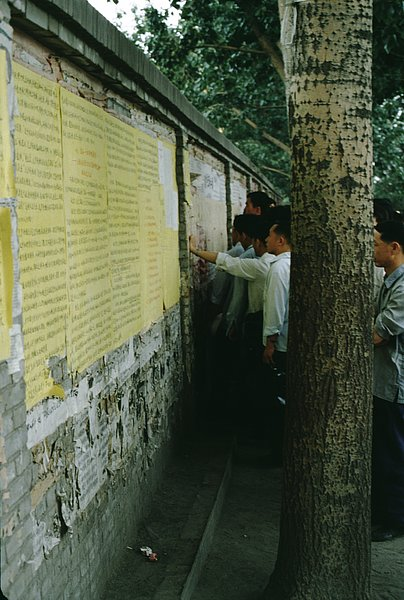
Xidan Wall in western Beijing in May 1979. Chinese people would come to post essays and “big character” posters. Image Credit: Qindianchen / CC BY-SA
Wei was at the time China’s best-known political prisoner. An electrician and former soldier who had been working at the Beijing Zoo since 1973, Wei was prominent in the 1978 Democracy Wall movement. On December 5, 1978, Wei posted an essay, “The Fifth Modernization,” on Democracy Wall, a stretch of wall surrounding a bus station in Beijing’s western district. Citizens took to the wall and put up “big character” posters in a burst of free speech not seen since the Cultural Revolution – and not seen since. I frequented the wall on many occasions in late 1978; at that time, I was staying at nearby hotels, including the Fuxing, during trips to sell chemicals and technology.
Wei’s poster caused a sensation. It rebutted Deng Xiaoping’s Four Modernizations policy and criticized Deng by name, calling him a dictator. (Deng had called for the modernization of industry, agriculture, national defense, and science and technology.) Wei Jingsheng proposed a “Fifth Modernization”—democracy. Soon Wei was being interviewed by foreign journalists, helped by his able assistant Tong Yi.
Wei was detained in 1979 and subsequently sentenced to 15 years in prison for counterrevolutionary crimes. The Chinese government had said nothing about him for more than a decade.
Wang Mingdi picked a file from the stack and began to read: “Wei Jingsheng, male, Han, born in 1950, middle school education, worker. Sentenced to 15 years imprisonment and three years deprivation of political rights in October 1979. He is currently serving his sentence in a reform through labor camp.”
I asked where Wei was serving his sentence. “What can you tell me about the conditions of his imprisonment? Is he being held in solitary confinement?”
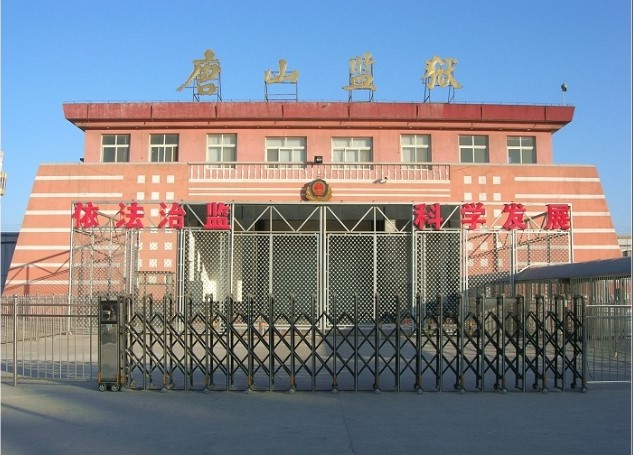
“He’s serving his sentence in a reform through labor camp in Tangshan, Hebei Province. It is not correct to say he’s being held under solitary confinement. His cell has two rooms. He has one room to himself. This room opens onto another room where there are guards. He eats his meals and watches television in this room. He is allowed out for fresh air, and he enjoys gardening. He has been exempted from physical labor.”
“Tell me about his health,” I asked.
Tangshan Prison in Hebei, where Wei Jingsheng served part of his reform through labor sentence for counterrevolutionary crimes after posting his Fifth Modernization essay on Xidan Wall in 1978. Image Credit: baike.com
Wang replied: “He is in good health, although he smokes a lot. Contrary to reports in Western media, he is not being mistreated. He has not lost his mind. He has not lost his hair nor all his teeth. He likes to stay up late debating with the guards. Wei is a very intelligent, well-informed man, but he is very stubborn. He refuses to admit his guilt or express regret.”
I asked if he could be considered for early release from prison. Wang was blunt. “Unless he changes his attitude, it is unlikely that he will be granted a sentence reduction or parole.”
Once Wang finished talking about Wei, I asked about Wang Dan, a student leader of the Tiananmen Square protests in the spring of 1989. I was told that Wang, like Wei, was proving difficult to reform. He liked reading and stayed mostly in his cell. He too had been exempted from physical labor. He was not being mistreated.
The Beijing Great Wall Hotel. Image Credit: hotelincn.com
After the meeting with Vice Minister Jin wound up, I was driven to the offices of the State Council Information Office (SCIO) for a meeting and lunch with its director, Zeng Jianhui (who would go on to be chairman of the National People’s Congress Foreign Affairs Committee), and its deputy director Li Yuanchao, China’s future vice president. On the way I reflected on what I had been told, which was in complete variance with the accepted narrative, which was basically that Wei Jingsheng was in bad shape, a basket case.
I told Director Zeng and Deputy Director Li about my meeting with Vice Minister Jin and expressed my concern that people wouldn’t believe the account I had been given about Wei. “Don’t worry,” Zeng Jianhui said. “He’s a vice minister. If he lied to a foreigner, he’d be in big trouble.”
China’s “007”
On the way back to the hotel, I stopped by the Ministry of Public Security, on Tiananmen Square, to see Director General of the International Department Zhu Entao, someone I’d known since 1976 when he was seconded to the Guangzhou Trade Fair’s liaison office handling Americans and Europeans. Zhu, “China’s 007,” feigned ignorance of Wei’s situation, not unexpected as Wei was being held in a Ministry of Justice facility. There was bad blood between the ministries, arising from the decision in 1980 to transfer control of the country’s prisons from the Ministry of Public Security to the newly established Ministry of Justice (MOJ).
I returned to the Great Wall Sheraton and called Nick Kristof of The New York Times. Nick and his wife Sheryl WuDunn had been awarded a Pulitzer Prize for their reporting on the Tiananmen Square protests. He was and remains passionate about human rights.
Nick joined me for drinks at the hotel bar. I read from my notes of the meeting with Vice Minister Jin, leaving nothing out. After an hour, Nick left and returned to his apartment to write up the story. It appeared in The New York Times on April 8, 1992, under the headline “China Offers Peek at Famed Prisoner.”
The day the article appeared I met with the Ministry of Foreign Affairs and the Supreme People’s Procuratorate, the prosecutors. That evening I hosted a banquet in honor of my host, the China Council for the Promotion of International Trade’s (CCPIT) Liu Fugui. Gathered around the table were senior officials of the SCIO, the Religious Affairs Bureau (RAB, now the State Administration of Religious Affairs), the Public Security Ministry, the MOJ, and the Procuratorate. I was asked which prisoners’ release would have the biggest impact on American opinion, in Congress and in the general public. I was well prepared, and listed labor leaders, Catholics, and other big names like Wei Jingsheng. After the dinner, the official from the RAB took me aside and told me that the Catholics whose names I had raised would be released.
As anticipated, the reaction to the Kristof article was one of disbelief and, in some quarters, hostility. A Beijing-based journalist of a rival newspaper, a friend who had written a profile about me and my work, called me at my hotel, furious that I had given the “scoop” to Kristof. A New York-based human rights activist wrote a letter to The Los Angeles Times questioning why anyone would believe anything the Chinese government told John Kamm.
Wei Released
Wang Mingdi1995 at the China State Prison Work Meeting. Image Credit: ilawpress.com
I continued to raise Wei on future trips to Beijing, pressing for his release. I met Wang Mingdi on March 9, 1993, at the MOJ’s old headquarters, a shabby, non-descript building on a dusty lane off the road to Beijing airport. Officers played billiards in the middle of the road in front of a bicycle repair shop.
I asked Wang about Wei. “He is such a famous international person; many people are interested in him.” Wang told me that, while Wei was healthy, “He persists in his strong anti-government attitude. He is strongly against socialism and blames the Chinese government for everything wrong in China, even the recent East China floods.”
Wang revealed that at the end of 1992, six months after I raised his name, Wei was driven to Beijing and taken to Science Street in Haidian District. “We let him alight and take a look. He didn’t say much, only ‘I’m from Beijing, but I don’t recognize Beijing.’” Wang Mingdi didn’t rule out an early release, though he said this would be “difficult to consider.” If Wei continued to follow prison rules, his sentence would not be extended. It was not uncommon in those days for counterrevolutionaries to have their sentences extended.
Wei Jingsheng was paroled on September 14, 1993. The reason given was that he had obeyed prison regulations, but many observers noted his release took place one week before the decision by the International Olympics Committee on which city would be awarded the 2000 Summer Olympics. (Beijing lost out to Sydney by a single vote.)
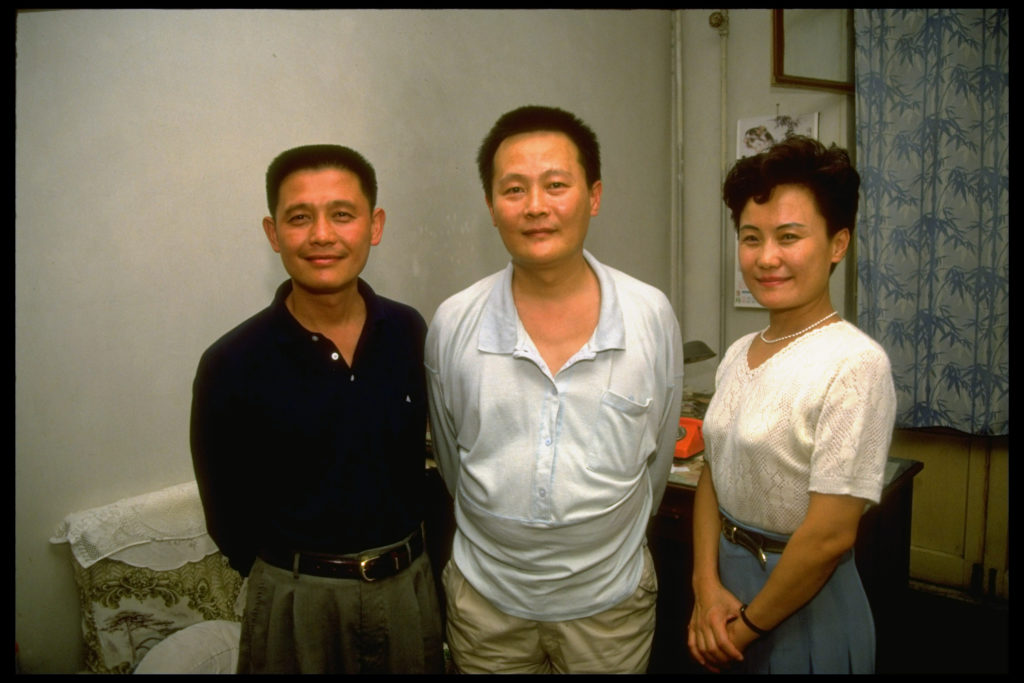
Wei looked well on release. A photograph taken with his brother and sister and published in a western newspaper showed a grinning, somewhat plump Wei. He had lots of hair.
China’s most famous dissident Wei Jingsheng (C), released 6 mos. before end of his 15-yr prison term, w. brother Wei Xiaotao & sister Wei Ling, at family home. (Photo by Forrest Anderson/The LIFE Images Collection via Getty Images/Getty Images)
The last time I discussed Wei with Wang Mingdi was in late October 1993, a month after the release. He told me that he had gone to the Tangshan prison holding Wei. It consisted of one big building with 20 individual cells. There was a large garden area, and a field where inmates could play ball. All prisoners had been exempted from physical labor. Wei’s cell was “full of books.” Wang felt that conditions were good enough to allow foreigners to visit, but as far as I know, this never happened. As I was leaving the meeting, Wang expressed regret that Wei had been released. “We did a bad job. We should have kept him in prison.” By then, China had lost its bid to host the 2000 Olympics.
Wei returned to activism after his September 1993 release. He was arrested again in early April 1994 after a meeting with US Assistant Secretary of State John Shattuck in the lobby of the China World hotel, under the eyes of state security agents. He was subsequently sentenced to 14 years in prison for counterrevolutionary propaganda and incitement. After international pressure and an appeal to President Jiang Zemin by President Bill Clinton, he was released on medical parole on November 17, 1997 and promptly flown to the United States, where he remains active promoting human rights and democracy in China.
In the two years that followed Dui Hua’s incorporation in April 1999, relations between the United States and China were roiled by two incidents: the May 7, 1999 bombing of China’s embassy in Belgrade by US planes and the April 1, 2001 mid-air collision between an American EP3 surveillance plane and a Chinese fighter jet 70 miles off the coast of Hainan.
The Belgrade bombing led to the suspension of the human rights dialogue between the two countries. The EP3 incident, which resulted in the downing of the Chinese fighter jet and the capture of the US plane, came less than three months after President George W. Bush was inaugurated in January 2001. The US plane was forced to land on Hainan. The crew was held in China for 12 days before they were repatriated to the United States. During this roughly two-week period, newly elected President George W. Bush and Vice President Dick Cheney froze all contact between US officials and Chinese diplomats, with few exceptions. I was discouraged from attending a reception at the Chinese embassy in Washington.
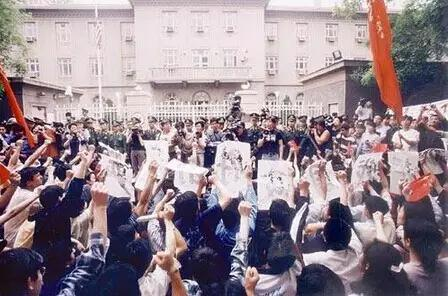
On May 8, 1999, Chinese university students gathered outside the US embassy in Beijing to protest the bombing of China’s embassy in Belgrade by US-led NATO forces. Image Credit: Liu Zhankun via news.sina.com.cn
Seeking to repair badly frayed relations between the two countries, Secretary of State Colin Powell announced on April 23, 2001 that he would visit Beijing at the end of July 2001.
A goal of the July 2001 visit was to announce the resumption of the human rights dialogue with China, which had been suspended for more than two years by this point. Powell brought Lorne Craner, the newly confirmed Assistant Secretary for Democracy, Rights, and Labor, with him on his three-day visit to China. As hoped, the visit resulted in an announcement that the human rights dialogue would resume in October 2001 in Beijing.
Not long after the announcement that the July 2001 visit would take place, Craner asked me to assist with the preparation of a prisoner list that he hoped to hand over to his Chinese counterpart, Director General of the Ministry of Foreign Affairs International Department Li Baodong. The list was in fact made up of two lists, one of long-serving prisoners and the other of priority cases. Dui Hua drew up the long-serving prisoner list, a compilation of 50 individuals serving sentences for counterrevolution and endangering state security, and it contributed names to the priority cases list.
Craner was able to hand over the list to Li Baodong, who reluctantly accepted it but told Craner not to expect a response.
In the wake of the September 11, 2001 terrorist attacks in the United States, Chinese President Jiang Zemin made a strategic decision to improve relations with the United States. As part of this decision he ordered his Ministry of Foreign Affairs to make the human rights dialogue session taking place in October 2001 a success. Instead of Beijing, the session would take place in Washington. At the same time the Ministry of Justice was ordered to reply to the US prisoner list and to separately draw up a list of political prisoners who could be released.
The dialogue session that took place on October 10, 2001 was a success. The Chinese delegation handed over a document with information on 48 of the prisoners on the “long-serving list” and 26 of the prisoners on the “priority list” – a response rate of 92.5 percent. Releases of long-serving prisoners began in January 2002 with Tibetan ethnomusicologist Ngawang Choephel, followed later that year by the releases of elderly teacher Jigme Sangpo, Drapchi nun Ngawang Sangdrol, and Democracy Party Chairman Xu Wenli.
In testimony I delivered to Congress in 2005, I estimated that prisoners on the 2001 Craner list were three times more likely than prisoners not on the list to benefit from early release.
Bolstered by the success of the October 2001 dialogue session, Craner decided to prepare a list for the next round of the human rights dialogue to take place in Beijing in December 2002. Once again, he asked for my assistance. My colleagues and I put together a list of 250 names which I sent to Craner on November 7, 2002. Twenty names were removed from the list, which was then forwarded to the US embassy in Beijing. This list of 230 names was handed over to China’s Ministry of Foreign Affairs. One of the names on that list was that of US businessman Fong Fuming (方复明).
Who is Fong Fuming?
At the dawn of the new millennium, Fong Fuming was a US businessman, engineer, and power industry consultant based in New Jersey. In China, he had been the deputy director and chief engineer of the Zhejiang Provincial Power Bureau. In the wake of the June 1989 killings in Beijing and other cities, he resigned his position and left for the United States. His decision did not sit well with the Ministry of State Security.
Fong Fuming in a 2012 video expressing support for Congressman Pascrell. Image Credit: Pascrell2012
Fong regularly visited China on business. In the late 1990s, officials from the Shanghai State Security Bureau contacted Fong’s agent with a request to cooperate with the bureau to earn money bidding for power plants. The agent rebuffed them. The Shanghai State Security Bureau, suspicious of Fong after he resigned his position and angry at his agent’s rejection, placed Fong under surveillance. The director of the Shanghai Bureau was promoted to Vice Minister of the State Security Ministry in Beijing, and the investigation into Fong intensified.
On February 28, 2000, Fong arrived in Beijing for a meeting with B&W Boiler Manufacturing. He was taken into custody by officers of the Beijing State Security Bureau at Beijing International Airport and placed under residential surveillance in a designated location (RSDL), a coercive measure that is often used to hold political prisoners for a period of up to six months and is rarely used against foreigners. During this period, those subjected to RSDL cannot receive visits from family members or lawyers. Foreigners under RSDL are permitted one 30-minute visit once a month from consular officers at their embassy.
Fong was moved around among State Security facilities in the outskirts of Beijing. His laptop, seized at the airport, was scrutinized. State Security found 32 documents containing specifications of various manufacturers’ power equipment. The State Security Bureau had these documents classified as state secrets. Fong was now suspected of obtaining and providing state secrets to foreign entities.
After spending six months under RSDL, Fong was formerly detained on August 28, 2000 on state secrets charges and bribery. He was arrested the following month. Following two hearings, Fong was tried in March 2002. He was convicted and sentenced to five years in prison. He was not given credit for the time he served under RSDL.
According to statistics released by China’s Supreme People’s Court, 19 people were convicted of obtaining and providing state secrets to foreign entities in 2002. Only one of them – American Fong Fuming – was a foreigner.
Fong entered Beijing Number Two Prison on June 6, 2002 and was placed in the cell block holding foreigners. These included three or four Americans, two Japanese citizens, and several South Koreans. Not long after Fong’s arrival, the foreigner group was transferred to Beijing’s Liangxiang Prison, where Fong was to serve the remainder of his sentence.
Fong was not physically tortured but was subjected to a number of indignities while under detention. His glasses, dentures, and hearing aid were taken from him; his dentures were returned at mealtime. On one occasion, the guards lost his dentures, and Fong refused to eat until they were found.
Advocacy
Shortly after Fong Fuming was taken into custody, the Chinese Ministry of Foreign Affairs notified the US embassy, which in turn notified Fong’s family in New Jersey. Fong’s wife and sons immediately began working to secure his release. They consulted the preeminent expert on Chinese law, Jerome Allen Cohen, and reached out to me for help. They appealed to senior officials of the George W. Bush administration, including Secretary of State Colin Powell, Ambassador to China Clark “Sandy” Randt, and assistant secretaries James Kelley (in charge of the East Asia and Pacific Bureau) and Lorne Craner. President Bush raised Fong’s case when he visited Beijing in February 2002.
Congressman Pascrell. Image Credit: United States Congress / Public Domain
Most importantly, Fong’s family asked for assistance from the family’s congressman, Bill Pascrell. Pascrell, a Democrat elected in 1996, worked tirelessly on behalf of his constituents. In his words, Pascrell launched an “avalanche of letters” to US and Chinese officials demanding Fong’s immediate release. He reached across the aisle and secured the help of Congressman Chris Smith, a fierce critic of China’s human rights record. Pascrell even engineered a resolution on Fong Fuming that was passed by the New Jersey State Assembly.
The family requested medical parole for Fong on four occasions. Their applications were ignored or rejected by the Beijing Prison Bureau.
The campaign to secure Fong’s release intensified in November 2002, when his name was presented to the Chinese Ministry of Foreign Affairs on the list compiled by Dui Hua for the human rights dialogue in Beijing. This was in anticipation of the human rights dialogue to take place in December 2002. That same month, Dui Hua researchers found a December 1984 document issued by the Supreme People’s Court; the document stated that time spent under RSDL should be counted when calculating the date when a criminal sentence expires. I immediately sent this document to Fong’s family.
In January 2003, Congressman Pascrell visited Beijing. He forcefully raised Fong’s case in a meeting with Chinese President Jiang Zemin. Pascrell’s meeting was one of the last between Jiang and a US member of Congress. Jiang stepped down from his position in March 2003 and was succeeded by Hu Jintao.
On January 4, 2003, I faxed a petition to La Yifan, the head of the Ministry of Foreign Affairs’ Human Rights Division. I asked him to consider granting good behavior parole to Fong. Under Chinese law, a prisoner can be released on good behavior parole after he or she has completed half of his or her sentence. Citing records of consular visits provided to me by the family, I pointed out that Fong was considered an exceptionally well-behaved prison – “a model prisoner” – and argued that if Fong had been given credit for the time he served under RSDL, then he would have already completed half of his sentence months before.
La Yifan, the head of the Ministry of Foreign Affairs’ Human Rights Division during Fong Fuming’s ordeal. Image Credit: Ministry of Foreign Affairs of China
I followed up on this message when I met with La in Beijing on March 3, 2003. In the months that followed, frequent follow-up calls were made to La after consultations with Fong’s family, Assistant Secretary Craner, and Ambassador Randt.
My next visit to Beijing took place from September 8-12, 2003. I met with a wide range of interlocutors and was informed by two sources that a decision had been made in August to grant Fong a nine-month sentence reduction. I argued that instead of giving Fong a nine-month sentence reduction, his sentence should be commuted, a procedure known as “jianxing shifang” (减刑释放) – literally “reduce sentence followed by release.” I felt progress was being made, so I briefed Craner by phone on September 12, 2003.
On October 19, 2003, President Bush met with Chinese President Hu in Bangkok. President Bush again brought up Fong. Eight days later, Fong was released from prison and flown back to the United States accompanied by an embassy officer. I received a phone call from La Yifan at 2 a.m. advising me that Fong was on a plane on the way back to the United States.
Fong arrived at Newark International Airport and was met in an emotional reunion by his wife and sons as well as his champion Congressman Pascrell. The congressman subsequently sent me a letter in which he thanked me for the “invaluable assistance” I provided. At the bottom of the letter, Mr. Pascrell penned a brief note: “We couldn’t have done this without your help.”
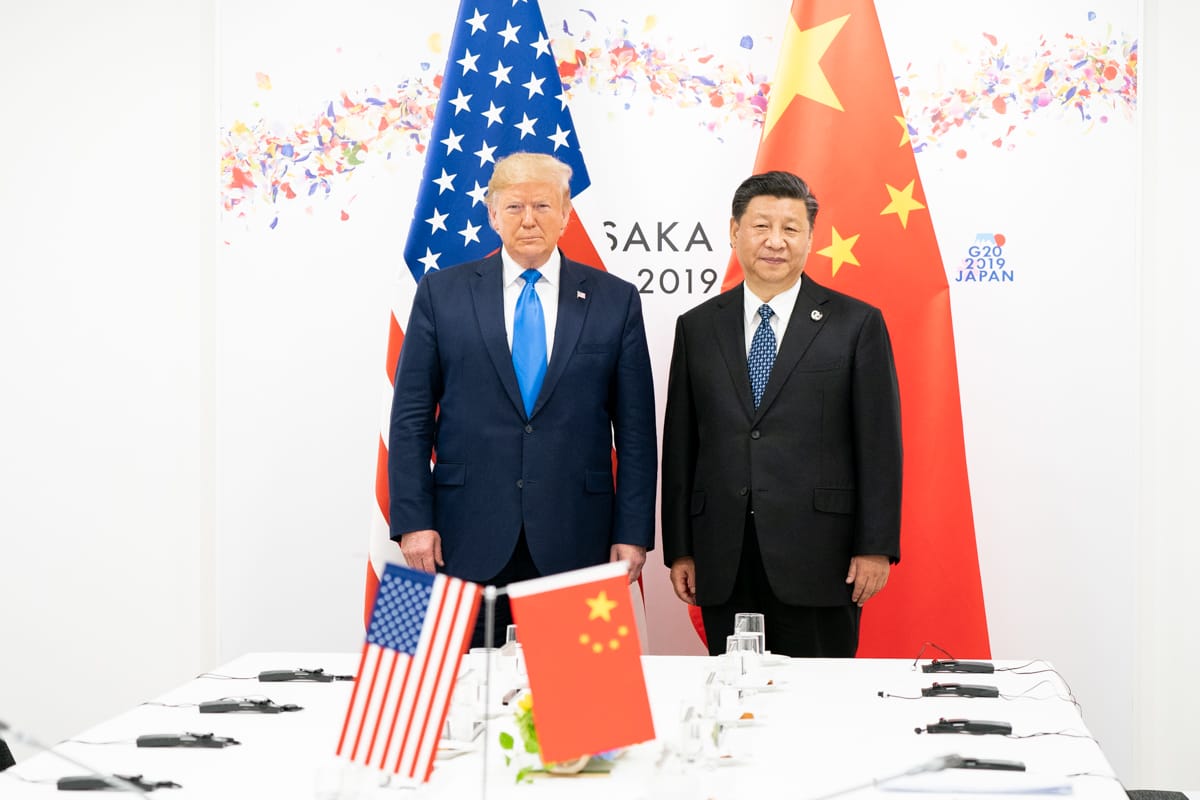
President Trump and President Xi at the start of their bilateral meeting June 29, 2019, at the G20 Japan Summit in Osaka, Japan. Image credit: Official White House photo by Shealah Craighead / Public domain
For more than 40 years, the Gallup organization has polled American opinion on China. The results of its latest poll, published on March 2, 2020, reveal a sharp drop in opinion among Americans towards China. Only one-third of Americans now have a favorable view of China.
This represents a 20-percentage point drop compared to the share of Americans with a favorable opinion of China recorded in Gallup’s 2018 poll. China’s 33 percent favorability rating ties the lowest reading in recent memory and is a point lower than the first poll taken after the Tiananmen killings in 1989. For the first time since polling started, no significant percentage of respondents gave a “No Opinion” answer; unfavorable opinions of China, especially “very unfavorable” ones, are at an all-time high. The graph below depicts the changes in public opinion:
In the most recent Gallup poll, China is tied with Russia as the United States’ greatest enemy. Furthermore, for the first time in 20 years, Americans do not believe that China is the world’s top economy. Half of Americans now hold that the United States is the world’s leading economy with China a distant second, at 39 percent.
Dui Hua believes that the poor view of China in the eyes of Americans is in large part related to the outbreak of the coronavirus in China. The Gallup poll was taken from February 3-16 and surveyed 1,028 American adults. During this two-week period, the number of cases and deaths of the deadly virus in China soared from 20,630 cases and 426 deaths on February 3 to 71,329 cases and 1,775 deaths on February 16. Media coverage was intense, peaking with the news of the death of the whistle-blower doctor Li Wenliang on February 7. The period coincided with the decision by the United States and other countries to bar entry to arrivals from China.
According to an Economist/YouGov poll of 1,500 American adults conducted from February 9-11, 2020, 70 percent of those polled were closely following the news on the coronavirus, and nearly 70 percent believed that the government should bar entry into the United States for foreigners with the virus. In this poll, 40 percent approved of the way Donald Trump is handling China versus 44 percent who disapproved. Weekly Economist/YouGov polls conducted throughout February saw the percentage of Americans who think that the US government should quarantine people who have recently been to China increase from 65 percent to 71 percent.
These frequently conducted Economist/YouGov polls corroborate the general drop in favorable opinion recorded by the Pew Research Center and Gallup. Between July 2016 and March 2020, respondents were asked 125 times whether they viewed China as an ally or enemy of the United States. While the Gallup poll focused on personal opinions toward China, this question gauges perceptions of US-China relations. At several points in 2017, a plurality of respondents assessed the relationship as positive, peaking at 43 percent saying China was a US ally or friend on November 21, 2017. That number has gradually slid, however, and in the latest poll results, on March 3, 2020, an outright majority (61 percent) of respondents deemed China unfriendly or an enemy, as can be seen in the following graph:
While disapproval of China cuts across party lines, opinions about China are especially low among Republicans. According to the Gallup poll, less than a quarter of Republicans view China favorably, and 31 percent consider China to be the United States’ greatest enemy.
In addition to the coronavirus outbreak, Gallup lists allegations of spying by Chinese students and scholars at American colleges, tensions over trade and territorial disputes, and accusations of alleged theft by China of American technology as other possible reasons for China’s dismal performance in the most recent poll. Dui Hua believes that extensive reporting of human rights abuses in China, particularly in Xinjiang, has contributed to the fall in China’s image.
I had already begun working on a juvenile justice program in China when the Dui Hua board approved expanding the foundation’s mission to include at-risk detainees other than political prisoners (read “Li Yan Has Survived!” parts one and two to learn about Dui Hua’s expanded focus). Shortly after board approval, I set in motion a plan to bring a delegation from China’s Supreme People’s Court (SPC) to visit the United States to study its juvenile justice system. I had already raised this possibility with the Court’s Research Department and the Office of Juvenile Courts in 2007, and they were receptive. We agreed that the delegation would take place in the summer of 2008.
On May 12, 2008, a devasting earthquake, measuring 8.0 on the Richter Scale, took place in Sichuan Province. More than 69,000 people were killed, and all overseas trips by Chinese government officials were put on hold. The Chinese juvenile justice delegation was eventually rescheduled, and it took place in October 2008.
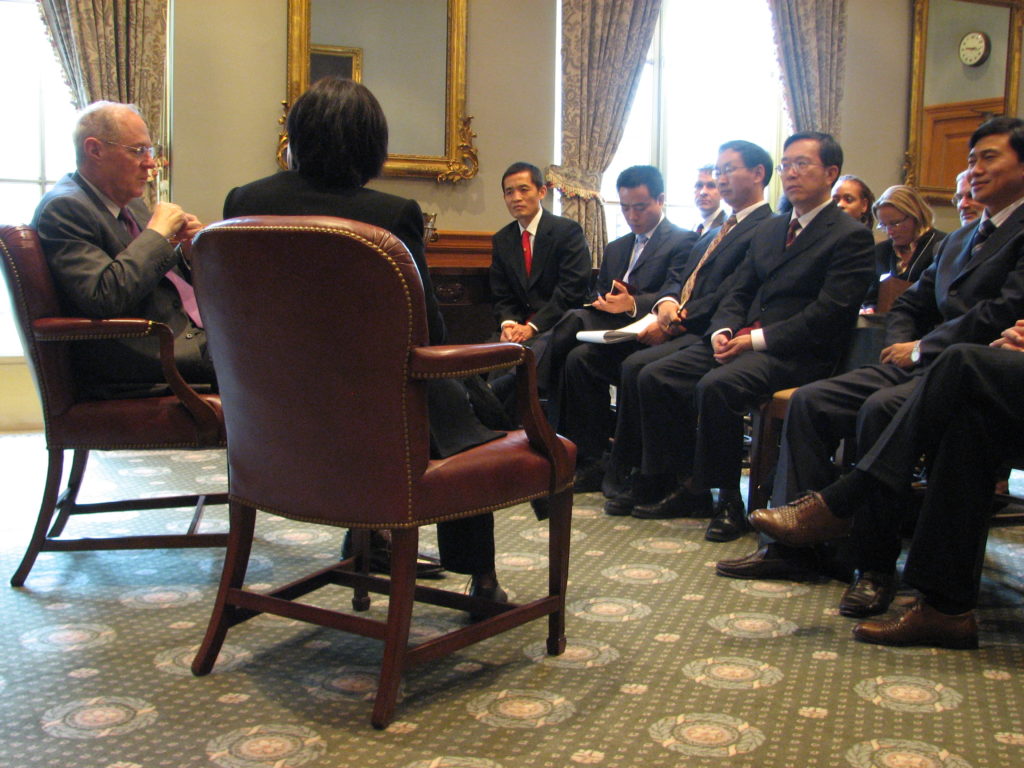
The visit included meetings, presentations, and tours of courts and detention facilities in Chicago, Maryland, Washington, D.C., and San Francisco. A highlight of the two-week trip was a meeting with Supreme Court Justice Anthony Kennedy, well known to Chinese legal circles as the justice who wrote the 2005 Roper vs. Simmons decision which declared that executing juveniles (individuals under the age of 18) was unconstitutional. Kennedy referenced China’s own abolition of capital punishment for juveniles in 1997 in his majority opinion.
Associate Justice Kennedy (left) received the delegation and US hosts in Washington on October 16, 2008. Image credit: Dui Hua Foundation
Upon the delegation’s return to China, Senior Judge Hu Weixin, who led the delegation, wrote a report on the visit. The report was widely circulated within the government and court system. On my visit to Beijing in July 2009, I was told by Chinese officials at the SPC and Ministry of Foreign Affairs that the report had been read by Premier Wen Jiabao. The Chinese juvenile justice delegation to the United States was considered one of the most successful programs in the field of legal exchange between the United States and China. It provided impetus for the reform of China’s juvenile justice system.
During the July visit I was invited to organize a return delegation of American juvenile justice practitioners to China. I followed up this visit by traveling to China twice during the first few months of 2010 to prepare. We agreed that the delegation would visit Beijing and Qingdao in May 2010 to make presentations, hold a mock trial, and visit juvenile detention facilities.
Tour of the Beijing Juvenile Reform Center
The delegation, led by Judge Lillian Sing of the San Francisco Superior Court, arrived in Beijing on May 8, 2010. We were met by a senior SPC official and transported to the Jianguo Hotel. We spent May 9 seeing the sites around Beijing (Great Wall, Forbidden City). In the evening we were hosted at a banquet held by SPC Vice President Xi Xiaoming.
On May 10 we set out for rural Daxing County on the outskirts of Beijing. There, surrounded by acres of agricultural land and several other correctional facilities, was the Beijing Juvenile Reform Center. Founded in 1955, the center is the only juvenile prison in Beijing. It is managed by the Beijing Bureau of Prison Administration under the Ministry of Justice. At the time of our visit, it held 470 juveniles (in China, juveniles are 14-18 years old), 60 percent of whom had been sentenced to prison for violent offenses. There are also “work study schools” – now known as “specialized schools” – in Beijing. They are managed by the Public Security Bureau and hold juveniles who have committed less serious offenses but who are not tried by courts. Although 95 percent of those held in the center were males, there were 12 females. They were housed in a cell block separate from the boys.
It took more than an hour to reach the center from our hotel. Our cars encountered a massive traffic jam which necessitated our taking a back road. A colleague quipped, “They must have known you were coming.”
Upon arrival our delegation was met by Madame Sun, a formidable lady who was a senior cadre in the Beijing Prison Bureau, and by the warden and deputy warden of the Beijing Juvenile Reform Center. I had met Madame Sun once before, when I visited Beijing Number Two Prison in 2001.
We were treated to a performance of traditional Chinese drumming by around 100 boys, decked out in colorful peasant garb. The sound was deafening, and it seemed to go on for an eternity. The noise made it impossible to carry on a conversation with the wardens. Finally, SPC Judge Hu, who had accompanied us, stepped in and asked for the performance to end. At this point we were told that the boys were the only inmates that we would see on the visit. Everyone else was required to participate in the center’s annual sports day. It was odd that our visit was scheduled on one of the only days of the year when we could not see, much less interact with, incarcerated young people, something we had arranged for the Chinese delegation when they visited the United States. Sessions between young detainees and the Chinese visitors were among the most valuable experiences of the 2008 delegation’s visit to the United States.
Our group proceeded to visit the empty male and female cell blocks, classrooms and other activity rooms. We were told that the average inmate age was 17 and a half years old. Inmates who turn 18 but who have two years left on their sentences are typically not transferred to adult prisons and instead serve the remainder of their sentences in the juvenile reform center. Two juveniles were serving life sentences at the time of our visit.
The wardens explained the system of awarding points for good behavior. Each month, inmates can earn a maximum of 10 points: one for “showing remorse,” one for performing well in “thought reform,” and eight for general behavior such as observing discipline, classroom performance, good hygiene and so forth. Violations result in the deduction of points. Accumulation of points leads to citations which in turn form the basis of applications for sentence reductions. Every year 20 percent of juveniles in the center are granted parole, a rate much higher than the rate in adult prisons.
Teens incarcerated in the center are entitled to one family visit a month, and unlike inmates in adult prisons, this privilege is not restricted as a form of punishment. Inmates can also make phone calls and send letters to family members. Unlike in the United States, there are no gangs in juvenile prisons in China, and fights are uncommon due to intense monitoring by staff. Although there is a protocol for solitary confinement, it is rarely employed. The biggest problem is that it is difficult to deliver vocational training given the varying ages and sentences of the young people in the center.
After we left the cell block, I tried to find out if any inmates were serving sentences for endangering state security. Madame Sun jumped in before the wardens could answer my question. “You’re always asking about such people,” she exclaimed. I failed to get an answer.
After our second juvenile justice delegation concluded, Dui Hua organized three more delegations, two to China and one to the United States. American experts introduced such practices as “diversion,” the sealing of juvenile records, gender-specific measures, and psychological and behavioral assessments at every stage of adjudication and incarceration. Several of these practices were enshrined in the amended Criminal Procedure Law promulgated in 2012.
In 2010, when I visited the Beijing center with our delegation, 80,000 juveniles were arrested in China. More than 68,000 were given custodial sentences. In 2017, the year our last exchange with the SPC took place, fewer than 33,000 juveniles were given custodial sentences by Chinese courts, a drop of more than 50 percent.
In 2010, when I visited the Beijing center with our delegation, 80,000 juveniles were arrested in China. More than 68,000 were given custodial sentences. In 2017, the year our last exchange with the SPC took place, fewer than 33,000 juveniles were given custodial sentences by Chinese courts, a drop of more than 50 percent.
The Dui Hua Foundation was established in April 1999. That same month, the United States introduced a resolution criticizing China’s human rights record at the United Nations Commission on Human Rights. The Ministry of Justice (MOJ) advised me that they would no longer provide information on prisoners “for reasons known to all.”
On May 7, 1999, American warplanes bombed the Chinese Embassy in Belgrade, touching off a major crisis in U.S.-China relations. China immediately suspended the official human rights dialogue with the United States. Since Dui Hua’s unofficial dialogue had already been suspended, the suspension of the official dialogue did not affect us. In fact, it enabled our dialogue to be resumed before the government-to-government dialogue.
My wife and I made a personal donation through the Chinese Embassy in Washington to the families of the Chinese killed in the Belgrade Bombing. I was advised by a senior Chinese official that we were the first American citizens to make this gesture, which was much appreciated.
On March 21, 2000, I received a letter faxed from the MOJ. The letter thanked me for “all your hard work over these past several years to promote understanding between our two sides.” Attached to the letter was information on 14 prisoners about whom I had asked. The letter marked the resumption of Dui Hua’s dialogue on prisoners with the Ministry of Justice, something I called “the Prisoner Information Project.”
The first prisoner about whom information was provided was Bai Weiji (白伟基), an official of China’s Ministry of Foreign Affairs who had led a march during the Spring 1989 protests, for which he was fired and expelled from the Communist Party. Bai was detained on May 5, 1992 and subsequently tried and convicted for “illegally providing state secrets to a foreign organization.” His wife, Zhao Lei (赵蕾) , was arrested a year later, and sentenced to six years in prison. (She was released early after an 18-month sentence reduction.)
Bai was given a 10-year prison sentence. He had provided documents to the Beijing Bureau chief of The Washington Post, Ms. Lena Sun, for whom his wife worked. The documents were found during a police raid on Ms. Sun’s apartment. In her safe were 10 “top secret” documents, according to Xinhua News Agency. Ms. Sun asked me to help secure Bai Weiji’s release, and I began raising his name with Chinese officials and submitting lists with his name on them to the MOJ.
The March 21 letter advised that Bai had received three sentence reductions and been released more than three years early on February 2, 1999.
Not long after receiving the letter, the MOJ invited me to visit Beijing. It would be the first visit by Dui Hua to Beijing and the first visit by a foreign human rights organization to discuss China’s prisoners with the ministry in charge of the country’s 700 prisons.
Prior to leaving for Beijing, I received a letter from Mr. Samuel (“Sandy”) Berger, President Bill Clinton’s National Security Advisor. The letter asked me to follow up on President Clinton’s request, made during his trip to Beijing in June 1998, to release the remaining counterrevolutionaries serving sentences in China’s prisons. The fate of these prisoners would be the focus of my trip to Beijing.
I arrived in Beijing on May 18, 2000. Before I departed on May 20, I met with MOJ Vice Minister Fan Fengping and held 10 hours of talks with officials of the Prison Administration Bureau and the Department of Judicial Assistance as well as Director Liu Huaqiu, head of the Foreign Affairs Office of the Communist Party’s Central Committee, and senior officials of the Ministry of Foreign Affairs. Meetings were held in the ministry’s nearly opened headquarters in Chaoyang District.
I was given a great deal of information on counterrevolutionary prisoners. At the end of 1999, there were 1,300 such prisoners still serving sentences, a reduction of 650 from the end of 1997. Most of those released were released early, including several I had advocated for: Bai Weiji, Shandong’s Zhang Xiaoxu (张霄旭) (paroled in 1998 after serving less than nine years of a 15-year sentence), and Tibet’s Jampa Ngodrup (released three years early in 1999). Immediately prior to my visit, Chen Lantao (陈兰涛), a student leader in Qingdao, was released after serving less than 11 years of his 18-year sentence for counterrevolutionary propaganda and incitement and blocking traffic. Chen’s sentence was the longest for non-violent actions taken during the Spring 1989 protests, and I had taken a special interest in his case, raising his name on trips to Qingdao.
I raised the case of Zhang Jie (张杰), another Shandong prisoner whose case had been taken up by Congresswoman Lynn Woolsey and 15 other members of Congress. I was told that Zhang had had his sentence reduced by four and one-half years. The sentence was due to expire on January 15, 2003. I pressed hard for his release before then, and was told that if Zhang continued to “make progress in his reform” he would be released early.
I handed over a new list of 25 cases involving 51 individuals. Dui Hua had found their names in its research into “open source” Chinese publications. Most of their names were not known outside of China.
A highlight of the trip was a visit to Beijing Number One Prison in Daxing County on May 19. This was the prison where Bai Weiji had served his sentence, and I was eager to take a look at conditions there.
I left my hotel at 1:00 PM, and arrived at the prison an hour later. I was greeted by Warden Yang Di, a big man with a broad smile. He had earned a reputation as a warden who, though strict, cared about the prisoners under his charge.
Yang gave me the standard “brief introduction” and showed me around the prison’s spacious and well-tended grounds. I was shown a cell block, the infirmary, and the cafeteria. The prison occupied an area of 440,000 square meters. Established in 1982, it held 2,000 male prisoners overseen by 370 guards.
The prison was a hive of small factories, and included 18 workshops making automobile parts (some for export, although not to the United States), plastic packaging, steel templates, and toys, among other products.
Beijing Number One Prison, now known as Beijing Municipal Prison, was designated a model prison by the Ministry of Justice and one of only seven “Cultural Units” (wenming danwei 文明单位) by Beijing Municipality. To be designated a model prison, a carceral facility has to meet 42 conditions including “no prison escapes” and “no prisoner suicides.” Beijing Number One enjoyed a recidivism rate of less than two percent.
Prisoners ranged in age from 18 to 60. Sentences included life in prison, 16-20 year terms, 10-15 year terms, and under 10 year terms. Most sentences were 15 years or more. Fifty percent of prisoners would be granted sentence reductions or parole during their time at Beijing Number One. Medical parole was granted to prisoners near death who did not represent a threat to the community. Fifty-two percent of prisoners had committed property crimes and 30 percent had committed violent crimes, including sex crimes. Several officials were serving sentences for corruption.
As I boarded my car to return to my hotel after a four-hour visit, I asked Warden Yang if he remembered Bai Weiji. He remembered Bai as a well-behaved prisoner who had been released early.
Years after I visited Beijing Number One Prison, Bai Weiji came to visit me in the United States. He told me about his life in prison. He had acted as a translator for Warden Yang’s efforts to sell prison-made automobile parts abroad. The warden had treated him well.
Bai thanked me for intervening on his and his wife’s behalf. While he credited my efforts for helping him gain early release, he cited two other reasons.
First, his team had won a city-wide competition among prisons to see who knew the most about Hong Kong’s reversion to China in 1997. Although he gained points for use towards a sentence reduction, his team members were given twice as many points as Bai because Bai was a counterrevolutionary.
The other reason had to do with the visit by the United Nations Working Group on Arbitrary Detention (WGAD) in July 1996. This visit, made by the Chairman-Rapporteur Louis Joinet, was to make arrangements for a trip to China by the full working group in 1997. Two carceral facilities were selected for visits by Joinet: Beijing Number One Prison and a reeducation-through-labor camp in Shandong Province.
Part of the agreement between China’s Ministry of Foreign Affairs (MFA) and the WGAD was that randomly-selected prisoners could be interviewed in private, with no prison officials present. Upon arrival at Beijing Number One Prison, Joinet randomly selected Bai Weiji. Bai was the only political prisoner housed at the prison, and his selection was greeted with alarm and suspicion by the prison officials. They refused to let Joinet interview Bai. This led to a stand-off that was only resolved when a senior MFA official arrived to negotiate a solution.
Eventually, Joinet was allowed to interview Bai in a small room off the prison courtyard. Although the interview was supposed to be private and out of earshot, Bai suspected that the conversation was being monitored. Accordingly, he was very guarded. He declined to say why he was in prison, and claimed that he was being well treated. For this performance, Bai was given three successive sentence reductions, totaling three years and three months, in 1996, 1997, and 1998.
Not long after Bai visited me, I flew to Geneva. I requested, and was granted, a meeting with the WGAD. When I told them that the prisoner that Mr. Joinet had selected was the only political prisoner in the prison, they were shocked. I let them know that, because of the way he had handled the interview, Bai was released early, and was now a successful businessman able to travel abroad.
On June 3, 1998, President Bill Clinton addressed a press conference in Washington D.C. Calling trade “a force for change in China,” Clinton cited “concrete results on human rights” as a result of his administration’s engagement with China, and then announced his intention to renew China’s Most Favored Nation (MFN) trading status, set to expire the next day.
Within hours of the press conference, China’s Ministry of Foreign Affairs announced that President Clinton would make a state visit to China from June 25 to July 3, 1998. He would meet with China’s President Jiang Zemin, and pay visits to Shanghai, Xian, Guilin, and Hong Kong.
President Bill Clinton and Jiang Zemin, 1998. Image Credit: Wikimedia Commons
Not unexpectedly, Clinton’s decision to renew MFN and pay a state visit to China was harshly criticized by members of Congress and human rights groups, who challenged the president’s conclusion that there had been positive developments in human rights in China. They claimed that, while there had been a few releases of political and religious prisoners, repression continued apace. Beijing had still not provided an accounting of individuals imprisoned in the Tiananmen protests of 1989 (it has yet to do so), and in October 1997 the head of the underground Catholic Church, Bishop Si Zhimin, had been taken into custody by officials of the Religious Affairs Bureau in Hebei Province. His whereabouts remain unknown more than 20 years later.
The reaction from China’s small dissident community to President Clinton’s decision to visit China was less condemnatory. Many saw the visit as an opportunity to test the limits of China’s strict control over dissent. The year before, in 1997, several dissidents, nearly all of whom had served time in prison for their political activities, had begun working to establish an opposition political party, and the prospect of an American president visiting China encouraged them to speed up their work.
Preparatory committees for the China Democracy Party (CDP), intended to be a national opposition party, were established in different parts of the country. Initially, they were established secretly, but on June 25, 1998, the day President Clinton arrived in China, the Hangzhou Preparatory Committee, led by Wang Youcai, issued an “Open Declaration of the Establishment of the CDP Zhejiang Preparatory Committee.” The declaration, together with a draft party constitution, was circulated on the Internet, and a formal application was filed with the Zhejiang government to register the CDP as a political party.
Soon other CDP preparatory committees were established elsewhere in China. By the end of 1998 there were 24 such committees. The names and details of 200 party members were posted on websites.
President Clinton’s visit to China came off without a hitch. He was criticized for inspecting an honor guard in Tiananmen Square, site of the killings in June 1989 that outraged the world. But afterwards, he met with Jiang Zemin and had what was by all accounts an extraordinary joint press conference with the Chinese president on June 17. The event was broadcast live on Chinese state television. Clinton expressed disapproval of the Tiananmen Square killings and referred to the Dalai Lama as a “holy man” whom President Jiang “would like very much.” President Clinton even referenced my own proposal that China should release all imprisoned counterrevolutionaries since the crime of counterrevolution had been removed from the Criminal Law in 1997.
Clinton’s endorsement of this proposal garnered much attention from Chinese officials, who marveled, in private conversations with me, at the president’s knowledge of the Chinese legal system. Clinton attended services at a Protestant church and gave a speech to Chinese students that was also televised nationwide.
His remarks on the Dalai Lama had a deleterious effect however. Talks were underway in Singapore between representatives of the Dalai Lama and the Chinese government. They were abruptly terminated, reportedly due to anger on the part of the People’s Liberation Army with Clinton’s remarks and Jiang Zemin’s failure to push back.
Crackdown
On July 10, 1998, one week after President Clinton left China, the police moved against the CDP, detaining Wang Youcai in Hangzhou. They formally arrested him for inciting subversion on August 7, but in an unusual move, he was released and placed under residential surveillance. The relative freedom of loose house arrest did not last long. He was rearrested and indicted for subversion, tried, and sentenced to 11 years in prison on December 21, 1998.
After the detention of Wang Youcai, the authorities changed their tactics. One by one, the preparatory committees were informed that their applications to register as a political party had been turned down. Leaders were visited by the police and told to desist their efforts or face the consequences.
Undeterred by threats, Xu Wenli, Gao Hongming, and Zha Jianguo established the CDP National Congress Preparatory Committee in Beijing on November 2, 1998. Xu was detained on November 30 and subsequently tried and sentenced to 13 years in prison on December 21, 1998 for the crime of subversion.
On May 7, 1999 NATO fighters under American command bombed China’s embassy in Belgrade, touching off a crisis in US-China relations. China suspendered all discussions on human rights with the United States.
After the bombing, Beijing stepped up its repression of the CDP. On July 5, 1999 Zha Jianguo and Gao Hongming were tried for subversion in Beijing. Zha and Gao were sentenced to nine years and eight years, respectively, on August 2. After a few more weeks in a detention center, both men were placed in Beijing Number Two Prison, a facility in northeast Beijing housing 2,000 inmates. According to my list of political prisoners in Beijing, 26 of the 40 names of prisoners serving sentences for counterrevolution or endangering state security were housed in Beijing Number Two.
Dui Hua was established in April 1999. Its dialogue on human rights with the Chinese government had been suspended that month on account of the tabling of a resolution at the Human Rights Commission in Geneva. Its suspension therefore came before the suspension of the official dialogue on account of the Belgrade bombing in May. This proved to be fortuitous. Dui Hua’s dialogue was resumed well before the official dialogue resumed.
Some of Dui Hua’s earliest cases were those of CDP members, in line with the priorities of Western governments at the time. There were two high-profile successes that Dui Hua contributed to. Xu Wenli was granted medical parole and flown to the United States with his wife on Christmas eve 2002. Wang Youcai was granted medical parole and flown to the United States on March 4, 2004.
Xu Wenli with John Kamm at the Dui Hua Foundation’s San Francisco office.
Gao Hongming, Qin Yongmin, and Zha Jianguo, as well as most of other CDP members who had been imprisoned, served their entire sentences with not a day off. They were mostly forgotten by the West.
Zha Jianguo was an idealistic young man who, heeding Chairman Mao’s call, went down to the countryside in the late 1960s to make revolution. He was 17 years old. He became a village leader in Inner Mongolia, a dirt-poor part of China. Disillusioned with the promises of Maoism, he returned to Beijing, and became passionately involved in the Tiananmen protests of 1989. After the imprisonment of Xu Wenli and the dismemberment of the CDP, Zha Jianguo became the de facto leader of the soon-to-be crushed opposition party.
Zha Jianying
In the summer of 2000 I was contacted by Benjamin Lee, a visiting professor of comparative literature at the University of Hong Kong. Ben was an accomplished scholar. He had taught at the University of Chicago where he had earned his PhD in anthropology. He had also taught at Rice University, where he ran the Transnational China Project at the James A. Baker Institute of Policy Studies. Ben and I had studied Chinese language at Middlebury College in the summer of 1972, immediately before I left the United States for Macau.
Ben had married Zha Jianying, a rising star in contemporary literature on China. Her China Pop, published in 1995, was critically acclaimed. Her facility in the English language was astonishing. When she went for her visa application interview at the United States Embassy in Beijing she hardly spoke a word of English. Within a few years she was writing fluent and evocative prose, glistening with power and emotion.
Zha Jianying’s brother is Zha Jianguo, and Ben had suggested she reach out to me for advice and assistance on how to secure better treatment and clemency for Zha Jianguo.
Ben, Jianying, and I met for lunch in Hong Kong at the Mandarin Hotel’s Grill Room on September 19, 2000. Over the next six months Jianying and I met frequently. She joined me on visits to the Chinese University of Hong Kong’s University Services Centre which, at the time, had an outstanding collection of Chinese government open sources on political crime. Sadly, that is no longer the case.
I accepted her request to act as her advisor on matters relating to Chinese prisons and offered to begin including her brother’s name on prisoner lists submitted to the Chinese government by foreign governments, as well as asking about him directly in my meetings with the Chinese Ministry of Justice and Ministry of Foreign Affairs.
By the time I offered to assist Jianying I had already visited five Chinese prisons and met privately with officials of the Prison Administration Bureau of the Ministry of Justice more than two dozen times.
I concluded that Chinese prison officials were susceptible to flattery regarding their personal appearance, in particular their smart uniforms, and the physical appearance of their prisons. (This was in part because prison officials, unlike foreign affairs officials, rarely got to meet foreigners.) If prison officials had treated a prisoner well, this should be acknowledged. It was important that visitors dress appropriately. This was not an issue with Jianying, who is an elegant dresser.
I told her that monthly visits and phone calls were critically important, not only because they boosted the prisoner’s morale, but because they sent a strong signal to the prison authorities that people on the outside cared deeply for their imprisoned loved one. I admonished her to be careful what she said to Zha Jianguo during the 30-minute monthly visits; they spoke by phone through a thick plexiglass screen. The calls were monitored and could be cut off at any time. I advised to her to speak with her brother as if Jiang Zemin were in the room.
During monthly visits, friendships could be developed both with guards and wardens, some of whom would drop their guard and reveal important information on the prisoner’s behavior and health. I suggested she ask to meet with one of the wardens of Beijing Number Two Prison.
Jianying advised me that her brother was unrepentant, and since he refused to confess he could never be considered for sentence reduction or parole. She asked me what I would do if I were in her brother’s place. I gave her the same answer I have given to every friend and relative of prisoners who have asked me this question over many years: if I were in prison, I would say or sign anything to win early release, as long as it didn’t hurt anyone else, especially fellow prisoners. In short, I would lie. Confessions made under distress would not be taken as signs of genuine remorse by people familiar with the realities of prison life in China. They were not worth the paper they were written on. Jianying sighed, knowing that her brother would never admit guilt for what he had done or for what he believed.
I also taught Jianying about fen lei gai zao, a Ministry of Justice policy, followed in many prisons, of grouping prisoners together with those who had been sentenced for the same crime. She should ask to have her brother moved to a cell with other political prisoners. At the time he was in a cell with violent offenders who often engaged in fights and petty quarrels. He was left alone, however, due to the respect other prisoners afforded him.
Shortly after our first meeting I put Zha Jianguo’s name on a list of prisoners submitted as part of a bilateral human rights dialogue with a European government. In January 2001, the Chinese government, for the first time, provided written information on Zha Jianguo.
A Conversation with Warden Zhang
On April 10 and 11, 2001, Zha Jianying received phone calls from Zhang Yongsheng, a warden of Beijing Number Two. Her request for a private meeting with the warden had been granted. She was invited to visit the prison on April 13.
Upon her arrival she was brought into the warden’s office. She sat on a sofa opposite Warden Zhang and his assistant Mr. Han. What was supposed to be a 30-minute meeting wound up lasting 90 minutes.
Jianying started by praising Warden Zhang. “I have been quite surprised and impressed by your officers’ courtesy, efficiency, and law-abiding spirit,” she said. She complimented the warden and his assistant’s snappy new uniforms (modeled on Hong Kong prison uniforms) and asked for the meaning of the stars on their epaulets. Warden Zhang smiled broadly.
Jianying then proceeded to make requests. On a recent visit she had noticed that her brother was in poor health. While thanking the warden for arranging Jianguo to receive a spinal CT at a local hospital, she asked that he also be given a heart CT and a brain CT. She expressed concern over an alarming new development: Jianguo’s hands were purple and would turn black at night. This might be a sign of a circulation problem. A heart examination and treatment might be necessary. She worried about her brother’s headaches, and said she feared he might have a brain tumor.
Jianying complained that her brother was in a cell with ruffians who were noisy and argumentative. He was unable to get a good night’s sleep. Would it be possible to move him to a better cell? Perhaps the prison could move him in with other prisoners who were serving sentences for state security offenses.
She lodged a complaint with the warden over the lack of physical exercise for Zha Jianguo. He had fallen down while exercising in the prison yard and had been barred from going outside “for his own good.” All prisoners should do physical labor, the warden said. Zha Jianguo’s job was wrapping chopsticks, a monotonous task involving little physical exercise.
Finally, Warden Zhang told Zha Jianying that all her requests would be considered. “We will do the best we can.” However, the prison did not have enough state security prisoners to fill a cell block, so this request could not be granted. Transfer to another, quieter cell could however be considered.
In the months that followed Jianying’s visit, Zha Jianguo’s treatment improved. He was moved to a better cell and exempted from physical labor. He was allowed to read as much as he wanted; his sister brought piles of books to him on every visit. He was afforded better medical treatment.
A Visit to Beijing Number Two
Two months after Zha Jianying visited Beijing Number Two, I went to Beijing in June on one of my regular missions. I met with the Ministry of Justice and asked for permission to visit the prison. I was told that my request would be considered.
In December 2001, I traveled to Beijing accompanied by Tina Rosenberg, a journalist working for The New York Times who was writing a story about my work. (The story appeared in the March 3, 2002 issue of the Times’ Sunday Magazine under the title John Kamm’s Third Way.) Ms. Rosenberg observed my work (including during a frosty breakfast with the American Chamber of Commerce) and sat in on meetings with the Supreme People’s Court and the Ministry of Foreign Affairs, but her request for a meeting with the Ministry of Justice was denied, and it was made clear that she would not be allowed into a Chinese prison.
On the morning of December 18, 2001, I was picked up at the Jianguo Hotel and, together with representatives of the Ministry of Justice and the Beijing Prison Administration Bureau, we drove to northeast Beijing, down a dusty exit road off the Beijing-Shenyang expressway. It was familiar terrain for me. The prison sat cheek to jowl with the Beijing Chemical Works, with whom I’d done business 20 years before.
I was bringing with me a list of prisoners in Beijing Number Two. Among the names on the list were Zha Jianguo and Gao Hongming. Others included Hu Shigen, Liu Jingsheng, Chen Yanbin, and Han Chunsheng, all well-known dissidents. There were also two people on my list who had been given long sentences for counterrevolutionary sabotage and hooliganism committed during the June 1989 protests in Beijing, Chang Yongjie and Zhu Gengsheng. They were both released early after multiple sentence reductions.
Beijing Number Two was an old facility, drab and run-down. It had been designated a maximum-security prison in 1990. Among its 2,000 prisoners were many who had committed violent crimes. In the report on my two-hour visit, I noted that “Its facilities, including its clinic, are less extensive and more poorly equipped [than other prisons I had visited], and its cellblocks were more crowded and less well-appointed than those of model prisons. . . . My tour revealed a physical plant badly in need of repair and better maintenance. Foreigners are rarely taken to the prison. I was the only foreign visitor in the last 12 months.”
Beijing Number Two Prison. Photo Credit: Baidu Baike
In my conversation with the warden in his office (a different warden than the one Zha Jianying had met), I went over my list name by name and asked for their current status. The warden said he’d look into my requests. Although they did not have a separate section, those convicted of political crimes were not housed with violent criminals, sex offenders, or those convicted of economic crimes. Prisoners serving sentences for these crimes were housed together in separate cell blocks.
I was given a detailed account of the point system used to reward prisoners with sentence reductions and parole, as well as other benefits like more frequent family visits, conjugal visits, and use of two telephones to receive calls from family members. The prison granted sentence reductions to 25 percent of prisoners every year, though the warden acknowledged that the sentence reduction rate for those convicted of endangering state security was lower.
I asked if prisoners like Zha Jianguo and Han Chunsheng who refuse to “acknowledge guilt, show genuine remorse, obey regulations, and perform manual labor” could ever gain early release. He replied that prisoners who refuse to acknowledge guilt can petition courts for a retrial. And if their petitions are rejected? “Then the prisoner has no way out,” the warden explained.
After our conversation, I toured the prison grounds accompanied by Ministry of Justice officials and the warden. I used the walk-around to pepper them with questions on individual prisoners. I tried to raise as many names as I could before being invited to leave the prison. The visit had lasted two hours.
Of Courage and Devotion
During one of the monthly visits, Zha Jianguo asked his sister to tell me to stop my efforts on his behalf. He was doing fine, and I should focus on other prisoners who were in greater need. I complied with his request and stopped raising his name. He was released on June 29, 2008, having served his entire nine-year sentence. He returned home to a hero’s welcome.
Zha Jianying and Zha Jianguo, Beijing, 2017. Zha Jianguo had just returned to his apartment after spending an evening in a detention center. Photo courtesy of Zha Jianying.
Despite serving a supplemental sentence of “deprivation of political rights,” Zha Jianguo returned to political activism, at one point writing three separate blogs that commented on recent events. From time to time what he wrote got him into trouble. He would be “invited for tea,” his computer and cell phones seized, and, around the time of “sensitive anniversaries” or big meetings like party or legislative congresses, taken out of Beijing on tours of scenic and historic sights.
In her Tides Players, Zha Jianying paints me in heroic terms as someone who uses everything in his power, “hard data, personal connections, cajoling, name-dropping, bargaining, to make sure the issue of Chinese political prisoners does not go away.” She writes that “If Jianguo has been treated better than some political detainees it is probably because of John’s efforts.”
She is too generous. The reasons why Zha Jianguo was treated better than other political detainees were his courage and his sister’s devotion.
Possessed of a charismatic personality, Zha Jianguo refused to admit guilt, to grovel before authority. He was resolute, and held fast to his belief that, someday, China would be a democracy that respects human rights. He earned the respect of inmates and guards alike. He was neither tortured nor mistreated. For the most part he was left alone with his books.
On her monthly visits, Zha Jianying brought him news of home, money to buy extra food, snacks and sweets from the commissary, warm clothes, and, perhaps most important, books. She brought him hundreds of books during the time he was in prison, enough to stock a small library. She mostly visited her brother on her own, but on one occasion she brought along a grandchild he’d never seen. He watched her crawl around the reception room through the thick plexiglass barrier through which Jianying spoke with him by phone.
Abraham Lincoln once said that the power of hope on human exertion, and on happiness, is wonderful. Zha Jianying gave her brother hope, and strengthened his will to carry on. As for me, I was but an instrument of her devotion.
Every year since 1979, the year the United States and China normalized diplomatic relations, Washington-based Gallup Inc. has surveyed opinions of Americans on China. This year’s poll was conducted February 1-10, 2019, one year after the last poll was conducted in early February 2018. Results are based on interviews conducted with a random sample of 1,016 adults ages 18+ in all 50 states and the District of Columbia. The margin of error is plus/minus 4 percent, yielding a 95 percent confidence level.
Reflecting heightened tensions with China over a wide range of issues – trade, technology, cyber espionage, national security, ideology, Taiwan, South China Sea, human rights – this year’s results reveal a sharp deterioration in public opinion towards the Asian giant, viewed by the Trump administration as a strategic competitor.
Key results of this year’s poll include:
One in five Americans – 21 percent – consider China America’s greatest enemy. This is roughly double the number in 2018, when 11 percent viewed China as America’s biggest enemy. This result is second only to Russia. Thirty-two percent of Americans view Russia as the country’s greatest enemy, up from 19 percent in 2018.
Fifty-seven percent percent of Americans have an unfavorable view of China. Forty-one percent have a favorable view. These numbers reflect a 12-point percentage shift from the numbers recorded in 2018, when 45 percent of Americans had an unfavorable view of China, and 53 percent had a favorable view. The 2018 “favorable” number was the first time since the events of June 1989 that a majority of Americans had a favorable opinion towards China.
Among Americans who consider themselves conservatives, China is America’s number one enemy. More than one in four American conservatives consider China America’s greatest enemy. (Criticisms of China were much in evidence at the Conservative Political Action Committees annual meeting outside Washington D.C. in early March.) Sixty-three percent of conservatives now have an unfavorable view of China.
Americans are evenly split on President Trump’s handling of relations with China with 47 percent approving and 48 percent disapproving. The partisan gap is very large: 88 percent of Republicans approve of the way Mr. Trump is dealing with China, while only 14 percent of Democrats approve. Among independents, 42 percent approve.
Forty-six percent of Americans view China’s economic power as a critical threat.
Impressed with the results of the 2018 Gallup poll, Chinese Foreign Minister Wang Yi, at his press conference held at the end of last year’s annual session of the National People’s Congress, urged journalists to “pay more attention to such positive things.” Given this year’s results, it is doubtful that Mr. Wang will urge journalists to pay attention to the results of the 2019 Gallup poll.
Li Yan In Happier Times. Image Credit: Li Yan’s family
The events of June 4, 1989 in Beijing – known in the West as the Tiananmen Massacre – had a catastrophic impact on China’s image around the world, especially in the United States, China’s largest trading partner. By one measure, Gallup’s annual poll of attitudes among Americans to foreign countries, China’s favorability rating among Americans fell by 50 percent between early 1989 and the summer of that year. China went from being the “cuddly Communist” to an international pariah virtually overnight.
Seizing on China’s bad image as a violator of human rights, in 1990 the United States Congress began considering legislation that would strip China of its Most Favored Nation trading status. In May of that year I made my first intervention on behalf of a political prisoner. In the ensuing months and years, I intervened on behalf of hundreds of political prisoners, often with good results. A principal weapon in my arsenal was the argument that by releasing prisoners China’s image in the United States would improve.
After the attacks on New York and Washington on September 11, 2001, President George W. Bush declared a War on Terror. In carrying out that war, the United States took a series of actions that affected its global image. It incarcerated scores of captured Islamic militants without trial at the naval base in Guantanamo, Cuba. It built an extraordinary rendition program under which detainees captured in a foreign country would be transferred to the United States or another jurisdiction, without due process.
In March 2003, the United States invaded Iraq, overthrowing the regime of Saddam Hussein. The United States military, with its new Iraqi allies, undertook “enhanced interrogation techniques” like waterboarding, viewed by many as torture, at the Abu Ghraib Prison in Baghdad. As evidence of these abuses began to become public, many were outraged, and America’s image took another hit.
By the mid-2000s, polling data suggested that China’s image around the world was better than that of the United States. The argument that China should release political prisoners to improve its image lost much of its potency. Beijing had little incentive to deal with me and Dui Hua.
Expanded Mission: Juvenile Justice
Faced with this situation, I decided to find other reasons for the Chinese government to engage with me on human rights. I hit upon the idea that Dui Hua should expand its mission beyond advocating for political prisoners to advocating for other groups of prisoners at risk. One group in particular caught my attention: juvenile offenders. In its third reform plan covering 2004-2008. China’s Supreme People’s Court (SPC) prioritized the reform of the country’s juvenile justice system. Maybe Dui Hua could help by engaging in expert exchanges with the court’s Office of Juvenile Courts.
In June 2007, I traveled to Beijing to explore the idea of holding expert exchanges on juvenile justice. I had a meeting at the SPC on June 13. Present were three judges from the Office of Juvenile Courts under the SPC’s Research Department. After a review of where things stood insofar as the reform plan was concerned, the Chinese judges said that they would be open to discussing a delegation to the United States to study the American juvenile justice system.
On August 27, 2007, Dui Hua held its annual meeting in Tiburon, California. During my executive director report, I proposed that Dui Hua undertake a new program on juvenile justice. Directors expressed concern that the new program would sow confusion amongst supporters who might see it as diluting Dui Hua’s core mission of helping political prisoners.
According to the minutes of the meeting: “Kamm responded to the concerns, assuring directors that the new initiative would in fact be supportive of the core mission by opening up new relationships, demonstrating to the Chinese government that we’re willing to help in an area identified as a high priority for legal reform.” A consensus was reached that the initiative should only be undertaken if financial support could be secured, and if the initiative did not detract from Dui Hua’s ongoing work identifying and assisting individuals detained in political cases, some of whom, including Tibetan nun Ngawang Sangdrol, were juveniles.
Working with colleagues and partners in Chicago, Washington D.C., and San Francisco, preparations began for hosting a delegation from the SPC in the spring of 2008. Unfortunately, the devastating Sichuan earthquake put paid to those plans, but the visit was rearranged to take place in the autumn. The delegation was a success, and it was followed by a delegation of American experts to China in 2010 and another Chinese delegation to the United States in September 2012.
A few months before the September 2012 delegation, China’s National People’s Congress adopted the amended Criminal Procedure Law. For the first time, the law contained a chapter on the handling of juvenile cases. Many of the ideas explored in Dui Hua’s exchanges with the SPC were included in the chapter, including diversion (referred to as “postponed prosecution” in the law) and sealing of juvenile records.
Women Prisoners and the Bangkok Rules
Chen Min, one of China’s leading experts on domestic violence at the China Institute of Applied Jurisprudence under the Supreme People’s Court delivers a presentation.
Audience members at the International Symposium on the Bangkok Rules held in Hong Kong in February 2014.
In December 2010, the United Nations General Assembly had adopted the United Nations “Rules for the Treatment of Women Prisoners and Non-Custodial Measures for Women Offenders.” Reflecting the strong support of the Thai royal family, the rules became popularly known as the Bangkok Rules.
And in early 2011, Dui Hua began covering the plight of Chinese women in prison in its publications. At its annual meeting, held in San Diego in October 2011. Dui Hua’s board endorsed my proposal to expand our work from juvenile offenders to female prisoners in the framework of promoting adoption of the Bangkok Rules in China. We decided that I should explore the idea of holding an international symposium on the Bangkok Rules in Beijing.
Unfortunately, while China’s Ministry of Foreign Affairs supported the idea, China’s Ministry of Justice didn’t. The Justice Minister, Wu Aiying, herself a woman, was dead-set against any form of cooperation with Dui Hua or for that matter other governments and NGOs on issues related to the rights of prisoners. I decided to explore other partners and other venues.
In March 2012, I traveled to Geneva with my colleague Daisy Yau. We were invited to attend a side event on the Bangkok Rules organized by the Thai Mission to the United Nations. After the side event, which was sparsely attended (no one from either the Chinese Mission or the US Mission attended), Ms. Yau and I huddled with Rachel Brett of the Quakers’ Office in Geneva and Andrea Huber of Penal Reform International in London. Both women had played important roles in developing and promoting the Bangkok Rules. We agreed to work together on an international symposium.
It took nearly two years of preparation until the International Symposium on the Bangkok Rules took place in Hong Kong at the end of February 2014. There were four partners: The Centre for Comparative and Public Law at the Faculty of Law, University of Hong Kong (CCPL); Dui Hua; Penal Reform International; and the Center for Criminal Procedure and Reform (CCPR) at Renmin University of China Law School. The CCPL oversaw logistics, including securing the Law School’s new conference room and arranging rooms for participants. The CCPR undertook field research at five places of detention for women on the mainland and presented its findings at the symposium. PRI lent its expertise in the Bangkok Rules to selecting topics and making suggestions for expert presenters.
Dui Hua was in charge of fundraising and retaining interpreters. In addition to securing support from several individuals, the foundation received grants from the governments of Denmark, the Netherlands, Norway, the United Nations Office of the High Commissioner for Human Rights, and the Ford Foundation.
Experts from countries in Europe, Asia, and North America attended and made presentations and interventions. Especially gratifying was the high turnout from Mainland China. More than a dozen judges, judicial officials, and scholars came to the symposium. Unfortunately, the Ministry of Justice declined to attend, even though they had been invited a year in advance. The ministry claimed it was too busy. Not only did it refuse to attend, the ministry actively tried to sabotage the symposium by pressuring a presenter from China’s Prison Society to withdraw at the last minute, claiming illness.
After two days of listening to presenters and engaging in lively exchanges on a wide range of issues, the participants toured Hong Kong’s women’s prison at Lo Wu. Hong Kong turned out to be a good choice for the symposium. The territory has one of the highest percentages of women in its prisoner population of any country or territory in the world. The symposium, attended by officers of the Hong Kong Correctional Services, raised questions as to why this was so, and what could be done about it.
Domestic Violence: Li Yan
One of the topics explored at the symposium was violence against women. On the first morning, two experts – Elizabeth Brundige, Executive Director of the Avon Global Center for Women and Justice in the United States, and Chen Min, one of China’s leading experts on domestic violence at the China Institute of Applied Jurisprudence under the Supreme People’s Court – made presentations.
Using national and provincial statistics, Chen Min outlined the stark realities of violence against women in China: in China as a whole, nearly 25 percent of women experience domestic violence during their marriages, and in Shaanxi Province, 171 women were serving time in the provincial women’s prison for violent crimes, more than 90 percent of them had killed their spouse due to prolonged domestic violence.
While there were no national statistics on the reasons for women’s incarceration, Chen Min, drawing on local data, concluded that the main reason for women’s incarceration was their experience of domestic violence and for their fighting that violence with violence.
Chen Min’s presentation was timely. China’s NPC was considering the country’s first domestic violence law. Legislators finished drafting the law in November 2014, and it was passed by lawmakers in July 2015. It took effect on March 1, 2016. Although flawed (the law has been criticized for failing to address violence in relationships other than marriage), the law was an important step in addressing the pandemic of domestic violence in China.
There was another reason why Chen Min’s presentation was timely. In November 2010, a woman by the name of Li Yan, a then 41-year-old resident of Anyue County in Sichuan Province. murdered her husband Tan Yong. The couple, who ran a noodle shop, had married the year before. It was Tan’s fourth marriage. He boasted of abusing his previous wives, and it wasn’t long after his marriage to Li Yan that he began subjecting her to horrific violence, beating her, sexually assaulting her, stubbing cigarettes out on her face, and locking her outside on cold winter nights.
On November 3, 2010, Tan was at home, drunkenly playing with an air rifle. When Li tried to stop Tan, he kicked her and threatened her with the rifle. Li seized the gun and struck Tan in the head twice, killing him. She dismembered his body, boiled the parts, and spread them around the village. She was arrested and sentenced to death by the Ziyang City Intermediate People’s Court. The judgment was upheld by the Sichuan High People’s Court after which it was sent to the Supreme People’s Court (SPC) in Beijing. The SPC confirmed the judgment in January 2013. Tan’s family successfully filed a civil suit against Li Yan’s family to pay 58,212 RMB in compensation – a large sum of money for Li’s working-class family.
Death sentences reviewed and confirmed by the SPC typically take place within days of SPC approval. By the time of our Hong Kong symposium, more than 13 months after the SPC decision, Li Yan had not yet been executed. Her plight had drawn domestic attention as Chinese feminists lobbied the government to stay its hand arguing it had not taken into consideration the violence Li had suffered. More than 400 Chinese lawyers and legal scholars had signed a letter to the SPC pleading for Li Yan’s life to be spared. The case was beginning to draw international attention too. Amnesty International initiated a global signature campaign calling for Li Yan not to be executed.
One of the SPC judges attending the symposium sat on an SPC panel reviewing death sentences, and it emerged that she was one of the judges considering whether to carry out the execution of Li Yan. At the end of the symposium, she thanked me for inviting her to the event, and told me that she had learned a lot from the discussion on domestic violence. “It has changed the way I think about it,” she told me. I stayed in touch with the Chinese participants, and on June 23, 2014, a Chinese official who had been at the symposium and was deeply concerned with Li’s case sent me a short email: “She has survived.” At the same time, Li Yan’s brother was advised that his sister’s death sentence had been overturned by the SPC. A retrial by the Ziyang City Intermediate People’s Court was ordered.
Dui Hua issued a press statement and sent it to journalists covering human rights in China, including many who were based in Beijing. Coverage in the international media was widespread, and the United Nations Office of the High Commissioner for Human Rights in Geneva issued a statement applauding the decision.
One of the journalists I sent Dui Hua’s statement to was Didi Kirsten Tatlow, a New York Times journalist based in Beijing. Ms. Tatlow had been reporting on the Li Yan case since late 2012 and decided to travel to Chengdu and thence to Ziyang with photographer Gilles Sabrié to attend the retrial in November 2014. Outside the courthouse, she encountered an angry and threatening mob of Tan Yong’s family and friends. In a telephone call to me, Ms. Tatlow remarked that she had rarely welcomed the presence of Chinese police in her work, but she did on this occasion!
During the retrial, more evidence of domestic violence and testimonies from neighbors and witnesses emerged. Witness protection systems had to be set up to protect witnesses from Tan’s family. Inside the courtroom, the mob hurled insults and papers at Ms. Li and her lawyer. Five months later, on April 24, 2015, the court announced it had changed the judgment to death with two years reprieve, a unique Chinese sentence that almost always results in commutation after two years. On September 8, 2017, the intermediate court commuted the sentence and sentenced Li Yan to life in prison. Under Supreme People’s Court regulations that came into effect on January 1, 2017, Li Yan can be considered for a sentence reduction no earlier than September 2020. Her total time served after commutation cannot be less than 15 years, meaning that she will remain in prison until at least 2032, when she will be 62 years old.
Tan Yong’s family confront journalists outside of the Ziyang Intermediate Court. Image Credit: Gilles Sabrié
Relatives of Tan Yong called on the court to reaffirm Li Yan’s death sentence. Image Credit: Gilles Sabrié
“To Ziyang for Li Yan”
Didi Kirsten Tatlow
The reporting trip I made to Ziyang to attend Li Yan’s retrial was one of the most instructive, and frightening, moments of my 14 years reporting in China from 2003 until my departure for Berlin, Germany, in 2017. I had been reporting on women’s and feminist issues including gendered violence for years by the time the retrial was announced, including one heart-breaking magazine story for the South China Morning Post, my employer for the first seven years in China, about Sun Village, a home for children from abuse-filled families whose parents were both dead (often the father killed by the mother with rat poison after years of abuse by him), run by a former correctional officer from Xi’an. Strangely heartbreaking for me was the small fact that the children’s favorite TV show, SpongeBob SquarePants, was moved to late night viewing not long after my visit around 2006, on the grounds that it was an American show and would sully Chinese children’s minds. The kids had lost the cute little sponge and his pink friend Patrick Starfish, who made their often-harsh lives that bit more fun.
I applied to attend Li Yan’s retrial with low hopes – never had I been allowed to enter a Chinese courtroom and this was sensitive stuff. And initially I was put off by the Sichuan authorities, but always with the curious suggestion that I should try again later. I did, and on my third or fourth attempt I was given permission.
The experience was tough. In the small town of Ziyang Mr. Tan’s family seemed to be everywhere; the night before the hearing I met with members of Li Yan’s family in a restaurant, but we had to be careful not to speak loudly and her brother, Li Deshuai, though friendly and hospitable, was anxious. The next morning, I understood why. After handing over my reporter ID to the court front gate in order to enter the grounds, I went to talk to a large group of Mr. Tan’s family members that had gathered outside. They quickly grew hostile and began to pull at my clothes and arm, voices rising. His father waved his crutches at me; his sisters wagged their fingers in my face. Somehow, I was to blame, it seemed. Sensing things were slipping out of hand I moved into the court grounds and called for the police as the atmosphere deteriorated. They however were slow to react, and I wondered – if I, a foreign reporter with the backing of the court authorities to be present that day, could not get timely help from the dozens of court police standing around, how bad must it be for a Chinese, especially one with a grievance with the court?
Eventually the police did intervene. But Tan’s family persisted in their verbal and physical aggression, clearly hoping to influence the judges and the decision. I was shocked, too, that court officials did not order them out of the courtroom for contempt, as they sat there shouting and abusing Li Yan, telling her they hoped she would be raped for her crimes (her former husband had already done that, before she killed him.)
As a journalist, one rarely knows if or how one might have helped someone, though to me this was by far the most important aspect of the job. When John Kamm told me that he thought my work had helped I felt a deep sense of happiness. Li Yan was a petite woman standing alone in the courtroom between the panel of judges and shouting opponents, and I felt sorry for her, knowing also details of the appalling abuse she and her family had endured that had not been publicized out of consideration for the dignity and privacy of other family members (I also agreed not to publicize them, following their wishes.) It was a moment when I knew being a journalist was worth it, despite the strain, and regular fear, of reporting deeply not just on politics but also sensitive social issues like gender, in a complex, repressive and trigger-happy place like China.