Tag: US-China Relations

  • A Victory for Rights Diplomacy:  Xi Yang Released Eight Years Early

    A Victory for Rights Diplomacy: Xi Yang Released Eight Years Early

    << Read all John Kamm Remembers stories

    On September 23, 1993, journalist Xi Yang, a reporter for the Hong Kong daily Ming Pao was detained on suspicion of “stealing state secrets.” His detention took place in Beijing shortly after the funeral for his mother, a senior cadre working for the Xinhua News Agency. Xi was tried and convicted on March 28, 1994. He was sentenced to 12 years in prison with two-year subsequent deprivation of political rights.

    The state secrets that Xi allegedly stole concerned unpublicized interest rate adjustments made by the People’s Bank of China and China’s international gold transactions. The information was allegedly provided by a PBOC official who was given a 15-year prison sentence.

    The detention of Xi caused an uproar in Hong Kong, which was still recovering from the shock of the suppression of pro-democracy demonstrations in Beijing in June 1989, and which eyed with growing apprehension that scheduled hand over of the colony to China on July 1, 1997, less than four years after Xi’s detention. Politicians from all political parties joined in calling for Beijing to provide an explanation. Large protests demanding Xi’s release took place.

    American businessman John Kamm added Xi’s name to his prisoner lists. He met frequently with Xi’s family in Hong Kong and Beijing.

    On February 9, 1996, Kamm met with Xi’s sister in Hong Kong. The businessman had picked up a rumor that the real reason that Xi was detained had little to do with his acquiring secrets related to interest rate adjustments and gold transactions, but rather concerned articles on Li Peng’s health that had appeared in Ming Pao. The Chinese premier had been hospitalized for a heart condition in April 1993, and though he was healthy enough to be seen in public again by late summer, his illness had touched off speculation about his political future.

    Xi’s sister confirmed that the Hong Kong journalist had in fact obtained information on Li Peng’s heart attack. Xi’s mother was in the same hospital for senior cadres as Li Peng, albeit in a different ward. Li’s doctor was also Xi’s mother’s doctor, and he shared information with the Xi family when they visited her. Xi relayed the information to Ming Pao which, based on the information, published an article confirming the premier had indeed suffered a heart attack, but that it was mild and not life-threatening. Li was furious that private information on his health had been leaked and published in a Hong Kong newspaper. The doctor who gave the information to Xi Yang was given a two-year prison sentence.

    Following the Taiwan crisis in 1995 – a crisis which saw China launch numerous missiles in the direction of Taiwan and the United States dispatch two carrier groups to the area – Washington and Beijing began looking for ways to mend the relationship. Robert Suettinger, then China Director of the National Security Council, was determined that human rights remain at the center of US-China relations. Over a period of several months starting in March 1996, Suettinger and Kamm worked together to assemble a list of eight “illustrative cases” of Chinese political prisoners. Knowing that Li Peng would play a central role in any rapprochement with the United States, Kamm made sure that Xi’s name was on the eight-name list.

    The list was handed over to the Chinese government by National Security Adviser Tony Lake on his visit to Beijing in June 1996. There was no immediate response from Chinese officials with whom Lake met, but separately, a Ministry of Foreign Affairs official hinted to Kamm that Xi might be released as part of the 10th anniversary of Hong Kong’s reversion to China in July 1997.

    In August 1996, NSC Director Suettinger came up with an idea that he shared with Kamm. In return for releasing prisoners on the list handed over by Lake in June, as well as taking other steps including signing and ratifying the two United Nations human rights covenants and allowing visits to prisons by the International Committee of the Red Cross, the United States would drop its sponsorship of a “China resolution” at the Human Rights Commission’s meeting in Geneva to take place in March 1997.

    Suettinger’s proposal was presented during the visit of State Department official Jim Steinberg to Beijing in October 1996, and presented again during the November 1996 visit to Beijing of Secretary of State Warren Christopher. Christopher went over the package with senior Chinese officials, including Li Peng. The Chinese showed interest in pursuing the Suettinger initiative.

    On January 25, 1997, Xi Yang was released on parole from Beijing Number Two Prison. Despite his deprivation of political rights sentence, Xi was allowed to return to Hong Kong. In a communication from the Ministry of Justice to Kamm, the reason for Xi’s release – more than eight years before the end of his sentence – was that Xi had acknowledged his guilt and demonstrated a willingness to reform.

    Xi’s release proved to be “too little, too late.” The United States again sponsored a China resolution at the Human Rights Commission in Geneva in March 1997, and the resolution was again soundly defeated by China and its allies. But it provides a striking example of how human rights diplomacy can win the release of political prisoners.


    Listen to the Encounters with China podcast.

    Subscribe to receive notifications about new episodes. 

    Read all John Kamm Remembers stories.

  • A Prison Without Walls

    A Prison Without Walls

    << Read all John Kamm Remembers stories

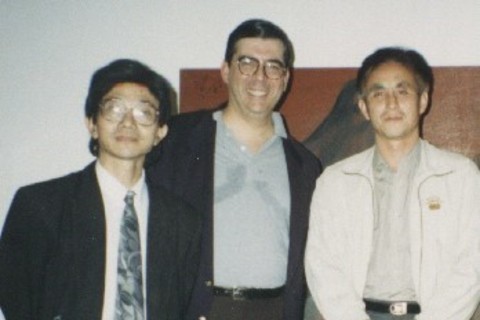
    From left: Li Jengtian, John Kamm, and Wang Xizhe

    In the 1992 presidential campaign, Democratic challenger Bill Clinton attacked incumbent President George H. W. Bush for “coddling” dictators from Baghdad to Beijing. He endorsed the use of trade sanctions to force China to improve its human rights record. After Clinton won the election in November 1992, China’s leaders grew increasingly concerned that Clinton would make good on his promise. They turned to American businessman turned rights advocate John Kamm for advice.

    Shortly after the election, Kamm flew to Beijing for meetings with senior officials. On November 16, 1992, Kamm dined with Zeng Jianhui, Director of the State Council Information Office (Zeng later served as chairman of the Foreign Affairs Committee of the National People’s Congress.) Kamm reminded Zeng of the positive reaction in the United States to the release of Tiananmen Square and Catholic prisoners, and suggested that China release prisoners from the Democracy Wall movement, namely Wei Jingsheng, Xu Wenli, and Wang Xizhe.* Kamm told Zeng that China had never released a prominent Democracy Wall prisoner, and opined that releasing one or more of them would have a positive impact.

    Wang Xizhe was a member of the famous Li Yizhe group that had put up a wall poster in Guangzhou in 1974 that called for democracy and rule of law. Wang had served five years in prison for his bold move, and, upon release, resumed his activism. He became a leader in the Democracy Wall movement, was detained in April 1981 and subsequently sentenced to 14 years in prison for counterrevolutionary incitement and propaganda and establishing a counterrevolutionary group. He sent to Huaiji Prison in western Guangdong Province to serve his sentence.

    Wang was released on February 3, 1993. Media coverage, especially by the Hong Kong press, was heavy.

    In early March 1993, Kamm returned to Beijing for meetings with senior officials including Zeng Jianhui and representatives of the Ministry of Foreign Affairs, Ministry of Public Security, Ministry of Justice, and Supreme People’s Court. He told officials with whom he met that he wanted go to Guangzhou and meet with Wang Xizhe. No objections were raised.

    On March 26, Kamm took the through train from Hong Kong to Guangzhou. That evening he was hosted to a banquet by Guangdong vice governor Zhang Gaoli. In his notes, Kamm recorded that 48 year old Zhang was a “high flyer.” He is currently a member of the Standing Committee of the Politburo of the Communist Party of China. The focus of the discussion was Clinton’s looming decision on whether or not to extend China’s Most Favored Nation trading status.

    Having gotten the go ahead from both Beijing and Guangdong, Kamm went to the coffee shop of the Jiang Nan Hotel in Guangzhou’s Henan District. He found Wang Xizhe and Li Jengtian, another leader of the Li Yizhe group, waiting for him.

    Li, by then a successful businessman who ran his own art gallery, was dressed in an elegant suit. Kamm found Wang’s appearance disconcerting. Kamm wrote in his notebook: “His time in prison must have been very difficult. He is trying to tint his hair back to brown from snow white. Most of the teeth on the upper right side of his mouth are gone.” Wang, Kamm wrote, is a proud and dignified man, determined to have his verdict reversed. He gave Kamm a copy of his 40th petition to the Supreme People’s Court; none of his petitions had been answered.

    The conversation covered many topics. How did Kamm become interested in Wang’s case? What did Kamm think of Wang getting into business to promote capitalism and democracy? Wang told Kamm that his future was in China, and that he didn’t want to go abroad.

    As the conversation grew animated, the tables around the small party in the coffee shop filled up with muscular young men in black leather jackets. These were officers of the state security bureau that Kamm had been told by officials in Beijing and Guangzhou to expect.

    Soon it was midnight. The small group was surrounded by a dozen agents. Gesturing towards them, Wang said “Although I am not in a prison with walls, I am not free. I am in a prison without walls.”

    Suddenly, Wang stood up and bowed to Kamm, declaring that this is how Chinese people show respect. Kamm then stood up and asked him to sit down, saying he didn’t deserve such respect. Wang would have none if it. He bowed a second time. ” My first bow was to say thank you for what you did for me, this bow is to say thank you on behalf of people who would like to thank you, but cannot.”

    After taking photos and settling the bill, the group went their separate ways. Kamm promised to return to Guangzhou in June to attend a children’s art exhibition at Li Jengtian’s gallery, and to see Wang.

    *The Democracy Wall movement, sometimes referred to as Beijing Spring, lasted from November 1978 to December 1979. Thousands of people aired their grievances on a wall near a bus stop in Beijing’s Xidan District. Elsewhere around China, demonstrations, petitions, and unofficial journals flourished. Wang Xizhe assisted in the publication of the April Fifth Forum and edited his own journal, Study Bulletin.


    Listen to the Encounters with China podcast.

    Subscribe to receive notifications about new episodes. 

    Read all John Kamm Remembers stories.


  • The Young Diplomat

    The Young Diplomat

    << Read all John Kamm Remembers stories

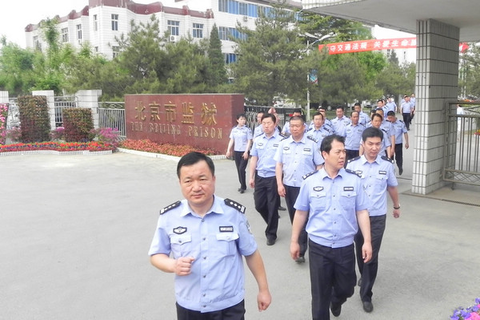
    A photograph of Beijing Prison and its personnel. Image credit: wdh.la

    In May 1992, a young Chinese Ministry of Foreign Affairs (MFA) official, Bai Weiji, and his wife Zhao Lei, were detained by China’s State Security police on suspicion of trafficking in state secrets. Two weeks later, police raided the apartment of Lena Sun, Beijing Bureau Chief of The Washington Post. They briefly detained Ms. Sun and her family and forced the American journalist to open the safe where she kept sensitive materials. In the safe they found internal documents that Bai Weiji had provided Ms. Sun.

    Lena Sun, who had written one of the first profiles on American businessman and recently turned human rights activist John Kamm, requested assistance from Kamm. Kamm began raising Bai and Zhao’s case with Chinese authorities, with whom he was regularly meeting in Beijing..

    In May, 1993, Bai was sentenced to 10 years in prison for trafficking in state secrets by the Beijing Intermediate People’s Court. His wife was given a six-year sentence. It is believed that one of the reasons that Bai was given such a lengthy sentence was that he had organized protests among MFA staff over the June 1989 suppression of pro-democracy demonstrations in Beijing.

    Kamm, in an interview with The New York Times Bureau Chief Nicholas Kristof, called the verdicts “very troubling” and “a serious disappointment.”

    Bai was sent to Beijing Prison, considered to be a model prison, where Bai was the only prisoner serving a sentence for counterrevolution. His English language skills were put to good use by the prison warden, who was seeking to find export markets for products made in prison workshops. Because he “expressed regret and a genuine willingness to reform,” and because he exhibited good behavior, Bai was granted three sentence reductions in 1996, 1997 and 1998 for a total reduction of three years and three months. He was released on February 2, 1999. His wife had been released early on October 20, 1997.

    After his release, Bai became a successful businessman. On a trip to the United States, he looked up John Kamm, who had moved with his family to San Francisco from Hong Kong in July 1995.

    Bai credited Kamm’s interventions for his early release, but brought up two other reasons he was shown clemency.

    In July 1996, Louis Joinet, chairman of the United Nations Working Group on Arbitrary Detention, visited China to begin preparations for a visit by the full working group the following year. One of the prisons he was allowed to visit was Beijing Prison.

    Upon arrival at the prison, Joinet asked to interview prisoners. His request was rejected. The director general of the MFA’s International Department, Li Baodong, rushed to the prison to resolve the stand-off. It was agreed that Joinet could interview a prisoner, and he was invited to select one at random. At that moment, Bai Weiji was walking in the prison yard, and Joinet chose him to be interviewed. Joinet had no idea who he was, but the prison officials became suspicious: how could it be that the prisoner selected to be interviewed was the only prisoner serving a sentence for counterrevolution?

    Bai played his role brilliantly. He declined to give any identifying information. He did not tell Joinet why he was in prison, nor did he say he was a former MFA official. He went to considerable length to commend the prison authorities for treating him so well. Although the interview was supposed to be held in a secure, confidential setting, Bai figured that the prison authorities were listening in. Shortly after the interview, Bai was granted his first sentence reduction.

    The second reason given to explain Bai’s clemency involves the July 1997 handover of Hong Kong from the United Kingdom to China. A city-wide competition to ascertain who knew the most about the handover was held among teams representing all of Beijing’s prisons. Bai, who was familiar with Hong Kong from his days working for MFA, was chosen to head the Beijing Prison team, which handily won the competition. Bai and his team members were rewarded with sentence reductions, but Bai noted, somewhat ruefully, that because he was serving a sentence for counterrevolution, he could only get half the number of points awarded to the other teammates.

    According to regulations, prisoners serving sentences for counterrevolution had to be “strictly handled” when it came to sentence reductions. The Bai Weiji case afforded Kamm one of his first opportunities to find out what these regulations meant in practice.


    Listen to the Encounters with China podcast.

    Subscribe to receive notifications about new episodes. 

    Read all John Kamm Remembers stories.

  • Cousin Orrin

    Cousin Orrin

    << Read all John Kamm Remembers stories

    Orrin Hatch speaks at Utah Valley University on August 31, 2011. Image credit: Michael Jolley/ CC BY 2.0

    In October 1997, American businessman and human rights activist John Kamm flew to Hong Kong to start a two-week business and human rights advocacy trip that would also take him to Dalian and Beijing. On the flight to Hong Kong he was in the same cabin as the late Michel Oksenberg, the Stanford University scholar who played a key role in normalizing US-China relations when he served on the National Security Council.

    Kamm and Oksenberg discussed why they were heading to China. Oksenberg advised Kamm that he would be accompanying Senator Orrin Hatch, then-chairman of the Senate Judiciary Committee, on a weeklong visit to Hong Kong, Beijing, and Shanghai. Senator Hatch was visiting China 10 days before President Jiang Zemin’s state visit to the United States hosted by President Bill Clinton. Hatch and his wife Elaine were due to arrive in Hong Kong the following evening, accompanied by aides, and the Stanford scholar invited Kamm to join the small party for dinner at the Spring Deer Restaurant in Kowloon.

    Kamm put together a file of material on his work, and showed up at the restaurant on time. When he arrived, Oksenberg told him that, due to a bad weather delay in Washington DC, Senator Hatch had to cancel his trip to Hong Kong and instead fly directly to Beijing. Oksenberg took the file from Kamm and promised to hand it to Senator Hatch. If there were an opportunity for Kamm to meet Hatch, Oksenberg would contact Kamm in Beijing.

    Kamm and Oksenberg went their separate ways, Oksenberg to Beijing, Kamm to Dalian. After business meetings in Dalian, Kamm flew to Beijing where he settled into his hotel. The morning after he arrived, Kamm received a phone call from Professor Oksenberg.

    “Are you sitting down?” Oksenberg asked. “You’re not going to believe this, but you and Senator Hatch are related. He insists that you are his cousin. His mother was a Kamm, and her family came from the same part of New York as your father’s family.” Oksenberg asked Kamm to come to the China World Hotel right away to meet Senator Hatch and his wife.

    Upon his arrival, Senator Hatch stood up, looked at Kamm, and turned to his wife: “The spittin’ image of grandpa!”

    Kamm and Hatch sat down for a friendly conversation. Hatch asked if there was anything he could do to help Kamm’s work on political prisoners. Kamm advised Hatch that Kamm’s prisoner information project had been suspended since 1995, and that the Ministry of Justice owed him answers on 75 requests for information. Hatch promised to assist.

    The next day, Senator Hatch met with Xiao Yang, then Minister of Justice. At the end of a meeting that focused on possible cooperation between the Senate Judiciary Committee and the Ministry of Foreign Affairs, Hatch got up to leave. When he reached the door, he put his arm around Minister Xiao (who would later go on to become President of China’s Supreme People’s Court) and asked for a personal favor: “My friend and relative John Kamm has cooperated with your ministry on a prisoner information project. The project has been suspended due to no fault of John’s. Can you please look into this and resume your cooperation with my cousin?”

    After his stay in Beijing, Hatch flew to Shanghai and had a meeting with President Jiang Zemin. As had done with Xiao Yang, Hatch raised Kamm’s work and asked President Jiang to authorize the resumption of the prisoner information project.

    Jiang Zemin visited Washington from October 25 to October 28, 1997. At the conclusion of the state visit, the two countries issued a joint statement listing the achievements of the meeting. Among the accomplishments was the resumption of American businessman John Kamm’s accounting project. Kamm was the only individual whose name appeared in the joint statement. Cooperation with the Ministry of Justice resumed, and within a few months all of Kamm’s remaining inquiries had been answered. The responses indicated that several long serving prisoners had been granted early release after Kamm submitted their names in 1995.


    Listen to the Encounters with China podcast.

    Subscribe to receive notifications about new episodes. 

    Read all John Kamm Remembers stories.


  • Executions of Hong Kong Residents Spur Interest in Human Rights

    Executions of Hong Kong Residents Spur Interest in Human Rights

    << Read all John Kamm Remembers stories

    Prisoners transported for public display during Strike Hard 1983. Image credit: Sina Blogger

    Before he began his human rights work in 1990, John Kamm was an American businessman based in Hong Kong. As the Hong Kong representative of the semi-governmental National Council for US-China Trade, Kamm worked to open China to trade and investment. He registered the first Chinese factories with the American Food and Drug Administration in 1977 and introduced American firms to investment opportunities on the Mainland. He ran the National Council’s office at the Guangzhou Trade Fair from 1976 to 1980.

    After the United States and China established diplomatic relations in 1979, Kamm established a company and began representing American and other firms in China. Leveraging his knowledge of the city and his fluency in Cantonese, Kamm established the first foreign office in Guangzhou in 1979.

    Shortly before the Spring Chinese Export Commodities Fair opened in Guangzhou in April 1983, an event took place that focused Kamm’s attention on human rights. China’s first Strike Hard Campaign was launched in August 1983, and offenders were dealt with harshly. It was recently revealed in a Mainland Chinese publication that there were 24,000 executions in China in 1983. Kamm witnessed men being led to their executions in the summer of 1983 as he crisscrossed Guangdong Province buying and selling chemicals.

    Two young men from Hong Kong, He Enjie and Liu Zerong, hung a banner from their room in the Guangzhou Hotel denouncing China’s ruling Communist Party. They left the hotel and photographed the banner, then headed for the train station to return to Hong Kong. They were intercepted by public security officers, detained and subsequently tried for espionage. They were convicted, sentenced to death, and had their appeals rejected. The Supreme People’s Court (SPC) in Beijing then approved their executions, which were carried out on September 6, 1983.

    Hong Kong prisoners serving sentences for counterrevolution in Mainland prisons were a top priority for Kamm after he turned to human rights work in 1990. One of these early cases was that of Qin Hanbiao, a Guangzhou native who emigrated to Hong Kong in 1979. Qin and Guangzhou resident Qin Yaoche were detained on May 10, 1983 on suspicion of spying for Taiwan. They were tried by the Guangzhou Intermediate Court on September 10, 1983, found guilty, and sentenced to death. The sentence was upheld by the Guangdong High People’s Court on September 21, 1983, after which it was sent to Beijing for SPC review.

    The SPC, perhaps influenced by the uproar over the execution of He Enjie and Liu Zerong the month before, determined in October that the damage to China’s national security caused by Qin Hanbiao and Qin Yaoche was not sufficiently serious to warrant the death sentence. The two men were retried in Guangzhou and sentenced to life in prison.

    Kamm sought information on Qin Hanbiao from both the Hong Kong government and the Guangdong government. The latter advised him that Qin was serving his sentence in Huaiji Prison in western Guangdong (Huaji had a special cell block for counterrevolutionaries). His sentence had been reduced to a 20-year sentence in March 1986. The sentence was further reduced by 18 months in January 1990. After Kamm’s repeated inquiries, Qin Hanbiao was released on June 24, 1999—shortly after Dui Hua was established, and seven years before the end of Qin’s 20-year sentence imposed in 1986. (In China, people sentenced to life in prison whose sentences are subsequently reduced to a fixed term do not receive credit for time served. Qin did not get credit for the three years he spent in prison before the life sentence was commuted.)

    Hong Kong residents who were convicted of counterrevolution in Guangdong usually served their sentences in the province, but other prisoners convicted of counterrevolution—even those residing in the province—were often shipped to Xinjiang in China’s far northwest to serve their sentences. That is what happened to Qin Yaoche. Despite many attempts by Kamm to find out what happened to him, the trail went cold. Then as now, finding information on prisoners in Xinjiang remains difficult.


    Listen to the Encounters with China podcast.

    Subscribe to receive notifications about new episodes. 

    Read all John Kamm Remembers stories.


  • You’re on a Businessman’s List

    You’re on a Businessman’s List

    << Read all John Kamm Remembers stories

    Jiang Zemin during his state visit to the United States in October 1997, after which Kamm was able to resume cooperation with the Chinese government. Image credit: sina.com

    In February 1995, American businessman John Kamm traveled to Beijing to review progress of his effort to systematically obtain information on people imprisoned for counterrevolutionary crimes. Prior to his arrival, he compiled a booklet with all of the information he had received from the Ministry of Justice (MOJ) in 1994 and sent it to the MOJ and State Council Information Office (SCIO).

    When he met with senior officials of the SCIO and MOJ, Kamm asked them what they thought of his booklet. SCIO Director Zeng Jianhui replied, “You have accurately reported what you were told.”

    Kamm then proposed that, for 1995, he submit quarterly lists of 25 prisoners for a total of 100 names. Director Zeng looked at the MOJ representative, who nodded in agreement. “It’s a deal then,” said Kamm. “Let’s shake on it.” He then handed over the first list of 25 names.

    Two months later Kamm returned to Beijing, where the MOJ gave him responses on 18 of the first 25 names, and he submitted a second list.

    Then, in May 1995, the United States Department of State issued a visa to then-President of Taiwan Lee Tenghui. Lee traveled to the United States where he gave an impassioned speech on Taiwan at his alma mater, Cornell University. The Chinese government was furious. As tensions mounted, Chinese rockets were fired in the direction of Taiwan, and President Clinton dispatched two carrier groups to patrol the waters off the island.

    The Taiwan Straits crisis effectively ended Kamm’s “prisoner information project,” but he refused to accept what he saw as a unilateral termination of a contract. He continued to travel to Beijing and lobbied whoever would see him—not many Chinese officials would—to resume cooperation. He convinced dozens of American senators and members of Congress to write letters of support to the Chinese Embassy and to bring up the matter in face-to-face meetings with senior Chinese officials. Most importantly, he “kept his side of the deal,” faxing to the SCIO and MOJ the third and fourth quarter lists.

    It wasn’t until after President Jiang Zemin made a state visit to the United States in October 1997 that cooperation between Kamm and the Chinese government resumed. By the end of 1998, Kamm had received responses to nearly all of the prisoners on his 1995 lists.

    One of the names for which he received a response was Zhang Xianliang, a Shanghai-based dissident who had served a sentence for counterrevolution in the mid-1980s and who had resumed his pro-democracy activism after his release. Zhang had been detained in 1993 for organizing a commemoration of the 1989 June Fourth anti-government protests in Beijing and other cities. He was sentenced to three years of re-education through labor in Anhui Province.

    According to the MOJ response, Zhang had been released early for good behavior in June 1996. Not long after his release, Zhang traveled to the United States to join his daughter.

    In March 2002, Kamm was profiled in a cover story for The New York Times Magazine. A few days after the story appeared, Kamm received a call from Ms. Zhang Bing, Zhang Xianliang’s daughter, who lived in Berkeley. She asked to come and see him at his San Francisco office.

    Zhang came to Kamm’s office and immediately began telling him a story she had heard from her father, who was at that time running a small human rights group in Chicago. Upon arrival at the camp, Zhang Xianliang, a fifty-year-old intellectual, had been assigned to hard labor. He was tormented by two guards, until one day they were replaced by a kind guard. Zhang was reassigned to work in the camp library, and his guard would stop by and join him for tea and cigarettes.

    At one of these get-togethers, the guard told Zhang: “Don’t worry. You will be released and allowed to travel to the United States. You’re on a businessman’s list.” When Zhang read the story in the Times magazine, he realized that the businessman was John Kamm.


    Listen to the Encounters with China podcast.

    Subscribe to receive notifications about new episodes. 

    Read all John Kamm Remembers stories.

  • American Views of China Remain Negative

    Less than six months after Chinese president Xi Jinping’s state visit to the United States—a visit intended to improve American perceptions of China—the percentage of Americans who hold an unfavorable view of China rose in 2016, according to the Gallup Organization. For the ninth year in a row, at least half of Americans hold an unfavorable view of China; 52 percent held that view in early February 2016, versus 44 percent who held a favorable view. In 2015 the percentages were 50 and 44, respectively. Gallup conducted its annual survey on American attitudes towards foreign countries earlier this month.

    The percentage of Americans who consider China to be America’s greatest enemy remained steady at 12 percent.

    Americans who see China’s economic power as a critical or important threat to the United States rose marginally from 84 percent of those polled in 2015 to 86 percent in 2016, while the percentage who see China’s military power to be a critical or important threat was 87 percent—the same percentage recorded the last time the question was asked in 2014.

    Since 2011, at least 50 percent of Americans have viewed China as the world’s leading economic power, but this year the percentage dropped to exactly 50 percent, while the percentage holding the view that the US is the leading economic power rose to 37 percent from 31 percent in 2015. Perhaps the most surprising result of the poll is the response of Americans to the question “Who will be the leading economic power in 20 years?” In 2012, the last time the question was posed, 46 percent responded China and 38 percent responded the US. In 2016, 44 percent believe the US will be the leading power in 2026; only 34 percent predict China will then be the leading power.

  • The Campaign to Free Counterrevolutionaries

    The Campaign to Free Counterrevolutionaries

    << Read all John Kamm Remembers stories

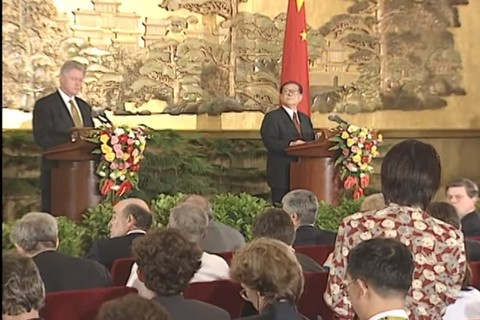
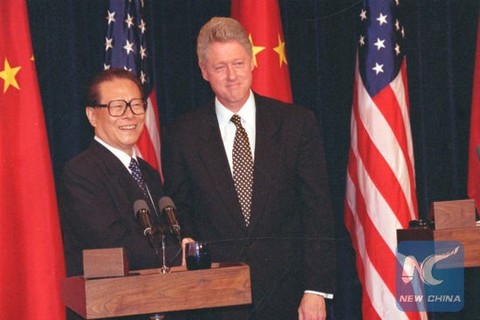
    Former presidents Bill Clinton and Jiang Zemin, holding a June 1998 press conference in Beijing, listen to an American reporter raise the issue of releasing prisoners sentenced in China for counterrevolutionary crimes. Source: YouTube screengrab

    China’s most recent Criminal Law was adopted by the National People’s Congress on July 1, 1979, and came into force on January 1, 1980. It has been amended nine times, most recently in September 2015.

    The most sweeping amendment to the Criminal Law took effect on March 14, 1997, when lawmakers removed the chapter on counterrevolutionary crimes and added another on crimes of endangering state security (ESS). The new chapter covered some, but not all, of the acts formerly classified as counterrevolutionary offenses. For instance, the counterrevolutionary crimes relating to “reactionary sects,” organizing a jailbreak, and plotting and carrying out airplane hijackings were reclassified as crimes other than ESS in the amended Criminal Law.

    American businessman John Kamm had been intervening on behalf of prisoners convicted of counterrevolutionary crimes—most of whom had been convicted for offenses committed during the Spring 1989 disturbances—for nearly seven years when the amended Criminal Law took effect. From exchanges he had with the Ministry of Justice (MOJ), he obtained information on individual cases as well as the number of counterrevolutionaries serving sentences in prison: 2,016 as of the end of 1996. By the end of 1997, almost nine months after counterrevolutionary crimes had been removed from the Criminal Law, there were still 1,946 people serving prison sentences for the defunct crimes.

    In early 1998, Kamm began lobbying the SPC and the MOJ to release these prisoners in accord with both Chinese and international law. In China, there is no such thing as “crime by analogy.” An offense cannot be an offense simply because it is like another crime, and counterrevolution and ESS are different.

    Kamm also relied on an interpretation of Article 15 of the International Covenant on Civil and Political Rights, which China signed in 1998 but has not ratified. Article 15 states that, “If subsequent to the commission of an offense, provision is made for the imposition of a lighter penalty, the offender should benefit thereby.” Kamm argued that, after their removal from the Criminal Law, the legal penalties for counterrevolutionary crimes became nonexistent.

    Surprisingly, Chinese officials were sympathetic. An SPC official told Kamm that if his arguments were accepted, many prisoners and their families would be forever grateful. An MOJ official told Kamm that the ministry’s own analysis somewhat aligned with his: under international human rights law, the prisoners should be released, but under Chinese law, this was impossible.

    The MOJ expanded on its position in a letter to Kamm dated April 17, 1998, citing Article 12 of the amended Criminal Law, which states: “Before the entry into force of this law, any judgment that has been made and has become effective according to the laws at the time shall remain valid.”

    Around the time Kamm received the letter, President Bill Clinton was planning a state visit to China. Kamm appealed to Jeff Bader, who headed China affairs at the National Security Council, to present Kamm’s proposal for clemency to the president. Clinton agreed to raise the issue with President Jiang Zemin.

    On June 27, 1998, Clinton met Jiang at the Great Hall of the People. After the meeting, they held a press conference at which President Clinton revealed that he had suggested to President Jiang that “Chinese citizens who were in prison for crimes no longer on the books” should be released.

    On a subsequent trip to China, Kamm asked a senior adviser what President Jiang thought of the suggestion. The advisor said, “President Jiang was impressed by President Clinton’s deep knowledge of Chinese law.”

    To this day several dozen people remain in prison for counterrevolutionary crimes committed before 1997. One of the longest still in prison is Shanghai labor activist Jiang Cunde, who was detained in 1987 and subsequently sentenced to life in prison for counterrevolutionary sabotage. His life sentence was commuted in 2004, and there have been no sentence reductions since then. Jiang, who reportedly suffers from schizophrenia, is not due for release until August 22, 2024, by which time he will be 71 years old.


    Listen to the Encounters with China podcast.

    Subscribe to receive notifications about new episodes. 

    Read all John Kamm Remembers stories.


  • In Bid for MFN, 2000 Olympics, China Freed Catholics

    In Bid for MFN, 2000 Olympics, China Freed Catholics

    << Read all John Kamm Remembers stories

    A photo of Father Li Fangchun, who was released on medical parole in 1992, with Father Giancarlo Politi.

    The attempt by US Congress to attach human rights conditions on the renewal of China’s Most Favored Nation (MFN) trading status narrowly failed when Senate Majority Leader George Mitchell could not muster the votes necessary to override President George H. W. Bush’s veto in the summer of 1991.

    Beijing knew that the fight to renew MFN in 1992—a presidential election year—would be a tough one, and that it would be necessary to continue making human rights concessions to achieve renewal of that trade status without conditions. Adding to China’s willingness to compromise was the 2000 Summer Olympics. Beijing announced a bid to host the games in February 1991 and the winner would be determined in September 1993.

    American businessman Kamm, who by late 1991 was increasingly seen as a middleman in securing the release of Chinese prisoners of conscience, had an idea for how China could demonstrate its commitment to human rights. He suggested the release of “underground Catholics.” As the early 1990s began, dozens of Catholic clergy and laity were being held in prisons and re-education through labor (RTL) camps as well as “homes for the elderly,” detention facilities for elderly clergy operated by the State Administration of Religious Affairs (SARA). For many Catholics, their only offense was refusal to join the Catholic Patriotic Association under the control of the Chinese Communist Party.

    In meetings with a number of Chinese government agencies—including the State Council Information Office, the Ministry of Foreign Affairs, the Ministry of Justice, the Ministry of Public Security, and the Catholic Section of SARA known as the Second Department—Kamm argued that releasing underground Catholics, served China’s twin goals of renewing MFN and securing the 2000 Olympics.

    Kamm stressed the high percentage of Roman Catholics who were members of US Congress, and the large number of countries in Europe, Latin America, and Asia with majority Roman Catholic populations. He used the information obtained during his visit to Meizhou Prison in late 1991—that elderly prisoners are eligible for medical parole—to concentrate his early efforts on bishops and priests in their seventies.

    From January 1992 to September 1993, Kamm intervened on behalf of more than 20 Catholic clergy, many of whom were brought to his attention by Giancarlo Politi, a Catholic priest in Hong Kong. Kamm put their names on lists, raised their names in meetings, unleashed a barrage of letters and faxes, and, as a Roman Catholic, requested to hear Mass said by the clergy and to send them Christmas cards.

    By September 1993, virtually all of the bishops and priests for whom Kamm advocated had gained early release, including:

    • Bishop Liu Guandong (刘冠东), the de facto president of the underground Chinese Bishops Conference, was sentenced to three years of RTL on May 21, 1990. He was released one year early on May 21, 1992.
    • Father Jin Dechen (靳德辰), sentenced to 15 years in prison for counterrevolutionary crimes in 1982, was released on parole on May 21, 1992.
    • Monsignor Wang Yijun (王益俊), one of the longest serving Catholic prisoners who was sentenced to prison for counterrevolution in 1981 and then sentenced to an additional three years of RTL in February 1990, was released on parole on May 21, 1992.

    China’s effort to win renewal of its MFN trade status was successful in 1992, and in 1993, President Bill Clinton eschewed legislative action in favor of an executive order that was eventually abandoned as China’s economic clout and lobbying prowess began to rise. As for its Olympic bid, after leading in four of five rounds of voting, China was finally edged out by Sydney, which won by two votes. To this day, Catholics, like other religious groups, continue to be persecuted in China, and elderly clergy can still be found in government-run “homes.”


    Listen to the Encounters with China podcast.

    Subscribe to receive notifications about new episodes. 

    Read all John Kamm Remembers stories.

  • I Guess You’d Call it a Miracle

    I Guess You’d Call it a Miracle

    << Read all John Kamm Remembers stories

    Kamm with the Li Brothers following their release in 1991.

    In early 1991, after stepping down as president of the American Chamber of Commerce in Hong Kong, John Kamm began working as a private businessman to help political prisoners in China, starting with several visits to Guangzhou. Human rights activists initially greeted his efforts with skepticism. At a breakfast meeting with Kamm, Human Rights Watch Hong Kong Director Robin Munro expressed disbelief that businesspeople could be effective rights advocates.

    A few weeks after the breakfast, Munro phoned Kamm at his Hong Kong office. Making clear that he was calling in his private capacity, Munro told Kamm that a journalist friend had given him a letter smuggled out of a detention center in Hengyang, Hunan Province. “You say that businesspeople can help political prisoners,” Munro told Kamm. “Well, here’s your chance.”

    Two brothers, Li Lin and Li Zhi, wrote the letter. They had been leaders in the spring 1989 protests in Hengyang. Both fled to Hong Kong after the protests subsided, courtesy of Operation Yellow Bird. Once in Hong Kong, Li Lin, a leader of the Hunan Independent Workers Federation, found work as a mechanic, while his younger brother, Li Zhi, worked as a salesman and musician.

    The brothers went back to their hometown to visit family during the Lunar New Year holiday in 1991. Contrary to assurances from local officials, both were detained on February 16, 1991.

    Munro gave Kamm the brothers’ names (in Pinyin and in characters) as well as their Chinese ID numbers and the location of the detention center where they were allegedly being tortured.

    It happened that, in the afternoon, Kamm was to meet with a Deputy Vice-Secretary General of the State Council, accompanied by an editor of a left-leaning Chinese newspaper in the then-British colony, and an officer of the American Consulate General. The State Council official got right to the point: “Why is it so difficult for China to win renewal of its Most Favored Nation (MFN) trade status in the United States?” Kamm responded, “Because, every day, average Americans like me hear something about how your government treats its citizens that makes us angry.” The official asked, “What do you mean?” Kamm replied by handing the official a note with the information on the Li brothers. “I understand they are being tortured,” Kamm said. The official took the note, folded it, and put it into his pocket.

    In order to prepare for two testimonies to Congress in late June 1991, Kamm flew to Beijing to obtain updates on political prisoners in early June. He set up meetings with a number of officials, including the State Council official who had accepted the note. Prior to this meeting, Kamm met with the Supreme People’s Court (a court vice president and directors of court’s Criminal Division and Foreign Affairs Bureau) and an official of the China Council for the Promotion of International Trade, Kamm’s official host. The purpose of this meeting was to ask about the possibility of parole for Lo Xaixing, a former Hong Kong Trade Development Council representative who was serving a five-year sentence for his role in helping dissidents escape China in the aftermath of June 4.

    After asking about Lo, Kamm followed up with a question about two men who had been convicted along with him. The vice president misunderstood Kamm’s question and replied: “Regarding the Li brothers, their case will be handled in accordance with the policy that those who have committed offenses during the turmoil can return to China provided they do not commit new crimes.”

    After being sentenced to five and a half months for illegal border crossing, the Li brothers were released on July 9, 1991—four weeks after Kamm’s meeting with the State Council official. The brothers went directly to Hong Kong and had dinner with Kamm the following day. They were emaciated and showed signs of having been tortured. The day Kamm raised their cases was the day police started treating them better, the Li’s told Kamm. The Li brothers eventually traveled to the United States where they were granted political asylum.

    Months later, on another trip to Beijing, Kamm had an informal meeting with the Supreme People’s Court Foreign Affairs Bureau official who had attended the meeting at which the Li brothers were discussed. Kamm asked for information on the policy that those who fled China after June 4 would not be detained provided they did not commit new crimes. The official replied that he was also curious about this policy, but had found no relevant official documents. Kamm asked, “If that’s the case, why were the Li brothers released?”

    The official replied, “I guess you’d call it a miracle.”


    Listen to the Encounters with China podcast.

    Subscribe to receive notifications about new episodes. 

    Read all John Kamm Remembers stories.


  • The Northeast China Autonomous People’s Republic

    The Northeast China Autonomous People’s Republic

    << Read all John Kamm Remembers stories

    This post was originally published as part of the Roots series in the May 2015 Digest.

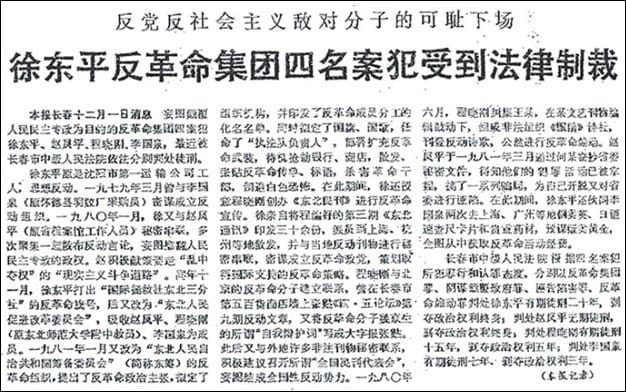
    An article from the Jilin Daily in 1983 provided Kamm the names of previously unknown political prisoners.

    John Kamm was a private businessman based in Hong Kong when he was granted a meeting with Vice Minister of Justice Jin Jian and Prison Administration Bureau Director Wang Mingdi in April 1992. At the time, US Congress was debating whether to extend Most-Favored-Nation tariffs to China, and Kamm was one of the principal proponents in favor of granting China this treatment. The Chinese government decided to support Kamm’s effort by releasing information on cases and granting clemency to prisoners Kamm named in meetings and lists.

    During the April meeting, Vice Minister Jin offered to respond to any prisoner inquiry Kamm submitted, provided that the name was given in accurate pinyin or, even better, in Chinese characters. Kamm immediately asked about Wei Jingsheng, arguably China’s most famous political prisoner known for his essays in support of democratic reform published during the brief period of political liberalization of the late 1970s. True to the vice minister’s word, Director Wang Mingdi responded to Kamm’s inquiry. Information included in the response was published the next day in The New York Times, which referred to the correspondence as “the first time that the [Chinese] government has provided extensive details of the imprisonment of Mr. Wei.”

    Two years later, Kamm was compelled to look into a lesser-known case. In February 1994, Human Rights Watch published Detained in China and Tibet: A Directory of Political Prisoners. The 632-page tome contains information on approximately 1,700 prisoners and remains a valuable resource for scholars and activists.

    Buried in the section “Long-Term Prisoners Sentenced Prior to 1989” was an account of a counterrevolutionary party, the Preparatory Committee for the Northeast China Autonomous People’s Republic, set up in Jilin Province in the early 1980s. The account was based on the transcript of a Changchun Radio broadcast recorded by the BBC. It gave the names of the three ringleaders—Cheng Xiaogang, Shi Dongting, and Zhao Fengxing—thought to remain in prison.

    Kamm wondered whether the names were recorded correctly and if a written account of the case could be found in a provincial newspaper. On a hunch, he visited a Hong Kong library and searched Jilin newspapers published in late 1983. After several hours, he came across a detailed account of the case in the December 2 edition of the Jilin Daily that named the party leaders as Cheng Xiaogang, Xu Dongping, and Zhao Fengping.

    Armed with Chinese characters and accurate pinyin, Kamm immediately filed an inquiry with the Ministry of Justice. In response, the ministry advised Kamm that all three men had been convicted of counterrevolutionary crimes. Cheng Xiaogang was sentenced to 15 years in prison and paroled on December 1, 1987. Xu Dongping was sentenced to 20 years in prison and released on medical parole in 1991. Zhao Fengping was given a life sentence, which was commuted to 13 years on December 20, 1989. Zhao’s sentence was due to expire on December 19, 2002. Kamm continued to inquire about Zhao after founding Dui Hua—until the ministry reported that he had been released two and a half years early on April 21, 2000.

    The prospect of finding the names of political prisoners in open source materials seemed absurd until John Kamm went to a library in 1994. Five years later, Kamm would establish Dui Hua, which, due in part to the contribution of open-source research, now maintains the world’s largest database of Chinese prisoners of conscience.


    Listen to the Encounters with China podcast.

    Subscribe to receive notifications about new episodes. 

    Read all John Kamm Remembers stories.


  • Congressional Action on Hong Kong Set to Roil US-China Relations

    Hong Kong people demand genuine democracy during a seven-week civil disobedience campaign in 2014. Photo credit: ezone.hk news

    Buried in the massive 1,600-page, $1.1 trillion omnibus spending bill that was signed into law by President Obama on December 16, 2014, is a provision requiring the Department of State to resume reporting under the terms of the Hong Kong Policy Act of 1992. A report on Hong Kong covering topics such as the development of democratic institutions, change in the exercise of sovereignty, and bilateral relations with the United States must be submitted to Congress no later than January 31. The Department of State is currently drafting the report and will submit it by the deadline imposed by Congress. The last time a report was filed under the Hong Kong Policy Act was in 2007.

    Resumption of reporting as provided for in the omnibus spending bill applies only to 2015, but legislation being reintroduced to the House of Representatives by Congressman Chris Smith (R-NJ), co-chairman of the Congressional-Executive Commission on China, would extend reporting for many years to come. The legislation in question is the Hong Kong Human Rights and Democracy Act (HKHRDA), which was originally introduced in both the House and Senate in November 2014. Although it passed the Senate Foreign Relations Committee in the waning hours of the 113th Congress, both the Senate and House adjourned before further action could be taken.

    The HKHRDA stipulates that the Department of State file annual reports on conditions in Hong Kong for 10 years, or until “the Secretary of State certifies that Hong Kong has held free and fair elections for two consecutive Chief Executive and two consecutive Legislative Council periods.” Of greater concern to Hong Kong and mainland officials is the stipulation that the Secretary of State issue an annual certification that Hong Kong is sufficiently autonomous to warrant separate treatment under US law. The Department of State has made clear that it is opposed to this certification requirement. The Hong Kong Policy Act does not require annual certification. It gives the president the discretion to decide whether Hong Kong enjoys the high degree of autonomy called for under both the Sino-British Joint Declaration and the Basic Law, Hong Kong’s mini-constitution. Between 1993 and 2007, no president exercised the discretion to deny Hong Kong separate treatment.

    Congressman Smith is also putting together a Hong Kong Caucus in the House of Representatives. The caucus, which must be approved by Speaker of the House John Boehner (R-OH), is expected to hold its first meeting in the coming weeks. At some point, Congressman Smith, possibly accompanied by other caucus members, will seek to visit Hong Kong on a “fact finding mission.” Like all members of Congress, he travels on a diplomatic passport, which means that he will need to get a visa from the Chinese Embassy in Washington in order to do so. Long a critic of China’s human rights record, Congressman Smith has had his applications to visit mainland China rejected on several occasions. It remains to be seen whether the Chinese Embassy will issue a visa to allow him to enter the Hong Kong Special Administrative Region (SAR). In light of the recent refusal by the Chinese Embassy in London to issue visas to British members of parliament seeking to visit Hong Kong, chances are high that Congressman Smith will not get a visa, something likely to prompt a strong reaction in Washington.

    Members of Congress are taking action on Hong Kong in part to support “genuine democracy” (i.e., universal suffrage and an open selection of candidates) in response to the Occupy Central protests that paralyzed parts of Hong Kong for seven weeks from late September to mid-December 2014. They may also be responding to how Hong Kong authorities handled the Edward Snowden affair in June 2013. When the SAR government allowed Snowden to leave Hong Kong for Moscow, it looked to many in Washington that it had done Beijing’s bidding, raising questions about the level of autonomy in Hong Kong.

    Although the Chinese government has not made statements on the renewal of reporting and the introduction of the HKHRDA, it is certainly deeply opposed to both. The Ministry of Foreign Affairs’ spokewoman stated on September 29, 2014 that “Hong Kong affairs fall entirely within China’s internal affairs. [The ministry] urge[s] relevant countries to be prudent in their words and deeds [and to] refrain [from] interfering in Hong Kong’s internal affairs in any way.” Chinese leaders believe that foreign governments, led by the United States, were behind Occupy Central. Congressional action on Hong Kong will reinforce this belief.

    For now at least, Beijing is content to let the Hong Kong government take the lead in lobbying Congress and the Obama administration not to enact the HKHRDA. The Hong Kong Trade and Economic Commission in Washington is actively meeting with state department officials and congressional staffers. It has enlisted the support of trade organizations who warn of dire consequences if Hong Kong is stripped of separate treatment under US law.

    How a Bill Becomes a Law

    The HKHRDA has a long way to go before it passes both chambers of Congress and lands on President Obama’s desk. A person involved in the drafting of the bill told Dui Hua that it is not expected to pass both houses of Congress until the summer of 2015—around the time that Hong Kong’s Legislative Council will vote on the political reform package based on the National People’s Congress Standing Committee decision issued August 31, 2014.

    Once Congressman Smith introduces the HKHRDA, it will receive a number and be referred to committees with jurisdiction, almost certainly the House Foreign Affairs Committee but possibly, since the legislation touches on economic and trade issues, the House Ways and Means Committee as well. Hearings on the bill would likely be held before passage by the full committees, after which it would head to the House for a vote.

    The HKHRDA was co-sponsored in the 113th Congress by Senator Marco Rubio (R-FL), but has yet to find a Senate sponsor in the 114th Congress. Assuming a senator does introduce the bill in the Senate, it would follow a path similar to that in the House. Opposition by the Department of State could cause some Democratic senators to oppose the bill and affect its chances of passage. Assuming the bill does pass both chambers and the version that passes the Senate is different from that which passes the House, a conference of members from both chambers would hammer out a bill that merges the two. Both chambers must in turn pass that bill before it goes to the president for his signature or veto. If President Obama vetoes the bill on the grounds that it removes his discretionary power, two-thirds of the members of both the House and Senate would need to vote to override the veto.

    The long process of hearings and debates, denial of visas to American congressmen bent on visiting Hong Kong, and strong statements by the Chinese government that are expected to ensue should make human rights and democracy in Hong Kong a bone of contention in US-China relations for the months ahead. Weeks after the Department of State issues its report at the end of January, the department will issue its country report on China’s human rights record, which contains a section on Hong Kong. In the words of an official involved in writing this year’s report, it will be a “scorcher,” guaranteed to raise hackles in Beijing.