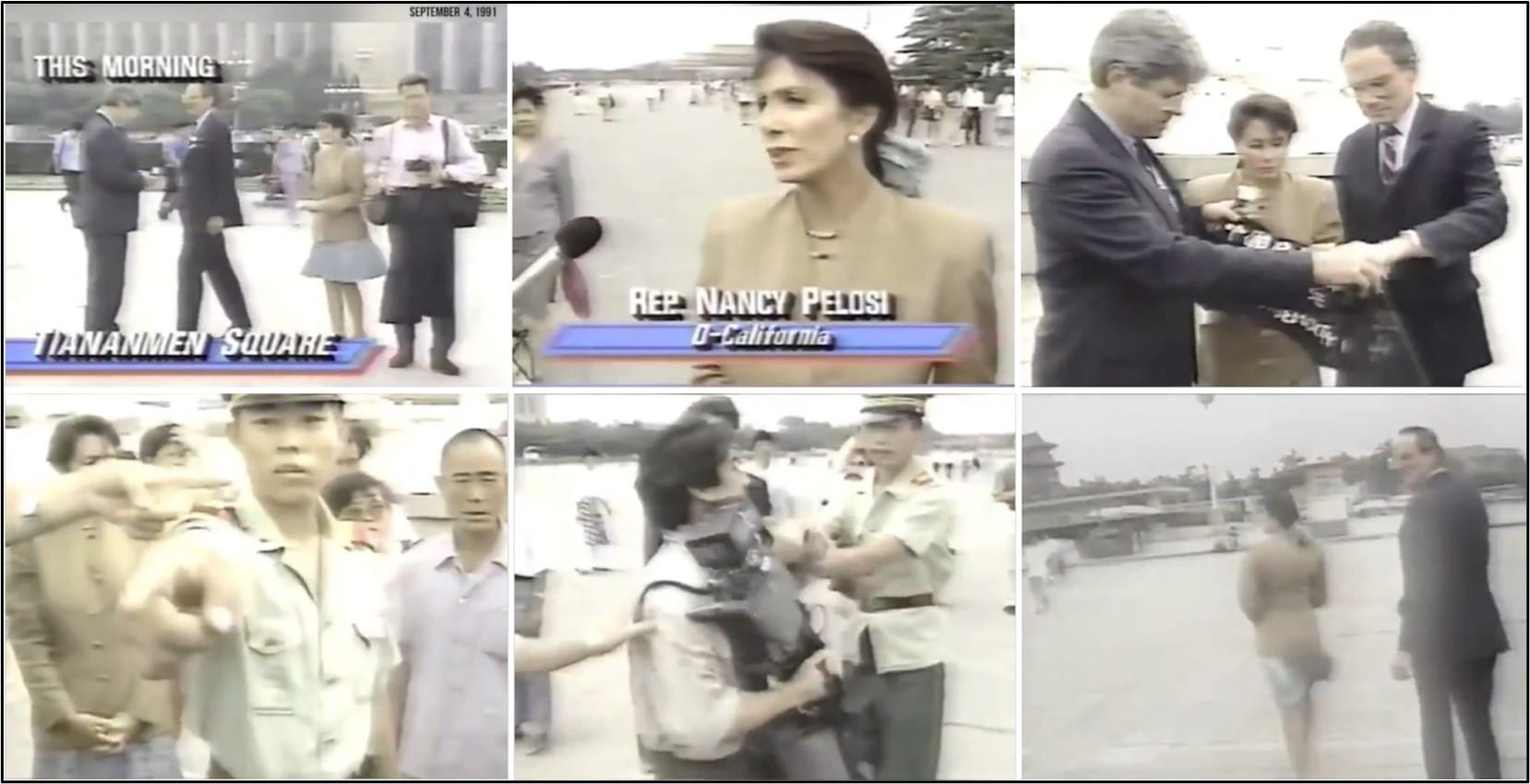
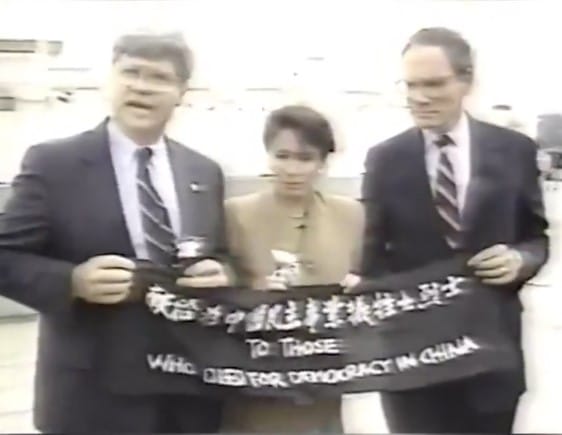
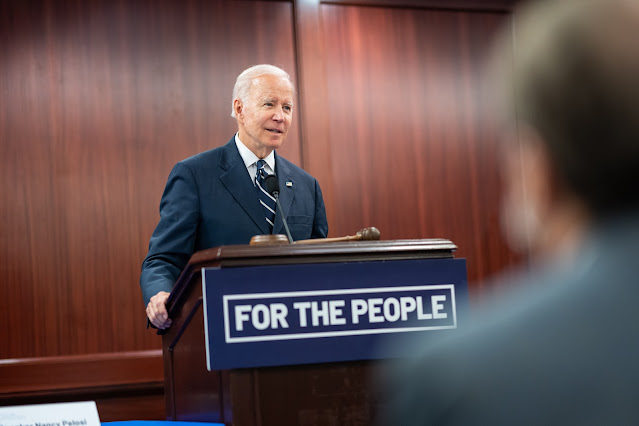
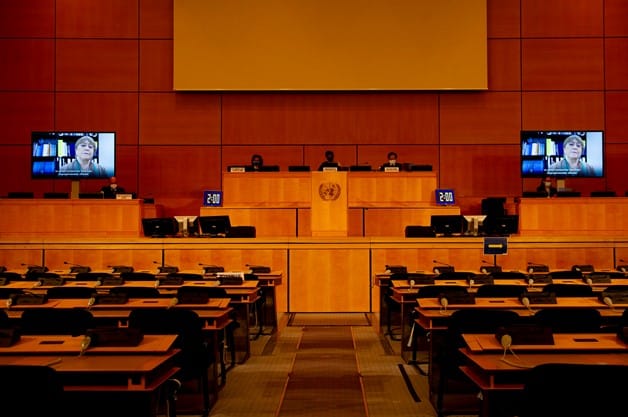
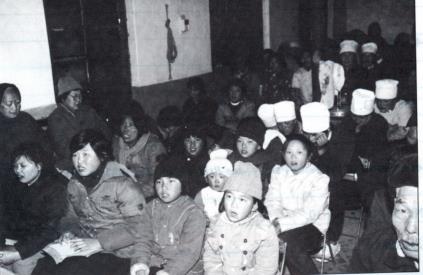
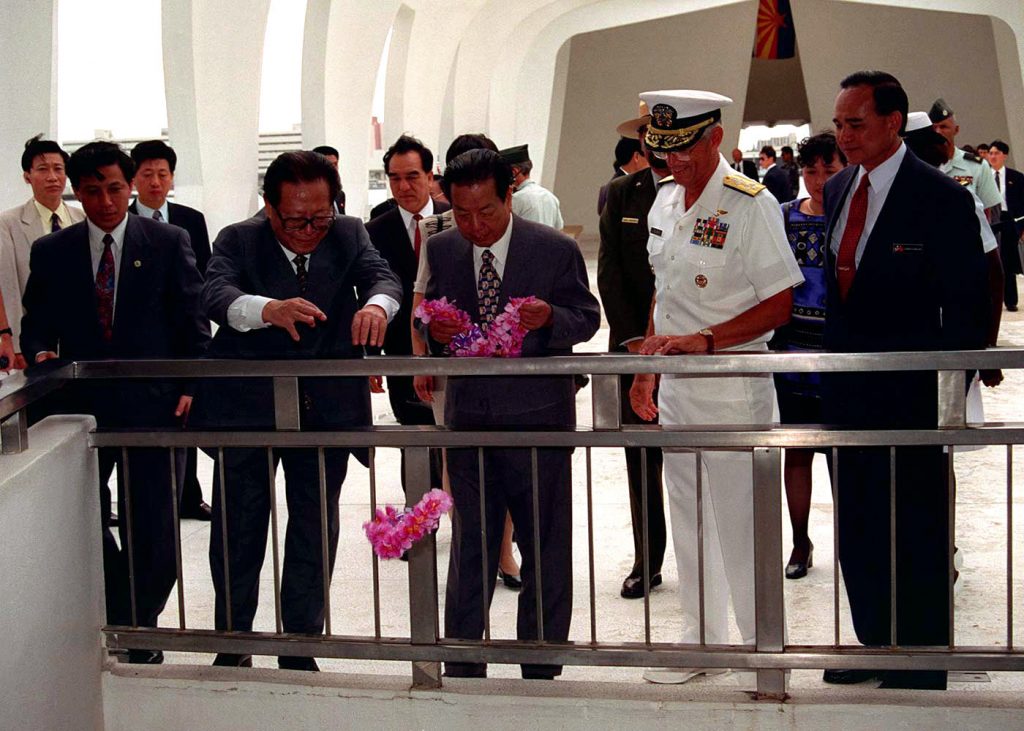
Images from a video of Representatives Jones, Miller, and Pelosi in Tiananmen Square in 1991. Image credit: Nancy Pelosi Facebook account
Speaker of the House Nancy Pelosi’s trip to Taiwan in early August 2022 was praised and criticized in equal measure. It resulted in massive Chinese military drills as well as a surge in foreign delegations to the island. China’s President Xi Jinping asked US President Joe Biden to intervene to stop Pelosi, but Mr. Biden declined to do so. The Biden administration did, however, take steps to discourage the speaker from making the trip.
After Speaker Pelosi’s visit, China canceled or suspended cooperation with the United States on a range of issues, including military talks, climate change, and law enforcement, notably involving narcotics.
Her Taiwan visit was not Mrs. Pelosi’s first foray to Greater China to promote democracy and human rights.
In September 1991, Pelosi and two other members of Congress, Ben Jones and John Miller, traveled to Beijing accompanied by staff and representatives of NGOs, including the AFL-CIO. While there, they slipped out of their hotel, unbeknownst to their host, and went to Tiananmen Square where they unfurled a banner that read “To Those who Died for Democracy in China.” The police quickly moved in, and Pelosi tried to run away in high heels. The Representatives were questioned and let go.
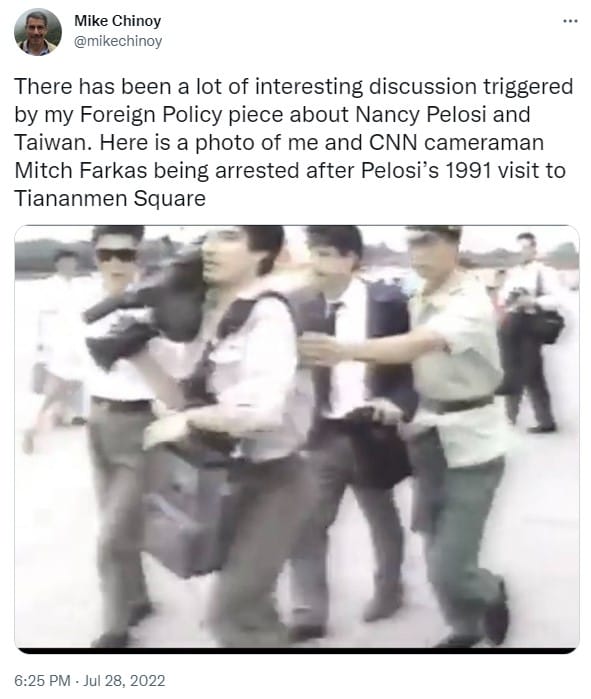
“It was my first experience with Pelosi’s penchant for high-profile gestures designed to poke China’s communist rulers in the eye – regardless of the consequences” wrote Mike Chinoy, CNN’s bureau chief in Beijing. Chinoy, who had not been forewarned of Mrs. Pelosi’s plans, and his cameraman were roughed up by the police and placed under arrest. Journalists from two other networks, ABC and CBC, were similarly treated. Officials at Pelosi’s host organization were punished. American ambassador Stapleton Roy was furious and confronted Pelosi in the lobby of the hotel. Congresswoman Pelosi did not care about any of this. Her mission had been accomplished; her profile had been lifted.
Screenshot of Mike Chinoy’s post on Twitter with an image of the arrest after unfurling the banner. Image credit: Mike Chinoy Twitter account
In fact, I am grateful to Congresswoman Pelosi for what she did in Tiananmen Square that day in September 1991. Though she has no idea why I’m grateful, in fact her protest led directly to some of my early successes, including the release of Hong Kong Trade Development Council representative Lo Hoi-sing, son of a senior journalist at a Hong Kong left-wing paper.
Operation Yellow Bird
In the aftermath of the killings in Chinese cities in June 1989, loosely coordinated efforts began to spirit protesters out of China to safe havens outside of the mainland, notably Hong Kong, then a British crown colony. These efforts involved more than 40 people, some of whom were members of triads, others of whom were local Chinese officials. The efforts were dubbed “Operation Yellow Bird 黄雀行动,” and they led to the saving of more than 130 of China’s leading dissident students and intellectuals, including Wu’er Kaixi, Yan Jiaqi, and Su Xiaokang.
These efforts were risky, and some operatives were caught and punished. Lo Hoi-sing (pinyin: Luo Haixing, simple: 罗海星, traditional: 羅海星), a Hong Kong businessman, was detained on October 14, 1989, and formally arrested on December 18 the same year. He was tried with two “co-conspirators,” Hong Kong residents surnamed Li Peicheng (黎沛成) and Li Longqing (李龙庆), on March 4, 1991. After Lo was released, he told me that he didn’t know either Li; he had met them for the first time at trial.
For the crimes of harboring criminals and belonging to a counterrevolutionary group, Lo was sentenced to five years in prison, with three years deprivation of political rights (DPR). Lo was accused of trying to help Chen Ziming and Wang Juntao escape China. He was shipped off to Huaiji Prison in western Guangdong Province. He occupied a cell next to that of Wang Xizhe of “Li Yi Zhe” fame. Li Yi Zhe referred to a group of Guangzhou dissidents who put up posters calling for democracy in the mid-1970s.
Shortly after Lo Hoi-sing’s trial, his wife, Zhou Mimi (Chow Mat-mat), came to see me at my office in Hopewell Center, a high-rise office building in Hong Kong’s Wanchai District. Ms. Zhou, an author of children’s books, asked me to try to secure her husband’s release. I agreed and began putting Lo’s name on prisoner lists submitted to the Chinese government.
Flight to Beijing
On June 10, 1991, I flew to Beijing for a two-day visit. I was determined to seek clemency for Lo Hoi-sing and the Li Brothers (Li Lin and Li Zhi), two young Hunan labor activists who had escaped China after June 4, but who had returned to Hunan where they were detained. On June 11, at 2:00 PM, I met Supreme People’s Court Vice President Lin Zhen and State Council Deputy Secretary General He Chunlin. I had met He a few weeks earlier in Hong Kong. At that meeting I raised the cases of Lo Hoi-sing and the Li Brothers.
I asked Vice President Lin if Lo Hoi-sing could be considered for early release. His response was hopeful: Lo could be considered for early release under certain conditions. I then asked, in English, about Li Peicheng and Li Longing. Vice President Lin misunderstood me and thought I was referring to the Li Brothers. “In accordance with policy, if they have not committed new crimes after returning to China, they will be released from detention,” the vice president intoned. The next month, the Li Brothers arrived in Hong Kong. They were granted political asylum in the United States. It was my first major success.
North-South Strategy
I returned to Beijing in August 1991. By then, I had garnered a great deal of positive media attention that resulted from my AmCham initiatives, my three congressional testimonies, and the release of the Li Brothers. I had been awarded “Communicator of the Year” by the International Association of Business Communicators. I was considered a media “guru.”
A screenshot of the video of Representatives Jones, Miller, and Pelosi unfurling the banner saying “To Those Who Died for Democracy in China” in Tiananmen Square in 1991. Image credit: Nancy Pelosi Facebook account
In my meetings with Chinese officials, I made a bold prediction. It was already known that Nancy Pelosi would visit Beijing. I predicted that she would do something “that would make the Chinese government unhappy.” Following the principle that the best way to counter bad news is to release good news, I suggested a “North-South Strategy.” To counter bad news in the north, release good news in the south.” I recommended that Hong Kong resident Lo Hoi-sing be released from prison on medical parole and sent back to Hong Kong with as much fanfare as possible. My interlocutors paid attention and took careful notes.
When Nancy Pelosi unfurled her banner on September 4, 1991, the Chinese government acted quickly. A call was made to the Guangdong government which ordered the immediate release of Lo Hoi-sing. A car was sent to Huaiji Prison from Guangzhou to pick up Lo, but the officers forgot to take Lo’s travel documents with them. The car returned to Huaji before going back to Guangzhou, but Lo Hoi-sing’s release had to be delayed.
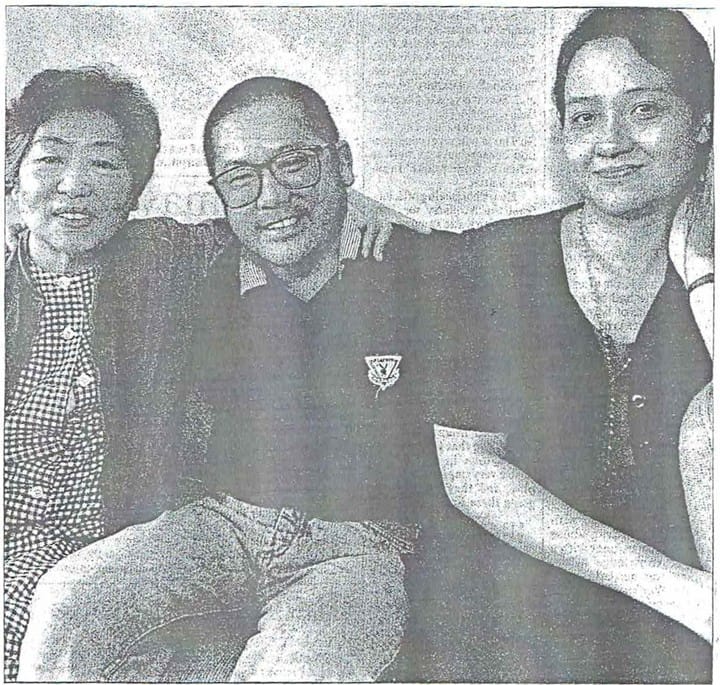
A scan of a photo that appeared in the South China Morning Post after Lo’s release. Lo (center) with his mother and wife (left and right, respectively). Image credit: South China Morning Post via Dui Hua archives.
Lo was granted medical parole and he arrived in Hong Kong on September 9, 1991, met with banner headlines and photographs of beaming family members reunited with their loved one. Lo never served his DPR sentence.
British Prime Minister John Major had been in Beijing at the same time as Nancy Pelosi. He flew to Hong Kong’s Kai Tak Airport where he learned of Lo’s release. He immediately set about claiming credit, advancing the preposterous notion that Beijing was grateful for the prime minister being the first Western leader to visit China’s capital since the events of June 1989. I said nothing to contradict Major’s claims, relying on an adage that Ronald Reagan was fond of: “There is no limit to what a man can achieve if he doesn’t care who gets credit for it.”
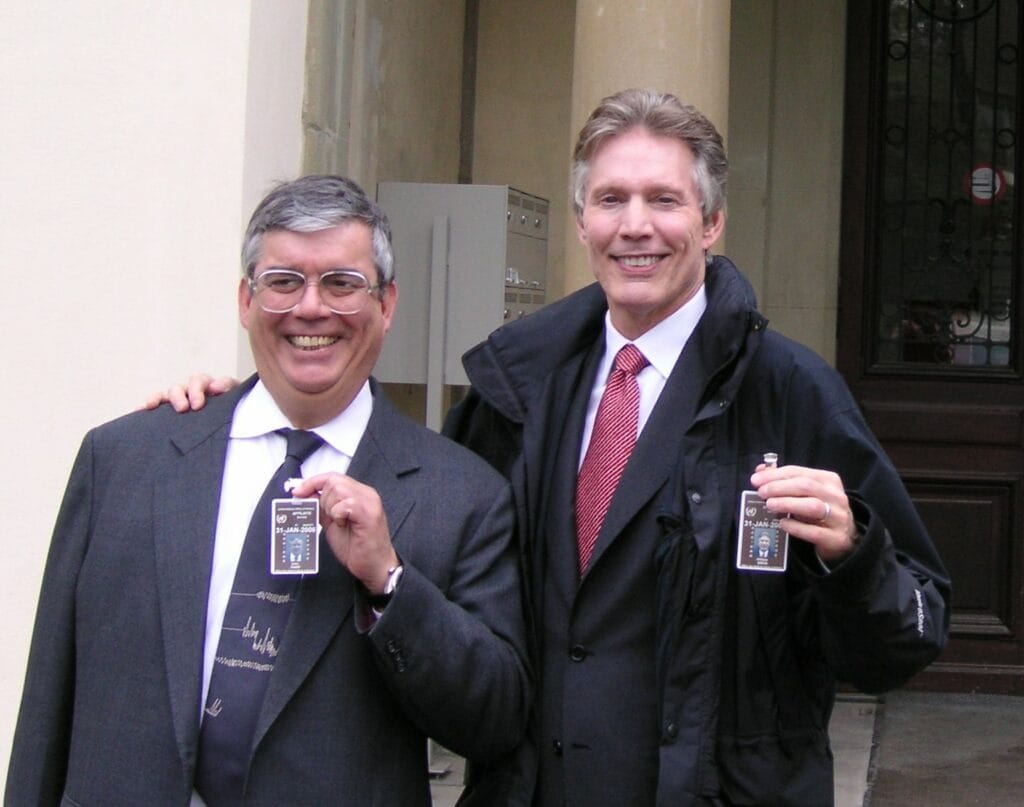
Kamm and Dui Hua director William Simon holding up their United Nations grounds passes in Geneva in 2005. Image credit: The Dui Hua Foundation
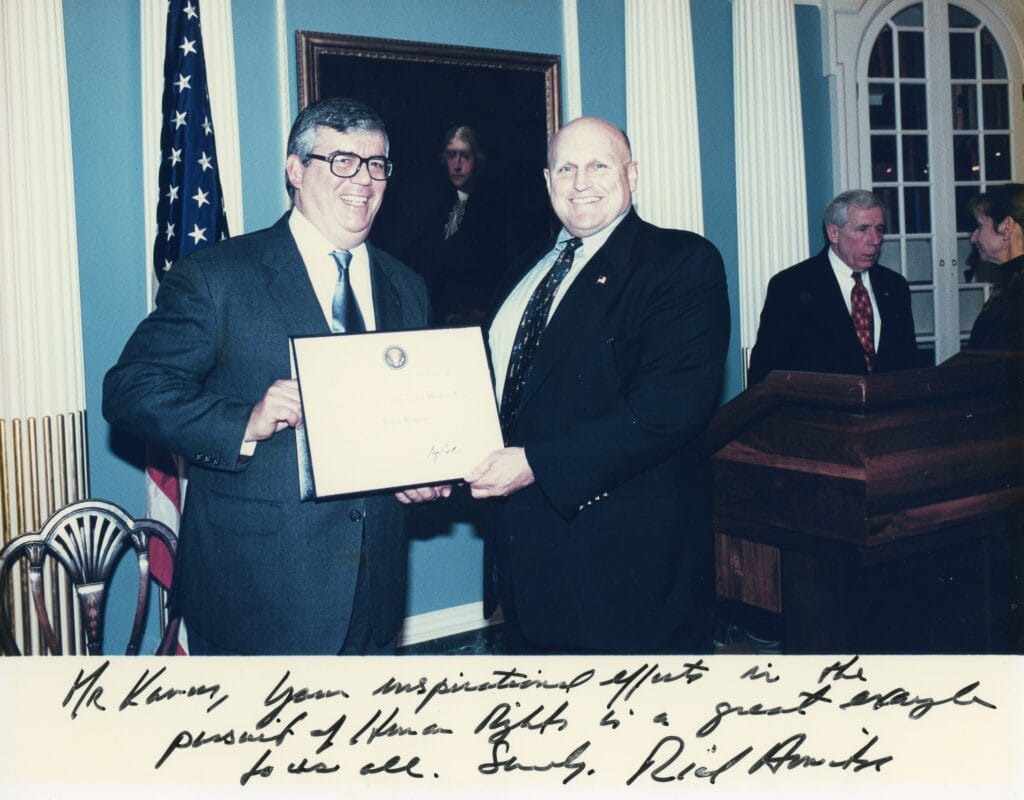
Three months after the 9/11 terror attacks, I resumed my travels. My first trip was to Washington DC, where I accepted the Eleanor Roosevelt Human Rights Award at the State Department on December 13, 2001. I was joined at the ceremony by two other awardees – Congressman Frank Wolf, a lion of human rights advocacy, and Barbara Elliott, a fierce advocate for refugees fleeing communism – and members of my family.
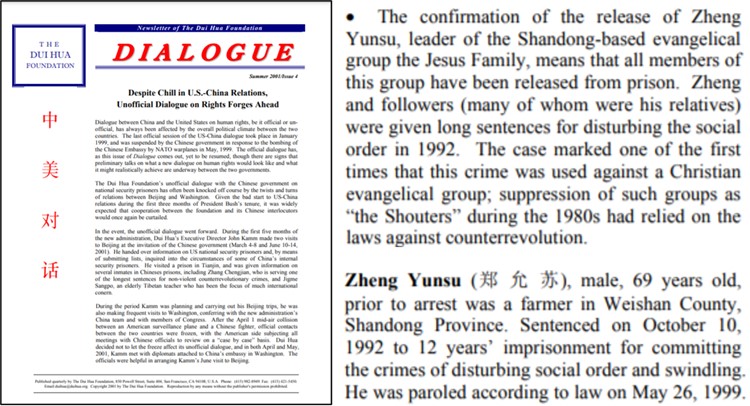
For the next two-and-a-half years. I kept to a grueling schedule of domestic and international travel. I made frequent trips to Washington DC, where I met with members of Congress and the Bush Administration, including Lorne Craner, Assistant Secretary of State for Human Rights, for whom Dui Hua crafted numerous prisoner lists for use at the annual human rights dialogues between the United States and China. (The dialogue has been suspended since 2016.) A highlight was my testimony to the Congressional Executive Commission on China (CECC), a body I lobbied to establish in the aftermath of President Clinton’s decision to extend China’s Most Favored Nation status without conditions. My testimony – An Arsenal of Human Rights – was delivered on April 11, 2002.
I traveled to other cities in the United States as well, visiting with NGO representatives and supporters, as well as speaking at universities around the country. I also traveled to Australia where I met with government officials and spoke at gatherings at universities and elsewhere.
Kamm being awarded the Eleanor Roosevelt Human Rights Award by then-Deputy Secretary of State Richard Armitage. Image credit: The Dui Hua Foundation
On my many trips to China during this period I focused on helping secure the release of long-serving counterrevolutionaries, including the ethno-musicologist Ngawang Choephel. I logged two trips to Lhasa where I helped gain freedom for the elderly teacher Jigme Sangpo and the young nun Ngawang Sangdrol. In Beijing I worked with officials of the Ministry of Justice and Ministry of Foreign Affairs to secure the early release of Democracy Party activists Xu Wenli and Wang Youcai. Of special importance was the early release of American citizen Fong Fuming, a businessman, convicted of state secrets violations. This was the first case of an American citizen imprisoned in China that I worked on. It would not be the last.
On my trips to Europe, I focused on securing support from European governments, including those of Switzerland and Scandinavian countries. These efforts were successful and helped ensure the financial viability of Dui Hua for years to come.
June 2004: Washington and New York
On June 5, 2004, I flew to Washington DC for five days of meetings and events. I briefed staff of the CECC on Dui Hua’s work, and addressed a gathering organized by a grantor where I updated the group on developments in Hong Kong, notably the debate over Article 23 in which I had played a role.
Meetings were held with State Department officials in charge of China and human rights, members of Congress, including Senator Chuck Hagel (R-Nebraska), Congressman Doug Bereuter (R-Nebraska), and Congressman Frank Wolf (R-Virginia), as well as senior staff of committees dealing with China. I met with Minister Lan of the Chinese Embassy and staff of human rights groups including Amnesty International.
The day I arrived in Washington, former president Ronald Reagan passed away. I followed news of his death closely, watching unfolding events on my hotel room television. I have painful memories of doing so, not least because I was suffering from a bout of kidney stones, two of which I passed with considerable discomfort.
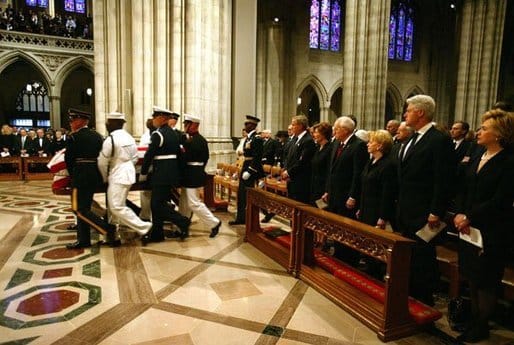
At Ronald Reagan’s funeral, then-President George W. Bush, Laura Bush, then-Vice-President Richard Cheney, Lynne Cheney, Bill Clinton, and Hillary Clinton watch as the casket is carried into the cathedral. Image credit: Public domain
On June 10, I took a morning train to New York. The same day I met with Wang Guangya, China’s ambassador to the United Nations. We met at the Chinese Mission. Before meeting me, Ambassador Wang had signed the book of condolences for President Reagan at the US Mission.
Our meeting was an exceptionally friendly one. I mentioned that I was interested in applying for Special Consultative Status with the Economic and Social Committee (ECOSOC) of the United Nations, the body that oversaw the Human Rights Commission, now the Human Rights Council, in Geneva. Ambassador Wang replied: “I will support you, and if any of my colleagues give you a hard time, let me know.” In the meeting were other diplomats assigned to the mission, including Li Xiaomei, then China’s representative on the NGO Committee, now Special Representative for Human Rights of the Ministry of Foreign Affairs in Beijing.
I left the mission and headed to my sister-in-law’s brownstone in the city for dinner. Pat worked at the United Nations, and she offered to introduce me to the person in charge of NGO accreditation the next day, June 11, 2004. The person in charge was a French woman, a longtime UN employee.
The lady was getting ready for her long summer vacation in France and had little time for me. She asked what I wanted, and I told her that I’d like to apply for ECOSOC consultative status. She handed me the application form and asked, “Which country do you work on?” “China,” I replied. “Forget it,” she remarked, with a wave of the hand. China and its allies had blocked applications of virtually all human rights groups, like Human Rights in China, that worked exclusively on China.
I straightened her out. “I met with Chinese Ambassador Wang Guangya yesterday, and he told me that he would personally support Dui Hua’s application.” You could have knocked her over with a feather.
At the next meeting of the NGO committee, applications by NGOs for consultative status were considered. One by one, the committee chairperson read out the names of the applicants. It was a lengthy list. Typically, if a country objects to an NGO’s application, the committee registers its objection, and the chairperson moves on. “The Dui Hua Foundation,” the chairperson intoned. Waiting to object were Chinese allies Pakistan and Cuba who looked for a signal from the Chinese representative. Li Xiaomei sat motionless as other representatives shifted in their seats.
After the chairperson finished ticking off the names of NGO applicants, he or she returned to Dui Hua. “I ask again. Are there any objections to The Dui Hua Foundation’s application for Special Consultative Status.” Li Xiaomei told me later: “I was very embarrassed, but I registered no objection.” Dui Hua was granted the much-coveted status, becoming the only independent human rights group focused on China to be given this status. That remains the case to this day.
Making Use of our UN Status
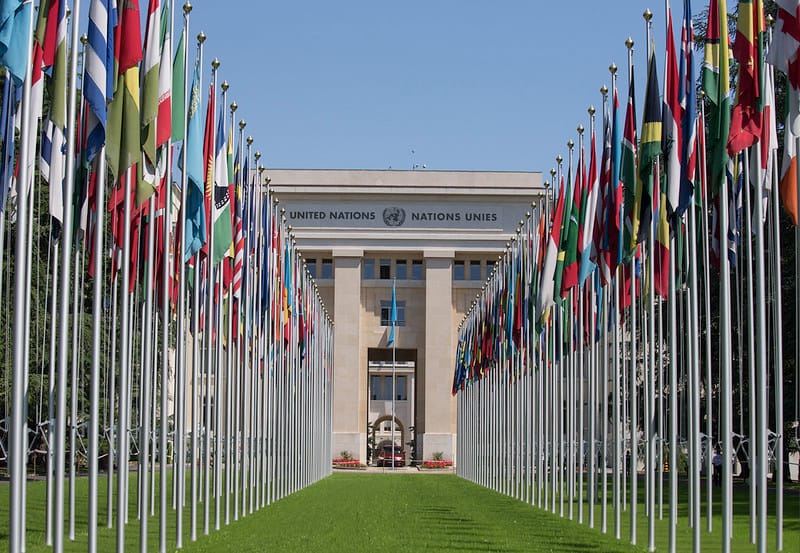
Early in 2005, a fellow Dui Hua director, Bill Simon, traveled to Geneva with me to obtain our badges that granted us privileges at the Palais des Nations, home of the Human Rights Commission. Since 2005, I traveled to Geneva at least once a year before the Covid-19 pandemic made international travel impossible.
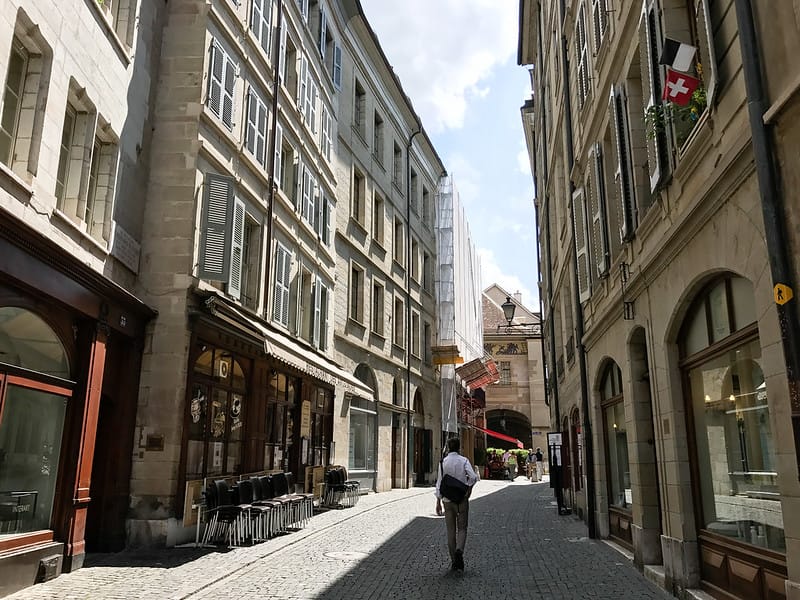
In Geneva I stayed at the Hotel Ambassador through the generous support of the hotel’s owner, Madame Rossotto. I fell in love with the city, and took long walks along the lake to Palais Wilson, site of the Office of the High Commissioner for Human Rights and many of the special procedures of the Human Rights Council. I particularly enjoyed spending time in the Old City, dining at its restaurants with an old friend, Christophe Swinarski, a distinguished human rights scholar who had served for many years with the International Committee of the Red Cross, also headquartered in Geneva.
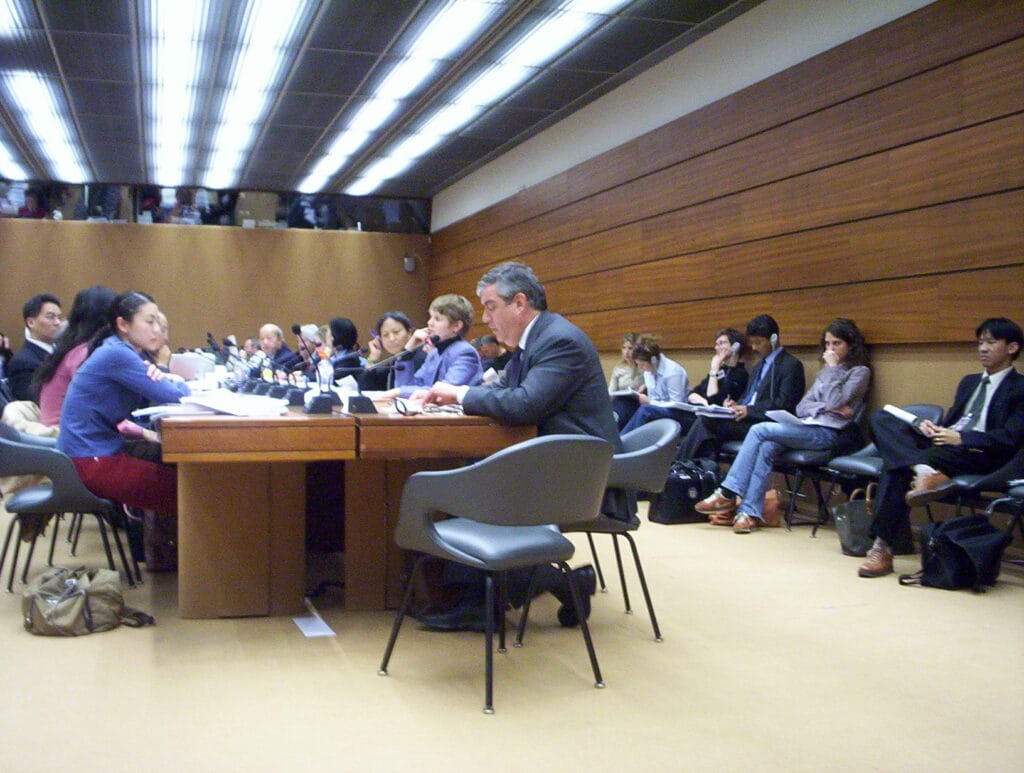
Dui Hua has made good use of its special consultative status. The foundation has made submissions to all of China’s and the United States’ Universal Periodic Reviews (UPR), a process whereby every member of the United Nations’ human rights record is scrutinized every 4-5 years. Our submission to China’s third UPR in 2018 was of special importance. We focused on judicial transparency, examining the decision to post judgments on the Supreme People’s Court’s China Judgments Online (CJO), which we hailed (attached to our statement were prisoner lists of names found on CJO). Unfortunately, in 2021 the court purged the website of judgments involving cases of endangering state security and other sensitive crimes, dealing a blow to Dui Hua’s work compiling prisoner lists for submission to the Chinese government. For both the Chinese and US UPRs we examined capital punishment; when it comes to the death penalty, both countries are outliers.
In addition to its work on UPRs, Dui Hua has worked on issues related to women prisoners and arbitrary detention. We lobbied for China to invite a delegation from the newly established Working Group on Discrimination Against Women in Law and Practice. The group visited China in December 2013, not long after China’s UPR.
Dui Hua has worked closely with the Working Group on Arbitrary Detention to secure favorable opinions on the cases of American citizens judged to have been arbitrarily detained by Chinese authorities: US businesswoman Sandy Phan-Gillis and US businessmen Mark Swidan and Li Kai, both of whom remain imprisoned as of this writing.
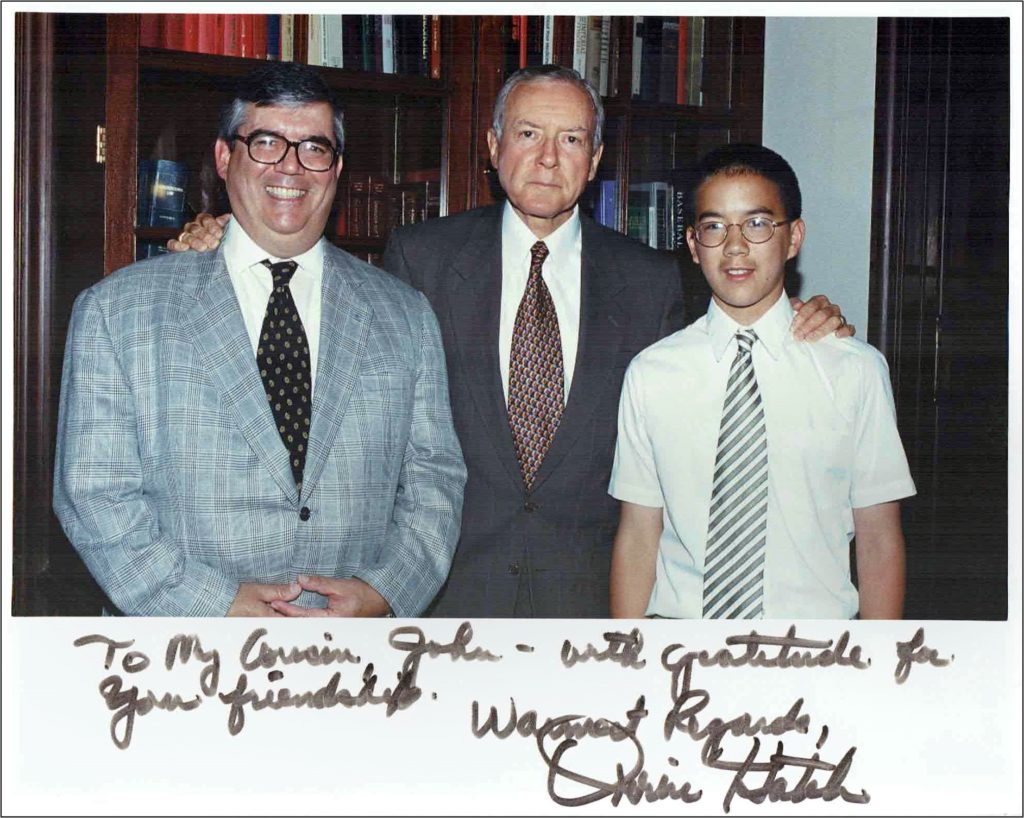
(Left to right) John Kamm, Orrin Hatch, and Kamm’s son during a visit to Hatch’s office in the summer of 2000. Image credit: Office of Senator Hatch courtesy of the Kamm family
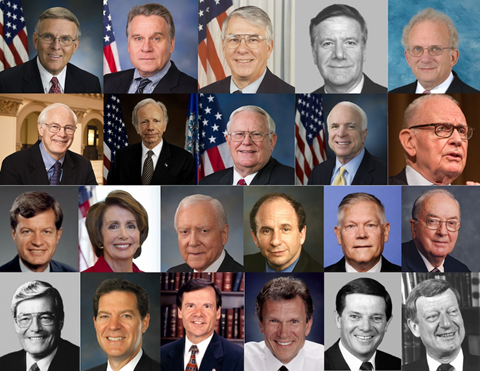
Orrin G. Hatch, the longest serving Republican senator and longest serving Utah senator, passed away on April 23, 2022, in Salt Lake City, Utah. He was 88 years old. He served six terms in the United States Senate and chaired the Senate Judiciary Committee for a total of eight years.
Senator Hatch was born in Pennsylvania to Jesse Hatch and Helen Kamm, both of whom grew up in Utah. His grandfather was John Kamm, a fabled man of the Old West. Orrin Hatch was a bishop of the Church of Latter Day Saints and a staunch supporter of religious freedom.
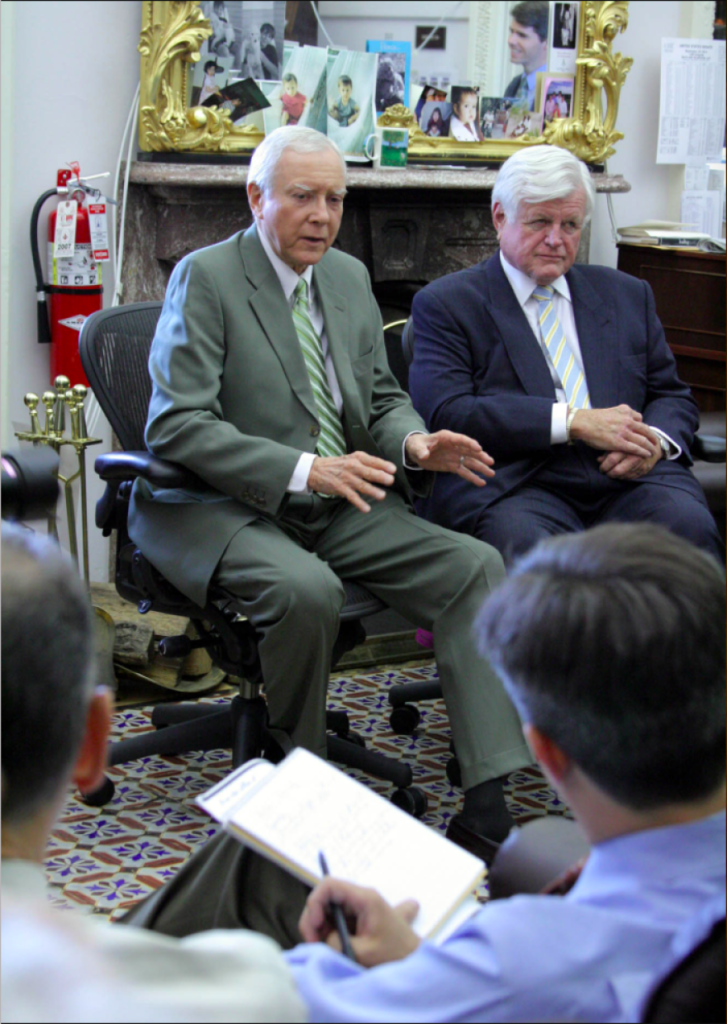
Sens. Orrin Hatch and Ted Kennedy, sometimes called “the odd couple.” Image credit: Office of Senator Hatch via Wikimedia Commons
Senator Orrin Hatch was an original. Although he was a rock-solid conservative, he reached across the aisle to work on legislation with Democratic leaders. One of his best friends was liberal icon Senator Edward Kennedy. A talented musician and songwriter, Senator Hatch appeared in cameo roles in several movies. He generally supported good ties with China and favored renewing China’s trade status in the United States and admitting the country into the World Trade Organization.
Senator Hatch was a friend, strong supporter of my work, and a relative who wrote 11 letters to senior Chinese and American officials, including President Bill Clinton, urging cooperation with my work on Chinese political and religious prisoners. He welcomed me to his office on every trip I made to Washington, including one I made with my oldest son Jack in the summer of 2000. In December 2018, weeks before he stepped down as a senator, Senator Hatch nominated me for the Nobel Peace Prize.
Trip to China
I met Orrin Hatch and his wife Elaine in Beijing in October 1997, shortly before Chinese President Jiang Zemin made his final state visit to the United States. The trip had been arranged by an American foundation specializing in making grants to support work on international relations. Upon seeing me for the first time, Senator Hatch remarked to his wife that I resembled his grandfather. I gave Senator Hatch a prisoner list with 37 names from 20 provinces, and he in turn handed the list to Minister Xiao Yang, then Minister of Justice and President Jiang Zemin. For more details on Senator Hatch’s visit to China, see “Cousin Orrin.”
The prisoner list Kamm gave to Senator Hatch. Hatch then submitted the list Minister Xiao Yang. Image credit: The Dui Hua Foundation
Not long after Senator Hatch gave the list to Minister Xiao Yang, several of the prisoners whose names were on the list were released from prison, some with months and years of time left to serve. Clemency began within weeks of Minister Xiao’s accepting the letter. Eventually as many as one-third of the prisoners on the Hatch List were granted commutations, sentence reductions leading to release, and medical parole. Those who benefited included long-serving counterrevolutionaries, June 4 prisoners, and the Tibetan ethnomusicologist Ngawang Choephel.
Letters to Chinese and American Leaders
In early 1998, Senator Hatch began writing letters to senior Chinese and American officials including Minister Xiao Yang, his successor Gao Changli, and President Bill Clinton.
On February 25, 1998, the senator wrote to Minister of Justice Xiao Yang to thank him for recently providing me with information on prisoners. He stressed that the prisoner information project between me and the ministry was heralded as one of the accomplishments of the previous autumn’s Jiang-Clinton summit.
On May 22, 1998, Senator Hatch wrote to Xiao Yang’s successor as Minister of Justice, Gao Changli, reminding the minister that he had had several positive exchanges with his predecessor regarding John Kamm’s prisoner information project. “I hope that we can continue to discuss this valuable project which has garnered the attention of many leaders and citizens in this country.”
Hatch, then Chairman of the Senate Committee on Finance meeting with Chinese Vice Premier Liu He on May 16, 2018. Image credit: United States Senate Committee on Finance
In a letter sent to President Bill Clinton on September 28, 1998, Senator Hatch advised the president that he had taken a strong personal interest in my work and asked him to raise the recent lack of progress on the project with visiting Chinese Foreign Minister Tang Jiaxuan.
On October 28, 1998, President Clinton responded. “We are in complete agreement about the importance of promoting Mr. Kamm’s project.” He went on: “In her meeting with Foreign Minister Tang, Secretary Albright urged the Chinese to resume cooperation with Mr. Kamm. In my meeting with Tang, I urged release of prisoners detained under laws that have been repealed, a reference to the Law on Counterrevolution that is no longer on the books. Mr. Kamm has been very active raising Chinese consciousness on this issue.”
Senator Hatch’s interest in my work had a direct impact on my work to free Chinese prisoners. For this, and for many other kindnesses, I will always be grateful to my “Cousin Orrin.”
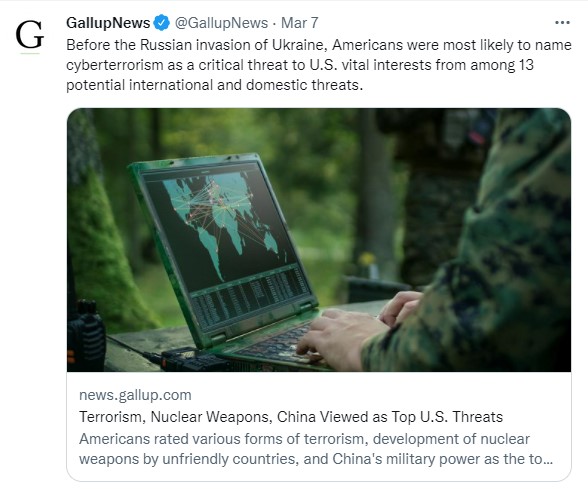
A post on Gallup News’ Twitter account releasing their study on threats to the United States. Image credit: Gallup News Twitter account
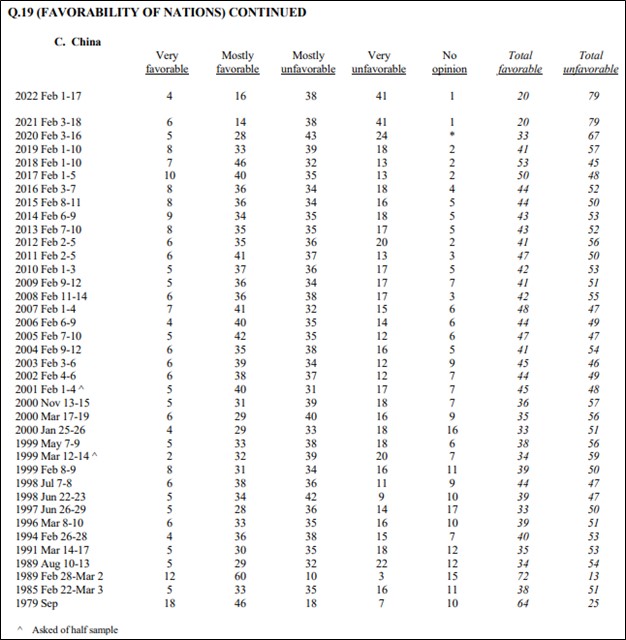
In Gallup’s latest annual World Affairs poll, conducted from February 1-17, the American public’s opinion of China remains at a historic low. The poll, conducted partly during the 2022 Winter Olympics, found that 79 percent of respondents have an unfavorable view of China, with 41 percent answering “very unfavorable.” Only 20 percent of respondents have a “favorable” view of China. The numbers remain largely unchanged from the 2021 poll.
China’s favorability rating is at its lowest since Gallup started to poll American attitudes towards the country in 1979. An on-going trade imbalance, the COVID-19 pandemic, and alleged human rights violations in Hong Kong and Xinjiang likely all contributed to unfavorable opinions. In a 2020 poll by the Pew Research Center, 82 percent viewed China’s human rights policies as a serious problem.
The Gallup poll also found that Americans view China as a “critical” threat to US security. While more respondents identified terrorism (including cyber, international, and domestic) and the development of nuclear weapons by Iran and North Korea as critical threats, anxiety over China’s military power outranked the spread of infectious diseases and climate change in perceptions of being a critical threat. When given a list of possible threats to US interests, 67 percent said that China’s military power is a “critical” threat and 29 percent ranked it as “important;” only 4 percent characterized it as “unimportant.” The concern reached a historic high and even outstripped worries over military threat from Russia. The threat of China’s economic power is also considered “critical” by 57 percent of respondents and “important” by 34 percent. However, concern over China’s economic power fell from 63 percent in 2021.
From Gallup’s February 1-17 survey, Americans’ favorability of China from 1979-2022. The poll was conducted from February 1-17 via telephone interviews with 1,008 adults and has a margin of error of 4 percentage points. Image credit: Gallup [PDF, 873 KB]
A similar poll by Pew Research conducted before the 2022 Beijing Olympics asked Americans if they see China as a partner, competitor, or enemy. The majority, 54 percent, saw China as a competitor; 35 percent answered as an enemy. Only 9 percent saw China as a partner. These opinions remained largely unchanged from 2021, when the views as competitor and enemy were 55 percent and 34 percent, respectively.
The recently released polls were conducted in January and February, prior to the Russia invasion of Ukraine. China has since publicly supported Russia’s position while amplifying disinformation domestically. It is likely China’s favorability among Americans will suffer further as it embraces stronger anti-Western and anti-United States rhetoric.
A different time: in 2017, Gallup polling found US attitudes to China to be at their highest point. Image credit: CGTN Twitter account
The change in US leadership in 2021 did not bring a reset, or significant improvements, in the government’s official stance toward China as some had hoped it would. President Biden has made adjustments to policies inherited from the Trump administration while adopting a less incendiary tone. The Biden administration, however, has continued tough positions on trade negotiations and restrictions on key technologies while imposing more sanctions against human rights abuses in Hong Kong and Xinjiang.
This latest polling will likely further the notion that the US-China relationship is at a crossroads, with the leadership of both struggling to differentiate where competition ends and hostility begins. Even at the lowest point of US-China confrontation during the Cold War, diplomacy, including efforts involving non-government interlocutors, was never completely dismissed. With publics in both the United States and China voicing more animosity for each other, politicians may soon be looking to change tact or adopt more policies to further decoupling.
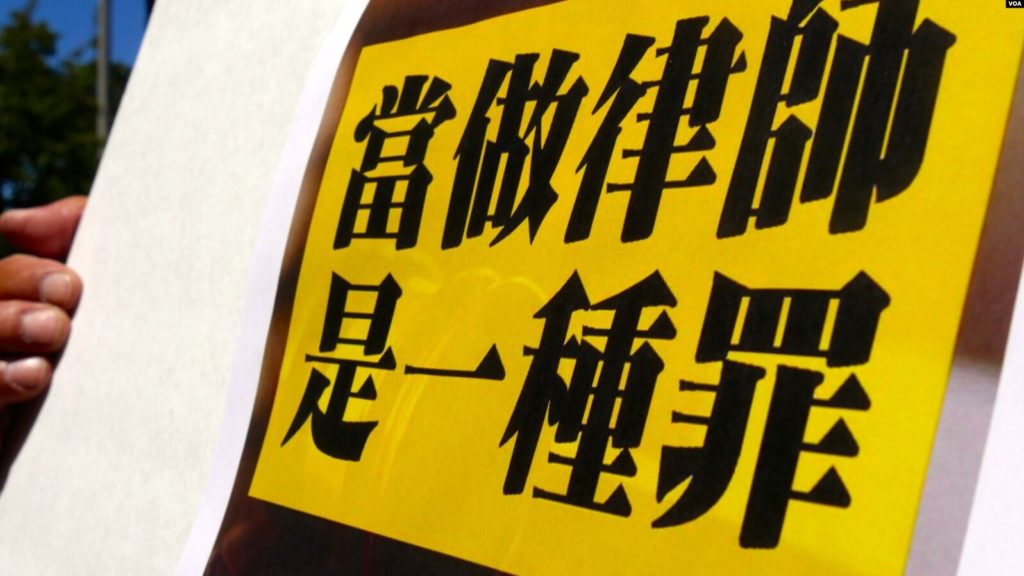
A sign held at a protest in July 2015 in Los Angeles against the 709 Crackdown in China. The sign reads, “When being a lawyer is a type of crime.” Image credit: Voice of America
In the early morning hours of July 9, 2015, Chinese police moved against human rights lawyers, legal assistants, and rights activists across China, but mostly those living and working in Beijing. Over the coming days and weeks, an estimated 300 lawyers and activists were detained or had exit bans placed on them. Power was cut off at their residences. Many were stripped of their lawyers’ licenses, forcing law firms to close. Several of those detained were subsequently tried and convicted of state security offenses. A few are still in prison, including Wu Gan, an activist known as “Super Vulgar Butcher,” who was sentenced to eight years in prison for subversion in December 2017.
International reaction to what became known as the 709 Crackdown was sharply critical. Governments, bar associations, law schools, and experts from United Nations Special Procedures condemned the action, to no avail. In an early indication of China’s current policy of ignoring international opinion, Beijing has become defiant and increasingly oblivious to criticism. Even requests for information on the status of political prisoners are now considered assaults on China’s judicial sovereignty constituting interference in China’s internal affairs.
A Brave Lawyer
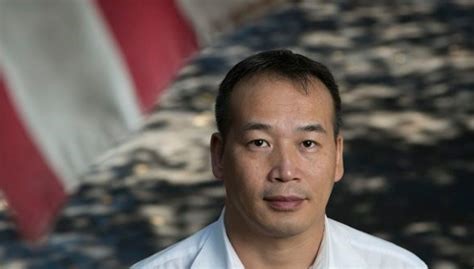
A photo of Chen Taihe. Image credit: Dui Hua Foundation
Prior to his detention by public security agents for inciting subversion, picking quarrels and provoking trouble, and embezzlement on July 12, 2015, and his subsequent departure from China in March 2016, Guilin-based lawyer and associate professor of law at the Guilin University of Electronic Science and Technology Chen Taihe was a well-known advocate of China adopting the jury trial system. He researched the jury system in the United Kingdom as a visiting professor and summarized his findings in an eloquent and well-argued book entitled The Most Common Right.
It is not known why Chen Taihe was detained. It might have been because of his friendship with leading rights lawyer, Li Heping, who was himself detained on July 10, 2015. Chen had called for his release. It could have been because of his extensive ties to the United States. It might have been because of his advocacy for China adopting the jury trial system. Or it might have been because of a vendetta against him by a Guilin official. China’s justice system is anything but transparent.
Undated photograph of Li Heping. Chen Taihe called for his release prior to Chen’s detention. Image credit: Provided by Li’s supporters via RFA
Chen Taihe’s activism brought him to the attention of the domestic security division of the public security bureau, a unit known as guo bao. They invited him “to drink tea” – a euphemism used for police questioning – on multiple occasions.
His successful law practice, which focused on civil and criminal litigations, brought him fame and wealth, enabling him to purchase three apartments in high-class developments. He gave that all away to find freedom for himself and his family in the United States, assisted by retired Judge Shackley Raffetto, the Dui Hua Foundation, and American diplomats in China. He is believed to be the only 709 lawyer to have successfully left China for the West with the permission of the domestic security bureau of the Chinese government.
Time on the Cross
Upon detention, Chen Taihe was placed in the Guilin Number Two Detention Center. He endured physical mistreatment, including being forced to squat for hours in a stress position, and threats from prisoners, one of whom had been sentenced to death. Chen was in a crowded cell with 12 other detainees; he was not given a bowl, spoons, and other necessary utensils to eat food and drink water for nearly three days.
Guilin Number 2 Detention Center, where Chen was held. Image credit: dcnnlawyer.com
Finally, on July 16, 2015, he was allowed a visit by a lawyer, who was a spy sent by the government. The second lawyer that visited him was Qin Yongpei. He posted Chen’s situation and mistreatment online after he interviewed Chen in a prison meeting room. (Lawyer Qin was detained in 2019; he has not been released and is currently under indictment for inciting subversion.) Chen was then moved to another detention center where his treatment slightly improved. A month after his detention, he was moved to a location outside the detention center and then on August 22, 2015, he was allowed to return home and placed under residential surveillance, but even then, he continued to be subjected to interrogation and threats by the police right up to the day he departed China.
Lawyer Qin Yongpei, who visited Chen Taihe in detention center. He was tried for inciting subversion on December 31, 2021. Image credit: Boxun.com
While keeping the police advised of his whereabouts, he was allowed to move around Guilin and even to travel to other cities. The police monitored his communications and his movements. The family’s bank accounts were frozen, heaping misfortune on top of misery.
Judge Shackley Raffetto
On July 21, 2015, nine days after Chen Taihe’s detention, I received an email from Shackley F. Raffetto, a retired Hawaii state trial judge and US Navy judge who had befriended Chen Taihe following an introduction by a lawyer based at the US Embassy in Beijing. Judge Raffetto invited Chen and three other Chinese lawyers to visit Hawaii in September 2013. While there, the small group of Chinese lawyers observed a jury trial and were able to interview the jurors after the trial concluded. They met with the Chief Justice of the Hawaii Supreme Court as well as law professors and lawyers from firms involved in legal exchanges with lawyers in China.
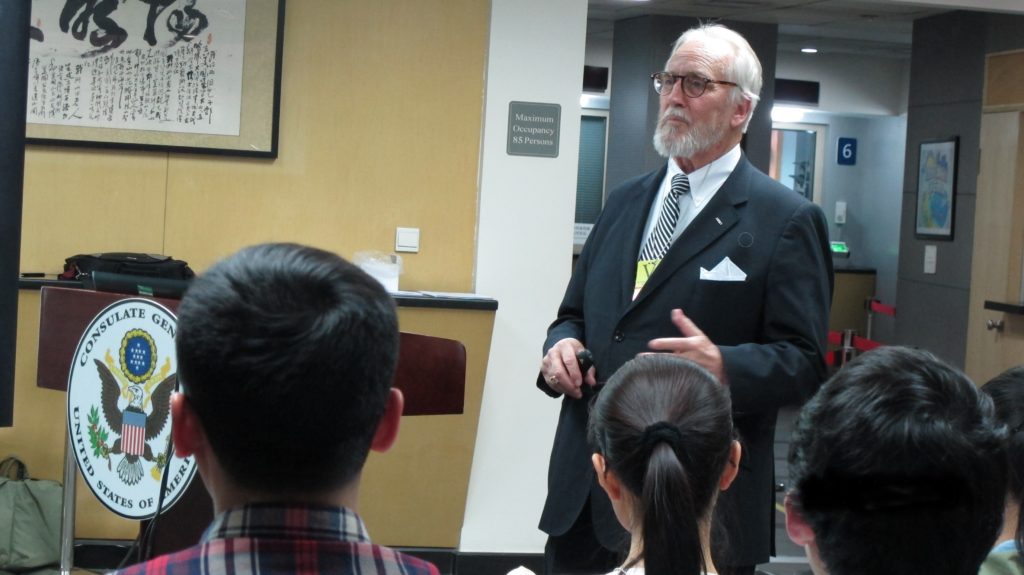
Judge Raffetto addressing an audience at the US Consulate General in Chengdu, since closed, in 2014. Image credit: Judge Raffetto
Judge Raffetto had already lectured and conducted a US style jury trial moot program at two PRC law schools. In April 2014 he travelled to Beijing, at the invitation of the US Embassy, with the intention of providing the jury trial moot at a number of law schools that had requested the program. The first school at which the trial moot program would be presented was Chen Taihe’s law school. Chen had advised the Guilin police that he had invited Judge Raffetto to conduct the program at his university.
Upon arrival in Beijing, Judge Raffetto was told that the entire program had been cancelled. No explanation was given. Chen Taihe was ordered not to participate in the program. Judge Raffetto adjusted the program and proceeded to give lectures on the American justice system at law schools around China, arranged by the US government. Police tried to block people from attending his lecture in Beijing. They were admitted by a side door.
In July 2015, Judge Raffetto noticed that Chen Taihe’s name was on a list of lawyers and activists detained in the 709 crackdown drawn up by Amnesty International. He contacted the US Embassy in Beijing, the people with whom he had worked on programs, but never received a response. He then reached out to human rights groups, including Dui Hua, to see what could be done for his friend.
Role of China’s San Francisco Consulate
In my work on Chinese political prisoners, I have used different channels to submit lists and discuss cases. One of the most important channels has been the Chinese consulate general in San Francisco. I reached out to my point of contact, Consul Wang, and asked for a meeting to discuss Chen Taihe’s case. We agreed to meet on Monday, July 27, 2015, at the consulate on Laguna Street.
A picture of Consulate General of the People’s Republic of China in San Francisco. Image credit: Steve Rhodes / CC BY-NC-ND 2.0
I submitted a detailed memo on what I knew about the case. I pointed out that Chen was the only law professor to have been detained in the 709 crackdown and pointed out that President Obama was also a law professor. Guangxi Zhuang Autonomous Region, whose capital is Guilin, is the sister state of Montana, home state of US Ambassador Max Baucus. For these reasons, Chen Taihe’s case was now a high priority for the US government.
Wang took action. He impressed on his superiors in Beijing the importance of the case. A few weeks later Chen Taihe was moved out of the detention center and eventually placed under residential surveillance. Unfortunately, his ordeal was far from over.
Throughout my work on the case, I stayed in close touch with officers at the United States Department of State and the National Security Council in Washington as well as the US Embassy in Beijing. Washington-based officials were a source of good advice and assistance arranging Chen’s departure and providing limited financial support. Chen Taihe was well known to the Department of State prior to his detention in 2015. In both 2011 and 2012, Chen Taihe had participated in legal exchange programs and in 2012 he visited Washington DC at the invitation of the State Department’s International Visitor Leadership Program.
Ms. Jiang Jie Flees China, Arrives in US
While their loved ones are suffering in prison, families of political detainees suffer on the outside, often denied visitation rights and telephone calls, not knowing if their spouses are still alive. Sometimes, spouses are urged to divorce their partners so that their children can lead a “normal life,” free of stigma.
Jiang Jie, the wife of Chen Taihe, was interrogated by the police attached to the domestic security division (guo bao) of the Guilin public security bureau, and their apartment was searched on two occasions. The police told Jiang Jie, four months pregnant with the couple’s second child, that she was violating the one-child-per -family policy in force at the time. They tried to convince her to abort the baby. Jiang Jie refused.
Chen Taihe had a US visa, a J2, in his passport; this entitled Jiang Jie to a dependent visa in her passport. Despite limited English and not having friends or family in the United States, Jiang Jie decided to leave Guilin and fly to San Francisco. She purchased two separate tickets, one for her, one for her son, as close as possible to departure. She took these steps to throw the police off her scent. On August 3, she flew to Guangzhou, on the pretext of looking for a lawyer, and, on August 4, together with her son, she boarded a flight to Seoul. From there she flew to San Francisco, arriving on August 4, 2015.
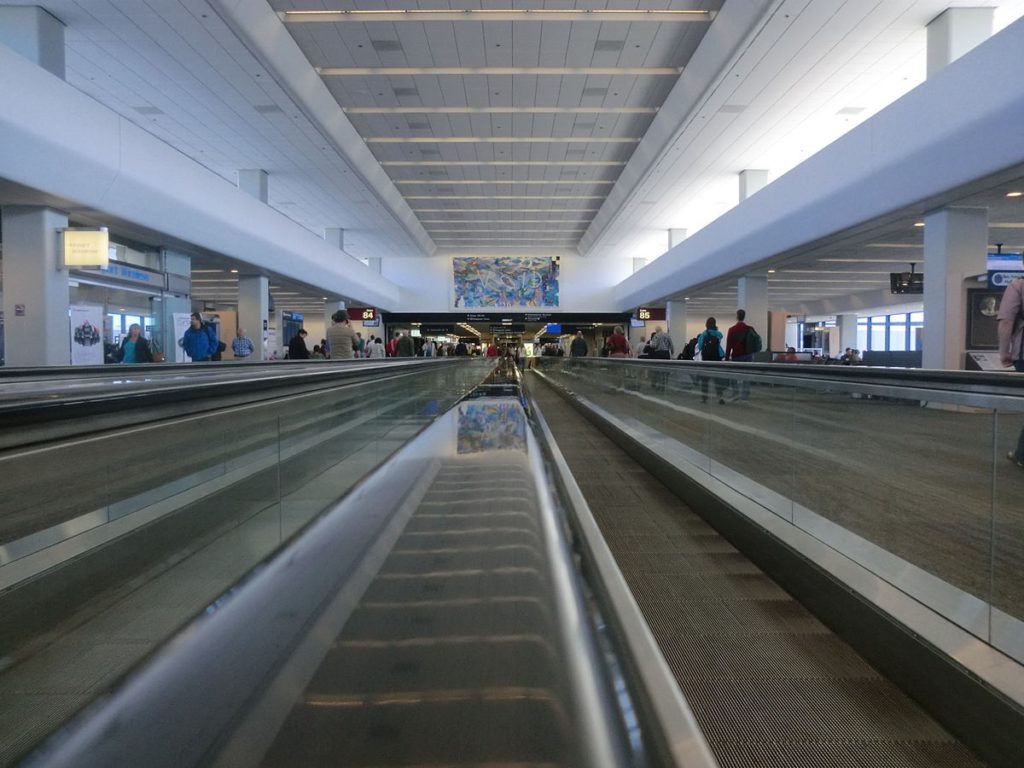
Upon deplaning at the cavernous arrival hall at SFO, Jiang Jie and her son faced a stern Customs officer. He told her that her visa entitled her to enter the United States with her husband, not by herself. They were taken to a room where she had to deal with an unfriendly interpreter over the telephone. This person tried to convince her to return to China. Jiang Jie stood her ground and refused to be sent back.
Moving walkway of San Francisco International Airport. Image credit: Nissy-KITAQ / CC BY-SA 3.0
Finally she was moved to another room where she was dealt with by a friendly immigration officer. He eventually allowed her to enter the United States after she told him where she planned to stay. It had been nearly 24 hours since she arrived at the airport.
Jiang Jie and son Zuoan went to Fremont where she rented a place to stay. After her husband was released from the detention center, he called her on her mobile. She was overjoyed to hear his voice. At the end of August, at the suggestion of an official at the American embassy in Beijing, she made contact with Dui Hua. We began to assist her. At the end of September, she contacted the legal aid center at the University of California Berkeley. They proved to be very helpful to her and her husband in starting a new life in the United States.
Trips to Guangzhou and Beijing
After his release from detention to residential surveillance, Chen Taihe was summoned every two weeks for interrogation by guo bao. These sessions took place either at the guo bao office or in a hotel. These were extremely stressful events during which Chen was threatened with rearrest.
The final straw was when the case of arrested lawyer Pu Zhiqiang was brought up in an interrogation session. Pu had been detained in May 2014 for creating a disturbance and inciting ethnic hatred by posting seven Weibo messages between 2011 and 2014. At the time of Chen Taihe’s interrogations in Guilin, Pu had yet to be brought to trial. One of his interrogators pointed out to Chen that Pu had only posted seven Weibo messages whereas Chen had posted thousands. (Pu was subsequently tried and given a three-year suspended sentence. He was stripped of his license to practice law.)
Pu Zhiqing, who was sentenced for posting seven messages on Weibo. Interrogators threatened Chen Taihe: “You’ve posted thousands!” Image credit: Voice of America East / Public Domain
At around the same time, lawyer Bao Longjun’s son was arrested trying to leave the country for Myanmar and Hong Kong bookseller Gui Minhai was kidnapped in Thailand and taken back to China.
Fearing his rearrest was imminent and that he would die if he were put back in detention, Chen decided to leave China. He would travel to Guangzhou, site of a large US consulate. Not knowing that one cannot apply for political asylum at a consulate, Chen went to the consulate where he sought entry. He was turned away, and he made his way back to Guilin.
Chen then sought permission from guo bao to travel to Beijing. Permission was granted. The first trip was used to tie up loose ends of cases he was working on. The second trip, undertaken in February 2016, was to apply for a new visa to enter the United States. The visa was granted on February 24, 2016 whereupon Chen briefed American officers on what he had endured.
All was ready. Chen Taihe went to Guilin Liangjiang International Airport to board a plane to Hong Kong where he was to board a plane to San Francisco. After checking in with his luggage on March 1, 2016, he approached immigration. They cleared him to leave, but after entering the departure area officers of wu jing, the people’s armed police deployed at the airport, stopped him and refused to let him board the flight. Chen called guo bao who intervened on his behalf. After half an hour wu jing relented and Chen was allowed to board the flight.
It was a nervous 320-mile flight to Hong Kong on a Chinese carrier through China airspace. After arrival at Hong Kong international airport, he boarded a flight to San Francisco.
Unlike his treatment at Guilin Airport and Jiang Jie’s treatment at SFO, Chen entered the United States without incident. At the arrival hall he was met by Jiang Jie, his oldest son, and me.
(Left to right) Jiang Jie, their son, Chen Taihe, and John Kamm meet at San Francisco International Airport upon Chen’s arrival. Image credit: Dui Hua Foundation
Doubtless exhausted, he nevertheless was upbeat and full of energy. He and his small family boarded a taxi for their small apartment in Fremont.
A New Life
After he arrived in the United States, Chen Taihe applied for political asylum through his Berkley-based legal aid team. Judge Shackley and I wrote letters supporting his application, which was eventually granted. It allowed him to not only stay in the United States but to seek employment as well.
Chen wanted to practice law but he needed the support of the Guilin Bar Association, issue a certificate of good standing which they refused to provide. Fortunately, the California Bar Association can grant permission to take the bar examination if the applicant is supported by letters from practicing lawyers. With the of his legal aid team, Chen Taihe gathered five support letters and sent them along. The California Bar Association accepted his application to take the bar examination.
Chen Taihe decided to put off taking the examination to make some money to support his family. He joined California’s largest landscaping firm working in the red-hot San Francisco Bay Area property market as a landscaping designer and project manager. Always good with his hands and with a keen eye for detail, Chen was an immediate success, his efforts praised by colleagues and customers alike. He eventually set up his own company.
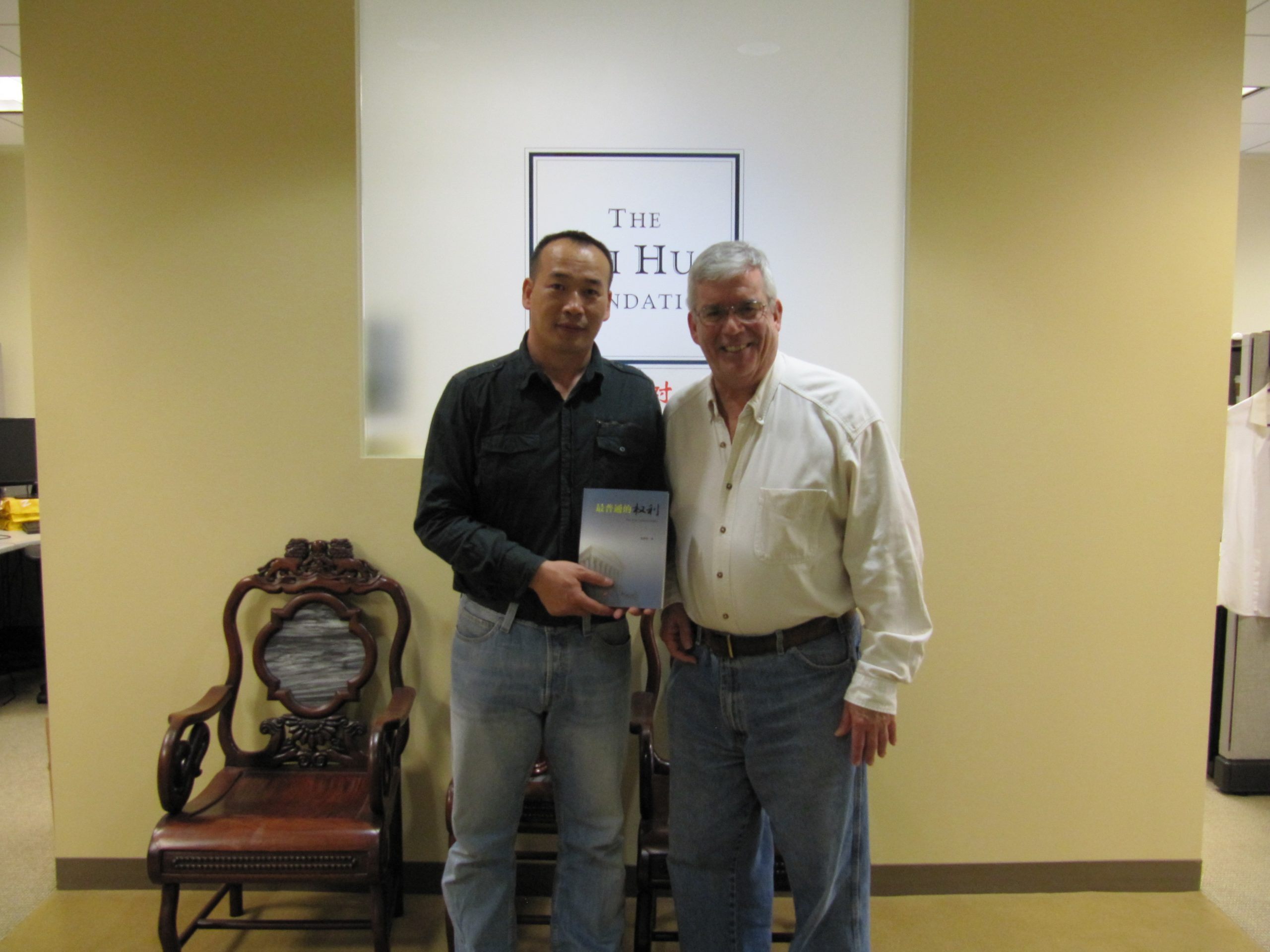
Chen Taihe and John Kamm during a visit to Dui Hua’s office. Chen is holding a copy of his book The Most Common Right. Image credit: Dui Hua Foundation
Today, Chen Taihe, Jiang Jie and their three children (a daughter, Stephanie, was born in September 2021) are living the American dream. A successful businessman, Chen owns his own firm and his own home. He continues to fight for democracy and human rights in China by posting on social media, delivering a lecture at Hastings Law School where he was granted a position of visiting professor, and asking me to intervene on behalf of imprisoned lawyers and members of their families in China.
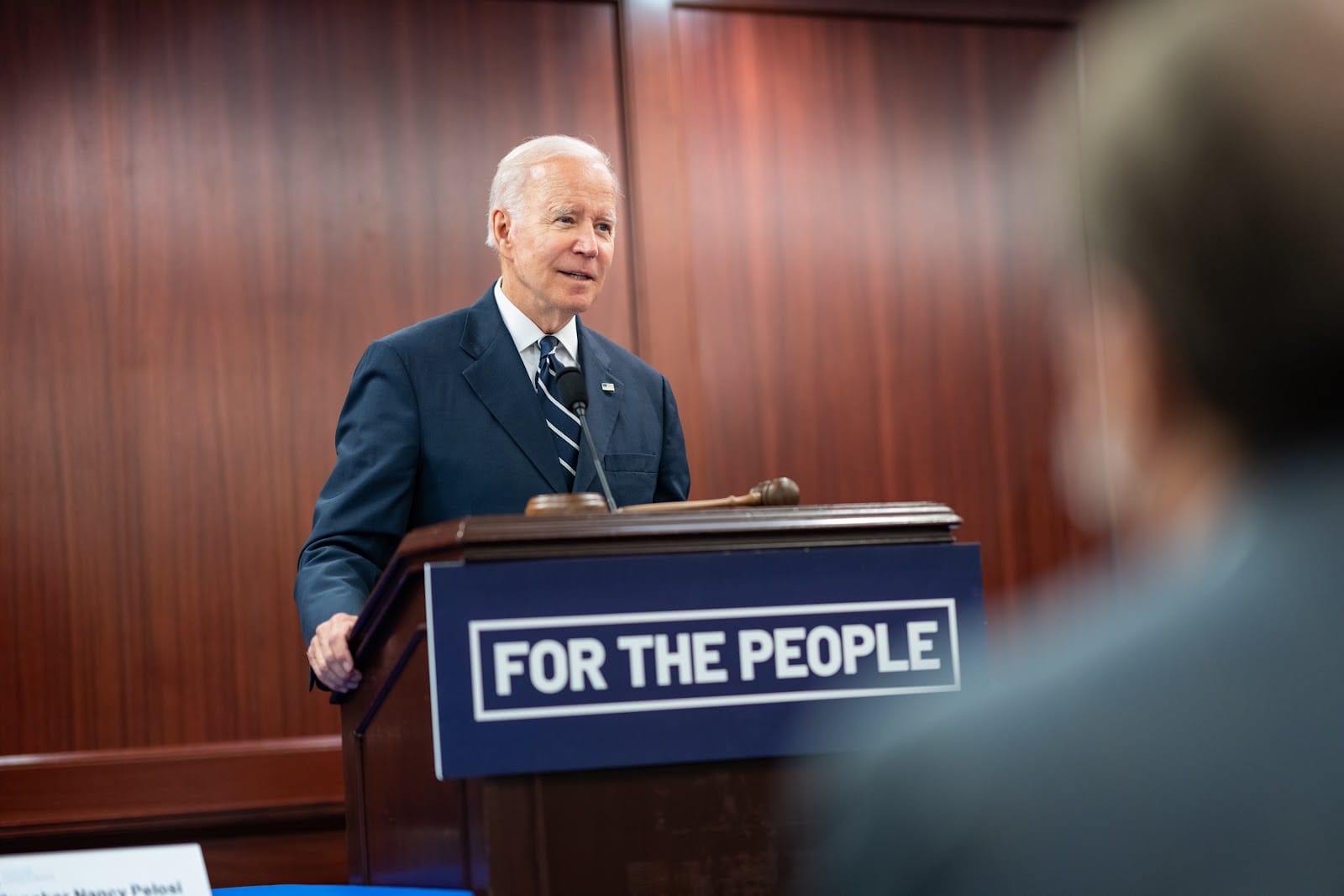
President Biden delivers remarks at the House Democratic Caucus on the Build Back Better agenda and the Bipartisan Infrastructure Deal, October 28, 2021, at the US Capitol in Washington, DC. Image credit: Adam Schultz / Official White House Photo
Two polls of Americans taken in mid-January 2022 reveal a sharp drop in confidence among registered voters in President Joe Biden’s ability to handle China.
A CBS News poll of 2,094 adults conducted January 12-14, 2022 found that 59 percent disapprove of Mr. Biden’s handling of China issues while 41 percent approve, closely tracking with the president’s overall approval rating. From July 14 to July 17, 2021, the same poll showed that 52 percent of Americans disapproved of Biden’s handling of China issues while 48 percent approved.
A larger poll of 5,128 American adults conducted by Pew January 10-17, 2022. found that 39 percent were confident in the president’s ability to deal effectively with China while 61 percent were not confident in his ability to handle relations with a country widely viewed as an adversary of the United States. One year ago, in early February 2021, 53 percent of adults surveyed by Pew were confident of the new president’s ability to deal effectively with China while 46 percent were not confident.
There are several reasons that might explain this lack of confidence. President Biden’s overall rating for foreign policy is underwater by double digits. There is a steady drum beat of negative stories about China in American media, with no decisive action or policies on the part of the Biden administration to counter the alleged malign activities. Finally, President Biden’s November virtual summit with Chinese President Xi yielded few results.
The day after the summit, President Biden was interviewed on the tarmac of the Pittsburgh airport. He claimed that he and Xi had agreed to set up four working groups covering a wide range of issues. To date, information about what those four working groups are, including what they are working on, has not been disclosed.
Low approval of President Biden’s handling of China limits his ability to take steps that might improve US-China relations, a prime example being the lifting of tariffs imposed by former president Trump. Treasury Secretary Yellen has commented that reducing tariffs can help in the fight against inflation, and more than 100 lawmakers have written a letter to the president urging the granting of more tariff exemptions on Chinese goods, a move strongly supported by the business community. President Biden was asked about lifting the tariffs during his January press conference. His response: “We’re not there yet.”
The US theatrical poster for Schindler’s List (left) and the cover for the Chinese VCD bootleg (right). People in China watched the film on pirated copies of VCDs since the film was not released in Chinese theaters. Image credit: Wikipedia; Knews.cc
This John Kamm Remembers is a continuation of last month’s installment, “Memories of 9/11,” which recounted August-September 2001, when Kamm was approached by Tina Rosenberg about being the subject of a New York Times Magazine profile, and Kamm’s experience in China in the wake of the September 11 attacks.
State Security
Tina and the photographer retained by the Times to cover our visit, Zeng Nian, arrived in Beijing from New York in the late afternoon of December 17, 2001. I met them in the lobby of the Jianguo. From the moment of their arrival going forward, we were the objects of attention by state security. One of my drivers later told me that he was summoned for questioning and shown photographs of our arrival at different ministries.
Tina and I had dinner at the Jianguo. We discussed the schedule for the days ahead.
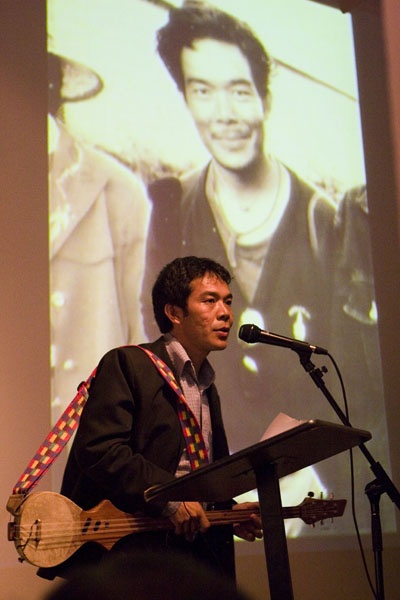
Ngawang Choepel speaks to an audience about his work while holding a traditional Tibetan lute. SFT HQ / CC BY 2.0
On December 18, Tina, Zeng Nian, and I went to the MFA for a meeting with Li Baodong. The purpose was to discuss the possible release of Ngawang Choepel, a Tibetan musicologist who had studied at Middlebury College in Vermont and had been detained in September 1995 on a trip back to Tibet to film folk dances and record traditional music, and to see his mother. His had become an important case for Senator Jim Jeffords, R-Vermont, a pro-trade politician who had nevertheless voted against China’s Most Favored Nation (MFN) in 2001 over the way Ngawang Choepel and his family were being treated.
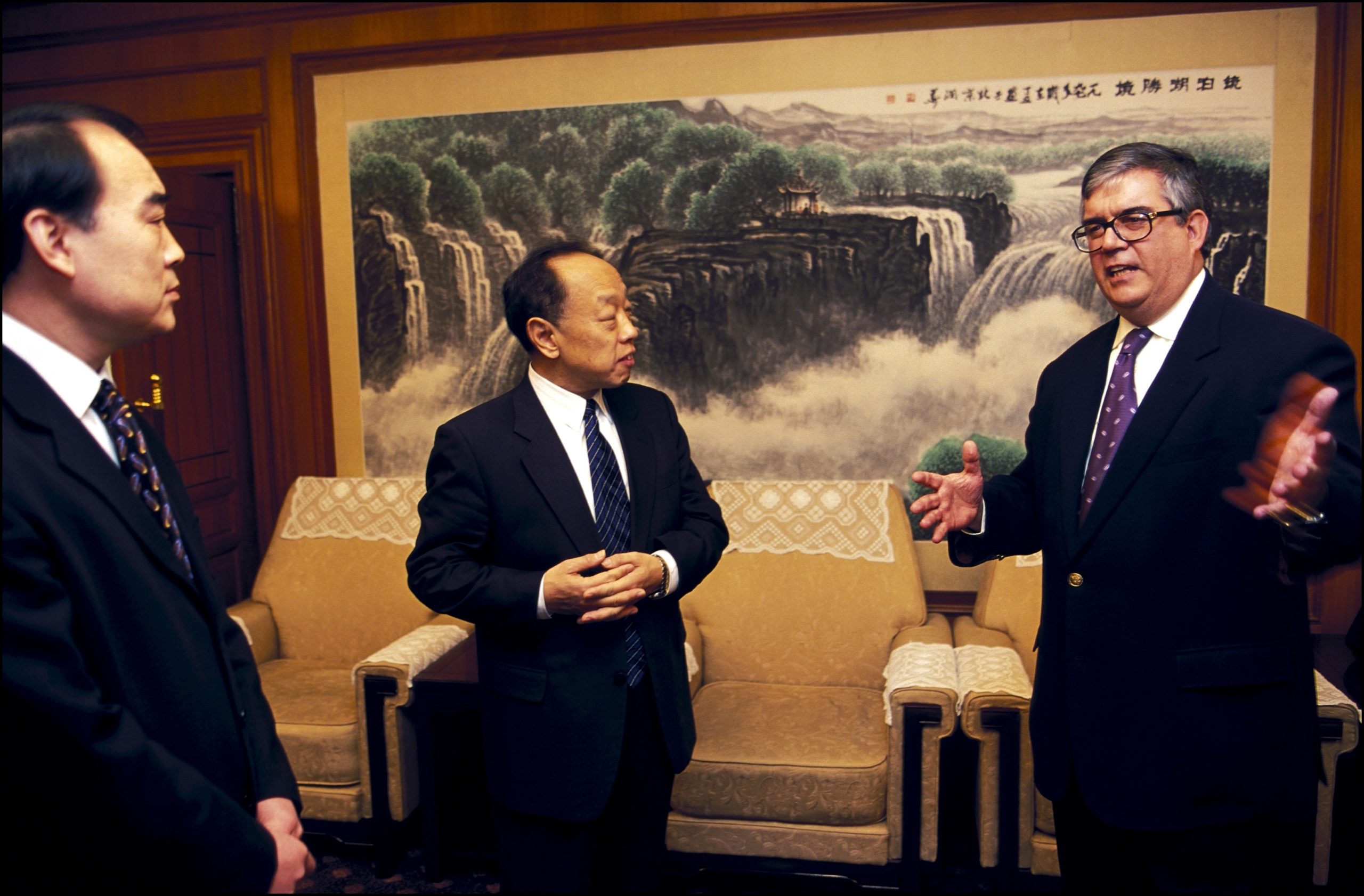
While we were introducing ourselves in came Foreign Minister Li Zhaoxing, who had recently returned to Beijing from Washington where he had served as ambassador. Li was familiar with the Ngawang Choephel case. Senator Jeffords’ vote against MFN had made an impression. After 9/11 Li Zhaoxing had recommended, to President Jiang Zemin, that political prisoners be released to improve the relationship with the United States, a seemingly contrarian move. Why make concessions to the United States when it was the United States that was seeking support from China?
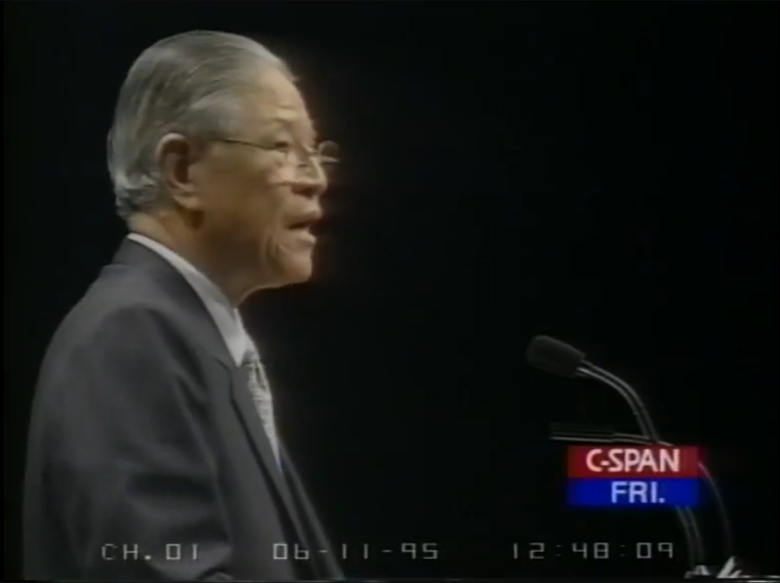
At the MFA, Foreign Minister Li introduced Tina to Li Baodong. “This is the good Mr. Li,” he quipped. “There’s another Li who lives in Taiwan. He’s the bad Mr. Li.” The foreign minister was referring to President Lee Tenghui, seen by the Chinese government as enemy number one. After the foreign minister left the room, Li Baodong and I discussed the Ngawang Choepel case in cryptic terms. We agreed that we would meet again the next day.
For lunch, Tina and I were hosted by a large group of foreign diplomats assembled by Mark Lambert, the US embassy’s human rights officer, in the best Italian restaurant in Beijing, Aria. They spoke one-by-one about their dealings with China on human rights. In those days, China was engaged in around 10 human rights dialogues with foreign countries. Now there are none.
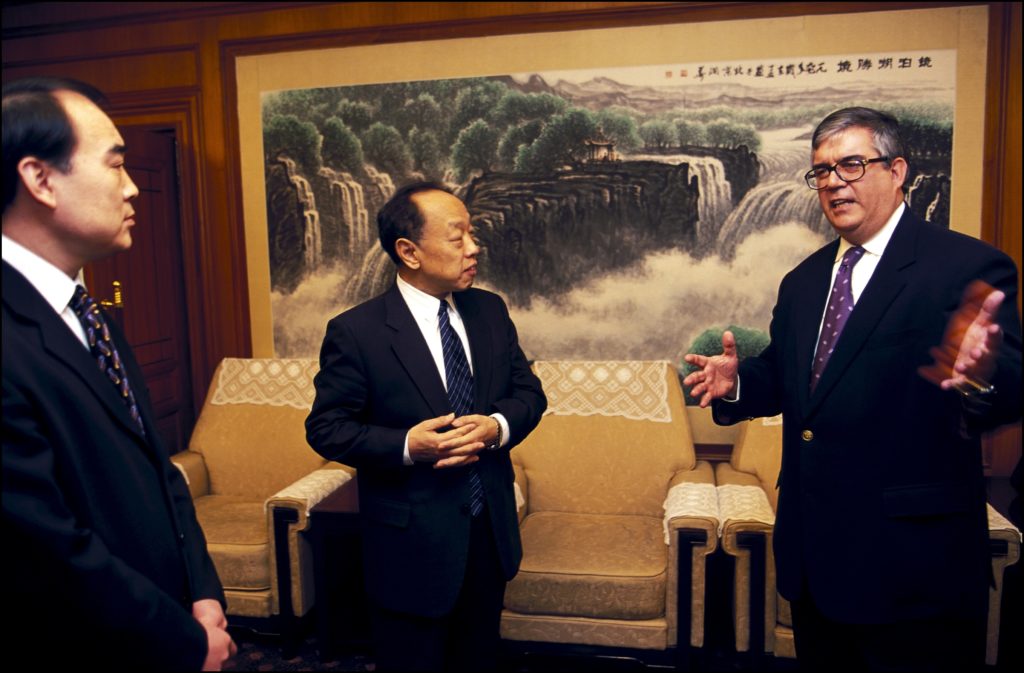
Offices of the Foreign minister: John Kamm with the First Vice Foreign Minister Li Zhaoxing (also former Chinese ambassador to the United States). On the left, Li Baodong, Chief of International Affairs Department of the Foreign Ministry. Image credit: Zeng Nian / Gamma-Rapho via Getty Images
Tina and I parted ways. I went on a visit to Beijing Number Two Prison. The MOJ had denied a request for Tina to join me. She went back to the MFA for a private interview with Li Baodong. We reconnected for dinner with Mark Lambert.
Not surprisingly. Tina wanted to gauge the opinion of American businesspeople about what I was up to, promoting respect for human rights on the part of the American business community in Beijing. I had set up a breakfast with the American Chamber of Commerce for 7:30 AM on December 19. Those at the table were defensive, citing the good work done for orphans and flood victims. Tina adopted a skeptical air. Outside the room, state security was listening.
After the breakfast, we went to the Supreme People’s Court for yet another uncomfortable meeting. The head of the Foreign Affairs Bureau, Mr. Liu Hehua, had clearly been caught off guard. I presented a letter from “my cousin,” Senator Orrin Hatch, and pummeled him with questions about the fate of the China Plum Blossom Party and the pamphleteer Yu Rong. I offered to provide assistance to Mr. Liu with materials on the American justice system.
As we were leaving, Mr. Liu took our photographer aside and sharply asked him about what was going on. The photographer was told that that he should be careful about who he worked for. It was not what the photographer, a French citizen with family in China, had anticipated.
There are two bookstores that were selling volumes related to judicial matters, including those related to trials for political offenses, near the Supreme Court. (NB: The bookstores no longer offer such books.) We surveyed their offerings under the watchful eyes of suspicious shopkeepers. I bought a couple, and then we were off for a photoshoot at the old Beijing railway station.
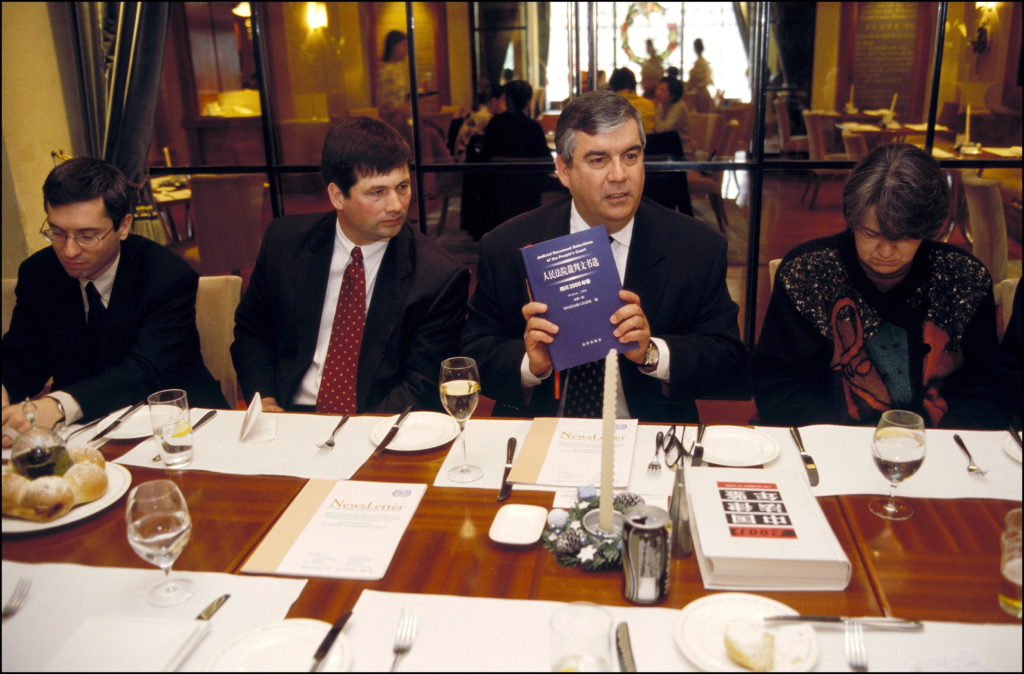
Dinner at the Beijing International Trade Center with 17 European ambassadors and the staff of European embassies working for human rights in China. John Kamm holds the book Annual judgements of the Sichuan Province in 2000. Image credit: Zeng Nian / Gamma-Rapho via Getty Images
I departed Beijing on the 5:30 PM Dragon Air flight to Hong Kong. After three days doing research and briefing clients I returned to San Francisco on December 23, in time for Christmas.
On January 16, 2002, Tina called me with the news that her editor had decided that the entire article – now a profile – would be devoted to my work. The aim was to publish it on February 16. There followed more calls between Tina and me, one on February 5 devoted entirely to Ngawang Choephel’s release that had taken place on January 20. “Wrap up” interviews followed.
A photograph of Tina Rosenberg, the author of “Kamm’s List.” Image credit: Emmanuel Upegui provided by Ms. Rosenberg
The first of two fact-checking interviews with the Times editorial staff followed. I was asked to estimate how many prisoners I had helped in the years since I began intervening on behalf of Chinese prisoners in May 1990. This entailed going over trip reports and notes. Finally, I estimated that I had helped around 250 political prisoners win early release or better treatment. During the last of these fact-checking interviews, I managed to tease the title of the article, now billed as a cover story for the Times’ Sunday Magazine, out of the fact-checker: “John Kamm’s Third Way.” I concluded that Chinese feathers would not be ruffled by this title. The story was slated to appear on Sunday March 3, 2002.
I left for Hong Kong on February 26, thence to Beijing on March 10. In Hong Kong, I intended having dinner with my Guangdong interlocutors, taping a show for VOA, giving a speech to the Asia Society, and conducting research in Hong Kong libraries. Most important, I wanted to gauge reactions to the cover story, due for publication during my days in Hong Kong.
On Friday, March 1, my cell phone went off while I was in the stacks of the Hong Kong University library. I stepped outside to take the call from my wife. The story had been published on the Times’ website on Thursday, February 28. “I thought you said that the title of the story was ‘John Kamm’s Third Way,”’ she said. “In fact, the title on the cover is ‘Kamm’s List.’” That’s when I learned that there are in fact two titles for a cover story. One for the cover, which is decided by the graphics people, the other inside the body of the article decided by the editorial staff.
The latter was in fact “John Kamm’s Third Way.” The cover was a mockup of a movie poster that closely resembled one of the movie posters for Steven Spielberg’s 1993 hit movie Schindler’s List.
Schindler’s List
I shuddered. It would be hard to avoid the comparison between Kamm, saving Chinese prisoners from the Chinese government, and Schindler, saving Jews from the Nazis. I anticipated a sharp reaction from Chinese officials in Beijing – assuming I was allowed to enter the country.
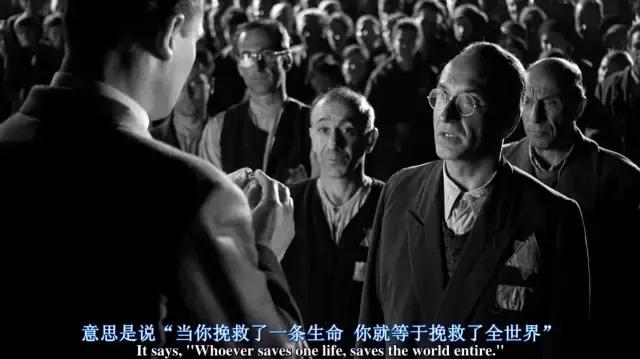
A still from Schindler’s List with Chinese subtitles. Image credit: Knews.cc
I need not have worried. I entered China on March 10, 2002, without incident. The next day I met with Li Baodong and La Yifan. La advised me that he was monitoring reactions to the article among Chinese officials and National People’s Congress and political Consultative Congress deputies, assembled in Beijing for their annual meetings, the so-called “Two Sessions.” Thus far there had been no negative reactions. I told them that there was unhappiness with the article among American businessmen. Li Baodong airily waved his hand: “Don’t worry. They’ll get over it.”
A young official escorted me from the ministry to my car. “Imagine,” he said. “An article about human rights in China in which the Chinese government is not the biggest villain!”
On the afternoon of March 11, I went to the MOJ’s headquarters where I was received by two directors: Wang Lixian, head of the International Department, and Liu Fuchen, head of the Prison Administration Bureau. We sat down and director Liu fixed his eyes on me. “Mr. Kamm, wasn’t there an article about you published in the United States recently?” I said yes, there had been a story about me in the New York Times Sunday Magazine published a few days before.
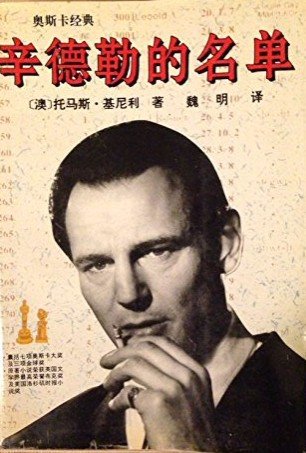
The cover of a Chinese version of the book Schindler’s List, written by Thomas Keanelly and originally titled Schindler’s Ark, published after the movie received international acclaim. Image credit: Abebooks
“What was the title of the article,” Liu asked. “John Kamm’s Third Way,” I replied. Liu shot back. “No, that’s not the title I remember.” I explained that “Kamm’s List” was the title on the cover of the magazine. “John Kamm’s Third Way” was the title listed in the table of contents and inside the issue itself. Liu continued his line of questioning. “Wasn’t there a movie with a title similar to that?” I confessed that there was: “Schindler’s List.”
Liu rubbed his hands and exclaimed: “Won an Oscar, didn’t it? Excellent!”
An Unhappy Exchange
After a final meeting with Li Baodong on the morning of March 13, I went to the Supreme People’s Court where I was received by Liu Hehua. He was not happy, taking special umbrage at a line in the story: “Kamm not only speaks Mandarin and Cantonese but also the language of the party which is just as important.” Liu adopted a threatening tone. “This will not end well for you.” It turned out that Liu was relying on a translation of the article and not the actual article itself. I admonished him to read the original, and not rely on a translation.
I returned to Hong Kong on March 14 and flew back to San Francisco on March 17, satisfied that, while members business community were not happy – the head of a large business group that promotes trade with China was especially angry – the Chinese government was, for the most part, satisfied with the article, as was the case with the human rights community.
Today, “John Kamm’s Third Way” is required reading in courses on business and human rights, including those taught at Harvard Law School, Columbia Law School, and Princeton University. A testament to Tina Rosenberg’s writing, it has stood the test of time.
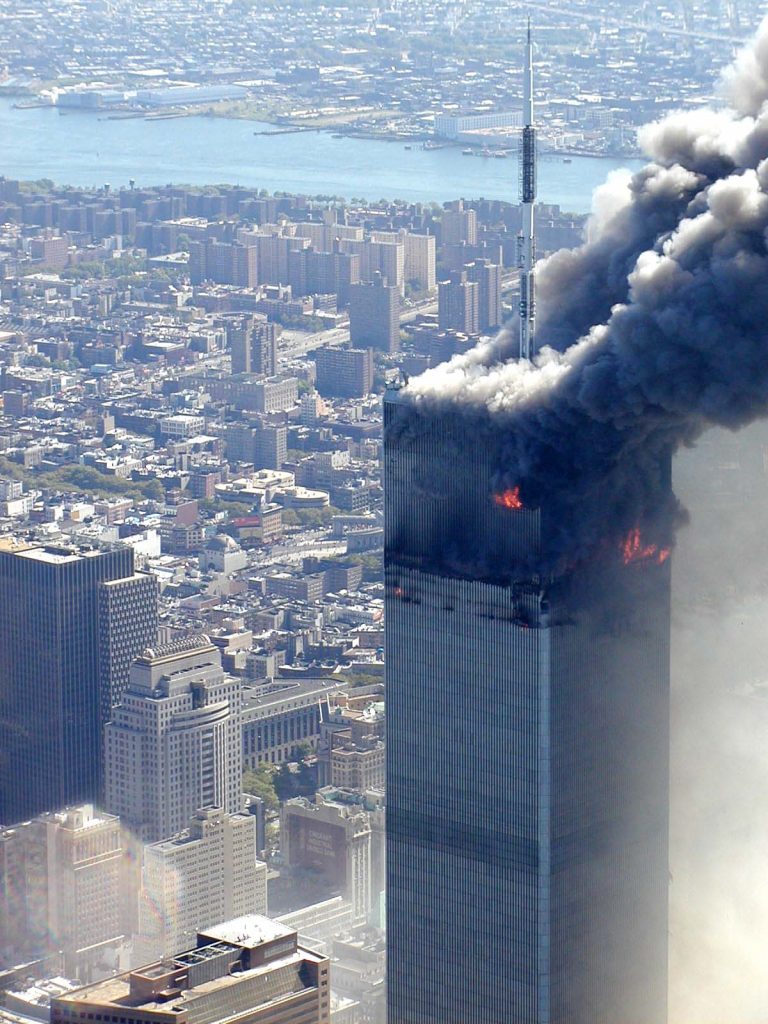
Plumes of smoke billowed from the World Trade Center towers in Lower Manhattan, New York City, after Boeing 767s hit each tower during the September 11 attacks. Image credit: Michael Foran / CC BY 2.0
This John Kamm Remembers recounts the attacks of September 11 and the lead-up to the publication of a cover story on John Kamm. It can be read in conjunction with “Kamm’s List,” the next installment which continues this story.
In the late summer of that year my family and I lived in an apartment in San Francisco that overlooked Chinatown below, and then, down to the Bay and Alcatraz Island in the distance, enveloped in gray fog.
On August 21, 2001, I was sitting at my desk when the phone rang. The caller identified herself as New York Times journalist Tina Rosenberg. I was not familiar with her name.
Ms. Rosenberg told me that she was working on an article that might appear in the paper’s Sunday Magazine. The article would examine the nexus between business and human rights in countries where foreign multinational corporations were conducting business. She mentioned Royal Dutch Shell’s operations in Nigeria and Adidas’ sneaker-manufacturing in Pakistan as possible subjects worth exploring. For China, she wanted to focus on my work on behalf of political prisoners.
On December 9, 2005, Tina Rosenberg speaks at a conference titled “National Security Archives: Celebrating 20 Years of Keeping Government Honest.” Image credit: C-Span
We agreed to talk again the next day. As soon as the call ended, I did an Internet search for Tina Rosenberg. I was impressed by what I found. Tina Rosenberg was, and is today, one of The New York Times’ most accomplished journalists. She was awarded a MacArthur Fellowship, dubbed the “Genius Award,” in 1987, when she was 27 years old. This was followed by a National Book Award in 1995 and a Pulitzer Prize for Nonfiction in 1996. All of this was accomplished before she reached the age of 40. I decided to work with her on the article. I informed her of my decision the next day.
When we spoke on August 22, 2001, I advised Tina that I would travel to Hong Kong and Beijing in September. We spoke again on September 7. I left for Hong Kong the next day, arriving on September 9. I checked into the Marriott Hotel in Pacific Place, an old haunt.
In those days, I had my own show on the Voice of America, and I had lined up several shows to be recorded on this trip. The first show – a program on prospects for political reform in China – was recorded on September 10 at the studio in Wanchai.
The 9/11 Attacks
The next day, September 11, 2001, I made last-minute arrangements for the trip to Beijing, confirming appointments with the Ministry of Foreign Affairs (MFA), the Ministry of Justice (MOJ), and the Supreme People’s Court. The highlight of the trip was to be a dinner hosted for the MOJ to celebrate 10 years of our cooperation. I had secured letters of congratulations from four members of Congress to present at the dinner.
September 11 was capped off with a dinner, in the hotel’s Chinese restaurant, with two of my interlocutors from Guangdong Province. They provided information on seven political prisoners in the province, including the last prisoner connected to June 4, 1989, protests imprisoned in Guangdong. I returned to my room around 9 PM to begin packing for my flight to Beijing the next day.
Upon returning to my room, I found the message light flashing. It was a brief message from my VOA producer in Washington. “Turn on your TV,” it said. “A plane has just crashed into the World Trade Center (WTC) in New York.” I turned on my TV to CNN and saw smoke billowing from the WTC’s North Tower. I watched another plane crashed into the South Tower at just after 9 PM. I continued watching until both towers collapsed one after the other, in pancake fashion, at 10:20 PM.
I didn’t know it at the time, but a close family member had been killed at the very beginning of the attack, the victim of a head-on collision by the jet that crashed into the North Tower. Many of his colleagues at Cantor Fitzgerald were killed in the attack.
After 9/11, air traffic between the United States, Europe, and Asia was suspended, but planes continued to fly between destinations outside the United States. I went out to the airport early for my 11:35 AM Dragon Air flight to Beijing. I needn’t have done so. The departure hall was empty. The cancellation of flights to and from North America had had a devastating knock-on effect on air traffic around the world.
Arriving at Beijing Airport in the early afternoon, I was picked up by my driver and taken to the Jianguo Hotel. After checking in, I called the US Embassy. The new ambassador, Clark “Sandy” Randt had recently arrived. Sandy was an old friend from our days together in Hong Kong. A personal friend of President George W. Bush, Sandy would go on to become the longest serving American ambassador to China.
Sandy Randt had lost a close friend in the 9/11 attacks, and I had lost a cousin. After commiserating, I invited him to the dinner for the Ministry of Justice, to be held on the evening of September 13. He accepted. Sandy also agreed to do a VOA interview with me right before the dinner.
On the morning of September 13, 2001, I met with the Supreme People’s Court to discuss the case of Yu Rong, a Shanghai worker who had been arrested in 1990 in the largest counterrevolutionary pamphlet case in the history of the city. Yu had scattered 1,400 leaflets from the tops of Shanghai buildings. He was subsequently placed in a psychiatric detention center. After this meeting I had lunch with Mark Lambert, the human rights officer at the United States Embassy. This was followed by the VOA interview with Ambassador Randt at the embassy.
The dinner itself, attended by senior officials at the MOJ, the China Society of Prisons, and the MFA, was a somber affair. Not a good occasion for feasting and drinking. It broke up early.
The next morning, I was driven to the MOJ’s headquarters for a 9:00 AM meeting with Wang Lixian, director of the International Department, and his colleague Zhang Qing. I was told that I would not be given any information on prisoners on this visit to Beijing. I registered my disappointment. “At this time when my country is grieving, I come to Beijing to see you and to receive responses to my inquiries. And what do I get? Nothing.” My bitterness and disappointment showed. I choked up and couldn’t continue.
I summoned my driver and returned to my hotel. After eating my lunch, alone, I went to see Director General Li Baodong of the MFA’s Department of International Organizations and Conferences as well as his colleague La Yifan, effectively Li’s number two, and Li Xiaomei. At this meeting I broached the idea of having Tina Rosenberg come to Beijing as part of a story for the Times on my work. I also complained about how I had been treated by the MOJ.
Coverage of the September 11 attacks in Chinese media: (left to right) The front page and inside coverage of the Global Times’ September 12 edition; the front page of the Reference Times. Image credit: kongfz.com; guancha.cn
I stayed behind in Beijing one more day to attend the Memorial Mass for the victims of the 9/11 attacks held at the Cathedral of the Immaculate Conception on Saturday evening, September 15. A priest, a member of the Patriotic Church, kept local Catholics from attending the service. I returned to Hong Kong the next day, checking into the Marriott.
On September 17, 2001, I received an unexpected call in my room at the Marriott. Director Wang Lixian was in the lobby and wanted to meet me. I went downstairs for a short meeting. Wang advised me that they were gathering information in response to some of my requests. They intended to fax it to me over the coming days. I advised him that I would be returning to San Francisco on September 27 and requested that he fax the information to me there. He agreed. We shook hands and he left.
Over the next nine days I kept a full schedule in Hong Kong. I met with foreign diplomats, including the papal nuncio and the American consul general, Dui Hua donors, business leaders, and family and friends. I carried out research at university libraries, finding the names of hundreds of previously unknown political prisoners. I taped a VOA show on the Hong Kong economy.
I flew back to San Francisco on September 27 and, upon returning home, found the promised responses on prisoners from the Ministry of Justice on my fax machine. It was an extraordinary document: information was given on nine prisoners including high priority Tibetan prisoners Jigme Sangpo and Ngawang Sangdrol. A number of early releases had taken place. More would come, including both Tibetans.
Washington
On October 14, 2001, I flew to Washington DC, a tense city still in shock from the attack on the Pentagon on September 11. Security was tight. Troops were everywhere.
I met Tina for dinner at McCormick & Schmick’s on K Street on October 15. It was our first face-to-face meeting. We reviewed progress to date, and I briefed her on recent developments with respect to cases, including those of Liu Baiqiang, a Guangdong prisoner who tied political messages to the legs of locusts and released them from his cell – I dubbed him the “Locust Man” – and Kajikhumar Shabdan, an elderly Kazakh poet serving a 15-year sentence for counterrevolution.
On October 25, I called La Yifan, Li Baodong’s deputy. I wanted to know whether Tina would be given a visa. La told me that it had been decided to grant the visa. We discussed possible dates for Tina and my trip to Beijing, and settled on mid-December, subject to confirmation and Tina’s availability.
I flew to Beijing via Narita on December 15, arriving on December 16. The next day I had lunch with Ambassador Randt and his family at the residence. Afterwards I met with Li Baodong at the Ministry of Foreign Affairs. Two of his colleagues joined the meeting. Tina was soon to land in Beijing. Director General Li commented that the Chinese government did not expect Tina to write an article suitable for publication in the Beijing Review, but it hoped she would be fair and objective. At this meeting I presented a list of Chinese political prisoners eligible for parole.
Read about the aftermath of the article’s publication in “Kamm’s List,” which you can read by clicking here.
United Nations High Commissioner for Human Rights Michelle Bachelet makes remarks during the annual high-level panel discussion on human rights mainstreaming at the 46th session of the Human Rights Council on February 22, 2021. Image credit: UN photo by Violaine Martin
The United Nations Human Rights Council is an ideological battleground between China and its allies and the United States and its allies. Its 47th regular session (hereafter HRC 47) took place from June 21 to July 14, 2021 in Geneva. At the start of the session, Permanent Representative of Canada to the United Nations (UN) in Geneva Leslie E. Norton delivered the Joint Statement on the Human Rights Situation in Xinjiang on behalf of 44 countries. In response, Belarus delivered a joint statement from 69 countries refuting criticisms against China and urging non-interference.
In recent years, HRCs and other UN sessions have seen dueling statements expressing concern over China’s human rights record on the one hand and lauding it on the other. Two blocs have emerged since a joint letter at HRC 41 in 2019. While each of the UN’s 193 member states has its own motivations, some factors offer insights into how countries are negotiating the US-China relationship and the current human rights climate.
Dueling Statements
The Canada statement at HRC 47 expressed concerns about the human rights situation in Xinjiang Uyghur Autonomous Region (XUAR), Hong Kong Special Administrative Region (SAR), and Tibet Autonomous Region (TAR) citing “credible reports” of rights abuses including widespread arbitrary detention, surveillance, restrictions on fundamental freedoms, torture, and gender-based violence by authorities. It urges China to allow “immediate, meaningful, and unfettered access” to the region and to implement the concluding observations of the UN Committee on the Elimination of Racial Discrimination (CERD).
The signatories to the Canadian statement are predominantly developed democracies in North America, Europe, and Asia-Pacific. European states make up the majority. Most of the signatories have been outspoken against China’s human rights record and, as with Asia-Pacific signatories, have geopolitical concerns about China. Ukraine allegedly backed out of signing the statement when China threatened to halt sending vaccines. Israel was reportedly pressured to join by the United States.
All of the G7 – Canada, France, Germany, Italy, Japan, the United Kingdom, and the United States – signed the Canadian statement. In 2020, the G7 countries made up at least a third of China’s foreign trade revenue. Except for Japan and the United States, the G7 countries are also members of the China-launched Asia Infrastructure Investment Bank. The countries that signed the Canadian statement likely account for at least 50 percent of China’s export revenue. Trade between the United States and China, meanwhile, has surged to record levels, with some reports writing that it is “as if the protracted tariff war and pandemic never happened.”
Belarus’ counter statement emphasized the importance of “sovereignty, independence and territorial integrity of states and non-interference in internal affairs.” It implies that the Canadian statement is politically motivated and based on disinformation and double standards. The statement originally had 65 signatories with four nations joining later, and has broad support among the Organization of the Islamic Cooperation (OIC). Twenty-three of the OIC’s 57 members did not sign the Belarus statement, nor did most of China’s major trading partners.
Table 1. HRC 47 Statement Signatories
There were notable omissions. Both Turkey and Kazakhstan have not signed either statement despite cultural links to persecuted groups in China. Multiple ASEAN nations, particularly those that are Muslim-majority and/or have concerns about the South China Sea, have not aligned with either bloc. Several of the world’s largest economies have also been absent, including India and Brazil. South Korea, which enjoys strong economic ties with both but is politically aligned with the United States, refrained from signing, as did Singapore. Finally, four members of the EU have not signed either statement: Cyprus, Greece, Hungary, and Malta.
As mentioned, HRC 47 was not the first instance of dueling statements on China’s human rights record. At HRC 41 in 2019, 25 nations signed a letter criticizing China while a counter letter garnered 50 signatories. At HRC 44, the UK issued a joint statement signed by 27 nations; in turn, two statements supported China—one on Xinjiang issued by Belarus signed by 53 states and another on Hong Kong issued by Cuba signed by 46 states. At HRC 46, Belarus and Cuba switched: Belarus offered a statement on Hong Kong for 69 states while Cuba’s statement on Xinjiang garnered 64 signatories. There was no joint measure critical of China; instead, 21 member states made 34 separate remarks criticizing China’s human rights record.
Similarly, in the 74th session of the General Assembly, the UK issued a statement on behalf of 23 states, which was met by a counter statement from 54 member states. In the 75th session, Germany issued a joint statement on behalf of 39 states. Cuba supported Xinjiang policy on behalf of 45 states and Pakistan supported Hong Kong policy on behalf of 55 states.
Statements critical of China have been issued by the UK, Germany, and Canada while joint actions supporting China have been issued by Belarus, Cuba, and Pakistan. Both Belarus and Cuba are among the last communist dictatorships in their regions, and both have faced political turmoil and threat of regime change in recent months. Should political instability in Cuba result in the fall of the regime, China could lose one of its key supporters.
Table 2. Selected Actions at the UN
The joint statements have consistent messaging. Statements critical of China have expressed concern over human rights, noted China’s obligations under international law, recommended that China implement the CERD observations, and urged China to allow meaningful, unfettered access to independent observers. Statements in support of China consistently accuse the other bloc of being politically motivated, commend China’s actions in Xinjiang as human rights achievements through the right to development and, because there have been no terrorist attacks in Xinjiang in three consecutive years, the right to life.
Regions Beyond the Rhetoric
The most obvious bloc is that of the developed democratic economies of North America, Europe, and Asia-Pacific that express concern over human rights in China. Canada’s HRC 47 statement was the most supported statement yet: 44 states signed on, 23 from the EU and 32 in Europe. This corresponds to recent polling in which publics in 17 advanced economies said China does not respect the personal freedoms of its citizens. Of the nations surveyed—all in North America, Europe, and Asia-Pacific—13 signed the HRC 47 statement. Several of these nations have designated China’s actions in Xinjiang as genocide in their domestic political bodies. Of the remainder, South Korea, Greece, and Singapore have not signed any statement; the latter two reported favorable views of China, and Singapore was the only public to prefer close economic ties with China and to express confidence in Xi Jinping. However, the United States induces uncertainty. Of the 16 other nations, a third said that the United States considered their foreign policy interests. While most described the United States as a “somewhat reliable partner,” most believe that it is no longer a good model of democracy.
Much has been made of the Islamic world’s support for China’s actions in Xinjiang. Belarus’ HRC 47 statement was signed by 13 MENA countries and the majority of OIC countries. Only one OIC member, Albania, signed Canada’s statement. Muslim populations’ support for alleged genocide against a Muslim population has been explained as a byproduct of strong-man rule because many MENA, OIC, and Central Asian nations have authoritarian features. However, polling has found consistently positive views of China and Xi Jinping even when support for the United States increased among seven MENA countries. Arab publics consistently view the United States as a larger economic threat than China. Across 13 Arab countries, 58 percent viewed US policy towards the region negatively while a majority held positive views on China’s foreign policy. These views persist even though respondents view China as a less desirable employer and a source of inferior goods, and they express broad support for democracy, which suggests that China’s argument for sovereignty is attractive. Dismissing the Muslim world’s support of China as a product of illiberalism may validate China’s narrative that human rights are individualistic western ideals used to infiltrate and subjugate otherwise sovereign states.
Among ASEAN countries, seven of its 10 members did not sign either statement. The Philippines stopped supporting China after HRC 41. While sharing the Philippines’ concerns over the South China Sea, Indonesia and Malaysia are also facing pressure, both external and internal, over the situation of the Uyghurs in their country. A 2021 survey of government and civil society experts in ASEAN nations found that support for the United States has increased in recent years. A 2020 poll found 79 percent identified China as the most influential power in the region, with 72 percent expressing wariness over this: “China’s economic influence is deeply felt but not very well received in the country.” Still, China is favored in many ASEAN countries with the United States being the overwhelming preference in the Philippines and Vietnam.
Africa has been a consistent source of support for China at the UN, even as some of the continent’s largest economies avoid statements. (In a surprise development, Côte d’Ivoire issued a statement expressing concern over actions in Xinjiang, Hong Kong, and Tibet despite not signing either statement.) A survey of 18 African countries found that while the United States is still the preferred development model, in countries where China had invested mainly in infrastructure, perceptions have held steady or improved. Less than half of those polled said they were aware of Chinese loans or financial assistance to their country but among those who were, 77 percent were concerned about loan repayment and a majority (58 percent) said that their governments had overborrowed. This might indicate that narratives about debt traps and asset seizures are having an effect.
Like Africa, the region consisting of Latin America and the Caribbean (LAC) has seen hefty Chinese investment. According to the Congressional Research Service, 19 LAC countries have Belt and Road Initiative (BRI) projects in the region and total trade between China and the region reached $316 billion in 2019. Accumulated loans from 2005 to 2020 totaled $137 billion, with top recipients being Venezuela, Brazil, Ecuador, and Argentina—only one of which signed the Cuba statement. Public polling in Brazil, Argentina, and Mexico suggests that people have more positive views of China than negative, and these ratings have improved since 2014; these publics were more likely to name the United States as the top threat but say that they have good economic relations with both countries.
Trading Onwards
A look at China’s top trading partners suggests that any battle for hearts and minds is occurring separate from trade deals. China’s top 10 countries for imports and exports are dominated by Canada statement signatories—the United States, Germany—and non-signers—Brazil, South Korea. While supporters like Russia and the odd MENA state factor in at lower levels, China’s economy is still supported by the countries it accuses of weaponizing human rights. Amongst ongoing calls for decoupling and an economic reality that suggests the opposite, there are several issues to consider moving forward.
Investment and attention seem to matter. In public polls, countries that receive investments tend to have more favorable opinions of a country, which sometimes translates into UN support or at least the absence of opposition. The United States and Europe have recently announced initiatives to compete with China’s BRI, and vaccine diplomacy, as seen by the Ukraine case, remains a crucial issue for international engagement.
Narratives can create opportunities. Narratives on predatory investment may have sway in regions lacking a power monopoly; China-led narratives about sovereignty at the very least provide effective cover for post-colonial societies, some of whom may be truly weary of invasion. Similarly, China’s human rights whataboutism can deflect attention from criticism. It has highlighted the United States’ history of genocide and aggression in the MENA region. At the same time that Canada issued its statement, reports of mass graves at its relocation schools revealed its own human rights abuses. China even issued its own joint statement expressing “deep concerns” on human rights in the United Kingdom largely due to severe systemic racism.
China’s accusations of political bias might seem contrived to western audiences, but the United States has at times taken a similar approach. The Bush administration declined to join the HRC in 2006 when the HRC replaced the Human Rights Commission, which was widely seen as ineffective and even counterproductive. The Bush presidency also cited anti-Israel bias as a reason for non-involvement, and the United States was one of four nations—with Israel, the Marshall Islands, and Palau—to vote against the HRC’s formation. Belarus, Iran, and Venezuela abstained. During the Obama administration, the United States joined and was elected to the HRC. In 2018, the Trump administration withdrew from the HRC, again citing anti-Israel bias as the reason.
On June 19, 2018, then-Ambassador to the United Nations announced the US withdrawal from the HRC. Image credit: C-Span
Similarly, China has used the US-led war on terror to justify its actions. Many Western countries have expressed indignation at China’s actions without acknowledging parallels to US programs of extraordinary rendition, extrajudicial drone killings, and the “off-shoring” of refugees by developed democracy economies. This helps reinforce China’s narrative that human rights are culturally biased, politicized devices. Ignoring these aspects may reinforce China’s notion that the choice between the US and China-led narratives on human rights is a political one, as opposed to one rooted in international law and morality.
The Biden administration seems to be progressing on some of these fronts. The administration’s statement on key outputs from HRC 47 listed achievements such as co-sponsoring resolutions in human rights in Syria and the human rights of migrants, leading events on Hong Kong’s National Security Law and business and human rights, and cooperating on a new mechanism to combat systemic racism. It also confirmed that the United States will seek election to the HRC leadership for 2022-2024.
A photograph of Check Lap Kok Airport in Hong Kong, taken on November 20, 2010. Image credit: Elmar Bajora / CC BY-NC-ND 2.0
Before starting my human rights work in China, I prided myself on being a pioneering businessman. In 1979, I placed the first advertisement for Western products in China since the Cultural Revolution. In the same year, I opened two of the first offices in Chinese cities – Guangzhou and Shanghai – outside Beijing, before regulations on foreign offices were enacted. I made some of the first direct sales to Chinese county foreign trade corporations. These were sales of vaccines for pigeons raised in Zhongshan County, Guangdong, in the early 1980s.
I negotiated the first 50:50 joint venture between a Chinese chemical plant and a Western chemical company. The Chinese partner was the Qingdao Chemical Plant and the Western company was Occidental Chemical Company, which I served as vice president of the Asia Pacific region from 1986 to 1991. The product we joint ventured to produce was sodium silicate, a simple, low-risk inorganic chemical with wide applications in the detergent and glass industries.
Mixing Business and Human Rights
The negotiations began in 1988. I made a number of trips to Qingdao, a seaside city known, among other things, as a base for American navy vessels before 1949. (President Carter served there in the years immediately after the Second World War. There was a large Eurasian population in Qingdao as a result of American sailors being stationed there.)
I took the train from Hong Kong to Guangzhou where I boarded a flight to Qingdao on October 14, 1991. I stayed in the Qingdao Flower Stone House, a Gothic-style structure built in 1936 for a wealthy merchant family. Our joint venture negotiating sessions took place at the sodium silicate factory. Between sessions I and my team were hosted to lunch by the Qingdao Economic and Trade Department and to dinner by Qingdao’s mayor.
A photo of the Qingdao Flower Stone House from November 8, 2011. Image credit: Gisling / CC BY-SA 3.0 via Wikimedia Commons
On October 18, I was invited to give a speech at Qingdao University, where I had been made an honorary professor in April 1990. I spoke on US-China Relations to the university faculty, toured the campus, and was invited to lunch by the university president. At lunch I raised the names of Qingdao students who had been imprisoned for their actions in the May-June 1989 protests. (Shandong courts were known for passing some of the harshest sentences on students and workers.)
I flew to Beijing that evening and settled into the Jianguo Hotel. This was my third visit to Beijing in 1991.
Over the next three days I met with the Ministry of Justice to arrange a visit to Guangdong Meixian Prison; we discussed the fates of several prisoners including Wang Xizhe and Liu Shanshing. After this meeting I met with the head of the Foreign Affairs Department of the Supreme People’s Court to discuss the Lo Haixing and Han Dongfang cases, the situations of imprisoned Catholic clergy, and the abolition of counterrevolutionary crimes.
I then met with the Ministry of Foreign Economic Relations and Trade to discuss prison labor exports by Chinese factories, illegal in the United States. I had broached the topic of prison exports with the Ministry of Justice earlier in the day and been told that the ministry would take action against a Chinese factory that had been caught shipping products to the United States.
I also had a working dinner with the Ministry of Foreign Affairs (MFA) and the State Council.
The Issue of Exit Bans
At my meetings with the Supreme People’s Court, the State Council, and the Ministry of Foreign Affairs, I raised the issue of exit bans placed on relatives of dissidents who had fled China after the events of May and June 1989. I pressed my Chinese counterparts to let them join their family members who were living in exile in the United States.
At the dinner with the MFA and State Council on October 17, 1991, I was advised that several family members had, over the previous month, been allowed to leave China for the United States. I was told I would be given a full accounting the next day. The accounting would be given to me in a fax sent by the Supreme People’s Court to my hotel room.
On October 18, I debriefed the American Embassy and spoke to the American Chamber of Commerce. (It was a cool reception.) Upon my return to the Jianguo, I collected the fax from the Supreme People’s Court in the business center. The fax advised that family members of five leading dissidents had been allowed to leave China in recent weeks. The five dissidents were:
Chen Kuide (陈奎德), director of the Institute of Culture at the Eastern University of Chemistry;
Ma Bo (马波), an investigative journalist who wrote under the pen name Lao Gui (老鬼 “Old Ghost”). He had authored Blood Red Sunset, an early example of Cultural Revolution “scar literature;”
Ruan Ming (阮銘), a researcher at the Central Party School;
Su Xiaokang (苏晓康), an influential intellectual and scholar who was named as one of China’s seven most-wanted intellectuals involved in the 1989 protests. Su wrote the script for River Elegy, a controversial, six-episode television program that criticized Chinese culture; and
Yuan Zhiming (远志明), a student protest leader who worked with Su Xiaokang on River Elegy.
Both Su and Yuan were wanted by police when they fled China. I was told by American diplomats that the public security authorities wanted to force exiled dissidents to return to China in a naked display of hostage politics.
The families eventually reunited. The exiles had relocated to the East Coast of the United States. Chen Kuide and Su Xiaokang set up shop in Princeton New Jersey where they became core members of the Princeton China initiative. (At one point, more than 20 Chinese exiles had joined the initiative in Princeton.) Ma Bo became a writer in residence at Brown University. Yuan Ziming also settled in Princeton before becoming a Christian pastor. He stepped down from his ministry in 2015 after being accused of sexual misconduct, an accusation he denied. Ruan Ming was at Columbia University where he continued his research and writing on Chinese leadership politics.
After I received the fax I gave interviews to Jeff Parker of the UPI, Chris Yeung of the South China Morning Post, Cathy Wilhelm of the Associated Press, James Miles of the BBC, and David Holly of the Los Angeles Times. I continued my work with journalists the following day, giving radio interviews to Hong Kong media and filming a segment for ABC News at Ryh Tan, a park in central Beijing. After wrapping up the segment, I left for the airport, where I boarded a flight back to Hong Kong.
The Right to Travel
Article 13 of the Universal Declaration of Human Rights states that “Everyone has the right to leave any country, including his own, and return to his country.” Nevertheless, many countries, including the United States and China, restrict this right for a number of reasons. In the United States, a ban on leaving the country is imposed by a judge in an open hearing and is accomplished by forcing the defendant in a criminal or civil trial to surrender his or her passport.
In China, there is a long history of exit bans placed on both Chinese citizens and foreigners. One of the most famous examples of exit bans were those placed on British bankers who managed the Hong Kong Shanghai Bank and Chartered Bank in Shanghai. The exit bans, which were in place for decades, were accompanied by other restrictions, especially during the Cultural Revolution years, and were supposedly imposed to ensure that the head offices of the banks in London didn’t confiscate the holdings of Chinese banks—an early example of hostage politics. As soon as the bankers’ replacements arrived, the exit bans were lifted.
The HSBC building in Shanghai, which was the headquarters of the Shanghai branch of The Hongkong and Shanghai Banking Corporation from 1923 to 1955. Image credit: Livelikerw / CC BY-SA 3.0US citizens Victor and Cynthia Liu, who have been unable to leave China since June 2018. Image credit: club6parkbbs.com
In another case, that of a Chinese American woman whose father is a Chinese citizen suspected of endangering state security, the exit ban was only lifted after she signed a document pledging not to reveal details of her ordeal. In yet another case, an American of Chinese descent was forced to sell all his assets and hand the proceeds over to the Chinese government before he was allowed to leave the country, poorer but wiser.
While most exit bans are imposed against foreigners of Chinese descent, there are examples of foreigners who are not of Chinese descent living under exit bans in China. Irish businessman Richard O’Halloran has been forbidden to leave China for more than two years over a business dispute involving his employer, even though he was not employed by the firm when the dispute took place. He was advised by the police that if he pays more than $50 million, he can leave. The Irish president raised his plight with Chinese president Xi Jinping, to no avail.
The application of exit bans against American citizens has become a major irritant in US-China relations. The subject is raised as a priority issue in high-level discussions between officials of the two governments, including the March 2021 meeting in Anchorage between senior officials of the Department of State and the National Security Council and their Chinese counterparts.
In December 2020, the Department of State issued a Level Three Travel Advisory – “Reconsider Travel” – for American citizens considering visiting China in large part because of the danger of being subjected to an exit ban. The advisory states that “the PRC government uses exit bans to:
Compel individuals to participate in PRC government investigations,
Pressure family members to return to the PRC from abroad,
Influence PRC authorities to resolve civil disputes in favor of PRC citizens, and
Gain bargaining leverage over foreign governments.”
Under regulations that take effect on August 1, 2021, Hong Kong’s immigration authorities have the power to bar people from entering and leaving the territory, another sign that the legal systems of both the mainland and Hong Kong are moving closer together.
I was quite surprised when the State Council Information Office (SCIO) and the Ministry of Justice (MOJ) agreed to the proposal I made at our January 1995 meeting to accept four lists of prisoners during the year, one each quarter. I had prepared and handed over a list of 25 prisoners, leaving three more lists of 25 names to be submitted in 1995.
This was four years before Dui Hua existed, and long before the foundation had set up its political prisoner database (PPDB). Since the early 2000s, I have relied on the PPDB to draft prisoner lists, but in the 1990s I had to rely on conversations with political activists, family members of political prisoners, and NGO publications to identify names for my lists.
Among the names I included on my lists was Zheng Yunsu, leader of a Jesus Family congregation in Shandong Province who was detained in May 1992 and subsequently sentenced in September 1992 to 12 years in prison for disturbing the social order and fraud. I found his name and accounts of his detention and sentencing in Detained in China and Tibet, published by Human Rights Watch in February 1994, and The Imprisonment and Harassment of Jesus Family Members in Shandong Province, published by Amnesty International in October 1994. I placed Zheng Yunsu’s name on my fourth quarter list, which I faxed to the Ministry of Justice in November 1995.
Subsequent to Zheng’s detention, Chinese police moved in and detained dozens of other Jesus Family members, including Zheng’s four sons, and demolished their church buildings in Duoyiguo Village in Shandong Province. The arrests and destruction of church properties were eerily reminiscent of the attack by Chinese police on Youtong Village in Hebei in April 1989. A Trappist priest, Pei Ronggui, was detained, Church property demolished, and two villagers killed in the attack. Pei was subsequently sentenced in 1991 to five years in prison for “disturbing the social order.” He was granted early release on March 31, 1993, following a brief campaign of spirited intervention with my interlocutors.
Instead of being put in prison for counterrevolution, both Pei Ronggui and Zheng Yunsu were imprisoned for disturbing the social order, a precursor of “using a cult to sabotage implementation of the law,” Article 300 of the Criminal Law amended in 1997.
The Jesus Family: A Brief History
The Jesus Family is an indigenous Christian communitarian group that emerged in Shandong Province during the 1920s. Although it was influenced by Pentecostal missionaries, the Jesus Family is not a Pentecostal church. Founded by Jing Dianying, a charismatic Christian who was raised in a traditional Confucian family that practiced Buddhism and who later attended a Methodist high school, the Jesus Family expanded rapidly throughout China, surviving and even thriving during the Japanese occupation and the Chinese civil war that resulted in the defeat of Nationalist forces in 1949.
The Jesus Family emphasized simple living, poverty, communal sharing, piety, and prophesy. It emphasized prayers and singing of psalms. It reportedly rose to more than 125 congregations and 20,000 members in China by 1949. Although concentrated in Shandong, families existed in many other provinces.
After 1949, the Jesus Family leadership embraced the officially sanctioned Three-Self Movement, and for a while its activities were condoned, even praised by the Chinese government and communist party. However, the sect’s rapid growth and communitarianism came to be seen as a threat to the party, and in 1952 Jing was arrested and sentenced to prison where he developed cancer. Jesus Family properties were destroyed and the 500 members who lived in Mazhuang were dispersed throughout Shandong.
Jing died shortly after being granted medical parole in 1957. The Cultural Revolution (1966-1976) saw this unorthodox Christian group largely disappear. It was only after the reform and opening period began in 1979 that the church reemerged. It spread rapidly. In Ding’s home village, Mazhuang, the family reoccupied 43 acres of land, established a church, and grew crops. Eventually an eye hospital was established. It still serves the Mazhuang and surrounding communities and is deeply appreciated by both local residents and the party.
One of the biggest areas of growth took place in Duoyigao, a village near Weixian City in western Shandong. There and in surrounding villages, the family, under the leadership of Zheng Yunsu, counted around 3,000 congregants. Services, including baptisms, were attended by more than 1,000 believers. The congregation supported itself by raising rabbits, making shoes, and growing crops for its own consumption and to give away to those in need. Family activities alarmed local security forces, which subjected the group to surveillance, including using a helicopter to monitor gatherings. Members faced harassment and short detentions.
Attacks on Duoyigao Village, May-June 1992
On May 19, 1992, police disrupted a service led by Zheng Yunsu in Liuzhuang Village, a community with many Jesus Family congregants not far from Duoyigao Village. Zheng was spirited away from the service before police could take him into custody, but the next day, Zheng surrendered to police in Shandong’s provincial capital, Jinan. Not long afterwards, Zheng’s four sons were taken into custody. Zheng and his sons were paraded through Duoyigao Village and surrounding villages with placards hung around their necks identifying them as Jesus Family believers.
On June 18, 1992, 40 truckloads of police descended on Duoyigao Village. Several buildings were destroyed, and possessions – including bicycles, machinery for making shoes, furniture, bedding, clothing, livestock, and grains – were seized. On June 20, 1992, the police returned and detained more than 20 Jesus Family members. On July 10, 1992, another ten members were detained.
Excerpts from Amnesty International’s The Imprisonment and Harassment of Jesus Family Members in Shandong Province. Image credit: Amnesty International
On October 10, 1992, Zheng Yunsu was convicted of fraud and disrupting social order by the Weishan District Court. He was sentenced to 12 years in prison and placed in Shandong Number One Prison. His four sons were sentenced to three-year terms of re-education through labor. Most other Jesus Family detainees were released after they confessed their crimes and agreed to stop their religious activities. Those released, and other members of the Jesus Family, wrote a detailed account of what they had gone through. This was provided to Amnesty International in London which published an urgent appeal based on this information in August 1993. This appeal formed the basis of the information published by Human Rights Watch in 1994, which in turn led to my including Zheng Yunsu’s name on my November 1995 list submitted to the SCIO and the MOJ.
Nine months after I submitted the November 1995 list with Zheng Yunsu’s name on it, he was granted an 18-month sentence reduction. Further advocacy resulted in Zheng Yunsu being released on parole on May 26, 1999, seven years into his 12-year sentence.
Strategy to Free Zheng Yunsu
I adopted a multi-pronged strategy for advocating on Zheng Yunsu’s behalf. I placed him on my lists and raised his name in conversations with Chinese officials from the Ministry of Foreign Affairs, the SCIO, the MOJ, and the Religious Affairs Bureau. I also put his name on lists of countries having bilateral human rights dialogues with China, notably the United States. I encouraged members of Congress to reference Zheng in their letters Chinese leaders. Finally, I used the visits of senior American religious leaders to China to raise Zheng’s name.
Following the November 1995 list on which I put Zheng’s name, I placed Zheng’s name on a list of 24 prisoners submitted to the MOJ in October 1997, immediately prior to President Jiang Zemin’s state visit to the United States, and on a July 1998 list of religious prisoners eligible for parole (they had completed half of their sentences). I gave this list to the Department of State for use in its January 1999 bilateral human rights dialogue with China.
In addition to referring to the November 1995 list that included Zheng’s name in Congress members’ letters to the Chinese government urging a resumption of the Prisoner Information Project, several members either attached their own lists of religious prisoners on which Zheng’s name was included or raised Zheng in their conversations with Chinese officials in the United States or China.
During the October 1997 state visit of Jiang Zemin to the United States, Jiang Zemin and President Clinton struck an agreement that a group of American religious leaders would be invited to visit China in early 1998.
The group, led by Rabbi Arthur Schneier, president of the Appeal of Conscience Foundation, and including the Roman Catholic Archbishop of Newark Theodore McCarrick and the president of the National Association of Evangelicals Reverend Don Argue, spent two weeks in China in February 1998. They met with President Jiang in the Great Hall of the People; Rabbi Schneier presented President Jiang with a gold-embossed Torah. They also met with Ye Xiaowen, director of the Religious Affairs Bureau. They provided Ye with a list of 30 religious prisoners drawn up in consultation with the United States government and human rights activists, including me. Ye promised to give answers.
In January 1999, Rabbi Yechiel Eckstein, one of America’s preeminent rabbis, traveled to China to lobby the Chinese government to release imprisoned Christian pastors. He forcefully took up the cause of Zheng Yunsu in discussions with Director Ye Xiaowen. Four months after the rabbi’s visit, Zheng Yunsu was paroled.
Coverage of Zheng Yunsu’s release in Dui Hua’s summer 2001 newsletter. Image credit: The Dui Hua Foundation
Aftermath
Little has been written about what happened to the Jesus Family after 1997. What has been written suggests that the Jesus Family has largely disappeared – disbanded, marginalized, affiliated with various house churches, or absorbed into the government-approved Three-Self Movement. In his book Pentecostals in China, published in September 2015, Robert Menzies maintains that the Jesus Family exists in non-communitarian form in various parts of China. “It’s quite small,” he writes.
An American religious scholar living in Hong Kong disagrees. This man, who visited the Mazhuang eye hospital in the early 1990s and has stayed in touch with the faith community in Shandong, states that the Jesus Family remains active in the public space. According to his account, as of the end of 2019, the Jesus Family enjoys good relations with the Three-Self Movement’s Shandong Christian Council. Zheng Yunsu, now in his late 80’s, was in good health and continuing his work. He was not in trouble with the Chinese government. He was well and at peace. His faith had set him free.
On January 24, 1995, then-President Clinton delivers the State of the Union address to Congress. Image credit: C-Span
Acting on a recommendation by Assistant Secretary of State for Democracy Human Rights and Labor Richard Shifter, I began submitting prisoner lists to the Chinese government in 1991. In January 1995 I gathered all the responses on prisoners that I received from the Ministry of Justice (MOJ) and the State Council Information Office (SCIO) in 1993 and 1994, 50 in all, and sent a booklet containing the information to senior officials of the MOJ and the SCIO in Beijing.
I flew from Hong Kong to Beijing on Wednesday, February 15, and immediately went to the Jianguo Hotel upon arrival. The next day I met with SCIO Minister Zeng Jianhui, and Liang Gang, Director of the MOJ’s Prison Administration Bureau and his colleague Zhang Jinsheng. (Zeng, now 93 years old, had served as Vice President of the New China News Agency when he was picked to head the SCIO in 1990. He went on to chair the National People’s Congress Foreign Affairs Committee.) We met at the offices of the SCIO, a drab structure next to the Asian Games Village, a 30-minute drive from the Jianguo Hotel.
I started the conversation by asking Minister Zeng whether he had read the recently released human rights report on China released by the Department of State. He replied that he had read it and felt that it was negative and full of mistakes. I pointed out that the report made favorable mention of my cooperation with the Chinese government on prisoner information. Minister Zeng called that mention one of the few positive things in the report.
On October 14, 1999, then-Chairman of the Chinese National People’s Congress Zeng Jianhui spoke with reporters about their delegation’s meeting with members of congress. Image credit: C-Span
I then asked what he thought of the compilation of prisoner information that I had faxed to him a few weeks before. He replied that he had received it. “What do you think?” I asked. “You have accurately reported what you were told.” I then asked if we should continue our cooperation, and the minister replied “Of course.”
I took a chance, apologizing for causing so much work for the MOJ. “I suggest I limit my inquiries to 100 names in 1995, 25 a quarter.” Minister Zeng checked with the MOJ officials, and they nodded agreement. “Great,” I said, and extended my hand for a handshake. All present shook hands. Information on prisoners would be provided during in-person meetings or by fax.
I then handed over my first list of 25 names, singling out Yang Lianzi, Zhao Fengping, and Jigme Sangpo for special attention. Yang was an itinerant troubadour who entertained crowds at Tiananmen Square with protest songs and poems. Zhao founded the Northeast China Autonomous People’s Republic, a counterrevolutionary organization. Jigme Sangpo had been a schoolteacher in Lhasa who was now serving a long sentence for counterrevolution.
After I left the meeting I was hosted to a dinner by my host, the China Council for the Promotion of International Trade. The conversation centered around prospects for Most Favored Nation (MFN) renewal in 1995.
I returned to Beijing on April 24, 1995 and met with the SCIO Director of the Domestic Information Bureau Zhou Changnian and the MOJ’s Liang Gang, director of the Prison Administration Bureau. We met at the SCIO office on April 26. As soon as we sat down, Liang Gang handed over responses to 19 of the names on my first list of 25 names. He explained the difficulties in obtaining information on prisoners but said the MOJ was committed to providing information to the best of its ability. I handed over my second list of 25 names. I was informed that the SCIO had established a small human rights unit within the office.
As I had done at the February meeting, I focused on several prisoners including Hong Kong journalist Xi Yang in prison for trafficking in state secrets, Tibetan prisoner Tenpa Wangdrag who had been severely punished for attempting to hand over a letter to American Ambassador Jim Lilley when he visited Drapchi Prison, and Ahmet Jan, a young Uyghur who had been given a long prison sentence for establishing a reactionary organization. After the meeting, I visited bookstores where I found the names and basic information on several previously unknown prisoners. Their names were added to my lists.
Not long after this April visit, the MOJ sent out a directive to prisons under its control requiring them to report on a regular basis the situations of political and religious prisoners.
Taiwan Strait Crisis
In 1994, Taiwan President Lee Teng-hui transited Honolulu on his way to South America, where a number of countries maintained diplomatic relations with the Republic of China. President Bill Clinton’s State Department refused to grant Lee a visa, so he spent the evening on his plane, on the tarmac.
A year later, Lee Teng-hui was invited to speak at his alma mater, Cornell University. Lee accepted the invitation. Chinese foreign minister Qian Qichen claimed that Secretary of State Warren Christopher assured him in April 1995 that Lee would not be granted a visa. Whatever the truth, Congress stepped in and passed a concurrent resolution. Even though a concurrent resolution, as opposed to a joint resolution, need not be signed by the president, the State Department relented and issued the visa. Lee visited Cornell June 9-10, 1995.
On June 9, 1995, then-president of Taiwan Lee Teng-hui speaks at the Cornell University Alumni Reunion. Image credit: C-Span
Beijing was furious and accused the United States of violating the “One China” principle and “ruining US-China relations.” In July and August, the Chinese military fired barrages of missiles into the waters off Taiwan, mobilized troops in Fujian Province, and conducted amphibious landing exercises.
Bill Clinton’s administration responded by bolstering the US naval presence in the area around Taiwan. Two aircraft battle groups were dispatched, and one of them sailed through the Taiwan Strait. China stopped the missile firings, and it appeared that the Chinese military had backed down, but the relaxation of tensions proved short-lived. In March 1996, just before Taiwan’s presidential election, the firings resumed. Once again, the United States dispatched a carrier battle group to the region. US-China relations had entered a period of crisis that was to last through the November 1996 US presidential election.
My cooperation with the SCIO and MOJ stalled. For my part, I sent my third and fourth quarter lists to the MOJ in August and December 1995. As I told Chinese officials at the time, I had lived up to my side of the agreement.
Stalemate
I traveled to Beijing in February and May 1996, meeting with the SCIO and the MOJ on both trips. I was told by both organizations, and by the Ministry of Foreign Affairs (MFA), that it had been decided to suspend providing information to me “for the time being,” due to tensions in US-China relations.
In addition to the fallout from the Taiwan Strait crisis, Beijing was increasingly concerned about the likelihood that the United States would put forward a China resolution at the Human Rights Commission in Geneva. If that happened, I was told by a senior official in the MFA, US-China relations would enter an “ice age.” I was also told that the best way to repair relations would be for President Clinton to invite Chinese President Jiang Zemin to make a state visit to the United States.
On June 2, 1996, I arrived in Washington to present a list of recommendations for US policy towards China now that MFN had been extended without human rights conditions. My recommendations included establishing a consulate in Lhasa, setting up a prisoner registry, and putting together a bipartisan, bicameral commission on human rights in China. I met with members of the Clinton administration and Congress to introduce my recommendations and to ask a favor: would they be willing to write letters urging Beijing to follow through on commitments to provide information, as promised, on prisoners about whom I had asked in 1995?
Prior to my visit to Washington in June, I went to Beijing in May and managed to hand over a new list of 25 names to MOJ, thus bringing to 100 the number of outstanding inquiries. My thinking was to keep the pressure on while I was waiting for responses to the remaining 75 names on the 1995 lists. It was a tactic I would use again before Jiang Zemin’s state visit to the United States in October 1997.
Starting with my testimonies on MFN in 1990, I had met with scores of members of the House of Representatives, Senators, and senior staff in Washington, San Francisco, and Hong Kong, and had formed strong friendships with several. My visits to Washington were facilitated by Hal Furman, a lawyer who had served in the Reagan administration and who had lost a narrow race for Senator from Nevada in 1994.
The plan I worked out with Mr. Furman was to ask members of both chambers, from both parties, and with different China positions to write letters addressed to me for forwarding, or directly to Chinese officials including the Chinese ambassador in Washington. On the early June 1996 trip, I asked Senators John Kerry (D-MA), Craig Thomas (R-WY) and congressmen Matt Salmon (R-AR) and Ed Royce (R-CA) to write letters. They all agreed to do so.
(Left to right) John Kerry, Craig Thomas, Matt Salmon, and Ed Royce. Image credit: Public domain via Wikimedia commons
Over the next two years, 20 letters were written from Senators and Congresspeople to me, Chinese ambassador Li Daoyu, Chinese President Jiang Zemin, Chinese Premier Li Peng, and Minister of Justice Xiao Yang. I also received a verbal commitment to help from House Speaker Newt Gingrich (R-Georgia) and, after a somewhat contentious session, from Senator Dianne Feinstein (D-California). On a visit to Beijing, Congressman Ed Royce (R-California) – he went on to become Chairman of the House Foreign Affairs Committee – managed to hand one of my lists to a startled Premier Li Peng.
The first letter came from Senator John Kerry. He had visited San Francisco on March 31, 1996, and together we had met with the Chinese consul general. Minister Song Zengshou. One of the topics the senator raised was the violation of American company intellectual property rights (IPR) by Chinese state-owned enterprises. The consul general claimed that the Chinese government was not able to track IPR violations by Chinese firms. Senator Kerry scoffed: “You can track citizens who voice dissenting views, but you can’t track companies that violate IPR?”
In his letter to me on June 11, 1996, Senator Kerry said that the “noteworthy success” of my dialogue with the MOJ “testifies to the wisdom of pursuing engagement with, not containment of, China.” He asked that as soon as I had received responses to my lists, I let him know so that he could invite me to Washington “to brief some of my skeptical colleagues on the value of dialog on human rights with the Chinese government.” He dangled the possibility of my testifying to the Senate Foreign Relations Committee on the results of my work in China.
Two days after the Senator Kerry letter, Senator Craig Thomas (R-Wyoming), chairman of the Senate Foreign Relations Committee’s Asian and Pacific Affairs Subcommittee, sent a letter to Chinese ambassador Li Daoyu. He told Ambassador Li that he thought my cooperation with the MOJ was significant and valuable and urged him to contact MOJ minister Xiao Yang and SCIO deputy director Ma Yuzhen to resume the Prisoner Information Project. Like Senator Kerry, he said it would be desirable for me to come to Washington to brief colleagues.
Two months went by. The letters from Senators Kerry and Thomas failed to get the desired results, so I turned to Congressman Chris Smith (D-New Jersey), chairman of the House of Representatives Subcommittee on Human Rights and a strong critic of China’s human rights record. I had met Congressman Smith at my first testimony on MFN in May 1990, and he and I had become friends (we both grew up on the New Jersey shore, so we were both “clam diggers”). In his letter, addressed to me and dated September 17, 1996, he made the point that for dialogue to be effective, “the question of trustworthiness is critical.” He too invited me to come to Washington to share with colleagues whatever information on prisoners I obtained “as we continue to assess US-China relations.”
The three letters appear to have had an impact. On October 15, 1996, the Director of the MOJ’s Prison Administration Bureau, sent me a letter stating that “the Chinese side does not have the duty to provide the American side with the information on the seventy-five inmates you mentioned.” I immediately replied, saying that I agreed that the Chinese government is not obligated to provide information about its prisoners to foreign governments, but stressing that this was a situation involving a private individual to whom the Chinese government had made a promise. My letter went unanswered. After waiting a few months, I resumed pressing members of Congress to write letters to the Chinese government.
On February 5, 1997, Congressman Lee Hamilton, Ranking Democratic member of the House International Relations Committee, wrote to Chinese Ambassador Li Daoyu expressing support for my work and asking him to urge the MOJ to provide the information that had been promised to me two years before. In quick succession, letters were sent by Congressman Matt Salmon (R-Arizona), who had studied Mandarin as a Mormon missionary in Taiwan, to Ambassador Li Daoyu (March 10, 1997) urging China to honor its commitment to me; Congressman Ed Royce (R-California) to Chinese premier Li Peng (March 21, 1997) pointing out the importance of honoring commitments; and Senators Max Baucus (D-Montana) to Ambassador Li (April 14, 1997), Paul Wellstone (D-Minnesota), and Congressman Doug Bereuter (R-Nebraska) to Ambassador Li, all urging the Chinese government to renew cooperation.
In June 1997, President Bill Clinton gave me the first Global Practices Award for my work on behalf of lesser-known political prisoners in China.
In August 1997, National Security Advisor Sandy Berger traveled to Beijing for discussions with Chinese President Jiang Zemin about a possible state visit to the United States in October 1997. After Berger’s return to the United States, the Department of State announced that President Bill Clinton would host Jiang on a nine-day visit in late October. A summit between the two leaders would take place on October 29, 1997.
On October 29, 1997, President Clinton makes remarks before exchanging toasts with President Jiang Zemin, seated next to First Lady Clinton. Image credit: C-Span
Prior to Jiang’s arrival in the United States, I sent the MOJ two new lists: one a “national list” with 37 names from provinces all of China, and one a list of 24 counterrevolutionaries and hooligans in Shandong Province, where leaders of the June 1989 protests had received some of the longest prison sentences in China. Also prior to the October summit Senator Hatch (R-Utah) visited China and intervened on my behalf with President Jiang Zemin and Minister of Justice Xiao Yang, urging them, in private meetings, to resume providing the information promised to me.
Talks between the two governments began on a list of “deliverables,” things that the two countries wanted to see come out of the Clinton-Jiang summit. One of the American deliverables was the resumption of my “prisoner information project.” A joint statement issued at the end of the summit affirmed both sides’ commitment to holding human rights dialogues involving both governmental and non-governmental organizations. A side document referenced resumption of the prisoner information project. (Mine was the only name in the joint statement documents. Mention of my name in Chinese, Kang Yuan, prompted hilarity on the Chinese side: Kang Yuan is a homonym of the name of a popular biscuit in China).
A selection of the Khong Guan biscuits that are homonymous with Kang Yuan, John Kamm’s Chinese name. Image credit: Midori / CC BY 3.0
Unfortunately, information did not begin to flow, necessitating another barrage of letters from members of Congress including Congressman Don Manzullo (R-Illinois) to Jiang Zemin (Manzullo attached one of my lists of religious prisoners to his letter), Senator Orrin Hatch (expressing disappointment that the promised information had yet to be provided), and Senator Jesse Helms, perhaps the fiercest critic of “Red China” in the Senate.
All the while I was getting lawmakers to write letters, senior administration officials including Secretary of State Madeline Albright and National Security Advisors Tony Lake and Sandy Berger were raising the Chinese side’s failure to honor their commitments with senior Chinese officials, including Foreign Minister Tang Jiaxuan, even after President Jiang’s promise that it would do so. The American embassy in Beijing also weighed in, pressing the Ministry of Justice to resume providing information. President Clinton exchanged letters with Senator Hatch in which the president expressed strong support for my efforts. I was authorized to provide the letters to the Chinese government.
In February 1998 I traveled to Atlanta to attend a conference with former President Jimmy Carter. On February 13, I received a phone call from Bai Ping, Deputy Director Bai Ping of the MOJ’s Foreign Affairs Bureau, advising me that I would be sent information on prisoners “in a few days.” As promised, I received the information – a partial installment on the list of 100 – a week later. I advised Senator Hatch, who commended me on this achievement, and other members of the House of Representatives and Senate who had supported me.
By the time Dui Hua was established in April 1999, the MOJ had fulfilled its 1995 commitment to provide information on 100 prisoners, “to the best of its ability.” The last installment was provided June 22, 1998, the eve of President Clinton’s state visit to China. Bolstering my claim, made in Congressional testimony in September 2006, that asking about prisoners tripled the chance of clemency, a majority of prisoners on my 1995, 1996, and 1997 lists had been granted early release from prison, while others had benefited from better treatment.
On June 26, 1998, the Clinton family visits the Terra Cotta Warriors Exhibit in Shaanxi Province during former President Clinton’s state visit to China. Image credit: Ralph Alswang (Presidential official photographer) / Public Domain, via Wikimedia Commons
After the resumption of the prisoner information project, members of Congress and the Clinton and George W. Bush administrations continued to write letters to Chinese officials supporting my efforts to win the release of counterrevolutionaries and reduce use of the death penalty. Some letters asked for my help in assisting constituent’s family members incarcerated in China. Some letters, including one sent to Religious Affairs Bureau chief Ye Xiaowen by Congressman Joe Pitts, were sent with prisoner lists.
In all, 60 letters were written from 1996 to 2007. Letters were written by members of the Senate and House of Representatives including House Minority Leader Nancy Pelosi (D-California), House Majority Whip Tom Delay, Chairman of the Senate Finance Committee William Roth (R-Delaware), Senate Minority Leader Tom Daschle (D-South Dakota), Senator John McCain (R-Arizona), Senator Joe Leiberman (D-Connecticut), Senator Sam Brownback (R-Kansas), Senator Tim Hutchinson (R-Arkansas), Pete Sessions (R-Texas), Phil Crane (R-Illinois), Howard Berman (D-California), and Jim Leach (R-Iowa). The last letter, dated June 5, 2007, was written to me by Senator Byron Dorgan (D-North Dakota) following a discussion we had in Rome.
The experience of having to fight for MFN renewal taught Beijing the importance of Congress in making China policy. After China gained entry to the World Trade Organization in December 2001, it gradually came around to the view that Congress was less and less important in formulating China policy, even though, in 2020, more than 300 bills and resolutions touching on China’s “core interests” in Hong Kong, Tibet, Taiwan, and Xinjiang were debated in Congress, and several were passed by both chambers with veto-proof majorities. Today, letters from congresspeople and senators to the Chinese government are often ignored and almost never acted on. I took advantage of a special moment in the history of US-China relations to use Congress to help political prisoners in China.
Some of the members of Congress that participated in the letter writing campaign. (Left to right, top to bottom) Byron Dorgan, Chris Smith, Don Manzullo, Doug Bereuter, Howard Berman, Jim Leach, Joe Lieberman, Joe Pitts, John McCain, Lee Hamilton, Max Baucus, Nancy Pelosi, Orrin Hatch, Paul Wellstone, Pete Sessions, Jesse Helms, Phil Crane, Sam Brownback, Timothy Hutchinson, Tom Daschle, Tom DeLay, William Roth. Image credit: Public domain via Wikimedia Commons