Blog

  • The Arbitrary Classification of State Secrets

    China’s national broadcasting station CCTV airs Gao Yu’s confession of “illegally procuring/trafficking in state secrets for foreign entities,” blurring out her face but disclosing her full name.

    In China, transparency on endangering state security (ESS) cases is low in many respects. China Law Yearbook, an official judicial compendium that publishes judicial statistics, states that 4,818 individuals were indicted for ESS crimes during the four-year period from 2011-2014. In recent years, China Law Yearbook has obscured this information by counting ESS cases under the category of “others.” Dui Hua estimates that more than 1,000 individuals have been indicted every year for ESS crimes since 2015.

    There are 12 offences categorized under ESS. China has never disclosed a breakdown showing how many cases or individuals were arrested, indicted, tried or sentenced under each of these 12 offences, which include subversion, splittism, incitement, espionage, and illegally procuring/trafficking in state secrets for foreign entities. Dui Hua’s Political Prisoner Database (PPDB) has information on 779 individuals incarcerated for ESS crimes during 2011-2017.

    Dui Hua has found that a substantial portion of ESS judgments disclosed online by courts concern the crime of illegally procuring/trafficking in state secrets for foreign entities, a charge that carries a maximum sentence of death. These judgments generally provide little information about the background of defendants or the nature of the illegally acquired secrets. Only a few judgments provide specifics about the cases. Some defendants were sentenced for taking photos of troops, vessels, and air force equipment. Some judgments concern individuals who allegedly provided state secrets to Taiwanese, U.S. or other foreign agents in exchange for financial compensation.

    Every country has its reasons for guarding state secrets, but in China the offence has been frequently applied to regulate academic research, curb free speech, and suppress criticisms about party policy in the name of state security. Article 10 of the Law on Guarding State Secrets classifies state secrets into three levels: top secret (绝密), secret (机密), and confidential (秘密). What counts as a state secret and who is considered a foreign entity? The cases below illustrate that the classification system can be highly problematic, and the application of the offence can run counter to international norms, trumping individual rights of expression under the guise of safeguarding state security.

    “Top Secret” State Secrets

    The Law on Guarding State Secrets defines “top secret” as the highest level of state secrets; divulging such information is said to cause “extremely serious harm to state security and national interests.” In Dui Hua’s PPDB there are two cases involving the June Fourth protests and top secrets. Sympathetic to the protests, Fan Baolin (范宝琳) obtained six top secret documents in 1999 in his capacity as a state security cadre in Shaanxi. The documents revealed Beijing’s refusal to let exiled Chinese democracy activists return to China. Fan sent the documents to the Federation for a Democratic China, a group founded in Paris following the crackdown in 1989, which advocates for the democratization of China. In February 2001, Fan was sentenced to life imprisonment for illegally procuring state secrets for foreign entities. His imprisonment was not known by any human rights groups until 2007, when Zhao Changqing (赵常青) disclosed Fan’s case after completing his five years’ sentence in the same Weinan Prison for inciting subversion. Fan was imprisoned for a total of 17 years and was released on November 2, 2016, following multiple sentence reductions.

    The case of Shi Tao (师涛) received extensive international media coverage when the journalist was sentenced to 10 years’ imprisonment for using a Yahoo! Mail account to send top secrets to a New York-based, Chinese language website. In April 2004, Shi attended a staff meeting where a memo issued by the Central Propaganda Department about stability maintenance ahead of the 15th anniversary of the June Fourth protests was discussed. The memo covered restrictions on media coverage about June Fourth, Falun Gong, and mass protests. Prosecutors accused Shi of taking detailed notes about the memo and sending them to “overseas hostile forces” under the name of “198964”, despite him “knowing full well that recording and dissemination were strictly prohibited.”

    Prominent dissident Huang Qi (黄琦) is currently incarcerated for allegedly sharing a top secret report issued by a local neighborhood committee in Mianyang, Sichuan, on his 64 Tianwang website. With the help of like-minded volunteers, Huang founded the website to provide legal assistance and information to vulnerable groups. According to several volunteers, police investigating the case claimed 64 Tianwang was a “hostile foreign website” created to “spread negative news about China.” The so-called top secrets concerned a report covering the government’s handling of petitions lodged by Chen Tianmao (陈天茂), also a 64 Tianwang volunteer, who photographed the report for Huang. Pu Wenqing, Huang Qi’s mother, questioned why a petitioner report would be classified as top secret and claimed the offence was trumped up since the report did not even bear a “secrets” stamp or an official seal.

    “Secret” State Secrets

    “Secret” information refers to important state secrets, the leakage of which is said to cause “serious harm to the state.” Rights lawyer Zheng Enchong (郑恩宠) was sentenced to three years’ imprisonment for sending two documents by fax to the New York-based organization Human Rights in China (HRIC). The Shanghai Secrecy Bureau found that one of the documents contained “secrets” while the other was considered “confidential.” The secret information referred to a manuscript Zheng had compiled about police handling of a protest that broke out at a food factory in Shanghai in May 2003. Zheng was found guilty even though neither of the two faxes were actually received by HRIC due to technical errors; nor had HRIC sought to disclose information about the documents.

    In a relatively recent case, journalist Gao Yu (高瑜) was sentenced on November 26, 2015 to five years’ imprisonment for illegally providing secrets to Mirror Media Group, a Chinese news outlet based in the U.S. The charge stemmed from her acquisition of “Document No.9,” a warning to Chinese Communist Party members about the “seven perils.” The seven perils included the promotion of historical nihilism and Western values such as democracy, free press, and judicial independence. The full text of Document No.9 was shared online, garnering a total of 26,197 views as of April 28, 2014, according to the judgment handed down by the Beijing No.3 People’s Court. Due in part to her poor health and international outcry, Gao was allowed to serve her sentence outside prison. Her sentence will expire on April 23, 2019.

    “Confidential” State Secrets

    Although “confidential” is the lowest level of state secrets, individuals providing more than three “confidential secrets” to foreign entities can still face lengthy sentences of up to 10 years’ imprisonment. U.S. citizen Xue Feng (薛锋) was sentenced to eight years’ imprisonment in July 2010 for obtaining 15 geological reports classified as “intelligence” and acquiring an oil industry database classified as “confidential” on behalf of his employer, a U.S. consultancy company. The database contained information about the coordinates of more than 30,000 oil wells, each of which was “confidential” even though oil well coordinates are research data generally made public in countries other than China. Of the oil wells, 2,000 of them were either located outside of China or were already widely known. Dui Hua raised Xue’s case with Chinese officials and urged the U.S. government to step up efforts to secure Xue’s better treatment and early release. In November 2012, Xue was granted a 10-month sentence reduction. He was deported on the day he was released, April 3, 2015.

    While the case of Xue Feng casts a spotlight on the danger of doing business in China, academics also face similar risks. Dui Hua has previously reported on the case of Xu Zerong (徐泽荣), a historian sentenced to 13 years’ imprisonment for sending photocopies of books about the Korean War, published in the 1950s, to a South Korean scholar. Unbeknownst to Xu, the books remained classified as “top secret,” even though their secrecy status should have been declassified upon the expiry of the 30-year secrecy period as stipulated by Article 15 of the Law on Guarding State Secrets.

    An early case Dui Hua uncovered involved two individuals in Fujian who were sentenced to 5-10 years’ imprisonment for mailing “secret,” “confidential,” and “neibu” (i.e. internal) books to a university library in Hong Kong. The prosecutors claimed the duo illegally procured library materials in China starting in 1995 in exchange for financial compensation from the Hong Kong library. The “confidential” books covered statistical materials on broadcasting and civil administration in Hebei, which are now widely available in both Hong Kong and mainland libraries. The “secret” information referred to books published in the 1960s about the Sino-Soviet and Mongolian borders and books published in the early 2000s about Chongqing’s public security bureau and its anti-gang campaigns. The first defendant was released in September 2010 following two sentence reductions totaling 32 months; the second defendant completed his full five years’ sentence in May 2008.

    Arbitrary Application

    State secrets are matters that have a vital bearing on state security and national interests and are entrusted to only a limited number of people for a given period of time in accordance with proper legal procedures. The regulations governing the handling of state secrets in Chinese courts are not well understood. Dui Hua has previously reported that entire criminal cases may be classified as secret from the police investigation stage onward, based solely on the politically sensitive nature of the alleged criminal activities at play, and that this classification holds over when the case is tried in court. In the aforementioned cases, it is questionable how the defendants’ actions put China’s state security at risk. Zheng Enchong’s defense lawyers claim the offence was misapplied because Zheng only recorded ordinary social news – ranging from a small peaceful protest by factory workers to a demolition jointly carried out by government officials and business corporations. Zheng’s accounts have no obvious connection to state security.

    Similarly, it is hard to imagine why a document issued by a local neighborhood committee concerning a petitioner’s complaint could be classed as “top secret,” as in the case of Huang Qi. In an interview with Radio Free Asia, Huang’s mother stated that “if it were really a top secret document, the staff members [allowing Chen Tianmao to photograph] should have been detained too… They have set a trap for Huang Qi…” Huang’s defense lawyer, Li Jinglin, remarked that Huang would very likely be sentenced even though the state secret charge against him had no basis.

    Several Chinese legal scholars and practitioners have cast doubt on the labeling of Document No. 9 as a “secret.” Scholar Zhang Xuezhong argued that to avoid arbitrary application, courts should be required to identify and quantify the harm inflicted on state security and national interest. He remarked that a party document should not be seen as a state secret since the ruling party is obliged to make its policies and governing philosophy public so that party members can monitor and evaluate their performance. Even if a document discloses party secrets, party members only receive disciplinary, not criminal, punishment. Gao should not have received any form of punishment because she has never been a party member.

    Scholar He Bing argued that Gao is innocent on the basis that the information in Document No. 9 was already disclosed by official news media outlets that warned party members to remain vigilant about the infiltration of aspects of Western ideology, dubbed the “seven perils.” These reports came out months before Document No. 9 was circulated online in August 2013. Prominent dissident Bao Tong called it “ridiculous” to treat Document No. 9 as a state secret – as it relates neither to military affairs nor commerce, but an instruction of “ideological control” given by a political party.

    The two cases relating to Fujian and Guangdong academics illustrate the question of the expiration periods imposed on state secrets. In finding the scholars guilty, the courts’ decision ran counter to the Law on Guarding State Secrets, which provides that a state secret shall be automatically declassified upon the expiration of the period guarding it. The secrecy period of “top secrets” shall not exceed 30 years, whereas the time limit for “secrets” and “confidential” secrets is 20 years and 10 years, respectively. Nonetheless, Xu Zerong and the duo in Fujian were found guilty although the acquired materials had technically been “declassified” at the time of their detention.

    In January 2018, Swedish national Gui Minhai (桂民海) made international headlines again after he was snatched by Chinese agents on board a train to Beijing while accompanied by two Swedish diplomats. Gui was reportedly detained for the problematic offence of illegally procuring state secrets for foreign entities. The level of state secrets involved in the case remains unclear. In a televised confession in February, Gui claimed he had been manipulated by Sweden as a “chess piece” to cause trouble for China. Given Gui’s past involvement in Causeway Bay Books, a Hong Kong bookstore which sold titles about Chinese leaders, there are reasons to believe the charge is political and Gui’s statement at the government-arranged interview was coerced.

    The cases above reveal the problematic nature of the offence of “illegally procuring/trafficking in state secrets for foreign entities.” Not only is there a lack of transparency in the classification system of state secrets, there is also a great deal of evidence that the offence is being used to curb individual rights of expression under the guise of safeguarding state security. The offence has been arbitrarily used to silence dissidents, rights lawyers, journalists, and academics and to cover up events like June Fourth protests.

  • Stalemate on Detention Center Law

    Reformers widely agree that changes are needed to the management of detention centers, which are currently governed by a set of administrative regulations issued in 1990. Image credit: Sixth Tone.

    It has been more than a year since the Ministry of Public Security circulated a draft of the new Detention Center Law for a one-month period of public comment. The consultation period served as an opportunity for Chinese legal scholars and lawyers to reiterate their strong criticism of the current system of detention and express their visions for reform—positions which have been relatively consistent for many years.

    It is difficult to say where the process stands now. As is common in the process of Chinese law-making, there is little transparency about how public comments are incorporated into the legislative process. No new drafts have been made public, and the only news from China’s legislative body, the National People’s Congress (NPC), is that work on the Detention Center Law will continue under a new legislative plan.

    Things appear to be in a stalemate. Reformers widely agree that changes are needed to a system that is currently governed by a set of administrative regulations issued in 1990. There is widespread consensus among critics that the key to reforming China’s detention centers is shifting administrative responsibility from the Ministry of Public Security (MPS) to the Ministry of Justice (MOJ). But the draft legislation put forward by the MPS proposes strengthening legal provisions without touching the current institutional arrangement.

    The argument for moving detention centers away from MPS control is based on a critique of the overlapping and conflicting functions that detention centers are currently used for. At present, Chinese detention centers play both a custodial role and an investigatory role. In addition to housing suspects and defendants, detention centers are expected to enhance criminal investigation and uncover additional evidence of crimes. According to critics like Professor Chen Ruihua of Peking University, some places have even based performance criteria for detention centers on their role in solving criminal cases. There is estimated to be at least 3,000 detention centers in China housing more than one million individuals.

    One consequence of using detention centers to further criminal investigations is the widespread use of “jailhouse bullies” and informants to obtain evidence or confessions from suspects. This clearly violates evidence rules and leads to false confessions and wrongful convictions. It has also been blamed for a number of deaths in detention under mysterious circumstances.

    This blurring of functions in Chinese detention centers is made possible because the public security system is responsible for both criminal investigation and detention—with the former being given higher priority in the interest of social stability and national security. Shifting responsibility for detention to the MOJ would put detention facilities in the hands of an institution with no direct interest in the outcome of a criminal investigation. This would, in principle, make detention centers more neutral sites that can focus on the protection of detainees’ rights.

    Advocates of such reform believe that putting detention centers under the MOJ would not only help to reduce jailhouse abuses but also facilitate the rights of suspects and defendants to meet with legal counsel. It will lead, they also believe, to a much stronger presumption of innocence throughout the pre-trial phase of the criminal process. The current regulations governing detention centers still refer to detainees as “criminals” (renfan), as opposed to “suspects” (xianyiren) or “defendants” (beigaoren)—terms that have already been well-established in China’s Criminal Law and Criminal Procedure Law. Notably, the draft MPS legislation did propose making these changes in terminology, but critics doubt that changing the wording will lead to changing the mindset and practices that presume all detainees to be guilty. Another benefit to placing detention centers under the MOJ is that it would allow detainees to use points earned for good behavior towards future applications for sentence reductions.

    The current stalemate may be hard to overcome given the institutional interests at stake in preserving the practice of using detention as a tool of criminal investigation. The fact that the MPS draft has not been enacted by the NPC suggests that there may be relatively strong support for deeper reform. But the battles and negotiations over Chinese legislation mostly take place behind closed doors, far from the public eye. The next opportunity for insight into the content of the law might well be after it’s passed by the NPC Standing Committee—at which point, the debate will have been settled one way or another.

  • Dui Hua Digest, July 2018

    Dui Hua Digest, July 2018

    EVENTS

    Executive Director John Kamm Visits the East Coast for Talks on US-China Relations

    Dui Hua Executive Director John Kamm visited Boston, Washington DC., and New York June 3 to June 18, 2018. He was accompanied by Program and Development Manager Yin Yu in Boston and Washington DC, and by Research Associate Ricky Hui in Boston.

    Kamm held meetings with State Department and National Security Council officials to ascertain the present state and likely trajectory of US-China relations. He also met with a senior Chinese diplomat as well as senior Congressional staffers, leading scholars, and family members of political prisoners in China. Kamm was granted meetings with everyone he asked to see, no small feat given that his visit took place in the days immediately before the summit in Singapore between President Trump and North Korea’s leader Kim Jong-un.

    As one senior State Department official told Kamm, “Relations with China are bad and about to get worse.” Two days after Kamm was told this, President Trump released a list of $34 billion of Chinese goods facing a 25 percent tariff, effective July 6.

    Another State Department official said that the State Department’s position on China’s human rights is that “the level of repression is as bad today as it was in the period immediately after Tiananmen.” The two countries are barely talking to each other on human rights.

    There are no plans to hold sessions of the four “Strategic Dialogue Mechanisms” announced at the April 2017 Mar-a-Lago Summit between President Trump and President Xi. These sessions, characterized by an American official as a “waste of time,” were supposed to be a forum at which human rights concerns could be discussed.

    It was apparent in Kamm’s discussions that the United States was close to deciding whether to quit the United Nations Human Rights Council. American ambassador to the United Nations Nikki Haley announced the decision to withdraw from the council on June 19, calling the body a “cesspool of bias.” While the main reason for quitting the council was bias against Israel, American officials have long complained about the presence on the Council of human rights abusers, including China.

    Prior to the American decision to leave the Human Rights Council, discussions took place between Washington and the capitals of “like-minded countries” on crafting a joint statement on China’s human rights, with a focus on the situation in Xinjiang. As it became clear that the United States was going to leave the council, talks foundered. Countries were reluctant to criticize China without America playing a leading role, as it did in April 2016 when twelve countries banded together to issue a scathing attack on China’s human rights record.

    Two matters topped concerns over human rights in China: the situation in Xinjiang, where many of the people Kamm interviewed claim that as many as a million Uyghurs have been put in so-called “political education camps,” and Beijing’s refusal at the time to let Liu Xia, the widow of Nobel Peace Prize laureate Liu Xiaobo, leave the country.

    A favored approach to reflecting concerns over China’s policies in Xinjiang is the use of Global Magnitsky sanctions against Chinese officials seen to be responsible for carrying out repressive policies in the northwest China autonomous region. A top candidate for sanctions is Xinjiang Party Secretary Chen Quanguo. Sam Brownback, International Religious Freedom Ambassador, reportedly advocated sanctioning Chen in talks with Republican lawmakers in late June.

    As for what to do to force Beijing to let Liu Xia leave, an approach appeared to be to reintroduce legislation put forward by Senator Ted Cruz (R-Texas) to rename the street in front of China’s Washington embassy “Liu Xiaobo Plaza.” The bill stalled in 2017 when a Republican senator put a hold on it. The senator, representing a farm state, feared that renaming the street would hurt his state’s exports of agricultural products, but insiders say that the chance that legislation will again be blocked have diminished with China’s threat to retaliate for President Trump’s tariffs by placing tariffs on American farm products. After spending almost eight years under house arrest, Liu Xia was permitted to leave China on July 10 and is now in Berlin.

    In the run-up to Kamm’s visit, speculation was rife that the nomination of Susan Thornton, a career diplomat with 25 years of China experience, would be withdrawn due to opposition from two influential Republican lawmakers, Senators Marco Rubio (R-Florida) and Tom Cotton (R-Arkansas). Ms. Thornton announced her resignation, to take effect on July 31, on June 30.


    PRISONER UPDATE

    Dui Hua research into judicial websites uncovered new information concerning members of an underground opposition group. Official reports have previously stated that Xiang Fengxuan (项逢选) established the People’s Election Party and the so-called “Shadow Corps” with the intention of overthrowing the Communist Party in a violent revolution. Xiang was sentenced to 11 years for subversion in 2017 in Guangdong and is now incarcerated in Yangjiang Prison. Dui Hua’s research revealed that other leaders including Ma Ji (马骥), Yang Wanben (杨万本), Su Dongliang (苏东亮), and Zhang Junwei (张珺玮) were also sentenced for subversion in Guangzhou. Yang and Zhang are known to have been sentenced to four years and five years’ imprisonment, respectively, whereas the sentences received by Ma and Su remain unknown. In June, Dui Hua submitted a prisoner list to its interlocutors to inquire about Ma and Su’s status.

    A court judgment Dui Hua discovered online revealed that Cao Haibo (曹海波) received a sentence reduction of five months in April 2016. Cao was sentenced to eight years’ imprisonment for subversion in October 2012. A member of the China Democracy Party, Cao created an online group to discuss politics and the “China Republican Party.” Cao’s posts were reportedly online for only one day. Unofficial media has provided no update on Cao since his imprisonment in Yunnan No.2 Prison in 2012. Cao is now scheduled for release on May 20, 2019 following his first sentence reduction. Dui Hua also learned that the prison filed another sentence reduction application on Cao’s behalf in April 2018.

    In June, Dui Hua received information from the Chinese government on thirteen prisoners in Shanghai. Of them, ten were convicted of “organizing/using a cult to undermine implementation of the law.” The response confirmed that two Falun Gong practitioners Bian Jiang (卞江) and Luo Zhijun (罗志军) were released from Tilanqiao Prison in July and November last year, respectively.

    The same response also revealed that Jiang Cunde (蒋存德) is continuing to serve his 20-year sentence. Jiang is one of the few prisoners known to remain incarcerated for the now-defunct offense of counterrevolution. Jiang has not received a sentence reduction since his life sentence was commuted to a fixed-term sentence of 20 years in 2004. For more information about his case, please see Dui Hua’s report in December 2017.


    PUBLICATIONS ROUND UP

    Featured: The Resurgence of Big-Character Posters and Switching Tactics of Criminalization (June 27, 2018)

    Big character posters were found on Peking University’s campus calling for action on sexual assault cases. The posters were removed by authorities. Image credit: Radio Free Asia.

    The iconic big-character posters (dazibao) of the 1970s and 1980s are often thought to have lost their purpose in a China now dominated by smartphones and WeChat. Popularized during the Cultural Revolution, big-character posters were used by competing political factions to instigate “mass mobilization.” In the revision to the 1982 Constitution, the right to use big-character posters was removed. During the June Fourth protests of 1989, the posters became ubiquitous when protesters used them to criticize the path of economic reform. In official narratives, authorities used the word fandong (reactionary), implying a hindrance to progress and reform, to describe cases involving big-character posters.

    Previous Digest: June 2018


    John Kamm Remembers

    John Kamm Remembers is a feature that explores Kamm’s human rights advocacy prior to and since Dui Hua’s establishment in 1999

    National Security in the Time of SARS (Part 2 of 2)

    To read part one, click here

    Kamm surrounded by journalists, Hong Kong’s Legislative Council, June 17, 2003. Image credit: SCMP.com.

    I decided not to attend the first day of the Hong Kong University conference on June 14, 2003. That evening though, I was invited to attend a dinner at the Hong Kong Club. In attendance were conference participants including local pro-democracy activists and lawmakers. The mood was grim.

    The Conference

    Earlier that day Legco’s Bills Committee had carried out a “clause by clause” review of the National Security Bill, a process that took nearly eight hours. Many of the legislators in the democratic camp chose not to attend the meeting, preferring to attend the Hong Kong University conference instead. After the review, the Legco committee voted to end debate, meaning that debate could not be reopened, and easing the way for the bill’s adoption by Legco.

    All seemed lost. What could be done to stop adoption of the legislation by Legco? I weighed in at the dinner, introducing the Cultural Revolution concept of “raising the red flag to oppose the red flag.” It was often used by Red Guard factions against each other; each claimed the mantle of Mao Zedong thought and used quotations from Mao to undermine the arguments of the faction.

    In the case of Article 23, Chinese law was a “red flag,” and set against this was another “red flag,” the Hong Kong National Security Bill. What we needed to do was to show how the Hong Kong legislation ran counter to both the spirit and letter of Mainland Chinese law. Instead of pointing out why the legislation was bad for the human rights of the people of Hong Kong, basing our arguments on the Common Law, we needed to show how the legislation was bad for the people of China based on Chinese law. A long shot, but worth a try.

    Kamm delivers a talk on Article 23 and national security, Hong Kong University, June 15, 2003.

    My panel sat down and shortly thereafter I began my presentation. I went through it point by point, focusing on the 1997 amendment to the Criminal Law that criminalized acts, not association.The next day I arrived at the conference hall to find a packed room of leading legal scholars from around the world, a cohort of Democratic legislators, and the Hong Kong Solicitor General Bob Allcock and his subordinates. Mr. Allcock was head of the Legal Policy Division of the SAR Department of Justice.

    I referenced several cases in which individuals had been convicted of subversion after 1997 for undertaking subversive acts. I had been unable to find a single case of someone being subjected to coercive measures for mere membership in an organization. In one case, that of the Chinese Nation’s People’s Party, more than a thousand members of an underground political party had been spared criminal prosecution. Its leaders had been convicted of subversion and sentenced to long prison terms for engaging in activities like organizing meetings, drawing up a manifesto, and raising money.

    Reinforcing my point that China did not ban groups on national security groups, I pointed out that it had in fact banned groups like Falun Gong on public order grounds. Article 300 of the Criminal Law made it a crime, punishable by imprisonment, to use a cult to disrupt the administration of the law. If China had banned groups on public order grounds, why hadn’t it banned groups on national security grounds?

    I concluded that Hong Kong’s National Security Legislation could not come into force unless and until China’s National People’s Congress amended the criminal law and returned to the “bad old days” of the pre-1997 criminal law, a time-consuming and complicated process that would anger China’s legal reformers who were proud of having removed “membership in a counterrevolutionary group” from the criminal law.

    My remarks caused quite a stir. Veteran democratic legislator Martin Lee wondered aloud: “Why didn’t we think of that?” Legislator and union leader Lee Cheukyan delivered impassioned remarks: “We Hong Kong people are so selfish. All this time we have been concerned with how this bill will hurt the human rights of the Hong Kong people. Now we learn that it could hurt the human rights of the entire Chinese nation. We will be condemned as criminals for a thousand generations!”

    At this point, Attorney General Allcock addressed me, arguing that there were regulations issued by local authorities that governed registration of organizations. If an organization could not be registered, it was the same as banning the organization. I disputed this. “Refusing to register an organization is not the same as banning it. And, in any event, laws passed by the National People’s Congress take precedence over regulations put out by ministries and local governments. There is nothing in the Criminal Law about banning organizations on national security grounds.”

    Albert Chan took the floor. Chan, former dean and current professor of law at Hong Kong University School of Law and a member of the Basic Law Committee, was a respected legal scholar enjoying excellent relations with senior Chinese judicial and government officials. “John Kamm is right,” Professor Chan declared. “For the National Security Bill to be enacted in its present form, Mainland Chinese law would have to be amended. No proscription mechanism as described in the bill exists in Chinese law.”

    Bob Allcock was at sixes and nines, the proverbial deer in the headlights. He had lost control of the meeting. He said that the issue I had raised could be discussed at the Legco Bills Committee meeting on June 17. I asked if I could attend the meeting and he said yes.

    The next day local newspapers, English and Chinese, were full of stories on what I had done. A headline in the South China Morning Post read “Hong Kong’s Future Autonomy is at Stake, Says Expert.” The stage was set for a showdown between Regina Ip and John Kamm at the Bills Committee meeting on June 17.

    Debate in Legco

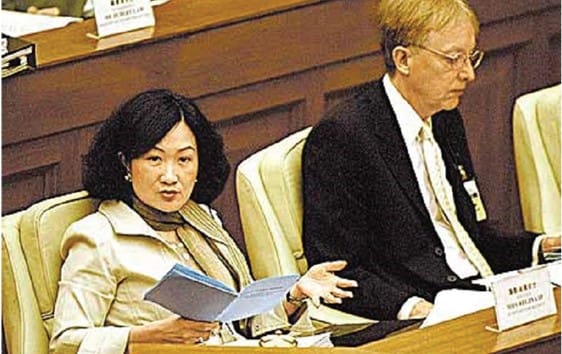
    Regina Ip and Bob Allcock. Image credit: HongKongFP.com

    I showed up at the Legco Building on June 17 at the appointed hour. I took my seat in the gallery above the ornate chamber, looking down on the legislators. Bob Allcock came up to where I was sitting and gave me a handwritten note. An amendment to the bill would be introduced changing the proscription mechanism from “certificate” to “open proclamation.”

    The first order of business at the meeting was an attempt by Democratic legislators to rescind the June 14 decision to close debate. All their motions were voted down. Attention then turned to my objection to the bill as presented at the Hong Kong University conference.

    Regina Ip tabled the motion to amend the bill by substituting “certificate” with “open proclamation.” This move was met with derision by the Democratic camp. One legislator remarked that after saying debate could not be reopened the government had in fact done just that. Legislators Emily Lau and Margaret Ng, stalwart campaigners for human rights and democracy, claimed that the amendment didn’t change a thing. What was meant by “open proclamation?” Could a newspaper advertisement placed by a local government be considered an “open proclamation?” The government had muddied the waters.

    Finally, Lee Cheukyan took the floor. “Secretary for Security, you have said that the bill was subjected to scores of public consultations and 80 hours of debate by Legco. Yet, a foreigner comes to town who has never read the bill, examines it for less than an hour and finds a fatal flaw. What do you have to say to John Kamm?” Pointing at me, he said “Look at John Kamm sitting in the gallery. He is laughing at you!”

    This proved too much for Regina Ip. “I am sick and tired of hearing from so-called foreign experts on Chinese law. Sick and tired!” she exclaimed in a high-pitched and agitated voice.

    At this point, the Chairman of the Committee meeting stepped in and suggested a brief recess to allow tempers to calm down. I left the gallery and went downstairs to find Martin Lee waiting for me. He ushered me into a room where there were several dozen journalists waiting to pepper me with questions. I made it clear that I was not satisfied with the amendment. The bill was still flawed.

    At this point I took a gamble. “The Ministry of Foreign Affairs holds its weekly press conference on Thursday June 19. There are journalists in this room who work for wire services. Why don’t you ask the Foreign Ministry spokesman who is right, John Kamm or Regina Ip?”

    In making this move I reckoned that Regina Ip knew as little about Chinese bureaucratic politics as she knew about Chinese law. She had studiously built relations with the Hong Kong Macau Affairs Office, and had largely ignored the Ministry of Foreign Affairs, a bad move. In the event, journalists submitted my question at the press briefing on June 19. The spokesman declined to answer. On June 25, 2003, Regina Ip tendered her resignation as Secretary for Security, citing personal reasons. Later that year she entered Stanford University to study for a Master’s Degree.

    As I was exiting the Legco conference room on June 17, two journalists from Apple Daily and Ming Pao stopped me at the door. “What do you think of what Regina Ip said about you?” they asked. I played dumb, “What was that?” “She said that she was sick and tired of hearing from so-called foreign experts on Chinese law. She called you a so-called foreign expert.” I quipped: “I thought she was talking about Bob Allcock.” The press loved it.

    Past as Prologue

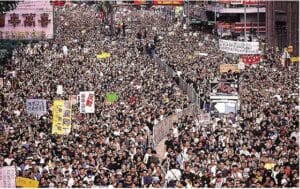
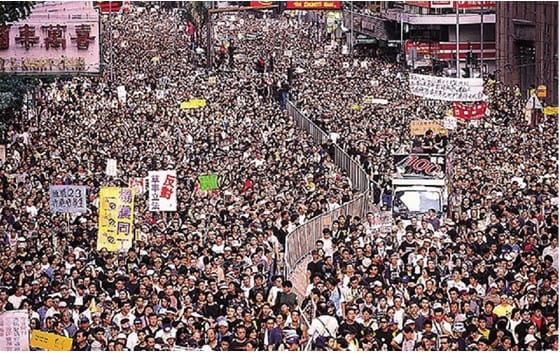
    On July 1, 2003, hundreds of thousands of Hong Kong people took to the streets to protest Article 23. Government officials had predicted that only 30,000 people would participate in the march. The marchers wound through the streets and ended the march by passing by Chief Executive Tung Chee-hwa’s office. They carried placards denouncing “Uncle Tung” and calling for his resignation.

    Hong Kong residents took to the streets in protest of Article 23 on July 1, 2003.

    As for me, I returned to San Francisco, but my job was not complete. I penned an article that ran in both English and Chinese newspapers in Hong Kong outlining how the people of China would be hurt if the National Security Bill was passed by Legco and became law.With the desertion of James Tien, leader of the Liberal Party which had supported passage of the legislation, the National Security Bill’s fate was sealed. The government removed the bill from consideration by Legco. Citing health issues, Tung Chee-hwa resigned in March 2005. Mr. Tung remains in excellent health. He had apparently contracted a short-term political illness.

    In the summer of 2003, a senior official of the Ministry of Foreign Affairs came to San Francisco and we agreed to meet. He told me that “We know that the Hong Kong government has made many mistakes, but we don’t appreciate our friends pointing them out!” We had a good chuckle.

    Fifteen years after the demise of the National Security Bill, China’s leaders, notably President Xi Jinping, are pushing for the SAR to enact Article 23 legislation, perhaps as early as the end of 2018. Opposition among the public to such legislation remains high – Regina Ip, the face of Article 23, received the lowest number of Election Committee votes for Chief Executive in 2017 – but due to changes in the make-up of Legco brought about by the ousting of several recently elected legislators, sanctioning speech and association under Article 23 could well be in Hong Kong’s future.

  • Flouting Global Norms, China Continues to Incarcerate Prisoners for Abolished Crimes

    Flouting Global Norms, China Continues to Incarcerate Prisoners for Abolished Crimes

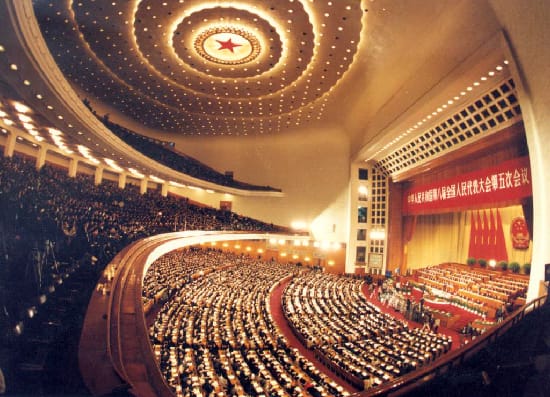
    The fifth session of the 8th National People’s Congress, which adopted the revision to the Criminal Law. Image credit: NPC.gov.cn.

    As Dui Hua has previously reported, the People’s Republic of China continues to incarcerate prisoners for the crimes of counterrevolution and hooliganism, despite the abolition of these crimes in 1997. A recent comparative survey of criminal laws, summarized below, notes that most countries (67 percent) allow some “retroactive ameliorative relief” (e.g., sentence reductions or early release) in the wake of legislative changes that abolish or lighten the sentences of certain crimes. The major governing human rights treaties, including the International Covenant on Civil and Political Rights (ICCPR), determine that prisoners should benefit from legal reforms that impose lighter penalties than those in existence at the time the offense was committed. Although prisoners serving sentences for abolished crimes have received sentence reductions, the Chinese government should unequivocally join other countries by releasing and doing more to reduce the sentences for these prisoners.

    The Long Reach of Counterrevolution and Hooliganism

    Chinese legal scholar Chen Jianfu points out the crime of counterrevolution has always assumed primary importance in the PRC’s criminal justice system. One of the first PRC legal provisions, the “Regulations for the Punishment of Counterrevolutionaries,” passed in 1951, reveals that counterrevolutionary crimes were primarily political in nature. When the PRC Criminal Law was amended in 1997, problems with enforcing these ambiguously worded, politically charged counterrevolutionary crimes led to the abolition of this criminal legal category; some of the activities that fell under counterrevolutionary crimes were included into the collection of “endangering state security” crimes which are tailored more directly at criminalizing specific actions that threaten the state.

    Dui Hua’s research has uncovered the names of prisoners in China who continue to be incarcerated for political crimes of counterrevolution. Dui Hua has received written responses from the Chinese government that the following individuals are still imprisoned for crimes of counterrevolution:

    • Chen Yulin (陈瑜琳): Chen is a former Xinhua news agency employee who was convicted of espionage by the Guangzhou Intermediate People’s Court on March 4, 2004 and sentenced to life imprisonment. Because Chen’s alleged offense took place before the amended Criminal Law took effect in 1997, he was tried under the 1979 Criminal Law for the crime of counterrevolution. Chen Yulin’s life sentence was commuted in 2007 and replaced with a fixed-term sentence of 19.5 years. Although Chen has received multiple sentence reductions, he is not due for release until August 26, 2020.
    • Jiang Cunde (蒋存德): Jiang is a former labor activist serving in Shanghai’s Tilanqiao Prison for counterrevolutionary sabotage and illegal possession of weapons. He was diagnosed with schizophrenia in prison and in 1993 he was released on medical parole. In 1999, he was re-incarcerated for participating in demonstrations. Since then, Jiang has received only one sentence reduction, in 2004, when his life sentence was commuted to a fixed-term of 20 years’ imprisonment. A government response given to Dui Hua in 2015 stated that Jiang was held in a “mental retardation unit” and a response in 2018 indicated that there had been no change to Jiang’s sentence. Jiang’s sentence expires on August 22, 2024.
    • Abdukerim Abduweli: Abduweli was sentenced by the Urumqi Intermediate People’s Court to twelve years in prison on May 6, 1993, for counterrevolutionary propaganda and incitement and leading a counterrevolutionary group. According to information provided by the Chinese government, his imprisonment has been extended several times. His sentence expires in December 2018.
    • Omer Akchi: Akchi was detained in December 1996 for organizing the Islamic Party of Allah. Akchi continues to serve his 21-year sentence for counterrevolution.

    Although prisoners serving sentences for abolished crimes in China have received clemency in the form sentence reductions, cases such as Chen Yulin’s and Jiang Cunde’s demonstrate the importance Chinese leadership should place in aligning its laws with international. Dui Hua has received government responses on both cases in 2018. The responses confirm that Jiang Cunde has not received a sentence reduction in over 14 years and that by the time Chen Yulin is expected to be released, he will have served more than 16 years in prison. Dui Hua’s research has found that sentence reductions for prisoners serving sentences for counterrevolution are infrequently handed down and those that are handed down are usually only in the months to yearlong range. In the case of life sentences that are commuted to fixed-term sentences, such as for Jiang and Chen, the time spent already served does not count towards their new fixed-term sentence, which is usually twenty years imprisonment. Another impediment to the formalization of retroactive ameliorative relief is that when sentence reductions are filed by the prisons to the courts the justification for the sentence reductions is based almost exclusively on evidence of meritorious behavior, never the fact that the prisoners are serving a sentence for a crime no longer in the books. Following the latest regulation on sentence reduction released by the Supreme People’s Court in November 2016, prisoners serving sentences for endangering state security crimes (which replaced many of the offenses previously categorized under counterrevolution) must wait three years, rather than the standard two years, before they can be considered for sentence reductions. The regulation fails to clarify the status of prisoners serving sentences for counterrevolution and hooliganism.

    The ill-defined crime of “hooliganism” was also abolished in 1997, yet nearly 200 individuals remain incarcerated for this crime. Inspired by the criminal laws of the former Soviet Union and other socialist states, hooliganism was loosely defined, granting state officials the broad discretion to punish undesirable behavior as defined in interpretations issued by the Supreme People’s Court and the Supreme People’s Procuratorate. Between 1979-1997, a large but unknown number of people were convicted of this offense.

    Dui Hua’s research into online judgments has uncovered the names of 182 prisoners serving sentences for hooliganism who were still in prison as of December 31, 2017. Although the offense was abolished in 1997, some of them received sentences in the 2000s or even more recently, because the Criminal Law imposes no limit on the period of prosecution for cases where the suspect has escaped after a case has been filed by police or procuratorate, or heard by the courts.

    International Norms on Abolished Crimes

    The Chinese government’s continued incarceration of these prisoners marks a clear break from international norms regarding changes to the criminal law and prisoners convicted of those crimes. This area of international and comparative criminal justice policy, referred to as “retroactive application of ameliorative law,” was examined in a recent report by the Human Rights in Criminal Sentencing Project at the University of San Francisco School of Law. According to the report, the international legal framework governing retroactive amelioration is explicit and clear: “The major governing human rights treaties allow an offender to benefit from a change in law that imposes a lighter penalty than the one in existence at the time the offense was committed.”

    In the report, of 193 countries surveyed, 129 (or 67%) have incorporated some type of provision requiring retroactive implementation of a lesser penalty into their constitution and/or their criminal statutes. Under retroactive ameliorative relief, a law change that eases or eliminates punishments for a specific crime would result in a corresponding amendment to any convictions and sentences for persons already convicted of the crime. Revisions to death penalty statutes provide perhaps the clearest illustrations of the importance of retroactive relief: according to Amanda Solter, Project Director of the USF Human Rights and Criminal Sentencing Reform Project, when the death penalty was repealed in the US states of Connecticut and New Mexico, the change was not made retroactive, leaving prisoners on death row despite a lack of valid legal authority for the state to carry out executions. “South Africa, on the other hand, abolished the death penalty and made it retroactive for 300 to 400 people on Death Row. Russia did the same in the ’90s and commuted the sentences of roughly 700 people.”

    China Should Unambiguously Follow Global Norms and Release Prisoners and Increase Transparency

    To take a global leadership role in the world, China should avoid such contradictions in its criminal law and unequivocally embrace retroactive ameliorative relief when crimes are removed from applicable criminal justice statutes. This policy stance would involve releasing and/or commuting the sentences of all prisoners confined for committing the long-defunct crimes of counterrevolution and hooliganism. In the event that release or commutation is not granted, the relevant legal authorities should issue a transparent explanation justifying the continued imprisonment under valid and effective criminal law provisions.

    General proscriptions against retroactive applications of law should not be an obstacle to recognizing ameliorative relief; in fact, such objections have already been addressed in the applicable international legal provisions. Article 15 of the ICCPR prohibits criminal ex post facto laws but notes the exception that “[i]f, subsequent to the commission of the offence, provision is made by law for the imposition of a lighter penalty, the offender shall benefit thereby.”

    Given the global consensus on this issue, the Chinese government should clarify its policy regarding changes to the criminal law and their effects on prisoners incarcerated for those crimes. In this case, releasing prisoners whose acts of “counterrevolution” or “hooliganism” have been completely decriminalized would send a strong message and bring Chinese law into alignment with the international consensus on this issue.

  • The Resurgence of Big-Character Posters and Switching Tactics of Criminalization

    Big character posters were found on Peking University’s campus calling for action on sexual assault cases. The posters were removed by authorities. Image credit: Radio Free Asia.

    The iconic big-character posters (dazibao) of the 1970s and 1980s are often thought to have lost their purpose in a China now dominated by smartphones and WeChat. Popularized during the Cultural Revolution, big-character posters were used by competing political factions to instigate “mass mobilization.” In the revision to the 1982 Constitution, the right to use big-character posters was removed. During the June Fourth protests of 1989, the posters became ubiquitous when protesters used them to criticize the path of economic reform. In official narratives, authorities used the word fandong (reactionary), implying a hindrance to progress and reform, to describe cases involving big-character posters.

    Today, these wall-mounted posters, often handwritten and on a few sheets of paper are used by activists and petitioners seeking to air grievances and direct attention on a range of issues from forced evictions, to government corruption, to wage theft. In some cases, big-character posters allow the disgruntled to circumvent the extensive surveillance and censorship of the internet.

    In December 2017, Tianjin dissident Zhang Changhong (张长虹) was sentenced for using big-character posters to call for the rehabilitation of the June Fourth protests. In June 2013, Zhang put up posters at various bus stops and subway stations and in December 2016, he filmed videos of himself in front of his posters, one of which read “Do you know about the Tiananmen Massacre?” He published videos and articles calling on the public not to forget about the bloody suppression. The court accused Zhang of provoking a serious public disturbance for disseminating “fabricated” information and sentenced him to three years and three months’ imprisonment. Zhang is scheduled for release in 2019.
    In April 2018, big-character posters appeared on the campus of Peking University. The posters were put up in support for Yue Xin, a female student who sought information from the university about an alleged rape case in the 1990s involving a former professor. Yue wrote online that she had been warned by the school to stop requesting information about the rape case, or risk facing “treason” charges. The posters were promptly removed by the school security personnel.

    The following month, during the 120th anniversary of the university, 24 big-character posters briefly appeared on Peking University’s campus. Written by alumnus Fan Liqin, the posters stated that Mao Zedong’s promotion of a personality cult was disastrous for China. Fan warned the Chinese people to be vigilant of history repeating itself under Xi Jinping’s reign, following the removal of presidential term limits and the insertion of “Xi Jinping Thought” into the party constitution. Fan was reportedly escorted away by police officers and campus security personnel; he is not known to have received any coercive measures.

    Switching Tactics of Criminalization

    As big-character posters continue to be used for political purposes, Dui Hua has noticed an increasingly prevalent tactic of criminalization – a shift from charging “reactionaries” caught with big-character posters with inciting subversion to charging them with “picking quarrels and provoking troubles.” When “endangering state security” was introduced into the 1997 Criminal Law, inciting subversion was frequently used against “reactionaries” who used big-character posters to “vilify” party and senior leaders. In recent years, the term “reactionary” has disappeared from official narratives about petitioners. Instead, petitioners are more likely to be charged with the crime of “picking quarrels and provoking troubles.” At first glance, this shift seems like a welcome reform as inciting subversion is a more serious crime carrying a harsher sentence than picking quarrels and provoking troubles. However, Dui Hua’s research shows that in cases involving big-character posters, those charged with picking quarrels and provoking troubles can still find themselves serving as harsh of a sentence as those charged with incitement for committing similar acts. The reason behind this shift is unclear, but given the similarity in the harshness of sentencing, perhaps there is an attempt to obscure cases of a political nature that attract scrutiny by putting them into a pocket crime like picking quarrels and provoking troubles. In 2016 alone, China’s public security bureau filed more than 77,000 cases involving picking quarrels and provoking troubles; the scope of acts that count under this crime is indeed obscure, ranging from criticizing local officials on Weibo to drunken assaults.

    Incitement Cases involving Big-character Posters

    Dui Hua’s library research into government gazettes has uncovered several previously unknown incitement cases involving big-character posters. One of the earliest cases concerns Ding Qingyun (丁青云), a man from Zhenjiang, Jiangsu, who was caught putting up “reactionary” big-character posters on three separate occasions. In October 1997, he put up a poster titled “New Tongmenghui Propaganda” at a farmer’s market, signed by the “New Tongmenghui Dantu Township Branch.” Tongmenghui bore the same name as the secret society and underground revolutionary movement founded by Sun Yatsen in 1905 against the Qing Dynasty. Available sources did not provide further information about Ding’s Tongmenghui.

    Ding went on to write more “reactionary” slogans in April and May of 1998. In a restroom of the Dantu Township government building, Ding hung up big-characters posters reading: “Down with the Communist Party,” “Down with Socialism,” and “Down with the proletarian dictatorship.” In May 1998, Ding was taken into custody on suspicion of inciting subversion. Although the gazette record did not reveal Ding’s fate, a government response subsequently provided to Dui Hua confirmed that Ding completed his two-year sentence for inciting subversion in May 2000.

    Dui Hua previously reported on an incitement case involving Chen Shifu (陈世富), a coffin seller from Hunan who used big-character posters to call on residents to oppose local government policies on property demolition and forced evictions. The prosecution statement claimed that Chen’s big-character posters that called on people to overthrow the CCP and reestablish Kuomintang rule posed a threat to state security. The statement also described the books Chen possessed about Kuomintang leader Chiang Kai-shek as “reactionary.”

    The Switch to Picking Quarrels and Provoking Troubles

    Today, those who use big-character posters to criticize the government and party are likely to face the charge of “picking quarrels and provoking troubles.” Dui Hua uncovered a judgment involving a farmer from Shaanxi surnamed Zhang, who was sentenced to two years’ imprisonment in December 2017. On July 1, 2017, the 96th anniversary of the founding of the CCP, Zhang stood in front of a series of big-character posters, which the court judgment later described as “distorting history,” and proceeded to deliver a three-hour long speech that “insulted the party and Chinese leaders.” Zhang had hired someone to film his speech while he delivered it on a busy street in a village in Shaanxi. The court deemed Zhang’s actions as leading to “social disorder” as crowds of onlookers gathered and vehicles stopped in the middle of the street to listen to his speech.

    In his speech, Zhang criticized a court decision to side with the township government over a longstanding property dispute. After futile attempts at petitioning, Zhang began pointing fingers at the central government. In 2000, he put up big-character posters calling past and present Chinese leaders, including Jiang Zemin, “traitors” and their rule “a disaster for the country and ruinous for the Chinese people.” Zhang accused local officials of colluding with mafia groups. His big-character posters made references to the “Tiananmen Massacre” and ridiculed Deng Xiaoping’s “black cat, white cat theory.” In 2005, Zhang was sentenced to one years’ re-education through labor for “insulting” the party and various leaders. After repeated detention and time under re-education through labor, Zhang allegedly refused to repent and continued to put up big-character posters. In December 2017, the court decided that Zhang had persistently refused to show remorse and that his slanderous remarks against the party, senior leaders, and other cadres qualified as a public disturbance. Zhang is scheduled for release in June 2019.

    In this case, the court described Zhang’s remarks about the party and leaders as “improper.” The same act would have been tantamount to a “vicious attack on the people’s government,” a phrase commonly used in official narratives about counterrevolution propaganda and former incitement cases such as that of Ding Qingyun’s and Chen Shifu’s. Although Zhang’s big-character posters were as politically charged as that of Ding and Chen’s, the political nature of Zhang’s case was obscured by its categorization under the crime of picking quarrels and provoking troubles, most telling is that the sentence he received was as harsh as Ding’s.

    Obscuring Political Cases

    The latest available statistics from China Law Yearbook shows that 576 individuals were arrested for endangering state security in 2016, a significant drop from 1,105 in 2012. However, this decline is no cause for celebration. As the big-character poster cases show, individuals previously charged with inciting subversion are now more likely to be prosecuted for picking quarrels and provoking troubles. The number of endangering state security cases alone does not give a comprehensive picture of the scale of suppression of dissent in China.

    The crime of picking quarrels and provoking troubles has long been decried as a pocket crime, meaning that because of its vague definition “anything can be stuffed into it,” after all 77,451 such cases were filed in 2016. Given the enormous variety of acts that can be prosecuted under this charge, it is no easy task to identify which ones are of a political nature. Dui Hua researchers continue to delve into government sources to uncover the names of political prisoners incarcerated for this charge.

  • Dui Hua Digest, June 2018

    Dui Hua Digest, June 2018

    EVENTS

    Dui Hua Attends Seminar on Juvenile Justice and Social Work

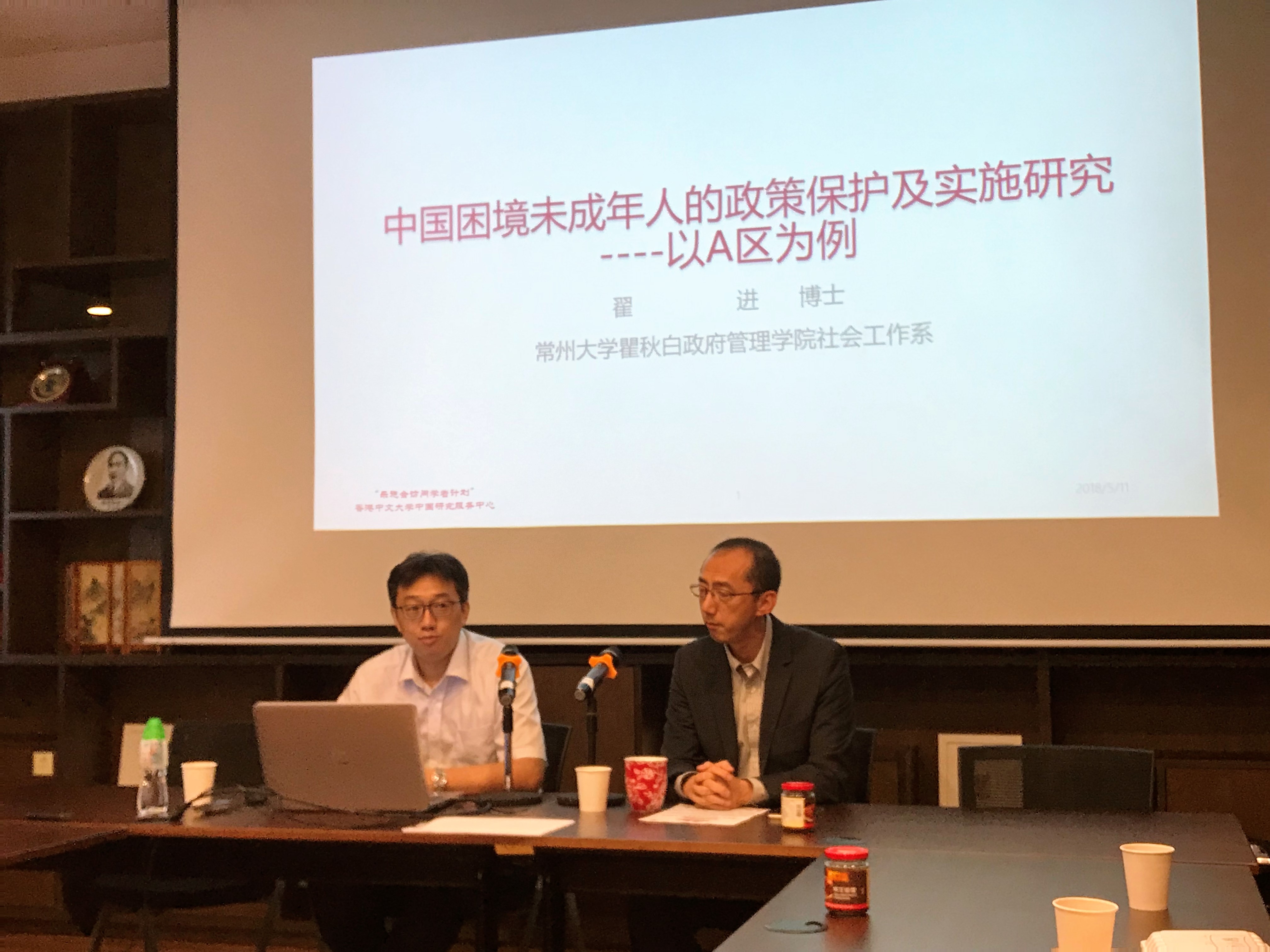
    Professor Zhai Jin (left) of Changzhou University. Image: Dui Hua

    On May 11, Dui Hua Hong Kong staff attended a seminar on juvenile justice and social work in China at the Chinese University of Hong Kong. Leading the seminar was Professor Zhai Jin, Head of the Social Work Department at Changzhou University in Jiangsu. The seminar introduced recent developments and trends in social work services for at-risk youth in China, including juveniles, migrant youth, and orphans. As a practicing social worker and academic, Zhai’s research was carried out in conjunction with the Ministry of Civil Affairs (MCA). Since 2013, the MCA has attempted to strengthen the availability of social work resources for at-risk youth. That year, the MCA released a Notice on the Launching of the Trial Implementation of the Social Protection for Minors. In 2016, the State Council released an Opinion on Strengthening Resources for At-Risk Youth.

    The population Zhai serves includes not only juveniles but also orphans and migrant children, including “left behind” children. Unlike most of the youth who receive social work services from Zhai, the decision to provide social work services to juveniles was often a condition set by the courts responsible for releasing juveniles back into society. Consequently, many of the juveniles who had received social work services from Zhai were given treatment plans with defined end dates determined by the courts. Although a positive sign in that some courts recognize the importance of providing social work services for juveniles re-entering society, Zhai noted that in comparison to the treatment plans for other youth under his care, it was harder to make substantial progress with juveniles who had clear end dates and not always enough time to fully benefit from the services.

    In 2012, China amended its Criminal Procedure Law to emphasize the principle of education first and punishment second in juvenile cases as well as the importance of considering social inquiry reports completed by social workers during sentencing. Since then, the use of non-custodial measures in juvenile cases has been on the rise. Zhai’s research raises a critical obstacle for juvenile justice reformers in China – the plight of migrant youth.

    Juveniles, many of whom are migrants or left-behind children, face discrimination when it comes to access to non-custodial measures. Courts in cities and provinces with large migrant populations such as Shanghai and Guangdong have reported lower than average rates of juvenile non-custodial measures when compared to national averages. In both Shanghai and Guangdong, the courts have attributed this to the large number of migrant juveniles. There are a myriad of legal and economic barriers migrant juveniles face in obtaining non-custodial measures. For example, in some cities, police or other responsible bodies in charge of supervising juveniles serving a suspended sentence will not monitor juveniles who do not hold a local hukou. This loophole leaves many migrant juveniles ineligible for suspended sentences. Those who are lucky enough to get a suspended sentence may have to relocate to their hometowns, where they are less likely to receive adequate treatment plans as they are being supervised by those who lack familiarity with their cases and specific needs. Juvenile defendants in China are often able to serve suspended sentences if they “express remorse.” One way of expressing remorse includes returning stolen property or providing financial compensation, a system that clearly privileges wealthier defendants.

    The plight of migrant youth in China’s justice system cannot be understated. Like many juvenile populations around the world, youth who come into conflict with the law in China are disproportionately of an economically and socially disadvantaged background. With the staggering number of migrant youth in China, Zhai’s research raises a critical obstacle for juvenile justice reformers. How do reformers create a justice system that ensures non-custodial measures are impartially applied to all defendants regardless of economic background, and ensure that courts routinely include the recommendations and services of social workers in determining sentences and facilitating the reentry of juveniles into society?

    At Dui Hua’s 2017 juvenile justice exchange in Shenzhen, the issue of social inquiry reports was raised by several Chinese judges, who expressed concern that courts often lacked the resources for social workers to independently complete the reports. In cities where the juvenile population is overwhelmingly made up of migrant youths, such as Shenzhen, social workers and juvenile courts must work hand in hand. As Zhai’s research shows, the need for preventative mechanisms to support at-risk youth and rehabilitative services for youth offenders will only come about through cooperation between government and social service providers.


    PRISONER UPDATE

    Dui Hua has been informed that Chen Yulin, a Hong Kong resident and United Kingdom citizen, was granted a seven-month sentence reduction in April. Chen, a former official at Hong Kong’s Xinhua News Agency, was placed under residential surveillance on January 31, 2003. He was subsequently detained on March 13, 2003 and formally arrested on suspicion of espionage on April 17, 2003.

    Chen was convicted of espionage by the Guangzhou Intermediate People’s Court on March 4, 2004 and sentenced to life in prison. The Guangdong High People’s Report rejected his appeal on August 29, 2004. He was sent to Shaoguan Prison to begin serving his sentence.

    Because his alleged offense took place before the amended Criminal Law took effect in 1997, Chen Yuling was tried under the 1979 Criminal Law for the crime of counterrevolution.

    Chen Yulin’s life sentence was commuted in 2007 and replaced with a fixed-term sentence of 19.5 years. Since then, Chen’s sentence has been reduced five times totaling 76 months. Following the most recent reduction, Chen is due for release on August 26, 2020.

    In June, Dui Hua delved into records at an American university, uncovering previously unknown names of political and religious prisoners. Records included government reports and gazettes from courts, procuratorates, public security organs, and prisons from city and provincial levels. Valuable information on religious prisoners was found.

    In a Gansu court record, Dui Hua discovered an incident leading to the arrest of more than thirty Almighty God members. On December 6, 2012, 32 members of the Almighty God group entered a busy area near a Huangqu Township government building in Dunhuang city to distribute religious texts and perform religious songs and dance. Key members included Zhao Mingxing, Gong Haizhong, Wang Yongzhi, Zhang Xuemei, Dang Xiaoying, and Feng Lihua. The Almighty God members clashed with police, attracting the attention of hundreds of onlookers and causing serious traffic. The police seized the materials brought by the members. The record states that the defendants were charged under Article 300, “organizing/using a cult to undermine implementation of the law” and received sentences ranging from one year to suspended sentences ranging from two to five years and six months. The defendants appealed. The Jiuquan Intermediate People’s Court upheld the judgment.

    A Hebei public security record revealed the arrest of a group of Falun Gong practitioners and the seizure of Falun Gong materials. On May 12, 2004 police arrested a group of Falun Gong practitioners including Wang Jinyu, Su Kezhen, Wang Shouyu, Li Guanglian, and Hu Jicheng. Following their arrest and trial, the police cracked cases involving Falun Gong practitioners in Dongbao, Jidao, Shayang, and Dangyang City in Hebei Province. More than 5,000 Falun Gong propaganda materials were confiscated, as well as over 200 volumes of information and 100 discs. Twelve people involved in the cases were arrested. Several were given fixed-term sentences.

    A Shandong record provided information on the crackdown on the Green Environment Protection Civic Party (The Green Party绿野环境保护公民党). According to an online judgment found in December 2017, The Green Party, a.k.a. the China Democracy and Justice Party (中国民主正义党) was established in 2013-2014. The leaders created an instant messaging group on QQ and posted articles attacking the CPC and attempted to set up a security personnel company to train party members. In November 2015, Deng X (邓某) was sentenced to four years’ imprisonment, and Qu X (曲某) was given a sentence of three years and six months. Both were sentenced for subversion.

    In a Gansu provincial public security bureau record, Dui Hua staff discovered the name of previously unknown suspect in an endangering state security case. Abdukeyum Tursun (阿布杜凯尤木·图尔逊), was wanted by the Xinjiang Public Security Bureau for splittism, He was arrested in Gansu on March 13, 2008. Facts related to his incarceration and sentencing are not known.


    PUBLICATIONS ROUND UP

    Featured: “Illegal Business Activity” and Christian Bookstores (May 9, 2018)

    Last month, the Chinese government banned online retailers from selling the Bible on their platforms. Within days after the ban was announced, ecommerce giants Taobao and JD.com had removed the Bible from its websites. In an officially atheist country where stories of religious oppression often make international headlines, many might be surprised to learn that the Bible is a bestseller.

    2017 Annual Report

    Mixed Signals in Reports of “Zero Confession” Executions

    Previous Digest: May 2018


    IN THE MEDIA

    Executive Director John Kamm discusses China’s “exit bans” in Daily Beast‘s “Beijing Is Holding U.S. Citizens ‘Hostage’ in China.” (August 18, 2018)

    In an interview with Michigan NPR’s Stateside, Executive Director John Kamm commented on the injustice suffered by American citizen Wendell Brown who has been detained in China since September 2016 because of repeated delays in announcing the judgement. (June 20, 2018)


    John Kamm Remembers

    John Kamm Remembers is a feature that explores Kamm’s human rights advocacy prior to and since Dui Hua’s establishment in 1999

    National Security in the Time of SARS (Part 1 of 2)

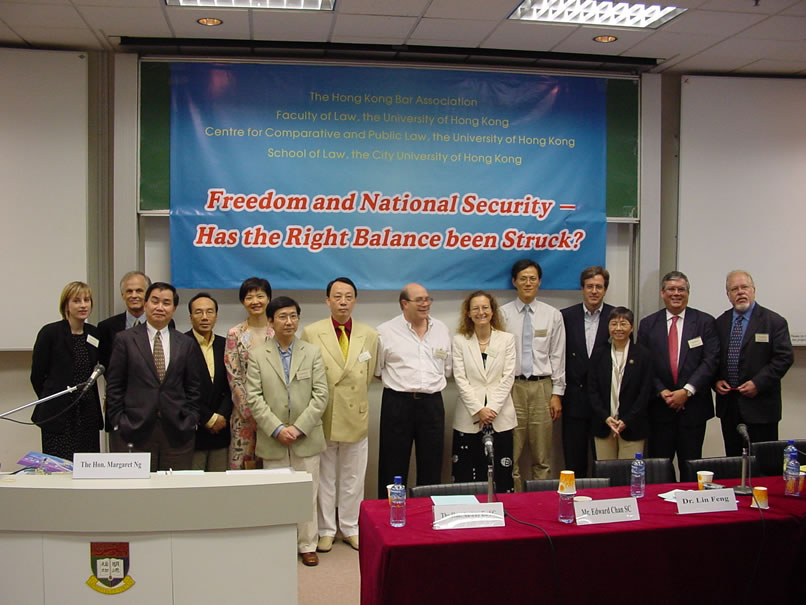
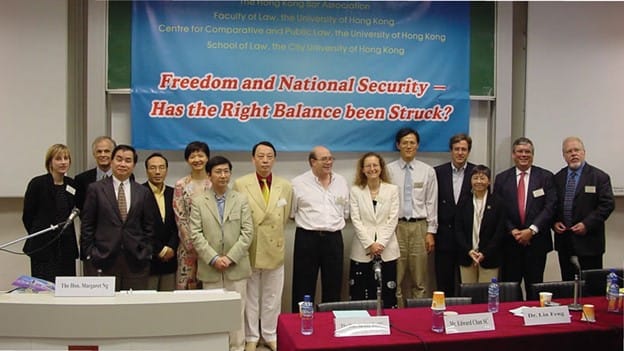
    Executive Director John Kamm, second to right, at the Hong Kong University and Hong Kong Bar Association’s conference on “Freedom and National Security – Has the Right Balance Been Struck?” June 14-15, 2003. Image: Hong Kong University

    Shortly after Tibetan political prisoner Ngawang Sangdrol’s arrival in the United States on March 28, 2003, I began preparing for my next visit to Beijing and Hong Kong, tentatively scheduled for early June, roughly four weeks later. Preparations for these visits, then as of now, take many weeks.

    Cases need to be identified, researched, and prioritized. Bilingual prisoner lists for my interlocutors have to be prepared. For this trip I intended to focus on the imprisoned American businessmen Jude Shao and Fong Fuming, as well as prominent Uyghur political prisoner Rebiya Kadeer.

    I sought meetings with the Ministry of Foreign Affairs, the Ministry of Justice, the Supreme People’s Court, the Supreme People’s Procurement, and leading Chinese academics who served as advisers to the Chinese government. I asked to visit a prison. I asked for meetings with the American ambassador and other diplomats as well.

    I made my preparations with some trepidation. A fatal disease – Severe Acute Respiratory Syndrome (SARS) – was sweeping China. Thousands of infections had been recorded, and many people – including officials – had been placed under quarantine. Guangdong Province was especially hard hit. By early June 2003, the province had recorded more than 1,500 cases and 57 fatalities. SARS had already spread to Beijing, Tianjin, and other provinces and municipalities by April. By early June, there were 5,329 cases and 336 reported deaths nation-wide.

    A siege mentality gripped Hong Kong as the death toll from SARS started to rise. Image: timeout.candrholdings.com

    The epidemic reached Hong Kong in March 2003. The first fatality was recorded on March 11. By early June, 1,750 cases had been identified and 286 deaths recorded. The city was in a state of high alert. Disinfectant was applied liberally to every conceivable surface, often several times a day. People wore masks and generally avoided public gatherings. Tourist arrivals dropped precipitously.

    In mid-May I was advised that my principal interlocutor, Ministry of Foreign Affairs Director General of the International Department Li Baodong, remained under quarantine. All prisons in the country had been placed off limits to visitors. I decided to cancel my trip to Beijing but to proceed with the visit to Hong Kong. I would meet Chinese officials from an inland province as well as Hong Kong activists, academics, and researchers. As usual, I would conduct research at the University Services Center of the Chinese University of Hong Kong.

    “Nest of Spies”

    SARS was not the only issue troubling the people of Hong Kong during the early months of 2003. Article 23 of the Basic Law, Hong Kong’s mini-constitution, stated that the Hong Kong Special Administrative Region (SAR) “shall enact laws on its own to prohibit any act of treason, secession, sedition, subversion against the Central People’s Government.” This article had been inserted into the Basic Law after the events of May and June 1989 in Beijing.

    By late 2002, the SAR’s Legislative Council (Legco) had failed to enact the legislation called for under Article 23, and Beijing was growing impatient. Chinese officials based in the SAR declared that Hong Kong was a nest of spies; in early 2003 at least three Hong Kong residents, all of whom had worked in China’s Xinhua News Agency, were detained in Guangdong Province for allegedly spying for the United Kingdom during the years leading up to the handover in 1997. They were eventually arrested, tried, and convicted of espionage. Two of them, Chen Yulin and Wei Pingyuan, were sentenced to life in prison. They were still in prison, despite multiple sentence reductions, as of mid-2018 (see this issue’s Prisoner Update).

    The Hong Kong official tasked with pushing through Article 23 legislation by Chief Executive Tung Chee-hwa was Regina Ip, a career civil servant holding various positions in the Hong Kong government before being appointed Secretary for Security in July 1998. Ms. Ip and I had worked on retaining Most Favored Nation trading status for China in the early 1990s. I knew her as a tough, uncompromising official well versed in issues of trade, industry, and immigration. She had little knowledge of national security however, and had infrequently visited China before 1997 (when she was 47 years old). This was in line with pre-handover British policy which placed restrictions on Hong Kong officials traveling to the People’s Republic.

    Regina Ip was also very ambitious. She was determined to eventually become the Chief Executive of the SAR.

    Unfortunately for her ambitions, Secretary Ip had developed a reputation for alienating people by making ill-considered remarks. In the run-up to the introduction of the National Security Bill in the Legislative Council’s Bills Committee on February 14, 2003, Secretary Ip had warned against viewing democracy as a panacea. After all, she said, Adolf Hitler had been democratically elected as Germany’s chancellor before embarking on his murderous genocide directed at the Jews. She also disparaged Hong Kong’s taxi drivers and restaurant workers, opining that they weren’t interested in such things as national security.

    A Letter from Alan Leong

    I arrived in Hong Kong on June 11 and immediately went to the J.W. Marriott Hotel at Pacific Place on Hong Kong Island. After checking in, I went to my room to begin unpacking. While doing so, I noticed a letter that had been slipped under my door. It was from Alan Leong, a leading member of the Article 23 Concern Group and Chairman of the Hong Kong Bar Association. The letter, on Bar Association stationary, invited me to make a presentation to a conference on Article 23 to be held at the Law School of Hong Kong University on June 14-15, 2003. The title of the conference was “Freedom and National Security – Has the Right Balance Been Struck?” I was asked to make a presentation on national security legislation in the People’s Republic of China.

    I called Mr. Leong at his Chambers. “What’s this all about?” I asked. “The policy governing Hong Kong is ‘One Country, Two Systems.’ What does national security legislation in China have to do with national security legislation in Hong Kong.” At that point I hadn’t even read the National Security Bill being considered by Legco.

    Mr. Leong replied, “You are correct. National security legislation in China should have nothing to do with national security legislation in Hong Kong. As it turns out, however, the bill under consideration contains language which links the two systems. In short, if an organization in Hong Kong is subordinate to an organization in China that has been banned by the central government on national security grounds by means of a certificate, the Secretary for Security can ban it in Hong Kong.”

    I was intrigued. I had never heard of a Mainland Chinese mechanism for banning an organization on national security grounds by means of a certificate. Prior to 1997, when China’s Criminal Law was amended to remove the crime of counterrevolution, individuals could be sentenced to prison for simply belonging to a counterrevolutionary group. Whether or not a group was a counterrevolutionary group was determined by a court, not by a government agency. After 1997, mere membership in a group no longer constituted a crime. This important 1997 reform of the Criminal Law sought to criminalize acts like drafting manifestos and raising money, not simple association.

    I agreed to make a presentation on June 15, the second and last day of the conference. I was told by Mr. Leong that the audience would probably be small. June 15 was Father’s Day in Hong Kong, and mine would be among the last presentations.

    After we rang off, I went to the hotel’s concierge level and printed out a copy of the National Security Bill. Part 4, Section 8A (2) (c) provided for the Secretary for Security to proscribe any local organization “which is subordinate to a mainland organization the operation of which has been prohibited on the ground of protecting the security of the People’s Republic of China, as officially proclaimed by means of an open decree, by the Central Authorities under the law of the People’s Republic of China.” The next section (3) stated that conclusive evidence of the prohibition would be “a certificate issued by or on behalf of the Central People’s Government.”

    I began preparing a presentation based on points of Chinese law, and on cases of individuals tried by Chinese courts for counterrevolution and endangering state security.

    Read part 2 here.

  • National Security in the Time of SARS

    National Security in the Time of SARS

    << Read all John Kamm Remembers stories

    Executive Director John Kamm, second to right, at the Hong Kong University and Hong Kong Bar Association’s conference on “Freedom and National Security – Has the Right Balance Been Struck?” June 14-15, 2003. Image: Hong Kong University

    Shortly after Tibetan political prisoner Ngawang Sangdrol’s arrival in the United States on March 28, 2003, I began preparing for my next visit to Beijing and Hong Kong, tentatively scheduled for early June, roughly four weeks later. Preparations for these visits, then as of now, take many weeks.

    Cases need to be identified, researched, and prioritized. Bilingual prisoner lists for my interlocutors have to be prepared. For this trip I intended to focus on the imprisoned American businessmen Jude Shao and Fong Fuming, as well as prominent Uyghur political prisoner Rebiya Kadeer.

    I sought meetings with the Ministry of Foreign Affairs, the Ministry of Justice, the Supreme People’s Court, the Supreme People’s Procuratorate, and leading Chinese academics who served as advisers to the Chinese government. I asked to visit a prison. I asked for meetings with the American ambassador and other diplomats as well.

    I made my preparations with some trepidation. A fatal disease – Severe Acute Respiratory Syndrome (SARS) – was sweeping China. Thousands of infections had been recorded, and many people – including officials – had been placed under quarantine. Guangdong Province was especially hard hit. By early June 2003, the province had recorded more than 1,500 cases and 57 fatalities. SARS had already spread to Beijing, Tianjin, and other provinces and municipalities by April. By early June, there were 5,329 cases and 336 reported deaths nation-wide.

    The epidemic reached Hong Kong in March 2003. The first fatality was recorded on March 11. By early June, 1,750 cases had been identified and 286 deaths recorded. The city was in a state of high alert. Disinfectant was applied liberally to every conceivable surface, often several times a day. People wore masks and generally avoided public gatherings. Tourist arrivals dropped precipitously.

    In mid-May I was advised that my principal interlocutor, Ministry of Foreign Affairs Director General of the International Department Li Baodong, remained under quarantine. All prisons in the country had been placed off limits to visitors. I decided to cancel my trip to Beijing but to proceed with the visit to Hong Kong. I would meet Chinese officials from an inland province as well as Hong Kong activists, academics, and researchers. As usual, I would conduct research at the University Services Center of the Chinese University of Hong Kong.

    “Nest of Spies”

    SARS was not the only issue troubling the people of Hong Kong during the early months of 2003. Article 23 of the Basic Law, Hong Kong’s mini-constitution, stated that the Hong Kong Special Administrative Region (SAR) “shall enact laws on its own to prohibit any act of treason, secession, sedition, subversion against the Central People’s Government.” This article had been inserted into the Basic Law after the events of May and June 1989 in Beijing.

    By late 2002, the SAR’s Legislative Council (Legco) had failed to enact the legislation called for under Article 23, and Beijing was growing impatient. Chinese officials based in the SAR declared that Hong Kong was a nest of spies; in early 2003 at least three Hong Kong residents, all of whom had worked in China’s Xinhua News Agency, were detained in Guangdong Province for allegedly spying for the United Kingdom during the years leading up to the handover in 1997. They were eventually arrested, tried, and convicted of espionage. Two of them, Chen Yulin and Wei Pingyuan, were sentenced to life in prison. They were still in prison, despite multiple sentence reductions, as of mid-2018 (see this issue’s Prisoner Update).

    The Hong Kong official tasked with pushing through Article 23 legislation by Chief Executive Tung Chee-hwa was Regina Ip, a career civil servant holding various positions in the Hong Kong government before being appointed Secretary for Security in July 1998. Ms. Ip and I had worked on retaining Most Favored Nation trading status for China in the early 1990s. I knew her as a tough, uncompromising official well versed in issues of trade, industry, and immigration. She had little knowledge of national security however, and had infrequently visited China before 1997 (when she was 47 years old). This was in line with pre-handover British policy which placed restrictions on Hong Kong officials traveling to the People’s Republic.

    Regina Ip was also very ambitious. She was determined to eventually become the Chief Executive of the SAR.

    Unfortunately for her ambitions, Secretary Ip had developed a reputation for alienating people by making ill-considered remarks. In the run-up to the introduction of the National Security Bill in the Legislative Council’s Bills Committee on February 14, 2003, Secretary Ip had warned against viewing democracy as a panacea. After all, she said, Adolf Hitler had been democratically elected as Germany’s chancellor before embarking on his murderous genocide directed at the Jews. She also disparaged Hong Kong’s taxi drivers and restaurant workers, opining that they weren’t interested in such things as national security.

    A Letter from Alan Leong

    I arrived in Hong Kong on June 11 and immediately went to the J.W. Marriott Hotel at Pacific Place on Hong Kong Island. After checking in, I went to my room to begin unpacking. While doing so, I noticed a letter that had been slipped under my door. It was from Alan Leong, a leading member of the Article 23 Concern Group and Chairman of the Hong Kong Bar Association. The letter, on Bar Association stationary, invited me to make a presentation to a conference on Article 23 to be held at the Law School of Hong Kong University on June 14-15, 2003. The title of the conference was “Freedom and National Security – Has the Right Balance Been Struck?” I was asked to make a presentation on national security legislation in the People’s Republic of China.


    A siege mentality gripped Hong Kong as the death toll from SARS started to rise. Image: timeout.candrholdings.com

    I called Mr. Leong at his Chambers. “What’s this all about?” I asked. “The policy governing Hong Kong is ‘One Country, Two Systems.’ What does national security legislation in China have to do with national security legislation in Hong Kong.” At that point I hadn’t even read the National Security Bill being considered by Legco.

    Mr. Leong replied, “You are correct. National security legislation in China should have nothing to do with national security legislation in Hong Kong. As it turns out, however, the bill under consideration contains language which links the two systems. In short, if an organization in Hong Kong is subordinate to an organization in China that has been banned by the central government on national security grounds by means of a certificate, the Secretary for Security can ban it in Hong Kong.”

    I was intrigued. I had never heard of a Mainland Chinese mechanism for banning an organization on national security grounds by means of a certificate. Prior to 1997, when China’s Criminal Law was amended to remove the crime of counterrevolution, individuals could be sentenced to prison for simply belonging to a counterrevolutionary group. Whether or not a group was a counterrevolutionary group was determined by a court, not by a government agency. After 1997, mere membership in a group no longer constituted a crime. This important 1997 reform of the Criminal Law sought to criminalize acts like drafting manifestos and raising money, not simple association.

    I agreed to make a presentation on June 15, the second and last day of the conference. I was told by Mr. Leong that the audience would probably be small. June 15 was Father’s Day in Hong Kong, and mine would be among the last presentations.

    After we rang off, I went to the hotel’s concierge level and printed out a copy of the National Security Bill. Part 4, Section 8A (2) (c) provided for the Secretary for Security to proscribe any local organization “which is subordinate to a mainland organization the operation of which has been prohibited on the ground of protecting the security of the People’s Republic of China, as officially proclaimed by means of an open decree, by the Central Authorities under the law of the People’s Republic of China.” The next section (3) stated that conclusive evidence of the prohibition would be “a certificate issued by or on behalf of the Central People’s Government.”

    I began preparing a presentation based on points of Chinese law, and on cases of individuals tried by Chinese courts for counterrevolution and endangering state security.

    The Conference

    I decided not to attend the first day of the Hong Kong University conference on June 14, 2003. That evening though, I was invited to attend a dinner at the Hong Kong Club. In attendance were conference participants including local pro-democracy activists and lawmakers. The mood was grim.

    Earlier that day Legco’s Bills Committee had carried out a “clause by clause” review of the National Security Bill, a process that took nearly eight hours. Many of the legislators in the democratic camp chose not to attend the meeting, preferring to attend the Hong Kong University conference instead. After the review, the Legco committee voted to end debate, meaning that debate could not be reopened, and easing the way for the bill’s adoption by Legco.

    All seemed lost. What could be done to stop adoption of the legislation by Legco? I weighed in at the dinner, introducing the Cultural Revolution concept of “raising the red flag to oppose the red flag.” It was often used by Red Guard factions against each other; each claimed the mantle of Mao Zedong thought and used quotations from Mao to undermine the arguments of the faction.

    In the case of Article 23, Chinese law was a “red flag,” and set against this was another “red flag,” the Hong Kong National Security Bill. What we needed to do was to show how the Hong Kong legislation ran counter to both the spirit and letter of Mainland Chinese law. Instead of pointing out why the legislation was bad for the human rights of the people of Hong Kong, basing our arguments on the Common Law, we needed to show how the legislation was bad for the people of China based on Chinese law. A long shot, but worth a try.

    The next day I arrived at the conference hall to find a packed room of leading legal scholars from around the world, a cohort of Democratic legislators, and the Hong Kong Solicitor General Bob Allcock and his subordinates. Mr. Allcock was head of the Legal Policy Division of the SAR Department of Justice.

    My panel sat down and shortly thereafter I began my presentation. I went through it point by point, focusing on the 1997 amendment to the Criminal Law that criminalized acts, not association.

    I referenced several cases in which individuals had been convicted of subversion after 1997 for undertaking subversive acts. I had been unable to find a single case of someone being subjected to coercive measures for mere membership in an organization. In one case, that of the Chinese Nation’s People’s Party, more than a thousand members of an underground political party had been spared criminal prosecution. Its leaders had been convicted of subversion and sentenced to long prison terms for engaging in activities like organizing meetings, drawing up a manifesto, and raising money.

    Reinforcing my point that China did not ban groups on national security groups, I pointed out that it had in fact banned groups like Falun Gong on public order grounds. Article 300 of the Criminal Law made it a crime, punishable by imprisonment, to use a cult to disrupt the administration of the law. If China had banned groups on public order grounds, why hadn’t it banned groups on national security grounds?

    I concluded that Hong Kong’s National Security Legislation could not come into force unless and until China’s National People’s Congress amended the criminal law and returned to the “bad old days” of the pre-1997 criminal law, a time-consuming and complicated process that would anger China’s legal reformers who were proud of having removed “membership in a counterrevolutionary group” from the criminal law.

    My remarks caused quite a stir. Veteran democratic legislator Martin Lee wondered aloud: “Why didn’t we think of that?” Legislator and union leader Lee Cheuk-yan delivered impassioned remarks: “We Hong Kong people are so selfish. All this time we have been concerned with how this bill will hurt the human rights of the Hong Kong people. Now we learn that it could hurt the human rights of the entire Chinese nation. We will be condemned as criminals for a thousand generations!”

     
    Kamm delivers a talk on Article 23 and national security, Hong Kong University, June 15, 2003.

    At this point, Attorney General Allcock addressed me, arguing that there were regulations issued by local authorities that governed registration of organizations. If an organization could not be registered, it was the same as banning the organization. I disputed this. “Refusing to register an organization is not the same as banning it. And, in any event, laws passed by the National People’s Congress take precedence over regulations put out by ministries and local governments. There is nothing in the Criminal Law about banning organizations on national security grounds.”

    Albert Chan took the floor. Chan, former dean and current professor of law at Hong Kong University School of Law and a member of the Basic Law Committee, was a respected legal scholar enjoying excellent relations with senior Chinese judicial and government officials. “John Kamm is right,” Professor Chan declared. “For the National Security Bill to be enacted in its present form, Mainland Chinese law would have to be amended. No proscription mechanism as described in the bill exists in Chinese law.”

    Bob Allcock was at sixes and nines, the proverbial deer in the headlights. He had lost control of the meeting. He said that the issue I had raised could be discussed at the Legco Bills Committee meeting on June 17. I asked if I could attend the meeting and he said yes.

    The next day local newspapers, English and Chinese, were full of stories on what I had done. A headline in the South China Morning Post read “Hong Kong’s Future Autonomy is at Stake, Says Expert.” The stage was set for a showdown between Regina Ip and John Kamm at the Bills Committee meeting on June 17.

    Debate in Legco


    Kamm surrounded by journalists, Hong Kong’s Legislative Council, June 17, 2003. Image credit: SCMP.com.

    I showed up at the Legco Building on June 17 at the appointed hour. I took my seat in the gallery above the ornate chamber, looking down on the legislators. Bob Allcock came up to where I was sitting and gave me a handwritten note. An amendment to the bill would be introduced changing the proscription mechanism from “certificate” to “open proclamation.”

    The first order of business at the meeting was an attempt by Democratic legislators to rescind the June 14 decision to close debate. All their motions were voted down. Attention then turned to my objection to the bill as presented at the Hong Kong University conference.

    Regina Ip tabled the motion to amend the bill by substituting “certificate” with “open proclamation.” This move was met with derision by the Democratic camp. One legislator remarked that after saying debate could not be reopened the government had in fact done just that. Legislators Emily Lau and Margaret Ng, stalwart campaigners for human rights and democracy, claimed that the amendment didn’t change a thing. What was meant by “open proclamation?” Could a newspaper advertisement placed by a local government be considered an “open proclamation?” The government had muddied the waters.

    Finally, Lee Cheuk-yan took the floor. “Secretary for Security, you have said that the bill was subjected to scores of public consultations and 80 hours of debate by Legco. Yet, a foreigner comes to town who has never read the bill, examines it for less than an hour and finds a fatal flaw. What do you have to say to John Kamm?” Pointing at me, he said “Look at John Kamm sitting in the gallery. He is laughing at you!”

    This proved too much for Regina Ip. “I am sick and tired of hearing from so-called foreign experts on Chinese law. Sick and tired!” she exclaimed in a high-pitched and agitated voice.

    At this point, the Chairman of the Committee meeting stepped in and suggested a brief recess to allow tempers to calm down. I left the gallery and went downstairs to find Martin Lee waiting for me. He ushered me into a room where there were several dozen journalists waiting to pepper me with questions. I made it clear that I was not satisfied with the amendment. The bill was still flawed.

    Regina Ip and Bob Allcock. Image credit: HongKongFP.com

    At this point I took a gamble. “The Ministry of Foreign Affairs holds its weekly press conference on Thursday June 19. There are journalists in this room who work for wire services. Why don’t you ask the Foreign Ministry spokesman who is right, John Kamm or Regina Ip?”

    In making this move I reckoned that Regina Ip knew as little about Chinese bureaucratic politics as she knew about Chinese law. She had studiously built relations with the Hong Kong Macau Affairs Office, and had largely ignored the Ministry of Foreign Affairs, a bad move. In the event, journalists submitted my question at the press briefing on June 19. The spokesman declined to answer. On June 25, 2003, Regina Ip tendered her resignation as Secretary for Security, citing personal reasons. Later that year she entered Stanford University to study for a Master’s Degree.

    As I was exiting the Legco conference room on June 17, two journalists from Apple Daily and Ming Pao stopped me at the door. “What do you think of what Regina Ip said about you?” they asked. I played dumb, “What was that?” “She said that she was sick and tired of hearing from so-called foreign experts on Chinese law. She called you a so-called foreign expert.” I quipped: “I thought she was talking about Bob Allcock.” The press loved it.

    On July 1, 2003, hundreds of thousands of Hong Kong people took to the streets to protest Article 23. Government officials had predicted that only 30,000 people would participate in the march. The marchers wound through the streets and ended the march by passing by Chief Executive Tung Chee-hwa’s office. They carried placards denouncing “Uncle Tung” and calling for his resignation.

    With the desertion of James Tien, leader of the Liberal Party which had supported passage of the legislation, the National Security Bill’s fate was sealed. The government removed the bill from consideration by Legco. Citing health issues, Tung Chee-hwa resigned in March 2005. Mr. Tung remains in excellent health. He had apparently contracted a short-term political illness.

    Hong Kong residents took to the streets in protest of Article 23 on July 1, 2003.

    As for me, I returned to San Francisco, but my job was not complete. I penned an article that ran in both English and Chinese newspapers in Hong Kong outlining how the people of China would be hurt if the National Security Bill was passed by Legco and became law.

    In the summer of 2003, a senior official of the Ministry of Foreign Affairs came to San Francisco and we agreed to meet. He told me that “We know that the Hong Kong government has made many mistakes, but we don’t appreciate our friends pointing them out!” We had a good chuckle.

    Fifteen years after the demise of the National Security Bill, China’s leaders, notably President Xi Jinping, are pushing for the SAR to enact Article 23 legislation, perhaps as early as the end of 2018. Opposition among the public to such legislation remains high – Regina Ip, the face of Article 23, received the lowest number of Election Committee votes for Chief Executive in 2017 – but due to changes in the make-up of Legco brought about by the ousting of several recently elected legislators, sanctioning speech and association under Article 23 could well be in Hong Kong’s future.


    Listen to the Encounters with China podcast.

    Subscribe to receive notifications about new episodes. 

    Read all John Kamm Remembers stories.


  • Mixed Signals in Reports of “Zero Confession” Executions

    In 2016, Nie Shubin was exonerated 21 years after his execution. Nie’s parents burn a copy of the exculpating court documents near Nie’s tomb in Hebei province, December 2016. Image credit: SixthTone.

    “Hunan Has Executed its First Criminal in a ‘Zero Confession’ Case; The Female Drug Lord Went to Her Death Refusing to Admit to Drug Trafficking” reads a recent Chinese news headline. The coverage suggests that Yang Kelian—a middle-aged woman with an elementary school education—thought that she could get away with her crimes if she did not confess, but she was nonetheless found guilty and put to death. Dui Hua has uncovered similar recent reports of “zero confession” capital convictions and executions for non-violent drug crimes in Sichuan, Jiangsu, and Hubei.

    In a healthy legal system, the presence or absence of a confession does not bear on the fairness and accuracy of judicial proceedings. Sometimes the guilty confess and sometimes they do not; sometimes the innocent insist on their innocence, but sometimes they admit to crimes they did not commit. Unfortunately, in China suspects are often pressured to confess, and face consequences if they do not. In recent years China has embarked on criminal procedure reform aimed at addressing these concerns. Insofar as recent “zero confession” headlines herald a departure from a singular focus on self-incrimination, these reports signal a laudable development. However, upon closer inspection, these cases depict a legal process in which the role of confession remains problematic.

    The tone, timing, and facts of these reports on zero confession cases send ambiguous signals about the rights of defendants and the role of evidence in capital cases today. In tone, defendants are portrayed as obstinate or foolhardy in their refusal to admit guilt. With respect to timing, state media tends to report these cases in the run-up to high-profile and heavily politicized anniversaries such as China’s June 26 International Anti-Drug Day. The evidence in these cases is impossible to judge independently, because these verdicts are not being posted online, despite the Supreme People’s Court’s professed commitment to release case documents on its new central database. Altogether, despite invoking improvements in criminal procedure, these reports serve as veiled warnings about the consequences for any criminal suspect who might wish to stay silent.

    “Zero Confession”

    What is a “zero confession” (零口供) case? In a widely cited 2001 article published in the People’s Procutorial Monthly, criminal law scholar He Jiahong describes “zero confession” as a legal standard used by Chinese law enforcement in deciding whether to pursue prosecution. When a defendant has not confessed, He writes, the procuratorate should view the lack of a confession as having zero or nil confessions—that is, the lack of a confession is indicative of neither guilt nor innocence. The procuratorate should therefore rely on the sufficiency of other evidence in deciding whether to proceed with the case.

    While the term zero confession was originally limited to charging decisions, it is now a catch-all term for defendants who do not confess at later stages of adjudication as well. In a zero confession drug trafficking case from Hubei, defendants Long and Hong (both are presumably pseudonyms) did not confess during the trial. And in the case from Hunan, Yang Kelian was convicted and executed without ever making a confession.

    The zero confession standard emerged as a response to a Chinese criminal procedure culture in which nearly all cases include confessions and virtually all prosecutions result in convictions. This system has long been criticized for both incentivizing coerced confessions and producing wrongful convictions and wrongful executions. In 2012, China amended its China’s Criminal Procedure Law to better safeguard the rights of criminal defendants and improve the rules of evidence, particularly in capital cases. While the 2012 Amendment (which took effect on January 1, 2013) was a step forward for criminal procedure reform, the language of the Amendment is in some places contradictory, and fails to establish an unambiguous “right to silence” for criminal defendants. The amendment also falls short in establishing rules of exclusion that prevent the introduction of confessions obtained through coercion. In practice, it is widely reported that law enforcement still coerces confessions in many criminal cases, including through the use of torture. In 2008, a grocery shop owner named Nian Bin was sentenced to death for allegedly poisoning his neighbors. Nian claimed he confessed to the crime under the duress of police torture. Years later, Nian’s lawyers proved that the police had fabricated evidence against Nian and withheld information that would have proven his innocence. One of most famous cases of forced confession involving torture and resulting in execution is the case of Nie Shubin. In 1995, Nie was sentenced to death for murder, even after rights groups and fellow inmates argued that Nie’s confession was forced under torture. More than twenty years later it was discovered that Nie was in fact wrongfully convicted when the real perpetrator came forward to admit guilt. In Nian’s case, the Fujian high court upheld the death sentence despite also finding that the case had “unclear facts and insufficient evidence.” In Nie’s case the only evidence was the confession he gave under police torture.

    A common theme in zero confession case coverage is the sufficiency of evidence in the absence of confession. In this regard, media coverage shines a welcome light on the legal and practical requirements of substantiating a case without the words of the defendant. In the case of Wei and Quan, two defendants from Jiangsu (who are only identified by last names), reports go to great pains to enumerate the evidence: including cell phone records, eye witness testimony, confessions from other defendants, and bank records. Ultimately, this evidence was deemed sufficient to sentence the two people to death for sale and transport of drugs.

    Recalcitrant Defendants

    Although the term zero confession was originally intended as a value-free description of a defendant’s decision not to confess, state media reports of zero confession convictions universally portray a defendant’s lack of confession as evidence of conniving or bad faith, rather than an assertion of rights or a sincere avowal of innocence. In describing the motivations of defendants in a case from Hunan, the reporter asserts that the two individuals, Long and Hong, believed that so long as they did not confess, they would not be convicted of a crime. Similarly, defendant Yang Kelian is described as thinking that as long as she didn’t confess, she would get away unpunished. In a zero confession case of drug manufacturing in Sichuan, state media reported that a Mr. Liu (full name withheld) was trying to “escape the crackdown of public security agencies. In the face of the interrogation of the police, Liu, a suspect in drug crimes, was not only deaf and mute, but also refused to sign all legal documents.”

    Nowhere in this coverage of zero confession cases is it suggested that these defendants have a right to stay silent, or that they might choose to do so because they believe themselves to be innocent. As is often the case in China, neither the condemned nor their representatives are interviewed or quoted in the coverage; in some of the reported cases defendants have already been executed. Reporters based their stories exclusively on law enforcement officials and investigators.

    Non-Violent Drug Crimes

    Although zero confession cases occur for other types of criminal charges, there appears to be a trend in state media reports that link zero confession cases with capital drug crimes in particular. This trend is likely due to both an underlying rise in capital drug cases and a Chinese state policy to combat drug crimes with harsh punishment.

    China has a drug problem. By the country’s own account, drug users, drug cases, and drug seizures have all increased dramatically in recent years. The increasing ease of manufacturing synthetic drugs has also dramatically scaled up drug operations and diffused drug enforcement challenges from border regions into the nation’s interior.

    China’s response to the drug epidemic has been to continue a course of punitive measures for narcotics, even as the state has reportedly eased off capital punishment for other types of crimes. Today, four types of drug crimes—manufacturing, trafficking, sale, and smuggling—are eligible for the death penalty in China. It is estimated that drug crimes make up a large portion of China’s annual executions. China is one of a small minority of countries that imposes the death penalty for drug crimes, a practice that violates both international laws and norms (although US President Donald Trump has recently voiced support for executing those convicted of drug crimes).

    China does not seem to be moving away from imposing capital punishment for drug offenses. Indeed, state media reports of zero confession convictions reflect not only the underlying phenomenon of capital drug cases, but also state efforts to publicize a crackdown on drugs. Two of the cases highlighted here, from Hubei and Jiangsu, were published in the week leading up to China’s June 26 International Anti-Drug Day. State media traditionally announce harsh punishments for drug offenders during this anniversary. Coverage of zero confession cases seems designed to make a public example of defendants who do not confess. One story about the Yang Kelian case from Hunan sums up, “presently, the number of drug cases is increasing. The quantity of drugs is increasing. Drug networks are becoming increasingly widespread. The age of participants is getting younger. Connecting drug crimes is becoming easier. This case has a deterrent effect.” A story about the Jiangsu case concludes in a similar way, stating that sentencing the two defendants to death “is of great significance for cracking down and preventing drug-related crimes.”

    Transparency and Rule of Law

    Ultimately the fairness of a conviction in any capital case—regardless of whether a confession is involved—can only be assessed through a public judicial process and a transparent court record. The Supreme People’s Court has made valuable steps in this direction by launching a central website hosting judgments from China’s courts. A review of the documents in zero confession cases is a necessary check on the claims about these cases published in state media.

    Dui Hua conducted a search on the central court website for records related to six defendants sentenced to death in four zero confession cases in four different provinces over the last year. Each case was reported in some detail by state media, (although in the cases from Sichuan, Hubei and Jiangsu just the defendants’ surnames or pseudonyms were provided). Dui Hua was able to locate a record related to only one the six defendants, Yang Kelian, the “Female Drug Lord” mentioned at the beginning of this article. That record is from the case of a co-defendant; it is a Hunan High Court second instance trial verdict from 2017 for defendant Chen Wenxin. The record indicates that Chen, who was given a suspended death sentence for drug trafficking, named Yang in a confession he provided to the court. Despite the detailed media accounts of Yang’s case, the judgment in her own case has not been published.

    Dui Hua calls on China’s Supreme People’s Court to publish all death penalty case records online. As a first step, the court should consider making public any cases that have been reported in state media. That way, even if those put to death will remain silent forever more, the public may still have the information necessary to make up its own mind about a defendant’s choice not to confess.

  • Dui Hua Digest, May 2018

    Dui Hua Digest, May 2018

    EVENTS

    Dui Hua Attends San Francisco Bay Area Events
    In April, the U.S. Department of Commerce banned U.S. companies from selling components to Shenzhen-based ZTE Corporation for seven years. Image credit: Getty Images.

    As tensions between Washington and Beijing increase, Dui Hua directors and staff participated in several San Francisco Bay Area events in late April and early May. No part of the United States is more engaged with China than the Bay Area. The events included a dinner with a national religious organization that held its annual meeting in Berkeley, a workshop on China’s Foreign NGO Management Law organized by prominent foundations and a law school, and a speech by Dui Hua Executive Director John Kamm at one of San Francisco’s oldest and most prestigious clubs.

    Issues examined at these events included:

    The US-China Trade War

    The Bay Area is heavily involved in trade and investment with China. President Trump’s decision to impose billions of dollars’ worth of tariffs on Chinese goods, and the Chinese government’s response, figured prominently in discussions. Given Silicon Valley’s deep ties to Chinese enterprises and entrepreneurs, Washington’s claims that China has stolen billions of dollars in American technology and forced American firms to transfer technology as a price for doing business in China are matters of great concern, as are discussions in Washington to limit visas for Chinese students and scholars coming to the United States for research related to science and technology.

    Chinese tech giant ZTE has been sanctioned and telecom firm Huawei is under investigation for violating Iran sanctions. Huawei phones have been banned from American military bases.

    Taiwan

    The Bay Area is home to the largest population of American citizens of Chinese descent. There are strong ties to Mainland China, Taiwan, and Hong Kong. Growing tensions between the Mainland and Taiwan are troubling. Washington has taken steps in recent months that have signaled closer ties between the United States and Taiwan. Steps have included Congress passing legislation that allows high-level visits to Taiwan and calls to Taiwan ports by US naval vessels as well as the Department of State’s decision to authorize the sale of submarine technology to the island.

    Bay Area airports handle the greatest number of flights between the United States and China. Worries have been stoked by reports that China’s aviation authority is demanding that United Airlines and American Airlines change their websites to remove references to Taiwan as a country, and is threatening legal action against the airlines, including, possibly, restrictions on flights to and from China.

    Human Rights

    A perennial issue in US-China relations, and one in which Dui Hua is heavily involved, is human rights. Here too recent actions by the governments of both countries have served to increase tensions. Actions include the increased use of exit bans against Americans of Chinese descent – something that prompted the State Department to issue a travel advisory on China in late January; the late April release of the annual human rights report on China – Deputy Secretary of State Sullivan referred to Beijing as a “morally reprehensible” government in his introductory remarks; the refusal of the Chinese government to allow Liu Xia, the widow of imprisoned Nobel laureate Liu Xiaobo, to leave the country despite repeated assurances that she can leave; alleged threats to “One Country Two Systems” in Hong Kong; and the deteriorating human rights situation in Xinjiang, where media reports that as many as one million Uyghurs have been placed in “political education camps.”

    During her visit to Beijing in April, Acting Deputy Assistant Secretary of State Laura Stone took the unusual step of hinting that officials in Xinjiang involved in human rights abuses in the autonomous region could face Global Magnitsky sanctions in the United States, a step that is being seriously mooted in Washington.

    Interference in America’s Domestic Affairs

    For many years, Chinese officials complained that the United States was interfering in China’s domestic affairs. Now, with increasing frequency, American politicians are complaining about alleged attempts by China to interfere in American society. A special focus of their attacks are Confucius Institutes and Confucius Classrooms on American campuses; the attacks have already led to the closure of a few such bodies.

    North Korea

    A bright spot in US-China relations has been cooperation between the two countries in enforcing a strict sanctions regime against Pyongyang over its efforts to build a nuclear and ballistic missile arsenal. President Donald Trump has credited his “good friend” President Xi Jinping with exerting the economic pressure that resulted in President Kim Jong Un’s stated intention to denuclearize his country. Cooperation between the two countries and the strong personal friendship between their presidents was seen by participants in the Bay Area events as an important factor in China’s improved image in the United States.

    PRISONER UPDATE

    Dui Hua has recently uncovered an online judgment involving two individuals sentenced in July 2017 in Shenzhen for selling Bibles. One defendant surnamed Xu was allegedly hired by a Hong Kong-based Christian group in 2006 to smuggle Bibles into the mainland via the immigration ports in Futian and Luohu. The Christian group rented two apartments to store the Bibles, which were then distributed free of charge in the mainland. A South Korean national from the same Christian group was also involved in the smuggling and distribution of the Bibles. He was detained for being in possession of 800 Bibles in October 2016 near the Futian Port. The judgment stated that the Korean national was handled in a separate case.

    Police began investigating Xu following the detention of the Korean national. Xu was found to have sold the Bibles he obtained from the Hong Kong-based Christian group to Wang X, a Shandong-based shop owner, alongside audio Bible discs he had procured from another source. The sale involved transactions totaling more than 700,000 yuan between April 2013 to September 2016. In 2016, Wang was found to have sold over 2,000 Bibles through his shop in Shandong. While Wang pled guilty to illegal business activity and admitted to making a profit of fifty cents to two yuan for each Bible sold, Xu pled innocent and stated in his defense that he only charged 4 to 24 yuan for each Bible to cover the cost of express delivery. Wang also stated that he was not aware of the Christian group that employed Xu or that the Bibles were imported from Hong Kong.

    The court found that both Xu and Wang “ignored national law, violated state regulations by illegally importing and issuing overseas illegal Bibles, and seriously disrupted the market order”. Xu was sentenced to nine months’ in prison and was released on September 5, 2017, whereas Wang completed his eight-month sentence one month prior to Xu’s release.

    For more information about cases involving the distribution of Bibles and the crime of illegal business activity, read “Illegal Business Activity and Christian Bookstores.”

    PUBLICATIONS ROUND UP

    Featured: Call for Constitutional Review of Custody and Education (April 4, 2018)

    In the lead up to this year’s session of the National People’s Congress (NPC), prominent Chinese lawyer, Zhu Zhengfu, called on the NPC to review the constitutionality of the system of custody and education (收容教育). Zhu is the Vice President of the All-China Lawyers Association and a member of the Chinese People’s Political Consultative Conference. Custody and education is a form of administrative detention designed to punish both sex workers and their clients.

    Previous Digest: April 2018

    John Kamm Remembers

    John Kamm Remembers is a feature that explores Kamm’s human rights advocacy prior to and since Dui Hua’s establishment in 1999

    To read part one, click here

    The Banquet (Part 2 of 2)

    Kamm testifies on China’s Most-Favored-Nation trading status before US Congress, 1990. Photo credit: C-Span.

    Testifying on China

    The next day, May 10, 1990, I left Hong Kong for Washington, stopping first in Seoul and then in Tokyo on Oxychem business. In Tokyo, I composed my testimony in a room at the Okura Hotel. I decided that the focus of my testimony would be the damage that revoking China’s MFN would do to the colony, then grappling with the fact that it would be handed over by the United Kingdom to China. I also decided to confront the issue of human rights head on.

    I arrived in Washington via Newark on May 14, 1990. The next day I huddled with AMCHAM’s consultants, representatives of the Hong Kong Economic and Trade Office, and staff of the State Department and Congress dealing with China.

    On May 16 at 9:40 AM the hearing on “Most Favored Nation Status for the People’s Republic of China” was called to order by Congressman Solarz in Room 2172 of the House Rayburn Office Building. Members of Congress were invited to make statements. After that, witnesses were called, one by one. First to testify was Winston Lord, former ambassador to China. He was followed by witnesses representing the National Committee on US-China Relations, Human Rights Watch, and the Independent Federation of Chinese Students and Scholars.

    Then it was the business panel’s turn. First up was the president of the United States-China Business Council, Roger Sullivan. I followed Mr. Sullivan, representing the American Chamber of Commerce in Hong Kong.

    Sticking closely to the five-minute limit for testimonies, I outlined the damage revoking China’s MFN would inflict on Hong Kong and adjacent Guangdong Province and then moved to the subject of human rights. “Americans in Hong Kong abhor the violations of human rights now going on in China, and we condemn them both in public and private sessions with Chinese officials,” I said.

    I continued. “Who knows better than the people of Hong Kong how bad the situation is? We are on the front line. There are young Hong Kong people in Chinese jails. I take this opportunity to call once more for China’s leaders to release them to their families in Hong Kong… Whatever capital we might earn by fighting further sanctions we will gladly spend in the effort to free all Chinese prisoners of conscience.”

    Chairman Solarz thanked me for my “powerful and eloquent plea,” but then subjected me to sharp questioning. He was followed by Congresswoman Pelosi. The congresswoman had taken office in 1987. Her San Francisco district had a large population of Chinese Americans who had been deeply affected by the events of June 4, 1989. Mrs. Pelosi became a leader in the effort to use MFN to wrest human rights concessions from the Chinese government. Her opposition to China being granted MFN without additional human rights conditions launched her national political career.

    My testimony received wide media coverage, including in major American newspapers. It was broadcast in its entirety by a fledgling network known as C-Span. Excerpts were broadcast by CNN, and were viewed in Hong Kong and on the Mainland. Chinese officials were delighted, as was the Hong Kong business community. Everywhere I went in the colony, I was greeted as “Mr. MFN.” The frontpage of USA Today carried a headline: “John Kamm: Hero in Hong Kong.”

    I returned to Hong Kong on May 27. I debriefed AMCHAM’s board, the American Consulate General, and the Hong Kong Government. My wife and I were invited to dinner by Ji Shaoxiang, the official who had given me the name of the detained student leader at the May 9 banquet, and his wife. The dinner was to take place on the evening of June 1 in the top-floor restaurant of the China Resources Building.

    My wife and I arrived at the restaurant to find a cavernous room empty save for a single table placed under a large chandelier. We took our seats, and the food began to flow. Mercifully there was no Mao Tai. The conversation consisted mostly of pleasantries, but then the tone turned serious.

    “Director Zhou very much wanted to attend this evening’s dinner,” Mr. Ji intoned. “Unfortunately, he was called away on urgent business. He asked me to tell you, however, that Yao Yongzhan will be released in four days.” On June 5, Yao walked out of the Shanghai Detention Center a free man. He boarded a flight and returned to Hong Kong the same day. He eventually went to the United States. Yao’s release following my plea marked the first time that Beijing released a political prisoner due to a foreign intervention. It would not be the last.

    On June 3, 1990, President George H.W. Bush waived the free-emigration conditions stipulated in the Jackson-Vanick Amendment of the Trade Act of 1974, thereby extending MFN status to China for another year. In his presidential determination, President Bush cited the damage that Hong Kong would suffer if China’s trade status were revoked. Bush’s decision to extend China’s MFN status opened a 60-day window during which Congress could debate a resolution of disapproval which, if passed with enough votes to withstand a presidential veto, would strip China of MFN. Such a resolution was soon introduced by Congressman Jerry Solomon (R-New York), along with another piece of legislation that would place human rights conditions on future renewals of China’s MFN status. This was the US-China Policy Act introduced in the House of Representatives by Congresswoman Pelosi and in the US Senate by Majority Leader George Mitchell (D-Maine).

    On June 14, 1990, China’s premier Zhu Rongji visited Hong Kong. AMCHAM was one of the hosts, and we organized a luncheon for him. Prior to the luncheon, attended by hundreds of business people, I was taken aside by a Chinese official and told that one of the reasons Yao Yongzhan was released was that there was concern in Beijing that I would use the occasion of my introductory remarks to call for the student leader’s release. I was asked not to embarrass Premier Zhu.

    Congress acted quickly to call hearings on President Bush’s decision to renew China’s MFN status. Hearings were scheduled by both the Trade Subcommittee of the Ways and Means Committee, chaired by Congressman Sam Gibbons (D-Florida) and the Senate Finance Committee, chaired by Senator Lloyd Bentsen (D-Texas). The former hearing was to take place on June 19, with the latter hearing to take place the next day. I arrived in Washington on June 18 and testified at both hearings. Before and after the hearings I roamed the halls of Congress. In less than five weeks I had testified three times to Congress and had met dozens of members of Congress and senior staff, as well as administration figures. I gave many interviews to the media.

    The House of Representatives eventually passed both the Resolution of Disapproval and the US-China Policy Act, but the Senate failed to consider and vote on the two bills before the clock ran out on the 101st Congress. China’s MFN status was saved, at least for another year. AMCHAM – and Hong Kong – had played a role. This marked the first time in history that Hong Kong had figured in a major American foreign policy decision.

    As my term as AMCHAM president drew to a close, I was asked to come to Xinhua’s headquarters on Queen’s Road West, across the street from the Happy Valley Race Track, on December 20, 1990. I was ushered into a room where I was greeted by Director Zhang, vice-director in charge of trade and economic affairs.

    Director Zhang expressed the Chinese government’s gratitude for the work I had done on MFN. He wondered if I was interested in expanding my business in China.

    I thought about it, and replied “The struggle for MFN is far from over. I would rather invest in the issue than expand my business in China.”

    Director Zhang asked, “How can we help?” My response was brief: “Release prisoners held for what they did during the 1989 disturbances. That will help China keep its MFN status.”

  • “Illegal Business Activity” and Christian Bookstores

    “Illegal Business Activity” and Christian Bookstores

    Liaofu House Church during a lesson of the Chinese Christian Faith and Legal Training Camp on July 23, 2014. Image credit: China Aid

    Last month, the Chinese government banned online retailers from selling the Bible on their platforms. Within days after the ban was announced, ecommerce giants Taobao and JD.com had removed the book from its websites. In an officially atheist country where stories of religious oppression often make international headlines, many would be surprised to learn that the Bible is a bestseller. In March 2017, more than 160 million Bibles were printed by Nanjing-based Amity Printing – the state-approved company that holds a monopoly on all Bible printing and distribution in China. Approximately sixty percent of Amity’s Bibles are for domestic consumption in state-sanctioned churches where they are sold at an affordable price. Under Chinese law, it is illegal to publish, print, or distribute the Bible without a license, not only at privately-owned bookstores but also state-run chains such as Xinhua Bookstore.

    While the number of Christians in China is a contested figure, scholars broadly agree that Christianity is the fastest growing religion in the country. The millions of Bibles printed by Amity certainly do not meet the demands of the rising number of Christians. Smaller and independent publishers that are not state-approved have attempted to satisfy the excess demand by either directly importing Bibles and religious texts from overseas or by printing and selling such texts outside of the state-sanctioned churches. Some distribute the materials free of charge, while others seek to make a small profit to support their own churches. Many are subject to imprisonment under the charge of “illegal business activity” – an economic crime said to undermine the socialist market order.

    The crime of illegal business activity has also been used against booksellers who sell political books, not necessarily of a religious nature, that are banned in the mainland. A court in Guangdong Province sentenced an American citizen to five years in prison for illegal business activity in 2016. The businessman, Wang Jianmin, published political magazines in Hong Kong of which a small number were distributed in China. The Causeway Bay booksellers – Gui Minhai, Lee Bo, and Lam Wingkee among others – were abducted in Thailand and Hong Kong and brought back to China where they have been investigated for illegal business activity. Gui is currently being held somewhere in China. His legal status is not known.

    An early case involving the charge of illegal business activity and Christian booksellers concerns the Beijing-based house church pastor Shi Weihan (石维翰). Shi gave away free Bibles and other devotional texts printed by his private printing company. The texts were not government approved and Shi was consequently detained in November 2007. The police seized over 140,000 unlicensed Bibles and devotional texts and in June 2009 the shareholders and executives of Shi’s printing company were sentenced to one to three years’ imprisonment alongside Shi.

    No less sensational is the case of Enyu (lit.: Grace of Rain) bookstore, the first and only Christian bookstore in Taiyuan, Shaanxi, founded by house church leader Ren Lacheng (任拉成). The bookstore sold Christian gift items in addition to traditional print and video offerings. In 2012, Li Wenxi (李文习), who came from a Beijing-based Christian bookstore, provided staff training at Ren’s newly expanded bookstore. The Xiaodian District People’s Court accused the duo of making an illegal profit of 5,460 yuan from the sale of 780 hymnals. In June 2013, Ren was sentenced to five years’ imprisonment and Li received a two-year prison sentence for selling books procured from a Guangzhou-based church. Unofficial news sources reported that Li completed his full two-year sentence in December 2014. A judgment Dui Hua discovered online indicated that Ren was released one year early on December 18, 2016, following a sentence reduction granted to him one month before his release.

    Taobao and Bibles

    Dui Hua has uncovered two related cases involving individuals punished for selling religious texts and items on Taobao, a Chinese ecommerce site – long before the recently announced ban. Shortly after Han X (韩某), a Shandong resident, opened his online bookstore in July 2012, he got in touch with Tu X (屠某), another online Christian bookstore owner in Jilin. For the first three years of operation, Han acquired Bibles and hymnals from other Taobao vendors and sold them to customers nationwide. Payments were made through Alipay, a popular Chinese mobile payment platform. The payment record showed that Tu had sent Han a total of 391,191 yuan between August 9, 2012 and June 29, 2015. In addition to reselling the hymnals acquired from Han, Tu also sold Bibles he acquired from state-sanctioned churches, audio Bibles, and Christian-themed paintings, calendars, and couplets on Taobao. Neither Tu nor Han had obtained a license to operate their online bookstores. The courts found that their online business violated state regulations and the circumstances were grave enough to disrupt the “normal market order,” even though Tu was found to have made a profit of only 15,000 yuan over the three-year period. Tu claimed that he only made a few cents worth of profit from each item sold online. The judgment did not state how much profit Han had made from Taobao, but a local court in Shandong handed down a three-year suspended sentence for the crime of illegal business activity, with a supplemental fine of 80,000 yuan. Tu was given a suspended sentence of two years in Jilin and a fine equal to the entire 15,000 yuan profit he had made.

    State-Sanctioned Churches Are No Exception

    One would be mistaken to assume that sentences for illegal business activity are generally as lenient as they were for Han and Tu. The case of Li Dongzhe (李东哲) is an example of how severe the punishment for selling religious texts can be, even for members of state-sanctioned churches.

    Li Dongzhe is an ethnically Korean pastor who was based at Chaoguang Church, a state-sanctioned church in Liaoning. The church had a small store that sold Christian books, which Li and his wife Piao Shunnan (朴顺南) procured from a Guangzhou-based church. To raise funds for the church, the couple entrusted their church officer to procure over 100,000 copies of Christian books worth approximately 500,000 yuan from Guangzhou. The books were then sold to church members in Liaoning and other provinces at prices 10-20 percent higher than the purchase price, allegedly to cover transportation costs. The church made a profit of 1-2 yuan per book, with a total profit of approximately 60,000 yuan. It was later discovered that the books were printed by a publisher only licensed to process book design and packaging, not to print literature. The book covers were designed by church members, and the books had no author names, place of publication, or ISBNs. Dui Hua has previously reported that Korean Christians, including both South Korean nationals and ethnically Korean Chinese, disproportionately face arbitrary detention and harassment.

    As with the other Christians convicted of illegal business activity, the purchase and reselling of unauthorized religious books by Li and his wife were said to constitute a “grave circumstance” and to have “seriously disrupted the market order.” In February 2017, the couple were each sentenced to seven years’ imprisonment and are now scheduled for release in May 2023. Three other members of their church were sentenced to three to five years’ imprisonment.

    Illegal Business Activity Without a Business

    The offence of illegal business activity has also been applied to those who give away religious materials for free and those who make just a marginal profit. The standard of conviction for illegal business activity does not require intent to establish a profitable business. Unofficial news media reported that Beijing house church pastor Cai Zhuohua (蔡卓华) had been interrogated by state security police nearly ninety times before he was sentenced to three years’ imprisonment in November 2005. Cai was accused of printing over 200,000 copies of the Bible and other Christian texts. He gave away the texts for free. The Ministry of Public Security called his case the “largest foreign religious infiltration in the history of the People’s Republic of China.”

    The judgment for aforementioned Korean pastor Li Dongzhe revealed that his case was first discovered and investigated by guobao (i.e. Internal Security Bureau of the Ministry of Public Security) in 2016. Guobao probed the church officer’s personal email account and concluded that Li’s church had sold 71,515 copies of illegal books, which the police valued at 291,326.90 yuan.

    Dui Hua uncovered a similar case in Shenzhen where two partial-named members of Shenzhen registered churches were convicted of illegal business activity for helping warehouse and deliver more than 200,000 Christian books and 7,000 CDs. The two were given suspended sentences in December 2017, even though the court failed to obtain evidence of them having received any monetary gains.

    The Politicization of “Illegal Business Activity”

    Prosecutors in China frequently denounce underground Christian bookstores for undermining the “market order.” Market order in China is predicated on a rigid licensing network managed by public security, industry, and commerce bureaus and by a set of stringent administrative rules. By franchising monopolies to Amity Printing and Three-Self churches, the central government can readily control circulation and censor content. Attempts to privately print, distribute, and sell without a license not only constitute an administrative violation but also a criminal offence. In the Taobao case, the bookseller was criminally liable for disrupting the “market order” as he had violated the Publications Management Regulations, an administrative regulation issued by the State Council in December 2001.

    The offence of illegal business activity bears striking resemblance to the now-defunct crime of “profiteering,” encoded in 1979 to safeguard state policy and administrative rules against the private businesses that emerged during the reform and opening era. The first illegal publishing case was in Tianjin in 1987, two months following a State Council notice that authorized a crackdown on illegal publishing. The notice called for criminal punishments in publishing cases that had “serious consequences,” even though the 1979 Criminal Law made no reference to publishing as a crime. What followed was that the Supreme People’s Court (SPC) deemed the Tianjin case a significant case, in which infringement of the state’s management over publishing and printing constituted profiteering. In the Tianjin case, the defendants were sentenced for compiling and printing criminal law casebooks without a license.

    The amended 1997 Criminal Law also makes no reference to publishing as an illegal business activity. The vague clause of “other activities” in Article 225(3) of the law gives authorities the discretion to punish undesirable behavior as defined in interpretations issued by the SPC. To coordinate with the central government to suppress unauthorized publishing following a series of administrative notices issued between 1994 and 1997, the SPC issued a judicial interpretation in December 1998 making illegal publishing criminally punishable under “other illegal business activities.” The interpretation extended criminal liabilities to violators of administrative regulations, allowing authorities to criminalize virtually any unfavorable activity under the guise of disrupting the “market order.”

    In the case of Christian bookstores, illegal business activity is disguised as an economic crime that is used to legitimize criminal punishments against religious groups and private individuals operating outside of the state’s control. In the case of Li Dongzhe and the partial-named duo in Shenzhen, all three individuals were connected to registered churches, but that status alone did not protect them from being punished for distributing unlicensed religious materials. While China rebukes criticisms of its religious affairs by stating that its citizens enjoy freedom of religion in accordance with the law, the charge of illegal business activity clearly works alongside the more overtly repressive crimes such as “organizing/using a cult to undermine implementation of the law.”

    Dui Hua’s Political Prisoner Database has recorded information on over 1,500 Christians who have been detained or sentenced for either illegal business activity or using a cult to undermine implementation of the law since 1997. Most recently, the Chuxiong Municipality People’s Court in Yunnan tried seven Christians for organizing/using a cult to undermine implementation of the law on April 27 and 28, 2018. The procuratorate accused the Christians of setting up an illegal printing shop in Chuxioing and reading illegal religious books, among other offenses.

  • Dui Hua Digest, April 2018

    Dui Hua Digest, April 2018

    EVENTS

    Dui Hua Makes Submission to China’s Universal Periodic Review
    UN Human Rights Council in the Palace of Nations in Geneva. Image Credit: ForeignPolicy.

    As part of the agreement to establish the Human Rights Council (HRC) in 2006, members of the United Nations are required to have their human rights record reviewed on a periodic basis. This process – known as the Universal Periodic Review (UPR) – takes place in Geneva and is overseen by the council’s UPR Division.

    China’s first UPR took place in 2009 and its second UPR took place in 2013. The country’s third UPR will take place in late October or early November 2018.

    To manage each UPR, three members of the HRC – known as the troika – are chosen by lots. The three countries responsible for overseeing China’s 2018 UPR are Kenya, Saudi Arabia, and Hungary. This is fortunate for China as all three are considered close friends of the country.

    China takes the UPR very seriously. Although not required to do so, it files a national report outlining where progress in human rights has been made. It fields a very large delegation made up of government and judicial officials. The delegation is led by the Ministry of Foreign Affairs’ Department of International Organizations and Conferences and is supported by the Chinese Mission in Geneva. It includes officials from the Ministry of Public Security, Ministry of Justice, Supreme People’s Court, Supreme People’s Procuratorate and bodies looking after religious affairs, women’s rights, and the disabled, among others.

    At each UPR, countries that are members of the United Nations – the body currently has 193 members – are given time (sometimes as little as two minutes) to make statements and recommendations. China, in turn, responds to recommendations made by countries during its UPR, accepting some and rejecting others. It sometimes happens that commitments to accept recommendations are not fulfilled, as in the case of promises to invite the High Commissioner for Human Rights and HRC Special Procedures to visit the country.

    Non-governmental organizations can make submissions on the rights records of countries undergoing UPRs. Dui Hua, which has enjoyed Special Consultative Status with the United Nations Economic and Social Council (ECOSOC) since 2005, has made submissions to both the 2009 and 2013 UPRs for China. Dui Hua made its submission to the UPR Division for China’s 2018 UPR in late March 2018.

    Dui Hua’s submission for China’s 2018 UPR examines judicial transparency, with a focus on judgments posted on court websites. In 2013, when China’s last UPR took place, it was rare for courts to post judgments on websites. Beginning in 2014, judgments in civil and criminal cases have been posted on the Supreme People’s Court’s China Judgments Onlinewebsite. At the end of 2017, more than 40 million judgments had been posted, up from 26 million at the end of 2016.

    Dui Hua Executive Director John Kamm traveled to Beijing in January 2018 and met with senior officials of the Supreme People’s Court and Ministry of Foreign Affairs to discuss the foundation’s submission. The officials answered his questions and provided information on specific judgments.

    Court websites are important tools for research and advocacy. In 2015-2017, Dui Hua found the names of 350 previously unknown individuals who had been convicted of endangering state security (ESS), while in 2017 alone, Dui Hua found approximately 800 previously unknown names of individuals convicted of “using a cult to sabotage implementation of the law,” the article of the criminal law used to prosecute groups like Falun Gong and Almighty God. At present 40 percent of all new entries to Dui Hua’s Political Prisoner Database are found on court websites.

    Once a name is found, Dui Hua puts it on prisoner lists which it submits to the Chinese government either directly or indirectly through countries that have human rights dialogues with China. Dui Hua also uses the information found on court websites to write articles for its publications. Recent articles based on the judgment websites include analysis on prison rules governing clemency and the little understood coercive measure of “educational placement.”

    In its submission, Dui Hua examines other sources of official information on China’s judicial system. The foundation has found information in reports released by provincial bodies that enable one to estimate the number of people imprisoned for participating in the 1989 political protests and the number of people indicted for ESS and cult crimes in 2017.

    China’s Ministry of Justice stopped releasing statistics on the number of women in prison in 2016, when it gave the number for the first half of 2015 to the Asia Pacific Conference of Correctional Administrators. In its submission, Dui Hua recommends that the ministry resume publishing the number of women incarcerated in prisons under its control.

    PRISONER UPDATE

    Dui Hua has received information on sentence reductions for three Uyghurs involved in obscure cases of splittism in Xinjiang. Yusup Ismail was sentenced to 12 years in prison in 2006. An online judgment stated that the Xinjiang High People’s Court reviewed the application of his sentence reduction in January 2017, but the outcome has not been disclosed. The response confirmed that he received a three-month sentence reduction and completed his sentence in Tulufan Prison on April 14, 2017.

    Sentenced to life in prison in 1999, Abdusalam Amut did not receive any clemency until after he had served 19 years in Xinjiang No.1 Prison. In June 2016, the prison applied for a sentence commutation on his behalf, but the outcome remained unknown until a government response given to Dui Hua confirmed that the Xinjiang High People’s Court commuted his sentence to 20 years’ imprisonment. He is now scheduled for release on June 27, 2036.

    The same response indicated that Memettohti Memetimin received a commutation of his life sentence to 20 years’ imprisonment. He was granted his first sentence reduction on September 6, 2016, after being imprisoned for 20 years. In 2003, he was sentenced additionally for theft and illegal production/trafficking in weapons/ammunition/explosives. His life sentence was commuted about two weeks after the Xinjiang High People’s Court received the recommendation for a sentence reduction submitted by Xinjiang No.4 Prison on August 25, 2016.

    PUBLICATIONS ROUND UP

    Featured: Uncovering the Obscurity of “Educational Placement” (March 12, 2018)

    Dui Hua’s research into online judgments has uncovered the first known case of “educational placement” (安置教育, anzhi jiaoyu), a measure imposed on prisoners who are considered “a danger to society” even after they have completed their sentences for terrorism or extremism offenses. Educational placement is a new measure included in the Counterterrorism Law which took effect on January 1, 2016. The measure is classified as a subcategory of a criminal case – carrying its own legal codes and procedures, standardized and stipulated by the Supreme People’s Court.

    Previous Digest: March 2018

    John Kamm Remembers

    John Kamm Remembers is a feature that explores Kamm’s human rights advocacy prior to and since Dui Hua’s establishment in 1999

    The Banquet (Part 1 of 2)

    Zhou Nan, former Director of Xinhua News Agency in Hong Kong and former Vice Minister of Foreign Affairs for the People’s Republic of China. Image Credit: South China Morning Post.

    In the late Spring of 1990, my family and I lived in an apartment on Hong Kong’s Victoria Peak that looked over a verdant country park to the South China Sea on the near horizon. When visibility was good, one could see junks with red sails and cargo vessels plying the waters off Lamma Island. The outline of Chinese islands loomed on the far horizon. China was near. With the conclusion of the Sino-British Joint Declaration in 1984, China was drawing nearer. In 1990, a mere seven years remained before China resumed sovereignty over Hong Kong.

    My life in Hong Kong was good. I was a vice president of Dallas-based Occidental Chemical (Oxychem), which paid me a handsome salary and cost-of-living allowance. I enjoyed generous home leave, exclusive use of a 280SE Mercedes, a driver, two maids, school tuition for my first son, and two country club memberships. I ran the Asia Pacific region for the corporation. Oxychem had factories and sales offices in a dozen countries. I spent a lot of time on the road.

    That year, I was also the president of the American Chamber of Commerce (AMCHAM) in Hong Kong, the largest American chamber outside of North America with 2,800 members. In fact, I was never meant to be president of the chamber. After the killings in Tiananmen Square in 1989, I used my position as vice-president of the chamber in charge of committees to convene a meeting of members big and small. At that meeting I pushed through a resolution condemning Beijing’s actions against fierce opposition from large corporate members. The resolution was published in AMCHAM’s magazine and placed as an advertisement in a number of Hong Kong newspapers.

    Not surprisingly, when it came time for the Nominating Committee, which was dominated by old-timers and representatives of multinational corporations, to vote on the next president, I came in a distant second. My views on human rights and Tiananmen, in the eyes of many AMCHAM leaders, made me unsuitable to be president.

    The fellow who came in first called his boss in New York with the good news. His boss told him that he had a choice: He could assume the presidency of AMCHAM and serve his one-year term, or he could continue his career with the firm. The fellow chose to continue his career, and I became president of AMCHAM by default.

    I assumed the presidency on January 1, 1990. It was a tough time to be president of an organization that favored strong trade ties with China. After Tiananmen, China had become an international pariah. Calls were mounting to impose sanctions and, in the United States Congress, to strip China of its Most Favored Nation (MFN) trading status. China’s trade status had to be renewed every year, ironically no later than June 4.

    The first hearings on China’s human rights record and MFN were scheduled to take place before three subcommittees of the Committee on Foreign Affairs of the House of Representatives on May 16, 1990 in Washington. I was invited to testify by Richard Bush, staff consultant to the Subcommittee on Asian and Pacific Affairs chaired by Congressman Steve Solarz (D-New York). I accepted the invitation.

    Chaucer and Mao Tai

    On May 9, a week before I was to testify, I and the leaders of the American business community in Hong Kong were invited to a banquet by Zhou Nan, Director of the New China News Agency (Xinhua) in Hong Kong. Xinhua was the seat of Chinese power in the colony. Zhou was an experienced diplomat. He had served as a vice minister in the Ministry of Foreign Affairs, in which capacity he had negotiated the joint declaration between China and the United Kingdom on Hong Kong. He spoke flawless English, and loved English literature (he could recite the prologue to Chaucer’s Canterbury Tales in Middle English). He also served as an interpreter for interrogations of American POWs during the Korean War.

    Zhou had a fearsome reputation as a hard-liner. He was also very anti-British, stemming from a botched attempt to recruit him by MI6 while Zhou was posted to China’s Mission to the United Nations in New York.

    Before heading off to the banquet, my longtime friend and fellow AMCHAM officer Jeff Muir and I had done our daily jog up Black’s Link. We returned to my apartment, showered, and fortified ourselves with ice-cold cans of San Miguels. We left in my car for Zhou Nan’s villa on the south side of Hong Kong Island shortly before 6 PM.

    My driver had turned on the radio for the 6:00 PM news on RTHK, the government-run radio station. A few minutes into the broadcast, an interview of the mother of a Hong Kong student, Yao Yongzhan, aired. Yao, a student leader, had been detained in the aftermath of the protests in Shanghai. His mother wept gently. She had heard that her son was being mistreated in a Shanghai detention center. Her tearful plea stuck in my mind.

    We arrived at the villa and were led into a room where the rest of the American guests were waiting. These were the leaders of the American business community: Michael Clancy, China Light & Power, a subsidiary of Exxon, and the largest foreign investor in Hong Kong; Lyn Edinger, managing director of Honeywell; Ed Onderko, partner of Arthur Anderson; Jeff Muir, partner of China Consultants International; and Ralph Spencer, executive director of AMCHAM.

    We were ushered into the dining room where we took our seats around a large round table. I was seated at the right hand of Zhou Nan. As soon as we sat down, Mao Tai began to be served. Mao Tai is a sorghum-based spirit which is 52 percent alcohol (104 proof). It is the favored banquet drink served at meals with senior officials. It is often chased with cold beer.

    Zhou Nan was known as one of China’s best Mao Tai drinkers. I had learned to drink Mao Tai under the tutelage of Wang Yaoting, Chairman of the China Council for the Promotion of International Trade, when I served as the Hong Kong representative of the National Council for US-China Trade from 1975 to 1980. My boss, Ambassador Chris Phillips, wasn’t much of a drinker, so I was called upon to represent him at banquets during visits to Beijing. Wang Yaoting regularly consumed a bottle of Mao Tai at dinner. Each bottle held 32 glasses made exclusively for drinking the fiery spirit.

    It wasn’t long before the combination of Mao Tai and cold beer loosened the tongue. I remarked to Zhou Nan that I had heard that one could learn a lot about what kind of person someone is by asking which character in the classic Dream of the Red Chamber the person admired the most, “just like you can learn a lot about someone by finding out which of the pilgrims in Chaucer’s Canterbury Tales he or she likes the most.”

    That got Zhou Nan going: “When that Aprile with his shoures soote, The droghte of March hath perced to the roote, And bathed every veyne in swich licour, Of which vertu engendred is the flour . . .”

    When he finished his performance to applause, Zhou drew himself up and began his toast. “Mr. Kamm,” he intoned in perfect English, “I would like to thank you, on behalf of the Chinese government and the Chinese people, for all that you have done, and all that you are about to do, to promote friendly relations between the United States and China.”

    To this day, I don’t know what got into my head, but I stopped Zhou Nan and asked, “So what are you going to do for me?” The room fell into a stunned silence. You could hear a pin drop. My American colleagues had had no warning. They had no idea where I was heading. Perhaps they thought I would ask that China would buy a boatload or two of caustic soda. No one knew. Neither did I.

    Zhou Nan asked what I meant and I replied that many people in Hong Kong hoped that AMCHAM would convince Congress to keep China’s MFN status, “but you are different, Minister Zhou. You can help me.”

    Zhou responded: “The Chinese government has done everything possible to improve relations with the United States.” I said I begged to differ. It could do more.

    Zhou put down his glass and asked me what I thought the Chinese government should do. I had arrived at that point without thinking what it was I wanted Beijing to do. Then I remembered the voice on the radio. I asked Ji Shaoxiang, head of Xinhua’s foreign affairs bureau who was sitting across the table, what the name of the student leader who was being held in Shanghai. Ji replied “Yao Yongzhan.”

    “That’s it!” I declared. “Why don’t you release Yao Yongzhan?”

    Zhou exploded. “You have rudely interfered in China’s internal affairs, and committed an unfriendly act that has hurt the feelings of the Chinese people.” he thundered.

    In for a dime, in for a dollar, I figured, so I fought back. “A few minutes ago, you treated me as a friend of the Chinese government and people. Now, because I ask you to show mercy to a young man, I’m no longer a friend?”

    I reminded Zhou that “The quality of mercy is not strained,” and asked him if he had ever done something as a young man that he wished he had done differently later in life.

    It went on like this for a few minutes. The business leaders were becoming increasingly uncomfortable, and Zhou Nan was becoming more and more upset.

    Finally, I told Zhou that whether or not Yao Yongzhan were released I would still go to Congress to testify in favor of retaining China’s MFN status, and asked him if he knew why. “No,” he snarled. “Because I love Hong Kong. Do you love Hong Kong?”

    Zhou was speechless. Here was a foreign businessman asking China’s most senior official in Hong Kong whether he loved the city. After a moment’s pause, Zhou said, “Alright, I’ll see what I can do.”

    I stood up and told Zhou Nan that I wanted to use the restroom. He snapped his fingers and a young man in a white coat emerged. He led me through a maze of corridors and then, when he knew there were no recording devices in use, he turned and looked at me. He had listened to the exchange with Zhou Nan, and he had tears in his eyes. He hugged me and said, “Thank you for that.”

    After visiting the washroom, I returned to the banquet room. The head of China Light & Power, Michael Clancy, was apologizing to Zhou Nan. “Not all Americans are as impertinent as John Kamm,” he intoned. I took my seat and reminded the Americans that I was president of AMCHAM and that they should hold their tongues. The dinner drew to a close and I returned to my apartment on Coombe Road, wondering about what I had just done.

    Continue reading part 2 here…

  • The Banquet

    The Banquet

    << Read all John Kamm Remembers stories

    In the late Spring of 1990, my family and I lived in an apartment on Hong Kong’s Victoria Peak that looked over a verdant country park to the South China Sea on the near horizon. When visibility was good, one could see junks with red sails and cargo vessels plying the waters off Lamma Island. The outline of Chinese islands loomed on the far horizon. China was near. With the conclusion of the Sino-British Joint Declaration in 1984, China was drawing nearer. In 1990, a mere seven years remained before China resumed sovereignty over Hong Kong.

    My life in Hong Kong was good. I was a vice president of Dallas-based Occidental Chemical (Oxychem), which paid me a handsome salary and cost-of-living allowance. I enjoyed generous home leave, exclusive use of a 280SE Mercedes, a driver, two maids, school tuition for my first son, and two country club memberships. I ran the Asia Pacific region for the corporation. Oxychem had factories and sales offices in a dozen countries. I spent a lot of time on the road.

    That year, I was also the president of the American Chamber of Commerce (AMCHAM) in Hong Kong, the largest American chamber outside of North America with 2,800 members. In fact, I was never meant to be president of the chamber. After the killings in Tiananmen Square in 1989, I used my position as vice-president of the chamber in charge of committees to convene a meeting of members big and small. At that meeting I pushed through a resolution condemning Beijing’s actions against fierce opposition from large corporate members. The resolution was published in AMCHAM’s magazine and placed as an advertisement in a number of Hong Kong newspapers.

    Not surprisingly, when it came time for the Nominating Committee, which was dominated by old-timers and representatives of multinational corporations, to vote on the next president, I came in a distant second. My views on human rights and Tiananmen, in the eyes of many AMCHAM leaders, made me unsuitable to be president.

    The fellow who came in first called his boss in New York with the good news. His boss told him that he had a choice: He could assume the presidency of AMCHAM and serve his one-year term, or he could continue his career with the firm. The fellow chose to continue his career, and I became president of AMCHAM by default.

    I assumed the presidency on January 1, 1990. It was a tough time to be president of an organization that favored strong trade ties with China. After Tiananmen, China had become an international pariah. Calls were mounting to impose sanctions and, in the United States Congress, to strip China of its Most Favored Nation (MFN) trading status. China’s trade status had to be renewed every year, ironically no later than June 4.

    The first hearings on China’s human rights record and MFN were scheduled to take place before three subcommittees of the Committee on Foreign Affairs of the House of Representatives on May 16, 1990 in Washington. I was invited to testify by Richard Bush, staff consultant to the Subcommittee on Asian and Pacific Affairs chaired by Congressman Steve Solarz (D-New York). I accepted the invitation.

    Chaucer and Mao Tai

    On May 9, a week before I was to testify, I and the leaders of the American business community in Hong Kong were invited to a banquet by Zhou Nan, Director of the New China News Agency (Xinhua) in Hong Kong. Xinhua was the seat of Chinese power in the colony. Zhou was an experienced diplomat. He had served as a vice minister in the Ministry of Foreign Affairs, in which capacity he had negotiated the joint declaration between China and the United Kingdom on Hong Kong. He spoke flawless English, and loved English literature (he could recite the prologue to Chaucer’s Canterbury Tales in Middle English). He also served as an interpreter for interrogations of American POWs during the Korean War.

    Zhou had a fearsome reputation as a hard-liner. He was also very anti-British, stemming from a botched attempt to recruit him by MI6 while Zhou was posted to China’s Mission to the United Nations in New York.

    Before heading off to the banquet, my longtime friend and fellow AMCHAM officer Jeff Muir and I had done our daily jog up Black’s Link. We returned to my apartment, showered, and fortified ourselves with ice-cold cans of San Miguels. We left in my car for Zhou Nan’s villa on the south side of Hong Kong Island shortly before 6 PM.

    My driver had turned on the radio for the 6:00 PM news on RTHK, the government-run radio station. A few minutes into the broadcast, an interview of the mother of a Hong Kong student, Yao Yongzhan, aired. Yao, a student leader, had been detained in the aftermath of the protests in Shanghai. His mother wept gently. She had heard that her son was being mistreated in a Shanghai detention center. Her tearful plea stuck in my mind.

    We arrived at the villa and were led into a room where the rest of the American guests were waiting. These were the leaders of the American business community: Michael Clancy, China Light & Power, a subsidiary of Exxon, and the largest foreign investor in Hong Kong; Lyn Edinger, managing director of Honeywell; Ed Onderko, partner of Arthur Anderson; Jeff Muir, partner of China Consultants International; and Ralph Spencer, executive director of AMCHAM.

    We were ushered into the dining room where we took our seats around a large round table. I was seated at the right hand of Zhou Nan. As soon as we sat down, Mao Tai began to be served. Mao Tai is a sorghum-based spirit which is 52 percent alcohol (104 proof). It is the favored banquet drink served at meals with senior officials. It is often chased with cold beer.

    Zhou Nan was known as one of China’s best Mao Tai drinkers. I had learned to drink Mao Tai under the tutelage of Wang Yaoting, Chairman of the China Council for the Promotion of International Trade, when I served as the Hong Kong representative of the National Council for US-China Trade from 1975 to 1980. My boss, Ambassador Chris Phillips, wasn’t much of a drinker, so I was called upon to represent him at banquets during visits to Beijing. Wang Yaoting regularly consumed a bottle of Mao Tai at dinner. Each bottle held 32 glasses made exclusively for drinking the fiery spirit.

    It wasn’t long before the combination of Mao Tai and cold beer loosened the tongue. I remarked to Zhou Nan that I had heard that one could learn a lot about what kind of person someone is by asking which character in the classic Dream of the Red Chamber the person admired the most, “just like you can learn a lot about someone by finding out which of the pilgrims in Chaucer’s Canterbury Tales he or she likes the most.”

    That got Zhou Nan going: “When that Aprile with his shoures soote, The droghte of March hath perced to the roote, And bathed every veyne in swich licour, Of which vertu engendred is the flour . . .”

    When he finished his performance to applause, Zhou drew himself up and began his toast. “Mr. Kamm,” he intoned in perfect English, “I would like to thank you, on behalf of the Chinese government and the Chinese people, for all that you have done, and all that you are about to do, to promote friendly relations between the United States and China.”

    To this day, I don’t know what got into my head, but I stopped Zhou Nan and asked, “So what are you going to do for me?” The room fell into a stunned silence. You could hear a pin drop. My American colleagues had had no warning. They had no idea where I was heading. Perhaps they thought I would ask that China would buy a boatload or two of caustic soda. No one knew. Neither did I.

    Zhou Nan asked what I meant and I replied that many people in Hong Kong hoped that AMCHAM would convince Congress to keep China’s MFN status, “but you are different, Minister Zhou. You can help me.”

    Zhou responded: “The Chinese government has done everything possible to improve relations with the United States.” I said I begged to differ. It could do more.

    Zhou put down his glass and asked me what I thought the Chinese government should do. I had arrived at that point without thinking what it was I wanted Beijing to do. Then I remembered the voice on the radio. I asked Ji Shaoxiang, head of Xinhua’s foreign affairs bureau who was sitting across the table, what the name of the student leader who was being held in Shanghai. Ji replied “Yao Yongzhan.”

    “That’s it!” I declared. “Why don’t you release Yao Yongzhan?”

    Zhou exploded. “You have rudely interfered in China’s internal affairs, and committed an unfriendly act that has hurt the feelings of the Chinese people.” he thundered.

    In for a dime, in for a dollar, I figured, so I fought back. “A few minutes ago, you treated me as a friend of the Chinese government and people. Now, because I ask you to show mercy to a young man, I’m no longer a friend?”


    Zhou Nan, former Director of Xinhua News Agency in Hong Kong and former Vice Minister of Foreign Affairs for the People’s Republic of China. Image Credit: South China Morning Post.

    I reminded Zhou that “The quality of mercy is not strained,” and asked him if he had ever done something as a young man that he wished he had done differently later in life.

    It went on like this for a few minutes. The business leaders were becoming increasingly uncomfortable, and Zhou Nan was becoming more and more upset.

    Finally, I told Zhou that whether or not Yao Yongzhan were released I would still go to Congress to testify in favor of retaining China’s MFN status, and asked him if he knew why. “No,” he snarled. “Because I love Hong Kong. Do you love Hong Kong?”

    Zhou was speechless. Here was a foreign businessman asking China’s most senior official in Hong Kong whether he loved the city. After a moment’s pause, Zhou said, “Alright, I’ll see what I can do.”

    I stood up and told Zhou Nan that I wanted to use the restroom. He snapped his fingers and a young man in a white coat emerged. He led me through a maze of corridors and then, when he knew there were no recording devices in use, he turned and looked at me. He had listened to the exchange with Zhou Nan, and he had tears in his eyes. He hugged me and said, “Thank you for that.”

    After visiting the washroom, I returned to the banquet room. The head of China Light & Power, Michael Clancy, was apologizing to Zhou Nan. “Not all Americans are as impertinent as John Kamm,” he intoned. I took my seat and reminded the Americans that I was president of AMCHAM and that they should hold their tongues. The dinner drew to a close and I returned to my apartment on Coombe Road, wondering about what I had just done.

    Testifying on China

    The next day, May 10, 1990, I left Hong Kong for Washington, stopping first in Seoul and then in Tokyo on Oxychem business. In Tokyo, I composed my testimony in a room at the Okura Hotel. I decided that the focus of my testimony would be the damage that revoking China’s MFN would do to the colony, then grappling with the fact that it would be handed over by the United Kingdom to China. I also decided to confront the issue of human rights head on.

    I arrived in Washington via Newark on May 14, 1990. The next day I huddled with AMCHAM’s consultants, representatives of the Hong Kong Economic and Trade Office, and staff of the State Department and Congress dealing with China.

    On May 16 at 9:40 AM the hearing on “Most Favored Nation Status for the People’s Republic of China” was called to order by Congressman Solarz in Room 2172 of the House Rayburn Office Building. Members of Congress were invited to make statements. After that, witnesses were called, one by one. First to testify was Winston Lord, former ambassador to China. He was followed by witnesses representing the National Committee on US-China Relations, Human Rights Watch, and the Independent Federation of Chinese Students and Scholars.

    Then it was the business panel’s turn. First up was the president of the United States-China Business Council, Roger Sullivan. I followed Mr. Sullivan, representing the American Chamber of Commerce in Hong Kong.

    Sticking closely to the five-minute limit for testimonies, I outlined the damage revoking China’s MFN would inflict on Hong Kong and adjacent Guangdong Province and then moved to the subject of human rights. “Americans in Hong Kong abhor the violations of human rights now going on in China, and we condemn them both in public and private sessions with Chinese officials,” I said.

    I continued. “Who knows better than the people of Hong Kong how bad the situation is? We are on the front line. There are young Hong Kong people in Chinese jails. I take this opportunity to call once more for China’s leaders to release them to their families in Hong Kong… Whatever capital we might earn by fighting further sanctions we will gladly spend in the effort to free all Chinese prisoners of conscience.”

    Chairman Solarz thanked me for my “powerful and eloquent plea,” but then subjected me to sharp questioning. He was followed by Congresswoman Pelosi. The congresswoman had taken office in 1987. Her San Francisco district had a large population of Chinese Americans who had been deeply affected by the events of June 4, 1989. Mrs. Pelosi became a leader in the effort to use MFN to wrest human rights concessions from the Chinese government. Her opposition to China being granted MFN without additional human rights conditions launched her national political career.

    My testimony received wide media coverage, including in major American newspapers. It was broadcast in its entirety by a fledgling network known as C-Span. Excerpts were broadcast by CNN, and were viewed in Hong Kong and on the Mainland. Chinese officials were delighted, as was the Hong Kong business community. Everywhere I went in the colony, I was greeted as “Mr. MFN.” The frontpage of USA Today carried a headline: “John Kamm: Hero in Hong Kong.”

    I returned to Hong Kong on May 27. I debriefed AMCHAM’s board, the American Consulate General, and the Hong Kong Government. My wife and I were invited to dinner by Ji Shaoxiang, the official who had given me the name of the detained student leader at the May 9 banquet, and his wife. The dinner was to take place on the evening of June 1 in the top-floor restaurant of the China Resources Building.

    My wife and I arrived at the restaurant to find a cavernous room empty save for a single table placed under a large chandelier. We took our seats, and the food began to flow. Mercifully there was no Mao Tai. The conversation consisted mostly of pleasantries, but then the tone turned serious.

    “Director Zhou very much wanted to attend this evening’s dinner,” Mr. Ji intoned. “Unfortunately, he was called away on urgent business. He asked me to tell you, however, that Yao Yongzhan will be released in four days.” On June 5, Yao walked out of the Shanghai Detention Center a free man. He boarded a flight and returned to Hong Kong the same day. He eventually went to the United States. Yao’s release following my plea marked the first time that Beijing released a political prisoner due to a foreign intervention. It would not be the last.

    China’s MFN Status

    On June 3, 1990, President George H.W. Bush waived the free-emigration conditions stipulated in the Jackson-Vanick Amendment of the Trade Act of 1974, thereby extending MFN status to China for another year. In his presidential determination, President Bush cited the damage that Hong Kong would suffer if China’s trade status were revoked. Bush’s decision to extend China’s MFN status opened a 60-day window during which Congress could debate a resolution of disapproval which, if passed with enough votes to withstand a presidential veto, would strip China of MFN. Such a resolution was soon introduced by Congressman Jerry Solomon (R-New York), along with another piece of legislation that would place human rights conditions on future renewals of China’s MFN status. This was the US-China Policy Act introduced in the House of Representatives by Congresswoman Pelosi and in the US Senate by Majority Leader George Mitchell (D-Maine).

    On June 14, 1990, China’s premier Zhu Rongji visited Hong Kong. AMCHAM was one of the hosts, and we organized a luncheon for him. Prior to the luncheon, attended by hundreds of business people, I was taken aside by a Chinese official and told that one of the reasons Yao Yongzhan was released was that there was concern in Beijing that I would use the occasion of my introductory remarks to call for the student leader’s release. I was asked not to embarrass Premier Zhu.

    Congress acted quickly to call hearings on President Bush’s decision to renew China’s MFN status. Hearings were scheduled by both the Trade Subcommittee of the Ways and Means Committee, chaired by Congressman Sam Gibbons (D-Florida) and the Senate Finance Committee, chaired by Senator Lloyd Bentsen (D-Texas). The former hearing was to take place on June 19, with the latter hearing to take place the next day. I arrived in Washington on June 18 and testified at both hearings. Before and after the hearings I roamed the halls of Congress. In less than five weeks I had testified three times to Congress and had met dozens of members of Congress and senior staff, as well as administration figures. I gave many interviews to the media.

    The House of Representatives eventually passed both the Resolution of Disapproval and the US-China Policy Act, but the Senate failed to consider and vote on the two bills before the clock ran out on the 101st Congress. China’s MFN status was saved, at least for another year. AMCHAM – and Hong Kong – had played a role. This marked the first time in history that Hong Kong had figured in a major American foreign policy decision.

    As my term as AMCHAM president drew to a close, I was asked to come to Xinhua’s headquarters on Queen’s Road West, across the street from the Happy Valley Race Track, on December 20, 1990. I was ushered into a room where I was greeted by Director Zhang, vice-director in charge of trade and economic affairs.

    Director Zhang expressed the Chinese government’s gratitude for the work I had done on MFN. He wondered if I was interested in expanding my business in China.

    I thought about it, and replied “The struggle for MFN is far from over. I would rather invest in the issue than expand my business in China.”

    Director Zhang asked, “How can we help?” My response was brief: “Release prisoners held for what they did during the 1989 disturbances. That will help China keep its MFN status.”


    Listen to the Encounters with China podcast.

    Subscribe to receive notifications about new episodes. 

    Read all John Kamm Remembers stories.