Blog

  • Dui Hua Digest, November 2018

    Dui Hua Digest, November 2018

    EVENTS

    Dui Hua Attends China’s Third Universal Periodic Review in Geneva

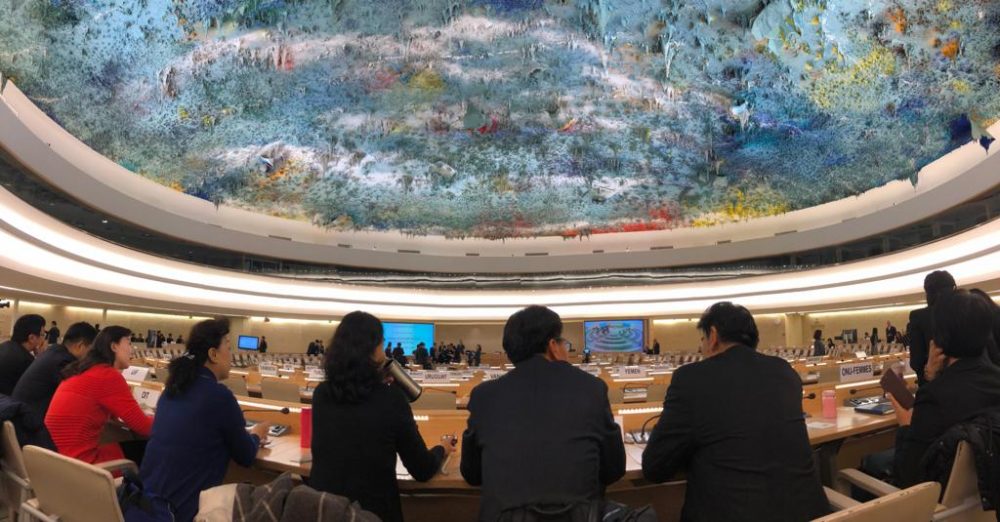
    China’s third Universal Periodic Review (UPR) was held in Geneva November 6-9, 2018. UPRs are held under the auspices of the United Nations Human Rights Council. All member states of the United Nations (UN) are obligated to submit to a review of their human rights records every four to five years. This was the 31st round of UPRs and it was the third time China’s human rights record was scrutinized by member states of the UN.

    UPRs are managed by a troika of UN members. The troika for China’s third UPR was made up of Saudi Arabia, Kenya, and Hungary, all countries that enjoy good relations with China.

    Dui Hua, which made a submission to the UPR on judicial transparency in March, sent three staff to Geneva: Executive Director John Kamm, Programs and Development Manager Yin Yu, and Programs and Publications Officer Xandra Xiao. They sat through the interactive dialogue on November 6. During the interactive dialogue more than 150 countries made interventions; each intervention was limited to 45 seconds.

    China’s delegation to its UPR was led by Vice Minister Le Yucheng and was made up of 56 delegates representing the State Council, the Supreme People’s Court, the Ministry Justice, and the State Administration of Religious Affairs, among others. Officials representing the Tibet and Xinjiang Autonomous Regions took part as members of China’s delegation.

    The United States, which had quit the Human Rights Council in June, took part in China’s UPR. It was the only country to raise the names of political prisoners who, it said, should be released or accounted for. After the United States quit the council, China issued a statement of regret. At China’s third UPR, Vice Minister Le welcomed the Americans back to the council chambers. It is not certain however whether the United States will involve itself in future council activities, including UPRs. Some officials in the American government would prefer to see the country’s participation in China’s UPR as a “one-off,” in line with the maximum pressure on China policy articulated by Vice President Mike Pence’s speech to the Hudson Institute on October 4.

    Focus on Xinjiang

    Twenty-three countries used their interventions to criticize China’s policies in Xinjiang, where hundreds of thousands of Uyghurs and other Muslim minorities are alleged to be interned in political education camps, referred to by the Chinese government as “vocational training centers.” These countries called for the immediate release of all those interned in the camps, the closure of all camps, and an end to discrimination against ethnic minorities in Xinjiang.

    Although a minority of states participating in the UPR, the 23 countries who criticized China make up China’s largest trade and investment partners. They also account for the bulk of tourists visiting China.

    China countered the criticisms by claiming that the vocational training centers taught much needed skills and Mandarin language fluency. The Chinese delegation said that internees signed an agreement upon entry, implying that their presence in the camps was voluntary, and asserted that the legal basis for the camps was the Counterterrorism Law and the recently amended Xinjiang regulations on de-extremification which authorized counties to establish vocational training centers. Vice Minister Le credited the centers with having brought security and stability to the region. He claimed that there had not been a single serious act of terrorism in Xinjiang in 22 months. It was also claimed that 132 million tourists visited Xinjiang from other parts of China and foreign countries in the first nine months of 2018.

    Reflecting intense Chinese lobbying and financial assistance, not a single country with a majority Muslim population mentioned Xinjiang by name. Turkey, whose population is ethnically close to Uyghurs, referenced concern over China’s use of administrative measures to repress religious practices. Kazakhstan, which borders Xinjiang, similarly voiced concern (many Chinese Kazakhs are said to be in the camps) but said that the issue is being addressed through diplomatic channels.

    Both critics and friends recommended that China ratify the International Covenant on Civil and Political Rights (ICCPR) — Beijing signed the covenant in 1997 — and establish a National Human Rights Institution in accordance with the Paris Principles. Several countries asked China to release statistics on the number of executions carried out every year.

    The Chinese delegation revealed that the High Commissioner for Human Rights Michelle Bachelet had been invited to China. It also said that the special rapporteurs on the right to development, the rights of the elderly, and the rights of the disabled would be invited to visit the country. It was also revealed that 427 foreign NGOs had registered in China since the law on foreign NGOs came into effect on January 1, 2017 (according to the Ministry of Public Security around a quarter of registered foreign NGOs are from Hong Kong, Macau, and Taiwan). Before the law came into effect there were more than several thousand foreign NGOs operating in China.


    PRISONER UPDATE

    In October, Dui Hua received a response from an official source on twelve prisoners in Guangdong province. The responses revealed that Zhang Junwei (张珺玮) is due to complete his five-year sentence for subversion on August 26, 2021. Zhang is one of the individuals who was sentenced for joining the “People’s Election Party” in Guangdong with the alleged intention of overthrowing the party in a violent revolution. Other individuals known to be sentenced in the same case include Xiang Fengxuan (项逢选), Ma Ji (马骥), and Yang Wanben (杨万本).

    The same response also confirmed that seven Guangdong prisoners serving lengthy sentences for endangering state security have received sentence reductions ranging from five to seven months. ESS prisoners are subject to strict handling when it comes to applications for sentence reductions and parole; the length of reductions received is often shorter than prisoners sentenced to petty crimes or economic offenses such as theft, bribery, and fraud. Dui Hua uncovered the names of these prisoners from court websites. Available judgments did not provide information about the circumstances of the cases.

    Unofficial news sources reported that former June Fourth student leader Zhou Yongjun (周勇军) was re-arrested in September, this time for “organizing/using a cult to undermine implementation of the law”. Zhou was found to have Falun Gong materials in his possession and was detained on August 20 in Fangchenggang, Guangxi. Prior to his arrest, Zhou completed his nine-year sentence for fraud in December 2015 following at least two sentence reductions granted to him.


    PUBLICATIONS ROUND UP

    Featured: Xinjiang Production and Construction Corps: Safeguarding or Endangering Security? 

    The Xinjiang Production and Construction Corps (XPCC), known as Bingtuan (兵团) in Chinese, is a quasi-military and business conglomerate located in Xinjiang that governs a population of 2.6 million people of whom more than 200,000 are Uyghurs and other predominantly Muslim ethnic minority groups. Founded in 1954 as a conglomerate of state-owned agricultural and stock-raising farms, the original XPCC settlers were comprised of decommissioned soldiers, captive Nationalist armed forces, and “rusticated youth,” who were inspired by Mao’s revolutionary dream of converting the Westernmost desert areas into arable land. In the last six decades, XPCC has grown from a population of 170,000 to a population of 2.6 million. The conglomerate now controls an area close to the size of Taiwan within the restive province of Xinjiang.

    Prisoner Updates, Quarter 3 

    October Digest 


    John Kamm Remembers

    John Kamm Remembers is a feature that explores Kamm’s human rights advocacy prior to and since Dui Hua’s establishment in 1999.

    1999: Dui Hua Begins its Work

    The Centre’s current office at Tin Ka Ping Building, CUHK. Image Credit: CUHK.

    When Senator Orrin Hatch visited China in 1997, he was accompanied by a leading scholar of contemporary China Michel Oksenberg, and a former senior staff member of Senator Hatch who had recently joined a private foundation, based on the East Coast, that supported both domestic and international projects with grants. A few months after the senator’s visit, I was contacted by the foundation to see if I’d be interested in applying for a grant.

    The experience of working on the Northeast China Autonomous People’s Republic – in which I had uncovered the names of three hitherto unknown political prisoners in a provincial newspaper – convinced me that one could find names of political and religious prisoners whose names were not known outside China by scouring “open sources:” official publications – in particular – provincial newspapers. I submitted a proposal for a research grant to find these names.
     
    At the time, my work on political and religious prisoners was supported entirely by the profits of my consulting business. I had never received a grant from either a government or private group and I had no idea how to go about winning one.  I did a bit of research and learned that to receive a grant from a non-profit foundation I would need to use a “pass through” organization that was also a non-profit. I discussed the situation with my wife and a close friend. We looked into what it would take to create our own “pass through,” our own private foundation. We settled on a name – Dui Hua, which means dialogue  对话 in Mandarin Chinese – and applied to the State of California to begin operations as a non-profit foundation. Our application was accepted,  and Dui Hua was incorporated in April 1999. After that we applied to the Internal Revenue Service for 501(c)(3) status which would enable us to operate as a non-profit exempt from federal taxes. This application was accepted in July 1999.
     
    After the East Coast foundation received Dui Hua’s proposal, it forwarded it to three Sinologists for peer reviews. The responses were not very encouraging. Aside from being an unknown quantity insofar as research into contemporary China was concerned, there was skepticism that my research would find anything. As one reviewer put it, “The Chinese government does not make the names of political prisoners available in publications available to the public.” I was asked how many names of prisoners I expected to find. I answered I’d be satisfied if I could find 100 hitherto unknown names. The foundation decided to take a chance, and Dui Hua received the grant and began operations in August 1999.
     

    With Dui Hua established and our first grant in hand, I headed for Hong Kong. I hired a couple of research assistants and together we went to the University Services Centre (USC) at the Chinese University of Hong Kong, one of the world’s premier repositories of materials on contemporary China. The USC has three floors of newspapers, journals, and books. The newspapers were held in the basement, in stacks arranged by province. I started by looking at newspapers published around the time of the Spring 1989 protests that culminated in the killings in Tiananmen Square. I focused on the newspapers of cities most affected by what the Chinese government referred to as a “counterrevolutionary uprising” – Beijing, Changsha, Shanghai, and Guangzhou.

    After four hours of eye-straining research, I had turned up virtually nothing. Not a single story, even those that reported on the protests, yielded the name of a detainee. Maybe the critics were right – the Chinese government didn’t publish such information. Maybe the Jilin newspaper report was a fluke. Discouraged, I took the elevator to the eighth floor.

    The eighth floor is where books are held in open stacks. I headed for the section that held judicial books. There I found several hundred yearbooks and records (multi-year collections) put out by public security bureaus, courts, procuratorates, and prisons. I had struck gold. In four hours of work I unearthed more than a hundred names of individuals detained for political crimes.

    Two of my most important finds were found in publications put out by the Shanghai Public Security Bureau.

    The December 1997 issue of Shanghai Public Security Journal revealed details of the case of Jiang Cunde. Jiang was a worker at a tool repair factory who plotted with other workers to set up an organization – “China Human Rights Committee” – modeled on Poland’s Solidarity Trade Union. Their activities took place in 1985 and 1986, and they were arrested and charged with counterrevolution in 1987. Jiang was sentenced to life in prison.

    After discovering Jiang’s name, I began putting him on prisoner lists submitted to the Chinese government and have continued doing so up to the present day. I have been told that Jiang was diagnosed with schizophrenia in 1993 and released on medical parole. He returned to political activities and was put back in prison in 1999. In 2004 his sentence was commuted to 20 years. Despite being awarded several citations for good behavior, Jiang has yet to receive another sentence reduction. He is imprisoned in Tilanqiao Prison and is said to suffer from severe mental illness characterized by psychotic episodes. He is due for release in 2024, by which time he will have served 31 years in prison.

    The other case I found on my first foray into the holdings at USC was that of a disaffected young man by the name of Yu Rong. According to the 1990 Shanghai Public Security Yearbook and the popular magazine China Police, Yu Rong was responsible for printing and distributing 1,450 reactionary leaflets in Shanghai over a four-month period beginning in June 1989, not long after the suppression of the democracy protests in Beijing. Then-Mayor Zhu Rongji declared Yu’s action the biggest case of counterrevolutionary incitement in the history of Shanghai. He ordered the mobilization of hundreds of police officers to catch the culprit.

    Most of Yu’s leaflets were dropped from tall buildings in Shanghai. By the time the leaflets reached the ground and had been collected and read, Yu had left the top of the buildings from where he had dropped the leaflets. After Yu was finally captured, the police accused him of committing 20 acts of arson and of dropping bricks from tall buildings, causing serious injuries and three deaths.

    Since discovering Yu’s name in 1999, I have put him on 14 prisoner lists, but I have only received one written response. In April 2006 I was told that Yu was in a psychiatric detention center, also known as Ankang. If he is alive he is likely to still be there.

    As China’s influence in Hong Kong has grown, the usefulness of the University Services Centre’s holdings has diminished. Recent publications with information on sensitive political crimes are rarely found on the centre’s shelves. The centre has been “harmonized.” For several years however the centre was an unrivaled source of the names of mostly unknown political prisoners about whom Dui Hua submits inquiries to the Chinese government. The USC’s role as a resource for our work has largely been taken over by Internet research, including surveying judgments in criminal cases posted on the Supreme People’s Court judgment websites.
  • Dui Hua Digest, October 2018

    Dui Hua Digest, October 2018

    EVENTS

    Kamm’s Trip to Beijing

    Dui Hua Executive Director John Kamm visited Hong Kong and Beijing September 16 – October 2. He had far-ranging talks on US-China relations and on human rights in China. 

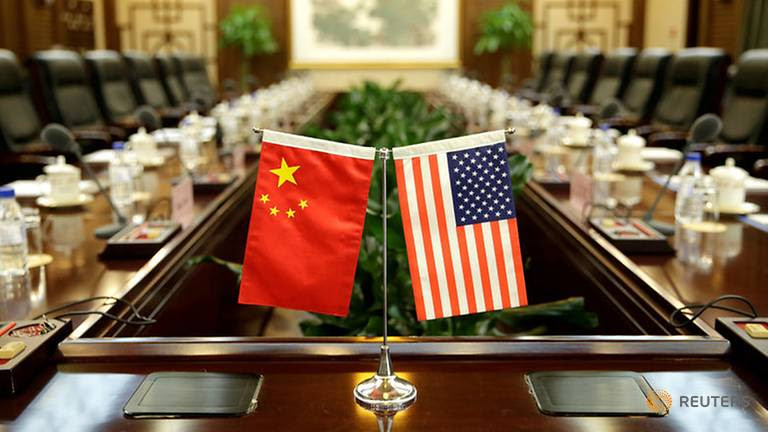
    Kamm’s trip to China coincided with a marked downturn in US-China relations. The trade war ramped up as both countries announced tariffs on two-way trade worth more than $300 billion. American sanctions were placed on a senior Chinese defense official accused of purchasing Russian military equipment, leading China to call off a military exchange and cancel a port visit by a US vessel to Hong Kong. 

    Prior to and during the trip China was accused of trying to influence American elections and of shipping vast quantities of opioids to China. Especially troubling were confrontations between the countries over the disputed South China Sea. An American B52 was flown over Chinese man-made islands and on September 30 there was a near-collision involving Chinese and American vessels. 

    A session of the US-China Diplomatic and Security Dialogue scheduled for October 15 was called off when Defense Secretary James Mattis was told that China’s Defense Secretary would not be available to meet him. 

    In Hong Kong, Kamm met with the American Consul General Kurt Tong. He also met with Chinese officials, leaders of NGOs, scholars, business leaders, and journalists. Discussions centerd on the upcoming trials of Occupy Central activists, and the impact of the US-China trade war on Hong Kong. He discussed the international symposium on girls in conflict with the law to be held at Hong Kong University School of Law in April 2020. This program will bring together leading experts and practitioners to examine best practices to address issues related to this vulnerable but rarely talked about population. 

    In Beijing, Kamm discussed cooperation on juvenile justice with the Supreme People’s Court (SPC). Dui Hua has thus far held five expert exchanges with the court’s Office of Juvenile Courts. Both sides agreed that the next exchange should take place in the United States. Topics of interest to the Chinese side were identified. 

    The court’s Research Department gave an in-depth briefing on the different criteria used to determine which judgments are posted on the court’s judgment websites. Dui Hua believes that the number of cases being posted online has been dropping as court’s pay greater attention to making sure no judgments in cases involving state secrets are made publicly available. 

    Kamm’s discussions with the SPC on judicial transparency were meant as a follow up to the foundation’s submission to China’s upcoming Universal Periodic Review (UPR) of its human rights record to be held in Geneva on November 6, 2018. Kamm and two colleagues will attend the UPR. Dui Hua’s executive director held a working dinner with Chinese officials in charge of human rights. The principal topic was preparations for the UPR. 

    Meetings were also held with Chinese scholars and judicial officials. Kamm exchanged views with a senior official of an international humanitarian organization. 

    As in past visits to Beijing, Kamm reached out to ambassadors of countries concerned with human rights in China that support Dui Hua’s work. He met with the ambassadors or deputy chiefs of mission from the United States, the European Union, Denmark, The Netherlands, Norway, Switzerland, and Sweden. A working lunch with diplomats from so-called “like-minded” countries was held, continuing a tradition dating back more than 20 years. 

    Meetings with Chinese officials and foreign diplomats were dominated by the issue of Xinjiang. In the run-up to Kamm’s trip, numerous reports appeared in foreign media alleging the widespread internment and mistreatment of Uyghurs in “political education camps” – called “vocational training centers” by Chinese officials. Some reports asserted that as many as one million Uyghurs and members of other Muslim minority groups were being held in these facilities. 

    The mass internment of Muslims as well as other measures to deal with perceived extremist or terrorist tendencies are certain to be major issues confronting China at its UPR. Dui Hua will report on the UPR in the next issue of Digest. 


    PRISONER UPDATE

    Kou Ji (寇稽), sentenced to 10 years’ imprisonment and three years’ deprivation of political rights for subversion in 2013 by a Shaanxi court, received his second sentence reduction of seven months in May, according to an online judgment Dui Hua recently uncovered. Kou was given his first sentence reduction of nine months in 2016. He is now due to be released in July 2020. Dui Hua first discovered his name from a Shaanxi court work report in 2013. The specifics of his case remain largely unknown. Dui Hua has received no government responses about him despite repeated inquiries since 2015. 

    Lee Ming-che (left) stood trial together with Peng Yuhua (right). The hearing was broadcast live on the Sina Weibo account of the Yueyang Intermediate People’s Court.

    In September, a government response provided to Dui Hua confirmed that Peng Yuhua (彭宇华) is now serving his seven years’ imprisonment sentence for subversion in Hunan’s Chishan Prison. The response stated that Peng is in good condition and that his behavior is very good. Peng has not applied for a sentence reduction; he was detained 18 months ago and may not be eligible for a reduction yet. Peng was a co-defendant with Lee Ming-che (李明哲); both were sentenced in the same trial by the Yueyang Intermediate People’s Court on November 28, 2017. The court claimed that Peng was the ringleader and Lee was an active participant in setting up a number of online groups to attack the Chinese socialist system and advocate for a western political model. The indictment indicated that the duo intended to recruit a million members in 2017 to overthrow the Chinese government. Despite having received a two-year lengthier sentence for the same charge, Peng did not receive the same extent of media coverage as Lee. Many democracy activists in China have questioned Peng’s identity as they had not heard of his name prior to the hearing. Hsiao Yi-ming, Executive Secretary of the Taipei-based Judicial Reform Foundation, speculated that Peng was being used by authorities to strengthen the allegations against Lee. Hsiao stated that none of Lee’s friends in China were aware of any connection between Lee and Peng.  


    PUBLICATIONS ROUND UP

    Featured: The Arbitrary Classification of State Secrets (August 16, 2018)

    In China, transparency on endangering state security (ESS) cases is low in many respects. China Law Yearbook, an official judicial compendium that publishes judicial statistics, states that 4,818 individuals were indicted for ESS crimes during the four-year period from 2011-2014. In recent years, China Law Yearbook has obscured this information by counting ESS cases under the category of “others.” Dui Hua estimates that more than 1,000 individuals have been indicted every year for ESS crimes since 2015.

    Previous Digest: August/September 2018

    John Kamm Remembers

    John Kamm Remembers is a feature that explores Kamm’s human rights advocacy prior to and since Dui Hua’s establishment in 1999

    Click here to read part 1.

    Target of the Gang of Four (Part 2 of 2)

    A group of mourners assemble for the walk to Zhou Enlai’s funeral in a side hall of the Forbidden City. All photos by author.

    An Interview 

    On January 8, I was advised that my request for an interview had been granted. I was told to come to a room on the top floor of the Shanghai Mansions at 10 PM, an unusually late hour for meetings in China. I spent some time putting together my questions, and then prepared to join a tour of a Shanghai commune. When I tried to sign up for the tour however I was told that I was not welcome to join. I protested to the liaison office to no avail. I headed out on another walk, this time witnessing the arrest of a Shanghai citizen by a police officer. The officer frog marched the young man down a narrow alley, attracting a throng of curious onlookers. 

    I went back to the Shanghai Mansions, had dinner, and waited in my room for the interview. At the appointed hour I went to the assigned room and found about two dozen cadres led by “leading Member” Chen Wenhai waiting for me. The interview was a formal affair, no smiles or words of greeting. I was told the ground rules. I would first ask all my questions. Thereafter I would be given a brief introduction to the trade fair. No further questions would be entertained. I must have asked thirty or so questions, after which I was given the brief introduction. It quickly became apparent that few of my questions would be answered. The “brief introduction” started out with words of praise for the wise leader Chairman Mao Zedong and the correct policies of the Chinese Communist Party. I was then given the bare bones facts of the trade fair: how large the exhibition space was, how many provincial animal by-products branches were in attendance, how many traders from which foreign countries were in attendance. That was it. 

    I tried to slip in one more question. In 1975 China agreed for the first time to sew into garments intended for export the labels of the western company that had ordered them according to their specifications. This was a welcome reform as Chinese labels like Peony, Snowflake, and the like didn’t appeal much to American and European consumers. Suddenly, at this minifair, traders had been advised that this policy had been cancelled. No more foreign labels would be sewn into Chinese made garments. There was much unhappiness among foreign traders about this sudden change, and I wanted to ask a question about why this step had been taken. I never got a chance to do so. I was cut off and reminded that there would be no more questions and told that the interview was over. 

    Shortly after returning to my room the phone, an old black apparatus with a solid feel, started ringing. It was the young sailor I had befriended the night before. His voice was shaking, and I guessed he had company sitting nearby. Obviously distressed, he told me that he was leaving Shanghai early, and that I was not to try to contact him. He told me he would always remember our friendship. He rang off. A cold shiver ran up my spine. 

    I went to bed, but had trouble falling asleep. In the early hours of January 9, I heard a great commotion taking place on the barges on Suzhou Creek below me. There were loud voices and the sounds of fighting. I dozed off and when I awoke I saw the streets lined with military vehicles, and all the barges gone. In the distance I could hear the somber music of a funeral dirge. I left my room and encountered an elderly floor attendant. What has happened I asked? He told me that Premier Zhou Enlai had died. He was weeping. 

    I and other trade fair attendees went to the liaison office to find out more. The official who met us solemnly announced the premier’s passing, and then told us that “the Chinese people will turn grief into strength” and that they would carry on the great traditions of the revolutionary leader. There would be no interruption to the trade fair. Business as usual.  

    To reinforce this point, the liaison office laid on visits for the attendees and this time I was invited to join the tours. We were offered visits to a well-off commune on the outskirts of the city – one of its production brigades specialized in raising “hairy crabs,” a Shanghai delicacy – and a factory making feather and down garments. Our visits were punctuated by bursts of propaganda praising the Great Proletarian Cultural Revolution.  

    Upon my return to the hotel I ran into the Australian who I had met on the train up to Guangzhou and his wife. They had just had a harrowing experience. They had gone for a morning walk and saw crowds of people reading newspapers which had been posted on wooden hoardings. They were reading official news of Zhou Enlai’s death, and the couple decided to photograph the scene. Bad move. In those days it was against the law for foreigners to purchase or even read local newspapers like the Wen Wei Bao and Liberation Daily. The couple were swiftly taken into custody by the local neighborhood committee and held in a small room until the police showed up. They were interrogated and lectured at length. Their actions were unlawful and violated the terms of their visit to China. After signing expressions of regret, and apologizing profusely, the couple were escorted back to the Shanghai Mansions. 

    A small group of us decided to try another restaurant for lunch, having sampled just about everything on the Shanghai Mansions’ menu. We walked to the Peace Hotel and took the elevator up to the dining floor. We chose the Western restaurant. Sitting down, we noticed that the waiters were wearing black arm bands. One of the young men came to our table and explained: “We have been told not to commemorate Zhou Enlai’s death, but we are doing so anyway. We are not afraid. Let them come and try to make trouble.” 

    The next day I flew to Beijing where I attended the fur garments minifair, and visited one of the model communes on the city’s outskirts as well as, of course, the Great Wall and the Ming Tombs. 

    On January 12, I took part in the funeral of Zhou Enlai as a member of the American delegation. Diplomats were all dressed in black, thin clothing for the bitter cold. We were received on the dais by Jiang Qing, wife of Chairman Mao Zedong, one of the members of the Shanghai Faction later to be known as the Gang of Four. Zhang Chunqiao was also present.  

    China would be visited with much more sorrow in 1976: the campaign against the right deviationist wind, the Ching Ming protests and the deadly response, the July earthquake in Tangshan, and much joy when the Gang of Four was overthrown in October. I witnessed all of those events during many visits to the country that year. 

    Upon my return to Hong Kong after attending Zhou’s funeral I was asked by a friend at Ta Kung Pao, a left-wing newspaper, to write a eulogy for the recently departed premier. I did so, and the piece ran under the Chinese name given to me by a teacher in the United States: Kang Youhan (康又瀚). The eulogy was full of praise for Zhou. A few days after it appeared my friend told me that the article had been removed from the Reference News edition published in Shanghai. My friend suggested that I adopt a new name for any future Chinese language articles I might write. I adopted the name Kang Yuan (康原), and have kept it to the present day.  

    Postscript: More than 30 years later, I took a small group of businesspeople to Shanghai. We went to the restaurant at the top of the Peace Hotel, and there I recounted the story of the defiant young waiter. Across the room I spied a man of roughly my age who was now the manager of the restaurant. He looked familiar, and I asked him to come to our table. He complied, and we quickly figured out that he was that young waiter I had encountered in January 1976. In excited voices we relived what had happened. Misty eyed, he asked me a favor. Would I be willing to come back and talk to his young charges? “Young people have no idea how we lived then. And they aren’t interested. You can help. Please come back.” I agreed to do so, but when I returned a few months later the restaurant was closed for renovation. I subsequently found out that Mr. Zhang the manager had retired. 

  • Xinjiang Production and Construction Corps: Safeguarding or Endangering Security?

    The XPCC 12th Division State-Owned Assets Management Company vows to crack down on terrorism during a training on July 4, 2017. People.cn.

    The Xinjiang Production and Construction Corps (XPCC), known as Bingtuan (兵团) in Chinese, is a quasi-military and business conglomerate located in Xinjiang that governs a population of 2.6 million people of whom more than 200,000 are Uyghurs and other predominantly Muslim ethnic minority groups. Founded in 1954 as a conglomerate of state-owned agricultural and stock-raising farms, the original XPCC settlers were comprised of decommissioned soldiers, captive Nationalist armed forces, and “rusticated youth,” who were inspired by Mao’s revolutionary dream of converting the Westernmost desert areas into arable land. In the last six decades, XPCC has grown from a population of 170,000 to a population of 2.6 million. The conglomerate now controls an area close to the size of Taiwan within the restive province of Xinjiang.

    Photo credit: The Economist

    From its onset, XPCC was tasked with the mission of “safeguarding the frontier, maintaining stability and promoting ethnic unity.” Its official goal of safeguarding state security remains unchanged today. As a distinct administrative unit with its own educational, healthcare, and residence registration system, XPCC also operates as a separate jurisdiction with its own police force, procuratorates, courts, and prisons independent of the Xinjiang provincial government. In March 2012, XPCC established its own state security bureau with the aim of investigating and cracking down on endangering state security (ESS) activities. Xinjiang is believed to account for the majority of ESS cases in China; ESS crimes include splittism, subversion, and incitement. Dui Hua has previously reported that Xinjiang concluded 1,542 ESS trials during 2010-2014. The number of defendants in such cases is unknown. Dui Hua believes that the reported figures on crime in Xinjiang does not cover XPCC-controlled areas.

    Has XPCC lived up to its duty to safeguard state security? Dui Hua’s research into government annals has uncovered over a decade of ESS arrests and indictments in XPCC from 2003-2015. When compared with the numbers available from other Chinese provinces and municipalities, it is clear that XPCC accounts for a disproportional amount of the arrests and indictments for ESS crimes.

    Arrests and Indictments for Endangering State Security Cases in Xinjiang Production and Construction Corps, Chongqing Municipality and Nationwide

    Sources: XPCC Statistical Yearbook, Chongqing Statistical Yearbook, China Law Yearbook.

    The table above shows that 237 individuals were arrested in 80 cases and 209 indicted in 60 cases in the last 13 years in XPCC. When compared with other Chinese provinces and municipalities and given its population size, XPCC makes a staggering number of ESS arrests and indictments. For example, in Chongqing, home to 30.17 million people in 2015, 35 individuals were arrested in 25 cases and 29 individuals were indicted in 23 cases from 2002-2016. Dui Hua’s research into government gazettes in Shandong, Jiangsu, and Henan indicated that the number of individuals arrested or indicted in each year from 2014-2016 for ESS crimes ranged from one to a little over a dozen. The three provinces have a population of 98.5 m, 79.8 m, and 107 m, respectively.

    ESS arrests in XPCC stagnated for many years until 2008. In 2008, the number of arrested individuals surged to 38. In 2011, one person was indicted in XPCC for ESS for every 24 individuals indicted nationwide; in 2014, XPCC arrested one person for every 16 individuals arrested for ESS nationwide. The surge in 2008 occurred just one year before the Urumqi riots of July 2009 and coincided with the nationwide increase of ESS arrests and indictments in 2008. Official news media reported that 1,295 individuals were arrested, and 1,154 individuals were indicted in Xinjiang in the first eleven months of 2008, accounting for 75.6 percent and 82 percent of the nationwide ESS arrests and indictments.

    Religious Persecution in Endangering State Security Cases

    ESS cases involving Uyghurs are linked to the crackdown on religious freedom in Xinjiang. From June to July 2009, the 4th Agricultural Division Intermediate People’s Court sentenced a group of 17 Uyghurs to three-five years’ imprisonment for inciting splittism and inciting racial hatred. According to Ili Evening News, the group organized underground religious activities to celebrate the holy holiday of Ramadan and to teach the Quran. Hazreteli Abbas, one of the 17 imprisoned, was additionally sentenced for “harboring criminals” after allegedly providing financial aid to members seeking to leave China, despite knowing that they were wanted by police.

    The 2015 census indicated that there were 229,100 Uyghur residents in XPCC, accounting for less than 10 percent of the entire XPCC population. However, the majority of the ESS cases in XPCC known to Dui Hua involve Uyghurs accused of splittism or inciting splittism. In XPCC, a single ESS case can often involve over a dozen Uyghur individuals, who tend to receive substantially harsher treatment and prison terms than their Han counterparts. On July 23, 1999, the 4th Agricultural Division Intermediate People’s Court sentenced 18 Uyghurs to 10-15 years’ imprisonment for splittism at a public sentencing rally. The rally was held in an open-air theater, with an audience of more than 1,300 individuals from the 64th Brigade of the Fourth Agricultural Division. Only three of the individuals sentenced names are known: Abdurazaq Abdureshit, Ekrem Qurbantay and Shirmemet Abdureshit. All defendants in the case were likely released in the early 2010s.

    Dui Hua’s PPDB has information on four other Uyghurs incarcerated for ESS (see table below), three of whom were sentenced alongside five to fifteen other defendants. Available sources do not provide details on the case specifics.

    NameCourtSentence DateCrime(s)SentenceClemencyRemarks
    Abdurusul Ehsan1st Agricultural Division IntermediatePeople’s Court2011Splittism, illegally manufacturing of weapons/ ammunition/ explosivesDeath with reprieveSentence commuted to life imprisonment in 2015Case specifics unclear
    Mehmet Imin1st Agricultural Division Intermediate People’s Court2011Inciting splittismUnknownUnknownSentenced alongside 14 other defendants
    Enwer Obul3rd Agricultural Division Intermediate People’s Court2013Inciting splittismUnknownUnknownPart of the 10 defendants tried for inciting splittism in XPCC
    Muhyibla NizAn intermediate court in XPCC2014Inciting splittismUnknownUnknownSentenced alongside 5 other defendants

    Han Incitement

    In My West China; Your East Turkestan《我的西域,你的东土》, dissident writer Wang Lixiong calls XPCC a “Han autonomous province within Xinjiang Autonomous Region.” While Han Chinese account for 86 percent of XPCC’s population, only a handful are known to be involved in ESS cases. Liu Weifang (刘卫方) is one such individual. Liu was sentenced to three years’ imprisonment by the 9th Brigade Intermediate Court for inciting subversion. He posted dozens of articles on multiple Internet forums, “viciously attacking the party, national leaders, the socialist system and party principles and policies.” Liu is believed to have completed his sentence before 2004. In a rare disclosure, the XPCC procuratorate website stated that its 4th Division Branch arrested an individual surnamed Yang for inciting subversion in September 2017. Like Liu, Yang was accused of using social networking apps to disseminate information and spread “rumors” about the party and socialism.

    The charge of incitement is also used against Falun Gong practitioners who distribute publications critical of the party. One such case took place in XPCC. In November 2014, Wang Xiaoying (王晓莺) was criminally detained for two weeks for inciting subversion. Although the charge was eventually dropped, Wang was later arrested and sentenced to three years and six months’ imprisonment for using/organizing a cult to undermine implementation of the law. She is currently being held in Urumqi Women’s Prison and is due for release in 2019.

    From Endangering State Security to Terrorism

    Dui Hua has previously reported on the growing trend of authorities charging individuals with “picking quarrels and provoking troubles” for acts that would have previously resulted in charges for inciting subversion. Both Xinjiang and XPCC appear to have followed suit, applying a similar switching tactic of criminalization to obscure cases of a political nature. As such the drop in ESS arrests and indictments in 2015 by no means indicates a relaxation of suppression. Moreover, Uyghurs are now more likely to face prosecution for terrorism than splittism or inciting splittism.

    Dui Hua’s research into online judgments discovered a case, involving four Uyghurs in their early twenties, who were initially detained and arrested for inciting splittism but subsequently sentenced in 2013 for organizing/leading/actively participating in a terrorist organization. The XPCC 14th Division Intermediate People’s Court sentenced the men to two to ten years’ imprisonment.

    Receiving the lengthiest sentence of the four, Abdusalam Abulat was accused of watching videos and listening to audio materials about “jihad” and “hegira” with his uncle Ababaikerim Mahmut, who was previously sentenced in Hotan to two years’ imprisonment for inciting splittism in 2010. According to the judgment, the uncle spoke about his resentment towards Han Chinese in Xinjiang. “In our hometown Xinjiang today, we are not allowed to have more than three children; otherwise we will be forced to undergo abortions. Women are forced to put on contraceptive devices… We cannot worship outside of mosques. Men cannot keep beards. Not only are students forbidden to wear Islamic clothes, but also headscarves…” The uncle said Muslims should “migrate” to other Islamic nations to strengthen their religious faith before they conduct “jihad” upon their return to Xinjiang and that the first step of “hegira” was to apply for passports to study abroad in Malaysia or Indonesia and eventually Afghanistan.

    Abdusalam Abulat shared his uncle’s interpretations of “jihad” and “hegira” with his co-workers at a textile factory in Shihezi and started learning Arabic with them. The court alleged that they had discussed plans to leave for Afghanistan via Kashgar. Even though the four had not committed any violent acts, the court held that the physical and shooting training they received with replica guns in the factory yard of their dormitory constituted acts of terrorism.

    Court judgments involving incitement, splittism, and terrorism frequently conflate the terms “jihad” and “hegira” with violence. Despite its common mistranslation as “holy war”, jihad embraces a much wider religious meaning of a non-violent struggle that prompts one to be a good Islamic believer, according to The Islamic Supreme Council of America. A Diplomat article titled “Uyghur Terrorism: A Misnomer”states that “some governments are prone to label as terrorism all violent acts committed by their political opponents… and “[G]overnments may be tempted by a ready-made narrative to back up the claim that domestic unrest derives from outside influences rather than from authentic local concerns.” Overseas observers have criticized China’s terrorism laws as being overly vague. The laws do not require actual action or violence to have taken place for authorities to initiate prosecution and other restrictions, allowing for the conflation of dissenters with terrorists.

    A Bulwark of State Security?

    Since its founding, XPCC has justified its raison d’être by citing the threat of ethnic unrest, social instability, and splittist activities. Severely damaged during the Cultural Revolution, XPCC was reinstated in 1981 by Deng Xiaoping as “the key force of maintaining stability in Xinjiang.” Hu Jintao has praised XPCC as a “mighty construction army” for the quelling of the 2009 Urumqi Riots. Xi Jinping has described wanting the XPCC to combat terrorism in Xinjiang with its “walls made of copper and steel” and “nets spread from the earth to sky.”

    Delegated as a bulwark against “the three evil forces of terrorism, extremism, and separatism,” XPCC has extended its reach to southern Xinjiang, where a number of attacks have reportedly occurred. In January 2016, the State Council approved the establishment of Kunyu City in Hotan, a prefecture largely dominated by Uyghurs. The new county-level city is administered by XPCC’s 14th Agricultural Division. In 2017, an official news media article recommended that XPCC create a Special Economic Zone in southern Xinjiang modelled on Shenzhen to create opportunities for the many ethnic minorities who cannot speak Mandarin, have few educational opportunities, and are “extremely religious” and “dissatisfied with the status quo.” Beijing is seen to have turned a deaf ear to complaints that XPCC is taking away valuable resources from its Uyghur population, including vast amounts of arable land and abundant water resources.

    Observers and scholars have described the government’s attempts to control the Uyghur population as a self-fulfilling prophecy. The perceived threats to state security and social stability provided the initial justification for the creation of XPCC. As the conglomerate expanded, the area saw an influx of Han migration drawn in by business opportunities; efforts to secularize the region routinely deny Uyghurs access to economic and political opportunities. Consequently, the already conspicuous ethnic tensions continue to mount. Contrary to its alleged mission to “safeguard the frontier, maintain stability and promote ethnic unity,” XPCC is giving its Uyghur residents even more reason to flee or seek greater autonomy.

  • Prisoner Updates 2018 Quarter 3

    Illegal Publications

    Liang Jiantian (梁鉴添), a Guangzhou publisher, received a six-month sentence reduction in June 2018. He was sentenced to life imprisonment in 2000 by a Guangdong court, for illegal business activity and producing obscene materials after printing around five million copies of Falun Gong related publications. Panyu Prison disclosed a notice on its website concerning Liang’s latest sentence reduction. His sentence is due to expire on April 17, 2022.

    A recently uncovered judgement found on China Judgements Online involves a case of illegal publications. Ding Lixian (丁立先) and Zhang Haiqing (张海清) were sentenced by a Shandong court to five years’ imprisonment and suspended imprisonment respectively in November 2017. They were accused of printing 60,000 illegal books that contained rumors about former president Jiang Zemin.

    “Educational Placement” in Xinjiang

    Judicial websites released the case numbers of eight judgments concerning “Educational Placement” in Xinjiang. Among them, Elipani Tohti (依力帕尼·托乎提), convicted of splittism, was ordered by a Xinjiang Production and Construction Corps court on November 9, 2017 to be placed in an Educational Placement facility after his prison term expires. The full content of the judgement is unavailable due to the court’s determination that the content was “unsuitable for disclosure.” Others include Dewula Rehim (代吾拉·热合木), convicted of provoking ethnic hatred, Yasin Husedin (亚森·吾赛丁), convicted of disturbing social order, and Saierjia Bazarbek (赛尔加·巴扎尔别克), apparently an ethnic-Kazakh, convicted of participating in a terrorist organization. Established by Article 30 of the Counterterrorism Law, educational placement is designed for those convicted of terrorism or extremism crimes who still pose a threat to the society beyond their prison term. Without a term limit, educational placement is a de-facto life imprisonment sentence. Of the eight individuals, only Bazakbek was convicted of a crime involving terrorism. The sentencing of the other seven individuals falls beyond the legal scope of Article 30.

    Underground Parties

    Cao Haibo (曹海波) is a member of the China Democracy Party who was sentenced for subversion in October 2012. Cao was responsible for creating an online group to discuss politics and the “China Republican Party.” His posts were reportedly online for only one day. Cao was sentenced to eight years’ imprisonment in Yunnan No. 2 Prison for subversion. Dui Hua learned that Cao received a sentence reduction and is now scheduled for release on May 20, 2019 following his first sentence reduction.

    Xiang Fengxuan (项逢选) established the People’s Election Party and the so-called “Shadow Corps” with the intention of overthrowing the Communist Party in a violent revolution according to official reports. Xiang was sentenced to 11 years for subversion in 2017 in Guangdong and is now incarcerated in Yangjiang Prison.

    Ma Ji (马骥), Yang Wanben (杨万本), Su Dongliang (苏东亮), and Zhang Junwei (张珺玮) were also sentenced for subversion in Guangzhou over their participation in the People’s Election Party. Dui Hua uncovered this information from judicial websites. Only Yang and Zhang are known to have been sentenced to four years and five years’ imprisonment, respectively, whereas the sentences received by Ma and Su remain unknown. Dui Hua submitted a prisoner list to its interlocutors to inquire about Ma and Su.

    Endangering State Security Cases in Xinjiang

    Yusup Ismail (玉素普·司马义) was sentenced to 12 years in prison in 2006. An online judgment stated that the Xinjiang High People’s Court reviewed the application of his sentence reduction in January 2017, but the outcome has not been disclosed. Dui Hua received a response confirming that he received a three-month sentence reduction and completed his sentence in Tulufan Prison on April 14, 2017.

    Abdusalam Amut (阿布都沙拉木·阿木特) was sentenced to life in prison in 1999. He did not receive any clemency until after he had served 19 years in Xinjiang No.1 Prison. In June 2016, the prison applied for a sentence commutation on his behalf, but the outcome remained unknown until a government response given to Dui Hua confirmed that the Xinjiang High People’s Court commuted his sentence to 20 years’ imprisonment. He is now scheduled for release on June 27, 2036.

    Memettohti Memetimin (买买托乎提·买买提明) has received a commutation of his life sentence to 20 years’ imprisonment. He was granted his first sentence reduction on September 6, 2016, after being imprisoned for 20 years. In 2003, he was sentenced additionally for theft and illegal production/trafficking in weapons/ammunition/explosives. His life sentence was commuted about two weeks after the Xinjiang High People’s Court received the recommendation for a sentence reduction submitted by Xinjiang No.4 Prison on August 25, 2016.

    Abdukeyum Tursun (阿布杜凯尤木·图尔逊) is the name of a previously unknown suspect in an endangering state security case. Dui Hua researchers uncovered his name in a Gansu provincial public security bureau record. He was wanted by the Xinjiang Public Security Bureau for splittism, He was arrested in Gansu on March 13, 2008. Facts related to his incarceration and sentencing are not known.

  • Dui Hua Digest, August/September 2018

    Dui Hua Digest, August/September 2018

    EVENTS

    American Attitudes Towards China At a Low Point

    Against the backdrop of heightened tensions in US-China relations, Dui Hua executive director John Kamm will visit China from September 16 to October 1, 2018. His two-week trip will take him to Hong Kong and Beijing. He will meet with Chinese officials, foreign diplomats, NGO representatives, journalists, and leading scholars, several of whom act as advisors to the Communist Party and the Chinese government.

    Although the trade war between the two countries is seen by many observers as the main reason for worsening relations, in fact several other issues are souring opinion in the United States towards China. Issues include accusations that Beijing is encouraging North Korea to reduce cooperation with the United States, that it is seeking to influence American politics and civil society, that it is mounting widespread espionage operations in the United States, that it hacked into Hillary Clinton’s emails, that it is flooding the United States with opioids, even that it is refusing to share samples of a potentially deadly virus. Media coverage of human rights abuses in China – especially in Xinjiang – has been intense.

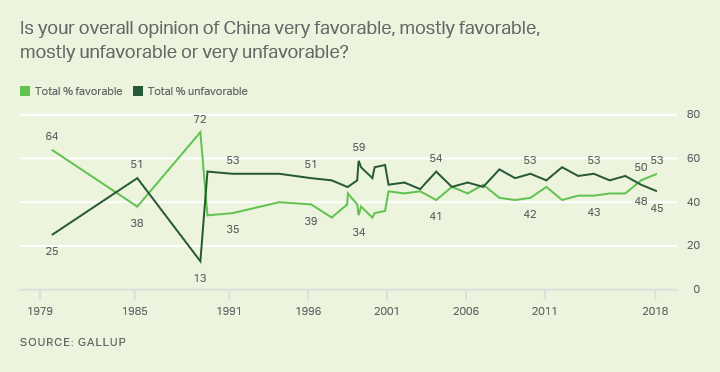
    The extent of the damage to public opinion in the United States can be seen in the results of the Pew Research Center’s annual poll of American attitudes towards China. The poll was conducted in May and June 2018 among 1,500 adults and was released on August 28. It showed that 38 percent of Americans have a favorable opinion of China, down from 44 percent in 2017. Opinions towards China are significantly worse among older Americans and adults who identify as Republicans.

    The Pew results are especially troubling when compared to the Gallup poll of American opinion towards China. That poll, taken in February and released in March 2018, showed that 53 percent of Americans had a favorable opinion of China, the first time since the events of June 4, 1989 that a majority of American adults viewed China favorably. That poll garnered praise from Chinese officials, including Foreign Minister Wang Yi.

    The Pew poll identifies the top five problems Americans have with China as 1) the large amount of American debt held by China (89 percent of Americans share this view), 2) cyberattacks (87 percent), 3) China’s impact on the global environment (85 percent), 4) the loss of jobs to China (83 percent), and the trade deficit with China (82 percent).

    According to the Pew poll, 79 percent of Americans believe that China’s policies on human rights are a serious problem, and of this percentage 49 percent believe that human rights abuses are a very serious problem, the highest percentage since 2015.

    The Trump administration has been silent on the subject of human rights in China. That may change as officials in the Department of State and the White House debate whether to participate in the Universal Periodic Review (UPR) of China’s human rights record to take place in Geneva on November 6, 2018. Even though the United States withdrew from the Human Rights Council (HRC) in June – the HRC oversees the UPRs of all United Nations member states – it can still participate in UPRs as a member of the United Nations. It can submit questions (they must be filed no later than 10 days before the UPR takes place) and make a statement on China’s report.

    The US can coordinate its participation with so-called “like-minded countries,” most of whom intend focusing on what’s going on Xinjiang, where media reports claim that more than one million Uyghur, Kazak, and Hui Muslims have been interned in “political education camps.”

    Dui Hua has translated into Chinese a key resource on girls in the criminal justice system. Neglected Needs: Girls in the Criminal Justice System, published by Penal Reform International and the Interagency Panel for Juvenile Justice, examines the specific challenges faced by girls in contact with the criminal justice system and makes recommendations for strengthening the protection of their rights. Find out more here!


    PRISONER UPDATE

    Guangzhou publisher Liang Jiantian (梁鉴添) received a six-month sentence reduction in June 2018. He was sentenced to life imprisonment in 2000 by a Guangdong court, for illegal business activity and producing obscene materials after printing around five million copies of Falun Gong related publications. Panyu Prison disclosed a notice on its website concerning Liang’s latest sentence reduction. His sentence is due to expire on April 17, 2022.

    Judicial websites released the case numbers of eight judgments concerning “Educational Placement” in Xinjiang. Among them, Elipani Tohti (依力帕尼·托乎提), convicted of splittism, was ordered by a Xinjiang Production and Construction Corps court on November 9, 2017 to be placed in an Educational Placement facility after his prison term expires. The full content of the judgement is unavailable due to the court’s determination that the content was “unsuitable for disclosure.” Others include Dewula Rehim (代吾拉·热合木), convicted of provoking ethnic hatred, Yasin Husedin (亚森·吾赛丁), convicted of disturbing social order, and Saierjia Bazarbek (赛尔加·巴扎尔别克), apparently an ethnic-Kazakh, convicted of participating in a terrorist organization. Established by Article 30 of the Counterterrorism Law, educational placement is designed for those convicted of terrorism or extremism crimes who still pose a threat to the society beyond their prison term. Without a term limit, educational placement is a de-facto life imprisonment sentence. Of the eight individuals, only Bazakbek was convicted of a crime involving terrorism. The sentencing of the other seven individuals falls beyond the legal scope of Article 30.

    A recently uncovered judgement found on China Judgements Online involves a case of illegal publications. Ding Lixian (丁立先) and Zhang Haiqing (张海清) were sentenced by a Shandong court to five years’ imprisonment and suspended imprisonment respectively in November 2017. They were accused of printing 60,000 illegal books that contained rumors about former president Jiang Zemin.


    IN THE MEDIA

    On August 10, 2018 The New York Times published a story on the disappearance of a high profile state scholar in China. A revered academic and expert on Xinjiang folk culture and traditions Professor Rahile Dawut, has been incommunicado since December 2017. Relatives and supporters are certain that she has been secretly detained as part of the clampdown on Uyghurs in China. Executive Director John Kamm commented “Rahile Dawut is the human face of this unspeakable tragedy.”


    PUBLICATIONS ROUND UP

    Featured: Neglected Needs: Girls in the Criminal Justice System (September 6, 2018)

    Dui Hua has translated into Chinese a key resource on girls in the criminal justice system. Neglected Needs: Girls in the Criminal Justice System, published by Penal Reform International and the Inter-agency Panel for Juvenile Justice, the paper examines the specific challenges faced by girls in contact with the criminal justice system and makes recommendations for strengthening the protection of their rights.

    “All Criminal Defendants to Have Lawyers”: Is Access to Defense Lawyers Enough in a System Designed Against Defendants? (Part 1 of 2) (August 29, 2018)

    Stalemate on Detention Center Law (July 25, 2018)

    Flouting Global Norms, China Continues to Incarcerate Prisoners for Abolished Crimes (July 11, 2018)

    Previous Digest: July 2018


    John Kamm Remembers

    John Kamm Remembers is a feature that explores Kamm’s human rights advocacy prior to and since Dui Hua’s establishment in 1999

    Target of the Gang of Four (Part 1 of 2)

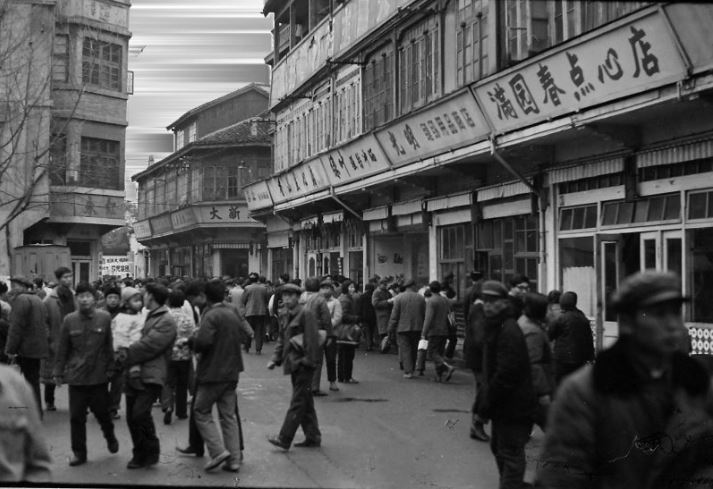
    Shanghai’s Fuzhou Road, a haven for used bookstores, January 1976. All photos by author.

    I left America for Macau to take up a teaching position in August 1972. I moved to Hong Kong on Christmas Day, 1972. By the end of 1975 I had lived most of the previous three years in Hong Kong with a spell at Harvard University in late 1974 and early 1975 to earn a Master’s degree. What is now a Special Administrative Region of China, Hong Kong was then a Crown Colony of Great Britain. I worked as a tutor at the Chinese University of Hong Kong and, beginning in the summer of 1975, as an assistant editor of Asian Business & Industry, a limited circulation business magazine, published by Far East Trade Press, with readers in every Asian country, including China.

    One day in July 1975, as I was walking back to my office in Prince’s Building, I passed by Commercial Press where I purchased a copy of a pamphlet entitled “On Exercising All Round Dictatorship of the Bourgeoisie” written by Zhang Chunqiao. Zhang was a member of the Standing Committee of the Politburo of the Central Committee of the Chinese Communist Party, and the theoretician of a leftist faction that would someday come to be known as the Gang of Four. I read the pamphlet and, based on my understanding of its contents, wrote an article for the August issue of Asian Business & Industry. I called out Zhang for his ultra-leftism – identifying him as the principal spokesman for radical economic policy in the Central Committee — and criticized his call for class warfare directed against the “dictatorship of the bourgeoisie,” referring to a passage in his essay in which he calls for the “iron broom of the dictatorship of the proletariat” to sweep away bourgeois rights from China.

    A few weeks after publication, I came to the office to find a stack of copies of the magazine wrapped in filthy rags. The China National Publications Import Corporation, the channel through which Far East Trade Press distributed its magazine in China, had returned all the magazines with a letter on its official stationary. The letter accused Asian Business & Industry of having published a counterrevolutionary article that had “hurt the feelings of the Chinese people.” The letter concluded by stating that the magazine would no longer be allowed to circulate in China.

    I didn’t know it at the time, but my article attacking Zhang Chunqiao had attracted the attention of Zhang and his leftist allies in what was sometimes called “the Shanghai faction.” Public security began a file on me, known in China as a dang’an. Such files are kept on virtually every Chinese citizen as well as on foreigners who visit China on a regular basis. Thirty years after my article appeared, I learned that it was the first item in my dang’an. The diplomat who gave me this information said that I was known in government and party circles as a “target of the Gang of Four.”

    Shanghaied at the Feather and Down Fair

    Shanghai Mansions

    My chance to visit Mainland China for the first time came in January 1976 when, as a freshly minted representative of the National Council for US-China Trade, I was asked to go to Shanghai to attend the China Feather and Down Garments Minifair (中国羽绒服饰小交易会) put on by the China National Native Produce and Animal By-Products Import and Export Corporation (CHINATUHSHU, 中国土产畜产进出口公司). My visa came through at the last possible moment, enabling me to make the flight to Shanghai from Guangzhou on January 6.

    First though I had to get to Guangzhou from Hong Kong. I boarded the Kowloon Canton Railway train that departed from the Tsimtsatsui terminus at 8:24 on January 4, 1976, arriving at Lo Wu station around two hours later.

    After crossing the border at Lowu and having a simple but tasteless lunch at the station on the Chinese side, I and other trade fair attendees boarded the 1:00 PM train for Guangzhou. I was accompanied by a young American entrepreneur who had become a leader in manufacturing down garments, then quite the rage in America, and an Australian businessman/scholar and his wife.

    From the train windows we could view the countryside, fields left fallow for the spring planting. We passed the small village of Shenzhen, today a major city that is home to China’s first special economic zone. Upon arrival at the Guangzhou train station we hopped into grey Shanghai sedans for the run to the Bai Yun airport. We arrived at Hong Qiao Airport in Shanghai after nightfall, but there was no one to receive me.

    Eventually Mr. Ma from the Shanghai Foreign Affairs Bureau showed up and I was taken to the Peace Hotel, the former Cathay Hotel, on the Bund. Mr. Ma was silent for the late-night drive though dark, deserted streets. The next day I moved to Shanghai Mansions, the old Broadway Mansions, where the trade fair was taking place. At the Shanghai Mansions I was given an immense apartment on an upper floor, with balconies overlooking the Huangpu River, Suzhou Creek and the Bund. There was a big radio circa early 1940s in the living room. Radio was the only form of entertainment available to me. I never bothered turning it on.

    The next day, January 5, 1976, I visited the trade fair itself, and registered with the liaison office. The office was staffed by cadres from the China Council for the Promotion of International Trade (CCPIT), the National Council’s counterpart organization in China. The fair itself was held in four rooms on the second floor of the hotel. Different branches of CHINATUSHU had their own display and negotiation spaces which were fitted out with one or two tables and chairs. A tin of cigarettes was placed on the tables. The exhibition and negotiation hall reeked of cigarette smoke.

    One of my tasks was to write an article on the minifair for the National Council’s magazine, China Business Review, so I put in a request for an interview with the trade fair’s leadership. My request received a cool reception. I was told to go to my room and wait for an answer. This was a sensitive time for people doing business in China, and minifairs, an innovation introduced as a modest reform in 1975, were under fire as examples of the “roots of capitalism” being introduced by Deng Xiaoping, arch foe of the Shanghai Faction. I wondered if I would get an interview in Shanghai, or have to wait until I got to Beijing, where a Fur Garments Minifair was about to open.

    “Traffic” on the Bund. Not a single car in sight. Today this thoroughfare is multi-laned and bumper to bumper, one of the busiest streets in China.

    Rather than heeding the liaison office’s instructions, I decided to take a walk along the Bund and up Nanjing Road. There were few vehicles on the road, the favored mode of transport being the bicycle. I checked out the Shanghai Exhibition Hall, a vast structure built in the Soviet style, and the Shanghai Number One Department Store, said to be the largest in China. Its five floors were stocked with a wide variety of consumer goods, all made in China except foreign watches, the only foreign consumer good allowed for sale in China. I resisted the temptation to buy an Omega for RMB 861.

    I have always visited bookstores on trips to China, and my first trip was no exception. I walked into the large Xinhua Bookstore on Nanjing Road, passing through thick canvas curtains meant to shield the building from the bitter cold outside. Upstairs I walked into the room that held internal (nei bu) publications sold only to cadres with the right documents. I was quickly and unceremoniously told to leave.

    I wandered back to the hotel, stopping first at the office of the Hong Kong Shanghai Bank, located in a small building on a side street not far from the compound housing the Friendship Store and the Seamen’s Club. The compound had previously served as the sprawling British Consulate in Shanghai. I was greeted by the bank’s British manager with more than the usual British reserve. He and his colleague from the Standard Charter Bank were at the time the only resident foreign businessmen in Shanghai. Unfortunately, they could not conduct business. They were in effect hostages of the Chinese government to ensure that China’s holdings with the banks wouldn’t be expropriated. Their colleagues had in fact been detained during the early years of the Cultural Revolution. They couldn’t leave Shanghai until colleagues arrived to replace them. The fellow I met expressed relief that he would be ending his assignment later that year.

    The Shanghai Exhibition Hall

    I decided to stop by the Friendship Store, a dreary place selling shoddy goods far below the quality found in Hong Kong’s Chinese products stores. After examining the wares on display, I walked over to the nearby Seamen’s Club. Both the Friendship Store and the Seamen’s Club were located on the grounds of the old British Consulate in Shanghai.

    In those days Seamen’s Clubs were the hubs of entertainment for foreigners in China. They served cold beer and one could always find a sailor willing to tell tall tales of his voyages to China. I struck up a conversation with a young Hong Kong sailor who was working on a tramp steamer registered in Hong Kong and operated under the Chinese flag. Together we went back to the Shanghai Mansions where we had a simple dinner and played pool for several hours, drinking beer and eating peanuts. The young sailor told me of his life on a PRC-owned vessel. He complained about the incessant political study sessions he and his fellow seamen had to endure. I listened attentively. Apparently, others were also listening attentively.

    To be continued in the October Digest

  • Target of the Gang of Four

    Target of the Gang of Four

    << Read all John Kamm Remembers stories

    I left America for Macau to take up a teaching position in August 1972. I moved to Hong Kong on Christmas Day, 1972. By the end of 1975 I had lived most of the previous three years in Hong Kong with a spell at Harvard University in late 1974 and early 1975 to earn a Master’s degree. What is now a Special Administrative Region of China, Hong Kong was then a Crown Colony of Great Britain. I worked as a tutor at the Chinese University of Hong Kong and, beginning in the summer of 1975, as an assistant editor of Asian Business & Industry, a limited circulation business magazine, published by Far East Trade Press, with readers in every Asian country, including China.

    One day in July 1975, as I was walking back to my office in Prince’s Building, I passed by Commercial Press where I purchased a copy of a pamphlet entitled “On Exercising All Round Dictatorship of the Bourgeoisie” written by Zhang Chunqiao. Zhang was a member of the Standing Committee of the Politburo of the Central Committee of the Chinese Communist Party, and the theoretician of a leftist faction that would someday come to be known as the Gang of Four. I read the pamphlet and, based on my understanding of its contents, wrote an article for the August issue of Asian Business & Industry. I called out Zhang for his ultra-leftism – identifying him as the principal spokesman for radical economic policy in the Central Committee — and criticized his call for class warfare directed against the “dictatorship of the bourgeoisie,” referring to a passage in his essay in which he calls for the “iron broom of the dictatorship of the proletariat” to sweep away bourgeois rights from China.

    A few weeks after publication, I came to the office to find a stack of copies of the magazine wrapped in filthy rags. The China National Publications Import Corporation, the channel through which Far East Trade Press distributed its magazine in China, had returned all the magazines with a letter on its official stationary. The letter accused Asian Business & Industry of having published a counterrevolutionary article that had “hurt the feelings of the Chinese people.” The letter concluded by stating that the magazine would no longer be allowed to circulate in China.

    I didn’t know it at the time, but my article attacking Zhang Chunqiao had attracted the attention of Zhang and his leftist allies in what was sometimes called “the Shanghai faction.” Public security began a file on me, known in China as a dang’an. Such files are kept on virtually every Chinese citizen as well as on foreigners who visit China on a regular basis. Thirty years after my article appeared, I learned that it was the first item in my dang’an. The diplomat who gave me this information said that I was known in government and party circles as a “target of the Gang of Four.”

    Shanghaied at the Feather and Down Fair

    Shanghai Mansions.

    My chance to visit Mainland China for the first time came in January 1976 when, as a freshly minted representative of the National Council for US-China Trade, I was asked to go to Shanghai to attend the China Feather and Down Garments Minifair (中国羽绒服饰小交易会) put on by the China National Native Produce and Animal By-Products Import and Export Corporation (CHINATUHSHU, 中国土产畜产进出口公司). My visa came through at the last possible moment, enabling me to make the flight to Shanghai from Guangzhou on January 6.

    First though I had to get to Guangzhou from Hong Kong. I boarded the Kowloon Canton Railway train that departed from the Tsimtsatsui terminus at 8:24 on January 4, 1976, arriving at Lo Wu station around two hours later.

    After crossing the border at Lowu and having a simple but tasteless lunch at the station on the Chinese side, I and other trade fair attendees boarded the 1:00 PM train for Guangzhou. I was accompanied by a young American entrepreneur who had become a leader in manufacturing down garments, then quite the rage in America, and an Australian businessman/scholar and his wife.

    From the train windows we could view the countryside, fields left fallow for the spring planting. We passed the small village of Shenzhen, today a major city that is home to China’s first special economic zone. Upon arrival at the Guangzhou train station we hopped into grey Shanghai sedans for the run to the Bai Yun airport. We arrived at Hong Qiao Airport in Shanghai after nightfall, but there was no one to receive me.

    Eventually Mr. Ma from the Shanghai Foreign Affairs Bureau showed up and I was taken to the Peace Hotel, the former Cathay Hotel, on the Bund. Mr. Ma was silent for the late-night drive though dark, deserted streets. The next day I moved to Shanghai Mansions, the old Broadway Mansions, where the trade fair was taking place. At the Shanghai Mansions I was given an immense apartment on an upper floor, with balconies overlooking the Huangpu River, Suzhou Creek and the Bund. There was a big radio circa early 1940s in the living room. Radio was the only form of entertainment available to me. I never bothered turning it on.

    The next day, January 5, 1976, I visited the trade fair itself, and registered with the liaison office. The office was staffed by cadres from the China Council for the Promotion of International Trade (CCPIT), the National Council’s counterpart organization in China. The fair itself was held in four rooms on the second floor of the hotel. Different branches of CHINATUSHU had their own display and negotiation spaces which were fitted out with one or two tables and chairs. A tin of cigarettes was placed on the tables. The exhibition and negotiation hall reeked of cigarette smoke.


    “Traffic” on the Bund. Not a single car in sight. Today this thoroughfare is multi-laned and bumper to bumper, one of the busiest streets in China.

    One of my tasks was to write an article on the minifair for the National Council’s magazine, China Business Review, so I put in a request for an interview with the trade fair’s leadership. My request received a cool reception. I was told to go to my room and wait for an answer. This was a sensitive time for people doing business in China, and minifairs, an innovation introduced as a modest reform in 1975, were under fire as examples of the “roots of capitalism” being introduced by Deng Xiaoping, arch foe of the Shanghai Faction. I wondered if I would get an interview in Shanghai, or have to wait until I got to Beijing, where a Fur Garments Minifair was about to open.

    Rather than heeding the liaison office’s instructions, I decided to take a walk along the Bund and up Nanjing Road. There were few vehicles on the road, the favored mode of transport being the bicycle. I checked out the Shanghai Exhibition Hall, a vast structure built in the Soviet style, and the Shanghai Number One Department Store, said to be the largest in China. Its five floors were stocked with a wide variety of consumer goods, all made in China except foreign watches, the only foreign consumer good allowed for sale in China. I resisted the temptation to buy an Omega for RMB 861.

    I have always visited bookstores on trips to China, and my first trip was no exception. I walked into the large Xinhua Bookstore on Nanjing Road, passing through thick canvas curtains meant to shield the building from the bitter cold outside. Upstairs I walked into the room that held internal (nei bu) publications sold only to cadres with the right documents. I was quickly and unceremoniously told to leave.

    I wandered back to the hotel, stopping first at the office of the Hong Kong Shanghai Bank, located in a small building on a side street not far from the compound housing the Friendship Store and the Seamen’s Club. The compound had previously served as the sprawling British Consulate in Shanghai. I was greeted by the bank’s British manager with more than the usual British reserve. He and his colleague from the Standard Charter Bank were at the time the only resident foreign businessmen in Shanghai. Unfortunately, they could not conduct business. They were in effect hostages of the Chinese government to ensure that China’s holdings with the banks wouldn’t be expropriated. Their colleagues had in fact been detained during the early years of the Cultural Revolution. They couldn’t leave Shanghai until colleagues arrived to replace them. The fellow I met expressed relief that he would be ending his assignment later that year.


    The Shanghai Exhibition Hall.

    I decided to stop by the Friendship Store, a dreary place selling shoddy goods far below the quality found in Hong Kong’s Chinese products stores. After examining the wares on display, I walked over to the nearby Seamen’s Club. Both the Friendship Store and the Seamen’s Club were located on the grounds of the old British Consulate in Shanghai.

    In those days Seamen’s Clubs were the hubs of entertainment for foreigners in China. They served cold beer and one could always find a sailor willing to tell tall tales of his voyages to China. I struck up a conversation with a young Hong Kong sailor who was working on a tramp steamer registered in Hong Kong and operated under the Chinese flag. Together we went back to the Shanghai Mansions where we had a simple dinner and played pool for several hours, drinking beer and eating peanuts. The young sailor told me of his life on a PRC-owned vessel. He complained about the incessant political study sessions he and his fellow seamen had to endure. I listened attentively. Apparently, others were also listening attentively.

    An Interview

    A group of mourners assemble for the walk to Zhou Enlai’s funeral in a side hall of the Forbidden City. Photos by author.

    On January 8, I was advised that my request for an interview had been granted. I was told to come to a room on the top floor of the Shanghai Mansions at 10 PM, an unusually late hour for meetings in China. I spent some time putting together my questions, and then prepared to join a tour of a Shanghai commune. When I tried to sign up for the tour however I was told that I was not welcome to join. I protested to the liaison office to no avail. I headed out on another walk, this time witnessing the arrest of a Shanghai citizen by a police officer. The officer frog marched the young man down a narrow alley, attracting a throng of curious onlookers.

    I went back to the Shanghai Mansions, had dinner, and waited in my room for the interview. At the appointed hour I went to the assigned room and found about two dozen cadres led by “leading Member” Chen Wenhai waiting for me. The interview was a formal affair, no smiles or words of greeting. I was told the ground rules. I would first ask all my questions. Thereafter I would be given a brief introduction to the trade fair. No further questions would be entertained. I must have asked thirty or so questions, after which I was given the brief introduction. It quickly became apparent that few of my questions would be answered. The “brief introduction” started out with words of praise for the wise leader Chairman Mao Zedong and the correct policies of the Chinese Communist Party. I was then given the bare bones facts of the trade fair: how large the exhibition space was, how many provincial animal by-products branches were in attendance, how many traders from which foreign countries were in attendance. That was it.

    I tried to slip in one more question. In 1975 China agreed for the first time to sew into garments intended for export the labels of the western company that had ordered them according to their specifications. This was a welcome reform as Chinese labels like Peony, Snowflake, and the like didn’t appeal much to American and European consumers. Suddenly, at this minifair, traders had been advised that this policy had been cancelled. No more foreign labels would be sewn into Chinese made garments. There was much unhappiness among foreign traders about this sudden change, and I wanted to ask a question about why this step had been taken. I never got a chance to do so. I was cut off and reminded that there would be no more questions and told that the interview was over.

    Shortly after returning to my room the phone, an old black apparatus with a solid feel, started ringing. It was the young sailor I had befriended the night before. His voice was shaking, and I guessed he had company sitting nearby. Obviously distressed, he told me that he was leaving Shanghai early, and that I was not to try to contact him. He told me he would always remember our friendship. He rang off. A cold shiver ran up my spine.

    I went to bed, but had trouble falling asleep. In the early hours of January 9, I heard a great commotion taking place on the barges on Suzhou Creek below me. There were loud voices and the sounds of fighting. I dozed off and when I awoke I saw the streets lined with military vehicles, and all the barges gone. In the distance I could hear the somber music of a funeral dirge. I left my room and encountered an elderly floor attendant. What has happened I asked? He told me that Premier Zhou Enlai had died. He was weeping.

    I and other trade fair attendees went to the liaison office to find out more. The official who met us solemnly announced the premier’s passing, and then told us that “the Chinese people will turn grief into strength” and that they would carry on the great traditions of the revolutionary leader. There would be no interruption to the trade fair. Business as usual.

    To reinforce this point, the liaison office laid on visits for the attendees and this time I was invited to join the tours. We were offered visits to a well-off commune on the outskirts of the city – one of its production brigades specialized in raising “hairy crabs,” a Shanghai delicacy – and a factory making feather and down garments. Our visits were punctuated by bursts of propaganda praising the Great Proletarian Cultural Revolution.

    Upon my return to the hotel I ran into the Australian who I had met on the train up to Guangzhou and his wife. They had just had a harrowing experience. They had gone for a morning walk and saw crowds of people reading newspapers which had been posted on wooden hoardings. They were reading official news of Zhou Enlai’s death, and the couple decided to photograph the scene. Bad move. In those days it was against the law for foreigners to purchase or even read local newspapers like the Wen Wei Bao and Liberation Daily. The couple were swiftly taken into custody by the local neighborhood committee and held in a small room until the police showed up. They were interrogated and lectured at length. Their actions were unlawful and violated the terms of their visit to China. After signing expressions of regret, and apologizing profusely, the couple were escorted back to the Shanghai Mansions.

    A small group of us decided to try another restaurant for lunch, having sampled just about everything on the Shanghai Mansions’ menu. We walked to the Peace Hotel and took the elevator up to the dining floor. We chose the Western restaurant. Sitting down, we noticed that the waiters were wearing black arm bands. One of the young men came to our table and explained: “We have been told not to commemorate Zhou Enlai’s death, but we are doing so anyway. We are not afraid. Let them come and try to make trouble.”

    The next day I flew to Beijing where I attended the fur garments minifair, and visited one of the model communes on the city’s outskirts as well as, of course, the Great Wall and the Ming Tombs.

    On January 12, I took part in the funeral of Zhou Enlai as a member of the American delegation. Diplomats were all dressed in black, thin clothing for the bitter cold. We were received on the dais by Jiang Qing, wife of Chairman Mao Zedong, one of the members of the Shanghai Faction later to be known as the Gang of Four. Zhang Chunqiao was also present.

    China would be visited with much more sorrow in 1976: the campaign against the right deviationist wind, the Ching Ming protests and the deadly response, the July earthquake in Tangshan, and much joy when the Gang of Four was overthrown in October. I witnessed all of those events during many visits to the country that year.

    Upon my return to Hong Kong after attending Zhou’s funeral I was asked by a friend at Ta Kung Pao, a left-wing newspaper, to write a eulogy for the recently departed premier. I did so, and the piece ran under the Chinese name given to me by a teacher in the United States: Kang Youhan (康又瀚). The eulogy was full of praise for Zhou. A few days after it appeared my friend told me that the article had been removed from the Reference News edition published in Shanghai. My friend suggested that I adopt a new name for any future Chinese language articles I might write. I adopted the name Kang Yuan (康原), and have kept it to the present day.

    Postscript: More than 30 years later, I took a small group of businesspeople to Shanghai. We went to the restaurant at the top of the Peace Hotel, and there I recounted the story of the defiant young waiter. Across the room I spied a man of roughly my age who was now the manager of the restaurant. He looked familiar, and I asked him to come to our table. He complied, and we quickly figured out that he was that young waiter I had encountered in January 1976. In excited voices we relived what had happened. Misty eyed, he asked me a favor. Would I be willing to come back and talk to his young charges? “Young people have no idea how we lived then. And they aren’t interested. You can help. Please come back.” I agreed to do so, but when I returned a few months later the restaurant was closed for renovation. I subsequently found out that Mr. Zhang the manager had retired.

  • Mixed Signals in Reports of “Zero Confession” Executions

    In 2016, Nie Shubin was exonerated 21 years after his execution. Nie’s parents burn a copy of the exculpating court documents near Nie’s tomb in Hebei province, December 2016. Image credit: SixthTone.

    “Hunan Has Executed its First Criminal in a ‘Zero Confession’ Case; The Female Drug Lord Went to Her Death Refusing to Admit to Drug Trafficking” reads a recent Chinese news headline. The coverage suggests that Yang Kelian—a middle-aged woman with an elementary school education—thought that she could get away with her crimes if she did not confess, but she was nonetheless found guilty and put to death. Dui Hua has uncovered similar recent reports of “zero confession” capital convictions and executions for non-violent drug crimes in Sichuan, Jiangsu, and Hubei.

    In a healthy legal system, the presence or absence of a confession does not bear on the fairness and accuracy of judicial proceedings. Sometimes the guilty confess and sometimes they do not; sometimes the innocent insist on their innocence, but sometimes they admit to crimes they did not commit. Unfortunately, in China suspects are often pressured to confess, and face consequences if they do not. In recent years China has embarked on criminal procedure reform aimed at addressing these concerns. Insofar as recent “zero confession” headlines herald a departure from a singular focus on self-incrimination, these reports signal a laudable development. However, upon closer inspection, these cases depict a legal process in which the role of confession remains problematic.

    The tone, timing, and facts of these reports on zero confession cases send ambiguous signals about the rights of defendants and the role of evidence in capital cases today. In tone, defendants are portrayed as obstinate or foolhardy in their refusal to admit guilt. With respect to timing, state media tends to report these cases in the run-up to high-profile and heavily politicized anniversaries such as China’s June 26 International Anti-Drug Day. The evidence in these cases is impossible to judge independently, because these verdicts are not being posted online, despite the Supreme People’s Court’s professed commitment to release case documents on its new central database. Altogether, despite invoking improvements in criminal procedure, these reports serve as veiled warnings about the consequences for any criminal suspect who might wish to stay silent.

    “Zero Confession”

    What is a “zero confession” (零口供) case? In a widely cited 2001 article published in the People’s Procutorial Monthly, criminal law scholar He Jiahong describes “zero confession” as a legal standard used by Chinese law enforcement in deciding whether to pursue prosecution. When a defendant has not confessed, He writes, the procuratorate should view the lack of a confession as having zero or nil confessions—that is, the lack of a confession is indicative of neither guilt nor innocence. The procuratorate should therefore rely on the sufficiency of other evidence in deciding whether to proceed with the case.

    While the term zero confession was originally limited to charging decisions, it is now a catch-all term for defendants who do not confess at later stages of adjudication as well. In a zero confession drug trafficking case from Hubei, defendants Long and Hong (both are presumably pseudonyms) did not confess during the trial. And in the case from Hunan, Yang Kelian was convicted and executed without ever making a confession.

    The zero confession standard emerged as a response to a Chinese criminal procedure culture in which nearly all cases include confessions and virtually all prosecutions result in convictions. This system has long been criticized for both incentivizing coerced confessions and producing wrongful convictions and wrongful executions. In 2012, China amended its China’s Criminal Procedure Law to better safeguard the rights of criminal defendants and improve the rules of evidence, particularly in capital cases. While the 2012 Amendment (which took effect on January 1, 2013) was a step forward for criminal procedure reform, the language of the Amendment is in some places contradictory, and fails to establish an unambiguous “right to silence” for criminal defendants. The amendment also falls short in establishing rules of exclusion that prevent the introduction of confessions obtained through coercion. In practice, it is widely reported that law enforcement still coerces confessions in many criminal cases, including through the use of torture. In 2008, a grocery shop owner named Nian Bin was sentenced to death for allegedly poisoning his neighbors. Nian claimed he confessed to the crime under the duress of police torture. Years later, Nian’s lawyers proved that the police had fabricated evidence against Nian and withheld information that would have proven his innocence. One of most famous cases of forced confession involving torture and resulting in execution is the case of Nie Shubin. In 1995, Nie was sentenced to death for murder, even after rights groups and fellow inmates argued that Nie’s confession was forced under torture. More than twenty years later it was discovered that Nie was in fact wrongfully convicted when the real perpetrator came forward to admit guilt. In Nian’s case, the Fujian high court upheld the death sentence despite also finding that the case had “unclear facts and insufficient evidence.” In Nie’s case the only evidence was the confession he gave under police torture.

    A common theme in zero confession case coverage is the sufficiency of evidence in the absence of confession. In this regard, media coverage shines a welcome light on the legal and practical requirements of substantiating a case without the words of the defendant. In the case of Wei and Quan, two defendants from Jiangsu (who are only identified by last names), reports go to great pains to enumerate the evidence: including cell phone records, eye witness testimony, confessions from other defendants, and bank records. Ultimately, this evidence was deemed sufficient to sentence the two people to death for sale and transport of drugs.

    Recalcitrant Defendants

    Although the term zero confession was originally intended as a value-free description of a defendant’s decision not to confess, state media reports of zero confession convictions universally portray a defendant’s lack of confession as evidence of conniving or bad faith, rather than an assertion of rights or a sincere avowal of innocence. In describing the motivations of defendants in a case from Hunan, the reporter asserts that the two individuals, Long and Hong, believed that so long as they did not confess, they would not be convicted of a crime. Similarly, defendant Yang Kelian is described as thinking that as long as she didn’t confess, she would get away unpunished. In a zero confession case of drug manufacturing in Sichuan, state media reported that a Mr. Liu (full name withheld) was trying to “escape the crackdown of public security agencies. In the face of the interrogation of the police, Liu, a suspect in drug crimes, was not only deaf and mute, but also refused to sign all legal documents.”

    Nowhere in this coverage of zero confession cases is it suggested that these defendants have a right to stay silent, or that they might choose to do so because they believe themselves to be innocent. As is often the case in China, neither the condemned nor their representatives are interviewed or quoted in the coverage; in some of the reported cases defendants have already been executed. Reporters based their stories exclusively on law enforcement officials and investigators.

    Non-Violent Drug Crimes

    Although zero confession cases occur for other types of criminal charges, there appears to be a trend in state media reports that link zero confession cases with capital drug crimes in particular. This trend is likely due to both an underlying rise in capital drug cases and a Chinese state policy to combat drug crimes with harsh punishment.

    China has a drug problem. By the country’s own account, drug users, drug cases, and drug seizures have all increased dramatically in recent years. The increasing ease of manufacturing synthetic drugs has also dramatically scaled up drug operations and diffused drug enforcement challenges from border regions into the nation’s interior.

    China’s response to the drug epidemic has been to continue a course of punitive measures for narcotics, even as the state has reportedly eased off capital punishment for other types of crimes. Today, four types of drug crimes—manufacturing, trafficking, sale, and smuggling—are eligible for the death penalty in China. It is estimated that drug crimes make up a large portion of China’s annual executions. China is one of a small minority of countries that imposes the death penalty for drug crimes, a practice that violates both international laws and norms (although US President Donald Trump has recently voiced support for executing those convicted of drug crimes).

    China does not seem to be moving away from imposing capital punishment for drug offenses. Indeed, state media reports of zero confession convictions reflect not only the underlying phenomenon of capital drug cases, but also state efforts to publicize a crackdown on drugs. Two of the cases highlighted here, from Hubei and Jiangsu, were published in the week leading up to China’s June 26 International Anti-Drug Day. State media traditionally announce harsh punishments for drug offenders during this anniversary. Coverage of zero confession cases seems designed to make a public example of defendants who do not confess. One story about the Yang Kelian case from Hunan sums up, “presently, the number of drug cases is increasing. The quantity of drugs is increasing. Drug networks are becoming increasingly widespread. The age of participants is getting younger. Connecting drug crimes is becoming easier. This case has a deterrent effect.” A story about the Jiangsu case concludes in a similar way, stating that sentencing the two defendants to death “is of great significance for cracking down and preventing drug-related crimes.”

    Transparency and Rule of Law

    Ultimately the fairness of a conviction in any capital case—regardless of whether a confession is involved—can only be assessed through a public judicial process and a transparent court record. The Supreme People’s Court has made valuable steps in this direction by launching a central website hosting judgments from China’s courts. A review of the documents in zero confession cases is a necessary check on the claims about these cases published in state media.

    Dui Hua conducted a search on the central court website for records related to six defendants sentenced to death in four zero confession cases in four different provinces over the last year. Each case was reported in some detail by state media, (although in the cases from Sichuan, Hubei and Jiangsu just the defendants’ surnames or pseudonyms were provided). Dui Hua was able to locate a record related to only one the six defendants, Yang Kelian, the “Female Drug Lord” mentioned at the beginning of this article. That record is from the case of a co-defendant; it is a Hunan High Court second instance trial verdict from 2017 for defendant Chen Wenxin. The record indicates that Chen, who was given a suspended death sentence for drug trafficking, named Yang in a confession he provided to the court. Despite the detailed media accounts of Yang’s case, the judgment in her own case has not been published.

    Dui Hua calls on China’s Supreme People’s Court to publish all death penalty case records online. As a first step, the court should consider making public any cases that have been reported in state media. That way, even if those put to death will remain silent forever more, the public may still have the information necessary to make up its own mind about a defendant’s choice not to confess.

  • The Resurgence of Big-Character Posters and Switching Tactics of Criminalization

    The Resurgence of Big-Character Posters and Switching Tactics of Criminalization

    Big character posters were found on Peking University’s campus calling for action on sexual assault cases. The posters were removed by authorities. Image credit: Radio Free Asia.

    The iconic big-character posters (dazibao) of the 1970s and 1980s are often thought to have lost their purpose in a China now dominated by smartphones and WeChat. Popularized during the Cultural Revolution, big-character posters were used by competing political factions to instigate “mass mobilization.” In the revision to the 1982 Constitution, the right to use big-character posters was removed. During the June Fourth protests of 1989, the posters became ubiquitous when protesters used them to criticize the path of economic reform. In official narratives, authorities used the word fandong (reactionary), implying a hindrance to progress and reform, to describe cases involving big-character posters.

    Today, these wall-mounted posters, often handwritten and on a few sheets of paper are used by activists and petitioners seeking to air grievances and direct attention on a range of issues from forced evictions, to government corruption, to wage theft. In some cases, big-character posters allow the disgruntled to circumvent the extensive surveillance and censorship of the internet.

    In December 2017, Tianjin dissident Zhang Changhong (张长虹) was sentenced for using big-character posters to call for the rehabilitation of the June Fourth protests. In June 2013, Zhang put up posters at various bus stops and subway stations and in December 2016, he filmed videos of himself in front of his posters, one of which read “Do you know about the Tiananmen Massacre?” He published videos and articles calling on the public not to forget about the bloody suppression. The court accused Zhang of provoking a serious public disturbance for disseminating “fabricated” information and sentenced him to three years and three months’ imprisonment. Zhang is scheduled for release in 2019.

    In April 2018, big-character posters appeared on the campus of Peking University. The posters were put up in support for Yue Xin, a female student who sought information from the university about an alleged rape case in the 1990s involving a former professor. Yue wrote online that she had been warned by the school to stop requesting information about the rape case, or risk facing “treason” charges. The posters were promptly removed by the school security personnel.

    The following month, during the 120th anniversary of the university, 24 big-character posters briefly appeared on Peking University’s campus. Written by alumnus Fan Liqin, the posters stated that Mao Zedong’s promotion of a personality cult was disastrous for China. Fan warned the Chinese people to be vigilant of history repeating itself under Xi Jinping’s reign, following the removal of presidential term limits and the insertion of “Xi Jinping Thought” into the party constitution. Fan was reportedly escorted away by police officers and campus security personnel; he is not known to have received any coercive measures.

    Switching Tactics of Criminalization

    As big-character posters continue to be used for political purposes, Dui Hua has noticed an increasingly prevalent tactic of criminalization – a shift from charging “reactionaries” caught with big-character posters with inciting subversion to charging them with “picking quarrels and provoking troubles.” When “endangering state security” was introduced into the 1997 Criminal Law, inciting subversion was frequently used against “reactionaries” who used big-character posters to “vilify” party and senior leaders. In recent years, the term “reactionary” has disappeared from official narratives about petitioners. Instead, petitioners are more likely to be charged with the crime of “picking quarrels and provoking troubles.” At first glance, this shift seems like a welcome reform as inciting subversion is a more serious crime carrying a harsher sentence than picking quarrels and provoking troubles. However, Dui Hua’s research shows that in cases involving big-character posters, those charged with picking quarrels and provoking troubles can still find themselves serving as harsh of a sentence as those charged with incitement for committing similar acts. The reason behind this shift is unclear, but given the similarity in the harshness of sentencing, perhaps there is an attempt to obscure cases of a political nature that attract scrutiny by putting them into a pocket crime like picking quarrels and provoking troubles. In 2016 alone, China’s public security bureau filed more than 77,000 cases involving picking quarrels and provoking troubles; the scope of acts that count under this crime is indeed obscure, ranging from criticizing local officials on Weibo to drunken assaults.

    Incitement Cases involving Big-character Posters

    Dui Hua’s library research into government gazettes has uncovered several previously unknown incitement cases involving big-character posters. One of the earliest cases concerns Ding Qingyun (丁青云), a man from Zhenjiang, Jiangsu, who was caught putting up “reactionary” big-character posters on three separate occasions. In October 1997, he put up a poster titled “New Tongmenghui Propaganda” at a farmer’s market, signed by the “New Tongmenghui Dantu Township Branch.” Tongmenghui bore the same name as the secret society and underground revolutionary movement founded by Sun Yatsen in 1905 against the Qing Dynasty. Available sources did not provide further information about Ding’s Tongmenghui.

    Ding went on to write more “reactionary” slogans in April and May of 1998. In a restroom of the Dantu Township government building, Ding hung up big-characters posters reading: “Down with the Communist Party,” “Down with Socialism,” and “Down with the proletarian dictatorship.” In May 1998, Ding was taken into custody on suspicion of inciting subversion. Although the gazette record did not reveal Ding’s fate, a government response subsequently provided to Dui Hua confirmed that Ding completed his two-year sentence for inciting subversion in May 2000.

    Dui Hua previously reported on an incitement case involving Chen Shifu (陈世富), a coffin seller from Hunan who used big-character posters to call on residents to oppose local government policies on property demolition and forced evictions. The prosecution statement claimed that Chen’s big-character posters that called on people to overthrow the CCP and reestablish Kuomintang rule posed a threat to state security. The statement also described the books Chen possessed about Kuomintang leader Chiang Kai-shek as “reactionary.”

    The Switch to Picking Quarrels and Provoking Troubles

    Today, those who use big-character posters to criticize the government and party are likely to face the charge of “picking quarrels and provoking troubles.” Dui Hua uncovered a judgment involving a farmer from Shaanxi surnamed Zhang, who was sentenced to two years’ imprisonment in December 2017. On July 1, 2017, the 96th anniversary of the founding of the CCP, Zhang stood in front of a series of big-character posters, which the court judgment later described as “distorting history,” and proceeded to deliver a three-hour long speech that “insulted the party and Chinese leaders.” Zhang had hired someone to film his speech while he delivered it on a busy street in a village in Shaanxi. The court deemed Zhang’s actions as leading to “social disorder” as crowds of onlookers gathered and vehicles stopped in the middle of the street to listen to his speech.

    In his speech, Zhang criticized a court decision to side with the township government over a longstanding property dispute. After futile attempts at petitioning, Zhang began pointing fingers at the central government. In 2000, he put up big-character posters calling past and present Chinese leaders, including Jiang Zemin, “traitors” and their rule “a disaster for the country and ruinous for the Chinese people.” Zhang accused local officials of colluding with mafia groups. His big-character posters made references to the “Tiananmen Massacre” and ridiculed Deng Xiaoping’s “black cat, white cat theory.” In 2005, Zhang was sentenced to one years’ re-education through labor for “insulting” the party and various leaders. After repeated detention and time under re-education through labor, Zhang allegedly refused to repent and continued to put up big-character posters. In December 2017, the court decided that Zhang had persistently refused to show remorse and that his slanderous remarks against the party, senior leaders, and other cadres qualified as a public disturbance. Zhang is scheduled for release in June 2019.

    In this case, the court described Zhang’s remarks about the party and leaders as “improper.” The same act would have been tantamount to a “vicious attack on the people’s government,” a phrase commonly used in official narratives about counterrevolution propaganda and former incitement cases such as that of Ding Qingyun’s and Chen Shifu’s. Although Zhang’s big-character posters were as politically charged as that of Ding and Chen’s, the political nature of Zhang’s case was obscured by its categorization under the crime of picking quarrels and provoking troubles, most telling is that the sentence he received was as harsh as Ding’s.

    Obscuring Political Cases

    The latest available statistics from China Law Yearbook shows that 576 individuals were arrested for endangering state security in 2016, a significant drop from 1,105 in 2012. However, this decline is no cause for celebration. As the big-character poster cases show, individuals previously charged with inciting subversion are now more likely to be prosecuted for picking quarrels and provoking troubles. The number of endangering state security cases alone does not give a comprehensive picture of the scale of suppression of dissent in China.

    The crime of picking quarrels and provoking troubles has long been decried as a pocket crime, meaning that because of its vague definition “anything can be stuffed into it,” after all 77,451 such cases were filed in 2016. Given the enormous variety of acts that can be prosecuted under this charge, it is no easy task to identify which ones are of a political nature. Dui Hua researchers continue to delve into government sources to uncover the names of political prisoners incarcerated for this charge.

  • “All Criminal Defendants to Have Lawyers”: Is Access to Defense Lawyers Enough in a System Designed Against Defendants? Part I

    Guangdong Department of Justice Notice given to defense lawyer Sui Muqing, claiming Sui was in violation of court rules; Sui’s license to practice was revoked by Guangdong authorities. Image credit: HKFP.
    In January 2018, the Supreme People’s Court (SPC) announced that “all criminal defendants are to have defense lawyers.” Pilot projects in various provinces across China have since launched with this goal in mind. Official media reports boast 100% defense counsels assigned to criminal cases in certain pilot project localities. At first glance, these results are impressive considering public defenders have historically been provided in only 30% of criminal cases in China. Increased access to defense lawyers should ensure the rights of defendants are upheld, however the relationship is not always automatic. Access to defense is effective so long as lawyers have the right tools at their disposal to represent their clients. Dui Hua analyzes shortcomings in the pilot projects including their failure to address the role of defense counsel in pre-trial contexts and the overemphasis on measuring success by coverage rather than quality of defense. Additionally, basic principles such as conflict of interest and identifying clear sources of funding and accountability mechanisms are obstacles that reformers have yet to address in their attempts to institutionalize a more robust defense counsel.
    “All Criminal Defendants to Have Lawyers”


    The eight provinces and municipalities selected to participate in the pilot projects are Beijing, Shanghai, Zhejiang, Anhui, Henan, Guangdong, Sichuan, and Shaanxi. Senior officials have praised the projects as “serving as a well of experience for further national expansion and as a vehicle to uphold human rights and to avoid miscarriages of justice.” The regulations on the pilot projects outline procedural guidelines for expanding access to defense counsel to all criminal cases, including setting three days as the maximum amount of time that courts can take to inform defendants that they have the right to retain a lawyer and the right to receive legal assistance. The regulations also call on courts to directly provide legal aid centers with information regarding the defendant’s case.
    Defense lawyers are not new to China’s criminal justice system. China’s Criminal Procedure Law mandates compulsory defense counsel for mentally ill persons and juveniles and provides guidance on scenarios in which courts should request legal aid centers to appoint a defense lawyer. Legal aid centers were nationalized in 2003 under State Council regulations and in 2017 the “Regulations on Legal Aid” fine-tuned the provisions for criminal cases stipulating defense lawyers for those incompetent to stand trial and those facing the death penalty.
    Pretrial Defense


    In Shenzhen, the Bao’an District Court and the Bao’an Justice Bureau announced that they had achieved their goal of assigning defense lawyers to every criminal defendant in April 2018. Bao’an officials applauded the establishment of a “green channel” (lüse tongdao) to streamline “delivery to defendant of the indictment, the court’s issuing notice to the defense, and the legal aid center assigning counsel to defendant.” In Jiangsu Province, the Wujin District of Changzhou applauded the pilot projects installation of a legal help window and a legal aid center inside its Litigation Service Hall. While focusing heavily on increased courtroom defense representation, these pilot projects fail to address questions of pretrial legal assistance. It is common for defendants to encounter difficulty meeting their lawyers once coercive measures are placed on them. In cases involving endangering state security, lawyers face obstacles in accessing evidence and escaping pressure from authorities to drop cases.
    One of the lawyers implicated in the “709” crackdown in 2015, Wang Quanzhang (王全璋), was barred from seeing his family and the lawyers hired by his family during his three years in custody. On the afternoon of July 12, 2018, Wang’s lawyer was finally able to meet with him at the Tianjin No.1 Detention Center. Wang’s trial date has yet to be announced. Activist Zhang Liumao (张六毛), was detained for picking quarrels and provoking troubles on August 15, 2015 and later arrested for subversion. He died in Guangzhou No.3 Detention Centre on November 4, 2015. Police restricted Zhang’s lawyer from meeting with him because the case was considered “anti-Party” and “anti-China.” Two weeks after Zhang’s death, his family and lawyer discovered bruises on his corpse, prompting suspicion that Zhang had been tortured to death. Wang and Zhang’s cases exemplify the injustice that can result when criminal suspects are restricted from meeting their lawyers before trial.
    Following the “709” crackdown, administrative penalties such as suspension or revocation of legal licenses have become commonplace tactics to retaliate against lawyers and law firms that take on sensitive cases. For example, Wang Quanzhang has so far had seven different lawyers assigned to his case. One of Wang’s lawyers was disbarred in 2017 during an annual review overseen by the party-controlled local lawyers’ associations and justice bureaus. In the spring of 2018, another lawyer, who had served as Wang’s counsel for two years, was barred from renewing his practicing license. In the case of Huang Qi (黄琦), the webmaster of the legal rights website 64 Tianwang, authorities in Guangdong revoked his defense lawyer Sui Muqing’s license to practice. During an interview with Hong Kong Free Press, Sui claimed that “I’m afraid the reason is that I’ve represented clients in too many human rights cases – the things I’ve said about my cases cannot be tolerated by the party.”
    In cases deemed to threaten “social stability,” defense lawyers are often handpicked by authorities seeking to control the outcome of the case. This practice raises questions about whether the rights of the accused can be fairly represented by lawyers who are not of their client’s choosing. In November 2016, after being detained for 16 months, Xie Yang (谢阳), another disappeared lawyer, was finally granted access to two lawyers he had appointed. However, after exposing the torture Xie endured while in detention, both lawyers were dismissed from the case in April 2017. Xie allegedly voluntarily appointed He Xiaodian to take over the case before it was heard in May 2017, however Xie’s family argues that he was coerced into appointing He. In the same month, Xie appeared on state television where he denied torture claims and confessed to being “brainwashed” by overseas groups. On December 26, 2017, Xie was convicted of inciting subversion but was exempted from criminal punishment.
    Liu Zhengqing and Huang Qi’s mother outside the Mianyang Detention Center. Image credit: Radio Free Asia.
    In a healthy criminal justice system, lawyers are given adequate time to examine evidence before a case is tried. Although Article 38 of the Criminal Procedure Law grants defense counsels the right to access evidence, in practice defense lawyers face a myriad of obstacles, particularly in cases involving “state secrets.” In February 2018, lawyer Liu Zhengqing, who took over Huang Qi’s case from disbarred defense lawyer Sui Muiqing, said that his request to photocopy evidence was turned down by the Mianyang Intermediate People’s Court because it contained “top secret” state secrets. The so-called state secrets reportedly concerned a document issued by a local neighborhood committee about the handling of a petitioner’s complaint. Li Jinglin, another one of Huang’s defense lawyers, also claimed that his appointment to examine evidence on October 12, 2017, was cancelled because the prosecutors were allegedly busy reporting the endangering state security case to authorities in Chengdu. In February 2018, Li’s request to examine evidence was again rejected, this time because the judge claimed he “had no time” to deal with the matter.
    Procedural Violations During Trial


    Increased courtroom representation does not necessarily guarantee the right to a fair trial. In cases concerning social stability, the role of defense lawyers is often for show – as presiding judges routinely side with prosecutors and frequently interrupt the arguments of defense counsels. In his defense of prominent activist Yang Maodong (杨茂东), also known as Guo Feixiong (郭飞雄), Zhang Lei reported that he had been repeatedly interrupted after questioning the court’s jurisdiction over the case. Yang was charged with “gathering a crowd to disrupt order in a public place” in Guangzhou’s Yuexiu District after leading a demonstration in support of the newspaper The Southern Weekend. To no avail, Zhang argued that the case should not have been investigated and tried in Tianhe District. Defending Sun Desheng (孙德胜), who was tried in the same case as Yang, Chen Jinxue also claimed that the presiding judge lacked impartiality and repeatedly interrupted the defense’s statements.
    Zhang Lei also spoke about the difficulty of summoning witnesses to Yang’s trial. The court refused to issue subpoenas to witnesses and the day before trial, three key witnesses were either coerced into “traveling” or kidnapped by authorities. In a case involving a Three-Self Church pastor sentenced to 12 years’ imprisonment for fraud and a public order offense, the Nan Le County People’s Court refused the defense lawyer’s request to summon witnesses to testify in defense of Pastor Zhang Shaojie (张少杰). One of the witnesses was taken to a “black jail,” an extra-judicial detention facility.
    Rights lawyer Wang Yu outside the San He City Court. Image credit: Radio Free Asia.
    Rights lawyers who criticize violations of procedural justice in court also face the risk of being expelled or disbarred. In July 2015, rights lawyer Wang Yu (王宇) was representing a Falun Gong practitioner in Hebei when he was expelled and forcibly removed from court after pointing out procedural violations. The court neglected to send Wang a notice of appearance as a defense attorney before the case was heard and the court turned down Wang’s request to adjourn the trial after her client suffered a heart attack in the courtroom. The presiding judge continued to hear the multi-defendant case involving other Falun Gong practitioners and decided to only reschedule the trial for Wang’s client. Wang objected to the judge’s decision, insisting that all the defendants should be heard together in an adjourned trial. The court subsequently issued an order to expel Wang from the courtroom; court guards violently removed Wang.
    Not only has the offense of “disrupting courtroom order” been used as an excuse to expel lawyers from trial and to disbar them from practicing, but the offense also has the potential to imprison lawyers who challenge procedural violations during trial. Deriving from the ninth amendment to the Criminal Law in 2015, the offence has a maximum sentence of three years in prison. The offence conspicuously targets lawyers who complain about procedural violations in cases involving social stability. Xie Yang was one of the first ones indicted for this offence in December 2016. The indictment states that Xie “slapped the table, insulted the judge and instigated claimants” in the courtroom to protest the judge’s decision to expel two other lawyers entrusted in the same eviction compensation lawsuit against a local government. Although Xie was eventually not found guilty of “disrupting courtroom order,” the offence continues to discourage lawyers from speaking out against procedural violations in court.Read Part II to learn about the barriers to reform.

  • “All Criminal Defendants to Have Lawyers”: Is Access to Defense Lawyers Enough in a System Designed Against Defendants? Part II

    Dr. Tan Qindong, detained for three months in Guangdong, found himself at the center of a major conflict of interest story in Chinese media. Image source: Caixin.
    In “‘All Criminal Defendants to Have Lawyers:’ Is Access to Defense Lawyers Enough in a System Designed Against Defendants? Part I,” Dui Hua analyzed shortcomings in the pilot projects including their failure to address the role of defense counsel in pre-trial contexts and the overemphasis on measuring success by coverage rather than quality of defense. In Part II, Dui Hua looks at a how a failure to embrace principles such as conflict of interest and clear commitment to public resources and accountability mechanisms are barriers that reformers must also consider.
     
    Conflict of Interest
     
    The presence of lawyers who are free from conflict of interest is key to a well-functioning criminal justice system. Recent cases illustrate that this principle has yet to be fully embraced in China’s criminal justice system. In January 2018, Guangzhou doctor Tan Qindong was arrested for writing online that in “his scientific opinion” the popular Chinese tonic liquor made by the Hongmao Liquor Company “appeared to be quack medicine, and a potential ‘poison’ for many retirees who drink it every day.” Hongmao is considered the backbone of the economy in Liangcheng County in Inner Mongolia, where the liquor is produced. Inner Mongolia police officers traveled more than 1,700 miles to arrest Tan in Guangzhou for his statements made online. The police later recommended that Tan’s wife, hire an attorney. Unbeknownst to her, the lawyer had previously served as Hongmao’s in-house legal counsel (falü guwen). The attorney advised Tan to admit guilt and to refrain from speaking to the media. Following heavy media attention and public outcry, Tan was released in April 2018. Professor Wang Yong of China University of Political Science and Law described the case as an overreach of power reflecting the influence of the Hongmao Liquor Company on the Inner Mongolia legal authorities.
    Yin Chuji was investigated in 2016 for handling cases as a defense attorney while also serving as a Hunan Taojiang Party official. Source: ifeng.
    In Hunan, Yin Chuji, was investigated in 2016 for simultaneously serving as a defense attorney at a Changsha law firm as well as a deputy party secretary of the Hunan Taojiang Political-Legal Commission. Yin reportedly handled more than eighty cases over a six-year period while holding both positions. In Beijing, Wang Hongguang, a former presiding Supreme People’s Court judge of the second civil division, was imprisoned in a case suggesting serious conflict of interest. The case was reported on WeChat. Wang allegedly accepted payments to influence the outcome of cases. In 2017, Beijing Dongcheng People’s Court found Wang guilty of accepting bribes. Wang’s appeal was rejected in 2018. As reformers seek to create a more robust system of defense counsels in China, efforts must also be made to address corruption and bias in the court room.
    Funding for Defense Counsels
     
    Another shortcoming of the pilot projects is adequate funding – critical for defense counsels who are expected to perform an array of functions. As a Congressional Executive Commission on China report points out, legal aid centers have “insufficient funding and eligibility restrictions continue to seriously limit accessibility to legal aid.” Local officials in Bao’an and Henan have acknowledged the varying duties defense counsels must perform, from obtaining case files and drafting briefs to applying for bail and other changes to coercive measures. However, the national regulations on the criminal defense pilot projects do not specify which government actors or units are responsible for ensuring the project’s funding.
    Media outlets have stated that in some cases subsidies are provided for defendants who cannot afford to hire their own attorneys. The pilot project regulations on funding are complex, leaving a series of bureaucratic loopholes for local officials looking to cut funding for criminal defense counsel. For example, Article 9 states that defendants should bear the costs of a publicly funded defense lawyer and that any cost sharing can be determined by provincial level judicial-administrative branches based on the regions local economic development, average residents’ income, and case-handling subsidy allowance standards. Article 7 and 8 states that the responsibility for providing funding for defense attorneys in criminal cases is shared among local jurisdictions, with unspecified “areas with means” (you tiaojian de difang) relied upon to voluntarily shoulder the cost burden in different ways, including establishing a criminal defense lawyer pool to develop the criminal defense counsel pilot projects and launching government procurement of legal aid services. A clear commitment to public resources would bolster the capacity of defense counsels to perform these specialized tasks.
    Sources of Accountability
     
    Another troubling pattern has emerged in the implementation of the pilot projects – it is unclear which bodies of government are responsible for the projects. Different municipalities and provinces seem to have their own opinion on which bodies are responsible for project implementation. In some projects, party units are entrusted with carrying out the projects, even though the national regulations on the pilot projects were launched by the Ministry of Justice. In some projects, the implementation is carried out by government offices or by provincial justice bureaus and courts. In Hebei province, which was not among the pilot project jurisdictions initially selected, neither the courts nor justice bureau has been involved in the project implementation. Instead it is the party or the government office that is overseeing the implementation. In Henan province, among the first to launch its pilot project in 2016, the provincial justice ministry is the project implementer “throughout the province and in selected areas,” with plans to expand the project to 91 county-level localities.
    The presence of a justice ministry bureau as the project implementer does not automatically mean the projects are better informed. For example, in the E’zhou prefecture of Hubei province, the pilot project was subsumed under a larger project of combating organized crime, with only a cursory mention of the criminal defense counsel pilot project.
    Meetings on “Full Coverage” of Defense Counsel for All Criminal Defendants in China
    JurisdictionBody Managing Pilot ProjectsReported DateOfficial Pilot Project location Under Article 26 Regulations?Status of Defense Counsel Pilot Projects
    Bao’an District, Shenzhen, GuangdongBao’an courts and Bao’an Justice BureauJune 2018YesAchievement of “complete criminal defense coverage” in Bao’an District
    Guangzhou, GuangdongGuangzhou courts and Guangzhou Justice BureauMay 2018YesImplementation of local regulations
    Henan provinceHenan Justice BureauJune 2018YesImplementation of local regulations
    Wujin District, Changzhou JiangsuWujin Court and Wujin Justice BureauMay 2018NoComplete criminal defense coverage underway
    Hebei provinceHenan Party General Office and Henan Government General OfficeJune 2018NoCriminal defense reform is part of a broader anti-crime agenda
    E’zhou, Hubei provinceE’zhou Justice BureauMay 2018NoCity Ministry of Justice unit advances criminal defense reform as part of a broader anti-crime agenda
    As these defense counsel pilot projects take shape across the country, precise guidelines on funding and identifying responsible actors are crucial. To understand the future implications of not doing so, the Chinese government’s needs to look no further than what has happened in the last fifty years in the U.S. In the 1963 U.S. Supreme Court decision Gideon v. Wainwright, the court unanimously announced that the Sixth Amendment of the Constitution “guarantees to every criminal defendant in a felony trial the right to a lawyer.” As Justice Hugo Black wrote, “any person hauled into court, who is too poor to hire a lawyer, cannot be assured a fair trial unless counsel is provided to him.”
    Fifty years later, much of Gideon’s promise remains a myth. The resources necessary to maintain high standards for the pro bono defense bar have been largely gutted; states are incentivized to cut funding and have many tools at their disposal to do so. Remuneration for public defenders has been capped in some states; in others, defendants must jump through various bureaucratic hoops to see a lawyer. In many jurisdictions, unqualified defense attorneys are the norm. To avoid the pitfalls of Gideon’s promise, Chinese authorities would benefit from making a long-term investment in their defense counsels.
    The defense counsel pilot projects are a step towards enhancing the protection of human rights in China. It is encouraging to see that provinces beyond the eight localities originally selected are also carrying out their own versions of the pilot projects, including in Jiangsu, Hubei, and Hebei provinces. However, there are obstacles that still need to be addressed, including providing better pre-trial defense, ensuring defense lawyers are free from conflicts of interest, and clarifying the funding sources and accountability mechanisms for defense counsels. As localities move ahead with expanding defense counsel appointments in criminal cases, courts and local units of the Justice Ministry should take the lead in implementing these reforms as the state institutions responsible for processing criminal cases. Limiting the role of party officials in the pilot project would safeguard defendants and minimize bias in court.
  • “All Criminal Defendants to Have Lawyers”: Is Access to Defense Lawyers Enough in a System Designed Against Defendants? Part II

    Dr. Tan Qindong, detained for three months in Guangdong, found himself at the center of a major conflict of interest story in Chinese media. Image source: Caixin.
    In “‘All Criminal Defendants to Have Lawyers:’ Is Access to Defense Lawyers Enough in a System Designed Against Defendants? Part I,” Dui Hua analyzed shortcomings in the pilot projects including their failure to address the role of defense counsel in pre-trial contexts and the overemphasis on measuring success by coverage rather than quality of defense. In Part II, Dui Hua looks at a how a failure to embrace principles such as conflict of interest and clear commitment to public resources and accountability mechanisms are barriers that reformers must also consider.

    Conflict of Interest

    The presence of lawyers who are free from conflict of interest is key to a well-functioning criminal justice system. Recent cases illustrate that this principle has yet to be fully embraced in China’s criminal justice system. In January 2018, Guangzhou doctor Tan Qindong was arrested for writing online that in “his scientific opinion” the popular Chinese tonic liquor made by the Hongmao Liquor Company “appeared to be quack medicine, and a potential ‘poison’ for many retirees who drink it every day.” Hongmao is considered the backbone of the economy in Liangcheng County in Inner Mongolia, where the liquor is produced. Inner Mongolia police officers traveled more than 1,700 miles to arrest Tan in Guangzhou for his statements made online. The police later recommended that Tan’s wife, hire an attorney. Unbeknownst to her, the lawyer had previously served as Hongmao’s in-house legal counsel (falü guwen). The attorney advised Tan to admit guilt and to refrain from speaking to the media. Following heavy media attention and public outcry, Tan was released in April 2018. Professor Wang Yong of China University of Political Science and Law described the case as an overreach of power reflecting the influence of the Hongmao Liquor Company on the Inner Mongolia legal authorities.
    Yin Chuji was investigated in 2016 for handling cases as a defense attorney while also serving as a Hunan Taojiang Party official. Source: ifeng.
    In Hunan, Yin Chuji, was investigated in 2016 for simultaneously serving as a defense attorney at a Changsha law firm as well as a deputy party secretary of the Hunan Taojiang Political-Legal Commission. Yin reportedly handled more than eighty cases over a six-year period while holding both positions. In Beijing, Wang Hongguang, a former presiding Supreme People’s Court judge of the second civil division, was imprisoned in a case suggesting serious conflict of interest. The case was reported on WeChat. Wang allegedly accepted payments to influence the outcome of cases. In 2017, Beijing Dongcheng People’s Court found Wang guilty of accepting bribes. Wang’s appeal was rejected in 2018. As reformers seek to create a more robust system of defense counsels in China, efforts must also be made to address corruption and bias in the court room.
    Funding for Defense Counsels

    Another shortcoming of the pilot projects is adequate funding – critical for defense counsels who are expected to perform an array of functions. As a Congressional Executive Commission on China report points out, legal aid centers have “insufficient funding and eligibility restrictions continue to seriously limit accessibility to legal aid.” Local officials in Bao’an and Henan have acknowledged the varying duties defense counsels must perform, from obtaining case files and drafting briefs to applying for bail and other changes to coercive measures. However, the national regulations on the criminal defense pilot projects do not specify which government actors or units are responsible for ensuring the project’s funding.
    Media outlets have stated that in some cases subsidies are provided for defendants who cannot afford to hire their own attorneys. The pilot project regulations on funding are complex, leaving a series of bureaucratic loopholes for local officials looking to cut funding for criminal defense counsel. For example, Article 9 states that defendants should bear the costs of a publicly funded defense lawyer and that any cost sharing can be determined by provincial level judicial-administrative branches based on the regions local economic development, average residents’ income, and case-handling subsidy allowance standards. Article 7 and 8 states that the responsibility for providing funding for defense attorneys in criminal cases is shared among local jurisdictions, with unspecified “areas with means” (you tiaojian de difang) relied upon to voluntarily shoulder the cost burden in different ways, including establishing a criminal defense lawyer pool to develop the criminal defense counsel pilot projects and launching government procurement of legal aid services. A clear commitment to public resources would bolster the capacity of defense counsels to perform these specialized tasks.
    Sources of Accountability

    Another troubling pattern has emerged in the implementation of the pilot projects – it is unclear which bodies of government are responsible for the projects. Different municipalities and provinces seem to have their own opinion on which bodies are responsible for project implementation. In some projects, party units are entrusted with carrying out the projects, even though the national regulations on the pilot projects were launched by the Ministry of Justice. In some projects, the implementation is carried out by government offices or by provincial justice bureaus and courts. In Hebei province, which was not among the pilot project jurisdictions initially selected, neither the courts nor justice bureau has been involved in the project implementation. Instead it is the party or the government office that is overseeing the implementation. In Henan province, among the first to launch its pilot project in 2016, the provincial justice ministry is the project implementer “throughout the province and in selected areas,” with plans to expand the project to 91 county-level localities.
    The presence of a justice ministry bureau as the project implementer does not automatically mean the projects are better informed. For example, in the E’zhou prefecture of Hubei province, the pilot project was subsumed under a larger project of combating organized crime, with only a cursory mention of the criminal defense counsel pilot project.
    Meetings on “Full Coverage” of Defense Counsel for All Criminal Defendants in China
    JurisdictionBody Managing Pilot ProjectsReported DateOfficial Pilot Project location Under Article 26 Regulations?Status of Defense Counsel Pilot Projects
    Bao’an District, Shenzhen, GuangdongBao’an courts and Bao’an Justice BureauJune 2018YesAchievement of “complete criminal defense coverage” in Bao’an District
    Guangzhou, GuangdongGuangzhou courts and Guangzhou Justice BureauMay 2018YesImplementation of local regulations
    Henan provinceHenan Justice BureauJune 2018YesImplementation of local regulations
    Wujin District, Changzhou JiangsuWujin Court and Wujin Justice BureauMay 2018NoComplete criminal defense coverage underway
    Hebei provinceHenan Party General Office and Henan Government General OfficeJune 2018NoCriminal defense reform is part of a broader anti-crime agenda
    E’zhou, Hubei provinceE’zhou Justice BureauMay 2018NoCity Ministry of Justice unit advances criminal defense reform as part of a broader anti-crime agenda
    As these defense counsel pilot projects take shape across the country, precise guidelines on funding and identifying responsible actors are crucial. To understand the future implications of not doing so, the Chinese government’s needs to look no further than what has happened in the last fifty years in the U.S. In the 1963 U.S. Supreme Court decision Gideon v. Wainwright, the court unanimously announced that the Sixth Amendment of the Constitution “guarantees to every criminal defendant in a felony trial the right to a lawyer.” As Justice Hugo Black wrote, “any person hauled into court, who is too poor to hire a lawyer, cannot be assured a fair trial unless counsel is provided to him.”
    Fifty years later, much of Gideon’s promise remains a myth. The resources necessary to maintain high standards for the pro bono defense bar have been largely gutted; states are incentivized to cut funding and have many tools at their disposal to do so. Remuneration for public defenders has been capped in some states; in others, defendants must jump through various bureaucratic hoops to see a lawyer. In many jurisdictions, unqualified defense attorneys are the norm. To avoid the pitfalls of Gideon’s promise, Chinese authorities would benefit from making a long-term investment in their defense counsels.
    The defense counsel pilot projects are a step towards enhancing the protection of human rights in China. It is encouraging to see that provinces beyond the eight localities originally selected are also carrying out their own versions of the pilot projects, including in Jiangsu, Hubei, and Hebei provinces. However, there are obstacles that still need to be addressed, including providing better pre-trial defense, ensuring defense lawyers are free from conflicts of interest, and clarifying the funding sources and accountability mechanisms for defense counsels. As localities move ahead with expanding defense counsel appointments in criminal cases, courts and local units of the Justice Ministry should take the lead in implementing these reforms as the state institutions responsible for processing criminal cases. Limiting the role of party officials in the pilot project would safeguard defendants and minimize bias in court.