Blog

  • A Prison for Foreigners

    A Prison for Foreigners

    << Read all John Kamm Remembers stories

    As 2002 drew to a close, I travelled to Beijing again to make the final arrangements for the release of Ngawang Sangdrol. It had been a busy year. Dui Hua had announced the release of two other Tibetan political prisoners earlier that year, Jigme Sangpo and ethnomusicologist Ngawang Choephel.

    On March 3, I was featured in a cover story in The New York Times Sunday Magazine and in April 11, I delivered testimony to the Congressional Executive Commission on China — “An Arsenal of Human Rights.”

    I had travelled to China a number of times that year, including in June to Beijing and Lhasa where I visited Jigme Sangpo, in the home of his niece, at the tail end of my efforts to secure his release and safe passage to the United States. In September, I had visited Beijing shortly after the release of American businessman David Chow from a prison in Harbin after serving eight years of a 15-year sentence. I had worked hard on Chow’s case for several years. His release, together with that of Ngawang Sangdrol on October 17, were intended to lay the groundwork for Jiang Zemin’s state visit to the United States in late October 2002.

    On October 9, 2002, I met with officials of the Ministry of Foreign Affairs and Ministry of Justice the day after I arrived in Beijing. Joint meetings with different ministries are rare, then as now. In addition to discussing Ngawang Sangdrol’s imminent release, I asked that I be allowed to visit a prison before the end of the year. I was told that my request would be considered, and that I should return to Beijing later that month to get an answer.

    I returned to Beijing on October 26. I was told that I would be allowed to visit Dongguan Prison in Guangdong Province, one of China’s largest prisons, in two weeks. I would be accompanied by Mr. Zhang Yi, a ranking official of the Ministry of Justice’s Department of Judicial Assistance and Foreign Affairs.

    I flew back to Hong Kong to research the prison and to speak to NGOs to ascertain if there were political prisoners incarcerated there. It turned out that Chen Meng, a Shenzhen-based musician, was serving a 12-year sentence in Dongguan Prison for trafficking in state secrets. In November 1994, Chen had faxed to two Hong Kong human rights groups a “blacklist” of political activists barred from leaving or entering China. He had obtained the list from his brother-in-law who worked for the border control police. Chen’s identity was quickly uncovered. Chen, his sister, and his brother-in-law all went to prison. In Chen Meng’s case, that meant entering Dongguan Prison.

    On November 10, 2002, I boarded the direct train from Hong Kong to Guangzhou, arriving in Guangdong’s capital city in the late morning. I was met by local officials, with whom I had lunch. After lunch, I was driven to the White Swan Hotel, considered one of the best hotels in the city. (It is situated on Shamian Island, site of the pre-1949 foreign concessions.) Zhang Yi had already arrived. I called his room and we settled on the next day’s program. Afterwards I called John Norris, the American Consul General in Guangzhou.

    The next day, November 11, Zhang Yi and I left the hotel after breakfast for the 90-minute drive on the expressway to the prison. Dongguan Prison is situated in Gaobu Township on the outskirts of Shijie village in Dongguan Municipality. We arrived at the prison shortly before 10 AM.

    By the time I visited Dongguan Prison, I had already toured six prisons in China, in Beijing, Tianjin, Shanghai, and Guangdong. I knew the routine. Upon arrival, I would be met by a phalanx of officers in full uniform, after which the warden would take me to his conference room where he would deliver a “brief introduction” to the prison. From there, depending on the prison’s layout, one would tour the hospital, kitchen, exhibition space for products made by prisoners, and a cellblock (but almost never solitary confinement cells). Sometimes you could witness prison labor, and, even rarer, one might see performances laid on by prisoners for visitors.

    Afterwards everyone would go to a local restaurant where much eating and drinking took place. Those occasions proved to be a good opportunity for effective advocacy, so I reluctantly joined in.

    A Brief Introduction

    Upon arrival at the prison, Zhang Yi and I were greeted by the warden, Mr. Li Jianping. He introduced us to two senior members of the provincial prison administration bureau, as well as his deputy wardens. Mr. Li, who was to be my guide during the two-hour tour, escorted us to his office, where the group sat down at a mahogany table in his conference room.

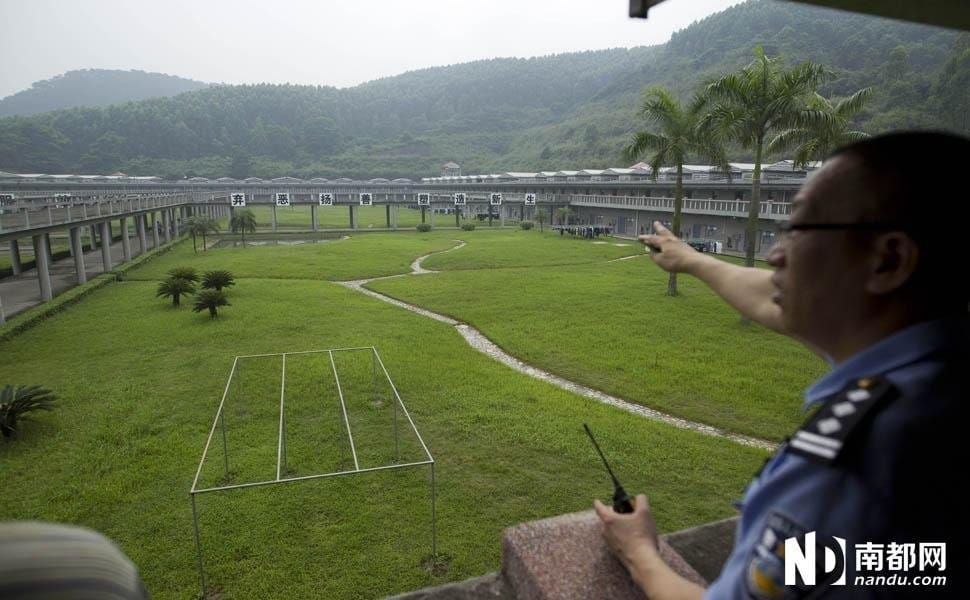
    Dongguan Prison, Warden Li explained, was established in 1988. In November 1998, it was designated a “ministry level” model prison, a status which enabled it to host high-level central and provincial government officials. At the time of my visit, it housed 5,200 inmates in 15 cell blocks. It held the largest population of Hong Kong-Macau-Taiwan residents and foreigners in China – 700 inmates from 20 territories and countries. Each block had 30 cells (six cells on each of the five floors) measuring 30 square meters each. The cells housed 10-12 inmates each. The prison was overcrowded, well above design capacity.

    Foreign prisoners in Dongguan Prison, Guangdong.
    Image Credit: WenXueCity.Com

    Most individuals convicted by courts in Shenzhen and Dongguan Municipalities served their sentences in Dongguan Prison. Those whose household registrations were in those two municipalities but who were convicted by Beijing courts served their sentences in Dongguan Prison. Most foreigners and Hong Kong-Macau-Taiwan residents convicted by Guangdong courts were housed there.

    Warden Li explained the management system of the prison. There were four types of prisoners and four types of punishment. The four types of prisoners were those who were serving sentences for violent crimes, smuggling, other economic crimes, and sexual crimes. Well-behaved prisoners would be treated leniently, “ordinary” prisoners would be treated according to standard policies, prisoners whose behavior was sub-standard would be placed under observation (one-third of Hong Kong prisoners were under observation at the time of my visit), and prisoners who violated prison regulations, including violent and dangerous prisoners, would be “strictly managed.” They could be subjected to solitary confinement.

    The warden extolled the results achieved by the prison’s management system: 35 percent of all prisoners receive a sentence reduction or parole every year, there was a low recidivism rate of 3.2 percent, and there had been no prison escapes. Because of the high level of care available in the prison’s “Grade A” hospital, medical parole was rarely granted, I was told.

    All prisoners were required to do manual labor, except those who were old, weak, or sick, who were placed in their own cell block (prisoners over the age of 55 were considered elderly). The prison made toys and plastic flowers. Since November 1991, none of their products had been exported. (In 1992, the United States and China signed a memorandum of understanding prohibiting trade in products made with prison labor.)

    A Performance

    When the briefing was over, our party went to the prison courtyard to watch a program of performances by prisoners, passing along the way the Grade A Prison Hospital. There were many pieces of advanced medical devices in evidence, though not in use.

    Anticipating the performance, I sat in the front row, next to Warden Li. We were serenaded by an 18-piece band under an energetic conductor. I was told that this man, dressed in standard prison garb save for a red coat and a jaunty navy cap, was a Hong Kong person serving a life sentence. Throughout the band’s performance, the conductor would turn his head and flash a toothy smile.

    One performance in particular stood out. A prisoner from Ghana serving a sentence of death with two-year reprieve performed a skit in which he, dressed as a peasant woman with a rag doll strapped to his back, leapt about the stage singing a plaintive Mandarin song. It bore a striking resemblance to an Al Jolson routine. He looked at me with vacant eyes.

    The warden jabbed me with his elbow. “Pretty good, eh?” he said under his breath. “I think we’ll keep him.” I was outraged. The warden was seeking my opinion as to whether this man’s life should be spared based on an offensive performance with strong racist overtones.

    As we left the courtyard and headed for one of the cell blocks, I admonished Warden Li. He responded, in a matter-of-fact way, “Don’t worry about it. No one serving a death with two-year reprieve at my prison has ever been executed. In 2002, 100 prisoners serving sentences of death with two-year reprieve had their sentences commuted, including eight Hong Kong people.”

    I replied: “Let me give you a piece of advice. If ever you host a delegation of African-Americans don’t lay on that performance. You will regret doing so. They will not be as polite as me.

    Cell Block Nine

    As we approached Cell Block Nine, Warden Li informed me that this block was used to house Hong Kong and Macau prisoners. There were more than 300 such prisoners spread across five floors of cells. The rest of the Hong Kong-Macau prisoner population – totaling around 400 inmates – was placed among the general population, or were in the prison hospital. Most of the Hong Kong-Macau prisoners were serving sentences for drug trafficking and smuggling of common goods. A few of them were serving sentences for espionage. On the wall of the cell block were lists of prisoners whose behavior was “exemplary, normal, and sub-standard.”

    The prisoners could receive monthly visits from members of their families living in the two special administrative regions, Taiwan, and overseas. Although representatives of civil society had visited, no Hong Kong official had ever visited a Hong Kong person in Dongguan Prison.

    Dongguan Prison in Guangdong Province. Image Credit: Baidu.com

    Our small party entered the cell block and walked up a flight of stairs to the second floor. The cells were oblong, opening onto a hallway where there were chairs and a television set on which inmates could watch the seven o’clock news. There was a telephone where prisoners could receive calls from relatives. Each cell had a small balcony. I noticed the smell of cigarette smoke. Contrary to practice in every other prison I have visited in the world, prisoners were apparently permitted to smoke. Each cell had six bunk beds. Space was at a premium.

    We left the cell block and headed for the product exhibition hall. Before we got there, I asked about Chen Meng. The warden recognized his name. Chen, he said, was in the general population, when he wasn’t in a hospital bed. His medical expenses were borne by the hospital, and he was exempt from physical labor. Family members paid regular visits. He had not received any sentence reductions, and was not being considered for medical parole. (Chen Meng served his entire sentence. He was released on March 13, 2007).

    The exhibition of arts and crafts products contained a wide variety of items, ranging from models made with wooden sticks, to plastic flower displays, to paintings. I was asked to sign the visitor’s comments book, and given a Chinese calligraphy brush to do so. I found the brush unwieldy, so I jotted down a few phrases: “Nice work! Congratulations!” and signed the book using my Chinese name, Kang Yuan.

    Years later, an assessment of Dongguan Prison attributed to me appeared in a local Chinese newspaper, much to the amusement of friends. “Even John Kamm, head of the American Human Rights Dialogue Foundation, who has consistently been a critic of China’s prisons, sighed with emotion.” The article went “Your work inspires confidence. I am a fairly serious person who rarely writes inscriptions when visiting prisons, but I was happy with everything I saw today, for which I express my thanks.”

    After the visit to the exhibition hall, we left the prison for lunch at a local seafood restaurant. We dined on rice sparrows, a delicacy during cold weather, washed down by beer and maotai. After lunch, I was driven to the train station, where I boarded the express train to Hong Kong, arriving at my hotel in the early evening.

    Xu Zerong

    I didn’t know it at the time of my visit, but Xu Zerong began serving his sentence for endangering state security in Dongguan Prison in the first half of 2002.

    Xu was a respected scholar and historian who resided in Hong Kong but who, because of his distinguished family background (his father and mother were senior officials in the People’s Liberation Army and Zhongshan University, respectively), traveled to Guangzhou frequently. Xu, aka David Tsui, earned his PhD from Oxford University in 1999, after which he returned to China where he assumed positions at the Guangzhou Academy of Social Sciences and Zhongshan University. Xu’s area of specialization was China’s role in the Korean War. He also studied and wrote articles on China’s support for communist insurgencies in Southeast Asia, a sensitive topic.

    Xu was detained on June 24, 2000, accused of having photocopied and sent out of China excerpts from books on China’s military strategy during the Korean War, which had ended in 1953. Although marked internal (nei bu), Xu believed the books had been declassified. He was also accused of running an illegal publishing business. He was placed in the Guangzhou State Security Bureau Detention Center, and formally arrested on July 29, 2000. He was tried on August 7, 2001 by the Shenzhen Intermediate People’s Court and sentenced to 13 years in prison and three years subsequent deprivation of political rights on December 12, 2001. His appeal was rejected and he was moved from the detention center to Dongguan Prison sometime in the first half of 2002.

    Not long after he was detained, Xu’s friends at universities in the United Kingdom and the United States asked me to help. I began making inquiries. I was finally told that he was serving his sentence in Dongguan Prison.

    Since I had already established a good relationship with Warden Li Jianping, I decided to try a novel approach to helping Xu Zerong. I would write letters to the warden asking him to look after Xu Zerong. On March 14, 2003, I mailed a letter to Warden Li from Hong Kong.

    The first thing I did in the letter was to establish a personal connection to Xu. The two of us had worked together on Professor Ezra Vogel’s One Step Ahead in China. I had contributed a chapter while David had helped with translation for the Chinese edition. Vogel’s work on Guangdong over many years had resulted in his having many friends in the provincial government. The professor gave me permission to use his name in making appeals on Xu’s behalf.

    In my letter, I pointed out that Xu had a number of medical conditions, and asked that he be placed in the prison hospital. “Because Dr. Xu is a scholar, it would help if he could receive books and scholarly journals,” I wrote. “You might also consider exempting him from physical labor and employing him, if he is not too ill, as a librarian or teacher.”

    To my surprise, Warden Li replied on April 15, 2003 to my letter. The letter was written in English. He confirmed that Xu Zerong had been taken into custody at Dongguan Prison. Li said that the prison would look after his health and “dispose him to rational labor work required by rehabilitation.”

    I wrote a second letter to Warden Li on May 28, 2003. By then, the SARS epidemic was raging in China. I offered to donate to the prison’s medical fund to help combat SARS. I again recommended that Xu be placed in the medical ward and be employed teaching English to his fellow inmates. “I think being able to receive letters and reading material . . . would help his morale and assist his rehabilitative progress,” I wrote.

    Warden Li replied on June 11, 2003. He thanked me for my concern over SARS, and said not a single case had been diagnosed in the prison. As for Xu Zerong, “he is now emotionally stable and physically healthy (and) makes use of his advantage of English language helping the other inmates with the English classes.”

    Teaching English to prisoners constitutes meritorious service, and qualifies the prisoner doing the teaching to receive points that can be used to obtain sentence reductions.

    In his June 11 letter, Warden Li confirmed that Xu had the right to receive a small quantity of commodities including books, but pointed out that the books would be examined by prison administrators before they reach prisoners “to safeguard the security of the prison.”

    I immediately set about trying to mail books to Xu in Dongguan Prison. I quickly discovered, from friends with ties to the provincial prison bureau, that books in English would have to be translated into Chinese! (One of the books I sent to Xu was the English-language translation of Tolstoy’s War and Peace.) I subsequently discovered that books published in Hong Kong and sent from the Special Administrative Region attracted extra scrutiny. Finally, on a trip to Shanghai, I purchased books and sent them via domestic mail to Dongguan. Those books made it to Xu Zerong.

    I sent my third letter to Warden Li on July 25, 2003, but I never got an answer. Xu Zerong was transferred in November 2003 to Xicun Prison, also known as Guangzhou Prison. Xicun Prison is considered the best prison in Guangdong, and Xu was treated well there.

    Xu received a nine-month sentence reduction in 2006. This was followed by a 10-month sentence reduction in 2008 and a five-month sentence reduction in 2011. He was released two years early on June 23, 2011. Despite having a supplemental sentence of three years deprivation of political rights, Xu was allowed to return to Hong Kong.

    Not long after he arrived in Hong Kong, Xu gave an interview to Open Magazine. In the interview, published on August 6, 2011, Xu credits my efforts on his behalf – visiting the prison in the company of an official from the Ministry of Justice, mailing him books, frequently submitting lists with his name on them – for his better treatment and early release. My visit was covered in the prison newspaper. Xu claimed that with my attention, “prison conditions improved, and all prisoners benefited.”

    A few years after Xu’s release, I was told by one of my interlocutors in the Guangdong government that Warden Li Jianping had been criticized for engaging in the exchange of letters with me. He was transferred to another prison, but otherwise was not punished.


    Listen to the Encounters with China podcast.

    Subscribe to receive notifications about new episodes. 

    Read all John Kamm Remembers stories.


  • “Mandarin Only” Visitation Rules

    Bilingual education class offered in a juvenile reformatory in Kashgar, Xinjiang. Image: Baidu.cn.

    The promotion of Mandarin as China’s lingua franca, commonly referred to as “tuipu,” has been one of the most sweeping initiatives implemented by the Chinese government. Tuipu serves the dual purpose of forging a sense of national identity based on Han culture and weakening regional and ethnic loyalties. Some regional dialects and ethnic minority languages have largely died out in China because of tuipu propaganda that portrays them as “uncivilized” and “barbaric.” The use of regional dialects and ethnic minority languages (e.g. Mongolian, Tibetan, Uyghur) is banned in many government offices and schools, and on television programs. According to the latest official statistics, the literacy rate of Mandarin in urban China has reached 90 percent, however in rural areas it remains around 40 percent.

    Within the carceral system, prisoners are not required to speak Mandarin among their peers, but the use of dialects and minority languages are subject to varying degrees of restrictions when it comes to family visitation rules. It should be noted that at the national level neither the Prison Law nor the visitation and correspondence regulations issued by the Ministry of Justice (MOJ) on December 5, 2016, contain provisions restricting the use of dialects or minority languages. However, in practice many local prisons have taken it upon themselves to mandate the use of Mandarin during family visitations, with varying degrees of enforcement. As many of those who come into conflict with the law are from rural areas, it comes as little surprise that many of those subject to prison surveillance have limited economic means and educational opportunities to learn Mandarin. Prisoners and their family members, especially older generations, who can only speak their regional dialects or their minority languages are consequently deprived of their visitation rights. Dui Hua’s research has found that those who fail the “Mandarin only” visitation requirement also have slimmer prospects for obtaining clemency.

    Domestic news media in China occasionally report stories about the use of regional dialects during prison visitations to showcase the more “human” side of prison management. A news article in 2004 reported a story from Shanghai’s Tilanqiao Prison where well-behaved prisoners were allowed to speak in their local dialects when making phone calls to family members. A Xinhua article in 2014 covered a story about a prisoner serving time in Guangdong’s Jieyang Prison who spoke in a local dialect during a video call with his mother in Guangxi, who he had not seen in three years.

    In Sichuan’s Jinjiang Prison, visitation rules state that prisoners and their family visitors can speak in Mandarin or Sichuanese during visitations. However, such leniency is not extended to many other prisons around the country. In Guangdong, Zhuang Songkun (庄松坤) is one of the Wukan villagers who was sentenced in December 2016 for allegedly instigating protests against local government corruption. When Zhuang’s wife tried to visit him at Guangdong’s Wujiang Prison on February 23, 2017, she was not allowed to speak in her Chaozhou dialect. As she was unable to speak Mandarin, the prison officers confiscated her microphone, which had been attached to a video recording device, cutting short the whole visit to a mere five minutes. Henan-based lawyer Ren Quanniu publicly remarked that such a policy is an abuse of power, especially given that there is no written provision prohibiting the use of regional dialects. The MOJ regulation entitles prisoners to up to one monthly visit from family members or guardians in the form of telephone calls, face-to-face meetings, or video calls. (In some parts of China, visits from family members take place less frequently.) Meetings are not supposed to exceed 30 minutes, though sometimes more time is given as a reward for good behavior. Even during court proceedings, defendants, police, prosecutors, and judges often communicate in regional dialects. It is unlawful to deprive prisoners such as Zhuang of their visitation rights just because prison staff cannot understand them, says Ren.

    Wujiang Prison is not alone in prohibiting regional dialects; similar visitation restrictions are commonplace across China. A guide issued by Guangdong’s Gaoming Prison in December 2015 states that a family visit will be cancelled unless both prisoners and visitors speak Mandarin. The same policy is enforced in Fujian’s Qingliu Prison as part of the campaign to “cultivate civilization.” In the same province, an exception is made at Putian Prison, but only for elderly prisoners who cannot speak Mandarin and who are meeting with a relative who can provide translation for the supervising guard.

    Despite the generally lower Mandarin proficiency among many ethnic minority groups in China, there are still language restrictions in prisons located in provinces with large ethnic minority populations. In Guizhou province, where one-third of the population is non-Han Chinese, minority languages spoken in prisons are strictly regulated. A provincial visitation guide issued in 2015 bans ethnic minority languages and the use of any “secret languages” during visitations to the provincial judicial police hospital that caters to prisoners in need of medical treatment. The restriction aims to cultivate “linguistic civilization” and maintain “one’s dignified demeanor.” The same restrictions apply to Wenshan Prison and Yiliang Prison in Yunnan province, which has an ethnic minority population of over 15 million. Yiliang Prison does not explicitly forbid the use of Yunnanese among local prisoners, but all other regional dialects and minority languages are prohibited. Violators of the rule can have their family visitation rights taken away for six months and in serious circumstances a case can be filed to investigate the matter.

    Sichuan appears to be one of the few exceptions. Given that Sichuan has a non-Han population of approximately five million, the Sichuan Prison Administrative Bureau permits the use of minority languages like Tibetan in prisons throughout the province. Shandong province, although not nearly as ethnically diverse as Sichuan, permits minority language use during visitations, albeit with some restrictions. For instance, Shandong’s Luning Prison only allows the use of minority languages when prisoners have obtained prior police approval.

    In China’s autonomous regions of Tibet and Xinjiang, regulations on prison visitation rules could not be found by Dui Hua researchers. However anecdotal evidence from formerly incarcerated individuals suggests that these regions are not unlike the rest of China when it comes to enforcing Mandarin during prison visitations. Circumstantial factors such as the particular prison, the language ability of the guards on duty, and the political climate at the time can impact whether and how language and dialect restrictions are enforced.

    Dui Hua’s research into clemency judgments found that the practice of speaking regional dialects also has a significant impact on a prisoner’s chances of gaining sentence reductions and parole. The judgments reveal that speaking dialects can be considered evidence of not “showing remorse,” a prerequisite for obtaining early release. Sentence reductions and parole are granted to those who have accrued a certain number of points for good behavior. Between 2013-2016, prisoners in Fujian and Shanghai received point deductions ranging from 0.5 to 2 points for each instance of speaking regional dialects during family visitations. In December 2016, the Fujian Bureau of Justice implemented new measures for assessing clemency points, drastically increasing the penalty for speaking dialects to a deduction of 30-100 points. In accordance with the new provincial directive, Wuyishan Prison deducted 30 points from a prisoner because he did not speak Mandarin on just one occasion during a family visit in March 2017.

    The impact these rules have on prisoners who are ethnic minorities or who come from rural areas with limited opportunities to learn Mandarin, or those who come from both backgrounds is significant. The rules not only deny these groups precious contact with their families and opportunities to gain early release but they also function to further stigmatize and criminalize these groups because of their ethnicity and limited economic means.

    It is not uncommon for prisons to impose restrictions on communication within prisons for security purposes, such as to guard against distribution of printed materials that can be used to plan escapes or other crimes. However, language restrictions on visitations are now widely uncommon. (In the United States, Utah was the last state to drop the “English only” visitation requirement in August 2013.) While the promotion of Mandarin has been crucial to China’s development, punishments in the form of denying visitation rights and equal opportunities for clemency due to language ability deprive prisoners of their constitutional rights (Article 4 “All nationalities have the freedom to use and develop their own spoken and written languages.”)

    Dui Hua has found some cases where prisoners earn points towards clemency as a result of learning Mandarin. In some rare cases, rewards are given to those who learn minority languages and contribute to “bilingual education classes” offered to prisoners to learn both Mandarin and ethnic minority languages in autonomous regions. However, these cases are rare and resources for Mandarin education in prisons are by no means comprehensive.

    The suppression of regional dialects and ethnic minority languages that has accompanied tuipu has long been a source of social and ethnic tension, sparking incidents of unrest across China. Learning Mandarin can better equip prisoners with skills for post-release integration and opportunities for clemency provide prisoners with a strong incentive to learn and a chance at earlier reintegration. Rather than directing resources to support prisoner’s education and rehabilitation, the punitive “Mandarin only” visitation rules serve instead to undermine inter-ethnic relationships and run counter to the ideal of the “harmonious society” that the Chinese Communist Party and the Chinese government strive to achieve.

  • Dui Hua Welcomes Arrival of Dhondup Wangchen in the United States

    SAN FRANCISCO (December 27, 2017) – Tibetan independent filmmaker Dhondup Wangchen arrived at San Francisco International Airport on Christmas Day, 2017. He has been reunited with his family after having been separated for more than ten years during which he was held incommunicado, detained, imprisoned, and subjected to deprivation of political rights in the People’s Republic of China. He conveys his thanks to the governments, organizations, and individuals who made this day possible.

    Dhondup Wangchen and Golog Jigme Gyatso made a documentary – Leaving Fear Behind – based on interviews with Tibetans in China between 2007 and 2008. Dhondup Wangchen, now 43 years old, was taken into custody in March 2008 and formally detained in June the same year. He was convicted of inciting splittism and sentenced to six years imprisonment and three years’ subsequent deprivation of political rights by the Xining Intermediate People’s Court in Qinghai Province on December 11, 2009. He began serving his sentence in Xining Prison in 2010.

    In response to his faltering health, and due to international concern, the prison authorities in Qinghai Province transferred Dhondup Wangchen from Xining Prison to Qinghai Provincial Women’s Prison in late 2012. He received better treatment there, and his health gradually improved.

    Dhondup Wangchen was released from Qinghai Provincial Women’s Prison on June 5, 2014. He returned to his home village in Gansu Province where he served his three-year sentence of deprivation of political rights. That sentence expired on June 4, 2017.

    “Although many people, organizations, and governments worked hard to bring about Dhondup Wangchen’s release and safe journey to the United States,” remarked John Kamm, executive director of Dui Hua, “the person who worked hardest and deserves the most credit for this happy development is his wife Lhamo Tso. While raising the couple’s four children and grappling with health issues of her own, Lhamo Tso worked tirelessly to free her husband and bring him home to her and their children. Dui Hua salutes her, and joins people around the world in rejoicing at the news of Dhondup Wangchen’s arrival in the United States.”

  • Imprisonment for Crimes No Longer in the Criminal Law

    1983 Strike Hard Campaign in Shanghai. Given the catch-all nature of hooliganism, hooligans became a target of the campaign, where tens of thousands were prosecuted, many for non-violent acts seen as “immoral.” Image Credit: 360doc.com

    Dui Hua research has uncovered the names of more than 180 individuals serving sentences for hooliganism — a crime removed from the Criminal Law in 1997 — as late as 2015. Dozens of these prisoners are still serving their sentences. Based on circumstantial evidence, Dui Hua believes that one of them may have been convicted of hooliganism for offenses committed during the Spring 1989 protests that rocked China.

    The last known June Fourth prisoner serving a sentence for hooliganism was Liu Zhihua (刘智华). Liu was released from Loudi Prison in Hunan Province in January 2009.

    Hooliganism: A Catch-all Offense

    Since hooliganism was codified in the Criminal Law in 1979, a large but unknown number of people have been convicted of this offense. The crime of hooliganism was created with the aim of deterring a wide range of disorderly conduct including “assembling a crowd to have brawls, stirring up fights and causing trouble, humiliating women, and other hooligan behavior.” Inspired by the criminal laws of the former Soviet Union and other socialist states, Chinese lawmakers left vague what constituted “humiliation of women” and “other hooligan behavior.” Hooliganism is essentially a catch-all offense, giving authorities discretion to punish undesirable behavior as defined in interpretations issued by the Supreme People’s Court and the Supreme People’s Procuratorate.

    The Case of Wang Shaohua: A June 4 Prisoner?

    Wang Shaohua (王少华) was sentenced to death with reprieve for hooliganism at the age of 17, two months following the pro-democracy protests of 1989. Wang remains incarcerated in Wuzhong Prison in Ningxia autonomous region. Student and worker protesters who participated in the June Fourth protests were given swift and severe punishments for crimes such as hooliganism, counterrevolution, and charges such as arson, assault, and robbery, often within a few months following their detention. August 1989 accounts for the highest number of trials for hooliganism following the June Fourth protests.

    Wang was sentenced in Shizuishan, a town just 47 miles north of Ningxia’s provincial capital Yinchuan. Yinchuan was a city rocked by the June Fourth protests. A government record states that approximately 50,000 people took to the streets of Yinchuan on May 18. The day following the bloody suppression in Beijing on June 4, 800 students and teachers from Ningxia University held a memorial for the deceased protesters. Two days later, the number of participants at the memorial nearly doubled. The mourning continued until participants were arrested en masse by public security authorities on June 25.

    Wang received several sentence reductions after being convicted of hooliganism. In 1997, Wang was released on medical parole, but he failed to observe the terms of his parole and was eventually taken back into custody. In 2008, a local court combined the remainder of his hooliganism sentence with an additional crime of tomb-robbing, leading to a total sentence of 19 years’ imprisonment. Wang is due to be released in August 2018. (Unlike counterrevolution which was tried by intermediate people’s courts, hooliganism was tried by district courts.)

    Incarceration for Crimes no Longer in the Criminal Law

    Image Credit: Dui Hua Foundation.

    After the crime of counterrevolution was removed, along with hooliganism, in the revised Criminal Law in 1997, Dui Hua Executive Director John Kamm began lobbying the Chinese government to release counterrevolutionaries who were still serving sentences in prison. His pleas fell on deaf ears. A letter from the Ministry of Justice dated April 17, 1998, cited Article 12 of the amended Criminal Law: “Before the entry into force of this law, any judgment that has been made and entered into law and has become effective according to the laws at the time shall remain valid.”

    Individuals who committed crimes of counterrevolution before the revised Criminal Law came into effect that were discovered after 1998 have in fact been prosecuted and sent to prison for committing the crime of counterrevolution. A striking example is the case of Chen Yulin, a former Chinese official and Hong Kong businessman who was sentenced to life in prison in 2004 for spying for the British in pre-handover Hong Kong.

    Chinese news media has reported at least two hooliganism trials since the crime was removed in 1997. In May 2012, Zhao Dameng (赵大猛) received a suspended sentence in Nanjing for an act of hooliganism committed in 1996; in April 2013, a man surnamed Cao was sentenced in Hunan to 18 months’ imprisonment for hooliganism. Several other hooliganism trials concluded recently have not received any coverage.

    Dui Hua’s research into online judgments reveals that as of January 1, 2015, at least 182 hooliganism prisoners remained in prison. Of them, 121 were released between 2015 and 2017; 61 continue to serve their sentences.

    China’s Criminal Law imposes no limit on the period of prosecution for cases where the suspect has escaped after a case has been filed by police or procuratorate, or heard by the courts. Not all hooliganism prisoners sentenced after 1997 were escapees like Zhao Dameng. Some were released on probation, but re-sentenced for violating parole rules. Courts can also hear a new case and extend sentences for hooliganism prisoners for violating prison regulations. A few prisoners were sentenced to new offenses that were missing in the original hooliganism trials, and thus received sentence extensions.

    Dui Hua found that 20 of 182 hooliganism prisoners still in jail as of January 1, 2015, were sentenced during or after 2010. Of these 20 prisoners, Chen Dong (陈东) is set to be released in 2023. Chen was sentenced to 15 years’ imprisonment for hooliganism as a standalone charge in 2010.

    Image Credit: Dui Hua Foundation.

  • The 1983 Strike Hard Campaign
  • Given the catch-all nature of hooliganism, hooligans became a target of the 1983 Strike Hard campaign where tens of thousands of hooligans were prosecuted not only for their violence or trouble-making, but also other non-violent acts seen as “immoral.” Courts were required to hand down “swift and severe” punishments, with sentences up to immediate execution. An even larger number were sent to re-education through labor camps without trial.

    Most prisoners sentenced to death with reprieve or life imprisonment during the 1983 campaign have received some form of clemency, but not all of them have been released. Dui Hua’s research indicates that as of January 1, 2015 six hooligan prisoners sentenced in 1983 were still serving their sentences and as of the end of 2017 two remain incarcerated.

  • The 1996 Strike Hard Campaign
  • In 1996, China launched a second Strike Hard Campaign, this time to curb the growing influence of gangsters and triads. Although hooligans were not the focus of the campaign, another wave of life sentences and death with reprieve sentences for hooliganism were imposed. Dui Hua found that as of January 1, 2015, 76 hooliganism prisoners sentenced during the 1996 campaign remained imprisoned and twenty are still serving their sentences as of the end of 2017. At least four will be released in the 2020s.

    Ethnic Bias in Clemency

    Clemency provided to hooliganism prisoners has a clear ethnic bias. Of the six hooliganism prisoners who did not receive clemency prior to 2016, four are Xinjiang ethnic minorities. The other two are Han Chinese who were sentenced to life imprisonment in 2012. The Fujian High People’s Court received recommendations from the prison to commute their sentences to 19 years and 19½ years, respectively, in 2015. The result of the sentence commutation application is unclear.

    Unlike the two Han Chinese who were considered for clemency three years into their sentence, the same opportunity was not given to three Uyghurs and one Uzbek in Xinjiang until they had served many more years of their sentences. The Uzbek was sentenced in 1992 to death with reprieve for hooliganism and other violent crimes; the Uyghurs were sentenced to life imprisonment or death with reprieve in April-May 1997. They were sentenced a few months after the Ghulja Incident in 1997, a violent crackdown by the Chinese government on the traditional Uyghur cultural festival of Meshrep. While the two sentenced to death with reprieve had their sentences commuted to life imprisonment, neither of them are known to have received further sentence reductions. Even if the Xinjiang High People’s Court were to have granted them clemency in 2016, they would still have at least two more decades to serve until the late 2030s, possibly making them the last known hooligans serving sentences for the now defunct crime.

    An Outdated Sentencing Regime

    One would be mistaken to assume that the acts that hooliganism prisoners were prosecuted for are no longer considered illegal. In today’s Criminal Law, crimes of disturbing public order like “picking quarrels and provoking disturbances” and “assembling crowds to disturb public order” are used to prosecute human rights lawyers, petitioners, and protesters for what were formerly considered hooligan “trouble-making behavior.” Equivalents for hooligan “licentious behavior” like “insulting women” are harder to locate in the current criminal law.

    In March 2015, President Barrack Obama commuted the sentences of 22 prisoners who were sentenced to life imprisonment for drug offenses because they were convicted under what he called an “outdated sentencing regime”. Their cases were largely non-violent, but “because of the operation of sentencing laws on the books at the time, [they] received substantial sentences that are disproportionate to what they would receive today,” said a deputy attorney general at a press conference announcing the clemency initiative. Similarly, hooliganism prisoners are incarcerated under an “outdated sentencing regime.” Campaign-style trials during the two Strike Hard Campaigns were concluded at the expense of defendants’ rights and judicial fairness. The sentences they received at that time were more severe than what they would receive under today’s Criminal Law. Under Article 15 of the International Covenant on Civil and Political Rights, a prisoner shall benefit from a lighter penalty if such provision is made by law subsequent to the commission of the offense. As a signatory of the covenant since 1998, China should consider granting additional clemency to those who remain in jail for the crimes of hooliganism and counterrevolution. Failure to do so will present yet another obstacle to the country’s ratification of the International Covenant on Civil and Political Rights.

  • Dui Hua Digest, December 2017

    EVENTS

    Annual Friends of Dui Hua Holiday Celebration
    Executive Director John Kamm delivers remarks at the annual friends of Dui Hua holiday celebration, December 5.

    On the evening of December 5, 2017, more than 60 friends of Dui Hua gathered for the foundation’s traditional holiday celebration at the Presidio Golf & Concordia Club in San Francisco. Dui Hua Executive Director John Kamm briefed guests on the foundation’s activities in 2017 and plans for 2018. Judge (ret) Leonard Edwards gave a special presentation on the US-China Juvenile Trial System Reform Seminar that was co-hosted with the Supreme People’s Court of China in November in Shenzhen. Five of the seven experts who traveled to Shenzhen attended the event, and contributed observations and conclusions.

    Kamm began his remarks by going over the results of the 19th Party Congress held in Beijing in October and President Trump’s state visit to Beijing in November. Both events have implications for human rights in China. While cementing his position as the “core” of the Communist Party’s leadership by having his name inserted in the party constitution, Xi Jinping has moved to rein in party abuses like shuangguei. Noting that there had been positive developments like reducing the number of juveniles in prison, cutting the number of executions, and enhancing transparency, Kamm decried the rise in the number of arrests and convictions for non-violent political and religious activities.

    Kamm opined that the focus by President Trump on securing the release of three UCLA basketball players who had been detained for shoplifting detracted from the effort to have a broader dialogue on human rights that dealt with the cases of both American citizens and Chinese activists. There was no public mention of human rights during the state visit.

    Judge Edwards reviewed the results of the seminar on juvenile trial system reform which was attended by more than 40 senior judicial officials and judges from 15 provinces in China. Both sides learned a great deal about efforts to reform the juvenile trial systems in the two countries. The American team was impressed by the quality of the presentations and the dialogue, both during the sessions and in less formal settings. The visits to sites rarely visited by foreigners – including two courts and two facilities for rehabilitating juveniles on probation – were highlights of the two-day program. Judge Edwards’ remarks were followed by comments from Dui Hua Director Magdalen Yum, who played a key role in organizing and underwriting the Shenzhen program.

    Looking ahead, Executive Director Kamm revealed that Dui Hua has begun work to hold an international symposium on “Girls in Conflict with the Law.” The foundation has identified an enthusiastic partner in Hong Kong, and experts are being identified. The program is tentatively scheduled for 2019. Talks to push the idea forward will take place during Kamm’s visit to Beijing and Hong Kong in January 2018.

    Kamm reminded the audience, most of whom live in the Bay Area, of something that Napoleon Bonaparte famously said: “An army marches on its stomach.” In Kamm’s words, “An NGO marches on its bank accounts.” He thanked Dui Hua’s supporters for their assistance. Although the December 5 event was not a fundraiser, it nevertheless resulted in a number of generous donations. Dui Hua will end 2017 in a strong financial position, ready for another year of hard work promoting human rights and judicial reform in China and the United States.

    PRISONER UPDATE

    Dui Hua has information on three individuals who remain in jail for counterrevolution. Twenty years ago, the crime of counterrevolution was removed from the Criminal Law.

    In September, Dui Hua received a government response confirming that labor activist Jiang Cunde (蒋存德) is continuing to serve his sentence in Shanghai’s Tilanqiao Prison for counterrevolution. His sentence is due to end on August 22, 2024. Jiang has been in prison for most of the last three decades since he was sentenced to life imprisonment in 1987 for counterrevolutionary sabotage and illegal possession of weapons. He was charged with planning to hijack a plane to Taiwan. Prior to his detention, Jiang advocated for an independent labor union based on Poland’s Solidarity Movement. He was diagnosed with schizophrenia in prison, and in 1993 he was released on medical parole. In 1999, he was re-incarcerated for participating in demonstrations. Since then, Jiang has received only one sentence reduction, in 2004, when his life sentence was commuted to a fixed-term of 20 years’ imprisonment. A government response given to Dui Hua in 2015 stated that Jiang was held in a “mental retardation unit.”

    The two other remaining known counterrevolutionary prisoners are Uyghurs. Some Uyghur political activists have received sentence extensions after entering prison. In 2015, the Chinese government informed Dui Hua that Abdukerim Abduweli, chairman of the Islamic Reform Party, had received five sentence extensions for violating prison rules. The Urumqi Intermediate People’s Court sentenced him to 12 years in prison on May 6, 1993, for counterrevolutionary propaganda and incitement and leading a counterrevolutionary group. To date, he has been imprisoned for 27 years and still has one more year to serve before his sentence expires in December 2018.

    Omer Akchi has served his sentence for the now defunct crime of counterrevolution for 21 years. Detained in December 1996 for organizing the Islamic Party of Allah, Omer Akchi was sentenced to 14 years’ imprisonment in Xinjiang’s Aksu Prefecture. In 2006, he was sentenced to life imprisonment for splittism while serving his sentence. He is not known to have received any sentence reductions.

    DUI HUA IN THE NEWS

    In November, President Trump made his first state visit to China. While in Beijing, Trump decided to personally intervene in the case of the three UCLA basketball players who were arrested for shoplifting. The story detracted from the valuable opportunity to raise cases of other American citizens and Chinese political dissidents currently being held in China. Dui Hua was cited in articles in The Washington Post and Newsweek covering this story.

    John Kamm Remembers

    John Kamm Remembers is a feature that explores Kamm’s advocacy stories prior to and since Dui Hua’s establishment in 1999

    To read part one click here.

    Enemy of Dialogue (Part 2 of 2)

    Wu Aiying, former Minister of Justice. Image credit: Caixin.

    The Three Nos

    I returned to Beijing on June 28, 2005. Shortly before arriving, I phoned a junior official at the MOJ and was told that everyone was too busy to see me. This would be the first time since 2000 that I would not be afforded a meeting with officials of the MOJ on a trip to Beijing. A woman by the name of Wu Aiying was settling into her new job as Minister of Justice. I later learned that one of her first acts was to order the cessation of all cooperation with Dui Hua.

    My next trip to Beijing was in October 2005. Upon arrival, I phoned the Director General of the Department of Judicial Assistance and Foreign Affairs Mr. Gong Xiaobing. I had a good relationship with Mr. Gong, having hosted him in San Francisco. Mr. Gong told me that, as an old friend of the ministry, I could visit the headquarters at the precise date and time he specified. He said I should arrive promptly, not a minute early or a minute late. To get this meeting, I would have to agree to three conditions: 1) There would be no talk of cooperation between Dui Hua and the ministry; 2) There would be no talk about “criminals;” and 3) I would not try to hand over a list.

    A Solemn Representation

    I was shocked. “What else is there to talk about? What’s the point of having a meeting?” I asked. I protested that this was a serious violation of the understanding under which we had operated for nearly 15 years, and that I would make a “solemn representation” to the Ministry of Foreign Affairs (MFA) when I met them the next day. Mr. Gong sheepishly replied: “Please understand. I didn’t make this decision. It was made at a senior level.” He was referring to Wu Aiying.

    Wu Aiying was born in Shandong Province in 1951, the daughter of poor peasants. She joined the Communist Party at a young age, and was admitted to Shandong University in 1971, during the Cultural Revolution. She was almost certainly a Red Guard. She had studied the thoughts of Chairman Mao for two years, which was the extent of her undergraduate education (After she became MOJ minister, she received a law degree from the Party School.) She rose through the ranks of Shandong officials, becoming a senior member of the Communist Youth League in 1982. She became a vice governor of Shandong Province in 1993 in which capacity she oversaw the police and the courts. Some of the harshest sentences of counterrevolution were handed out in Shandong Province.

    Wu became a vice minister of justice in 2003 and was appointed minister in July 2005. She was a prominent member of the China Youth League faction, a bastion of support for then-Party Secretary Hu Jintao. Wu Aiying was known as an ignorant, short tempered official who had famously upbraided an official whose cell phone had gone off during one of her meetings. She knew nothing about law, preferring to talk about cooking when meeting foreign visitors. She enjoyed traveling abroad where she was given expensive gifts and enjoyed lavish banquets.

    Wu Aiying’s Damage to China’s Human Rights Dialogues

    The MOJ under Wu Aiying did everything it could to undermine Dui Hua’s work in China. In addition to refusing to see me, accept lists, or give answers to my queries, the ministry barred me from visiting prisons. On a visit to Yichang in central China, a visit to a prison that had been agreed to in advance by local officials was abruptly cancelled on orders from Beijing. In February 2014, Dui Hua partnered with Renmin University School of Law to hold an international symposium on women in prison. Despite Dui Hua having invited the MOJ to participate in the conference more than six months in advance, and despite the relevance of the topic to the MOJ’s work, the ministry said they were too busy to attend. Ministry officials actively discouraged Chinese Mainland participants from attending, resulting in the cancellation of a presentation from a senior member of the China Prison Society.

    The dismantling of the MOJ’s relationship with Dui Hua was but one act in a wide-ranging assault by Wu Aiying on human rights dialogues with foreign governments and international organizations. She resisted providing responses to lists accepted from the MFA’s official dialogue partners. In 2005, China had official dialogues with nine foreign governments. In 2016, her final year as minister of justice, the number of dialogues had shrunk to three. She told the president of an international humanitarian organization that visits to Chinese prisons were out of the question.

    The damage Wu Aiying did to bilateral human rights dialogues paled in significance to the damage she did to Chinese activists and human rights defenders. She tightened rules governing clemency, reducing the number of sentence reductions and paroles of political prisoners. The MOJ oversees and licenses China’s lawyers. Wu Aiying made sure that human rights lawyers were stripped of their licenses. She doubtless played a role in the crackdown against those lawyers that began in July 2015. She opposed granting medical parole to prominent political prisoners including Chen Guangcheng, Tenzin Delek Rinpoche, and Liu Xiaobo. The latter prisoner, who was awarded the Nobel Peace Prize in 2010, served virtually his entire prison sentence while Wu was minister. He passed away in July 2017.

    The Downfall of Wu Aiying

    It turns out that Wu Aiying was not only an ignorant and crude obstructionist, she was also a poor judge of people and a terrible manager. In early 2017 it emerged that the director general of the MOJ’s political department, Lu Enguang, was a conman and scam artist who had faked his entire biography – education, age, even party membership – to gain a position in the MOJ. Lu Enguang, like Wu Aiying, was a native of Shandong Province. He was promoted by Wu Aiying, to whom he gave expensive gifts and for whom he performed menial tasks. According to Chinese media reports, as many as 20 other senior MOJ officials benefited from this conman’s corrupt activities. Lu was arrested and is awaiting trial at the time of this writing.

    Wu Aiying was removed as Minister of Justice in July 2017. She was expelled from the Communist Party at the 19th Party Congress in October 2017. Lawyers all over China rejoiced at hearing the news. It is expected she will face trial, and she could well wind up in one of the women’s prisons she once oversaw (during her tenure at the MOJ, the number of women in prison in China rose by more than 50 percent). If she goes to prison, she will have received her just deserts.

  • Dui Hua Digest, November 2017

    EVENTS

    Dui Hua Holds Juvenile Justice Program with Supreme People’s Court in Shenzhen
    The American and Chinese delegation at the Juvenile Delinquent Assist & Education Campus of Baoan District, November 9.

    While President Donald Trump soft-pedalled human rights on his first state visit to China earlier this month, Dui Hua was busy holding its fifth juvenile justice exchange with the Supreme People’s Court (SPC) in Shenzhen. The exchange was held on November 8-9 and was attended by over forty Chinese participants, including representatives from the Office of Juvenile Trials under the Supreme People’s Court’s Research Department and juvenile judges from courts across fifteen provinces in China.

    Dui Hua’s Executive Director John Kamm, Program & Development Manager Yin Yu, and Program & Publications Associate Xandra Xiao travelled to Shenzhen where they were joined by the US delegation consisting of five leading juvenile judges and juvenile justice experts. Judge Leonard Edwards led the US delegation, which included Patricia Lee, Managing Attorney for the Juvenile Unit of the San Francisco Public Defender’s Office; Judge Roger Chan, San Francisco Superior Court Judge and former Executive Director of the East Bay Children’s Law Offices; John Tuell, Executive Director of the Robert F. Kennedy National Resource Center for Juvenile Justice; and Shay Bilchick, founder and Director of the Center for Juvenile Justice Reform at Georgetown University. Former Dui Hua juvenile justice exchange participants Judge Julie Tang of the San Francisco Superior Court and Judge Elizabeth Lee of the San Mateo Superior Court joined the delegation as expert observers.

    Discussion between the American and Chinese delegation was lively, with conversation spilling into the hallways in between sessions. Both sides agreed on the importance of promoting education and non-custodial measures in juvenile cases and stressed its overall long-term benefit in lowering juvenile delinquency and recidivism. The issue of the independence of the juvenile courts came up a number of times. Judge Edwards discussed the juvenile justice movement’s rejection of merging juvenile and criminal courts in the United States, due to the inherent differences between youths and adults. The need for specialized courts, judges, and social services that can appropriately service juveniles is critical. Children are not simply small adults. The Chinese delegation made clear that they too shared this overarching goal of “treating the juvenile offender as a child rather than the child as a criminal.” They reiterated the obstacles juvenile courts in China currently face in operating independent of criminal and family courts.

    Questions arose from the American delegation on the issue of family engagement in juvenile cases involving China’s left-behind children, a population of sixty million children separated from their parents due to the mass migration of workers from China’s rural to urban regions. The Chinese side emphasized the government’s role in supporting welfare organizations and guardians such as grandparents in such cases, as well as specific measures including school tuition fee exemptions to alleviate the economic burdens faced by left-behind children. Family engagement was a challenge shared by both the American and Chinese delegation. John Tuell discussed the importance of providing families with the right tools and resources to help restore delinquent youths as well as providing families with formal opportunities to communicate with and provide feedback to the courts. Professor Song Yinghui discussed the similar challenges faced in China, where although schools do take on the responsibility of educating parents there is not nearly enough engagement and that perhaps China needs to consider legislation on providing more formal parental education.

    On the morning of November 9, the American and Chinese delegations visited the Juvenile Delinquent Assist & Education Campus of Baoan District. The Campus hosted the Juvenile Trial Court of Baoan District, a Social Worker Center, and a Psychological Guidance Center; it is a model campus in China that aims to provide comprehensive rehabilitation support for juvenile delinquents. Interestingly, a juvenile detention center and an adult detention center operated by the Ministry of Justice are located adjacent to the Campus. The American delegation is the second foreign delegation to have visited the Campus, and the first since 2010, when the Australian Human Rights Commission was granted a tour.

    The delegates first viewed the roundtable juvenile trial court of the campus, where they learned that around two to three percent of the juvenile cases undertaken by the Baoan Juvenile Trial Court involve juvenile girls. Next, they visited the Campus’ Social Worker Center, which provides support to juvenile delinquents during and throughout pre- and post-trial periods. To date, 2,974 juveniles have received support from the Center since the Campus’ establishment in September 2009. The Center has supported the rehabilitation of 1,188 juvenile delinquents on probation, eight of whom have been admitted to universities. The staff showed the visitors shelves where juvenile offenders’ sealed records were located; the files include judgments, social investigation reports, psychological assessment reports, and other documents, in neatly bound books. Addressing questions from American delegates, staff from the Campus noted that the reports are only accessible by the social workers or judges, even juveniles themselves cannot access their own records. This practice is different from the American system, where the records of juvenile cases belong to the juvenile involved.

    Social workers demonstrate record sealing protocol at the Social Worker Center.

    Next door was the Psychological Guidance Center that provides services to juveniles on probation. A psychologist from the Center demonstrated the Sand Play therapy for the visitors. It was noted that 96 percent of the psychological counseling recipients are males.

    After departing the Baoan Campus, the delegation headed to the nearby Airmate Electrical Company, a local Shenzhen electrical appliance manufacturing company where youth on probation are employed. Twenty such juveniles currently work there. The delegation learned that companies that hire youth on probation can be provided tax incentives. After successfully completing their probation, the youth are allowed to stay in Shenzhen.

    In the afternoon, the Shenzhen Intermediate People’s Court hosted a roundtable discussion between the American delegation and a group of senior court officials. The American delegation learned about the local pressures facing Shenzhen’s juvenile population and the preventative measures in place to curb juvenile delinquency. Owing to Shenzhen’s large migrant worker population, more than 90 percent of delinquents who come before Shenzhen’s juvenile courts are from outside Shenzhen. Shenzhen juvenile judges introduced the concept of “social worker stations” located inside courts that are staffed by social workers trained in providing youth psychological examinations. In cooperation with schools and parents, the social workers aim to capture a fuller picture of the juvenile’s case that is used in a “social investigation report” presented to the judge. It was evident that the cooperation between the courts, social workers, schools, and families, which was discussed by the Chinese delegation at the Seminar held the day before, was also operating in practice in Shenzhen’s juvenile courts. That said, many of the judges from the Chinese delegation also expressed the view that more work needs to be done in this field and that many courts still lack resources to provide adequate social services for its delinquent youth. Judges are often left to conduct the “social investigation reports” on their own, leaving them with inadequate time to preside over the juvenile court cases.

    Sand Play therapy at the Psychological Guidance Center.

    One of the most interesting exchanges occurred after Executive Director Kamm asked the judges what would happen to a 13-year old student who murders his or her teacher, bearing in mind that the legal age of responsibility in China is 14. The reply: just because the juvenile doesn’t bear legal responsibility doesn’t mean that there are no consequences for juveniles under the age of 14 who commit serious crimes. The family of the under-age juvenile must pay compensation to the victim’s family, and the youthful offender will most likely be sent to a work-study school.

    Executive Director Kamm and Supreme People’s Court Judge Jiang Ming concluded the sessions with praise for the exchange and its enhancement of mutual trust between the United States and China. This exchange marks Dui Hua’s fifth exchange on juvenile justice with the SPC. Despite the increasingly challenging operating environment for NGOs in China since the introduction of the Foreign NGO Management Law, Dui Hua and the SPC’s cooperation and our shared goal of protecting the rights of juveniles remains resilient.

    PRISONER UPDATE

    A troubling feature of China’s criminal justice system is that a judgment in a criminal trial can be postponed indefinitely after the trial concludes. American citizen Mark Swidan was detained on November 14, 2012. He was tried in 2013 by the Guangdong Jiangmen Intermediate People’s Court. The court has yet to announce its judgment; the Supreme People’s Court in Beijing has extended the deadline for the court to render a judgment at least a dozen times. The most recent extension was granted on October 14, 2017. This extension, as with the others, is for three months. A judgment must be announced or another extension must be granted by January 14, 2018. January 14 is Mark Swidan’s birthday.

    In the meantime, Mark Swidan remains held in the Jiangmen Detention Center run by the Jiangmen Public Security Bureau. He receives monthly visits from an officer at the American Consulate in Guangzhou. Read More.

    PUBLICATIONS ROUND-UP

    Featured: Clemency for Singing Red Songs (November 2)

    Before Bo Xilai’s famous downfall in 2012, he was widely known for his role in launching Chongqing’s “Red Culture Movement” as the city’s Party Secretary. The movement was an attempt to revive Mao-era culture through a series of propaganda campaigns. A hallmark of the movement was the promotion of singing “red songs” from China’s “revolutionary era.” The songs reached nearly every corner of daily life in Chongqing, from televisions and radio programs to schools and workplaces. What is perhaps less known is how the red culture movement also found its way into China’s prisons.

    Previous Digest: October 2017

    John Kamm Remembers

    John Kamm Remembers is a feature that explores Kamm’s advocacy stories prior to and since Dui Hua’s establishment in 1999

    Enemy of Dialogue (Part 1 of 2)

    Ministry of Justice, Beijing. Image Credit: N509FZ, CC BY-SA 4.0, via Wikimedia Commons.

    In the Spring of 2004, I was asked by a librarian at a center in Hong Kong to help on a case of endangering state security. This center had on its shelves many valuable volumes – public security yearbooks, court records and the like – that contained the names of people detained in political cases in China. For five years, Dui Hua had done research here, uncovering the names of hundreds of political and religious prisoners. The librarian wanted me to help secure the release or better treatment for one of the center’s Mainland vendors. The vendor had recently been convicted of trafficking in state secrets because of his sales of old and used books to the center.

    The man who had been convicted was a retired official in Fujian Province, a party member from a distinguished family, by the name of Jin Zhangqin. Before retirement this man oversaw Fujian’s provincial archives. After retirement, Mr. Jin set up a small business that specialized in buying old books from vendors in different parts of China. These vendors would buy volumes that had been discarded by government offices when they relocated. The government offices that supplied these vendors wanted to get rid of old volumes for which they no longer had use; the offices would sell the old books for as little as RMB 2 per kilogram to Jin’s partners, who would go through them and sell those considered most valuable to Jin, who would sell them, in turn, to the research center in Hong Kong. Some of the volumes were marked internal (nei bu) or even secret (ji mi); they dealt with mundane topics like economic statistics from collective enterprises in Hebei Province. All volumes were at least 10 years old, some were more than 20 years old.

    Jin Zhangqin was convicted of trafficking in state secrets by the Fuzhou Intermediate People’s Court and sentenced to 10 years in prison on January 5, 2004. The sentence was upheld by the Fujian High People’s Court on March 9, 2004. (I obtained a copy of the judgment issued by the intermediate court and was relieved to find that none of the volumes dealing with political crime that Dui Hua had uncovered at the Hong Kong center were mentioned in the judgment.) Not long after the high court rejected Jin Zhangqin’s appeal, the retired official, who was then 64 years old, was moved to Jianyang Prison in northeast Fujian Province to begin serving his sentence.

    I took up the case. In those days, I enjoyed good working relations with both the Ministry of Justice (MOJ) in Beijing and the provincial prison administration in Fuzhou. The deputy director general of the MOJ’s Department of Judicial Assistance and Foreign Affairs had the same surname as my Chinese surname, and he called me “older brother.” I had visited Xiamen Prison in September 2003, accompanied by senior officials from the provincial prison bureau. The visit had been an informative one. I had been briefed on how the sentence reduction system worked, knowledge I would put to good use, and been given detailed information on the inmate population of Fujian Province.

    After taking up the case, I developed as much information on Jin as possible. I contacted a relative of Jin’s in New York who told me that Jin suffered a serious heart ailment that required surgery. I was asked to intervene with the authorities to see if an operation could be arranged in Fuzhou, where Jin Zhangqin’s family lived. Fuzhou was hundreds of miles from Jianyang Prison, and the medical care available in the provincial capital was far superior to the care available in Jianyang.

    I began putting Jin’s name on prisoner lists, and wrote letters to the officials I had met when I visited Xiamen Prison in September 2003. I raised the elderly prisoner’s name with officials I met on my visits to Beijing.

    A Breakthrough Meeting

    A breakthrough took place on my April 2005 trip to Beijing. On April 5, I was met by senior officials of the Prison Administration Bureau and the Department of Judicial Assistance and Foreign Affairs in the minister’s conference room at the MOJ’s headquarters. This was the first time I had been invited to a meeting in the conference room. It was a well-appointed office with a large mahogany table. On the wall were photographs of all the officials who had served as justice ministers since the ministry had been established.

    The meeting itself was successful. Agreement was reached that Dui Hua would host a delegation of ten ministry officials on a tour of prison facilities in California. I handed over a prisoner list and a special appeal for Jin Zhangqin; I asked that he be moved to Fuzhou for heart surgery, and that he be considered for medical parole. The deputy director general of the Prison Administration Bureau accepted my letter and told me he would personally take care of it.

    The official was true to his word. Senior prison officials went to Jianyang Prison where, in the presence of Jin’s wife, the prisoner was told that he would have the surgery in Fuzhou. The operation was a complete success, but not long after the procedure he was sent back to serve his sentence in Jianyang Prison. (My work contributed to two sentence reductions, totaling 34 months, for Jin Zhangqin. He was released from prison in July 2010.)

    The April 5 meeting ended with a commitment that we would meet again on my next visit to Beijing in late June or early July. I didn’t know it at the time, but the April 5 meeting would be the last time I set foot in the MOJ’s headquarters. A new Minister of Justice was about to be appointed, a woman by the name of Wu Aiying.

    To be continued in Dui Hua’s December Digest.

  • Enemy of Dialogue

    Enemy of Dialogue

    << Read all John Kamm Remembers stories

    In the Spring of 2004, I was asked by a librarian at a center in Hong Kong to help on a case of endangering state security. This center had on its shelves many valuable volumes – public security yearbooks, court records and the like – that contained the names of people detained in political cases in China. For five years, Dui Hua had done research here, uncovering the names of hundreds of political and religious prisoners. The librarian wanted me to help secure the release or better treatment for one of the center’s Mainland vendors. The vendor had recently been convicted of  trafficking in state secrets because of his sales of old and used books to the center.  

    The man who had been convicted was a retired official in Fujian Province, a party member from a distinguished family, by the name of Jin Zhangqin. Before retirement this man oversaw Fujian’s provincial archives. After retirement, Mr. Jin set up a small business that specialized in buying old books from vendors in different parts of China. These vendors would buy volumes that had been discarded by government offices when they relocated. The government offices that supplied these vendors wanted to get rid of old volumes for which they no longer had use; the offices would sell the old books for as little as RMB 2 per kilogram to Jin’s partners, who would go through them and sell those considered most valuable to Jin, who would sell them, in turn, to the research center in Hong Kong. Some of the volumes were marked internal (nei bu) or even secret (ji mi); they dealt with mundane topics like economic statistics from collective enterprises in Hebei Province. All volumes were at least 10 years old, some were more than 20 years old.

    Jin Zhangqin was convicted of trafficking in state secrets by the Fuzhou Intermediate People’s Court and sentenced to 10 years in prison on January 5, 2004. The sentence was upheld by the Fujian High People’s Court on March 9, 2004. (I obtained a copy of the judgment issued by the intermediate court and was relieved to find that none of the volumes dealing with political crime that Dui Hua had uncovered at the Hong Kong center were mentioned in the judgment.) Not long after the high court rejected Jin Zhangqin’s appeal, the retired official, who was then 64 years old, was moved to Jianyang Prison in northeast Fujian Province to begin serving his sentence.

    Ministry of Justice, Beijing. Image Credit: DW News.

    I took up the case. In those days, I enjoyed good working relations with both the Ministry of Justice (MOJ) in Beijing and the provincial prison administration in Fuzhou. The deputy director general of the MOJ’s Department of Judicial Assistance and Foreign Affairs had the same surname as my Chinese surname, and he called me “older brother.” I had visited Xiamen Prison in September 2003, accompanied by senior officials from the provincial prison bureau. The visit had been an informative one. I had been briefed on how the sentence reduction system worked, knowledge I would put to good use, and been given detailed information on the inmate population of Fujian Province.

    After taking up the case, I developed as much information on Jin as possible. I contacted a relative of Jin’s in New York who told me that Jin suffered a serious heart ailment that required surgery. I was asked to intervene with the authorities to see if an operation could be arranged in Fuzhou, where Jin Zhangqin’s family lived. Fuzhou was hundreds of miles from Jianyang Prison, and the medical care available in the provincial capital was far superior to the care available in Jianyang.

    I began putting Jin’s name on prisoner lists, and wrote letters to the officials I had met when I visited Xiamen Prison in September 2003. I raised the elderly prisoner’s name with officials I met on my visits to Beijing.

    A Breakthrough Meeting

    A breakthrough took place on my April 2005 trip to Beijing. On April 5, I was met by senior officials of the Prison Administration Bureau and the Department of Judicial Assistance and Foreign Affairs in the minister’s conference room at the MOJ’s headquarters. This was the first time I had been invited to a meeting in the conference room. It was a well-appointed office with a large mahogany table. On the wall were photographs of all the officials who had served as justice ministers since the ministry had been established.

    The meeting itself was successful. Agreement was reached that Dui Hua would host a delegation of ten ministry officials on a tour of prison facilities in California. I handed over a prisoner list and a special appeal for Jin Zhangqin; I asked that he be moved to Fuzhou for heart surgery, and that he be considered for medical parole. The deputy director general of the Prison Administration Bureau accepted my letter and told me he would personally take care of it.

    The official was true to his word. Senior prison officials went to Jianyang Prison where, in the presence of Jin’s wife, the prisoner was told that he would have the surgery in Fuzhou. The operation was a complete success, but not long after the procedure he was sent back to serve his sentence in Jianyang Prison. (My work contributed to two sentence reductions, totaling 34 months, for Jin Zhangqin. He was released from prison in July 2010.)

    The April 5 meeting ended with a commitment that we would meet again on my next visit to Beijing in late June or early July. I didn’t know it at the time, but the April 5 meeting would be the last time I set foot in the MOJ’s headquarters. A new Minister of Justice was about to be appointed, a woman by the name of Wu Aiying.

    The Three Nos

    I returned to Beijing on June 28, 2005. Shortly before arriving, I phoned a junior official at the MOJ and was told that everyone was too busy to see me. 

    My next trip to Beijing was in October 2005. Upon arrival, I phoned the Director General of the Department of Judicial Assistance and Foreign Affairs Mr. Gong Xiaobing. I had a good relationship with Mr. Gong, having hosted him in San Francisco. Mr. Gong told me that, as an old friend of the ministry, I could visit the headquarters at the precise date and time he specified. He said I should arrive promptly, not a minute early or a minute late. To get this meeting, I would have to agree to three conditions: 1) There would be no talk of cooperation between Dui Hua and the ministry; 2) There would be no talk about “criminals;” and 3) I would not try to hand over a list.

    A Solemn Representation

    I was shocked. “What else is there to talk about? What’s the point of having a meeting?” I asked. I protested that this was a serious violation of the understanding under which we had operated for nearly 15 years, and that I would make a “solemn representation” to the Ministry of Foreign Affairs (MFA) when I met them the next day. Mr. Gong sheepishly replied: “Please understand. I didn’t make this decision. It was made at a senior level.” He was referring to Wu Aiying.

    Wu Aiying was born in Shandong Province in 1951, the daughter of poor peasants. She joined the Communist Party at a young age, and was admitted to Shandong University in 1971, during the Cultural Revolution. She was almost certainly a Red Guard. She had studied the thoughts of Chairman Mao for two years, which was the extent of her undergraduate education (After she became MOJ minister, she received a law degree from the Party School.) She rose through the ranks of Shandong officials, becoming a senior member of the Communist Youth League in 1982. She became a vice governor of Shandong Province in 1993 in which capacity she oversaw the police and the courts. Some of the harshest sentences of counterrevolution were handed out in Shandong Province.

    Wu became a vice minister of justice in 2003 and was appointed minister in July 2005. She was a prominent member of the China Youth League faction, a bastion of support for then-Party Secretary Hu Jintao. Wu Aiying was known as an ignorant, short tempered official who had famously upbraided an official whose cell phone had gone off during one of her meetings. She knew nothing about law, preferring to talk about cooking when meeting foreign visitors. She enjoyed traveling abroad where she was given expensive gifts and enjoyed lavish banquets.

    Wu Aiying’s Damage to Human Rights Dialogues

    The MOJ under Wu Aiying did everything it could to undermine Dui Hua’s work in China. In addition to refusing to see me, accept lists, or give answers to my queries, the ministry barred me from visiting prisons. On a visit to Yichang in central China, a visit to a prison that had been agreed to in advance by local officials was abruptly cancelled on orders from Beijing. In February 2014, Dui Hua partnered with Renmin University School of Law to hold an international symposium on women in prison. Despite Dui Hua having invited the MOJ to participate in the conference more than six months in advance, and despite the relevance of the topic to the MOJ’s work, the ministry said they were too busy to attend. Ministry officials actively discouraged Chinese Mainland participants from attending, resulting in the cancellation of a presentation from a senior member of the China Prison Society.

    The dismantling of the MOJ’s relationship with Dui Hua was but one act in a wide-ranging assault by Wu Aiying on human rights dialogues with foreign governments and international organizations. She resisted providing responses to lists accepted from the MFA’s official dialogue partners. In 2005, China had official dialogues with nine foreign governments. In 2016, her final year as minister of justice, the number of dialogues had shrunk to three. She told the president of an international humanitarian organization that visits to Chinese prisons were out of the question.

    She tightened rules governing clemency, reducing the number of sentence reductions and paroles of political prisoners. The MOJ oversees and licenses China’s lawyers. Wu Aiying made sure that human rights lawyers were stripped of their licenses. She doubtless played a role in the crackdown against those lawyers that began in July 2015. She opposed granting medical parole to prominent political prisoners including Chen Guangcheng, Tenzin Delek Rinpoche, and Liu Xiaobo. The latter prisoner, who was awarded the Nobel Peace Prize in 2010, served virtually his entire prison sentence while Wu was minister. He passed away in July 2017.

    The Downfall of Wu Aiying

    It turns out that Wu Aiying was not only an ignorant and crude obstructionist, she was also a poor judge of people and a terrible manager. In early 2017 it emerged that the director general of the MOJ’s political department, Lu Enguang, was a conman and scam artist who had faked his entire biography – education, age, even party membership – to gain a position in the MOJ. Lu Enguang, like Wu Aiying, was a native of Shandong Province. He was promoted by Wu Aiying, to whom he gave expensive gifts and for whom he performed menial tasks. According to Chinese media reports, as many as 20 other senior MOJ officials benefited from this conman’s corrupt activities. Lu was arrested and is awaiting trial at the time of this writing.

    Wu Aiying was removed as Minister of Justice in July 2017. She was expelled from the Communist Party at the 19th Party Congress in October 2017. Lawyers all over China rejoiced at hearing the news. It is expected she will face trial, and she could well wind up in one of the women’s prisons she once oversaw (during her tenure at the MOJ, the number of women in prison in China rose by more than 50 percent). If she goes to prison, she will have received her just deserts.


    Listen to the Encounters with China podcast.

    Subscribe to receive notifications about new episodes. 

    Read all John Kamm Remembers stories.


  • Five Years and Counting

    Five Years and Counting

    Guangdong Jiangmen Detention Center. It is divided into 79 cells and the buildings form a large enclosed space in the middle. In 2013, the facility held about 1,600 detainees. One of them was Mark Swidan. Image: nandu.com.

    A troubling feature of China’s criminal justice system is that a judgment in a criminal trial can be postponed indefinitely after the trial concludes. American citizen Mark Swidan was formally detained on drug charges on November 14, 2012. He was tried in 2013 by the Guangdong Jiangmen Intermediate People’s Court. The court has yet to announce its judgment; the Supreme People’s Court in Beijing has extended the deadline for the court to render a judgment at least a dozen times. The most recent extension was granted on October 14, 2017. This extension, as with the others, is for three months. A judgment must be announced or another extension must be applied for by January 14, 2018. January 14 is Mark Swidan’s birthday.

    In the meantime, Mark Swidan remains held in the Jiangmen Detention Center run by the Jiangmen Public Security Bureau. He receives monthly visits from an officer at the American Consulate in Guangzhou.

    Mark Swidan in happier days. With mother, Katherine, in Houston, 1991. Image credit: Katherine Swidan

    Mark Swidan was taken into custody during a police raid on his hotel room on November 12, 2012. He was on a business trip. Two individuals – an interpreter and a driver – had come to his room. Police reportedly found drugs on their persons. No drugs were found on Mr. Swidan or in his room. Drugs were found in the room of another suspect. No forensic evidence has been produced – no drugs in his system, no DNA on the packages, no fingerprints on the packages or drug paraphernalia – tying Mr. Swidan to the drugs. No emails, letters, or phone calls have been found that link Mr. Swidan to any drug transaction. The indictment states that Mr. Swidan played a secondary role in the alleged crime. Prosecutors recommended a lesser sentence. Mr. Swidan has no history of criminal behavior, including using or trafficking in drugs.

    The alleged crime involved 11 people, including, in addition to American citizen Mark Swidan, four Mexicans, one Canadian, one Hong Kong resident, and four Chinese citizens. It is believed that some of defendants have pointed the finger at Mr. Swidan, who comes from a Texas family of limited means. He is unable to hire good legal counsel. Mr. Swidan refuses to admit guilt. He is said to rather die than admit to a crime he didn’t commit.

    Reports given to the family over the years suggest that Mr. Swidan has suffered during his five years in the detention center. He has had his art supplies seized. He has been shackled, bullied, and denied medical treatment. His mother is often unable to have her letters delivered. He has threatened suicide. Detention centers are often accused of being carceral facilities where torture is common place.

    According to a human rights officer working for the United Nations in Geneva, the way Mr. Swidan’s case has been handled is a “cut and dry case of arbitrary detention.” In perhaps the best known case of someone determined by the Working Group on Arbitrary Detention to have been arbitrarily detained in part because of a long delay in announcing a verdict, the WGAD found that the failure to announce a verdict in the case of American journalist Jason Rezaian, detained in Iran in 2014 and tried in the summer of 2015, was a violation of Article 14 of the International Covenant on Civil and Political Rights.

    It is not unheard of for Chinese defendants to have their judgments delayed for a period of several months. Prominent dissidents like Gao Yu, Guo Feixiong, and Pu Zhiqiang all had their judgments delayed for many months. But holding a foreigner for five years without adjudication is unheard of. No Chinese official has given an explanation for this interminable delay, merely stating that the case is “complicated.”

    Article 202 of China’s Criminal Procedure Law (CPL) states that a people’s court should announce judgment within two months of the completion of the trial, and no more than three months can pass without a judgment being announced. If the crime can result in a death sentence or if there are complicating factors, then the higher court can extend the time for rendering a judgment by three months. “If there are special circumstances requiring additional extensions, the court must apply to the Supreme People’s Court for approval.” There is no statutory limit for the number of times a judgment can be extended.

    Complicating factors leading to an extension of the judgment include 1) if the offense involves both criminal and civil penalties (Article 202); 2) if the case is an important or complicated one in rural areas with inconvenient transportation; 3) if the case involves large criminal organizations; 4) if it is an important case involving crimes committed in multiple locations; and 5) if collecting evidence is difficult (2-5 are covered by Article 156.) In short, there are many reasons why a Chinese court can extend a judgment for as long as it wants, and there are no means to force a decision.

    “Justice delayed is justice denied” is a legal maxim, widely ascribed to the British jurist William Gladstone, that is the basis of a fundamental due process right, the right to a speedy trial and judgment. Another legal maxim is that a suspect is innocent until proven guilty. In the eyes of the law, Mark Swidan is an innocent man.

    Justice has been denied to Mark Swidan and he and his family have suffered greatly. But China’s reputation as a country that respects the letter and spirit of law and protects fundamental rights has also suffered. The Jiangmen Court needs to announce its judgment, a judgment which will hopefully result in Mark Swidan going home without further delay.

  • Clemency for Singing Red Songs

    Prisoners compete in a red song contest at Fuquan Prison in Guizhou province. Image Credit: Weibo.

    Before Bo Xilai’s famous downfall in 2012, he was widely known for his role in launching Chongqing’s “Red Culture Movement” as the city’s Party Secretary. The movement was an attempt to revive Mao-era culture through a series of propaganda campaigns. A hallmark of the movement was the promotion of singing “red songs” from China’s “revolutionary era.” The songs reached nearly every corner of daily life in Chongqing, from televisions and radio programs to schools and workplaces.

    What is perhaps less known is how the red culture movement also found its way into China’s prisons. In 2008, a total of 100 revolutionary songs glorifying the Communist Party of China, the People’s Liberation Army, and the People’s Republic of China were selected to “rehabilitate” prisoners through prisoner performances. In some cases, these performances have been used to gain points towards granting clemency for prisoners in the form of sentence reductions.

    There is little doubt this directive comes from the highest echelons of judicial power in China. In a statement released by the Ministry of Justice, they acknowledged the “benefits” of instilling red culture for both prison administration and prisoner rehabilitation. They encouraged all judicial officials to further understand the “essence” of red culture. The Ministry even claimed that the contribution of red songs to prisoner reform was “statistically proven.” In 2010, the success rate of reforming “stubborn” prisoners was celebrated for having marginally increased from 79.1 to 81.56 percent since the introduction of red songs in 2008. Over the same period, red songs also purportedly helped to lower the number of prisoners classified as “at-risk.”

    Red song rehabilitation has been widely challenged in and outside of China by former prisoners. In an interview with The Beijing News in November 2012, former Chongqing village official Ren Jianyu (任建宇) recounted his experience serving in a re-education through labor (RTL) facility. He said that in the now defunct system of RTL, detainees would receive sentence reductions for singing red songs. Ren was sentenced to two years for inciting subversion in November 2011 for circulating critical messages online about China’s political system. After Ren had served over one year of his sentence, the Chongqing RTL Committee vacated his sentence on the grounds of insufficient evidence. When asked why Ren refused to sing in RTL while he had promoted red songs in his capacity as a village official in the past, Ren responded that red songs were “meaningless” and had no actual benefits for rehabilitation. Government officials are better off spending resources improving people’s livelihood rather than promoting red songs, said Ren.

    Reforming Prisoners through Red Song Rehabilitation

    In the first few decades after 1949, red songs were used as a legitimate tool for ideological reeducation and prisoner rehabilitation against the “class enemy.” Today, official narratives claim that red songs can widen prisoners’ intellectual and cultural horizons, instill repentance, and ultimately transform them into law-abiding citizens. On August 31, 2015, prisoners in Guangdong’s Huizhou Prison took part in a red song performance contest to commemorate the 70th anniversary of the War of Resistance Against Japan. The prison’s website displayed a picture of three prisoners singing on a red-carpet podium underneath a slogan reading “Remember History and Martyrs; Treasure Peace.” The nature of the contest was described as both artistic and rehabilitative. The prison claimed that the participants were inspired by the “revolutionary heroes” mentioned in the red songs and through their participation became more “enthusiastic, determined, and confident” to reform.

    A red song can be performed as a small choir of a few dozen prisoners or as a massive show with hundreds of participants. To celebrate China’s National Day in 2016, over a thousand prisoners in Guizhou’s Liupanshui Prison spent two months rehearsing patriotic songs and choreography for a performance titled “Blessing the Motherland, Thankful for Society.” The prison stated that red songs allowed prisoners to reflect on their crimes and alleviate stress. A month later, Sichuan’s Yibin Prison reported hosting a red song contest with over 500 prisoners.

    Red song performances are about more than just singing. To diversify and develop a unique prison culture, Fuquan Prison in Guizhou organized 64 prisoners in an artistic troupe to play musical instruments such as drums, gongs, and cymbals in preparation for a red song contest. The prison even hired an expert musician from Shaanxi to teach how to play the instruments to the prisoners.

    The messages of nationalism and party allegiance underlying these red songs are clear. In June 2014, Guangxi’s Guizhou Prison organized a red song concert in celebration for the 93rd anniversary of the founding of the CCP. Each participant was required to perform two propaganda songs, one of which was titled “Without the Communist Party, There Would Be No New China.” The second song could be chosen from a list of eleven songs provided by the prison. The Guangxi Prison Administration Bureau claimed that the positive energy and patriotism cultivated from red songs created a healthy environment for rehabilitation.

    Prisoners in a Xinjiang prison perform in a red singing song contest titled “Remember History, Treasure Peace, Love the Motherland, Combat Splittism.” December, 2015. Image Credit: Xinjiang Prison Website.

    Prisoners from ethnic minority groups are no strangers to the red song artistic troupes, in fact their participation is actively sought out. In a China National Radio article, the Xinjiang Agriculture Construction Division praised red songs not only for their propensity to boost the “low levels of cultural development among prisoners,” but also as a way to nurture a sense of national identity. On October 25, 2015, eight Uyghur prisoners were selected to sing the song “Socialism Is Good” in Xinjiang’s Alar Prison. In Alar Prison, Han Chinese and Uyghur prisoners reportedly recite red poems and sing red operas together, of course all in Mandarin Chinese. Instilling messages of nationalism and party allegiance through red songs and the deliberate usage of Putonghua education serves the party and prison’s wider aim to “de-extremize” Uyghur prisoners in the restive region, stated Xinjiang Production and Construction Corps Prison Administration Bureau.

    Clemency Rewards for Red Prisoners

    In May 2011, Chongqing Standing Committee member Liu Guanglei demanded that clemency be granted to prisoners for their excellent performances of red songs, leading to widespread criticism concerning the legality and arbitrariness of such a practice. The Chongqing government issued a vague defense, reiterating that sentence reductions and parole are granted in accordance with the law and that the performance of red songs was not the only basis to evaluate clemency. There are no legal provisions that reference red songs as determining meritorious behavior or remorse – conditions necessary for granting clemency under China’s Criminal Law.

    It’s unclear how many prisoners have benefited from early releases for red song performances. After delving into clemency judgments from the Supreme People’s Court website, Dui Hua found that the performance of red songs continues to be commonly used to gauge meritorious behavior and remorse, even for prisoners who are sentenced to life imprisonment or death with reprieve for violent crimes. For example, a prisoner convicted of rape in Heilongjiang was deemed to have an outstanding performance and to have shown remorse due to his active participation in a red song singing contest in 2015. “He actively requested to participate, earnestly took part in rehearsals, memorized well the lyrics, mastered the singing technique, and played a positive leading role [among prisoners].” As a result, he was granted a two-year sentence reduction in January 2016.

    Normally, prisoners can accrue points for acts of meritorious behavior that can then be used towards sentence reductions and parole. Participation in a red song performance generally awards one point. A prisoner from Fujian sentenced to life for aggravated assault earned two points for winning the championship in a red song performance during a “culture week” event in December 2013. He received additional points for his keen participation in political and cultural learning alongside his excellent labor. In October 2015, the Fujian High People’s Court commended his enthusiasm to reform and commuted his sentence to a fixed-term of 20½ years’ imprisonment.

    From government offices to schools and television stations, red song performances have been promoted at the behest of propaganda officials to stir patriotism and party allegiance. While many leftist groups today gather in public spaces in China to sing red songs in praise of Chairman Mao, ironically many have been placed under surveillance and even imprisoned for subversion for organizing underground parties seeking to revive pre-reform era socialism.

    Within the carceral system, Ren Jianyu’s criticisms concerning the superficiality of promoting red songs as a means to rehabilitation ring true. Using public displays of patriotism as a benchmark for rehabilitation indicates a trend towards a more moralistic form of criminal justice and one that opens more opportunities for the arbitrary treatment of prisoners. While China has made early releases more accessible to “ordinary” prisoners who avidly sing praises of the nation, it is likely that those imprisoned for expressing dissent of one-party rule or criticism of the state are less willing to participate. Dui Hua has long observed that the rate of clemency for prisoners convicted of inciting subversion or splittism is far lower than the rate enjoyed by the general prison population. Red song rehabilitation has made clemency for political prisoners more difficult, and further derailed China’s crafting of a single-track criminal justice system committed to equal procedural rights for all.

  • Dui Hua Digest, October 2017

    EVENTS

    Dui Hua Executive Director Discusses Human Rights in Europe
    Executive Director John Kamm and Switzerland’s State Secretary Pascale Baeriswyl.

    Dui Hua executive director John Kamm visited European capitals from September 20 to October 7, 2017. Kamm discussed developments in China with officials and diplomats in Copenhagen, Brussels, Geneva, Bern, Stockholm, and Oslo. He also huddled with scholars and representatives of non-governmental organizations, including the International Committee of the Red Cross, exchanging information and opinions on the current state of human rights in China. He briefed his counterparts on Dui Hua activities since his last visit to Europe in November 2016.

    Kamm attended the last three days of the 36th session of the Human Rights Council. The session was noteworthy for criticisms leveled against China by the United States and the European Union (EU). Having failed to deliver a statement on China under Item 4 of the agenda during the 35th session, apparently because Greece failed to support the move, the EU delivered a strongly worded Item 4 statement at the 36th session. The statement regretted the death in prison of Nobel Peace Prize laureate Liu Xiaobo and called for the lifting of all restrictions on family members; urged China to respect due process in the cases of imprisoned lawyers and give fair trials to Jiang Tianyong, Wang Quanzhang, Tashi Wangchuk, and Wu Gan; asked China to implement the Foreign NGO Management Law in ways that do not hinder the development of independent civil society; and called on China to respect cultural diversity and religious freedom in Tibet
    and Xinjiang.

    The United States made statements under Items 3, 4, and 5 of the agenda. For the first time, it made a statement under Item 3, which deals with enforced disappearances. The United States criticized only two countries, China and Syria, listing China first. It highlighted the disappearances of five Hong Kong booksellers in 2015 and the 2017 disappearance of billionaire Xiao Jianhua “under suspicious circumstances” from a hotel in Hong Kong. Under Item 4, which deals with human rights situations that require the Human Rights Council’s attention, the United States expressed concern over the decision of the Hong Kong authorities to seek tougher sentences for pro-democracy activists who had served their original sentences. It also criticized China for the arbitrary detention, torture, and televised confessions of lawyers and activists; mentioned retaliation against their family members; and expressed concern about conditions “akin to martial law” in Xinjiang and Tibet.

    China’s Reaction: Impact on Bilateral Dialogues?

    China reacted furiously to the American and European statements (in addition to the EU statement under Item 4, both the United Kingdom and German issued strongly-worded statements under Item 4 and Switzerland issued a statement under Item 2 that called for the lifting of restrictions on Liu Xia’s freedom to travel). The Chinese rebuttal criticized the United States for racism, Germany for the rise of neo-Nazi groups, the UK for fostering modern day slavery, the Netherlands for the rise of xenophobia and far right groups, and Switzerland for its treatment of minorities. It was especially angry at the American Item 3 statement, not only because of its language on Hong Kong, but because the American representative “blindsided” his Chinese counterpart, giving him only 20 minutes to craft a reply.

    Prior to the 35th Session of the Human Rights Council in June, Beijing warned the EU that it would cancel the bilateral human rights dialogue if the EU made an Item 4 statement criticizing China. In the event, the EU did not make a statement, not because of the Chinese threat but because, under the consensus rule, Greece effectively blocked the statement by refusing to endorse it. It remains to be seen what the impact of the EU’s and EU member states’ actions at the 36th session will have on the bilateral human rights dialogues currently enjoyed by the EU, UK, and Germany.

    Other highlights

    • On September 21, Kamm addressed the Foreign Policy Committee of the Danish Parliament in Copenhagen. The committee is planning to visit China later this year, making it one of the first groups of foreign parliamentarians to make an official visit to the country after the 19th Party Congress of the Communist Party concludes in late October. Unsurprisingly, the discussion centered on what to expect from the congress in terms of human rights and rule of law in China.

    • On September 29, Kamm went to Bern, capital of Switzerland, where he was received by Ms. Pascale Baeriswyl, State Secretary and head of the directorate of political affairs of the Federal Department of Foreign Affairs (FDFA). Ms. Baeriswyl, the second highest official in the Swiss government, has been friends with Kamm since September 2002, the month the FDFA began supporting Dui Hua’s work. The State Secretary briefed Kamm on Switzerland’s relations with China, which have continued to develop following the state visit of President Xi Jinping to the country in January 2017.

    • Kamm was in Oslo when the 2017 Nobel Peace Prize laureate was announced. So concerned was the Chinese government that the prize might once again be given to a Chinese dissident that it cancelled the Golden Week holiday for all staff at its Oslo embassy. In the event the prize went to the International Campaign to Abolish Nuclear Weapons, a sound choice given the heightened tensions between North Korea and the West over Pyongyang’s aggressive pursuit of nuclear weapons and ballistic missiles. Norway and China have normalized their relationship, and there was concern in some quarters that giving the prize to a critic of the Chinese government would disrupt the normalization process.

    PRISONER UPDATE

    In September, Dui Hua received a response from its Chinese interlocutors on 13 prisoners in Shanghai. One of them was Falun Gong practitioner, Chen Huiqun (陈惠群), who was granted medical parole on March 1, 2016, about one year after she was sentenced to an unspecified prison term length. Chen completed her sentence on July 21, 2017.

    The same response also indicated that Wang Wei (王伟) received a sentence commutation and was released four months and 12 days early on February 24, 2017. It was his second sentence reduction, about two years after he received his first sentence reduction of seven months in March 2015. In September 2012, Wang was sentenced to six years’ imprisonment for illegally procuring and trafficking in state secrets for foreign entities, the same endangering state security (ESS) charge used to convict the prominent journalist Gao Yu. The circumstances of Wang’s case are largely unknown. Dui Hua has observed that within the 12 crimes under the category of ESS, prisoners convicted of state secrets or espionage tend to receive clemency more frequently than those convicted of incitement, subversion, or splittism.

    PUBLICATIONS ROUND-UP

    Featured: The Importance of Mental Health Evaluations in Juvenile Cases (Part 1 of 2) (September 26)

    According to a National Conference of State Legislatures report, approximately 70 percent—or 2 million—juveniles arrested each year in the United States suffer from a mental health disorder. One in five “suffer from a mental illness so severe as to impair their ability to function,” and in addition, juvenile offenders often suffer multiple disorders at once, substance abuse being the most common co-occurrence with mental illness. Dui Hua has previously pointed out that girls in conflict with the law are more likely than boys to attempt suicide and to self-mutilate. And the disproportionately high rate of girls who are also victims of sexual abuse places them at even greater risk of suffering from multiple mental health illnesses.

    Previous Digest: August/September 2017

    John Kamm Remembers

    John Kamm Remembers is a feature that explores Kamm’s advocacy stories prior to and since Dui Hua’s establishment in 1999

    Discovering Legal Education (Part 2 of 2)

    To read part one click here.

    Guangdong’s Women Prison.

    A Response from Guangdong

    On November 12, 2003, I received a detailed response from my interlocutor. It confirmed much of what I had been told by Congressman Tierney, but added new details. The picture of Liang Shaolin that emerged from this response was of a strong-willed, defiant woman fiercely devoted to Falun Gong.

    The email stated that Liang began practicing Falun Gong in 1996. After the government officially declared Falun Gong to be an “evil cult,” Liang “confronted the government” and conducted activities that violated the law including “gathering crowds and making a disturbance,” promulgating Falun Gong teachings, and collecting and distributing propaganda and publications banned by the government. For these reasons, Liang was sentenced to two years and three months in a reeducation through labor (RTL) camp.

    The email went on to say that, after entering the RTL camp, Liang continued her activities, which now included secretly distributing subversive messages written on small strips of paper. Because of this, when her RTL sentence ended, she was sent to the Maoming Legal Education School “to continue her education.” Liang had stayed in the school for a fairly long time because she had continued to try to influence and incite other students. “Recently, she started shouting slogans supporting Falun Gong three times a day. Because the school is in a residential area, her actions have had a negative influence on nearby residents.”

    The response concluded by outlining an arrangement under which Liang Shaolin would be freed. Liang, it was claimed, was healthy – aside from an eye infection that she refused to have treated, citing Falun Gong beliefs – and not being tortured. She had received visits by family members, but because of the SARS epidemic, which hit Southern China particularly hard, family visits to the Maoming Legal Education School had been suspended. Liang Shaolin’s husband, who was not a Falun Gong practitioner, had filed for divorce. The school had hired a lawyer to help her.

    “The school has indicated to Ms. Liang that if she promises to be a law-abiding citizen after leaving the school, she can leave. The school does not forbid her to believe in and practice Falun Going, so long as she does not practice in public and endanger social stability. She not only refuses to make such a promise, but has also indicated that she wants to continue popularizing and propagating Falun Gong to the society at large.”

    A Meeting in Guangzhou

    I decided to travel to Guangzhou to explore the proposed arrangement under which Liang Shaolin could be released. I left for Beijing on December 1, and after meetings with Chinese government officials and foreign diplomats, I traveled via Hong Kong to Guangzhou, arriving on December 11, 2003. My interlocutor, a professor affiliated with the research association who held relatively liberal views, and his assistant met me at the train station. It was a cold and overcast day.

    We went to a restaurant in the Pearl Island Hotel, a location favored by provincial party and government officials. After settling into a well-appointed private room for a ten-course “light” lunch, we immediately began discussing the Liang Shaolin case.

    <p=”justify”>“Legal Education Schools have been built to house ‘seriously poisoned’ Falun Gong practitioners,” I was told. “There are two things you need to know about them. First, the Maoming Legal Education School is by no means the only such school in China. There are many of them. Second, legal education schools have no basis under Chinese law. This is a problem that must be addressed.” (The professor made clear that he favored the abolition of all forms of arbitrary detention.)

    The professor and his assistant had previously traveled to Maoming Legal Education School, to look into Liang Shaolin’s situation. The response they had sent me earlier in November was an account of their visit to Maoming. Although they did not directly speak to Liang, they were able to observe her. She appeared thin and her eyes swollen, but aside from this she appeared healthy and energetic. They reported that “Three times a day – in the morning, in the afternoon, and in the evening – Liang Shaolin shouts in a loud voice: ‘Long Live Li Hongzhi (the founder of Falun Gong), Down with Jiang Zemin (China’s president who initiated the crackdown against Falun Gong).’

    If Liang Shaolin were to be released and she took to the streets and shouted such things, I was told she’d be arrested and sentenced to prison under Article 300 of the Criminal Law, which criminalizes organizing religious groups that the Chinese government considers “cults.” “We are prepared to release her and allow her to return home where she can practice Falun Gong,” I was told. “But under no circumstances will the police allow her to publicly propagate Falun Gong. If you were in our shoes, what would you do Mr. Kamm?”

    I replied that I did not believe in placing restrictions on free speech. On the other hand, I did not want Liang to be put in prison. I suggested that the authorities continue to practice gentle persuasion, and under no circumstances should she be mistreated. I wondered aloud whether she could be given a passport to travel to the United States to join her brother who lived in Congressman Tierney’s district. The response: “Possible, but not likely. If she were given a passport and allowed to leave, other Falun Gong practitioners would see this as a reward. It might encourage them to behave like Liang Shaolin.”

    Better Treatment and Release

    After we concluded our lunch, I took the train back to Hong Kong, and soon was homebound to San Francisco. I summarized the meeting held in Guangzhou and sent a memo to Congressman Tierney. He replied by email on January 28, 2004: “As a result of your attention and the intervention of some of your friends in the Guangdong government, Liang Shaolin appears to be receiving better treatment.” Congressman Tierney encouraged me to “do everything possible to insure her safety and good treatment. . . I respectfully renew my request for a member of Liang Shaolin’s family in the United States to contact her at the Maoming Legal Education School via telephone.”

    Hubei Legal Education Campus. Image Credit: Aboluowang.

    Over the next 14 months I continued to communicate and meet with my Guangdong interlocutor. I submitted two more written requests for information in February and June 2004. In these I asked that Liang Shaolin be allowed to return home and be allowed to communicate with her family in the United States. In January 2005 at a meeting with my interlocutor in Hong Kong, I pointedly asked if it were legal to hold Liang Shaolin indefinitely.

    Finally, in early April that year, I was advised that, while Liang Shaolin remained unrepentant, she had been allowed to return home. The authorities in Maoming had presented her with an agreement for her release: if she agreed not to go to the streets and practice Falun Gong and shout slogans, she would be allowed to leave the school. I was told that she tore up the agreement, crumpled it, and threw it back at the authorities. Finally, her sister in Guangzhou, who was not a Falun Gong practitioner, had to be brought to the school and to sign the agreement on Liang Shaolin’s behalf.

    Aftermath

    In July 2016, an article appeared on a Falun Gong website with Liang’s name. It said that Liang Shaolin had been detained in September 2009 and subsequently sentenced to nine years in prison for “organizing a cult to sabotage implementation of the law.” Another source claimed that her date of release would be September 9, 2018.

    I immediately put her name on a list of Guangdong prisoners and submitted it to my interlocutor, and in January 2017 I was advised that Liang Shaolin had been convicted and sentenced to nine years in prison on May 18, 2010. She was in Guangdong Women’s Prison (said to be the largest women’s prison in the world). I was told that Liang Shaolin is due for release on December 23, 2017.

    Congressman John Tierney lost his bid for reelection in November 2014. In February 2016, he was appointed the executive director of the Council for a Livable World and the Center for Arms Control and Non-Proliferation based in Washington D.C. Dui Hua remains actively engaged with its Guangdong interlocutor, and is monitoring Liang Shaolin’s release.

    </p=”justify”>

  • The United States and European Union Hammer China at the Human Rights Council

    Statements delivered at the Human Rights Council 36th Session; clockwise from top left: the US, China, Germany, and Estonia (representing the EU). Image Credit: UN Web TV.

    At the 35th session of the Human Rights Council (HRC) in Geneva in June 2017, the European Union (EU) was unable to make a statement criticizing China’s human rights record under Item 4 of the Council agenda, “Human Rights Situations that Require the Council’s Attention.” The EU works under the consensus principle, meaning that all 28 member countries must agree on important foreign policy statements, and Greece, which has received massive investments and aid from China (China Cosco Shipping owns a controlling stake in the Greek port of Piraeus), refused to endorse the EU’s statement, effectively killing the initiative.

    Diplomats and representatives of human rights groups were outraged. Rubbing salt into the wound, China thanked Greece. The German foreign minister accused China of trying to undermine “One Europe.”

    Media coverage was intense. In one of many articles in American and European media that covered the debacle, The Washington Post, in an article entitled “Europe divided, China gratified, as Greece blocks EU statement over human rights,” wrote that “Money really can buy love, and in China’s case, it appears to be helping to keep the EU divided and ineffective.”

    In a stunning reversal, the EU made an Item 4 statement at the 36th session of the HRC that ended in Geneva on September 29. The EU statement was accompanied by Item 4 statements by Germany, the United Kingdom, and the Czech Republic. (Switzerland, which is not a member state of the EU, made a statement on Liu Xia, the widow of Nobel Peace Prize laureate Liu Xiaobo, under Item 2 of the agenda.) The EU regretted the death in prison of Liu Xiaobo and called on Beijing to lift restrictions on Liu Xia. It expressed concern over the lack of transparency and respect for due process in the cases of detained human rights lawyers and called on China to ensure fair trials for individuals detained for their human rights activities, including Jiang Tianyong, Wang Quanzhang, Tashi Wangchuk, and Wu Gan. It also called on China to respect cultural diversity and freedom of religion in Tibet and Xinjiang.

    Germany expressed deep worries over widespread human rights abuses in China, especially in Tibet and Xinjiang. It cited infringements on the freedom of religion witnessed at the Larung Gar monastery in Sichuan Province, and urged China to immediately release all human rights defenders, including Jiang Tianyong, Wang Quanzhang, Wu Gan, Liu Feiyue, Huang Qi, Li Tingyu, Lu Yuyu, and Tashi Wangchuk. It asked China to allow visits of the UN Special Procedures.

    The United Kingdom (UK) registered sadness over the death of Liu Xiaobo, and concern over the handling of his case. It too called for the lifting of all restrictions on Liu Xia.

    Dui Hua has failed to find a single media article on the EU’s about-face. Nor has the foundation received an explanation of how it came about. The final decision was said to have been reached by foreign ministers in New York for the United Nations General Assembly meeting. It was also claimed that the final decision was reached in Brussels hours before the statement was delivered. One European diplomat said that Germany in particular was incensed by the Greek scuttling of the EU statement at the 35th session of the HRC, and let Greece know “which side of their bread was being buttered by whom,” a reference to the bailout of cash-strapped Greece by the European Commission and EU member states. Another official cited widespread disappointment with the bilateral human rights dialogue held between China and the EU on June 22-23, 2017. Despite questions by the EU on Liu Xiaobo, the Chinese side said nothing in reply, even though it has emerged that the Chinese side was aware at the time that Liu was gravely ill.

    The statements under Item 4 by the EU, Germany, and the UK could impact the holding of future bilateral human rights dialogues between the countries and China. Prior to the June 22-23, 2017 dialogue, China warned the EU that the dialogue would be cancelled if it made an Item 4 statement at the 35th session of the HRC. Now that the EU, Germany, and the UK have defied China, it may well turn out that sessions of human rights dialogues expected to be held in 2018 will not take place, dealing a fatal blow to the practice of holding human rights dialogues with China.

    The United States Issues Sharp Criticisms at HRC 36

    As if to challenge the narrative, advanced by critics, that the Trump administration does not care about human rights abuses in China, the US Mission in Geneva made three statements that sharply criticized aspects of China’s human rights behavior. Statements were made under Items 3 (“disappearances”), 4 (“situations requiring attention”), and 5 (“human rights bodies and mechanisms.”) No other country made three critical statements.

    The Item 4 statement accuses China of arbitrary detentions, torture, and forced confessions on state media of lawyers and activists. Both Item 4 and Item 5 cite retaliations against family members and others who cooperate with UN Special Procedures. Item 4 says that conditions in Tibet and Xinjiang are akin to martial law.

    Of particular note is language on Hong Kong in the U.S. Item 4 statement: “We are concerned by the decision of the Hong Kong authorities to seek tougher sentences for activists after they served their original sentences.” This is a rare instance of U.S. criticism of Hong Kong at a session of the HRC.

    Another first for the U.S. was the issuance of a statement under Item 3 of the agenda. The statement criticized China for detaining the Hong Kong Causeway Bay booksellers in 2015, and the alleged kidnapping by Chinese security agents of billionaire businessman Xiao Jianhua in a Hong Kong hotel earlier this year. The US Item 3 statement registered concern over enforced disappearances in only two countries, China and Syria, in that order.

    China Reacts

    China’s mission in Geneva issued furious rebuttals to the US and EU Item 4 statements, accusing the countries of widespread and serious human rights abuses. It singled out racism and white supremacism in the United States and the rise of neo-Nazis and xenophobia in Germany. The UK was called out for “the phenomenon of modern slavery in which tens of thousands of migrant household workers suffer ill treatment.”

    China was especially angered by the US statement under Item 3. Not only did the Americans criticize Chinese actions involving Hong Kong, the Chinese side was given only 20 minutes to craft a reply. In one respect, however, the Chinese government was relieved by the action in Geneva. It had been rumored that another joint statement like the one made by the United States and 11 “like-minded countries” under Item 2 at the 31st session of the Human Rights Council would be delivered at the 36th session. It appears that the strategy by Western countries has shifted from making joint statements to making individual statements. Whether this strategy holds going forward remains to be seen.

  • The Importance of Mental Health Evaluations in Juvenile Cases (Part I of II)

    Girls detained at a Santa Clarita detention facility in Los Angeles. Image Credit: LA Times.
    According to a National Conference of State Legislatures report, approximately 70 percent—or 2 million—juveniles arrested each year in the United States suffer from a mental health disorder. One in five “suffer from a mental illness so severe as to impair their ability to function,” and in addition, juvenile offenders often suffer multiple disorders at once, substance abuse being the most common co-occurrence with mental illness. Dui Hua has previously pointed out that girls in conflict with the law are more likely than boys to attempt suicide and to self-mutilate. And the disproportionately high rate of girls who are also victims of sexual abuse places them at even greater risk of suffering from multiple mental health illnesses.
    Perhaps the most famous recent criminal case in the United States involving mental health concerns and very young female defendants is the “Slender Man” incident in Wisconsin, in which two 12-year-old female defendants stabbed a classmate repeatedly and were charged with attempted homicide. This unusual case reflects the complex intersection between mental health, crime, and juvenile justice policy and suggests that the growing trend toward juvenile competency statutes in certain US states might be a path towards more humane and sensible treatment of juvenile offenders.
    This article is another installment in Dui Hua’s investigation of how different states approach high profile felonies committed by juveniles 15 and younger. In a similar vein to earlier installments, two case studies involve female juvenile defendants and two involve males, and the states chosen represent a variety of juvenile incarceration rates and juvenile policies. See here for a broad survey of each state’s rate of juvenile confinement. State juvenile policy works best when the lowest possible proportion of the juvenile population is confined in a detention facility. Selecting states with varying juvenile incarceration rates and juvenile justice policies is instructive for analyzing juvenile justice trends in the United States.
    This article compares different state-level policy on juvenile competency hearings and applies these policies to the specific facts of each case, inquiring whether the defendants in each case were provided a psychological or mental health exam before adjudication and sentencing. Competency refers to the minor’s ability to understand the proceeding against them and to assist in his or her own defense. Competency evaluations can uncover not just mental health issues facing defendants, but also substance abuse and developmental problems that often co-occur among adolescents.
    This section presents serious crimes committed by juveniles in four states. Part 1 investigates the states of Massachusetts and Wisconsin representing states with relatively low juvenile incarceration rates. Part 2 examines the states of California and South Dakota, representing states with higher juvenile incarceration rates.
    Massachusetts: Low Incarceration Rate (46-109.5 per 100,000 juveniles)
     
    Facts: Mathew Borges is accused of stabbing Viloria Paulino, his Lawrence High School classmate on November 18, 2016, decapitating him and mutilating his body. Borges was 15 at the time of the crime.
    Massachusetts on Juvenile Mental Health/Competency: A Massachusetts bill that would create a juvenile-specific competence law in Massachusetts has been pending in the legislature for years. In general, juvenile defendants should be briefly evaluated by a court clinician; a more comprehensive evaluation may be conducted in an inpatient setting, but many of juveniles cannot easily be seen in the short same-day time frame created by the initial triage stage.
    Defendants Evaluated for Mental Health Before Conviction? The defendant does not appear to have been evaluated for mental illness since his arrest, despite mental health concerns noted in media reports. Classmates described Borges as a quiet teenager with anger issues, with one classmate saying “He was scary,” and that “He was negative to be around. He seemed mad at the world.” Another classmate stated that Borges was frequently involved in fights.
    Wisconsin: Mid-Low Incarceration Rate (109.5-173 per 100,000)
     
    Facts: In May 2014, two 12-year-old girls stabbed another girl of the same age 19 times to impress the fictional “Slender Man” horror character; the case has received extensive media attention and separate trials for the two defendants are currently pending. One of the girls, now 15-years-old, pleaded guilty but claimed that she could not be held responsible for her actions on grounds of insanity; she will be placed in a mental hospital for three years. The trial for the second girl is scheduled to begin on October 9.
    Wisconsin on Juvenile Mental Health/Competency: Wisconsin appears to be among a minority of US states that have passed laws providing for mental health screening of juvenile offenders via competency hearings, which occur before juvenile defendants can be sentenced to confinement. Wisconsin has had this provision on its books since 1995; under Wis. Stat. 938.295(2)(a), in cases where “there is probable cause to believe that the juvenile has committed the alleged offense and if there is reason to doubt the juvenile’s competency to proceed, the court is required to order the juvenile to be examined by a psychiatrist or licensed psychologist.
    Defendants Evaluated for Mental Health Before Conviction? Both defendants in the Slender Man case were assessed in 2014 for their competence to stand trial. Since then, one defendant was diagnosed with schizophrenia and both defendants have pled not guilty by reason of mental disease.
    Continue reading Part 2…