In early 1999, I became aware of an opportunity to secure a grant from a foundation based on the East Coast to help fund my work on behalf of political prisoners in China. For nine years I had been underwriting that work by myself, drawing on the profits of my consulting business. I had never applied for a grant.
I quickly found out that I needed a “pass through”– an organization to accept the grant and monitor its use. My wife and a good friend who worked in finance joined with me to establish Dui Hua in order to accept grants from foundations and governments. Dui Hua was incorporated as a non-profit charity on April 16, 1999.
I had already drawn up a proposal which I had submitted to the grant-making foundation. My proposal would focus on turning up names of political prisoners in Chinese newspapers, periodicals, and books. Having found the names of three previously unknown counterrevolutionaries in a Jilin Province newspaper, I was convinced that an effort to examine provincial newspapers would yield the names of many more obscure and forgotten political prisoners.
After receiving the proposal, the foundation sent it to three China experts for comment. The reception was underwhelming. Two of the three reviewers believed I wouldn’t find many names. One reviewer flatly stated that the Chinese government does not publish sensitive information on political prisoners in publicly available publications available in libraries or online. A senior officer of the grant maker asked me how many names I thought I’d find. I replied that if I could find 100 names of hitherto unknown prisoners, I would consider my project a success.
In May, I was given the good news that my proposal had been accepted. I promptly set up a trip to Hong Kong, site of the University Services Center (USC) at the Chinese University of Hong Kong. I had found the Jilin newspaper at the Center and I would start my search there.
The University Services Center at the Chinese University of Hong Kong, where John Kamm conducted research on political prisoners. Image credit: CUHKtrove Facebook account
USC was established in 1963 in Kowloon, and for many years it was considered one of the best places to do research on contemporary China. It was ably led by my friend, scholar, and Tibetologist John Dolfin for many years. He had amassed complete runs of more than 250 national and provincial newspapers and more than 1,000 periodicals. The USC moved to Chinese University of Hong Kong in 1988, without John Dolfin. It was housed on three floors (a basement and two upper floors) of the university library; the basement was where the newspapers were stored, and I went there straightaway upon arriving at the campus.
I started by selecting several cities where the spring 1989 protests had been especially widespread and long-lasting. I examined newspapers for the months of April, May, and June 1989. After four hours of work I had found nothing of use. Maybe the reviewers had been right after all.
Discouraged, I took the elevator up to the eighth floor and headed for the section where books on policing and courts were housed. Eureka! I found scores of provincial and county yearbooks, specialized yearbooks, and multi-year records published by public security bureaus, procuratorates, and prison bureaus, as well as sentencing records of courts. Several books were marked “internal (neibu).” I quickly began photocopying accounts of political cases that recorded the names of those detained by public security and state security bureaus, tried by courts, and held in prisons.
I made eight more trips to Hong Kong before the end of 2000 and did research at USC on 15 occasions, assisted at times by two university students. By the end of 2000, we had recorded the names of more than 300 previously unknown individuals detained for counterrevolution and endangering state security in the 1980s and 1990s. I had far exceeded the target of 100 names.
Wang Jun
On my trip to USC in September 2000, I came across Sentencing Records of Shaanxi Province, published in 1994. It contained a detailed account of what had happened to Wang Jun (王军), an 18-year-old temporary worker for the Passenger Transport Section of the Xi’an Railway Branch Office who was arrested for taking part in “a serious beating, smashing, looting, and burning political disturbance” on April 22, 1989, weeks before the killings in Tiananmen Square. The Xi’an unrest was the first major protest following the death of reformist party secretary Hu Yaobang in Beijing on April 15, 1989.
(Left) Obituary for Hu Yaobang released by Xinhua News Agency on April 15, 1989. (Right) Beijing university students enter Tiananmen Square for Hu’s funeral. Image credit: standoffattiananmen.com
Wang was accused of attacking the provincial government building, using rocks and bricks to attack the people’s armed police, and smashing several streetlights. Afterwards, he and a few other young people got into the provincial high court and procuratorate offices, where they broke windows, and set fire to three cars, one motorcycle, and one bicycle. They finished by breaking into the office of the procuratorate’s motor pool where they stole a calculator, pens, and cassette tapes. They were apprehended on the scene. Wang allegedly confessed to what he had done.
Two weeks after his arrest, Wang Jun was tried by the Xi’an Intermediate People’s Court and sentenced to death for the crimes of arson and robbery. Wang Jun appealed the sentence to the Shaanxi High People’s Court, and his father testified that his son was mentally deficient and pleaded for leniency. A medical examination was ordered. It found that while Wang’s mental development had been arrested, he knew right from wrong and had to accept responsibility for his acts.
The Sentencing Committee of the High Court was divided between those who favored immediate execution and those who favored a sentence of death with two-year reprieve. They sought guidance from the Supreme People’s Court (SPC) in Beijing. The SPC favored death with two-year reprieve and ordered the sentencing committee to make a new judgment: on October 13, 1989 Wang Jun was sentenced to death with two-year reprieve.
I gathered up the photocopies I collected at USC and returned to San Francisco. There, working with staff, index cards for each case were filled out, and I checked other sources for information on the names we had collected. I looked at Human Rights Watch’s Detained in China and Tibet, published in 1994. It listed Wang Jun as having been executed.
In October 1999, Dui Hua published the first in a series of Occasional Publications. It was titled “Individuals Detained During the Spring 1989 Disturbances in China.” It covered 15 individuals from five provinces, 13 of whose names had not appeared in publications outside of China. One of the cases covered was that of Wang Jun. “Individuals uncovered by this search will be included in future lists submitted to the Chinese government by Dui Hua,” I wrote in the introduction.
The first of Dui Hua’s Occasional Publications series. (Left) The cover. (Right) The beginning of the section on Wang Jun. Image credit: The Dui Hua Foundation
The first list that included Wang Jun’s name was faxed to the Ministry of Justice (MOJ) on January 11, 2000. On a visit to Beijing in June 2000, I handed over another list with Wang Jun’s name to MOJ officials. In 2002, I began lobbying the United States and the European Union to include Wang Jun’s name on prisoner lists submitted to China’s Ministry of Foreign Affairs at their respective human rights dialogues.
Finally, in August 2003, the MFA gave a written response to the United States.
Tanks near Tiananmen Square during the unrest culminating on June 4, 1989. Image credit: 64memo.com
Wang Jun’s death with two-year reprieve sentence had been commuted to a 20-year prison sentence in December 1992. This was a tell-tale sign that Wang was behaving well in prison. Death with two-year reprieve sentences are usually commuted to life in prison, not a fixed term sentence. The response also revealed that Wang Jun was serving his sentence in Fuping Prison, a high-security prison in Weinan Municipality used to hold prisoners serving sentences of more than 15 years, including those serving life sentences and death with two-year reprieve.
I kept pushing for more information. A response to the European Union provided by the MFA in May 2006 revealed that Wang was given an 18-month sentence reduction in August 2001–only months after I had submitted lists including Wang Jun’s name to the MOJ – and another 18-month sentence reduction in December 2004.
An entrance to Fuping Prison in central Shaanxi. Image credit: Chinanews.com
Finally, I received information from the Shaanxi Prison Bureau in August 2009 that Wang Jun had received a two-year sentence reduction in September 2008 and had been released from Fuping Prison on May 11, 2009. After I first intervened on Wang Jun’s behalf in 2001, he received three sentence reductions totaling five years.
The Forgotten
The majority of those imprisoned for June 4, 1989 related offenses were convicted of committing acts of violence. In Hunan, the province with the highest number of “two disturbances” prisoners, 133 individuals were sentenced to prison for crimes committed during the protests that rocked China in the spring of 1989. Of these, 33 were imprisoned for counterrevolutionary propaganda and incitement, 43 were imprisoned for robbery, and 57 committed hooliganism and sabotage of transportation equipment.
By the time I began advocating on behalf of Wang Jun (王军) in 2000, most of those who had committed non-violent crimes like counterrevolutionary propaganda and incitement and leading or organizing a counterrevolutionary group had been released from prison, many before the end of their terms.
One of the last of these prisoners to be released was Yang Lianzi (杨连子), an itinerant troubadour from Gansu Province who sang counterrevolutionary songs to protesters in Tiananmen Square in May 1989. Yang, who figured on my prisoner lists, was sentenced to 15 years in prison. He received three sentence reductions and was released in May 2001.
A few days after Wang Jun was released, two other June 4 prisoners sentenced to long prison terms for violent crimes were released from prison. On May 18, 2009, Liu Zhihua (刘智华), a worker convicted of “hooliganism” for what he did during the 1989 protests, was released from a Hunan Province prison after receiving a two-year sentence reduction in December 2008. Peng Jiamin (彭家民), a Shanghai worker who had been sentenced to life in prison for arson and destruction of transport, was granted early release, according to information received from the Shanghai Prison Bureau.
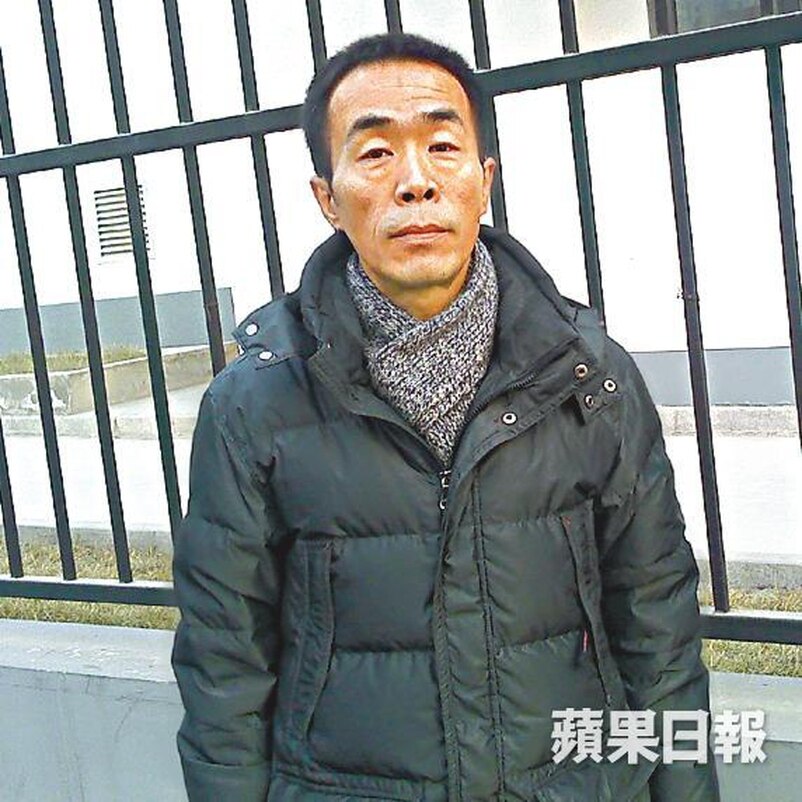
A case of a June 4 prisoner I paid special attention to was Zhu Gengsheng (朱更生), who was featured on Chinese television atop a burning tank, waving a flag and shouting, “We’ve won!” Although originally detained for counterrevolutionary propaganda and incitement, Zhu was sentenced to death with two-year reprieve for counterrevolutionary sabotage. In 1994, his sentence was commuted to life in prison. I placed Zhu’s name on seven prisoner lists and received four responses. Starting in 1997, Zhu received seven sentence reductions. He was released from Beijing Number Two Prison on April 29, 2011.
Zhu Gengsheng as he appeared in a news article published on March 11, 2014. Image credit: Apple Daily
We sometimes found information on the remaining June 4 prisoners in unusual places. In May 2013, Dui Hua researchers uncovered a notice issued by the Jiangshan Neighborhood Council in Beijing about an elderly man who had served a sentence in Yanqing Prison, Jiang Yaqun (姜亚群). Jiang was suffering from Alzheimer’s but had no relatives to look after him.
Jiang had been sentenced to death with two-year reprieve on July 17, 1990 for the crime of counterrevolutionary sabotage. I put him on 10 prisoner lists and received four responses. His sentence was commuted to life in prison and further reduced on five occasions. He was released from Yanqing Prison, which has a ward for elderly, weak, ill, and disabled prisoners in October or November 2012, whereupon he was taken in and cared for by the Jiangnan Neighborhood Council.
Li Yujun (李玉君) was convicted of arson by the Beijing High People’s Court in January 1991 and sentenced to death with two-year reprieve. The sentence was commuted to life in prison on December 31, 1996. I asked about him repeatedly; he was on nine of my prisoner lists submitted to the Chinese government. After receiving six sentence reductions for good behavior, Li was released from Beijing Number Two Prison on May 31, 2013.
Miao Deshun
The last Tiananmen prisoner known by Dui Hua to have served a sentence for an offence committed during the spring 1989 disturbances was Miao Deshun (苗德顺). Miao was a worker from Hebei Province who came to Beijing to participate in the uprising. He was sentenced to death with two-year reprieve by the Beijing Intermediate People’s Court on August 7, 1989. The crime was arson; he and four other protesters had thrown a basket onto a burning tank.
Miao had had no contact with the outside world for many years. At his request, his family stopped visiting him. He was defiant, refusing to admit guilt or participate in prison labor. He spent time in solitary confinement, which contributed to his schizophrenia and hepatitis.
I took a special interest in his case, putting his name on 17 lists submitted to the Chinese government. In late January 2016, I learned from a court website that, after several sentence reductions–the last granted six weeks after my last inquiry–Miao would be released from the elderly, weak, ill, and disabled ward of Yanqing Prison on October 15, 2016.
I announced his imminent release, and journalists became interested in the story. Several went to Yanqing Prison to observe the October 15 event, but no one could sight him.
It is sometimes the case that prisoners are released the night before, or at dawn, at the darkest moment. They are hustled out the back door.
The last of the known June 4 prisoners had been released, but, fittingly, no one had seen the moment, and it has been quickly forgotten.
Soldiers cleaning Tiananmen Square following the events of June 4, 1989. Image credit: timetoast.com
Candidates Use Platforms, Conventions to Attack Each Other on China
(Left) President Trump, President Xi, then-Vietnamese President Trần Đại Quang, and then-Australian Prime Minister Malcolm Turnbull take a selfie on November 16, 2017. (Right) Vice President Biden raises a toast in honor of Chinese President Xi at a State Luncheon at the State Department on September 25, 2015. Image credits: (Left)US Embassy Canberra / Public domain; (Right)US Department of State / Public domain
Both dominant US political parties held their national conventions in August. Dui Hua previously suggested that engagement with China would be an issue in the 2020 elections “to an extent that it has not been in the past.” Both parties used their conventions and accompanying publicity to frame the other as ineffective on China, but Republican narratives have focused on China with more frequency and intensity.
The Democratic National Convention (DNC) was held from August 17-20, with the Republican National Convention (RNC) taking place from August 24-27. The DNC official approved its party platform on August 18. The RNC ultimately decided not to release an updated platform, instead offering a bulleted list of second-term agenda goals.
The DNC platform explicitly references China 27 times, a substantial increase from its 2016 platform’s eight mentions. On its foreign policy for the Asia-Pacific region, the platform affirms support for the Taiwan Relations Act, the Hong Kong Human Rights and Democracy Act, and the Uyghur Human Rights Policy Act while also opposing China’s claims in the South China Sea and likening the mass internment of Uyghurs to the religion-based genocidal attacks in the Middle East and Myanmar.
On trade reform, the platform says that it will “protect the American worker from unfair trade practices by the Chinese government…” and “push back against China or any other country’s attempts to undermine international norms.” It stresses multilateral cooperation, citing Europe as the United States’ “natural partner in managing areas of competition with China” and promising to “mobilize more than half the world’s economy to stand up to China.” The platform heavily criticizes the so-called trade war, describing it as “reckless” and “self-defeating,” arguing that the administration is “falling into the trap of a new Cold War” that, among other consequences, “would only serve to exaggerate China’s weight.” The president’s use of authoritarian rhetoric, the platform states, “will not make us ‘tough on China’” but “would be a gift to the Chinese Communist Party.”
China played a limited role in speeches at the actual DNC, garnering only four mentions over the course of the convention, including one by Biden. Two mentions criticized Trump’s handling of COVID-19 and his much-maligned kindness to authoritarian leaders. The other two noted the need for trade reform and renewed American manufacturing.
While the RNC’s efforts to recycle or adapt its 2016 platform led to criticisms and speculation, the RNC adopted a resolution on August 22 saying that it “has unanimously voted to forego the Convention Committee on Platform…” because “it did not want a small contingent of delegates formulating a new platform without the breadth of perspectives within the ever-growing Republican movement.” The resolution goes on to state that “the Republican Party has and will continue to enthusiastically support the President’s America-first agenda.” The RNC has issued a platform for every election since 1856. The 2016 RNC platform referenced China 25 times.
In place of a platform, the administration released a bulleted list of second-term priorities titled “President Trump: Fighting for You!” The list includes ten categories, including one titled “End Our Reliance on China.” Four out of five of the items in this category relate to divestment or decoupling: “Bring Back 1 Million Manufacturing Jobs from China;” “Tax Credits for Companies that Bring Back Jobs from China;” “Allow 100% Expensing Deductions for Essential Industries like Pharmaceuticals and Robotics who Bring Back their Manufacturing to the United States;” “No Federal Contracts for Companies who Outsource to China.” The final point refers to the handling of COVID-19: “Hold China Fully Accountable for Allowing the Virus to Spread around the World.”
Over the four-day RNC, China was explicitly referenced approximately 101 times, with 16 made by President Trump during his acceptance speech. While these references often had compounded or overlapping functions, they generally operated along three narratives: expressing grievances against China; depicting Joe Biden and the Democratic party as weak on China; depicting President Trump as strong on China. The phrase “China virus” was used seven times during the convention, all by the president.
Numerous speakers made remarks on China, including Senator Tom Cotton, Secretary of State Mike Pompeo, Florida Attorney General Pam Bondi, and the president. Over the course of the convention, speakers described Biden in relation to China as “a total pushover,” criticized his 2013 trip to China, blamed him for China’s global ascension, and referred to him as “Beijing Biden.” One of the more controversial speakers was Chinese human rights activist Chen Guangcheng, who was brought to the United States under the Obama/Biden administration. His endorsement of President Trump was met with criticism by fellow Chinese human rights lawyer Teng Biao.
One oft-repeated claim throughout the convention was that China favors Joe Biden because he is soft on China, with President Trump saying in his speech that China “desperately wants him to win. I can tell you that upon very good information.” This claim, a version of which was repeated by Democratic House leader Nancy Pelosi in an interview, is not incorrect but is inaccurate.
The foremost public information on this matter when the comments were made was a statement by National Counterintelligence and Security Center Director William Evanina released on August 7. The statement expressed concern “about the ongoing and potential activity by China, Russia, and Iran” to influence the outcome of the November elections. The section on China does not mention Joe Biden, and its assessment is that “China prefers that President Trump—whom Beijing sees as unpredictable—does not win reelection.” There is no mention of China viewing either candidate as tough or lenient.
Biden is only mentioned in relation to Russia. That section of the statement begins “We assess that Russia is using a range of measures to primarily denigrate former Vice President Biden…” and goes on to say that “[s]ome Kremlin-linked actors are also seeking to boost President Trump’s candidacy on social media and Russian television.”
Tough on China: How Voters Perceive Biden v. Trump
Both presidential candidates have made efforts to portray themselves as tough on China. While polls taken from May to September on this issue suggest that neither candidate dominates the other in this context, those surveyed express slightly more confidence in President Trump to handle China even in polls that show an overall lead for Biden as president.
A Morning Consult/Politico poll conducted from May 15-18 among 1,994 registered voters showed a slim edge for Joe Biden. Among all registered voters, 40 percent said they trusted Biden more to handle relations with China, compared to 38 percent that had more trust in Trump, with 21 percent answering “Don’t know/No opinion.” The survey had a margin of error of two percentage points.
In a poll conducted by NBC News/Wall Street Journal from May 28 to June 2 among 1,000 registered voters, 43 percent said Trump would be better at dealing with China, compared to 40 percent who answered Biden. The margin of error was 3.1 percentage points.
The New York Times/Siena College Research Institute poll taken from June 8-16 polled 3,870 registered voters in six swing states (margin of error in parentheses): Arizona (4.3), Florida (4.6), Michigan (4.3), North Carolina (4.1), Pennsylvania (4.2), and Wisconsin (4.3). While Biden led in all six states, respondents differed on who would handle China better. Four states answered Trump: Arizona (49 percent to Biden’s 43); Florida (51 to 41 percent); North Carolina (49 to 42 percent); and Pennsylvania (50 to 41 percent). Biden led in Michigan (47 to 42 percent) and Wisconsin (46 to 45 percent).
The Harvard-Harris poll taken from July 21-23 of 1,932 registered voters also asked respondents which candidate would do a better job of handling relations with China. Joe Biden led the poll, with 54 percent compared to Trump’s 46 percent.
From August 29 to September 1, Fox News conducted a survey of likely voters in Arizona, North Carolina, and Wisconsin. The poll was conducted among 1,500 US adult citizens, with a margin of error of 3.5 percentage points. While Biden led in all three states, opinions again differed as to who is better suited to handle China. InArizona,respondents expressed slightly more trust in Biden, with 44 percent to Trump’s 43 percent. In North Carolina, 48 percent trusted Trump more compared to 43 percent for Biden. In Wisconsin, 45 percent trusted Trump more, while 44 percent trusted Biden.
PRISONER UPDATES
On November 4, 2017, China passed the 10th amendment to Criminal Law, making disrespect of the national anthem a crime punishable by up to three years in prison. This move aims to further legislate respect for the nation and brought treatment of the national anthem in line with desecration of the national flag and symbol. The newly expanded Article 299 defines the following acts as an insult to the national anthem:
maliciously altering the lyrics or music of the “March of the Volunteers;”
performing it in a distorted or derogatory manner, or otherwise desecrating its solemnity.
There have been few if any reports of anyone being criminally pursued for insulting the anthem. The amended Article 299 makes these acts a criminal offense only when the circumstances are serious without explaining the criteria to determine seriousness. At the time of writing, all publicized cases have only resulted in administrative punishment, except for one case Dui Hua discovered involving an Almighty God member.
On December 18, 2019, a district-level court in Xinjiang Production and Construction Corpssentenced a group of 12 Han Almighty God members to prison terms from two years and six months to six years. All but one of them were convicted of Article 300 “organizing a cult to undermine implementation of law.” Police discovered the lyrics of “the Song of Satan’s Victory”” from an electronic file and cited witnesses’ testimonies as saying that the song was similar in tune to the national anthem. The song was composed by Hu Liancai (胡连彩) at the church’s behest in 2018. The judgment stated that Almighty God “silently sang”the song in public during a weekly national flag raising ceremony in Chepaizi Reclamation Area.
Despite being a member of Almighty God, Hu was sentenced to 30 months in prison not for Article 300, but for maliciously altering the lyrics of the national anthem under the Article 299. Hu’s codefendants who disseminated or contributed to the altered lyrics were convicted only of Article 300 but are serving longer prison sentences. The judgment did not state the extent to which the national anthem was modified;nor did it substantiate how or whether the anthem was performed in a distorted or derogatory manner. This first known criminal case appears to suggest that being a member of a banned religious group could be an important factor to determine whether the circumstances are serious in national anthem cases.
See Also:Press Statement:Hong Kong Residents, Convicted of Spying for the British, Released from Guangdong Prisons
SAN FRANCISCO (August 26, 2020) — Two Hong Kong residents, both former employees of the New China News Agency (Xinhua) and naturalized United Kingdom (UK) citizens, have been released from prisons in Guangdong Province after serving 17 years of their life sentences for spying for the UK.
John Kamm Remembers is a feature that explores Kamm’s human rights advocacy prior to and since Dui Hua’s establishment in 1999.
The Forgotten, Part I
Students carrying a pro-democracy banner on May 4, 1989. Image credit: Vision Times
In early 1999, I became aware of an opportunity to secure a grant from a foundation based on the East Coast to help fund my work on behalf of political prisoners in China. For nine years I had been underwriting that work by myself, drawing on the profits of my consulting business. I had never applied for a grant.
I quickly found out that I needed a “pass through”–an organization to accept the grant and monitor its use. My wife and a good friend who worked in finance joined with me to establish Dui Hua in order to accept grants from foundations and governments. Dui Hua was incorporated as a non-profit charity on April 16, 1999.
I had already drawn up a proposal which I had submitted to the grant-making foundation. My proposal would focus on turning up names of political prisoners in Chinese newspapers, periodicals, and books. Having found the names of three previously unknown counterrevolutionaries in a Jilin Province newspaper, I was convinced that an effort to examine provincial newspapers would yield the names of many more obscure and forgotten political prisoners.
After receiving the proposal, the foundation sent it to three China experts for comment. The reception was underwhelming. Two of the three reviewers believed I wouldn’t find many names. One reviewer flatly stated that the Chinese government does not publish sensitive information on political prisoners in publicly available publications available in libraries or online. A senior officer of the grant maker asked me how many names I thought I’d find. I replied that if I could find 100 names of hitherto unknown prisoners, I would consider my project a success.
In May, I was given the good news that my proposal had been accepted. I promptly set up a trip to Hong Kong, site of the University Services Center (USC) at the Chinese University of Hong Kong. I had found the Jilin newspaper at the Center and I would start my search there.
The University Services Center at the Chinese University of Hong Kong, where John Kamm conducted research on political prisoners. Image credit: CUHKtrove Facebook account
USC was established in 1963 in Kowloon, and for many years it was considered one of the best places to do research on contemporary China. It was ably led by my friend, scholar, and Tibetologist John Dolfin for many years. He had amassed complete runs of more than 250 national and provincial newspapers and more than 1,000 periodicals. The USC moved to Chinese University of Hong Kong in 1988, without John Dolfin. It was housed on three floors (a basement and two upper floors) of the university library; the basement was where the newspapers were stored, and I went there straightaway upon arriving at the campus.
I started by selecting several cities where the spring 1989 protests had been especially widespread and long-lasting. I examined newspapers for the months of April, May, and June 1989. After four hours of work I had found nothing of use. Maybe the reviewers had been right after all.
Discouraged, I took the elevator up to the eighth floor and headed for the section where books on policing and courts were housed. Eureka! I found scores of provincial and county yearbooks, specialized yearbooks, and multi-year records published by public security bureaus, procuratorates, and prison bureaus, as well as sentencing records of courts. Several books were marked “internal (neibu).” I quickly began photocopying accounts of political cases that recorded the names of those detained by public security and state security bureaus, tried by courts, and held in prisons.
I made eight more trips to Hong Kong before the end of 2000 and did research at USC on 15 occasions, assisted at times by two university students. By the end of 2000, we had recorded the names of more than 300 previously unknown individuals detained for counterrevolution and endangering state security in the 1980s and 1990s. I had far exceeded the target of 100 names.
Wang Jun
On my trip to USC in September 2000, I came across Sentencing Records ofShaanxi Province, published in 1994. It contained a detailed account of what had happened to Wang Jun (王军), an 18-year-old temporary worker for the Passenger Transport Section of the Xi’an Railway Branch Office who was arrested for taking part in “a serious beating, smashing, looting, and burning political disturbance” on April 22, 1989, weeks before the killings in Tiananmen Square. The Xi’an unrest was the first major protest following the death of reformist party secretary Hu Yaobang in Beijing on April 15, 1989.
(Left) Obituary for Hu Yaobang released by Xinhua News Agency on April 15, 1989. (Right) Beijing university students enter Tiananmen Square for Hu’s funeral. Image credit: standoffattiananmen.com
Wang was accused of attacking the provincial government building, using rocks and bricks to attack the people’s armed police, and smashing several streetlights. Afterwards, he and a few other young people got into the provincial high court and procuratorate offices, where they broke windows, and set fire to three cars, one motorcycle, and one bicycle. They finished by breaking into the office of the procuratorate’s motor pool where they stole a calculator, pens, and cassette tapes. They were apprehended on the scene. Wang allegedly confessed to what he had done.
Two weeks after his arrest, Wang Jun was tried by the Xi’an Intermediate People’s Court and sentenced to death for the crimes of arson and robbery. Wang Jun appealed the sentence to the Shaanxi High People’s Court, and his father testified that his son was mentally deficient and pleaded for leniency. A medical examination was ordered. It found that while Wang’s mental development had been arrested, he knew right from wrong and had to accept responsibility for his acts.
The Sentencing Committee of the High Court was divided between those who favored immediate execution and those who favored a sentence of death with two-year reprieve. They sought guidance from the Supreme People’s Court (SPC) in Beijing. The SPC favored death with two-year reprieve and ordered the sentencing committee to make a new judgment: on October 13, 1989 Wang Jun was sentenced to death with two-year reprieve.
I gathered up the photocopies I collected at USC and returned to San Francisco. There, working with staff, index cards for each case were filled out, and I checked other sources for information on the names we had collected. I looked at Human Rights Watch’s Detained in China and Tibet, published in 1994. It listed Wang Jun as having been executed.
In October 1999, Dui Hua published the first in a series of Occasional Publications. It was titled “Individuals Detained During the Spring 1989 Disturbances in China.” It covered 15 individuals from five provinces, 13 of whose names had not appeared in publications outside of China. One of the cases covered was that of Wang Jun. “Individuals uncovered by this search will be included in future lists submitted to the Chinese government by Dui Hua,” I wrote in the introduction.
The first of Dui Hua’s Occasional Publications series. (Left) The cover. (Right) The beginning of the section on Wang Jun. Image credit: The Dui Hua Foundation
The first list that included Wang Jun’s name was faxed to the Ministry of Justice (MOJ) on January 11, 2000. On a visit to Beijing in June 2000, I handed over another list with Wang Jun’s name to MOJ officials. In 2002, I began lobbying the United States and the European Union to include Wang Jun’s name on prisoner lists submitted to China’s Ministry of Foreign Affairs at their respective human rights dialogues.
Finally, in August 2003, the MFA gave a written response to the United States.
SAN FRANCISCO (August 26, 2020) — Two Hong Kong residents, both former employees of the New China News Agency (Xinhua) and naturalized United Kingdom (UK) citizens, have been released from prisons in Guangdong Province after serving 17 years of their life sentences for spying for the UK.
Chan Yu Lam (aka Chen Yulin 陈瑜琳), a former official in Xinhua’s Foreign Affairs Department, was detained in January 2003 and subsequently convicted of espionage in March 2004. He was accused of handing over materials, including the Xinhua telephone directory and organization chart, to a British agent embedded in the Hong Kong police force. He is alleged to have accepted HK$200,000 (around US$20,000) in payment.
Chan’s life sentence was commuted in June 2007, and he was subsequently given multiple sentence reductions totaling 76 months. He served his sentence in Shaoguan Prison and was released on August 26, 2020.
Chan was a well-known official who played a prominent role in organizing events for the Marco Polo Club, a social group that brought together Chinese officials and prominent foreign diplomats, businesspeople, and journalists. He was known for his outgoing and self-confident manner. After resigning from Xinhua in 1993, he took up a senior position at Guangdong Investments. It was on a business trip to Shenzhen in January 2003 that he was taken into custody and placed in residential surveillance in a designated location. He was formally arrested in 2003 and tried in March 2004.
Less is known about Wei Pingyuan (魏平原). He was detained in late 2003 and subsequently convicted of counterrevolutionary espionage in 2004. He served his sentence in Meizhou Prison. He was released on August 20, 2020.
It is possible that Wei served in Xinhua under a different name. He worked in Xinhua’s department dealing with Taiwan. He was accused of recruiting Cai Xiaohong. Cai was the son of China’s Minister of Justice Cai Cheng and would go on to serve as Secretary General of China’s Central Liaison Office, which replaced Xinhua as China’s leading political organization after Hong Kong’s reversion to China in 1997. Cai Xiaohong was also convicted of espionage and given a 15-year sentence. Wei is said to have received hundreds of thousands of dollars in return for handing over sensitive communications between Chinese officials in Hong Kong and Beijing.
Because both Chan Yu Lam and Wei Pingyuan allegedly committed their crimes before the 1997 handover, they were tried under the 1979 Criminal Law’s section on counterrevolution, amended in 1997 to remove counterrevolutionary crimes. They are believed to be among the last counterrevolutionaries to have served prison sentences in China. (Several remain in prison, including Jiang Cunde in Shanghai.) Their detentions took place in 2003, when national security legislation was being hotly debated in Hong Kong. At the time, Chinese officials accused Hong Kong of being a “nest of spies.”
The Chinese side refused to recognize their UK citizenship, meaning that neither man was granted consular protections, including consular visits.
Both men were convicted in closed trials, and both were given supplemental sentences of seven-year “deprivation of political rights” which they have begun serving outside of prison. Individuals deprived of political rights lose the rights to speech, press, assembly, and association. Although not required by law, they are nevertheless instructed to check in with public security bureaus on a regular basis.
Dui Hua has submitted dozens of lists with Chan and Wei’s names to the Chinese government. It first requested information on Chan Yu Lam in early 2004, more than 16 years ago. Dui Hua’s advocacy contributed to the release of both men.
“Chan Yu Lam has served more than 17 years in prison and he suffers from multiple health issues,” noted Dui Hua Executive Director John Kamm. “Dui Hua hopes he will be permitted to serve his sentence of deprivation of political rights in Hong Kong, where he was born, and notes that this has been allowed in other cases.”
For questions, please contact Dui Hua at duihua [at] duihua [dot] org.
The Casino Hotel Lisboa, which began construction in 1964 and opened to the public in 1970. Image credit: Nentavaiconta
Ientered Princeton University with the Class of 1973 in September 1969, fresh out of Neptune High School, New Jersey. The Class of 1973 was the first class to admit women; at the same time that it took this “revolutionary step,” it sharply increased the number of admitted students of color and New Jersey High School graduates.
Not long after I arrived on campus, I heard about the “University Scholars Program,” designed to acknowledge and support students of exceptional scholastic skills who wished to pursue an independent curriculum. I hadn’t been invited to the meeting at which the dean of studies introduced the program, but a couple of dorm mates had gone and brought back materials that outlined what the program was all about.
I went to the Dean’s office and submitted an application to undertake a course of study combining anthropology (my major) and East Asian Studies (my minor). To my surprise my application was accepted. I was no longer required to fulfill university requirements to graduate (no calculus for me!); I only needed to fulfill department requirements: take the requisite number of courses and write a senior thesis.
In February of my junior year, President Nixon visited China. I was determined to go to China, but I didn’t want to spend time in Taiwan, then run by the Kuomintang, Hong Kong, a British crown colony, or Singapore, ruled with an iron fist by Lee Kwan Yew. That left Macau, a sleepy Portuguese settlement across the Pearl River from Hong Kong.
Macau Governor Apologizes
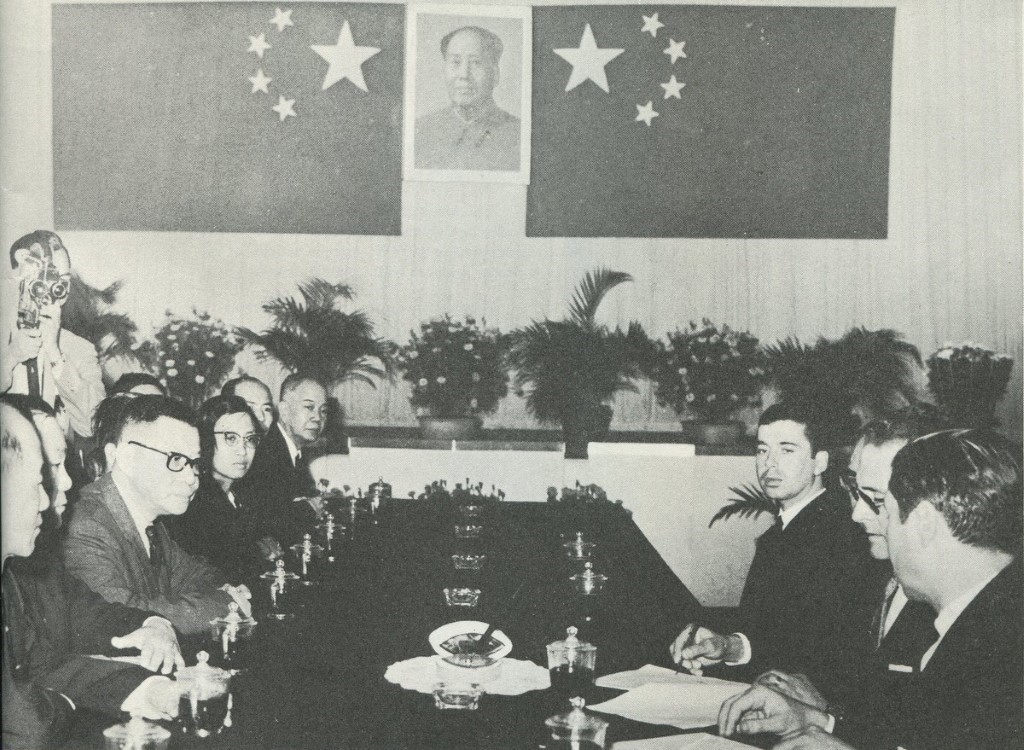
Macau was the next best thing to going to China. Red Guards had mounted city-wide protests in December 1966, and they were met with force, resulting in death and injury to many. Local Chinese residents boycotted Portuguese products and refused to sell products to Portuguese families. Eventually, the Portuguese government was brought to its knees. The governor, Jose Carvalho, signed a humiliating letter of apology for the actions of troops and police against the protesters; he did so under a portrait of Chairman Mao.
The Portuguese governor of Macau signing a statement of apology for cracking down on political demonstrations known as the 12-3 incident and other riots. Image credit: The Stand News
Carvalho sat atop a local government bureaucracy made up officials from Lisbon and local Macanese, who enjoyed a distinct culture and spoke their own dialect, but the real power was wielded by Ho Yin, a Beijing loyalist. Ho Yin’s son would go on to become the first Chinese governor of Macau after the December 1999 reversion to China.
To everyone’s surprise, Beijing did not force the Portuguese to leave Macau as they had been forced out of Goa by India in 1961. Portuguese traders had settled Macau in the early 16th century, making it the first foreign settlement in China. It was destined to be the last. After the Portuguese “Carnation Revolution” in 1974, Portugal tried to give Macau back to China, but Beijing demurred out of concern that such a development would destabilize Hong Kong. Macau was eventually returned two years after Hong Kong’s 1997 return to China.
Having made up my mind to graduate from Princeton a year early, I went to see Bob Atmore, who headed the Princeton-in-Asia office in Jones Hall. I asked him what he had in Macau. He pulled open a box of index cards, blew off the dust, and pulled out a card for Linson College, a secondary school in Macau established and run by the first Chinese graduate of West Point, Linson Edward Dzau. I wrote to the headmaster, and was offered a job as a teacher, for 500 patacas (US$100) a month, room included.
The college and the anthropology department approved my application to graduate with the Class of 1972. I got my degree in June and then went to Middlebury College for several weeks of Chinese language training before packing my bags and heading to JFK airport for my August 22, 1972 flight to Hong Kong. I arrived in the British colony on August 23, 1972. The next day I took the hydrofoil to Macau, arriving around noon.
I was met by the school’s groundskeeper, and together we went in a cab to the school, a stately if rundown family mansion that had once been the residence of a fireworks manufacturer. Americans of a certain age will remember that Macau was a major source of firecrackers and other fireworks set off during the Fourth of July. By the time I arrived in Macau in 1972, most production had shifted to southern China.
I was shown to my room on the third floor. I had a simple meal and turned in. I awoke in the middle of the night to have a glass of water from a thermos. That’s when I learned that Chinese prefer drinking hot water to drinking cold water. I burned my mouth taking a swig of boiling hot water.
Tipping the Dogs
By the time I arrived in Macau, Linson College was in dire financial straits. Headmaster Dzau’s principal benefactor, a fellow West Point graduate, had passed away and tuition from students wasn’t enough to keep the school going. In October, the headmaster told the teachers that he could no longer pay salaries. They left in droves, leaving me to teach all subjects. I earned money by “tipping the dogs” at Macau’s Canidrome for a Hong Kong tabloid and enjoyed a string of luck at the casinos.
Finally, I left Macau on Christmas Day, 1972 – four months after I had arrived. I had visited the British colony on several occasions including one memorable one when I sat on the upper of a Chinese ferry drinking North Korea brandy and smoking Albanian cigars. After settling in Hong Kong, I landed a teaching position at the Chinese University of Hong Kong in Shatin.
A postcard of the Macau Palace floating casino. Image credit: Nentavaiconta
Reflecting its 400 years as a Portuguese-governed territory, there was much evidence of Portugal’s presence in Macau in 1972. The architecture, the cuisine, even the colorful uniforms of those in the police force recruited from African colonies, all reflected the deep historical ties between Macau and the mother country. Yet, as I had suspected, China’s influence in and control over Macau was everywhere to be seen. Let me relate a few experiences that speak to this observation.
Ilha Verde (Green Island)
A group of teachers at Linson College decided to teach me mahjong, the tile-based games invented in China during the Qing Dynasty. On weekends we would visit mahjong parlors in different parts of the city. Being a novice, I spent long hours observing how the game is played.
On one occasion the group traveled to Ilha Verde, a district in northwestern Macau on the border with the mainland. At some point I decided to take a break and wander around the neighborhood. As the name implies, Ilha Verde was originally an island. It sported a military barracks, a convent, and a cement factory. Over the years, land was reclaimed with the result that it was no longer an island.
I walked into an area of undeveloped land. There were no buildings. To my left was a stream that apparently marked the boundary with China. Suddenly, a few yards away, a young soldier of the People’s Liberation Army (PLA) stood up. He was guarding the border with a rifle. I froze, as did the soldier. I smiled, waved, and quickly retreated.
The next week the group decided to visit the same parlor. As we approached it in our car, we found our way blocked by a police barricade. Foreigners were barred from entering the area. It had been closed by order of the Chinese government. I never again entered the area.
Taipa
Macau consists of three parts, the city, which sits on a peninsula, and two offshore islands, Taipa and Coloane. In 1972, the peninsula had not yet been joined by a bridge to Taipa. (It was said that Chinese workers worked slowly in order to make sure that a causeway linking two islands opposite Macau would be completed first.) Access to the islands was by a ferry run by a Chinese company and staffed with Chinese sailors. As the ferry approached Taipa, one could see large hoardings praising Chairman Mao on a nearby Chinese island. There was also a sign prohibiting photographs of Chinese territory. Ferry staff were vigilant in enforcing this rule. Tourists who took photos had their cameras seized.
I loved visiting the islands. They provided a glimpse of rural China, as well as a number of beautiful churches and chapels. Some of the best Macanese restaurants were to be found on the islands. On Coloane, there was a wonderful beach with a villa above it. This building would eventually become the Pousada de Coloane, a traditional Portuguese Inn.
On one trip I was invited to dinner by the police commander of Taipa. He was a former Portuguese officer who had lost an arm in the colonial wars in Angola and Mozambique. He related a story that deeply affected me.
The night before, a refugee fleeing from China had scaled his garden wall and appealed to the commander for shelter. Much as he would have liked to do so, he was unable to shelter the refugee. Under an agreement with China, individuals who fled China to Macau were promptly returned to China. (At the same time that the Macau government issued its apology, it handed over seven Kuomintang “spies,” setting the tone for what was to come.) Sometimes, PLA troops entered the territory to enforce this policy. The officer had informed his commander, and the refugee was picked up and delivered to the PLA.
The People’s Republic of China was admitted to the United Nations in 1971. At the time, Macau housed an office of the United Nations High Commissioner for Refugees, managed by a Norwegian national and his Australian secretary. The office’s principal work was to help refugees from China, those who had managed to escape forcible repatriation to the mainland, as well as refugees from Southeast Asian countries including Myanmar and Cambodia. China took the position that the office needed to close since there were no Chinese refugees in Macau, which was Chinese territory. The office closed in 1973, shortly after I left the territory.
National Day
Following the December 1966 disturbances, the government of Macau declared that China’s National Day would be celebrated as public holidays on October 1 and October 2. Marches of “patriotic” Macau residents and large rallies took place. The largest rally took place at a sports field adjacent to the Lisboa Casino. Thousands of people gathered in a festive atmosphere marked by singing and dancing. There were political speeches and signs praising Chairman Mao and the Chinese Communist Party. A few called for the “liberation of Taiwan.”
Shortly before the holiday, I was approached by a teacher who advised me not to go out in public during the National Day holidays. Not a few people thought I was a CIA spy. If, my friend advised, I went out, then I should not take public transport (the drivers were members of a left-wing union) and, most important, I was told not to take a camera with me.
On December 3, 1966, a crowd tore down a statue of a Portuguese military officer during the anti-Portuguese rule 12-3 incident. Image credit: HKC News
I took my friend’s advice and walked south to the Leal Senado, the seat of the Municipal Council, in downtown Macau. Afterwards I set out in the direction of the Lisboa Hotel. On the way I passed a bookshop owned by a PRC company. In the window was a large aquarium with a model of a sunken American submarine resting on the bottom.
I figured that were I stopped, I would simply say I was on my way to the casino to play blackjack. When challenged, this seemed to work. Aside from hostile looks, I was not disturbed. I watched the rally from the steps of the Lisboa and then walked back to the Linson College.
First Impressions
My first and most enduring impressions of China were formed during the four months I spent in Macau in 1972. I began to see China as both intensely ideological but also very practical – it could have seized Macau in 1966 but chose not to out of concern that doing so would undermine stability in Hong Kong.
China was determined to protect its boundaries, but at the same time it was reasonable and non-violent. The young soldier could have shot me at close range, but he let me go. Finally, I came to understand that the Chinese government would seek to maximize control over the movements its citizens. Those who dared to flee China to Macau would be captured by the Portuguese and forcibly returned to the mainland to face an uncertain fate.
Summer of Sanctions: From Xinjiang to Fentanyl, US Government Goes After CCP
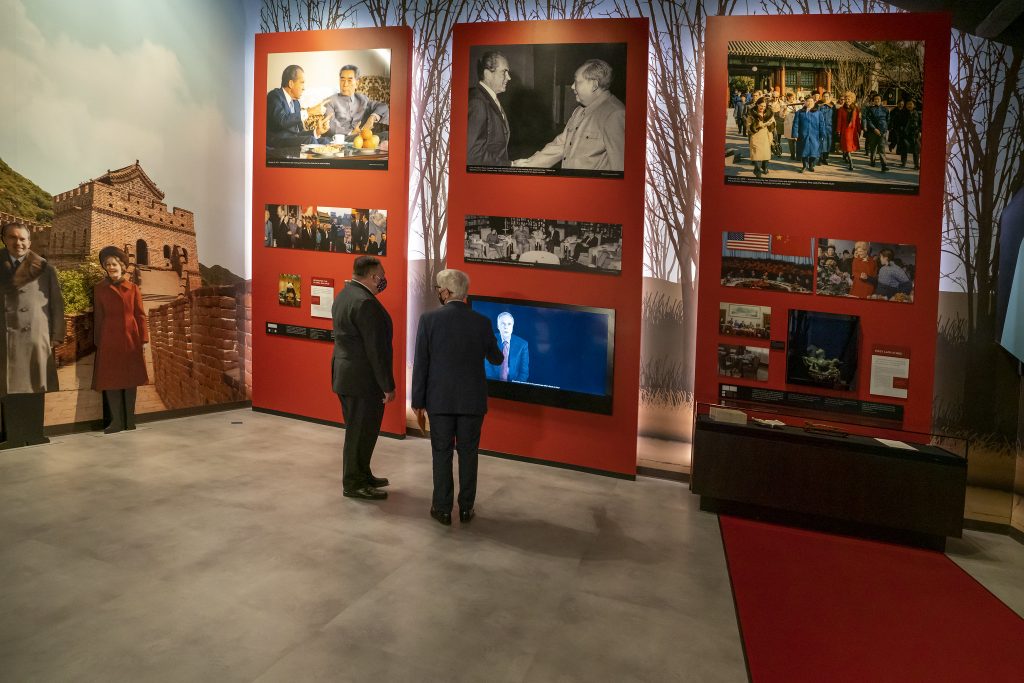
On July 23, 2020, Secretary of State Pompeo takes a guided tour of the Richard Nixon Presidential Library before making remarks on China. Image credit: Ron Przysucha, State Department
Rarely has the US government taken so many steps, in such a short period, to sanction the Chinese government over alleged human rights abuses.
Following the late-May announcement that Beijing would impose national security legislation on Hong Kong, President Trump announced on May 28 that his administration would revoke Hong Kong’s preferential economic treatment. Weeks later, on June 12, the US State Department updated its travel advisory for Hong Kong, changing it from Level 1 (“Practice Usual Precautions”) to Level 2 (“Exercise Increased Caution”) “due to civil unrest, risk of surveillance, and arbitrary enforcement of laws other than for maintaining law and order.”
On June 30, 2020 at 11:00PM, the Hong Kong national security law, or the Law of the People’s Republic of China on Safeguarding National Security in the Hong Kong Special Administrative Region, was enacted. Secretary of State Pompeo said that the United States is “deeply concerned about the law’s sweeping provisions and the safety of everyone living in the territory, including Americans.” Pompeo further stated that some provisions, like Article 38 which might punish offenses committed outside of Hong Kong by non-residents of Hong Kong, are “outrageous and an affront to all nations.” On July 1, the House of Representatives passed H.R. 7440, the Hong Kong Autonomy Act, with the Senate passing it the next day. The president signed the law into effect on July 14.
Building on the Hong Kong Human Rights and Democracy Act of 2019, the Hong Kong Autonomy Act requires the Secretary of State and the Secretary of the Treasury to identify foreign persons and financial entities contributing to the failure of China to meet its obligations regarding Hong Kong’s autonomy, and it requires the president to impose sanctions within a given period of time. On the same day that the president signed the Hong Kong Autonomy Act, he also issued Executive Order 13936, “The President’s Executive Order on Hong Kong Normalization,” effectively ending preferential treatment for Hong Kong. On August 7, the Treasury Department announced sanctions against Carrie Lam and 10 other Hong Kong and Chinese officials over their role in the crackdown on Hong Kong.
These events have been preceded by administrative actions highlighting strained relations between the two countries. In April, the US Consulate in Guangzhou issued a travel advisory for African American citizens living in or traveling to the city. The travel advisory was issued in response to reports that those believed to be of African origin or with “African contacts” could be susceptible to mandatory testing and mandatory self-quarantine “regardless of recent travel history or previous quarantine completion.” The advisory also stated that police “ordered bars and restaurants not to serve clients who appear to be of African origin” due to heightened scrutiny of foreigners triggered by a rise in COVID-19 infections.
The travel advisory was preceded by complaints from African ambassadors in Beijing who wrote to China’s State Councilor Wang Yi to address the alleged discrimination. In response to news of the travel alert, foreign ministry spokesperson Zhao Lijian said, “We do not have discrimination in China against African brothers,” and suggested that the travel advisory was “irresponsible,” “immoral,” and a way for the United States “to sow discord.”
The US government’s actions to challenge China over its treatment of the indigenous populations of the Tibetan Autonomous Region and the Xinjiang Uyghur Autonomous Region (XUAR) have also resulted in sanctions. H.R.4331 – Tibetan Policy and Support Act of 2019 passed the House of Representatives on January 28, 2020. The bill was introduced in the House on September 13, 2019 to modify and reauthorize the Tibetan Policy Act of 2002. The bill recognizes Tibetan Buddhists as the sole deciders of the succession of the Dalai Lama and calls for the creation of a new US consulate in Lhasa. Chinese officials interfering in the selection of Tibetan Buddhist leaders will be subject to sanctions under the Global Magnitsky Act. As of this writing, the law is pending approval in the Senate, having been referred to the Committee on Foreign Relations. On July 7, Secretary Pompeo cited the Reciprocal Access to Tibet Act of 2018 to announce new visa restrictions on Chinese government and Chinese Communist Party officials “involved in the formulation or execution of policies related to access for foreigners to Tibetan areas.”
The Uyghur Human Rights Policy Act of 2020 was initially passed with unanimous consent by the Senate on September 11, 2019. However, the House of Representatives passed a stronger version on December 3, 2019. The revised version was introduced in and passed by the Senate on May 14, 2020 and then approved by the House on May 27. The president signed the bill into law on June 17.
The Act calls for sanctions against individuals and entities that are known to propagate human rights abuses against Turkic Muslim minorities in China under the Global Magnitsky Act. The law formally sanctions XUAR CCP secretary Chen Quanguo, XUAR former deputy party secretary Zhu Hailun, Xinjiang Public Security Bureau director Wang Mingshan, and Xinjiang Public Security Bureau former party secretary Huo Liujun. These officials were sanctioned by the treasury and state departments, and on July 20, the US Commerce Department added 11 Chinese companies to its Entities List due to their alleged involvement in human rights abuses in the XUAR. These events also follow a July 1 business advisory for US companies utilizing supply chains in the Xinjiang region.
One of the most publicized features of the Uyghur Human Rights Policy is its use of the Global Magnitsky Act. The sanctioning of Chen Quanguo marks the first time that a member of China’s Politburo has been sanctioned since diplomatic relations between the United States and China resumed in 1979. Chen has allegedly gained a reputation as an “ethnic policy innovator.” Prior to his work in Xinjiang, Chen spearheaded the crackdown in Tibet as the party’s chief official in the region. On July 31, the Department of the Treasury’s Office of Foreign Assets Control issued additional sanctions against the Xinjiang Production and Construction Corps (XPCC), as well as Peng Jiarui, XPCC deputy party secretary and commander and Sun Jinlong, former party secretary of the XPCC.
Official White House graphics depicting the Trump administration’s rhetoric against China. Image credit: White House Flickr account.
In an opinion article about the Trump administration’s responses to China’s Xinjiang policy, National Security Adviser O’Brien wrote, “As long as these human rights violations continue, the Trump administration will respond.” Weeks earlier, on June 24, O’Brien delivered remarks in Arizona in which he stated, “America, under President Trump’s leadership, has finally awoken to the threat the Chinese Communist Party’s actions and the threat they pose to our very way of life” and referred to the notion that China “would liberalize to meet the rising democratic aspirations of its people” as “very naïve.” He went on to characterize that notion as “the greatest failure of American foreign policy since the 1930s.”
Chinese government officials have said that they would “take firm countermeasures.” Foreign ministry spokesperson Zhao Lijian said, “In light of these wrong actions, China will impose reciprocal measures on U.S. officials and organizations that have displayed egregious behaviour in human rights in relation to Xinjiang affairs.”
On July 13, the Chinese government said that it would impose sanctions against four US officials: Senators Ted Cruz and Marco Rubio, Representative Chris Smith, Ambassador at Large for International Religious Freedom Sam Brownback and the U.S. Congressional-Executive Commission on China. Senators Cruz and Rubio and Representative Smith have all sponsored legislation concerning human rights in China. A day later, on July 14, the Chinese government announced that it would sanction Lockheed Martin over a US arms sale to Taiwan.
On August 10, China announced retaliatory sanctions against 11 US citizens who “behaved badly on Hong Kong-related issues.” Those sanctioned include Republican lawmakers who have been outspoken on issues related to China; the presidents of the National Endowment for Democracy, the National Democratic Institute, and the International Republican Institute; and two key figures from human rights organizations: Human Rights Watch executive director Kenneth Roth and Freedom House president Michael Abramowitz. Multiple press outlets noted that none of the sanctions affect the Trump cabinet and that the CCP sanctioned the same number of people, 11, as the US government did on August 7.
The White House continues to bear down on industries where it claims China is acting in bad faith. On July 17, the US Department of the Treasury sanctioned four China-based individuals and one company for their alleged role in trafficking fentanyl to the United States, with Deputy Treasury Secretary Justin Muzinich saying, “The United States is committed to holding drug traffickers and those who facilitate their operations accountable for the suffering they impose upon American families.” On August 6-7, the White House issued executive orders prohibiting transactions with the owners of WeChat and TikTok and setting a de facto 45-day window for a company to purchase TikTok’s US operations.
Consular Closures as US and China Trade Espionage Accusations
The summer of 2020 brought new developments in the confrontation between China and the United States. Dui Hua has studied these developments throughout the year, examining Congressional action against China and deteriorating public opinion of China. In July, the United States and China added a new dimension to their confrontation in the form of closing consulates.
On July 21, 2020, the US government ordered China to close its consulate in Houston within 72 hours. Officials alleged that the consulate acted as a hub for espionage and research theft. In opening remarks to the Senate Foreign Relations Committee on July 30, Secretary of State Pompeo said, “We closed the consulate in Houston because it was a den of spies.” State Department spokesperson Morgan Ortagus said the closure was “in order to protect American intellectual property and Americans’ private information.” Following the consulate’s closure on Friday, July 24, a US Justice Department official said that the consulate’s activities “are a microcosm, we believe, of a broader network of individuals in more than 25 cities…supported through the consulates here.”
Beijing issued a response of outrage and indignation. Foreign Ministry spokesperson Wang Wenbin called the abrupt closure order a “unilateral” and “unprecedented escalation” and said that “China urges the US to immediately withdraw its wrong decision, or China will definitely take a proper and necessary response.” On Friday, July 24, the Chinese government ordered the US consulate in Chengdu to close. Ministry spokesperson Wang said that this was a “legitimate and necessary response” to the Houston consulate closure and accused Chengdu consulate staff of “interfering in China’s internal affairs and harming China’s national security interests.” Tibet was in the Chengdu consulate’s district at the time of its closure.
Following the tit-for-tat closures, each country now maintains four consulates in the other’s territory. China has an embassy in Washington and consulates in Chicago, Los Angeles, San Francisco, and New York. The now-shuttered Houston consulate was the first to open in early 1979. The United States has an embassy in Beijing and consulates in Guangzhou, Shanghai, Shenyang, and Wuhan. It has a consulate in Hong Kong as well, but this consulate does not report to the Beijing embassy.
John Kamm Participates in Princeton in Asia Virtual Event
On July 9, Executive Director John Kamm joined a Princeton in Asia Storytelling event to share memories of his time spent in the fellowship program in Macau in 1972. The virtual event featured six other alumni of the Princeton in Asia fellowship program, who recounted their time spent in Egypt, Japan, Taiwan, India, and South Korea between 1962 and 2018. Over 90 fellow alumni of the program and guests listened and asked questions to the panelists.
Director Kamm had not previously written or spoken publicly much about his fellowship in Macau, so he was happy to explain the unique circumstances that led him to teach at Linson College in Macau and how that shaped his business career in Hong Kong and eventual human rights work with China. Fitting the storytelling event’s theme of “Times of Change,” Kamm described institutional shakeups at Princeton, where his class was the first to admit female students, and shifting power dynamics in Macau, where Portugal was ceding de facto control to China. He shared vivid memories of encountering a People’s Liberation Army soldier in territory where the border was ill-defined, pro-Mao rallies on China’s National Day, and his growing awareness of the fate of Chinese dissidents caught between the People’s Republic and the Portuguese colonial authorities. You can watch an excerpt of his story here and read more about John’s time in Macau in this month’s installment of John Kamm Remembers.
PRISONER UPDATES
China has long taken aim at “negative information” about its one-party rule in cyberspace, but how it criminalizes disseminators of such information has not always been consistent. While “picking quarrels and provoking troubles” has been increasingly used to stifle dissenting voices, prosecutors have not entirely stopped using the endangering state security crime of inciting subversion to pursue online critics.
Two cases recently concluded in Jiangsu illustrate the overlapping scope of activities punishable under the two different crimes. On June 18, 2020, Ge Jueping (戈觉平) was sentenced to four years and six months with three years’ deprivation of political rights for inciting subversion. About a month later, Wu Qihe (吴其和) received a prison sentence of three years and eight months for “picking quarrels.” This crime does not carry a supplemental sentence of deprivation of political rights. Ge and Wu openly supported victims of forced evictions in Suzhou and actively took part in protests in support of evictee Fan Mugen, who was sentenced to eight years in prison for aggravated assault earlier in 2015.
Although Ge and Wu were sentenced for different crimes, prosecutors presented strikingly similar evidence against the duo. In addition to the public nuisance Ge and Wu allegedly created, the allegations centered on the negative information they posted online. Both were accused of using the Internet to hype up sensitive cases and incidents since 2013 by “distorting facts and maliciously attacking the nation’s judicial system.” However, only the acts committed by Ge were construed as subversive: the court held that Ge intended to “create an illusion of judicial injustice and antagonism between the government and people,” with an ulterior motive to incite people to “gradually disintegrate the power basis of the Chinese Communist Party.” Wu was similarly accused of “smearing, attacking the socialist system with Chinese characteristics,” but no explanation was given as to why the same acts did not amount to incitement to subvert state power.
It is not immediately clear how prosecutors determine which crime to pursue. Given the similarity in the harshness of sentencing, this question matters little to China so long as dissent can be silenced. Obfuscating the political nature of Wu’s case, the crime of “picking quarrels” perhaps provides an added benefit of avoiding scrutiny from observers.
“Picking quarrels” also appears to be a more likely option and results in lighter punishment if an individual only directs the criticisms against local officials. This point can be attested to by a case Dui Hua uncovered online: a court also in Jiangsu sentenced Wang Hongquan (王洪全) to 18 months in prison for “picking quarrels” because he allegedly set up a “fake” news media agency in Hong Kong and released a number of negative reports about government corruption, township elections, wage arrears, forced evictions and land seizures across multiple localities. The 14-page judgment said such coverage had a substantial negative impact on local government bureaus. There was no mention of how the negative coverage inflicted harm on the Chinese Communist Party or the socialist system.
Two other co-defendants were also convicted of “picking quarrels:” reporter Tang Yunli (唐云立) was sentenced to 13 months’ imprisonment. Li Hede (李鹤德), who was responsible for promoting the news website, received a one-year suspended sentence.
Tibetan monks clashed with armed police during the Lhasa riots in 2008, which the Chinese government saw as a separatist movement plotted by the Dalai Lama. Image credit: CCTV
Through July and August, Dui Hua’s Human Rights Journal published a three-part series examining how charges of splittism and inciting splittism are applied in China. The series relies heavily on statistics from the Records of People’s Courts Historical Judicial Statistics: 1949-2016.
Part I discusses the application of splittism and inciting splittism from 1998-2016, examining how the trends and sentencing corresponded to major incidents of ethnic unrest in China. Part II focuses on two major ethnic groups who are more likely to face trial for splittism and inciting splittism: Uyghurs and Tibetans. Part III looks at cases involving other groups, including Mongols and Han Chinese. While there is no available breakdown of ethnicities, the court statistics indicate that splittism and inciting splittism were disproportionately used against ethnic minorities.
See Also: Human Rights Journal: Detailed Court Statistics on Article 300, Part I and Part II
JOHN KAMM REMEMBERS
John Kamm Remembers is a feature that explores Kamm’s human rights advocacy prior to and since Dui Hua’s establishment in 1999.
Macau Days
The Casino Hotel Lisboa, which began construction in 1964 and opened to the public in 1970. Image credit: Nentavaiconta
I entered Princeton University with the Class of 1973 in September 1969, fresh out of Neptune High School, New Jersey. The Class of 1973 was the first class to admit women; at the same time that it took this “revolutionary step,” it sharply increased the number of admitted students of color and New Jersey High School graduates.
Not long after I arrived on campus, I heard about the “University Scholars Program,” designed to acknowledge and support students of exceptional scholastic skills who wished to pursue an independent curriculum. I hadn’t been invited to the meeting at which the dean of studies introduced the program, but a couple of dorm mates had gone and brought back materials that outlined what the program was all about.
I went to the Dean’s office and submitted an application to undertake a course of study combining anthropology (my major) and East Asian Studies (my minor). To my surprise my application was accepted. I was no longer required to fulfill university requirements to graduate (no calculus for me!); I only needed to fulfill department requirements: take the requisite number of courses and write a senior thesis.
In February of my junior year, President Nixon visited China. I was determined to go to China, but I didn’t want to spend time in Taiwan, then run by the Kuomintang, Hong Kong, a British crown colony, or Singapore, ruled with an iron fist by Lee Kwan Yew. That left Macau, a sleepy Portuguese settlement across the Pearl River from Hong Kong.
Macau Governor Apologizes
Macau was the next best thing to going to China. Red Guards had mounted city-wide protests in December 1966, and they were met with force, resulting in death and injury to many. Local Chinese residents boycotted Portuguese products and refused to sell products to Portuguese families. Eventually, the Portuguese government was brought to its knees. The governor, Jose Carvalho, signed a humiliating letter of apology for the actions of troops and police against the protesters; he did so under a portrait of Chairman Mao.
The Portuguese governor of Macau signing a statement of apology for cracking down on political demonstrations known as the 12-3 incident and other riots. Image credit: The Stand News
Carvalho sat atop a local government bureaucracy made up officials from Lisbon and local Macanese, who enjoyed a distinct culture and spoke their own dialect, but the real power was wielded by Ho Yin, a Beijing loyalist. Ho Yin’s son would go on to become the first Chinese governor of Macau after the December 1999 reversion to China.
To everyone’s surprise, Beijing did not force the Portuguese to leave Macau as they had been forced out of Goa by India in 1961. Portuguese traders had settled Macau in the early 16th century, making it the first foreign settlement in China. It was destined to be the last. After the Portuguese “Carnation Revolution” in 1974, Portugal tried to give Macau back to China, but Beijing demurred out of concern that such a development would destabilize Hong Kong. Macau was eventually returned two years after Hong Kong’s 1997 return to China.
Having made up my mind to graduate from Princeton a year early, I went to see Bob Atmore, who headed the Princeton-in-Asia office in Jones Hall. I asked him what he had in Macau. He pulled open a box of index cards, blew off the dust, and pulled out a card for Linson College, a secondary school in Macau established and run by the first Chinese graduate of West Point, Linson Edward Dzau. I wrote to the headmaster, and was offered a job as a teacher, for 500 patacas (US$100) a month, room included.
The college and the anthropology department approved my application to graduate with the Class of 1972. I got my degree in June and then went to Middlebury College for several weeks of Chinese language training before packing my bags and heading to JFK airport for my August 22, 1972 flight to Hong Kong. I arrived in the British colony on August 23, 1972. The next day I took the hydrofoil to Macau, arriving around noon.
I was met by the school’s groundskeeper, and together we went in a cab to the school, a stately if rundown family mansion that had once been the residence of a fireworks manufacturer. Americans of a certain age will remember that Macau was a major source of firecrackers and other fireworks set off during the Fourth of July. By the time I arrived in Macau in 1972, most production had shifted to southern China.
I was shown to my room on the third floor. I had a simple meal and turned in. I awoke in the middle of the night to have a glass of water from a thermos. That’s when I learned that Chinese prefer drinking hot water to drinking cold water. I burned my mouth taking a swig of boiling hot water.
Tipping the Dogs
By the time I arrived in Macau, Linson College was in dire financial straits. Headmaster Dzau’s principal benefactor, a fellow West Point graduate, had passed away and tuition from students wasn’t enough to keep the school going. In October, the headmaster told the teachers that he could no longer pay salaries. They left in droves, leaving me to teach all subjects. I earned money by “tipping the dogs” at Macau’s Canidrome for a Hong Kong tabloid and enjoyed a string of luck at the casinos.
Finally, I left Macau on Christmas Day, 1972 – four months after I had arrived. I had visited the British colony on several occasions including one memorable one when I sat on the upper of a Chinese ferry drinking North Korea brandy and smoking Albanian cigars. After settling in Hong Kong, I landed a teaching position at the Chinese University of Hong Kong in Shatin.
A postcard of the Macau Palace floating casino. Image credit: Nentavaiconta
Reflecting its 400 years as a Portuguese-governed territory, there was much evidence of Portugal’s presence in Macau in 1972. The architecture, the cuisine, even the colorful uniforms of those in the police force recruited from African colonies, all reflected the deep historical ties between Macau and the mother country. Yet, as I had suspected, China’s influence in and control over Macau was everywhere to be seen. Let me relate a few experiences that speak to this observation.
Ilha Verde (Green Island)
A group of teachers at Linson College decided to teach me mahjong, the tile-based games invented in China during the Qing Dynasty. On weekends we would visit mahjong parlors in different parts of the city. Being a novice, I spent long hours observing how the game is played.
On one occasion the group traveled to Ilha Verde, a district in northwestern Macau on the border with the mainland. At some point I decided to take a break and wander around the neighborhood. As the name implies, Ilha Verde was originally an island. It sported a military barracks, a convent, and a cement factory. Over the years, land was reclaimed with the result that it was no longer an island.
I walked into an area of undeveloped land. There were no buildings. To my left was a stream that apparently marked the boundary with China. Suddenly, a few yards away, a young soldier of the People’s Liberation Army (PLA) stood up. He was guarding the border with a rifle. I froze, as did the soldier. I smiled, waved, and quickly retreated.
The next week the group decided to visit the same parlor. As we approached it in our car, we found our way blocked by a police barricade. Foreigners were barred from entering the area. It had been closed by order of the Chinese government. I never again entered the area.
Taipa
Macau consists of three parts, the city, which sits on a peninsula, and two offshore islands, Taipa and Coloane. In 1972, the peninsula had not yet been joined by a bridge to Taipa. (It was said that Chinese workers worked slowly in order to make sure that a causeway linking two islands opposite Macau would be completed first.) Access to the islands was by a ferry run by a Chinese company and staffed with Chinese sailors. As the ferry approached Taipa, one could see large hoardings praising Chairman Mao on a nearby Chinese island. There was also a sign prohibiting photographs of Chinese territory. Ferry staff were vigilant in enforcing this rule. Tourists who took photos had their cameras seized.
I loved visiting the islands. They provided a glimpse of rural China, as well as a number of beautiful churches and chapels. Some of the best Macanese restaurants were to be found on the islands. On Coloane, there was a wonderful beach with a villa above it. This building would eventually become the Pousada de Coloane, a traditional Portuguese Inn.
On one trip I was invited to dinner by the police commander of Taipa. He was a former Portuguese officer who had lost an arm in the colonial wars in Angola and Mozambique. He related a story that deeply affected me.
The night before, a refugee fleeing from China had scaled his garden wall and appealed to the commander for shelter. Much as he would have liked to do so, he was unable to shelter the refugee. Under an agreement with China, individuals who fled China to Macau were promptly returned to China. (At the same time that the Macau government issued its apology, it handed over seven Kuomintang “spies,” setting the tone for what was to come.) Sometimes, PLA troops entered the territory to enforce this policy. The officer had informed his commander, and the refugee was picked up and delivered to the PLA.
The People’s Republic of China was admitted to the United Nations in 1971. At the time, Macau housed an office of the United Nations High Commissioner for Refugees, managed by a Norwegian national and his Australian secretary. The office’s principal work was to help refugees from China, those who had managed to escape forcible repatriation to the mainland, as well as refugees from Southeast Asian countries including Myanmar and Cambodia. China took the position that the office needed to close since there were no Chinese refugees in Macau, which was Chinese territory. The office closed in 1973, shortly after I left the territory.
National Day
Following the December 1966 disturbances, the government of Macau declared that China’s National Day would be celebrated as public holidays on October 1 and October 2. Marches of “patriotic” Macau residents and large rallies took place. The largest rally took place at a sports field adjacent to the Lisboa Casino. Thousands of people gathered in a festive atmosphere marked by singing and dancing. There were political speeches and signs praising Chairman Mao and the Chinese Communist Party. A few called for the “liberation of Taiwan.”
Shortly before the holiday, I was approached by a teacher who advised me not to go out in public during the National Day holidays. Not a few people thought I was a CIA spy. If, my friend advised, I went out, then I should not take public transport (the drivers were members of a left-wing union) and, most important, I was told not to take a camera with me.
On December 3, 1966, a crowd tore down a statue of a Portuguese military officer during the anti-Portuguese rule 12-3 incident. Image credit: HKC News
I took my friend’s advice and walked south to the Leal Senado, the seat of the Municipal Council, in downtown Macau. Afterwards I set out in the direction of the Lisboa Hotel. On the way I passed a bookshop owned by a PRC company. In the window was a large aquarium with a model of a sunken American submarine resting on the bottom.
I figured that were I stopped, I would simply say I was on my way to the casino to play blackjack. When challenged, this seemed to work. Aside from hostile looks, I was not disturbed. I watched the rally from the steps of the Lisboa and then walked back to the Linson College.
First Impressions
My first and most enduring impressions of China were formed during the four months I spent in Macau in 1972. I began to see China as both intensely ideological but also very practical – it could have seized Macau in 1966 but chose not to out of concern that doing so would undermine stability in Hong Kong.
China was determined to protect its boundaries, but at the same time it was reasonable and non-violent. The young soldier could have shot me at close range, but he let me go. Finally, I came to understand that the Chinese government would seek to maximize control over the movements its citizens. Those who dared to flee China to Macau would be captured by the Portuguese and forcibly returned to the mainland to face an uncertain fate.
Part I examined the application of splittism and inciting splittism from 1998-2016 as it corresponded to major incidents of ethnic unrest in China.
Part II focused on two ethnic groups who are more likely to face trial for splittism and inciting splittism: Uyghurs and Tibetans. Court statistics discussed in both parts indicate that splittism and inciting splittism charges were disproportionately used against ethnic minorities. However, a breakdown of ethnicities is not available.
Mongols
Compared to Uyghurs and Tibetans, Mongolian splittism is rarely discussed in state discourse, perhaps reflecting its status as a smaller security threat to China. An important reason is that ethnic Mongols in Inner Mongolia have been heavily assimilated with Han Chinese. Despite Inner Mongolia’s designation as China’s first autonomous region, ethnic Mongols have long been greatly outnumbered by Han Chinese in the region. The 2010 census indicated that ethnic Mongols accounted for a mere 17 percent of the population in Inner Mongolia, compared to 80 percent Han.
Signs of Mongolian nationalism emerged among university students in the 1980s. While some preferred political separation and the establishment of an independent Inner Mongolian state, others promoted unity with Mongolia and the ethnic Mongols in Russia. Separatist sentiments were further rekindled by the disintegration of the Soviet Union in 1991. Although there were demonstrations in Inner Mongolia in 1990 in favor of independence, key figures were quickly arrested. In 1991, leaders of a group based near Hohhot were sentenced to two years for separatist activity, according to British Sinologist Michael Dillon. In the same year, Mongol independence activist Xi Haiming (席海明) fled persecution in China to Mongolia and was granted political asylum in Germany in 1993.
Hada (left), founder of the Southern Mongolian Democratic Alliance, was sentenced to 15 years’ imprisonment for splittism and espionage in 1996. Image credit: Radio Free Asia
Perhaps the most iconic case was Hada (哈达). Unlike Xi Haiming, Hada chose to stay in Inner Mongolia to continue his peaceful activism and formed the Southern Mongolian Democratic Alliance with other Mongol activists in 1992. The alliance’s mission was to oppose colonization by the Han people and call for self-determination, freedom, and democracy in Southern Mongolia. He was later sentenced to 15 years’ imprisonment for conspiring to split the country and espionage. Having completed his full sentence without a sentence reduction in December 2010, Hada continues to live under close police surveillance and numerous restrictions, including a travel ban and frozen bank accounts.
Other than Hada, cases of ethnic Mongolian splittism have not been widely reported or well documented. Dui Hua’s research into government gazettes unearthed only a few cases of endangering state security:
In 1992, 11 of the 197 people classified as the “targeted population” in Ordos were splittists;
In 1996, Ordos police solved the case of the illegal ethnic splittism publication Dure and the case of the “Ordos Branch of the Southern Mongolia Democratic League Central Committee” ethnic splittism organization. Police quickly uncovered and stopped a small number of Mongol students who were carrying out efforts in support of Hada’s “Southern Mongolia Democratic League;”
In 2009, two of the 18 people classified as the targeted population in Urad Rear Banner were “ethnic splittists.”
Large-scale ethnic Mongol protests erupted in 2011; they were triggered by collective grievances over the ecological destruction of grasslands as a result of excessive mining operations dominated by Han-owned entities in Inner Mongolia. Pro-independence groups overseas also pointed out that the protests had nothing to do with self-determination or independence but were focused on legal rights for indigenous herders. Beijing, however, still blamed foreign forces for fueling unrest among ethnic Mongols.
Dui Hua’s Political Prisoner Database only has information on four ethnic Mongols who were convicted of inciting splittism over the past two decades.
On October 29, 2008, the Xining Intermediate People’s Court sentenced Quehezhou (却合周) and E’erjian (俄尔尖) to nine and ten years in prison, respectively. They were both detained on April 16, 2008. The timing of their detention coincided with the protests which spread across the Tibetan plateau before the Beijing Olympics.
Lobsang Gongpo (洛藏公保) was likely involved in the same case; he was sentenced to ten years in prison by the same court on the same day. Despite his Tibetan-sounding name, Lobsang Gongpo is an ethnic Mongol, according to a court judgment Dui Hua discovered online.
Quehezhou, E’erjian and Lobsang Gongpo are all from Henan Mongol Autonomous County, an ethnic Mongol-majority county in the south of Huanggang Tibetan Autonomous Precture in Qinghai Province. The judgments did not provide further information about the case.
In July 2019, Lhamjab A. Borigin received a one-year suspended prison sentence in Shili Yin Gool for splittism and illegal business activity. The charges stemmed from his book written in Mongolian about the Cultural Revolution. Published in 2006 by an underground press and subsequently translated into Mandarin, the book discloses survivor testimonies and details torture techniques used during political campaigns.
Han Chinese
Court statistics have confirmed that splittism and inciting splittism have been disproportionately applied to ethnic minorities, but no less striking is the remainder of the defendants who are not classified as ethnic minorities. Dui Hua believes that these people are Han Chinese.
Charts 1 and 2 show that of the 3,936 people convicted of splittism and inciting splittism with judgments taking effect from 1998-2016, 347, or 8.8 percent, were not ethnic minorities. There was a slightly bigger proportion of non-ethnic minorities in inciting splittism cases: 155 people, or 14 percent, in inciting splittism cases, compared to 192, or just 6.5 percent, in splittism cases.
In inciting splittism cases, the number of non-ethnic minority defendants varied from 1.6 percent in 2001 to 83 percent of all defendants in 2012. In 2006, slightly over half of the 13 people convicted of inciting splittism were not ethnic minorities; in 2012, 15 of 18 people convicted were Han Chinese.
Unlike Uyghurs, Tibetans, and, to a lesser extent, ethnic Mongols who are imprisoned for promoting ethnic independence, demanding genuine or greater autonomy, or criticizing China’s ethnic policy, the reasons for convicting Han Chinese in splittism or inciting splittism cases are not immediately obvious.
Dui Hua’s Political Prisoner Database only has information on one Han Chinese who was convicted of inciting splittism: Wang Jicheng (王集成) was sentenced to eight years in prison in Nanping, Fujian, in December 2009 for inciting splittism, inciting subversion, and teaching methods of committing crimes. In this case, Wang was sentenced to four years in prison for inciting splittism. A judgment Dui Hua discovered indicated that Wang was released on December 25, 2015, more than seven months earlier than the original release date, without providing information on his criminal acts, which were said to have incited other people to divide China.
A case recently posted by Wei Quan Wang shed some light on the obscure cases of Han Chinese inciting splittism. Originally from Wuhan, Li Ke stood trial in Xining, Qinghai, where he was caught red-handed displaying a “Free Tibet” banner and a Snow Lion flag at a Tibetan monastery. The source also said Li was found in possession of a U-drive with images of overseas Tibetan protesters disrupting the 2008 Olympic Torch relay. The trial outcome is nevertheless unclear.
The following two cases show how Han Chinese can be at risk of being accused of inciting splittism because of their online speech, although neither was found guilty of this particular ESS crime:
Huang Qi (黄琦) was sentenced to five years’ imprisonment for inciting subversion in February 2003. Prosecutors moved forward with the inciting splittism charge against Huang because his website contained articles about ethnic independence. The court dismissed the inciting splittism charge and upheld that Huang did not have the intent to divide the country since he did not author the articles.
Prominent human rights lawyer Pu Zhiqiang (浦志强) was sentenced to three years’ imprisonment for inciting ethnic hatred, picking quarrels, and provoking trouble in December 2015. The initial allegations against him included inciting splittism, a charge stemming from his negative online comments about China’s policies in Xinjiang. Pu urged China to stop treating Xinjiang as a colony and to stop acting as a conqueror and plunderer.
Taiwan
The developments in Taiwan might be relevant to understand how China curbs separatism among Han Chinese in the mainland. Dui Hua, however, has yet to find proof that promoting Taiwan independence is a reason for conviction in cases of splittism or inciting splittism in mainland China.
Over the years, Beijing has proactively blocked Taiwan in the international arena in a bid to suppress independence. China typically undertakes countermeasures and ramps up rhetoric against the Taiwan independence movement when the Democratic Progressive Party (DPP) becomes the majority ruling party in Taiwan. A year after Chen Shui-bian of the DPP was re-elected as Taiwan president, China ratified the Anti-Succession Law in 2005. The law claims that Taiwan is a part of China and suggests the use of non-peaceful means against Taiwan independence in the event of a declaration of independence.
Evidence suggests that Han Chinese are not necessarily criminally liable for discussing Taiwan independence online. A court judgment Dui Hua discovered indicated that Wang Yong (王勇) was only given “admonishment” in Shandong for posting messages on Twitter to “incite Taiwan independence.” Wang was not imprisoned for tweets about Taiwan independence, but rather for the 1,200 “anti-Communist Party” messages and images he tweeted as of August 14, 2019. In January 2020, Wang was sentenced to 10 months’ imprisonment for “picking quarrels and provoking trouble.”
Hong Kong
China has been increasingly wary of the newly emerged independence movement in Hong Kong. Beginning with the student-led movement in 2014 calling for the right to vote for their chief executive, the calls for independence have become more visible in the wake of the civil unrest through the second half of 2019 triggered by the ill-fated extradition bill.
A man found carrying a “Hong Kong Independence” flag in his backpack during a protest on July 1, 2020 was the first person arrested under the Hong Kong National Security Law. Netizens said that the flag said “no to” (反对) in tiny print above the independence slogan. The man has been released without formal charges at the time of publication. Image credit: Hong Kong Police Force Twitter account
As the coronavirus outbreak subsided from May-June 2020, throngs of demonstrators chanting pro-democracy slogans and displaying banners saying “Hong Kong Independence” and “Liberate Hong Kong, Revolution of our times” returned to the city’s streets and shopping malls. Chinese officials condemned the Hong Kong protesters as a “political virus” using violence to promote independence claims.The Hong Kong government has also declared that the protest slogans are pro-independence, secessionist and subversive, and can be prosecuted under the newly enacted national security law, which came into force on June 30, 2020.
Openly supporting Hong Kong independence in the mainland is a risky proposition, but this act alone does not necessarily constitute a crime of ESS. Dui Hua’s research into online judgments found that Twitter user Tang Guogang (唐国刚) was sentenced to 18 months in prison, also for “picking quarrels,” in Liaoning in December 2019. His imprisonment stemmed in part from his messages supporting the independence of both Hong Kong and Taiwan. The court also found him guilty of tweeting hundreds of “subversive” messages attacking China, the Communist Party, and the socialist system.
In a separate case, a local court in Foshan, Guangdong, sentenced Deng Xiqiang (邓锡强) to two years in prison (suspended for three years) on January 20, 2020, also for “picking quarrels.” Deng was accused of using circumvention software to access Instagram and post 48 messages, which “attacked the socialist system, satirized Chinese leaders, and vilified the Hong Kong Special Administrative Region’s government.” The court also found him guilty of posting “unhealthy and fake” information about Hong Kong independence. Other allegations against Deng included the “yellow umbrella” accessories he designed in support of Hong Kong’s Occupy Central Movement in 2014.
The two cases above were concluded before the National People’s Congress passed national security legislation on June 30, 2020. The law, which covers secession, subversion, terrorism, and collusion with foreign forces, signals a harsher crackdown to crush the Hong Kong independence movement. It remains to be seen whether mainland courts will mete out more severe punishment to deter dissenters who publicly express sympathy for the Hong Kong cause under the catch-all crime of “picking quarrels.” It is also possible that the same acts conducted online will be construed as endangering state security amid a worsening political climate.
Minor splittism movements
There are a few other minor splittism movements in China advocating for provincial independence, but the threat is more apparent than real. Individuals who promote this cause are not known to have been charged with splittism or inciting splittism:
The Haizhu District People’s Court convicted Yang Xubin (杨旭彬) of “picking quarrels” for spray painting graffiti slogans, including “Liberate Guangzhou” and “Guangdong independence,” as shown in the image of a court judgment posted online. The court did not explain why the slogans did not amount to splittism or other endangering national security crimes. Image credit: China Political Prisoner Concern
Yang Xubin (杨旭彬), of Han ethnicity, was sentenced to nine months in prison for “picking quarrels” in January 2020. He spray-painted graffiti of slogans in Guangzhou about the anti-extradition bill protests in Hong Kong and also daubed slogans of “Free Guangzhou” and “Guangdong Independence.”
In a separate case, Wang Zhan (王展) was detained for subversion on October 15, 2019 upon returning to China from Finland, where he pursued his post-doctorate study. Wang, whose ethnicity is unclear, was an advocate for independence for Manchuria and Shanghai.
It is hard to understand the rationale behind the tactics of criminalization against Han Chinese supporters of any independence movement. The above cases demonstrated that splittism and inciting splittism are not necessarily applicable even when Han Chinese openly criticize China’s ethnic policy or disseminate information about independence for Taiwan, Hong Kong, or other less developed provincial independence movements. Because of the opacity of China’s criminal justice system, the identities, acts, and fates of the 347 Han Chinese who were convicted of splittism and inciting splittism from 1998-2016 remain unknown.
What is clear is that the application of splittism and inciting splittism charges has an ethnic bias. Similar acts to split or incite splittism by Uyghurs, Tibetans, or ethnic Mongols are more likely to lead to more severe consequences. Instead of “picking quarrels,” they will likely be charged with splittism and inciting splittism—crimes of endangering state security, which China gives utmost priority and carry much harsher prison sentences.
On a final note, the drop in splittism and inciting splittism cases beginning in 2014 is no cause for celebration. In an upcoming post, Dui Hua will analyze the reasons and explain how the Chinese government has employed new tactics of criminalization against ethnic minority dissenters: from using splittism and inciting splittism to non-ESS crimes, including terrorism-related crimes and inciting ethnic hatred.
China’s propaganda often denounces western critics for their “hypocrisy” and defends its own anti-splittism law by drawing comparisons with separatist movements in the west. While it is true that punishing splittism-adjacent crimes through other laws, including anti-terrorism measures, are in place in western democracies to suppress separatism, people in many countries and regions other than China and Hong Kong are at least “free to express secessionist views.” In Spain, political parties that support the independence of Catalonia are represented in the parliament. By contrast, China has zero tolerance for political parties that promote splittism. It also makes peaceful speech punishable under splittism, inciting splittism, or other criminal offenses.
Residents used fire extinguishers against police who fired tear gas and pepper spray during a major clash in Wayao village, Beijing, ahead of a forced demolition on June 29. Image credit: Cable News
June 2020
Location: Changping District, Beijing
Participants: Hundreds
The incident first began with a standoff between police and residents on June 21 in a suburb northwest of Beijing, where residents used cars as roadblocks to prevent police and demolition crews from entering their village. On June 29, police armed with riot shields and long sticks used tear gas and pepper spray to disperse around 200 protesting residents, including the elderly, from Wayao Township of Changping District in Beijing. Residents attempted to stop police from advancing and neutralized tear gas with fire extinguishers. Similar incidents took place in Pinggu District in Beijing and Laishui County in Hebei. All these clashes were triggered by the demolition of villas which government officials say were “illegal.”
The incident in Wayao, home to 1,300 households, was not the first of its kind. Dui Hua previously reported a similar protest in another village, also in Changping, in October 2019. The district government put up an eviction notice on October 17, urging villagers to leave their properties by the following day. The properties in the mass incident belong to the so-called “minor property rights houses” (小产权房). These houses are built on “village common land” collectively owned by local villagers.
In the June 2020 incident, the properties considered illegal by the district government also involved “minor property rights houses.” The villas were constructed by village committees on village common land, and were sold to outside buyers from 2008-2014. As early as 2010, the district government began issuing demolition orders of all “illegal” villas across different villages, but its policy has not been consistent. For instance, Chinese Real Estate News and China Industrial Economy News reported in 2011 that the sale of the Wayao Township villas was officially approved by the district government’s Development and Reform Commission as part of its priority project to develop the cultural and creative industry.
Residents, including seniors and artists, in Changping District invested their life savings in the villas they bought from the village committee without legal titles and/or deeds. The village committee gave them the right to use the property for 70 years. Unbeknownst to them, the district government changed tack and claimed that the village committee has no legal right in the first place to build the villas on the village common land.
State media Legal Daily reported, according to one study, “minor property rights houses” estimated to account for 24 percent of the total urban housing areas nationwide as of 2018. In 2019, the Beijing Municipal Committee decided that a large number of existing illegal “minor property rights houses” should be demolished. A map prepared by an online media shows these “illegal villas” scattered across Bejing. Forced demolition of these properties will continue, and they will likely trigger similar mass incidents in the future.
Amid the resurgence of new COVID-19 cases in Wuhan in May 2020, residents took to the streets against an electrical substation to be constructed near residential areas. A banner held by protesters in Hongshan District wrote “Who can save the lives of Nanhu people?” Image credit: Radio France Internationale
May 10, 2020
Location: Hongshan District in Wuhan, Hebei
Participants: Over a hundred
Over a hundred people took to the streets to protest the site selection of an electrical transformer substation near residential areas in Wuhan. The incident coincided with reports of the first new cluster of coronavirus cases on May 10, after Wuhan lifted the strict lockdown on April 8. Footage shows that over a hundred people gathered at crossroads to chant slogans about safeguarding their homes and health. Several people were taken away by police officers. A video uploaded on April 24 shows a group of ten people holding placards protesting the site selection plan outside of the Hongshan District government office. Hongshan District government office.
The Wuhan National Resources and Planning Bureau announced the site selection proposal on March 30, when the city was still in lockdown. With no other means to channel their grievances, residents voiced complaints to higher level officials on an online “Message Board for Leaders.” A message addressed to the Hubei Provincial Party Secretary wrote that the substation would pose a danger to residential areas and kindergartens should accidents such as fire or explosions occur. Residents also expressed fear about radiation and noise pollution. No official responses have been given on the message board.
The status of the site selection remains unclear because of limited media coverage in- and outside of China.
Amid a heated international dispute that has pitted China against Canada and the United States, the Supreme People’s Procuratorate formally charged Canadian citizens Michael Kovrig and Michael Spavor for “secretly gathering state secrets or intelligence for foreign organization or personnel” on June 19, 2020. Analysts have described their detention as China’s hostage diplomacy in retaliation for the arrest of Huawei executive Meng Wanzhou on a US warrant. China has suspended consular visits since January 2020 over the coronavirus pandemic.
After the trial was first held behind closed doors over a year ago, the Xuzhou Intermediate People’s Court sentenced Yu Wensheng (余文生)to four years in prison and three years’ deprivation of political rights (DPR) for inciting subversion on June 17. Yu gained fame as a rights lawyer for defending religious and political dissidents, including other lawyers who were detained during the “709 crackdown,” such as Wang Quanzhang (王全璋). Yu was initially detained on January 20, 2018 for disrupting public services, after he wrote an open letter calling for constitutional reforms and the impeachment of Xi Jinping. He is due for release in 2022. At the time of writing, his wife Xu Yan (许艳) has yet to receive a copy of Yu’s judgment. She has not been notified as to where her husband is incarcerated.
Also in Jiangsu, Ge Jueping(戈觉平) was sentenced by the Suzhou Intermediate People’s Court to four years and six months’ imprisonment with three years’ DPR on June 18 for inciting subversion. Ge was among a group of activists who publicly protested what they felt was the court’s mishandling of the case of Fan Mugen (范木根). Fan was sentenced to eight years’ imprisonment for aggravated assault in 2015 for allegedly killing two demolition crews who assaulted his family members during a forced eviction. The court accused Ge of hyping up sensitive cases, with the aim to “deceive people into thinking” that there are miscarriages of justice and confrontations between the government and people. His acts were said to have intended to “gradually erode and dissolve” the power base of the Chinese Communist Party among people.
Dui Hua’s research into court websites discovered a court notice concerning an obscure case of subversion involving three individuals: Li Shouhua (李守铧),Zhang Xin (张欣),and Jiang Wengang (蒋文刚) stood trial at the Ji’nan Intermediate People’s Court on June 11, 2020. The trial outcome and case details are unknown.
Unofficial news media sources reported two other cases of inciting subversion during the reporting period. The reasons for their detention are not immediately obvious. Zhang Guiqi (张桂祺), also known as Lu Yang (鲁扬), was formally arrested for inciting subversion on June 18. Zhang is a signatory of Charter 08 written by Nobel Peace laureate Liu Xiaobo. He is currently incarcerated in the Chiping County Detention Center. Wang Yuwen (王玉文), also known as Wang Zang (王藏), was detained on May 30.
Crackdown on dissidents with non-ESS crimes
Cases withpolitical relevance have increasingly been obscured under the catch-all crime of “picking quarrels and provoking trouble.” A Tibetan environmental activist joined the ranks of political prisoners under this crime during this reporting period. On June 17, 2020, the Guoluo Prefecture Intermediate People’s Court upheld the judgment of Anya Sengdra (阿亚桑扎), who was sentenced to seven years’ imprisonment for “picking quarrels” and gathering a crowd to disturb social order in December 2019. Sengdra campaigned against government corruption and environmental destruction caused by mining activities and hunting of protected wildlife. Nine other defendants were also sentenced to around two years’ imprisonment in the same case. Sengdra is due for release in 2025.
On April 30, 2020, a local court in Hunan sentenced former journalist Chen Jieren (陈杰人) to 15 years’ imprisonment for “picking quarrels” and multiple economic crimes stemming from thousands of critical commentaries and investigative reports he posted on social media. The court alleged that Chen used the internet to disseminate false or negative information, maliciously exaggerate certain mass incidents, and vilify the Chinese Communist Party. Also convicted in the same case was his brother Chen Weiren (陈伟人), who received a four-year prison sentence. His colleague Liu Min (刘敏) was exempted from criminal punishment for the sole crime of “picking quarrels.”
The judgment mentioned four other defendants who were dealt with in a separate case: Ai Qunhui (艾群辉), Deng Jiangxiu (邓江秀),Li Changmao (李长茂), and Liu Liqun (刘利群). Their statuses are unclear. Chen Minren (陈敏人) has been criminally detained over the same charges as his brother Chen Jieren since July 2018.
On March 31, Qi Yiyuan (祁怡元) and Zhang Pancheng (张盼成) were sentenced to 24 months and 18 months’ imprisonment, respectively, in Beijing for “picking quarrels.” The duo, who are in their twenties, made videos critical of Xi. Qi posted a video of himself with “anti-Xi” and “anti-Communist Party” slogans and called for freedom of expression, the release of rights lawyers, and the reinstatement of rights lawyers who were stripped of their licenses. In a separate video, Zhang called for the release of Dong Yaoqiong (董瑶琼), who was sent to a psychiatric hospital for splashing ink on a poster of Xi in July 2018, Yue Xin (岳昕), a vocal supporter of the Jasic worker strike in the summer of 2018, and over a million Uyghurs who are allegedly held in facilities officially referred to as vocational training centers.
Notable releases
Despite a drop in new cases, COVID-19 continues to affect inmates, including those who were jailed for exercising free speech. Prominent rights lawyer Wang Quanzhang (王全璋) completed his four years and six months’ sentence for subversion on April 5, 2020 but was prevented from immediately reuniting with his family in Beijing. Wang, who has repeatedly tested negative for COVID-19, was forced into a 14-day quarantine in his hometown Ji’nan, Shandong. Wang’s return to Beijing on April 27 marked the long overdue family union.
Veteran dissident Liu Xianbing (刘贤斌) was released from Chuanzhong Prison on June 27, after serving full 10 years’ imprisonment without a sentence reduction. On March 25, 2011, the Suining Intermediate People’s Court convicted Liu of inciting subversion for writing articles about forming an opposition organization. Liu has served over 20 years in prison for participating in the Tiananmen protests and subsequently joining the banned China Democracy Party.
In Part I, Dui Hua discussed the application of splittism and inciting splittism from 1998-2016, examining how the trends and sentencing corresponded to major incidents of ethnic unrest in China. The court statistics also indicated that splittism and inciting splittism were disproportionately used against ethnic minorities, but a breakdown of ethnicities is not available.
Part II focuses on two major ethnic groups who are more likely to face trial for splittism and inciting splittism: Uyghurs and Tibetans.
Uyghurs
Individuals who are convicted of splittism or inciting splittism are predominantly Uyghurs. Parts of today’s Xinjiang Uyghur Autonomous Region briefly enjoyed independence in the two decades before 1949. The disintegration of the Soviet Union in 1991 and the subsequent emergence of independent Muslim nations in Central Asia rekindled Uyghurs’ desire to establish an independent state of their own. To curb the emerging separatist sentiments, China launched its first “strike hard” campaign in Xinjiang in 1996 following large-scale protests, bombings, and killings of government cadres. Thousands of Uyghurs suspected of violence and separatism were reportedly rounded up, and hundreds were executed.
The following year, the Chinese government suppressed the Uyghur uprising in Ghulja, which was sparked by the news that as many as 30 Uyghur independence activists were executed and of the prohibition on traditional Uyghur gatherings known as meshrep. A large but unknown number of people were charged with the counterrevolutionary crime of “conspiring to split the country.” In 1997, Xinjiang concluded 83 counterrevolution cases of first instance, accounting for 30 percent of all counterrevolution cases nationwide.
Sources: Dui Hua, Xinjiang Yearbook, Records of People’s Courts Historical Judicial Statistics: 1949-2016
Dui Hua’s research into government records confirmed that Xinjiang made up an even bigger portion of political cases in China after counterrevolutionary crimes were expunged in the 1997 Criminal Law. From 1998-2003, at least half of endangering state security (ESS) cases were concluded every year in Xinjiang; the number even increased to two-thirds in 2001 and 2003. Between 1996 and 2003, there was an average of two to four defendants per trial. Figures from 2004-2007 are not available.
Despite global attention to the suppression of the Tibetan Riots in 2008, Xinjiang remained the epicenter of ESS cases. Government sources also revealed that Xinjiang made up 67 percent of ESS cases nationwide in that year. From 2009-2010, three quarters of China’s ESS cases were tried in Xinjiang.
Based on analysis of annual work reports disclosed by Xinjiang’s high court from time to time, Dui Hua estimated that Xinjiang concluded approximately 300 ESS case each year from 2013-2014. During this period, Xinjiang continued to account for about 75 percent of the ESS cases in China. The number of Xinjiang ESS trials dropped to 100 cases in 2015. This drop coincided with the overall decline in ESS cases nationwide beginning in the same year. The same work report also reveals that trials for crimes that cover “terrorism” surged by about 25 percent in 2015. Dui Hua believes that many of the trials for terrorism crimes had previously been handled as ESS trials.
Most, if not all, of these ESS cases were splittism or inciting splittism, and a large portion of them took place in west Xinjiang. For instance, government sources confirmed that more than 60 percent of Xinjiang’s most serious ESS cases between 2001-2009 were tried in Kashgar. In 2009 alone, Kashgar courts handled 49 ESS cases involving 225 defendants. Among them, 33 cases involving 171 defendants concerned separatist organizations, such as Hizb ut-Tahrir (伊扎布特) and Hijrah Jihad (伊吉拉特).
In recent years, government reporting often conflates splittism and inciting splittism cases with terrorism-related crimes, making it impossible for observers to discern how many people were convicted for non-violent expressions of dissent. The Supreme People’s Court reported that 712 people were convicted of inciting splittism, terrorism, and other violent crimes in 2014, an increase of 13.3 percent compared to 2013. Alleged members of Hizb ut-Tahrir and Hijrah Jihad are often charged with splittism, inciting splittism, and terrorism. The identities, acts, and fates of these people remain largely unknown.This is not to suggest that peaceful dissenters are necessarily treated more leniently than people convicted of violent crimes. Uyghurs who openly oppose Xinjiang independence remain at great risk of facing lengthy prison sentences for the two ESS crimes if they refuse to toe the party line or are critical of China’s ethnic policy. Notable examples include:
Gheyret Niyaz in a screengrab from the now-defunct uyghurbiz.net. Image credit: Radio Free Asia
However, the prosecutors focused on his critical essays about Mandarin-focused bilingual education policies, which he said had resulted in widespread layoffs of Uyghur teachers. He also opposed a government program to transfer Uyghur women to jobs in the interior of China because Uyghur communities feared that the programs would result in prostitution and intermarriage. He is not known to have received a sentence reduction over a decade into his sentence and is scheduled for release in October 2024.
Uyghur economics professor Ilham Tohti was sentenced to life imprisonment for splittism by the Urumqi Intermediate People’s Court on September 23, 2014. Image credit: news.cri.cn
Ilham Tohti, arguably the most prominent Uyghur prisoner, was sentenced to life imprisonment for splittism in September 2014. The scholar rejected violence and independence but argued that the Uyghur population has been largely left out of Xinjiang’s economic development and routinely face discrimination. He was accused of colluding with the East Turkestan Independence Movement and promoting ethnic separatism on uighurbiz.net, a website he founded to reconcile differences between Han and Uyghurs.
Over the years, Dui Hua has been advocating for clemency and better treatment on behalf of non-violent Uyghur activists who were sentenced for splittism or inciting splittism. Our research indicated that clemency provided to ESS prisoners has a clear ethnic bias: Han Chinese convicted of espionage and supplying foreign entities with state secrets are more likely to receive clemency than Uyghurs convicted of splittism and inciting splittism, despite all these crimes being categorized under ESS.
One noteworthy development is that Uyghur splittism and inciting splittism cases are not just confined to Xinjiang. Some of these Uyghurs were job seekers or students who pursued tertiary education in Han-majority cities. Evidence also suggests that some of these cases were related to Hijrah Jihad, which means “migration” and “holy war.” This group encourages members to leave their hometowns to proselytize.
Dui Hua previously reported that two Uyghurs were detained in Pingdingshan, Henan, in 2012 for ESS crimes: Adili Tursun was allegedly as one of 61 fugitives of “three forces” (i.e., separatism, religious extremism, and terrorism), while Iliyar Kublati was charged with inciting splittism.
Another duo in their early twenties were also indicted for inciting splittism in Henan but were tried in Jilin. Eli Exmet continues to serve his eight years’ sentence in a prison in Changchun until November 2020, while Paziniye completed her five years’ prison sentence in 2019.
Fujian’s Nanping Intermediate People’s Court sentenced Ailaijiang Abuliti to seven years’ imprisonment for inciting splittism in December 2015. The judgment only stated that he was given a five-month sentence reduction in June 2019 because of good behavior.
In 2016, Guangdong tried an inciting splittism case involving Warisjan Ghopur. No government responses have been provided to Dui Hua despite repeated inquiries about the case.
Tibetans
The Tibetan regions are widely considered to be trouble spots. Mounting resentment against Beijing began after China reasserted control of Tibet in 1950. Outbreaks of armed resistance, which culminated in the Lhasa Uprising in March 1959, compelled the Dalai Lama to escape to Dharamsala, India, where he currently lives as a refugee.
Protests in the Tibetan regions are typically initiated by monks calling for the return of the Dalai Lama, and are joined by lay people supporting the same cause. Over the past decades, Chinese policies within Tibet have shifted from relatively liberal to repressive and back again. The 1980s were a period of relative tolerance in Tibet: Beijing briefly allowed temples and monasteries to reopen, and the Tibetan language was reintroduced in schools. However, China tightened its policy after then-Tibet party secretary Hu Jintao violently suppressed large-scale anti-Chinese demonstrations in Lhasa in honor of the 30th anniversary of the 1959 uprising. Martial law was declared on March 8, 1989 and lasted about two years.
Chinese rule in Tibet remained largely repressive in the 1990s. Monks and nuns who were serving sentences for counterrevolution coordinated large numbers of prisoners to join hunger strikes, shout campaigns, and to chant pro-independence slogans. They also sought to solicit international attention from visiting diplomats. The most severe crackdown on prison protests took place after demonstrations in Drapchi, Tibet’s largest prison, on May 1 and May 4 in 1998. On both occasions, prisoners who were ordered by Chinese officials to celebrate the socialist achievements in Tibet shouted political slogans just ahead of a visit by a delegation from the European Union. Defiant prisoners were reportedly dealt with by deadly force and given sentence extensions for inciting splittism.
Tibetan prisoners convicted of splittism and inciting splittism were largely peaceful, but in some cases, they received additional sentencing for violent crimes. One notable example is Tenzin Delek, who was sentenced to death with two-year reprieve for inciting splittism and setting explosions in December 2002. A respectable leader among Tibetans in eastern Sichuan who had spoken out against deforestation, the monk was accused of staging a series of bombings in Chengdu. Tenzin Delek also denied the charges against him, human rights groups said in 2004, citing a recording smuggled out of prison. Tenzin Delek died in July 2015 while serving his sentence in Chuangdong Prison.
Tibetan monks clashed with armed police during the Lhasa riots in 2008, which the Chinese government saw as a separatist movement plotted by the Dalai Lama. Image credit: CCTV
The impact on ESS cases of the Lhasa Riots, which began on March 14 just months ahead of the Beijing Olympics, cannot be overstated. As noted earlier in this post, 67 percent of China’s ESS cases were concluded in Xinjiang. That said, a portion of ESS cases involved young Tibetans who questioned the path of non-violence promoted by the Dalai Lama and resorted to violence to express political grievances. Foreign journalists reported cases where Tibetan rioters focused on setting fire to and looting businesses owned by Han Chinese and Hui.
Two weeks into the protests, China brought a delegation of foreign journalists to Lhasa to allow independent reporting from the Tibetan capital. Several dozen monks at the Jokhang temple protested in front of the foreign reporters and yelled “We want the Dalai Lama to return to Tibet, we want to be free.” Some of these monks were likely charged with or sentenced for ESS, including splittism and inciting splittism. Reliable arrest figures are not available.
Amid the outbreak of the Tibetan protests, filmmaker Dhondup Wangchen joined the ranks of political prisoners because of his independent coverage of the tensions in Tibet. He produced a 25-minute documentary “Leaving Fear Behind,” in which he interviewed Tibetans about their hopes and frustrations living under Chinese rule. His footage was smuggled overseas before he disappeared into detention on March 26, 2008. He was sentenced to six years’ imprisonment for inciting splittism in December 2009 and completed his full sentence without a sentence reduction on June 5, 2014. In December 2017, he fled China and was reunited with his family in the United States who had been granted political asylum there.
The spate of self-immolations in the Tibetan regions, which began in 2009, brought into sharp relief the despair and defiance of Tibetans. Some Tibetans see these acts as altruistic suicide committed in order to not cause material damage or inflict physical harm on others. State-run news media reported at least two cases of inciting splittism in connection to the self-immolation protests:
A court in Qinghai sentenced Phagpa to 13 years’ imprisonment for inciting splittism and murder in February 2013. Phagpa allegedly encouraged a monk to set himself ablaze for the Tibetan cause. In November 2012, Phagpa organized pro-independence demonstrations in Tongren County and was found in possession of a large number of “Snow Lion Flags” and photos of the Tibetan government in exile. In this case, the crime of inciting splittism alone carried five years’ imprisonment.
Due to limited information available, it is hard to estimate the number of splittism and inciting splittism cases throughout all Tibetan regions, which span not only the Tibetan Autonomous Region but also parts of Qinghai, Sichuan, Gansu, Ningxia, and Yunnan. Although comprehensive data of arrests, indictments, and trials for splittism and inciting splittism across all Tibetan regions are not available, piecemeal figures from government sources suggest that Tibetan cases came in a distant second after Xinjiang:
Self-immolation protests by Tibetans have not stopped; the latest incident was reported on November 26, 2019. At the same time as the rate of occurrence has slowed down, considerably fewer political cases in the Tibetan regions have been reported over the past few years.
One of the most well-known cases over the past few years concerns Tashi Wangchuk. Like some of the previously discussed Uyghur cases, promoting or discussing independence for Tibet is not a requisite for conviction. Tashi Wangchuk was sentenced to five years’ imprisonment for inciting splittism in May 2018 because of the interviews he gave to The New York Times. In the interviews, he explicitly stated that he was not calling for Tibetan independence; rather, he expressed worries about the disappearance of the Tibetan language because Chinese authorities have been prohibiting the use of Tibetan in spheres ranging from schools to commerce. He is scheduled for release from Qinghai’s Dongchuan Prison in January 2021.
In Part III, Dui Hua examines two other ethnic groups who have also faced trials for splittism and inciting splittism: ethnic Mongols and Han Chinese.
However, the prosecutors focused on his critical essays about Mandarin-focused bilingual education policies, which he said had resulted in widespread layoffs of Uyghur teachers. He also opposed a government programs to transfer Uyghur women to jobs in the interior of China because Uyghur communities feared that the programs would result in prostitution and intermarriage. He is not known to have received a sentence reduction over a decade into his sentence and is scheduled for release in October 2024.
Ilham Tohti, arguably the most prominent Uyghur prisoner, was sentenced to life imprisonment for splittism in September 2014. The scholar rejected violence and independence but argued that the Uyghur population has been largely left out of Xinjiang’s economic development and routinely face discrimination. He was accused of colluding with the East Turkestan Independence Movement and promoting ethnic separatism on uighurbiz.net, a website he founded to reconcile differences between Han and Uyghurs.
Uyghur economics professor Ilham Tohti was sentenced to life imprisonment for splittism by the Urumqi Intermediate People’s Court on September 23, 2014. Image credit: news.cri.cn
Official news media reports confirmed that seven students of Ilham have also been jailed for splittism: Perhat Halmurat, Shohret Nijat, Mutellip Imin, Abduqeyyum Ablimit, Atikem Rozi, Akbar Imin, and Luo Yuwei, who is from the Yi ethnic minority. One of them was sentenced to eight year’ imprisonment and two other students were sentenced to seven years, also for splittism. Their sentencings, whereabouts, and current statuses cannot be individually confirmed.
Over the years, Dui Hua has been advocating for clemency and better treatment on behalf of non-violent Uyghur activists who were sentenced for splittism or inciting splittism. Our research indicated that clemency provided to ESS prisoners has a clear ethnic bias: Han Chinese convicted of espionage and supplying foreign entities with state secrets are more likely to receive clemency than Uyghurs convicted of splittism and inciting splittsm, despite all these crimes being categorized under ESS.
One noteworthy development is that Uyghur splittism and inciting splittism cases are not just confined to Xinjiang. Some of these Uyghurs were job seekers or students who pursued tertiary education in Han-majority cities. Evidence also suggests that some of these cases were related to Hijrah Jihad, which means “migration” and “holy war.” This group encourages members to leave their hometowns to proselytize.
Dui Hua previously reported that two Uyghurs were detained in Pingdingshan, Henan, in 2012 for ESS crimes: Adili Tursun was allegedly as one of 61fugitives of “three forces” (i.e., separatism, religious extremism, and terrorism), while Iliyar Kublati was charged with inciting splittism.
Another duo in their early twenties were also indicted for inciting splittism in Henan but were tried in Jilin. Eli Exmet continues to serve his eight years’ sentence in a prison in Changchun until November 2020, while Paziniye completed her five years’ prison sentence in 2019.
Fujian’s Nanping Intermediate People’s Court sentenced Ailaijiang Abuliti to seven years’ imprisonment for inciting splittism in December 2015. The judgment only stated that he was given a five-month sentence reduction in June 2019 because of good behavior.
In 2016, Guangdong tried an inciting splittism case involving Warisjan Ghopur. No government responses have been provided to Dui Hua despite repeated inquiries about the case.
Tibetans
The Tibetan regions are widely considered to be trouble spots. Mounting resentment against Beijing began after China reasserted control of Tibet in 1950. Outbreaks of armed resistance, which culminated in the Lhasa Uprising in March 1959, compelled the Dalai Lama to escape to Dharamsala, India, where he currently lives as a refugee.
Protests in the Tibetan regions are typically initiated by monks calling for the return of the Dalai Lama, and are joined by lay people supporting the same cause. Over the past decades, Chinese policies within Tibet have shifted from relatively liberal to repressive and back again. The 1980s were a period of relative tolerance in Tibet: Beijing briefly allowed temples and monasteries to reopen, and the Tibetan language was reintroduced in schools. However, China tightened its policy after then-Tibet party secretary Hu Jintao violently suppressed large-scale anti-Chinese demonstrations in Lhasa in honor of the 30th anniversary of the 1959 uprising. Martial law was declared on March 8, 1989 and lasted about two years.
Chinese rule in Tibet remained largely repressive in the 1990s. Monks and nuns who were serving sentences for counterrevolution coordinated large numbers of prisoners to join hunger strikes, shout campaigns, and to chant pro-independence slogans. They also sought to solicit international attention from visiting diplomats. The most severe crackdown on prison protests took place after demonstrations in Drapchi, Tibet’s largest prison, on May 1 and May 4 in 1998. On both occasions, prisoners who were ordered by Chinese officials to celebrate the socialist achievements in Tibet shouted political slogans just ahead of a visit by a delegation from the European Union. Defiant prisoners were reportedly dealt with by deadly force and given sentence extensions for inciting splittism.
Tibetan prisoners convicted of splittism and inciting splittism were largely peaceful, but in some cases, they received additional sentencing for violent crimes. One notable example is Tenzin Delek, who was sentenced to death with two-year reprieve for inciting splittism and setting explosions in December 2002. A respectable leader among Tibetans in eastern Sichuan who had spoken out against deforestation, the monk was accused of staging a series of bombings in Chengdu. Tenzin Delek also denied the charges against him, human rights groups said in 2004, citing a recording smuggled out of prison. Tenzin Delek died in July 2015 while serving his sentence in Chuangdong Prison.
Tibetan monks clashed with armed police during the Lhasa riots in 2008, which the Chinese government saw as a separatist movement plotted by the Dalai Lama. Image credit: CCTV
The impact on ESS cases of the Lhasa Riots, which began on March 14 just months ahead of the Beijing Olympics, cannot be overstated. As noted earlier in this post, 67 percent of China’s ESS cases were concluded in Xinjiang. That said, a portion of ESS cases involved young Tibetans who questioned the path of non-violence promoted by the Dalai Lama and resorted to violence to express political grievances. Foreign journalists reported cases where Tibetan rioters focused on setting fire to and looting businesses owned by Han Chinese and Hui.
Two weeks into the protests, China brought a delegation of foreign journalists to Lhasa to allow independent reporting from the Tibetan capital. Several dozen monks at the Jokhang temple protested in front of the foreign reporters and yelled “We want the Dalai Lama to return to Tibet, we want to be free.” Some of these monks were likely charged with or sentenced for ESS, including splittism and inciting splittism. Reliable arrest figures are not available.
Amid the outbreak of the Tibetan protests, filmmaker Dhondup Wangchen joined the ranks of political prisoners because of his independent coverage of the tensions in Tibet. He produced a 25-minute documentary “Leaving Fear Behind,” in which he interviewed Tibetans about their hopes and frustrations living under Chinese rule. His footage was smuggled overseas before he disappeared into detention on March 26, 2008. He was sentenced to six years’ imprisonment for inciting splittism in December 2009 and completed his full sentence without a sentence reduction on June 5, 2014. In December 2017, he fled China and was reunited with his family in the United States who had been granted political asylum there.
The spate of self-immolations in the Tibetan regions, which began in 2009, brought into sharp relief the despair and defiance of Tibetans. Some Tibetans see these acts as altruistic suicide committed not to cause material damage or inflict physical harm on others. State-run news media reported at least two cases of inciting splittism in connection to the self-immolation protests:
A court in Qinghai sentenced Phagpa to 13 years’ imprisonment for inciting splittism and murder in February 2013. Phagpa allegedly encouraged a monk to set himself ablaze for the Tibetan cause. In November 2012, Phagpa organized pro-independence demonstrations in Tongren County and was found in possession of a large number of “Snow Lion Flags” and photos of the Tibetan government in exile. In this case, the crime of inciting splittism alone carried five years’ imprisonment.
Due to limited information available, it is hard to estimate the number of splittism and inciting splittism cases throughout all Tibetan regions, which span not only the Tibetan Autonomous Region but also parts of Qinghai, Sichuan, Gansu, Ningxia, and Yunnan. Although comprehensive data of arrests, indictments, and trials for splittism and inciting splittism across all Tibetan regions are not available, piecemeal figures from government sources suggest that Tibetan cases came in a distant second after Xinjiang:
Self-immolation protests by Tibetans have not stopped; the latest incident was reported on November 26, 2019. At the same time as the rate of occurrence has slowed down, considerably fewer political cases in the Tibetan regions have been reported over the past few years.
One of the most well-known cases over the past few years concerns Tashi Wangchuk. Like some of the previously discussed Uyghur cases, promoting or discussing independence for Tibet is not a requisite for conviction. Tashi Wangchuk was sentenced to five years’ imprisonment for inciting splittism in May 2018 because of the interviews he gave to The New York Times. In the interviews, he explicitly stated that he was not calling for Tibetan independence; rather, he expressed worries about the disappearance of the Tibetan language because Chinese authorities have been prohibiting the use of Tibetan in spheres ranging from schools to commerce. He is scheduled for release from Qinghai’s Dongchuan Prison in January 2021.
In Part III, Dui Hua examines two other ethnic groups who have also faced trials for splittism and inciting splittism: ethnic Mongols and Han Chinese.
On May 27, 2014, the Yili Kazakh Autonomous Prefecture Branch of the Xinjiang High People’s Court convicted 55 defendants of splittism, “organizing/leading/participating in a terrorist organization” and murder in a public rally of sentencing, arrest and criminal detention jointly held by the party secretary and public security. Image credit: China Daily
Splittism and inciting splittism are crimes of endangering state security (ESS), introduced in 1997. They are routinely used to suppress calls for greater self-determination rights, including genuine autonomy and political separation from China. Trials of these two crimes have been used as proxies for the suppression of dissenters from ethnic minority groups, most notably Uyghurs and Tibetans.
Defined in Article 103 of the Criminal Law, splittism and inciting splittism serve to deter people from “splitting the country or undermining national unification.” The former carries a potential death sentence and targets those who organize, plot, or act to divide China. Inciting splittism is not a capital crime and is applicable when an offender urges or persuades others to commit splittism through the use of language, text, images, or other communication tools but does not commit splittism him- or herself.
Statistics released by the Supreme People’s Court (SPC) in the 12-volume Records of People’s Courts Historical Judicial Statistics: 1949-2016 corroborate Dui Hua’s observation that splittism and inciting splittism are considered by the Chinese government to be the two principal state security threats in China. The two crimes account for the majority of ESS cases nationwide and are disproportionately applied to ethnic minorities.
Chinese courts accepted 5,863 ESS cases and brought 14,072 people to trial for ESS in the first 18 years after the 1997 Criminal Law came into effect. Charts 1 and 2 show that among them, 4,304, or 73 percent of the ESS cases, and 11,810, or 84 percent of the defendants, stood trial for splittism or inciting splittism.
Chart 3 shows that the first peak of splittism and inciting splittism cases occurred in 2001; a total of 731 people were brought to trial. Although sporadic incidents of ethnic unrest had started earlier in the 1990s, China remained relatively silent and downplayed the severity of the security threat before 2001, according to a research report by CNA China Studies.
China began speaking more openly and frequently about separatist violence in Xinjiang after the September 11, 2001, terrorist attacks on New York and Washington. After 9/11, Beijing employed similar rhetoric to the United States to justify its own “War on Terror” and designated the East Turkestan Independence Movement (ETIM) as a terrorist organization with assistance from global jihadist networks. In the same year, China started blaming ETIM for instigating a number of separatist and terrorist activities in China. Because most information on ETIM can only be tracked back to Chinese government sources, some critics have raised questions of credibility and said the threats were exaggerated.
Due to the limited information available, it is impossible to quantify the extent of ETIM’s involvement in splittism and inciting splittism cases. Dui Hua’s research, however, revealed that a substantial proportion of these cases after 2000 were attributed to Hizb ut-Tahrir (伊扎布特), or Party of Liberation. For example, in 2010, police in Kashgar identified 522 people for their involvement with Hizb ut-Tahrir. Many countries have banned the group, but independent media reports documenting Hizb ut-Tahrir activity in China are scarce. Members of this group are also likely to face terrorism-related charges. Part II will feature a more in-depth discussion of this topic.
The six years before the Beijing Summer Olympics were a period of relative calm. The number of people tried for splittism and inciting splittism dropped every year from 2002-2005, falling from 630 people to 310, but increased steadily in the two years since 2006. From 2002-2007, the number of people tried for splittism and inciting splittism made up around 80 percent of ESS defendants nationwide.
The crackdown on separatism intensified in 2008; the number of defendants tried for the two crimes doubled to 1,155 from 564 in 2007. This surge was likely triggered by calls for an Olympics boycott by international activists over China’s extensive human rights violations. Chinese state media blamed ETIM and Tibetan separatists in exile for fanning anti-China sentiment overseas. Just months ahead of the Beijing Olympics, Tibetan protests erupted in Lhasa on March 14, 2008, and spread across the entire Tibetan plateau.
The number stayed high between 2009 and 2013, during which 3,871 people were brought to trial. Notable incidents of ethnic unrest included the Urumqi Riots in July 2009, a spate of Tibetan self-immolation protests, and violent attacks allegedly committed by Uyghurs in- and outside of Xinjiang.
A significant drop in the number of people brought to trial for splittism and inciting splittism occurred in 2014, falling to 577 from 886 in 2013. The number dipped almost threefold to 199 in 2015 and remained low in 2016. From 2015-2016, splittism and inciting splittism cases accounted for 58 percent of all ESS cases, down from over 90 percent when these cases were at their peak in 2012.
It is worth noting that China consistently tried and concluded more cases of splittism than inciting splittism from 1998-2013, but the case ratio vastly fluctuated. In 2013, ten people were tried for splittism for every one person tried for inciting splittism. The ratio dropped to 1.7:1 in 2005. Between 2006 and 2013, the number of defendants tried for splittism was 1.7-4.6 times more than those tried for inciting splittism.
The number of cases and defendants tried for splittism was superseded by inciting splittism after 2013. From 2014-2016, 630 people were tried for inciting splittism, more than double the number of defendants for splittism. More research is needed to better understand this emerging trend.
Sentencing
From 1998-2016, only 15 people tried for splittism or inciting splittism were acquitted. These acquittals mostly occurred in the first five years after 1997. No one was acquitted for either crime from 2003 through 2016. The only exception was in 2009; four people were acquitted for inciting splittism.
About 99.6 percent of splittism and inciting splittism trials ended with a conviction. Charts 4 and 5 show the following types of punishment: a. below three years, b. three to five years, c. over five years to death penalty, d. other, which includes exemption from criminal punishment, suspended sentence, criminal detention, and public surveillance.
Thirty-five people, 0.8 percent, were exempt from criminal punishment. Only three people, or 0.07 percent, were given criminal detention.
Non-custodial punishments were also rare. Only 26 people received suspended sentences (eight for splittism, 18 for inciting splittism), and 16 people were given public surveillance (nine for splittism, seven for inciting splittism).
The vast majority of people received imprisonment sentences. Chart 4 shows that considerably more people convicted of splittism received longer prison sentences than those convicted of inciting splittism. In the 18 years beginning in 1998, 74 percent of defendants convicted for splittism received prison sentences longer than five years, compared to 41 percent for inciting splittism as shown in Chart 5.
Chart 6 shows a year-by-year sentencing breakdown for people convicted of splittism from 1998-2016. The surge of long prison sentences (i.e. longer than five years) meted out from 2008-2013 coincided with the aforementioned incidents of ethnic unrest involving Uyghurs and Tibetans. During this restive period, as many as 90 percent of them received prison sentences longer than five years, including an unknown number of people who might have received the maximum sentence of death.
However, the same trend was not reflected in inciting splittism cases. Chart 7 shows that although nearly half of the defendants received longer prison sentences in 2009, the number dropped to 32 percent in 2010 and 34 percent in 2013.
The Publicity Department of Shache County in Xinjiang reported that 840,000 people from different ethnic groups took oaths to fight against extremism and splittism before the Chinese Communist Party flag, following a deadly terror attack which occurred in the city on July 28, 2014. Image credit: China News
Severe punishments were meted out in both splittism and inciting splittism cases in 2014. Nine out of every 10 splittism defendants received long prison sentences, as did eight out of every 10 defendants for inciting splittism. In that year, state-run Xinhua News Agency called the frenzied violence at a crowded train station in Kunming, Yunnan, “China’s 9/11.” The attack was allegedly committed by Uyghur separatists.
Social Backgrounds
The SPC statistics also provide interesting insights into the social backgrounds of defendants with judgments taking effect. Notable observations gleaned from the statistics include:
A substantial portion of splittism and inciting splittism cases appeared to concern rural grievances. Chart 8 shows that from 1998-2016, over 70 percent of people convicted of splittism were farmers, whereas farmers made up half of the defendants convicted of inciting splittism.
Classified as a sub-category of farmers in the court statistics, migrant workers emerged as a numerically significant group in 2009. Of the 322 individuals convicted for splittism, 113 were migrant workers. In that year, a violent dispute between migrant Uyghurs and Han Chinese workers from June 25-26 at a toy factory in Shaoguan, Guangdong, triggered the days-long riots that broke out in Urumqi on July 5.
Unemployed (370) and private business owners (355, including self-employed), came in a distant second and third place, respectively.
Women committed splittism and inciting splittism at a fraction of the rate of men. Only 118, or less than three percent, of all the 4,238 people convicted of the two crimes were women.
Women have received harsh prison sentences. For instance, Gulmire Imin was sentenced to life imprisonment for splittism in April 2010; she is not known to have received a sentence reduction. The Chinese government accused her of calling on Uyghurs to join the protests in Urumqi in July 2009.
Splittism and inciting splittism were disproportionately applied to ethnic minorities. Of the 4,283 convicted individuals, 3,936, or 92 percent, were ethnic minorities.
Read Part II to learn about the two main ethnic minority groups in splittism and inciting splittism cases: Uyghurs and Tibetans