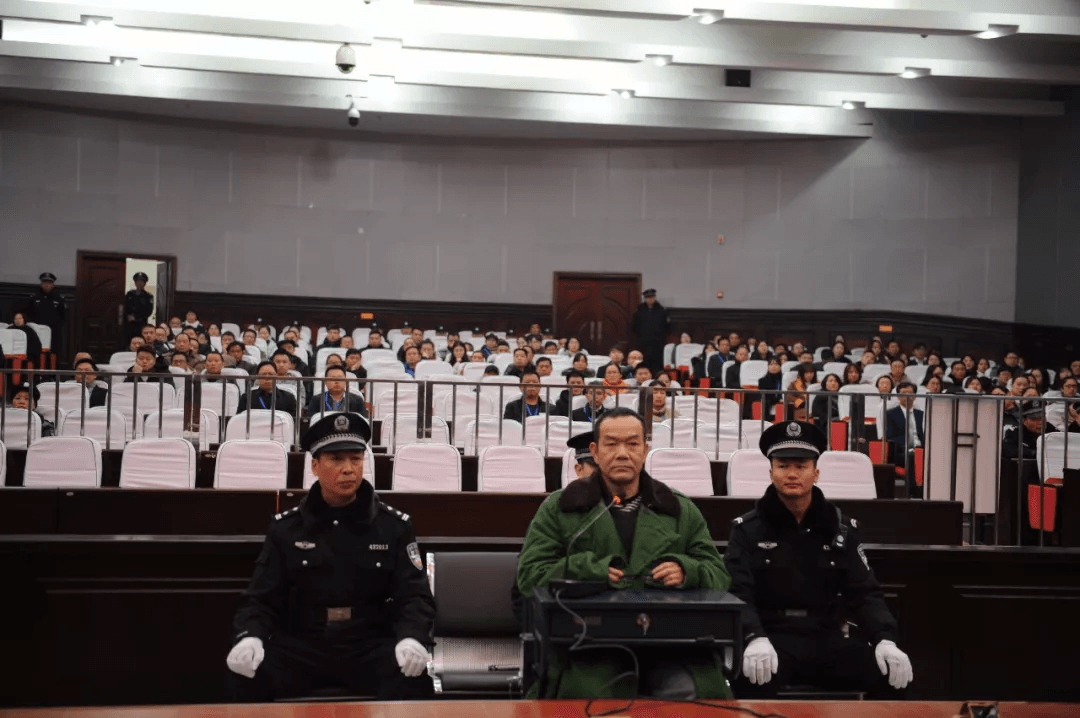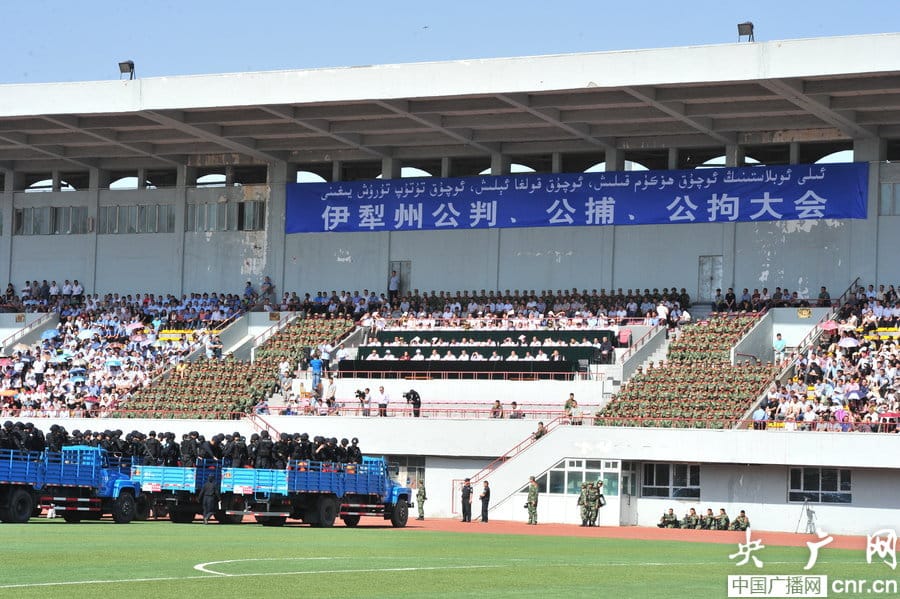
On May 27, 2014, the Yili Kazakh Autonomous Prefecture Branch of the Xinjiang High People’s Court convicted 55 defendants of splittism, “organizing/leading/participating in a terrorist organization” and murder in a public rally of sentencing, arrest and criminal detention jointly held by the party secretary and public security. Image credit: China Daily
Splittism and inciting splittism are crimes of endangering state security (ESS), introduced in 1997. They are routinely used to suppress calls for greater self-determination rights, including genuine autonomy and political separation from China. Trials of these two crimes have been used as proxies for the suppression of dissenters from ethnic minority groups, most notably Uyghurs and Tibetans.
Defined in Article 103 of the Criminal Law, splittism and inciting splittism serve to deter people from “splitting the country or undermining national unification.” The former carries a potential death sentence and targets those who organize, plot, or act to divide China. Inciting splittism is not a capital crime and is applicable when an offender urges or persuades others to commit splittism through the use of language, text, images, or other communication tools but does not commit splittism him- or herself.
Statistics released by the Supreme People’s Court (SPC) in the 12-volume Records of People’s Courts Historical Judicial Statistics: 1949-2016 corroborate Dui Hua’s observation that splittism and inciting splittism are considered by the Chinese government to be the two principal state security threats in China. The two crimes account for the majority of ESS cases nationwide and are disproportionately applied to ethnic minorities.
Chinese courts accepted 5,863 ESS cases and brought 14,072 people to trial for ESS in the first 18 years after the 1997 Criminal Law came into effect. Charts 1 and 2 show that among them, 4,304, or 73 percent of the ESS cases, and 11,810, or 84 percent of the defendants, stood trial for splittism or inciting splittism.
Chart 3 shows that the first peak of splittism and inciting splittism cases occurred in 2001; a total of 731 people were brought to trial. Although sporadic incidents of ethnic unrest had started earlier in the 1990s, China remained relatively silent and downplayed the severity of the security threat before 2001, according to a research report by CNA China Studies.
China began speaking more openly and frequently about separatist violence in Xinjiang after the September 11, 2001, terrorist attacks on New York and Washington. After 9/11, Beijing employed similar rhetoric to the United States to justify its own “War on Terror” and designated the East Turkestan Independence Movement (ETIM) as a terrorist organization with assistance from global jihadist networks. In the same year, China started blaming ETIM for instigating a number of separatist and terrorist activities in China. Because most information on ETIM can only be tracked back to Chinese government sources, some critics have raised questions of credibility and said the threats were exaggerated.
Due to the limited information available, it is impossible to quantify the extent of ETIM’s involvement in splittism and inciting splittism cases. Dui Hua’s research, however, revealed that a substantial proportion of these cases after 2000 were attributed to Hizb ut-Tahrir (伊扎布特), or Party of Liberation. For example, in 2010, police in Kashgar identified 522 people for their involvement with Hizb ut-Tahrir. Many countries have banned the group, but independent media reports documenting Hizb ut-Tahrir activity in China are scarce. Members of this group are also likely to face terrorism-related charges. Part II will feature a more in-depth discussion of this topic.
The six years before the Beijing Summer Olympics were a period of relative calm. The number of people tried for splittism and inciting splittism dropped every year from 2002-2005, falling from 630 people to 310, but increased steadily in the two years since 2006. From 2002-2007, the number of people tried for splittism and inciting splittism made up around 80 percent of ESS defendants nationwide.
The crackdown on separatism intensified in 2008; the number of defendants tried for the two crimes doubled to 1,155 from 564 in 2007. This surge was likely triggered by calls for an Olympics boycott by international activists over China’s extensive human rights violations. Chinese state media blamed ETIM and Tibetan separatists in exile for fanning anti-China sentiment overseas. Just months ahead of the Beijing Olympics, Tibetan protests erupted in Lhasa on March 14, 2008, and spread across the entire Tibetan plateau.
The number stayed high between 2009 and 2013, during which 3,871 people were brought to trial. Notable incidents of ethnic unrest included the Urumqi Riots in July 2009, a spate of Tibetan self-immolation protests, and violent attacks allegedly committed by Uyghurs in- and outside of Xinjiang.
A significant drop in the number of people brought to trial for splittism and inciting splittism occurred in 2014, falling to 577 from 886 in 2013. The number dipped almost threefold to 199 in 2015 and remained low in 2016. From 2015-2016, splittism and inciting splittism cases accounted for 58 percent of all ESS cases, down from over 90 percent when these cases were at their peak in 2012.
It is worth noting that China consistently tried and concluded more cases of splittism than inciting splittism from 1998-2013, but the case ratio vastly fluctuated. In 2013, ten people were tried for splittism for every one person tried for inciting splittism. The ratio dropped to 1.7:1 in 2005. Between 2006 and 2013, the number of defendants tried for splittism was 1.7-4.6 times more than those tried for inciting splittism.
The number of cases and defendants tried for splittism was superseded by inciting splittism after 2013. From 2014-2016, 630 people were tried for inciting splittism, more than double the number of defendants for splittism. More research is needed to better understand this emerging trend.
Sentencing
From 1998-2016, only 15 people tried for splittism or inciting splittism were acquitted. These acquittals mostly occurred in the first five years after 1997. No one was acquitted for either crime from 2003 through 2016. The only exception was in 2009; four people were acquitted for inciting splittism.
About 99.6 percent of splittism and inciting splittism trials ended with a conviction. Charts 4 and 5 show the following types of punishment: a. below three years, b. three to five years, c. over five years to death penalty, d. other, which includes exemption from criminal punishment, suspended sentence, criminal detention, and public surveillance.
Thirty-five people, 0.8 percent, were exempt from criminal punishment. Only three people, or 0.07 percent, were given criminal detention.
Non-custodial punishments were also rare. Only 26 people received suspended sentences (eight for splittism, 18 for inciting splittism), and 16 people were given public surveillance (nine for splittism, seven for inciting splittism).
The vast majority of people received imprisonment sentences. Chart 4 shows that considerably more people convicted of splittism received longer prison sentences than those convicted of inciting splittism. In the 18 years beginning in 1998, 74 percent of defendants convicted for splittism received prison sentences longer than five years, compared to 41 percent for inciting splittism as shown in Chart 5.
Chart 6 shows a year-by-year sentencing breakdown for people convicted of splittism from 1998-2016. The surge of long prison sentences (i.e. longer than five years) meted out from 2008-2013 coincided with the aforementioned incidents of ethnic unrest involving Uyghurs and Tibetans. During this restive period, as many as 90 percent of them received prison sentences longer than five years, including an unknown number of people who might have received the maximum sentence of death.
However, the same trend was not reflected in inciting splittism cases. Chart 7 shows that although nearly half of the defendants received longer prison sentences in 2009, the number dropped to 32 percent in 2010 and 34 percent in 2013.
The Publicity Department of Shache County in Xinjiang reported that 840,000 people from different ethnic groups took oaths to fight against extremism and splittism before the Chinese Communist Party flag, following a deadly terror attack which occurred in the city on July 28, 2014. Image credit: China News
Severe punishments were meted out in both splittism and inciting splittism cases in 2014. Nine out of every 10 splittism defendants received long prison sentences, as did eight out of every 10 defendants for inciting splittism. In that year, state-run Xinhua News Agency called the frenzied violence at a crowded train station in Kunming, Yunnan, “China’s 9/11.” The attack was allegedly committed by Uyghur separatists.
Social Backgrounds
The SPC statistics also provide interesting insights into the social backgrounds of defendants with judgments taking effect. Notable observations gleaned from the statistics include:
A substantial portion of splittism and inciting splittism cases appeared to concern rural grievances. Chart 8 shows that from 1998-2016, over 70 percent of people convicted of splittism were farmers, whereas farmers made up half of the defendants convicted of inciting splittism.
Classified as a sub-category of farmers in the court statistics, migrant workers emerged as a numerically significant group in 2009. Of the 322 individuals convicted for splittism, 113 were migrant workers. In that year, a violent dispute between migrant Uyghurs and Han Chinese workers from June 25-26 at a toy factory in Shaoguan, Guangdong, triggered the days-long riots that broke out in Urumqi on July 5.
Unemployed (370) and private business owners (355, including self-employed), came in a distant second and third place, respectively.
Women committed splittism and inciting splittism at a fraction of the rate of men. Only 118, or less than three percent, of all the 4,238 people convicted of the two crimes were women.
Women have received harsh prison sentences. For instance, Gulmire Imin was sentenced to life imprisonment for splittism in April 2010; she is not known to have received a sentence reduction. The Chinese government accused her of calling on Uyghurs to join the protests in Urumqi in July 2009.
Splittism and inciting splittism were disproportionately applied to ethnic minorities. Of the 4,283 convicted individuals, 3,936, or 92 percent, were ethnic minorities.
Read Part II to learn about the two main ethnic minority groups in splittism and inciting splittism cases: Uyghurs and Tibetans
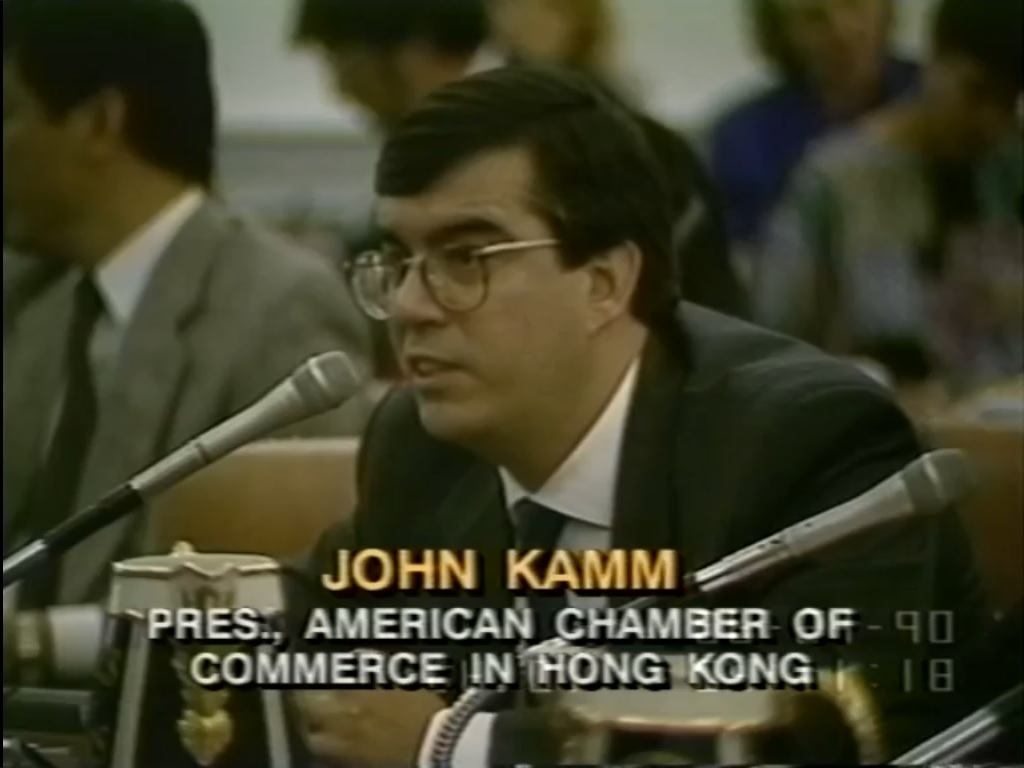
John Kamm testifying before the House Ways and Means Subcommittee on Trade on June 19, 1990. Image credit: C-Span
On January 1, 1990, I began my one-year term as president of the American Chamber of Commerce (Amcham) in Hong Kong. As recounted elsewhere, there was opposition from large corporate members to my becoming president. Many of them resented my having pushed through a resolution condemning the June 4, 1989 killings. A former president of Amcham claimed, with no evidence, that the Hong Kong government opposed the prospect of my becoming Amcham president and would refuse to work with me.
1990 would prove to be an eventful year marked by my testifying three times to Congress on China’s Most Favored Nation (MFN) trade status – before subcommittees of the House Foreign Affairs Committee (May 16, 1990), the Trade Subcommittee of the House Ways and Means Committee (June 19, 1990), and the Senate Finance Committee (June 20, 1990). My argument – that withdrawing MFN from China would cause massive collateral damage to Hong Kong – was cited by President George H. W. Bush in his May 24, 1990 statement renewing China’s MFN.
The MFN decision is thought to have been the first time in American history where the then-colony had played a role in a major foreign policy decision.
The chamber also successfully lobbied the Bush administration to issue an executive order protecting visas for Chinese students, and it urged the normalization of relations with Vietnam. In September 1990, I led the first American delegation to Mongolia after that country’s democratic revolution.
Internally, I oversaw the raising of membership dues by a large percentage; the chamber lost very few members. This hike in dues resulted in the chamber banking a significant sum, which enabled it to purchase its own premises in the Bank of America Building, a property it occupies to the present day. I was proud to have welcomed the first businesswoman onto the chamber’s executive council, a long overdue step.
Towards a Hong Kong Policy
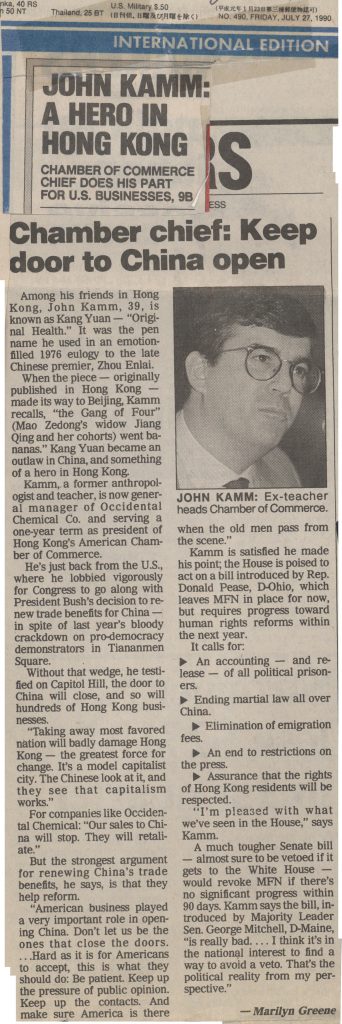
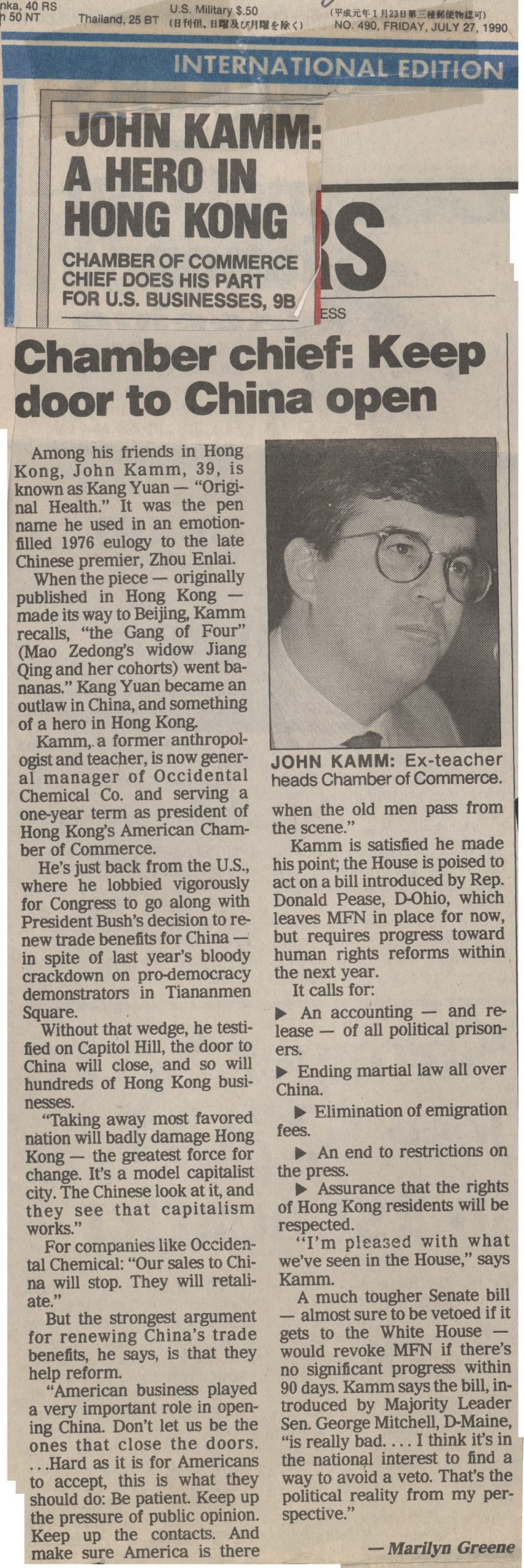
Clippings of USA Today’s coverage of Kamm’s testimony as it appeared in the international edition on July 27, 1990. Image credit: Dui Hua media log
On November 16, 1990, as my term of office was about to expire, I traveled to New York. I gave a speech at the Harvard Club in which I called for legislation to protect Hong Kong’s special status under United States law, an initiative that contributed to the enactment of the Hong Kong Policy Act in 1992. The speech, titled “Towards a Hong Kong Policy,” was hosted by the National Committee on US-China Relations.” It was attended by more than 60 local and state officials, journalists, businesspeople and traders, and lawyers, including President John F. Kennedy’s speech writer Ted Sorenson and the celebrated China expert Jerome A. Cohen. It didn’t take long for my speech to find its way to Washington D.C.
I started my remarks by noting that little thought had been given to fashioning a national policy to protect and enhance America’s substantial interests in Hong Kong, and then went on to list what those substantial interests were: America’s 14th largest trading partner, home for more than 160 American-owned factories worth $1.4 billion in investment, shared culture and values, and an American population of more than 20,000 citizens. I estimated that 200,000 Hong Kong people would emigrate to the United States over the next ten years.
I declared that “The United States has a special responsibility with respect to the Sino-British Joint Declaration on Hong Kong. . .Ours was the first government to recognize the declaration, later leading the vote in the United Nations on registering the Joint Declaration as an international treaty.” I stressed that the United States has a moral responsibility to be true to our own ideology of free enterprise and respect for human rights. “If America is a shining city on a hill, nowhere is the glow reflected more brilliantly than Hong Kong.”
I questioned how well the Joint Declaration was being honored, and I gave a somewhat tepid response. It was being honored “in the main.” I pointed out that there had been a series of disagreements between the United Kingdom and China on such matters as the pace of democratization, the British Nationality Act, the Port and Airport Development Strategy (which called for the building of a new airport), and cross border controls. “Fortunately, neither side has accused the other of breaking the Joint Declaration.” How times have changed!
I concluded my remarks by suggesting initiatives for the American government and institutions to preserve and protect Hong Kong:
Washington should keep Hong Kong interests in mind when considering policies towards China. Institutions, whether academic, professional, religious or public-service oriented, should strengthen ties with counterparts in Hong Kong.
Government should examine Hong Kong’s Basic Law and make comments and suggestions on areas where it can be improved. “I have been particularly vocal on the article relating to subversion and state secrets (Article 23). China’s insistence that Hong Kong pass laws against possession of undefined state secrets represents a serious threat to the free flow of information crucial to Hong Kong’s commercial vitality.”
The United States should seek to negotiate directly with the Hong Kong government on trade, investment, and taxation treaties necessary for the further development of US-Hong Kong economic relations. The trade treaty should cover separate tariff treatment, trade quotas, bilateral dispute settlement, protection against expropriation, and the establishment of trade offices on each other’s territory.
Washington should seek treaties with the sovereign powers (China and the United Kingdom) guaranteeing consular access, port visits by military vessels, and reciprocal air traffic rights.
The United States should support Hong Kong’s full participation in international trade and financial organizations. “We need to work harder to insure Hong Kong’s admission to the Asia Pacific Economic Council.” I suggested that Congress enact legislation to ensure that Hong Kong continues to have access to American companies offering high technology goods and services.
“Congress should reinforce legislation on Hong Kong’s separate immigration status after 1997.”
I recommended that the executive branch pressure the Hong Kong government to demonstrate greater commitment to the internationalization of Hong Kong. I cited the “pressing need to involve foreign nationals in as many areas of public life as possible.” I suggested that the Hong Kong civil service be internationalized.
I wound up my speech with these words: “Inasmuch as legislative authority and direction will be required for granting Hong Kong separate trade and immigration benefits, Congress should, at an early date, enact a Hong Kong Relations Act.”
On September 20, 1991, Senator Mitch McConnell (R-Kentucky) – whom I had met when he visited Hong Kong in 1990 – introduced the Hong Kong Policy Act. The legislation included most of my recommendations. It was eventually signed into law by President George H. W. Bush on October 5, 1992. It was amended by the Hong Kong Human Rights and Democracy Act on November 27, 2019.
On May 20, Dui Hua Executive Director John Kamm gave a virtual speech titled “China: The Pandemic and 2020 Elections” as part of the San Francisco University Club’s “Luncheon Lectures” series. The event, which the University Club hosted over Zoom, was attended by over 80 people.
Kamm spoke for approximately 35 minutes before answering questions from the virtual audience. After describing how he became involved with China as an undergraduate 50 years ago, Kamm spoke about the United States’ all-of-government confrontation with China, listing “fronts” on trade, finance, national security, technology, and human rights. His talk also discussed the substantial increase in US legislation targeting China as well as the surge in polling revealing deteriorating opinions on China held by the US public(see box below). Kamm concluded his comments by discussing developments in US-China relations, including the Hong Kong Human Rights and Democracy Act and the Uyghur Human Rights Policy Act.
The upcoming 2020 presidential election was one of the event’s focus areas, with Kamm saying, “China will be an issue to an extent that it has not been in the past.” In his comments on the topic, Kamm suggested that President Trump and Joe Biden will each try to appear tougher on China than their opponent, citing the fact that both are spending millions on airtime to run ads on China in battleground states, where anti-China sentiment tends to be higher. Despite such posturing, Kamm reminded the audience that both candidates have vulnerabilities when it comes to dealing with China.
Following his speech, Kamm participated in a question and answer session. Questions touched on topics including the pandemic’s effects on international trade and local supply chains, internet censorship, China’s possible preferences between the two main party presidential candidates, and policy challenges moving forward. When asked how current US-China relations were affecting Dui Hua’s work, Kamm responded, “It has rarely been so difficult.”
Responses to this event have been overwhelmingly positive. In an anonymous survey distributed to selected invitees to the virtual event, respondents praised the content of Kamm’s speech and noted the high technical quality of the event. When asked what they liked about the event, responses included, “The broad range of John’s information and sources for [the speech], his insights into the US polling numbers and Congressional politics, and his candor in answering questions.” Respondents also expressed interest in hearing more about US-China relations, Dui Hua’s advocacy methods and history, and political and religious prisoners.
“China: The Pandemic and 2020 Elections” marked Dui Hua’s first virtual event. Since the foundation began working remotely in March, Dui Hua has been exploring avenues to engage its supporters and general audiences online. Based on the positive response to Kamm’s Luncheon Lecture, Dui Hua is currently looking into possibilities for future virtual events, including panels, lectures, interviews with other experts working on China, and weekly or monthly audio events.
This talk is the latest event in a long, productive relationship between Dui Hua and the University Club. Kamm was introduced by Alfred Knoll, chair of the “Luncheon Lectures” series, who also moderated the talk. Mr. Knoll introduced Kamm, saying that he was the ideal person to address questions such as “What’s happening in China as a result of the pandemic?”, “Will it affect the 2020 elections?”, and are “Xi Jinping and Trump really drinking buddies?” Kamm last spoke at the University Club in May 2019, when he delivered a speech entitled “How Tiananmen Changed China—and Me.”
‘Negative Attitudes Towards China Persist in Public Opinion Polls
In his virtual speech to the University Club of San Francisco, John Kamm noted the high number of national polls on American attitudes towards China, saying that the results were both “astonishing” and “troublesome.” Dui Hua had previously discussedtrends in polls, their implications for US-China relations, and attitudes towards economic decoupling, and the latest polls continue to reflect increasingly negative views of China.
In asurvey of 1,012adults conducted by FTI Consulting, 40 percent of respondents said that they would not buy products made in China. Fifty-five percent said that they did not think China would follow through on the Phase 1 trade deal, and 78 percent said that they will pay more for products made by companies who have moved production out of China. The survey, which was conducted May 12-14 and released on May 15, had a margin of error of 3.09 percent.
A poll by Politico and Morning Consult conducted May 15-18 and released on May 20 shows similarly negative views. Of 1,994 registered voters polled, 31 percent see China “an enemy,” a nine-point increase since January, and another 30 percent see the country as unfriendly.In terms of who can better handle China, Biden and Trump are essentially tied, with 40 percent of respondents in favor of Biden and 38 percent more confident in Trump. The margin of error is 2 percent.
An earlier pollby Morning Consult, published on May 8, revealed that nearly three out of four Americans blamed China for the COVID-19 death rate in the United States. Out of 12 entities included on the survey, China was the most blamed among Republications and the fourth most blamed among Democrats. In a message test included in the poll, 56 percent of respondents selected the statement “The Chinese government did not give the U.S. enough warning about the pandemic, so the U.S. could not better prepare for the pandemic” as the most correct.
PRISONER UPDATES
A judgment Dui Hua recently uncovered from court websites further corroborates our observation about an increasingly prevalent tactic of criminalizing political prisoners: a shift away from using inciting subversion in favor of charging defendants with “picking quarrels and provoking troubles.” Liu Meiting (刘美廷) and Han Lifang (韩丽芳) were arrested and indicted for inciting subversion in the summer of 2017, but a year later they were sentenced to four years and three yearsin prison, respectively, for “picking quarrels” in Yuncheng, Shaanxi.
Liu had long lodged futile petitions over the death of his parents and gravelyinjured brothers.Liu and his wife Han wereaccused of hosting and joining multiple WeChat groups totaling nearly 500 members.Their WeChat messages contained abusive language about Mao Zedong, his hardcore supporters and the Chinese Communist Party.They also condemnedMao’s fans as the “most stubborn dirt” in Chinaand the ChineseCommunist Party as a “rogue regime,” andcalled its party members gongfei (共匪), or Communist bandits.In one message, the couple even called on all Chinese people to arm themselves to wipe out the Party.
Another WeChat post was addressed to a staffer in the US embassy. In April 2017, they urged the US to issue a letter of help to participating countries of the Belt and Road Forum on behalf of the oppressed petitioners in China. They pleaded foreigners not to “aid and abet injustice” because their participation in the forum gave China impetusto ratchet up stability maintenance and lock up tens of thousands of petitioners.
The court found that the above WeChat messages were merely acts of venting personal frustrations and that the couple had no real intentto overthrow or subvert the socialist system.However, the attacks on the Party and state leaders were said to have “vilified China’s national image” and “seriously sabotage[d] social order.”
The catch-all offense of “picking quarrels”was again used in a more recent case to punish dissent. Fu Hailu (符海陆), Zhang Junyong (张隽勇), Luo Fuyu (罗富誉), andChen Bing (陈兵)were sentenced in April 2019 for“picking quarrels” for selling bottles of baijiu bearing the label “8964” in commemoration of June Fourth.Before being convicted, they were likewise detained, arrested and indicted for inciting subversion.
Over the last month, Dui Hua has learned oftwo new cases of inciting subversion:
Zhang Guiqi (张桂祺), also known as Lu Yang (鲁扬), is reportedly held in Liaocheng, Shandong. Zhang is a signatory of Charter 08 written by Nobel Peace laureate Liu Xiaobo.
Wang Yuwen (王玉文), also known as Wang Zang (王藏), was detained on May 30.
The reasons for their detention are not entirely clear. As China appears to be increasingly using “picking quarrels” to suppress dissent, it remains to be seen whether their crime will be changed at a later stage of criminal investigation.
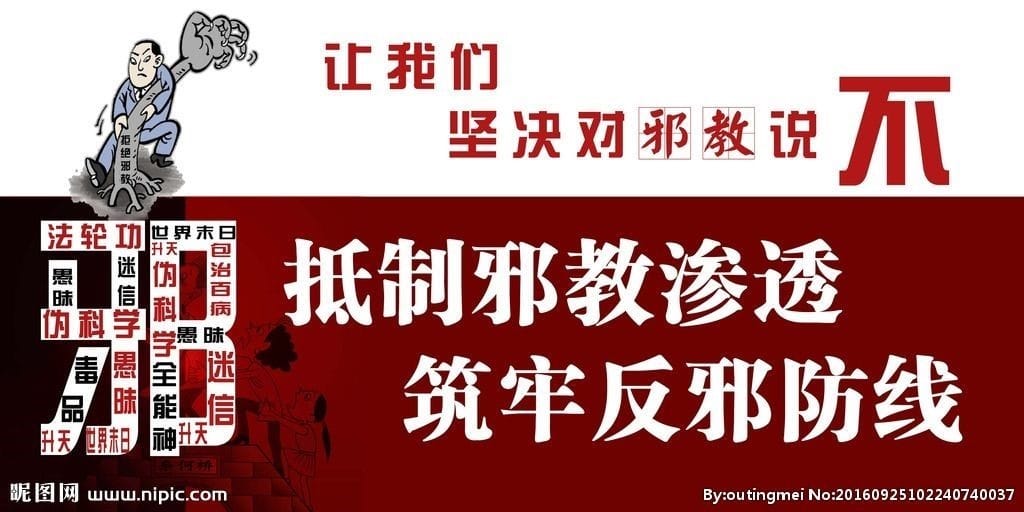
China’s anti-cult propaganda likens Falun Gong and Almighty God to drugs, superstition, and pseudoscience. Image credit: The Paper
A cult is a social group characterized by its unconventional, sometimes controversial religious, spiritual, or philosophical beliefs. In the United States, mainstream culture and religious leaders consider violent acts such as murder, suicide, and bodily harm as important factors when designating a social group as a cult. Most liberal democracies do not have legislation against cults because any attempt to do so is believed to run counter to freedom of religion enshrined in their constitutions. In China, however, a group can be designated as a cult because its politics and potential to mobilize people are considered threats to Communist Party rule.
Since coming into force in 1997, Article 300 of the Criminal Law—“using or organizing a cult to undermine implementation of the law”—has frequently been used to criminalize non-mainstream religious groups. Observers have long viewed religious persecution as being widespread in China, but they have been unable to quantify the precise extent of the crackdown because reliable figures are not available.
This article draws on the Records of People’s Courts Historical Judicial Statistics: 1949-2016, which contains extensive information on trials of Article 300 offenses, including statistical breakdowns of sentencing, gender, and defendants’ occupation. These statistics have revealed that over 23,000 cult cases were accepted and over 40,000 people were tried during an 18-year period beginning in 1998.
John Kamm Remembers is a feature that explores Kamm’s human rights advocacy prior to and since Dui Hua’s establishment in 1999.
Going to Bat for Hong Kong
John Kamm testifying before the House Ways and Means Subcommittee on Trade on June 19, 1990. Image credit: C-Span
On January 1, 1990, I began my one-year term as president of the American Chamber of Commerce (Amcham) in Hong Kong. As recounted elsewhere, there was opposition from large corporate members to my becoming president. Many of them resented my having pushed through a resolution condemning the June 4, 1989 killings. A former president of Amcham claimed, with no evidence, that the Hong Kong government opposed the prospect of my becoming Amcham president and would refuse to work with me.
1990 would prove to be an eventful year marked by my testifying three times to Congress on China’s Most Favored Nation (MFN) trade status – before subcommittees of the House Foreign Affairs Committee (May 16, 1990), the Trade Subcommittee of the House Ways and Means Committee (June 19, 1990), and the Senate Finance Committee (June 20, 1990). My argument – that withdrawing MFN from China would cause massive collateral damage to Hong Kong – was cited by President George H. W. Bush in his May 24, 1990 statement renewing China’s MFN.
The MFN decision is thought to have been the first time in American history where the then-colony had played a role in a major foreign policy decision.
The chamber also successfully lobbied the Bush administration to issue an executive order protecting visas for Chinese students, and it urged the normalization of relations with Vietnam. In September 1990, I led the first American delegation to Mongolia after that country’s democratic revolution.
Internally, I oversaw the raising of membership dues by a large percentage; the chamber lost very few members. This hike in dues resulted in the chamber banking a significant sum, which enabled it to purchase its own premises in the Bank of America Building, a property it occupies to the present day. I was proud to have welcomed the first businesswoman onto the chamber’s executive council, a long overdue step.
Towards a Hong Kong Policy
Clippings of USA Today’s coverage of Kamm’s testimony as it appeared in the international edition on July 27, 1990. Image credit: Dui Hua media log
On November 16, 1990, as my term of office was about to expire, I traveled to New York. I gave a speech at the Harvard Club in which I called for legislation to protect Hong Kong’s special status under United States law, an initiative that contributed to the enactment of the Hong Kong Policy Act in 1992. The speech, titled “Towards a Hong Kong Policy,” was hosted by the National Committee on US-China Relations.” It was attended by more than 60 local and state officials, journalists, businesspeople and traders, and lawyers, including President John F. Kennedy’s speech writer Ted Sorenson and the celebrated China expert Jerome A. Cohen. It didn’t take long for my speech to find its way to Washington D.C.
I started my remarks by noting that little thought had been given to fashioning a national policy to protect and enhance America’s substantial interests in Hong Kong, and then went on to list what those substantial interests were: America’s 14th largest trading partner, home for more than 160 American-owned factories worth $1.4 billion in investment, shared culture and values, and an American population of more than 20,000 citizens. I estimated that 200,000 Hong Kong people would emigrate to the United States over the next ten years.
I declared that “The United States has a special responsibility with respect to the Sino-British Joint Declaration on Hong Kong. . .Ours was the first government to recognize the declaration, later leading the vote in the United Nations on registering the Joint Declaration as an international treaty.” I stressed that the United States has a moral responsibility to be true to our own ideology of free enterprise and respect for human rights. “If America is a shining city on a hill, nowhere is the glow reflected more brilliantly than Hong Kong.”
I questioned how well the Joint Declaration was being honored, and I gave a somewhat tepid response. It was being honored “in the main.” I pointed out that there had been a series of disagreements between the United Kingdom and China on such matters as the pace of democratization, the British Nationality Act, the Port and Airport Development Strategy (which called for the building of a new airport), and cross border controls. “Fortunately, neither side has accused the other of breaking the Joint Declaration.” How times have changed!
I concluded my remarks by suggesting initiatives for the American government and institutions to preserve and protect Hong Kong:
Washington should keep Hong Kong interests in mind when considering policies towards China. Institutions, whether academic, professional, religious or public-service oriented, should strengthen ties with counterparts in Hong Kong.
Government should examine Hong Kong’s Basic Law and make comments and suggestions on areas where it can be improved. “I have been particularly vocal on the article relating to subversion and state secrets (Article 23). China’s insistence that Hong Kong pass laws against possession of undefined state secrets represents a serious threat to the free flow of information crucial to Hong Kong’s commercial vitality.”
The United States should seek to negotiate directly with the Hong Kong government on trade, investment, and taxation treaties necessary for the further development of US-Hong Kong economic relations. The trade treaty should cover separate tariff treatment, trade quotas, bilateral dispute settlement, protection against expropriation, and the establishment of trade offices on each other’s territory.
Washington should seek treaties with the sovereign powers (China and the United Kingdom) guaranteeing consular access, port visits by military vessels, and reciprocal air traffic rights.
The United States should support Hong Kong’s full participation in international trade and financial organizations. “We need to work harder to insure Hong Kong’s admission to the Asia Pacific Economic Council.” I suggested that Congress enact legislation to ensure that Hong Kong continues to have access to American companies offering high technology goods and services.
“Congress should reinforce legislation on Hong Kong’s separate immigration status after 1997.”
I recommended that the executive branch pressure the Hong Kong government to demonstrate greater commitment to the internationalization of Hong Kong. I cited the “pressing need to involve foreign nationals in as many areas of public life as possible.” I suggested that the Hong Kong civil service be internationalized.
I wound up my speech with these words: “Inasmuch as legislative authority and direction will be required for granting Hong Kong separate trade and immigration benefits, Congress should, at an early date, enact a Hong Kong Relations Act.”
On September 20, 1991, Senator Mitch McConnell (R-Kentucky) – whom I had met when he visited Hong Kong in 1990 – introduced the Hong Kong Policy Act. The legislation included most of my recommendations. It was eventually signed into law by President George H. W. Bush on October 5, 1992. It was amended by the Hong Kong Human Rights and Democracy Act on November 27, 2019.
In Detailed Court Statistics on Article 300, Part I, Dui Hua explored the application of Article 300 over an 18-year period spanning 1998-2016, examining the types of cases prosecuted under Article 300 as well as the roles of women and ethnic minorities in organizations deemed to be cults. Part II analyzes trends in sentencing and discusses post-2016 developments concerning Article 300.
The Standing Committee of the National
People’s Congress extended the maximum penalty of Article 300 from 15 years’
imprisonment to life imprisonment in the ninth amendment of the criminal law,
which came into effect on November 1, 2015. Image credit:Liaoning
Pindao
Since coming into force in 1997, Article 300 of the Criminal Law—“using or organizing a cult to undermine implementation of the law”—has frequently been used to criminalize non-mainstream religious groups. Records of People’s Courts Historical Judicial Statistics: 1949-2016 contains information on trials of Article 300 offenses, including statistical breakdowns of sentencing, gender, and defendants’ occupation. These statistics have revealed that over 23,000 cult cases were accepted and over 40,000 people were tried during an 18-year period beginning in 1998.
Replacing the former crime of “organizing or using a sect or feudal superstition to carry out counterrevolution activities” in 1997, Article 300 began to be used extensively after the Chinese government designated Falun Gong as an “evil cult” in 1999. The court statistics do not fully reflect the extent of the cult crackdown because they omit a large but unknown number of people whose personal liberties were deprived without any legal procedure. Despite these limitations, the statistics offer a glimpse of how China invoked its criminal justice process to crack down on religion.
Punishment Trends
Acquittals are rare in China. In cult cases, only 69 men and women who stood trial from 1998-2016 were acquitted.
About 99.8 percent of cult trials ended with a conviction. Among them, 384, or 1.3 percent, were exempt from criminal punishment, and 219, or 0.8 percent, were sentenced to criminal detention or public surveillance.
Table 1. Sentencing breakdown of cult cases
Most cult defendants received imprisonment sentences. The court statistics broke down the sentencing information into four groups: a. below three years, b. three to five years, c. over five years to death penalty, and d. suspended sentences.
Article 300 is not a capital crime, but China’s propaganda often conflates cults with violent crimes such as murder to stigmatize certain religious groups even though violence is only rarely involved. In such cases, death sentences are possible.
From 1997-2015, Article 300 as a standalone offense carried a maximum sentence of 15 years’ imprisonment. The ninth amendment to the Criminal Law in 2015 increased the maximum sentence to life imprisonment. It is unclear how many defendants convicted of Article 300 received life sentences because of how the sentencing information is categorized in the court records.
In the 18 years beginning in 1998, suspended sentences were not uncommon in cult cases, with 3,620 defendants, or 13 percent, receiving suspended sentences. Chart 1 shows an overall upward trend in the use of suspended sentences. In 2013, suspended sentences were meted out to one in every four defendants.
From 2002-2004, about 40 percent of all the cult defendants received the upper end of prison sentences exceeding five years, vis-à-vis 26 percent and 18 percent of those who received the medium and lower end of prison sentences, respectively. The severity of punishment highlighted the heightened repression of Falun Gong at the time.
The proportion of people who received prison sentences exceeding five years dropped to 12 percent from 28 percent from 2005-2013. In 2015, however, the number of people who received longer prison sentences surged to 1,218, making it the only year between 1998-2016 when the number exceeded 1,000. The severity of punishment, which cumulated in the 2015 amendment to the Criminal Law that turned Article 300 into a crime with the possibility of life in prison, was largely triggered by the heightened crackdown on Almighty God. China’s propaganda offensive against the quasi-Christian sect intensified following the killing of a woman in a McDonald’s restaurant allegedly committed by Almighty God members in May 2014. In this case, two members who committed the murder were sentenced to death in February 2015, and two others received life imprisonment. All of them were also convicted of violating Article 300.
This trend of severe punishment appears to have lasted only one year. In 2016, the number of cult defendants who received longer prison sentences dropped fourfold to 333. More than half of them were sentenced to imprisonment not longer than three years.
Going forward
Although the court records only provide criminal trial statistics up to 2016, other government sources seem to suggest that the trend towards greater leniency in cult cases continued afterwards. Effective since February 1, 2017, the judicial interpretation issued by the Supreme People’s Court in 2017 raises the threshold for evidence necessary to imprison cult prisoners for up to three to seven years. For instance, the quantity of print propaganda materials (such as leaflets, banners, or newspapers) produced or disseminated for cult purposes that constitute a normal offense has now been raised to 1,000, a significant leap from 300, as stated in the 2001 interpretation. Today, more cult cases are likely to be deemed “relatively minor” because the interpretation has expanded the scope of activities that fall under such a category.
Dui Hua previously reported that it is not uncommon for cult prisoners to receive clemency after expressing remorse for their behaviour. This trend remains unchanged. Since January 1, 2017, Dui Hua’s Political Prisoner Database has documented over 1,200 instances of sentence reductions, parole, and medical parole granted to “cult” prisoners. All these acts of clemency were confirmed by official sources, including court judgments and responses provided by government interlocutors to Dui Hua.
However, Dui Hua continues to find a large number of cult cases from government sources after 2016. From 2017-2019, over 6,000 cult judgments have been posted online. Most of them involve Falun Gong, followed by Almighty God.
These judgments also revealed a troubling aspect of judicial transparency in cult cases involving ethnic minorities. Dui Hua uncovered about three dozen cases which appear to involve Uyghurs or Kazakhs; the judgments were all handed down in Aksu Prefecture in June 2019. This finding suggests that China’s crackdown on cult organizations has extended to Muslim minorities in Xinjiang, but details remain unknown because judges exercised their power to conceal content that they believe might endanger social stability. These judgments only revealed information about defendants’ names, crimes, and the courts which handled the cases. All other information, including how long they were sentenced and where they are incarcerated, has been obscured.
Since 2019, state news media has reported a large number of cult cases in Shandong and Qinghai. In each instance, dozens to over 600 people were admonished, administratively detained, or criminally detained. A portion of these “cult” members are believed to have been indicted or brought to trial.
Anti-cult propaganda continues unabated even amid the COVID-19 outbreaks across China. Authorities in Henan combine COVID-19 prevention measures with an anti-cult message, saying, “Pandemic prevention requires cult prevention.” Image credit: Guancha.cn
China continued to deploy considerable manpower to suppress cult organizations even amid the COVID-19 outbreaks across the country. From January to early May 2020, the China Anti-Cult Association reported 25 cult cases across different provinces. About half of these cases were related to the pandemic. Among them, 15 Falun Gong practitioners were detained for disseminating anti-government materials. They were also accused of “concocting and spreading superstitious fallacies” about their supernatural power to cure COVID-19 when the outbreaks were at their peak in February.
Society of Disciples, also known as Mentu Hui, has been much less visible in China, but this Christian sect was involved in one of the reported coronavirus-related cult cases. The group allegedly claimed that conversion could help to prevent the spread of COVID-19. In this case, a woman surnamed Wu in Gong County, Sichuan, received administrative detention for 15 days.
Despite signs of greater leniency towards cult offenders, there are sufficient grounds to believe that the number of cases, as well as the number of individuals, especially women, brought to trial for Article 300 has remained in the thousands over the past few years. Dui Hua will continue to monitor the application of this crime, which has been used by the Chinese government to jail tens of thousands of religious dissenters since 1997.
China’s anti-cult propaganda likens Falun Gong and Almighty
God to drugs, superstition, and pseudoscience. Image credit: The
Paper
A cult is a social group characterized by its unconventional, sometimes controversial religious, spiritual, or philosophical beliefs. In the United States, mainstream culture and religious leaders consider violent acts such as murder, suicide, and bodily harm as important factors when designating a social group as a cult. Most liberal democracies do not have legislation against cults because any attempt to do so is believed to run counter to freedom of religion enshrined in their constitutions. In China, however, a group can be designated as a cult because its politics and potential to mobilize people are considered threats to Communist Party rule.
Since coming into force in 1997, Article 300 of the Criminal Law—“using or organizing a cult to undermine implementation of the law”—has frequently been used to criminalize non-mainstream religious groups. Observers have long viewed religious persecution as being widespread in China, but they have been unable to quantify the precise extent of the crackdown because reliable figures are not available.
Published by China’s Supreme People’s Court at the end of 2018, Records of People’s Courts Historical Judicial Statistics: 1949-2016 contains extensive information on trials of Article 300 offenses, including statistical breakdowns of sentencing, gender, and defendants’ occupation. These statistics have revealed that over 23,000 cult cases were accepted and over 40,000 people were tried during an 18-year period beginning in 1998.
The Criminal Law does not provide an explicit and detailed definition of cult organizations. Back in 1995, the Central Committee, State Council, and Ministry of Public Security identified 14 religious groups (12 Christian and two seemingly Buddhist) as cult organizations. In 2014, the China Anti-Cult Association compiled another list of 20 cult organizations (16 Christian, three quasi-Buddhist, and one qigong). These lists are not exhaustive because local authorities across China have exercised broad discretion to designate numerous religious groups as “cults” even though they have not been named on the aforementioned cult lists.
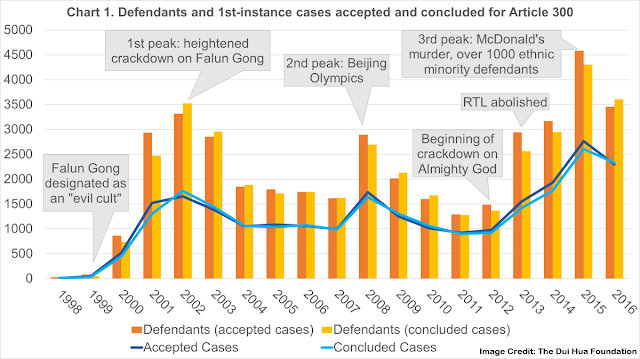
Replacing the former religious crime of “organizing or using a sect or feudal superstition to carry out counterrevolution activities” in 1997, Article 300 began to be used extensively after the Chinese government designated Falun Gong as an “evil cult” in 1999. Before the nationwide repression began, tens of thousands of practitioners could be seen meditating in parks and public squares all over China. Chinese courts began filing the bulk of cult cases a year after Falun Gong was outlawed. The number of people brought to trial skyrocketed from 864 in 2000 to almost 3,000 in 2001. The country recorded its first peak of cult cases in 2002; 3,315 people were brought to first-instance trials.
The second peak took place in 2008; the reasons are not entirely clear. It could be that China ratcheted up stability maintenance in the run up to the Olympics in Beijing. Falun Gong practitioners joined forces with international activists to boycott the Olympic torch relay over China’s extensive human rights violations. Chinese state media called Falun Gong one of the three forces seeking to sabotage the Olympics alongside the East Turkestan and Tibetan independence movements.
The court statistics do not fully reflect the extent of the cult crackdown because they omit a large but unknown number of people whose personal liberties were deprived without any legal procedure. Among these measures are people who are placed in “legal education classes,” which have been used in China for two decades. This measure provides local authorities with a highly flexible means of dealing with individuals who engage in behavior that is viewed as socially disruptive but does not meet the criteria for criminal prosecution or public-order punishment.
Despite these limitations, the statistics offer a glimpse of how China invoked its criminal justice process to crack down on religion. The surge of cult cases in 2013 warranted particular attention. Compared to 2012, the number of people who stood trial in 2013 doubled to 2,942. There were two main reasons:
RTL was abolished in 2013. Cult offenders who were previously sent to RTL are now more likely to face imprisonment sentences.
People
in Gansu Province on December 11, 2012 carry a banner warning that Almighty God
is coming to save believers and destroy the people and nations that resist. Image
credit: Global
Times
China’s sweeping clampdown on Almighty God began in late December 2012. Identified by the Chinese government as a cult organization in 1995, the quasi-Christian group claims that Jesus was reincarnated as a Chinese woman and calls on members to slay the Chinese Communist Party, which they call the “great red dragon.” It joined the chorus of voices spreading rumors of an impending apocalypse, which predicted that the sun would cease to shine and electricity would stop working for three days beginning on December 21, 2012. Prior to the “doomsday,” group members spread the rumors at public venues and by going door-to-door, and they held demonstrations across China which were put down with force.
The Chinese press had published very little about Almighty God before 2012, but the demonstrations in that year became the catalyst for China’s propaganda offensive against the sect. Just ahead of the “doomsday,” public security detained 1,300 Almighty God members across 16 provinces, with the majority of them in Qinghai and Guizhou. In 2014, China Daily reported the arrests of another batch of 800 Almighty God members in Ningxia over the previous two years.
The highest peak of cult cases occurred in 2015: 2,764 cases and 4,582 defendants. This peak coincided with the amendment to the Criminal Law which turned Article 300 into a crime with the possibility of life in prison (up from a fixed-term imprisonment sentence of 15 years). In that year, China intensified its propaganda offensive against Almighty God and sentenced two members who allegedly killed a woman in a McDonald’s restaurant to death.
It is worth noting that the surge of cult cases in 2015 was attributed largely to ethnic minorities. Except for 2015, ethnic minorities typically accounted for a few dozen to over a hundred defendants each year from 2000-2016. Evidence suggests that Falun Gong, Almighty God, and other unconventional Christian sects have made inroads with a small number of Hui, who are traditionally Muslims. With a strong base in northeast China, Falun Gong is also known to have converted a number of Manchus, ethnic Koreans, and Mongols. More research is needed to examine why the number of ethnic minorities surged to 1,082 in 2015. It remains unclear who these ethnic groups were and what happened to them in that year.
Dui Hua’s research into online judgments also uncovered cult cases concerning lesser-known unconventional religious groups, including the Three Grades of Servants (三班仆人), Society of Disciples (门徒会), Spirit Sect (灵灵教), Blood of the Holy Spirit (血水圣灵), Lord God Sect (主神教), Full Scope Church (全范围教会), Shouters (呼喊派), and the quasi-Buddhist group Guanyin Famen (观音法门). However, Falun Gong and Almighty God continue to account for the majority of cult cases. Violence is rarely involved in cases involving these organizations.
Over one-third were women
From 2010-2016, women accounted for five to seven percent of defendants in all criminal cases. However, they are disproportionately represented in cult cases tried. The court records indicated that women made up 41 percent of all the 28,497 cult defendants during the 18-year period. In the 2000s, the number of female defendants ranged from 400 to 800 each year, but it doubled in just one year after the state crackdown on Almighty God commenced in December 2012. About 2,600 women stood trial within two years since 2015.
China’s anti-cult propaganda says that women in cult cases are typically middle aged and “left-behind” by husbands (留守妇女) who migrated from rural regions to cities for employment or to conduct business for an extended period. It often makes sexist claims that women are “weak-willed and psychologically vulnerable, with a propensity to succumb to coercion or monetary enticements from cult organizations” because many of them have a low level of education.
Statistics are given about the defendants’ occupational background, but it is unclear how many workers, farmers, and other occupations were women. The statistics indicated that 35 percent of all cult defendants were farmers or migrant workers, and slightly less than one-third were unemployed. Only 7.5 percent of all the defendants were classified as employed or laid-off workers, and another 7.5 percent were retired.
Although China’s anti-cult propaganda tends to describe women as passive victims in cult cases, they are known to have taken a leading role in several religious groups outlawed by the Chinese government. For instance, Guanyin Famen (观音法门) was founded by Vietnam-born Chinese Shi Qinghai in 1988 and introduced to China around 1992. It appears to be the largest of the three Buddhist-sounding groups banned by China (read The “Cult of Buddha” for a more in-depth discussion). Shi, who is residing overseas, continues to attract members in China despite the state ban that has been in place for almost three decades.
Many China-based Guanyin Famen leaders are women. Although the number of publicized cases has decreased sharply in recent years, Dui Hua continues to uncover new cases related to this sect. In September 2019, a local court in Shaanxi sentenced Guo Huiling (郭会玲) to 18 months’ imprisonment. Guo, a leading member in charge of recruiting members in Baoji, was apprehended by public security while distributing Guanyin Famen pamphlet cards in March 2019. The “cult” books, posters, cassette tapes, and CD-ROMs found by public security in her home became the evidence for conviction.
Women have likewise played a leading role in several other homegrown religious groups which emerged relatively recently in the 2010s. Combining elements of Daoism, Buddhism, Chinese folklore, and superstitious practices, these groups have never been mentioned on the different lists of cults compiled by the Chinese government. Their leaders also received lengthy sentences for Article 300.
Zheng Hui, founder of the Milky Way Federation, promoted the use of alien energy to become Buddha.
Image credit: Sohu
Among these groups are the Milky Way Federation (银河联邦), which was established in 2012 by Zheng Hui (郑辉). Zheng resigned from her job and created a website dedicated to promoting a belief she learned from a group in Germany, which China views as an apocalyptic religious cult. Zheng combined concepts of Buddhism with her belief that extra-terrestrial beings exist. Proclaiming herself to be the female Gautama Buddha, Zheng intended to awaken humankind in her envisioned “Buddha kingdom.” Her group allegedly had over 4,000 members from across China. In July 2015, Zheng was sentenced to eight years in prison under Article 300 in Nanning, Guangxi.
Zhongtian Zhengfa is a Buddhist-sounding religious group co-founded by
self-proclaimed reincarnated mother Buddha Chen Yunxiu. Despite propaganda
presenting women as passive victims in cult cases, Chen has played a leading
role in an organization designated as a cult. Image credit: Sina
Blog
Bizarre as it may sound, syncretic religious groups similar to the Milky Way Federation appear to have gained popularity in other provinces. Alongside her husband, Chen Yunxiu (陈云秀) founded Zhongtian Zhengfa (中天正法) in 2010 and called herself the reincarnated mother Buddha, Nüwa (the mother goddess in Chinese mythology), and Saint Mary. Zhang said that conversion to her sect would be the only way to obtain salvation. Zheng was sentenced in Shandong to seven years’ imprisonment for Article 300 in 2018. The court judgment indicated that her group had over 900 members from different provinces.
In Part II, Dui Hua examines the different forms of punishment meted out to those convicted under Article 300, analyzes trends in sentencing, and explores post-2016 developments concerning cult cases. Read it here.
Public Opinion of China Plummets as Calls for Economic Decoupling Grow
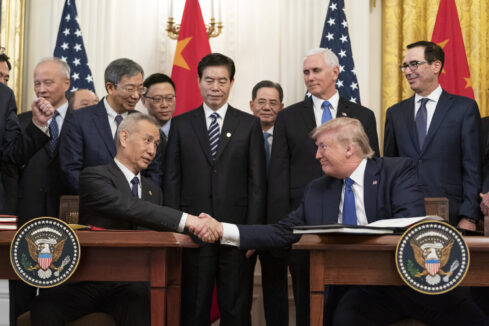
President Trump and Chinese Vice Premier Liu He sign the US-China Phase One Trade Agreement on Wednesday, January 15, 2020, in the East Room of the White House. Image Credit: Official White House Photo by Shealah Craighead / Public Domain
Polls of American public opinion released in March and April reveal a deep distrust of the Chinese government, low favorability ratings of China, and a lack of confidence in China’s leader Xi Jinping. There is strong support for economic decoupling, with more than 70 percent in two polls favoring American corporations withdrawing from China.
The Gallup poll of 1,028 American adults conducted in February and released on March 2 puts China’s favorability rating at 33 percent versus an unfavorability reading of 67 percent. The spread of 34 percentage points is the biggest gap since September 1979, when Gallup began polling American attitudes towards China. Twenty-two percent of Americans, and a plurality of Republicans, see China as America’s greatest enemy, one notch below Russia. The Gallup results reveal that, for the first time in 20 years, Americans rate the United States as the world’s leading economic power now and in 20 years.
The Pew Research Center poll of 1,000 adults undertaken March 3-29, 2020 and released on April 21 gives even worse ratings for China: 26 percent favorable versus 66 percent unfavorable. This spread of 40 points is the biggest gap on record. More than 90 percent see China’s power and influence as a threat to the United States, and more than 70 percent have little or no confidence in Xi Jinping. Eighty-five percent of Americans view America’s trade deficit with China as a serious problem.
Two of the most interesting findings in the Pew poll concern human rights and Hong Kong. Eighty-two percent view China’s human rights policies as a serious problem, and 57 percent view them as a very serious problem, an eight-point increase since the 2018 poll. For the first time, a major American polling organization asked for opinions regarding Hong Kong. Two-thirds view tensions between China and Hong Kong as a serious problem.
The Harris poll of 1,993 American adults taken April 3-5, 2020 and released on April 8, 2020, reveals deep distrust of Chinese reporting on the coronavirus, with 72 percent viewing it as inaccurate versus 28 percent who view it as accurate. Likewise, 77 percent of Americans blame China for the spread of the disease. Sixty-nine percent agree with President Trump’s trade policies, but 50 percent want even tougher policies. By a slim majority, Americans do not believe that China will honor the Phase One trade agreement; if the country does not honor the agreement, nearly three-quarters of Americans support reimposing tough tariffs. If China is found to be underreporting coronavirus cases and deaths, 80 percent of Americans hold that the administration or Congress should impose unilateral sanctions against the country.
The weekly Economist/YouGov polls have asked Americans about their perceptions of China twice since Dui Hua reported a drop in public opinions in March. The number of Americans answering that China is an enemy of the United States continually increased to an all-time high of 27 percent in the poll released on April 27 (in addition to 40 percent of respondents who view China as unfriendly). For the Economist/YouGov survey conducted March 22-24, 33 percent of respondents answered that the claim “China is responsible for the worldwide pandemic” is “definitely true,” and 35 percent responded that it is “probably true.” Answers to the “daily question” posed on April 27 reveal that 39 percent of 24,812 US adults surveyed have a more negative view of China due to the COVID-19 outbreak.
Unlike the other polls which measure attitudes among adults, the McLaughlin & Associates poll, taken April 16-20, 2020 and released on April 22, 2020, measures attitudes of likely voters. Seventy percent of likely voters think that China knowingly kept Covid-19 data secret versus only 12 percent who think the country did not. The poll reveals that 75 percent of likely voters think the United States should reduce dependence on Chinese imports, 72 percent think the United States should change its trade relationship with China, and 72 percent feel that Washington should mandate that companies with essential manufacturing and technology leave the country.
Of special concern to Beijing is that voters in battleground states tend to favor harder policies on China than voters in non-battleground states. Republicans and conservatives, who polls show are more likely to enthusiastically support their candidate than Democrats and liberals are to enthusiastically support their candidate, also favor “get tough on China” policies.
It is unusual for so many polls of attitudes towards China to have taken place in such a short period of time. The results strongly suggest that China and its policies on a wide range of topics, notably its handling of the Covid-19 pandemic, will be major issues in the upcoming presidential campaign.
‘Economic Decoupling’ Between the US and China
A survey conducted by Kearney, an American consulting company with offices in 40 countries, reveals a sharp increase in American companies relocating production from Asian countries – especially China – back to the United States in 2019. The main reason for this dramatic shift was the trade war between China and the United States, a confrontation that saw tariffs rise on billions of dollars of goods.
A more recent survey released by the American Chambers of Commerce in China and Shanghai suggests that American companies with long histories of working in China increasingly believe that “decoupling” is possible. In autumn 2019, 66 percent of executives at these firms believed that decoupling was impossible. In the survey released in April, 44 percent of these executives now think decoupling is impossible, a drop of 22 percentage points in a period of six months.
The main reason for this dramatic change is the disruption of supply chains caused by Covid-19. Other reasons include the continuing impact of high tariffs and the increasing possibility that China’s deep unpopularity among American consumers could prompt boycotts of Chinese products.
Another factor is Washington’s banning American companies and government agencies from doing business with Chinese companies seen as abetting human rights abuses or posing national security risks. White House Economic Council Director Larry Kudlow went so far as to suggest, on April 10, 2020, that the United States should pay the “moving costs” of every US company that wants to leave China.
The idea of governments incentivizing their companies to leave China is not as outlandish as it may appear at first glance. On the same day that Kudlow announced support for paying American companies’ costs to leave China, the Japanese government announced a $2.2 billion fund to help Japanese companies exit the country.
PRISONER UPDATES
Last month, China launched a campaign nationwide amid the COVID-19 pandemic to raise public awareness of statesecurity. Held annually on April 15 since 2016, the National Security Education Day this year broadened the scope to highlight issues related to health care and biological security. As with previous years, state news media showcaseda series of endangering state security (ESS) cases. Dui Hua found over two dozen names of individuals from state news reports, most of whom were detained in the 2010s. Some of the previously unknown cases included:
Wang Pihong (王丕宏) and Zhao Ruqin (赵汝芹) were sentenced to two to three years’ imprisonment for “defection and turning traitor” by the Luoyang Intermediate People’s Court on November 20, 2019. Before migrating to Canada, the couple worked in a Chinese state-owned aviation research institute and got involved in several secret projects. While allegedly possessing China’s state secrets, they found employment with a foreign-owned aviation corporation and became naturalized citizens in Canada.
In a separate case, Miao Jingguo (苗敬国) was also sentenced for “defection” to two years in prison in Luoyang, Henan. Miao was alleged to have acquired a foreign nationality without notifying the Chinese government. Available sources did not specify which foreign country was involved. While in China, Miao worked as a technical specialist of a defense industry research institution.
Military engineering expert Zhang Jian’ge (张建革) received a 15 years’ imprisonment sentence for espionage in Zhengzhou, Henan, in 2016. State news media sources said Zhang provided intelligence to a foreign agent during an academic trip in 2011.
On April 30, 2020, a local court in Hunan sentenced former journalist Chen Jieren (陈杰人) to 15 years’ imprisonment for “picking quarrels and provoking trouble” and multiple economic crimes due to the thousands of critical commentaries and investigative reports he posted on social media. The court alleged that Chen used the internet to disseminate false or negative information, maliciously exaggerate certain mass incidents, and vilify the Chinese Communist Party. Also convicted in the same case was his brother Chen Weiren (陈伟人), who received a four-year prison sentence. His colleague Liu Min (刘敏) was exempted from criminal punishment for the sole crime of “picking quarrels.”
The judgment mentioned four other defendants who were dealt with in a separate case: Ai Qunhui (艾群辉), Deng Jiangxiu (邓江秀), Li Changmao (李长茂) and Liu Liqun (刘利群). Their statuses are unclear. Chen Minren (陈敏人) has been criminally detained over the same charges as his brother Chen Jieren since July 2018.
China continues to use ESS charges to crack down on house churches. Last December, Pastor Wang Yi (王怡) of the Early Rain Covenant Church received a nine-year prison sentence for inciting subversion and illegal business activity in Chengdu. On April 2, Bethel Church pastor Zhao Huaiguo (赵怀国) was formally arrested for inciting subversion about two weeks after he was detained in Zhangjiajie. Zhao established the church in Hunan in 2007 and has repeatedly refused to join the officially sanctioned Three Self Patriotic Church. Available sources said that Zhao circumvented internet censorship to read news and commentaries about coronavirus.
As the world’s leading executioner, China’s death penalty law has long been scrutinized by scholars, policy makers, and human rights groups. The subject matter garners an outsized level of international attention when the cases involve foreigners. Robert Schellenberg’s case serves as a recent, highly visible example: Schellenberg is a Canadian sentenced to death for drug trafficking, and his case has seemingly been thrust into the tit-for-tat of international politics. Ironically, this increased attention comes amid a decades-long decline in the overall use of the death penalty in China.
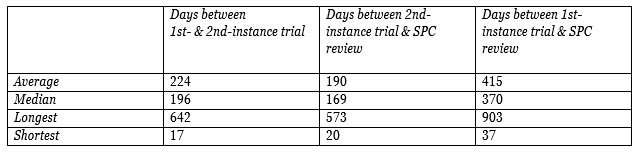
It has been over a year since Schellenberg appealed his death sentence to the Liaoning High People’s Court in January 2019. The court appears to be delaying the judgment in order to seek leverage over the case of Meng Wanzhou. International politics are clearly at play in Schellenberg’s case, but it must be noted that delayed judgments are not uncommon in capital cases involving Chinese citizens. In some cases, defendants have waited as long as 600 days between first and second instance trials; in a rare case, 900 days elapsed before the final review by the Supreme People’s Court (SPC). The length of time between trials, SPC reviews, and execution varies case by case. It is also possible for the SPC to expeditiously approve death sentences within a month after the sentences were handed down at first-instance trials.
Understanding of how China applies the death penalty is largely lacking. To better understand these conflicting trends, Dui Hua has conducted an updated analysis of trends in the length of time between trial and execution in China’s death penalty cases. Longer times between sentence and execution could indicate a more deliberate judicial approach that allows for meaningful review of the evidence supporting a conviction and death sentence, and it also provides a window for intervention from higher courts and others to stop executions and correct wrongly decided cases.
John Kamm Remembers is a feature that explores Kamm’s human rights advocacy prior to and since Dui Hua’s establishment in 1999.
Mission to Beijing: April 1992, Part II
The Beijing Great Wall Hotel. Image Credit: hotelincn.com
Part I, published in last month’s Digest, can be found here.
After the meeting with Vice Minister Jin wound up, I was driven to the offices of the State Council Information Office (SCIO) for a meeting and lunch with its director, Zeng Jianhui (who would go on to be chairman of the National People’s Congress Foreign Affairs Committee), and its deputy director Li Yuanchao, China’s future vice president. On the way I reflected on what I had been told, which was in complete variance with the accepted narrative, which was basically that Wei Jingsheng was in bad shape, a basket case.
I told Director Zeng and Deputy Director Li about my meeting with Vice Minister Jin and expressed my concern that people wouldn’t believe the account I had been given about Wei. “Don’t worry,” Zeng Jianhui said. “He’s a vice minister. If he lied to a foreigner, he’d be in big trouble.”
China’s “007”
On the way back to the hotel, I stopped by the Ministry of Public Security, on Tiananmen Square, to see Director General of the International Department Zhu Entao, someone I’d known since 1976 when he was seconded to the Guangzhou Trade Fair’s liaison office handling Americans and Europeans. Zhu, “China’s 007,” feigned ignorance of Wei’s situation, not unexpected as Wei was being held in a Ministry of Justice facility. There was bad blood between the ministries, arising from the decision in 1980 to transfer control of the country’s prisons from the Ministry of Public Security to the newly established Ministry of Justice (MOJ).
I returned to the Great Wall Sheraton and called Nick Kristof of The New York Times. Nick and his wife Sheryl WuDunn had been awarded a Pulitzer Prize for their reporting on the Tiananmen Square protests. He was and remains passionate about human rights.
Nick joined me for drinks at the hotel bar. I read from my notes of the meeting with Vice Minister Jin, leaving nothing out. After an hour, Nick left and returned to his apartment to write up the story. It appeared in The New York Times on April 8, 1992, under the headline “China Offers Peek at Famed Prisoner.”
The day the article appeared I met with the Ministry of Foreign Affairs and the Supreme People’s Procuratorate, the prosecutors. That evening I hosted a banquet in honor of my host, the China Council for the Promotion of International Trade’s (CCPIT) Liu Fugui. Gathered around the table were senior officials of the SCIO, the Religious Affairs Bureau (RAB, now the State Administration of Religious Affairs), the Public Security Ministry, the MOJ, and the Procuratorate. I was asked which prisoners’ release would have the biggest impact on American opinion, in Congress and in the general public. I was well prepared, and listed labor leaders, Catholics, and other big names like Wei Jingsheng. After the dinner, the official from the RAB took me aside and told me that the Catholics whose names I had raised would be released.
As anticipated, the reaction to the Kristof article was one of disbelief and, in some quarters, hostility. A Beijing-based journalist of a rival newspaper, a friend who had written a profile about me and my work, called me at my hotel, furious that I had given the “scoop” to Kristof. A New York-based human rights activist wrote a letter to The Los Angeles Times questioning why anyone would believe anything the Chinese government told John Kamm.
Wei Released
Wang Mingdi1995 at the China State Prison Work Meeting. Image Credit: ilawpress.com
I continued to raise Wei on future trips to Beijing, pressing for his release. I met Wang Mingdi on March 9, 1993, at the MOJ’s old headquarters, a shabby, non-descript building on a dusty lane off the road to Beijing airport. Officers played billiards in the middle of the road in front of a bicycle repair shop.
I asked Wang about Wei. “He is such a famous international person; many people are interested in him.” Wang told me that, while Wei was healthy, “He persists in his strong anti-government attitude. He is strongly against socialism and blames the Chinese government for everything wrong in China, even the recent East China floods.”
Wang revealed that at the end of 1992, six months after I raised his name, Wei was driven to Beijing and taken to Science Street in Haidian District. “We let him alight and take a look. He didn’t say much, only ‘I’m from Beijing, but I don’t recognize Beijing.’” Wang Mingdi didn’t rule out an early release, though he said this would be “difficult to consider.” If Wei continued to follow prison rules, his sentence would not be extended. It was not uncommon in those days for counterrevolutionaries to have their sentences extended.
Wei Jingsheng was paroled on September 14, 1993. The reason given was that he had obeyed prison regulations, but many observers noted his release took place one week before the decision by the International Olympics Committee on which city would be awarded the 2000 Summer Olympics. (Beijing lost out to Sydney by a single vote.)
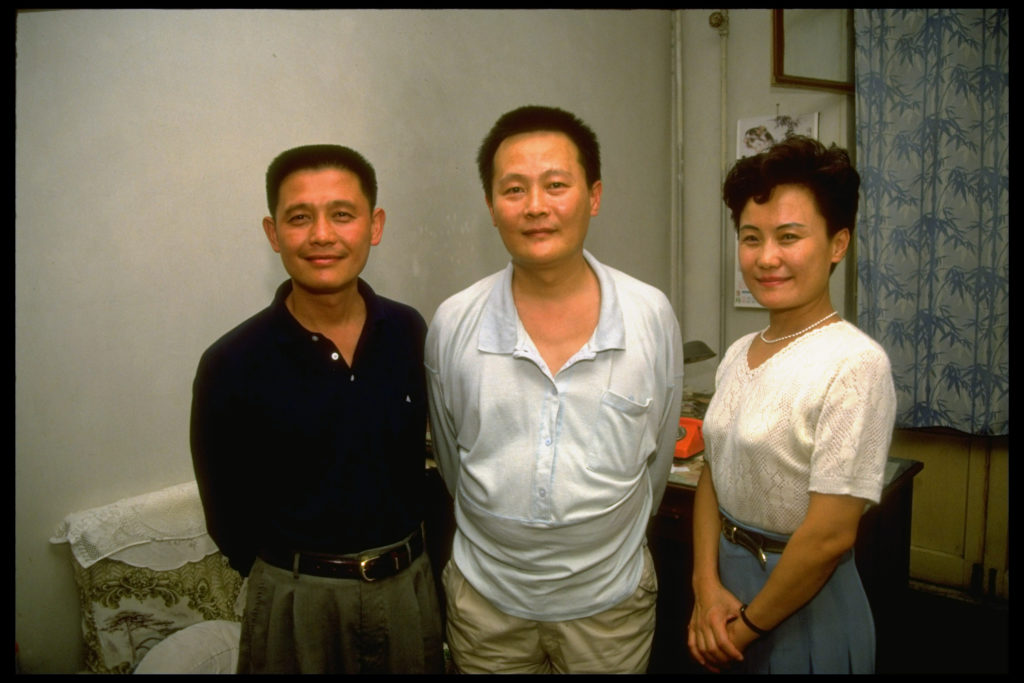
Wei looked well on release. A photograph taken with his brother and sister and published in a western newspaper showed a grinning, somewhat plump Wei. He had lots of hair.
China’s most famous dissident Wei Jingsheng (C), released six months before the end of his 15-year prison term, shown here with brother Wei Xiaotao and sister Wei Ling at their family home. Image Credit: Forrest Anderson/The LIFE Images Collection via Getty Images/Getty Images
The last time I discussed Wei with Wang Mingdi was in late October 1993, a month after the release. He told me that he had gone to the Tangshan prison holding Wei. It consisted of one big building with 20 individual cells. There was a large garden area, and a field where inmates could play ball. All prisoners had been exempted from physical labor. Wei’s cell was “full of books.” Wang felt that conditions were good enough to allow foreigners to visit, but as far as I know, this never happened. As I was leaving the meeting, Wang expressed regret that Wei had been released. “We did a bad job. We should have kept him in prison.” By then, China had lost its bid to host the 2000 Olympics.
Wei returned to activism after his September 1993 release. He was arrested again in early April 1994 after a meeting with US Assistant Secretary of State John Shattuck in the lobby of the China World hotel, under the eyes of state security agents. He was subsequently sentenced to 14 years in prison for counterrevolutionary propaganda and incitement. After international pressure and an appeal to President Jiang Zemin by President Bill Clinton, he was released on medical parole on November 17, 1997 and promptly flown to the United States, where he remains active promoting human rights and democracy in China.
As the world’s leading executioner, China’s death penalty law has long been scrutinized by scholars, policy makers, and human rights groups. The subject matter garners an outsized level of international attention when the cases involve foreigners. Robert Schellenberg’s case serves as a recent, highly visible example: Schellenberg is a Canadian sentenced to death for drug trafficking, and his case has seemingly been thrust into the tit-for-tat of international politics. Ironically, this increased attention comes amid a decades-long decline in the overall use of the death penalty in China.
It has been over a year since Schellenberg appealed his death sentence to the Liaoning High People’s Court in January 2019. The court appears to be delaying the judgment in order to seek leverage over the case of Meng Wanzhou. International politics are clearly at play in Schellenberg’s case, but it must be noted that delayed judgments are not uncommon in capital cases involving Chinese citizens. In some cases, defendants have waited as long as 600 days between first and second instance trials; in a rare case, 900 days elapsed before the final review by the Supreme People’s Court (SPC).
The length of time between trials, SPC reviews, and execution varies case by case. It is also possible for the SPC to expeditiously approve death sentences within a month after the sentences were handed down at first-instance trials. The cases below display some disparities in this application:
The Beijing High People’s Court upheld the death sentence of Sun Wenbin 29 days after the Beijing No.3 Intermediate People’s Court handed down the judgment on January 16, 2020. Sun was found guilty of intentional homicide for stabbing a doctor at a Beijing hospital in December 2019. The SPC approved the death sentence on March 17, 2020, slightly over a month after the appellate ruling was made. The period from Sun’s criminal detention to his execution on April 3, 2020 lasted 101 days.
In another case, Du Shaoping was found guilty of intentional homicide and other crimes by a court in Huaihua, Hunan, sentenced to death, and executed in January 2020. The alleged crime of him killing and burying a teacher in a school yard, which took place in 2003, was said to be instigated by disputes over a schoolyard construction project. While 16 years passed between the crime and Du’s trial hearing on December 17, 2019, judicial proceedings were more expeditious. Du was executed on January 20, 2020, meaning that the period from his first trial to the SPC approval of his conviction and sentencing lasted 30 days. Four days elapsed between the SPC’s approval and his execution.
Understanding of how China applies the death penalty is largely lacking. To better understand these conflicting trends, Dui Hua has conducted an updated analysis of trends in the length of time between trial and execution in China’s death penalty cases. Longer times between sentence and execution could indicate a more deliberate judicial approach that allows for meaningful review of the evidence supporting a conviction and death sentence, and it also provides a window for intervention from higher courts and others to stop executions and correct wrongly decided cases.
This article examines possible trends in sentencing and execution in order to discern attitudes and practices towards the application of the death penalty. First, this article presents new statistical data on the length of time between sentence and execution using Dui Hua’s Death Penalty Log. It then provides a paired comparison of a very quick (less than 60 days) and a very deliberate (more than 2 years) death penalty appellate review, which can assist in developing an understanding of the factors that tend to be associated with a longer judicial deliberation between trial and execution.
A Look at the Numbers: Time from Trial to Final SPC Approval of Execution
In the United States, the term “death row” is part of the common lexicon, perhaps owing to the extended delay between the investigation, trial, appeal, and execution of condemned prisoners. By contrast, there has been little need for a term like “death row” in China because there has not historically been an extended period between trial and execution, and capital offenders are rarely sent to prison before execution. In China, capital offenders stay in detention centers after they are sentenced, or when appeals to a higher-level court or approvals from Supreme People’s Court are pending.
However, as the SPC has reclaimed its authority over the review and final approval of death sentences, times between trial and sentencing have begun to lengthen and vary. Although the complete abolition of the death penalty should be the ultimate goal from a human rights perspective, understanding how and why delays of execution occur is nonetheless an important element of understanding whether China engages in the deliberation necessary to limit injustice in death penalty cases.
Dui Hua has recently compiled the following information regarding the time between trial and execution in death penalty cases in China: from 2015 to 2019, Dui Hua recorded 1,247 first-instance trials involving the death penalty; of those, there were 460 known second instance trials, and 261 known SPC reviews of those trials. Table 1 below provides a summary of average lengths of time between adjudication and final SPC death penalty review.1
Table 1. Length of Time in Days Between Adjudication and Final SPC Judgment in Death Penalty Cases
Image Credit: The Dui Hua Foundation
Of the 261 SPC reviews, 239 death sentences were approved (91.6 percent), and 24 were not approved (9.2 percent). While these data provide a sense of the average delays between death penalty trial and execution, Figure 1 provides a more detailed understanding of how many cases involve significant appellate deliberation.
Figure 1. Number of Death Penalty Cases, Sorted by Days Between First Instance Trial to Final SPC Decision
Image Credit: The Dui Hua Foundation
In approximately half of the cases, the time between first instance death penalty trial and SPC review is between six months to a year. On the other hand, in more than half of cases, the period from trial to SPC review took longer than a year; of those, nearly 33 percent took longer than one and a half years. Interestingly, a very small number of cases landed on opposite ends of the spectrum – only three cases took less than 182 days to review, and only 10 took longer than 730 days.
To better understand what factors lead to longer time windows between trial and execution, the next part provides a more in depth look at two cases, one from each end of the spectrum. While these two cases are outliers – one was particularly quick while the other was noticeably drawn out – they provide insight into factors affecting the duration of judicial proceedings in death penalty cases.
Yang Zanyun and the “9-12” Attack
A photograph of Yang Zanyun from a court proceeding related to his mass killing case. Image Credit: Hunan People’s Court
On one end of the spectrum is a high-profile mass killing that featured a highly expeditious SPC review in which the period from initial trial to execution lasted only 48 days (December 12, 2018-January 29, 2019). This case involved an attack carried out in Hunan province by Yang Zanyun (阳赞云), who drove a car into a crowd in September 12, 2018, killing 15 people.
Yang was convicted of the crime of “endangering public safety using dangerous methods”; however, a more accurate contemporary translation of the crime would probably be “mass killing” or even terrorism (media articles branded the case the “9-12” attack). According to Xinhua, Yang drove a Land Rover into a crowd of people at Mijiang Square in Hunan before exiting his vehicle and attacking more people with a knife and a shovel. In addition to those killed, Yang also injured 43 others. Unsurprisingly, as one of the most heinous mass killings in China’s history, the case drew strong public response, with more than 300 people attending the proceedings held at the Hengyang Intermediate People’s Court in December 2018.
A little over one month later, the Hunan High People’s Court announced on its WeChat account that the Hengyang Intermediate People’s Court carried out Yang’s execution on January 29, 2019, in accordance with a final SPC death penalty order.
Another negative factor that likely contributed to Yang’s execution was his long criminal history. According to Reuters, Yang had previous convictions for “selling drugs, theft and attacking people, which caused him to harbor a desire for ‘revenge on society.’”
Ma Gongxian and the Land Dispute Homicide
By contrast, a recent homicide case has led to a much longer judicial review process. The defendant in this case, Ma Gongxian (马攻先), was convicted of intentional homicide for stabbing a family member to death as part of a dispute over land rights in Qingdao, Shandong province.
The case arose out of long simmering tensions between Ma Gongxian and his younger brother, Ma Huixian, with respect to a 16-mu (approximately two-and-a-half-acre) piece of real estate. In October 2015, tensions boiled over when Ma Gongxian confronted Ma Huixian regarding a building that Ma Huixian was constructing on the disputed land. While the exact details remain somewhat unclear, at some point Ma Gongxian wielded a large knife and stabbed and killed Zhao Jufang, Ma Huixian’s wife. Ma Gongxian was then attacked with rocks by others at the scene and taken to the hospital.
According to the report, Ma Gongxian was arrested in the hospital, and the Qingdao Procuratorate charged him with intentional homicide. The Qingdao Intermediate People’s Court sentenced him to death with immediate execution in October 2016, but despite the judgment calling for the immediate implementation of the death penalty verdict, Ma was allowed to appeal the sentence. The Shandong High Court heard the case on June 8, 2017, and Ma Gongxian presented a complex court defense in which he admitted to killing the victim but claimed that his actions amounted to negligent, rather than intentional, homicide. The defendant was 69 years old at the time of the crime. As of November 2019, the Shandong High Court reportedly upheld the judgement, and the SPC approved the death sentence, meaning that the execution likely took place soon after the final SPC approval.
In the small village in Shandong where the crime took place, however, the execution sentence was met with opposition. During Ma Gongxian’s appellate hearing, nearly a hundred villagers from Ma Gongxian’s village went to the Shandong High Court, expressing opposition to Ma Gongxian’s death sentence and saying that “the crime should not lead to death” (罪不致死, zui bu zhi si). The defense also noted that Ma did not have a history of committing crimes, a point that seems to have been accepted by the criminal judicial officials.
Assuming that Ma’s death sentence was carried out in November 2019, the execution would have taken place approximately three years after the start of the first-instance trial in October 2016, making this case much longer than the average time from trial to SPC death penalty approval.
Toward a List of Factors that Impact Length of SPC Review
Although no conclusions can be definitively made from only two cases, the major differences between the two cases might illuminate some of the factors upon which to assess Chinese judicial review of death penalty cases and, in a broader sense, human rights in China. The differences in the Yang Zanyun and Ma Gongxian cases include the following elements:
number of deaths (overall severity of the crime)
public versus private dispute
social pressure
complicated criminal defenses
previous criminal history
Clearly, Yang’s crimes were particularly heinous and attracted international media attention. His crimes resulted in a substantial threat to social stability, which might have pressured higher courts and the SPC to approve the death penalty quickly. These factors are absent in the Ma Gongxian case that involved the murder of a single individual amidst a family dispute that was not a threat to spill into other corners of society. These factors can be considered in addition to other governmental or political factors involving ongoing counter-terrorist policies and or other campaigns noted previously by Dui Hua.
It is also interesting to note that Ma Gongxian’s case led to substantial delays perhaps in part because he was able to present a complex criminal defense. Although it might be a positive sign that Ma’s defense strategy was able to produce a more deliberate judicial response, it also might call into question whether criminal defendants with financial means to pay defense lawyers might be able to more successfully challenge their sentences, with poorer defendants more likely to face unjust execution.
While these factors are by no means an exhaustive or definitive list of factors influencing appellate review in these two cases, they offer a perspective into a legal system that is notorious for its low acquittal rate and lack of transparency. The insights gleaned from these cases and available statistics can help inform the ongoing conversation about how judicial review occurs and how human rights might be protected in China.
As the coronavirus pandemic upends proceedings, China has vowed not to delay justice in the midst of the outbreak. Such promises have raised concerns that procedural justice may suffer as a result, especially in capital cases, where the review process already faces transparency issues.
1 Of all of the death penalty cases for which statistics are provided, only a small number are reported on in the media or in other public forums; at times, some cases are reported in the media that are not yet included in statistical accounts
This series (#14 to 17) of Dui Hua’s Mass Incident Monitor highlights four major protests that took place across China in relation to the novel coronavirus (COVID-19). Wuhan, the epicenter of COVID-19, was under lockdown from January 23 to April 8. Hubei province was also under lockdown for more than one month. Other Chinese cities implemented traffic restrictions and around-the-clock “closed off management,” where residents of a community must be registered before they are allowed in or out. Many of these protests were triggered by the expansive and draconian quarantine measures put in place to contain the outbreak.
On March 17, Hubei workers clashed with the SWAT police from the neighboring province, Jiangxi, as they were stopped from crossing the provincial boundary after the lockdown was lifted. Image credit: Twitter
After claiming to have achieved zero new local infections in March, the Chinese government began to lift the lockdown and traffic controls in Hubei on March 25 (the provincial capital Wuhan remained under lockdown until April 8). Residents from other Hubei cities who hold digital health certificates obtained online should be allowed to travel outside of the province. However, they are not necessarily welcome by people from other provinces due to the stigma of Hubei as the origin of COVID-19.
The incident on March 27 began with a clash among police officers from Hubei and neighboring Jiangxi province after Hubei reopened its outbound traffic. Police officers from the two provinces traded accusations against one another on social media over online footage which showed them beating and grabbing each other. Witnesses claimed that Jiangxi police had crossed Hubei’s provincial boundary to set up a travel and health checkpoint to stop Hubei people from entering Jiangxi via the Jiujiang Yangtze River Bridge, including those who had obtained the digital health certificates issued in Hubei. Hubei police officers accused their Jiangxi colleagues of overstepping the provincial boundary, but Jiangxi police refuted the claim and blamed Hubei police for initiating the assault.
The initial police clash was later joined by thousands of Hubei workers who attempted to cross the bridge but were stopped by Jiangxi SWAT police with riot shields. As the Hubei workers felt that they were being discriminated against, they charged at the Jiangxi SWAT police. An online video circulated on social media shows that police officers only stood aside and watched the crowds damage and topple multiple police vehicles. The county party secretary from Huangmei, Hubei, arrived at the scene to placate the crowd and vowed to resolve the crisis with his Jiangxi counterparts. Dozens of residents surrounded a Jiangxi police station to demand an apology, with some holding banners that asked Jiujiang people not to be biased against them.
In an apparent bid to shy away from this violent incident, Hubei and Jiangxi issued a joint statement on March 28 in which they agreed to remove the checkpoints at the provincial border and welcome any person holding a digital health certificate. It is unclear whether any officials would be held accountable for the incident. Available sources did not say whether anyone from Hubei or Jiangxi was detained.
This series (#14 to 17) of Dui Hua’s Mass Incident Monitor highlights four major protests that took place across China in relation to the novel coronavirus (COVID-19). Wuhan, the epicenter of COVID-19, was under lockdown from January 23 to April 8. Hubei province was also under lockdown for more than one month. Other Chinese cities implemented traffic restrictions and around-the-clock “closed off management,” where residents of a community must be registered before they are allowed in or out. Many of these protests were triggered by the expansive and draconian quarantine measures put in place to contain the outbreak.
In March, shop tenants in multiple provinces demanded rent waivers for poor business conditions due to the COVID-19 outbreak. Image credit: Intenet
After the end of the extended Lunar New Year Holidays on February 2, the Chinese government imposed entry and exit restrictions on all residential communities in Shenzhen and Guangzhou. Shopping malls and public entertainment venues were shuttered. Some business owners struggled to make ends meet as they continued to pay regular expenses such as rent and wages even when their businesses were suspended. Although the situation appeared to have improved after the number of new cases of COVID-19 subsided in late February, customer flows continued to dip. Retail sales of consumer goods, a major indicator of consumption growth, plummeted by 20.5 percent for the first two months of 2020 compared to the same period in 2019.
Shop tenants from New China Mansion, one of the largest clothing wholesale markets in Guangzhou, marched to demand rent waivers from their landlords one day after the mall reopened on March 4. They also requested two months’ rent free because of the poor business conditions. The property development company offered a rent reduction plan, which was rejected by the protesters because only a small number of them could benefit. Video footage shows that uniformed security guards pepper sprayed and clashed with tenants. A day after the protest, the entire New China Mansion was guarded by police and security officers. On March 17, the property development company introduced another rent reduction plan to benefit all tenants. However, some tenants were reportedly unable to receive rent reductions because of subleases.
As more businesses resumed, similar protests occurred not only in Guangdong cities such as Shenzhen, Zhuhai, Zhongshan, and Dongguan, but also in the provinces of Liaoning, Guangxi and Sichuan. Landlords face additional demands from shop tenants. For example, dozens of tenants from Zhengzhou, Henan, took to the streets to demand rent exemption for an extended period of six months.
Due to limited news coverage, it is unclear how these protests were resolved.
This series (#14 to 17) of Dui Hua’s Mass Incident Monitor highlights four major protests that took place across China in relation to the novel coronavirus (COVID-19). Wuhan, the epicenter of COVID-19, was under lockdown from January 23 to April 8. Hubei province was also under lockdown for more than one month. Other Chinese cities implemented traffic restrictions and around-the-clock “closed off management,” where residents of a community must be registered before they are allowed in or out. Many of these protests were triggered by the expansive and draconian quarantine measures put in place to contain the outbreak.
On March 12, residents in Xiaogan gathered to protest against overpriced food during stay-at-home order. Image credit: Sina
“Fake! Fake! Everything is fake!” Local residents in Wuhan were heard shouting through apartment windows in online videos when Vice-Premier Sun Chunlan was inspecting the work of a neighborhood committee tasked with taking care of quarantined residents on March 6. The property management company was accused by the residents of arranging employees who disguised themselves as volunteers to deliver groceries during Sun’s visit. On March 10, Xi Jinping made his first visit to virus-hit Wuhan after more than a month after the lockdown. Police officers were reportedly stationed inside apartments to prevent residents from heckling Xi.
Two days after Xi’s visit to Wuhan, aggrieved residents in Xiaogan gathered to protest against overpriced food as they were forced to comply with the stay-at-home order (Xiaogan is a city in Hubei around 70 kilometers from Wuhan). From February 14 to late March, the Xiaogan government prohibited all residents from leaving their homes, lest they be subjected to administrative detention for up to 15 days. Government-designated companies and organizations distributed daily necessities including food supplies and banned private sales of the kind.
Residents complained about food price inflation, with some accusing government-designated suppliers of profiteering during the pandemic. A resident who sold groceries to his neighbors at a lower price than government-designated suppliers was detained by police for “illegal private transactions” on March 12. On the same day, over a hundred residents in the community gathered at a basketball court to demand release of the detained resident. The Chinese word xiake, an equivalent to “stepping down,” can be heard being chanted from the crowds, but it is unclear who they were targeting. According to the Xiaogan government, the crowds left after officials arrived at the scene. The detained resident was subsequently released. The government also announced that it would lower food prices, introduce competition among suppliers, and provide additional subsidies to suppliers.
Officials were criticized for disregarding public health needs and people’s livelihoods during the curfew-like lockdown. A day after Xi’s visit, Wuhan residents quarreled with officials who used sanitary trucks to deliver packs of raw meat on March 11. Similar incidents occurred all over the city: residents were outraged to see online images of food supplies getting delivered by sanitart trucks, sanitary trolleys, construction trolleys, and even ambulances. The party officials in the residential community were fired the following day.
This series (#14 to 17) of Dui Hua’s Mass Incident Monitor highlights four major protests that took place across China in relation to the novel coronavirus (COVID-19). Wuhan, the epicenter of COVID-19, was under lockdown from January 23 to April 8. Hubei province was also under lockdown for more than one month. Other Chinese cities implemented traffic restrictions and around-the-clock “closed off management,” where residents of a community must be registered before they are allowed in or out. Many of these protests were triggered by the expansive and draconian quarantine measures put in place to contain the outbreak.
On January 28, residents in Xiapu County clashed with police at a tunnel entrance to halt the construction of a quarantine center one kilometer from their village. Image credit: Internet
The Wuhan lockdown, which began on January 23, too late to curb the spread of COVID-19 to neighboring provinces and then to the rest of the world. In response to this fast spreading public health crisis, local governments scrambled to designate sites for makeshift quarantine centers, usually without seeking public comments. Local residents believed that the quarantine centers in the densely populated neighborhoods would pose a serious health threat to members of their community.
On January 28, residents from Xiapu County in Ningde, Fujian, clashed with police to halt the construction of a quarantine center just one kilometer from their village. Images posted online show a crowd gathering at a tunnel entrance during the daytime. Upon learning that a police vehicle was about to clear the tunnel at night, protesters used wooden chairs as roadblocks. Some even threw chairs at police officers and one of the vehicles. Online footage also shows that a police officer holding a riot shield suffered a head injury. Several protesters were taken into custody.
The county had two confirmed cases of COVID-19 on the day of the protest. The local government planned to convert a deserted factory dormitory into a quarantine center for those who had close contact with infected patients. The government announced that the incident was resolved following a public dialogue among government officials, medical experts, and protesters. Sources do not say whether any detained protesters were released after the dialogue.
Dui Hua received a written response from a Chinese interlocutor based in Guangdong when Executive Director John Kamm visited Hong Kong from January 7-16. The response revealed where seven Falun Gong practitioners (three female and four male) are serving their prison sentences in Hebei. All of them were convicted of Article 300 of the Criminal Law – organizing/using a cult to undermine implementation of the law – and are due for release from 2023 to 2025.
Clampdown on dissidents during the coronavirus outbreak
The Ministry of Public Security announced that over 5,500 cases of “fabricating and deliberately disseminating false and harmful information” in connection to the coronavirus outbreak had been found by the public security, as of February 21. Some of these cases were clearly politically motivated:
Guo Quan (郭泉), former professor at Nanjing Normal University, was formally arrested on February 14 for inciting subversion, a charge stemming from his online articles critical of the Chinese government’s handling of the outbreak. The arrest came while he is serving his three-year deprivation of political rightsfrom his previous sentence. Guo completed his full ten years’ sentence for subversion in November 2018 without having received a sentence reduction.
Tsinghua University professor Xu Zhangrun (许章润)has been under house arrest since early February. Xu blamed the deficiencies of China’s authoritarian system that has increasingly concentrated power in the hands of Xi Jinping for causing the uncontrolled spread of the virus.
Retired professor of Beijing Technology University Chen Zhaozhi (陈兆志)was criminally detained on March 10 for fabricating or deliberately disseminating false information. Chen shared videos of commentaries about the outbreak on Twitter. He reportedly suffers from Alzheimer’s disease and hypertension.
Citizen journalistFang Bin (方斌) was criminally detained on February 10 for livestreaming the epidemic in his hometown of Wuhan as the entire province was in lockdown. He also called on the people to resist the Chinese government.
Chen Qiushi (陈秋实), another citizen journalist and a lawyer, has been forced to undergo quarantine for 25 days at an undisclosed location since February 6 for reporting the outbreak in Wuhan. Chen had previously been harassed and silenced by mainland authorities for covering the anti-extradition bill protests in Hong Kong. There are no reports of his release at the time of writing.
Former CCTV 7 channel host Li Zehua (李泽华)disappeared on February 26 after interviewing porters who were hired to transport the bodies of those who had died from the virus.
Notable endangering state security (ESS) cases
In the final days of 2019, over a dozen rights lawyers and activists from different provinces were detained or went missing after attending a private gathering in Xiamen, Fujian, to discuss public affairs. Among them, Ding Jiaxi (丁家喜), Zhang Zhongshun (张忠顺), Dai Zhenya (戴振亚), and Li Yingjun (李英俊) have been held on suspicion of inciting subversion under residential surveillance at a designated location in Shandong since December 26. Prominent activist Xu Zhiyong (许志永) went into hiding in Guangzhou after the initial crackdown. He was reportedly taken away in Guangzhou on February 15. The following day, he was held under residential surveillance at a designated location in Beijing on suspicion of inciting subversion. Xu’s girlfriend, feminist and labor activist LiQiaochu (李翘楚), was also taken away by Beijing public security on February 16. The charges against Li and her whereabouts remain unknown.
Another case concerns what has become known as the “Shenzhen Crackdown” in November 2016. A group of activists went missing or were detained after attending a similar dinner gathering in Shenzhen to discuss politics and current affairs. Deng Hongcheng (邓洪成), Wang Jianhua (王建华),and Li Jiangpeng (李江鹏) were among the detainees who were sentenced for subversion by the Shenzhen Intermediate People’s Court on January 13, 2020. Deng was given a 12-year prison term, and Wang and Li were both sentenced to five years’ imprisonment. Li Nanhai (李南海) and Wang Jun (王军), another duo involved in the Shenzhen Crackdown, were also sentenced to three years’ imprisonment and three and half years’ imprisonment, respectively. Both were released in February 2020. The judgment, which has not been posted online, was made more than three years after they were detained in November 2016.
On February 24, Swedish national GuiMinhai (桂民海or 桂敏海) was convicted during a closed-door hearing and sentenced to 10 years’ imprisonment and five years’ deprivation of political rights by the Ningbo Intermediate People’s Court for illegally providing intelligence to foreign entities. Gui’s disappearance in Pattaya, Thailand, in 2015 rattled relations between Beijing and Stockholm. Relations were further strained in January 2018, when Chinese law enforcement officers seized Gui on a Beijing-bound train in the company of Swedish diplomats. The Ningbo court claimed that Gui applied to restore his Chinese citizenship in 2018. Sweden has challenged this claim.
Notable releases
Twin brothers Chen Bing (陈兵) and Chen Wei (陈卫) were released from the same Sichuan prison on December 31, 2019 and February 20, 2020, respectively. Chen Bing was sentenced to three and a half years’ imprisonment for selling liquor printed with the words June Fourth on the bottles. He was initially detained and indicted for inciting subversion, but he was convicted of picking quarrels and provoking troubles by the Chengdu Intermediate People’s Court on April 4, 2019.
Chen Bing’s twin brother Chen Wei was sentenced to nine years’ imprisonment for inciting subversion by the Suining Intermediate People’s Court in 2011. The former June 4 student leader was re-imprisoned because he called on the public to “go for a stroll” in support of the Jasmine Revolution inspired by the Tunisian revolution in 2011. In 1994, Chen Bing, as the co-founder of the China Liberal Democratic Party, was sentenced to five years’ imprisonment for counterrevolutionary propaganda and incitement.