In “Leftist Dissent Under Xi: The Old Leftists,” Part I, Dui Hua discussed the phenomenon of neo-Maoism among a number of social groups, including veterans and laid-off workers. In this post, we look at attempts to form political parties intended to resurrect the ideology, culture, and legacy of the Mao era, and the government’s reactions to these efforts.
Political Parties
Despite faltering public trust in local officials, the central government still earns the approval of many patriotic workers and veterans, especially since the launch of Xi’s anti-corruption campaign, which appears to have won the hearts and minds of the majority of Chinese. However, there exists a small segment of aggrieved leftists who believe their plight cannot be addressed without an ideological overhaul within the CCP. They believe that the CCP must revert to pre-reform era socialism, restore the people’s communes, re-collectivize, and provide employment, education, healthcare, and housing for all throughout China. They also think that the alternative communist parties they created are the true vanguard of socialism, a path from which the CCP has been straying for over 40 years since Deng Xiaoping’s economic reforms began.
Dui Hua has previously reported cases of leftist subversion from 1980-2012, where individuals received harsh prison sentences for founding political groups with the aim of overthrowing the CCP, which some on the far left believe has morphed into totalitarian capitalism. A year before Xi came to power, Dong Zhanyi (董占义), founder of the New Era Communist Party of China, was sentenced to life imprisonment for subversion and contract fraud. The party was established around 2008 with the mission to fight rampant government corruption.
Under Xi, new political associations created by the Old Leftists continue to emerge. Instead of promoting regime change like Dong Zhanyi, some of these newly formed groups call for mutual coexistence with the CCP. One such case involves Wang Shiji (王士吉), who calls himself Mao Jidong (毛继东, literally “Mao’s Successor”). Wang had attempted to set up the “China Communist Party Revolution Commission” in 1999, but was arrested on September 8, 1999. Wang completed his three-year sentence for inciting subversion in August 2002. In August 2016, at the age of 72, apparently undeterred, he founded a new party, the “Defend Mao Zedong People’s Party.” This Hebei-based party, which he claimed had about 40 members from across China, aimed to promote love for Mao and the concept of popular sovereignty. Casting it as a “fraternal” party that sounds less radical than the programs of his leftist counterparts, Wang said that his party would co-exist and enjoy equal status with the CCP, and that privatization must be stopped in order to solve China’s current problems of corruption and a widening gap between rich and poor. However, after being summoned and warned by officials in Shijiazhuang, Hebei, Wang dissolved the party, one day before he was scheduled to convene the first “national congress,” which he had claimed would be attended by representatives from a number of major cities. He is not known to have received any criminal punishment thereafter.
Wang Zheng founded the Supreme Constitution Party
at the age of 48 in 2013. She commended former Chongqing Party Secretary Bo
Xilai for being a genuine socialist, because, she believes, he improved the
lives of ordinary people in Chongqing. Image Credit: VOA
It would be mistaken to assume that Maoism enjoys only grassroots popularity. Leftist ideologies are no less appealing among certain educated professionals looking for solutions to present-day China’s social ills. Wang Zheng (王铮), a former associate professor at Beijing Institute of Economics and Management, set up the “Supreme Constitution Party” in November 2013, two months after Bo Xilai was sentenced to life in prison for bribe-taking, embezzlement, and abuse of power. Bo, who won national renown with his “sing red, strike black” campaign while serving as Chongqing Party Secretary from 2007-2012, was hailed as a hero by many leftists. Wang is a vocal supporter of Bo, calling the former rising star in the Politburo a genuine socialist who spent money in Chongqing on public housing to improve lives of ordinary people. In a New York Times interview in 2013, Wang claimed that her party aimed to promote “common prosperity,” a core socialist value that the CCP has largely ignored, mostly through its failure to address widening income disparity. Although Wang never met Bo, she said Bo’s stated egalitarian views and his self-defense in court had inspired her. Wang believes that Bo was a victim of a power struggle within the CCP and her party is an answer to what she sees as serious political problems. When asked whether her party was legal, Wang retorted that “even the CCP didn’t register when it was set up… it was a revolutionary party!” Wang and other members elected Bo as the “Chairman for Life” before the party was banned by Beijing’s Bureau of Civil Affairs in December 2013.
In 2013, the Shandong High People’s Court upheld the life imprisonment sentence of Bo Xilai, the former Party Secretary of Chongqing, who tried to revive Mao-era culture by encouraging locals to sing revolutionary songs. Image Credit: CCTV
Since Xi put Bo and other big “tigers” behind bars on corruption charges, the threat posed by Wang’s political party to the CCP was negligible at best. Nevertheless, Wang remained a target of police surveillance because of her high-profile support for Bo. In 2016, Wang organized a protest against the demolition of Xinghai Square in Dalian, an iconic landmark built by Bo when he served as the mayor from 1993-2000; the demolition is part of a drive by the new leaders in the north-eastern port city to wipe out the lingering “poisonous” legacy left by Bo. In the same year, Wang published articles calling county- and township-level elections a “black-box operation” and Xi the “most unruly leader.” Wang’s insistent demands for Bo’s political rehabilitation led to her detention in Beijing in March 2017, this time for “picking quarrels and provoking troubles.” Hefei, provincial capital of Anhui, was later instructed by the Supreme People’s Procuratorate to investigate this “important and sensitive” case in December 2017. In July 2018, she was sentenced to five years’ imprisonment. Wang is currently scheduled for release in March 2022.
The “Genuine Communist Party”
A small group of leftists continue to seek regime change by forming political parties which they believe represent genuine vehicles for Mao Zedong Thought. Dui Hua discovered several names of prisoners belonging to the so-called “Genuine Communist Party,” a virtual party founded in 2010 by a Jiangsu worker naned Chen Jianmin (陈剑敏). Chen, who was born in 1962 and is also known by his internet nickname Zhou Qun (周群), founded and led a party entitled “The Central Committee of the Chinese Proletarian Revolution.” Unlike Wang Shiji and Wang Zheng, Chen, through his party, openly calls for the overthrow of the ruling CCP and condemns Chinese leaders from Deng Xiaoping to Xi Jinping as “fake communists” and “capitalist bureaucrats.” Although the party claims to convene weekly online meetings, the minutes posted on its party website indicate that the meetings have been sparsely attended by a mere handful of netizens.
Chen has now been placed “under supervision,” (beikongzhi 被控制), according to information posted in May 2019. The wording suggests that his personal liberty is restricted with an unknown coercive measure being placed on him. Information from the party’s online forum also reveals that since 2013 seven members of this party from Fujian, Hubei, Hunan, Guangdong, Gansu, and Jiangsu have been beaten, received administrative detentions, or have even been committed to psychiatric hospitals.
Dui Hua’s research also found that some “young leftists,” believers in Marxism or Maoism born after Mao’s death in 1976, have joined the Genuine Communist Party. One of the known members was Ye Dongdong (叶东东), a sophomore in Chongqing Vocational College of Media in 2013. In February of that year, Ye was detained for ten days after putting up public notices in Chongqing and his home province, Gansu, that claimed China is a capitalist, not a socialist, country and promoted the Genuine Communist Party. Four years later, in November 2017, Ye was re-detained and later indicted in Longnan, Gansu, for inciting subversion. Ye stood trial in the Longnan Intermediate People’s Court in 2018, but the trial outcome is unknown.
In a separate case, another Genuine Communist Party member, Zhou Liangliang (周亮亮), completed his three years’ sentence for subversion in Beijing in 2016. Dui Hua unearthed this case from a civil judgment handed down by the Chaoyang District People’s Court in December 2016. In this civil case, Zhou, born in 1983, was the plaintiff, seeking compensation because he had been dismissed by a power consulting company in 2013 on the grounds that Zhou was a member of the “illegal” Genuine Communist Party. Zhou was also accused of using the company’s Internet connection to plan and publicize activities aimed to “overthrow the government and party and subvert state power.” Unsurprisingly, the court found that Zhou had been lawfully dismissed. The company was not required to pay compensation to Zhou.
Read the other installments in this series to find out more about contemporary China’s young leftists and their activism.
Souvenir plates with images of Xi Jinping and Mao Zedong. The “Great Helmsman” is among the series of honorifics given to Mao. Image Credit: RFA
In the West, Mao Zedong gained notoriety as a totalitarian dictator responsible for the deaths of millions of people. His promotion of an extreme cult of personality and two political movements in particular, the Great Leap Forward, resulting in the Great Famine, and the Cultural Revolution, which Mao masterminded to crush his political foes, were among the most destructive aspects of his leadership. Although by some estimates Mao Zedong caused more deaths in peacetime than either Adolf Hitler or Joseph Stalin, the portrait of the man who “brought calamity to an entire nation still hangs in Tiananmen Square and is still found on the banknotes we use every day,” wrote Mao Yushi in a critical essay in 2011. (Mao Yushi, who is not related to Mao Zedong, is a prominent economist who won the Cato Institute’s 2012 Milton Friedman Prize for Advancing Liberty.)
China has allowed some room for the public to question the officially sanctioned reputation of Mao since the “Great Helmsman” died in 1976. Nonetheless, scholars, journalists, and other public figures can stand accused of “historical nihilism” if they reject Mao’s legacy of liberating China from Japanese occupation and Western imperialism, and critics may risk ruining their careers for holding “hostile” views on Chairman Mao. Because of his critical essay, Mao Yushi has even received death threats and has been widely vilified by Mao Zedong’s supporters. Criticism of Mao Zedong in the public space continues to be considered politically incorrect today, because Mao Zedong Thought, or Maoism, is enshrined in China’s constitution and represents the ideological orthodoxy of the Chinese Communist Party (CCP). Mao’s ideology provides justification for the CCP to prevent the spread of destabilizing western values, such as multiparty democracy, and maintain its “perennial ruling party” status.
After Xi Jinping rose to power in 2012, his policies and rhetoric have often evoked memories of the Mao era. Just ahead of Mao’s 120th birthday on December 26, 2013, Xi Jinping said, during a visit to Wuhan in July 2013, “We must turn Chairman Mao’s old residence into a base for patriotism and revolutionary education.” Xi’s promotion of the singing of “red (revolutionary) songs” in official settings as diverse as government offices, schools, television stations, and even prisons strikes a chord with adherents of Mao Zedong Thought. Some observers believe that Xi manipulates Maoism to cultivate a sense of pride and consolidate support from the powerful group known as the princelings (i.e., sons and daughters of prominent CCP officials). He does so, not just to bolster ideological support for himself, but also to foster an aura of respectability on behalf of their “revolutionary” parents, who contributed to or even sacrificed for Mao’s socialist cause, according to veteran China analyst Willy Wo-Lap Lam, author of Chinese Politics in the Era of Xi Jinping: Renaissance, Reform, or Retrogression?. In 2015, one Maoist observer even lauded the Xi era as “a golden period” for the leftists, as Xi “has ushered in fundamental change to the status quo, shattering the sky.”
But despite this leftist revival, many adherents of Mao who are nostalgic for his egalitarian ideals continue to find themselves disillusioned with Xi’s “new era of socialism with Chinese characteristics,” largely due to pervasive corruption and social inequality. They make up a large pool of leftist dissenters who refuse to acknowledge the achievements made by the CCP over the 40 years of economic reform. Leftist dissent, however, is far from being monolithic. The dissenters are from diverse backgrounds, have assorted motives, and use different means to channel discontent. There is also a generational divide within this group.
This post defines “old leftists” as the generations who either lived through the Mao era as adults or adolescents, or have only vague but fond childhood memories of Mao before his death in 1976. Many of them are veterans and employees laid off by state-owned enterprises; both groups believe that pervasive corruption is the root cause of their problems. As many of them grew up during the Mao era with limited means and educational opportunities, they do not necessarily understand what Mao’s ideology or legacy entail. They may uphold the simple belief that Maoism is a panacea for their livelihood problems, due in part to state propaganda campaigns to deify Mao since 1949. Many old leftists take part in tens of thousands of mass incidents across China every year in the form of protests and collective petitions, whenever public policies put their material benefits at risk. A small fraction of these “old leftists” even proclaim themselves the real descendants of Communism, in the belief that China’s problems must be solved by a reversion to pre-reform era socialism, which would amount to a complete ideological overhaul of the current core philosophy of the Chinese government. They resort to forming political associations in order to challenge the CCP as the legitimate leader of the one-party state.
State-Owned Enterprise Workers
Leftist ideologies appeal to many grassroots workers, especially employees of state-owned enterprises. As of 2013, state-owned enterprises employed around 37 million people. Once the pillar of Mao’s planned economy, they are nostalgic for Mao’s promise of an “iron rice bowl” (i.e., guaranteed lifetime employment). The generation of the urban “sent-down youth” born in the 1940s and 1950s was ordered by Mao to “receive education from living in rural poverty” and many were consequently deprived of the opportunity to receive higher education when Mao suspended university entrance exams in 1966. Members of the generation of Mao’s sent-down youth have been less competitive in the job market than younger generations. They see economic reform and marketization as anathema because the state-owned enterprises provided a livelihood for most of them. From 1993-2003, the restructuring of state-owned enterprises resulted in around 28 million redundancies. Despite Xi’s 2018 remark that “state-owned enterprises would grow stronger, better, and larger,” labor protests against the privatization of state-owned enterprises show few signs of abating in the Xi era.
Since 2014, China Labor Bulletin has documented hundreds of protests joined each year by state-owned enterprise workers across China. In these protests, workers sometimes employ Maoist rhetoric to advance their claims in defence of their rights. One such protest over labor retrenchment rocked Nanyang, Henan, on September 9, 2014. Hundreds of workers laid off by a state-owned pharmaceutical factory took to the streets to commemorate the 38th anniversary of Mao’s death. They chanted slogans against privatization, corruption, and capitalism, and “Only Mao Zedong Thought Can Save China!” A middle-aged female protester interviewed by the prominent Maoist website Utopia described her life during Mao’s era as “heaven” because workers enjoyed free or low-cost medical services, education, housing, and retirement benefits. She likened the plight of workers in present-day China to “having fallen through the eighteen levels of hell.”
Laid-off workers join a spontaneous parade in Nanyang to commemorate Mao Zedong on the 38th anniversary of his death, carrying his portraits and banners, and demanding unpaid pensions from a privatized pharmaceutical factory. Image Credit: Utopia
Today, many of Mao’s supporters continue to converge on Hunan, Mao’s birth province, to pay tribute to the Great Helmsman they have long revered. On April 23, 2018, around three hundred retired workers, many of whom were former state-owned enterprise workers, protested against the policies of the Shaoyang City government in Hunan. They demanded punishment for police officers who fired tear gas at them when they petitioned against cutbacks in post-retirement medical benefits. The protesters, whom unofficial media reports called “Mao’s fans,” gathered to sing red songs to express their discontent.
Veterans
Official statistics released in 2018 indicated that China had 57 million veterans, and the number has been increasing by several hundred thousand each year. Those who answered the party’s call to fight in the 1979 Sino-Vietnam War or other earlier wars especially feel that they are not afforded the dignity they deserve from the state. Since being demobilized, they have been assigned low-end jobs, subsequently laid off, or granted only limited medical care and other benefits. Many demobilized soldiers believed their material benefits were squeezed by corrupt officials and consequently joined the ranks of leftist protesters to defend their rights. Disaffected veterans typically wear camouflage uniforms to convey pride in their past military service. To show allegiance to the CCP, they also wave national flags, sing red songs, and carry photos of Mao. Xi’s attempts to pacify veterans, however, appear to have achieved little. The Ministry of Veterans Affairs, created in March 2018 with the goal of streamlining bureaucracy concerning veterans’ benefits, has become another site frequented by protesting veterans who feel that local officials have ignored their complaints.
Expressions of discontent by veterans often become flashpoints across China. On September 20, 2018, a group of veterans converged on the Ministry of Veterans’ Affairs. In attendance was a 91-year old veteran who complained about local governments’ failure to comply with the CCP’s veterans’ benefits policy. Hundreds of veterans sang “Unity is Strength,” a patriotic song about the People’s Liberation Army popularized by Mao. They were soon drowned out by plainclothes police loudspeakers ordering the veterans to stop singing. A veteran petitioner reported that none of them were allowed to meet with a ministry representative. Some were sent back to the Jiujingzhuang reception center. While most were subsequently sent back to their original residences, some were sent from the reception center to the network of infamous “black jails.”
In an undated photo, Hubei veteran petitioners hold a banner that reads, “Firmly Support Xi Jinping, Follow the Party Forever.” Image Credit: RFA
Perhaps the most notable incident over the years was the veterans’ protest in Zhenjiang, Jiangsu, in June 2018. A group of veteran petitioners were assaulted by government-paid thugs. The incident crystalized the broader anger of veterans who came from across the nation to Zhenjiang to express solidarity with their comrades. Video footage from witnesses showed that around 100 veterans gathered outside a hospital with banners that read, “We are CCP members, not criminals.” Another online video even shows a protester shouting over a loudspeaker, “Perish together with the reactionary government.” Checkpoints were set up to prevent other veterans from entering the city. Police dispersed the protesters on June 23, injuring dozens of them, and sent many back to their home cities.
At the time of writing, at least nine veteran protesters in the Zhenjiang protests are known to have been sentenced on April 19, 2019 to two to four years’ imprisonment on charges of “gathering a crowd to disturb social order” or aggravated assault. On the same day, the Weicheng District People’s in Shandong sentenced another group of nine veterans to three to six years’ imprisonment for similar offenses.
Read about the old leftists attempts to actively promote neo-Maoism in Part II.
Overall in this quarter, Dui Hua received
six responses from interlocutors on the whereabouts of and clemency for 26
prisoners convicted of endangering state security crimes (ESS),
“organizing/using a cult to undermine implementation of the law,” and other
crimes. One government response Dui Hua received in July concerned 18 Tianjin
prisoners. Apart from confirming the release dates and places of incarceration
for these prisoners, most of whom are Falun Gong practitioners, the July
response also contained news on two well-known political prisoners. The first, Zhou
Shifeng (周世峰)
is due for release on September 24, 2022. Zhou, a founder of the Beijing
Fengrui Law Firm who was detained during the “709 crackdown” in 2015, was
convicted of subversion and sentenced to seven years’ imprisonment by the
Tianjin Number Two Intermediate People’s Court on August 4, 2016. The same
response confirmed that veteran dissident Hu Shigen (胡石根)
will complete his seven years and six months’ sentence for subversion on March
26, 2023.The remaining two prisoners on the list were sentenced for ESS crimes
and commemorating June 4, respectively.
Xi Jinping ordered his second special pardon to celebrate the 70th
anniversary of the founding of the People’s Republic of China. Eligible
prisoners included those aged 75 or above with serious physical disabilities
who are unable to take care of themselves. Dui Hua submitted a list of five
elderly and sick prisoners serving their sentences in Guangdong to its
interlocutors, and inquired about their eligibility for the special pardon. In
September 2019, Dui Hua received an official response confirming that none of
the five prisoners Dui Hua inquired about had benefited from the special
pardons. Yao Wentian (姚文田) is a 79-year-old publisher from Hong
Kong convicted of smuggling ordinary goods and sentenced to ten years’
imprisonment by the Shenzhen Intermediate People’s Court on May 7, 2014.
Despite his advanced age and poor health, Yao is not considered eligible. Dui
Hua, however, was advised that Yao was given an eight-month sentence reduction
in April 2019. Yao is scheduled for release from Dongguan Prison in 2023.
The remainder of the response on special pardons for elderly
prisoners are Falun Gong practitioners, Chen
Le’an (陈乐安), Zheng Shuqiong (郑淑琼), and Lin
Jinlan (林金兰). All of
them are women over 75 years old, and received relatively short prison
sentences from 24-42 months. Despite their ages and short sentences, they were
not granted special pardons. As of September 12, 15,858
prisoners were granted special pardons by courts
nationwide. The response to Dui Hua, however, indicates that political and
religious prisoners did not receive special pardons because they were deemed dangerous
to the political security of the government.
Espionage Case of a Macau Resident
Dui Hua has discovered an espionage case concerning a resident of Macau Special Administrative Region from court websites. Qiao Junjie (乔俊捷), who was formerly known as Qiao Yong (乔勇) and was born in Beijing in 1958, was sentenced to death with two-year reprieve for espionage by the Beijing No.2 Intermediate Court on June 14, 2016. The Beijing High People’s Court upheld the conviction and sentence on December 9, 2016. The same high court commuted his death sentence with reprieve to life imprisonment on May 27, 2019. His case specifics are unclear. Qiao is the only Macau resident convicted of espionage known to Dui Hua, according to our Political Prisoner Database.
Health Conditions of Political Prisoners
On July 10, 2019, self-taught legal activist Ji Sizun (纪斯尊) died, at the age of 71, of colorectal cancer. His death, which came about two months after the completion of his four-years-and-six-months’ imprisonment imposed in 2016, has once again raised questions about China’s treatment of human rights campaigners. In April 2016, Ji was sentenced in Fujian for “gathering a crowd to disturb social order” and “picking quarrels and provoking troubles.” The sentence was upheld by the Fuzhou Intermediate People’s Court in July 2016. Widely lauded as a “barefoot lawyer” by the human rights community, Ji not only taught himself law but also gave advice to petitioners to defend their legal rights against land seizures and forcible demolitions. While Ji was hospitalized several times during his prison terms, he was placed in a hospital’s intensive care unit under police guard upon completing his sentence in April 2019. His relatives were only allowed to visit Ji when he was in a coma before his death. His body was immediately cremated, reportedly against his family’s wishes. The 2016 sentence was Ji’s second: since he was imprisoned for the first time in 2008, Dui Hua has included his name on seven prisoner lists submitted directly or indirectly to the Chinese government.
On July 29, 2019, Huang Qi (黄琦), who was accused of running a “hostile foreign website” named after the June 4, 1989 Tiananmen Square crackdown, received a harsh sentence of 12 years’ imprisonment in Mianyang, Sichuan for two offenses: intentionally leaking state secrets and illegally providing state secrets to foreign personnel or organizations. Friends and his 86-year-old mother worry that Huang will suffer the same fate as Nobel Prize laureate Liu Xiaobo (刘晓波), who died in custody in July 2017 after being denied leave to seek cancer treatment overseas. Huang, aged 56, is scheduled for release on November 27, 2028. He is reportedly suffering from chronic diseases such as renal failure, hydrocephalus, heart disease, and emphysema.
Like Ji Sizun (纪斯尊) and Huang Qi (黄琦), the case of Wang Jing (王晶) highlights the issue of deprivation of medical care for human rights activists during incarceration. Wang Jing continues to be in poor health after she was released from Jilin Women’s Prison on September 15, 2019. Wang, a citizen reporter covering petitioners and provided information for 64tianwang.com, suffers from a brain tumor and her condition is deteriorating. She was criminally detained in 2014 because of her report on a petitioner who set himself ablaze in Tiananmen Square. Although Wang was diagnosed with brain cancer before she was placed under criminal detention, she was not granted bail and was reportedly mistreated while in custody in 2015. On April 20, 2016, the Chuanying District People’s Court sentenced her to four years and ten months’ imprisonment for picking quarrels and provoking troubles. The Jilin Intermediate People’s Court upheld the conviction and sentence in 2016. Despite her medical condition, the prison refused to consider her for medical parole in 2017. The intermediate court rejected her request for a post-conviction appeal in 2018. News media reported that her tumor has returned, and that she has not recovered from the spinal injury she received during mistreatment.
Notable Releases of Political Prisoners
Three notable activists were released in August 2019. Lin Zulian (林祖恋), an
iconic figure of the 2011 Wukan protests against corruption and land seizure,
was released from Guangdong’s Yangjiang Prison on August 3. The popularly
elected village leader was once hailed by state media for creating a democratic
mechanism known as the “Wukan Model.” Lin’s continued efforts to organize
petitions to seek redress for land disputes led to his arrest and televised
confession for taking bribes in June 2016. The Chancheng District People’s
Court sentenced him to a 37-month term of imprisonment on September 8, 2016.
Lin, now aged 75, has been under 24-hour police surveillance since his release.
Also on August 3, Dong
Guangping (董广平) completed
his three-years-and-six-month sentence at Nan’an District Detention Center,
Chongqing, given for subversion and illegal border crossing. Dong was arrested
in China for commemorating “June Fourth” in May 2014 but fled eight months
later with his wife and daughter, while he was on bail and awaiting trial.
After fleeing to Thailand in September 2015, Dong awaited resettlement to
Canada as a refugee recognized by the U.N. His forcible repatriation by the
Thai government in November 2015 drew strong criticism from the U.N. Human
Rights Council and international rights groups.
Yang Maodong (杨茂东), also known as Guo Feixiong (郭飞雄), was released from Guangdong’s Yingde Prison on August 7, after serving six years in prison for “gathering a crowd to disturb a public place” and “picking quarrels and provoking troubles.” Guo was a vocal supporter of the now-defunct New Citizens Movement and Southern Street Movement, both of which called for the disclosure of officials’ private assets.
Pilgrims crawling to the Shrine of Our Lady of the Seven Sorrows, Shanxi. Image Credit: RFA
September 15, 2019
Location: Taiyuan, Shanxi
Participants: Estimates from various news sources vary, running as high as 10,000
By some estimates nearly ten thousand Catholic pilgrims travelled to the Shrine of Our Lady of the Seven Sorrows (Qikushengmutang,七苦聖母堂) sitting atop of the Mount of the Seven Sorrows (七苦山) in Dong’ergou, Taiyuan, to celebrate the Feast of Our Lady of Sorrows on September 15, 2019. This year, the pilgrims were alarmed by the imminent demolition of a structure at the Shrine, an order by the local government to the Taiyuan Diocese in late August 2019. Dong’ergou is a strongly Catholic region with many structures and sites sacred to local people.
On August 26, 2019, the local authorities instructed state-approved Bishop Paul Meng Ningyou (孟宁友) of the Taiyuan Diocese under the Chinese Catholic Patriotic Association to demolish an arch of the Shrine called the “Gate of Heaven” (Shangtianzimen,上天之门) on the grounds of “unlawful land occupation” (feifazhandi, 非法占地). Bishop Meng has been negotiating to preserve the landmark and succeeded in postponing the demolition until early October 2019. The authorities, however, not only forbade the local diocese to organize the annual pilgrimage, but also set up roadblocks and implemented traffic control measures to prevent pilgrims from reaching the Dong’ergou Marian Shrine. Ahead of the 70th anniversary of the founding of the People’s Republic of China, social stability in the area was a top priority for the local authorities. On the day of the Feast, pilgrims who circumvented the restrictions spent hours walking uphill for at least three kilometers to reach the Shrine. There were no protests per se, as the authorities might have feared.
Several days before the Feast, on September 11, about one hundred Catholics crawled up to the Shrine, hoping that their hardship and prayer would be rewarded with a cancellation of the demolition plan.
It is not the first time that the local authorities announced plans to eradicate structures on the Mount of the Seven Sorrows. Last year, statues of the Twelve Apostles on the hilltop were forcibly removed. Despite the signing of the Sino-Vatican agreement in September 2018, the Chinese government launched a five-year campaign to sinicize religions early that year. Chinese practices are to be incorporated into Catholic practices, while structures and symbols that appear too religious are to be removed. The impact of sinicization has extended far beyond underground churches to the government-sanctioned Chinese Patriotic Catholic Association.
Protests over a proposed incinerator project, Wuhan. Image Credit: Weibo
June 28 – July 5, 2019
Location: Xinzhou District, Wuhan, Hubei
Participants: Estimates from various news sources vary, running as high as 10,000
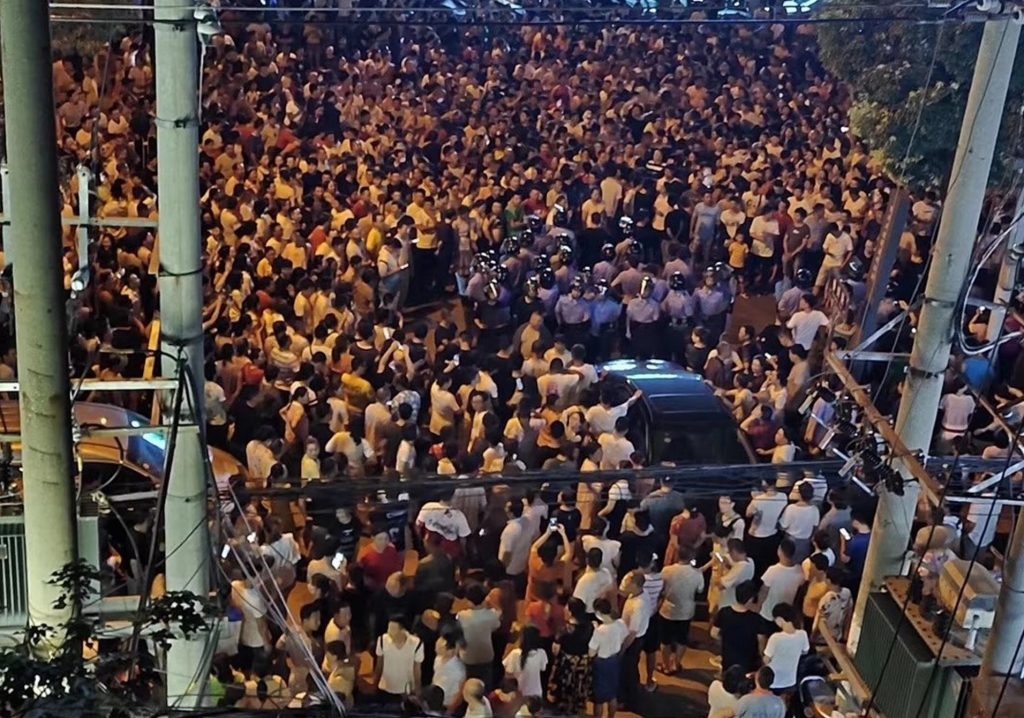
News media reports claimed that up to ten thousand residents of Xinzhou District, Wuhan, took to the streets for at least one whole week from June 28 to July 5 to protest against the site selection of an incineration plant project. It is unclear as of this writing when the protests ended and whether the local government has yielded to public demand to terminate the incinerator project.
The Chenjiachong landfill, full to bursting with solid waste from over 300,000 residents in Yangluo subdistrict and nearby areas over the last decade, has been slammed for causing air pollution affecting nearby residents and even contaminating underground water. In May 2019, a report from a development research institute in Wuhan briefly revealed the government’s plan to replace the landfill by an economy-eco industrial park that would allegedly combine recreation and incineration. Wuhan’s urban management administration later responded to an online inquiry in June: an incinerator slated for construction in September would replace the landfill scheduled to cease operation in 2020. The decision, which only became public knowledge through the online response, did not receive any public comments.
On June 28, the Xinzhou District government announced on its official Weibo account the decision to hold off construction until a consensus among residents is reached. Residents concerned about cancerous gas emission and the exacerbation of Yangtze River pollution massed on the streets for days to voice objections to the proposed incinerator while holding banners with slogans such as “air pollution will harm the next generations.” Riot police with shields and batons were deployed to disperse protesters. In a letter issued on July 3, the Xinzhou government agreed not to push through the incinerator project without first conducting an environmental assessment and receiving public comments. It also reiterated that “the project will never start if people disagree with it.” The letter or other updates on the project, however, cannot be found on the Xinzhou government website nor its Weibo account as of September 2019.
Incinerator proposals in China have long been a major source of environmental concern, sparking scores of incidents of unrest despite authorities’ promise to put them on hold, including the Yunfu protest Dui Hua previously reported in June. While the incident garnered widespread media attention in early July not long after its outbreak, censorship on social media has prevented Wuhan locals from circulating updates about the protest. The status of the incinerator in Xinzhou remains unclear. Chinese state media cited anonymous analysts as saying that insufficient communication between the government and public, and the lack of transparent pollution data were the major reasons for public resentment. State media also commented that “allowing residents to participate in accessing and supervising the project from the beginning could help ease concern and build public confidence.”
On June 22 around 20,000 people from Yu’nan County in Yunfu, Guangdong blocked the Guangxi-bound highway to protest a waste incinerator project, according to news media sources. While SWAT police with riot shields attempted to clear the highway, protesters responded by throwing water bottles and the like. This was the major clash during a four-day-long protest beginning on June 19. The county government announced its decision to cancel site selection of the incinerator plant on June 23.
The incinerator was set to be located less than one kilometer away from nearby towns in Yu’nan County. Members of the public were only allowed to mail their opinions on site selection to the county government within the 10-day commenting period. Failure to do so would be considered an abstention. As the government did not respond to their opinions, local residents took to the streets to protest the plant project and attempted to stop the construction. They feared that the plant would emit highly cancerous waste gas with dioxin, causing soil and water pollution and contaminating food chains. During the protest, elderly people, students, and children held signs and banners rejecting the proposal on the basis that the incinerator would harm future generations. Although the plant was said to have the capacity to turn waste into energy, opponents suspected that other localities would also dump waste into their hometown. After the clashes, on June 22 the government announced that the project would be shelved, but protesters refused to accept the vague promise. The next day, the government announced the official cancellation of site selection.
As of February 2019, China has built more than 400 incinerators over the past ten years and is building 170 more. The 13th Five-Year Plan in 2016 set a goal to increase the use of incineration for waste disposal by the end of 2020. Implementation of the national policy, however, has met with fierce local resistance. Guangdong, China’s most populous province, has at least 40 incinerators. From 2014 to 2017, mass protests against the project proposals took place in such localities as Huizhou, Zhaoqing, and Qingyuan. The most violent one erupted in 2015 in Luoding, a county-level city also under Yunfu. The Luoding government signed an incinerator construction contract with China Resources Cement Holdings Limited without public notice or conducting a proper environmental assessment. Brutal law enforcement enraged tens of thousands of residents, who surrounded government buildings and even attacked police vehicles and police stations. The Luoding city government consequently backed down and terminated the contract.
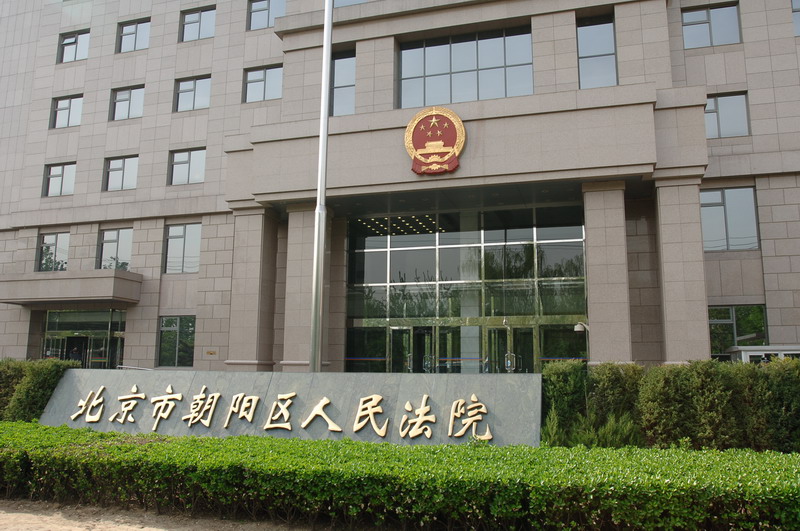
Beijing Chaoyang District Peoples Court. Image credit: Chinacourt.org
After Minister of Justice Wu Aiying took up her position in 2005, I was barred from visiting Chinese prisons. By 2005 I had been shown around prisons in Beijing, Hebei, Tianjin, Shanghai, Fujian, and Guangdong – nine prisons in all.
Wu Aiying was expelled from the Communist Party for corruption in 2017. Her ceaseless efforts to dismantle my dialogue with the ministry came to a head when a colleague and I were invited to visit Yichang Municipality in Hubei Province in 2007 to make presentations on the American justice system to a large audience of provincial justice officials. We had been promised a prison visit, but after finishing our presentations our hosts confirmed that we would not after all be allowed to visit the prison, on the instruction of the Ministry of Justice in Beijing. We needed to get out of town quickly.
In early 2006, I shifted my attention from visiting prisons to attending criminal trials. In January I wrote to the Supreme People’s Court in Beijing, requesting permission to attend a trial of either endangering state security or disturbing the social order, specifically a “mass incident,” when I visited Beijing the following month. This was a bold request. Although most trials are supposed to be open to the public, trials of endangering state security are usually closed. Trials of disturbing the social order involving dissidents are often closed to outsiders. In general foreigners, other than consular representatives, who are, for the most part, allowed to attend trails of their citizens, rarely get permission to attend trials.
To my surprise, I was told that I could attend a disturbing the social order trial, as the guest of the Beijing High Court, when I visited Beijing the following month. The trial would take place at the Chaoyang District Court, one of the country’s busiest; it had heard 50,000 criminal cases in 2005.
At 9 AM on February 17, 2006, my driver and I arrived at the Chaoyang District Court. I was met by the Chief Judge of the Chaoyang Court’s Criminal Division, the Director of the Court’s General Office, and the Director of the High Court’s Foreign Affairs Office. My driver told me that I was being given great face.
I was ushered into a polyurethane wood-paneled court room where photographers and cameramen were waiting to film my attendance. Other than court officials and police officers, I was the only other person in the room.
Seated at the front of the court was an appropriately robed collegiate panel consisting of two judges and a people’s assessor. In front of them was the court recorder. The defense team sat to my right while the prosecutors sat to my left. The defendant, Mr. Dong, was led into the courtroom in shackles. He stood in a box before the judges, flanked by two sturdy policemen.
Mr. Dong was accused of creating a disturbance, a violation of Article 293 of the Criminal Law, and a crime of disturbing the social order. In October 2005, Mr. Dong had been drinking in a bar. After a bit too much bai jiu, a fiery Chinese liquor, he stumbled into the street, where he began fights with passersby. The police showed up and detained him, somewhat worse for the wear.
I asked a court official seated next to me if this was considered a “mass incident.” He replied yes, “a small-scale mass incident.”
Mr. Dong had already served a two-year sentence for fighting, which meant that as a recidivist he could expect a harsh sentence. He pleaded guilty at this trial. The judges, in a show of leniency, noted his deep remorse and decided to give him a second chance, a suspended sentence. Mr. Dong thanked the court and was led away.
The whole proceeding had taken just 30 minutes. After my visit to the court room I was taken to see the room where copies of judgments are held. I asked to take a look at a few randomly selected judgments, but my request was denied.
On the way back to the car we passed through the court’s atrium. Overhead was a glass ceiling. I was told that this ceiling symbolized the court’s commitment to transparency.
After the trial and before returning to Hong Kong on February 18, 2006, I was hosted to lunch by Swedish Ambassador Borje Ljunggren and dinner by American Ambassador Clark Randt. I also met with the Red Cross and the Swiss Embassy.
A Case of Armed Robbery
I took the afternoon train to Guangzhou from Hong Kong on February 19. I was met at the train station by a professor and his junior colleague who both worked for a research association. They drove me to the White Swan Hotel on Shamian Island, close to the American consulate. We went to dinner at the hotel’s Chinese restaurant.
Over dinner I related my experience at the Chaoyang District Court. I told my friends that I felt that the trial I had attended was choreographed and intended to impress me with how compassionate the judges were. To my surprise I was asked if I’d like to attend a trial in Guangzhou. “We are far more open here. Foreigners can attend trials without prior approval,” I was told. We agreed to try to attend a trial at the Guangzhou Intermediate Court the next day.
We arrived at the court by taxi on the morning of February 20. The court was housed in a large, multi-story building, a hive of 80 court rooms. The ground floor was teeming with family members and others intending to attend trials, as well as judges and bailiffs. After passing through the security check, I went to an unimpressive wooden desk and registered to attend a trial of armed robbery, a capital offense. I presented my passport and was given a pass. Intermediate courts in China are the courts of first instance of trials for crimes that carry the death sentence, so we chose a death penalty trial.
My friend and I went to Courtroom Two on the fourth floor, where the trial was taking place, Judge Jiang Jianxiong presiding. The defendant, 19-year-old Huang Changwei was brought into the courtroom, shackled and accompanied by two blue-suited bailiffs. He stood in the dock shivering with fear. He was flanked by two cops. I thought of my own children. My oldest son was the same age as Huang Changwei, a migrant from a poor family in rural Guangdong. The judge, spying me out of the corner of his eye, asked young Mr. Huang if he needed some time to compose himself.
Mr. Huang was accused of killing his girlfriend, whom he had met on the Internet, in June 2005. The couple had rented a hotel room to negotiate a “breakup fee,” the amount the young woman was to receive for agreeing to separate. She demanded RMB 10,000. The boyfriend refused to pay anything and instead demanded that the girl return the cellphone he had given her. She refused, and when he tried to grab it a struggle ensued. During the fight he grabbed a fruit knife and stabbed her to death, after which he fled the scene, in possession of the cellphone. It was a simple matter for the police to track him down and detain him.
The court room was crowded. In addition to court officials, lawyers, and police, there were people like me (I was the only foreigner) who simply wanted to watch the proceedings. There was a group of relatives of the deceased girl who were there to demand justice. They were armed with a document that apparently allowed them to calculate the amount of compensation to the family that the young man should pay them for killing the girl.
The defendant’s lawyer stated that his client was too poor to pay a large compensation. At this point, the judge moved to adjourn the trial in order that he consider amending the charge to intentional murder. The defendant’s lawyer exclaimed: “Surely your honor wouldn’t sentence my client to death simply because he can’t afford to pay compensation.”
After the trial was adjourned, I went up to the judge and asked him if he cared to join me for a cup of tea and a cigarette. We agreed to do so in a small room off the hallway outside the court. We sat down on a couch to discuss the case. I found myself in the unlikely role of advocating for someone facing the death penalty in a Chinese court of law.
I said that Mr. Huang was a young man (he was 18 years old at the time of the crime) and took the position that this was a crime of passion committed by an immature person. There was no evidence of premeditation. At most this would be second-degree murder in the United States, maybe manslaughter. No way, I opined, could the crime justify his execution.
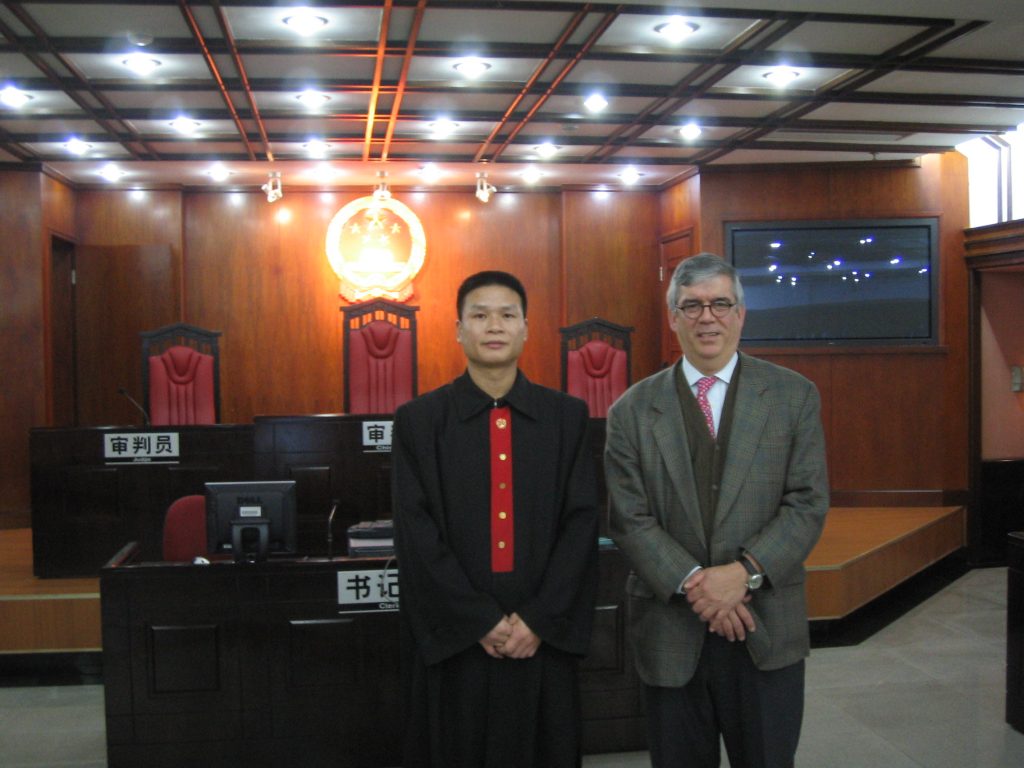
Judge Jiang seemed to take what I said on board. After finishing the tea and cigarette, I asked if he’d take a picture with me. He agreed and we reentered the courtroom where compensation negotiations between parties were still underway. He shooed them away, and we took a picture together, he in his splendid robes.
Judge Jiang did not amend the charge to intentional murder, keeping it as intentional robbery, a capital crime.
John Kamm with Judge Zhang Jianxiong of the Guangzhou Intermediate People’s Court, February 2006
Aftermath
On April 25, 2006 the Guangzhou Intermediate People’s Court sentenced Huang Changwei to death. He was ordered to compensate the girl’s family to the tune of RMB 292,689, the sum total of his assets. Huang appealed the judgment to the Guangdong High Court.
I wrote a letter to Judge Jiang which I asked my Guangzhou friend to deliver. I asked the judge to pass along my comments on the case to the High Court. On November 28, 2006 the High Court amended the sentence to death with two-year reprieve, reasoning that he had just turned 18 (the youngest age at which someone can be executed for a crime committed at or after the age of 18) not long before he committed the crime. He deserved a second chance. My friend wrote me that it was virtually certain that the sentence would be commuted to life in prison, which is what happened on August 8, 2009.
Huang turned out to be a very well-behaved prisoner. His life sentence was reduced to 19 years on July 28, 2011 and further reduced by 17 months on December 31, 2013. He was given an eight-month sentence reduction on May 6, 2016 and a five-month reduction in 2018. After the last reduction this sentence is set to expire on June 27, 2028, 23 years after the death at his hands of his girlfriend.
View of Hong Kong from Victoria Peak. Image Credit: Pixabay.com
In the midst of widespread and increasingly violent protests, Dui Hua Executive Director John Kamm visited Hong Kong from September 17 to September 25, 2019. He found a city deeply divided between support for the protesters and support for the police. Hong Kong is a city where normal life has been upended, where “flash mob” protests and mostly peaceful demonstrations by supporters and opponents of the police frequently take place, and where transportation around the city and at the airport are subject to disruption.
Major events have been cancelled due to the unrest, including the Hong Kong Tennis Open and the PGA Hong Kong Open, concerts by K-pop groups, a drag queen performance and a gig by comedian Trevor Noah, as well as the Global Wellness Summit.
The economy has been badly hit. Retails sales have plummeted, and hotels stand at least half empty. Districts popular with Mainland shoppers are now largely empty. Restaurants, when open, close early. There will be more than two million fewer tourist arrivals in 2019 than in 2018. Arrivals from mainland China are down 90 percent year-on-year. Reflecting the US-China trade war, exports of Hong Kong goods and reexports of mainland goods have plunged every month of 2019 when compared with the same months in 2018.
It is widely expected that Hong Kong will fall into recession by the end of 2019.
HKHRDA Generates Intense Interest
During his eight days in Hong Kong, Kamm met with Chinese officials, American diplomats, Hong Kong government advisors, business leaders, academics, journalists, and senior staff of locally-based human rights groups.
A principal topic of discussion in all meetings was the Hong Kong Human Rights and Democracy Act (HKHRDA), which passed both the House Foreign Affairs Committee and the Senate Foreign Relations Committee on September 25. The committees passed different versions of the Act, meaning that the two versions will need to be reconciled before the final version is voted on by both chambers. Enactment is by no means certain.
The HKHRDA imposes new reporting requirements on the State Department to determine whether Hong Kong continues to enjoy a degree of autonomy sufficient to deserve special treatment under the 1992 Hong Kong Policy Act. A separate report must be submitted to Congress on the efficacy of Hong Kong’s technology controls. Most telling, the HKHRDA imposes sanctions on mainland and Hong Kong officials who are determined to have committed human rights abuses against the Hong Kong people.
Beijing has denounced the legislation, and threatened retaliation against American interests. China has already blamed foreign “black hands,” including those from the United States, of inciting the protests in Hong Kong. Hong Kong recently barred an American scholar who had testified to Congress about Hong Kong from entering the SAR. Hong Kong officials acknowledge that China is widely disliked in Washington, but they are determined to lobby Senators to stop the legislation. Officials see no chance of stopping the bill in the House.
Protests were massive and violent on October 1, China’s National Day, thereby embarrassing the Xi Jinping government. A secondary school student was shot by a policeman and an Indonesian journalist was blinded in one eye by a police rubber bullet. More than 1,000 protesters and police have been injured, and more than two thousand protesters have been arrested, many on charges of rioting and participating in an illegal assembly. Upon her return from Beijing where she attended a big military parade, SAR Chief Executive Carrie Lam convened a meeting of the Executive Council after which she announced that she would invoke a 1922 ordinance to impose emergency measures including the banning of face masks.
Kamm concluded that, barring a highly unlikely accession to the protesters’ key demands of an independent investigation into police brutality and the adoption of democratic reforms, the crisis in Hong Kong will continue with no end in sight.
Progress Made on Dui Hua Priorities
Despite the turmoil, Kamm made progress on Dui Hua’s April 2020 program, the International Symposium on Girls in Conflict with the Law. He met with Dui Hua’s partner, the University of Hong Kong’s Centre for Comparative and Public Law, as well as two key welcoming speakers. It was decided to press ahead with the Symposium.
Kamm also met with the foundation’s Chinese interlocutors, handed over prisoner lists, and received information in response to its inquiries. Thus far, Dui Hua has received information on as many prisoners as it did in all of 2018.
PRISONER UPDATES
Updates on American citizens
On September 5, 2019, Dui Hua was informed by family members of David Lin (David Kuo Liang Lin, 林大卫) that he had been granted a four-month sentence reduction. David Lin is an American pastor and businessman who entered China to preach in 2006. He was convicted of fraud and sentenced to life imprisonment by the Beijing No.1 Intermediate People’s Court on December 2, 2009. The Beijing High People’s Court upheld the conviction and sentence on May 25, 2010. After his life sentence was commuted to a fixed-term imprisonment of 19 years and six months in 2012, he received three more sentence reductions in 2013, 2014, and 2019, respectively. Lin is due for release on December 19, 2029.
American citizen Wendell Brown was released from a prison in Chongqing on September 24, after serving three years in prison for a fight arising from an altercation in a bar in 2016. After being detained for around 20 months while awaiting judgment, the Chongqing Yubei District Court convicted him of intentional assault and sentenced him to four years’ imprisonment on June 28, 2018. On November 13, 2018 the Chongqing No.1 Intermediate Court reduced the sentence to three years, the lowest sentence for the crime of intentional assault under the Criminal Law. Dui Hua played a role in bringing about the sentence reduction, having lobbied both U.S. and Chinese governments, and called attention to the case in western media. Dui Hua also served as an adviser to Brown’s family and team of supporters.
Guangdong Prisoner List and Responses
Following the first special pardons to mark the 70th anniversary of the end of World War II on June 29, 2015, Xi Jinping ordered his second special pardon four years later to celebrate the 70th birthday of the People’s Republic of China. This time, eligible prisoners included those aged 75 or above with serious physical disabilities who are unable to take care of themselves. Dui Hua submitted a list of five elderly and sick prisoners serving their sentences in a southern province to its interlocutors, and inquired about their eligibility for special pardons.
In September 2019, Dui Hua received an official response confirming that none of the five prisoners Dui Hua inquired about had benefited from the special pardons. Yao Wentian (姚文田) is a 78-year-old publisher from Hong Kong convicted of smuggling ordinary goods and sentenced to ten years’ imprisonment by the Shenzhen Intermediate People’s Court on May 7, 2014. Despite his advanced age and poor health conditions, Yao was not considered eligible. Dui Hua, however, was advised that Yao was given an eight-month sentence reduction in April 2019. Observers believed that Yao was imprisoned for editing a book on Xi Jinping in 2013 by dissident author Yu Jie (余杰). Yao is scheduled for release from Dongguan Prison in 2023.
Like Ji Sijun (纪斯尊)and Huang Qi (黄琦), the case of Wang Jing (王晶) highlights the issue of deprivation of medical care for human rights activists during incarceration. Wang Jing continues to be in poor health after she was released from Jilin Women’s Prison on September 15, 2019. Wang, a citizen reporter covering petitioners and provided information for 64tianwang.com, suffers from a brain tumor and her condition is deteriorating. She was criminally detained in 2014 because of her report on a petitioner who set himself ablaze in Tiananmen Square. Although Wang was diagnosed with brain cancer before she was placed under criminal detention, she was not granted bail and was reportedly tortured while in custody in 2015. On April 20, 2016, the Chuanying District People’s Court sentenced her to four years and ten months’ imprisonment for picking quarrels and provoking troubles. The Jilin Intermediate People’s Court upheld the conviction and sentence in 2016. Despite her medical condition, the prison refused to consider her for medical parole in 2017. The intermediate court rejected her request for a post-conviction appeal in 2018. News media reported that her tumor has returned, and that she has not recovered from the spinal injury she received during mistreatment.
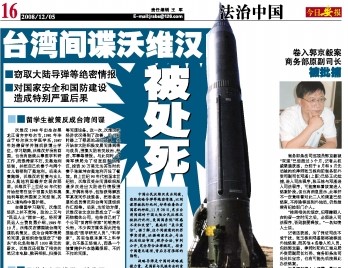
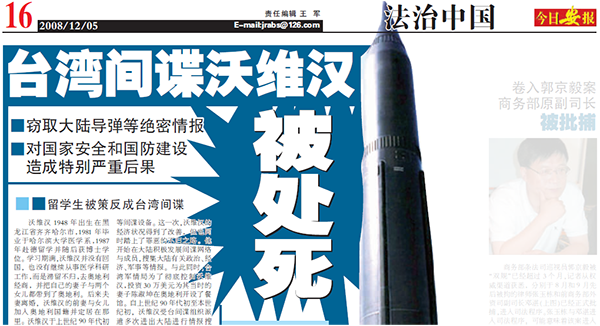
The execution of Wo Weihan, an ethnic Daur accused of spying for Taiwan, indicated that members of ethnic minorities do not necessarily benefit from leniency in accordance with China’s policy of “two restraints, one leniency.” Wo’s execution received wide-spread state media coverage in late 2008. Image Credit: Dahe.cn (大河网)
Liangshao Yikuan: The Current Status
There has been ongoing debate concerning the current status of Two Restraints One Leniency, or liangshao yikuan, since the Publicity Department, the State Ethnic Affairs Commission, and the United Front Work Department jointly issued a statement on policies toward minorities in 2010. Some observers believe that the policy has been abolished by virtue of this statement, which maintains that “everyone should be equal before the law, and all criminals should be punished regardless of ethnicity.” In 2014, the Fourth Plenary Session of the Eighteenth Central Committee of the Chinese Communist Party reiterated the principle of equality irrespective of ethnicity and incorporated equality as a core socialist value. Nevertheless, liangshao yikuan remains formally in effect because the joint statement cannot override an earlier national policy apparently promulgated by a superior authority, the Standing Committee of the Central Committee. Thus, while the actual hierarchy of authority regarding the policy initiated by then-General Secretary Hu Yaobang in the 1984 criminal policy document Number 5 remains somewhat obscure, liangshao yikuan has not yet been repealed.
Academics cannot reach a consensus concerning how liangshao yikuan is being implemented across China. Prior to his imprisonment, prominent Uyghur scholar Ilham Tohti expressed support for repeal in an interview in 2012. He claimed that abolition would be easy because the policy itself was not being enforced in ethnic regions. Another opinion published by legal scholar Chen Lanxin on the social media website Douban states that the policy is implemented only “to some extent.” His argument highlights the ambiguity about how liangshao yikuan is being enforced, or even fundamentally understood. Such a status is also underpinned in the findings of a doctoral thesis by a Uyghur scholar, Erken Shumamshak, who points out in a 2013 article that judicial personnel in minority regions may not be cognizant of liangshao yikuan despite over 30 years of its existence. The author found that a number of judicial personnel in the cities of Urumqi, Kashgar, Hotan, and Tacheng in Xinjiang had “never heard” about the policy. Another study conducted among judicial officials in Gansu’s Tianzhu Tibetan Autonomous County indicated that ethnicity played no role in law enforcement because the officials claimed there were no marked political, economic, or cultural differences between Han and ethnic minorities in the county.
Beyond Liangshao Yikuan: Security Trumps Leniency
Policy makers in the 1980s might not have foreseen the complex problems brought about by the increase in inter-ethnic contact in the subsequent decades, resulting from the mass migration of Han Chinese to traditionally minority regions in China’s interior. Eastward migration to traditionally Han Chinese cities by ethnic minorities on the lookout for better job opportunities, albeit on a smaller scale, has also contributed to the surge of inter-ethnic conflicts. Although the arguments against liangshao yikuan are not entirely without grounds, recent public discussions reveal the rise of Han chauvinism in both physical and virtual spaces. While stressing that preferential policies for ethnic minorities violate the right to equality, many critics fail to realize that ethnic minorities today face discrimination in many other respects. For instance, Tibetans and Uyghurs are placed on a security blacklist when they seek accommodations in major cities. Their right to travel both internationally and abroad is severely restricted because their passports have been seized in a bid to tighten control over their movements.
John Kamm Remembers is a feature that explores Kamm’s human rights advocacy prior to and since Dui Hua’s establishment in 1999.
Attending Trials in Beijing and Guangzhou, 2006
Beijing Chaoyang District Peoples Court. Image Credit: blog.sina.com.cn
After Minister of Justice Wu Aiying took up her
position in 2005, I was barred from visiting Chinese prisons. By 2005 I had
been shown around prisons in Beijing, Hebei, Tianjin, Shanghai, Fujian, and
Guangdong – nine prisons in all.
Wu Aiying was expelled from the Communist Party for
corruption in 2017. Her ceaseless efforts to dismantle my dialogue with the
ministry came to a head when a colleague and I were invited to visit Yichang
Municipality in Hubei Province in 2007 to make presentations on the American
justice system to a large audience of provincial justice officials. We had been
promised a prison visit, but after finishing our presentations our hosts
confirmed that we would not after all be allowed to visit the prison, on the
instruction of the Ministry of Justice in Beijing. We needed to get out of town
quickly.
In early 2006, I shifted my attention from visiting
prisons to attending criminal trials. In January I wrote to the Supreme
People’s Court in Beijing, requesting permission to attend a trial of either
endangering state security or disturbing the social order, specifically a “mass
incident,” when I visited Beijing the following month. This was a bold request.
Although most trials are supposed to be open to the public, trials of
endangering state security are usually closed. Trials of disturbing the social
order involving dissidents are often closed to outsiders. In general
foreigners, other than consular representatives, who are, for the most part,
allowed to attend trails of their citizens, rarely get permission to attend
trials.
To my surprise, I was told that I could attend a
disturbing the social order trial, as the guest of the Beijing High Court, when
I visited Beijing the following month. The trial would take place at the
Chaoyang District Court, one of the country’s busiest; it had heard 50,000
criminal cases in 2005.
At 9 AM on February 17, 2006, my driver and I arrived
at the Chaoyang District Court. I was met by the Chief Judge of the Chaoyang
Court’s Criminal Division, the Director of the Court’s General Office, and the
Director of the High Court’s Foreign Affairs Office. My driver told me that I
was being given great face.
I was ushered into a polyurethane wood-paneled court
room where photographers and cameramen were waiting to film my attendance.
Other than court officials and police officers, I was the only other person in
the room.
Seated at the front of the court was an appropriately
robed collegiate panel consisting of two judges and a people’s assessor. In
front of them was the court recorder. The defense team sat to my right while
the prosecutors sat to my left. The defendant, Mr. Dong, was led into the
courtroom in shackles. He stood in a box before the judges, flanked by two
sturdy policemen.
Mr. Dong was accused of creating a disturbance, a
violation of Article 293 of the Criminal Law, and a crime of disturbing the
social order. In October 2005, Mr. Dong had been drinking in a bar. After a bit
too much bai jiu, a fiery Chinese
liquor, he stumbled into the street, where he began fights with passersby. The
police showed up and detained him, somewhat worse for the wear.
I asked a court official seated next to me if this was
considered a “mass incident.” He replied yes, “a small-scale mass incident.”
Mr. Dong had already served a two-year sentence for
fighting, which meant that as a recidivist he could expect a harsh sentence. He
pleaded guilty at this trial. The judges, in a show of leniency, noted his deep
remorse and decided to give him a second chance, a suspended sentence. Mr. Dong
thanked the court and was led away.
The whole proceeding had taken just 30 minutes. After
my visit to the court room I was taken to see the room where copies of
judgments are held. I asked to take a look at a few randomly selected
judgments, but my request was denied.
On the way back to the car we passed through the court’s
atrium. Overhead was a glass ceiling. I was told that this ceiling symbolized
the court’s commitment to transparency.
After the trial and before returning to Hong Kong on
February 18, 2006, I was hosted to lunch by Swedish Ambassador Borje Ljunggren and
dinner by American Ambassador Clark Randt. I also met with the Red Cross and
the Swiss Embassy.
I took the afternoon train to Guangzhou from Hong Kong
on February 19. I was met at the train station by a professor and his junior colleague
who both worked for a research association. They drove me to the White Swan
Hotel on Shamian Island, close to the American consulate. We went to dinner at
the hotel’s Chinese restaurant.
Over dinner I related my experience at the Chaoyang
District Court. I told my friends that I felt that the trial I had attended was
choreographed and intended to impress me with how compassionate the judges
were. To my surprise I was asked if I’d like to attend a trial in Guangzhou.
“We are far more open here. Foreigners can attend trials without prior
approval,” I was told. We agreed to try to attend a trial at the Guangzhou
Intermediate Court the next day.
We arrived at the court by taxi on the morning of February 20. The court was housed in a large, multi-story building, a hive of 80 court rooms. The ground floor was teeming with family members and others intending to attend trials, as well as judges and bailiffs. After passing through the security check, I went to an unimpressive wooden desk and registered to attend a trial of armed robbery, a capital offense. I presented my passport and was given a pass. Intermediate courts in China are the courts of first instance of trials for crimes that carry the death sentence, so we chose a death penalty trial.
My friend and I went to Courtroom Two on the fourth floor, where the trial was taking place, Judge Jiang Jianxiong presiding. The defendant, 19-year-old Huang Changwei was brought into the courtroom, shackled and accompanied by two blue-suited bailiffs. He stood in the dock shivering with fear. He was flanked by two cops. I thought of my own children. My oldest son was the same age as Huang Changwei, a migrant from a poor family in rural Guangdong. The judge, spying me out of the corner of his eye, asked young Mr. Huang if he needed some time to compose himself.
Mr. Huang was accused of killing his girlfriend, whom he had met on the Internet, in June 2005. The couple had rented a hotel room to negotiate a “breakup fee,” the amount the young woman was to receive for agreeing to separate. She demanded RMB 10,000. The boyfriend refused to pay anything and instead demanded that the girl return the cellphone he had given her. She refused, and when he tried to grab it a struggle ensued. During the fight he grabbed a fruit knife and stabbed her to death, after which he fled the scene, in possession of the cellphone. It was a simple matter for the police to track him down and detain him.
The court room was crowded. In addition to court officials, lawyers, and police, there were people like me (I was the only foreigner) who simply wanted to watch the proceedings. There was a group of relatives of the deceased girl who were there to demand justice. They were armed with a document that apparently allowed them to calculate the amount of compensation to the family that the young man should pay them for killing the girl.
The defendant’s lawyer stated that his client was too poor to pay a large compensation. At this point, the judge moved to adjourn the trial in order that he consider amending the charge to intentional murder. The defendant’s lawyer exclaimed: “Surely your honor wouldn’t sentence my client to death simply because he can’t afford to pay compensation.”
After the trial was adjourned, I went up to the judge and asked him if he cared to join me for a cup of tea and a cigarette. We agreed to do so in a small room off the hallway outside the court. We sat down on a couch to discuss the case. I found myself in the unlikely role of advocating for someone facing the death penalty in a Chinese court of law.
I said that Mr. Huang was a young man (he was 18 years old at the time of the crime) and took the position that this was a crime of passion committed by an immature person. There was no evidence of premeditation. At most this would be second-degree murder in the United States, maybe manslaughter. No way, I opined, could the crime justify his execution.
Judge Jiang seemed to take what I said on board. After finishing the tea and cigarette, I asked if he’d take a picture with me. He agreed and we reentered the courtroom where compensation negotiations between parties were still underway. He shooed them away, and we took a picture together, he in his splendid robes.
Judge Jiang did not amend the charge to intentional murder, keeping it as intentional robbery, a capital crime.
John Kamm with Judge Zhang Jianxiong of the Guangzhou Intermediate People’s Court, February 2006
Aftermath
On April 25, 2006 the Guangzhou Intermediate People’s Court sentenced Huang Changwei to death. He was ordered to compensate the girl’s family to the tune of RMB 292,689, the sum total of his assets. Huang appealed the judgment to the Guangdong High Court.
I wrote a letter to Judge Jiang which I asked my Guangzhou friend to deliver. I asked the judge to pass along my comments on the case to the High Court. On November 28, 2006 the High Court amended the sentence to death with two-year reprieve, reasoning that he had just turned 18 (the youngest age at which someone can be executed for a crime committed at or after the age of 18) not long before he committed the crime. He deserved a second chance. My friend wrote me that it was virtually certain that the sentence would be commuted to life in prison, which is what happened on August 8, 2009.
Huang turned out to be a very well-behaved prisoner. His life sentence was reduced to 19 years on July 28, 2011 and further reduced by 17 months on December 31, 2013. He was given an eight-month sentence reduction on May 6, 2016 and a five-month reduction in 2018. After the last reduction this sentence is set to expire on June 27, 2028, 23 years after the death at his hands of his girlfriend.
SAN FRANCISCO (October 1, 2019) — On September 30, 2019, the Pew Research Center released its latest Global Attitudes survey. Nearly 35,000 people in 32 countries were polled on their opinions of China from May 13 to August 29, 2019. The results indicate that China’s “soft power” push to improve the country’s international image has failed in North America, Western Europe, and Asia. Opinions on China in Latin America, Eastern Europe, Russia, and Africa have remained for the most part positive, though there has been significant slippage in several countries, notably Kenya and South Africa.
Of the 26 countries surveyed by Pew in both 2018 and 2019, 17 show drops in favorability versus nine which show improvements. Compared with 2018, China’s favorability rating fell by double digits in eight countries. The decline in opinions towards China was most pronounced in Indonesia, Canada, and Sweden (down 17 percentage points) and in the United States and Australia (down 12 percentage points). In each of these countries, concerns over China’s human rights have been much in evidence over the last 12 months.
In Indonesia, protests against China’s treatment of Muslims in Xinjiang have taken place, and there is growing dissatisfaction over China’s claim to almost the entire South China Sea. (In Tunisia, another Muslim country surveyed by Pew, opinion towards China dropped seven points year on year).
In Canada, where a Nanos survey released in August showed that 90 percent of Canadians held a negative or somewhat negative opinion of China, there is widespread anger over the treatment of Canadians Michael Spavor and Michael Kovrig. Both men were detained and subsequently arrested for spying in apparent retaliation for the detention of Huawei executive Meng Wanzhou. Ms. Meng has a team of lawyers and is out on bail enjoying life in Vancouver, where she owns two mansions, while the Canadians are being held in harsh conditions in state security detention centers, largely incommunicado. They are allowed one 30-minute consular visit a month. Opinions have also been affected by death sentences for two Canadians convicted of drug trafficking
In Sweden, where China’s favorable rating dropped from 42 percent in 2018 to 25 percent in 2019, anger has been stoked by the treatment of Swedish citizen Gui Minhai. In Australia there is alarm over the treatment of Australian citizen and writer Yang Hengjun, recently arrested for spying. A Lowy poll released in June indicated that China, Australia’s largest trading partner, dropped nine degrees on the so-called “feelings thermometer” which measures public warmth towards other countries. This was the worst result for China in 15 years of polling.
China’s leadership is known to be concerned by the rapid deterioration of China’s image in the United States. A Gallup poll taken in February showed that 57 percent of Americans had a negative opinion of China, a drop of 12 points since the 2018 poll. While there are many reasons for the fall in China’s popularity – militarization of man-made islands in the South China Sea, cyber espionage, and trade practices, to name a few – human rights abuses are one of them. There has been a steady drum beat of negative media over China’s treatment of Uyghurs in Xinjiang, policies on religious freedom, and encroachments on Hong Kong’s freedoms.
In “Two Restraints, One Leniency”: Part I, Dui Hua looked at the origins of, and controversies over, this policy. It originated in a criminal policy pushed through the Central Committee as a part of Document Number Five by then-General Secretary Hu Yaobang in 1984. The policy called on law enforcement to be lenient towards criminal offenders from ethnic minority groups, by making fewer arrests and handing down fewer executions and lighter sentences to ethnic minority offenders. In Part II, Dui Hua looks at its legacy in Han-minority relations today and its current, still unsettled status.
The execution of Wo Weihan, an ethnic Daur accused of spying for Taiwan, indicated that members of ethnic minorities do not necessarily benefit from leniency in accordance with China’s policy of liangshao yikuan. Wo’s execution received widespread state media coverage in late 2008. Image Credit: dahe.cn (大河网)
Liangshao Yikuan: The Current Status
There has been ongoing debate concerning the current status of Two Restraints One Leniency, or liangshao yikuan, since the Publicity Department, the State Ethnic Affairs Commission, and the United Front Work Department jointly issued a statement on policies toward minorities in 2010. Some observers believe that the policy has been abolished by virtue of this statement, which maintains that “everyone should be equal before the law, and all criminals should be punished regardless of ethnicity.” In 2014, the Fourth Plenary Session of the Eighteenth Central Committee of the Chinese Communist Party reiterated the principle of equality irrespective of ethnicity and incorporated equality as a core socialist value. Nevertheless, liangshao yikuan remains formally in effect because the joint statement cannot override an earlier national policy apparently promulgated by a superior authority, the Standing Committee of the Central Committee. Thus, while the actual hierarchy of authority regarding the policy initiated by then-General Secretary Hu Yaobang in the 1984 criminal policy document Number 5 remains somewhat obscure, liangshao yikuan has not yet been repealed.
Academics cannot reach a consensus concerning how liangshao yikuan is being implemented across China. Prior to his imprisonment, prominent Uyghur scholar Ilham Tohti expressed support for repeal in an interview in 2012. He claimed that abolition would be easy because the policy itself was not being enforced in ethnic regions. Another opinion published by legal scholar Chen Lanxin on the social media website Douban states that the policy is implemented only “to some extent.” His argument highlights the ambiguity about how liangshao yikuan is being enforced, or even fundamentally understood. Such a status is also underpinned in the findings of a doctoral thesis by a Uyghur scholar, Erken Shumamshak, who points out in a 2013 article that judicial personnel in minority regions may not be cognizant of liangshao yikuan despite over 30 years of its existence. The author found that a number of judicial personnel in the cities of Urumqi, Kashgar, Hotan, and Tacheng in Xinjiang had “never heard” about the policy. Another study conducted among judicial officials in Gansu’s Tianzhu Tibetan Autonomous County indicated that ethnicity played no role in law enforcement because the officials claimed there were no marked political, economic, or cultural differences between Han and ethnic minorities in the county.
Beyond Liangshao Yikuan: Security Trumps Leniency
Policy makers in the 1980s might not have foreseen the complex problems brought about by the increase in inter-ethnic contact in the subsequent decades, resulting from the mass migration of Han Chinese to traditionally minority regions in China’s interior. Eastward migration to traditionally Han Chinese cities by ethnic minorities on the lookout for better job opportunities, albeit on a smaller scale, has also contributed to the surge of inter-ethnic conflicts. Although the arguments against liangshao yikuan are not entirely without grounds, recent public discussions reveal the rise of Han chauvinism in both physical and virtual spaces. While stressing that preferential policies for ethnic minorities violate the right to equality, many critics fail to realize that ethnic minorities today face discrimination in many other respects. For instance, Tibetans and Uyghurs are placed on a security blacklist when they seek accommodations in major cities. Their right to travel both internationally and abroad is severely restricted because their passports have been seized in a bid to tighten control over their movements.
While Han Chinese widely believe that liangshao yikuan has contributed to an increase in petty crimes by ethnic minorities, some critics believe that the policy’s negative effect has been exaggerated. A 2010 article originally posted on a website founded by Ilham Tohti, www.uighur.biz.net (no longer valid), claimed that the problem of Uyghur petty thieves is chiefly caused both by the lack of social mobility among Uyghurs and the criminal policy that exempts children under the age of 14 from criminal liability, rather than liangshao yikuan. The age of criminal responsibility has likewise benefited many Han Chinese juvenile offenders. Prominent Tibetan blogger Woeser has written that the policy of restraints and leniency has virtually no effect on political cases.
Woeser’s argument is in line with Dui Hua’s observation that ethnic minorities receive excessive punishment in endangering state security cases. The offenses of splittism and inciting splittism are almost exclusively used to punish Uyghurs, Tibetans, and, to a lesser extent, ethnic Mongolians. Dui Hua’s Political Prisoner Database (PPDB) indicates that, since 2000, over 180 ethnic minority prisoners were sentenced to ten years’ imprisonment or more severe sentences, including life imprisonment, death with reprieve, and death, for these two offenses. Two-thirds of them are Uyghurs, while the remainder are mostly Tibetans. In regard to death sentences specifically, Dui Hua’s research found that five Uyghurs were sentenced to death for splittism alone, and five Uyghurs for splittism combined with terrorism or other charges. The number of ethnic minority offenders receiving harsh sentences for splittism or inciting splittism is strikingly high compared to Han Chinese democracy activists sentenced for subversion and inciting subversion, which are also categorized under endangering state security. Dui Hua’s PPDB showed that about 50 prisoners, 37 Han and 13 others with unclear ethnicity, have received prison sentences of ten years or more since 2000 for subversion and inciting subversion.
The principle of restraints and leniency has been largely superseded by the “War on Terror,” after China employed similar rhetoric from the U.S. to justify the anti-terrorism campaign following the September 11 attacks in 2001. After 2009, propaganda offensives against the “three evil forces” of terrorism, ethnic separatism, and religious extremism have intensified. China’s 2019 white paper on national defense reported that Xinjiang’s armed police forces have broken up 1,588 terrorist gangs and captured 12,995 terrorists since 2014.
Based on information selectively publicized by Chinese government sources, many of these terrorists are believed to be Uyghurs. Of the over two dozen people sentenced to death in connection with the 2009 Urumqi Riots, at least two were Han Chinese, whereas the remainder are thought to be Uyghurs. A decade on, those who are continuing to serve their lengthy sentences for splittism or inciting splittism are almost exclusively Uyghurs, including Gulmire Imin and Gheyret Niyaz. None of them are known to have received any sentence reductions or other forms of clemency.
There are additional coercive measures targeting Xinjiang’s Muslim minorities. Dui Hua previously reported on educational placement (anzhi jiaoyu 安置教育), a coercive measure which targets prisoners considered “a danger to society,” even when they have completed their sentences for terrorism or extremism offenses. The measure provides no time limit for how long someone can be held under the measure, leaving open the possibility of de facto life imprisonment. It has been used exclusively against Uyghurs and ethnic Kazakhs. Today, these two Muslim minority groups are facing repression unprecedented in China, as exemplified by the massive internment camps which are said to house over one million people across the autonomous region, as well as intensive surveillance, enabled by artificial intelligence, of those not, or no longer, confined to camps.
There is little evidence to suggest that liangshao yikuan serves to mitigate criminal sentencing when members of other ethnic groups are accused of endangering state security, even outside of restive Xinjiang and Tibet. Tong Daning (佟达宁), an ethnic Manchu, and Wo Weihan (沃维汉), an ethnic Daur, were sentenced to death in 2005 and 2007, respectively, for spying for Taiwan amid the strained cross-strait relations during Chen Shui-bian’s presidency. Tong, who spent many years working at the Ministry of Foreign Affairs before taking a senior position at the National Council for the Social Security Fund, was one of the top Chinese officials to have been executed for providing top military secrets about China’s military preparations against Taiwan. As part of the anti-spy propaganda in China, videotapes of Tong’s trial were distributed as a deterrent to civil servants. Wo, an entrepreneur and medical scientist, was convicted of providing photocopies of a missile defense system and information on a senior leader’s health to a Taiwanese intelligence agency. Wo’s execution in 2008 was strongly condemned by the European Union and U.S., which had sought a stay of execution.
Example of reporting on the execution of Wo Weihan. In the photo accompanying this article, which takes up four columns, he is shown in happier days at his daughter’s wedding.
Image Credit: dahe.cn (大河网)
Other discriminatory rules and practices against ethnic minorities prevailing in the carceral system are much in evidence. For example, Dui Hua has reported that clemency provided to prisoners convicted of the now-defunct offense of hooliganism has a clear ethnic bias against non-Han. Unlike Han Chinese who were considered for clemency a few years into their sentences, the same opportunity was not given to Uyghurs possibly (based on the date, as no precise reason is given in the judgment) sentenced for their involvement in the 1997 Ghulja Incident—demonstrations in the Xinjiang city of Ghulja, or Yining in Mandarin Chinese, which ended with repression by the Chinese military—until they had served many more years of their sentences. Finally, prisoners from ethnic minorities who fail to comply with the Mandarin-language-only visitation rules also have slimmer prospects for obtaining clemency than Han Chinese.
Whither Liangshao Yikuan?
The policy of liangshao yikuan might have saved the lives of many ethnic minorities from execution during the Strike Hard campaign in the 1980s, when the party deemed it necessary to preserve interethnic harmony as it countered the surge in criminal offenses across Han Chinese cities following the economic reforms. Nevertheless, as we have seen, the need to safeguard state security trumps liangshao yikuan, especially in Xinjiang and Tibet, where the majority of China’s endangering state security cases are believed to take place today. The role of liangshao yikuan in restraining harsh punishments and enabling lenient treatment for ethnic minority offenders has virtually disappeared in cases deemed to endanger state security. The same state security rationale has produced a spate of prejudicial rules, measures, and harsh sentences intended to suppress separatist sentiments. It is likely, in fact, that these policies are responsible for negative outcomes instead: higher levels of interethnic tensions, more grievances, the desire for greater autonomy or even independence by ethnic minority groups, and more efforts to flee the country by minorities who fear for their lives and safety.
There is no easy way to strike a balance between tolerating ethno-cultural diversity and promoting interethnic harmony. Hu Jintao’s rhetoric of building a “harmonious society” contrasted sharply with the incidents of ethnic unrest that began to occur towards the end of the first decade of the 21st century. The continuing incidents of interethnic violence into the Xi Jinping era have been widely seen as proof of the failure of the liangshao yikuan policy by both Han and other ethnic groups. The fact that Xi continues to blame “hostile foreign forces” for instigating ethnic problems demonstrates Beijing’s reluctance to change the status quo. The controversy surrounding “Two Restraints, One Leniency” is only the tip of the iceberg of China’s ethnic relations challenges. Even if Xi accepts the mainstream desire to have liangshao yikuan repealed, China’s ethnic policies will still fall far short of the principle of equality before the law, as long as China’s overall domestic strategy is to maintain stability by indiscriminately suppressing ethnic minorities.
An image of an early propaganda poster (1964), that states, “Long live the great unity of all ethnicities across the country,” from a discussion of “Two Restraints, One Leniency” reposted by Tibetan blogger Woeser in 2014. Image Credit: Woeser Blog
China’s criminal policy of “Two Restraints, One Leniency” (liangshao yikuan 两少一宽) was enacted during the administration of reformist leader Hu Yaobang (1982-1987). Derived from a Soviet-era policy that granted regional autonomy and preferential protection to ethnic minorities, the policy had the intended purpose of strengthening the political loyalty of ethnic minorities in the multi-national country. Hu believed that granting sufficient autonomy to members of ethnic minority groups was indispensable for safeguarding national unity. To this end, Hu improved ethnic representation in politics across autonomous regions. This progressive policy was reversed by Deng Xiaoping and Hu’s successors. In 1984, Hu pushed through the Central Committee Document Number Five, a new criminal policy which called on law enforcement to be lenient towards criminal offenders from ethnic minority groups by making fewer arrests and handing down fewer executions and lighter sentences to ethnic minority offenders.
The policy has been a source of contention since its promulgation. Supporters of the policy argue that it embodies the government’s deep respect towards China’s diverse population and upholds the ideal of “ethnic unity.” Critics of the policy have become increasingly vocal following a spate of violent attacks involving Uyghurs on Han Chinese targets after 2009. They argue that the policy runs counter to the principle of equality before the law. Preferential treatment towards ethnic minorities stokes anger within a large segment of China’s Han population. Many Han Chinese claim to have experienced discrimination because of prejudicial law enforcement, or because ethnic minorities have been exempt from strict policies restricting family size and have easier access to tertiary education and lower business taxation rates – many of which are legacies from reformer Hu.
This article, the first of two on this topic, serves to provide an overview of public opinion from the two opposing camps in the liangshao yikuan controversy. Despite being a national criminal policy, liangshao yikuan has been enforced only to varying degrees across the country. In matters relating to state security, today the policy is largely disregarded. The instrumental use of the policy to further the interests of the state has left the treatment of ethnic minority offenders highly unpredictable, and dependent on the political climate of the day. The Argument by Supporters
An article published in 1991 by the Journal of Qinghai University for Nationalities, entitled “We Must Enforce ‘Two Restraints and One Leniency’ for Criminals from Ethnic Minorities,” has been widely circulated by supporters of liangshao yikuan. The article claimed that ethnic minority communities were “culturally and economically behind” their Han counterparts, and called for more lenient policies towards them. In Qinghai, liangshao yikuan was said to be enforced in six major types of criminal cases: rape, hooliganism, bigamy, assault, murder, and crimes triggered by historical grievances or mass disputes. The authors stated that sex crimes inflicted a lesser degree of social harm on ethnic minorities than other crimes. Statutory rape, for instance, was generally not perceived as heinous in the ethnic regions. According to the article, liangshao yikuan protects ethnic minority women from social stigma, because many Tibetan, Mongolian, and Monguor women in the province faced mockery or discrimination as victims of sex abuses. The authors claimed that these women would suffer even more humiliation within their communities if offenders received severe punishments.
The authors also argued that liangshao yikuan was designed to protect ethnic minorities from China’s first Strike Hard (yanda 严打) campaign in the early 1980s, during which criminal offenders were given “swift and severe” punishments, with sentences up to immediate execution, not only for violence or trouble-making, but also for other non-violent acts seen as “immoral.” The offense of hooliganism could have landed tens of thousands of ethnic minorities in jail, since “immoral” behaviors such as premarital sex and promiscuity remained commonplace in minority communities, said the authors.
A major argument for liangshao yikuan is premised on the political need to maintain stability and interethnic harmony: a rigid application of the Criminal Law, irrespective of cultural differences, is bound to provoke ethnic resentment across the nation. Supporters of liangshao yikuan say that by giving flexibility to law enforcement, the policy pays respect to ethnic diversity. The 1991 article also stated that the Criminal Law was at odds with numerous ethnic minority traditions, particularly regarding marriage. Although concubinage, polygamy, and polyandry had shown signs of abating after 1949, some of these practices remained commonplace in the Islamic and Tibetan communities in Qinghai. Under the Criminal Law, many people in these regions would have been convicted of bigamy.
On a propaganda poster from the early years of the People’s Republic of China: “All ethnic groups in our country have united to become a great free and equal family of nationalities.”
Image Credit: Woeser Blog
Legal awareness in China remained weak even after the Criminal Law was enacted in 1979. Ethnic minorities typically resorted to their own customs and traditions to resolve inter- and intra-ethnic disputes. In cases in many minority communities that involved violence, offenders offered compensation, either monetary or non-monetary, to the victim’s family in exchange for forgiveness; the 1991 article contrasts this with what it claimed was the Han Chinese deeply-rooted retributive belief in “a life for a life.” In handling members of ethnic minorities involved in incidents “involving mass weapons resulting from interethnic disputes,” the authors called on the government to give severe punishments selectively to ringleaders, masterminds, and those who caused serious injuries or deaths, while generally observing the policy of leniency for ordinary participants, in order to minimize inter-ethnic resentment
Ethnic minorities’ religions, customs, and traditions varied from region to region, and their psychology and concept of law differed greatly from those of the Han Chinese, according to the article: “Imposing a set of laws in the Han areas [that also apply to ethnic minorities] will inevitably lead to political chaos and intensify contradictions among ethnic groups, thus creating new political inequalities.”
The Abolitionist Argument
The arguments put forward by supporters in the 1991 article are now widely seen as anachronistic. Even if the arguments held true, many of them have lost validity because the problems liangshaoyikuan sought to address have largely ceased to exist. In the four decades of modernization following China’s reform and opening, many of the customary practices and marriage traditions that could have triggered confrontation between ethnic minorities and the criminal justice system have weakened or died out.
The policy has garnered fierce criticism among Han Chinese who believe that liangshao yikuan has turned into a privilege pertaining exclusively to ethnic minorities in their interaction with Han Chinese. For example, many Han feel that law enforcement is lax when it comes ethnic minorities’ practices, such as operating unlicensed businesses in street stalls or selling banned animal products. In recent years, the policy has been blamed for causing a surge of Uyghur thieves, pickpockets, and aggressive purveyors of street foods in urban areas, like the so-called “nut cake gangs,” Uyghur street vendors who coerce customers into paying exorbitant prices for large portions of traditional Uyghur confectionary. Because of a high level of negative media coverage, language barriers, and, more importantly, liangshao yikuan, many Han Chinese believe law enforcers typically let Uyghur offenders off lightly compared to Han Chinese, thus inciting them to commit more petty crimes and even violence.
Today, Uyghurs are universally blamed in state discourse when they are involved in incidents of ethnic unrest. In the aftermath of the 2009 Shaoguan Incident (a brawl between Uyghur and Han workers at a Guangdong toy factory that turned violent), the Urumqi Riots, also in 2009, and a series of terrorist attacks both inside and outside of Xinjiang, China’s Internet has been filled with expressions of anti-Uyghur sentiments. After the Kunming train station attack in 2014, state news media reports even ascribed cases of terrorism, splittism, and incitement to the liangshao yikuan policy. A policy originally designed to promote ethnic harmony has instead exacerbated the rift between Han and other ethnic groups. In view of its deleterious impact, many legal experts have advanced proposals to phase out the policy. From a legal point of view, liangshao yikuan serves only to provide guidance and is not criminal law per se. Using a government policy as a basis of conviction in place of law runs counter to the legal principle of no penalty outside the law.
In the absence of a unified nationwide standard, it was to be expected that judicial officials throughout the country would have different understandings of how liangshao yikuan should be implemented. For example, in 1992, legal scholar Ma Kechang proposed that the policy be indiscriminately applied to all ethnic minorities, regardless of the locations of their residences. Another school of thought, proposed in 1988 by legal scholar Zhou Mohen in China Legal Science, advocated for restricted application: only ethnic minorities with a low level of education residing in the autonomous regions should benefit from it (i.e., excluding minority migrants residing in urban areas). In recent years, some experts have argued that liangshao yikuan has fulfilled its mission to safeguard the lives of many ethnic minorities in the historical context of the Strike Hard campaign. They suggest adopting the policy of “combining leniency and severity” (kuanyanxiangji 宽严相济) in place of liangshao yikuan, because in 2010 the Supreme People’s Court issued a judicial interpretation to clarify the use of this new legal principle. The interpretation calls for the use of discretion in granting prisoners clemency and lenient punishment in cases considered “less heinous” by society, such as those involving juvenile or elderly prisoners. More importantly, the policy has the stated purpose of preventing and reducing crime without ethnic preference or bias.
Read Part II to explore this policy’s legacy on Han-minority relations and its effects on today’s society.
Wo (center) at the wedding of his daughter Ran Chen (left). His other daughter, Di Chen, is to the right. Source: Ran Chen.
In November 2008 I traveled to the New Jersey shore, where I had grown up. My youngest son, Rene, was with me. We would celebrate Thanksgiving dinner with my brother and his family, and, before leaving the family to return to San Francisco, scatter my mother’s ashes. She had died the previous July, the wife of three World War II veterans. I was with her when she died in a Florida hospice, and I had pledged to scatter her ashes in the place she loved best, off Avon beach, where she had met my father.
The dinner on November 27 was joyous and traditional, turkey with all the trimmings (including copious amounts of the family’s special stuffing), but it was a time of hope as well. Wo Weihan (沃维汉), someone facing imminent execution in China whose case I’d been working on, had met with his family at a detention facility in Beijing, and they had been told by way of the Austrian Embassy that another family visit could take place the next day. When I heard this news, I allowed myself to think that his execution might still be stayed. This extension, if granted, would be beyond the limit for delaying an execution approved by the Supreme People’s Court.
There were many reasons to stay this execution. Perhaps someone in a position of power would realize how this arbitrary, cruel, and unusually extreme punishment would impact China’s relationships with foreign countries and its international image, not long after the positive reaction to the 2008 Olympics.
After dinner, Rene and I drove to our hotel, the Courtyard in Wall Township, where we shared a room. My sleep was fitful. I sensed another person in our room, wandering aimlessly about. In my dreams I saw a ghostly apparition.
Just after 6 AM, my phone rang. It was my colleague Josh Rosenzweig, calling from Hong Kong. Wo Weihan had been executed earlier that day, when it was still Thanksgiving in the United States. Josh asked if I’d give an interview to The Washington Post. I said yes, in 10 minutes. I threw on my clothes and went down to the lobby and then outside where it was cold and foggy. The call came in to my cell phone. The journalist wrote that I reacted with anger and disbelief: “’I have been doing this work for 19 years, and this is the absolute lowest point of those 19 years,” Kamm said. “I am devastated.’”
A Scientist and Entrepreneur
Wo Weihan, a Chinese citizen born in 1949 in Heilongjiang Province, was an accomplished scientist who held several patents. He had founded a biochemical company in Beijing upon his return from studying and working in Germany and Austria, where he lived for several years in the 1990s, and where his two daughters, Ran and Di, live. Wo Weihan was a civilian who had never served in China’s military. His daughters are Austrian citizens. Wo was also a member of the Daur ethnic minority, one of China’s smallest ethnic groups. He had had the opportunity to apply for Austrian citizen but had turned it down. He was proud of his Chinese origins.
In 1984, the Central Committee of the Chinese Communist Party issued Document Number Five, which set out the principle of “Two Restraints, One Leniency” that was to be applied to ethnic minorities. Law enforcement was to be lenient to offenders from ethnic minorities by making fewer arrests and handing down fewer executions. Executions of ethnic minorities in China were rare at the time of Wo Weihan’s execution. Executions of Uyghurs accused of terrorism-related crimes have taken place in recent years. Executions of members of other minorities remain rare, however. The only known execution of a Tibetan sentenced to death in recent years was that of Lobsang Dhundop, a nephew of Tenzin Delek Rinpoche. He was executed in 2003 after being convicted of involvement in a series of bombings. In 2005, an official of Manchu ethnicity, Tong Daning (佟达宁), was sentenced to death and subsequently executed for spying for Taiwan.
Rarer than executions of members of ethnic minorities are executions of civilians for espionage, as opposed to executions of military officers and government officials. That remains the case in China today. Dui Hua is not aware of an execution of a civilian for espionage since 2000 – with the notable exception of Wo Weihan.
Wo was taken into custody on January 19, 2005 and placed under residential surveillance in a designated location. Shortly thereafter, Guo Wanjun (郭万钧), said to be a distant relative of Wo who worked as a missile expert for a research institute affiliated with the Chinese air force, was taken into custody and placed under residential surveillance in a designated location as well. Both men were taken into custody on suspicion of committing the crime of espionage, a crime of endangering state security that carries the maximum sentence of death.
Not long after being placed under residential surveillance in a designated location, Wo Weihan suffered a stroke, possibly due to mistreatment by his captors. He was granted bail to return to his home to recuperate. Granting bail to an individual accused of a crime that carries the death penalty is highly unusual.
Wo was formally detained on March 30, 2005, accused of spying for Taiwan. He was put in the hospital ward of a state security detention center. He was formally arrested on May 5, 2005. Only after his arrest was Wo allowed a visit by a lawyer; it took place 10 months after his initial detention. Family visits were not permitted until the day before he was executed.
The Supreme People’s Court (SPC) took back the power of final review of death sentences on January 1, 2007. Under pressure from China’s senior leaders, it had delegated this power to lower courts in 1984 at the height of the first “Strike Hard Campaign.” Upon taking back the power of final review, the SPC declared that, henceforth, only the most “vile and serious crimes” would attract the death penalty. In the first year of conducting reviews, the court overturned 15 percent of death sentences.
On May 24, 2007, Wo Weihan and Guo Wanjun were tried by the Beijing Intermediate People’s Court. The two men were sentenced to death in a closed trial. The prosecution introduced a confession from Wo that had been given in the ten months he was denied a lawyer; Wo recanted the confession made under duress without a lawyer present. The court had determined that Wo and Guo had provided Taiwan military intelligence with top secrets but provided few actual details. It was alleged that Wo had provided photocopies of a missile defense system and information on the health of a senior official who was not identified. (According to Wo’s lawyer, the photocopies in question were from an article in a publicly available journal that was subsequently classified.) Providing these secrets apparently constituted a “vile and serious” crime deserving the ultimate penalty.
The Taiwan intelligence agency to which secrets were provided turned out to be the “Grand Alliance for China’s Reunification under the Three Principles of the People,” a Taiwan-based non-governmental organization that promoted Dr. Sun Yatsen’s political philosophy and Chinese culture. It had no known links to Taiwan’s intelligence agency. The group’s contact details had been found in Wo’s diary.
Dui Hua Gets Involved
Dui Hua began working on Wo’s case in January 2008, when Josh Rosenzweig was visited in his Beijing hotel room by Wo’s daughter Ran Chen and an officer of the European Union (E.U.) Mission in Beijing. Josh offered advice and assistance. He was told that, for the time being, the family had decided, on the advice of Wo’s lawyer and the Austrian Embassy in Beijing, to keep a low profile and avoid media coverage.
The Chinese government was preparing to host the Summer Olympics in August 2008. In March 2008 protests erupted in Tibet; they were put down by Chinese police and troops. The world reacted in outrage. The Olympic torch run was beset by protests. On March 26, French President Nicolas Sarkozy suggested that he might boycott the Olympics opening ceremony in Beijing. Not long afterward, American President George W. Bush announced that he would attend the ceremony, and other world leaders fell into line. Beijing was very grateful to President Bush.
On March 28, 2008, the Kuomintang’s candidate for Taiwan president, Ma Yingjeou, won the presidential election. He succeeded Chen Shui-bian, seen by Beijing as a dangerous advocate of Taiwan independence. Ma’s election ushered in an era of good will between the Mainland and Taiwan that would be put at risk if China executed a civilian for allegedly spying for Taiwan.
A day later, on March 29, 2008, Beijing’s High Court rejected the appeals of Wo Weihan and Guo Wanjun. The death sentences were upheld. The cases were sent to the Supreme People’s Court for final review.
After Wo’s appeal was rejected the family decided to step up its effort to save him. I traveled to Beijing, and on April 2, 2008, I met Ran and her husband Michael in my room at the Beijing Renaissance Hotel. Ran, who had just enrolled as an MBA student at the University of California, struck me as an intelligent and courageous young woman determined to do what was necessary to save her father. Michael, an American citizen, was equally determined to fight for his father-in-law’s life. We mapped out a strategy and decided on the role I and Dui Hua would play.
Dui Hua’s advocacy would involve the following:
Raise the profile of the case in international media and alert other human rights group of Wo’s possible execution;
Push the United States government to aggressively lobby the Chinese government to grant clemency to Wo Weihan; and
Use Dui Hua’s extensive contacts with China’s judicial and foreign affairs establishments to advocate for the overturning of Wo Weihan’s death sentence.
Press Conference
On April 3, 2008, I summoned Beijing-based journalists to come to my hotel for an impromptu, unsanctioned press conference on the Wo Weihan case. The hotel management became agitated and tried to stop the journalists from taking the elevator to the seventh floor, where I had been given a junior suite. In response, journalists walked up the stairs, lugging their heavy equipment with them.
At least two dozen journalists from outlets in 10 countries in Latin America, North America, Europe, and Asia attended. I went over the basics of the case and listed the reasons I felt clemency should be granted: the need to project a humane image for the Olympic games; weak evidence and violations of due process rights; the Supreme Court’s overturning of hundreds of death sentences; Wo’s status as a member of an ethnic minority; the fact that executions of civilians for espionage were extremely rare; the prospect of improved relations with Taiwan, on whose behalf Wo allegedly spied.
Articles in papers from Brazil to Austria to Japan began appearing the next day. At the same time, Ran and Michael were giving impassioned interviews to major outlets, including the BBC. Never before had there been so much coverage of an imminent execution in China, the world’s top executioner.
Engaging the American Government
My close friend Clark “Sandy” Randt was American ambassador to China. Sandy and I knew each other in Hong Kong, where we were both heavily involved in American Chamber of Commerce activities; our children grew up together. He proved to be an invaluable resource in the doomed fight to save Wo Weihan.
Sandy Randt was also a close friend of President George W. Bush. The two men had attended Yale together, and after he was elected President Bush chose Sandy as America’s ambassador to China. After taking up his position in 2001, he went on to serve with distinction – he was an outspoken advocate for human rights – stepping down at the end of President Bush’s term of office as the longest serving American ambassador to China in the history of relations between the two countries.
On April 8, 2008, Ambassador Randt raised Wo’s case with China’s Ministry of Foreign Affairs. In the months that followed, Secretary of State Condoleezza Rice, Assistant Secretary of State David Kramer, as well as other officials and members of Congress asked the Chinese government to grant clemency to Wo Weihan.
David Kramer’s role was especially important. He was the Assistant Secretary of State for Human Rights, Democracy, and Labor, in which position he was the ranking official tasked with managing the bilateral human rights dialogue with China. After a hiatus of six years, the two countries agreed to hold a round of the dialogue in Washington May 24-28, 2008. Wo Weihan’s name was placed on the list of priority cases that Dui Hua helped draw up. It was accepted by the Chinese representative.
Lobbying the Chinese Government
Unique among human rights groups working on China, Dui Hua maintains open channels of communication with the Chinese government. I decided to bring these into play in the effort to save Wo Weihan’s life. I sent emails to, and met privately with, Chinese foreign affairs and judicial officials.
I concentrated on the SPC, which had been tasked with reviewing Wo’s death sentence passed by the Beijing High People’s Court. Dui Hua had an especially good relationship with the SPC; we had invited them to visit the United States to study the American juvenile justice system in October 2008.
In September 2008 I traveled to Beijing to meet with two senior judges to make final arrangements for the delegation to the United States the next month. I turned the conversation to Wo Weihan and explained that I was a friend of the family. I pointed out that executions for espionage in the United States were very rare. The last time civilians were executed for espionage – Ethel and Julius Rosenberg – was in 1953. Now the trend for the most serious such offenders is a sentence of life in prison.
The senior judge present nodded his head. He had been to Florence Super Max in Colorado and saw the tough conditions “lifers” faced there.
I criticized the lack of detail in the court judgments and queried how someone facing a death sentence could be allowed home to recuperate from an illness. I asked the judge when the SPC would complete its review. He replied that most reviews are completed within six months of the High Court decision. He cautioned that the number of death sentences overturned thus far in 2008 was far fewer than in 2007. He assigned a colleague to be my liaison on the case, but as it turned out the man proved to be of no use.
Family Told to Visit Wo
On the evening of November 17, 2008, Wo Weihan’s wife received a call from the SPC advising her to file an application, with supporting documents, to visit Wo Weihan. The application was to be filed within seven days, and if approved, the family should make the visit as soon as possible. The family’s lawyer saw this as a bad sign: the SPC had approved the execution. Preparations to execute Wo Weihan were underway.
I took action as soon as Ran advised me what happened, sending urgent messages to the Chinese Embassy in Washington, the Chinese Mission in Geneva, the SPC, the Supreme People’s Procuratorate, and academic and research organizations under the control of the Chinese government and Communist Party.
Complicating Factors
The responses I received were troubling. The Chinese embassy response was terse: the case would be handled in accordance with the law. My liaison at the SPC, which we had just hosted in the United States, washed his hands of the matter. A friend at the Chinese mission in Geneva advised that her ambassador would try to help – in fact he did try, telling me he had sent recommendations to his superiors in Beijing — but warned, somewhat ominously, that the sharp criticism of China’s capital punishment by the just-concluded meeting of the United Nations Committee Against Torture was deeply resented by Beijing: “Therefore it might be bad timing for the West to seek reconsideration of the case.”
Another complicating factor was the unraveling of relations between China and the European Union, which had actively lobbied the Chinese government to grant clemency to Wo Weihan, the father of two E.U. citizens. France, which held the rotating presidency of the E.U., had already drawn the ire of the Chinese government over President Sarkozy’s suggestion that he might boycott the opening ceremony of the Olympic Games.
On August 22, 2008, Sarkozy’s wife, Carla Bruni, joined the Dalai Lama at the inauguration of a Buddhist temple in France. There was speculation that Sarkozy himself would meet the Dalai Lama when the Tibetan spiritual leader visited Europe later in the year. When it became clear that the meeting would indeed take place, China canceled the E.U.-China Summit, shocking E.U. leaders and diplomats.
Nevertheless, E.U. officials traveled to Beijing to take part in the E.U.-China human rights dialogue that opened in Beijing on November 25. It was to run until November 28. The fact that Beijing declined to cancel the dialogue raised hopes that damage from the fracas over the impending Sarkozy-Dalai Lama meeting could be contained.
The Family Visits Wo Weihan
On Tuesday, November 25, Ran Chen received a call from the Beijing Intermediate People’s Court Number Two. The caller advised Ran that the SPC had confirmed the death sentence on her father and told her to come to the court at 9 AM on Thursday November 27 to see her father for what would turn out to be the last time. Ran arrived at the court at the appointed time. Wo’s wife, Ran’s stepmother, arrived and together the two women were taken to a small room. They sat on one side of a glass partition. Wo was brought in, flanked by two guards.
Beijing Number Two Intermediate People’s Court. Image Credit: Xinhua
Wo was surprised to see his visitors. He had no idea that he would soon be executed. He was optimistic that the SPC would overturn the death sentence and expressed confidence in China’s justice system. Ran and his wife read letters from his brother and his wife, and told him that his youngest daughter, who was nine or ten at the time, was doing fine. Wo teared up at the mention of a child he’d never see again.
The tension proved too much for Ran. “This is a terrible injustice. China has a broken justice system and you are a victim of it,” she cried. One of the guards standing behind her reproached her, saying she had no right to criticize the Chinese government and its justice system. Ran shot back. “Why not? I have every right to do so.” At this point Wo Weihan intervened and asked his daughter to calm down.
The meeting lasted 30 minutes. Ran and her stepmother left the room, sobbing. None of the court officials dared to look at them. They returned to a friend’s apartment where they were joined by Di, Wo’s oldest daughter, who had just arrived in Beijing. They held each other and sobbed for a long time. Later that afternoon they received a call from the Austrian Embassy. China’s Ministry of Foreign Affairs (MFA) had told the Austrians that the execution would be put off to allow for Di to visit her father the next day.
Execution and Aftermath
That visit would never take place. On the morning of November 28, 2008, as the E.U.-China human rights dialogue was winding down, Wo Weihan and Guo Wanjun were executed by gunshots to the back of their heads. They were promptly cremated. That afternoon the MFA told the Austrian Embassy that the execution had taken place that morning. Senior E.U. officials were still in Beijing.
The response from the E.U. was swift. A statement was issued. “The E.U. condemns in the strongest terms the execution of Mr. Wo. It deeply regrets the fact that China has not heeded the repeated calls for the execution to be deferred and for the death sentence to be commuted. It wishes to express its indignation at this execution which comes just after the conclusion in Beijing of the E.U.-China human rights dialogue.”
Austria’s Foreign Minister Ursula Plassnik used even stronger language, saying that the execution “must be considered an intentional affront to the E.U.… China’s approach emphasizes the ruthlessness and coldness of the SPC’s decision.”
Countries weighed in, including the United States, sharply condemning the execution. Human rights groups, including Amnesty International, likewise expressed outrage. Calls were made for the human rights dialogue between China and the E.U. to be permanently cancelled. It has in fact continued to take place every year.
I received a message from a Chinese official, a leading reformer and opponent of the death penalty: “Today I am ashamed to be a Chinese official!” China’s media tried to justify the execution, but China Daily, in a rare admission, noted that the execution had stirred resentment of China in certain countries.
Wo Weihan is Buried
Five days after the execution, the family retrieved Wo Weihan’s remains. They had selected a burial plot at Badaling Cemetery, a peaceful place a mile away from the Badaling Great Wall. They went to the cemetery to purchase the plot, but as the paperwork was being filled in, a manager appeared and told them they would not be permitted to buy the plot, apparently because it would contain the remains of an executed “criminal.” Ran once again exhibited her fearlessness. She accused the manager of being a coward and threatened to call the international press and file a lawsuit if the cemetery refused to let the family purchase the plot. Chastened, the manager backed down and the transaction was completed. Eventually the family bought two other plots for Wo’s father and mother, who were buried in Heilongjiang. The parents and their son were reunited in death.
Wo Weihan’s funeral took place on December 6, 2008. Family members and representatives of the Austrian Embassy attended. It was a moving memorial, a tribute to an extraordinary man who was loyal to family and country.
In December 2008 I went to New York to meet with a Chinese diplomat with whom I had worked on sensitive cases. He tried his best to convince me that the execution of Wo Weihan was justified, providing details of the other secrets Wo allegedly gave to Taiwan. I would have none of it. I told him that I would continue Dui Hua’s work on behalf of prisoners, at the family’s request. He seemed relieved that I would do so.
Today the execution of Wo Weihan, nearly 11 years ago, has largely been forgotten. A blip on the screen of the history of E.U.-China relations on human rights, even less of a blip in the history of U.S.-China wrangling over human rights.
But, as in the case of the Rosenbergs, the international and to some extent domestic outrage seems to have had an effect. Support for capital punishment in China is still strong among the Chinese population, but it has waned. Calls for its abolishment have gained strength among reformers.
Since the execution of Wo Weihan, the number of executions in China has dropped sharply from around 7,000 in 2007 to around 2,000 in 2018, according to Dui Hua estimates. In 2019, 46 crimes carry the death sentence, down from 68 in 2008. There has not been an execution of a civilian for espionage in China since Wo Weihan’s. Nor has there been an execution of a member of an ethnic minority group for the crime of espionage.
Such is the legacy of Wo Weihan, an extraordinary man forgotten by all but his family and those who worked to save him from execution. His brother still visits the place where Wo Weihan and his parents are buried, laying flowers and saying prayers for the repose of their souls.