Tag: civil society

  • Dui Hua Hits Important Milestone

    Dui Hua Hits Important Milestone

    Image credit: Dui Hua

    Since the Dui Hua Foundation was established in 1999, it has composed and handed over 500 written requests for information on prisoners to the Chinese government. The Chinese government has never refused to accept a list from Dui Hua.

    In the past 25 years, Dui Hua has asked about 2,210 prisoners, of whom 396 were females and 1,316 were males (gender is not known in all cases). The foundation received responses on 1,070 prisoners, of whom 235 were females and 726 were male (gender is not known in all cases). Dui Hua has learned of 454 acts of clemency and better treatment afforded to 294 prisoners on its lists.

    Dui Hua’s Political Prisoner Database, used to generate prisoner lists, has grown from a few hundred names on notecards in 1999 to 48,699 names at the end of 2023.

    Individuals in the PPDB from 2004-2023. Image credit: Dui Hua

    Prior to Dui Hua’s establishment in 1999, founder John Kamm actively engaged the Chinese government in a dialogue focused on prisoners, submitting hundreds of lists and receiving responses on more than a thousand prisoners. Unfortunately, good records were not kept.

    Dui Hua advocates for at-risk detainees — political and religious prisoners and other individuals facing coercive measures. Individuals have been subjected to coercive measures including detention, arrest, imprisonment, and residential surveillance in a designated location, among others. Most names raised by Dui Hua are largely unknown outside of China.

    Recipients of Dui Hua lists have included the State Council Information Office, Ministry of Justice, Ministry of Foreign Affairs, Supreme People’s Court, State Administration for Religious Affairs, provincial and municipal governments, and government backed policy thinktanks.

    As judicial transparency deteriorated, the number of prisoners about whom information has been provided has decreased but has nevertheless continued. In 2024, nine lists have thus far been accepted and two responses on eight prisoners have been received.

    Sample of prisoner lists from August 1999 (left) and June 2000 (right). Image credit: Dui Hua

    Important acts of clemency that Dui Hua has learned of through active interventions include:

    Xu Wenli (徐文立). Xu was a prominent political dissident who was dubbed “China’s special prisoner number one.” Xu co-founded the China Democracy Party (CDP) and organized activities during the 1979 Democracy Wall Movement leading to his sentence of 15 years in prison in 1982. Kamm’s intervention contributed to parole in 1993. Xu was subsequently convicted of subversion and sentenced to 13 years in prison and three years DPR in 1998. This was Xu’s second imprisonment. Dui Hua inquired about his case eight times during 2000 and 2002. China provided eight responses. Those efforts contributed to Xu being granted medical parole in 2002 and receiving permission to seek medical treatment abroad. Kamm and Dui Hua also successfully advocated for other June 4 protesters and members of the CDP, including Wang Youcai (王有才).

    Zhang Lin (张林). A veteran activist, Zhang was tried and convicted in five separate trials between 1991 and 2014. Kamm and Dui Hua raised his name on ten lists and received eight responses. Dui Hua assisted a women’s rights activist to bring Zhang’s daughters to the United States, then with stakeholders to secure his passage to the United States in 2018.

    Jigme Sangpo (晋美桑布). Takna Jigme Sangpo was a Tibetan school teacher and advocate for Tibetan independence. He was believed to be the longest serving prisoner convicted of counterrevolution. Dui Hua assisted in negotiations, one of which took place in Lhasa. Jigme Sangpo was released in 2002 on medical parole and allowed to come to the United States for medical treatment before taking up residence outside Zurich, Switzerland. Dui Hua submitted eight inquiries between 1999 and 2003, and Kamm submitted at least two in 1995 before the foundation’s establishment. He received six responses. Takna Jigme Sangpo passed away on October 17, 2020, at the age of 91.

    Ngawang Sangdrol (阿旺桑珍). At the age of 13, Ngawang Sangdrol was convicted of counterrevolutionary propaganda and incitement and sentenced to three years of imprisonment with one year deprivation of political rights (DPR) in 1992. Her sentence was then extended three times to 23 years. Ngawang was the youngest of 13 women known as the “singing nuns of Drapchi.” They secretly recorded and smuggled protest songs out of prison. Ngawang was granted a sentence reduction in 2001 and parole in 2002. John Kamm visited Lhasa in early 2003 and met with Ngawang. Dui Hua helped secure her departure to the United States for medical treatment that same year. Dui Hua made 11 inquiries between 2001 and 2003, either directly to the Chinese government or through governments that held human rights dialogues with China. The Chinese government provided ten responses. Dui Hua also assisted in efforts to secure the early release of another “singing nun,” Phuntsog Nyidron, in 2004.

    Xu Zerong (徐泽荣). Xu, a Hong Kong resident and respected expert on China’s military history, was detained in 2000 and accused of stealing state secrets and illegal business activity. He received a combined sentence of 13 years, with three years of DPR. From 2002 to 2011, Dui Hua raised Xu’s case on 28 lists, directly or through stakeholders, and received 26 responses. Those efforts contributed to three sentence reductions, totaling 24 months. Kamm visited the prison where Xu was first incarcerated and pressed the warden to provide better treatment. Xu was transferred to a “model prison” and released in 2011.

    Rebiya Kadeer (热比亚•卡德尔). A prominent Uyghur businesswoman and representative to the Chinese People’s Political Consultative Conference, Rebiya was placed in custody in August 1999 after attempting to meet with staff of a US congressional delegation that was visiting Urumqi. She was convicted of illegally providing state secrets to an overseas entity in 2000 and sentenced to eight years in prison and two years of DPR. Dui Hua submitted eight inquiries between 2002 and 2004 to the Chinese government and received more than 20 responses. Dui Hua’s efforts contributed to a one-year sentence reduction in 2004 and medical parole in 2005. She was allowed to seek medical treatment aboard.

    Liang Jiantian (梁鉴添). Owner of a small printing shop in Guangzhou, Liang was convicted of illegal business activities, including publishing Falun Gong materials, and sentenced to life in prison in 2000. Dui Hua put Liang’s name on 20 lists and received 18 responses contributing to seven sentence reductions. Liang was released in October 2021.

    Tenzin Delek Rinpoche (丹增德勒仁波切, 阿安扎西). An influential Tibetan monk from Ganzi, Sichuan. An outspoken advocate for local Tibetan autonomy, he led efforts to provide education to poor children and orphans in the region. The authorities accused Tenzin Delek of involvement in several explosions in Chengdu and Ganzi. He was convicted of inciting splittism and setting off explosions and given a sentence of death with two-year reprieve in 2002. The sentence was later commuted to life in 2005. Dui Hua raised the case directly and through governments on 31 lists and received 31 responses during 2002 and 2015. Despite being in poor health, the prison authorities refused to grant him medical parole. Tenzin Delek Rinpoche passed away in July 2015 at the age of 65. The authorities refused to release the body back to the family for a proper burial, fearing potential social unrest. Dui Hua found and provided the family with government regulations that required the body to be treated with respect for ethnic traditions. The government relented.

    Shi Tao (师涛). Shi was an editor of a provincial newspaper in Hunan. In 2005, he received an internal notice instructing reporters not to cover the upcoming 15th anniversary of the June 4th crackdown, Shi described the post on an overseas website. He was detained in 2004 and sentenced to ten years for providing state secrets to an overseas entity. Dui Hua uncovered the connection between a US internet company and the case and attended a congressional hearing on the case. Shi was released in 2013.

    Yao Wentian (姚文田). Publisher and bookstore owner based in Hong Kong. (He is the father of Yao Yongzhan, John Kamm’s first intervention that took place in 1990.) He was convicted for smuggling common goods and sentenced to ten years in 2013. He received a short sentence reduction in 2019. Although the prison authorities refused to consider medical parole for Yao, he was placed in the medical ward of the prison for most of his sentence, exempted from physical labor, and allowed to receive monthly visits from his wife. Yao returned to Hong Kong on February 27, 2023.

    Li Yan (李彦). A woman from Anyue County in Sichuan was sentenced to death for murdering her abusive husband in 2012. The Supreme People’s Court affirmed the judgment in January 2013. In February 2014, Dui Hua convened an international conference on women in prison in which judges from the Supreme People’s Court took part. Topics of domestic violence were discussed. A judge and another official from the court told Dui Hua that what they heard was helpful in reversing the lower court’s decision. In June 2014, the SPC issued a decision to the Sichuan High Court to hold a retrial. The sentence was changed to death with two-year reprieve in April 2015.

    Chen Taihe (陈泰和). A lawyer in Guilin, Guangxi, an associate professor at Guilin Electronic Technology University Law School, and an advocate of adopting the jury system, Chen was one of more than 300 lawyers and activists interrogated or detained in the “709” a national-wide police action in 2015, later known as the “7.09” crackdown. Dui Hua worked closely with Chinese officials and diplomats from China and the United States to secure a passport and permission for Chen’s departure for the United States in 2016.


  • Child Welfare with Chinese Characteristics, Part II: An All-of-Society Effort

    Child Welfare with Chinese Characteristics, Part II: An All-of-Society Effort

    Image credit: The Dui Hua Foundation

    Read Part I:  Rights & Responsibilities of Family & Schools

    The revised Law of the People’s Republic of China on Protection of Minors (hereafter Protection of Minors Law) came into effect in June 2021, introducing 60 new articles into law. During Dui Hua’s Joint Program on Child Welfare Laws (JPCW) webinar in April 2022, experts from the United States and the Supreme People’s Court of China (SPC) discussed best practices for child protection legislation and the revisions to the Protection of Minors Law across six protection areas. Part I explored the roles of family and schools in child protection. This installment looks at the roles assigned to broader society, online content providers, government, and the judiciary.

    Child Protection Online

    China’s regulation of youth gaming online drew international attention, partly because these measures were among the first of their kind. Even countries that balk at online censorship and lack of user privacy have expressed positive attitudes towards China’s efforts to set limits on youth online consumption.

    Much of this has been necessitated by the nation’s high internet penetration. According to the white paper Youth of China in a New Era, at the end of 2020 the number of netizens in China aged 6 to 18 reached 180 million, with the internet available to 94.9 percent of minors nationwide.

    Number of Chinese minors and internet accessibility rate from 2018 to 2020. Source: China Daily, Full Text: Youth of China in the New Era 
    Online content regulations focus on reducing internet addiction and cyberbullying and combating sexual exploitation of minors. Article 74 states that internet product and service providers “shall not offer minors products and services that induce addiction,” and Article 75 specifically limits the time minors spend playing online games by minors and also restricts in-game purchases.
    During the JPCW, Li Chen, Deputy Director of the Division of Supervision of Minors’ Protection at the Child Welfare Department of the Ministry of Civil Affairs, stated that the Office of the Central Cyberspace Affairs Commission and the Ministry of Industry and Information Technology have created reporting channels for minor-related issues in order to help standardize reporting mechanisms and response times. The amendments require service providers to take measures to stop cyberbullying, stipulating that the parent or guardian of a minor who is cyberbullied has the right to inform service providers to delete, block, or disconnect links. If service providers are unresponsive to these complaints, the reporting channels should be leveraged to stop the illegal behavior. If found complicit or guilty, the website, individual, or platform may have their operating licenses revoked and face fines of up to one million yuan (roughly $150,000 USD).
    In May 2022, China Daily reported that prosecutors had obtained evidence of 2,584 cyberbullying cases through the compulsory reporting system since 2020 and found 1,604 cases in which staff (those working at schools, hospitals, hotels and in other industries related to minors) failed to report violations despite having compulsory reporting obligations, with 299 individuals being held accountable.
    The United States’ approach is less centralized. According to the Cyberbullying Research Center, 48 states or territories (including Washington, DC) include cyberbullying or electronic harassment in their anti-bullying legislation. While most states have criminal and school sanctions for cyberbullying, these laws vary by state in terms of scope.
    Former Facebook product manager Frances Heughen testifying to Congress on the effects of social media on youth mental health. Image credit: C-Span YouTube account
    In terms of online regulation, the clearest equivalent in the United States would be the Children’s Online Privacy Protection Act (COPPA), which was enacted in 1998, entered into force in 2000, and was revised in 2013. COPPA places requirements on websites that are directed to children under 13, with a focus on the collection, use, and disclosure of personal information of their data. Efforts to further revise COPPA have been underway – among the most recent being the “Protecting the Information of our Vulnerable Children and Youth Act” or the “Kids PRIVCY Act” introduced in 2021 by Representative Kathy Castor (R-Fla.) – but it is unclear if these will address issues beyond data collection or those affecting adolescents older than 13. The current law has also come under fire, both for being ineffective and outdated (for example, by the CEO of NGO Common Sense Media) and for being too restrictive (Facebook founder and Meta CEO Mark Zuckerberg famously argued that these restrictions impede early child education).
    In 2019, China instituted restrictions on the amount of time minors could play online games to 90 minutes a day on weekdays, and minors were banned from online gaming from 10 PM to 8 AM. In 2021, online gaming for minors was restricted further to Fridays, weekends, and public holidays for one hour per day. Restrictions like these and limitations on in-game purchases for minors were meant to combat gaming addictions that state officials sometimes refer to as “spiritual opium.”
    While federal implementation of such a law is unlikely, the state of Utah recently approved the Utah Social Media Regulation Act restricting minors’ use of social media in ways that bear some similarities to China’s gaming restrictions. The bill, signed by Governor Cox in March 2023, requires minors to obtain the consent of a guardian before joining social media platforms, marking the most aggressive step yet by state or federal lawmakers to regulate minors’ online behavior. It requires social media platforms to conduct age verification for all Utah residents and provide parents’ access to their teens’ accounts. The law also bans all ads for minors and bans minors from using such sites from 10:30 PM to 6:30 AM.
    Judiciary, Government & the “China Dream” 
    Included in the Protection of Minors Law is the establishment of a special juvenile court office. According to the Global Times, citing Vice President of the SPC and juvenile court office director Yang Wanming, the new office is responsible for coordinating, guiding, and managing all juvenile trials and cases.
    In an effort to implement the new office’s mandate, the Protection of Minors Law amendments impose new requirements on public security organs, procuratorates, courts, and judicial administrative departments. These include Article 101 (designating dedicated institutions and appointing dedicated personnel to handle cases involving minors), Article 103 (keeping information about minors confidential), and Articles 110 to 112 (stipulating that adult representatives be present when minors – suspects, victims, or witnesses – are interviewed by judicial organs). Article 112 in particular requires female staff be present when the minor involved is female.
    (Clockwise top left) Judge Wang, Deputy Director Li, Judge Song, and Committee Member Chen during the JPCW. Image credit: The Dui Hua Foundation

    In 2021, Beijing News reported that 24,035 criminal cases involving the infringement upon the rights and interests of minors (including trafficking, child molestation, and forced begging) were tried nationwide between 2016 and 2020. Of those cases, 24,386 offenders received punishment. From 2016 to 2020, more than 1.2 million civil cases involving the upbringing and guardianship of minors were brought to trial.

    The amendments to the Protection of Minors Law speak to an increased awareness by the Supreme People’s Court and the Chinese government that China’s youth face new challenges to their welfare that require novel approaches. These amendments also call on government social service agencies to improve the quality of support received by minors without guardianship. Li Chen, speaking during the JPCW shared that in 2021 13 authorities including the Ministry of Civil Affairs – which houses the Department of Children’s Welfare Affairs – jointly issued Opinions on Further Promoting Improvement, Upgrade and Innovation-Driven Transformation of Child Welfare Institutions to Pursue High-Quality Development. The opinions aimed to improve child welfare institutions at the provincial and municipal levels, and to foster increased integration between the upbringing of children and wraparound services like community-based medical treatment, rehabilitation, education, and social work.

    The Protection of Minors Law differs from the United States’ approach to juvenile justice and child welfare, which is defined both by its child-focused, rights-based approach and its federalist orientation that creates variations between states with some federal regulation. By contrast, Beijing’s top-down approach stresses uniformity, setting responsibilities for various stakeholders to ensure compliance at the local level. A lingering question is how far the law will go in holding parents, schools, and other community stakeholders responsible for violations and derogations of child welfare.

    The Youth of China in the New Era white paper paints a rosy picture of the future of child welfare in China:

    In the future, with successive efforts from one generation of young people to the next, China will scale new heights in every dimension, achieving economic, political, cultural, ethical, social, and eco-environmental progress. The Chinese people will enjoy a happier and healthier life and the Chinese nation will become a proud and active member of the community of nations. The great Chinese Dream will eventually become a reality. 

    The continued emphasis on rule of law and legal responsibility is evident in the changes to the Protection of Minors Law. What is less clear is if these changes will yield a system that is fair, enforceable, and subject to rule of law in line with that Chinese Dream.

    An All-of-Society Effort

    The revised Protection of Minors Law also recognizes broader societal obligations to protect minors. Article 11 grants any organization or individual “the right to discourage, prevent, or report or make an accusation against an act…which is not conducive to the physical or mental health of minors or infringes upon the lawful rights and interests of minors.” These regulations share many of the same principles as those placed on schools and educational institutions. Using sexual or physical abuse as an example, Article 9 of the Opinion on Punishing Sexual Violations of Minors in Accordance of Law (2013) states that anyone with a special responsibility to minors – including supervising, educating, training, or providing medical treatment – has a right and obligation to report to the public security organ or the people’s procuratorate if they discover that a minor under their supervision has been abused.

    As with the obligations for schools, the Protection of Minors Law’s view to societal obligations has similarities to CAPTA in the United States; however, by making reporting a legal responsibility through national legislation, China’s law potentially elevates the issue and could help create a uniform process for reporting, response, and resolution. Currently in the United States, each state may or does have different definitions, processes and responses to any reported abuse, of any kind. According to a 2019 report by the Child Welfare Information Gateway, approximately 47 States, the District of Columbia, American Samoa, Guam, the Northern Mariana Islands, Puerto Rico, and the Virgin Islands designate professions whose members are mandated by law to report child maltreatment. Individuals designated as mandatory reporters are those who typically have frequent contact with children. The circumstances under which a mandatory reporter must make a report, and the process for doing so, vary by state.

    President Obama signs S. 3817, the “CAPTA Reauthorization Act of 2010.” Image credit: Pete Souza / Official White House Photo 

    According to China Daily, Chinese procuratorates nationwide prosecuted 60,553 people for crimes against minors in 2021, up 5.7 percent year-on-year, of which 27,851 were for crimes involving sexual assault against minors. The Opinions on Establishing the Compulsory Reporting System for Cases regarding Infringement on Minors (Provisional) is meant to combat this trend by standardizing the compulsory reporting procedure system and specifying the parties considered mandated reporters. The reporting procedures enabled procuratorates, public security organs, and women’s federations to set up more than 1,600 “one-stop” interview and rescue areas to shield minor victims from “secondary injuries” or re-traumatization that can occur during the reporting process.

    The revisions to the Protection of Minors Law reflect renewed appreciation for the role of society in protecting minors. The European Union’s Civil Society Roadmap for China notes that the revised Protection of Minors Law makes 13 mentions of “social organizations.” Furthermore, a State Council working group was established to assist civil society organizations focused on child protection in an effort to “achieve full coverage” of child protection by civil society organizations by 2025.

    Achieving such comprehensive child welfare mechanisms remains a challenge for any government. China’s recent developments reflect a top-down, all-of-government mentality that outlines obligations for all stakeholders, from the parent who might have to leave their child with relatives to centralized government bodies. China’s approach speaks to the adage that it “takes a village to raise a child,” and both the JPCW presenters and the legislation suggest that there is room for civil society organizations and grassroots participation. Whether or not these entities have the space and agency to fill these roles remains to be seen.

    The information in both parts of this article was gathered over the past year since the JPCW concluded. Dui Hua continues its dialogue with the SPC in an effort to stay abreast of developments and best practices for juvenile justice reform and the improvement of child welfare systems. These are areas in which countries the world over struggle to identify policies that will meaningfully address the issues facing youth, and dialogue on these issues is a reminder that sound child welfare policies help pave the way for a bright future.

  • Of Dialogues and Prisoner Lists

     This essay, written by Dui Hua Executive Director John Kamm, was originally published in the US-Asia Law Institute’s journal USALI Perspectives, Volume 3, Number 16 on February 13, 2023. You can view the original posting here. 

    As China prepares to resume bilateral human rights dialogues, a human rights advocate reflects on their record.

    In August 1989, just weeks after the Chinese army opened fire on peaceful protesters in Tiananmen Square, the UN Human Rights Commission’s Subcommission on the Prevention of Discrimination and Protection of Minorities passed a resolution censoring China. It was the first and last time that China lost a vote at a UN forum over its human rights record.
    Since then, Beijing has strenuously lobbied and spent significant resources to make sure nothing like this ever happened again. Instead of multilateral discussions about its treatment of dissidents and minorities in open UN fora, the Chinese government persuaded Western countries to present their criticisms in closed-door, bilateral human rights dialogues. One of the main features of such dialogues was the presentation by the foreign party (and acceptance by the Chinese side) of prisoner lists. As China prepares now to revive its dialogues with some Western governments, it’s worth reflecting on the role that dialogues and prisoner lists have played.
    Switzerland and the United States were the first two countries that China invited to launch these dialogues, which began in 1991. Geneva was home to the Human Rights Commission (now the Human Rights Council), and China hoped to discourage future critical resolutions by lobbying Swiss officials in Geneva and Berne. Geneva also was home to the International Committee of the Red Cross (ICRC). Access to Chinese prisons by the ICRC has been a key demand of Western governments for decades.
    As for the United States, China was not fazed by the sanctions put in place by the George H.W. Bush administration after Tiananmen, but it was deeply worried by the prospect of Congress revoking its trade privileges, notably its MFN status. To avoid this outcome, Beijing made many concessions to prevent the loss of its trade status, including releasing dozens of political prisoners, agreeing to a memorandum on prison labor in 1992, and initiating numerous bilateral human rights dialogues.
    Throughout the early 1990s, other governments agreed to hold their own bilateral human rights dialogues with China. These included the European Union, the United Kingdom, Germany, Norway, Canada, Australia, and Japan. In addition to periodic human rights dialogues, the United States and China held seven sessions of a legal experts’ dialogue, focusing on rule of law issues. China also held human rights consultations with the Netherlands, New Zealand, and developing countries such as Brazil.
    In addition to the submission of prisoner lists, bilateral human rights dialogues featured visits to Chinese and American courts and prisons, and, in rare instances, meetings with representatives of civil society groups. All told, more than 120 sessions of human rights dialogues took place between China and foreign countries between 1991 and 2019, according to my count.
    As time went by, China held fewer and fewer dialogues with foreign governments. It also downgraded the status of officials leading the dialogues, from vice-minister to assistant minister, then to director general, and finally to deputy director general or special representative. According to a senior Chinese official, once China achieved its goals of lifting post-1989 economic sanctions and entering the World Trade Organization, it no longer felt the need to hold human rights dialogues or otherwise make human rights concessions.
    The last governmental dialogue, a session with the European Union, took place in 2019. China  cited various reasons for suspending or cancelling dialogues: with Norway, it was the 2010 award of the Nobel Peace Prize to Liu Xiaobo; with Japan, it was visits to the Yasukuni Shrine by senior Japanese officials.
    However, alarmed by the deterioration of China’s image in the West, Beijing decided in late 2022 to resume human rights dialogues with Western governments. On February 11, Hong Kong’s South China Morning Post reported that the EU and China would hold the 38th session of their human rights dialogue in Brussels at the end of the week of February 13. Beijing has hinted that it is willing to resume its dialogue with Australia.
    China suspended the dialogue with the United States on at least three occasions, most recently in 2016 after then-President Barack Obama met with the Dalai Lama. Then-assistant secretary of state for democracy, human rights, and labor, Tom Malinowski, declared that the dialogue with China had been a waste of time anyway. No efforts have been made to revive it.
    The suspension of both the human rights dialogue and the legal experts’ dialogue that same year were but two of the official US-China dialogues in various issue areas that were done away with immediately before or during the Trump administration. More recently, dialogues with the Biden administration on climate change and narcotics were frozen in the wake of then-House Speaker Nancy Pelosi’s visit to Taiwan in August 2022.
    The submission of prisoner lists to the Chinese government was always the most valuable part of rights dialogues. Some of these lists have been very long, containing hundreds of names of individuals subjected to coercive measures in virtually every province and autonomous region. Lists promote transparency and force the Chinese government to focus on specific individuals whose rights have been violated, drawing in ministries and courts responsible for the violations. In response to prisoner lists, over the years the government released information about the location and status of hundreds of political and religious prisoners who had simply dropped into a black hole.
    The lists also have played a role in gaining clemency for political and religious prisoners. According to a survey submitted by the Dui Hua Foundation to Congress in 2005, presence on a prisoner list tripled the chance that a prisoner would be granted clemency. Even when the Chinese government declines to respond to a list, evidence suggests that the inquiry is passed along to ministries and courts, where, occasionally, action is taken.
    For the same reasons that it downgraded human rights dialogues, China’s Ministry of Foreign Affairs increasingly resisted accepting prisoner lists. In one instance, a list was left on the table while the Chinese official leading the dialogue played video games on a cell phone. No written responses to prisoner lists submitted by governments have been recorded since 2012.
    Matters came to a head at the 18th session of the US-China dialogue in Kunming in July 2013. The leader of the Chinese side refused to accept the US list. Only after intense pressure from the US side was the list begrudgingly accepted. The director general who led the Chinese side made clear that this would be the last time the Ministry of Foreign Affairs accepted a prisoner list from a foreign government.
    While governments have been unable to hand over lists, my organization, the Dui Hua Foundation (whose name means “dialogue” in Chinese), has been able to submit lists continuously since it was established in 1999. By the end of December 2022, Dui Hua had handed over 463 lists containing altogether more than 2000 “unique” names of prisoners (“unique” means names are only counted once; it is not uncommon for a name to appear on dozens of Dui Hua lists). Interlocutors responded on 282 occasions, providing information on more than 1,000 unique names. In 2022, Dui Hua submitted 21 lists, received 27 responses, and learned of instances of clemency or better treatment for 22 names on its lists.
    The degradation of human rights dialogues that intensified after Xi Jinping assumed power in 2012 is not the only blow to judicial transparency during the strongman’s reign. In June 2021, China’s Supreme People’s Court purged all cases involving state security, “cults,” and death sentences from its judgment website. Crafting prisoner lists has become increasingly difficult for Dui Hua, but it has found new sources and new channels to continue submitting lists and getting responses.
    Experience tells us that dialogues cannot immediately solve China’s human rights problems, but they can increase transparency. Prisoner lists in particular have benefited prisoners and their families, and should be part of any resumed dialogues.  Dui Hua, which remains committed to a mutually respectful dialogue with the Chinese government, plans to continue submitting lists for as long as it is able to do so.
  • “All People Act Together” Supporters Imprisoned, Part II: Public Disruption, Limited Reach

    “All People Act Together” Supporters Imprisoned, Part II: Public Disruption, Limited Reach

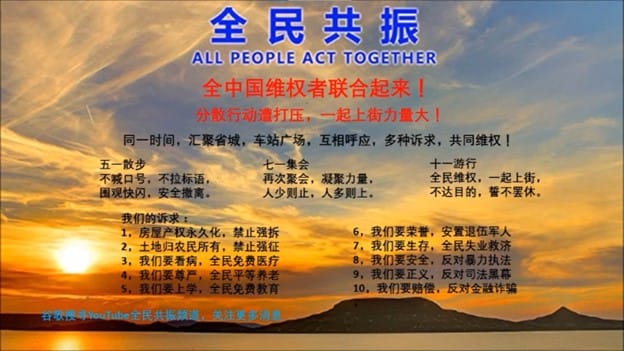
    A logo used by the APAT. Image credit: 時事能見度 YouTube page
    The “All People Act Together” (APAT), or quanmin gongzhen (全民共振) social media campaign was launched in early 2018 by Chinese dissidents overseas. The campaign encourages rights defenders to engage in collective action and protests on days of importance to China and the Chinese Communist Party.
    Part I of this article focused on how the charge of “picking quarrels and provoking trouble” is used against APAT supporters. In such cases, supporters were imprisoned for their behavior on social media, including deleted private conversations. Part II looks at cases where supporters were charged with disrupting public services and preparing for a terrorist activity.
    Disrupting Public Services 
    Dui Hua’s research into court judgments revealed that Li Yunzhu (李韫竹) was found guilty of injuring stability maintenance officers and sentenced to eight months in prison in Yinchuan, Ningxia, in August 2019. On February 24, 2019, the officers were sent by guobao, China’s domestic security police, to Li’s home to give her “thought reform” after she circulated footage with an APAT thumbnail tag of “Down with the CCP.” The video allegedly incited the Chinese people to defend their rights and take to the streets every day at 3 PM during the “Two Sessions,” China’s biggest annual gathering of its rubber stamp parliament and political advisory body which discuss plans for national priorities.
    It is unclear what prompted Li to circulate the video or why she was drawn to APAT. The judgment only stated that Li was planning to lodge an appeal in Beijing in December 2018 over a consumer lawsuit but was persuaded by police to stay in her home province Ningxia. The police arranged for her appellate trial to begin the following March. Li refused the arrangement. She expressed concerns about being unable to travel to Beijing during the Two Sessions, despite knowing full well that transport disruptions are commonplace in order to allow for senior government and party leaders to travel to Beijing during the Two Sessions.
    Li was angry upon discovering that the appellate trial date was decided without her consent. She allegedly insulted the stability maintenance officers and asked them to leave her home. She ended up throwing a kitchen knife which left one of them injured. Li completed her eight-month prison sentence for disrupting public services on October 25, 2019.
    Preparing for a Terrorist Activity  
    Ethnic Korean Jin Bo (金波) was released from a Heilongjiang prison on April 26, 2022 for plotting what prosecutors called a “violent APAT activity” on May 1, 2018. He was found guilty of preparing for a terrorist activity, one of the terrorism/extremism offenses added to the Criminal Law in 2015. The charge stemmed from him possessing explosive devices and Molotov cocktails which prosecutors believed Jin would use on the Labor Day holiday in connection with APAT.
    Jin admitted to making the explosives primarily to seek revenge for his 444-day wrongful imprisonment. In August 2014, Jin was taken into custody on suspicion of extortion. He was later acquitted and given state compensation. Jin’s father and father-in-law passed away while he was incarcerated. Jin felt guilty for not being able to arrange for their funerals and blamed his business partners for framing him. He also expressed disillusionment with petition bureau officials who repeatedly ignored his complaints. Jin scaled China’s Great Firewall to learn about APAT and took part in online discussions after his unsuccessful attempts to seek redress.
    Jin’s case indicates that some people who lose trust in China’s justice system find APAT appealing. A substantial portion of the prosecutor’s arguments focused on the “reactionary,” “anti-party,” and “anti-China” comments Jin made online. In April 2018, he wrote “What is APAT for? For revolution! What is Revolution? As the name suggests, it aims to overthrow the old and establish the new.” Days before he was criminally detained on April 27, 2018, he claimed to have lost confidence in China and expressed desires to begin retaliation. He ordered materials to make explosives via WeChat, claiming that he might set himself ablaze and throw bombs at his business partners. Although Jin confessed to posting radical comments online, he stated in his defense that he did not personally know any “overseas pro-democracy activists” nor did he join any overseas terrorist organizations.
    In this case, prosecutors characterized the whole APAT campaign as a “violent political activity” organized by overseas forces because of Jin’s way of expressing grievances. However, there is insufficient evidence that other APAT supporters in China or overseas call for violent political resistance.
    Members of San Francisco’s Chinese community participating in the “May 1st National Resonance” event in front of the Chinese Consulate. Image credit: CK via RFA 
    APAT fell flat. Fewer netizens in China have answered the APAT appeal than during 2011 “Jasmine Revolution.” Overseas APAT supporters in the United States, Canada, and Australia reportedly organized small rallies outside of the Chinese consulates in 2018-2019, but these had  limited reach in China due in part to pervasive internet censorship and surveillance. Additionally, APAT was hotly disputed even within Chinese dissident circles, with some saying that it was an entrapment attempt devised by the Ministry of State Security to round up political dissenters in one fell swoop. Regardless of the controversy, Dui Hua believes that the four people discussed in this post represent a small portion of criminal cases and more people could have been sentenced for espousing support for APAT. More research is needed to uncover the fate and the acts of other APAT supporters, as well as their motivations for sympathizing with the campaign.
  • “All People Act Together” Supporters Imprisoned, Part II: Public Disruption, Limited Reach

    “All People Act Together” Supporters Imprisoned, Part II: Public Disruption, Limited Reach

    A logo used by the APAT. Image credit: 時事能見度 YouTube page 
    The “All People Act Together” (APAT), or quanmin gongzhen (全民共振) social media campaign was launched in early 2018 by Chinese dissidents overseas. The campaign encourages rights defenders to engage in collective action and protests on days of importance to China and the Chinese Communist Party.  
    Part I of this article focused on how the charge of “picking quarrels and provoking trouble” is used against APAT supporters. In such cases, supporters were imprisoned for their behavior on social media, including deleted private conversations. Part II looks at cases where supporters were charged with disrupting public services and preparing for a terrorist activity. 
    Disrupting Public Services 
    Dui Hua’s research into court judgments revealed that Li Yunzhu (李韫竹) was found guilty of injuring stability maintenance officers and sentenced to eight months in prison in Yinchuan, Ningxia, in August 2019. On February 24, 2019, the officers were sent by guobao, China’s domestic security police, to Li’s home to give her “thought reform” after she circulated footage with an APAT thumbnail tag of “Down with the CCP.” The video allegedly incited the Chinese people to defend their rights and take to the streets every day at 3 PM during the “Two Sessions,” China’s biggest annual gathering of its rubber stamp parliament and political advisory body which discuss plans for national priorities. 
    It is unclear what prompted Li to circulate the video or why she was drawn to APAT. The judgment only stated that Li was planning to lodge an appeal in Beijing in December 2018 over a consumer lawsuit but was persuaded by police to stay in her home province Ningxia. The police arranged for her appellate trial to begin the following March. Li refused the arrangement. She expressed concerns about being unable to travel to Beijing during the Two Sessions, despite knowing full well that transport disruptions are commonplace in order to allow for senior government and party leaders to travel to Beijing during the Two Sessions.  
    Li was angry upon discovering that the appellate trial date was decided without her consent. She allegedly insulted the stability maintenance officers and asked them to leave her home. She ended up throwing a kitchen knife which left one of them injured. Li completed her eight-month prison sentence for disrupting public services on October 25, 2019. 
    Preparing for a Terrorist Activity  
    Ethnic Korean Jin Bo (金波) was released from a Heilongjiang prison on April 26, 2022 for plotting what prosecutors called a “violent APAT activity” on May 1, 2018. He was found guilty of preparing for a terrorist activity, one of the terrorism/extremism offenses added to the Criminal Law in 2015. The charge stemmed from him possessing explosive devices and Molotov cocktails which prosecutors believed Jin would use on the Labor Day holiday in connection with APAT. 
    Jin admitted to making the explosives primarily to seek revenge for his 444-day wrongful imprisonment. In August 2014, Jin was taken into custody on suspicion of extortion. He was later acquitted and given state compensation. Jin’s father and father-in-law passed away while he was incarcerated. Jin felt guilty for not being able to arrange for their funerals and blamed his business partners for framing him. He also expressed disillusionment with petition bureau officials who repeatedly ignored his complaints. Jin scaled China’s Great Firewall to learn about APAT and took part in online discussions after his unsuccessful attempts to seek redress.  
    Jin’s case indicates that some people who lose trust in China’s justice system find APAT appealing. A substantial portion of the prosecutor’s arguments focused on the “reactionary,” “anti-party,” and “anti-China” comments Jin made online. In April 2018, he wrote “What is APAT for? For revolution! What is Revolution? As the name suggests, it aims to overthrow the old and establish the new.” Days before he was criminally detained on April 27, 2018, he claimed to have lost confidence in China and expressed desires to begin retaliation. He ordered materials to make explosives via WeChat, claiming that he might set himself ablaze and throw bombs at his business partners. Although Jin confessed to posting radical comments online, he stated in his defense that he did not personally know any “overseas pro-democracy activists” nor did he join any overseas terrorist organizations. 
    In this case, prosecutors characterized the whole APAT campaign as a “violent political activity” organized by overseas forces because of Jin’s way of expressing grievances. However, there is insufficient evidence that other APAT supporters in China or overseas call for violent political resistance. 
    Members of San Francisco’s Chinese community participating in the “May 1st National Resonance” event in front of the Chinese Consulate. Image credit: CK via RFA 

    APAT fell flat. Fewer netizens in China have answered the APAT appeal than during 2011 “Jasmine Revolution.” Overseas APAT supporters in the United States, Canada, and Australia reportedly organized small rallies outside of the Chinese consulates in 2018-2019, but these had  limited reach in China due in part to pervasive internet censorship and surveillance. Additionally, APAT was hotly disputed even within Chinese dissident circles, with some saying that it was an entrapment attempt devised by the Ministry of State Security to round up political dissenters in one fell swoop. Regardless of the controversy, Dui Hua believes that the four people discussed in this post represent a small portion of criminal cases and more people could have been sentenced for espousing support for APAT. More research is needed to uncover the fate and the acts of other APAT supporters, as well as their motivations for sympathizing with the campaign.  
  • “All People Act Together” Supporters Imprisoned, Part I: Social Media Campaign Draws Ire

    “All People Act Together” Supporters Imprisoned, Part I: Social Media Campaign Draws Ire

    A screenshot from a video about the “All People Act Together” campaign. Image credit: 一平論政 Youtube page

    “All People Act Together” (APAT), or quanmin gongzhen (全民共振), is a social media campaign launched in early 2018 by Chinese dissidents overseas. The campaign calls on rights defenders to collectively seek redress and make their voices heard by staging street protests across Chinese cities on occasions of special historical, social, or political importance such as International Workers’ Day (May 1), the anniversary of the founding of the Chinese Communist Party (July 1), and National Day (October 1).

    Proponents of APAT believe that resistance movements can “reverberate” or “resonate” around the country and overwhelm the stability maintenance regime if the outbreaks are simultaneous and sustained. They predict CCP’s eventual demise when it runs short of resources to keep up its increasingly expensive operations.

    The CCP’s zeal in crushing dissent to maintain stability has created a domestic security system so costly that it is sapping funds required elsewhere to support the country’s economic health. APAT emerged against the backdrop of China’s spending on internal security, which has exceeded the national defense budget since 2010. The rise in spending on domestic security is most evident in western regions of Xinjiang and Tibet, but a sizable portion is spent in Han-majority regions keeping potential troublemakers in residential surveillance, running “black jails,” or forcing dissenters to “travel” elsewhere — all part of the longstanding scheme designed to muzzle protestors during sensitive occasions.

    Part I of this post focuses on APAT’s reach and cases in which supporters were charged with “picking quarrels and provoking trouble (PQPT).” Part II will look at cases involving charges of disrupting public services and preparing for a terrorist activity.

    The nature of APAT is similar to the online calls for the 2011 Tunisia-inspired “Jasmine Revolution” manifested in the form of “strolling” protests around McDonald’s on Wangfujing shopping streets and spots in other cities. Chinese state media have been largely silent on the planned protests, but social media accounts recounted major shows of police force to disperse small crowds of seemingly curious onlookers that had gathered in Beijing and Shanghai.

    APAT appears to have limited reach in China. No visible protests linked to APAT have been reported. However, prominent dissidents including Hu Jia were reportedly warned by police not to take part in or publicly discuss APAT. There was scant media coverage and the fate of those who openly espouse APAT in China has gone largely unnoticed. Dui Hua’s Political Prisoner Database has information on six individuals who were given coercive measures for heeding the calls of APAT. Of them, four received prison sentences for a variety of crimes ranging from PQPT and disrupting public services to preparing for terrorist activities.

    Picking Quarrels & Provoking Trouble

    Xue Renyi, an advocate of Greenleaf Action, who was arrested on May 1, 2018 for walking in Jiefangbei Square in Chongqing while wearing a green leaf. Image credit: Twitter via RFA

    The first APAT supporter known to have been imprisoned is Xue Renyi (薛仁义). He was taken into custody on May 1, 2018 after posting a photograph of himself “strolling” in Chongqing People’s Liberation Monument Square while carrying a green leaf in his shirt pocket. Some other people were seized on the same day; they were warned off speaking out online or giving interviews with foreign media after being released from custody.

    Xue is the founder of Green Leaf Action, an environmental group which promoted food safety, clean air, and clean water. The group stood accused by police of being “controlled” and “manipulated” by foreign forces. Xue’s three-year sentence became known to the outside world only when his fiancée received his letter from prison one year after he was detained. Xue completed his sentence for PQPT in Dianjiang Prison without receiving a sentence reduction. He was released on April 30, 2021.

    Gao Zhigang’s case materials and ID card. Image credit: Provided by Geng Guanjun via RFA

    In a separate case, Gao Zhigang (高志刚) was sentenced to 10 months in prison for PQPT in 2020 even without showing up at any APAT protest spot. Gao was accused of forwarding a video which called on people to join a rally in Taiyuan’s Wuyi Square on the 2019 National Day. Additionally, Gao sent the video to an “overseas democracy activist” known by the name of Geng Guanjun (耿冠军). Geng fled to the United States in 2018 and has been a target of attack by patriotic internet users for his “reactionary” views and anti-China remarks. After completing his sentence in August 2020, Gao spoke to Radio Free Asia claiming that he never expected the conviction would be based entirely on his private conversations from his social media account which he had deleted prior to his detainment in October 2019.

    Read Part II here. 

  • The Persecution of Unorthodox Religious Groups in China: A report by Dui Hua

    The Persecution of Unorthodox Religious Groups in China: A report by Dui Hua

    (Clockwise from top left) Chinese government anti-cult propaganda; Tablighi Jamaat members with Hui Muslims at a mosque; practitioners of Yi Guan Dao; promotion for Milky Way Federation; a notice expanding the penalties under Article 300; the Jesus Family. Image credits: The Paper; Umal Al-Dawa Youtube Account; Jin De Fo Tang’s Facebook account; Sohu; Liaoning Pindao; Bridge Magazine

    Dui Hua’s new report “The Persecution of Unorthodox Religious Groups in China” [PDF, 1.4 MB] details and analyzes the Chinese government’s treatment of unorthodox religious groups, listing known banned groups and the actions taken against them. The report, compiled over several months in 2021, offers a view into a substantial and largely unrecognized aspect of the Chinese population.

    “The Persecution of Unorthodox Religious Groups in China” is based on legal documents, media reports, case studies, official publications, Chinese government responses to requests for information on persecuted prisoners, court statistics, and Dui Hua’s Political Prisoner Database (PPDB).  It provides a comprehensive view of how non-state sanctioned religious practitioners come into conflict with the law, how officials at different levels of government criminalize unorthodox worship, and how past trends can inform future advocacy for those undergoing coercive measures for the non-violent expression of their beliefs.

    As early as 1951, regulations on punishing counterrevolutionaries targeted leaders of reactionary religious organizations. Currently, the Chinese government allows its citizens to take part in the five state-sanctioned patriotic associations of Buddhism, Catholicism, Daoism, Islam, and Protestantism, but many seeking spiritual salvation look beyond government-approved faiths and embrace unorthodox religious groups.

    Graph 1. Defendants and 1st-instance cases accepted and concluded for violating Article 300(1)
    Image credit: The Dui Hua Foundation

    Noting the extensive historical context informing the Chinese government’s approach to religious groups, especially those not sanctioned by the state, Dui Hua found that the 1997 revision to the criminal law placed “cult” trials into the purview of district courts, resulting in less transparency and attention for such cases. By 1999, trials of Article 300 cases—for those accused of organizing and using superstitious sects, secret societies, and religious organizations to undermine the law—soared, largely due to the ban on Falun Gong.

    The report includes an overview of 41 unorthodox religious groups; a summary of laws and regulations targeting unorthodox religious groups; analysis of court statistics from 1979-2016; discussion of deteriorating transparency in the disclosure of information on Article 300 cases; analysis of religious persecution using the PPDB; a summary of Dui Hua’s advocacy for such prisoners using prisoner lists and responses; and recommendations for future advocacy.

    Table 1. Breakdown of unorthodox religious practitioners in PPDB by affiliation
    Source: PPDB

    The objective of the report is to enable more effective interventions on behalf of practitioners of unorthodox religious groups who face coercive measures under Article 300 by providing insight and actionable information. Its main findings include the following:

    • The number of adherents of orthodox religious groups makes up more than 10 percent of China’s population, perhaps as many as 15 percent. Unorthodox religious groups exist in all of China’s provinces and autonomous regions, and many have developed links to international groups. If the number of unorthodox religious adherents was incorporated into official figures, then the number of all religious practitioners in China would far exceed the current government figure of 200 million official practitioners (as of 2018).
    • Adherents of unorthodox religious groups subjected to coercive measures for violating Article 300(1)—“organizing and using a cult to undermine implementation of the law”—and other charges make up 60 percent of all prisoners in the PPDB. Their numbers have swelled in recent years as sentence reductions and paroles have been restricted.
    • The most common crime for which adherents of unorthodox religious groups are imprisoned is covered by Article 300(1) of China’s Criminal Law but other crimes are also used, including endangering state security and economic crimes like committing fraud (Article 266) and operating illegal businesses (Article 225).
    • Falun Dafa (aka Falun Gong) and the Church of Almighty God have the largest number of adherents, but there are many other smaller groups. This report identified 41 unorthodox religious groups operating in China today or during the last two decades.
    • From 1998-2016, women made up 41 percent of those sentenced to prison for violating Article 300, five times the percentage of all women prisoners in China.
    Graph 2. Gender Breakdown of prisoners and unorthodox religious prisoners in PPDB
    Image credit: The Dui Hua Foundation
    • Adherents of unorthodox religions are typically non-violent. Instances of violence are rare; when they occur, the Chinese government features them in “anti-cult” propaganda. Adherents have been convicted of rape and murder. Those so convicted are often executed.
    • The persecution of unorthodox religious groups has existed since the founding of the People’s Republic in 1949; adherents were classified as counterrevolutionaries prior to 1997. They have been viewed as threats to the government’s hold on power.
    • Persecution of unorthodox religious practitioners rose sharply following the banning of Falun Gong in 1999. In recent years, practitioners have seen sentences increase and clemency restricted. Persecution shows no sign of abating. In 2018, there were 3,550 people tried for violating Article 300(1), one of the highest numbers of individuals tried for this charge in recent years.
    • Adherents of unorthodox religions rarely make their way onto prisoner lists submitted to the Chinese government in bilateral and multilateral human rights dialogues. Their numbers dwarf those subject to coercive measures for exercising their political beliefs.
    Dui Hua encourages governments to raise the issue of this persecution in formal and informal discussions on human rights with the Chinese government and to include the names of imprisoned practitioners of unorthodox religions to the lists compiled for use in human rights dialogues with China. When, and to the extent possible, governments and NGOs should support appeals of unorthodox religion practitioners to Special Procedures of the United Nations. More so, governments and NGOs should incorporate concerns about the persecution of unorthodox religious groups into submissions to China’s Universal Periodic Review, tentatively scheduled for October 2023.
    Finally, governments should use this report when considering applications of political asylum by practitioners of unorthodox religions. Some governments, particularly in Europe, have become more open to accepting asylum requests for Church of Almighty God members. Dui Hua encourages courts to recognize the persecution of unorthodox religious group members as grounds for asylum and to recognize precedents for such asylum requests.
  • Chinese Asylum Seekers in Bangkok, Part II

    Chinese Asylum Seekers in Bangkok, Part II

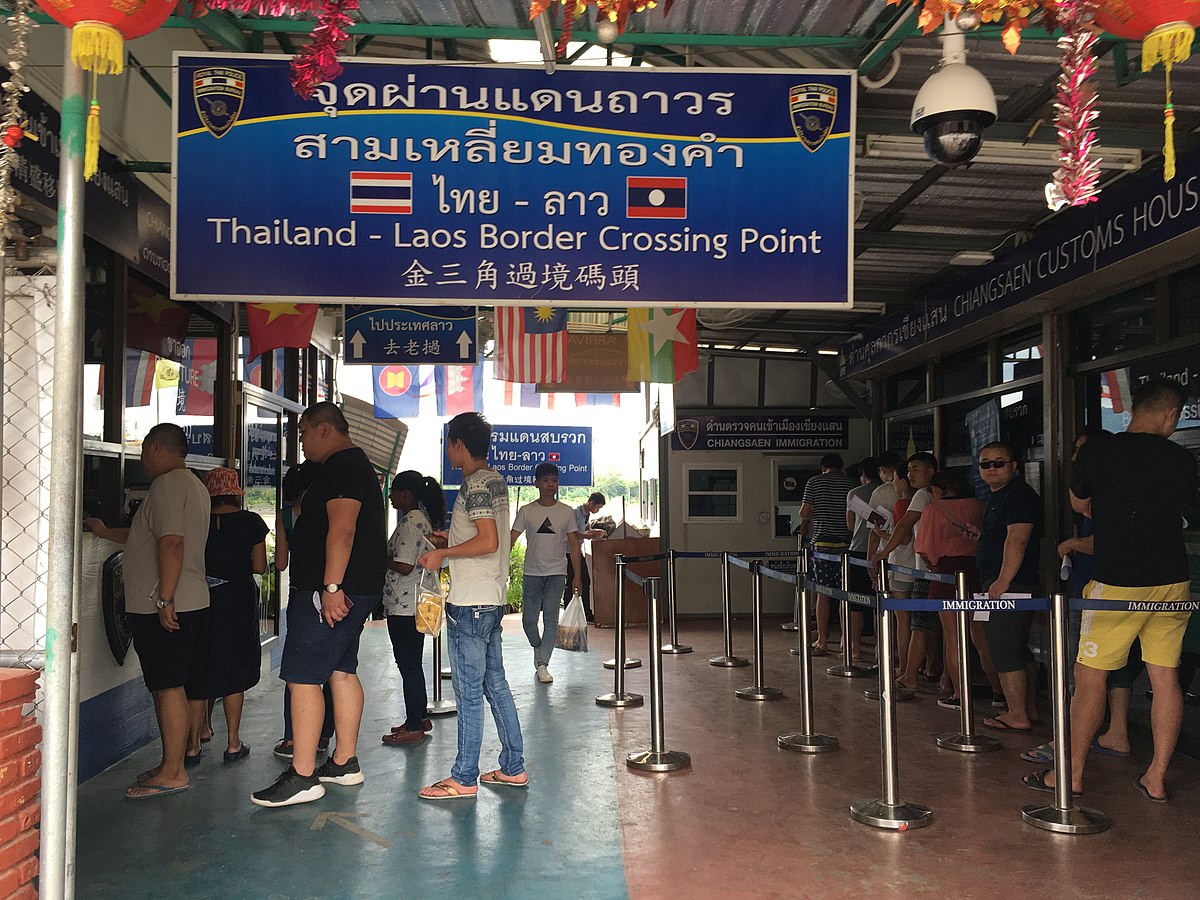
    At the Thailand-Laos crossing checkpoint at Sop Ruak, people queue to travel between Thailand and the Golden Triangle Special Economic Zone in Laos. Image credit: Slleong / CCO via Wikimedia Commons

    This is the second installment in a two-part series. Read Part I here.

    Thailand does not recognize the status of refugees because it has not acceded to the 1951 Refugee Convention or its 1967 Protocol. Refugees who overstay their visas or enter Thailand without proper documents are regarded as illegal immigrants. They have no legal right to work or adequate access to health care; nor can their children attend local schools. They are dependent on charitable groups, religious organizations, other refugees in their community, or they simply subsist on meagre savings. Because of budget cuts and a global tightening of national immigration policies, the UNHCR has reportedly axed financial aid for refugees.

    Consequently, many Chinese asylum seekers and refugees enter Bangkok’s labor black market to make a living. Once arrested, they are typically held in immigration detention centers, many of which are “severely overcrowded, provide inadequate food, have poor ventilation and lack medical service and other basic necessities,” according to Human Rights Watch.

    In January 2015, Uyghur refugees also complained to a visiting Istanbul-based journalist about health problems in the detention facilities in Thailand. Prior to this incident, three Uyghurs died despite efforts of charitable groups to provide relief. In September 2018, a Chinese observer claimed that dozens of refugees and asylum seekers of different nationalities were crammed into an area of approximately 12 square meters of floor space.

    Because of the cramped and unhygienic conditions at the immigration centers, seven Uyghurs made a failed attempt at a jail break in February 2019. A Thai NGO, which has worked to assist these Uyghurs since their detention, is compiling evidence about the alleged reports of physical abuse by Thai police officers.

    The long wait time for resettlement is another major source of frustration among refugees. Zhang Shufeng (张淑凤), who obtained refugee status in 2017, said the UNHCR prioritizes applications of refugees from armed conflicts such as Syrians and Myanmar’s Rohingya Muslims over Chinese applicants. In 2016, another asylum seeker Cai Yuliang (蔡欲亮) was finally accepted for resettlement in the United States after spending a total of 17 years in Thailand. Cai fled China in 1999, seven years after he completed his 20 years’ imprisonment for the now-defunct criminal offense of counterrevolution.

    No Safe Haven

    Jiang Yefei holds a placard with a criminal charge at a Thai immigration detention center prior to repatriation in 2015. Image credit: Apple Daily (Taiwan)
    Since the coup of 2014, the Thai military regime has been tilting away from the United States toward China. Refugees or asylum seekers are believed to be facing imminent risk of repatriation at the behest of China — Thailand’s largest trade partner and major country of origin for tourists.

    Repatriation

    Four months after over 100 Uyghurs were repatriated to China, Thailand deported Dong Guangping (董广平) and Jiang Yefei (姜野飞) in November 2015, allegedly for breaking immigration rules. A political cartoonist, Jiang left China in 2008 after he was detained and allegedly tortured over his work critical of the government’s handling of the Sichuan earthquake. Dong fled to Thailand in 2015, having served a three-year jail term for subversion from 2001-2004 and “disappeared” for eight months in secret detention in 2014.

    Following their repatriation, Jiang and Dong were sentenced in Chongqing to 78-month and 42-month imprisonment sentences, respectively, for subversion and illegal border crossing in July 2018. Thailand’s decision to repatriate the duo drew condemnation from the UN, United States, and others because both men had been awaiting resettlement in Canada after they obtained their refugee status. Dong completed his prison sentence on August 2, 2019, whereas Jiang still has one year to serve before release in August 2022.

    Cross-Border Law Enforcement

    The disappearance of Chinese-born Swedish citizen Gui Minghai in Pattaya in October 2015 raised fear of cross-border operations of Chinese security forces. A similar case that did not garner much attention concerns former editor of the Southern Metropolitan Daily Li Xin (李新). In November 2015, Li fled to New Delhi after he was coerced by Chinese state security to work as an informant. He disappeared while riding a Laos-bound train in north Thailand in January 2016 in a bid to renew his Thai visa. A month later, Li reappeared in China claiming that he had returned to China “voluntarily” to assist with a police investigation. When asked about the case by The New York Times, the Thai Foreign Ministry responded that there was no “record as yet as to whether he has left the country.” Li’s wife and supporters speculated that Li had been abducted by Chinese security forces and clandestinely transported across the border.

    Turning a Blind Eye

    Xing Jian (邢鉴) arrived in New Zealand as a refugee in January 2020, more than three years after the UNHCR recognized his refugee status in the summer of 2016. Xing criticized the Thai government for providing insufficient care and protection for UN-recognized refugees. While in Thailand, Chinese public security officers apprehended him alongside Bangkok police because he overstayed his visa on November 25.

    Before fleeing China, Xing volunteered for prominent dissident Huang Qi (黄琦) and was accused of “rumour-mongering” for exposing corruption in his home county in Jiangsu. His father Xing Wangli (邢望力), who remains in China, was sentenced to two years and three months’ imprisonment in October 2018 for “picking quarrels and provoking troubles.” Xing Wangli was re-arrested in June 2021 for defamation after visiting prominent rights lawyer Jiang Tianyong.

    Wu Yuhua and Yang Chong (see part 1) were originally scheduled to depart for Canada from Bangkok on June 25, 2019. However, they were barred from leaving Thailand. Yang may be required to complete his one-year suspended sentence there for overstaying, according to a Chinese activist familiar with Thai laws. However, another Radio Free Asia report cited the Chinese embassy as saying that the Thai authorities “do not rule out the possibility of repatriating the duo to China.”

    Fleeing Again

    Risky Voyage

    In view of a potentially indefinite waiting period for resettlement, the threat of repatriation, and abduction by Chinese security forces overseas, some asylum seekers and refugees are determined to flee once more. Prior to the scheduled interview with the UNHCR in 2017, Falun Gong practitioner Dong Junming (董俊明) undertook a risky voyage to New Zealand, some 6,000 miles away from Pattaya, on February 29, 2016. Dong was joined by six like-minded asylum seekers and two children.

    In early March, a few days into their voyage, the yacht capsized off the Thai coast. In an interview with overseas media, Dong said that “[i]t’s highly risky out there on the ocean, but we are so fearful here in Thailand that I thought I should take the risk.” All travellers who boarded the yacht, including China Democracy Party member Li Xiaolong (黎小龙), were returned to Thailand after the failed escape. Some were placed in immigration detention centers while at least one of them stood trial for illegal entry into Thailand in January 2017.

    To Taiwan

    In a bid to evade the extending reach of China in Thailand, some dissidents have chosen to flee once more to Taiwan. Huang Yan (黄燕)  fled to Thailand in 2016 after years of harassment, repeated incarceration, and alleged torture for speaking out in support of Gao Zhisheng. In May 2018, she flew to Jakarta, then to Taiwan, where she was granted temporary leave to remain until the United States granted her political asylum in January 2019.

    Following in Huang’s footsteps, China Democracy Party members Yan Bojun (颜伯钧) and Liu Xinglian (刘兴联) left Bangkok four months after Huang’s arrival in Taiwan. They were granted entry in February 2019 on the basis of “professional exchanges” after 125 days at Taipei Taoyuan airport. At the time of writing, both men have been granted asylum protection in Canada.

    On September 29, 2016, Taiwan’s Mainland Affairs Council Deputy Minister Chiu Chui-cheng expresses concerns over the situation in Hong Kong but says Taiwan will not intervene. Image credit: Voice of America via Wikimedia Commons

    It would be a mistake to assume that Taiwan welcomes individuals fleeing violence and persecution in China. While the island has promised assistance to Hong Kong anti-extradition bill protesters, Taiwan’s Mainland Affairs Council (MAC) maintained that Taiwan policy toward mainland asylum seekers remained unchanged. Should Taiwan openly admit mainland asylum seekers and refugees, it will likely trigger a flood of applications and further antagonize China, putting hundreds of thousands of China-based Taiwanese residents, workers, and investors at risk of arbitrary detention. Additionally, Taiwan fears what it calls “infiltration” from mainland agents. There have been recent arrivals of mainland Chinese who managed to cross the Taiwan Straits despite it being one of the world’s most heavily policed waterways.

    Taiwan is not a member of the UN and does not have legislation to protect refugees. The island only vows to deal with applications from mainland Chinese on a case-by-case basis, according to the MAC.

    Non-Refoulement

    It must be noted that around the globe, not all Chinese asylum applicants are found to have a legitimate fear for persecution. In Australia, for instance, the number of Chinese nationals applying for refugee asylum rose by 311 percent in just one year from 2017. Despite this surge, the Australian Department of Home Affairs only recognized 10 percent of such claims as being genuine. Most claims found to be bogus have been used by applicants to overstay their visas. The United States has also cracked down on “asylum mills,” which have helped thousands of Chinese immigrants to fraudulently win asylum status. Over 13,500 immigrants, mostly Chinese, who were granted asylum status are reportedly facing possible deportation.

    A poster from the Australian government’s 2013 “No Way” campaign aimed at dissuading attempts by non-citizens to enter Australia. Image credit: Australian Customs and Border Protection Service / CC BY-SA 3.0
    However, many of those in Bangkok have been determined by the UNHCR to have a well-founded fear for persecution, a fear not imaginary but very much real, as being detained, arrested, and sentenced should they be returned to China. The fact that Thailand is not a signatory state of the 1951 Refugee Convention or its 1967 Protocol does not absolve the country from its duty to protect refugees inside its borders. The UNHCR has also called on all states, including non-signatory states, to observe non-refoulement, an international principle that prevents all countries from expelling or returning an individual to a country where he or she is at genuine risk of persecution.

    Thai officials have reiterated their commitment to protecting the rights of refugees and asylum seekers. They have also vowed to adopt anti-torture legislation to strengthen implementation of the principle of non-refoulement. However, insufficient protection for asylum seekers and refugees has left them stranded in Thailand, vulnerable to detention, arrest, and repatriation. Some of them have even been compelled to flee Thailand as well to evade arrests, deportation, and Chinese security forces overseas.

  • Chinese Asylum Seekers in Bangkok, Part I

    Chinese Asylum Seekers in Bangkok, Part I

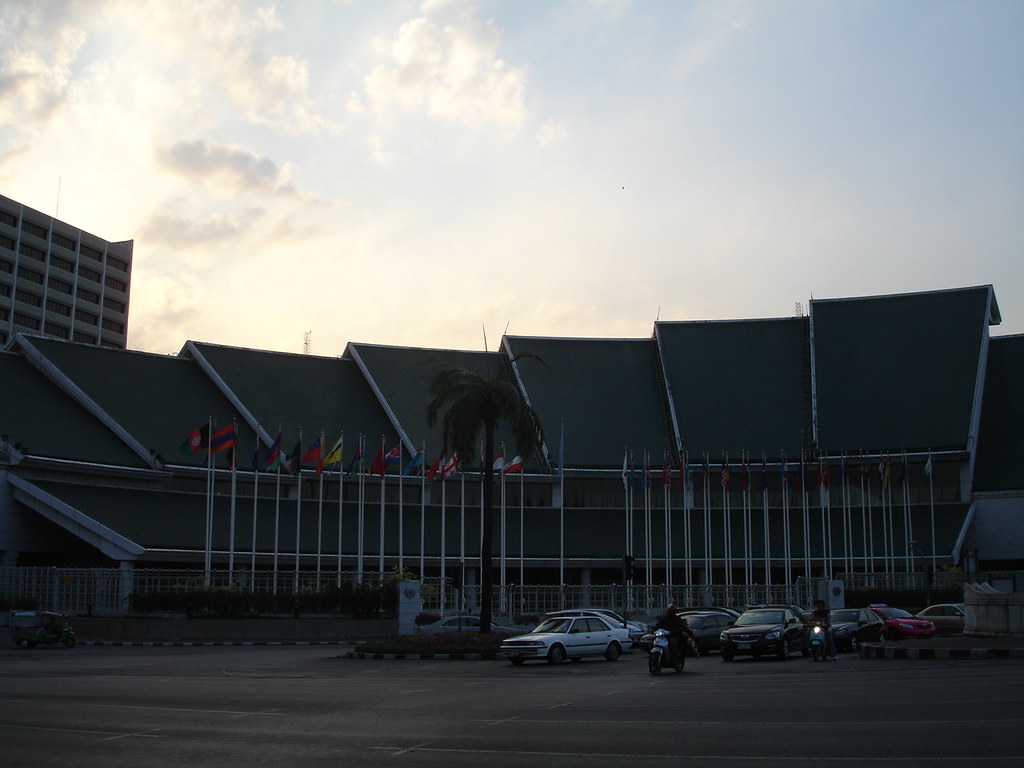
    The United Nations building in Bangkok, Thailand. Image credit: dsin_travel / CC BY 2.0 

    China has consistently ranked among the top 20 refugee producing countries every year since 2003, according to statistics published by the United Nations High Commission for Refugees (UNHCR). The latest statistics published in June 2021 indicated that China was 18th on the UNHCR’s list at the end of 2020. The number of UNHCR-registered refugees originally from China reached 175,585. Additionally, there were 107,864 Chinese asylum seekers around the globe with pending claims. The number of asylum seekers increased nine-fold from just 11,375 in 2011, the year before paramount leader Xi Jinping assumed power.  

    Table 1. UNHCR’s Forced Displacement Statistics (Country of Origin: China)

    Source: UNHCR, Refugee Data Finder, 2003-2020 
    Many UNHCR-recognized refugees from China consider the West a destination of choice for resettlement. After taking the first step in the long journey to asylum, many refugees from China sojourn in Thailand where they await refugee status determination. It is an administrative process by which the Bangkok-based regional office of UNHCR for Southeast Asia determines whether a person seeking protection qualifies as a refugee under international law. Bangkok is home to an estimated 8,000 urban refugees—hailing from Asia, the Middle East, and Africa.  

    Dui Hua is not aware of any official statistics about Chinese asylum seekers in Thailand. However, Bei Ling, founder of “Home of Refugees” in Thailand in 2015, estimated that more than 300 Chinese asylum seekers were in the country as of October 2018.  

    This is the first entry in a two-part series examining issues facing Chinese asylum seekers in Thailand. This entry explores who they are and why they have fled China. The second entry will look at how and why Thailand falls short of being a safe haven. Prospective refugees with or without valid passports risk criminal detention for overstaying in Thailand. Their predicaments also include indefinite wait times for third country resettlement. The fact that Thailand fails to abide by the principle of non-refoulement also places a heightened risk of repatriation for those seeking protection from persecution at home. 

    Why Thailand?

    Thailand started to become a popular place of transit for Chinese refugees about two decades ago. Prior to that, those with a well-founded fear of persecution decamped to colonial Hong Kong to flee political persecution thanks to the lax border controls at the time. Since China resumed sovereignty over the former British colony in 1997, Hong Kong has ceased to be a popular destination for asylum protection.  

    For decades, Hong Kong has been a magnet for refugees. It is troubling to see a spiked increase in asylum seekers from Hong Kong since civil unrest triggered first by the now-rescinded extradition bill, and then by the sweeping arrests made under the National Security Law. The law criminalizes secession, subversion, terrorism, and collusion with foreign forces. At the end of 2020, there were 487 registered asylum seekers from Hong Kong, up from 22 in 2018 before mass protests erupted in June 2019. 

    While a portion of those who fled China could be considered “economic migrants” in search of sustenance and a livelihood, China’s much-lauded economic success has fallen short of stopping people from fleeing abroad. Critics of one-party rule, adherents of banned religious groups, civil rights activists, petitioners, and ethnic minority groups are continuing to seek asylum protection abroad via Thailand.  

    Chinese nationals find entry to Thailand easier than other neighboring countries or regions including South Korea, Japan, and Taiwan, mainly because they benefit from the 15-day visas on arrival available to them (Thailand has suspended this arrangement due to the outbreak of coronavirus). Entry to elsewhere requires obtaining a pre-arranged visa. 

    The Thailand-Laos overland crossing checkpoint at Sop Ruak. Image credit: Slleong / CC0 via Wikimedia Commons 

    Because of geographical proximity, those without proper legal documents can resort to traveling illicitly overland from Yunnan with the help of smugglers. Chiang Mai, for instance, is reachable by land transport from Yunnan’s border in nine hours. From Chiang Mai, it is another half-day journey to Bangkok, where asylum seekers file their refugee claims at the UNHCR office. 

    Why Flee?

    Political Prisoners

    Geng He (耿和), wife of human rights lawyer Gao Zhisheng, is arguably the most notable example of a family member of a Chinese political prisoner fleeing political persecution via Thailand. She left for Bangkok with her children in January 2009 while her husband was serving his suspended sentence for inciting subversion. Gao’s entire family faced reprisal because Gao took on controversial cases and publicly called for an end to the persecution of Falun Gong. While in China, Gao’s children were prevented from attending school. Geng and her children stayed in Bangkok for two months before resettling in the United States. However, it must be noted that such speedy granting of asylum by the United States was only expedited by international attention. As will be discussed in Part II, the wait time for third country resettlement is often indefinite. Today, Gao remains under house arrest even after his sentence expired in August 2014. 

    Another asylum application involved Hua Yong (华涌), who arrived in Canada in April 2021. Hua is a well-known painter from Beijing who posted videos documenting forced evictions and demolitions in poor neighborhoods. He was placed under residential surveillance at a designated location for three months after meeting with the father of Dong Yaoqiong, a girl who was admitted to a psychiatric facility after she live-streamed a video of herself accusing the Chinese Communist Party of “thought control.” Hua escaped to Thailand in September 2019. 

    Dui Hua previously assisted former political prisoner Li Huangming (李焕明) with verifying his claim for political asylum. Before being granted political asylum in Finland in May 2013, Li fled to Bangkok after he completed his nine years’ sentence for inciting subversion in September 2010. The conviction stemmed from him distributing or planning to distribute tens of thousands of “reactionary” flyers in Shenzhen. While awaiting refugee resettlement, Li wrote stories about other Chinese asylum seekers in Bangkok for Boxun and other NGOs. In an article published by Human Rights in China in November 2012, Li wrote that Bangkok’s UNHCR office had a special team of interpreters and officials to handle the surge of applications from Chinese dissidents.  

    Li wrote about changing demographics of Chinese asylum seekers. A significant number of applications were submitted by petitioners contrary to the popular belief that most Chinese refugees are supporters of China’s democracy movement, violators of the one-child policy, and adherents of banned religious groups such as Falun Gong and house churches. 

    Petitioners

    Li’s observation is in line with what has been reported in unofficial news sources in recent years. Petitioners fled to Bangkok because they face reprisal in China after lodging futile complaints about land expropriation or forced demolition in their home cities.  

    Petitioner Zhang Shufeng protests at UNHCR’s Bangkok office while holding a bilingual slogan that says “Request UNHCR help.” Image credit: Mirror Media 

    Zhang Shufeng (张淑凤), a native of Beijing, fled to Bangkok in 2014 and obtained refugee status three years later. Taiwan-based Mirror Media reported that Zhang’s family was subjected to house arrest, beatings, and constant surveillance by government-hired thugs in China. Surveillance intensified during the “Two Sessions” (the National People’s Congress and the Chinese People’s Political Consultative Conference) and other political events. In Bangkok, Zhang protested at the UNHCR office while holding a bilingual slogan saying “Request UNHCR help,” in the hope that the UNHCR would expedite her resettlement process.  

    In January 2017, unofficial news media reported that Beijing evictee Wang Ling (王玲) joined her son who had arrived in Bangkok in December 2016 to maximize the chance of them both getting through Chinese immigration checks. Wang claimed that she had received death threats from police after pursuing complaints about the forced demolition of her home. In 2008, she was sentenced to 15 months of re-education through labor and had been detained a total of 11 times. The news of abnormal deaths in police custody made Wang fear for her life.

    Religious Persecution

    Falun Gong practitioners still make up a large portion of asylum seekers in Bangkok. Many of them have fled persecution after the suppression of the spiritual sect began in 1999. One widely publicized case concerns Song Zhiyu (宋志宇), who escaped to Thailand in early 2014 via Myanmar after completing his three-and-a-half-year sentence for “organizing a cult to undermine implementation of the law.” In a Reuters interview in 2016, Song recounted how he “was spirited across a river into Thailand and hidden in the luggage hold of a Bangkok-bound bus.” Song claimed that Thailand had about 160 Falun Gong refugees and asylum seekers. The Thai authorities have taken an interest in them owing to the close bond between the military junta and Chinese government since 2014. More than 29 practitioners had been arrested on immigration charges under the military junta, said Song. 

    Members of the Early Rain Covenant Church in Chengdu have also made their escapes via Thailand and joined the ranks of asylum seekers before pastor Wang Yi (王怡) was sentenced to nine years in prison for subversion and illegal business activity in December 2019. The crackdown on this prominent house church prompted Liao Qiang (廖强) to travel to Thailand with five of his family members in July 2019. They stayed in Thailand only for three days before transiting to Taiwan. However, their stay in Taiwan was only temporary because Taiwan does not have a refugee law. Liao and his family left for the United States on June 29, 2021 after receiving political asylum there. 

    Civil Activism

    New groups of asylum seekers have emerged following Xi Jinping’s sweeping crackdown on civil society since he took power in 2012. Some were participants of the “Southern Street Movement,” a series of small-scale street banner protests that occurred in southern cities such as Guangzhou and Shenzhen from 2012-2013. The movement called for democratic reform and government officials to disclose assets.  

    Among the “Southern Street Movement” asylum seekers were Wu Yuhua (吴玉华) and her husband Yang Chong (杨崇). They fled China in early 2015 after being targeted by police for supporting the protests in Guangzhou. Two years later, the couple was granted refugee status in Bangkok.  

    Yang Chong holding up a banner calling for human rights and elections in 2015. Image credit: Bnn.co
    Supporters of the New Citizens’ Movement have also sought political asylum. The movement was promoted by prominent legal scholar and civil rights lawyer Xu Zhiyong, who was formally arrested for subversion in January 2021 after calling on Xi Jinping to step down. Sharing similar aspirations with Xu, Yan Bojun (颜伯钧) arrived in Bangkok in early 2015 after several futile attempts to leave China. In 2016, Yan published a book in Japan recounting the suppression he faced after helping Xu provide legal assistance to victims of social injustice. He had been placed under criminal detention several times in China; the longest one lasted 30 days. 
    Liu Xinglian (刘兴联), another UNHCR-recognized refugee, was arrested in Hubei for inciting subversion in June 2015 due to his involvement in Qin Yongmin’s “China Human Rights Watch.” The group promoted the idea of a peaceful transformation to a democracy and circulated Qin’s articles about the inevitable demise of China’s autocratic rule. After Liu was released on bail in April 2016, he managed to escape to Bangkok in 2017.  

    Uyghurs & Kazakhs

    Pakistan, which borders Xinjiang, was once a popular escape route for Uyghurs seeking to escape Chinese state repression, but its growing economic reliance on China has made Uyghurs fear for their future. Pakistani Prime Minister Imran Khan said as recently as July 2021 that, “What they [China] say about the programs in Xinjiang, we accept it.”  In the mid-2010s, a large group of Uyghurs made a long detour south to Bangkok before human rights abuses associated with the “re-education camps” made international headlines. However, Uyghurs are typically not interested in registering in Thailand as asylum seekers, according to a UNHCR statement in 2015. They were only looking for ways to get to Turkey, a destination of choice with an estimated 50,000 Uyghur residents.  

    Thai authorities have confirmed a staggering number of Uyghur escapees in Thailand. In 2014, a group of 424 Uyghurs were detained in Thailand. In July 2015, over 170 Uyghurs were released to start new lives in Turkey, but a week later the Thai government repatriated 109 refugees to China. In July 2017, Thai immigration police said about 60 Uyghurs remained in detention centers across the country. As recently as 2020, their number was down to about 50. They were remnants of the Uyghurs who fled to Thailand in 2014. 

    Evidence also suggests that ethnic Kazakhs have fled Xinjiang’s massive surveillance and detention campaign. A recent case involved Qalymbek Shahman, who Uzbek authorities sent back to Thailand after being denied entry to Kazakhstan in January 2019. He was subjected to intense racial profiling in China, making it impossible for him to make a living. “I would have my ID checked every 50 to 100 meters when I was in Xinjiang…Whether it was getting on a plane, on a train or other public transportation, they would spend half an hour checking me out every time.” His clients became concerned as to why he was routinely monitored and consequently stopped doing businesses with him. 

    Chinese asylum seekers in Thailand face a number of problems beyond finding safe haven, including the lack of legal recognition. The second instalment will explore why and how Thailand falls short in protecting asylum seekers, and the challenges asylum seekers encounter once in Thailand. 

    Read Part II here.

  • Chinese Asylum Seekers in Bangkok, Part I

    Chinese Asylum Seekers in Bangkok, Part I

    The United Nations building in Bangkok, Thailand. Image credit: dsin_travel / CC BY 2.0

    China has consistently ranked among the top 20 refugee producing countries every year since 2003, according to statistics published by the United Nations High Commission for Refugees (UNHCR). The latest statistics published in June 2021 indicated that China was 18th on the UNHCR’s list at the end of 2020. The number of UNHCR-registered refugees originally from China reached 175,585. Additionally, there were 107,864 Chinese asylum seekers around the globe with pending claims. The number of asylum seekers increased nine-fold from just 11,375 in 2011, the year before paramount leader Xi Jinping assumed power.

    Table 1. UNHCR’s Forced Displacement Statistics (Country of Origin: China)

    Source: UNHCR, Refugee Data Finder, 2003-2020
    Many UNHCR-recognized refugees from China consider the West a destination of choice for resettlement. After taking the first step in the long journey to asylum, many refugees from China sojourn in Thailand where they await refugee status determination. It is an administrative process by which the Bangkok-based regional office of UNHCR for Southeast Asia determines whether a person seeking protection qualifies as a refugee under international law. Bangkok is home to an estimated 8,000 urban refugees—hailing from Asia, the Middle East, and Africa.

    Dui Hua is not aware of any official statistics about Chinese asylum seekers in Thailand. However, Bei Ling, founder of “Home of Refugees” in Thailand in 2015, estimated that more than 300 Chinese asylum seekers were in the country as of October 2018.

    This is the first entry in a two-part series examining issues facing Chinese asylum seekers in Thailand. This entry explores who they are and why they have fled China. The second entry will look at how and why Thailand falls short of being a safe haven. Prospective refugees with or without valid passports risk criminal detention for overstaying in Thailand. Their predicaments also include indefinite wait times for third country resettlement. The fact that Thailand fails to abide by the principle of non-refoulement also places a heightened risk of repatriation for those seeking protection from persecution at home.

    Why Thailand?

    Thailand started to become a popular place of transit for Chinese refugees about two decades ago. Prior to that, those with a well-founded fear of persecution decamped to colonial Hong Kong to flee political persecution thanks to the lax border controls at the time. Since China resumed sovereignty over the former British colony in 1997, Hong Kong has ceased to be a popular destination for asylum protection.

    For decades, Hong Kong has been a magnet for refugees. It is troubling to see a spiked increase in asylum seekers from Hong Kong since civil unrest triggered first by the now-rescinded extradition bill, and then by the sweeping arrests made under the National Security Law. The law criminalizes secession, subversion, terrorism, and collusion with foreign forces. At the end of 2020, there were 487 registered asylum seekers from Hong Kong, up from 22 in 2018 before mass protests erupted in June 2019.

    While a portion of those who fled China could be considered “economic migrants” in search of sustenance and a livelihood, China’s much-lauded economic success has fallen short of stopping people from fleeing abroad. Critics of one-party rule, adherents of banned religious groups, civil rights activists, petitioners, and ethnic minority groups are continuing to seek asylum protection abroad via Thailand.

    Chinese nationals find entry to Thailand easier than other neighboring countries or regions including South Korea, Japan, and Taiwan, mainly because they benefit from the 15-day visas on arrival available to them (Thailand has suspended this arrangement due to the outbreak of coronavirus). Entry to elsewhere requires obtaining a pre-arranged visa.

    The Thailand-Laos overland crossing checkpoint at Sop Ruak. Image credit: Slleong / CC0 via Wikimedia Commons
    Because of geographical proximity, those without proper legal documents can resort to traveling illicitly overland from Yunnan with the help of smugglers. Chiang Mai, for instance, is reachable by land transport from Yunnan’s border in nine hours. From Chiang Mai, it is another half-day journey to Bangkok, where asylum seekers file their refugee claims at the UNHCR office.

    Why Flee?

    Political Prisoners

    Geng He (耿和), wife of human rights lawyer Gao Zhisheng, is arguably the most notable example of a family member of a Chinese political prisoner fleeing political persecution via Thailand. She left for Bangkok with her children in January 2009 while her husband was serving his suspended sentence for inciting subversion. Gao’s entire family faced reprisal because Gao took on controversial cases and publicly called for an end to the persecution of Falun Gong. While in China, Gao’s children were prevented from attending school. Geng and her children stayed in Bangkok for two months before resettling in the United States. However, it must be noted that such speedy granting of asylum by the United States was only expedited by international attention. As will be discussed in Part II, the wait time for third country resettlement is often indefinite. Today, Gao remains under house arrest even after his sentence expired in August 2014.

    Another asylum application involved Hua Yong (华涌), who arrived in Canada in April 2021. Hua is a well-known painter from Beijing who posted videos documenting forced evictions and demolitions in poor neighborhoods. He was placed under residential surveillance at a designated location for three months after meeting with the father of Dong Yaoqiong, a girl who was admitted to a psychiatric facility after she live-streamed a video of herself accusing the Chinese Communist Party of “thought control.” Hua escaped to Thailand in September 2019.

    Dui Hua previously assisted former political prisoner Li Huangming (李焕明) with verifying his claim for political asylum. Before being granted political asylum in Finland in May 2013, Li fled to Bangkok after he completed his nine years’ sentence for inciting subversion in September 2010. The conviction stemmed from him distributing or planning to distribute tens of thousands of “reactionary” flyers in Shenzhen. While awaiting refugee resettlement, Li wrote stories about other Chinese asylum seekers in Bangkok for Boxun and other NGOs. In an article published by Human Rights in China in November 2012, Li wrote that Bangkok’s UNHCR office had a special team of interpreters and officials to handle the surge of applications from Chinese dissidents.

    Li wrote about changing demographics of Chinese asylum seekers. A significant number of applications were submitted by petitioners contrary to the popular belief that most Chinese refugees are supporters of China’s democracy movement, violators of the one-child policy, and adherents of banned religious groups such as Falun Gong and house churches.

    Petitioners

    Li’s observation is in line with what has been reported in unofficial news sources in recent years. Petitioners fled to Bangkok because they face reprisal in China after lodging futile complaints about land expropriation or forced demolition in their home cities.

    Petitioner Zhang Shufeng protests at UNHCR’s Bangkok office while holding a bilingual slogan that says “Request UNHCR help.” Image credit: Mirror Media

    Zhang Shufeng (张淑凤), a native of Beijing, fled to Bangkok in 2014 and obtained refugee status three years later. Taiwan-based Mirror Media reported that Zhang’s family was subjected to house arrest, beatings, and constant surveillance by government-hired thugs in China. Surveillance intensified during the “Two Sessions” (the National People’s Congress and the Chinese People’s Political Consultative Conference) and other political events. In Bangkok, Zhang protested at the UNHCR office while holding a bilingual slogan saying “Request UNHCR help,” in the hope that the UNHCR would expedite her resettlement process.

    In January 2017, unofficial news media reported that Beijing evictee Wang Ling (王玲) joined her son who had arrived in Bangkok in December 2016 to maximize the chance of them both getting through Chinese immigration checks. Wang claimed that she had received death threats from police after pursuing complaints about the forced demolition of her home. In 2008, she was sentenced to 15 months of re-education through labor and had been detained a total of 11 times. The news of abnormal deaths in police custody made Wang fear for her life.

    Religious Persecution

    Falun Gong practitioners still make up a large portion of asylum seekers in Bangkok. Many of them have fled persecution after the suppression of the spiritual sect began in 1999. One widely publicized case concerns Song Zhiyu (宋志宇), who escaped to Thailand in early 2014 via Myanmar after completing his three-and-a-half-year sentence for “organizing a cult to undermine implementation of the law.” In a Reuters interview in 2016, Song recounted how he “was spirited across a river into Thailand and hidden in the luggage hold of a Bangkok-bound bus.” Song claimed that Thailand had about 160 Falun Gong refugees and asylum seekers. The Thai authorities have taken an interest in them owing to the close bond between the military junta and Chinese government since 2014. More than 29 practitioners had been arrested on immigration charges under the military junta, said Song.

    Members of the Early Rain Covenant Church in Chengdu have also made their escapes via Thailand and joined the ranks of asylum seekers before pastor Wang Yi (王怡) was sentenced to nine years in prison for subversion and illegal business activity in December 2019. The crackdown on this prominent house church prompted Liao Qiang (廖强) to travel to Thailand with five of his family members in July 2019. They stayed in Thailand only for three days before transiting to Taiwan. However, their stay in Taiwan was only temporary because Taiwan does not have a refugee law. Liao and his family left for the United States on June 29, 2021 after receiving political asylum there.

    Civil Activism

    New groups of asylum seekers have emerged following Xi Jinping’s sweeping crackdown on civil society since he took power in 2012. Some were participants of the “Southern Street Movement,” a series of small-scale street banner protests that occurred in southern cities such as Guangzhou and Shenzhen from 2012-2013. The movement called for democratic reform and government officials to disclose assets.

    Among the “Southern Street Movement” asylum seekers were Wu Yuhua (吴玉华) and her husband Yang Chong (杨崇). They fled China in early 2015 after being targeted by police for supporting the protests in Guangzhou. Two years later, the couple was granted refugee status in Bangkok.

    Yang Chong holding up a banner calling for human rights and elections in 2015. Image credit: Bnn.co
    Supporters of the New Citizens’ Movement have also sought political asylum. The movement was promoted by prominent legal scholar and civil rights lawyer Xu Zhiyong, who was formally arrested for subversion in January 2021 after calling on Xi Jinping to step down. Sharing similar aspirations with Xu, Yan Bojun (颜伯钧) arrived in Bangkok in early 2015 after several futile attempts to leave China. In 2016, Yan published a book in Japan recounting the suppression he faced after helping Xu provide legal assistance to victims of social injustice. He had been placed under criminal detention several times in China; the longest one lasted 30 days.
    Liu Xinglian (刘兴联), another UNHCR-recognized refugee, was arrested in Hubei for inciting subversion in June 2015 due to his involvement in Qin Yongmin’s “China Human Rights Watch.” The group promoted the idea of a peaceful transformation to a democracy and circulated Qin’s articles about the inevitable demise of China’s autocratic rule. After Liu was released on bail in April 2016, he managed to escape to Bangkok in 2017.

    Uyghurs & Kazakhs

    Pakistan, which borders Xinjiang, was once a popular escape route for Uyghurs seeking to escape Chinese state repression, but its growing economic reliance on China has made Uyghurs fear for their future. Pakistani Prime Minister Imran Khan said as recently as July 2021 that, “What they [China] say about the programs in Xinjiang, we accept it.”  In the mid-2010s, a large group of Uyghurs made a long detour south to Bangkok before human rights abuses associated with the “re-education camps” made international headlines. However, Uyghurs are typically not interested in registering in Thailand as asylum seekers, according to a UNHCR statement in 2015. They were only looking for ways to get to Turkey, a destination of choice with an estimated 50,000 Uyghur residents.

    Thai authorities have confirmed a staggering number of Uyghur escapees in Thailand. In 2014, a group of 424 Uyghurs were detained in Thailand. In July 2015, over 170 Uyghurs were released to start new lives in Turkey, but a week later the Thai government repatriated 109 refugees to China. In July 2017, Thai immigration police said about 60 Uyghurs remained in detention centers across the country. As recently as 2020, their number was down to about 50. They were remnants of the Uyghurs who fled to Thailand in 2014.

    Evidence also suggests that ethnic Kazakhs have fled Xinjiang’s massive surveillance and detention campaign. A recent case involved Qalymbek Shahman, who Uzbek authorities sent back to Thailand after being denied entry to Kazakhstan in January 2019. He was subjected to intense racial profiling in China, making it impossible for him to make a living. “I would have my ID checked every 50 to 100 meters when I was in Xinjiang…Whether it was getting on a plane, on a train or other public transportation, they would spend half an hour checking me out every time.” His clients became concerned as to why he was routinely monitored and consequently stopped doing businesses with him.

    Chinese asylum seekers in Thailand face a number of problems beyond finding safe haven, including the lack of legal recognition. The second instalment will explore why and how Thailand falls short in protecting asylum seekers, and the challenges asylum seekers encounter once in Thailand.

    Read Part II here.

  • US Federal Government Embraces Capital Punishment Leading Up to UN Review

    US Federal Government Embraces Capital Punishment Leading Up to UN Review

    A cell on death row. Image credit: Innocence Project 
    This summer the United States federal government aggressively resumed federal executions, ending an ad hoc federal moratorium that had been in place since 2003. So far this year, the federal government has executed seven people, and three more federal executions are currently scheduled for 2020. The execution of Lisa Montgomery, scheduled for December 8, will mark the first federal execution of a woman since 1953. The number of US federal executions this year already exceeds the total number of federal executions that took place in the rest of the last half century combined. Even as both individual US states and nations around the world are abandoning capital punishment, the US federal government is instead choosing to embrace it. As the United States prepares for a review of its human rights record at the UN in November, the future of the federal death penalty is on the agenda.

    Capital Punishment and the Universal Periodic Review

    The resumption of federal executions comes as the United States is in the midst of its third Universal Periodic Review (UPR), a human rights process that every UN member state undergoes about every five years. The UPR is organized by the Human Rights Council. Although the United States withdrew from the Council in 2018, it still participates in the UPR as a UN member state.

    The UPR of the United States is formally a three-hour event at the UN in Geneva that is scheduled for November 9. But the November review is the culmination of a long process that began in 2019 when the Human Rights Council solicited input on the US record from stakeholders. As an NGO with UN Special Consultative Status, Dui Hua provided a stakeholder submission on the US human rights record last fall. The death penalty was a theme raised by many stakeholders, and Dui Hua’s submission (PDF) focused in particular on Attorney General William Barr’s stated intention to re-start federal capital punishment. Dui Hua highlighted ongoing concerns about the administration of the federal death penalty and urged the administration to maintain the moratorium and address these procedural concerns. Dui Hua also noted that the federal government had selected people with the most gruesome crimes for execution, rather than those who had been on death row the longest, raising worries that optics—rather than justice—shaped the terms of the resumption.

    Countries under review also prepare a national report in response to the stakeholder input. The US national report was due in February and finally released in September. While it does discuss capital punishment, it does not adequately address stakeholder concerns about the resumption of federal executions raised by Dui Hua. The report does not explain why the US attorney general directed the Bureau of Prisons to restart federal executions after more than 17 years without them. Nor does the report—which describes in detail the graphic crimes of the condemned—explain why the government is going forward with executions for these individuals, rather than others who had also exhausted appeals. Because these matters are entirely under the control of the same federal administration whose department of state prepares the national report, the report ought to address these issues.

    Capital Punishment in a Federal Review

    The United States is a compound federal republic in which criminal justice authority is divided between state and national jurisdictions. As long as capital punishment is deemed constitutional by the Supreme Court, state executions are a state matter outside the control of the federal government. The majority of US executions have always been carried out by the states—a point national government officials often make to international audiences. When the United States last underwent a UPR in 2015, the US report touted the fact that “the federal government has carried out no executions since our last UPR; in fact, it has not executed an inmate since 2003 and only three since 1963.” In some sense, the national government has been de facto abolitionist for over a decade. The resumption of federal executions ends this record. The federal government already accounts for half of all executions in the United States so far this year. If the federal government proceeds with the three executions it currently has scheduled, then federal executions will exceed state executions in 2020. It would be the first time in modern US history that this has occurred.

    The rise of federal executions comes as states are moving away from capital punishment. Since the last US UPR in 2015, capital punishment has been struck down by courts in two states (Delaware, 2016; Washington State, 2018), repealed by the legislature in two states (New Hampshire, 2019; Colorado, 2020) and subject to moratoriums in two states (Pennsylvania, 2015; California, 2019). The death penalty is now abolished or under moratorium in half of all states. State executions have also been declining for two decades. As leaders in Washington have become directly responsible for a significant share of US executions, international scrutiny of American capital punishment should also shift from the states to the federal government.

    Renewed Comparison to China

    Dui Hua has long called for all countries that retain the death penalty to adhere to transparency and the rule of law in application of capital sanctions. The foundation puts a particular focus on China because of its secrecy and resistance to international laws and norms. China is a capital punishment outlier in the world today.

    Despite the overall transparency in US federal executions, the manner in which the condemned were selected remains unclear. Of the many individuals on federal death row who have exhausted their appeals, those who were given execution dates this year are not the people who have been there longest. It appears that these individuals may have been scheduled for execution first because their crimes were particularly shocking and unlikely to elicit public sympathy. The Justice Department’s announcement of the resumption of federal executions in 2019 placed particular emphasis on the fact that the individuals scheduled for execution had committed crimes against children and the elderly. The US UPR report similarly emphasizes the graphic nature of the crimes committed by those who were executed. An impartial justice system should avoid even the appearance of politicization in the death penalty process. As China faces accusations that American, Australian, Japanese, and Canadian citizens are facing capital sentences for political reasons, the US federal government must do more to indicate how it is selecting individuals for execution warrants.

    The current administration also appears to want to use the death penalty to mimic China in ways that may violate the US Constitution and international law. As Dui Hua makes clear in its US UPR stakeholder submission, President Trump has repeatedly called for the death penalty for drug dealers, an idea he claims he got from Xi Jinping. Following President Trump’s statements about capital punishment for drug offenders, former Attorney General Jeff Sessions released a memo encouraging federal prosecutors to pursue capital punishment in drug cases where permitted by federal law, including non-homicide “drug kingpin” cases. While capital punishment for non-homicide drug kingpin crime is allowed under US federal statute, no defendant has ever been sentenced to death under the statute, so its legality is untested. Existing caselaw suggests that capital punishment for a non-homicide drug crime is unconstitutional under the Eighth Amendment, and therefore constitutes “cruel, inhuman or degrading treatment or punishment” under Article 7 of the International Covenant on Civil and Political Rights as indicated under US reservations to the Covenant as well. In addition to capital punishment for non-homicide offenses, President Trump has also expressed support for the extra-judicial execution for drug offenses in the Philippines, a practice that is a clear violation of the Universal Declaration of Human Rights and US and international law.

    The UPR and the Election

    Because the power to carry out federal executions lies with the US executive branch, the upcoming presidential election will likely shape the course of federal executions over the next few years. Criminal justice has been front-and-center in the presidential race, even though capital punishment has not been a major topic of debate. The issue got more attention during the primary race. At the time, Democratic nominee Joe Biden called for eliminating the federal death penalty. Vice presidential candidate Kamala Harris also publicly opposes the death penalty. She declined to pursue the death penalty when prosecuting David Hill for murdering a police officer. Hill is now serving a sentence of life in prison without parole. Ultimately, the near future of the federal death penalty will be decided at the ballot box on November 3. Regardless of that outcome though, the United States should expect to receive comments from nations around the world at the UPR in Geneva on November 9.

  • Leftist Dissent Under Xi: The Young Leftists Part II, Leftist Students Join in Labor Activism: Jasic and Beyond

    Leftist Dissent Under Xi: The Young Leftists Part II, Leftist Students Join in Labor Activism: Jasic and Beyond

    In Leftist Dissent Under Xi: The Young Leftists Part I, Who Are the Young Leftists?, Dui Hua  outlined the rise of a new generation of Chinese leftists and their swift repression by Xi Jinping’s Communist Party.
    Timeline of the Jasic protests in Shenzhen. Image Credit: The Dui Hua Foundation


    Double Solidarity Marks the Jasic Protests: Young Leftists in Support of Workers

    Unlike many other labor protests across China, the protests at Jasic Technology in Shenzhen in the summer of 2018 were unusual because of the role leftist students played. These students made an unprecedented move to intervene in a labor rights dispute by venturing into public space side by side with workers.
    In April 2018, welding machinery workers at Jasic Technology attempted to form an independent trade union. The nation’s sole legally-mandated All-China Federation of Trade Unions had been tasked with securing better wages, abolishing punitive fines, and improving working conditions. The Federation failed to achieve these goals, prompting the workers to take action. Several workers were dismissed because of their effort to unionize.
    The conflict escalated at the end of July, when over 20 workers and one student were arrested for protesting abusive treatment by police. From July 28 to early August, Shen Mengyu (沈梦雨), Yue Xin (岳昕), and sympathizers from Peking University, Tsinghua University, Nanjing University, and Sun Yat-sen University formed the Jasic Workers Solidarity Support Group. In solidarity with the workers, they began posting articles, open letters, photos, videos of speeches and peaceful demonstrations in front of the Jasic factory on digital media. They raised funds for workers, formed human chains, held banners, and chanted slogans alongside dozens of workers from Jasic and nearby factories.
    The student-worker coalition demanded the unconditional release of all detained workers and the punishment of police and mob members accused of beating workers. The Jasic protesters also requested the reinstatement of all previously dismissed workers. In less than a month, this student-worker coalition would be no more.
    On August 10, 2018, members of the Jasic Workers Solidarity Support Group submitted an open letter calling for the Shenzhen Pingshan District Procuratorate to investigate the police’s unlawful detention of workers in Shenzhen. The members (from left to right) were Zheng Yongming (郑永明), Shen Mengyu (沈梦雨), Xu Zhongliang (徐忠良), and Yue Xin (岳昕). Image Credit: @yuexinmutian, via Twitter
     

    Triple Solidarity: Old Leftists in Support of Leftist Students and Jasic Workers

    While young Marxists garnered widespread attention for bearing the subsequent brunt of government suppression, “old leftists” also took part in the Jasic protests in a display of solidarity with their young counterparts and the Jasic workers. The South China Morning Post reported that over half of the approximately 80 Jasic supporters who joined the rally on August 6 outside of Yanziling police station in Shenzhen’s Pingshan District were Chinese Communist Party (CCP) members and retired cadres. Many of them held portraits of Chairman Mao as they protested and were active members of Utopia, China’s leading Maoist internet forum.
    Other older leftists who were too weak to take to the streets contributed articles for leftist forums or websites. On July 28, as soon as he learned that workers were being detained, Wu Jingtang (吴敬堂) called on all “comrades” to support the Jasic workers in the name of Chairman Mao. Up until his death in early 2019 at the age of 82, Wu was revered for leading thousands of workers to protest the sale of Tonghua Iron and Steel Group in 2009, which they feared would threaten their jobs, and then successfully pressuring several corrupt officials to step down.
    After the Jasic protests were crushed in late August, another veteran leftist activist Gu Zhenghua (古正华) wrote in defense of the young Marxists. He openly countered the state media’s accusation that the Jasic protesters were “manipulated by overseas forces.” Gu, who called himself a devoted follower of Chairman Mao and previously worked for the Chinese press, was 90 years old when he penned the article in September 2018.
    During the month-long protest, Jasic student activists deliberately eschewed politics. In online posts, they pledged to espouse Marxism or even Maoism by standing with both the CCP and the working class against “local vicious forces.” On August 19, 2018, Yue posted an open letter to Xi, stressing that her activism aligned with Xi’s “Socialism with Chinese Characteristics for a New Era.” Yue attested to the unswerving loyalty of other solidary group members: they were neither plotting a revolution nor pressing for political reforms. They focused solely on helping Jasic workers safeguard their well-deserved labor rights. Jasic supporters young and old wore T-shirts with the slogan “Unity Is Strength,” a patriotic song about the People’s Liberation Army.
     
    Shen Mengyu, wearing a
    t-shirt that reads “Unity is Strength,
    ” above left, was taken away by unidentified men on August 11, 2018. Yue Xin and other
    members of the Jasic Workers’ Solidarity Support Group, above right, protested
    her disappearance on August 13. Image Credit: @wangshi77
    and @
    yuexinmutian, via Twitter
    But the tactic of using Marxist or patriotic rhetoric to get the CCP on their side failed. On August 24, anti-riot police raided the students’ apartments in Huizhou and detained approximately 50 people, including Shen Mengyu, Yue Xin, Zheng Yongming (郑永明), and Gu Jiayue (顾佳悦). Most were charged with “picking quarrels and provoking troubles.” The New York Times reported that the activists held hands and sang “L’Internationale” as the police broke through the door.
    In response to the police raid on the same day, state-run Xinhua News blamed non-governmental organizations and foreign forces for fanning the Jasic protests. These reports made no mention of the workers’ grievances or their rationale for protesting. Xinhua’s allegation was based on the fact that Fu Changguo (付常国) was an employee of Shenzhen-based Dagongzhe Migrant Workers Center, a local non-governmental organization said to have been “fully funded by an overseas NGO.” Fu is one of more than 50 protesters detained, disappeared, or placed under residential surveillance for participating in the Jasic labor movement.

    Aftermath of the Jasic Crackdown

    A year after the Jasic crackdown, almost 40 students, workers, and other Jasic supporters with records in Dui Hua’s political database remain in custody or have disappeared and their status remains unclear. In January 2019, about five months after their last public appearance, Shen, Yue, Zheng, and Gu briefly resurfaced in a 30-minute confessional video aired by state security officers to former members of the Jasic Workers’ Solidarity Support Group. In the video, all four pled guilty and admitted to being brainwashed. Shen was reported to have been incited by a “radical organization” to engage in subversive actions to overthrow the CCP.
    Observers believe their confessions were staged and scripted because Gu and Shen looked “dull and unresponsive” in the video, a quality observed among rights campaigners, celebrities, and even foreign nationals who have been forced to make confessions on TV since 2014. In many cases, these confessions are made before formal legal proceedings against the confessors have begun. In this sense, the use of public shaming violates the presumption of innocence, and these confessions seem to function more as a show of power rather than any substantial indictment of guilt.
    Campus activism has also been quashed. Universities warn students not to participate in protests. Despite its reputation as a wellspring for democracy movements, Peking University ousted leaders of the Marxism Society who were sympathetic to the Jasic workers and replaced them with “loyalists” from the CCP or Communist Youth League in September 2018. In addition to warning students off activism, the university branded the Jasic Workers’ Solidarity Support Group’s activities as “criminal,” in a November 2018 message to all students.
    The New Light People’s Development Association at Renmin University, too, is having a hard time recruiting members because migrant workers were pressured by the university and their contractors to leave the organization. Many students also quit after being summoned by university teachers. In November 2018, Nanjing University students were forbidden to register a Marxism reading group in reprisal for writing public letters and delivering speeches supporting the Jasic Workers’ Solidarity Support Group. VOA reported that on November 1 two Nanjing University students were beaten by university guards and thugs on campus while delivering a speech in which they announced their intention to form a Marxist reading association independent of the philosophy department. Their stated aim was to “study the original work of Marxism” and “pay more attention to workers and peasants.” The students were dragged away to an administrative building and later escorted to a police vehicle.
    In September 2018, leftist students from various universities and Jasic workers commemorated the 42nd death anniversary of Mao Zedong in his birth province Hunan. Image Credit: Jasic Workers’ Solidarity Support Group’s GitHub
    While China continues to sing the praises of Chairman Mao’s legacy, leftist students attempting to commemorate Mao’s 125th birthday in December 2018 were singled out for punishment. At least two Marxist students were taken by police for attempting to attend events related to Mao’s birthday. According to the Jasic Workers Solidarity Group’s Twitter account, Qiu Zhanxuan (邱占萱), who presided over the Peking University Marxism Study Society, was forcibly taken near the university gate by plainclothes police while on his way to attend a memorial he had organized for Mao’s birthday. In a video posted in early 2019, Qiu alleged that he had been strip-searched, slapped, and forced to listen to Xi’s speeches at high volume during an interrogation session in February 2019. Zhan Zhenzhen’s (展振振) whereabouts remain unknown after he was taken away on January 2, 2019 for joining a similar ceremony in Hunan, Mao’s native province.
    Several leftists not known to have travelled to Shenzhen to join the Jasic protests have also faced suppression. Leftist scholar Chai Xiaoming (柴晓明) was put under residential surveillance at a designated location for “subversion” in Nanjing on March 21, 2019. Chai was a lecturer at the School of Marxism of Peking University and a part-time editor at the Maoist website Red Reference. One day before he was detained, Chai was involved in the publication of an article by distinguished mainland scholar Jin Canrong (金灿荣), a professor at Renmin University. Jin had called on China to take a different path to modernization.
    In August 2018, police from Guangdong raided the Beijing office of Red Reference, confiscating computers and books. Editor Shang Kai (尚恺), a supporter of the Jasic protests, was detained on criminal charges of picking quarrels and provoking troubles. Information concerning Chai, Shang, and the police raid remains sparse.
    A year before Xi came to power in 2012, He Bing, a law professor at China University of Political Science and Law, called Bo Xilai’s promotion of “red culture” in Chongqing absurd. “In this absurd time, they encourage you to sing revolutionary songs, but they do not encourage you to wage a revolution.” Almost eight years on, the criticism about the now-disgraced Bo still rings true.
    The love for Mao and Marx as a part of modern Chinese patriotism does not translate into love for Xi or his ruling CCP. The “old leftists,” comprised of mostly state-owned enterprise workers and veteran protestors, find themselves increasingly alienated as today’s socialism directly contradicts the system they remember under Mao. Young Marxists also have reasons to feel aggrieved: the motherland they have been taught to love is falling short of their romanticized version of Marxism due to pervasive labor problems and a broad range of other socioeconomic issues. The Chinese government not only ignores these issues, it represses any attempt to raise them in the public sphere. In Xi’s China, even calling attention to existing problems either propagated or tolerated by the infrastructure, no matter how local or apolitical, is an offense to be met by everything from legal obfuscation to intimidation to detainment and being disappeared.
    From pro-democracy activists to rights lawyers and religious leaders, the CCP has crushed scores of activists who promote any of the seven political “perils” that Xi warned against in his infamous Document No.9. The reliance on the ideas of Marx, Lenin, or Mao to pave the way for Xi’s “Socialism with Chinese Characteristics for a New Era” has made clear the ideological contradictions between the CCP of yesterday and today, which will continue to impact the Party.
    Socialism with Chinese characteristics increasingly looks like an unembarrassed capitalist oligarchy, with “Chinese characteristics” as a catchall term to justify the demand for total fealty. Leftist supporters, both young and old, who do not toe Xi’s line face similar or worse fates than those who try to spread democratic ideals such as a multi-party system and judicial independence: the ideology they espouse may be more threatening to the Chinese government than those ideals which can be dismissed as “coming from the West.”