Tag: civil society

  • Leftist Dissent Under Xi: The Young Leftists Part II, Leftist Students Join in Labor Activism: Jasic and Beyond

    Leftist Dissent Under Xi: The Young Leftists Part II, Leftist Students Join in Labor Activism: Jasic and Beyond

    In Leftist Dissent Under Xi: The Young Leftists Part I, Who Are the Young Leftists?, Dui Hua  outlined the rise of a new generation of Chinese leftists and their swift repression by Xi Jinping’s Communist Party.
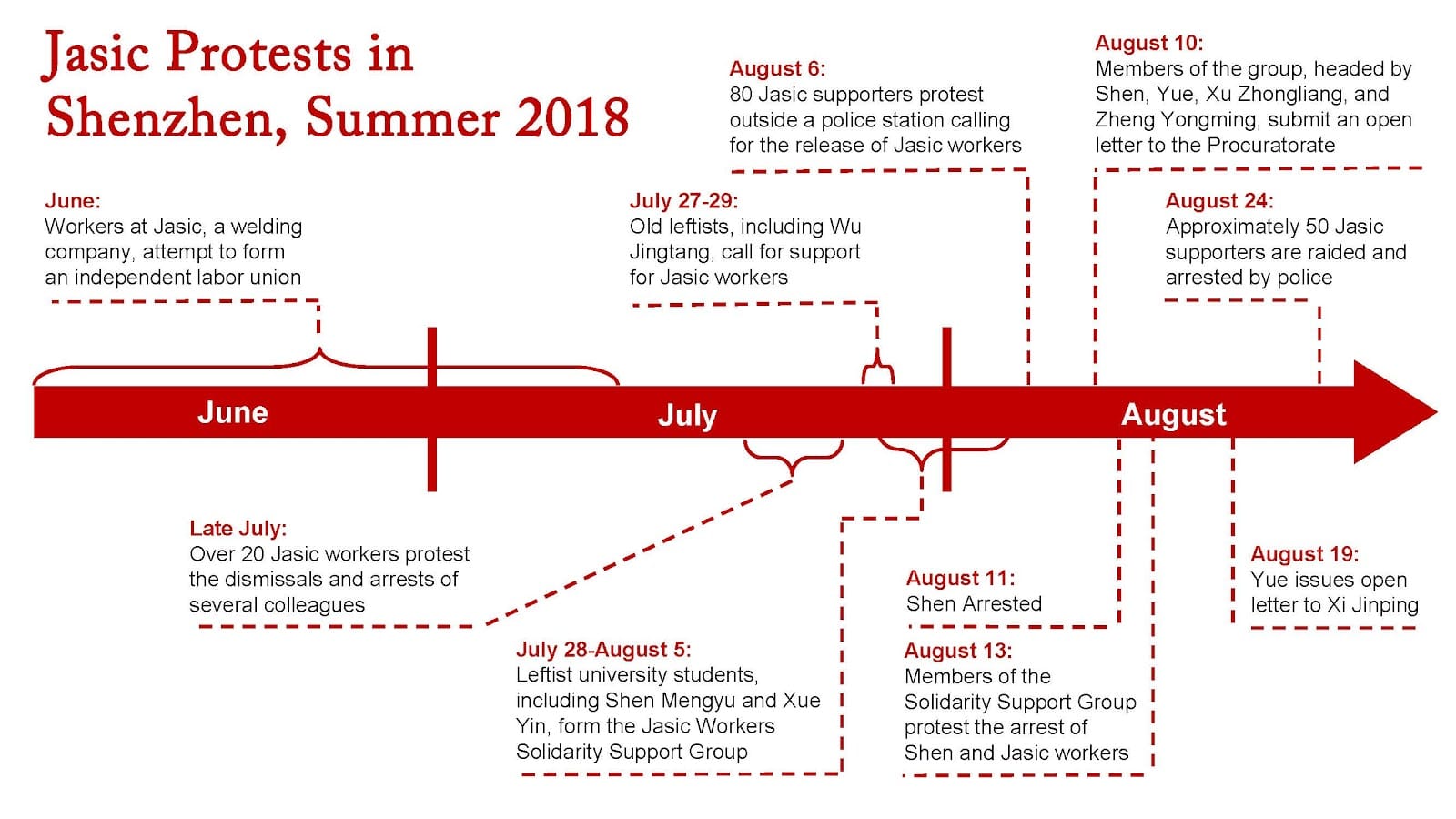
    Timeline of the Jasic protests in Shenzhen. Image Credit: The Dui Hua Foundation


    Double Solidarity Marks the Jasic Protests: Young Leftists in Support of Workers

    Unlike many other labor protests across China, the protests at Jasic Technology in Shenzhen in the summer of 2018 were unusual because of the role leftist students played. These students made an unprecedented move to intervene in a labor rights dispute by venturing into public space side by side with workers.
    In April 2018, welding machinery workers at Jasic Technology attempted to form an independent trade union. The nation’s sole legally-mandated All-China Federation of Trade Unions had been tasked with securing better wages, abolishing punitive fines, and improving working conditions. The Federation failed to achieve these goals, prompting the workers to take action. Several workers were dismissed because of their effort to unionize.
    The conflict escalated at the end of July, when over 20 workers and one student were arrested for protesting abusive treatment by police. From July 28 to early August, Shen Mengyu (沈梦雨), Yue Xin (岳昕), and sympathizers from Peking University, Tsinghua University, Nanjing University, and Sun Yat-sen University formed the Jasic Workers Solidarity Support Group. In solidarity with the workers, they began posting articles, open letters, photos, videos of speeches and peaceful demonstrations in front of the Jasic factory on digital media. They raised funds for workers, formed human chains, held banners, and chanted slogans alongside dozens of workers from Jasic and nearby factories.
    The student-worker coalition demanded the unconditional release of all detained workers and the punishment of police and mob members accused of beating workers. The Jasic protesters also requested the reinstatement of all previously dismissed workers. In less than a month, this student-worker coalition would be no more.
    On August 10, 2018, members of the Jasic Workers Solidarity Support Group submitted an open letter calling for the Shenzhen Pingshan District Procuratorate to investigate the police’s unlawful detention of workers in Shenzhen. The members (from left to right) were Zheng Yongming (郑永明), Shen Mengyu (沈梦雨), Xu Zhongliang (徐忠良), and Yue Xin (岳昕). Image Credit: @yuexinmutian, via Twitter
     

    Triple Solidarity: Old Leftists in Support of Leftist Students and Jasic Workers

    While young Marxists garnered widespread attention for bearing the subsequent brunt of government suppression, “old leftists” also took part in the Jasic protests in a display of solidarity with their young counterparts and the Jasic workers. The South China Morning Post reported that over half of the approximately 80 Jasic supporters who joined the rally on August 6 outside of Yanziling police station in Shenzhen’s Pingshan District were Chinese Communist Party (CCP) members and retired cadres. Many of them held portraits of Chairman Mao as they protested and were active members of Utopia, China’s leading Maoist internet forum.
    Other older leftists who were too weak to take to the streets contributed articles for leftist forums or websites. On July 28, as soon as he learned that workers were being detained, Wu Jingtang (吴敬堂) called on all “comrades” to support the Jasic workers in the name of Chairman Mao. Up until his death in early 2019 at the age of 82, Wu was revered for leading thousands of workers to protest the sale of Tonghua Iron and Steel Group in 2009, which they feared would threaten their jobs, and then successfully pressuring several corrupt officials to step down.
    After the Jasic protests were crushed in late August, another veteran leftist activist Gu Zhenghua (古正华) wrote in defense of the young Marxists. He openly countered the state media’s accusation that the Jasic protesters were “manipulated by overseas forces.” Gu, who called himself a devoted follower of Chairman Mao and previously worked for the Chinese press, was 90 years old when he penned the article in September 2018.
    During the month-long protest, Jasic student activists deliberately eschewed politics. In online posts, they pledged to espouse Marxism or even Maoism by standing with both the CCP and the working class against “local vicious forces.” On August 19, 2018, Yue posted an open letter to Xi, stressing that her activism aligned with Xi’s “Socialism with Chinese Characteristics for a New Era.” Yue attested to the unswerving loyalty of other solidary group members: they were neither plotting a revolution nor pressing for political reforms. They focused solely on helping Jasic workers safeguard their well-deserved labor rights. Jasic supporters young and old wore T-shirts with the slogan “Unity Is Strength,” a patriotic song about the People’s Liberation Army.
     
    Shen Mengyu, wearing a
    t-shirt that reads “Unity is Strength,
    ” above left, was taken away by unidentified men on August 11, 2018. Yue Xin and other
    members of the Jasic Workers’ Solidarity Support Group, above right, protested
    her disappearance on August 13. Image Credit: @wangshi77
    and @
    yuexinmutian, via Twitter
    But the tactic of using Marxist or patriotic rhetoric to get the CCP on their side failed. On August 24, anti-riot police raided the students’ apartments in Huizhou and detained approximately 50 people, including Shen Mengyu, Yue Xin, Zheng Yongming (郑永明), and Gu Jiayue (顾佳悦). Most were charged with “picking quarrels and provoking troubles.” The New York Times reported that the activists held hands and sang “L’Internationale” as the police broke through the door.
    In response to the police raid on the same day, state-run Xinhua News blamed non-governmental organizations and foreign forces for fanning the Jasic protests. These reports made no mention of the workers’ grievances or their rationale for protesting. Xinhua’s allegation was based on the fact that Fu Changguo (付常国) was an employee of Shenzhen-based Dagongzhe Migrant Workers Center, a local non-governmental organization said to have been “fully funded by an overseas NGO.” Fu is one of more than 50 protesters detained, disappeared, or placed under residential surveillance for participating in the Jasic labor movement.

    Aftermath of the Jasic Crackdown

    A year after the Jasic crackdown, almost 40 students, workers, and other Jasic supporters with records in Dui Hua’s political database remain in custody or have disappeared and their status remains unclear. In January 2019, about five months after their last public appearance, Shen, Yue, Zheng, and Gu briefly resurfaced in a 30-minute confessional video aired by state security officers to former members of the Jasic Workers’ Solidarity Support Group. In the video, all four pled guilty and admitted to being brainwashed. Shen was reported to have been incited by a “radical organization” to engage in subversive actions to overthrow the CCP.
    Observers believe their confessions were staged and scripted because Gu and Shen looked “dull and unresponsive” in the video, a quality observed among rights campaigners, celebrities, and even foreign nationals who have been forced to make confessions on TV since 2014. In many cases, these confessions are made before formal legal proceedings against the confessors have begun. In this sense, the use of public shaming violates the presumption of innocence, and these confessions seem to function more as a show of power rather than any substantial indictment of guilt.
    Campus activism has also been quashed. Universities warn students not to participate in protests. Despite its reputation as a wellspring for democracy movements, Peking University ousted leaders of the Marxism Society who were sympathetic to the Jasic workers and replaced them with “loyalists” from the CCP or Communist Youth League in September 2018. In addition to warning students off activism, the university branded the Jasic Workers’ Solidarity Support Group’s activities as “criminal,” in a November 2018 message to all students.
    The New Light People’s Development Association at Renmin University, too, is having a hard time recruiting members because migrant workers were pressured by the university and their contractors to leave the organization. Many students also quit after being summoned by university teachers. In November 2018, Nanjing University students were forbidden to register a Marxism reading group in reprisal for writing public letters and delivering speeches supporting the Jasic Workers’ Solidarity Support Group. VOA reported that on November 1 two Nanjing University students were beaten by university guards and thugs on campus while delivering a speech in which they announced their intention to form a Marxist reading association independent of the philosophy department. Their stated aim was to “study the original work of Marxism” and “pay more attention to workers and peasants.” The students were dragged away to an administrative building and later escorted to a police vehicle.
    In September 2018, leftist students from various universities and Jasic workers commemorated the 42nd death anniversary of Mao Zedong in his birth province Hunan. Image Credit: Jasic Workers’ Solidarity Support Group’s GitHub
    While China continues to sing the praises of Chairman Mao’s legacy, leftist students attempting to commemorate Mao’s 125th birthday in December 2018 were singled out for punishment. At least two Marxist students were taken by police for attempting to attend events related to Mao’s birthday. According to the Jasic Workers Solidarity Group’s Twitter account, Qiu Zhanxuan (邱占萱), who presided over the Peking University Marxism Study Society, was forcibly taken near the university gate by plainclothes police while on his way to attend a memorial he had organized for Mao’s birthday. In a video posted in early 2019, Qiu alleged that he had been strip-searched, slapped, and forced to listen to Xi’s speeches at high volume during an interrogation session in February 2019. Zhan Zhenzhen’s (展振振) whereabouts remain unknown after he was taken away on January 2, 2019 for joining a similar ceremony in Hunan, Mao’s native province.
    Several leftists not known to have travelled to Shenzhen to join the Jasic protests have also faced suppression. Leftist scholar Chai Xiaoming (柴晓明) was put under residential surveillance at a designated location for “subversion” in Nanjing on March 21, 2019. Chai was a lecturer at the School of Marxism of Peking University and a part-time editor at the Maoist website Red Reference. One day before he was detained, Chai was involved in the publication of an article by distinguished mainland scholar Jin Canrong (金灿荣), a professor at Renmin University. Jin had called on China to take a different path to modernization.
    In August 2018, police from Guangdong raided the Beijing office of Red Reference, confiscating computers and books. Editor Shang Kai (尚恺), a supporter of the Jasic protests, was detained on criminal charges of picking quarrels and provoking troubles. Information concerning Chai, Shang, and the police raid remains sparse.
    A year before Xi came to power in 2012, He Bing, a law professor at China University of Political Science and Law, called Bo Xilai’s promotion of “red culture” in Chongqing absurd. “In this absurd time, they encourage you to sing revolutionary songs, but they do not encourage you to wage a revolution.” Almost eight years on, the criticism about the now-disgraced Bo still rings true.
    The love for Mao and Marx as a part of modern Chinese patriotism does not translate into love for Xi or his ruling CCP. The “old leftists,” comprised of mostly state-owned enterprise workers and veteran protestors, find themselves increasingly alienated as today’s socialism directly contradicts the system they remember under Mao. Young Marxists also have reasons to feel aggrieved: the motherland they have been taught to love is falling short of their romanticized version of Marxism due to pervasive labor problems and a broad range of other socioeconomic issues. The Chinese government not only ignores these issues, it represses any attempt to raise them in the public sphere. In Xi’s China, even calling attention to existing problems either propagated or tolerated by the infrastructure, no matter how local or apolitical, is an offense to be met by everything from legal obfuscation to intimidation to detainment and being disappeared.
    From pro-democracy activists to rights lawyers and religious leaders, the CCP has crushed scores of activists who promote any of the seven political “perils” that Xi warned against in his infamous Document No.9. The reliance on the ideas of Marx, Lenin, or Mao to pave the way for Xi’s “Socialism with Chinese Characteristics for a New Era” has made clear the ideological contradictions between the CCP of yesterday and today, which will continue to impact the Party.
    Socialism with Chinese characteristics increasingly looks like an unembarrassed capitalist oligarchy, with “Chinese characteristics” as a catchall term to justify the demand for total fealty. Leftist supporters, both young and old, who do not toe Xi’s line face similar or worse fates than those who try to spread democratic ideals such as a multi-party system and judicial independence: the ideology they espouse may be more threatening to the Chinese government than those ideals which can be dismissed as “coming from the West.”
  • Leftist Dissent Under Xi: The Young Leftists Part I, Who Are the Young Leftists?

    Leftist Dissent Under Xi: The Young Leftists Part I, Who Are the Young Leftists?

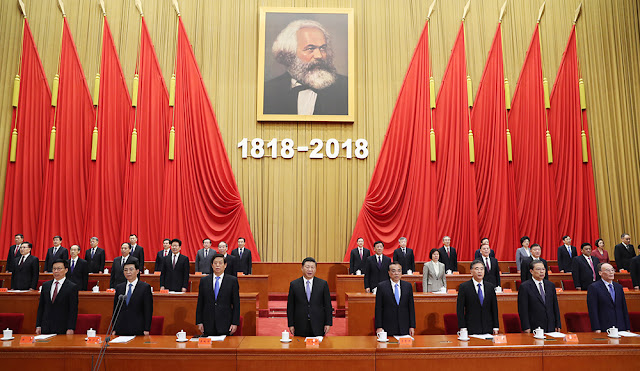
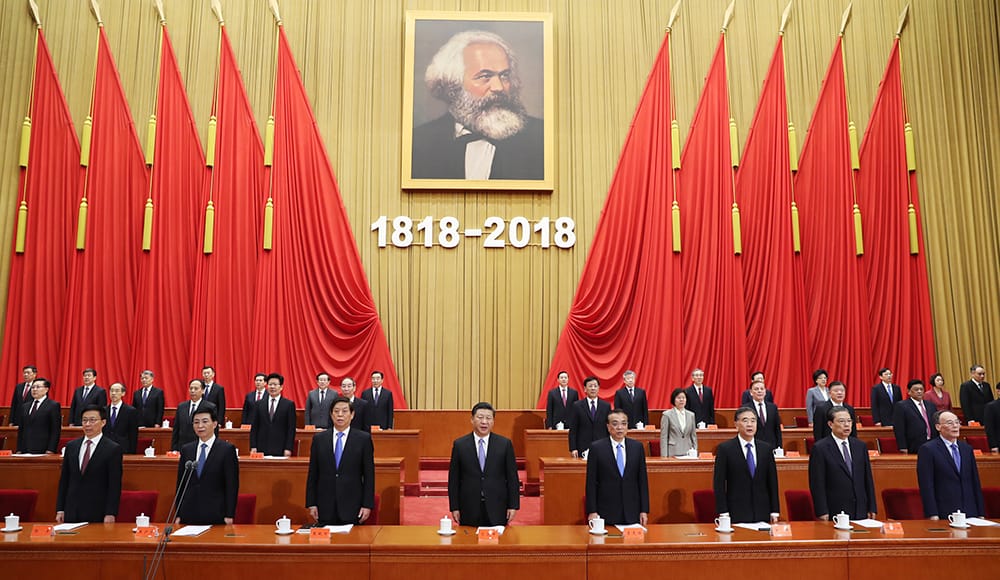
    Xi Jinping leads members of Politburo Standing Committee and other state leaders in celebrating the 200th birthday of Karl Marx in the Great Hall of People on May 5, 2018. Image credit: Xinhuanet
    In May 2018, Xi Jinping led a celebration of the 200th anniversary of Karl Marx’s birthday. During the event, Xi delivered a speech hailing Marx as the greatest thinker of modern times and holding up Marxism as the guiding ideology of the Chinese Communist Party (CCP). The days before and after Xi’s speech were marked by numerous celebratory events, including the placement of a golden Marx statue in Xi’s hometown.
    Just months later, the CCP would engage in a crackdown on leftist supporters who not only shared the same ideological bedrock as the CCP but were actively working to apply Marxism at the local level. The tactics used by the party may not surprise those familiar with the CCP’s handling of any dissent regardless of political ideology. However, the stark contrast between the tone struck by Xi in May and the party’s blatant rejection of those same ideals when carried out by its citizenry served as another reminder of the CCP’s intolerance for dissent, even that which seeks to bring local standards in line with the government’s stated values.
    This is the first entry in a two-part post that examines dissent among the ideological left in China. In October 2019, Dui Hua examined the grievances of the “old leftists,” including their efforts to form political parties. Dui Hua has also chronicled leftist subversion in China from 1980-2013. This post turns to a young generation of Marxists who emerged more recently and quickly faced repression in Xi’s China. The second part of this post, which will be released shortly, discusses the young leftists’ roles in the 2018 Jasic workers’ protests, as well as the consequences they faced after the government crackdown.
    The emergence of young leftist dissent, which culminated in the outbreak of workers’ protests at Jasic, a welding company, in the summer of 2018, represents an unlikely challenge for the CCP. Xi is continuing China’s decades-long effort to instill the political ideology of the CCP as the rightful successor to Marxism in the education curriculum. He also widely celebrates his own thoughts on socialism by adding “Chinese characteristics” to Marxism. To ensure loyalty and broaden the appeal of his Sinicized version of Marxism for future generations, Xi’s government launched a mobile app in early 2019 to educate school-aged children about the CCP’s ideological orthodoxy.
    Despite escalating political indoctrination among China’s youth, a group of self-declared Marxist students came to prominence under Xi’s rule. Most of them were born in the 1990s and early 2000s with no first-hand experience of Mao’s revolutionary zeal for class struggle. Growing up amid China’s economic boom, these young leftists find that the Marxist ideals trumpeted by the CCP in school do not line up with the realities of the society in which they are living. Rather, they see aggravated ideological contradictions in Xi’s “new era,” including increasing state capitalism and social injustice, especially corruption and a widening wealth gap. At the core of their disillusionment are rampant labor rights abuses, including wages in arrears, long work hours, and unlawful layoffs.
    Old leftists have joined these young dissenters and harnessed social activism when their interests conflict with government policies. Having grown up in Mao’s China without the benefit of formal Marxist education, their activism is rooted in what they perceive as the tainting of Mao’s ideals by corruption and capitalist tendencies. In contrast, many young leftists are well educated and motivated by the pursuit of social justice derived from Marxist values of equality. These young leftists come from diverse backgrounds, but they began their activism at universities with the formation of various Marxism-Leninism or Mao Zedong Thought discussion groups. In an unprecedented move, this activism would expand beyond the campus as students took their cause into society to support the Jasic workers.
    Diverse Backgrounds
    The young Marxists who emerged in Xi’s era were students or graduates from various disciplines and social backgrounds. Many of them attended China’s most prestigious universities. One student Marxist from Peking University who spoke to AFP on condition of anonymity said that he read the works of Marx to find ways to help China’s underclass. As the son of migrant farm workers, he believes that he has a sense of social responsibility.
    Other activists, like several members of a Marxism study group formed at Guangdong University of Technology in 2017, were born to less well-off families. For instance, chemical engineering student Ye Jianke(叶建科) grew up in Heping, the poorest county in Guangdong. Zheng Yongming (郑永明), a graduate of Nanjing Agricultural University, is a native of Ganzhou, a state-designated poverty city in Jiangxi. Sun Tingting(孙婷婷), a Chinese medicine graduate from Nanjing University, similarly grew up in a poor family in Jiangsu. In November 2017, the study group members took part in a group session and were detained for “gathering a crowd to disturb social order.” Afterwards, Sun released a public letter in which she described the difficulty of paying her legal fees.
    If the well-to-do backgrounds of some students made for unlikely Marxists, it did not deter the students’ convictions. For instance, Shen Mengyu (沈梦雨), whose parents are university lecturers, became a student leader who openly supported the Jasic protesters. Shen graduated with a master’s degree in computer science and mathematics from Sun Yat-sen University. Despite a family background and educational qualifications pointing to a bright future, Shen chose to work in a car factory in Guangzhou after graduation to experience life as a proletarian. In an interview with Asia Weekly (paywall), Shen said she did not consider herself a Marxist until she attended graduate school and learned about labor issues by attending talks and following leftist websites online.
    Another notable figure, Yue Xin (岳昕), was born to a typical middle-class family. Her family has an apartment in Beijing, and she had a materially trouble-free life. In a now-censored essay about social injustice and inequality published online, Yue expressed guilt for her privileged upbringing, something not afforded to many ordinary Chinese people. Yue became interested in workers’ rights in 2016 when she visited Jakarta as part of a language exchange from Peking University. Prior to her trip, she believed in constitutional democracy. Seeing that the Indonesian political system failed to improve the lives of Indonesian workers who continued to suffer capitalist exploitation, she began to follow labor issues in China more closely upon her return to China in 2017. These views led her to join various campus activities to promote workers’ rights.
    Leftist Campus Activism
    University students did not appear particularly vocal about labor issues, even after a spate of suicides at Foxconn starting in 2010 and other labor protests that rocked the manufacturing hub of Guangdong. Although many students likely experienced mistreatment while working to support themselves, there were no known collective student efforts to improve workers’ conditions until around 2014.
    That year, over 200 sanitation workers in Guangzhou University Town launched a two-week strike to seek severance pay and assurances that the new employer assuming the regional cleaning contract would continue to employ the workers. The striking workers received help from many of the area’s 200,000 students. These students signed an open letter supporting the strike, raised funds, and even brought food and water for the workers. Nevertheless, except for Shen Mengyu, who conducted on-site research about the strike, few students identified as Marxists.
    These efforts led to improvements in working conditions, including safer and more hygienic workplaces as well as better-defined work hours and duties. This success also sparked an interest among leftist student groups to improve the treatment of “campus proletarians” like cooks, construction workers, and janitors. In November 2018, Inkstone, a subsidiary of the South China Morning Post, wrote of several Marxist student groups in Jiangsu and Beijing. At Nanjing University, students from Marxist labor rights groups sympathetic to campus workers took up canteen work and organized square dance events. The New Light People’s Development Association at Renmin University supported migrant workers by organizing free clinics, night schools, and dance parties. Only months later, these groups would be suppressed by government action.
    Perhaps the best-known student group is the Peking University Marxism Study Society, which was founded in 2000. In late 2015, the society released a report detailing inadequate labor protections for the university’s maintenance staff, including unlawful pay cuts, insufficient social security coverage, and abhorrent living conditions. The report, based on responses from 100 interviewees on campus, urged the university management to act to improve working conditions in accordance with Chinese law.
    A follow-up survey conducted in 2017 by Zhan Zhenzhen(展振振) indicated that the university had made no substantive improvements to staff conditions. Perhaps recognizing the risk in making overt criticism, Zhan’s May 2018 report avoided naming and shaming, instead calling on university management to ensure the protection of basic workers’ rights. Although Zhan did not face any disciplinary action for his survey, Peking University warned workers not to cooperate with him lest they be laid off.
    While only a small minority of students are devoted to left-wing campus activism, the CCP fears a student-worker coalition that highlights labor rights and broader socio-economic inequalities. The CCP believes such criticisms undermine its vested interests in the increasingly capitalist markets. When the party believes a line has been crossed, it has not hesitated to crack down on leftist student groups, using a variety of methods including coercive measures. Zhang Yunfan (张云帆) was among the first students to have his leftist activism met with such resistance.
    A former member of the Peking University Marxism Study Society, Zhang started working in Guangzhou University Town after graduating from Peking University with a major in philosophy in 2016. In 2017, Zhang organized Marxism reading groups at Guangdong University of Technology for like-minded students and graduates. Three of the activists mentioned in this article—Sun Tingting, Ye Jianke, and Zheng Yongmin—were members. In addition to labor rights, Zhang’s reading groups were keen to discuss current affairs, even “June Fourth.”
    After a group session on November 15, 2017, Zhang, Ye, and a few other members were initially charged with “illegal business activity” but later detained for “gathering a crowd to disturb social order.” A month later, Zhang and Ye were placed under residential surveillance at a designated location and released on December 29, 2017. Sun and Zheng were also detained in early December and released on bail within a month.
    While the Marxist students shared similar passions to improve workers’ rights, some of them expanded their focus to explore women’s rights. Marxist student Yue Xin emerged as a critical voice in China’s #MeToo movement, which began in January 2018. She helped trigger a public reckoning when she began investigating an alleged rape that occurred almost 20 years ago and possibly led to the suicide of a Peking University student in 1998. In April 2018, Yue and other students requested that police disclose information about the investigation of a former literature professor who is believed to have raped the student who committed suicide and coerced other students into sexual relationships. In an open letter Yue published on April 23, 2018, she recounted intimidation by Peking University. The university said that she would not be able to matriculate unless she deleted all related information from her electronic devices.
    Many politically engaged students, including those profiled here, reached an important level of commitment with their involvement in the Jasic labor protests of summer 2018. The next post tells their story.
  • From Hu to Xi: China’s Grip on Environmental Activism: PART II: Environmental Activism from Above and Below

    Environmental Activism from Above and Below
     

    In Part 1 of this series,  Dui Hua analyzed a decade of environmental activism, both mass protests and individual actions, and the price paid by those trying to protect the environment. In Part 2, Dui Hua looks at civil society engagement in activism to protect the environment, and China’s shrinking space for the work of environmental NGOs.

    Civil Society

    The concept of environmental non-governmental organizations (ENGOs) was entirely foreign to China until, in the nation’s first bid for the Olympic Games in 1993, its delegation was asked by the International Olympic Committee whether China had ENGOs. A year later, China’s first ENGO, Friends of Nature, formerly known as The Academy for Green Culture, was formally incorporated. Both grassroots and foreign-funded ENGOs thereafter emerged, and provided help for victims stricken by environmental disasters.The most famous of these
    were the deadly floods along the Yangtze River in 1998, caused by deforestation, and
    the Nu River hydropower project, which would have flooded a natural UNESCO site
    on the lower reaches of the river in Yunnan, had then-prime minister Wen Jiabo
    not put a dam-building moratorium on the river due to ecological concerns.

    An early criminal case involving six villagers, all surnamed Ye, who joined an environmental non-profit organization did not garner the attention it deserves. The leading members were sentenced in 2010 to 6-18 years’ imprisonment for multiple violent offenses, including organizing/leading an organization of a gangland nature. The case took place in Guangdong’s Huangshawei Township, not far from another township well-known for ceramics, where a clay quarry began operation in 2008. Southern Farmer’s Daily reported that half of the quarry sites were illegal and over 300 haul trucks without mechanical covers passed through Huangshawei Township every day, causing both safety hazards and considerable dust pollution. As government officials refused to take measures to protect the villagers, the villagers set up The Huangshawei Education Foundation in July 2009 to defend their environmental rights. The foundation used its funds to provide subsidies to affected villagers and hired armed road guards to intercept haul trucks. Within two months of its founding, the foundation successfully pressed the local government and quarry operation for compensation over pollution. In October 2009, a verbal argument turned into a group brawl after the foundation members intercepted a haul trucker who refused to use a mechanical cover. The foundation was then labelled a “gangland” organization and the compensation it had received from the government was cited as evidence of extortion. In 2017, a Chinese government response provided to Dui Hua confirmed that one of the foundation members, Ye Bailian (叶百练), received three sentence reductions, 32 months in total between 2013 and 2017. Ye is now scheduled for release on May 6, 2025.
    According to Southern Farmer’s Daily, similar environmental rights groups emerged in four nearby villages after The Huangshawei Foundation was founded in 2009. While it is unclear whether they all suffered the same fate, the fact that all of them targeted the same clay mining operations reflected a growing trend in grassroots environmental consciousness. Over the two decades since 1994, there was an exponential growth in ENGOs nationwide. The number had grown from just nine in 1994 to 8,000 in 2017, according to Gulf News, citing the French Embassy in Beijing. ENGOs were said to have enjoyed an unusual degree of freedom – many, in fact, were co-funded by local governments to evaluate the environmental impact of factories and even to critique public policy.
    Nonetheless, Xi Jinping has tightened his grip on environmental activism, particularly since the Foreign NGO Law came into effect in 2017. The law requires all foreign NGOs to abide by strict requirements related to funding sources and registration procedures, which has sharply limited their ability to support or collaborate with Chinese NGOs, including ENGOs. Police can also question foreign NGO employees and seal off their assets and offices. While in 2016 there had been about 7,000 foreign NGOs active in China, according to former vice foreign minister Fu Ying, in January 2019 ChinaFile reported that the number of new foreign NGOs registering to work in China dropped from 303 in 2017 to only 133 in 2018. Of these, the number of ENGOs dropped from 36 to 13 (although the number of ENGOs applying for temporary registration increased from 39 to 71, very likely indicating efforts to work around the difficulties of registering to operate permanently in China.) While exact numbers vary according to different reports, the drop in registration from the beginning of 2017, when the law went into effect, is consistent across sources. An ENGO from the U.S. said of its work in China that “[w]e chose to stop all activities to avoid putting ourselves and partners at risk… it’s not like the law allows any wriggle room.”
    A poster of Green Leaf Action, an
    environmental group founded by Xue Renyi,
    calls on the Chinese government to improve
    food safety and air and water quality.
    Image Credit: Boxun
    Members of Green Leaf Action, a Chongqing-based environmental group that promoted food safety, clean air, and clean water, were among the first to face suppression for having “foreign connections.” In December 2016, founder Xue Renyi (薛仁义) was warned by police that his group was “controlled” and “manipulated” by overseas forces. Xue was later detained for picking quarrels and provoking troubles in May 2018, and in January 2019, Xue’s fiancée claimed that she had not been allowed to visit him in custody. Another active member of Green Leaf Action, Pan Bin (潘斌), was sentenced in December 2018 to four years’ imprisonment for the same offense.
    The case of Liu Shu (刘曙) indicates that environmental surveying can also be considered a state secret. In 2013, the Ministry of Environmental Protection called soil pollution information a state secret in a reply to a Beijing lawyer’s request to make the information public. Liu, founder of ENGO Shuguang Green, was accused of revealing China’s state secrets related to counterespionage work in October 2016. Liu collected soil and paddy samples to examine the level of heavy metal pollution in the waters of Lake Dongting, a shallow lake in northeast Hunan. One of her samples indicated that heavy metal pollution exceeded the national limits by 715 times. In January 2016, Liu wrote that the degree of freedom in the realm of environmental protection had significantly declined because she had faced repeated harassment in the three years since her ENGO came into operation in 2013. Liu was given a ten-day administrative detention by the Changsha state security bureau.
    Whistleblowers

    China appears to have encouraged the public to monitor environmental affairs in the “war on pollution” that began in early 2013. The initiative has the intended goal to hold local governments accountable by encouraging informers to report environmental violations. In 2015, substantive amendments were made to the Environmental Protection Law, which imposes harsher penalties against polluters and requires that enterprises disclose information about discharged pollutants and that authorities keep reports filed by whistleblowers confidential.
    But disclosing information concerning an imminent danger to public health, safety, or the natural environment remains a highly risky proposition. In March 2018, Lei Ping (雷萍) was accused of rumor mongering after she made complaints online about illegal quarrying and disposal facilities near a national-level conservation area in her hometown of Xinyi City, Guangdong. Lei volunteered for the government-funded non-profit China Biodiversity Conservation and Green Development Foundation. Lei Ping spent ten days in detention and she was released in part due to public outcry; the foundation had issued a public letter to police calling for her release. Sixth Tone, a sister publication of The Paper (澎湃), cited a Beijing-based lawyer specializing in environmental cases as saying that the handling of Lei’s case by police gave a bad impression to the public that informers were being punished to cover up private business violations.
    A group of protesters from Funing, Jiangsu, assemble in support of environmental whistleblower Ji Shulong. The banner says: “Xi Jinping, release environmental rights defender Ji Shulong. We want blue mountains and green waters, not mountains of gold and silver. Ji Shulong is innocent.”
    Image Credit: RFA 
    Independent whistleblowers without support from government-funded environmental groups are not as fortunate. Ji Shulong (嵇书龙) tipped off the environmental authorities in Beijing that a local government in Yangcheng, Jiangsu, planned to reintroduce Aoyang Industrial Park (Yancheng is the same prefecture-level city where the plant explosion mentioned in Part I occurred in March 2019). Aoyang is a chemical enterprise widely discredited even by domestic news media for causing severe pollution, and has previously been ordered to suspend production for environmental violations. Ji led a group of villagers to petition Beijing to request intervention from the central government after Aoyang seized and converted approximately 130,000 square meters (32 acres) of farmland into a landfill. Ji continued her efforts to expose Aoyang’s environmental violations after completing her two-year sentence for picking quarrels in 2014. In October 2017, Ji was re-detained for the same offense, and remains incarcerated after spending 21 months in custody at the time of writing.
    Zhang Wenqi (张文奇) is yet another case highlighting how people who expose wrongdoing on
    environmental issues are given insufficient protection and subjected to
    retaliation
     . In July 2018, Zhang was sentenced to 17 months’ imprisonment for damaging business reputations and causing financial losses to three companies in his home province of Henan, even though the environmental authorities had verified Zhang’s complaints. Having worked for a Shanghai-based biochemical technology company, Zhang is well-informed about the environmental impact caused by crystal violet lactone (CVL), a dye used in carbonless copying paper. In 2014, Zhang found pollutants such as ammonia and heavy metals in the gases and solid waste discharged by the two manufacturers of CVL in Henan, and witnessed the companies illegally dumping waste near the industrial zone. Both manufacturers were connected to the same parent paper company, a major taxpayer in Wuzhi County. Unconvinced by the Ministry of Environmental Protection’s 2015 investigation that rebutted Zhang’s complaints that the companies were manufacturing CVL, Zhang continued to file anonymous reports against environmental violations. A year later, the Henan provincial environmental bureau confirmed Zhang’s allegations and ordered the companies to terminate CVL production. In March 2017, however, Zhang was detained for using a fake identity to fabricate the accusations against the companies over the past three years for personal gain. In a document submitted to the court, the parent company claimed that Zhang’s allegations had cost them a financial loss of 800,000 yuan, even though the defence lawyer claimed that the amount had not been independently verified by auditors.
    Despite the positive publicity Xi has received for his stated commitment to “ecological civilization,” the term is in fact not Xi’s own creation. It was first coined by Hu Jintao in 2007 as a guiding principle to cure environmental woes associated with China’s biggest and fastest industrial revolution in the world. From Hu to Xi, both regimes have made commitments to climate change targets and rolled out a number of corresponding measures to curb pollution. However, an article from The National Bureau of Asian Research (NBR) in 2014 argued that there was an apparent gap between rhetoric and reality in China’s air pollution control, due to an absence of a robust legal system, a free press, and an active civil society.
    After years of government-driven environmental efforts, China remains the world’s biggest polluter. It emits more carbon dioxide than the U.S. and EU combined. NBR explained that historical precedents have demonstrated that people who bore the direct consequences of pollution provided the driving forces of environmental reform. A top-down approach to environmental governance could not succeed in bringing about substantive changes without active assistance from below.
    Factors impeding the progress of grassroots environmental protection persist, or have even increased, in Xi’s “new era.” Xi shows few signs of tolerating individual rights to protest about environmental problems. His state security and NGO legislation have created an unfavourable atmosphere for environmental civil society, making activists who join independent groups more likely than ever to fall victim to state security charges. The cases discussed in this article also indicate that mechanisms intended to guarantee the safety of environmental whistleblowers are insufficient. To make meaningful progress in environmental protection both domestically and internationally, the Chinese government must reconsider its approach to environmental governance. It must respect human rights, because freedom of expression, assembly, and association are indispensable to the protection of public health and the environment.
  • From Hu to Xi: China’s Grip on Environmental Activism PART I: Mass Protests and the Threat to Activists

    Threats to China’s natural environment, and the resulting negative impact on public health and well-being, have galvanized an impressive range of individuals and groups across Chinese society. Whatever the diversity of the groups, they all face risks of official harassment, including detention and prison sentences. For example, in November 2018, a group of Buddhist monks from Sansheng Temple in Changzhou, Jiangsu, attempted to stop the construction of an underground rainwater pipe in front of a chemical plant across from the temple. While authorities claimed that the construction was intended to repair a road and improve traffic for local residents, the monks believed that the pipes would be used to dump industrial waste from the plant. This striking case of religious involvement in environmental activism did not surface until Chinese news media sources reported in July 2019 that three monks had been indicted for “disrupting public services.” This case not only demonstrates the range of Chinese groups involved in environmental protection, but also the growing mistrust of official narratives concerning environmental matters, and the risk of action against infrastructure projects that threaten to damage the environment.
    Having catapulted through the ranks of developing countries during the four decades of economic reform, China is now the world’s second largest economy. Its breakneck GDP growth, however, comes at the cost of egregious environmental degradation. Smog continues to blanket major cities surrounding heavy-industry hubs, while riverfront, lakeside, and coastal localities are hit hard by water contamination. Over the years, China has vowed to combat pollution and take a global lead in fighting climate change. In November 2016, Xi Jinping spoke to President Donald Trump about China’s commitment to combat climate change “whatever the circumstances,” in stark contrast to Trump’s climate change scepticism and subsequent withdrawal from the Paris climate accord.
    Domestically, China is making efforts to keep its environmental promises, although its carbon inventory for 2014, submitted to the UN in June 2019, revealed a surge of 53.5% over the 10-year period from 2004-2014. During the “Two Sessions” meetings in 2017, Li Keqiang pledged to make the nation’s smoggy skies “blue again” and curb pollution caused by burning coal for heat and electricity. Xi echoed the same sentiment by calling for constructing a system of an “ecological civilization” (shengtai wenming 生态文明) to bring back “clear waters and green mountains” for his “New Era of Socialism with Chinese Characteristics.” To redress the damages done to skies, water, and soil, authorities prosecuted 42,195 individuals nationwide for environmental offenses in 2018, including deforestation and illegal mining and fishing activities, a one-fifth increase in prosecutions compared to 2017.
    Algae Bloom on Lake Tai Image Credit Global Citizen.com

    Despite sharing the same green agenda with the central leadership, local governments have not steered away from their pursuit of GDP growth. They continue to cooperate with police, prosecutors, and judges to maintain social order. Two significant cases during the Hu Jintao administration indicated that environmental activists face reprisals from officials or businesses. The first case involved Wu Lihong (吴立红), who was sentenced in 2007 to three years’ imprisonment for extortion for bringing attention to the environmental plight of Lake Tai, China’s third largest freshwater body in the coastal province of Jiangsu. Once an agricultural heartland, the surrounding region of the lake is now home to thousands of chemical plants that are continuing to dump effluent straight into the lake. Liu Futang (刘福堂), another activist who, like Wu Lihong, had earned the nickname “Eco-Warrior”(huanbaoweishi 环保卫士), was named the Person of the Year 2007 for his environmental work by South Reviews, a subsidiary of Guangzhou Daily News Group, and named the Person of the Year 2011 by the Hainan Channel of People.cn. Despite his fame, Liu was given a three-year suspended sentence for illegal business activity, a charge stemming from his self-publishing of books that exposed pollution scandals in the southernmost province of Hainan.

    The impetus unleashed by the army of green activists continues to be deemed a destabilizing force under Xi, who has put the utmost emphasis on the longstanding policy of “stability above all else” to ensure the party’s “perennial ruling status,” as well as his permanent role as the leadership core. Despite nationwide government-driven initiatives to strengthen environmental protection, Beijing often construes criticisms “from below” — ie, from individuals and grassroots organizations — about environmental policies as endangering the foundations of China’s economic miracle. Space for environmental activism has shrunk, as a result of the slate of legislation Xi introduced against perceived threats to state security between 2014 and 2016, including the National Security Law, the Counterespionage Law, and the Cybersecurity Law. Since Xi’s rise to power in 2012, Dui Hua’s political prisoner database has recorded over 50 individuals who have been detained, arrested, or imprisoned for participating in environmental protests, joining environmental civil society organizations that promote environmental awareness, or whistleblowing.

    Environmental protests

    The Chinese Academy of Social Sciences estimated that half the large-scale protests between 2000 and 2013 were triggered by concerns over pollution and lack of transparency on environmental issues. Such protests were linked to land expropriation and forcible relocation. China’s Ministry of Environmental Protection claimed that major environmental protests surged by 120 percent a year before Xi’s rise to power, after which the Chinese government stopped releasing official statistics. At that time, violent protests initiated by parents of children suffering from lead poisoning due to heavy metal pollution from smelting and chemical plants frequently made domestic and international headlines.
    Observers continue to believe that environmental concerns are a prime cause for mass incidents during Xi’s administration. Some estimates suggest that there were as many as 30,000 or even 50,000 anti-pollution demonstrations over the four-year period from 2013 to 2017. When Xi began his first term as president, grassroots protests organized by residents of “cancer villages” were a flashpoint for mass incidents. “Cancer villages” refer to communities near chemical, pharmaceutical, or power plants where cancer rates far exceed the national average. In 2013, it was estimated that 459 cancer villages were spread across every province except Qinghai and Tibet. A peaceful protest occurred in Shantou’s Guiyu Township in March 2016. Over 10,000 residents assembled to demand that the township government terminate the construction of a waste incineration plant. Once the world’s largest e-waste dumping site, Guiyu is called Guangdong’s No.1 cancer village, as villagers have reported a suspiciously high number of deaths from cancer. As a result of the four-day protest, the township government gave in and shelved the incinerator proposal.
    There are signs that local governments were willing to yield to protesters’ demands to scrap or even terminate infrastructure projects during the Hu years, and even the early years of Xi’s era. From 2011-2016, official proposals to build or expand Para-Xylene (PX) factories triggered mass demonstrations every year across China, including in Dalian, Ningbo, Kunming, Maoming, Shanghai, and Longkou. PX is a chemical necessary for producing clothes and plastic bottles. Residents feared that the chemicals from the nearby PX factories would cause air pollution and even cancers. These anti-PX plant protests successfully pressured local governments to compromise, at least temporarily, in an attempt to pacify local discontent. The protest in Dalian, for instance, was caused by fears about PX leakage after a typhoon struck the city and breached the factory’s dyke. Although the government promised to suspend production and relocate the factory, Chinese news media reported in the following year that the factory had clandestinely resumed operation of the the PX plant.
    In November 2017, Michael Standaert wrote in Yale Environment 360 that fewer environmental protests were taking place in China. This argument is in line with Dui Hua’s observation that unofficial news media sources have been reporting noticeably fewer protests in recent years, in part because demonstrations, as Standaert noted, tended to be quickly broken up by police. The pesticide factory blast in Yancheng, Jiangsu, in March 2018 that caused nearly 80 deaths and dozens injured reportedly did not trigger any mass incidents. Authorities were swift to suppress signs of social instability by detaining family members of the deceased and injured who questioned the government’s handling of the man-made disaster. Zhang Wenbin (张文斌), a volunteer from a local environmental group, was summoned by police for “picking quarrels and provoking troubles” after he criticized local authorities for refusing to evacuate nearby residents after the blast and warned about the possible risks of contamination. Another individual, Cao Jianshan (曹建山) was criminally detained for “defamation” in April, after he called on the government to disclose information about the deceased victims. The authorities had previously rejected Cao’s request on the grounds that publicizing such information would cause “great harm to their family members.”
    Since June 2019, mass protests against official plans to build waste incinerator plants have become the latest type of environmental protest to take place in China. One week after hundreds of thousands of residents filled the streets in Yu’nan County, Guangdong, another large protest erupted in Wuhan, Hubei, on June 28, 2019. In mid-June, Wuhan protesters first learned of the government’s plan to build an incinerator plant on an existing landfill in a densely populated residential area. While the landfill is already causing severe land and ground water pollution, protesters are even more alarmed by the incinerator proposal, which had been previously shelved. The protests underscored the mounting discontent not just about public health, but also over the lack of public consultation and transparency of the projects. RFA reported that around 20 protesters were detained, many of whom were WeChat users who posted or forwarded information about the protests. The government quickly blocked mobile phone signals and possible contacts with Hong Kong, where the controversial extradition bill in the former British colony set in motion successive rallies and clashes in June 2019.
    Dui Hua’s research into Chinese-language judgment websites has uncovered approximately 20 criminal cases involving criminalization of anti-pollution protests since 2014. Some of them involved violence and did not receive any media coverage. While the offense of picking quarrels and provoking troubles is commonly used against protesters, other offenses include gathering a crowd to disturb social order, gathering a crowd to attack an organ of the state, and holding an illegal assembly. Among the protests recorded in the judgment websites, one broke out in July 2017 in Xiangtan, Hunan, where hundreds of villagers protested the Huashi township government’s plan to construct an animal carcass disposal plant, which would specialize in disposing of piles of pigs that had died of swine fever. The protesters used WeChat and blogs to discuss their fear of pollution and raised funds to print leaflets and produce banners. At its peak on August 3, over a thousand villagers took to the streets. (On the exact same day a year later, China reported its first case of African swine fever in Shenyang, Liaoning.) The Huashi township government refused to back down. Four leading protesters were sentenced from nine months’ to one year’s imprisonment for gathering a crowd to disrupt an organ of the state.
    Lawyer-turned-environmental activist Chen Wuquan initiates the “War to Protect the Sea” against illegal reclamation and destruction of marine resources in his home village in Zhanjiang, Guangdong, in 2017. Photo Credit: RFA
    The case of Chen Wuquan (陈武权) indicates that even peaceful protesters can receive severe sentences. In 2012, Chen Wuquan represented Chen Kegui, nephew of prominent dissident Chen Guangcheng, before his law license was rescinded in the same year for taking the sensitive case. Chen Wuquan (no relation to either Chen Guangcheng or his nephew Chen Kegui) returned to his home village in Zhanjiang, Guangdong, and initiated a campaign to protect the tidal flats and natural abundance that has provided a livelihood for the villagers for centuries. Chen Wuquan argued that the destruction of marine life in his village was caused by forced demolition, land reclamation, and mangrove logging—all conducted without the villagers’ consent. Prior to detention in February 2018, Chen Wuquan staged a seaside protest with over a dozen villagers, calling on the government to terminate the reclamation project. In January 2019, Chen Wuquan was sentenced to five years’ imprisonment for picking quarrels and provoking troubles, and six other villagers were each sentenced to 12-18 months for the same offense.
    Read Part II to learn about civil society activism and the shrinking space for environmental NGOs.