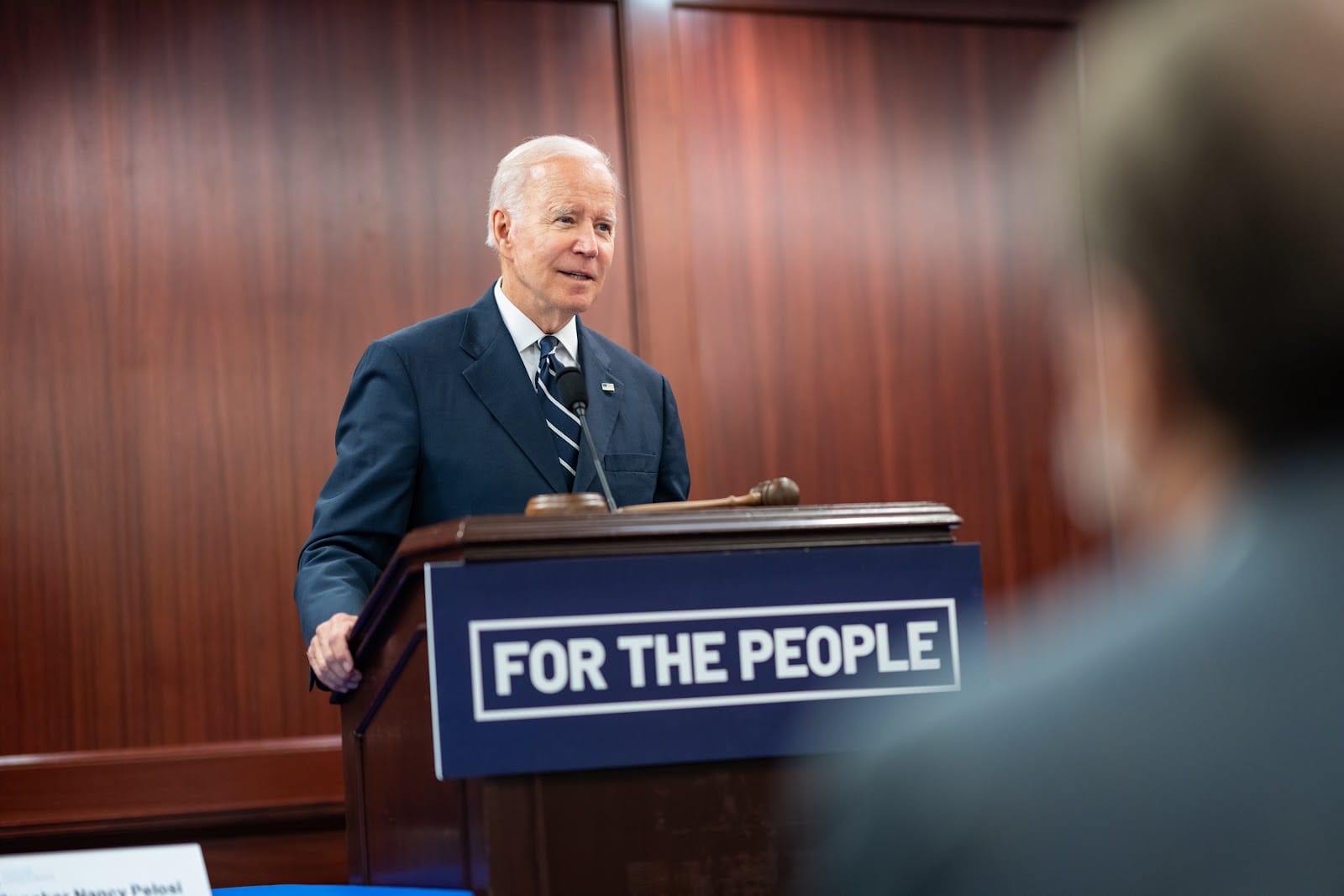
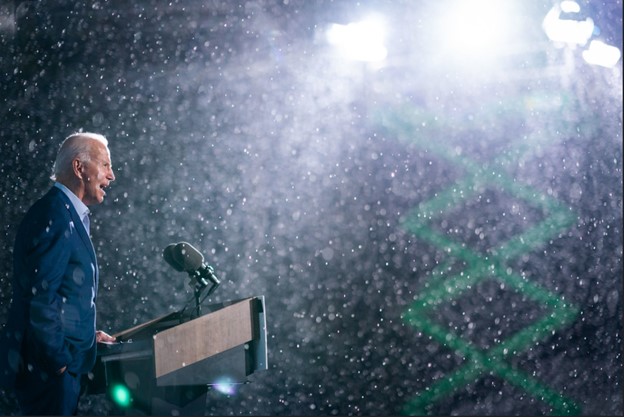
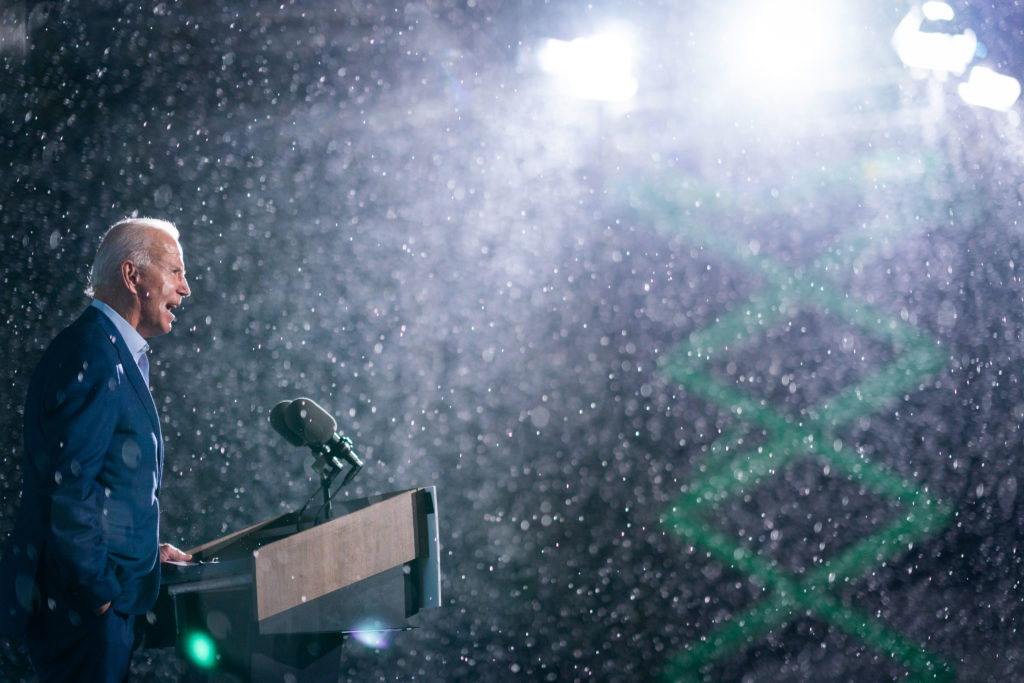
President Biden delivers remarks at the House Democratic Caucus on the Build Back Better agenda and the Bipartisan Infrastructure Deal, October 28, 2021, at the US Capitol in Washington, DC. Image credit: Adam Schultz / Official White House Photo
Two polls of Americans taken in mid-January 2022 reveal a sharp drop in confidence among registered voters in President Joe Biden’s ability to handle China.
A CBS News poll of 2,094 adults conducted January 12-14, 2022 found that 59 percent disapprove of Mr. Biden’s handling of China issues while 41 percent approve, closely tracking with the president’s overall approval rating. From July 14 to July 17, 2021, the same poll showed that 52 percent of Americans disapproved of Biden’s handling of China issues while 48 percent approved.
A larger poll of 5,128 American adults conducted by Pew January 10-17, 2022. found that 39 percent were confident in the president’s ability to deal effectively with China while 61 percent were not confident in his ability to handle relations with a country widely viewed as an adversary of the United States. One year ago, in early February 2021, 53 percent of adults surveyed by Pew were confident of the new president’s ability to deal effectively with China while 46 percent were not confident.
There are several reasons that might explain this lack of confidence. President Biden’s overall rating for foreign policy is underwater by double digits. There is a steady drum beat of negative stories about China in American media, with no decisive action or policies on the part of the Biden administration to counter the alleged malign activities. Finally, President Biden’s November virtual summit with Chinese President Xi yielded few results.
The day after the summit, President Biden was interviewed on the tarmac of the Pittsburgh airport. He claimed that he and Xi had agreed to set up four working groups covering a wide range of issues. To date, information about what those four working groups are, including what they are working on, has not been disclosed.
Low approval of President Biden’s handling of China limits his ability to take steps that might improve US-China relations, a prime example being the lifting of tariffs imposed by former president Trump. Treasury Secretary Yellen has commented that reducing tariffs can help in the fight against inflation, and more than 100 lawmakers have written a letter to the president urging the granting of more tariff exemptions on Chinese goods, a move strongly supported by the business community. President Biden was asked about lifting the tariffs during his January press conference. His response: “We’re not there yet.”
Crimes of endangering state security in China achieved international attention in 2021 with high-profile cases related to hostage diplomacy, even as available information about individual trials decreased. Such crimes include subversion, splittism, incitement to subversion/splittism, espionage, and state secrets violations. They carry a mandatory supplemental sentence of deprivation of political rights, precluding individuals from writing articles, giving interviews, voting, standing for office, and working in a state-owned company.
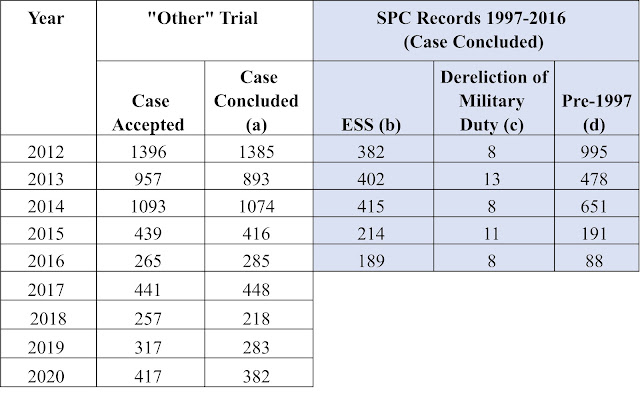
From 2017-2020, Chinese courts concluded 1,330 trials of endangering state security (ESS), dereliction of military duty, and pre-1997 offenses, according to Dui Hua’s analysis of data published annually in China Statistical Yearbooks (中国统计年鉴) by the National Bureau of Statistics. The yearbooks, accessible on the National Bureau of Statistics website, provide information on the number of first-instance criminal trials accepted and concluded by people’s courts nationwide.
ESS, dereliction of military duty, and criminal offenses prior to October 1, 1997 are typically included in the category of “other” trials. In 2020, the latest year for which information is available, trials of ESS by Chinese courts appear to have surged. They accepted 417 “other” trials, up from 257 and 317 in 2018 and 2019, respectively. The courts also concluded 382 “other” trials in 2020, an increase from 218 and 283 over the previous two years.
This post, the first of two, looks at the number of ESS trials in Tibetan areas as well as in Xinjiang. Part II details case numbers for “other” trials such as dereliction of military duty as well as ESS trials in Han-majority provinces and Guangdong.
Table 1. Number of “other” trials and trials of ESS, dereliction of military duty trials, and pre-1997 criminal cases
*(a) = (b) + (c) + (d); Sources: China Statistical Yearbooks & Records of People’s Courts Historical Judicial Statistics: 1949-2016
A fair portion of “other” trials are made up of ESS. Statistics released by the Supreme People’s Court in the 12-volume Records of People’s Courts Historical Judicial Statistics: 1949-2016 confirmed that a total of 1,602 ESS trials were concluded from 2012-2016, making up 40 percent of “other” trials. In 2016, as many as two-thirds of the 285 “other” trials concluded were ESS.
Official figures disclosed in Ganzi Prefecture also hint at the extent of crackdown in the Tibetan autonomous region in western Sichuan. Although trial numbers are not available, the prefecture’s procuratorate approved the arrest of nine individuals in seven ESS cases in 2020, according to its 2021 annual work report. That same year, 15 people were indicted in 12 ESS cases. While figures are available for Tibet and Ganzi, it is not known how many people were arrested, indicted, or tried in other Tibetan regions in Sichuan, Gansu, Ningxia, and Yunnan.
Dui Hua’s analysis of data published in the annual work reports of the Xinjiang High People’s Court through the mid-2010s found that the autonomous region accounted for the largest percentage of ESS trials of any Chinese region. About 300 ESS trials were held in Xinjiang each year in 2013 and 2014, accounting for three quarters of China’s total ESS trials. The number decreased in 2015, but Xinjiang continued to account for almost half of the 214 ESS trials nationwide. The lack of publicly available data in recent years makes it impossible to ascertain whether the majority of ESS cases continued to be concluded in the region. The use of the vast network of re-education camps beginning in 2017 might have an impact on the number of ESS trials. Authorities in Xinjiang can easily stifle dissent under the pretext of vocational training without invoking ESS crimes.
In 2021, transparency of ESS cases dipped to a record low. Dui Hua’s Political Prisoner Database has information on 68 individuals who were sentenced in ESS trials of first instance in 2020. With the mass purge of court judgments online, the Chinese government has undone some of its progress in judicial transparency and, in doing so, possibly harmed its own rule of law.
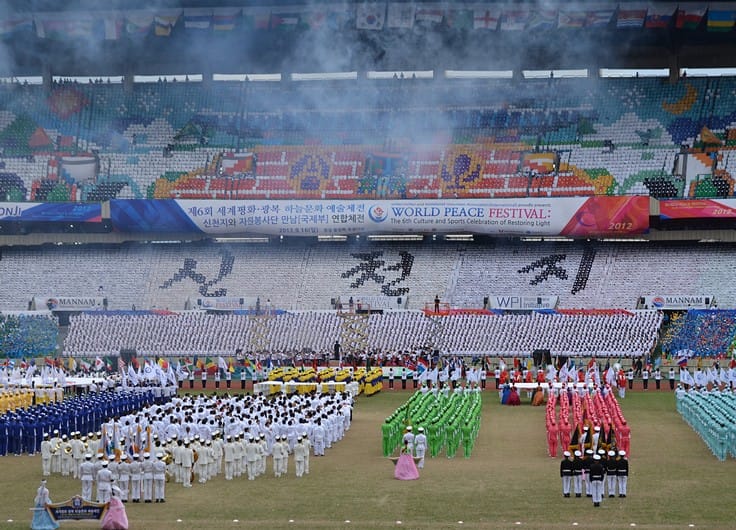
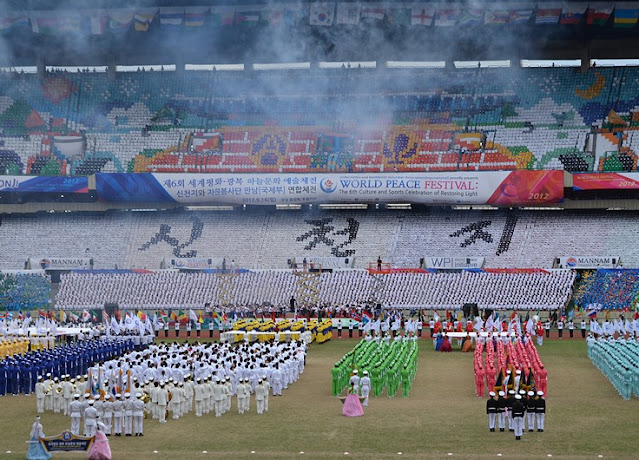
On September 16, 2012, Shincheonji Church hosted the 6th Shincheonji National Olympiad in Olympic Stadium in Seoul. Image credit: Junganghansik / CC BY-SA 3.0
The Chinese government has long been vigilant of burgeoning Christian groups from South Korea. Of the 12 Christian groups identified as cult organizations in a circular issued by the Ministry of Public Security in 2000, three are from South Korea: The Unification Church, World Elijah Evangelical Mission, and Dami Mission. However, many more South Korean Christian groups have been targeted in religious crackdowns across China. Following its exploration of the case of Cho Young-joo and his Good News Mission, Dui Hua has found ample evidence of a clampdown on the Shincheonji Church of Jesus (新天地教会) by the Chinese government.
Literally translated as New Heaven and New Earth Church, Shincheonji was singled out for fierce criticism in South Korea in early 2020 while the country was battling its COVID-19 outbreak. The controversy began with a Shincheonji congregant nicknamed Patient 31 who attended several church events in Daegu despite having COVID-19 symptoms. In March 2020, the city became the largest epicenter of the pandemic outside China, with a cluster of infections reportedly linked to this secretive Protestant group. Sincheonji’s founder Lee Man-hee was charged with and acquitted of obstructing efforts to stamp out the pandemic by deliberately withholding information about its membership from health authorities trying to conduct contact tracing. However, Lee was convicted of embezzling billions of Korean won and received a suspended prison sentence.
Before the pandemic made Shincheonji a target of public scorn, Dui Hua’s research into government records found that China had long perceived the group to be a “cult organization” and source of religious infiltration and heresy. While some Shincheonji activity was identified in China as early as 1993, Chinese government sources say that “religious infiltration” in an organized manner in northeast provinces and eastern coastal regions began around 2010. A state-run media article in 2018 wrote that, “Under the banner of Christianity and being a public welfare organization,” Shincheonji deifies its founder Lee Man-hee and fabricates heresy about the “immortal body.” The article went on to say that by illegally collecting personal information, Shincheonji “steals state secrets, amasses vast fortunes, and endangers society.”
A parked car with signs protesting Shincheonji Church in March 2020. Image credit: MatthieuRicard / CC0 via Wikimedia Commons
Dui Hua’s research into local government yearbooks found about two dozen instances of religious clampdowns targeting Shincheonji in Beijing, Heilongjiang, Liaoning, Fuzhou, Jiangsu, Zhejiang, Henan, Hubei, Hebei, and Shanxi before the pandemic. In 2018, local governments across China began banning Shincheonji in their anti-cult campaigns. The largest raid occurred in November 2018 in Dalian, Liaoning, where the church had grown to 2,000 members. Dozens of core members were admonished after police confiscated all their religious items. In the same year, police in Zhangwan District, Hubei, found that Shincheonji had been actively preaching among students during the summer holiday, and authorities detained 40 people in 11 cult cases involving Shincheonji as well as Falun Gong and Almighty God.
Shincheonji members in South Korea and China were in frequent communication with each other. On February 29, 2020, South Korea’s Ministry of Justice said that a total of 3,600 Shincheonji followers entered South Korea from China between July 2019 and February 27, 2020. Of them, 42 members had entered the country from Wuhan during this period.
In February 2020, the South China Morning Post (SCMP) reported that Shincheonji had a membership of 20,000 people across China. There were about 200 members in Wuhan when rumors surfaced in late 2019 about an unknown virus in the Chinese city which would become the epicenter of the epidemic. Members continued to hold meetings until December 2019 but stopped after they realized that their congregants had been infected with COVID-19. After December 2019, Shinchoenji moved online, continuing to share sermons and teachings virtually. Most members had returned home at the start of the Lunar New Year holiday in late January 2020.
The same SCMP report also quoted a former Shincheonji missionary in Shanghai as saying that the church used to hold meetings every Wednesday and Sunday, attracting 300-400 people at a time. Despite multiple raids by police, church members continued to meet in smaller groups of eight to 10 people. The church’s secretive nature made it hard for the authorities to eradicate its activities, said the missionary.
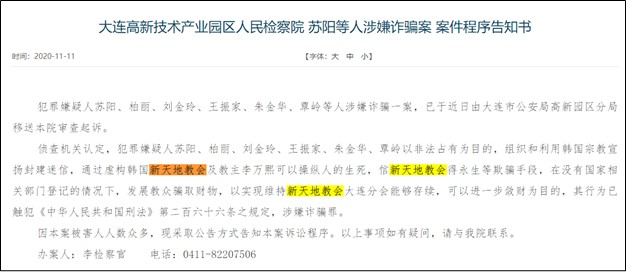
The first known criminal case involving six members of Shincheonji in Dalian, Liaoning. Image credit: www.12309.gov.cn
Dui Hua’s research found the two criminal cases involving Shincheongji in China from the procuratorate website. In both cases, the suspects were accused of fraud. A notice posted on November 11, 2020 indicated that six Shincheonji members were detained for “organizing and using a Korean religion to promote feudal superstition” in Dalian, Liaoning, by falsely saying “that Shincheonji and its founder Lee Man-hee can manipulate one’s life and death.” The case was transferred to Dalian High-Tech Industrial Zone Procuratorate for review, but no further information is publicly available.
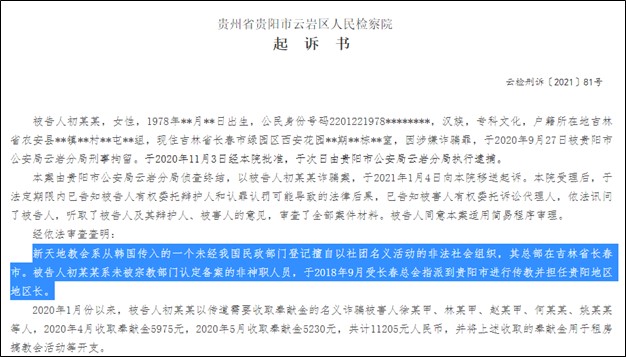
A female Shincheonji member in Guiyang, Guizhou, was indicted for fraud on February 3, 2021. Image credit: www.12309.gov.cn
The second case involves one female criminal suspect surnamed Chu, who was detained in Guiyang, Guizhou, on September 27, 2020 and arrested 37 days later on November 3. According to the indictment issued on February 3, 2021, Chu was appointed by Shincheonji’s Chinese headquarters in Changchun to proselytize in Guiyang, but her status as a cleric had not been recognized by China’s religious bureau. Chu was accused of receiving 11,205-yuan in donations from church members in the two months since April 2020. The prosecutor recommended that the court give Chu a lenient prison sentence of six months because Chu admitted her guilt.
China is not alone in discrediting minority religious groups like Shincheonji. Mainstream Protestant denominations in South Korea call it a “cult” because of its secretive nature and unconventional beliefs. Lee Man-hee claimed that he is the second coming of Jesus Christ uniquely capable of deciphering the Bible’s Book of Revelation. Despite having been acquitted over the COVID case surge in South Korea, Shincheonji continues to come under fire for spreading the coronavirus. Chinese news media sources have reinforced the notion that Shincheonji is a virus spreader and a fraudulent cult, just as some in South Korea and further abroad continue to regard the group with fear, resentment, and confusion.
John Kamm speaking about Dui Hua’s work during a Q&A session at Dui Hua’s year-end event. Image credit: The Dui Hua Foundation
On December 9, Dui Hua held its first in-person event in almost two years. Prior to the pandemic, Dui Hua’s year-end dinner with supporters was an annual tradition. While a limited version was held online in 2020, this year’s event marked a cautious, optimistic return to person-to-person engagement.
Held at the Presidio Golf and Concordia Club in San Francisco from 5:15 to 8:30pm on December 9, Dui Hua staff was joined by local supporters, board members, participants from the International Symposium on Girls in Conflict with the Law (GICL), and community members from the Bay Area. All guests were required to show proof of vaccination. Masking and social distancing were practiced in all public areas.
Magdalen Yum, Dui Hua Board member, introduces John Kamm at the event. Image credit: The Dui Hua Foundation
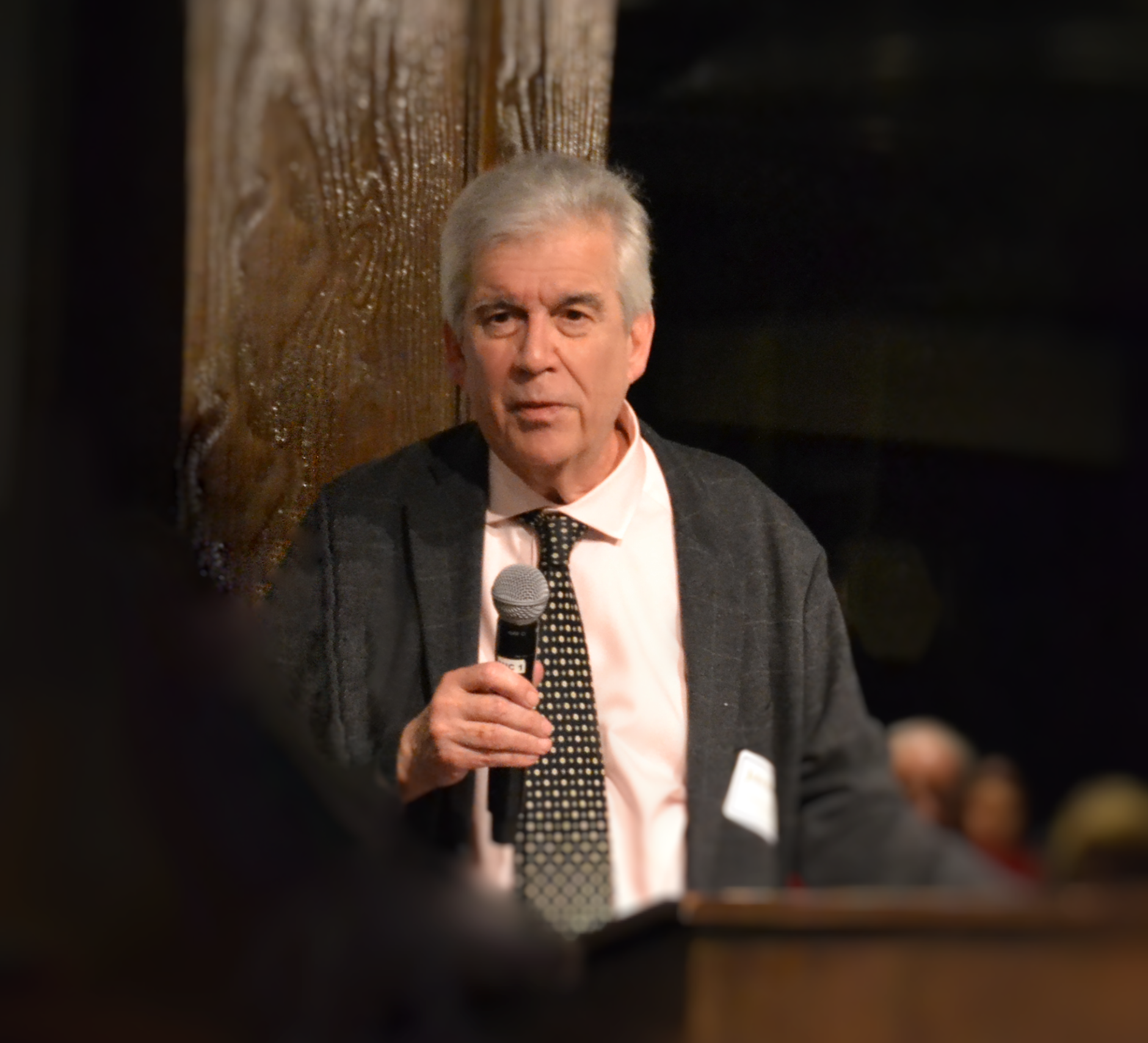
Board member Magdalen Yum introduced John Kamm, who spoke on Dui Hua’s challenges and achievements over the last year and through the pandemic. During the post-dinner program, Kamm invited Patricia Lee, Managing Attorney for the Juvenile Division of the San Francisco Public Defender’s Office and co-host of the GICL, to speak about juvenile justice reform. Lee went over the symposium and highlighted San Francisco’s success in reducing the number of girls detained in carceral facilities and the region’s efforts to prioritize diversion. She also spoke about the value programs like the GICL can have in effecting change locally, nationally, and, in the case of Dui Hua’s engagement with China’s Supreme People’s Court (SPC) and other experts and practitioners around the world, internationally.
Patricia Lee of the San Francisco District Attorney’s Office speaks about the GICL at Dui Hua’s year-end event. Image credit: The Dui Hua Foundation
Looking to the future, Kamm invited long-time Dui Hua ally Judge Leonard Edwards to speak about Dui Hua’s upcoming expert exchange: a webinar on child welfare laws involving Dui Hua and the SPC, currently slated for April 7, 2022. As Kamm explained, “China wants a child welfare law, and they came to Dui Hua. Then we went to Len Edwards. Len Edwards literally wrote the book on juvenile justice.” Edwards spoke about the value of child welfare and the need to ensure the best possible outcomes for at-risk youth through legal measures such as record sealing and placement for children with relatives in the social services system.
Judge Edwards speaks about his work with Dui Hua and the coming juvenile justice exchange. Image credit: The Dui Hua Foundation
Throughout the evening, Kamm addressed attendees, providing a summary of the organization’s work over the past year and highlighting its achievements: continued dialogue with China despite the lack of international human rights dialogues, clemency for prisoners, engagement with the SPC, the GICL and developments in juvenile justice reform, unique research on religious freedom, and strong support from its donors, among others.
Challenges in the US-China context also merited discussion. Kamm went over the recent summit between the presidents of the two countries and pointed out that Taiwan dominated the discussion. At one point, Kamm held up an informal list of irritants featuring dozens of issues complicating US-China relations and Dui Hua’s work to advocate for prisoners.
The evening concluded with a Q&A session where guests posed questions to Kamm. Attendees asked about issues ranging from hostage diplomacy, Congress’ approach to containing China, the World Tennis Association’s response to Peng Shuai’s ordeal, and how both US and Chinese leaders are seeking to leverage domestic and international perceptions. Kamm’s comments reiterated the value of open, respectful, but accurate dialogue, at one point invoking the Chinese adage: “Your best friend is a critic.” Kamm spoke about cases Dui Hua is currently working on.
The return to an in-person event was welcomed by Dui Hua staff and supporters. Person-to-person engagement has long been a stalwart of Dui Hua’s work. Prisoner lists have traditionally been submitted in person, and in-person meetings with Chinese officials and representatives from other foreign governments have been crucial aspects to the foundation’s operations. In the summer of 2021, Dui Hua re-opened its San Francisco office in compliance with COVID-19 safety precautions, implementing a hybrid work schedule. While many NGOs shuttered their operations in Hong Kong, Dui Hua has maintained its presence.
This year-end event marks the latest positive step toward resuming meaningful dialogue and building a more stable future.
EXCHANGES
“Let’s talk about challenging and cooperating and competing on human rights.”
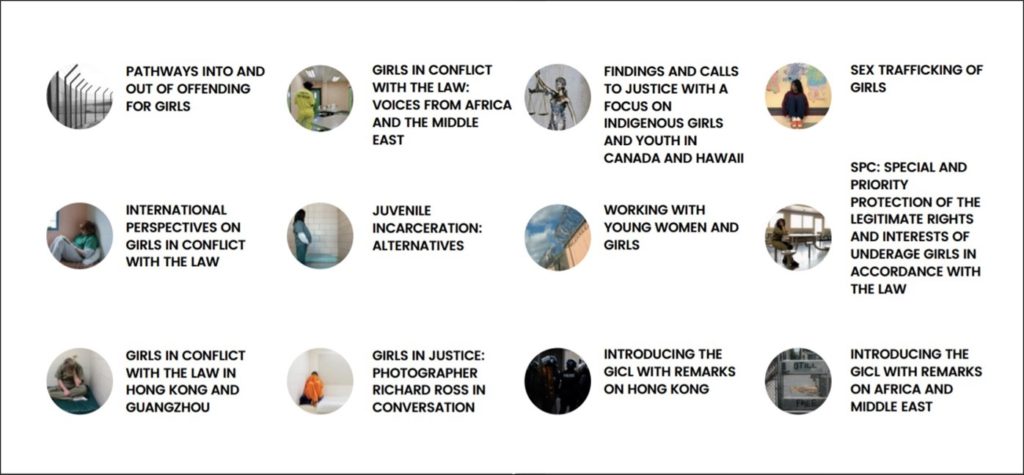
An informational slide on the International Symposium on Girls in Conflict with the Law. Image credit: The Dui Hua Foundation
Since the International Symposium on Girls in Conflict with the Law’s (GICL) final webinar in April 2021, “Exchanges” has looked at the conditions girls face in detainment, the factors that lead them to crime, community-based solutions, the effects of discrimination, and China’s recent reforms. As 2021 ends and San Francisco prepares to close its juvenile hall, “Exchanges” ends by exploring best practices and recommendations from the GICL.
One of the most crucial steps to combatting child crime is understanding the economics behind it. Antonia Lavine, Coordinator of the San Francisco Collaborative Against Human Trafficking urged authorities to stop punishing sexually exploited girls and address root causes. “If you want to stop the market, you must make it not productive, you have to make sure that the benefit is outweighed by the danger of being prosecuted and by what you pay for the business to work.” California legislation like Senate Bill 1322 and San Francisco Penal Code Section 236.23 combat commercial sexual exploitation of children (CSEC) by connecting victims with support services and recognizing the contexts in which offending by CSEC victims occurs.
Slides prepared by Kasie Lee, Assistant District Attorney for the City and County of San Francisco, Juvenile Unit, on CSEC-related legislation. Image credit: Kasie Lee
Panelists extolled the virtues of using storytelling and art for advocacy. Photographer Richard Ross directs his work, such as side-by-side comparisons of facilities in Texan youth detention centers with military prisons like Abu Ghraib, to where policy makers work. “Getting the images into the hands of the right people to effect change is the battle that I do,” he said. During his presentation, Ross shared methods to combine visuals and text to maximize the impact of content.
Many panelists reiterated the value of storytelling, using narrative presentations to describe topics such as a girl’s journey through the justice system, a social worker’s typical day, and the unintended consequences of an anti-sexting law. But as Christa Big Canoe said, “It’s important to listen to stories, but we have to be able to actually create the change.”
Patricia Lee, GICL co-partner and Managing Attorney for the Juvenile Division of the San Francisco Public Defender’s Office, presented on San Francisco’s plans to close its juvenile hall by December 31, 2021, making it the first metropolitan area to take such a measure. Lee noted that “…the eyes of other jurisdictions in California and, frankly, throughout the nation are looking at San Francisco to see if this is something that they can replicate.”
All of the webinars available at GirlsJustice.org. Image credit: The Dui Hua Foundation
The closure aims to expand community-based alternatives to detention and provide rehabilitative non-institutional places of detention in court-approved locations, reinvesting the money saved to fund diversion programs. Closing the facility was motivated by financial, not humanitarian, reasons — a reminder that many juvenile justice laws are not just bad for human rights, they are bad for business: they disproportionately punish the vulnerable, encourage recidivism, strain underfunded services, and leave local communities with the socioeconomic consequences.
A slide of Manfred Nowak’s recommendations based on the UN Global Study on Children Deprived of Liberty. Image credit: Manfred Nowak
During a talk for the Asia Society in May, Dui Hua Executive Director John Kamm suggested that both China and the United States could rededicate themselves to the international order, including by rooting their juvenile justice systems in the UN Convention on the Rights of the Child, which the United States has not ratified. “Let’s talk about challenging and cooperating and competing on human rights. Competition on human rights, not confrontation. If you want to make a difference, figure out a way to cooperate. I have done so. I know it’s possible.”
Dui Hua’s most recent Prisoner Updates installment reports on the formal arrest of labor activist Wang Jianbin (王建兵), Chen Yunfei’s (陈云飞) conviction and sentencing in Chengdu, and the latest legal obstacles in Xu Zhiyong’s (许志永) inciting subversion trial.
I flew to Beijing on a Dragonair flight on November 16, 1992. I was picked up by an officer of my host organization, the China Council for the Promotion of International Trade (CCPIT). After checking into the Great Wall Sheraton and taking the obligatory “rest,” I was whisked away to a welcoming banquet hosted by CCPIT Vice Chairman Xie Peijing at the nearby Kunlun Hotel.
The next five days were filled with meetings. I sat down for discussions with senior officials of the Ministry of Foreign Affairs, the State Council Information Office, the Ministry of Public Security, the Ministry of Justice, the Ministry of Foreign Economic Relations and Trade, and the Chinese People’s Institute of Foreign Affairs. Bill Clinton had just been elected, and his name was on everybody’s lips. They asked if I thought that Mr. Clinton would revoke China’s MFN status.
On Thursday November 19, 1992, I met with Wang Mingdi, director of the Ministry of Justice’s Laogai (Reform through Labor) Bureau (later renamed the Prison Administration Bureau). Wang gave me information on Li Fangchun. Li had been detained on February 23, 1983. He was sentenced to 12 years in prison for counterrevolution, reduced by one year in 1984 and one year in 1988. His sentence was to expire on February 22, 1993. No information was provided on any supplemental sentences including whether a sentence of deprivation of political rights had been imposed.
Wang didn’t mention that Father Li had already been released from prison on medical parole a short time before our meeting, in late October or early November 1992. He likely had not heard of the release, which suggested that the release had been sudden. Wang Mingdi would confirm the release at our next meeting in March 1993. Medical parole is the simplest way to secure an early release as it doesn’t need the approval of a court.
After briefing the American ambassador at his office in Beijing, I flew back to Hong Kong on Saturday, November 21. I got in touch with Father Politi and we agreed to meet at the Holy Spirit Centre in Aberdeen on Tuesday, November 24. There I told him what I had learned about Father Li Fangchun.
A picture of the Holy Spirit Seminary in Aberdeen taken in 2006. Image credit: Isaac Wong (惡德神父) / CC BY-SA 3.0 via Wikimedia Commons
Politi activated the old PIME network in Kaifeng. He was told that the prison wardens had opened the prison gate and unceremoniously tossed Li Fangchun out onto the street around the time of my appeal to Minister Jin Jian. Li was found wandering the streets by a Catholic couple surnamed Cai, a priest and his sister, a Catholic nun.
Li was in bad shape. He could not remember his name, nor even remember that he had been a priest. He walked with difficulty. The couple nursed him back to health. He gradually recalled how he had suffered in prison; he had experienced two heart attacks.
Under Cover of Darkness
Politi travelled to Kaifeng in January 1993. He met Father Li at the couple’s house. After a period spent building trust, the Kaifeng priest, Politi, and Li Fangchun decided to leave Kaifeng early the next morning. A driver who could be trusted — probably a local Catholic — was hired, and at 5:00 AM, after a sleepless night, the group — Li, Politi, and Father and Sister Cai — left Kaifeng in the cold and dark. Politi was under surveillance. As he later put it, “In China, you learn to move under cover of darkness.”
The journey to Shangqiu from Kaifeng — 200 kilometers (about half the length of New York State) — took more than two hours on rough roads (this was long before a freeway was opened to link the two cities.) Father Li was mostly silent, tracking progress by ticking off the stones marking kilometers. Politi told him of our effort to secure his release. Li Fangchun wept.
His home village was about 20 kilometers from Shangqiu. As he approached it, he could see the spire of his old church. He called out for the taxi to stop, and he leapt from the car. As Politi put it, “he ran like a child” to the doors of his church. There he fell on his knees and kissed the earth. The church had long been abandoned; no priests were in sight. A villager, a Catholic, emerged from the shadows and led Father Li away, but not before telling Father Politi to leave right away and never come back. “It’s too dangerous for you, and for us.”
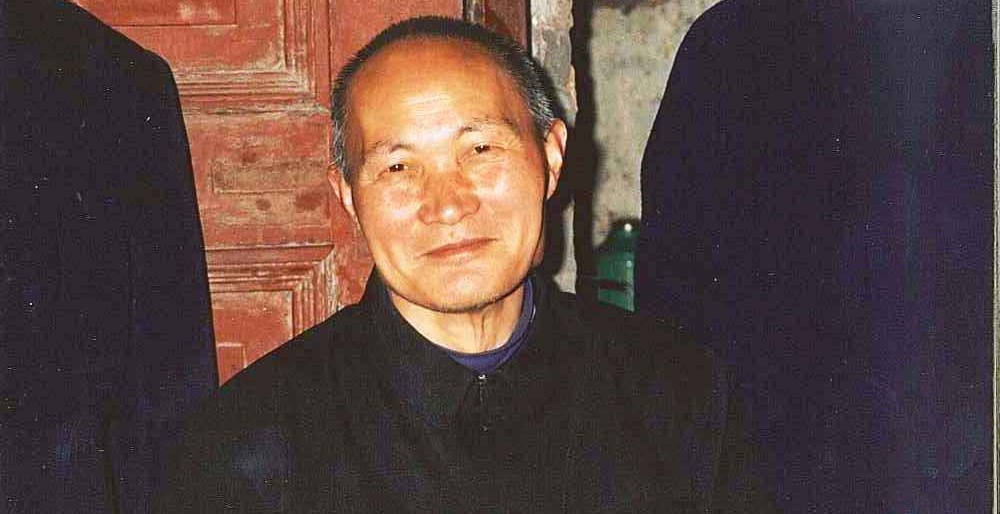
A photo of Father Li Fangchun, Kaifeng, Henan, 1993. Image credit: Father Giancarlo Politi
Not long after his return to Hong Kong, Father Politi was recalled to Italy. Those in the local Catholic community believed he was called back in part due to his activism on behalf of Catholic bishops and priests in China, including his trips to the mainland to gain information on local Catholic communities and imprisoned Catholics. Beijing was also said to be angered by Father Politi’s role in leaking photographs of the deceased Bishop Fan Xueyan, lying on a slab. The photos suggested that Bishop Fan, his body covered with bruises, had been mistreated.
Politi’s last trip to the mainland was the one he made to Kaifeng in January 1993 to bring Li Fangchun home to Shangqiu. Shortly after his return to Hong Kong and as he was preparing to return to Milan, Father Politi learned that Li Fangchun had died from his third heart attack.
The Italian missionary never returned to Hong Kong, working in Milan on China issues until he passed away at the age of 75 from complications from a long illness in December 2019. Father Politi gave an on-camera interview to my son Rene and his Oberlin College classmate Jake Hochendoner in October 2013. Much of the information on Politi’s trip to save Li Fangchun comes from that interview.
Father Politi is remembered as a good shepherd by Catholics on the mainland and in Hong Kong, where he served as a parish priest in Yuen Long and Tsuen Wan before taking up his position at PIME House in 1986. He fought to save the Roman Catholic Church from extinction in China during the darkest days of the second half of the 20th century. He will long be remembered.
Subscribe if you want to receive Dui Hua publications by email.
Missing labor activist Wang Jianbin (王建兵) has been formally arrested. His family received an arrest notice in early November. This is the first update the family has received since Wang went missing more than a month ago.
The notice, issued by the Guangzhou Public Security Bureau, states that Wang was arrested for inciting subversion.
Wang was in Shenzhen accompanying his friend Huang Xueqin (黄雪琴), who was preparing to travel to the United Kingdom to attend school. Both have been missing since the end of September.
Friends have speculated that Wang might have been facing endangering state security (ESS) charges at the time of his disappearance because he frequently hosted gatherings with fellow activists at his home in Shenzhen.
Activist convicted and sentenced in Chengdu
Veteran activist Chen Yunfei (陈云飞) has been convicted and sentenced by the Beidu District People’s Court in Chengdu.
Chen was detained in March 2021 for picking quarrels and provoking troubles when he conducted research and surveys on China’s “nine years of compulsory education,” with the goal of exposing systemic issues.
However, on December 3, 2021, the court convicted Chen for compulsory indecency, a crime akin to sexual assault, and child molestation. Chen was sentenced to a combined imprisonment of four years. The procuratorate accused Chen’s survey and interview of students of being equivalent to “stalking.”
Convicting activists of crimes of a sexual nature can be a way to use the stigma associated with such crimes to deter inquiries about activists and to frame advocacy efforts for them as immoral and illegitimate.
Chen was previously arrested for inciting subversion and convicted and sentenced to four years for picking quarrels and provoking troubles in 2017.
Xu Zhiyong trial facing legal uncertainties
Liang Xiaojun (梁小军), the defense lawyer for Xu Zhiyong (许志永), posted on his Twitter account that he received a preliminary notice from the Beijing Justice Bureau on November 26, 2021 informing him that his practicing license will be suspended.
The notice said that Liang has made numerous remarks on social media platforms, including supporting Falun Gong for religious freedom reasons and attacking constitutional principles and fundamental systems. The Bureau also criticizes Liang over his refusal to make amends after several “talks.”
The Beijing Justice Bureau has made the preliminary decision to suspend Liang’s license in accordance with China’s Lawyer Law. A hearing will be held, and Liang can appeal. However, the process will likely be merely procedural.
Xu was detained in February 2020 and was indicted in August 2021 for inciting subversion. The trial has been postponed to start before February 20, 2022, according to Ding Jiaxi’s lawyer Peng Jian, but the date has not been set. Liang losing his license before the trial likely means that Xu will face more legal uncertainties in his trial. Ding (丁家喜) and Xu were both arrested and indicted for inciting subversion for their work on the New Citizen Movement.
The Chinese government has long pressured and posed challenges to lawyers of “sensitive” cases. The court and procuratorate often obstruct lawyers from implementing successful legal defenses by denying them access to evidence or visitation rights on the pretense that the cases are sensitive and involve state secrets. The government routinely pressures defendants and their families to release their own lawyers and use court-appointed counsel. However, court appointed lawyers have been known to prioritize the interests of the prosecution over their clients, not cooperating with the defendants, and accepting the prosecution’s charges despite their clients’ protests during trials.
Shangqiu South Church before the removal of its crosses in 2020. They were replaced with smaller crucifixes. Image credit: Union of Catholic Asia News
In October 1992, I was in Hong Kong preparing for a trip to China the next month. It would be my tenth human rights trip to Beijing since January 1991. Many of the names of prisoners I raised on those trips had been granted early release, a reflection of Beijing’s concerns over the possibility of losing its bid for the 2000 Olympic Games and the prospect of Bill Clinton defeating George H. W. Bush in the November 3, 1992 presidential election. Clinton had campaigned on stripping China of its Most Favored Nation (MFN) trading status if elected.
Preparations for trips to Beijing typically took several weeks. Appointments with officials in the Chinese government needed to be requested and, if granted, followed up with details including, on my part, the submission of political and religious prisoner lists. More mundanely, I needed to contact my regular driver and book a room at my usual hotel. Appointments with foreign diplomats and Beijing-based journalists also had to be fixed.
For the November 1992 prisoner list, I wanted to include imprisoned Roman Catholic clergy and senior laity, of whom there were more than 100 at that time. In January 1992, I submitted lists to the central government, including to the Religious Affairs Bureau of the State Council, with names of imprisoned Catholic prelates. In May 1992, I was informed of the early release from prison of three high priority underground leaders I had advocated for. This experience was on my mind as I put together my list for the mid-November 1992 trip to Beijing.
Father Giancarlo Politi, a Good Priest
For that first list of Catholic prisoners submitted in January 1992, I had relied for information from Father Giancarlo Politi, a Pontifical Institute for Foreign Missions (PIME) missionary assigned to Hong Kong. Father Politi produced and edited authoritative materials on the Catholic Church in China, gained from first-hand readings, observation, and experience in the field. The priest arrived in Hong Kong in 1970 and began traveling widely in China to make contact with Catholic communities in 1986. He was deeply concerned about the fate of imprisoned Catholic clergy. Politi usually travelled alone on his trips to the mainland, though he was occasionally accompanied by Hong Kong Catholics. These were dangerous trips, fraught with peril.
I reached out to Father Politi for assistance. I gave him a call at his place of work and residence, the PIME House in Sai Kung, Hong Kong. We agreed to meet for a “simple lunch” the next day. I contacted my driver – I was still a consultant to Occidental Chemical drawing salary and benefits, including use of a Mercedes 280SE. I arranged to be picked up at my apartment on Coombe Road the following morning.
A photo of Father Giancarlo Politi, Kaifeng, Henan, 1993. Image credit: Father Giancarlo Politi
Upon arrival at PIME House on November 5, 1992, I was met by Father Politi. He would later recall me as “a big man in a business suit with a driver and a Mercedes.” He ushered me into his office, where desks and shelves were piled high with publications and notes from his trips to China. I thanked Politi for sending me copies of PIME’s AsiaNews – he was editor at the time – and his latest mimeographed list of imprisoned Catholic bishops, priests, and senior laity. These lists informed virtually all of the publications of Western human rights groups that dealt with jailed Catholics.
I asked Father Politi for a complete set of the lists, going back several years. He demurred, saying that the most recent list had incorporated the names of all imprisoned clergy on previous lists.
Politi’s Samizdat
I insisted: “As a businessman, I always try to collect as much information as possible on a transaction,” I said. “It sometimes happens that critically important information is inadvertently omitted from the record.” Politi relented. He called his assistant, a young seminarian, and asked him to put together a complete set of the mimeographed lists, which I likened to samizdat of the old Soviet Union, unofficial publications of dissidents and activists that were widely circulated among networks in the country and abroad.
Politi escorted me to the dining hall, where we were joined by a dozen PIME monsignors and priests. The “simple lunch” turned out to be a feast with plates full of pasta, vegetables, meat and fish, washed down with glasses of chianti. After finishing up, I headed for my car. I was met at the door by the seminarian. He gave me a stack of Politi’s lists.
I was driven back to Hopewell Centre in Wanchai, site of my office. I spread out the copies of Politi’s lists on my conference table and began going through them. I quickly discovered that a name – that of Father Li Fangchun 李芳春 – had been dropped from the most recent list. I called Politi and he confirmed that a terrible mistake had been made. I then prepared an urgent appeal and faxed it, on November 7, 1992, to Vice Minister of Justice Jin Jian with whom I had established a good relationship.
Father Giuseppe Li Fangchun, born in Shangqiu County, Henan Province, in 1935, underwent formation at the Kaifeng Seminary, a regional seminary that served the Kaifeng Archdiocese and other dioceses in Henan Province and Shanxi Province. The seminary was considered one of China’s best, on a par with Shanghai’s Shesan Seminary. It was for many years under the administration of PIME. Kaifeng itself was one of the most Christian cities in the country, sometimes called the Galilee of China. It was also home to China’s largest Jewish community.
Li was ordained in secret in 1957. (Around one dozen Kaifeng seminarians were secretly ordained during the 1953-1957 period.) The last PIME missionary in Kaifeng was expelled from China in 1954. The seminary was closed in 1958 due to “lack of enrollment.”
The main gate of the Kaifeng Seminary, where Father Li spent some time. Closed in 1958, the building has been used to shoot film and television programs. Image credit: PIME Hong Kong China
According to the Chronicles of the Kaifeng Seminary published by the official Henan Catholic Administrative Commission, Li Fangchun was detained for counterrevolutionary activities together with other clergy, including the dean of the seminary, Ma Changren, around the time the seminary closed in 1958. The detentions took place during the Sufan (肃反) Movement to purge counterrevolutionaries. (Ma died in prison in 1962.) Li and the others had allegedly formed a “counterrevolutionary group” that secretly held masses, opposed the consecration of the officially appointed bishop of the Kaifeng Archdiocese, and criticized the official Catholic Patriotic Association. The Sufan Movement took place from July 1955 until early 1958. An estimated 214,000 people were detained; approximately 53,000 died, many by execution.
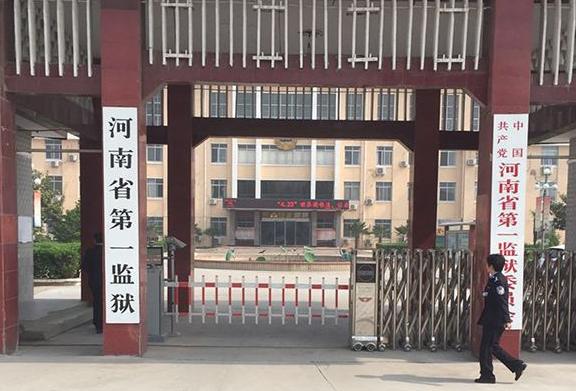
After his detention in 1958 Father Li was tried and sentenced to 14 years in prison for counterrevolution. He served his sentence at Kaifeng Prison, currently known as Henan Number One Prison, a maximum-security prison that has housed many political prisoners and those awaiting execution over many decades.
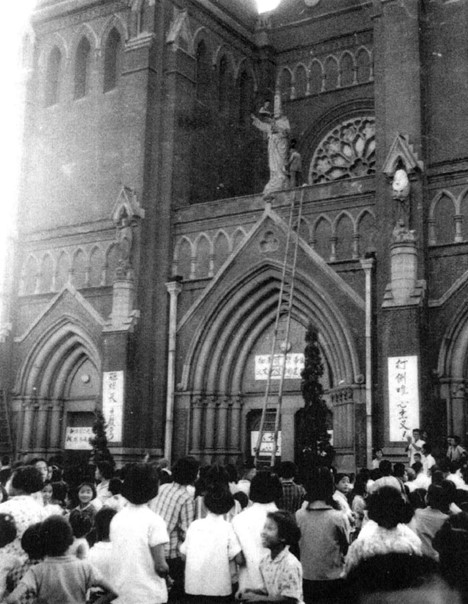
He was due to be released from prison in 1972. In that year, the Cultural Revolution, which began in April 1966, was still underway, although its worst excesses had for the most part passed. The Cultural Revolution was a period when the Catholic Church, or what was left of it, was under fierce attack. Churches were ransacked, priests “struggled” and beaten, and worse. I vividly recall being told by the Polish Consul General in Guangzhou – where there was a joint venture shipping company between China and Poland – that the priests at the Catholic church on Shamian Island had been frog marched by Red Guards from the church and lynched from lamp posts on Renmin Road in those horrifying days.
The summer of 1966 was a period of intense persecution of Catholics. Here Red Guards sack St. Ignatius Cathedral in Shanghai on August 23, 1966. Image credit: Botanwang
It is not known whether Li Fangchun was released on schedule in 1972 or had his sentence extended. He might have been placed in a re-education through labor camp, maybe in a remote area. He eventually returned to Shangqiu, a city of some 20,000 Catholics, probably in the late 1970s at the start of the Opening and Reform period when repression against Catholics eased. He began his ministry at the reopened Shangqiu South Church.
Father Li’s freedom proved to be short-lived. He was detained again in February 1983 and sentenced to 12 years in prison for counterrevolutionary activities, including membership in a counterrevolutionary group and counterrevolutionary propaganda and incitement. He was sent back to Kaifeng Prison to serve his sentence.
Henan Number One Prison, formerly Kaifeng Prison, where Father Li Fangcun was imprisoned. Image credit: Baike.sogou
November 1992 Trip to Beijing
I flew to Beijing on a Dragonair flight on November 16, 1992. I was picked up by an officer of my host organization, the China Council for the Promotion of International Trade (CCPIT). After checking into the Great Wall Sheraton and taking the obligatory “rest,” I was whisked away to a welcoming banquet hosted by CCPIT Vice Chairman Xie Peijing at the nearby Kunlun Hotel.
The next five days were filled with meetings. I sat down for discussions with senior officials of the Ministry of Foreign Affairs, the State Council Information Office, the Ministry of Public Security, the Ministry of Justice, the Ministry of Foreign Economic Relations and Trade, and the Chinese People’s Institute of Foreign Affairs. Bill Clinton had just been elected, and his name was on everybody’s lips. They asked if I thought that Mr. Clinton would revoke China’s MFN status.
On Thursday November 19, 1992, I met with Wang Mingdi, director of the Ministry of Justice’s Laogai (Reform through Labor) Bureau (later renamed the Prison Administration Bureau). Wang gave me information on Li Fangchun. Li had been detained on February 23, 1983. He was sentenced to 12 years in prison for counterrevolution, reduced by one year in 1984 and one year in 1988. His sentence was to expire on February 22, 1993. No information was provided on any supplemental sentences including whether a sentence of deprivation of political rights had been imposed.
Wang didn’t mention that Father Li had already been released from prison on medical parole a short time before our meeting, in late October or early November 1992. He likely had not heard of the release, which suggested that the release had been sudden. Wang Mingdi would confirm the release at our next meeting in March 1993. Medical parole is the simplest way to secure an early release as it doesn’t need the approval of a court.
After briefing the American ambassador at his office in Beijing, I flew back to Hong Kong on Saturday, November 21. I got in touch with Father Politi and we agreed to meet at the Holy Spirit Centre in Aberdeen on Tuesday, November 24. There I told him what I had learned about Father Li Fangchun.
A picture of the Holy Spirit Seminary in Aberdeen taken in 2006. Image credit: Isaac Wong (惡德神父) / CC BY-SA 3.0 via Wikimedia Commons
Politi activated the old PIME network in Kaifeng. He was told that the prison wardens had opened the prison gate and unceremoniously tossed Li Fangchun out onto the street around the time of my appeal to Minister Jin Jian. Li was found wandering the streets by a Catholic couple surnamed Cai, a priest and his sister, a Catholic nun.
Li was in bad shape. He could not remember his name, nor even remember that he had been a priest. He walked with difficulty. The couple nursed him back to health. He gradually recalled how he had suffered in prison; he had experienced two heart attacks.
Under Cover of Darkness
Politi travelled to Kaifeng in January 1993. He met Father Li at the couple’s house. After a period spent building trust, the Kaifeng priest, Politi, and Li Fangchun decided to leave Kaifeng early the next morning. A driver who could be trusted — probably a local Catholic — was hired, and at 5:00 AM, after a sleepless night, the group — Li, Politi, and Father and Sister Cai — left Kaifeng in the cold and dark. Politi was under surveillance. As he later put it, “In China, you learn to move under cover of darkness.”
The journey to Shangqiu from Kaifeng — 200 kilometers (about half the length of New York State) — took more than two hours on rough roads (this was long before a freeway was opened to link the two cities.) Father Li was mostly silent, tracking progress by ticking off the stones marking kilometers. Politi told him of our effort to secure his release. Li Fangchun wept.
His home village was about 20 kilometers from Shangqiu. As he approached it, he could see the spire of his old church. He called out for the taxi to stop, and he leapt from the car. As Politi put it, “he ran like a child” to the doors of his church. There he fell on his knees and kissed the earth. The church had long been abandoned; no priests were in sight. A villager, a Catholic, emerged from the shadows and led Father Li away, but not before telling Father Politi to leave right away and never come back. “It’s too dangerous for you, and for us.”
A photo of Father Li Fangchun, Kaifeng, Henan, 1993. Image credit: Father Giancarlo Politi
Not long after his return to Hong Kong, Father Politi was recalled to Italy. Those in the local Catholic community believed he was called back in part due to his activism on behalf of Catholic bishops and priests in China, including his trips to the mainland to gain information on local Catholic communities and imprisoned Catholics. Beijing was also said to be angered by Father Politi’s role in leaking photographs of the deceased Bishop Fan Xueyan, lying on a slab. The photos suggested that Bishop Fan, his body covered with bruises, had been mistreated.
Politi’s last trip to the mainland was the one he made to Kaifeng in January 1993 to bring Li Fangchun home to Shangqiu. Shortly after his return to Hong Kong and as he was preparing to return to Milan, Father Politi learned that Li Fangchun had died from his third heart attack.
The Italian missionary never returned to Hong Kong, working in Milan on China issues until he passed away at the age of 75 from complications from a long illness in December 2019. Father Politi gave an on-camera interview to my son Rene and his Oberlin College classmate Jake Hochendoner in October 2013. Much of the information on Politi’s trip to save Li Fangchun comes from that interview.
Father Politi is remembered as a good shepherd by Catholics on the mainland and in Hong Kong, where he served as a parish priest in Yuen Long and Tsuen Wan before taking up his position at PIME House in 1986. He fought to save the Roman Catholic Church from extinction in China during the darkest days of the second half of the 20th century. He will long be remembered.
Commencing with the late summer’s flawed withdrawal of US troops from Afghanistan, accompanied by the deaths of 13 service members in a suicide bombing and the takeover of the country by the Taliban, President Joe Biden has suffered a number of domestic setbacks, including a crisis on the southern border, a lingering pandemic, disrupted supply chains, and a surge in inflation. Third quarter GDP growth came in at an anemic 2 percent.
He has enjoyed no relief on the foreign policy front as well, with North Korea resuming missile firings, China test-firing an advanced hypersonic weapon, and a dust-up with an angry France over the agreement to supply nuclear submarines to Australia.
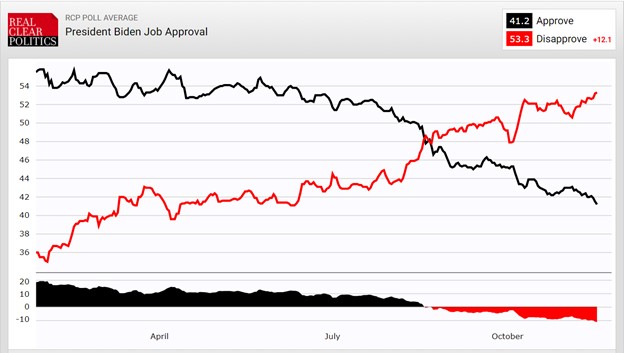
As of this writing, President Biden’s overall approval ratings as measured by the Real Clear Politics average were stuck in the low 40’s. A key metric – direction of the country – was underwater by more than 30 percent. His numbers on key issues – the economy, immigration, and foreign policy were all down by double digits. For the first time in years, Americans have favored Republicans in the so-called Generic Congressional Vote in several polls. These numbers spell disaster for the Democrats in the 2022 midterm election, with predictions that they will lose 40-70 seats in the House and several in the Senate.
Real Clear Politics approval ratings for Biden as of November 18, 2021. Image credit: Real Clear Politics screenshot
Real Clear Politics approval ratings for Biden on the direction of the country as of November 18, 2021. Image credit: Real Clear Politics screenshot
Unease Over Handling of China
Shortly after President Biden’s assuming office on January 20, 2021, the respected Pew Polling organization surveyed how confident Americans were that the new administration could deal effectively with a range of foreign policy challenges. By a margin of 53 to 46 percentage points, Americans felt that the Biden administration could deal effectively with China. This number was the lowest confidence rating on any foreign policy issue, and portended trouble ahead as the new administration sought to meet the China challenge.
On March 18, 2021, Secretary of State Antony Blinken and National Security Advisor Jake Sullivan met with China’s State Counsellor in charge of foreign affairs, Yang Jiechi, and Chinese Foreign Minister Wang Yi in Anchorage, Alaska. The meeting did not go well. Especially disturbing to many Americans was a long diatribe by Yang Jiechi on American ills, in effect a lecture delivered on camera for the benefit of Secretary Blinken and Mr. Sullivan.
A Fox News poll conducted June 19-22 found that 39 percent of Americans approved of Biden’s handling of China; 54 percent disapproved.
This was followed by a CBS News poll conducted July 14-17 that measured how Americans felt about President Biden’s handling of China issues. By a margin of 52-48 percent, Americans disapproved of the way China issues were being handled. A month later, a Gallup poll was conducted. Polled on August 2-17, 2021, Americans gave low marks to President Biden’s handling of relations with China; 39 percent approved and 55 percent disapproved.
As of publication, the Gallup poll is the most recent poll to measure how Americans view President Biden’s handling of China, but it is unlikely to have improved given the low marks recorded on his handling of foreign policy, and given the lack of positive achievements announced in the wake of the virtual summit between Presidents Xi and Biden on November 16, 2021.
China has been much in the news in recent months, and none of the news has been positive. Reports on what American officials call genocide in Xinjiang, Chinese warplanes threatening Taiwan, the dismantling of democracy and civil rights in Hong Kong, the test of two hypersonic missiles, record trade deficits, and China’s alleged practice of hostage diplomacy have taken their toll on how China is perceived in America and around the world. America’s inability to effectively deal with China’s aggressive behavior has impacted how Americans view how the Biden administration’s policy towards China.
Polling Update: Fox Finds Low Confidence in Biden on China
As discussed in the above section, Americans have expressed growing disapproval of President Biden’s handling of China. Shortly after publication, a new poll was released that suggests this disapproval has worsened. Coinciding with Biden and Xi’s virtual meeting on November 16, Fox News conducted a poll from November 14-17 measuring, among other issues, Biden’s approach to China. As with other recent polls, it signals a lack of confidence in Biden and his administration.
A majority disapproves of Biden’s handling of China: 55 to 28 percent with 16 percent responding “don’t know.” Compared to Fox News’ last poll from June 19-22, 2021, this is a sharp decrease in approval and a spike in uncertainty. In that poll, disapproval was at 54 percent while 39 percent did approve and 8 percent were unsure.
The toughness of Biden’s approach is in question: 60 percent said that he was “not tough enough” on China, 26 percent said his approach was “about right,” and 10 percent answered “don’t know.” Only 4 percent said that Biden was “too tough.”
The poll also asked respondents to rate their level of concern about China’s military and economic powers, and majorities expressed high levels of concern in both areas. Regarding China’s military power, 70 percent said they were “extremely” or “very” concerned compared to 26 percent that were “not very” or “not at all” concerned. Respondents expressed similar levels of worry over China’s economic power, with 69 percent expressing varying levels of high concern compared to 26 who didn’t. In both areas, those answering “don’t know” came in at between 4-5 percent.
More broadly, this poll’s findings heavily match other recent polls on Biden’s approval (54 to 44 percent). Similar rates of disapproval were consistent for his handling of the economy (58 percent to 36 percent) and immigration (59 to 31). The poll had a margin of error of 3 percentage points.
EXCHANGES
Exchanges is a feature that explores Dui Hua’s expert exchanges and dialogues.
“…protection is at the core of our juvenile justice work.”
A composite screenshot from “Girls in Conflict with the Law in Hong Kong and Guangzhou.” (Clockwise from top left) Moderator Lindsay Ernst, Professor Eric Chui, Professor Zhang Hongwei, and Professor Karen Joe Laidler. Composite image credit: International Symposium on Girls in Conflict with the Law
Since 2008, Dui Hua’s expert exchanges have facilitated US-Chinese cooperation by focusing on an area dear to both nations: the well-being of youth. The International Symposium on Girls in Conflict with the Law (GICL) offered a view of juvenile justice in China, including recent reforms.
China’s first juvenile court was established in 1984; today, all six circuit courts in the nation have one. The Prevention of Juvenile Delinquency Law and the Law on the Protection of Minors are, with additional various civil codes, the main laws shaping juvenile justice in China. Both have been revised to better focus on rehabilitation.
Dr. Jiang Jihai, Director of Juvenile Offender Office of Research Office of the Supreme People’s Court (SPC) described the importance of these reforms: “It’s fair to say that protection is at the core of our juvenile justice work. If we want to achieve real protection, you don’t just deliver a fair judicial judgment. Our post trial follow-up assistance and education are also very important. We offer psychological assistance, intervention as well as educational assistance. These are all our natural extensions of juvenile justice work.”
During the same webinar, Ms. Dai Qiuying, Director of Center for the SPC’s Protection of Minors of Applied Law Research Institute, identified weak awareness of the law as a major cause of juvenile crime. When making a ruling, she said, the court considers the harm of punishment, conducting a social investigation and interviews to better understand the juvenile’s situation. Articles 7 and 117 of the revised Law for the Protection of Minors provide guidance for the state to support parents in educating their children on the law. Judges serve as adjunct teachers or assistant principals in primary and middle schools using resources like moot courts, cartoons, documentaries, and online courses for legal education.
During “Girls in Conflict with the Law in Hong Kong and Guangzhou,” Professor Zhang Hongwei of Jinan University provided a view of juvenile crime in China, finding that in a population of 27.9 million people under the age of 18, juvenile crime makes up 3.56 percent of all crime in China. Between 2007-2014, 8,800 juveniles were sentenced for the crime of robbery, theft, and intentional assault, accounting for 68.83 percent of all juvenile crimes in Guangzhou.
A slide from Professor Zhang’s presentation. Image credit: Zhang Hongwei
Professor Eric Chui of City University of Hong Kong presented on a collaborative research project on Hong Kong gang members aged 12 – 24. Looking at gender differences in behavior, social bonds, and gang affiliation, the study found that weak parental attachment predicted acts of theft and violence for males, whereas weakened belief in the legal systems predicted theft, but not violence, for females. Professor Karen Joe Laidler of the University of Hong Kong discussed trends in Hong Kong girl crime across decades. Laidler noted that girls 15 and under were arrested in higher proportions until 2012 despite declines in all age groups and genders for violent crime against property, fraud, and forgery. She is also exploring whether these declines are connected to how youth interact with social media and, consequentially, spend less time in public spaces.
A slide from Professor Laidler’s presentation. Image credit: Karen Joe Laidler
Honorary fellow and professor Anna Wu of the University of Hong Kong provided opening remarks for the GICL’s Asia-based audience. She discussed the effect protests have had on youth, emphasizing the need to help young offenders understand the law and the consequences of their actions. In Hong Kong, courts hear representations from both sides before sentencing, and there are a range of options, including unconditional or conditional discharge, suspended sentence care of protection orders, probation, and community service. Wu also shared thoughts on building a better justice system: “I think we really need to look for new approaches, both within and outside the criminal justice system, to build a community…and to refocus on restorative and reintegrative approaches to the criminal justice system.”
Looking to the future, Judge Jiang noted that “the protection of minors is a very complex social project,” requiring cooperation between “families, schools, social organizations, businesses, the judiciary, and other parts of the government.” Professor Zhang acknowledged as much while looking ahead: “For the past 40 years, we have made remarkable progress establishing our juvenile justice system. We have already tried to differentiate the treatment between an adult and a juvenile. For the next step, we will move further… to differentiate how to treat the girls and boys differently within the juvenile justice system.”
To learn more about the panelists, watch their individual webinars, and read a full list of recommendations visit girlsjustice.org.
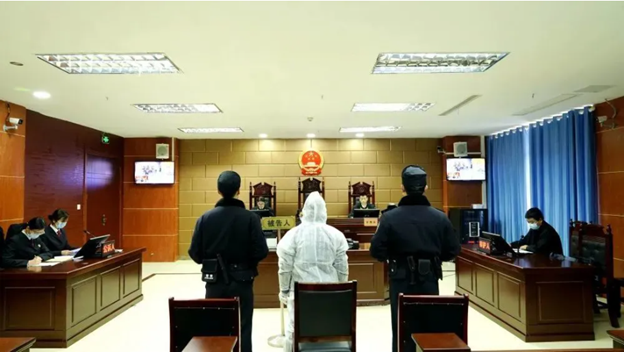
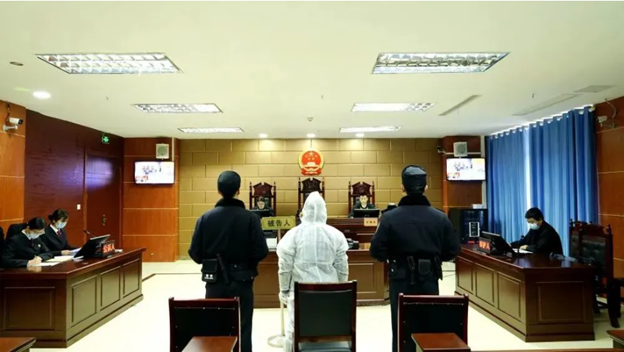
The court hearing for the defendant Pang, who was sentenced to six months in prison for desecrating the flag. Image credit: New.qq
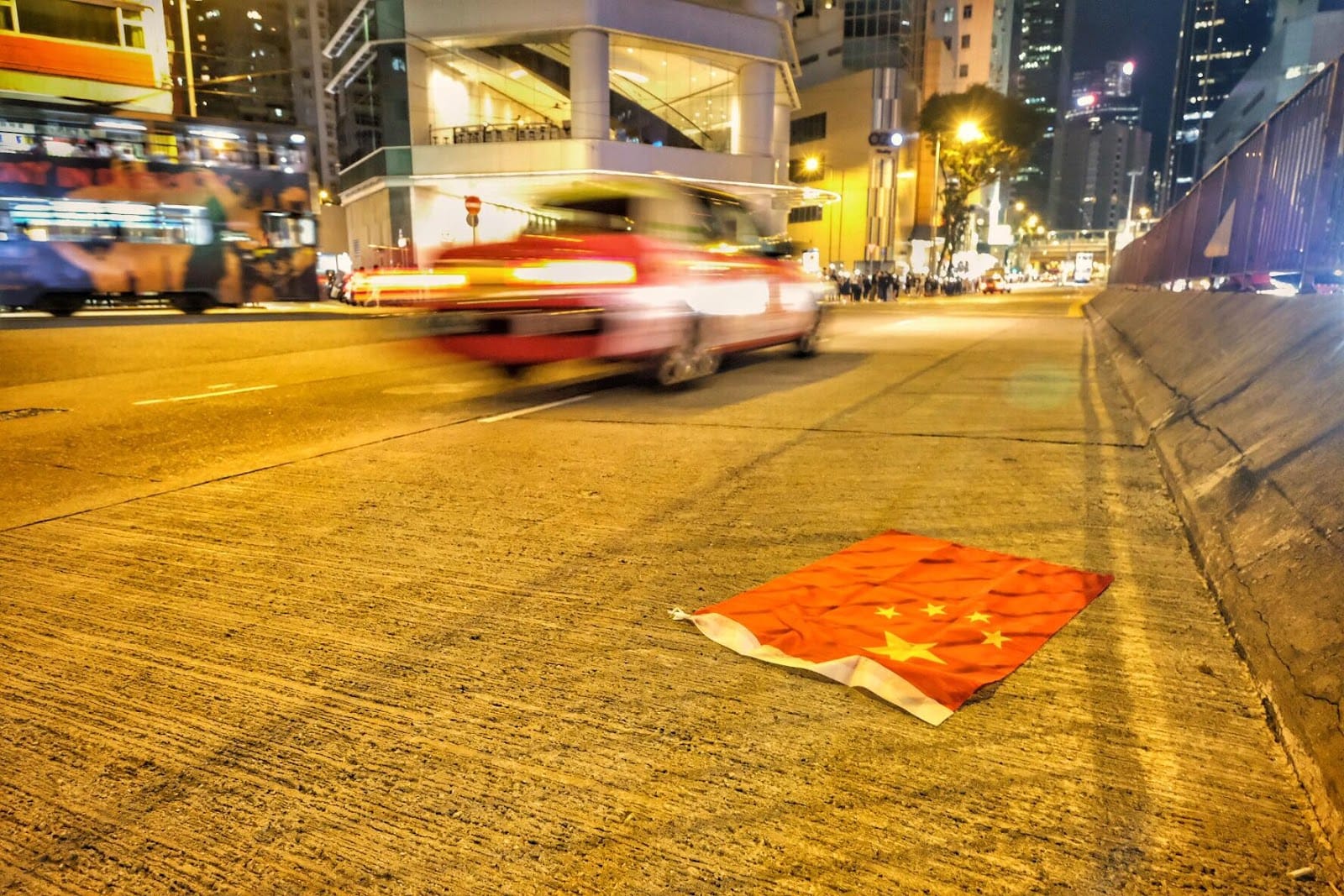
The desecration of national symbols evokes different responses from different governments. In some countries it is an acceptable form of political expression, in others an act that is merely tolerated, and in others a crime. China is among the countries that place broad restrictions on speech to criminalize acts it finds disrespectful to national symbols.
John Kamm Remembers is a feature that explores Kamm’s human rights advocacy prior to and since Dui Hua’s establishment in 1999.
Two Good Priests, Part I
Shangqiu South Church before the removal of its crosses in 2020. They were replaced with smaller crucifixes. Image credit: Union of Catholic Asia News
In October 1992, I was in Hong Kong preparing for a trip to China the next month. It would be my tenth human rights trip to Beijing since January 1991. Many of the names of prisoners I raised on those trips had been granted early release, a reflection of Beijing’s concerns over the possibility of losing its bid for the 2000 Olympic Games and the prospect of Bill Clinton defeating George H. W. Bush in the November 3, 1992 presidential election. Clinton had campaigned on stripping China of its Most Favored Nation (MFN) trading status if elected.
Preparations for trips to Beijing typically took several weeks. Appointments with officials in the Chinese government needed to be requested and, if granted, followed up with details including, on my part, the submission of political and religious prisoner lists. More mundanely, I needed to contact my regular driver and book a room at my usual hotel. Appointments with foreign diplomats and Beijing-based journalists also had to be fixed.
For the November 1992 prisoner list, I wanted to include imprisoned Roman Catholic clergy and senior laity, of whom there were more than 100 at that time. In January 1992, I submitted lists to the central government, including to the Religious Affairs Bureau of the State Council, with names of imprisoned Catholic prelates. In May 1992, I was informed of the early release from prison of three high priority underground leaders I had advocated for. This experience was on my mind as I put together my list for the mid-November 1992 trip to Beijing.
Father Giancarlo Politi, a Good Priest
For that first list of Catholic prisoners submitted in January 1992, I had relied for information from Father Giancarlo Politi, a Pontifical Institute for Foreign Missions (PIME) missionary assigned to Hong Kong. Father Politi produced and edited authoritative materials on the Catholic Church in China, gained from first-hand readings, observation, and experience in the field. The priest arrived in Hong Kong in 1970 and began traveling widely in China to make contact with Catholic communities in 1986. He was deeply concerned about the fate of imprisoned Catholic clergy. Politi usually travelled alone on his trips to the mainland, though he was occasionally accompanied by Hong Kong Catholics. These were dangerous trips, fraught with peril.
I reached out to Father Politi for assistance. I gave him a call at his place of work and residence, the PIME House in Sai Kung, Hong Kong. We agreed to meet for a “simple lunch” the next day. I contacted my driver – I was still a consultant to Occidental Chemical drawing salary and benefits, including use of a Mercedes 280SE. I arranged to be picked up at my apartment on Coombe Road the following morning.
A photo of Father Giancarlo Politi, Kaifeng, Henan, 1993. Image credit: Father Giancarlo Politi
Upon arrival at PIME House on November 5, 1992, I was met by Father Politi. He would later recall me as “a big man in a business suit with a driver and a Mercedes.” He ushered me into his office, where desks and shelves were piled high with publications and notes from his trips to China. I thanked Politi for sending me copies of PIME’s AsiaNews – he was editor at the time – and his latest mimeographed list of imprisoned Catholic bishops, priests, and senior laity. These lists informed virtually all of the publications of Western human rights groups that dealt with jailed Catholics.
I asked Father Politi for a complete set of the lists, going back several years. He demurred, saying that the most recent list had incorporated the names of all imprisoned clergy on previous lists.
Politi’s Samizdat
I insisted: “As a businessman, I always try to collect as much information as possible on a transaction,” I said. “It sometimes happens that critically important information is inadvertently omitted from the record.” Politi relented. He called his assistant, a young seminarian, and asked him to put together a complete set of the mimeographed lists, which I likened to samizdat of the old Soviet Union, unofficial publications of dissidents and activists that were widely circulated among networks in the country and abroad.
Politi escorted me to the dining hall, where we were joined by a dozen PIME monsignors and priests. The “simple lunch” turned out to be a feast with plates full of pasta, vegetables, meat and fish, washed down with glasses of chianti. After finishing up, I headed for my car. I was met at the door by the seminarian. He gave me a stack of Politi’s lists.
I was driven back to Hopewell Centre in Wanchai, site of my office. I spread out the copies of Politi’s lists on my conference table and began going through them. I quickly discovered that a name – that of Father Li Fangchun 李芳春 – had been dropped from the most recent list. I called Politi and he confirmed that a terrible mistake had been made. I then prepared an urgent appeal and faxed it, on November 7, 1992, to Vice Minister of Justice Jin Jian with whom I had established a good relationship.
Father Giuseppe Li Fangchun, born in Shangqiu County, Henan Province, in 1935, underwent formation at the Kaifeng Seminary, a regional seminary that served the Kaifeng Archdiocese and other dioceses in Henan Province and Shanxi Province. The seminary was considered one of China’s best, on a par with Shanghai’s Shesan Seminary. It was for many years under the administration of PIME. Kaifeng itself was one of the most Christian cities in the country, sometimes called the Galilee of China. It was also home to China’s largest Jewish community.
Li was ordained in secret in 1957. (Around one dozen Kaifeng seminarians were secretly ordained during the 1953-1957 period.) The last PIME missionary in Kaifeng was expelled from China in 1954. The seminary was closed in 1958 due to “lack of enrollment.”
The main gate of the Kaifeng Seminary, where Father Li spent some time. Closed in 1958, the building has been used to shoot film and television programs. Image credit: PIME Hong Kong China
According to the Chronicles of the Kaifeng Seminary published by the official Henan Catholic Administrative Commission, Li Fangchun was detained for counterrevolutionary activities together with other clergy, including the dean of the seminary, Ma Changren, around the time the seminary closed in 1958. The detentions took place during the Sufan (肃反) Movement to purge counterrevolutionaries. (Ma died in prison in 1962.) Li and the others had allegedly formed a “counterrevolutionary group” that secretly held masses, opposed the consecration of the officially appointed bishop of the Kaifeng Archdiocese, and criticized the official Catholic Patriotic Association. The Sufan Movement took place from July 1955 until early 1958. An estimated 214,000 people were detained; approximately 53,000 died, many by execution.
After his detention in 1958 Father Li was tried and sentenced to 14 years in prison for counterrevolution. He served his sentence at Kaifeng Prison, currently known as Henan Number One Prison, a maximum-security prison that has housed many political prisoners and those awaiting execution over many decades.
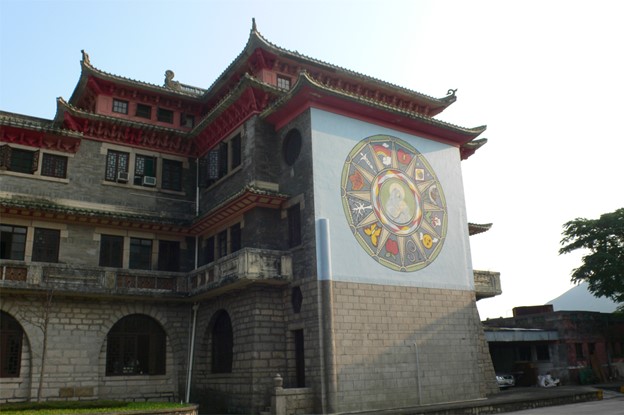
He was due to be released from prison in 1972. In that year, the Cultural Revolution, which began in April 1966, was still underway, although its worst excesses had for the most part passed. The Cultural Revolution was a period when the Catholic Church, or what was left of it, was under fierce attack. Churches were ransacked, priests “struggled” and beaten, and worse. I vividly recall being told by the Polish Consul General in Guangzhou – where there was a joint venture shipping company between China and Poland – that the priests at the Catholic church on Shamian Island had been frog marched by Red Guards from the church and lynched from lamp posts on Renmin Road in those horrifying days.
The summer of 1966 was a period of intense persecution of Catholics. Here Red Guards sack St. Ignatius Cathedral in Shanghai on August 23, 1966. Image credit: Botanwang
It is not known whether Li Fangchun was released on schedule in 1972 or had his sentence extended. He might have been placed in a re-education through labor camp, maybe in a remote area. He eventually returned to Shangqiu, a city of some 20,000 Catholics, probably in the late 1970s at the start of the Opening and Reform period when repression against Catholics eased. He began his ministry at the reopened Shangqiu South Church.
Father Li’s freedom proved to be short-lived. He was detained again in February 1983 and sentenced to 12 years in prison for counterrevolutionary activities, including membership in a counterrevolutionary group and counterrevolutionary propaganda and incitement. He was sent back to Kaifeng Prison to serve his sentence.
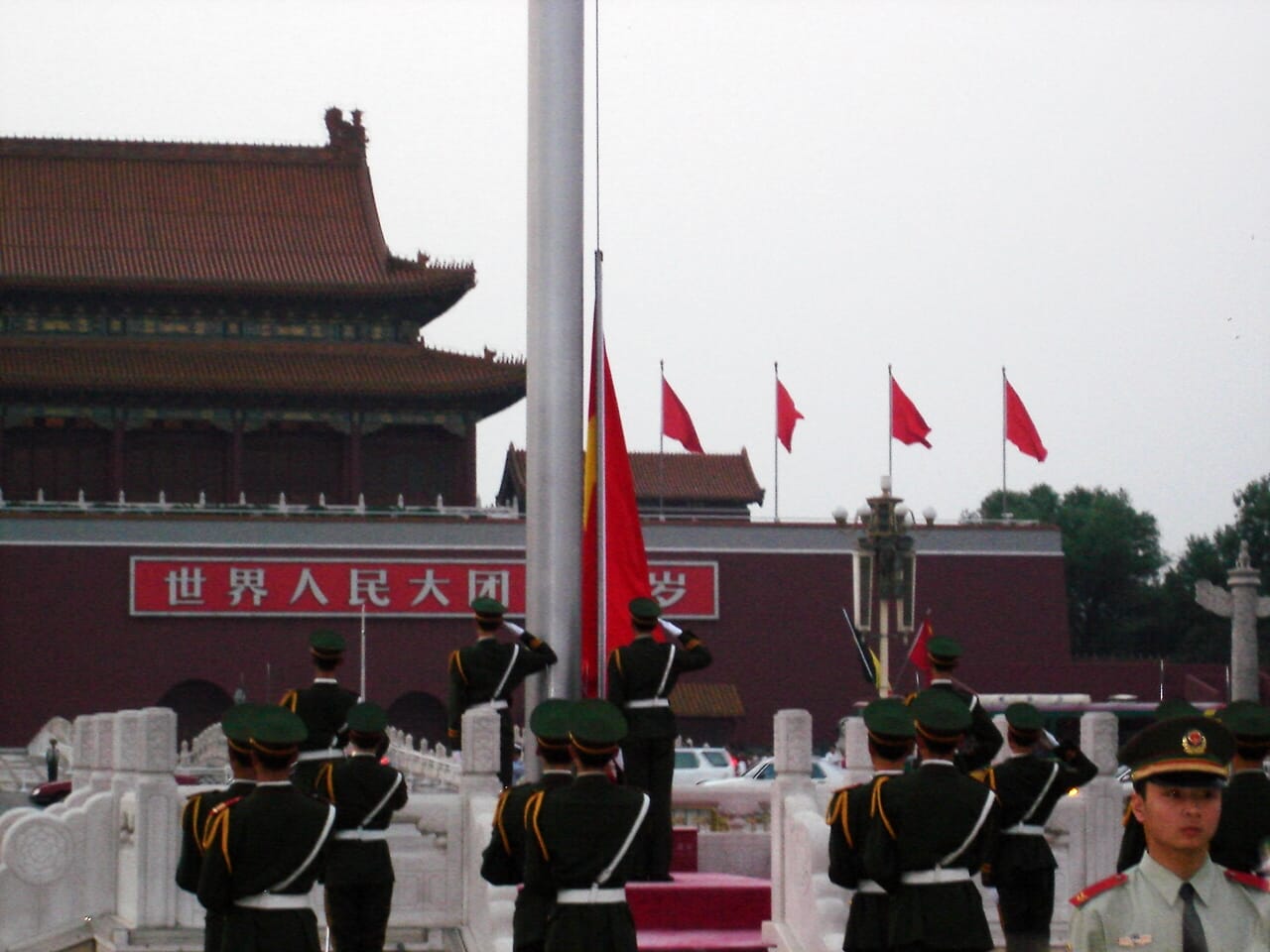
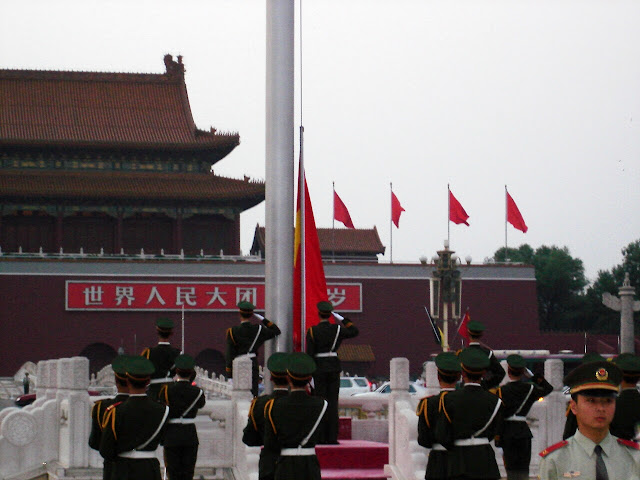
A flag hoisting ceremony in Tiananmen Square in 2005. Image credit: 武当山人 / CC BY-SA 3.0
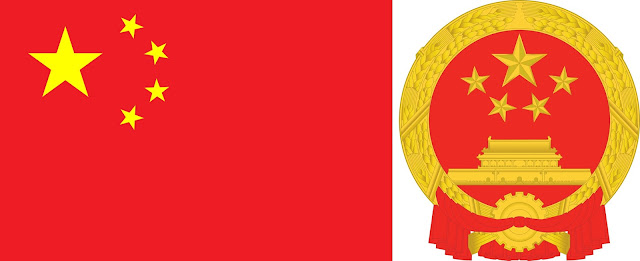
The desecration of national symbols is a crime under Chinese law. The National Flag Law was enacted in June 1990 and was extended to cover the national emblem one year later. While the laws were merely codes governing formalities to display the national symbols, a provision to the 1979 Criminal Law added in 1990 made intentionally desecrating the national flag and symbol in public a crime punishable by up to three years’ imprisonment.
This article explores the often-ignored topic of flag desecration in China. Part I looked at trends in sentencing and the law’s application across different cases. Part II discusses how the law is applied to different groups like Falun Gong, Tibetans, and Uyghurs. While most publicly disclosed cases involve “ordinary” offenders who did not desecrate the flag for political reasons, the same acts committed by practitioners of Falun Gong and ethnic minorities tend to result in lengthier prison sentences.
Political Cases
In cases where national symbols in China are desecrated in protest of public policy, like those of Wang Chunhua (王春花) and Lie Jinjie (刘杰津) discussed in Part I, the starting point for sentencing appears to get noticeably longer. Two other cases, which involved criticism of the CCP and so-called “anti-China elements,” also resulted in lengthier prison sentences. However, the circumstances of these cases have not been made entirely clear in available sources.
Tianjin’s first flag desecration case concerned Wu Zhaoming (吴兆明), who was sentenced to two years in prison in December 2017 for cutting up and damaging a total of 66 national flags, allegedly in a bid to express his discontent with the CCP. Some of the damaged flags and flagpoles were found in garbage bins and on sideroads. Available sources did not explain why Wu became dissatisfied with the CCP.
In a separate case in Changsha, Hunan, Wu Di (吴迪) was sentenced to 18 months in prison in January 2020 for setting fire to four flags with a lighter. Prosecutors alleged that Wu experienced depression due to unemployment and became “thrill-seeking” after he browsed overseas “anti-China” websites. From October 1-2, the 70th anniversary of the People’s Republic of China, he circulated a video to his friends of himself burning the flags on a university campus.
Falun Gong
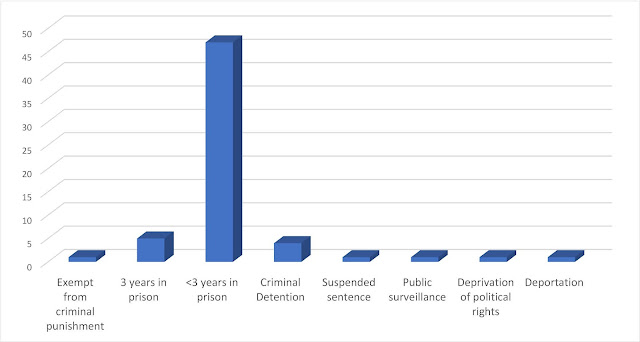
As shown in the chart below, from 1998-2016, only five people had received the maximum sentences of three years in prison. Of them, Dui Hua found that two were Falun Gong practitioners:
Chart 1. Sentencing breakdown of defendants convicted of Article 299
Source: Records of People’s Court Historical Judicial Statistics: 1949-2016
An early case involved Zhang Jingzhi (张敬之) and Wen Yanyu (文廷玉); each was sentenced to three years in prison for throwing paint-filled eggs at flags at a public memorial in Chongqing in August 2009. The heavy sentences could be attributed in part to the timing and setting of their protest. The flags were displayed at a memorial for “revolutionary martyrs”—300 Communist political prisoners held and then slaughtered by Kuomintang security agents in Chongqing’s notorious Zhazidong Prison Camp on November 27, 1949, as the city fell to the People’s Liberation Army.
According to media accounts, national and local leaders expressed concern about this flag desecration case, and personal instructions to investigators were reportedly issued by then-Chongqing governor Bo Xilai—whose use of public patriotic campaigns and a heavy-handed crackdown on corruption and organized crime was seen by some as an attempt to generate popular support to become a member of the powerful Politburo Standing Committee.
Another pair of Falun Gong practitioners, Dong Zhiyong (董志勇) and Zhi Xunlin (茆训林), in Jiangsu were sentenced for both Article 299 and Article 300 on November 2016. Although Article 299 in this case only carried one year in prison, they ended up serving prison sentences of 57-69 months because of Article 300. Chinese government sources said that the duo used sickles to damage 114 flags flown on street lampposts in the run up to the 64th National Day.
Tibetans
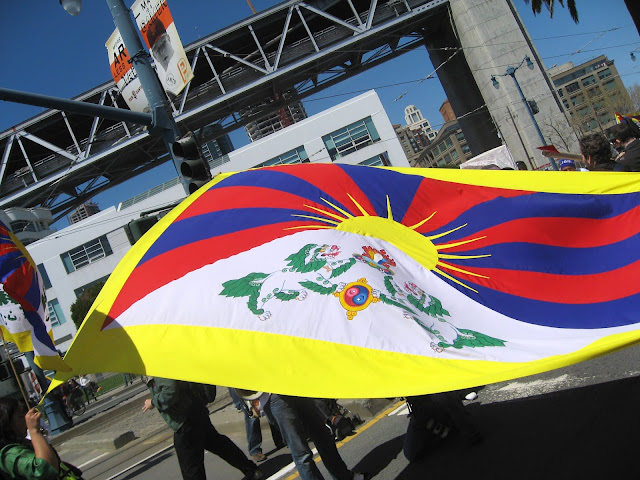
From time to time, Tibetans have undertaken flag desecration to express their blatant rejection of Beijing’s repressive religious policy, desire for genuine autonomy, and even independence. In her blog Invisible Tibet, prominent writer Tsering Woeser chronicled multiple instances of what appeared to be flag desecration incidents across the Tibetan plateau amid the 2008 Lhasa Riots. Protesters across cities and townships reportedly raised the “snow lion flag,” a symbol of the Tibetan independence movement, in place of the Chinese national flag just months ahead of the Beijing Summer Olympics.
The Tibetan flag carried during Olympic torch run demonstrations in San Francisco, California, on April 9, 2008. Image credit: Victor Lee / CC BY-NC-ND 2.0
However, many flag burning protesters might not have been charged with Article 299. Court statistics indicate that only three ethnic minorities were convicted of flag desecration from 2008-2009. It is possible they were convicted of the more serious charges of splittism or inciting splittism, with the former carrying a potential death sentence.
Dui Hua’s Political Prisoner Database has information on two Article 299 cases from 2011-2013. The two cases, both reported by Radio Free Asia, were likely linked to the self-immolation protests involving over a hundred Tibetan women and men who set themselves ablaze to highlight resistance to Beijing’s rule:
Around 2011, Sonam Norgye received a three-year prison sentence in Basu [Pashoe] County, Tibet, for hauling down and soiling with feces a Chinese flag that had been raised by government workers in the area;
Dui Hua previously reported the case of Garab (嘎热) who was accused of desecrating the flag out of frustration over the disaster relief efforts for the devastating 7.8-magnitude earthquake that rocked Nepal on April 25, 2015. The earthquake also brought causalities and widespread damage to southwestern Tibet, including his home in Tingri County.
According to the court judgment, Garab found an old Chinese national flag in the ruins of his former home weeks after the April quake. Prosecutors alleged that he burned holes in the flag and then used a marker to write “Free Tibet” on it. After allegedly hiding the flag under his mattress for several days, he discarded it along a path where some village children found it. Members of a work group stationed in the village noticed the children playing with the flag and reported the incident to local authorities. Garab received a prison sentence of two and a half years in November 2015.
Uyghurs
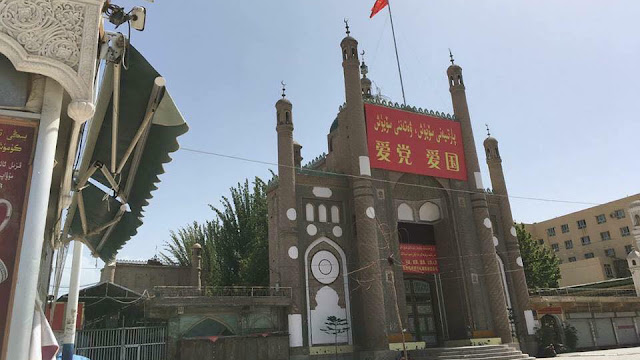
A picture of Jama Mosque in Kargilik County, Kashgar, with China’s flag and propaganda banners that read “Love the Party, Love the Country.” The photo is undated but was published by Radio Free America (RFA) in August 2018. Image credit: RFA via an unnamed RFA listener
The PPDB also has information on two Article 299 cases involving Uyghurs. In both cases, the Uyghur defendants received relatively lengthier prison sentences.
On February 20, 2013, two Uyghurs were sentenced to 24-30 months’ imprisonment in Wensu County, Aksu Prefecture. State news media sources claimed that they refused to perform salah, the obligatory Muslim prayers which are performed five times each day, in mosques where the national flag was displayed. They pulled down and burned the Chinese national flag on December 26, 2012.This trial was attended by a total of 1,208 people, including county congress representatives, religious figures, and villagers. The large size of the court audience suggested that the trial was conducted in the form of a public sentencing rally, which is often held in large outdoor public spaces like plazas and stadiums where the accused are bound and flanked by police in front of crowds of spectators that can number in the thousands. While public sentencing rallies in Xinjiang are typically held in cases involving violence, drugs, and state security, this case indicates that Uyghurs in flag desecration cases can also be brought to a public rally.
Just a month after the flag desecration case in Wensu County, a similar case was concluded in Awat County, also in Aksu Prefecture. According to news media sources, all mosques in the county were required to fly the Chinese national flag after August 2011. A muezzin (the person who performs the call to prayer) put the flag into a fireplace; he blamed the flag for the drop in mosque worshippers. Concerned about the choking smoke, he threw the half-burned flag outside of the mosque. He received a 30-month prison sentence on March 19, 2013.
Article 299: Beyond the National Flag
It is worth noting that the scope of activities punishable under Article 299 is expanding. The tenth amendment to the Criminal Law, which went into force in November 2017, made insults to the national anthem a crime punishable under the same article. Dui Hua previously reported the first known such case involving a female member of Almighty God in Xinjiang Production and Construction Corps. She received a 30-month prison sentence for composing “the Song of Satan’s Victory,” similar in tune to the national anthem.
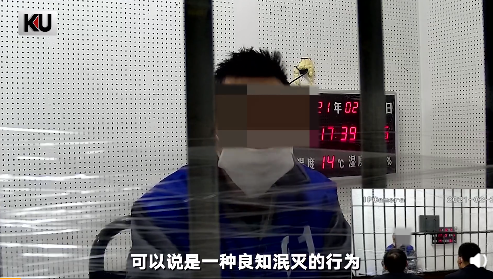
Footage of Qiu’s televised forced confession. Image credit: Hanqiu.com
China is not alone in taking an aggressive stance towards desecration, but questions remain as to whether sentencing is consistent, appropriate, and fair to all. The cases demonstrated in this post suggest that Falun Gong practitioners, Tibetans, Uyghurs, and those who commit the crime as a symbolic political expression against the CCP are at higher risk of receiving longer prison sentences. As Xi continues to cement the notion that a deep love for the CCP and even himself is the same as a deep love for the nation, it is likely that more people who do not share his version of patriotism will run afoul of an ever-expanding Article 299.
The US theatrical poster for Schindler’s List (left) and the cover for the Chinese VCD bootleg (right). People in China watched the film on pirated copies of VCDs since the film was not released in Chinese theaters. Image credit: Wikipedia; Knews.cc
This John Kamm Remembers is a continuation of last month’s installment, “Memories of 9/11,” which recounted August-September 2001, when Kamm was approached by Tina Rosenberg about being the subject of a New York Times Magazine profile, and Kamm’s experience in China in the wake of the September 11 attacks.
State Security
Tina and the photographer retained by the Times to cover our visit, Zeng Nian, arrived in Beijing from New York in the late afternoon of December 17, 2001. I met them in the lobby of the Jianguo. From the moment of their arrival going forward, we were the objects of attention by state security. One of my drivers later told me that he was summoned for questioning and shown photographs of our arrival at different ministries.
Tina and I had dinner at the Jianguo. We discussed the schedule for the days ahead.
Ngawang Choepel speaks to an audience about his work while holding a traditional Tibetan lute. SFT HQ / CC BY 2.0
On December 18, Tina, Zeng Nian, and I went to the MFA for a meeting with Li Baodong. The purpose was to discuss the possible release of Ngawang Choepel, a Tibetan musicologist who had studied at Middlebury College in Vermont and had been detained in September 1995 on a trip back to Tibet to film folk dances and record traditional music, and to see his mother. His had become an important case for Senator Jim Jeffords, R-Vermont, a pro-trade politician who had nevertheless voted against China’s Most Favored Nation (MFN) in 2001 over the way Ngawang Choepel and his family were being treated.
While we were introducing ourselves in came Foreign Minister Li Zhaoxing, who had recently returned to Beijing from Washington where he had served as ambassador. Li was familiar with the Ngawang Choephel case. Senator Jeffords’ vote against MFN had made an impression. After 9/11 Li Zhaoxing had recommended, to President Jiang Zemin, that political prisoners be released to improve the relationship with the United States, a seemingly contrarian move. Why make concessions to the United States when it was the United States that was seeking support from China?
At the MFA, Foreign Minister Li introduced Tina to Li Baodong. “This is the good Mr. Li,” he quipped. “There’s another Li who lives in Taiwan. He’s the bad Mr. Li.” The foreign minister was referring to President Lee Tenghui, seen by the Chinese government as enemy number one. After the foreign minister left the room, Li Baodong and I discussed the Ngawang Choepel case in cryptic terms. We agreed that we would meet again the next day.
For lunch, Tina and I were hosted by a large group of foreign diplomats assembled by Mark Lambert, the US embassy’s human rights officer, in the best Italian restaurant in Beijing, Aria. They spoke one-by-one about their dealings with China on human rights. In those days, China was engaged in around 10 human rights dialogues with foreign countries. Now there are none.
Offices of the Foreign minister: John Kamm with the First Vice Foreign Minister Li Zhaoxing (also former Chinese ambassador to the United States). On the left, Li Baodong, Chief of International Affairs Department of the Foreign Ministry. Image credit: Zeng Nian / Gamma-Rapho via Getty Images
Tina and I parted ways. I went on a visit to Beijing Number Two Prison. The MOJ had denied a request for Tina to join me. She went back to the MFA for a private interview with Li Baodong. We reconnected for dinner with Mark Lambert.
Not surprisingly. Tina wanted to gauge the opinion of American businesspeople about what I was up to, promoting respect for human rights on the part of the American business community in Beijing. I had set up a breakfast with the American Chamber of Commerce for 7:30 AM on December 19. Those at the table were defensive, citing the good work done for orphans and flood victims. Tina adopted a skeptical air. Outside the room, state security was listening.
After the breakfast, we went to the Supreme People’s Court for yet another uncomfortable meeting. The head of the Foreign Affairs Bureau, Mr. Liu Hehua, had clearly been caught off guard. I presented a letter from “my cousin,” Senator Orrin Hatch, and pummeled him with questions about the fate of the China Plum Blossom Party and the pamphleteer Yu Rong. I offered to provide assistance to Mr. Liu with materials on the American justice system.
As we were leaving, Mr. Liu took our photographer aside and sharply asked him about what was going on. The photographer was told that that he should be careful about who he worked for. It was not what the photographer, a French citizen with family in China, had anticipated.
There are two bookstores that were selling volumes related to judicial matters, including those related to trials for political offenses, near the Supreme Court. (NB: The bookstores no longer offer such books.) We surveyed their offerings under the watchful eyes of suspicious shopkeepers. I bought a couple, and then we were off for a photoshoot at the old Beijing railway station.
Dinner at the Beijing International Trade Center with 17 European ambassadors and the staff of European embassies working for human rights in China. John Kamm holds the book Annual judgements of the Sichuan Province in 2000. Image credit: Zeng Nian / Gamma-Rapho via Getty Images
I departed Beijing on the 5:30 PM Dragon Air flight to Hong Kong. After three days doing research and briefing clients I returned to San Francisco on December 23, in time for Christmas.
On January 16, 2002, Tina called me with the news that her editor had decided that the entire article – now a profile – would be devoted to my work. The aim was to publish it on February 16. There followed more calls between Tina and me, one on February 5 devoted entirely to Ngawang Choephel’s release that had taken place on January 20. “Wrap up” interviews followed.
A photograph of Tina Rosenberg, the author of “Kamm’s List.” Image credit: Emmanuel Upegui provided by Ms. Rosenberg
The first of two fact-checking interviews with the Times editorial staff followed. I was asked to estimate how many prisoners I had helped in the years since I began intervening on behalf of Chinese prisoners in May 1990. This entailed going over trip reports and notes. Finally, I estimated that I had helped around 250 political prisoners win early release or better treatment. During the last of these fact-checking interviews, I managed to tease the title of the article, now billed as a cover story for the Times’ Sunday Magazine, out of the fact-checker: “John Kamm’s Third Way.” I concluded that Chinese feathers would not be ruffled by this title. The story was slated to appear on Sunday March 3, 2002.
I left for Hong Kong on February 26, thence to Beijing on March 10. In Hong Kong, I intended having dinner with my Guangdong interlocutors, taping a show for VOA, giving a speech to the Asia Society, and conducting research in Hong Kong libraries. Most important, I wanted to gauge reactions to the cover story, due for publication during my days in Hong Kong.
On Friday, March 1, my cell phone went off while I was in the stacks of the Hong Kong University library. I stepped outside to take the call from my wife. The story had been published on the Times’ website on Thursday, February 28. “I thought you said that the title of the story was ‘John Kamm’s Third Way,”’ she said. “In fact, the title on the cover is ‘Kamm’s List.’” That’s when I learned that there are in fact two titles for a cover story. One for the cover, which is decided by the graphics people, the other inside the body of the article decided by the editorial staff.
The latter was in fact “John Kamm’s Third Way.” The cover was a mockup of a movie poster that closely resembled one of the movie posters for Steven Spielberg’s 1993 hit movie Schindler’s List.
Schindler’s List
I shuddered. It would be hard to avoid the comparison between Kamm, saving Chinese prisoners from the Chinese government, and Schindler, saving Jews from the Nazis. I anticipated a sharp reaction from Chinese officials in Beijing – assuming I was allowed to enter the country.
A still from Schindler’s List with Chinese subtitles. Image credit: Knews.cc
I need not have worried. I entered China on March 10, 2002, without incident. The next day I met with Li Baodong and La Yifan. La advised me that he was monitoring reactions to the article among Chinese officials and National People’s Congress and political Consultative Congress deputies, assembled in Beijing for their annual meetings, the so-called “Two Sessions.” Thus far there had been no negative reactions. I told them that there was unhappiness with the article among American businessmen. Li Baodong airily waved his hand: “Don’t worry. They’ll get over it.”
A young official escorted me from the ministry to my car. “Imagine,” he said. “An article about human rights in China in which the Chinese government is not the biggest villain!”
On the afternoon of March 11, I went to the MOJ’s headquarters where I was received by two directors: Wang Lixian, head of the International Department, and Liu Fuchen, head of the Prison Administration Bureau. We sat down and director Liu fixed his eyes on me. “Mr. Kamm, wasn’t there an article about you published in the United States recently?” I said yes, there had been a story about me in the New York Times Sunday Magazine published a few days before.
The cover of a Chinese version of the book Schindler’s List, written by Thomas Keanelly and originally titled Schindler’s Ark, published after the movie received international acclaim. Image credit: Abebooks
“What was the title of the article,” Liu asked. “John Kamm’s Third Way,” I replied. Liu shot back. “No, that’s not the title I remember.” I explained that “Kamm’s List” was the title on the cover of the magazine. “John Kamm’s Third Way” was the title listed in the table of contents and inside the issue itself. Liu continued his line of questioning. “Wasn’t there a movie with a title similar to that?” I confessed that there was: “Schindler’s List.”
Liu rubbed his hands and exclaimed: “Won an Oscar, didn’t it? Excellent!”
An Unhappy Exchange
After a final meeting with Li Baodong on the morning of March 13, I went to the Supreme People’s Court where I was received by Liu Hehua. He was not happy, taking special umbrage at a line in the story: “Kamm not only speaks Mandarin and Cantonese but also the language of the party which is just as important.” Liu adopted a threatening tone. “This will not end well for you.” It turned out that Liu was relying on a translation of the article and not the actual article itself. I admonished him to read the original, and not rely on a translation.
I returned to Hong Kong on March 14 and flew back to San Francisco on March 17, satisfied that, while members business community were not happy – the head of a large business group that promotes trade with China was especially angry – the Chinese government was, for the most part, satisfied with the article, as was the case with the human rights community.
Today, “John Kamm’s Third Way” is required reading in courses on business and human rights, including those taught at Harvard Law School, Columbia Law School, and Princeton University. A testament to Tina Rosenberg’s writing, it has stood the test of time.
NGO activists admitted into prisons; labor activists missing
Two activists of the Changsha NGO Funeng (长沙富能) have been admitted into prison. The families of Cheng Yuan and Wuge Jianxiong only recently learned of Cheng and Wuge’s admittance in October after receiving notices from the prisons.
It was widely reported that Cheng Yuan (程渊), Wuge Jianxiong (吴葛剑雄), and Liu Dazhi (刘大志) were secretly tried and sentenced in May. However, Cheng’s wife claimed that the families did not receive any documents related to the trial procedures, such as indictment and court hearing notices, and the families did not receive the judgements after learning about the sentences in August. All defendants were represented by court appointed lawyers.
The prison admission notice was sent by the Hunan Jinshi Prison to Cheng Yuan’s father. Dated September 17, the notice confirms that he was sentenced to five years by the Changsha Intermediate Court on May 25, 2021 for subversion. Cheng was reportedly detained in July 2019. This would put his release in July 2024.
Wuge’s father Wu Youshui only received a phone call from the Hengzhou Prison notifying him that Wuge has been transferred to the prison. Wuge was reportedly sentenced to three years, also for subversion. He will be released in July 2022.
Liu was reportedly sentenced to two years and was released after the conviction.
Many observers have speculated about the reasons for the activists’ arrests and convictions. Funeng has been advocating equal employment rights for those with HIV and hepatitis.
In recent months, several labor advocates have been placed in custody or gone incommunicado for endangering state security crimes. Fang Rang of Nanning, a PhD student at HKU with an interest in labor safety, has been under Residential Surveillance in a Designated Location for subversion since August 26. Wang Jianbing of Beijing, an advocate for labor safety standards and education for children in rural areas, has been missing in Shenzhen since September 19 when he accompanied a friend who was en route to Hong Kong. It has been speculated that Wang was also investigated for inciting subversion, possibly due to frequent gatherings of friends and activists at his home. The friend, journalist Huang Xueqin, is also reportedly missing.
The Administration of Activities of Overseas Non-Governmental Organizations within the Territory of China grants the police the power to investigate NGO activities. The law, commonly referred to as the foreign NGO law, passed in 2016. Activists, especially those who have received funding from overseas, are at greater risk of being seen as a threat of state security.
Lawyers avoid arrest for trial video release; unrelated charge suggested
Criminal lawyers in China collectively let out a sigh of relief following the news that the arrests for Zhou Xiaoyun and Nei Min were not approved by the procuratorate.
Zhou and Nie were taken by the Panjin police of Liaoning in early August for releasing a video clip of a court trial hearing. The Panjin police accused the two of picking quarrels and provoking trouble (PQPT) by spreading false information on the internet.
The Panjin Procuratorate, however, rejected the arrest request on September 30. In the public announcement, the procuratorate found that Zhou and Nie’s actions, while causing some harm to society, did not cause serious discord to the social order.
While this is seen by many as a victory, albeit a small one, such positive developments can be short lived. The procuratorate, having closed a door while leaving open a window, made clear that Zhou and Nie would not be let off easily.
The procuratorate suggested that although releasing the video online did not reach the seriousness of a criminal act, it still violated regulations of court conduct for lawyers. The procuratorate also made a more serious allegation. The public announcement laid out that during the investigation of PQPT, the police found the lawyers had charged their client (the defendant in the case) a large amount of money in addition to collecting the regular legal fee. The procuratorate suggested the police should refer the findings and the matters to the relevant judiciary organs and associations.
The regulatory violation could result in administrative penalties handed down by the local or provincial bar associations. Penalties usually include public criticism, blocking transferal to new law firms, and temporary or even permanent suspension of practicing license. Such administrative penalties have been increasingly used to punish outspoken lawyers, in and out of court.
The possibility that the two lawyers will face tax evasion charges is troubling and could complicate the situation further. The lawyers might not be able to practice law while under investigation by the tax administrative organs. The charges, if resulting in conviction, could lead to a simple fine or a criminal conviction and prison sentence depending on the severity of the charges.
Dui Hua Helps Secure Freedom for Two Michaels, Lifting of Exit Bans for Cynthia and Victor Liu
(Left) Meng Wanzhou during her detainment in Vancouver. (Right) On January 28, 2019, then-Homeland Security Secretary Nielsen made remarks during the announcement of indictments against Huawei and Meng. Image credits: 中国新闻网 / CC BY 3.0; US Department of Justice / Public domain
On September 25, 2021, Ms. Meng Wanzhou, Chief Financial Officer of Huawei, China’s largest technology company with 180,000 employees, left Vancouver, Canada, after Meng and her lawyers reached an agreement with the United States Department of Justice to defer prosecution, which led to the dropping of the DOJ’s extradition petition. Meng had not been allowed to leave Vancouver since she was detained at the airport in December 2018. She spent the time shuttling between her two mansions, shopping, and sharing meals with her friends.
The same day, two Canadian citizens, former diplomat Michael Kovrig and businessman Michael Spavor, both of whom had been convicted of espionage, were granted medical parole and allowed to return to Canada. They had been detained in China in December 2018. They underwent harsh interrogations under tough conditions. They had suddenly been granted medical parole, an act of clemency that does not require court review.
The next day, September 26, 2021, two US citizens, Cynthia and Victor Liu who had been banned from leaving China since June 2018, had their exit bans lifted. They boarded a plane in Shanghai for their return to New York. Their mother, Sandra Han, remained in a Guangzhou detention center. Chinese police suspected Ms. Han and the two Liu children of involvement with Liu Changming, one of China’s most corrupt officials who fled China having pilfered $1.4 billion from a large Chinese bank. Despite Liu Changming having abandoned the family without telling them where he was going, Sandra Han and the two children endured more than three years of interrogation before the children were allowed to leave. They never spent a day in jail, but they endured intense psychological pressure.
While Dui Hua’s executive director John Kamm played a small role in the negotiations leading to Michael Kovrig and Michael Spavor’s release, his involvement in the negotiations leading to the lifting of the exit bans was more consequential.
The Two Michaels
The “Two Michaels,” Michael Kovrig (left) and Michael Spavor (right). Image credit: Librero2109 / CC BY 4.0
At Kamm’s first meeting with a Chinese interlocutor to discuss the Kovrig and Spavor cases, held in early 2019, he was forcefully rebuffed and told to mind his own business. This case has nothing to do with the United States, Kamm was told by the Chinese diplomat.
At the next meeting with the diplomat, held at the Chinese consulate in San Francisco in the summer of 2019, there was a slight change in tone. “The Meng Wanzhou case and the case of the two Canadians are completely different. They are not related,” Kamm was told.
In late 2019, the same diplomat told Dua Hua’s executive director that “Although the cases are not related, if Meng Wanzhou is allowed to leave Canada, perhaps senior leaders will consider releasing the two Canadians.”
At his first in-person meeting with the consul since the pandemic began in early 2020, held in June 2021, the former businessman was told in no uncertain terms that if Meng Wanzhou were released, Kovrig and Spavor would be released. This followed the meeting between US and Chinese senior diplomats in Anchorage in March 2021. At this meeting Chinese diplomats were told that, as far as the United States was concerned, the two Canadians were as important as imprisoned Americans.
The Liu Family
Victor and Cynthia Liu, who were finally allowed to leave China in September. Image credit: Photo provided to press by friends of the Liu family.
Kamm became involved in the cases of Sandra Han and Cynthia and Victor Liu in July 2018, one month after Ms. Han was detained and the two Liu siblings had an exit ban slapped on them. Kamm became involved at the request of the family’s New York-based lawyer who had met with a senior administration official at the White House who knew of Dui Hua’s work on behalf of people subjected to coercive measures in China.
Kamm stayed involved in the case until its resolution on September 26, 2021. In the opinion of the New York lawyer who brought him into the case, Kamm was instrumental in bringing the case to a successful conclusion.
During the three-year period of Dui Hua’s involvement in the Liu family case, the foundation submitted 20 written appeals for the siblings and 16 written appeals for their mother. Appeals were submitted to Chinese officials in the United States and China.
Kamm also introduced the New York lawyer to a Beijing-based lawyer with whom Kamm had worked on political cases, including an exit ban case that bore striking resemblance to the case of the Liu siblings. He proved invaluable to the ultimate resolution of the case.
Red Notice
The process for issuing an Interpol Red Notice. The US Department of Justice has referred to Red Notices as “the closest instrument to an international arrest warrant in use today.” Image credit: Interpol.int
A breakthrough occurred in early August, 2021 as Kamm was preparing for two separate sessions with key Chinese interlocutors. Part of the preparation involved reviewing all media accounts of Liu Changming’s crime and flight from China. Several accounts referred to a “Red Notice” having been issued by Interpol for Liu. Kamm went to Interpol’s searchable website that lists all Red Notices and entered all conceivable spellings of Liu’s name. Kamm concluded that no Red Notice had been issued. He used this to confront interlocutors. “You’ve interrogated these young Americans for three years but haven’t even secured a Red Notice for their father!”
On August 15, 2021, Kamm received an email from his interlocutor at China’s San Francisco consulate. “I’d like to share with you that, during Ambassador Qin’s recent meeting with DDS Sherman, Ms. Sherman expressed her concern for the case of the Liu family. Ambassador Qin had a relatively positive response to her. The Chinese Embassy will report to Beijing again on the importance of the case.” The email was sent nine days after Kamm’s message to the official regarding the Red Notice. According to an informed source in China, the decision to lift the exit ban was made not long afterwards.
On September 26, Kamm received news from a source in China that the Liu siblings were on their way to New York. They arrived the same day, 39 months after they first learned that an exit ban had been placed on them. Their ordeal was finally over.
DUI HUA IN THE NEWS
From time to time, Dui Hua’s work and insights are featured in the press. Developments in high-profile cases have led media outlets to seek out Executive Director John Kamm’s expertise over the last few months.
Since August, Kamm has given 10 interviews for different media outlets, and Dui Hua has appeared in 25 original articles, which have been syndicated in 51 publications in regions including China, Vietnam, France, Taiwan, and Switzerland and in languages including Mandarin, French, Vietnamese, Khmer, and Spanish.
EXCHANGES
Exchanges is a feature that explores Dui Hua’s expert exchanges and dialogues.
“Racism is part of the moral panic around girlhood.”
The intersection of discrimination, race, and juvenile justice is a key focus of any discussion about youth criminal justice systems. The International Symposium on Girls in Conflict with the Law (GICL) explored the disproportionate effect family trauma, failed economic systems, and broken justice systems have on youth from Indigenous populations and communities of color.
Activist-artist Richard Ross, who has spent over 15 years photographing incarcerated juveniles in the United States, repeatedly emphasized racial disparities entrenched in the US system: every child sentenced to life without parole in the United States for a non-homicide has been a person of color; Latino youths are four times more likely to receive an adult sentence for the same crime as white youths and African American youths are nine times more likely to receive an adult sentence for the same crime. “The story that you have to tell essentially is, when you can predict that an infant boy of color in a particular zip code is more likely to go to prison than to college, you have to be able to accept that it’s our fault more than his.”
Girls of color make up 62 percent of incarcerated girls in the United States despite being only 22 percent of the youth population. Gena Castro-Rodriguez, Chief of the Victim Services Division, San Francisco District Attorney’s Office said, “We want to think about girls of color that in the United States are overrepresented for African American, Latina, and Native American girls, and how we’re overusing incarceration as a treatment strategy, instead of treating the trauma that these young people have been exposed to and experienced.”
Meda Chesney-Lind of the University of Hawaii at Manoa pointed out that African American girls are also three times more likely than their white peers to be incarcerated. Native and Indigenous girls are more than four times more likely than whites to be incarcerated. “Racism is a part of the moral panic around girlhood, and particularly girls of color are demonized [by media and society].”
Social worker Michelle De Youngshared the story of Natasha and her experience filing a report after being sexually assaulted. The child welfare social worker writing Natasha’s report doubted her account because she didn’t cry when relating the details of her assault. “Too often, those of color have their words discounted, especially young women of color. In a criminal justice system, you’re usually working with fractured individuals and fractured institutions. People ask how we can change the criminal justice system. First, we have to acknowledge that this system was created from racial institutions because right now, 99 percent of my clients are young people of color,” De Young said. Judge Susan Breall, who works in the same geographic area as De Young, also noted that young African American woman are arrested at five times the rate of other ethnic groups.
Native American youth are 30 percent more likely than white youth to be referred to juvenile court than to have charges dropped. In Canada, Indigenous people have more interactions with policing services than non-Indigenous, usually with different outcomes. Christa Big Canoe said, “If you take a Caucasian youth who’s from a middle-class or affluent family and you take an Indigenous child and they commit the same offense and they both go through the criminal justice system, you can almost always demonstrate that the Indigenous youth will get more serious punishment than the non-Indigenous youth.” Data from 2018 found that, in Canada, Indigenous youth aged 12 to 17 made up 43 percent of admissions to correctional services despite being about 8 percent of the entire population.
Describing a scene he witnessed during his work in the US juvenile justice system, Ross described an African American child in a courtroom facing two white public prosecutors and thinking ‘How does [that] feel?’ Ross continued, “These are lonely, powerless people. Every one of these children need mental health services. These are kids without a voice from families without resources, from communities without power, and that’s got to change somehow.”
To learn more about the panelists, watch their individual webinars, and read a full list of recommendations visit girlsjustice.org.
In 2000, the Ministry of Public Security issued a circular concerning the identification and banning of 14 evil cult or sect organizations. Of them, 12 were unorthodox Christian groups. Following hefty prison sentences given to founders in the 1990s, many of these groups have been severely weakened, driven underground, or have gone extinct. After state repression of religion intensified in late 2012, there appears to be a consensus that Almighty God has become the most suppressed Christian sect in China, but the continuing crackdown on other smaller and lesser-known Christian groups which are similarly considered “unorthodox” has not garnered the same level of scrutiny.
The desecration of national symbols evokes different responses from different governments. In some countries it is an acceptable form of political expression, in others an act that is merely tolerated, and in others a crime. China is among the countries that place broad restrictions on speech to criminalize acts it finds disrespectful to national symbols.
Drawing on Dui Hua’s research into news media sources, court records, and online judgments, this article sheds light on the little-discussed topic of flag desecration in China. Part I looks at trends in sentencing and the law’s application across different cases. Part II explores how the law is applied to different groups like Falun Gong, Tibetans, and Uyghurs. Most publicly disclosed cases involve “ordinary” offenders who did not make a political point against the CCP. However, the same acts committed by practitioners of Falun Gong and ethnic minorities tend to result in lengthier prison sentences.
John Kamm Remembers is a feature that explores Kamm’s human rights advocacy prior to and since Dui Hua’s establishment in 1999.
Kamm’s List
The US theatrical poster for Schindler’s List (left) and the cover for the Chinese VCD bootleg (right). People in China watched the film on pirated copies of VCDs since the film was not released in Chinese theaters. Image credit: Wikipedia; Knews.cc
Last month’s installment, “Memories of 9/11,” recounted August-September 2001, when Kamm was approached by Tina Rosenberg about being the subject of a New York Times Magazine profile, and Kamm’s experience in China in the wake of the September 11 attacks. This article continues that story.
State Security
Tina and the photographer retained by the Times to cover our visit, Zeng Nian, arrived in Beijing from New York in the late afternoon of December 17, 2001. I met them in the lobby of the Jianguo. From the moment of their arrival going forward, we were the objects of attention by state security. One of my drivers later told me that he was summoned for questioning and shown photographs of our arrival at different ministries.
Tina and I had dinner at the Jianguo. We discussed the schedule for the days ahead.
Ngawang Choepel speaks to an audience about his work while holding a traditional Tibetan lute. SFT HQ / CC BY 2.0
On December 18, Tina, Zeng Nian, and I went to the MFA for a meeting with Li Baodong. The purpose was to discuss the possible release of Ngawang Choepel, a Tibetan musicologist who had studied at Middlebury College in Vermont and had been detained in September 1995 on a trip back to Tibet to film folk dances and record traditional music, and to see his mother. His had become an important case for Senator Jim Jeffords, R-Vermont, a pro-trade politician who had nevertheless voted against China’s Most Favored Nation (MFN) in 2001 over the way Ngawang Choepel and his family were being treated.
While we were introducing ourselves in came Foreign Minister Li Zhaoxing, who had recently returned to Beijing from Washington where he had served as ambassador. Li was familiar with the Ngawang Choephel case. Senator Jeffords’ vote against MFN had made an impression. After 9/11 Li Zhaoxing had recommended, to President Jiang Zemin, that political prisoners be released to improve the relationship with the United States, a seemingly contrarian move. Why make concessions to the United States when it was the United States that was seeking support from China?
At the MFA, Foreign Minister Li introduced Tina to Li Baodong. “This is the good Mr. Li,” he quipped. “There’s another Li who lives in Taiwan. He’s the bad Mr. Li.” The foreign minister was referring to President Lee Tenghui, seen by the Chinese government as enemy number one. After the foreign minister left the room, Li Baodong and I discussed the Ngawang Choepel case in cryptic terms. We agreed that we would meet again the next day.
For lunch, Tina and I were hosted by a large group of foreign diplomats assembled by Mark Lambert, the US embassy’s human rights officer, in the best Italian restaurant in Beijing, Aria. They spoke one-by-one about their dealings with China on human rights. In those days, China was engaged in around 10 human rights dialogues with foreign countries. Now there are none.
Offices of the Foreign minister: John Kamm with the First Vice Foreign Minister (also former Chinese ambassador to the United States). On the left, Li Baodong, Chief of International Affairs Department of the Foreign Ministry. Image credit: Zeng Nian / Gamma-Rapho via Getty Images
Tina and I parted ways. I went on a visit to Beijing Number Two Prison. The MOJ had denied a request for Tina to join me. She went back to the MFA for a private interview with Li Baodong. We reconnected for dinner with Mark Lambert.
Not surprisingly. Tina wanted to gauge the opinion of American businesspeople about what I was up to, promoting respect for human rights on the part of the American business community in Beijing. I had set up a breakfast with the American Chamber of Commerce for 7:30 AM on December 19. Those at the table were defensive, citing the good work done for orphans and flood victims. Tina adopted a skeptical air. Outside the room, state security was listening.
After the breakfast, we went to the Supreme People’s Court for yet another uncomfortable meeting. The head of the Foreign Affairs Bureau, Mr. Liu Hehua, had clearly been caught off guard. I presented a letter from “my cousin,” Senator Orrin Hatch, and pummeled him with questions about the fate of the China Plum Blossom Party and the pamphleteer Yu Rong. I offered to provide assistance to Mr. Liu with materials on the American justice system.
As we were leaving, Mr. Liu took our photographer aside and sharply asked him about what was going on. The photographer was told that that he should be careful about who he worked for. It was not what the photographer, a French citizen with family in China, had anticipated.
There are two bookstores that were selling volumes related to judicial matters, including those related to trials for political offenses, near the Supreme Court. (NB: The bookstores no longer offer such books.) We surveyed their offerings under the watchful eyes of suspicious shopkeepers. I bought a couple, and then we were off for a photoshoot at the old Beijing railway station.
Dinner at the Beijing International Trade Center with 17 European ambassadors and the staff of European embassies working for human rights in China. John Kamm holds the book Annual judgements of the Sichuan Province in 2000. Image credit: Zeng Nian / Gamma-Rapho via Getty Images
I departed Beijing on the 5:30 PM Dragon Air flight to Hong Kong. After three days doing research and briefing clients I returned to San Francisco on December 23, in time for Christmas.
On January 16, 2002, Tina called me with the news that her editor had decided that the entire article – now a profile – would be devoted to my work. The aim was to publish it on February 16. There followed more calls between Tina and me, one on February 5 devoted entirely to Ngawang Choephel’s release that had taken place on January 20. “Wrap up” interviews followed.
A photograph of Tina Rosenberg, the author of “Kamm’s List.” Image credit: Emmanuel Upegui provided by Ms. Rosenberg
The first of two fact-checking interviews with the Times editorial staff followed. I was asked to estimate how many prisoners I had helped in the years since I began intervening on behalf of Chinese prisoners in May 1990. This entailed going over trip reports and notes. Finally, I estimated that I had helped around 250 political prisoners win early release or better treatment. During the last of these fact-checking interviews, I managed to tease the title of the article, now billed as a cover story for the Times’ Sunday Magazine, out of the fact-checker: “John Kamm’s Third Way.” I concluded that Chinese feathers would not be ruffled by this title. The story was slated to appear on Sunday March 3, 2002.
I left for Hong Kong on February 26, thence to Beijing on March 10. In Hong Kong, I intended having dinner with my Guangdong interlocutors, taping a show for VOA, giving a speech to the Asia Society, and conducting research in Hong Kong libraries. Most important, I wanted to gauge reactions to the cover story, due for publication during my days in Hong Kong.
On Friday, March 1, my cell phone went off while I was in the stacks of the Hong Kong University library. I stepped outside to take the call from my wife. The story had been published on the Times’ website on Thursday, February 28. “I thought you said that the title of the story was ‘John Kamm’s Third Way,”’ she said. “In fact, the title on the cover is ‘Kamm’s List.’” That’s when I learned that there are in fact two titles for a cover story. One for the cover, which is decided by the graphics people, the other inside the body of the article decided by the editorial staff.
The latter was in fact “John Kamm’s Third Way.” The cover was a mockup of a movie poster that closely resembled one of the movie posters for Steven Spielberg’s 1993 hit movie Schindler’s List.
Schindler’s List
I shuddered. It would be hard to avoid the comparison between Kamm, saving Chinese prisoners from the Chinese government, and Schindler, saving Jews from the Nazis. I anticipated a sharp reaction from Chinese officials in Beijing – assuming I was allowed to enter the country.
A still from Schindler’s List with Chinese subtitles. Image credit: Knews.cc
I need not have worried. I entered China on March 10, 2002, without incident. The next day I met with Li Baodong and La Yifan. La advised me that he was monitoring reactions to the article among Chinese officials and National People’s Congress and political Consultative Congress deputies, assembled in Beijing for their annual meetings, the so-called “Two Sessions.” Thus far there had been no negative reactions. I told them that there was unhappiness with the article among American businessmen. Li Baodong airily waved his hand: “Don’t worry. They’ll get over it.”
A young official escorted me from the ministry to my car. “Imagine,” he said. “An article about human rights in China in which the Chinese government is not the biggest villain!”
On the afternoon of March 11, I went to the MOJ’s headquarters where I was received by two directors: Wang Lixian, head of the International Department, and Liu Fuchen, head of the Prison Administration Bureau. We sat down and director Liu fixed his eyes on me. “Mr. Kamm, wasn’t there an article about you published in the United States recently?” I said yes, there had been a story about me in the New York Times Sunday Magazine published a few days before.
The cover of a Chinese version of the book Schindler’s List, written by Thomas Keanelly and originally titled Schindler’s Ark, published after the movie received international acclaim. Image credit: Abebooks
“What was the title of the article,” Liu asked. “John Kamm’s Third Way,” I replied. Liu shot back. “No, that’s not the title I remember.” I explained that “Kamm’s List” was the title on the cover of the magazine. “John Kamm’s Third Way” was the title listed in the table of contents and inside the issue itself. Liu continued his line of questioning. “Wasn’t there a movie with a title similar to that?” I confessed that there was: “Schindler’s List.”
Liu rubbed his hands and exclaimed: “Won an Oscar, didn’t it? Excellent!”
An Unhappy Exchange
After a final meeting with Li Baodong on the morning of March 13, I went to the Supreme People’s Court where I was received by Liu Hehua. He was not happy, taking special umbrage at a line in the story: “Kamm not only speaks Mandarin and Cantonese but also the language of the party which is just as important.” Liu adopted a threatening tone. “This will not end well for you.” It turned out that Liu was relying on a translation of the article and not the actual article itself. I admonished him to read the original, and not rely on a translation.
I returned to Hong Kong on March 14 and flew back to San Francisco on March 17, satisfied that, while members business community were not happy – the head of a large business group that promotes trade with China was especially angry – the Chinese government was, for the most part, satisfied with the article, as was the case with the human rights community.
Today, “John Kamm’s Third Way” is required reading in courses on business and human rights, including those taught at Harvard Law School, Columbia Law School, and Princeton University. A testament to Tina Rosenberg’s writing, it has stood the test of time.
The desecration of national symbols evokes different responses from different governments. In some countries it is an acceptable form of political expression, in others an act that is merely tolerated, and in others a crime. China is among the countries that place broad restrictions on speech to criminalize acts it finds disrespectful to national symbols.
The five-starred red national flag, which symbolizes the Communist Revolution and unity of the Chinese People under the leadership of the Chinese Communist Party (CCP), is at the heart of the legislation to mandate respect. Its first effort began with the National Flag Law in June 1990. The following year, the law was extended to cover the national emblem, which comprises the design of Tiananmen in a red circle illuminated by five stars and surrounded by sheaves of wheat. While the laws were merely codes of practice governing the formalities to display the two national symbols, a provision to the 1979 Criminal Law added in 1990 made intentionally burning, mutilating, scrawling on, defiling, or trampling upon the national flag and symbol in public a crime punishable by up to three years’ imprisonment.
Despite being a criminal offense in mainland China for nearly three decades, flag desecration cases have yet to be thoroughly discussed by observers. Internet searches are swamped with media coverage related to the now-rescinded extradition bill in Hong Kong. During the second half of 2019, Hong Kong protesters made headlines for burning, trampling, and flinging the national flag into the sea and defacing the national emblem on China’s liaison office. The former British colony is slated to amend its flag desecration law to criminalize acts in the virtual world, while extending the time allowable for a prosecution for up to two years.
Drawing on Dui Hua’s research into news media sources, court records, and online judgments, this article sheds light on the little-discussed topic of flag desecration in China. Part I looks at trends in sentencing and the law’s application across different cases. Part II explores how the law is applied to different groups like Falun Gong, Tibetans, and Uyghurs. Most publicly disclosed cases involve “ordinary” offenders who did not make a political point against the CCP. However, the same acts committed by practitioners of Falun Gong and ethnic minorities tend to result in lengthier prison sentences.
Court statistics, 1998-2016
Chart 1. No. of accepted and concluded first-instance criminal cases invoking Article 299
Source: Records of People’s Court Historical Judicial Statistics: 1949-2016
First and foremost, Article 299 has not been frequently invoked in China. The 12-volume Records of People’s Court Historical Judicial Statistics: 1949-2016 published by the Supreme People’s Court in 2018 indicated that there were only 61 first-instance criminal cases involving 86 defendants from 1998-2016. Except for 2014, the number of people brought to trial every year never exceeded 10. No court cases were tried or concluded in 2001, 2005, and 2006.
While Article 299 only covered the national flag and emblem from 1998-2016, criminal cases concerning the latter are rare. A possible reason for this is that the national emblem, typically displayed at government offices, is less readily accessible to the general public. Dui Hua has only found one case where someone was sentenced to one year in prison for editing an online image of the national emblem. His sentence was reduced to six months’ criminal detention upon appeal. Most, if not all, of the cases Dui Hua found relate to the physical desecration of the national flag in public spaces.
The surge of cases beginning in 2012 coincided with Xi Jinping’s ascension to General Secretary. This increase likely reflects his image as a patriotic leader who is more eager than his predecessor to punish disrespect of the national flag, which has come to symbolize the unity of the Chinese people under his leadership. After 2016, the last year for which court statistics are available, Xi continued to usher in new laws aimed at further legislating respect for the national flag. In October 2020, the National People’s Congress Standing Committee passed another amendment to make it a crime to simply turn the national flag upside town.
Nearly four in every five defendants received prison sentences of less than three years. The maximum sentence of three years was only meted out to five defendants. After cross-referencing cases recorded in its Political Prisoner Database, Dui Hua found that Falun Gong practitioners and Tibetans were among those who received the maximum sentences.
Chart 2. Sentencing breakdown of defendants convicted of Article 299
Source: Records of People’s Court Historical Judicial Statistics: 1949-2016
Another notable observation gleaned from court statistics is that 70 percent of all the defendants were ethnic minorities. The court records did not specify which ethnic groups were involved. Public information about these cases is also sparse. Of the 46 Article 299 judgments posted on China Judgements Online, all but five were Han Chinese. The selective disclosure of court judgments suggests an effort to cover up ethnic discord.
The First Desecration Case
China’s first criminal trial of flag desecration was reportedly concluded in April 1993. In this case, three students from the Fujian Vocational College of Geology were sentenced to 12-18 months of public surveillance. According to the judgment, the students became dissatisfied with the school after they received disciplinary punishment for violating school regulations. They held a grudge against the student guard team, who they believed was the whistle-blower. In November 1992, the students hoisted two men’s pants on a flagpole in the school playground. They doused the Chinese national flag with kerosene and set it on fire.
The Chinese national flag and emblem. Desecrating either has been punishable by up to three years in prison since 1990. Image credit: Wikimedia Commons
A commentary on this first case of flag desecration commended the court’s decision to hand down public surveillance to the adolescent defendants (one of them was minor at the time of the offense). The punishment was a rare act of leniency: public surveillance was only given once, in 2003 for a period of 18 years beginning in 1998. As part of the emplacement measures, the students were allowed to continue attending the same school. However, the court was obliged to hold them criminally liable for desecrating the national flag, which “represents the sovereignty and dignity of the nation.” Their acts of “intentionally insulting the national flag is an affront to the dignity of the country and damages the patriotic passion of the Chinese people.”
Non-political Desecration
The same line of patriotic argument has been reiterated to determine conviction in many other publicly disclosed flag desecration cases. Most of these cases are similarly apolitical, with offenders committing the crime over seemingly personal or trivial matters. There were also cases where defendants faced trials for what they claimed were drunken indiscretions. The prison sentences in such cases rarely exceeded six months.
Recent examples include:
Fang Runzhou (范润州), a farmer from Sanmenxia, Henan, was sentenced to six months of public surveillance in 2017 for ripping up a national flag after a futile attempt to register with the village committee as a “poverty household.”
A man surnamed Zhong from Guangdong received a six-month prison sentence in May 2018 for trampling the national flag while performing a lion dance for a newly opened martial arts center.
On October 1, 2019, Ma Yiyi (马义益) burned two national flags to “vent dissatisfaction with his life circumstances and social reality.” The flags were slated for display at a school in Zunyi, Guizhou, on the 70th anniversary of the founding of the People’s Republic of China. Ma was sentenced to six months in prison in December 2019.
The court hearing for the defendant Pang, who was sentenced to six months in prison for desecrating the flag. Image credit: New.qq
Political Desecration
As with protests in western countries, national flags in China are sometimes burned in protest of public policy. This happened to be the case of Wang Chunhua (王春花), whose anger with the local government’s decision to rush the construction of a garbage incinerator in Nan County, Hunan, landed her a one-year prison sentence (suspended for 18 months) in May 2017. Wang took part in a protest, where she lowered the national flag from a flagpole in front of a county government office building. The court found her guilty of “recklessly waving the national flag, throwing it on the ground and trampling it multiple times.”
The starting point for sentencing appears to get noticeably longer in cases triggered by political defiance. Dui Hua found a case where Lie Jinjie (刘杰津) was sentenced to 18 months in prison for burning the national flag in Chibi City, Hubei, in November 2020, allegedly in a bid to express discontent with the stringent COVID-19 quarantine rules. Unable to return to work in Jiangsu amid the province-wide lockdown, Lie claimed to have been inspired by online images of “Taiwanese and Hong Kong independence activists” who burned the national flag to vent discontent with the Chinese government.
Part II, which explores cases of political desecration and looks at how Article 299 is applied to Tibetans, Uyghurs, and Falun Gong practitioners, will be published in two weeks.