Elderly Falun Gong practitioner allowed to serve sentence outside of prison
An elderly female Falun Gong practitioner from Daqing in Heilongjiang Province has been allowed to serve her sentence outside of prison.
Cong Ruimin (丛瑞敏), who is in her sixties, was detained in August 2019 when the police searched her home and confiscated Falun Gong materials including posters, books and pamphlets, volumes of Falun Gong images, and hours of anti-CCP video clips on a computer. Cong made a written promise to denounce Falun Gong and was placed under residential surveillance in October 2019 before the trial. She was later given a sentence of three years in prison by the Daqing Ranghulu District People’s Court in December 2019. The sentence expires in August 2022.
Dui Hua recently learned that Cong was granted permission to serve her sentence outside of prison after the trial. Cong was diagnosed with gastrointestinal cancer. The sentencing court granted the request in November 2020 and placed her in the community correctional program (社区矫正). In August 2021, the court extended the clemency decision for the remainder of her sentence since her condition did not improve.
Xing Wangli indicted
Xing Wangli (邢望力), a petitioner and activist, was formally indicted in January 2022.
Xing was detained for “picking quarrels and provoking trouble” in May 2021 in Henan Province following his attempt to visit renowned rights lawyer Jiang Tianyong in April 2021. Xing was later arrested in June, but for defamation.
The Xi Country People’s Procuratorate requested two supplemental investigations from the police in late 2021. In the document filed to the Xi County People’s Court, the prosecutor accused the elder Xing of arranging and posting an open letter on two social media platforms that gathered over 25,000 views. In the letter, Xing accused a local propaganda official of corruption and intimidating his family over a traffic accident and dispute.
Although defamation cases are usually handled as private prosecution cases, a joint 2013 judicial interpretation from the SPC and SPP clarified the threshold for how spreading disinformation or false accusations online can constitute criminal acts. If a post deemed to contain disinformation or false accusations accrues more than 5,000 views or 500 reposts, then it is considered a “serious circumstance.” The interpretation grants authorities power to charge people with the ill-defined “causing harmful social influence.”
Xing’s son, Xing Jian, said his father’s lawyer obtained the indictment on March 21 and has applied for bail. The lawyer still has not been able to meet with the elder Xing because of the restrictions imposed by many government organs in China due to the COVID-19 pandemic. Xing Jian fled China as a refugee in 2020.
Li Qiaochu indicted
The Shandong Linyi People’s Procuratorate formally submitted an indictment for inciting subversion against feminist and labor activist Li Qiaochu (李翘楚) in January 2022. The indictment comes after numerous postponements for supplemental investigations and more than two years since she was first placed under residential surveillance in a designated location for advocating for better treatment for Xu Zhiyong.
In a version of indictment posted online, the prosecutor saw Li’s relationship to Xu as the cause of her subversive thinking. Her crime, summarized in a short paragraph, was committed under the influence of her boyfriend as she operated a personal blog for Xu and posted numerous subversive articles written by him. Xu was also indicted for inciting subversion in August 2021.
Li has been a long-time labor advocate, beginning her activism in her college years. She was harassed by police and state security after Xu Zhiyong went into hiding in 2019. In 2021, she announced that Xu been tortured while in the Linyi Detention Center and later accepted the Cao Shunli Memorial Award for Human Rights Defenders on his behalf.
She is reportedly suffering from auditory hallucinations and requires medication. In late 2021, her condition worsened, and she was admitted to the Linyi Psychiatric Hospital. Her mother and lawyer have repeatedly submitted requests for bail before trial but to no avail.
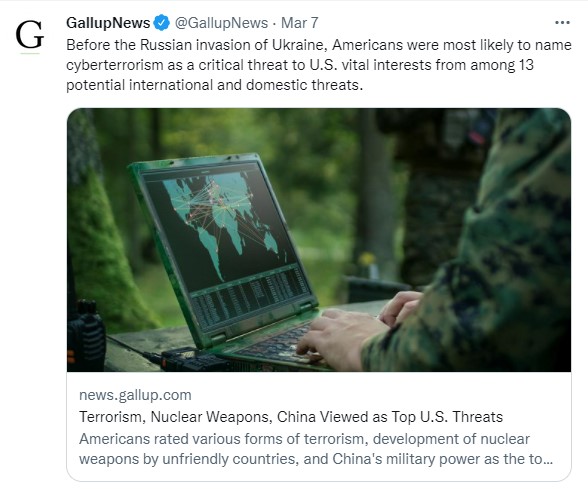
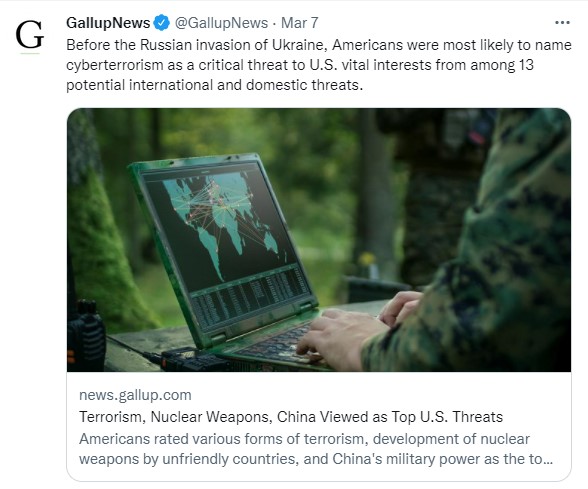
A post on Gallup News’ Twitter account releasing their study on threats to the United States. Image credit: Gallup News Twitter account
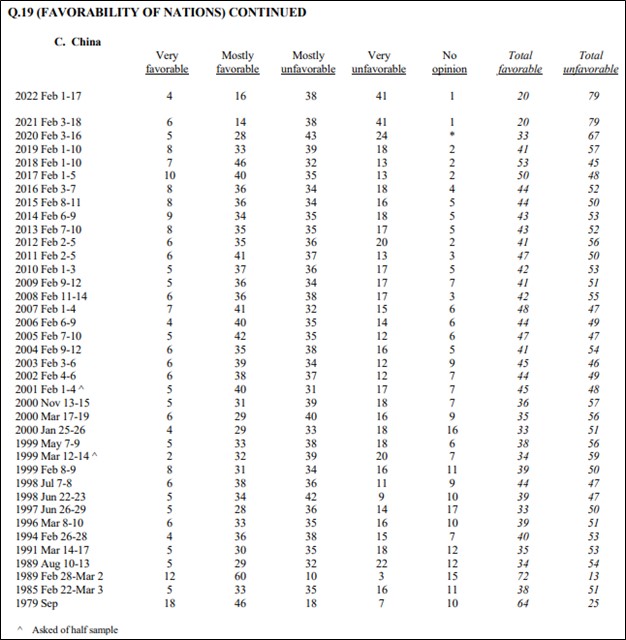
In Gallup’s latest annual World Affairs poll, conducted from February 1-17, the American public’s opinion of China remains at a historic low. The poll, conducted partly during the 2022 Winter Olympics, found that 79 percent of respondents have an unfavorable view of China, with 41 percent answering “very unfavorable.” Only 20 percent of respondents have a “favorable” view of China. The numbers remain largely unchanged from the 2021 poll.
China’s favorability rating is at its lowest since Gallup started to poll American attitudes towards the country in 1979. An on-going trade imbalance, the COVID-19 pandemic, and alleged human rights violations in Hong Kong and Xinjiang likely all contributed to unfavorable opinions. In a 2020 poll by the Pew Research Center, 82 percent viewed China’s human rights policies as a serious problem.
The Gallup poll also found that Americans view China as a “critical” threat to US security. While more respondents identified terrorism (including cyber, international, and domestic) and the development of nuclear weapons by Iran and North Korea as critical threats, anxiety over China’s military power outranked the spread of infectious diseases and climate change in perceptions of being a critical threat. When given a list of possible threats to US interests, 67 percent said that China’s military power is a “critical” threat and 29 percent ranked it as “important;” only 4 percent characterized it as “unimportant.” The concern reached a historic high and even outstripped worries over military threat from Russia. The threat of China’s economic power is also considered “critical” by 57 percent of respondents and “important” by 34 percent. However, concern over China’s economic power fell from 63 percent in 2021.
From Gallup’s February 1-17 survey, Americans’ favorability of China from 1979-2022. The poll was conducted from February 1-17 via telephone interviews with 1,008 adults and has a margin of error of 4 percentage points. Image credit: Gallup [PDF, 873 KB]
A similar poll by Pew Research conducted before the 2022 Beijing Olympics asked Americans if they see China as a partner, competitor, or enemy. The majority, 54 percent, saw China as a competitor; 35 percent answered as an enemy. Only 9 percent saw China as a partner. These opinions remained largely unchanged from 2021, when the views as competitor and enemy were 55 percent and 34 percent, respectively.
The recently released polls were conducted in January and February, prior to the Russia invasion of Ukraine. China has since publicly supported Russia’s position while amplifying disinformation domestically. It is likely China’s favorability among Americans will suffer further as it embraces stronger anti-Western and anti-United States rhetoric.
A different time: in 2017, Gallup polling found US attitudes to China to be at their highest point. Image credit: CGTN Twitter account
The change in US leadership in 2021 did not bring a reset, or significant improvements, in the government’s official stance toward China as some had hoped it would. President Biden has made adjustments to policies inherited from the Trump administration while adopting a less incendiary tone. The Biden administration, however, has continued tough positions on trade negotiations and restrictions on key technologies while imposing more sanctions against human rights abuses in Hong Kong and Xinjiang.
This latest polling will likely further the notion that the US-China relationship is at a crossroads, with the leadership of both struggling to differentiate where competition ends and hostility begins. Even at the lowest point of US-China confrontation during the Cold War, diplomacy, including efforts involving non-government interlocutors, was never completely dismissed. With publics in both the United States and China voicing more animosity for each other, politicians may soon be looking to change tact or adopt more policies to further decoupling.
Dui Hua’s new report “The Persecution of Unorthodox Religious Groups in China” [PDF, 1.4 MB] details and analyzes the Chinese government’s treatment of unorthodox religious groups, listing known banned groups and the actions taken against them. The report, compiled over several months in 2021, offers a view into a substantial and largely unrecognized aspect of the Chinese population.
“The Persecution of Unorthodox Religious Groups in China” is based on legal documents, media reports, case studies, official publications, Chinese government responses to requests for information on persecuted prisoners, court statistics, and Dui Hua’s Political Prisoner Database (PPDB). It provides a comprehensive view of how non-state sanctioned religious practitioners come into conflict with the law, how officials at different levels of government criminalize unorthodox worship, and how past trends can inform future advocacy for those undergoing coercive measures for the non-violent expression of their beliefs.
As early as 1951, regulations on punishing counterrevolutionaries targeted leaders of reactionary religious organizations. Currently, the Chinese government allows its citizens to take part in the five state-sanctioned patriotic associations of Buddhism, Catholicism, Daoism, Islam, and Protestantism, but many seeking spiritual salvation look beyond government-approved faiths and embrace unorthodox religious groups.
Graph 1. Defendants and 1st-instance cases accepted and concluded for violating Article 300(1)
Image credit: The Dui Hua Foundation
Noting the extensive historical context informing the Chinese government’s approach to religious groups, especially those not sanctioned by the state, Dui Hua found that the 1997 revision to the criminal law placed “cult” trials into the purview of district courts, resulting in less transparency and attention for such cases. By 1999, trials of Article 300 cases—for those accused of organizing and using superstitious sects, secret societies, and religious organizations to undermine the law—soared, largely due to the ban on Falun Gong.
The report includes an overview of 41 unorthodox religious groups; a summary of laws and regulations targeting unorthodox religious groups; analysis of court statistics from 1979-2016; discussion of deteriorating transparency in the disclosure of information on Article 300 cases; analysis of religious persecution using the PPDB; a summary of Dui Hua’s advocacy for such prisoners using prisoner lists and responses; and recommendations for future advocacy.
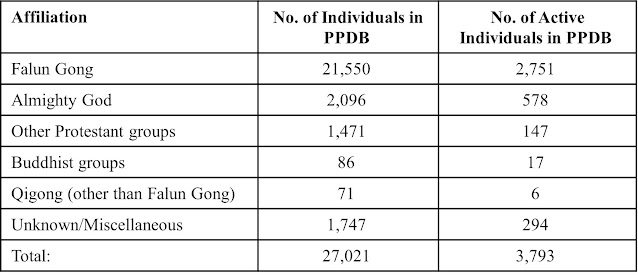
Table 1. Breakdown of unorthodox religious practitioners in PPDB by affiliation
Source: PPDB
The objective of the report is to enable more effective interventions on behalf of practitioners of unorthodox religious groups who face coercive measures under Article 300 by providing insight and actionable information. Its main findings include the following:
The number of adherents of orthodox religious groups makes up more than 10 percent of China’s population, perhaps as many as 15 percent. Unorthodox religious groups exist in all of China’s provinces and autonomous regions, and many have developed links to international groups. If the number of unorthodox religious adherents was incorporated into official figures, then the number of all religious practitioners in China would far exceed the current government figure of 200 million official practitioners (as of 2018).
Adherents of unorthodox religious groups subjected to coercive measures for violating Article 300(1)—“organizing and using a cult to undermine implementation of the law”—and other charges make up 60 percent of all prisoners in the PPDB. Their numbers have swelled in recent years as sentence reductions and paroles have been restricted.
The most common crime for which adherents of unorthodox religious groups are imprisoned is covered by Article 300(1) of China’s Criminal Law but other crimes are also used, including endangering state security and economic crimes like committing fraud (Article 266) and operating illegal businesses (Article 225).
Falun Dafa (aka Falun Gong) and the Church of Almighty God have the largest number of adherents, but there are many other smaller groups. This report identified 41 unorthodox religious groups operating in China today or during the last two decades.
From 1998-2016, women made up 41 percent of those sentenced to prison for violating Article 300, five times the percentage of all women prisoners in China.
Graph 2. Gender Breakdown of prisoners and unorthodox religious prisoners in PPDB
Image credit: The Dui Hua Foundation
Adherents of unorthodox religions are typically non-violent. Instances of violence are rare; when they occur, the Chinese government features them in “anti-cult” propaganda. Adherents have been convicted of rape and murder. Those so convicted are often executed.
The persecution of unorthodox religious groups has existed since the founding of the People’s Republic in 1949; adherents were classified as counterrevolutionaries prior to 1997. They have been viewed as threats to the government’s hold on power.
Persecution of unorthodox religious practitioners rose sharply following the banning of Falun Gong in 1999. In recent years, practitioners have seen sentences increase and clemency restricted. Persecution shows no sign of abating. In 2018, there were 3,550 people tried for violating Article 300(1), one of the highest numbers of individuals tried for this charge in recent years.
Adherents of unorthodox religions rarely make their way onto prisoner lists submitted to the Chinese government in bilateral and multilateral human rights dialogues. Their numbers dwarf those subject to coercive measures for exercising their political beliefs.
Dui Hua encourages governments to raise the issue of this persecution in formal and informal discussions on human rights with the Chinese government and to include the names of imprisoned practitioners of unorthodox religions to the lists compiled for use in human rights dialogues with China. When, and to the extent possible, governments and NGOs should support appeals of unorthodox religion practitioners to Special Procedures of the United Nations. More so, governments and NGOs should incorporate concerns about the persecution of unorthodox religious groups into submissions to China’s Universal Periodic Review, tentatively scheduled for October 2023.
Finally, governments should use this report when considering applications of political asylum by practitioners of unorthodox religions. Some governments, particularly in Europe, have become more open to accepting asylum requests for Church of Almighty God members. Dui Hua encourages courts to recognize the persecution of unorthodox religious group members as grounds for asylum and to recognize precedents for such asylum requests.
SAN FRANCISCO (March 23, 2022) — A Guangzhou-based Chinese businessman who was convicted of producing illegal publications, including a vast trove of literature promoting the banned spiritual group Falun Gong, has been released from prison after serving a long sentence, Dui Hua has learned.
Liang Jiantian (梁鉴添), now 70 years old, was sentenced to life in prison in 2000 for illegal business activities (covered by Article 225 of the Criminal Law) and manufacturing or reproducing obscene materials for profit (covered by Article 363). Dui Hua found his name in open sources in 2002 and began placing Liang’s name on lists submitted to the Chinese government. In 2007, Liang’s sentence was commuted and replaced with a sentence of 20 years imprisonment followed by seven years deprivation of political rights (DPR). The sentence was due to expire in 2027. Liang served his sentence in Panyu Prison. Prison authorities claim he was in good health on his release.
Dui Hua placed Liang’s name on 20 lists submitted to the Chinese government. Eighteen responses were received, and they chronicled multiple sentence reductions totaling six years.
Liang and his business partner Liu Jingsong (刘镜崧) were convicted by the Guangzhou Intermediate Court in November 2000 of illegal business activities and subsequently sentenced, respectively, to life in prison and 20 years in prison. Between September 1996 and March 2000, the pair were accused of producing publications without a permit. Among the “illegal publications” printed, there were nearly five million books or pamphlets of Falun Gong materials, generating 14 million RMB in revenue. It is not known whether Liang was a Falun Gong practitioner.
A third defendant in the same trial, Liu Hua (刘华), who placed the order for the Falun Gong materials, was sentenced to eight years in prison.
Liang has begun serving his DPR sentence. During this period, his employment opportunities are limited, he is under constant surveillance, and he is unable to publish or give interviews to foreign journalists. It is not known if Liang has benefited from reductions in his DPR sentence.
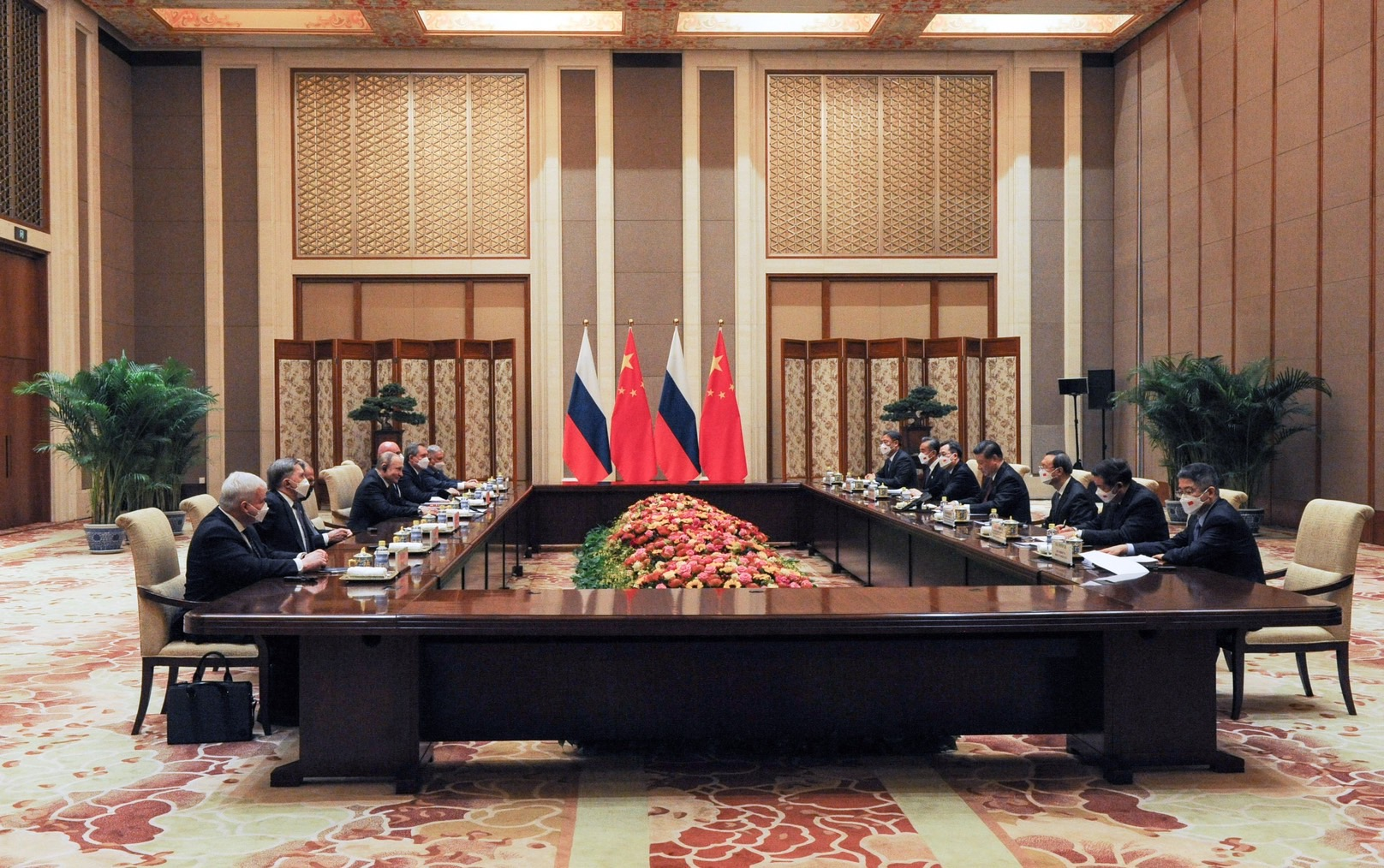
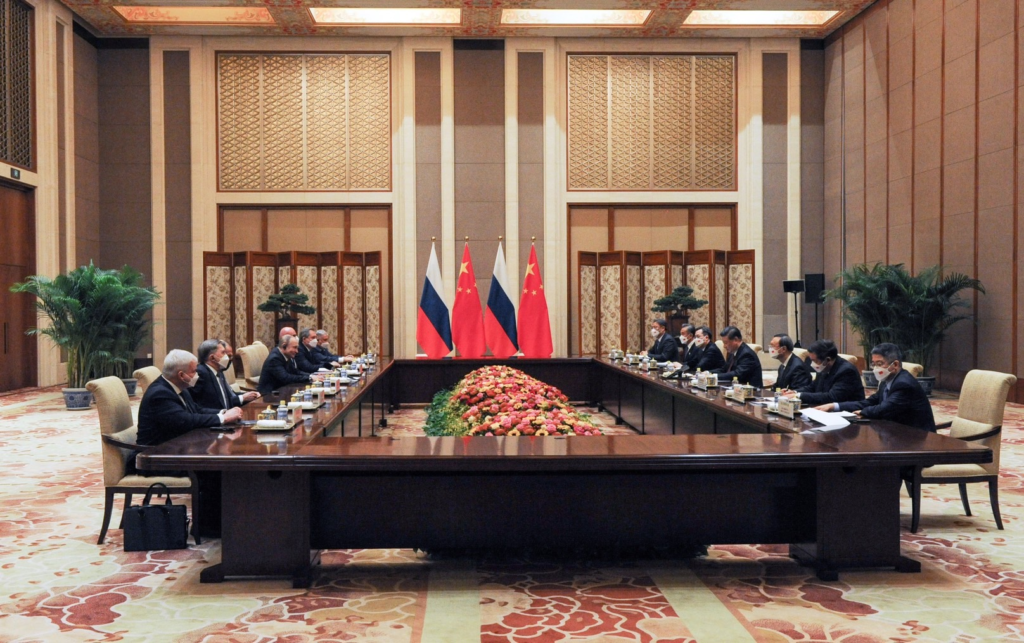
On February 4, Russian (left) and Chinese (right) leaders meet ahead of announcing the joint statement. Image credit: Ministry of Foreign Affairs of China
On the eve of the Winter Olympics in Beijing, Russian President Vladimir Putin visited Beijing for talks with Chinese president Xi Jinping on the two countries’ strategic relationship. On February 4, the opening day of the games, the two sides released a joint statement that declared that there are “no limits” to their cooperation and that their strategic relationship was superior to any Cold War alliance.
The Winter Olympics closing ceremony took place on February 20. On February 24, Russia attacked Ukraine, a country not mentioned in the China-Russia joint statement. Coming so soon after the conclusion of the Games, Russia’s invasion fueled speculation in the United States and Europe that Putin advised Xi about his plans to attack Russia’s neighbor, and that Xi asked him to delay the invasion until after the closing ceremony of the Games.
China has strenuously denied that Putin informed Xi of his plans to attack Ukraine, a country with which China has built a strong investment and trade relationship. It characterizes this account as “fake news.” China’s words and actions have, however, strongly suggested the country supports and sympathizes with the Russian position, which blames the United States for provoking the war. While repeating China’s “principled position” on sovereignty and territorial integrity, state media, quoting officials, has stressed that Russia’s legitimate “security concerns” must be respected.
Chinese officials have made clear that they will not honor western sanctions against Russia, and that trade and investment flows will continue. It has purchased a large shipment of Russian wheat. China has reportedly offered to help Russia get around the sanctions by letting the country use its banks and payment systems. It has provided a platform for some of Russia’s most outlandish statements justifying its actions and state media has even purchased Facebook ads parroting Russia’s position.
From March 1, a street in downtown Kharkiv destroyed by Russian bombardment. Image credit: Mvs.gov.ua / CC BY 4.0
Chinese media have been instructed not to use the word “invasion” to describe Russian actions and not to print articles on how the West, notably the United States, have resisted Russia’s actions. Discussion of casualties and Russian strikes against civilian targets are off limits. Ukraine’s consulate in Shanghai has complained to China’s public security bodies that harassment of Ukrainian citizens is taking place.
It is at the United Nations that China’s support for Russia is most evident. Beijing abstained on two resolutions (one in the Security Council, one in the General Assembly) decrying Russia’s invasion, and most significantly, voted against a resolution at the Geneva-based Human Rights Council to hold an urgent debate on the situation in Ukraine. According to a Chinese official who Dui Hua approached for an explanation of its vote at the HRC, “China does not believe that Russia has committed crimes against humanity in Ukraine and does not agree with the position of most Western countries that China and Russia have bad human rights records.”
(Left) On March 3, Chen Xu, Permanent Representative of China to the United Nations, at the Human Rights Council during the urgent debate on the “situation of human rights in Ukraine stemming from the Russian aggression.” (Right) On March 4, after the debate, voting to condemn Russia’s invasion of Ukraine. Image credits: Jean Marc Ferré, UN Photo / CC BY-NC-ND 2.0
However, as the supposedly quick “special operation” drags on into its third week, China may be having second thoughts. Oversea branches of Chinese banks have stopped financing Russian oil companies. A Rosaviatsiya official openly complained that China has refused to supply aircraft parts to Russia’s passenger airlines. That official was subsequently fired reportedly for making the public statements. China fears that its own economy may suffer collateral damage from sanctions placed on Russia. On March 8, US Commerce Secretary Gina Raimondo threatened to cut off China’s access to US chip making equipment and technology if the country violates the ban on Russian access to semiconductors.
Visit to Xinjiang
The war in Ukraine was not the only China-related news that made headlines at the 49th session of the HRC. In her speech to the council on March 8, Human Rights High Commissioner Michelle Bachelet announced that her long awaited trip to China, the first by a human rights commissioner to the country in 17 years, will take place this year, perhaps as early as May. Her visit to China will be preceded by the visit of a technical team in April.
United Nations High Commissioner for Human Rights Michelle Bachelet (right) speaks with Nada Al-Nashif , Deputy High Commissioner for Human Rights during the 49th Human Rights Council session on March 4. Image credit: Jean Marc Ferré, UN Photo / CC BY-NC-ND 2.0
For more than three years, Bachelet has sought to visit China and especially Xinjiang where reports of human rights violations against the Uyghurs have been widely publicized. It is not clear what the parameters of her visit will be. Beijing insists that her visit be an “exchange” and not an investigation. On various occasions, the office of the high commissioner has said that it wants “unfettered access,” “meaningful access” and, most recently, “credible access.” As things stand, it is not known if the camps where Uyghurs are held will be visited nor is it known whether, and under what conditions, alleged victims of human rights abuses will be interviewed.
In December, Bachelet threatened to release a detailed report on the situation in Xinjiang, and she has repeatedly been pressed to do so by the United States and other countries. On the eve of her March 8 speech, 192 human rights organizations released a letter urging Bachelet to release the report without further delay. Bachelet made no mention of the report in her speech, and it is unlikely that she will authorize release of the report prior to her visit to China later this year.
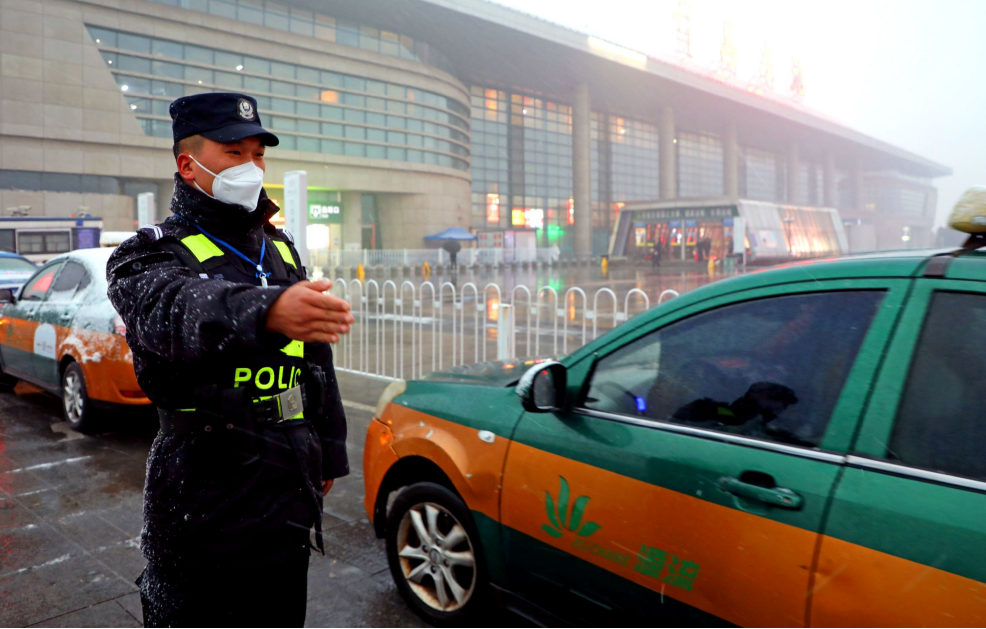
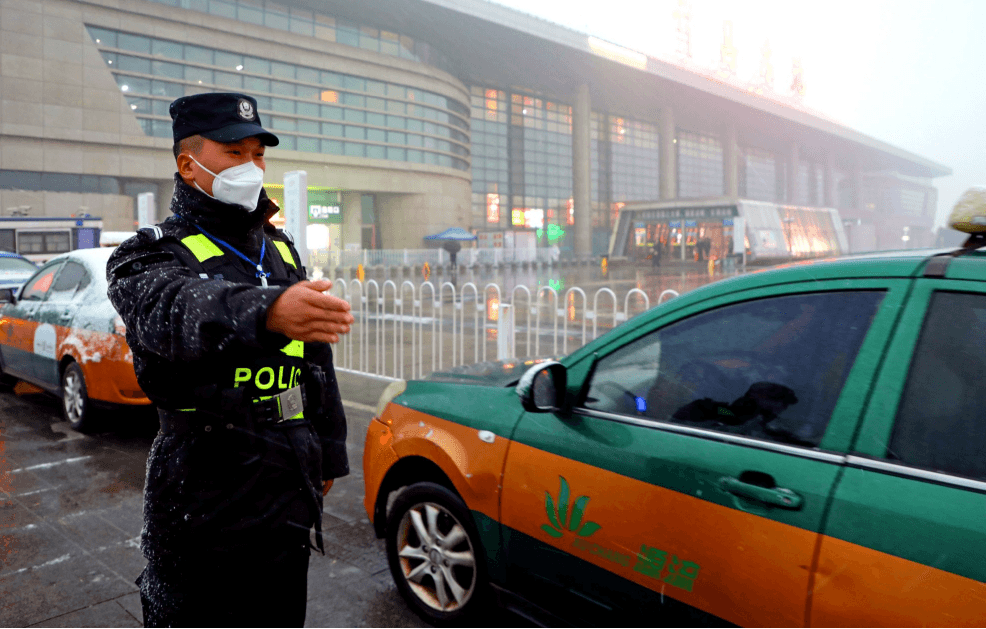
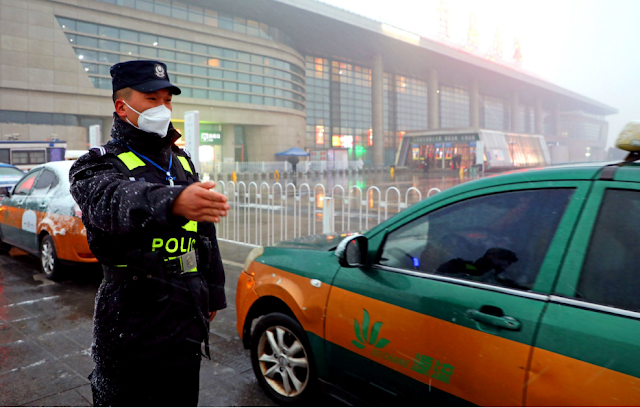
On January 4, 2022, a police officer from the Dongcheng Branch of the Xuchang Public Security Bureau managing the taxi rank in front of Xuchang East Station following the closure of the city. Image credit: Xuchang government
Dissent has fast become a victim of the coronavirus as China tightens controls on acceptable forms of speech during the pandemic. Citizen journalists who give first-hand accounts that contradict the official version of events are at risk of arrest for “picking quarrels and provoking trouble,” with a notable example being citizen-journalist Zhang Zhan (张展).
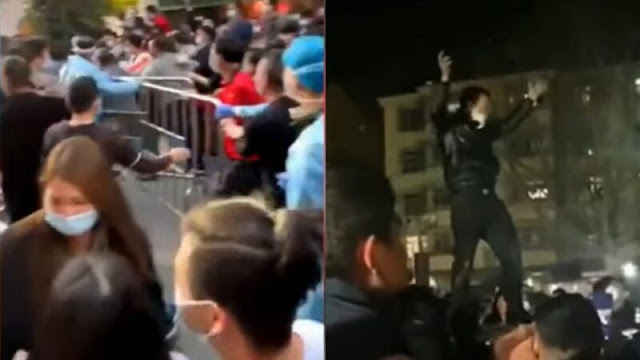
The crime of “picking quarrels and provoking trouble” also targets those who take to the streets during lockdowns. China’s persistence with the zero-COVID policy, often imposing total lockdowns alongside mandatory testing programs in major cities or across entire neighborhoods, has sparked protests over overpriced groceries and poor-quality food supplies. As recently as January 2022, COVID-related mass incidents broke out in Shenzhen, Tianjin, and Xi’an.
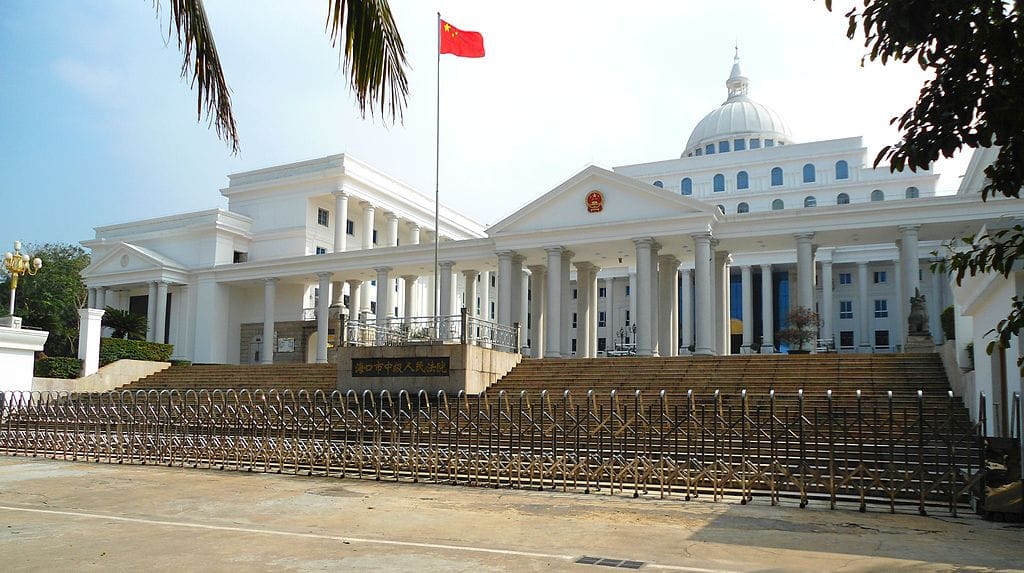
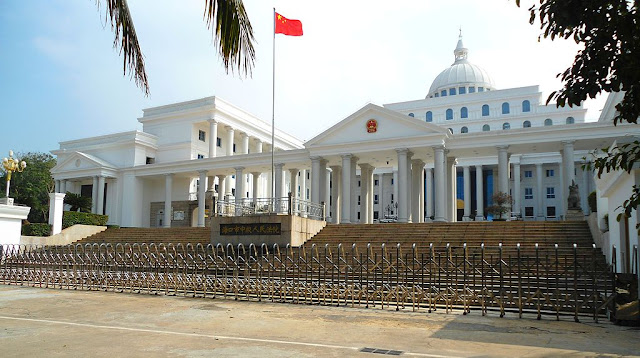
Haikou Intermediate People’s Court in Haikou, Hainan Province, People’s Republic of China. Image credit: Anna Frodesiak / CCO
In China, trials for crimes of endangering state security (ESS) are capable of generating intense, international media scrutiny while also being woefully opaque. In the face of severe degradations in judicial transparency, increasingly scant data—the latest from 2020—suggests that ESS trials have surged in recent years.
In Part I, Dui Hua looked at available statistics for ESS trials, focusing on Tibet—where ESS cases rose sharply in 2020—and Xinjiang, which accounted for the largest percentage of ESS trials of any Chinese region through the mid-2010s. This entry considers the rates of additional trials categorized as “other” in China Statistical Yearbooks (中国统计年鉴): endangering national defense, dereliction of military duty, and criminal offenses prior to 1997. Attention is paid to ESS trials in Han-majority provinces and Guangdong.
JOHN KAMM REMEMBERS
John Kamm Remembers is a feature that explores Kamm’s human rights advocacy prior to and since Dui Hua’s establishment in 1999.
Two Flights to Freedom, Part II
(Left to right) Jiang Jie, their son, Chen Taihe, and John Kamm meet at San Francisco International Airport upon Chen’s arrival. Image credit: Dui Hua Foundation
While their loved ones are suffering in prison, families of political detainees suffer on the outside, often denied visitation rights and telephone calls, not knowing if their spouses are still alive. Sometimes, spouses are urged to divorce their partners so that their children can lead a “normal life,” free of stigma.
Jiang Jie, the wife of Chen Taihe, was interrogated by the police attached to the domestic security division (guo bao) of the Guilin public security bureau, and their apartment was searched on two occasions. The police told Jiang Jie, four months pregnant with the couple’s second child, that she was violating the one-child-per -family policy in force at the time. They tried to convince her to abort the baby. Jiang Jie refused.
Chen Taihe had a US visa, a J2, in his passport; this entitled Jiang Jie to a dependent visa in her passport. Despite limited English and not having friends or family in the United States, Jiang Jie decided to leave Guilin and fly to San Francisco. She purchased two separate tickets, one for her, one for her son, as close as possible to departure. She took these steps to throw the police off her scent. On August 3, she flew to Guangzhou, on the pretext of looking for a lawyer, and, on August 4, together with her son, she boarded a flight to Seoul. From there she flew to San Francisco, arriving on August 4, 2015.
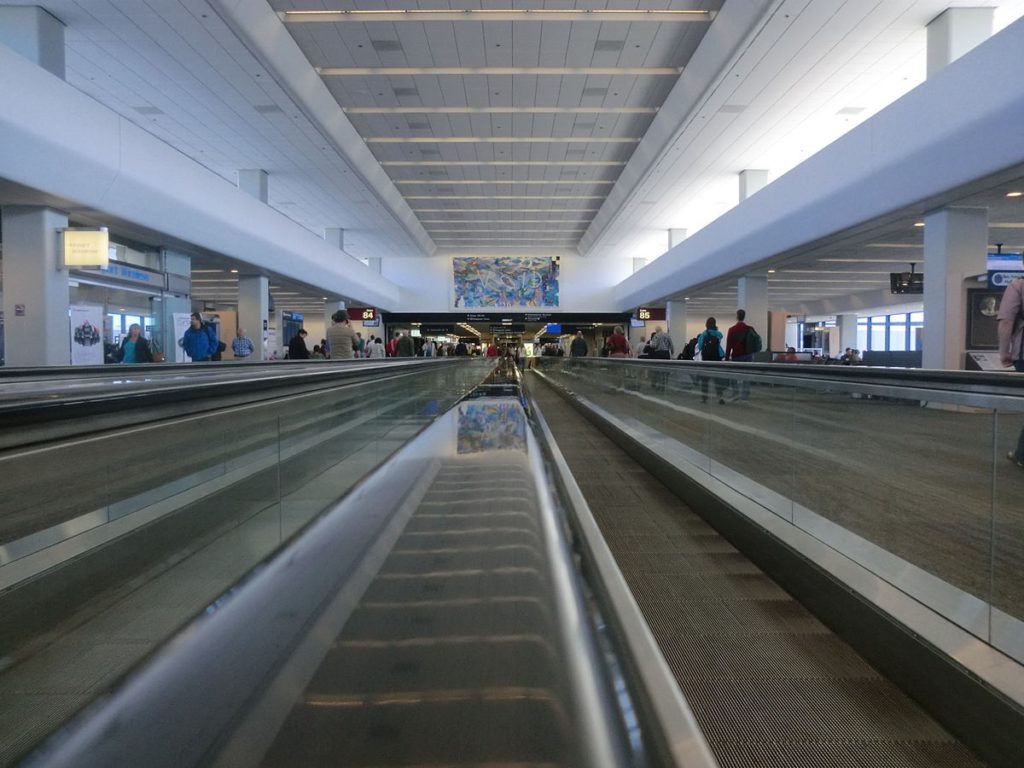
Upon deplaning at the cavernous arrival hall at SFO, Jiang Jie and her son faced a stern Customs officer. He told her that her visa entitled her to enter the United States with her husband, not by herself. They were taken to a room where she had to deal with an unfriendly interpreter over the telephone. This person tried to convince her to return to China. Jiang Jie stood her ground and refused to be sent back.
Moving walkway of San Francisco International Airport. Image credit: Nissy-KITAQ / CC BY-SA 3.0
Finally she was moved to another room where she was dealt with by a friendly immigration officer. He eventually allowed her to enter the United States after she told him where she planned to stay. It had been nearly 24 hours since she arrived at the airport.
Jiang Jie and son Zuoan went to Fremont where she rented a place to stay. After her husband was released from the detention center, he called her on her mobile. She was overjoyed to hear his voice. At the end of August, at the suggestion of an official at the American embassy in Beijing, she made contact with Dui Hua. We began to assist her. At the end of September, she contacted the legal aid center at the University of California Berkeley. They proved to be very helpful to her and her husband in starting a new life in the United States.
Trips to Guangzhou and Beijing
After his release from detention to residential surveillance, Chen Taihe was summoned every two weeks for interrogation by guo bao. These sessions took place either at the guo bao office or in a hotel. These were extremely stressful events during which Chen was threatened with rearrest.
The final straw was when the case of arrested lawyer Pu Zhiqiang was brought up in an interrogation session. Pu had been detained in May 2014 for creating a disturbance and inciting ethnic hatred by posting seven Weibo messages between 2011 and 2014. At the time of Chen Taihe’s interrogations in Guilin, Pu had yet to be brought to trial. One of his interrogators pointed out to Chen that Pu had only posted seven Weibo messages whereas Chen had posted thousands. (Pu was subsequently tried and given a three-year suspended sentence. He was stripped of his license to practice law.)
Pu Zhiqing, who was sentenced for posting seven messages on Weibo. Interrogators threatened Chen Taihe: “You’ve posted thousands!” Image credit: Voice of America East / Public Domain
At around the same time, lawyer Bao Longjun’s son was arrested trying to leave the country for Myanmar and Hong Kong bookseller Gui Minhai was kidnapped in Thailand and taken back to China.
Fearing his rearrest was imminent and that he would die if he were put back in detention, Chen decided to leave China. He would travel to Guangzhou, site of a large US consulate. Not knowing that one cannot apply for political asylum at a consulate, Chen went to the consulate where he sought entry. He was turned away, and he made his way back to Guilin.
Chen then sought permission from guo bao to travel to Beijing. Permission was granted. The first trip was used to tie up loose ends of cases he was working on. The second trip, undertaken in February 2015, was to apply for a new visa to enter the United States. The visa was granted on February 24, 2015 whereupon Chen briefed American officers on what he had endured.
All was ready. Chen Taihe went to Guilin Liangjiang International Airport to board a plane to Hong Kong where he was to board a plane to San Francisco. After checking in with his luggage on March 1, 2015, he approached immigration. They cleared him to leave, but after entering the departure area officers of wu jing, the people’s armed police deployed at the airport, stopped him and refused to let him board the flight. Chen called guo bao who intervened on his behalf. After half an hour wu jing relented and Chen was allowed to board the flight.
It was a nervous 320-mile flight to Hong Kong on a Chinese carrier through China airspace. After arrival at Hong Kong international airport, he boarded a flight to San Francisco.
Unlike his treatment at Guilin Airport and Jiang Jie’s treatment at SFO, Chen entered the United States without incident. At the arrival hall he was met by Jiang Jie, his oldest son, and me. Doubtless exhausted, he nevertheless was upbeat and full of energy. He and his small family boarded a taxi for their small apartment in Fremont.
A New Life
After he arrived in the United States, Chen Taihe applied for political asylum through his Berkley-based legal aid team. Judge Shackley and I wrote letters supporting his application, which was eventually granted. It allowed him to not only stay in the United States but to seek employment as well.
Chen wanted to practice law but he needed the support of the Guilin Bar Association, issue a certificate of good standing which they refused to provide. Fortunately, the California Bar Association can grant permission to take the bar examination if the applicant is supported by letters from practicing lawyers. With the of his legal aid team, Chen Taihe gathered five support letters and sent them along. The California Bar Association accepted his application to take the bar examination.
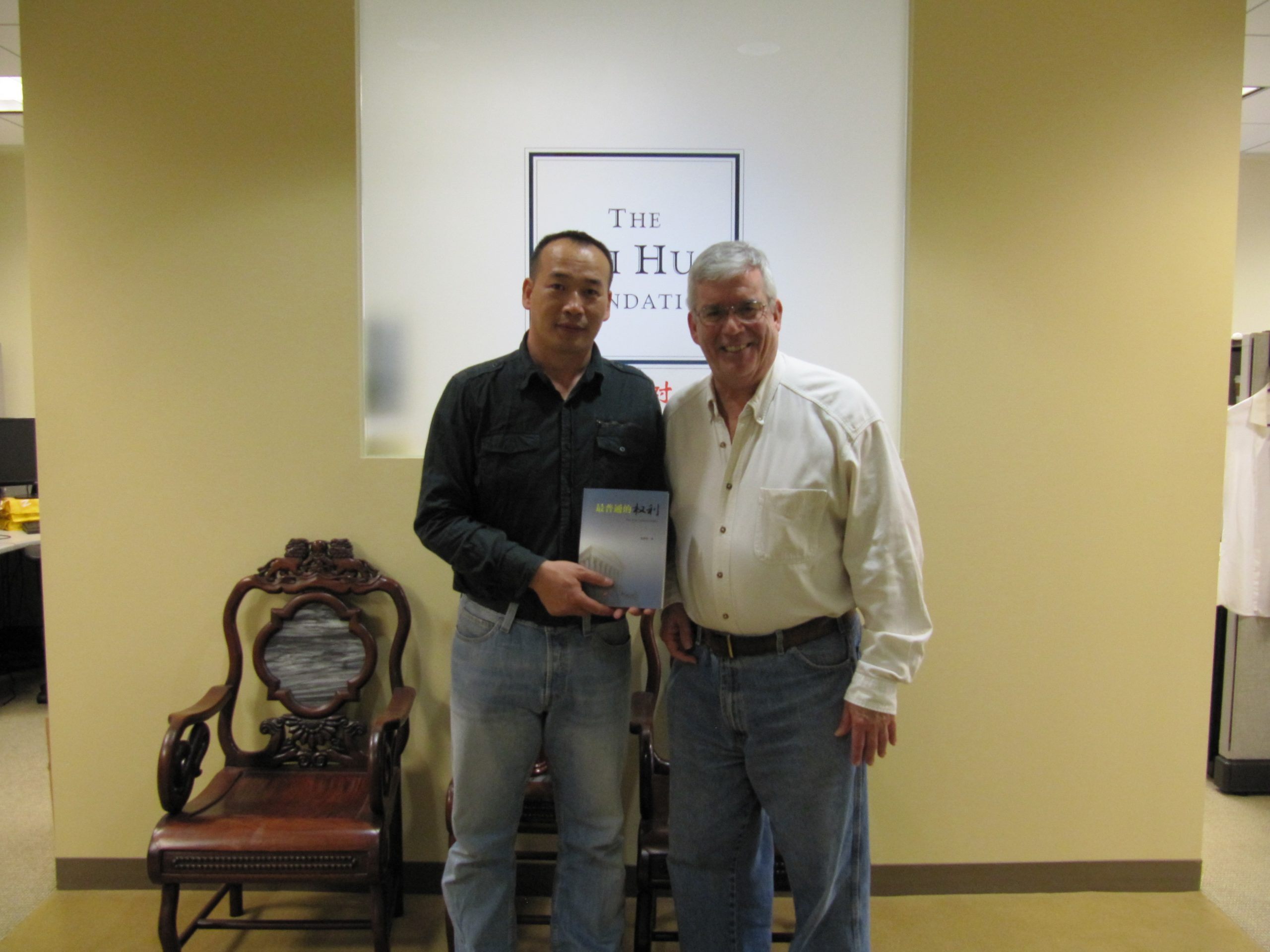
Chen Taihe and John Kamm during a visit to Dui Hua’s office. Chen is holding a copy of his book The Most Common Right. Image credit: Dui Hua Foundation
Chen Taihe decided to put off taking the examination to make some money to support his family. He joined California’s largest landscaping firm working in the red-hot San Francisco Bay Area property market as a landscaping designer and project manager. Always good with his hands and with a keen eye for detail, Chen was an immediate success, his efforts praised by colleagues and customers alike. He eventually set up his own company.
Today, Chen Taihe, Jiang Jie and their three children (a daughter, Stephanie, was born in September 2021) are living the American dream. A successful businessman, Chen owns his own firm and his own home. He continues to fight for democracy and human rights in China by posting on social media, delivering a lecture at Hastings Law School where he was granted a position of visiting professor, and asking me to intervene on behalf of imprisoned lawyers and members of their families in China.
Subscribe if you want to receive Dui Hua publications by email.
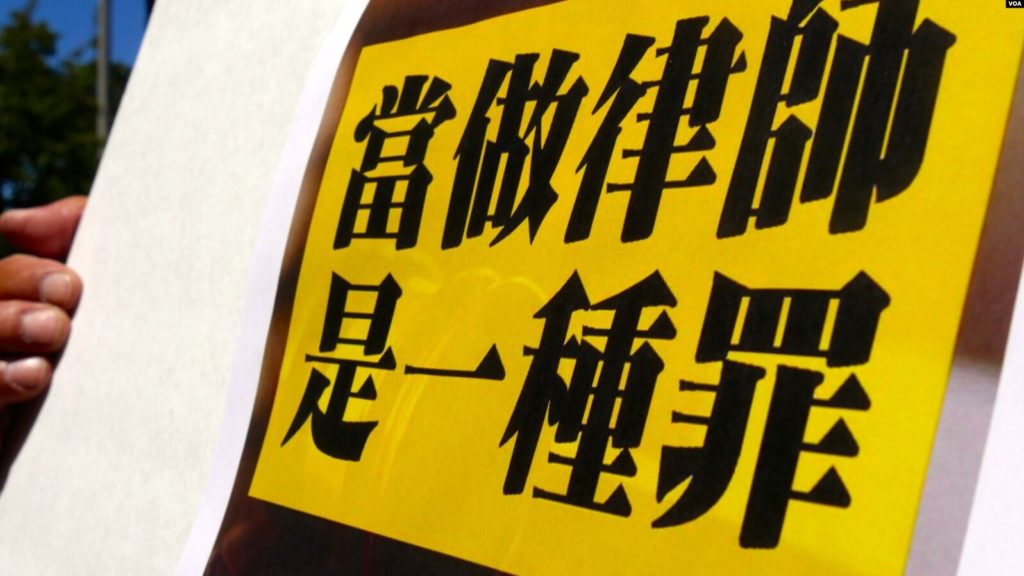
A sign held at a protest in July 2015 in Los Angeles against the 709 Crackdown in China. The sign reads, “When being a lawyer is a type of crime.” Image credit: Voice of America
In the early morning hours of July 9, 2015, Chinese police moved against human rights lawyers, legal assistants, and rights activists across China, but mostly those living and working in Beijing. Over the coming days and weeks, an estimated 300 lawyers and activists were detained or had exit bans placed on them. Power was cut off at their residences. Many were stripped of their lawyers’ licenses, forcing law firms to close. Several of those detained were subsequently tried and convicted of state security offenses. A few are still in prison, including Wu Gan, an activist known as “Super Vulgar Butcher,” who was sentenced to eight years in prison for subversion in December 2017.
International reaction to what became known as the 709 Crackdown was sharply critical. Governments, bar associations, law schools, and experts from United Nations Special Procedures condemned the action, to no avail. In an early indication of China’s current policy of ignoring international opinion, Beijing has become defiant and increasingly oblivious to criticism. Even requests for information on the status of political prisoners are now considered assaults on China’s judicial sovereignty constituting interference in China’s internal affairs.
A Brave Lawyer
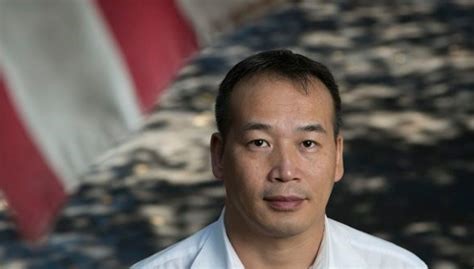
A photo of Chen Taihe. Image credit: Dui Hua Foundation
Prior to his detention by public security agents for inciting subversion, picking quarrels and provoking trouble, and embezzlement on July 12, 2015, and his subsequent departure from China in March 2016, Guilin-based lawyer and associate professor of law at the Guilin University of Electronic Science and Technology Chen Taihe was a well-known advocate of China adopting the jury trial system. He researched the jury system in the United Kingdom as a visiting professor and summarized his findings in an eloquent and well-argued book entitled The Most Common Right.
It is not known why Chen Taihe was detained. It might have been because of his friendship with leading rights lawyer, Li Heping, who was himself detained on July 10, 2015. Chen had called for his release. It could have been because of his extensive ties to the United States. It might have been because of his advocacy for China adopting the jury trial system. Or it might have been because of a vendetta against him by a Guilin official. China’s justice system is anything but transparent.
Undated photograph of Li Heping. Chen Taihe called for his release prior to Chen’s detention. Image credit: Provided by Li’s supporters via RFA
Chen Taihe’s activism brought him to the attention of the domestic security division of the public security bureau, a unit known as guo bao. They invited him “to drink tea” – a euphemism used for police questioning – on multiple occasions.
His successful law practice, which focused on civil and criminal litigations, brought him fame and wealth, enabling him to purchase three apartments in high-class developments. He gave that all away to find freedom for himself and his family in the United States, assisted by retired Judge Shackley Raffetto, the Dui Hua Foundation, and American diplomats in China. He is believed to be the only 709 lawyer to have successfully left China for the West with the permission of the domestic security bureau of the Chinese government.
Time on the Cross
Upon detention, Chen Taihe was placed in the Guilin Number Two Detention Center. He endured physical mistreatment, including being forced to squat for hours in a stress position, and threats from prisoners, one of whom had been sentenced to death. Chen was in a crowded cell with 12 other detainees; he was not given a bowl, spoons, and other necessary utensils to eat food and drink water for nearly three days.
Guilin Number 2 Detention Center, where Chen was held. Image credit: dcnnlawyer.com
Finally, on July 16, 2015, he was allowed a visit by a lawyer, who was a spy sent by the government. The second lawyer that visited him was Qin Yongpei. He posted Chen’s situation and mistreatment online after he interviewed Chen in a prison meeting room. (Lawyer Qin was detained in 2019; he has not been released and is currently under indictment for inciting subversion.) Chen was then moved to another detention center where his treatment slightly improved. A month after his detention, he was moved to a location outside the detention center and then on August 22, 2015, he was allowed to return home and placed under residential surveillance, but even then, he continued to be subjected to interrogation and threats by the police right up to the day he departed China.
Lawyer Qin Yongpei, who visited Chen Taihe in detention center. He was tried for inciting subversion on December 31, 2021. Image credit: Boxun.com
While keeping the police advised of his whereabouts, he was allowed to move around Guilin and even to travel to other cities. The police monitored his communications and his movements. The family’s bank accounts were frozen, heaping misfortune on top of misery.
Judge Shackley Raffetto
On July 21, 2015, nine days after Chen Taihe’s detention, I received an email from Shackley F. Raffetto, a retired Hawaii state trial judge and US Navy judge who had befriended Chen Taihe following an introduction by a lawyer based at the US Embassy in Beijing. Judge Raffetto invited Chen and three other Chinese lawyers to visit Hawaii in September 2013. While there, the small group of Chinese lawyers observed a jury trial and were able to interview the jurors after the trial concluded. They met with the Chief Justice of the Hawaii Supreme Court as well as law professors and lawyers from firms involved in legal exchanges with lawyers in China.
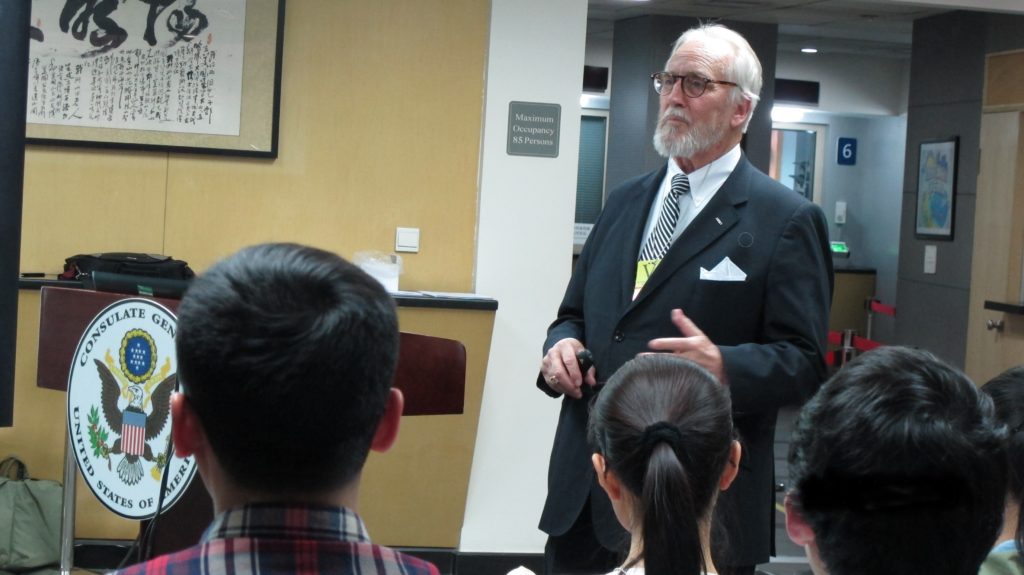
Judge Raffetto addressing an audience at the US Consulate General in Chengdu, since closed, in 2014. Image credit: Judge Raffetto
Judge Raffetto had already lectured and conducted a US style jury trial moot program at two PRC law schools. In April 2014 he travelled to Beijing, at the invitation of the US Embassy, with the intention of providing the jury trial moot at a number of law schools that had requested the program. The first school at which the trial moot program would be presented was Chen Taihe’s law school. Chen had advised the Guilin police that he had invited Judge Raffetto to conduct the program at his university.
Upon arrival in Beijing, Judge Raffetto was told that the entire program had been cancelled. No explanation was given. Chen Taihe was ordered not to participate in the program. Judge Raffetto adjusted the program and proceeded to give lectures on the American justice system at law schools around China, arranged by the US government. Police tried to block people from attending his lecture in Beijing. They were admitted by a side door.
In July 2015, Judge Raffetto noticed that Chen Taihe’s name was on a list of lawyers and activists detained in the 709 crackdown drawn up by Amnesty International. He contacted the US Embassy in Beijing, the people with whom he had worked on programs, but never received a response. He then reached out to human rights groups, including Dui Hua, to see what could be done for his friend.
Role of China’s San Francisco Consulate
In my work on Chinese political prisoners, I have used different channels to submit lists and discuss cases. One of the most important channels has been the Chinese consulate general in San Francisco. I reached out to my point of contact, Consul Wang, and asked for a meeting to discuss Chen Taihe’s case. We agreed to meet on Monday, July 27, 2015, at the consulate on Laguna Street.
A picture of Consulate General of the People’s Republic of China in San Francisco. Image credit: Steve Rhodes / CC BY-NC-ND 2.0
I submitted a detailed memo on what I knew about the case. I pointed out that Chen was the only law professor to have been detained in the 709 crackdown and pointed out that President Obama was also a law professor. Guangxi Zhuang Autonomous Region, whose capital is Guilin, is the sister state of Montana, home state of US Ambassador Max Baucus. For these reasons, Chen Taihe’s case was now a high priority for the US government.
Wang took action. He impressed on his superiors in Beijing the importance of the case. A few weeks later Chen Taihe was moved out of the detention center and eventually placed under residential surveillance. Unfortunately, his ordeal was far from over.
Throughout my work on the case, I stayed in close touch with officers at the United States Department of State and the National Security Council in Washington as well as the US Embassy in Beijing. Washington-based officials were a source of good advice and assistance arranging Chen’s departure and providing limited financial support. Chen Taihe was well known to the Department of State prior to his detention in 2015. In both 2011 and 2012, Chen Taihe had participated in legal exchange programs and in 2012 he visited Washington DC at the invitation of the State Department’s International Visitor Leadership Program.
Ms. Jiang Jie Flees China, Arrives in US
While their loved ones are suffering in prison, families of political detainees suffer on the outside, often denied visitation rights and telephone calls, not knowing if their spouses are still alive. Sometimes, spouses are urged to divorce their partners so that their children can lead a “normal life,” free of stigma.
Jiang Jie, the wife of Chen Taihe, was interrogated by the police attached to the domestic security division (guo bao) of the Guilin public security bureau, and their apartment was searched on two occasions. The police told Jiang Jie, four months pregnant with the couple’s second child, that she was violating the one-child-per -family policy in force at the time. They tried to convince her to abort the baby. Jiang Jie refused.
Chen Taihe had a US visa, a J2, in his passport; this entitled Jiang Jie to a dependent visa in her passport. Despite limited English and not having friends or family in the United States, Jiang Jie decided to leave Guilin and fly to San Francisco. She purchased two separate tickets, one for her, one for her son, as close as possible to departure. She took these steps to throw the police off her scent. On August 3, she flew to Guangzhou, on the pretext of looking for a lawyer, and, on August 4, together with her son, she boarded a flight to Seoul. From there she flew to San Francisco, arriving on August 4, 2015.
Upon deplaning at the cavernous arrival hall at SFO, Jiang Jie and her son faced a stern Customs officer. He told her that her visa entitled her to enter the United States with her husband, not by herself. They were taken to a room where she had to deal with an unfriendly interpreter over the telephone. This person tried to convince her to return to China. Jiang Jie stood her ground and refused to be sent back.
Moving walkway of San Francisco International Airport. Image credit: Nissy-KITAQ / CC BY-SA 3.0
Finally she was moved to another room where she was dealt with by a friendly immigration officer. He eventually allowed her to enter the United States after she told him where she planned to stay. It had been nearly 24 hours since she arrived at the airport.
Jiang Jie and son Zuoan went to Fremont where she rented a place to stay. After her husband was released from the detention center, he called her on her mobile. She was overjoyed to hear his voice. At the end of August, at the suggestion of an official at the American embassy in Beijing, she made contact with Dui Hua. We began to assist her. At the end of September, she contacted the legal aid center at the University of California Berkeley. They proved to be very helpful to her and her husband in starting a new life in the United States.
Trips to Guangzhou and Beijing
After his release from detention to residential surveillance, Chen Taihe was summoned every two weeks for interrogation by guo bao. These sessions took place either at the guo bao office or in a hotel. These were extremely stressful events during which Chen was threatened with rearrest.
The final straw was when the case of arrested lawyer Pu Zhiqiang was brought up in an interrogation session. Pu had been detained in May 2014 for creating a disturbance and inciting ethnic hatred by posting seven Weibo messages between 2011 and 2014. At the time of Chen Taihe’s interrogations in Guilin, Pu had yet to be brought to trial. One of his interrogators pointed out to Chen that Pu had only posted seven Weibo messages whereas Chen had posted thousands. (Pu was subsequently tried and given a three-year suspended sentence. He was stripped of his license to practice law.)
Pu Zhiqing, who was sentenced for posting seven messages on Weibo. Interrogators threatened Chen Taihe: “You’ve posted thousands!” Image credit: Voice of America East / Public Domain
At around the same time, lawyer Bao Longjun’s son was arrested trying to leave the country for Myanmar and Hong Kong bookseller Gui Minhai was kidnapped in Thailand and taken back to China.
Fearing his rearrest was imminent and that he would die if he were put back in detention, Chen decided to leave China. He would travel to Guangzhou, site of a large US consulate. Not knowing that one cannot apply for political asylum at a consulate, Chen went to the consulate where he sought entry. He was turned away, and he made his way back to Guilin.
Chen then sought permission from guo bao to travel to Beijing. Permission was granted. The first trip was used to tie up loose ends of cases he was working on. The second trip, undertaken in February 2016, was to apply for a new visa to enter the United States. The visa was granted on February 24, 2016 whereupon Chen briefed American officers on what he had endured.
All was ready. Chen Taihe went to Guilin Liangjiang International Airport to board a plane to Hong Kong where he was to board a plane to San Francisco. After checking in with his luggage on March 1, 2016, he approached immigration. They cleared him to leave, but after entering the departure area officers of wu jing, the people’s armed police deployed at the airport, stopped him and refused to let him board the flight. Chen called guo bao who intervened on his behalf. After half an hour wu jing relented and Chen was allowed to board the flight.
It was a nervous 320-mile flight to Hong Kong on a Chinese carrier through China airspace. After arrival at Hong Kong international airport, he boarded a flight to San Francisco.
Unlike his treatment at Guilin Airport and Jiang Jie’s treatment at SFO, Chen entered the United States without incident. At the arrival hall he was met by Jiang Jie, his oldest son, and me.
(Left to right) Jiang Jie, their son, Chen Taihe, and John Kamm meet at San Francisco International Airport upon Chen’s arrival. Image credit: Dui Hua Foundation
Doubtless exhausted, he nevertheless was upbeat and full of energy. He and his small family boarded a taxi for their small apartment in Fremont.
A New Life
After he arrived in the United States, Chen Taihe applied for political asylum through his Berkley-based legal aid team. Judge Shackley and I wrote letters supporting his application, which was eventually granted. It allowed him to not only stay in the United States but to seek employment as well.
Chen wanted to practice law but he needed the support of the Guilin Bar Association, issue a certificate of good standing which they refused to provide. Fortunately, the California Bar Association can grant permission to take the bar examination if the applicant is supported by letters from practicing lawyers. With the of his legal aid team, Chen Taihe gathered five support letters and sent them along. The California Bar Association accepted his application to take the bar examination.
Chen Taihe decided to put off taking the examination to make some money to support his family. He joined California’s largest landscaping firm working in the red-hot San Francisco Bay Area property market as a landscaping designer and project manager. Always good with his hands and with a keen eye for detail, Chen was an immediate success, his efforts praised by colleagues and customers alike. He eventually set up his own company.
Chen Taihe and John Kamm during a visit to Dui Hua’s office. Chen is holding a copy of his book The Most Common Right. Image credit: Dui Hua Foundation
Today, Chen Taihe, Jiang Jie and their three children (a daughter, Stephanie, was born in September 2021) are living the American dream. A successful businessman, Chen owns his own firm and his own home. He continues to fight for democracy and human rights in China by posting on social media, delivering a lecture at Hastings Law School where he was granted a position of visiting professor, and asking me to intervene on behalf of imprisoned lawyers and members of their families in China.
The 2021 prosecution of a young man surnamed Li for forming a “People’s Party,” disseminating writings prosecutors deemed “slanderous,” and seeking to recruit members points to an increasingly prevalent tactic of criminalization – a shift from charging political dissidents with endangering state security (ESS) crimes to instead charging them with “picking quarrels and provoking trouble.” Over a decade ago, the same acts of disseminating “reactionary,” “subversive,” or “slanderous” articles in the name of a political party would have been more likely punished as ESS crimes.
In Part I, Dui Hua detailed Li’s case and the court’s rationale for charging him with “picking quarrels and provoking trouble.” This entry looks at similar cases and shifts in sentencing, considering reasons for the enhanced usage of “picking quarrels and provoking trouble.”
People’s Parties
Li’s People’s Party was not the first political party of its kind. Dissident intellectuals, farmers, workers, and Communist idealists have recruited like-minded individuals and organized underground groups over the past two decades. They often choose names like “People’s Party,” mindang or renmindang, as a way of invoking public support or positioning themselves as representatives of the Chinese people. These “People’s Parties” do not appear to be connected to each other; rather their appeal is to specific social groups. While some aspire to Western-style democracy and call for a multiparty political system, others believe that a return to pre-reform era socialism is a panacea for social injustices and government corruption.
Dui Hua previously reported that around 2008, Dong Zhanyi (董占义) founded a different People’s Party, which was later renamed to “New Era Communist Party of China.” Dong was convicted of subversion and contract fraud in October 2011 and was sentenced to life in prison. Another party founder Chen Guohua (陈国华) was given a 14-year prison sentence for subversion. This party, once active in Beijing, Henan, Shandong, and Jiangxi, aimed to fight corruption and allegedly recruited aggrieved workers and petitioners to overthrow the Chinese Communist Party.
Another opposition group, which also existed online like Li’s party, was called the People’s Party. In November 2009, news media sources reported that a Henan netizen surnamed Yan stood trial in Wuhan for inciting subversion after proclaiming himself to be chairman of the “Chinese People’s Party” (中国人民党). Yan’s political orientation is ambiguous. Dui Hua learned that his full name is Yan Bianfang (阎边防). Yan reportedly wrote two “subversive” articles and read them aloud in a video he posted on a US website. The links to his articles and video were circulated domestically on Chinese websites. Yan was sentenced to one year in prison and completed his prison sentence in April 2010. Yan was charged with inciting subversion, a crime of endangering state security; Li’s crime and sentencing were similar to Yan’s, but in an apparent shift in practice, Yan was charged with “picking quarrels and provoking trouble.”
The reason behind this shift is unclear, but it might be a way to obscure cases of a political nature that would otherwise attract scrutiny by treating them as pocket crimes, like “picking quarrels and provoking trouble.” Crimes of “picking quarrels and provoking trouble” are tried in district courts while ESS crimes are tried in intermediate courts. District court trials tend to be quicker and attract less attention than those at the intermediate level. Judges are typically less experienced, and corruption is more prevalent. The comparative lack of attention means that judgments are less contentious, with the rationale behind them drawing less scrutiny.
Another possible explanation for the shift might be that the procuratorate or the court thinks it is easier to determine that a post or act caused “social harm” or “disturbed the social order” than it is to show the “subversion of state power.” The threshold for justifying pocket crimes is lower than that for ESS charges. This catch-all crime now carries a maximum prison sentence of 10 years, up from the previous cap of five years, following the eighth amendment to the Criminal Law in 2011.
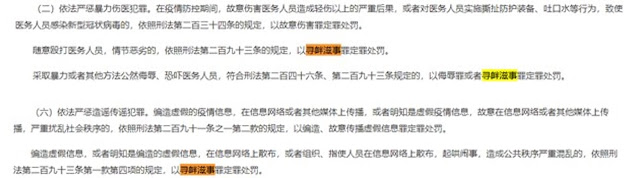
Excerpts from the joint notice broadening the application of the crime of picking quarrels and provoking trouble to include Covid-related actions. Image credit: Ministry of Public Security of China
Since the outbreak of COVID-19, “picking quarrels and provoking trouble” has been used along with an array of other criminal offenses to curb so-called “pandemic-related crimes.” On February 10, 2020, two months into the pandemic, a notice jointly issued by the Supreme People’s Court, Supreme People’s Procuratorate, Ministry of Public Security, and Ministry of Justice broadened the crime’s application to punish those who cause chaos by using “violence or other means” to insult or intimidate medical personnel, as well as those who spread “false news” or “rumors” about the pandemic.
By February 25, 2020, about a month after Wuhan was first placed on lockdown, the Supreme People’s Procuratorate reported handling 301 pandemic-related picking quarrels cases nationwide involving 375 people. In addition to citizen journalists, street protesters, and rights lawyers, Li’s case indicated that dissident party organizers were also among those at risk of arrest for this pocket crime.
The vague definition of Article 293 has long attracted criticism from China’s legal scholars and experts. Prominent lawyer Zhu Zhengfu recently suggested in an interview with China News Weekly that the government “abolish the crime of picking quarrels and provoking troubles at a right time.” Zhu, a representative of the Consultative Conference and a member of the All China Lawyers Association’s supervisory board, pointed out that “clarity is the essential requirement of the Nulla poena sine lege; however, the wording in the Article 293 is excessively vague, such as ‘at will,’ ‘willfully,’ ‘serious circumstances,’ or ‘causing serious disturbances to public order.’ Yet those described [activities] are the key elements of the crime.”
News coverage featuring excerpts of Zhu’s statements on Article 293. Image credit: China News Weekly via Weibo
Zhu, whose comments came during preparation for the “Two Meetings” which began March 4, added that the definition’s ambiguity enables authorities to selectively enforce the law and harmed citizens’ rights. Zhu’s suggestion has since been echoed by others. Xiao Shenfang, a member of the NPC and vice chairperson of the All China Lawyers Association, also plans to submit a similar proposal at the “Two Meetings.” Xiao also warned of the law’s over-criminalization of social issues.
On January 4, 2022, a police officer from the Dongcheng Branch of the Xuchang Public Security Bureau managing the taxi rank in front of Xuchang East Station following the closure of the city. Image credit: Xuchang government
Dissent has fast become a victim of the coronavirus as China tightens controls on acceptable forms of speech during the pandemic. Citizen journalists who give first-hand accounts that contradict the official version of events are at risk of arrest for “picking quarrels and provoking trouble,” with a notable example being Zhang Zhan (张展).
The crime of “picking quarrels and provoking trouble” also targets those who take to the streets during lockdowns. China’s persistence with the zero-COVID policy, often imposing total lockdowns alongside mandatory testing programs in major cities or across entire neighborhoods, has sparked protests over overpriced groceries and poor-quality food supplies. As recently as January 2022, mass incidents broke out in Shenzhen, Tianjin, and Xi’an.
This entry in the Human Rights Journal, the first of two installments, looks at the application of “picking quarrels and provoking trouble,” through the case of a one prisoner whose political engagement was born out of frustration with pandemic restrictions. Part II looks at how this and similar cases reflect shifts in the use of different crimes to stifle dissent.
Images from Radio Free Asia’s reporting on mass protests in Tianjin, Shenzhen, and Xian against COVID-19 restrictions. Image credit: Radio Free Asia
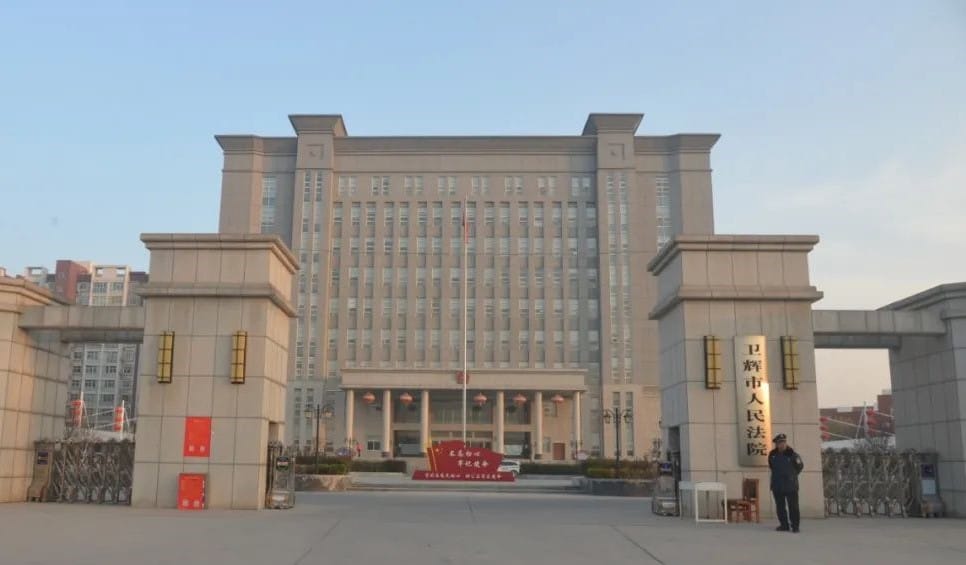
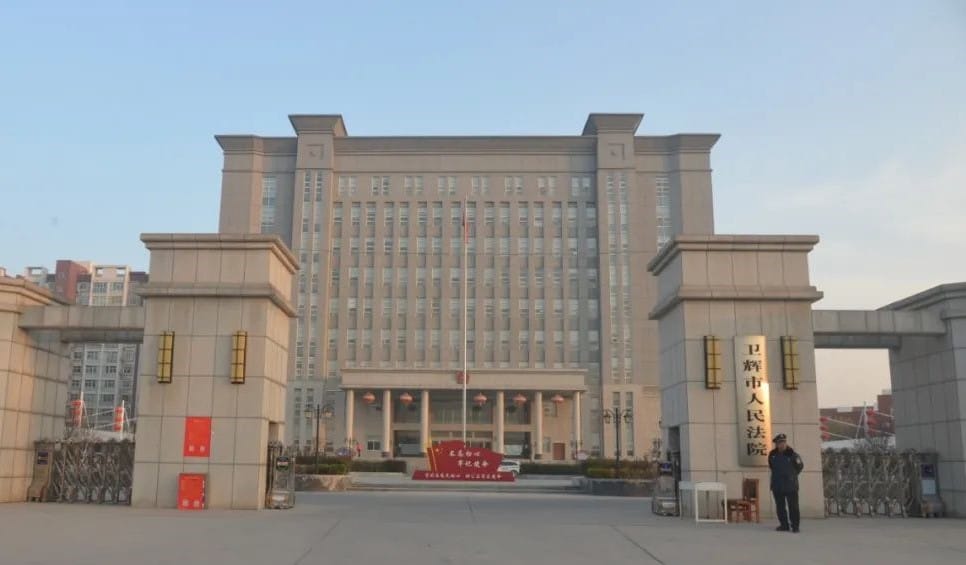
Unbeknownst to many people is that China’s heavy-handed approach to handling COVID-19 led a dissenter to form an opposition party to challenge the Chinese Communist Party. Dui Hua’s research found that a young man surnamed Li founded the “People’s Party” (人民党) in Weihui City, Henan, in March 2020, two months after the initial outbreak occurred in neighboring Hubei province.
A document filed to the Weihui City People’s Court stated that Li became “anti-social” and resented the current political system after his sources of income were cut off as a result of pandemic containment measures. Following in the footsteps of Wuhan, the site of the first lockdown, cities and counties across Henan were soon placed under strict lockdowns with measures such as banning non-essential travel between villages and communities. Li allegedly recruited leftist supporters to join his People’s Party with a goal to save the world.
Li’s People’s Party might have existed only in name and only in the virtual space. Li used the internet to comment on current issues, disseminate his political views, and seek members. Li founded Oriental Voice, an online journal he irregularly posted in his QQ chatgroups. In Oriental Voice, Li published his party constitution and discussed historical nihilism (i.e. the questioning of the Chinese Communist Party’s official version of Chinese history). Additionally, he collected articles on how to “drink tea,” a euphemism for being summoned or interrogated by public and state security police. His articles, published over a total of 36 issues, garnered over 150,000 views.
Prosecutors alleged that the articles contained slanderous remarks about the socialist system and senior leaders. His personal QQ document folders also contained content described as “reactionary articles” with titles such as “Discussing Our Future during the Trough of the Communist Movement,” “A Letter to All Chinese Socialist Leftist Comrades,” “The Constitution of the People’s Party,” and “The Confidentiality Code of the People’s Party.”
According to the document, Li was suspected of “picking quarrels and provoking trouble,” and the Weihui City Public Security Bureau decided to carry out criminal detention on March 21, 2021 after he was apprehended in a staff dormitory in Guangzhou a day earlier. The Weihui City Procuratorate approved his arrest on April 2. Li was charged with the crime of “picking quarrels and provoking trouble.” On June 2, Li was formally indicted for this crime, which has been increasingly used against peaceful protests and those who express dissent.
The procuratorate claimed that Li had “promoted and disseminated reactionary speech in online public space and seriously disturbed social order” in violation of Article 293 of the Criminal Law. The prosecutor recommended that the court give Li a short prison sentence of 12 to 18 months in part because he was a first-time offender, admitted his guilt, and “showed repentance.”
It is notable that Li’s crime was “picking quarrels and provoking trouble.” In the past, similar behavior—starting a political party in opposition to the CCP, publishing materials political in nature, and seeking to recruit others—would be more likely to face charges of endangering state security, mainly subversion or inciting subversion.
Haikou Intermediate People’s Court in Haikou, Hainan Province, People’s Republic of China. Image credit: Anna Frodesiak / CCO
In China, trials for crimes of endangering state security (ESS) are capable of generating intense, international media scrutiny while also being woefully opaque. In the face of severe degradations in judicial transparency, increasingly scant data—the latest from 2020—suggests that ESS trials have surged in recent years.
In Part I, Dui Hua looked at available statistics for ESS trials, focusing on Tibet—where ESS cases rose sharply in 2020—and Xinjiang, which accounted for the largest percentage of ESS trials of any Chinese region through the mid-2010s. This entry considers the rates of additional trials categorized as “other” in China Statistical Yearbooks (中国统计年鉴): dereliction of military duty, criminal offenses prior to 1997, and ESS trials in Han-majority provinces and Guangdong.
“Other” Trials: ESS, Dereliction of Military Duty, and Cases Before 1997
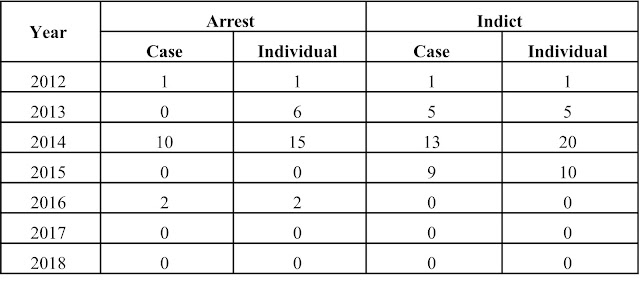
Table 1. Number of cases and people arrested and indicted for dereliction of military duty, 2012-2018
Source: China Statistical Yearbooks
Dereliction of military duty typically makes up a negligible number of “other” trials. From 2012-2016, Chinese courts concluded 48 trials of dereliction of military duty, just one percent of “other” trials. China Statistical Yearbooks revealed that only two people were arrested for the crime in 2016, and no single arrest was made from 2017-2020. Additionally, no one was indicted in the three years since 2016. Assuming the same trend of arrest and indictment continues, it is to be expected that only a handful of dereliction of military duty cases had proceeded to trials in the four years since 2017.
“Other” trials also include the little-known category of pre-1997 criminal cases, which concern crimes committed before the revised Criminal Law took effect on October 1, 1997. The Records of People’s Courts Historical Judicial Statistics: 1949-2016 indicated that nearly 60 percent of “other” trials concerned pre-1997 criminal cases from 2012-2016. In 2012 alone, fifteen years after the 1997 Criminal Law came into force, as many as 995 trials were concluded, accounting for 72 percent of “other” trials in that year. While there is insufficient information to estimate the number of pre-1997 criminal cases in recent years, the number showed signs of abating. In 2016, only 88 trials were concluded, down from 651 and 191 trials in 2014 and 2015, respectively.
Table 2. Number of “other” trials and trials of ESS, dereliction of military duty trials, and pre-1997 criminal cases
*(a) = (b) + (c) + (d); Sources: China Statistical Yearbooks & Records of People’s Courts Historical Judicial Statistics: 1949-2016
Among the pre-1997 criminal cases to have been concluded after 1997 are the now-defunct crimes of counterrevolution, with a notable example being Chen Yulin (陈瑜琳). The former employee of Xinhua News Agency was accused of handing over materials, including the Xinhua telephone directory and organization chart, to a British agent embedded in the Hong Kong police force during his tenure in the early 1990s. In 2004, he was sentenced to life imprisonment in Guangzhou. He was convicted not of ESS, but of the counterrevolution crime of espionage in accordance with the 1979 Criminal Law. Chen completed his sentence in August 2020 following multiple sentence reductions granted to him since 2007.
Hooliganism, another crime which no longer exists in the 1997 Criminal Law, was among the cases which could be found under the category of pre-1997 criminal cases before the mass purge of China Judgements Online in June 2021. China’s Criminal Law imposes no limit on the period of prosecution for cases where the suspect has escaped after a pre-1997 criminal case has been filed by police or the procuratorate, or heard by the courts. Some hooliganism cases concern prisoners who were released on probation but re-sentenced after 1997 for violating parole rules. Courts can also hear a new case and extend sentences for hooliganism prisoners for violating prison regulations. A few prisoners were sentenced to new offenses that were missing in the original hooliganism trials, and thus received sentence extensions.
Han-Majority Provinces & Guangdong
Outside of Tibetan regions and Xinjiang, Dui Hua’s research into provincial statistical yearbooks found that few ESS trials have been concluded in Han-majority provinces. In Chongqing, no ESS trials were held from 2018-2020. Hainan accepted and concluded two ESS trials in 2020, whereas Guizhou only held one ESS trial every year from 2014-2019.
More ESS trials took place in Guangdong, but the figures are far out of proportion given the province’s large population. From 2013-2019, courts in Guangdong concluded 54 ESS trials. Although the numbers in 2020-2021 are not yet available, it is likely that some of the latest ESS trials were closely related to Hong Kong.
In 2018 and 2019, Guangdong authorities arrested a total of 17 people on suspicion of ESS and indicted a total of 30 people on ESS charges. Some of the ESS arrests in Guangdong over the past three years involved Hong Kong’s anti-extradition bill protests. In April 2021, state-run news media publicized four ESS cases in Guangdong, two of which were Hong Kong-related. In June 2020, a university student from Hong Kong surnamed Yeung was accused of subversion while studying in the mainland. Yeung not only retweeted in support of Hong Kong’s “black-clad mobs,” but also smeared the police force with a stated goal to bring Hong Kong’s model of political resistance to China.
In the second case, a mainland student studying at the University of Hong Kong posted information on social media to support Hong Kong protesters and attack the central government. His messages also included “liberate Hong Kong,” a banned slogan also deemed capable of inciting secession in the former British colony. Detained in June 2020 upon his return to the mainland, the student reportedly wrote a 100,000-word repentance statement in which he vowed not to take part in activity that endangers state security.
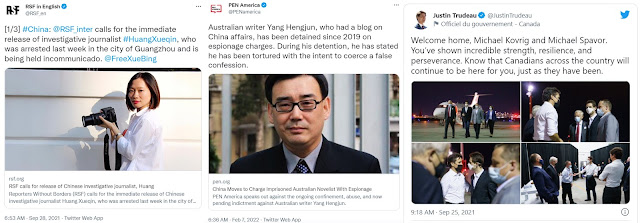
More Hong Kong-related ESS arrests were made in Guangdong. In September 2021, news media sources reported that independent journalist Huang Xueqin (黄雪琴) was placed under residential surveillance at a designated location in Shenzhen. She was formally arrested for inciting subversion the following month. Prior to her arrest, Huang was briefly detained for “picking quarrels and provoking trouble” in 2019 after taking part in and publishing writings about the Hong Kong protests. Arrested with Huang in October was her friend Wang Jianbin (王建兵), an education and labor advocate. Wang too was arrested for inciting subversion.
ESS trials have long been criticized for being opaque. A number of these trials were held behind closed doors with citizens, journalists and foreign diplomats shut out, as in the cases of the Canadians Michael Spavor and Michael Kovrig and Australian citizen Yang Hengjun (杨恒君, aka Yang Jun). The identities, acts, and fates of many more people tried, convicted, and sentenced in ESS cases are not known.
Media attention for recent ESS cases on Twitter (left to right): Reporters Without Borders calls for the release of Huang Xueqin; PEN America calls for the release of Yang Hengjun; Canada’s Prime Minister hails the release of Michaels Kovrig and Spavor. Image credits: RSF in English Twitter account; PEN America Twitter account; Justin Trudeau Twitter account
In 2021, transparency of ESS cases dipped to a record low. Dui Hua’s Political Prisoner Database has information on 68 individuals who were sentenced in ESS trials of first instance in 2020. With the mass purge of court judgments online, the Chinese government has undone some of its progress in judicial transparency and, in doing so, possibly harmed its own rule of law.
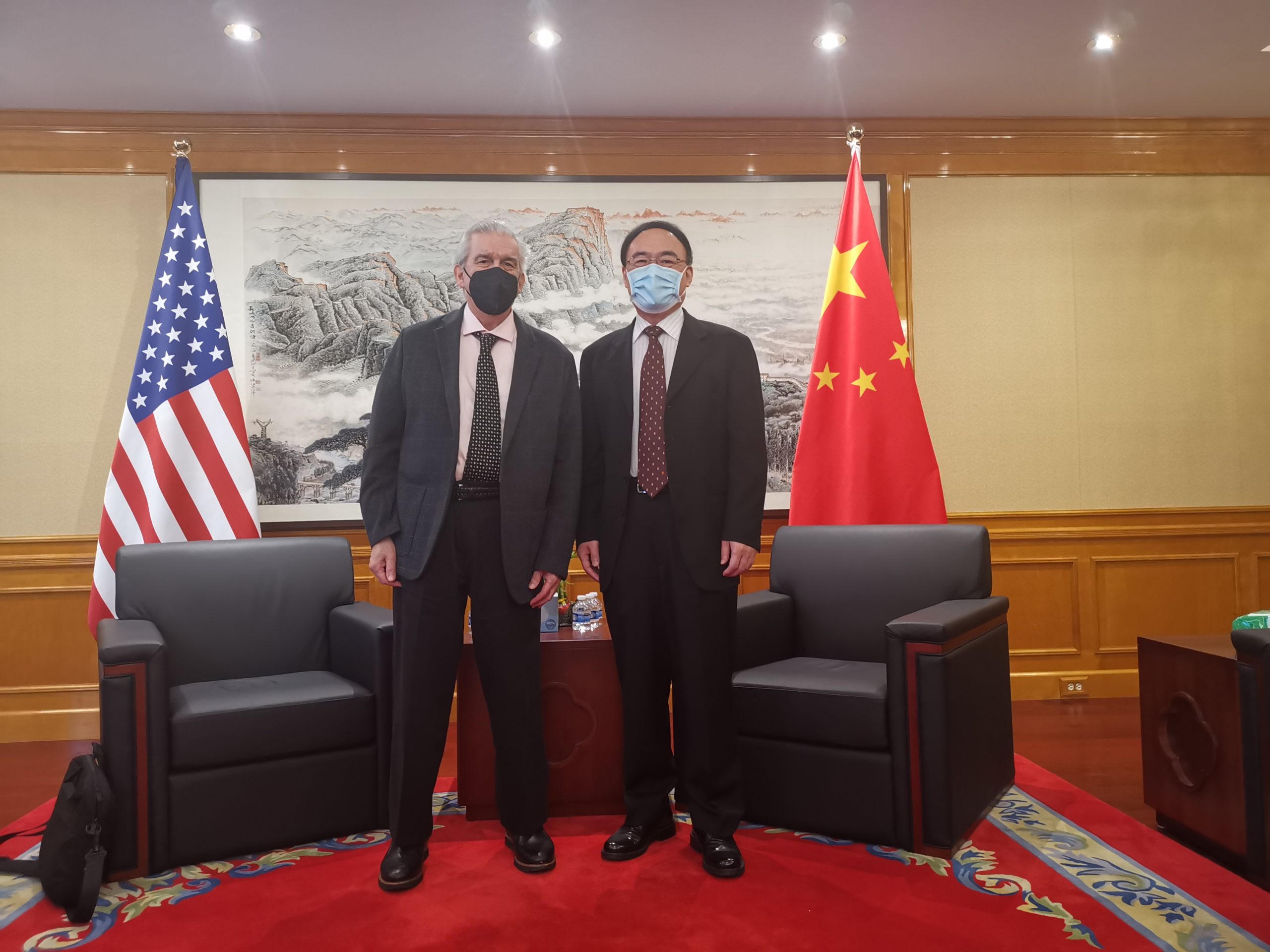
John Kamm and San Francisco Consul General Wang Donghua at a meeting on January 5, 2022. Image credit: Chinese consulate in San Francisco
Dui Hua opened 2022, the Year of the Tiger, with a roar!
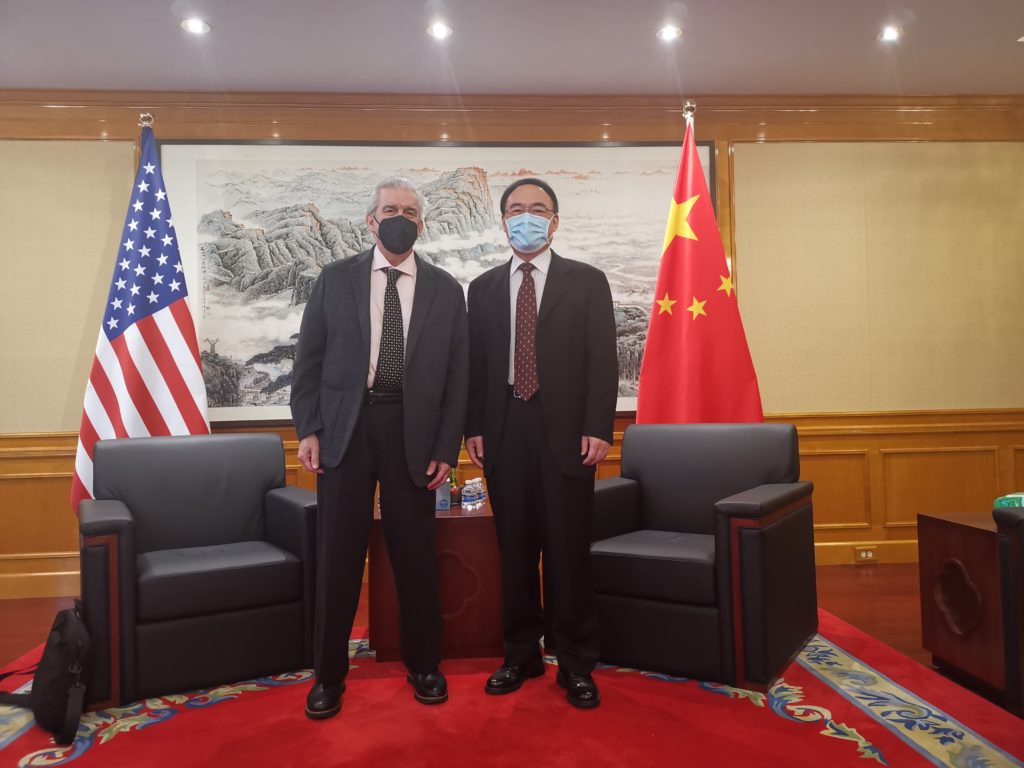
In late December 2021, Dui Hua executive director John Kamm received an email from the Chinese consulate in San Francisco. Kamm was invited to visit the consulate in early January 2022 to meet Consul General Wang Donghua and exchange opinions on human rights. The meeting took place on January 5, 2022 and lasted for an hour. Consul General Wang, who holds the rank of ambassador and director general of China’s Ministry of Foreign Affairs, was accompanied by three colleagues.
Kamm stressed the importance of China resuming what he called “strategic acts of clemency” to improve its poor image in the United States. He suggested focusing on US citizens including those with relatives in China. A long prisoner list was handed over, and four specific cases were discussed.
Kamm and Wang agreed that relations between the two countries were at their lowest point in decades. Wang noted that many people in China had hoped that the new US administration of Joe Biden would change policies enacted by the previous one in order to improve relations with China, but in fact “relations have continued to deteriorate.” The diplomat stressed that poor relations between the two countries undermine the basis of cooperation on human rights.
New Book Spotlights Dui Hua
On January 10, 2022, Oxford University Press published Americans in China: Encounters with the People’s Republic by Terry Lautz. In 10 chapters, Lautz profiles 13 Americans who have helped shape US-China relations in the 20th century. One chapter is devoted to Kamm and the work of Dui Hua on political prisoners in China.
Lautz traces Kamm’s life from his days as a student activist in New Jersey to his arrival in southern China in 1972. The chapter covers both his business career and his human rights activism that began in 1990 when he was serving as president of the American Chamber of Commerce in Hong Kong. Kamm’s interventions on behalf of several prisoners are highlighted, as are his testimonies to Congress.
Webinar in Santa Fe
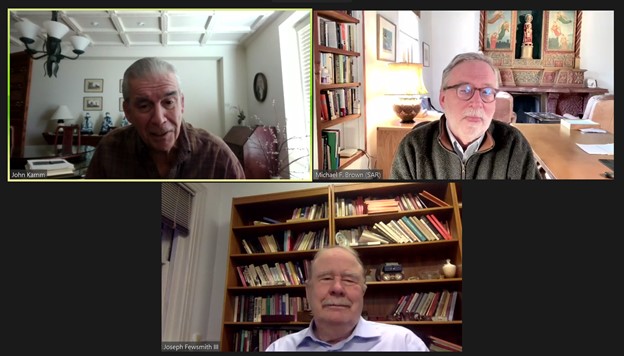
On January 20, 2022, Kamm was joined by Boston University Professor Joseph Fewsmith in an hour-long webinar hosted by the School for Advanced Studies in Santa Fe, New Mexico. In “China and the United States: A Troubled Relationship,” Fewsmith focused on Chinese domestic politics, in particular the 19th party plenum to take place later in 2022, while Kamm focused on US domestic politics including the looming mid-term elections in November 2022.
Using a graph based on Gallup polls going back to 1978, Kamm illustrated the sharp decline in China’s popularity among Americans since 2018 and noted that China’s favorability rating is now lower than those recorded after the events in Tiananmen Square that took place in June 1989. American media coverage of China is characterized by a steady drumbeat of negative stories, and attitudes in Congress are uniformly negative. An astonishing 350 bills and resolutions with China content were introduced in the first year of the current Congress. One bill in particular is noteworthy: the Uyghur Forced Labor Act establishes the presumption of guilt for companies importing products from the Xinjiang Uyghur Autonomous Region.
A screenshot from John Kamm’s presentation showing Gallup’s polling of public opinion toward China in the United States. Image credit: Gallup and the School of Advanced Research
Kamm pointed out that approval of President Biden’s handling of China among US adults is low, and this limits his ability to take steps to improve relations. This point was reinforced by examining the issue of tariffs on Chinese goods. Even though Treasury Secretary Yellen has commented that the tariffs contribute to high inflation and despite 110 members of Congress favor easing the tariffs, President Biden made clear in his January press conference that the United States is not ready to reduce or eliminate the tariffs imposed by former president Trump.
Kamm repeated the point made with Consul General Wang earlier in the month. To improve US-China relations China should show clemency to American citizens like Mark Swidan, held in a Chinese detention center for more than nine years.
A screenshot from “China and the United States: A troubled Relationship.” (Clockwise top left) John Kamm, moderator Michael Brown, Joseph Fewsmith III. Image credit: School for Advanced Research
The program concluded with a lively Q&A session during which Fewsmith and Kamm fielded a wide range of questions from the audience of 120 engaged participants. The questions covered the main hotspots: Xinjiang and the question of genocide, Taiwan and the prospect of conflict, the deteriorating situation in Hong Kong, the winter Olympics, and the question of diplomatic boycotts.
From 2017-2020, Chinese courts concluded 1,330 trials of endangering state security (ESS), dereliction of military duty, and pre-1997 offenses, according to Dui Hua’s analysis of data published annually in China Statistical Yearbooks (中国统计年鉴) by the National Bureau of Statistics. The yearbooks, accessible on the National Bureau of Statistics website, provide information on the number of first-instance criminal trials accepted and concluded by people’s courts nationwide.
President Biden delivers remarks at the House Democratic Caucus on the Build Back Better agenda and the Bipartisan Infrastructure Deal, October 28, 2021, at the US Capitol in Washington, DC. Image credit: Adam Schultz / Official White House Photo
Two polls of Americans taken in mid-January 2022 reveal a sharp drop in confidence among registered voters in President Joe Biden’s ability to handle China.
On September 16, 2012, Shincheonji Church hosted the 6th Shincheonji National Olympiad in Olympic Stadium in Seoul. Image credit: Junganghansik / CC BY-SA 3.0
The Chinese government has long been vigilant of burgeoning Christian groups from South Korea. Following its exploration of the case of Cho Young-joo and his Good News Mission, Dui Hua has found ample evidence of a clampdown on the Shincheonji Church of Jesus (新天地教会) by the Chinese government.
John Kamm Remembers is a feature that explores Kamm’s human rights advocacy prior to and since Dui Hua’s establishment in 1999.
Two Flights to Freedom, Part I
A sign held at a protest in July 2015 in Los Angeles against the 709 Crackdown in China. The sign reads, “When being a lawyer is a type of crime.” Image credit: Voice of America
In the early morning hours of July 9, 2015, Chinese police moved against human rights lawyers, legal assistants, and rights activists across China, but mostly those living and working in Beijing. Over the coming days and weeks, an estimated 300 lawyers and activists were detained or had exit bans placed on them. Power was cut off at their residences. Many were stripped of their lawyers’ licenses, forcing law firms to close. Several of those detained were subsequently tried and convicted of state security offenses. A few are still in prison, including Wu Gan, an activist known as “Super Vulgar Butcher,” who was sentenced to eight years in prison for subversion in December 2017.
International reaction to what became known as the 709 Crackdown was sharply critical. Governments, bar associations, law schools, and experts from United Nations Special Procedures condemned the action, to no avail. In an early indication of China’s current policy of ignoring international opinion, Beijing has become defiant and increasingly oblivious to criticism. Even requests for information on the status of political prisoners are now considered assaults on China’s judicial sovereignty constituting interference in China’s internal affairs.
A Brave Lawyer
A photo of Chen Taihe. Image credit: Dui Hua Foundation
Prior to his detention by public security agents for inciting subversion, picking quarrels and provoking trouble, and embezzlement on July 12, 2015, and his subsequent departure from China in March 2016, Guilin-based lawyer and associate professor of law at the Guilin University of Electronic Science and Technology Chen Taihe was a well-known advocate of China adopting the jury trial system. He researched the jury system in the United Kingdom as a visiting professor and summarized his findings in an eloquent and well-argued book entitled The Most Common Right.
It is not known why Chen Taihe was detained. It might have been because of his friendship with leading rights lawyer, Li Heping, who was himself detained on July 10, 2015. Chen had called for his release. It could have been because of his extensive ties to the United States. It might have been because of his advocacy for China adopting the jury trial system. Or it might have been because of a vendetta against him by a Guilin official. China’s justice system is anything but transparent.
Undated photograph of Li Heping. Chen Taihe called for his release prior to Chen’s detention. Image credit: Provided by Li’s supporters via RFA
Chen Taihe’s activism brought him to the attention of the domestic security division of the public security bureau, a unit known as guo bao. They invited him “to drink tea” – a euphemism used for police questioning – on multiple occasions.
His successful law practice, which focused on civil and criminal litigations, brought him fame and wealth, enabling him to purchase three apartments in high-class developments. He gave that all away to find freedom for himself and his family in the United States, assisted by retired Judge Shackley Raffetto, the Dui Hua Foundation, and American diplomats in China. He is believed to be the only 709 lawyer to have successfully left China for the West with the permission of the domestic security bureau of the Chinese government.
Time on the Cross
Upon detention, Chen Taihe was placed in the Guilin Number Two Detention Center. He endured physical mistreatment, including being forced to squat for hours in a stress position, and threats from prisoners, one of whom had been sentenced to death. Chen was in a crowded cell with 12 other detainees; he was not given a bowl, spoons, and other necessary utensils to eat food and drink water for nearly three days.
Guilin Number 2 Detention Center, where Chen was held. Image credit: dcnnlawyer.com
Finally, on July 16, 2015, he was allowed a visit by a lawyer, who was a spy sent by the government. The second lawyer that visited him was Qin Yongpei. He posted Chen’s situation and mistreatment online after he interviewed Chen in a prison meeting room. (Lawyer Qin was detained in 2019; he has not been released and is currently under indictment for inciting subversion.) Chen was then moved to another detention center where his treatment slightly improved. A month after his detention, he was moved to a location outside the detention center and then on August 22, 2015, he was allowed to return home and placed under residential surveillance, but even then, he continued to be subjected to interrogation and threats by the police right up to the day he departed China.
Lawyer Qin Yongpei, who visited Chen Taihe in detention center. He was tried for inciting subversion on December 31, 2021. Image credit: Boxun.com
While keeping the police advised of his whereabouts, he was allowed to move around Guilin and even to travel to other cities. The police monitored his communications and his movements. The family’s bank accounts were frozen, heaping misfortune on top of misery.
Judge Shackley Raffetto
On July 21, 2015, nine days after Chen Taihe’s detention, I received an email from Shackley F. Raffetto, a retired Hawaii state trial judge and US Navy judge who had befriended Chen Taihe following an introduction by a lawyer based at the US Embassy in Beijing. Judge Raffetto invited Chen and three other Chinese lawyers to visit Hawaii in September 2013. While there, the small group of Chinese lawyers observed a jury trial and were able to interview the jurors after the trial concluded. They met with the Chief Justice of the Hawaii Supreme Court as well as law professors and lawyers from firms involved in legal exchanges with lawyers in China.
Judge Raffetto addressing an audience at the US Consulate General in Chengdu, since closed, in 2014. Image credit: Judge Raffetto
Judge Raffetto had already lectured and conducted a US style jury trial moot program at two PRC law schools. In April 2014 he travelled to Beijing, at the invitation of the US Embassy, with the intention of providing the jury trial moot at a number of law schools that had requested the program. The first school at which the trial moot program would be presented was Chen Taihe’s law school. Chen had advised the Guilin police that he had invited Judge Raffetto to conduct the program at his university.
Upon arrival in Beijing, Judge Raffetto was told that the entire program had been cancelled. No explanation was given. Chen Taihe was ordered not to participate in the program. Judge Raffetto adjusted the program and proceeded to give lectures on the American justice system at law schools around China, arranged by the US government. Police tried to block people from attending his lecture in Beijing. They were admitted by a side door.
In July 2015, Judge Raffetto noticed that Chen Taihe’s name was on a list of lawyers and activists detained in the 709 crackdown drawn up by Amnesty International. He contacted the US Embassy in Beijing, the people with whom he had worked on programs, but never received a response. He then reached out to human rights groups, including Dui Hua, to see what could be done for his friend.
Role of China’s San Francisco Consulate
In my work on Chinese political prisoners, I have used different channels to submit lists and discuss cases. One of the most important channels has been the Chinese consulate general in San Francisco. I reached out to my point of contact, Consul Wang, and asked for a meeting to discuss Chen Taihe’s case. We agreed to meet on Monday, July 27, 2015, at the consulate on Laguna Street.
A picture of Consulate General of the People’s Republic of China in San Francisco. Image credit: Steve Rhodes / CC BY-NC-ND 2.0
I submitted a detailed memo on what I knew about the case. I pointed out that Chen was the only law professor to have been detained in the 709 crackdown and pointed out that President Obama was also a law professor. Guangxi Zhuang Autonomous Region, whose capital is Guilin, is the sister state of Montana, home state of US Ambassador Max Baucus. For these reasons, Chen Taihe’s case was now a high priority for the US government.
Wang took action. He impressed on his superiors in Beijing the importance of the case. A few weeks later Chen Taihe was moved out of the detention center and eventually placed under residential surveillance. Unfortunately, his ordeal was far from over.
Throughout my work on the case, I stayed in close touch with officers at the United States Department of State and the National Security Council in Washington as well as the US Embassy in Beijing. Washington-based officials were a source of good advice and assistance arranging Chen’s departure and providing limited financial support. Chen Taihe was well known to the Department of State prior to his detention in 2015. In both 2011 and 2012, Chen Taihe had participated in legal exchange programs and in 2012 he visited Washington DC at the invitation of the State Department’s International Visitor Leadership Program.
As Dui Hua has previously written about, Chinese government crackdowns target all aspects of the political spectrum, including leftist dissidents who are seen as a destabilizing factor, especially when they invoke Marxist and Maoist ideologies to organize migrant workers to support labor rights.
Many young leftists obtained their political knowledge on the People’s Republic of China from well-known leftist or left-leaning intellectuals and user-generated content on forum websites such as Utopia (乌有之乡). Their opinions on the economic policies of the pre-“open and reform” era are particularly influenced by such websites and reinforced by each other through forum discussions and posts.
Dui Hua recently learned that members of a young leftist group from Fujian were convicted and sentenced for picking quarrels and provoking troubles. The Pingdingshan Xinhua District Court in Henan province found five defendants guilty of spreading false information online for illegal financial gain. According to a version of the judgment reposted online, the sixth member will be processed in a separate case.
The procuratorate accused the six defendants of registering multiple companies to promote “red culture” while spreading false information through social media that attacked the Party and several former leaders. The titles of eleven posts cited in the court judgment ranged from defending the Great Leap Forward and the Gang of Four to attacking the “open and reform” era.
Four of the five defendants are in their late 20s to early 30s, while one was 19 years old at the time of sentencing. Their education ranges from primary to middle school. Zhang Zhijing (张支景) was sentenced to two years (sentence expires in April 2023), Yu Chaoquan (余朝权) and Qu Pingqing (邱平琴) were each sentenced to one year (sentences expire in April 2022), and Qu Pinghui (邱平会) and Huang Xiaochun (黄晓春)—the latter being the youngest of the five—were sentenced to ten and nine months, respectively.
On Reddit, a post claiming to be written by the sixth member of the group, Yu Yixun (余宜勋), says that he was released on bail due to illness and spared from the trial.
Guangxi rights lawyers tried, one convicted and sentenced
The first hearing in the endangering state security trial against former lawyer Qin Yongpei (覃永沛) was held behind closed doors on New Year’s Eve at the Nanning Intermediate People’s Court, more than two years after he was detained. Only his defense counsel and wife were permitted to attend.
Qin was briefly detained during the 2017 “7.09” crackdown on lawyers and legal activists. His law firm was shuttered in May 2018, and he later lost his license to practice. However, he continued to voice his concerns over the judicial process and reforms on social media, criticizing violations of human rights by the government.
The Nanning police detained Qin on October 31, 2019 for inciting subversion. The indictment was submitted in May 2020. The procuratorate accused him of “spreading false information about high profile cases on social media,” forming a “post-lawyer club”—with other lawyers who similarly lost their practice licenses—and challenging the judicial system after his license was revoked.
Citing concerns over COVID-19, the Nanning Number One Detention Center initially denied visitations by Qin’s lawyer and wife while still permitting interrogations by the police and procuratorate to continue via video conferencing inside the facility. The meeting with Qin’s defense lawyer was only granted after Qin had been transferred to the Nanning Number Two Detention Center. Qin’s wife had her first visit in August 2021.
At the time of writing, the trial has yet to be concluded.
Lawyer Chen Jiahong (陈家鸿) was one of the partners at Baijuming, Qin’s law firm. Chen was reportedly detained for inciting subversion in April 2019 and indicted in October. Although his trial had the first hearing in June 2020, no judgment was issued until December 14, 2021. Chen was convicted and sentenced to three years in prison. The charge against Chen was linked to a slogan he posted in Chinese calligraphy with the words “liquidate this evil bureaucracy and promote democracy.” Family and friends suspected Chen admitted guilt in exchange for lenient sentencing.