Category: John Kamm Remembers

John Kamm Remembers are stories written by Dui Hua’s founder recounting Kamm’s advocacy for prisoners in China. In addition to these stories, the 50 Years in China timeline visualizes Kamm’s human rights work alongside the history of US-China relations.

  • Target of the Gang of Four

    Target of the Gang of Four

    << Read all John Kamm Remembers stories

    I left America for Macau to take up a teaching position in August 1972. I moved to Hong Kong on Christmas Day, 1972. By the end of 1975 I had lived most of the previous three years in Hong Kong with a spell at Harvard University in late 1974 and early 1975 to earn a Master’s degree. What is now a Special Administrative Region of China, Hong Kong was then a Crown Colony of Great Britain. I worked as a tutor at the Chinese University of Hong Kong and, beginning in the summer of 1975, as an assistant editor of Asian Business & Industry, a limited circulation business magazine, published by Far East Trade Press, with readers in every Asian country, including China.

    One day in July 1975, as I was walking back to my office in Prince’s Building, I passed by Commercial Press where I purchased a copy of a pamphlet entitled “On Exercising All Round Dictatorship of the Bourgeoisie” written by Zhang Chunqiao. Zhang was a member of the Standing Committee of the Politburo of the Central Committee of the Chinese Communist Party, and the theoretician of a leftist faction that would someday come to be known as the Gang of Four. I read the pamphlet and, based on my understanding of its contents, wrote an article for the August issue of Asian Business & Industry. I called out Zhang for his ultra-leftism – identifying him as the principal spokesman for radical economic policy in the Central Committee — and criticized his call for class warfare directed against the “dictatorship of the bourgeoisie,” referring to a passage in his essay in which he calls for the “iron broom of the dictatorship of the proletariat” to sweep away bourgeois rights from China.

    A few weeks after publication, I came to the office to find a stack of copies of the magazine wrapped in filthy rags. The China National Publications Import Corporation, the channel through which Far East Trade Press distributed its magazine in China, had returned all the magazines with a letter on its official stationary. The letter accused Asian Business & Industry of having published a counterrevolutionary article that had “hurt the feelings of the Chinese people.” The letter concluded by stating that the magazine would no longer be allowed to circulate in China.

    I didn’t know it at the time, but my article attacking Zhang Chunqiao had attracted the attention of Zhang and his leftist allies in what was sometimes called “the Shanghai faction.” Public security began a file on me, known in China as a dang’an. Such files are kept on virtually every Chinese citizen as well as on foreigners who visit China on a regular basis. Thirty years after my article appeared, I learned that it was the first item in my dang’an. The diplomat who gave me this information said that I was known in government and party circles as a “target of the Gang of Four.”

    Shanghaied at the Feather and Down Fair
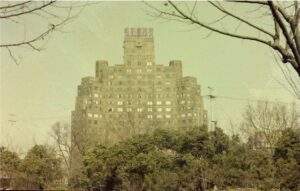
    Shanghai Mansions.

    My chance to visit Mainland China for the first time came in January 1976 when, as a freshly minted representative of the National Council for US-China Trade, I was asked to go to Shanghai to attend the China Feather and Down Garments Minifair (中国羽绒服饰小交易会) put on by the China National Native Produce and Animal By-Products Import and Export Corporation (CHINATUHSHU, 中国土产畜产进出口公司). My visa came through at the last possible moment, enabling me to make the flight to Shanghai from Guangzhou on January 6.

    First though I had to get to Guangzhou from Hong Kong. I boarded the Kowloon Canton Railway train that departed from the Tsimtsatsui terminus at 8:24 on January 4, 1976, arriving at Lo Wu station around two hours later.

    After crossing the border at Lowu and having a simple but tasteless lunch at the station on the Chinese side, I and other trade fair attendees boarded the 1:00 PM train for Guangzhou. I was accompanied by a young American entrepreneur who had become a leader in manufacturing down garments, then quite the rage in America, and an Australian businessman/scholar and his wife.

    From the train windows we could view the countryside, fields left fallow for the spring planting. We passed the small village of Shenzhen, today a major city that is home to China’s first special economic zone. Upon arrival at the Guangzhou train station we hopped into grey Shanghai sedans for the run to the Bai Yun airport. We arrived at Hong Qiao Airport in Shanghai after nightfall, but there was no one to receive me.

    Eventually Mr. Ma from the Shanghai Foreign Affairs Bureau showed up and I was taken to the Peace Hotel, the former Cathay Hotel, on the Bund. Mr. Ma was silent for the late-night drive though dark, deserted streets. The next day I moved to Shanghai Mansions, the old Broadway Mansions, where the trade fair was taking place. At the Shanghai Mansions I was given an immense apartment on an upper floor, with balconies overlooking the Huangpu River, Suzhou Creek and the Bund. There was a big radio circa early 1940s in the living room. Radio was the only form of entertainment available to me. I never bothered turning it on.

    The next day, January 5, 1976, I visited the trade fair itself, and registered with the liaison office. The office was staffed by cadres from the China Council for the Promotion of International Trade (CCPIT), the National Council’s counterpart organization in China. The fair itself was held in four rooms on the second floor of the hotel. Different branches of CHINATUSHU had their own display and negotiation spaces which were fitted out with one or two tables and chairs. A tin of cigarettes was placed on the tables. The exhibition and negotiation hall reeked of cigarette smoke.
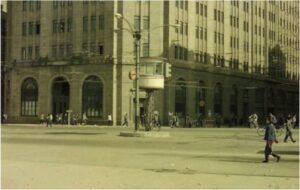

    “Traffic” on the Bund. Not a single car in sight. Today this thoroughfare is multi-laned and bumper to bumper, one of the busiest streets in China.

    One of my tasks was to write an article on the minifair for the National Council’s magazine, China Business Review, so I put in a request for an interview with the trade fair’s leadership. My request received a cool reception. I was told to go to my room and wait for an answer. This was a sensitive time for people doing business in China, and minifairs, an innovation introduced as a modest reform in 1975, were under fire as examples of the “roots of capitalism” being introduced by Deng Xiaoping, arch foe of the Shanghai Faction. I wondered if I would get an interview in Shanghai, or have to wait until I got to Beijing, where a Fur Garments Minifair was about to open.

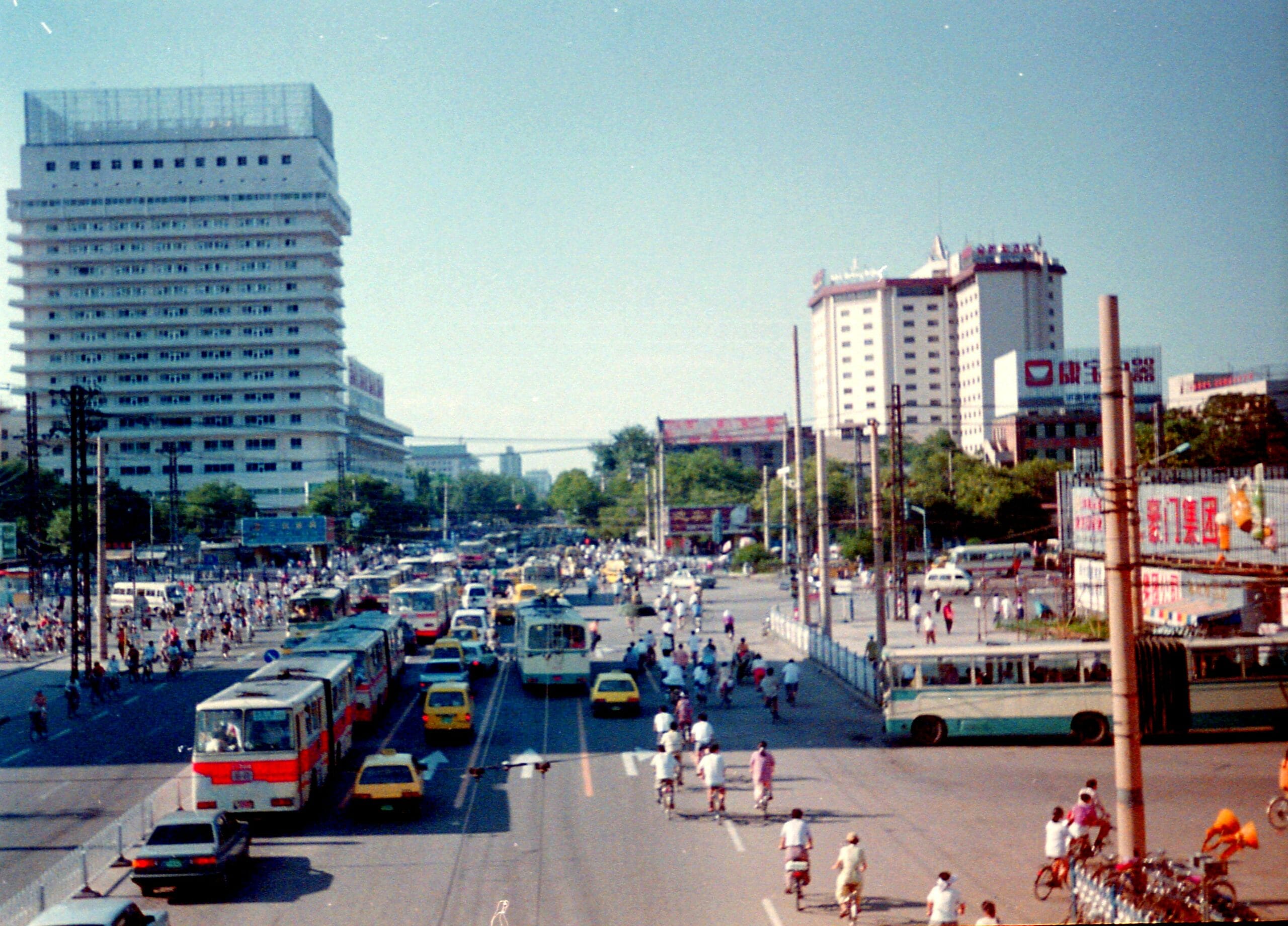
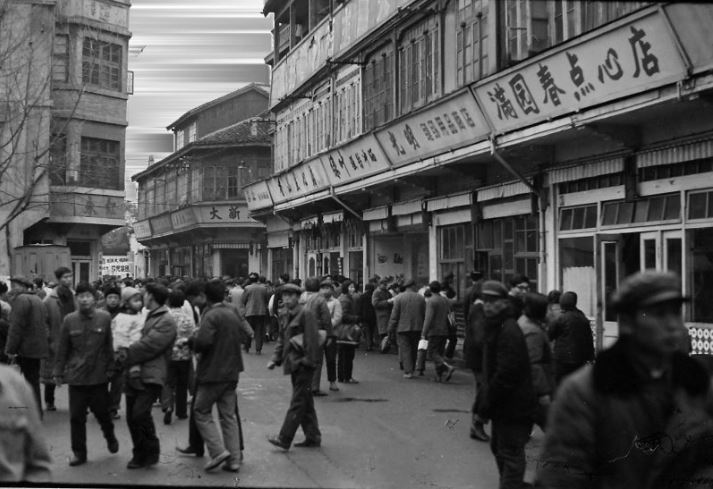
    Rather than heeding the liaison office’s instructions, I decided to take a walk along the Bund and up Nanjing Road. There were few vehicles on the road, the favored mode of transport being the bicycle. I checked out the Shanghai Exhibition Hall, a vast structure built in the Soviet style, and the Shanghai Number One Department Store, said to be the largest in China. Its five floors were stocked with a wide variety of consumer goods, all made in China except foreign watches, the only foreign consumer good allowed for sale in China. I resisted the temptation to buy an Omega for RMB 861.

    I have always visited bookstores on trips to China, and my first trip was no exception. I walked into the large Xinhua Bookstore on Nanjing Road, passing through thick canvas curtains meant to shield the building from the bitter cold outside. Upstairs I walked into the room that held internal (nei bu) publications sold only to cadres with the right documents. I was quickly and unceremoniously told to leave.

    I wandered back to the hotel, stopping first at the office of the Hong Kong Shanghai Bank, located in a small building on a side street not far from the compound housing the Friendship Store and the Seamen’s Club. The compound had previously served as the sprawling British Consulate in Shanghai. I was greeted by the bank’s British manager with more than the usual British reserve. He and his colleague from the Standard Charter Bank were at the time the only resident foreign businessmen in Shanghai. Unfortunately, they could not conduct business. They were in effect hostages of the Chinese government to ensure that China’s holdings with the banks wouldn’t be expropriated. Their colleagues had in fact been detained during the early years of the Cultural Revolution. They couldn’t leave Shanghai until colleagues arrived to replace them. The fellow I met expressed relief that he would be ending his assignment later that year.
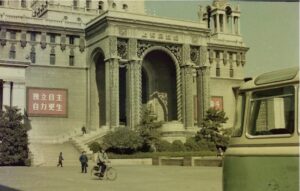

    The Shanghai Exhibition Hall.

    I decided to stop by the Friendship Store, a dreary place selling shoddy goods far below the quality found in Hong Kong’s Chinese products stores. After examining the wares on display, I walked over to the nearby Seamen’s Club. Both the Friendship Store and the Seamen’s Club were located on the grounds of the old British Consulate in Shanghai.

    In those days Seamen’s Clubs were the hubs of entertainment for foreigners in China. They served cold beer and one could always find a sailor willing to tell tall tales of his voyages to China. I struck up a conversation with a young Hong Kong sailor who was working on a tramp steamer registered in Hong Kong and operated under the Chinese flag. Together we went back to the Shanghai Mansions where we had a simple dinner and played pool for several hours, drinking beer and eating peanuts. The young sailor told me of his life on a PRC-owned vessel. He complained about the incessant political study sessions he and his fellow seamen had to endure. I listened attentively. Apparently, others were also listening attentively.

    An Interview

    A group of mourners assemble for the walk to Zhou Enlai’s funeral in a side hall of the Forbidden City. Photos by author.

    On January 8, I was advised that my request for an interview had been granted. I was told to come to a room on the top floor of the Shanghai Mansions at 10 PM, an unusually late hour for meetings in China. I spent some time putting together my questions, and then prepared to join a tour of a Shanghai commune. When I tried to sign up for the tour however I was told that I was not welcome to join. I protested to the liaison office to no avail. I headed out on another walk, this time witnessing the arrest of a Shanghai citizen by a police officer. The officer frog marched the young man down a narrow alley, attracting a throng of curious onlookers.

    I went back to the Shanghai Mansions, had dinner, and waited in my room for the interview. At the appointed hour I went to the assigned room and found about two dozen cadres led by “leading Member” Chen Wenhai waiting for me. The interview was a formal affair, no smiles or words of greeting. I was told the ground rules. I would first ask all my questions. Thereafter I would be given a brief introduction to the trade fair. No further questions would be entertained. I must have asked thirty or so questions, after which I was given the brief introduction. It quickly became apparent that few of my questions would be answered. The “brief introduction” started out with words of praise for the wise leader Chairman Mao Zedong and the correct policies of the Chinese Communist Party. I was then given the bare bones facts of the trade fair: how large the exhibition space was, how many provincial animal by-products branches were in attendance, how many traders from which foreign countries were in attendance. That was it.

    I tried to slip in one more question. In 1975 China agreed for the first time to sew into garments intended for export the labels of the western company that had ordered them according to their specifications. This was a welcome reform as Chinese labels like Peony, Snowflake, and the like didn’t appeal much to American and European consumers. Suddenly, at this minifair, traders had been advised that this policy had been cancelled. No more foreign labels would be sewn into Chinese made garments. There was much unhappiness among foreign traders about this sudden change, and I wanted to ask a question about why this step had been taken. I never got a chance to do so. I was cut off and reminded that there would be no more questions and told that the interview was over.

    Shortly after returning to my room the phone, an old black apparatus with a solid feel, started ringing. It was the young sailor I had befriended the night before. His voice was shaking, and I guessed he had company sitting nearby. Obviously distressed, he told me that he was leaving Shanghai early, and that I was not to try to contact him. He told me he would always remember our friendship. He rang off. A cold shiver ran up my spine.

    I went to bed, but had trouble falling asleep. In the early hours of January 9, I heard a great commotion taking place on the barges on Suzhou Creek below me. There were loud voices and the sounds of fighting. I dozed off and when I awoke I saw the streets lined with military vehicles, and all the barges gone. In the distance I could hear the somber music of a funeral dirge. I left my room and encountered an elderly floor attendant. What has happened I asked? He told me that Premier Zhou Enlai had died. He was weeping.

    I and other trade fair attendees went to the liaison office to find out more. The official who met us solemnly announced the premier’s passing, and then told us that “the Chinese people will turn grief into strength” and that they would carry on the great traditions of the revolutionary leader. There would be no interruption to the trade fair. Business as usual.

    To reinforce this point, the liaison office laid on visits for the attendees and this time I was invited to join the tours. We were offered visits to a well-off commune on the outskirts of the city – one of its production brigades specialized in raising “hairy crabs,” a Shanghai delicacy – and a factory making feather and down garments. Our visits were punctuated by bursts of propaganda praising the Great Proletarian Cultural Revolution.

    Upon my return to the hotel I ran into the Australian who I had met on the train up to Guangzhou and his wife. They had just had a harrowing experience. They had gone for a morning walk and saw crowds of people reading newspapers which had been posted on wooden hoardings. They were reading official news of Zhou Enlai’s death, and the couple decided to photograph the scene. Bad move. In those days it was against the law for foreigners to purchase or even read local newspapers like the Wen Wei Bao and Liberation Daily. The couple were swiftly taken into custody by the local neighborhood committee and held in a small room until the police showed up. They were interrogated and lectured at length. Their actions were unlawful and violated the terms of their visit to China. After signing expressions of regret, and apologizing profusely, the couple were escorted back to the Shanghai Mansions.

    A small group of us decided to try another restaurant for lunch, having sampled just about everything on the Shanghai Mansions’ menu. We walked to the Peace Hotel and took the elevator up to the dining floor. We chose the Western restaurant. Sitting down, we noticed that the waiters were wearing black arm bands. One of the young men came to our table and explained: “We have been told not to commemorate Zhou Enlai’s death, but we are doing so anyway. We are not afraid. Let them come and try to make trouble.”

    The next day I flew to Beijing where I attended the fur garments minifair, and visited one of the model communes on the city’s outskirts as well as, of course, the Great Wall and the Ming Tombs.

    On January 12, I took part in the funeral of Zhou Enlai as a member of the American delegation. Diplomats were all dressed in black, thin clothing for the bitter cold. We were received on the dais by Jiang Qing, wife of Chairman Mao Zedong, one of the members of the Shanghai Faction later to be known as the Gang of Four. Zhang Chunqiao was also present.

    China would be visited with much more sorrow in 1976: the campaign against the right deviationist wind, the Ching Ming protests and the deadly response, the July earthquake in Tangshan, and much joy when the Gang of Four was overthrown in October. I witnessed all of those events during many visits to the country that year.

    Upon my return to Hong Kong after attending Zhou’s funeral I was asked by a friend at Ta Kung Pao, a left-wing newspaper, to write a eulogy for the recently departed premier. I did so, and the piece ran under the Chinese name given to me by a teacher in the United States: Kang Youhan (康又瀚). The eulogy was full of praise for Zhou. A few days after it appeared my friend told me that the article had been removed from the Reference News edition published in Shanghai. My friend suggested that I adopt a new name for any future Chinese language articles I might write. I adopted the name Kang Yuan (康原), and have kept it to the present day.

    Postscript: More than 30 years later, I took a small group of businesspeople to Shanghai. We went to the restaurant at the top of the Peace Hotel, and there I recounted the story of the defiant young waiter. Across the room I spied a man of roughly my age who was now the manager of the restaurant. He looked familiar, and I asked him to come to our table. He complied, and we quickly figured out that he was that young waiter I had encountered in January 1976. In excited voices we relived what had happened. Misty eyed, he asked me a favor. Would I be willing to come back and talk to his young charges? “Young people have no idea how we lived then. And they aren’t interested. You can help. Please come back.” I agreed to do so, but when I returned a few months later the restaurant was closed for renovation. I subsequently found out that Mr. Zhang the manager had retired.
  • National Security in the Time of SARS

    National Security in the Time of SARS

    << Read all John Kamm Remembers stories

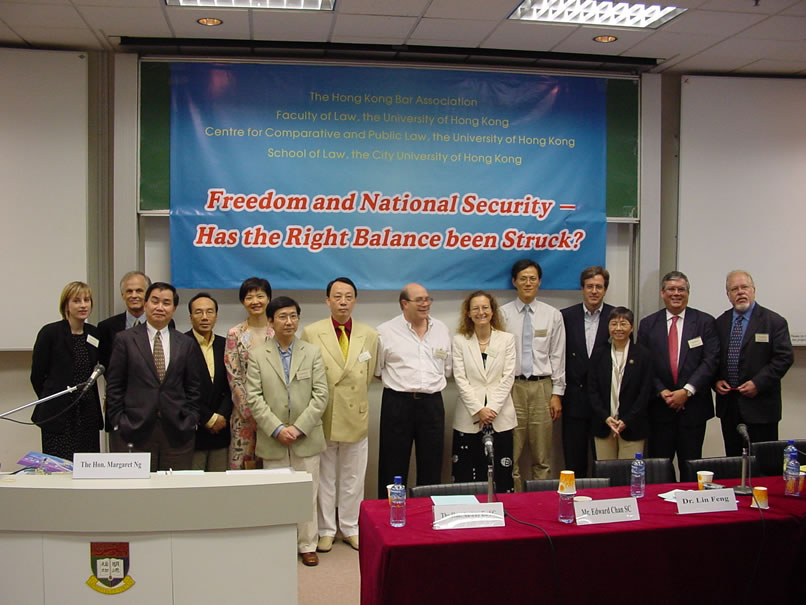
    Executive Director John Kamm, second to right, at the Hong Kong University and Hong Kong Bar Association’s conference on “Freedom and National Security – Has the Right Balance Been Struck?” June 14-15, 2003. Image: Hong Kong University

    Shortly after Tibetan political prisoner Ngawang Sangdrol’s arrival in the United States on March 28, 2003, I began preparing for my next visit to Beijing and Hong Kong, tentatively scheduled for early June, roughly four weeks later. Preparations for these visits, then as of now, take many weeks.

    Cases need to be identified, researched, and prioritized. Bilingual prisoner lists for my interlocutors have to be prepared. For this trip I intended to focus on the imprisoned American businessmen Jude Shao and Fong Fuming, as well as prominent Uyghur political prisoner Rebiya Kadeer.

    I sought meetings with the Ministry of Foreign Affairs, the Ministry of Justice, the Supreme People’s Court, the Supreme People’s Procuratorate, and leading Chinese academics who served as advisers to the Chinese government. I asked to visit a prison. I asked for meetings with the American ambassador and other diplomats as well.

    I made my preparations with some trepidation. A fatal disease – Severe Acute Respiratory Syndrome (SARS) – was sweeping China. Thousands of infections had been recorded, and many people – including officials – had been placed under quarantine. Guangdong Province was especially hard hit. By early June 2003, the province had recorded more than 1,500 cases and 57 fatalities. SARS had already spread to Beijing, Tianjin, and other provinces and municipalities by April. By early June, there were 5,329 cases and 336 reported deaths nation-wide.

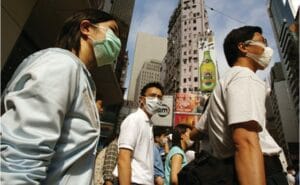
    The epidemic reached Hong Kong in March 2003. The first fatality was recorded on March 11. By early June, 1,750 cases had been identified and 286 deaths recorded. The city was in a state of high alert. Disinfectant was applied liberally to every conceivable surface, often several times a day. People wore masks and generally avoided public gatherings. Tourist arrivals dropped precipitously.

    In mid-May I was advised that my principal interlocutor, Ministry of Foreign Affairs Director General of the International Department Li Baodong, remained under quarantine. All prisons in the country had been placed off limits to visitors. I decided to cancel my trip to Beijing but to proceed with the visit to Hong Kong. I would meet Chinese officials from an inland province as well as Hong Kong activists, academics, and researchers. As usual, I would conduct research at the University Services Center of the Chinese University of Hong Kong.

    “Nest of Spies”

    SARS was not the only issue troubling the people of Hong Kong during the early months of 2003. Article 23 of the Basic Law, Hong Kong’s mini-constitution, stated that the Hong Kong Special Administrative Region (SAR) “shall enact laws on its own to prohibit any act of treason, secession, sedition, subversion against the Central People’s Government.” This article had been inserted into the Basic Law after the events of May and June 1989 in Beijing.

    By late 2002, the SAR’s Legislative Council (Legco) had failed to enact the legislation called for under Article 23, and Beijing was growing impatient. Chinese officials based in the SAR declared that Hong Kong was a nest of spies; in early 2003 at least three Hong Kong residents, all of whom had worked in China’s Xinhua News Agency, were detained in Guangdong Province for allegedly spying for the United Kingdom during the years leading up to the handover in 1997. They were eventually arrested, tried, and convicted of espionage. Two of them, Chen Yulin and Wei Pingyuan, were sentenced to life in prison. They were still in prison, despite multiple sentence reductions, as of mid-2018 (see this issue’s Prisoner Update).

    The Hong Kong official tasked with pushing through Article 23 legislation by Chief Executive Tung Chee-hwa was Regina Ip, a career civil servant holding various positions in the Hong Kong government before being appointed Secretary for Security in July 1998. Ms. Ip and I had worked on retaining Most Favored Nation trading status for China in the early 1990s. I knew her as a tough, uncompromising official well versed in issues of trade, industry, and immigration. She had little knowledge of national security however, and had infrequently visited China before 1997 (when she was 47 years old). This was in line with pre-handover British policy which placed restrictions on Hong Kong officials traveling to the People’s Republic.

    Regina Ip was also very ambitious. She was determined to eventually become the Chief Executive of the SAR.

    Unfortunately for her ambitions, Secretary Ip had developed a reputation for alienating people by making ill-considered remarks. In the run-up to the introduction of the National Security Bill in the Legislative Council’s Bills Committee on February 14, 2003, Secretary Ip had warned against viewing democracy as a panacea. After all, she said, Adolf Hitler had been democratically elected as Germany’s chancellor before embarking on his murderous genocide directed at the Jews. She also disparaged Hong Kong’s taxi drivers and restaurant workers, opining that they weren’t interested in such things as national security.

    A Letter from Alan Leong

    I arrived in Hong Kong on June 11 and immediately went to the J.W. Marriott Hotel at Pacific Place on Hong Kong Island. After checking in, I went to my room to begin unpacking. While doing so, I noticed a letter that had been slipped under my door. It was from Alan Leong, a leading member of the Article 23 Concern Group and Chairman of the Hong Kong Bar Association. The letter, on Bar Association stationary, invited me to make a presentation to a conference on Article 23 to be held at the Law School of Hong Kong University on June 14-15, 2003. The title of the conference was “Freedom and National Security – Has the Right Balance Been Struck?” I was asked to make a presentation on national security legislation in the People’s Republic of China.


    A siege mentality gripped Hong Kong as the death toll from SARS started to rise. Image: timeout.candrholdings.com

    I called Mr. Leong at his Chambers. “What’s this all about?” I asked. “The policy governing Hong Kong is ‘One Country, Two Systems.’ What does national security legislation in China have to do with national security legislation in Hong Kong.” At that point I hadn’t even read the National Security Bill being considered by Legco.

    Mr. Leong replied, “You are correct. National security legislation in China should have nothing to do with national security legislation in Hong Kong. As it turns out, however, the bill under consideration contains language which links the two systems. In short, if an organization in Hong Kong is subordinate to an organization in China that has been banned by the central government on national security grounds by means of a certificate, the Secretary for Security can ban it in Hong Kong.”

    I was intrigued. I had never heard of a Mainland Chinese mechanism for banning an organization on national security grounds by means of a certificate. Prior to 1997, when China’s Criminal Law was amended to remove the crime of counterrevolution, individuals could be sentenced to prison for simply belonging to a counterrevolutionary group. Whether or not a group was a counterrevolutionary group was determined by a court, not by a government agency. After 1997, mere membership in a group no longer constituted a crime. This important 1997 reform of the Criminal Law sought to criminalize acts like drafting manifestos and raising money, not simple association.

    I agreed to make a presentation on June 15, the second and last day of the conference. I was told by Mr. Leong that the audience would probably be small. June 15 was Father’s Day in Hong Kong, and mine would be among the last presentations.

    After we rang off, I went to the hotel’s concierge level and printed out a copy of the National Security Bill. Part 4, Section 8A (2) (c) provided for the Secretary for Security to proscribe any local organization “which is subordinate to a mainland organization the operation of which has been prohibited on the ground of protecting the security of the People’s Republic of China, as officially proclaimed by means of an open decree, by the Central Authorities under the law of the People’s Republic of China.” The next section (3) stated that conclusive evidence of the prohibition would be “a certificate issued by or on behalf of the Central People’s Government.”

    I began preparing a presentation based on points of Chinese law, and on cases of individuals tried by Chinese courts for counterrevolution and endangering state security.

    The Conference

    I decided not to attend the first day of the Hong Kong University conference on June 14, 2003. That evening though, I was invited to attend a dinner at the Hong Kong Club. In attendance were conference participants including local pro-democracy activists and lawmakers. The mood was grim.

    Earlier that day Legco’s Bills Committee had carried out a “clause by clause” review of the National Security Bill, a process that took nearly eight hours. Many of the legislators in the democratic camp chose not to attend the meeting, preferring to attend the Hong Kong University conference instead. After the review, the Legco committee voted to end debate, meaning that debate could not be reopened, and easing the way for the bill’s adoption by Legco.

    All seemed lost. What could be done to stop adoption of the legislation by Legco? I weighed in at the dinner, introducing the Cultural Revolution concept of “raising the red flag to oppose the red flag.” It was often used by Red Guard factions against each other; each claimed the mantle of Mao Zedong thought and used quotations from Mao to undermine the arguments of the faction.

    In the case of Article 23, Chinese law was a “red flag,” and set against this was another “red flag,” the Hong Kong National Security Bill. What we needed to do was to show how the Hong Kong legislation ran counter to both the spirit and letter of Mainland Chinese law. Instead of pointing out why the legislation was bad for the human rights of the people of Hong Kong, basing our arguments on the Common Law, we needed to show how the legislation was bad for the people of China based on Chinese law. A long shot, but worth a try.

    The next day I arrived at the conference hall to find a packed room of leading legal scholars from around the world, a cohort of Democratic legislators, and the Hong Kong Solicitor General Bob Allcock and his subordinates. Mr. Allcock was head of the Legal Policy Division of the SAR Department of Justice.

    My panel sat down and shortly thereafter I began my presentation. I went through it point by point, focusing on the 1997 amendment to the Criminal Law that criminalized acts, not association.

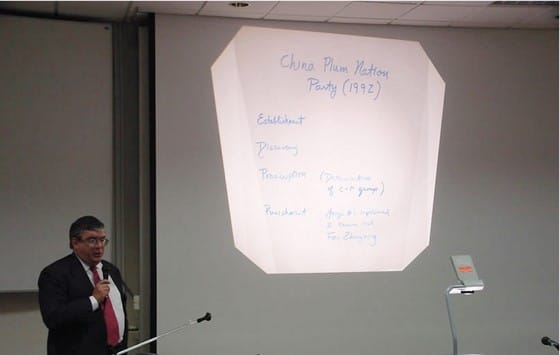
    I referenced several cases in which individuals had been convicted of subversion after 1997 for undertaking subversive acts. I had been unable to find a single case of someone being subjected to coercive measures for mere membership in an organization. In one case, that of the Chinese Nation’s People’s Party, more than a thousand members of an underground political party had been spared criminal prosecution. Its leaders had been convicted of subversion and sentenced to long prison terms for engaging in activities like organizing meetings, drawing up a manifesto, and raising money.

    Reinforcing my point that China did not ban groups on national security groups, I pointed out that it had in fact banned groups like Falun Gong on public order grounds. Article 300 of the Criminal Law made it a crime, punishable by imprisonment, to use a cult to disrupt the administration of the law. If China had banned groups on public order grounds, why hadn’t it banned groups on national security grounds?

    I concluded that Hong Kong’s National Security Legislation could not come into force unless and until China’s National People’s Congress amended the criminal law and returned to the “bad old days” of the pre-1997 criminal law, a time-consuming and complicated process that would anger China’s legal reformers who were proud of having removed “membership in a counterrevolutionary group” from the criminal law.

    My remarks caused quite a stir. Veteran democratic legislator Martin Lee wondered aloud: “Why didn’t we think of that?” Legislator and union leader Lee Cheuk-yan delivered impassioned remarks: “We Hong Kong people are so selfish. All this time we have been concerned with how this bill will hurt the human rights of the Hong Kong people. Now we learn that it could hurt the human rights of the entire Chinese nation. We will be condemned as criminals for a thousand generations!”

     
    Kamm delivers a talk on Article 23 and national security, Hong Kong University, June 15, 2003.

    At this point, Attorney General Allcock addressed me, arguing that there were regulations issued by local authorities that governed registration of organizations. If an organization could not be registered, it was the same as banning the organization. I disputed this. “Refusing to register an organization is not the same as banning it. And, in any event, laws passed by the National People’s Congress take precedence over regulations put out by ministries and local governments. There is nothing in the Criminal Law about banning organizations on national security grounds.”

    Albert Chan took the floor. Chan, former dean and current professor of law at Hong Kong University School of Law and a member of the Basic Law Committee, was a respected legal scholar enjoying excellent relations with senior Chinese judicial and government officials. “John Kamm is right,” Professor Chan declared. “For the National Security Bill to be enacted in its present form, Mainland Chinese law would have to be amended. No proscription mechanism as described in the bill exists in Chinese law.”

    Bob Allcock was at sixes and nines, the proverbial deer in the headlights. He had lost control of the meeting. He said that the issue I had raised could be discussed at the Legco Bills Committee meeting on June 17. I asked if I could attend the meeting and he said yes.

    The next day local newspapers, English and Chinese, were full of stories on what I had done. A headline in the South China Morning Post read “Hong Kong’s Future Autonomy is at Stake, Says Expert.” The stage was set for a showdown between Regina Ip and John Kamm at the Bills Committee meeting on June 17.

    Debate in Legco


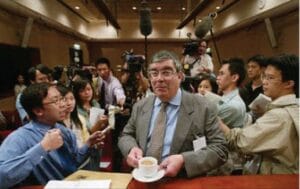
    Kamm surrounded by journalists, Hong Kong’s Legislative Council, June 17, 2003. Image credit: SCMP.com.

    I showed up at the Legco Building on June 17 at the appointed hour. I took my seat in the gallery above the ornate chamber, looking down on the legislators. Bob Allcock came up to where I was sitting and gave me a handwritten note. An amendment to the bill would be introduced changing the proscription mechanism from “certificate” to “open proclamation.”

    The first order of business at the meeting was an attempt by Democratic legislators to rescind the June 14 decision to close debate. All their motions were voted down. Attention then turned to my objection to the bill as presented at the Hong Kong University conference.

    Regina Ip tabled the motion to amend the bill by substituting “certificate” with “open proclamation.” This move was met with derision by the Democratic camp. One legislator remarked that after saying debate could not be reopened the government had in fact done just that. Legislators Emily Lau and Margaret Ng, stalwart campaigners for human rights and democracy, claimed that the amendment didn’t change a thing. What was meant by “open proclamation?” Could a newspaper advertisement placed by a local government be considered an “open proclamation?” The government had muddied the waters.

    Finally, Lee Cheuk-yan took the floor. “Secretary for Security, you have said that the bill was subjected to scores of public consultations and 80 hours of debate by Legco. Yet, a foreigner comes to town who has never read the bill, examines it for less than an hour and finds a fatal flaw. What do you have to say to John Kamm?” Pointing at me, he said “Look at John Kamm sitting in the gallery. He is laughing at you!”

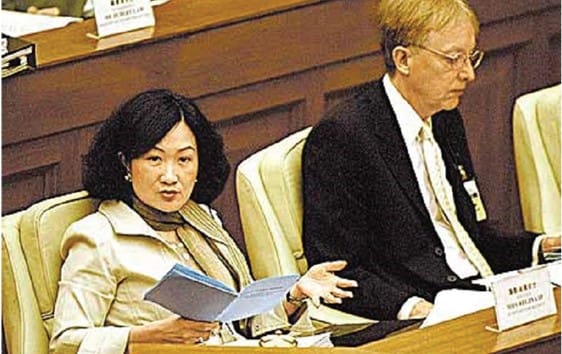
    This proved too much for Regina Ip. “I am sick and tired of hearing from so-called foreign experts on Chinese law. Sick and tired!” she exclaimed in a high-pitched and agitated voice.

    At this point, the Chairman of the Committee meeting stepped in and suggested a brief recess to allow tempers to calm down. I left the gallery and went downstairs to find Martin Lee waiting for me. He ushered me into a room where there were several dozen journalists waiting to pepper me with questions. I made it clear that I was not satisfied with the amendment. The bill was still flawed.

    Regina Ip and Bob Allcock. Image credit: HongKongFP.com

    At this point I took a gamble. “The Ministry of Foreign Affairs holds its weekly press conference on Thursday June 19. There are journalists in this room who work for wire services. Why don’t you ask the Foreign Ministry spokesman who is right, John Kamm or Regina Ip?”

    In making this move I reckoned that Regina Ip knew as little about Chinese bureaucratic politics as she knew about Chinese law. She had studiously built relations with the Hong Kong Macau Affairs Office, and had largely ignored the Ministry of Foreign Affairs, a bad move. In the event, journalists submitted my question at the press briefing on June 19. The spokesman declined to answer. On June 25, 2003, Regina Ip tendered her resignation as Secretary for Security, citing personal reasons. Later that year she entered Stanford University to study for a Master’s Degree.

    As I was exiting the Legco conference room on June 17, two journalists from Apple Daily and Ming Pao stopped me at the door. “What do you think of what Regina Ip said about you?” they asked. I played dumb, “What was that?” “She said that she was sick and tired of hearing from so-called foreign experts on Chinese law. She called you a so-called foreign expert.” I quipped: “I thought she was talking about Bob Allcock.” The press loved it.

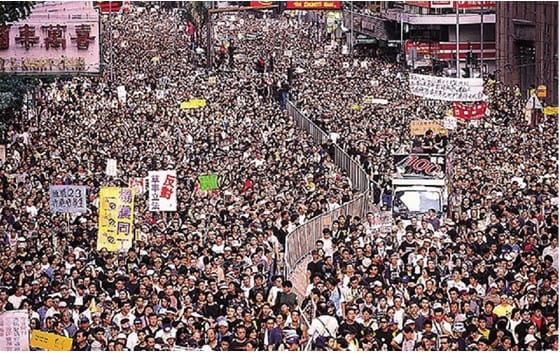
    On July 1, 2003, hundreds of thousands of Hong Kong people took to the streets to protest Article 23. Government officials had predicted that only 30,000 people would participate in the march. The marchers wound through the streets and ended the march by passing by Chief Executive Tung Chee-hwa’s office. They carried placards denouncing “Uncle Tung” and calling for his resignation.

    With the desertion of James Tien, leader of the Liberal Party which had supported passage of the legislation, the National Security Bill’s fate was sealed. The government removed the bill from consideration by Legco. Citing health issues, Tung Chee-hwa resigned in March 2005. Mr. Tung remains in excellent health. He had apparently contracted a short-term political illness.

    Hong Kong residents took to the streets in protest of Article 23 on July 1, 2003.

    As for me, I returned to San Francisco, but my job was not complete. I penned an article that ran in both English and Chinese newspapers in Hong Kong outlining how the people of China would be hurt if the National Security Bill was passed by Legco and became law.

    In the summer of 2003, a senior official of the Ministry of Foreign Affairs came to San Francisco and we agreed to meet. He told me that “We know that the Hong Kong government has made many mistakes, but we don’t appreciate our friends pointing them out!” We had a good chuckle.

    Fifteen years after the demise of the National Security Bill, China’s leaders, notably President Xi Jinping, are pushing for the SAR to enact Article 23 legislation, perhaps as early as the end of 2018. Opposition among the public to such legislation remains high – Regina Ip, the face of Article 23, received the lowest number of Election Committee votes for Chief Executive in 2017 – but due to changes in the make-up of Legco brought about by the ousting of several recently elected legislators, sanctioning speech and association under Article 23 could well be in Hong Kong’s future.


    Listen to the Encounters with China podcast.

    Subscribe to receive notifications about new episodes. 

    Read all John Kamm Remembers stories.


  • The Banquet

    The Banquet

    << Read all John Kamm Remembers stories

    In the late Spring of 1990, my family and I lived in an apartment on Hong Kong’s Victoria Peak that looked over a verdant country park to the South China Sea on the near horizon. When visibility was good, one could see junks with red sails and cargo vessels plying the waters off Lamma Island. The outline of Chinese islands loomed on the far horizon. China was near. With the conclusion of the Sino-British Joint Declaration in 1984, China was drawing nearer. In 1990, a mere seven years remained before China resumed sovereignty over Hong Kong.

    My life in Hong Kong was good. I was a vice president of Dallas-based Occidental Chemical (Oxychem), which paid me a handsome salary and cost-of-living allowance. I enjoyed generous home leave, exclusive use of a 280SE Mercedes, a driver, two maids, school tuition for my first son, and two country club memberships. I ran the Asia Pacific region for the corporation. Oxychem had factories and sales offices in a dozen countries. I spent a lot of time on the road.

    That year, I was also the president of the American Chamber of Commerce (AMCHAM) in Hong Kong, the largest American chamber outside of North America with 2,800 members. In fact, I was never meant to be president of the chamber. After the killings in Tiananmen Square in 1989, I used my position as vice-president of the chamber in charge of committees to convene a meeting of members big and small. At that meeting I pushed through a resolution condemning Beijing’s actions against fierce opposition from large corporate members. The resolution was published in AMCHAM’s magazine and placed as an advertisement in a number of Hong Kong newspapers.

    Not surprisingly, when it came time for the Nominating Committee, which was dominated by old-timers and representatives of multinational corporations, to vote on the next president, I came in a distant second. My views on human rights and Tiananmen, in the eyes of many AMCHAM leaders, made me unsuitable to be president.

    The fellow who came in first called his boss in New York with the good news. His boss told him that he had a choice: He could assume the presidency of AMCHAM and serve his one-year term, or he could continue his career with the firm. The fellow chose to continue his career, and I became president of AMCHAM by default.

    I assumed the presidency on January 1, 1990. It was a tough time to be president of an organization that favored strong trade ties with China. After Tiananmen, China had become an international pariah. Calls were mounting to impose sanctions and, in the United States Congress, to strip China of its Most Favored Nation (MFN) trading status. China’s trade status had to be renewed every year, ironically no later than June 4.

    The first hearings on China’s human rights record and MFN were scheduled to take place before three subcommittees of the Committee on Foreign Affairs of the House of Representatives on May 16, 1990 in Washington. I was invited to testify by Richard Bush, staff consultant to the Subcommittee on Asian and Pacific Affairs chaired by Congressman Steve Solarz (D-New York). I accepted the invitation.

    Chaucer and Mao Tai

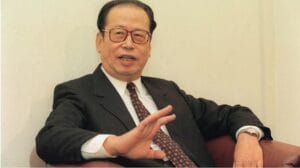
    On May 9, a week before I was to testify, I and the leaders of the American business community in Hong Kong were invited to a banquet by Zhou Nan, Director of the New China News Agency (Xinhua) in Hong Kong. Xinhua was the seat of Chinese power in the colony. Zhou was an experienced diplomat. He had served as a vice minister in the Ministry of Foreign Affairs, in which capacity he had negotiated the joint declaration between China and the United Kingdom on Hong Kong. He spoke flawless English, and loved English literature (he could recite the prologue to Chaucer’s Canterbury Tales in Middle English). He also served as an interpreter for interrogations of American POWs during the Korean War.

    Zhou had a fearsome reputation as a hard-liner. He was also very anti-British, stemming from a botched attempt to recruit him by MI6 while Zhou was posted to China’s Mission to the United Nations in New York.

    Before heading off to the banquet, my longtime friend and fellow AMCHAM officer Jeff Muir and I had done our daily jog up Black’s Link. We returned to my apartment, showered, and fortified ourselves with ice-cold cans of San Miguels. We left in my car for Zhou Nan’s villa on the south side of Hong Kong Island shortly before 6 PM.

    My driver had turned on the radio for the 6:00 PM news on RTHK, the government-run radio station. A few minutes into the broadcast, an interview of the mother of a Hong Kong student, Yao Yongzhan, aired. Yao, a student leader, had been detained in the aftermath of the protests in Shanghai. His mother wept gently. She had heard that her son was being mistreated in a Shanghai detention center. Her tearful plea stuck in my mind.

    We arrived at the villa and were led into a room where the rest of the American guests were waiting. These were the leaders of the American business community: Michael Clancy, China Light & Power, a subsidiary of Exxon, and the largest foreign investor in Hong Kong; Lyn Edinger, managing director of Honeywell; Ed Onderko, partner of Arthur Anderson; Jeff Muir, partner of China Consultants International; and Ralph Spencer, executive director of AMCHAM.

    We were ushered into the dining room where we took our seats around a large round table. I was seated at the right hand of Zhou Nan. As soon as we sat down, Mao Tai began to be served. Mao Tai is a sorghum-based spirit which is 52 percent alcohol (104 proof). It is the favored banquet drink served at meals with senior officials. It is often chased with cold beer.

    Zhou Nan was known as one of China’s best Mao Tai drinkers. I had learned to drink Mao Tai under the tutelage of Wang Yaoting, Chairman of the China Council for the Promotion of International Trade, when I served as the Hong Kong representative of the National Council for US-China Trade from 1975 to 1980. My boss, Ambassador Chris Phillips, wasn’t much of a drinker, so I was called upon to represent him at banquets during visits to Beijing. Wang Yaoting regularly consumed a bottle of Mao Tai at dinner. Each bottle held 32 glasses made exclusively for drinking the fiery spirit.

    It wasn’t long before the combination of Mao Tai and cold beer loosened the tongue. I remarked to Zhou Nan that I had heard that one could learn a lot about what kind of person someone is by asking which character in the classic Dream of the Red Chamber the person admired the most, “just like you can learn a lot about someone by finding out which of the pilgrims in Chaucer’s Canterbury Tales he or she likes the most.”

    That got Zhou Nan going: “When that Aprile with his shoures soote, The droghte of March hath perced to the roote, And bathed every veyne in swich licour, Of which vertu engendred is the flour . . .”

    When he finished his performance to applause, Zhou drew himself up and began his toast. “Mr. Kamm,” he intoned in perfect English, “I would like to thank you, on behalf of the Chinese government and the Chinese people, for all that you have done, and all that you are about to do, to promote friendly relations between the United States and China.”

    To this day, I don’t know what got into my head, but I stopped Zhou Nan and asked, “So what are you going to do for me?” The room fell into a stunned silence. You could hear a pin drop. My American colleagues had had no warning. They had no idea where I was heading. Perhaps they thought I would ask that China would buy a boatload or two of caustic soda. No one knew. Neither did I.

    Zhou Nan asked what I meant and I replied that many people in Hong Kong hoped that AMCHAM would convince Congress to keep China’s MFN status, “but you are different, Minister Zhou. You can help me.”

    Zhou responded: “The Chinese government has done everything possible to improve relations with the United States.” I said I begged to differ. It could do more.

    Zhou put down his glass and asked me what I thought the Chinese government should do. I had arrived at that point without thinking what it was I wanted Beijing to do. Then I remembered the voice on the radio. I asked Ji Shaoxiang, head of Xinhua’s foreign affairs bureau who was sitting across the table, what the name of the student leader who was being held in Shanghai. Ji replied “Yao Yongzhan.”

    “That’s it!” I declared. “Why don’t you release Yao Yongzhan?”

    Zhou exploded. “You have rudely interfered in China’s internal affairs, and committed an unfriendly act that has hurt the feelings of the Chinese people.” he thundered.

    In for a dime, in for a dollar, I figured, so I fought back. “A few minutes ago, you treated me as a friend of the Chinese government and people. Now, because I ask you to show mercy to a young man, I’m no longer a friend?”


    Zhou Nan, former Director of Xinhua News Agency in Hong Kong and former Vice Minister of Foreign Affairs for the People’s Republic of China. Image Credit: South China Morning Post.

    I reminded Zhou that “The quality of mercy is not strained,” and asked him if he had ever done something as a young man that he wished he had done differently later in life.

    It went on like this for a few minutes. The business leaders were becoming increasingly uncomfortable, and Zhou Nan was becoming more and more upset.

    Finally, I told Zhou that whether or not Yao Yongzhan were released I would still go to Congress to testify in favor of retaining China’s MFN status, and asked him if he knew why. “No,” he snarled. “Because I love Hong Kong. Do you love Hong Kong?”

    Zhou was speechless. Here was a foreign businessman asking China’s most senior official in Hong Kong whether he loved the city. After a moment’s pause, Zhou said, “Alright, I’ll see what I can do.”

    I stood up and told Zhou Nan that I wanted to use the restroom. He snapped his fingers and a young man in a white coat emerged. He led me through a maze of corridors and then, when he knew there were no recording devices in use, he turned and looked at me. He had listened to the exchange with Zhou Nan, and he had tears in his eyes. He hugged me and said, “Thank you for that.”

    After visiting the washroom, I returned to the banquet room. The head of China Light & Power, Michael Clancy, was apologizing to Zhou Nan. “Not all Americans are as impertinent as John Kamm,” he intoned. I took my seat and reminded the Americans that I was president of AMCHAM and that they should hold their tongues. The dinner drew to a close and I returned to my apartment on Coombe Road, wondering about what I had just done.

    Testifying on China

    The next day, May 10, 1990, I left Hong Kong for Washington, stopping first in Seoul and then in Tokyo on Oxychem business. In Tokyo, I composed my testimony in a room at the Okura Hotel. I decided that the focus of my testimony would be the damage that revoking China’s MFN would do to the colony, then grappling with the fact that it would be handed over by the United Kingdom to China. I also decided to confront the issue of human rights head on.

    I arrived in Washington via Newark on May 14, 1990. The next day I huddled with AMCHAM’s consultants, representatives of the Hong Kong Economic and Trade Office, and staff of the State Department and Congress dealing with China.

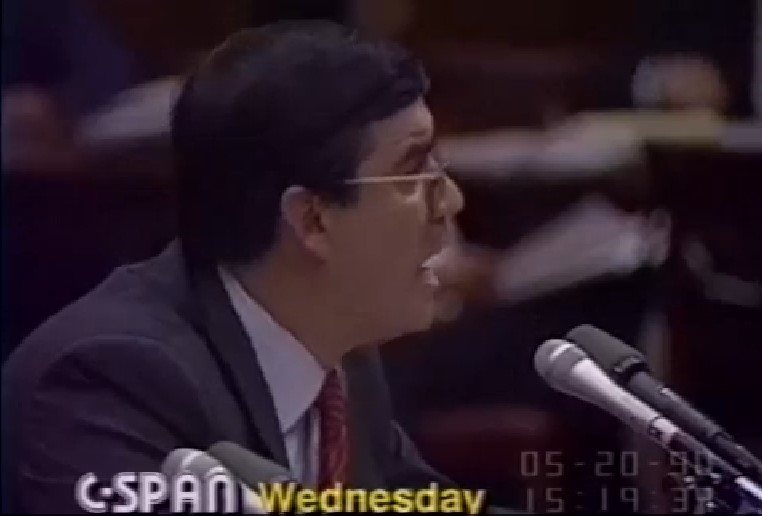
    On May 16 at 9:40 AM the hearing on “Most Favored Nation Status for the People’s Republic of China” was called to order by Congressman Solarz in Room 2172 of the House Rayburn Office Building. Members of Congress were invited to make statements. After that, witnesses were called, one by one. First to testify was Winston Lord, former ambassador to China. He was followed by witnesses representing the National Committee on US-China Relations, Human Rights Watch, and the Independent Federation of Chinese Students and Scholars.

    Then it was the business panel’s turn. First up was the president of the United States-China Business Council, Roger Sullivan. I followed Mr. Sullivan, representing the American Chamber of Commerce in Hong Kong.

    Sticking closely to the five-minute limit for testimonies, I outlined the damage revoking China’s MFN would inflict on Hong Kong and adjacent Guangdong Province and then moved to the subject of human rights. “Americans in Hong Kong abhor the violations of human rights now going on in China, and we condemn them both in public and private sessions with Chinese officials,” I said.

    I continued. “Who knows better than the people of Hong Kong how bad the situation is? We are on the front line. There are young Hong Kong people in Chinese jails. I take this opportunity to call once more for China’s leaders to release them to their families in Hong Kong… Whatever capital we might earn by fighting further sanctions we will gladly spend in the effort to free all Chinese prisoners of conscience.”

    Chairman Solarz thanked me for my “powerful and eloquent plea,” but then subjected me to sharp questioning. He was followed by Congresswoman Pelosi. The congresswoman had taken office in 1987. Her San Francisco district had a large population of Chinese Americans who had been deeply affected by the events of June 4, 1989. Mrs. Pelosi became a leader in the effort to use MFN to wrest human rights concessions from the Chinese government. Her opposition to China being granted MFN without additional human rights conditions launched her national political career.

    My testimony received wide media coverage, including in major American newspapers. It was broadcast in its entirety by a fledgling network known as C-Span. Excerpts were broadcast by CNN, and were viewed in Hong Kong and on the Mainland. Chinese officials were delighted, as was the Hong Kong business community. Everywhere I went in the colony, I was greeted as “Mr. MFN.” The frontpage of USA Today carried a headline: “John Kamm: Hero in Hong Kong.”

    I returned to Hong Kong on May 27. I debriefed AMCHAM’s board, the American Consulate General, and the Hong Kong Government. My wife and I were invited to dinner by Ji Shaoxiang, the official who had given me the name of the detained student leader at the May 9 banquet, and his wife. The dinner was to take place on the evening of June 1 in the top-floor restaurant of the China Resources Building.

    My wife and I arrived at the restaurant to find a cavernous room empty save for a single table placed under a large chandelier. We took our seats, and the food began to flow. Mercifully there was no Mao Tai. The conversation consisted mostly of pleasantries, but then the tone turned serious.

    “Director Zhou very much wanted to attend this evening’s dinner,” Mr. Ji intoned. “Unfortunately, he was called away on urgent business. He asked me to tell you, however, that Yao Yongzhan will be released in four days.” On June 5, Yao walked out of the Shanghai Detention Center a free man. He boarded a flight and returned to Hong Kong the same day. He eventually went to the United States. Yao’s release following my plea marked the first time that Beijing released a political prisoner due to a foreign intervention. It would not be the last.

    China’s MFN Status

    On June 3, 1990, President George H.W. Bush waived the free-emigration conditions stipulated in the Jackson-Vanick Amendment of the Trade Act of 1974, thereby extending MFN status to China for another year. In his presidential determination, President Bush cited the damage that Hong Kong would suffer if China’s trade status were revoked. Bush’s decision to extend China’s MFN status opened a 60-day window during which Congress could debate a resolution of disapproval which, if passed with enough votes to withstand a presidential veto, would strip China of MFN. Such a resolution was soon introduced by Congressman Jerry Solomon (R-New York), along with another piece of legislation that would place human rights conditions on future renewals of China’s MFN status. This was the US-China Policy Act introduced in the House of Representatives by Congresswoman Pelosi and in the US Senate by Majority Leader George Mitchell (D-Maine).

    On June 14, 1990, China’s premier Zhu Rongji visited Hong Kong. AMCHAM was one of the hosts, and we organized a luncheon for him. Prior to the luncheon, attended by hundreds of business people, I was taken aside by a Chinese official and told that one of the reasons Yao Yongzhan was released was that there was concern in Beijing that I would use the occasion of my introductory remarks to call for the student leader’s release. I was asked not to embarrass Premier Zhu.

    Congress acted quickly to call hearings on President Bush’s decision to renew China’s MFN status. Hearings were scheduled by both the Trade Subcommittee of the Ways and Means Committee, chaired by Congressman Sam Gibbons (D-Florida) and the Senate Finance Committee, chaired by Senator Lloyd Bentsen (D-Texas). The former hearing was to take place on June 19, with the latter hearing to take place the next day. I arrived in Washington on June 18 and testified at both hearings. Before and after the hearings I roamed the halls of Congress. In less than five weeks I had testified three times to Congress and had met dozens of members of Congress and senior staff, as well as administration figures. I gave many interviews to the media.

    The House of Representatives eventually passed both the Resolution of Disapproval and the US-China Policy Act, but the Senate failed to consider and vote on the two bills before the clock ran out on the 101st Congress. China’s MFN status was saved, at least for another year. AMCHAM – and Hong Kong – had played a role. This marked the first time in history that Hong Kong had figured in a major American foreign policy decision.

    As my term as AMCHAM president drew to a close, I was asked to come to Xinhua’s headquarters on Queen’s Road West, across the street from the Happy Valley Race Track, on December 20, 1990. I was ushered into a room where I was greeted by Director Zhang, vice-director in charge of trade and economic affairs.

    Director Zhang expressed the Chinese government’s gratitude for the work I had done on MFN. He wondered if I was interested in expanding my business in China.

    I thought about it, and replied “The struggle for MFN is far from over. I would rather invest in the issue than expand my business in China.”

    Director Zhang asked, “How can we help?” My response was brief: “Release prisoners held for what they did during the 1989 disturbances. That will help China keep its MFN status.”


    Listen to the Encounters with China podcast.

    Subscribe to receive notifications about new episodes. 

    Read all John Kamm Remembers stories.


  • Lansing and the Sanming Eight

    Lansing and the Sanming Eight

    << Read all John Kamm Remembers stories

    In 2017, there were more than 200 sister city and state relationships between the United States and China, ties that bind states and cities. The relationships are handled, on the American side, by offices in state and city governments, often manned by volunteers. The relationships exist primarily to foster economic and cultural ties. They have rarely been used to promote human rights and the rule of law.

    In the summer of 2004, I hit upon the idea of utilizing sister city relationships to intervene on behalf of political prisoners in the Chinese cities and provinces that had American partners. There were around 120 sister community relationships at that time. I and my colleagues put together a list of contacts in the governor’s and mayor’s offices who oversaw the relationships with Chinese provinces and cities. Our final list had 83 names and addresses of individuals in charge of the sister community relationship.

    On August 18, 2004, Dui Hua sent letters to our list of contacts introducing our work and asking if the sister city would be willing to engage their counterparts in a discussion of human rights, and, in particular, whether the state would be willing to submit a list of political prisoners incarcerated in their Chinese counterpart’s jails and prisons.

    The response was underwhelming. Of the 83 letters sent out, we received only one positive response. Lansing, Michigan’s state capital, had a sister city relationship with Sanming Municipality, a prefecture-level municipality with a population of 2.5 million, in Fujian Province. Martha Fujita, the Executive Director in charge of Lansing’s Regional Sister City Commission, housed in the Mayor’s office, replied that she would be willing to help Dui Hua. Ms. Fujita advised that a delegation headed by the mayor of Sanming would visit Lansing on September 19-21, 2004.

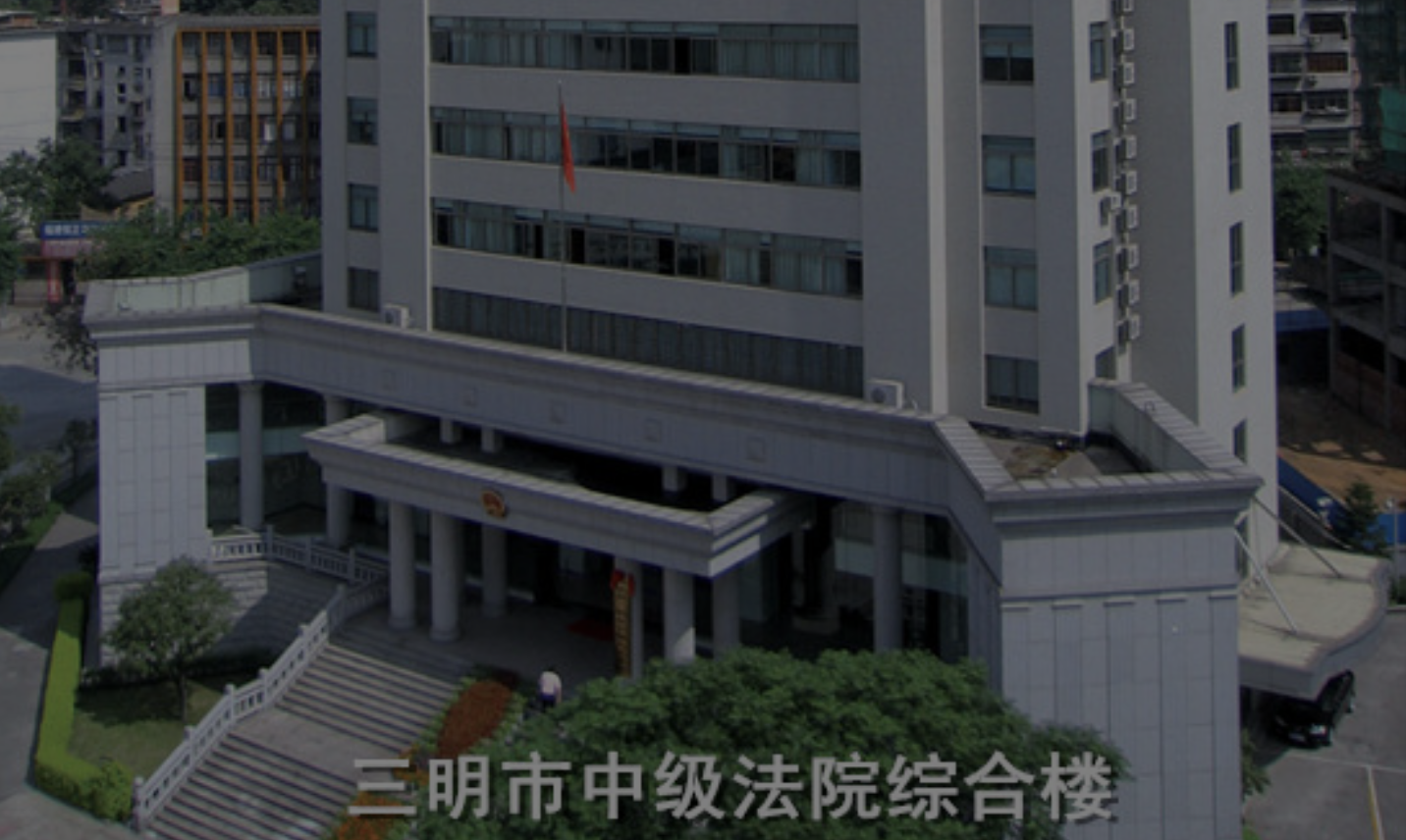
    It so happened that there was a group of eight labor activists who had been detained in April 2002 and sentenced to prison for subversion by the Sanming Intermediate People’s Court in October 2003. The sentences ranged from two to sixteen years. The 16-year sentence was given to the group’s leader, Li Jianfeng, a former court official who had set up an independent trade union and who, the prosecution alleged, had downloaded materials from the Internet which he compiled into a book entitled “Labor Unions.”

    Lansing is a city with deep roots to the automotive industry. It has manufactured automobiles at General Motor’s Lansing Plant for decades. Trade unions are strong. National and local unions as well as the local chapter of Amnesty International had already contacted Mayor Tony Benevides asking him to intervene on behalf of the Sanming Eight.

    I composed a “Request for Information” and faxed it to Ms. Fujita on August 31, 2004. She agreed to find a way to hand it over, with a cover letter from Mayor Benevides, to the mayor of Sanming when the right moment presented itself.

    The Chinese delegation arrived and were hosted to a “Mayor’s Welcome Dinner” and a Chamber of Commerce luncheon. They visited the General Motors plant, Michigan State University, and Sparrow Health Systems. A highlight of the delegation’s visit was sitting in on a Chinese immersion program at an elementary school where the children greeted the guests in Chinese and performed a Chinese folk song for them. The Chinese guests were thrilled and posed for photographs with the children. They also attended a baseball game and sat in the Mayor’s VIP Skybox.

    In short, the Chinese delegation was treated to a hearty dose of Midwestern hospitality, setting the stage for the intervention that was to follow.

    On September 21, the Chinese group left from Lansing Capital International Airport to make their way back to China via Chicago. While the group was checking in their bags, Ms. Fujita took the mayor of Sanming aside. She explained that Lansing is a city with deep connections to the labor movement, and that an important base of support for Mayor Benevides was labor unions. She then presented Mayor Benevides’ letter and Dui Hua’s request for information to the Chinese mayor. He accepted them without hesitation.

    Over the next few years, two of the three labor leaders, including Li Jianfeng, were given sentence reductions and released early. Li was given sentence reductions totaling five years. He was released in April 2013. His five-year supplemental sentence of deprivation of political rights will expire next month, in April 2018. Huang Xiangwei, who was sentenced to six years in prison, received a 10-month sentence reduction and was released after serving just over five years of his sentence.

    The use of sister city relationships to promote respect for human rights in China holds potential, but the relationships are rarely used. Boulder, Colorado has had an active sister city relationship with Lhasa, Tibet for more than 30 years. According to the body’s website, it “promotes and implements non-political exchanges of mutual benefit with Lhasa” including in the fields of health care, education, environmental protection, agriculture, and animal husbandry. No mention of human rights, even though human rights abuses in Tibet are often in the news. Houston, which has a sister city relationship with Shenzhen, did little to assist American businesswoman Sandy Phan-Gillis, even though Ms. Phan-Gillis was the president of the Houston-Shenzhen Sister City Association.

    Lansing’s decision to use its relationship with Sanming to help secure the release of the Sanming Eight shows that sister city relationships can play a role in advancing the cause of human rights in China, if city and state governments demonstrate the political will to do so.


    Listen to the Encounters with China podcast.

    Subscribe to receive notifications about new episodes. 

    Read all John Kamm Remembers stories.


  • A Prison for Foreigners

    A Prison for Foreigners

    << Read all John Kamm Remembers stories

    As 2002 drew to a close, I travelled to Beijing again to make the final arrangements for the release of Ngawang Sangdrol. It had been a busy year. Dui Hua had announced the release of two other Tibetan political prisoners earlier that year, Jigme Sangpo and ethnomusicologist Ngawang Choephel.

    On March 3, I was featured in a cover story in The New York Times Sunday Magazine and in April 11, I delivered testimony to the Congressional Executive Commission on China — “An Arsenal of Human Rights.”

    I had travelled to China a number of times that year, including in June to Beijing and Lhasa where I visited Jigme Sangpo, in the home of his niece, at the tail end of my efforts to secure his release and safe passage to the United States. In September, I had visited Beijing shortly after the release of American businessman David Chow from a prison in Harbin after serving eight years of a 15-year sentence. I had worked hard on Chow’s case for several years. His release, together with that of Ngawang Sangdrol on October 17, were intended to lay the groundwork for Jiang Zemin’s state visit to the United States in late October 2002.

    On October 9, 2002, I met with officials of the Ministry of Foreign Affairs and Ministry of Justice the day after I arrived in Beijing. Joint meetings with different ministries are rare, then as now. In addition to discussing Ngawang Sangdrol’s imminent release, I asked that I be allowed to visit a prison before the end of the year. I was told that my request would be considered, and that I should return to Beijing later that month to get an answer.

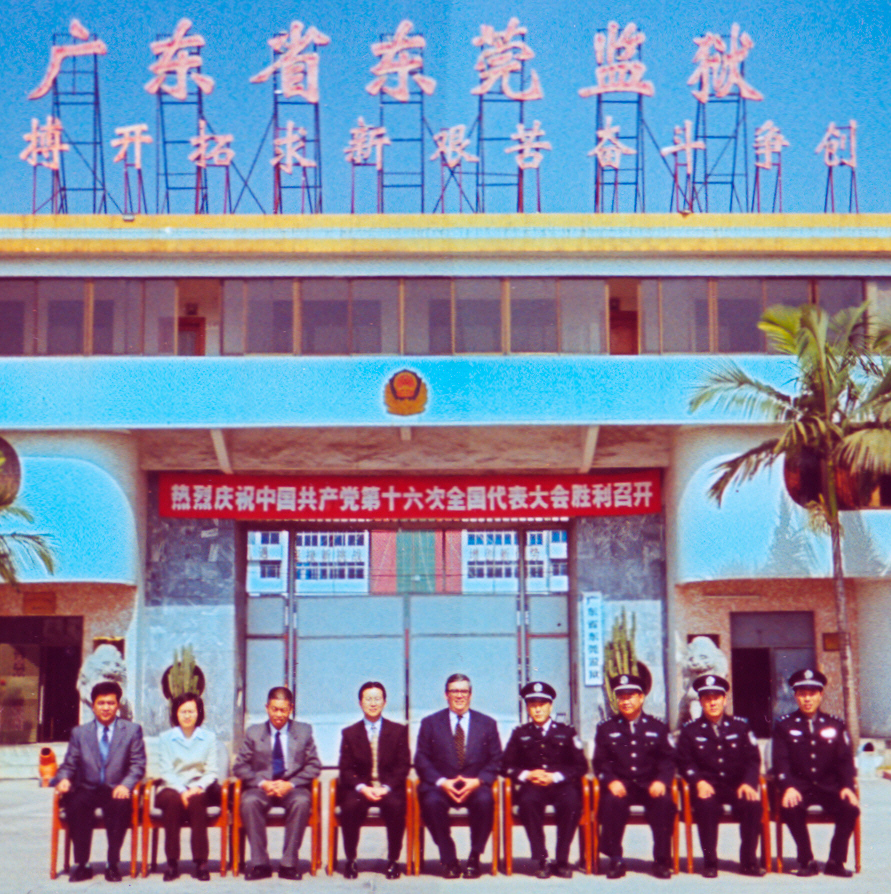
    I returned to Beijing on October 26. I was told that I would be allowed to visit Dongguan Prison in Guangdong Province, one of China’s largest prisons, in two weeks. I would be accompanied by Mr. Zhang Yi, a ranking official of the Ministry of Justice’s Department of Judicial Assistance and Foreign Affairs.

    I flew back to Hong Kong to research the prison and to speak to NGOs to ascertain if there were political prisoners incarcerated there. It turned out that Chen Meng, a Shenzhen-based musician, was serving a 12-year sentence in Dongguan Prison for trafficking in state secrets. In November 1994, Chen had faxed to two Hong Kong human rights groups a “blacklist” of political activists barred from leaving or entering China. He had obtained the list from his brother-in-law who worked for the border control police. Chen’s identity was quickly uncovered. Chen, his sister, and his brother-in-law all went to prison. In Chen Meng’s case, that meant entering Dongguan Prison.

    On November 10, 2002, I boarded the direct train from Hong Kong to Guangzhou, arriving in Guangdong’s capital city in the late morning. I was met by local officials, with whom I had lunch. After lunch, I was driven to the White Swan Hotel, considered one of the best hotels in the city. (It is situated on Shamian Island, site of the pre-1949 foreign concessions.) Zhang Yi had already arrived. I called his room and we settled on the next day’s program. Afterwards I called John Norris, the American Consul General in Guangzhou.

    The next day, November 11, Zhang Yi and I left the hotel after breakfast for the 90-minute drive on the expressway to the prison. Dongguan Prison is situated in Gaobu Township on the outskirts of Shijie village in Dongguan Municipality. We arrived at the prison shortly before 10 AM.

    By the time I visited Dongguan Prison, I had already toured six prisons in China, in Beijing, Tianjin, Shanghai, and Guangdong. I knew the routine. Upon arrival, I would be met by a phalanx of officers in full uniform, after which the warden would take me to his conference room where he would deliver a “brief introduction” to the prison. From there, depending on the prison’s layout, one would tour the hospital, kitchen, exhibition space for products made by prisoners, and a cellblock (but almost never solitary confinement cells). Sometimes you could witness prison labor, and, even rarer, one might see performances laid on by prisoners for visitors.

    Afterwards everyone would go to a local restaurant where much eating and drinking took place. Those occasions proved to be a good opportunity for effective advocacy, so I reluctantly joined in.

    A Brief Introduction

    Upon arrival at the prison, Zhang Yi and I were greeted by the warden, Mr. Li Jianping. He introduced us to two senior members of the provincial prison administration bureau, as well as his deputy wardens. Mr. Li, who was to be my guide during the two-hour tour, escorted us to his office, where the group sat down at a mahogany table in his conference room.

    Dongguan Prison, Warden Li explained, was established in 1988. In November 1998, it was designated a “ministry level” model prison, a status which enabled it to host high-level central and provincial government officials. At the time of my visit, it housed 5,200 inmates in 15 cell blocks. It held the largest population of Hong Kong-Macau-Taiwan residents and foreigners in China – 700 inmates from 20 territories and countries. Each block had 30 cells (six cells on each of the five floors) measuring 30 square meters each. The cells housed 10-12 inmates each. The prison was overcrowded, well above design capacity.

    Foreign prisoners in Dongguan Prison, Guangdong.
    Image Credit: WenXueCity.Com

    Most individuals convicted by courts in Shenzhen and Dongguan Municipalities served their sentences in Dongguan Prison. Those whose household registrations were in those two municipalities but who were convicted by Beijing courts served their sentences in Dongguan Prison. Most foreigners and Hong Kong-Macau-Taiwan residents convicted by Guangdong courts were housed there.

    Warden Li explained the management system of the prison. There were four types of prisoners and four types of punishment. The four types of prisoners were those who were serving sentences for violent crimes, smuggling, other economic crimes, and sexual crimes. Well-behaved prisoners would be treated leniently, “ordinary” prisoners would be treated according to standard policies, prisoners whose behavior was sub-standard would be placed under observation (one-third of Hong Kong prisoners were under observation at the time of my visit), and prisoners who violated prison regulations, including violent and dangerous prisoners, would be “strictly managed.” They could be subjected to solitary confinement.

    The warden extolled the results achieved by the prison’s management system: 35 percent of all prisoners receive a sentence reduction or parole every year, there was a low recidivism rate of 3.2 percent, and there had been no prison escapes. Because of the high level of care available in the prison’s “Grade A” hospital, medical parole was rarely granted, I was told.

    All prisoners were required to do manual labor, except those who were old, weak, or sick, who were placed in their own cell block (prisoners over the age of 55 were considered elderly). The prison made toys and plastic flowers. Since November 1991, none of their products had been exported. (In 1992, the United States and China signed a memorandum of understanding prohibiting trade in products made with prison labor.)

    A Performance

    When the briefing was over, our party went to the prison courtyard to watch a program of performances by prisoners, passing along the way the Grade A Prison Hospital. There were many pieces of advanced medical devices in evidence, though not in use.

    Anticipating the performance, I sat in the front row, next to Warden Li. We were serenaded by an 18-piece band under an energetic conductor. I was told that this man, dressed in standard prison garb save for a red coat and a jaunty navy cap, was a Hong Kong person serving a life sentence. Throughout the band’s performance, the conductor would turn his head and flash a toothy smile.

    One performance in particular stood out. A prisoner from Ghana serving a sentence of death with two-year reprieve performed a skit in which he, dressed as a peasant woman with a rag doll strapped to his back, leapt about the stage singing a plaintive Mandarin song. It bore a striking resemblance to an Al Jolson routine. He looked at me with vacant eyes.

    The warden jabbed me with his elbow. “Pretty good, eh?” he said under his breath. “I think we’ll keep him.” I was outraged. The warden was seeking my opinion as to whether this man’s life should be spared based on an offensive performance with strong racist overtones.

    As we left the courtyard and headed for one of the cell blocks, I admonished Warden Li. He responded, in a matter-of-fact way, “Don’t worry about it. No one serving a death with two-year reprieve at my prison has ever been executed. In 2002, 100 prisoners serving sentences of death with two-year reprieve had their sentences commuted, including eight Hong Kong people.”

    I replied: “Let me give you a piece of advice. If ever you host a delegation of African-Americans don’t lay on that performance. You will regret doing so. They will not be as polite as me.

    Cell Block Nine

    As we approached Cell Block Nine, Warden Li informed me that this block was used to house Hong Kong and Macau prisoners. There were more than 300 such prisoners spread across five floors of cells. The rest of the Hong Kong-Macau prisoner population – totaling around 400 inmates – was placed among the general population, or were in the prison hospital. Most of the Hong Kong-Macau prisoners were serving sentences for drug trafficking and smuggling of common goods. A few of them were serving sentences for espionage. On the wall of the cell block were lists of prisoners whose behavior was “exemplary, normal, and sub-standard.”

    The prisoners could receive monthly visits from members of their families living in the two special administrative regions, Taiwan, and overseas. Although representatives of civil society had visited, no Hong Kong official had ever visited a Hong Kong person in Dongguan Prison.

    Dongguan Prison in Guangdong Province. Image Credit: Baidu.com

    Our small party entered the cell block and walked up a flight of stairs to the second floor. The cells were oblong, opening onto a hallway where there were chairs and a television set on which inmates could watch the seven o’clock news. There was a telephone where prisoners could receive calls from relatives. Each cell had a small balcony. I noticed the smell of cigarette smoke. Contrary to practice in every other prison I have visited in the world, prisoners were apparently permitted to smoke. Each cell had six bunk beds. Space was at a premium.

    We left the cell block and headed for the product exhibition hall. Before we got there, I asked about Chen Meng. The warden recognized his name. Chen, he said, was in the general population, when he wasn’t in a hospital bed. His medical expenses were borne by the hospital, and he was exempt from physical labor. Family members paid regular visits. He had not received any sentence reductions, and was not being considered for medical parole. (Chen Meng served his entire sentence. He was released on March 13, 2007).

    The exhibition of arts and crafts products contained a wide variety of items, ranging from models made with wooden sticks, to plastic flower displays, to paintings. I was asked to sign the visitor’s comments book, and given a Chinese calligraphy brush to do so. I found the brush unwieldy, so I jotted down a few phrases: “Nice work! Congratulations!” and signed the book using my Chinese name, Kang Yuan.

    Years later, an assessment of Dongguan Prison attributed to me appeared in a local Chinese newspaper, much to the amusement of friends. “Even John Kamm, head of the American Human Rights Dialogue Foundation, who has consistently been a critic of China’s prisons, sighed with emotion.” The article went “Your work inspires confidence. I am a fairly serious person who rarely writes inscriptions when visiting prisons, but I was happy with everything I saw today, for which I express my thanks.”

    After the visit to the exhibition hall, we left the prison for lunch at a local seafood restaurant. We dined on rice sparrows, a delicacy during cold weather, washed down by beer and maotai. After lunch, I was driven to the train station, where I boarded the express train to Hong Kong, arriving at my hotel in the early evening.

    Xu Zerong

    I didn’t know it at the time of my visit, but Xu Zerong began serving his sentence for endangering state security in Dongguan Prison in the first half of 2002.

    Xu was a respected scholar and historian who resided in Hong Kong but who, because of his distinguished family background (his father and mother were senior officials in the People’s Liberation Army and Zhongshan University, respectively), traveled to Guangzhou frequently. Xu, aka David Tsui, earned his PhD from Oxford University in 1999, after which he returned to China where he assumed positions at the Guangzhou Academy of Social Sciences and Zhongshan University. Xu’s area of specialization was China’s role in the Korean War. He also studied and wrote articles on China’s support for communist insurgencies in Southeast Asia, a sensitive topic.

    Xu was detained on June 24, 2000, accused of having photocopied and sent out of China excerpts from books on China’s military strategy during the Korean War, which had ended in 1953. Although marked internal (nei bu), Xu believed the books had been declassified. He was also accused of running an illegal publishing business. He was placed in the Guangzhou State Security Bureau Detention Center, and formally arrested on July 29, 2000. He was tried on August 7, 2001 by the Shenzhen Intermediate People’s Court and sentenced to 13 years in prison and three years subsequent deprivation of political rights on December 12, 2001. His appeal was rejected and he was moved from the detention center to Dongguan Prison sometime in the first half of 2002.

    Not long after he was detained, Xu’s friends at universities in the United Kingdom and the United States asked me to help. I began making inquiries. I was finally told that he was serving his sentence in Dongguan Prison.

    Since I had already established a good relationship with Warden Li Jianping, I decided to try a novel approach to helping Xu Zerong. I would write letters to the warden asking him to look after Xu Zerong. On March 14, 2003, I mailed a letter to Warden Li from Hong Kong.

    The first thing I did in the letter was to establish a personal connection to Xu. The two of us had worked together on Professor Ezra Vogel’s One Step Ahead in China. I had contributed a chapter while David had helped with translation for the Chinese edition. Vogel’s work on Guangdong over many years had resulted in his having many friends in the provincial government. The professor gave me permission to use his name in making appeals on Xu’s behalf.

    In my letter, I pointed out that Xu had a number of medical conditions, and asked that he be placed in the prison hospital. “Because Dr. Xu is a scholar, it would help if he could receive books and scholarly journals,” I wrote. “You might also consider exempting him from physical labor and employing him, if he is not too ill, as a librarian or teacher.”

    To my surprise, Warden Li replied on April 15, 2003 to my letter. The letter was written in English. He confirmed that Xu Zerong had been taken into custody at Dongguan Prison. Li said that the prison would look after his health and “dispose him to rational labor work required by rehabilitation.”

    I wrote a second letter to Warden Li on May 28, 2003. By then, the SARS epidemic was raging in China. I offered to donate to the prison’s medical fund to help combat SARS. I again recommended that Xu be placed in the medical ward and be employed teaching English to his fellow inmates. “I think being able to receive letters and reading material . . . would help his morale and assist his rehabilitative progress,” I wrote.

    Warden Li replied on June 11, 2003. He thanked me for my concern over SARS, and said not a single case had been diagnosed in the prison. As for Xu Zerong, “he is now emotionally stable and physically healthy (and) makes use of his advantage of English language helping the other inmates with the English classes.”

    Teaching English to prisoners constitutes meritorious service, and qualifies the prisoner doing the teaching to receive points that can be used to obtain sentence reductions.

    In his June 11 letter, Warden Li confirmed that Xu had the right to receive a small quantity of commodities including books, but pointed out that the books would be examined by prison administrators before they reach prisoners “to safeguard the security of the prison.”

    I immediately set about trying to mail books to Xu in Dongguan Prison. I quickly discovered, from friends with ties to the provincial prison bureau, that books in English would have to be translated into Chinese! (One of the books I sent to Xu was the English-language translation of Tolstoy’s War and Peace.) I subsequently discovered that books published in Hong Kong and sent from the Special Administrative Region attracted extra scrutiny. Finally, on a trip to Shanghai, I purchased books and sent them via domestic mail to Dongguan. Those books made it to Xu Zerong.

    I sent my third letter to Warden Li on July 25, 2003, but I never got an answer. Xu Zerong was transferred in November 2003 to Xicun Prison, also known as Guangzhou Prison. Xicun Prison is considered the best prison in Guangdong, and Xu was treated well there.

    Xu received a nine-month sentence reduction in 2006. This was followed by a 10-month sentence reduction in 2008 and a five-month sentence reduction in 2011. He was released two years early on June 23, 2011. Despite having a supplemental sentence of three years deprivation of political rights, Xu was allowed to return to Hong Kong.

    Not long after he arrived in Hong Kong, Xu gave an interview to Open Magazine. In the interview, published on August 6, 2011, Xu credits my efforts on his behalf – visiting the prison in the company of an official from the Ministry of Justice, mailing him books, frequently submitting lists with his name on them – for his better treatment and early release. My visit was covered in the prison newspaper. Xu claimed that with my attention, “prison conditions improved, and all prisoners benefited.”

    A few years after Xu’s release, I was told by one of my interlocutors in the Guangdong government that Warden Li Jianping had been criticized for engaging in the exchange of letters with me. He was transferred to another prison, but otherwise was not punished.


    Listen to the Encounters with China podcast.

    Subscribe to receive notifications about new episodes. 

    Read all John Kamm Remembers stories.


  • Enemy of Dialogue

    Enemy of Dialogue

    << Read all John Kamm Remembers stories

    In the Spring of 2004, I was asked by a librarian at a center in Hong Kong to help on a case of endangering state security. This center had on its shelves many valuable volumes – public security yearbooks, court records and the like – that contained the names of people detained in political cases in China. For five years, Dui Hua had done research here, uncovering the names of hundreds of political and religious prisoners. The librarian wanted me to help secure the release or better treatment for one of the center’s Mainland vendors. The vendor had recently been convicted of  trafficking in state secrets because of his sales of old and used books to the center.  

    The man who had been convicted was a retired official in Fujian Province, a party member from a distinguished family, by the name of Jin Zhangqin. Before retirement this man oversaw Fujian’s provincial archives. After retirement, Mr. Jin set up a small business that specialized in buying old books from vendors in different parts of China. These vendors would buy volumes that had been discarded by government offices when they relocated. The government offices that supplied these vendors wanted to get rid of old volumes for which they no longer had use; the offices would sell the old books for as little as RMB 2 per kilogram to Jin’s partners, who would go through them and sell those considered most valuable to Jin, who would sell them, in turn, to the research center in Hong Kong. Some of the volumes were marked internal (nei bu) or even secret (ji mi); they dealt with mundane topics like economic statistics from collective enterprises in Hebei Province. All volumes were at least 10 years old, some were more than 20 years old.

    Jin Zhangqin was convicted of trafficking in state secrets by the Fuzhou Intermediate People’s Court and sentenced to 10 years in prison on January 5, 2004. The sentence was upheld by the Fujian High People’s Court on March 9, 2004. (I obtained a copy of the judgment issued by the intermediate court and was relieved to find that none of the volumes dealing with political crime that Dui Hua had uncovered at the Hong Kong center were mentioned in the judgment.) Not long after the high court rejected Jin Zhangqin’s appeal, the retired official, who was then 64 years old, was moved to Jianyang Prison in northeast Fujian Province to begin serving his sentence.

    Ministry of Justice, Beijing. Image Credit: DW News.

    I took up the case. In those days, I enjoyed good working relations with both the Ministry of Justice (MOJ) in Beijing and the provincial prison administration in Fuzhou. The deputy director general of the MOJ’s Department of Judicial Assistance and Foreign Affairs had the same surname as my Chinese surname, and he called me “older brother.” I had visited Xiamen Prison in September 2003, accompanied by senior officials from the provincial prison bureau. The visit had been an informative one. I had been briefed on how the sentence reduction system worked, knowledge I would put to good use, and been given detailed information on the inmate population of Fujian Province.

    After taking up the case, I developed as much information on Jin as possible. I contacted a relative of Jin’s in New York who told me that Jin suffered a serious heart ailment that required surgery. I was asked to intervene with the authorities to see if an operation could be arranged in Fuzhou, where Jin Zhangqin’s family lived. Fuzhou was hundreds of miles from Jianyang Prison, and the medical care available in the provincial capital was far superior to the care available in Jianyang.

    I began putting Jin’s name on prisoner lists, and wrote letters to the officials I had met when I visited Xiamen Prison in September 2003. I raised the elderly prisoner’s name with officials I met on my visits to Beijing.

    A Breakthrough Meeting

    A breakthrough took place on my April 2005 trip to Beijing. On April 5, I was met by senior officials of the Prison Administration Bureau and the Department of Judicial Assistance and Foreign Affairs in the minister’s conference room at the MOJ’s headquarters. This was the first time I had been invited to a meeting in the conference room. It was a well-appointed office with a large mahogany table. On the wall were photographs of all the officials who had served as justice ministers since the ministry had been established.

    The meeting itself was successful. Agreement was reached that Dui Hua would host a delegation of ten ministry officials on a tour of prison facilities in California. I handed over a prisoner list and a special appeal for Jin Zhangqin; I asked that he be moved to Fuzhou for heart surgery, and that he be considered for medical parole. The deputy director general of the Prison Administration Bureau accepted my letter and told me he would personally take care of it.

    The official was true to his word. Senior prison officials went to Jianyang Prison where, in the presence of Jin’s wife, the prisoner was told that he would have the surgery in Fuzhou. The operation was a complete success, but not long after the procedure he was sent back to serve his sentence in Jianyang Prison. (My work contributed to two sentence reductions, totaling 34 months, for Jin Zhangqin. He was released from prison in July 2010.)

    The April 5 meeting ended with a commitment that we would meet again on my next visit to Beijing in late June or early July. I didn’t know it at the time, but the April 5 meeting would be the last time I set foot in the MOJ’s headquarters. A new Minister of Justice was about to be appointed, a woman by the name of Wu Aiying.

    The Three Nos

    I returned to Beijing on June 28, 2005. Shortly before arriving, I phoned a junior official at the MOJ and was told that everyone was too busy to see me. 

    My next trip to Beijing was in October 2005. Upon arrival, I phoned the Director General of the Department of Judicial Assistance and Foreign Affairs Mr. Gong Xiaobing. I had a good relationship with Mr. Gong, having hosted him in San Francisco. Mr. Gong told me that, as an old friend of the ministry, I could visit the headquarters at the precise date and time he specified. He said I should arrive promptly, not a minute early or a minute late. To get this meeting, I would have to agree to three conditions: 1) There would be no talk of cooperation between Dui Hua and the ministry; 2) There would be no talk about “criminals;” and 3) I would not try to hand over a list.

    A Solemn Representation

    I was shocked. “What else is there to talk about? What’s the point of having a meeting?” I asked. I protested that this was a serious violation of the understanding under which we had operated for nearly 15 years, and that I would make a “solemn representation” to the Ministry of Foreign Affairs (MFA) when I met them the next day. Mr. Gong sheepishly replied: “Please understand. I didn’t make this decision. It was made at a senior level.” He was referring to Wu Aiying.

    Wu Aiying was born in Shandong Province in 1951, the daughter of poor peasants. She joined the Communist Party at a young age, and was admitted to Shandong University in 1971, during the Cultural Revolution. She was almost certainly a Red Guard. She had studied the thoughts of Chairman Mao for two years, which was the extent of her undergraduate education (After she became MOJ minister, she received a law degree from the Party School.) She rose through the ranks of Shandong officials, becoming a senior member of the Communist Youth League in 1982. She became a vice governor of Shandong Province in 1993 in which capacity she oversaw the police and the courts. Some of the harshest sentences of counterrevolution were handed out in Shandong Province.

    Wu became a vice minister of justice in 2003 and was appointed minister in July 2005. She was a prominent member of the China Youth League faction, a bastion of support for then-Party Secretary Hu Jintao. Wu Aiying was known as an ignorant, short tempered official who had famously upbraided an official whose cell phone had gone off during one of her meetings. She knew nothing about law, preferring to talk about cooking when meeting foreign visitors. She enjoyed traveling abroad where she was given expensive gifts and enjoyed lavish banquets.

    Wu Aiying’s Damage to Human Rights Dialogues

    The MOJ under Wu Aiying did everything it could to undermine Dui Hua’s work in China. In addition to refusing to see me, accept lists, or give answers to my queries, the ministry barred me from visiting prisons. On a visit to Yichang in central China, a visit to a prison that had been agreed to in advance by local officials was abruptly cancelled on orders from Beijing. In February 2014, Dui Hua partnered with Renmin University School of Law to hold an international symposium on women in prison. Despite Dui Hua having invited the MOJ to participate in the conference more than six months in advance, and despite the relevance of the topic to the MOJ’s work, the ministry said they were too busy to attend. Ministry officials actively discouraged Chinese Mainland participants from attending, resulting in the cancellation of a presentation from a senior member of the China Prison Society.

    The dismantling of the MOJ’s relationship with Dui Hua was but one act in a wide-ranging assault by Wu Aiying on human rights dialogues with foreign governments and international organizations. She resisted providing responses to lists accepted from the MFA’s official dialogue partners. In 2005, China had official dialogues with nine foreign governments. In 2016, her final year as minister of justice, the number of dialogues had shrunk to three. She told the president of an international humanitarian organization that visits to Chinese prisons were out of the question.

    She tightened rules governing clemency, reducing the number of sentence reductions and paroles of political prisoners. The MOJ oversees and licenses China’s lawyers. Wu Aiying made sure that human rights lawyers were stripped of their licenses. She doubtless played a role in the crackdown against those lawyers that began in July 2015. She opposed granting medical parole to prominent political prisoners including Chen Guangcheng, Tenzin Delek Rinpoche, and Liu Xiaobo. The latter prisoner, who was awarded the Nobel Peace Prize in 2010, served virtually his entire prison sentence while Wu was minister. He passed away in July 2017.

    The Downfall of Wu Aiying

    It turns out that Wu Aiying was not only an ignorant and crude obstructionist, she was also a poor judge of people and a terrible manager. In early 2017 it emerged that the director general of the MOJ’s political department, Lu Enguang, was a conman and scam artist who had faked his entire biography – education, age, even party membership – to gain a position in the MOJ. Lu Enguang, like Wu Aiying, was a native of Shandong Province. He was promoted by Wu Aiying, to whom he gave expensive gifts and for whom he performed menial tasks. According to Chinese media reports, as many as 20 other senior MOJ officials benefited from this conman’s corrupt activities. Lu was arrested and is awaiting trial at the time of this writing.

    Wu Aiying was removed as Minister of Justice in July 2017. She was expelled from the Communist Party at the 19th Party Congress in October 2017. Lawyers all over China rejoiced at hearing the news. It is expected she will face trial, and she could well wind up in one of the women’s prisons she once oversaw (during her tenure at the MOJ, the number of women in prison in China rose by more than 50 percent). If she goes to prison, she will have received her just deserts.


    Listen to the Encounters with China podcast.

    Subscribe to receive notifications about new episodes. 

    Read all John Kamm Remembers stories.


  • Discovering Legal Education

    Discovering Legal Education

    << Read all John Kamm Remembers stories

    On November 12, 2003, I received a detailed response from my interlocutor. It confirmed much of what I had been told by Congressman Tierney, but added new details. The picture of Liang Shaolin that emerged from this response was of a strong-willed, defiant woman fiercely devoted to Falun Gong.

    From June 1996 to June 1997, such letters were sent to Chinese Ambassador Li Daoyu by Senator Craig Thomas (D-Wyoming), Congressman Lee Hamilton (D-Indiana), Congressman Matt Salmon (R-Arizona), Senator Max Baucus (D-Montana), Senator Paul Wellstone (D-Minnesota), and Congressman Doug Bereuter (R-Nebraska). Congressman Ed Royce (R-California) sent a detailed letter to Chinese Premier Li Peng asking him to instruct the Ministry of Justice to resume cooperation with me.

    Thanks to these letters, and the support of the White House, the “prisoner information project” resumed in 1998 following Jiang Zemin’s state visit in 1997. While it was no longer necessary to ask members of Congress to write letters to the Chinese government on my behalf, I stayed in close contact with members, attending congressional hearings, roundtables, and forums at their invitation.

    One such event that I participated in was a breakfast meeting with members of the House of Representatives organized by the Aspen Institute on July 17, 2002. One of the congressmen attending the breakfast was Congressman John Tierney (D-Massachusetts).

    An Email from Congressman Tierney

    On January 28, 2003, I received an email from Congressman Tierney asking for assistance on behalf of a constituent whose older sister, Ms. Liang Shaolin, had been detained in a Chinese labor camp for practicing the banned spiritual practice known as Falun Gong.

    In his email, Congressman Tierney described Liang Shaolin’s situation:


    “In September 1999, Shaolin is reported to have been detained in her workplace, the Maoming Oil Company, and not allowed to return home. She is said to have continued working but escaped after one month and seized as she made her way to Beijing ‘to appeal on behalf of Falun Gong.’ The police in Guangzhou sent her to a local detention center from where she was released after a seven-day hunger strike. Not long after, she was again detained by police and in January 2000 was sentenced without trial to two years in Sanshui Labor Camp; (she was) denied visitors, including family members. In 2002, the family received a phone call saying she had been transferred to the Legal School of Maoming City, yet to this day she is not allowed contact.”

    Congressman Tierney then asked if I could find a way to obtain some relief for Liang Shaolin. I was familiar with Falun Gong, but had never heard of a “Legal School” used as a carceral facility.

    Falun Gong

    Falun Gong is a popular spiritual movement that arose in the early 1990s, initially in China’s northeastern region. The practice involves a mix of beliefs and practices that combine Buddhism and Taoism with qigong, defined by Wikipedia as “a holistic system of coordinated body posture and movement, breathing and meditation, natural products, spirituality, and martial arts training.”

    Falun Gong spread rapidly in China in the 1990s, and by the end of the decade the movement reportedly had a following of tens of millions of Chinese practitioners. The rapid growth and popularity of the movement alarmed China’s top leaders. In April 1999, as many as 10,000 Falun Gong practitioners traveled to Beijing where they surrounded the central leadership compound, Zhongnanhai, in a mass demonstration calling for the release of imprisoned Falun Gong practitioners. The event had an immediate impact, and soon many more practitioners and their leaders were detained by authorities. In July 1999, Falun Gong was classified by the government as an “evil sect,” and repression intensified, repression that has continued to the present day.

    Heilongjiang Legal Education Campus

    After receiving Tierney’s email, I began looking into “legal schools,” but could find little information about schools being used as detention sites. I found one or two references to “legal education schools” or “legal education bases” as places where petitioners and adherents of unauthorized religious groups were placed for indeterminate periods of time.

    I phoned Congressman Tierney’s office and we agreed that we would meet on my next visit to Washington in April 2003. When I arrived at his office I couldn’t help but notice the striking painting that hung behind his desk. It was a large oil painting of a scene from the Salem Witch trials, a troubling page in American history. In colonial Massachusetts in 1692 and 1693, twenty people, mostly women, were prosecuted and executed for practicing witchcraft. Salem, a city in Congressman Tierney’s district, was famous for being at the center of the mass hysteria which resulted in the executions. The congressman told me that the painting served to remind visitors that religious persecution was no stranger to the US, and that Americans should reflect on their own past before criticizing others for human rights violations.

    A Plan to help Liang Shaolin

    We settled on a plan to help Liang Shaolin. I would try my best to put Liang’s name on all requests for information on prisoners submitted by the US government to China, and I would activate my relationship with a provincial research association based in Guangzhou to seek information on Liang Shaolin. Congressman Tierney’s staff would help by composing a letter on the case that I could send to my Guangdong interlocutors.

    Upon my return from D.C., I received the letter on Liang’s case by fax. The letter provided helpful information including the name, address, and telephone number of the legal education school in Maoming, the names and phone numbers of the officials in charge of the legal education school, the name and address of Liang Shaolin’s former employer, Maoming Oil Company, and the names and phone numbers of the officials in charge of the company’s “610 Office,” a specialized unit established in offices and enterprises across China in charge of suppressing Falun Gong practitioners. In the following months, I managed to get this letter into the hands of my Guangzhou interlocutor and put Liang Shaolin’s name on a prisoner list submitted by the International Commission on Religious Freedom.

    Unfortunately, I wasn’t able to visit Guangzhou until September 18, 2003. I took the train up to Guangzhou from Hong Kong and met with my interlocutor that same day. Liang Shaolin’s case was raised. I included it on a new list of five prisoners in Guangdong Province about whom I was concerned. I followed up the meeting with an email sent on October 15, 2003 . In less than a month, I would receive a response from my interlocutor.

    A Response from Guangdong

    On November 12, 2003, I received a detailed response from my interlocutor. It confirmed much of what I had been told by Congressman Tierney, but added new details. The picture of Liang Shaolin that emerged from this response was of a strong-willed, defiant woman fiercely devoted to Falun Gong.

    The email stated that Liang began practicing Falun Gong in 1996. After the government officially declared Falun Gong to be an “evil cult,” Liang “confronted the government” and conducted activities that violated the law including “gathering crowds and making a disturbance,” promulgating Falun Gong teachings, and collecting and distributing propaganda and publications banned by the government. For these reasons, Liang was sentenced to two years and three months in a reeducation through labor (RTL) camp.

    The email went on to say that, after entering the RTL camp, Liang continued her activities, which now included secretly distributing subversive messages written on small strips of paper. Because of this, when her RTL sentence ended, she was sent to the Maoming Legal Education School “to continue her education.” Liang had stayed in the school for a fairly long time because she had continued to try to influence and incite other students. “Recently, she started shouting slogans supporting Falun Gong three times a day. Because the school is in a residential area, her actions have had a negative influence on nearby residents.”

    The response concluded by outlining an arrangement under which Liang Shaolin would be freed. Liang, it was claimed, was healthy – aside from an eye infection that she refused to have treated, citing Falun Gong beliefs – and not being tortured. She had received visits by family members, but because of the SARS epidemic, which hit Southern China particularly hard, family visits to the Maoming Legal Education School had been suspended. Liang Shaolin’s husband, who was not a Falun Gong practitioner, had filed for divorce. The school had hired a lawyer to help her.

    “The school has indicated to Ms. Liang that if she promises to be a law-abiding citizen after leaving the school, she can leave. The school does not forbid her to believe in and practice Falun Going, so long as she does not practice in public and endanger social stability. She not only refuses to make such a promise, but has also indicated that she wants to continue popularizing and propagating Falun Gong to the society at large.”

    A Meeting in Guangzhou

    I decided to travel to Guangzhou to explore the proposed arrangement under which Liang Shaolin could be released. I left for Beijing on December 1, and after meetings with Chinese government officials and foreign diplomats, I traveled via Hong Kong to Guangzhou, arriving on December 11, 2003. My interlocutor, a professor affiliated with the research association who held relatively liberal views, and his assistant met me at the train station. It was a cold and overcast day.

    We went to a restaurant in the Pearl Island Hotel, a location favored by provincial party and government officials. After settling into a well-appointed private room for a ten-course “light” lunch, we immediately began discussing the Liang Shaolin case.

    “Legal Education Schools have been built to house ‘seriously poisoned’ Falun Gong practitioners,” I was told. “There are two things you need to know about them. First, the Maoming Legal Education School is by no means the only such school in China. There are many of them. Second, legal education schools have no basis under Chinese law. This is a problem that must be addressed.” (The professor made clear that he favored the abolition of all forms of arbitrary detention.)

    The professor and his assistant had previously traveled to Maoming Legal Education School, to look into Liang Shaolin’s situation. The response they had sent me earlier in November was an account of their visit to Maoming. Although they did not directly speak to Liang, they were able to observe her. She appeared thin and her eyes swollen, but aside from this she appeared healthy and energetic. They reported that “Three times a day – in the morning, in the afternoon, and in the evening – Liang Shaolin shouts in a loud voice: ‘Long Live Li Hongzhi (the founder of Falun Gong), Down with Jiang Zemin (China’s president who initiated the crackdown against Falun Gong).’

    If Liang Shaolin were to be released and she took to the streets and shouted such things, I was told she’d be arrested and sentenced to prison under Article 300 of the Criminal Law, which criminalizes organizing religious groups that the Chinese government considers “cults.” “We are prepared to release her and allow her to return home where she can practice Falun Gong,” I was told. “But under no circumstances will the police allow her to publicly propagate Falun Gong. If you were in our shoes, what would you do Mr. Kamm?”

    I replied that I did not believe in placing restrictions on free speech. On the other hand, I did not want Liang to be put in prison. I suggested that the authorities continue to practice gentle persuasion, and under no circumstances should she be mistreated. I wondered aloud whether she could be given a passport to travel to the United States to join her brother who lived in Congressman Tierney’s district. The response: “Possible, but not likely. If she were given a passport and allowed to leave, other Falun Gong practitioners would see this as a reward. It might encourage them to behave like Liang Shaolin.”

    Better Treatment and Release

    After we concluded our lunch, I took the train back to Hong Kong, and soon was homebound to San Francisco. I summarized the meeting held in Guangzhou and sent a memo to Congressman Tierney. He replied by email on January 28, 2004: “As a result of your attention and the intervention of some of your friends in the Guangdong government, Liang Shaolin appears to be receiving better treatment.” Congressman Tierney encouraged me to “do everything possible to insure her safety and good treatment. . . I respectfully renew my request for a member of Liang Shaolin’s family in the United States to contact her at the Maoming Legal Education School via telephone.”

    Over the next 14 months I continued to communicate and meet with my Guangdong interlocutor. I submitted two more written requests for information in February and June 2004. In these I asked that Liang Shaolin be allowed to return home and be allowed to communicate with her family in the United States. In January 2005 at a meeting with my interlocutor in Hong Kong, I pointedly asked if it were legal to hold Liang Shaolin indefinitely.

    Finally, in early April that year, I was advised that, while Liang Shaolin remained unrepentant, she had been allowed to return home. The authorities in Maoming had presented her with an agreement for her release: if she agreed not to go to the streets and practice Falun Gong and shout slogans, she would be allowed to leave the school. I was told that she tore up the agreement, crumpled it, and threw it back at the authorities. Finally, her sister in Guangzhou, who was not a Falun Gong practitioner, had to be brought to the school and to sign the agreement on Liang Shaolin’s behalf.

    Aftermath

    In July 2016, an article appeared on a Falun Gong website with Liang’s name. It said that Liang Shaolin had been detained in September 2009 and subsequently sentenced to nine years in prison for “organizing a cult to sabotage implementation of the law.” Another source claimed that her date of release would be September 9, 2018.

    I immediately put her name on a list of Guangdong prisoners and submitted it to my interlocutor, and in January 2017 I was advised that Liang Shaolin had been convicted and sentenced to nine years in prison on May 18, 2010. She was in Guangdong Women’s Prison (said to be the largest women’s prison in the world). I was told that Liang Shaolin is due for release on December 23, 2017.

    Congressman John Tierney lost his bid for reelection in November 2014. In February 2016, he was appointed the executive director of the Council for a Livable World and the Center for Arms Control and Non-Proliferation based in Washington D.C. Dui Hua remains actively engaged with its Guangdong interlocutor, and is monitoring Liang Shaolin’s release.


    Listen to the Encounters with China podcast.

    Subscribe to receive notifications about new episodes. 

    Read all John Kamm Remembers stories.


  • Breakthrough

    Breakthrough

    << Read all John Kamm Remembers stories

    Chongwenmen Street in 1994. Image credit: Lars Olsson / CC BY-SA 4.0

    Following my first meeting with the Ministry of Justice (MOJ) in October 1991, I made 18 trips to Beijing before the end of 1994 – an average of one trip every two months. At a meeting with Vice Minister of Justice Jin Jian and Deputy Director of the Ministry’s Prison Administration Bureau Wang Mingdi in April 1992, I was given the green light to ask about any prisoner incarcerated in one of the approximately 700 prisons and 300 reform-through-labor camps administered by the Ministry of Justice.

    Thereafter I would prepare lists of 20 names and fax them to the Ministry of Justice prior to visiting Beijing. The lists were simple. In the left-hand column was the province where the prisoner was serving his or her sentence. (In those days, before the opening of the Yanshan Prison in Hebei, all prisons were administered by provincial prison bureaus.) In the middle column was the prisoner’s name in pinyin. In the right-hand column were the Chinese characters for the prisoner’s name.

    Upon my arrival in Beijing I would confirm the date and time of my meeting with Wang Mingdi with the MOJ’s Department of Judicial Assistance and Foreign Affairs through my host organization, the China Council for the Promotion of International Trade. Once that was settled, I would leave the hotel for the Ministry’s headquarters, making sure to arrive promptly.

    In the early 1990s, the MOJ was headquartered in a drab, rather run-down building down a dusty road off the main highway to Beijing’s Capital Airport. Outside the gates of the headquarters were several shops, including a bicycle repair business, and in front of this there was a pool table where locals, including prison officers, played billiards.

    After I entered the MOJ’s headquarters, I was shown to a room where I was received by Deputy Director Wang and an assistant from the foreign affairs department. Out would come my most recent list. Wang Mingdi would read from a document that provided basic information on the prisoner including correct name in characters, aliases if applicable, age, gender, ethnicity, place of residence, details of detention and trial, name of prison, and, sometimes, information on health and behavior. The latter information was useful in determining if the prisoner was eligible for sentence reduction, parole, or medical parole.

    Wang Mingdi would never give me a copy of the document he was reading from. Instead I had to copy down what he said, word for word. This was a laborious process taking well over an hour. Typically, I would receive information on around 80 percent of the prisoners I asked about.

    In October 1994 I was preparing to visit Beijing on my last trip of the year. On October 31, I faxed a letter to Wang Mingdi with a list of 20 names as an attachment.

    I arrived in Beijing on November 26 for an eight-day visit. After assisting a business client carry out a technical seminar and making a presentation on the recently concluded congressional elections to the Chinese People’s Institute of Foreign Affairs, I set about meeting with interlocutors with whom I discussed human rights. I was disappointed to learn that Wang Mingdi was not in Beijing. Since he was the only one in MOJ authorized to provide information to me on prisoners, it looked like I would leave Beijing empty-handed.

    I was fortunate however to meet Minister Zeng Jianhui, head of the State Council Information Office, on December 2, and he agreed to accept the list I had sent to Wang Mingdi. He also accepted a clipping on the three counterrevolutionary prisoners in Jilin who had been given long sentences for establishing a counterrevolutionary group. In our conversation, I also asked Minister Zeng to see if he could find out anything about Ren Wanding, a veteran democracy activist who had entered the grounds of the US embassy during the violent aftermath of the June 1989 protests. The US embassy subsequently turned him over to the police; he was sentenced to seven years in prison in January 1991.

    To my surprise, Minister Zeng offered to find out the information and send it to me by fax in Hong Kong. I was skeptical. China had never given a detailed written response to a prisoner list, and to do so over an open fax would be highly unusual.

    I returned to Hong Kong. Two weeks after my meeting with Zeng Jianhui, I received a fax with information on 16 prisoners, including all three of the Jilin counterrevolutionaries and Ren Wanding. Thirteen of the responses concerned prisoners on the list I sent to Wang Mingdi on October 31. One of those prisoners was Ge Hu, a teacher in Shanxi Province who had been sentenced to seven years in prison for “counterrevolution” in 1990. One week after faxing my list to Wang Mingdi, Ge had been granted medical parole.

    Two other counterrevolutionary prisoners on the list, Hao Jinguang and Zhang Chengjian, received sentence reductions in the months following the response to my list. They were released from prison early. Unfortunately, others, including Ren Wanding, were destined to serve their entire terms.

    In the years that followed the written response to my list, I and Dui Hua have submitted hundreds of prisoner lists with thousands of names to the Chinese government. We have received responses on more than 1,000 prisoners, and many of them have been granted clemency. The breakthrough took place in December 1994. Six months later, the Ministry of Justice stopped responding to my lists in large part because of the sharp deterioration in US-China relations that took place in the wake of the visit by Taiwan president Lee Tenghui, but by then precedent had been established. When responses resumed in 1997, they were made for the most part in writing, a practice that has continued to the present day.


    Listen to the Encounters with China podcast.

    Subscribe to receive notifications about new episodes. 

    Read all John Kamm Remembers stories.


  • City of the Doomed

    City of the Doomed

    << Read all John Kamm Remembers stories

    TIlanqiao Prison in Shanghai is one of the oldest operating prisons in the world. Constructed in 1903, occupied in 1906, it has gone by many names. Wood Road Gaol. Shanghai Prison. Oriental Bastille. Alcatraz of the Orient. City of the Doomed. It is where mothers in Shanghai threaten to send their children if they misbehave.

    Thousands of inmates have entered Tilanqiao’s gates. Not all have survived. Some have gone mad. China’s longest serving political prisoner, labor leader Jiang Cunde, is incarcerated in Tilanqiao. He suffers from schizophrenia.

    After NATO bombed China’s Belgrade embassy in 1999, I resumed my advocacy work as soon as I could. Part of that work involved visiting prisons. It was my practice to carry with me a list of prisoners believed to be in the facility I was visiting. I visited Beijing Prison in early 2000. Not long after this visit I began pushing for another visit to a prison in Beijing. I wanted to go to Beijing Number Two, where most political prisoners in the municipality are held, then as now.

    In March 2000, plans were made for me to make a trip to Beijing in September, at which time I would visit a local prison. As soon as I arrived in Beijing in September I sensed problems. I was told that there would be no prison visit, and maybe no information on prisoners. The senior Ministry of Justice (MOJ) official who had agreed to my prison visit, as well as directors general of both the MOJ and the Ministry of Foreign Affairs with whom I worked, were unavailable to see me. The reason given for why MOJ officials couldn’t meet me was that they had given blood earlier in the week. Phlebotomies are considered a serious medical procedure in China, I was told, requiring days of rest to recover.

    I dug in my heals. A deal’s a deal. Officials were called back to work and we reached a compromise. I could visit a prison in Shanghai on my next trip to China, scheduled for December. The exact prison (at the time the Shanghai Prison Bureau administered 10 prisons, not counting two farms in Anhui and Jiangsu Provinces, respectively) and the timing of the visit would be up to the Shanghai Prison Bureau. The MOJ would send an officer to accompany me.

    Flight to Shanghai

    I flew to Shanghai from Hong Kong on December 3, still not knowing which prison I would visit. By then, the choice was down to two: Qing Pu, built in the 1990s to house, among others, foreign inmates, and Tilanqiao. I checked into the Hilton Hotel, opened in 1988 as the first foreign-owned hotel in China.

    I arrived to find a message from my MOJ escort, Director Bai. We would visit Tilanqiao on December 5. Pick- up would be 2:00 PM. The next morning, December 6, we would fly to Beijing.

    I had anticipated as much, so meetings were frontloaded prior to the prison visit. Over the next day and a half, I sat down with the American Consul General Hank Levine and his team, the Shanghai correspondents of The New York Times and the Associated Press, and two resident American businesspeople.

    One topic kept coming up in my discussions with diplomats and journalists: the removal from office of the Minister of Justice, Gao Changli, on December 2, the day before I boarded the flight to Shanghai. At first, health issues were cited as the reason this man, who had built a formidable reputation as a legal reformer, had stepped down. Over the next 24 hours however, in time for my meetings, accusations emerged that Gao had engaged in large scale corruption and abuse of power.

    There were darker rumors. Gao, it was said, had several mistresses and had overseen a scheme in which female prisoners were offered as sexual favors to well-heeled inmates and high officials, often after alcohol-infused dinners. Upon hearing these rumors, President Jiang Zemin was said to be livid. He angrily ordered the immediate removal of Gao Changli. Or so it was said at the time. The rumor was never confirmed. Gao emerged 10 years after his removal as an expert collector of calligraphy.


    Site of former headquarters of the American Jewish Joint Distribution Committee located in Tilanqiao. Image Credit: AsianJewishLife.org

    My lunch with The New York Times correspondent Craig Smith the day before I visited Tilanqiao set a dark mood for my stay in Shanghai. The journalist recently interviewed the brother of a man who had been executed for tax evasion. The brother, a well-to-do businessman, followed the execution van to the crematorium and when he could see and cradle the executed man, his deceased brother’s intestines fell out. His kidneys had been harvested. After giving wrenching interviews in his office, located in a high-rise tower overlooking the city, and a local pub, the man became fearful – he was being threatened by the police – and tried to walk back what he had told the journalist. (The story eventually appeared in The Times in March 2001.)

    The car with my escort and an official from the Shanghai Prison Bureau, Mr. Zhao, showed up at the Hilton promptly at 2:00 PM. We headed for Tilanqiao.

    As we sat in the car — it was a cold December day — I ventured to ask about the fall from power of Gao Changli. Ms. Bai was taken aback by my question. Yes, she said, he had stepped down for reasons of health; he had a bad back. She translated our conversation for Mr. Zhao. “You know about this?” he asked me. I replied it was much in the news. That would be the last time I heard from Mr. Zhao during the visit. He declined to give me his name card.

    Tilanqiao Prison occupies a four-hectare plot in the middle of a largely residential neighborhood in Shanghai’s Hongkou district. It is a neighborhood steeped in history. The Jewish ghetto, established in the 1920s, sheltered Jews during the Second World War. Hongkou saved more Jews from the Nazis than any other metropolitan center in the world during the Holocaust, around 25,000 by several accounts. The Ohel Moshe Synagogue, meters from the gates of Tilanqiao Prison, can still be visited. Not far from Tilanqiao is the fabled Broadway Mansions, where I had stayed during my first trip to China in 1976.

    The value of the plot of land that Tilanqiao occupies is enormous, especially given the sharp rise in land prices in recent years. For more than 10 years, there have been reports that it would be redeveloped as a mixed commercial residential complex, probably keeping the old British cell block as a tourist attraction. As of this writing, Tilanqiao remains very much in business as a prison, however. The municipal authorities have been unable to reach an agreement on the future of Tilanqiao with the prison bureau, which reports to the Ministry of Justice in Beijing.

    Warden Li

    We were met at the prison gate by Warden Li and his subordinates, all spit and polish in their fine dark blue uniforms. We entered the main courtyard. Overlooking the prison on two sides, cheek to jowl with its walls, were residential apartment blocks whose units offered a bird’s eye view of the main yard. “The broad masses people keep a close eye on our work,” the warden quipped.


    High enclosure wall and Watchtower. Image credit: Shanghai Prison Administration.

    Our small group walked towards the pride of Tilanqiao, the old British cell block. The cell block was designed as a Panopticon, considered at the time of its construction to be the most scientific method of incarceration in the West, originally designed by the nineteenth-century British philosopher Jeremy Bentham as a wheel with the guard tower in the center, and spikes made up of lines of cells. A guard could monitor behavior without the inmates knowing they were being watched.

    On the way to the old cellblock I was given basic information about the prison. There were around 4,000 inmates (up from 3,500 inmates in 1998) in 10 male cellblocks and one female cellblock. The prison housed convicts serving sentences of 10 or more years, including those serving sentences of death with two-year reprieve. (Those about to be executed are held in detention centers, not prisons.) This made Tilanqiao one of China’s premier maximum security prisons. It was also considered a model prison, one of the first to be opened to foreign visitors.

    When I toured Tilanqiao in 2000, the old cell block was used as a museum and an exhibition space for artwork created by prisoners. One genre was models of buildings, including Tilanqiao itself, painstakingly pieced together from small pieces of wood. A model of the Panopticon itself took pride of place.

    We headed for one of the male prisoner cell blocks, passing on the way the prison hospital, which served as the principal hospital for all 10 Shanghai prisons. The cell block was constructed in the 1930s, during the British period, and was made up of six floors. On the ground floor was the kitchen, where piping hot cauldrons of rice were being prepared for dinner. Bushels of fresh vegetables were on display.

    We toured one of the floors of cells. There were no prisoners in the cells when I toured. Each cell had been designed for a single prisoner, but it was apparent that more than one prisoner was held in each. In addition to the wooden bunk, bedding was laid out on the floor. There was neither a lavatory nor a sink; a night soil pot could be seen in the corner. I was shown the key room. The cells, which opened onto a common area where prisoners could congregate and watch TV, were opened with keys still in use from the British era, big heavy steel devices. I was given a demonstration of how a cell was opened and locked.

    I was taken to the workshop. Rows of prisoners, lined up in the hundreds, sat at benches cutting cloth to be sewed into prison uniforms. I was assured that none of the products were for export; export to the United States of goods made in Chinese prisons was a controversial issue at the time. I was invited to walk the middle line between the rows. I did so with some reluctance. In the hands of prisoners, several with expressions of deep anger in their eyes, were long pairs of sharp scissors.

    An Artistic Troupe

    We left the cell block and walked a few yards to a recently constructed prefab unit where, I was told, female artistic performers were held. There were 33 females in this “special unit.” I was led into the cell block. Women prisoners, behind a wire mesh, were doing laundry, hanging up their undergarments, and donning theatrical costumes. I wrote in my notebook, “The women were clearly chosen for their appearance.” They met my eyes with defiant looks. I had seen women behind glass windows and even in cages in Southeast Asia, but I never imagined I’d see something like this in China.

    We left the women’s cellblock and headed for the theatrical performance at the prison’s auditorium. Our small party made up the entire audience. A special program was laid on by “The Xin-An Art Ensemble of Shanghai Tilanqiao Prison.” In all there were more than a dozen female performers and three male performers dressed up in traditional Han, Mongolian, Tibetan, and Uyghur garb. For an hour, we were treated to renditions of Leonard Bernstein’s Magnificent Seven, a tenor solo from an Italian opera, the theme from the movie Love Story and an assortment of ethnic song and dance routines.

    The last stop was the warden’s office, which was housed in the headquarters of the Shanghai Prison Bureau on the prison grounds. It was a squat red brick building constructed much like municipal administrative buildings throughout the British empire in the 1920s and 30s.

    Political Prisoners in Tilanqiao

    Warden Li and his colleagues asked about my impressions of Tilanqiao. I replied that I was impressed by how clean the prison looked. It certainly appeared that there was plentiful food. The staff looked to me to be professional. It was clear however that the prison was extremely overcrowded. I said that I was uncomfortable at times in both the male and female wards. I recommended that foreign guests not be allowed to get too close to inmates holding sharp scissors.

    Warden Li thanked me for my comments and asked if I had any questions before we had dinner at a hairy crab restaurant. I said yes, I wanted to talk about people who might be imprisoned at Tilanqiao, and hear from the warden whatever information he could give me on them. Warden Li became somewhat uneasy at this, even more so when I pulled out my prisoner list.


    The Gates of Tilanqiao Prison. Image Credit: MingHui.org.

    I said I wanted to learn about someone on my prisoner lists who had been sent to Tilanqiao to serve a two-year sentence, Mr. Lin Hai, who had been released six months early and gone to the United States. Mr. Lin was said to be China’s first Internet dissident.

    I remarked that I thought that only prisoners sentenced to 10 years or longer were housed at the prison. Warden Li replied that all Shanghai counterrevolutionaries were housed at Tilanqiao as part of a policy implemented in 1986 to segregate this special group of prisoners from the general population. Since then the number of counterrevolutionaries (and, after 1997, prisoners convicted of endangering state security) had been halved. It now stood at 17, half of whom were Taiwanese spies. I felt that segregating political prisoners from the general population was an enlightened policy; in some provinces, political prisoners in the general population are bullied by other prisoners, especially those serving time for violent crime. In fact, after his release, Lin revealed that he had not been mistreated, and had not been forced to do manual labor. He complained, however, about overcrowding, saying that he shared his small cell with one or at times two other prisoners.

    Since 1986, sentence reductions for political prisoners had increased, but the rate of reduction was well below that for ordinary prisoners, Warden Li acknowledged.

    I wondered if Warden Li was familiar with the name Yu Rong, a young man who had thrown 1,400 counterrevolutionary leaflets from the tops of downtown Shanghai buildings in 1990, a case that then-mayor Zhu Rongji dubbed the biggest case of counterrevolutionary incitement and propaganda in the city’s history. Warden Li was not familiar with the name. (In 2006 I learned that Yu Rong had been diagnosed with schizophrenia and was incarcerated in a psychiatric detention center, also known as Ankang.)

    I asked about Tao Shanben, sentenced to life in prison for being a follower of the Gang of Four. Warden Li said there were no more Gang of Four elements in the Shanghai prison system.

    Warden Li recognized the names Yao Kaiwen and Gao Xiaoliang as convicts who had tried to set up a counterrevolutionary group. Beyond that, he declined to say more. According to my notes, Yao, a school teacher, and Gao, a worker, had been detained in May 1993 for establishing “The Mainland Headquarters of the Democratic China Front.” They were subsequently sentenced to 10 years and nine years in prison, respectively. Gao received a sentence reduction after my visit, and was released in late 2001. Yao served his full term and was released in May 2003.

    Li Junmin in The City of the Doomed

    Sensing that the time for questions was running out, I moved on to my last two prisoners, Taiwanese spies Zhou Guogui and Li Junmin. I had received information on them from the MOJ in March 2000 at which time both were serving sentences in Tilanqiao.

    Zhou was an elderly Hong Kong doctor who had been sentenced to 15 years’ imprisonment in 1986 for spying for Taiwan. Because he suffered from a heart condition and high blood pressure, he was released on medical parole a few months before my visit.

    Li Junmin was the most famous counterrevolutionary prisoner in Shanghai at the time. A Taiwanese intelligence officer, he was sentenced to life in prison for espionage in May 1982 and sent to Tilanqiao. While in Tilanqiao, he managed to send letters detailing conditions in the detention center in which he had been held prior to being sent to Tilanqiao. He sent the letters through prisoners who were about to be released. He also carried out “counterrevolutionary propaganda and incitement” among other prisoners – “viciously attacking the Communist Party and seeking to overthrow China’s socialist system.”

    Li was tried again for his new crimes, and the Shanghai Intermediate People’s Court sentenced him to death in December 1983. The Shanghai High People’s Court upheld the verdict and sent the case for final review to the Supreme People’s Court (SPC) in Beijing. Following a decision made during the Strike Hard Campaign of the summer of 1983, death sentences could be carried out after the provincial high court had rejected an appeal, with an important exception: death sentences for counterrevolution had to be reviewed and approved by the SPC in Beijing.


    Inside a Tilanqiao prison block. Image Credit: Shanghai Prison Administration.

    The SPC overturned the death sentence and passed a sentence of death with two-year reprieve in February 1984. In June 1986, this sentence was commuted to life in prison. Li’s life sentence was reduced to 18 years with seven years’ deprivation of political rights in June 1994. At the time of my visit to Tilanqiao, Li was scheduled to be released on December 20, 2012.

    In contrast to his responses on other prisoners, Warden Li became quite animated when I mentioned Li Junmin’s name. In language reminiscent of how Democracy Wall prisoner Wei Jingsheng was described to me by MOJ officials in 1992, Li Junmin was “defiant, and resists reform. For a long time, he had nothing good to say about the Chinese government, but now he has acknowledged that recent developments might be good for the Chinese people,” said Warden Li. “He now wishes both China and Taiwan well.” Warden Li expressed the hope that, one day, there would be no prisoners serving sentences for counterrevolution or endangering state security in his prison, but for the foreseeable future, Li Junmin would stay in Tilanqiao.

    A few months after my visit Li Junmin was given an eight-month sentence reduction. In 2003 he was granted a 14-month sentence reduction and this was followed in 2004 by a 12-month reduction. His sentence was commuted in December 2006. He returned to Taiwan to be greeted by his wife, who had never given up on Li Junmin despite being told by the Taiwan government that he was dead, and the son he had never known. Li Junmin had survived the City of the Doomed.


    Listen to the Encounters with China podcast.

    Subscribe to receive notifications about new episodes. 

    Read all John Kamm Remembers stories.


  • “The Locust Man”

    “The Locust Man”

    << Read all John Kamm Remembers stories

    Image Credit: The Dui Hua Foundation.

    In China, prisoners serving sentences for counterrevolution and endangering state security who commit political crimes while behind bars make up a special group of political prisoners. They are treated especially harshly. For committing “counterrevolutionary propaganda and incitement” while in Drapchi Prison, Tibetan nun Ngawang Sangdrolhad her sentence extended three times. Omer Akchi, a Uyghur farmer sentenced to 14 years in prison in 1997 for forming the “Islamic Party of Allah,” a counterrevolutionary group, had his sentence extended to life imprisonment in 2006 for committing the crime of “splittism” while serving his sentence.

    In the early 1990s, Robin Munro, a China specialist working for Human Rights Watch and a friend of American businessman John Kamm, came into possession of a collection of model cases of June 4, 1989 offenses compiled by China’s Supreme People’s Court. One of the cases in the collection was that of a young man, Liu Baiqiang, who had been sentenced by a Guangdong Province court in 1988 to 10 years in Shaoguan Prison for robbery.

    In June 1989, pro-democracy protests erupted in Beijing and other cities. Liu and his fellow inmates heard news of the protests.

    According to the account of the case in the Supreme Court compilation, translated by Robin Munro and published in his and Mickey Spiegel’s Detained in China and Tibet (1994), “Liu secretly wrote out three leaflets bearing the words ‘Down with Deng Xiaoping and Li Peng,’ ‘Long Live Freedom,’ ‘Deng Xiaoping Should Step Down,’ and ‘Tyranny.’ After showing these to his cellmates, Liu attached them to the legs of locusts and released the insects from his prison cell.

    Liu was subsequently convicted of “counterrevolutionary propaganda and incitement” by the Jiangmen Intermediate People’s Court. Eight years were added to the remaining nine years of his sentence for a combined total of 17 years, followed by five years’ deprivation of political rights. His new date of release was set at June 5, 2006.

    Shortly after publication of Detained in China and Tibet, Kamm began putting Liu Baiqiang—dubbed “The Locust Man”—on prisoner lists. He raised the case at both central and local levels, and in June 1995, Liu received his first sentence reduction of one year and three months. In April 1998 Kamm learned that Liu had not received any further sentence reductions. The businessman pushed harder, and the following year Liu’s sentence was reduced another 15 months. By that time, his sentence was due to expire on December 5, 2003.

    On June 2, 1999, in hopes of securing another sentence reduction, Kamm boarded a train from Hong Kong to Guangzhou where he was received by a small group of senior party reformers at the Pearl Island Guest House. (Designed by Chairman Mao’s wife Jiang Qing in the early 1970s, by the late nineties it was still the Communist Party’s principal venue for receiving guests.)

    Kamm’s visit coincided with a difficult period in US-China relations. Less than a month before his trip to Guangzhou, the United States had bombed the Chinese embassy in Belgrade, killing three Chinese journalists. China exploded in anger. The US Embassy in Beijing was trashed, and Beijing announced it would suspend all discussions with the US about human rights.

    At the Pearl Island Guest House meeting, Kamm pressed hard for the early release of Liu Baiqiang whose name topped the list of 20 Guangdong prisoners that Kamm presented to the party seniors that day. Within three months after Kamm’s visit to Guangzhou, Liu was granted another sentence reduction, this one for 18 months. His new date of release was fixed at June 5, 2002.

    In July 2001, American Secretary of State Colin Powell visited Beijing. As a result of the visit, the two countries agreed to resume their bilateral human rights dialogue. Dates were set for October, and despite the 9/11 terrorist attacks—perhaps because of them—a Chinese delegation arrived in Washington. (For an account of President Jiang Zemin’s strategic decision to use the 9/11 attacks to improve China’s relations with the United States, see “To Lhasa for Jigme Sangpo.”)

    Prior to their departure from Beijing, the Chinese side accepted a list of more than 90 names of political prisoners from the US Embassy in Beijing. More than half of the names had been contributed by Kamm’s Dui Hua Foundation, all of them counterrevolutionaries. Among the names was Liu Baiqiang.

    During the bilateral talks the Chinese side presented a written response to the prisoner list, providing information on nearly all the names. In April 2001, Liu Baiqiang, by then serving his sentence in Meizhou Prison. had been granted a one-year sentence reduction. The Locust Man had been released on June 5, 2001, five years before the end of his extended sentence.


    Listen to the Encounters with China podcast.

    Subscribe to receive notifications about new episodes. 

    Read all John Kamm Remembers stories.


  • The Singing Nuns of Drapchi

    The Singing Nuns of Drapchi

    << Read all John Kamm Remembers stories

    Kamm with Ngawang Sangdrol. Image credit: Dui Hua Foundation

    In February 2002, President George W. Bush visited Beijing and met with President Jiang Zemin. Their discussions covered the world’s hotspots, with a special focus on events in Iraq and North Korea. President Bush, in an unscripted moment, thanked President Jiang for the releases of Hong Kong resident and bible smuggler Li Guangqiang and the Tibetan musicologist Ngawang Choephel. Bush also invited Jiang to make a working visit to the United States in October, on his way to the APEC Summit in Mexico City. Perhaps they might meet at his famous ranch in Crawford, Texas. Jiang happily accepted the invitation.

    The group advising Jiang on which prisoners to release was convened. There were a number of good candidates for early release, including, first off, school teacher Jigme Sangpo, but also Democracy Party Chairman Xu Wenli and Uyghur businesswoman Rebiya Kadeer. There was no shortage of others worthy of clemency.

    Jigme Sangpo was released on March 31, 2002, six weeks after the Bush-Jiang summit. He flew to the United States on July 13, a month after I had visited him in Lhasa.

    I left on a tour of European capitals in late August 2002, being received at senior levels by governments in London, Oslo, Stockholm, Copenhagen, and Geneva. My last stop was Bern. I arrived at around 10 AM on September 11, the first anniversary of the 9/11 attacks. I checked into the Savoy Hotel in the Old City and, at 11 AM, walked the short distance to the Federal Department of Foreign Affairs where I was received by Ambassador Peter Maurer, head of Political Section IV. We had a working lunch of traditional Swiss cuisine at a nearby restaurant. (Maurer went on to become Switzerland’s first ambassador to the United Nations. He is now the President of the International Committee of the Red Cross, based in Geneva.

    A Divination in Lhasa


    In October 2002, Jiang Zemin and his wife Wang Yeping joins George W. Bush and his wife Laura Bush in Crawford, Texas. Jiang toured the Bush family ranch by truck and dined on Texas barbecue. Image Credit: China File.

    During the lunch, Ambassador Maurer asked me if I would be willing to meet a prominent Tibetan living in Switzerland by the name of Tsultim Tersey that evening. I said fine, and around 6 PM Mr. Tersey and his daughter showed up at my hotel. They gave me a special khata, a ceremonial Tibetan scarf, and we went out to find a restaurant. It was a cold and wet night. We found a quiet place.

    As soon as we sat down, Tsultim Tersey pulled out a thick sheath of paper. It was a petition signed by 300 Tibetan Swiss citizens asking that I seek the release from prison of Ngawang Sangdrol, the young leader of a group known as the Singing Nuns of Drapchi. At the age of thirteen, Ngawang Sangdrol was detained and subsequently sentenced to three years in prison for counterrevolutionary propaganda and incitement in November 1992. In October 1993, she and 13 other nuns secretly recorded 27 songs of devotion to their homeland and the Dalai Lama. The cassette recording was smuggled out of prison; it circulated widely among Tibetans in Tibet and overseas. For this act, the nuns had their sentences extended. Maintaining a spirit of defiance, Ngawang Sangdrol had her sentence extended again in 1996 and 1998. What had been a three-year sentence became a 23-year sentence. Her plight received the attention of many governments and friends of Tibet overseas, especially in Switzerland which is home to a large ethnic Tibetan population.

    I accepted the petition and said that I would do what I could to press for her release, but that there were no guarantees that I would succeed. Tsultim Tersey replied: “You will succeed, you must succeed.”


    Schedule in Lhasa, February 28 – March 1, 2003. Image Credit: Dui Hua Foundation.

    He told me that, after Jigme Sangpo’s release, he traveled to Lhasa and met with the elderly former prisoner at his niece’s residence. While in Lhasa, Tersey also met with Tibetan officials and asked them to release Ngawang Sangdrol. He felt he was making progress, but at his last meeting with the officials he was told that Ngawang Sangdrol would not be released. He was very upset, and sought the advice of a shaman.

    He asked the shaman if his effort to secure the release of Ngawang Sangdrol would eventually succeed. The shaman performed a divination. The answer was no. He then asked the shaman whether an American businessman by the name of John Kamm would succeed. The shaman once again performed a divination. The answer: “She will be released within six months.”

    Tsultim Tersey then told me that a kind and generous couple who lived in Geneva, Mrs. Maria José Rossotto and Professor Paolo Rossotto, had a strong interest in Tibet and in the Ngawang Sangdrol case in particular, and that if I needed their help I should contact them.

    I left the next day for Hong Kong. On the flight I decided to concentrate my efforts on securing the release of Tibetans convicted of counterrevolutionary crimes who were still serving their sentences. Upon my arrival in Hong Kong I briefed American officials and made calls to Beijing. On September 23, I spoke to my principal interlocutor with whom I had worked on the Jigme Sangpo case. He told me that progress was being made on the cases of Xu Wenli and Rebiya Kadeer. There was no mention of Ngawang Sangdrol.

    By that time, I had learned from other contacts in Beijing that Jiang Zemin, whose trip to Crawford was a month away, wanted to have a very special visit. He would be the fourth foreign leader to visit Crawford (Vladimir Putin of Russia, Prince Abdullah of Saudi Arabia, and Prime Minister Tony Blair had all spent time with President Bush at his ranch). President Jiang would be the first Asian leader to be accorded this honor, and he wanted it to be memorable.

    I called Lorne Craner, who was then Assistant Secretary for the Bureau of Democracy, Rights, and Labor at the State Department. Without detracting from the importance of securing the release of Xu Wenli and Rebiya Kadeer, I lobbied to include the release of Ngawang Sangdrol on the list of “deliverables” for the Jiang visit to Texas. Craner bought in.


    Aerial Shot of Drapchi Prison, in Lhasa, Tibet. Image Credit: Tibetan Center for Human Rights and Democracy.

    Shortly after, I flew to Beijing where I met with my principal interlocutor. As tea was being served, he looked at me and said. “There’s a prisoner you’ve asked about. I have some news, but I can’t recall the prisoner’s name.” His colleague reminded him: “Ngawang.” I jumped in. “Ngawang Sangdrol?” My interlocutor replied “Yes, she can be released. We have discussed her case, and senior leaders were surprised to learn that someone so young has been serving such a long sentence.” We agreed to hold a three-way meeting the next day: I could make my pitch directly to the Prison Administration Bureau of the Ministry of Justice, with my interlocutor present.

    The pitch went well and the following day, October 10, I had a wrap-up meeting with my principal interlocutor’s deputy. I was told that Ngawang Sangdrol would be released before the end of October. As in the case of Jigme Sangpo, I could travel to Lhasa at a future date, meet with Ngawang Sangdrol, and determine for myself if she wanted to leave China for medical treatment.

    I left Beijing and flew home to San Francisco. Following back and forth calls with Beijing and Washington, I was called by my principal interlocutor’s deputy at 10 PM on October 16, San Francisco time, and told that Ngawang Sangdrol had just been released and that she was on her way to her sister’s home in Lhasa. I was told that I could release a statement to the press. I demurred. I wanted to be sure that she arrived safely at her sister’s home before announcing the news. Finally, at 1:30 AM on October 17, I got the call. Ngawang Sangdrol was safe at her sister’s home.

    To Lhasa for Ngawang Sangdrol

    In November and December, I struggled to fix a date for my visit to Beijing and Lhasa. In a letter to my principal interlocutor’s deputy faxed on December 30, I suggested dates in January 2003. I was told my visit was inconvenient in January. Opposition to letting Ngawang Sangdrol leave Lhasa had grown, and local officials did not want to see me. I surmised that, with Jiang Zemin having stepped down as Communist Party Secretary in November 2002, and with his successor Hu Jintao opposed to releasing prisoners for favors, prospects looked bleak. I pressed on, arguing that a promise is a promise, and that since Jiang Zemin would stay on as president of China, the capacity in which he had visited George Bush, until March 2003, surely he would approve my trip.

    I tried again on January 21, suggesting dates of February 27 to March 5 for my visit to Beijing and Lhasa. This time I got the green light. After meetings in Washington with Lorne Craner and his colleagues in the Bureau of Democracy, Rights, and Labor and Mike Meserve, deputy director of the Office of Chinese and Mongolian Affairs in the Bureau of East Asian and Pacific Affairs, I returned to San Francisco where I drafted and mailed a letter to Losang Geleg, deputy director of the Prison Administration Bureau of the Tibet Autonomous Region (TAR). Attached to the letter was a list of 30 Tibetan political prisoners.

    I had met Losang Geleg on my visit to Lhasa in June 2002. Like other foreigners who had met him, I was struck by this man’s openness and willingness to share information on prisoners. (In an article published by the official Xinhua news agency on January 21, 2003, Losang Geleg stated that there were 2,300 prisoners in Tibet, of whom “less than five percent” were serving sentences for crimes of counterrevolution and endangering state security.) In the letter I asked for clemency for three Tibetan prisoners serving sentences for counterrevolution: Phuntsog Nyidron, Jampel Changchub, and Ngawang Oezer. Phuntsog Nyidron was, like Ngawang Sangdrol, a “Singing Nun of Drapchi.” The other two prisoners were serving long sentences, passed down in 1989, for counterrevolutionary crimes (they had translated the Universal Declaration of Human Rights into Tibetan and had attempted to popularize it). Because the prison bureau was no longer responsible for Ngawang Sangdrol, I did not bring up her name, nor did I mention my imminent visit to Lhasa, in the letter to Losang Geleg.

    I flew to Beijing on February 26, arriving on February 27. I departed Beijing for Lhasa via Chengdu on CA4112 on February 28, 2003. The night before I had dined with my principal interlocutor at the residence of American Ambassador Clark Randt. I was told that, despite opposition, my visit to Lhasa would go ahead as planned. I would be accompanied by a middle-ranking Ministry of Foreign Affairs official. I was asked not to say anything to anybody in Lhasa about a possible trip to the United States by Ngawang Sangdrol.

    It was a smooth flight, notwithstanding a brawl involving angry Sichuanese in the seats right behind me. Too much baijiu, too early. The crew moved in quickly, and the plane, which was rocking in mid-air, stabilized.

    Ngawang Sangdrol and her Niece

    I arrived with my companion at Lhasa Airport at 4:00 PM on February 28. Unlike what happened when I had flown to Tibet’s capital in June 2002 for Jigme Sangpo, we were met at the appropriate level – a deputy director of the TAR Foreign Affairs Office greeted us. We were driven to the hotel, where we dropped off our bags, and taken to the FAO office in downtown Lhasa. This was to be a lightning visit; I would leave Lhasa the next day, 24 hours after I had arrived.

    The meeting began at 6 PM. Officials on the TAR side included senior officials of the TAR foreign affairs and police organizations involved in the Ngawang Sangdrol case. I was pleasantly surprised to see Losang Geleg seated at the table. He agreed to see me for a few minutes after the meeting.

    Nima Tsering of the TAR Public Security Bureau opened the meeting by welcoming me to Lhasa. He then briefed me on Ngawang Sangdrol’s situation. Her parole had been approved by the Lhasa Intermediate Court on October 17, 2002, and her parole was being managed by the local public security office of the district where she lived. Mr. Tsering said she was allowed to travel around Lhasa, and that she had visited monasteries in the area around the city. She was required to report to public security once a month.


    The Singing Nuns of Drapchi Reunite in Amsterdam in 2015. Phuntsog Nyidron (second on the left) and Ngawang Sangdrol (fourth on the left). Image Credit: International Campaign for Tibet.

    I worked with Chinese, American, and Swiss officials in Beijing and with American officials in Washington and Swiss officials in Bern to bring about Ngawang Sangdrol’s safe passage to the United States and Switzerland. Not long after my visit to Lhasa, she was granted medical parole by the warden of Drapchi Prison. (Parole and sentence reductions are approved by courts, medical parole is approved by prison wardens.) She boarded a plane to Beijing and, accompanied by an officer of the American Embassy, flew to the United States, arriving on March 28, 2003. She then went to Switzerland where, with the assistance of the Swiss government and the generous support of the Rossottos, she settled in Rikon, together with Jigme Sangpo in exile. Ngawang Sangdrol eventually settled in the United States.


    Listen to the Encounters with China podcast.

    Subscribe to receive notifications about new episodes. 

    Read all John Kamm Remembers stories.


  • “Special Prisoner 01”

    “Special Prisoner 01”

    << Read all John Kamm Remembers stories

    In March 1993, American businessman John Kamm traveled to Beijing to attend an international conference on small and medium-sized enterprises hosted by the China Council for the Promotion of International Trade. During and after the conference he had talks with Chinese government officials on US-China relations and the need for more prisoner releases.President Clinton was a few weeks into his presidency. He was considering how to fulfill his campaign promise to put human rights conditions on renewal of China’s most favored nation (MFN) tariff status. China’s leaders were concerned that he might support and sign legislation imposing conditions, as opposed to issuing an executive order, which could be reversed with the stroke of a pen. Clinton had to make a decision no later than June 4, when China’s MFN expired.

    On March 2, 1993 Kamm was hosted to dinner by Minister Zeng Jianhui of the State Council Information Office, together with his deputy Li Yuanchao. Media coverage of recent releases was reviewed. The release of Wang Xizhe in February had generated positive press coverage, but it was mostly in Hong Kong and Overseas Chinese media. Zeng asked Kamm to name one or two prisoners whose release would make the front page in the United States. Kamm, opting for two, said “Wei Jingsheng and Xu Wenli.”

    Both Wei and Xu were veterans of the Democracy Wall Movement and both had been in prison for more than 10 years. Wei was China’s most prominent political prisoner, known for authoring an essay, “China’s Fifth Modernization,” which he posted on Democracy Wall in December 1978. The essay, which he signed above his address, called for China to adopt democracy and criticized China’s leader Deng Xiaoping by name. For this and other writings in his magazine Explorations, Wei was arrested and sentenced to 15 years in prison.

    Like Wei, Xu Wenli was the editor of a pro-democracy magazine (April Fifth Forum) where he posted essays advocating political reform. In June 1980, together with Wang Xizhe and other dissidents, he tried to organize a political party. For this he was convicted of counterrevolution and given a long prison sentence in 1981. Xu was reportedly known by Chinese authorities as “Special Prisoner 01.” The release of Wei and Xu were high priorities for Western governments and human rights groups.

    Kamm had been told by senior officials of the Ministry of Justice in 1992 that Wei was unrepentant, and showed no willingness to reform. He enjoyed arguing with his guards. The American businessman was told that, because of his attitude, Wei was not being considered for early release. With this in mind, Kamm decided to first push for Xu’s release. Zeng Jianhui told Kamm he’d work on Xu’s release, and then asked Kamm at what time of the day Xu should be released for maximum publicity. Kamm said major newspapers on the American east coast closed their editions for the following day at midnight. Ten in the morning Beijing time was the best time to announce important news.

    On March 8, 1993, Kamm met with Vice Minister of Justice Jin Jian. Jin told the businessman that “people like Xu Wenli can be released in accordance with Articles 71 and 73 of the Criminal Law, as had been demonstrated in the case of Wang Xizhe. It isn’t necessary for them to change their anti-government positions. They have to follow regulations, do meritorious service, and show an understanding of their crimes.” Jin did not mention that prisoners would need to admit their guilt to win parole, a significant departure from the usual litany of things prisoners would have to do to gain clemency.

    After Kamm left Beijing he flew to Washington where he briefed Clinton administration officials and members of Congress on possible prisoner releases in the run-up to the president’s MFN decision. On May 16, 1993, Kamm returned to Beijing. At a banquet in his honor on May 18, Kamm was advised by Public Security Ministry director general Zhu Entao that Xu’s release was imminent. At his meeting with the Ministry of Justice on May 19 Kamm was told that an application to parole Xu had been filed with the Beijing Intermediate Court. A director general of the Supreme People’s Court told Kamm that the decision to release Xu had been made in April. In a final meeting with Zeng Jianhui, details of the release were hammered out.

    Xu Wenli. Image credit: Fongwso/CC BY-SA 3.0

    Kamm left Beijing for Hong Kong on May 20. In the early morning of May 26, Kamm received a fax from the State Council Information Office with a simple message: Xu Wenli would be released on parole that day at 10:00 AM. Kamm, who had predicted that the release would take place before the end of May, informed the press. Reporters were waiting for Xu when he returned home.

    Coverage in the American press was heavy. The Clinton administration welcomed the news. On May 28, 1993, President Clinton issued an executive order renewing China’s MFN for one year, but placed conditions on renewal of the status in 1994. In May 1994, Clinton reversed course and renewed China’s MFN without condition


    Listen to the Encounters with China podcast.

    Subscribe to receive notifications about new episodes. 

    Read all John Kamm Remembers stories.