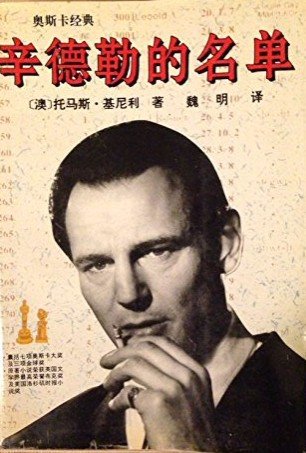
The US theatrical poster for Schindler’s List (left) and the cover for the Chinese VCD bootleg (right). People in China watched the film on pirated copies of VCDs since the film was not released in Chinese theaters. Image credit: Wikipedia; Knews.cc
This John Kamm Remembers is a continuation of last month’s installment, “Memories of 9/11,” which recounted August-September 2001, when Kamm was approached by Tina Rosenberg about being the subject of a New York Times Magazine profile, and Kamm’s experience in China in the wake of the September 11 attacks.
State Security
Tina and the photographer retained by the Times to cover our visit, Zeng Nian, arrived in Beijing from New York in the late afternoon of December 17, 2001. I met them in the lobby of the Jianguo. From the moment of their arrival going forward, we were the objects of attention by state security. One of my drivers later told me that he was summoned for questioning and shown photographs of our arrival at different ministries.
Tina and I had dinner at the Jianguo. We discussed the schedule for the days ahead.
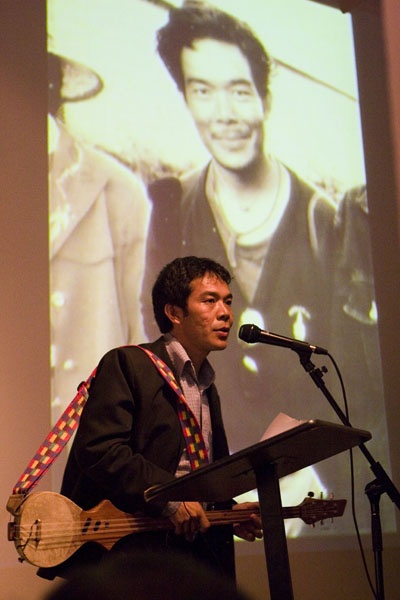
Ngawang Choepel speaks to an audience about his work while holding a traditional Tibetan lute. SFT HQ / CC BY 2.0
On December 18, Tina, Zeng Nian, and I went to the MFA for a meeting with Li Baodong. The purpose was to discuss the possible release of Ngawang Choepel, a Tibetan musicologist who had studied at Middlebury College in Vermont and had been detained in September 1995 on a trip back to Tibet to film folk dances and record traditional music, and to see his mother. His had become an important case for Senator Jim Jeffords, R-Vermont, a pro-trade politician who had nevertheless voted against China’s Most Favored Nation (MFN) in 2001 over the way Ngawang Choepel and his family were being treated.
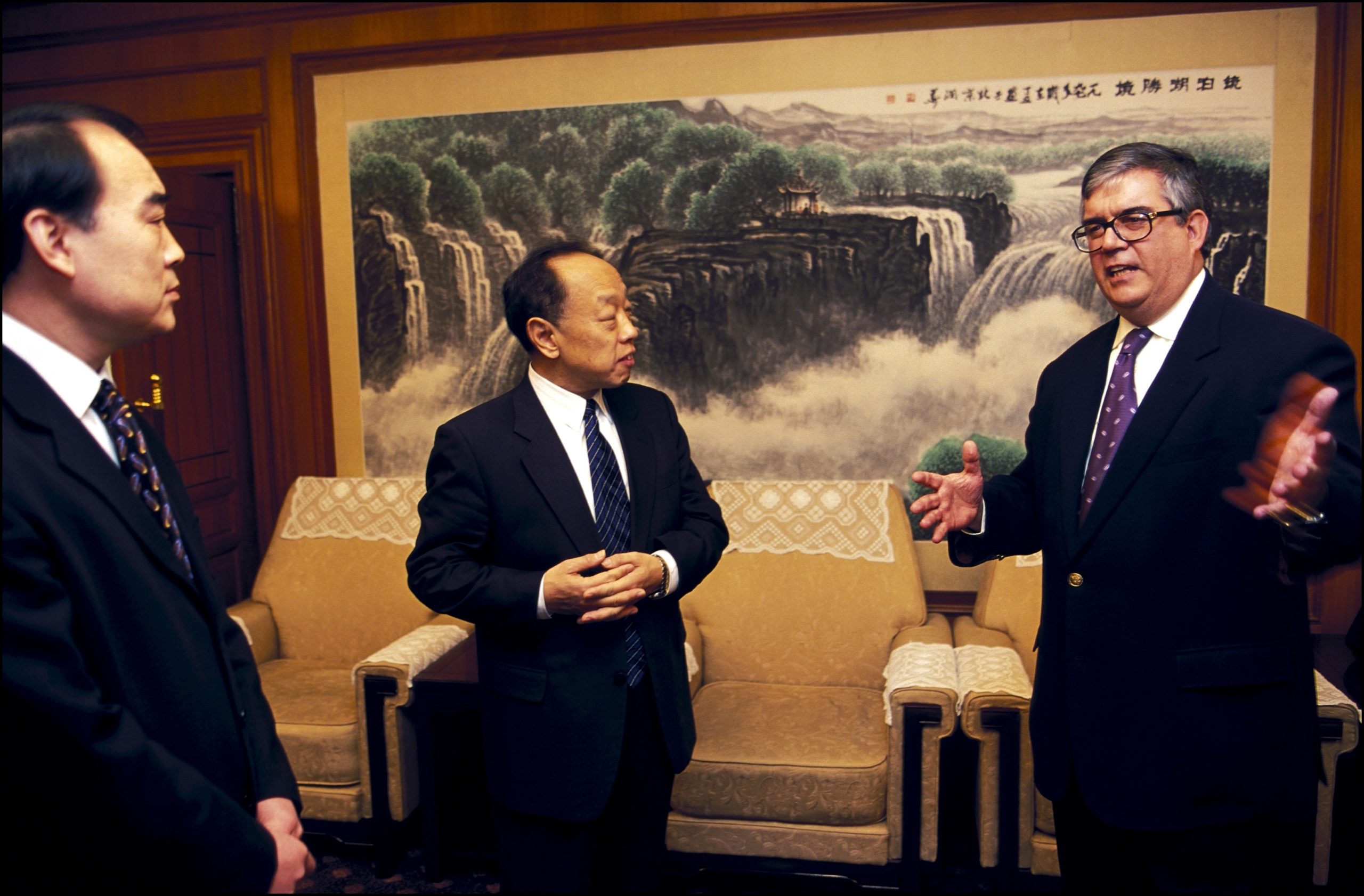
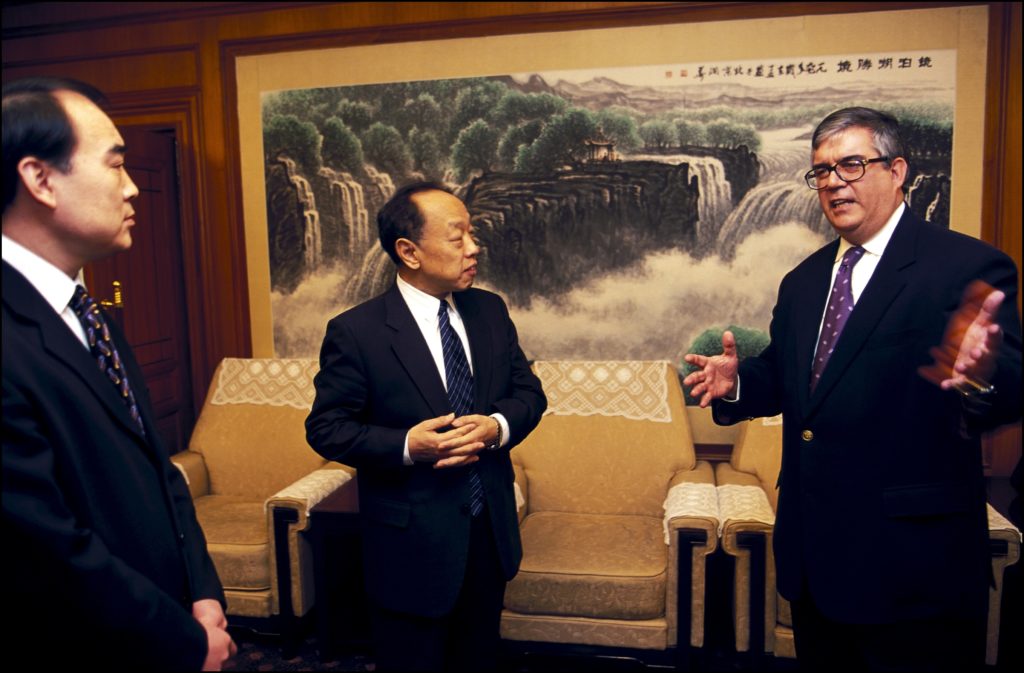
While we were introducing ourselves in came Foreign Minister Li Zhaoxing, who had recently returned to Beijing from Washington where he had served as ambassador. Li was familiar with the Ngawang Choephel case. Senator Jeffords’ vote against MFN had made an impression. After 9/11 Li Zhaoxing had recommended, to President Jiang Zemin, that political prisoners be released to improve the relationship with the United States, a seemingly contrarian move. Why make concessions to the United States when it was the United States that was seeking support from China?
At the MFA, Foreign Minister Li introduced Tina to Li Baodong. “This is the good Mr. Li,” he quipped. “There’s another Li who lives in Taiwan. He’s the bad Mr. Li.” The foreign minister was referring to President Lee Tenghui, seen by the Chinese government as enemy number one. After the foreign minister left the room, Li Baodong and I discussed the Ngawang Choepel case in cryptic terms. We agreed that we would meet again the next day.
For lunch, Tina and I were hosted by a large group of foreign diplomats assembled by Mark Lambert, the US embassy’s human rights officer, in the best Italian restaurant in Beijing, Aria. They spoke one-by-one about their dealings with China on human rights. In those days, China was engaged in around 10 human rights dialogues with foreign countries. Now there are none.
Offices of the Foreign minister: John Kamm with the First Vice Foreign Minister Li Zhaoxing (also former Chinese ambassador to the United States). On the left, Li Baodong, Chief of International Affairs Department of the Foreign Ministry. Image credit: Zeng Nian / Gamma-Rapho via Getty Images
Tina and I parted ways. I went on a visit to Beijing Number Two Prison. The MOJ had denied a request for Tina to join me. She went back to the MFA for a private interview with Li Baodong. We reconnected for dinner with Mark Lambert.
Not surprisingly. Tina wanted to gauge the opinion of American businesspeople about what I was up to, promoting respect for human rights on the part of the American business community in Beijing. I had set up a breakfast with the American Chamber of Commerce for 7:30 AM on December 19. Those at the table were defensive, citing the good work done for orphans and flood victims. Tina adopted a skeptical air. Outside the room, state security was listening.
After the breakfast, we went to the Supreme People’s Court for yet another uncomfortable meeting. The head of the Foreign Affairs Bureau, Mr. Liu Hehua, had clearly been caught off guard. I presented a letter from “my cousin,” Senator Orrin Hatch, and pummeled him with questions about the fate of the China Plum Blossom Party and the pamphleteer Yu Rong. I offered to provide assistance to Mr. Liu with materials on the American justice system.
As we were leaving, Mr. Liu took our photographer aside and sharply asked him about what was going on. The photographer was told that that he should be careful about who he worked for. It was not what the photographer, a French citizen with family in China, had anticipated.
There are two bookstores that were selling volumes related to judicial matters, including those related to trials for political offenses, near the Supreme Court. (NB: The bookstores no longer offer such books.) We surveyed their offerings under the watchful eyes of suspicious shopkeepers. I bought a couple, and then we were off for a photoshoot at the old Beijing railway station.
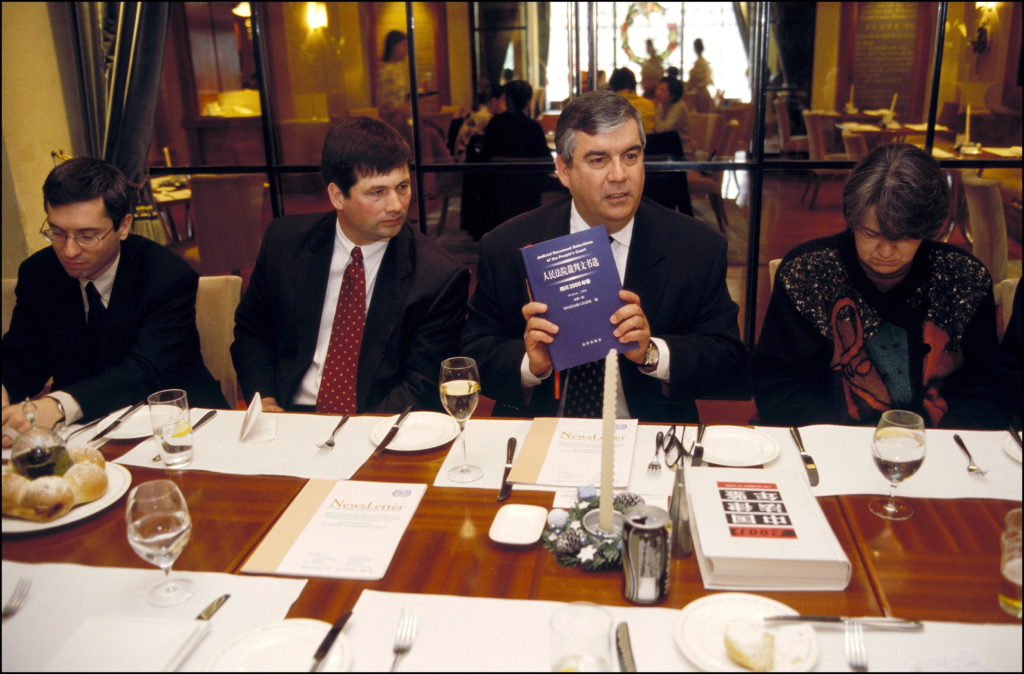
Dinner at the Beijing International Trade Center with 17 European ambassadors and the staff of European embassies working for human rights in China. John Kamm holds the book Annual judgements of the Sichuan Province in 2000. Image credit: Zeng Nian / Gamma-Rapho via Getty Images
I departed Beijing on the 5:30 PM Dragon Air flight to Hong Kong. After three days doing research and briefing clients I returned to San Francisco on December 23, in time for Christmas.
On January 16, 2002, Tina called me with the news that her editor had decided that the entire article – now a profile – would be devoted to my work. The aim was to publish it on February 16. There followed more calls between Tina and me, one on February 5 devoted entirely to Ngawang Choephel’s release that had taken place on January 20. “Wrap up” interviews followed.
A photograph of Tina Rosenberg, the author of “Kamm’s List.” Image credit: Emmanuel Upegui provided by Ms. Rosenberg
The first of two fact-checking interviews with the Times editorial staff followed. I was asked to estimate how many prisoners I had helped in the years since I began intervening on behalf of Chinese prisoners in May 1990. This entailed going over trip reports and notes. Finally, I estimated that I had helped around 250 political prisoners win early release or better treatment. During the last of these fact-checking interviews, I managed to tease the title of the article, now billed as a cover story for the Times’ Sunday Magazine, out of the fact-checker: “John Kamm’s Third Way.” I concluded that Chinese feathers would not be ruffled by this title. The story was slated to appear on Sunday March 3, 2002.
I left for Hong Kong on February 26, thence to Beijing on March 10. In Hong Kong, I intended having dinner with my Guangdong interlocutors, taping a show for VOA, giving a speech to the Asia Society, and conducting research in Hong Kong libraries. Most important, I wanted to gauge reactions to the cover story, due for publication during my days in Hong Kong.
On Friday, March 1, my cell phone went off while I was in the stacks of the Hong Kong University library. I stepped outside to take the call from my wife. The story had been published on the Times’ website on Thursday, February 28. “I thought you said that the title of the story was ‘John Kamm’s Third Way,”’ she said. “In fact, the title on the cover is ‘Kamm’s List.’” That’s when I learned that there are in fact two titles for a cover story. One for the cover, which is decided by the graphics people, the other inside the body of the article decided by the editorial staff.
The latter was in fact “John Kamm’s Third Way.” The cover was a mockup of a movie poster that closely resembled one of the movie posters for Steven Spielberg’s 1993 hit movie Schindler’s List.
Schindler’s List
I shuddered. It would be hard to avoid the comparison between Kamm, saving Chinese prisoners from the Chinese government, and Schindler, saving Jews from the Nazis. I anticipated a sharp reaction from Chinese officials in Beijing – assuming I was allowed to enter the country.
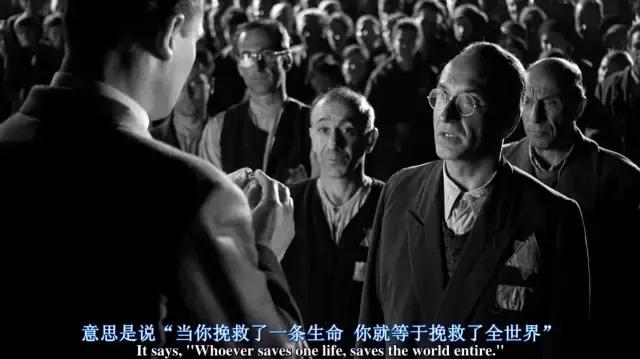
A still from Schindler’s List with Chinese subtitles. Image credit: Knews.cc
I need not have worried. I entered China on March 10, 2002, without incident. The next day I met with Li Baodong and La Yifan. La advised me that he was monitoring reactions to the article among Chinese officials and National People’s Congress and political Consultative Congress deputies, assembled in Beijing for their annual meetings, the so-called “Two Sessions.” Thus far there had been no negative reactions. I told them that there was unhappiness with the article among American businessmen. Li Baodong airily waved his hand: “Don’t worry. They’ll get over it.”
A young official escorted me from the ministry to my car. “Imagine,” he said. “An article about human rights in China in which the Chinese government is not the biggest villain!”
On the afternoon of March 11, I went to the MOJ’s headquarters where I was received by two directors: Wang Lixian, head of the International Department, and Liu Fuchen, head of the Prison Administration Bureau. We sat down and director Liu fixed his eyes on me. “Mr. Kamm, wasn’t there an article about you published in the United States recently?” I said yes, there had been a story about me in the New York Times Sunday Magazine published a few days before.
The cover of a Chinese version of the book Schindler’s List, written by Thomas Keanelly and originally titled Schindler’s Ark, published after the movie received international acclaim. Image credit: Abebooks
“What was the title of the article,” Liu asked. “John Kamm’s Third Way,” I replied. Liu shot back. “No, that’s not the title I remember.” I explained that “Kamm’s List” was the title on the cover of the magazine. “John Kamm’s Third Way” was the title listed in the table of contents and inside the issue itself. Liu continued his line of questioning. “Wasn’t there a movie with a title similar to that?” I confessed that there was: “Schindler’s List.”
Liu rubbed his hands and exclaimed: “Won an Oscar, didn’t it? Excellent!”
An Unhappy Exchange
After a final meeting with Li Baodong on the morning of March 13, I went to the Supreme People’s Court where I was received by Liu Hehua. He was not happy, taking special umbrage at a line in the story: “Kamm not only speaks Mandarin and Cantonese but also the language of the party which is just as important.” Liu adopted a threatening tone. “This will not end well for you.” It turned out that Liu was relying on a translation of the article and not the actual article itself. I admonished him to read the original, and not rely on a translation.
I returned to Hong Kong on March 14 and flew back to San Francisco on March 17, satisfied that, while members business community were not happy – the head of a large business group that promotes trade with China was especially angry – the Chinese government was, for the most part, satisfied with the article, as was the case with the human rights community.
Today, “John Kamm’s Third Way” is required reading in courses on business and human rights, including those taught at Harvard Law School, Columbia Law School, and Princeton University. A testament to Tina Rosenberg’s writing, it has stood the test of time.
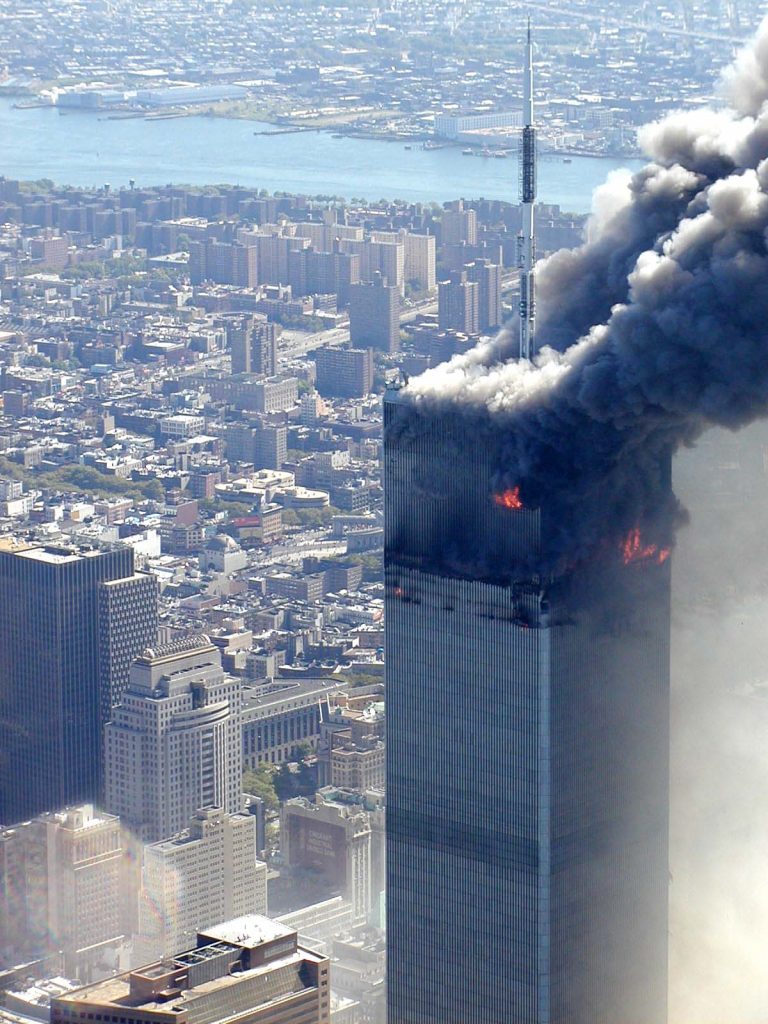
Plumes of smoke billowed from the World Trade Center towers in Lower Manhattan, New York City, after Boeing 767s hit each tower during the September 11 attacks. Image credit: Michael Foran / CC BY 2.0
This John Kamm Remembers recounts the attacks of September 11 and the lead-up to the publication of a cover story on John Kamm. It can be read in conjunction with “Kamm’s List,” the next installment which continues this story.
In the late summer of that year my family and I lived in an apartment in San Francisco that overlooked Chinatown below, and then, down to the Bay and Alcatraz Island in the distance, enveloped in gray fog.
On August 21, 2001, I was sitting at my desk when the phone rang. The caller identified herself as New York Times journalist Tina Rosenberg. I was not familiar with her name.
Ms. Rosenberg told me that she was working on an article that might appear in the paper’s Sunday Magazine. The article would examine the nexus between business and human rights in countries where foreign multinational corporations were conducting business. She mentioned Royal Dutch Shell’s operations in Nigeria and Adidas’ sneaker-manufacturing in Pakistan as possible subjects worth exploring. For China, she wanted to focus on my work on behalf of political prisoners.
On December 9, 2005, Tina Rosenberg speaks at a conference titled “National Security Archives: Celebrating 20 Years of Keeping Government Honest.” Image credit: C-Span
We agreed to talk again the next day. As soon as the call ended, I did an Internet search for Tina Rosenberg. I was impressed by what I found. Tina Rosenberg was, and is today, one of The New York Times’ most accomplished journalists. She was awarded a MacArthur Fellowship, dubbed the “Genius Award,” in 1987, when she was 27 years old. This was followed by a National Book Award in 1995 and a Pulitzer Prize for Nonfiction in 1996. All of this was accomplished before she reached the age of 40. I decided to work with her on the article. I informed her of my decision the next day.
When we spoke on August 22, 2001, I advised Tina that I would travel to Hong Kong and Beijing in September. We spoke again on September 7. I left for Hong Kong the next day, arriving on September 9. I checked into the Marriott Hotel in Pacific Place, an old haunt.
In those days, I had my own show on the Voice of America, and I had lined up several shows to be recorded on this trip. The first show – a program on prospects for political reform in China – was recorded on September 10 at the studio in Wanchai.
The 9/11 Attacks
The next day, September 11, 2001, I made last-minute arrangements for the trip to Beijing, confirming appointments with the Ministry of Foreign Affairs (MFA), the Ministry of Justice (MOJ), and the Supreme People’s Court. The highlight of the trip was to be a dinner hosted for the MOJ to celebrate 10 years of our cooperation. I had secured letters of congratulations from four members of Congress to present at the dinner.
September 11 was capped off with a dinner, in the hotel’s Chinese restaurant, with two of my interlocutors from Guangdong Province. They provided information on seven political prisoners in the province, including the last prisoner connected to June 4, 1989, protests imprisoned in Guangdong. I returned to my room around 9 PM to begin packing for my flight to Beijing the next day.
Upon returning to my room, I found the message light flashing. It was a brief message from my VOA producer in Washington. “Turn on your TV,” it said. “A plane has just crashed into the World Trade Center (WTC) in New York.” I turned on my TV to CNN and saw smoke billowing from the WTC’s North Tower. I watched another plane crashed into the South Tower at just after 9 PM. I continued watching until both towers collapsed one after the other, in pancake fashion, at 10:20 PM.
I didn’t know it at the time, but a close family member had been killed at the very beginning of the attack, the victim of a head-on collision by the jet that crashed into the North Tower. Many of his colleagues at Cantor Fitzgerald were killed in the attack.
After 9/11, air traffic between the United States, Europe, and Asia was suspended, but planes continued to fly between destinations outside the United States. I went out to the airport early for my 11:35 AM Dragon Air flight to Beijing. I needn’t have done so. The departure hall was empty. The cancellation of flights to and from North America had had a devastating knock-on effect on air traffic around the world.
Arriving at Beijing Airport in the early afternoon, I was picked up by my driver and taken to the Jianguo Hotel. After checking in, I called the US Embassy. The new ambassador, Clark “Sandy” Randt had recently arrived. Sandy was an old friend from our days together in Hong Kong. A personal friend of President George W. Bush, Sandy would go on to become the longest serving American ambassador to China.
Sandy Randt had lost a close friend in the 9/11 attacks, and I had lost a cousin. After commiserating, I invited him to the dinner for the Ministry of Justice, to be held on the evening of September 13. He accepted. Sandy also agreed to do a VOA interview with me right before the dinner.
On the morning of September 13, 2001, I met with the Supreme People’s Court to discuss the case of Yu Rong, a Shanghai worker who had been arrested in 1990 in the largest counterrevolutionary pamphlet case in the history of the city. Yu had scattered 1,400 leaflets from the tops of Shanghai buildings. He was subsequently placed in a psychiatric detention center. After this meeting I had lunch with Mark Lambert, the human rights officer at the United States Embassy. This was followed by the VOA interview with Ambassador Randt at the embassy.
The dinner itself, attended by senior officials at the MOJ, the China Society of Prisons, and the MFA, was a somber affair. Not a good occasion for feasting and drinking. It broke up early.
The next morning, I was driven to the MOJ’s headquarters for a 9:00 AM meeting with Wang Lixian, director of the International Department, and his colleague Zhang Qing. I was told that I would not be given any information on prisoners on this visit to Beijing. I registered my disappointment. “At this time when my country is grieving, I come to Beijing to see you and to receive responses to my inquiries. And what do I get? Nothing.” My bitterness and disappointment showed. I choked up and couldn’t continue.
I summoned my driver and returned to my hotel. After eating my lunch, alone, I went to see Director General Li Baodong of the MFA’s Department of International Organizations and Conferences as well as his colleague La Yifan, effectively Li’s number two, and Li Xiaomei. At this meeting I broached the idea of having Tina Rosenberg come to Beijing as part of a story for the Times on my work. I also complained about how I had been treated by the MOJ.
Coverage of the September 11 attacks in Chinese media: (left to right) The front page and inside coverage of the Global Times’ September 12 edition; the front page of the Reference Times. Image credit: kongfz.com; guancha.cn
I stayed behind in Beijing one more day to attend the Memorial Mass for the victims of the 9/11 attacks held at the Cathedral of the Immaculate Conception on Saturday evening, September 15. A priest, a member of the Patriotic Church, kept local Catholics from attending the service. I returned to Hong Kong the next day, checking into the Marriott.
On September 17, 2001, I received an unexpected call in my room at the Marriott. Director Wang Lixian was in the lobby and wanted to meet me. I went downstairs for a short meeting. Wang advised me that they were gathering information in response to some of my requests. They intended to fax it to me over the coming days. I advised him that I would be returning to San Francisco on September 27 and requested that he fax the information to me there. He agreed. We shook hands and he left.
Over the next nine days I kept a full schedule in Hong Kong. I met with foreign diplomats, including the papal nuncio and the American consul general, Dui Hua donors, business leaders, and family and friends. I carried out research at university libraries, finding the names of hundreds of previously unknown political prisoners. I taped a VOA show on the Hong Kong economy.
I flew back to San Francisco on September 27 and, upon returning home, found the promised responses on prisoners from the Ministry of Justice on my fax machine. It was an extraordinary document: information was given on nine prisoners including high priority Tibetan prisoners Jigme Sangpo and Ngawang Sangdrol. A number of early releases had taken place. More would come, including both Tibetans.
Washington
On October 14, 2001, I flew to Washington DC, a tense city still in shock from the attack on the Pentagon on September 11. Security was tight. Troops were everywhere.
I met Tina for dinner at McCormick & Schmick’s on K Street on October 15. It was our first face-to-face meeting. We reviewed progress to date, and I briefed her on recent developments with respect to cases, including those of Liu Baiqiang, a Guangdong prisoner who tied political messages to the legs of locusts and released them from his cell – I dubbed him the “Locust Man” – and Kajikhumar Shabdan, an elderly Kazakh poet serving a 15-year sentence for counterrevolution.
On October 25, I called La Yifan, Li Baodong’s deputy. I wanted to know whether Tina would be given a visa. La told me that it had been decided to grant the visa. We discussed possible dates for Tina and my trip to Beijing, and settled on mid-December, subject to confirmation and Tina’s availability.
I flew to Beijing via Narita on December 15, arriving on December 16. The next day I had lunch with Ambassador Randt and his family at the residence. Afterwards I met with Li Baodong at the Ministry of Foreign Affairs. Two of his colleagues joined the meeting. Tina was soon to land in Beijing. Director General Li commented that the Chinese government did not expect Tina to write an article suitable for publication in the Beijing Review, but it hoped she would be fair and objective. At this meeting I presented a list of Chinese political prisoners eligible for parole.
Read about the aftermath of the article’s publication in “Kamm’s List,” which you can read by clicking here.
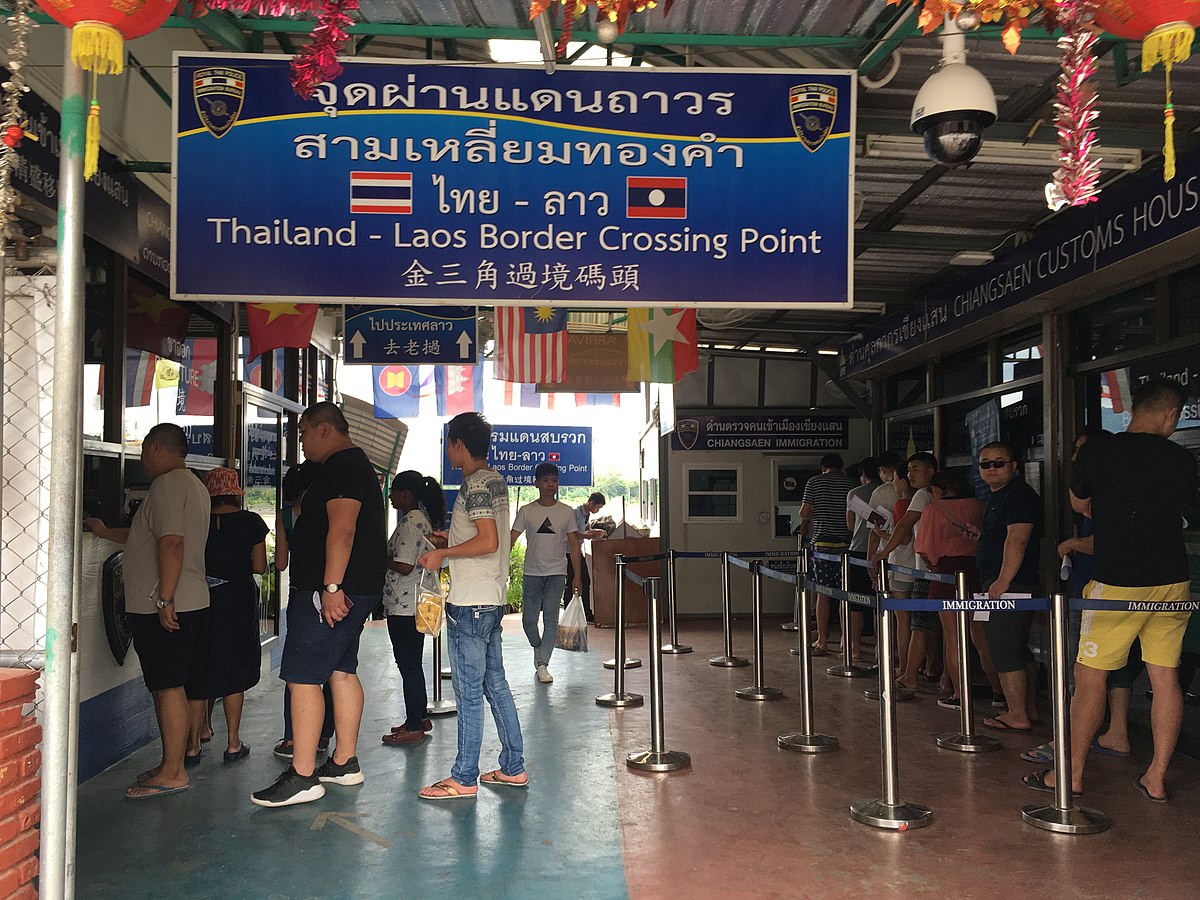
At the Thailand-Laos crossing checkpoint at Sop Ruak, people queue to travel between Thailand and the Golden Triangle Special Economic Zone in Laos. Image credit: Slleong / CCO via Wikimedia Commons
This is the second installment in a two-part series. Read Part I here.
Thailand does not recognize the status of refugees because it has not acceded to the 1951 Refugee Convention or its 1967 Protocol. Refugees who overstay their visas or enter Thailand without proper documents are regarded as illegal immigrants. They have no legal right to work or adequate access to health care; nor can their children attend local schools. They are dependent on charitable groups, religious organizations, other refugees in their community, or they simply subsist on meagre savings. Because of budget cuts and a global tightening of national immigration policies, the UNHCR has reportedly axed financial aid for refugees.
Consequently, many Chinese asylum seekers and refugees enter Bangkok’s labor black market to make a living. Once arrested, they are typically held in immigration detention centers, many of which are “severely overcrowded, provide inadequate food, have poor ventilation and lack medical service and other basic necessities,” according to Human Rights Watch.
In January 2015, Uyghur refugees also complained to a visiting Istanbul-based journalist about health problems in the detention facilities in Thailand. Prior to this incident, three Uyghurs died despite efforts of charitable groups to provide relief. In September 2018, a Chinese observer claimed that dozens of refugees and asylum seekers of different nationalities were crammed into an area of approximately 12 square meters of floor space.
The long wait time for resettlement is another major source of frustration among refugees. Zhang Shufeng (张淑凤), who obtained refugee status in 2017, said the UNHCR prioritizes applications of refugees from armed conflicts such as Syrians and Myanmar’s Rohingya Muslims over Chinese applicants. In 2016, another asylum seeker Cai Yuliang (蔡欲亮) was finally accepted for resettlement in the United States after spending a total of 17 years in Thailand. Cai fled China in 1999, seven years after he completed his 20 years’ imprisonment for the now-defunct criminal offense of counterrevolution.
No Safe Haven
Jiang Yefei holds a placard with a criminal charge at a Thai immigration detention center prior to repatriation in 2015. Image credit: Apple Daily (Taiwan)
Since the coup of 2014, the Thai military regime has been tilting away from the United States toward China. Refugees or asylum seekers are believed to be facing imminent risk of repatriation at the behest of China — Thailand’s largest trade partner and major country of origin for tourists.
Repatriation
Four months after over 100 Uyghurs were repatriated to China, Thailand deported Dong Guangping (董广平) and Jiang Yefei (姜野飞) in November 2015, allegedly for breaking immigration rules. A political cartoonist, Jiang left China in 2008 after he was detained and allegedly tortured over his work critical of the government’s handling of the Sichuan earthquake. Dong fled to Thailand in 2015, having served a three-year jail term for subversion from 2001-2004 and “disappeared” for eight months in secret detention in 2014.
Following their repatriation, Jiang and Dong were sentenced in Chongqing to 78-month and 42-month imprisonment sentences, respectively, for subversion and illegal border crossing in July 2018. Thailand’s decision to repatriate the duo drew condemnation from the UN, United States, and others because both men had been awaiting resettlement in Canada after they obtained their refugee status. Dong completed his prison sentence on August 2, 2019, whereas Jiang still has one year to serve before release in August 2022.
Cross-Border Law Enforcement
The disappearance of Chinese-born Swedish citizen Gui Minghai in Pattaya in October 2015 raised fear of cross-border operations of Chinese security forces. A similar case that did not garner much attention concerns former editor of the Southern Metropolitan DailyLi Xin (李新). In November 2015, Li fled to New Delhi after he was coerced by Chinese state security to work as an informant. He disappeared while riding a Laos-bound train in north Thailand in January 2016 in a bid to renew his Thai visa. A month later, Li reappeared in China claiming that he had returned to China “voluntarily” to assist with a police investigation. When asked about the case by The New York Times, the Thai Foreign Ministry responded that there was no “record as yet as to whether he has left the country.” Li’s wife and supporters speculated that Li had been abducted by Chinese security forces and clandestinely transported across the border.
Turning a Blind Eye
Xing Jian (邢鉴) arrived in New Zealand as a refugee in January 2020, more than three years after the UNHCR recognized his refugee status in the summer of 2016. Xing criticized the Thai government for providing insufficient care and protection for UN-recognized refugees. While in Thailand, Chinese public security officers apprehended him alongside Bangkok police because he overstayed his visa on November 25.
Before fleeing China, Xing volunteered for prominent dissident Huang Qi (黄琦) and was accused of “rumour-mongering” for exposing corruption in his home county in Jiangsu. His father Xing Wangli (邢望力), who remains in China, was sentenced to two years and three months’ imprisonment in October 2018 for “picking quarrels and provoking troubles.” Xing Wangli was re-arrested in June 2021 for defamation after visiting prominent rights lawyer Jiang Tianyong.
Wu Yuhua and Yang Chong (see part 1) were originally scheduled to depart for Canada from Bangkok on June 25, 2019. However, they were barred from leaving Thailand. Yang may be required to complete his one-year suspended sentence there for overstaying, according to a Chinese activist familiar with Thai laws. However, another Radio Free Asia report cited the Chinese embassy as saying that the Thai authorities “do not rule out the possibility of repatriating the duo to China.”
Fleeing Again
Risky Voyage
In view of a potentially indefinite waiting period for resettlement, the threat of repatriation, and abduction by Chinese security forces overseas, some asylum seekers and refugees are determined to flee once more. Prior to the scheduled interview with the UNHCR in 2017, Falun Gong practitioner Dong Junming (董俊明) undertook a risky voyage to New Zealand, some 6,000 miles away from Pattaya, on February 29, 2016. Dong was joined by six like-minded asylum seekers and two children.
In early March, a few days into their voyage, the yacht capsized off the Thai coast. In an interview with overseas media, Dong said that “[i]t’s highly risky out there on the ocean, but we are so fearful here in Thailand that I thought I should take the risk.” All travellers who boarded the yacht, including China Democracy Party member Li Xiaolong (黎小龙), were returned to Thailand after the failed escape. Some were placed in immigration detention centers while at least one of them stood trial for illegal entry into Thailand in January 2017.
To Taiwan
In a bid to evade the extending reach of China in Thailand, some dissidents have chosen to flee once more to Taiwan. Huang Yan (黄燕) fled to Thailand in 2016 after years of harassment, repeated incarceration, and alleged torture for speaking out in support of Gao Zhisheng. In May 2018, she flew to Jakarta, then to Taiwan, where she was granted temporary leave to remain until the United States granted her political asylum in January 2019.
Following in Huang’s footsteps, China Democracy Party members Yan Bojun (颜伯钧) and Liu Xinglian (刘兴联) left Bangkok four months after Huang’s arrival in Taiwan. They were granted entry in February 2019 on the basis of “professional exchanges” after 125 days at Taipei Taoyuan airport. At the time of writing, both men have been granted asylum protection in Canada.
On September 29, 2016, Taiwan’s Mainland Affairs Council Deputy Minister Chiu Chui-cheng expresses concerns over the situation in Hong Kong but says Taiwan will not intervene. Image credit: Voice of America via Wikimedia Commons
It would be a mistake to assume that Taiwan welcomes individuals fleeing violence and persecution in China. While the island has promised assistance to Hong Kong anti-extradition bill protesters, Taiwan’s Mainland Affairs Council (MAC) maintained that Taiwan policy toward mainland asylum seekers remained unchanged. Should Taiwan openly admit mainland asylum seekers and refugees, it will likely trigger a flood of applications and further antagonize China, putting hundreds of thousands of China-based Taiwanese residents, workers, and investors at risk of arbitrary detention. Additionally, Taiwan fears what it calls “infiltration” from mainland agents. There have been recent arrivals of mainland Chinese who managed to cross the Taiwan Straits despite it being one of the world’s most heavily policed waterways.
Taiwan is not a member of the UN and does not have legislation to protect refugees. The island only vows to deal with applications from mainland Chinese on a case-by-case basis, according to the MAC.
Non-Refoulement
It must be noted that around the globe, not all Chinese asylum applicants are found to have a legitimate fear for persecution. In Australia, for instance, the number of Chinese nationals applying for refugee asylum rose by 311 percent in just one year from 2017. Despite this surge, the Australian Department of Home Affairs only recognized 10 percent of such claims as being genuine. Most claims found to be bogus have been used by applicants to overstay their visas. The United States has also cracked down on “asylum mills,” which have helped thousands of Chinese immigrants to fraudulently win asylum status. Over 13,500 immigrants, mostly Chinese, who were granted asylum status are reportedly facing possible deportation.
However, many of those in Bangkok have been determined by the UNHCR to have a well-founded fear for persecution, a fear not imaginary but very much real, as being detained, arrested, and sentenced should they be returned to China. The fact that Thailand is not a signatory state of the 1951 Refugee Convention or its 1967 Protocol does not absolve the country from its duty to protect refugees inside its borders. The UNHCR has also called on all states, including non-signatory states, to observe non-refoulement, an international principle that prevents all countries from expelling or returning an individual to a country where he or she is at genuine risk of persecution.
Thai officials have reiterated their commitment to protecting the rights of refugees and asylum seekers. They have also vowed to adopt anti-torture legislation to strengthen implementation of the principle of non-refoulement. However, insufficient protection for asylum seekers and refugees has left them stranded in Thailand, vulnerable to detention, arrest, and repatriation. Some of them have even been compelled to flee Thailand as well to evade arrests, deportation, and Chinese security forces overseas.
The United Nations building in Bangkok, Thailand. Image credit: dsin_travel / CC BY 2.0
China has consistently ranked among the top 20 refugee producing countries every year since 2003, according to statistics published by the United Nations High Commission for Refugees (UNHCR). The latest statistics published in June 2021 indicated that China was 18th on the UNHCR’s list at the end of 2020. The number of UNHCR-registered refugees originally from China reached 175,585. Additionally, there were 107,864 Chinese asylum seekers around the globe with pending claims. The number of asylum seekers increased nine-fold from just 11,375 in 2011, the year before paramount leader Xi Jinping assumed power.
Table 1. UNHCR’s Forced Displacement Statistics (Country of Origin: China)
Source: UNHCR, Refugee Data Finder, 2003-2020
Many UNHCR-recognized refugees from China consider the West a destination of choice for resettlement. After taking the first step in the long journey to asylum, many refugees from China sojourn in Thailand where they await refugee status determination. It is an administrative process by which the Bangkok-based regional office of UNHCR for Southeast Asia determines whether a person seeking protection qualifies as a refugee under international law. Bangkok is home to an estimated 8,000 urban refugees—hailing from Asia, the Middle East, and Africa.
Dui Hua is not aware of any official statistics about Chinese asylum seekers in Thailand. However, Bei Ling, founder of “Home of Refugees” in Thailand in 2015, estimated that more than 300 Chinese asylum seekers were in the country as of October 2018.
This is the first entry in a two-part series examining issues facing Chinese asylum seekers in Thailand. This entry explores who they are and why they have fled China. The second entry will look at how and why Thailand falls short of being a safe haven. Prospective refugees with or without valid passports risk criminal detention for overstaying in Thailand. Their predicaments also include indefinite wait times for third country resettlement. The fact that Thailand fails to abide by the principle of non-refoulement also places a heightened risk of repatriation for those seeking protection from persecution at home.
Why Thailand?
Thailand started to become a popular place of transit for Chinese refugees about two decades ago. Prior to that, those with a well-founded fear of persecution decamped to colonial Hong Kong to flee political persecution thanks to the lax border controls at the time. Since China resumed sovereignty over the former British colony in 1997, Hong Kong has ceased to be a popular destination for asylum protection.
For decades, Hong Kong has been a magnet for refugees. It is troubling to see a spiked increase in asylum seekers from Hong Kong since civil unrest triggered first by the now-rescinded extradition bill, and then by the sweeping arrests made under the National Security Law. The law criminalizes secession, subversion, terrorism, and collusion with foreign forces. At the end of 2020, there were 487 registered asylum seekers from Hong Kong, up from 22 in 2018 before mass protests erupted in June 2019.
While a portion of those who fled China could be considered “economic migrants” in search of sustenance and a livelihood, China’s much-lauded economic success has fallen short of stopping people from fleeing abroad. Critics of one-party rule, adherents of banned religious groups, civil rights activists, petitioners, and ethnic minority groups are continuing to seek asylum protection abroad via Thailand.
Chinese nationals find entry to Thailand easier than other neighboring countries or regions including South Korea, Japan, and Taiwan, mainly because they benefit from the 15-day visas on arrival available to them (Thailand has suspended this arrangement due to the outbreak of coronavirus). Entry to elsewhere requires obtaining a pre-arranged visa.
Because of geographical proximity, those without proper legal documents can resort to traveling illicitly overland from Yunnan with the help of smugglers. Chiang Mai, for instance, is reachable by land transport from Yunnan’s border in nine hours. From Chiang Mai, it is another half-day journey to Bangkok, where asylum seekers file their refugee claims at the UNHCR office.
Why Flee?
Political Prisoners
Geng He (耿和), wife of human rights lawyer Gao Zhisheng, is arguably the most notable example of a family member of a Chinese political prisoner fleeing political persecution via Thailand. She left for Bangkok with her children in January 2009 while her husband was serving his suspended sentence for inciting subversion. Gao’s entire family faced reprisal because Gao took on controversial cases and publicly called for an end to the persecution of Falun Gong. While in China, Gao’s children were prevented from attending school. Geng and her children stayed in Bangkok for two months before resettling in the United States. However, it must be noted that such speedy granting of asylum by the United States was only expedited by international attention. As will be discussed in Part II, the wait time for third country resettlement is often indefinite. Today, Gao remains under house arrest even after his sentence expired in August 2014.
Another asylum application involved Hua Yong (华涌), who arrived in Canada in April 2021. Hua is a well-known painter from Beijing who posted videos documenting forced evictions and demolitions in poor neighborhoods. He was placed under residential surveillance at a designated location for three months after meeting with the father of Dong Yaoqiong, a girl who was admitted to a psychiatric facility after she live-streamed a video of herself accusing the Chinese Communist Party of “thought control.” Hua escaped to Thailand in September 2019.
Dui Hua previously assisted former political prisoner Li Huangming (李焕明) with verifying his claim for political asylum. Before being granted political asylum in Finland in May 2013, Li fled to Bangkok after he completed his nine years’ sentence for inciting subversion in September 2010. The conviction stemmed from him distributing or planning to distribute tens of thousands of “reactionary” flyers in Shenzhen. While awaiting refugee resettlement, Li wrote stories about other Chinese asylum seekers in Bangkok for Boxun and other NGOs. In an article published by Human Rights in China in November 2012, Li wrote that Bangkok’s UNHCR office had a special team of interpreters and officials to handle the surge of applications from Chinese dissidents.
Li wrote about changing demographics of Chinese asylum seekers. A significant number of applications were submitted by petitioners contrary to the popular belief that most Chinese refugees are supporters of China’s democracy movement, violators of the one-child policy, and adherents of banned religious groups such as Falun Gong and house churches.
Petitioners
Li’s observation is in line with what has been reported in unofficial news sources in recent years. Petitioners fled to Bangkok because they face reprisal in China after lodging futile complaints about land expropriation or forced demolition in their home cities.
Petitioner Zhang Shufeng protests at UNHCR’s Bangkok office while holding a bilingual slogan that says “Request UNHCR help.” Image credit: Mirror Media
Zhang Shufeng (张淑凤), a native of Beijing, fled to Bangkok in 2014 and obtained refugee status three years later. Taiwan-based Mirror Media reported that Zhang’s family was subjected to house arrest, beatings, and constant surveillance by government-hired thugs in China. Surveillance intensified during the “Two Sessions” (the National People’s Congress and the Chinese People’s Political Consultative Conference) and other political events. In Bangkok, Zhang protested at the UNHCR office while holding a bilingual slogan saying “Request UNHCR help,” in the hope that the UNHCR would expedite her resettlement process.
In January 2017, unofficial news media reported that Beijing evictee Wang Ling (王玲) joined her son who had arrived in Bangkok in December 2016 to maximize the chance of them both getting through Chinese immigration checks. Wang claimed that she had received death threats from police after pursuing complaints about the forced demolition of her home. In 2008, she was sentenced to 15 months of re-education through labor and had been detained a total of 11 times. The news of abnormal deaths in police custody made Wang fear for her life.
Religious Persecution
Falun Gong practitioners still make up a large portion of asylum seekers in Bangkok. Many of them have fled persecution after the suppression of the spiritual sect began in 1999. One widely publicized case concerns Song Zhiyu (宋志宇), who escaped to Thailand in early 2014 via Myanmar after completing his three-and-a-half-year sentence for “organizing a cult to undermine implementation of the law.” In a Reutersinterview in 2016, Song recounted how he “was spirited across a river into Thailand and hidden in the luggage hold of a Bangkok-bound bus.” Song claimed that Thailand had about 160 Falun Gong refugees and asylum seekers. The Thai authorities have taken an interest in them owing to the close bond between the military junta and Chinese government since 2014. More than 29 practitioners had been arrested on immigration charges under the military junta, said Song.
Members of the Early Rain Covenant Church in Chengdu have also made their escapes via Thailand and joined the ranks of asylum seekers before pastor Wang Yi (王怡) was sentenced to nine years in prison for subversion and illegal business activity in December 2019. The crackdown on this prominent house church prompted Liao Qiang (廖强) to travel to Thailand with five of his family members in July 2019. They stayed in Thailand only for three days before transiting to Taiwan. However, their stay in Taiwan was only temporary because Taiwan does not have a refugee law. Liao and his family left for the United States on June 29, 2021 after receiving political asylum there.
Civil Activism
New groups of asylum seekers have emerged following Xi Jinping’s sweeping crackdown on civil society since he took power in 2012. Some were participants of the “Southern Street Movement,” a series of small-scale street banner protests that occurred in southern cities such as Guangzhou and Shenzhen from 2012-2013. The movement called for democratic reform and government officials to disclose assets.
Among the “Southern Street Movement” asylum seekers were Wu Yuhua (吴玉华) and her husband Yang Chong (杨崇). They fled China in early 2015 after being targeted by police for supporting the protests in Guangzhou. Two years later, the couple was granted refugee status in Bangkok.
Yang Chong holding up a banner calling for human rights and elections in 2015. Image credit: Bnn.co
Supporters of the New Citizens’ Movement have also sought political asylum. The movement was promoted by prominent legal scholar and civil rights lawyer Xu Zhiyong, who was formally arrested for subversion in January 2021 after calling on Xi Jinping to step down. Sharing similar aspirations with Xu, Yan Bojun (颜伯钧) arrived in Bangkok in early 2015 after several futile attempts to leave China. In 2016, Yan published a book in Japan recounting the suppression he faced after helping Xu provide legal assistance to victims of social injustice. He had been placed under criminal detention several times in China; the longest one lasted 30 days.
Liu Xinglian (刘兴联), another UNHCR-recognized refugee, was arrested in Hubei for inciting subversion in June 2015 due to his involvement in Qin Yongmin’s “China Human Rights Watch.” The group promoted the idea of a peaceful transformation to a democracy and circulated Qin’s articles about the inevitable demise of China’s autocratic rule. After Liu was released on bail in April 2016, he managed to escape to Bangkok in 2017.
Uyghurs & Kazakhs
Pakistan, which borders Xinjiang, was once a popular escape route for Uyghurs seeking to escape Chinese state repression, but its growing economic reliance on China has made Uyghurs fear for their future. Pakistani Prime Minister Imran Khan said as recently as July 2021 that, “What they [China] say about the programs in Xinjiang, we accept it.” In the mid-2010s, a large group of Uyghurs made a long detour south to Bangkok before human rights abuses associated with the “re-education camps” made international headlines. However, Uyghurs are typically not interested in registering in Thailand as asylum seekers, according to a UNHCR statement in 2015. They were only looking for ways to get to Turkey, a destination of choice with an estimated 50,000 Uyghur residents.
Thai authorities have confirmed a staggering number of Uyghur escapees in Thailand. In 2014, a group of 424 Uyghurs were detained in Thailand. In July 2015, over 170 Uyghurs were released to start new lives in Turkey, but a week later the Thai government repatriated 109 refugees to China. In July 2017, Thai immigration police said about 60 Uyghurs remained in detention centers across the country. As recently as 2020, their number was down to about 50. They were remnants of the Uyghurs who fled to Thailand in 2014.
Evidence also suggests that ethnic Kazakhs have fled Xinjiang’s massive surveillance and detention campaign. A recent case involved Qalymbek Shahman, who Uzbek authorities sent back to Thailand after being denied entry to Kazakhstan in January 2019. He was subjected to intense racial profiling in China, making it impossible for him to make a living. “I would have my ID checked every 50 to 100 meters when I was in Xinjiang…Whether it was getting on a plane, on a train or other public transportation, they would spend half an hour checking me out every time.” His clients became concerned as to why he was routinely monitored and consequently stopped doing businesses with him.
Chinese asylum seekers in Thailand face a number of problems beyond finding safe haven, including the lack of legal recognition. The second instalment will explore why and how Thailand falls short in protecting asylum seekers, and the challenges asylum seekers encounter once in Thailand.
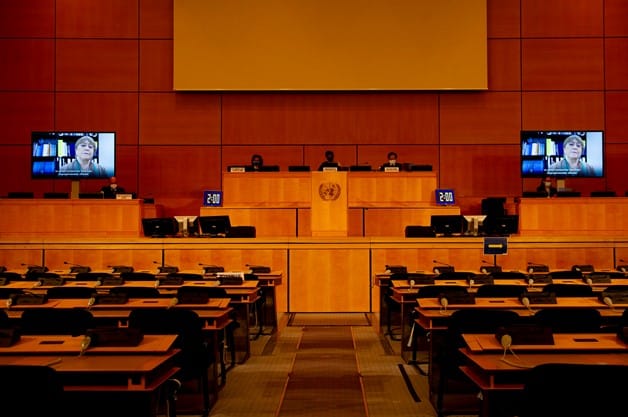
United Nations High Commissioner for Human Rights Michelle Bachelet makes remarks during the annual high-level panel discussion on human rights mainstreaming at the 46th session of the Human Rights Council on February 22, 2021. Image credit: UN photo by Violaine Martin
The United Nations Human Rights Council is an ideological battleground between China and its allies and the United States and its allies. Its 47th regular session (hereafter HRC 47) took place from June 21 to July 14, 2021 in Geneva. At the start of the session, Permanent Representative of Canada to the United Nations (UN) in Geneva Leslie E. Norton delivered the Joint Statement on the Human Rights Situation in Xinjiang on behalf of 44 countries. In response, Belarus delivered a joint statement from 69 countries refuting criticisms against China and urging non-interference.
In recent years, HRCs and other UN sessions have seen dueling statements expressing concern over China’s human rights record on the one hand and lauding it on the other. Two blocs have emerged since a joint letter at HRC 41 in 2019. While each of the UN’s 193 member states has its own motivations, some factors offer insights into how countries are negotiating the US-China relationship and the current human rights climate.
Dueling Statements
The Canada statement at HRC 47 expressed concerns about the human rights situation in Xinjiang Uyghur Autonomous Region (XUAR), Hong Kong Special Administrative Region (SAR), and Tibet Autonomous Region (TAR) citing “credible reports” of rights abuses including widespread arbitrary detention, surveillance, restrictions on fundamental freedoms, torture, and gender-based violence by authorities. It urges China to allow “immediate, meaningful, and unfettered access” to the region and to implement the concluding observations of the UN Committee on the Elimination of Racial Discrimination (CERD).
The signatories to the Canadian statement are predominantly developed democracies in North America, Europe, and Asia-Pacific. European states make up the majority. Most of the signatories have been outspoken against China’s human rights record and, as with Asia-Pacific signatories, have geopolitical concerns about China. Ukraine allegedly backed out of signing the statement when China threatened to halt sending vaccines. Israel was reportedly pressured to join by the United States.
All of the G7 – Canada, France, Germany, Italy, Japan, the United Kingdom, and the United States – signed the Canadian statement. In 2020, the G7 countries made up at least a third of China’s foreign trade revenue. Except for Japan and the United States, the G7 countries are also members of the China-launched Asia Infrastructure Investment Bank. The countries that signed the Canadian statement likely account for at least 50 percent of China’s export revenue. Trade between the United States and China, meanwhile, has surged to record levels, with some reports writing that it is “as if the protracted tariff war and pandemic never happened.”
Belarus’ counter statement emphasized the importance of “sovereignty, independence and territorial integrity of states and non-interference in internal affairs.” It implies that the Canadian statement is politically motivated and based on disinformation and double standards. The statement originally had 65 signatories with four nations joining later, and has broad support among the Organization of the Islamic Cooperation (OIC). Twenty-three of the OIC’s 57 members did not sign the Belarus statement, nor did most of China’s major trading partners.
Table 1. HRC 47 Statement Signatories
There were notable omissions. Both Turkey and Kazakhstan have not signed either statement despite cultural links to persecuted groups in China. Multiple ASEAN nations, particularly those that are Muslim-majority and/or have concerns about the South China Sea, have not aligned with either bloc. Several of the world’s largest economies have also been absent, including India and Brazil. South Korea, which enjoys strong economic ties with both but is politically aligned with the United States, refrained from signing, as did Singapore. Finally, four members of the EU have not signed either statement: Cyprus, Greece, Hungary, and Malta.
As mentioned, HRC 47 was not the first instance of dueling statements on China’s human rights record. At HRC 41 in 2019, 25 nations signed a letter criticizing China while a counter letter garnered 50 signatories. At HRC 44, the UK issued a joint statement signed by 27 nations; in turn, two statements supported China—one on Xinjiang issued by Belarus signed by 53 states and another on Hong Kong issued by Cuba signed by 46 states. At HRC 46, Belarus and Cuba switched: Belarus offered a statement on Hong Kong for 69 states while Cuba’s statement on Xinjiang garnered 64 signatories. There was no joint measure critical of China; instead, 21 member states made 34 separate remarks criticizing China’s human rights record.
Similarly, in the 74th session of the General Assembly, the UK issued a statement on behalf of 23 states, which was met by a counter statement from 54 member states. In the 75th session, Germany issued a joint statement on behalf of 39 states. Cuba supported Xinjiang policy on behalf of 45 states and Pakistan supported Hong Kong policy on behalf of 55 states.
Statements critical of China have been issued by the UK, Germany, and Canada while joint actions supporting China have been issued by Belarus, Cuba, and Pakistan. Both Belarus and Cuba are among the last communist dictatorships in their regions, and both have faced political turmoil and threat of regime change in recent months. Should political instability in Cuba result in the fall of the regime, China could lose one of its key supporters.
Table 2. Selected Actions at the UN
The joint statements have consistent messaging. Statements critical of China have expressed concern over human rights, noted China’s obligations under international law, recommended that China implement the CERD observations, and urged China to allow meaningful, unfettered access to independent observers. Statements in support of China consistently accuse the other bloc of being politically motivated, commend China’s actions in Xinjiang as human rights achievements through the right to development and, because there have been no terrorist attacks in Xinjiang in three consecutive years, the right to life.
Regions Beyond the Rhetoric
The most obvious bloc is that of the developed democratic economies of North America, Europe, and Asia-Pacific that express concern over human rights in China. Canada’s HRC 47 statement was the most supported statement yet: 44 states signed on, 23 from the EU and 32 in Europe. This corresponds to recent polling in which publics in 17 advanced economies said China does not respect the personal freedoms of its citizens. Of the nations surveyed—all in North America, Europe, and Asia-Pacific—13 signed the HRC 47 statement. Several of these nations have designated China’s actions in Xinjiang as genocide in their domestic political bodies. Of the remainder, South Korea, Greece, and Singapore have not signed any statement; the latter two reported favorable views of China, and Singapore was the only public to prefer close economic ties with China and to express confidence in Xi Jinping. However, the United States induces uncertainty. Of the 16 other nations, a third said that the United States considered their foreign policy interests. While most described the United States as a “somewhat reliable partner,” most believe that it is no longer a good model of democracy.
Much has been made of the Islamic world’s support for China’s actions in Xinjiang. Belarus’ HRC 47 statement was signed by 13 MENA countries and the majority of OIC countries. Only one OIC member, Albania, signed Canada’s statement. Muslim populations’ support for alleged genocide against a Muslim population has been explained as a byproduct of strong-man rule because many MENA, OIC, and Central Asian nations have authoritarian features. However, polling has found consistently positive views of China and Xi Jinping even when support for the United States increased among seven MENA countries. Arab publics consistently view the United States as a larger economic threat than China. Across 13 Arab countries, 58 percent viewed US policy towards the region negatively while a majority held positive views on China’s foreign policy. These views persist even though respondents view China as a less desirable employer and a source of inferior goods, and they express broad support for democracy, which suggests that China’s argument for sovereignty is attractive. Dismissing the Muslim world’s support of China as a product of illiberalism may validate China’s narrative that human rights are individualistic western ideals used to infiltrate and subjugate otherwise sovereign states.
Among ASEAN countries, seven of its 10 members did not sign either statement. The Philippines stopped supporting China after HRC 41. While sharing the Philippines’ concerns over the South China Sea, Indonesia and Malaysia are also facing pressure, both external and internal, over the situation of the Uyghurs in their country. A 2021 survey of government and civil society experts in ASEAN nations found that support for the United States has increased in recent years. A 2020 poll found 79 percent identified China as the most influential power in the region, with 72 percent expressing wariness over this: “China’s economic influence is deeply felt but not very well received in the country.” Still, China is favored in many ASEAN countries with the United States being the overwhelming preference in the Philippines and Vietnam.
Africa has been a consistent source of support for China at the UN, even as some of the continent’s largest economies avoid statements. (In a surprise development, Côte d’Ivoire issued a statement expressing concern over actions in Xinjiang, Hong Kong, and Tibet despite not signing either statement.) A survey of 18 African countries found that while the United States is still the preferred development model, in countries where China had invested mainly in infrastructure, perceptions have held steady or improved. Less than half of those polled said they were aware of Chinese loans or financial assistance to their country but among those who were, 77 percent were concerned about loan repayment and a majority (58 percent) said that their governments had overborrowed. This might indicate that narratives about debt traps and asset seizures are having an effect.
Like Africa, the region consisting of Latin America and the Caribbean (LAC) has seen hefty Chinese investment. According to the Congressional Research Service, 19 LAC countries have Belt and Road Initiative (BRI) projects in the region and total trade between China and the region reached $316 billion in 2019. Accumulated loans from 2005 to 2020 totaled $137 billion, with top recipients being Venezuela, Brazil, Ecuador, and Argentina—only one of which signed the Cuba statement. Public polling in Brazil, Argentina, and Mexico suggests that people have more positive views of China than negative, and these ratings have improved since 2014; these publics were more likely to name the United States as the top threat but say that they have good economic relations with both countries.
Trading Onwards
A look at China’s top trading partners suggests that any battle for hearts and minds is occurring separate from trade deals. China’s top 10 countries for imports and exports are dominated by Canada statement signatories—the United States, Germany—and non-signers—Brazil, South Korea. While supporters like Russia and the odd MENA state factor in at lower levels, China’s economy is still supported by the countries it accuses of weaponizing human rights. Amongst ongoing calls for decoupling and an economic reality that suggests the opposite, there are several issues to consider moving forward.
Investment and attention seem to matter. In public polls, countries that receive investments tend to have more favorable opinions of a country, which sometimes translates into UN support or at least the absence of opposition. The United States and Europe have recently announced initiatives to compete with China’s BRI, and vaccine diplomacy, as seen by the Ukraine case, remains a crucial issue for international engagement.
Narratives can create opportunities. Narratives on predatory investment may have sway in regions lacking a power monopoly; China-led narratives about sovereignty at the very least provide effective cover for post-colonial societies, some of whom may be truly weary of invasion. Similarly, China’s human rights whataboutism can deflect attention from criticism. It has highlighted the United States’ history of genocide and aggression in the MENA region. At the same time that Canada issued its statement, reports of mass graves at its relocation schools revealed its own human rights abuses. China even issued its own joint statement expressing “deep concerns” on human rights in the United Kingdom largely due to severe systemic racism.
China’s accusations of political bias might seem contrived to western audiences, but the United States has at times taken a similar approach. The Bush administration declined to join the HRC in 2006 when the HRC replaced the Human Rights Commission, which was widely seen as ineffective and even counterproductive. The Bush presidency also cited anti-Israel bias as a reason for non-involvement, and the United States was one of four nations—with Israel, the Marshall Islands, and Palau—to vote against the HRC’s formation. Belarus, Iran, and Venezuela abstained. During the Obama administration, the United States joined and was elected to the HRC. In 2018, the Trump administration withdrew from the HRC, again citing anti-Israel bias as the reason.
On June 19, 2018, then-Ambassador to the United Nations announced the US withdrawal from the HRC. Image credit: C-Span
Similarly, China has used the US-led war on terror to justify its actions. Many Western countries have expressed indignation at China’s actions without acknowledging parallels to US programs of extraordinary rendition, extrajudicial drone killings, and the “off-shoring” of refugees by developed democracy economies. This helps reinforce China’s narrative that human rights are culturally biased, politicized devices. Ignoring these aspects may reinforce China’s notion that the choice between the US and China-led narratives on human rights is a political one, as opposed to one rooted in international law and morality.
The Biden administration seems to be progressing on some of these fronts. The administration’s statement on key outputs from HRC 47 listed achievements such as co-sponsoring resolutions in human rights in Syria and the human rights of migrants, leading events on Hong Kong’s National Security Law and business and human rights, and cooperating on a new mechanism to combat systemic racism. It also confirmed that the United States will seek election to the HRC leadership for 2022-2024.
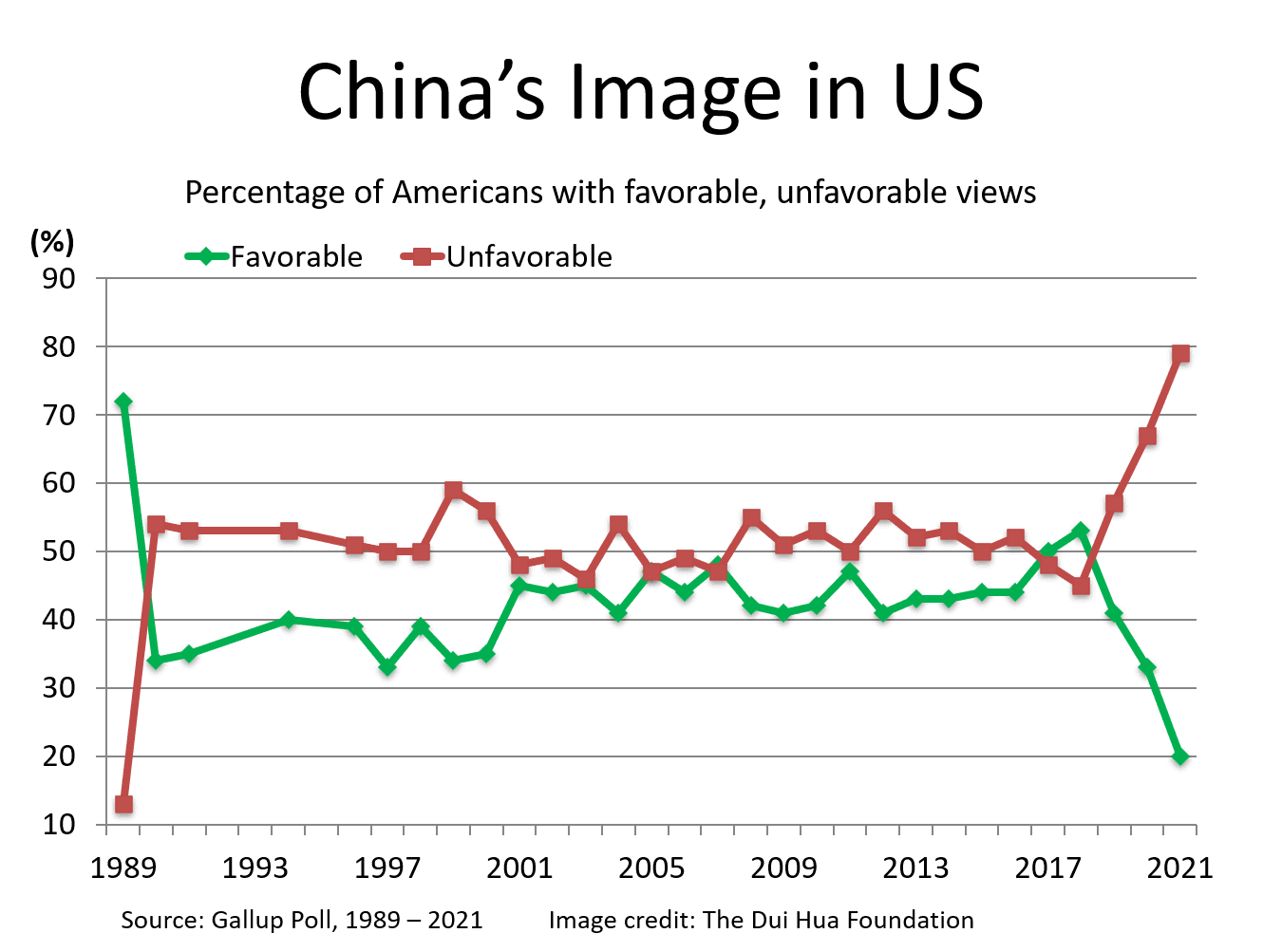
Reflecting a year of tense relations between the United States and China, China’s favorability rating among Americans as measured by the annual Gallup Poll has dropped to its lowest level in at least 40 years. The survey of 1,021 adults, carried out from February 3 to 28, 2021, found that 20 percent of American adults have a favorable view of China – down 13 points from the 2020 result – while 79 percent have an unfavorable view, an increase of 12 points over the 2020 result.
Clashes over how China has handled the coronavirus (polls show that large majorities of Americans fault China for how it handled the outbreak), human rights in Xinjiang and Hong Kong, trade, China’s militarization of the South China Sea, and China’s threats to Taiwan have taken a toll.
Unfavorable views of China in the Gallup poll outweighed favorable views in every demographic – gender, race, education, political party, and ideology. Only two countries – Iran and North Korea – are less popular than China. Taiwan has a favorability to unfavorability ratio of 72:24.
The results will bolster those in Congress and the Biden administration who favor tough policies towards China, and they will make efforts to ease tension and find common ground more difficult. A Pew poll taken in early February found that 48 percent of Americans believe that limiting the power and influence of China should be the United States’ top foreign policy priority. The same poll found that a slim majority of Americans – 53 to 46 percent – have confidence that President Biden will deal effectively with China.
South Korean missionary Cho Young-joo (in a blue striped polo shirt) led a mission trip in the summer of 2013 to provide education for children in Mongla, Myanmar. China accused Cho of organizing volunteers from China and South Korea to illegally cross the Yunnan-Myanmar border. Image credit: GoodNewsTV
A judgment unearthed by Dui Hua revealed that Korean Christians in China en route to their overseas missions in Southeast Asia face similar risks. In May 2014, South Korean national Cho Young-joo (KR: 조영주; CH: 曹永周) was sentenced to seven years in prison for organizing illegal border crossings to Myanmar from Yunnan.
While overland border crossings between Yunnan and Myanmar are only legally accessible to citizens from the two countries with valid exit permits, some areas are separated by rivers but crossable on foot in most other places. Informal Yunnan-Myanmar border crossings can be common, or were at the time of Cho’s conviction, in some areas. For this reason, the prosecution of some crossings and not others can be considered arbitrary or politically motivated applications of the law.
In China, there were few if any reports about its church members being subjected to coercive measures until Bitter Winter, an online magazine that focuses on religious liberty and human rights issues in China, reported a case of 26 people who were sentenced for “illegal business activity” in July 2020. They were accused of printing Good News Mission books. Among them, Xian Renguo (咸仁国), director of the Secretarial Department of the mission, received a prison sentence of 42 months in Jiangsu.
There is evidence that the mission has gained some traction in China. Government gazettes have documented instances of “infiltration” from the Good News Mission in the northeast provinces of Liaoning, Jilin, and Heilongjiang, where the majority of two million ethnic Koreans are concentrated. Liaoning was among the first provinces to have banned the church as early as 2005. Public security in Inner Mongolia, Hunan, Guizhou, and Shaanxi have also filed “special cases” (专案) to monitor the church. The most recent mention by the government found in the 2016 Changsha Yearbook states that an unknown number of members were taken to “education classes” for illegally proselytizing there. Reporting by Bitter Winter also revealed that the mission established a secretarial department in Guangzhou in 2009.
Prior to detention, Cho administered a website to recruit volunteers to provide schooling for children in Mongla, the capital of Myanmar’s Shan State Special Administrative Region 4 bordering China’s Menghai County in Yunnan. Jointly initiated by Jingkang School (景康学校) in Mongla, the mission was joined by South Koreans and Chinese nationals, including members of ethnic minority groups such as ethnic Koreans, Manchu, and Jingpo (景颇族, a predominantly Christian ethnic group in Yunnan).
The Daluo Port is the official crossing that connects Mongla to Yunnan’s Menghai County. Image credit: Google Map and zhihu.com
The Daluo Port is the only official crossing that connects Mongla to Yunnan’s Menghai County. As with many other overland border crossings between Yunnan and Myanmar, the port is accessible only to citizens from the two countries with valid exit permits. Exit permits are also obtainable by licensed tour operators catering to casino clientele. However, as noted above, the Yunnan-Myanmar border is considered porous and crossable on foot in many places. Locals are known to eschew the process of applying for a pass in favor of informal crossings utilizing accessible entry points. A 2014 New York Times article noted that few locals “bother applying for a pass and instead sneak through, via motorbike or by climbing through large holes conveniently located on the border fence.”
Cho was accused of organizing three illegal border crossings from Yunnan to Mongla, all of which were made in July 2013. Of the three border crossings, Cho admitted to having a leading role in the first one where he was physically present:
In the summer of 2013, Cho was assisted by local churches in China to arrange for five South Korean students to meet him in Kunming, Yunnan’s provincial capital. From Kunming, they travelled to Jinghong, where they split into two groups. All but one student made their way to Mongla’s Jingkang School.
Cho and his wife stayed with the one South Korean student who did not make it to Jingkang School. They were later alerted by Zhang Hongjun (张洪军), a Han missionary from Qiqihar, Heilongjiang Province, to evade Chinese police before crossing a river to Mongla. The trio was intercepted by Yunnan police upon their return to Kunming on July 25, 2013.
Prior to Cho’s detainment, Burmese police apprehended a total of 31 people on July 21. They were sent back to Yunnan on the same day. According to the Chinese prosecutors, Cho instructed Wang Yingjie (王应杰) and Yang Yuanyuan (杨园园) to arrange a coach for the volunteers after they had arrived in Kunming. Wang travelled with them to the border township of Menglong, from where they took minivans and crossed the border to Myanmar via a secret route. This group appeared to have taken a detour in a bid to join Cho in Mongla to avoid unwanted attention from border police.
Yang was responsible for collecting transportation fees from the volunteers and did not cross the Yunnan-Myanmar border. Yang, however, was detained separately on August 9, 2013.
The third border crossing involved seven volunteers, all of whom managed to reach Mongla. Four of them were detained in Menghai County on July 28 after they had finished volunteering and returned to Yunnan on the same day.
Map showing the route (green) from Kunming to Jinghong, from where Cho intended to travel to Mongla. Source: Gaode Map
Convictions & Harsh Sentences
Ten other defendants were also tried alongside Cho. The Jinghong City People’s Court sentenced three for “organizing illegal border crossings;” four for “transporting others to illegally cross the border;” and another four for “illegal border crossing.” All but Cho were Chinese nationals.
Cho’s wife and the five volunteers from South Korea were not prosecuted. They were deported after paying a fine for violating the Exit and Entry Administration Law.
Table 1: Individuals convicted of crimes related to illegal border crossings.
According to the 12-volume Records of People’s Courts Historical Judicial Statistics: 1949-2016 released by the Supreme People’s Court, 7,264 individuals were convicted of Article 318 in the 18 years beginning in 1998. Of them, one in every five defendants received prison sentences over five years. A larger portion, 37 percent, received prison sentences not exceeding three years.
Considered a lenient punishment, suspended sentences are quite common in Article 318 cases. One in every four defendants received suspended sentences from 1998-2016. Cho was not given leniency even though none of the 11 defendants had an intent to profit. It would be hard to argue that Cho’s humanitarian work in Mongla has inflicted any social harms in China or Myanmar, an important factor to consider when a court determines sentencing. Cho’s defense lawyer also asked the court, albeit in vain, to consider the ties of friendship between China and South Korea.
A cropped image of the 29-page court judgment detailing the specifics of the three illegal border crossings organized by Cho. Image credit: China Judgements Online
The 29-page judgment did not explain why Cho deserved a seven-year prison sentence; it only focused on Cho’s role as the principal offender who “led, plotted, and organized” more than 40 people to illegally cross the Yunnan-Myanmar border thrice. The court also found that Cho had known that crossing the Yunnan-Myanmar border without proper documentation would be an unlawful act. However, he only expected that the crossings, if found, would constitute an administrative violation, rather than a criminal offense. He appeared to have acted on his belief that Chinese authorities would turn a blind eye to people illicitly slipping through the border, as they often do with locals who commute to towns on the other side of the border to see relatives or conduct trade as part of their daily lives.
Cho’s case was investigated by guobao, China’s secret police force in charge of handling political dissidents, religious groups, and “subversive” activities. The case fulfilled the criteria for being an “important case” (pinyin: zhongda anjian, 重大案件), as defined in the notice issued by the Ministry of Public Security in 2000 which stipulates that one of the following conditions is met:
organizing 20-49 people to illegally cross the border at one time;
organizing others to cross the border three to four times;
causing serious injuries to one to two persons during the crossing;
depriving of or restricting personal freedom of others;
using violence or coercion to resist law enforcement;
illegally making a profit of RMB50,000-200,000;
and other “serious circumstances.”
Points 1 and 2 are relevant to Cho, making his case almost certainly a zhongda anjian.
Cho served his prison sentence in Qingdao, Shandong, in closer geographical proximity to South Korea than Yunnan. His first sentence reduction was granted three years into his prison sentence in December 2016; another reduction was granted in 2018. Good News Daily (Good News Mission’s news portal) reported his return to South Korea on January 23, 2019 upon completion of his prison sentence. Other than that, his case did not appear to have garnered substantial coverage in mainstream news media in South Korea.
The Chinese government likely considers Cho a case of foreign infiltration, a term typically associated with religious activities conducted by foreign missionaries inside China. His case suggested that foreigners proselytizing outside of China face hefty prison sentences.
A Risky Venture
Cho’s imprisonment was by no means an isolated incident. In March 2018, Reverend John Cao Sanqiang (曹三强) was sentenced to seven years in prison for the same charge of organizing illegal border crossings. Cao conducted charitable work in Myanmar’s Wa Region, subsumed under the northern special region of Shan State near the Yunnan-Myanmar border. In addition to providing schooling, Cao also organized a charity clinic to reduce child and infant mortality rates, offered drug rehabilitation, and conducted onsite visits to Wa families to educate them about the harms of drug abuse. On March 5, 2017, Cao was taken into custody by Chinese police at the border upon his return to Menglian County, Yunnan, from Myanmar.
Despite being a Chinese national, Cao is perceived by the Chinese government to have close US connections. Cao is a US permanent resident with links to China’s house church movement. His trial was concluded at the onset of the fraying US-China ties caused by the trade war. The Department of State has expressed “deep concerns” and urged that Cao be released on humanitarian grounds. The UN Working Group on Arbitrary Detention called for his release from wrongful imprisonment in October 2019.
China has a track record of hostage diplomacy by holding foreign nationals as bargaining chips on dubious charges, as in the cases of Michael Kovrig and Michael Spavor. However, political and economic problems between China and South Korea were irrelevant to Cho’s case. Cho was sentenced amid the warming ties between the two countries. Irritants did not occur until South Korea announced its approval of the US deployment of the THAAD missile system to counter the growing threats from North Korea. As China-South Korea relations turned sour in 2016, an increasing number of reports of missionaries being deported and visas refused have emerged.
There might be reasons not explicitly stated in the judgment that could explain Cho’s harsh prison sentence. In the early 2010s, official news media began reporting a surge of cross-border crimes in Southwest China. Of particular concern were cases of a political nature involving overseas religious forces complicit in organizing “Uyghurs splittists” to flee overseas through Yunnan and Guangxi. This led the Supreme People’s Court and Supreme People’s Procuratorate to issue a joint response in 2012, in which they called on all cross-border crimes to be “handled in the strictest possible manner.” Public security was required to strengthen investigation and detection of cross-border crimes. Cho, a religious figure with close foreign connections, might just be an unfortunate victim as China began increasing scrutiny along the Yunnan-Myanmar border amid its campaign to ratchet up stability maintenance.
The case of Cho Young-joo is not well-documented in Chinese government sources beyond the 29-page court judgment published on China Judgements Online. We will likely be kept in the dark until more information about Cho’s case becomes publicly available. That said, it has become increasingly clear that cross-border evangelization is riskier than ever. In early 2020, China reportedly started erecting a 2000-kilometer reinforced fence along the Yunnan-Myanmar border. The move has been officially cast as an attempt to contain imported cases of COVID-19 from Myanmar.
Some observers have alluded other motives to Beijing. The wall can be more than just a physical barrier; it has created new nodes of surveillance combined with the rollout of facial recognition technologies that can be used to monitor not only dissidents, but also ethnic minorities and missionaries, as well as to keep them from fleeing the country.
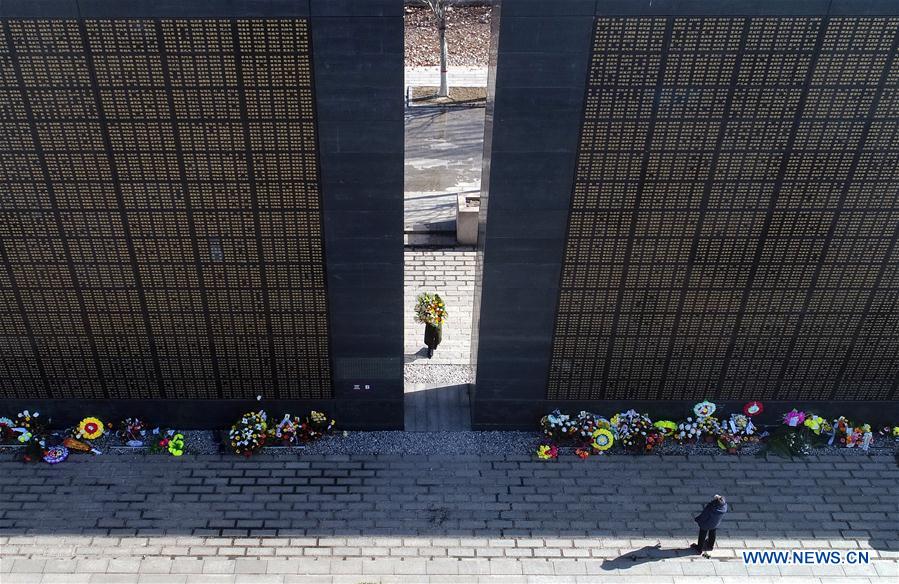
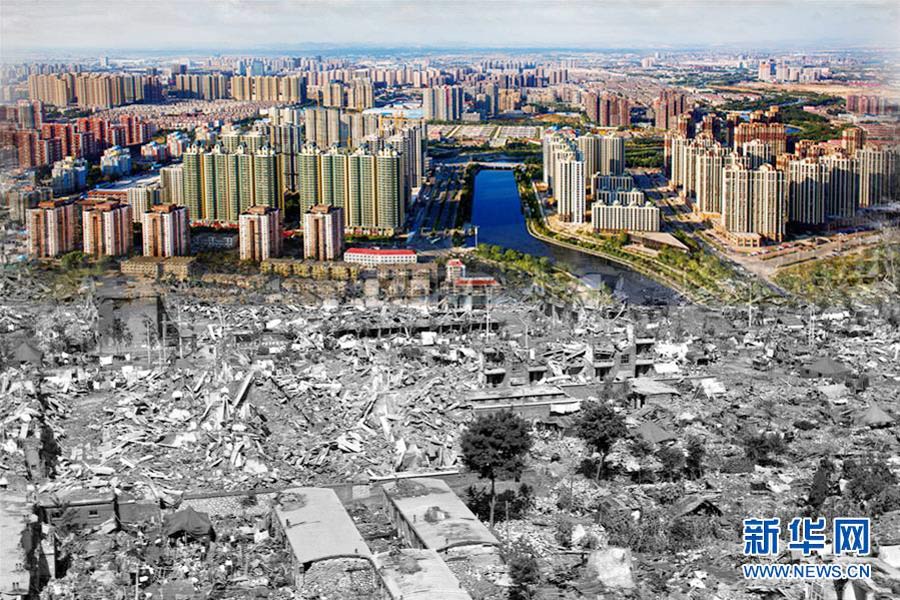
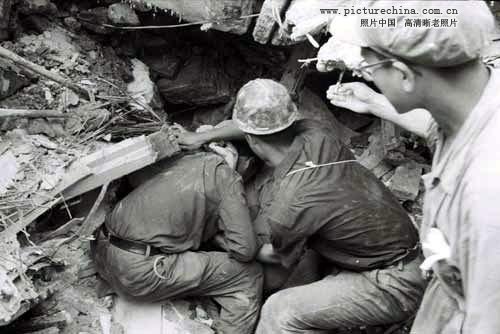
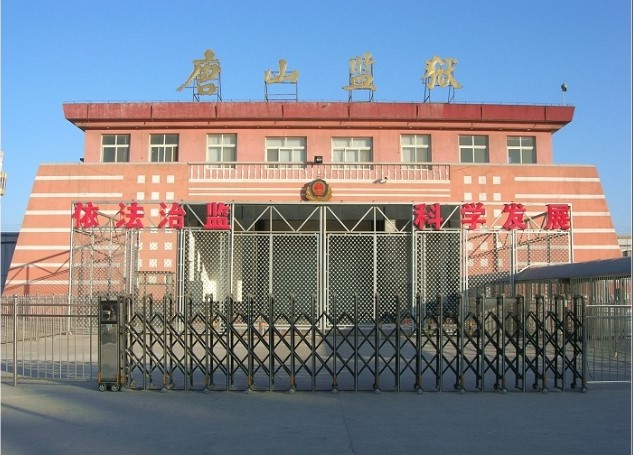
The black-and-white section of the image shows the damage of the earthquake that hit Tangshan on July 28, 1976. The colored part shows the city on July 9, 2016. Image credit: Chinadaily.com.cn
Amulet
In late July 1976, I found myself strolling the streets of Kyoto with my wife Irene and her sister Pat. It was a warm day, and we had taken the train from Tokyo to Kyoto and headed to the Heian Shrine. The seat of the imperial court of Japan from 794 to 1869, Kyoto was modeled on the ancient Chinese capital of Chang’an and was laid out in accordance with the principles of Feng Shui, the traditional practice of Chinese geomancy. Kyoto has long been considered the cultural capital of Japan, and is home to numerous temples, shrines, and palaces.
The courtyard in front of the shrine was lined with stalls selling amulets. We stopped at a stall displaying hundreds of amulets, colorful pouches meant to ward off all manner of evil spirits and natural disasters. One amulet in particular caught my eye. Dark blue with a hint of white. After settling on a price, I asked Pat to ask the trader what the amulet was meant for. The trader replied that it was meant to protect against earthquakes.
This trip to Kyoto had been a hasty adjustment of plans. Irene and I were meant to be in Hong Kong with my parents, who were traveling across the world for a belated celebration of our nuptials. My parents had been unable to attend our wedding the previous year, when Irene and I had said our vows at the Causeway Bay Marriage Registry in Hong Kong, followed by a traditional Chinese wedding banquet organized by Irene’s family.
Shortly before my parents were to arrive in Hong Kong, however, fate intervened. I was asked by Ambassador Christopher Phillips, president of the National Council for US-China Trade, to join him on a week-long visit to Beijing in late July 1976. At the time, I was the Hong Kong representative of the National Council for US-China Trade, one of three “people-to-people” organizations set up in the wake of Richard Nixon’s February 1972 trip to China.
President Nixon sitting next to Premier Zhou Enlai at a banquet given in Nixon’s honor on February 21, 1972. Image credit: docsteach.org
I agreed to join Ambassador Phillips in Beijing, and Irene and I went about changing the arrangements for my parents’ visit. My parents would meet us in Tokyo, where Irene’s sister Pat and her husband Kenji lived. After a few days in Japan, I would fly to Beijing and my parents would travel to Hong Kong to meet Irene’s family and celebrate our marriage.
First Day in Beijing
On Wednesday, July 21, 1976, Ambassador Phillips joined me at Tokyo’s Haneda Airport, and together we flew to Beijing on the Japan Airlines flight that departed at 9:00 AM. We were met on our arrival at 12:35 PM by American officials from the Liaison Office and Mr. Guo Simian, head of the American and Oceanian Division of the Liaison Department of our host, the China Council for the Promotion of International Trade (CCPIT). (I learned later that Guo was party secretary of the Liaison Department. He was removed after the downfall of the “Gang of Four.”)
We were driven to the Peking Hotel, one of two locations for visiting dignitaries, the other being the Diaoyutai Guest House. After checking in, we took the elevator to the 14th floor and went to our rooms to unpack and prepare ourselves for the welcoming banquet.
Around 5:00 PM, Ambassador Phillips came knocking on my door. He told me that he had just drunk a tall glass of water from the tap, thus violating the number one rule against drinking unboiled water in a Third World country. I admonished him not to do this again, but it was too late. He would pay a heavy price.
The welcoming banquet was hosted by CCPIT Chairman Wang Yaoting at one of Beijing’s Peking duck restaurants. He was joined by Vice Chairman Li Chuan. Over helpings of Peking duck, washed down by shots of Mao Tai—the fiery sorghum-based and high proof liquor—and chased by beer, it dawned on me why Ambassador Phillips had insisted that I join him in Beijing. He was an old-school diplomat, a former deputy ambassador on the United Nations Security Council and Republican state senator in Massachusetts, but he couldn’t drink. By contrast, I was quite familiar with alcoholic beverages, my father having been a whiskey salesman in New Jersey in the 1950s and 1960s.
My capacity was put to the test. I matched Wang Yaoting glass for glass. Wang was one of China’s most accomplished Mao Tai drinkers. Every time we finished a shot, Li Chuan placed a match on the table. A bottle of Mao Tai contains 33 small glasses, each about the size of a shot glass. By the end of the banquet, there were 25 matches on the tablecloth. Such was the start of our visit.
Tensions
China’s domestic political situation and the state of US-China relations, including the trade relationship, were fraught with tensions leading up to my July 1976 visit. After his 1972 trip to China, Nixon and his National Security Advisor Henry Kissinger wanted to have diplomatic relations with both the People’s Republic of China (PRC), whose capital was in Beijing, and the Republic of China, whose capital was in Taipei, Taiwan. Beijing would have none of it, so the United States maintained its embassy in Taipei and the PRC and the United States opened liaison offices in their respective capitals.
In 1976, after Premier Zhou Enlai’s death in January—I attended the funeral on my first visit to Beijing—a large demonstration that honored him and criticized leftist leaders took place on April 5 in Tiananmen Square. The protest was brutally put down. Vice-Premier Deng Xiaoping was blamed for the protest, removed from his government positions, and placed under house arrest. Radical leftists were now firmly in control of the Communist Party and the government it controlled.
Mourners at Zhou Enlai’s funeral. Image credit: news.sina.com
Beijing was angered by steps the United States took in 1976 to show support for the Republic of China on Taiwan, with whom the United States maintained diplomatic relations, much to China’s chagrin. They protested Taiwan’s establishment of new consulates in the United States, Vice President Nelson Rockefeller’s attendance at Chiang Kai-shek’s funeral in Taipei, and the setting up of the US-Taiwan Economic Council, several members of which were also members of the National Council for US-China Trade.
Two-way trade between the United States and China dropped sharply in both 1975 and 1976. Radical leftists criticized Deng’s policy of purchasing Western technology, including complete plants, and ended a policy that saw Western brand names sewn into Chinese garments. Purchases of agricultural products dropped to zero in 1976. Beijing was especially incensed by an American company’s drilling for oil in the South China Sea.
The Meetings Begin
On July 22, a day after arriving, Ambassador Phillips and I began our visit in earnest. The next two days called for meetings with our host, the CCPIT, the Ministry of Foreign Affairs, the Bank of China, and most of China’s 12 state-owned foreign trade corporations. The plan was for all meetings to wrap up by July 26, after which Ambassador Phillips would leave for Washington on July 27 and I would travel to Tianjin on July 28 to attend an export fair. The weekend (July 24-25) would be given over to trips to tourist sites—the Great Wall, the Summer Palace, the Temple of Heaven.
Following a slew of expected meetings, our second day in Beijing was capped off by a reception at the American Liaison Office, the body that represented American interests in the absence of an embassy. Prior to the reception, Ambassador Tom Gates welcomed Ambassador Phillips to his office. He spoke of a recent meeting with Zhang Chunqiao, considered the leftists’ principal theoretician. It was an unhappy meeting, with Zhang issuing crude threats of what China would do if the United States did not sever all ties with Taiwan. “There will be big trouble,” Ambassador Gates remarked, “if this guy ever takes control of China’s government.”
Two meetings on July 23 stand out: one with the China National Chemicals Import and Export Corporation (Sinochem) and one with the Bank of China. Both were unpleasant, but unpleasant in different and telling ways.
We met with senior Sinochem managers in their office. Once I knew I would be traveling to Beijing with Ambassador Phillips, colleagues in the Washington office managed to wrangle an invitation for the China Chemicals and Pharmaceuticals Special Fair to be held in Tianjin from July 27 to August 19, 1976. I had already attended three mini-fairs thus far in 1976.
I thanked Sinochem’s deputy managing director, but he ignored me, thinking perhaps that I was too junior to warrant an acknowledgement. He only said that the corporation expects a full report from the National Council on the market for chemicals in the United States at the event, a market about which I knew very little. Through Guo Simian, I was given an invitation to the fair. The CCPIT helped me buy a train ticket departing Beijing for Tangshan/Tianjin at 7:32 AM Beijing time on July 28.
I asked this official what he could tell the National Council about Sinochem’s Petroleum Department. He became hostile. “Why do you want to know?” he asked, suggesting that this was secret information. Ambassador Phillips stepped in and said that the council had recently set up a petroleum committee and its members wanted to establish contact with their counterparts in China. The official gave a curt answer to the effect that they should write a letter to Sinochem’s head office requesting that the letter be transferred to the Petroleum Department.
After blasting American companies for exploring for oil in China’s “sovereign territory,” the deputy managing director showed us the door.
Our meeting with the Bank of China was the last official meeting of the trip. It took place in the bank’s headquarters just off Tiananmen Square. We were greeted by an urbane senior manager in a starched Mao suit. After an exchange of pleasantries, the gentleman adopted a stern demeanor. He had heard about the establishment of the “so-called” US-Taiwan Economic Council and had noticed that several American banks that were members of the National Council for US-China Trade had joined this organization. “This is unacceptable,” he intoned. “There will be consequences for them. Your own Council might pay a price as well.”
Ambassador Phillips took these threats calmly, with aplomb, making the point that the National Council could not control the activities of its members.
A Visit to the Subway and the Hospital
After the meeting with the Bank of China, Mr. Guo took us to a nearby Beijing subway station. The first subway lines were constructed in 1969, but the system was frequently closed for technical and political reasons. For several years it was operated by the People’s Liberation Army, but in 1976 it was returned to civilian control and foreign dignitaries were sometimes invited to have a look. The subway had both civilian and military uses. In the event of a nuclear attack, civilians would shelter there.
A performance in the newly-opened Beijing subway in 1969. Image credit: 3g.163.com
We took an escalator down to the platform. Few passengers were waiting. A train pulled up and we boarded. Sitting in our car were several passengers, including a young mother whose child exploded in tears when we said hello. There was also an elderly peasant from the countryside, looking a bit worse for the wear. Mr. Guo approached him and told him to push off. The peasant ignored him, and given the tenor of the times, Mr. Guo did not press the point. The three of us alighted at the next stop.
When we made it to the street, Ambassador Phillips told Guo and me that he wasn’t feeling well. We went to a hospital and Phillips was given a battery of tests. Exhausted, we returned to the Peking Hotel. At midnight, we were roused from our sleep by calls from the lobby. Ambassador Phillips had been diagnosed with dysentery and a rare salmonella infection resistant to antibiotics.
With two CCPIT officials, we headed for the First Infectious Diseases Hospital where Phillips was given a private room. Dr. Zhang Dongbo, one of China’s top infectious diseases specialists, arrived and declared he would be in charge of the ambassador’s treatment. He would spend sleepless nights looking after Phillips.
Over the next three days I visited Ambassador Phillips on several occasions, sometimes accompanied by a member of the Liaison Office, sometimes accompanied by Guo Simian. Phillips seemed comfortable and in good spirits.
Wandering About Beijing
That left plenty of time for me to walk around Beijing. I had visited Beijing twice earlier in 1976, and I had identified several places of interest including bookstores and the large Beijing Department Store on Wangfujing. The department store offered made-in-China products with one exception: Swiss watches, which carried a hefty price tag. The Xinhua Bookstore had an impressive display of “Little Red Books” – quotations of Chairman Mao Zedong – laid out beneath the chairman’s portrait. Further down the street were a couple of second-hand bookstores, where I spent happy hours.
In the evening I would go to dinner with American businesspeople who happened to be in Beijing. We would meet in the lobby of the hotel. I was armed with tips of restaurants. One evening we ate curries and breads at the Pakistani Restaurant on the top floor of the Hua Qiao Hotel. The next evening we went to the Minzu Hotel’s restaurant, famous for its spicy dandan noodles.
Finally, on the evening of July 27, I joined two New York garments buyers for a meal at the Moscow Restaurant on the west side of the Beijing Exhibition Hall, a massive Stalinist structure with halls and theaters and a great tower that could have been airlifted out of Moscow.
A photograph of the Beijing Exhibition Hall. Image credit: j.17qq.com
The restaurant was mostly empty, so we settled down at a small table and ordered Russian dishes from the menu. The restaurant did not have a wine list, but they sported a cellar full of Russian vodka. The vodka had been shipped to China under the 1956 barter trade agreement between the Soviet Union and China. It was very cheap, and very good. We consumed a bottle and then some. We happily returned to the Peking Hotel for what I hoped would be a good night’s sleep.
In the early morning hours of July 28, 1976, I lay awake in my room on the 14th floor of the Peking Hotel. It was a hot, humid evening, and the windows were open an inch or so for fresh air. I was unable to sleep, worried about what I would say when asked to give a report on the chemicals market in the United States after I arrived in Tianjin.
Suddenly, at 3:42 AM, my bed began to heave violently up and down. This lasted around 20 seconds. Then, the swaying, like a pendulum, began, east to west. The windows flew open as much as they could, the ceiling cracked, and the bed slid across the room, first in one direction, then in the other. On each swing of the pendulum, the hotel, by now creaking and moaning, tilted more and more to the point that I thought the next would be the building’s last. But when it reached the apogee, the pendulum paused and gradually settled down, stroke by stroke, until the building came to rest. The violent shaking and swinging together lasted around 80 seconds.
The quake had hit Tangshan, a city 68 miles east of Beijing. It was rated a magnitude 7.5 quake (some estimates are higher) and it caused massive damage to large parts of Hebei Province, Tianjin, and Beijing. The official death toll was put at 242,000 people, though several estimates are much higher, making it one of the greatest natural disasters in history. Thousands of miners were entombed in the underground coal mines around Tangshan, China’s principal source of energy.
I jumped out of bed and threw on my clothes, but I couldn’t find my shoes. I went to the window and looked out over the neighborhoods, made up of a maze of hutong, to the north of the hotel. Children were crying, dogs were barking. On the horizon I made out explosions that I later found out were collapsing power stations. There was an eerie green hue to the early morning sky. I feared, for an instant, that the Soviets had carried out an attack on Beijing.
I decided not to look for my shoes any longer. I exited my room to pandemonium in the hall. Staff attendants were directing people to take the stairs down to the ground floor. People were nervous and excited, and some were nauseous, others expectorating after clearing their throats. It wasn’t long before my feet were filthy with spittle and dirt.
Rescuers dig through the rubble after the earthquake. Image credit: China.org.cn
We poured out onto Chang’an Dajie, Beijing’s main street. The city was coming to life. Trucks full of watermelons were barreling down the streets. Residents of nearby hutong began building makeshift street-side structures from pipes, plastic sheets, mats, and tarpaulin. These elaborate structures were to stay in place for more than a year.
Determined to wash my feet, I went back into the hotel. The lobby was cloaked in dust, and staff attendants were inspecting damage with flashlights. No one stopped me, so I took the still operating elevator back to my room on the 14th floor and immediately turned on the tap. Water! I washed myself the best I could and then lay down on my bed where I fell into a deep sleep.
Shortly after 7 AM, I was awakened by the phone. It was Guo Simian. “Mr. Kamm,” he said. “Last night there was an earthquake.”
“I know, Mr. Guo.” He told me to come down to the lobby.
As soon as I saw him, I asked him if there had been damage and casualties. He replied, “No, nothing serious. A few damaged buildings. You can take a train to Tianjin later today.” After his reassurances, he disappeared.
An officer of the Liaison Office stopped by to check on us, I asked him to call my wife in Hong Kong, letting her know I was okay. Not long after this call, my mother, who was in Hawaii, called Irene’s brother who let her know I was safe.
The Party Speaks
Mr. Guo returned in the late afternoon. He called his charges together and announced that the Standing Committee of the Political Bureau of the Communist Party of China had met and determined that there had in fact been an earthquake earlier that day. Foreigners should leave Beijing as soon as possible. If assistance was required, the relevant departments would do what they could to provide it.
I told Guo that I would stay until I was sure that Ambassador Phillips was safely evacuated. We agreed to go to the Number One Infectious Disease Hospital the next morning.
We found Phillips in a tent on the hospital grounds. The tent was stifling hot, but he was stoic, nary a complaint. Sharing the tent were three Laotian soldiers who had been bombed by US forces and who were being treated for hepatitis. The daughter of the Tanzanian ambassador was also housed in the tent. While we were there, trucks with casualties from Tangshan began to arrive.
Returning to the hotel, I went to the restaurant for lunch. Suddenly an aftershock rattled the windows, making them look like flowing water. I later learned that this aftershock was measured as 7.1 on the Richter scale. I decided to sleep on the ground floor, accompanied by three CCPIT officials. I returned to my room for the next two nights.
On July 29, I ventured out of the hotel to survey the damage. The building with the most damage was the department store I had just visited. The southeast corner of the building had crumbled, and bricks were strewn everywhere.
Mandate of Heaven
The foreign missions organized evacuation flights, and Ambassador Phillips departed on one that left on July 30. I decided to take a flight to Guangzhou on July 31, thence by train to Hong Kong. On checking out, I was told that there were only 50 foreign guests left in the hotel, down from 300 on July 28.
On the CAAC flight to Guangzhou I was seated next to a survivor of the quake, a Frenchman who had been in Tangshan on a friendship tour. His wife had been killed. When he went to use the washroom, the Chinese official accompanying him insisted that the man’s hair had turned white as a result of what he had experienced.
On April 4, 2018, a person visits a memorial wall in remembrance of victims in the 1976 Tangshan earthquake. Image credit: Dong Jun/Xinhua
Upon arrival in Guangzhou, I went to the Dong Fang Hotel, where I had stayed at the trade fairs, and took a room. The previous four days had taken a toll on my mental state. I had grown accustomed to uncertainty, to not knowing if the ground beneath me was solid. Gradually, the tension eased, leaving me with a splitting migraine headache.
The next morning, I took the train down to Lo Wu, where I crossed the wooden railway bridge and entered Hong Kong. I boarded the Kowloon-Canton Railway where I was met by a gaggle of local journalists eager to hear what I had experienced. I was featured on the evening news and wrote an op-ed for the Ta Kung Pao, a local left-wing newspaper. The op-ed compared the earthquake to the death of Premier Zhou Enlai. I later learned that the leftist leadership in Shanghai was greatly angered by what I had written. They refused to let it run in the local edition of Reference News.
I also gave an interview to the Washington Post’s Jay Matthews. The story ran in the paper on August 2, 1976.
Six weeks after the earthquake, Mao Zedong died, and four weeks later Hua Guofeng, the Communist Party’s new chairman, carried out the arrest of the “Gang of Four,” one of whose members was Zhang Chunqiao, the man Tom Gates had warned us about. In traditional Chinese belief, natural disasters presage the end of an emperor’s reign. Thus, in the eyes of many Chinese, the North China Earthquake of July 28, 1976 was a sign that Emperor Mao was losing the Mandate of Heaven.
John Kamm testifying before the House Ways and Means Subcommittee on Trade on June 19, 1990. Image credit: C-Span
On January 1, 1990, I began my one-year term as president of the American Chamber of Commerce (Amcham) in Hong Kong. As recounted elsewhere, there was opposition from large corporate members to my becoming president. Many of them resented my having pushed through a resolution condemning the June 4, 1989 killings. A former president of Amcham claimed, with no evidence, that the Hong Kong government opposed the prospect of my becoming Amcham president and would refuse to work with me.
1990 would prove to be an eventful year marked by my testifying three times to Congress on China’s Most Favored Nation (MFN) trade status – before subcommittees of the House Foreign Affairs Committee (May 16, 1990), the Trade Subcommittee of the House Ways and Means Committee (June 19, 1990), and the Senate Finance Committee (June 20, 1990). My argument – that withdrawing MFN from China would cause massive collateral damage to Hong Kong – was cited by President George H. W. Bush in his May 24, 1990 statement renewing China’s MFN.
The MFN decision is thought to have been the first time in American history where the then-colony had played a role in a major foreign policy decision.
The chamber also successfully lobbied the Bush administration to issue an executive order protecting visas for Chinese students, and it urged the normalization of relations with Vietnam. In September 1990, I led the first American delegation to Mongolia after that country’s democratic revolution.
Internally, I oversaw the raising of membership dues by a large percentage; the chamber lost very few members. This hike in dues resulted in the chamber banking a significant sum, which enabled it to purchase its own premises in the Bank of America Building, a property it occupies to the present day. I was proud to have welcomed the first businesswoman onto the chamber’s executive council, a long overdue step.
Towards a Hong Kong Policy
Clippings of USA Today’s coverage of Kamm’s testimony as it appeared in the international edition on July 27, 1990. Image credit: Dui Hua media log
On November 16, 1990, as my term of office was about to expire, I traveled to New York. I gave a speech at the Harvard Club in which I called for legislation to protect Hong Kong’s special status under United States law, an initiative that contributed to the enactment of the Hong Kong Policy Act in 1992. The speech, titled “Towards a Hong Kong Policy,” was hosted by the National Committee on US-China Relations.” It was attended by more than 60 local and state officials, journalists, businesspeople and traders, and lawyers, including President John F. Kennedy’s speech writer Ted Sorenson and the celebrated China expert Jerome A. Cohen. It didn’t take long for my speech to find its way to Washington D.C.
I started my remarks by noting that little thought had been given to fashioning a national policy to protect and enhance America’s substantial interests in Hong Kong, and then went on to list what those substantial interests were: America’s 14th largest trading partner, home for more than 160 American-owned factories worth $1.4 billion in investment, shared culture and values, and an American population of more than 20,000 citizens. I estimated that 200,000 Hong Kong people would emigrate to the United States over the next ten years.
I declared that “The United States has a special responsibility with respect to the Sino-British Joint Declaration on Hong Kong. . .Ours was the first government to recognize the declaration, later leading the vote in the United Nations on registering the Joint Declaration as an international treaty.” I stressed that the United States has a moral responsibility to be true to our own ideology of free enterprise and respect for human rights. “If America is a shining city on a hill, nowhere is the glow reflected more brilliantly than Hong Kong.”
I questioned how well the Joint Declaration was being honored, and I gave a somewhat tepid response. It was being honored “in the main.” I pointed out that there had been a series of disagreements between the United Kingdom and China on such matters as the pace of democratization, the British Nationality Act, the Port and Airport Development Strategy (which called for the building of a new airport), and cross border controls. “Fortunately, neither side has accused the other of breaking the Joint Declaration.” How times have changed!
I concluded my remarks by suggesting initiatives for the American government and institutions to preserve and protect Hong Kong:
Washington should keep Hong Kong interests in mind when considering policies towards China. Institutions, whether academic, professional, religious or public-service oriented, should strengthen ties with counterparts in Hong Kong.
Government should examine Hong Kong’s Basic Law and make comments and suggestions on areas where it can be improved. “I have been particularly vocal on the article relating to subversion and state secrets (Article 23). China’s insistence that Hong Kong pass laws against possession of undefined state secrets represents a serious threat to the free flow of information crucial to Hong Kong’s commercial vitality.”
The United States should seek to negotiate directly with the Hong Kong government on trade, investment, and taxation treaties necessary for the further development of US-Hong Kong economic relations. The trade treaty should cover separate tariff treatment, trade quotas, bilateral dispute settlement, protection against expropriation, and the establishment of trade offices on each other’s territory.
Washington should seek treaties with the sovereign powers (China and the United Kingdom) guaranteeing consular access, port visits by military vessels, and reciprocal air traffic rights.
The United States should support Hong Kong’s full participation in international trade and financial organizations. “We need to work harder to insure Hong Kong’s admission to the Asia Pacific Economic Council.” I suggested that Congress enact legislation to ensure that Hong Kong continues to have access to American companies offering high technology goods and services.
“Congress should reinforce legislation on Hong Kong’s separate immigration status after 1997.”
I recommended that the executive branch pressure the Hong Kong government to demonstrate greater commitment to the internationalization of Hong Kong. I cited the “pressing need to involve foreign nationals in as many areas of public life as possible.” I suggested that the Hong Kong civil service be internationalized.
I wound up my speech with these words: “Inasmuch as legislative authority and direction will be required for granting Hong Kong separate trade and immigration benefits, Congress should, at an early date, enact a Hong Kong Relations Act.”
On September 20, 1991, Senator Mitch McConnell (R-Kentucky) – whom I had met when he visited Hong Kong in 1990 – introduced the Hong Kong Policy Act. The legislation included most of my recommendations. It was eventually signed into law by President George H. W. Bush on October 5, 1992. It was amended by the Hong Kong Human Rights and Democracy Act on November 27, 2019.
The Beijing Kunlun Hotel, where Kamm met with interlocutors to discuss at-risk political prisoners. Image Credit: Jiaju.Sina
As winter turned to spring in 1992, Chinese officials increasingly turned their attention to the possibility that the country’s coveted trade privilege – Most Favored Nation (MFN) status in the United States – might be removed if the White House changed hands in November. Deng Xiaoping’s friend George H. W. Bush, the incumbent, was expected to be a shoo-in on account of the success of the Gulf War. But after Super Tuesday, March 10, 1992, polls suggested that in a three-way race involving President George H. W. Bush, Arkansas Democratic Governor Bill Clinton, and independent Ross Perot, Bush would poll less than 50 percent.
Furthermore, in December 1991, Beijing had applied to hold the 2000 Olympics, and officials knew full well that its human rights record would prove to be an impediment. I decided to exploit their fears and ambitions by planning a week-long trip to Beijing beginning April 5, 1992.
It would prove to be a remarkable trip, marked by meetings with senior officials and opportunities to intervene on behalf of political and religious prisoners, the latter mostly Catholics. I would also be given information on China’s most famous political prisoner, Wei Jingsheng, and Wang Dan, a leader of the June 4 protests. Concerning Wei, this would be the first time that the Chinese government would address his living conditions, health, and state of mind.
I flew up to Beijing from Hong Kong on the afternoon of April 5. I was picked up by my driver and taken to the Great Wall Sheraton Hotel, near the Embassy District. The Great Wall Hotel was managed by a friend who offered me a generous rate and lots of hospitality, including the occasional drink at the hotel’s well-stocked bar.
The next day, April 6, I met with my host, Vice Chairman of the China Council for the Promotion of International Trade (CCPIT), Liu Fugui. This was followed by a meeting with the Deputy Director of the American and Oceanian Department of the Ministry of Foreign Economic Relations and Trade (MOFERT), Shi Jianxin. These meetings focused on the situation in Congress with respect to MFN, which was grim, in my estimation.
In the afternoon I met with the Supreme People’s Court and, later, Luosang Chinai, a Tibetan official who was a senior official in the Religious Affairs Bureau (RAB, now the State Administration of Religious Affairs). He was accompanied by a lady who was in charge of the department overseeing Roman Catholics, known as the Second Department.
At this meeting I pressed for the release of elderly Catholic clerics Bishop Liu Guandong, president of the underground Catholic Bishops Conference, serving a sentence in a reeducation through labor (RTL) camp, Father Jin Dechen, serving a 15-year sentence in prison for counterrevolution, and Monsignor Wang Yijun, one of China’s longest serving religious prisoners, then serving a three-year sentence in an RTL camp. Luosang Chinai seemed sympathetic.
Six weeks after this meeting, all three of the clerics, held in facilities around the country, were released on the same day.
That evening I was hosted to a welcome banquet by the CCPIT’s Liu Fugui. Mao Tai, the fiery, sorghum-based spirit (120 proof) was poured liberally, and not wanting to be a bad guest, I partook liberally. I returned to the Great Wall Sheraton, where I was met by my friend the manager. We repaired to the bar where we had shots of Black Label chased by beer. Bad idea.
Vice Minister “Gold Prison”
The next morning, I woke up with a ferocious headache. I had a bolt of caffeine and soldiered on, as businesspeople do, meeting my driver and being driven to the nearby Kunlun Hotel, said to be owned by China’s Ministry of State Security. Up the escalator, I was ushered into a large room where I was met with Ministry of Justice Vice Minister Jin Jian (synonymous with “gold prison”) and the Director of the Reform through Labor Bureau (now the Prison Administration Bureau) Wang Mingdi. I had met Wang in October 1991, so we were “old friends.” Wang was a tough prison official who sported a cauliflower ear.
I sat down on a plush chair with a doily as a head rest. A translator sat between me and the vice minister. There were two notetakers next to Wang Mingdi.
After an exchange of pleasantries, Vice Minister Jin came straight to the point. “We have decided to give you information on any prisoner you ask us about, to the best of our ability.” I was told that this was the first time they were offering this privilege to a foreigner.
I looked at Wang Mingdi. He was seated by a table on which there was a big stack of files, each apparently containing information on prisoners.
I suggested to the vice minister that we could save a lot of time if Mr. Wang would simply give me the files on the table next to him.
Vice Minister Jin did not like this idea. “You need to ask us about individual prisoners, using the full name. Don’t just ask about Mr. Wang in Beijing or Mr. Li in Shanghai. Do you have any idea how many Mr. Wangs live in Beijing and how many Mr. Li’s live in Shanghai?!
“Please tell me about Wei Jingsheng,” I replied.
Xidan Wall in western Beijing in May 1979. Chinese people would come to post essays and “big character” posters. Image Credit: Qindianchen / CC BY-SA
Wei was at the time China’s best-known political prisoner. An electrician and former soldier who had been working at the Beijing Zoo since 1973, Wei was prominent in the 1978 Democracy Wall movement. On December 5, 1978, Wei posted an essay, “The Fifth Modernization,” on Democracy Wall, a stretch of wall surrounding a bus station in Beijing’s western district. Citizens took to the wall and put up “big character” posters in a burst of free speech not seen since the Cultural Revolution – and not seen since. I frequented the wall on many occasions in late 1978; at that time, I was staying at nearby hotels, including the Fuxing, during trips to sell chemicals and technology.
Wei’s poster caused a sensation. It rebutted Deng Xiaoping’s Four Modernizations policy and criticized Deng by name, calling him a dictator. (Deng had called for the modernization of industry, agriculture, national defense, and science and technology.) Wei Jingsheng proposed a “Fifth Modernization”—democracy. Soon Wei was being interviewed by foreign journalists, helped by his able assistant Tong Yi.
Wei was detained in 1979 and subsequently sentenced to 15 years in prison for counterrevolutionary crimes. The Chinese government had said nothing about him for more than a decade.
Wang Mingdi picked a file from the stack and began to read: “Wei Jingsheng, male, Han, born in 1950, middle school education, worker. Sentenced to 15 years imprisonment and three years deprivation of political rights in October 1979. He is currently serving his sentence in a reform through labor camp.”
I asked where Wei was serving his sentence. “What can you tell me about the conditions of his imprisonment? Is he being held in solitary confinement?”
“He’s serving his sentence in a reform through labor camp in Tangshan, Hebei Province. It is not correct to say he’s being held under solitary confinement. His cell has two rooms. He has one room to himself. This room opens onto another room where there are guards. He eats his meals and watches television in this room. He is allowed out for fresh air, and he enjoys gardening. He has been exempted from physical labor.”
“Tell me about his health,” I asked.
Tangshan Prison in Hebei, where Wei Jingsheng served part of his reform through labor sentence for counterrevolutionary crimes after posting his Fifth Modernization essay on Xidan Wall in 1978. Image Credit: baike.com
Wang replied: “He is in good health, although he smokes a lot. Contrary to reports in Western media, he is not being mistreated. He has not lost his mind. He has not lost his hair nor all his teeth. He likes to stay up late debating with the guards. Wei is a very intelligent, well-informed man, but he is very stubborn. He refuses to admit his guilt or express regret.”
I asked if he could be considered for early release from prison. Wang was blunt. “Unless he changes his attitude, it is unlikely that he will be granted a sentence reduction or parole.”
Once Wang finished talking about Wei, I asked about Wang Dan, a student leader of the Tiananmen Square protests in the spring of 1989. I was told that Wang, like Wei, was proving difficult to reform. He liked reading and stayed mostly in his cell. He too had been exempted from physical labor. He was not being mistreated.
The Beijing Great Wall Hotel. Image Credit: hotelincn.com
After the meeting with Vice Minister Jin wound up, I was driven to the offices of the State Council Information Office (SCIO) for a meeting and lunch with its director, Zeng Jianhui (who would go on to be chairman of the National People’s Congress Foreign Affairs Committee), and its deputy director Li Yuanchao, China’s future vice president. On the way I reflected on what I had been told, which was in complete variance with the accepted narrative, which was basically that Wei Jingsheng was in bad shape, a basket case.
I told Director Zeng and Deputy Director Li about my meeting with Vice Minister Jin and expressed my concern that people wouldn’t believe the account I had been given about Wei. “Don’t worry,” Zeng Jianhui said. “He’s a vice minister. If he lied to a foreigner, he’d be in big trouble.”
China’s “007”
On the way back to the hotel, I stopped by the Ministry of Public Security, on Tiananmen Square, to see Director General of the International Department Zhu Entao, someone I’d known since 1976 when he was seconded to the Guangzhou Trade Fair’s liaison office handling Americans and Europeans. Zhu, “China’s 007,” feigned ignorance of Wei’s situation, not unexpected as Wei was being held in a Ministry of Justice facility. There was bad blood between the ministries, arising from the decision in 1980 to transfer control of the country’s prisons from the Ministry of Public Security to the newly established Ministry of Justice (MOJ).
I returned to the Great Wall Sheraton and called Nick Kristof of The New York Times. Nick and his wife Sheryl WuDunn had been awarded a Pulitzer Prize for their reporting on the Tiananmen Square protests. He was and remains passionate about human rights.
Nick joined me for drinks at the hotel bar. I read from my notes of the meeting with Vice Minister Jin, leaving nothing out. After an hour, Nick left and returned to his apartment to write up the story. It appeared in The New York Times on April 8, 1992, under the headline “China Offers Peek at Famed Prisoner.”
The day the article appeared I met with the Ministry of Foreign Affairs and the Supreme People’s Procuratorate, the prosecutors. That evening I hosted a banquet in honor of my host, the China Council for the Promotion of International Trade’s (CCPIT) Liu Fugui. Gathered around the table were senior officials of the SCIO, the Religious Affairs Bureau (RAB, now the State Administration of Religious Affairs), the Public Security Ministry, the MOJ, and the Procuratorate. I was asked which prisoners’ release would have the biggest impact on American opinion, in Congress and in the general public. I was well prepared, and listed labor leaders, Catholics, and other big names like Wei Jingsheng. After the dinner, the official from the RAB took me aside and told me that the Catholics whose names I had raised would be released.
As anticipated, the reaction to the Kristof article was one of disbelief and, in some quarters, hostility. A Beijing-based journalist of a rival newspaper, a friend who had written a profile about me and my work, called me at my hotel, furious that I had given the “scoop” to Kristof. A New York-based human rights activist wrote a letter to The Los Angeles Times questioning why anyone would believe anything the Chinese government told John Kamm.
Wei Released
Wang Mingdi1995 at the China State Prison Work Meeting. Image Credit: ilawpress.com
I continued to raise Wei on future trips to Beijing, pressing for his release. I met Wang Mingdi on March 9, 1993, at the MOJ’s old headquarters, a shabby, non-descript building on a dusty lane off the road to Beijing airport. Officers played billiards in the middle of the road in front of a bicycle repair shop.
I asked Wang about Wei. “He is such a famous international person; many people are interested in him.” Wang told me that, while Wei was healthy, “He persists in his strong anti-government attitude. He is strongly against socialism and blames the Chinese government for everything wrong in China, even the recent East China floods.”
Wang revealed that at the end of 1992, six months after I raised his name, Wei was driven to Beijing and taken to Science Street in Haidian District. “We let him alight and take a look. He didn’t say much, only ‘I’m from Beijing, but I don’t recognize Beijing.’” Wang Mingdi didn’t rule out an early release, though he said this would be “difficult to consider.” If Wei continued to follow prison rules, his sentence would not be extended. It was not uncommon in those days for counterrevolutionaries to have their sentences extended.
Wei Jingsheng was paroled on September 14, 1993. The reason given was that he had obeyed prison regulations, but many observers noted his release took place one week before the decision by the International Olympics Committee on which city would be awarded the 2000 Summer Olympics. (Beijing lost out to Sydney by a single vote.)
Wei looked well on release. A photograph taken with his brother and sister and published in a western newspaper showed a grinning, somewhat plump Wei. He had lots of hair.
China’s most famous dissident Wei Jingsheng (C), released 6 mos. before end of his 15-yr prison term, w. brother Wei Xiaotao & sister Wei Ling, at family home. (Photo by Forrest Anderson/The LIFE Images Collection via Getty Images/Getty Images)
The last time I discussed Wei with Wang Mingdi was in late October 1993, a month after the release. He told me that he had gone to the Tangshan prison holding Wei. It consisted of one big building with 20 individual cells. There was a large garden area, and a field where inmates could play ball. All prisoners had been exempted from physical labor. Wei’s cell was “full of books.” Wang felt that conditions were good enough to allow foreigners to visit, but as far as I know, this never happened. As I was leaving the meeting, Wang expressed regret that Wei had been released. “We did a bad job. We should have kept him in prison.” By then, China had lost its bid to host the 2000 Olympics.
Wei returned to activism after his September 1993 release. He was arrested again in early April 1994 after a meeting with US Assistant Secretary of State John Shattuck in the lobby of the China World hotel, under the eyes of state security agents. He was subsequently sentenced to 14 years in prison for counterrevolutionary propaganda and incitement. After international pressure and an appeal to President Jiang Zemin by President Bill Clinton, he was released on medical parole on November 17, 1997 and promptly flown to the United States, where he remains active promoting human rights and democracy in China.
In the two years that followed Dui Hua’s incorporation in April 1999, relations between the United States and China were roiled by two incidents: the May 7, 1999 bombing of China’s embassy in Belgrade by US planes and the April 1, 2001 mid-air collision between an American EP3 surveillance plane and a Chinese fighter jet 70 miles off the coast of Hainan.
The Belgrade bombing led to the suspension of the human rights dialogue between the two countries. The EP3 incident, which resulted in the downing of the Chinese fighter jet and the capture of the US plane, came less than three months after President George W. Bush was inaugurated in January 2001. The US plane was forced to land on Hainan. The crew was held in China for 12 days before they were repatriated to the United States. During this roughly two-week period, newly elected President George W. Bush and Vice President Dick Cheney froze all contact between US officials and Chinese diplomats, with few exceptions. I was discouraged from attending a reception at the Chinese embassy in Washington.
On May 8, 1999, Chinese university students gathered outside the US embassy in Beijing to protest the bombing of China’s embassy in Belgrade by US-led NATO forces. Image Credit: Liu Zhankun via news.sina.com.cn
Seeking to repair badly frayed relations between the two countries, Secretary of State Colin Powell announced on April 23, 2001 that he would visit Beijing at the end of July 2001.
A goal of the July 2001 visit was to announce the resumption of the human rights dialogue with China, which had been suspended for more than two years by this point. Powell brought Lorne Craner, the newly confirmed Assistant Secretary for Democracy, Rights, and Labor, with him on his three-day visit to China. As hoped, the visit resulted in an announcement that the human rights dialogue would resume in October 2001 in Beijing.
Not long after the announcement that the July 2001 visit would take place, Craner asked me to assist with the preparation of a prisoner list that he hoped to hand over to his Chinese counterpart, Director General of the Ministry of Foreign Affairs International Department Li Baodong. The list was in fact made up of two lists, one of long-serving prisoners and the other of priority cases. Dui Hua drew up the long-serving prisoner list, a compilation of 50 individuals serving sentences for counterrevolution and endangering state security, and it contributed names to the priority cases list.
Craner was able to hand over the list to Li Baodong, who reluctantly accepted it but told Craner not to expect a response.
In the wake of the September 11, 2001 terrorist attacks in the United States, Chinese President Jiang Zemin made a strategic decision to improve relations with the United States. As part of this decision he ordered his Ministry of Foreign Affairs to make the human rights dialogue session taking place in October 2001 a success. Instead of Beijing, the session would take place in Washington. At the same time the Ministry of Justice was ordered to reply to the US prisoner list and to separately draw up a list of political prisoners who could be released.
The dialogue session that took place on October 10, 2001 was a success. The Chinese delegation handed over a document with information on 48 of the prisoners on the “long-serving list” and 26 of the prisoners on the “priority list” – a response rate of 92.5 percent. Releases of long-serving prisoners began in January 2002 with Tibetan ethnomusicologist Ngawang Choephel, followed later that year by the releases of elderly teacher Jigme Sangpo, Drapchi nun Ngawang Sangdrol, and Democracy Party Chairman Xu Wenli.
In testimony I delivered to Congress in 2005, I estimated that prisoners on the 2001 Craner list were three times more likely than prisoners not on the list to benefit from early release.
Bolstered by the success of the October 2001 dialogue session, Craner decided to prepare a list for the next round of the human rights dialogue to take place in Beijing in December 2002. Once again, he asked for my assistance. My colleagues and I put together a list of 250 names which I sent to Craner on November 7, 2002. Twenty names were removed from the list, which was then forwarded to the US embassy in Beijing. This list of 230 names was handed over to China’s Ministry of Foreign Affairs. One of the names on that list was that of US businessman Fong Fuming (方复明).
Who is Fong Fuming?
At the dawn of the new millennium, Fong Fuming was a US businessman, engineer, and power industry consultant based in New Jersey. In China, he had been the deputy director and chief engineer of the Zhejiang Provincial Power Bureau. In the wake of the June 1989 killings in Beijing and other cities, he resigned his position and left for the United States. His decision did not sit well with the Ministry of State Security.
Fong Fuming in a 2012 video expressing support for Congressman Pascrell. Image Credit: Pascrell2012
Fong regularly visited China on business. In the late 1990s, officials from the Shanghai State Security Bureau contacted Fong’s agent with a request to cooperate with the bureau to earn money bidding for power plants. The agent rebuffed them. The Shanghai State Security Bureau, suspicious of Fong after he resigned his position and angry at his agent’s rejection, placed Fong under surveillance. The director of the Shanghai Bureau was promoted to Vice Minister of the State Security Ministry in Beijing, and the investigation into Fong intensified.
On February 28, 2000, Fong arrived in Beijing for a meeting with B&W Boiler Manufacturing. He was taken into custody by officers of the Beijing State Security Bureau at Beijing International Airport and placed under residential surveillance in a designated location (RSDL), a coercive measure that is often used to hold political prisoners for a period of up to six months and is rarely used against foreigners. During this period, those subjected to RSDL cannot receive visits from family members or lawyers. Foreigners under RSDL are permitted one 30-minute visit once a month from consular officers at their embassy.
Fong was moved around among State Security facilities in the outskirts of Beijing. His laptop, seized at the airport, was scrutinized. State Security found 32 documents containing specifications of various manufacturers’ power equipment. The State Security Bureau had these documents classified as state secrets. Fong was now suspected of obtaining and providing state secrets to foreign entities.
After spending six months under RSDL, Fong was formerly detained on August 28, 2000 on state secrets charges and bribery. He was arrested the following month. Following two hearings, Fong was tried in March 2002. He was convicted and sentenced to five years in prison. He was not given credit for the time he served under RSDL.
According to statistics released by China’s Supreme People’s Court, 19 people were convicted of obtaining and providing state secrets to foreign entities in 2002. Only one of them – American Fong Fuming – was a foreigner.
Fong entered Beijing Number Two Prison on June 6, 2002 and was placed in the cell block holding foreigners. These included three or four Americans, two Japanese citizens, and several South Koreans. Not long after Fong’s arrival, the foreigner group was transferred to Beijing’s Liangxiang Prison, where Fong was to serve the remainder of his sentence.
Fong was not physically tortured but was subjected to a number of indignities while under detention. His glasses, dentures, and hearing aid were taken from him; his dentures were returned at mealtime. On one occasion, the guards lost his dentures, and Fong refused to eat until they were found.
Advocacy
Shortly after Fong Fuming was taken into custody, the Chinese Ministry of Foreign Affairs notified the US embassy, which in turn notified Fong’s family in New Jersey. Fong’s wife and sons immediately began working to secure his release. They consulted the preeminent expert on Chinese law, Jerome Allen Cohen, and reached out to me for help. They appealed to senior officials of the George W. Bush administration, including Secretary of State Colin Powell, Ambassador to China Clark “Sandy” Randt, and assistant secretaries James Kelley (in charge of the East Asia and Pacific Bureau) and Lorne Craner. President Bush raised Fong’s case when he visited Beijing in February 2002.
Congressman Pascrell. Image Credit: United States Congress / Public Domain
Most importantly, Fong’s family asked for assistance from the family’s congressman, Bill Pascrell. Pascrell, a Democrat elected in 1996, worked tirelessly on behalf of his constituents. In his words, Pascrell launched an “avalanche of letters” to US and Chinese officials demanding Fong’s immediate release. He reached across the aisle and secured the help of Congressman Chris Smith, a fierce critic of China’s human rights record. Pascrell even engineered a resolution on Fong Fuming that was passed by the New Jersey State Assembly.
The family requested medical parole for Fong on four occasions. Their applications were ignored or rejected by the Beijing Prison Bureau.
The campaign to secure Fong’s release intensified in November 2002, when his name was presented to the Chinese Ministry of Foreign Affairs on the list compiled by Dui Hua for the human rights dialogue in Beijing. This was in anticipation of the human rights dialogue to take place in December 2002. That same month, Dui Hua researchers found a December 1984 document issued by the Supreme People’s Court; the document stated that time spent under RSDL should be counted when calculating the date when a criminal sentence expires. I immediately sent this document to Fong’s family.
In January 2003, Congressman Pascrell visited Beijing. He forcefully raised Fong’s case in a meeting with Chinese President Jiang Zemin. Pascrell’s meeting was one of the last between Jiang and a US member of Congress. Jiang stepped down from his position in March 2003 and was succeeded by Hu Jintao.
On January 4, 2003, I faxed a petition to La Yifan, the head of the Ministry of Foreign Affairs’ Human Rights Division. I asked him to consider granting good behavior parole to Fong. Under Chinese law, a prisoner can be released on good behavior parole after he or she has completed half of his or her sentence. Citing records of consular visits provided to me by the family, I pointed out that Fong was considered an exceptionally well-behaved prison – “a model prisoner” – and argued that if Fong had been given credit for the time he served under RSDL, then he would have already completed half of his sentence months before.
La Yifan, the head of the Ministry of Foreign Affairs’ Human Rights Division during Fong Fuming’s ordeal. Image Credit: Ministry of Foreign Affairs of China
I followed up on this message when I met with La in Beijing on March 3, 2003. In the months that followed, frequent follow-up calls were made to La after consultations with Fong’s family, Assistant Secretary Craner, and Ambassador Randt.
My next visit to Beijing took place from September 8-12, 2003. I met with a wide range of interlocutors and was informed by two sources that a decision had been made in August to grant Fong a nine-month sentence reduction. I argued that instead of giving Fong a nine-month sentence reduction, his sentence should be commuted, a procedure known as “jianxing shifang” (减刑释放) – literally “reduce sentence followed by release.” I felt progress was being made, so I briefed Craner by phone on September 12, 2003.
On October 19, 2003, President Bush met with Chinese President Hu in Bangkok. President Bush again brought up Fong. Eight days later, Fong was released from prison and flown back to the United States accompanied by an embassy officer. I received a phone call from La Yifan at 2 a.m. advising me that Fong was on a plane on the way back to the United States.
Fong arrived at Newark International Airport and was met in an emotional reunion by his wife and sons as well as his champion Congressman Pascrell. The congressman subsequently sent me a letter in which he thanked me for the “invaluable assistance” I provided. At the bottom of the letter, Mr. Pascrell penned a brief note: “We couldn’t have done this without your help.”