Tag: Hong Kong

  • Li Yan Has Survived!

    Li Yan Has Survived!

    << Read all John Kamm Remembers stories
    The events of June 4, 1989 in Beijing – known in the West as the Tiananmen Massacre – had a catastrophic impact on China’s image around the world, especially in the United States, China’s largest trading partner. By one measure, Gallup’s annual poll of attitudes among Americans to foreign countries, China’s favorability rating among Americans fell by 50 percent between early 1989 and the summer of that year. China went from being the “cuddly Communist” to an international pariah virtually overnight.

    Seizing on China’s bad image as a violator of human rights, in 1990 the United States Congress began considering legislation that would strip China of its Most Favored Nation trading status. In May of that year I made my first intervention on behalf of a political prisoner. In the ensuing months and years, I intervened on behalf of hundreds of political prisoners, often with good results. A principal weapon in my arsenal was the argument that by releasing prisoners China’s image in the United States would improve.

    After the attacks on New York and Washington on September 11, 2001, President George W. Bush declared a War on Terror. In carrying out that war, the United States took a series of actions that affected its global image. It incarcerated scores of captured Islamic militants without trial at the naval base in Guantanamo, Cuba. It built an extraordinary rendition program under which detainees captured in a foreign country would be transferred to the United States or another jurisdiction, without due process.

    In March 2003, the United States invaded Iraq, overthrowing the regime of Saddam Hussein.  The United States military, with its new Iraqi allies, undertook “enhanced interrogation techniques” like waterboarding, viewed by many as torture, at the Abu Ghraib Prison in Baghdad. As evidence of these abuses began to become public, many were outraged, and America’s image took another hit.

    By the mid-2000s, polling data suggested that China’s image around the world was better than that of the United States. The argument that China should release political prisoners to improve its image lost much of its potency.  Beijing had little incentive to deal with me and Dui Hua.

    Expanded Mission: Juvenile Justice

    Faced with this situation, I decided to find other reasons for the Chinese government to engage with me on human rights. I hit upon the idea that Dui Hua should expand its mission beyond advocating for political prisoners to advocating for other groups of prisoners at risk. One group in particular caught my attention: juvenile offenders. In its third reform plan covering 2004-2008. China’s Supreme People’s Court (SPC) prioritized the reform of the country’s juvenile justice system. Maybe Dui Hua could help by engaging in expert exchanges with the court’s Office of Juvenile Courts.

    In June 2007, I traveled to Beijing to explore the idea of holding expert exchanges on juvenile justice. I had a meeting at the SPC on June 13. Present were three judges from the Office of Juvenile Courts under the SPC’s Research Department. After a review of where things stood insofar as the reform plan was concerned, the Chinese judges said that they would be open to discussing a delegation to the United States to study the American juvenile justice system.

    On August 27, 2007, Dui Hua held its annual meeting in Tiburon, California. During my executive director report, I proposed that Dui Hua undertake a new program on juvenile justice. Directors expressed concern that the new program would sow confusion amongst supporters who might see it as diluting Dui Hua’s core mission of helping political prisoners.

    According to the minutes of the meeting: “Kamm responded to the concerns, assuring directors that the new initiative would in fact be supportive of the core mission by opening up new relationships, demonstrating to the Chinese government that we’re willing to help in an area identified as a high priority for legal reform.” A consensus was reached that the initiative should only be undertaken if financial support could be secured, and if the initiative did not detract from Dui Hua’s ongoing work identifying and assisting individuals detained in political cases, some of whom, including Tibetan nun Ngawang Sangdrol, were juveniles.

    Working with colleagues and partners in Chicago, Washington D.C., and San Francisco, preparations began for hosting a delegation from the SPC in the spring of 2008. Unfortunately, the devastating Sichuan earthquake put paid to those plans, but the visit was rearranged to take place in the autumn. The delegation was a success, and it was followed by a delegation of American experts to China in 2010 and another Chinese delegation to the United States in September 2012.

    A few months before the September 2012 delegation, China’s National People’s Congress adopted the amended Criminal Procedure Law. For the first time, the law contained a chapter on the handling of juvenile cases. Many of the ideas explored in Dui Hua’s exchanges with the SPC were included in the chapter, including diversion (referred to as “postponed prosecution” in the law) and sealing of juvenile records.

    Women Prisoners and the Bangkok Rules

    In December 2010, the United Nations General Assembly had adopted the United Nations “Rules for the Treatment of Women Prisoners and Non-Custodial Measures for Women Offenders.” Reflecting the strong support of the Thai royal family, the rules became popularly known as the Bangkok Rules.

    And in early 2011, Dui Hua began covering the plight of Chinese women in prison in its publications. At its annual meeting, held in San Diego in October 2011. Dui Hua’s board endorsed my proposal to expand our work from juvenile offenders to female prisoners in the framework of promoting adoption of the Bangkok Rules in China. We decided that I should explore the idea of holding an international symposium on the Bangkok Rules in Beijing.

    Unfortunately, while China’s Ministry of Foreign Affairs supported the idea, China’s Ministry of Justice didn’t. The Justice Minister, Wu Aiying, herself a woman, was dead-set against any form of cooperation with Dui Hua or for that matter other governments and NGOs on issues related to the rights of prisoners. I decided to explore other partners and other venues.

    In March 2012, I traveled to Geneva with my colleague Daisy Yau. We were invited to attend a side event on the Bangkok Rules organized by the Thai Mission to the United Nations. After the side event, which was sparsely attended (no one from either the Chinese Mission or the US Mission attended), Ms. Yau and I huddled with Rachel Brett of the Quakers’ Office in Geneva and Andrea Huber of Penal Reform International in London. Both women had played important roles in developing and promoting the Bangkok Rules. We agreed to work together on an international symposium.

    It took nearly two years of preparation until the International Symposium on the Bangkok Rules took place in Hong Kong at the end of February 2014. There were four partners: The Centre for Comparative and Public Law at the Faculty of Law, University of Hong Kong (CCPL); Dui Hua; Penal Reform International; and the Center for Criminal Procedure and Reform (CCPR) at Renmin University of China Law School. The CCPL oversaw logistics, including securing the Law School’s new conference room and arranging rooms for participants. The CCPR undertook field research at five places of detention for women on the mainland and presented its findings at the symposium. PRI lent its expertise in the Bangkok Rules to selecting topics and making suggestions for expert presenters.

    Dui Hua was in charge of fundraising and retaining interpreters. In addition to securing support from several individuals, the foundation received grants from the governments of Denmark, the Netherlands, Norway, the United Nations Office of the High Commissioner for Human Rights, and the Ford Foundation.

    Experts from countries in Europe, Asia, and North America attended and made presentations and interventions. Especially gratifying was the high turnout from Mainland China. More than a dozen judges, judicial officials, and scholars came to the symposium. Unfortunately, the Ministry of Justice declined to attend, even though they had been invited a year in advance. The ministry claimed it was too busy. Not only did it refuse to attend, the ministry actively tried to sabotage the symposium by pressuring a presenter from China’s Prison Society to withdraw at the last minute, claiming illness.

    After two days of listening to presenters and engaging in lively exchanges on a wide range of issues, the participants toured Hong Kong’s women’s prison at Lo Wu. Hong Kong turned out to be a good choice for the symposium. The territory has one of the highest percentages of women in its prisoner population of any country or territory in the world. The symposium, attended by officers of the Hong Kong Correctional Services, raised questions as to why this was so, and what could be done about it.

    Domestic Violence: Li Yan

    One of the topics explored at the symposium was violence against women. On the first morning, two experts – Elizabeth Brundige, Executive Director of the Avon Global Center for Women and Justice in the United States, and Chen Min, one of China’s leading experts on domestic violence at the China Institute of Applied Jurisprudence under the Supreme People’s Court – made presentations.

    Using national and provincial statistics, Chen Min outlined the stark realities of violence against women in China: in China as a whole, nearly 25 percent of women experience domestic violence during their marriages, and in Shaanxi Province, 171 women were serving time in the provincial women’s prison for violent crimes, more than 90 percent of them had killed their spouse due to prolonged domestic violence.

    While there were no national statistics on the reasons for women’s incarceration, Chen Min, drawing on local data, concluded that the main reason for women’s incarceration was their experience of domestic violence and for their fighting that violence with violence.

    Chen Min’s presentation was timely. China’s NPC was considering the country’s first domestic violence law. Legislators finished drafting the law in November 2014, and it was passed by lawmakers in July 2015. It took effect on March 1, 2016. Although flawed (the law has been criticized for failing to address violence in relationships other than marriage), the law was an important step in addressing the pandemic of domestic violence in China.

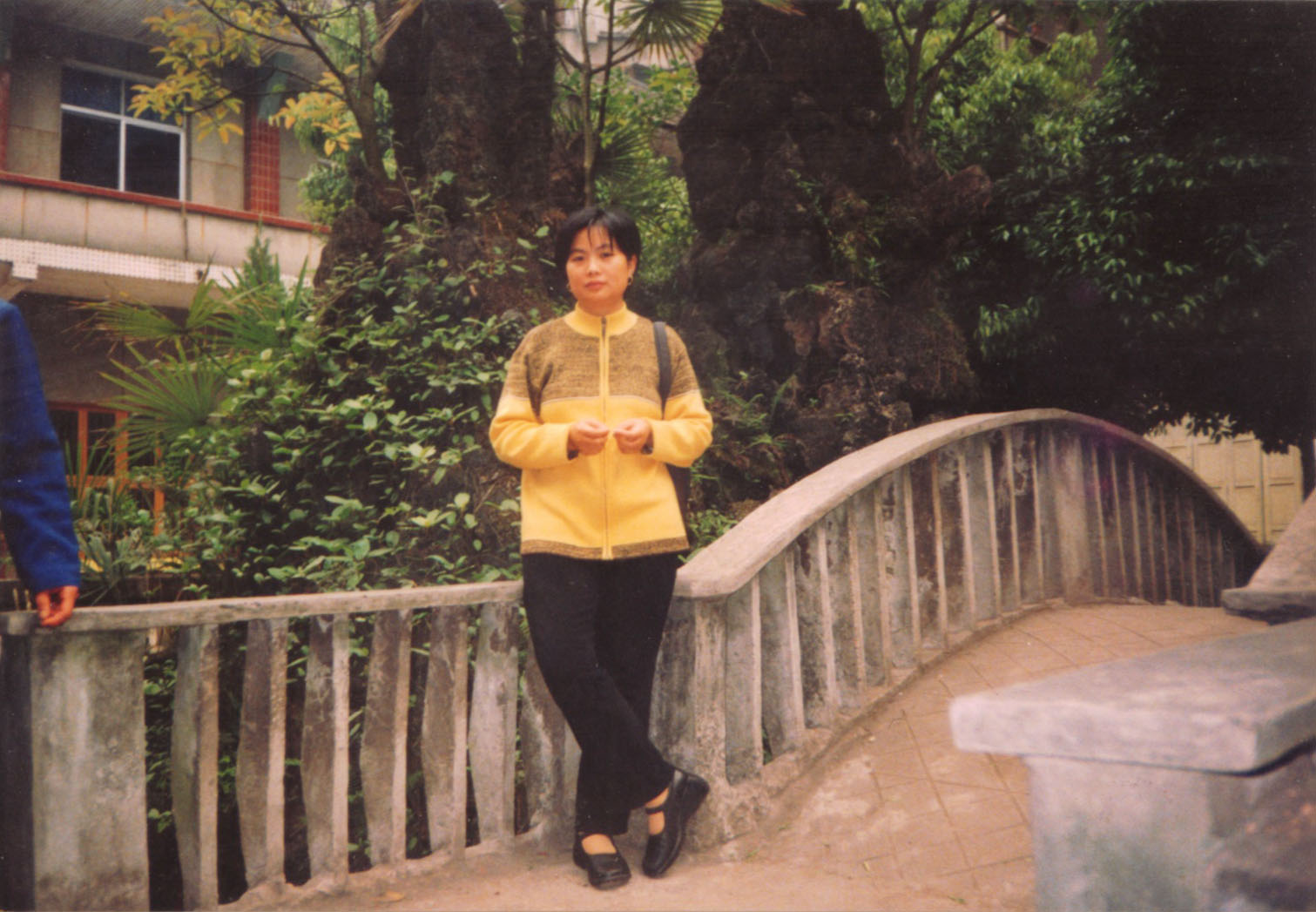
    There was another reason why Chen Min’s presentation was timely. In November 2010, a woman by the name of Li Yan, a then 41-year-old resident of Anyue County in Sichuan Province. murdered her husband Tan Yong. The couple, who ran a noodle shop, had married the year before. It was Tan’s fourth marriage. He boasted of abusing his previous wives, and it wasn’t long after his marriage to Li Yan that he began subjecting her to horrific violence, beating her, sexually assaulting her, stubbing cigarettes out on her face, and locking her outside on cold winter nights.

    On November 3, 2010, Tan was at home, drunkenly playing with an air rifle. When Li tried to stop Tan, he kicked her and threatened her with the rifle. Li seized the gun and struck Tan in the head twice, killing him. She dismembered his body, boiled the parts, and spread them around the village. She was arrested and sentenced to death by the Ziyang City Intermediate People’s Court. The judgment was upheld by the Sichuan High People’s Court after which it was sent to the Supreme People’s Court (SPC) in Beijing. The SPC confirmed the judgment in January 2013. Tan’s family successfully filed a civil suit against Li Yan’s family to pay 58,212 RMB in compensation – a large sum of money for Li’s working-class family.

    Death sentences reviewed and confirmed by the SPC typically take place within days of SPC approval. By the time of our Hong Kong symposium, more than 13 months after the SPC decision, Li Yan had not yet been executed. Her plight had drawn domestic attention as Chinese feminists lobbied the government to stay its hand arguing it had not taken into consideration the violence Li had suffered. More than 400 Chinese lawyers and legal scholars had signed a letter to the SPC pleading for Li Yan’s life to be spared. The case was beginning to draw international attention too. Amnesty International initiated a global signature campaign calling for Li Yan not to be executed.

    One of the SPC judges attending the symposium sat on an SPC panel reviewing death sentences, and it emerged that she was one of the judges considering whether to carry out the execution of Li Yan. At the end of the symposium, she thanked me for inviting her to the event, and told me that she had learned a lot from the discussion on domestic violence. “It has changed the way I think about it,” she told me. I stayed in touch with the Chinese participants, and on June 23, 2014, a Chinese official who had been at the symposium and was deeply concerned with Li’s case sent me a short email: “She has survived.” At the same time, Li Yan’s brother was advised that his sister’s death sentence had been overturned by the SPC. A retrial by the Ziyang City Intermediate People’s Court was ordered.

    Dui Hua issued a press statement and sent it to journalists covering human rights in China, including many who were based in Beijing. Coverage in the international media was widespread, and the United Nations Office of the High Commissioner for Human Rights in Geneva issued a statement applauding the decision.

    One of the journalists I sent Dui Hua’s statement to was Didi Kirsten Tatlow, a New York Times journalist based in Beijing. Ms. Tatlow had been reporting on the Li Yan case since late 2012 and decided to travel to Chengdu and thence to Ziyang with photographer Gilles Sabrié to attend the retrial in November 2014. Outside the courthouse, she encountered an angry and threatening mob of Tan Yong’s family and friends. In a telephone call to me, Ms. Tatlow remarked that she had rarely welcomed the presence of Chinese police in her work, but she did on this occasion!

    During the retrial, more evidence of domestic violence and testimonies from neighbors and witnesses emerged. Witness protection systems had to be set up to protect witnesses from Tan’s family. Inside the courtroom, the mob hurled insults and papers at Ms. Li and her lawyer. Five months later, on April 24, 2015, the court announced it had changed the judgment to death with two years reprieve, a unique Chinese sentence that almost always results in commutation after two years. On September 8, 2017, the intermediate court commuted the sentence and sentenced Li Yan to life in prison. Under Supreme People’s Court regulations that came into effect on January 1, 2017, Li Yan can be considered for a sentence reduction no earlier than September 2020. Her total time served after commutation cannot be less than 15 years, meaning that she will remain in prison until at least 2032, when she will be 62 years old.


    “To Ziyang for Li Yan”

    Didi Kirsten Tatlow

    The reporting trip I made to Ziyang to attend Li Yan’s retrial was one of the most instructive, and frightening, moments of my 14 years reporting in China from 2003 until my departure for Berlin, Germany, in 2017. I had been reporting on women’s and feminist issues including gendered violence for years by the time the retrial was announced, including one heart-breaking magazine story for the South China Morning Post, my employer for the first seven years in China, about Sun Village, a home for children from abuse-filled families whose parents were both dead (often the father killed by the mother with rat poison after years of abuse by him), run by a former correctional officer from Xi’an. Strangely heartbreaking for me was the small fact that the children’s favorite TV show, SpongeBob SquarePants, was moved to late night viewing not long after my visit around 2006, on the grounds that it was an American show and would sully Chinese children’s minds. The kids  had lost the cute little sponge and his pink friend Patrick Starfish, who made their often-harsh lives that bit more fun.

    I applied to attend Li Yan’s retrial with low hopes – never had I been allowed to enter a Chinese courtroom and this was sensitive stuff. And initially I was put off by the Sichuan authorities, but always with the curious suggestion that I should try again later. I did, and on my third or fourth attempt I was given permission.

    The experience was tough. In the small town of Ziyang Mr. Tan’s family seemed to be everywhere; the night before the hearing I met with members of Li Yan’s family in a restaurant, but we had to be careful not to speak loudly and her brother, Li Deshuai, though friendly and hospitable, was anxious. The next morning, I understood why. After handing over my reporter ID to the court front gate in order to enter the grounds, I went to talk to a large group of Mr. Tan’s family members that had gathered outside. They quickly grew hostile and began to pull at my clothes and arm, voices rising. His father waved his crutches at me; his sisters wagged their fingers in my face. Somehow, I was to blame, it seemed. Sensing things were slipping out of hand I moved into the court grounds and called for the police as the atmosphere deteriorated. They however were slow to react, and I wondered – if I, a foreign reporter with the backing of the court authorities to be present that day, could not get timely help from the dozens of court police standing around, how bad must it be for a Chinese, especially one with a grievance with the court?

    Eventually the police did intervene. But Tan’s family persisted in their verbal and physical aggression, clearly hoping to influence the judges and the decision. I was shocked, too, that court officials did not order them out of the courtroom for contempt, as they sat there shouting and abusing Li Yan, telling her they hoped she would be raped for her crimes (her former husband had already done that, before she killed him.)

    As a journalist, one rarely knows if or how one might have helped someone, though to me this was by far the most important aspect of the job. When John Kamm told me that he thought my work had helped I felt a deep sense of happiness. Li Yan was a petite woman standing alone in the courtroom between the panel of judges and shouting opponents, and I felt sorry for her, knowing also details of the appalling abuse she and her family had endured that had not been publicized out of consideration for the dignity and privacy of other family members (I also agreed not to publicize them, following their wishes.) It was a moment when I knew being a journalist was worth it, despite the strain, and regular fear, of reporting deeply not just on politics but also sensitive social issues like gender, in a complex, repressive and trigger-happy place like China.


    Listen to the Encounters with China podcast.

    Subscribe to receive notifications about new episodes. 

    Read all John Kamm Remembers stories.

  • Target of the Gang of Four

    Target of the Gang of Four

    << Read all John Kamm Remembers stories

    I left America for Macau to take up a teaching position in August 1972. I moved to Hong Kong on Christmas Day, 1972. By the end of 1975 I had lived most of the previous three years in Hong Kong with a spell at Harvard University in late 1974 and early 1975 to earn a Master’s degree. What is now a Special Administrative Region of China, Hong Kong was then a Crown Colony of Great Britain. I worked as a tutor at the Chinese University of Hong Kong and, beginning in the summer of 1975, as an assistant editor of Asian Business & Industry, a limited circulation business magazine, published by Far East Trade Press, with readers in every Asian country, including China.

    One day in July 1975, as I was walking back to my office in Prince’s Building, I passed by Commercial Press where I purchased a copy of a pamphlet entitled “On Exercising All Round Dictatorship of the Bourgeoisie” written by Zhang Chunqiao. Zhang was a member of the Standing Committee of the Politburo of the Central Committee of the Chinese Communist Party, and the theoretician of a leftist faction that would someday come to be known as the Gang of Four. I read the pamphlet and, based on my understanding of its contents, wrote an article for the August issue of Asian Business & Industry. I called out Zhang for his ultra-leftism – identifying him as the principal spokesman for radical economic policy in the Central Committee — and criticized his call for class warfare directed against the “dictatorship of the bourgeoisie,” referring to a passage in his essay in which he calls for the “iron broom of the dictatorship of the proletariat” to sweep away bourgeois rights from China.

    A few weeks after publication, I came to the office to find a stack of copies of the magazine wrapped in filthy rags. The China National Publications Import Corporation, the channel through which Far East Trade Press distributed its magazine in China, had returned all the magazines with a letter on its official stationary. The letter accused Asian Business & Industry of having published a counterrevolutionary article that had “hurt the feelings of the Chinese people.” The letter concluded by stating that the magazine would no longer be allowed to circulate in China.

    I didn’t know it at the time, but my article attacking Zhang Chunqiao had attracted the attention of Zhang and his leftist allies in what was sometimes called “the Shanghai faction.” Public security began a file on me, known in China as a dang’an. Such files are kept on virtually every Chinese citizen as well as on foreigners who visit China on a regular basis. Thirty years after my article appeared, I learned that it was the first item in my dang’an. The diplomat who gave me this information said that I was known in government and party circles as a “target of the Gang of Four.”

    Shanghaied at the Feather and Down Fair

    Shanghai Mansions.

    My chance to visit Mainland China for the first time came in January 1976 when, as a freshly minted representative of the National Council for US-China Trade, I was asked to go to Shanghai to attend the China Feather and Down Garments Minifair (中国羽绒服饰小交易会) put on by the China National Native Produce and Animal By-Products Import and Export Corporation (CHINATUHSHU, 中国土产畜产进出口公司). My visa came through at the last possible moment, enabling me to make the flight to Shanghai from Guangzhou on January 6.

    First though I had to get to Guangzhou from Hong Kong. I boarded the Kowloon Canton Railway train that departed from the Tsimtsatsui terminus at 8:24 on January 4, 1976, arriving at Lo Wu station around two hours later.

    After crossing the border at Lowu and having a simple but tasteless lunch at the station on the Chinese side, I and other trade fair attendees boarded the 1:00 PM train for Guangzhou. I was accompanied by a young American entrepreneur who had become a leader in manufacturing down garments, then quite the rage in America, and an Australian businessman/scholar and his wife.

    From the train windows we could view the countryside, fields left fallow for the spring planting. We passed the small village of Shenzhen, today a major city that is home to China’s first special economic zone. Upon arrival at the Guangzhou train station we hopped into grey Shanghai sedans for the run to the Bai Yun airport. We arrived at Hong Qiao Airport in Shanghai after nightfall, but there was no one to receive me.

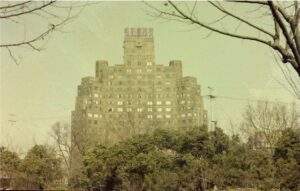
    Eventually Mr. Ma from the Shanghai Foreign Affairs Bureau showed up and I was taken to the Peace Hotel, the former Cathay Hotel, on the Bund. Mr. Ma was silent for the late-night drive though dark, deserted streets. The next day I moved to Shanghai Mansions, the old Broadway Mansions, where the trade fair was taking place. At the Shanghai Mansions I was given an immense apartment on an upper floor, with balconies overlooking the Huangpu River, Suzhou Creek and the Bund. There was a big radio circa early 1940s in the living room. Radio was the only form of entertainment available to me. I never bothered turning it on.

    The next day, January 5, 1976, I visited the trade fair itself, and registered with the liaison office. The office was staffed by cadres from the China Council for the Promotion of International Trade (CCPIT), the National Council’s counterpart organization in China. The fair itself was held in four rooms on the second floor of the hotel. Different branches of CHINATUSHU had their own display and negotiation spaces which were fitted out with one or two tables and chairs. A tin of cigarettes was placed on the tables. The exhibition and negotiation hall reeked of cigarette smoke.


    “Traffic” on the Bund. Not a single car in sight. Today this thoroughfare is multi-laned and bumper to bumper, one of the busiest streets in China.

    One of my tasks was to write an article on the minifair for the National Council’s magazine, China Business Review, so I put in a request for an interview with the trade fair’s leadership. My request received a cool reception. I was told to go to my room and wait for an answer. This was a sensitive time for people doing business in China, and minifairs, an innovation introduced as a modest reform in 1975, were under fire as examples of the “roots of capitalism” being introduced by Deng Xiaoping, arch foe of the Shanghai Faction. I wondered if I would get an interview in Shanghai, or have to wait until I got to Beijing, where a Fur Garments Minifair was about to open.

    Rather than heeding the liaison office’s instructions, I decided to take a walk along the Bund and up Nanjing Road. There were few vehicles on the road, the favored mode of transport being the bicycle. I checked out the Shanghai Exhibition Hall, a vast structure built in the Soviet style, and the Shanghai Number One Department Store, said to be the largest in China. Its five floors were stocked with a wide variety of consumer goods, all made in China except foreign watches, the only foreign consumer good allowed for sale in China. I resisted the temptation to buy an Omega for RMB 861.

    I have always visited bookstores on trips to China, and my first trip was no exception. I walked into the large Xinhua Bookstore on Nanjing Road, passing through thick canvas curtains meant to shield the building from the bitter cold outside. Upstairs I walked into the room that held internal (nei bu) publications sold only to cadres with the right documents. I was quickly and unceremoniously told to leave.

    I wandered back to the hotel, stopping first at the office of the Hong Kong Shanghai Bank, located in a small building on a side street not far from the compound housing the Friendship Store and the Seamen’s Club. The compound had previously served as the sprawling British Consulate in Shanghai. I was greeted by the bank’s British manager with more than the usual British reserve. He and his colleague from the Standard Charter Bank were at the time the only resident foreign businessmen in Shanghai. Unfortunately, they could not conduct business. They were in effect hostages of the Chinese government to ensure that China’s holdings with the banks wouldn’t be expropriated. Their colleagues had in fact been detained during the early years of the Cultural Revolution. They couldn’t leave Shanghai until colleagues arrived to replace them. The fellow I met expressed relief that he would be ending his assignment later that year.


    The Shanghai Exhibition Hall.

    I decided to stop by the Friendship Store, a dreary place selling shoddy goods far below the quality found in Hong Kong’s Chinese products stores. After examining the wares on display, I walked over to the nearby Seamen’s Club. Both the Friendship Store and the Seamen’s Club were located on the grounds of the old British Consulate in Shanghai.

    In those days Seamen’s Clubs were the hubs of entertainment for foreigners in China. They served cold beer and one could always find a sailor willing to tell tall tales of his voyages to China. I struck up a conversation with a young Hong Kong sailor who was working on a tramp steamer registered in Hong Kong and operated under the Chinese flag. Together we went back to the Shanghai Mansions where we had a simple dinner and played pool for several hours, drinking beer and eating peanuts. The young sailor told me of his life on a PRC-owned vessel. He complained about the incessant political study sessions he and his fellow seamen had to endure. I listened attentively. Apparently, others were also listening attentively.

    An Interview

    A group of mourners assemble for the walk to Zhou Enlai’s funeral in a side hall of the Forbidden City. Photos by author.

    On January 8, I was advised that my request for an interview had been granted. I was told to come to a room on the top floor of the Shanghai Mansions at 10 PM, an unusually late hour for meetings in China. I spent some time putting together my questions, and then prepared to join a tour of a Shanghai commune. When I tried to sign up for the tour however I was told that I was not welcome to join. I protested to the liaison office to no avail. I headed out on another walk, this time witnessing the arrest of a Shanghai citizen by a police officer. The officer frog marched the young man down a narrow alley, attracting a throng of curious onlookers.

    I went back to the Shanghai Mansions, had dinner, and waited in my room for the interview. At the appointed hour I went to the assigned room and found about two dozen cadres led by “leading Member” Chen Wenhai waiting for me. The interview was a formal affair, no smiles or words of greeting. I was told the ground rules. I would first ask all my questions. Thereafter I would be given a brief introduction to the trade fair. No further questions would be entertained. I must have asked thirty or so questions, after which I was given the brief introduction. It quickly became apparent that few of my questions would be answered. The “brief introduction” started out with words of praise for the wise leader Chairman Mao Zedong and the correct policies of the Chinese Communist Party. I was then given the bare bones facts of the trade fair: how large the exhibition space was, how many provincial animal by-products branches were in attendance, how many traders from which foreign countries were in attendance. That was it.

    I tried to slip in one more question. In 1975 China agreed for the first time to sew into garments intended for export the labels of the western company that had ordered them according to their specifications. This was a welcome reform as Chinese labels like Peony, Snowflake, and the like didn’t appeal much to American and European consumers. Suddenly, at this minifair, traders had been advised that this policy had been cancelled. No more foreign labels would be sewn into Chinese made garments. There was much unhappiness among foreign traders about this sudden change, and I wanted to ask a question about why this step had been taken. I never got a chance to do so. I was cut off and reminded that there would be no more questions and told that the interview was over.

    Shortly after returning to my room the phone, an old black apparatus with a solid feel, started ringing. It was the young sailor I had befriended the night before. His voice was shaking, and I guessed he had company sitting nearby. Obviously distressed, he told me that he was leaving Shanghai early, and that I was not to try to contact him. He told me he would always remember our friendship. He rang off. A cold shiver ran up my spine.

    I went to bed, but had trouble falling asleep. In the early hours of January 9, I heard a great commotion taking place on the barges on Suzhou Creek below me. There were loud voices and the sounds of fighting. I dozed off and when I awoke I saw the streets lined with military vehicles, and all the barges gone. In the distance I could hear the somber music of a funeral dirge. I left my room and encountered an elderly floor attendant. What has happened I asked? He told me that Premier Zhou Enlai had died. He was weeping.

    I and other trade fair attendees went to the liaison office to find out more. The official who met us solemnly announced the premier’s passing, and then told us that “the Chinese people will turn grief into strength” and that they would carry on the great traditions of the revolutionary leader. There would be no interruption to the trade fair. Business as usual.

    To reinforce this point, the liaison office laid on visits for the attendees and this time I was invited to join the tours. We were offered visits to a well-off commune on the outskirts of the city – one of its production brigades specialized in raising “hairy crabs,” a Shanghai delicacy – and a factory making feather and down garments. Our visits were punctuated by bursts of propaganda praising the Great Proletarian Cultural Revolution.

    Upon my return to the hotel I ran into the Australian who I had met on the train up to Guangzhou and his wife. They had just had a harrowing experience. They had gone for a morning walk and saw crowds of people reading newspapers which had been posted on wooden hoardings. They were reading official news of Zhou Enlai’s death, and the couple decided to photograph the scene. Bad move. In those days it was against the law for foreigners to purchase or even read local newspapers like the Wen Wei Bao and Liberation Daily. The couple were swiftly taken into custody by the local neighborhood committee and held in a small room until the police showed up. They were interrogated and lectured at length. Their actions were unlawful and violated the terms of their visit to China. After signing expressions of regret, and apologizing profusely, the couple were escorted back to the Shanghai Mansions.

    A small group of us decided to try another restaurant for lunch, having sampled just about everything on the Shanghai Mansions’ menu. We walked to the Peace Hotel and took the elevator up to the dining floor. We chose the Western restaurant. Sitting down, we noticed that the waiters were wearing black arm bands. One of the young men came to our table and explained: “We have been told not to commemorate Zhou Enlai’s death, but we are doing so anyway. We are not afraid. Let them come and try to make trouble.”

    The next day I flew to Beijing where I attended the fur garments minifair, and visited one of the model communes on the city’s outskirts as well as, of course, the Great Wall and the Ming Tombs.

    On January 12, I took part in the funeral of Zhou Enlai as a member of the American delegation. Diplomats were all dressed in black, thin clothing for the bitter cold. We were received on the dais by Jiang Qing, wife of Chairman Mao Zedong, one of the members of the Shanghai Faction later to be known as the Gang of Four. Zhang Chunqiao was also present.

    China would be visited with much more sorrow in 1976: the campaign against the right deviationist wind, the Ching Ming protests and the deadly response, the July earthquake in Tangshan, and much joy when the Gang of Four was overthrown in October. I witnessed all of those events during many visits to the country that year.

    Upon my return to Hong Kong after attending Zhou’s funeral I was asked by a friend at Ta Kung Pao, a left-wing newspaper, to write a eulogy for the recently departed premier. I did so, and the piece ran under the Chinese name given to me by a teacher in the United States: Kang Youhan (康又瀚). The eulogy was full of praise for Zhou. A few days after it appeared my friend told me that the article had been removed from the Reference News edition published in Shanghai. My friend suggested that I adopt a new name for any future Chinese language articles I might write. I adopted the name Kang Yuan (康原), and have kept it to the present day.

    Postscript: More than 30 years later, I took a small group of businesspeople to Shanghai. We went to the restaurant at the top of the Peace Hotel, and there I recounted the story of the defiant young waiter. Across the room I spied a man of roughly my age who was now the manager of the restaurant. He looked familiar, and I asked him to come to our table. He complied, and we quickly figured out that he was that young waiter I had encountered in January 1976. In excited voices we relived what had happened. Misty eyed, he asked me a favor. Would I be willing to come back and talk to his young charges? “Young people have no idea how we lived then. And they aren’t interested. You can help. Please come back.” I agreed to do so, but when I returned a few months later the restaurant was closed for renovation. I subsequently found out that Mr. Zhang the manager had retired.

  • National Security in the Time of SARS

    National Security in the Time of SARS

    << Read all John Kamm Remembers stories

    Executive Director John Kamm, second to right, at the Hong Kong University and Hong Kong Bar Association’s conference on “Freedom and National Security – Has the Right Balance Been Struck?” June 14-15, 2003. Image: Hong Kong University

    Shortly after Tibetan political prisoner Ngawang Sangdrol’s arrival in the United States on March 28, 2003, I began preparing for my next visit to Beijing and Hong Kong, tentatively scheduled for early June, roughly four weeks later. Preparations for these visits, then as of now, take many weeks.

    Cases need to be identified, researched, and prioritized. Bilingual prisoner lists for my interlocutors have to be prepared. For this trip I intended to focus on the imprisoned American businessmen Jude Shao and Fong Fuming, as well as prominent Uyghur political prisoner Rebiya Kadeer.

    I sought meetings with the Ministry of Foreign Affairs, the Ministry of Justice, the Supreme People’s Court, the Supreme People’s Procuratorate, and leading Chinese academics who served as advisers to the Chinese government. I asked to visit a prison. I asked for meetings with the American ambassador and other diplomats as well.

    I made my preparations with some trepidation. A fatal disease – Severe Acute Respiratory Syndrome (SARS) – was sweeping China. Thousands of infections had been recorded, and many people – including officials – had been placed under quarantine. Guangdong Province was especially hard hit. By early June 2003, the province had recorded more than 1,500 cases and 57 fatalities. SARS had already spread to Beijing, Tianjin, and other provinces and municipalities by April. By early June, there were 5,329 cases and 336 reported deaths nation-wide.

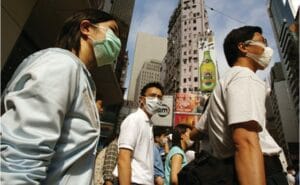
    The epidemic reached Hong Kong in March 2003. The first fatality was recorded on March 11. By early June, 1,750 cases had been identified and 286 deaths recorded. The city was in a state of high alert. Disinfectant was applied liberally to every conceivable surface, often several times a day. People wore masks and generally avoided public gatherings. Tourist arrivals dropped precipitously.

    In mid-May I was advised that my principal interlocutor, Ministry of Foreign Affairs Director General of the International Department Li Baodong, remained under quarantine. All prisons in the country had been placed off limits to visitors. I decided to cancel my trip to Beijing but to proceed with the visit to Hong Kong. I would meet Chinese officials from an inland province as well as Hong Kong activists, academics, and researchers. As usual, I would conduct research at the University Services Center of the Chinese University of Hong Kong.

    “Nest of Spies”

    SARS was not the only issue troubling the people of Hong Kong during the early months of 2003. Article 23 of the Basic Law, Hong Kong’s mini-constitution, stated that the Hong Kong Special Administrative Region (SAR) “shall enact laws on its own to prohibit any act of treason, secession, sedition, subversion against the Central People’s Government.” This article had been inserted into the Basic Law after the events of May and June 1989 in Beijing.

    By late 2002, the SAR’s Legislative Council (Legco) had failed to enact the legislation called for under Article 23, and Beijing was growing impatient. Chinese officials based in the SAR declared that Hong Kong was a nest of spies; in early 2003 at least three Hong Kong residents, all of whom had worked in China’s Xinhua News Agency, were detained in Guangdong Province for allegedly spying for the United Kingdom during the years leading up to the handover in 1997. They were eventually arrested, tried, and convicted of espionage. Two of them, Chen Yulin and Wei Pingyuan, were sentenced to life in prison. They were still in prison, despite multiple sentence reductions, as of mid-2018 (see this issue’s Prisoner Update).

    The Hong Kong official tasked with pushing through Article 23 legislation by Chief Executive Tung Chee-hwa was Regina Ip, a career civil servant holding various positions in the Hong Kong government before being appointed Secretary for Security in July 1998. Ms. Ip and I had worked on retaining Most Favored Nation trading status for China in the early 1990s. I knew her as a tough, uncompromising official well versed in issues of trade, industry, and immigration. She had little knowledge of national security however, and had infrequently visited China before 1997 (when she was 47 years old). This was in line with pre-handover British policy which placed restrictions on Hong Kong officials traveling to the People’s Republic.

    Regina Ip was also very ambitious. She was determined to eventually become the Chief Executive of the SAR.

    Unfortunately for her ambitions, Secretary Ip had developed a reputation for alienating people by making ill-considered remarks. In the run-up to the introduction of the National Security Bill in the Legislative Council’s Bills Committee on February 14, 2003, Secretary Ip had warned against viewing democracy as a panacea. After all, she said, Adolf Hitler had been democratically elected as Germany’s chancellor before embarking on his murderous genocide directed at the Jews. She also disparaged Hong Kong’s taxi drivers and restaurant workers, opining that they weren’t interested in such things as national security.

    A Letter from Alan Leong

    I arrived in Hong Kong on June 11 and immediately went to the J.W. Marriott Hotel at Pacific Place on Hong Kong Island. After checking in, I went to my room to begin unpacking. While doing so, I noticed a letter that had been slipped under my door. It was from Alan Leong, a leading member of the Article 23 Concern Group and Chairman of the Hong Kong Bar Association. The letter, on Bar Association stationary, invited me to make a presentation to a conference on Article 23 to be held at the Law School of Hong Kong University on June 14-15, 2003. The title of the conference was “Freedom and National Security – Has the Right Balance Been Struck?” I was asked to make a presentation on national security legislation in the People’s Republic of China.


    A siege mentality gripped Hong Kong as the death toll from SARS started to rise. Image: timeout.candrholdings.com

    I called Mr. Leong at his Chambers. “What’s this all about?” I asked. “The policy governing Hong Kong is ‘One Country, Two Systems.’ What does national security legislation in China have to do with national security legislation in Hong Kong.” At that point I hadn’t even read the National Security Bill being considered by Legco.

    Mr. Leong replied, “You are correct. National security legislation in China should have nothing to do with national security legislation in Hong Kong. As it turns out, however, the bill under consideration contains language which links the two systems. In short, if an organization in Hong Kong is subordinate to an organization in China that has been banned by the central government on national security grounds by means of a certificate, the Secretary for Security can ban it in Hong Kong.”

    I was intrigued. I had never heard of a Mainland Chinese mechanism for banning an organization on national security grounds by means of a certificate. Prior to 1997, when China’s Criminal Law was amended to remove the crime of counterrevolution, individuals could be sentenced to prison for simply belonging to a counterrevolutionary group. Whether or not a group was a counterrevolutionary group was determined by a court, not by a government agency. After 1997, mere membership in a group no longer constituted a crime. This important 1997 reform of the Criminal Law sought to criminalize acts like drafting manifestos and raising money, not simple association.

    I agreed to make a presentation on June 15, the second and last day of the conference. I was told by Mr. Leong that the audience would probably be small. June 15 was Father’s Day in Hong Kong, and mine would be among the last presentations.

    After we rang off, I went to the hotel’s concierge level and printed out a copy of the National Security Bill. Part 4, Section 8A (2) (c) provided for the Secretary for Security to proscribe any local organization “which is subordinate to a mainland organization the operation of which has been prohibited on the ground of protecting the security of the People’s Republic of China, as officially proclaimed by means of an open decree, by the Central Authorities under the law of the People’s Republic of China.” The next section (3) stated that conclusive evidence of the prohibition would be “a certificate issued by or on behalf of the Central People’s Government.”

    I began preparing a presentation based on points of Chinese law, and on cases of individuals tried by Chinese courts for counterrevolution and endangering state security.

    The Conference

    I decided not to attend the first day of the Hong Kong University conference on June 14, 2003. That evening though, I was invited to attend a dinner at the Hong Kong Club. In attendance were conference participants including local pro-democracy activists and lawmakers. The mood was grim.

    Earlier that day Legco’s Bills Committee had carried out a “clause by clause” review of the National Security Bill, a process that took nearly eight hours. Many of the legislators in the democratic camp chose not to attend the meeting, preferring to attend the Hong Kong University conference instead. After the review, the Legco committee voted to end debate, meaning that debate could not be reopened, and easing the way for the bill’s adoption by Legco.

    All seemed lost. What could be done to stop adoption of the legislation by Legco? I weighed in at the dinner, introducing the Cultural Revolution concept of “raising the red flag to oppose the red flag.” It was often used by Red Guard factions against each other; each claimed the mantle of Mao Zedong thought and used quotations from Mao to undermine the arguments of the faction.

    In the case of Article 23, Chinese law was a “red flag,” and set against this was another “red flag,” the Hong Kong National Security Bill. What we needed to do was to show how the Hong Kong legislation ran counter to both the spirit and letter of Mainland Chinese law. Instead of pointing out why the legislation was bad for the human rights of the people of Hong Kong, basing our arguments on the Common Law, we needed to show how the legislation was bad for the people of China based on Chinese law. A long shot, but worth a try.

    The next day I arrived at the conference hall to find a packed room of leading legal scholars from around the world, a cohort of Democratic legislators, and the Hong Kong Solicitor General Bob Allcock and his subordinates. Mr. Allcock was head of the Legal Policy Division of the SAR Department of Justice.

    My panel sat down and shortly thereafter I began my presentation. I went through it point by point, focusing on the 1997 amendment to the Criminal Law that criminalized acts, not association.

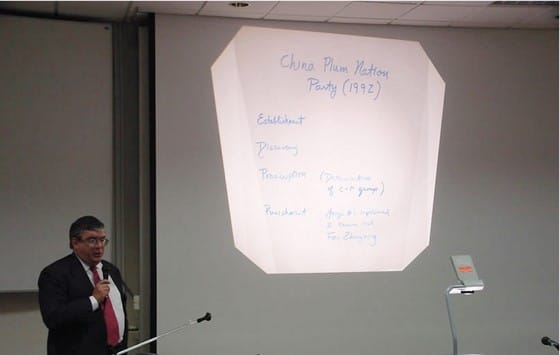
    I referenced several cases in which individuals had been convicted of subversion after 1997 for undertaking subversive acts. I had been unable to find a single case of someone being subjected to coercive measures for mere membership in an organization. In one case, that of the Chinese Nation’s People’s Party, more than a thousand members of an underground political party had been spared criminal prosecution. Its leaders had been convicted of subversion and sentenced to long prison terms for engaging in activities like organizing meetings, drawing up a manifesto, and raising money.

    Reinforcing my point that China did not ban groups on national security groups, I pointed out that it had in fact banned groups like Falun Gong on public order grounds. Article 300 of the Criminal Law made it a crime, punishable by imprisonment, to use a cult to disrupt the administration of the law. If China had banned groups on public order grounds, why hadn’t it banned groups on national security grounds?

    I concluded that Hong Kong’s National Security Legislation could not come into force unless and until China’s National People’s Congress amended the criminal law and returned to the “bad old days” of the pre-1997 criminal law, a time-consuming and complicated process that would anger China’s legal reformers who were proud of having removed “membership in a counterrevolutionary group” from the criminal law.

    My remarks caused quite a stir. Veteran democratic legislator Martin Lee wondered aloud: “Why didn’t we think of that?” Legislator and union leader Lee Cheuk-yan delivered impassioned remarks: “We Hong Kong people are so selfish. All this time we have been concerned with how this bill will hurt the human rights of the Hong Kong people. Now we learn that it could hurt the human rights of the entire Chinese nation. We will be condemned as criminals for a thousand generations!”

     
    Kamm delivers a talk on Article 23 and national security, Hong Kong University, June 15, 2003.

    At this point, Attorney General Allcock addressed me, arguing that there were regulations issued by local authorities that governed registration of organizations. If an organization could not be registered, it was the same as banning the organization. I disputed this. “Refusing to register an organization is not the same as banning it. And, in any event, laws passed by the National People’s Congress take precedence over regulations put out by ministries and local governments. There is nothing in the Criminal Law about banning organizations on national security grounds.”

    Albert Chan took the floor. Chan, former dean and current professor of law at Hong Kong University School of Law and a member of the Basic Law Committee, was a respected legal scholar enjoying excellent relations with senior Chinese judicial and government officials. “John Kamm is right,” Professor Chan declared. “For the National Security Bill to be enacted in its present form, Mainland Chinese law would have to be amended. No proscription mechanism as described in the bill exists in Chinese law.”

    Bob Allcock was at sixes and nines, the proverbial deer in the headlights. He had lost control of the meeting. He said that the issue I had raised could be discussed at the Legco Bills Committee meeting on June 17. I asked if I could attend the meeting and he said yes.

    The next day local newspapers, English and Chinese, were full of stories on what I had done. A headline in the South China Morning Post read “Hong Kong’s Future Autonomy is at Stake, Says Expert.” The stage was set for a showdown between Regina Ip and John Kamm at the Bills Committee meeting on June 17.

    Debate in Legco


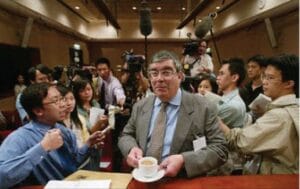
    Kamm surrounded by journalists, Hong Kong’s Legislative Council, June 17, 2003. Image credit: SCMP.com.

    I showed up at the Legco Building on June 17 at the appointed hour. I took my seat in the gallery above the ornate chamber, looking down on the legislators. Bob Allcock came up to where I was sitting and gave me a handwritten note. An amendment to the bill would be introduced changing the proscription mechanism from “certificate” to “open proclamation.”

    The first order of business at the meeting was an attempt by Democratic legislators to rescind the June 14 decision to close debate. All their motions were voted down. Attention then turned to my objection to the bill as presented at the Hong Kong University conference.

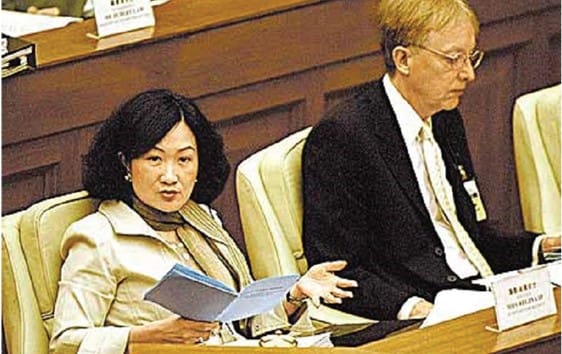
    Regina Ip tabled the motion to amend the bill by substituting “certificate” with “open proclamation.” This move was met with derision by the Democratic camp. One legislator remarked that after saying debate could not be reopened the government had in fact done just that. Legislators Emily Lau and Margaret Ng, stalwart campaigners for human rights and democracy, claimed that the amendment didn’t change a thing. What was meant by “open proclamation?” Could a newspaper advertisement placed by a local government be considered an “open proclamation?” The government had muddied the waters.

    Finally, Lee Cheuk-yan took the floor. “Secretary for Security, you have said that the bill was subjected to scores of public consultations and 80 hours of debate by Legco. Yet, a foreigner comes to town who has never read the bill, examines it for less than an hour and finds a fatal flaw. What do you have to say to John Kamm?” Pointing at me, he said “Look at John Kamm sitting in the gallery. He is laughing at you!”

    This proved too much for Regina Ip. “I am sick and tired of hearing from so-called foreign experts on Chinese law. Sick and tired!” she exclaimed in a high-pitched and agitated voice.

    At this point, the Chairman of the Committee meeting stepped in and suggested a brief recess to allow tempers to calm down. I left the gallery and went downstairs to find Martin Lee waiting for me. He ushered me into a room where there were several dozen journalists waiting to pepper me with questions. I made it clear that I was not satisfied with the amendment. The bill was still flawed.

    Regina Ip and Bob Allcock. Image credit: HongKongFP.com

    At this point I took a gamble. “The Ministry of Foreign Affairs holds its weekly press conference on Thursday June 19. There are journalists in this room who work for wire services. Why don’t you ask the Foreign Ministry spokesman who is right, John Kamm or Regina Ip?”

    In making this move I reckoned that Regina Ip knew as little about Chinese bureaucratic politics as she knew about Chinese law. She had studiously built relations with the Hong Kong Macau Affairs Office, and had largely ignored the Ministry of Foreign Affairs, a bad move. In the event, journalists submitted my question at the press briefing on June 19. The spokesman declined to answer. On June 25, 2003, Regina Ip tendered her resignation as Secretary for Security, citing personal reasons. Later that year she entered Stanford University to study for a Master’s Degree.

    As I was exiting the Legco conference room on June 17, two journalists from Apple Daily and Ming Pao stopped me at the door. “What do you think of what Regina Ip said about you?” they asked. I played dumb, “What was that?” “She said that she was sick and tired of hearing from so-called foreign experts on Chinese law. She called you a so-called foreign expert.” I quipped: “I thought she was talking about Bob Allcock.” The press loved it.

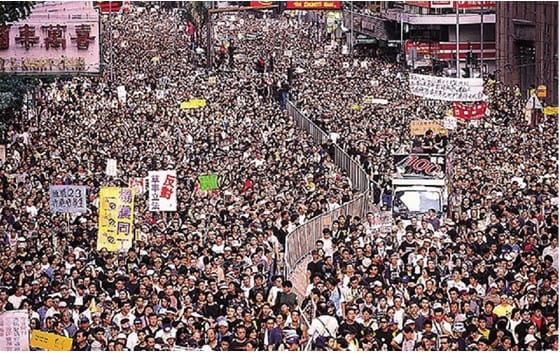
    On July 1, 2003, hundreds of thousands of Hong Kong people took to the streets to protest Article 23. Government officials had predicted that only 30,000 people would participate in the march. The marchers wound through the streets and ended the march by passing by Chief Executive Tung Chee-hwa’s office. They carried placards denouncing “Uncle Tung” and calling for his resignation.

    With the desertion of James Tien, leader of the Liberal Party which had supported passage of the legislation, the National Security Bill’s fate was sealed. The government removed the bill from consideration by Legco. Citing health issues, Tung Chee-hwa resigned in March 2005. Mr. Tung remains in excellent health. He had apparently contracted a short-term political illness.

    Hong Kong residents took to the streets in protest of Article 23 on July 1, 2003.

    As for me, I returned to San Francisco, but my job was not complete. I penned an article that ran in both English and Chinese newspapers in Hong Kong outlining how the people of China would be hurt if the National Security Bill was passed by Legco and became law.

    In the summer of 2003, a senior official of the Ministry of Foreign Affairs came to San Francisco and we agreed to meet. He told me that “We know that the Hong Kong government has made many mistakes, but we don’t appreciate our friends pointing them out!” We had a good chuckle.

    Fifteen years after the demise of the National Security Bill, China’s leaders, notably President Xi Jinping, are pushing for the SAR to enact Article 23 legislation, perhaps as early as the end of 2018. Opposition among the public to such legislation remains high – Regina Ip, the face of Article 23, received the lowest number of Election Committee votes for Chief Executive in 2017 – but due to changes in the make-up of Legco brought about by the ousting of several recently elected legislators, sanctioning speech and association under Article 23 could well be in Hong Kong’s future.


    Listen to the Encounters with China podcast.

    Subscribe to receive notifications about new episodes. 

    Read all John Kamm Remembers stories.

  • The Banquet

    The Banquet

    << Read all John Kamm Remembers stories

    In the late Spring of 1990, my family and I lived in an apartment on Hong Kong’s Victoria Peak that looked over a verdant country park to the South China Sea on the near horizon. When visibility was good, one could see junks with red sails and cargo vessels plying the waters off Lamma Island. The outline of Chinese islands loomed on the far horizon. China was near. With the conclusion of the Sino-British Joint Declaration in 1984, China was drawing nearer. In 1990, a mere seven years remained before China resumed sovereignty over Hong Kong.

    My life in Hong Kong was good. I was a vice president of Dallas-based Occidental Chemical (Oxychem), which paid me a handsome salary and cost-of-living allowance. I enjoyed generous home leave, exclusive use of a 280SE Mercedes, a driver, two maids, school tuition for my first son, and two country club memberships. I ran the Asia Pacific region for the corporation. Oxychem had factories and sales offices in a dozen countries. I spent a lot of time on the road.

    That year, I was also the president of the American Chamber of Commerce (AMCHAM) in Hong Kong, the largest American chamber outside of North America with 2,800 members. In fact, I was never meant to be president of the chamber. After the killings in Tiananmen Square in 1989, I used my position as vice-president of the chamber in charge of committees to convene a meeting of members big and small. At that meeting I pushed through a resolution condemning Beijing’s actions against fierce opposition from large corporate members. The resolution was published in AMCHAM’s magazine and placed as an advertisement in a number of Hong Kong newspapers.

    Not surprisingly, when it came time for the Nominating Committee, which was dominated by old-timers and representatives of multinational corporations, to vote on the next president, I came in a distant second. My views on human rights and Tiananmen, in the eyes of many AMCHAM leaders, made me unsuitable to be president.

    The fellow who came in first called his boss in New York with the good news. His boss told him that he had a choice: He could assume the presidency of AMCHAM and serve his one-year term, or he could continue his career with the firm. The fellow chose to continue his career, and I became president of AMCHAM by default.

    I assumed the presidency on January 1, 1990. It was a tough time to be president of an organization that favored strong trade ties with China. After Tiananmen, China had become an international pariah. Calls were mounting to impose sanctions and, in the United States Congress, to strip China of its Most Favored Nation (MFN) trading status. China’s trade status had to be renewed every year, ironically no later than June 4.

    The first hearings on China’s human rights record and MFN were scheduled to take place before three subcommittees of the Committee on Foreign Affairs of the House of Representatives on May 16, 1990 in Washington. I was invited to testify by Richard Bush, staff consultant to the Subcommittee on Asian and Pacific Affairs chaired by Congressman Steve Solarz (D-New York). I accepted the invitation.

    Chaucer and Mao Tai

    On May 9, a week before I was to testify, I and the leaders of the American business community in Hong Kong were invited to a banquet by Zhou Nan, Director of the New China News Agency (Xinhua) in Hong Kong. Xinhua was the seat of Chinese power in the colony. Zhou was an experienced diplomat. He had served as a vice minister in the Ministry of Foreign Affairs, in which capacity he had negotiated the joint declaration between China and the United Kingdom on Hong Kong. He spoke flawless English, and loved English literature (he could recite the prologue to Chaucer’s Canterbury Tales in Middle English). He also served as an interpreter for interrogations of American POWs during the Korean War.

    Zhou had a fearsome reputation as a hard-liner. He was also very anti-British, stemming from a botched attempt to recruit him by MI6 while Zhou was posted to China’s Mission to the United Nations in New York.

    Before heading off to the banquet, my longtime friend and fellow AMCHAM officer Jeff Muir and I had done our daily jog up Black’s Link. We returned to my apartment, showered, and fortified ourselves with ice-cold cans of San Miguels. We left in my car for Zhou Nan’s villa on the south side of Hong Kong Island shortly before 6 PM.

    My driver had turned on the radio for the 6:00 PM news on RTHK, the government-run radio station. A few minutes into the broadcast, an interview of the mother of a Hong Kong student, Yao Yongzhan, aired. Yao, a student leader, had been detained in the aftermath of the protests in Shanghai. His mother wept gently. She had heard that her son was being mistreated in a Shanghai detention center. Her tearful plea stuck in my mind.

    We arrived at the villa and were led into a room where the rest of the American guests were waiting. These were the leaders of the American business community: Michael Clancy, China Light & Power, a subsidiary of Exxon, and the largest foreign investor in Hong Kong; Lyn Edinger, managing director of Honeywell; Ed Onderko, partner of Arthur Anderson; Jeff Muir, partner of China Consultants International; and Ralph Spencer, executive director of AMCHAM.

    We were ushered into the dining room where we took our seats around a large round table. I was seated at the right hand of Zhou Nan. As soon as we sat down, Mao Tai began to be served. Mao Tai is a sorghum-based spirit which is 52 percent alcohol (104 proof). It is the favored banquet drink served at meals with senior officials. It is often chased with cold beer.

    Zhou Nan was known as one of China’s best Mao Tai drinkers. I had learned to drink Mao Tai under the tutelage of Wang Yaoting, Chairman of the China Council for the Promotion of International Trade, when I served as the Hong Kong representative of the National Council for US-China Trade from 1975 to 1980. My boss, Ambassador Chris Phillips, wasn’t much of a drinker, so I was called upon to represent him at banquets during visits to Beijing. Wang Yaoting regularly consumed a bottle of Mao Tai at dinner. Each bottle held 32 glasses made exclusively for drinking the fiery spirit.

    It wasn’t long before the combination of Mao Tai and cold beer loosened the tongue. I remarked to Zhou Nan that I had heard that one could learn a lot about what kind of person someone is by asking which character in the classic Dream of the Red Chamber the person admired the most, “just like you can learn a lot about someone by finding out which of the pilgrims in Chaucer’s Canterbury Tales he or she likes the most.”

    That got Zhou Nan going: “When that Aprile with his shoures soote, The droghte of March hath perced to the roote, And bathed every veyne in swich licour, Of which vertu engendred is the flour . . .”

    When he finished his performance to applause, Zhou drew himself up and began his toast. “Mr. Kamm,” he intoned in perfect English, “I would like to thank you, on behalf of the Chinese government and the Chinese people, for all that you have done, and all that you are about to do, to promote friendly relations between the United States and China.”

    To this day, I don’t know what got into my head, but I stopped Zhou Nan and asked, “So what are you going to do for me?” The room fell into a stunned silence. You could hear a pin drop. My American colleagues had had no warning. They had no idea where I was heading. Perhaps they thought I would ask that China would buy a boatload or two of caustic soda. No one knew. Neither did I.

    Zhou Nan asked what I meant and I replied that many people in Hong Kong hoped that AMCHAM would convince Congress to keep China’s MFN status, “but you are different, Minister Zhou. You can help me.”

    Zhou responded: “The Chinese government has done everything possible to improve relations with the United States.” I said I begged to differ. It could do more.

    Zhou put down his glass and asked me what I thought the Chinese government should do. I had arrived at that point without thinking what it was I wanted Beijing to do. Then I remembered the voice on the radio. I asked Ji Shaoxiang, head of Xinhua’s foreign affairs bureau who was sitting across the table, what the name of the student leader who was being held in Shanghai. Ji replied “Yao Yongzhan.”

    “That’s it!” I declared. “Why don’t you release Yao Yongzhan?”

    Zhou exploded. “You have rudely interfered in China’s internal affairs, and committed an unfriendly act that has hurt the feelings of the Chinese people.” he thundered.

    In for a dime, in for a dollar, I figured, so I fought back. “A few minutes ago, you treated me as a friend of the Chinese government and people. Now, because I ask you to show mercy to a young man, I’m no longer a friend?”


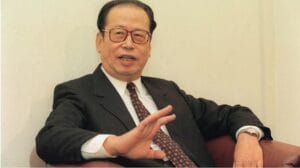
    Zhou Nan, former Director of Xinhua News Agency in Hong Kong and former Vice Minister of Foreign Affairs for the People’s Republic of China. Image Credit: South China Morning Post.

    I reminded Zhou that “The quality of mercy is not strained,” and asked him if he had ever done something as a young man that he wished he had done differently later in life.

    It went on like this for a few minutes. The business leaders were becoming increasingly uncomfortable, and Zhou Nan was becoming more and more upset.

    Finally, I told Zhou that whether or not Yao Yongzhan were released I would still go to Congress to testify in favor of retaining China’s MFN status, and asked him if he knew why. “No,” he snarled. “Because I love Hong Kong. Do you love Hong Kong?”

    Zhou was speechless. Here was a foreign businessman asking China’s most senior official in Hong Kong whether he loved the city. After a moment’s pause, Zhou said, “Alright, I’ll see what I can do.”

    I stood up and told Zhou Nan that I wanted to use the restroom. He snapped his fingers and a young man in a white coat emerged. He led me through a maze of corridors and then, when he knew there were no recording devices in use, he turned and looked at me. He had listened to the exchange with Zhou Nan, and he had tears in his eyes. He hugged me and said, “Thank you for that.”

    After visiting the washroom, I returned to the banquet room. The head of China Light & Power, Michael Clancy, was apologizing to Zhou Nan. “Not all Americans are as impertinent as John Kamm,” he intoned. I took my seat and reminded the Americans that I was president of AMCHAM and that they should hold their tongues. The dinner drew to a close and I returned to my apartment on Coombe Road, wondering about what I had just done.

    Testifying on China

    The next day, May 10, 1990, I left Hong Kong for Washington, stopping first in Seoul and then in Tokyo on Oxychem business. In Tokyo, I composed my testimony in a room at the Okura Hotel. I decided that the focus of my testimony would be the damage that revoking China’s MFN would do to the colony, then grappling with the fact that it would be handed over by the United Kingdom to China. I also decided to confront the issue of human rights head on.

    I arrived in Washington via Newark on May 14, 1990. The next day I huddled with AMCHAM’s consultants, representatives of the Hong Kong Economic and Trade Office, and staff of the State Department and Congress dealing with China.

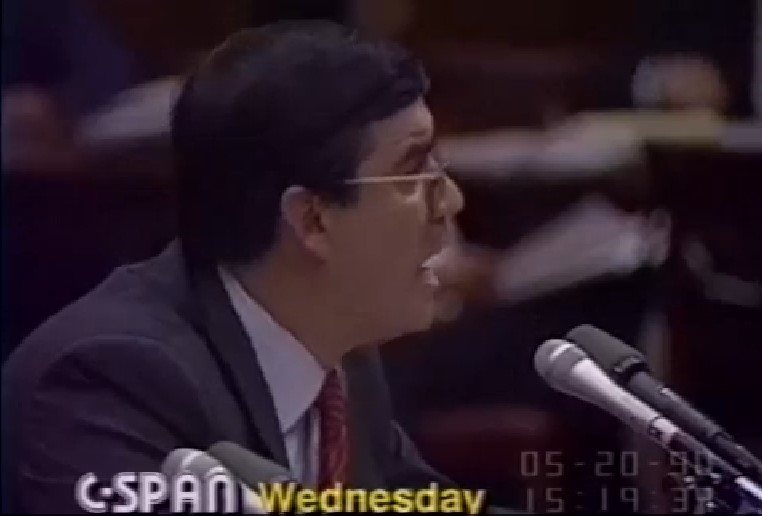
    On May 16 at 9:40 AM the hearing on “Most Favored Nation Status for the People’s Republic of China” was called to order by Congressman Solarz in Room 2172 of the House Rayburn Office Building. Members of Congress were invited to make statements. After that, witnesses were called, one by one. First to testify was Winston Lord, former ambassador to China. He was followed by witnesses representing the National Committee on US-China Relations, Human Rights Watch, and the Independent Federation of Chinese Students and Scholars.

    Then it was the business panel’s turn. First up was the president of the United States-China Business Council, Roger Sullivan. I followed Mr. Sullivan, representing the American Chamber of Commerce in Hong Kong.

    Sticking closely to the five-minute limit for testimonies, I outlined the damage revoking China’s MFN would inflict on Hong Kong and adjacent Guangdong Province and then moved to the subject of human rights. “Americans in Hong Kong abhor the violations of human rights now going on in China, and we condemn them both in public and private sessions with Chinese officials,” I said.

    I continued. “Who knows better than the people of Hong Kong how bad the situation is? We are on the front line. There are young Hong Kong people in Chinese jails. I take this opportunity to call once more for China’s leaders to release them to their families in Hong Kong… Whatever capital we might earn by fighting further sanctions we will gladly spend in the effort to free all Chinese prisoners of conscience.”

    Chairman Solarz thanked me for my “powerful and eloquent plea,” but then subjected me to sharp questioning. He was followed by Congresswoman Pelosi. The congresswoman had taken office in 1987. Her San Francisco district had a large population of Chinese Americans who had been deeply affected by the events of June 4, 1989. Mrs. Pelosi became a leader in the effort to use MFN to wrest human rights concessions from the Chinese government. Her opposition to China being granted MFN without additional human rights conditions launched her national political career.

    My testimony received wide media coverage, including in major American newspapers. It was broadcast in its entirety by a fledgling network known as C-Span. Excerpts were broadcast by CNN, and were viewed in Hong Kong and on the Mainland. Chinese officials were delighted, as was the Hong Kong business community. Everywhere I went in the colony, I was greeted as “Mr. MFN.” The frontpage of USA Today carried a headline: “John Kamm: Hero in Hong Kong.”

    I returned to Hong Kong on May 27. I debriefed AMCHAM’s board, the American Consulate General, and the Hong Kong Government. My wife and I were invited to dinner by Ji Shaoxiang, the official who had given me the name of the detained student leader at the May 9 banquet, and his wife. The dinner was to take place on the evening of June 1 in the top-floor restaurant of the China Resources Building.

    My wife and I arrived at the restaurant to find a cavernous room empty save for a single table placed under a large chandelier. We took our seats, and the food began to flow. Mercifully there was no Mao Tai. The conversation consisted mostly of pleasantries, but then the tone turned serious.

    “Director Zhou very much wanted to attend this evening’s dinner,” Mr. Ji intoned. “Unfortunately, he was called away on urgent business. He asked me to tell you, however, that Yao Yongzhan will be released in four days.” On June 5, Yao walked out of the Shanghai Detention Center a free man. He boarded a flight and returned to Hong Kong the same day. He eventually went to the United States. Yao’s release following my plea marked the first time that Beijing released a political prisoner due to a foreign intervention. It would not be the last.

    China’s MFN Status

    On June 3, 1990, President George H.W. Bush waived the free-emigration conditions stipulated in the Jackson-Vanick Amendment of the Trade Act of 1974, thereby extending MFN status to China for another year. In his presidential determination, President Bush cited the damage that Hong Kong would suffer if China’s trade status were revoked. Bush’s decision to extend China’s MFN status opened a 60-day window during which Congress could debate a resolution of disapproval which, if passed with enough votes to withstand a presidential veto, would strip China of MFN. Such a resolution was soon introduced by Congressman Jerry Solomon (R-New York), along with another piece of legislation that would place human rights conditions on future renewals of China’s MFN status. This was the US-China Policy Act introduced in the House of Representatives by Congresswoman Pelosi and in the US Senate by Majority Leader George Mitchell (D-Maine).

    On June 14, 1990, China’s premier Zhu Rongji visited Hong Kong. AMCHAM was one of the hosts, and we organized a luncheon for him. Prior to the luncheon, attended by hundreds of business people, I was taken aside by a Chinese official and told that one of the reasons Yao Yongzhan was released was that there was concern in Beijing that I would use the occasion of my introductory remarks to call for the student leader’s release. I was asked not to embarrass Premier Zhu.

    Congress acted quickly to call hearings on President Bush’s decision to renew China’s MFN status. Hearings were scheduled by both the Trade Subcommittee of the Ways and Means Committee, chaired by Congressman Sam Gibbons (D-Florida) and the Senate Finance Committee, chaired by Senator Lloyd Bentsen (D-Texas). The former hearing was to take place on June 19, with the latter hearing to take place the next day. I arrived in Washington on June 18 and testified at both hearings. Before and after the hearings I roamed the halls of Congress. In less than five weeks I had testified three times to Congress and had met dozens of members of Congress and senior staff, as well as administration figures. I gave many interviews to the media.

    The House of Representatives eventually passed both the Resolution of Disapproval and the US-China Policy Act, but the Senate failed to consider and vote on the two bills before the clock ran out on the 101st Congress. China’s MFN status was saved, at least for another year. AMCHAM – and Hong Kong – had played a role. This marked the first time in history that Hong Kong had figured in a major American foreign policy decision.

    As my term as AMCHAM president drew to a close, I was asked to come to Xinhua’s headquarters on Queen’s Road West, across the street from the Happy Valley Race Track, on December 20, 1990. I was ushered into a room where I was greeted by Director Zhang, vice-director in charge of trade and economic affairs.

    Director Zhang expressed the Chinese government’s gratitude for the work I had done on MFN. He wondered if I was interested in expanding my business in China.

    I thought about it, and replied “The struggle for MFN is far from over. I would rather invest in the issue than expand my business in China.”

    Director Zhang asked, “How can we help?” My response was brief: “Release prisoners held for what they did during the 1989 disturbances. That will help China keep its MFN status.”


    Listen to the Encounters with China podcast.

    Subscribe to receive notifications about new episodes. 

    Read all John Kamm Remembers stories.

  • Lansing and the Sanming Eight

    Lansing and the Sanming Eight

    << Read all John Kamm Remembers stories

    In 2017, there were more than 200 sister city and state relationships between the United States and China, ties that bind states and cities. The relationships are handled, on the American side, by offices in state and city governments, often manned by volunteers. The relationships exist primarily to foster economic and cultural ties. They have rarely been used to promote human rights and the rule of law.

    In the summer of 2004, I hit upon the idea of utilizing sister city relationships to intervene on behalf of political prisoners in the Chinese cities and provinces that had American partners. There were around 120 sister community relationships at that time. I and my colleagues put together a list of contacts in the governor’s and mayor’s offices who oversaw the relationships with Chinese provinces and cities. Our final list had 83 names and addresses of individuals in charge of the sister community relationship.

    On August 18, 2004, Dui Hua sent letters to our list of contacts introducing our work and asking if the sister city would be willing to engage their counterparts in a discussion of human rights, and, in particular, whether the state would be willing to submit a list of political prisoners incarcerated in their Chinese counterpart’s jails and prisons.

    The response was underwhelming. Of the 83 letters sent out, we received only one positive response. Lansing, Michigan’s state capital, had a sister city relationship with Sanming Municipality, a prefecture-level municipality with a population of 2.5 million, in Fujian Province. Martha Fujita, the Executive Director in charge of Lansing’s Regional Sister City Commission, housed in the Mayor’s office, replied that she would be willing to help Dui Hua. Ms. Fujita advised that a delegation headed by the mayor of Sanming would visit Lansing on September 19-21, 2004.

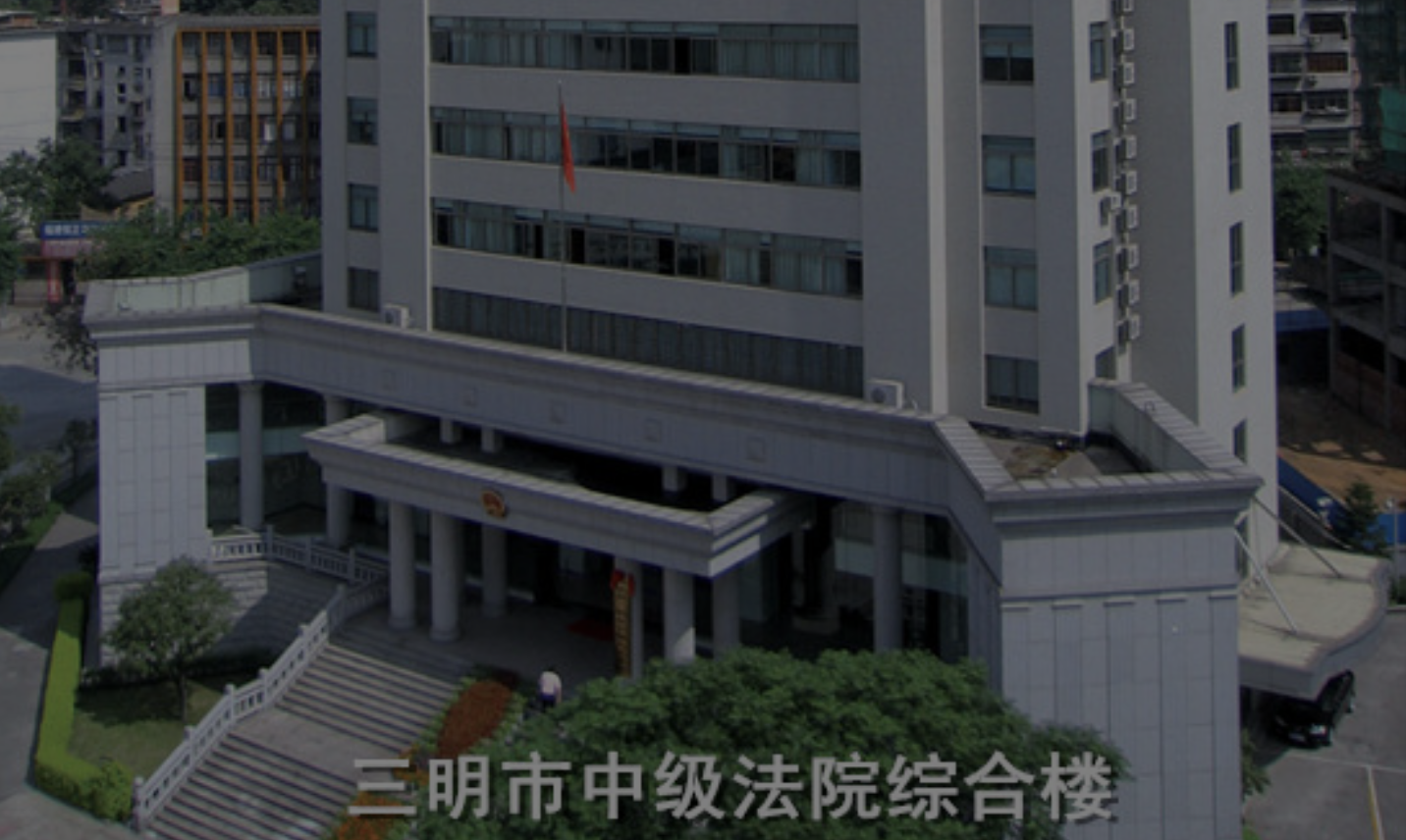
    It so happened that there was a group of eight labor activists who had been detained in April 2002 and sentenced to prison for subversion by the Sanming Intermediate People’s Court in October 2003. The sentences ranged from two to sixteen years. The 16-year sentence was given to the group’s leader, Li Jianfeng, a former court official who had set up an independent trade union and who, the prosecution alleged, had downloaded materials from the Internet which he compiled into a book entitled “Labor Unions.”

    Lansing is a city with deep roots to the automotive industry. It has manufactured automobiles at General Motor’s Lansing Plant for decades. Trade unions are strong. National and local unions as well as the local chapter of Amnesty International had already contacted Mayor Tony Benevides asking him to intervene on behalf of the Sanming Eight.

    I composed a “Request for Information” and faxed it to Ms. Fujita on August 31, 2004. She agreed to find a way to hand it over, with a cover letter from Mayor Benevides, to the mayor of Sanming when the right moment presented itself.

    The Chinese delegation arrived and were hosted to a “Mayor’s Welcome Dinner” and a Chamber of Commerce luncheon. They visited the General Motors plant, Michigan State University, and Sparrow Health Systems. A highlight of the delegation’s visit was sitting in on a Chinese immersion program at an elementary school where the children greeted the guests in Chinese and performed a Chinese folk song for them. The Chinese guests were thrilled and posed for photographs with the children. They also attended a baseball game and sat in the Mayor’s VIP Skybox.

    In short, the Chinese delegation was treated to a hearty dose of Midwestern hospitality, setting the stage for the intervention that was to follow.

    On September 21, the Chinese group left from Lansing Capital International Airport to make their way back to China via Chicago. While the group was checking in their bags, Ms. Fujita took the mayor of Sanming aside. She explained that Lansing is a city with deep connections to the labor movement, and that an important base of support for Mayor Benevides was labor unions. She then presented Mayor Benevides’ letter and Dui Hua’s request for information to the Chinese mayor. He accepted them without hesitation.

    Over the next few years, two of the three labor leaders, including Li Jianfeng, were given sentence reductions and released early. Li was given sentence reductions totaling five years. He was released in April 2013. His five-year supplemental sentence of deprivation of political rights will expire next month, in April 2018. Huang Xiangwei, who was sentenced to six years in prison, received a 10-month sentence reduction and was released after serving just over five years of his sentence.

    The use of sister city relationships to promote respect for human rights in China holds potential, but the relationships are rarely used. Boulder, Colorado has had an active sister city relationship with Lhasa, Tibet for more than 30 years. According to the body’s website, it “promotes and implements non-political exchanges of mutual benefit with Lhasa” including in the fields of health care, education, environmental protection, agriculture, and animal husbandry. No mention of human rights, even though human rights abuses in Tibet are often in the news. Houston, which has a sister city relationship with Shenzhen, did little to assist American businesswoman Sandy Phan-Gillis, even though Ms. Phan-Gillis was the president of the Houston-Shenzhen Sister City Association.

    Lansing’s decision to use its relationship with Sanming to help secure the release of the Sanming Eight shows that sister city relationships can play a role in advancing the cause of human rights in China, if city and state governments demonstrate the political will to do so.


    Listen to the Encounters with China podcast.

    Subscribe to receive notifications about new episodes. 

    Read all John Kamm Remembers stories.

  • A Prison for Foreigners

    A Prison for Foreigners

    << Read all John Kamm Remembers stories

    As 2002 drew to a close, I travelled to Beijing again to make the final arrangements for the release of Ngawang Sangdrol. It had been a busy year. Dui Hua had announced the release of two other Tibetan political prisoners earlier that year, Jigme Sangpo and ethnomusicologist Ngawang Choephel.

    On March 3, I was featured in a cover story in The New York Times Sunday Magazine and in April 11, I delivered testimony to the Congressional Executive Commission on China — “An Arsenal of Human Rights.”

    I had travelled to China a number of times that year, including in June to Beijing and Lhasa where I visited Jigme Sangpo, in the home of his niece, at the tail end of my efforts to secure his release and safe passage to the United States. In September, I had visited Beijing shortly after the release of American businessman David Chow from a prison in Harbin after serving eight years of a 15-year sentence. I had worked hard on Chow’s case for several years. His release, together with that of Ngawang Sangdrol on October 17, were intended to lay the groundwork for Jiang Zemin’s state visit to the United States in late October 2002.

    On October 9, 2002, I met with officials of the Ministry of Foreign Affairs and Ministry of Justice the day after I arrived in Beijing. Joint meetings with different ministries are rare, then as now. In addition to discussing Ngawang Sangdrol’s imminent release, I asked that I be allowed to visit a prison before the end of the year. I was told that my request would be considered, and that I should return to Beijing later that month to get an answer.

    I returned to Beijing on October 26. I was told that I would be allowed to visit Dongguan Prison in Guangdong Province, one of China’s largest prisons, in two weeks. I would be accompanied by Mr. Zhang Yi, a ranking official of the Ministry of Justice’s Department of Judicial Assistance and Foreign Affairs.

    I flew back to Hong Kong to research the prison and to speak to NGOs to ascertain if there were political prisoners incarcerated there. It turned out that Chen Meng, a Shenzhen-based musician, was serving a 12-year sentence in Dongguan Prison for trafficking in state secrets. In November 1994, Chen had faxed to two Hong Kong human rights groups a “blacklist” of political activists barred from leaving or entering China. He had obtained the list from his brother-in-law who worked for the border control police. Chen’s identity was quickly uncovered. Chen, his sister, and his brother-in-law all went to prison. In Chen Meng’s case, that meant entering Dongguan Prison.

    On November 10, 2002, I boarded the direct train from Hong Kong to Guangzhou, arriving in Guangdong’s capital city in the late morning. I was met by local officials, with whom I had lunch. After lunch, I was driven to the White Swan Hotel, considered one of the best hotels in the city. (It is situated on Shamian Island, site of the pre-1949 foreign concessions.) Zhang Yi had already arrived. I called his room and we settled on the next day’s program. Afterwards I called John Norris, the American Consul General in Guangzhou.

    The next day, November 11, Zhang Yi and I left the hotel after breakfast for the 90-minute drive on the expressway to the prison. Dongguan Prison is situated in Gaobu Township on the outskirts of Shijie village in Dongguan Municipality. We arrived at the prison shortly before 10 AM.

    By the time I visited Dongguan Prison, I had already toured six prisons in China, in Beijing, Tianjin, Shanghai, and Guangdong. I knew the routine. Upon arrival, I would be met by a phalanx of officers in full uniform, after which the warden would take me to his conference room where he would deliver a “brief introduction” to the prison. From there, depending on the prison’s layout, one would tour the hospital, kitchen, exhibition space for products made by prisoners, and a cellblock (but almost never solitary confinement cells). Sometimes you could witness prison labor, and, even rarer, one might see performances laid on by prisoners for visitors.

    Afterwards everyone would go to a local restaurant where much eating and drinking took place. Those occasions proved to be a good opportunity for effective advocacy, so I reluctantly joined in.

    A Brief Introduction

    Upon arrival at the prison, Zhang Yi and I were greeted by the warden, Mr. Li Jianping. He introduced us to two senior members of the provincial prison administration bureau, as well as his deputy wardens. Mr. Li, who was to be my guide during the two-hour tour, escorted us to his office, where the group sat down at a mahogany table in his conference room.

    Dongguan Prison, Warden Li explained, was established in 1988. In November 1998, it was designated a “ministry level” model prison, a status which enabled it to host high-level central and provincial government officials. At the time of my visit, it housed 5,200 inmates in 15 cell blocks. It held the largest population of Hong Kong-Macau-Taiwan residents and foreigners in China – 700 inmates from 20 territories and countries. Each block had 30 cells (six cells on each of the five floors) measuring 30 square meters each. The cells housed 10-12 inmates each. The prison was overcrowded, well above design capacity.

    Foreign prisoners in Dongguan Prison, Guangdong.
    Image Credit: WenXueCity.Com

    Most individuals convicted by courts in Shenzhen and Dongguan Municipalities served their sentences in Dongguan Prison. Those whose household registrations were in those two municipalities but who were convicted by Beijing courts served their sentences in Dongguan Prison. Most foreigners and Hong Kong-Macau-Taiwan residents convicted by Guangdong courts were housed there.

    Warden Li explained the management system of the prison. There were four types of prisoners and four types of punishment. The four types of prisoners were those who were serving sentences for violent crimes, smuggling, other economic crimes, and sexual crimes. Well-behaved prisoners would be treated leniently, “ordinary” prisoners would be treated according to standard policies, prisoners whose behavior was sub-standard would be placed under observation (one-third of Hong Kong prisoners were under observation at the time of my visit), and prisoners who violated prison regulations, including violent and dangerous prisoners, would be “strictly managed.” They could be subjected to solitary confinement.

    The warden extolled the results achieved by the prison’s management system: 35 percent of all prisoners receive a sentence reduction or parole every year, there was a low recidivism rate of 3.2 percent, and there had been no prison escapes. Because of the high level of care available in the prison’s “Grade A” hospital, medical parole was rarely granted, I was told.

    All prisoners were required to do manual labor, except those who were old, weak, or sick, who were placed in their own cell block (prisoners over the age of 55 were considered elderly). The prison made toys and plastic flowers. Since November 1991, none of their products had been exported. (In 1992, the United States and China signed a memorandum of understanding prohibiting trade in products made with prison labor.)

    A Performance

    When the briefing was over, our party went to the prison courtyard to watch a program of performances by prisoners, passing along the way the Grade A Prison Hospital. There were many pieces of advanced medical devices in evidence, though not in use.

    Anticipating the performance, I sat in the front row, next to Warden Li. We were serenaded by an 18-piece band under an energetic conductor. I was told that this man, dressed in standard prison garb save for a red coat and a jaunty navy cap, was a Hong Kong person serving a life sentence. Throughout the band’s performance, the conductor would turn his head and flash a toothy smile.

    One performance in particular stood out. A prisoner from Ghana serving a sentence of death with two-year reprieve performed a skit in which he, dressed as a peasant woman with a rag doll strapped to his back, leapt about the stage singing a plaintive Mandarin song. It bore a striking resemblance to an Al Jolson routine. He looked at me with vacant eyes.

    The warden jabbed me with his elbow. “Pretty good, eh?” he said under his breath. “I think we’ll keep him.” I was outraged. The warden was seeking my opinion as to whether this man’s life should be spared based on an offensive performance with strong racist overtones.

    As we left the courtyard and headed for one of the cell blocks, I admonished Warden Li. He responded, in a matter-of-fact way, “Don’t worry about it. No one serving a death with two-year reprieve at my prison has ever been executed. In 2002, 100 prisoners serving sentences of death with two-year reprieve had their sentences commuted, including eight Hong Kong people.”

    I replied: “Let me give you a piece of advice. If ever you host a delegation of African-Americans don’t lay on that performance. You will regret doing so. They will not be as polite as me.

    Cell Block Nine

    As we approached Cell Block Nine, Warden Li informed me that this block was used to house Hong Kong and Macau prisoners. There were more than 300 such prisoners spread across five floors of cells. The rest of the Hong Kong-Macau prisoner population – totaling around 400 inmates – was placed among the general population, or were in the prison hospital. Most of the Hong Kong-Macau prisoners were serving sentences for drug trafficking and smuggling of common goods. A few of them were serving sentences for espionage. On the wall of the cell block were lists of prisoners whose behavior was “exemplary, normal, and sub-standard.”

    The prisoners could receive monthly visits from members of their families living in the two special administrative regions, Taiwan, and overseas. Although representatives of civil society had visited, no Hong Kong official had ever visited a Hong Kong person in Dongguan Prison.

    Dongguan Prison in Guangdong Province. Image Credit: Baidu.com

    Our small party entered the cell block and walked up a flight of stairs to the second floor. The cells were oblong, opening onto a hallway where there were chairs and a television set on which inmates could watch the seven o’clock news. There was a telephone where prisoners could receive calls from relatives. Each cell had a small balcony. I noticed the smell of cigarette smoke. Contrary to practice in every other prison I have visited in the world, prisoners were apparently permitted to smoke. Each cell had six bunk beds. Space was at a premium.

    We left the cell block and headed for the product exhibition hall. Before we got there, I asked about Chen Meng. The warden recognized his name. Chen, he said, was in the general population, when he wasn’t in a hospital bed. His medical expenses were borne by the hospital, and he was exempt from physical labor. Family members paid regular visits. He had not received any sentence reductions, and was not being considered for medical parole. (Chen Meng served his entire sentence. He was released on March 13, 2007).

    The exhibition of arts and crafts products contained a wide variety of items, ranging from models made with wooden sticks, to plastic flower displays, to paintings. I was asked to sign the visitor’s comments book, and given a Chinese calligraphy brush to do so. I found the brush unwieldy, so I jotted down a few phrases: “Nice work! Congratulations!” and signed the book using my Chinese name, Kang Yuan.

    Years later, an assessment of Dongguan Prison attributed to me appeared in a local Chinese newspaper, much to the amusement of friends. “Even John Kamm, head of the American Human Rights Dialogue Foundation, who has consistently been a critic of China’s prisons, sighed with emotion.” The article went “Your work inspires confidence. I am a fairly serious person who rarely writes inscriptions when visiting prisons, but I was happy with everything I saw today, for which I express my thanks.”

    After the visit to the exhibition hall, we left the prison for lunch at a local seafood restaurant. We dined on rice sparrows, a delicacy during cold weather, washed down by beer and maotai. After lunch, I was driven to the train station, where I boarded the express train to Hong Kong, arriving at my hotel in the early evening.

    Xu Zerong

    I didn’t know it at the time of my visit, but Xu Zerong began serving his sentence for endangering state security in Dongguan Prison in the first half of 2002.

    Xu was a respected scholar and historian who resided in Hong Kong but who, because of his distinguished family background (his father and mother were senior officials in the People’s Liberation Army and Zhongshan University, respectively), traveled to Guangzhou frequently. Xu, aka David Tsui, earned his PhD from Oxford University in 1999, after which he returned to China where he assumed positions at the Guangzhou Academy of Social Sciences and Zhongshan University. Xu’s area of specialization was China’s role in the Korean War. He also studied and wrote articles on China’s support for communist insurgencies in Southeast Asia, a sensitive topic.

    Xu was detained on June 24, 2000, accused of having photocopied and sent out of China excerpts from books on China’s military strategy during the Korean War, which had ended in 1953. Although marked internal (nei bu), Xu believed the books had been declassified. He was also accused of running an illegal publishing business. He was placed in the Guangzhou State Security Bureau Detention Center, and formally arrested on July 29, 2000. He was tried on August 7, 2001 by the Shenzhen Intermediate People’s Court and sentenced to 13 years in prison and three years subsequent deprivation of political rights on December 12, 2001. His appeal was rejected and he was moved from the detention center to Dongguan Prison sometime in the first half of 2002.

    Not long after he was detained, Xu’s friends at universities in the United Kingdom and the United States asked me to help. I began making inquiries. I was finally told that he was serving his sentence in Dongguan Prison.

    Since I had already established a good relationship with Warden Li Jianping, I decided to try a novel approach to helping Xu Zerong. I would write letters to the warden asking him to look after Xu Zerong. On March 14, 2003, I mailed a letter to Warden Li from Hong Kong.

    The first thing I did in the letter was to establish a personal connection to Xu. The two of us had worked together on Professor Ezra Vogel’s One Step Ahead in China. I had contributed a chapter while David had helped with translation for the Chinese edition. Vogel’s work on Guangdong over many years had resulted in his having many friends in the provincial government. The professor gave me permission to use his name in making appeals on Xu’s behalf.

    In my letter, I pointed out that Xu had a number of medical conditions, and asked that he be placed in the prison hospital. “Because Dr. Xu is a scholar, it would help if he could receive books and scholarly journals,” I wrote. “You might also consider exempting him from physical labor and employing him, if he is not too ill, as a librarian or teacher.”

    To my surprise, Warden Li replied on April 15, 2003 to my letter. The letter was written in English. He confirmed that Xu Zerong had been taken into custody at Dongguan Prison. Li said that the prison would look after his health and “dispose him to rational labor work required by rehabilitation.”

    I wrote a second letter to Warden Li on May 28, 2003. By then, the SARS epidemic was raging in China. I offered to donate to the prison’s medical fund to help combat SARS. I again recommended that Xu be placed in the medical ward and be employed teaching English to his fellow inmates. “I think being able to receive letters and reading material . . . would help his morale and assist his rehabilitative progress,” I wrote.

    Warden Li replied on June 11, 2003. He thanked me for my concern over SARS, and said not a single case had been diagnosed in the prison. As for Xu Zerong, “he is now emotionally stable and physically healthy (and) makes use of his advantage of English language helping the other inmates with the English classes.”

    Teaching English to prisoners constitutes meritorious service, and qualifies the prisoner doing the teaching to receive points that can be used to obtain sentence reductions.

    In his June 11 letter, Warden Li confirmed that Xu had the right to receive a small quantity of commodities including books, but pointed out that the books would be examined by prison administrators before they reach prisoners “to safeguard the security of the prison.”

    I immediately set about trying to mail books to Xu in Dongguan Prison. I quickly discovered, from friends with ties to the provincial prison bureau, that books in English would have to be translated into Chinese! (One of the books I sent to Xu was the English-language translation of Tolstoy’s War and Peace.) I subsequently discovered that books published in Hong Kong and sent from the Special Administrative Region attracted extra scrutiny. Finally, on a trip to Shanghai, I purchased books and sent them via domestic mail to Dongguan. Those books made it to Xu Zerong.

    I sent my third letter to Warden Li on July 25, 2003, but I never got an answer. Xu Zerong was transferred in November 2003 to Xicun Prison, also known as Guangzhou Prison. Xicun Prison is considered the best prison in Guangdong, and Xu was treated well there.

    Xu received a nine-month sentence reduction in 2006. This was followed by a 10-month sentence reduction in 2008 and a five-month sentence reduction in 2011. He was released two years early on June 23, 2011. Despite having a supplemental sentence of three years deprivation of political rights, Xu was allowed to return to Hong Kong.

    Not long after he arrived in Hong Kong, Xu gave an interview to Open Magazine. In the interview, published on August 6, 2011, Xu credits my efforts on his behalf – visiting the prison in the company of an official from the Ministry of Justice, mailing him books, frequently submitting lists with his name on them – for his better treatment and early release. My visit was covered in the prison newspaper. Xu claimed that with my attention, “prison conditions improved, and all prisoners benefited.”

    A few years after Xu’s release, I was told by one of my interlocutors in the Guangdong government that Warden Li Jianping had been criticized for engaging in the exchange of letters with me. He was transferred to another prison, but otherwise was not punished.


    Listen to the Encounters with China podcast.

    Subscribe to receive notifications about new episodes. 

    Read all John Kamm Remembers stories.


  • A Victory for Rights Diplomacy:  Xi Yang Released Eight Years Early

    A Victory for Rights Diplomacy: Xi Yang Released Eight Years Early

    << Read all John Kamm Remembers stories

    On September 23, 1993, journalist Xi Yang, a reporter for the Hong Kong daily Ming Pao was detained on suspicion of “stealing state secrets.” His detention took place in Beijing shortly after the funeral for his mother, a senior cadre working for the Xinhua News Agency. Xi was tried and convicted on March 28, 1994. He was sentenced to 12 years in prison with two-year subsequent deprivation of political rights.

    The state secrets that Xi allegedly stole concerned unpublicized interest rate adjustments made by the People’s Bank of China and China’s international gold transactions. The information was allegedly provided by a PBOC official who was given a 15-year prison sentence.

    The detention of Xi caused an uproar in Hong Kong, which was still recovering from the shock of the suppression of pro-democracy demonstrations in Beijing in June 1989, and which eyed with growing apprehension that scheduled hand over of the colony to China on July 1, 1997, less than four years after Xi’s detention. Politicians from all political parties joined in calling for Beijing to provide an explanation. Large protests demanding Xi’s release took place.

    American businessman John Kamm added Xi’s name to his prisoner lists. He met frequently with Xi’s family in Hong Kong and Beijing.

    On February 9, 1996, Kamm met with Xi’s sister in Hong Kong. The businessman had picked up a rumor that the real reason that Xi was detained had little to do with his acquiring secrets related to interest rate adjustments and gold transactions, but rather concerned articles on Li Peng’s health that had appeared in Ming Pao. The Chinese premier had been hospitalized for a heart condition in April 1993, and though he was healthy enough to be seen in public again by late summer, his illness had touched off speculation about his political future.

    Xi’s sister confirmed that the Hong Kong journalist had in fact obtained information on Li Peng’s heart attack. Xi’s mother was in the same hospital for senior cadres as Li Peng, albeit in a different ward. Li’s doctor was also Xi’s mother’s doctor, and he shared information with the Xi family when they visited her. Xi relayed the information to Ming Pao which, based on the information, published an article confirming the premier had indeed suffered a heart attack, but that it was mild and not life-threatening. Li was furious that private information on his health had been leaked and published in a Hong Kong newspaper. The doctor who gave the information to Xi Yang was given a two-year prison sentence.

    Following the Taiwan crisis in 1995 – a crisis which saw China launch numerous missiles in the direction of Taiwan and the United States dispatch two carrier groups to the area – Washington and Beijing began looking for ways to mend the relationship. Robert Suettinger, then China Director of the National Security Council, was determined that human rights remain at the center of US-China relations. Over a period of several months starting in March 1996, Suettinger and Kamm worked together to assemble a list of eight “illustrative cases” of Chinese political prisoners. Knowing that Li Peng would play a central role in any rapprochement with the United States, Kamm made sure that Xi’s name was on the eight-name list.

    The list was handed over to the Chinese government by National Security Adviser Tony Lake on his visit to Beijing in June 1996. There was no immediate response from Chinese officials with whom Lake met, but separately, a Ministry of Foreign Affairs official hinted to Kamm that Xi might be released as part of the 10th anniversary of Hong Kong’s reversion to China in July 1997.

    In August 1996, NSC Director Suettinger came up with an idea that he shared with Kamm. In return for releasing prisoners on the list handed over by Lake in June, as well as taking other steps including signing and ratifying the two United Nations human rights covenants and allowing visits to prisons by the International Committee of the Red Cross, the United States would drop its sponsorship of a “China resolution” at the Human Rights Commission’s meeting in Geneva to take place in March 1997.

    Suettinger’s proposal was presented during the visit of State Department official Jim Steinberg to Beijing in October 1996, and presented again during the November 1996 visit to Beijing of Secretary of State Warren Christopher. Christopher went over the package with senior Chinese officials, including Li Peng. The Chinese showed interest in pursuing the Suettinger initiative.

    On January 25, 1997, Xi Yang was released on parole from Beijing Number Two Prison. Despite his deprivation of political rights sentence, Xi was allowed to return to Hong Kong. In a communication from the Ministry of Justice to Kamm, the reason for Xi’s release – more than eight years before the end of his sentence – was that Xi had acknowledged his guilt and demonstrated a willingness to reform.

    Xi’s release proved to be “too little, too late.” The United States again sponsored a China resolution at the Human Rights Commission in Geneva in March 1997, and the resolution was again soundly defeated by China and its allies. But it provides a striking example of how human rights diplomacy can win the release of political prisoners.


    Listen to the Encounters with China podcast.

    Subscribe to receive notifications about new episodes. 

    Read all John Kamm Remembers stories.
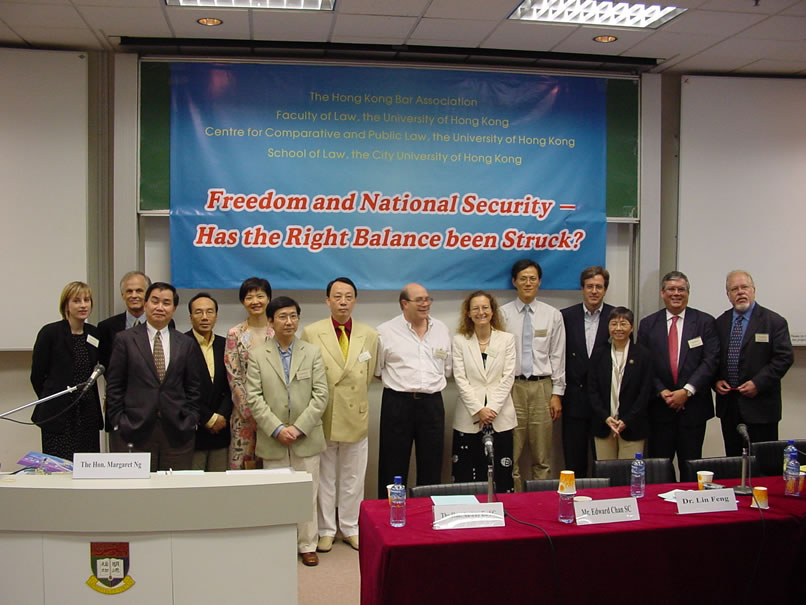

  • The Young Diplomat

    The Young Diplomat

    << Read all John Kamm Remembers stories

    A photograph of Beijing Prison and its personnel. Image credit: wdh.la

    In May 1992, a young Chinese Ministry of Foreign Affairs (MFA) official, Bai Weiji, and his wife Zhao Lei, were detained by China’s State Security police on suspicion of trafficking in state secrets. Two weeks later, police raided the apartment of Lena Sun, Beijing Bureau Chief of The Washington Post. They briefly detained Ms. Sun and her family and forced the American journalist to open the safe where she kept sensitive materials. In the safe they found internal documents that Bai Weiji had provided Ms. Sun.

    Lena Sun, who had written one of the first profiles on American businessman and recently turned human rights activist John Kamm, requested assistance from Kamm. Kamm began raising Bai and Zhao’s case with Chinese authorities, with whom he was regularly meeting in Beijing..

    In May, 1993, Bai was sentenced to 10 years in prison for trafficking in state secrets by the Beijing Intermediate People’s Court. His wife was given a six-year sentence. It is believed that one of the reasons that Bai was given such a lengthy sentence was that he had organized protests among MFA staff over the June 1989 suppression of pro-democracy demonstrations in Beijing.

    Kamm, in an interview with The New York Times Bureau Chief Nicholas Kristof, called the verdicts “very troubling” and “a serious disappointment.”

    Bai was sent to Beijing Prison, considered to be a model prison, where Bai was the only prisoner serving a sentence for counterrevolution. His English language skills were put to good use by the prison warden, who was seeking to find export markets for products made in prison workshops. Because he “expressed regret and a genuine willingness to reform,” and because he exhibited good behavior, Bai was granted three sentence reductions in 1996, 1997 and 1998 for a total reduction of three years and three months. He was released on February 2, 1999. His wife had been released early on October 20, 1997.

    After his release, Bai became a successful businessman. On a trip to the United States, he looked up John Kamm, who had moved with his family to San Francisco from Hong Kong in July 1995.

    Bai credited Kamm’s interventions for his early release, but brought up two other reasons he was shown clemency.

    In July 1996, Louis Joinet, chairman of the United Nations Working Group on Arbitrary Detention, visited China to begin preparations for a visit by the full working group the following year. One of the prisons he was allowed to visit was Beijing Prison.

    Upon arrival at the prison, Joinet asked to interview prisoners. His request was rejected. The director general of the MFA’s International Department, Li Baodong, rushed to the prison to resolve the stand-off. It was agreed that Joinet could interview a prisoner, and he was invited to select one at random. At that moment, Bai Weiji was walking in the prison yard, and Joinet chose him to be interviewed. Joinet had no idea who he was, but the prison officials became suspicious: how could it be that the prisoner selected to be interviewed was the only prisoner serving a sentence for counterrevolution?

    Bai played his role brilliantly. He declined to give any identifying information. He did not tell Joinet why he was in prison, nor did he say he was a former MFA official. He went to considerable length to commend the prison authorities for treating him so well. Although the interview was supposed to be held in a secure, confidential setting, Bai figured that the prison authorities were listening in. Shortly after the interview, Bai was granted his first sentence reduction.

    The second reason given to explain Bai’s clemency involves the July 1997 handover of Hong Kong from the United Kingdom to China. A city-wide competition to ascertain who knew the most about the handover was held among teams representing all of Beijing’s prisons. Bai, who was familiar with Hong Kong from his days working for MFA, was chosen to head the Beijing Prison team, which handily won the competition. Bai and his team members were rewarded with sentence reductions, but Bai noted, somewhat ruefully, that because he was serving a sentence for counterrevolution, he could only get half the number of points awarded to the other teammates.

    According to regulations, prisoners serving sentences for counterrevolution had to be “strictly handled” when it came to sentence reductions. The Bai Weiji case afforded Kamm one of his first opportunities to find out what these regulations meant in practice.


    Listen to the Encounters with China podcast.

    Subscribe to receive notifications about new episodes. 

    Read all John Kamm Remembers stories.

  • Kamm Visits a Chinese Prison

    Kamm Visits a Chinese Prison

    << Read all John Kamm Remembers stories

    Meizhou Prison’s front gate, in a 2015 photo. Image credit: On.cc

    Reflecting his background as president of the American Chamber of Commerce in Hong Kong in 1990, the early trips businessman John Kamm made to Beijing to engage Chinese officials on human rights were hosted by the Chinese Council for the Promotion of International Trade (CCPIT). It was with the assistance of the CCPIT that Kamm first met with China’s Prison Administration Bureau (PAB), under the Ministry of Justice (MOJ), on October 17, 1991.

    During that meeting, Kamm sat down with PAB Deputy Director Wang Mingdi and MOJ Foreign Affairs Department Deputy Director Zhang Yaochen to discuss the possibility of visiting one of the approximately 700 prisons under the control of the PAB in 1991.

    The MOJ told Kamm that while it was not prepared to allow the International Committee of the Red Cross (ICRC) to visit Chinese prisons, it welcomed foreign visitors to its 31 “model prisons” and had hosted more than 20,000 of these visitors since 1979.

    Opining that model prisons were unlikely to be representative of general prison conditions, Kamm asked the MOJ to consider allowing him to visit a prison that 1) had never been visited by a foreigner, 2) was not a model prison, 3) housed prisoners convicted of counterrevolutionary crimes (which are now mostly reclassified as endangering state security crimes), and 4) was located in a coastal region (coastal prisons were alleged to make goods for export).

    Wang said the ministry would consider his request and asked if Kamm had any prisons in mind. Kamm named Huaiji Prison in western Guangdong Province, following a tip from Hong Kong businessman Luo Haixing, who was previously incarcerated there, that it had a specialized cellblock for people who had committed counterrevolutionary crimes. Wang said he would pass along the request, making clear that China would decide which prisons to open to outsiders.

    The next day, on October 18, 1991, Kamm received a phone call inviting him to visit a prison that met all of his conditions: Meizhou Prison in northeastern Guangdong Province. He was told that no photography would be allowed during the visit.

    Kamm immediately returned to Hong Kong to put together as much information as he could on Guangdong’s counterrevolutionary prisoners and Meizhou Prison. Using reports issued by international human rights organizations, Kamm put together a list of 13 people convicted of counterrevolutionary crimes who might be in Meizhou.

    Armed with the list, Kamm took the train to Guangzhou on October 21 and flew to Meizhou on October 22. He was met at the airport by Guangdong’s Prison Administration Department Director Chen Weixiong and Meizhou Prison Warden Zhou Xiongxiang.

    The men repaired to a small room at the airport where Chen and Zhou gave Kamm a “brief introduction” to Meizhou Prison, and Kamm gave them his list.

    In late 1990, the Guangdong Prison Administration Department managed 20 prison and reform-through-labor brigades as well as several reeducation-through-labor camps. Only one facility was open to foreigners: the juvenile reformatory in Guangzhou. Generally speaking, prisons are used to house people with prison terms of 10 years or more, while detention centers run by public security bureaus house people awaiting trial as well as those sentenced to one or two years in prison who, because of the length of their sentences, are not transferred to prisons.

    In 1990, the largest prison in Guangdong Province was Shaoguan Prison in the north, housing 3,000 prisoners. Huaiji held 2-3,000 prisoners, while Meizhou was considered average size at 1,500 prisoners and 300 staff who lived and worked at the prison with their families. Eighty percent of Meizhou prisoners had been convicted of a violent crime in Meixian, Shantou, and Heyuan municipalities; 30 percent had been convicted of murder; 20 percent of economic crimes, like embezzlement and corruption. Only about 10 prisoners had been convicted of counterrevolutionary crimes, typically of spying for Taiwan. Meizhou did not house any people convicted for offenses committed during the 1989 June Fourth protests.

    Kamm and his hosts left Meizhou Airport and headed directly to the prison in the center of Meixian Municipality. Founded in 1951, Meizhou Prison was built on the site of a former Guomindang detention facility.

    They entered the prison complex from a bustling street through white gates with signboards that read “Meixian New Life Automotive Parts Factory.” Prisoners at Meizhou Prison manufactured wheel assemblies in three workshops. The officials insisted that none of the products, valued at RMB 5 million, were for export.

    In the outer courtyard Kamm was shown the family meeting rooms where prisoners were allowed once or twice a month, the mail room, a shop selling products for visiting relatives to give to prisoners, staff quarters, and the prison administration offices. On the western side of the courtyard were a car repair workshop and a plastic bottle workshop with two injection molding machines. Family members of prison staff ran the workshops.

    On the northern end of the outer courtyard was Meizhou Prison. Kamm passed through a large sliding gate and a separate entrance guarded by an armed sentry. The walls were 18-20 feet high and topped by electrified wires.

    At the end of a 200-meter walkway flanked by vegetable fields, a pigsty, and lumberyards filled with laboring prisoners, Kamm entered the cellblocks. There were 11 cellblocks, each housing 120-130 prisoners, who stood at attention during his visits. In each block, there were cells of 28-32 bed spaces. The cells were spartan, but it appeared that electric fans had recently been installed. Each block had a television that prisoners were allowed to watch three times a week and a common latrine and shower area.

    Kamm visited the prison kitchen, where he heard about the rations given to each prisoner. He then toured the clinic; a music room—where the prisoners played Jingle Bells on Chinese instruments for the duration of the visit; a library; and the prison school where classes were taught in politics, art, and mathematics. Pleasantries were exchanged with prisoners, who seemed amused by the first visiting foreigner to have set foot in the facility.

    In the courtyard between two cellblocks, Kamm watched a 10-minute exercise session. He asked to see the solitary confinement area, but his request was denied. At the time of his visit, one prisoner was in solitary for trying to escape.

    The warden said that torture was strictly prohibited, and guards who beat inmates were disciplined—in one instance, a guard was sentenced to prison.

    Every day the wardens of each cellblock graded prisoners on a 10-point scale. Those who received a year’s worth of 10-point scores were virtually guaranteed a sentence reduction. In line with national averages, 30 percent of prisoners received sentence reductions every year. Parole, approved by courts, also took place, and prisoners were allowed to petition courts for their cases to be reheard.

    In the workshops, Kamm observed rudimentary safety measures for tractor wheel assemblies. The environment resembled that of the scores of state-owned factories that he had visited in his business career: lots of idling, and low levels of efficiency.

    After the visit to the workshops, Director Chen Weixiong of the Guangdong Prison Administration Department gave Kamm information on five of the 13 prisoners he had asked about.

    Three individuals had spent time at Meizhou Prison: Mai Furen and Sun Ludian, pastors of the Shouters, an evangelical sect targeted in a nationwide campaign in late 1983, and Liu Shanqing (刘山青), a Hong Kong resident detained in December 1981 and sentenced to 10 years in prison for counterrevolutionary offenses. Mai, who was serving a 13-year sentence, was released to his family a few months before Kamm’s visit due to his advanced age. Sun, who was serving a nine-year sentence, was released on medical parole in December 1990. Liu had been transferred to Huaiji Prison in 1989 or 1990. Kamm asked that Liu be released and allowed to return to Hong Kong without serving his deprivation of political rights in China. He returned to Hong Kong on Christmas Day, 1991.

    Director Chen also gave Kamm information on two people who had not been incarcerated in Meizhou Prison. Chen Zhixiang (陈志祥) and Chen Pokong (陈破空) were sentenced for counterrevolutionary offenses committed during the spring 1989 protests in Guangzhou. Chen Zhixiang, a teacher sentenced to 10 years in prison, was in a detention center awaiting prison placement. He eventually went to Shaoguan Prison from which he was released more than three years early in 1995. Protest organizer Chen Pokong received a three-year sentence that he served in a public security detention center. He served nearly his entire sentence and was subsequently sentenced to re-education through labor for illegal border crossing.


    Listen to the Encounters with China podcast.

    Subscribe to receive notifications about new episodes. 

    Read all John Kamm Remembers stories.