Tag: arbitrary detention

  • Arbitrary Detention of Taiwanese in China

    Arbitrary Detention of Taiwanese in China

    The campaign headquarters of non-party legislator candidate Wang Xingzhi
    at the north entrance of Taiwan Railways Keelung Station in Keelung City
    Image credit:
    Solomon203
    /
    CC0 1.0 Universal

    On January 13, 2024, Lai Ching-te of the ruling Democratic Progressive Party (DPP) won Taiwan’s presidential election in a three-way race against two rivals who sought warmer ties with China. Reviled by Beijing for rejecting China’s sovereignty over Taiwan, the DPP will hold onto the presidency for an unprecedented third consecutive term following eight years under Tsai Ing-wen.
    Under Lai, Taiwan will face diplomatic isolation, trade coercion, and military threats from President Xi Jinping as China is expected to ramp up its pressure on the island by arbitrarily arresting more people from Taiwan on the Mainland.

    Taiwan began allowing its residents to visit the Mainland in 1987. According to The Straits Exchange Foundation, 594 Taiwanese went missing in China from 1991-2020. In 2019, Taiwan’s Mainland Affairs Council said that 149 Taiwanese had disappeared since 2016, the year when Tsai began her first term. While some of these people may have suffered accidents, been detained, or died, 67 cases were unaccounted for due to insufficient information or the Chinese government’s withholding of information. A number of them are believed to be held on political charges. Months after Tsai began her second term in 2020, China announced that its Thunder-2020 campaign had uncovered hundreds of cases orchestrated by Taiwan’s intelligence forces to “infiltrate and sabotage” and to set up a network of spies.

    One of the early cases Dui Hua worked on was that of Li Junmin (李俊敏), a Taiwan “spy” who was sentenced to death with reprieve for the now-defunct crime of counterrevolution. Li was granted early release in 2006 despite being once called “defiant and resistant to reform” by the Chinese government. This post examines the cases of seven Taiwanese arbitrarily detained in China, on charges of endangering state security, since the DPP took power in 2016. Two of the detainees have returned to Taiwan after completing their full prison sentences whereas the others remain in custody, either awaiting hefty jail terms or with their fate unclear.

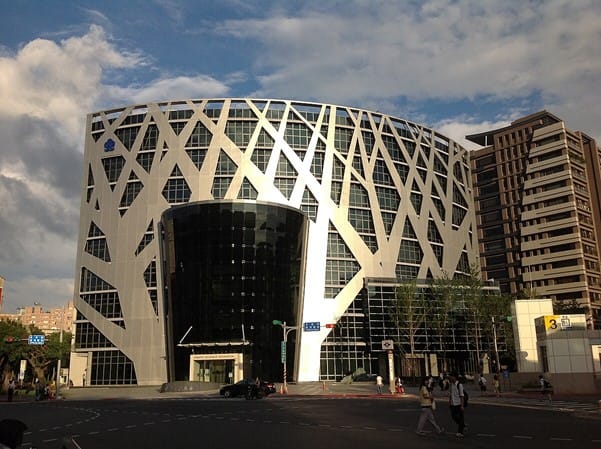
    The Straits Exchange Foundation’s headquarters in Dazhi, Taipei. Image
    credit:
    Meow, Wikimedia Commons /
    CC BY-SA 3.0

    Deprivation of Political Rights, Arbitrarily Applied

    China’s Criminal Law stipulates that deprivation of political rights (DPR) sentences be applied to individuals convicted of endangering state security and other serious crimes. People serving DPR sentences lose their rights to freedom of speech, press, assembly, association, procession, and demonstration. While foreign nationals are typically deported immediately upon completing their sentences, the situation remains murky for people from Taiwan, Hong Kong, and Macau.

    Lee Ming-che (李明哲) was among the first Taiwanese arbitrarily detained in China in 2017 when Tsai began her first term as president. Lee, a rights activist, community college administrator, and former member of the DPP, was convicted of subversion in the same year and sentenced to five years in prison with a supplemental two-year DPR sentence. His ordeal stemmed from group discussions he hosted on WeChat about Taiwan democracy. Additionally, he provided financial help to Chinese political prisoners and their families because their stories reminded him of Taiwan under martial law (1949-1987). When his sentence expired on April 14, 2022, he was allowed to return to Taiwan by plane the following day without having to serve his DPR sentence.

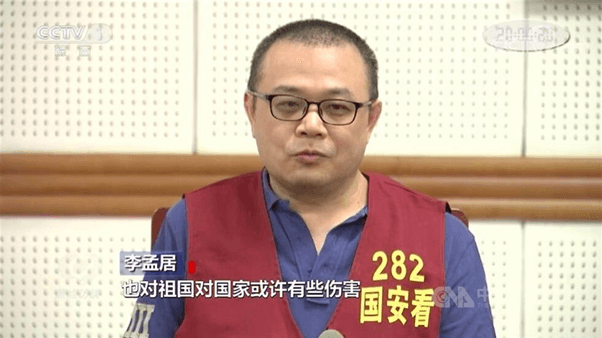
    Lee’s treatment is in stark contrast to that of another Taiwanese businessman, Lee Meng-chu (李孟居), who completed his 22-month prison sentence for “illegally trafficking in and gathering state secrets/intelligence for foreigners” on July 24, 2021. Lee Ming-chu had been banned from leaving China in order to serve his two years’ DPR sentence. Nonetheless, Lee was allowed to
    move around China and he used the opportunity to travel to more than 100 cities and meeting dissidents. When his DPR sentence ended on July 24, 2023, Lee left for Japan on the condition that he not return to Taiwan until after the 2024 presidential elections. However, after spending five weeks in Japan, Lee flew back to Taiwan.

    Lee gave confession in a national news program in October 2020. Image
    source:
    Focus Report, CCTV

    Lee Meng-chu was detained in Shenzhen in August 2019 at the height of the anti-extradition bill protests in Hong Kong for possessing a card that read “Go Hong Kong!” — at the time a common protest slogan — and snapping pictures from his hotel of armed police gathering nearby. These actions and their accompanying media coverage were deemed to be evidence of him acting as a “Taiwan independence activist” attempting to foment a color revolution in Hong Kong. Lee took the position that he was a political hostage because China was outraged over Tsai Ing-wen’s vocal support for the Hong Kong protesters. His case shows that Taiwanese prisoners can be subjected to exit bans when the Chinese authorities decide to make a political point amid escalating tensions.

    Still in Custody

    Yang Chih-yuan (杨智渊)

    While the two Lees have safely returned to Taiwan, more cases of arbitrary detention have emerged as cross-strait relations have worsened. On August 3, 2022, Yang Chih-yuan was detained in Wenzhou for splittism, the first case where a Taiwanese resident was charged with this crime. His detention came hours after Tsai Ing-wen met with then-US House of Representatives Speaker Nancy Pelosi. China called the visit a “provocation” and condemned the United States for “seriously infringing on China’s sovereignty.”

    A screenshot of Yang being detained by police in Wenzhou. Image credit:
    CCTV

    China’s state news media claimed that Yang was appointed as the head of the DPP youth league in Taichung and became a member of the splittist forces on the island. In 2019, he became the vice chairman of the now defunct Taiwan National Party, which advocated for “Taiwan independence” through a referendum. Also in 2019, he was allegedly invited by then-DPP president Chen Shui-bian to run for a seat in the island’s legislature, albeit unsuccessfully. Yang was similarly accused of colluding with splittist forces to support Hong Kong protesters amid the citywide civil unrest the same year.

    Li Yanhe (李延贺)

    On March 23, 2023, Taiwan-based publisher Li Yanhe was placed under residential surveillance at a designated location (RSDL) for inciting splittism in Shanghai. RSDL is a coercive measure condemned by the United Nations Special Procedures as a form of enforced and involuntary disappearance. Under RSDL, a suspect can be held for up to six months incommunicado while being denied legal counsel or family visits.

    Gusa Press publisher Li Yanhe. Image credit:
    CNA
    via Taiwan News

    Li was born in China but settled in Taiwan in 2009 after marrying a Taiwanese woman. He is the founder and editor-in-chief of Gusa Publishing, which is known for publishing books on history and politics that are critical of the Chinese Communist Party (CCP). Some critical titles focused on subjects like CCP corruption and infiltration of global media. In March 2023, he visited
    Shanghai to revoke his mainland residence registration and to visit relatives. He had applied for citizenship in Taiwan, but to do so he was required by Taiwan law to relinquish his mainland household registration.

    Cheng Yu-chin (郑宇钦)

    One day after China Central Television (CCTV) aired the confession of Lee Meng-chu in October 2020, Cheng Yu-chin appeared in another televised confession in which he admitted to using his academic post in the Czech Republic to carry out espionage against China. State news media sources accused Cheng of infiltrating Chinese mainland organizations in Europe and damaging China’s diplomatic ties with other countries. Cheng was placed under criminal detention in Zhengzhou, Fujian, for espionage in April 2019. On April 15, 2024, China’s National Security Education Day, the Ministry of State Security reported that Cheng had been sentenced to seven years’ imprisonment. He has two more years to serve before completing his sentence in April 2026.

    Cheng claimed to be a member of the DPP and to have worked as an assistant to former DPP chairman Cho Jung-tai, but Cho rejected this claim and denied that he knew Cheng. Taiwan senior officials also came forward to rebuke false claims about Cheng’s case, adding that a Taiwanese associate said to have worked with Cheng did not even exist. Taiwan’s Mainland Affairs Council blamed Beijing for making up the spy case. A Taiwanese professor familiar with Cheng also expressed disbelief that Cheng was a spy because Cheng had set up a company to help Chinese students gain admission to post-graduate programs in the Czech Republic. He had worked to promote China’s Belt and Road Initiative during his stay in Europe.

    Chen Shu-kai (陈树楷)

    Dui Hua’s research discovered the case of Chen Shu-kai, who was detained for espionage in January 2017 and sentenced to 12 years and six months’ imprisonment with three years’ DPR in August 2020 in Xiamen. Chen was the chairman of the board of Bioil International Limited (Taiwan). While an official document stated that he received NTD700,000 from the Taiwan Military Intelligence Bureau to obtain 29 classified documents in China, Dui Hua could not find other sources to verify this official account in order to determine whether this is one of the many cases of arbitrary detention in China. He is currently incarcerated in a prison in Fujian. In 2023, the prison recommended a sentence reduction of four months be granted to Chen because he had demonstrated remorse. The sentence reduction, if approved, would shorten his release date to February 2029.

    Pan-Blue Camp Also Targeted

    In Taiwan, pan-blue refers to a political stance espoused by Kuomintang (KMT) supporters who favor a dual Taiwanese Chinese identity as well as friendly relations with China. However, people subscribing to the pan-blue view can still face arrest in China on charges of endangering state security. At least two pan-blue academics from Taiwan have been imprisoned in China in recent
    years.

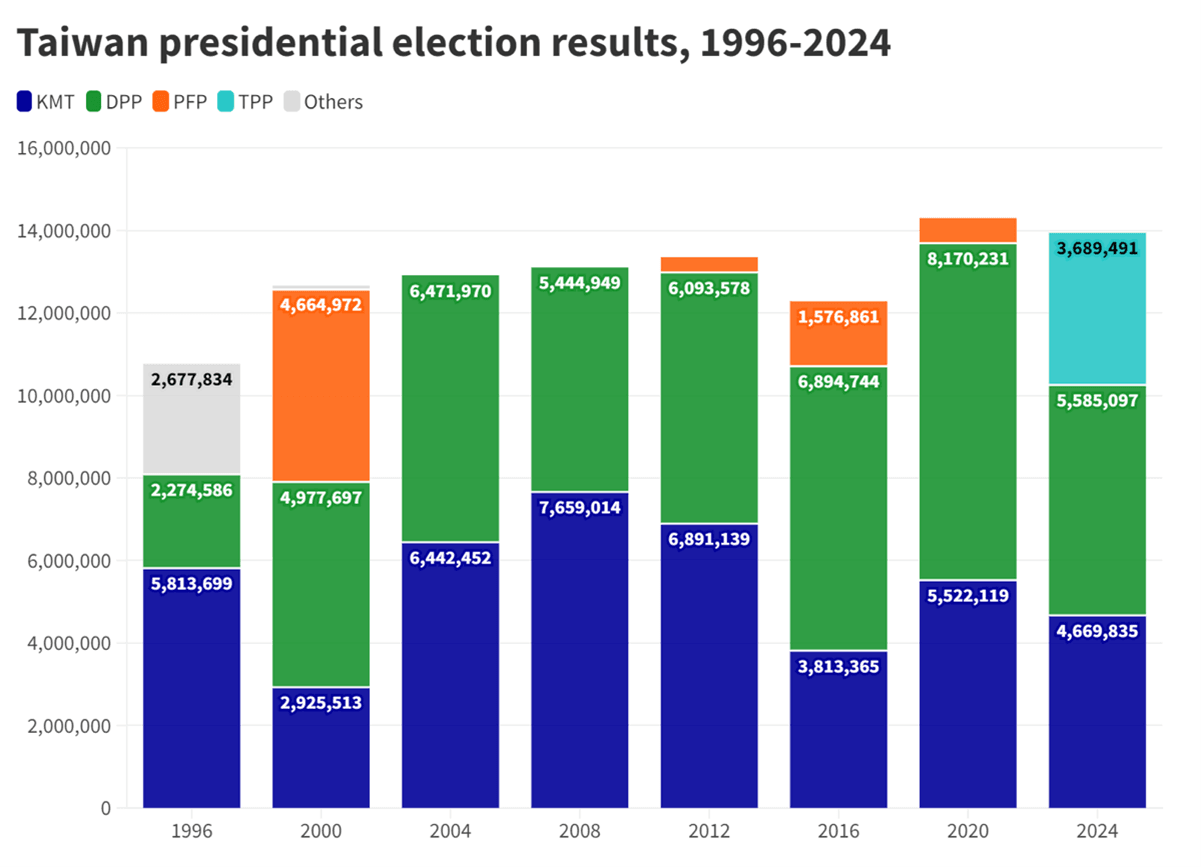
    Results from presidential elections for the past eight Taiwanese
    elections, showing changes in support for the Pan-Blue KMT and the DPP.
    Image credit:
    Emanuelamianstrolski
    /
    CC BY 4.0

    Shih Cheng-ping (施正屏) is a retired professor at National Taiwan Normal University. Shih wrote op-eds critical of Tsai Ing-wen in the Taiwanese press. In August 2022, he completed his four-year sentence for espionage in Anhui. It is not known whether Shih has returned to Taiwan or is obliged to stay in China to serve his two-year DPR sentence, which will end in August 2024.

    Shih disappeared after traveling to China in August 2018. His case came to light 15 months after his disappearance, when he appeared in a CCTV television program in October 2020 confessing to spying for Taiwan. In the recording, he admitted to passing information to Taiwan authorities from a mainland think tank in exchange for money. As with many other televised confessions, his was aired before he was found guilty by the court. This practice has been condemned by human rights groups as forced confessions under duress.

    Pro-unification Taiwanese scholar Tsai Chin-shu (蔡金树) was convicted of Taiwanese espionage in July 2020, Tsai is a KMT member and has worked in multiple capacities to promote cross-strait exchanges. He served as director of the Kaohsiung Cross-Strait Exchanges Research Association and chaired the Southern Taiwan Union of Cross-Strait Relations Associations, which advocated for the Ma Ying-jeou administration’s policies of forging ties with China.

    On January 13, 2024, Taiwan Democratic Progressive Party supporters
    watching the election results. Image credit: Cypp0847 / CC BY-SA 4.0

    He was released from a prison in Fujian in May 2022. Like Lee Meng-chu, Tsai has been barred from returning to Taiwan because of the four-year DPR sentence that was imposed on him. In June 2023, Taiwanese news media sources reported that Tsai was placed under house arrest in Gulangyu Island of Xiamen.

    China has a track record of making politically motivated arrests that observers call “hostage diplomacy.” Since the DPP won the 2016 presidential election, China and Taiwan have exchanged fiery rhetoric and denounced each other as threats to national security and social stability. Days after the DPP won the 2024 presidential election, China’s Ministry of State Security claimed it would intensify efforts to crack down on “subversion, espionage and splittist struggles” related to Taiwan. In June, judicial bodies and Ministry of State Security jointly issued a 22-point legal opinion against “Taiwan splittism” which threatens “trial in absentia” or even to impose the death penalty for “diehard” Taiwan independence splittists in extreme cases, and in August the Taiwan Affairs Office of the State Council added 10 Taiwanese to the list of die-hard splittists (nearly all are members of the DPP). At the time of writing, Taiwanese officials have confirmed to the media that 15 Taiwanese residents are currently held in China for various crimes, “including violations of the anti-secession law.” As cross-strait tensions escalate, more cases of arbitrary detention are likely to emerge, leaving citizens to pay the price for geopolitical hostility.

  • Arbitrary Detention of Taiwanese in China

    Arbitrary Detention of Taiwanese in China

    The campaign headquarters of non-party legislator candidate Wang Xingzhi
    at the north entrance of Taiwan Railways Keelung Station in Keelung City
    Image credit:
    Solomon203
    /
    CC0 1.0 Universal

    On January 13, 2024, Lai Ching-te of the ruling Democratic Progressive Party
    (DPP) won Taiwan’s presidential election in a three-way race against two
    rivals who sought warmer ties with China. Reviled by Beijing for rejecting
    China’s sovereignty over Taiwan, the DPP will hold onto the presidency for an
    unprecedented third consecutive term following eight years under Tsai Ing-wen.
    Under Lai, Taiwan will face diplomatic isolation, trade coercion, and military
    threats from President Xi Jinping as China is expected to ramp up its pressure
    on the island by arbitrarily arresting more people from Taiwan on the
    Mainland.

    Taiwan began allowing its residents to visit the Mainland in 1987. According
    to
    The Straits Exchange Foundation, 594 Taiwanese went missing in China from 1991-2020. In 2019,
    Taiwan’s Mainland Affairs Council
    said that 149 Taiwanese had disappeared since 2016, the year when Tsai began
    her first term. While some of these people may have suffered accidents, been
    detained, or died, 67 cases were unaccounted for due to insufficient
    information or the Chinese government’s withholding of information. A number
    of them are believed to be held on political charges. Months after Tsai began
    her second term in 2020, China announced that its
    Thunder-2020 campaign
    had uncovered hundreds of cases orchestrated by Taiwan’s intelligence forces
    to “infiltrate and sabotage” and to set up a network of spies.

    One of the early cases Dui Hua worked on was that of Li Junmin (李俊敏),
    a Taiwan “spy”
    who was sentenced to death with reprieve for the now-defunct crime of
    counterrevolution. Li was granted early release in 2006 despite being once
    called “defiant and resistant to reform” by the Chinese government.

    This post examines the cases of seven Taiwanese arbitrarily detained in China,
    on charges of endangering state security, since the DPP took power in 2016.
    Two of the detainees have returned to Taiwan after completing their full
    prison sentences whereas the others remain in custody, either awaiting hefty
    jail terms or with their fate unclear.

    The Straits Exchange Foundation’s headquarters in Dazhi, Taipei. Image
    credit:
    Meow, Wikimedia Commons /
    CC BY-SA 3.0

    Deprivation of Political Rights, Arbitrarily Applied

    China’s Criminal Law stipulates that deprivation of political rights (DPR)
    sentences be applied to individuals convicted of endangering state security
    and other serious crimes. People serving DPR sentences lose their rights to
    freedom of speech, press, assembly, association, procession, and
    demonstration. While foreign nationals are typically deported immediately upon
    completing their sentences, the situation remains murky for people from
    Taiwan, Hong Kong, and Macau.

    Lee Ming-che (李明哲) was among the first Taiwanese arbitrarily
    detained in China in 2017 when Tsai began her first term as president. Lee, a
    rights activist, community college administrator, and former member of the
    DPP, was convicted of subversion in the same year and sentenced to five years
    in prison with a supplemental two-year DPR sentence. His ordeal stemmed from
    group discussions he hosted on WeChat about Taiwan democracy. Additionally, he
    provided financial help to Chinese political prisoners and their families
    because their stories reminded him of Taiwan under martial law (1949-1987).
    When his sentence expired on April 14, 2022, he was allowed to return to
    Taiwan by plane the following day without having to serve his DPR sentence.

    Lee’s treatment is in stark contrast to that of another Taiwanese businessman,
    Lee Meng-chu (李孟居), who completed his 22-month prison sentence for
    “illegally trafficking in and gathering state secrets/intelligence for
    foreigners” on July 24, 2021. Lee Ming-chu had been banned from leaving China
    in order to serve his two years’ DPR sentence. Nonetheless, Lee was allowed to
    move around China and he used the opportunity to travel to more than 100
    cities and meeting dissidents. When his DPR sentence ended on July 24, 2023,
    Lee left for Japan on the condition that he not return to Taiwan until after
    the 2024 presidential elections. However, after spending five weeks in Japan,
    Lee flew back to Taiwan.

    Lee gave confession in a national news program in October 2020. Image
    source:
    Focus Report, CCTV

    Lee Meng-chu was detained in Shenzhen in August 2019 at the height of the
    anti-extradition bill protests in Hong Kong for possessing a card that read
    “Go Hong Kong!” — at the time a common protest slogan — and snapping pictures
    from his hotel of armed police gathering nearby. These actions and their
    accompanying media coverage were deemed to be evidence of him acting as a
    “Taiwan independence activist” attempting to foment a color revolution in Hong
    Kong. Lee took the position that he was a political hostage because China was
    outraged over Tsai Ing-wen’s vocal support for the Hong Kong protesters. His
    case shows that Taiwanese prisoners can be subjected to exit bans when the
    Chinese authorities decide to make a political point amid escalating tensions.

    Still in Custody

    Yang Chih-yuan (杨智渊)

    While the two Lees have safely returned to Taiwan, more cases of arbitrary
    detention have emerged as cross-strait relations have worsened. On August 3,
    2022,
    Yang Chih-yuan
    was detained in Wenzhou for splittism, the first case where a Taiwanese
    resident was charged with this crime. His detention came hours after Tsai
    Ing-wen met with then-US House of Representatives Speaker Nancy Pelosi. China
    called the visit a “provocation” and condemned the United States for
    “seriously infringing on China’s sovereignty.”

    A screenshot of Yang being detained by police in Wenzhou. Image credit:
    CCTV

    China’s state news media claimed that Yang was appointed as the head of the
    DPP youth league in Taichung and became a member of the splittist forces on
    the island. In 2019, he became the vice chairman of the now defunct
    Taiwan National Party, which advocated for “Taiwan independence” through a referendum. Also in
    2019, he was allegedly invited by then-DPP president Chen Shui-bian to run for
    a seat in the island’s legislature, albeit unsuccessfully. Yang was similarly
    accused of colluding with splittist forces to support Hong Kong protesters
    amid the citywide civil unrest the same year.

    Li Yanhe (李延贺)

    On March 23, 2023, Taiwan-based publisher Li Yanhe was placed under
    residential surveillance at a designated location (RSDL) for inciting
    splittism in Shanghai. RSDL is
    a coercive measure condemned by the United Nations Special Procedures
    as a form of enforced and involuntary disappearance. Under RSDL, a suspect can
    be held for up to six months incommunicado while being denied legal counsel or
    family visits.

    Gusa Press publisher Li Yanhe. Image credit:
    CNA
    via Taiwan News

    Li was born in China but settled in Taiwan in 2009 after marrying a Taiwanese
    woman. He is the founder and editor-in-chief of Gusa Publishing, which is
    known for publishing books on history and politics that are critical of the
    Chinese Communist Party (CCP). Some critical titles focused on subjects like
    CCP corruption and infiltration of global media. In March 2023, he visited
    Shanghai to revoke his mainland residence registration and to visit relatives.
    He had applied for citizenship in Taiwan, but to do so he was required by
    Taiwan law to relinquish his mainland household registration.

    Cheng Yu-chin (郑宇钦)

    One day after China Central Television (CCTV) aired the confession of Lee
    Meng-chu in October 2020, Cheng Yu-chin appeared in another televised
    confession in which he admitted to using his academic post in the Czech
    Republic to carry out espionage against China.
    State news media sources
    accused Cheng of infiltrating Chinese mainland organizations in Europe and
    damaging China’s diplomatic ties with other countries. Cheng was placed under
    criminal detention in Zhengzhou, Fujian, for espionage in April 2019. On April
    15, 2024, China’s National Security Education Day, the
    Ministry of State Security
    reported that Cheng had been sentenced to seven years’ imprisonment. He has
    two more years to serve before completing his sentence in April 2026.

    Cheng claimed to be a member of the DPP and to have worked as an assistant to
    former DPP chairman Cho Jung-tai, but Cho rejected this claim and denied that
    he knew Cheng. Taiwan senior officials also came forward to rebuke false
    claims about Cheng’s case, adding that a Taiwanese associate said to have
    worked with Cheng did not even exist. Taiwan’s Mainland Affairs Council blamed
    Beijing for making up the spy case. A Taiwanese professor familiar with Cheng
    also
    expressed disbelief
    that Cheng was a spy because Cheng had set up a company to help Chinese
    students gain admission to post-graduate programs in the Czech Republic. He
    had worked to promote China’s Belt and Road Initiative during his stay in
    Europe.

    Chen Shu-kai (陈树楷)

    Dui Hua’s research discovered the case of
    Chen Shu-kai, who was detained for espionage in January 2017 and sentenced to 12 years
    and six months’ imprisonment with three years’ DPR in August 2020 in Xiamen.
    Chen was the chairman of the board of Bioil International Limited (Taiwan).
    While an official document stated that he received NTD700,000 from the Taiwan
    Military Intelligence Bureau to obtain 29 classified documents in China, Dui
    Hua could not find other sources to verify this official account in order to
    determine whether this is one of the many cases of arbitrary detention in
    China. He is currently incarcerated in a prison in Fujian. In 2023, the prison
    recommended a sentence reduction of four months be granted to Chen because he
    had demonstrated remorse. The sentence reduction, if approved, would shorten
    his release date to February 2029.

    Pan-Blue Camp Also Targeted

    In Taiwan, pan-blue refers to a political stance espoused by Kuomintang (KMT)
    supporters who favor a dual Taiwanese Chinese identity as well as friendly
    relations with China. However, people subscribing to the pan-blue view can
    still face arrest in China on charges of endangering state security. At least
    two pan-blue academics from Taiwan have been imprisoned in China in recent
    years.

    Results from presidential elections for the past eight Taiwanese
    elections, showing changes in support for the Pan-Blue KMT and the DPP.
    Image credit:
    Emanuelamianstrolski
    /
    CC BY 4.0

    Shih Cheng-ping (施正屏) is a retired professor at National Taiwan Normal
    University. Shih wrote op-eds critical of Tsai Ing-wen in the Taiwanese press.
    In August 2022, he completed his four-year sentence for espionage in Anhui. It
    is not known whether Shih has returned to Taiwan or is obliged to stay in
    China to serve his two-year DPR sentence, which will end in August 2024.

    Shih disappeared after traveling to China in August 2018. His case came to
    light 15 months after his disappearance, when he appeared in a CCTV television
    program in October 2020 confessing to spying for Taiwan. In the recording, he
    admitted to passing information to Taiwan authorities from a mainland think
    tank in exchange for money. As with many other televised confessions, his was
    aired before he was found guilty by the court. This practice has been
    condemned by human rights groups as forced confessions under duress.

    Pro-unification Taiwanese scholar Tsai Chin-shu (蔡金树) was convicted of
    Taiwanese espionage in July 2020, Tsai is a KMT member and has worked in
    multiple capacities to promote cross-strait exchanges. He served as director
    of the Kaohsiung Cross-Strait Exchanges Research Association and chaired the
    Southern Taiwan Union of Cross-Strait Relations Associations, which advocated
    for the Ma Ying-jeou administration’s policies of forging ties with China.

    On January 13, 2024, Taiwan Democratic Progressive Party supporters
    watching the election results. Image credit: Cypp0847 / CC BY-SA 4.0

    He was released from a prison in Fujian in May 2022. Like Lee Meng-chu, Tsai
    has been barred from returning to Taiwan because of the four-year DPR sentence
    that was imposed on him. In June 2023, Taiwanese news media sources reported
    that Tsai was placed under house arrest in Gulangyu Island of Xiamen.

    China has a track record of making politically motivated arrests that
    observers call “hostage diplomacy.” Since the DPP won the 2016 presidential
    election, China and Taiwan have exchanged fiery rhetoric and denounced each
    other as threats to national security and social stability. Days after the DPP
    won the 2024 presidential election, China’s Ministry of State Security claimed
    it
    would intensify efforts
    to crack down on “subversion, espionage and splittist struggles” related to
    Taiwan. In June, judicial bodies and Ministry of State Security jointly issued
    a 22-point legal opinion against “Taiwan splittism” which threatens “trial in
    absentia” or even to
    impose the death penalty
    for “diehard” Taiwan independence splittists in extreme cases, and in August
    the Taiwan Affairs Office of the State Council added 10 Taiwanese to the
    list of die-hard splittists
    (nearly all are members of the DPP). At the time of writing, Taiwanese
    officials have confirmed to the media that
    15 Taiwanese residents
    are currently held in China for various crimes, “including violations of the
    anti-secession law.” As cross-strait tensions escalate, more cases of
    arbitrary detention are likely to emerge, leaving citizens to pay the price
    for geopolitical hostility.
  • Hurry Up and Wait: The Robert Schellenberg Case

    Robert Schellenberg, Dalian Intermediate Court, Jan 14, 2019. Image Credit: cdn.hk01.com
    As US-China relations sink ever lower, the list of urgent criminal cases involving Western citizens in China has increased. In just the last few weeks Canadians Michael Kovrig and Michael Spavor were formally arrested on espionage charges and American Mark Swidan was given a suspended death sentence for drug trafficking.

    Amid so many arrests and sentences, a May 9 appeal hearing in the case of Robert Schellenberg, a Canadian sentenced to death for drug trafficking, went largely unnoticed. Although Schellenberg’s appeal hearing concluded without pronouncement of a sentence, the timing of the hearing—the day after a hearing in Vancouver for Huawei CFO Meng Wanzhou—points to the continuing role of international politics in the outcome of his case.

    Schellenberg’s case is part of a larger emerging dynamic of tit-for-tat detention diplomacy, but it is also unique because it is both overtly political and carries a death sentence. No other case is so inextricably bound up with that of a Chinese national being held in the West. Schellenberg’s fate has unfolded in parallel to that of Meng, a Chinese citizen who is currently detained in Canada pending extradition to the United States. After her detention Chinese state media representatives ominously warned there would be retaliation. Schellenberg’s sudden, unusual retrial and capital sentence followed shortly thereafter, leading many to conclude that it is Canada, as well as Schellenberg, that is being punished in this case. The fact that Schellenberg’s most recent hearing in Dalian took place the day after Meng appeared in court in Vancouver suggests that the two cases remain linked. As Huawei has moved to the center of a global struggle over China’s role in technology markets in the last few weeks, the political stakes in the two cases have increased as well.

    Mark Swidan with his mother, Katherine Swidan, in 1991.
    Image Credit: Katherine Swidan
    Schellenberg’s case stands out not just because it is one of a prominent set of political cases involving foreigners, but also because it is the only overtly political verdict carrying a sentence likely to result in death. (Swidan, an American detained on drug charges in 2012, received a suspended death sentence on April 30, which, in accordance with Article 50 of the Criminal Law, will be reduced to a prison sentence so long as he does not commit a new crime in the next two years). Western citizens have been executed in China before, but such cases typically become international causes of concern because of China’s use of capital punishment in general, rather than doubts about the intention behind the ruling. For example, another Canadian citizen, Fan Wei, was also recently sentenced to death for drug trafficking, but so far there have been no accusations that his sentence was intended to punish Canada; in Schellenberg’s case, by contrast, it seems that the death sentence is politically motivated. While Chinese authorities insist that the punishment conforms to the rule of law, state spokespeople have also provided not-so-subtle indications that the death sentence should be understood as retaliation for Meng’s detention. Canadian Prime Minister Justin Trudeau has accused China of “arbitrarily” applying the death penalty in the case. For better or worse, Schellenberg stands out as the capital test case in a new dynamic that one legal commentator has dubbed “death-threat diplomacy.”

    What has happened in the case to date, and what might we expect in the future? So far, the case has unfolded in two phases. In the first phase, which stretched from arrest in 2014 to an initial sentence of 15 years in November 2018, the case was not overtly political, and the judicial process was slow and low-profile, perhaps because the evidence against Schellenberg was weak and central authorities were called in to deliberate. In the second phase of the case, which began with an appeal court remand for retrial immediately following Meng’s detention in December 2018, the case took on a new political valence. The judicial process was fast and well-publicized. The court operated with perverse procedural formalism, meeting legal deadlines and adhering to the letter, if not the spirit, of the Criminal Procedure Law.

    Following the hearing this month it is likely that the pace of proceedings will again slow to a crawl. Formal deadlines for the next legal phases of the case are minimal. The Liaoning High People’s Court may draw out announcement of the sentence. If the appeals court does come down with a death sentence, the case will be sent to the Supreme People’s Court (SPC) for final review. There are no procedural deadlines in that process; the judiciary can hold up the case indefinitely, or wait until an opportune political moment in the Meng case to announce a decision.

    The Background of the Schellenberg Case

    Robert Schellenberg, a Canadian citizen, was arrested in the city of Dalian in 2014. (According to Canadian officials, nearly 200 Canadians are currently detained or imprisoned in China.) He stood accused of participating in a scheme to smuggle about 500 pounds of methamphetamine from China to Australia inside car tires. He was tried in 2016. In November 2018, two years after his trial, Schellenberg and his co-defendants were sentenced by the Dalian Intermediate People’s Court. He was found guilty of drug smuggling and sentenced to 15 years in prison, along with a hefty fine and expulsion from China following completion of the prison term. No one involved in the case was initially sentenced to execution, though two of Schellenberg’s co-defendants—both Chinese nationals—were given stiffer sentences: a suspended death sentence and an indeterminate life sentence (wuqi tuxing 无期徒刑). (In contrast to the U.S. parole system, China’s sentence reduction policy entails the reduction of sentences based on a system of points for good behavior, and generally means that prisoners with indeterminate life sentences are not usually imprisoned until death). The harsher punishments for the co-defendants reflect the court’s initial judgment that Schellenberg did not carry principal culpability in the case.

    Dalian Intermediate People’s Court. Image Credit: chinaplus.cri.com

    Following the initial verdict Schellenberg appealed his sentence, indicating he considered the punishment too severe. If a defendant appeals a verdict, a second-instance court may not increase the sentence on review. The prosecution may also choose to appeal a sentence in order to increase the punishment, but they did not do so, suggesting they considered the penalty appropriate at the time.

    Typically defendants face no risk in filing an appeal, but the Liaoning High People’s Court took an unusual approach to the case: rather than rule on it, the high court returned the case to the lower court for retrial. The retrial gave prosecutors the power to amend the charges and seek a harsher sentence, something the appeal court could not do. Prosecutors quickly amended the charges, ostensibly introducing new evidence that increased Schellenberg’s culpability. (Schellenberg’s lawyer claims no new evidence was introduced.) The lower court retried the case in January 2019 and sentenced Schellenberg to death, a significant increase in punishment from the previous trial verdict. Schellenberg appealed his verdict to the Liaoning People’s High Court a second time. On May 9, 2019—days before the four month procedural deadline for a hearing—the appeal court heard the case. However, the court declined to issue a judgment, indicating it would do so at an unspecified later date.

    Liaoning Province High People’s Court. Image Credit: Zhonglan Xinwen

    A Tale of Two Cases

    What sentence should Schellenberg receive? A defendant’s criminal culpability and punishment ought to be determined in light of his or her own crimes. But whatever chance Robert Schellenberg may have once had of having his case interpreted in isolation ended last year. Today his case is indelibly wedded to another defendant: Meng Wanzhou, the CFO of Huawei, the world’s second largest cellphone manufacturer and one of China’s flagship companies.

    Meng Wanzhou, Huawei CFO. Image Credit: Mingbao

    In December 2018 Meng was arrested in Vancouver during a layover flight between Hong Kong and Mexico. Canadian officials arrested Meng based on a warrant issued by the United States Eastern District of New York, which named Meng as part of an alleged conspiracy violating sanctions with Iran. Meng is currently free on bail in Vancouver. The United States has requested that Meng be extradited to the U.S.

    Meng’s arrest precipitated a diplomatic crisis in China-Canada relations. China has demanded Meng’s immediate release, alleging that the arrest is part of a Western effort to obstruct Huawei’s entry into Western markets. A representative of China’s Ministry of Foreign Affairs stated that Canada would face “grave consequences” over Meng’s continued detention. Immediately after Meng’s arrest in December, China detained two Canadians, Michael Spavor and Michael Kovrig, on accusations of endangering state security. Shortly thereafter the editor in chief of state media outlet the Global Times made a statement in English that “if Canada extradites Meng to the U.S., China’s revenge will be far worse than detaining a Canadian.”

    It is in this context that Chinese and Western commentators interpret Schellenberg’s situation. When Schellenberg appealed his 15-year sentence in November 2018—just before Meng’s arrest—he had every reason to think that the re-consideration of his case at a trial of the second instance could only work in his favor. A defendant who appeals a verdict is not supposed to face a more severe sentence on retrial. And the prosecution did not file an appeal raising concerns about the severity of the sentence.

    But circumstances changed between Schellenberg’s appeal in November 2018 and the Liaoning High People’s Court review in December. Meng’s case became an international flashpoint and China vowed to respond. The Liaoning High People’s Court took the unusual step of inviting foreign media to the second-instance trial. Western journalists who were present noted the ways in which the event appeared staged to send signals to the audience. Rather than reach a verdict on the case, the court took the unorthodox step of sending the case back to the lower court.

    The remand to the lower court allowed the prosecution to amend the charges against Schellenberg, claiming new evidence in the case. This procedural move provided the trial court with a legal justification for resentencing Schellenberg to death. Numerous Chinese legal experts have noted irregularities in these proceedings. It is striking, for example, that although it took four years to initially sentence Schellenberg to a 15-year sentence, the justice system managed to re-sentence him to death in less than a month. His lawyers also contend the amended indictment in fact does not provide any new evidence of Schellenberg’s culpability.

    What Are We Waiting For?

    What comes next? Schellenberg’s case has so far proceeded in two phases with very different timelines. In the first phase, which ran from arrest in 2014 through Schellenberg’s initial sentence of 15 years in November 2018, there were no public announcements indicating the case carried political significance. The court moved extremely slowly, taking four years to deliver the initial sentence. Four years is an unusually long stretch for a criminal case in China. In waiting so long to produce a verdict, the Dalian trial court surely consulted higher authorities on the appropriate course of action. Why did this process take so long? The protracted wait might be the result of weak evidence in the case. Since China’s trials virtually never produce acquittals (as Dui Hua has recently noted), cases with shaky facts are likely to be sent to an adjudication committee for deliberation on appropriate sentencing. When a case involves a foreigner, the considerations may take even longer.

    The second phase of the began after Schellenberg appealed his 15-year sentence in November 2018. In contrast to the first phase of the case, the second phase was fast, high-profile, and politically fraught. Following Meng’s arrest on December 1, 2018, Schellenberg’s case went through second instance trial and retrial of the first instance in six weeks. The second instance trial court announced its decision the day of the trial, rather than deliberating on the evidence, as usually takes place. And after the high court remanded the case for retrial, prosecutors amended the complaint with new evidence in a mere four days. The lightning speed of proceedings and state media comments about retaliation for Meng send signals about how Schellenberg’s death sentence should be interpreted. And yet Chinese authorities and media figures also strenuously insist that the court’s judgment was “beyond reproach” and rooted in the rule of law. China’s insistence on adherence to criminal procedure in the case fits with a general trend towards legal formalism in China, despite a larger turn away from rule of law. (China’s recent Supervision Law, for example, introduces a formal legal basis for the longstanding unaccountable, extrajudicial detention powers of the National Supervisory Committee, the Chinese Communist Party watchdog.).

    We are now entering a third phase in the Schellenberg case, one in which Schellenberg’s fate hangs like a sword of Damocles over Canada. A cynical reading of the situation suggests that Schellenberg must continue to dangle there until Meng has either been extradited to the U.S. or returned to China. Meng’s most recent hearing took place on May 8. Schellenberg’s appeal hearing notably took place the following day. The timing of Schellenberg’s hearing carried a two-fold significance. The court heard the case within four months of accepting it, as required by law. But in doing so the day after Meng’s hearing, the court also pointed to the ongoing connection between the two defendants (a signal that did not, however, get much Western media coverage).

    When will the Liaoning High People’s Court issue a sentence for Schellenberg? The Criminal Procedure Law indicates that the court may announce the sentence at a set time after the hearing, but does not stipulate any procedural constraints on that announcement (Articles 202 and 242). Indeed, Mark Swidan waited more than half a decade for announcement of a verdict following conclusion of his trial.

    Although the court may delay indefinitely, Schellenberg’s procedural experience suggests that a verdict may be announced as a response to a development in Meng’s case. She is scheduled to next appear in court for an extradition hearing on September 23, so a sentence may be forthcoming at that time. If the high court upholds Schellenberg’s death sentence, the case will be sent to the Supreme People’s Court (SPC) for final review. There is no fixed statutory period for completion of this review. Although limited data suggests that many death penalty reviews are completed in a matter of months, anecdotal evidence also indicates that some cases are under review for years. Overall, however, the outcome is extremely consistent: the SPC eventually affirms the overwhelming majority of death sentences, although precise data on this is lacking. In 2007, around 15% of death sentences were not approved, but the percentage is believed to be lower now.

    Once the SPC affirms the verdict, an execution order is issued and the execution usually takes place as soon as within a week, although there are exceptions: Li Yan, a woman from Sichuan, was sentenced to death for killing her husband in 2010 in self-defense, after enduring years of horrific domestic abuse at his hands, by each court that heard the case (local city/intermediate, provincial Sichuan High People’s Court, and finally, in January 2013, the SPC.) The case provoked broad condemnation and expressions of concern both inside and outside China, including by the Dui Hua Foundation. China’s 2016 anti-domestic violence law was invoked in wide-spread calls to take seriously the situation of domestically abused Chinese women who receive harsh sentences ranging from ten years to death sentences when they act in self-defense. On April 24, 2015, Li Yan’s death sentence was commuted to death with two years reprieve, and on September 8, 2017, the intermediate court commuted the 2015 sentence and sentenced Li Yan to life in prison.

    Post settings Labels Criminal Justice, Law Enforcement Published on 5/30/19, 12:13 PM Pacific Daylight Time Permalink Location Options

  • Complaints with Retribution: China’s Muffling of Gaoyangzhuang

    Hong Kong-based pro-Beijing newspaper Wen Wei Po accuses democratic legislators and organizers of Occupy Central, including Joshua Wong, of making complaints overseas about internal affairs of China and Hong Kong. Photo credit: Wen Wei Po
    China celebrates National Youth Day every year on May 4th, a holiday commemorating the patriotic May Fourth Movement in 1919. On this day exactly a century ago, thousands of university students assembled at Beijing’s Tiananmen Square, urging the Chinese delegation at the Paris Peace Conference not to sign the Versailles Treaty because the Allied Powers had conceded to Japan’s demand to take over the German concessions in Shandong. The procession proceeded to foreign embassies in the Legation Quarter to demand nullification of special foreign privileges, such as extraterritoriality. This was a privilege by which China was forced to yield control of sovereign powers, one of many losses as part of a series of “unequal treaties” in force since the First Opium War. Student protesters hoped that the United States would side with China over the “Shandong question,” because the U.S. was a key proponent of national self-determination and the U.S. embassy was the only foreign embassy willing to meet with their representatives and accept their petition.
    A century later, the patriotic act of petitioning westerners known as gaoyangzhuang (告洋状) carries a negative connotation. Petitioning refers to the administrative system for receiving complaints from people with grievances, mostly concerning corrupt officials. While China guarantees the right to complain so long as petitioners do not bypass local authorities, the government does not tolerate the act of complaining to foreigners, in part due to the traditional notion of “not exposing family scandals.” Recent usage of gaoyangzhuang is often associated with Taiwanese president, Tsai Ing-wen, when she speaks to foreign diplomats and journalists about her rejection of Xi’s offer of the “one country, two systems” framework for reunification with the mainland. Li Jing-yu, wife of imprisoned Taiwanese activist Lee Ming-che (李明哲), has also been accused of gaoyangzhuang for criticizing China from overseas because she was prevented from visiting her husband, who is serving a five-year sentence in Hunan for subversion. The term is no less frequently used against Hong Kong democratic legislators, supporters and localists if they tell foreigners about Beijing’s tightening control over the former British colony.
    In Taiwan and Hong Kong, complaining about the Chinese government does not land individuals in legal trouble because both regions are independent jurisdictions. By contrast, critics on the mainland face imminent threat of loss of personal liberty. In August 2013, Global Times stated that petitioners, alongside exiled democracy activists and “splittist forces overseas” headed by the Dalai Lama and Rebiya Kadeer, were the major users of gaoyangzhuang. Petitioners were accused of taking part in a number of “illegal behaviours” such as wearing clothing traditionally associated with petitioning. These included, for example, signs hanging both down the petitioner’s front and back, waving banners, and chanting slogans at Beijing-based international organizations, such as offices of the United Nations and foreign embassies, with the intention to “create international influence” (zaocheng guoji yingxiang 造成 国际 影响). Unlike those in Hong Kong and Taiwan, petitioners on the mainland with assorted grievances, from forced demolitions to land disputes, are most likely to face reprisals for complaining to foreigners.
    Hu-Wen Era
    It is unclear when the term of gaoyangzhuang entered the official lexicon. An article originally published by Phoenix Weekly in January 2009 stated that the term began to come into vogue during the Hu Jintao and Wen Jiabao administration. China’s effort to improve its global image prior to the Beijing 2008 Olympics incentivized provincial governments to track gaoyangzhuang petitioners in Beijing. In 2005, a total of 37 people from Hubei were reported to have travelled to Beijing to make complaints to foreigners, compared to 77 people from Liaoning, which was ranked as the top fourth province nationwide. In the 19 months since July 2004, over 540 people in 50 different groups had filed complaints to the Beijing offices of UNHCR and UN Development Programme, according to statistics from the Sanlitun police station. A Liaoning official was quoted as saying that gaoyangzhuang “seriously damages the country’s reputation and external image” and “creates pressure on the capital’s social security and stability.” Another Shanghai official called gaoyangzhuang “despicable,” an act tantamount to “blackmailing the Chinese people.”
    A Hebei government directive in 2007 states that gaoyangzhuang petitioners adversely affect Beijing’s social stability and vilify the national image. Underlining added by Dui Hua Foundation. Photo credit: Boxun
    Public censure achieved little to deter petitioners from complaining about local governments to foreigners. In view of this, provincial public security, procuratorial offices, and courts started to jointly push for punitive measures. Anhui was among the first to release an opinion in 2006, listing foreign embassies and international organizations as “key areas” for stability maintenance alongside the central organs of the Chinese Communist Party, and subjecting anyone who disturbed social order to punishment in accordance to the Public Security Administration Punishments Law.
    Government officials are keen to suppress gaoyangzhuang because they use low rates of gaoyangzhuang as an indicator of good governance. A performance appraisal document in Shihu Township, Jiangsu, in 2011 categorized the prevention of gaoyangzhuang under the section appraising “critical stability control” (zhongdien weiwen 重点维稳) during “sensitive days” (such as certain national holidays and anniversaries of events that are likely to inspire protests and other forms of public political expression); the section carries two evaluation points. Each occurrence of gaoyangzhuang leads to a deduction of half a point. Similar assessment mechanisms likely existed before 2011, since the 2009 Phoenix Weekly article mentions that local public security bureaus in Henan, Shanghai and Liaoning had publicized cases of petitioners apprehended or detained for gaoyangzhuang.
    In the run-up to the 2008 Olympics, both official usage of the term gaoyangzhuang and punitive measures proliferated. In June 2007, an official in Heilongjiang’s Datong District called for “detaining or giving re-education through labor (RTL)” to gaoyangzhuang petitioners before resolving their problems. Petitioners would have to pay for all expenses the government incurred for handling their petitions if deemed “unreasonable.” In January 2008, an opinion from Hebei called gaoyangzhuang an “irregular form of petitioning to Beijing” (feizhengchang jinjing shangfang非正常进京上访) and a “serious breach” of the petition regulations. The opinion recommended that public security directly detain or give RTL to gaoyangzhuang petitioners without the need to give prior admonishment or warning. In March, Liaoning followed suit and issued a similar opinion to crack down on gaoyangzhuang petitioners.
    Nor did the crackdown on gaoyangzhuang relax in the wake of the Beijing Olympics. A local government directive issued in 2009 continued to blame gaoyangzhuang petitioners for “complicating simple issues, internationalizing and politicizing domestic problems” by means of “creating international influence.” Throughout the year, a total of 2,862 gaoyangzhuang petitioners were caught in Chaoyang District, Beijing, and, of these petitioners, 1,118 were detained. In February of that year, then-Secretary of State Hillary Clinton visited China. Zhao Chunhong (赵春红) led a group of petitioners to put up a banner welcoming Clinton and called on Nancy Pelosi (scheduled for a separate visit in May of 2009) to put pressure on China over its human rights records. Zhang was subsequently sentenced to three years’ imprisonment for “picking quarrels and provoking troubles.”
    About half a year before Xi’s rise to power in 2012, blind activist Chen Guangcheng (陈光诚) made a daring escape from house arrest to the U.S. embassy. In May, Chen and his family left China for New York. Some mainland observers opined that the episode had emboldened petitioners to make complaints to foreigners in the belief that the Chinese government would ultimately address their problems. On May 8, 2012, elderly petitioner Nie Muni (聂木妮) and his wife attempted to “barge into” the U.S. embassy, but were intercepted by the embassy guards and taken to the Jiujingzhuang Reception Center in Beijing, an unofficial detention center where petitioners are held. In an interview with Voice of America (VOA), the couple said they wanted to “beat drums and cry injustice” (jigu mingyuan击鼓鸣冤) at the U.S. embassy because the U.S. “gives people a sense of trust and respect for human rights and dignity.” They claimed to have been inspired by Chen, who received medical treatment from the Chinese government after he escaped to the U.S. embassy.
    Xi’s Regime
    Despite the abolition of RTL in 2013, many gaoyangzhuang petitioners have not fared any better. They are now more likely to be convicted of “picking quarrels and provoking troubles,” which carries a maximum sentence of ten years. In 2013, over a dozen petitioners from Fuzhou, Fujian, started a series of gaoyangzhuang petitions in the hope that then-U.S. Ambassador Gary Locke would respond to their plight. In April of that year, they even planned to intercept John Kerry’s vehicle during his Beijing visit on the 13th. Upon learning that the Fuzhou government had dispatched large numbers of interceptors to Beijing, the group proceeded instead to Ambassador Locke’s residence, where they threw stacks of leaflets and some of them chained themselves to the front gate. The group of petitioners grew to over two dozen in July, but many were removed and collectively charged with “picking quarrels and provoking troubles.” Some of them were released on bail after several months in custody.
    Some of the Fuzhou gaoyangzhuang petitioners who attempted to complain about corruption and rights abuses in China to then-U.S. Ambassador Gary Locke in 2013. Photo credit: RFA
    Lin Yingqiang (林应强) continued his effort to petition Locke alongside a dozen of the Fuzhou petitioners into early November. After 15 months in criminal detention, Lin was sentenced to three years’ imprisonment in February 2015. The judgment stated that Lin circulated 68 blog posts about the “Fuzhou victims” to satisfy his greed in the name of “anti-corruption” and “whistleblowing.” Among these posts, two recounted his stories of “barging into” the American embassy, which were viewed over 9,000 times in 2013. A day after his November petition, he and other Fuzhou petitioners put up another blog post, entitled “Please Follow Fuzhou Petitioners Who Complained to Foreigners,” which was viewed 51,159 times within one month of posting. At least four other individuals surnamed Tang, Chen, Shi and He were sentenced to two and a half years for the same offense of “picking quarrels and provoking troubles.” According to a Fuzhou activist, the above-mentioned five Fuzhou petitioners were sentenced at three different locations on purpose, because putting all of them on the same trial would have attracted unwanted publicity to this significant gaoyangzhuang case.
    In February 2016, unofficial news media reported that the Ministry of Public Security would establish a “national petitioner database” as a preventive measure of stability maintenance. The database would not only track mainland petitioners, but also those who petitioned in Hong Kong, Macao, and Taiwan. An exit ban might be placed on the mainland petitioners, who also faced restrictions from entering various municipalities and cities. Public security would liaise with Chinese embassies to track and monitor petitioners who made complaints overseas.
    The petitioner database was created with the intention of curbing the rising number of petitioners who traveled abroad to voice complaints about the Chinese government, according to Bowen Press, citing an informed source. On September 25, 2015, dozens of petitioners attempted to intercept Xi’s motorcade at the end of the Obama-Xi meeting in Washington, D.C. One of them, a petitioner from Jilin, managed to stop Xi’s wife Peng Lijuan’s vehicle. Bowen reported that the incident had “frightened” Peng and made Xi “lose face.” The petitioner was taken away by police and his petition materials were subsequently received by officials from the Chinese embassy. In March 2016, another group of 50 gaoyangzhuang petitioners from 10 different provinces and municipalities were accused of “creating a nuisance” when Xi attended the Fourth Nuclear Security Summit, again in Washington, D.C. At the time of writing, Dui Hua is not aware whether the petitioner database has come into operation.

    Communicating with Foreign Media

    While petitioning is not the only channel for Chinese citizens seeking to publicize or change policies that they deem unfair, anyone who makes negative remarks about China to foreign media can face accusations of gaoyangzhuang. In May 2014, journalist Xiang Nanfu (向南夫) was detained for the offense of picking quarrels and provoking trouble, a charge stemming from his use of Boxun, a U.S.-based Chinese language news website, to “fabricate” news about organ harvesting and violent land grabs in China in exchange for article fees. It is worth noting that although Xiang was not a petitioner, Xinhua News called his act of “smearing” China in front of foreigners gaoyangzhuang.
    Lawyers, too, have been affected by Chinese government responses to communicating with foreign sources. There has been a growing trend of using administrative penalties against lawyers following the nationwide crackdown on Chinese lawyers and human rights activists that began on July 9, 2015. During the “Two Meetings” in March 2018, the Ministry of Justice (MOJ) warned lawyers not to give dissenting views on China’s constitutional amendment that removed Xi’s presidential term limit. A notice issued by a local justice bureau indicated that violators would have his/her license to practice revoked and be barred from resuming work for five years. The MOJ also explicitly warned lawyers not to give interviews to foreign media, including BBC, Voice of Russia, and American media outlets such as NBC, CBS, VOA, and Radio Free Asia (RFA). When asked by RFA about the health condition of his client Huang Qi, the webmaster of the legal rights website 64 Tianwang, in August 2018, defence attorney Liu Zhengqing apologized for not being able to give an interview because he was under a lot of pressure with regard to talking to foreign media. On December 25, 2018, Liu’s license to practice law was revoked.
    Critics in- and outside of academia frequently face harassment for speaking out to foreign media. On August 2, 2018, Shandong police broke into the home of retired professor Sun Wenguang (孙文广) while he was giving a phone interview to VOA. In the interview, Sun criticized Xi’s One Belt One Road initiative, urging Xi to spend more money in China instead of wasting money overseas on aid, loans and investments. Sun was put under house arrest for over 10 days.
    A recent case involving prison sentences for who spoke out to foreign media involved Tibetan language activist Tashi Wangchuk, who was sentenced to five years’ imprisonment for inciting splittism in May 2018. In 2015, Tashi Wangchuk gave interviews to The New York Times, in which he expressed worries about the disappearance of the Tibetan language, as the Chinese authorities have been prohibiting the use of Tibetan in spheres ranging from schools to commerce even on the Tibetan plateau. Tashi Wangchuk described China’s ethnic policy as a “systematic slaughter” of Tibetan culture. Speaking to foreign media was his last resort, because government bureaus had refused to lodge a petition for him. He had also been turned down by domestic media, nor could he bring a lawsuit against the language policy. Knowing full well of the risk of speaking to foreign media, Tashi Wangchuk stressed that he was not advocating for independence. He insisted that language rights are human rights protected by China’s constitution. However, the nine-minute film made by The New York Times was cited as evidence that landed Tashi in jail. Tashi is scheduled for release from a prison in Qinghai in January 2021.
    The frustration of those who apparently feel driven to complain to foreigners is succinctly described by a Caixin columnist who witnessed a gaoyangzhuang incident at the U.S. embassy in March 2014: a middle-aged petitioner holding two crutches, along with three people who appeared to have come from the countryside, were intercepted by a plainclothes officer after they ignored the warning that they would be arrested. Speaking from his own petitioning experience, the columnist wrote that the only response he received from the petition bureau was a receipt acknowledgement of his complaint, and despite an indefinite wait, his petition was never addressed. He guessed that gaoyangzhuang petitioners did not genuinely think they could succeed in obtaining redress from foreigners; they were simply trying their luck because they believed they had nothing more to lose by “speaking out against injustice” in front of foreigners.
    Many gaoyangzhuang petitioners who made this or similar assumptions, however, have been mistaken. The cases explored in this article demonstrate how those who complain about China to foreigners, including foreign embassies, visiting diplomats and leaders, and journalists, could very well face several forms of retribution. Not only are they stigmatized for “badmouthing” China, but they also face the risk of imprisonment for picking quarrels and provoking troubles, and even for the very serious crime of endangering state security in cases involving ethnic minorities.
    For more on petitioning in China, see also Dui Hua’s earlier reporting on the Beijing city government’s efforts to prohibit the use of “black security firms” and “black jails” to prevent petitioners from outside Beijing from coming to the capital to petition the central government, and, potentially, foreign actors.
  • Complaints with Retribution: China’s Muffling of Gaoyangzhuang

    Hong Kong-based pro-Beijing newspaper Wen Wei Po accuses democratic legislators and organizers of Occupy Central, including Joshua Wong, of making complaints overseas about internal affairs of China and Hong Kong. Photo credit: Wen Wei Po
    China celebrates National Youth Day every year on May 4th, a holiday commemorating the patriotic May Fourth Movement in 1919. On this day exactly a century ago, thousands of university students assembled at Beijing’s Tiananmen Square, urging the Chinese delegation at the Paris Peace Conference not to sign the Versailles Treaty because the Allied Powers had conceded to Japan’s demand to take over the German concessions in Shandong. The procession proceeded to foreign embassies in the Legation Quarter to demand nullification of special foreign privileges, such as extraterritoriality. This was a privilege by which China was forced to yield control of sovereign powers, one of many losses as part of a series of “unequal treaties” in force since the First Opium War. Student protesters hoped that the United States would side with China over the “Shandong question,” because the U.S. was a key proponent of national self-determination and the U.S. embassy was the only foreign embassy willing to meet with their representatives and accept their petition.

    A century later, the patriotic act of petitioning westerners known as gaoyangzhuang (告洋状) carries a negative connotation. Petitioning refers to the administrative system for receiving complaints from people with grievances, mostly concerning corrupt officials. While China guarantees the right to complain so long as petitioners do not bypass local authorities, the government does not tolerate the act of complaining to foreigners, in part due to the traditional notion of “not exposing family scandals.” Recent usage of gaoyangzhuang is often associated with Taiwanese president, Tsai Ing-wen, when she speaks to foreign diplomats and journalists about her rejection of Xi’s offer of the “one country, two systems” framework for reunification with the mainland. Li Jing-yu, wife of imprisoned Taiwanese activist Lee Ming-che (李明哲), has also been accused of gaoyangzhuang for criticizing China from overseas because she was prevented from visiting her husband, who is serving a five-year sentence in Hunan for subversion. The term is no less frequently used against Hong Kong democratic legislators, supporters and localists if they tell foreigners about Beijing’s tightening control over the former British colony.

    In Taiwan and Hong Kong, complaining about the Chinese government does not land individuals in legal trouble because both regions are independent jurisdictions. By contrast, critics on the mainland face imminent threat of loss of personal liberty. In August 2013, Global Times stated that petitioners, alongside exiled democracy activists and “splittist forces overseas” headed by the Dalai Lama and Rebiya Kadeer, were the major users of gaoyangzhuang. Petitioners were accused of taking part in a number of “illegal behaviours” such as wearing clothing traditionally associated with petitioning. These included, for example, signs hanging both down the petitioner’s front and back, waving banners, and chanting slogans at Beijing-based international organizations, such as offices of the United Nations and foreign embassies, with the intention to “create international influence” (zaocheng guoji yingxiang 造成 国际 影响). Unlike those in Hong Kong and Taiwan, petitioners on the mainland with assorted grievances, from forced demolitions to land disputes, are most likely to face reprisals for complaining to foreigners.

    Hu-Wen Era

    It is unclear when the term of gaoyangzhuang entered the official lexicon. An article originally published by Phoenix Weekly in January 2009 stated that the term began to come into vogue during the Hu Jintao and Wen Jiabao administration. China’s effort to improve its global image prior to the Beijing 2008 Olympics incentivized provincial governments to track gaoyangzhuang petitioners in Beijing. In 2005, a total of 37 people from Hubei were reported to have travelled to Beijing to make complaints to foreigners, compared to 77 people from Liaoning, which was ranked as the top fourth province nationwide. In the 19 months since July 2004, over 540 people in 50 different groups had filed complaints to the Beijing offices of UNHCR and UN Development Programme, according to statistics from the Sanlitun police station. A Liaoning official was quoted as saying that gaoyangzhuang “seriously damages the country’s reputation and external image” and “creates pressure on the capital’s social security and stability.” Another Shanghai official called gaoyangzhuang “despicable,” an act tantamount to “blackmailing the Chinese people.”

    A Hebei government directive in 2007 states that gaoyangzhuang petitioners adversely affect Beijing’s social stability and vilify the national image. Underlining added by Dui Hua Foundation. Photo credit: Boxun
    Public censure achieved little to deter petitioners from complaining about local governments to foreigners. In view of this, provincial public security, procuratorial offices, and courts started to jointly push for punitive measures. Anhui was among the first to release an opinion in 2006, listing foreign embassies and international organizations as “key areas” for stability maintenance alongside the central organs of the Chinese Communist Party, and subjecting anyone who disturbed social order to punishment in accordance to the Public Security Administration Punishments Law.

    Government officials are keen to suppress gaoyangzhuang because they use low rates of gaoyangzhuang as an indicator of good governance. A performance appraisal document in Shihu Township, Jiangsu, in 2011 categorized the prevention of gaoyangzhuang under the section appraising “critical stability control” (zhongdien weiwen 重点维稳) during “sensitive days” (such as certain national holidays and anniversaries of events that are likely to inspire protests and other forms of public political expression); the section carries two evaluation points. Each occurrence of gaoyangzhuang leads to a deduction of half a point. Similar assessment mechanisms likely existed before 2011, since the 2009 Phoenix Weekly article mentions that local public security bureaus in Henan, Shanghai and Liaoning had publicized cases of petitioners apprehended or detained for gaoyangzhuang.

    In the run-up to the 2008 Olympics, both official usage of the term gaoyangzhuang and punitive measures proliferated. In June 2007, an official in Heilongjiang’s Datong District called for “detaining or giving re-education through labor (RTL)” to gaoyangzhuang petitioners before resolving their problems. Petitioners would have to pay for all expenses the government incurred for handling their petitions if deemed “unreasonable.” In January 2008, an opinion from Hebei called gaoyangzhuang an “irregular form of petitioning to Beijing” (feizhengchang jinjing shangfang非正常进京上访) and a “serious breach” of the petition regulations. The opinion recommended that public security directly detain or give RTL to gaoyangzhuang petitioners without the need to give prior admonishment or warning. In March, Liaoning followed suit and issued a similar opinion to crack down on gaoyangzhuang petitioners.

    Nor did the crackdown on gaoyangzhuang relax in the wake of the Beijing Olympics. A local government directive issued in 2009 continued to blame gaoyangzhuang petitioners for “complicating simple issues, internationalizing and politicizing domestic problems” by means of “creating international influence.” Throughout the year, a total of 2,862 gaoyangzhuang petitioners were caught in Chaoyang District, Beijing, and, of these petitioners, 1,118 were detained. In February of that year, then-Secretary of State Hillary Clinton visited China. Zhao Chunhong (赵春红) led a group of petitioners to put up a banner welcoming Clinton and called on Nancy Pelosi (scheduled for a separate visit in May of 2009) to put pressure on China over its human rights records. Zhang was subsequently sentenced to three years’ imprisonment for “picking quarrels and provoking troubles.”

    About half a year before Xi’s rise to power in 2012, blind activist Chen Guangcheng (陈光诚) made a daring escape from house arrest to the U.S. embassy. In May, Chen and his family left China for New York. Some mainland observers opined that the episode had emboldened petitioners to make complaints to foreigners in the belief that the Chinese government would ultimately address their problems. On May 8, 2012, elderly petitioner Nie Muni (聂木妮) and his wife attempted to “barge into” the U.S. embassy, but were intercepted by the embassy guards and taken to the Jiujingzhuang Reception Center in Beijing, an unofficial detention center where petitioners are held. In an interview with Voice of America (VOA), the couple said they wanted to “beat drums and cry injustice” (jigu mingyuan击鼓鸣冤) at the U.S. embassy because the U.S. “gives people a sense of trust and respect for human rights and dignity.” They claimed to have been inspired by Chen, who received medical treatment from the Chinese government after he escaped to the U.S. embassy.

    Xi’s Regime

    Despite the abolition of RTL in 2013, many gaoyangzhuang petitioners have not fared any better. They are now more likely to be convicted of “picking quarrels and provoking troubles,” which carries a maximum sentence of ten years. In 2013, over a dozen petitioners from Fuzhou, Fujian, started a series of gaoyangzhuang petitions in the hope that then-U.S. Ambassador Gary Locke would respond to their plight. In April of that year, they even planned to intercept John Kerry’s vehicle during his Beijing visit on the 13th. Upon learning that the Fuzhou government had dispatched large numbers of interceptors to Beijing, the group proceeded instead to Ambassador Locke’s residence, where they threw stacks of leaflets and some of them chained themselves to the front gate. The group of petitioners grew to over two dozen in July, but many were removed and collectively charged with “picking quarrels and provoking troubles.” Some of them were released on bail after several months in custody.

    Some of the Fuzhou gaoyangzhuang petitioners who attempted to complain about corruption and rights abuses in China to then-U.S. Ambassador Gary Locke in 2013. Photo credit: RFA
    Lin Yingqiang (林应强) continued his effort to petition Locke alongside a dozen of the Fuzhou petitioners into early November. After 15 months in criminal detention, Lin was sentenced to three years’ imprisonment in February 2015. The judgment stated that Lin circulated 68 blog posts about the “Fuzhou victims” to satisfy his greed in the name of “anti-corruption” and “whistleblowing.” Among these posts, two recounted his stories of “barging into” the American embassy, which were viewed over 9,000 times in 2013. A day after his November petition, he and other Fuzhou petitioners put up another blog post, entitled “Please Follow Fuzhou Petitioners Who Complained to Foreigners,” which was viewed 51,159 times within one month of posting. At least four other individuals surnamed Tang, Chen, Shi and He were sentenced to two and a half years for the same offense of “picking quarrels and provoking troubles.” According to a Fuzhou activist, the above-mentioned five Fuzhou petitioners were sentenced at three different locations on purpose, because putting all of them on the same trial would have attracted unwanted publicity to this significant gaoyangzhuang case.

    In February 2016, unofficial news media reported that the Ministry of Public Security would establish a “national petitioner database” as a preventive measure of stability maintenance. The database would not only track mainland petitioners, but also those who petitioned in Hong Kong, Macao, and Taiwan. An exit ban might be placed on the mainland petitioners, who also faced restrictions from entering various municipalities and cities. Public security would liaise with Chinese embassies to track and monitor petitioners who made complaints overseas.

    The petitioner database was created with the intention of curbing the rising number of petitioners who traveled abroad to voice complaints about the Chinese government, according to Bowen Press, citing an informed source. On September 25, 2015, dozens of petitioners attempted to intercept Xi’s motorcade at the end of the Obama-Xi meeting in Washington, D.C. One of them, a petitioner from Jilin, managed to stop Xi’s wife Peng Lijuan’s vehicle. Bowen reported that the incident had “frightened” Peng and made Xi “lose face.” The petitioner was taken away by police and his petition materials were subsequently received by officials from the Chinese embassy. In March 2016, another group of 50 gaoyangzhuang petitioners from 10 different provinces and municipalities were accused of “creating a nuisance” when Xi attended the Fourth Nuclear Security Summit, again in Washington, D.C. At the time of writing, Dui Hua is not aware whether the petitioner database has come into operation.

    Communicating with Foreign Media

    While petitioning is not the only channel for Chinese citizens seeking to publicize or change policies that they deem unfair, anyone who makes negative remarks about China to foreign media can face accusations of gaoyangzhuang. In May 2014, journalist Xiang Nanfu (向南夫) was detained for the offense of picking quarrels and provoking trouble, a charge stemming from his use of Boxun, a U.S.-based Chinese language news website, to “fabricate” news about organ harvesting and violent land grabs in China in exchange for article fees. It is worth noting that although Xiang was not a petitioner, Xinhua News called his act of “smearing” China in front of foreigners gaoyangzhuang.

    Lawyers, too, have been affected by Chinese government responses to communicating with foreign sources. There has been a growing trend of using administrative penalties against lawyers following the nationwide crackdown on Chinese lawyers and human rights activists that began on July 9, 2015. During the “Two Meetings” in March 2018, the Ministry of Justice (MOJ) warned lawyers not to give dissenting views on China’s constitutional amendment that removed Xi’s presidential term limit. A notice issued by a local justice bureau indicated that violators would have his/her license to practice revoked and be barred from resuming work for five years. The MOJ also explicitly warned lawyers not to give interviews to foreign media, including BBC, Voice of Russia, and American media outlets such as NBC, CBS, VOA, and Radio Free Asia (RFA). When asked by RFA about the health condition of his client Huang Qi, the webmaster of the legal rights website 64 Tianwang, in August 2018, defence attorney Liu Zhengqing apologized for not being able to give an interview because he was under a lot of pressure with regard to talking to foreign media. On December 25, 2018, Liu’s license to practice law was revoked.

    Critics in- and outside of academia frequently face harassment for speaking out to foreign media. On August 2, 2018, Shandong police broke into the home of retired professor Sun Wenguang (孙文广) while he was giving a phone interview to VOA. In the interview, Sun criticized Xi’s One Belt One Road initiative, urging Xi to spend more money in China instead of wasting money overseas on aid, loans and investments. Sun was put under house arrest for over 10 days.

    A recent case involving prison sentences for who spoke out to foreign media involved Tibetan language activist Tashi Wangchuk, who was sentenced to five years’ imprisonment for inciting splittism in May 2018. In 2015, Tashi Wangchuk gave interviews to The New York Times, in which he expressed worries about the disappearance of the Tibetan language, as the Chinese authorities have been prohibiting the use of Tibetan in spheres ranging from schools to commerce even on the Tibetan plateau. Tashi Wangchuk described China’s ethnic policy as a “systematic slaughter” of Tibetan culture. Speaking to foreign media was his last resort, because government bureaus had refused to lodge a petition for him. He had also been turned down by domestic media, nor could he bring a lawsuit against the language policy. Knowing full well of the risk of speaking to foreign media, Tashi Wangchuk stressed that he was not advocating for independence. He insisted that language rights are human rights protected by China’s constitution. However, the nine-minute film made by The New York Times was cited as evidence that landed Tashi in jail. Tashi is scheduled for release from a prison in Qinghai in January 2021.

    The frustration of those who apparently feel driven to complain to foreigners is succinctly described by a Caixin columnist who witnessed a gaoyangzhuang incident at the U.S. embassy in March 2014: a middle-aged petitioner holding two crutches, along with three people who appeared to have come from the countryside, were intercepted by a plainclothes officer after they ignored the warning that they would be arrested. Speaking from his own petitioning experience, the columnist wrote that the only response he received from the petition bureau was a receipt acknowledgement of his complaint, and despite an indefinite wait, his petition was never addressed. He guessed that gaoyangzhuang petitioners did not genuinely think they could succeed in obtaining redress from foreigners; they were simply trying their luck because they believed they had nothing more to lose by “speaking out against injustice” in front of foreigners.

    Many gaoyangzhuang petitioners who made this or similar assumptions, however, have been mistaken. The cases explored in this article demonstrate how those who complain about China to foreigners, including foreign embassies, visiting diplomats and leaders, and journalists, could very well face several forms of retribution. Not only are they stigmatized for “badmouthing” China, but they also face the risk of imprisonment for picking quarrels and provoking troubles, and even for the very serious crime of endangering state security in cases involving ethnic minorities.

    For more on petitioning in China, see also Dui Hua’s earlier reporting on the Beijing city government’s efforts to prohibit the use of “black security firms” and “black jails” to prevent petitioners from outside Beijing from coming to the capital to petition the central government, and, potentially, foreign actors.
  • United States and Chinese National Security Policies Raise Memories of World War II

    Photo by Crystal K. Huie, Courtesy of the Fred T. Korematsu Institute.

    In 2018 the international community rebuked both China and the United States (U.S.) for controversial policies affecting Muslim populations. This summer it was reported that China has detained more than a million of its own citizens — Uyghurs in the Xinjiang Autonomous Region suspected of dissident sentiments — in re-education camps. Meanwhile, the U.S. instituted a travel restriction on citizens from eight Muslim majority countries in what was widely viewed as an attempt to prevent Muslims from entering the country. Despite the many differences in these two policies, China and the U.S. offer strikingly similar justifications for their actions. Both countries point to overriding national security concerns and insist that these extreme practices are permissible by law. Although extremist violence is portrayed as a new threat that requires new responses, the legal battle over the U.S. travel ban and the outcry over detention of Muslims in China resurface discussion of a similar policy from a bygone era: the internment of Japanese citizens in the U.S. during World War II.

    This summer the U.S. Supreme Court ruled that the Trump administration’s travel ban is constitutional. In the same decision, the court finally overturned its ruling in United States v. Korematsu, a 1944 case holding it permissible for the military to detain Japanese Americans in internment camps as a preventative safety measure. Although the internment camps were widely condemned in the decades since that decision, the practice officially remained “good law” until this year. The fact that such a flagrant human rights abuse could be found legally permissible—and remain so for so long—offers an important lesson: Although a policy that directly or indirectly targets an ethnic group may be judged lawful in a contemporary court, it may still be overruled in the court of history.

    The Internment of Japanese Americans and the Korematsu Decision

    More than a half-century ago the U.S. and China united in war against a common enemy: Japan. After years of imperial expansion in Asia, Japan’s incursion into Manchuria led to the formal declaration of war with China in 1937. In 1941 Japan attacked Pearl Harbor, prompting the U.S. to enter the conflict as well. The next year President Roosevelt signed Executive Order 9066, which authorized the military to exclude people from geographic areas in the U.S. at their discretion.

    Following the executive order, more than 112,000 people in the U.S., primarily people of Japanese ancestry living on the west coast, were relocated from their homes and interned in concentration camps. At least 70,000 of these people were American citizens. Despite a lack of empirical evidence that Japanese-Americans posed a threat to national security, citizens were held against their will for years because of their ethnic background.

    Fred Korematsu, an American of Japanese descent who was born in Oakland, California, refused to obey the exclusion order. He was arrested, convicted of violating the order, and sent to a camp in Utah. Korematsu appealed the conviction, arguing that the exclusion order was discriminatory and violated his constitutional rights.

    In 1944 the U.S. Supreme Court considered Korematsu’s case. A divided court ultimately upheld the exclusion order and Korematsu’s conviction. Justice Hugo Black, writing for the majority, argued that while restrictions on the civil rights of a racial group are legally suspect, Roosevelt was justified in his order for reasons of national security. Black opined that “exclusion of those of Japanese origin was deemed necessary because of the presence of an unascertained number of disloyal members of the group.”

    Even at the time of the ruling, some members of the Court condemned the exclusion. In a published dissent, Justice Frank Murphy called the order a “legalization of racism.” In the decades following the end of World War II, the U.S. reached a similar national consensus that the internment was a mistake and an injustice. In 1976 President Gerald Ford issued a formal apology, stating that “[w]e now know what we should have known then—not only was that evacuation wrong but Japanese-Americans were and are loyal Americans.” President Jimmy Carter established a commission that debunked the argument that the internment was necessary for national security. Following the recommendations of the commission, the U.S. government subsequently made reparation payments to people who had been interned.

    But, despite the widespread recognition by both the public and the U.S. government that the internment was unjust, the Supreme Court’s 1944 Korematsu decision remained the unchallenged law of the land for more than 70 years.

    Supreme Court Decision Invokes America’s Past Missteps in Travel Ban Decision

    The Supreme Court reconsidered Korematsu this year in light of a contemporary presidential directive. Immediately after assuming office in 2017 President Donald Trump issued an executive order temporarily restricting entry to the U.S. for citizens from seven Muslim-majority countries. Although the Trump administration insisted that the restrictions were intended to prevent terrorist attacks, critics of the proposal pointed to numerous campaign statements by the president that seemed to indicate the order was intended to bar Muslims from entering the country.

    The travel restriction order immediately came under judicial scrutiny. Following a series of legal actions and modifications to the order, in April 2018 the U.S. Supreme Court heard opinions in the question of whether the ban violated the establishment clause of the First Amendment, which forms the basis of the constitutional right to freedom of religion. In June the court issued its decision. Justice John Roberts, writing for a narrow majority, <a href=”The Korematsu decision reminds us that while a discriminatory policy may enjoy a veneer of legality, that legality is ultimately no match for the judgment of history. The internment of Japanese Americans was wrong during WWII, despite Supreme Court reasoning to the contrary. China’s efforts to criminalize Muslim expressions of faith today are no less abhorrent, whether or not they find basis in statute. As Justice Murphy wrote in his dissent in Korematsu in 1944, “[s]uch exclusion goes over ‘the very brink of constitutional power,’ and falls into the ugly abyss of racism” Justice John Roberts, writing for a narrow majority, upheld the constitutionality of the Trump order, finding that the president has broad authority over issues of national security.

    In two dissents, four of the Supreme Court’s nine justices disagreed with the majority opinion upholding the travel ban. Justice Sonia Sotomayor, joined by Justice Ruth Bader Ginsburg, wrote that the majority “leaves undisturbed a policy first advertised openly and unequivocally as a ‘total and complete shutdown of Muslims entering the United States’ because the policy now masquerades behind a façade of national-security concerns.”

    The ghost of the court’s previous decision in Korematsu haunts both the majority decision and the dissent response to the travel restrictions. In the majority opinion Justice Roberts seemed to finally overturn the 1944 decision, stating that the contemporary debate “affords this Court the opportunity to express what is already obvious: Korematsu was gravely wrong on the day it was decided, has been overruled in the court of history, and—to be clear— ‘has no place in law under the constitution’.” Meanwhile, Justice Sotomayor wrote that while “[i]n the intervening since Korematsu, our Nation has done much to leave its sordid legacy behind,” in upholding the executive order and sanctioning a discriminatory policy in the name of national security, “the court replaces one ‘gravely wrong decision’ with another.”

    The debate over Korematsu shows that even in a country such as the U.S. with a hearty tradition of strong and independent courts, when it comes to questions of national security and minority groups, what is lawful is not always what is right.

    Korematsu and Lessons for China

    China ought to take note of the legacy of the Korematsu decision. International news outlets reported this year that China has detained as many as a million Chinese Muslims—particularly ethnic minority Uyghurs and Kazakhs in the western autonomous region of Xinjiang—out of national security concerns. In August the United Nations Committee on the Elimination of Racial Discrimination issued a report expressing concern that these Muslims were being “held incommunicado and often for long periods, without being charged or tried, under the pretext of countering terrorism and religious extremism” and are “forced to spend varying periods in political ‘re-education camps’ for even nonthreatening expressions of Muslim ethno-religious culture like daily greetings.” In November numerous nations raised concerns about China’s treatment of Muslims at the Universal Periodic Review of China’s human rights record at the United Nations. Dui Hua’s submission to the Review highlights the Foundation’s research uncovering discrimination against Muslims in Xinjiang.

    China disputes reports on its policies towards Muslims in Xinjiang. At the same time, the government passed a series of laws and regulations purportedly providing a legal basis for targeting Muslims in response to national security concerns. These new legal measures include a 2015 Counterterrorism Law that criminalized a broad range of conduct and expression, including clothes and symbols. And Xinjiang introduced regulations authorizing re-education facilities to combat “religious extremism.” Dui Hua found the first judgment involving the use of “educational placement,” a new coercive measure imposed on prisoners who are considered a danger to society even after completing their sentences for terrorism or extremism offenses. The Foundation also discovered judgments involving violators of the Islamic clothing ban in force throughout Xinjiang. Individuals can be sentenced for “illegal business activity” for selling clothing with the Islamic star and crescent symbol. In one case, a Muslim man, Gong Xiaojun, was sentenced to two years’ imprisonment for “disrupting official business” after arguing with cadres over his “abnormal” beard and a black robe his wife was wearing at home. The case indicates that Xinjiang authorities have extended the reach of the ban to peoples’ homes. Across the board, China appears to be using the veil of national security law to justify openly discriminatory practice.

    The Korematsu decision reminds us that while a discriminatory policy may enjoy a veneer of legality, that legality is ultimately no match for the judgment of history. The internment of Japanese Americans was wrong during WWII, despite Supreme Court reasoning to the contrary. China’s efforts to criminalize Muslim expressions of faith today are no less abhorrent, whether or not they find basis in statute. As Justice Murphy wrote in his dissent in Korematsu in 1944, “[s]uch exclusion goes over ‘the very brink of constitutional power,’ and falls into the ugly abyss of racism.”

  • The Arbitrary Classification of State Secrets

    China’s national broadcasting station CCTV airs Gao Yu’s confession of “illegally procuring/trafficking in state secrets for foreign entities,” blurring out her face but disclosing her full name.

    In China, transparency on endangering state security (ESS) cases is low in many respects. China Law Yearbook, an official judicial compendium that publishes judicial statistics, states that 4,818 individuals were indicted for ESS crimes during the four-year period from 2011-2014. In recent years, China Law Yearbook has obscured this information by counting ESS cases under the category of “others.” Dui Hua estimates that more than 1,000 individuals have been indicted every year for ESS crimes since 2015.

    There are 12 offences categorized under ESS. China has never disclosed a breakdown showing how many cases or individuals were arrested, indicted, tried or sentenced under each of these 12 offences, which include subversion, splittism, incitement, espionage, and illegally procuring/trafficking in state secrets for foreign entities. Dui Hua’s Political Prisoner Database (PPDB) has information on 779 individuals incarcerated for ESS crimes during 2011-2017.

    Dui Hua has found that a substantial portion of ESS judgments disclosed online by courts concern the crime of illegally procuring/trafficking in state secrets for foreign entities, a charge that carries a maximum sentence of death. These judgments generally provide little information about the background of defendants or the nature of the illegally acquired secrets. Only a few judgments provide specifics about the cases. Some defendants were sentenced for taking photos of troops, vessels, and air force equipment. Some judgments concern individuals who allegedly provided state secrets to Taiwanese, U.S. or other foreign agents in exchange for financial compensation.

    Every country has its reasons for guarding state secrets, but in China the offence has been frequently applied to regulate academic research, curb free speech, and suppress criticisms about party policy in the name of state security. Article 10 of the Law on Guarding State Secrets classifies state secrets into three levels: top secret (绝密), secret (机密), and confidential (秘密). What counts as a state secret and who is considered a foreign entity? The cases below illustrate that the classification system can be highly problematic, and the application of the offence can run counter to international norms, trumping individual rights of expression under the guise of safeguarding state security.

    “Top Secret” State Secrets

    The Law on Guarding State Secrets defines “top secret” as the highest level of state secrets; divulging such information is said to cause “extremely serious harm to state security and national interests.” In Dui Hua’s PPDB there are two cases involving the June Fourth protests and top secrets. Sympathetic to the protests, Fan Baolin (范宝琳) obtained six top secret documents in 1999 in his capacity as a state security cadre in Shaanxi. The documents revealed Beijing’s refusal to let exiled Chinese democracy activists return to China. Fan sent the documents to the Federation for a Democratic China, a group founded in Paris following the crackdown in 1989, which advocates for the democratization of China. In February 2001, Fan was sentenced to life imprisonment for illegally procuring state secrets for foreign entities. His imprisonment was not known by any human rights groups until 2007, when Zhao Changqing (赵常青) disclosed Fan’s case after completing his five years’ sentence in the same Weinan Prison for inciting subversion. Fan was imprisoned for a total of 17 years and was released on November 2, 2016, following multiple sentence reductions.

    The case of Shi Tao (师涛) received extensive international media coverage when the journalist was sentenced to 10 years’ imprisonment for using a Yahoo! Mail account to send top secrets to a New York-based, Chinese language website. In April 2004, Shi attended a staff meeting where a memo issued by the Central Propaganda Department about stability maintenance ahead of the 15th anniversary of the June Fourth protests was discussed. The memo covered restrictions on media coverage about June Fourth, Falun Gong, and mass protests. Prosecutors accused Shi of taking detailed notes about the memo and sending them to “overseas hostile forces” under the name of “198964”, despite him “knowing full well that recording and dissemination were strictly prohibited.”

    Prominent dissident Huang Qi (黄琦) is currently incarcerated for allegedly sharing a top secret report issued by a local neighborhood committee in Mianyang, Sichuan, on his 64 Tianwang website. With the help of like-minded volunteers, Huang founded the website to provide legal assistance and information to vulnerable groups. According to several volunteers, police investigating the case claimed 64 Tianwang was a “hostile foreign website” created to “spread negative news about China.” The so-called top secrets concerned a report covering the government’s handling of petitions lodged by Chen Tianmao (陈天茂), also a 64 Tianwang volunteer, who photographed the report for Huang. Pu Wenqing, Huang Qi’s mother, questioned why a petitioner report would be classified as top secret and claimed the offence was trumped up since the report did not even bear a “secrets” stamp or an official seal.

    “Secret” State Secrets

    “Secret” information refers to important state secrets, the leakage of which is said to cause “serious harm to the state.” Rights lawyer Zheng Enchong (郑恩宠) was sentenced to three years’ imprisonment for sending two documents by fax to the New York-based organization Human Rights in China (HRIC). The Shanghai Secrecy Bureau found that one of the documents contained “secrets” while the other was considered “confidential.” The secret information referred to a manuscript Zheng had compiled about police handling of a protest that broke out at a food factory in Shanghai in May 2003. Zheng was found guilty even though neither of the two faxes were actually received by HRIC due to technical errors; nor had HRIC sought to disclose information about the documents.

    In a relatively recent case, journalist Gao Yu (高瑜) was sentenced on November 26, 2015 to five years’ imprisonment for illegally providing secrets to Mirror Media Group, a Chinese news outlet based in the U.S. The charge stemmed from her acquisition of “Document No.9,” a warning to Chinese Communist Party members about the “seven perils.” The seven perils included the promotion of historical nihilism and Western values such as democracy, free press, and judicial independence. The full text of Document No.9 was shared online, garnering a total of 26,197 views as of April 28, 2014, according to the judgment handed down by the Beijing No.3 People’s Court. Due in part to her poor health and international outcry, Gao was allowed to serve her sentence outside prison. Her sentence will expire on April 23, 2019.

    “Confidential” State Secrets

    Although “confidential” is the lowest level of state secrets, individuals providing more than three “confidential secrets” to foreign entities can still face lengthy sentences of up to 10 years’ imprisonment. U.S. citizen Xue Feng (薛锋) was sentenced to eight years’ imprisonment in July 2010 for obtaining 15 geological reports classified as “intelligence” and acquiring an oil industry database classified as “confidential” on behalf of his employer, a U.S. consultancy company. The database contained information about the coordinates of more than 30,000 oil wells, each of which was “confidential” even though oil well coordinates are research data generally made public in countries other than China. Of the oil wells, 2,000 of them were either located outside of China or were already widely known. Dui Hua raised Xue’s case with Chinese officials and urged the U.S. government to step up efforts to secure Xue’s better treatment and early release. In November 2012, Xue was granted a 10-month sentence reduction. He was deported on the day he was released, April 3, 2015.

    While the case of Xue Feng casts a spotlight on the danger of doing business in China, academics also face similar risks. Dui Hua has previously reported on the case of Xu Zerong (徐泽荣), a historian sentenced to 13 years’ imprisonment for sending photocopies of books about the Korean War, published in the 1950s, to a South Korean scholar. Unbeknownst to Xu, the books remained classified as “top secret,” even though their secrecy status should have been declassified upon the expiry of the 30-year secrecy period as stipulated by Article 15 of the Law on Guarding State Secrets.

    An early case Dui Hua uncovered involved two individuals in Fujian who were sentenced to 5-10 years’ imprisonment for mailing “secret,” “confidential,” and “neibu” (i.e. internal) books to a university library in Hong Kong. The prosecutors claimed the duo illegally procured library materials in China starting in 1995 in exchange for financial compensation from the Hong Kong library. The “confidential” books covered statistical materials on broadcasting and civil administration in Hebei, which are now widely available in both Hong Kong and mainland libraries. The “secret” information referred to books published in the 1960s about the Sino-Soviet and Mongolian borders and books published in the early 2000s about Chongqing’s public security bureau and its anti-gang campaigns. The first defendant was released in September 2010 following two sentence reductions totaling 32 months; the second defendant completed his full five years’ sentence in May 2008.

    Arbitrary Application

    State secrets are matters that have a vital bearing on state security and national interests and are entrusted to only a limited number of people for a given period of time in accordance with proper legal procedures. The regulations governing the handling of state secrets in Chinese courts are not well understood. Dui Hua has previously reported that entire criminal cases may be classified as secret from the police investigation stage onward, based solely on the politically sensitive nature of the alleged criminal activities at play, and that this classification holds over when the case is tried in court. In the aforementioned cases, it is questionable how the defendants’ actions put China’s state security at risk. Zheng Enchong’s defense lawyers claim the offence was misapplied because Zheng only recorded ordinary social news – ranging from a small peaceful protest by factory workers to a demolition jointly carried out by government officials and business corporations. Zheng’s accounts have no obvious connection to state security.

    Similarly, it is hard to imagine why a document issued by a local neighborhood committee concerning a petitioner’s complaint could be classed as “top secret,” as in the case of Huang Qi. In an interview with Radio Free Asia, Huang’s mother stated that “if it were really a top secret document, the staff members [allowing Chen Tianmao to photograph] should have been detained too… They have set a trap for Huang Qi…” Huang’s defense lawyer, Li Jinglin, remarked that Huang would very likely be sentenced even though the state secret charge against him had no basis.

    Several Chinese legal scholars and practitioners have cast doubt on the labeling of Document No. 9 as a “secret.” Scholar Zhang Xuezhong argued that to avoid arbitrary application, courts should be required to identify and quantify the harm inflicted on state security and national interest. He remarked that a party document should not be seen as a state secret since the ruling party is obliged to make its policies and governing philosophy public so that party members can monitor and evaluate their performance. Even if a document discloses party secrets, party members only receive disciplinary, not criminal, punishment. Gao should not have received any form of punishment because she has never been a party member.

    Scholar He Bing argued that Gao is innocent on the basis that the information in Document No. 9 was already disclosed by official news media outlets that warned party members to remain vigilant about the infiltration of aspects of Western ideology, dubbed the “seven perils.” These reports came out months before Document No. 9 was circulated online in August 2013. Prominent dissident Bao Tong called it “ridiculous” to treat Document No. 9 as a state secret – as it relates neither to military affairs nor commerce, but an instruction of “ideological control” given by a political party.

    The two cases relating to Fujian and Guangdong academics illustrate the question of the expiration periods imposed on state secrets. In finding the scholars guilty, the courts’ decision ran counter to the Law on Guarding State Secrets, which provides that a state secret shall be automatically declassified upon the expiration of the period guarding it. The secrecy period of “top secrets” shall not exceed 30 years, whereas the time limit for “secrets” and “confidential” secrets is 20 years and 10 years, respectively. Nonetheless, Xu Zerong and the duo in Fujian were found guilty although the acquired materials had technically been “declassified” at the time of their detention.

    In January 2018, Swedish national Gui Minhai (桂民海) made international headlines again after he was snatched by Chinese agents on board a train to Beijing while accompanied by two Swedish diplomats. Gui was reportedly detained for the problematic offence of illegally procuring state secrets for foreign entities. The level of state secrets involved in the case remains unclear. In a televised confession in February, Gui claimed he had been manipulated by Sweden as a “chess piece” to cause trouble for China. Given Gui’s past involvement in Causeway Bay Books, a Hong Kong bookstore which sold titles about Chinese leaders, there are reasons to believe the charge is political and Gui’s statement at the government-arranged interview was coerced.

    The cases above reveal the problematic nature of the offence of “illegally procuring/trafficking in state secrets for foreign entities.” Not only is there a lack of transparency in the classification system of state secrets, there is also a great deal of evidence that the offence is being used to curb individual rights of expression under the guise of safeguarding state security. The offence has been arbitrarily used to silence dissidents, rights lawyers, journalists, and academics and to cover up events like June Fourth protests.

  • Uncovering the Obscurity of “Educational Placement”

    The public sentencing of 55 people in a stadium in Yining, northern Xinjiang province. Image Credit: AP.

    Dui Hua’s research into online judgments has uncovered the first known case of “educational placement” (安置教育, anzhi jiaoyu), a measure imposed on prisoners who are considered “a danger to society” even after they have completed their sentences for terrorism or extremism offenses. Educational placement is a new measure included in the Counterterrorism Law which took effect on January 1, 2016. The measure is classified as a subcategory of a criminal case – carrying its own legal codes and procedures, standardized and stipulated by the Supreme People’s Court.

    The uncovered judgment states that the Urumqi Intermediate People’s Court approved a recommendation from Xinjiang No. 5 Prison to order a Uyghur prisoner from Shache County to be placed in educational placement on August 30, 2017, 18 days before his 10-year prison sentence for inciting splittism was due to expire. The court believed that the prisoner, Ismaili Rozi (伊斯马伊力·如则), continued to pose a threat to society because he “refused to admit guilt during imprisonment, refused to accept education and reform, and was deeply influenced by extreme religious thoughts.” The judgment did not state the length of his educational placement. However, it did indicate that Ismaili had the right to lodge a review of the court order to the Xinjiang High People’s Court within 10 days of receiving it.

    At present, information about educational placement exists mostly on paper and how it has been implemented remains largely unclear. Article 30 of the Counterterrorism Law states that it is organized and carried out by provincial-level people’s governments. The measure remains effective until the individual is no longer considered a risk to society by the educational placement institute. The implementation measures issued in Xinjiang on August 1, 2016, provide some details about what the “at-risk” prisoners are obliged to learn once they are committed to the institutes. These include “laws and regulations, ideology and morality, psychological health, modern culture, scientific education, religious orthodoxy and vocational trainings.” The implementation measures also state that prisons and detention centers shall submit recommendations for educational placement to the intermediate people’s courts six months prior to the scheduled release of the prisoners sentenced for terrorism or extremism offenses.

    A few Chinese scholars have spoken out on the custodial nature of educational placement. In an article published in the Jilin Province Law Society Journal in May 2017, legal scholar Xu Chi described the measure as both a coercive and custodial measure aimed to prevent released prisoners from re-offending, and as the most severe existing form of post-imprisonment security punishment. Another legal scholar, Zhou Zhenjie, described educational placement as an extension of a criminal sentence and as a security measure independent of the Criminal Law.

    Despite scarcely available information, the first-known judgment about educational placement raises several alarming issues. First, the measure was applied beyond the legal scope stipulated by the Counterterrorism Law. The Counterterrorism Law stipulates that educational placement is applicable only to prisoners sentenced to fixed-term imprisonment for terrorism or extremism offenses. However, Ismaili was sentenced for neither of these offenses, but for inciting splittism, which is a crime of endangering state security. When he was sentenced in 2010, the offenses of extremism did not even exist until five years later when they were codified during the ninth amendment to the Criminal Law. The judgment suggests that the scope of offenses for those serving educational placement is likely much greater than the Counterterrorism Law mandates. Educational placement also creates more risks for the arbitrary denial of rights for political prisoners who have already completed their sentences. Ethnic minorities in Xinjiang, who comprise the majority of the country’s endangering state security prison population, are particularly vulnerable to falling prey to this measure.

    Another troubling aspect is that it is unclear when Ismaili’s educational placement will end, if ever. The Counterterrorism Law provides no time limit for how long someone can be held in educational placement, meaning that the length of punishment can be indefinite. Xu described it as having “the same punitive effect as fixed-term or life imprisonment.” Zhou does not share Xu’s optimism that an indeterminate punishment could be effective in combating terrorism and extremism. Rather, he expressed concerns that it leaves open the possibility of de facto life imprisonment – an individual can be deprived of their lifelong freedom so long as the educational placement facility considers him or her a risk to society.

    Another cause for concern is how prisons and detention centers evaluate the risk levels of soon-to-be released prisoners when they make their initial recommendations to the courts for educational placement. Zhou criticized the procedure for being opaque and opening up risk to the notion that all prisoners convicted of terrorism or extremism offenses are predisposed to being perpetually “at risk.” Although the Counterterrorism Law mandates prisons to “hear opinions from grassroots organizations and organs that initially handled the case,” they have never made public how these opinions are accepted, or even considered, when forming their recommendations. Zhou also questioned how they assessed the impact of prisoner releases on the wider community. Do they conduct interviews and surveys? The evaluation process prisons use to decide whether prisoners should be held in educational placement after serving their sentences is highly subjective, wrote Zhou, and how decisions are reached likely depends more on the current political atmosphere and fears surrounding terrorism in a particular region at a given time than on any real indication of potential threat posed by an individual prisoner.

    While Ismaili can appeal the educational placement order to the Xinjiang High People’s Court in theory, it remains to be seen how he can go about exercising this right. Zhou wrote that it is unclear whether the appellant is allowed under the current law to entrust a third party to challenge the evaluation conducted by the prisons or detention centers.

    Zhou questions what the likelihood is of overturning recommendations made by the educational placement bodies to keep an individual incarcerated. Once admitted, an individual will be released only when the institute no longer considers him or her a threat to society, or when their application to lift the educational placement order has been approved by the court. Zhou remarked that the current law does not provide a clear review procedure. Should the application be submitted directly to the court, or indirectly through the educational placement institute? If it is the latter, the institute may censor applications submitted by those it considers a threat to society.

    Two years since its formal introduction, educational placement remains a measure shrouded in secrecy. Whether the measure is applied beyond its legal limits, and whether the evaluation mechanisms and review procedures are fair and transparent are not the only issues emanating from the discovered judgment. As Uyghurs in Xinjiang are disproportionately incarcerated for splittism, terrorism and extremism offenses, they are more likely than Han Chinese and other ethnic groups to bear the brunt of this post-imprisonment measure that could put their personal liberty at risk for life. China should promote judicial transparency by making judgments about its use more readily available on its online platforms.

  • Five Years and Counting

    Five Years and Counting

    Guangdong Jiangmen Detention Center. It is divided into 79 cells and the buildings form a large enclosed space in the middle. In 2013, the facility held about 1,600 detainees. One of them was Mark Swidan. Image: nandu.com.

    A troubling feature of China’s criminal justice system is that a judgment in a criminal trial can be postponed indefinitely after the trial concludes. American citizen Mark Swidan was formally detained on drug charges on November 14, 2012. He was tried in 2013 by the Guangdong Jiangmen Intermediate People’s Court. The court has yet to announce its judgment; the Supreme People’s Court in Beijing has extended the deadline for the court to render a judgment at least a dozen times. The most recent extension was granted on October 14, 2017. This extension, as with the others, is for three months. A judgment must be announced or another extension must be applied for by January 14, 2018. January 14 is Mark Swidan’s birthday.

    In the meantime, Mark Swidan remains held in the Jiangmen Detention Center run by the Jiangmen Public Security Bureau. He receives monthly visits from an officer at the American Consulate in Guangzhou.

    Mark Swidan in happier days. With mother, Katherine, in Houston, 1991. Image credit: Katherine Swidan

    Mark Swidan was taken into custody during a police raid on his hotel room on November 12, 2012. He was on a business trip. Two individuals – an interpreter and a driver – had come to his room. Police reportedly found drugs on their persons. No drugs were found on Mr. Swidan or in his room. Drugs were found in the room of another suspect. No forensic evidence has been produced – no drugs in his system, no DNA on the packages, no fingerprints on the packages or drug paraphernalia – tying Mr. Swidan to the drugs. No emails, letters, or phone calls have been found that link Mr. Swidan to any drug transaction. The indictment states that Mr. Swidan played a secondary role in the alleged crime. Prosecutors recommended a lesser sentence. Mr. Swidan has no history of criminal behavior, including using or trafficking in drugs.

    The alleged crime involved 11 people, including, in addition to American citizen Mark Swidan, four Mexicans, one Canadian, one Hong Kong resident, and four Chinese citizens. It is believed that some of defendants have pointed the finger at Mr. Swidan, who comes from a Texas family of limited means. He is unable to hire good legal counsel. Mr. Swidan refuses to admit guilt. He is said to rather die than admit to a crime he didn’t commit.

    Reports given to the family over the years suggest that Mr. Swidan has suffered during his five years in the detention center. He has had his art supplies seized. He has been shackled, bullied, and denied medical treatment. His mother is often unable to have her letters delivered. He has threatened suicide. Detention centers are often accused of being carceral facilities where torture is common place.

    According to a human rights officer working for the United Nations in Geneva, the way Mr. Swidan’s case has been handled is a “cut and dry case of arbitrary detention.” In perhaps the best known case of someone determined by the Working Group on Arbitrary Detention to have been arbitrarily detained in part because of a long delay in announcing a verdict, the WGAD found that the failure to announce a verdict in the case of American journalist Jason Rezaian, detained in Iran in 2014 and tried in the summer of 2015, was a violation of Article 14 of the International Covenant on Civil and Political Rights.

    It is not unheard of for Chinese defendants to have their judgments delayed for a period of several months. Prominent dissidents like Gao Yu, Guo Feixiong, and Pu Zhiqiang all had their judgments delayed for many months. But holding a foreigner for five years without adjudication is unheard of. No Chinese official has given an explanation for this interminable delay, merely stating that the case is “complicated.”

    Article 202 of China’s Criminal Procedure Law (CPL) states that a people’s court should announce judgment within two months of the completion of the trial, and no more than three months can pass without a judgment being announced. If the crime can result in a death sentence or if there are complicating factors, then the higher court can extend the time for rendering a judgment by three months. “If there are special circumstances requiring additional extensions, the court must apply to the Supreme People’s Court for approval.” There is no statutory limit for the number of times a judgment can be extended.

    Complicating factors leading to an extension of the judgment include 1) if the offense involves both criminal and civil penalties (Article 202); 2) if the case is an important or complicated one in rural areas with inconvenient transportation; 3) if the case involves large criminal organizations; 4) if it is an important case involving crimes committed in multiple locations; and 5) if collecting evidence is difficult (2-5 are covered by Article 156.) In short, there are many reasons why a Chinese court can extend a judgment for as long as it wants, and there are no means to force a decision.

    “Justice delayed is justice denied” is a legal maxim, widely ascribed to the British jurist William Gladstone, that is the basis of a fundamental due process right, the right to a speedy trial and judgment. Another legal maxim is that a suspect is innocent until proven guilty. In the eyes of the law, Mark Swidan is an innocent man.

    Justice has been denied to Mark Swidan and he and his family have suffered greatly. But China’s reputation as a country that respects the letter and spirit of law and protects fundamental rights has also suffered. The Jiangmen Court needs to announce its judgment, a judgment which will hopefully result in Mark Swidan going home without further delay.

  • The “Hidden Rules” of China’s Criminal Justice System

    Rule of Law was a centerpiece of the Fourth Plenum meeting of the Central Committee of the CCP in October 2014. Image Credit: Getty Images.

    Xi Jinping made judicial reform a priority item on his agenda after fully taking power in 2013. He promised to “construct a rule-of-law country” and repeatedly emphasized the need for governing with respect to Chinese law and the constitution. Legal institutions were the focus of the “Fourth Plenum” meeting of the Central Committee of the Chinese Communist Party in October 2014, which pledged to “strive to let the popular masses feel justice in every court case.” Since then, efforts have been undertaken to “deepen” reform of the country’s legal institutions and officials have been served notice to achieve their reform targets before the upcoming 19th Party Congress later this year.

    In the run up to the 19th Party Congress, we should expect to hear more talk of the great achievements and successful reforms of China’s judicial system. In February, the Supreme People’s Court released a white paper on judicial reform describing its progress in improving the efficiency, accountability, and transparency of the judicial system and declaring that 63 of the 65 reform goals it had set for itself to achieve by 2018 had already been basically accomplished by the end of 2016.

    The reform of China’s law-enforcement and judicial institutions has certainly made some progress in recent years, but are there problems in the country’s legal system that remain untouched by these reforms and continue to undermine the ability of those institutions to deliver justice?

    According to Professor Chen Ruihua, an expert on criminal procedure law at Peking University Law School, the answer is a resounding yes. In a recent blog post, widely circulated online, Chen observes that there are 17 “hidden rules” that govern how the Chinese criminal justice system “really” operates. These rules describe a system of collusion between institutions intended to check each other’s powers, courts that are fundamentally biased against defendants, and a coordinated effort to limit the impact of defense lawyers.

    A list like this is clearly not meant to be analytical, though Chen has spoken and written quite frankly and at length on the flaws he observes in China’s criminal justice system. At a time of renewed ideological attacks against judicial independence and separation of powers, it takes courage to even raise the possibility that the progress of Chinese legal reform is not everything it’s made out to be.

    *

    17 “Hidden Rules” of China’s Criminal Justice System

    In the Chinese criminal justice system, the “gong-jian-fa” institutions (public security, procuratorate, and courts) follow a set of “hidden rules” outside of the formal legal system. These “hidden rules” have great vitality and have operated over a long period of time, making it difficult to change them despite revisions to the criminal procedure law or even judicial reforms. Professor Chen Ruihua sums up these “hidden rules” as follows:

    • The investigative organs will only file a case for investigation when that case has already been solved.

    • Most of the public security organ’s criminal investigation activity is completed before issuing the decision to arrest.

    • The vast majority of cases are only solved after obtaining a confession of guilt by the suspect.

    • If it were not for the purposeful restriction of the rights of defense lawyers and the extralegal detention measures against suspects, solving criminal cases would be extremely difficult for the majority of investigative organs.

    • Compared to plaintiffs in civil trials, the public prosecutor in a criminal trial has a far stronger appetite for “winning”.

    • When a case lacks clear facts or evidence, the procuratorate would rather withdraw the prosecution than allow the court to acquit the defendant.

    • Almost all police and procurators treat defense lawyers with a certain degree of hostility.

    • When a case lacks clear facts or evidence, courts will generally issue decisions that “give lenient punishment when there is doubt” or “remand for retrial;” the “presumption of innocence” is an extremely rare exception.

    • Nearly all first-instance trials proceed by reading the record of criminal investigation aloud.

    • In cases where the defendant hasn’t put forward enough exculpatory evidence, the court’s judgement is basically a kind of process to affirm the conclusions of the investigators and prosecutors.

    • The vast majority of criminal judges lean toward the side of prosecution and will do everything they can to avoid allowing a “guilty” defendant to escape justice.

    • Judgments in the vast majority of cases are reached outside of the trial process.

    • The vast majority of judges turn a blind eye to procedural violations of law made by police, procurators, and first-instance trial judges.

    • When a defendant refuses to admit guilt during the investigation or trial phases, it becomes a significant basis for the court to impose a more severe punishment.

    • In the vast majority of cases it is a “responsible” judge that makes the judgement decision.

    • Judges would rather write extremely detailed “trial conclusion reports” than provide detailed reasoning for their judgments.

    • Whether it is the individual police, procurator, judge, or the “gong-jian-fa” organs, each has a direct interest in how criminal cases are decided.
  • The “Hidden Rules” of China’s Criminal Justice System

    Rule of Law was a centerpiece of the Fourth Plenum meeting of the Central Committee of the CCP in October 2014. Image Credit: Getty Images.

    Xi Jinping made judicial reform a priority item on his agenda after fully taking power in 2013. He promised to “construct a rule-of-law country” and repeatedly emphasized the need for governing with respect to Chinese law and the constitution. Legal institutions were the focus of the “Fourth Plenum” meeting of the Central Committee of the Chinese Communist Party in October 2014, which pledged to “strive to let the popular masses feel justice in every court case.” Since then, efforts have been undertaken to “deepen” reform of the country’s legal institutions and officials have been served notice to achieve their reform targets before the upcoming 19th Party Congress later this year.

    In the run up to the 19th Party Congress, we should expect to hear more talk of the great achievements and successful reforms of China’s judicial system. In February, the Supreme People’s Court released a white paper on judicial reform describing its progress in improving the efficiency, accountability, and transparency of the judicial system and declaring that 63 of the 65 reform goals it had set for itself to achieve by 2018 had already been basically accomplished by the end of 2016.

    The reform of China’s law-enforcement and judicial institutions has certainly made some progress in recent years, but are there problems in the country’s legal system that remain untouched by these reforms and continue to undermine the ability of those institutions to deliver justice?

    According to Professor Chen Ruihua, an expert on criminal procedure law at Peking University Law School, the answer is a resounding yes. In a recent blog post, widely circulated online, Chen observes that there are 17 “hidden rules” that govern how the Chinese criminal justice system “really” operates. These rules describe a system of collusion between institutions intended to check each other’s powers, courts that are fundamentally biased against defendants, and a coordinated effort to limit the impact of defense lawyers.

    A list like this is clearly not meant to be analytical, though Chen has spoken and written quite frankly and at length on the flaws he observes in China’s criminal justice system. At a time of renewed ideological attacks against judicial independence and separation of powers, it takes courage to even raise the possibility that the progress of Chinese legal reform is not everything it’s made out to be.

    *

    17 “Hidden Rules” of China’s Criminal Justice System

    In the Chinese criminal justice system, the “gong-jian-fa” institutions (public security, procuratorate, and courts) follow a set of “hidden rules” outside of the formal legal system. These “hidden rules” have great vitality and have operated over a long period of time, making it difficult to change them despite revisions to the criminal procedure law or even judicial reforms. Professor Chen Ruihua sums up these “hidden rules” as follows:

    1. The investigative organs will only file a case for investigation when that case has already been solved.
    2. Most of the public security organ’s criminal investigation activity is completed before issuing the decision to arrest.
    3. The vast majority of cases are only solved after obtaining a confession of guilt by the suspect.
    4. If it were not for the purposeful restriction of the rights of defense lawyers and the extralegal detention measures against suspects, solving criminal cases would be extremely difficult for the majority of investigative organs.
    5. Compared to plaintiffs in civil trials, the public prosecutor in a criminal trial has a far stronger appetite for “winning”.
    6. When a case lacks clear facts or evidence, the procuratorate would rather withdraw the prosecution than allow the court to acquit the defendant.
    7. Almost all police and procurators treat defense lawyers with a certain degree of hostility.
    8. When a case lacks clear facts or evidence, courts will generally issue decisions that “give lenient punishment when there is doubt” or “remand for retrial;” the “presumption of innocence” is an extremely rare exception.
    9. Nearly all first-instance trials proceed by reading the record of criminal investigation aloud.
    10. In cases where the defendant hasn’t put forward enough exculpatory evidence, the court’s judgement is basically a kind of process to affirm the conclusions of the investigators and prosecutors.
    11. The vast majority of criminal judges lean toward the side of prosecution and will do everything they can to avoid allowing a “guilty” defendant to escape justice.
    12. Judgments in the vast majority of cases are reached outside of the trial process.
    13. The vast majority of judges turn a blind eye to procedural violations of law made by police, procurators, and first-instance trial judges.
    14. When a defendant refuses to admit guilt during the investigation or trial phases, it becomes a significant basis for the court to impose a more severe punishment.
    15. In the vast majority of cases it is a “responsible” judge that makes the judgement decision.
    16. Judges would rather write extremely detailed “trial conclusion reports” than provide detailed reasoning for their judgments.
    17. Whether it is the individual police, procurator, judge, or the “gong-jian-fa” organs, each has a direct interest in how criminal cases are decided.
  • Wrongful Conviction for Counterrevolutionary Incitement Resurfaces

    After the Cultural Revolution, workers at Shanghai No. 1 Textile Factory gathered to denounce the crimes of the “Gang of Four.” Image credit: zgdsw.org.cn

    When China emerged from the Cultural Revolution and set off on its path of “reform and opening,” the country’s judicial system was enlisted to address many of the politically motivated judgments that had been handed down during the Mao era. Courts throughout the country overturned verdicts against former “counterrevolutionaries,” clearing away their status as “enemies of the people.”

    This effort took place as China worked to rebuild its shattered legal institutions and put a new legal framework in place that would help to reduce some of the arbitrariness and injustice that had characterized the preceding era. Notably, a new Criminal Law and Criminal Procedure Law took effect on January 1, 1980. Counterrevolutionary crime continued to be punished, but punishment would henceforth be handed down in accordance with laws and would follow prescribed legal procedures.

    Of course, not everyone could benefit from the political rehabilitation of past political crimes. Those associated with the “Gang of Four,” pinned with blame for the violence and destruction of the Cultural Revolution and deemed to oppose the Communist Party of China and its leaders, were among the first “counterrevolutionaries” sentenced in accordance with the new laws. It didn’t matter much that most of them had been sitting in jail for years without access to any legal counsel or even anticipation of any formal legal proceeding. And though the courts that handed down judgments were now technically bound to do so “in accordance with the law,” the law was still primarily an instrument of the state’s political power that offered defendants little as far as protection of their rights was concerned.

    Lingering Stigma: Counterrevolutionary Incitement

    Concern for wrongful convictions and miscarriages of justice might lead one to take another look at some of these cases from the early 1980s. One example of residual injustice from this period recently came to light via Liu Xiaoyuan, a Beijing-based criminal defense lawyer who has been actively involved in rights-protection cases. Liu recently blogged about being contacted by an 80-year-old man from Henan who has spent most of the past four decades trying to get his elder brother’s 1980 conviction for “counterrevolutionary incitement” overturned.

    Ren Ruixiang (任瑞祥) was 17 years old when the People’s Republic of China was founded in 1949. Though he came from a “rich peasant” background, his middle-school education made him a valuable asset for building a “New China.” He served as a local government cadre in the city of Luoyang and joined the Communist Youth League.

    But Ren’s “bad class background” would eventually catch up with him. In 1959, in the fevered final months of the Anti-Rightist Movement, he was accused of having concealed his membership in a Nationalist Party youth organization and stripped of his position. Most likely he was also sent for re-education. He would eventually be transferred to Mianchi County, where he spent the tumultuous years of the Cultural Revolution labelled as a “bad element.”

    At the end of the Cultural Revolution, local authorities accused Ren of having been a follower of the “Gang of Four” and sent him for compulsory “re-education” in what was euphemistically known as a “study session” (xuexi ban). During his time there, in December 1977, Ren allegedly jotted down a short piece of counterrevolutionary verse in a notebook and then shouted it aloud. The verse read:

    “China’s troubles aren’t through—
    Bandit Hua* has risen again!
    My fellow Chinese brothers—
    You must eliminate Bandit Hua!”

    Ren was arrested and sent to the county detention center in January 1978, where he was alleged to have continued shouting counterrevolutionary slogans calling for the ouster of central party leaders, including Hua Guofeng, Ye Jianying, and Deng Xiaoping. China’s procuratorate system had not yet been restored after the Cultural Revolution, so the county public security authorities sent the case to the local court for prosecution the following month. But no trial was held and Ren spent the next two years in a detention center.

    At the time, China had few trained legal professionals. Therefore, it’s surprising to learn that Ren Ruixiang was able to be represented by a defense lawyer named Bo Xiping. When Bo went to meet with his client at the detention center, he found his behavior odd and reported this to the court. As a result, the court arranged for Ren Ruixiang to be evaluated by the Kaifeng Psychiatric Hospital. The hospital’s assessment report stated that Ren Ruixiang’s mental state was fine and that he had been feigning illness to avoid criminal responsibility.

    Imprisonment & Release

    China’s new Criminal Law and Criminal Procedure Law took effect just days after the completion of Ren’s psychiatric evaluation. The Mianchi County People’s Court proceeded to find Ren Ruixiang guilty of “counterrevolutionary incitement” and sentenced him to seven years in prison. According to Ren’s brother, however, the court held no trial hearing and did not notify the defense lawyer of Ren’s conviction. By the time anyone knew what had happened, the deadline for appeal had already passed.

    Ren was sent to a “reform through labor” camp at a glue factory in the city of Jiaozuo. Doubts about his mental state persisted, and family members again called upon Bo Xiping to file a petition for post-conviction relief. Bo also met with Ren Ruixiang and was shocked to hear the detainee insist that he “spoke with Chairman Mao every night.”

    Bo reviewed Ren’s medical file at the Kaifeng Psychiatric Hospital and found in the entrusted letter that the court had sent the hospital several statements detailing Ren’s past and his alleged “counterrevolutionary speech”. Bo considered the court’s behavior to be prejudicial and noted that the hospital had not employed modern diagnostic tests, such as an EEG, in assessing whether Ren was mentally ill and instead conducted only blood and urine tests.

    By this time Bo had become a senior legal figure in the province, and doubts about the case had begun to reach other senior provincial and central officials. In 1983, the Jiaozuo People’s Procuratorate arranged for Ren Ruixiang to undergo another psychiatric evaluation at the provincial psychiatric hospital in Xinxiang. This time, doctors performed an EEG and found abnormalities in his frontal cortex. They also reported that Ren Ruixiang frequently suffered from auditory hallucinations in which voices told him to say or do certain things. They diagnosed Ren as suffering from paranoid schizophrenia, and he was soon released on medical parole.

    Erasing Stigma

    Of course, Ren Ruixiang’s release is not the end of the story. His brother told Liu Xiaoyuan that the family’s limited resources meant that Ren was never able to receive the medical treatment needed for his illness. He has spent most of the past four decades unsuccessfully trying to clear his brother’s name. Now at the age of 85, Ren’s mental illness is unaddressed and the stigma of his conviction for “counterrevolution” remains.

    In the early days of “reform and opening”, courts across the nation overturned a number of counterrevolution cases handed down at a time when China’s criminal justice system did not operate under the boundaries of law. Ren’s case was decided after the Gang of Four was purged from leadership and his “reactionary” verse was cited as evidence of him being a remnant of the cadre population. The highly political nature of the case barred him from exoneration, or pingfan, that allowed many of the former “counterrevolutionaries” to escape stigma.

    There was no hope of a legal remedy until February 2012 when the Sanmenxia Intermediate People’s Court offered to pay Ren monthly subsidies so long as his family acknowledged his involvement with the Gang. Ren’s brother nevertheless rejected the offer and insists that Ren should never have been criminally responsible as he became mentally ill during his incarceration in the “study session” back in 1977. The family continued to file petitions until 2011, but the Mianchi County People’s Court formally rejected the family’s petition and upheld its original findings and the psychiatric assessment that Ren was “mentally sound” at the time of committing the crimes and had “feigned illness.”

    Setting aside the question of Ren Ruixiang’s mental illness, as Liu Xiaoyuan points out there are several substantive and procedural issues that arise because of the way that Ren’s case straddles a moment in history when Chinese criminal justice began to be implemented “in accordance with the law.” On the substantive side, it is unclear whether Ren’s statements against central government leaders amounted to “incitement to overthrow the dictatorship of the proletariat and the socialist system,” the standard under the Criminal Law at the time. And given the restrictive space (a “re-education” class) and the limited audience that heard Ren’s comments, the decision to classify his speech as a “serious offense” appears arbitrary. These objections about the arbitrary and harsh criminalization of political speech in China persist to the current day, however, as “counterrevolutionary incitement” is replaced with “inciting subversion” and “inciting splittism,” both crimes of “endangering state security.”

    Ren’s trial also seems to have violated several procedural protections that should have come into force with the new legal provisions. Under the Criminal Law, Ren’s case should have been handled by an intermediate court and not by the Mianchi County People’s Court. (In the county court’s 2011 appeal decision, it states that the Luoyang Prefecture Intermediate Court had granted it jurisdiction to try the case on its behalf, but no mention of this was made in the original court document.) The case should have been tried in open court, with Ren Ruixiang’s lawyer there to represent him. And by 1980 the prosecution should have been handled by the county procuratorate, but the record only shows that the case had been sent for prosecution by the county public security bureau.

    Double Standard

    There was nothing magical about the “legalization” of criminal justice in 1980 that would make Ren Ruixiang’s case any less deserving of re-evaluation than the cases that came before. But by the same token, a decision to re-evaluate a case like Ren’s could open the door for re-evaluation of other counterrevolution convictions that came afterwards, say in 1983 or 1989.

    Under Xi Jinping, China’s judicial system has made a point of its efforts to prevent and remedy wrongful convictions, and there have been some notable instances in which longstanding convictions have been overturned. But the victims of past political persecutions are clearly not meant to be included among the cases subject for review. Though willing, on occasion, to acknowledge the contribution of police abuse and procedural violations to miscarriages of justice in “ordinary” criminal cases involving rape and homicide, it is easier to pretend that these same things don’t happen in cases involving purported threats to the security of the regime. Perhaps it’s worth asking those who want to strengthen the credibility and legitimacy of China’s judiciary whether a system that maintains this sort of double standard and blindness to past injustice can ever be considered “fair.”


    * “Bandit Hua” likely was referring to the then Chairman Hua Guofeng.