Blog

  • He Weifang: Legal Reform, Resolve, and Lawyers (Part II of III)

    Professor He Weifang. Photo credit:
    China Business View
    There is perhaps no better example of a public intellectual in China than He Weifang (贺卫方), professor of law at Peking University Law School and avid promoter of legal reform and judicial independence. In part two of a three-part translation of an interview He gave Xi’an newspaper China Business View, he discusses the need for resolve in the pursuit of legal reform. Click here to read part one of the translation on legal reform and judicial professionalization.

    *
    Reform Itself Changes National Circumstances [Excerpt]
    China Business View, May 19, 2012
    Interview with He Weifang

    Steely Resolve Needed to Push Forward Reforms

    CBV: There are many differences of opinion within academia about legal reform. Some scholars hope to find a safer path.

    He: I always feel that sometimes you need to have a kind of steely resolve in order to push forward reforms. That is to say, when you push for reform in the correct direction, sometimes things might actually get worse for a while, rather than reform fixing everything all at once. So, you need to have a certain degree of patience with respect to reform. But these days there are many people without enough patience, people who think that they need to compromise and consider the degree to which [reform ideas] are acceptable to powerful departments and whether they have a way of backing down [from proposals]. I think that academics should remain loyal to truth and express their research outcomes in full; only then can official decision-making avoid being particularly confused with respect to logic and pace. Otherwise, reform cannot be successful. Of course, I personally believe that there should be a division of labor among scholars. I’m often criticized for being too idealistic and too much of a purist. Some say I should make some compromises and concessions and that one can only map out the path of reform in accordance with national circumstances. But I think that reform is about changing the national circumstances. Sometimes I think I have to express myself; if I can’t express myself, I’d rather not say anything at all.

    CBV: In today’s discourse, on a certain level the opposite of reform has become a return to the “Cultural Revolution.” But it seems that contemporary intellectuals are also clearly divided and opposed on this question.

    He: I can never understand why some intellectuals who themselves experienced the great calamity of the “Cultural Revolution” would say that we have to “see both good and bad” in the “Cultural Revolution.” And these people are very influential among university students. I think that perhaps you can find some kind of explanation if you analyze their psychology. For example, some of those who still sing the praises of the “Cultural Revolution” might be detached, like some overseas scholars. Or take Li Ao, who is very critical of the Kuomintang and Chiang Kai-shek because of the suffering he experienced but who has no painful experience of the “Cultural Revolution.” Perhaps there’s a difference between those who have personally experienced suffering and those who have not. It is even more impressive when a person who has not personally experienced suffering can understand that suffering and produce a good theoretical analysis of it. We say that the tragedy of the “Cultural Revolution” could reappear because we have never allowed younger citizens to see the truth about the “Cultural Revolution.” The Cultural Revolution museum that Ba Jin called for has still never been built. I feel we ought to reflect honestly on history and use tangible objects to tell each generation of citizens that our nation once experienced a decade of insanity. For example, Germans place extraordinary emphasis on reflecting on the Nazis. In the prime area next to the Brandenburg Gate there is there is actually a large spot devoted to a memorial for the Jews. People say now that “praising the Cultural Revolution” is free expression, but this is something that perplexes me a bit. It’s like the way that praise for the Nazis does not fall under the scope of free expression in Germany.

    CBV: Intellectuals are a knowledge repository for society and continued speech is beneficial toward leading society in the correct direction. Can today’s intellectuals ever develop a group voice?

    He: People who study the humanities and social sciences rarely ever join together, and it’s the characteristics of their profession that make them unwilling to join together. This is related to the special characteristics of the profession of intellectuals and scholars. Of course, intellectuals may to some degree discover the existence of certain [common] interests or enemies. For example, during the height of McCarthyism, American intellectuals sensed that this was a great threat to society and they joined together at the time to oppose it so that the height of McCarthyism did not last long. At the same time, this kind of opposition led intellectuals to feel that they were a unit or a group, but in reality it is difficult for intellectuals to exist as a “group.” It’s best when they debate each other, when there is free expression, and when everyone is trying to influence society and society makes certain choices.

    Related links:

  • He Weifang: Legal Reform, Resolve, and Lawyers (Part II of III)

    Professor He Weifang. Photo credit:
    China Business View
    There is perhaps no better example of a public intellectual in China than He Weifang (贺卫方), professor of law at Peking University Law School and avid promoter of legal reform and judicial independence. In part two of a three-part translation of an interview He gave Xi’an newspaper China Business View, he discusses the need for resolve in the pursuit of legal reform. Click here to read part one of the translation on legal reform and judicial professionalization.
    *
    Reform Itself Changes National Circumstances [Excerpt]
    China Business View, May 19, 2012
    Interview with He Weifang

    Steely Resolve Needed to Push Forward Reforms

    CBV: There are many differences of opinion within academia about legal reform. Some scholars hope to find a safer path.
    He: I always feel that sometimes you need to have a kind of steely resolve in order to push forward reforms. That is to say, when you push for reform in the correct direction, sometimes things might actually get worse for a while, rather than reform fixing everything all at once. So, you need to have a certain degree of patience with respect to reform. But these days there are many people without enough patience, people who think that they need to compromise and consider the degree to which [reform ideas] are acceptable to powerful departments and whether they have a way of backing down [from proposals]. I think that academics should remain loyal to truth and express their research outcomes in full; only then can official decision-making avoid being particularly confused with respect to logic and pace. Otherwise, reform cannot be successful. Of course, I personally believe that there should be a division of labor among scholars. I’m often criticized for being too idealistic and too much of a purist. Some say I should make some compromises and concessions and that one can only map out the path of reform in accordance with national circumstances. But I think that reform is about changing the national circumstances. Sometimes I think I have to express myself; if I can’t express myself, I’d rather not say anything at all.
    CBV: In today’s discourse, on a certain level the opposite of reform has become a return to the “Cultural Revolution.” But it seems that contemporary intellectuals are also clearly divided and opposed on this question.
    He: I can never understand why some intellectuals who themselves experienced the great calamity of the “Cultural Revolution” would say that we have to “see both good and bad” in the “Cultural Revolution.” And these people are very influential among university students. I think that perhaps you can find some kind of explanation if you analyze their psychology. For example, some of those who still sing the praises of the “Cultural Revolution” might be detached, like some overseas scholars. Or take Li Ao, who is very critical of the Kuomintang and Chiang Kai-shek because of the suffering he experienced but who has no painful experience of the “Cultural Revolution.” Perhaps there’s a difference between those who have personally experienced suffering and those who have not. It is even more impressive when a person who has not personally experienced suffering can understand that suffering and produce a good theoretical analysis of it. We say that the tragedy of the “Cultural Revolution” could reappear because we have never allowed younger citizens to see the truth about the “Cultural Revolution.” The Cultural Revolution museum that Ba Jin called for has still never been built. I feel we ought to reflect honestly on history and use tangible objects to tell each generation of citizens that our nation once experienced a decade of insanity. For example, Germans place extraordinary emphasis on reflecting on the Nazis. In the prime area next to the Brandenburg Gate there is there is actually a large spot devoted to a memorial for the Jews. People say now that “praising the Cultural Revolution” is free expression, but this is something that perplexes me a bit. It’s like the way that praise for the Nazis does not fall under the scope of free expression in Germany.
    CBV: Intellectuals are a knowledge repository for society and continued speech is beneficial toward leading society in the correct direction. Can today’s intellectuals ever develop a group voice?
    He: People who study the humanities and social sciences rarely ever join together, and it’s the characteristics of their profession that make them unwilling to join together. This is related to the special characteristics of the profession of intellectuals and scholars. Of course, intellectuals may to some degree discover the existence of certain [common] interests or enemies. For example, during the height of McCarthyism, American intellectuals sensed that this was a great threat to society and they joined together at the time to oppose it so that the height of McCarthyism did not last long. At the same time, this kind of opposition led intellectuals to feel that they were a unit or a group, but in reality it is difficult for intellectuals to exist as a “group.” It’s best when they debate each other, when there is free expression, and when everyone is trying to influence society and society makes certain choices.

    Related links:

  • He Weifang: Legal Reform, Resolve, and Lawyers (Part I of III)

    Renowned legal scholar and Peking University Professor He Weifang discussing
    legal reforms. Photo credit: China Business View
    There is perhaps no better example of a public intellectual in China than He Weifang (贺卫方), professor of law at Peking University Law School and avid promoter of legal reform and judicial independence. Since 1998, when Southern Weekly published his article entitled “Ex-Servicemen Enter the Court,” He has been well-known for his insightful combination of legal analysis and criticism of contemporary social and political issues. Unabashedly liberal, his positions on legal reform have been under attack in recent years from those who believe that China should forsake foreign models of legal development and pursue its own path toward rule of law that considers “national circumstances.” In a recent interview with Xi’an newspaper China Business View, He responds by stating that reform is about changing national circumstances. In part one of a three-part translation of this interview, He discusses the importance of pursuing legal reform as a proxy for political reform and urges a return to professionalization within the legal system.
    *
    Reform Itself Changes National Circumstances [Excerpt]
    China Business View, May 19, 2012
    Interview with He Weifang
    Multilateral Consensus on Reform Clearest in 1980s
    China Business View (CBV): People conventionally treat 1978 as a turning point in China’s rule of law. How do you evaluate the past 30-plus years of China’s rule-of-law construction?
    He Weifang: In the exactly 30 years from 1949 until 1979, this country produced only a constitution and a Marriage Law. After 1979, we began to enact a series of laws. This period of legal-system construction is inextricably linked to the “bitterness of lawlessness” that national leaders like Deng Xiaoping and Peng Zhen experienced during the “Cultural Revolution.” You can say that during the reforms of the 1980s the consensus formed at all levels [of society] was clearest because everyone at the time felt that the “Cultural Revolution” needed to be left behind. So, in 1979 we enacted a Criminal Law and Criminal Procedure Law, in 1987 we had the General Principles of Civil Law, and in 1989 we had the Administrative Litigation Law. These were all terrific milestones. By the early 1990s, we had a few years of initial hesitation, but after Deng Xiaoping’s speeches during his 1992 Southern Tour, it was made clear that [China] would follow the path of socialist market economy. And in order to build a market economy, executive power needed to withdraw from the market, and another kind of power was needed in order to adapt to the current situation and that was judicial power. And so, at that time there was a resounding slogan: “The market economy is a rule-of-law economy.” However, over time, [the system of] norms became more and more complete but enforcement was very disappointing. If you look for the reason, you’ll find that we once believed that enacting a law was enough to guarantee its implementation, but it actually is not the case. This is a situation of concern to the present day.
    CBV: What’s the solution? What needs to be done to establish a rule-of-law society?
    He: Everyone came to recognize that the problem of building a rule-of-law society cannot be solved without good legal institutions, so we began legal reforms. During that period, I personally threw myself into study of contemporary legal systems and promotion of reforms. Suddenly, 20 years has gone by. When I look back, legal reform was extremely active during the first decade and there was a relatively clear consensus about values: namely, that it was necessary to raise the quality of legal personnel, to raise consciousness of procedure, to reform litigation models in order to have fairer dispute resolutions, and that the law should not be applied within a black box. At that time, the Supreme People’s Court also called for judicial decisions to explain their reasoning. During this process, the academic community commonly believed that legal reform might be a good angle [from which to pursue] reform of the political system.
    CBV: Reform must involve top-level design. Why did you think that reform of the legal system would be easier?
    He: I once wrote an article arguing that legal reform was potentially a way of achieving benefits at very little cost. For example, by raising the quality of judges, reforming the financial and personnel systems [of the courts], and separating judicial and executive [powers], it would ultimately [serve] to continuously improve judicial authority and continuously increase the level of fairness. In this way, through the resolution of judicial problems, we could ultimately realize reform of the political system. Actually, as I see it, politics is nothing more than a problem of the arrangement of authority and rights. Politics is [a question of] what kind of power we obey and what kind of power can shape stronger social relations. If people increasingly feel that you need to rely on true administration of justice, that other power is not important as long as there are fair courts, and that you go to court when you have a dispute, then that would be following a very good path. But looking at this now, that path is becoming narrower and narrower.
    CBV: What’s the Problem?
    He: Unless we resolve the basic problem of judicial independence, then it will be impossible to improve judicial fairness. On the other hand: the legal system itself wants to solve the problem of fairness, but this internal force cannot overcome external interference. So, at that time ordinary people were seriously “deceived” by legal scholars. Readers welcomed media reports on major cases and analysis of cases, but the overall level of fairness in society has not improved and public trust in the legal system has not increased. So, the public felt a bit tricked, and in legal circles there were those who began to feel the need to go back and resort to the rule of man—like we needed a good leader with abundant kindness and insight and far-reaching power.
    Just like that, the status of law began to decline and legal reform continually ran into obstacles. On the one hand, the initiative for reform by institutions of power grew weaker. In some places, one felt that there were indications that [these institutions] wanted to get rid of the system of checks and balances between public security, procuratorates, and courts and use the kind of non-adjudicative model of “establishing special case units”—and all of this was practically being done out in the open. We truly need to reflect on which direction society needs to go. In the course of reflecting on this, we naturally need to consider the direction of rule-of-law construction and legal reform, both of which are components of political reform.

    Judges Should Only Express Themselves to Society Through Judgments

    …

    CBV: Everyone knows you’re a firm supporter of judicial professionalization and advocate for judicial meritocracy. How do you think professionalization of the judicial system can be realized?
    He: So-called judicial professionalism, or professionalization, should be realized in several respects. For example, we should really treat judicial power as a special kind of power, one different from executive or legislative power. First of all, those who exercise this power should possess good specialized training and excellent abilities in legal thinking and analysis, as well as an ability to use the law to respond to society’s needs. Second, we should make efforts to have judicial power be able to operate independently. This not only means that courts should be independent from external interference, but also that there should be internal regulations to ensure the independence of each judge. That’s the time to look at the way that power operates inside courts and how the power framework ought to be designed.
    CBV: How do you think we should understand the role of judges? In the real world, judges have many complaints about their own role, and there is widespread public dissatisfaction with judges.
    He: It’s particularly important [to figure out] how to prevent officials from interfering in the exercise of power by ordinary judges within courts. Reform must bring about a better unity between court power and responsibilities. Judges deciding a case cannot be allowed to say: “Actually, it wasn’t I who decided this case. Even though my name’s [on the decision], it really doesn’t have much to do with me.” There are currently too many cases like this, where those who try the case don’t make the decisions and those who make the decisions don’t try the case. Authority must be attributed more clearly. Only if we do this can we pursue judicial responsibility. Next, we need to construct ways to professionalize how court power is exercised. When judges sit in judgment of a case, the result must be based on evidence and theoretical argumentation. That is, a suit must be about the evidence and about [legal] theory. Only through this kind of outcome where the facts naturally become clear can we minimize to the greatest extent the possibility of judicial decisions being criticized. Even parties who lose their cases will accept the decisions because they’ll believe [they lost] because their evidence wasn’t strong enough. Moreover, this kind of professionalism also must be expressed through independent decision-making in the relationship between higher and lower courts. If higher courts participate in specific adjudication work of lower courts, then the appellate system is useless.

    …

    CBV: The public worries that if judges are independent in the current environment they will make even more trouble.
    He: Of course we all worry about the problem of judges’ professional ethics. What sort of person or behavior can pass [for a] judge? In a rule-of-law country, one with rigorous judicial professionalism, professional ethics demand that judges cannot interact unilaterally with one party in a case, even if it doesn’t involve economic bribery. These days we have judges who like to go to the media and speak freely about why they decided a case in a certain way. This is extremely out of line with judges’ professional ethics because anything that judges have to say to society should be said through their decisions; aside from this, they should not use the mass media to comment on cases. If this would gradually become the standard, this would also be a direction for judicial professionalism. In some western countries, there are thick books on judges’ professional ethics that tell you very clearly how power should be exercised. If we could truly achieve independent adjudication of cases and the name of the judge on the decision were the same person who made the actual decisions about the case, that would mean that there would be no way for judges of record to evade responsibility when miscarriages of justice were discovered—their names would forever be linked to that miscarriage of justice and the [associated] shame. “The wild goose leaves behind its cry, while a man leaves behind his name.” What judge would want to leave behind such a bad reputation?
    CBV: But, in order to prevent miscarriages of justice and wrongly decided cases, some local courts have put forth a system of lifetime responsibility for judges, something that seems to have gotten a favorable response from a segment of the public. What’s your opinion?
    He: I am firmly opposed to these so-called “reforms” that masquerade as professionalization. I wrote an article entitled “Legal Reform Must Proceed According to Legal Principle.” It seems that over the past eight or nine years we’ve seen a number of anti-professional “legal reforms,” and the more they tinker, the more varieties there are. When the public hears about this lifetime responsibility system for judges, they think it’s great. But they don’t realize that under the backdrop of the current [system], the more vigorously you pursue [responsibility], the more people form a conspiracy of silence and mistakes don’t get remedied. In the end, the victim is still the public.

    Related Links

    • He Weifang: Legal Reform, Resolve, and Lawyers Part II of III
    • He Weifang: Legal Reform, Resolve, and Lawyers Part III of III
  • Court Promises Death to Quell Petitions

    On August 2, 2001, a 13-year-old girl surnamed Guo was raped and murdered on the banks of the Sha River in central Henan Province while gathering cicada nymphs for sale. Several days later, police in Ye County detained a local man, Li Huailiang, who that same day had been seen in the same area collecting the same insects. Two years passed before the case went to trial.
    At trial, Li proclaimed his innocence and recanted an earlier confession that he alleged had been coerced through torture. Nevertheless, the Ye County People’s Court found him guilty and sentenced him to 15 years in prison. Neither the defendant nor the victim’s family was satisfied with the verdict, so an appeal was made to the Pingdingshan Intermediate People’s Court, which rejected the verdict on the grounds of “unclear facts and insufficient evidence” and sent the case back to Ye County for retrial.
    Although a new trial was held, the Ye County court never issued a new decision. Instead, the case was retried in first instance by the Pingdingshan Intermediate People’s Court, which convicted Li Huailiang and sentenced him to death in August 2004. Still insisting on his innocence, Li again appealed to the provincial high court, which once again rejected the verdict on the grounds of “unclear facts and insufficient evidence.” The Pingdingshan court retried the case in April 2006 and handed down a death sentence with two-year reprieve, but this, too, was rejected by the provincial court on appeal.
    The death penalty guarantee on letterhead of
    the Pingdingshan Intermediate People’s Court
    signed by the victim’s parents and witnesses.
    Source: China Comment

    Since September 2006, there have been no further court hearings, and Li Huailiang has remained in the local detention center for nearly 11 years with his legal fate still uncertain. About the only thing that has been made clear in the course of the case is that the evidence against Li is flimsy. According to Li’s sister, blood and sperm samples recovered from the crime scene don’t correspond to Li and footprints don’t match up, either.

    Li Huailiang’s legal limbo may come to an end soon, however, after a document from his case file was leaked online earlier this year. The handwritten document, entitled “Letter of Guarantee,” appears on stationary of the Pingdingshan Intermediate People’s Court and is signed by the parents of the murdered girl. In it, they request that the court “sentence Li Huailiang to life imprisonment or, even better, death” and “guarantee” that were the court to do so, they would accept the verdict and stop petitioning about the case—even if the court’s verdict were later rejected by a higher court on appeal. Not long after the victim’s parents submitted their “guarantee,” the court issued its death sentence.
    Media Coverage
    Investigative journalists working for Guangdong newspapers began reporting on this story in February 2012, but the story did not gain much traction. The timing was certainly inconvenient, from the perspective of the authorities who decide what stories may and may not be reported in China’s media. The annual plenary session of the National People’s Congress was set to open in a matter of days after the story first broke, and one of the main topics for discussion was proposed revision of the Criminal Procedure Law. Perhaps this explains why the case disappeared from public view for several months.
    But the scandalous story of the “death sentence guarantee” is now back, and it has an even brighter spotlight shining upon it. On June 6, the case was reported again in China Comment, a semi-monthly publication of the Xinhua News Agency with close links to the Central Publicity Department of the Communist Party. Then on June 12, China Comment followed up with a new report citing internal court documents that appear to show that the “guarantee” had been written after discussions with the then-president of the Pingdingshan Intermediate People’s Court, Zhao Mingzhang, and agreed to by a deputy secretary of the local politico-legal committee. The whistleblower responsible for leaking the documents reportedly gave them to China Comment in hopes that the case would get the attention of central party leaders who might intervene and bring resolution to the case.
    The day before these latest revelations, on June 11, a Guangzhou lawyer named Geng Shuang (耿爽) published a sharp critique of the case (translated below) in Southern Metropolis Daily. Though Geng is critical of officials at the Pingdingshan court for placing considerations of stability above basic principles of legal procedure and fairness, she recognizes that cases like these are not isolated but, rather, are systemic in nature. When pressure is put on judges and court officials to make decisions that will not lead to petitioning or other potentially destabilizing activity, courts risk straying from the ideals of independent and objective adjudication. Focusing on rule of law and justice is a better path to long-term stability, she concludes, because it reinforces public trust in the judicial system, instead of destroying it.
    *
    Ridiculous “Death Sentence Guarantee” Devalues Public Trust in the Judicial Process
    Geng Shuang
    Southern Metropolis Daily
    June 11, 2012
    According to a report in the June 6 edition of China Comment magazine, the Pingdingshan Intermediate People’s Court in Henan Province, in order to prevent the relatives of a victim in a murder case from petitioning, actually “promised” to sentence the suspect in that case to death. Even though the verdict was rejected by the Henan High People’s Court because of insufficient evidence, the suspect continues to remain locked up in a detention center, held beyond legal time limits for more than 10 years.
    Thereafter, the Pingdingshan Intermediate People’s Court issued a statement via weibo [a Twitter-like service] to deny the report, saying that from the content of the “letter of guarantee” one could see that it was a letter of request by the victim’s relatives, not an agreement, and that no person from the court had signed it.
    Looking back at the case, on the evening of August 2, 2001, the body of Guo Xia [This is identified as a pseudonym in the original source—Trans.], a villager from Wanli Village, Ye County, Henan, was found dumped in a river. Li Huailiang, from the same village, was arrested on suspicion of intentional homicide. A total of seven trials were held and three verdicts annulled because of insufficient evidence. During the trial, the victim’s mother Du Yuhua demanded severe punishment for the “murderer,” lest she go to the [top of the] court building and jump. This is the origin of the so-called death sentence guarantee or application.
    As a legal professional, I am deeply shocked by seeing this kind of ridiculous incident that goes against the spirit of the law—even though this is not the first time. This letter of guarantee or application was a promise or appeal made to the court by the victim’s relatives, and the Pingdingshan intermediate court admits that it was a promise by a single party and not a two-party agreement. Be that as it may, this guarantee is neither evidence used to weigh the facts [in the case] nor legal statute to determine guilt or assign a penalty. So how did it end up in the case file? No matter what explanation is given by the court involved, the answer is all too clear: this is a guarantee against petitioning demanded by the court of the victim’s relatives. What sort of mindset did the court have in demanding that the victim’s relatives make this kind of guarantee? Actually, the court is truly helpless, because if it doesn’t prevent victims’ families from petitioning, court officials will have a hard time keeping their jobs.
    In this case, the court has been kidnapped—and, at a deeper level, that means the judicial system has been kidnapped—by the petitioning system. And once the judicial system has been kidnapped, the natural balance of the law inevitably becomes imbalanced. In this case, specifically, this sort of kidnapping resulted in two clear errors by the Pingdingshan intermediate court:
    The first error was to violate a basic principle of adjudication in China: “taking facts as the basis and the law as criterion.”
    If a suspect is sentenced to death without conclusive evidence, this means that every day each of us has the potential to become a murderer. But the Pingdingshan intermediate court was able to get a party to the case to write the following letter of guarantee and openly included it in the case file: If the suspect can be sentenced to life imprisonment or above, preferably the death sentence, then [we] guarantee not to petition any more. This ridiculous “death sentence guarantee” obviously resulted from the victim’s relatives’ continuous petitioning and judicial personnel going beyond the law to take “calming petitions” and “maintaining stability” into consideration. With the law no longer the sole criterion, the case was artificially made more complex.
    In fact, more than two months after the relative signed the letter of guarantee, the Pingdingshan Intermediate People’s Court did, in fact, sentence the suspect to death. Considering that a higher court subsequently annulled the death sentence based on insufficient evidence, it is clear that the death sentence in this case was imposed without enough evidence and that the primary factor of consideration at the time of sentencing was not only “taking facts as the basis and the law as criterion” but, rather, preventing the victim’s relatives from further petitioning.
    The second error was to violate the basic principle of the presumption of innocence in criminal cases.
    Since revision of the Criminal Procedure Law in 1996, the presumption of innocence has become clear in the law. Presumption of innocence means that an acquittal must be made if there is insufficient evidence to prove the existence of a crime. An example of the presumption of innocence is the ultimate acquittal in America’s famous trial of the century, the [O.J.] “Simpson case.”
    In this case against criminal suspect Li Huailiang, multiple findings of insufficient evidence should have meant his acquittal and release long ago, but to this day he has been in custody for more than 10 years. The court, which specializes in adjudication, surely understands the concept of presumption of innocence, but this case has become a hot potato precisely because everyone is clear that Li should have been acquitted and released long ago. The moment he is acquitted, huge amounts of state compensation will be involved, and this case could become the “sequel to the Zhao Zuohai case.” And whether the court acquits, the procuratorate retracts its indictment, or the public security organ drops the case, it will involve the assignment of responsibility to legal institutions and concerned officials—and no one wants to take on that responsibility. [This has] caused the case to become a ball, being kicked around by each institution for more than a decade.
    Although the court’s errors are obvious, if you look farther behind these errors you see that in requiring the victim’s relatives to sign a “death sentence guarantee,” the court appears to be trying to “calm petitions.” But, in fact, their actions are counterproductive and do more harm than good. When the court, sitting beneath the national emblem and armed with the scales [of justice], itself strays from the law and makes a party to a case sign an extralegal guarantee (or, if you like, application) in order to “calm petitions,” it might allow a small group or individual officials to avoid risk, but it sacrifices rule of law and devalues public trust in the judicial process. (The author is a lawyer in Guangzhou.)
  • Less Than a Dozen June Fourth Protesters Still in Prison

    SAN FRANCISCO (May 31, 2012) — Based on the most current information from government and non-government sources, Dui Hua estimates that less than a dozen people remain in prison for participating in the protests that spread across China in the spring of 1989 (hereafter, “June Fourth prisoners”)—an estimate that a source in the Chinese government confirmed earlier this month. Thousands are believed to have been detained. According to a recently discovered official account published by the Hunan provincial government, a total of 1,602 individuals were convicted and sentenced to prison for their activities during the spring 1989 protests in Beijing and elsewhere in China.

    Dui Hua continues to raise the names of June Fourth prisoners with the Chinese government both directly and through foreign governments conducting bilateral human rights dialogues with China. While receiving information on other cases, Dui Hua has not received a Chinese government response regarding individual June Fourth prisoners since September 2009. Dui Hua has the names of two people who it believes likely remain in prison and five people who may still be incarcerated. Official and unofficial information indicates that remaining and recently released June Fourth prisoners are grappling with mental illness.

    Dui Hua believes that Jiang Yaqun (姜亚群), age 73, and Miao Deshun (苗德顺), 48, likely remain in Beijing’s Yanqing Prison, which specializes in incarcerating people who are “elderly, weak, ill, and disabled.” A Chinese government response from September 2009 states that Jiang and Miao were transferred to Yanqing Prison for mental illness in 1993 and 2003, respectively.

    Convicted of “counterrevolutionary sabotage,” Jiang may be the last June Fourth “counterrevolutionary” still in prison—the crime of counterrevolution was removed from China’s Criminal Law in 1997, the year that “endangering state security” crimes were codified. Jiang’s sentence of death with two-year reprieve was commuted to life imprisonment in 1992 and to 19.5 years in 1995. Having received three additional sentence reductions, Jiang is scheduled for release on October 23, 2013.

    Miao was sentenced to death with two-year reprieve for the crime of “arson.” His sentence was commuted to life imprisonment in 1991 and reduced to 20 years in 1998; he did not receive any sentence reductions between 1998 and the time of the last government response in September 2009. That response said Miao was temporarily placed in solitary confinement in 1997 for self-mutilation. Because China does not offer credit for time served before a life sentence is commuted, Miao is not scheduled for release until September 15, 2018.

    Since the Chinese government provided information about their cases in September 2009, Dui Hua has raised the names of Jiang and Miao through official channels on several occasions.

    Dui Hua’s Political Prisoner Database lists the names of five other June Fourth prisoners who may still be incarcerated. They are:

    Name
    Last Known Information
    Last Government Response (date)
    Chen Yong
    (陈勇)
    Sentenced to life imprisonment for “counterrevolutionary assault,” incarcerated in Beijing’s Qincheng Prison
    “Beijing Prison System does not have a record for Chen Yong” (2009)
    Luan Jikui
    (栾吉奎)
    Sentenced to death with two-year reprieve for “arson,” later commuted to life imprisonment, incarcerated in Beijing’s Qincheng Prison
    “Beijing Prison System does not have a record for … Luan Jikui” (2009)
    Deng Wenbin
    (邓文斌)
    Sentenced to death with two-year reprieve, later commuted to life imprisonment, incarcerated in Hubei
    [No response given]
    Sun Guanghu
    (孙广虎)
    Sentenced to life imprisonment, incarcerated in Shaanxi
    “No record found” (2009)
    Yu Rong
    (余蓉)
    Detained for “counterrevolutionary propaganda and incitement,” incarcerated in Shanghai
    “In 1990, [Yu was] verified to have mental illness and was sent to an ankang hospital* for treatment, [he] was not sentenced to imprisonment.” (2006)

    *Ankang (安康) hospitals are psychiatric hospitals run by the public security system.

    “Twenty-three years later, the number of people in prison for their participation in the June Fourth protests has gotten smaller,” said Dui Hua Executive Director John Kamm. “We look forward to the day when all people convicted for their actions during the spring 1989 protests are free.”

    Li Yujun (李玉君) was released earlier this month. Chinese government responses to prisoner inquiries indicate that Li was sentenced to death with two-year reprieve for “arson” in 1989. He allegedly set fire to a military vehicle in resistance to the military occupation of Beijing. As is usually the case with sentences of death with two-year reprieve, Li’s sentence was commuted to life imprisonment in 1993. After his sentence was commuted to a fixed term of 20 years on November 11, 1996, he received seven additional sentence reductions for good behavior and was released from Beijing Number Two Prison in early May 2012.

    Li’s release means that he will begin eight years of deprivation of political rights, a sentence which entails surveillance and bars individuals from giving interviews, publishing articles, and voting. Born in the 1960’s, Li reportedly suffers from mental illness.

  • Dialogue — Issue 47, Spring 2012

    Adhering to the Bangkok Rules: Norway’s Largest Women’s Prison

    In March, Dui Hua staff visited Bredtveit, Norway’s largest women’s prison. Having toured the grounds and met with prison staff and incarcerated women, Dui Hua believes Bredtveit has implemented many of the provisions in the UN rules for the treatment of women prisoners (the Bangkok Rules) and become a model for rehabilitative corrections.

    Diminishing Returns: Aging in Prison

    The US and China are facing demographic challenges from aging populations, and the trend is particularly acute in prisons—the number of “elderly” prisoners in both countries combined may exceed 100,000. Dui Hua previously highlighted the indignity and costs of requiring people to confront aging and illness behind bars. This article considers recidivism and efforts to make elderly prisoners eligible for leniency in sentencing.

    Photo credit: Pan Xiaoling, Southern Weekly

    Related: China’s Oldest ESS Prisoner?

    China and Norway: Renewing Dialogue with Preventive Detention

    2012 marks the 15th anniversary of the accomplished, if recently tongue-tied, Sino-Norwegian Human Rights Dialogue. According to a dialogue veteran Dui Hua met earlier this year, preventive detention (forvaring) was once a topic of interest and criticism for Chinese delegates. In the spirit of the dialogue and the rights of detained people, this article discusses the controversially indefinite sentence.

    Photo credit: Kristoffer Ronneberg

    Ching Cheong: Journalist, Prisoner, Activist

    As a Hong Kong native and chief China correspondent for Singapore’s Straits Times, Ching Cheong (程翔) was taken into custody by Chinese authorities in Shenzhen on April 21, 2005. Ching stayed in custody for nearly three years before the Chinese government responded to Hong Kong and international pressure and released him on parole. This article discusses Ching’s experience and, more generally, the treatment of prisoners in China.

    Prisoner Update: Clemency in Guangdong

    In March, Chinese government sources updated Dui Hua on the status of six people incarcerated in Guangdong. All but Guo Li (郭利), charged with “extortion” in connection with the 2008 tainted-milk scandal, have received clemency. The remaining five include American citizen David Dong Wei (董维), businessmen charged with “espionage” amid choppy Cross-Strait relations, and “illegal business activity” involving Falun Gong books.

    Photo credit: RFA, Guo’s family

    Dui Hua News

    A briefing on recent trips to Europe and Beijing, including attendance at the 19th Human Rights Council, plans for the third juvenile justice exchange, and our celebration of five years in Hong Kong.

  • Dialogue – Issue 47: China and Norway: Renewing Dialogue with Preventive Detention

    2012 marks the 15th anniversary of the Sino-Norwegian Human Rights Dialogue, which created a forum for individual cases to be raised and field visits to be conducted. The dialogue was suspended in 2011 following the awarding of the Nobel Peace Prize to Liu Xiaobo (刘晓波) in December 2010. Just months before the prize was unveiled, however, exchange between China and Norway was thriving.

    China’s Assistant Foreign Minister Cui Tiankai (right) and Norway’s then State Secretary Raymond Johansen at the 2006 Sino-Norwegian Human Rights Dialogue. Photo credit: Kristoffer Ronneberg

    Following the 13th Sino-Norwegian dialogue in June 2010, a Chinese delegation from the Central Institute for Correctional Police went to Norway for six days to visit a court of appeal, a prison, and police and correctional training institutes as well as to discuss prisoner rights and human rights with an advisor to the Parliamentary Ombudsman for Public Administration. Describing the visit in a report published in an academic journal, a Chinese delegate wrote that “Norway made this visit a high priority, providing a thorough and jam-packed itinerary.” [Original text: 挪威方面对本次考察访问非常重视,访问日程安排周密紧凑—Ed.]

    On a visit to Norway’s largest women’s prison in March 2012, Dui Hua met Bredtveit Prison Governor Hilde Lundeby, who participated in three Sino-Norwegian dialogues between 1997 and 2006. She attended field visits to Chinese prisons and served as the head of the dialogue’s working group on detainees’ rights. Lundeby told Dui Hua that during past dialogues, preventive detention—confinement that can be carried out indefinitely in order to protect society, rather than to punish a crime—sparked much interest and criticism from Chinese delegates.

    Chinese feedback was not specified, but the use of the practice inside and outside Norway has raised a number of human rights concerns. A few of these concerns include the scope of application, the psychological toll of indefinite incarceration, abuse of the vague and changing definition of “security,” and whether adequate measures for rehabilitation are provided. In the spirit of dialogue and the rights of detained people, Dui Hua shares what it learned about preventive detention through exchange with Norway.

    Participants at the 6th Sino-Norwegian Human Rights Dialogue in Beijing in 2006. Photo credit: Royal Norwegian Ministry of Foreign Affairs

    Preventive Detention

    Prioritizing rehabilitation over punishment, Norway has abolished the death penalty and chosen 21 years as its maximum sentence of unconditional imprisonment. That does not mean, however, that 21 years is the longest period a person can spend in prison. Under preventive detention, known as forvaring in Norway and Denmark, prison terms can become indefinite, with the stated purpose of protecting society from individuals seen as creating a high risk of re-offense.

    Before giving a sentence of preventative detention, a social inquiry must be made. Forvaring may be imposed where (1) a person is found guilty of having committed or attempted to commit either (a) a serious felony that impairs or risks the life, health, or liberty of others, or (b) a less serious felony, in the event that the person previously committed or attempted to commit a serious felony as specified in (a), and (2) it is deemed that there is an imminent risk that the person will commit another felony. (While Norway allows for first-time offenders to be given sentences of preventive detention, Denmark limits the measure to those who have repeatedly committed serious crimes.)

    In May 2011, there were 73 people in preventive detention in Norway. The majority, 62 men, was at Ila Prison and Preventive Detention Centre—Chinese delegates visited this facility as part of a bilateral rights dialogue in 1999. One woman was at Bredtveit Prison, the only women’s prison designated to carry out the sanction. When Dui Hua visited that facility in March 2012, there were two women in preventive detention.

    Procedure

    When imposing forvaring, the court sets a minimum term (not exceeding 10 years) and a maximum term (usually not exceeding 15 years and in no event exceeding 21 years). After serving the minimum term, a person may apply for and receive probation for a period of 1–5 years at the consent of the prosecuting authority, prison, and probation service. Where consent is not provided, the court either accepts the application or rejects it with the condition that the individual cannot re-submit an application for one year.

    People who are not granted probation are not guaranteed release after completing the maximum term originally established by the court. No later than three months before the end of that term, the court may extend it, on application by the prosecuting authority, by up to five years. These extensions can be repeated indefinitely.

    International Response

    In its General Comment No. 8 (1982) on the International Covenant on Civil and Political Rights, the United Nations Office of the High Commissioner for Human Rights enumerates the conditions under which preventive detention ensures people’s right to liberty. Among these conditions are that it is not arbitrary and that court control is available.

    The UN Working Group on Arbitrary Detention (WGAD) has raised concerns about the reliance of Norwegian courts on information provided by correctional services when reviewing sentence extensions. In an October 2007 report on its mission to Norway, the working group stated that it “appears to be difficult” for people to have extensions reversed on appeal. In contrast, the European Committee on the Prevention of Torture (CPT) reported in December 2011 that the procedures for release, including probation, had been made in conformity with legal requirements and that, “in a significant number of cases,” courts had granted release despite negative assessments by the prison and probation service.

    WGAD also raised concerns about the possibility of indefinite detention and uncertain release dates. However, CPT noted that detailed and individualized treatment plans were made during “thorough” intake assessments and were reviewed in annual progress reports. Both WGAD and CPT found that a variety of programs were available for treatment and preparation for release (e.g., cognitive programs and conversation groups tailored for people who have committed violent or sex offenses and for people battling drug addiction). Such plans and programs presumably facilitate reentry, but CPT was told that “due to severe learning disabilities, a number of inmates were not effectively able to benefit” from the programs that are a prerequisite for release. The European body asked Norwegian authorities to provide more information.

    International reviews of Norwegian implementation indicate that while forvaring does make indefinite detention a real possibility—the WGAD raised the case of one person who died during preventive detention—it does so with less finality than life without parole in the US and the death penalty in the US and China. Norwegian practice also provides cues for balancing public safety, rehabilitative justice, and the right to liberty.

    Returning to Dialogue

    Participants at the 13th Sino-Norwegian Human Rights Dialogue in Beijing in 2010. Photo credit: Ministry of Foreign Affairs of the PRC

    To mark the 10-year anniversary of the Sino-Norwegian Human Rights Dialogue, a summary was produced to describe its structure, programs, and participants. The document distinguishes a “dialogue” from a “discussion” by stating that “a ‘dialogue’ is recognised by a lack of persuasive measures and a willingness to see the other side of the matter.”

    For the Chinese side, the 2010 Nobel Peace Prize caused a “serious setback” in China-Norway relations, and Norway has been trying to overcome this setback ever since. By October 2011, relations were still at “an all-time low,” but Norwegian Minister of Foreign Affairs Jonas Gahr Støre expressed resolve to “move forward in mutual respect” after having “listened to China’s reactions and [having] considered what [had] been said.” In the case of China-Norway relations, moving forward may require stepping back: to reinstate bilateral dialogues and reestablish the ties forged therein.

  • Dialogue – Issue 47: Dui Hua News

    Human Rights Council, European Talks

    United Nations office in Geneva

    In early March, Executive Director John Kamm and Development & Program Manager Daisy Yau attended the 19th Human Rights Council at the United Nations office in Geneva. During the session, side events were held on the practice of solitary confinement and the implementation of the UN standards for the treatment of women prisoners (the Bangkok Rules). The forum on solitary confinement focused on abuses in US super-maximum security prisons but had global implications. Following the event, Dui Hua compiled and published information on solitary confinement in China, specifically in cases of residential surveillance. At the Bangkok Rules forum, panelists urged the need to spread awareness about the rules and proposed an implementation plan. While the Bangkok Rules are essential for safeguarding the rights and special needs of the world’s growing number of women prisoners, governments have done little to study or implement the rules since their adoption in December 2010.

    While in Geneva, Kamm and Yau met with Chair Rapporteur Jeremy Sarkin of the Working Group on Enforced and Involuntary Disappearances, Ambassador Eileen Donahoe of the US Mission, Rory Mungoven of the Office of the High Commissioner for Human Rights, and Rachel Brett of the Quaker United Nations Office. Consultations with Sarkin indicated that amendments to China’s Criminal Procedure Law (CPL), specifically Article 83, constitute enforced disappearance under international law. On a day trip to Bern, Kamm and Yau met with senior members of the Swiss Federal Department of Foreign Affairs, including ambassadors Paul Koller and Valentin Zellweger, where they discussed the delicate state of bilateral human rights dialogues held with China and the implications of the CPL amendments.

    Before heading to Geneva, Kamm and Yau traveled to Oslo. They visited Norway’s largest women’s prison and held meetings with officials of the Norwegian Ministry of Foreign Affairs and members of the Norwegian Centre for Human Rights and the Norwegian Helsinki Committee. Kamm updated Norwegian officials on the implications of Beijing’s upcoming leadership transition and on Dui Hua’s latest research on women in prison in China.

    Beijing: A Victory for Juvenile Justice

    In mid-March, Kamm departed Europe for Beijing and had a number of fruitful meetings with the Supreme People’s Court (SPC) and Ministry of Foreign Affairs (MFA), reinforcing Dui Hua’s close working relationship with the Chinese government. Kamm received verbal information on prisoners and laid the groundwork for a future seminar on women in prison. He also met privately with foreign ambassadors-in-residence from Canada, Denmark, the EU, France, and Switzerland. At a subsequent gathering of foreign diplomats, Kamm was told that execution statistics presented by a Chinese judge at an official forum in February confirmed the estimate Dui Hua announced in December.

    San Francisco Boys & Girls Home staff with Judge Julie Tang (third from right) and Dui Hua Development & Program Manager Daisy Yau (left).

    One of the most concrete successes of the trip was the SPC’s agreement to join Dui Hua in holding a third juvenile justice exchange. Following a delegation to the US in 2008 and to China in 2010, a delegation of six SPC and provincial judges will travel to the San Francisco Bay Area in September 2012. During the six-day program, delegates will have the opportunity to observe court proceedings, visit juvenile detention and alternative rehabilitation centers, and participate in academic seminars with legal experts and judges. In light of a new section on juvenile procedures in the amended CPL, Dui Hua is optimistic that the program will lead to further reform and better treatment of people in the juvenile justice system.

    In preparation for the upcoming exchange, Dui Hua staff accompanied Judge Julie Tang, a partner and participant in the upcoming exchange, on a visit to the San Francisco Boys & Girls Home, a community-based residential treatment program in San Francisco. The facility can accommodate up to 10 young men and 10 young women with services including community recreation and treatment programs for mental health and substance abuse issues.

    Dui Hua directors Magdalen Yum and Tom Gorman (right) with Executive Director John Kamm at the Friends of Dui Hua Hong Kong Reception.

    Celebrating Five Years in Hong Kong

    On March 20, Dui Hua hosted the Friends of Dui Hua Hong Kong Reception in celebration of the five-year anniversary of its Hong Kong office. Nearly 40 of Dui Hua’s close friends and supporters came to celebrate Dui Hua’s accomplishments and future plans. Kamm made brief yet enthusiastic remarks about Dui Hua’s upcoming initiatives for juvenile justice and women in prison and stressed Dui Hua’s thriving relationship and productive dialogue with Chinese and European governments. ■

  • Dialogue – Issue 47: Adhering to the Bangkok Rules: Norway’s Largest Women’s Priso

    In March, Executive Director John Kamm and Development & Program Manager Daisy Yau went to Oslo where they visited Bredtveit Prison, Norway’s largest women’s prison. Originally built in 1919 as a detention center for young men, Bredtveit held people accused of treason after World War II and was converted into a women’s prison in 1957. Despite some concerns over healthcare, Bredtveit has become a model for rehabilitative corrections, implementing many of the provisions in the UN rules for the treatment of women prisoners (the Bangkok Rules).

    Top: The entrance to Bredtveit Prison in Oslo, Norway.
    Bottom: An incarcerated woman’s room inside Bredtveit.

    One of three women’s prisons, Bredtveit has the capacity to hold 64 of Norway’s approximately 200 women prisoners. (As in China, women account for about 5 percent of Norway’s total prison population.) At the time of Dui Hua’s visit, 63 women were serving sentences in Bredtveit, including 27 for narcotics and 10 for murder. The average length of sentence was 4 years and 3 months, with the shortest being 45 days and the longest 21 years, Norway’s maximum length for unconditional sentences. Prison sentences can be conditional or indefinite in Norway under preventive detention, which creates a means of reviewing and extending prison terms in the interest of protecting society. Two women were in preventive detention at Bredtveit at the time of Dui Hua’s visit.

    Pursuing Rehabilitation, not Punishment

    Nearly half of the prisoners at Bredtveit are foreign citizens, and Sharon,* a 64-year-old British prisoner, likened the place to “a country club.” There are no uniforms for prisoners and no weapons for personnel. Every prisoner has her own room with a bed and desk. Personal belongings such as clothes, jewelry, CDs, and guitars are also allowed. In the high-security wing (with 46-person capacity), each of the four floors has a common area containing a kitchen, dining area, sofas, and television. To help prisoners gradually adapt to free society, women move based on individual risk and need evaluations from higher- to lower-security areas over time. In the low-security wing, women’s doors are not locked, and during the day, they can move freely throughout the facility. This is consistent with Rule 45 of the Bangkok Rules that encourages the use of open prisons.

    Apartment where children and their incarcerated mothers can stay together during overnight visits.

    Lampooned in the media for having “luxurious” prisons, Norway stands by its prison philosophy: to rehabilitate, not to punish. Norway emphasizes that public safety should not be defined by the number of people in high-security cells but by the rate of criminal recidivism, which is low in Norway. According to a study completed in 2007, Norway’s recidivism rate was the lowest in Scandinavia at 20 percent.

    Family Contact

    Women are generally allowed at least a one-hour visit and 20 minutes of phone calls per week, excluding calls to attorneys and police. In line with Rule 26, children of incarcerated mothers are granted additional visits, generally two to three per week. Counterbalancing what the rule calls “disadvantages faced by women detained in institutions located far from their homes,” one-hour visits are extended for visitors traveling long distances.

    After assessing that it is safe and in the best interest of the child, children of incarcerated mothers are also allowed overnight visits. These visits can occur about once a month in an “apartment” inside the high-security wing. The apartment opens into a small backyard and has two bedrooms, two bathrooms, a living room, a dining room, a kitchen, and a small play area. This appears to more than satisfy Rule 28’s mandate for “an environment that is conducive to a positive visiting experience” and allows “open contact between mother and child.”

    Spouses are welcome during overnight child visitations, but if the child does not stay overnight or if the couple does not have a child, spouses are not eligible for overnight stays or apartment visitation. This is meant to prioritize the rights of the child. Women without children may not use the apartment but may have conjugal visits, which are encouraged under Rule 27, in visitation rooms.

    Like the US and China but unlike most European countries, Norway does not permit children to stay with their mothers in prison. Instead, Norway creates opportunities for mothers to stay with their children outside prison, consistent with Rule 52(3). Women who are pregnant or have young children may be able to serve sentences outside prison under paragraph 12 of Norway’s Execution of Sentences Act. The provision states that people can serve all or a part of their sentences in institutions other than prisons where it is necessary to improve their ability to function socially and lawfully or where other special circumstances exist.

    Programming

    Bredtveit provides “a balanced and comprehensive program of activities which take into account gender-appropriate needs” in accordance with Rule 42. These activities can be completed inside or outside prison and include treatment programs, jobs, and coursework that counts towards degrees or certificates. For example, the VINN program organizes discussion groups of five to eight women who are in prison or on probation. The groups focus on substance abuse, violence, life mastery, and other topics.

    Nancy, who appeared to be in her twenties, told Dui Hua that she was satisfied with prison conditions and was particularly optimistic about PATHFINDER, a drug treatment program conducted inside Bredtveit. A singer and guitarist, Nancy was in the low-security wing for drug-related offenses. She was allowed to attend music events outside Bredtveit, sometimes involving overnight stays. Another woman in the low-security wing, Tina, sped by with her social worker during our visit. Turning an imaginary steering wheel and making the sounds of a racing motor, she was on her way to drive an all-terrain vehicle for the first time.

    Complaints

    After its May 2011 visit to Bredtveit, the European Committee for the Prevention of Torture (CPT) released a report in which it expressed concern that the prison had no healthcare staff on duty during nights and weekends. CPT reported that the prison had one part-time doctor who was present only 40 percent of the time, and Bredtveit Prison Governor Hilde Lundeby said nurses are normally in the prison daily from 8 a.m. to 3 p.m. CPT also stressed that medical screening should be done upon admission, and that, at Bredtveit, there were delays of several days and even weeks. Bredtveit officials told Dui Hua that round-the-clock medical care was desirable but cost prohibitive.

    Two women’s personal experiences speak to the success and failure of healthcare at Bredtveit. Abigail, a 48-year-old woman in the high-security wing, expressed gratitude for prison medical care, which has led to the diagnosis and continuing treatment of her attention deficit hyperactivity disorder. Sharon, on the other hand, named healthcare as her biggest complaint despite overall satisfaction with prison conditions. After a botched acupuncture session meant to treat arthritis, she has suffered from acute arm pain. The physiotherapist performing the procedure left Bredtveit without removing one of the needles from the back of Sharon’s head, and when Sharon discovered it half an hour later, there was no medical staff on duty. The needle was eventually removed by custodial staff. The physiotherapist lost his job as a result of the incident.

    Women have also lodged complaints for being placed in solitary confinement as punishment. At Bredtveit, solitary confinement is only to be used for preventive purposes, i.e., to protect people from other prisoners and vice versa. Prison staff said the coercive measure was rarely used and when used generally done so for one day or a maximum of two days. (In Chinese prisons, solitary confinement may be carried out for 7–15 days as a punitive measure.) Lundeby said complaints about solitary confinement had been “adequately” addressed.

    Staff

    Kamm (left) and Yau (right) with Bredtveit Prison Governor Lundeby (second left) and Principal Officer Storvik.

    Norway’s prison personnel must complete two years of formal training at the Correctional Service of Norway Staff Academy (KRUS). Principal Officer Birgitte L. Storvik was a teacher at KRUS before joining Bredtveit. In total, Bredtveit had 84 staff members for its 64-prisoner capacity. Personnel was split nearly 50/50 between women and men, short of Norway’s prison governance principle that 60 percent of staff be the same sex as the prisoners in the facility they serve. Lundeby said there were few applicants but that she hoped to recruit more women.

    Prison personnel were proud to report that a “contact officer” is designated for each prisoner. Contact officers are responsible for ensuring that incarcerated women receive information about the prison and her rights and duties; for addressing problems efficiently; for support and motivation; and for assisting in preparations (e.g., employment and social security) for life after release. Sharon said that the good relationship she had with her contact officer contributed to her positive prison experience. ■

    *Pseudonyms are used to maintain anonymity of incarcerated women.

    Upon leaving Bredtveit, Dui Hua staff took away the knowledge that the Bangkok Rules can and are being implemented despite limited international attention. We extend our sincerest thanks to Bredtveit Prison Governor Hilde Lundeby and Principal Officer Birgitte L. Storvik for acting as our hosts on March 1, 2012.

  • Dialogue – Issue 47: Diminishing Returns: Aging in Prison

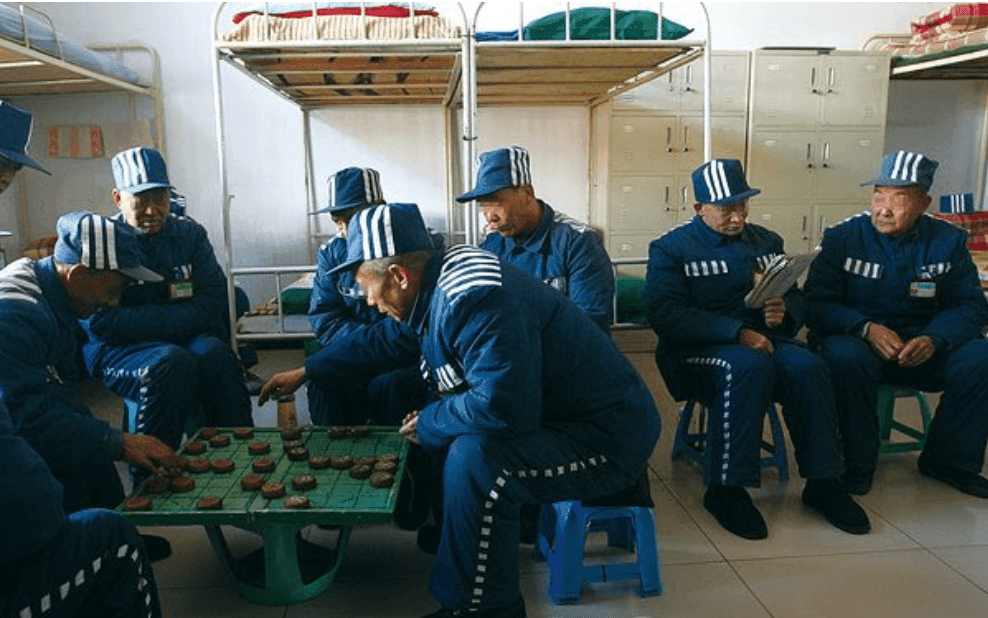
    Men play chess inside the “elderly” prisoner cell block of Henan No. 3 Prison. Photo Credit: Pan Xiaoling, Southern Weekly

    It’s an old problem and a new one. The United States and China are facing demographic challenges from aging populations, and the trend is particularly acute in prisons. In the US, longer sentences and mandatory minimums have contributed to a historically unprecedented level of incarceration, resulting in prisons that are both growing and growing grey. According to a Human Rights Watch report, the number of people age 65 or older in US state and federal prisons grew 63 percent between 2007 and 2010, compared with growth of less than one percent in the overall prison population. This statistic underscores why the plight of older prisoners is now often called a crisis.

    While definitions vary, the proportion of “elderly” prisoners in both the US and China may be around 3–4 percent of national prison populations. In China, prisons generally classify people age 60 or over as “elderly”—some sources say the age is 55 for women—but prison statistics are not often in the public domain. Using available data, Chinese academics have speculated that elderly people account for less than 3 percent of Chinese prisoners and, at 3 percent, that would be about 50,000 people. In the US, the minimum age of an “older” prisoner varies by state from 50 to 70. Using the Chinese benchmark for comparison, there were 59,700 people 60 or over in state and federal prisons in 2010, accounting for 3.9 percent of the US prison population, according to data from the US Bureau of Justice Statistics (BJS).

    Dui Hua previously highlighted the indignity and monumental costs of requiring people to confront aging and illness behind bars—BJS data indicate that more than 8,000 people age 55 or over died of illness in US state prisons between 2001 and 2007. Building on these humanitarian and fiscal arguments, this article looks at recidivism rates as support for making elderly prisoners prime candidates for more tempered and alternative sentencing, as is already the case in China.

    Age and Recidivism

    “Of all the causes which influence the development of the propensity to crime, or which diminish that propensity, age is unquestionably the most energetic,” wrote Belgian sociologist Adolphe Quetelet in his 1842 classic, A Treatise on Man and the Development of his Faculties. Quetelet, arguably the world’s first crime statistician, based his work on French crime data from 1826 to 1829. Recent research continues to support his theory that the incidence of crime peaks in adolescence or early adulthood and then declines.

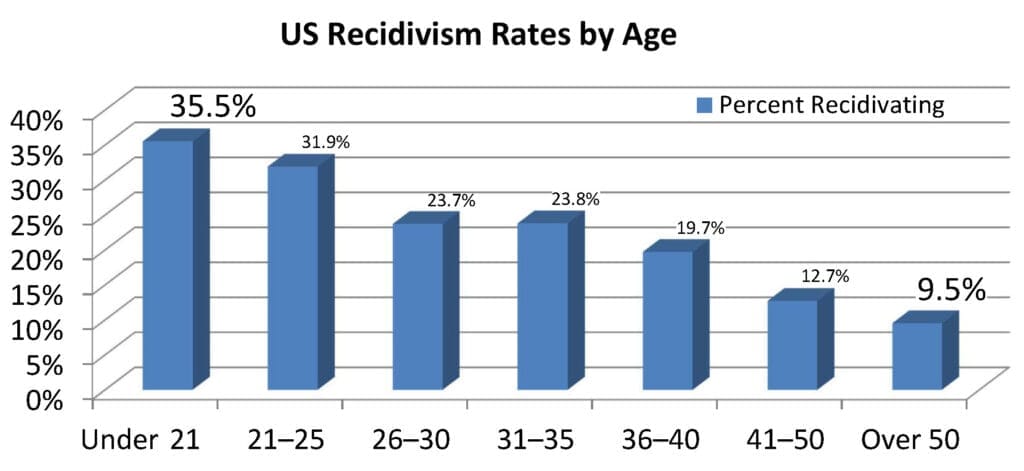
    A comprehensive analysis of people in the US federal prison system found that recidivism declined consistently with age. This 2004 study, which was produced by the U.S. Sentencing Commission, reported that people over age 50 had a recidivism rate of 9.5 percent, compared with 35.5 percent for people under 21 (see graph). According to a 1998 study from the Coalition for Sentencing Reform, only 3.5 percent of people 55 or older were re-incarcerated within a year of release, compared with 45 percent of those ages 18 to 29.

    Recidivism refers to re-arrest or re-conviction within a 24-month period. Data: U.S. Sentencing Commission

    Discussing the reason for the link between age and law-breaking, some experts point to biological and hormonal changes. Others highlight the influence of stable social relationships, particularly marriage, and physical degeneration. Whatever the explanation, any criminal justice system that takes public safety into account cannot deny that older people generally pose less of a danger to society—in terms of recidivism and persistence of crime—than younger people.

    A Mature Approach to Criminal Justice

    In February 2010, China’s Supreme People’s Court released an opinion on the implementation of the national policy of combining leniency and severity (宽严相济). The opinion calls for the use of discretion in granting elderly people lenient punishment (Para. 21) and lists them as eligible for leniency in sentence reduction and parole (Para. 34). One of the stated purposes of the policy is to prevent and reduce crime.

    In Anhui, 151 people age 60 or over received sentence reductions and parole in January 2011.
    Photo credit: Legal Daily

    Additionally, several courts have cited generally lower rates of recidivism and lower public safety risk as reasons to treat older people differently. Although some US jurisdictions offer compassionate release programs for terminally ill prisoners, federal and state parole policies do not typically consider age, and the move to determinate, or non-discretionary, sentencing has precluded such discretion.

    Last year, China included provisions for the elderly in amendments to the Criminal Law. Unlike prison guidelines that use age 60, however, the law uses age 75 to delineate elderly prisoners. Some critics have argued that this age is too high to have any real impact and is out of step with Chinese criminal justice regulations that choose age 70. That said, as a move towards more humanitarian treatment, the amended law makes elderly people eligible to receive suspended sentences (Art. 72) and receive leniency and reduced sentences (Art. 17).

    Defendants in this age group are also exempt from capital punishment, except “in cases where death is caused by especially cruel methods.” As an indication of how little impact this will have, the number of Chinese capital cases involving people over 70 is fewer than 10 cases per year, compared to the estimated 4,000 people executed in China in 2011. By contrast, the percentage of people over 60 on US death row quadrupled between 1999 and 2009 to more than 8 percent (of 3,173 people). While the US takes more time than China to carry out executions, the number of elderly people executed in the US has risen in recent years. Between the reinstatement of capital punishment in 1976 and 2002, only one prisoner over age 65 was executed. Since then, at least three have been put to death.

    Life Without Possibility

    Another contentious and divergent area relevant to aging prisoners is life without the possibility of parole. The US is a global outlier in its extensive use of the sanction and its application of the sentence for nonviolent crimes. As of 2008, more than 41,000 people in US prisons were serving sentences of life without the possibility of parole, according to data compiled by The Sentencing Project. In China, Canada, France, Germany, Italy, and Spain, the sentence, which has the potential to increase the elderly prisoner population and virtually guarantees death behind bars, does not exist.

    People, young and old, should be held accountable for their actions, and criminal sanctions are an important way to do this. At the same time, courts should have ways of recognizing the low risk that aging prisoners pose to free citizens and the dignity of dying outside prison. China’s criminal laws are moving towards such discretion, while sentencing guidelines and mandatory minimums are holding US judges back. A more balanced US policy towards elderly prisoners would universalize the possibility of parole and recognize that while justice requires blindness, it also requires vision. ■

    China’s Oldest ESS Prisoner?

    Chen Zhaolu (陈兆祿) was born on December 9, 1917, in Guangzhou. He became a Hong Kong resident in 1968 when he started working for Xinhua News Agency—then China’s de facto consulate in Hong Kong—and retired in 1985 at age 67. Chen remained in Hong Kong with his immediate family, including two sons and three daughters, but traveled regularly between Hong Kong and Guangzhou.

    Eighteen years after retirement, on November 25, 2003, Chen was detained in Guangzhou on suspicion of “endangering state security” (ESS). That year, a number of former Hong Kong Xinhua employees were arrested on charges of espionage, an ESS crime, but it is not known whether Chen’s detention was part of a broader investigation.

    On January 19, 2004, the Guangzhou Intermediate People’s Court sentenced Chen to 13 years’ imprisonment. At age 86, he was incarcerated in the elderly prisoner cell block of Guangzhou Prison, Guangdong’s “model prison.” Chen was given a nine-month sentence reduction in 2006 and a 16-month sentence reduction in 2008. He was granted medical parole for a period of three years on September 2, 2009, and is reported to be in the care of his family.

    Medical parole, as with parole granted for good behavior, is a sentence served outside prison. Dui Hua believes that Chen Zhaolu, age 94, is the oldest prisoner serving a sentence for endangering state security in China. Given his advanced age and subsequent special needs, prison authorities, an informed source said, are unlikely to re-incarcerate Chen when his medical parole expires on September 1, 2012. According the source, Chen’s remaining sentence is likely to be commuted.

  • Dialogue – Issue 47: Prisoner Update: Clemency in Guangdong

    In March, Chinese government sources updated Dui Hua on the status of six people incarcerated in Guangdong. Their crimes were “extortion” in connection with the 2008 tainted-milk scandal, “espionage” amid choppy Cross-Strait relations, and “illegal business activity” involving Falun Gong books. Government responses are listed under each name followed by background information from various sources.

    Guo Li (郭利)
    Expected release date: 7/22/2014
    Sentence reduction: Possible (2nd half 2012, 1st half 2013)

    Guo Li is in prison for trying to obtain compensation from the company whose melamine-laced products poisoned his daughter. Photo credit: RFA, Guo’s family

    Overshadowed in the foreign press by Zhao Lianhai (赵连海), lesser-known tainted milk activist Guo Li has not received clemency. Guo was convicted of “extortion” after launching a campaign to obtain compensation from infant formula maker Scient. The Guangdong-based company allegedly poisoned 300,000 children, including Guo’s daughter, with melamine-tainted milk powder. Guo was sentenced to five years’ imprisonment by the Chao’an County People’s Court on January 12, 2010.

    Zhao Lianhai, who organized a similar campaign against Hubei-based dairy producer Sanlu, was sentenced to 2.5 years’ imprisonment for “causing a serious disturbance” in November 2010. Following international pressure, he was released on medical parole the next month.


    David Dong Wei (董维)
    Expected release date: 8/27/2013
    Sentence reduction: 9 months (6/2011), possible (2nd half 2012)
    Place of incarceration: Chongqing (transferred)

    An American citizen incarcerated for “espionage,” David Dong Wei was transferred to a Chongqing prison from Dongguan Prison in August 2011. This unusual transfer may be related to Dong’s status as a Chongqing resident prior to becoming a US citizen in 1995. Dong’s nine-month sentence reduction is his third, following a 10-month reduction in April 2008 and an 18-month reduction in April 2010. While visiting Guangzhou on a Louisiana trade delegation, Dong was detained in September 2003 on suspicion of spying for Taiwan and lobbying the US government on Taiwan’s behalf. He was sentenced to 13 years’ imprisonment in a closed trial in April 2005. He is known to suffer from a number of ailments including heart disease and hypertension.

    Fu Hongzhang (傅宏章) 
    Release date: 7/7/2011


    Tong Taiping (童太平)
    Expected release date: 6/22/2013
    Place of incarceration: Panyu Prison


    The first official responses Dui Hua has received regarding Taiwanese businessmen Fu Hongzhang and Tong Taiping indicate that each has received sentence reductions totaling at least three years. Though tried separately, both were convicted during a nationwide crackdown on “Taiwanese espionage” in 2003. The crackdown emerged out of statements made by then Taiwanese President Chen Shui-bian during his bid for re-election. Citing confirmation from “sources inside China,” Chen said that China had nearly 500 missiles aimed at Taiwan. China had arrested two dozen Taiwanese people and 19 mainland Chinese for “espionage” by late December, Xinhua reported. Fu was initially taken into custody by state security in Shantou on December 15, 2003, while reportedly trying to probe military deployments in Guangdong and Jiangxi provinces. Tong was detained in Guangzhou on December 4, 2003, for collecting naval intelligence at Huangpu Shipyard.


    Liu Jingsong (刘镜崧) 
    Release date: 9/17/2010
    Original sentence: 16 years


    Liu Yong (刘勇)
    Release date: 8/21/2010


    Eight years after our initial inquiry, government sources indicated that Liu Jingsong and Liu Yong were released from lengthy sentences about five years early. Both were convicted of “illegal business activity” involving Falun Gong books within two years of the Chinese government declaring the group an “illegal organization.” As co-owner of a Guangzhou publishing house, Liu Jingsong was accused of printing books without a license and publishing “obscene” materials that included Falun Gong books. Chinese media reports state that Liu Jingsong was sentenced to 20 years’ imprisonment in November 2000, but the latest government response states that he was given a 16-year sentence. In a related case, cultural communication company owner Liu Yong was sentenced to 15 years’ imprisonment in November 2000 after allegedly ordering Falun Gong books from Liu Jingsong.

    Government sources confirmed that there have been no recent sentence reductions for Liu Jingsong’s business partner Liang Jiantian (梁鉴添). Originally sentenced to life, Liang has received sentence reductions totaling 29 months. Previous government responses said he was due for release from Panyu Prison on August 17, 2024.

  • Dialogue – Issue 47: Ching Cheong: Journalist, Prisoner, Activist

    As a Hong Kong native and chief China correspondent for Singapore’s Straits Times, Ching Cheong (程翔) was taken into custody by Chinese authorities in Shenzhen on April 21, 2005. Ching stayed in custody for nearly three years before the Chinese government responded to Hong Kong and international pressure and released him on parole.

    Ching Cheong at his Hong Kong book launch in February 2012.

    In his recent book My 1000-Day Ordeal (千日无悔), Ching chronicles the time he spent in custody. Earlier this year, he spoke to Dui Hua about his experience and, more generally, the treatment of Chinese prisoners. We previously wrote about the 105 days Ching spent under residential surveillance, which he described as “solitary confinement” and “psychological torture.” Guards were forbidden from talking to Ching or telling him their names, but one man, though terse, broke the rule. “I was so sad when he left,” Ching said, “I kneeled in front of him in gratitude.”

    Detention

    Ching himself left residential surveillance for Beijing’s Dahongmen detention center on August 5, 2005. Dahongmen holds people suspected of involvement in state security cases and senior officials involved in non-political crimes. According to Ching, treatment was better at the detention center than it was under residential surveillance. Ching was able to request and receive a Bible, on the condition that he did not proselytize or share it with others, and was also allowed three family visits of two relatives each. While grateful for the visits, Ching saw his visitation privileges as discriminatory, saying they were not granted to detainees who were mainland Chinese. He also stated that, although accustomed to speaking to his family in Cantonese, guards required that they use Mandarin during the visit.

    Ching stayed in a detention cell with five or six others including Xu Jianyi (徐建一). Xu was sent to Geneva, Switzerland, to study western human rights theory and help compile China’s first human rights white paper, which was released in 1991. Xu refuted western criticism of China’s human rights situation, but according to Ching Cheong, Xu was also as a Maoist who supported underground publications that criticized Chinese leaders Jiang Zemin and Deng Xiaoping.

    When Ching met him, Xu had been in detention for six years. Ching called this “absolutely lawless.” Under Chinese law, the whole procedure from detention to sentencing should not take more than 11 months. Detained in 1999, Xu was sentenced to seven years’ imprisonment on December 13, 2003. Charged with “embezzlement,” he was reportedly released in 2006, presumably with time spent in detention counting against his sentence.

    Ching was indicted and allowed to hire a lawyer after spending about six months in detention. Beijing lawyers were pressured not to take his case, so he hired two lawyers in Guangzhou. Ching was allowed to meet with them for a total of 10 hours for both the original and appellate trial. They advised him that his actions did not constitute espionage, which was the charge against him, since he lacked subjective intent and did not see or possess any documents marked “confidential” or “secret.” During the trial, the defense was interrupted so frequently that Ching was left to defend himself. On August 31, 2006, after a two-week trial, Ching was sentenced to five years’ imprisonment and one year of deprivation of political rights (DPR).

    Imprisonment

    Ching Cheong was moved to Beijing’s Tianhe Prison on December 26, 2006. Tianhe holds non-Beijing residents who are convicted in Beijing until they can be sent back to their place of residence to complete their sentences. Ching stayed in Tianhe for one month before being transferred to Guangzhou Prison. As a temporary location, Tianhe requires prisoners to perform less penal labor and as a result provides less food. Yet, according to Ching, neither Tianhe nor Guangzhou prison provided enough food to meet China’s minimum legal standards. Ching went to prison weighing 178 pounds and came out weighing 128.

    Ching credited the prisons for decent sanitation—hot water was available twice a day and showers were allowed once a week—and said he did not witness any physical torture or overcrowding. He did say, however, that prisoners were treated like “talking dogs.” In both Tianhe and Guangzhou, prisoners were required to squat down when reporting to prison guards and to squat and bow their heads when prison guards addressed them. Guards also administered regular “security checks” involving oral and anal searches.

    In a number of prisons, political prisoners are held in separate cell blocks. Guangzhou Prison is not one of them. Instead, as a political prisoner, Ching was constantly accompanied by a “mutual surveillance group” (互监组) that limited his interaction with other prisoners. That said, political prisoners are not the only prisoners organized into these groups. Composed of three to five prisoners, mutual surveillance groups are used to prevent rule breaking and escapes by making each member of the group responsible for the actions of all.

    Clemency

    Chinese law requires prisoners to admit their guilt in order to obtain clemency. This is reflected by the inclusion of a question on prison admittance forms and sentence reduction applications: “Do you admit the crime?” However, some people, including Ching Cheong, have chosen not to provide a “yes” or “no” answer. When Ching was admitted to Guangzhou Prison, he responded by writing, “I accept the verdict and maintain my right of appeal.”

    Although Ching eventually obtained clemency, he does not necessarily see the “acceptance of a verdict” as an alternative to admitting of guilt. Due to pressure from Hong Kong and the international community, “even if I didn’t confess, or acknowledge the court verdict, they would have [had] to release me anyway once the half-way mark [on my sentence] [had] passed, and for political considerations.” Under Chinese law, a prisoner becomes eligible for parole once half of his or her sentence has been served.

    A banner sponsored by the Hong Kong Journalists Association calls for Ching’s release from prison in 2007.

    Ching believes that he was treated better than other prisoners because of his supporters. He was allowed to move back to Hong Kong after being released on parole (which requires checking in with local police) and to give interviews to the press (which is prohibited during DPR) “solely because of international support.” The supporters who effectively helped nullify parole and DPR restrictions included Hong Kong Chief Executive Donald Tsang, then US President George W. Bush, and other government officials and NGO activists including those from Hong Kong Journalists Association, Reporters Without Borders, and Dui Hua.

    That international attention expedited Ching’s release is evidenced by the fact that Lu Jianhua (陆建华), a man accused of providing information to Ching but not the subject of public outcry, remains in prison serving a 20-year sentence. Lu was also given six years of DPR—one year in excess of the legal limit—to serve after his release. Once a prominent sociologist, Lu is not scheduled for release until May 26, 2025.

    Continuing the Struggle

    Ching Cheong was released from prison in February 2008 after completing about half of his sentence. From his home in Hong Kong, he continues to write and has witnessed some welcome changes to China’s Criminal Procedure Law (CPL). Passed on March 14, 2012, the amended CPL includes provisions to notify family members within 24 hours of the imposition of residential surveillance—Ching’s wife waited 30 days—and to count time served under residential surveillance against sentences of imprisonment. Once effective on January 1, 2013, people subjected to residential surveillance will receive a one-day credit against their prison sentence for every two days in residential surveillance. Under the existing CPL, such credit has been withheld from prisoners like Ching, Liu Xiaobo (刘晓波), and Lv Jiaping (吕加平). Lv is 71 years old and only one year into a 10-year sentence for publishing articles critical of the Chinese government. He suffers from heart disease, diabetes, and other ailments but has yet to receive medical parole.

    Ching is now working towards abolishing solitary confinement, which he claims Chinese authorities use to extort confessions during residential surveillance. He described the isolation of residential surveillance—a measure that is not always carried out in one’s home—as “psychological torture.” Perhaps with this in mind he said that although the amended CPL now includes a “presumption of innocence,” it is of little use without guarantying a defendant’s right to silence.