Blog

  • Dialogue – Issue 49: US Participant Perspectives on the Juvenile Justice Expert Exchange

    In San Mateo County, we strive to understand the unique circumstances and social history of each juvenile in order to find the best disposition for him or her. As judges, we don’t make these decisions in a vacuum. We rely heavily on the information and recommendations provided to us by probation officers, attorneys for the minors, and the district attorney’s office. We also do our best to implement programs and services for youth that are based on evidence based practices. Through the exchange, we learned that Chinese judges are not always provided with the same types of resources and tools that we have here in the United States. Through the sharing of our best practices and programs, we hope that the delegation gained further insight into how future reform may be carried out in China.

    — Judge Elizabeth Lee
    Superior Court of San Mateo County


    The honor of meeting the Chinese delegates was a career highlight for me. In my 29 years of public service, I have served as a police officer, police detective, police sergeant, hostage negotiator, juvenile hall officer, probation officer, and various command-level positions including now deputy chief.

    I began my career 29 years ago (will be 30 this February), after serving four years in the military (USMC). I was interested in a career that supported and helped society, protected the community, and specifically that helped guide and direct at-risk youth towards a better life and future.

    Almost 30 years later, these continue to be my goals and as I begin the twilight of that career, I can’t think of a better way to cap it than the opportunity to work with Dui Hua and the Chinese authorities in developing a juvenile justice system in their country. We have some things to offer them and after meeting and speaking with them over the course of their visit, I know we have some things we can learn from them.

    On a human level, I found the delegates to be great people from a great culture, one that going forward we as a country and people need to engage with more on every level. The exchange will help lay the foundation for more dialogue and contribute significantly to improving the rights and treatment of children on both sides of the Pacific.

    — Roy Brasil
    Deputy Chief Probation Officer
    San Mateo Probation Department

    The San Francisco Juvenile Probation Department was once again appreciative of the opportunity to participate in the dialogue that ensued during this most recent visit from the Supreme People’s Court from the People’s Republic of China, where the key role probation officers play in the juvenile justice system was once again prominently featured. For it is precisely the role probation officers play that puts into real practice all of the important orders the judge puts into place that are designed to help rehabilitate youth and protect the public. Probation officers interpret the court’s orders into specific action steps that need to be taken by the youth. And conversely, probation officers relay evidence of youths’ compliance (or non-compliance) with the court’s orders, for the court’s further deliberation and pronouncements. Probation officers customize the orders of court according to the specific needs of each case and into a written plan … then engage the necessary support services within the youth’s neighborhood that can help the youth fulfill his/her promises to the court. Probation officers make the real difference in the United States’ juvenile justice system.

    — William P. Siffermann
    Chief Probation Officer
    SF Juvenile Probation Department


    I am continually energized by the interest and commitment of the judges from the China delegation, who have asked insightful questions designed to enhance their understanding of the US judicial and community corrections systems. As a member of the 2010 US delegation to China, I also recognize that there are elements of the Chinese culture and judicial practice that are of value to us here in the US. I am particularly impressed by the goals to rehabilitate and restore a youth as a responsible member of their family and the community. In the US, we have maintained that effective community supervision by a probation officer represents a critical extension of the judge into the neighborhoods where young people reside, designed to track compliance with judicial orders, provide linkages to community supports, and enhance public safety by holding youths accountable. The 2012 China-US delegation is one further indication of how our two nations can collaborate to share information that can lead to the development of laws, policies, and practices that benefit the well-being of people everywhere.

    — Allen Nance
    Assistant Chief Probation Officer
    SF Juvenile Probation Department

    We were very pleased to be involved in the project. Legal education is the foundation for building meaningful reform, and our panel discussion provided a forum for Chinese and US participants to engage in lively discussion on the current and future challenges faced by juvenile justice advocates.

    — Keith J. Hand
    Associate Professor of Law
    UC Hastings College of the Law


  • Dialogue – Issue 49: Dui Hua News

    Reference Materials Go Online

    Dui Hua launched a new blog featuring translations of Chinese research findings in October. The Reference Materials blog shares the name of the now retired print publication that was offered to diplomats, scholars, and human rights activists from 2009 through September 2012. The electronic version offers a searchable format that is open to the public. Every month, Dui Hua will post English translations of Chinese open source documents related to prisoner cases, criminal justice statistics, and regulations.

    Reference Materials archives are not available online but are available for purchase. For more information, please send us an email.

    East Coast Engagement

    In late September, Kamm went to the East Coast for meetings in New York and Washington DC. In both cities, senior Chinese diplomats met with Kamm to have candid discussions about the heated standoff in the East China Sea and the tough positions on China held by US presidential candidates. Kamm also met with executives of New York-based hedge funds to talk about the current state of US-China relations and the uncertainties surrounding China’s upcoming National People’s Congress slated for March 2013.

    In Washington DC, Dui Hua Director Linda Ziglar hosted the annual Friends of Dui Hua DC Reception. Around 30 close friends and supporters came out to hear about recent human rights developments and the impending leadership transition in China. Kamm updated guests about Dui Hua’s recent successes and upcoming programs in the areas of juvenile justice and women in prison. Kamm also met with members and staff of the Congressional Executive Commission on China and the US-China Economic and Security Review Commission as well as officials of the US Department of State and the US National Security Council.

    Juvenile Justice on the Air

    During his trip to Hong Kong in August, Kamm joined RTHK radio host Gavin Grey on Morning Brew to talk about juvenile delinquency in China and the US, and relevant areas for improvement and exchange. Kamm emphasized the importance of Dui Hua’s Juvenile Justice Expert Exchange with China’s Supreme People’s Court. China currently incarcerates over 60 percent of its juvenile offenders and is working to implement new juvenile procedures that will introduce more diversionary and rehabilitative services as alternatives to incarceration. (Photo credit: Radio 3)

    Organizing for Women in Prison

    While in Beijing in August, Kamm met with Renmin University Law School’s Center for Criminal Procedure and Reform to discuss possible cooperation on an international conference on the Bangkok Rules. Known formally as the United Nations Rules for the Treatment of Women Prisoners and Non-Custodial Measures for Women Offenders, the rules have yet to gain the attention of prison authorities worldwide, despite their focus on the world’s fastest growing prisoner demographic—women.

    Kamm went to Renmin University Law School to discuss possible cooperation on women in prison. Photo credit: Renmin Law School

    A possible venue for the conference is Hong Kong, and discussions are underway to confirm a local partner. With women accounting for nearly 20 percent of its prisoners (only about seven percent of US prisoners and six percent of Chinese prisoners are women), Hong Kong has one of the highest percentages of women prisoners in the world. Many women incarcerated in Hong Kong are from mainland China.

    Helping bring attention to the needs of incarcerated women and foster international partnerships, Kamm was quoted extensively by The New York Times in a September article entitled, “Women in Prison Fare Better in China.” During the same month, Kamm met with Andrea Huber of Penal Reform International regarding a possible international conference on the Bangkok Rules.

  • RTL: Government Preps Reform, Activist Prompts Abolition

    China’s reeducation through labor (RTL) system appears to be back on the agenda of the nation’s legal reformers. Following a series of high-profile reversals of controversial RTL decisions, a government spokesman recently told reporters that an overhaul of the administrative detention regime was being pursued on the basis of widespread consensus about the need for reform.

    A re-education through labor center in Guizhou Province. Photo: Southcn.com
    The problems associated with RTL are numerous and widely reported. Power over examination and review of RTL has become concentrated in the hands of police, who have relied upon its relatively lax procedural requirements and vague definition of targeted offenses to pursue the overarching goal of preserving social order. The flexibility of the measure comes at a serious cost to protecting human rights. Critics argue that RTL evades constitutional prohibitions on unlawful detention, and a strong argument has been made regarding the measure’s illegality under the Legislation Law. The incompatibility of RTL with China’s commitments to provisions in international human rights law that guarantee fair trial and prohibit arbitrary detention pose yet another incentive for reform or abolition of RTL.
    In a recent opinion published in Hebei Youth Daily, columnist Sheng Xiang cites many of these problems in calling not just for the reform, but for the abolition of RTL. Sheng’s claim that there are no opportunities to seek legal relief in RTL cases is not entirely accurate (see our new translation of RTL regulations), as has been seen in the recent reversals of RTL decisions mentioned above. But it is true that, compared to the formal judicial process (which at least theoretically allows for opportunities to challenge some decisions and air a full defense during a trial hearing), there are very few chances for the targets of RTL proceedings to challenge decisions made against them.
    Sheng also cites Chinese public opinion as being strongly supportive of abolition, but it is somewhat unclear what “abolition” would entail in this case and whether reforms that introduce procedural protections, shorter punishments, and further reduction of the scope of targeted behaviors—all things that reformers have proposed—would change RTL radically enough to satisfy the public’s demands.
    *
    Can We Consider Abolishing RTL
    Sheng Xiang
    Hebei Youth Daily, October 10, 2012
    The white paper entitled Judicial Reform in China was recently released. In answering reporters’ questions, the head of the Office of the Central Leading Group for Judicial Reform, Jiang Wei, said that the RTL system has played an important role in maintaining China’s social order. Of course, there are problems with some of the regulations and procedures and research on a reform plan is currently underway.
    There have always been two “many’s” as far as RTL was concerned. The first is many fantastic and astonishing stories, with many examples of individuals sent to RTL for “baffling reasons.” The second is many public calls for abolition, with unending calls for abolition of the RTL system emanating from all corners of society each year during the lianghui [National People’s Congress and Chinese People’s Political Consultative Congress] and on National Legal System Day. For the relevant departments to now be able to face the problem of RTL squarely and acknowledge that “research on a reform plan is currently underway” is truly remarkable.
    However, would it be possible to comply with public opinion and abolish RTL? Everyone knows that RTL is essentially a kind of institutionalized deprivation or restriction of personal freedom and that, although it is not a criminal punishment, it surpasses criminal punishment—even criminals can be sentenced to suspended sentences, but people “whose actions do not warrant criminal punishment” frequently serve 1–3 years in RTL. This is obviously extremely unfair. Also, since RTL is a form of public order punishment, the public security authority can make the necessary decisions on their own. Therefore, it in fact has become a kind of “lawful private punishment” that lies outside of the system of rule of law, and if people don’t agree with being sent to RTL, they have no opportunities to seek legal relief.
    The reason why experts and academics have been calling for abolition of RTL is because it has no legal basis. At most, the Provisional Measures on Reeducation Through Labor are administrative regulations, and even though they have been “provisional” up until today, they have long violated the clear provision in the Constitution that “no citizen may be arrested except with the approval or by decision of a people’s procuratorate or by decision of a people’s court, and arrests must be made by a public security organ” and the provision of the Legislation Law that “only national law may be enacted in respect of matters relating to the deprivation of the political rights of a citizen, or compulsory measures and penalties involving restriction of personal freedom.”
    As far as “playing an important role in maintaining China’s social order,” perhaps we cannot totally overlook the special role [RTL] plays during particular periods. But rule of law has made it this far in China, and a society with rule of law simply should not tolerate the existence of “extralegal imprisonment” like RTL.
    On the one hand, we increasingly emphasize humanitarian rule of law ideas like “non-indictment for minor offenses,” but on the other hand we frequently restrict the personal liberty of people for more than a year over offenses that simply don’t warrant criminal punishment. This is clearly unjust. It is precisely because of this that under the RTL system we see many similarly unjust tragedies occur but rarely any true capacity to “maintain social order.”
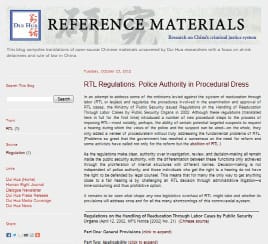
  • RTL Regulations: Police Authority in Procedural Dress

    In an attempt to address some of the criticisms levied against the system of reeducation through labor (RTL or laojiao) and regularize the procedures involved in the examination and approval of RTL cases, the Ministry of Public Security issued Regulations on the Handling of Reeducation Through Labor Cases by Public Security Organs in 2002. Although these regulations (translated here in full for the first time) introduced a number of new procedural steps to the process of imposing RTL—most notably, perhaps, the ability of certain potential targeted suspects to request a hearing during which the views of the police and the suspect can be aired—on the whole, they only added a veneer of proceduralism without truly addressing the fundamental problems of RTL. (Problems so great that the government has reached a consensus on the need for reform and some activists have called not only for the reform but the abolition of RTL.)
    As the regulations make clear, authority over investigation, review, and decision-making all remain inside the public security authority, with the differentiation between these functions only achieved through the proliferation of internal structures with different names. Decision-making is not independent of police authority, and those individuals who get the right to a hearing do not have the right to be defended by legal counsel. This means that for many the only way to get anything close to a fair hearing is by challenging an RTL decision through administrative litigation—a time-consuming and thus prohibitive option.
    It remains to be seen what shape any new legislative overhaul of RTL might take and whether its provisions will address once and for all the many shortcomings of this controversial system.

    Regulations on the Handling of Reeducation Through Labor Cases by Public Security Organs (April 12, 2002, MPS Notice [2002] No. 21)  (Chinese source)
    Part One: General Provisions (click to expand)
    Article 1: In order to standardize the procedures by which public security organs handle reeducation through labor [hereafter “RTL”] cases, guaranteeing that the review and approval authority for RTL enforces the law strictly and fairly and ensuring the quality of RTL cases, and to handle criminals and safeguard the legitimate rights and interests of citizens in accordance with the law, these regulations are enacted in accordance with the relevant laws and administrative regulations.
    Article 2: The public security departments (bureaus) of each province, autonomous region, and directly administered municipality; the Xinjiang Production and Construction Corps Public Security Bureau; and the public security bureaus (divisions) of each prefecture, prefecture-level city, autonomous prefecture, and league shall establish RTL review and approval committees to serve as the review and approval body of RTL management committees at the same administrative level. They shall examine and approve RTL cases in accordance with the relevant laws, administrative regulations, and these regulations, and issue decisions in the name of the RTL management committees about whether to [impose] reeducation through labor.
         The daily work of the RTL review and approval committees shall be undertaken by the legal affairs unit of the public security authority at that administrative level.
    Article 3: The RTL review and approval committees at the provincial and prefectural level shall be made up of the following personnel: a chairperson, to be filled by the leading cadre in charge of the legal affairs work of the public security authority at that administrative level; a deputy chairperson, to be filled by the leading cadre in the legal affairs unit of the public security authority at that administrative level; and three to five members, selected from leading cadres from the legal affairs, police inspection, public order, criminal investigation, or other units of the public security authority at that administrative level. The RTL review and approval committee may review and issue decisions on RTL cases when two-thirds or more of its members are present.
         When the RTL review and approval committee reviews cases handled by the public order, criminal investigation, or other case-handling units of the public security authority at that administrative level, members of those case-handling units who are on the review and approval committee shall recuse themselves.
    Article 4: The handling of RTL cases must be based on the facts and take the law as criterion; the facts must be clear, the evidence reliable and sufficient, the determination [of wrongdoing] correct, and the punishment appropriate; the procedure must be lawful. RTL must not be used as a covert way of extending the detention period of criminal suspects for whom investigation cannot be concluded within the statutory detention limits, and those whose acts constitute a crime and, in accordance with the law, should be prosecuted for criminal liability must not be sent to RTL.
    Article 5: The handling of RTL cases shall put into practice the policy of education, persuasion, and rehabilitation; obey the principles of openness, fairness, and timeliness; and safeguard the legitimate rights and interests of citizens in accordance with the law.
    Article 6: The handling of RTL cases shall proceed according to the principle of separation between the case-handling unit and the verification unit.
         The case-handling units and verification units of RTL cases shall divide their responsibilities and cooperate with and check each other in order to guarantee correct and effective enforcement of the law.
    Article 7: Decisions to send those suspected of unlawful offenses to RTL must be made through collective deliberation. No person may have an RTL decision issued against him or her without prior deliberation by an RTL review and approval committee.
    Article 8: The public security authority’s RTL review and approval committee shall deliberate and issue decisions about RTL cases in accordance with the law, administrative regulations, and these regulations, without illegal interference by other units or individuals.

    Collapse

    Part Two: Applicability (click to expand)
    Article 9: Based upon the State Council Decision on the Issue of RTL and the State Council’s Supplementary Regulations on RTL, both approved by the National People’s Congress Standing Committee; the Ministry of Public Security’s Trial Measures for RTL, reissued by the State Council; and other laws and administrative regulations, persons aged 16 years or older who committed one of the following acts shall be sent to RTL in accordance with the law:
    1. Acts of endangering state security that are clearly minor in nature, wherein criminal punishment is not yet warranted;
    2. Membership in a criminal gang formed to murder, rob, rape, commit arson, kidnap, set explosions, or traffic women and children, wherein criminal punishment is not yet warranted;
    3. Subsequent commission of one the [following] illegal criminal acts, wherein criminal punishment is not yet warranted, either within five years of completing a criminal penalty, sentenced in accordance with the law, [for the one of following acts] or subsequent commission of one the [following acts] within three years of being lawfully fined by police or completing administrative detention, custody and education, or RTL issued by police: compulsory indecency; humiliating women; indecency with children; group promiscuity; luring juveniles to engage in group promiscuity; illegal detention; theft; fraud; forgery or resale of invoices; resale of train or boat tickets; forgery of price tags; sale of forged price tags; forcible seizure; group robbery; extortion; swindling; forgery; alteration; trafficking in official documents, credentials, or chops; or the harboring, transfer, purchase, or sale of stolen property;
    4. Endangering public safety by creating an atmosphere of terror or causing the public to panic; organizing or using a secret society or cult or use of superstition to undermine implementation of national laws; mass brawling; creating a serious disturbance; instigating turmoil; forcing purchases or sales to dominate the market; or disrupting social order through deeply engrained bad habits such as bullying, engaging in mischief, or oppressing the masses, wherein criminal punishment criminal punishment is not yet warranted;
    5. Deliberate provocations that disrupt the order of production, work, education or research, or daily life, as well as rejection or obstruction of state employees’ [efforts] to carry out their duties in accordance with the law but without the use of violence or threats;
    6. Instructing others to commit crimes, wherein criminal punishment is not yet warranted;
    7. Introducing or allowing others to engage in prostitution or solicit prostitutes; enticing others to engage in prostitution; gambling or providing conditions for gambling; or producing, reproducing, selling, renting, or disseminating pornography, in which the acts are of a rather serious nature but do not yet warrant criminal punishment;
    8. Engaging in prostitution or soliciting prostitutes after being lawfully warned, fined, or given administrative detention by the public security authority for engaging in prostitution or soliciting prostitutes;
    9. Taking or injecting drugs after having been sent to compulsory drug treatment for addiction to taking or injecting drugs;
    10. Other circumstances for which there is statutory basis for RTL.
         Individuals who have committed offenses of endangering state security, endangering public safety, infringement of civil rights, infringement of property, or obstruction of social order management but whom, because the offense was minor in nature, a people’s procurate has opted not to prosecute or a people’s court has exempted from criminal punishment may be sent to RTL, in accordance with the law, where they meet the conditions for RTL.
    Article 10: Decisions to send juveniles to RTL shall be strictly controlled.
         Juveniles who commit unlawful offenses and are first-time offenders or students still in school and whose parents or other guardians have an effective ability to discipline them must not be sent to RTL; instead, their parents or other guardians shall be ordered to discipline them strictly.
         The juvenile’s age and identity shall be determined by his or her actual situation at the time he or she committed the illegal criminal act.
    Article 11: Mentally ill persons and the feebleminded must not be sent to RTL.
         Blind, deaf, or mute persons; the seriously ill; pregnant women or women nursing their own infants under the age of one; and persons over the age of 60 who are no longer able to work due to illness or other reasons are generally not sent to RTL. Where there is truly a need for RTL, a simultaneous decision may be made to implement non-custodial RTL.
         Persons suspected of an unlawful offense who injure or maim themselves in order to resist investigation or evade punishment shall, where they meet the conditions for RTL, be sent to RTL in accordance with the law.
         For persons suspected of an unlawful offense who are covered by the provisions of Paragraphs 1 and 2 of this article, their age and physical condition shall be determined by the actual circumstances at the time that RTL is approved.
    Article 12: Foreigners, stateless persons, and overseas Chinese who commit unlawful offenses within the territory of the People’s Republic of China; residents of Taiwan who commit offenses on the mainland; and residents of the Hong Kong or Macau special administrative regions who commit offenses on the mainland [but outside those regions] shall not be sent to RTL.

    Collapse

    Part Three: Verification (click to expand)
    Article 13: After investigation of a criminal or public-order case has been completed by the case-handling unit of a county-level public security authority, where it is deemed that the basic facts are clear, the basic evidence is reliable and sufficient, and the conditions for RTL have been met, a Request for RTL Approval shall be produced and, after verification by a responsible person from the case-handling unit, the chop of the case-handling unit shall be affixed and the request sent together with the case file to the legal affairs unit of the public security authority at that administrative level for verification.
         A Request for RTL Approval shall record the following content:
    1. The basic details of the person suspected of the unlawful offense, including name, sex, full date of birth, identification card number, place of birth, ethnicity, level of education, employment, work unit, address, and criminal record;
    2. Facts and evidence for the unlawful offense;
    3. Reasons, basis, and duration for RTL;
    4. Whether the person suspected of the unlawful offense or his or her relatives or work unit has applied for non-custodial implementation and [relevant] reasons;
    5. For juveniles suspected of unlawful offenses, whether the family has the ability to effectively impose discipline;
    6. Other relevant details.
    Article 14: When proposing RTL for a juvenile, the case-handling unit shall conduct an investigation and gather evidence from his or her parents or other guardians, neighbors, school, and the residents’ (village) committee or police station for his or her place of residence with regard to whether or not his or her family has the ability to effectively impose discipline.
    Article 15: Where a person suspected of an unlawful offense does not provide his or her true name, address, or identity, but the basic facts are clear, the basic evidence is reliable and sufficient, and the conditions have been met for RTL, the case-handling unit may make the RTL request using the name provided.
    Article 16: After the legal affairs unit of a county-level public security authority receives an RTL case from the case-handling unit of the public security authority at that administrative level, it shall arrange for two or more police officers to collectively verify the following content:
    1. Whether [the target of the case] falls under the applicability conditions for RTL;
    2. Whether the basic facts of the offense are clear, whether the basic evidence is reliable and sufficient, and whether there are statutory grounds for lenience or severity;
    3. Whether a correct determination of the case has been made;
    4. Whether the basis for applicability is correct;
    5. The age, capacity for responsibility, and health of the person suspected of an unlawful offense, and whether there is a criminal record;
    6. For any request for non-custodial RTL implementation made by the person suspected of unlawful offense or his or her relatives or work unit, the accuracy of the reasons given;
    7. For a juvenile suspected of an unlawful offense, the situation regarding his or her family’s ability to effectively impose discipline;
    8. Whether the case-handling procedure was lawful and legal procedures are complete.
    Article 17: In verifying RTL cases, the legal affairs unit of a county-level public security authority shall question the persons suspected of unlawful offenses and review the principal facts and evidence of their offenses.
         In questioning juveniles suspected of unlawful offenses, their parents or other guardians or their teachers shall be notified to be in attendance, except when it would interfere with the investigation or when it is impossible to give such notification.
         A detailed record of the questioning of the person suspected of unlawful offense shall be kept, and it shall be checked by the suspect and have his or her signature or fingerprint affixed.
    Article 18: For RTL cases reported by a case-handling unit of a county-level public security authority, the legal affairs unit of the public security authority at that administrative level shall complete its verification within three days and prepare a Verification Report handling the case in one of the following ways based on the different circumstances of each case:
    1. Where it is determined that the facts of the offense have been fully investigated, the evidence is reliable and sufficient, and the case meets the conditions for RTL, after signed comments are added to the Request for RTL Approval and it is approved by a responsible person in the public security authority at that administrative level, the chop of the public security authority at that level shall be affixed and [the Request for RTL Approval] sent along with the Verification Report to the legal affairs unit of the public security authority at the prefectural level for verification.
    2. Where it is determined that the basic facts are unclear, the basic evidence is insufficient, or it is necessary to investigate other offenses, further steps for investigation shall be outlined and returned to the case-handling unit for additional investigation within a set period of time. When necessary, the legal affairs unit may also conduct its own additional investigation.
    3. Where it is determined that the conditions for RTL have not been met, the reasons shall be stated clearly in writing; where, according to the law, criminal responsibility should be pursued, a public order management punishment should be given, or the matter should be handled in another way, an opinion shall be given about how to handle the case and the case shall be returned to the case-handling unit for handling in accordance with the law.
         The Verification Report shall include the following content:
    1. Details of the verification of the main facts and evidence of the offense;
    2. Opinions for how to handle the case and their legal bases, including opinions based on the verification of any applications for non-custodial RTL implementation by the person suspected of unlawful offense or his or her family members or work unit;
    3. List of names of the individuals conducting the verification;
    4. Other relevant details.
    Article 19: After investigation of a criminal or public-order case has been completed by the case-handling unit of a public security authority at the prefectural level or above, where it has been determined that the facts of the offense have been investigated fully, the evidence is reliable and sufficient, and the case satisfies the conditions for RTL, [the case handling unit] shall complete a Request for RTL Approval and, after verification by a responsible person from the case-handling unit, the chop of the case-handling unit shall be affixed and [the request] sent together with the case file to the legal affairs unit of the public security authority at that administrative level for verification.
    Article 20: After receiving the report of an RTL case from the case-handling unit of a county-level public security authority or a public security authority at [its own] administrative level, the legal affairs unit of a public security authority at the prefectural level or above shall convene a panel to verify the documents. Where one of the following situations is encountered, the panel shall question the suspected offender and hear the opinions of the unit reporting the case:
    1. Although there is evidence to confirm the facts of the case, the person suspected of the unlawful offense has not confessed or there are discrepancies between confessions such that it affects the finding of fact and the ability to come to a decision about how to handle the case;
    2. There are doubts about the objectivity, relatedness, and legality of the primary facts of the offense and the evidence of those facts;
    3. The case is major, complex, or difficult;
    4. Other reasons necessitating verification in person.
         The panel shall be composed of three or five police officers, with one serving as a leader. Panel members shall have two or more years of public security work experience and relatively high degrees of professional and legal character. The position of panel leader shall be filled by a responsible person in the legal affairs unit of the public security authority.
    Article 21: The legal affairs unit of a public security authority at the prefectural level or above shall complete its verification within three days of receiving the Request for RTL Approval and associated documents from a case-handling unit of a county-level public security authority or public security authority at [its own] administrative level.
         In cases for which additional investigation is necessary or the person suspected of unlawful offense has requested a hearing, the time for verification may be extended to 12 days; when additional investigation is necessary and the person suspected of unlawful offenses has requested a hearing, the time for review may be extended to 15 days.
    Article 22: After the panel meets, it shall produce a Panel Meeting Transcript presenting an opinion on handling the case arrived at through majority rule and recording the opinions of the minority, which shall be sent for verification by a responsible person in the legal affairs unit of the public security authority at the prefectural level or above.
         The Panel Meeting Transcript shall record the opinions and reasoning given by members of the panel and shall be signed or chopped by each person after their reading to confirm that there are no errors.
    Article 23: After carrying out a verification of the RTL case, a responsible person in the legal affairs unit of the public security authority at the prefectural level or above, based on the different circumstances of the case and the relevant legal provisions, shall record his or her opinions on the Request for RTL Approval, handling the case in one of the following ways:
    1. Where the facts of the case are clear, the evidence is reliable and sufficient, and the person suspected of unlawful offense meets the conditions for RTL, a request for deliberation and decision shall be sent, along with the Panel Meeting Transcript, to the RTL review and approval committee of the public security authority at that administrative level.
    2. Where the case meets the conditions for a hearing set as out in Article 25 of these regulations, a request for approval shall be sent, along with the Panel Meeting Transcript, to a responsible person on the RTL review and approval committee of the public security authority at that administrative level.
    3. Where the case’s main facts are unclear, evidence is insufficient, or there is a need to investigate other offenses, an outline for additional investigation shall be prepared and [the case] returned to the reporting unit for additional investigation. When necessary, the legal affairs unit may also conduct its own additional investigation.
    4. Where the facts of the case are clear and the evidence is reliable and sufficient, [but,] according to the law, criminal responsibility should be pursued, a public order management punishment should be given, or the matter should be handled in another way, [the case] shall be returned to the unit reporting the case for handling in accordance with the law.
    Article 24: With regard to cases requiring additional investigation, the unit reporting the case shall complete such investigation within five days of receiving the outline for additional investigation; where the legal affairs unit conducts its own additional investigation, the investigation shall be completed within five days of deciding on additional investigation.
         Additional investigation may be carried out only once. After additional investigation, where the legal affairs unit of the public security authority at the prefectural level or above still finds that the main facts are unclear or the evidence is insufficient, it shall request that the RTL review and approval committee of the public security authority at that administrative level review the case and issue a decision not to impose RTL.

    Collapse

    Part Four: Hearings (click to expand)
    Article 25: Except for those involved in organizing or using a cult to undermine the implementation of national laws or those involved in taking or injecting drugs, where it has been decided to impose RTL on a person suspected of unlawful offense, a public security authority at the prefectural level or above may, arrange for a hearing in the name of the RTL management committee at that administrative level for a case with one of the following circumstances:
    1. The person suspected of unlawful offense shall be sent to RTL for two years or more;
    2. A juvenile suspected of unlawful offense shall to be sent to RTL.
         As to whether hearings should be held for other types of RTL cases, the public security departments or bureaus of each province, autonomous region, and directly administered municipality and the Xinjiang Production and Construction Corps Public Security Bureau shall issue regulations based on the actual situations in their own locations.
    Article 26: In an RTL case for which a hearing may be held in accordance with the provisions of Article 25 of these regulations, the legal affairs unit of a public security authority at the prefectural level or above shall deliver a Hearing Disclosure Notice to the person suspected of unlawful offense within two days after panel deliberations have concluded, notifying him or her that he or she has a right to ask for a hearing.
         The Hearing Disclosure Notice shall include the following content and bear the chop of the RTL management committee at that administrative level:
    1. The name, sex, and full date of birth of the person suspected of unlawful offense;
    2. The facts, reasoning, duration, and basis for RTL;
    3. The lawful rights enjoyed by the person suspected of unlawful and the time limit for requesting a hearing;
    4. The inquiry hearing authority.
    Article 27: In RTL cases for which hearings may be held in accordance with the provisions of Article 25 of these regulations, where the person suspected of unlawful offense or his or her guardian requests a hearing, he or she shall make an application in writing or orally within two days of receiving the Hearing Disclosure Notice.
         Where, due to force majeure or other special reasons, the person suspected of unlawful offense or his or her guardian fails to apply for a hearing within the statutory period but applies within one day of the obstacle being lifted, the public security authority shall allow it.
         Where the person suspected of unlawful offense or his or her guardian fails to apply for a hearing within the statutory period, it shall be treated as relinquishing the right to request a hearing.
    Article 28: Where a person suspected of unlawful offense or his or her guardian, after having received the Hearing Disclosure Notice, clearly states that a hearing is not requested or does not apply for a hearing within two days of receiving the Hearing Disclosure Notice, the legal affairs unit of the public security authority at the prefectural level or above, within two days of knowing that the person suspected of unlawful offense or his or her guardian does not request a hearing, shall request the RTL review and approval committee of the public security authority at that administrative level to deliberate and issue a decision.
    Article 29: After receiving an application for a hearing, the public security authority at the prefectural level or above shall conduct a review and, where the case conforms to the provisions of Article 25 of these regulations, shall decide to hold a hearing one time. Where the case does not conform to the provisions of Article 25 of these regulations, it shall issue, within two days of receiving the request for a hearing, a decision not to hold a hearing and notify the applicant in writing and explain the reasons within two days of making such a decision.
    Article 30: After deciding to hold a hearing of inquiry, the public security authority at the prefectural level or above shall issue a Hearing Notice, deliver [the notice] to the hearing applicant two days prior to the hearing, and notify the unit reporting the case and other participants.
         The Hearing Notice shall contain the following content and bear the chop of the RTL management committee at that administrative level:
    1. The name, sex, full date of birth, and identification card number of the person requesting the hearing;
    2. The case summary;
    3. The time and place of the hearing;
    4. The name of the person overseeing the hearing;
    5. The lawful rights enjoyed by the person requesting the hearing during the hearing.
    Article 31: Where two or more people suspected of illegal or criminal offenses in the same case request a hearing at the same time, their hearings may be conducted together.
         Where some of the people suspected of illegal or criminal offenses in the same case apply for a hearing, the public security authority at the prefectural level or above shall request the participation in the hearing of the people suspected of illegal or criminal offenses in the same case who did not apply for a hearing and, after the hearing is conducted, make a decision regarding the entire case.
    Article 32: Except for cases involving state secrets or individual privacy, cases of juvenile offenders, and other cases unsuited to a public hearing, the close relatives and work unit of the person suspected of unlawful offense may each send one to three representatives to participate as observers.
         During the course of the hearing, where observers disrupt the order of the hearing, the person overseeing the hearing shall warn them to stop. Those who do not stop may be forcibly removed; where the circumstances are serious, legal liability may be pursued in accordance with the law.
    Article 33: The hearing shall be led by the panel chair, with participation by other members of the panel.
         When considered necessary by the chair of the hearing, the injured party or his or her legal representative may be requested to participate in the hearing.
    Article 34: Where the person suspected of unlawful offense fails to attend the hearing without proper excuse or insists on withdrawing from the hearing during the course of the hearing, it should be treated as revocation of the request for a hearing.
    Article 35: When holding the hearing, the hearing chair shall notify the person suspected of unlawful offense that he or she enjoys the following lawful rights during the hearing:
    1. To request or abandon a hearing;
    2. The right to request recusal where he or she believes that a hearing personnel has a direct interest the case;
    3. To make a statement, a defense plea, and cross-examine the evidence;
    4. To introduce new facts and evidence;
    5. To check the hearing record.
    Article 36: During the course of the hearing, the hearing personnel shall arrange for debate between the case investigators and the person suspected of unlawful offense regarding the main facts of the case, the evidence, the applicable [legal] bases, the duration of RTL, the disposition of any illicit income or illegal property, and other relevant issues.
         The hearing personnel shall truthfully record the details of the hearing, and the Hearing Transcript shall record the following content:
    1. The names, work units, and positions of those participating in the hearing;
    2. The names and positions of the hearing personnel;
    3. The time and place of the hearing;
    4. Case investigators’ facts, reasoning, and grounds for recommending an RTL decision;
    5. The suspected offender’s statement, defense, and challenges to the evidence;
    6. Witness statements or witness testimony;
    7. Signatures or fingerprints of the suspected offender, case investigators, and witnesses [affirming] their respective statements.
    Article 37: After the hearing has concluded, the hearing chair shall arrange a conference of the hearing personnel and write a Hearing Report presenting an opinion on how to handle the case, arrived at through majority rule, and recording the opinions of the minority. [The report] shall be sent for review by a responsible person in the legal affairs unit of the public security authority at that administrative level.
         The Hearing Report shall record the following content and bear the signatures of the hearing chair and other hearing personnel:
    1. Case summary;
    2. Basic details of the hearing;
    3. Basic details of the conference;
    4. Details of the facts of the case and evidence that were found during the hearing;
    5. Opinion on handling the case.
    Article 38: The legal affairs unit of a public security authority at the prefectural level or above shall present an opinion on how to handle the case based on the Hearing Report and the Hearing Transcript and make a request for deliberation and decision by the RTL review and approval committee of the public security authority at that administrative level.

    Collapse

    Part Five: Decisions (click to expand)
    Article 39: The RTL review and approval committee of a public security authority at the prefectural level or above shall, within two days of receiving a request to review an RTL case from the legal affairs unit of the public security authority at that administrative level, issue a decision in the name of the RTL management committee at the same administrative level as to whether to [impose] RTL.
    Article 40: In response to a request for review of an RTL case by the legal affairs unit of a public security authority at [the same] administrative level, the person responsible for the RTL review and approval committee shall convene members to hear the report by the verification panel chair regarding the case details and opinions for handling [the case], to organize a review, and to make a decision arrived at through majority rule.
         Detail of the review of an RTL case and the decision made by the RTL review and approval committee shall be written up in the Review Minutes, recording the opinions and reasoning given by each participant in the review and, having been read by each person, bearing the signature or chop of each to signify that there are no errors.
    Article 41: After the RTL review and approval committee of a public security authority at the prefectural level or above has reviewed an RTL case, it shall issue one of the following decisions according to the different circumstances and relevant legal statutes of the case:
    1. Where the facts are clear, the evidence is reliable and sufficient, and the suspected offender meets the conditions for RTL, a decision to impose RTL shall be issued.
    2. Where the main facts of the case are unclear or the evidence is insufficient, a decision not to impose RTL shall be issued.
    3. Where the facts of the case are clear and the evidence is reliable and sufficient, [but,] according to the law, criminal responsibility should be pursued, a public order management punishment should be imposed, or the matter should be handled in another way, the unit reporting the case shall be instructed to handle the case in accordance with the law.
         Where the person suspected of unlawful offense has any illicit income or illegal property, at the same time that the RTL decision is made, a decision shall also be made, in accordance with the law, to confiscate the illicit income or illegal property and transfer it to the treasury. Lawful property of the victim shall be promptly returned in accordance with the law. Any contraband or other items that cannot be stored for a long time shall be disposed of in accordance with the relevant state regulations.
    Article 42: Where the person suspected of unlawful offense has not confessed, but other evidence is reliable, sufficient, and mutually corroborative and [the person] meets the conditions for RTL, a decision [to impose] RTL may be issued in accordance with the law; where there is only the confession of the person suspected of unlawful offense or the statement of a victim and there is no other evidence, a decision to impose RTL must not be issued.
    Article 43: Where an illegal criminal act punishable by RTL is not discovered by the public security authority within three years, no decision [to impose] RTL shall be issued. But, where the illegal criminal act was already filed for investigation by the public security authority and the person suspected of the unlawful offense eluded investigation, or where the victim filed a complaint within the aforementioned period and the public security authority should have filed the case but did not do so, this time limit does not apply.
         The time limit stipulated in the above paragraph commences from the date the illegal criminal act occurred; where the illegal criminal act is of a continuous or enduring nature, the time limit commences from the day the act concluded.
    Article 44: In consideration of the facts, nature, circumstances, motive, and degree of social harm of the [suspect’s offense], as well as the legal liability that should be borne, the duration of an RTL decision should be set for one year, one year and three months, one year and six months, one year and nine months, two years, two years and three months, two years and six months, two years and nine months, or three years.
         Except for those who continue to take or inject drugs after compulsory drug treatment, the duration of RTL decisions for juveniles shall generally be one year or one year and three months, with a maximum length not to exceed one year and six months.
    Article 45: Where a person suspected of unlawful offense upon whom RTL should be imposed meets one of the following circumstances, he or she may be exempted from RTL:
    1. Voluntarily surrendered to authorities, and the illegal criminal act is minor;
    2. Was coerced or defrauded into engaging in illegal criminal activities, and the illegal criminal acts are minor;
    3. Committed a first offense after which he or she voluntarily returned stolen goods or made compensation for losses, and he or she personally displays true remorse;
    4. Demonstrated major meritorious service;
    5. Other circumstances for which there is statutory basis for exemption from RTL.
    Article 46: Where a person suspected of unlawful offense upon whom RTL should be imposed meets one of the following circumstances, he or she may be treated leniently in determining the duration of RTL:
    1. Played a secondary or supporting role in an offense committed jointly;
    2. Was coerced or defrauded into engaging in the illegal criminal activities;
    3. Voluntarily surrendered to authorities or, after being taken into custody by the public security authority, truthfully confessed the facts of his or her offense;
    4. Demonstrated meritorious service;
    5. Other circumstances for which there is statutory basis for lenient treatment.
    Article 47: Where a person suspected of unlawful offense upon whom RTL should be imposed meets one of the following circumstances, he or she may be treated more severely in determining the duration of RTL:
    1. Committed an intentional illegal criminal act within two years of being released from imprisonment or within one year of release from RTL;
    2. Escaped during the period when the public security authority filed his or her case for investigation or when it reviewed his or her RTL case for approval;
    3. Coerced, defrauded, or instructed juveniles to commit offenses;
    4. Committed two or more illegal criminal acts, both of which should be [punished] with RTL in accordance with the law;
    5. Other circumstances for which there is statutory basis for severe treatment.
    Article 48: The period of RTL begins from the day the RTL decision is issued, with one day deducted from the RTL period for each day of lawful custody instituted prior to the RTL decision for the same act. Time spent in flight by the person upon whom RTL has been decided to be imposed is not counted towards the RTL period.
    Article 49: After a public security authority at the prefectural level or above issues an RTL decision in the name of the RTL management committee at that level, it shall issue an RTL Decision and RTL Notice and, after affixing the chop of the RTL management committee at that level, deliver them to the unit that reported the case within three days of the RTL decision.
         The RTL Decision should record the following content:
    1. Basic details of the person upon whom RTL has been imposed, including name, sex, full date of birth, identification card number, place of birth, ethnicity, education level, employment, work unit, address, and criminal record;
    2. Facts and evidence of the offense, including the findings of the unit that reported the case, the confession and defense statement of the person suspected of unlawful offense, and the RTL management committee’s findings with respect to facts, evidence, and reasoning;
    3. Whether a hearing was held and the basic details of the hearing;
    4. Basis for the RTL decision;
    5. Duration of RTL; whether implementation is to be non-custodial and, if so, the reasoning and basis for such a decision; whether there was prior custody before the decision and, if so, the type of prior custody, its duration, and how it reduces the RTL period;
    6. Decision regarding how to deal with illicit income or illegal property;
    7. The lawful rights enjoyed by the person upon whom RTL has been imposed to request administrative reconsideration or file administrative litigation;
    8. Channels for resolving questions of compensation for damages;
    9. Time the RTL decision was issued.
    Article 50: The RTL management committee must not issue a decision regarding compensation for any damages involved in the RTL case. The injured party or his or her legal representative shall file civil litigation with a people’s court in accordance with the General Principles of Civil Law and the Civil Procedure Law.

    Collapse

    Part Six: Implementation (click to expand)
    Article 51: An RTL decision takes effect from the day it is issued.
    Article 52: Within two days of receiving the RTL Decision, the unit that reported the case shall announce the facts, basis, and duration of the RTL decision and the lawful rights enjoyed by the person upon whom RTL has been imposed to [that person] and his or her family members and deliver the RTL Decision to the person upon whom RTL has been imposed and the injured party. The person upon whom RTL has been imposed and his or her family members shall sign or affix their thumbprint to the Delivery Receipt; where they refuse to sign or affix their thumbprint, the person making the announcement or the delivery shall note this on the Delivery Receipt.
         Where it is impossible for the unit that reported the case to announce the facts, basis, and duration of the RTL decision as well as the lawful rights enjoyed by the person upon whom RTL has been imposed to the family members of the [that person] in accordance with the above paragraph in person, it shall deliver the RTL Decision to the family member of the person upon whom RTL has been imposed and note this on the Delivery Receipt. Where the person upon whom RTL has been imposed does not have family members or it is impossible to find his or her family members because he or she did not provide his or her real name, address, or identity, this shall be noted on the Delivery Receipt.
    Article 53: Within one month after delivering the RTL Decision to the person upon whom RTL has been imposed, the unit that reported the case shall transfer the person upon whom RTL has been imposed to the designated RTL facility for implementation and send the RTL Decision and RTL Notice together to the RTL facility. However, during the period that the person upon whom RTL has been imposed applies for administrative reconsideration or files administrative litigation in accordance with the law or he or she or his or her family members or work unit requests non-custodial RTL, transfer to the RTL facility may be postponed.
         Within seven days of transferring the person upon whom RTL has been imposed to the RTL facility, the unit that reported the case shall send the signed receipt from the RTL facility to the public security authority that originally approved the RTL.
    Article 54: Where one of the conditions provided for in Article 11(2) of these regulations has been met or the suspected offender meets one of the following conditions, it may be decided to implement non-custodial RTL:
    1. Possesses special business or technical expertise that is truly necessary to the production or scientific research of his or her work unit and the work unit has made a request;
    2. A family member has a serious illness and is unable to care for himself or herself or has no other source of income and truly needs the care or support of the person [upon whom RTL has been imposed].
         Where the person sent to RTL or a member of his or her family has a serious illness, a certificate shall be provided by a hospital designated by the provincial-level people’s government.
    Article 55: Where a person upon whom RTL has been decided to be imposed meets one of the following circumstances, excepting those with serious illnesses or women who are pregnant or nursing their own infants under the age of one, non-custodial implementation must not be approved:
    1. The decision to implement RTL was issued against him or her for committing acts of endangering state security;
    2. Committed illegal criminal acts many times or in many different places or whose offenses had adverse effects on the locality;
    3. Previously been sent to RTL or been given criminal punishment;
    4. Addicted to drugs and has not yet given them up;
    5. Wounded or maimed himself or herself or ran away in order to avoid RTL or after an RTL decision;
    6. Might be a danger to society if not sent to RTL;
    7. [His or her] family, guardian, and work unit all lack effective conditions to provide help and education.
    Article 56: Where a person sent to RTL satisfies the conditions for non-custodial RTL implementation, he or she or his or her family members or work unit may make a written request for non-custodial implementation before he or she is transferred to an RTL facility.
         An application for non-custodial RTL implementation must explain the reasons [for the request] and be submitted with relevant documentary evidence; after being checked by the police station of the place of residence [of the person upon whom RTL was imposed], [the request shall be] sent to the legal affairs unit of the county-level public security authority for review. Within two days of receiving an application for non-custodial RTL implementation, the legal affairs unit of the county-level public security authority shall review the request, issue an opinion as to whether it agrees to non-custodial implementation, and, after review by a responsible person from the public security authority at that administrative level, report up one administrative level to the public security authority that reviews and approves RTL for a decision.
    Article 57: Where a public security authority at the prefectural level or above receives an application for non-custodial RTL implementation before it issues an RTL decision [in that case], it shall review the request and the county-level public security authority’s opinions and, at the same time as issuing its decision on RTL, make a decision about whether it agrees to non-custodial implementation and record this in the RTL Decision.
         Where a public security authority at the prefectural level or above receives an application for non-custodial RTL implementation after issuing an RTL decision [in that case] but before transferring [the person upon whom RTL has been imposed] to the RTL facility for implementation, the legal affairs unit of the public security authority at that administrative level shall, within 15 days of receiving the request, review the request and the county-level public security authority’s opinions; issue a decision as to whether to implement non-custodial RTL; and, within three days of making that decision, send its Decision on Whether to Implement Non-Custodial RTL to the unit that reported the case. The unit that reported the case, within five days of receiving the Decision on Whether to Implement Non-Custodial RTL, shall deliver the decision to the person requesting non-custodial implementation.
         Where a public security authority at the prefectural level decides to implement non-custodial RTL, it shall report this to the provincial public security authority for filing.
    Article 58: Where a decision is made to implement non-custodial RTL at the same time that RTL is approved, the unit that reported the case, within three days of receiving the RTL Decision and the RTL Notice, shall deliver the RTL Decision and the RTL Notice to the work unit and the police station for the place of residence of the person upon whom RTL was imposed.
         Where a decision is made to implement non-custodial RTL after RTL has been approved, the unit that reported the case, within three days of receiving the Decision to Implement Non-Custodial RTL and the Notice of Non-Custodial RTL Implementation, shall deliver the Decision to Implement Non-Custodial RTL and the Notice of Non-Custodial RTL Implementation to the work unit and the police station for the place of residence of the person upon whom RTL has been imposed.
    Article 59: When the unit that reported the case announces the decision to implement non-custodial RTL to a person upon whom non-custodial RTL has been decided to be imposed, it shall notify him or her of the obligation to obey the following rules:
    1. Obey the law, administrative regulations, and relevant rules enacted by the Ministry of Public Security and submit to help and education;
    2. Report one’s activities to the police station for one’s place of residence once every three months;
    3. Where there truly are special circumstances such as treatment of illness or visiting relatives that require going places outside the county or city of residence, approval must first be obtained from the county-level public security authority of one’s the place of residence;
    4. Obey specific monitoring and control rules set by the public security authority.
    Article 60: Help and education for a person serving non-custodial RTL shall be carried out by the police station for [that person’s] place of residence, in cooperation with his or her work unit, the neighborhood council of his or her residence, and his or her residential (village) committee. Once every six months, the county-level public security authority of the place of residence of the person upon whom RTL was imposed shall evaluate that person and report the evaluation results in writing to the public security authority that originally approved the RTL.
    Article 61: Where the police station for the place of residence [of a person upon whom RTL has been imposed] discovers that [such a person] meets one of the following circumstances during non-custodial implementation, it shall report up to the public security authority that originally approved his or her RTL to obtain approval, prepare a Decision to Revoke Non-Custodial Implementation and Transfer to Facility, and have the unit that originally reported the case send the person to an RTL facility to serve the remainder of his or her RTL period, except when the remainder of the RTL period is less than three months. Where Item 2 below applies, the RTL period that has already passed shall not be deducted:
    1. The basis for the request of non-custodial implementation no longer applies;
    2. False evidence was provided to fraudulently obtain non-custodial implementation;
    3. Serious violation of the public security authority’s monitoring and control rules;
    4. Commission of an illegal criminal act that does not yet warrant criminal punishment.
         Where violations of Items 3 or 4 above are committed by persons upon whom RTL has been imposed but for whom, in accordance with the regulations, transfer to an RTL facility for implementation is unsuitable, the public security authority that originally approved the RTL shall, taking into consideration the facts, circumstances, motive, and degree of social harm of the illegal criminal act and the appropriate legal liability, make a decision in the name of the RTL management committee at the same administrative level to extend the RTL period from three to 12 months, but accumulated extension periods must not exceed 12 months.
    Article 62: Where a person upon whom RTL has been imposed displays exceptional behavior during non-custodial implementation, the public security authority that originally approved the RTL may, in the name of the RTL management committee at that level, issue a decision to reduce the RTL period or release early from RTL.
         A reduction in the RTL period or early release from RTL must not exceed one half of the original RTL period.
    Article 63: Decisions in accordance with these regulations directed at people serving non-custodial RTL to revoke non-custodial implementation and transfer to an RTL facility, to reduce the RTL period, or to release early from RTL proceed from written opinions submitted by the police station for the place of residence of the person upon whom RTL has been imposed, and, after review by the legal affairs unit of the county-level public security authority, are be sent up for approval by the public security authority that originally approved the RTL.
    Article 64: Where the RTL period of a person upon whom non-custodial RTL has been imposed is about to expire, the police station for [that person’s] place of residence shall conduct an evaluation of [him or her] one month before the expiration date; fill out an RTL Release Evaluation Form; attach the periodic evaluation documents, the opinions of the help-and-education unit, and the summary of the person upon whom RTL was imposed; and send these to the public security authority that originally approved the RTL.
    Article 65: Where the person upon whom RTL was imposed is released or released early from RTL, the public security authority that originally approved the RTL shall prepare a Decision on Release from RTL and, after affixing the chop of the RTL management committee at that administrative level, deliver it to the person upon whom RTL was imposed via the unit that reported the case.
    Article 66: Where the public security authority that originally approved the RTL approves revocation of non-custodial implementation and transfer to an RTL facility, reduction of the RTL period, or release or early release from RTL, it shall provide written notice to the person upon whom RTL was imposed, his or her work unit, and the police station for his or her place of residence.
    Article 67: Where a person upon whom RTL has been imposed is sentenced during the implementation period to criminal punishment in accordance with the law for other criminal acts, the criminal punishment shall be implemented first. However, where [the criminal punishment] is public surveillance or a suspended sentence, the public surveillance or suspended sentence shall be implemented immediately after the RTL implementation period has been completed.
         Where a person upon whom RTL has been imposed is sentenced during the implementation period to imprisonment of five years or less or penal servitude, in accordance with the law, for other criminal acts, his or her remaining RTL period shall be implemented immediately after release at the end of the [criminal] sentence. Where [the person] is sentenced, in accordance with the law, to more than five years’ imprisonment or a life sentence or suspended death sentence that has been commuted to fixed-term imprisonment in accordance with the law, his or her remaining RTL period shall not be served after release at the end of the [criminal] sentence.

    Collapse

    Part Seven: Enforcement Oversight (click to expand)
    Article 68: The handling of RTL cases by the public security authorities is subject to legal oversight by the people’s procuratorates, administrative oversight by the administrative inspection authorities, and the oversight of the public [lit., “the masses”].
    Article 69: The work of RTL deliberation and decisions by the RTL review and approval committees of public security authorities at the prefectural level and above is subject to the oversight of the RTL management committee at the same administrative level.
    Article 70: For the handling of RTL cases, a case-handling responsibility system, accountability system, and other internal law-enforcement oversight systems shall be established and perfected.
         The [disposition] of RTL cases shall be incorporated into the assessment [criteria] used to evaluate the quality of law enforcement of the public security authorities.
    Article 71: Where a higher-level public security authority discovers that a lower-level public security authority has made an error in an RTL decision made in the name of the RTL management committee, it shall annul or change [the decision] in the name of the RTL management committee at that administrative level, or else order the lower-level public security authority to make rectification within a set time.
    Article 72: Where a person upon whom RTL has been imposed does not accept the RTL decision, he or she may, in accordance with the provisions of the Administrative Reconsideration Law, request administrative reconsideration by the people’s government at the administrative level of the RTL management committee that issued the decision or by the RTL management committee at the immediately higher administrative level.
         Where a person upon whom RTL has been imposed requests administrative reconsideration by the RTL management committee at the immediately higher administrative level, the public security authority at the same administrative level shall, in accordance with the law, accept the request and issue an administrative reconsideration decision in the name of the RTL management committee at the same administrative level.
    Article 73: Where a person upon whom RTL has been imposed does not accept the RTL decision, he or she may, in accordance with the provisions of the Administrative Procedure Law, file administrative litigation with a people’s court.
         Where a person upon whom RTL has been imposed files administrative litigation because he or she does not accept the RTL decision, the public security authority shall, in accordance with the law, participate in the litigation in the name of the RTL management committee at the same administrative level.
    Article 74: During the period where an application for administrative reconsideration has been made or administrative litigation has been filed, implementation of the RTL decision shall not be halted; however, under one of the following circumstances, implementation may be halted in accordance with the law:
    1. The public security authority that originally approved the RTL believes it necessary to halt implementation;
    2. The administrative reconsideration authority believes it necessary to halt implementation;
    3. The people’s court rules in accordance with the law to halt implementation;
    4. There are legal provisions halting implementation.
    Article 75: Where a person upon whom RTL was imposed believes that an RTL decision has infringed upon his or her legitimate rights or interests, he or she may, in accordance with the provisions of the State Compensation Law, apply for state compensation.
         Where a person upon whom RTL was imposed applies for state compensation, the public security authority shall, in accordance with the law, handle the request in the name of the RTL management committee at the same administrative level.
    Article 76: Where a person upon whom RTL was imposed does not accept the principal facts in the RTL decision, he or she may, in accordance with the provisions of the Trial Measures for RTL, request a review by the RTL management committee that issued the decision.
         Where a person upon whom RTL was imposed requests a review, the public security authority shall, in accordance with the law, carry out a review in the name of the RTL management committee at the same administrative level.
    Article 77: Where a person upon whom RTL was imposed files a petition of appeal over an RTL decision or requests administrative reconsideration from an RTL management committee beyond the statutory period for requesting administrative review, the public security authority that originally approved the RTL shall handle [the request] in accordance with the Provisional Regulations on Acceptance of Complaints and Petitions by the Public Security Authorities.
    Article 78: Where, in the course of handling an RTL case, a public security authority police officer takes advantage of his or her position to ask for or accept other people’s property, or engages in dereliction of duty, abuse of power, or favoritism for personal gain, he or she shall be given administrative punishment in accordance with regulations; acts constituting criminal offense will be pursued for criminal liability in accordance with the law.

    Collapse

    Part Eight: Supplementary Provisions (click to expand)
    Article 79: All references to “days” in these regulations refer to business days and do not include statutory holidays.
    Article 80: The Ministry of Public Security is responsible for interpreting these regulations.
    Article 81: The format of all legal documents referenced in these regulations shall be uniformly set by the Ministry of Public Security, with the public security departments or bureaus of each province, autonomous region, and directly administered municipality, as well as the Xinjiang Production and Construction Corps Public Security Bureau, having responsibility for their printing.
    Article 82: The public security departments or bureaus of each province, autonomous region, and directly administered municipality, as well as the Xinjiang Production and Construction Corps Public Security Bureau, may enact specific operational rules based on these regulations, and report them to the Ministry of Public Security for filing.
    Article 83: These regulations take effect on June 1, 2002. Once these regulations take effect, in case of inconsistencies or overlap between these regulations and previous regulations enacted by the Ministry of Public Security, these regulations shall prevail without exception.

    Collapse

    Chinese source:
    《公安机关办理劳动教养案件规定》
    http://www.mps.gov.cn/n16/n1996048/n2283084/2288628.html  (click icon to expand full text)
    《公安机关办理劳动教养案件规定》
         (2002年4月12日,公通字[2002]21号)
    目 录
    第一章、总则
    第二章、适用对象
    第三章、审核
    第四章、聆询
    第五章、决定
    第六章、执行
    第七章、执法监督
    第八章、附则

    第—章、总则
    第一条、为了规范公安机关办理劳动教养案件的程序,保证劳动教养审批机关严格、公正执法,确保劳动教养案件质量,依法处理违法犯罪分子,保护公民的合法权益,根据有关法律、行政法规,制定本规定。
    第二条、各省、自治区、直辖市公安厅(局)、新疆生产建设兵团公安局和地、地级市、州、盟公安局(处)设立劳动教养审批委员会,作为同级劳动教养管理委员会的审批机构,依照有关法律、行政法规和本规定审批劳动教养案件,并以劳动教养管理委员会的名义作出是否劳动教养的决定。
    劳动教养审批委员会的日常工作由本级公安机关法制部门承担。
    第三条、省级和地级公安机关劳动教养审批委员会由下列人员组成:主任一名,由本级公安机关主管法制工作的负责人担任;副主任一名,由本级公安机关法制部门的主要负责人担任;委员三至五名,从本级公安机关法制、警务督察、治安、刑侦等部门的负责人中选任。劳动教养审批委员会三分之二以上的成员出席,即可对劳动教养案件进行审议并作出决定。
    劳动教养审批委员会在审议本级公安机关治安、刑侦等办案部门办理的劳动教养案件时,审批委员会中该办案部门的成员应当回避。
    第四条、办理劳动教养案件,必须以事实为根据,以法律为准绳,做到事实清楚,证据确实充分,定性准确,量处适当,程序合法。
    对不能在法定羁押期限内侦查终结的犯罪嫌疑人,不得以劳动教养时间变相延长羁押期限;对构成犯罪,依法应当追究刑事责任的行为人,不得决定劳动教养。
    第五条、办理劳动教养案件,应当贯彻教育、感化、挽救的方针,遵循公开、公正、及时的原则,依法保护公民的合法权益。
    第六条、办理劳动教养案件,应当实行办案部门、审核部门相分离的原则。
    劳动教养案件的办案部门、审核部门应当分工负责,互相配合,互相制约,以保证准确有效地执行法律。
    第七条、对违法犯罪嫌疑人决定劳动教养,必须经过集体审议。未经劳动教养审批委员会审议,不得对任何人作出劳动教养决定。
    第八条、公安机关劳动教养审批委员会依照法律、行政法规和本规定审议决定劳动教养案件,不受其他单位和个人的非法干预。

    第二章、适用对象
    第九条、根据全国人民代表大会常务委员会批准的《国务院关于劳动教养问题的决定》、《国务院关于劳动教养的补充规定》和国务院转发的公安部《劳动教养试行办法》等法律、行政法规的规定,对年满十六周岁、具有下列情形之一的,应当依法决定劳动教养:
    (一)危害国家安全情节显著轻微,尚不够刑事处罚的;
    (二)结伙杀人、抢劫、强奸、放火、绑架、爆炸或者拐卖妇女、儿童的犯罪团伙中,尚不够刑事处罚的;
    (三)有强制猥亵、侮辱妇女,猥亵儿童,聚众淫乱,引诱未成年人聚众淫乱,非法拘禁,盗窃,诈骗,伪造、倒卖发票,倒卖车票、船票,伪造有价票证,倒卖伪造的有价票证,抢夺,聚众哄抢,敲诈勒索,招摇撞骗,伪造、变造、买卖国家机关公文、证件、印章,以及窝藏、转移、收购、销售赃物的违法犯罪行为,被依法判处刑罚执行期满后五年内又实施前述行为之一,或者被公安机关依法予以罚款、行政拘留、收容教养、劳动教养执行期满后三年内又实施前述行为之一,尚不够刑事处罚的;
    (四)制造恐怖气氛、造成公众心理恐慌、危害公共安全,组织、利用会道门、邪教组织、利用迷信破坏国家法律实施,聚众斗殴,寻衅滋事,煽动闹事,强买强卖、欺行霸市,或者称霸一方、为非作恶、欺压群众、恶习较深、扰乱社会治安秩序,尚不够刑事处罚的;
    (五)无理取闹,扰乱生产秩序、工作秩序、教学科研秩序或者生活秩序,且拒绝、阻碍国家机关工作人员依法执行职务,未使用暴力、威胁方法的;
    (六)教唆他人违法犯罪,尚不够刑事处罚的;
    (七)介绍、容留他人卖淫、嫖娼,引诱他人卖淫,赌博或者为赌博提供条件,制作、复制、出售、出租或者传播淫秽物品,情节较重,尚不够刑事处罚的;
    (八)因卖淫、嫖娼被公安机关依法予以警告、罚款或者行政拘留后又卖淫、嫖娼的;
    (九)吸食、注射毒品成瘾,经过强制戒除后又吸食、注射毒品的;
    (十)有法律规定的其他应当劳动教养情形的。
    对实施危害国家安全、危害公共安全、侵犯公民人身权利、侵犯财产、妨害社会管理秩序的犯罪行为的人,因犯罪情节轻微人民检察院不起诉、人民法院免予刑事处罚,符合劳动教养条件的,可以依法决定劳动教养。
    第十条、对未成年人决定劳动教养,应当从严控制。
    对违法犯罪未成年人中的初犯、在校学生,且其父母或者其他监护人有实际管教能力的,不得决定劳动教养,但是应当依法责令其父母或者其他监护人严加管教。
    未成年人的年龄、身份,以其实施违法犯罪行为时的实际情况确定。
    第十一条、对精神病人、呆傻人员不得决定劳动教养。
    对盲、聋、哑人,严重病患者,怀孕或者哺乳自己不满一周岁婴儿的妇女,以及年满六十周岁又有疾病等丧失劳动能力者,一般不决定劳动教养;确有必要劳动教养的,可以同时决定劳动教养所外执行。
    违法犯罪嫌疑人为抗拒审查、逃避惩罚而自伤、自残,符合劳动教养条件的,应当依法决定劳动教养。
    本条第一款、第二款规定的违法犯罪嫌疑人的年龄、身体状况,以审批劳动教养时违法犯罪嫌疑人的实际情况确定。
    第十二条、对在中华人民共和国领域内违法犯罪的外国人、无国籍人、华侨,在大陆违法犯罪的台湾居民和在内地违法犯罪的香港、澳门特别行政区居民,不得决定劳动教养。

    第三章、审核
    第十三条、县级公安机关办案部门对刑事案件、治安案件调查完毕后,认为基本事实清楚,基本证据确实充分,符合劳动教养条件的,应当制作《劳动教养呈批报告》,经办案部门负责人审核后,加盖办案部门印章,连同案卷材料报送本级公安机关法制部门审核。
    《劳动教养呈批报告》应当载明下列内容:
    (一)违法犯罪嫌疑人的基本情况,包括姓名、性别、出生年月日、身份证件号码、出生地、民族、文化程度、职业、工作单位、住址、违法犯罪经历;
    (二)违法犯罪事实和证据;
    (三)劳动教养的理由、依据和期限;
    (四)违法犯罪嫌疑人或者其家属、单位是否申请所外执行和理由;
    (五)未成年违法犯罪嫌疑人的家庭有无实际管教能力;
    (六)其他有关情况。
    第十四条、拟对未成年人呈报劳动教养的,办案部门应当就其家庭有无实际管教能力,向其父母或者其他监护人、邻居、学校、居住地居(村)民委员会或者公安派出所调查取证。
    第十五条、违法犯罪嫌疑人不讲真实姓名、住址、身份,但基本事实清楚、基本证据确实充分,符合劳动教养条件的,办案部门可以按其自报的姓名呈报劳动教养。
    第十六条、县级公安机关法制部门接到本级公安机关办案部门报送的劳动教养案件后,应当组织二名以上民警就下列内容进行集体审核:
    (一)是否属于劳动教养的适用对象;
    (二)基本违法犯罪事实是否清楚、基本证据是否确实充分,有无法定的从轻、从重情节;
    (三)案件定性是否准确;
    (四)适用依据是否正确;
    (五)违法犯罪嫌疑人的年龄、责任能力、健康状况,有无违法犯罪经历;
    (六)违法犯罪嫌疑人或者其家属、单位申请劳动教养所外执行的理由是否属实;
    (七)未成年违法犯罪嫌疑人的家庭实际管教能力情况;
    (八)办案程序是否合法,法律手续是否完备。
    第十七条、县级公安机关法制部门审核劳动教养案件,应当讯问违法犯罪嫌疑人,对其主要违法犯罪事实和证据进行复核。
    讯问未成年违法犯罪嫌疑人,除有碍调查或者无法通知的情形外,应当通知其父母或者其他监护人、教师到场。
    讯问违法犯罪嫌疑人的情况,应当制成详细的笔录,由违法犯罪嫌疑人核对并签名或者按指印。
    第十八条、对县级公安机关办案部门报送的劳动教养案件,本级公安机关法制部门应当在三日内审核完毕,并写出《审核报告》,根据案件的不同情况作出如下处理:
    (一)认为违法犯罪事实已经查请,证据确实充分,符合劳动教养条件的,在《劳动教养呈批报告》上签署意见,报经本级公安机关负责人批准后,加盖本级公安机关印章,连同《审核报告》报送地级公安机关法制部门审核。
    (二)认为基本事实不清、基本证据不足,或者需要查证其他违法犯罪问题的,应当列出补充调查提纲,退回办案部门限期补充调查。必要时,法制部门也可以自行补充调查。
    (三)认为不符合劳动教养条件的,应当写明理由;依法应当追究刑事责任、予以治安管理处罚或者作其他处理的,应当提出处理意见,退回办案部门依法处理。
    《审核报告》应当包括下列内容:
    (一)对主要违法犯罪事实和证据进行复核的情况;
    (二)处理意见和法律依据,包括对违法犯罪嫌疑人或者其家属、单位所外执行申请的审核意见;
    (三)审核人员名单;
    (四)其他有关情况。
    第十九条、地级以上公安机关办案部门对刑事案件、治安案件调查完毕后,认为违法犯罪事实已经查清,证据确实充分,符合劳动教养条件的,应当填写《劳动教养呈批报告》,经办案部门负责人审核后,加盖办案部门印章,连同案卷材料报送本级公安机关法制部门审核。
    第二十条、对县级公安机关或者本级公安机关办案部门呈报的劳动教养案件,地级以上公安机关法制部门应当组成合议组进行书面审核。遇有下列情形之一的,合议组应当讯问违法犯罪嫌疑人,并听取呈报单位的意见:
    (一)案件事实虽有证据证明,但违法犯罪嫌疑人不供述或者前后供述不一致,影响事实认定和定性处理的;
    (二)对主要违法犯罪事实及其证据的客观性、关联性和合法性有疑问的;
    (三)案件重大、复杂或者疑难的;
    (四)其他需要当面核实的。
    合议组由法制部门的三名或者五名民警组成,其中一人为组长。参加合议的民警应当具有二年以上公安工作经验和较高的业务、法律素质,合议组组长应当由公安机关法制部门的负责人担任。
    第二十一条、地级以上公安机关法制部门应当在收到县级公安机关或者本级公安机关办案部门报送的《劳动教养呈批报告》及有关材料之日起的三日内审核完毕。
    对于需要补充调查或者违法犯罪嫌疑人申请聆询的案件,审核时间可以延长到十二日;对于需要补充调查且违法犯罪嫌疑人申请聆询的案件,审核时间可以延长到十五日。
    第二十二条、合议组合议后,应当制作《合议笔录》,按照少数服从多数的原则提出处理意见,并将少数人的意见记入笔录,报地级以上公安机关法制部门负责人审核。
    《合议笔录》应当载明合议组成员的意见和理由,并由其本人审阅确认无误后签名或者盖章。
    第二十三条、地级以上公安机关法制部门负责人对劳动教养案件进行审核后,应当根据案件的不同情况和有关法律规定,在《劳动教养呈批报告》上签署意见,分别作出如下处理:
    (一)案件事实清楚,证据确实充分,违法犯罪嫌疑人符合劳动教养条件的,连同《合议笔录》提请本级公安机关劳动教养审批委员会审议决定。
    (二)符合本规定第二十五条规定的聆询条件的,连同《合议笔录》提请本级公安机关劳动教养审批委员会负责人审批。
    (三)案件主要事实不清、证据不足或者需要查清其他违法犯罪问题的,应当列出补充调查提纲,退回呈报单位补充调查。必要时,法制部门也可以自行补充调查。
    (四)案件事实清楚,证据确实充分,依法应当追究刑事责任、予以治安管理处罚或者作其他处理的,应当退回呈报单位依法处理。
    第二十四条、对于补充调查的案件,呈报单位应当在收到补充调查提纲之日起的五日内调查完毕;法制部门自行补充调查的,应当在决定补充调查之日起的五日内调查完毕。
    补充调查以一次为限。补充调查后,地级以上公安机关法制部门仍然认为案件主要事实不清、证据不足的,应当提请本级公安机关劳动教养审批委员会审议后作出不予劳动教养的决定。

    第四章、聆询
    第二十五条、除对组织、利用邪教组织破坏国家法律实施和吸食、注射毒品的违法犯罪嫌疑人决定劳动教养的案件外,对具有下列情形之一的案件,地级以上公安机关可以以同级劳动教养管理委员会的名义组织聆询:
    (一)应当对违法犯罪嫌疑人决定劳动教养二年以上的;
    (二)应当对未成年违法犯罪嫌疑人决定劳动教养的。
    对其他种类的劳动教养案件是否实行聆询,由各省、自治区、直辖市公安厅、局和新疆生产建设兵团公安局根据本地区的实际情况作出规定。
    第二十六条、对按照本规定第二十五条规定可以举行聆询的劳动教养案件,地级以上公安机关法制部门应当在合议完毕后的二日内将《聆询告知书》送达违法犯罪嫌疑人,告知其有要求聆询的权利。
    《聆询告知书》应当载明以下内容,并加盖本级劳动教养管理委员会印章:
    (一)违法犯罪嫌疑人的姓名、性别、出生年月日;
    (二)拟决定劳动教养的事实、理由、期限和依据;
    (三)违法犯罪嫌疑人依法享有的权利和提出聆询申请的期限;
    (四)聆询组织机关。
    第二十七条、对按照本规定第二十五条规定可以举行聆询的劳动教养案件,违法犯罪嫌疑人或者其监护人要求聆询的,应当在收到《聆询告知书》之日起的二日内提出书面或者口头申请。
    违法犯罪嫌疑人或者其监护人因不可抗力或者其他特殊原因未在规定的期限内提出聆询申请,但是在障碍消除后的一日内提出申请的,公安机关应当准许。
    违法犯罪嫌疑人或者其监护人在规定的期限内未提出聆询申请的,视为放弃要求聆询的权利。
    第二十八条、违法犯罪嫌疑人或者其监护人在收到《聆询告知书》后即明确表示不要求聆询或者在收到《聆询告知书》后的二日内未提出聆询申请的,地级以上公安机关法制部门应当在知道违法犯罪嫌疑人或者监护人不要求聆询后的二日内提请本级公安机关劳动教养审批委员会审议决定。
    第二十九条、地级以上公安机关收到聆询申请后,应当进行审查,对符合本规定第二十五条规定的,应当决定聆询一次;对不符合本规定第二十五条规定的,应当在收到聆询申请之日起的二日内作出不聆询的决定,在作出决定后的二日内书面通知聆询申请人,并说明理由。
    第三十条、地级以上公安机关决定聆询后,应当制作《聆询通知书》,在举行聆询的二日前送达聆询申请人,并通知呈报单位和其他参加人。
    《聆询通知书》应当载明以下内容,并加盖本级劳动教养管理委员会印章:
    (一)聆询申请人的姓名、性别、出生年月日、身份证件号码;
    (二)案由;
    (三)举行聆询的时间、地点;
    (四)聆询人员的姓名;
    (五)聆询申请人在聆询中依法享有的权利。
    第三十一条、同一案件的两个以上违法犯罪嫌疑人同时要求聆询的,聆询可以合并举行。
    同一案件的部分违法犯罪嫌疑人申请聆询的,地级以上公安机关应当要求未申请聆询的同案违法犯罪嫌疑人参加聆询,并在聆询举行后对全案一并作出决定。
    第三十二条、除涉及国家秘密、个人隐私的案件,未成年人违法犯罪案件,以及其他不宜公开聆询的案件外,违法犯罪嫌疑人的近亲属和单位可以各派一至三名代表参加旁听。
    在聆询过程中,旁听人员扰乱聆询秩序的,聆询主持人应当警告制止。对不听制止的,可以强行带离;情节严重的,依法追究法律责任。
    第三十三条、聆询由合议组组长主持,合议组其他人员参加。
    聆询主持人认为必要时,可以要求被侵害人或者其法定代理人参加聆询。
    第三十四条、违法犯罪嫌疑人没有正当理由,不出席聆询或者在聆询过程中坚持退出聆询的,视为撤回聆询申请。
    第三十五条、举行聆询时,聆询主持人应当告知违法犯罪嫌疑人在聆询中依法享有下列权利:
    (一)要求或者放弃聆询;
    (二)认为聆询人员与本案有直接利害关系的,有权申请回避;
    (三)进行陈述、申辩和质证;
    (四)提出新的事实和证据;
    (五)核对聆询笔录。
    第三十六条、聆询过程中,聆询人员应当组织案件调查人员、违法犯罪嫌疑人围绕案件的主要事实、证据、适用依据、劳动教养的期限、违法所得和非法财物的处理以及其他有关问题进行辩论。
    聆询人员应当如实记录聆询情况,《聆询笔录》应当载明下列内容:
    (一)聆询参加人的姓名、单位、职务;
    (二)聆询人员姓名、职务;
    (三)举行聆询的时间、地点;
    (四)案件调查人员陈述的事实、理由、建议决定劳动教养的依据;
    (五)违法犯罪嫌疑人的陈述、申辩和质证;
    (六)证人的陈述或者证人证言;
    (七)违法犯罪嫌疑人、案件调查人员、证人对各自陈述予以签名或者捺指印。
    第三十七条、聆询结束后,聆询主持人应当组织聆询人员进行合议,写出《聆询报告》,根据少数服从多数的原则提出处理意见,并将少数人的意见记入报告,报送本级公安机关法制部门负责人审核。
    《聆询报告》应当载明以下内容,并由聆询主持人及其他聆询人员签名:
    (一)案由;
    (二)聆询的基本情况;
    (三)合议的基本情况;
    (四)聆询认定的案件事实、证据情况;
    (五)处理意见。
    第三十八条、地级以上公安机关法制部门应当根据《聆询报告》和《聆询笔录》提出处理意见,提请本级公安机关劳动教养审批委员审议决定。

    第五章、决定
    第三十九条、地级以上公安机关劳动教养审批委员会应当在收到本级公安机关法制部门提请审议的劳动教养案件之日起的二日内,以同级劳动教养管理委员会的名义作出是否劳动教养的决定。
    第四十条、对本级公安机关法制部门提请审议的劳动教养案件。劳动教养审批委员会负责人应当召集组成人员听取合议组组长关于案件情况和处理意见的汇报,组织审议,并按照少数服从多数的原则作出决定。
    劳动教养审批委员会审议劳动教养案件和作出决定的情况应当制成《审议纪要》,载明参加审议的每位成员的意见和理由,并由其本人审阅确认无误后签名或者盖章。
    第四十一条、地级以上公安机关劳动教养审批委员会对劳动教养案件进行审议后,应当根据案件的不同情况和有关法律规定,分别作出如下决定:
    (一)案件事实清楚,证据确实充分,违法犯罪嫌疑人符合劳动教养条件的,作出劳动教养决定。
    (二)案件主要事实不清、证据不足的,作出不予劳动教养的决定。
    (三)案件事实清楚,证据确实充分,依法应当追究刑事责任、予以治安管理处罚或者作其他处理的,应当责成呈报单位依法处理。
    违法犯罪嫌疑人有违法所得、非法财物的,在作出劳动教养决定的同时,应当依法决定没收违法所得、非法财物,上交国库。对被害人的合法财产,应当依法及时返还。对违禁品或者不宜长期保存的物品,应当依照国家有关规定处理。
    第四十二条、对没有违法犯罪嫌疑人本人供述,但是其他证据确实充分,能够相互印证,并且符合劳动教养条件的,可以依法作出劳动教养决定;对只有违法犯罪嫌疑人的供述或者只有被侵害人的陈述,没有其他证据的,不得作出劳动教养决定。
    第四十三条、依法应当予以劳动教养的违法犯罪行为在三年内未被公安机关发现的,不再决定劳动教养。但是违法犯罪行为已被公安机关立案调查,违法犯罪嫌疑人逃避调查的,以及被侵害人在上述期限内提出控告,公安机关应当立案而不予立案的,不受这一期限的限制。
    前款规定的期限,从违法犯罪行为发生之日起计算;违法犯罪行为有连续或者继续状态的,从行为终了之日起计算。
    第四十四条、决定劳动教养的期限,应当与违法犯罪嫌疑人的违法犯罪事实、性质、情节、动机、社会危害程度及应当承担的法律责任相适应,确定为一年、一年三个月、一年六个月、一年九个月、二年、二年三个月、二年六个月、二年九个月或者三年。
    对未成年人决定劳动教养的期限,除强制戒除后又吸食、注射毒品的以外,一般为一年或者一年三个月,最长不得超过一年六个月。
    第四十五条、依法应当予以劳动教养的违法犯罪嫌疑人具有下列情形之一的,可以免予劳动教养:
    (一)自动投案且违法犯罪行为轻微的;
    (二)被胁迫、诱骗参与违法犯罪活动,且违法犯罪行为轻微的;
    (三)初犯且作案后主动退赃、赔偿损失、本人确有悔改表现的;
    (四)有重大立功表现的;
    (五)有其他法定免予劳动教养情节的。
    第四十六条、依法应当予以劳动教养的违法犯罪嫌疑人具有下列情形之一的,可以从轻确定劳动教养期限:
    (一)在共同违法犯罪中起次要或者辅助作用;
    (二)被胁迫、诱骗参与违法犯罪活动的;
    (三)自动投案或者被公安机关抓获后,如实供述自己的违法犯罪事实的;
    (四)有立功表现的;
    (五)有其他法定从轻处理情节的。
    第四十七条、依法应当予以劳动教养的违法犯罪嫌疑人具有下列情形之一的,可以从重确定劳动教养期限:
    (一)刑满释放后二年内或者解除劳动教养后一年内又故意实施违法犯罪行为的;
    (二)在公安机关对其立案调查或者审批劳动教养期间逃跑的;
    (三)胁迫、诱骗、教唆未成年人违法犯罪的;
    (四)实施两种以上违法犯罪行为,依法均应当予以劳动教养的;
    (五)有其他法定从重处理情节的。
    第四十八条、劳动教养期限自作出劳动教养决定之日起计算,作出劳动教养决定前因同一行为被依法先行羁押的,羁押一日折抵劳动教养一日。被决定劳动教养人员逃跑的期间不计入劳动教养期限。
    第四十九条、地级以上公安机关以本级劳动教养管理委员会的名义作出劳动教养决定后,应当制作《劳动教养决定书》和《劳动教养通知书》,加盖本级劳动教养管理委员会印章,在作出劳动教养决定后的三日内送达呈报单位。
    《劳动教养决定书》应当载明下列内容:
    (一)被劳动教养人员的基本情况,包括姓名、性别、出生年月日、身份证件号码、出生地、民族、文化程度、职业、工作单位、住址、违法犯罪经历;
    (二)违法犯罪事实、证据,包括呈报单位的认定,违法犯罪嫌疑人的供述和辩解,劳动教养管理委员会认定的事实、证据及理由;
    (三)是否举行聆询,聆询的基本情况;
    (四)决定劳动教养的依据;
    (五)决定劳动教养的期限,是否决定劳动教养所外执行,决定劳动教养所外执行的理由和依据;决定前是否先行羁押,先行羁押的措施名称、期限及其折抵情况;
    (六)对违法所得、非法财物的处理决定;
    (七)被劳动教养人员依法享有的申请行政复议、提起行政诉讼的权利;
    (八)损害赔偿的解决途径;
    (九)作出劳动教养决定的时间。
    第五十条、对劳动教养案件中涉及的损害赔偿,劳动教养管理委员会不得作出决定,被侵害人或者其法定代理人应当依照《民法通则》和《民事诉讼法》向人民法院提起民事诉讼。

    第六章、执行
    第五十一条、劳动教养决定自作出决定之日起生效。
    第五十二条、呈报单位应当在收到《劳动教养决定书》之日起的二日内,向被劳动教养人员及其家属宣布决定劳动教养的事实、依据、期限,以及被劳动教养人员依法享有的权利,并将《劳动教养决定书》送达被劳动教养人员和被侵害人。被劳动教养人员及其家属应当在《送达回执》上签名或者撩指印;拒绝签名或者撩指印的,宣布人或者送达人应当在《送达回执》上注明。
    呈报单位无法按照前款规定向被劳动教养人员的家属当面宣布决定劳动教养的事实、依据、期限,以及被劳动教养人员依法享有的权利的,应当将《劳动教养决定书》送达被劳动教养人员的家属,并在《送达回执》上注明;被劳动教养人员没有家属,或者因其不讲真实姓名、住址、身份而无法找到其家属的,应当在《送达回执》上注明。
    第五十三条、呈报单位应当在《劳动教养决定书》送达被劳动教养人员之日起的一个月内,将被劳动教养人员投送指定的劳动教养场所执行,并将《劳动教养决定书》、《劳动教养通知书》一并送达劳动教养场所。但是在被劳动教养人员依法申请行政复议、提起行政诉讼,或者其本人及其家属、单位申请所外执行期间,被劳动教养人员可以暂不投送劳动教养场所。
    呈报单位应当在被劳动教养人员投送劳动教养场所执行之日起的七日内,将劳动教养场所签收的回执送原审批劳动教养的公安机关。
    第五十四条、对符合本规定第十一条第二款规定的条件之一,或者具有下列情形之一的违法犯罪嫌疑人,可以决定劳动教养所外执行:
    (一)有特殊业务技术专长,确为本单位生产、科研所必需,其单位提出申请的;
    (二)家庭成员患有严重疾病、生活不能自理或者没有生活来源,确需本人照顾或者扶养的。
    被劳动教养人员或者其家庭成员患有严重疾病的,应当提供省级人民政府指定的医院开具的证明文件。
    第五十五条、对具有下列情形之一的被决定劳动教养的人员,除严重病患者和怀孕或者哺乳自己未满一周岁婴儿的妇女外,不得批准所外执行:
    (一)因实施危害国家安全行为被决定劳动教养的;
    (二)属于多次作案、流窜作案或者其违法犯罪行为在当地造成恶劣影响的;
    (三)曾被劳动教养或者受过刑事处罚的;
    (四)染有毒瘾未戒除的;
    (五)为逃避劳动教养或者决定劳动教养后自伤、自残、逃跑的;
    (六)不投送劳动教养场所执行可能有社会危险性的;
    (七)被决定劳动教养人员的家庭、监护人和单位均没有实际帮教条件的。
    第五十六条、被劳动教养人员符合所外执行条件的,其本人、家属或者单位在其被投送劳动教养场所执行前,可以书面申请所外执行。
    申请所外执行,必须说明理由,并提交相关证明材料,经居住地公安派出所核实后,报县级公安机关法制部门审核。县级公安机关法制部门应当在收到所外执行申请之日起的二日内进行审核,提出是否同意所外执行的意见,经本级公安机关负责人审核后,逐级报送审批劳动教养的公安机关决定。
    第五十七条、地级以上公安机关在作出劳动教养决定前收到所外执行申请的,应当对所外执行申请和县级公安机关的意见进行审核,并在决定劳动教养的同时作出是否同意所外执行的决定,在《劳动教养决定书》中载明。
    地级以上公安机关在作出劳动教养决定后、投送劳动教养场所执行前收到所外执行申请的,应当由本级公安机关法制部门在收到所外执行申请之日起的十五日内,对所外执行申请和县级公安机关的意见进行审核,以同级劳动教养管理委员会的名义作出是否同意劳动教养所外执行的决定,并在作出决定后的三日内将《劳动教养所外执行或者不予所外执行决定书》送达呈报单位。呈报单位应当在收到《劳动教养所外执行或者不予所外执行决定书》之日起的五日内送达所外执行申请人。
    地级公安机关作出劳动教养所外执行决定的,应当报省级公安机关备案。
    第五十八条、对批准劳动教养的同时决定所外执行的,呈报单位应当在收到《劳动教养决定书》、《劳动教养通知书》之日起的三日内,将《劳动教养决定书》、《劳动教养通知书》送达被劳动教养人员的单位和居住地公安派出所。
    对批准劳动教养后决定所外执行的,呈报单位应当在收到《劳动教养所外执行决定书》、《劳动教养所外执行通知书》之日起的三日内,将《劳动教养所外执行决定书》、《劳动教养所外执行通知书》送达被劳动教养人员的单位和居住地公安派出所。
    第五十九条、呈报单位在向被决定劳动教养所外执行的人宣布所外执行决定时,应当告知其必须遵守下列规定:
    (一)遵守法律、行政法规和公安部制定的有关规定,服从帮教;
    (二)每隔三个月向居住地公安派出所报告一次自己的活动情况;
    (三)确因治病、探亲等特殊情况需要到所居住的县、市以外地方的,必须报经居住地县级公安机关批准;
    (四)遵守公安机关制定的具体监督管理规定。
    第六十条、对所外执行的被劳动教养人员,由居住地公安派出所会同其单位、居住地街道办事处、居(村)民委员会进行帮教。被劳动教养人员居住地县级公安机关应当每隔半年对其考察一次,并将考察情况书面报原审批劳动教养的公安机关。
    第六十一条、居住地公安派出所发现被劳动教养人员在所外执行期间具有下列情形之一的,应当逐级报送原审批劳动教养的公安机关批准,制作《撤销所外执行投送场所执行决定书》,由原呈报单位投送劳动教养场所执行剩余的劳动教养期限,但剩余劳动教养期限不足三个月的除外。具有下列第(二)项情形的,不得扣除已经执行的劳动教养期限:
    (一)申请所外执行的情形消失的;
    (二)提供虚假证明文件骗取所外执行的;
    (三)违反公安机关的监督管理规定,情节严重的;
    (四)实施违法犯罪行为,尚不够刑事处罚的。
    对违反前款第(三)项或者第(四)项规定,依照规定不宜投送劳动教养场所执行的被劳动教养人员,原审批劳动教养的公安机关应当根据其违法犯罪行为的事实、情节、动机、社会危害程度及应当承担的法律责任,以同级劳动教养管理委员会的名义决定延长劳动教养期限三个月至十二个月,但是累计延长期限不得超过十二个月。
    第六十二条、被劳动教养人员在所外执行期间有突出表现的,原审批劳动教养的公安机关可以以本级劳动教养管理委员会的名义作出减少劳动教养期限或者提前解除劳动教养的决定。
    减少劳动教养期限或者提前解除劳动教养,不得超过原劳动教养期限的二分之一。
    第六十三条、依照本规定对被劳动教养所外执行人员撤销所外执行投送劳动教养场所执行、减少劳动教养期限或者提前解除劳动教养的,由被劳动教养人员居住地公安派出所提出书面意见,经县级公安机关法制部门审核后逐级报送原审批劳动教养的公安机关批准。
    第六十四条、被劳动教养所外执行人员执行期限即将届满的,居住地公安派出所应当在期满前一个月,对所外执行人员进行鉴定,填写《解除劳动教养鉴定表》,并附定期考察材料、帮教单位的意见以及被劳动教养人员的小结,报送原审批劳动教养的公安机关。
    第六十五条、对被劳动教养人员解除或者提前解除劳动教养的,原审批劳动教养的公安机关应当制作《解除劳动教养决定书》,加盖本级劳动教养管理委员会印章后,交由呈报单位送达被劳动教养人员。
    第六十六条、原审批劳动教养的公安机关批准撤销所外执行投送劳动教养场所执行、减少劳动教养期限以及解除、提前解除劳动教养的,应当书面通知被劳动教养人员及其单位、居住地公安派出所。
    第六十七条、被劳动教养人员在执行期间,因其他犯罪行为被依法判处刑罚的,应当先执行刑罚;但是被依法判处管制或者缓刑的,应当在劳动教养执行期满后继续执行管制或者缓刑。
    被劳动教养人员在执行期间,因其他犯罪行为被依法判处五年或者五年以下有期徒刑、拘役的,刑满释放后其剩余的劳动教养期限应当继续执行;被依法判处五年以上有期徒刑,或者被依法判处无期徒刑、死刑缓期执行后被依法减为有期徒刑的,刑满释放后,其剩余的劳动教养期限不再执行。

    第七章、执法监督
    第六十八条、公安机关办理劳动教养案件的工作,接受人民检察院的法律监督、行政监察机关的行政监督和人民群众的监督。
    第六十九条、地级以上公安机关劳动教养审批委员会审议决定劳动教养的工作,接受同级劳动教养管理委员会的监督。
    第七十条、办理劳动教养案件,应当建立和完善办案责任制度、过错责任追究制度及其他内部执法监督制度。
    办理劳动教养案件的情况,应当纳入公安机关执法质量考核评议范围。
    第七十一条、上级公安机关发现下级公安机关以劳动教养管理委员会名义作出的劳动教养决定有错误的,应当以本级劳动教养管理委员会的名义予以撤销或者变更,或者责令下级公安机关限期纠正。
    第七十二条、被劳动教养人员对劳动教养决定不服的,可以依照行政复议法的规定向作出决定的劳动教养管理委员会的本级人民政府或者上一级劳动教养管理委员会申请行政复议。
    被劳动教养人员向上一级劳动教养管理委员会申请行政复议的,同级公安机关应当依法受理,并以同级劳动教养管理委员会的名义依法作出行政复议决定。
    第七十三条、被劳动教养人员对劳动教养决定不服的,可以依照行政诉讼法的规定向人民法院提起行政诉讼。
    被劳动教养人员因不服劳动教养决定提起行政诉讼的,公安机关应当以同级劳动教养管理委员会的名义依法参加诉讼。
    第七十四条、在申请行政复议或者提起行政诉讼期间,劳动教养决定不停止执行;但是具有下列情形之一的,可以依法停止执行:
    (一)原审批劳动教养的公安机关认为需要停止执行的;
    (二)行政复议机关认为需要停止执行的;
    (三)人民法院依法裁定停止执行的;
    (四)法律规定停止执行的。
    第七十五条、被劳动教养人员认为劳动教养决定侵犯其合法权益的,可以依照国家赔偿法的规定申请国家赔偿。
    被劳动教养人员申请国家赔偿的,公安机关应当以同级劳动教养管理委员会的名义依法办理。
    第七十六条、被劳动教养人员对决定劳动教养的主要事实不服的,可以依照《劳动教养试行办法》的规定向作出决定的劳动教养管理委员会申请复查。
    被劳动教养人员申请复查的,公安机关应当以同级劳动教养管理委员会的名义依法进行复查。
    第七十七条、被劳动教养人员对劳动教养决定不服提出申诉,或者超过法定的申请行政复议期限向劳动教养管理委员会申请行政复议的,原审批劳动教养的公安机关应当按照《公安机关受理控告申诉暂行规定》办理。
    第七十八条、公安机关的人民警察在办理劳动教养案件的过程中,利用职务上的便利,索取或者收受他人财物的,以及玩忽职守、滥用职权、徇私舞弊的,应当依照规定给予行政处分;构成犯罪的,依法追究刑事责任。

    第八章、附则
    第七十九条、本规定所称“日”是指工作日,不含法定节假日。
    第八十条、本规定由公安部负责解释。
    第八十一条、本规定涉及的有关法律文书格式,由公安部统一制定,各省、自治区、直辖市公安厅、局和新疆生产建设兵团公安局负责印制。
    第八十二条、各省、自治区、直辖市公安厅、局和新疆生产建设兵团公安局可以根据本规定制定具体操作规程,并报公安部备案。
    第八十三条、本规定自二○○二年六月一日起施行。本规定生效后,公安部以前制定的规定,凡与本规定不一致或者重复的,一律以本规定为准。

    收起中文部分

  • Juvenile Record Sealing: The Q&A of Policy and Practice

    by Judge Leonard Edwards (ret.)
    In January 2013, China’s Criminal Procedure Law will require record sealing for juveniles who have been sentenced to less than five years’ imprisonment. Implementation of the measure could take cues from the United States, where juvenile record sealing has been a common practice for over 50 years. This article attempts to tackle key questions about record sealing and how might it be implemented in order to maximize opportunities for rehabilitation and minimize danger to the public.

    Judge Edwards gives a presentation to Chinese delegates during Dui Hua’s 2012 Juvenile Justice Expert Exchange
      1. What is a juvenile justice record and who keeps these records?
        A juvenile justice record is a notation reflecting the fact that a youth has been arrested, prosecuted, or brought before the juvenile court. A record may be maintained in law enforcement files, it may be kept by the prosecutor’s office, and, if the case involved formal court proceedings, it may be kept by the juvenile court. Court records may include notations relating to the court proceedings and a report prepared by the probation department. Other persons or agencies also may have records of the youth’s behavior. Wherever the conduct took place, for instance at a school or business, that entity may keep a record of the event.
        It is important to remember that the records collected by law enforcement and the prosecutor’s office may be different from those maintained by the juvenile court. Law enforcement may arrest a youth for several serious crimes. The prosecutor may only file charges in some of those crimes, and the juvenile court may find that only one or none of the charges is proven in court. For this reason law enforcement and the prosecutor records do not reflect the charges proven in court. Law enforcement and prosecutor records can be misleading and should be confidential from all persons.
      1. Should juvenile records be treated differently from adult criminal records?
        The answer is yes—children’s records should be treated differently from adult records for a number of reasons. The United States Supreme Court has held that children are different from adults. “Our history is replete with laws and judicial recognition that children cannot be viewed simply as miniature adults.”[1] This is the principle reason behind the creation of the juvenile court separate and apart from the adult criminal court. In the United States, as in most countries in the world, we treat children differently from adults for criminal behavior because children are developing beings whose brains and personalities have not been fully formed. They are not as responsible for their actions as adults are. Moreover, it has been the experience throughout the world that children can be rehabilitated and become productive members of society whereas it is much more difficult to rehabilitate an adult.
        The United States Supreme Court has acknowledged these differences in a number of recent decisions. In speaking for a majority of the Supreme Court, Justice Kennedy has stated:
        “…developments in psychology and brain science continue to show fundamental differences between adult and juvenile minds.”[2]
        These conclusions have led the United States Supreme Court to abolish the death penalty for children,[3] and imprisonment for life without the possibility of parole.[4]
      1. What do juvenile court records have to do with rehabilitation?
        A record can follow a person through life. If available to employers or schools, it can limit a person’s ability to secure employment or positions of trust as well as make it difficult to avoid a life of criminality.[5] If social policy is to acknowledge and reflect that children are different from adults and that rehabilitation of youth is a goal, then access to juvenile records should be restricted.
      1. What is the difference between confidentiality, record sealing, and record destruction?
        Restricting public access to juvenile records can be accomplished in several ways, but each has individual characteristics. State policy may be that juvenile records are to be confidential. This means that no person or agency can have access to them unless they have a legitimate interest. Access may be available to a class of persons or agencies such as all law enforcement or all prosecutors, or access may be available only if a juvenile court judge so orders. Any access by either an agency or an individual can be granted with conditions attached, such as a restriction that no further dissemination is permitted and that once the use of the record has been completed, that it be destroyed.
        Record sealing differs from confidentiality—it literally means that the record is sealed from public access and cannot be obtained without a court order unsealing the record. Such an unsealing can only occur if so ordered by the juvenile court. Record destruction (also called expungement) refers to the actual destruction of the juvenile record such that access is no longer possible because the record no longer exists.
      1. Who should have access to juvenile records?
        Juvenile records should be confidential and unavailable to the general public. That conclusion has been accepted by most modern states. However, certain agencies are often permitted access to these records. These include judges, law enforcement, prosecutors, and probation departments. In addition, many other professionals have asked for and received access to juvenile records. In California, for example, 16 individuals and groups have been designated by the legislature that they have the right to inspect juvenile records without prior court approval.[6] Others may inspect juvenile records only with prior approval of a juvenile court judge.
      1. Are some juvenile records more confidential than others?
        Yes. Sometimes social investigation of juvenile offenders includes extremely sensitive information about family members or the youth. Psychological and psychiatric reports, in particular, may contain information that would, if known, jeopardize a young person’s ability to rehabilitate and to move ahead in life either in school or to be employed. It may be a good policy to restrict access to such reports even to those who are permitted to inspect juvenile records by statute. Some courts segregate these reports from the remainder of the court file and only permit access to court records, not mental health reports.
      1. What are the procedures for gaining access to juvenile records?
        For a person or agency to gain access to a juvenile court record, it is necessary either to be designated in the statute or by court order. A petition for disclosure usually is made to the juvenile court judge. The petition states facts indicating why the petitioner should have access to the records and what the petitioner proposes to do with them. For example, the petitioner may want to have information relating to an automobile accident in which the juvenile was driving while under the influence of alcohol. The petitioner may wish to bring a civil lawsuit for damages against the juvenile. In such proceedings, the juvenile court judge would permit the juvenile to appear and state his or her position about the release of the records and then rule on the petition. If the records are released by the judge, the judge should set conditions on the release. The conditions might be that the records only be used in the pending civil suit and after that suit is over, be destroyed or returned to the court. Further the judge might order that the records not be further disseminated by the petitioner.
        Should the petitioner approach another record holder such as law enforcement or the prosecutor’s office, that office should refer the matter to the juvenile court judge regarding whether the records should be released. Moreover, if the names or other identifying information regarding other juveniles are contained in the juvenile court records, that information should be deleted before the records are released.
      1. What is the cost of collecting and maintaining juvenile records?
        Creating files and storing them in a confidential area will cost the court time and energy. Staff will have to be hired to record, catalog, and maintain the records so that they can be retrieved, if necessary. Space will have to be dedicated to storage, and that space will have to be expanded as long as the records are maintained and new records are created. The cost for the collection, storage and maintenance of these records may be substantial for the court system.
      1. What is the burden on the juvenile court to decide who has access to juvenile records?
        The juvenile court judge will have to decide who has access to juvenile records. This responsibility may take significant judicial time. Based on experience in California, this responsibility can take up to 5% of a judge’s time on and off the bench. Off the bench time includes reviewing the records page by page to determine whether there is information of such relevance that the petitioner should be granted access to the records. It also includes deleting information about other juveniles that may be contained in the records as well as copying the records that will be released.
      1. When should juvenile records be sealed?
        There are several choices policy makers can make about the timing of record sealing for juvenile records. They could be sealed immediately after the creation of the record, they could be sealed at some specific time, or they could be sealed only after application by the youth. California law requires the youth to apply to have his or her records sealed. The recommendation from research suggests that automatic sealing is a better policy.[7]
      1. Are there some juvenile records that should not be sealed?
        When a youth commits very serious crimes, perhaps his or her record should not be sealed. The legislature should decide which categories of crimes should not be sealed. For example, in cases of homicide and forcible rape, the record might not be sealed until a later date. One difficulty with this approach is that the juvenile court filing system must segregate and maintain those serious crimes in a separate area so that they can be easily retrieved. This will require the development of a sophisticated record filing system.
      1. When should juvenile court records be destroyed?
        The policy in many states is that juvenile records should be destroyed at some time. Keeping records indefinitely is costly and unnecessary. The question is when that destruction should take place. In California the law permits destruction to take place when the youth reaches the age of 26. That appears to be an arbitrary number, but the California system seems to have worked well.
      1. Are there some juvenile records that should not be destroyed?
        Just as some juvenile court records should not be sealed, some juvenile records should not be destroyed when the youth reaches 18 years of age. Only records pertaining to the most serious crimes should be maintained by the juvenile court after that age. Yet even these should be destroyed at some time, perhaps five or ten years after all other records are destroyed. Some states destroy all juvenile court records when the youth reaches a certain age regardless of the nature of the crime. In California, for example, all juvenile records are destroyed at age 26.
      1. How can the juvenile court be assured that other agencies holding juvenile records will seal or destroy them when the juvenile court does?
        The juvenile court may seal or destroy records at a particular time either automatically or at the request of an applicant. It is important that other agencies such as law enforcement or prosecution seal or destroy their records at the same time. Otherwise, juvenile records will be potentially available to the public. Some states such as California require the court staff (the clerk of the court) to notify each agency that the court has ordered certain records sealed or destroyed and to order that the agency take similar action regarding the records that they hold. This is a burdensome task for the clerk of the court and assumes that the agency will abide by the court order. An alternative would be for the law to state that the agency automatically seal or destroy all juvenile records at a certain time.
      1. After a juvenile court record has been sealed or destroyed, what can the person answer to the question: “Have you ever been in juvenile court or been the subject of juvenile court proceedings?”
        If a prospective employer asks a person whether he or she has ever appeared in juvenile court proceeding, what can a person say? If the record has been sealed or destroyed, the person should be able to say “I have never been in the juvenile court.” Yet that is an untruthful statement. Are we asking a person to lie about his or her contact with the juvenile court?
        This is a difficult problem. On the one hand, if rehabilitation is to be meaningful, the prospective employer should not be informed of any juvenile court record or that a record was sealed. On the other hand, we are asking a person to lie, and they may be unwilling to do so, thus defeating the purpose of the record sealing and record destruction law.
        Two approaches might be employed. First, a law could prohibit employers, schools, or other agencies from asking persons about juvenile records. Second, the juvenile court could inform the person that he or she could deny any contact with the juvenile court. This information could be handed to the person at the time his or her juvenile record is sealed or destroyed.
    1. Conclusions and Recommendations
      The sealing and destruction of juvenile court records involves a number of complex issues. The juvenile court and the legislature must address these issues effectively if the goal of rehabilitation is to be fulfilled.
      1. The rehabilitation of children who break the law is an important public goal. This is because children are different from adults. They are developing creatures and can grow into productive citizens if redirected and offered services by the juvenile court and agencies serving the juvenile court.
      2. Juvenile court records should be confidential from the public. Otherwise the goal of rehabilitation will be jeopardized. Only agencies with a legitimate interest such as law enforcement and prosecutor’s offices should be able to keep juvenile records and have access to juvenile court records.
      3. There should be a legal process enabling those persons or agencies with a legitimate interest in specific juvenile court records to petition the juvenile court for access to those records. The juvenile court judge should determine whether and under what conditions any petitioner should have access to those records. In no case should a youth’s mental health record be included in his or her juvenile court record.
      4. Most juvenile court records should be automatically sealed at a certain time, possibly when a youth reaches 18 years of age. A few juvenile records relating to very serious crimes should be maintained by the juvenile court after that time.
      5. All juvenile court records should be destroyed at a certain time. It is recommended that destruction take place when the youth reaches 26 years of age. Destruction will ease the burden on the juvenile court to maintain records indefinitely.
      6. The legislature should pass a law making all records relating to arrests, prosecution and juvenile court proceedings confidential. Should an applicant ask law enforcement or the prosecutor’s office for copies of their records, those offices should refer the applicant to the juvenile court. The law should state that all of these records be sealed at 18 and destroyed at 26.
      7. The legislature should pass a law restricting employers from asking potential employees whether they were arrested as a juvenile or have had contact with the juvenile court. The law should further state that once a record has been sealed, the youth may respond to any such inquiry by stating that he or she has never been arrested or involved with the juvenile court.
      These recommended policies, laws, and procedures will maximize the opportunity for rehabilitation to occur and will minimize danger to the public.
    A participant in Dui Hua’s Juvenile Justice Expert Exchange, Judge Leonard Edwards (ret.) is a consultant mentor judge for the Center for Families, Children & the Courts, a division of the California Administrative Office of the Courts. Before retiring in 2006, Judge Edwards served on the Superior Court of Santa Clara County for 26 years. He was awarded the William H. Rehnquist Award for Judicial Excellence in 2004.

    1. Eddings v. Oklahoma, 455 U.S. 104, 115 (1982)  ^
    2. Graham v. Florida, 130 S.Ct. 2011  ^
    3. Roper v. Simmons, 543 U.S. 551, at 569 (2005)  ^
    4. Graham v. Florida, op.cit., footnote 2.  ^
    5. Edwards, L., & Sagatun, I., “A Study of Juvenile Record Sealing Practices in California,” Pepperdine Law Review, Vol. 4, (1977), pp 543- 572 at p. 544.  ^
    6. Welfare and Institutions Code section 827 lists 16 groups of persons who can inspect juvenile records without prior court approval including school superintendents, probate investigators, and members of a multi-disciplinary team. California Welfare & Institutions Code section 827, West, 2012  ^
    7. Edwards, L., & Sagatun, I., op.cit., footnote 5 at 564.  ^
  • Establishing a Reporting System for Important Prisoners

    Ministry of Justice Prison Administration Bureau
    Notice on Establishing a Reporting System for Important Prisoners

    April 24, 1995

    [95] Si Yu Zi No. 60

    In recent years, prisons in all areas have imprisoned a number of important prisoners with a relatively large influence. In order to accurately and in a timely manner deal with the reform of these important prisoners by the prison administration, to strengthen supervision over this type of prisoner, and to coordinate with the international struggle over human rights, it has been decided to establish a reporting system for imprisoned important prisoners. The relevant points regarding this notice are as follows:
    I. The following prisoners are considered important prisoners:
    1. Party and government leading cadres at the level of deputy director of a provincial bureau (currently serving office) or higher;
    2. Former members of the National People’s Congress (NPC) or Chinese People’s Political Consultative Congress (CPPCC) at the national, provincial, or autonomous region level or members of the NPC or CPPCC of municipalities under the jurisdiction of the central government; responsible persons formerly belonging to provincial level or higher democratic party organizations; direct relations of provincial or department level or higher party and government leading cadres; and well-known persons with important influence in the fields of science and technology, the arts, sports, health, or religion.
    3. On the basis of written approval by the leadership, prisoners whose cases are being directly handled by either the central authorities or provincial, autonomous region, or municipal political and legal departments;
    4. Prisoners belonging to the “two disturbances”[*] and “two illegal”[**] types of cases who have received international attention;
    5. Prisoners who encourage ethnic splittism and take part in riots;
    6. Former clergy, underground bishops, and other similar prisoners;
    7. Prisoners with foreign passports who have been sentenced for counterrevolution;
    8. Prisoners whose cases have been reported in central-authority-level newspapers and magazines, or prisoners who have had a large influence either inside or outside of the country.
    II. Within three days of admitting an important prisoner, prisons should fill out an “Important Prisoner Registration Form” on the prisoner’s basic situation (with a copy of the people’s court verdict attached) and send the report to the provincial prison administration bureau. After the provincial prison administration bureau receives the report, it should, in a timely manner, forward it to the Ministry of Justice Prison Administration Bureau (PAB). The circumstances of important prisoners whose sentences have been extended or reduced, who have been released on probation or medical parole, or who have been released upon completion of their sentences, should also be reported.
    III. If the prison administration bureaus of provinces, autonomous regions, or municipalities under the jurisdiction of the central government want to set up a special file on important prisoners, they should assign a cadre with a certain understanding of policy and public affairs to manage the file. As for the circumstances of the important prisoners’ prison management, ideological development, physical health and so forth, reports should be submitted once per quarter. Any important situations that occur should be reported as necessary. Any letters or materials mailed from outside of the country to important prisoners need to be registered by the prison and reported to the prison administration bureau of the province, autonomous region, or municipality under the jurisdiction of the central government; according to the relevant regulations on the appropriate handling of such situations, they must be reported in a timely manner to the PAB. As for requests for information on the situation of important prisoners by the PAB, such information should be quickly and accurately reported. At the end of each year, all individual prison administration bureaus should write a summary of their work on the reform of important prisoners, and should forward their report to the PAB.
    IV. All individual prison organs must strengthen supervisory work directed at important prisoners in accordance with relevant regulations, tightly grasp [important prisoners’] ideological development, and be sure to manage in accordance with the law and emphasize policy.
    After receiving this notice, all localities are asked to faithfully implement and pay close attention to this work.
    Attachment: Important Prisoner Registration Form

    [*] Cases related to unrest (dongluan) and counterrevolutionary rioting (fangeming baoluan) that occurred throughout China in 1989.

    [**] Cases related to illegal groups and illegal publications.

    NameSexAgeRace
    BirthplaceAddress
    Former work unitPosition
    CrimeSentencing organ
    Date of verdictTerm of Sentence
    Where ImprisonedPeriod of detention
    State of health:
    Facts of crime committed:
    Remarks:
    Chinese Source(原文):
    监狱工作手册1993年4月-1997年12月,218-219页
    Jianyu Gongzuo Shouce (Prison Work Manual), 1993.4 – 1997.12, pp. 218-219.
    Click on icon to expand


    司法部监狱管理局关于建立重要罪犯报告制度的通知

    (1995年4月24日)

    [95]司狱字第60号

    近年来,各地监狱相继收押了一些影响较大的重要罪犯。为及时、准确地掌握这部分重要罪犯的监管改造情况,加强对此类罪犯的管理,配合国际人权斗争,决定建立监狱收押重要罪祀报告制度。现就有关问题通知如下:

    一、下列押犯属于重要罪犯:

    1. 原副厅局级(现职)以上的党政领导干部;
    2. 原全国人大代表、政协委员,省、自治区、直辖市人大代表、政协委员;原省级以上民主党派组织的负责人;省、部级以上党政领导干部的直系亲属;科技、艺术、体育、卫生、宗教界等有重要影响的知名人士。
    3. 根据领导批示,中央及各省、自治区、直辖市政法部门直接承办案件中的罪犯。
    4. ” 两乱” 、”两非”案犯中国际上关注的罪犯;
    5. 鼓吹民族分裂主义、参与骚乱的罪犯;
    6. 原神职人员、地下主教等罪犯;
    7. 以反革命罪判刑的外国籍罪犯;
    8. 中央级报刊曾予报道、在国内外有重大影响的案件中的罪犯。

    二、各监狱收押重要罪犯后,应在3天内将罪犯的基本情况按《重要罪犯登记表》填写后(附人民法院判决书复印件)报省(自治区、直辖市)监狱管理局;各地监狱管理局接到报告后应及时上报司法部监狱管理局。现已在押尚未上报的重要罪犯情况,请各地监狱管理局在1995 年 5 月31 日前补报司法部监狱管理局。重要罪犯被加刑或减刑、假释、保外就医及刑满释放的情况应随时报告。

    三、各省、自治区、直辖市监狱管理局要设立重要罪犯专卷,指定有一定政策、业务水平的同志专门管理。对重要罪犯的监管、思想动态、身体状等方面情况,要每季度末上报一次;遇到重要情况要随时报告;对境外寄给重要罪犯的信件、物品,监狱要进行登记,并报告省、自治区、直辖市监狱管理局,按有关规定妥善处理,必要时上报司法部监狱管理局。对司法部监狱管理局要求查询的重要罪犯情况,要迅速、准确地核查上事;每年底,各地监狱管理局要对监管改造重要罪犯的工作进行总结,并上报部监狱管理局。

    四、各地监狱机关要按有关规定加强对重要罪犯的监管工作,密切掌握其思想动态,在管理上注意依法管理,讲究政策。

    请各地接此通知后,认真贯彻落实,将此项工作抓紧抓好。

    附: (重要罪犯登记表〉

    姓名性别年龄民族
    籍贵住址
    原工作单位职务
    罪名审判机关
    判决时间刑期起止
    关押单位收押时间
    身体状况:
    犯罪事实:
    备注:


    Collapse

  • Reference Materials Blog Coming Soon

    The Reference Materials Blog will be launched next week.

    Please visit again.

    – Dui Hua Team

  • Court Discipline Rules Hype Up Judge-Lawyer Conflict?

    Before recently passed revisions to China’s Criminal Procedure Law (CPL) take effect on January 1, 2013, four of the main bodies affected by the law—the Ministry of Public Security, Supreme People’s Procuratorate, Supreme People’s Court, and Ministry of Justice*—are expected to issue implementation regulations or interpretations governing how each will internally carry out the revised provisions. Unlike the formal legislative process, these interpretations and regulations—which could have significant consequences for the way the CPL is enforced—are not expected to go through any kind of formal public consultation.
    But if the Supreme People’s Court expected that discussions surrounding its 560-article draft judicial interpretation would remain out of the public eye, it was surely disappointed when details of some of the proposed provisions leaked last month. Two items concerned with maintaining courtroom order during criminal trials have elicited howls of protest from Chinese lawyers in particular. The first provision would bar them from using email, blogs, or social media to report on trial proceedings from the courtroom, whereas the second would give judges the ability to sanction lawyers who breach court rules by prohibiting them from appearing in court for up to one year.
    Critics see these provisions—particularly the latter—as further evidence of efforts by Chinese authorities to rein in defense lawyers and prevent those who engage in activism from interfering with the “efficiency” of the judicial process. Tensions between lawyers and judges have been on the rise in recent years, with the two sides going head to head in trials both big and small. Lawyers who refuse to cooperate can find themselves expelled from trial, deprived of their licenses to practice, or even subject to retaliatory prosecution.
    A recent article (translated below) appearing in the Guangzhou newspaper Southern Weekly reviews the confrontational atmosphere inside the courtroom and concludes that the situation may not be as dire as some have suggested. Frustration on the part of both lawyers and judges is largely to blame for emotions running high, and, if cooler heads prevail, extreme (and impractical) measures to sanction “troublemaking” lawyers should not be necessary.
    * Note: The Ministry of State Security is another key body that will be affected by the law, but it is not expected to release relevant regulations to the public.
    *
    Judges vs. Lawyers: An Imaginary Showdown
    Liu Chang
    Southern Weekly, September 4, 2012
    A knowledgeable source has confirmed to Southern Weekly that Zhang Jun did in fact mention a few lawyers disrupting court order but never used the phrase “stirring up trouble in the courtroom.”
    “There are definitely two sides to the problem: lawyers have shortcomings, and judges also have shortcomings; that’s how I’d put it.”
    “During these difficult times, every legal professional needs to do more soul-searching.”
    Every time lawyer Si Weijiang appears in court, he always brings with him a white digital clock from Ikea. One afternoon in June 2012, at the Xiaohe District People’s Court in Guiyang, a court police officer suddenly took it and dismantled it for inspection. Fortunately, this was only an ordinary digital clock; it didn’t have a recording function.
    If new provisions being considered by the Supreme People’s Court (SPC) take effect, this digital clock may not even make it through the main entrance of the court.
    The (Consultation Draft) of the SPC Interpretation on Certain Issues Regarding Implementation of the Criminal Procedure Law of the PRC (hereafter “Draft Interpretation”) is being circulated for opinions within the national court system.
    Two provisions are brand new: First, trial participants are prohibited from using email, blogs, microblogs, or other means to report on trial activity while inside the courtroom. Second, where defense lawyers and legal counsel have been expelled from the court or otherwise punished for serious violations of courtroom order, the court may bar them for between six months and one year from appearing in court as defense lawyers or legal counsel and can even recommend to the justice bureau that they be punished with measures such as suspension or even license-revocation.
    There is more controversy over the second provision, since the power to punish lawyers professionally belongs to judicial administration departments. Even judges interviewed believe there is no legal basis for courts to bar lawyers from carrying out their profession and that the provision is unfeasible and merely “words spoken in anger.”
    These two new provisions have led many to reflect on some recent conflicts that have occurred between lawyers and judges. However, most judges, lawyers, and scholars interviewed believe that the antagonism between the two sides is not nearly as serious as the Internet makes it seem. Mainly, it reflects short-term, emotional confrontations between the two sides since lawyers began banding together to take a stand. [Those interviewed] call on the members of both groups of legal professionals to be more self-reflective and be more sympathetic and understanding to the other side as they drive forward together along the road towards rule of law.
    Speaking to Southern Weekly, two authoritative scholars of criminal procedure expressed criticisms of the Draft Interpretation, each saying that they felt that the wording regarding courtroom discipline was inappropriate.
    According to the SPC’s plans, opinions are presently being sought from within the court system through the middle of September. Then, “after further revision and request for comment from relevant departments,” [the SPC] will formally issue [the interpretation] at the end of the year.
    An Overreaction?
    Some lawyers have linked these two provisions on courtroom discipline to a speech given by Zhang Jun, the vice-president at the SPC responsible for criminal adjudication work.
    According to a report in the Economic Observer, at the end of April 2012 Zhang Jun went to Beijing to give a lecture at one of the rotating training sessions for vice-presidents of high- and intermediate-level courts nationwide, during which he criticized a handful of “no-good” lawyers who disrupted courtroom order and some lawyers whose words served to diminish public trust in the court’s judicial process.
    Not long afterwards, in early May, Zhang Jun convened a meeting of chiefs from the SPC criminal divisions, adjudication supervision division, research office, and other departments along with a group of experts and academics to discuss the first draft of the judicial interpretation of the CPL. After this meeting, the SPC Research Office put together a second draft.
    On July 5, the second draft of the judicial interpretation of the CPL was sent to Xining, Qinghai, where the National Court Criminal Adjudication Work Conference was being held. There, the draft was submitted for discussion by vice-presidents responsible for criminal adjudication and criminal division heads from high-level courts nationwide.
    Based on discussions at the Qinghai meeting, in mid-July Zhang Jun again held a meeting and revisions were made to the second draft. On July 30, this third draft was submitted for comment to courts throughout the country.
    It is unknown how the new provisions on courtroom discipline that are now under scrutiny came to be included in the judicial interpretation currently under revision. The amendments to the Criminal Procedure Law that were passed on March 14, 2012, are the first major revision since the one in 1996 and brought changes to more than 50 percent of the law’s provisions. But not a word was changed in the section on courtroom discipline. Why weren’t these issues raised during the legislative process? It’s worth pondering the attitude of the SPC.
    “The SPC’s decision may have been an intense reaction to the Xiaohe case,” was the analysis a vice-president of a basic-level court in Shandong offered Southern Weekly. The Draft Interpretation shows that on some level the SPC is backing up lower-level courts, but it may have “overreacted.”
    A vice-president of a basic-level court in Hubei thinks that the most recent Draft Interpretation “is connected to the peculiar environment of the last year or so.” The “rebellious” nature of some lawyers is also due to this environment. “During this time,” [he says,] “even if what you say is correct you might be opposed, because the time is not right.”
    According to the report in the Economic Observer, in Zhang Jun’s controversial speech he mentioned three cases since 2011 in Beihai, Changshu, and Guiyang. [In each case,] lawyers worked collectively to provide defense in major criminal trials.
    At the Li Qinghong organized crime trial in the Xiaohe District People’s Court in Guiyang, during the first set of hearings from January 9 to 14, 2012, a new record was set for conflict between judges and lawyers: more than 10 lawyers were reprimanded, four lawyers were thrown out of the courtroom, and a National People’s Congress delegate fainted in the courtroom … [Note: Ellipsis appears in original—Ed.] The trial, which had been set to conclude before the lunar new year holiday, had to be suspended.
    In Beijing, the SPC, Supreme People’s Procuratorate (SPP), and Ministry of Justice (MOJ) met to view an edited video from the Xiaohe District People’s Court. Lawyer Tian Wenchang, chair of the All-China Lawyer’s Association (ACLA) Criminal Defense Committee, says, “After the conflict, the court cut five days of hearings into a 16-minute video that showed lawyers with rather intense attitudes. Watching this led officials concerned to believe that there was a problem with lawyers stirring up trouble in the courtroom.”
    After ACLA’s Criminal Defense Committee reviewed the [unedited] video footage, it produced a 30-minute version in which Tian Wenchang personally added narration and commentary and sent it to the SPC. The video revealed many problems in the courtroom, such as “not letting lawyers speak, saying either that it was irrelevant to the case or that it was repetitive; failing to acknowledge you when you raised your hand; refusing requests to speak; and kicking you out when you insisted on speaking anyway.” As China’s most prestigious criminal defense lawyer, Tian has experienced all of these situations.
    Perhaps because video doesn’t do justice to reality, from June 8 to July 19, 2012, the Xiaohe court held another hearing lasting more than 40 days, and a “Central Supervisory Group” made up of individuals from the SPC, SPP, MOJ, and ACLA not only showed up but also insisted on observing the entire proceeding.
    The SPC sent the head of one of its criminal divisions. According to a report in Caijing magazine, an SPC representative confirmed that their main goal was to “investigate the new Criminal Procedure Law.”
    “There are definitely two sides to the problem with the Xiaohe court,” says Tian Wenchang. “There are indeed lawyers who are rather intense, but there are inevitably reasons for this. Surely, lawyers don’t go around stirring up trouble in courtrooms without reason?” He says that sometimes lawyers lose their cool, but it’s also true that some judges do not allow lawyers to speak or treat them roughly and that this makes lawyers furious: “Lawyers have shortcomings and judges also have shortcomings; that’s how I’d put it.”
    Lawyer Zhang Qingsong is a representative sent by the ACLA to observe in Xiaohe. To his understanding, this draft judicial interpretation makes the SPC’s position clear: a show of support for the Xiaohe judge.
    People inside the court system do not find anything unusual about many of the provisions in the Draft Interpretation regarding courtroom discipline, including having to get permission from the court to record, videotape, or film. “Courts in many countries do this,” [they say.] But most judges believe that it goes beyond the authority of judicial interpretation to have courts be able to punish lawyers by barring them from appearing in court.
    “Could a prohibition imposed by a Shandong court be applicable to courts in Yunnan?” asked a vice-president of a basic-level court in Shandong. Even if the provision is passed, there are still technical issues that haven’t been resolved.
    Weaklings Bullying Each Other?
    From the beginning of the Beihai case, lawyers used new media to broadcast details of the case. As for so-called “live microblogging,” in fact many lawyers post to microblogs after trial hearings conclude, but this has caused great headaches for the courts.
    According to the report in the Economic Observer, in that internal speech Zhang Jun complained bitterly about some “lawyers talking nonsense.”
    A knowledgeable source has confirmed to Southern Weekly that in that internal speech Zhang Jun did mention a few lawyers disrupting court order but never used the phrase “stirring up trouble in the courtroom.”
    Other views raised by the top judge in his speech actually closely resonate with the expectations of lawyers, but this has gotten lost in the heat of the rhetoric.
    According to the Economic Observer report, Zhang Jun was emphasizing how judges should have a trial-centered consciousness when he mentioned the problem of lawyers’ so-called “stirring up trouble in the courtroom.” He said that the facts show that one reason that judges do not have a high degree of control over trials is that judges still think and operate like inquisitors and are unable to adapt to the adversarial trial system. A second reason is that presiding judges lack relative independence.
    According to the aforementioned report, what leads a few lawyers to stir up trouble is, in Zhang Jun’s view, “the lack of fair procedure and failure to do what was expected” in a few cases, “including some unfairness towards lawyers.”
    However, the proposals in the Draft Interpretation regarding trial powers have been seen as showing a lack of self-reflection on the part of the courts.
    “Judges first need to reflect upon whether they are being good judges, only then [should they focus on] the work of enforcing the law,” says lawyer Zhang Peihong. For example, although a lot of courtroom disciplinary measures appear to be “international norms” and their limitations applicable to “all trial participants,” if lawyers are always the ones being punished, in reality, they’re still essentially unjust.”
    “The biggest problem in China’s courtrooms right now is that judges really want to be like judges in countries with mature rule of law—enjoying absolute authority and respect in the courtroom,” says lawyer Zhang Peihong. “What they don’t understand is that such authority and respect doesn’t come from the rules that [judges] themselves enact; they are earned through generation after generation of judges being more knowledgeable, more reasonable, and more humble than the other participants in the litigation process.”
    Zhang Peihong has noticed an interesting phenomenon in recent years: In Chinese criminal trials, the conflicting sides in the courtroom seem to have increasingly shifted from prosecution versus defense to judges versus lawyers. Judges want to control order in the courtroom, whereas lawyers feel this leaves no way to ensure equal treatment. Lawyers feel that “live microblogging” promotes oversight of the judicial process in individual cases, but judges worry about too much interference from public opinion. Judges criticize an extremely small number of lawyers for “stirring up trouble in the courtroom” and creating hype, while lawyers take to the media and Internet to complain about judges’ unfairness in trying cases.
    Judges and lawyers are oriented similarly in their struggles: it has always been difficult to achieve breakthrough in lawyers’ right to carry out defense—it must be accomplished through convincing the court—and there’s a common consensus that the status of the courts needs to be elevated.
    In the view of Sichuan Judge Gao Hui [pseudonym], looking at current problems by considering the relationship between judges and lawyers only scratches the surface. At root is the problem of public trust in the judicial process. If courts and judges could have a high level of universal support from the public, then “relations between judges and lawyers would not be an issue.”
    “In a country with rule of law, it’s not considered excessive to emphasize discipline in the courtroom and the authority of judges in the courtroom,” said Judge Gao Hui. “In a country that has already established modern rule of law, authority must be given to judges. But we currently lack this kind of authority.”
    Lawyer Tian Wenchang has also seen signs of worsening relations between lawyers and judges. In a society under rule of law, judges and lawyers are inextricably linked. The current situation makes him worry.
    “Every legal professional needs to do more soul-searching,” sighed Liu Guofeng, vice-president of the Lichuan City People’s Court in Hubei, after seeing the war of words between lawyers and judges on Weibo [a micro-blog service similar to Twitter].
  • Consensus Building on RTL Reform, Cases Highlight Abuse

    Tang Hui was sentenced to 18 months of RTL for accusing police of misconduct following her daughter’s kidnapping and rape. Source: Sanxiang Metropolis Daily
    The plight of 39-year-old mother Tang Hui recently catapulted the controversial system of reeducation through labor (RTL) back into Chinese headlines. Tang was sentenced to 18 months of RTL—a system that enables police to punitively detain individuals without trial for periods that generally range from one to three years—in August after she accused police of misconduct while handling of the case of her fifth-grade daughter. The 11-year-old had been kidnapped, repeatedly raped, and sold into prostitution, circumstances that rallied public support for Tang’s successful appeal of the RTL decision. Not long after her vindication, a group of Chinese lawyers circulated an open letter to the Ministry of Public Security and Ministry of Justice calling for reforms to the system.
    This was not the first call for reform. The fiercest critics advocate abolition of RTL, calling it unconstitutional, a violation of the Legislation Law, and incompatible with China’s expressed goal to ratify the International Covenant on Civil and Political Rights, which China signed in 1998. Since 2003, lawmakers have twice placed a new Law on Education and Correction for Illegal Acts (违法行为教育矫治法) on the legislative agenda, but each time police opposition has prevented it from going much farther.
    There are, however, signs of new momentum, including the recent announcement of a pilot project in four Chinese cities that promises to reduce the scale of RTL and introduce more reasonable procedural guarantees. Overall, consensus appears to be forming around the idea that the RTL system cannot continue in its present form and some changes will have to be made.
    As the future of RTL approaches this turning point, an account from Caijing magazine (translated below) offers an inside look at the experiences of several men who were detained in Chongqing’s Fuling RTL and Drug Treatment Center for online expression. In the battle to preserve social stability, the reform of RTL might take a favored weapon out of the hands of Chinese police but, by reducing the degree of arbitrariness and abuse of citizen’s rights implicit in the system, it might also make stability more possible.
    *RTL, Twice
    Xu Kai
    Caijing, August 26, 2012

    Gong Hanzhou, sentenced twice to RTL, and his RTL “classmates” show how local government abuses RTL as a tool of maintaining stability
    On March 29, 2012, 32-year-old Gong Hanzhou received some good news while in the RTL facility. But “after a moment of elation, I grew angry enough to curse someone,” because this was followed immediately by some bad news.
    The good news was he had won his second lawsuit. In his appeal against the Chongqing RTL Committee, the Chongqing Municipality High People’s Court had upheld the Chongqing No. 3 Intermediate People’s Court’s earlier decision to annul the RTL decision against him on the grounds that the evidence was insufficient and the facts were not clear.
    The bad news was he received a second RTL decision from the Chongqing RTL Committee, sending him to RTL a second time based on the same facts, albeit for 18 months instead of the original two years. Counting from the date of his criminal detention on January 4, 2011, he still had more than three months to go before he would be released from the RTL facility.
    Two weeks earlier, someone from Chongqing’s Qianjiang District Public Security Bureau came to talk to him and to deliver to him a RTL hearing notice in the name of the Chongqing RTL Committee, saying that he would be sent to RTL for 15 months. As far as public security was concerned, even though the first RTL decision had been annulled by the court, it could rely on the second decision without mishandling the case.
    So that he could leave earlier, around March 16, 2012, Gong Hanzhou came to a written agreement with the public security authority: he would not stir up public opinion or seek state compensation. “It was only after I received the decision notice that I realized that three months had been added to the 15 months we had discussed earlier!” [Gong said.] But it was no use: he had to spend three more months in the Fuling RTL and Drug Treatment Center.
    Reposting
    Gong Hanzhou had once worked four years in the Qianjiang Vehicle Administration Office, and before his troubles began he had been working in a computer sales center. His RTL started with the online reposting of a photo of a naked man.
    On the night of December 28, 2010, Qianjiang resident Ni Zhenhua and his girlfriend got into an argument with a street vendor after they had been drinking. Ni Zhenhua overturned the vendor’s table and smacked his refrigerator. A Qianjiang district traffic police officer responded to the call and took Ni Zhenhua to the traffic police podium at the Qianjiang District Stadium, handcuffing him to a nearby railing. In resisting his restraints, Ni Zhenhua struggled so much that he came out of his clothes.
    This scene was spotted by a passerby named Chen Wei, who in turn related it to a local man named Liu Yong whom he met for dinner. Three hours later, Liu Yong passed the scene and discovered that Ni Zhenhua was still handcuffed in the same spot, so he went back to his friend’s house to grab a camera to take a photo of Ni Zhenhua. As he was leaving, Liu left his phone number with Ni Zhenhua’s girlfriend, saying: “Give me a call if you want the photo.”
    One afternoon three days later, Liu Yong posted an item entitled “Qianjiang District Stadium Traffic Police Podium—Traffic Police Abuse a Drunken Man” to his Qzone [a social networking platform], attaching eight photographs. The post read: “On December 28 at 9:48 p.m., a drunken man was taken back to the Qianjiang District Stadium traffic police podium, where he was first beaten by several traffic police (see photo), then stripped of all his clothing (see photo), and handcuffed, naked, to a small iron post nearby for nearly four hours (see photo). This is a clear humiliation of his personhood!! I hope the relevant authorities will take notice! Please repost!” Then, Liu Yong sent the post URL to several QQ [on online chat tool] groups.
    On January 1, 2011, Liu Yong’s brother-in-law Gong Hanzhou reposted the item to his own Qzone [page] and sent the new web address to many other friends on QQ, generating a great deal of attention and reposting.
    Two days later, having heard that the police were investigating the aforementioned posts, Gong Hanzhou told Liu Yong that he was willing to share responsibility: “We’ll take the blame together.” He and Liu Yong went to the public security bureau, saying that the photographs, the text, and the posting were done by them together.
    The next day, the Qianjiang District Public Security Bureau filed a case for investigation against Gong Hanzhou on suspicion of creating a serious disturbance and placed him under criminal detention. On the 7th, the bureau told Gong that his detention would be extended to February 3, 2011. On January 11th, the Chongqing RTL Committee issued RTL decision number 164, finding that Gong Hanzhou and Liu Yong “retaliated against the public security authority by using the Internet to disseminate the photos they had taken and fabricate a story to attack a functional department of the government, thereby deceiving members of the public who did not know the facts and creating an extremely bad impact on society.”
    At the same time that Gong Hanzhou was being sent to RTL, the drunk and disorderly Ni Zhenhua was also sent to RTL for 18 months and Liu Yong was sent to RTL for two years. Because of the Ni Zhenhua photo incident, Qianjiang District Public Security Bureau Chief Song Zhijun and Traffic Patrol Unit head Liu Yonghua were removed from duty and transferred out of the public security system; the political commissar of the Traffic Patrol Unit was given an internal party warning; and the officer involved, Li Yongjiu, was placed under public order detention for seven days and transferred out of the police force.
    “Classmates”
    The Fuling RTL and Drug Treatment Center where Gong Hanzhou was sent is managed by the Chongqing Justice Bureau. There are two main buildings at the RTL center. One is a dormitory, with each floor housing 84 individuals; two floors making up a squadron and four floors making up a brigade. The other building is a workshop—a very long factory building.
    At the beginning, Gong Hanzhou and Liu Yong underwent training with the 4th Brigade, consisting of marching and lining up in formation. This was supposed to last for 40 days, but they did it for more than three months.
    Since Gong Hanzhou was considered to have been a victim of injustice, his days inside were relatively easy. He didn’t work in the workshop and didn’t spend even a single day there. Instead, he helped cadres in the dormitory to organize the files on people sent to RTL. He also didn’t need to study. “I had the privilege of not having to study because I was working for the cadres,” he said.
    RTL is a form of compulsory education, and people sent to RTL address each other as “classmates.” Because he was helping the guards to organize documents, Gong Hanzhou made a tally and found that the majority of his “classmates” were there for theft or fighting: half for theft, 30 percent for fighting, and the rest for things like petitioning and having one’s home demolished. He learned that one “classmate,” because of his previous record of being sent to RTL and placed under public order detention, had been sent for one year of RTL after stealing a packet of instant noodles. Also, because the facility served both as an RTL facility and as a drug treatment center, there were many people there in drug rehabilitation.
    Other than his brother-in-law Liu Yong, he encountered other “classmates” who were there for online expression. One of them was thorny Fang Hong. Fang Hong, known online as “Bamboo-Shoot Fang,” had lampooned Chongqing’s then-senior leader on his Tencent microblog, for which he was sent to one year of RTL for spreading rumors.
    In the RTL facility, Gong Hanzhou also came to know a university student known as Ren Jianyu the “Village Official,” who had been sent to two years of RTL for harmful speech after posting a large number of microblog posts on his Tencent microblog and Qzone. Earlier in July 2009, after graduating from the Chongqing University of Arts and Sciences, Ren Jianyu had been selected by Chongqing Municipality to serve as a university student “village official” in Yushan Town, Pengshui County. His performance was very good during this time, and at the end of his term, in August 2011, he was hired as a civil servant by Pengshui County. But during the “public notice period” after his hiring, he was sent for RTL by the Chongqing RTL Committee.
    Labor
    The main components of the RTL system are labor and education. But the great majority of those sent to RTL slack off during their labor. When Gong Hanzhou’s “classmate” Fang Hong didn’t want to work, there wasn’t much the RTL facility could do about it.
    Fang Hong, age 45, is a resident of Fuling District, Chongqing, and an internally retired employee of the Fuling District Forestry Bureau. His brigade produced Christmas lights for a Shenzhen lighting company, with 27 people assigned to a team. Each day, each person was responsible for soldering 6,500 lights, and points would be deducted if they did not meet their target. Fang Hong said only two or three of the 27 were able to meet the target, and the rest were all docked points. The regulations say that for each 10 points docked, RTL will be extended by one day.
    Fang Hong told the RTL guards that he didn’t care about an extension and that they were welcome to dock his points. But in the end his RTL was not extended. “The RTL guards were relatively lenient,” he said.
    Liu Yong also produced lights for three months, and before that he spent seven or eight months making packaging for drinking straws and paper-based packaging for a pharmaceutical company.
    These companies that cooperate with the RTL facility would send representatives to be stationed there and take responsibility for quality control. “Before, when things were better, the center could earn tens of thousands of yuan each day,” said Fang Hong. “But now I think they’re lucky if they don’t lose money, the losses are so great. Each person only gets paid a stipend of eight yuan each month, whether or not they do a good job.”
    According to regulations, RTL facilities should pay wages to people in RTL. Fang Hong, Gong Hanzhou, and Liu Yong only received the eight-yuan monthly stipend. Cash cannot be used to make purchases in the RTL facility, instead a stored-value card is used, to which a maximum of 500 yuan may be added each month. The RTL facility provides meals, alternating daily between meat and eggs. Payment is necessary for extra portions.
    Here, relatives can visit once every two weeks, and one phone call is allowed every two weeks.
    So-called “reeducation” is the compulsory study that people sent to RTL are required to do. According to Liu Yong and others, there are two main parts to the education. One is political study, where they talk about revolutionary heroes like Pan Dongzi [a character in a 1974 film depicting the life of a 10-year-old boy determined to join the Red Army], Liu Hulan [a young woman who carried out secret operations on behalf of the Communist Party during the Civil War], and Qiu Shaoyun [a soldier with the Chinese Volunteer Army during the Korean War who is considered a martyr for deciding to remain hidden during an attack rather than betray the location of his fellow soldiers]. The second is legal education, including the constitution and criminal law. The classes are taught by instructors who are hired by the RTL facility according to police hiring quotas.
    Time spent in the classroom is minimal compared to that spent laboring. Fang Hong only went to one class, Gong Hanzhou never went to class, and in more than a year Liu Yong only went to class three times.
    Besides the instructors, there are also RTL police who are primarily there to maintain order in the dormitory and the workshop.
    Fang Hong discovered that the police in the RTL facility also feel as if there’s something fundamentally wrong with the system, making it difficult to manage. What’s more, they get paid less than other police and there are no opportunities for promotion, so there’s a lot of grumbling.
    Maintaining Stability
    Gong Hanzhou’s ability to win two lawsuits was due in no small part to the help of police at the RTL facility.
    “From top to bottom, these cadres all knew about the injustice that had been done to me,” [said Gong.] After he went in, cadres and police officers actively helped him to file suit with the Chongqing No. 3 Intermediate People’s Court. When the second RTL decision was handed down, they said: “We’ve never seen this kind of second RTL before.”
    In order to deal with his case, the number of telephone calls Gong Hanzhou made each month far exceeded the limit, and cadres and police officers helped him to the best of their ability.
    With the help of his father, in November 2011 Gong filed suit against the Chongqing RTL Committee, requesting that the RTL decision against him be annulled. The defendant in this administrative lawsuit was the Chongqing RTL Committee, but the actual respondents were the heads of the Legal Affairs Unit and the Letters and Visits Section of the Qianjiang District Public Security Bureau. After the Chongqing No. 3 Intermediate People’s Court, which is located in Fuling, accepted the case, it issued a ruling in favor of Gong Hanzhou. When the other side appealed, the Chongqing Municipality High People’s Court upheld the lower court’s ruling.
    But the arbitrary nature of the RTL system revealed itself: Gong Hanzhou was sent to RTL a second time, being released only on June 25 of this year (after reductions).
    After his release, Gong Hanzhou sought out a lawyer and made plans to file suit challenging the legality of the second RTL decision. Earlier, after his own release from RTL, Fang Hong had, with the help of a lawyer, filed a successful administrative lawsuit against the Chongqing RTL facility.
    Afterwards, Chongqing police sought out Gong Hanzhou, saying: “We’ll fix our own mistakes; there’s no need to get other people involved.” The police promised to annul the second RTL decision and provide compensation in accordance with the State Compensation Law. Gong Hanzhou demanded that his “brother-in-law Liu Yong be released,” and on August 9, with four and a half months left to serve, Liu Yong was allowed to serve his RTL outside the facility. The decision stated: In light of the real difficulties faced by Liu Yong’s family, he is hereby immediately released to serve outside the facility.
    On August 19, after [online] calls made by lawyers and other legal professionals on microblogs, Ren Jianyu called his father and girlfriend from the detention center, saying: the police had come to discuss his terms for release.
  • (En)countering Torture in China (Part II of II)

    Read Part I here.Work is underway to root out torture in China, but in order to evaluate current initiatives, it’s important to consider how torture operates. Back in 2006, Beijing Kingdom Law Firm (北京市京鼎律师事务所) conducted a study of torture and other illegal conduct in eight cases—those of Du Peiwu (杜培武), Jin Weiguang (靳伟光), Li Jiuming (李久明), She Xianglin (佘祥林), Sun Wangang (孙万刚), Wang Shuhong (王树红), Xu Jingxiang (胥敬祥), and Zhu Shengwen (朱胜文)—in an effort to shape revisions to the Criminal Procedure Law. The study found 10 legislative flaws and systemic loopholes that demonstrated why de jure prohibitions on torture have not been realized in practice.

    The following list provides the 10 flaws along with illustrative case excerpts translated from Kingdom Law Firm’s report.
      1. Serious flaws exist in the detention system: All alleged torture occurred outside detention centers.
        Case 1 – Zhu Shengwen [said he] suffered two bouts of torture … (1) In the building where the special group investigating his case was stationed, Zhu endured beatings, electric batons, electrocution, and other forms of torture through the course of a nine-month interrogation. In accordance with instructions communicated on three occasions by the special group, Zhu “confessed” to three crimes. (2) The second session occurred after Zhu was transferred to the dungeon of Bei’an prison [in Heilongjiang]. In an underground prison cell measuring less than two square meters, Zhu was detained for 40 days. He was guarded and tortured by two prisoners who had been sentenced to life imprisonment. Finally, under the “inspiration” of these two prisoners, and in order to survive and await a chance to appeal, Zhu Shengwen was again forced to admit [the crime].
        Case 2 – According to She Xianglin’s statement, after he was summoned for detention on suspicion of killing his wife, the special group investigating his case took him directly to a hot-springs resort where he suffered 10 days and 11 nights of torture. Two years later, when the case was returned for reinvestigation, the special group escorted She from the detention center to the hot-springs resort for another five days and six nights of interrogation. She Xianglin told [Kingdom Law Firm] that while he was detained at the resort for interrogation, he often heard screams … According to his analysis and after-the-fact communication with other detainees, [it is believed that] special groups in charge of major cases established the hot-springs resort specifically to conduct interrogation.
      1. Torture is a significant means for police to solve cases and earn merit: In almost all cases, the special group set up to solve the case was awarded for meritorious service and, because of this, some leaders were promoted.
        Case 1 – Du Peiwu and his defense lawyer told [Kingdom Law Firm] that [a case in which] two policemen were murdered and their bodies were dumped … created a lot of pressure for the police to solve the case. This pressure also became their incentive [since] it was customary for people to be awarded and promoted after a major case was solved. Driven by such enormous pressure and incentive, police officers relied on torture even more than usual to secure a confession.
      1. The methods of torture are diverse and cruel to the point of depriving basic human dignity: Undergoing such cruel punishment, all of the accused preferred death over life, pleading guilty to capital crimes.
        Case 1 – After smashing Xu Jingxiang’s right ankle with a wooden club, police stomped and trampled on it with their leather shoes. They also scalded him with oil dripping from burning plastic bags. Having suffered three days and three nights of continuous torture, Xu made a confession of guilt based on hearsay and police instruction.
      1. Evidence is fabricated to conceal torture: Fabrications—including altered interrogation records, the directed identification [of crime scenes], and illegal forensic identification—were accepted by procuratorates and courts, while statements and evidence provided by the defense were ignored.
        Case 1 – During the investigation of Du Peiwu, the Kunming Intermediate People’s Court joined police in administering a polygraph test. According to Du, after he answered several questions truthfully, one woman from the court became dissatisfied with his answers and slapped him. The court’s “assistance” continued until the polygraph determined that all of Du’s answers were “lies.”
        Case 2 – When Wang Shuhong was detained, his family and people from nearby villages proactively went to police to provide information regarding the case, but were threatened by a police officer who said: Isn’t it enough that Wang Shuhong’s [in detention]? You all want to come here as well? Even when the case was returned for supplementary investigation, investigators ignored the problems reported by the villagers.
        Case 3 – If the defendants or their defense lawyers insisted in their claims that torture was used, the judges would adjourn the trial or stop such claims. If the defense was particularly adamant, it was common for prosecutors to deal with cross-examination and the trial participants by presenting statements provided by public security stating that no illegal acts were committed during the investigation stage. People’s courts would adopt the prosecutor’s “explanation” without conducting any investigation.
      1. Evidence of torture is difficult to preserve and allegations of torture are not acknowledged by the courts.
        Case 1 – In order to prove that Du Peiwu was never tortured, the prosecutor played a video during the hearing that showed the entirety of one of Du’s interrogations. In response, the defense lawyer argued that this was an attempt to prove the civility of all interrogations with one relatively civilized interrogation. The torture that accounts for one third of all interrogations was intentionally evaded. Unfortunately, the collegial panel did not take any measures in regard to the defense lawyer’s aforementioned argument and instead identified it as “the defense lawyer’s pure speculation” and did not accept it.
        Case 2 – Du Peiwu told [Kingdom Law Firm] that, during the second hearing, he brought a bloody shirt, which he had secretly kept, into the courtroom by wrapping it around his waist. He then presented it to the judge … who merely said “just put down the shirt” and asked the bailiff to take it away without initiating any examination of the evidence. After the hearing, Du repeatedly asked the court to return the bloody shirt that he had painstakingly preserved, but the court’s final response was that it had been “incinerated.”
        Case 3 – During [Li Jiuming’s] trial of first instance, the questioning stage was simply omitted, no evidence was presented, and lawyers were not permitted to conduct cross-examination. In fact, courts not examining key evidence, and in particular the phenomenon of [courts] not examining evidence of torture presented by defendants and their defense lawyers, accounted for nearly 100 percent of the cases in this study.
      1. Investigative organs selectively transfer evidence: Confessions and evidence of guilt were submitted while evidence of innocence was concealed.
        Case 1 – Sun Wangang’s defense lawyer found just two records of Sun’s confession of guilt in the case file. It was exactly these two records, however, that had been transferred to the procuratorate. When the case was reviewed by the provincial procuratorate, in consideration of the possibility of torture, the [officials] handling [the case] submitted these two records for judicial verification and found that Sun’s signatures [had been falsified].
      1. Procuratorial oversight is lacking: Procuratorates ignored the illegal conduct of police and the appeals of the accused and even cooperated with investigative organs to intentionally conceal evidence.
        Case 1 – Wang Shuhong quickly submitted documents to the prefecture-level procuratorate accusing the police of torture. In fact, [at that time] the real murderer had already been identified. The prefectural procuratorate went to the county public security bureau to obtain videos of [Wang’s] interrogation and came to the conclusion that [the county public security bureau] had engaged in “extortion and enticements.” Yet the procuratorate and the public security bureau reached an agreement on internal investigation. Leading departments at the prefecture level, the public security bureau, and procuratorate set up an investigation group after Wang raised his accusations, but the police who stood accused firmly denied that they had ever used torture. The investigation group finally determined that there was insufficient evidence of police torture. Later, after some new evidence was discovered, the provincial procuratorate directed the county procuratorate to investigate the case further. Ultimately, the county procuratorate requested that the case be withdrawn because “the investigation caused emotional disturbances among the entire police force.”
        Case 2 – Having confessed under torture, Sun Wangang always hoped he could bring his accusations of police torture to the procuratorate. Unfortunately, he never saw a procuratorial official before his first hearing.
      1. Role of defense lawyers is extremely limited during the investigation phase: None of the accused was informed of their right to counsel. Only Du Peiwu, who was a police officer by profession, proactively asked for legal counsel, but he was refused.
        Case 1 – Sun Wangang told [Kingdom Law Firm] that he was only informed of his right to counsel shortly before the trial of first instance. Sun’s father then hired two lawyers introduced to him by a judge at the Zhaotong District People’s Court. Yet three days before the hearing, one of the lawyers resigned because his wife was having a baby. In desperation, Sun’s father then had to find another lawyer quickly. These two lawyers hastily met Sun Wangang, hurriedly examined the case file, and went to trial. Sun had told the lawyers the details of the torture [he endured], but, in such a short time, the lawyers had no grasp of the situation nor any evidence, so they did not raise [the allegations] in court. This defense was basically a formality.
      1. Courts hold illegal trials leading to conviction: There is no judicial independence and court procedures—such as those regarding jurisdiction, the admission of evidence, and sentencing—are repeatedly violated.
        Case 1 – Du Peiwu said that before his trial began, the presiding judge came to the detention center where he conducted a hearing. Du told the judge his grievances, but the judge wasn’t interested in hearing Du’s pleas. Instead, the judge wanted to make a deal with Du, offering a “suspended” sentence in exchange for the murder weapon, which the police had been unable to find. … After being sentenced to death in the trial of first instance, Du Peiwu still had faith in the court and continued to tell the judge that he had been tortured, that he was innocent, and that he hoped the court could investigate and conduct a fair trial. But the judge kept bargaining with him over surrendering the murder weapon and said “brave words” like, “If I kill you with an unjust verdict, worst case scenario, I go to jail.”
        Case 2 – [She Xianglin said that] before his hearing, a judge offered this bargain: “Say what you are told to say, then I can give you life imprisonment.”
        Case 3 – The jurisdiction of these cases should belong to intermediate people’s courts, but ultimately, through the coordination of relevant departments … it was “devolved” to basic level procuratorates and courts in three of the eight cases in this study. … [This] was because the substantial facts were unclear, the evidence was insufficient, and critical flaws in the evidence could not be remedied after repeatedly remanding the cases to police for investigation. In the end, it was common for defendants whose indictments stated that they committed serious crimes to be given “lenient” fixed-term prison sentences.
        Case 4 – One judge told [Du Peiwu’s lawyer Liu Huyue] that [judges] assume enormous risks regardless of whether [they] “kill” or “release” [defendants], so they normally start out by leaving them with their lives. In fact, this situation occurred in most of the cases researched in this study … with suspended death sentences and “degradations” to fixed-term imprisonment. Through this study, we found that no matter how many times [a case] was returned for investigation or tried, the courts had actually already determined that “the facts were unclear and the evidence was insufficient,” yet because of certain pressures and risks, in these cases that obviously lacked sufficient evidence and facts to constitute a crime, the courts normally “returned the case for retrial” or, in accordance with the principle of “lenient sentences for suspected crimes” (疑罪从轻) [This “principle” is de facto not de jure; the Criminal Procedure Law stipulates that guilt cannot be determined without sufficient evidence, and thus is more prescriptive of a principle of “no convictions for suspected crimes” (疑罪从无)—Trans. Note], temporarily did not issue death sentences and gave defendants’ the chance to live to see new evidence and facts appear. Fortunately, [She Xianglin, Zhu Shengwen, Xu Jingxiang, Du Peiwu, and others] finally saw the day where the real murderers [were apprehended] or the victims “rose from the dead” thereby gaining their freedom from capital crimes. In sum, the [defendants] were deprived of their legally protected rights and interests by the law and were restored of [these rights] by murders and victims.
    1. Public security, procuratorates, and courts coordinate the handling of cases: First, the outcome of the cases is decided, and then the trial procedure is carried out as a formality.
      Case 1 – According to Xu Jingxiang’s accounts, after the trial of first instance, the presiding judge told him: “I understand that this is unfair to you. But the [outcome] of this case has already been determined by relevant superior departments, and this is how you are to be sentenced. It’s useless for you to appeal. After so many years, you should know that the weak cannot overcome the strong.
  • (En)countering Torture in China (Part I of II)

    Anti-torture pilot projects are underway nationwide, according to a recent report by Southern Metropolis Daily. Trial measures include putting complaint boxes in bathrooms, letting detainees meet with resident procuratorial officers without providing a reason, training police in non-violent interrogation tactics, and setting up automated recording systems to allow interrogations to be watched from monitoring centers in real time. In implementing the projects, China has worked with international partners. The Center for Criminal Procedure and Reform (CCPR) at Renmin University Law School joined Maastricht University in the Netherlands to organize the training of police from 23 provinces, while related torture-prevention initiatives were conducted in collaboration with The Rights Practice and the Great Britain China Centre.
    The Sino-EU International Conference on Combating Torture took place in Beijing in June. Photo credit: People’s Procuratorate of Wuhu
    The measures demonstrate that China’s approach to torture is shifting from “after-the-fact investigation” to “before-the-fact prevention,” according to Cheng Lei (程雷), the assistant director of the CCPR and a participant in pilot projects in Wuhu, Anhui province.
    One Southern Weekly commentator calls the measures “well-intentioned” but suggests that they over-emphasize oversight from higher authorities and ignore the need for lawyers and family members to access detainees. Such outside intervention is necessary because the importance of confessions in “solving” cases effectively incentivizes torture throughout the Chinese justice system.
    Legal Reform
    Preventing torture is one of the aims of Criminal Procedure Law (CPL) revisions that will go into effect next year, and, lately, the SPC and Supreme People’s Procuratorate (SPP) have set to work strengthening CPL provisions that were criticized as loopholes for torture. On July 30, 2012, the SPC circulated a judicial interpretation of more than 560 articles to get feedback from people’s courts. According to pre-eminent legal scholar Chen Guangzhong (陈光中), the judicial interpretation may make up for certain deficiencies in the law by, for instance, specifying and explicitly forbidding less detectable acts of torture like sleep deprivation and requiring audio and video recordings for interrogations that occur outside detention centers.
    Meanwhile, the SPP is working on a major revision of the Criminal Procedure Rules of People’s Procuratorates, issued in 1999. According to Caixin, changes are expected to clarify vagaries in the revised CPL including the definition of “impeding investigation” (有碍侦查)—wording employed in the so-called disappearance clauses.
    Challenging Confessions
    But is legal reform enough? A recent op-ed in the state-run Global Times argues that “dependence on confessions must be broken if forced confession [i.e., torture] is to be stopped effectively.” The CPL stipulates that sentences can be issued without a confession in cases where evidence is sufficient, but, as Cheng Lei notes, a large number of local procuratorates and courts still believe that confessions are important evidence, and even the Supreme People’s Court (SPC) has used the lack of a confession as a reason not to approve death sentences.
    The reliance on confessions has made torture widespread and systemic in China as evidenced by a report published by Beijing Kingdom Law Firm (北京市京鼎律师事务所) in 2006—despite its age the report details problems that are still prevalent today. To promote dialogue on evaluating and implementing appropriate counter-torture measures, Part 2 of this post will provide translations of the 10 legislative flaws and systemic loopholes identified in the report as perpetuating torture in China.Continue this story here.

  • China Exchange Marks 22nd Anniversary of Rights of the Child

    SAN FRANCISCO (August 29, 2012) – Twenty-two years ago, on August 29, 1990, China made a strong commitment to improving the lives of young people by signing the United Nations Convention on the Rights of the Child. China ratified the convention in March 1992, and, in March of this year, the country passed revisions to the Criminal Procedure Law (CPL) incorporating for the first time a section on juveniles. While the US has signed but not ratified this Convention, the country moved towards this direction by banning mandatory life-without-parole sentences for juveniles in June.

    In less than two weeks, Dui Hua will hold its third Juvenile Justice Expert Exchange with China’s Supreme People’s Court (SPC), pushing forward more reforms to realize the goals of the Convention. From September 9 to 16, seven Chinese juvenile judges will visit three jurisdictions in the Bay Area, California: San Mateo, San Francisco, and Santa Clara.

    The delegation will first spend three days immersed in San Mateo, highlighting the independent yet collaborative role of the probation department in the entire juvenile system, with a special focus on divisionary services. “Juvenile judges generally recognize that minors who commit crimes are more likely to be rehabilitated with proper intervention and appropriate services than adults because of their youth,” says Judge Elizabeth Lee of San Mateo County, a participant in the exchange. “We make a greater effort to understand the unique circumstances and social history of each juvenile in order to find the best disposition for him or her.”

    In San Francisco, the program will highlight a collaborative approach between probation officers, courts, and attorneys in preparing juveniles to reenter society. China’s revised CPL includes measures for juvenile probation—called “conditional non-prosecution”—but the country does not currently have probation officers. “By engaging Chinese partners on probationary conditions and opportunities, we can help them realize their principle of ‘education first, punishment second,’” says Judge Julie Tang of San Francisco, a participant who has taken a lead role in the San Francisco portion of the exchange.

    In Santa Clara, the delegates will study the law and practice of records sealing, which gives young people the hope of a fresh start by making them eligible to have their records cleared of criminal offenses. Records sealing for juveniles is an important aspect of the revised CPL, but questions remain about eligibility and whether records will be kept confidential or literally expunged. “Children are developing beings whose moral sense has not yet matured,” says Judge Leonard Edwards of Santa Clara County, who will be making a presentation on records sealing during the exchange. “A youth can be rehabilitated and become a productive member of society.”

    The delegation will also attend a reception, jointly hosted by the California Supreme Court and Administrative Office of the Courts. The exchange will end with a panel discussion at UC Hastings College of the Law.

    Dui Hua held previous Juvenile Justice Expert Exchanges with the SPC in 2008 and 2010 (PDF). Among the concepts proposed during these exchanges were diversion and behavioral assessments, both of which were incorporated into the revised CPL. “This exchange is of great importance for juvenile justice reform in China,” says Dui Hua Executive Director John Kamm, “as it very well may influence the way the country implements its new juvenile justice system in 2013. Dui Hua and all our partners are eagerly looking forward to exchanging views and experiences with the Chinese delegation.”

    Dui Hua Foundation
    San Francisco
    August 29, 20112