Blog

  • Dialogue, Issue 53: Prisoner Update

    In August, Chinese government sources updated Dui Hua on the status of eight people sentenced in Chongqing Municipality. Four prisoners sentenced for crimes of endangering state security (ESS) received sentence reductions.

    Clemency for Democracy Activists
    A Chongqing court holds a sentence reduction hearing in 2011. Photo credit: Yang Junxiang

    Song Bukun (宋步坤), an activist from a rural area of Chongqing Municipality, was released 11 months early from Sanhe Prison on September 7, 2013. In the first official response Dui Hua received to inquiries dating back to 2005, government sources said Song received an 11-month sentence reduction in February 2009. He was a leading member of the “Southwest Yangtze Column of the Chinese Anti-Corruption Army” (中国人民农工反腐败大军西南长江纵队). Established among farmers in 1998, the group called itself a democratic alternative to the Communist Party of China (CPC). It opposed excessive agricultural taxes and, on the tenth anniversary of the 1989 pro-democracy movement, distributed fliers calling for the rehabilitation of June Forth.

    Sentenced to 12 years’ imprisonment for subversion in the early 2000s, Song is believed to be the last member of the group to be released from prison. Previous government responses confirmed the releases of three other leading members following sentence reductions of 12‒15 months. Luo Haiyuan (罗海元) was released in June 2011, and Yang Jiahua (杨家华) and Xiang Xingheng (向兴恒) were released in the first half of 2013.

    Former county-level official Rao Wenwei (饶文蔚) received a 20-month sentence reduction on September 14, 2011, and is scheduled for release on November 18, 2018. He was detained one month before the 2008 Beijing Olympics and sentenced to 12 years’ imprisonment for taking bribes and inciting subversion. Rao wrote a series of 53 essays that were published by The Epoch Times and other “anti-China” websites. He admitted to writing the articles but stated in his defense that his friends submitted them to the overseas websites without his consent. In the essays, known collectively as A Short Critique of the Communist Party—‘Reactionary’ Notes from a Chinese Man, Rao predicts the downfall of the CPC in the post-2020 period due to young leaders’ lack of enthusiasm for serving the people and their self-interested yet blind employment of slogans such as Jiang Zemin’s “Three Represents” and Hu Jintao’s “Scientific Development.” Rao also opines that Bo Xilai’s inauguration speech, marking the beginning of the “Strike Black” campaign in November 2007, demonstrated the authoritarianism, totalitarianism, and nepotism of the Communist-led system.

    Veteran political activist Xu Wanping (许万平) received his second and third sentence reductions of 14 and 10 months in June 2012 and February 2013, respectively. He is now scheduled for release on April 29, 2014. According to overseas media, prison authorities have denied medical parole despite spleen problems and general ill health. In 2010, Radio Free Asia reported that Xu was on the verge of mental breakdown as a result of prolonged solitary confinement. The Chongqing No.1 Intermediate People’s Court convicted Xu of subversion and sentenced him to 12 years’ imprisonment on December 21, 2005. In its verdict, the court stated that Xu wrote articles, recruited members, and raised funds for the China Democracy Party and organized online campaigns calling for the praise of ESS prisoners and political activists. Xu was sentenced to three years of reeducation through labor in 1998 for joining the China Democracy Party and was imprisoned in 1990 for founding the China Action Party. Both groups were banned by the Chinese government for advocating the end of one-party rule.

    No Reductions for Communist Organizers

    Government sources confirmed that four members of the “Mao Zedong Thought Communist Party of China” (中国毛泽东主义共产党) are serving sentences for subversion in Chongqing and Guizhou Province. Incarcerated in Yunzhou Prison, Ma Houzhi (马厚芝) and Wei Jinxiang (蔚晋湘) are serving 10-year sentences that expire in October 2019. Held in Guizhou’s Zunyi Prison, Niu Yong (牛勇) and He Yuanfa (何远发) are scheduled for release from five- and six-year sentences in September of 2014 and 2015, respectively.

    The Mao Zedong Thought Communist Party is one of several leftist opposition parties in China. Established in November 2008, the party claims to be the genuine vanguard of Marxism-Leninism-Mao Zedong Thought, an ideology it says the CPC abandoned in 1978 with Deng Xiaoping’s economic reform. According to online copies of its “Ten Declarations,” the party intended to stage a proletarian revolution; purge capitalism and corruption; and provide employment, housing, education, and healthcare for all. In October 2009, during Bo Xilai’s reign, more than 30 party members were detained by armed police and state security officers for attending a secret meeting in Wenshan County. They were charged with “illegal assembly,” “organizing terrorist activity,” and ESS.

    Shorter Term in Espionage Case

    Convicted of spying for Taiwan and illegally trafficking in state secrets, Xu Jianchi (许剑池) received sentence reductions totaling 20 months in April 2010 and February 2012. Xu is scheduled for release from Yuzhou Prison on February 14, 2014. He received a 15-year sentence for allegedly using Taiwanese organizations based in Hong Kong and the US Embassy in Bangkok to pass high-level Chinese intelligence to Taiwan and the United States.

  • Dialogue – Issue 49: Introducing Group Homes to China’s Juvenile Justice Experts

    By Judge Julie Tang

    Tang (front row, fourth from right) with Chinese delegates and staff of the San Francisco Boys & Girls Home at the group home.

    I have been fortunate to be a part of the juvenile justice exchange programs sponsored by Dui Hua since 2008. From these exchanges, I had the opportunity to learn about one of the most serious problems facing China’s criminal justice system: the migrant youth-offender.

    Dui Hua has published many articles since 2008 about the problem of juvenile offenders in China. Official data suggests that more than 60 percent of juveniles convicted in China are incarcerated. Many of them are children of migrant workers who do not have the time or resources to properly supervise their children. To compound the problem, many of these youth do not have access to schools because of the policy of hukou (or house registration)—a national policy that a youth must have a registered residence in the city in order to be qualified to go to a public school in that city. Many of these young people have no jobs, schools, or any structured activities and commit crimes to make ends meet. The migrant youth-offender problem has become so serious that China’s Supreme People’s Court has made juvenile justice reform one of the nation’s priorities.

    Tang (right) meets with Guangzhou Intermediate People’s Court judges in November 2011

    When I visited the Guangzhou Intermediate People’s Court in November 2011, I observed the trial of a migrant youth who was accused of snatching a necklace from a victim. He was arrested almost instantaneously. The necklace was returned and the victim was unharmed. At the time of the trial, the minor had been detained for more than six months. The judges who tried the case shared with me the reason for the long detention—and their dilemma: The young man’s parents were migrant workers and not locatable, and there were no living relatives identified. Under Chinese law, a minor cannot be released from detention unless a parent, or a suitable relative, steps up to accept the minor into his/her home.

    In the US, we face these problems on a daily basis. But thanks to many years of evolving juvenile law, and progressive federal and state legislative actions, we have Title IV federal funding and some local funds to provide shelters in the form of group homes, which house minors temporarily while their cases are pending—or for long-term placement during rehabilitation.

    As judges, we are required by law to place a minor in the least restrictive placement—after considering community safety—while the minor is awaiting trial, or after conviction. At present, out of a caseload of approximately 650 minors in our San Francisco juvenile courts, about 65 minors are detained in the temporary, locked-detention facility while awaiting trial. After conviction, we send, yearly, on average, 5 youth, the most serious and violent offenders as defined by the statue, to a highly secured and locked facility called the Department of Juvenile Justice, with potential confinement until they turn 23 years of age. For the majority of the minors who are repeat or even serious offenders, we rely on group homes for involuntary out-of-home placement. Currently, we have approximately 160 minors assigned to out-of-home placements in group homes. The rest are allowed to reside in the home of their parents or guardians with specific probation conditions such as school, curfew, no drugs or weapons, drug or anger management programs, etc.

    The group homes allow for rehabilitation, rather than punishment; this is an established judicial philosophy and statutory mandate for the treatment of juvenile offenders. This alternative provides a safe, highly structured and disciplined environment where the minor is required to go to school and participate in a program to rehabilitate him/her from crimes and drugs. Many group homes specialize in substance abuse and mental health treatment. Other group homes focus on vocational and educational programs or gang abatement. We try to place a minor in a program that meets his/her specific needs. Group homes are not locked facilities, but they are supervised and managed by professionals licensed to run the homes for young offenders. These group homes serve a vital function in housing minors who may not have a home to return to. Others are placed in group homes upon a determination by the court that there is substantial risk of harm to the minor or the community if he/she were to be returned to the parents, and that out of home placement is necessary to rehabilitate the minor and keep the community safe.

    In the September 2012 exchange with China’s Supreme People’s Court, we had the opportunity to show the Chinese delegation an example of a group home: the San Francisco Boys & Girls Home. The Chinese delegates were extremely interested and asked many questions such as the monthly cost for housing a group-home resident. I mentioned the example of a 15-year-old young man, a recent immigrant from China who was temporarily sheltered in the group home while awaiting trial.

    At the group home, he had his own room and was driven to and from school every day. He participated in communal cooking and cleaning at the home and received on-site therapy for anger management and other cultural sensitivity training. He even had a temporary job while living at the group home. After 90 days, it was determined that it was safe for him and the community to release him back to his parents. His case was later settled for probation.

    It is my and Dui Hua’s sincere hope that through the exchanges with China’s Supreme People’s Court, both China and the US will continue to adopt the reforms that promote rehabilitation of one of the most important and vulnerable parts of our community—the youthful offender—and provide them the protection, compassion, and support they need to safely rehabilitate to become a useful member of society. ■

    Judge Julie Tang has served as judge of the San Francisco Trial Court since 1991, first as Municipal Court judge and elevated to the Superior Court in 1998. She is a former assistant district attorney for the City and County of San Francisco. Judge Tang is deeply involved in organizations addressing issues of concern to Chinese communities.

    Related: US Participant Perspectives on the 2012 Exchange

  • Dialogue – Issue 49: Exploring the Human Rights Footprints of China’s New Leaders

    After delays caused in large part by the scandal involving disgraced Chongqing Party Secretary Bo Xilai, the 18th Congress of the Communist Party of China (CPC) will convene in Beijing on November 8. A new leadership will be announced at the end of the congress, including that of China’s paramount political body, the Standing Committee of the Politburo, whose membership is likely to be reduced to seven from nine. This downsizing could have important consequences for human rights and rule of law in China as it would likely eliminate the seat currently occupied by the chairman of the Central Politico-Legal Committee (PLC). The PLC is responsible for “stability maintenance” (weiwen) and oversight of the public security and state security apparatuses, procuratorates, and the Ministry of Justice. If the seat held by the PLC chief is eliminated, it could signal a de-emphasis on the current policy of “stability above all else,” which has been used to trample dissent.

    Politburo Standing Committee members elected at the 17th party congress in 2007. Photo credit: Xinhua

    Although the full line-up will not be certain until it’s announced, it is virtually certain that Xi Jinping will be named as the next party secretary (replacing Hu Jintao), and that Li Keqiang will assume the number two position (replacing Wen Jiabao). If this occurs, these two men are also expected to assume the respective positions of president and premier in March 2013.

    Others who may be elected to the Politburo Standing Committee include: CPC Organization Department head Li Yuanchao, the former party secretary of Jiangsu Province; Vice-Premier Wang Qishan, who is in charge of economics and trade policy; Chongqing Party Secretary Zhang Dejiang, Bo Xilai’s replacement; Tianjin Party Secretary Zhang Gaoli; Guangdong Party Secretary Wang Yang; and Shanghai Party Secretary Yu Zhengsheng.

    Whoever makes the cut, the body will face a host of serious challenges. China’s economy is slowing, with manufacturing, exports, and imports all exhibiting weakness. The country is embroiled in territorial disputes with its neighbors—most ominously with Japan, its largest trading partner—that highlight the increasing influence of China’s assertive military. Social unrest is also rising, as are calls for political reform. State Counselor Niu Wenyuan said there were an average of 500 “mass incidents” every day in 2011, and the number has shown no sign of abating. The numbers of arrests and prosecutions for endangering state security also remain high. On top of these challenges, the new leadership will have to deal with the outcome of the US presidential election taking place just two days before the party congress convenes.

    Human rights is where these issues intersect and looking at the records of Standing Committee candidates may indicate the direction of traffic. Set to become the first party secretary not to have been blessed by either Mao Zedong or Deng Xiaoping, and the youngest party secretary to assume power since Hua Guofeng in 1976, Xi Jinping is more likely to rule by consensus than fiat. Understanding the human rights footprint of Xi and those who may, or may not, join him on the new Standing Committee can help chart the future development of human rights in China.

    Xi Jinping: A Pragmatic Conservative

    Prior to moving to Beijing to take up the position of vice-president and Standing Committee member, Xi Jinping served as deputy party secretary in Fujian Province (1995–2002) and party secretary in Zhejiang Province (2002–2007). He gained a reputation for targeting independent trade unions in Fujian and underground house churches in Zhejiang. Yet, while he was Zhejiang party secretary, he readily approved the release on medical parole of Wang Youcai (王有才), co-founder of the China Democracy Party, in March 2004.

    In Fujian, Xi oversaw the April 2002 arrests of Li Jianfeng (李建峰) and seven other activists who formed an independent trade union. All received stiff sentences, with Li sent to prison for 16 years. After Xi departed from Fujian for Zhejiang, those imprisoned in the case began to be granted clemency. As of early last year (when Dui Hua was last updated), all but Li Jianfeng had been released. After receiving sentence reductions totaling 38 months, Li will not be free until February 2, 2015.

    Mass Incidents Handled in Zhejiang under Party Secretary Xi Jinping
    Type
    2004
    2005
    2006
    2007
    Petitioning
    654
    609
    521
    352
    Illegal assembly, parade, demonstration
    18
    16
    33
    Surrounding, attacking party or government buildings
    148
    82
    79
    Disrupting traffic
    126
    138
    92
    65
    Mass fighting with weapons
    81
    37
    24
    Obstructing performance of official business
    131
    97
    40
    Causing serious disturbances, riots
    189
    133
    115
    Smashing, looting, burning
    21
    10
    4
    Total
    1,739
    2,950
    2,211
    1,658
    Source: Compiled from annual editions of Zhejiang Province Public Security Records.

    During Xi’s tenure as party secretary, Zhejiang imprisoned more members of the China Democracy Party—one of the largest underground opposition parties to develop in China after the founding of the People’s Republic—than any other province, according to Dui Hua’s Political Prisoner Database (PPDB). But in the wake of 9/11, then Party Secretary Jiang Zemin adopted a strategy of freeing political prisoners to court warmer relations with Washington. Regional party secretaries were asked to support the strategy and facilitate releases. Xi readily agreed to release Wang Youcai. Others were less agreeable. Xinjiang Party Secretary Wang Lequan strongly resisted the release of business woman and Uyghur rights activist Rebiya Kadeer during 2004 and 2005. Wang didn’t concede until he received a direct order from Jiang’s successor, Hu Jintao.

    Under Xi’s reign, 2005 marked the “first time in recent years” that police were transferred between cities in order to quell mass incidents, according to provincial public security yearbooks. The number of mass incidents declined in 2006 and 2007 (see table).

    After Xi’s arrival in Beijing, he teamed up with Standing Committee member and PLC chief Zhou Yongkang to establish a stability maintenance office to silence dissidents around sensitive anniversaries like National Day or June 4. Although Xi is seen as a supporter of growth and pro-economic reform, he has little patience for critics of China’s human rights record. He has deemed international actors as “foreigners, with full bellies, who have nothing better to do.” He has also shown no interest for political reform in China or democracy in Hong Kong. Observers believe that as head of the Central Committee’s Hong Kong-Macao Affairs Leading Small Group, Xi instructed China’s Hong Kong-based representatives to lobby for the election of C. Y. Leung as Hong Kong’s chief executive. This would have violated the spirit, if not the letter, of Hong Kong’s Basic Law, which guarantees self-governance.

    Li Keqiang: Strict Enforcer of “Stability”

    Li Keqiang became deputy party secretary of central China’s Henan Province—sometimes called China’s Bible belt for its high concentration of evangelical Christians—in June 1998 and rose to become party secretary in December 2002. After serving two years as Henan party secretary, he was transferred to Liaoning Province in China’s heavily industrialized northeast—home to a large population of Falun Gong practitioners—where he served as party secretary (December 2004–October 2007) before relocating to Beijing to serve on the Politburo Standing Committee.

    During his time in Henan, villagers who sold blood to government-run blood banks were infected by AIDS, and thousands perished. In some “AIDS villages,” the entire adult population was decimated. Li has been criticized for trying to cover up the blood-trade scandal, failing to hold government officials accountable, and overseeing the harassment and house arrest of whistle-blowers like Dr. Gao Yaojie (高耀洁) and Wan Yanhai (万延海), both of whom have fled to the United States.

    In Liaoning, Li is said to have suppressed media coverage of devastating fires and strikes at state-owned enterprises. In an unrelated case, poet and journalist Zheng Yichun (郑贻春) was sentenced to seven years’ imprisonment by the Yingkou Intermediate People’s Court for his pro-democracy writing. He was released last December after completing his full sentence.

    Drawn largely from workers whose livelihood was squelched by the shuttering of state-owned enterprises, Liaoning has one of the highest populations of Falun Gong practitioners in China. Dui Hua’s PPDB includes the records of 284 Falun Gong practitioners sentenced in Liaoning during Li’s term as provincial party secretary. Evidence suggests that Falun Gong was not the only religious movement targeted. In November 2006 seven followers of Zhonggong—or the “China Healthcare and Wisdom Enhancement Practice,” a sect banned in same year as the Falun Gong—were detained and given long prison sentences, some of which remain on-going.

    Li Yuanchao: A Cautious Reformer

    Of all of the candidates in the running, Li Yuanchao has exhibited the greatest tolerance for dissent as well as a measure of sympathy for political prisoners.This has been held against him in the past and could well affect his chances to join the Standing Committee. If he is elected, he will likely advocate for political reform within the confines of one-party rule.

    In 1991, Li was appointed deputy director of the State Council Information Office. The tragic events of June 4, 1989, were still very much on the mind of the international community, and Li saw the value of releasing protesters and other political prisoners from the Democracy Wall era. (In his position as a senior member of the Communist Youth League in the late 1980s, Li authorized the publication of articles supportive of the student protests, causing him to temporarily fall out of favor.) Working with American businessman John Kamm (now executive director of Dui Hua), Li helped publicize the releases of scores of prisoners.

    Li was given mid-career training at Harvard Kennedy School in the early 2000s. Speaking at the school in 2009, he credited this training with his ability to maintain transparency during a Nanjing food poisoning crisis.

    During his tenure as party secretary of Jiangsu (2002–2007), Li earned a reputation for being tough on corruption. He also became known for his concern for the environment and ordered the closure of thousands of chemical plants that were polluting the province’s many scenic places, including Taihu Lake. Unlike Xi Jinping, he took a soft approach to handling mass incidents, and very few dissidents were arrested and prosecuted during his tenure, according to the PPDB.

    In his current post as Organization Department chief, Li is known for his opposition to Bo Xilai’s attempt to revive Maoism. Immediately after Bo was deposed, Li addressed the assembled cadres and told them that Bo’s reign—during which many human rights abuses were committed in the name of “strike black” campaigns against organized crime—was over. ■

    Polls: Americans Prioritize Human Rights in China

    To an extent not seen in previous US presidential campaigns, how to deal with a rising China has been a major issue in the 2012 contest. Romney has repeatedly said he’d name China a “currency manipulator” the day he takes office and otherwise crack down on Chinese “cheating.” Obama has showcased the actions he’s taken against Chinese imports and has accused his opponent of investing in Chinese companies and shipping American jobs to China.

    American public opinion polls seem to have been fueling attempts to appear tough on China. In 2012 alone there were at least three polls showing double-digit drops in China’s favorability ratings. The polls reveal deep concern over China’s growing economic and military might, but none of them explicitly examine American attitudes towards China’s human rights record.

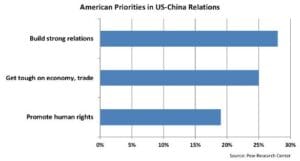
    In September 2012, however, the Pew Global Attitudes Project conducted a poll of American attitudes asking specifically about human rights in China. Querying how important promoting human rights was for US policy towards China, 53 percent of the general public said that it was “very important,” while an additional 28 percent called it “somewhat important.” Choosing between the very important issues they identified, 19 percent of respondents selected promoting human rights as “most important.” This was the third most popular selection, lagging nine points behind the leader, “build[ing] a strong relationship with China,” and six points behind “be[ing] tough” on economic and trade issues.

    In January 2011, 40 percent of Americans thought that it was very important to “do more to promote human rights in China,” while 32 percent thought it was somewhat important, according to a Pew Research Center poll. Consistent with this later finding, a CNN/Opinion Research Corporation poll found in February 2010 that Americans felt taking “a strong stand on human rights in China” (53 percent) was more important than maintaining “good relations with China” (44 percent). American disapproval of China’s human rights situation was summed up by the same polling organization in November 2009: 68 percent of Americans gave the Chinese government “mostly bad” or “very bad” marks for “respecting the human rights of its citizens.”

    Despite economic concerns, promoting human rights remains among the top priorities that Americans identify for the US government’s foreign policy initiatives towards China. How the winner of the 2012 presidential election manages the public’s expectations is likely to be one of the biggest challenges of US-China relations over the next four years. ■

  • Dialogue – Issue 49: Dui Hua Hosts Third Juvenile Justice Expert Exchange with China

    Chinese and US participants and Dui Hua directors and staff attend a welcome dinner at Director Maggie Yum’s home.

    China’s dedication to juvenile justice reform has led to a decline in national delinquency and the emergence of specialized treatment for youth at odds with the law. While much has been accomplished since China established its first juvenile tribunal in 1984, further development informed by international methods remains crucial.

    Looking towards the implementation of new juvenile procedures introduced in amendments to China’s Criminal Procedure Law (CPL) earlier this year, Dui Hua hosted its third Juvenile Justice Expert Exchange with China’s Supreme People’s Court (SPC) in September. The two previous exchanges, held in 2008 and 2010, introduced progressive measures for handling juveniles that were largely incorporated into China’s amended CPL. The third exchange brought a Chinese delegation of seven juvenile judges and experts to the Bay Area to tour juvenile facilities, observe trials, and meet with local experts in San Mateo, San Francisco, and Santa Clara counties. Senior Judge Ma Dong of the SPC Juvenile Court Guiding Group led the delegation and was joined by two colleagues from the SPC Juvenile Court Work Office and four judges from the provincial courts of Heilongjiang, Hunan, Henan, and Fujian.

    Rehabilitation and Restorative Justice

    Henan intermediate court Vice-President Li Qihong (right) tours a San Mateo juvenile detention facility with interpreter Sonia Ng.

    The delegation first traveled to San Mateo County where they were hosted by Judge Elizabeth Lee at the Youth Services Center (YSC), a state-of-the-art facility for juvenile offenders with an emphasis on rehabilitation and restorative justice. Due to YSC’s integrative design, delegates were able to learn about the functioning of San Mateo’s entire juvenile justice system all in one place. Composed of courtrooms, a detention center, a fully accredited school, and the county’s juvenile probation department, YSC allowed delegates to gain first-hand experience in everything from intake by police to release on probation.

    The importance of probation officers in enforcing court dispositions and monitoring rehabilitative progress was one recurring theme. It was showcased during a ride-along with the San Mateo Juvenile Probation Department. Chinese delegates accompanied three probation officers into the field to make unscheduled house visits to youth on probation. The purpose of the routine visits is to ensure that youth are abiding by the conditions of their probation and that their homes are safe and free of dangerous or suspicious activity. During the ride-along, one youth agreed to talk with Chinese delegates about the conditions of his probation and his experience in the justice system. Taking advantage of the unexpected meeting, the judges asked him whether he faced any social stigmas and what his plans were after probation. In a system without probation officers to split heavy caseloads, Chinese juvenile judges are often unable to provide much individual attention to juvenile cases.

    Chinese delegates also observed a mock victim-offender mediation, which displayed the cooperative nature of San Mateo’s Juvenile Mediation Program and its capacity to provide compassionate resolution to juvenile delinquency. The mock mediation—which involved a juvenile who stole a laptop from a home and sold it to a friend—was conducted in three parts, each involving different participants: offender-mediator, victim-mediator, and victim-offender-mediator. After emotional testimonies from both sides, the offender met her victim face-to-face to apologize and express remorse for her actions. The mediation ended with the parties agreeing to a peaceful and practical resolution.

    Specialized Courts, Record Sealing

    In San Francisco, the delegation learned about the Juvenile Collaborative Reentry Team (JCRT), a specialized juvenile court which focuses on coordinating and implementing comprehensive reentry plans and aftercare services for “high-need” youth soon to be released from out-of-home placement. The goal of the court is to reduce recidivism, and in only a few years of operation, this is being achieved. In 2011, 12 percent of youth served by the JCRT committed an additional offense, compared with 41 percent of San Francisco youth not served by that court. (In a recent white paper on judicial reform, China said that juvenile recidivism remained around 1–2 percent from 2002 to 2011, but how recidivism is defined is unclear; aftercare services are limited in China.) The JCRT is led by Superior Court Judge Kathleen Kelly and supported by the San Francisco Juvenile Probation Department, the Public Defender’s Office, and a community-based aftercare service.

    Santa Clara County welcomed delegates to observe a morning session of its Juvenile Treatment Court. Led by Judge Carrie Zepeda, the court provides intensive, multi-agency treatment and services to youth whose legal troubles started with substance abuse. During the proceedings, Judge Zepeda met with nearly a dozen service providers from various agencies to consider five specific cases. After discussing progress reports, the juvenile’s issues at home and school, and their relationships with family and friends, the team proposed next steps in the treatment program. Youth are not present during the morning sessions but are brought into the court during same-day afternoon sessions for a status report and update on the decisions that were agreed upon during the morning session.

    Together with juvenile records sealing, specialized courts help troubled youth make a fresh start. For more than 50 years, records sealing has been a common way to promote rehabilitation in the United States. In 2011, the practice was incorporated into China’s amended CPL. While in Santa Clara, Judge Leonard Edwards (ret.) primed delegates on best practices.

    Roundtable Wrap-Up

    The exchange program ended at UC Hastings College of the Law in San Francisco. The Chinese delegates were joined by local law professors and experts for a roundtable session organized by Dean Frank Wu and Associate Professor Keith Hand. The forum provided an academic yet relaxed conclusion to the week of programs. SPC Judge Jiang Ming gave an informative presentation on the expansion of juvenile justice in China, highlighting the achievements and reforms that have been made over a short period of development. UC Hastings professors followed up with short presentations on a collection of topics, including how juvenile delinquency is taught in American law schools—a topic suggested by the Chinese delegation.

    Near the conclusion of the roundtable, San Francisco Judge Julie Tang offered a brief summary of the programs over the past week and the importance of the exchange in improving the lives of young people in both China and the United States. Chinese delegation leader Senior Judge Ma Dong closed the event with an expression of gratitude for the hospitality his group received and an acknowledgement that the deeper and more comprehensive understanding of effective juvenile programs gained by the delegation throughout the exchange will have an impact on their work in the future. ■

    In addition to those mentioned above, Dui Hua would like to recognize San Francisco Superior Court Judge Lillian Sing, California Supreme Court Justice James Lambden, and interpreters Sonia Ng and Chi Ho Chan.

    Landmarks in Chinese Juvenile Justice

    Less than 30 years ago, China had just one juvenile tribunal. Today, there are 2,331 juvenile tribunals and 7,450 judges adjudicating juvenile cases. The Supreme People’s Court (SPC) divides the history of China’s juvenile justice system into four phases:

    1. Juvenile court pilots (1984–1988);
    2. Nationwide expansion of juvenile courts (1989–1993);
    3. Development of institutional systems and mechanisms (1994–2003);
    4. Reform and gradual improvement (2004–present).

    Below are some highlights.

    1984
    Shanghai establishes first juvenile tribunal
    1991
    Jiangsu establishes first comprehensive juvenile court to hear criminal, civil, and administrative cases
    1998
    Jiangsu establishes first inter-regional juvenile tribunal to hear juvenile cases in a centralized manner
    2006
    SPC launches juvenile court pilots at the intermediate-court level
    2008
    2010
    2011
    • Criminal Law amendments include juvenile probation, lenient sentencing, etc.
    • Criminal Procedure Law (CPL) amendments include juvenile records sealing, diversion, etc.
    2012
    2013
    CPL effective January 1
     
  • Leftist Subversion in China: 1980 to Present

    Mao’s statue towers over a public square in his birthplace, Shaoshan City, Hunan. Photo credit: Changsha Evening Newspaper

    Officials in Shaoshan City, Hunan Province, the birthplace of Mao Zedong, have already spent in excess of 1.9 billion yuan in preparation for the 120th anniversary of Mao’s birth this December. Last month, more than 20 thousand people visited a mausoleum in the middle of Beijing to mark the 37th anniversary of his death. Throughout the country thousands more—many of them petitioners, former soldiers, workers, and officials—attended “red song” concerts in memory of China’s “great man,” depicted in official narratives to have “liberated” China from feudalism, capitalism, and imperialism.

    Mao and patriotism seem to go hand in hand, but Chinese authorities have convicted scores of individuals of “reactionary” or “subversive” acts for singing Mao’s praises too loud. Dui Hua’s Political Prisoner Database (PPDB) has information on more than 40 individuals detained or sentenced for their involvement in illegal opposition parties advocating pre-reform socialism. These self-proclaimed vanguards of Marxism-Leninism-Mao Zedong Thought include farmers, workers, academics, cadres, and even entrepreneurs discontented by the capitalist influence that poured into China following Deng Xiaoping’s reform and opening in 1978.

    While many Chinese have joined leftist symposiums and, in the past decade, Internet forums to vent grievances about the corruption and social inequality that persist despite, or because of, the Communist Party of China (CPC), few chose to organize opposition parties to rebuild a proletarian dictatorship. Those who do face the same, and at times worse, fates as those who organize in the name of western-style democracy, a multiparty system and separation of powers.

    Striking Hard Against “Mao Anmin”

    On December 22, 1983, the Linyi District Intermediate People’s Court in Shandong Province sentenced Zhang Chengjian (张成检) to death. According to an official summary of the case (translated in Dui Hua Occasional Publications, Volume 2), the farmer claimed that he was Mao Anmin (毛岸民), Chairman Mao’s successor and Jiang Qing’s stepson. He said that his entire family was murdered by Deng Xiaoping and his allies and that Deng “usurped” the power of Mao’s designated successor, Hua Guofeng, and “distorted Mao’s revolutionary path.” Zhang was particularly critical of the household responsibility system. First adopted in the agricultural sector in 1981, the system allowed farmers to sell their produce at unregulated prices after meeting state production quotas. While increasing production incentives dramatically, the system also made farmers more vulnerable to economic losses from poor harvests, fluctuating market prices, and natural disasters.

    Assembling several like-mind individuals who hoped to restore the people’s commune and abolish the one-child policy, Zhang formed a new “Central Party Committee” in preparation for “revolution.” Between April and September 1983, the group allegedly mailed 97 letters attacking CPC principles, inciting military units to take up armed rebellion, and urging students to skip classes and workers to go on strike. Some letters were sent to foreign embassies, requesting their personnel to leave China and disseminate information about Zhang’s organization in their own countries.

    The case summary, the only known description of Zhang’s party, implies that the group was small and of little influence. Six farmers, ages 25‒43, were convicted for their involvement. Two others were mentioned as being approached by party members but refusing to join.

    In the trial of first instance, Zhang was convicted of organizing and leading a counterrevolutionary group, collaborating with foreign countries to conspire to damage state security, inciting state personnel and military units to rise up in armed rebellion, and counterrevolutionary propaganda and incitement. As the trial coincided with China’s first “strike-hard” campaign, which used swift and severe punishment to maintain political stability, Zhang’s death sentence came as little surprise.

    A year later, however, an appellate court found the crimes against Zhang to be incorrect and his sentence to be unduly heavy. The Shandong High People’s Court reduced his sentence to 20 years’ imprisonment, convicting him only of non-violent crimes. The other members of his group were sentenced to 1.5 to 15 years’ imprisonment on appeal. According to government responses to 10 prisoner inquiries made by Dui Hua, Zhang received one sentence extension and three sentence reductions and was released in April 2005. He was 52 and had spent 22 years in prison.

    Henan’s Mamao Party

    Established in 1991, the Marxism-Leninism-Mao Zedong Thought Communist Party of China (中国马列主义毛泽东思想共产党), or Mamao Party (马毛党), is one of the largest illegal political parties in China known to Dui Hua. Most opposition parties discussed in Chinese open sources are only reported to have a few dozen or few hundred followers. Three times the size of the Chinese People’s Democracy Party, the Mamao Party once had nearly 3,000 members in and around Dengfeng City, Henan Province. Of the 1,031 members identified in the late 1990s by local police, 899 were farmers; more than 100 were workers, teachers, cadres, and retirees; 90 percent had received middle-school education or above; and over two-thirds were ages 25‒45.

    Local public security records from 2003 name Wang Wuzhou (王五州) as party leader. A farmer and self-proclaimed special representative of the party’s Henan Provincial Committee, Wang assigned key members to take charge of propaganda, labor, military, and women’s affairs and appointed secretaries to various county- and district-level committees. The party criticized CPC policies dating back to the third plenary session of the 11th CPC Central Committee in 1978, when Deng’s market reforms were introduced. Calling the CPC “degenerate” and “corrupt,” the group cited Mao’s strategies of guerilla warfare to encourage the establishment of a new proletarian regime.

    Local police branded the Mamao Party a subversive group that “stole” the title of Marxism-Leninism-Mao Zedong Thought. Wang was detained in Xuchang, Henan, on January 9, 1999. Chinese government sources informed Dui Hua that Wang was sentenced to 15 years’ imprisonment for subversion, while leading members Zang Yongqin (臧永钦) and Dong De’an (董得安) were both sentenced to 10 years. Police classified all party members as part of the “targeted population,” a group of free persons singled out for additional public surveillance, and forced them to write statements of repentance. Zang and Dong were released in 2006 and 2007, respectively, after receiving sentence reductions. Wang is not known to have received clemency and may remain in prison until 2014.

    Internal Uprising

    In the 1990s, several senior CPC leaders advocated for workers and farmers to stage an armed rebellion, among them was Xu Jianyi (徐建一), according to investigative journalist Zhao Yan (赵岩). (Zhao was sentenced to three years’ imprisonment in 2006 for exposing forced land seizures, evictions, and other farmers’ rights issues.) Born in 1954, Xu was an editor of Hongqi (Red Flag), the state-run magazine that was renamed Qiushi Journal in 1988. He studied human rights theories in Geneva and co-wrote China’s first human rights white book, rebuking western criticisms of China’s human rights situation from 1990‒2000. Along with former Central Propaganda Minister Deng Liqun and leftist writer Wei Wei, Xu “supported” two banned publications that criticized Jiang Zemin’s “Three Represents” as overly capitalistic. Leftist officials were particularly outraged by Jiang’s plan to allow private entrepreneurs to become party members.

    Allegedly using Hongqi to establish a new publishing company and purchase an office building in Beijing, Xu was sentenced to seven years’ imprisonment for “embezzlement” and “favoritism” on December 31, 2003. He is the only person known to have been sentenced in the case. According to Zhao Yan, Xu’s sentence was “relatively light” because state prosecutors deliberately prolonged his investigation until after Jiang Zemin retired as chairman of the Central Military Commission in 2002. In 2005, Hong Kong journalist Ching Cheong (程翔) shared a cell with Xu in Beijing’s Dahongmen Detention Center, which houses high-profile political prisoners and high-ranking officials.

    One Man Committee

    Wang Shiji (王士吉) formed the CPC Revolutionary Committee at his chemical plant in Yongjin County, Hebei Province, on May 16, 1999. As the sole member of his committee, he called for the proletariat to stage the “second socialist revolution.” He appointed himself party secretary and designed party flags and emblems. In letters he wrote petitioning the CPC in 2001, Wang said he was born to a poor family in 1944 and was indebted to Mao for assigning farm work to his family, giving them a house, and subsidizing his education from the time he entered primary school to his university graduation in 1968.

    Wang opined that corruption plagued the CPC because it failed to strictly follow The Communist Manifesto and the principles of the Paris Commune. The root of this corruption, he argued, was Deng Xiaoping’s “revisionism,” a term used by Mao in the early 1960s to indicate that post-Stalinist Soviet interpretations of Marxism adulterated Marxist theory with capitalistic elements. Accusing Deng’s economic theory of betraying Marxism, Wang also openly criticized Jiang Zemin for strengthening the revisionist path and urged members of the Central Standing Committee to collectively resign. Between 1997 and 1999, Wang used the penname Mao Jidong (毛继东), literally “Mao’s successor,” to send more than two dozen critical letters and articles to the central government, party schools, and state-run and Hong Kong-based publishers. The self-proclaimed patriot and loyal party member warned that revisionism dismembered the Soviet Union in 1991, and China would follow suit.

    On November 22, 2000, the Shijiazhuang Intermediate People’s Court sentenced Wang to three years’ imprisonment for inciting subversion. His letters and articles, although never published, were presented as evidence of “rumors” defaming party policies and leaders and the socialist system.

    After his release in August 2002, Wang began petitioning to overturn his conviction and resumed his “anti-revisionist” writings. By that time, with the popularization of the Internet, he gained a broader audience, and in 2010, he reportedly formed the Marxism-Leninism-Maoism Workers’ Party of China (中国马列毛主义工人党). Wang explicitly stated that the party had a “fraternal” policy toward the CPC and would not attempt to overthrow incumbent party leaders.

    In December 2010, the Chang’an District Civil Affairs Bureau rejected Wang’s application to register the party as a social organization. Wang then defiantly stated that he would formally announce the party’s establishment in March 2011, but whether the party was formally established or continues to operate is unknown. In an article that appeared on Boxun in June 2013, Wang focuses on corruption in the CPC but makes no mention of his party. He questions President Xi Jinping’s sincerity and ability to curb graft after fire engulfed grain stocks slated for central government inspection in Daqing, Heilongjiang Province.

    Against Hu Jintao and Charter 08

    Circulating information on social networking services and sympathetic websites, the Mao Zedong Thought Communist Party of China (中国毛泽东主义共产党) was founded on November 28, 2008. In its “Ten Declarations,” the party promises that a successful revolutionary movement against the CPC will purge corrupt officials; restore the people’s communes; and lead to employment, education, healthcare, and housing for all. About a month after its founding, the party allegedly distributed pamphlets in Beijing, Shanghai, and other big cities asserting the rights of workers to overthrow Hu Jintao’s “fascist” regime. The party was equally hostile to signatories of Charter 08, a political manifesto calling for multi-party governance, calling them “traitors” and “reactionary elites” who plotted to “westernize” and “subjugate” China to US imperialism. In 2009, the party briefly received foreign media attention, but little is known about the fate of party members.

    Possibly emboldened by Bo Xilai’s Mao-style approach, 34 representatives from more than 20 provinces convened a secret meeting on October 15, 2009, in rural Wansheng County, Chongqing, where Bo was municipal party secretary, to discuss “Mao’s revolutionary practices.” One of the organizers was Ma Houzhi (马厚芝), a teacher and Shandong native who had spent more than 40 years advocating Maoism. According to Hong Kong’s Open Magazine, the meeting was joined by several members of a Chongqing Mao Zedong Thought society and a Nanjing university professor who had organized Mao Zedong Thought classes in Henan’s Nanjie Village—a place that reportedly retains pre-reform collectivized agricultural production.

    Online forums include accounts of armed police and security officers raiding the gathering and confiscating computers, party flags, and propaganda. Twenty-five of the meeting participants were sent back to their original residences after serving 4‒5 days of administrative detention for holding an “illegal assembly.” Ten other members, whose average age was over 50, were criminally detained for “organizing terrorist activity.”

    Government sources confirmed for Dui Hua earlier this year that at least four members, including Ma, are serving sentences for subversion in Chongqing and Guizhou. Ma and Wei Jinxiang (蔚晋湘) are both scheduled to complete 10-year sentences on October 14, 2019. Incarcerated in Guizhou’s Zunyi Prison, Niu Yong (牛勇) and He Yuanfa (何远发) are serving five- and six-year sentences, respectively. Government sources were unable to verify information about Deng Guobin (邓国宾), who was reportedly sentenced to five years’ imprisonment.

    Patriotism and Mao Zedong

    Partially to appease hardline leftists bitter over Bo Xilai’s downfall, in his first speech at the Politburo collective study session in November 2012, Xi Jinping emphasized that Marxism-Leninism-Mao Zedong Thought “must not be lost.” This summer, Xi remarked that Mao’s lakeside villa in Wuhan, Hubei Province, should become a youth learning center dedicated to patriotism.

    While toeing the line of “socialism with Chinese characteristics” and “stability above all else” under one-party rule, how appropriate is it for Xi to stress Mao Zedong Thought? As the aforementioned cases show, a deep love for Mao and country is not the same as a deep love for the CPC, and those who favor communist ideals over the “perils” of democracy and constitutional government may also face persecution.

  • Politico-Legal Committee Issues Rules to Prevent Injustice

    Four well-known miscarriages of justice befell (from left) Zhao Yanjin (in prison nearly a decade), Nie Shubin (executed, 1995), She Xianglin (in prison 11 years), Hugejiletu (executed, 1996). Photo credits: Sanlian Life Weekly, xinhuanet.com, sohu.com

    A series of high-profile cases involving wrongful conviction and other miscarriages of justice has increasingly forced China’s top law-enforcement officials to address this troubling issue head-on. In March, the president of Zhejiang’s High People’s Court placed much of the blame for wrongful convictions on the extraction of confessions through torture. President Xi Jinping has spoken prominently about the need for “the popular masses to feel fairness and justice in every judicial case,” and new Supreme People’s Court President Zhou Qiang has called on lawyers and scholars to help reform the criminal justice system.

    Then, in mid-August, the Chinese Communist Party’s Central Politico-Legal Commission (CPLC) issued a set of 15 provisions aimed at systemic changes that could help prevent future injustice. Met with considerable fanfare by Chinese media, the provisions included a call to establish a new responsibility system in which judges, prosecutors, and police would be held accountable for life for negligent or wrongful acts that result in wrongful conviction.

    Over the past two months, judicial and law-enforcement bodies throughout China have been studying the CPLC pronouncements. The Supreme People’s Procuratorate has already issued provisions for implementation. Despite all the attention, copies of the provisions have not been widely circulated. In fact, Dui Hua has only been able to find one copy online (translated below) as circulated by a local party branch politico-legal committee in Jining, Shandong Province.

    On one level, much of the CPLC guidelines reiterate provisions and principles that are already part of China’s Criminal Procedure Law and related regulations. The emphasis on fully recording interrogations and excluding illegally obtained evidence reflect the growing recognition of the need to protect the rights of criminal suspects and defendants, but implementation of these important protections has yet to become routine. Likewise, the CPLC provisions emphasize the importance of keeping channels of communication open within the criminal process and acting on information in a timely manner, whether it be the opinions of defense lawyers or allegations of wrongdoing made by convicted persons.

    Besides the proposed responsibility system, another theme of note in the CPLC provisions is the need to insulate the judicial process from external interference. Public opinion, petitioning, and “stability preservation” are all cited as sources of external pressure that should not be allowed to influence decisions made during the criminal process. By the same token, the guidelines also point to the possibility of less interference by local party and government officials by limiting the scope of politico-legal committees’ guiding opinions and efforts to “coordinate” opinions between law-enforcement bodies when there are disagreements about how a case ought to be handled.

    There is much in these guidelines that sounds positive from the perspective of promoting procedural fairness and rule of law in China. The ultimate impact of these pronouncements, however, is likely to depend on how much weight they are given vis-a-vis other, well-established imperatives to pursue stability in the interest of the overall socio-political order, for it is the perception that these interests can trump the law and political and civil rights that contributes most to miscarriages of justice in China.

    *
    Provisions on Earnest Prevention of Miscarriages of Justice

    In order to give thorough implementation to the spirit of the important written instructions given by General Secretary Xi Jinping and Comrades Meng Jianzhu and Guo Shengkun, fully realize the spirit of the Fourth Plenary Session of the Central Politico-Legal Commission, punish crime in accordance with the law, respect and safeguard human rights, increase the credibility of the judicial system, and uphold social fairness and justice, we hereby enact the following provisions on the subject of strict adherence to legal procedure and holding firm to the bottom line on prevention of miscarriages of justice.

    1. Except in emergencies when it is necessary to conduct on-the-spot questioning, questioning of criminal suspects or defendants ought to be carried out in case-handling locations provided for [by law and regulation]. After a criminal suspect has been transferred to a detention center for custody, questioning shall be carried out in the detention center interrogation room with simultaneous audio- or video recording of the entire process. The investigating organ may not use reasons such as recovering stolen goods or [conducting an] identification [procedure] to remove suspects from the detention center in order to conduct questioning outside the facility.
    2. When the investigating organ transfers a case [to prosecutors], it ought to include all evidence of the guilt or innocence of the suspect or defendant as well as of the severity of the crime. It is strictly forbidden to withhold or fabricate evidence.
    3. When evidence that ought to be excluded is discovered during investigation, prosecutory review, or trial, it ought to be excluded in accordance with the law and may not serve as the basis for requesting arrest approval, approving or issuing an arrest decision, transferring the case for prosecutory review, making a decision to prosecute, or issuing a verdict. Suspect or defendant confessions obtained through torture or other illegal means, or witness testimony or victim statements obtained through violence, threats, or other illegal means may not be used as the basis for conviction.
    4. People’s procuratorates shall conduct oversight in accordance with the law as to whether investigation activities are lawful; provide opinions and recommendations as to the collection, securing, and perfection of evidence; and, when necessary, appoint procurators to take part in discussions with the investigating organs concerning major or serious cases and re-testing or re-examination of crime scenes or items, persons, or corpses associated with a crime.
    5. People’s procuratorate shall strictly ensure the standards for arrest review, prosecutory review, and prosecutory appeal. In cases that do not meet the statutory requirements for arrest or prosecution, it shall withhold arrest approval or issue a decision not to prosecute in accordance with the law. Appeal shall be made in accordance with the law in cases that meet the conditions for prosecutory appeal, especially when the innocent are found guilty, the guilty are found innocent, or the sentence is either unusually light or unusually heavy.
    6. Firmly adhere to the principle of judgment on the basis of evidence. When a witness who ought to appear in court in accordance with the law refuses to appear or appears but refuses to testify without good reason and the court has no way to confirm the veracity of his or her testimony, the testimony of that witness may not be used as the basis for conviction. Any evidence that has not been presented, examined, and cross-examined in court and verified through these court investigation procedures may not be used as the basis for conviction.
    7. Strictly implement the legal standard of proof. When there is only a defendant’s confession and no other evidence, the defendant cannot be convicted or given criminal punishment. In cases where there is insufficient evidence to convict, the presumption of innocence shall be adhered to and the defendant pronounced innocent in accordance with the law, standards cannot be lowered to issue a verdict with a “margin of error.” When evidence to convict is truthful and sufficient but there are doubts concerning evidence with implications for sentencing, a sentence favoring the defendant shall be issued.
    8. When people’s courts, people’s procuratorates, or public security organs handle criminal cases, they must take facts as the basis and law as the criterion and cannot issue judgments or decisions that violate the provisions of the law due to pressure caused by public-opinion hype, disruptive petitioning by a parties to the case or their relatives, “case-solving deadlines,” or local “stability preservation.”
    9. Earnestly safeguard the rights of defense lawyers to meet [with clients], read case files, carry out investigations, and obtain evidence, and to raise questions, cross-examine evidence, and debate in court. During the phases of concluding the investigation, prosecutory review, and final review of death sentences, people’s courts, people’s procuratorates, and public security organs ought to hear defense lawyers’ opinions in accordance with the law. With respect to the defense arguments and evidentiary materials submitted in defense by defendants and their defense counsel, people’s courts ought to give them serious review and provide an explanation in the court decision as to why they were accepted or rejected.
    10. People’s procuratorates and people’s courts ought to conduct timely review in accordance with the law when receiving allegations or petitions that may truly involve miscarriage of justice. After review, if a criminal verdict or decision is found to be in error, prosecutory appeal or request for retrial shall be made in accordance with the law. People’s procuratorates shall immediately rectify mistaken decisions made in a criminal case by itself or by its subordinate procuratorates in accordance with statutory procedures.
    11. Prisons or other penalty-enforcement organs may not withhold petitions, allegations, or accusation materials made by offenders and ought to transmit them or request the relevant authority to handle them in a timely manner. The relevant authority ought to conduct a serious review and handle [the petition, allegation, or accusation] in a timely manner and notify the prison or other penalty-enforcement organ of its decision. When offenders make petitions or allegations, it shall not affect their eligibility for sentence reduction or parole.
    12. Establish a strong case-management responsibility system in which the collegiate bench as well as individual judges, procurators, and police officers are held equally accountable and judges, procurators, and police officers are held accountable for life for the quality of the way a case is handled insofar as the purview of their duties is concerned. Responsibility for unlawful acts related to the handling of cases by judges, procurators, and police officers shall be pursued in accordance with the relevant laws and provisions.
    13. Clarify the standards for [what constitutes] a miscarriage of justice as well as procedure for and agent who can initiate remedial action and establish a strong mechanism for pursuing responsibility in miscarriages of justice. Acts such as coercion of confession through torture, use of violence to obtain evidence, and withholding or fabricating evidence shall be severely punished in accordance with the law.
    14. Establish a strong, scientific, and rational system for case-management performance evaluation that adheres to judicial rules; do not one-sidedly pursue targets such as a case-solution rate, arrest rate, prosecution rate, or conviction rate.
    15. Party politico-legal committees at all levels ought to support the independent and fair exercise of judicial and procuratorial powers by the people’s courts and people’s procuratorates and support each politico-legal unit in carrying out its work in an independently responsible and coordinated manner in accordance with the constitution and laws. In cases where the facts are unclear or the evidence is insufficient, do not coordinate [opinions between law enforcement bodies]; when coordinating [opinions regarding] cases, generally refrain from making specific opinions regarding the determination or substantive handling of a case.
  • Dialogue – Issue 53, Fall 2013

    Looking for Universality at China’s Second UPR

    In a year of waning cooperation on human rights between China and foreign governments and international institutions, the 17th session of the UN Human Rights Council Universal Periodic Review provided an opportunity for open dialogue across a broad range of topics. On the morning of October 22, 2013, 137 countries gave statements on China’s human rights record recommending ratification of UN treaties, release of execution statistics, rights protections for ethnic minorities, and the end of arbitrary detention.

    Women Prisoners, Gender-Specific Treatment

    Ahead of China’s Universal Periodic Review, the United Nations hosted a series of events to raise awareness about UN Rules for the Treatment of Women Prisoners and Non-Custodial Measures for Women Offenders (the Bangkok Rules). At a panel convened on October 16, NGOs were called on to advocate for implementation of the rules that address the unique needs of women in prison systems built for and run by men. Dui Hua is doing its part by organizing a symposium on the Bangkok Rules in February 2014. (Photo credit: Penal Reform International)

    Prisoner Update

    We report on sentence reductions for Chongqing activists Song Bukun (宋步坤) and Xu Wanping (许万平), former county official Rao Wenwei (饶文蔚), and Chinese citizen Xu Jianchi (许剑池). Clemency was not granted for leftist opposition party organizers including Ma Houzhi (马厚芝) and Wei Jinxiang (蔚晋湘). (Photo credit: Yang Junxiang, Chinanews.com)

    Dui Hua News

    A brief look at Dui Hua activities in September and October highlighting advocacy and outreach, staff updates, and improvements to our Political Prisoner Database.

  • Dialogue, Issue 53: Looking for Universality at China’s Second UPR

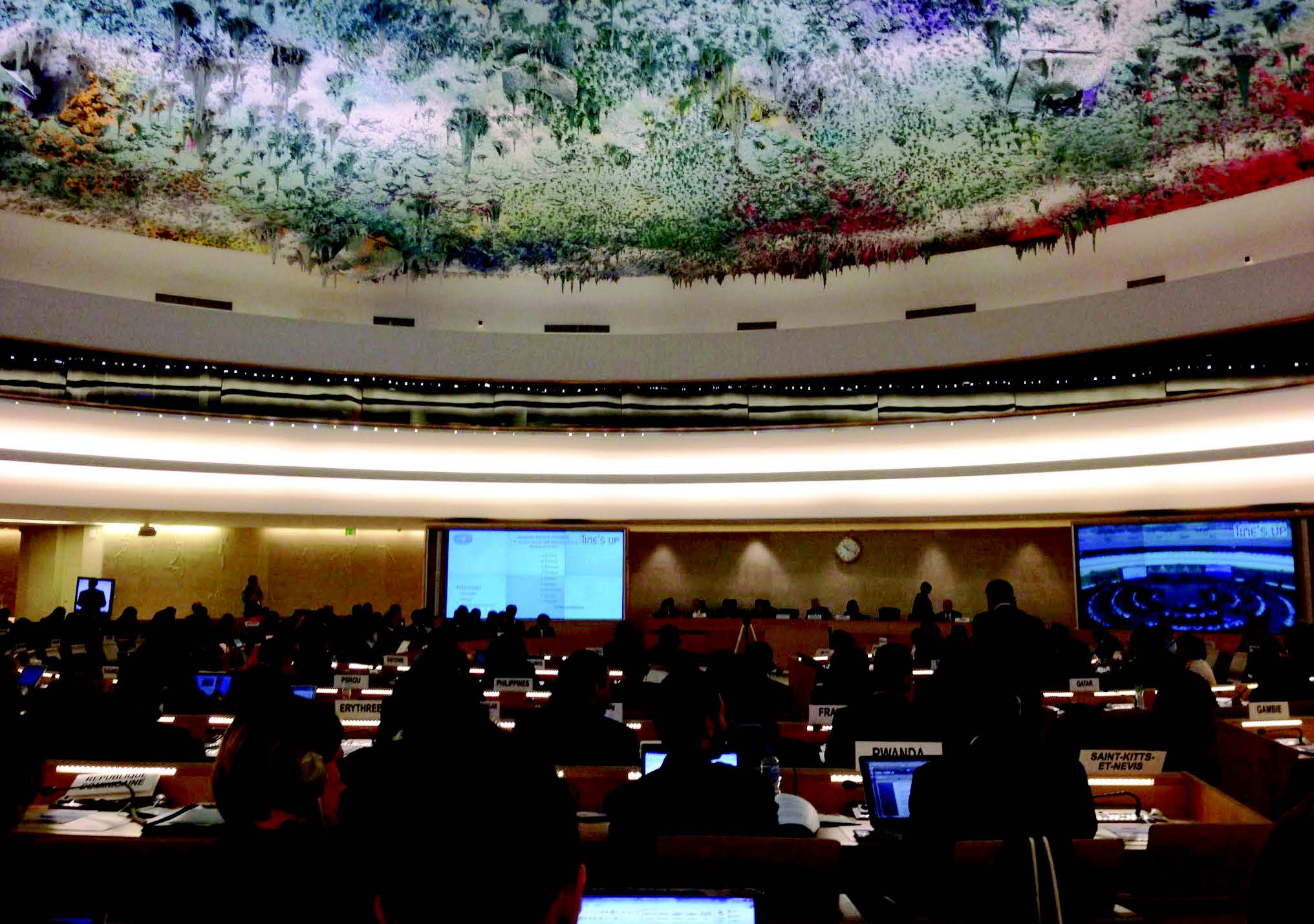
    China’s second Universal Periodic Review by the UN Human Rights Council convened on October 22, 2013, at the Palais des Nations in Geneva.
    China’s second Universal Periodic Review by the UN Human Rights Council convened on October 22, 2013, at the Palais des Nations in Geneva.
     

    In a year of waning cooperation on human rights between China and foreign governments and international organizations, the 17th session of the Human Rights Council (HRC) Universal Periodic Review (UPR) provided an opportunity for open dialogue across a broad range of topics. On the morning of October 22, 2013, 137 countries gave statements on China’s human rights record. The troika of countries that facilitated the review process consisted of Poland, Sierra Leone, and United Arab Emirates.

    Many declared China’s handling of its first UPR in February 2009 a brilliant stroke of political maneuvering. In order to make statements during that session, country representatives were required to queue and speak in order of their places in line. By the time the session concluded, only 60 countries—less than half of those who wanted to speak—had made remarks, and many of those countries had lined up hours in advance at China’s behest.

    In an effort to remedy situations like this, the HRC instituted new UPR procedures. This year, the majority of countries were given the floor in alphabetical order (the first five spots were determined by lots), with each allowed just 50 seconds to speak. The result was a rapid-fire interactive dialogue bookended and interspersed with statements and responses from the Chinese delegation, led by Wu Hailong, special envoy of China’s Ministry of Foreign Affairs (MFA).

    Opening Remarks

    Wu’s introductory statement began with a commitment to the UPR process and “open, candid, and responsible” dialogue. He acknowledged the 42 recommendations accepted at the previous UPR and highlighted the steps China has taken to improve its human rights record.

    With regard to the judicial system, these steps included reducing the number of crimes carrying the death penalty and reforming the system of reeducation through labor (RTL). Wu emphasized that Amendment 8 to the Criminal Law abolished the death penalty for 13 economic and non-violent crimes, but he did not offer statistics on the number of executions nor a commitment to complete abolition. In his mention of RTL—a decades-old form of administrative detention often applied to dissidents—he stated that a plan for reform was underway and would be announced in due course.

    Wu Hailong led the Chinese delegation to the second UPR. Photo credit: Prokerala.com

    Acknowledging China’s agreement to step up cooperation with UN Special Procedures, a recommendation it accepted in 2009, Wu announced that China had issued an invitation to receive the Working Group on the Issue of Discrimination against Women in Law and in Practice later this year. Dui Hua lobbied for this landmark invitation, which comes at a time when China has about a dozen pending requests for visits by Special Procedures, the oldest of the requests dating back to 2005. China also indicated that it would welcome three other Special Procedures next year and increase its annual donation to the Office of the High Commissioner for Human Rights from US$50,000 to US$800,000. The revised figure puts China among the top 25 donors, just ahead of Japan, but is nonetheless dwarfed by the annual US contribution of US$48 million.

    In its first UPR, China agreed to facilitate an early visit by the UN high commissioner on human rights. High Commissioner Navanethem Pillay has been in office for the last five years but has yet to visit China. In his statement, Wu reiterated that China would like to invite the high commissioner to visit at a mutually convenient time. Having made several critical statements on China’s human rights record, Pillay was only approved for an abbreviated two-year second term, and her mandate ends on September 1, 2014. Finding a mutually convenient time for Pillay to visit China will be difficult—partially due to a number of sensitive dates such as the National People’s Congress and Chinese People’s Political Consultative Conference, Chinese New Year, June Fourth, and Occupy Central (a civil disobedience movement for universal suffrage in Hong Kong scheduled to coincide with the July 1 Special Administrative Region Day)—but may be possible in April or May of 2014.

    In his discussion of Hong Kong, Wu stated that the government continues to support individuals with different sexual orientation. In China’s 2009 UPR no recommendations were issued on the subject. This round Ireland recommended that China establish anti-discrimination laws to ensure equal treatment for lesbian, gay, bisexual, and transgender people, while the Netherlands recommended that anti-discrimination clauses be added to the labor law.

    Recommendations

    Reinforcing the universality of human rights as put forth in Article 1 of the Universal Declaration of Human Rights, ratification of the International Covenant on Civil and Political Rights (ICCPR) remained the action most recommended to China by member states, just as it was during China’s 2009 UPR. China signed the ICCPR in 1998, and while it accepted the 2009 recommendations to one day ratify the covenant, it rejected recommendations to either immediately ratify the treaty or provide a timetable for ratification. Acceptance or rejection of the recommendations made during the 17th session has not yet been indicated. China is expected to formally respond to the recommendations at the 25th session of the HRC in Geneva in March 2014.

    In April of this year, the General Office of the Communist Party of China (CPC) issued Document No. 9 identifying “universal values of human rights” as one of “seven perils” faced by the CPC in maintaining its one-party system. Speaking last in the interactive dialogue of October’s UPR, Iceland emphasized the principle of the universality of human rights. It commended China for affirming that principle in its first National Human Rights Action Plan (2009‒2010) but expressed concern that the principle was trumped by “practicality” in the action plan for 2012‒2015.

    The second most common type of recommendation at this year’s review involved the death penalty. While China’s reduction in the number of capital crimes was widely acknowledged, several European nations, among others, called on China to declare a moratorium on the death penalty and release execution statistics. In responses made by the Chinese delegation during the interactive dialogue, Miao Youshui, deputy presiding judge at the Supreme People’s Court, addressed the issue of capital punishment. He noted that the right to life must be balanced with guaranteeing the rights of the victim. According to the current situation and “people’s desire for justice” the death penalty cannot presently be abolished, but abolition is a trend that China is moving toward, Miao said.

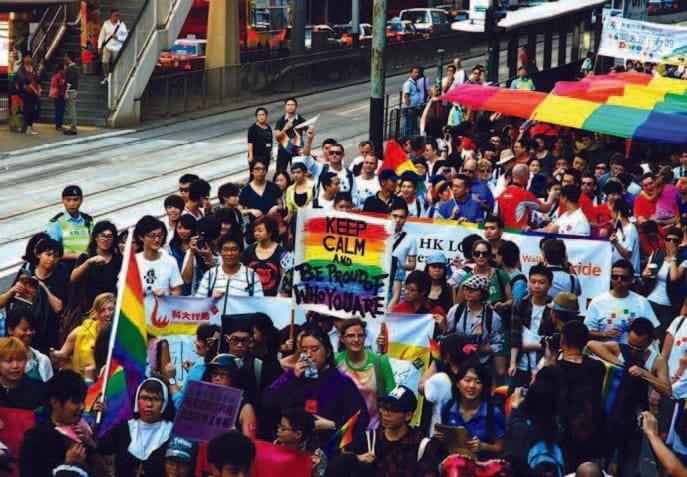
    The Chinese delegation said Hong Kong’s government supports individuals with different sexual orientation. Hong Kong activists have been organizing annual pride parades for LGBT rights 2008. Photo credit: PrideLab

    Ethnic minorities were another major focus during the interactive dialogue. As country representatives arrived for China’s UPR, Tibet activists scaled the UN venue and unfurled a 9-meter-by-15-meter banner that read “China Fails Human Rights, UN: Stand Up for Tibet.” The banner was removed before the UPR actually commenced, and four of the activists were arrested by police. Countries critical of China’s ethnic policies recommended greater protections of political and religious rights, particularly for Tibetans, Uyghurs, and Mongolians. Canada called on China to stop the persecution of people for their religious practices and beliefs including Tibetans, Uyghurs, Catholics, other Christians, and Falun Gong.

    In contrast, Uzbekistan asked China to step up measures to bring self-immolators to justice in Tibet, and Pakistan and Sri Lanka recommended continued counterterrorist action in Xinjiang. Liu Peng, director of the Seventh Department of the United Front Work Department of the CPC Central Committee, noted rapid economic growth and social developments, such as improved literacy rates and life expectancy, in Tibet. He blamed the “Dalai Lama clique” for organizing the more than 120 self-immolations carried out across the Tibetan plateau since February 2009, citing an online guide to self-immolation as evidence. Sui Qing, deputy director-general of the Department of Supervision of the State Ethnic Affairs Commission, said that Xinjiang is currently at its “best time” in economic and social development but that violent terrorist acts originated by East Turkestan have led to instability.

    In defending its treatment of Tibetans and Uyghurs, the Chinese delegation cited equal participation between ethnic minorities and Han Chinese in state and local affairs. Yet the delegation’s leading experts on Tibet and Xinjiang were neither Tibetan nor Uyghur, which speaks to the larger issue of who is allowed to participate.

    One month before the UPR, academic and human rights defender Cao Shunli (曹顺利) was detained at Beijing Capital International Airport en route to Geneva, where she intended to attend the HRC. Cao led a protest outside the MFA calling on the government to allow civil society a more robust role in the UPR. She was formally arrested on October 21. Many of the most critical countries at the UPR recommended that China establish a national human rights institution in line with the Paris Principles, and even more highlighted enforced disappearances and the detention of human rights defenders.

    Naming Names

    While rights abuses against human rights defenders and civil society practitioners were brought up repeatedly, throughout the entire session, only one of 137 countries included in its remarks the names of people believed to face these abuses. Speaking sixth to last, the United States expressed concern that China “harasses, detains, and punishes activists including Xu Zhiyong (许志永) and Yang Maodong (杨茂东)” (a.k.a. Guo Feixiong (郭飞雄)). Xu and Yang are leading members of the loosely organized New Citizens’ Movement that advocates for constitutionalism and anti-corruption measures. Despite their mention during the interactive dialogue, neither Xu’s nor Yang’s name appears in the draft report of the Working Group on the UPR, which was approved without objection by the United States. Names of six other individuals—Gao Zhisheng (高智晟), Liu Xiaobo (刘晓波), Liu Xia (刘霞), Dhondrup Wangchen, Jigme Gyatso, and Ghariyet Niyaz—were included in questions submitted by Sweden and the United States in advance of the UPR. With the possible exceptions of Yang and Jigme Gyatso, all of these individuals were among the 30 people identified during the 18th US-China Human Rights Dialogue as facing political persecution.

    Xu Zhiyong was one of two activists named by the US delegation as facing harassment and punishment. Photo credit: RFI/Stéphane Lagarde

    In China’s final remarks, Director-General Li Junhua of the MFA Department of International Organizations and Conferences countered that some countries “called certain criminals in China as human rights defenders” and that “normal judicial procedures were called political persecution.” Rights lawyer Gao Zhisheng, university professor and Nobel laureate Liu Xiaobo, and Tibetan filmmaker Dhondrup Wangchen are all currently serving prison sentences. Yang Maodong and Jigme Gyatso previously served prison sentences for providing legal aid to petitioners and carrying out peaceful resistance for Tibetan independence, respectively. However, neither Xu Zhiyong, who is currently in police custody, nor Liu Xia, who is under police surveillance, has ever been convicted of any crime.

    In systems where human rights abuses persist, actions to protect human rights can often run afoul of the law, and “normal” judicial procedures may be flawed. It may be true, as Director-General Li Junhua says, that “the best person to know the situation of human rights in China is Chinese,” but the notions that there is a unified Chinese experience and that outside perspectives are categorically faulty run counter to the spirit of the UPR.

  • For State Security, Police Rules Color Code “Targeted Population”

    Guizhou Public Security Bureau Director-General Sun Licheng discusses targeted population management with local police. Photo credit: Guizhou Public Security.

    In addition to their roles as crime investigators, Chinese police are responsible for taking proactive measures to maintain political and social stability. Increasingly, this involves Chinese police at all administrative levels carrying out massive efforts to gather and analyze intelligence about their jurisdictions in an effort to prevent crime and unrest before it occurs. This has been especially true since 2008, when the former head of the Ministry of Public Security (MPS), Meng Jianzhu, announced a nationwide goal of “public security informatization” (gongan xinxihua). Evidence of concrete applications of this new “intelligence-led policing” can be seen in measures (translated below) concerned with control of the “targeted population” (zhongdian renkou) that were adopted last December by police stations in a handful of areas in Guizhou Province.

    Though few Chinese outside of law-enforcement circles are probably aware that a targeted population officially exists, local police officers are given a serious responsibility to “manage” this group, which includes individuals suspected of “endangering state security” (including those who participate in “cults” or illegal religious activity), people who use drugs, people with previous convictions, and persistent petitioners or others with grievances that might lead to protests or other forms of social unrest.

    Chinese police have been keeping detailed files on the targeted population in local police stations for many years under MPS regulations first issued in 1985. Advances in technology have made it easier for police to monitor targeted persons and gather information about them, share information between law-enforcement agencies, and draw upon a wide variety of other data from government agencies to profile suspects and predict their potential to cause unrest. As one part of a comprehensive system of “social management” (shehui guanli), Chinese police are using technology to collect and analyze huge amounts of personal data in hopes that it might help them to be more preemptive in preserving social stability. In areas where stability is of particular concern, such as Tibet, pervasive surveillance measures in a system of “grid management” (wanggehua guanli) aim to feed the intelligence system with data and assist local authorities in predicting and neutralizing risks.

    From the Guizhou measures, we see evidence of information from a number of databases being integrated under a comprehensive “police-station basic information system” as well as an “intelligence platform” that pushes alerts concerning particular targets to local police stations. Based on the data collected in this intelligence platform, targets are assigned points between 0 and 100 based on their predicted degree of risk. Based on that score, targets are assigned one of three color codings that determine the sort of control measures police are expected to put in place. For the most high-risk “orange” targets, the Guizhou measures call for deployment of para-police “public safety activists” and informants to carry out monitoring, and it seems very possible that additional measures—such as the kind of long-term “house arrest” carried out against individuals like Chen Guangcheng and Liu Xia—may be used by police in individual cases against those targets considered to pose extraordinary risks.


    Guizhou Province Provisional Measures: click to expand

    Guizhou Province Provisional Measures for Management of
    the Targeted Population by Public Security Organs

    Chapter One: General Provisions

    Article 1: In order to protect public order and state security and further enhance management of the targeted population, these measures are hereby enacted in accordance with the Ministry of Public Security (MPS) Standards for Regularized Construction of Public Security Police Stations and Regulations for Management of the Targeted Population; the Anti-Drug Law and the Drug User Registration Measures; and the Guizhou Province Anti-Drug Regulations, Guizhou Province (Trial) Measures for Points Warning Status Control of Targeted Persons by Public Security Organs, and Guizhou Province Provisional Regulations for Application and Management of the Information System for Persons Released from Prison and RTL and in light of the current application of information technology in our province .

    Article 2: These measures aim to explore ways of informatizing police work and gradually integrating the MPS Regulations for Management of the Targeted Population with the “Great Intelligence” measures of assigning points to members of the targeted population [in order to achieve] early warning and situational control and resolve the problems of the targeted population being unquantifiable, having unclear details, being hard to discover, and being unable to put under control. In these measures, targeted population refers to persons put under targeted management by public security organs on suspicion of endangering state security or social order and public safety. This includes the 20 types of targeted persons in five categories specified in MPS regulations and six of the seven categories of targeted persons (excluding fugitives) pushed through the intelligence platform.

    Management of the targeted population is a basic task to be handled internally by the public security organs, and it is strictly prohibited to divulge information [about this work]. “Targeted population” is a phrase used internally by public security organs, and it is strictly prohibited to use this phrase publicly. Auxiliary personnel and other non-police personnel are strictly prohibited from accessing targeted population information.

    Article 3: Public security police stations are responsible for daily management of the targeted population. Public safety units are responsible for operational guidance. Intelligence, anti-drug, custodial, legal affairs, information technology (IT), and other relevant units shall assist with management of the targeted population and build information collaboration mechanisms and facilitate information-sharing between units and types of police in order to reduce the burden on police station officers.

    Article 4: Placement of targeted persons under control or removal of targeted persons from control shall be decided pursuant to an opinion on control (removal) by a community police officer of the public security police station and subject to review and approval by police station officials.

    Article 5: Management of targeted persons is to be carried out chiefly by the public security police station in the place of current residence. For those targeted persons whose place of current residence and place of household registration are not under the jurisdiction of the same police station, dual control shall be carried out. For those who have migrated to other provinces, management is to be carried out chiefly by the police station in the place of household registration.

    Article 6: The goal of targeted population management is the prevention, discovery, and fighting of unlawful and criminal activity; the education, management, and rescue of individuals engaging in unlawful and criminal activity; and the preservation of social order and safety.

    Article 7: Management of the targeted population must uphold the principle of “Information Management, Situation Assessment, and Categorized Control” and rely on the Police Station Basic Information System (hereafter, [BIS]) to carry out information management.

    Article 8: Management of the targeted population is a standardized management supported by information and data. Information concerning the targeted population includes identity, background, trajectories, present behavior, and control information. All data on the targeted population is to be uniformly provided by the BIS for use by community police officers. Information about the identity, background, and trajectories of the targeted population collected outside of the BIS is to be delivered to the BIS through a comprehensive information system platform. All social resources collected by public security organs at the prefecture and county (city, district) levels shall first be compiled by the prefectural [PSB] before delivering to police stations via the BIS. Daily management of targeted population by police station community police officers is carried out using the BIS, and community police officers must ensure that information about targeted population management is accurate and up to date.

    Article 9: In order to ensure effective cooperation between all types of police in the management of the targeted population, the BIS shall be integrated into a comprehensive information system that interfaces uniformly with other public security operations systems. Real-time adjustments to the BIS shall be carried out according to changes in the operations of targeted-population management. Adjustments to operational functions are to be approved by the public safety corps, and [adjustments to] system functions are to be approved by the IT unit.

    Chapter Two: Scope of Management

    Article 10: The following individuals are subject to management as targeted persons:

    1. Those suspected of endangering state security, including suspected terrorists identified by the intelligence platform;
    2. Those suspected of serious criminal offenses, including information put forward by the intelligence platform regarding those suspected of unlawful and illegal activity;
    3. Those who because of intense conflicts and disputes have a potential to create a disturbance, engage in violent retaliation, or act recklessly, including those identified by the intelligence platform as being individuals suspected of causing instability, key petitioners, and mentally ill persons capable of creating trouble, as well as persons identified by the detention center and jail information system as persons [recently] released;
    4. Those who were sent to prison or reeducation through labor (RTL) for intentionally unlawful or criminal acts and who have been released for less than five years, including those persons identified by the intelligence platform as having prior records for major criminal offenses and those whom the Prison/RTL Release System identifies as persons released from prison or RTL for intentionally unlawful or criminal acts;For those targeted persons from Guizhou who are released from prison, RTL, or compulsory drug treatment in other provinces, the police station in the place of household registration shall list them for control in the BIS upon their reporting [to the police station] or receipt of legal documents.
    5. Those who consume or inject drugs, including those whom the BIS identifies as being drug offenders or whom the Drug User Situational Control System identifies as drug users, as well as those released from compulsory drug treatment facilities run under the justice bureau or public security bureau.After the Drug User Situation Control System is integrated with the BIS, police station community police shall no longer use the Drug User Situation Control System to manage drug user information.

    Article 11: For those targeted persons whose place of current residence and place of household registration are not under the jurisdiction of the same police station, the police stations in the place of current residence and place of household registration shall exchange information and promptly place them under control. Within the province, use the BIS to circulate information; outside the province, use letters, the Internet, or other means to circulate information.

    Article 12: Under one of the following conditions, control shall be revoked for individuals already placed under control as members of the targeted population

    1. Death;
    2. Suspicion has been eliminated through investigation;
    3. Loss of potential to engage in crimes of office such as corruption or bribery;
    4. Loss of potential to engage in crimes due to advanced age or physical infirmity;
    5. Illegal or criminal activity was committed through negligence;
    6. Current imprisonment, RTL, or compulsory drug treatment;
    7. Release from prison or RTL for at least five years (except for those targeted individuals identified by the intelligence platform);
    8. Transfer of household registration outside of the jurisdiction of a given police station, when control has been established by the new place of household registration;
    9. Control established by the police station in the place of current residence (revocation of control may be carried out by the police station in the former place of residence);
    10. Drug offender who has not taken drugs again three years after treatment;
    11. Others who should no longer be placed under control.

    Article 13: For those targeted persons already under control, the control category should be revised when the circumstances change such that the former control category is no longer applicable.

    Chapter Three: Information Management

    Article 14: Situation assessments for the targeted population consist of the four steps of information processing, information verification, information entry, and control registration.

    Article 15: The intelligence center and public safety unit of the county level public security organ shall compare of all types of [information] resources in order to locate targeted persons for whom control has not yet been established.

    Article 16: Information processing. Processing deadlines are:

    For orange alerts delivered by the intelligence platform, within one hour;

    For yellow alerts delivered by the intelligence platform, within 12 hours;

    For blue alerts delivered by the intelligence platform, reminders regarding targeted persons sent by other information systems, targeted-person management reminders originating from the BIS, and requests for mutual assistance in establishing dual control from locations inside the province, within 48 hours.

    Article 17: Information verification. Within the deadline for information entry, verify the targeted person’s basic details and get a handle on his or her current behavior and situation by checking the information and conducting fieldwork investigations.

    Article 18: Information entry. Community police officers from the police station shall enter information regarding the information verification and current behavior and situation into the BIS.

    Article 19: Assessment of points. Assessment of points for targeted person shall be conducted according to Chapter Four of these measures.

    Article 20: Control registration. Register the [type of] control [to be imposed] in the BIS according to the targeted person’s category and circumstance and within the stipulated time period.

    Article 21: Information feedback. The BIS shall feed details about management of the targeted population to the relevant information networks: Information about a targeted person’s current behavior, assessed points, and control measures shall be fed into the intelligence platform. Information about a drug user’s current behavior and urinalysis results shall be fed into the Drug User Situation Control System. Information about control established over individuals released from prison or RTL shall be fed into the Prison/RTL Release System. Feedback deadlines are as follows:

    For orange alerts sent by the intelligence platform, within 48 hours;

    For yellow alerts sent by the intelligence platform, within 72 hours;

    For blue alerts sent by the intelligence platform, targeted person memos sent by other information systems, and targeted-person management memos originating from the BIS, within seven days.

    For dual-control mutual assistance requests from inside the province, within seven days.

    Article 22: Location of targeted persons not yet under control. For those targeted persons over whom control has not yet been established, community police officers shall apply to the intelligence center for temporary control while simultaneously try to locate them using information from various social resources such as family-planning, insurance, broadcasting, water and electric utilities, communications, gas, or student records together with transient population information from places they might be and notify the police station in the place of residence to establish control.

    Chapter Four: Situation Assessment

    Article 23: Assessment of points. Assess points based on a targeted person’s current behavior, divided between system-generated points and manually-generated points. System-generated points are used as reference, whereas manually-generated points are used to determine the final points assessed to a targeted person.

    Article 24: System-generated points are points automatically assessed by the BIS for current behavior based on information entered by community-based police officers on current behavior and trajectory information provided by other systems in accordance with the Targeted Population Current Behavior Points Regulations.

    Article 25: Manually-generated points are points assessed by community police officers, using the system-generated points as a reference, on the basis of a comprehensive assessment of the targeted person’s present risk and current behavior. When the community police officer believes that the system-generated points accord with the targeted person’s present risk, the system-generated points serve as the final assessed points. When the community police officer believes that the system-generated points do not accord with the targeted person’s present risk, he or she may directly assess points based on the targeted person’s present behavior but must make a note of the reason [for the intervention].

    Article 26: Accumulated points correspond to three color levels: orange, yellow, and blue. Orange is 80 points or above, corresponding to high-risk targeted persons. Yellow is 50 to 79 points, corresponding to targeted persons of concern. Blue is 49 points and below, corresponding to ordinary targeted persons.

    Article 27: When a targeted person’s accumulated points change, the community police officer of the police station may revise the targeted person’s control category.

    Chapter Five: Control categories

    Article 28: Police stations shall employ different control measures and control frequencies for different color categories of targeted population information.

    Article 29: Orange information corresponds to targeted persons suspected of being a major and present risk. The police station community-based police officers must take management and control measures and arrange for public safety informants or public safety activists to carry out strict control. For high-risk targeted persons, the frequency of management and control by community police officers should be at least once per month.

    Article 30: Yellow information corresponds to targeted persons suspected of being a relatively large and present risk. The police station community-based police officers must pay close attention. For targeted persons of concern, the frequency of management and control by community police officers should be at least once per quarter.

    Article 31: Blue information corresponds to targeted persons suspected of being a minor and present risk. The police station community-based police officers must carry out help and education measures. For ordinary targeted persons, the frequency of management and control by community police officers should be at least once every six months.

    Chapter Six: Work Evaluation

    Article 32: Targeted population control work shall be subject to evaluation and assessment and shall serve as one major index in evaluating the work of public security police stations and community police.

    Article 33: Evaluation of targeted population management work shall be carried out by the public safety unit. Evaluation of community police officers shall be carried out by the police station. Evaluation of the police station shall be carried out by the county (city, district) public security (branch) bureau. Evaluation of the county (city, district) public security (branch) bureau shall be carried out by the municipal (prefectural) public security bureau.

    Article 34: The main areas for evaluation of targeted population control work are the role and effectiveness of targeted population control work in the discovery, prevention, and fight against criminal activity, and quantitative evaluation is made on the basis of four areas including processing rate, entry rate, and control rate. Evaluation score = (processing rate + entry rate + control rate) /3 * 100.

    Article 35: Processing rate = number processed on time / number of system alerts

    Article 36: Entry rate = number with data entered / number of system alerts

    Article 37: Control rate = number under control / number that should be under control

    Article 38: Police stations with a control rate of less than 95% or a targeted-population-not-yet-under-control rate of over 80% will have their police station qualification assessment revoked.

    Article 39: Evaluations concerning targeted persons put forward by the intelligence platform will be made according to the intelligence agencies’ evaluation measures.

    Chapter Seven: Additional Provisions

    Article 40: These rules take are to be implemented in Yunyan, Qingzhen, Honghuagang, Suiyang, Jinsha, Weng’an, and Kaili from April 20, 2012. All public security organs in the province are encouraged to actively promote them.

    Article 41: Incentive measures for targeted population management work are to be improved following a trial process.

    Article 42: Public security organs and public safety offices at all levels in the trial areas may consult these rules to enact detailed implementation rules and measures for evaluation incentives.

    Chinese Source(原文):
    贵州省公安机关重点人口管理工作暂行办法
    发布日期:2012年12月6日
    http://wsjws.gzga.gov.cn/show.aspx?id=699636443bcf486c9808e4cc0b8edd82
    Click on icon to expand


    贵州省公安机关重点人口管理工作暂行办法

    第一章 总 则

    第一条 为维护社会治安和国家安全,进一步加强重点人口管理工作,根据公安部《公安派出所正规化建设规范》、《重点人口管理工作规定》、《禁毒法》、《吸毒人员登记办法》、《贵州省禁毒条例》、《贵州省公安机关重点人员积分预警动态管控工作办法(试行)》、《贵州省刑释解教人员信息系统运行应用管理暂行规定》,结合我省公安信息化应用实际,制定本办法。

    第二条 本办法旨在探索在警务信息化条件下将公安部的《重点人口管理工作规定》和“大情报”重点人员积分预警动态管控办法逐步融合,解决重点人口底数不清、情况不明、发现不了、控制不住问题。本办法所称重点人口是指有危害国家安全和社会治安嫌疑,由公安机关重点管理的人员。包括公安部规定的五类二十种重点人口和由情报平台推送的七类重点人员中除在逃人员外的六类重点人员。

    重点人口管理为公安机关内部掌握的基础工作,严禁对外泄露。“重点人口”为公安机关内部用语,严禁对外使用。严禁协勤等非警务人员直接接触重点人口信息。

    第三条 公安派出所负责重点人口日常管理工作,治安部门负责业务指导工作,情报、禁毒、监管、法制、科信等相关部门协助做好重点人口管理工作。建立信息协作机制,实现警种、部门之间的信息共享,减轻派出所民警工作负担。

    第四条 重点人口的列管与撤管,由公安派出所社区民警提出列管(撤管)意见,呈报公安派出所领导审批。

    第五条 重点人口管理以现住地公安派出所管理为主。对现住地和户籍地不在同一公安派出所辖区的重点人口,实行双列管。对流出到外省的,以户籍地派出所管理为主。

    第六条 重点人口管理工作目标是预防、发现、打击违法犯罪活动,教育、管理、挽救有违法犯罪行为的人员,维护社会治安。

    第七条 重点人口管理工作坚持“信息管理、动态评估、分类管控”原则,依托派出所基础信息系统(以下简称派基系统)进行信息化管理。

    第八条 重点人口管理以信息数据为支撑进行规范化管理,重点人口信息包括身份、背景、轨迹、现实表现和管控信息,全警采集的重点人口信息统一由派基系统提供给社区民警掌控,派基系统以外采集的重点人口身份、背景、轨迹信息统一由信息系统整合平台推送到派基系统中。市州、县(市、区)二级公安机关采集的各类社会资源由市州汇集后通过派基系统向派出所推送。派出所社区民警对重点人口的日常管理在派基系统中进行,社区民警要确保重点人口管控信息的真实、及时。

    第九条 为确保重点人口管理工作中各警种的有效协作,派基系统与其它公安业务系统的衔接统一由信息系统整合平台贯通。派基系统根据重点人口管理业务的改变进行实时调整,业务功能调整由治安总队审核,系统功能由科信部门审核。

    第二章 管理范围

    第十条 下列人员列为重点人口管理:

    (一)有危害国家安全活动嫌疑的,包括情报平台推送的涉恐人员;

    (二)有严重刑事犯罪活动嫌疑的,包括情报平台推送违法犯罪嫌疑人信息;

    (三)因矛盾纠纷激化,有闹事行凶报复苗头、可能铤而走险的,包括情报平台推送的涉稳人员、重点上访人员、肇事肇祸精神病人,以及看守所、拘留所信息系统推送的出所人员;

    (四)因故意违法犯罪被刑满释放、解除劳动教养不满五年的,包括情报平台推送的重大刑事犯罪前科人员和刑释解教系统推送的故意违法犯罪刑释解教人员;

    从外省监所刑释解教解戒的贵州籍重点人口,户籍地派出所在其报到或收到法律文书后,在派基系统中列管。

    (五)吸食、注射毒品的,包括情报平台推送的涉毒人员和吸毒人员动态管控系统推送的吸毒人员,以及司法强戒所和公安强戒所的出所人员。

    吸毒人员动态管控系统与派基系统整合后,派出所社区民警不再直接使用吸毒人员动态管控系统处理吸毒人员信息。

    第十一条 对现住地和户籍地不在同一派出所辖区的重点人口,现住地派出所和户籍地派出所要互通情况,及时列管。省内通过派基系统通报,省外通过信函、网络等方式通报。

    第十二条 对已列管的重点人口,符合以下条件的,予以撤管:

    (一)死亡的;

    (二)经查证核实嫌疑被排除的;

    (三)贪污、受贿等职务犯罪条件丧失的;

    (四)年老体弱丧失犯罪能力的;

    (五)过失违法犯罪的;

    (六)正在服刑劳教强戒的;

    (七)刑释解教满五年的(情报平台推送的重点刑释解教人员除外);

    (八)户口已迁出本派出所辖区,现户口所在地已列管的;

    (九)现住地派出所已列管的(由原居住地派出所撤管);

    (十)吸毒人员已戒断三年未复吸的;

    (十一)其他不应继续列管的。

    第十三条 对已列管的重点人口,情况变化不再适用原列管类别的应予变更列管类别。

    第三章 信息管理

    第十四条 重点人口动态评估按照信息签收、信息核查、信息维护、管控登记四个步骤进行。

    第十五条 利用各类资源比对寻找失控重点人口的工作由县级公安机关情报中心和治安大队进行。

    第十六条 信息签收。签收时限是:

    由情报平台推送的橙色预警信息,1小时内;

    由情报平台推送的黄色预警信息,12小时内;

    对情报平台推送的蓝色预警信息、其他信息系统推送的重点人口提醒信息、派基系统产生的重点人口管理工作提醒和省内双列管协查请求,48小时内。

    第十七条 信息核查。在信息维护时限内,通过信息核对、实地调查等方式,核查重点人口基本情况,掌握现实表现情况。

    第十八条 信息维护。派出所社区民警将信息核查情况和现实表现情况维护到派基系统。

    第十九条 积分评估。按本办法第四章对重点人口现实表现进行积分评估。

    第二十条 管控登记。根据重点人员的分类情况在规定时间内在派基系统中进行管控登记。

    第二十一条 信息反馈。派基系统要将重点人口管理工作情况反馈相关信息系统:将重点人员现实表现、积分结果、管控信息反馈给情报平台,将吸毒人员现实表现及尿检情况反馈给吸毒人员动态管控系统,将刑释解教人员的列管状态反馈给刑释解教系统。反馈时限是:

    由情报平台推送的橙色预警信息,48小时内;

    由情报平台推送的黄色预警信息,72小时内;

    对情报平台推送的蓝色预警信息、其他信息系统推送的重点人口提醒信息、派基系统产生的重点人口管理工作提醒,7日内。

    省内双列管协查,7日内。

    第二十二条 失控重点人口的查找。对于失控的重点人口,社区民警应当向情报中心申请临控,同时要通过计生、保险广电、水电、通信、煤气、学生信息等社会资源和可能流入地的暂住人口信息找到失控人员,通知居住地派出所列管。

    第四章 动态评估

    第二十三条 积分评估。根据现实表现对重点人口实行积分,分为系统积分和人工干预。系统积分作为参考,人工干预实现重点人口的最终积分。

    第二十四条 系统积分是派基系统根据社区民警维护的现实表现信息和其他系统推送的重点人口轨迹信息,按照《重点人口现实表现积分规则》自动生成的现实表现积分。

    第二十五条 人工干预是社区民警以系统积分为参考,对重点人口现实危害性综合评估确定的现实表现积分。社区民警认为系统积分与重点人口的现实危害相符的,以系统积分作为最终积分;社区民警认为系统积分与重点人口的现实危害不相符合的,可以直接确定重点人口的现实表现积分,但需注明理由。

    第二十六条 积分对应橙、黄、蓝三种颜色表示。橙色为80分以上,对应高危类重点人口;黄色为50至79分,对应关注类重点人口;蓝色为49分以下,对应一般类重点人口。

    第二十七条 对于积分有变化的重点人口,派出所社区民警可以变更重点人口管控类别。

    第五章 分类管控

    第二十八条 派出所针对不同颜色的重点人口信息,采取不同级别的管控措施和管控频率。

    第二十九条 橙色信息,对应有重大现实危害嫌疑的重点人口,派出所社区民警要落实管控措施,安排治安耳目或治安积极分子严密控制。社区民警对高危类重点人口的管控频率至少每月一次。

    第三十条 黄色信息,对应有较大现实危害嫌疑的重点人口,派出所社区民警要密切关注。社区民警对关注类重点人口的管控频率至少每季度一次。

    第三十一条 蓝色信息,对应有轻微现实危害嫌疑的重点人口,派出所社区民警要落实帮教措施。社区民警对一般类重点人口的管控频率至少每半年一次。

    第六章 工作考核

    第三十二条 对重点人口管理工作要进行考核评比,并作为考核公安派出所及社区民警工作的重点指标之一。

    第三十三条 重点人口管理工作考核由治安部门进行。社区民警的考核由派出所进行,派出所的考核由县(市、区)公安(分)局进行,县(市、区)公安(分)局的考核由市(州)公安局进行。

    第三十四条 对重点人口管理工作考核的主要内容是重点人口管理工作在发现、预防、打击刑事犯罪活动中发挥的作用和效果,从签收率、维护率、列管率四个方面进行量化考核。考核得分=(签收率+维护率+列管率)/3*100。

    第三十五条 签收率=按时签收数/系统提醒数。

    第三十六条 维护率=信息维护数/系统提醒数。

    第三十七条 列管率=已列管数/应列管数。

    第三十八条 对重点人口列管率不到95%,重点人口失控率超过80%的派出所,取消派出所等级评定资格。

    第三十九条 对情报平台推送的重点人员按照情报部门的考核办法进行考核。

    第七章 附则

    第四十条 本规范从2012年4月20日起在云岩、清镇、红花岗、绥阳、金沙、瓮安、凯里试行,并鼓励全省公安机关积极推行。

    第四十一条 重点人口管理工作的奖惩办法待试行后完善。

    第四十二条 试行地各级公安机关治安部门可以参照本规范制定实施细则、考核奖惩办法。


    Collapse
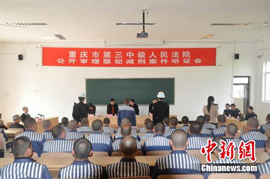
  • Justice Ministry to Silence Lawyers with New Confidentiality Rules

    China University of Political Science and Law Professor Wang Jianxun. Photo credit: sohu.com

    Months before China’s highest court and prosecutor prescribed imprisonment for online posts that got too popular, the Ministry of Justice introduced information controls in draft regulations targeting criminal defense lawyers. Circulated to province-level judicial administration departments earlier this summer, the rules were met with criticism from those in the legal profession.

    Defense lawyers voiced concern that certain provisions would impose upon them absolute obligations to keep various case details confidential. Compared with the Supreme People’s Court’s judicial interpretation of the Criminal Procedure Law that barred the use of social media in the courtroom, the Ministry of Justice rules go further. While the judicial interpretation only covers the conduct of lawyers inside the courtroom and, specifically, their ability to reveal trial proceedings, the rules impose limitations on things like sharing case information with the relatives of defendants or accessing or reproducing court records. As the body mandated with the supervision of lawyers, the ministry also has more direct weapons (e.g., the approval of lawyer licenses) to use as punishment against those who fail to abide by its rules.

    The main concern, explains China University of Political Science and Law Professor Wang Jianxun, is that the rules are aimed at preventing defense lawyers from using the media and the Internet to raise public awareness about individual cases that may become miscarriages of justice.

    In recent years, Chinese lawyers have increasingly made public details of ongoing criminal cases involving procedural irregularities or other types of injustice. There is a perception among some, however, that such mobilization of public opinion interferes with courts’ ability to adjudicate cases independently and ought to be curbed in an effort to promote rule of law.

    But as Professor Wang notes, in an article published by Caijing (translated below), the Chinese judicial system is plagued by insufficient transparency and imperfect attention to procedural rights. Moreover, “coordination” between judicial and law-enforcement bodies under the party’s guidance limits, rather than promotes, judicial independence. Under these circumstances, publicity and public opinion offers an important channel through which courts, prosecutors, and police may be held accountable for their actions in the criminal process. Imposing an absolute ban on revealing case details would further limit lawyers’ ability to defend their clients and could potentially result in sanctions for those lawyers who violate these provisions.

    *
    Lawyers’ Defense Rights and the “Cutthroat” Bill

    Wang Jianxun
    Caijing, July 29, 2013

    In the wake of the promulgation of rules related to the new Criminal Procedure Law by the Supreme People’s Court, Supreme People’s Procuratorate, and Ministry of Public Security, the Ministry of Justice (MOJ) has also drafted a consultation version of Regulations on Several Issues Concerning Criminal Defense by Lawyers, regulations specifically aimed at regulating the criminal defense activities of lawyers. These regulations concern issues related to the appointment of criminal defense lawyers and their abilities to meet with clients, read case files, and carry out defense work. Many provisions tend toward restriction of lawyers’ defense rights, among which a widely criticized one is the requirement that lawyers keep case information confidential.

    According to Articles 18, 27, and 42 of these regulations, defense lawyers must not leak notes, audio recordings, video recordings, or photographs to relatives of criminal suspects or defendants or use case-file documents or notes or audio- or video recordings made during the trial for purposes other than defense in that case. Also, any audio- or video recording of the trial or requests to view or reproduce audio- or video recordings of the trial made by the people’s court must first get the court’s approval.

    What do these provisions mean, ultimately? Will they constrict the already narrow space available for criminal defense even further? How will lawyers’ criminal defense rights be protected?

    There’s no doubt that criminal cases are special, and it’s understandable that lawyers’ activities in criminal litigation be subject to certain regulation and restriction. But the problem is that restrictions on lawyers’ activities ought to be premised on protecting their rights to engage in defense and motivated by protecting the rights of criminal suspects and defendants. After all, the entire system of criminal defense was set up to protect the rights of these persons, and to protect the rights of lawyers to engage in defense is also to protect the rights of suspects and defendants.

    In this respect, there is nothing improper about requiring criminal defense lawyers to fulfill certain confidentiality obligations, but complete or unconditional requirements that lawyers keep case information secret are inappropriate.

    If in certain special instances secrecy does not benefit a lawyer’s exercise of defense rights or benefit protection of the rights of a criminal suspect or defendant, then there is no reason to require the lawyer to fulfill this kind of confidentiality obligation. For example, the MOJ regulations bar defense lawyers from leaking notes, audio recordings, video recordings, or photographs to relatives of criminal suspects or defendants. Does this mean that defense lawyers may not report information about the case or give a progress report to those relatives? If those things are prohibited, how are they supposed to coordinate on behalf of defending the suspect or defendant?

    As another example, the MOJ regulations also bar lawyers from using case documents or notes or audio- or video recordings of the trial for purposes other than defense in the case at hand. This provision is intended to prevent lawyers from revealing information about cases to outsiders.

    The question is: what is the legal basis for this sort of prohibition? If a defendant’s confession is coerced through torture, can’t a lawyer notify relatives of audio or videotapes or make them public? And how does one define “other purposes”? Does discussing details of the case with relatives of a suspect or defendant count as “other purposes”? Does being interviewed about a trial count as “other purposes”? Does publicizing details of the trial online count as “other purposes”?

    There is widespread concern among lawyers that these provisions barring defense lawyers from revealing case details will in fact block them from using the media and public opinion to prevent miscarriages of justice. In a society where rule of law is imperfect and the judicial process is not independent, there is already limited space for criminal defense. The rights of lawyers to engage in criminal defense work are unable to receive effective protection, and the rights of criminal suspects and defendants are often violated. For proof, just look at the frequent occurrence of miscarriages of justice and the jailing of some criminal defense lawyers.

    If one says that the confidentiality responsibility of lawyers in societies with rule of law does not worry people because of procedural justice, then in a society with imperfect rule of law this kind of confidentiality responsibility has the possibility to deny a wrongly accused criminal suspect or defendant their final hope of obtaining justice.

    In fact, when we look at the level of practice, in a society where the judicial process is not independent and procedural justice is not made manifest, the act of a lawyer revealing case details will often enable an unfair case to turn itself around and either prevent or remedy a case of injustice due to false evidence or errors in the law.

    Cases like the “Beihai Case” in Guangxi or the “Xiaohe Case” in Guiyang were able to benefit to a considerable degree from timely publicity of case information by defense lawyers in order to avoid an even greater degree of judicial unfairness. As everyone knows, one of the chronic problems of the criminal process is insufficient openness and transparency. Even though trials and verdicts are supposed to be public according to the law, in practice both are regularly done in a non-open manner—especially those so-called sensitive or major and important cases. The court often makes excuses for refusing to try a case in public, whether it’s through the excuse that all observer permits have been distributed already, deliberately holding the trial in a small courtroom, or even making it impossible for the defendant’s relatives to observe.

    In essence, these kinds of trials are secret trials, and not only do secret trials violate the law, they are also unfair. Even worse, in many criminal cases, defendants and their relatives don’t even get copies of the verdicts.

    In this kind of situation with no open trials or verdicts, what is the crime in a defense lawyer making details of the case public? Otherwise, would there be any openness to speak of in the entire criminal process? Without openness, how can the fairness of the judicial process be guaranteed?

    One of the signs of humanity’s becoming more civilized is the shift from secret trials to public trials and the shift from secret decisions to public decisions. Where there are secret trials and secret decisions, there is no reason to bar lawyers from revealing case details; otherwise, it’s unavoidable that defendants’ rights will get trampled upon.

    Then if you permit lawyers to reveal case details as they please—especially in those cases that have not yet been tried—what do you do when these actions have negative consequences for adjudication or even judicial independence? Frankly speaking, this sort of worry is not without merit because public opinion has the potential to be a double-edged sword.

    However, the way to go about resolving this problem is not to bar lawyers from revealing case details, which could possibly make it so that these cases of injustice have no remedy. Rather, the solution is to establish judicial independence in an institutional way and realize the procedural justice of the Criminal Procedure Law.

    Were the judicial process to truly achieve independence, then even if a lawyer reveals details of a case or public opinion exerts pressure on the judicial process the judicial process would be able to handle it calmly, stand firm, and carry on. It thus wouldn’t have to worry about the improper influence of public opinion or the media.

    Only a judicial system that is not independent will be vulnerable in the face of public opinion and [state] power.

    The author is an assistant professor at China University of Political Science and Law.

  • Veteran Rights Activists and the Quantification of Dissent

    The 2011 verdict against Chen Wei (left) quantifies the influence of his “incitement” with page views.

    A new judicial interpretation defines the number of hits and reposts necessary for online information to be classified as “serious” slander, but counting page views existed in the judicial equation at least as far back as 2009. In December of that year the Beijing Municipality No. 1 Intermediate People’s Court sentenced Liu Xiaobo to 11 years in prison for inciting subversion.

    In the verdict against him, translated by Human Rights in China, the Beijing court listed the number of links, repostings, and/or hits for seven articles he had written or co-authored. The majority had fewer than 800 hits—most far fewer—but one of them was said to have a total of more than 5,000 hits: Charter 08, a political manifesto calling for multi-party government.

    The judicial interpretation, issued by the Supreme People’s Court and Supreme People’s Procuratorate earlier this month, lists the accrual of at least 5,000 hits or 500 reposts for a single item as “serious circumstances” for cases involving online defamation. The judicial interpretation applies to crimes of defamation, causing a serious disturbance, extortion, and illegal business activity, but not to inciting subversion.

    In 2011, at least five men were given lengthy prison sentences for “serious” cases of inciting subversion in which their verdicts quantified the reach of the essays they had authored. Both Chen Wei and Liu Xianbin (March 2011 verdict) were sentenced by the Suining Intermediate People’s Court in Sichuan Province, while Chen Xi (December 2011 verdict) was sentenced by the Guiyang Intermediate People’s Court in Guizhou Province. Writers Lü Jiaping and Jin Andi were sentenced 10 years and 8 years, respectively, for writing articles accusing a former leader of ceding northeast territories to Russia.

    In the criminal verdict against Chen Wei (translated below from a posting by Chinese Human Rights Defenders), the Suining court classifies his crime as serious, reasoning that he “published many articles on the Internet [that] had a strong instigatory nature, and their scope of influence was great.” In demonstrating the influence of the articles, the verdict notes that 11 items published on overseas websites by Chen Wei had been linked to by a total of 37 web pages and received 8,524 hits. The verdict states repeatedly that the articles he wrote spread “rumors and slander.”

    If linking to articles is proxy for re-posting, Chen’s essays—shared by just 37 web pages—didn’t come close to the threshold introduced this year. If averaged over 11 items, his page views also fell far below the mark, averaging 775 views per article.

    But back then, there was no benchmark. And, of course, the number of times information is viewed does not alone determine the severity of exposure. Influence and social context are important. Like Liu Xiaobo, by the time of their latest court hearings, Chen Wei, Liu Xianbin, and Chen Xi were all veteran rights activists with an aptitude for organizing and speaking their minds. Chen Wei and Chen Xi (no relation) were detained in the wake of the Jasmine Revolution—an uprising that was supposed to have been modeled on the popular uprisings of the “Arab Spring,” but never happened.

    In 2013, as the crackdown on activists like Xu Zhiyong unfolds around the New Citizen’s Movement, will the numerical guidelines for “rumors and slander” become the yardstick for quantifying dissent?

    *

    Suining Intermediate People’s Court of Sichuan
    Criminal Verdict

    (2011) Sui. Int. Crim First No. 00054

    The prosecuting organ is the Suining People’s Procuratorate of Sichuan.

    Defendant Chen Wei, male, born February 21, 1969, in Suining, Sichuan, Han ethnicity, attended university, unemployed, place of household residence at [redacted by translator], Suining, Sichuan, resides at [redacted by translator], Suining, Sichuan. In December 1994, he was sentenced to five years’ imprisonment, with subsequent deprivation of political rights for two years, for the crime of counterrevolutionary propaganda and incitement. He was released from prison at the end of his sentence on May 28, 1997. On February 21, 2011, he was placed under criminal detention on suspicion of inciting subversion and formally arrested on March 28 of that year. He is currently being detained in the Suining Detention Center.

    Defense counsel is Zheng Jianwei, attorney with the Chongqing Kangshi Law Firm.

    Defense counsel is Liang Xiaojun, attorney with the Beijing Daoheng Law Firm.

    On November 25, 2011, the Suining People’s Procuratorate filed indictment Sui. Proc. Indict. (2011) No. 42 with this court, charging defendant Chen Wei with inciting subversion. This court formed a collegiate bench in accordance with the law and held a hearing in open court to try this case. The Suining People’s Procuratorate appointed prosecutor Li Hongzhi and associate prosecutor Li Qin to appear in court on behalf of the prosecution. Defendant Chen Wei and his defense counsel Zheng Jianwei and Liang Xiaojun appeared in court to participate in the proceedings. The trial has now concluded.

    The Suining People’s Procuratorate alleged that: Between March 2009 and January 2011, defendant Chen Wei used the Internet to publish “Systemic Illness and the Medication of Constitutionalism and Democracy” and other articles that he had written on overseas websites such as minzhuzhongguo.org, Human Rights in China, and yibaochina.com, spreading rumors and slander [such as] “the people have been deprived of their [freedoms of] thought and belief” and “the Chinese Communist Party uses the machinery of violence to control the people” and inciting “the death knell has tolled for one-party dictatorship” and “[we] must change this system.” His articles were widely linked to, reposted, and viewed, [causing] an extremely bad influence. In court, the prosecution produced evidence including a crime scene inspection record, an inspection work record of electronic evidence, expert verifications, witness testimony, and the defendant’s confession. The prosecution maintains that defendant Chen Wei’s actions constitute the crime of inciting subversion, falling under the category of a serious offense, and it requests that the people’s court issue a verdict in accordance with the law.

    Defendant Chen Wei and his defense counsel argue in defense that Chen Wei did not have the intention to incite subversion of state power and what he published were all theoretical articles that did not contain rumors or slander. [They further argue that] his views fall within the scope of a citizen’s freedom of speech and do not constitute the crime of inciting subversion and that he is not a repeat offender.

    In the course of the trial it was ascertained that: Between March 2009 and January 2011, defendant Chen Wei used the Internet to publish “Systemic Illness and the Medication of Constitutionalism and Democracy,” “The Growth of Civil Opposition is a Crucial Factor in China’s Democratization,” “The Harmony Trap and the Absence of Fairness,” “Reflections on a Hunger Strike on Human Rights Day” and other articles that he had written on overseas websites such as minzhuzhongguo.org, Human Rights in China, and yibaochina.com, spreading rumors and slander [such as] “the people have been deprived of their [freedoms of] thought and belief,” “the Chinese Communist Party uses the machinery of violence to control the people,” “[they] are the enemies of democracy,” and “everyone realizes the Chinese Communists’ anti-human nature” and inciting “the death knell has tolled for one-party dictatorship,” “use street-level opposition to promote civic politics,” and “[we] must change this system.” His articles were widely linked to, reposted, and viewed, [causing] an extremely bad influence.

    The aforementioned facts are confirmed by the following evidence, which was cross-examined and confirmed in court:

    1. A record of receiving a criminal case, case-filing decision, case-solution report, and report of custody, confirming the source of the case and details about the investigation and manner in which Chen Wei was taken into custody.

    2. A search warrant, search record, inventory of seized items, a record of crime-scene inspection, and crime-scene photographs, confirming that the investigating organ seized two laptop computers, a portable hard drive, and some train tickets from Chen Wei’s residence in accordance with the law.

    3. Inspection work records of electronic evidence from the Suining Public Security Bureau—Sui. PSB (Int. Sec.) Inspect [2011] No. 011 Inspection Work Record of Electronic Evidence, Sui. PSB (Int. Sec.) Inspect [2011] No. 012 Inspection Work Record of Electronic Evidence, Sui. PSB (Int. Sec.) Inspect [2011] No. 013 Remote Inspection Record, and Sui. PSB (Int. Sec.) Inspect [2011] No. 010 Letter and Reply Regarding Assistance with Inspection of Relevant Data—confirming that “Systemic Illness and the Medication of Constitutionalism and Democracy,” “Reflections on a Hunger Strike on Human Rights Day,” “The Harmony Trap and the Absence of Fairness,” and other articles were discovered on the hard drive of the laptop computer seized from Chen Wei’s residence. Through remote inspection it was determined that as of February 25, 2011, 11 articles published by Chen Wei on overseas websites like minzhuzhongguo.org, Human Rights in China, and yibaochina.com had been linked to by a total of 37 web pages and received 8,524 hits.

    4. A forensic verification report (BNIA For. Ctr [2011] Verif. No. 12) and sample use explanation from the Beijing Network Industry Association Electronic Data Forensic Report Center, confirming that on the hard drive implicated in the Chen Wei case were discovered “Systemic Illness and the Medication of Constitutionalism and Democracy,” “Reflections on a Hunger Strike on Human Rights Day,” “The Harmony Trap and the Absence of Fairness,” and other articles written by Chen Wei and a record of the use of his registered Skype account to upload articles that he wrote point-to-point overseas.

    5. Hard copies of “Systemic Illness and the Medication of Constitutionalism and Democracy,” “The Growth of Civil Opposition is a Crucial Factor in China’s Democratization,” “The Harmony Trap and the Absence of Fairness,” “Reflections on a Hunger Strike on Human Rights Day,” and other articles published on the Internet, identified with a signature by Chen Wei as articles published by him, confirming that Chen Wei published instigatory articles on the Internet, spreading rumors and slander [such as] “the people have been deprived of their [freedoms of] thought and belief,” “the Chinese Communist Party uses the machinery of violence to control the people,” “[they] are the enemies of democracy,” and “everyone realizes the Chinese Communists’ anti-human nature” and inciting “the death knell has tolled for one-party dictatorship,” “use street-level opposition to promote civic politics,” and “[we] must change this system.”

    6. A criminal verdict from the Beijing Intermediate People’s Court, criminal decision from the Beijing High People’s Court, and certificate of release from the Sichuan Province Chuanzhong Prison, confirming that on December 16, 1994, the Beijing Intermediate People’s Court sentenced Chen Wei to five years’ imprisonment, with subsequent deprivation of political rights for two years, for the crime of counterrevolutionary propaganda and incitement. He was released at the completion of his sentence on May 28, 1997.

    7. Household registration documents, confirming Chen Wei’s personal identity information.

    8. Witness testimony from Wang Xiaoyan (Chen Wei’s wife), Wang Lanfang (Chen Wei’s sister-in-law), Tang Jianlin (Chen Wei’s brother-in-law), Wang Lanying (Chen Wei’s sister-in-law), confirming that Chen Wei and his wife and Wang Lanfang and her husband [Tang Jianlin] reside together at [address redacted by translator], Suining. None of them have relatives living overseas. The documents “List of Sichuan Democracy Movement Activists” and “Activist Liu Xianbin” were not saved by them on the hard drive of the Founder laptop computer or Samsung portable hard drive seized in this case, and they did not publish articles on the Internet under Chen Wei’s name. Chen Wei had Wang Xiaoyan, Wang Lanfang, Tang Jianlin, and Wang Lanying settle overseas wire payments at the bank.

    9. Testimony of witnesses Chen Wei [陈伟], Yin Xia, and Yu Yuebo, confirming that they had each read articles written by Chen Wei on websites like minzhuzhongguo.org.

    10. Confession of defendant Chen Wei, confirming that he had written “Systemic Illness and the Medication of Constitutionalism and Democracy,” “The Growth of Civil Opposition is a Crucial Factor in China’s Democratization,” “The Harmony Trap and the Absence of Fairness,” “Reflections on a Hunger Strike on Human Rights Day,” and other articles published on overseas websites such as minzhuzhongguo.org, Human Rights in China, and yibaochina.com.

    This court finds that defendant Chen Wei wrote and published on the Internet articles that used rumors and slander to incite subversion of state power and overthrow of the socialist system and that his actions constitute the crime of inciting subversion. Chen Wei published many articles on the Internet, [these articles] had a strong instigatory nature, and their scope of influence was great; therefore, his crimes are categorized as serious. Chen Wei was previously convicted of a crime of endangering state security and, after the completion of that sentence, he again committed a crime of endangering state security; therefore, he is a repeat offender and ought to receive heavier punishment in accordance with the law. Chen Wei and his defense counsel claim that the articles he published fall within the scope of a citizen’s right to free speech, that he neither had the subjective intention nor committed the objective acts of inciting subversion of state power, and that his acts [therefore] do not constitute a criminal offense. Upon review, [this court finds that] Chen Wei published numerous articles on the Internet that used rumors and slander in a goal of inciting subversion of state power and overthrow of the socialist system; therefore, his actions do not fall within the scope of a citizen’s right to free speech. He seriously damaged the interests and security of the state; therefore, his defense arguments and justifications are not tenable and this court does not accept them. Chen Wei and his defense counsel claim that he is not a repeat offender. Upon review, [this court finds that] Chen Wei was previously convicted of counterrevolutionary propaganda and incitement and, after the completion of that sentence, he again committed the crime of inciting subversion. These crimes both fall under the category of crimes of endangering state security; therefore, he is a repeat offender and his defense arguments and justifications are not tenable and this court does not accept them. In conclusion, the facts of the prosecution’s charges are clear, the evidence is reliable and sufficient, and the charged offense is valid; this court therefore supports [the prosecution’s charges]. In accordance with Articles 105(2), 55(1), 56(1), 66, and 64 of the Criminal Law of the PRC, [this court] rules as follows:

    I. For the crime of inciting subversion, defendant Chen Wei is sentenced to nine years’ imprisonment, with subsequent deprivation of political rights for two years.

    (The prison term is to be calculated from the day the verdict is implemented, with each day spent in detention prior to the verdict’s implementation to count as one day of the prison term; therefore, it will run from February 21, 2011, to February 20, 2020.)

    II. Items that were used in the crimes in this case shall be confiscated.

    If this verdict is not accepted, an appeal may be filed within 10 days of the second day following the receipt of this verdict, either to this court or directly to the Sichuan High People’s Court. In the case of a written appeal, the original appellate petition must be submitted together with two copies.


    Presiding Judge: Liu Zebin
    Judicial Officer: Wei Xiao
    Judicial Officer: Deng Gang


    December 23, 2011


    Court Clerk: Quan Liguo