Blog

  • Important (Political, “Cult”) Prisoners: Identify & Manage

    Important prisoners, like Gao Zhisheng, are required to be imprisoned far from home. Xinjiang Shaya Prison. Photo credit: rfa.org

    In February 1995, John Kamm, an independent human rights activist and now executive director of The Dui Hua Foundation, met with representatives of the State Council Information Office and Ministry of Justice (MOJ) in Beijing. Agreement was reached that the MOJ would provide information on prisoners in response to 100 requests Kamm would make that year.

    Two months later, in April 1995, the ministry’s Prison Administration Bureau released a “Notice on Establishing a Reporting System for Important Prisoners.” The notice was to “strengthen supervision over important prisoners . . . and coordinate with the international struggle over human rights.” It spelled out eight categories of important prisoners—chiefly people serving sentences for political crimes—and laid out what information should be reported in the registration and management of such prisoners. Among other things, the notice requires prison authorities to report to prison administration bureaus (PAB): “the circumstances of important prisoners whose sentences have been extended or reduced, who have been released on probation or medical parole, or who have been released upon completion of their sentences.”

    The information necessary to register important prisoners is largely the same information that China’s Ministry of Foreign Affairs provides in responses to requests for information from foreign countries engaging with it in bilateral human rights dialogues. It is likely that the information in the registration form provides the basis for these responses.

    Although the MOJ has not released a comprehensive revision of the 1995 notice, central and provincial PABs have modified and expanded it. Thus, Shanghai’s Prisoner Visitation Management Rules (2010) require, in Article 7, approval from the municipal PAB’s prison political management office for an important prisoner to receive more than one family visit a month; Jiangsu Prisons Detailed Implementation Rules on Work Procedures for Applying for Sentence Reduction and Parole (2011) require, in Article 18, that sentence reduction and parole for important prisoners must be approved by the provincial PAB before being sent to a court; and Detailed Rules for Law Enforcement Evaluation of Weihai [Shandong] Prison Police (2006) spell out, in Article 5.3, demerits for prison police who fail to report sentence reductions or paroles for important prisoners to the provincial PAB’s prison political management office.

    Perhaps the most detailed update of the 1995 notice is to be found in Jianyu Gongzuo Shiwu, published by China Legal Publishing House in 2011. A section of the book (translated below) lists 10 new classes of important prisoners—Falun Gong and “cult” practitioners top the list—and provides directions for how important prisoners are to be managed. Isolation appears to be key: important prisoners are not to be incarcerated in the same place as their household registration (hukou) or residence, accomplices of important prisoners are generally not to be incarcerated in the same prison as the important prisoner, and visitors of important prisoners other than family members must be approved by the PAB’s public security office. Regulations for the treatment of important prisoners may explain why Gao Zhisheng is incarcerated in Shaya Prison—500 miles from Urumqi, the place of his hukou. Another example of an important prisoner incarcerated far from his hukou is Nobel laureate Liu Xiaobo. Liu is serving his sentence in Jinzhou Prison, a day’s travel by train from Dalian, his hukou.

    The most significant modification to the 1995 notice is the requirement that, after being reviewed by the warden’s office, sentence reductions and paroles for important prisoners must be reported to the PAB’s penalty execution office and reviewed and consented to by the PAB’s sentence reduction, parole, and medical parole approval committee before their submission to a court for final approval. This rule effectively adds two layers to the approval process for sentence reduction and parole for important prisoners, and helps explain why, in recent years, relatively few sentence reductions and paroles of prisoners serving sentences for endangering state security have taken place.

    Although the Jianyu Gongzuo Shiwu mentions only two extra layers of approval, there is probably at least one more for especially sensitive cases. In a video interview given by Chen Guangcheng in January 2010, the blind activist recounts how the prison where he was incarcerated applied to the provincial PAB to grant him a six-month sentence reduction after he had earned enough points for an 18-month reduction. Rather than acting on the application, the bureau sent it to the Ministry of Justice in Beijing, but no action was taken and Chen served out his entire term before being released into a home teeming with police.


    Important Prisoners: click to expand

    Important prisoners refer to prisoners who committed duty-related crimes, head criminals and ringleaders of organized crime syndicates, key prisoners with a certain degree of influence in the local district, and other important prisoners.

    I. Criteria for routing out important prisoners. In addition to important prisoners as defined by the Ministry of Justice Prison Administration Bureau Notice on Establishing a Reporting System for Important Prisoners ([1995] MOJ PAB Doc. No. 60), the following prisoners shall be incorporated into the management of important prisoners:

    1. “Falun Gong” and other cult prisoners;
    2. Prisoners from Hong Kong, Macao, and Taiwan who are sentenced for endangering state security crimes;
    3. Head criminals and ringleaders of organized crime syndicates;
    4. Prisoners whose cases of duty-related crimes such as graft, bribery, or malfeasance involve very large sums of money or have relatively significant influence within the entire city/municipality;
    5. Prisoners whose cases have been reported in provincial- or municipal-level newspapers and magazines, on television, or in other media and have very significant influence domestically, internationally, and within society;
    6. Prisoners whose crimes are vile in their nature or circumstances, lead to serious consequences, or are followed closely by local people or the investigation and handling of whose cases are led directly by the Politico-legal Affairs Committee of the Municipal Party Committee;
    7. Prisoners who were working in economics, finance, or other industries prior to their arrest and had relatively significant influence in their field or who seriously harm economic or financial security or disrupt the order of the market economy;
    8. Head criminals and ringleaders who participate in or create incidents of mass social conflict;
    9. Prisoners whose cases involve victims, relevant interested persons, or others who are dissatisfied with the court decision and frequently petition or report to [the authorities];
    10. Others who need to be classified as important prisoners.

    II. Determination of important criminal [status]. Determination of important criminal [status] is made by [prison administration bureau (PAB)] public security office review of [cases] prisons report to it ([upon their] internal detection) or by notification from the PAB public security office. Determination work is performed by the [PAB] public security office in conjunction with its prison political management office and penalty execution office. Prisons shall fill out the “Important Prisoners Registration Form” and submit it to the [PAB] public security office within one month of taking important prisoners into custody.

    …

    (II) Management of Important Prisoners

    1. Important prisoners who have their sentences extended, have their sentences reduced, are paroled, are released on medical parole, are released after serving out their sentences, or encounter major situations must be reported as they occur. Inquiries made by the [PAB] business department regarding the situation of important prisoners must be handled quickly and reported accurately.
    2. Important prisoners shall not be incarcerated in prisons that are in the same locality as their place of household registration, residence, or crime. Important prisoners who are accomplices to the same crime shall generally be incarcerated in different prisons. Where accomplices are numerous to the extent that they are incarcerated in the same prison, they shall be incarcerated in different prison blocks.
    3. Visits between important prisoners and people other than their relatives or guardians must be approved by the PAB public security office. Head criminals and ringleaders of organized crime syndicates and prisoners from Hong Kong, Macao, and Taiwan sentenced for endangering state security crimes are generally not allowed to be visited by people other than their relatives or guardians.
    4. Sentence reductions and paroles of important prisoners must be reviewed at a meeting of the warden’s office; reported to the PAB penalty execution office; and reviewed and consented to by the PAB sentence reduction, parole, and medical parole approval committee before their submission to a court for deliberation.
    Chinese Source(原文):
    王志亮 [Wang Zhiliang], 监狱工作实务 [Jianyu Gongzuo Shiwu] (北京 [Beijing]: 中国法制出版社 [China Legal Publishing House], 2011), 140‒142
    Click on icon to expand


    重要罪犯。重要罪犯是指职务犯、黑社会性质组织犯罪主犯和首要分子、本地区有一定影响的罪犯中的重点对象以及其他重要罪犯。

    1. 重要罪犯的排摸条件。除司法部监狱管理局《关于建立重要罪犯报告制度的通知)([1995J 司狱字第60 号文)规定的重要罪犯外,以下罪犯纳入重要罪犯管理。

    1. “法轮功”及其他邪教罪犯;
    2. 以危害国家安全罪判刑的港澳台罪犯;
    3. 黑社会性质组织犯罪的主犯和首要分子;
    4. 贪污贿赂、渎职等职务犯罪中案值数额巨大,或案件在全市有较大影响的罪犯;
    5. 省市级以上报刊电视等媒体曾予报道、并在国内外或社会上有重大影响的案件中的罪犯;
    6. 犯罪性质、情节恶劣、后果严重、当地群众非常关注或市委政法委直接领导侦办案件的罪犯;
    7. 捕前从事经济、金融等行业并在行业中有较大影响的罪犯,或严重危害经济、金融安全,扰乱市场经济秩序的罪犯;
    8. 参与、制造社会群体性矛盾事件的主犯和首要分子;
    9. 案件被害人或相关利害人等对判决不满、经常上访、举强的案件中的罪犯;
    10. 其他需要被列为重要罪犯的。

    2. 重要罪犯的确定。重要罪犯由监狱上报经局公安处(狱内侦查)审核确定或由局公安处通知确定。确定工作由局公安处会同狱政管理处、刑罚执行处进行。监狱应在收押重要罪犯后1 个月内填报《重要罪犯登记表),报局公安处。

    ……

    (二)重要罪犯的管理

    1. 重要罪犯被加刑、减刑、假释、保外就医、刑满释放以及遇到重要情况要随时上报。对局业务部门要求查询的重要罪犯情况,要迅速、准确地核查上报。
    2. 重要罪犯不得关押于同其户籍地、居住地或犯罪地为同一区域的监狱。同一团伙的重要罪犯一般应当分别关押不同监狱,因团伙人数较多关押在同一监狱的,应分别关押在不同监区。
    3. 重要罪犯会见亲属或监护人以外的其他人员,须报局公安处批准。其中黑社会性质组织的主犯和首要分子,以危害国家安全罪判刑的港澳台罪犯,一般不得会见亲属或监护人以外的其他人员。
    4. 重要罪犯的减刑、假释,经监狱长办公会议审核,报局刑罚执行处,经局减刑、假释、保外就医评审委员会审核同意后,再提请法院裁定。


    Collapse

  • Dialogue – Issue 52, Summer 2013

    US-China Rights Dialogue: An Exercise in Insanity?

    The US Department of State, led by Acting Assistant Secretary Uzra Zeya, participated in the 18th round of the US-China Human Rights Dialogue on July 30-31, 2013. On August 2, the acting assistant secretary gave a press briefing at which she asserted—as is asserted nearly every year—that China’s human rights situation was deteriorating. If that is in fact the case, why does the United States agree, year after year, to continue the dialogue? (Photo credit: Ministry of Foreign Affairs, PRC)

    Related: Selected Individuals Named at the 18th US-China Dialogue

    The “Cult” of Buddha

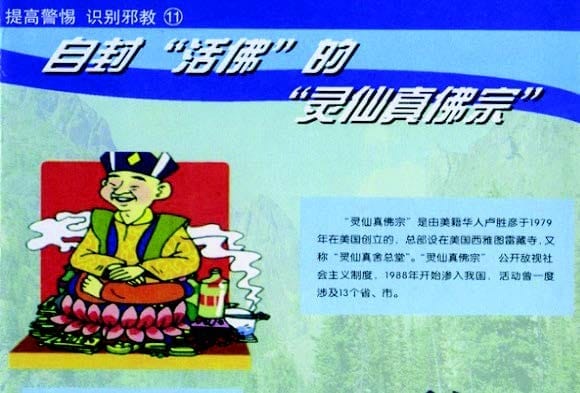
    China’s central government began labeling and banning religious groups as “cults” (邪教) in 1995—four years before the proscription of Falun Gong. Among the banned groups are three Buddhist sects: True Buddha School, Guanyin Famen, and Yuandun Famen. Reasons cited for their prohibition include foreign infiltration, so-called anti-China remarks, and apocalypticism. (Photo credit: Shengli Oil Field Anti-Cult Association)

    Prisoner Update

    We report on sentence reductions for Guangzhou publisher Liang Jiantian (梁鉴天), former Xinhua News Agency employee Chen Yulin (陈瑜琳), and Taiwanese resident Lin Jieshan (林介山), as well as possible clemency for Lai Yiwa (赖亦瓦), Guo Li (郭利), Wei Pingyuan (魏平原), and Wang Ruiquan (王瑞泉). (Photo credit: Zhdwz.com.cn)

    Dui Hua News

    A brief look at Dui Hua activities from May through August highlighting advocacy and outreach, a visit from Hu Zhicheng (胡志成), staff updates, and coverage of Dui Hua’s execution estimates by The Economist. (Photo credit: AP)

  • Dialogue – Issue 52: Prisoner Update

    Beijiang Prison in Guangdong Province, 2004. Photo credit: Zhdwz.com.cn

    In June and July, Chinese government sources updated Dui Hua on the status of eight people incarcerated in Guangdong Province. Three were reported to have received sentence reductions.

    Religious Pamphleteers

    Liang Jiantian (梁鉴天) received a 15-month sentence reduction on May 3, 2013, according to government sources. As co-owner of a Guangzhou publishing house, Liang was accused of printing 4.5 million Falun Gong publications. (Falun Gong was a widely popular qigong-based practice before it was banned as a “cult” in 1999.) Convicted of “illegal business activity” and “producing obscene material,” Liang was sentenced to life imprisonment. His sentence has since been commuted and, after four sentence reductions totaling 44 months, Liang is scheduled for release from Panyu Prison on May 17, 2023.

    Lai Yiwa (赖亦瓦) may have his sentence reduced in the second half of 2014 or first half of 2015. In the first official response Dui Hua has received regarding Lai, government sources said he is currently scheduled for release from Beijiang Prison on December 15, 2019. Sentenced to seven years’ imprisonment in April 2013, Lai allegedly printed 1,600 copies of Almighty God (also known as Real God or Eastern Lightning) publications in his home and distributed them to others. In December 2012, members of the Protestant sect that was banned as a “cult” in 1995 held public gatherings across China to warn of impending apocalypse. Local police came out in force and, according a Xinhua report, 1,300 people were detained nationwide. Qinghai and Guizhou accounted for 800 of the detentions that spanned 16 provinces. Lai is the only individual known to have been convicted in Guangdong in connection with the gatherings.

    Food Safety Activist

    Guo Li (郭利) is still awaiting his first sentence reduction. Continuing to push back dates of possible clemency, government sources said he may have his sentence commuted sometime before his sentence expires on July 22, 2014. Guo was convicted of extortion and sentenced to five years’ imprisonment in 2010. Police took him into custody after he sought medical compensation from Shien Group, a milk producer involved in the melamine poisoning scandal that caused thousands of Chinese infants, including Guo’s daughter, to develop kidney stones.

    Espionage

    Chen Yulin (陈瑜琳) received a sentence reduction of 19 months on March 29, 2013, according to government sources. Chen was one of three British citizens and former Xinhua News Agency employees sentenced to life imprisonment for providing state secrets about the Hong Kong handover to the British in the 1990s. This is the fourth of Chen’s sentence reductions, which total 60 months, since 2007. Chen is currently scheduled for release on December 26, 2021, but government sources said that he may receive another sentence reduction in late 2014 or the first half of 2015.

    Wei Pingyuan (魏平原), another Briton sentenced in relation to the handover, may receive an additional sentence reduction in late 2013 or early 2014. Wei has received four sentence reductions totaling 58 months. His sentence is currently set to expire in October 2022. The Chinese government does not recognize either Chen Yulin’s or Wei Pingyuan’s British citizenship.

    Taiwanese resident Lin Jieshan (林介山) has received four sentence reductions totaling 47 months. In the first official response Dui Hua has received regarding Lin’s case, government sources said he is scheduled for release from Panyu Prison on January 13, 2015. Lin was one of 24 Taiwanese residents detained in the mainland in December 2003. At the time, the central government had instituted a nationwide crackdown on espionage in response to comments Chen Shui-bian made about missile defense deployments during his presidential re-election campaign. Several people detained around the same time in Taiwanese espionage cases, including Tong Taiping (童太平) and Fu Hongzhang (傅宏章), have been released following multiple sentence reductions.

    Wang Ruiquan (王瑞泉), one of only five individuals known to have been convicted of Taiwanese espionage after Ma Ying-jeou took office in 2008, may have his life sentence commuted to a fixed-term of 18‒19 years’ imprisonment in the second half of 2013. Currently in Beijiang Prison, Wang allegedly photographed secret documents including those discussing preparations by the People’s Liberation Army to curb Taiwanese independence.

  • Dialogue – Issue 52: The “Cult” of Buddha

    “Do not listen, do not read, do not believe, do not disseminate” is a widely circulated anti-cult slogan. China’s central government began labeling and banning religious groups as “cults” (邪教) in 1995—four years before the proscription of Falun Gong.

    In 2000, the Ministry of Public Security issued a notice describing 14 groups identified as cults by central authorities. A decade later, 22 “cults” had been identified, according to an article on the China Anti-Cult Association website. Among them were qigong-based Falun Gong, the largest and most vocal group; 18 Protestant sects; and three variants of Buddhism: True Buddha School, Guanyin Famen, and Yuandun Famen.

    Anti-cult propaganda poster. Credit: Shengli Oil Field Anti-Cult Association

    Buddhism has a long history in China and has been able to attract new adherents with healthy, and increasingly trendy, practices like vegetarianism and meditation. An estimated 185 million Chinese identify as Buddhists, according to the Chinese Spiritual Life Survey conducted in 2007. Their activities are overseen by the Buddhist Association of China (BAC) and the State Administration for Religious Affairs. Both bodies promote the love of religion and the state.

    Article 36 of China’s constitution grants “freedom of religious belief” so long as “religious bodies and religious affairs are not subject to any foreign domination.” Unlike Christian groups persecuted prior to the reform and opening of the 1980s, Buddhist organizations were never targeted as part of an anti-imperial struggle, since most Buddhist groups were founded by mainland or overseas-born Chinese. Nevertheless, foreign infiltration and so-called anti-China remarks are cited as reasons for the proscription of Buddhist groups along with apocalypticism.

    Those who engage in Buddhist worship without permission from BAC or local religious bureaus have been charged with disturbing social order, fraud, illegal business activity, or crimes under Article 300: “organizing or using a cult to undermine implementation of the law.” Punishment for these offenses results in confiscations, fines, detention, reeducation through labor, or imprisonment.

    True Buddha School 灵仙真佛宗

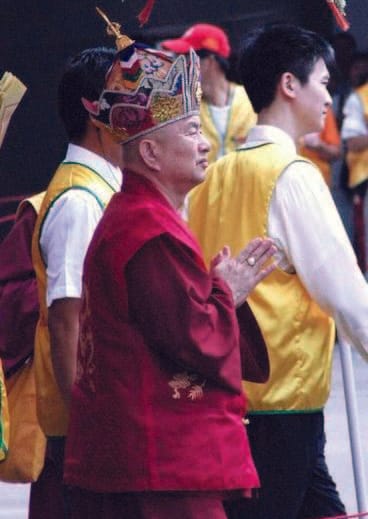
    True Buddha School (TBS) is a modern Vajrayana Buddhist sect founded in Seattle in 1979 by Taiwanese American Lu Sheng-yen (卢胜彦), known by his disciples as “Living Buddha.” The majority of TBS followers are in Taiwan and parts of Southeast Asia. The group claims to have 5 million followers, according to the Encyclopedia of Taiwan.

    True Buddha School founder Lu Sheng-yen is called an “open enemy of the socialist system” in anti-cult propaganda. Photo credit: Ushkdan

    Introduced to mainland China in 1988, TBS emphasizes the need to diligently cultivate spiritual advancement and teaches disciples to transform difficulty into positivity through enlightenment. The Ministry of Public Security reported that the group disseminated a large amount of publications and propaganda and had branches in Shanghai, Guangzhou, and Kunming with followers across 13 provinces and municipalities.

    TBS was banned in 1995 due in part to critical statements Lu made about the government’s decision to violently suppress student protesters in Tiananmen Square in 1989. Chinese authorities labeled Lu as “hostile to the socialist system,” saying he had given “multiple public speeches attacking the party and government,” organized ten thousand people in Hong Kong to join a memorial puja (worship service) for June 4 protesters, and “used newspapers and radio to broadcast the memorial all over the world.”

    TBS activities have been driven underground in China, but are not necessarily dormant. Government records document instances of “legal education,” confiscation of religious materials, and the demolition of a temple between 1996 and 2005. As recently as 2011, a local government in Sichuan listed TBS alongside Falun Gong and Guanyin Famen as inspection targets.

    Guanyin Famen 观音法门

    Guanyin Famen (GYFM) was established in 1988 by Vietnamese-born Chinese Shi Qinghai (释清海), known to her followers as the Supreme Master Ching Hai. Introduced to mainland China around 1992, GYFM gained about 500,000 followers, including party members and senior cadres, across more than 20 provinces, according to the Information Centre for Human Rights and Democracy in Hong Kong. GYFM is likely the largest of the three Buddhist groups that are outlawed in China.

    GYFM is registered with the Taiwanese Ministry of the Interior and is known internationally as the Supreme Master Ching Hai International Association, according to the Encyclopedia of Taiwan. The group is estimated to have more than 2 million disciples worldwide, with about 300,000 in Taiwan.

    A chain restaurant affiliated with Guanyin Famen. Photo credit: Suprememastertv.com

    Core to the practice is daily meditation and a vegan lifestyle defined by “five no’s”—no killing, no lying, no stealing, no lewdness, and no drinking. According to the China Anti-Cult Association, GYFM believes that two thirds of the world’s population must become vegetarian to prevent the catastrophic effects of climate change. Running vegan chain restaurants and meditation centers around the world, its business activity is characterized by the Chinese government as foreign infiltration and swindling. GYFM was accused of visiting China frequently “under the cover of traveling, visiting, investing, and opening up factories for the purpose of recruiting and founding secret meeting places” and “intending to amass vast fortunes by opening vegetarian chain restaurants.” Shi has been described by the China Anti-Cult Association as anti-communist for remarks made in the early 1990s about communism’s inevitable demise in China, Vietnam, and the Eastern Bloc. But others affiliated with the group have reportedly been persecuted not for their political beliefs, but their business practices and association with foreigners.

    Dui Hua’s Political Prisoner Database (PPDB) has information on over two dozen GYFM members, most of whom were detained between 1996 and 2005. Thirteen leading members were given prison sentences of one-and-a-half to eight years’ imprisonment under Article 300. A widely publicized case occurred in April 2001, when the Yanta District People’s Court in Xi’an sentenced Liu Shiyao (刘世尧), Zhang Huadong (张华东), Cheng Wei (程炜), Ma Yi (马懿), Ge Lin (葛麟), and Hua Sihong (华四红) to three to eight years’ imprisonment. They were accused of using propaganda and practice sessions to “cheat” disciples out of a total of 320,000 yuan. The individuals reportedly received instructions and religious texts from a foreign GYFM agent and distributed the texts to a number of higher education institutes. They also allegedly planned to join an international retreat in Thailand.

    As religious groups gained popularity, Chinese leaders worried that spiritual protest might shift into mass revolt

    Dui Hua

    Although the number of publicized cases has decreased sharply in recent years, local government records continue to provide evidence of repression. On March 21, 2009, Urumqi police confiscated a total of 86,800 leaflets and detained four suspects. In 2011 authorities prevented a total of 242 members from exiting Jilin Province to attend a puja in Taiwan.

    The most recent conviction reported in Chinese media was in 2012. In March, Jilin’s Tiedong District People’s Court sentenced two defendants to seven years’ imprisonment for organizing or using a cult to undermine implementation of the law. Both were accused of using donations of 10,000 yuan to purchase and distribute leaflets and 2,600 copies of a book on vegetarianism and climate change. Two additional defendants, a couple who organized a video screening at their home, were given suspended sentences.

    Yuandun Famen 圆顿法门

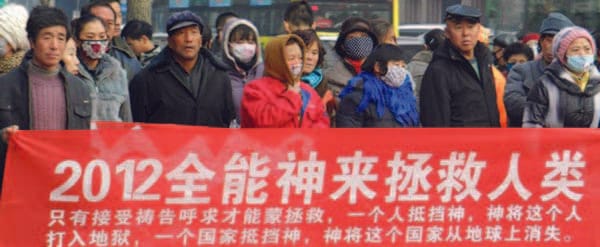
    Like the Christian sect Almighty God, homegrown Buddhist group Yuandun Famen (YDFM) claims to be able to rescue disciples from an impending apocalypse. The founder Xu Chengjiang (许成江) was originally a follower of GYFM. Combining doctrines from different Buddhist scriptures, he established YDFM in 1998. The group was banned a year later, and according to legal documents, Xu was detained seven times between 1998 and 2002 for illegal proselytizing. In December 2000, Xu named his son, Xu Longjing (许珑璟), as his successor and continued to organize large-scale pujas. In the early 2000s, YDFM had more than 10,000 members across 20 provinces, municipalities, and autonomous regions.

    Like the Christian sect Almighty God (pictured above), Yuandun Famen says it can rescue disciples from an impending apocalypse. Photo credit: Gscn.com.cn

    Shortly before YDFM was banned in December 1999, the Mudanjiang Public Security Bureau in Heilongjiang Province shut down three home gatherings organized for a total of 80 members. Detention center police officer Ma Jinglan (马景兰) and retired cadres Liu Chunyang (刘春阳) and Zhang Yan (张彦) were accused of spreading doomsday rumors. To shelter disciples from what she considered impending disaster, Ma raised funds to purchase five blocks of buildings, to rent additional venues for members, and to stockpile 20,000 kg of food and soybean oil. Other disciples who joined the gatherings claimed that they only did so in an effort to improve their health, and local police claimed that these individuals agreed to voluntarily destroy YDFM publications and terminate practice sessions after the group was banned.

    In 2003, Xu Chengjiang and his son became the only members known to be imprisoned. The former was sentenced to life imprisonment on three charges: organizing or using a cult to undermine implementation of the law, fraud, and rape. Xu Longjing received a 13-year sentence for organizing a cult and fraud. Since information on YDFM is limited to government sources, it is unclear whether the charges were justified. The court verdict alleged that the Xus amassed a vast fortune from the sales of cassettes, books, and CDs and “swindled” a total of 5.9 million donations from disciples throughout China. The group’s influence declined rapidly after the trial, but there is evidence that run-ins with police continued. In Xinjiang, the Bortala Public Security Bureau confiscated a large amount of propaganda and audio materials in 2005, and six members were detained in a separate case in 2006.

    Mobilizing Force

    After the gradual lifting of religious suppression following the end of the Cultural Revolution in 1976, Chinese people turned to religion to fill the spiritual vacuum that came with the massive socio-economic transformations of reform and opening. Some religious scholars coined the term “new religious movements” to describe new sects that have emerged since the 1980s. As religion scholar Dr. Scott Lowe opined in his article “China and New Religious Movements,” Chinese leaders were initially tolerant to some of these groups as the focus on economic development precluded their ability to “keep track of everyone’s private business.” Nevertheless, as religious groups gained popularity and mobilizing potential, Chinese leaders were also aware that a spiritual protest might shift into mass revolt if religion remained outside state control.

    While China’s anti-cult propaganda often labels “cults” as “anti-science, anti-humanity, and anti-society,” the harmful nature of its banned Buddhist “cults” is not universally recognized. As new Buddhist groups whose doctrines differ from dominant streams, TBS and GYFM have drawn some criticisms outside China. Several Taiwanese and Malaysian Buddhist groups have openly questioned Lu Sheng-yen’s Tibetan lineage and legitimacy as “Living Buddha.” In 2002, Lu was sued for sexually abusing a former TBS member, but the charges were dropped due to insufficient evidence. Some Buddhist groups and western news media criticized Shi Qinghai for her luxurious lifestyle and selling expensive artwork to her followers. But despite these controversies, China is the only nation to have banned these groups.

  • Dialogue – Issue 52: US-China Rights Dialogue: An Exercise in Insanity?

    Participants visit a mosque during the 18th US-China Human Rights Dialogue. Photo credit: Ministry of Foreign Affairs, PRC

    The US Department of State, led by Acting Assistant Secretary Uzra Zeya, participated in the 18th round of the US-China Human Rights Dialogue in Kunming, the capital of Yunnan Province, on July 30-31, 2013. In addition to officials from the department’s Bureau of Democracy, Human Rights and Labor, the American team included representatives from the National Security Council, the Department of Justice, and the Environmental Protection Agency. The Chinese side was led by Director General Li Junhua, and included representatives from China’s judicial agencies and those managing ethnic affairs and the environment. The Americans met with senior provincial officials and visited Yunnan No. 2 Women’s Prison and a mosque where members of the Hui minority worship. Following the talks, the American team flew to Beijing where they met with Assistant Minister of Foreign Affairs Ma Zhaoxu.

    On August 2, Acting Assistant Secretary Zeya gave a press briefing at which she asserted that human rights conditions in China were deteriorating. China’s Ministry of Foreign Affairs (MFA) countered with familiar rhetoric: “China’s human rights situation is in the best period in history and China is a country ruled by law.” Aside from announcing that their Legal Experts Dialogue will take place in November, the only other agreement reached by the two sides was to hold another round of the bilateral human rights dialogue in 2014.

    The July dialogue was the first since the reelection of President Barack Obama and the ascension to Communist Party secretary and state president of Xi Jinping. It followed the Sunnylands summit between the two presidents in June and the Strategic & Economic Dialogue held in Washington in July. At both events American officials tried to convince Xi to rule with a lighter hand. Their efforts, and those by the American team in Kunming, appear to have had little impact. Days after the dialogue ended, Chinese police took several people into custody for their involvement in the loosely organized “New Citizens’ Movement,” known best for its anti-corruption activism. Among the detained were journalist Chen Min (陈敏)—formerly of Southern Weekly, he uses the pen name Xiao Shu (笑蜀); veteran activist and Charter ’08 signer Yang Lin (杨林), arrested on charges of inciting subversion; and Guo Feixiong (郭飞雄), detained for “gathering a crowd to disrupt social order.”

    Laundry List of Issues

    The US side raised a by now familiar list of issues including the treatment of political dissidents, human rights lawyers, and practitioners of unauthorized religious groups. It focused on the situations in Tibet—where more than 120 self-immolations have taken place over the last four years—and Xinjiang—where a large percentage of endangering state security trials take place. It also urged resumption of the dialogue between China and representatives of the Dalai Lama.

    The acting assistant secretary described China’s alleged persecution of the family members of dissidents as a “worrying trend.” She mentioned the families of imprisoned Nobel Peace Prize laureate Liu Xiaobo (刘晓波) and human rights activist Chen Guangcheng (陈光诚), among others.

    The Chinese side took issue with American policies towards minorities, immigrants, and prisoners. With news dominated by revelations of email surveillance brought about by National Security Agency contractor Edward Snowden, the Chinese could not help but point the finger at the United States as an abuser of privacy rights. Once again, neither side discussed capital punishment, not surprising since both countries continue to execute those convicted of capital crimes.

    China’s opening of a women’s prison to the Americans reflects the country’s interest in the rights of incarcerated women. Their interest was not reciprocated by the Americans, who were critical of the happy scenes (of gardens and prisoner performances) laid on by their hosts. Although China is studying the United Nations Rules for the Treatment of Women Prisoners and Non-Custodial Measures for Women Offenders (the Bangkok Rules), the United States, whose treatment of women prisoners is arguably worse than that of China, has evinced little interest in the rules.

    Struggle over Lists

    A feature of China’s human rights dialogues with foreign countries has been the presentation, by the foreign counterpart, of a list of “cases of concern.” China’s MFA has, in recent years, resisted accepting lists. In July 2012, a decision was made that the ministry’s International Department, which has responsibility for managing the dialogues for the Chinese government, would no longer accept prisoner lists and would not give responses to lists already accepted.

    Last Year, China’s foreign affairs ministry decided to no longer accept prisoner lists or respond to those already accepted.

    Dui Hua

    According to a source in the MFA, geographic departments in the ministry would consider accepting short lists from their foreign counterparts on the occasion of state visits. The International Department would continue replying to appeals from the United Nations Office of the High Commissioner for Human Rights and its Special Procedures Division.

    Diplomats based in Beijing who represent countries with human rights dialogues or consultations confirm that, since last summer, their Chinese counterparts have rebuffed efforts to hand over lists. In fact, the Americans’ first effort to submit this year’s list was turned down. At the dialogue in Kunming, Director General Li declared that the Chinese side would accept the list but made clear that this would be the last time it would do so. Acting Assistant Secretary Zeya replied that, as far as the United States is concerned, it will continue to hand over such lists in the future. In line with the new policy, the American side received no written information in response to lists submitted since 2011.

    Acting Assistant Secretary of State Uzra Zeya gives a press briefing following the dialogue.

    During the dialogue the American team raised more than 30 cases of those it alleged suffered from persecution for their political and religious beliefs. At her press briefing, Zeya listed eight names (see table). The Chinese side provided some information on these cases, but, according to Zeya, the information “fell short of our expectations.” For its part, China’s MFA “urg[ed] the U.S. side to respect China’s judicial sovereignty and stop bothering China on some isolated cases.”

    American complaints were a taste of what the MFA can expect at the upcoming Universal Periodic Review (UPR) of China’s human rights record, which will take place in Geneva on October 22. Washington will send a strong team to the event, most likely headed by Assistant Secretary for Democracy, Human Rights and Labor Tom Malinowski, who is expected to be confirmed by the Senate in September. Malinowski is a veteran human rights activist, unlike Zeya, whose strength is in the administration of the state department’s sprawling bureaucracy.

    China has not announced its team for the UPR. One possibility for the official to lead the team is Senior Vice Minister Li Baodong, who has served as China’s ambassador to the United Nations in New York and Geneva and was previously director general of the MFA’s International Department. Li recently took charge of multilateral issues, a portfolio that covers China’s human rights diplomacy.

    Critical Chorus

    There are many American critics of the US-China human rights dialogue among members of Congress and, more broadly, the human rights community. One of the fiercest critics has been influential Republican lawmaker Frank Wolf, who issued a statement on the opening day of the dialogue slamming what he saw as meager results from the annual exercise. Characterizing the discussions as “cloaked in secrecy,” Wolf derided the approach taken by the Department of State as one which “time and again, failed to produce meaningful results.”

    Chinese citizens used Weibo to post their own pointed comments. Leftists spoke of foreign interference with derision. Painting a bleak picture, one user scoffed, “the party is a mother; are you gonna tell me that when a mother beats her child, the neighbors should get involved?” Most of the views expressed, however, showed frustration not with the US, but with the results of the dialogue. One asked: “If this is the best of times, what would things look like in bad times?”

    An Exercise in Insanity?

    Albert Einstein famously defined insanity as doing the same thing over and over again and expecting different results. The United States and China have held 18 rounds of a human rights dialogue that stretches back more than 20 years. Though some specific complaints have changed, the fundamentals have remained the same. Both sides of the dialogue decry human rights violations in the other country. Neither side credits the other with improvements in the area of civil and political rights. On the contrary, year after year, the United States claims that China’s human rights situation has deteriorated. If that is in fact the case, why does the United States agree, year after year, to continue the dialogue?

    Li Fangping, one of China’s best-known human rights lawyers and himself a target of police harassment, bluntly acknowledges that the dialogue “achieves little in the short term.” But, with respect to results, the Sino-US dialogue was never billed as means to score short-term improvements. Moreover, in Li’s view, “from a macro and long-term assessment, there are great benefits [to the dialogue]. It helps make human rights public and mainstream, and more people can be aware of the issues through digital media.” Rights consciousness is certainly on the rise in China, and humankind’s penchant for short-term gratification notwithstanding, it’s surely not insane to spend time helping awareness bloom.

    Selected Individuals Named at the 18th US-China Dialogue

    Dhondup Wangchen
    当知项欠
    A Tibetan filmmaker, Dhondup Wangchen was sentenced to six years’ imprisonment for inciting splittism in 2009 and has been unable to obtain medical parole despite suffering from hepatitis B. Before his arrest, Wangchen produced a film in which he interviewed Tibetans about their lives under Chinese rule and their views on the then upcoming 2008 Olympics.
    Gao Zhisheng
    高智晟
    A lawyer who took on controversial cases and publicly called for an end to the persecution of Falun Gong, Gao is serving a three-year prison sentence in Xinjiang for inciting subversion. His sentence was originally suspended, but the suspension was revoked days before its expiry.
    Hada
    哈达
    Mongolian rights activist, writer, and former bookstore owner, Hada has been under house arrest since he completed a 15-year prison sentence in December 2010. Charged with espionage and splittism for organizing peaceful protests, he reportedly suffers from depression.
    Hairat Niyaz
    海来提•尼亚孜
    As a Communist Party member, former journalist, and AIDS activist who advocated for dialogue among Uyghur and Han Chinese, Niyaz is serving a 15-year sentence for the crime of splittism in response to remarks he made to Hong Kong media regarding the Urumqi Riots, which erupted on July 5, 2009
    Liu Xia
    刘霞
    Liu is a painter, poet, and photographer who has been under house arrest since her husband, Liu Xiaobo, won the Nobel Peace Prize in 2010.
    Liu Xiaobo
    刘晓波
    As a professor at Beijing Normal University, Liu was sentenced to 11 years in prison for inciting subversion for his contributions to the political manifesto Charter 08, which called for the end of China’s one-party rule. In 2010, less than a year after his conviction, he won the Nobel Peace Prize. In 1989, Liu left a post at Columbia University to join the pro-democracy movement in Beijing.
    Ni Yulan
    倪玉兰
    A former lawyer and housing activist, Ni has been arrested and detained several times since 2002. She is currently serving a 32-month prison sentence for “fraud” and “causing a serious disturbance” for protesting the demolition of her home.
    Xu Zhiyong
    许志永
    A lawyer and civil society activist, Xu was detained on July 16, 2013. He is a chief proponent of the New Citizens’ Movement and co-founder of the Open Constitution Initiative, a legal aid and rights-protection organization shuttered under government pressure in 2009.
  • Dialogue – Issue 52: Dui Hua News

    Advocacy and Outreach

    Executive Director John Kamm went on the road in May and June to continue advocacy and outreach efforts. In the lead-up to the Sunnylands Summit, he traveled to Washington, DC, to brief governmental bodies, advocacy groups, and think tanks on US-China relations with a focus on the meeting between President Barack Obama and President Xi Jinping.

    Following the conclusion of the summit, Kamm traveled to Beijing and Hong Kong. In Beijing, he met with representatives from China’s Ministry of Foreign Affairs and Supreme People’s Procuratorate. He also met with ambassadors and senior diplomats from the EU mission and the embassies of Denmark, Norway, Sweden, Switzerland, and the United States.

    During his trip, Kamm continued to secure support for Dui Hua’s international symposium on women in prison. He met with symposium partners at Renmin University in Beijing and the University of Hong Kong, which will host the February event. Thus far, Dui Hua has confirmed presenters representing the United Nations and nearly a dozen countries including China, Argentina, Norway, and the Philippines. Fundraising efforts are underway and we welcome your support!

    Hu Zhicheng told Dui Hua that raising the profile of his case improved his treatment during detention. Photo Credit: AP

    In July, American citizen Hu Zhicheng (胡志成) visited Dui Hua’s San Francisco office with his family to express their gratitude for assisting with his case. Hu was detained in China over a commercial dispute in 2008. Although the charges were dropped in 2010, Hu was prohibited from leaving the country for another three years. He told Dui Hua that raising the profile of his case in the media and with the US and Chinese governments improved his treatment during detention.

    This summer, Kamm sat on two distinct panels. At the University of Notre Dame’s China Forum, he addressed country experts from academia, the press, and other fields. At the 1990 Institute in San Mateo, he spoke to local high school teachers interested in adding China content to their curriculums.

    Staff Updates

    After serving two and a half years as Manager and Senior Manager of Development & Programs, Daisy Yau is leaving Dui Hua in September. Yau was instrumental in the successful implementation of Dui Hua’s 2012 juvenile justice exchange and the launch of Dui Hua’s new logo and expanded mission in 2011. She intends to return to legal practice. We wish her the best of luck with her new endeavors!

    With Yau’s departure, former Publications & Communications Officer Megan Ko has been promoted to Programs & Publications Manager and Research Officer Luke Wong has been promoted to Research Manager. In the coming months, Ko’s principal focus will be the women in prison symposium. She is assisted by Rene Kamm, who joined Dui Hua’s San Francisco office as Programs & Publications Associate in July.

    As part of the reorganization, Irene Kamm is now Senior Manager of Finance & Development, and Kevin Li, Dui Hua’s longest-serving employee, has been promoted to Senior Manager of Operations & Technology.

    The Economist: Dui Hua Execution Stats the “Best”

    Dui Hua’s decade-long tally of executions in China was called the “best figures available” in the August 3rd edition of The Economist. The article, entitled “Strike Less Hard,” uses the data to examine the drastic decline in the number of executions in China, which Dui Hua estimates fell from 12,000 per year in 2002 to 3,000 per year in 2012—the country is still believed to be the world’s largest executioner. Although the Communist Party guards execution statistics as a state secret, Dui Hua’s estimates have become widely accepted. The Economist quotes Executive Director John Kamm as calling the decline “the most significant positive development in the human rights situation in China in recent decades.”

  • Prosecutors: Man “Should Have Known” Employer Was Taiwan Spy

    Ma Ying-jeou meets Chen Yunlin, president of China’s Association for Relations across the Taiwan Straits, in November 2008. Photo credit: Xing Guangli, Xinhua

    The cross-strait rapprochement that began when Ma Ying-jeou became Taiwanese president in 2008 marked a clear decline in the number of publicized Taiwanese espionage cases in mainland China. Based on open-source materials, Dui Hua’s Political Prisoner Database holds information on more than 90 Taiwanese “spies” detained or convicted between 2000 and 2008—during the presidency of Chen Shui-bian—compared with just five people convicted for espionage after Ma took office. Four of these convictions were for selling military secrets and led to sentences ranging from death with reprieve to 15 years’ imprisonment.

    Court records from Hunan describe the fifth case involving Long Jianbin, who was sentenced to five years’ imprisonment. The official account charges Long with collecting information about leadership changes and political, military, and economic developments for someone he “should have known” was a Taiwanese agent.

    Through an online job search, Long was hired to work part time for a man surnamed Lee, who called himself the assistant vice president of a media company. After taking on initial assignments, Long reported Lee to relevant government bodies, perhaps concerned that he had gotten involved in illegal matters. Receiving no response from the government, however, Long continued to collect materials, many of which appear to have been publically available.

    One of the collected publications, Selected Internal Reference, is a limited distribution compendium of news and opinion pieces sold principally to government bodies and work units, but often made available to their employees. As social commentator Zhang Shihe (张世和) noted in 2007, cadres often sell the publication to scrap recyclers, while other internal publications were often made widely available by profit-driven publishers. Other so-called internal publications that Long collected, like Dispatches of from the General Office of the Communist Party of China, contain articles that can be freely viewed online. Perhaps acknowledging that the information Long supplied did little harm to state security, the court meted out a relatively short sentence.

    (Article 110 of the Criminal Law prescribes 3-10 years’ imprisonment for acts of espionage with minor circumstances.)


    Zhuzhou Court Records Verdict: click to expand

    Long Jianbin Espionage Case

    Prosecutor: Zhuzhou People’s Procuratorate of Hunan Province
    Defendant: Long Jianbin.

    As the result of an online posting in which he sought part-time work, in September 2008, defendant Long Jianbin received a recruitment email for an editorial post with a generous remuneration package from someone calling himself “Assistant Vice President Lee” of Huayu Media Information Center. Long provided samples of his writing and editing ability over the Internet and expressed his interest in the job. Assistant Vice President Lee instructed Long to collect information on position changes and transfers among high-ranking officials and on political, military, and economic conditions. Long collected materials using methods such as Internet downloads, purchasing books and newspapers from local stores, and scanning Selected Internal References at the Chalin County Party Committee Office. He then used foreign computer networks to compress and encrypt the collected materials and sent them to “Assistant Vice President Lee.” Long received from “Assistant Vice President Lee” three payment transfers totaling 14,000 yuan around January 7, 2009. At this time, Long started to have suspicions about the identity of Assistant Vice President Lee and filed an online report with relevant state bodies. After receiving no reply, Long continued cooperation with Lee. During the period of September 2008 to June 2009, under the instructions of “Assistant Vice President Lee,” an agent of a Taiwanese espionage organization, Long took from the Chalin County Confidential Affairs Bureau and borrowed from his own work unit classified materials and information from 27 issues of Selected Internal References and three issues of Dispatches from the General Office of the Communist Party of China and other works. Adhering to transmission methods imparted by the agent of the espionage organization, he sent the information to Taiwanese espionage organization agent “Assistant Vice President Lee” over the Internet and received from “Assistant Vice President Lee” five payment transfers totaling 10,000 yuan. Using aliases such as “Li Xiang,” “Da Hai,” and “Song Weiping,” Long Jianbin received espionage payments totaling RMB 24,000 yuan.

    After conducting a trial, the intermediate court found that defendant Long Jianbin, under circumstances in which he should have known that “Assistant Vice President Lee” was an agent of a foreign espionage organization, accepted assignments and requests from “Assistant Vice President Lee” and used secretive online methods to provide [him] with several confidential national documents and information. His actions constitute the crime of espionage. In accordance with the law, his sentence is as follows: 1) For the crime of espionage, defendant Long Jianbin is sentenced to fixed-term imprisonment of five years and deprivation of political rights for one year with confiscation of personal assets of 10,000 yuan; 2) recovery of the 24,000 yuan [Long Jianbin] illegally obtained, transferred to the state treasury; and 3) confiscation of the tools used in committing the crime—one notebook computer, three desktop computers, and a USB flash drive.

    Chinese Source(原文):
    株洲市法院志 2011年,115-116页
    Zhuzhou Court Records, (2011), pp.115-116
    Click on icon to expand


    龙建斌间谍案。

    公诉机关湖南省株洲市人民检察院。
    被告人龙建斌。

    被告人龙建斌通过在网上求兼职,在2008年9月份收到了一个华昱传播信息中心自称是“李协理”的人,发来招聘采编人员并有优厚待遇的邮件,龙建斌通过网络将自己的文字和编辑能力进行介绍并表示愿意兼职。李协理要龙建斌收集大陆高层人员变动、政治、军事、经济等方面的情况。龙建斌即通过从网上下裁、当地购买书报和到茶陵县委领取《内参选编》扫描等方式收集资料,使用境外域网压缩加密将收集的资料发给”李协理”。并于2009年1月7日前后分三次收到了“李协理”汇来的人民币14000元。此时龙建斌开始怀疑李协理的身份,并通过网上向国家有关部门进行举报,在没有得到回应后,龙建斌又继续与李协理合作。在2008年9月至2009年6月间,龙建斌接受台湾间谍组织代理人“李协理”的指示,通过到茶陵县委机要局领取和在本单位借阅等方式,先后搜集《内参选编》27期、《中共中央办公厅通讯》3期等涉密资料和情报,按照间谍组织代理人传授的传输方式,通过互联网发送给了台湾间谍组织代理人“李协理”,又分五次收到了”李协理”汇来的人民币1万元。龙建斌分别用“李湘”、“大海”、“宋伟平”等化名领取间谍经费共计人民币24000元。

    中院审理后认为,被告人龙建斌在应当知道“李协理”为境外间谍组织代理人的情况下,接受“李协理”的任务和要求,在网上以隐秘方式向“李协理”提供多份国家秘密文件和情报,其行为巳构成间谍罪。依法判决:一、被告人龙建斌犯间谍罪,判处有期徒刑五年,剥夺政治权利一年,并处没收个人财产10000元;二、追缴非法所得24000元,上缴国库;三、对作案工具笔记本电脑一台、电脑主机三台、U 盘一个予以没收。


    Collapse

  • Government Notice Fuels Crackdown on Assembly as Subversion

    Xu Zhiyong (top) & Guo Feixiong are among the recent arrested for “disrupting social order”.
    Photo credit: VOAChinese.com

    Over the past several months, Chinese authorities have been cracking down on peaceful assembly and association. As of August 14, more than 50 individuals had been detained, arrested, or disappeared. Among the most prominent are Xu Zhiyong, chief proponent of the “New Citizens’ Movement” and co-founder of the Open Constitution Initiative—a legal aid and rights-protection organization shuttered under government pressure in 2009—and veteran rights activist Guo Feixiong. Both were detained on charges of “gathering a crowd to disrupt social order”; Xu on July 16 and Guo on August 8. Many of those detained were active in calling on Chinese government leaders to disclose their assets and make good on promises to combat official corruption.

    An internal notice issued by China’s Supreme People’s Procuratorate in June may be one impetus for this crackdown. The notice called on prosecutors (who also investigate corruption and approve arrests in criminal cases) to support the ongoing propaganda effort to “build a peaceful China” by paying special attention to certain types of criminal cases seen as particularly disruptive to political stability and social order. One thing this notice calls for is resoluteness in combatting criminal activity such as “illegal assembly and gathering a crowd to disrupt social order” where there is a “goal of subverting state power.” It is likely no coincidence, then, that the charges of illegal assembly and gathering a crowd to disrupt social order have been widely used against those detained in this latest crackdown.

    In the August 11 edition of Caijing magazine, constitutional law professor Zhang Qianfan published an essay expressing serious reservations about this notice and the latest campaign against assembly and association. In this essay (translated below), he argues that peaceful assembly should be seen as a form of speech and subject to the protections of China’s Constitution. Protecting citizens from punishment for peaceful assembly or legitimate criticism and exposure of government wrongdoing should be, he argues, a key component in pursuing the goal of social stability and security. Though he does not mention the recent detentions specifically, his linkage between clear channels for free public expression and the effectiveness of China’s fight against corruption makes it clear that he is not simply speaking in abstractions.

    *
    How to Build a Peaceful China

    Zhang Qianfan
    Caijing, August 11, 2013

    On June 20, 2013, the Supreme People’s Procuratorate issued a “Notice on Making Full Use of the Procuratorial Functions to Thoroughly Promote the Building of a Peaceful China” (hereafter the “Notice”). On the one hand, the Notice calls for severity in combatting especially major and serious criminal cases involving safety and accidents, such as those involving threats to food or pharmaceutical safety, public health, environmental pollution, damage to natural resources or fires, mining disasters, or serious traffic accidents. On the other hand, the Notice calls for severity in accordance with the law in combatting crimes that endanger state security, earnest support for political security, and resoluteness in combatting criminal activity such as illegal assembly and gathering a crowd to disrupt social order or a public place with the goal of subverting state power.

    The criminal activities in the first provision produce social harm and are related to public safety, so the procuratorates truly need to exercise their powers to approve arrest and prosecute in order to effectively combat them. As for the latter provision, activities that damage state security such as espionage, inciting defection, and disclosure of legitimately and lawfully classified state secrets truly need to be combatted in accordance with the law. But in order to be compatible with the constitutional goals of ruling the nation in accordance with the law and protection of human rights, there is a need for strict interpretation of broad concepts such as “subversion of state power,” “illegal assembly,” and “disturbing social order”; otherwise, if handled inappropriately, it will not only potentially infringe on citizens’ constitutional rights but may also run contrary to the idea of building a peaceful China.

    Part Two, Chapter One of the Criminal Law provides for “Crimes of Endangering State Security,” among which Article 105 punishes the acts of “organizing, plotting or carrying out” or “using rumor, slander or other means to incite the subversion of state power or overthrow of the socialist system.”

    According to the definition in Article 4 of the State Security Law, “endangering state security” is an offense based on actions. For example, in “plotting to subvert the government, split the nation, or overthrow the socialist system,” the words “subvert,” “split,” and “overthrow” are all action verbs. In other words, only actual illegal activity such as plotting an armed rebellion, engaging in espionage activity, or disclosing state secrets can possibly constitute actions that endanger state security. Of course, Article 105 of the Criminal Law broadens the crime to speech such as rumor or slander that “incites subversion of state power,” but this broadening must be treated with caution.

    In order to charge a particular mode of speech as constituting “inciting subversion of state power,” one must prove that the speech intended to subvert state power and also that it really had the potential to cause subversion of state power. This is because the object of Article 105 is not to restrict speech; rather, it is to prevent the act of subversion. If inciting speech is actually able to cause subversion, it ought to be forbidden in accordance with the law. But unlimited expansion makes it easy to exaggerate and prosecute and repress legitimate criticism of the government as criminal speech “inciting subversion of state power,” thereby trampling on citizens’ right to free speech and right to criticize and make recommendations as granted by Articles 35 and 41, respectively, of the Constitution.

    The reason why the Constitution protects citizens’ freedom of speech and especially provides citizens with the “right to criticize and make suggestions to any state organ or functionary,” the “right to make to relevant state organs complaints and charges against, or exposures of, violation of the law or dereliction of duty by any state organ or functionary,” and [states] “no one may suppress [such complaints, charges, and exposures] or retaliate [against the citizens making them]” is because freedom of speech is critical to maintaining the security and stability of the entire society.”

    It’s worth emphasizing that the “ordinary mechanism” for maintaining state security and social stability is not the frequent use of the Criminal Law to punish those citizens who dare to speak out; rather, it is actually in the protection of citizens’ freedom of speech. This point is especially important to a great nation. The main source of a variety of sources of instability in Chinese society at present is the uncontrolled abuse of state power. Up to this point, China’s main mechanism for checking official corruption is top-down organizational control. However, China is so large and has so many localities and complex administrative hierarchy that it is difficult for the central government to keep an eye on all the provincial and ministerial-level officials, difficult for provincial government to keep an eye on officials in each of its cities, counties, townships, and towns, and so on. Since top-down organizational oversight is of limited effectiveness and bottom-up democratic oversight is, for many reasons, unable to play a full role, corruption and abuse of power have become rampant.

    But with the rise of the Internet in recent years, the citizen voices have played an increasingly big role in oversight over the government, and much corrupt behavior has been exposed through channels like the Internet, providing an opening for the top-down legal- and disciplinary oversight.

    But without strict definition of the scope of the crime of “endangering state security,” the social consequences of inappropriate use of those laws may run counter to the intent of protecting state security. For example, if charges are cooked up to punish speech, then the channels for citizen expression and oversight by society will be blocked, corrupt officials will run wild until seething popular resentment shakes the central government, causing irreparable damage to society, more acute social unrest, and accumulated dangers.

    By the same logic, there should also be strict interpretation of the “Crimes of Disturbing Public Order” set out in Part Two, Chapter Six, Section One of the Criminal Law. Among these, Article 290 establishes the “crime of gathering a crowd to disturb social order.” So-called “gathering a crowd to disturb social order” means acts “to such a serious extent that work in general, production, business operation, teaching, or scientific research are unable to go on and heavy losses are caused.” From this, it is clear that if one only gathers a crowd but the extent is not serious and it does not lead to work, production, business operation, or teaching being “unable to go on” or “cause heavy losses,” then it is insufficient to constitute “disturbing social order” and the Criminal Law should not be applied as one pleases. If citizens gather together merely to articulate a particular demand and do not attack government offices, obstruct traffic, or negatively affect other people’s work or daily life in any other way, then they should be allowed to speak their minds.

    Related to this, Article 291 [sic, should be 296] of the Criminal Law provides for the “crime of illegal assembly,” to be used “where social order is seriously disrupted because an assembly, procession, or demonstration is held with no application made in accordance with the law or regulations, where no permission was granted for the application, or where it is held not in accordance with the time for start and stop, venue, and routes permitted by the competent authorities and the order of dismission is disobeyed.” On this point, “serious disruption of social order” should follow the understanding of “disrupting social order” given in the provision discussed above; namely, its key constitutive criteria should include “work in general, production, business operation, teaching, or scientific research are unable to go on and heavy losses are caused.” If it is merely an assembly without a permit but this does not cause any heavy losses, it cannot constitute “serious disruption of social order” and the crime of “illegal assembly” will also be untenable.

    It is especially necessary to point out that citizen assemblies are one form of expression protected under Article 35 of the current Constitution and do not fall under the scope of actions that the law may ordinarily restrict or punish; therefore, use of the Criminal Law to punish assembly ought to be done with the utmost caution. Under general circumstances, peaceful assembly is one manner of rational expression of citizen’s demands, especially small-scale assembly that cannot lead to any serious consequences on society. Therefore, these cannot constitute the key criterion of the crimes of “illegal assembly” or “gathering a crowd to disturb social order”—serious disruption of public order—and even less can they be considered acts of endangering state security such as “inciting subversion of state power.”

    At present, there is a common misperception that assembly is an “action” and thus substantially distinguishable from ordinary speech. [In this view,] once citizens assemble, it constitutes an “action” and the relevant authorities can use the Criminal Law to suppress it severely. This understanding does not comport with the provisions of Article 35 of the Constitution: “Citizens have the freedom of speech, publication, assembly, association, procession, and demonstration.” Clearly, assembly, procession, and demonstration are listed alongside speech and publication, making them all “speech” or “expression” in the broader sense and enjoying the Constitution’s protection for freedom of speech in this broad sense. Of course, if during an assembly there are violent incidents like riots, arson, or attacks, this clearly enters the realm of action and the state has both the power and the obligation to prohibit these actions. But peaceful assembly is clearly speech, so even if the legal process is flawed the Criminal Law cannot be used to punish it.

    Article [296] of the Criminal Law requires assemblies to apply for permission in accordance with law and regulation and treats assembly without requesting or receiving permission to be “illegal assembly.” Applying for permission is indeed a statutory condition for lawful assembly, and just about all countries with rule of law make similar requirements.

    But it needs to be pointed out that the goal of this requirement is to ensure that citizen assembly is carried out peacefully and in an orderly manner so that it does not have a negative impact on others’ work, transportation, or rest, and is not a disguised way to deprive [citizens] of their freedom of assembly. Those who give permission may not refuse their approval because they do not agree with the views that those assembled want to express or out of some inexplicable fear of citizens gathering; otherwise, this is an abuse of the permit authority. This is why in countries with rule of law applications for permission to assemble are a formality, with those giving approval simply conducting a procedural review of the time, location, and manner of the assembly and not a substantive review of the content of the assembly. Any assembly without violent tendency will be approved, making assembly a common way in which citizens peacefully express their demands and gather popular support. One could even say that the more orderly a society, the more common citizen assembly is.

    It cannot be denied that the reason why the citizen “strolls” and other activities taking place in many parts of China today are treated as “illegal assembly” is to a great extent because local authorities view ordinary assembly as a plague and very rarely approve requests by citizens to assemble. They routinely refuse to approve assemblies on the grounds that they will “seriously disrupt social order,” without ever giving any specific explanation or reasoning—often without even any written decision. Even though under the provisions of the Law on Assembly, Procession, and Demonstration, failure to respond by the statutory deadline can be seen as approval, once citizens take to the streets, police are mobilized to counter the “illegal assembly.” Not only does this not serve to maintain true public order, it even artificially intensifies social contradictions.

    Clearly, Article [296] of the Criminal Law cannot be based simply on whether an assembly is “illegal” but must consider whether an assembly constitutes a “serious disruption to social order” and especially needs to review whether the relevant authorities exercised their power to approve the assembly in accordance with the law.

    In sum, enforcing the Criminal Law certainly is the mandate of the public security and procuratorial authorities, but this important mandate must be exercised appropriately. First, we must establish a professional habit of respect for the Constitution, because only the freedom of speech provided by Article 35 of the Constitution can serve as the main path toward true social peace.

    The Notice requires investigation and punishment in accordance with the law of the corruption behind especially major and serious criminal cases involving safety and accidents and the serious investigation of crimes of office such as corruption, bribery, and malfeasance. This is commendable, but the experience of past years has taught us that corruption and malfeasance cannot be fully investigated only by the procuratorate’s efforts. Especially in a broader context in which independent procuratorial authority does not enjoy full protection, exposure of the corruption and other crimes of many officials has relied on public whistleblowers. If the public’s channels of expression are blocked or the Criminal Law is used to punish the public-spirited, conscientious, and courageous expression of responsible citizens, then the only result will be a chilling effect on the people of noble character in this realm, people of base character will increasingly have nothing to fear, and it will be difficult to realize “peaceful China.”

    The author is a professor of constitutional law at Peking University.

  • Petitioning Abuse Survivor Wins Forced Commitment Suit

    Confident and relaxed, Wu Chunxia leaves Henan Province High People’s Court. Photo credit: Han Junjie, China Youth Daily

    Some observers have compared Wu Chunxia’s use of the judicial process to clear her name to the efforts of petitioning mother Tang Hui, whose challenge to reeducation through labor (RTL) helped galvanize support for RTL reform. Intercepted in Beijing, kidnapped from a Henan courtroom, detained, sentenced to RTL, and forcefully institutionalized, Wu has successfully fought back with a series of lawsuits through which she has already received more than 145,000 yuan (nearly $24,000) in compensation and civil damages. Her story is told in an investigative report (translated below) by China Youth Daily.

    A survivor of domestic abuse, Wu was detained by police after seeking the assistance of provincial and central officials in a custody dispute with her ex-husband—a matter complicated by the man’s cozy relations with local police. Perhaps responding to urgent instructions to control sources of instability surrounding the Beijing Olympics, local authorities arranged to have Wu sent for psychiatric treatment just weeks before the games opened in August 2008.

    Under the direction of local police, Wu was held without visitors in a psychiatric hospital for 132 days of treatment for “paranoid psychosis.” The primary symptoms of her condition, for which no evaluation was ever carried out, were “running around and making allegations for three years.” After she left the hospital, the formerly healthy Wu was 20kg heavier and suffered from high blood pressure and high cholesterol.

    Many of the human rights abuses reported in contemporary China share a common theme: the lengths to which local authorities are willing to go in order to control people they identify as threats to stability. Many of those who have been targeted are petitioners, often women, seeking redress for what they believe to be unjust administrative or judicial decisions. Having already won a string of lawsuits, Wu is currently awaiting the verdict in a suit against the Zhoukou Public Security Bureau for its role in her forced institutionalization.

    *
    A Life Changed by Petitioning

    Han Junjie and Zhang Yufu
    China Youth Daily, July 19, 2013

    Just as she had done in the past, at 5 p.m. on July 18, Wu Chunxia placed layer upon layer of her litigation documents in a plastic bag and carried them out of the main entrance of the Henan Province High People’s Court. This time, however, she was much more confident about her suit.

    Wu Chunxia lives in the Gaozhuang neighborhood of the Xiaoqiao Subdistrict Office, Chuanhui District, Zhoukou, Henan Province. In 2004, she petitioned about “family and village affairs” and became a “stability-preservation target” in her locality. One after another, she was detained and sent to reeducation through labor (RTL). Then as the RTL began, she was sent for 132 days of “treatment” in a psychiatric hospital.

    Since 2009, Wu Chunxia has continuously petitioned the courts, and her previous detention and RTL decisions were ultimately annulled. In June 2012, Wu Chunxia won a civil lawsuit and received a total of 145,336.70 yuan in compensation from the Henan Provincial Psychiatric Hospital and the Xiaoqiao Subdistrict Office of Chuanhui District, Zhoukou. Afterwards, Wu Chunxia continued her administrative lawsuits by taking the Zhoukou Public Security Bureau to court. On May 6, 2013, the Zhoukou intermediate court confirmed in a trial of first instance that the Sha’nan Branch of the Zhoukou Public Security Bureau acted unlawfully in sending Wu Chunxia to a psychiatric hospital.

    After the verdict was handed down, the Zhoukou Public Security Bureau did not accept it and decided to appeal. On the afternoon of July 18, the Henan high court held a trial hearing but did not announce a decision.

    “Even though it’s been a very difficult road to clear my name, I remain steadfast in my belief that all attempts at sophistry will be powerless in the face of the facts,” said Wu Chunxia.

    What sort of misfortune did Wu Chunxia, once an ordinary rural village woman, encounter so that she ended up being detained, sent to RTL, and “forcefully institutionalized in the name of mental illness ”? After being discharged from the psychiatric hospital, how did she pursue the difficult path to protect her rights? During this process, what twists and turns did she encounter along the way?

    Domestic Violence and Petitioning Lead to Calamity

    In 1998, Wu Chunxia’s older sister underwent an operation for acute appendicitis, and the 24-year-old Wu went to help her sister look after her cake shop. Wu Chunxia couldn’t make cakes, so she borrowed several books from a classmate and sat in the shop reading.

    One day, a young man selling cement next door to the cake shop came in to borrow some water to wash his hands. He asked Wu Chunxia: “What are you reading?”

    This is how the two got to know each other.

    The young man selling cement was named Li Zhenhong (pseudonym) and was born in the same year as Wu Chunxia. In April 1999, the two got married and one year later they had a son.

    After they married, Wu Chunxia went to the city to deliver purified water. Her husband stopped selling cement and also went to the city to work as a security guard. Since theirs was a marriage entered into freely without being arranged by others, up until the time that their son turned three the family enjoyed a pretty good life.

    In 2003, the family’s happiness came to an end when Li Zhenhong went off the rails. One day that year, Wu Chunxia returned home from delivering water and, following an argument, was beaten by Li Zhenhong.

    Afterwards, Li went from beating Wu Chunxia to smashing things, seizing the child, and kicking Wu out of the house. In front of a government official, Li Zhenhong even went so far as to say: “If she enters the house, I’ll beat her.”

    It was only when her husband took her to court to sue for divorce that she learned that he was having an affair. A mediation attempt by the township women’s federation failed, so Wu Chunxia had no choice but to go into hiding. Wu then complained to the village committee all the way up to the provincial women’s federation, all to no avail.

    Wu Chunxia decided to go to Beijing to seek assistance from the All-China Women’s Federation. That was the first time she went to Beijing to petition. She didn’t know anyone there and didn’t know how to get around. She stayed near the long-distance bus station at Yongdingmen.

    Hearing that she had gone to Beijing, the Shucai Township Police Station of the Sha’nan Branch of the Zhoukou Public Security Bureau sent personnel to Beijing to intercept her. When Wu Chunxia discovered her interceptors outside the gate of the State Office of Letters and Visits, she quickly ducked into a taxi.

    As soon as she got in the taxi, a police officer flashed his badge, stopped the cab, and dragged her out of the vehicle. Later, Wu was kept inside a guesthouse near Beijing’s Taoranting Overpass. The officer who flagged down the taxi was named Zhang Xiaodong, then a police instructor at the Shucai Township Police Station. He was close to the family of Wu Chunxia’s husband and Wu knew him well.

    Several days later, with the help of a long-time petitioner, Wu Chunxia found an opportunity to escape from the guesthouse. But she never imagined the consequences this petitioning episode would bring her.

    On July 16, 2008, Wu Chunxia and her husband were in court on account of their divorce. This day was the beginning of her nightmare: “I’ll never forget that day, even after I’m dead.” It was that day that she was taken directly from the courtroom and dropped into an even more dark and gloomy life.

    The day before Wu Chunxia was taken away from the courtroom, on the morning of July 15, 2008, Chuanhui District, Zhoukou, held a “Work Meeting on the Standardization of Petitioning Procedures and Combatting Illegal Petitioning Activity in Accordance with the Law” attended by officials from the four major political institutions and persons in charge of the neighborhood committees and subdistrict offices. According to reports from that time, “the goal of the meeting was to help all work units in the district clearly understand the current situation regarding petitioning.” An official from the politico-legal committee of the Chuanhui District Party Committee read aloud an Opinion on Standardizing Petitioning Procedures and Combatting Illegal Petitioning Activity in Accordance with the Law.

    This day also continues to haunt Cai Yuzhong, a judge at the Shabei Court of the Chuanhui District [People’s] Court in Zhoukou.

    Cai Yuzhong says that at the time Wu Chunxia was in a dispute with Li Zhenhong over custody of their son. The doors to the courtroom burst open and several men rushed in, the one in charge asked, “Who’s Wu Chunxia?” Wu Chunxia answered and she was bundled out of the courtroom.

    “I’ve never seen anyone dare to kidnap someone from a courtroom. Such lawlessness!” said Cai Yuzhong. He noted down the vehicle license plate number and quickly dialed 110 to report the incident to police. Very soon after, a deputy director from the Sha’nan Branch of the Zhoukou Public Security Bureau telephoned to tell Cai Yuzhong that it was the police who had taken Wu Chunxia away. This filled Cai with disbelief and anger.

    Before she realized what was going on, Wu Chunxia had already been taken to the Shucai Township Police Station. This was a familiar place to Wu Chunxia, a place where she could find her “old acquaintance”—the police station police instructor, Zhang Xiaodong.

    Wu Chunxia previously told a reporter that back in the spring of 2007, when she was suing her husband for abuse, that Zhang Xiaodong’s uncle, Zhang Hengbin, was suspected of giving false testimony in court. When Wu Chunxia confronted him about it, he beat her.

    But this time, she actually didn’t see Zhang Xiaodong. The person who interrogated her was Sergeant Zhai Wucheng. Up until the time Wu affixed her thumbprint to the interrogation transcript, [Zhang] never appeared. But afterwards, Zhang Xiaodong’s name was written on the interrogation transcript.

    Wu Chunxia clearly remembers that Zhai Wucheng was speaking on the telephone while he was questioning her, and he asked whatever the person on the phone said. The voice sounded very much like that of Zhang Xiaodong.

    “Forceful Institutionalization” of 132 Days

    On July 26, 2008, Wu Chunxia was released from detention, but she had not yet regained her freedom.

    Wu Chunxia, just released from the detention center, was once again taken to the police station. Just as night was about to fall, several people bundled the weakened Wu Chunxia into a vehicle. Someone at the police station told her: “You’re being sent to RTL!”

    Documents show: “On July 25, 2008, the RTL Committee of the Zhoukou People’s Government decided to send Wu Chunxia to one year of RTL for disturbing social order.”

    Wu Chunxia never imagined that even before she had entered the RTL center, on the night of July 26, she would be forcibly sent to the Henan Provincial Psychiatric Hospital. This hospital is located in Xinxiang, Henan, right next to the Henan No.2 Prison. Here, she spent 132 days undergoing “treatment.”

    In the middle of the night on July 26, a groggy Wu Chunxia was placed on a bed and quickly fell asleep. It was only when she awoke the next day that she realized she was in a psychiatric hospital.

    Wu Chunxia was scared and rushed to find a doctor. The doctor told her: “The local public security authorities and your sister-in-law sent you here, saying that you were ill and needed treatment.” The doctor also told Wu Chunxia that the police officer who brought her there had said: “Wang Xia (Wu Chunxia’s sister-in-law) is her only relative.”

    On the mere basis of “the local public security authorities sent you here,” Wu Chunxia received 132 days of treatment for “paranoid psychosis.” The hospital kept a record of Wu Chunxia’s illness totaling eight pages. The “primary illness symptoms” were “running around and making allegations for three years.” The doctor’s “medical advice” was: “treatment for mania,” “level-one treatment,” “electroshock treatment,” “suicide prevention,” “escape prevention”….

    Wu Chunxia says there are two records in her medical chart from October of that year [saying]: “recommend judicial [psychiatric] evaluation.”

    “This shows that even the hospital wasn’t certain whether I was sick,” Wu Chunxia says. However, until the very end, neither the public security authorities nor the hospital ever carried out any kind of evaluation.

    Wu Chunxia showed members of the media a sheet of medical advice upon which was written: “level-one management,” “visitation forbidden.” Wu Chunxia explains that level-one management is the strictest form of control involving on-duty nurses 24 hours a day.

    While Wu was in the hospital, her older sister entered the hospital posing as a relative of another patient and shouted her name in the hall. But Wu Chunxia was tightly restrained by the nurses and her sister was quickly dragged out of the hospital. A furious Wu Chunxia continually demanded to know, “What gives you the right to prevent people from visiting me?”

    In all the excitement, a nurse let slip: “The public security bureau won’t let anyone see you.”

    As for “treatment,” Wu Chunxia has written a record: “They gave me electroshock and had me take medication. Eight years after giving birth, when I took their medication white stuff began leaking from my breasts and they swelled unbearably and were very painful….”

    “The most unbearable thing was that they blindfolded me, stuck steel needles directly into my head, and turned on the current. Three times a week, there was no way to avoid or escape it, no matter how much you screamed. Anyway, in the psychiatric hospital wild shrieks and howls would come and go. Your screams only proved that you were a psychiatric patient….”

    “I pleaded over and over, saying that I wasn’t mentally ill and begged them to stop giving me medication. I was homesick and wanted to go home. I begged them to call the police station and let me go home….”

    Wu Chunxia applied to be discharged from the hospital nearly every day. Each time, however, she got the same answer: “Your discharge is up to the police station.” The days passed one by one. Wu Chunxia threatened to commit suicide multiple times. Finally, on December 5, 2008, the psychiatric hospital had the Shucai Township Police Station notify Wang Xia to come retrieve Wu Chunxia from the hospital.

    Wu Chunxia’s 132 days of “treatment” were book-ended by a commitment and a discharge both made by an organ of state power. The Xiaoqiao Subdistrict Office of Chuanhui District, Zhoukou, paid 14,758.70 yuan in medical expenses and retrieved her from the hospital.

    Sues Psychiatric Hospital, Wins 145,000 Yuan

    After she left the hospital, the formerly healthy Wu Chunxia contracted high blood pressure and high cholesterol; she was more than 20kg heavier than she had been before her “treatment” began. After a physical examination, she began to seek redress for having been “forcefully institutionalized in the name of mental illness.”

    In May 2009, she submitted documents to Yang Zhengchao, secretary of the Zhoukou Discipline Inspection Committee. Yang instructed the Zhoukou Public Security Bureau to deal with the matter. One month later, the Zhoukou RTL Committee revoked its decision of a year earlier against Wu Chunxia. In the meantime, she copied out a letter of guarantee promising not to petition anymore and received a 30,000-yuan “subsidy for difficulties.”

    Her plan to protect her rights progressed step by step: In November 2009, Wu Chunxia filed suit with the Chuanhui District [People’s] Court of Zhoukou, claiming that the Henan Provincial Psychiatric Hospital and the Xiaoqiao Subdistrict Office had violated her rights. One month later, she filed an administrative lawsuit with the same court demanding annulment of the police decision to give her a 10-day detention on July 16, 2008.

    At the beginning, the Chuanhui District court refused to hear either suit. After several complicated back-and-forths, the Zhoukou Intermediate People’s Court finally assigned the Shenqiu County court to hear the suits.

    On March 23, 2011, the Shenqiu County court annulled the detention decision against Wu Chunxia on the grounds that the defendant “had made an unclear finding of facts, had insufficient evidence, followed improper procedure, and applied the law inappropriately.” The decision was thus “annulled in accordance with the law” and Wu Chunxia received 1,423.30 yuan in state compensation.

    After both the RTL and detention decisions had been annulled, Wu Chunxia’s attorney Zhang Chungui adjusted their litigation strategy: “It was the [subdistrict] office, the public security bureau, and Wu Chunxia’s sister-in-law Wang Xia who participated in the forced [psychiatric] commitment. Wang Xia was coerced, so we can’t sue her. For the time being, we won’t sue the public security bureau either. The focus will be on suing the psychiatric hospital and the [subdistrict] office.”

    Zhang Chungui’s worry was that suing the public security bureau would make the lawsuit harder to win. It would also be easier for the court to shift responsibility [by classifying] the case as an administrative suit, but since the psychiatric hospital is considered an institutional organization [and not an administrative unit], by combining the [defendants], the suit would be hard to move forward.

    The attorneys for the psychiatric hospital appeared to see through Zhang Chungui’s strategy. They insisted on treating Wang Xia and the police as joint defendants, but Wu Chunxia refused and the court rejected this demand. The Xiaoqiao Subdistrict Office that was sued alongside the hospital also objected to making the public security bureau a joint defendant.

    The Xiaoqiao Subdistrict Office also claimed in defense that it had no idea that Wu Chunxia had been forcibly committed. The only reason it paid Wu’s medical expenses was to offer assistance to a resident under its jurisdiction.

    At the first hearing on October 27, 2011, a representative from the hospital requested to evaluate “whether Wu Chunxia is mentally ill,” but this was rejected by the court.

    Wu Chunxia claimed that she had suffered insult to her person, and her attorney Zhang Chungui answered back sarcastically to the defendant’s lawyer: “Well, I also suspect that you are mentally ill. Shall we evaluate you?”

    The representative for the Henan Provincial Psychiatric Hospital maintained that the additional defendants and subjecting Wu Chunxia to psychiatric evaluation were both extremely important to clarifying the nature of the case. Zhang Chungui argued in response that it was the plaintiff’s right to decide whom to sue and that even if an evaluation showed Wu Chunxia to be mentally ill, it would not prove that she had been mentally ill at the time she was forcibly committed.

    The two sides argued for over an hour. The representative from the psychiatric hospital also pointed out that at the time of her discharge from the hospital Wu Chunxia had refused to take along medication that would stabilize her treatment. Since “paranoid psychosis” often involves relapse or fluctuation, it would be necessary for the court to establish whether she was currently ill in order to determine whether she was in possession of [full] civil capacity and the ability to engage in litigation. He therefore submitted an application to delay the trial. According to legal statute, applications for this sort of “special procedure” should be handled by the Chuanhui District [People’s] Court, located in the place of household registration for the target of the request. Thereupon, the judge announced an adjournment.

    Immediately after exiting the court, Wu Chunxia telephoned an official at the Chuanhui District court who then promised her that [the court] would definitely not accept the request.

    Several days later, the lawyers representing the psychiatric hospital applied to file a case with the Chuanhui District court, but this was rejected, as expected: “They said Wu Chunxia again went to make a scene at the case-filing department, so no one dares accept this case.”

    In the eyes of the Henan Provincial Psychiatric Hospital, Wu Chunxia had been petitioning and filing suits for many years. Even if the police, prosecutors, and courts in Zhoukou were afraid of her, they were undermining judicial fairness in the interest of maintaining stability. Of course, Wu Chunxia doesn’t agree with this assessment: “The court should have helped me right this wrong from the beginning.”

    On March 8, 2012, a first-instance civil trial verdict from the Shenqiu County court said that the Henan Provincial Psychiatric Hospital was at fault in three ways in its treatment of Wu Chunxia as a psychiatric patient. First, according to the defendant’s Regulations for the Management of Clinical Work, only a patient’s guardian or a judicial organ can commit a patient to the hospital. But in this case it could only be established that Wu Chunxia was sent for treatment by her sister-in-law Wu Xia, who was not her legal guardian, and the psychiatric hospital could not provide evidence to prove that a judicial organ had sent [Wu] for treatment. Second, even if the person who committed [Wu] met the regulations, the defendant admitted her solely on a statement by Wang Xia and gave her treatment for “manic psychosis.” Third, plaintiff Wu Chunxia was committed on July 26, 2008, and the time of diagnosis recorded in her case file is October 23, 2008. But in a treatment summary on that date and a note recorded five days later during rounds by one of the hospital’s deputy directors, it was “recommended to conduct a judicial evaluation.” This shows that at that time the defendant had not yet established whether the plaintiff was mentally ill.

    The Shenqiu County court ruled that the Henan Provincial Psychiatric Hospital should compensate Wu Chunxia more than 110,000 yuan: 5,841.10 yuan in lost wages, 4,302.10 yuan in medical expenses, 600 yuan in transportation costs, and 100,000 yuan in damages for mental anguish.

    Following the trial of first instance, both Wu Chunxia and the hospital filed appeals. On June 15, the Zhoukou Intermediate People’s Court issued a final ruling, confirming that the Xiaoqiao Subdistrict Office had participated in committing Wu Chunxia and ruling that the Henan Provincial Psychiatric Hospital and Xiaoqiao Subdistrict Office “jointly compensate” Wu Chunxia in the amount of 145,336 yuan. Of this, 100,000 was still damages for mental anguish.

    Although the ruling spoke of “joint compensation,” the Henan Provincial Psychiatric Hospital never contacted the Xiaoqiao Subdistrict Office to discuss how to divide up the compensation payment. Lou Tao, head of the hospital’s medical section knew they “simply couldn’t count on them.” During the three trials, the subdistrict office had tried to deflect responsibility for the commitment completely.

    Recently, Wu Chunxia heard that the Shenqiu County court had checked the accounts of the Xiaoqiao Subdistrict Office and found that they had no funds to spare.

    Ultimately, the Henan Provincial Psychiatric Hospital footed the bill for the judgment and then some. In the view of the hospital, this is not unusual: “Both the court and the subdistrict office are under Zhoukou’s jurisdiction. We’re in Xinxiang. Of course they’ll do everything they can to ensure we pay….”

    In the end, nearly four years after being “forcefully institutionalized in the name of mental illness,” Wu Chunxia had the label of “mentally ill” removed. In an interview, Lou Tao, head of the medical section of the Henan Provincial Psychiatric Hospital, said that this was the first time in the 61 years since the hospital was established that it had lost a case involving a dispute over “forceful institutionalization.”

    Suing the Public Security Organ

    While she was suing the psychiatric hospital and the [subdistrict] office, Wu Chunxia was also preparing another case: a suit against the unlawful [police officers] who handled her case.

    Her suit claims that the 132 days of so-called “treatment” caused her to contract cardiovascular and cerebrovascular disease and very possibly led to her becoming infertile.

    Wu Chunxia says that she frequently has visions of a person who makes her furious beyond repair. Everything that has happened to her—from when her husband divorced her to her seizure from the courtroom, her administrative detention, and her commitment in the psychiatric hospital where she was tormented—is nearly all related to this person.

    After the RTL and detention punishments were revoked and she won her lawsuit against the psychiatric hospital, Wu Chunxia went to petition at the Zhoukou Public Security Bureau, demanding that it hold police officers Zhang Xiaodong and others accountable for her detention, RTL, and commitment.

    A person at the public security bureau once urged her: “We never sent you to RTL, the detention was annulled, and we gave you compensation. What are you suing for!?”

    “It’s precisely because the court annulled the RTL and detention [decisions]; this shows that they [i.e., the police] violated the law in handling my case,” Wu Chunxia says.

    On May 6, 2013, Wu Chunxia again won another lawsuit. On this day, the Zhoukou Intermediate People’s Court found that the former Sha’nan Branch of the Zhoukou Public Security Bureau participated in sending Wu Chunxia to the Henan Provincial Psychiatric Hospital. It acted in error and this action is considered a violation of the law.

    After the verdict was delivered, the Zhoukou Public Security Bureau filed an appeal. On the afternoon of July 18, the Henan High court held a trial hearing. In the courtroom, the two sides argued over whether the Zhoukou Public Security Bureau carried out the commitment, whether Wu Chunxia’s administrative lawsuit against the public security has passedthe [statutory] deadline, and whether, if the Zhoukou Public Security Bureau carried out the commitment, it did so in violation of the law.

    Since the lawyers willing to represent Wu Chunxia pro bono were only notified by the court on July 12 of the time the trial would commence and were [thus] unable to make it to the trial on time, Wu Chunxia decided to appear in court on her own behalf.

    “The facts are the facts—no one can change them,” Wu Chunxia repeatedly said in the courtroom. “Whoever violated the law should be held accountable.”

    Even though the Henan high court did not announce a verdict immediately, Wu Chunxia is confident that she will win this lawsuit because she has always remained steadfast in her belief that the law will ultimately give her a just response.

  • RTL Detainees Pressed to Work, Paying to Leave, Officers Say

    Men assemble Ethernet cables at the Shijiazhuang RTL Center, May 23, 2012. Photo credit: He You/CFP

    Individual miscarriages of justice have helped to turn Chinese public opinion against the decades-old form of administrative detention known as reeducation through labor (RTL or laojiao). Most scrutiny has been focused on the arbitrary manner in which police determine sentencing. Considerably less attention has been paid to the myriad problems inside RTL facilities.

    The veil was briefly lifted earlier this year when a Chinese magazine published a lengthy article exposing the dehumanizing conditions in a women’s RTL center in Masanjia, Liaoning Province. Domestic censors quickly attempted to minimize the impact of the article that revealed torture, frequent hunger strikes, and exploitative labor practices.

    Coercive labor got fuller exposure in May in an article published by Southern Weekly (translated below). Providing accounts from several former correctional officers, the article looks at the way in which “unwritten rules” conditioned the labor experience at one RTL facility in Sichuan Province and ultimately demonstrates how economic incentives are behind a number of forms of corruption and mistreatment endemic within the RTL system. Stamping out low-level corruption is one of many reasons for central authorities to thoroughly reform RTL, but the abundance of licit and illicit economic opportunities for local authorities also helps explain why there has been longstanding resistance to reform.

    *
    Confessions of Disgraced RTL Officers

    RTL Centers: Labor First?
    Chai Huiqun
    Southern Weekly, May 2, 2013

    [Indented, italic text is in the voice of the interviewed officers.—Trans.]

    Editor’s note: The criminal prosecution of five police officers for embezzling “state-owned assets”—actually, the revenues produced by people laboring in RTL—revealed problems such as revenue targets, overtime labor, and bribery at one RTL facility. Under the influence of interests, the function of “education and reform first, labor and production second” was turned on its head. Southern Weekly found three of the officers and conducted separate interviews with them, cross-checking their accounts against each other and verifying those accounts against the relevant legal documents.

    “‘Laojiao’ puts labor first and education second. This idea clearly violates RTL policies but everyone thinks this way. [They] probably felt that the name ‘laojiao’ wasn’t so good so they changed it to ‘apprenticeship.’ But this is only a change in name, like calling a prostitute a ‘sex worker’ instead of a ‘whore.’”

    On April 26, 2013, the final verdict was handed down in a case involving a “den” of corruption inside an RTL facility in Luzhou, Sichuan. Five RTL officers from the Luzhou RTL Center were held criminally responsible for embezzling state assets, corruption, and taking bribes. Earlier, the appeal of another RTL officer given a suspended sentence for “taking bribes” was rejected by a court of second instance.

    All six RTL officers appealed. Three officers involved confirmed the facts of the case to Southern Weekly and said that, to a certain degree, the problems involved were universal.

    RTL Detainee Death by Drinking “Alcohol”

    The incident came about because of the death of an RTL detainee. The person was named Hu Minghong; he died after drinking industrial alcohol. Perhaps you might find it odd: how does a person in RTL come upon industrial alcohol? There are clear regulations strictly forbidding alcohol from being brought into detention facilities. The underlying reason [that alcohol got into the facility] is actually economic interest—the RTL facility’s own economic interest.

    At the time, the facility was processing liquor boxes for a company. At first, they used sparkling wine as a cleaning agent, but later they felt that was too expensive. In order to reduce costs, they switched to industrial alcohol. This accident occurred as a consequence.

    After the six officers got in trouble, an official from the provincial justice department was overheard at a meeting lamenting that Luzhou “was not unified.” There was profound meaning behind this. Although similar incidents are very sensitive, generally speaking, as long as people “are unified” internally and do not make a big fuss, it will not lead to anything. Take our Luzhou RTL Center for example, as early as 2003 a detainee died while being “hired out,” and in 2005 a man named Xia Tian unsuccessfully tried to commit suicide by jumping off a building. Neither case led to anything. Last year, a person detained at the [Luzhou] Public Security Bureau’s drug treatment center died under unnatural circumstances. Three officers were indicted for dereliction of duty, which seems quite serious, but not a single officer received criminal punishment.

    Originally, what happened to Hu Minghong was also kept under wraps. After a “humanitarian compensation” payment of over 20,000 yuan, his family did not complain. Because “effective measures” were taken and there were no public consequences, people in charge of the Luzhou RTL Center even applied for a commendation. After nearly a year, it was said that there was a dispute between higher-ups and facility officials over personnel appointments, which led to the disclosure of this incident. Subsequently, out came [the news] of collective corruption and bribe-taking by officers.

    The Luzhou RTL Center was established in 1998, one of two RTL facilities in Sichuan to be run by prefectural-level cities. In 2009, it added the sign “Luzhou Compulsory Drug Treatment Center.” There are more than 50 correctional officers at the facility. Before the incident, there were around 200 people in RTL, the vast majority of whom were there for compulsory drug treatment.

    The procuratorate found that at the beginning of 2011 the Luzhou Compulsory Drug Treatment Center signed a liquor-box production contract with Luzhou Texing Printing Company Ltd whereby the people in drug treatment would process liquor boxes. The enterprise used industrial alcohol to replace the cleaning agent. Hu Minghong took some industrial alcohol back to his cell, mixed it with water, and drank it, leading to his death by poisoning. Three others in drug treatment were treated in the hospital for poisoning.

    One year after the incident, Chen Jinrui, the former head of the Luzhou RTL Center’s Second Brigade, was indicted for dereliction of duty. He told Southern Weekly that, according to regulations, alcohol, as a flammable and explosive material, cannot be brought into detention facilities. But, for the sake of production, “we did this for several years.”

    After the death of Hu Minghong, there was no autopsy. The local hospital issued a diagnosis report listing five causes of death, none of which included alcohol poisoning. The family did not “make a fuss.”

    In the trial of first instance, the prosecution’s charges against Chen Jinrui were not accepted by the court because Hu Minghong’s cause of death was never ascertained. Chen Jinrui was not the officer on duty at the time of the incident. He believes that even if Hu Minghong really did die as a result of alcohol poisoning, he should only be held responsible as the person in charge and not be indicted as the only officer involved in the case. In his view, things turned out as they did because of “competing relationships.”

    Wages Defined as “State Assets”

    I’m confident that concealing funds is a common phenomenon among low-level officers inside the RTL system. The only differences are in form and degree. You could call it “corruption,” you could also call it a “bonus,” because no one knows for sure how to classify this money. Put simply, the funds are actually earned by the RTL detainees, but they’re treated as “finances.” As far as whom the “finances” belong to—the finance bureau, the RTL facility, the production brigade, or a particular official—this is a gray area and it is uncertain. This uncertainty then becomes a hole that can be exploited.

    At the Luzhou RTL Center, according to regulations, “labor payments” made by enterprises must be handed over by the basic-level production brigades to the center, the center must hand it over to the finance bureau; then the finance bureau returns a portion to the center, and the center returns a portion to the production brigades. From the perspective of the production brigades, they always hope to receive a little bit more because they’re the ones with the most worries and who take on the risk. So, when they complete their production tasks, they reserve a portion [of the revenues]. Besides using some for activity fees of the production brigade, the rest is distributed to officers in the form of a bonus in order to reward them for working actively. This is an unwritten rule.

    Originally, the enterprise signs a production agreement with the RTL center, but it’s the brigade that manages things concretely and the labor payments must pass through the brigade on the way to the RTL center. The bosses of the enterprises are all smart guys who understand that the “county official is not as good as the person really in charge.” If I get you, an official at an RTL center, on my side in order to sign a production agreement, this is only the first step. You are not the one in charge of production, effectiveness, and quality. So, I have to win over the people below who are truly overseeing the production line and arranging production in order for [them] to get things done for me. By “get things done,” I mean pressing the RTL detainees to work and make money. To [the enterprises] and from the perspective of production, the brigade head is more important than the head of the RTL center, so they acquiesce in and even take the initiative to help the brigade conceal revenue. This is definitely not an isolated phenomenon.

    In the corruption of the two production brigades in this instance, basically every officer got a cut. In the Second Brigade, each person got more than 10,000 [yuan], and in the Compulsory Drug Treatment Center it was over 20,000. It’s unclear how much each person got specifically. This is because there are no account books, the officers did not sign a note of receipt when they took their money, the two sides didn’t see each other, and the payments were made very quietly. The brigade leaders purposefully manufactured these circumstances, seemingly out of [concerns about] “security,” but it was actually also to make it possible for the higher-ups to be even more corrupt. This makes it even easier for them to line their own pockets.

    You think that during this entire process the superiors at these centers don’t know what’s going on? I don’t believe it. As far as the brigade is concerned, the center never allocated any funds for office expenses or any other expenses. If an RTL detainee gets sick, the brigade has to find the money for him to see a doctor. Now that the problem’s come out, they call it “reserving” and “concealing.” But don’t forget this fact: the brigade must be prepared to invite higher-ups to a meal, to a banquet, to [watch detainees] doing drills. This is a huge expense, even the primary expense. Last time, the audit bureau asked us, “Do you know how much your brigade head spent inviting center higher-ups to a meal?” I said the brigade head told us afterwards it was 5,000 yuan. The audit bureau said: “5,000 yuan? It was more than 20,000 yuan! There were two tables, 10,000 yuan per table.” That’s three months of my salary.

    I’m someone at the brigade level with no other source of funding. You’re an RTL center official always having these meals. How much per meal? How much per bottle of liquor? How many bottles? Roughly how much are we spending? Add it up and you’ll understand. Did [I] come by this money legally? Can a person with ordinary logical thinking not be clear about this? I can’t believe that officials are not as smart as me—they’re definitely smarter. You just have to analyze it a bit and you’ll discover that the source of the money is problematic. Police officers wouldn’t use their wages to invite officials out to eat, and we don’t have any office funds. As an official, it should be easy for you to figure it out. Once you’ve figured it out, you tacitly acquiesce or at least you don’t raise any objections.

    The procuratorate found that the Luzhou RTL Center signed a contract with Luzhou Meishun Packaging Materials Ltd (hereafter “Meishun”) in February 2011 to produce liquor boxes. The Luzhou RTL Center assigned the production tasks to two “production brigades”—the drug treatment center and the Second Brigade. The heads of the two production brigades had talks with Meishun Deputy Manager Gong Junming and decided to conceal a portion of the product from the RTL facility each month and hand it over to Meishun under a false name in exchange for cash payments. In total, they held back and embezzled more than 700,000 yuan. Aside from a portion that was used for the office expenses of the two brigades, the rest was privately divided up between the 18 RTL officers of the two brigades. Each of the officers from the Second Brigade took in over 10,000 yuan, and the officers from the drug treatment center each got more than 30,000 yuan. Full- and deputy brigade leaders at the drug treatment center each got an additional 40,000 yuan on top of the over 30,000 yuan. Other than the five who were prosecuted and convicted for having primary responsibility, none of the other officers who divided the money were sanctioned in any way and merely had to refund some of the money.

    In the course of the trial, there was a major argument between the prosecution and defense over how to characterize these embezzled “labor payments.” The defense attorneys maintained that the so-called “labor payments” were income from operations involving production by persons in compulsory drug treatment and arranged in violation of relevant RTL regulations and in the absence of a business license by the Luzhou RTL Center and others. It therefore constituted illegal proceeds, and the prosecution’s charge of “corruption” was not tenable.

    The court of first instance agreed with the defense and convicted the five RTL corrections officers of embezzling state assets, which carries a lighter sentence. The defendants and their attorneys rejected the idea of treating “illegal proceeds” as “state assets” and appealed. The prosecution stuck to its charge of corruption and also appealed.

    The court of second instance chose to split the difference by upholding the first-instance verdict against the three RTL officers but added on three years’ imprisonment for corruption to the sentences given to the two drug treatment center officials who split the more than 40,000 yuan in additional payments.

    According to revelations from several RTL officers connected to the case, the office funds held back by the brigades were primarily used to invite officials from the facility and other functional offices to meals and recreation. An official from the RTL center also used the funds to pay his party dues.

    “Production Definitely Comes First”

    Whether it’s money given to compensate the relatives of Hu Minghong or money gotten through corruption and embezzling by officers, at the end of the day this is money that is being made by RTL detainees. There’s a deep-seated mentality in the RTL system: “Laojiao” puts labor first and education second. This idea clearly violates RTL policies but everyone thinks this way. Later, those up above probably felt that the name “laojiao” wasn’t so good, so they changed it to “apprenticeship.” But the reality hasn’t changed. This is only a change in name, like calling a prostitute a “sex worker” instead of a “whore.” The reality is that we force RTL detainees to work and make money [for us]; that’s what every RTL center does.

    Whether it’s the RTL centers or the officers, they all lack money. Even if they didn’t lack money, there’s so much idle labor in the RTL centers, who wouldn’t want to use it to make some money? The only questions are how much to make and how to make it. There have never been clear regulations, or there are regulations but they have never been seriously implemented. For example, the Ministry of Justice long ago prohibited RTL facilities from setting revenue targets and required them to spend half of their time on education and half on labor. But none of the RTL facilities I know of can do that. How can you not have revenue targets? Labor by RTL detainees is passive labor—who would do it voluntarily? And once you have revenue targets, it’s impossible [to spend] “half the day on labor and half the day on education.”

    For the RTL centers, production definitely comes first. Every unit puts its pursuit of economic interests first. Under this sort of policy, the lawful rights and interests of RTL detainees inevitably cannot be protected.

    Once there are production targets, the management of the RTL centers becomes intimately entwined with production. The RTL facility gives a target to the brigade. If they can’t meet it, the officers get their allowances docked; if they surpass it, they get a bonus. The brigade gives a target to the RTL detainees. If they can’t meet it they get docked points, and docked points means “term extensions.”

    Each time there’s a production task, the center will give the basic-level brigades production targets. For example, according to a 2011 facility document, in processing liquor boxes for a Luzhou liquor company, the minimum production target was set at 350, which means that, calculating per person, each month each person must complete 350 yuan of production. This figure doesn’t look very high, but, on the one hand, the factory will set the unit price very low and, on the other hand, detainees who serve as group- or team leaders or who run the warehouse don’t participate in production or generate value. But that 350-yuan target is calculated per person, so it must be equalized through [the work of] others, raising their targets to compensate. If the RTL detainees in the facility want to make this target, on average they must work seven or eight hours per day. In all of Sichuan, a production target of 350 is probably rather low. In RTL facilities in more developed areas, the target might be 800 to 1,000.

    Of the surplus exceeding the 350-yuan production target, the facility returns 10 percent to us in the basic-level brigades to serve as the production withholding bonus. Of that, a portion is to be distributed among the RTL detainees to allow them to improve their food. This is only symbolic—each person gets an average of eight to 10 yuan, and it’s not in cash. For the amount exceeding 500 yuan, the facility returns 20 percent. We later calculated that according to the facility’s return policies, each officer got 200 yuan each month. We felt that was too little, so the brigade began concealing part of the revenues so that everyone could get a bigger cut.

    A target of 350 yuan is only the lowest requirement. Whether it’s the RTL centers or the brigades, we all encouraged the RTL detainees to produce more, because producing more was in the interest of the center, the brigades, and the officers. Of course it was even more in the company’s interest. Why did these companies cooperate with the RTL facilities? In order to reduce their labor costs. For example, on this project if the company wanted to hire workers to produce the liquor boxes, they would have to pay wages of at least 1,500 yuan—plus, they’d be responsible for social security and worker’s compensation insurance: that’s 2000 yuan at least. But the company could hire four RTL detainees for that 2,000 yuan. The value created by an RTL detainee and an ordinary worker is the same. That means that the actual cost is only one quarter as much. You can imagine how huge this makes the profits. So, it’s the system that makes things this way.

    The problems would get exposed sooner or later. The only way for the RTL facility to pursue even greater profits is to extend the detainees’ working hours. On this point, the detainees understand things very clearly. They’ve analyzed how many hours they work in a day and can calculate how much output value they create. They might learn a little about the unit price of the product from people at the factory and then figure out how much money [the company] is making and compare that to how much they are actually making. For instance, this year we brought in 100,000 yuan in revenue. According to the 10 percent ratio, that’s 10,000 yuan. The officers take a cut, probably leaving 5,000. If there’s some underreporting, some of that cut won’t get returned, probably meaning a return of only 2,500. There’s a gap there, and they can figure out the problem. Even more important, since you’ve exaggerated the detainees’ labor strength, they might start to feel resentment, [thinking that if you work us] too hard we’ll join together and report the problem which may lead to exposure.

    Since its birth, the RTL system, which is based on the idea of “education, reform, and rescue,” has added another important function—getting detainees to make money for RTL facilities. There are many ways to make money—some set up their own enterprises, others work for [existing] enterprises doing processing. The Luzhou RTL Center falls under the latter category.

    The two production brigades involved in the corruption case at the Luzhou RTL Center were considered the facility’s “backbone” whose “contributions” to the facility reached their peak in 2011. Together, they brought in a total of 1 million yuan in revenue for the facility, each exceeding their targets and more than doubling their performance in the previous year.

    Driven by interest, the RTL detainees were compelled to work overtime. One former detainee surnamed Qiu who was at the Luzhou RTL Center’s Compulsory Drug Treatment Center from 2010 to 2011 told Southern Weekly that he had to process 3,000 to 4,000 [sic] liquor boxes per day, with average work hours of more than nine hours and up to 12 hours per day at the most. (The Ministry of Justice requires that work hours not exceed six hours per day.) If they didn’t complete their tasks, they would be beaten. As for living conditions, he summed it up with [an idiom referring to food that means]: winter melon, tomatoes, pumpkin, and cabbage. Besides this, medication and items for daily use were much more expensive inside the RTL Center. “Outside, Liu Wei Di Huang Pills are eight yuan a bottle. Inside, they’re 20 yuan a bottle.” According to Qiu, detainees in the compulsory drug treatment center once carried out a collective hunger strike to protest the labor and living conditions, but they were ultimately unsuccessful.

    Among the six RTL officers implicated in the case, the one considered to have been most “wronged” is Chen Jinrui, who was given a suspended sentence. As the brigade leader, his cut of the revenues was no more than the other ordinary corrections officers, but because he was in charge of the brigade, he was sentenced.

    Unwritten Rules for Release

    Since there are production targets and these targets are directly linked to officers’ incomes, this of course leads to RTL detainees working overtime. Working overtime of course causes the detainees to react and this reaction leads to the employment of high-pressure policies such as beatings and [other] corporal punishment. This forms a vicious cycle. Thus, as soon as [one] is sent to RTL he or she begins to think about getting out early, which gives birth to another sort of corruption.

    In the RTL facility, it’s been a longstanding and relatively common unwritten rule that corrections officers help detainees to be released early in exchange for benefits. This also occurs in prisons, but it’s much harder to carry out [in prison] because [sentence reductions] require a court ruling. It’s easier in the RTL facilities, which mostly use medical parole or non-custodial forms—for example, shifting (someone in drug treatment) from compulsory drug treatment to community drug treatment.

    This time, two corrections officers at the Luzhou RTL Center were convicted of taking bribes. Actually, it would be more accurate to call it fraud than taking bribes. In fact, some RTL detainees are eligible for release according to the regulations but they don’t realize it. So, when you come to find me and ask whether I can help get you out, I’m happy to take full advantage of the opportunity. The guys who drank industrial alcohol with Hu Minghong were like that. After one person died, the people in charge of the center worried that others were going to die in the detention center [sic] and wished they could get rid of them quickly. But the detainees, themselves, were unaware of this and were willing to pay money [to get released early]. From the perspective of the officers who did this kind of thing, it became a habit to accept money from people because it was always being done. They wouldn’t let you leave without paying, even if it was time for you to leave.

    Transferring people who used drugs to community drug treatment was always done on the grounds of illness, and it required a very complex process. You needed to get diagnoses from the RTL center’s clinic and the Luzhou People’s Hospital and then get final approval from the public security bureau. This was a complicated process involving people in charge as well as public security, because public security was in charge of both sending you to RTL and releasing you. There were only two RTL officers implicated in this case for taking bribes, which shows they didn’t investigate very deeply: this only scratches the surface.

    At the time of investigating Hu Minghong’s death, the Luzhou Justice [Bureau] accidentally got a lead that these two RTL officers were taking bribes. The Matan District People’s Procuratorate in Luzhou found that between February 2011 and January 2012, Luzhou RTL Center Drug Treatment Center Director Li X and corrections officer Yuan XX conspired to use their positions and employ measures like fabricating medical records to enable four people in compulsory drug treatment to be shifted to community drug treatment, for which they received a total of 78,700 yuan.

    The den of corruption concealed for many years inside the RTL facility was thus finally exposed. Eighteen officers were suspected of collectively embezzling revenues, with six ultimately being convicted.

    After the case was uncovered, the Luzhou RTL Center was for a time unable to operate normally, and it was only recently that it again began accepting people for drug treatment. Southern Weekly learned through investigation that in the 15 years since the Luzhou RTL Center was established, three different facility directors have been removed from their posts for various reasons. (Among them, the first facility director “got into trouble” for accepting 1.68 million yuan in “drug treatment fees.”) But as far as pursuing criminal responsibility, this collective “den [of corruption] case” is a first.

  • International Opinion of China’s Human Rights Largely Negative

    UN Human Rights Council. Photo credit: UN

    Despite some modest improvements over the past five years, international opinion of China’s human rights record remains largely negative, according to a just released poll taken by the Pew Research Global Attitudes Project. Majorities or pluralities in 18 countries out of 38 polled answered “yes” to the question “Does the Chinese government respect the personal freedoms of its people,” while majorities or pluralities in 20 countries answered no.

    The poll on global attitudes towards China and other major countries including the United States was conducted from March 2 to May 1 in 39 countries covering a total of 37,653 respondents (the margin of error varies between three and five percent). Results from China are excluded on the personal freedoms question as the Chinese government objected to asking its citizens their opinions on its human rights performance. The median score of those saying the Chinese government respects the rights of its people was 36 percent. The median score among the 20 countries for which tracking data is available was 26 percent, up from 23 percent when Pew last asked this question in 2008.

    Opinions of the Chinese government’s human rights record are lowest in North America, Western Europe, Australia and China’s neighbors South Korea and Japan. Among these countries more than 70 percent of respondents think the Chinese government does not respect the personal freedoms of its people. Opinions of the Chinese government’s human rights performance are highest in Africa, the Middle East (except in Egypt, Israel and Turkey), Latin America and traditional allies with large Muslim populations—Pakistan, Malaysia and Indonesia.

    The American people’s negative assessment of the Chinese government’s human rights performance has remained consistent for the last 15 years. In 1997 and 1999, Gallup/CNN/USA Today polls asked Americans to rate the Chinese government’s performance in respecting its citizens’ human rights. In both years, 69 percent responded “mostly bad or very bad.” In the just completed Pew poll, 71 percent of Americans held the view that the Chinese government does not respect the personal freedoms of its people.

    Overall, China’s “favorability” numbers in the Pew poll—i.e. the percentage of respondents who have a favorable impression of the country—follow the downward trajectory of China’s “positive influence” numbers as recorded in the BBC/Globescan poll released earlier in May. In the latter poll, respondents in 15 of 21 countries gave lower marks to China in 2013 than they did in 2012. In the Pew poll, respondents in 12 of 19 countries for which year-by-year data is available had less favorable opinions of China in 2013 than they did in 2012. The percentage of Americans holding a favorable opinion of China in 2013—37 percent—is the lowest since the Pew poll was first taken in 2007. In general, countries with the least favorable opinions of China are the same countries that give the Chinese government the lowest marks on respecting the rights of its people.

  • Limits of Public Outrage: RTL and Custody and Education

    Women assemble ball point pens at the Zhejiang Nantong Custody and Education Center, March 10, 2011.
    Photo credit: Zhou Quan

    The system of reeducation through labor (RTL) has persisted since the 1950s despite its increasingly evident inconsistencies with domestic legislation, constitutional rights guarantees, and international human rights law. Yet over the past year, consensus on the need to reform RTL has swiftly coalesced. This is due in large part to widespread expressions of sympathy and outrage by the Chinese public over several cases involving individuals sent to RTL for criticizing government policies or alleging wrongdoing by government agents.

    But what are the limits to public sentiment as a driver of reform? Is public intolerance of RTL limited to sympathetic individuals like Tang Hui or Ren Jianyu, or does it expand to encompass the hundreds of thousands of people who, without due judicial process, lose their liberty for months and years in RTL and other institutions for things like drug use, petty theft, and sex work?

    Guangzhou’s Southern Metropolis Daily raises this question in a recent editorial (translated below) that shines a light on measures like “custody and education” (shourong jiaoyu 收容教育), which targets sex workers and their patrons, and “custody and rehabilitation” (shouyang jiaoyang 收容教养), which targets juvenile delinquents. The editorial argues that these measures suffer from the same concentration of police discretion and lack of due process rights that have been identified for RTL, but suggests that the purpose of these measures—to target individuals who engage in socially undesirable and even illegal activity—has kept them from garnering widespread public support for reform.

    Public sympathy can exert an important force in promoting legal reform, but where deprivation of freedom is concerned, all individuals—no matter how sympathetic—should be entitled to the same basic procedural rights. Constitutional review of RTL could establish generalized principles about the exercise of administrative power with respect to personal freedom, and conceivably invalidate other practices. But if structural changes are made only to RTL while other measures like custody and education are left intact, any claims about major strides toward rule-of-law development will have to be qualified.

    *
    In the Name of Rule of Law, Sort out “Quasi-RTL Measures” as One Package

    Southern Metropolis Daily
    June 29, 2013

    According to reports, police sent 28-year-old Cui X to two years of custody and education for engaging in prostitution in a hair salon in Chancheng District, Foshan, Guangdong Province. Recently, after receiving the decision, Cui’s family felt that the punishment by police was too heavy and applied to the Legal Affairs Bureau of the Chancheng District [People’s Government] for administrative reconsideration. The police maintain that their decision was made in accordance with law and that “custody and education has always been used.”

    Compared to the illustrious reputation of reeducation through labor (RTL), custody and education remains relatively unknown to the public; other similar [measures] include custody and rehabilitation. The targets for both custody and education and custody and rehabilitation are relatively unitary. The former, which originates from the State Council’s 1993 Measures for the Custody and Education of Prostitutes and Clients of Prostitutes, is an “administrative compulsory measure” targeting prostitutes and their clients. Its aim is for these groups of people to be “centralized for legal and moral education, organized to participate in productive labor, and screened and treated for sexually transmitted diseases.” Terms of custody and education range from six months to two years. Similarly, custody and rehabilitation is a means of administrative punishment of between one and three years for “juveniles under the age of 16 who cannot be given criminal punishment.”

    In reality, the main substance of these three types of punishments is the deprivation of citizens’ freedom of person. Even though custody and education is defined as an “administrative compulsory measure,” from the length of its term one can see that this measure does not have the immediacy and temporary nature of administrative compulsory measures (such as sequestration, impounding, or freezing [an account]) and displays more characteristics of an administrative punishment. For these three punishments, including custody and education, the most evident characteristic is the prison-like custody and management through which citizens are deprived of their personal freedom. The next [most obvious characteristic] is the procedure whereby decisions are made, insofar as each measure actually leaves primary responsibility to the public security organs and does not involve any procedures for check and balance by the procuratorate or courts. It is also difficult for the procuratorates or courts to exercise any systematic oversight. In fact, the ease with which citizens’ freedom can be restricted for several years without sentencing by a court puts [these measures] within the realm of discretion by administrative power and makes them a systematic violation of the spirit of the rule of law.

    Article 7 of the Measures for the Custody and Education of Prostitutes and Clients of Prostitutes states that, aside from the punishments provided for in Article 66 of the Public Security Administration Penalty Law, persons who engage in prostitution or who consort with prostitutes but who do not [meet the criteria for] RTL may be sent for custody and education by the public security organ. Here, custody and education is treated as a transitional measure between public security administration punishments and RTL. But to take the same illegal behavior that under the Public Security Administration Penalty Law has been punished with less than five days or between 10 and 15 days of detention along with corresponding fines and then, under other regulations, issue a punishment of custody and education or even RTL is a clear violation of the administrative punishment principle prohibiting “double jeopardy.” Furthermore, custody and education can punish a citizen by depriving his or her freedom for as long as two years.

    The same legal principles and statutes raised during discussion of reform of the RTL system must also be used now to examine the legality of custody and education and custody and rehabilitation. Article 37 of the current Constitution gives citizens a sacred right whereby “freedom of the person … is inviolable” and [states that] citizens shall not be deprived of this freedom except pursuant to statute and legal process. Moreover, Article 8 of the Legislation Law states that “mandatory measures and penalties involving deprivation of citizens of their political rights or restriction of the freedom of their person” are absolute reservations explicitly requiring [that they] “shall only be governed by law.” Article 10 of the Administrative Penalty Law grants the power to enact nearly any form of punishment through administrative rules and regulations but includes a reservation regarding “restricting freedom of the person.” Citizens’ freedom of person, which the Constitution declares to be the most fundamental right to be protected, inevitably receives the highest level of legal recognition and its desecration must not be tolerated.

    Seen in this light, even though they have a certain historical rationality, in a situation where the ruling party has many times professed its commitment to the gradual improvement of law and rule of law principles, it is truly impossible to continue implementing various quasi-RTL measures including custody and education; [these measures] must be comprehensively reviewed and reformed according to rule of law. The issue of RTL reform arose because of a number of cases involving citizens being punished for expression, but the issue is not only [connected to] the specific nature of those cases but also in the way that [RTL] seriously violates the spirit of the rule of law. Although the persons targeted by custody and education and custody and rehabilitation may not have the most reputable images and their acts may require punishment, the manner and procedure in which they are punished must conform to the principles of rule of law.

    The situation is already changing and reform of RTL is imminent. As this system evolves, the measures of custody and education and custody and rehabilitation appear increasingly incompatible with the spirit of the rule of law. There is no reason to focus discussion only on questions of reforming RTL, while ignoring the existence of other similar measures and allowing them to continue to be used. All provisions that violate and run counter to the rule of law should undergo a comprehensive review with an eye towards rule of law and be dealt with together as a single package. In order to build a rule-of-law country, we must face this problem head-on.