Blog

  • Commentary: “China’s Battle Over the Right to Criticize” (in Far Eastern Economic Review)

    An essay by Joshua Rosenzweig, Dui Hua’s senior manager of research based in Hong Kong, has been published in the May 2009 issue of the Far Eastern Economic Review. Entitled “China’s Battle Over the Right to Criticize,” the essay analyzes cases of Chinese citizens charged with defamation after criticizing local government officials. It also explores broader questions about the legal provisions in such criminal cases and the current state of Chinese society and government leadership that is influencing the exercise of free speech.

    A Human Rights Journal post from April 30 provides a related commentary—and translation of opinion pieces by Chinese scholars—on the specific case of Wang Shuai, who was charged with libel and detained for eight days in March after posting a satirical criticism online of officials from his hometown.

  • After Six Years, Innocent Man Escapes Execution

    Last week, Nanning’s Southland Morning News (南国早报) published the incredible story of Zhuo Fakun, a 39-year-old farmer from Liuping Village in central Guangxi (original Chinese article begins here and concludes on a second webpage). In November 2002, Zhuo was apprehended from a construction site where he was working as a laborer and charged with the brutal murder of an elderly woman back in his hometown. He was convicted and sentenced to death, but continued to maintain his innocence while his case bounced back and forth in the local court system. After Zhuo had spent 2,339 days—nearly 6-1/2 years—in detention, most of that time forced to wear the heavy leg shackles worn by death-row prisoners, judges from the Guangxi High People’s Court went to the Laibin Detention Center on April 24 to tell Zhuo that he was free to go home.

    As Gao Yifei, a law professor at Southwest University of Politics and Law in Chongqing, has pointed out in a commentary, the case against Zhuo Fakun was so defective that it’s hard to explain why it took six years to release him. The prosecution’s main evidence against Zhuo was his confession to police, but several details in that confession contradicted each other as well as the testimony of other witnesses—none of whom were eyewitnesses to the murder. For instance, Zhuo reportedly confessed six different times to committing the murder “just after 10 p.m.,” but according to the testimony of another witness, Zhuo had been in another village drinking with his brother-in-law on the night of the crime and had not returned to Liuping until well after 11 p.m. Neither police nor prosecutors submitted other evidence to explain how Zhuo could have committed the crime given the time discrepancies. Another key piece of evidence was a blood-stained shirt belonging to Zhuo that had been retrieved at the time of his arrest. The blood on the shirt was determined to be of the same type as that of the victim, but Zhuo’s blood type was also a match, and police investigators never provided any evidence (such as DNA tests) to establish the source of the blood on Zhuo’s shirt.

    Despite the many holes in the prosecution’s case, the Laibin Intermediate People’s Court convicted Zhuo Fakun of murder and sentenced him to death in July 2003. Zhuo appealed the conviction, and more than a year later the Guangxi High People’s Court ruled that the facts in the case were unclear and the evidence was insufficient. A retrial was ordered, and four months later, in December 2004, the Laibin Intermediate People’s Court once again sentenced Zhuo to death. Zhuo again appealed and, this time, benefitted from the work of a legal aid defense attorney who began to poke holes in the prosecution’s case. In the end, even prosecutors had to acknowledge that their case against Zhuo was weak and the Guangxi High Court decided to acquit him.

    In his remarks on the case, Prof. Gao essentially takes for granted the likelihood that Zhuo Fakun’s confession was extracted through police torture, considering it the only reasonable explanation for why someone would falsely confess to a crime carrying the death penalty. But Gao’s harshest criticism is of the Laibin court for failing to act independently and, twice, “accommodating itself” to police, prosecutors, and (he suspects) pressure from local party and government officials. He argues that had the case been tried in open court with full media coverage from the beginning, judges “wouldn’t have issued such a foolish judgment that defies common sense.” Most egregiously, Gao argues, the courts failed to exercise sufficient caution with their gravest of powers, showing “utter disregard for human life” in the process.

    Unlike in the United States, where individuals awaiting execution routinely sit on death row for years while appeal motions are filed and refiled, the wheels of China’s criminal justice system tend to move quickly in capital cases. With at least 5,000 executions expected to take place in China this year, the country carries out far more death sentences than the rest of the world combined. And under the banner of “striking hard,” there is little support for letting convicted murderers and others awaiting execution languish in detention for too long. In this light, perhaps the most remarkable thing about Zhuo Fakun’s case was how slowly the wheels of justice actually turned. Although in this instance it shouldn’t have been necessary to take six years to bring justice to Zhuo, one wonders how many more innocent men and women might have been spared from execution in China had the judicial process moved more deliberately and their cases scrutinized with more care.

  • Commentary & Translations: “Online Post Case” Stirs Outrage in China Over Government Crackdown on Free Expression, Weak Rule of Law

    A recent incident in China—with a defamation charge levied against Wang Shuai of Lingbao City, Henan, who satirically criticized his local government in an online post—has provoked heated public discourse around the country. In his post, the 24-year-old Wang suggested that Lingbao officials were misappropriating funds while supporting policies to increase drought to cut land values, which would then allow the government to offer less compensation for requisitioned farmland. Arrested for libel due to his comments but later released when the charge was dropped, Wang posted his remarks only after provincial authorities did not respond to his petition requesting them to investigate land deals in Lingbao.Wang was taken into custody on March 6 in Shanghai, 1,200 kilometers from Lingbao, by police from his hometown. He was detained in Shanghai for three days and then brought back to Lingbao, where he was held for five more days before finally being released on bail after he signed a written confession. On April 8, the China Youth Daily reported on Wang’s case, setting off public outrage in China, with both common citizens and legal scholars expressing sympathy for Wang while vilifying the Lingbao City government. Moved to action by this show of support, provincial officials in Henan took some measures; they issued a public apology, suspended four police officers, and compensated Wang a total of 783.93 yuan (approximately US$115) for his eight days of incarceration. They also ordered an investigation into Wang’s original allegations that led to various punishments for local officials.

    Even though the libel charge against Wang was dropped and some efforts were made to “redress” the situation, the furor that erupted over his case and its aftermath shows Chinese citizens’ concern over the excessive power wielded by local governments, which are often believed to be out to protect themselves instead of lawfully defending the public interest. The case also exposes the potential hazards of open expression over the Internet for the increasing numbers of Chinese who view online communication as an effective method for sharing opinions about the world around them—even on subjects as sensitive as alleged wrongdoing by government officials.

    Translated by Dui Hua, the two commentaries below by Chinese scholars—about pervasive problems of rule of law and the limits of free expression exposed by Wang Shuai’s case and other libel cases—have recently appeared in the official Chinese press. The first article, ‘“Lingbao post case”: Who should apologize more?,” was written by Dr. Yu Jianrong, a prominent scholar with the Chinese Academy of Social Sciences. The piece (original Chinese text) critiques the issue of legal responsibility in such cases and emphasizes the importance of being persistent in taking on local government corruption.

    The second translation is of an article (original Chinese text) just published on April 30, “The Winner in the ‘Wang Shuai Post Case’ is ‘Power,’ not ‘the Law,’” by Sheng Dalin, a well-known lawyer, media critic, and writer. In his commentary, Sheng decries that even the “resolution” of the case was orchestrated by the main local power brokers—the Lingbao Party Committee and city government—and, as such, an appropriate procedure that recognizes tenets of law was not followed.

    “Lingbao post case”: Who should apologize more?
    Yu Jianrong
    April 17, 2009

    Yesterday, Qin Yuhai, Henan vice governor and chief of the provincial public security department, visited with the People’s Daily website to discuss the incident of the “cross-provincial arrest in Lingbao, Henan, of Wang Shuai, the online poster.” He indicated that local public security organs had made mistakes in enforcing the law, that Wang Shuai’s case did not conform to conditions of the crime of defamation, and that [Wang] had already received state compensation. Qin Yuhai also apologized for the incident and said the Henan Province Public Security Department had sent a team to Lingbao to conduct an investigation (April 16 People’s Daily website). On April 10, when Wang Shuai and I agreed to be interviewed together by the People’s Daily website, I was still concerned about whether he would be arrested and taken into custody again. Now, with Qin Yuhai having taken this position, we can rest assured, but the matter cannot end here.

    Although Qin Yuhai also serves as vice governor of Henan Province, his statement mainly is made from the perspective of the public security system, and criticism is being directed at the problem of arbitrary law enforcement by public security departments. But there has yet been no clear answer regarding whether the Lingbao public security departments got involved in the case because of pressure or direct instructions from the local government.

    A public security organ should carry out the sacred duties as major enforcers of the nation’s laws and the protectors of society, work in accordance with the law, and place the interests of the masses first. But it also is a government department, [and] its personnel matters, finances, and operations must be subject to the jurisdiction of government at the same level. So it is inevitable at times that a number of local political interests creep in. Police power is often abused not by local police themselves, but by those who use their authority to employ police power. In dealing with thorny issues such as land requisition, some local governments force police to overstep their authority.

    The “Pengshui poem case” in Chongqing, the “Jishan document case” in Shanxi, the “Zhidan SMS case” in Shaanxi, and the “Gaotang Internet case” in Shandong—a lot of behavior clearly falling within the scope of freedom of speech has been pinned with the label of “defamation,” and public power has been employed abusively in carrying out interrogation, arrest, and prosecution, all for “causing a [negative] impact on local economic development” or “damaging the local image.” It’s clearly unimaginable that all of this can take place without specific power-holders in the background deliberately “governing illegally and abusing office,” “suppressing criticism and controlling public opinion,” or “perverting the law to suit one’s own selfish needs.” In Wang Shuai’s case, the public has reason to question the role the Lingbao City government played and whether or not there was abuse of police power, and [the public] even hopes to see someone held responsible for the incident. Besides the apology by Qin Yuhai, an even more standard way of doing things for a society with rule of law would be for the Lingbao City government or a higher-level government to officially publicize the details of Wang Shuai’s case, including the entire process of its occurrence up to the recognition that the case was faulty, the specific staff who must take responsibility, and the handling of decisions by relevant departments and staff. [These actions] will make the conduct of those in power more open and transparent.

    The Wang Shuai “defamation case” simply should never have happened, and withdrawing the faulty case now only solves a derivative problem. The incident emerged as a response to unlawful land use by the Lingbao City government, and this is where [our] attention should return. Since Wang Shuai did not commit libel, the Lingbao City government should provide a clear response to Wang Shuai and the public regarding the issue of illegal land requisition that he raised. If the public has misunderstandings because of Wang Shuai’s post and if the Lingbao City government thinks the image of the local government has been tarnished, then the government is obliged to clarify the actual situation, respond to the suspicions of netizens, and dispel their doubts. Without effective communication, the masses who don’t know the truth will never understand [the situation]. If the issues in Wang Shuai’s case are valid (on April 16, the China Youth Daily reported the requisition of over 27 square kilometers [of land]), the Lingbao City government should not conceal this, but instead acknowledge the problem, take responsibility, and seek an effective solution. Whether through restoration of farmland, remedial measures, or pursuit of greater land compensation, [the government] needs to provide a clear response to those affected and to members of society who care about this issue.

    After attracting so much attention, if this matter simply went away without being resolved, it would actually do great damage to the image of the local government. It would seem to send the message that whatever local governments want to do—legal or not and regardless of whether a citizen who voices criticism is sent to prison or if farmers are pushed off their land at a low price [in compensation]—can be achieved through a variety of methods. Even if [such actions] bring about serious consequences, the government also can pass the buck for various reasons, with its own illegal acts falling outside the bounds of the law.

    *
    The Winner in the “Wang Shuai Post Case” is “Power,” not “the Law”
    Sheng Dalin
    April 30, 2009

    According to an April 29 report in The Beijing News, the Sanmenxia Party Committee and city government held a meeting to “seriously punish” the illegal occupation of land in Lingbao City that had been exposed in the “Wang Shuai post case.” The Lingbao City Party Committee and city government were ordered to carry out a thorough investigation for the Sanmenxia Party Committee and city governmnent, and Lingbao City Party Secretary Lü Junping and Mayor Qiao Changqing were ordered to carry out a thorough investigation for the Sanmenxia Party Committee and city government. It was decided to punish those officials who were found to be responsible.

    So now, the “Wang Shuai post case” that has made such a stir throughout the nation can be said to have come to a close. No doubt many citizens who offered encouragement and support to Wang Shuai will be very happy with this result, but I can’t help but feel that the conclusion is less than perfect.

    The final outcome of the “Wang Shuai post case” is certainly just as we had hoped. But did we only want to see the outcome? No—outcomes are important, but the process is important, too. We wanted to see substantive justice done, but we also wanted to see procedural justice as well. However, looking back at the entire course of the “Wang Shuai post case,” we must admit that the course of action taken was not the ideal choice.

    Actually, there are many paths that could have been taken to achieve a just outcome. For example, the public security bureau could have strictly handled the case in accordance with the law and refused to file the case for investigation or withdrawn the case in accordance with the law after public opinion pointed out that the charge of “defamation” was completely untenable. But it did neither of these. After the storm of public opinion, not only did Lingbao City have no intention of rectifying the case, it actually fought back hard against public opinion. Only intervention by the Henan Province Public Security Department and Vice Governor and Public Security Department Chief Qin Yuhai’s public admission that “defamation is untenable” was there a sudden shift in their course.

    It’s a clear fact that, from start to finish, the main actor in handling this case, the Lingbao City Public Security Bureau, was secondary to the Lingbao City Party Committee and city government, which was in the driver’s seat. It was the party committee and government that made public statements, and it was always the publicity department of the city party committee, speaking on behalf of the city party committee and government, that gave media interviews. Obviously, the “filing” in this case was a result of the intervention of power and its “withdrawal” was a result of the intervention of power as well. From the beginning, what the city public security bureau was enforcing was not the “law,” but rather “orders” from superiors. Even though the oversight of public opinion played an important role, what ultimately brought about a reversal in these events was power. In other words, the winner in the “Wang Shuai post case” was “power,” not “the law.”

    This is not an isolated situation. From the “Pengshui poem case” to the “Jishan document case,” in recent years there have been several “defamation” cases that were nothing more than the result of “power overshadowing the law.” In the Wu Baoquan case in Hohhot [sic, should be Ordos], Inner Mongolia, there have even been a few judges and prosecutors handling the case who have openly expressed their frustration at being unable to handle the case in accordance with the law.

    “Supremacy of the law” is the first tenet of the rule of law. “Power overshadows the law” is a vestige of the rule of man. Even though the “Wang Shuai post case” was recently overturned and the responsible people concerned have received “serious punishments,” not a single hair has been harmed on the “chief culprit” in this case and others like it—namely, the idea that “power overshadows the law.” Unless we eradicate this “chief culprit,” individual rights such as freedom of speech can never be protected and cases involving the punishment of free speech will never cease.
  • Dialogue – Issue 35: Counterrevolutionaries Named in Report for “Resisting Reform”

    Below is a translation of an item recently discovered by Dui Hua in a 2005 volume published by Chishan Prison, in Hunan Province. Formerly known as Hunan Number One Prison, this prison, located on an island in Dongting Lake, has long been the main place of incarceration for political prisoners in Hunan. The passage describes actions taken to “resist reform” by “counterrevolutionary” prisoners, including some incarcerated for crimes committed in the spring of 1989. Of the two cited for receiving letters of concern from overseas, it is worth noting that one, Yu Dongyue, a June Fourth prisoner, was eventually released more than three years early, in February 2006, after receiving two reductions to his original 20-year sentence.

    Counterrevolutionary groups have frequently been active inside the prison. After the political disturbances of 1989, each year on June 4 counterrevolutionary Chen Xuefu (陈学富) would gather together fellow prisoners to fast with him for a day in remembrance of the ‘elite’ who died during the June Fourth incident, and on October 10 they would celebrate the Nationalist Party’s National Day by ‘adding dishes’ [i.e., eating more].

    Rioter Zhang Xudong (张旭东) (leading member of the Changsha Workers’ Autonomous Federation) wrote a 30-page item [entitled] ‘History Will Prove Me Innocent.’

    Yu Dongyue (喻东岳), who defaced the portrait of Chairman Mao, long feigned madness in order to resist reform. Foreign hostile forces frequently sent him letters to make contact and incite rebellion. Between January 1992 and April 1993, Yu received a total of eight letters from organizations and individuals in the United States, the United Kingdom, Canada, and five other countries.

    In 2001, Zhang Shanguang (张善光) [labor activist imprisoned in July 1998 and released in July 2008 after serving his full 10-year sentence] received more than 30 letters, mostly from the United States, the United Kingdom, and Japan. Most of these letters came from legislators, professors, teachers, lawyers, and members of ‘Amnesty International’ and national human rights organizations. (《湖南省赤山监狱志》[赤山:赤山监狱, 2005], 119)

  • Dialogue — Issue 35, Spring 2009

    Speaking of Human Rights: US Dialogue Policy For China Still Taking Shape

    When US Secretary of State Hillary Clinton visited China in February, US-China relations were shaky, and the human rights dialogue to be assumed by the new Obama presidency was fraught with questions.

    Prison Overcrowding Costly to California, Other States

    California has run out of prison cells. Many of its 33 prisons now operate at over 200 percent of capacity, crowding inmates into triple bunks in prison gymnasiums. These conditions have been shown to impede medical care delivery, spread epidemics, and increase the risk of violence to inmates and staff.

    Related:

      Practical, Humanitarian Means Can Help Relieve Crowded Chinese Prisons

      Reductions in Summer 2008 Show Signs of Clemency Around Olympics

      Dui Hua has learned of sentence reductions granted in the summer of 2008 to individuals imprisoned in Chongqing Municipality. Although the general sense is that there was widespread tightening-up by law enforcement in the run-up to last year’s Beijing Olympics, it appears there were at least limited acts of clemency toward prisoners taking place at the same time.

      Related:

        Sentencing Oddity: Response Suggests Prisoner Incarcerated Over Three Years for One-Year Sentence

        Counterrevolutionaries Named in Report for “Resisting Reform”

        Recently discovered by Dui Hua in a 2005 volume published by Chishan Prison, in Hunan Province, a passage describes actions taken to “resist reform” by “counterrevolutionary” prisoners.

        Death Sparks Debate on Detention Center Operations

        In February, “elude the cat” (躲猫猫, duo mao mao) became a popular phrase on the Chinese Internet after 24-year-old Li Qiaoming (李乔明) died from a head injury while being held for illegal logging in a detention center in Yunnan Province.

        Dui Hua News

        Dui Hua completes first 2009 mission; strengthens contacts through Hong Kong office.

      • Dialogue – Issue 35: Dui Hua News

        Dui Hua Completes First 2009 Mission

        Executive Director John Kamm spent the month of March engaged in an intercontinental advocacy trip to Asia and Europe. He gave several presentations, met with delegates of major Chinese government bodies, and consulted with representatives from more than a dozen countries.

        Kamm began his trip in Hong Kong, where he delivered two talks. In his March 6 speech hosted by the American Chamber of Commerce, “Human Rights in China and America: A Constructive and Realistic Approach,” Kamm identified areas where the two countries can work together on human rights issues, including juvenile justice. In this speech and in remarks delivered at other gatherings, Kamm argued for a special pardon for long-serving prisoners to mark the 60th anniversary of the founding of the People’s Republic of China.

        From Hong Kong, Kamm traveled to mainland China, where he met up with Senior Manager of Research and Hong Kong Operations Joshua Rosenzweig. Kamm was also accompanied in China by a senior program officer from a major US foundation. The group stopped in Nanjing, Shanghai, and Beijing. In Nanjing, Kamm spoke at the Hopkins-Nanjing Center, an international graduate center jointly administered by Johns Hopkins University and Nanjing University. In Shanghai, the US Consulate General hosted a lunch for Kamm where guests included several of the city’s leading legal scholars. In Beijing, Kamm met with the Chinese Ministry of Foreign Affairs and the Supreme People’s Court, and also representatives from several countries, including the United States, Norway, Canada, the Netherlands, Italy, Switzerland, Denmark, Sweden, Germany, the Czech Republic, and France as well as representatives of the European Commission.

        From Asia, Kamm flew to Europe, with stops in Norway, Sweden, and Switzerland. In Oslo, Kamm addressed the Interdepartmental China Group of the Norwegian Ministry of Foreign Affairs and had fruitful discussions with the Nobel Institute, the Rafto Foundation, the Helsinki Committee, and the Norwegian Center for Human Rights.

        Kamm closed out his trip with meetings in Stockholm, Geneva, and Berne. In each city, he met with government representatives and senior Chinese diplomats. In Geneva, sessions were held with the senior staff of the UN Human Rights Council, including several involved in the Special Procedures Division, and a distinguished member of the Committee on the Rights of the Child, Professor Jean Zermatten. Kamm also exchanged opinions with senior staff of the International Committee of the Red Cross.

        Dui Hua Strengthens Contacts Through Hong Kong Office

        Since moving to Hong Kong last May to head Dui Hua’s branch office in the SAR, Joshua Rosenzweig, senior research manager, has frequently carried out a central function of the office: providing a convenient point of contact for individuals traveling in and out of China who are interested in the foundation’s work.

        In recent months, Rosenzweig has met with diplomats from Norway, Denmark, Canada, the Netherlands, and the Czech Republic to discuss human rights issues concerning China, and he meets regularly with journalists, academic researchers, and representatives of other NGOs visiting and working in Hong Kong. Rosenzweig also introduced Dui Hua’s mission and programs to a group of Danish travelers about to embark on an educational tour of China. Dui Hua values these communications as a way to enter into exchange with others monitoring and working on issues tied to China’s human rights and criminal justice system.

      • Dialogue – Issue 35: Death Sparks Debate on Detention Center Operations

        In February, “elude the cat” (躲猫猫, duo mao mao) became a popular phrase on the Chinese Internet after 24-year-old Li Qiaoming (李乔明) died from a head injury while being held for illegal logging in a detention center in Yunnan Province. Center officials claimed that, on February 8, Li hit his head running into a wall while blindfolded during a game of “elude the cat” (“blind man’s bluff”) with his cellmates, an explanation that elicited an outcry from Chinese netizens, many of whom suspected police brutality.

        To quell skepticism, the Yunnan Propaganda Department invited netizen volunteers and journalists to examine the incident scene. But they were unable to come to any new conclusions due to limited information provided, and the team’s credibility eroded when some “volunteers” were exposed as members of the state media. The Yunnan Procuratorate then announced its own findings, stating that Li had been beaten to death by inmates who concocted the “elude the cat” story as a cover-up.

        Some have questioned this explanation as well, but demands for the truth have largely been overshadowed by recommendations for improving the operation and supervision of detention centers. Former Vice Minister of Justice Duan Zhengkun called for transferring the administration of detention centers from public security bureaus to a third party, thus placing a check on possible abuse of police power. Other suggestions include revising detention center guidelines issued in 1990 to make them more legally binding and detainee rights-oriented, and increasing authority of People’s Congress representatives to order investigations of unnatural deaths. The proposals all suggest widespread agreement that supervision of detention centers—now the responsibility of the procuratorate—should be improved.

        The effectiveness of supervision is limited without basic checks on police power, and signs of reform in this area have emerged. In March 2008, Renmin University, with funding from the European Union, launched an experimental detention center supervision program in Liaoyuan, Jilin Province. Centers were visited by a specially-trained delegation of members from the local People’s Congress and People’s Political Consultative Conference as well as civilian supervisors from the procuratorate. It is China’s first detention center supervision scheme to involve individuals from outside law enforcement. During the trial period, delegates held meetings with self-selected detainees, inspected detention center facilities, reported rule violations, and followed up later on the center’s progress. With the trial considered a success, there are plans to establish more trial locations in the provinces of Henan and Jiangsu.

        Whether such plans can be put into practice on a large scale remains to be seen, but as with conditions surrounding Li Qiaoming’s death, the experience has raised public awareness of detention center conditions and greater concern for detainees’ rights. These are key steps for bringing prisoner welfare into public discourse, which can conceivably provide momentum for lawmakers and common citizens to push for further reform.

      • Dialogue – Issue 35: Prison Overcrowding Costly to California, Other States

        California has run out of prison cells. Many of its 33 prisons now operate at over 200 percent of capacity, crowding inmates into triple bunks in prison gymnasiums. These conditions have been shown to impede medical care delivery, spread epidemics, and increase the risk of violence to inmates and staff. The situation is so dire that in 2006 Governor Arnold Schwarzenegger issued an emergency proclamation, stating that crowding “caused substantial risk to the health and safety of the men and women who work inside these prisons, and the inmates who are housed within them,” and he vowed to solve the problem. But prison construction is expensive, and in the years since the governor’s declaration, the state has proved unable—or unwilling—to build its way out of this crisis.

        So, in February, a federal court in San Francisco ruled that overcrowded conditions violate inmates’ Eighth Amendment rights against cruel and unusual punishments, and the court indicated it will issue a release order that could force the state to reduce its inmate population by 55,000. In other words, if California cannot provide enough space to safely confine all its inmates, it will have to confine fewer of them.

        While the state holds many prison-related records in the United States—the largest state prison population, the most expensive system, and the most severe overcrowding—it is not unique. Many US states are coming off a decades-long incarceration binge that has locked up more people faster, and for longer periods, than at any time in history. More than seven million Americans, or one in every 31 adults, are incarcerated, on probation, or on parole. According to a study by the Pew Foundation, the total costs of this incarceration reached $47 billion in 2008, and these costs have quadrupled in the past two decades. Even in the economic boom years of the 1990s, prison funding did not keep pace with prison growth. Heading into financially lean times, many in the United States are wondering whether its time for a change of course.

        California Sets Unfortunate Precedent

        In 1980, California housed 24,000 prisoners in 12 prisons, but today it has about 170,000 prisoners in 33 state prisons. Although some of this expansion comes from arresting and penalizing more criminals, a large share also comes from policy decisions that have changed the way California and the entire country have locked people up.

        What are these policies? First, California was an early leader in determinate sentencing laws, which impose mandatory sentencing guidelines and curtail judicial discretion. California’s Three Strikes Law, passed in 1994, imposes fixed increasing sentences for successive felonies, resulting in longer sentences for repeat offenders. For example, in California, there are nearly 700 people serving sentences of 25 years-to-life for non-violent third-strike offenses such as shoplifting.

        Many states passed mandatory sentencing laws in the last two decades, especially for drug crimes, but California is notable for the number of laws passed through direct ballot initiatives rather than through the legislature. This system has allowed voters to enact stringent crime laws with neither legislative oversight nor plans to pay for the associated costs.

        California is also the only state that requires that all prisoners be granted parole (technically, post-correctional supervision) and that they be re-incarcerated immediately for violations such as missing a meeting with a parole officer or associating with former gang affiliates. As a result, more than 70,000 parolees a year return to California prisons, though many have not committed new crimes. In most states, about one out of three people who enters prison does so for a parole violation, but the rate is two out of three in California.

        With these laws and policies in place, California spends over $10 billion a year, or about 11 percent of its budget, on corrections, which is more than it spends on education. At the same time, California, already suffering from budget deficits, has been hit hard by the global financial crisis and is scrambling to close a projected $40-billion budget gap.

        In this economic climate, the federal court decision is timely. The court predicts that its mandated reduction in prison population will save California $1 billion per year while expanding community-based alternatives to incarceration. But the state has already vowed to appeal, arguing that the federal ruling amounts to a general amnesty that will release dangerous criminals back into society. In fact, the proposed plan would likely involve a number of revisions to the parole system and changes to good behavior credits, and would be aimed at non-violent offenders.

        But the response shows the state’s difficult position: while prison spending is exorbitant, tough law enforcement policies remain politically popular. In November 2008, California voters passed a ballot measure that reduced parole opportunities for “lifer” inmates and expanded victims’ roles in parole hearings—despite its projected annual cost in the hundreds of millions of taxpayer dollars. In contrast, a measure that would have saved money by expanding drug treatment and diversionary programs while reforming parole was voted down. Ironically, the federal court ruling from February tentatively ordered many of these very same measures.

        Rest of Country Learns From California’s Experience

        Many other states are facing similar problems and trying to learn from the situation in California. New Jersey has made changes to its parole system so that, rather than send everyone with a technical parole violation back to prison, parolees will first receive a risks and needs assessment. The policy change should save New Jersey over $16 million this year. Kentucky, also facing budget deficits due to prison costs, recently enacted a program that gives parole violators credit toward their sentences for time they spent on parole.

        Overcrowding has been looming in Michigan for years, and in 2003 the governor asked the Michigan Department of Corrections to develop a five-year plan to avoid an imminent ROBD (Run-Out-of-Bed Date), when prisons will simply not be able to take in more inmates. The department is scrambling to meet a mandate to cut its budget by $120 million by 2010 and to reduce its prison population by 3,500 by October 1, 2009, in part through early releases.

        Increased funding for prisoners remains politically unpopular all across the United States. At a time when law-abiding citizens are themselves losing social services, even fewer want to invest billions to improve conditions in prisons. Still, constitutional democracy in the United States guarantees its citizens, including its worst criminals, the same basic protections. In California, the courts were forced to intercede to deal with problems of overcrowding. Fortunately, it appears other states are working to avoid the mistakes made in California—and saving money in the process.

        Related link:

      • Dialogue – Issue 35: Reductions in Summer 2008 Show Signs of Clemency Around Olympics

        Dui Hua has learned of sentence reductions granted in the summer of 2008 to individuals imprisoned in Chongqing Municipality. Although the general sense is that there was widespread tightening-up by law enforcement in the run-up to last year’s Beijing Olympics, it appears there were at least limited acts of clemency toward prisoners taking place at the same time.

        Reductions to Lengthy State Security Sentences

        In August 2008, veteran political activist Xu Wanping (许万平) was granted a one-year sentence reduction. Xu was sentenced to 12 years in prison in December 2005 for subversion. Earlier, he spent eight years behind bars for “counterrevolutionary propaganda and incitement” after the pro-democracy demonstrations in 1989, and he was incarcerated for three years of “reeducation-through-labor” from 1998 to 2001 following his attempt to organize a local branch of the China Democracy Party. With this record of political crime, Xu was clearly targeted for surveillance by Chongqing’s political security police, who monitored his Internet activity and bank transactions in order to track his efforts to publicize injustices and distribute funds for jailed activists’ families.

        This news of a sentence reduction for Xu Wanping comes amid recent unofficial reports that he is suffering from spleen problems and general ill-health and has petitioned officials at Chongqing’s Yuzhou Prison for medical parole. He is currently due for release on April 29, 2016.

        Also in August, a Chongqing court granted a one-year sentence reduction to alleged spy Xu Jianchi (许剑池). Xu (no relation to Xu Wanping) was originally sentenced to 18 years’ imprisonment in 2003 for espionage and procuring state secrets for foreign entities. Chinese authorities allege that Xu received training from Taiwanese intelligence agencies, gathered secret political and military intelligence, and sent inquiries to the US embassy in Bangkok about providing similar intelligence to the US government.

        Xu Jianchi has received two one-year sentence reductions since being transferred to Yuzhou Prison in August 2006, and is now due for release on October 14, 2018.

        Multiple Reductions in Falun Gong Case

        The same response revealed that three Falun Gong practitioners incarcerated in Chongqing Prison also received sentence reductions in June 2008. Chen Shumin (陈庶民) and Li Jian (黎坚) each received 18-month reductions, and Lu Zhengqi (卢正奇) was granted a one-year reduction.

        The three men were part of a group of five imprisoned in February 2004 for “using a cult to undermine implementation of the law” after disseminating reports that a 28-year-old female graduate student from Chongqing University named Wei Xingyan had been raped by a police officer while being detained for Falun Gong activities. The court called the allegations “deliberate exaggerations” and “manufactured rumors” and reported that it could find no record of Wei at the school. Chen, Li, and Lu were sentenced to prison terms of 14, 13, and 10 years, respectively.

        Before these latest reductions, Chen, Li, and Lu had each received sentence reductions ranging from 12 to 17 months. Chen is now scheduled for release in October 2014, Li is due for release in January 2014, and Lu is set to be released from prison in September 2011.


        Sentencing Oddity Sentencing Oddity

        Response Suggests Prisoner Incarcerated Over Three Years for One-Year Sentence

        In 2006, Dui Hua uncovered the case of Gong Xianzhi (龚先智), detained in 1999 by police in Bazhong City in Sichuan and subsequently charged with “inciting subversion” for sending overseas broadcasters numerous letters that exposed local corruption and criticized government policies. After several inquiries, Dui Hua was recently informed by a reliable source in China that Gong had been sentenced to a year of imprisonment and “released on December 20, 2002.” The source did not explain why, if Gong was detained in 1999, he apparently remained incarcerated for at least three years.

      • Dialogue – Issue 35: Practical, Humanitarian Means Can Help Relieve Crowded Chinese Prisons

        Although the United States and China have very different criminal justice and penal systems, they both face the problem of overcrowded prisons. The two countries have the largest prison populations in the world, and they have enacted strict crime laws to incarcerate criminals more readily and for longer periods (e.g., “three strikes” in the United States and “strike hard” in China). Prison overcrowding is such a shared predicament that each country, whether through media articles or more official pronouncements, has criticized the other for the state of its overstuffed prisons.

        In China, the Prison Law (监狱法) provides for general protections for prisoners, and Chinese law addresses the issue of crowding. The Criminal Life Sanitation Management Measure (犯人生活卫生管理办法) stipulates that, in order to maintain safety and airflow and avoid crowding, each inmate should be guaranteed five square meters of personal space. According to a study of 24 prisons in six Chinese provinces published in 1998, however, 42.2 percent of prisoners had less than three square meters and only 13.1 percent had more than five square meters. Another study released around the same time showed Chinese prisons nationally were 30 percent over capacity and 100 percent over capacity in Guangdong Province, where more than two dozen prisons are slated for construction by 2010, according to an article published recently in the Yangcheng Evening News.

        Legal channels to combat overcrowding in China are also limited compared to the United States, where a federal ruling by a court in California came about through concerted action by a few human rights advocates (see Prison Overcrowding Costly to California, Other States). It is hard to imagine a similar case being adjudicated under China’s current legal and judicial structures.

        With the global economic downturn, China will have to make tough financial decisions, and cutting costs in its prison system can benefit the entire country. China has over two million prisoners if administrative detainees are included, and in 1999, each prisoner cost the state about 10,000 RMB a year, almost twice as much as the average annual income for a Chinese worker at that time. And the average cost of incarcerating a prisoner in an urban area such as Shanghai can be three times that much.

        China has many cost-effective and humanitarian options for relieving its overcrowded prisons. One way is to expand the use of parole, sentence reduction, and other forms of early release. China also can issue more administrative, non-custodial punishments, such as granting suspended sentences or imposing fines. Discussions in China about issuing a “60th anniversary special pardon” (see the lead story in Dialogue 34) have brought out other ideas from legal experts, such as allowing early release for criminals serving light sentences and those with less than three years to serve. If a special pardon were scaled to the pardon issued on the country’s 10th anniversary, as many as 100,000 people could be released from prison, significantly easing overcrowding.

        China may well be moving in practical directions that can help relieve prison overcrowding. Since last year, large-scale paroles have been reported for groups of prisoners who pose no threats to society, including the elderly and the infirm, who excessively burden prisons responsible for incarcerating and caring for them. (In its online Human Rights Journal, Dui Hua reported on paroles that occurred in Sichuan Province in 2008 and in Beijing around the Spring Festival holiday in January.)

        In considering reductions to its prison population, Chinese leaders in fact have an advantage and a good degree of flexibility compared to US officials, who often maintain “tough-on-crime” stances to win over a voting public. While US citizens often see prisoner releases as a sign of weakness, greater use of parole and sentence reductions in China might actually yield political capital for a leadership committed to building a harmonious society.

        Related link:

      • Dialogue – Issue 35: Speaking of Human Rights: US Dialogue Policy For China Still Taking Shape

        When US Secretary of State Hillary Clinton visited China in February, US-China relations were shaky, and the human rights dialogue to be assumed by the new Obama presidency was fraught with questions. In the prior month, the Bush administration had failed in its attempt to conduct a final dialogue session with China, Beijing had redacted President Obama’s inauguration speech, and Secretary of the Treasury-designate Timothy Geithner had called China a currency manipulator at his confirmation hearing. In addition, the incoming administration had its hands full on the home front with a financial crisis and two costly wars. It was the kind of period—tense, overwhelming, and uncertain—when brief remarks can speak volumes.

        And so it was that, en route to China, on the final leg of her trip through Asia, Clinton made impromptu comments to reporters traveling with her. Regarding China’s human rights record, she stated, “We know what they are going to say because I’ve had those kinds of conversations for more than a decade with Chinese leaders.” She went on, “We have to continue to press them. But our pressing on those issues can’t interfere with the global economic crisis, the global climate change crisis, and the security crisis.”

        Her words caught fire in the press and were widely interpreted to mean that US China policy would be far more conciliatory on human rights than Obama had suggested during his campaign, when, for instance, he called on President Bush to boycott the opening ceremonies of the 2008 Summer Olympics over Beijing’s policies in Tibet. After Clinton’s comments were reported, critics suggested that Obama’s team was going to take the familiar tack of recent administrations: talk tough on human rights but, above all else, maintain the “strategic partnership” with China.

        Remarks and Realities

        The simple fact is that US human rights policy toward China does not hinge on the thoughts or desires of the executive branch, let alone any one person—even someone as powerful as the secretary of state. There are structures in place to deliberate over policy and to instill checks and balances for decision-making, as well as human rights reports to be filed with Congress. A week after Clinton’s visit to Beijing, the State Department released its annual country report on China’s human rights and concluded that human rights in the country had worsened in 2008. In March, her department once again listed China in its International Religious Freedom report as a “country of particular concern” over alleged violations of religious freedoms.

        In a year of major anniversaries, including the Tibetan uprising in 1959, Tibet remains a major flashpoint for human rights attention. Clinton brought up the Tibet issue, though only briefly, during her visit to Beijing. The US Congress and EU Parliament later passed resolutions calling for improved human rights policies in Tibet, with both moves strongly condemned by China. South Africa’s denial of a visa to the Dalai Lama to attend a peace conference—an apparent gesture of solidarity with Beijing—was met with widespread anger and dismay.

        The US executive branch also must consider the rulings of the courts, whose decisions can heavily influence the direction of policy and, in some cases, the image of the United States. Since revelations of mistreatment of prisoners in Abu Ghraib and Guantánamo Bay surfaced, it has become more difficult for the United States to criticize China’s treatment of prisoners in Tibet and elsewhere. Obama wants to close Guantánamo and toughen US policy on torture, but one of the thorniest issues facing the administration is what to do with the Uyghurs detained there. Just when it appeared the last hurdle had been cleared to settle the group in the United States, a federal court overturned the verdict of a lower court that would have enabled the move to take place, leaving the new administration in a difficult fix.

        In the area of workers’ rights, the Obama team is on target to be more proactive than the previous US leadership. The AFL-CIO, encouraged by the president’s interest in protecting labor, is expected to resubmit a petition—twice rejected by the Bush administration—that claims China’s lack of workers’ rights gives the country an unfair trade advantage. Like labor policy, concerns over the environment also speak to key constituencies of the Democratic Party. Energy Secretary Steven Chu has advocated tariffs on carbon-intensive imports to protect US manufacturing, this coming one day after a top China climate envoy warned that such tariffs would set off a trade war since industrializing countries would have to bear huge emission costs.

        Human Rights As Usual For China?

        Events that took place around Clinton’s visit to China, both at the United Nations in Geneva and in Beijing, should spur US policymakers and diplomats to be focused on engaging the Chinese government on human rights. In early February, China scored a public relations coup with its deft handling of the Universal Periodic Review (UPR) of its human rights record before the UN Human Rights Council. Some UN member states, mostly close Chinese allies criticized for their own alleged rights abuses, praised long-standing Chinese practices that have been broached in dialogues. Egypt supported China’s use of the death penalty, Sudan endorsed “reeducation-through-labor,” and Cuba backed China’s strict punishment of human rights defenders whose activities, said Cuba, threaten the interests of China and the Chinese people.

        In response to recommendations on how to improve its human rights record, China rejected virtually every one that spoke to increasing civil and political liberties (but said it would “consider” reducing the number of crimes that carry the death penalty). Chinese representatives defended the country at every turn, making the now-familiar argument that economic and social rights were more “fundamental” than civil and political rights. They gave no indication of when the country plans to ratify the International Covenant on Civil and Political Rights.

        Many in the human rights community had hoped that the UPR would be a new platform for frank and accountable human rights dialogue. Even in mid-January, State Department professionals had expected the United States to play an active role at China’s UPR and dispatch a team from Washington that would pose questions and make recommendations. In the end, however, no US delegation was sent, and no comments or recommendations were raised—yet another indication of the indecision within the new Obama administration over how to deal with China on human rights. To make matters worse, the summary report by the UN Office of the High Commissioner for Human Rights was criticized for omitting tough recommendations for China, especially those about religious and minority groups and human rights lawyers and defenders. The outcome seemed to further bolster China’s stature in the Human Rights Council, a body the United States will seek to join in part to wield more influence on issues of universal rights.

        Despite China’s glowing performance at the UPR, the international community is by no means won over by the general state of affairs in China. According to recent poll numbers, China’s popularity has sunk over the past year, especially among democratic countries, even as China garnered the world’s compassion after the Sichuan earthquake and respect for hosting a spectacular Summer Olympics. As the United States has discovered and China may yet, a country whose human rights record is found wanting can suffer a sharp drop in credibility overseas.

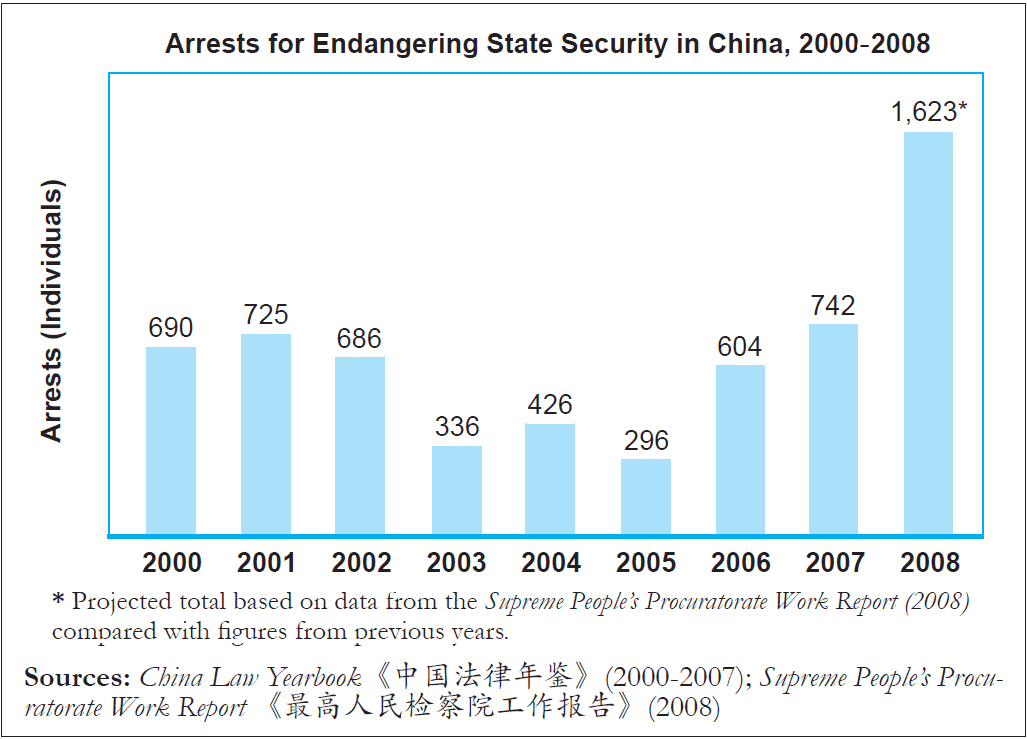
        Official rhetoric at the annual session of the National People’s Congress (NPC) in March may give further impetus for the United States to work conscientiously on issues of China’s human rights. Wu Bangguo, chairman of the NPC’s Standing Committee, drew out an explanation about how democratic pillars such as a multi-party political system and independent judiciary were incompatible with Chinese conditions. He underscored that China requires Communist Party leadership and would otherwise be “torn by strife.” This line of thinking follows a tumultuous year in China that saw an estimated 100,000 mass incidents, widespread unrest in Xinjiang and the Tibetan plateau, a doubling in the number of arrests for “endangering state security” crimes (see graph), and a demand by intellectuals and dissidents in “Charter 08” for China to adopt multi-party governance. It is almost certain China will experience greater social unrest in the near future due to the decimation of its export manufacturing sector, among and other problems with human rights ramifications.

        When, How Will Dialogue Resume?

        At a meeting between Chinese President Hu Jintao and President Obama in London on April 1, it was decided that the next session of the official human rights dialogue would take place “as soon as possible.” It was also announced that the countries are establishing an annual Strategic and Economic Dialogue (SAED) to combine and upgrade the twice-yearly Strategic Economic Dialogue and US-China Senior Dialogue that were features of the Bush administration. Since human rights will be discussed at the new SAED, it is possible that the human rights dialogue itself will take place around the same time. However, President Obama and Secretary Clinton are many weeks, if not months, away from having assistant secretaries of state for East Asia and human rights. Until the team is in place, holding a human rights dialogue with China is not possible.

        At the UPR, China asserted that it holds more than 20 human rights exchanges with foreign countries. But neither Chinese nor foreign participants in these dialogues are satisfied with the process or the results. The EU-China dialogue has yet to recover from the shock of China’s execution of Wo Weihan, father of two EU citizens, on the last day of the November session. Several Western dialogue partners have complained that, since July, virtually no new information has been provided by the Chinese side on cases of concern. These same partners have noted that China has become increasingly adept at raising human rights issues in the country with whom they are holding dialogues, such as state control of religion in Norway, police brutality in the UK, and the treatment of a Chinese journalist working for the German state broadcaster Deutsche Welle.

        Viewed broadly, the dialogues have become dialogues of the deaf in which each side simply lays out a defense of its own record while attacking the rights record of the other side. In this sense, Secretary Clinton was correct when she said that, on issues of human rights, each side has their own positions, well known to all. The challenge is to move beyond the present stalemate so that the human rights dialogues are equal part cooperation on such issues as juvenile justice and also respectful disagreement on issues like freedom of expression and association.

      • China’s Human Rights Plan Met With Mixed Reactions

        On Monday, China unveiled with great fanfare its National Human Rights Action Plan for 2009–2010 (full text available in English | Chinese). This plan, the first of its kind for China, is intended to set goals and measures for all of China’s government to follow in the next two years in its efforts to better protect and respect human rights.The plan, which was greeted with great enthusiasm by the China’s domestic media, received a more lukewarm reception outside the country. Although the plan contained several important expressions of support for the protection of human rights and some specific proposals, skeptics question whether the plan contained enough concrete benchmarks against which to measure achievements, particularly in the area of civil and political rights, and whether China’s system was transparent enough to allow for independent verification of progress.

        The following essay, published on the website of the Changjiang Daily in Wuhan (and reprinted by several major Chinese-language news portals), argues strongly that China’s ambitious plans need to be accompanied by sufficient action, else its goals will be in danger of not being realized. The author also reminds us that human rights are “naturally inherent” and “sacred” and not to be doled out by the state as it sees fit “according to national circumstances.” Progress in the protection of human rights should move forward in all areas simultaneously: economic, social, cultural, civil, and political.

        Safeguard Human Rights with Sufficient Action
        Li Qiong
        April 14, 2009
        Yesterday, the State Council authorized the State Council Information Office to issue the “National Human Rights Action Plan (2009–2010)” (NHRAP). This is the first time China has established a national program focused on human rights, and its action plan clearly sets out the Chinese government’s goals and concrete measures for the promotion and protection of human rights during the coming two years.From 1991, when the Chinese government published the “Chinese Human Rights Situation” white paper, the first government document to positively affirm the status of the concept of human rights in China’s political development, to 2004, when the phrase “the state protects and respects human rights” became part of the constitution, there has been increasingly clear and resolute identification of human rights as a common achievement of human civilization and a mainstream value of international society.

        On the level of theory and perception, the concept of human rights has already cast off the cloak of ideological struggle, and in speech it is no longer a sensitive or taboo subject. A whole series of legal provisions have reflected elements of the protection of human rights. The positive significance of the NHRAP lies in its clarification of the basic elements of the protection of human rights in China and turning these national values and strategic goals into a roadmap for the near term.

        In addition to progress on the level of ideas and perception, we cannot deny the accomplishments China has made in the area of action on human rights protection. But compared to the human rights content found in the NHRAP and in our various laws, we remain deeply concerned about the protection of human rights in practice.

        Looking at the reality of present-day Chinese society, many aspects of respecting and protecting human rights have yet to reach the ground, and there is much that remains unfinished with regard to upholding and protecting people’s rights. In some areas, whenever there is an accident involving major loss of life, the first thing that local government and enterprises think to do is conceal and cover up. In some management of society at the grassroots level, the difficulties people face in expressing and upholding their rights end up turning into intense popular confrontations or conflicts with officials or the police. In all areas of law enforcement and the administration of justice, there often appear flashes of the dark shadows of torture, prison bullies, and miscarriages of justice. In the hospitals of every major city, many parents of children with leukemia fiercely hope for a chance meeting with the Premier. The lack of basic cultural facilities in rural areas, the detention and even incarceration in psychiatric hospitals of those who make complaints and petitions—these facts make it clear that there remains a long way to go before realizing civil, cultural, and political rights.

        These hard realities that run through our rule of law and human civilization remind us that it is precisely at the level of implementation that human rights continue to be in danger of being ignored, neglected, distorted, and emptied of all meaning. Government and society continues to bear an enormous responsibility to respect, protect, and improve human rights.

        To be sure, it is even more difficult to break through barriers at the level of action and implementation than it is at the level of thought and speech. After 30 years of rapid economic expansion, the human rights issues we face are no longer limited to the single element of the right to life. The times are changing, and people’s knowledge of and desire for rights is growing stronger and more varied. The types of rights-protection problems that need to be resolved are increasingly complex as well. In the broader context of social transformation, respect and protection of human rights means increasing public investment to strengthen important social services, overcoming institutional inertia and improving the work of government, and sweeping away unreasonable vested interests and bringing fairness and justice to society in return. Improving these areas of implementation requires sufficient political awareness, a courage to reform, and sufficient mechanisms and platforms for the expression and interplay of interests.

        Human rights is something naturally inherent, something sacred; it is not a favor to be bestowed on the people or something that can be arbitrarily taken from them. We have already firmly established a national vision and system, but what we hope to see even more is respect, protection, and improvement of human rights in actual practice. When the promotion and protection of human rights is realized in practice, when it can be seen in every action taken by the government everywhere—only then can we really say that the citizens become the masters of the state and “putting people at the center” becomes the core of development.