Blog

  • China’s Human Rights Plan Met With Mixed Reactions

    On Monday, China unveiled with great fanfare its National Human Rights Action Plan for 2009–2010 (full text available in English | Chinese). This plan, the first of its kind for China, is intended to set goals and measures for all of China’s government to follow in the next two years in its efforts to better protect and respect human rights.

    The plan, which was greeted with great enthusiasm by the China’s domestic media, received a more lukewarm reception outside the country. Although the plan contained several important expressions of support for the protection of human rights and some specific proposals, skeptics question whether the plan contained enough concrete benchmarks against which to measure achievements, particularly in the area of civil and political rights, and whether China’s system was transparent enough to allow for independent verification of progress.

    The following essay, published on the website of the Changjiang Daily in Wuhan (and reprinted by several major Chinese-language news portals), argues strongly that China’s ambitious plans need to be accompanied by sufficient action, else its goals will be in danger of not being realized. The author also reminds us that human rights are “naturally inherent” and “sacred” and not to be doled out by the state as it sees fit “according to national circumstances.” Progress in the protection of human rights should move forward in all areas simultaneously: economic, social, cultural, civil, and political.

    Safeguard Human Rights with Sufficient Action
    Li Qiong
    April 14, 2009

    Yesterday, the State Council authorized the State Council Information Office to issue the “National Human Rights Action Plan (2009–2010)” (NHRAP). This is the first time China has established a national program focused on human rights, and its action plan clearly sets out the Chinese government’s goals and concrete measures for the promotion and protection of human rights during the coming two years.

    From 1991, when the Chinese government published the “Chinese Human Rights Situation” white paper, the first government document to positively affirm the status of the concept of human rights in China’s political development, to 2004, when the phrase “the state protects and respects human rights” became part of the constitution, there has been increasingly clear and resolute identification of human rights as a common achievement of human civilization and a mainstream value of international society.

    On the level of theory and perception, the concept of human rights has already cast off the cloak of ideological struggle, and in speech it is no longer a sensitive or taboo subject. A whole series of legal provisions have reflected elements of the protection of human rights. The positive significance of the NHRAP lies in its clarification of the basic elements of the protection of human rights in China and turning these national values and strategic goals into a roadmap for the near term.

    In addition to progress on the level of ideas and perception, we cannot deny the accomplishments China has made in the area of action on human rights protection. But compared to the human rights content found in the NHRAP and in our various laws, we remain deeply concerned about the protection of human rights in practice.

    Looking at the reality of present-day Chinese society, many aspects of respecting and protecting human rights have yet to reach the ground, and there is much that remains unfinished with regard to upholding and protecting people’s rights. In some areas, whenever there is an accident involving major loss of life, the first thing that local government and enterprises think to do is conceal and cover up. In some management of society at the grassroots level, the difficulties people face in expressing and upholding their rights end up turning into intense popular confrontations or conflicts with officials or the police. In all areas of law enforcement and the administration of justice, there often appear flashes of the dark shadows of torture, prison bullies, and miscarriages of justice. In the hospitals of every major city, many parents of children with leukemia fiercely hope for a chance meeting with the Premier. The lack of basic cultural facilities in rural areas, the detention and even incarceration in psychiatric hospitals of those who make complaints and petitions—these facts make it clear that there remains a long way to go before realizing civil, cultural, and political rights.

    These hard realities that run through our rule of law and human civilization remind us that it is precisely at the level of implementation that human rights continue to be in danger of being ignored, neglected, distorted, and emptied of all meaning. Government and society continues to bear an enormous responsibility to respect, protect, and improve human rights.

    To be sure, it is even more difficult to break through barriers at the level of action and implementation than it is at the level of thought and speech. After 30 years of rapid economic expansion, the human rights issues we face are no longer limited to the single element of the right to life. The times are changing, and people’s knowledge of and desire for rights is growing stronger and more varied. The types of rights-protection problems that need to be resolved are increasingly complex as well. In the broader context of social transformation, respect and protection of human rights means increasing public investment to strengthen important social services, overcoming institutional inertia and improving the work of government, and sweeping away unreasonable vested interests and bringing fairness and justice to society in return. Improving these areas of implementation requires sufficient political awareness, a courage to reform, and sufficient mechanisms and platforms for the expression and interplay of interests.

    Human rights is something naturally inherent, something sacred; it is not a favor to be bestowed on the people or something that can be arbitrarily taken from them. We have already firmly established a national vision and system, but what we hope to see even more is respect, protection, and improvement of human rights in actual practice. When the promotion and protection of human rights is realized in practice, when it can be seen in every action taken by the government everywhere—only then can we really say that the citizens become the masters of the state and “putting people at the center” becomes the core of development.

  • Chinese State Security Arrests, Indictments Doubled in 2008

    Arrests and indictments for “endangering state security” (ESS) in China soared in 2008, more than doubling for the second time in three years, according to data made available by the Supreme People’s Procuratorate (SPP) in its annual work report to the National People’s Congress (NPC) on March 10.While no figures for ESS were explicitly provided, data appended to the work report distributed at the annual plenary session of China’s legislature point unambiguously to such a rise. Based on those statistics, The Dui Hua Foundation estimates that last year more than 1,600 individuals were arrested and more than 1,300 individuals indicted on state security charges in China.

    Arrests and prosecutions for alleged “splittist” activities by Uyghurs and Tibetans are believed to have contributed significantly to the large increases in 2008. Security forces cracked down in Tibetan areas and Xinjiang following an uprising in Lhasa last March and numerous protests throughout the Tibetan plateau amid concerns that ethnic unrest and social instability would mar the Olympic Games held in Beijing last August.

    Close Tracking Makes Estimate Possible

    In 2007, Dui Hua called attention to the doubling of ESS arrests in 2006 over the previous year. Last year, the foundation used data announced in the SPP work report for 2007 to reveal another 23 percent increase in ESS arrests for that year. As early as January 2009, there were indications that arrests and prosecutions for ESS increased significantly in 2008. That month, an official spokesperson for the Xinjiang Uyghur Autonomous Region People’s Procuratorate revealed that nearly 1,300 individuals were arrested for endangering state security in that region alone—compared to 742 for the entire country in 2007.

    The version of the SPP work report for 2008 that was distributed to NPC delegates, members of the media, and other observers included charts breaking down arrest and indictment totals by the crime categories as found in China’s criminal code. In these charts, the three smallest categories—ESS, “endangering national defense interests,” and “dereliction of duty by military personnel”—are combined in a category marked “Other.” When these totals are routinely reported in the China Law Yearbook, each category is listed separately. Looking at the data over time, one finds relative stability in the number of arrests and prosecutions made for endangering national defense interests and dereliction of duty by military personnel—meaning that most of the variance can be attributed to ESS cases.

    Analysis Yields Astonishing Results

    From 2004 to 2007, arrests for endangering national defense interests and dereliction of duty by military personnel remained at a fairly consistent rate of about 7 per 20,000 total arrests. (By contrast, arrests for ESS over this same period displayed considerable variation.) Assuming that this rate did not vary considerably in 2008, it would mean that Chinese law enforcement authorities arrested more than 1,620 individuals for ESS that year. This marks a 119 percent increase over 2007 and a 448 percent increase over the historic low reported in 2005. Similar calculations for indictments yield an estimate of 1,327 for ESS in 2008, a 114 percent increase over 2007 and a 280 percent increase over 2005.

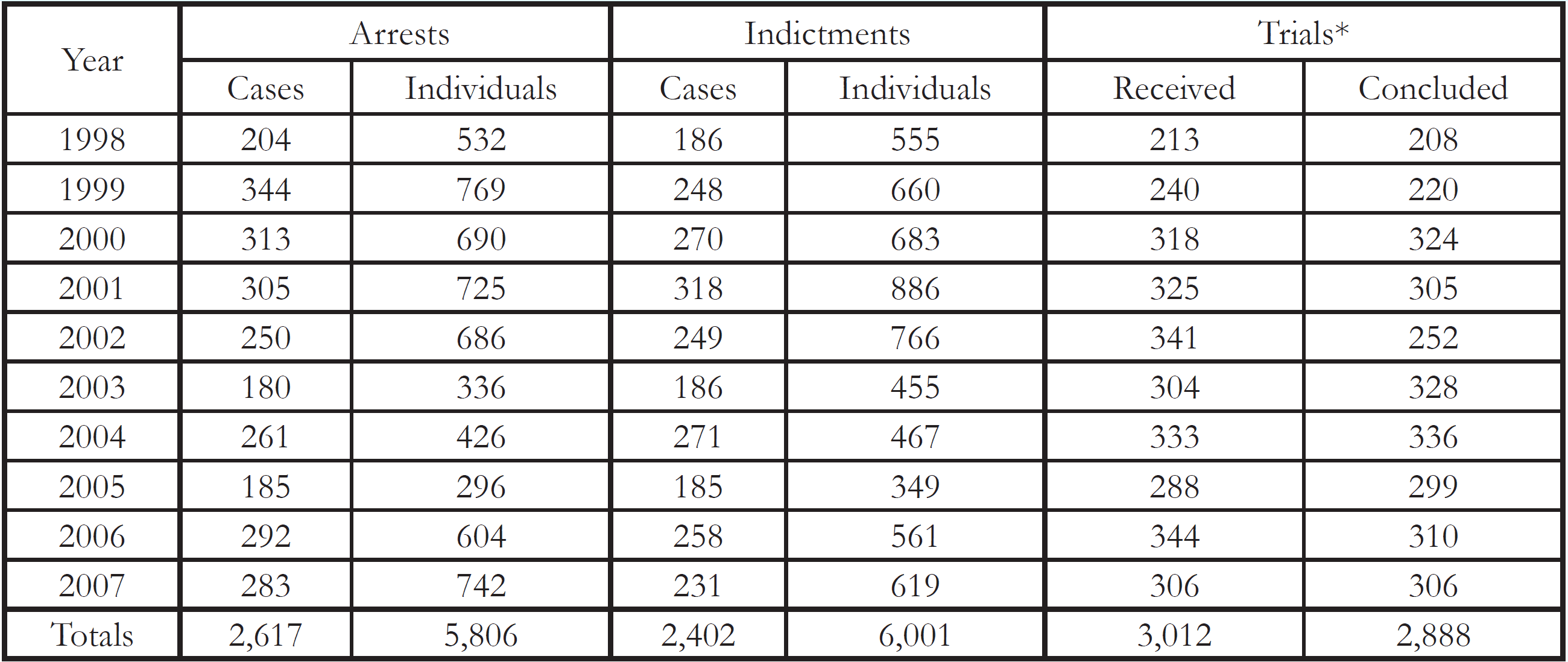
    Corroboration of a doubling in arrests and indictments for ESS in 2008 can be seen in figures made public in the work report of China’s Supreme People’s Court, which shows that first-instance trials for ESS (and a small number of trials for dereliction of duty by military personnel) increased by more than 50 percent compared to 2007. Given that it routinely takes 12 months or longer to conclude ESS trials, one would expect to see a substantial proportion of the arrests and indictments in 2008 reflected in trials concluded in 2009. (Click on the chart below to view data on ESS arrests and indictments in China since 1998.)

    Dui Hua’s estimates for arrests and indictments for ESS in 2008 raise questions about the report from Xinjiang earlier this year. If, as reported, 1,295 individuals were arrested for ESS crimes in Xinjiang during the first 11 months of 2008, this would comprise 80 percent of Dui Hua’s estimated total, leaving roughly 330 arrested throughout the rest of the country—including Tibetan areas, where dozens, if not hundreds, are suspected of having been charged with ESS during the year. This number appears rather low.

    It is possible that the data reported nationally and the data for Xinjiang do not categorize ESS crimes the same way, with the Xinjiang total including cases of terrorism and other crimes that do not strictly fall under the category of ESS as defined by the criminal code. However, if uniform criteria are being used, it means either that Uyghurs and Tibetans represent an even larger proportion of ESS cases than previously believed or that Dui Hua’s estimate for the total number of arrests and indictments nationally is too conservative. Clarity on these questions will have to wait until the 2009 China Law Yearbook is published—assuming that Chinese authorities maintain a basic level of transparency of the criminal justice system by continuing to report specific figures for ESS crimes.

    Related Links:

  • Discussion of 60th Anniversary Special Pardon Intensifies in China

    In recent weeks, the official Chinese media has covered the issue of a special pardon to celebrate the PRC’s 60th anniversary, with opinions of prominent academics and legal professionals appearing in many publications. Dui Hua has generated attention on the proposal since early this year, featuring it in the Winter 2009 issue of the Dialogue newsletter and in postings in the Human Rights Journal, and will continue to track official discussion on the topic. The following summarizes and provides context for some views on the “anniversary special pardon” published in China since mid-February, with links to referenced Chinese-language articles.

    The anniversary pardon proposal recently gained widespread attention in China when an interview with Gao Mingxuan (高铭暄), a professor at Renmin University and preeminent legal scholar and pioneer in the field of Chinese law, was published on February 16 in the Yangcheng Evening Post (羊城晚报). This occurred soon after a convicted murderer in Suizhou in Hubei Province had been sentenced to death and then appealed for clemency based on the principles of a special pardon, an incident which stimulated tremendous debate. Assuring he did not consider that particular case as commensurate with such a pardon, Prof. Gao stressed that special pardons should not be issued indiscriminately for prisoners who show no remorse or still pose threats to society, but instead can be implemented under proper conditions, such as in recognition of prisoner reform and for national anniversaries.Gao also emphasized that special pardons have a role in promoting “harmony,” a central ideal of current Chinese leaders, and commented on its rehabilitative benefits for individuals and society. In his remarks, he likened the reform and pardoning of prisoners to the treatment of people with serious illnesses who should be hospitalized and then released once their health is restored.

    Other legal scholars and members of the general public have since expressed strong opinions on the proposal. The many responses in favor of an anniversary pardon have underscored its humanitarian nature, precedents that exist in Chinese history, and the legal provisions of pardons set forth in Articles 67 and 80 of China’s constitution. For voices opposed, principal concerns have been how China can implement pardons while avoiding corruption of the process, the lack of clear procedures for implementing pardons, and whether public safety would be jeopardized by a large-scale release of prisoners.

    The China Youth Daily (中国青年报) published a response supportive of Prof. Gao’s call. The article urged that the proposal be taken seriously as a policy with a sound basis in both Chinese law and common sense, and argued that punishment and reform of prisoners have been complementary elements throughout Chinese history.

    In a February 18 article in the Chinese Commercial Daily (华商报), Jia Yu (贾宇), a scholar from the Northwest University of Political Science and Law, repeated a sentiment often voiced by special pardon supporters: Pardons demonstrate the confidence and tolerance of a powerful country and reflect the political stability, national prosperity, and social environment of today’s China. Still, Prof. Jia was skeptical that there would be support for pardoning prisoners convicted of “endangering state security” or economic crimes due to the serious nature of the offenses. He further suggested that pardons should not be determined based on crime categories. Jia indicated that an option could be to consider pardons for common criminals who receive light prison sentences and those with less than three years left to serve in prison.

    Not all intellectuals, however, have been in favor of the special pardon. In a February 25 interview published in Southern Weekend (南方周末) responding to Prof. Gao, criminal law expert Zhou Guangquan (周光权), who is a member of the National People’s Congress Law Committee and vice dean of Qinghua University’s School of Law, spoke out against the proposal, reasoning that conditions for a special pardon are not appropriate this year.


    Zhou made four main points against the special pardon: 1) A pardon could influence China’s criminal law and judicial authority, as people now put their faith in the judicial system to appropriately punish criminals; 2) institutions are not in place to reintegrate pardon recipients back into society and professional life, since the prisoners themselves may not have been reformed; 3) many crimes involve victims who have been harmed but gone uncompensated for their injuries, so releasing prisoners might lead to direct conflicts between criminals and their victims and give rise to new social unrest; and 4) a special pardon might undermine already tenuous social stability, which Zhou pointed out is a concern harbored by the general public, and one that is not without merit.

    In reality, attitudes among the general Chinese public about an anniversary special pardon are hard to ascertain. Amid the coverage in the Chinese press have been online surveys, however unscientific, that suggest a substantial number of common citizens may support the idea of a special pardon this year. (A poll showed in early March, after nearly 50,000 “votes” had been tallied, the numbers of supporters and opponents of the pardon proposal were nearly identical.) While definite conclusions cannot be drawn from this kind of polling, the mere existence of surveys—and the growing coverage in official media—clearly demonstrates that the idea of an anniversary special pardon is being considered by Chinese citizens and heard among high-level Chinese leadership.

  • Ching Cheong in Support of 60th Anniversary Special Pardon

    In the lead article of the most recent issue of the Dialogue newsletter, Dui Hua expressed support for the idea of a special pardon for prisoners as a means of commemorating the 60th anniversary of the founding of the People’s Republic of China on October 1, 1949. The article, which noted a variety of voices in China who have already raised the idea of a special pardon, has since generated considerable discussion on the proposal both inside and outside of China.A recent supporter of the 60th anniversary pardon proposal is Ching Cheong, veteran China correspondent for The Straits Times newspaper based in Singapore, who expressed his views in a February 5 opinion piece published in the Hong Kong Economic Journal. Translated below by Dui Hua, the piece is highly personal in nature, drawing on Ching’s own experience of being imprisoned in China on espionage charges from April 2005 until his release on parole in February 2008.


    Invincible are the benevolent, their love boundlessBy Ching Cheong
    (Hong Kong Economic Journal, February 5, 2009)

    February 5th marks the first anniversary of my regained freedom. It feels great to be home again! I am so happy to be free! Following the great efforts of so many Hong Kong people and the ceaseless petitioning of the Hong Kong SAR government on my behalf, the central government one year ago finally agreed to release me on parole. I shall never forget the understanding, trust, and support offered me by all sectors of society. I have pledged to transform this thanks into a guiding force working on behalf of democracy, freedom, human rights, and rule of law in Hong Kong and China.Announcing a special pardon offers a fresh a start

    This year marks the 60th anniversary of the founding of the People’s Republic of China and marks the first full cycle of 60 years since the establishment of a new China. According to the traditional Chinese calendrical system of “roots and branches,” this is the beginning of a new cycle and an opportunity to reflect on original intentions and start new ventures. I propose that the central government celebrate this 60th anniversary with the announcement of a special pardon, a policy of benevolence that will offer people a fresh start.

    Chinese history early on established this tradition of benevolent rule. For example, take the case of Emperor Wu of the Han Dynasty. In the “Annals of the Wu Emperor” in the History of the Han Dynasty, it is written: “On the Jiazi day, in the third month of the year in spring in the first year of the Yuansu reign period [128 BCE] . . . [Emperor Wu] decreed: ‘I wholeheartedly admire [the benevolent rule of] Tang and Yu [two enlightened rulers in the early history of China] as well as those found in the Yin [1600–1100 BCE] and Zhou [1100–771 BCE] dynasties. The old provides a mirror for the new. We thus declare a general pardon over the entire nation and make a fresh start with our people.’” Emperor Wu opened the way for a period of peace and prosperity such that to this day we are especially proud to refer to ourselves as “Han.” This has much to do with his willingness to “offer people a fresh start.”

    Besides considerations of cultivating benevolent rule, a special pardon today offers more of a chance to resolve judicial errors. Over the past decade, the CPC Central Committee has committed to reform of the judicial system, twice issuing a “Five-year Reform Program for the People’s Courts.” This is something that helps restore people’s confidence in the administration of justice. But it also highlights many of the deficiencies in past trials. These institutional problems cannot be reformed overnight; choosing to issue a special pardon on the occasion of this 60th anniversary National Day will meet the goal of resolving these errors, thereby easing feelings of social discontent.

    Based on my personal experience, I feel that resolving these miscarriages of justice is especially urgent. My reasoning is as follows:

    First, during the Fifth National Conference on Criminal Sentencing Work, former Politburo Standing Committee member and Central Politico-legal Committee Secretary Luo Gan noted: “We must effectively guarantee quality in handling cases and strengthen the protection of human rights in the area of criminal justice. We must strictly implement each procedure and system in the criminal justice process, and firmly grasp the central facets of facts, evidence, procedure, and use of law in each case so that every case possesses clear facts, sufficient evidence, accurate convictions, appropriate sentencing, and lawful procedure that can stand the inspection of history.” From these words by a top party leader responsible for China’s law enforcement work, we can clearly see that the authorities have in the past not mastered these four central facets and that this failure has been widespread. Otherwise, it would not be necessary to enact reforms.

    Second, the February 8, 2007, issue of the Legal Daily reported that China’s public security organs in 2006 had developed “special control measures,” one of which was aimed at controlling the extraction of confessions through torture. Later, in the second half of 2007, the same paper published a series of articles examining why the problem of extracting confession through torture “had not stopped, despite repeated prohibitions.” From these reports, we see that the extraction of confessions through torture is a very serious problem.

    Third, in 2007, China’s National People’s Congress Standing Committee passed a new Lawyers’ Law, explicitly including a section on the “professional rights and obligations of lawyers” and establishing clear provisions covering the rights of lawyers in the criminal justice procedure to meet with clients, view case materials, investigate and obtain evidence, and defend their clients—thereby taking a first step towards resolving the long existing problems in the profession of “difficulty to meet,” “difficulty to view evidence,” and “difficulty to investigate and obtain evidence.” This is a great step forward, to be sure, but it also highlights the fact that defendants in the past were unable to receive proper legal protection.

    Extraction of confessions through torture during the investigative phase, failure to grasp the four central facets of the trial process, and depriving defendants of their right to legal protection can only lead to miscarriages of justice.

    Make more use of parole to resolve contradictions

    Fourth, the present criminal code offers criminals who have served at least half of their sentences the possibility of leniency through parole. But in practice, only a handful of individuals who have served half of their sentences are actually paroled. According to statistics from China’s Ministry of Justice, in the decade from 1996 to 2005, the rate of parole never exceeded three percent. This effectively negates the leniency built into the criminal code. According to data from the Asian and Pacific Conference of Correctional Administrators, in 2005 China lagged far behind other countries and regions in the Asia Pacific region with respect to implementing parole. (In that year, China’s rate of parole was 2.3 percent, whereas Australia’s was 39.7 percent, New Zealand’s 39.4 percent, Canada’s 32.7 percent, Thailand’s 37.9 percent, Japan’s 5 percent, and Hong Kong’s a high 40.4 percent.) Since the rate of parole use is so low, many mainland legal experts have suggested that parole ought to be used more to resolve social tensions and fulfill the government’s criminal justice policy of “lenience mixed with severity.”

    These four errors that exist in law enforcement were created by the existing justice system, so we must rely on judicial reforms to solve them completely. But the social grievances that have accumulated as a result of this must be resolved in a timely manner if there is to be social harmony. As there are a wide range of such injustices that cannot be easily resolved one by one in a short period of time, I propose issuing a special pardon in order to resolve a larger portion of them. Only in this way can society’s grievances be effectively defused.

    Thirty years ago, Deng Xiaoping passed a “Resolution on Certain Questions in the History of Our Party Since the Founding of the State,”resolving serious contradictions within the Party and clearing the way for 30 years of prosperity. Today, if Hu Jintao were to issue a special pardon, expressing the government’s sincerity in healing old wounds and granting people a fresh start, resolving historical difficulties and enhancing the peaceful atmosphere of society, who would object? Invincible are the benevolent, their love boundless. I hope that the parties concerned can give this idea serious consideration.

    Related Links:

  • Olympics Six Months On: No Lift for China’s Image

    Six months after the dazzling ceremony that opened the Summer Olympics in Beijing, the first post-Games poll of international opinion toward China has been released by the BBC World Service. The results indicate that China’s image has worsened over the past year among most countries polled. The release of the poll coincides with the first Universal Periodic Review (UPR) of China’s human rights record this week at the United Nations in Geneva.According to the BBC poll of views in 21 countries released on February 6 this year, the percentage of people outside China who think the country exerts a positive influence in the world has slipped six percentage points to 39 percent from 45 percent a year earlier. Forty percent think China exerts a negative influence, up from 32 percent in 2008. Last year, 16 countries had a predominantly positive view of China and five held a negative view. In the most recent poll, 10 countries have a negative view and 10 countries have a positive view.

    The most recent poll indicates a modest improvement in the United States’ image since the low point recorded in late 2006, when only 30 percent of those polled outside the United States thought that the country wielded a positive influence. Those who have a positive view of the United States now account for 40 percent of those polled, while those who hold a negative view stand at 43 percent—a decrease from 51 percent in late 2006. The most recent poll was conducted after the November 2008 election of the first black US president, who campaigned on a platform of taking steps to improve America’s battered image by closing Guantánamo’s detention center, outlawing torture of detainees, and promoting better relations with countries that have strained ties with the United States.

    Over the past year, positive opinion toward China has dropped sharply in Europe and in parts of Asia (including in the Philippines, where China’s negatives rose from 30 percent to 52 percent) and the Muslim world (with double-digit drops in positive ratings recorded in Egypt, Indonesia, and Turkey). It has remained negative in the United States and Canada, but has improved in Latin America and Africa. Opinion toward China in Russia remains positive. In sharp contrast to international opinion, more and more Chinese—92 percent in the most recent poll—believe that China exerts a positive influence in the world.

    The recent poll reveals views of China from eight of the 12 top medal-winning countries at the 2008 Olympic Games. Excluding responses from China, an average of 52 percent of those polled among the top medal winners felt that China exerts a negative influence—up from 44 percent a year ago—and the percentage of those who think that China has a positive influence dropped to 28 percent from 37 percent. Among audiences likely to have watched the Games, China’s image appears to have deteriorated.

    Opinion toward China suffered some of its biggest losses in countries that hosted a leg of the around-the-world torch run. Positive views of China dropped to 39 percent from 48 percent in Great Britain, and negative views rose to an astonishing 70 percent in France (up from 46 percent a year ago). In Turkey, where sympathy for the Uyghur people is high, 64 percent now have a negative view compared to a mere 18 percent who see China in a positive light. In Australia, where a year ago 60 percent of the population felt that China exerted a positive influence, the number which does so now has dropped to 47 percent. The Japanese already had a very negative opinion of China’s role in the world, but even here the country’s positive numbers dropped from 12 percent in the 2008 report to 8 percent in this year’s report.

    This week in Geneva China’s human rights record is being examined by the UN’s Human Rights Council. The Chinese government will field many questions about its human rights record, but one question should be directed at to the Chinese people: Why do an increasing number of people around the world view China so negatively, even after the hard-won triumph of the Summer Olympics, the outpouring of international support after the Sichuan earthquake in May and the realization that China’s economy and foreign exchange reserves are vital to repairing the damaged world economy?

    A principal reason is doubtless the perception that the human rights situation in China is worsening, with reports of a sharp increase in arrests for political crimes, tightened controls over expression on the Internet, increased repression in Xinjiang and Tibet, and continued support for some of the world’s worst rights abusers in Sudan, Myanmar, and North Korea. As the United States and others have learned the hard way, the way power treats people, at home and abroad, counts heavily in the court of public opinion.

    Related Links:

  • Dialogue – Issue 34: Presidential Pardons in US History: Healing and Uniting the Nation

    The pardons recently issued by outgoing President George Bush set off public discussions about executive clemency powers in the United States. This comes as no surprise; presidents often issue pardons that spark controversy at the end of their terms, with the lame duck period after the election of a new president bringing with it debates over the scope and propriety of the power to pardon.

    The pardon power, granted in Article II, Section 2, of the US Constitution, is unchecked. The president may issue any number of pardons, to whomever he or she chooses, and without any legislative or judicial oversight. A pardon may be issued after a crime is committed, including before trial, while a sentence is being served, or after a sentence has been completed. The pardon power is only restricted by two conditions: pardons may not affect an impeachment process, and the president may only pardon offenses against the United States (i.e., federal crimes, rather than civil or state crimes).

    In 1891, the US Congress established the Office of the Pardon Attorney, a branch of the Justice Department. The office typically handles all requests for presidential pardons, completes the appropriate background investigations, and submits its recommendations to the deputy attorney general and White House counsel, who discuss them with the president, though the president is under no obligation to heed the suggestions of this counsel.

    A pardon—or, more broadly, executive clemency—actually refers to a range of possible actions. In addition to a full pardon, which completely wipes out the legal consequences of a conviction, the president may issue a conditional pardon (such as the one issued to labor leader Jimmy Hoffa by Richard Nixon in 1971 on the condition that he not take part in union organizing for ten years); a remission, which reduces a sentence; a reprieve, which delays the execution of a sentence; or a general pardon or amnesty, which pardons an entire class of people.

    Despite its wide application in the United States, the pardon is not an American innovation. In many civilizations, the power to pardon was vested in the sovereign and might be exercised for political expediency, personal sentiment, to address a deficit in the law, or to influence enemy combatants in time of war. In France, for example, any homicide was considered a murder, and any murder was punishable by death; the king’s pardon served as a check against the unyielding severity of this law.

    Revolutionary Roots and Political Continuity

    In pre-revolutionary America, the colonial governors generally exercised broad pardoning power, and individual states after the revolution were careful to put checks on the executive pardon into their constitutions. The debate over presidential pardon power during the 1787 convention to draft a new constitution was largely pragmatic. Proponents such as statesman Alexander Hamilton argued that the need for executive pardon powers in times of crisis superseded fears of a quasi-monarchy. They pointed out that a president who can pardon dissidents and factionalists can restore the unity of the country. One point of contention was the power to pardon in cases of treason. Ultimately, this power was retained, and the cogency of this choice was soon put to the test.

    In 1791, the new federal government imposed a tax on whiskey that many small distillers considered unfair. The distillers turned to armed insurrection, in what came to be known as the “Whiskey Rebellion.” The issue reached a fevered pitch in 1795, when President George Washington declared martial law and called up the militia to end the rebellion. The rebels were rounded up, two were sentenced to death for treason, and order was restored. Having established the power of the federal government, Washington issued the first pardon in US history and overturned the death sentences of the two traitors. He also issued a general amnesty for those who had taken part in the rebellion.

    Following Washington’s precedent, many US presidents have used the power of the pardon to protect the nation and heal the wounds of a country divided. In 1799, President John Adams sent troops to apprehend a group of insurrectionists who had accosted federal tax assessors. Three of the leaders were found guilty of treason and sentenced to death. His cabinet unanimously called for execution, but Adams instead pardoned the rebels in a move that was received positively by most citizens. In 1798, congress passed the Alien and Sedition Acts, which aimed to curb free speech and criticism of the government’s undeclared war with France. Thomas Jefferson believed that the acts were unconstitutional, and after his election in 1801 he pardoned everyone who had been prosecuted under them.

    Abraham Lincoln made extensive use of his power to pardon during the US Civil War, pardoning virtually every Union deserter whose case crossed his desk, essentially bolstering the Union’s chance of victory. He also issued a general amnesty in 1863 for confederate soldiers, with the purpose of encouraging enemy desertions. Following Lincoln’s assassination, President Andrew Johnson followed a similar program to lead the country through reconstruction. In 1921, President Warren Harding commuted the sentences of 24 political prisoners. In recent history, Jimmy Carter issued a general pardon to all those who evaded the Vietnam War draft on his first day in office on January 20, 1977.

    The Controversy and Value of Pardons

    In 1974, Gerald Ford, who was appointed president after Richard Nixon resigned due to the Watergate scandal, pardoned Nixon. Ford’s unpopular decision sank his approval ratings and likely contributed to his loss in the presidential election to Jimmy Carter in 1976. At the time, Ford said that the Nixon saga was “an American tragedy in which we all have played a part.” He went on to state: “It could go on and on and on, or someone must write the end to it. I have concluded that only I can do that, and if I can, I must.”

    Ford’s controversial action puts him in good company. Many presidential pardons have been viewed as inept or even corrupt. But while presidents may try to expand the office’s powers, the presidential pardon is one exercise of power that bucks the trend. The total and rate of pardons requested and granted have all decreased over the last century. Regulative forces—such as higher standards by the Office of the Pardon Attorney—and social forces, notably the “tough on crime” trend of the late 20th century, no doubt have played a part in this phenomenon.

    Despite inevitable controversies, the pardon power is ultimately about expressing forgiveness. As Alexander Hamilton wrote in The Federalist No. 74, “In seasons of insurrection or rebellion there are often critical moments when a well-timed offer of pardon to the insurgents or rebels may restore the tranquility of the commonwealth.” As leaders seek paths to harmony for their citizens and countries—an ambition deeply ingrained in Chinese society—these are important words to keep in mind.

    Related link:

  • Dialogue – Issue 34: Prisoners in Sichuan Receive Sentence Reductions

    The Dui Hua Foundation has received confirmation from authoritative sources inside China about sentence reductions for prominent activists serving sentences for “endangering state security” in Sichuan Province as well as lesser-known individuals incarcerated in the province. The information was provided in response to a request for updates on long-serving prisoners in Sichuan.

    Li Zhi (李智), aged 38, was granted a one-year sentence reduction by the Dazhou Intermediate People’s Court on January 19, 2007, and is now scheduled for release from Chuandong Prison on August 10, 2010. According to the information, the reduction was granted after Li received two citations of merit from prison authorities in 2006. Li was convicted of subversion by the Dazhou Intermediate People’s Court and sentenced on December 10, 2003, to eight years’ imprisonment. He was charged with using free email accounts to contact overseas representatives of the China Democracy Party (CDP) and posting politically-themed articles on a personal webpage. His is one of four cases in which user account information is known to have been provided to state security police by Yahoo! China.

    On May 21, 2008, the Dazhou Intermediate People’s Court also granted a 16-month sentence reduction to veteran political activist and CDP member Liu Xianbin (刘贤斌). This was the third sentence reduction for Liu, who had been given reductions totaling 28 months in 2004 and 2006. Liu, aged 40, was released from Chuandong Prison at the end of his sentence on November 6, 2008.

    Liu entered prison in 1992 after being sentenced to 2½ years’ imprisonment for “counterrevolutionary propaganda and incitement” for publishing a political journal in 1991 while studying at Beijing’s Renmin University. After his release from prison in 1993, Liu continued his political activity and became a local CDP organizer after the party was established in the late 1990s. He was detained in July 1999 and convicted of subversion by the Suining Intermediate People’s Court one month later. The response to Dui Hua notes that prison authorities recommended sentence reductions for Liu after awarding him several citations for good behavior between 2002 and 2006. Since his release from prison, Liu has been outspoken about rights defense and political reform, penning an open letter in defense of detained anti-corruption activist Deng Yonggu and joining the initial signers of the political manifesto, “Charter 08.”

    The response from Sichuan also reported reductions for prisoners incarcerated for counterrevolution or endangering state security whose cases are not as well-known. Zhao Liuneng (赵六能), also known as Zhao Liulun (赵六伦), received a one-year sentence reduction in October 2007, his third since 2004. Zhao and co-defendant Wang Zijun (王子俊), both farmers from Gulin County, were detained by police in July 2000 and charged with “armed rioting.” On June 7, 2001, the Luzhou Intermediate People’s Court sentenced Zhao and Wang to 15 and eight years in prison, respectively. Since entering Chuannan Prison, Zhao and Wang have been awarded many citations for good behavior. Wang was released on April 20, 2006, after receiving two sentence reductions. In February 2007, several months before his latest reduction, Zhao was named an “activist in prison reform,” suggesting his behavior had been particularly outstanding. Zhao is due for release on July 11, 2012.

    Liu Zhanghan (刘彰汉) was released from Chengdu’s Chuanzhong Prison in July 1999 after receiving four sentence reductions. In 1981, Liu was sentenced to death, suspended for two years, on charges of theft and “counterrevolutionary sabotage” for allegedly stealing weapons and plotting to derail a train during the Spring Festival holiday. While hiding from police, he and his cousin allegedly wrote a large number of political pamphlets calling for the overthrow of the socialist system. His death sentence was commuted to life imprisonment in 1983.

    Luo Zhengfang (罗正芳) was also released from Chuanzhong Prison in December 2001 after receiving numerous commendations, citations, and sentence reductions. He had received a suspended death sentence in 1984 for “actively participating in a counterrevolutionary group” and “counterrevolutionary sabotage.”

    Wang Ping (王平) was released from Chuandong Prison in March 2007 after receiving two sentence reductions totaling two years in 2004 and 2006. Wang, a former official from the city of Nanchong, had been convicted of espionage for providing military intelligence to Taiwan agents and sentenced to 10 years’ imprisonment in October 1999 by the Nanchong Intermediate People’s Court.

  • Dialogue – Issue 34: President Obama’s Human Rights Policy Towards China

    If President Bush made religious rights the centerpiece of US human rights policy towards China, President Obama will likely focus more on labor and free expression rights, especially with regard to the Internet. Moreover, the positive reaction to his election in the international community could put the new administration, which is set to utilize channels such as the United Nations with more vigor than its predecessor, in a good position to garner support from countries and bodies that maintain dialogues with China.

    Although many of Bush’s policies proved to be unpopular and the object of much criticism, his China policy was on the whole highly regarded. It is likely that President Obama will continue with the high-level dialogues initiated during Bush’s presidency, including the Strategic Economic Dialogue. The long-running, if frequently suspended, human rights dialogue will almost certainly continue, with the next session due to be held in Washington later this year.

    Obama’s advisors on China are concerned by Beijing’s policies to monitor the Internet and to punish those who use the Internet to voice anti-government sentiments. Some advocate promoting technologies that can circumvent the “Great Firewall of China,” while others are more interested in negotiating an agreement with the Chinese government that allows for a freer exchange of information between the two countries via the Internet. (In a reflection of the times, thought is being given to having the two presidents regularly address people of the other country by webcast.)

    Human rights issues related to Tibet could be a flashpoint for relations with China during the early period of the Obama administration. Obama is troubled by human rights problems in Tibet—he called for Bush to boycott the opening ceremonies of the Beijing Olympics in large part because of the suppression of the March protests in Tibetan areas—and several of his closest advisors on Asia and human rights were active on Tibetan issues while serving in the Clinton administration. A priority with the new US administration is likely to be winning Beijing’s agreement to allow the Dalai Lama to visit his home county in Qinghai Province.

    President Obama’s stance toward China on human rights will differ markedly from that of the Bush administration in one important respect. Obama will seek to use the United Nations human rights mechanisms—widely disparaged and often disregarded by Bush’s team—to engage in a multi-lateral dialogue with China. It is expected that Obama will seek to have the United States join the Human Rights Council, a body that the Bush administration boycotted.

    With the election of a new US president well-received in Europe, Africa, and Latin America, the Obama administration can expect an improvement in the image of the United States worldwide. Key polls of international public opinion about China and the United States will be conducted by the BBC and Pew Research Center in the first quarter of 2009. A surge in positive feelings toward the United States, along with such moves as the closure of Guantánamo Bay, may well underpin a more robust human rights policy toward China and other countries accused of widespread abuses of human rights.

  • Dialogue – Issue 34: Ten Years of Endangering State Security in China

    Annual statistics released by the Chinese government show that arrests and trials for endangering state security (ESS) are again on the rise, approaching their highest levels for the past decade. The data from the China Law Yearbook, which has been compiled into the accompanying table, offer a rare look into the way that Chinese law enforcement agencies handle this category of crime—which includes subversion, separatism, espionage, and trafficking in state secrets, among other political crimes.

    One of the first things to note is that though their numbers are increasing in absolute terms, ESS cases are still relatively rare in China. On average, roughly one of every 2,000 cases approved for arrest by Chinese procuratorates and one individual out of more than 1,400 indicted will face ESS charges. State security trials accounted for only 0.04 percent of all first-instance criminal trials heard by Chinese courts in 2007.

    There are several possible reasons why the numbers for arrests, indictments, and trials do not match up better. On the one hand, the legal process does filter out a certain number of questionable cases and, perhaps, shifts responsibility for punishment to administrative measures such as “reeducation-through-labor.” Moreover, there is a well-noted tendency for the criminal justice system to become backlogged with complex or sensitive cases, as many ESS cases are. Thus, it is quite rare for arrest, indictment, and trial to each occur in the same year.

    Another point worth noting is that, on average, ESS cases involve more defendants than do criminal cases taken as a whole. More cases alleging large conspiracies, such as those involving espionage rings, underground political parties, or groups advocating independence or greater autonomy for ethnic minorities, tend to drive up the defendant-to-case ratio more than would cases alleging incitement, which tend to involve only one or two individuals.

    The proportion of ESS cases is expected to increase significantly in 2008, however, thanks in large part to crackdowns during the year in the Xinjiang Uyghur Autonomous Region and Tibet. During a December 2008 news conference, Xinjiang procuratorial officials acting with unusual transparency revealed that 1,295 arrests and 1,154 prosecutions were made there for ESS in the first 11 months of 2008. These figures are astonishing because, as the table below shows, they correspond to approximately 20 percent of the total number of arrests and indictments made nationally over the entire previous decade.

    According to statistics published in the Xinjiang Yearbook for the years 1996 through 2003, approximately one half of all ESS trials in China take place in Xinjiang. The number of defendants in ESS cases tried in Xinjiang is typically more than in other parts of China, making it difficult to estimate national totals from the 2008 statistics released for Xinjiang. But, with the large number of arrests and indictments following unrest in Tibet, along with the crackdown against dissent in other parts of China, it is likely that for the country as a whole the number of ESS arrests and indictments in 2008 could each well exceed 2,000.

    The big increase in arrests and prosecutions for ESS last year is reflected in an unprecedented rise of known and suspected cases of individuals imprisoned for endangering state security in Dui Hua’s prisoner database. During 2008, the number of such prisoners in the database more than doubled—going from 355 on December 31, 2007, to 763 on December 31, 2008, largely attributable to arrests of Tibetans following the protests in March.


  • Dialogue — Issue 34, Winter 2009

    Calls Grow in China for Special Pardon to Mark PRC’s 60th Birthday

    This year, the People’s Republic of China turns 60—a particularly significant milestone in Chinese tradition. Following the ancient counting system of “heavenly stems” and “earthly branches,” 60 represents a full cycle, an occasion to reflect on past accomplishments, and an auspicious moment to embark on fresh endeavors. Whereas last year’s Olympic celebrations were an opportunity for the Chinese government to show its best face to the international community, October 1 is in many ways an opportunity for the government to show its best face to the Chinese people.

    Related:

      1959 Special Pardon Encouraged Prisoners to Reform

      Presidential Pardons in US History: Healing and Uniting the Nation

      The pardons recently issued by outgoing President George Bush set off public discussions about executive clemency powers in the United States. This comes as no surprise; presidents often issue pardons that spark controversy at the end of their terms, with the lame duck period after the election of a new president bringing with it debates over the scope and propriety of the power to pardon.

      Related:

        President Obama’s Human Rights Policy Towards China

        Prisoners in Sichuan Receive Sentence Reductions

        The Dui Hua Foundation has received confirmation from authoritative sources inside China about sentence reductions for prominent activists serving sentences for “endangering state security” in Sichuan Province as well as lesser-known individuals incarcerated in the province. The information was provided in response to a request for updates on long-serving prisoners in Sichuan.

        Ten Years of Endangering State Security in China

        Annual statistics released by the Chinese government show that arrests and trials for endangering state security (ESS) are again on the rise, approaching their highest levels for the past decade. The data from the China Law Yearbook, which has been compiled into the accompanying table, offer a rare look into the way that Chinese law enforcement agencies handle this category of crime—which includes subversion, separatism, espionage, and trafficking in state secrets, among other political crimes.

        Dui Hua News

        Dui Hua turns ten in year of anniversaries; Dui Hua takes part in UN’s Universal Periodic Review of China; Kamm surveys transition in the capital.

      • Dialogue – Issue 34: 1959 Special Pardon Encouraged Prisoners to Reform

        On September 17, 1959, the Standing Committee of the Second National People’s Congress, acting on a recommendation of China’s Communist Party Chairman Mao Zedong, issued a decision calling for a special pardon of prisoners to commemorate the 10th anniversary of the founding of the People’s Republic of China and other accomplishments of the country since its establishment in 1949.

        That same day, China’s head of state, Liu Shaoqi, issued an order for the Supreme People’s Court and provincial high people’s courts to carry out the decision. Under China’s constitution, the power to make decisions about pardons rests with the executive committee of China’s highest legislature, while the head of state is granted the power to issue pardons. Other than these constitutional provisions, there is no legislative framework governing the issue of pardons in China.

        The 1959 pardon was designed to release or provide sentence reductions to prisoners who had demonstrated “genuine reform.” Before being considered for release, prisoners also had to have served a significant portion of their sentence—ranging from one-third for ordinary criminals serving five years or fewer to two-thirds for counterrevolutionaries sentenced to more than five years. Individuals whose death sentence had been suspended for two years or who had been sentenced to life in prison could be considered for commutation to fixed-term sentences.

        Many who are aware of pardons in modern Chinese history believe that pardons were given only to “war criminals” who served in the previous Nationalist government under Chiang Kai-Shek or in the puppet Manchukuo government supported by the Japanese. This, however, fails to appreciate the scope and significance of the 1959 pardon, which was the only one issued to commemorate a major celebration. In addition to benefiting war criminals and former Nationalist officials, the 1959 pardon released tens of thousands of “counterrevolutionaries” and ordinary criminals as well.

        Following the announcement of the 1959 pardon, provincial courts established special commissions of officials and party cadres to oversee the process of carrying out the order. Guidelines appear to have been issued—probably within the party organization—intended to limit the number of pardon beneficiaries to five percent of the total prison population. Prisons were told to release a greater proportion of ordinary criminals than counterrevolutionaries and release more minor offenders than serious offenders. In Sichuan, at least, prisons were also instructed to release fewer prisoners in “minority areas” than in “Han areas.” (Sichuan’s sizeable Tibetan population had been particularly restive in previous years, and the Chinese army had just quelled a popular uprising in Tibet earlier in the year.)

        In most parts of China, the 1959 pardon appears to have been carried out in three phases and was generally wrapped up by the end of the year. It is unclear how many prisoners benefited from the pardon, but based on incomplete provincial data, Dui Hua estimates the total to be roughly 70,000. Anecdotal information indicates that the great majority of those released did not re-offend, and the pardon has been credited with having a positive impact on the willingness to reform of those who remained imprisoned.

      • Calls Grow in China for Special Pardon to Mark PRC’s 60th Birthday

        This year, the People’s Republic of China turns 60—a particularly significant milestone in Chinese tradition. Following the ancient counting system of “heavenly stems” and “earthly branches,” 60 represents a full cycle, an occasion to reflect on past accomplishments, and an auspicious moment to embark on fresh endeavors. Whereas last year’s Olympic celebrations were an opportunity for the Chinese government to show its best face to the international community, October 1 is in many ways an opportunity for the government to show its best face to the Chinese people.

        The government has already announced that the military parade marking National Day will be the biggest in the country’s history. President Hu Jintao will review the parade—his first since assuming power—and make an important speech. A spectacular space feat—like the country’s first rendezvous in orbit of two spacecraft—might be attempted. If the economic stimulus plan has its desired effect, shoppers will fill the stores, stock markets will be up, and optimism will be running high.

        Chinese emperors routinely celebrated their 60th birthdays with major acts of benevolence to the general population, such as opening up new routes to coveted spots in the imperial bureaucracy or reducing the tax burden on the country’s peasants. Another common way for a ruler to display his generosity and compassion to his subjects was to issue special pardons for convicted criminals. Pardons on special occasions are common in many countries around the world. Neighbors such as Vietnam and North and South Korea issued pardons on the occasion of their 60th anniversaries of liberation in 2005, and the King of Thailand granted pardons in 2007 to 25,000 prisoners on the 60th anniversary of his accession to the throne. It is thus no surprise that as the People Republic of China’s 60th birthday approaches, people inside and outside of China are calling on the government to make a special pardon of long-serving prisoners part of the major celebration expected this year.

        The 1959 Special Pardon

        Articles 67 and 80 of China’s constitution provide the mechanism to issue special pardons, giving authority over passage and issuance of pardons to the National People’s Congress Standing Committee and head of state, respectively. Since 1949, China has issued seven pardons, but the first pardon in 1959 is of greatest relevance since it was explicitly ordered as part of the celebrations for the country’s 10th anniversary. That year, several dozen “war criminals” were released from prison, but by far the largest group of pardon beneficiaries was the estimated 70,000 “counterrevolutionaries” and ordinary prisoners who had already served significant portions of their sentences and demonstrated good behavior.

        Prisoners serving life sentences and prisoners sentenced to death with two-year reprieve could also have their sentences commuted to fixed terms. If the 1959 pardon were scaled to today’s prison population, the number of prisoners affected would exceed 80,000. (see 1959 Special Pardon Encouraged Prisoners to Reform)

        Though six more special pardons have been issued since that first celebratory pardon in 1959, none have been issued since 1975. However, a number of influential Chinese recently have revived the idea as one worthy of consideration. In late 2007, outgoing Supreme People’s Court President Xiao Yang linked issuance of special pardons to the current policy goals of China, calling such pardons an “important manifestation of progress towards a civilized society,” and stating that “fully demonstrating the role of the pardon system certainly will have an enormously positive impact toward creating a harmonious and stable social environment and enhancing the internal unity of the people.”

        New Pardon Proposals Voiced

        In December 2007, Liu Renwen, a researcher at the Institute of Law at the Chinese Academy of Social Sciences, published an article in the influential Guangzhou newspaper Southern Weekend entitled, “Can 2008 Become China’s Year of the Special Pardon?” In it, Liu called for the release of prisoners “who have truly repented,” particularly those who were punished especially severely during China’s periodic “strike hard” anti-crime campaigns or those convicted of former crimes such as “profiteering” (or “counterrevolution” or “hooliganism”) that have since been removed from the criminal code. (See Dui Hua’s Human Rights Journal posting from May 16, 2008 for the foundation’s commentary on and translation of Liu’s article.)

        Last March, Wu Gang, a delegate to the Chinese People’s Political Consultative Conference from Chongqing, surprised his fellow delegates with a formal proposal to commemorate the 60th anniversary of the PRC with a pardon of nine categories of prisoners, including all prisoners over the age of 75, those under the age of 18, and the disabled. Female prisoners could be pardoned after serving half of their terms. Wu also suggested that prisoners who had not benefited from changes in the criminal law be freed, a group that would include counterrevolutionaries.

        Though different in substance, the proposals made by Liu and Wu share common elements that recall the spirit of the 1959 pardon. First, their pardon proposals do not target individual prisoners but rather seek to benefit larger groups. Second, the general principle for eligibility remains unchanged: showing good behavior, having already served substantial prison time, and no longer posing a threat to society. Both proposals see the exercise of constitutional pardon authority as a valuable tool to achieve fairness in a criminal justice system that does not always operate according to consistent policies. Finally, each appeals to traditional ethics, which see moral acts by the government as important guides to the behavior expected of society at large.

        The Debate Unfolds

        These proposals have touched off a lively debate. While some see the value of a special pardon to foster a harmonious society, others worry about sending the wrong signal while crime is on the rise. A few have taken a more cautious approach, suggesting that China should first enact a Special Pardon Law—even though existing constitutional provisions ensure that the absence of such a law is not an impediment to the issuance of a 60th anniversary pardon.

        Perhaps the most significant response to the pardon proposals has come from within China’s prisons themselves. A prisoner in Guangdong serving a sentence for “endangering state security” recalls that Liu Renwen’s proposal for an Olympic pardon circulated widely among inmates and that it gave him and other prisoners great encouragement. Prisoners and their families naturally support the idea of a special pardon, but prison personnel and their bosses charged with cutting costs also form an unexpected constituency that recognizes that a reduction of the prison population on the order of 5 percent could have major practical benefits for China’s economic health. The high cost of maintaining a large prison system is not a minor consideration as China faces economic uncertainties brought on by the global financial crisis.

        Such rationale may partly lie behind paroles in earthquake-ravaged Sichuan. A Chinese newspaper recently revealed that more than 1,000 prisoners categorized as “elderly, infirm, or disabled” had been paroled over the past half-year from prisons in the province, where more paroles are likely to occur this year (see Dui Hua’s Human Rights Journal for details). In the face of economic straits, the expansion in the use of parole and other forms of early release appears to indicate a growing willingness to release certain groups of prisoners, notably individuals who can receive better care with their families and who are unlikely to pose a threat to society.

        To be sure, China in 2009 is different from China in 1959, and its prison population has changed as well. There are relatively few political prisoners in China today, but a special pardon could result in the release of several, including long-serving counterrevolutionaries such as the Mongolian dissident Hada and Shanghai labor leader Jiang Cunde, as well as most if not all of the fifty or so remaining prisoners serving sentences for their involvement in the spring 1989 protests. Putting to rest the ghosts of Tiananmen by means of a 60th anniversary special pardon would go a long way toward building a harmonious society and likely be welcomed by the incoming Obama administration and other governments that have human rights dialogues with China. A special pardon would also solidify Hu Jintao’s legacy as a compassionate and forward-looking leader, one who embodies the building of a harmonious China in practice as well as in rhetoric.

        Related link: