Tag: torture

  • (En)countering Torture in China (Part II of II)

    Read Part I here.Work is underway to root out torture in China, but in order to evaluate current initiatives, it’s important to consider how torture operates. Back in 2006, Beijing Kingdom Law Firm (北京市京鼎律师事务所) conducted a study of torture and other illegal conduct in eight cases—those of Du Peiwu (杜培武), Jin Weiguang (靳伟光), Li Jiuming (李久明), She Xianglin (佘祥林), Sun Wangang (孙万刚), Wang Shuhong (王树红), Xu Jingxiang (胥敬祥), and Zhu Shengwen (朱胜文)—in an effort to shape revisions to the Criminal Procedure Law. The study found 10 legislative flaws and systemic loopholes that demonstrated why de jure prohibitions on torture have not been realized in practice.

    The following list provides the 10 flaws along with illustrative case excerpts translated from Kingdom Law Firm’s report.
      1. Serious flaws exist in the detention system: All alleged torture occurred outside detention centers.
        Case 1 – Zhu Shengwen [said he] suffered two bouts of torture … (1) In the building where the special group investigating his case was stationed, Zhu endured beatings, electric batons, electrocution, and other forms of torture through the course of a nine-month interrogation. In accordance with instructions communicated on three occasions by the special group, Zhu “confessed” to three crimes. (2) The second session occurred after Zhu was transferred to the dungeon of Bei’an prison [in Heilongjiang]. In an underground prison cell measuring less than two square meters, Zhu was detained for 40 days. He was guarded and tortured by two prisoners who had been sentenced to life imprisonment. Finally, under the “inspiration” of these two prisoners, and in order to survive and await a chance to appeal, Zhu Shengwen was again forced to admit [the crime].
        Case 2 – According to She Xianglin’s statement, after he was summoned for detention on suspicion of killing his wife, the special group investigating his case took him directly to a hot-springs resort where he suffered 10 days and 11 nights of torture. Two years later, when the case was returned for reinvestigation, the special group escorted She from the detention center to the hot-springs resort for another five days and six nights of interrogation. She Xianglin told [Kingdom Law Firm] that while he was detained at the resort for interrogation, he often heard screams … According to his analysis and after-the-fact communication with other detainees, [it is believed that] special groups in charge of major cases established the hot-springs resort specifically to conduct interrogation.
      1. Torture is a significant means for police to solve cases and earn merit: In almost all cases, the special group set up to solve the case was awarded for meritorious service and, because of this, some leaders were promoted.
        Case 1 – Du Peiwu and his defense lawyer told [Kingdom Law Firm] that [a case in which] two policemen were murdered and their bodies were dumped … created a lot of pressure for the police to solve the case. This pressure also became their incentive [since] it was customary for people to be awarded and promoted after a major case was solved. Driven by such enormous pressure and incentive, police officers relied on torture even more than usual to secure a confession.
      1. The methods of torture are diverse and cruel to the point of depriving basic human dignity: Undergoing such cruel punishment, all of the accused preferred death over life, pleading guilty to capital crimes.
        Case 1 – After smashing Xu Jingxiang’s right ankle with a wooden club, police stomped and trampled on it with their leather shoes. They also scalded him with oil dripping from burning plastic bags. Having suffered three days and three nights of continuous torture, Xu made a confession of guilt based on hearsay and police instruction.
      1. Evidence is fabricated to conceal torture: Fabrications—including altered interrogation records, the directed identification [of crime scenes], and illegal forensic identification—were accepted by procuratorates and courts, while statements and evidence provided by the defense were ignored.
        Case 1 – During the investigation of Du Peiwu, the Kunming Intermediate People’s Court joined police in administering a polygraph test. According to Du, after he answered several questions truthfully, one woman from the court became dissatisfied with his answers and slapped him. The court’s “assistance” continued until the polygraph determined that all of Du’s answers were “lies.”
        Case 2 – When Wang Shuhong was detained, his family and people from nearby villages proactively went to police to provide information regarding the case, but were threatened by a police officer who said: Isn’t it enough that Wang Shuhong’s [in detention]? You all want to come here as well? Even when the case was returned for supplementary investigation, investigators ignored the problems reported by the villagers.
        Case 3 – If the defendants or their defense lawyers insisted in their claims that torture was used, the judges would adjourn the trial or stop such claims. If the defense was particularly adamant, it was common for prosecutors to deal with cross-examination and the trial participants by presenting statements provided by public security stating that no illegal acts were committed during the investigation stage. People’s courts would adopt the prosecutor’s “explanation” without conducting any investigation.
      1. Evidence of torture is difficult to preserve and allegations of torture are not acknowledged by the courts.
        Case 1 – In order to prove that Du Peiwu was never tortured, the prosecutor played a video during the hearing that showed the entirety of one of Du’s interrogations. In response, the defense lawyer argued that this was an attempt to prove the civility of all interrogations with one relatively civilized interrogation. The torture that accounts for one third of all interrogations was intentionally evaded. Unfortunately, the collegial panel did not take any measures in regard to the defense lawyer’s aforementioned argument and instead identified it as “the defense lawyer’s pure speculation” and did not accept it.
        Case 2 – Du Peiwu told [Kingdom Law Firm] that, during the second hearing, he brought a bloody shirt, which he had secretly kept, into the courtroom by wrapping it around his waist. He then presented it to the judge … who merely said “just put down the shirt” and asked the bailiff to take it away without initiating any examination of the evidence. After the hearing, Du repeatedly asked the court to return the bloody shirt that he had painstakingly preserved, but the court’s final response was that it had been “incinerated.”
        Case 3 – During [Li Jiuming’s] trial of first instance, the questioning stage was simply omitted, no evidence was presented, and lawyers were not permitted to conduct cross-examination. In fact, courts not examining key evidence, and in particular the phenomenon of [courts] not examining evidence of torture presented by defendants and their defense lawyers, accounted for nearly 100 percent of the cases in this study.
      1. Investigative organs selectively transfer evidence: Confessions and evidence of guilt were submitted while evidence of innocence was concealed.
        Case 1 – Sun Wangang’s defense lawyer found just two records of Sun’s confession of guilt in the case file. It was exactly these two records, however, that had been transferred to the procuratorate. When the case was reviewed by the provincial procuratorate, in consideration of the possibility of torture, the [officials] handling [the case] submitted these two records for judicial verification and found that Sun’s signatures [had been falsified].
      1. Procuratorial oversight is lacking: Procuratorates ignored the illegal conduct of police and the appeals of the accused and even cooperated with investigative organs to intentionally conceal evidence.
        Case 1 – Wang Shuhong quickly submitted documents to the prefecture-level procuratorate accusing the police of torture. In fact, [at that time] the real murderer had already been identified. The prefectural procuratorate went to the county public security bureau to obtain videos of [Wang’s] interrogation and came to the conclusion that [the county public security bureau] had engaged in “extortion and enticements.” Yet the procuratorate and the public security bureau reached an agreement on internal investigation. Leading departments at the prefecture level, the public security bureau, and procuratorate set up an investigation group after Wang raised his accusations, but the police who stood accused firmly denied that they had ever used torture. The investigation group finally determined that there was insufficient evidence of police torture. Later, after some new evidence was discovered, the provincial procuratorate directed the county procuratorate to investigate the case further. Ultimately, the county procuratorate requested that the case be withdrawn because “the investigation caused emotional disturbances among the entire police force.”
        Case 2 – Having confessed under torture, Sun Wangang always hoped he could bring his accusations of police torture to the procuratorate. Unfortunately, he never saw a procuratorial official before his first hearing.
      1. Role of defense lawyers is extremely limited during the investigation phase: None of the accused was informed of their right to counsel. Only Du Peiwu, who was a police officer by profession, proactively asked for legal counsel, but he was refused.
        Case 1 – Sun Wangang told [Kingdom Law Firm] that he was only informed of his right to counsel shortly before the trial of first instance. Sun’s father then hired two lawyers introduced to him by a judge at the Zhaotong District People’s Court. Yet three days before the hearing, one of the lawyers resigned because his wife was having a baby. In desperation, Sun’s father then had to find another lawyer quickly. These two lawyers hastily met Sun Wangang, hurriedly examined the case file, and went to trial. Sun had told the lawyers the details of the torture [he endured], but, in such a short time, the lawyers had no grasp of the situation nor any evidence, so they did not raise [the allegations] in court. This defense was basically a formality.
      1. Courts hold illegal trials leading to conviction: There is no judicial independence and court procedures—such as those regarding jurisdiction, the admission of evidence, and sentencing—are repeatedly violated.
        Case 1 – Du Peiwu said that before his trial began, the presiding judge came to the detention center where he conducted a hearing. Du told the judge his grievances, but the judge wasn’t interested in hearing Du’s pleas. Instead, the judge wanted to make a deal with Du, offering a “suspended” sentence in exchange for the murder weapon, which the police had been unable to find. … After being sentenced to death in the trial of first instance, Du Peiwu still had faith in the court and continued to tell the judge that he had been tortured, that he was innocent, and that he hoped the court could investigate and conduct a fair trial. But the judge kept bargaining with him over surrendering the murder weapon and said “brave words” like, “If I kill you with an unjust verdict, worst case scenario, I go to jail.”
        Case 2 – [She Xianglin said that] before his hearing, a judge offered this bargain: “Say what you are told to say, then I can give you life imprisonment.”
        Case 3 – The jurisdiction of these cases should belong to intermediate people’s courts, but ultimately, through the coordination of relevant departments … it was “devolved” to basic level procuratorates and courts in three of the eight cases in this study. … [This] was because the substantial facts were unclear, the evidence was insufficient, and critical flaws in the evidence could not be remedied after repeatedly remanding the cases to police for investigation. In the end, it was common for defendants whose indictments stated that they committed serious crimes to be given “lenient” fixed-term prison sentences.
        Case 4 – One judge told [Du Peiwu’s lawyer Liu Huyue] that [judges] assume enormous risks regardless of whether [they] “kill” or “release” [defendants], so they normally start out by leaving them with their lives. In fact, this situation occurred in most of the cases researched in this study … with suspended death sentences and “degradations” to fixed-term imprisonment. Through this study, we found that no matter how many times [a case] was returned for investigation or tried, the courts had actually already determined that “the facts were unclear and the evidence was insufficient,” yet because of certain pressures and risks, in these cases that obviously lacked sufficient evidence and facts to constitute a crime, the courts normally “returned the case for retrial” or, in accordance with the principle of “lenient sentences for suspected crimes” (疑罪从轻) [This “principle” is de facto not de jure; the Criminal Procedure Law stipulates that guilt cannot be determined without sufficient evidence, and thus is more prescriptive of a principle of “no convictions for suspected crimes” (疑罪从无)—Trans. Note], temporarily did not issue death sentences and gave defendants’ the chance to live to see new evidence and facts appear. Fortunately, [She Xianglin, Zhu Shengwen, Xu Jingxiang, Du Peiwu, and others] finally saw the day where the real murderers [were apprehended] or the victims “rose from the dead” thereby gaining their freedom from capital crimes. In sum, the [defendants] were deprived of their legally protected rights and interests by the law and were restored of [these rights] by murders and victims.
    1. Public security, procuratorates, and courts coordinate the handling of cases: First, the outcome of the cases is decided, and then the trial procedure is carried out as a formality.
      Case 1 – According to Xu Jingxiang’s accounts, after the trial of first instance, the presiding judge told him: “I understand that this is unfair to you. But the [outcome] of this case has already been determined by relevant superior departments, and this is how you are to be sentenced. It’s useless for you to appeal. After so many years, you should know that the weak cannot overcome the strong.
  • (En)countering Torture in China (Part I of II)

    Anti-torture pilot projects are underway nationwide, according to a recent report by Southern Metropolis Daily. Trial measures include putting complaint boxes in bathrooms, letting detainees meet with resident procuratorial officers without providing a reason, training police in non-violent interrogation tactics, and setting up automated recording systems to allow interrogations to be watched from monitoring centers in real time. In implementing the projects, China has worked with international partners. The Center for Criminal Procedure and Reform (CCPR) at Renmin University Law School joined Maastricht University in the Netherlands to organize the training of police from 23 provinces, while related torture-prevention initiatives were conducted in collaboration with The Rights Practice and the Great Britain China Centre.
    The Sino-EU International Conference on Combating Torture took place in Beijing in June. Photo credit: People’s Procuratorate of Wuhu
    The measures demonstrate that China’s approach to torture is shifting from “after-the-fact investigation” to “before-the-fact prevention,” according to Cheng Lei (程雷), the assistant director of the CCPR and a participant in pilot projects in Wuhu, Anhui province.
    One Southern Weekly commentator calls the measures “well-intentioned” but suggests that they over-emphasize oversight from higher authorities and ignore the need for lawyers and family members to access detainees. Such outside intervention is necessary because the importance of confessions in “solving” cases effectively incentivizes torture throughout the Chinese justice system.
    Legal Reform
    Preventing torture is one of the aims of Criminal Procedure Law (CPL) revisions that will go into effect next year, and, lately, the SPC and Supreme People’s Procuratorate (SPP) have set to work strengthening CPL provisions that were criticized as loopholes for torture. On July 30, 2012, the SPC circulated a judicial interpretation of more than 560 articles to get feedback from people’s courts. According to pre-eminent legal scholar Chen Guangzhong (陈光中), the judicial interpretation may make up for certain deficiencies in the law by, for instance, specifying and explicitly forbidding less detectable acts of torture like sleep deprivation and requiring audio and video recordings for interrogations that occur outside detention centers.
    Meanwhile, the SPP is working on a major revision of the Criminal Procedure Rules of People’s Procuratorates, issued in 1999. According to Caixin, changes are expected to clarify vagaries in the revised CPL including the definition of “impeding investigation” (有碍侦查)—wording employed in the so-called disappearance clauses.
    Challenging Confessions
    But is legal reform enough? A recent op-ed in the state-run Global Times argues that “dependence on confessions must be broken if forced confession [i.e., torture] is to be stopped effectively.” The CPL stipulates that sentences can be issued without a confession in cases where evidence is sufficient, but, as Cheng Lei notes, a large number of local procuratorates and courts still believe that confessions are important evidence, and even the Supreme People’s Court (SPC) has used the lack of a confession as a reason not to approve death sentences.
    The reliance on confessions has made torture widespread and systemic in China as evidenced by a report published by Beijing Kingdom Law Firm (北京市京鼎律师事务所) in 2006—despite its age the report details problems that are still prevalent today. To promote dialogue on evaluating and implementing appropriate counter-torture measures, Part 2 of this post will provide translations of the 10 legislative flaws and systemic loopholes identified in the report as perpetuating torture in China.Continue this story here.

  • Solitary Confinement with Chinese Characteristics

    Solitary confinement was the theme of a side event held during the 19th session of the Human Rights Council on March 6, 2012. It is a widespread and global practice, but the event focused most extensively on abuses in the United States. China was given no verbal mention but was referenced once in a report that served as a catalyst for the event. In his August 2011 report to the United Nations General Assembly (hereafter, the interim report), Special Rapporteur on Torture Juan E. Méndez mentioned China as an example of a country where solitary confinement is used against people considered risks to national security—in this case a woman was allegedly held under solitary confinement for two years.
     
    Her case was previously written up by the special rapporteur’s predecessor, Manfred Nowak, who was invited by the Chinese government to conduct a mission to China in late 2005. During the mission, Nowak noted several records and claims of solitary confinement in prisons, detention centers, and reeducation through labor (RTL) facilities that spanned from three weeks to two years—all exceeding domestic and international limits. His report also includes notes from a November 2005 interview with rights activist and petitioner Mao Hengfeng (毛恒凤) detailing allegations of torture by police. Eight months after the interview, Mao claimed to have been held in solitary confinement in Shanghai Women’s Prison for 70 days.

    The United Nations Office at Geneva, Switzerland
    Defining Solitary ConfinementThe interim report defines solitary confinement as “the physical and social isolation of individuals who are confined to their cells for 22 to 24 hours a day.” It is called a “harsh measure” that is “contrary” to rehabilitation and reintegration and “may cause serious psychological and physiological adverse effects.” Research suggests that 15 days is the point at which some harmful psychological effects can become “irreversible.” Méndez, Nowak, and the two dozen international experts who authored the Istanbul Statement, a 2007 statement on the increasing global use and documented harm of solitary confinement, all conclude that solitary confinement can amount to torture in violation of several UN treaties and rules.

     
    Solitary Confinement in China
     
    China officially sanctions solitary confinement (禁闭) as a disciplinary measure that may be carried out for seven to fifteen days against prisoners and for no more than ten days against RTL detainees. RTL regulations, but not the Prison Law, call for “civilized management” of those in solitary confinement, including provisions requiring food and water, sanitation and medical care, and handling complaints in a timely manner. In line with international standards, they also stipulate that those in solitary confinement be given no less than one hour of daily activity outside their cell.
     
    Residential Surveillance as Solitary Confinement
     
    But before coercive measures like detention and imprisonment, for some, there is residential surveillance (监视居住). Despite its name, it is not always carried out in one’s home and is not often premised on the remote monitoring “surveillance” implies. It is an ill-defined, ostensibly investigative measure that is bound by few witnesses and few procedural protections.
     
    Ching Cheong spent 105 days under residential surveillance
    in 2005. He is pictured here with his wife Mary Lau.

    The measure garnered international attention last August when China’s National People’s Congress proposed the addition of what would be called “disappearance clauses” to the Criminal Procedure Law (CPL). The provisions would have allowed police to hold suspects under residential surveillance for up to six months in a “designated residence” without notifying suspects’ families. A revised version of the amendments was passed into law in March 2012, requiring family notification but removing requirements that notices to families specify the grounds and whereabouts of the detention

     
    Under residential surveillance, a person is kept in his domicile or a designated residence and prohibited from leaving or meeting with others without the permission of public security for up to six months. The revised CPL, effective in 2013, singles out suspects in cases of endangering state security, terrorism, and serious bribery as prime candidates for being held in designated residences. Such places are chosen by public security and exclude detention facilities and places where cases are handled (专门的办案场所).
     
    Below are two accounts providing evidence that the conditions of residential surveillance in China often constitute not only solitary confinement, but the type of prolonged solitary confinement that amounts to torture under international law.
    Ching Cheong: 105 Days
     
    Veteran Hong Kong journalist Ching Cheong (程翔) was held under residential surveillance for 105 days in 2005. He was taken into custody on state secrets charges and eventually sentenced for espionage. In a recently released book chronicling the time he spent in custody (千日無悔:我的心路歷程 or My 1000-Day Ordeal—A Spiritual Journey), Ching writes that residential surveillance is tantamount to solitary confinement and psychological torture. He has committed himself to advocating for the abolition of solitary confinement in China.
     
    Blinded by dark glasses and not questioned or “checked in,” Ching was taken to a guest house (招待所) in Beijing. He was put in a room that measured about 80 square feet, or 7 square meters, including a toilet. The room was typical of a low-grade guesthouse, only without TV, radio, reading or writing materials, and natural light. The room was perpetually lit by two light bulbs clustered on the ceiling and guarded by pairs of plainclothes guards who watched him “reflect on what he had done,” use the toilet, and shower. The guards were not allowed to talk to Ching or tell him their names.
     
    (Paragraph 53 of the interim report states that access to “meaningful human contact” is essential to the psychological health of detainees in solitary confinement—meaningful human contact may involve being able to chat with guards; contact the outside world; and have access to reading material, TV, or radio.)
     
    Ching was not let out for exercise or fresh air. He left the room only for interrogation, which happened at most once every three days and at one point, once in three weeks. Interrogation was virtually the only time Ching was allowed near the door or outside his room, the only time he saw sunlight—the windows of the interrogation room were covered by thin curtains, while heavy blankets shrouded the windows of his room—and the only time he had conversations with anyone but himself.
     
    (Paragraph 52 of the interim report states that prisoners “shall have at least one hour of suitable exercise in the open air daily.” Paragraph 50 states that windows and light are of “critical importance to the adequate treatment of detainees in solitary confinement.”)
     
    Ching believes that the stress induced by residential surveillance is often used to extort confessions in contravention of Article 43 of the CPL. He thus argues that the practice of residential surveillance itself should be outlawed in China. Under the stress of residential surveillance, Ching was plagued by insomnia, constipation, arrhythmia, and suicidal thoughts. He eventually made a statement, with several caveats, that investigators took along with his willingness to cooperate as a full confession.
     
    (Paragraph 73 of the interim report states that “When solitary confinement is used intentionally during pretrial detention as a technique for the purpose of obtaining information or a confession, it amounts to torture.”)
     
    As a reward for his “confession,” Ching’s wife was notified of his whereabouts, one month after he had disappeared.
     
    (The amended CPL, effective January 1, 2013, states that when suspects are put under residential surveillance in a designated residence, their family shall be notified within 24 hours.)
     
    Ching would stay under residential surveillance with no visitors for two and a half months more; none of which was credited to his prison sentence.
     
    (While the Supreme People’s Court has interpreted the CPL to exclude residential surveillance as a means to reduce time served on the controversial grounds that it is not a complete deprivation of liberty, the amended CPL will require that it is credited towards completion of a fixed-term prison sentence. Time served for sentences of fixed-term imprisonment should be reduced by one day for every two days of residential surveillance, compared with a one-to-one deduction for time spent in criminal detention.)
    He Depu: 85 Days
     
    He Depu spent 85 days in residential
    surveillance in 2002.
    Photo credit: China Human Rights Defenders

    Taken into custody on suspicion of inciting subversion, veteran democracy activist He Depu (何德普) was held under residential surveillance for 85 days starting in November 2002. In an open letter responding to the “disappearance clauses” proposed last year, He recounts the psychological torture of isolation, monotony, and indoor confinement, as well as the physical torture of beatings and the denial of food, hygiene, and medical attention. He described residential surveillance as “inhumane” and compared to prison and detention, “much more brutal.”

     
    Blindfolded, He was taken to a designated residence, stripped of his clothes, and forced to stay in a fixed position on a wooden bed every day for 85 days. He needed approval to get up and was beaten and verbally abused for moving his wrists and ankles, leaving him frequently spread-eagled in a room with no heater or windows. His guards stood at his bed posts for two-hour shifts, and as his bed sores multiplied, denied him medical attention. He was not permitted to shower and ate daily fare of two small steamed buns (馒头) and either three slices of onion or five slices of turnip.
     
    He never “confessed,” but like Ching Cheong, found interrogation to be the most welcome part of residential surveillance.
     
    He’s wife was not notified that he was in custody until 11 months after he disappeared.
     
    Ending Solitary Confinement
     
    In 2008, then UN Special Rapporteur on Torture Manfred Nowak said that solitary confinement should be used “only as a last resort.” In 2011, current Special Rapporteur Juan E. Méndez recommended that countries “put an end to” solitary confinement used during pretrial detention, “abolish” solitary confinement as an extortion technique, and “abolish” indefinite solitary confinement. Speaking of his personal experience as a prisoner of war in Vietnam, US Senator John McCain had this to say of the practice:
    It’s an awful thing, solitary. It crushes your spirit and weakens your resistance more effectively than any other form of mistreatment. Having no one else to rely on, to share confidences with, to seek counsel from, you begin to doubt your judgment and your courage.
  • Solitary Confinement with Chinese Characteristics

    Solitary confinement was the theme of a side event held during the 19th session of the Human Rights Council on March 6, 2012. It is a widespread and global practice, but the event focused most extensively on abuses in the United States. China was given no verbal mention but was referenced once in a report that served as a catalyst for the event. In his August 2011 report to the United Nations General Assembly (hereafter, the interim report), Special Rapporteur on Torture Juan E. Méndez mentioned China as an example of a country where solitary confinement is used against people considered risks to national security—in this case a woman was allegedly held under solitary confinement for two years.

    Her case was previously written up by the special rapporteur’s predecessor, Manfred Nowak, who was invited by the Chinese government to conduct a mission to China in late 2005. During the mission, Nowak noted several records and claims of solitary confinement in prisons, detention centers, and reeducation through labor (RTL) facilities that spanned from three weeks to two years—all exceeding domestic and international limits. His report also includes notes from a November 2005 interview with rights activist and petitioner Mao Hengfeng (毛恒凤) detailing allegations of torture by police. Eight months after the interview, Mao claimed to have been held in solitary confinement in Shanghai Women’s Prison for 70 days.

    The United Nations Office at Geneva, Switzerland
    Defining Solitary Confinement

    The interim report defines solitary confinement as “the physical and social isolation of individuals who are confined to their cells for 22 to 24 hours a day.” It is called a “harsh measure” that is “contrary” to rehabilitation and reintegration and “may cause serious psychological and physiological adverse effects.” Research suggests that 15 days is the point at which some harmful psychological effects can become “irreversible.” Méndez, Nowak, and the two dozen international experts who authored the Istanbul Statement, a 2007 statement on the increasing global use and documented harm of solitary confinement, all conclude that solitary confinement can amount to torture in violation of several UN treaties and rules.


    Solitary Confinement in China

    China officially sanctions solitary confinement (禁闭) as a disciplinary measure that may be carried out for seven to fifteen days against prisoners and for no more than ten days against RTL detainees. RTL regulations, but not the Prison Law, call for “civilized management” of those in solitary confinement, including provisions requiring food and water, sanitation and medical care, and handling complaints in a timely manner. In line with international standards, they also stipulate that those in solitary confinement be given no less than one hour of daily activity outside their cell.

    Residential Surveillance as Solitary Confinement

    But before coercive measures like detention and imprisonment, for some, there is residential surveillance (监视居住). Despite its name, it is not always carried out in one’s home and is not often premised on the remote monitoring “surveillance” implies. It is an ill-defined, ostensibly investigative measure that is bound by few witnesses and few procedural protections.

    Ching Cheong spent 105 days under residential surveillance
    in 2005. He is pictured here with his wife Mary Lau.

    The measure garnered international attention last August when China’s National People’s Congress proposed the addition of what would be called “disappearance clauses” to the Criminal Procedure Law (CPL). The provisions would have allowed police to hold suspects under residential surveillance for up to six months in a “designated residence” without notifying suspects’ families. A revised version of the amendments was passed into law in March 2012, requiring family notification but removing requirements that notices to families specify the grounds and whereabouts of the detention


    Under residential surveillance, a person is kept in his domicile or a designated residence and prohibited from leaving or meeting with others without the permission of public security for up to six months. The revised CPL, effective in 2013, singles out suspects in cases of endangering state security, terrorism, and serious bribery as prime candidates for being held in designated residences. Such places are chosen by public security and exclude detention facilities and places where cases are handled (专门的办案场所).

    Below are two accounts providing evidence that the conditions of residential surveillance in China often constitute not only solitary confinement, but the type of prolonged solitary confinement that amounts to torture under international law.

    Ching Cheong: 105 Days

    Veteran Hong Kong journalist Ching Cheong (程翔) was held under residential surveillance for 105 days in 2005. He was taken into custody on state secrets charges and eventually sentenced for espionage. In a recently released book chronicling the time he spent in custody (千日無悔:我的心路歷程 or My 1000-Day Ordeal—A Spiritual Journey), Ching writes that residential surveillance is tantamount to solitary confinement and psychological torture. He has committed himself to advocating for the abolition of solitary confinement in China.

    Blinded by dark glasses and not questioned or “checked in,” Ching was taken to a guest house (招待所) in Beijing. He was put in a room that measured about 80 square feet, or 7 square meters, including a toilet. The room was typical of a low-grade guesthouse, only without TV, radio, reading or writing materials, and natural light. The room was perpetually lit by two light bulbs clustered on the ceiling and guarded by pairs of plainclothes guards who watched him “reflect on what he had done,” use the toilet, and shower. The guards were not allowed to talk to Ching or tell him their names.

    (Paragraph 53 of the interim report states that access to “meaningful human contact” is essential to the psychological health of detainees in solitary confinement—meaningful human contact may involve being able to chat with guards; contact the outside world; and have access to reading material, TV, or radio.)

    Ching was not let out for exercise or fresh air. He left the room only for interrogation, which happened at most once every three days and at one point, once in three weeks. Interrogation was virtually the only time Ching was allowed near the door or outside his room, the only time he saw sunlight—the windows of the interrogation room were covered by thin curtains, while heavy blankets shrouded the windows of his room—and the only time he had conversations with anyone but himself.

    (Paragraph 52 of the interim report states that prisoners “shall have at least one hour of suitable exercise in the open air daily.” Paragraph 50 states that windows and light are of “critical importance to the adequate treatment of detainees in solitary confinement.”)

    Ching believes that the stress induced by residential surveillance is often used to extort confessions in contravention of Article 43 of the CPL. He thus argues that the practice of residential surveillance itself should be outlawed in China. Under the stress of residential surveillance, Ching was plagued by insomnia, constipation, arrhythmia, and suicidal thoughts. He eventually made a statement, with several caveats, that investigators took along with his willingness to cooperate as a full confession.

    (Paragraph 73 of the interim report states that “When solitary confinement is used intentionally during pretrial detention as a technique for the purpose of obtaining information or a confession, it amounts to torture.”)

    As a reward for his “confession,” Ching’s wife was notified of his whereabouts, one month after he had disappeared.

    (The amended CPL, effective January 1, 2013, states that when suspects are put under residential surveillance in a designated residence, their family shall be notified within 24 hours.)

    Ching would stay under residential surveillance with no visitors for two and a half months more; none of which was credited to his prison sentence.

    (While the Supreme People’s Court has interpreted the CPL to exclude residential surveillance as a means to reduce time served on the controversial grounds that it is not a complete deprivation of liberty, the amended CPL will require that it is credited towards completion of a fixed-term prison sentence. Time served for sentences of fixed-term imprisonment should be reduced by one day for every two days of residential surveillance, compared with a one-to-one deduction for time spent in criminal detention.)

    He Depu: 85 Days

    He Depu spent 85 days in residential
    surveillance in 2002.
    Photo credit: China Human Rights Defenders

    Taken into custody on suspicion of inciting subversion, veteran democracy activist He Depu (何德普) was held under residential surveillance for 85 days starting in November 2002. In an open letter responding to the “disappearance clauses” proposed last year, He recounts the psychological torture of isolation, monotony, and indoor confinement, as well as the physical torture of beatings and the denial of food, hygiene, and medical attention. He described residential surveillance as “inhumane” and compared to prison and detention, “much more brutal.”


    Blindfolded, He was taken to a designated residence, stripped of his clothes, and forced to stay in a fixed position on a wooden bed every day for 85 days. He needed approval to get up and was beaten and verbally abused for moving his wrists and ankles, leaving him frequently spread-eagled in a room with no heater or windows. His guards stood at his bed posts for two-hour shifts, and as his bed sores multiplied, denied him medical attention. He was not permitted to shower and ate daily fare of two small steamed buns (馒头) and either three slices of onion or five slices of turnip.

    He never “confessed,” but like Ching Cheong, found interrogation to be the most welcome part of residential surveillance.

    He’s wife was not notified that he was in custody until 11 months after he disappeared.

    Ending Solitary Confinement

    In 2008, then UN Special Rapporteur on Torture Manfred Nowak said that solitary confinement should be used “only as a last resort.” In 2011, current Special Rapporteur Juan E. Méndez recommended that countries “put an end to” solitary confinement used during pretrial detention, “abolish” solitary confinement as an extortion technique, and “abolish” indefinite solitary confinement. Speaking of his personal experience as a prisoner of war in Vietnam, US Senator John McCain had this to say of the practice:
    It’s an awful thing, solitary. It crushes your spirit and weakens your resistance more effectively than any other form of mistreatment. Having no one else to rely on, to share confidences with, to seek counsel from, you begin to doubt your judgment and your courage.
  • Detention House Rules Can’t Accommodate Oversight

    On March 1, China’s State Council published long-awaited rules governing the management of police-run detention houses (拘留所). Also known as administrative jails, these facilities are primarily used for people given administrative detentions of 10 to 15 days for violations of the Law on Public Security Administration Punishments. (Detention houses are different from criminal detention centers (看守所), which are police-run facilities that hold individuals being investigated or prosecuted for violations of the Criminal Law.)
    The regulations include many new protections for detainees, including prohibitions of forced labor and detainee abuse, provisions guaranteeing health and safety standards, and a requirement that relatives be notified “promptly” after detainees are taken into custody. Beijing-based criminal lawyer Tang Hongxin told China Daily that the new provisions are “up to international standards” and will offer better protection to detainees “if they can be enforced well.”
    The need for improved detention-house regulation has been evident for some time. The jails are currently regulated by provisional rules formulated in 1990, well before more progressive thinking about rule of law and the need to protect individual rights began to take firm hold in China. Moreover, the nation’s detention facilities have come under scrutiny in recent years for a spate of suspicious detainee deaths that were widely reported by domestic media. Concern over the deaths, and their implications for poor jail management, has been compounded by police who have attributed them to seemingly incredible causes, like falling out of bed during a nightmare or drowning while washing one’s face.
    The majority of reported incidents took place in criminal detention centers, but administrative jails have not been immune. It is notable, then, that the new regulations eliminate a draft provision that would have required police to report unnatural deaths and procuratorates to investigate their cause. This is one of several provisions involving external procuratorial oversight that were struck from the rules that become effective next month. Other provisions, including a ban on using detainees to control other detainees, were also removed.
    Professor Li Kejie.
    Photo credit:
    Shandong University of
    Political Science and Law
    Li Kejie (李克杰), a law professor at the Shandong University of Political Science and Law, argues in a Legal Daily article (translated below) that the omissions demonstrate the limitations of administrative regulations, which are rife with institutional interests. In this case, police may have chosen to omit certain provisions to reduce demands on enforcement, which is their responsibility. It is also simply the case, Li notes, that State Council agencies like the Ministry of Public Security have no authority to legislate action by judicial bodies like procuratorates or the courts. Thus, in order to establish adequate procuratorial oversight of administrative jails, administrative regulations are ineffectual and a law enacted by the National People’s Congress is essential.
    *
    Detention House Rules Bound by Administrative Regulation [Status]
    Li Kejie, Legal Daily
    March 5, 2012
    The State Council recently issued Detention House Regulations (拘留所条例) that will take effect on April 1, 2012. The regulations require detention houses to protect the personal safety and legal rights of detainees in accordance with the law; prohibit the act of or the permission or instruction of others to humiliate, corporally punish, or abuse detainees; and prohibit forced labor. However, compared to the previous discussion draft, [the regulations] also eliminate provisions for things such as “submitting to oversight by the procuratorate” and “notifying relatives within 12 hours of custody” (The Beijing News, March 2).
    With everything from content to form, the Detention House Regulations clearly show progress towards rule of law. In terms of content, the regulations strengthen the protection of detainees’ rights, providing: when carrying out a detention, [one] shall inform detainees of their rights and promptly notify their relatives. During detention, [one] shall provide detainees with food and drink and respect their ethnic dietary customs; guarantee at least two hours per day of activity outside the holding room; prohibit forced labor; not monitor or intercept correspondence; and not monitor or intercept documents such as those [necessary for] detainees to lodge a complaint or request administrative review. Detainees enjoy visitation rights and may request leave for school-entrance examinations, the birth of a child, or the life-threatening illness or death of a close relative.
    In form and in terms of legal hierarchy, the rules are administrative regulations. When they come into effect, they will replace the internal rules that have been used for the past 22 years, strengthening the authority of rule-making and displaying abundant respect for and effective protection of citizens’ personal rights.
    However, we also note with disappointment that the formally announced Detention House Regulations concurrently eliminate several major provisions that were included in the discussion draft. These include provisions like “detention houses carrying out detention activities shall submit to legal oversight by procuratorates,” “the death of a detainee from unnatural causes shall be reported to the procuratorate and investigated immediately,” “relatives shall be notified within 12 hours of custody,” and “detainees must not be used to manage other detainees.” Speaking as a matter of rule of law, I think that these provisions ought to be included in the national legal document that governs detention houses. But why were they ultimately removed? Based on my analysis, there are probably two major reasons: First, the regulations strongly tend towards institutional rulemaking, and [provisions] were [thus] eliminated to make enforcement more convenient for the institution or to accommodate reality. The last two of the aforementioned provisions may fall under this category. Second, limited by their nature as administrative regulations, the rules cannot issue orders to procuratorates. So in order to avoid overstepping legislative authority, it was necessary to remove [certain provisions]. The first two of the aforementioned provisions would fall into this group.
    In my view, both of these reasons clearly show the limitations of administrative regulations. The only way to better resolve the problems associated with detention houses and have their work follow a truly norm-abiding, rule-of-law path is to speed up the legislative process of the National People’s Congress (NPC) and promptly enact a law on detention houses. Even though administrative regulations enjoy considerable authority in China, they are ultimately administrative legislation that, according to Chinese conventional practice, is mostly drafted by enforcement agencies. Commonly called “institutional rulemaking,” the provisions and even principles of such laws are strongly infused with institutional interests, and many considerations are made to convenience management and enforcement, while insufficient consideration is given to the legal rights of those being managed. As such, there are always doubts about the fairness of “institutional rulemaking.” On the other hand, NPC legislation is able to enact laws that are much fairer and take into account the interests of all parties. This is by virtue of its high level of democratization in which various voices may openly compete as well as the impartiality of the NPC as an institution.
    When it comes to issues concerning procuratorial oversight, it is certainly inappropriate for administrative regulations to provide specific provisions. First, there is currently insufficient direct legal basis for [a provision saying that] “detention houses carrying out detention activities shall submit to legal oversight by procuratorates.” Looking at China’s Organic Law of the People’s Procuratorates and Law on Prosecutors, there are only provisions covering legal oversight of prisons and detention centers (看守所), while no provisions concern procuratorates’ legal oversight of detention houses (拘留所). If the Detention House Regulations added such provisions, it would raise concerns that the State Council had exceeded its legislative powers.
    “Procutorial oversight in the event that a detainee dies of unnatural causes” should be treated differently. A regulation requiring that “the procuratorate at the same [administrative] level shall immediately investigate and determine the cause of death” also seems like something that an administrative regulation is unable to stipulate because it also involves the separation and arrangement of power. But there is nothing wrong with “the detention house shall immediately notify the procuratorate,” because it has a legal basis. This is because, first of all, the public security organ must avoid suspicion, and second of all, the procuratorate has the legal responsibility to investigate crimes of dereliction of duty. When an unnatural death occurs in a detention house, the procuratorate should arrive at the scene as soon as possible—this is the fundamental requirement set out in Article 18(2) of the Criminal Procedure Law.
    (Author is a law professor at Law School of the Shandong University of Political Science and Law)
  • Official Fear: Inside a Shuanggui Investigation Facility

    Official Fear: Inside a Shuanggui Investigation Facility

    There is a strong sense among many Chinese that corrupt officials must die. Recently, there were reports of public cheering for the death sentences of the deputy mayors of Suzhou and Hangzhou, and the executions of the head of the State Food and Drug Administration and the director of the Chongqing Municipal Justice Bureau. News of the number of corrupt high officials spared the death penalty also garnered much attention. 
     
    Translated below, a recent post by Chinese blogger Chu Zhaoxian (储昭贤) reveals a lesser-known, and arguably equally ruthless, tactic primarily used for dealing with Party members accused of corruption: shuanggui (双规). People facing shuanggui, which can be translated as “dual designation” and refers to a designated time and place of inquiry, are usually apprehended at their places of work or summoned for “voluntary visits” with investigators. They are then held in an undisclosed location, often a specially designed hotel or office building. There have been reports of psychological manipulation and physical torture during detention and interrogation, such as sleep deprivation, simulated drowning, burning the detainee’s skin with cigarettes, and beating. Since shuanggui is rooted in Party regulations instead of formal legislation, it is a form of extra-legal detention. Because such regulations lack the transparency afforded by a legal system, the extent to which human rights violations are committed during shuanggui is not well documented.
     
    Despite its susceptibility to human rights violations, shuanggui gained the unashamed support of Chu, who assumes the same disposition of his readers. In the post, Chu describes his rare visit to a shuanggui investigation facility. The circumstances that led to the visit are unexplained; however, the trip does result in the publication of what Dui Hua believes to be the first photographic exposé of the inside of a shuanggui investigation facility. 
     
    Throughout his cold description of the rooms and instruments used for detention and interrogation, Chu drops menacing words of caution for the corrupt. He states that corrupt officials tremble with fear at the mention of shuanggui and do not make it three days before confessing. Chu ends the post with another warning: “Do not be invited here. If you come here, your days will seem like years. There is no rank before the law.” 
     
    Chu may be correct that “days will seem like years.” Shuanggui usually lasts several months and can extend to more than one year. Some shuanggui cases, particularly high-profile ones, are converted into criminal cases and adjudicated through the formal judicial process. The typical sentence is death or life imprisonment, with all property confiscated and official positions revoked. The following table summarizes some recent cases:

    Name

    Position held prior to shuanggui

    Alleged offenses

    Start of shuanggui

    Criminal sentence, date of sentence
    Chen ShaojiChairman, Chinese People’s Political Consultative Conference, Guangdong ProvinceAccepting bribes, embezzlementApr 2009Death sentence, suspended two years, Jul 2010
    Huang YaoChairperson, Chinese People’s Political Consultative Conference, Guizhou ProvinceAccepting bribes, facilitating an illegal mining enterpriseOct 2009Death sentence, suspended two years, Dec 2010
    Kang RixinParty Secretary and General Manager, China National Nuclear Corporation; former member, Committee for Discipline InspectionAccepting bribes, embezzling shareholder equityAug 2009Life imprisonment, Nov 2010
    Li TangtangVice Chairman, Ningxia Hui Autonomous RegionAccepting bribesOct 2010Life imprisonment, Apr 2011
    Liu ZhijunParty Secretary, National Railway Ministry“Severe violations of discipline,” manipulating competitive biddingFeb 2011Pending
    Lü JiangboVillage Director, Keren Village, Jinjiang City, Fujian Province“Obstructing official business” (organizing village protests of land seizure)Feb 201011 years’ imprisonment, Oct 2010
    Pi QianshengDirector, Special Economic Zone, Tianjin MunicipalityIllegal receipt of property, “seeking and facilitating benefits for others”Jun 2009Death sentence, suspended two years, Dec 2010
    Song YongDeputy Director, Liaoning Provincial People’s CongressAccepting bribes, embezzlementOct 2009Death sentence, suspended two years, Jan 2011
    Wang HuayuanMember, Party Committee for Discipline Inspection, Zhejiang ProvinceAccepting bribesApr 2009Death sentence, suspended two years, Sep 2010
    Xu ZhonghengMayor, ShenzhenAccepting bribesJun 2009Death sentence, suspended two years, May 2011
    Zhang MeifangDeputy Director, Department of Finance, Jiangsu ProvinceAccepting bribesNov 2010Pending
    Zheng ShaodongAssistant Department Head, Ministry of Public Security; member, Party CommitteeAccepting bribesJan 2009Death sentence, suspended two years, Sep 2010
    Zhu ZhigangDirector, Commission for Budget Affairs of the Standing Committee of the National People’s CongressAccepting bribes, abusing position to advantage others financially, manipulating real estate pricesOct 2008Life imprisonment, May 2010


    Despite possible human rights abuses, or perhaps because of them, shuanggui is likely to remain a common anti-corruption measure for years to come. As the number of officials found guilty of corruption rises, it stands to reason that shuanggui, which can often be a path to harsh criminal sentences, would have some popular support. (As an indication of interest, Chu’s article spread virally with numerous re-postings by various blogs and news media.) Two reasons likely contribute to such support. First, shuanggui detainees are commonly accused of unpopular acts of corruption and graft. Second, shuanggui is almost exclusively used against Party members, who are part of an elevated socioeconomic group that comprises only 6 percent of Chinese citizens.Sadly, acceptance of shuanggui seems to have seeped into international human rights circles and resulted in a dearth of relevant research and advocacy. While stamping out corruption is a worthy cause, it by no means warrants extra-legal detention, torture, or lack of transparency and rule of law.

    Endnote: Days after publication, Chu’s article was deleted along with all but one of its re-postings. The remaining post contained none of the original photos and has since been deleted.


    *


    Where Corrupt Officials Fear Most: Exploring a Shuanggui Investigation Facility
    Chu Zhaoxian
    April 28, 2011

    A popular saying among Chinese government officials goes: “Fear not the heavens or the earth, but fear the summons of the Central Commission for Discipline Inspection’s Anti-Corruption Office.”

    I had a rare opportunity to visit a shuanggui anti-corruption investigation facility. There was no advance notice that I would be brought to this place. When the car reached the highway exit of another city, a police car appeared in front of us and led the way. We were driven through rugged and muddy mountain roads, until we were well within remote mountains. Getting out of the car, I looked around and saw nothing but the desolate mountains. We entered an ordinary-looking courtyard and stopped before a small building, where People’s Armed Police were standing guard.

    On the other side, a leader led us into the building and through the security check machines. Not until we passed the security check could we start to move about normally.

    Shuanggui stems from Article 28, Section 3 of the Investigations Regulations of the Ministry of Supervision of the Communist Party of China, which “demands a person relevant to a case to appear at a designated time and place to provide explanations regarding all aspects of the case.”

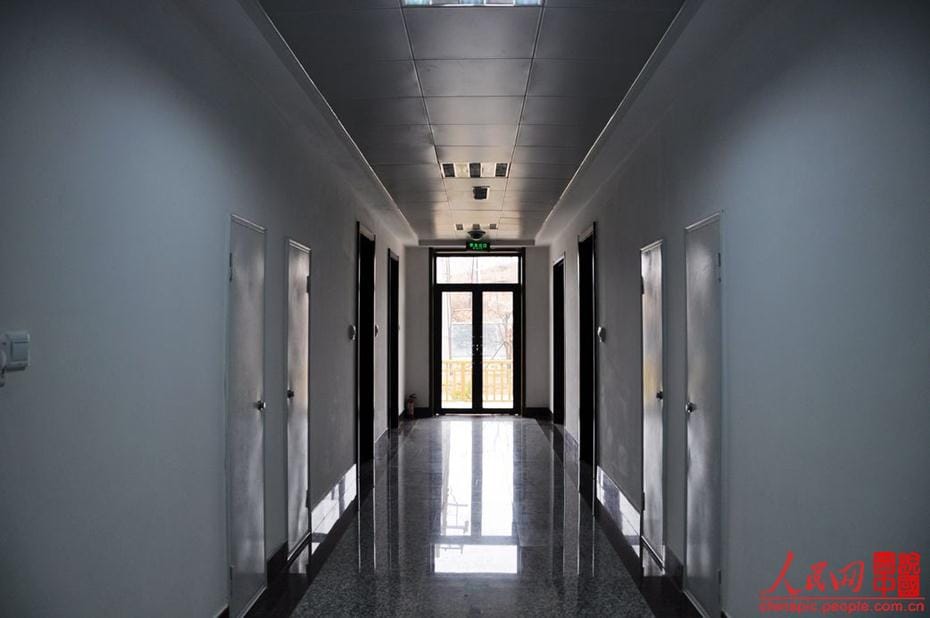
    This is the hallway of the investigation facility.

     
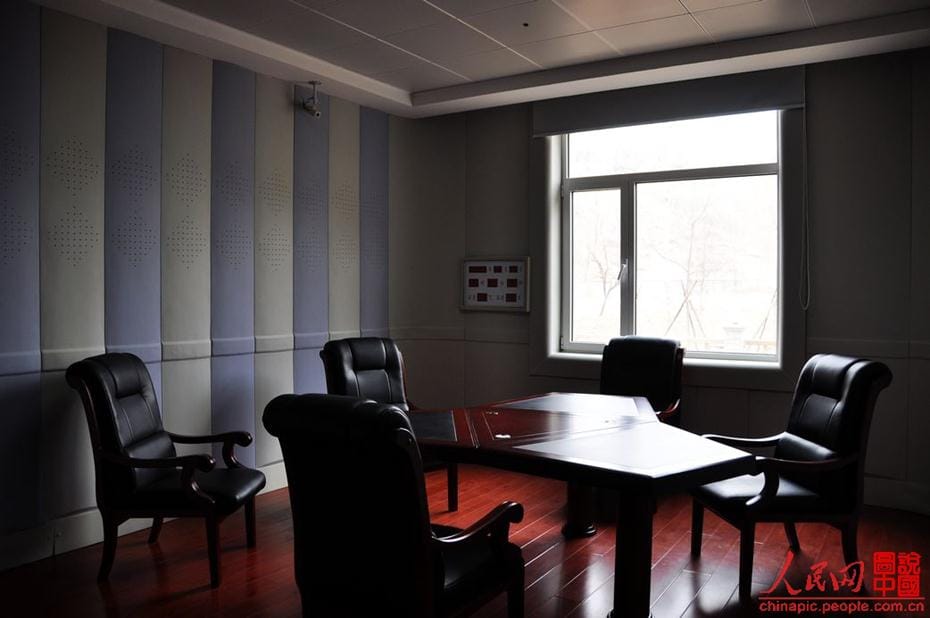
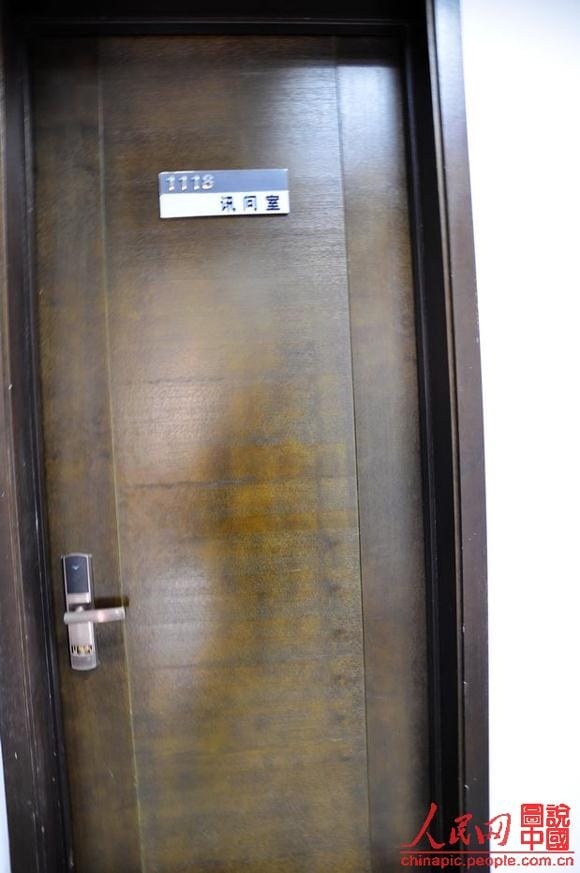
    Behind this door is the interrogation room of the facility, where investigators interrogate corrupt officials. Please note the term “interrogation room.” When a person enters this room, it is evident that the [Party] organization has already obtained conclusive evidence that the person is a corrupt official.

    These are the investigators’ seats in the interrogation room. Note the presence of video cameras.


    The lower podium across [from the investigators’ seats] is the seat for the corrupt official. Regardless of your past brilliance or elevated status, once you are invited to this place, your height [in the lower podium] is the same.


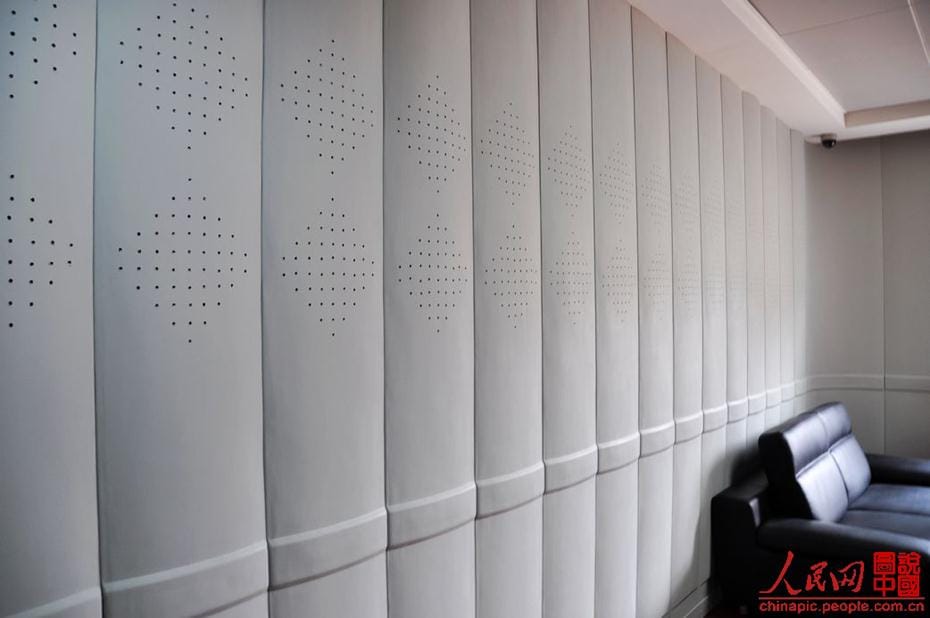
    The walls are made of special materials. They are soft to touch, soundproof, and prevent accidents.


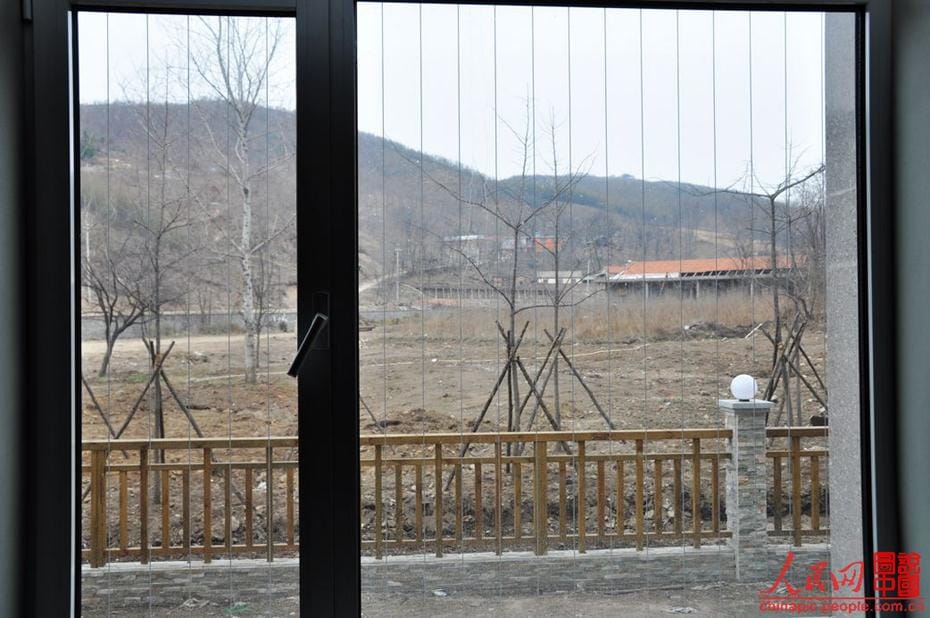
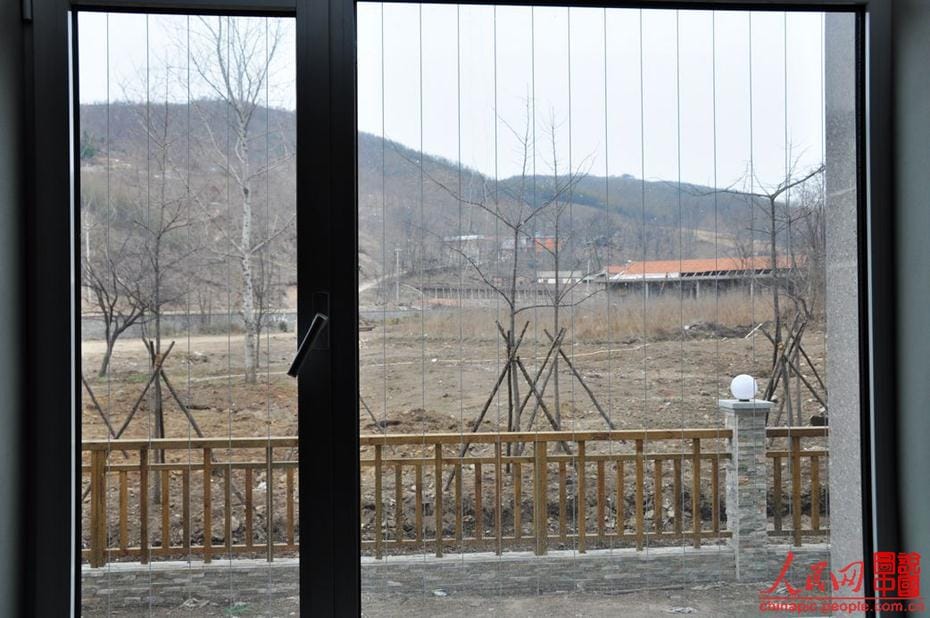
    Protective fences are installed on the windows. Outside, there are only mountains, remote and uninhabited, leaving one with a desolate feeling. 

     
    The Central Committee for Discipline Inspection’s shuanggui system makes all problem officials tremble with fear. It is also known as “the sharp sword for punishing corrupt officials.”
     

    This is the inquiry room, which is substantially different from the interrogation room.

     
    The inquiry room also has installed a series of equipment [capable of performing] synchronous audio recording, synchronous video recording, synchronous broadcast, and synchronous backup [so that] the entire process of investigation and inquiry is simultaneously supervised. Note the arrangement of the table and chairs, which differs from that of the interrogation room.
     

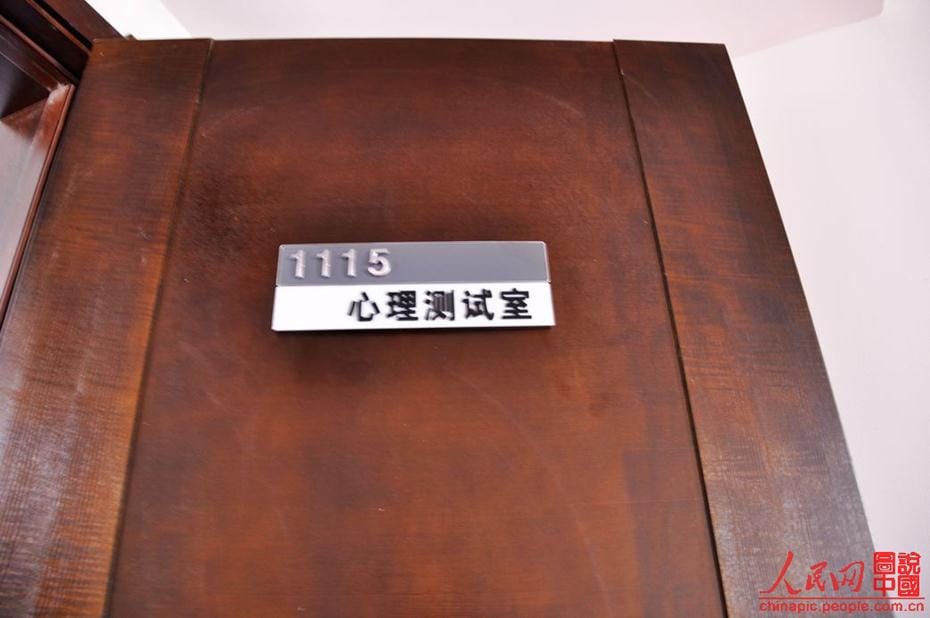
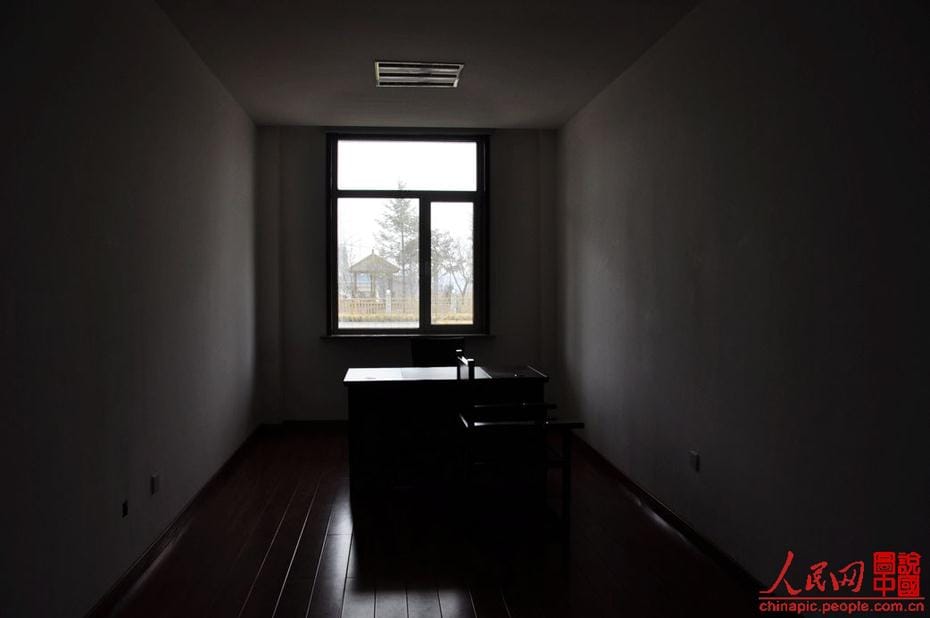
    This is the psychological examination room.


    The psychological examination room has many advanced instruments. Lies are immediately detected. [The instruments] are very sensitive.

     
    [This is the] investigations command room.
    I am especially fascinated by this big monitor, which I had only heard of but never seen before. This is the investigations command room’s monitor of the investigation status in every room. Using [a big monitor to provide] a clear picture at a glance is very appropriate.
    I heard that all corrupt officials who are summoned to the investigation facility have their contemptuous behavior exposed. Living under shuanggui is what they fear most. Within three days, they will confess.
    Due to special reasons, some photographs and descriptions have been left out. [Here is] a warning for government officials to bear in mind: The power in your hands is given by the people for seeking the benefit of the people. Do not betray the people’s trust. Be a good official with both competence and integrity. Do not be invited here. If you come here, your days will seem like years. There is no rank before the law.
  • Official Fear: Inside a Shuanggui Investigation Facility

    Official Fear: Inside a Shuanggui Investigation Facility

    There is a strong sense among many Chinese that corrupt officials must die. Recently, there were reports of public cheering for the death sentences of the deputy mayors of Suzhou and Hangzhou, and the executions of the head of the State Food and Drug Administration and the director of the Chongqing Municipal Justice Bureau. News of the number of corrupt high officials spared the death penalty also garnered much attention. 

    Translated below, a recent post by Chinese blogger Chu Zhaoxian (储昭贤) reveals a lesser-known, and arguably equally ruthless, tactic primarily used for dealing with Party members accused of corruption: shuanggui (双规). People facing shuanggui, which can be translated as “dual designation” and refers to a designated time and place of inquiry, are usually apprehended at their places of work or summoned for “voluntary visits” with investigators. They are then held in an undisclosed location, often a specially designed hotel or office building. There have been reports of psychological manipulation and physical torture during detention and interrogation, such as sleep deprivation, simulated drowning, burning the detainee’s skin with cigarettes, and beating. Since shuanggui is rooted in Party regulations instead of formal legislation, it is a form of extra-legal detention. Because such regulations lack the transparency afforded by a legal system, the extent to which human rights violations are committed during shuanggui is not well documented.

    Despite its susceptibility to human rights violations, shuanggui gained the unashamed support of Chu, who assumes the same disposition of his readers. In the post, Chu describes his rare visit to a shuanggui investigation facility. The circumstances that led to the visit are unexplained; however, the trip does result in the publication of what Dui Hua believes to be the first photographic exposé of the inside of a shuanggui investigation facility. 

    Throughout his cold description of the rooms and instruments used for detention and interrogation, Chu drops menacing words of caution for the corrupt. He states that corrupt officials tremble with fear at the mention of shuanggui and do not make it three days before confessing. Chu ends the post with another warning: “Do not be invited here. If you come here, your days will seem like years. There is no rank before the law.” 

    Chu may be correct that “days will seem like years.” Shuanggui usually lasts several months and can extend to more than one year. Some shuanggui cases, particularly high-profile ones, are converted into criminal cases and adjudicated through the formal judicial process. The typical sentence is death or life imprisonment, with all property confiscated and official positions revoked. The following table summarizes some recent cases:

    Name

    Position held prior to shuanggui

    Alleged offenses

    Start of shuanggui

    Criminal sentence, date of sentence
    Chen Shaoji Chairman, Chinese People’s Political Consultative Conference, Guangdong Province Accepting bribes, embezzlement Apr 2009 Death sentence, suspended two years, Jul 2010
    Huang Yao Chairperson, Chinese People’s Political Consultative Conference, Guizhou Province Accepting bribes, facilitating an illegal mining enterprise Oct 2009 Death sentence, suspended two years, Dec 2010
    Kang Rixin Party Secretary and General Manager, China National Nuclear Corporation; former member, Committee for Discipline Inspection Accepting bribes, embezzling shareholder equity Aug 2009 Life imprisonment, Nov 2010
    Li Tangtang Vice Chairman, Ningxia Hui Autonomous Region Accepting bribes Oct 2010 Life imprisonment, Apr 2011
    Liu Zhijun Party Secretary, National Railway Ministry “Severe violations of discipline,” manipulating competitive bidding Feb 2011 Pending
    Lü Jiangbo Village Director, Keren Village, Jinjiang City, Fujian Province “Obstructing official business” (organizing village protests of land seizure) Feb 2010 11 years’ imprisonment, Oct 2010
    Pi Qiansheng Director, Special Economic Zone, Tianjin Municipality Illegal receipt of property, “seeking and facilitating benefits for others” Jun 2009 Death sentence, suspended two years, Dec 2010
    Song Yong Deputy Director, Liaoning Provincial People’s Congress Accepting bribes, embezzlement Oct 2009 Death sentence, suspended two years, Jan 2011
    Wang Huayuan Member, Party Committee for Discipline Inspection, Zhejiang Province Accepting bribes Apr 2009 Death sentence, suspended two years, Sep 2010
    Xu Zhongheng Mayor, Shenzhen Accepting bribes Jun 2009 Death sentence, suspended two years, May 2011
    Zhang Meifang Deputy Director, Department of Finance, Jiangsu Province Accepting bribes Nov 2010 Pending
    Zheng Shaodong Assistant Department Head, Ministry of Public Security; member, Party Committee Accepting bribes Jan 2009 Death sentence, suspended two years, Sep 2010
    Zhu Zhigang Director, Commission for Budget Affairs of the Standing Committee of the National People’s Congress Accepting bribes, abusing position to advantage others financially, manipulating real estate prices Oct 2008 Life imprisonment, May 2010


    Despite possible human rights abuses, or perhaps because of them, shuanggui is likely to remain a common anti-corruption measure for years to come. As the number of officials found guilty of corruption rises, it stands to reason that shuanggui, which can often be a path to harsh criminal sentences, would have some popular support. (As an indication of interest, Chu’s article spread virally with numerous re-postings by various blogs and news media.) Two reasons likely contribute to such support. First, shuanggui detainees are commonly accused of unpopular acts of corruption and graft. Second, shuanggui is almost exclusively used against Party members, who are part of an elevated socioeconomic group that comprises only 6 percent of Chinese citizens.

    Sadly, acceptance of shuanggui seems to have seeped into international human rights circles and resulted in a dearth of relevant research and advocacy. While stamping out corruption is a worthy cause, it by no means warrants extra-legal detention, torture, or lack of transparency and rule of law.

    Endnote: Days after publication, Chu’s article was deleted along with all but one of its re-postings. The remaining post contained none of the original photos and has since been deleted.


    *


    Where Corrupt Officials Fear Most: Exploring a Shuanggui Investigation Facility
    Chu Zhaoxian
    April 28, 2011

    A popular saying among Chinese government officials goes: “Fear not the heavens or the earth, but fear the summons of the Central Commission for Discipline Inspection’s Anti-Corruption Office.”

    I had a rare opportunity to visit a shuanggui anti-corruption investigation facility. There was no advance notice that I would be brought to this place. When the car reached the highway exit of another city, a police car appeared in front of us and led the way. We were driven through rugged and muddy mountain roads, until we were well within remote mountains. Getting out of the car, I looked around and saw nothing but the desolate mountains. We entered an ordinary-looking courtyard and stopped before a small building, where People’s Armed Police were standing guard.

    On the other side, a leader led us into the building and through the security check machines. Not until we passed the security check could we start to move about normally.

    Shuanggui stems from Article 28, Section 3 of the Investigations Regulations of the Ministry of Supervision of the Communist Party of China, which “demands a person relevant to a case to appear at a designated time and place to provide explanations regarding all aspects of the case.”

    This is the hallway of the investigation facility.


    Behind this door is the interrogation room of the facility, where investigators interrogate corrupt officials. Please note the term “interrogation room.” When a person enters this room, it is evident that the [Party] organization has already obtained conclusive evidence that the person is a corrupt official.

    These are the investigators’ seats in the interrogation room. Note the presence of video cameras.


    The lower podium across [from the investigators’ seats] is the seat for the corrupt official. Regardless of your past brilliance or elevated status, once you are invited to this place, your height [in the lower podium] is the same.


    The walls are made of special materials. They are soft to touch, soundproof, and prevent accidents.


    Protective fences are installed on the windows. Outside, there are only mountains, remote and uninhabited, leaving one with a desolate feeling. 


    The Central Committee for Discipline Inspection’s shuanggui system makes all problem officials tremble with fear. It is also known as “the sharp sword for punishing corrupt officials.”

    This is the inquiry room, which is substantially different from the interrogation room.


    The inquiry room also has installed a series of equipment [capable of performing] synchronous audio recording, synchronous video recording, synchronous broadcast, and synchronous backup [so that] the entire process of investigation and inquiry is simultaneously supervised. Note the arrangement of the table and chairs, which differs from that of the interrogation room.

    This is the psychological examination room.


    The psychological examination room has many advanced instruments. Lies are immediately detected. [The instruments] are very sensitive.


    [This is the] investigations command room.

    I am especially fascinated by this big monitor, which I had only heard of but never seen before. This is the investigations command room’s monitor of the investigation status in every room. Using [a big monitor to provide] a clear picture at a glance is very appropriate. 
    I heard that all corrupt officials who are summoned to the investigation facility have their contemptuous behavior exposed. Living under shuanggui is what they fear most. Within three days, they will confess. 
    Due to special reasons, some photographs and descriptions have been left out. [Here is] a warning for government officials to bear in mind: The power in your hands is given by the people for seeking the benefit of the people. Do not betray the people’s trust. Be a good official with both competence and integrity. Do not be invited here. If you come here, your days will seem like years. There is no rank before the law.
  • Translation & Commentary: “Can Having a Lawyer Present for Interrogations Eliminate Torture?”

    In its “National Human Rights Action Plan” for 2009–2010, China asserted its commitment to eliminate torture in its criminal justice system, something UN Special Rapporteur on Torture Manfred Nowak had described as “widespread” in an interview with Dui Hua following his visit to the country in 2005.
    Over the past year, China took a significant step forward in the direction of combating torture by issuing two sets of detailed rules governing the exclusion in criminal trials of evidence obtained through illegal methods. While these rules provide further proof of China’s commitment to protecting the rights of criminal suspects, observers have pointed out that thorough implementation and further steps are needed before this commitment can be turned into action.
    Ensuring a suspect’s right to legal counsel at all stages of the criminal investigation process is one such further step that experts cite. So, it was welcome news to see last week that prosecutors in Beijing have launched a pilot program to allow certain criminal suspects to request a lawyer’s presence during questioning carried out by investigators. The move marks another small sign of progress along China’s path towards procedural justice.
    However, as legal commentator Xu Mingxuan notes in a Beijing News opinion column (translated below), the narrow application of these new measures in Beijing makes it unlikely that they will have much of a direct impact on preventing torture. For one, the rules only apply to suspects not being held in custody, a small group in a country where bail is not widely used.
    Moreover, it is the initial stage of police investigation (rather than the secondary stage of investigation by prosecutors), where the danger of torture is perhaps greatest. And this danger is not limited to the interrogation room, since most criminal suspects are detained in police-run detention centers, where they appear to be most vulnerable to torture.
    As Xu rightly points out, it is the “confession-centric” mentality in China’s criminal justice system that needs to change. Only then are we likely to see measures designed to protect suspects’ procedural rights truly take hold.
    *
    Can Having a Lawyer Present for Interrogations Eliminate Torture?
    Xu Mingxuan
    Beijing News
    December 7, 2010
         Recently, the Beijing Municipality Procuratorate Second Division issued [a set of] “(Provisional) Rules for Lawyers to be Present During Interrogations.” According to reports, criminal suspects in cases in which the suspect is not being held in custody may request the presence of a lawyer at the time of interrogation. This is understood to be the first such initiative by a Beijing procuratorate, one that will gradually be expanded to include cases involving offenses by juveniles, foreigners, and individuals from Hong Kong, Macau, and Taiwan.
         Even if you’re still unfamiliar with the phrase “lawyers being present during interrogations,” surely everyone must be familiar with lines like “I have nothing to say without an attorney present” from European and American movies. This is the “right to have a lawyer present,” one of a criminal suspect’s procedural rights. The right to a lawyer’s defense and presence is, in essence, an extension of citizens’ private rights, a [way of] monitoring public authority and an effective way to prevent extraction of confessions through torture and miscarriages of justice.
         For various historical reasons, the Criminal Procedure Law that China established 14 years ago has no provision for the right to have a lawyer present. On the contrary, there is actually a provision for a “right to have law enforcement organs present.” ([According to Article 96,] “When a lawyer meets with a criminal suspect in custody, the investigation organ may, in light of the seriousness of the crime and when it is deemed necessary, send personnel to be present at the meeting.”) Many miscarriages of justice have been caused by the absence of various procedural rights in [China’s] criminal procedure system. If he had had a lawyer present, would She Xianglin [link] have been tortured and beaten until he confessed? Or take the case of Xiao Chuanguo’s hiring of thugs to attack Fang Zhouzi [link]. The facts in this case were quite clear, with a clear distinction between right and wrong. But foreign media reports deliberately emphasized that Xiao Chuanguo had made his confession of guilt without having a lawyer present. This shows that having a lawyer present during interrogations by law enforcement bodies is something that all countries recognize as a part of rule of law. Without such a system in place, no matter whether substantive justice is achieved one will be unable to avoid criticisms about procedural injustice.
         In fact, even though China’s criminal procedure legislation is relatively lagging, it doesn’t mean that nothing can be done in law enforcement practice. Several years ago, the Procedural Law Research Institution at China University of Political Science and Law received funding from the United Nations to launch a pilot program at the Haidian Branch of the Beijing Public Security Bureau in which police in selected cases were required to notify a lawyer to appear during initial questioning of a suspect. This pilot program had a positive social impact. The Beijing Municipality Procuratorate Second Division’s current launch of a system for lawyers to be present during interrogations is [an example] of China’s gradual, one-step-at-a-time progress in rule of law.
         The real reason that it has been so difficult to realize the right to have a lawyer present is the question of whether the investigating organs (public security bureaus or procuratorates) dare to accept monitoring by lawyers and shine a light on the way that cases are handled. Only by establishing the right to have a lawyer present can we abandon the longstanding “confession-centrism” of China’s law enforcement system. Shifting investigators’ focus to physical evidence and other technical evidence will destroy the institutional space in which coerced confessions and the use of violence to extract confessions can exist.
         Though this pilot effort by the Beijing Municipality Procuratorate Second Division is worthy of praise, one should recognize that the limited scope of this program means that the impact of lawyers being able to sit in on interrogations is not great. The pilot project only covers the phase in which procuratorates are carrying out their investigation [in preparation for] indictment, and lawyers cannot sit in on interrogations of suspects carried out by the police. There remains a considerable distance from standard international practice. As far as application is concerned, [the rules] are only to be used for suspects who are not being held in custody. In law-enforcement practice, most cases in which suspects are not being held in custody involve those with a good attitude toward acknowledging guilt, those facing relatively light charges, or cases involving little disagreement [over the charges]. Even if lawyers [are allowed to] sit in on interrogations [in such cases], it would be extremely difficult for lawyers to play their role in protecting human rights and eliminating confessions extracted by torture or inducement.
  • Translation & Commentary: “To Refuse Compensation is to Turn a Blind Eye to Torture”

    When it comes to human rights in China, one can point to many provisions in the constitution, laws, and regulations designed to protect all sorts of individual rights. Problems often arise, however, when these provisions are inconsistently enforced or, in some cases, willfully ignored.
    There is perhaps no clearer illustration of this than the case of Li Jiyi. Arrested in 2002 on suspicion of theft, Li died in custody after being tortured by four police officers in Qiongzhong County, Hainan. Li’s family spent years trying to get some accountability for this police abuse, but were faced with repeated obstacles by a local public security bureau unwilling to investigate itself. The officers involved were eventually sent to prison and in the end a court awarded Li’s family with state compensation. But faced with the court’s compensation order, the public security bureau refused to pay, arguing that to do so would weaken police morale and initiative.
    China frequently reiterates its commitment to combat torture. “Coercion of confessions” is prohibited under Chinese criminal law, and new rules were recently issued governing the exclusion as evidence statements extracted under torture. But despite these prohibitions, torture remains an endemic problem in a criminal justice system that places a heavy emphasis on confession of guilt and features few real credible institutions to oversee a powerful police force.
    To Xu Mingxuan, who frequently comments on legal issues in the Chinese media, what happened to Li Jiyi is bad enough, but what his family subsequently endured is simply inexcusable. In an opinion published in the November 17 edition of the Beijing News, Xu points out that privileging police morale and power over justice for victims of police brutality is incompatible with any reasonable conception of rule of law. He asks rhetorically how police can be so audacious and ignorant of such common-sense ideas. Perhaps one need only look to the emphasis given to “stability above all else” for an answer.
    *
    To Refuse Compensation is to Turn a Blind Eye to Torture
    Xu Mingxuan
    Beijing News
    November 17, 2010
         In a country with rule of law, such defiance of the law by local law-enforcement agents is hard to imagine. Over the past eight years, police in Hainan’s Qiongzhong Li and Miao Ethnicity Autonomous County first tortured a man to death, then resisted investigating the case, and finally refused to honor a court’s 580,000-yuan state compensation judgment on the grounds that it would “hurt police initiative.”
         According to a report on the People’s Daily website, Li Jiyi was taken into custody in 2002 for theft and was later tortured to death. His family members sought answers from police, but the Qiongzhong County Public Security Bureau did not put the case on file [for investigation]. After two years of petitioning and lodging complaints, in 2004 the procuratorate performed an autopsy and police filed a case, but the next year the county public security bureau again said that it could not proceed with the case. After two more years, in 2008, four defendants were found guilty of coercing confessions and given sentences of up to 13 years. In 2009, Li’s family sought state compensation from the county public security bureau, but the bureau gave no response. Family members again filed an administrative lawsuit, and in a final ruling this past June the public security bureau was ordered to pay more than 580,000 yuan in compensation to family members of the deceased.
         I have tried to relate as succinctly as possible the story of how Li’s family spent the past eight years petitioning and defending their rights, yet it still takes up considerable column space. But the difficulty involved in describing their story briefly is nothing compared to their unimaginable pain, suffering, and anger. Yet at each step of the way, local police slammed the door on justice, passed up every opportunity to regain public trust, and never showed an ounce of shame.
         On another level, though, local police showed real “compassion” in the reasoning they gave for refusing to pay compensation to [the family of] the deceased. According to the State Compensation Law, the public security bureau would have to recover any compensation paid from the four who carried out the torture. But they were already paying a heavy price for the “lack of caution” that led to Li Jiyi’s death, and to make them come up with large sums in compensation as well would seriously dampen the initiative of public security officers! This explanation is ridiculous in the extreme—do they mean to protect the “initiative” to coerce confessions?
         The court’s two binding judgments on coercion of confessions and state compensations could not be any clearer. Coercion of confessions is contempt for a suspect’s procedural rights and right to life. Refusing to investigate is contempt for the state’s law-enforcement authority and the procuratorate’s oversight authority. Failure to implement a court’s binding judgment is contempt for the court.
         State compensation is a mechanism of self-correction for state organs and a way to make amends to victims. It is mandated by state law, so whether the public security bureau wants to pay compensation is not an issue. Moreover, as enforcers of the law [the police] are obliged in principle to set an example in carrying out a binding judicial decision—otherwise, doesn’t this put them in the same league as other “deadbeats”?
         Refusal to compensate the victim’s family on the grounds that it would damage “police initiative” is the same as approving and turning a blind eye to torture. It seems that after eight years of being the target of rights defense activity, these local police still don’t have even the slightest basic understanding of rule of law—torture is illegal and those who enforce the law have no special extralegal authority. Eight years on, there is no reason why the local police should not possess this basic understanding of the law. So, where could the motivation and audacity to refuse to compensate the victim of torture possibly come from?
    Related link:
  • Translation: “Torture in China: Fact or Fiction?”

    New rules on the use of evidence in criminal trials in China took effect on July 1, including standards for exclusion of statements made by suspects or witnesses under coercion or torture. The rules have been widely praised as an important step in the right direction, though not without concerns about how fully they will be implemented. Some of these concerns have been raised by Chinese criminal defense lawyers, a number of whom have firsthand experience in trying to get allegations of torture taken seriously by the judicial system.Chen Youxi is such a lawyer, and one with nearly 15 years’ experience working within the criminal justice system of his native Zhejiang Province. Chen has, since becoming a lawyer in 1999, made a name for himself as a criminal defense attorney unafraid to lock horns with judges in defense of a client. Earlier this year, he defended Li Zhuang—himself a defense attorney—who had been accused of urging his client to “fabricate evidence” in a high-profile organized-crime trial by recanting a confession on the grounds that it had been extracted through torture.

    In a June 16 post on his blog (translated below), Chen Youxi asks why allegations of torture are so rarely acknowledged in China’s criminal justice system; such a question is only becoming more common, given the suspicious deaths in detention—likely due to torture—that have been publicly reported. Chen concludes that a general presumption of guilt for criminal suspects—combined with lack of transparency in the criminal investigation process, procedural norms favoring the prosecution, and an insufficiently independent media—have led to a situation where it is difficult from the outside to determine whether torture in China is common (as many lawyers allege) or rare (as authorities often claim).

    *
    Torture in China: Fact or Fiction? Why do all court verdicts completely deny the existence of confessions coerced through torture?
    Why does every case of injustice always involve torture?
    Are the courts deaf and blind or are lawyers insolent?

    Chen Youxi
    June 16, 2010

    There’s an exceedingly strange but common phenomenon in China’s current judicial system: courts’ criminal verdicts consistently reject claims of confessions extracted through torture made by lawyers and defendants, saying “no evidence was found.” Even in the case of Liu Yong, who was tortured until his leg was broken, the high court merely wrote timidly that “the confession could not be accepted [as evidence] because violations of the Criminal Procedure Law could not be ruled out” and sentenced him to a suspended death sentence. But this was then immediately changed to the death penalty after review by the Supreme [People’s] Court, and torture was never spoken of again.

    Coercion of confession by torture is always carried out in a sealed environment. Three, four—even 10 or more—authorities take turns against a suspect, so it’s impossible to have “ironclad evidence” of torture. Only in cases of injustice like those of Zhao Zuohai or She Xianglin, where the “dead return home” and “admit to murder” there and then, will there be an investigation into false confessions and discovery of inhuman torture.
       
    This is because:

    1.    The suspect’s credibility has been denied, and the public won’t believe the claims of a “criminal.” Are you going to believe a criminal or believe the public security bureau and procuratorate?

    2.    The people carrying out torture won’t report themselves; on the contrary, they’ll join together and insist that no coercion of confessions through torture took place.
    3.    In China, a person who makes accusations in court can be “returned for [additional] investigation.” If [a defendant] makes accusations [of torture] in court, he or she can be sent back into the hands of the torturers, who can seek a [more] “solid confession” and then return [the case] for prosecution. This kind of “returning to the oven” is even more terrible, but China’s courts cooperate with the procuratorate and public security in these kinds of “re-investigations,” so many people don’t dare make allegations in court. And once you’ve admitted the charges in open court, there’s no possibility for this case of injustice to be overturned. It’s no use to file a petition, because the court will say: “This court didn’t beat or coerce you, so why did you admit the charges in open court? That shows you really did it.”
    4.    The public can never see the places where torture is committed, so it’s impossible to have eyewitnesses. “Turncoat” guards who give testimony to a lawyer that they witnessed torture would either lose their jobs or be prosecuted for “false accusation.”
    5.    Torture techniques have improved and interrogators are smarter, so there’s less physical abuse and more use of psychological abuse that leaves no scars or physical evidence. They can have a “wheel war” or prevent you from sleeping for nine days and nine nights or shine a big light bulb on you or strip you and spray you with cold water or pour pepper water down your throat—none of which leave any trace. Examination by an expert is no use.
    6.    If there are scars, there’s no worry. The court won’t agree to an examination by an expert and will pay them no heed. The judge will rule [the scars] to be the result of the defendant “playing blind man’s bluff” or “falling out of a tree when younger” or “a bump while on holiday in Hainan.” If there are wounds after a recent beating, [the authorities] can put [the suspect] in isolation and prevent him or her from meeting with a lawyer or can “state secret-ize” the case and “refuse to approve” a meeting for six months and wait until the scars are healed before letting the lawyer meet again.
    7.    Our media can be controlled, such that no one dares expose the dark side. If you don’t follow the main tune in reporting and publicly damage the image of law enforcement, the chief editor can be removed and the reporter fired. So the image is one of “strictly abiding by the law.” With 60 years of accumulated experience and protected by China’s present Criminal Procedure Law, “coercion of confessions by torture” in China is thus “harmonized” and wrapped up ever so tightly. This is why 100 percent of Chinese criminal defense lawyers believe coercion of confession by torture is extremely serious in China, while the vast majority of the public, including high-level officials in charge of law enforcement, don’t really believe that torture is such a serious problem in China. I’ve defended some law-enforcement officials, all of whom come to realize this truth only after themselves getting into trouble and being subjected to interrogation. But they can no longer return to their position of authority, and no one will believe what they say. They can have no more influence on China’s judicial system.

    This is the truth about coercion of confessions through torture in China. Is torture in China fact or fiction? Actually, everyone’s clear about this. Folks have no way of knowing [the truth] because of the asymmetry of information. But as soon as a family member gets in trouble, it usually becomes clear right away. Actually, there’s no need to be depressed: all we lack is an environment in which the truth can be spoken and a legal spirit that seeks truth from facts.

  • Translation: China’s New Rules on Evidence in Criminal Trials (Part 2 of 3)

    On June 25, the Supreme People’s Court, Supreme People’s Procuratorate, Ministry of Public Security, Ministry of State Security, and Ministry of Justice formally published two sets of rules regarding the use of evidence in capital cases and the procedure for excluding confessions by criminal suspects that had been obtained through illegal means such as torture. First announced at the end of May, these new rules have been the subject of much discussion in recent weeks.
    To make the content of these new rules available to a broader audience, Dui Hua is producing English translations of the texts, to be released in three separate blog posts.
    Part 2 is below. The original Chinese is here.
    Part 1 of the translation is here.
    Part 3 of the translation is here.

    *

    Rules Concerning Questions About
    Exclusion of Illegal Evidence in Handling Criminal Cases

        In order to standardize legal practices and promote fairness in the execution of the law, these rules are established in accordance with the Criminal Procedure Law and relevant judicial interpretations and in combination with the actual work of the people’s courts, people’s procuratorates, public security organs, state security organs, and judicial administration organs in handling criminal cases.Article 1   The category of illegal oral evidence includes statements by criminal suspects or defendants obtained through illegal means such as coerced confession as well as witness testimony or victim statements obtained through illegal means such as use of violence or threats.

    Article 2   Oral evidence that has been determined to be illegal in accordance with the law shall be excluded and may not serve as the basis for conviction.

    Article 3   In the course of examining whether to approve arrest or initiate prosecution, the people’s procuratorates shall exclude illegal oral evidence in accordance with the law and may not use it as the basis for approving arrest or initiating prosecution.

    Article 4   If, between the time that a copy of the indictment has been delivered and the time the trial commences, a defendant alleges that his or her pretrial confession was obtained illegally, he or she should submit a written motion to the people’s court. If the defendant has real difficulties with writing, he or she may make the accusation orally to be recorded by a people’s court employee or the defendant’s defense counsel, a copy of which the defendant shall sign or affix with his or her thumbprint.
    The people’s court shall deliver the defendant’s written motion or record of accusation to the people’s procuratorate prior to the commencement of the trial.

    Article 5   If, prior to commencement of the trial or during the trial, a defendant or his or her defense counsel alleges that the defendant’s pretrial confession was obtained illegally, the court should conduct an investigation in court immediately following the prosecutor’s recitation of the indictment.
    If, prior to the conclusion of courtroom debate, the defendant or his or her defense counsel alleges that the defendant’s pretrial confession was obtained illegally, the court shall also conduct an investigation.

    Article 6   If a defendant or his or her defense counsel alleges that the defendant’s pretrial confession was obtained illegally, the court shall request that he or she provide relevant leads or evidence with respect to the alleged illegal obtaining of evidence, such as the person(s), time, place, manner, and content.

    Article 7   If, upon investigation, the court has questions about the legality of the way the defendant’s pretrial confession was obtained, the prosecutor shall provide interrogation transcripts, original audio or video recordings of the interrogation or other evidence and request that the court notify other individuals present at the interrogation or other witnesses to provide testimony before the court. If it is still not possible to eliminate suspicion of coerced confession, [the procuratorate shall] request that the court notify the interrogator(s) to provide testimony before the court and confirm that the confession was obtained legally. If the prosecutor cannot provide evidence at the time of the hearing, he or she may recommend that the court postpone the trial proceedings in accordance with Article 165 of the Criminal Procedure Law.
    Having been notified in accordance with the law, interrogators or other individuals shall testify before the court.
    If the prosecutor submits an officially sealed [written] explanation that has not been signed or sealed by the interrogator(s) concerned, the document may not serve as evidence that the evidence was obtained legally.
    Prosecution and defense may cross-examine evidence and carry out debate with regard to the question of whether the defendant’s pretrial confession was obtained legally.

    Article 8   If the court has questions about the evidence submitted by either the prosecution or defense, it may adjourn the proceedings and conduct investigation and verification of the evidence. If necessary, the court may notify the procurator or defense counsel to be present.

    Article 9   If, in the course of the trial, the prosecutor recommends postponement of the trial proceedings in order to submit new evidence or conduct additional investigation, the court should agree.
    If the defendant or his or her defense counsel requests [that the court] notify an interrogator, other individuals present at the time of interrogation, or other witnesses to appear in court and the court determines it to be necessary to do so, the court may announce postponement of the trial proceedings.

    Article 10    Following the court’s investigation, the defendant’s pretrial confession may be read in court and subjected to cross-examination under one of the following circumstances:
    (1)  The defendant or his or her defense counsel do not provide leads or evidence of illegally obtained evidence;
    (2)  The defendant or his or her defense counsel has provided leads or evidence of illegally obtained evidence, [but] the court has no questions about the legality of the way the defendant’s pretrial confession was obtained;
    (3)  The prosecutor provides credible and sufficient evidence that is able to eliminate [questions about whether] the defendant’s pretrial confession was obtained illegally.
    A defendant’s pretrial confession that is read in court should be considered together with the defendant’s statement in court and other evidence before determining whether it may serve as the basis for conviction.

    Article 11   If the prosecutor does not provide evidence to confirm the legality of the defendant’s pretrial confession or the evidence provided is not credible or sufficient enough, that confession may not serve as a basis for conviction.

    Article 12   If a defendant or his or her defense counsel alleges that the defendant’s pretrial confession was obtained illegally and the people’s court of first instance does not investigate [the allegation] and uses the defendant’s pretrial confession as a basis for conviction, the people’s court of second instance shall conduct an investigation into whether the defendant’s pretrial confession was obtained legally. If the procurator does not provide evidence to confirm [legality] or the evidence provided is not credible or sufficient enough, the defendant’s confession may not be used as a basis for conviction.

    Article 13   If, in the course of the trial, the procurator, the defendant, or his or her defense counsel alleges that written testimony of a witness who has not appeared in court or a written statement by a victim who has not appeared in court was obtained illegally, the party who submitted the evidence shall verify that the evidence was obtained legally.
    With regard to the evidence mentioned in the preceding paragraph, the court should carry out an investigation with reference to the relevant provisions of these rules.

    Article 14   If material or documentary evidence is obtained in a manner that clearly violates the law and may have an impact on the fairness of an adjudication, redress or some reasonable explanation should be made, otherwise that material or documentary evidence may not serve as a basis for conviction.

    Article 15   These rules are effective from July 1, 2010.

  • Translation: China’s New Rules on Evidence in Criminal Trials (Part 1 of 3)

    On June 25, the Supreme People’s Court, Supreme People’s Procuratorate, Ministry of Public Security, Ministry of State Security, and Ministry of Justice formally published two sets of rules regarding the use of evidence in capital cases and the procedure for excluding confessions by criminal suspects that had been obtained through illegal means such as torture. First announced at the end of May, these new rules have been the subject of much discussion in recent weeks.
    To make the content of these new rules available to a broader audience, Dui Hua is producing English translations of the texts, to be released in three separate blog posts.
    Part 1 is below. The original Chinese is here.

    Part 2 of the translation is here.
    Part 3 of the translation is here.
    *

    Notice from the Supreme People’s Court, Supreme People’s Procuratorate, Ministry of Public Security, Ministry of State Security, and Ministry of Justice  

    Regarding the Issue of “Rules Concerning Questions About Examining and Judging Evidence in Death Penalty Cases” and “Rules Concerning Questions About Exclusion of Illegal Evidence in Handling Criminal Cases”
         To the Higher People’s Courts, People’s Procuratorates, Public Security Departments (Bureaus), State Security Departments (Bureaus), Justice Departments (Bureaus) of each province, autonomous region, and municipality; the Military Court, Military Procuratorate, and Security Department of the General Political Department of the People’s Liberation Army; and the Production and Construction Corps Division of the Xinjiang Uyghur Autonomous Region Higher People’s Court and the People’s Procuratorate, Public Security Bureau, Justice Bureau, and Prison Management Bureau of the Xinjiang Production and Construction Corps:     In order to further perfect our nation’s criminal procedure system and in accordance with the central government’s general plan for deepening reform of legal institutions and work mechanisms, the Supreme People’s Court, Supreme People’s Procuratorate, Ministry of Public Security, Ministry of State Security, and Ministry of Justice have recently, following extensive investigation and research, jointly established “Rules Concerning Questions About Examining and Judging Evidence in Death Penalty Cases” and “Rules Concerning Questions About Exclusion of Illegal Evidence in Handling Criminal Cases” (hereafter the “two sets of rules”), which we hereby issue to you and request compliance and implementation.

    So that the two sets of rules may be stringently and thoroughly implemented in the course of executing the law, we hereby issue the following opinions:

    I.   Fully recognize the enormous significance of the establishment and implementation of the two sets of rules

    The two sets of rules set higher standards and stricter demands on law enforcement organs’ handling of criminal cases, especially death penalty cases. As such, they are extremely significant for the perfection of our nation’s criminal procedure system, increasing the quality of law enforcement and handling cases, and promoting socialist rule of law construction. The central government places a high priority on these two sets of rules, and Comrade Zhou Yongkang, member of the CPC Politburo member and secretary of the Central Politics and Law Committee, led a full session of the Central Politics and Law Committee that also served as a briefing on reform of the legal system [at which] serious discussions of the two sets of rules [took place]. He called on people’s courts, people’s procuratorates, public security organs, state security organs, and judicial administration organs at all levels to carry out their duties in accordance with the law; strictly implement the two sets of rules; pay attention to facts, evidence, the law, and responsibilities; guarantee quality in handling cases; punish crime, protect human rights, and uphold justice in accordance with the law; and ensure that each criminal case handled can withstand scrutiny of the law and history. Relevant organs in each province, autonomous region, and municipality must implement national laws fully and correctly, carry out the criminal justice policies of the Party and state at a high level, and actively increase publicity work in order to give full recognition to the enormous significance of adopting the two sets of rules.

    II.   Resolutely arrange and begin training for the two sets of rules

    People’s courts, people’s procuratorates, public security organs, state security organs, and judicial administration organs should seriously and immediately begin training and study of the two sets of rules, taking practical circumstances into consideration and employing different channels and methods. Care must be taken to arrange specialized training sessions for relevant personnel in order to ensure that each person involved in handling criminal cases fully grasps the details of the two sets of rules.

    III.   Stringently and thoroughly implement the two sets of rules

    These two sets of rules not only fully set out the fundamental principles for evidence in criminal procedure and detail standards of proof; they also further specify with respect to the collection, fixing, examination, judgment, and use of evidence. They not only establish the meaning and extended meaning of illegal evidence, but also standardize in detail the procedures and burden of proof [used] in investigating and excluding illegal evidence. Truly implementing these two sets of rules will inevitably play a major role in raising the standards of law enforcement and improving the quality of law enforcement personnel. Each unit concerned should stringently and thoroughly implement the two sets of rules in their practice of executing the law and firmly establish the equal importance of punishing crime and protecting human rights and the equal importance of substantive and procedural law. Evidence must be collected, examined, and judged fully, objectively, and in accordance with the law, facts and evidence must be checked in order to raise the quality of criminal adjudications, and ensure that the two sets of rules are implemented so that each criminal case can be handled in an ironclad manner. Summing up and reporting in a timely manner to central bodies in charge any new situations and problems encountered in the course of implementation, as well as new experiences discovered, must be resolute.

    Finally, “Rules Concerning Questions About Examining and Judging Evidence in Death Penalty Cases” may be used as a reference for implementation in handling other criminal cases.

    Supreme People’s Court, Supreme People’s Procuratorate,
    Ministry of Public Security, Ministry of State Security,
    Ministry of Justice
    June 13, 2010