Tag: SPC statistics 1946-2016

  • Court Statistics on Splittism & Inciting Splittism, Part III: Mongols & Han Chinese

    Court Statistics on Splittism & Inciting Splittism, Part III: Mongols & Han Chinese

    The following has been posted to Dui Hua’s Human Rights Journal. It is the third in a three-part series examining the application of splittism and inciting splittism charges using Records of People’s Courts Historical Judicial Statistics: 1949-2016.
    Part I examined the application of splittism and inciting splittism from 1998-2016 as it corresponded to major incidents of ethnic unrest in China.
    Part II focused on two ethnic groups who are more likely to face trial for splittism and inciting splittism: Uyghurs and Tibetans. Court statistics discussed in both parts indicate that splittism and inciting splittism charges were disproportionately used against ethnic minorities. However, a breakdown of ethnicities is not available.
     

    Mongols

     
    Compared to Uyghurs and Tibetans, Mongolian splittism is rarely discussed in state discourse, perhaps reflecting its status as a smaller security threat to China. An important reason is that ethnic Mongols in Inner Mongolia have been heavily assimilated with Han Chinese. Despite Inner Mongolia’s designation as China’s first autonomous region, ethnic Mongols have long been greatly outnumbered by Han Chinese in the region. The 2010 census indicated that ethnic Mongols accounted for a mere 17 percent of the population in Inner Mongolia, compared to 80 percent Han.
    Signs of Mongolian nationalism emerged among university students in the 1980s. While some preferred political separation and the establishment of an independent Inner Mongolian state, others promoted unity with Mongolia and the ethnic Mongols in Russia. Separatist sentiments were further rekindled by the disintegration of the Soviet Union in 1991. Although there were demonstrations in Inner Mongolia in 1990 in favor of independence, key figures were quickly arrested. In 1991, leaders of a group based near Hohhot were sentenced to two years for separatist activity, according to British Sinologist Michael Dillon. In the same year, Mongol independence activist Xi Haiming (席海明) fled persecution in China to Mongolia and was granted political asylum in Germany in 1993.
    Hada (left), founder of the Southern Mongolian Democratic Alliance, was sentenced to 15 years’ imprisonment for splittism and espionage in 1996. Image credit: Radio Free Asia
    Perhaps the most iconic case was Hada (哈达). Unlike Xi Haiming, Hada chose to stay in Inner Mongolia to continue his peaceful activism and formed the Southern Mongolian Democratic Alliance with other Mongol activists in 1992. The alliance’s mission was to oppose colonization by the Han people and call for self-determination, freedom, and democracy in Southern Mongolia. He was later sentenced to 15 years’ imprisonment for conspiring to split the country and espionage. Having completed his full sentence without a sentence reduction in December 2010, Hada continues to live under close police surveillance and numerous restrictions, including a travel ban and frozen bank accounts.
    Other than Hada, cases of ethnic Mongolian splittism have not been widely reported or well documented. Dui Hua’s research into government gazettes unearthed only a few cases of endangering state security:
    • In 1992, 11 of the 197 people classified as the “targeted population” in Ordos were splittists;
    • In 1996, Ordos police solved the case of the illegal ethnic splittism publication Dure and the case of the “Ordos Branch of the Southern Mongolia Democratic League Central Committee” ethnic splittism organization. Police quickly uncovered and stopped a small number of Mongol students who were carrying out efforts in support of Hada’s “Southern Mongolia Democratic League;”
    • In 2009, two of the 18 people classified as the targeted population in Urad Rear Banner were “ethnic splittists.”
    Large-scale ethnic Mongol protests erupted in 2011; they were triggered by collective grievances over the ecological destruction of grasslands as a result of excessive mining operations dominated by Han-owned entities in Inner Mongolia. Pro-independence groups overseas also pointed out that the protests had nothing to do with self-determination or independence but were focused on legal rights for indigenous herders. Beijing, however, still blamed foreign forces for fueling unrest among ethnic Mongols.
    Dui Hua’s Political Prisoner Database only has information on four ethnic Mongols who were convicted of inciting splittism over the past two decades.
    • On October 29, 2008, the Xining Intermediate People’s Court sentenced Quehezhou (却合周) and E’erjian (俄尔尖) to nine and ten years in prison, respectively. They were both detained on April 16, 2008. The timing of their detention coincided with the protests which spread across the Tibetan plateau before the Beijing Olympics.
      • Lobsang Gongpo (洛藏公保) was likely involved in the same case; he was sentenced to ten years in prison by the same court on the same day. Despite his Tibetan-sounding name, Lobsang Gongpo is an ethnic Mongol, according to a court judgment Dui Hua discovered online.
    Quehezhou, E’erjian and Lobsang Gongpo are all from Henan Mongol Autonomous County, an ethnic Mongol-majority county in the south of Huanggang Tibetan Autonomous Precture in Qinghai Province. The judgments did not provide further information about the case.
    • In July 2019, Lhamjab A. Borigin received a one-year suspended prison sentence in Shili Yin Gool for splittism and illegal business activity. The charges stemmed from his book written in Mongolian about the Cultural Revolution. Published in 2006 by an underground press and subsequently translated into Mandarin, the book discloses survivor testimonies and details torture techniques used during political campaigns.
    Han Chinese
     
    Court statistics have confirmed that splittism and inciting splittism have been disproportionately applied to ethnic minorities, but no less striking is the remainder of the defendants who are not classified as ethnic minorities. Dui Hua believes that these people are Han Chinese.
    Charts 1 and 2 show that of the 3,936 people convicted of splittism and inciting splittism with judgments taking effect from 1998-2016, 347, or 8.8 percent, were not ethnic minorities. There was a slightly bigger proportion of non-ethnic minorities in inciting splittism cases: 155 people, or 14 percent, in inciting splittism cases, compared to 192, or just 6.5 percent, in splittism cases.
    In inciting splittism cases, the number of non-ethnic minority defendants varied from 1.6 percent in 2001 to 83 percent of all defendants in 2012. In 2006, slightly over half of the 13 people convicted of inciting splittism were not ethnic minorities; in 2012, 15 of 18 people convicted were Han Chinese.
    Unlike Uyghurs, Tibetans, and, to a lesser extent, ethnic Mongols who are imprisoned for promoting ethnic independence, demanding genuine or greater autonomy, or criticizing China’s ethnic policy, the reasons for convicting Han Chinese in splittism or inciting splittism cases are not immediately obvious.
    Dui Hua’s Political Prisoner Database only has information on one Han Chinese who was convicted of inciting splittism: Wang Jicheng (王集成) was sentenced to eight years in prison in Nanping, Fujian, in December 2009 for inciting splittism, inciting subversion, and teaching methods of committing crimes. In this case, Wang was sentenced to four years in prison for inciting splittism. A judgment Dui Hua discovered indicated that Wang was released on December 25, 2015, more than seven months earlier than the original release date, without providing information on his criminal acts, which were said to have incited other people to divide China.
    A case recently posted by Wei Quan Wang shed some light on the obscure cases of Han Chinese inciting splittism. Originally from Wuhan, Li Ke stood trial in Xining, Qinghai, where he was caught red-handed displaying a “Free Tibet” banner and a Snow Lion flag at a Tibetan monastery. The source also said Li was found in possession of a U-drive with images of overseas Tibetan protesters disrupting the 2008 Olympic Torch relay. The trial outcome is nevertheless unclear.

    The following two cases show how Han Chinese can be at risk of being accused of inciting splittism because of their online speech, although neither was found guilty of this particular ESS crime:
    • Huang Qi (黄琦) was sentenced to five years’ imprisonment for inciting subversion in February 2003. Prosecutors moved forward with the inciting splittism charge against Huang because his website contained articles about ethnic independence. The court dismissed the inciting splittism charge and upheld that Huang did not have the intent to divide the country since he did not author the articles.
    • Prominent human rights lawyer Pu Zhiqiang (浦志强) was sentenced to three years’ imprisonment for inciting ethnic hatred, picking quarrels, and provoking trouble in December 2015. The initial allegations against him included inciting splittism, a charge stemming from his negative online comments about China’s policies in Xinjiang. Pu urged China to stop treating Xinjiang as a colony and to stop acting as a conqueror and plunderer.
    Taiwan
     
    The developments in Taiwan might be relevant to understand how China curbs separatism among Han Chinese in the mainland. Dui Hua, however, has yet to find proof that promoting Taiwan independence is a reason for conviction in cases of splittism or inciting splittism in mainland China.
    Over the years, Beijing has proactively blocked Taiwan in the international arena in a bid to suppress independence. China typically undertakes countermeasures and ramps up rhetoric against the Taiwan independence movement when the Democratic Progressive Party (DPP) becomes the majority ruling party in Taiwan. A year after Chen Shui-bian of the DPP was re-elected as Taiwan president, China ratified the Anti-Succession Law in 2005. The law claims that Taiwan is a part of China and suggests the use of non-peaceful means against Taiwan independence in the event of a declaration of independence.
    Evidence suggests that Han Chinese are not necessarily criminally liable for discussing Taiwan independence online. A court judgment Dui Hua discovered indicated that Wang Yong (王勇) was only given “admonishment” in Shandong for posting messages on Twitter to “incite Taiwan independence.” Wang was not imprisoned for tweets about Taiwan independence, but rather for the 1,200 “anti-Communist Party” messages and images he tweeted as of August 14, 2019. In January 2020, Wang was sentenced to 10 months’ imprisonment for “picking quarrels and provoking trouble.”
    Hong Kong
     
    China has been increasingly wary of the newly emerged independence movement in Hong Kong. Beginning with the student-led movement in 2014 calling for the right to vote for their chief executive, the calls for independence have become more visible in the wake of the civil unrest through the second half of 2019 triggered by the ill-fated extradition bill.
    A man found carrying a “Hong Kong Independence” flag in his backpack during a protest on July 1, 2020 was the first person arrested under the Hong Kong National Security Law. Netizens said that the flag said “no to” (反对) in tiny print above the independence slogan. The man has been released without formal charges at the time of publication. Image credit: Hong Kong Police Force Twitter account
    As the coronavirus outbreak subsided from May-June 2020, throngs of demonstrators chanting pro-democracy slogans and displaying banners saying “Hong Kong Independence” and “Liberate Hong Kong, Revolution of our times” returned to the city’s streets and shopping malls. Chinese officials condemned the Hong Kong protesters as a “political virus” using violence to promote independence claims.The Hong Kong government has also declared that the protest slogans are pro-independence, secessionist and subversive, and can be prosecuted under the newly enacted national security law, which came into force on June 30, 2020.
    Openly supporting Hong Kong independence in the mainland is a risky proposition, but this act alone does not necessarily constitute a crime of ESS. Dui Hua’s research into online judgments found that Twitter user Tang Guogang (唐国刚) was sentenced to 18 months in prison, also for “picking quarrels,” in Liaoning in December 2019. His imprisonment stemmed in part from his messages supporting the independence of both Hong Kong and Taiwan. The court also found him guilty of tweeting hundreds of “subversive” messages attacking China, the Communist Party, and the socialist system.
    In a separate case, a local court in Foshan, Guangdong, sentenced Deng Xiqiang (邓锡强) to two years in prison (suspended for three years) on January 20, 2020, also for “picking quarrels.” Deng was accused of using circumvention software to access Instagram and post 48 messages, which “attacked the socialist system, satirized Chinese leaders, and vilified the Hong Kong Special Administrative Region’s government.” The court also found him guilty of posting “unhealthy and fake” information about Hong Kong independence. Other allegations against Deng included the “yellow umbrella” accessories he designed in support of Hong Kong’s Occupy Central Movement in 2014.
    The two cases above were concluded before the National People’s Congress passed national security legislation on June 30, 2020. The law, which covers secession, subversion, terrorism, and collusion with foreign forces, signals a harsher crackdown to crush the Hong Kong independence movement. It remains to be seen whether mainland courts will mete out more severe punishment to deter dissenters who publicly express sympathy for the Hong Kong cause under the catch-all crime of “picking quarrels.” It is also possible that the same acts conducted online will be construed as endangering state security amid a worsening political climate.
    Minor splittism movements
     
    There are a few other minor splittism movements in China advocating for provincial independence, but the threat is more apparent than real. Individuals who promote this cause are not known to have been charged with splittism or inciting splittism:
    The Haizhu District People’s Court convicted Yang Xubin (杨旭彬) of “picking quarrels” for spray painting graffiti slogans, including “Liberate Guangzhou” and “Guangdong independence,” as shown in the image of a court judgment posted online. The court did not explain why the slogans did not amount to splittism or other endangering national security crimes. Image credit: China Political Prisoner Concern
    • Yang Xubin (杨旭彬), of Han ethnicity, was sentenced to nine months in prison for “picking quarrels” in January 2020. He spray-painted graffiti of slogans in Guangzhou about the anti-extradition bill protests in Hong Kong and also daubed slogans of “Free Guangzhou” and “Guangdong Independence.”
    • In a separate case, Wang Zhan (王展) was detained for subversion on October 15, 2019 upon returning to China from Finland, where he pursued his post-doctorate study. Wang, whose ethnicity is unclear, was an advocate for independence for Manchuria and Shanghai.
    It is hard to understand the rationale behind the tactics of criminalization against Han Chinese supporters of any independence movement. The above cases demonstrated that splittism and inciting splittism are not necessarily applicable even when Han Chinese openly criticize China’s ethnic policy or disseminate information about independence for Taiwan, Hong Kong, or other less developed provincial independence movements. Because of the opacity of China’s criminal justice system, the identities, acts, and fates of the 347 Han Chinese who were convicted of splittism and inciting splittism from 1998-2016 remain unknown.
    What is clear is that the application of splittism and inciting splittism charges has an ethnic bias. Similar acts to split or incite splittism by Uyghurs, Tibetans, or ethnic Mongols are more likely to lead to more severe consequences. Instead of “picking quarrels,” they will likely be charged with splittism and inciting splittism—crimes of endangering state security, which China gives utmost priority and carry much harsher prison sentences.
    On a final note, the drop in splittism and inciting splittism cases beginning in 2014 is no cause for celebration. In an upcoming post, Dui Hua will analyze the reasons and explain how the Chinese government has employed new tactics of criminalization against ethnic minority dissenters: from using splittism and inciting splittism to non-ESS crimes, including terrorism-related crimes and inciting ethnic hatred.
    China’s propaganda often denounces western critics for their “hypocrisy” and defends its own anti-splittism law by drawing comparisons with separatist movements in the west. While it is true that punishing splittism-adjacent crimes through other laws, including anti-terrorism measures, are in place in western democracies to suppress separatism, people in many countries and regions other than China and Hong Kong are at least “free to express secessionist views.” In Spain, political parties that support the independence of Catalonia are represented in the parliament. By contrast, China has zero tolerance for political parties that promote splittism. It also makes peaceful speech punishable under splittism, inciting splittism, or other criminal offenses.
  • Court Statistics on Splittism & Inciting Splittism, Part III: Mongols & Han Chinese

    Court Statistics on Splittism & Inciting Splittism, Part III: Mongols & Han Chinese

    The following has been posted to Dui Hua’s Human Rights Journal. It is the third in a three-part series examining the application of splittism and inciting splittism charges using Records of People’s Courts Historical Judicial Statistics: 1949-2016.
    Part I examined the application of splittism and inciting splittism from 1998-2016 as it corresponded to major incidents of ethnic unrest in China.
    Part II focused on two ethnic groups who are more likely to face trial for splittism and inciting splittism: Uyghurs and Tibetans. Court statistics discussed in both parts indicate that splittism and inciting splittism charges were disproportionately used against ethnic minorities. However, a breakdown of ethnicities is not available.
     

    Mongols

     
    Compared to Uyghurs and Tibetans, Mongolian splittism is rarely discussed in state discourse, perhaps reflecting its status as a smaller security threat to China. An important reason is that ethnic Mongols in Inner Mongolia have been heavily assimilated with Han Chinese. Despite Inner Mongolia’s designation as China’s first autonomous region, ethnic Mongols have long been greatly outnumbered by Han Chinese in the region. The 2010 census indicated that ethnic Mongols accounted for a mere 17 percent of the population in Inner Mongolia, compared to 80 percent Han.
    Signs of Mongolian nationalism emerged among university students in the 1980s. While some preferred political separation and the establishment of an independent Inner Mongolian state, others promoted unity with Mongolia and the ethnic Mongols in Russia. Separatist sentiments were further rekindled by the disintegration of the Soviet Union in 1991. Although there were demonstrations in Inner Mongolia in 1990 in favor of independence, key figures were quickly arrested. In 1991, leaders of a group based near Hohhot were sentenced to two years for separatist activity, according to British Sinologist Michael Dillon. In the same year, Mongol independence activist Xi Haiming (席海明) fled persecution in China to Mongolia and was granted political asylum in Germany in 1993.
    Hada (left), founder of the Southern Mongolian Democratic Alliance, was sentenced to 15 years’ imprisonment for splittism and espionage in 1996. Image credit: Radio Free Asia
    Perhaps the most iconic case was Hada (哈达). Unlike Xi Haiming, Hada chose to stay in Inner Mongolia to continue his peaceful activism and formed the Southern Mongolian Democratic Alliance with other Mongol activists in 1992. The alliance’s mission was to oppose colonization by the Han people and call for self-determination, freedom, and democracy in Southern Mongolia. He was later sentenced to 15 years’ imprisonment for conspiring to split the country and espionage. Having completed his full sentence without a sentence reduction in December 2010, Hada continues to live under close police surveillance and numerous restrictions, including a travel ban and frozen bank accounts.
    Other than Hada, cases of ethnic Mongolian splittism have not been widely reported or well documented. Dui Hua’s research into government gazettes unearthed only a few cases of endangering state security:
    • In 1992, 11 of the 197 people classified as the “targeted population” in Ordos were splittists;
    • In 1996, Ordos police solved the case of the illegal ethnic splittism publication Dure and the case of the “Ordos Branch of the Southern Mongolia Democratic League Central Committee” ethnic splittism organization. Police quickly uncovered and stopped a small number of Mongol students who were carrying out efforts in support of Hada’s “Southern Mongolia Democratic League;”
    • In 2009, two of the 18 people classified as the targeted population in Urad Rear Banner were “ethnic splittists.”
    Large-scale ethnic Mongol protests erupted in 2011; they were triggered by collective grievances over the ecological destruction of grasslands as a result of excessive mining operations dominated by Han-owned entities in Inner Mongolia. Pro-independence groups overseas also pointed out that the protests had nothing to do with self-determination or independence but were focused on legal rights for indigenous herders. Beijing, however, still blamed foreign forces for fueling unrest among ethnic Mongols.
    Dui Hua’s Political Prisoner Database only has information on four ethnic Mongols who were convicted of inciting splittism over the past two decades.
    • On October 29, 2008, the Xining Intermediate People’s Court sentenced Quehezhou (却合周) and E’erjian (俄尔尖) to nine and ten years in prison, respectively. They were both detained on April 16, 2008. The timing of their detention coincided with the protests which spread across the Tibetan plateau before the Beijing Olympics.
      • Lobsang Gongpo (洛藏公保) was likely involved in the same case; he was sentenced to ten years in prison by the same court on the same day. Despite his Tibetan-sounding name, Lobsang Gongpo is an ethnic Mongol, according to a court judgment Dui Hua discovered online.
    Quehezhou, E’erjian and Lobsang Gongpo are all from Henan Mongol Autonomous County, an ethnic Mongol-majority county in the south of Huanggang Tibetan Autonomous Precture in Qinghai Province. The judgments did not provide further information about the case.
    • In July 2019, Lhamjab A. Borigin received a one-year suspended prison sentence in Shili Yin Gool for splittism and illegal business activity. The charges stemmed from his book written in Mongolian about the Cultural Revolution. Published in 2006 by an underground press and subsequently translated into Mandarin, the book discloses survivor testimonies and details torture techniques used during political campaigns.
    Han Chinese
     
    Court statistics have confirmed that splittism and inciting splittism have been disproportionately applied to ethnic minorities, but no less striking is the remainder of the defendants who are not classified as ethnic minorities. Dui Hua believes that these people are Han Chinese.
    Charts 1 and 2 show that of the 3,936 people convicted of splittism and inciting splittism with judgments taking effect from 1998-2016, 347, or 8.8 percent, were not ethnic minorities. There was a slightly bigger proportion of non-ethnic minorities in inciting splittism cases: 155 people, or 14 percent, in inciting splittism cases, compared to 192, or just 6.5 percent, in splittism cases.
    In inciting splittism cases, the number of non-ethnic minority defendants varied from 1.6 percent in 2001 to 83 percent of all defendants in 2012. In 2006, slightly over half of the 13 people convicted of inciting splittism were not ethnic minorities; in 2012, 15 of 18 people convicted were Han Chinese.
    Unlike Uyghurs, Tibetans, and, to a lesser extent, ethnic Mongols who are imprisoned for promoting ethnic independence, demanding genuine or greater autonomy, or criticizing China’s ethnic policy, the reasons for convicting Han Chinese in splittism or inciting splittism cases are not immediately obvious.
    Dui Hua’s Political Prisoner Database only has information on one Han Chinese who was convicted of inciting splittism: Wang Jicheng (王集成) was sentenced to eight years in prison in Nanping, Fujian, in December 2009 for inciting splittism, inciting subversion, and teaching methods of committing crimes. In this case, Wang was sentenced to four years in prison for inciting splittism. A judgment Dui Hua discovered indicated that Wang was released on December 25, 2015, more than seven months earlier than the original release date, without providing information on his criminal acts, which were said to have incited other people to divide China.
    A case recently posted by Wei Quan Wang shed some light on the obscure cases of Han Chinese inciting splittism. Originally from Wuhan, Li Ke stood trial in Xining, Qinghai, where he was caught red-handed displaying a “Free Tibet” banner and a Snow Lion flag at a Tibetan monastery. The source also said Li was found in possession of a U-drive with images of overseas Tibetan protesters disrupting the 2008 Olympic Torch relay. The trial outcome is nevertheless unclear.

    The following two cases show how Han Chinese can be at risk of being accused of inciting splittism because of their online speech, although neither was found guilty of this particular ESS crime:
    • Huang Qi (黄琦) was sentenced to five years’ imprisonment for inciting subversion in February 2003. Prosecutors moved forward with the inciting splittism charge against Huang because his website contained articles about ethnic independence. The court dismissed the inciting splittism charge and upheld that Huang did not have the intent to divide the country since he did not author the articles.
    • Prominent human rights lawyer Pu Zhiqiang (浦志强) was sentenced to three years’ imprisonment for inciting ethnic hatred, picking quarrels, and provoking trouble in December 2015. The initial allegations against him included inciting splittism, a charge stemming from his negative online comments about China’s policies in Xinjiang. Pu urged China to stop treating Xinjiang as a colony and to stop acting as a conqueror and plunderer.
    Taiwan
     
    The developments in Taiwan might be relevant to understand how China curbs separatism among Han Chinese in the mainland. Dui Hua, however, has yet to find proof that promoting Taiwan independence is a reason for conviction in cases of splittism or inciting splittism in mainland China.
    Over the years, Beijing has proactively blocked Taiwan in the international arena in a bid to suppress independence. China typically undertakes countermeasures and ramps up rhetoric against the Taiwan independence movement when the Democratic Progressive Party (DPP) becomes the majority ruling party in Taiwan. A year after Chen Shui-bian of the DPP was re-elected as Taiwan president, China ratified the Anti-Succession Law in 2005. The law claims that Taiwan is a part of China and suggests the use of non-peaceful means against Taiwan independence in the event of a declaration of independence.
    Evidence suggests that Han Chinese are not necessarily criminally liable for discussing Taiwan independence online. A court judgment Dui Hua discovered indicated that Wang Yong (王勇) was only given “admonishment” in Shandong for posting messages on Twitter to “incite Taiwan independence.” Wang was not imprisoned for tweets about Taiwan independence, but rather for the 1,200 “anti-Communist Party” messages and images he tweeted as of August 14, 2019. In January 2020, Wang was sentenced to 10 months’ imprisonment for “picking quarrels and provoking trouble.”
    Hong Kong
     
    China has been increasingly wary of the newly emerged independence movement in Hong Kong. Beginning with the student-led movement in 2014 calling for the right to vote for their chief executive, the calls for independence have become more visible in the wake of the civil unrest through the second half of 2019 triggered by the ill-fated extradition bill.
    A man found carrying a “Hong Kong Independence” flag in his backpack during a protest on July 1, 2020 was the first person arrested under the Hong Kong National Security Law. Netizens said that the flag said “no to” (反对) in tiny print above the independence slogan. The man has been released without formal charges at the time of publication. Image credit: Hong Kong Police Force Twitter account
    As the coronavirus outbreak subsided from May-June 2020, throngs of demonstrators chanting pro-democracy slogans and displaying banners saying “Hong Kong Independence” and “Liberate Hong Kong, Revolution of our times” returned to the city’s streets and shopping malls. Chinese officials condemned the Hong Kong protesters as a “political virus” using violence to promote independence claims.The Hong Kong government has also declared that the protest slogans are pro-independence, secessionist and subversive, and can be prosecuted under the newly enacted national security law, which came into force on June 30, 2020.
    Openly supporting Hong Kong independence in the mainland is a risky proposition, but this act alone does not necessarily constitute a crime of ESS. Dui Hua’s research into online judgments found that Twitter user Tang Guogang (唐国刚) was sentenced to 18 months in prison, also for “picking quarrels,” in Liaoning in December 2019. His imprisonment stemmed in part from his messages supporting the independence of both Hong Kong and Taiwan. The court also found him guilty of tweeting hundreds of “subversive” messages attacking China, the Communist Party, and the socialist system.
    In a separate case, a local court in Foshan, Guangdong, sentenced Deng Xiqiang (邓锡强) to two years in prison (suspended for three years) on January 20, 2020, also for “picking quarrels.” Deng was accused of using circumvention software to access Instagram and post 48 messages, which “attacked the socialist system, satirized Chinese leaders, and vilified the Hong Kong Special Administrative Region’s government.” The court also found him guilty of posting “unhealthy and fake” information about Hong Kong independence. Other allegations against Deng included the “yellow umbrella” accessories he designed in support of Hong Kong’s Occupy Central Movement in 2014.
    The two cases above were concluded before the National People’s Congress passed national security legislation on June 30, 2020. The law, which covers secession, subversion, terrorism, and collusion with foreign forces, signals a harsher crackdown to crush the Hong Kong independence movement. It remains to be seen whether mainland courts will mete out more severe punishment to deter dissenters who publicly express sympathy for the Hong Kong cause under the catch-all crime of “picking quarrels.” It is also possible that the same acts conducted online will be construed as endangering state security amid a worsening political climate.
    Minor splittism movements
     
    There are a few other minor splittism movements in China advocating for provincial independence, but the threat is more apparent than real. Individuals who promote this cause are not known to have been charged with splittism or inciting splittism:
    The Haizhu District People’s Court convicted Yang Xubin (杨旭彬) of “picking quarrels” for spray painting graffiti slogans, including “Liberate Guangzhou” and “Guangdong independence,” as shown in the image of a court judgment posted online. The court did not explain why the slogans did not amount to splittism or other endangering national security crimes. Image credit: China Political Prisoner Concern
    • Yang Xubin (杨旭彬), of Han ethnicity, was sentenced to nine months in prison for “picking quarrels” in January 2020. He spray-painted graffiti of slogans in Guangzhou about the anti-extradition bill protests in Hong Kong and also daubed slogans of “Free Guangzhou” and “Guangdong Independence.”
    • In a separate case, Wang Zhan (王展) was detained for subversion on October 15, 2019 upon returning to China from Finland, where he pursued his post-doctorate study. Wang, whose ethnicity is unclear, was an advocate for independence for Manchuria and Shanghai.
    It is hard to understand the rationale behind the tactics of criminalization against Han Chinese supporters of any independence movement. The above cases demonstrated that splittism and inciting splittism are not necessarily applicable even when Han Chinese openly criticize China’s ethnic policy or disseminate information about independence for Taiwan, Hong Kong, or other less developed provincial independence movements. Because of the opacity of China’s criminal justice system, the identities, acts, and fates of the 347 Han Chinese who were convicted of splittism and inciting splittism from 1998-2016 remain unknown.
    What is clear is that the application of splittism and inciting splittism charges has an ethnic bias. Similar acts to split or incite splittism by Uyghurs, Tibetans, or ethnic Mongols are more likely to lead to more severe consequences. Instead of “picking quarrels,” they will likely be charged with splittism and inciting splittism—crimes of endangering state security, which China gives utmost priority and carry much harsher prison sentences.
    On a final note, the drop in splittism and inciting splittism cases beginning in 2014 is no cause for celebration. In an upcoming post, Dui Hua will analyze the reasons and explain how the Chinese government has employed new tactics of criminalization against ethnic minority dissenters: from using splittism and inciting splittism to non-ESS crimes, including terrorism-related crimes and inciting ethnic hatred.
    China’s propaganda often denounces western critics for their “hypocrisy” and defends its own anti-splittism law by drawing comparisons with separatist movements in the west. While it is true that punishing splittism-adjacent crimes through other laws, including anti-terrorism measures, are in place in western democracies to suppress separatism, people in many countries and regions other than China and Hong Kong are at least “free to express secessionist views.” In Spain, political parties that support the independence of Catalonia are represented in the parliament. By contrast, China has zero tolerance for political parties that promote splittism. It also makes peaceful speech punishable under splittism, inciting splittism, or other criminal offenses.
  • Court Statistics on Splittism & Inciting Splittism, Part II: Uyghurs & Tibetans

    Court Statistics on Splittism & Inciting Splittism, Part II: Uyghurs & Tibetans

    The following has been posted to Dui Hua’s Human Rights Journal. It is the second in a three-part series examining the application of splittism and inciting splittism charges using Records of People’s Courts Historical Judicial Statistics: 1949-2016.
    In Part I, Dui Hua discussed the application of splittism and inciting splittism from 1998-2016, examining how the trends and sentencing corresponded to major incidents of ethnic unrest in China. The court statistics also indicated that splittism and inciting splittism were disproportionately used against ethnic minorities, but a breakdown of ethnicities is not available.
    Part II focuses on two major ethnic groups who are more likely to face trial for splittism and inciting splittism: Uyghurs and Tibetans.
    Uyghurs
     
    Individuals who are convicted of splittism or inciting splittism are predominantly Uyghurs. Parts of today’s Xinjiang Uyghur Autonomous Region briefly enjoyed independence in the two decades before 1949. The disintegration of the Soviet Union in 1991 and the subsequent emergence of independent Muslim nations in Central Asia rekindled Uyghurs’ desire to establish an independent state of their own. To curb the emerging separatist sentiments, China launched its first “strike hard” campaign in Xinjiang in 1996 following large-scale protests, bombings, and killings of government cadres. Thousands of Uyghurs suspected of violence and separatism were reportedly rounded up, and hundreds were executed.
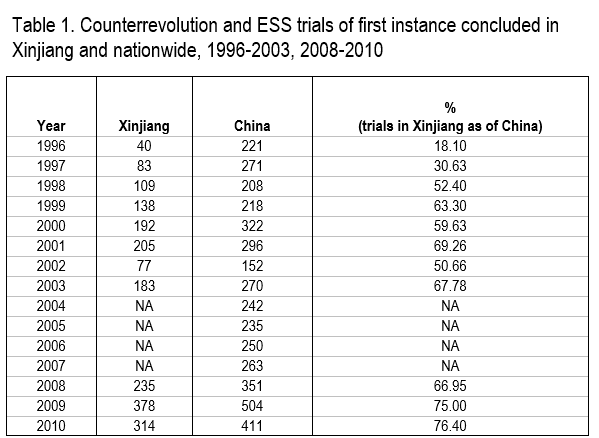
    The following year, the Chinese government suppressed the Uyghur uprising in Ghulja, which was sparked by the news that as many as 30 Uyghur independence activists were executed and of the prohibition on traditional Uyghur gatherings known as meshrep. A large but unknown number of people were charged with the counterrevolutionary crime of “conspiring to split the country.” In 1997, Xinjiang concluded 83 counterrevolution cases of first instance, accounting for 30 percent of all counterrevolution cases nationwide.
    Sources: Dui Hua, Xinjiang Yearbook, Records of People’s Courts Historical Judicial Statistics: 1949-2016
    Dui Hua’s research into government records confirmed that Xinjiang made up an even bigger portion of political cases in China after counterrevolutionary crimes were expunged in the 1997 Criminal Law. From 1998-2003, at least half of endangering state security (ESS) cases were concluded every year in Xinjiang; the number even increased to two-thirds in 2001 and 2003. Between 1996 and 2003, there was an average of two to four defendants per trial. Figures from 2004-2007 are not available.
    Despite global attention to the suppression of the Tibetan Riots in 2008, Xinjiang remained the epicenter of ESS cases. Government sources also revealed that Xinjiang made up 67 percent of ESS cases nationwide in that year. From 2009-2010, three quarters of China’s ESS cases were tried in Xinjiang.
    Based on analysis of annual work reports disclosed by Xinjiang’s high court from time to time, Dui Hua estimated that Xinjiang concluded approximately 300 ESS case each year from 2013-2014. During this period, Xinjiang continued to account for about 75 percent of the ESS cases in China. The number of Xinjiang ESS trials dropped to 100 cases in 2015. This drop coincided with the overall decline in ESS cases nationwide beginning in the same year. The same work report also reveals that trials for crimes that cover “terrorism” surged by about 25 percent in 2015. Dui Hua believes that many of the trials for terrorism crimes had previously been handled as ESS trials.
    Most, if not all, of these ESS cases were splittism or inciting splittism, and a large portion of them took place in west Xinjiang. For instance, government sources confirmed that more than 60 percent of Xinjiang’s most serious ESS cases between 2001-2009 were tried in Kashgar. In 2009 alone, Kashgar courts handled 49 ESS cases involving 225 defendants. Among them, 33 cases involving 171 defendants concerned separatist organizations, such as Hizb ut-Tahrir (伊扎布特) and Hijrah Jihad (伊吉拉特).
    In recent years, government reporting often conflates splittism and inciting splittism cases with terrorism-related crimes, making it impossible for observers to discern how many people were convicted for non-violent expressions of dissent. The Supreme People’s Court reported that 712 people were convicted of inciting splittism, terrorism, and other violent crimes in 2014, an increase of 13.3 percent compared to 2013. Alleged members of Hizb ut-Tahrir and Hijrah Jihad are often charged with splittism, inciting splittism, and terrorism. The identities, acts, and fates of these people remain largely unknown.This is not to suggest that peaceful dissenters are necessarily treated more leniently than people convicted of violent crimes. Uyghurs who openly oppose Xinjiang independence remain at great risk of facing lengthy prison sentences for the two ESS crimes if they refuse to toe the party line or are critical of China’s ethnic policy. Notable examples include:

    Gheyret Niyaz in a screengrab from the now-defunct uyghurbiz.net. Image credit: Radio Free Asia
    However, the prosecutors focused on his critical essays about Mandarin-focused bilingual education policies, which he said had resulted in widespread layoffs of Uyghur teachers. He also opposed a government program to transfer Uyghur women to jobs in the interior of China because Uyghur communities feared that the programs would result in prostitution and intermarriage. He is not known to have received a sentence reduction over a decade into his sentence and is scheduled for release in October 2024.
    Uyghur economics professor Ilham Tohti was sentenced to life imprisonment for splittism by the Urumqi Intermediate People’s Court on September 23, 2014. Image credit: news.cri.cn
      • Ilham Tohti, arguably the most prominent Uyghur prisoner, was sentenced to life imprisonment for splittism in September 2014. The scholar rejected violence and independence but argued that the Uyghur population has been largely left out of Xinjiang’s economic development and routinely face discrimination. He was accused of colluding with the East Turkestan Independence Movement and promoting ethnic separatism on uighurbiz.net, a website he founded to reconcile differences between Han and Uyghurs.
    Over the years, Dui Hua has been advocating for clemency and better treatment on behalf of non-violent Uyghur activists who were sentenced for splittism or inciting splittism. Our research indicated that clemency provided to ESS prisoners has a clear ethnic bias: Han Chinese convicted of espionage and supplying foreign entities with state secrets are more likely to receive clemency than Uyghurs convicted of splittism and inciting splittism, despite all these crimes being categorized under ESS.
    One noteworthy development is that Uyghur splittism and inciting splittism cases are not just confined to Xinjiang. Some of these Uyghurs were job seekers or students who pursued tertiary education in Han-majority cities. Evidence also suggests that some of these cases were related to Hijrah Jihad, which means “migration” and “holy war.” This group encourages members to leave their hometowns to proselytize.
    • Dui Hua previously reported that two Uyghurs were detained in Pingdingshan, Henan, in 2012 for ESS crimes: Adili Tursun was allegedly as one of 61 fugitives of “three forces” (i.e., separatism, religious extremism, and terrorism), while Iliyar Kublati was charged with inciting splittism.
    • Another duo in their early twenties were also indicted for inciting splittism in Henan but were tried in Jilin. Eli Exmet continues to serve his eight years’ sentence in a prison in Changchun until November 2020, while Paziniye completed her five years’ prison sentence in 2019.
    • Fujian’s Nanping Intermediate People’s Court sentenced Ailaijiang Abuliti to seven years’ imprisonment for inciting splittism in December 2015. The judgment only stated that he was given a five-month sentence reduction in June 2019 because of good behavior.
    • In 2016, Guangdong tried an inciting splittism case involving Warisjan Ghopur. No government responses have been provided to Dui Hua despite repeated inquiries about the case.
    Tibetans
     
    The Tibetan regions are widely considered to be trouble spots. Mounting resentment against Beijing began after China reasserted control of Tibet in 1950. Outbreaks of armed resistance, which culminated in the Lhasa Uprising in March 1959, compelled the Dalai Lama to escape to Dharamsala, India, where he currently lives as a refugee.
    Protests in the Tibetan regions are typically initiated by monks calling for the return of the Dalai Lama, and are joined by lay people supporting the same cause. Over the past decades, Chinese policies within Tibet have shifted from relatively liberal to repressive and back again. The 1980s were a period of relative tolerance in Tibet: Beijing briefly allowed temples and monasteries to reopen, and the Tibetan language was reintroduced in schools. However, China tightened its policy after then-Tibet party secretary Hu Jintao violently suppressed large-scale anti-Chinese demonstrations in Lhasa in honor of the 30th anniversary of the 1959 uprising. Martial law was declared on March 8, 1989 and lasted about two years.
    Chinese rule in Tibet remained largely repressive in the 1990s. Monks and nuns who were serving sentences for counterrevolution coordinated large numbers of prisoners to join hunger strikes, shout campaigns, and to chant pro-independence slogans. They also sought to solicit international attention from visiting diplomats. The most severe crackdown on prison protests took place after demonstrations in Drapchi, Tibet’s largest prison, on May 1 and May 4 in 1998. On both occasions, prisoners who were ordered by Chinese officials to celebrate the socialist achievements in Tibet shouted political slogans just ahead of a visit by a delegation from the European Union. Defiant prisoners were reportedly dealt with by deadly force and given sentence extensions for inciting splittism.
    Tibetan prisoners convicted of splittism and inciting splittism were largely peaceful, but in some cases, they received additional sentencing for violent crimes. One notable example is Tenzin Delek, who was sentenced to death with two-year reprieve for inciting splittism and setting explosions in December 2002. A respectable leader among Tibetans in eastern Sichuan who had spoken out against deforestation, the monk was accused of staging a series of bombings in Chengdu. Tenzin Delek also denied the charges against him, human rights groups said in 2004, citing a recording smuggled out of prison. Tenzin Delek died in July 2015 while serving his sentence in Chuangdong Prison.
     
    Tibetan monks clashed with armed police during the Lhasa riots in 2008, which the Chinese government saw as a separatist movement plotted by the Dalai Lama. Image credit: CCTV
    The impact on ESS cases of the Lhasa Riots, which began on March 14 just months ahead of the Beijing Olympics, cannot be overstated. As noted earlier in this post, 67 percent of China’s ESS cases were concluded in Xinjiang. That said, a portion of ESS cases involved young Tibetans who questioned the path of non-violence promoted by the Dalai Lama and resorted to violence to express political grievances. Foreign journalists reported cases where Tibetan rioters focused on setting fire to and looting businesses owned by Han Chinese and Hui.
    Two weeks into the protests, China brought a delegation of foreign journalists to Lhasa to allow independent reporting from the Tibetan capital. Several dozen monks at the Jokhang temple protested in front of the foreign reporters and yelled “We want the Dalai Lama to return to Tibet, we want to be free.” Some of these monks were likely charged with or sentenced for ESS, including splittism and inciting splittism. Reliable arrest figures are not available.
    Amid the outbreak of the Tibetan protests, filmmaker Dhondup Wangchen joined the ranks of political prisoners because of his independent coverage of the tensions in Tibet. He produced a 25-minute documentary “Leaving Fear Behind,” in which he interviewed Tibetans about their hopes and frustrations living under Chinese rule. His footage was smuggled overseas before he disappeared into detention on March 26, 2008. He was sentenced to six years’ imprisonment for inciting splittism in December 2009 and completed his full sentence without a sentence reduction on June 5, 2014. In December 2017, he fled China and was reunited with his family in the United States who had been granted political asylum there.
    The spate of self-immolations in the Tibetan regions, which began in 2009, brought into sharp relief the despair and defiance of Tibetans. Some Tibetans see these acts as altruistic suicide committed in order to not cause material damage or inflict physical harm on others. State-run news media reported at least two cases of inciting splittism in connection to the self-immolation protests:
    • A court in Qinghai sentenced Phagpa to 13 years’ imprisonment for inciting splittism and murder in February 2013. Phagpa allegedly encouraged a monk to set himself ablaze for the Tibetan cause. In November 2012, Phagpa organized pro-independence demonstrations in Tongren County and was found in possession of a large number of “Snow Lion Flags” and photos of the Tibetan government in exile. In this case, the crime of inciting splittism alone carried five years’ imprisonment.
    Due to limited information available, it is hard to estimate the number of splittism and inciting splittism cases throughout all Tibetan regions, which span not only the Tibetan Autonomous Region but also parts of Qinghai, Sichuan, Gansu, Ningxia, and Yunnan. Although comprehensive data of arrests, indictments, and trials for splittism and inciting splittism across all Tibetan regions are not available, piecemeal figures from government sources suggest that Tibetan cases came in a distant second after Xinjiang:
    Self-immolation protests by Tibetans have not stopped; the latest incident was reported on November 26, 2019. At the same time as the rate of occurrence has slowed down, considerably fewer political cases in the Tibetan regions have been reported over the past few years.
    One of the most well-known cases over the past few years concerns Tashi Wangchuk. Like some of the previously discussed Uyghur cases, promoting or discussing independence for Tibet is not a requisite for conviction. Tashi Wangchuk was sentenced to five years’ imprisonment for inciting splittism in May 2018 because of the interviews he gave to The New York Times. In the interviews, he explicitly stated that he was not calling for Tibetan independence; rather, he expressed worries about the disappearance of the Tibetan language because Chinese authorities have been prohibiting the use of Tibetan in spheres ranging from schools to commerce. He is scheduled for release from Qinghai’s Dongchuan Prison in January 2021.

    In Part III, Dui Hua examines two other ethnic groups who have also faced trials for splittism and inciting splittism: ethnic Mongols and Han Chinese.

      • However, the prosecutors focused on his critical essays about Mandarin-focused bilingual education policies, which he said had resulted in widespread layoffs of Uyghur teachers. He also opposed a government programs to transfer Uyghur women to jobs in the interior of China because Uyghur communities feared that the programs would result in prostitution and intermarriage. He is not known to have received a sentence reduction over a decade into his sentence and is scheduled for release in October 2024.
    • Ilham Tohti, arguably the most prominent Uyghur prisoner, was sentenced to life imprisonment for splittism in September 2014. The scholar rejected violence and independence but argued that the Uyghur population has been largely left out of Xinjiang’s economic development and routinely face discrimination. He was accused of colluding with the East Turkestan Independence Movement and promoting ethnic separatism on uighurbiz.net, a website he founded to reconcile differences between Han and Uyghurs.
    Uyghur economics professor Ilham Tohti was sentenced to life imprisonment for splittism by the Urumqi Intermediate People’s Court on September 23, 2014. Image credit: news.cri.cn
    Official news media reports confirmed that seven students of Ilham have also been jailed for splittism: Perhat Halmurat, Shohret Nijat, Mutellip Imin, Abduqeyyum Ablimit, Atikem Rozi, Akbar Imin, and Luo Yuwei, who is from the Yi ethnic minority. One of them was sentenced to eight year’ imprisonment and two other students were sentenced to seven years, also for splittism. Their sentencings, whereabouts, and current statuses cannot be individually confirmed.

    Over the years, Dui Hua has been advocating for clemency and better treatment on behalf of non-violent Uyghur activists who were sentenced for splittism or inciting splittism. Our research indicated that clemency provided to ESS prisoners has a clear ethnic bias: Han Chinese convicted of espionage and supplying foreign entities with state secrets are more likely to receive clemency than Uyghurs convicted of splittism and inciting splittsm, despite all these crimes being categorized under ESS.

    One noteworthy development is that Uyghur splittism and inciting splittism cases are not just confined to Xinjiang. Some of these Uyghurs were job seekers or students who pursued tertiary education in Han-majority cities. Evidence also suggests that some of these cases were related to Hijrah Jihad, which means “migration” and “holy war.” This group encourages members to leave their hometowns to proselytize.
    • Dui Hua previously reported that two Uyghurs were detained in Pingdingshan, Henan, in 2012 for ESS crimes: Adili Tursun was allegedly as one of 61fugitives of “three forces” (i.e., separatism, religious extremism, and terrorism), while Iliyar Kublati was charged with inciting splittism.
    • Another duo in their early twenties were also indicted for inciting splittism in Henan but were tried in Jilin. Eli Exmet continues to serve his eight years’ sentence in a prison in Changchun until November 2020, while Paziniye completed her five years’ prison sentence in 2019.
    • Fujian’s Nanping Intermediate People’s Court sentenced Ailaijiang Abuliti to seven years’ imprisonment for inciting splittism in December 2015. The judgment only stated that he was given a five-month sentence reduction in June 2019 because of good behavior.
    • In 2016, Guangdong tried an inciting splittism case involving Warisjan Ghopur. No government responses have been provided to Dui Hua despite repeated inquiries about the case.
    Tibetans
     
    The Tibetan regions are widely considered to be trouble spots. Mounting resentment against Beijing began after China reasserted control of Tibet in 1950. Outbreaks of armed resistance, which culminated in the Lhasa Uprising in March 1959, compelled the Dalai Lama to escape to Dharamsala, India, where he currently lives as a refugee.
    Protests in the Tibetan regions are typically initiated by monks calling for the return of the Dalai Lama, and are joined by lay people supporting the same cause. Over the past decades, Chinese policies within Tibet have shifted from relatively liberal to repressive and back again. The 1980s were a period of relative tolerance in Tibet: Beijing briefly allowed temples and monasteries to reopen, and the Tibetan language was reintroduced in schools. However, China tightened its policy after then-Tibet party secretary Hu Jintao violently suppressed large-scale anti-Chinese demonstrations in Lhasa in honor of the 30th anniversary of the 1959 uprising. Martial law was declared on March 8, 1989 and lasted about two years.
    Chinese rule in Tibet remained largely repressive in the 1990s. Monks and nuns who were serving sentences for counterrevolution coordinated large numbers of prisoners to join hunger strikes, shout campaigns, and to chant pro-independence slogans. They also sought to solicit international attention from visiting diplomats. The most severe crackdown on prison protests took place after demonstrations in Drapchi, Tibet’s largest prison, on May 1 and May 4 in 1998. On both occasions, prisoners who were ordered by Chinese officials to celebrate the socialist achievements in Tibet shouted political slogans just ahead of a visit by a delegation from the European Union. Defiant prisoners were reportedly dealt with by deadly force and given sentence extensions for inciting splittism.
    Tibetan prisoners convicted of splittism and inciting splittism were largely peaceful, but in some cases, they received additional sentencing for violent crimes. One notable example is Tenzin Delek, who was sentenced to death with two-year reprieve for inciting splittism and setting explosions in December 2002. A respectable leader among Tibetans in eastern Sichuan who had spoken out against deforestation, the monk was accused of staging a series of bombings in Chengdu. Tenzin Delek also denied the charges against him, human rights groups said in 2004, citing a recording smuggled out of prison. Tenzin Delek died in July 2015 while serving his sentence in Chuangdong Prison.

    Tibetan monks clashed with armed police during the Lhasa riots in 2008, which the Chinese government saw as a separatist movement plotted by the Dalai Lama. Image credit: CCTV
    The impact on ESS cases of the Lhasa Riots, which began on March 14 just months ahead of the Beijing Olympics, cannot be overstated. As noted earlier in this post, 67 percent of China’s ESS cases were concluded in Xinjiang. That said, a portion of ESS cases involved young Tibetans who questioned the path of non-violence promoted by the Dalai Lama and resorted to violence to express political grievances. Foreign journalists reported cases where Tibetan rioters focused on setting fire to and looting businesses owned by Han Chinese and Hui.
    Two weeks into the protests, China brought a delegation of foreign journalists to Lhasa to allow independent reporting from the Tibetan capital. Several dozen monks at the Jokhang temple protested in front of the foreign reporters and yelled “We want the Dalai Lama to return to Tibet, we want to be free.” Some of these monks were likely charged with or sentenced for ESS, including splittism and inciting splittism. Reliable arrest figures are not available.
    Amid the outbreak of the Tibetan protests, filmmaker Dhondup Wangchen joined the ranks of political prisoners because of his independent coverage of the tensions in Tibet. He produced a 25-minute documentary “Leaving Fear Behind,” in which he interviewed Tibetans about their hopes and frustrations living under Chinese rule. His footage was smuggled overseas before he disappeared into detention on March 26, 2008. He was sentenced to six years’ imprisonment for inciting splittism in December 2009 and completed his full sentence without a sentence reduction on June 5, 2014. In December 2017, he fled China and was reunited with his family in the United States who had been granted political asylum there.
    The spate of self-immolations in the Tibetan regions, which began in 2009, brought into sharp relief the despair and defiance of Tibetans. Some Tibetans see these acts as altruistic suicide committed not to cause material damage or inflict physical harm on others. State-run news media reported at least two cases of inciting splittism in connection to the self-immolation protests:
    • A court in Qinghai sentenced Phagpa to 13 years’ imprisonment for inciting splittism and murder in February 2013. Phagpa allegedly encouraged a monk to set himself ablaze for the Tibetan cause. In November 2012, Phagpa organized pro-independence demonstrations in Tongren County and was found in possession of a large number of “Snow Lion Flags” and photos of the Tibetan government in exile. In this case, the crime of inciting splittism alone carried five years’ imprisonment.
    Due to limited information available, it is hard to estimate the number of splittism and inciting splittism cases throughout all Tibetan regions, which span not only the Tibetan Autonomous Region but also parts of Qinghai, Sichuan, Gansu, Ningxia, and Yunnan. Although comprehensive data of arrests, indictments, and trials for splittism and inciting splittism across all Tibetan regions are not available, piecemeal figures from government sources suggest that Tibetan cases came in a distant second after Xinjiang:
    Self-immolation protests by Tibetans have not stopped; the latest incident was reported on November 26, 2019. At the same time as the rate of occurrence has slowed down, considerably fewer political cases in the Tibetan regions have been reported over the past few years.
    One of the most well-known cases over the past few years concerns Tashi Wangchuk. Like some of the previously discussed Uyghur cases, promoting or discussing independence for Tibet is not a requisite for conviction. Tashi Wangchuk was sentenced to five years’ imprisonment for inciting splittism in May 2018 because of the interviews he gave to The New York Times. In the interviews, he explicitly stated that he was not calling for Tibetan independence; rather, he expressed worries about the disappearance of the Tibetan language because Chinese authorities have been prohibiting the use of Tibetan in spheres ranging from schools to commerce. He is scheduled for release from Qinghai’s Dongchuan Prison in January 2021.
    In Part III, Dui Hua examines two other ethnic groups who have also faced trials for splittism and inciting splittism: ethnic Mongols and Han Chinese.


  • Court Statistics on Splittism & Inciting Splittism, Part I

    Court Statistics on Splittism & Inciting Splittism, Part I

    This is the first post in a three-part series examining the application of splittism and inciting splittism charges using Records of People’s Courts Historical Judicial Statistics: 1949-2016. Previous posts drawing on SPC statistics discussed the decline in juvenile convictions, cases related to Hong Kong and Taiwan, and cases covered by Article 300 of the Criminal Law—“using or organizing a cult to undermine implementation of the law.”

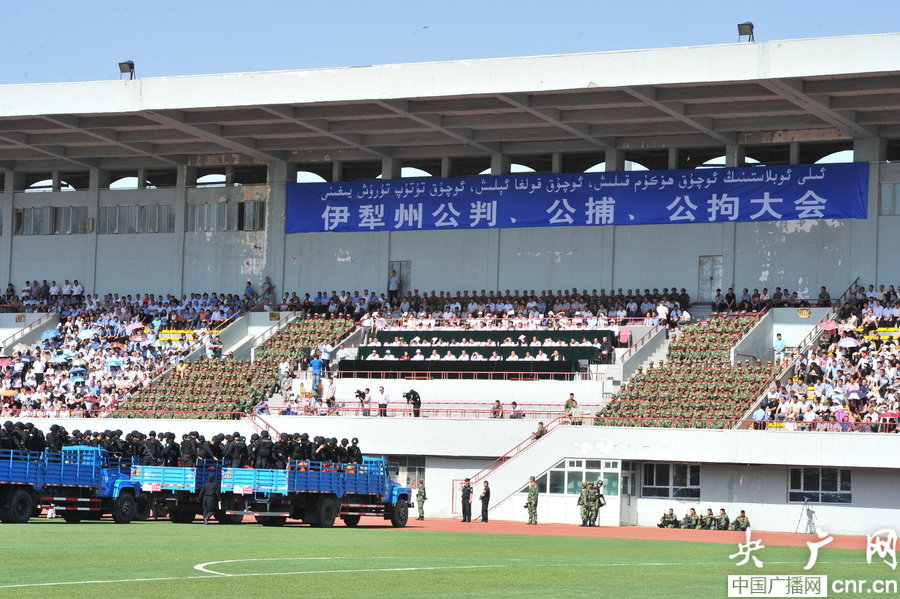
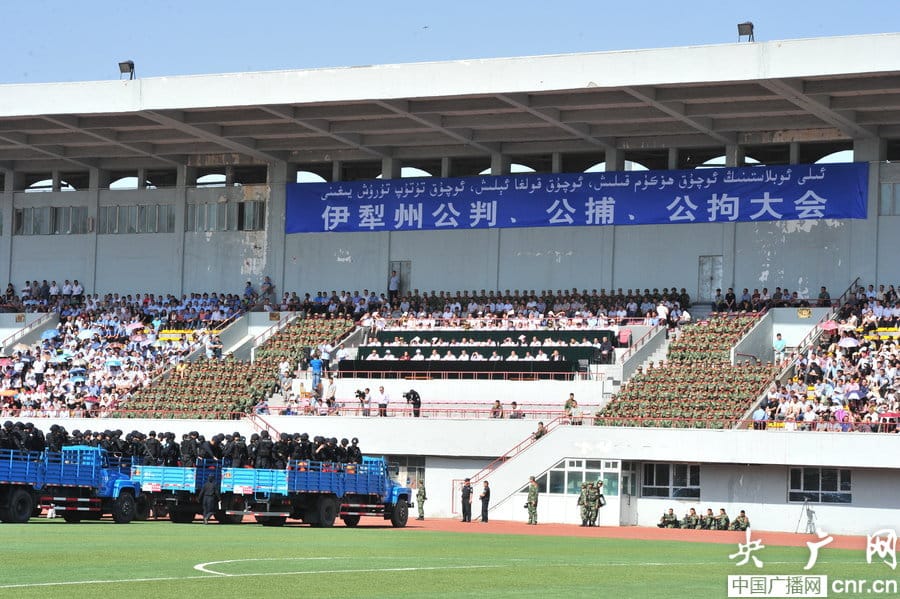
    On May 27, 2014, the Yili Kazakh Autonomous Prefecture Branch of the Xinjiang High People’s Court convicted 55 defendants of splittism, “organizing/leading/participating in a terrorist organization” and murder in a public rally of sentencing, arrest and criminal detention jointly held by the party secretary and public security. Image credit: China Daily

    Splittism and inciting splittism are crimes of endangering state security (ESS), introduced in 1997. They are routinely used to suppress calls for greater self-determination rights, including genuine autonomy and political separation from China. Trials of these two crimes have been used as proxies for the suppression of dissenters from ethnic minority groups, most notably Uyghurs and Tibetans.
    Defined in Article 103 of the Criminal Law, splittism and inciting splittism serve to deter people from “splitting the country or undermining national unification.” The former carries a potential death sentence and targets those who organize, plot, or act to divide China. Inciting splittism is not a capital crime and is applicable when an offender urges or persuades others to commit splittism through the use of language, text, images, or other communication tools but does not commit splittism him- or herself.
    Statistics released by the Supreme People’s Court (SPC) in the 12-volume Records of People’s Courts Historical Judicial Statistics: 1949-2016 corroborate Dui Hua’s observation that splittism and inciting splittism are considered by the Chinese government to be the two principal state security threats in China. The two crimes account for the majority of ESS cases nationwide and are disproportionately applied to ethnic minorities.

    Chinese courts accepted 5,863 ESS cases and brought 14,072 people to trial for ESS in the first 18 years after the 1997 Criminal Law came into effect. Charts 1 and 2 show that among them, 4,304, or 73 percent of the ESS cases, and 11,810, or 84 percent of the defendants, stood trial for splittism or inciting splittism.

    Chart 3 shows that the first peak of splittism and inciting splittism cases occurred in 2001; a total of 731 people were brought to trial. Although sporadic incidents of ethnic unrest had started earlier in the 1990s, China remained relatively silent and downplayed the severity of the security threat before 2001, according to a research report by CNA China Studies.
    China began speaking more openly and frequently about separatist violence in Xinjiang after the September 11, 2001, terrorist attacks on New York and Washington. After 9/11, Beijing employed similar rhetoric to the United States to justify its own “War on Terror” and designated the East Turkestan Independence Movement (ETIM) as a terrorist organization with assistance from global jihadist networks. In the same year, China started blaming ETIM for instigating a number of separatist and terrorist activities in China. Because most information on ETIM can only be tracked back to Chinese government sources, some critics have raised questions of credibility and said the threats were exaggerated.
    Due to the limited information available, it is impossible to quantify the extent of ETIM’s involvement in splittism and inciting splittism cases. Dui Hua’s research, however, revealed that a substantial proportion of these cases after 2000 were attributed to Hizb ut-Tahrir (伊扎布特), or Party of Liberation. For example, in 2010, police in Kashgar identified 522 people for their involvement with Hizb ut-Tahrir. Many countries have banned the group, but independent media reports documenting Hizb ut-Tahrir activity in China are scarce. Members of this group are also likely to face terrorism-related charges. Part II will feature a more in-depth discussion of this topic.
    The six years before the Beijing Summer Olympics were a period of relative calm. The number of people tried for splittism and inciting splittism dropped every year from 2002-2005, falling from 630 people to 310, but increased steadily in the two years since 2006. From 2002-2007, the number of people tried for splittism and inciting splittism made up around 80 percent of ESS defendants nationwide.
    The crackdown on separatism intensified in 2008; the number of defendants tried for the two crimes doubled to 1,155 from 564 in 2007. This surge was likely triggered by calls for an Olympics boycott by international activists over China’s extensive human rights violations. Chinese state media blamed ETIM and Tibetan separatists in exile for fanning anti-China sentiment overseas. Just months ahead of the Beijing Olympics, Tibetan protests erupted in Lhasa on March 14, 2008, and spread across the entire Tibetan plateau.
    The number stayed high between 2009 and 2013, during which 3,871 people were brought to trial. Notable incidents of ethnic unrest included the Urumqi Riots in July 2009, a spate of Tibetan self-immolation protests, and violent attacks allegedly committed by Uyghurs in- and outside of Xinjiang.
    A significant drop in the number of people brought to trial for splittism and inciting splittism occurred in 2014, falling to 577 from 886 in 2013. The number dipped almost threefold to 199 in 2015 and remained low in 2016. From 2015-2016, splittism and inciting splittism cases accounted for 58 percent of all ESS cases, down from over 90 percent when these cases were at their peak in 2012.
    It is worth noting that China consistently tried and concluded more cases of splittism than inciting splittism from 1998-2013, but the case ratio vastly fluctuated. In 2013, ten people were tried for splittism for every one person tried for inciting splittism. The ratio dropped to 1.7:1 in 2005. Between 2006 and 2013, the number of defendants tried for splittism was 1.7-4.6 times more than those tried for inciting splittism.
    The number of cases and defendants tried for splittism was superseded by inciting splittism after 2013. From 2014-2016, 630 people were tried for inciting splittism, more than double the number of defendants for splittism. More research is needed to better understand this emerging trend.
    Sentencing

    From 1998-2016, only 15 people tried for splittism or inciting splittism were acquitted. These acquittals mostly occurred in the first five years after 1997. No one was acquitted for either crime from 2003 through 2016. The only exception was in 2009; four people were acquitted for inciting splittism.

    About 99.6 percent of splittism and inciting splittism trials ended with a conviction. Charts 4 and 5 show the following types of punishment: a. below three years, b. three to five years, c. over five years to death penalty, d. other, which includes exemption from criminal punishment, suspended sentence, criminal detention, and public surveillance.
    Thirty-five people, 0.8 percent, were exempt from criminal punishment. Only three people, or 0.07 percent, were given criminal detention.
    Non-custodial punishments were also rare. Only 26 people received suspended sentences (eight for splittism, 18 for inciting splittism), and 16 people were given public surveillance (nine for splittism, seven for inciting splittism).
    The vast majority of people received imprisonment sentences. Chart 4 shows that considerably more people convicted of splittism received longer prison sentences than those convicted of inciting splittism. In the 18 years beginning in 1998, 74 percent of defendants convicted for splittism received prison sentences longer than five years, compared to 41 percent for inciting splittism as shown in Chart 5.

    Chart 6 shows a year-by-year sentencing breakdown for people convicted of splittism from 1998-2016. The surge of long prison sentences (i.e. longer than five years) meted out from 2008-2013 coincided with the aforementioned incidents of ethnic unrest involving Uyghurs and Tibetans. During this restive period, as many as 90 percent of them received prison sentences longer than five years, including an unknown number of people who might have received the maximum sentence of death.
    However, the same trend was not reflected in inciting splittism cases. Chart 7 shows that although nearly half of the defendants received longer prison sentences in 2009, the number dropped to 32 percent in 2010 and 34 percent in 2013.
    The Publicity Department of Shache County in Xinjiang reported that 840,000 people from different ethnic groups took oaths to fight against extremism and splittism before the Chinese Communist Party flag, following a deadly terror attack which occurred in the city on July 28, 2014. Image credit: China News

    Severe punishments were meted out in both splittism and inciting splittism cases in 2014. Nine out of every 10 splittism defendants received long prison sentences, as did eight out of every 10 defendants for inciting splittism. In that year, state-run Xinhua News Agency called the frenzied violence at a crowded train station in Kunming, Yunnan, “China’s 9/11.” The attack was allegedly committed by Uyghur separatists.

    Social Backgrounds

    The SPC statistics also provide interesting insights into the social backgrounds of defendants with judgments taking effect. Notable observations gleaned from the statistics include:

    • A substantial portion of splittism and inciting splittism cases appeared to concern rural grievances. Chart 8 shows that from 1998-2016, over 70 percent of people convicted of splittism were farmers, whereas farmers made up half of the defendants convicted of inciting splittism.
    • Classified as a sub-category of farmers in the court statistics, migrant workers emerged as a numerically significant group in 2009. Of the 322 individuals convicted for splittism, 113 were migrant workers. In that year, a violent dispute between migrant Uyghurs and Han Chinese workers from June 25-26 at a toy factory in Shaoguan, Guangdong, triggered the days-long riots that broke out in Urumqi on July 5.
      Unemployed (370) and private business owners (355, including self-employed), came in a distant second and third place, respectively.
    • Women committed splittism and inciting splittism at a fraction of the rate of men. Only 118, or less than three percent, of all the 4,238 people convicted of the two crimes were women.

    • Women have received harsh prison sentences. For instance, Gulmire Imin was sentenced to life imprisonment for splittism in April 2010; she is not known to have received a sentence reduction. The Chinese government accused her of calling on Uyghurs to join the protests in Urumqi in July 2009. 
    • Splittism and inciting splittism were disproportionately applied to ethnic minorities. Of the 4,283 convicted individuals, 3,936, or 92 percent, were ethnic minorities. 
    Read Part II to learn about the two main ethnic minority groups in splittism and inciting splittism cases: Uyghurs and Tibetans 
  • Court Statistics on Splittism & Inciting Splittism, Part I

    Court Statistics on Splittism & Inciting Splittism, Part I

    This is the first post in a three-part series examining the application of splittism and inciting splittism charges using Records of People’s Courts Historical Judicial Statistics: 1949-2016. Previous posts drawing on SPC statistics discussed the decline in juvenile convictions, cases related to Hong Kong and Taiwan, and cases covered by Article 300 of the Criminal Law—“using or organizing a cult to undermine implementation of the law.”
     
    On May 27, 2014, the Yili Kazakh Autonomous Prefecture Branch of the Xinjiang High People’s Court convicted 55 defendants of splittism, “organizing/leading/participating in a terrorist organization” and murder in a public rally of sentencing, arrest and criminal detention jointly held by the party secretary and public security. Image credit: China Daily
    Splittism and inciting splittism are crimes of endangering state security (ESS), introduced in 1997. They are routinely used to suppress calls for greater self-determination rights, including genuine autonomy and political separation from China. Trials of these two crimes have been used as proxies for the suppression of dissenters from ethnic minority groups, most notably Uyghurs and Tibetans.
    Defined in Article 103 of the Criminal Law, splittism and inciting splittism serve to deter people from “splitting the country or undermining national unification.” The former carries a potential death sentence and targets those who organize, plot, or act to divide China. Inciting splittism is not a capital crime and is applicable when an offender urges or persuades others to commit splittism through the use of language, text, images, or other communication tools but does not commit splittism him- or herself.
    Statistics released by the Supreme People’s Court (SPC) in the 12-volume Records of People’s Courts Historical Judicial Statistics: 1949-2016 corroborate Dui Hua’s observation that splittism and inciting splittism are considered by the Chinese government to be the two principal state security threats in China. The two crimes account for the majority of ESS cases nationwide and are disproportionately applied to ethnic minorities.
    Chinese courts accepted 5,863 ESS cases and brought 14,072 people to trial for ESS in the first 18 years after the 1997 Criminal Law came into effect. Charts 1 and 2 show that among them, 4,304, or 73 percent of the ESS cases, and 11,810, or 84 percent of the defendants, stood trial for splittism or inciting splittism.
    Chart 3 shows that the first peak of splittism and inciting splittism cases occurred in 2001; a total of 731 people were brought to trial. Although sporadic incidents of ethnic unrest had started earlier in the 1990s, China remained relatively silent and downplayed the severity of the security threat before 2001, according to a research report by CNA China Studies.
    China began speaking more openly and frequently about separatist violence in Xinjiang after the September 11, 2001, terrorist attacks on New York and Washington. After 9/11, Beijing employed similar rhetoric to the United States to justify its own “War on Terror” and designated the East Turkestan Independence Movement (ETIM) as a terrorist organization with assistance from global jihadist networks. In the same year, China started blaming ETIM for instigating a number of separatist and terrorist activities in China. Because most information on ETIM can only be tracked back to Chinese government sources, some critics have raised questions of credibility and said the threats were exaggerated.
    Due to the limited information available, it is impossible to quantify the extent of ETIM’s involvement in splittism and inciting splittism cases. Dui Hua’s research, however, revealed that a substantial proportion of these cases after 2000 were attributed to Hizb ut-Tahrir (伊扎布特), or Party of Liberation. For example, in 2010, police in Kashgar identified 522 people for their involvement with Hizb ut-Tahrir. Many countries have banned the group, but independent media reports documenting Hizb ut-Tahrir activity in China are scarce. Members of this group are also likely to face terrorism-related charges. Part II will feature a more in-depth discussion of this topic.
    The six years before the Beijing Summer Olympics were a period of relative calm. The number of people tried for splittism and inciting splittism dropped every year from 2002-2005, falling from 630 people to 310, but increased steadily in the two years since 2006. From 2002-2007, the number of people tried for splittism and inciting splittism made up around 80 percent of ESS defendants nationwide.
    The crackdown on separatism intensified in 2008; the number of defendants tried for the two crimes doubled to 1,155 from 564 in 2007. This surge was likely triggered by calls for an Olympics boycott by international activists over China’s extensive human rights violations. Chinese state media blamed ETIM and Tibetan separatists in exile for fanning anti-China sentiment overseas. Just months ahead of the Beijing Olympics, Tibetan protests erupted in Lhasa on March 14, 2008, and spread across the entire Tibetan plateau.
    The number stayed high between 2009 and 2013, during which 3,871 people were brought to trial. Notable incidents of ethnic unrest included the Urumqi Riots in July 2009, a spate of Tibetan self-immolation protests, and violent attacks allegedly committed by Uyghurs in- and outside of Xinjiang.
    A significant drop in the number of people brought to trial for splittism and inciting splittism occurred in 2014, falling to 577 from 886 in 2013. The number dipped almost threefold to 199 in 2015 and remained low in 2016. From 2015-2016, splittism and inciting splittism cases accounted for 58 percent of all ESS cases, down from over 90 percent when these cases were at their peak in 2012.
    It is worth noting that China consistently tried and concluded more cases of splittism than inciting splittism from 1998-2013, but the case ratio vastly fluctuated. In 2013, ten people were tried for splittism for every one person tried for inciting splittism. The ratio dropped to 1.7:1 in 2005. Between 2006 and 2013, the number of defendants tried for splittism was 1.7-4.6 times more than those tried for inciting splittism.
    The number of cases and defendants tried for splittism was superseded by inciting splittism after 2013. From 2014-2016, 630 people were tried for inciting splittism, more than double the number of defendants for splittism. More research is needed to better understand this emerging trend.
    Sentencing
     
    From 1998-2016, only 15 people tried for splittism or inciting splittism were acquitted. These acquittals mostly occurred in the first five years after 1997. No one was acquitted for either crime from 2003 through 2016. The only exception was in 2009; four people were acquitted for inciting splittism.
    About 99.6 percent of splittism and inciting splittism trials ended with a conviction. Charts 4 and 5 show the following types of punishment: a. below three years, b. three to five years, c. over five years to death penalty, d. other, which includes exemption from criminal punishment, suspended sentence, criminal detention, and public surveillance.
    Thirty-five people, 0.8 percent, were exempt from criminal punishment. Only three people, or 0.07 percent, were given criminal detention.
    Non-custodial punishments were also rare. Only 26 people received suspended sentences (eight for splittism, 18 for inciting splittism), and 16 people were given public surveillance (nine for splittism, seven for inciting splittism).
    The vast majority of people received imprisonment sentences. Chart 4 shows that considerably more people convicted of splittism received longer prison sentences than those convicted of inciting splittism. In the 18 years beginning in 1998, 74 percent of defendants convicted for splittism received prison sentences longer than five years, compared to 41 percent for inciting splittism as shown in Chart 5.
    Chart 6 shows a year-by-year sentencing breakdown for people convicted of splittism from 1998-2016. The surge of long prison sentences (i.e. longer than five years) meted out from 2008-2013 coincided with the aforementioned incidents of ethnic unrest involving Uyghurs and Tibetans. During this restive period, as many as 90 percent of them received prison sentences longer than five years, including an unknown number of people who might have received the maximum sentence of death.
    However, the same trend was not reflected in inciting splittism cases. Chart 7 shows that although nearly half of the defendants received longer prison sentences in 2009, the number dropped to 32 percent in 2010 and 34 percent in 2013.
    The Publicity Department of Shache County in Xinjiang reported that 840,000 people from different ethnic groups took oaths to fight against extremism and splittism before the Chinese Communist Party flag, following a deadly terror attack which occurred in the city on July 28, 2014. Image credit: China News

    Severe punishments were meted out in both splittism and inciting splittism cases in 2014. Nine out of every 10 splittism defendants received long prison sentences, as did eight out of every 10 defendants for inciting splittism. In that year, state-run Xinhua News Agency called the frenzied violence at a crowded train station in Kunming, Yunnan, “China’s 9/11.” The attack was allegedly committed by Uyghur separatists.

    Social Backgrounds
     
    The SPC statistics also provide interesting insights into the social backgrounds of defendants with judgments taking effect. Notable observations gleaned from the statistics include:

      • A substantial portion of splittism and inciting splittism cases appeared to concern rural grievances. Chart 8 shows that from 1998-2016, over 70 percent of people convicted of splittism were farmers, whereas farmers made up half of the defendants convicted of inciting splittism.
    Classified as a sub-category of farmers in the court statistics, migrant workers emerged as a numerically significant group in 2009. Of the 322 individuals convicted for splittism, 113 were migrant workers. In that year, a violent dispute between migrant Uyghurs and Han Chinese workers from June 25-26 at a toy factory in Shaoguan, Guangdong, triggered the days-long riots that broke out in Urumqi on July 5.
    Unemployed (370) and private business owners (355, including self-employed), came in a distant second and third place, respectively.
      • Women committed splittism and inciting splittism at a fraction of the rate of men. Only 118, or less than three percent, of all the 4,238 people convicted of the two crimes were women.
    Women have received harsh prison sentences. For instance, Gulmire Imin was sentenced to life imprisonment for splittism in April 2010; she is not known to have received a sentence reduction. The Chinese government accused her of calling on Uyghurs to join the protests in Urumqi in July 2009.
    • Splittism and inciting splittism were disproportionately applied to ethnic minorities. Of the 4,283 convicted individuals, 3,936, or 92 percent, were ethnic minorities.
    Read Part II to learn about the two main ethnic minority groups in splittism and inciting splittism cases: Uyghurs and Tibetans 
  • Detailed Court Statistics on Article 300, Part II

    Detailed Court Statistics on Article 300, Part II

    In Detailed Court Statistics on Article 300, Part I, Dui Hua explored the application of Article 300 over an 18-year period spanning 1998-2016, examining the types of cases prosecuted under Article 300 as well as the roles of women and ethnic minorities in organizations deemed to be cults. Part II analyzes trends in sentencing and discusses post-2016 developments concerning Article 300.
     
    The Standing Committee of the National
    People’s Congress extended the maximum penalty of Article 300 from 15 years’
    imprisonment to life imprisonment in the ninth amendment of the criminal law,
    which came into effect on November 1, 2015. Image credit:
    Liaoning
    Pindao
    Since coming into force in 1997, Article 300 of the Criminal Law—“using or organizing a cult to undermine implementation of the law”—has frequently been used to criminalize non-mainstream religious groups. Records of People’s Courts Historical Judicial Statistics: 1949-2016 contains information on trials of Article 300 offenses, including statistical breakdowns of sentencing, gender, and defendants’ occupation. These statistics have revealed that over 23,000 cult cases were accepted and over 40,000 people were tried during an 18-year period beginning in 1998.
    Replacing the former crime of “organizing or using a sect or feudal superstition to carry out counterrevolution activities” in 1997, Article 300 began to be used extensively after the Chinese government designated Falun Gong as an “evil cult” in 1999. The court statistics do not fully reflect the extent of the cult crackdown because they omit a large but unknown number of people whose personal liberties were deprived without any legal procedure. Despite these limitations, the statistics offer a glimpse of how China invoked its criminal justice process to crack down on religion.

    Punishment Trends

    Acquittals are rare in China. In cult cases, only 69 men and women who stood trial from 1998-2016 were acquitted.
    About 99.8 percent of cult trials ended with a conviction. Among them, 384, or 1.3 percent, were exempt from criminal punishment, and 219, or 0.8 percent, were sentenced to criminal detention or public surveillance.
    Table 1. Sentencing breakdown of cult cases
    Most cult defendants received imprisonment sentences. The court statistics broke down the sentencing information into four groups: a. below three years, b. three to five years, c. over five years to death penalty, and d. suspended sentences.
    Article 300 is not a capital crime, but China’s propaganda often conflates cults with violent crimes such as murder to stigmatize certain religious groups even though violence is only rarely involved. In such cases, death sentences are possible.
    From 1997-2015, Article 300 as a standalone offense carried a maximum sentence of 15 years’ imprisonment. The ninth amendment to the Criminal Law in 2015 increased the maximum sentence to life imprisonment. It is unclear how many defendants convicted of Article 300 received life sentences because of how the sentencing information is categorized in the court records.
    In the 18 years beginning in 1998, suspended sentences were not uncommon in cult cases, with 3,620 defendants, or 13 percent, receiving suspended sentences. Chart 1 shows an overall upward trend in the use of suspended sentences. In 2013, suspended sentences were meted out to one in every four defendants.
    From 2002-2004, about 40 percent of all the cult defendants received the upper end of prison sentences exceeding five years, vis-à-vis 26 percent and 18 percent of those who received the medium and lower end of prison sentences, respectively. The severity of punishment highlighted the heightened repression of Falun Gong at the time.
    The proportion of people who received prison sentences exceeding five years dropped to 12 percent from 28 percent from 2005-2013. In 2015, however, the number of people who received longer prison sentences surged to 1,218, making it the only year between 1998-2016 when the number exceeded 1,000. The severity of punishment, which cumulated in the 2015 amendment to the Criminal Law that turned Article 300 into a crime with the possibility of life in prison, was largely triggered by the heightened crackdown on Almighty God. China’s propaganda offensive against the quasi-Christian sect intensified following the killing of a woman in a McDonald’s restaurant allegedly committed by Almighty God members in May 2014. In this case, two members who committed the murder were sentenced to death in February 2015, and two others received life imprisonment. All of them were also convicted of violating Article 300.
    This trend of severe punishment appears to have lasted only one year. In 2016, the number of cult defendants who received longer prison sentences dropped fourfold to 333. More than half of them were sentenced to imprisonment not longer than three years.
    Going forward
     
    Although the court records only provide criminal trial statistics up to 2016, other government sources seem to suggest that the trend towards greater leniency in cult cases continued afterwards. Effective since February 1, 2017, the judicial interpretation issued by the Supreme People’s Court in 2017 raises the threshold for evidence necessary to imprison cult prisoners for up to three to seven years. For instance, the quantity of print propaganda materials (such as leaflets, banners, or newspapers) produced or disseminated for cult purposes that constitute a normal offense has now been raised to 1,000, a significant leap from 300, as stated in the 2001 interpretation. Today, more cult cases are likely to be deemed “relatively minor” because the interpretation has expanded the scope of activities that fall under such a category.
    Dui Hua previously reported that it is not uncommon for cult prisoners to receive clemency after expressing remorse for their behaviour. This trend remains unchanged. Since January 1, 2017, Dui Hua’s Political Prisoner Database has documented over 1,200 instances of sentence reductions, parole, and medical parole granted to “cult” prisoners. All these acts of clemency were confirmed by official sources, including court judgments and responses provided by government interlocutors to Dui Hua.
    However, Dui Hua continues to find a large number of cult cases from government sources after 2016. From 2017-2019, over 6,000 cult judgments have been posted online. Most of them involve Falun Gong, followed by Almighty God.
    These judgments also revealed a troubling aspect of judicial transparency in cult cases involving ethnic minorities. Dui Hua uncovered about three dozen cases which appear to involve Uyghurs or Kazakhs; the judgments were all handed down in Aksu Prefecture in June 2019. This finding suggests that China’s crackdown on cult organizations has extended to Muslim minorities in Xinjiang, but details remain unknown because judges exercised their power to conceal content that they believe might endanger social stability. These judgments only revealed information about defendants’ names, crimes, and the courts which handled the cases. All other information, including how long they were sentenced and where they are incarcerated, has been obscured.
    Since 2019, state news media has reported a large number of cult cases in Shandong and Qinghai. In each instance, dozens to over 600 people were admonished, administratively detained, or criminally detained. A portion of these “cult” members are believed to have been indicted or brought to trial.
    Anti-cult propaganda continues unabated even amid the COVID-19 outbreaks across China. Authorities in Henan combine COVID-19 prevention measures with an anti-cult message, saying, “Pandemic prevention requires cult prevention.” Image credit: Guancha.cn
    China continued to deploy considerable manpower to suppress cult organizations even amid the COVID-19 outbreaks across the country. From January to early May 2020, the China Anti-Cult Association reported 25 cult cases across different provinces. About half of these cases were related to the pandemic. Among them, 15 Falun Gong practitioners were detained for disseminating anti-government materials. They were also accused of “concocting and spreading superstitious fallacies” about their supernatural power to cure COVID-19 when the outbreaks were at their peak in February.
     
    Society of Disciples, also known as Mentu Hui, has been much less visible in China, but this Christian sect was involved in one of the reported coronavirus-related cult cases. The group allegedly claimed that conversion could help to prevent the spread of COVID-19. In this case, a woman surnamed Wu in Gong County, Sichuan, received administrative detention for 15 days.
    Despite signs of greater leniency towards cult offenders, there are sufficient grounds to believe that the number of cases, as well as the number of individuals, especially women, brought to trial for Article 300 has remained in the thousands over the past few years. Dui Hua will continue to monitor the application of this crime, which has been used by the Chinese government to jail tens of thousands of religious dissenters since 1997.
  • Detailed Court Statistics on Article 300, Part I

    Detailed Court Statistics on Article 300, Part I

    China’s anti-cult propaganda likens Falun Gong and Almighty
    God to drugs, superstition, and pseudoscience. Image credit:
    The
    Paper
    A cult is a social group characterized by its unconventional, sometimes controversial religious, spiritual, or philosophical beliefs. In the United States, mainstream culture and religious leaders consider violent acts such as murder, suicide, and bodily harm as important factors when designating a social group as a cult. Most liberal democracies do not have legislation against cults because any attempt to do so is believed to run counter to freedom of religion enshrined in their constitutions. In China, however, a group can be designated as a cult because its politics and potential to mobilize people are considered threats to Communist Party rule.
    Since coming into force in 1997, Article 300 of the Criminal Law—“using or organizing a cult to undermine implementation of the law”—has frequently been used to criminalize non-mainstream religious groups. Observers have long viewed religious persecution as being widespread in China, but they have been unable to quantify the precise extent of the crackdown because reliable figures are not available.
    Published by China’s Supreme People’s Court at the end of 2018, Records of People’s Courts Historical Judicial Statistics: 1949-2016 contains extensive information on trials of Article 300 offenses, including statistical breakdowns of sentencing, gender, and defendants’ occupation. These statistics have revealed that over 23,000 cult cases were accepted and over 40,000 people were tried during an 18-year period beginning in 1998.
    This is the latest article in a series based on Dui Hua’s research into Records of People’s Courts Historical Judicial Statistics: 1949-2016. Previous posts have explored the decline in juvenile convictions, Hong Kong-related cases, and Taiwan-related cases.What were the cult cases?

    The Criminal Law does not provide an explicit and detailed definition of cult organizations. Back in 1995, the Central Committee, State Council, and Ministry of Public Security identified 14 religious groups (12 Christian and two seemingly Buddhist) as cult organizations. In 2014, the China Anti-Cult Association compiled another list of 20 cult organizations (16 Christian, three quasi-Buddhist, and one qigong). These lists are not exhaustive because local authorities across China have exercised broad discretion to designate numerous religious groups as “cults” even though they have not been named on the aforementioned cult lists.

     
    Replacing the former religious crime of “organizing or using a sect or feudal superstition to carry out counterrevolution activities” in 1997, Article 300 began to be used extensively after the Chinese government designated Falun Gong as an “evil cult” in 1999. Before the nationwide repression began, tens of thousands of practitioners could be seen meditating in parks and public squares all over China. Chinese courts began filing the bulk of cult cases a year after Falun Gong was outlawed. The number of people brought to trial skyrocketed from 864 in 2000 to almost 3,000 in 2001. The country recorded its first peak of cult cases in 2002; 3,315 people were brought to first-instance trials.
    The second peak took place in 2008; the reasons are not entirely clear. It could be that China ratcheted up stability maintenance in the run up to the Olympics in Beijing. Falun Gong practitioners joined forces with international activists to boycott the Olympic torch relay over China’s extensive human rights violations. Chinese state media called Falun Gong one of the three forces seeking to sabotage the Olympics alongside the East Turkestan and Tibetan independence movements.
    The court statistics do not fully reflect the extent of the cult crackdown because they omit a large but unknown number of people whose personal liberties were deprived without any legal procedure. Among these measures are people who are placed in “legal education classes,” which have been used in China for two decades. This measure provides local authorities with a highly flexible means of dealing with individuals who engage in behavior that is viewed as socially disruptive but does not meet the criteria for criminal prosecution or public-order punishment.

    The court
    statistics also exclude
     tens of thousands of cult offenders who were sent to
    re-education through 
    labor (RTL) camps. Under RTL, individuals could be detained and
    subjected to forced 
    labor for up to three years, extendable for another year, for the
    vaguely defined conduct of
     “disrupting social order” on the
    decision of the public security organs alone. 
    During the 2009 China session
    of the UN Human Rights Council’s Universal Periodic Review
    , the Chinese government confirmed the existence of 320 RTL
    facilities with approximately 190,000 inmates, down from 500,000 inmates in 310
    RTL facilities in 2005. At the end of 2012, 
    the Ministry of
    Justice claimed that the number of RTL inmates further decreased to 50,000 from
    across 351 RTL facilities nationwide
    . 
    Despite these limitations, the statistics offer a glimpse of how China invoked its criminal justice process to crack down on religion. The surge of cult cases in 2013 warranted particular attention. Compared to 2012, the number of people who stood trial in 2013 doubled to 2,942. There were two main reasons:
    1. RTL was abolished in 2013. Cult offenders who were previously sent to RTL are now more likely to face imprisonment sentences.
      People
      in Gansu Province on December 11, 2012 carry a banner warning that Almighty God
      is coming to save believers and destroy the people and nations that resist. Image
      credit:
      Global
      Times


    2. China’s sweeping clampdown on Almighty God began in late December 2012. Identified by the Chinese government as a cult organization in 1995, the quasi-Christian group claims that Jesus was reincarnated as a Chinese woman and calls on members to slay the Chinese Communist Party, which they call the “great red dragon.” It joined the chorus of voices spreading rumors of an impending apocalypse, which predicted that the sun would cease to shine and electricity would stop working for three days beginning on December 21, 2012. Prior to the “doomsday,” group members spread the rumors at public venues and by going door-to-door, and they held demonstrations across China which were put down with force.
      The Chinese press had published very little about Almighty God before 2012, but the demonstrations in that year became the catalyst for China’s propaganda offensive against the sect. Just ahead of the “doomsday,” public security detained 1,300 Almighty God members across 16 provinces, with the majority of them in Qinghai and Guizhou. In 2014, China Daily reported the arrests of another batch of 800 Almighty God members in Ningxia over the previous two years.
    The highest peak of cult cases occurred in 2015: 2,764 cases and 4,582 defendants. This peak coincided with the amendment to the Criminal Law which turned Article 300 into a crime with the possibility of life in prison (up from a fixed-term imprisonment sentence of 15 years). In that year, China intensified its propaganda offensive against Almighty God and sentenced two members who allegedly killed a woman in a McDonald’s restaurant to death.

    It is worth noting that the surge of cult cases in 2015 was attributed largely to ethnic minorities. Except for 2015, ethnic minorities typically accounted for a few dozen to over a hundred defendants each year from 2000-2016. Evidence suggests that Falun Gong, Almighty God, and other unconventional Christian sects have made inroads with a small number of Hui, who are traditionally Muslims. With a strong base in northeast China, Falun Gong is also known to have converted a number of Manchus, ethnic Koreans, and Mongols. More research is needed to examine why the number of ethnic minorities surged to 1,082 in 2015. It remains unclear who these ethnic groups were and what happened to them in that year.

    Dui Hua’s research into online judgments also uncovered cult cases concerning lesser-known unconventional religious groups, including the Three Grades of Servants (三班仆人), Society of Disciples (门徒会), Spirit Sect (灵灵教), Blood of the Holy Spirit (血水圣灵), Lord God Sect (主神教), Full Scope Church (全范围教会), Shouters (呼喊派), and the quasi-Buddhist group Guanyin Famen (观音法门). However, Falun Gong and Almighty God continue to account for the majority of cult cases. Violence is rarely involved in cases involving these organizations.
    Over one-third were women
    From 2010-2016, women accounted for five to seven percent of defendants in all criminal cases. However, they are disproportionately represented in cult cases tried. The court records indicated that women made up 41 percent of all the 28,497 cult defendants during the 18-year period. In the 2000s, the number of female defendants ranged from 400 to 800 each year, but it doubled in just one year after the state crackdown on Almighty God commenced in December 2012. About 2,600 women stood trial within two years since 2015.
    China’s anti-cult propaganda says that women in cult cases are typically middle aged and “left-behind” by husbands (留守妇女) who migrated from rural regions to cities for employment or to conduct business for an extended period. It often makes sexist claims that women are “weak-willed and psychologically vulnerable, with a propensity to succumb to coercion or monetary enticements from cult organizations” because many of them have a low level of education.
    Statistics are given about the defendants’ occupational background, but it is unclear how many workers, farmers, and other occupations were women. The statistics indicated that 35 percent of all cult defendants were farmers or migrant workers, and slightly less than one-third were unemployed. Only 7.5 percent of all the defendants were classified as employed or laid-off workers, and another 7.5 percent were retired.
    Although China’s anti-cult propaganda tends to describe women as passive victims in cult cases, they are known to have taken a leading role in several religious groups outlawed by the Chinese government. For instance, Guanyin Famen (观音法门) was founded by Vietnam-born Chinese Shi Qinghai in 1988 and introduced to China around 1992. It appears to be the largest of the three Buddhist-sounding groups banned by China (read The “Cult of Buddha” for a more in-depth discussion). Shi, who is residing overseas, continues to attract members in China despite the state ban that has been in place for almost three decades.
    Many China-based Guanyin Famen leaders are women. Although the number of publicized cases has decreased sharply in recent years, Dui Hua continues to uncover new cases related to this sect. In September 2019, a local court in Shaanxi sentenced Guo Huiling (郭会玲) to 18 months’ imprisonment. Guo, a leading member in charge of recruiting members in Baoji, was apprehended by public security while distributing Guanyin Famen pamphlet cards in March 2019. The “cult” books, posters, cassette tapes, and CD-ROMs found by public security in her home became the evidence for conviction.
    Women have likewise played a leading role in several other homegrown religious groups which emerged relatively recently in the 2010s. Combining elements of Daoism, Buddhism, Chinese folklore, and superstitious practices, these groups have never been mentioned on the different lists of cults compiled by the Chinese government. Their leaders also received lengthy sentences for Article 300.
    Zheng Hui, founder of the Milky Way Federation, promoted the use of alien energy to become Buddha.
    Image credit:
    Sohu
    Among these groups are the Milky Way Federation (银河联邦), which was established in 2012 by Zheng Hui (郑辉). Zheng resigned from her job and created a website dedicated to promoting a belief she learned from a group in Germany, which China views as an apocalyptic religious cult. Zheng combined concepts of Buddhism with her belief that extra-terrestrial beings exist. Proclaiming herself to be the female Gautama Buddha, Zheng intended to awaken humankind in her envisioned “Buddha kingdom.” Her group allegedly had over 4,000 members from across China. In July 2015, Zheng was sentenced to eight years in prison under Article 300 in Nanning, Guangxi.
    Zhongtian Zhengfa is a Buddhist-sounding religious group co-founded by
    self-proclaimed reincarnated mother Buddha Chen Yunxiu. Despite propaganda
    presenting women as passive victims in cult cases, Chen has played a leading
    role in an organization designated as a cult. Image credit:
    Sina
    Blog
    Bizarre as it may sound, syncretic religious groups similar to the Milky Way Federation appear to have gained popularity in other provinces. Alongside her husband, Chen Yunxiu (陈云秀) founded Zhongtian Zhengfa (中天正法) in 2010 and called herself the reincarnated mother Buddha, Nüwa (the mother goddess in Chinese mythology), and Saint Mary. Zhang said that conversion to her sect would be the only way to obtain salvation. Zheng was sentenced in Shandong to seven years’ imprisonment for Article 300 in 2018. The court judgment indicated that her group had over 900 members from different provinces.
    In Part II, Dui Hua examines the different forms of punishment meted out to those convicted under Article 300, analyzes trends in sentencing, and explores post-2016 developments concerning cult cases. Read it here.
  • China’s Criminal Trial Statistics: Taiwan-Related Cases, Part II

    China’s Criminal Trial Statistics: Taiwan-Related Cases, Part II

    In China’s Criminal Trial Statistics: Taiwan-Related Cases, Part I, Dui Hua discussed Taiwan-related cases of endangering state security as well as alleged espionage charges involving Taiwanese and Chinese nationals. Part II, the latest entry in a series that draws on the 12-volume Records of People’s Courts Historical Judicial Statistics: 1949-2016, looks at foreign nationals accused of Taiwan-related espionage before examining the political implications of select cases and events.
     
    Taiwan resident Lee Ming-cheh and Chinese national
    Peng Yuhua were sentenced to five and seven years in prison, respectively, for subversion by
    the Yueyang Intermediate People’s Court on November 28, 2017. Image Credit: Sina
    News
    From Taiwan’s breakaway in 1949 until the early 1990s, Taiwan and China were engaged in intense “psychological warfare,” and Taiwan was clearly identified as a major security threat to China in a notice issued by the Supreme People’s Procuratorate in 1981. Ma Ying-jeou’s ascension to the Taiwanese presidency in 2008 marked a clear drop in the frequency of publicly disclosed espionage cases in the mainland. Since Taiwanese president Tsai Ing-wen of the pro-independence Democratic Progressive Party took office in 2016, spy scandals have re-emerged as an irritant in cross-strait relations.
    Dui Hua has noted discrepancies between public sources about Taiwanese espionage cases and the court statistics (which are detailed in Part I). A possible reason for such discrepancies between the court statistics and cases reported in news media sources is the murky definition of “Taiwan-related” in the court records. Regardless, these discrepancies suggest that either the court statistics do not take into account all Taiwanese, Chinese, and foreign people accused of Taiwan-related espionage, or that the concept of Taiwanese espionage is inflated or used opportunistically.
    Chinese state security departments and news media sources have clearly included Taiwan residents, Chinese nationals, and even US citizens and green card holders when labelling a case as Taiwanese espionage. Based on open-source materials for the same period of 1998 to 2016, Dui Hua’s Political Prisoner Database (PPDB) has information on over 100 individuals who were convicted of “Taiwanese espionage.” Among the “Taiwanese spies” with information in the PPDB, only two dozen were Taiwan residents. The PPDB has information on 81 Chinese nationals who were sentenced for Taiwanese espionage from 1998-2016.
    Foreign nationals


    An alleged case of Taiwanese espionage can also involve Chinese-born foreign nationals, but it is unclear whether these cases are classified as Taiwan-related in the court statistics.
    One such case is that of US citizen Li Shaomin (李少民), who was accused of working for a Taiwanese NGO that Beijing said was a spy agency. When asked to substantiate the charge against him, a presiding judge only presented a one-page memo from the state ministry that wrote, “We verify that this alliance is a spy agency.” Li was ordered to be deported after the case was decided in half an hour on July 14, 2001.
    Also convicted in the same year were US permanent residents Gao Zhan (高瞻) and Qin Guangguang (覃光广). Although they were both sentenced to 10 years in prison for collecting intelligence for Taiwan, they were released days ahead of a visit to Beijing by then-US Secretary of State Colin Powell.
    The second US citizen charged with spying for Taiwan was Dong Wei (董维), who received a sentence of 13 years’ imprisonment in April 2004. Dong was taken into custody in Guangzhou on September 28, 2003, while on a trade delegation, and accused of lobbying the US government on Taiwan’s behalf. Dong was released in September 2012 after his sentence was reduced by a total of four years.
    The clemency given to them was made possible largely due to improved US-China relations in the early 2000s. Both countries started cultivating regular high-level visits and exchanges of working level officials, resumed military-to-military relations, cooperated on counter-terrorism initiatives, and worked closely to restrain North Korea’s nuclear activities. Dui Hua lobbied for the release of Li Shaomin and Dong Wei.
    Scapegoating? 


    Every country has its reasons for developing counter-espionage networks, but in China charges of endangering state security (ESS) are often used against dissidents. For instance, US permanent resident Wang Bingzhang (王炳章) has been serving his life sentence for espionage and “organizing and leading a terrorist group” for almost two decades since his detainment in 2002. According to the judgment, Wang collected and provided military secrets for Taiwan. Wang, however, is also a well-known political dissident who founded two political parties, which are banned in China, and a pro-democracy magazine critical of the Communist Party.
    Hong Kong resident Ching Cheong (程翔) was also charged with spying for Taiwan. Observers believe that he faced reprisal for attempting to obtain a manuscript copy of interviews with Zhao Ziyang, the late reformist icon of the Communist Party who was placed under house arrest from 1989 until his death in 2005. In 2006, Cheong, a veteran journalist, was sentenced to five years’ imprisonment in Beijing. He was released in early 2008 after spending 1,000 days in prison.
    China’s overarching national security objectives and arbitrary classification of state secrets also call into question allegations concerning espionage. This issue can be demonstrated in the following two Taiwanese espionage cases:

      1. Long Jianbin (龙建斌) was sentenced in 2009 to five years’ imprisonment for Taiwanese espionage in Zhuzhou, Hunan. The official account charges Long with collecting information about leadership changes and political, military, and economic developments for someone he “should have known” was a Taiwanese agent. Long’s conviction stemmed in part from government inaction. After taking on initial assignments, Long reported what he had done to relevant government bodies, perhaps concerned that he had gotten involved in illegal matters. Receiving no reply from the government, however, Long continued to collect materials, many of which appear to have been publicly available. The so-called internal publications that Long collected, such as Dispatches from the General Office of the Communist Party of China, contain articles that can be freely viewed online.
    1. Dui Hua’s research into online judgments uncovered the case of Li Quansong (李权松), a Chinese national who was sentenced in 2013 to 10 years’ imprisonment in Shantou, Guangdong, for illegally trafficking in and providing state-secrets for Taiwan. The allegations against Li included collecting two dozen files of state secrets, which were obtained at least partly by taking photos of the Shantou naval dock and vessels and recording information about landings and take-offs of military aircrafts.The severity of Li’s punishment was exacerbated by a list of so-called classified books he had purchased from the Beijing National Library, including a catalogue of books ordered by mainland universities and a limited distribution compendium of news and opinion pieces sold principally to government bodies and work units known as Selected Internal Reference. In this case, Li bore the sole onus even though the alleged harm to China’s security was created in part by its own bureaucratic loopholes: it was the Beijing National Library that sold him the so-called secret books.
    A 2010 issue of Selected Internal Reference, which bears a confidential secrecy status for a period of six months, is a classified document said to be illegally acquired by “Taiwanese spies.” These internal publications are sometimes available in public libraries or sold to scrap recyclers. Image Credit: www.gucn.com

    The fact that the court statistics did not record a single Taiwan-related ESS case in 2013 appears to suggest that Chinese nationals accused of providing state secrets to Taiwan are excluded from the criteria that make a case Taiwan-related. This omission of a vast number of Chinese nationals renders the court statistics much less useful to gauge the perceived “Taiwan threat” posed to China. Were the Taiwanese, Chinese, and foreign nationals accused of Taiwanese espionage classified as Taiwan-related, then the number of Taiwan-related ESS cases would be substantially higher.


    A renewed threat 

    The hostility between the Communist Party and the Kuomintang (KMT) was suspended following the historic handshake between former Chinese leader Hu Jintao and then-KMT chairman Lien Zhan in 2005. China no longer sees the Beijing-friendly KMT as a major state security threat. Instead, the KMT is now seen as a potential partner in what China considers the “unification” of Taiwan with the mainland.

    Hostility has resumed since Tsai Ing-wen of the independence-leaning Democratic Progressive Party began her first term as president in 2016. Both sides have exchanged fiery rhetoric and called each other a threat to national security and social stability. In July 2019, Xi said he would not rule out using force to stem Taiwan’s independence and achieve reunification. Tsai’s landslide re-election victory in January 2020 is widely viewed as a response by Taiwanese voters to threats from China. In response to Tsai’s re-election, China’s top diplomat Wang Yi remarked that separatists will “leave a stink for 10,000 years.”

    Although the meaning of Taiwan-related ESS cases remains ambiguous, the number is almost certainly expected to rise amid the souring of cross-strait relations. Taiwan residents are also at heightened risk of arbitrary detention in the mainland. The most well-known victim is Lee Ming-cheh (李明哲), a former worker for the Democratic Progressive Party who was sentenced to five years’ imprisonment for subversion in Hunan in 2017. Observers believe that Lee was politically pursued because Beijing sees Tsai’s refusal to accept the “one China” principle as a provocative move to promote independence. A conspiratorial view even suggests that Lee’s imprisonment was retaliation for Taiwan’s arrest of a former mainland student for espionage earlier in March 2017.

    Lee may not be alone in facing retaliation. In September 2019, Taiwan’s Mainland Affairs Council reported that 67 Taiwan residents had been held incommunicado in China since 2016. Among them, at least three are currently held for ESS charges.

    Strong US support for Taiwan in recent years has likely contributed to China’s more aggressive stance. On March 26, 2020, President Trump enacted the Taiwan Allies International Protection and Enhancement Initiative (TAIPEI) Act, which aims to help Taiwan gain participation in international organizations and to discourage Taiwan’s allies from cutting ties with the island due to pressure from Beijing. Global Times responded that the legislation “demonstrates the US’s consistent plots to contain China’s development and obstruct the country’s reunification by playing the Taiwan card.”

    The ambiguities in how courts classify Taiwan-related cases make it difficult to understand how cases of alleged Taiwan espionage are dealt with in the legal system and by the media. Discrepancies between what is reported in the court statistics as opposed to other public records also suggest that China’s mobilization of the “Taiwan threat” is motivated by political interests at least as much as by concerns for mainland security. Taiwan, on the other hand, is facing increasingly threatening rhetoric from an opponent that openly speaks of its annexation, be it peaceful or not, as inevitable.

    Tsai’s successful re-election, combined with the strong US-Taiwan ties, has coincided with the Chinese government’s escalation of rhetoric to address the “Taiwan threat.” Under such circumstances, China is more likely than ever to exacerbate its clampdown on Taiwanese spies in the name of safeguarding state security. The sweeping crackdown will not only involve Taiwan residents, but also Chinese or foreign nationals who may be unlucky enough to be scapegoated as Taiwanese spies.

  • China’s Criminal Trial Statistics: Taiwan-Related Cases, Part I

    China’s Criminal Trial Statistics: Taiwan-Related Cases, Part I

    This post, the fourth in a series that draws on the 12-volume Records of People’s Courts Historical Judicial Statistics: 1949-2016, discusses so-called “Taiwan-related” cases of endangering state security in mainland China.

    Taiwan scrambled F-16 fighter jets (L) to intercept Chinese H-6 bombers (R) flying around the island on February 9 and 10, 2020. The Chinese People’s Liberation Army resumed regular “island encirclement” drills to deter pro-independence President Tsai Ing-wen after she took office in 2016. Image Credit: official Facebook page of the Taiwanese Ministry of National Defense

    The self-ruling island of Taiwan has been a thorn in China’s side since the island’s breakaway in 1949. Viewed by China as a territory awaiting reunification, Taiwan is a potential military flashpoint, with both sides of the strait conducting clandestine intelligence operations in each other’s territory.

    Since Taiwanese president Tsai Ing-wen first took office in 2016, spy scandals have re-emerged as an irritant in cross-straits relations. In 2017, Taiwanese news media sources said that there were approximately 5,000 Chinese spies in Taiwan, although the Chinese government dismissed these reports. In September 2018, China’s state security departments announced that over a hundred Taiwanese spy cases had been prosecuted amid its “Thunderbolt 2018” campaign. China accused Taiwan of luring mainland students studying in Taiwan with “money, love and friendship,” as well as using honey traps to recruit them as spies.
    The “Taiwan threat” has long been a major part of the Chinese Communist Party’s rhetoric, but how it articulates this perceived danger has varied. This post, the latest in Dui Hua’s series using statistics from the Supreme People’s Court, compares public information sources about Taiwanese espionage cases with court statistics. Much like in its coverage of Hong Kong-related cases, ambiguity and inconsistencies in reporting suggest an opaque system prone to opportunistic interpretations of criminal law.
    Cross-Strait Espionage
    “Thunderbolt 2018” may be the most publicized recent event, but similar spy allegations have been levelled by both sides since the China-Taiwan divide in 1949. China and Taiwan accuse each other of seeking to carry out “infiltration and sabotage activities.” In China, tens of thousands of “remnants” and alleged spies of Kuomintang (KMT) were sentenced and executed for counterrevolution alongside other class enemies such as landlords, rich farmers, bad influencers, and rightists in the years following 1949.
    For almost half a century until the early 1990s, the two sides were engaged in intense “psychological warfare” involving the use of megaphones, radio stations, balloons, and floating carriers containing leaflets to spread rumors and disinformation in order to misdirect enemy plans, encourage political defections, and stir unrest. Taiwan was clearly identified as a major security threat in a notice issued by the Supreme People’s Procuratorate in 1981: about 60 percent of the 3,600 counterrevolutionary correspondences discovered in China in the prior year were sent to Hong Kong and Japan-based KMT agents. In 1989, China also blamed Taiwan for ramping up its psychological warfare and espionage networks with the goal of recapturing the mainland during the political turmoil commonly known as June Fourth.
    The threat from Taiwan, however, appears to have been superseded by emerging domestic dissent after counterrevolution was expunged and largely repackaged as endangering state security (ESS) in 1997. Since then, splittism and inciting splittism have consistently accounted for the majority of China’s ESS cases nationwide. Used almost exclusively against Uyghurs and Tibetans, the two ESS offenses do not appear to have obvious connections to Taiwan.
    Table 1. Taiwan-related ESS cases concluded in China, 1998-2016
    Source: Records of People’s Courts Historical Judicial Statistics: (1949-2016), 2018.
     
    The 12-volume Records of People’s Courts Historical Statistics seems to confirm that the threat posed by Taiwan was rather negligible for a period of 18 years beginning in 1998. Of the 5,804 ESS cases concluded during this period, 37, or less than one percent, were classified as “Taiwan-related.” All but one Taiwan-related ESS case concerned espionage (the single exception was a case of “illegally trafficking in state secrets” in 2000).
    The number of Taiwan-related ESS cases cannot clearly indicate how Taiwan is perceived as a security threat to China. Comparing information from public sources about Taiwanese espionage cases with the court statistics suggests that either the court statistics have downplayed the influence of Taiwan by not taking into account all Taiwanese, Chinese, and foreign people accused of Taiwan-related espionage, or that the rhetoric used by China to describe the threat posed by Taiwan is disproportionate to the severity of Taiwanese meddling as noted by its justice system.
    Comparing numbers

    The majority of Taiwan-related ESS cases from 1998-2016 were concluded amid the escalating cross-straits tensions of the Lee Teng-hui and Chen Shui-bian presidencies (both are accused of exploiting Taiwanese nationalism and anti-China sentiment to win the elections). Of the 37 Taiwan-related ESS cases, at least 29 were concluded when Lee and Chen were presidents. This number appears to represent only a small portion of what China publicly disclosed within the same period.
    In December 2003, Xinhua News Agency reported breaking a batch of Taiwanese espionage cases in just one year involving 24 Taiwanese and 19 Chinese residents who operated on the mainland. The following year, four Taiwan espionage cases in Zhejiang were widely publicized, with four defendants from Taiwan and one from the mainland. The 2004 cases were linked to statements by Chen Shui-bien, who revealed detailed knowledge about the location and number of Chinese missiles aimed at Taiwan.
    Cross-strait rapprochement that began when Ma Ying-jeou became the Taiwanese president in 2008 marked a clear drop in the frequency of publicly disclosed espionage cases in the mainland. The trend is also reflected in Table 1: only five Taiwan-related cases were recorded between 2009 and 2016. Nevertheless, the court statistics are in stark contrast with what was reported by the Global Times in 2014. The report stated that nearly 40 Taiwanese espionage cases across 15 provinces and municipalities had been solved in that year, compared to only one Taiwan-related ESS case reported in the court records. The media reports on Taiwanese espionage cases were mostly related to mainland students who had studied in Taiwan.
    A possible reason for such discrepancies between the court statistics and cases reported in news media sources is the murky definition of “Taiwan-related” in the court records. It is unclear if cases designated as “Taiwan-related” refer exclusively to those involving Taiwan residents.
    However, Chinese state security departments and news media sources have clearly included both Taiwan residents and Chinese nationals when labelling a case Taiwanese espionage. In some cases, US citizens and green card holders can likewise be labelled Taiwanese spies. Based on open-source materials for the same period of 1998 to 2016, Dui Hua’s Political Prisoner Database records information on over 100 individuals who were convicted of “Taiwanese espionage,” a term court judgments sometimes use when describing a case.

    Taiwan residents

    Table 2. Sentence breakdown of “Taiwanese spies” with information in Dui Hua’s PPDB.
    Source: Records of People’s Courts Historical Judicial Statistics: (1949-2016), 2018.

    Before China’s reform and opening in 1979, Taiwanese agents concentrated much of their intelligence operations in colonial Hong Kong because both sides could rarely access each other’s territory. China’s opening provided an opportunity for Taiwan to directly develop intelligence networks in the mainland. In 2014, Chinese state news media said that Taiwanese spies masqueraded as travelers, family visitors of mainland residents, and businesspeople. More recently, the sprawling spy networks have allegedly included tourists who make short-term visits to the mainland and “Chinese brides” who marry Taiwanese men.

    One notable case is Li Junmin, who was accused of counterrevolution espionage and sentenced to death in 1983. His sentence was subsequently revised to death with two-year reprieve by the Supreme People’s Court. Dui Hua started to intervene on his behalf in 2002. Li was released in 2006 after receiving several sentence reductions.
    It must be noted that Taiwanese residents in the mainland are also known to have been recruited as Chinese spies and to have received prison sentences in Taiwan. However, the majority of the alleged Taiwanese spies sentenced in China are not Taiwan residents. Among the over 100 “Taiwanese spies” with information in the PPDB, only two dozen were Taiwan residents. Most of these cases were reported in news media sources in the decade after 1997.

    Chinese nationals

    Chinese nationals account for the majority of people sentenced in China for Taiwanese espionage. In the two decades after China’s reform, Chinese nationals accused of espionage have typically been portrayed as unemployed or whiners who developed “dissatisfaction with current reality” after being poisoned by Taiwan’s psychological warfare. In recent years, common allegations against them include illicitly taking photos of military bases and photocopying classified books and internal documents. In 2009, Taiwan lifted the ban on accepting exchange students from China as a goodwill gesture to thaw cross-strait relations. Chinese state news media sources have reported an increasing number of Taiwanese spy cases involving mainland exchange students who returned from Taiwan.
    China’s “anti-spy manual,” circulated in 2019, features a Taiwanese espionage case in which a mainland exchange student is said to have been compromised by a Taiwanese woman who works for the military intelligence service. Image Credit: thepaper.cn

    Dui Hua’s PPDB has information on 81 Chinese nationals who were sentenced for Taiwanese espionage from 1998-2016. Fifty-five of them received fixed-term imprisonment, with half of them sentenced to 10 years’ imprisonment or longer. Eleven people were sentenced to life imprisonment, three people were sentenced to death with reprieve, and at least eight people were executed during the same period. Most of these cases, again, were concluded from 1998-2008. Given this number of Chinese nationals, it is doubtful whether the court statistics classify all of them as Taiwan-related even though they are labelled Taiwanese spies by state news media, court judgments, and other government sources.

    Wo Weihan (沃维汉) and Guo Wanjun (郭万钧) are the last known Chinese nationals who were executed for Taiwanese espionage. They were given death sentences in 2007 for allegedly passing information on the mainland’s missile guidance system to Taiwan. Wo’s execution in 2008 was strongly condemned by the European Union and the United States, which had sought a stay of execution.
    Since 2008, there has only been one publicly disclosed death sentence for espionage involving a Chinese national: that of computer technician Huang Yu (黄宇), who was accused of selling 150,000 classified documents to foreign agents from 2002-2011. Available sources, however, did not say for whom Huang had spied.
    Alleged cases of Taiwanese espionage involving foreign nationals, as well as the possible use of Taiwan-based espionage allegations for political gain, are discussed in Part II available here.
  • China’s Criminal Trial Statistics: Hong Kong-Related Cases

    China’s Criminal Trial Statistics: Hong Kong-Related Cases

    One of the “No China Extradition” posters which were common during the anti-extradition bill protests in Hong Kong, which started in June 2019. Image Credit: kowloonsingjai via Facebook
    Civil unrest in Hong Kong, which entered its eighth month in February 2020, was initially triggered by a now-rescinded bill that would have allowed for the Special Administrative Region to extradite fugitive offenders to countries with whom Hong Kong does not have an extradition treaty, including mainland China. At the heart of these protests is a fundamental distrust for China’s judicial system among Hong Kong people.
    China has one of the highest conviction rates in the world; less than one percent of people brought to trial are acquitted. China’s judicial system routinely violates due process, and prisoners are known to have been subjected to torture and inhumane treatment.
    Distrust of the mainland’s justice system deepened in November 2019 when former British consulate employee Simon Cheng spoke out for the first time about his 15 days of administrative detention in Shenzhen. Cheng, a supporter of the anti-extradition bill protests, was detained for “soliciting prostitutes” in late August. He dismissed the accusation and claimed that he had been tortured and forced to make two confession videos. Many observers believe that the charge against Cheng was fabricated and/or politically motivated.
    While distrust for the legal system is widespread, some Hong Kong people do legitimately run afoul of mainland law as more of them have traveled, lived, or worked there since China resumed sovereignty over the former British colony in 1997. According to information provided by the Chinese authorities to the Hong Kong government, from 2001 to 2015, 9,400 Hong Kong people were subjected to criminal compulsory measures — summons for questioning, determination of bail, residence surveillance, detention, and arrest — in China. Most of them were detained in Guangdong for fraud, smuggling ordinary goods, or drug-related charges under Chinese law.
    Releasing the number of detainees, their whereabouts, and the nature of their offences via the so-called reciprocal notification mechanism is within the Hong Kong government’s power. However, it is unclear how many Hong Kong people are left to the mercy of Chinese courts because such figures are not available. Citing incomplete information from the Correctional Services Department, then-Secretary for Security Ambrose Lee estimated that 1,250 Hong Kong people were serving sentences in Chinese prisons in 2011, of whom 800 were doing so in Guangdong. This was the last year for which the Hong Kong government provided an estimate of the number of Hong Kong people serving sentences in Chinese prisons.
    In a display of judicial transparency not exhibited in Hong Kong, the Supreme People’s Court (SPC) of China sheds some light on this subject in its 12-volume Records of People’s Courts Historical Judicial Statistics: 1949-2016. The court records provide the numbers of “Hong Kong-related” criminal cases for a period of 18 years beginning in 1998.
    This post, the third in a series that draws on the 12-volume set, discusses criminal cases involving Hong Kong people who have been tried by Chinese courts. However, the lack of clear criteria for what makes a case Hong Kong-related as well as apparent underreporting and unclear or arbitrary categorizations, sentencing, and stipulations continue to muddle a system that many in Hong Kong already view with distrust and skepticism.
    Deciphering Hong Kong-Related Cases Table 1. First-instance Hong Kong-related cases concluded in China, 1998-2016

    Year
    All Criminal Cases
    Endangering State Security
    Illegal Business
    Smuggling Ordinary Goods or Articles
    1998
    326
    4
    1999
    290 
    16
    2000
    74
    1
    23
    2001
    68
    1
    9
    2002
    229
    31
    2003
    136
    24
    2004  
    115
    1
    39
    2005
    80
    1
    22
    2006
    83
    1
    28
    2007
    88
    35
    2008
    57
    1
    20
    2009
    99
    4
    12
    2010
    152
    3
    57
    2011
    156
    62
    2012
    168
    2
    103
    2013
    223
    4
    133
    2014
    242
    2
    155
    2015
    237
    2
    122
    2016
    164
    1
    2
    60
    Total:
    2987
    2
    24
    955

    Source: Records of People’s Courts Historical Judicial Statistics: (1949-2016), 2018.

     
    Table 1 shows that 2,987 criminal trials of first instance concluded in China from 1998-2016 were categorized as Hong Kong-related. Over forty percent, or 1,274, of these fell under the purview of the crime “undermining the order of socialist market economy.” Within this designation, smuggling ordinary goods or articles accounted for the biggest portion; 955 cases were Hong Kong-related.
    What exactly are Hong Kong-related cases? The definition is not given in the court records. However, Chinese legal experts tend to agree that such cases encompass three scenarios. Legal Study and Research states that Hong Kong-related cases are:
    1. in the widest sense, where Hong Kong residents are put on trial as defendants in China;
    2. where Hong Kong residents are the offended parties (i.e. victims in a criminal case);
    3. where the criminal conduct, or consequences of such conduct, occurs in Hong Kong.
    Deciphering Endangering State Security Cases
    Understanding the nature of Hong Kong-related cases is further complicated when taking into account cases of endangering state security (ESS). Dui Hua’s Political Prisoner Database (PPDB), which tracks political and religious prisoners incarcerated in China since 1980, has information on more Hong Kong-related ESS cases than what is reported in the court records.
    Table 1 shows that only two ESS cases were Hong Kong-related: one for espionage in 2006 and another in 2016 for stealing, secretly gathering, purchasing, or illegally trafficking in state secrets or intelligence for foreign entities.
    Ching Cheong was sentenced in one of the most controversial 
    ESS cases related to Hong Kong in 2006. Image credit: Gospel Herald
    The 2006 ESS case likely concerns Ching Cheong (程翔), a veteran journalist in Hong Kong who was sentenced to five years’ imprisonment in Beijing. The espionage charge stemmed from his attempts to obtain a manuscript copy of interviews with Zhao Ziyang, a reformist Chinese Communist Party leader who opposed the armed suppression of student protests in 1989.
    Ching was accused of obtaining “classified” documents from Lu Jianhua (陆建华), a former sociologist at the Chinese Academy of Social Sciences who was sentenced to 20 years’ imprisonment for illegally providing state secrets for foreign entities in 2006. Lu, who is not a Hong Kong resident, received what appears to be the harshest sentence given to an individual involved in an ESS case related to Hong Kong after 1997. Lu has not been granted any sentence reductions 15 years into his sentence and is scheduled for release from Beijing’s Chaobai Prison in April 2025.
    Dui Hua’s research into online judgments revealed that the 2016 case involved Ou Jiaming (欧家铭), who was sentenced in Beijing to 12 years’ imprisonment for illegally providing state secrets for foreign entities, with a supplemental three years’ deprivation of political rights sentence. Ou is scheduled for release in August 2023 following a seven-month sentence reduction granted to him in November 2019.
    It is unclear why the following cases are not classified as Hong Kong-related in the court records despite all the defendants being Hong Kong residents:
    • Xu Zerong (徐泽荣) is a mainland-born Hong Kong permanent resident who was sentenced to 13 years’ imprisonment in Shenzhen in 2001 for illegally trafficking in state secrets for foreign and illegal business entities (read “Cracking Down on Dissenting Versions of History” for a more in-depth dissection of Xu’s case). Xu was detained in Guangzhou in August 2000 while working as a university researcher. He was released in June 2011, following three sentence reductions totaling 24 months.
    • Chen Zhaolu (陈兆禄), born in 1917, was one of the oldest ESS prisoners with close connections to Hong Kong. Sentenced to 13 years’ imprisonment at the age of 87 in 2004 in Guangzhou for an unspecified ESS crime, Chen was also a Xinhua News Agency employee with residency in Hong Kong. He was accused of collecting intelligence, this time for Taiwan. Due to his advanced age, Chen was released on medical parole in 2009. Dui Hua has not received any updates about Chen following the expiry of his prison sentence on October 24, 2014.
    • Chen Yulin (陈瑜琳) and Wei Pingyuan (魏平元), are former employees of Xinhua News Agency, which served as China’s de facto embassy in Hong Kong before the handover. They were sentenced in 2004, when state propaganda started describing the former British colony as a “nest of spies.” The court found that they had provided information for the British Secret Intelligence Service during the years leading up to the handover in 1997. Both men are still in prison despite multiple sentence reductions; they are due for release in 2020.
    The impending release of Chen and Wei prompts question as to where they will serve their supplemental deprivation of political rights (DPR) sentences. Chen was given a supplemental seven years’ DPR sentence in 2007, when his life sentence was first commuted to 19 years and six months. DPR sentences entail surveillance and bar individuals from giving interviews, publishing articles, and voting.
    In January 2020, a Chinese government source informed Dui Hua that individuals serving DPR sentences are not allowed to leave the mainland and will be sent back to public security should they attempt to cross the border. However, previous events suggest that authorities in China may exercise discretion allowing Hong Kong residents to return home before their DPR sentences expire. For instance, Ching Cheong returned to Hong Kong on February 5, 2008, just one day after he was released on parole. Ching had a one-year DPR sentence to serve, which expired in 2009.
    The leniency given to Ching, however, does not appear commonplace because his case was expedited by international attention. Less publicized cases may not enjoy the same swiftness. In 2011, the Hong Kong Federation of Trade Unions, a pro-Beijing political party, reportedly received seven complaints from Hong Kong people who had been barred from returning to Hong Kong while they were serving DPR sentences. Their Hong Kong identification documents had not been returned to them after the completion of their prison sentences.
    Illegal Business

    Table 1 shows that 24 illegal business cases from 1998-2016 were Hong Kong-related. This non-ESS offense is noteworthy because the following case involving two booksellers from Hong Kong is highly political.
    Wang Jianmin (王建民) and Guo Zhongxiao (呙中校) are both Hong Kong permanent residents. Wang and Guo were sentenced to prison for illegal business, bribery and bid rigging in 2014. Wang was sentenced to five years and three months, and Guo received two years and three months. Originally from the mainland, the duo was accused of earning around HK$7.8 million by publishing two magazines that featured political gossip in China, a small number of which were sold to the mainland.
    Although Wang is an American citizen, he entered China on his Hong Kong documents. He did not benefit from American consular protections because his US citizenship was not recognized by China. American diplomats were not allowed to attend his trial nor were they allowed to visit him in prison.

    Smuggling Ordinary Goods

    Since 2010, the Supreme People’s Court has released three regulations that assign to courts throughout the country the responsibility for publicly releasing judgments. The latest regulations, published in August 2016, require courts to release more information with greater detail. Smuggling ordinary goods and products is the most common crime committed by Hong Kong people in China. Most of these cases were not political: they dealt with cross-border parallel traders who procured electronics, foodstuffs, cosmetics, medicine, and infant formulas tax-free in Hong Kong to resell for profit in the mainland.
    Table 1 indicates that there were 573 Hong Kong-related cases of smuggling ordinary goods and articles from 2012-2016. Based on information culled from online judgments, only 56 cases, slightly less than 10 percent, involving 62 Hong Kong residents as defendants were published online during the same period.
    The court statistics do not provide information on the type and length of sentences meted out to Hong Kong residents. The graphs below illustrate the missing information based on the 62 Hong Kong residents who were sentenced in China from 2012-2016:
    Most Hong Kong residents convicted of smuggling goods and products received criminal detention not exceeding six months, a sentence typically served in a detention center and carried out by public security. The Criminal Law states that individuals serving criminal detention are allowed to return home for one or two days each month. Given that cross-border law enforcement is not permissible, it is unclear whether Hong Kong residents can benefit from this provision.
    Based on findings collected from online judgments, about one-third of Hong Kong people were sentenced to fixed-term imprisonment for smuggling goods from 2012-2016. Seven of them remain imprisoned at the time of writing. One of them was sentenced to 13 years’ imprisonment and will remain incarcerated until April 2033. He was given a combined sentence of 20 years’ imprisonment in Quanzhou, Fujian, for smuggling both ordinary goods and waste.
    Yao Wentian, aged 78, a Hong Kong publisher who has 
    been imprisoned since 2014. Image credit: The Stand News
    There was at least one highly political smuggling case involving a Hong Kong resident. Perhaps due to the sensitivity of the case, the judgment of Hong Kong publisher Yao Wentian (姚文田) has never been published online. Yao was sentenced in 2014 to 10 years’ imprisonment in Shenzhen for smuggling ordinary goods. However, he is widely believed to have faced reprisal for preparing to release a book critical of Xi Jinping. He earned his first sentence reduction of eight months in April 2019. Now aged 78, Yao still has three more years to serve before his sentence expires in March 2023. Dui Hua will continue to seek clemency for Yao through its Chinese interlocutors.

    Building trust?

    The Hong Kong government has yet to respond to public inquiries about Hong Kong prisoners incarcerated in the mainland. It is not known to have visited detention centers, prisons, or other carceral facilities in any of the cases discussed above. There is a pressing need for the government to conduct routine visits of those incarcerated in a judicial system that is vastly different from that of Hong Kong. The government’s inaction in this regard hardly inspires trust. Dui Hua’s Executive Director John Kamm has repeatedly urged Hong Kong officials and pro-Beijing legislators to do more to safeguard the rights of Hong Kong people in the mainland but has only received tepid responses.
    Transparency is crucial to understand the legal process of controversial cases and to strengthen accountability for human rights violations. The disclosure of Hong Kong-related cases in the court statistics signals a welcome step in reducing the opacity of mainland China’s justice system. However, the fundamental question of how many Hong Kong people are imprisoned in the mainland remains largely ambiguous because of the lack of a definition of Hong Kong-related cases. The actual number of cases, especially those in connection to ESS, is likely to be higher than what is reported in the court statistics. Dui Hua’s findings on smuggling cases also suggest that China’s vow to improve judicial transparency leaves much to be desired.
    Both China and Hong Kong should make regular disclosures about Hong Kong people imprisoned in the mainland, including their offenses, whereabouts, sentence reductions, parole status, and any form of clemency they receive. Judicial transparency could be a positive step to build trust in China’s justice system, a system that is widely criticized for being both oppressive and opaque.
  • Sharp Drop in Number of Juveniles Convicted by Chinese Courts

    Sharp Drop in Number of Juveniles Convicted by Chinese Courts

     
    Image Credit: Pixabay 
     

    Records of People’s Courts Historical Judicial Statistics: 1949-2016 (Renmin fayuan sifa tongji lishi dianji 人民法院司法统计历史典籍) were published by the Supreme People’s Court (SPC) at the end of 2018 and contain extensive information on the convictions of juveniles, including girls, by Chinese courts. Statistics are available for trials from 2002 to 2016, a period of 15 years.Table 1 shows the number of juveniles convicted, with a breakdown by gender. It reveals that the number of juveniles tried and convicted from 2008 to 2016 dropped by more than 60 percent. However, while the number of girls convicted by courts decreased until the end of 2016, the number of girls convicted as a percentage of juvenile convictions has increased.


    Table 1. Total Juvenile Convictions, by Gender
    Year
    All Juveniles Convicted (ages 14-18)
    All Girls Convicted
    Girls as Percentage of the Year’s Total Convictions
    All Boys Convicted
    Boys as Percentage of the Year’s Total Convictions
    2002
    50,048
    1,438
    2.87%
    48,610
    97.13%
    2003
    58,870
    1,792
    3.04%
    57,078
    96.96%
    2004
    70,086
    1,994
    2.85%
    68,092
    97.15%
    2005
    82,692
    2,188
    2.65%
    80,504
    97.35%
    2006
    83,697
    1,957
    2.34%
    81,740
    97.66%
    2007
    87,506
    2,007
    2.29%
    85,499
    97.71%
    2008
    88,891
    2,047
    2.30%
    86,844
    97.70%
    2009
    77,604
    2,075
    2.67%
    75,529
    97.33%
    2010
    68,193
    2,078
    3.05%
    66,115
    96.95%
    2011
    67,280
    2,146
    3.19%
    65,134
    96.81%
    2012
    63,782
    2,077
    3.26%
    61,705
    96.74%
    2013
    55,817
    2,001
    3.58%
    53,816
    96.42%
    2014
    50,415
    1,847
    3.66%
    48,568
    96.34%
    2015
    43,839
    1,777
    4.05%
    42,062
    95.95%
    2016
    35,743
    1,570
    4.39%
    34,173
    95.61%
    Source: Records of People’s Courts Historical Judicial Statistics: (1949-2016), 2018.
     
    Tables 2 and 3 present the types of crimes committed by all juveniles and girls, respectively, since 2002. There has been a troubling rise in the number of cases of drug crimes committed by girls in recent years.
     
     
    Table 2. Top Juvenile Crimes

    Year

    Violent

    Nonviolent


    Robbery

    Aggravated
    Assault

    Rape

    Brawls

    Murder

    Theft

    “Picking
    Quarrels and Provoking Trouble”

    Drugs* 

    200221,8464,7122,56968056413,9631,495373
    200325,6265,8142,959602644 16,8721,647400
    200429,2076,8182,81097164120,9292,202617
    200535,2888,0952,8451,31567823,9612,631874
    200634,2598,9182,5491,74176023,7633,581749
    200734,2179,2852,6672,31867225,3973,818916
    200834,3269,8222,6312,50752425,9164,1001,210
    200929,8849,2782,5932,66155020,8124,0051,268
    201024,2929,0152,5813,18246317,2443,7301,368
    201121,7149,8252,5853,72755817,3163,8651,543
    201218,5588,8922,5983,37159818,2593,9691,567
    201316,4647,8912,3103,36447014,7133,3581,748
    201414,8587,4922,2242,91233711,9663,5711,745
    201513,1646,1421,9363,1063178,9973,3231,595
    201612,4164,1521,4972,6001995,9103,0011,223
     
     
    * Drug related crimes: smuggling,
    trafficking, transporting, and manufacturing drugs


    Source:
    Records of People’s Courts Historical Judicial Statistics: (1949-2016),
    2018.
     
    Table 3. Top Crimes Committed by
    Girls
    Year
    Violent
    Nonviolent
    Robbery
    Aggravated
    Assault
    Rape
    Brawls
    Murder
    Theft
    “Picking
    Quarrels and Provoking Trouble”
    Drugs
    Fraud
    Extortion
    2002
    442
    74
    24
    5
    38
    524
    33
    54
    52
    16
    2003
    524
    99
    34
    3
    34
    738
    15
    87
    79
    15
    2004
    554
    130
    34
    11
    40
    840
    19
    89
    79
    23
    2005
    636
    115
    36
    13
    26
    850
    49
    112
    114
    30
    2006
    527
    104
    31
    22
    38
    749
    36
    103
    57
    44
    2007
    534
    157
    46
    21
    29
    709
    43
    107
    72
    31
    2008
    467
    138
    59
    24
    24
    729
    50
    122
    77
    33
    2009
    456
    158
    58
    38
    29
    641
    71
    124
    85
    45
    2010
    387
    162
    65
    74
    18
    670
    48
    163
    57
    44
    2011
    347
    186
    56
    73
    35
    650
    67
    204
    73
    20
    2012
    290
    152
    41
    63
    29
    748
    69
    218
    59
    27
    2013
    199
    164
    53
    52
    23
    651
    82
    213
    96
    22
    2014
    174
    163
    30
    63
    26
    527
    74
    230
    79
    34
    2015
    145
    126
    45
    58
    21
    427
    52
    232
    92
    19
    2016
    147
    100
    29
    66
    20
    381
    74
    189
    100
    14
     
    Source:
    Records of People’s Courts Historical Judicial Statistics: (1949-2016),
    2018.


    Political crimes – endangering state security and organizing or using a cult to undermine implementation of the law – are rare. Twenty juveniles, almost certainly Tibetans or Uyghurs, were convicted of splittism and inciting splittism during 2010-2015. Eighty juveniles were convicted of organizing or using a cult to undermine implementation of the law during the same period; these are thought to be predominantly Falun Gong practitioners.A recent article published by Beijing News suggests there was a sharp increase in the percentage of girls convicted of crimes in 2017. According to the article, girls convicted as a percentage of juveniles rose to 6.56 percent for years 2016-2017. The SPC statistics volumes only cover trials through the end of 2016. However, China Law Yearbook 2018 provides a number for juveniles convicted in 2017: 32,778. Using this number and the 2016 number of 35,743 in the SPC volumes, we calculate that the number of girls convicted in 2017 was 2,925, the highest number since at least 2002. Expressed as a percentage of all juveniles convicted by courts, girls doubled from 4.39 percent in 2016 to 8.92 percent in 2017.

    It should be noted that the statistics in the SPC volumes only cover juveniles convicted by courts. Juveniles can be held in various other carceral facilities without being tried by a court. Such alternatives include compulsory drug rehabilitation (qiangzhi jiedu 强制戒毒) centers, custody and education (shourong jiayu 收容教育) camps (for sex workers, including juveniles), “legal education” (fazhi jiaoyu 法制教育) campuses for “seriously poisoned Falun Gong practitioners,” “custody and rehabilitation” (shourong jiaoyang 收容教养) facilities for juveniles under the age of 16 who commit mostly minor offenses, and “work-study schools” (gongduxuexiao 工读学校) for juveniles who “engage in serious misbehavior.” There were 1,335 juveniles in “custody and rehabilitation” facilities in 2005, the latest year for which numbers are available. In 2013, there were 10,735 juveniles in 67 “work-study schools,” of whom 18 percent were girls.

    Juvenile Justice Reforms

    China stressed reform of the juvenile justice system in the 2002-2007 five-year judicial reform plan. During this period, emphasis was on infrastructure – specifically the creation of juvenile courts and the recruitment and training of judges for juvenile cases. During the 2008-2012 plan period, the emphasis was on process – how to best deal with juvenile crime. This period culminated in the passing of the amended Criminal Law in 2011 and the amended Criminal Procedure Law in 2012. The former recommended giving juveniles suspended sentences for minor crimes. The latter introduced a number of important reforms including “diversion” (sifa fenliu 司法分流 or fenliu chuzhi 分流处置), sometimes referred to as “postponed prosecution,” (futiaojian buqisu 附条件不起诉), sealing of juvenile records, and use of behavioral and psychological assessments at every stage of adjudication.In addition to implementing and assessing pilot projects in the provinces, the SPC also sent teams abroad to study foreign juvenile justice systems. From 2008 to 2017, Dui Hua joined with the SPC’s Office of Juvenile Courts to hold five in-depth exchanges with judges and other judicial officials and scholars – two in the United States and three in China.

    Topics covered by these exchanges included reforms that made their way into the amended CPL. Dui Hua believes that the adoption of “postponed prosecution” – a process whereby an offender can apologize and pay compensation to victims as well as undertake other steps that demonstrate “genuine repentance and a willingness to reform” – is the main reason why trials and convictions of juveniles dropped more than 60 percent since 2008.

    The Road Ahead

    In the autumn of 2019, the National People’s Congress (NPC) released the draft of a proposed Law on the Prevention of Juvenile Delinquency for public comment. The draft focuses on prevention rather than punitive measures, stressing education, mental health, reduction of bullying, and a focus on multi-institutional collaboration to reduce juvenile delinquency. It renames “custody and rehabilitation” centers as “specialized schools.”A notable omission of the draft law is that it does not propose gender-specific measures. It is increasingly accepted that gender-specific needs require different approaches. This shortcoming may be addressed during the public comment phase of consideration.

    Whether or not the age of criminal responsibility should be lowered from the current standard of 14 years old is a hotly debated topic in China. The draft does not mention this controversial proposal, but it is likely to emerge as a point of contention during the public comment phase.

  • China’s Supreme People’s Court Releases Detailed Statistics on Trials, 1949-2016

    China’s Supreme People’s Court Releases Detailed Statistics on Trials, 1949-2016

    China’s Supreme People’s Court (SPC) has compiled and released detailed statistics covering the adjudication work of China’s courts from 1949 to 2016, inclusive. The first six volumes are devoted to criminal trials of the first and second instance as well as retrials. They include breakdowns of cases and individuals in trials accepted, concluded, and held over for each article of the Criminal Law, as well as information on sentences, supplemental sentences (e.g. deprivation of political rights), age, occupation, gender, and, in recent years, ethnicity of defendants.

    Records of People’s Courts Historical Judicial Statistics: 1949-2016 (Renmin fayuan sifa tongji lishi dianji 人民法院司法统计历史典籍) was compiled and edited by the SPC. It was published in September 2018 by the China Democracy and Legal System Press under the National People’s Congress. It became available in March 2019, but thus far the 12-volume set, priced at RMB 1,980, has attracted few readers and received little attention from scholars. Information is not provided on the number of volumes published.

    The sets are marked “for internal release” (neibu faxing 内部发行). A small market in second-hand volumes has emerged. Dui Hua has purchased a set. All 12 volumes are available at the H.C. Fung Library of the Fairbank Center for Chinese Studies at Harvard University.

    The publication of these volumes is a major step forward for judicial transparency in China and is a boon to scholars studying China’s justice system.

    In the coming months, Dui Hua will release reports in its Reference Materials series which will draw on topics derived from the statistics published in the 12-volume set. Topics will include use of Article 300 to suppress unorthodox religious groups; trials of Hong Kong, Macau, and Taiwan residents as well as foreigners; splittism and inciting splittism; espionage and trafficking in state secrets; Cultural Revolution court trials; and treatment of juveniles, including girls, in the criminal justice system.

    Counterrevolution in One Country: China, 1989

    Drawing on data in Volume Two of the Records, Dui Hua Executive Director John Kamm made a presentation at the Fairbank Center of Harvard University on October 24, 2019. Entitled “Counterrevolution in One Country: China, 1989,” the presentation covered trials for counterrevolution during the years 1989-1991. This period coincided with the political unrest in Beijing and other cities that took place in the spring of 1989 and its aftermath.

    Before beginning the presentation based on the data in the Records, Kamm made a few points about the crime of counterrevolution. Counterrevolution is a crime defined by motive. According to the 1979 Criminal Law, “All acts endangering the People’s Republic of China committed with the goal of overthrowing the dictatorship of the proletariat and the socialist system are crimes of counterrevolution.” In the tables in the Records there is a line for “other” counterrevolutionary crimes. Kamm related a story of a worker convicted of counterrevolutionary rape in the late 1970s. He was sentenced to death for sexually assaulting the wife of a foreign diplomat.

    Although the crime of counterrevolution was removed from the Criminal Law in 1997, there are still prisoners serving sentences for counterrevolution in China. It is commonly thought that counterrevolution was replaced by the crime of endangering state security in 1997. It was not. Crimes that were included in the articles on counterrevolution, like organizing a prison break or using a cult to commit crimes of counterrevolution, found their way into different parts of the Criminal Law.

    Not all individuals detained for offences committed during the protests were tried (some were placed in re-education-through-labor camps, for instance) and, of those tried, not all were tried for counterrevolution. According to Judicial and Administrative Records of Hunan Province, 1978-2002, 33 people were sentenced to prison for counterrevolutionary propaganda and incitement, 43 for robbery, and 57 for hooliganism or sabotaging transportation equipment in Hunan Province for June 4 related offenses.

    More than 1,700 people were tried for counterrevolution during the 1989-1991 period, the majority of whom are believed to have been detained and subsequently tried for their involvement in the political protests that took place in Beijing and approximately 300 other cities.

    Of those tried for counterrevolution during the 1989-1991 period, roughly half were convicted and sentenced for counterrevolutionary propaganda and incitement. Seventy-three counterrevolutionary groups were brought to court and 257 of their members were convicted and sentenced. In all, 75 percent of trials were for non-violent offenses – counterrevolutionary propaganda and incitement, organizing or leading a counterrevolutionary group, and using a cult to commit counterrevolutionary crimes.

    Nearly all tried for counterrevolution were male and most were 25 or older. In a surprise finding, the biggest group of tried counterrevolutionaries were farmers, accounting for 35 percent of defendants. Fifteen percent of those tried were workers, followed by government cadres and unemployed people. Students made up a relatively small number of those tried, accounting for seven percent.

    Although most of those tried were found guilty, 93 were acquitted in the first instance trial during the three-year period; 131 were exempted from criminal punishment, including the labor leader Han Dongfang. In 1991, nearly 19 percent of those tried for counterrevolution were either acquitted or exempted from criminal punishment. (In recent years, less than 0.1 percent of trials have resulted in acquittal). Eleven were acquitted on appeal, and 36 had their sentences reduced on appeal. Roughly half of counterrevolutionaries sentenced during the three-year period received sentences of at least five years in prison.

    As time passed, the sentences handed down for counterrevolution by courts grew shorter. The longest sentences were given before the end of 1989. According to materials collected by Dui Hua, the longest sentences were handed down in Shandong, where a student leader and a farmer were each given 18-year sentences.

    Most of the names of those tried for counterrevolution in the three-year period are not known. Despite strenuous efforts by Dui Hua and other human rights groups over the past 30 years, the foundation has found only 15 percent of their names.

    Look for future installments on these statistics on our Reference Materials site.