Tag: law enforcement

  • Public Sentencing Rallies during the Pandemic

    Public Sentencing Rallies during the Pandemic

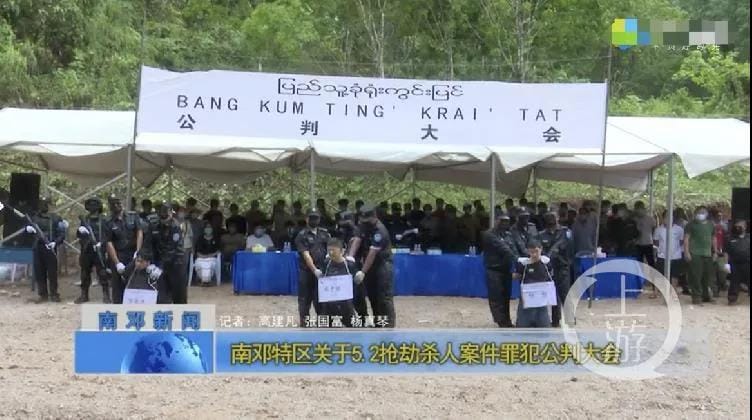
    Three Chinese nationals were executed in a public sentencing rally in Wa State, a Chinese-speaking region in Northern Myanmar on May 14, 2020. Image credit: The Paper 
    In May 2020, a video clip featuring the execution of three men in a public sentencing rally in Wa State of Myanmar became a trending topic on domestic social media. The three executed men were Chinese nationals who had reportedly robbed a gold shop and murdered the owner. While calling on the public to obey laws and customs overseas, Chinese news media sources appear to have expressed shock that the shaming ritual was replicated in Myanmar even though it has “long vanished in China.”
    Historically, public sentencing rallies were widely used in and outside China to crush political opponents and consolidate the power of the ruling class. In the first three decades of the People’s Republic of China, mass rallies served to educate the public about the errors of class enemies, including Kuomintang members and landlords.
    While there are signs that these rallies have fallen into disuse in recent years, they continue to take place in some localities where they target drug offenders and members of organized crime. In these rallies, which continue to serve as propaganda to “frighten criminals, educate people, and maintain social stability,” judges hand out mass sentencing and mete out harsh punishments, including death sentences. Because of the nationwide lockdowns and stringent social distancing measures accompanying China’s zero-COVID policy in the two full years since 2020, the rallies that are typically held in large public venues like plazas, stadiums, and auditoriums in front of crowds numbering in the thousands seemingly vanished from public sight.
    However, Chinese government sources continued to report on small rallies that have been convened. Many of these rallies appeared no different from regular court trials when they were held indoors or virtually with no or limited public attendance. Regardless of the forms and scale, Chinese courts continue to retain the campaign-style rallies which legal experts have decried for years, arguing that the rallies disregard the presumption of innocence and mainly serve to shame prisoners.
    Indoor & Virtual Rallies 
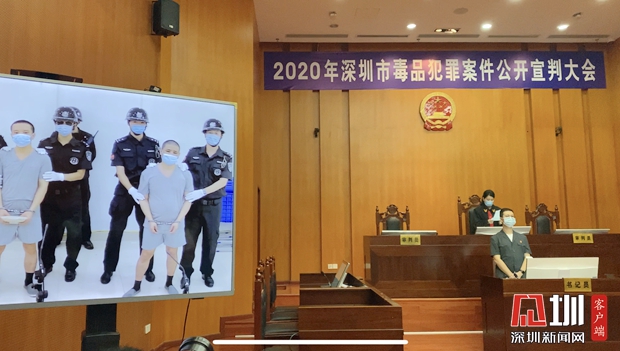
     
    A group of 14 drug traffickers were sentenced in what a Shenzhen court called a “public sentencing rally” on June 23, 2020. Image credit: Shenzhen News Network website
    Public sentencing rallies have long been integral to showcase the government’s efforts to combat drug crimes on the International Day against Drugs and Illicit Trafficking, observed annually on June 26. The date is of special significance in China as it serves to commemorate Lin Zexu, officially lauded as an anti-opium hero for dismantling the opium trade in Guangdong before the First Opium War in 1839.
    China continued to feature a series of high-profile public sentencing rallies on the International Day against Drugs and Illicit Trafficking amid the outbreak of the pandemic. In Shenzhen, a rally was held on June 23, 2020 to announce the death sentences of two traffickers of methamphetamine. The sentences had previously been determined by the Shenzhen Intermediate People’s Court and subsequently approved by the Supreme People’s Court. On the same day, the intermediate court also publicly sentenced ten people involved in a drug case.
    Unlike a widely reported rally in Lufeng County, Guangdong, where two courts sentenced 10 criminals to death in front of tens of thousands of people including children on December 16, 2017, the 2020 Shenzhen rally was not attended by any public spectators due to the stringent social distancing measures and anti-pandemic curbs at the time. The rally took place instead in a courtroom where only a judge and a clerk could be seen, according to an online video published on the Shenzhen News Network website. None of the defendants appeared in front of the judge to receive judgments. They were seen in a synchronous video in Shenzhen No.2 Detention Center wearing face masks, handcuffed, and escorted by security guards while the judge announced the death sentences.
    The duo was executed on the same day immediately after the rally ended. In the same rally, the judge announced that another drug trafficker was sentenced to life imprisonment and that ten other defendants were convicted of manufacturing, selling and transporting drugs, and illegal possession of firearms.
    Courts outside of Guangdong have also been eager to convene sentencing rallies in campaigns against drug abuse on or before the International Day Against Drug Abuse and Illicit Trafficking. In 2021, the Dandong Intermediate People’s Court of Liaoning Province held a rally in a courtroom where 13 handcuffed drug offenders stood in front of the judge in a courtroom to receive prison sentences ranging from nine years’ imprisonment to death with a two-year reprieve. A post published on the Liaoning High Court website claimed that the rally, which was attended by less than two dozen spectators, manifested “a high-pressure crackdown on drug crimes, effectively suppressed the arrogance of drug criminals, and contributed to the construction of a harmonious and safe Dandong.”
    Four defendants received judgments in a public sentencing rally convened by the Pingnan County People’s Court of Guangxi Zhuang Autonomous Region as part of the campaign to combat environmental pollution. Photo image: Pingnan County People’s Court website
    It must be noted that sentencing rallies are not exclusively used against drug traffickers. In May 2021, a local court in Guangxi convened a virtual rally for four people convicted of illegally disposing of hazardous substances. As with the 2020 Shenzhen rally, the defendants received their judgments via video while handcuffed in a detention center. This rally was held as part of the open day organized by the Pingnan County People’s Court to educate the public about environmental protection. It was sparsely attended by only 12 people from the local community, according to information provided by the court website.
    200-Spectator Rally in Yancheng, Jiangsu 
    Twenty-two criminal suspects were hauled into a sentencing rally attended by over 200 people in Yancheng, Jiangsu on October 28, 2020. Image credit: China Central Television 
    Despite the onerous zero-COVID measures that were in full swing in 2020, public attendees were occasionally allowed to take part in sentencing rallies of a smaller scale. The Yancheng Intermediate People’s Court in Jiangsu Province invited over 200 people from the National People’s Congress, members of the Chinese People’s Political Consultative Conference, journalists, village cadres, and resident representatives to the rally in Longgang Township on December 28, 2020. The 22 defendants manufactured banned substances including hydroxylamine hydrochloride, chlorophenyl, hydrochloric acid, and toluene. They could be seen wearing white hazmat suits with face masks while receiving judgments in front of the judge and the spectators.
    Of the 22 defendants, three were sentenced to death with a two-year reprieve. Each of them was accused of selling methamphetamine weighing 4,000 to 6,000 grams (about 8.82 to 13.23 pounds). The other defendants received prison sentences from 22 months to 11 years for manufacturing hydroxylamine hydrochloride totaling 1,106 grams (about 2.44 pounds).
    Student Spectators in Hainan 
     
    (Top to bottom) Dozens of Hainan school students, all seen wearing uniforms and face masks, sat in rows in a public sentencing rally held at the Danzhou District People’s Court on April 24, 2020. Image credit: The Paper
    As public sentencing rallies serve as sites of expressive punishment, teenage students are also required to attend such events as part of their legal education (法制教育). Images published by the Hainan court website show dozens of students in school uniforms sitting in rows to watch nine drug defendants receive prison sentences from ten months to 15 years’ imprisonment on April 24, 2020. The defendants were accused of selling large quantities of ecstasy and other counterfeit drugs.
    It was not the first time young students were required to watch public sentencing rallies. In June 2018, two drug dealers received death sentences in Haikou in front of hundreds of people, many of whom were students wearing school uniforms. The duo was executed following the rally. The executions took place elsewhere at a designated venue, so the students did not witness the actual executions.
    Outdoor Rally in Guangxi against Gangland Crimes 
    Traditional sentencing rallies held in large outdoor public spaces did not entirely vanish during the pandemic. On June 28, 2020, an outdoor rally was held in Donglan County, Guangxi, to publicly arrest and sentence gangland criminals. The rally was not held in a courtroom but in a sports stadium. Available sources did not state how many spectators attended, but the image below shows rows of police officers alongside dozens of public spectators. At the back of the crowds, criminal suspects and defendants stood in a row in front of the judge’s podium. They could be seen wearing the typical white hazmat protective suits and facing the group of public spectators.
    An outdoor rally in Donglan County, Guangxi, on June 28, 2020, during which alleged criminals were publicly arrested and sentenced. Image credit: Wei Hao / Weixin 
    Efforts to ban public executions 
     
    China’s decision to ban public executions dates back to 1979, while “perp walks” for sex workers were banned more recently in 2010. The Supreme People’s Court, Supreme People’s Procuratorate, Ministry of Public Security, and Ministry of Justice jointly issued notices in 1984 and 1986 prohibiting public parades before executions, saying that such events provided opportunities for overseas counterrevolutionary propaganda to “slander” China.
    Public executions (as well as the broader use of capital punishment) were thought to be one of many human rights-related objections to China’s bid to host the 2008 Summer Olympics in Beijing, a point Dui Hua executive director John Kamm recalled in a 2010 Washington Post op-ed. In the run-up to the opening of the Games, another joint opinion was issued in March 2007 to prohibit public parades before executions as well as to enforce the rights of the executed, including last visitation rights for the family. Criminal Procedure Law also stipulates that while the public should be notified of executions, the execution itself should not be held in public.
     
    Going Forward 
    Over the years, legal experts have spoken out against public arrests and sentencings, branding them “campaign-style justice” that emphasize swift and severe punishment. However, the general public tends to empathize with the need to deter crimes by publicly shaming the offenders. In its seventh annual report, the Collaborative Innovation Center of Judicial Civilization released its latest data collected over 24,354 surveys across 31 provinces, municipalities, and autonomous regions. It finds that over 62.5 percent of respondents expressed support for public arrest and sentencing rallies in 2018. The following year, the approval rate declined to 55.5 percent but bounced back to 61.3 percent in 2020-2021. Of them, 19.1 percent in 2020-2021 expressed strong support for retaining the practice, lower than 23.7 percent in 2018 but higher than the 15.8 percent in 2019.
    A public trial is intended to boost transparency by informing the public about who the accusers are, the nature of the charges, and the evidence against the accused. It is fundamentally different from a public sentencing rally — a form of show trial where the judgment and sentence of a criminal case already determined in court is publicly announced in front of crowds of public spectators. Such rallies serve a political agenda to demonstrate the government’s determination to fight crimes, blame and shame criminals, and educate the public about their alleged crimes. In response to a controversial sentencing rally held in Langzhong, Sichuan, in 2016, Professor Yu Qilin of China University of Political Science and Law remarked that trial fairness and justice is maintained through procedure transparency in the courtroom, not public spectacle.
    The use of public sentencing rallies to shame the accused appears to be on a downward trend in recent years thanks to China’s strict adherence to the hard-line zero-COVID policy. A decade ago, people accused of endangering state security, terrorism, and religious extremism in Xinjiang, as well as well as “wild imams” who preached illegally in the restive region, were condemned in front of crowds of thousands. At the very least, the rallies discussed in this post were downsized and used in a narrower scope to target drug traffickers and members of organized crime. Additionally, individuals shamed in the rallies were no longer seen wearing confessional placards or driven through the streets in open trucks.
    The practice of public shaming never really vanished even when strict pandemic measures were in force. On December 28, 2021, four men accused of smuggling people across an international border were publicly shamed in Guangxi. They were flanked by police officers and paraded through the streets of Jingxi City. Although authorities claimed that the parade served as a warning of what could happen if people violated the pandemic curbs, a Beijing News editorial remarked that “the measure seriously violates the spirit of the rule of law and cannot be allowed to happen again.” With the lifting of pandemic curbs following nationwide protests in late 2022, it remains to be seen whether large-scale sentencing rallies will reemerge.
  • Patriotic Acts as Cause for Non-Prosecution

    Patriotic Acts as Cause for Non-Prosecution

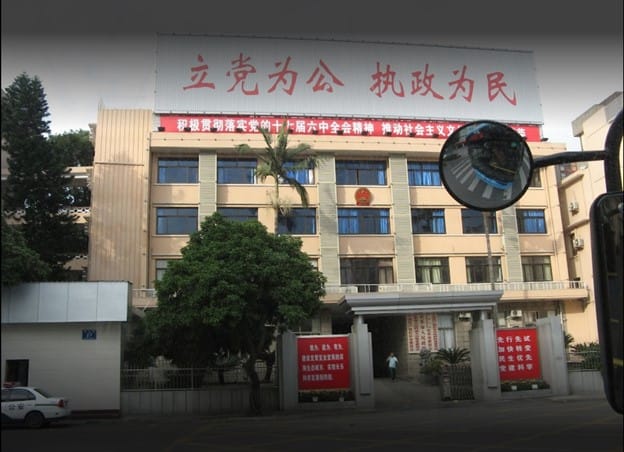
    Changle government building. Image credit: Google images
    Chinese prosecutors have the discretion not to indict an accused when the evidence is insufficient or when his/her perceived threat to society is minimal. However, these are not necessarily the most important reasons. Dui Hua’s research found that criminal suspects deemed patriotic can also avoid prosecution in mainland China.
    China’s long-time conviction rate of over 99.9 percent often overshadows the judicial progress it has made in other areas. While the acquittal rate dipped to its lowest point at 0.052 percent in 2021, Chinese prosecutors have approved fewer arrests and indicted fewer suspects in recent years. Statistics released by the Supreme People’s Procuratorate in March 2022 indicated that the country’s non-prosecution rate increased from 9.9 percent in 2019 to 16.6 percent in 2021.
    Non-prosecution embodies the lenient aspect of China’s largely punitive criminal justice system. Among the major beneficiaries of non-prosecution are juvenile delinquents, the elderly, severely ill, first-time offenders, and pregnant and breastfeeding women. Prosecutors can also exercise discretion and choose to not indict suspects if they have made “major contributions to the state or society” or performed “meritorious deeds.” Existing laws and regulations leave undefined what acts are considered “major contributions,” but the following case Dui Hua discovered concerning a Hong Kong “patriot” provides insight into this term.
    On October 21, 2019, the Public Security Bureau of Changle District, Fuzhou, decided not to prosecute a Hong Kong resident surnamed Chan. The bureau carried out criminal detention in December 2013 and listed Chan as a wanted criminal online on June 18, 2014. Chan was suspected of “organizing an illegal border crossing,” for allegedly forging identity documents for a group of 11 Chinese nationals in their applications for tourist visas at the US Consulate in Guangzhou. Their application was unsuccessful because the documents were found to be counterfeit by the consulate staffers.
    Chan flew back to Fuzhou from Hong Kong and turned himself in on October 14, 2019, six years after his alleged offense took place. That same day, Chan was released on bail pending further investigation. About a week later, the procuratorate issued a non-prosecution decision, citing the various patriotic acts he had performed in Hong Kong.
    Fuzhou Changle International Airport. Chan flew here from Hong Kong before turning himself in, six years after his alleged crime. Image credit: Fuzhou Changle International Airport
    First among these acts, Chan served as the then-incumbent executive vice president of the Hong Kong Family Union (New Territories West Branch), a pro-China non-governmental organization which helps mainland residents to emigrate to Hong Kong. During his tenure, Chan allegedly organized and participated in multiple activities to promote love for the motherland and Hong Kong. Chan was given credit for carrying out stability maintenance and secret investigation work for the Hong Kong Liaison Office during “Occupy Central,” the civil disobedience movement which paralyzed parts of Hong Kong for 79 days in late 2014.
    On October 13, 2014, protestors camp out in the streets of Hong Kong as part of the Occupy Central movement. Image credit: L-BBE / CC BY 3.0
    Furthermore, Chan was commended for performing security work for the official celebrations marking the 20th anniversary of Hong Kong’s handover to Chinese rule in 2017, the only year Xi Jinping attended the handover celebrations in the former British colony as Chinese president, as of this writing. More notably, Chan was cited for his “fearless” and “tenacious struggle” against the “radical opposition forces” during the recent 2019 protests, as well as his unified actions in supporting the Hong Kong government. The decision not to prosecute Chan came as Hong Kong protesters fought citywide pitched battles with police in an eruption of public anger against an already suspended extradition bill that critics saw as a fundamental threat to the former British colony’s civic freedoms and rule of law.
    Prosecutors also outlined other reasons for not indicting Chan, but the arguments are not without flaws. For example, one reason for not indicting Chan is because he turned himself in even though he did so six years after the public security bureau carried out criminal detention. Additionally, it was argued that the seriousness of Chan’s crime was mitigated because his attempt to organize illegal crossings failed. Chan did not complete the crime; he only attempted to commit it, argued the prosecutors. Even with this reasoning, it is unclear why the prosecutors did not charge Chan with forgery, covered by Article 280 of the Criminal Law, since the non-prosecution decision found that Chan did indeed forge identity documents for 11 Chinese nationals.
    The crime of organizing illegal border crossings is known to incur serious penalties. Dui Hua previously reported that the crime resulted in Korean missionary Cho Young-joo getting a seven-year prison sentence. Cho was not given lenient punishment for the humanitarian mission he conducted across the Yunnan-Myanmar border. Prominent house church leader Cao Sanqiang (曹三强) has more than a year to serve before completing his seven-year prison sentence in Yunnan for the same crime. Also convicted of the same crime are two Hong Kong anti-extradition bill protesters who attempted to flee to Taiwan by speedboat but were intercepted by mainland coastguards in August 2020. The duo is still serving their sentences in Guangdong.
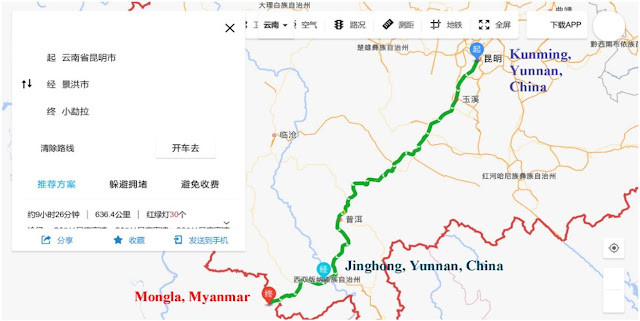
    Map showing the route (in green) from Kunming to Jinghong, from where Cho intended to travel to Mongla. Source: Gaode Map
    The treatment given to Chan was vastly different to that of Cho, Cao, and two of the Hong Kong 12, despite all of them being accused of organizing illegal border crossings. Chan’s preferential treatment calls into question whether “patriots” enjoy impunity for the criminal offenses they committed in mainland China. This raises speculation that Chan is not the only case of prosecutors dropping criminal charges against the so-called “patriots” because of meritorious services rendered in Hong Kong, China, or elsewhere.
  • China’s National People’s Congress May Expand Legal Aid in Death Penalty Cases

    China’s National People’s Congress May Expand Legal Aid in Death Penalty Cases

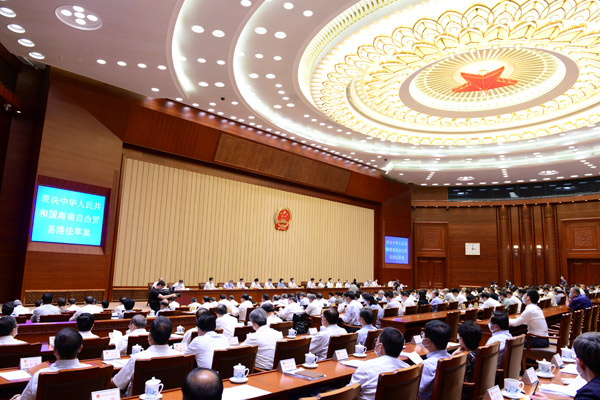
    The closing ceremony of the 29th session of the 13th NPC Standing Committee on June 10. Image credit: NPC.gov

    China’s National People’s Congress is considering a new Legal Aid Law. Among its many provisions, Article 24 of the new law would extend access to legal aid to condemned defendants during final death penalty case review at the Supreme People’s Court.

    China’s legal system already provides legal aid to defendants in the trial phase of death penalty proceedings. However, legal aid does not currently cover the crucial final death penalty review stage of China’s capital punishment process: death penalty review at the Supreme People’s Court. Capital defense lawyers have dubbed the lack of legal aid in death penalty review the “last mile problem” of Chinese capital defense. The new law would finally address this last mile, bringing death penalty review under the scope of legal aid and guaranteeing universal representation during all stages of capital proceedings.

    The law would also improve the quality of death penalty counsel at both trial and review. The draft law mandates that legal aid lawyers representing clients in cases carrying a possible sentence of death or an indeterminate life sentence have at least three years of legal practice experience.

    The Development of the Legal Aid Law  

    If enacted, the new Legal Aid Law will be China’s first comprehensive legislation on legal aid. Up until now, China’s legal aid has been governed by State Council Regulations. Implementation of the regulations takes place at a local level, and the quality of legal assistance has been uneven. Critics charge that low funding, low status, and lack of oversight lead to substandard representation in many legal aid cases. The new law earmarks funds and sets new standards in an attempt to address these problems.

    In recent years China’s leaders have signaled their intention to overhaul state legal aid as part of the Xi administration’s comprehensive effort to increase “governance through law.” In 2015 the CCP issued “Opinions on Improving the Legal Aid System,” a policy statement setting an agenda for improvements across the legal aid system. The document placed special emphasis on capital cases, including a call for legal aid in death penalty review cases. The 2015 opinion also called for an expansion in criminal representation generally, including the use of duty lawyers—criminal attorneys who can provide basic on-site legal advice at detention centers and courts. In 2018 the Supreme People’s Court and the Ministry of Justice issued “Measures on Launching the Pilot Program for Full Coverage of Lawyers’ Defense in Criminal Cases.” That measure did not specifically provide for death penalty review representation, but it has improved standards and increased access to defense lawyers in all criminal cases.

    The new Legal Aid Law is currently under review at the National People’s Congress. The first draft of the new Legal Aid Law was released in January. A second draft was introduced for public comment in June. The second draft notably improves upon the first by including an additional provision specifying that appointed legal aid counsel must have at least three years of experience in all death penalty review proceedings and trial cases carrying the possibility of an indeterminate life sentence or death sentence.

    Legal Aid and Death Penalty Review 

    Death penalty review is the final stage of legal proceedings in China’s capital punishment system. A capital defendant in China initially undergoes a trial of the first instance, typically at an intermediate court. If found guilty, the defendant faces a trial of the second instance, typically at a provincial high court. Following a capital sentence in a second instance trial, the condemned defendant’s case will undergo a final death penalty review. In 2007 the Supreme People’s Court retook the authority to perform death penalty review from provincial courts as part of its sweeping efforts at death penalty reform. Since that time, all death penalty review proceedings have been handled by the Supreme People’s Court in Beijing.

    The Supreme People’s Court has not previously recognized a universal right to legal aid in its death penalty review proceedings. China’s Criminal Procedure Law (Art. 35) requires the provision of a legal aid lawyer in cases in which defendant faces an indeterminate life sentence or death sentence. This provision should logically extend to death penalty review. However, the Supreme People’s Court has declined to apply this provision in death penalty review.

    The conference on providing legal aid for death penalty review. Image credit: Southern Metropolitan
    Currently condemned defendants may choose to hire counsel for the proceedings; however,  if they do not do so, the state will not provide a lawyer for them. While official death penalty review data is a state secret in China, the available evidence indicates that under the current system—in which legal representation at the review is not mandatory and a defendant must hire an attorney privately—most condemned defendants do not retain a lawyer for the proceedings.

    Experts Debate the Draft Law 

    On March 27 a group of 20 scholars and lawyers in China came together to discuss the implications of the death penalty review representation provision contained in the new Legal Aid Law. The conference was hosted by China University of Political Science and Law and Shangquan Law firm, a leading criminal defense firm in Beijing. Conference participants noted both the promise of the new legal aid law and the deficiencies that still exist in death penalty in China.

    Defense lawyers pointed out that while universal legal representation in death penalty review is an important legal development, obstacles to lawyer engagement with death penalty review proceedings hinder the substantive impact of the new law. For example, although death penalty review judges are legally mandated to meet with defense counsel, attorneys report difficulty in arranging these meetings. Lawyers also report difficulty accessing casefiles, and often end up taking pictures of documents on their phones because they cannot get copies.

    Scholars at the conference expressed concern that the expansion of legal aid to death penalty review might carry unexpected consequences for the legal market: legal aid lawyers assigned to death penalty review cases may lack experience and qualifications for this technical work, and the provision of these lawyers may also crowd out competent private lawyers who currently focus on death penalty practice. It is therefore important that the legal aid system provide sufficient compensation for this representation and also establish qualifications for death penalty review representation. The second draft of the Legal Aid Law, which was released subsequent to the conference, goes some way to addressing this concern by providing that legal aid counsel in both capital trial and death penalty review cases must have more than three years of related practice experience. Standing committee representatives also included a suggestion to include legal aid costs in the government budget, beginning at the county level. However, it is unclear whether death penalty review at the SPC would be covered by such a measure at the national level.

    Since the Supreme People’s Court retook the power of death penalty review in 2007, the Shangquan law firm in Beijing has been conducting empirical work on death penalty review representation. This work has included pro bono death penalty review representation in the past. At the conference, Shangquan law firm director Mao Lixin formally announced a new pro bono program that will provide pro bono representation for indigent condemned defendants facing death penalty review. The program was intended to run through March 2021, or until the new Legal Aid Law goes into effect.

    By Tobias Smith 

  • From Hu to Xi: China’s Grip on Environmental Activism: PART II: Environmental Activism from Above and Below

    Environmental Activism from Above and Below
     

    In Part 1 of this series,  Dui Hua analyzed a decade of environmental activism, both mass protests and individual actions, and the price paid by those trying to protect the environment. In Part 2, Dui Hua looks at civil society engagement in activism to protect the environment, and China’s shrinking space for the work of environmental NGOs.

    Civil Society

    The concept of environmental non-governmental organizations (ENGOs) was entirely foreign to China until, in the nation’s first bid for the Olympic Games in 1993, its delegation was asked by the International Olympic Committee whether China had ENGOs. A year later, China’s first ENGO, Friends of Nature, formerly known as The Academy for Green Culture, was formally incorporated. Both grassroots and foreign-funded ENGOs thereafter emerged, and provided help for victims stricken by environmental disasters.The most famous of these
    were the deadly floods along the Yangtze River in 1998, caused by deforestation, and
    the Nu River hydropower project, which would have flooded a natural UNESCO site
    on the lower reaches of the river in Yunnan, had then-prime minister Wen Jiabo
    not put a dam-building moratorium on the river due to ecological concerns.

    An early criminal case involving six villagers, all surnamed Ye, who joined an environmental non-profit organization did not garner the attention it deserves. The leading members were sentenced in 2010 to 6-18 years’ imprisonment for multiple violent offenses, including organizing/leading an organization of a gangland nature. The case took place in Guangdong’s Huangshawei Township, not far from another township well-known for ceramics, where a clay quarry began operation in 2008. Southern Farmer’s Daily reported that half of the quarry sites were illegal and over 300 haul trucks without mechanical covers passed through Huangshawei Township every day, causing both safety hazards and considerable dust pollution. As government officials refused to take measures to protect the villagers, the villagers set up The Huangshawei Education Foundation in July 2009 to defend their environmental rights. The foundation used its funds to provide subsidies to affected villagers and hired armed road guards to intercept haul trucks. Within two months of its founding, the foundation successfully pressed the local government and quarry operation for compensation over pollution. In October 2009, a verbal argument turned into a group brawl after the foundation members intercepted a haul trucker who refused to use a mechanical cover. The foundation was then labelled a “gangland” organization and the compensation it had received from the government was cited as evidence of extortion. In 2017, a Chinese government response provided to Dui Hua confirmed that one of the foundation members, Ye Bailian (叶百练), received three sentence reductions, 32 months in total between 2013 and 2017. Ye is now scheduled for release on May 6, 2025.
    According to Southern Farmer’s Daily, similar environmental rights groups emerged in four nearby villages after The Huangshawei Foundation was founded in 2009. While it is unclear whether they all suffered the same fate, the fact that all of them targeted the same clay mining operations reflected a growing trend in grassroots environmental consciousness. Over the two decades since 1994, there was an exponential growth in ENGOs nationwide. The number had grown from just nine in 1994 to 8,000 in 2017, according to Gulf News, citing the French Embassy in Beijing. ENGOs were said to have enjoyed an unusual degree of freedom – many, in fact, were co-funded by local governments to evaluate the environmental impact of factories and even to critique public policy.
    Nonetheless, Xi Jinping has tightened his grip on environmental activism, particularly since the Foreign NGO Law came into effect in 2017. The law requires all foreign NGOs to abide by strict requirements related to funding sources and registration procedures, which has sharply limited their ability to support or collaborate with Chinese NGOs, including ENGOs. Police can also question foreign NGO employees and seal off their assets and offices. While in 2016 there had been about 7,000 foreign NGOs active in China, according to former vice foreign minister Fu Ying, in January 2019 ChinaFile reported that the number of new foreign NGOs registering to work in China dropped from 303 in 2017 to only 133 in 2018. Of these, the number of ENGOs dropped from 36 to 13 (although the number of ENGOs applying for temporary registration increased from 39 to 71, very likely indicating efforts to work around the difficulties of registering to operate permanently in China.) While exact numbers vary according to different reports, the drop in registration from the beginning of 2017, when the law went into effect, is consistent across sources. An ENGO from the U.S. said of its work in China that “[w]e chose to stop all activities to avoid putting ourselves and partners at risk… it’s not like the law allows any wriggle room.”
    A poster of Green Leaf Action, an
    environmental group founded by Xue Renyi,
    calls on the Chinese government to improve
    food safety and air and water quality.
    Image Credit: Boxun
    Members of Green Leaf Action, a Chongqing-based environmental group that promoted food safety, clean air, and clean water, were among the first to face suppression for having “foreign connections.” In December 2016, founder Xue Renyi (薛仁义) was warned by police that his group was “controlled” and “manipulated” by overseas forces. Xue was later detained for picking quarrels and provoking troubles in May 2018, and in January 2019, Xue’s fiancée claimed that she had not been allowed to visit him in custody. Another active member of Green Leaf Action, Pan Bin (潘斌), was sentenced in December 2018 to four years’ imprisonment for the same offense.
    The case of Liu Shu (刘曙) indicates that environmental surveying can also be considered a state secret. In 2013, the Ministry of Environmental Protection called soil pollution information a state secret in a reply to a Beijing lawyer’s request to make the information public. Liu, founder of ENGO Shuguang Green, was accused of revealing China’s state secrets related to counterespionage work in October 2016. Liu collected soil and paddy samples to examine the level of heavy metal pollution in the waters of Lake Dongting, a shallow lake in northeast Hunan. One of her samples indicated that heavy metal pollution exceeded the national limits by 715 times. In January 2016, Liu wrote that the degree of freedom in the realm of environmental protection had significantly declined because she had faced repeated harassment in the three years since her ENGO came into operation in 2013. Liu was given a ten-day administrative detention by the Changsha state security bureau.
    Whistleblowers

    China appears to have encouraged the public to monitor environmental affairs in the “war on pollution” that began in early 2013. The initiative has the intended goal to hold local governments accountable by encouraging informers to report environmental violations. In 2015, substantive amendments were made to the Environmental Protection Law, which imposes harsher penalties against polluters and requires that enterprises disclose information about discharged pollutants and that authorities keep reports filed by whistleblowers confidential.
    But disclosing information concerning an imminent danger to public health, safety, or the natural environment remains a highly risky proposition. In March 2018, Lei Ping (雷萍) was accused of rumor mongering after she made complaints online about illegal quarrying and disposal facilities near a national-level conservation area in her hometown of Xinyi City, Guangdong. Lei volunteered for the government-funded non-profit China Biodiversity Conservation and Green Development Foundation. Lei Ping spent ten days in detention and she was released in part due to public outcry; the foundation had issued a public letter to police calling for her release. Sixth Tone, a sister publication of The Paper (澎湃), cited a Beijing-based lawyer specializing in environmental cases as saying that the handling of Lei’s case by police gave a bad impression to the public that informers were being punished to cover up private business violations.
    A group of protesters from Funing, Jiangsu, assemble in support of environmental whistleblower Ji Shulong. The banner says: “Xi Jinping, release environmental rights defender Ji Shulong. We want blue mountains and green waters, not mountains of gold and silver. Ji Shulong is innocent.”
    Image Credit: RFA 
    Independent whistleblowers without support from government-funded environmental groups are not as fortunate. Ji Shulong (嵇书龙) tipped off the environmental authorities in Beijing that a local government in Yangcheng, Jiangsu, planned to reintroduce Aoyang Industrial Park (Yancheng is the same prefecture-level city where the plant explosion mentioned in Part I occurred in March 2019). Aoyang is a chemical enterprise widely discredited even by domestic news media for causing severe pollution, and has previously been ordered to suspend production for environmental violations. Ji led a group of villagers to petition Beijing to request intervention from the central government after Aoyang seized and converted approximately 130,000 square meters (32 acres) of farmland into a landfill. Ji continued her efforts to expose Aoyang’s environmental violations after completing her two-year sentence for picking quarrels in 2014. In October 2017, Ji was re-detained for the same offense, and remains incarcerated after spending 21 months in custody at the time of writing.
    Zhang Wenqi (张文奇) is yet another case highlighting how people who expose wrongdoing on
    environmental issues are given insufficient protection and subjected to
    retaliation
     . In July 2018, Zhang was sentenced to 17 months’ imprisonment for damaging business reputations and causing financial losses to three companies in his home province of Henan, even though the environmental authorities had verified Zhang’s complaints. Having worked for a Shanghai-based biochemical technology company, Zhang is well-informed about the environmental impact caused by crystal violet lactone (CVL), a dye used in carbonless copying paper. In 2014, Zhang found pollutants such as ammonia and heavy metals in the gases and solid waste discharged by the two manufacturers of CVL in Henan, and witnessed the companies illegally dumping waste near the industrial zone. Both manufacturers were connected to the same parent paper company, a major taxpayer in Wuzhi County. Unconvinced by the Ministry of Environmental Protection’s 2015 investigation that rebutted Zhang’s complaints that the companies were manufacturing CVL, Zhang continued to file anonymous reports against environmental violations. A year later, the Henan provincial environmental bureau confirmed Zhang’s allegations and ordered the companies to terminate CVL production. In March 2017, however, Zhang was detained for using a fake identity to fabricate the accusations against the companies over the past three years for personal gain. In a document submitted to the court, the parent company claimed that Zhang’s allegations had cost them a financial loss of 800,000 yuan, even though the defence lawyer claimed that the amount had not been independently verified by auditors.
    Despite the positive publicity Xi has received for his stated commitment to “ecological civilization,” the term is in fact not Xi’s own creation. It was first coined by Hu Jintao in 2007 as a guiding principle to cure environmental woes associated with China’s biggest and fastest industrial revolution in the world. From Hu to Xi, both regimes have made commitments to climate change targets and rolled out a number of corresponding measures to curb pollution. However, an article from The National Bureau of Asian Research (NBR) in 2014 argued that there was an apparent gap between rhetoric and reality in China’s air pollution control, due to an absence of a robust legal system, a free press, and an active civil society.
    After years of government-driven environmental efforts, China remains the world’s biggest polluter. It emits more carbon dioxide than the U.S. and EU combined. NBR explained that historical precedents have demonstrated that people who bore the direct consequences of pollution provided the driving forces of environmental reform. A top-down approach to environmental governance could not succeed in bringing about substantive changes without active assistance from below.
    Factors impeding the progress of grassroots environmental protection persist, or have even increased, in Xi’s “new era.” Xi shows few signs of tolerating individual rights to protest about environmental problems. His state security and NGO legislation have created an unfavourable atmosphere for environmental civil society, making activists who join independent groups more likely than ever to fall victim to state security charges. The cases discussed in this article also indicate that mechanisms intended to guarantee the safety of environmental whistleblowers are insufficient. To make meaningful progress in environmental protection both domestically and internationally, the Chinese government must reconsider its approach to environmental governance. It must respect human rights, because freedom of expression, assembly, and association are indispensable to the protection of public health and the environment.
  • Complaints with Retribution: China’s Muffling of Gaoyangzhuang

    Hong Kong-based pro-Beijing newspaper Wen Wei Po accuses democratic legislators and organizers of Occupy Central, including Joshua Wong, of making complaints overseas about internal affairs of China and Hong Kong. Photo credit: Wen Wei Po
    China celebrates National Youth Day every year on May 4th, a holiday commemorating the patriotic May Fourth Movement in 1919. On this day exactly a century ago, thousands of university students assembled at Beijing’s Tiananmen Square, urging the Chinese delegation at the Paris Peace Conference not to sign the Versailles Treaty because the Allied Powers had conceded to Japan’s demand to take over the German concessions in Shandong. The procession proceeded to foreign embassies in the Legation Quarter to demand nullification of special foreign privileges, such as extraterritoriality. This was a privilege by which China was forced to yield control of sovereign powers, one of many losses as part of a series of “unequal treaties” in force since the First Opium War. Student protesters hoped that the United States would side with China over the “Shandong question,” because the U.S. was a key proponent of national self-determination and the U.S. embassy was the only foreign embassy willing to meet with their representatives and accept their petition.

    A century later, the patriotic act of petitioning westerners known as gaoyangzhuang (告洋状) carries a negative connotation. Petitioning refers to the administrative system for receiving complaints from people with grievances, mostly concerning corrupt officials. While China guarantees the right to complain so long as petitioners do not bypass local authorities, the government does not tolerate the act of complaining to foreigners, in part due to the traditional notion of “not exposing family scandals.” Recent usage of gaoyangzhuang is often associated with Taiwanese president, Tsai Ing-wen, when she speaks to foreign diplomats and journalists about her rejection of Xi’s offer of the “one country, two systems” framework for reunification with the mainland. Li Jing-yu, wife of imprisoned Taiwanese activist Lee Ming-che (李明哲), has also been accused of gaoyangzhuang for criticizing China from overseas because she was prevented from visiting her husband, who is serving a five-year sentence in Hunan for subversion. The term is no less frequently used against Hong Kong democratic legislators, supporters and localists if they tell foreigners about Beijing’s tightening control over the former British colony.

    In Taiwan and Hong Kong, complaining about the Chinese government does not land individuals in legal trouble because both regions are independent jurisdictions. By contrast, critics on the mainland face imminent threat of loss of personal liberty. In August 2013, Global Times stated that petitioners, alongside exiled democracy activists and “splittist forces overseas” headed by the Dalai Lama and Rebiya Kadeer, were the major users of gaoyangzhuang. Petitioners were accused of taking part in a number of “illegal behaviours” such as wearing clothing traditionally associated with petitioning. These included, for example, signs hanging both down the petitioner’s front and back, waving banners, and chanting slogans at Beijing-based international organizations, such as offices of the United Nations and foreign embassies, with the intention to “create international influence” (zaocheng guoji yingxiang 造成 国际 影响). Unlike those in Hong Kong and Taiwan, petitioners on the mainland with assorted grievances, from forced demolitions to land disputes, are most likely to face reprisals for complaining to foreigners.

    Hu-Wen Era

    It is unclear when the term of gaoyangzhuang entered the official lexicon. An article originally published by Phoenix Weekly in January 2009 stated that the term began to come into vogue during the Hu Jintao and Wen Jiabao administration. China’s effort to improve its global image prior to the Beijing 2008 Olympics incentivized provincial governments to track gaoyangzhuang petitioners in Beijing. In 2005, a total of 37 people from Hubei were reported to have travelled to Beijing to make complaints to foreigners, compared to 77 people from Liaoning, which was ranked as the top fourth province nationwide. In the 19 months since July 2004, over 540 people in 50 different groups had filed complaints to the Beijing offices of UNHCR and UN Development Programme, according to statistics from the Sanlitun police station. A Liaoning official was quoted as saying that gaoyangzhuang “seriously damages the country’s reputation and external image” and “creates pressure on the capital’s social security and stability.” Another Shanghai official called gaoyangzhuang “despicable,” an act tantamount to “blackmailing the Chinese people.”

    A Hebei government directive in 2007 states that gaoyangzhuang petitioners adversely affect Beijing’s social stability and vilify the national image. Underlining added by Dui Hua Foundation. Photo credit: Boxun
    Public censure achieved little to deter petitioners from complaining about local governments to foreigners. In view of this, provincial public security, procuratorial offices, and courts started to jointly push for punitive measures. Anhui was among the first to release an opinion in 2006, listing foreign embassies and international organizations as “key areas” for stability maintenance alongside the central organs of the Chinese Communist Party, and subjecting anyone who disturbed social order to punishment in accordance to the Public Security Administration Punishments Law.

    Government officials are keen to suppress gaoyangzhuang because they use low rates of gaoyangzhuang as an indicator of good governance. A performance appraisal document in Shihu Township, Jiangsu, in 2011 categorized the prevention of gaoyangzhuang under the section appraising “critical stability control” (zhongdien weiwen 重点维稳) during “sensitive days” (such as certain national holidays and anniversaries of events that are likely to inspire protests and other forms of public political expression); the section carries two evaluation points. Each occurrence of gaoyangzhuang leads to a deduction of half a point. Similar assessment mechanisms likely existed before 2011, since the 2009 Phoenix Weekly article mentions that local public security bureaus in Henan, Shanghai and Liaoning had publicized cases of petitioners apprehended or detained for gaoyangzhuang.

    In the run-up to the 2008 Olympics, both official usage of the term gaoyangzhuang and punitive measures proliferated. In June 2007, an official in Heilongjiang’s Datong District called for “detaining or giving re-education through labor (RTL)” to gaoyangzhuang petitioners before resolving their problems. Petitioners would have to pay for all expenses the government incurred for handling their petitions if deemed “unreasonable.” In January 2008, an opinion from Hebei called gaoyangzhuang an “irregular form of petitioning to Beijing” (feizhengchang jinjing shangfang非正常进京上访) and a “serious breach” of the petition regulations. The opinion recommended that public security directly detain or give RTL to gaoyangzhuang petitioners without the need to give prior admonishment or warning. In March, Liaoning followed suit and issued a similar opinion to crack down on gaoyangzhuang petitioners.

    Nor did the crackdown on gaoyangzhuang relax in the wake of the Beijing Olympics. A local government directive issued in 2009 continued to blame gaoyangzhuang petitioners for “complicating simple issues, internationalizing and politicizing domestic problems” by means of “creating international influence.” Throughout the year, a total of 2,862 gaoyangzhuang petitioners were caught in Chaoyang District, Beijing, and, of these petitioners, 1,118 were detained. In February of that year, then-Secretary of State Hillary Clinton visited China. Zhao Chunhong (赵春红) led a group of petitioners to put up a banner welcoming Clinton and called on Nancy Pelosi (scheduled for a separate visit in May of 2009) to put pressure on China over its human rights records. Zhang was subsequently sentenced to three years’ imprisonment for “picking quarrels and provoking troubles.”

    About half a year before Xi’s rise to power in 2012, blind activist Chen Guangcheng (陈光诚) made a daring escape from house arrest to the U.S. embassy. In May, Chen and his family left China for New York. Some mainland observers opined that the episode had emboldened petitioners to make complaints to foreigners in the belief that the Chinese government would ultimately address their problems. On May 8, 2012, elderly petitioner Nie Muni (聂木妮) and his wife attempted to “barge into” the U.S. embassy, but were intercepted by the embassy guards and taken to the Jiujingzhuang Reception Center in Beijing, an unofficial detention center where petitioners are held. In an interview with Voice of America (VOA), the couple said they wanted to “beat drums and cry injustice” (jigu mingyuan击鼓鸣冤) at the U.S. embassy because the U.S. “gives people a sense of trust and respect for human rights and dignity.” They claimed to have been inspired by Chen, who received medical treatment from the Chinese government after he escaped to the U.S. embassy.

    Xi’s Regime

    Despite the abolition of RTL in 2013, many gaoyangzhuang petitioners have not fared any better. They are now more likely to be convicted of “picking quarrels and provoking troubles,” which carries a maximum sentence of ten years. In 2013, over a dozen petitioners from Fuzhou, Fujian, started a series of gaoyangzhuang petitions in the hope that then-U.S. Ambassador Gary Locke would respond to their plight. In April of that year, they even planned to intercept John Kerry’s vehicle during his Beijing visit on the 13th. Upon learning that the Fuzhou government had dispatched large numbers of interceptors to Beijing, the group proceeded instead to Ambassador Locke’s residence, where they threw stacks of leaflets and some of them chained themselves to the front gate. The group of petitioners grew to over two dozen in July, but many were removed and collectively charged with “picking quarrels and provoking troubles.” Some of them were released on bail after several months in custody.

    Some of the Fuzhou gaoyangzhuang petitioners who attempted to complain about corruption and rights abuses in China to then-U.S. Ambassador Gary Locke in 2013. Photo credit: RFA
    Lin Yingqiang (林应强) continued his effort to petition Locke alongside a dozen of the Fuzhou petitioners into early November. After 15 months in criminal detention, Lin was sentenced to three years’ imprisonment in February 2015. The judgment stated that Lin circulated 68 blog posts about the “Fuzhou victims” to satisfy his greed in the name of “anti-corruption” and “whistleblowing.” Among these posts, two recounted his stories of “barging into” the American embassy, which were viewed over 9,000 times in 2013. A day after his November petition, he and other Fuzhou petitioners put up another blog post, entitled “Please Follow Fuzhou Petitioners Who Complained to Foreigners,” which was viewed 51,159 times within one month of posting. At least four other individuals surnamed Tang, Chen, Shi and He were sentenced to two and a half years for the same offense of “picking quarrels and provoking troubles.” According to a Fuzhou activist, the above-mentioned five Fuzhou petitioners were sentenced at three different locations on purpose, because putting all of them on the same trial would have attracted unwanted publicity to this significant gaoyangzhuang case.

    In February 2016, unofficial news media reported that the Ministry of Public Security would establish a “national petitioner database” as a preventive measure of stability maintenance. The database would not only track mainland petitioners, but also those who petitioned in Hong Kong, Macao, and Taiwan. An exit ban might be placed on the mainland petitioners, who also faced restrictions from entering various municipalities and cities. Public security would liaise with Chinese embassies to track and monitor petitioners who made complaints overseas.

    The petitioner database was created with the intention of curbing the rising number of petitioners who traveled abroad to voice complaints about the Chinese government, according to Bowen Press, citing an informed source. On September 25, 2015, dozens of petitioners attempted to intercept Xi’s motorcade at the end of the Obama-Xi meeting in Washington, D.C. One of them, a petitioner from Jilin, managed to stop Xi’s wife Peng Lijuan’s vehicle. Bowen reported that the incident had “frightened” Peng and made Xi “lose face.” The petitioner was taken away by police and his petition materials were subsequently received by officials from the Chinese embassy. In March 2016, another group of 50 gaoyangzhuang petitioners from 10 different provinces and municipalities were accused of “creating a nuisance” when Xi attended the Fourth Nuclear Security Summit, again in Washington, D.C. At the time of writing, Dui Hua is not aware whether the petitioner database has come into operation.

    Communicating with Foreign Media

    While petitioning is not the only channel for Chinese citizens seeking to publicize or change policies that they deem unfair, anyone who makes negative remarks about China to foreign media can face accusations of gaoyangzhuang. In May 2014, journalist Xiang Nanfu (向南夫) was detained for the offense of picking quarrels and provoking trouble, a charge stemming from his use of Boxun, a U.S.-based Chinese language news website, to “fabricate” news about organ harvesting and violent land grabs in China in exchange for article fees. It is worth noting that although Xiang was not a petitioner, Xinhua News called his act of “smearing” China in front of foreigners gaoyangzhuang.

    Lawyers, too, have been affected by Chinese government responses to communicating with foreign sources. There has been a growing trend of using administrative penalties against lawyers following the nationwide crackdown on Chinese lawyers and human rights activists that began on July 9, 2015. During the “Two Meetings” in March 2018, the Ministry of Justice (MOJ) warned lawyers not to give dissenting views on China’s constitutional amendment that removed Xi’s presidential term limit. A notice issued by a local justice bureau indicated that violators would have his/her license to practice revoked and be barred from resuming work for five years. The MOJ also explicitly warned lawyers not to give interviews to foreign media, including BBC, Voice of Russia, and American media outlets such as NBC, CBS, VOA, and Radio Free Asia (RFA). When asked by RFA about the health condition of his client Huang Qi, the webmaster of the legal rights website 64 Tianwang, in August 2018, defence attorney Liu Zhengqing apologized for not being able to give an interview because he was under a lot of pressure with regard to talking to foreign media. On December 25, 2018, Liu’s license to practice law was revoked.

    Critics in- and outside of academia frequently face harassment for speaking out to foreign media. On August 2, 2018, Shandong police broke into the home of retired professor Sun Wenguang (孙文广) while he was giving a phone interview to VOA. In the interview, Sun criticized Xi’s One Belt One Road initiative, urging Xi to spend more money in China instead of wasting money overseas on aid, loans and investments. Sun was put under house arrest for over 10 days.

    A recent case involving prison sentences for who spoke out to foreign media involved Tibetan language activist Tashi Wangchuk, who was sentenced to five years’ imprisonment for inciting splittism in May 2018. In 2015, Tashi Wangchuk gave interviews to The New York Times, in which he expressed worries about the disappearance of the Tibetan language, as the Chinese authorities have been prohibiting the use of Tibetan in spheres ranging from schools to commerce even on the Tibetan plateau. Tashi Wangchuk described China’s ethnic policy as a “systematic slaughter” of Tibetan culture. Speaking to foreign media was his last resort, because government bureaus had refused to lodge a petition for him. He had also been turned down by domestic media, nor could he bring a lawsuit against the language policy. Knowing full well of the risk of speaking to foreign media, Tashi Wangchuk stressed that he was not advocating for independence. He insisted that language rights are human rights protected by China’s constitution. However, the nine-minute film made by The New York Times was cited as evidence that landed Tashi in jail. Tashi is scheduled for release from a prison in Qinghai in January 2021.

    The frustration of those who apparently feel driven to complain to foreigners is succinctly described by a Caixin columnist who witnessed a gaoyangzhuang incident at the U.S. embassy in March 2014: a middle-aged petitioner holding two crutches, along with three people who appeared to have come from the countryside, were intercepted by a plainclothes officer after they ignored the warning that they would be arrested. Speaking from his own petitioning experience, the columnist wrote that the only response he received from the petition bureau was a receipt acknowledgement of his complaint, and despite an indefinite wait, his petition was never addressed. He guessed that gaoyangzhuang petitioners did not genuinely think they could succeed in obtaining redress from foreigners; they were simply trying their luck because they believed they had nothing more to lose by “speaking out against injustice” in front of foreigners.

    Many gaoyangzhuang petitioners who made this or similar assumptions, however, have been mistaken. The cases explored in this article demonstrate how those who complain about China to foreigners, including foreign embassies, visiting diplomats and leaders, and journalists, could very well face several forms of retribution. Not only are they stigmatized for “badmouthing” China, but they also face the risk of imprisonment for picking quarrels and provoking troubles, and even for the very serious crime of endangering state security in cases involving ethnic minorities.

    For more on petitioning in China, see also Dui Hua’s earlier reporting on the Beijing city government’s efforts to prohibit the use of “black security firms” and “black jails” to prevent petitioners from outside Beijing from coming to the capital to petition the central government, and, potentially, foreign actors.
  • Complaints with Retribution: China’s Muffling of Gaoyangzhuang

    Hong Kong-based pro-Beijing newspaper Wen Wei Po accuses democratic legislators and organizers of Occupy Central, including Joshua Wong, of making complaints overseas about internal affairs of China and Hong Kong. Photo credit: Wen Wei Po
    China celebrates National Youth Day every year on May 4th, a holiday commemorating the patriotic May Fourth Movement in 1919. On this day exactly a century ago, thousands of university students assembled at Beijing’s Tiananmen Square, urging the Chinese delegation at the Paris Peace Conference not to sign the Versailles Treaty because the Allied Powers had conceded to Japan’s demand to take over the German concessions in Shandong. The procession proceeded to foreign embassies in the Legation Quarter to demand nullification of special foreign privileges, such as extraterritoriality. This was a privilege by which China was forced to yield control of sovereign powers, one of many losses as part of a series of “unequal treaties” in force since the First Opium War. Student protesters hoped that the United States would side with China over the “Shandong question,” because the U.S. was a key proponent of national self-determination and the U.S. embassy was the only foreign embassy willing to meet with their representatives and accept their petition.
    A century later, the patriotic act of petitioning westerners known as gaoyangzhuang (告洋状) carries a negative connotation. Petitioning refers to the administrative system for receiving complaints from people with grievances, mostly concerning corrupt officials. While China guarantees the right to complain so long as petitioners do not bypass local authorities, the government does not tolerate the act of complaining to foreigners, in part due to the traditional notion of “not exposing family scandals.” Recent usage of gaoyangzhuang is often associated with Taiwanese president, Tsai Ing-wen, when she speaks to foreign diplomats and journalists about her rejection of Xi’s offer of the “one country, two systems” framework for reunification with the mainland. Li Jing-yu, wife of imprisoned Taiwanese activist Lee Ming-che (李明哲), has also been accused of gaoyangzhuang for criticizing China from overseas because she was prevented from visiting her husband, who is serving a five-year sentence in Hunan for subversion. The term is no less frequently used against Hong Kong democratic legislators, supporters and localists if they tell foreigners about Beijing’s tightening control over the former British colony.
    In Taiwan and Hong Kong, complaining about the Chinese government does not land individuals in legal trouble because both regions are independent jurisdictions. By contrast, critics on the mainland face imminent threat of loss of personal liberty. In August 2013, Global Times stated that petitioners, alongside exiled democracy activists and “splittist forces overseas” headed by the Dalai Lama and Rebiya Kadeer, were the major users of gaoyangzhuang. Petitioners were accused of taking part in a number of “illegal behaviours” such as wearing clothing traditionally associated with petitioning. These included, for example, signs hanging both down the petitioner’s front and back, waving banners, and chanting slogans at Beijing-based international organizations, such as offices of the United Nations and foreign embassies, with the intention to “create international influence” (zaocheng guoji yingxiang 造成 国际 影响). Unlike those in Hong Kong and Taiwan, petitioners on the mainland with assorted grievances, from forced demolitions to land disputes, are most likely to face reprisals for complaining to foreigners.
    Hu-Wen Era
    It is unclear when the term of gaoyangzhuang entered the official lexicon. An article originally published by Phoenix Weekly in January 2009 stated that the term began to come into vogue during the Hu Jintao and Wen Jiabao administration. China’s effort to improve its global image prior to the Beijing 2008 Olympics incentivized provincial governments to track gaoyangzhuang petitioners in Beijing. In 2005, a total of 37 people from Hubei were reported to have travelled to Beijing to make complaints to foreigners, compared to 77 people from Liaoning, which was ranked as the top fourth province nationwide. In the 19 months since July 2004, over 540 people in 50 different groups had filed complaints to the Beijing offices of UNHCR and UN Development Programme, according to statistics from the Sanlitun police station. A Liaoning official was quoted as saying that gaoyangzhuang “seriously damages the country’s reputation and external image” and “creates pressure on the capital’s social security and stability.” Another Shanghai official called gaoyangzhuang “despicable,” an act tantamount to “blackmailing the Chinese people.”
    A Hebei government directive in 2007 states that gaoyangzhuang petitioners adversely affect Beijing’s social stability and vilify the national image. Underlining added by Dui Hua Foundation. Photo credit: Boxun
    Public censure achieved little to deter petitioners from complaining about local governments to foreigners. In view of this, provincial public security, procuratorial offices, and courts started to jointly push for punitive measures. Anhui was among the first to release an opinion in 2006, listing foreign embassies and international organizations as “key areas” for stability maintenance alongside the central organs of the Chinese Communist Party, and subjecting anyone who disturbed social order to punishment in accordance to the Public Security Administration Punishments Law.
    Government officials are keen to suppress gaoyangzhuang because they use low rates of gaoyangzhuang as an indicator of good governance. A performance appraisal document in Shihu Township, Jiangsu, in 2011 categorized the prevention of gaoyangzhuang under the section appraising “critical stability control” (zhongdien weiwen 重点维稳) during “sensitive days” (such as certain national holidays and anniversaries of events that are likely to inspire protests and other forms of public political expression); the section carries two evaluation points. Each occurrence of gaoyangzhuang leads to a deduction of half a point. Similar assessment mechanisms likely existed before 2011, since the 2009 Phoenix Weekly article mentions that local public security bureaus in Henan, Shanghai and Liaoning had publicized cases of petitioners apprehended or detained for gaoyangzhuang.
    In the run-up to the 2008 Olympics, both official usage of the term gaoyangzhuang and punitive measures proliferated. In June 2007, an official in Heilongjiang’s Datong District called for “detaining or giving re-education through labor (RTL)” to gaoyangzhuang petitioners before resolving their problems. Petitioners would have to pay for all expenses the government incurred for handling their petitions if deemed “unreasonable.” In January 2008, an opinion from Hebei called gaoyangzhuang an “irregular form of petitioning to Beijing” (feizhengchang jinjing shangfang非正常进京上访) and a “serious breach” of the petition regulations. The opinion recommended that public security directly detain or give RTL to gaoyangzhuang petitioners without the need to give prior admonishment or warning. In March, Liaoning followed suit and issued a similar opinion to crack down on gaoyangzhuang petitioners.
    Nor did the crackdown on gaoyangzhuang relax in the wake of the Beijing Olympics. A local government directive issued in 2009 continued to blame gaoyangzhuang petitioners for “complicating simple issues, internationalizing and politicizing domestic problems” by means of “creating international influence.” Throughout the year, a total of 2,862 gaoyangzhuang petitioners were caught in Chaoyang District, Beijing, and, of these petitioners, 1,118 were detained. In February of that year, then-Secretary of State Hillary Clinton visited China. Zhao Chunhong (赵春红) led a group of petitioners to put up a banner welcoming Clinton and called on Nancy Pelosi (scheduled for a separate visit in May of 2009) to put pressure on China over its human rights records. Zhang was subsequently sentenced to three years’ imprisonment for “picking quarrels and provoking troubles.”
    About half a year before Xi’s rise to power in 2012, blind activist Chen Guangcheng (陈光诚) made a daring escape from house arrest to the U.S. embassy. In May, Chen and his family left China for New York. Some mainland observers opined that the episode had emboldened petitioners to make complaints to foreigners in the belief that the Chinese government would ultimately address their problems. On May 8, 2012, elderly petitioner Nie Muni (聂木妮) and his wife attempted to “barge into” the U.S. embassy, but were intercepted by the embassy guards and taken to the Jiujingzhuang Reception Center in Beijing, an unofficial detention center where petitioners are held. In an interview with Voice of America (VOA), the couple said they wanted to “beat drums and cry injustice” (jigu mingyuan击鼓鸣冤) at the U.S. embassy because the U.S. “gives people a sense of trust and respect for human rights and dignity.” They claimed to have been inspired by Chen, who received medical treatment from the Chinese government after he escaped to the U.S. embassy.
    Xi’s Regime
    Despite the abolition of RTL in 2013, many gaoyangzhuang petitioners have not fared any better. They are now more likely to be convicted of “picking quarrels and provoking troubles,” which carries a maximum sentence of ten years. In 2013, over a dozen petitioners from Fuzhou, Fujian, started a series of gaoyangzhuang petitions in the hope that then-U.S. Ambassador Gary Locke would respond to their plight. In April of that year, they even planned to intercept John Kerry’s vehicle during his Beijing visit on the 13th. Upon learning that the Fuzhou government had dispatched large numbers of interceptors to Beijing, the group proceeded instead to Ambassador Locke’s residence, where they threw stacks of leaflets and some of them chained themselves to the front gate. The group of petitioners grew to over two dozen in July, but many were removed and collectively charged with “picking quarrels and provoking troubles.” Some of them were released on bail after several months in custody.
    Some of the Fuzhou gaoyangzhuang petitioners who attempted to complain about corruption and rights abuses in China to then-U.S. Ambassador Gary Locke in 2013. Photo credit: RFA
    Lin Yingqiang (林应强) continued his effort to petition Locke alongside a dozen of the Fuzhou petitioners into early November. After 15 months in criminal detention, Lin was sentenced to three years’ imprisonment in February 2015. The judgment stated that Lin circulated 68 blog posts about the “Fuzhou victims” to satisfy his greed in the name of “anti-corruption” and “whistleblowing.” Among these posts, two recounted his stories of “barging into” the American embassy, which were viewed over 9,000 times in 2013. A day after his November petition, he and other Fuzhou petitioners put up another blog post, entitled “Please Follow Fuzhou Petitioners Who Complained to Foreigners,” which was viewed 51,159 times within one month of posting. At least four other individuals surnamed Tang, Chen, Shi and He were sentenced to two and a half years for the same offense of “picking quarrels and provoking troubles.” According to a Fuzhou activist, the above-mentioned five Fuzhou petitioners were sentenced at three different locations on purpose, because putting all of them on the same trial would have attracted unwanted publicity to this significant gaoyangzhuang case.
    In February 2016, unofficial news media reported that the Ministry of Public Security would establish a “national petitioner database” as a preventive measure of stability maintenance. The database would not only track mainland petitioners, but also those who petitioned in Hong Kong, Macao, and Taiwan. An exit ban might be placed on the mainland petitioners, who also faced restrictions from entering various municipalities and cities. Public security would liaise with Chinese embassies to track and monitor petitioners who made complaints overseas.
    The petitioner database was created with the intention of curbing the rising number of petitioners who traveled abroad to voice complaints about the Chinese government, according to Bowen Press, citing an informed source. On September 25, 2015, dozens of petitioners attempted to intercept Xi’s motorcade at the end of the Obama-Xi meeting in Washington, D.C. One of them, a petitioner from Jilin, managed to stop Xi’s wife Peng Lijuan’s vehicle. Bowen reported that the incident had “frightened” Peng and made Xi “lose face.” The petitioner was taken away by police and his petition materials were subsequently received by officials from the Chinese embassy. In March 2016, another group of 50 gaoyangzhuang petitioners from 10 different provinces and municipalities were accused of “creating a nuisance” when Xi attended the Fourth Nuclear Security Summit, again in Washington, D.C. At the time of writing, Dui Hua is not aware whether the petitioner database has come into operation.

    Communicating with Foreign Media

    While petitioning is not the only channel for Chinese citizens seeking to publicize or change policies that they deem unfair, anyone who makes negative remarks about China to foreign media can face accusations of gaoyangzhuang. In May 2014, journalist Xiang Nanfu (向南夫) was detained for the offense of picking quarrels and provoking trouble, a charge stemming from his use of Boxun, a U.S.-based Chinese language news website, to “fabricate” news about organ harvesting and violent land grabs in China in exchange for article fees. It is worth noting that although Xiang was not a petitioner, Xinhua News called his act of “smearing” China in front of foreigners gaoyangzhuang.
    Lawyers, too, have been affected by Chinese government responses to communicating with foreign sources. There has been a growing trend of using administrative penalties against lawyers following the nationwide crackdown on Chinese lawyers and human rights activists that began on July 9, 2015. During the “Two Meetings” in March 2018, the Ministry of Justice (MOJ) warned lawyers not to give dissenting views on China’s constitutional amendment that removed Xi’s presidential term limit. A notice issued by a local justice bureau indicated that violators would have his/her license to practice revoked and be barred from resuming work for five years. The MOJ also explicitly warned lawyers not to give interviews to foreign media, including BBC, Voice of Russia, and American media outlets such as NBC, CBS, VOA, and Radio Free Asia (RFA). When asked by RFA about the health condition of his client Huang Qi, the webmaster of the legal rights website 64 Tianwang, in August 2018, defence attorney Liu Zhengqing apologized for not being able to give an interview because he was under a lot of pressure with regard to talking to foreign media. On December 25, 2018, Liu’s license to practice law was revoked.
    Critics in- and outside of academia frequently face harassment for speaking out to foreign media. On August 2, 2018, Shandong police broke into the home of retired professor Sun Wenguang (孙文广) while he was giving a phone interview to VOA. In the interview, Sun criticized Xi’s One Belt One Road initiative, urging Xi to spend more money in China instead of wasting money overseas on aid, loans and investments. Sun was put under house arrest for over 10 days.
    A recent case involving prison sentences for who spoke out to foreign media involved Tibetan language activist Tashi Wangchuk, who was sentenced to five years’ imprisonment for inciting splittism in May 2018. In 2015, Tashi Wangchuk gave interviews to The New York Times, in which he expressed worries about the disappearance of the Tibetan language, as the Chinese authorities have been prohibiting the use of Tibetan in spheres ranging from schools to commerce even on the Tibetan plateau. Tashi Wangchuk described China’s ethnic policy as a “systematic slaughter” of Tibetan culture. Speaking to foreign media was his last resort, because government bureaus had refused to lodge a petition for him. He had also been turned down by domestic media, nor could he bring a lawsuit against the language policy. Knowing full well of the risk of speaking to foreign media, Tashi Wangchuk stressed that he was not advocating for independence. He insisted that language rights are human rights protected by China’s constitution. However, the nine-minute film made by The New York Times was cited as evidence that landed Tashi in jail. Tashi is scheduled for release from a prison in Qinghai in January 2021.
    The frustration of those who apparently feel driven to complain to foreigners is succinctly described by a Caixin columnist who witnessed a gaoyangzhuang incident at the U.S. embassy in March 2014: a middle-aged petitioner holding two crutches, along with three people who appeared to have come from the countryside, were intercepted by a plainclothes officer after they ignored the warning that they would be arrested. Speaking from his own petitioning experience, the columnist wrote that the only response he received from the petition bureau was a receipt acknowledgement of his complaint, and despite an indefinite wait, his petition was never addressed. He guessed that gaoyangzhuang petitioners did not genuinely think they could succeed in obtaining redress from foreigners; they were simply trying their luck because they believed they had nothing more to lose by “speaking out against injustice” in front of foreigners.
    Many gaoyangzhuang petitioners who made this or similar assumptions, however, have been mistaken. The cases explored in this article demonstrate how those who complain about China to foreigners, including foreign embassies, visiting diplomats and leaders, and journalists, could very well face several forms of retribution. Not only are they stigmatized for “badmouthing” China, but they also face the risk of imprisonment for picking quarrels and provoking troubles, and even for the very serious crime of endangering state security in cases involving ethnic minorities.
    For more on petitioning in China, see also Dui Hua’s earlier reporting on the Beijing city government’s efforts to prohibit the use of “black security firms” and “black jails” to prevent petitioners from outside Beijing from coming to the capital to petition the central government, and, potentially, foreign actors.
  • “Illegal Business Activity” and Christian Bookstores

    “Illegal Business Activity” and Christian Bookstores

    Liaofu House Church during a lesson of the Chinese Christian Faith and Legal Training Camp on July 23, 2014. Image credit: China Aid

    Last month, the Chinese government banned online retailers from selling the Bible on their platforms. Within days after the ban was announced, ecommerce giants Taobao and JD.com had removed the book from its websites. In an officially atheist country where stories of religious oppression often make international headlines, many would be surprised to learn that the Bible is a bestseller. In March 2017, more than 160 million Bibles were printed by Nanjing-based Amity Printing – the state-approved company that holds a monopoly on all Bible printing and distribution in China. Approximately sixty percent of Amity’s Bibles are for domestic consumption in state-sanctioned churches where they are sold at an affordable price. Under Chinese law, it is illegal to publish, print, or distribute the Bible without a license, not only at privately-owned bookstores but also state-run chains such as Xinhua Bookstore.

    While the number of Christians in China is a contested figure, scholars broadly agree that Christianity is the fastest growing religion in the country. The millions of Bibles printed by Amity certainly do not meet the demands of the rising number of Christians. Smaller and independent publishers that are not state-approved have attempted to satisfy the excess demand by either directly importing Bibles and religious texts from overseas or by printing and selling such texts outside of the state-sanctioned churches. Some distribute the materials free of charge, while others seek to make a small profit to support their own churches. Many are subject to imprisonment under the charge of “illegal business activity” – an economic crime said to undermine the socialist market order.

    The crime of illegal business activity has also been used against booksellers who sell political books, not necessarily of a religious nature, that are banned in the mainland. A court in Guangdong Province sentenced an American citizen to five years in prison for illegal business activity in 2016. The businessman, Wang Jianmin, published political magazines in Hong Kong of which a small number were distributed in China. The Causeway Bay booksellers – Gui Minhai, Lee Bo, and Lam Wingkee among others – were abducted in Thailand and Hong Kong and brought back to China where they have been investigated for illegal business activity. Gui is currently being held somewhere in China. His legal status is not known.

    An early case involving the charge of illegal business activity and Christian booksellers concerns the Beijing-based house church pastor Shi Weihan (石维翰). Shi gave away free Bibles and other devotional texts printed by his private printing company. The texts were not government approved and Shi was consequently detained in November 2007. The police seized over 140,000 unlicensed Bibles and devotional texts and in June 2009 the shareholders and executives of Shi’s printing company were sentenced to one to three years’ imprisonment alongside Shi.

    No less sensational is the case of Enyu (lit.: Grace of Rain) bookstore, the first and only Christian bookstore in Taiyuan, Shaanxi, founded by house church leader Ren Lacheng (任拉成). The bookstore sold Christian gift items in addition to traditional print and video offerings. In 2012, Li Wenxi (李文习), who came from a Beijing-based Christian bookstore, provided staff training at Ren’s newly expanded bookstore. The Xiaodian District People’s Court accused the duo of making an illegal profit of 5,460 yuan from the sale of 780 hymnals. In June 2013, Ren was sentenced to five years’ imprisonment and Li received a two-year prison sentence for selling books procured from a Guangzhou-based church. Unofficial news sources reported that Li completed his full two-year sentence in December 2014. A judgment Dui Hua discovered online indicated that Ren was released one year early on December 18, 2016, following a sentence reduction granted to him one month before his release.

    Taobao and Bibles

    Dui Hua has uncovered two related cases involving individuals punished for selling religious texts and items on Taobao, a Chinese ecommerce site – long before the recently announced ban. Shortly after Han X (韩某), a Shandong resident, opened his online bookstore in July 2012, he got in touch with Tu X (屠某), another online Christian bookstore owner in Jilin. For the first three years of operation, Han acquired Bibles and hymnals from other Taobao vendors and sold them to customers nationwide. Payments were made through Alipay, a popular Chinese mobile payment platform. The payment record showed that Tu had sent Han a total of 391,191 yuan between August 9, 2012 and June 29, 2015. In addition to reselling the hymnals acquired from Han, Tu also sold Bibles he acquired from state-sanctioned churches, audio Bibles, and Christian-themed paintings, calendars, and couplets on Taobao. Neither Tu nor Han had obtained a license to operate their online bookstores. The courts found that their online business violated state regulations and the circumstances were grave enough to disrupt the “normal market order,” even though Tu was found to have made a profit of only 15,000 yuan over the three-year period. Tu claimed that he only made a few cents worth of profit from each item sold online. The judgment did not state how much profit Han had made from Taobao, but a local court in Shandong handed down a three-year suspended sentence for the crime of illegal business activity, with a supplemental fine of 80,000 yuan. Tu was given a suspended sentence of two years in Jilin and a fine equal to the entire 15,000 yuan profit he had made.

    State-Sanctioned Churches Are No Exception

    One would be mistaken to assume that sentences for illegal business activity are generally as lenient as they were for Han and Tu. The case of Li Dongzhe (李东哲) is an example of how severe the punishment for selling religious texts can be, even for members of state-sanctioned churches.

    Li Dongzhe is an ethnically Korean pastor who was based at Chaoguang Church, a state-sanctioned church in Liaoning. The church had a small store that sold Christian books, which Li and his wife Piao Shunnan (朴顺南) procured from a Guangzhou-based church. To raise funds for the church, the couple entrusted their church officer to procure over 100,000 copies of Christian books worth approximately 500,000 yuan from Guangzhou. The books were then sold to church members in Liaoning and other provinces at prices 10-20 percent higher than the purchase price, allegedly to cover transportation costs. The church made a profit of 1-2 yuan per book, with a total profit of approximately 60,000 yuan. It was later discovered that the books were printed by a publisher only licensed to process book design and packaging, not to print literature. The book covers were designed by church members, and the books had no author names, place of publication, or ISBNs. Dui Hua has previously reported that Korean Christians, including both South Korean nationals and ethnically Korean Chinese, disproportionately face arbitrary detention and harassment.

    As with the other Christians convicted of illegal business activity, the purchase and reselling of unauthorized religious books by Li and his wife were said to constitute a “grave circumstance” and to have “seriously disrupted the market order.” In February 2017, the couple were each sentenced to seven years’ imprisonment and are now scheduled for release in May 2023. Three other members of their church were sentenced to three to five years’ imprisonment.

    Illegal Business Activity Without a Business

    The offence of illegal business activity has also been applied to those who give away religious materials for free and those who make just a marginal profit. The standard of conviction for illegal business activity does not require intent to establish a profitable business. Unofficial news media reported that Beijing house church pastor Cai Zhuohua (蔡卓华) had been interrogated by state security police nearly ninety times before he was sentenced to three years’ imprisonment in November 2005. Cai was accused of printing over 200,000 copies of the Bible and other Christian texts. He gave away the texts for free. The Ministry of Public Security called his case the “largest foreign religious infiltration in the history of the People’s Republic of China.”

    The judgment for aforementioned Korean pastor Li Dongzhe revealed that his case was first discovered and investigated by guobao (i.e. Internal Security Bureau of the Ministry of Public Security) in 2016. Guobao probed the church officer’s personal email account and concluded that Li’s church had sold 71,515 copies of illegal books, which the police valued at 291,326.90 yuan.

    Dui Hua uncovered a similar case in Shenzhen where two partial-named members of Shenzhen registered churches were convicted of illegal business activity for helping warehouse and deliver more than 200,000 Christian books and 7,000 CDs. The two were given suspended sentences in December 2017, even though the court failed to obtain evidence of them having received any monetary gains.

    The Politicization of “Illegal Business Activity”

    Prosecutors in China frequently denounce underground Christian bookstores for undermining the “market order.” Market order in China is predicated on a rigid licensing network managed by public security, industry, and commerce bureaus and by a set of stringent administrative rules. By franchising monopolies to Amity Printing and Three-Self churches, the central government can readily control circulation and censor content. Attempts to privately print, distribute, and sell without a license not only constitute an administrative violation but also a criminal offence. In the Taobao case, the bookseller was criminally liable for disrupting the “market order” as he had violated the Publications Management Regulations, an administrative regulation issued by the State Council in December 2001.

    The offence of illegal business activity bears striking resemblance to the now-defunct crime of “profiteering,” encoded in 1979 to safeguard state policy and administrative rules against the private businesses that emerged during the reform and opening era. The first illegal publishing case was in Tianjin in 1987, two months following a State Council notice that authorized a crackdown on illegal publishing. The notice called for criminal punishments in publishing cases that had “serious consequences,” even though the 1979 Criminal Law made no reference to publishing as a crime. What followed was that the Supreme People’s Court (SPC) deemed the Tianjin case a significant case, in which infringement of the state’s management over publishing and printing constituted profiteering. In the Tianjin case, the defendants were sentenced for compiling and printing criminal law casebooks without a license.

    The amended 1997 Criminal Law also makes no reference to publishing as an illegal business activity. The vague clause of “other activities” in Article 225(3) of the law gives authorities the discretion to punish undesirable behavior as defined in interpretations issued by the SPC. To coordinate with the central government to suppress unauthorized publishing following a series of administrative notices issued between 1994 and 1997, the SPC issued a judicial interpretation in December 1998 making illegal publishing criminally punishable under “other illegal business activities.” The interpretation extended criminal liabilities to violators of administrative regulations, allowing authorities to criminalize virtually any unfavorable activity under the guise of disrupting the “market order.”

    In the case of Christian bookstores, illegal business activity is disguised as an economic crime that is used to legitimize criminal punishments against religious groups and private individuals operating outside of the state’s control. In the case of Li Dongzhe and the partial-named duo in Shenzhen, all three individuals were connected to registered churches, but that status alone did not protect them from being punished for distributing unlicensed religious materials. While China rebukes criticisms of its religious affairs by stating that its citizens enjoy freedom of religion in accordance with the law, the charge of illegal business activity clearly works alongside the more overtly repressive crimes such as “organizing/using a cult to undermine implementation of the law.”

    Dui Hua’s Political Prisoner Database has recorded information on over 1,500 Christians who have been detained or sentenced for either illegal business activity or using a cult to undermine implementation of the law since 1997. Most recently, the Chuxiong Municipality People’s Court in Yunnan tried seven Christians for organizing/using a cult to undermine implementation of the law on April 27 and 28, 2018. The procuratorate accused the Christians of setting up an illegal printing shop in Chuxioing and reading illegal religious books, among other offenses.

  • Call for Constitutional Review of Custody and Education

    Zhu Zhengfu, Vice President of the All-China Lawyers Association and member of the Chinese People’s Political Consultative Conference. Image Credit: Weibo.

    In the lead up to this year’s session of the National People’s Congress (NPC), prominent Chinese lawyer, Zhu Zhengfu, called on the NPC to review the constitutionality of the system of custody and education (收容教育). Zhu is the Vice President of the All-China Lawyers Association and a member of the Chinese People’s Political Consultative Conference. Custody and education is a form of administrative detention designed to punish both sex workers and their clients.

    Those who find themselves in one of these centers can be detained for up to two years without judicial process. Similar to previous debates over the system of “re-education through labor,” which was abolished in 2013, calls for the abolition of custody and education have been made ahead of the annual NPC meeting. The detention of well-known Chinese actor Huang Haibo in 2014 for soliciting a sex worker also helped put a spotlight on the coercive measure.

    During the 2016 NPC session, Taiwanese delegate Zhang Xiaodong proposed to the NPC, on similar grounds as Zhu, that custody and education be abolished. In this years’ proposal, Zhu emphasized the weak legal basis of the system, specifically citing its inconsistency with the Constitution and the Legislation Law.

    As a form of administrative detention, custody and education is exclusively overseen and carried out by public security organs and is beyond the supervision of procuratorates and courts. Public security organs have comprehensive control over the investigation and incarceration process as well as the operation of the custody and education centers, an environment in which abuse of power thrives. The centers were originally created with the goal of educating and rehabilitating sex workers and treating sexually transmitted diseases (STD). The education detainees receive is intended to direct them towards other occupations upon release and treatment of STDs is designed to help contain ongoing public health issues such as the prevalence of HIV/AIDS.

    Instead, the centers are often riddled with stories of arbitrary arrests, forced and unpaid labor, and charging detainees fees for their living and medical expenses as well as their rehabilitation treatments. Detainees undergo compulsory testing and treatment for STDs, which they must bear the costs of; many are not informed about the results of their tests or provided adequate counselling. The centers not only violate detainees’ right to health and privacy, but critics argue that they have also been counterproductive at achieving their goal. Detainees frequently return to sex work upon release, having failed to obtain an education, new professional skills, or the health services and counselling needed to protect themselves as they reenter the sex work industry.

    Experts estimate that somewhere between 18,000 to 28,000 individuals are sent to custody and education centers each year. From 1987 to 2000, more than 300,000 people had been housed in custody and education centers across China and as of 2014 there were more than 116 custody and education centers in the country.

    *

    Discussing the System of Custody and Education

    Restricting the Personal Freedoms of Individuals Through Administrative Regulations Goes Against the Spirit of the Constitution

    Beijing News (BJ News): Why does your proposal focus on custody and education? What are the current problems with this system?

    Zhu Zhengfu (Zhu): The system of custody and education has many facets, including legislation passed at the 1991 National People’s Congress (NPC) Decision on the Strict Prohibition Against Prostitution, the State Council’s Measures on the Custody and Education of Prostitutes and Clients of Prostitutes, and the Ministry of Public Security’s regulations governing the sites of custody and education centers. The thrust of the legislations targets sex workers and their clients. Around the time of 1991, societal conditions were decadent and sex work was on the cusp of spreading. In hindsight, we cannot say that those who hired sex workers were right or wrong. However, following constitutional amendments and the passage of the Legislation Law, problems underlying custody and education’s legislative process, its legislative jurisdiction, and its enforcement began to gradually surface. The main problem is that as an administrative penalty, custody and education can restrict the personal freedoms of an individual from six months up to two years prior to trial and without judicial process before the punishments take effect. In other words, there is no legal defense and no cross-examination of evidence. Long periods of restricting personal freedoms under administrative penalties, without corresponding procedural safeguards, clearly demonstrates that the measure violates [the principle] of procedural fairness.

    BJ News: In other words, when you punish by limiting the personal freedoms of an individual, it should not be governed by administrative regulations.

    Zhu: Yes, Article 8(5) of the Legislation Law clearly stipulates that coercive measures and penalties that restrict personal freedoms must be governed by law. Article 9 of the Legislation Law also stipulates that if laws have not been formulated regarding this matter [Article 8(5)], the NPC or its Standing Committee can authorize the State Council to formulate administrative regulations, except for when it involves regulations that restrict personal freedoms. However, the 1991 NPC Decision on the Strict Prohibition Against Prostitution authorized the State Council to formulate specific measures for custody and education, which is legally at odds with the Legislation Law.

    Besides its inconsistency with the Legislation Law, custody and education also touches on the issue of the inconsistency of legislative jurisdiction. Custody and education is now regarded as a measure carried out by public security organs. Administrative penalties can be appealed and litigated on. The Law on Administrative Penalties covers different types of administrative penalties, however it does not include custody and education. Even as the most serious form of an administrative penalty, the system of custody and education is inconsistent with the Law on Administrative Penalties.

    Furthermore, the Criminal Law provides exemption from criminal punishment in cases where there is a sentence of less than two years’ imprisonment; in cases involving six-months [or less] criminal detention or control; and in cases where the circumstances are minor, even though the action constitutes a criminal offence. The Criminal Law targets and punishes those who commit criminal offences, however sex work is merely an administrative offence, yet it carries a punishment that is more severe than a criminal offence. In doing so, [custody and education] has disrupted the order set forth by the various measures stipulated in the Criminal Law.

    BJ News: You have repeatedly proposed abolishing the system of custody and education at the time of the Two Meetings, why are you so closely committed to ridding this system?

    Zhu: In 2003, I joined several members of the Guangdong People’s Consultative Conference and proposed to abolish the system of Re-education Through Labor (RTL); through many calls for action, media spotlight, and several important RTL cases, RTL was finally abolished in 2013. Custody and education and RTL are similar, on a legislative basis they have clear flaws and they both work through administrative organs that enforce punishments to restrict personal freedoms. Thus in 2014, [I proposed to] abolish custody and education, and again in 2016 and 2017.

    Prior proposals have all tackled the issue from an abolitionist perspective, this year’s proposal takes a constitutional review angle. In the 19th Party Congress work report, it clearly states the importance of “strengthening the implementation and supervision of the constitution, advancing constitutional review, and maintaining the authority of the constitution.” Because the work report has such a focus on this area and because I believe that the era of conducting constitutional reviews and establishing constitutional authority has come, I made the proposal to conduct a constitutional review of custody and education.

    BJ News: There are many vocal supporters of abolishing custody and education. At present, what do you regard as the hardest part in abolishing this system?

    Zhu: The hardest part is that [custody and education] has already become an established system that is well-embedded into mutually beneficial relationships; law enforcement organs may believe that the existing system could aid in problem solving – once you get rid of it, you are also removing a tool of law enforcement.

  • Ban on Islamic Clothing in Xinjiang

    Pedestrians walk past propaganda posters in Urumqi, Xinjiang. Image credit: The Uyghur American Association.


    In April 2011, France became the first Western country to ban the wearing of full-face veils in public. Similar national and regional bans in other secular Western countries soon followed, including in Belgium, the Netherlands, Italy, Spain, Switzerland, Austria, and Canada. In Australia, there is ongoing legislative debate on the issue. Under these bans, anybody caught wearing a burka (a veil covering the full face and body) or a niqab (a veil covering the face except the eyes) in public can face fines and in some cases even imprisonment.

    China is an officially atheist country. Civil servants and teachers across the country have long been prohibited from participating in religious activities or wearing religious clothing in public. In schools, students can be disqualified from scholarships, government subsidies, attending their graduation ceremonies and even face expulsion if found wearing religious clothing on campus. Around the same time when many in the West were busy passing anti-Islamic legislation, China was rocked by the Urumqi Riots of July 2009. Shortly after, the Xinjiang government began tightening restrictions on Islamic clothing on security grounds in the autonomous region, home to a Muslim population of over 13 million.

    In enforcing restrictions on Islamic clothing, Chinese officials have denied that veils are a part of Uyghur culture and have attempted to stigmatize wearers as uneducated and sharing a propensity towards religious extremism. A Phoenix News Media article in 2014 reported that veils had historically never been part of Uyghur culture and only first gained traction in southern Xinjiang in the 1980s. While officials argue that veils are unique to uneducated Uyghurs who share a propensity towards extremism, they also blame religious extremism in Xinjiang as deriving from overseas forces – a line of argument frequently used to justify the forced deportations of overseas Uyghurs. A Uyghur researcher from the Xinjiang Academy of Social Science’s Institute of Sociology opined that the phenomenon of religious extremism was largely driven by the high and disproportionate rates of poverty and unemployment among the Uyghur population. As Xinjiang becomes increasingly dominated by a market-oriented economy run by the Han population, Uyghurs feel they face greater economic, cultural, religious, and political marginalization. The same Uyghur scholar stated that the local Uyghurs’ disillusionment with their future in Xinjiang has led more Uyghur women to adopt the black veil and jilbab in place of their traditional headscarves, especially after the 2009 attacks and the ensuing incidents of ethnic unrest in the region.

    Not only has Xinjiang outlawed the wearing of veils in public, but Dui Hua has also uncovered cases of individuals facing criminal charges for wearing veils in their own homes and for selling the banned clothing items.

    The “Five Abnormalities”

    The restrictions on Islamic clothing in Xinjiang first emerged in a number of localities in province’s southern region. However, after the 2009 Urumqi attacks, similar regulations were implemented in northern Xinjiang. Restrictions in the north remained relatively lax until 2013, when the Xinjiang government issued a provisional-wide directive known as Document No.11. In a question and answer format, the document serves as a set of guidelines for local authorities and as a warning to the public on how “illegal religions and extremism” will be handled; there are three mentions of the ban on the jilbab in the text. The document does not specify what the punishment for wearing a jilbab is. It merely calls on officials to “resolutely handle” violators.

    The “Five Abnormalities” in Karamay, Xinjiang. August 2014. Image credit: ifeng.com

    It should be noted that the translation of terms used to describe Islamic clothing under Chinese regulations differ from what is generally used in Islamic communities. In August 2014, authorities in Karamay, a city in northern Xinjiang, banned those wearing Islamic clothing and those with beards from boarding a public bus, including women and girls who were wearing what authorities call a jilbab. In Islamic communities, a jilbab refers to a long and loose-fitting garment or cloak designed to cover the entire body while leaving the face visible, whereas under Chinese regulations they use the word jilbab for what would be considered a burka or a niqab in most Islamic communities, which covers the body and the face. The first category of women shown in the “Five Abnormalities,” with veils covering their face and hair but not their eyes, are wearing what would be considered a niqab outside of China, but is called a jilbab in China.

    The ban also prohibits young women from wearing what China calls a niqab, a garment that would generally be referred to as a hijab (a headscarf covering the hair and neck while leaving the face visible) in most Islamic communities.

    As a provincial-wide directive, Document No.11 has been introduced in localities across Xinjiang. In Karamay, authorities have banned the jilbab, the niqab, all face-covering veils, as well as young men from growing “big beards.” The ban has also outlawed clothes featuring the Islamic star and crescent symbol.

    Also in 2013, Xinjiang’s Ili Prefecture issued a provisional rule to proscribe the “five abnormalities” from all public spaces. The 2014 Ili Yearbook reported investigating nearly 1,000 violators and confiscating 7,364 jilbabs and garments with the star and crescent symbol. The following year, the capital of Urumqi followed suit. Instead of using the term jilbab, which opens room for debate about what constitutes a jilbab, the Urumqi regulation has added the more secular-sounding but even vaguer term – “face-masking robes” (蒙面罩袍) – to the Chinese legal lexicon, giving authorities even greater power to determine what garments can be considered illegal.

    Effective April 1, 2017, Xinjiang’s “Anti-Extremism Regulations” claimed that the wearing of “face-masking robes” and “abnormal beards” symbolized extremism. The regulations also officially expanded the administrative ban to the entire autonomous region.

    The five main categories of Islamic clothing in the Islamic world. Image credit: ABC News

    Criminalization of Islamic Clothing

    Violators of the aforementioned bans can face criminal prosecution under a number of offenses. One can be prosecuted for “forcing others to wear terrorism, extremism clothes or symbols,” a new offense that carries a maximum sentence of three years’ imprisonment. It was added to the Criminal Law in November 2015 and can be used in cases where violence or coercion is involved. Dui Hua is unable to find online judgments to understand how often this offense is being used by authorities. Unofficial news media has reported on cases of Uyghur women sentenced for promoting the wearing of headscarves, but the exact charges remain unknown.

    Dui Hua has found one case where the charge of illegal business activity was used to prosecute an individual for selling banned Islamic clothing. Yang Bao’an (杨宝安), a Han Chinese man who originally migrated to Xinjiang from Hunan, was sentenced to three years’ imprisonment in April 2015 in Ili Prefecture for selling a hundred niqabs in a shopping center in Korgas (China’s westernmost port bordering Kazakhstan). Twenty-four of the niqabs carried the star and crescent symbol. The court found that Yang violated the “five abnormalities” ban that had been widely enforced in Ili Prefecture. Yang pled innocent on several grounds – 1. He was not aware of the meaning behind the star and crescent symbol; 2. Nobody had purchased any of the garments from him; 3. He did not know about the local rules since he had only just arrived in Xinjiang. Given that he had obtained a university education, the court found that Yang should have been aware and cautious about local regulations and that his actions had adversely affected the social stability of the area.

    There is also evidence that wearing banned Islamic clothing can fall under the purview of the crime of “picking quarrels and provoking troubles.” In September 2014, the Supreme People’s Court, the Supreme People’s Procuratorate, and the Ministry of Public Security jointly issued a judicial interpretation to expand the applicable scope of this “pocket crime” in cases related to terrorism and extremism. An individual is now punishable for this offense if they disrupt social order by “willfully attacking, chasing, intercepting, and insulting others” while calling others “infidels or religious traitors.”

    In March 2015, China Youth Online reported that a court in Kashgar sentenced a group of religious extremists for “picking quarrels and provoking troubles.” The report cited one case in which a Uyghur couple repeatedly refused to comply with “Project Beauty,” a campaign to discourage men from keeping long beards and women from wearing veils and headscarves. The husband was sentenced to six years’ imprisonment for “ignoring the national law.” Not only was he punished for keeping a long beard, but he was also punished for encouraging his wife to wear a veil. As his wife was said to have shown remorse, she was given a relatively lenient two-year imprisonment sentence. The original report was removed the day after it was originally posted. An anonymous source who proclaimed to have written the article allegedly sent an apology statement via WeChat for misreporting the case. Critics remain skeptical of its authenticity, with some suspecting that the apology was made under duress. The article has since been widely circulated online and remains accessible on official news websites.

    Banning Islamic Clothing in the Home

    Although the ban on Islamic clothing has been enforced in the name of “maintaining public order,” Dui Hua has found cases where authorities in Xinjiang have enforced the ban in people’s homes.

    Dui Hua uncovered a judgment in which a Muslim man, Gong Xiaojun (龚小军, ethnicity unknown), was sentenced to two years’ imprisonment for “disrupting official business” in Urumqi after arguing with community cadres in December 2014. When the community cadres paid Gong a home visit in June 2014, they found that Gong had grown an “abnormal beard.” The cadres admonished Gong for his beard and Gong allegedly responded with “extreme language” insisting that he grew the beard because he simply liked the way it looked.

    The cadres informed Gong and his wife about the ban on “black religious clothing,” and accused his wife of wearing a jilbab. Gong argued that his wife was wearing a long loose black robe, not what the cadres were calling a jilbab and that the cadres had no right to intervene in what his family chose to wear at home. He claimed that he had requested his wife to wear the robe and his wife agreed that she had done so voluntarily. Gong was first indicted for “picking quarrels and provoking troubles,” but was convicted of a different charge – “disrupting official business.” The judgment did not explain in what ways Gong’s language was “extreme,” it only vaguely stated that his language was “extreme” and provocative enough to disrupt law enforcement.

    Beyond Xinjiang

    For Muslims who belong to China’s Hui minority, reports suggest that they currently do not face the same intensity of restrictions as Muslims in Xinjiang do. In a propaganda film entitled Leaving Heart in Hezhou (情定河州) about China’s “One Belt, One Road” initiative, the Hui women of Linxia Hui Autonomous Prefecture in Gansu Province are portrayed in long black garments covering their bodies, hair, and necks. While the same clothes are banned in public and private spaces in Xinjiang and violators can face imprisonment, in Linxia, also known as “China’s Little Mecca,” Hui women are currently free to wear veils in public. However, given the growing restrictions on religious freedom in Linxia, the question remains for how long this freedom will last.

    Xinjiang’s ban on Islamic clothing is no less controversial than the anti-Islamic legislation we see in the West and is no less discriminatory to Muslims. Since joining the global ranks of countries that impose restrictions on the appearance of its Muslim citizens, China has been under fire by human rights groups for intruding on its citizens’ religious freedoms. Although transparency of criminal cases involving the ban on Islamic clothing leaves much to be desired in Xinjiang, given what we know about how the sellers of Islamic clothing and those who wear Islamic clothing in their homes have fared, it is likely that those caught wearing Islamic clothing in public are facing increasing risks.

  • Dui Hua Book Review: The People’s Republic of the Disappeared

    Michael Caster’s The People’s Republic of the Disappeared: Stories from Inside China’s System for Enforced Disappearances. Image Credit: RSDLMonitor.Com


    Dui Hua examines the stories of dissidents held under the coercive measure “residential surveillance in a designated location” in Michael Caster’s The People’s Republic of the Disappeared: Stories from Inside China’s System for Enforced Disappearances (Safeguard Defenders, 2017).

    As the waves of repression in China have intensified over the past decade, one encounters the strange phrase “residential surveillance in a designated location” (RSDL) with greater frequency.

    It was memorably employed (though by no means for the first time) against the late Nobel Peace Prize laureate Liu Xiaobo, after the publication of “Charter 08” in December 2008. Later, it was used in the crackdown against the so-called “Jasmine Revolution” in the spring of 2011. Most recently, it has been a prominent feature of the ongoing crackdown against rights lawyers and activists that began in July 2015.

    This measure, with its relatively benign-sounding name, has been examined critically before, both inside and outside China. The new book The People’s Republic of the Disappeared makes an important contribution to this critique by collecting vivid accounts from those who have been subjected to the measure. Together, these accounts paint a damning portrait of how Chinese law enforcement agents are using the power they have been given under the law to violate human rights with impunity in the name of safeguarding state security.

    ***

    What exactly is RSDL? At first glance, it looks like it might be a form of house arrest, although “designated location” suggests that it might involve something other than being confined in one’s own home. “Surveillance” only adds to the mystery, suggesting some sort of monitoring without making exactly clear how intrusive it might be.

    In China’s Criminal Procedure Law (CPL), RSDL is what’s known as a “coercive measure.” Simply put, coercive measures authorize law enforcement agents to restrict a person’s liberty in the course of a criminal investigation. The degree and duration of that restriction depends on a variety of factors, but coercive measures are meant to serve a rather limited set of aims: preventing suspects from posing further threats to society or obstructing the investigation process and ensuring their availability to face questioning or stand trial. Coercive measures are not meant to be punitive or to be used as tools of investigation in their own right.

    In Chinese criminal procedure, “residential surveillance” exists alongside other coercive measures such as custodial detention (seen as the most restrictive measure) and “release on guarantee pending further investigation” (qubao houshen, which is much less restrictive). The ordinary form of residential surveillance—which, as the name suggests, permits suspects to remain in their homes under certain restrictions—is a relatively lenient, non-custodial measure. For that reason, the CPL allows it to be imposed for up to six months.

    Six months spent under house arrest is no picnic, but it is likely to be a more comfortable experience than being sent to a detention center. For this reason, reformers have promoted the greater use of non-custodial measures like residential surveillance as a way of reducing overuse of custodial detention.

    ***

    The book features eleven accounts, all but one of them presented in the first-person, from lawyers and political activists who were subjected to RSDL or similar measures between 2011 and 2016. These include well-known human rights lawyers, such as Tang Jitian, Liu Shihui, Sui Muqing, and Wang Yu. It also includes an account by Peter Dahlin, a Swedish human rights activist detained in 2016 for his connection with some of these lawyers and activists. Though each account is distinct, the victims’ experiences under RSDL share some key features. It is difficult to ignore how the measure of RSDL has become an integral part of a systematic regime used by authorities to target particular individuals.

    Though regulations require that the locations used for RSDL “possess conditions for ordinary living and rest,” it is clear from these accounts that disruption of routine daily activities is key to how the system operates. Sleep deprivation and the withholding of food and personal hygiene products are common practice. Detainees are cut off from communication with family, friends, and lawyers. Guards and interrogators use humiliation, enforced discipline, physical and verbal abuse, and threats to friends and family members. Family members of victims are also subject to varying degrees of surveillance, including house arrest, such as in the case of Wang Yu’s family. International law recognizes family members of victims of enforced disappearances as full victims.

    The victims’ accounts of confinement and interrogation becomes at times indistinguishable, since most detainees are subjected to questioning in the same place they are held—contrary to the provisions of RSDL. Invisible, alone, and at the mercy of guards and investigators who act with impunity, it is unsurprising that, in almost every case included in this book, involuntary confession is what brings the ordeal to an end.

    Lawyer Liu Shihui, who describes his 2011 confinement under RSDL, calls the measure “a system designed for prisoners of conscience [and] a place designed for torture.” Time and torment essentially ensure that any resistance gives way to capitulation. However, some accounts reveal that even in their acts of forced “confessions”, victims attempt to resist the abuse of state power. For example, lawyer Sui Muqing recounts the importance he placed in maintaining a degree of personal integrity and dignity by refusing to incriminate others in his confession.

    In reading these accounts one cannot escape the recurring sense that authorities use the brutal conditions of confinement in RSDL for the purpose of obtaining these confessions—the veracity and voluntariness of which does not necessarily matter. In this sense, one can certainly see how useful investigators would find RSDL—especially as a tool in sweeping crackdowns with multiple, linked suspects. Even if, as in most of the cases in this book, confessions do not lead to direct criminal prosecution, the authorities can still use them against other suspects. And by recording and broadcasting these forced confessions, the authorities can attempt to bring public discredit on both the individuals and the causes they promoted.

    Beyond confessions, the brutal confinement of RSDL constitutes a form of punishment in itself, especially when stretched to its six-month limit. Even the mere existence of RSDL seems designed to spread fear, and threat of its use can be enough, in some cases, to achieve the desired outcome.

    ***

    Of course, no matter how well RSDL might serve the aims of the Chinese authorities in terms of maintaining stability and political control, it doesn’t justify the use of torture and many other violations of individual human rights that it enables. Liu Shihui’s judgment that RSDL is a “place where law doesn’t exist” is amply backed up by the other accounts in this book.

    The similarities in these accounts unquestionably demonstrate a pattern of abuse. Yet, there may still be some who will claim that these stories are exceptional and do not represent the entirety of RSDL. For every instance of abuse under RSDL, there are sure to be examples in which the measure is being used in more benign ways. Even if these cases are exceptional, this is precisely why RSDL is so insidious. By labeling these acts a form of “residential surveillance,” Chinese authorities are engaged in a deliberate effort to obscure their use of torture and enforced disappearance. Through publishing these accounts, The People’s Republic of the Disappeared is attempting to shatter the veneer behind which these severe violations have tried to hide and expose them for the world to see. And given that the accounts are diverse in both the time frames and geographical regions they represent, it is unlikely that they are simply exceptional cases. The accounts come from two separate sweeps, one carried out in 2011 and the other in 2015-2016 and they take place across four distinct locations: Beijing, Guangzhou, Tianjin, and Changsha.

    Of all the people who should read this book, which has also recently been released in Chinese, it can only be hoped that it will be read by all of the Chinese academic legal experts who have been so instrumental in directing the reform of China’s criminal justice system. In the past, many of these experts had publicly criticized the ways Chinese investigators used residential surveillance. Yet these same experts stood by and even defended the inclusion of RSDL measures in the most recent revision to the CPL, rejecting predictions that the measure would be abused. In a perfect world, this book would prod their consciences and, in the name of human rights and rule of law, lead these influential experts to turn their efforts to stopping the outrageous abuses exercised under RSDL.

  • The “Hidden Rules” of China’s Criminal Justice System

    Rule of Law was a centerpiece of the Fourth Plenum meeting of the Central Committee of the CCP in October 2014. Image Credit: Getty Images.

    Xi Jinping made judicial reform a priority item on his agenda after fully taking power in 2013. He promised to “construct a rule-of-law country” and repeatedly emphasized the need for governing with respect to Chinese law and the constitution. Legal institutions were the focus of the “Fourth Plenum” meeting of the Central Committee of the Chinese Communist Party in October 2014, which pledged to “strive to let the popular masses feel justice in every court case.” Since then, efforts have been undertaken to “deepen” reform of the country’s legal institutions and officials have been served notice to achieve their reform targets before the upcoming 19th Party Congress later this year.

    In the run up to the 19th Party Congress, we should expect to hear more talk of the great achievements and successful reforms of China’s judicial system. In February, the Supreme People’s Court released a white paper on judicial reform describing its progress in improving the efficiency, accountability, and transparency of the judicial system and declaring that 63 of the 65 reform goals it had set for itself to achieve by 2018 had already been basically accomplished by the end of 2016.

    The reform of China’s law-enforcement and judicial institutions has certainly made some progress in recent years, but are there problems in the country’s legal system that remain untouched by these reforms and continue to undermine the ability of those institutions to deliver justice?

    According to Professor Chen Ruihua, an expert on criminal procedure law at Peking University Law School, the answer is a resounding yes. In a recent blog post, widely circulated online, Chen observes that there are 17 “hidden rules” that govern how the Chinese criminal justice system “really” operates. These rules describe a system of collusion between institutions intended to check each other’s powers, courts that are fundamentally biased against defendants, and a coordinated effort to limit the impact of defense lawyers.

    A list like this is clearly not meant to be analytical, though Chen has spoken and written quite frankly and at length on the flaws he observes in China’s criminal justice system. At a time of renewed ideological attacks against judicial independence and separation of powers, it takes courage to even raise the possibility that the progress of Chinese legal reform is not everything it’s made out to be.

    *

    17 “Hidden Rules” of China’s Criminal Justice System

    In the Chinese criminal justice system, the “gong-jian-fa” institutions (public security, procuratorate, and courts) follow a set of “hidden rules” outside of the formal legal system. These “hidden rules” have great vitality and have operated over a long period of time, making it difficult to change them despite revisions to the criminal procedure law or even judicial reforms. Professor Chen Ruihua sums up these “hidden rules” as follows:

    1. The investigative organs will only file a case for investigation when that case has already been solved.
    2. Most of the public security organ’s criminal investigation activity is completed before issuing the decision to arrest.
    3. The vast majority of cases are only solved after obtaining a confession of guilt by the suspect.
    4. If it were not for the purposeful restriction of the rights of defense lawyers and the extralegal detention measures against suspects, solving criminal cases would be extremely difficult for the majority of investigative organs.
    5. Compared to plaintiffs in civil trials, the public prosecutor in a criminal trial has a far stronger appetite for “winning”.
    6. When a case lacks clear facts or evidence, the procuratorate would rather withdraw the prosecution than allow the court to acquit the defendant.
    7. Almost all police and procurators treat defense lawyers with a certain degree of hostility.
    8. When a case lacks clear facts or evidence, courts will generally issue decisions that “give lenient punishment when there is doubt” or “remand for retrial;” the “presumption of innocence” is an extremely rare exception.
    9. Nearly all first-instance trials proceed by reading the record of criminal investigation aloud.
    10. In cases where the defendant hasn’t put forward enough exculpatory evidence, the court’s judgement is basically a kind of process to affirm the conclusions of the investigators and prosecutors.
    11. The vast majority of criminal judges lean toward the side of prosecution and will do everything they can to avoid allowing a “guilty” defendant to escape justice.
    12. Judgments in the vast majority of cases are reached outside of the trial process.
    13. The vast majority of judges turn a blind eye to procedural violations of law made by police, procurators, and first-instance trial judges.
    14. When a defendant refuses to admit guilt during the investigation or trial phases, it becomes a significant basis for the court to impose a more severe punishment.
    15. In the vast majority of cases it is a “responsible” judge that makes the judgement decision.
    16. Judges would rather write extremely detailed “trial conclusion reports” than provide detailed reasoning for their judgments.
    17. Whether it is the individual police, procurator, judge, or the “gong-jian-fa” organs, each has a direct interest in how criminal cases are decided.
  • The “Hidden Rules” of China’s Criminal Justice System

    Rule of Law was a centerpiece of the Fourth Plenum meeting of the Central Committee of the CCP in October 2014. Image Credit: Getty Images.

    Xi Jinping made judicial reform a priority item on his agenda after fully taking power in 2013. He promised to “construct a rule-of-law country” and repeatedly emphasized the need for governing with respect to Chinese law and the constitution. Legal institutions were the focus of the “Fourth Plenum” meeting of the Central Committee of the Chinese Communist Party in October 2014, which pledged to “strive to let the popular masses feel justice in every court case.” Since then, efforts have been undertaken to “deepen” reform of the country’s legal institutions and officials have been served notice to achieve their reform targets before the upcoming 19th Party Congress later this year.

    In the run up to the 19th Party Congress, we should expect to hear more talk of the great achievements and successful reforms of China’s judicial system. In February, the Supreme People’s Court released a white paper on judicial reform describing its progress in improving the efficiency, accountability, and transparency of the judicial system and declaring that 63 of the 65 reform goals it had set for itself to achieve by 2018 had already been basically accomplished by the end of 2016.

    The reform of China’s law-enforcement and judicial institutions has certainly made some progress in recent years, but are there problems in the country’s legal system that remain untouched by these reforms and continue to undermine the ability of those institutions to deliver justice?

    According to Professor Chen Ruihua, an expert on criminal procedure law at Peking University Law School, the answer is a resounding yes. In a recent blog post, widely circulated online, Chen observes that there are 17 “hidden rules” that govern how the Chinese criminal justice system “really” operates. These rules describe a system of collusion between institutions intended to check each other’s powers, courts that are fundamentally biased against defendants, and a coordinated effort to limit the impact of defense lawyers.

    A list like this is clearly not meant to be analytical, though Chen has spoken and written quite frankly and at length on the flaws he observes in China’s criminal justice system. At a time of renewed ideological attacks against judicial independence and separation of powers, it takes courage to even raise the possibility that the progress of Chinese legal reform is not everything it’s made out to be.

    *

    17 “Hidden Rules” of China’s Criminal Justice System

    In the Chinese criminal justice system, the “gong-jian-fa” institutions (public security, procuratorate, and courts) follow a set of “hidden rules” outside of the formal legal system. These “hidden rules” have great vitality and have operated over a long period of time, making it difficult to change them despite revisions to the criminal procedure law or even judicial reforms. Professor Chen Ruihua sums up these “hidden rules” as follows:

    • The investigative organs will only file a case for investigation when that case has already been solved.

    • Most of the public security organ’s criminal investigation activity is completed before issuing the decision to arrest.

    • The vast majority of cases are only solved after obtaining a confession of guilt by the suspect.

    • If it were not for the purposeful restriction of the rights of defense lawyers and the extralegal detention measures against suspects, solving criminal cases would be extremely difficult for the majority of investigative organs.

    • Compared to plaintiffs in civil trials, the public prosecutor in a criminal trial has a far stronger appetite for “winning”.

    • When a case lacks clear facts or evidence, the procuratorate would rather withdraw the prosecution than allow the court to acquit the defendant.

    • Almost all police and procurators treat defense lawyers with a certain degree of hostility.

    • When a case lacks clear facts or evidence, courts will generally issue decisions that “give lenient punishment when there is doubt” or “remand for retrial;” the “presumption of innocence” is an extremely rare exception.

    • Nearly all first-instance trials proceed by reading the record of criminal investigation aloud.

    • In cases where the defendant hasn’t put forward enough exculpatory evidence, the court’s judgement is basically a kind of process to affirm the conclusions of the investigators and prosecutors.

    • The vast majority of criminal judges lean toward the side of prosecution and will do everything they can to avoid allowing a “guilty” defendant to escape justice.

    • Judgments in the vast majority of cases are reached outside of the trial process.

    • The vast majority of judges turn a blind eye to procedural violations of law made by police, procurators, and first-instance trial judges.

    • When a defendant refuses to admit guilt during the investigation or trial phases, it becomes a significant basis for the court to impose a more severe punishment.

    • In the vast majority of cases it is a “responsible” judge that makes the judgement decision.

    • Judges would rather write extremely detailed “trial conclusion reports” than provide detailed reasoning for their judgments.

    • Whether it is the individual police, procurator, judge, or the “gong-jian-fa” organs, each has a direct interest in how criminal cases are decided.