Tag: judicial reform

  • The “Hidden Rules” of China’s Criminal Justice System

    Rule of Law was a centerpiece of the Fourth Plenum meeting of the Central Committee of the CCP in October 2014. Image Credit: Getty Images.

    Xi Jinping made judicial reform a priority item on his agenda after fully taking power in 2013. He promised to “construct a rule-of-law country” and repeatedly emphasized the need for governing with respect to Chinese law and the constitution. Legal institutions were the focus of the “Fourth Plenum” meeting of the Central Committee of the Chinese Communist Party in October 2014, which pledged to “strive to let the popular masses feel justice in every court case.” Since then, efforts have been undertaken to “deepen” reform of the country’s legal institutions and officials have been served notice to achieve their reform targets before the upcoming 19th Party Congress later this year.

    In the run up to the 19th Party Congress, we should expect to hear more talk of the great achievements and successful reforms of China’s judicial system. In February, the Supreme People’s Court released a white paper on judicial reform describing its progress in improving the efficiency, accountability, and transparency of the judicial system and declaring that 63 of the 65 reform goals it had set for itself to achieve by 2018 had already been basically accomplished by the end of 2016.

    The reform of China’s law-enforcement and judicial institutions has certainly made some progress in recent years, but are there problems in the country’s legal system that remain untouched by these reforms and continue to undermine the ability of those institutions to deliver justice?

    According to Professor Chen Ruihua, an expert on criminal procedure law at Peking University Law School, the answer is a resounding yes. In a recent blog post, widely circulated online, Chen observes that there are 17 “hidden rules” that govern how the Chinese criminal justice system “really” operates. These rules describe a system of collusion between institutions intended to check each other’s powers, courts that are fundamentally biased against defendants, and a coordinated effort to limit the impact of defense lawyers.

    A list like this is clearly not meant to be analytical, though Chen has spoken and written quite frankly and at length on the flaws he observes in China’s criminal justice system. At a time of renewed ideological attacks against judicial independence and separation of powers, it takes courage to even raise the possibility that the progress of Chinese legal reform is not everything it’s made out to be.

    *

    17 “Hidden Rules” of China’s Criminal Justice System

    In the Chinese criminal justice system, the “gong-jian-fa” institutions (public security, procuratorate, and courts) follow a set of “hidden rules” outside of the formal legal system. These “hidden rules” have great vitality and have operated over a long period of time, making it difficult to change them despite revisions to the criminal procedure law or even judicial reforms. Professor Chen Ruihua sums up these “hidden rules” as follows:

    • The investigative organs will only file a case for investigation when that case has already been solved.

    • Most of the public security organ’s criminal investigation activity is completed before issuing the decision to arrest.

    • The vast majority of cases are only solved after obtaining a confession of guilt by the suspect.

    • If it were not for the purposeful restriction of the rights of defense lawyers and the extralegal detention measures against suspects, solving criminal cases would be extremely difficult for the majority of investigative organs.

    • Compared to plaintiffs in civil trials, the public prosecutor in a criminal trial has a far stronger appetite for “winning”.

    • When a case lacks clear facts or evidence, the procuratorate would rather withdraw the prosecution than allow the court to acquit the defendant.

    • Almost all police and procurators treat defense lawyers with a certain degree of hostility.

    • When a case lacks clear facts or evidence, courts will generally issue decisions that “give lenient punishment when there is doubt” or “remand for retrial;” the “presumption of innocence” is an extremely rare exception.

    • Nearly all first-instance trials proceed by reading the record of criminal investigation aloud.

    • In cases where the defendant hasn’t put forward enough exculpatory evidence, the court’s judgement is basically a kind of process to affirm the conclusions of the investigators and prosecutors.

    • The vast majority of criminal judges lean toward the side of prosecution and will do everything they can to avoid allowing a “guilty” defendant to escape justice.

    • Judgments in the vast majority of cases are reached outside of the trial process.

    • The vast majority of judges turn a blind eye to procedural violations of law made by police, procurators, and first-instance trial judges.

    • When a defendant refuses to admit guilt during the investigation or trial phases, it becomes a significant basis for the court to impose a more severe punishment.

    • In the vast majority of cases it is a “responsible” judge that makes the judgement decision.

    • Judges would rather write extremely detailed “trial conclusion reports” than provide detailed reasoning for their judgments.

    • Whether it is the individual police, procurator, judge, or the “gong-jian-fa” organs, each has a direct interest in how criminal cases are decided.
  • The “Hidden Rules” of China’s Criminal Justice System

    Rule of Law was a centerpiece of the Fourth Plenum meeting of the Central Committee of the CCP in October 2014. Image Credit: Getty Images.

    Xi Jinping made judicial reform a priority item on his agenda after fully taking power in 2013. He promised to “construct a rule-of-law country” and repeatedly emphasized the need for governing with respect to Chinese law and the constitution. Legal institutions were the focus of the “Fourth Plenum” meeting of the Central Committee of the Chinese Communist Party in October 2014, which pledged to “strive to let the popular masses feel justice in every court case.” Since then, efforts have been undertaken to “deepen” reform of the country’s legal institutions and officials have been served notice to achieve their reform targets before the upcoming 19th Party Congress later this year.

    In the run up to the 19th Party Congress, we should expect to hear more talk of the great achievements and successful reforms of China’s judicial system. In February, the Supreme People’s Court released a white paper on judicial reform describing its progress in improving the efficiency, accountability, and transparency of the judicial system and declaring that 63 of the 65 reform goals it had set for itself to achieve by 2018 had already been basically accomplished by the end of 2016.

    The reform of China’s law-enforcement and judicial institutions has certainly made some progress in recent years, but are there problems in the country’s legal system that remain untouched by these reforms and continue to undermine the ability of those institutions to deliver justice?

    According to Professor Chen Ruihua, an expert on criminal procedure law at Peking University Law School, the answer is a resounding yes. In a recent blog post, widely circulated online, Chen observes that there are 17 “hidden rules” that govern how the Chinese criminal justice system “really” operates. These rules describe a system of collusion between institutions intended to check each other’s powers, courts that are fundamentally biased against defendants, and a coordinated effort to limit the impact of defense lawyers.

    A list like this is clearly not meant to be analytical, though Chen has spoken and written quite frankly and at length on the flaws he observes in China’s criminal justice system. At a time of renewed ideological attacks against judicial independence and separation of powers, it takes courage to even raise the possibility that the progress of Chinese legal reform is not everything it’s made out to be.

    *

    17 “Hidden Rules” of China’s Criminal Justice System

    In the Chinese criminal justice system, the “gong-jian-fa” institutions (public security, procuratorate, and courts) follow a set of “hidden rules” outside of the formal legal system. These “hidden rules” have great vitality and have operated over a long period of time, making it difficult to change them despite revisions to the criminal procedure law or even judicial reforms. Professor Chen Ruihua sums up these “hidden rules” as follows:

    1. The investigative organs will only file a case for investigation when that case has already been solved.
    2. Most of the public security organ’s criminal investigation activity is completed before issuing the decision to arrest.
    3. The vast majority of cases are only solved after obtaining a confession of guilt by the suspect.
    4. If it were not for the purposeful restriction of the rights of defense lawyers and the extralegal detention measures against suspects, solving criminal cases would be extremely difficult for the majority of investigative organs.
    5. Compared to plaintiffs in civil trials, the public prosecutor in a criminal trial has a far stronger appetite for “winning”.
    6. When a case lacks clear facts or evidence, the procuratorate would rather withdraw the prosecution than allow the court to acquit the defendant.
    7. Almost all police and procurators treat defense lawyers with a certain degree of hostility.
    8. When a case lacks clear facts or evidence, courts will generally issue decisions that “give lenient punishment when there is doubt” or “remand for retrial;” the “presumption of innocence” is an extremely rare exception.
    9. Nearly all first-instance trials proceed by reading the record of criminal investigation aloud.
    10. In cases where the defendant hasn’t put forward enough exculpatory evidence, the court’s judgement is basically a kind of process to affirm the conclusions of the investigators and prosecutors.
    11. The vast majority of criminal judges lean toward the side of prosecution and will do everything they can to avoid allowing a “guilty” defendant to escape justice.
    12. Judgments in the vast majority of cases are reached outside of the trial process.
    13. The vast majority of judges turn a blind eye to procedural violations of law made by police, procurators, and first-instance trial judges.
    14. When a defendant refuses to admit guilt during the investigation or trial phases, it becomes a significant basis for the court to impose a more severe punishment.
    15. In the vast majority of cases it is a “responsible” judge that makes the judgement decision.
    16. Judges would rather write extremely detailed “trial conclusion reports” than provide detailed reasoning for their judgments.
    17. Whether it is the individual police, procurator, judge, or the “gong-jian-fa” organs, each has a direct interest in how criminal cases are decided.
  • Chinese Court Decision Highlights the Need for Full Implementation of Anti-Domestic Violence Law

    The Ordos Intermediate People’s Court in Inner Mongolia recently convicted a local government official of battering his wife—the journalist Hong Mei—to death. The case has received significant attention largely due to Hong’s standing as a successful journalist who had been reporting on domestic violence and the implementation of China’s year-old Anti-Domestic Violence Law. Major Chinese news organizations covering Hong’s death include Xinhua, Caixin, Sina, and Tencent News. Digital media outlets Quartz and Sixth Tone also reported the story.

    Brutal Death of a Promising Woman Journalist Strikes a Nerve

    Hong’s death touches a raw nerve with the many Chinese citizens who recognize domestic violence as a major social problem. As described in a mournful report published shortly after her death, Hong was an especially poignant victim. Personal artifacts remaining in her office at the Hangjinqi Broadcasting and Television Bureau speak to a respected journalist devoted to her work and family.

    While China’s post-1978 reform era has brought about a degree of economic and social liberalization that has created greater opportunities for women, according to The New York Times it “has also fostered a resurgence of long-repressed traditional values. More and more men and women say a woman’s place is in the home, wealthy men take mistresses in a contemporary reprise of the concubine system, and pressure for women to marry young is intense.” Increasing numbers of professional women in China, such as Hong, encounter obstacles to professional achievement stemming from domestic violence and a male-dominated workplace culture. Although China’s Anti-Domestic Violence Law came into effect on March 1, 2016 and receives strong support from the public, it still suffers from weak implementation, and the number of domestic violence cases continue to be alarmingly high. The All-China Women’s Federation found that a quarter of all married women in China experience some form of domestic violence.

    Domestic Violence and Women in Prison

    Women make up an overwhelming majority of the victims of domestic violence. While spousal abuse perpetrated against women is often trivialized or ignored by local law enforcement, survivors’ defensive strategies are routinely criminalized. In some provinces, the number of female offenders who are in prison for committing crimes related to domestic violence (such as fighting back to defend themselves or their children) can account for up to 22% of the total serious female offender prison population. Recognizing the gendered nature of domestic violence and the importance of putting in place preventative and interventionist measures to protect potential victims and survivors would go a long way in reducing China’s female prison population, which has been on the rise in recent years.

    The Anti-Domestic Violence Law rightly addresses the issue. Of special significance is the introduction of “personal safety protection orders.” The law marks the first time on a national legislative scale that protection orders (essentially a restraining order) can be issued by a court without the need for a lawsuit to be filed. Alongside the orders, the law also emphasizes the importance of public education and a community-based approach towards intervention whereby groups such as schools, medical facilities, and neighborhood committees are responsible for reporting cases of domestic violence. With the rising number of women in prison and the fact that their crimes are often the last resort of an abuse victim, preventative measures not only ensure that victims are protected as early as possible, they also have the long-term collateral impact of reducing a woman’s risk of incarceration.

    However, preventative measures can only be successful if implemented. It is crucial that police and courts are responsive and protective of victims before domestic violence cases escalate. Currently, even with the Anti-Domestic Violence Law well into its first year of implementation, numerous women’s rights groups have expressed disappointment in law enforcement and judicial handling of domestic violence cases—the former for failing to intervene and provide refuge for victims, and the latter for the long turnaround time in issuing protection orders.

    Court Decision Documents a Sad History of Abuse

    If Hong’s story generates sympathy among Chinese citizens and women’s rights advocates, the background of her abuser, Jin Zhu, likely also taps into the broader societal anger directed at government officials within China. Jin was a government official in Ordos, giving Chinese citizens yet another example of a lawbreaking official to rail against (according to a Pew Global Attitudes survey, four out of five Chinese citizens consider malfeasance in office by government officials a big problem).

    The facts of the case indicate that Jin is a serial domestic abuser who showed no remorse for his criminal actions. In its decision, the court made clear that Jin’s violence against Hong was hardly an isolated incident—it not only detailed Jin’s terrorizing Hong over the several hours that led to her death on April 6, 2016, but also noted specifically that Jin physically attacked Hong many times throughout their relationship. A Caixin summary of the court’s full opinion recounts that in 2013, Jin battered Hong so badly she had to go to the hospital; she initially refused to return home, but finally did so after Jin promised that he would not batter her again.

    Jin showed no remorse in court, offering a flimsy intoxication defense: according to Cao Chunfeng, the lawyer representing Hong’s family, Jin blamed his actions on “getting blackout drunk” and stated that, as such, “it couldn’t be ruled out that another person committed the crime.” Jin never admitted guilt in court.

    Did Local Procuratorates Pursue the Correct Charges Against Jin?

    The court found Jin guilty of “intentional injurious assault” (guyi shanghai zui) and ordered a suspended death sentence (which can be commuted to life in prison after two years). It isn’t clear why an intentional homicide (guyi sharen) conviction was not pursued since the court stated that Jin “battered victim Hong Mei on the evening of April 5, 2016 because she went to a social event, and after getting drunk he battered her until she was dead.” The definitions of these crimes are simple, and under Article 232 of the Criminal Law “anyone who intentionally kills a person” is guilty of intentional homicide, liable for punishment ranging from three years in prison to the death penalty.

    Under Article 172 of the PRC Criminal Procedure Law, the people’s procuratorate possesses authority to bring specific crimes to court for criminal prosecution. Although the specific factors considered by the procuratorate in its charging decision are unclear, it would be a poor precedent if the court was persuaded by Jin’s intoxication defense and found that he lacked the requisite criminal intent to commit homicide. In its full opinion, the court emphasized that Jin’s intoxication was wholly voluntary and that he exhibited a long history of physically assaulting Hong. His intent to kill can be deduced from his actions over several years. If China’s legal authorities refrained from prosecuting Jin to the fullest extent of the law, they risk sending the message that alcohol intoxication is at least a partial defense to domestic violence charges.

    Leniency for domestic abusers like Jin might also contribute to rising numbers of incarcerated women in China. Domestic violence is a major contributing factor to crime among women, as women who fight back against their abusers can receive severe prison sentences and heavy criminal charges. The Supreme People’s Court has recognized the importance of this issue by developing national sentencing standards for cases involving domestic violence and women. The case of Li Yan (李彦), who had been beaten and tortured by her spouse, is perhaps the most famous example of violent self-defense by a victim of domestic abuse. Li was initially sentenced to death for killing her husband in self-defense before her sentence was reduced in the wake of mounting public pressure in 2015.

    China’s Anti-Domestic Violence Law Must Be Fully Implemented

    Unfortunately, China’s Anti-Domestic Violence Law came too late for Hong Mei. She was killed on April 6, 2016, just a few short weeks after the law took effect on March 1. Had the law been passed earlier, Hong might have obtained a “personal safety protection order” against her husband in 2013 after she was hospitalized for injuries he inflicted on her during a violent beating. As it was, Hong sought a divorce, but abandoned her effort “under pressure from those around her.” The new law is designed to make it easier for victims of domestic abuse to overcome societal pressure that makes it difficult for women to protect themselves against male perpetrators of domestic violence.

    According to the Anti-Domestic Violence Law, victims can apply for personal safety protection orders through their local courts, which must respond within 72 hours, or 24 hours in the case of emergencies. If an application is successful, protection orders can forbid contact between the victim and their abuser and demand that the abuser move out of their residence. If a victim of domestic violence is unable to apply for protection orders on their own, relatives or welfare organizations can apply for the orders on the victim’s behalf. The efficacy of protection orders in stopping domestic violence has already been proven in China. In 2008, the Supreme People’s Court experimented with allowing local courts to use protection orders in lawsuits involving domestic violence; over 90% of the orders proved successful in stopping the violence. However, prior to the introduction of the Anti-Domestic Violence Law, getting a protection order required filing a lawsuit, which took time and placed the burden of proof on the victim. Under the new law, the court can grant a protection order without bringing a lawsuit.

    Now that the Anti-Domestic Violence Law has taken effect, proper implementation is key. Hopefully, Hong’s case will inspire tougher enforcement and greater societal support of victims. Although a promising first step, handing down harsh punishment to perpetrators of domestic violence does not address the root causes nor the rising number of women such as Li Yan who, after years of suffering domestic abuse, end up in prison. That said, the Anti-Domestic Violence Law has the potential to make a difference, particularly in the lives of female victims of domestic violence. If fully implemented, it offers them, their children, and other victims of domestic abuse a legal way out of a dangerous situation. For some of these women, it may also mean the difference between freedom and incarceration.

  • Juvenile Justice Trends in the US Could Provide Lessons for China’s Courts (Part II of II)

    Juvenile Justice Trends in the US Could Provide Lessons for China’s Courts (Part II of II)

    Read Part I here.
     
    Transfer Rules from Juvenile to Criminal Court
     
    Despite the establishment of more than 3,000 juvenile tribunals and an Office of the Juvenile Court by the Supreme People’s Court there remains to be no unified system of juvenile courts in China. The transfer of serious cases involving juveniles to criminal courts in the US might become an issue in China if a more robust Chinese juvenile justice system arises to address the recent spate of violence among very young offenders. In the early 2000s, US juvenile judges began re-establishing their authority to decide whether to transfer youth in conflict with the law from juvenile court to the criminal court and corrections system. Transfer and waiver of juvenile court jurisdiction is frequently used in cases involving serious crimes by offenders aged 16 and younger.
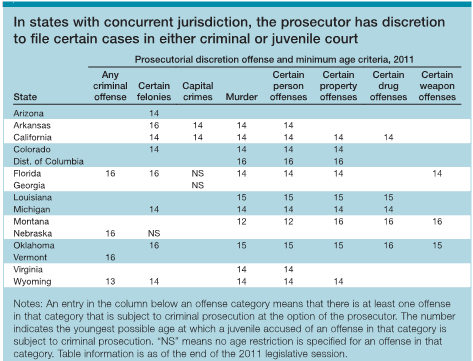
    The 1966 US Supreme Court opinion in Kent v. United States lists eight factors that a juvenile court should consider in determining whether to transfer a case. The factors include the seriousness of the offense, whether the crime was against person or property, the juvenile’s background, and likelihood of rehabilitation. However, in the decades immediately following the Kent decision many states enacted laws to bypass these factors, allowing prosecutors—instead of judges—to decide whether to transfer juveniles. (Some states even allow for automatic transfer.) The states that allow prosecutors instead of judges to file juvenile cases in criminal court, as of the end of 2011, are listed in Chart 2.
    Chart 2. States Allowing Prosecutors to File Juvenile Cases in Criminal Court.
    Chart source: OJJDP
    Several recent laws—many passed during the November elections—re-invigorate judges’ authority to make transfer decisions and rely on factors like those pronounced in Kent. In California, prosecutors were previously allowed to file juvenile cases directly in adult criminal court if they determined that the crime was not appropriate for the juvenile system. But in November, California voters approved Proposition 57, which eliminates direct filing and requires juvenile court judges to determine whether a juvenile will be tried as an adult. The California law also speeds up parole consideration for non-violent felons. In Nevada, new state laws provide that juvenile courts should have exclusive jurisdiction over anyone younger than 16 who is charged with serious crimes like attempted murder; previously, those youths would have been tried in criminal court.
    Similar changes have also occurred in other parts of the country: at the age of 12, Paul Gingerich became the youngest person sentenced in adult court in Indiana history, sparking outrage from child welfare advocates. The outrage over Gingerich’s transfer to criminal court likely spurred legal changes that now allow Indiana judges to re-sentence juveniles previously transferred and sentenced to prison terms. With the population of juvenile girls rising, gender also might become a factor for judges to consider during transfer proceedings. As prison policy and practice were designed for adult men, juvenile girls present unique challenges to legal officials; girls in conflict with the law have historically disproportionately high rates of sexual abuse victimization, contributing to high rates of mental health problems. A recent report indicates that such girls have a high need for services but present a disproportionately low risk to the community.
    Confidentiality of Juvenile Records and Court Proceedings
     
    Reducing juvenile recidivism also relies on ensuring youthful offender’s successful reintegration into society, whether by protecting their opportunities to complete education or obtain access to employment. In achieving these goals, it is critical that judicial authorities enhance the confidentiality of court hearings and expunge juvenile court records, however the practice of these two procedures vary among American states.
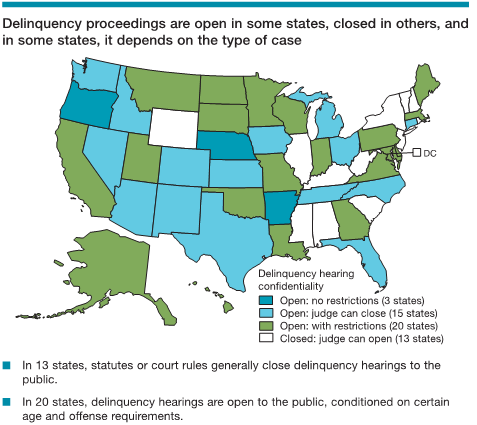
    Chart 3. Confidentiality of Juvenile Court Hearings, By State (2011)
    Chart Source: OJJDP
    The earliest American juvenile courts held public hearings, but by the 1950s, many states restricted public access and media reporting on juvenile court proceedings to prevent juvenile stigma. However in late 1980s, many juvenile courts re-opened their doors to the public amid concerns about rising juvenile crime rates (see Chart 3, above). However, some states continue to close court hearings when a defendant is below a certain age, properly recognizing that confidentiality is an even greater concern when the suspect is very young.
    Chart 4: The Sealing of Juvenile Court Records, By State (2011)
    Chart Source: OJJDP
    Regarding juvenile record sealing, 31 states mandate that juvenile court records cannot be sealed, expunged, or deleted if the court finds that the offender has subsequently been convicted of a felony, misdemeanor, or statutorily-specified juvenile offense (see Chart 4, above). Despite these restrictions, 33 states allow record sealing or expungement in some form, and since 2012, several states have enacted laws to allow juveniles to petition for expungement of records.
    Dui Hua has noted in previous collaboration with China’s courts that juvenile offenses can follow a person through life, leaving a lasting impact both on the young offender and on the broader society that collectively bears the repercussions of recidivism. Further policy changes allowing for the appropriate closing of juvenile court proceedings to the public and for juvenile record sealing could prove valuable to US and Chinese policymakers.
    Conclusion
     
    Recent trends in US juvenile justice recognize that American juvenile policy in the 1980s and 1990s was based on several mistaken assumptions about the nature of the adolescent brain and the effectiveness of harsh punishment against juveniles, especially those aged 16 and younger.
    Current Chinese juvenile court reformers would do well to avoid the same mistakes made in the US during the 1980s and 1990s.
    An important first step would be to acknowledge, in light of recent advancements in adolescent neuroscience, that children are not simply small adults. As retired California Superior Court Judge Leonard Edwards writes, progressive juvenile justice reform requires expanding the role of the juvenile judge, who possesses higher quality and quantity of information relative to police or prosecutors. Hence, judges are in “the best position to determine whether a child should be prosecuted as an adult or retained in juvenile court.” Since the beginning of the 2000s, American judges have dramatically increased the implementation of non-custodial measures, helping to limit the transfer of juvenile offenders from juvenile to criminal court.
    From this perspective, limiting juvenile incarceration is a “win-win” for those seeking more humane treatments for juveniles as well as for those most interested in lowering the costs of government programs. The cost effectiveness of reducing juvenile incarceration coupled with a deeper understanding of the adolescent brain and the community-based interventions that elicit favorable responses from juveniles should lead to fewer young people housed in state institutions. Conversely, if juvenile recidivism is allowed to increase, harmful effects will only be more severe as the chances of criminal behavior multiply into adulthood.
    The juvenile court policies discussed here are but a small sample of a complex and extensive topic. Please investigate the links above to explore other important juvenile policy issues including: access to counsel, conditions of confinement, and status offenses like truancy—the proper handling of which are critical to the long-term reduction of crime and societal tension.
  • Juvenile Justice Trends in the US Could Provide Lessons for China’s Courts (Part I of II)

    Juvenile Justice Trends in the US Could Provide Lessons for China’s Courts (Part I of II)

    A young offender confined in the US. Image credit: Juvenile in Justice Project.
    Amid high-profile reports of violence among children under the age of 14 in China, voices from several corners of Chinese society have called to lower the age of criminal responsibility. However, some Chinese legal experts remain opposed to adopting a more punitive juvenile justice regime and a look into the recent history of the US juvenile justice system supports a more cautious approach. Since 2000, legislatures throughout the United States have been scrambling to correct excessive punishments imposed upon young offenders in the 1980s and 1990s. Since 2000, several states have enhanced the authority of their juvenile courts, and by 2015, 41 states had raised to 17 the maximum age for transferring offenders to criminal court (often called “adult court”).
    In China, we are seeing developments that mirror the turn the US took in the 1980s and 1990s against a rehabilitative and developmental approach to juvenile justice, likely also driven by an upsurge in media reportage of violent cases among the very young. By the mid-1990s, some experts infamously began referring to American juvenile offenders as “super-predators”; the number of incarcerated youth soared, states across the US lowered the minimum age to transfer juveniles to criminal court, imposed mandatory minimum sentences on juveniles, and even allowed for juveniles to face life without parole (which was ultimately reversed in 2012 by the US Supreme Court).
    The more recent attempt in the US to reverse decades of excessive juvenile punishment could prove instructive for Chinese legal officials contemplating various reform “models” for their country’s juvenile justice tribunals. The following sections discuss three major categories of state-level court reforms designed to rein in costly and unnecessary juvenile incarceration in the US: (1) implementing non-custodial measures for juvenile offenders; (2) increasing judicial authority over the transfer of juveniles from juvenile court to criminal court; and (3) enhancing the confidentiality of juvenile records and court proceedings.
    Non-Custodial Alternatives to Juvenile Incarceration
     
    Perhaps the most important method of limiting juvenile incarceration and recidivism put forth is the implementation of non-custodial alternatives to incarceration. The recent proliferation of non-custodial measures in the US is in part the result of scientific advancements in the fields of adolescent neurology and developmental psychology that were unknown to policymakers in the 1990s. The findings indicate that the prefrontal cortex of the adolescent brain is not fully developed, inhibiting their decision-making abilities and mitigating the culpability of very young juvenile offenders. Chart 1 lists nine “Comeback States,” as identified by the National Juvenile Justice Network, which since 2001 have been particularly successful in implementing non-custodial alternatives for juveniles in response to new findings in neuroscience.
    Chart 1. Changes in Juvenile Confinement in American “Comeback States” Since 2001.
    “Comeback States” that have seen dramatic declines in juvenile incarceration.Source: NJJN
    In these “comeback” states, scientific advancements have spurred changes aimed at rehabilitating juvenile offenders, especially those under 16, while also reducing the risk to society with lowered juvenile recidivism rates. For example, in Ohio, juvenile court judges can sentence offenders to non-custodial measures including “supervised release programs…home detention, electronic monitoring, day and evening reporting centers, and local treatment programs.” In Connecticut, a 2004 law, requires officials to create a continuum of community-based services, including substance abuse and mental health treatment, that juvenile courts can implement to address problems facing young offenders without resorting to incarceration. In California a 2014 law ensures greater access and usage of non-custodial alternatives by requiring juvenile court judges to consider factors including age and mental health status before deciding whether to transfer a juvenile offender to the criminal court system.
    Advancements in scientific research have also helped limit harsh penalties such as solitary confinement on juvenile offenders. Because of its proven to be severe effects on the very young, solitary confinement should not be used for punishment of young offenders, and non-punitive solitary confinement should only be used when a youth is engaging in behavior that creates an imminent risk of serious harm.
    With more than 65 percent of the 2 million youth arrested each year in the US suffering from some form of mental health disorder, the use of mental health rehabilitation as a non-custodial measure has become increasingly widespread. For example, in 2005, the state of Washington expanded mental health services to address treatment gaps among juvenile offenders and a Colorado law now allows juvenile judges to impose suspended sentences to allow rehabilitation and treatment for juveniles with developmental disabilities or mental illness. Alongside mental health issues, the intersection of gender is a worthy consideration in developing a juvenile justice system that emphasizes non-custodial measures. Juvenile girls tend to be at greater risk in developing serious mental health problems, as noted in a 2012 Department of Justice report stating that adolescent “girls are more likely than boys to attempt suicide and to self-mutilate.” Further, juvenile girls are also less likely to pose a significant public safety risk than their male counterparts and “would be far better served in nonresidential treatment facilities close to their own homes.” The fact girls are more likely to suffer from serious mental health issues while also posing a significantly lower public safety risk suggest gender might be another factor for juvenile judges to consider in deciding on penalties for young offenders.
    Evidence-based measures have provided juvenile court judges with several community-based intervention options to reduce incarceration rates, without increasing public expenditure. American states are finding new ways to fund community-based alternatives. In Georgia, for instance, the ability of courts to impose non-custodial sanctions has been supported by an incentive grant program to distribute federal and state funding to counties serving the state’s at-risk youth. Provisions in Ohio and other states save scarce public funds by shortening juvenile detention time.

    Read Part II here.
  • China: SPC Issues New Regulations on the Release of Court Judgments Online

    Written judgments from criminal and civil cases in a Yunnan court. New regulations now state that digital copies of such judgments must be released online within a week of a court’s decision. Photo credit: ynfy.gov.cn

    [Updated: as of September 30, 2016, Dui Hua has obtained 117 judgments YTD.]

    In a bid to increase judicial transparency, including the adjudication of sensitive political cases, China’s Supreme People’s Court (SPC) recently released new regulations that unambiguously assign to courts throughout the country the responsibility for publicly releasing judgments (see translation of the regulations below). The SPC released similar regulations in 2013 and 2010, but the new regulations require courts to release more information, and with greater detail.

    Article 1 of the regulations states that “People’s courts should promptly release court judgments online.” The new regulations provide a stronger mechanism for making courts comply with this provision—if the court decides not to release a judgment to the public, it must make public the reasons for not releasing it (Article 6). Courts also have a new deadline for releasing judgments under the new regulations— “Legally effective court judgments should be posted online within seven working days of taking effect” (Article 7).

    The Discretion to Keep Secrets

    The new regulations provide more detailed guidance to courts when they determine that judgments should not be posted online. Article 4 states that judgments are not to be released if they (1) involve state secrets, (2) involve underage suspects, (3) are resolved by arbitration, (4) concern divorce, or (5) involve custody of underage children. The regulations give unfettered discretion to keep judgments secret if the court determines that a judgment is “unsuitable for online posting.” The meaning of “unsuitable” is not clarified in the regulations.

    The language of these regulations provides leeway to courts to restrict the release of court judgments in cases other than prosecutions of state secrets crimes under Article 111 of the PRC Criminal Law. Court cases that are not ostensibly political might be subject to restrictions on posting online, including but not limited to civil cases involving trade secrets (which might also be classified as state secrets), administrative cases of citizens against the government, financial fraud, and disturbing market order. The police or procuratorates, rather than courts, might possess practical authority to decide when certain cases sufficiently “involve” state secrets such that they are withheld from the public.

    Regulations Having the Intended Effect?

    Although the courts possess authority to block public release of judgments if they “involve” state secrets or are otherwise “unsuitable” for online posting, courts have been much more forthcoming with judgments since the previous set of regulations were issued in 2013. During the three-year period those regulations were in effect, the number of judgments involving endangering state security (ESS) cases that Dui Hua obtained from official websites increased each year: in 2014, 27 judgments were obtained, in 2015, 80 judgments, and, so far in 2016, 117 judgments [updated]. ESS crimes, which include subversion, inciting subversion, splittism, inciting splittism, espionage, and state secrets violations, are the most political in China’s Criminal Law. The decision to publicly release ESS judgments serves as a useful touchstone for assessing judicial transparency.

    Considering that the number of ESS trials has declined during the same three-year period, the increase in judgments posted online is all the more surprising. Dui Hua has estimated that Chinese courts concluded more than 500 ESS trials of the first instance in 2015, compared with more than 1,000 ESS trials in 2014 and 893 in 2013. The drop is attributed to judicial authorities trying cases that used to be considered ESS cases as cases of terrorism and disturbing social order.

    Restrictions on Redaction

    In addition to stipulating which judgments can be released, the new regulations provide some guidance on the content that must be provided in court judgments. Article 8 of the regulations states that courts should redact the names of crime victims, juveniles, and parties to certain types of family cases. Article 10 states that courts should redact certain types of information, primarily personal, private information. The rules also give courts broad authority to redact other information that they deem “inappropriate” for public release.

    The regulations’ drafters likely attempted to avoid issues surrounding the redacting of criminal defendants’ and prisoners’ names. In a change from the 2013 version, the new regulations no longer require the redacting of names of people who are not repeat offenders or who have been sentenced to three years in prison or less. Juvenile defendants should have their names redacted in online judgments owing to Article 8’s restriction on publishing juveniles’ names in general. Other than these changes, however, courts receive little guidance on how and when to publish the names of criminal defendants. Although redacting a defendant’s name can mitigate social stigma associated with a conviction, publicly releasing a defendant’s name can also help family and supporters advocate for greater judicial transparency and clemency.

    New Opportunities for Tracking Court Transparency

    On paper, the new regulations appear to be an improvement over the 2013 version, as they identify courts as the specific institution responsible for releasing judgments and require courts to publicly give reasons for refusing to release judgments. Judging by the increased number of ESS cases released to the public since the previous regulations took effect in 2013, regulations governing the release of judgments also appear to increase court transparency, which hopefully encourages public identification of suspects in most cases—including those involving ESS. Over the next months and years, Dui Hua plans to step up its monitoring of court websites to determine the extent to which courts are exercising their responsibility to release judgments online.

    *

    Regulations of the Supreme People’s Court of China Regarding the Release of Court Judgments Online

    *

    The Supreme People’s Court of China
    Legal Interpretation No. 19 [2016]

    August 29, 2016

    The “Regulations of the Supreme People’s Court of China Regarding the Release of Court Judgments Online” was passed on July 25, 2016 at the Meeting No. 1689 of the SPC Adjudication Committee, and will become effective on October 1, 2016.

    These regulations are formulated to implement and carry out the principle of public adjudication, standardize the people’s courts’ online judgment-releasing work, promote judicial fairness, raise the level of judicial credibility, bring together the practical experience of people’s courts, and they are in accordance with relevant regulations including the PRC Criminal Procedure Law, the PRC Civil Procedure Law, and the PRC Administrative Litigation Law.

    Article 1: People’s courts should promptly release court judgments online according to law, in a comprehensive manner, and in a standardized fashion.

    Article 2: The China Judgments Online website is the nationwide, centralized platform for releasing court judgments. People’s courts at all levels install links to China Judgments Online on their court political affairs websites and judicial transparency platforms.

    Article 3: The following types of court judgments should be released online:

    1. Criminal, civil, and administrative judgments;
    2. Criminal, civil, and administrative enforcement judgments;
    3. Payment orders;
    4. Criminal, civil, administrative, and enforcement notices rejecting petitions for review;
    5. State compensation decisions;
    6. Decisions for compulsory medical treatment or decisions rejecting applications for compulsory medical treatment;
    7. Decisions to enforce or amend criminal penalties;
    8. Decisions to detain or to issue fines for obstructionist litigation activities and enforcement behavior; decisions for early release from detention; and decisions on applications for reconsideration that have been filed against orders for detentions and fines;
    9. Administrative mediation decisions and civil public interest litigation mediation decisions;
    10. Other court judgments in which there is a discontinuation or completion of the litigation process, there is an influence on a party’s material rights and benefits, or there is a major influence on a party’s procedural rights.

    Article 4: People’s court judgments displaying one of the following types of characteristics should not be released online:

    1. Cases involved with state secrets;
    2. Juvenile crime cases;
    3. Cases resolved through mediation procedures or verifying the people’s mediatory agreements’ effectiveness, but not including those to protect state interests, the public interest, and other legal interests that need to be made public;
    4. Cases involved with divorce litigation or those involving the fostering or guardianship of minors;
    5. Other circumstances which cause people’s courts to believe internet release is not suitable.

    Article 5: People’s Courts should, in their notices accepting cases and responses, inform the parties of the scope of release of judgments online and publicly inform people’s courts, via government affairs websites, electronic touchscreens, litigation guides, and other methods, of the relevant regulations for issuing court judgments online.

    Article 6: Court judgments that are not released online should release the case number, the adjudicating court, the date of judgment, and the reasons for not releasing the judgment, except when releasing the above-described information could reveal state secrets.

    Article 7: Legally effective court judgments should be posted online within seven working days of taking effect. First-instance judgments and judgments which have been appealed, or regarding which a procuratorial protest has been brought according to law, should be released online within seven working days of the second-instance court’s adjudication taking effect.

    Article 8: People’s courts, when they release court judgments online, should redact the names of the following types of persons:

    1. Parties to marriage, family, and inheritance dispute cases, and their legal representatives;
    2. Crime victims and their legal representatives, collateral civil litigation plaintiffs and their legal representatives, witnesses, and expert witnesses;
    3. Juveniles and their legal representatives.

    Article 9: According to Article 8 of these regulations, the redacting of names in the following circumstances should be handled accordingly:

    1. When the surname is kept, replace the given name with “X”;
    2. Regarding the names of ethnic minorities, keep the first character and replace the rest of the name with “X”;
    3. Regarding foreigners and stateless people, keep the Chinese transliteration for the first character, with the rest of the name replaced by “X”; regarding the English names of foreigners and stateless people, keep the first English letter and eliminate the rest of the name.

    For repeat names resulting from redacting, use Arabic numerals after the names to distinguish them.

    Article 10: When people’s courts release court judgments online, they should redact the following kinds of information:

    1. Family addresses, contact information, identification numbers, bank account numbers, health situations, vehicle license plate numbers, movable or immovable property certificate serial numbers, etc., of natural persons;
    2. Information regarding bank accounts, vehicle license plates, moveable or immovable property certificate serial numbers, etc., of legal persons and other organizations;
    3. Information involving corporate secrets;
    4. Private personal information regarding ongoing disputes involving family affairs, individual rights, etc.;
    5. Information that involves technological investigation measures;
    6. Other information that a people’s court believes is not appropriate to make public.

    According to part (a.) of this Article, if redacted information influences the proper understanding of a court judgment, use the letter “X” as a partial replacement.

    Article 11: People’s courts judgments that are released online should contain the following types of information regarding parties, legal representatives, entrusted agents, and defenders:

    1. Other than the handling of redaction under Article 8 of these regulations, if parties and other legal representatives are natural persons, keep the name, date of birth, sex, district and/or the county of residence; regarding parties and their legal representatives, if they are legal persons or other organizations, keep the name, residential address, organization code, and legal representative or primary responsible persons’ name and occupation;
    2. If entrusted agents and defenders are lawyers or grassroots legal service workers, then maintain the name, the professional registration number, and law firm or grassroots legal service institution name; for entrusted agents and defenders that are other types of personnel, keep the name, date of birth, sex, county or district of residence, and relationship to the party.

    Article 12: If the judge handling the case believes that a court judgment involves circumstances pursuant to Article 4(e) of these regulations rendering inappropriate the release of the judgment online, then the judge should issue such opinion and the grounds for it in writing, and responsible staff from the relevant department, after conducting investigation, report to the managing court’s vice president for approval.

    Article 13: The PRC Supreme People’s Court supervises and guides the whole country’s courts in work on releasing court judgments online. High-level and intermediate-level people’s courts supervise and guide district-level people’s courts in their work on releasing court judgments online.

    Adjudication management offices of people’s courts at every level, or other institutions undertaking the function of adjudication management, have responsibility for the work of releasing their court’s judgments online and carry out the following duties:

    1. Organizing and guiding the release of court judgments online;
    2. Supervising and inspecting the work of releasing court judgments online;
    3. Coordinating and handling complaints and opinions from the public and society regarding court judgments;
    4. Coordinating technology departments to provide technological support and safeguarding;
    5. Other relevant management work.

    Article 14: Courts at every level should rely upon information technology to take court judgments and publicly enter them into the procedures for adjudication management, reducing the amount of work in publicizing court judgments, while realizing promptness, comprehensiveness, and streamlining in releasing court judgments.

    Article 15: In court judgments released online, other than the handling of technology implementation according to the requirements of these regulations, there should be consistency with the original court judgments.

    People’s courts that correct the written errors of court judgments should promptly release the corrected judgment online.

    The judge handling the case is responsible for the consistency between the court judgment that is released online and the original judgment, as well as the standardization of the technological processing.

    Article 16: Court judgments released online that are inconsistent with the original judgment or that exhibit inappropriate technological processing should be promptly removed and released again after they have been corrected.

    For court judgments that have been released online, if inspection reveals circumstances listed in Article 4 of these regulations, they should promptly be removed and then handled according to Article 6.

    Article 17: People’s courts information technology service centers are responsible for China Judgments Online’s functional maintenance and upgrading, providing convenience to all of society for the use according to law of this website’s public court judgments.

    In the application of different case numbers for different adjudication procedures, China Judgments Online cross-references court judgments with each other.

    Article 18: These regulations are effective starting October 1, 2016. The Supreme People’s Court previously issued interpretations and standardizing documents, and in case of inconsistency, these regulations will serve as the authoritative version.

  • Waiting for Relief: Obstacles to Righting Wrongful Convictions in China

    Chen Man (center) served 21 years in prison for a crime he did not commit. Photo credit: SCMP

    Increased attention to wrongful convictions in recent years has caused Chinese judicial authorities to retry more criminal cases and exonerate greater numbers of long-serving prisoners. What these trends mask, however, are the formidable obstacles of getting a criminal case reopened in China.

    Whether one looks at the case of Chen Man—released earlier this year after serving 21 years for a murder he didn’t commit—or the posthumous exoneration of Huugjilt in 2014—18 years after his execution—it is clear that it takes many years of petitioning just to get authorities to consider reopening a case. After a petition is accepted, it can still take years to decide whether it meets the criteria for retrial, as demonstrated by the ongoing effort to secure posthumous exoneration for Nie Shubin.

    Critics point out that the protracted and arbitrary manner in which these post-conviction appeals are handled is almost as damaging to the credibility of the judicial system as wrongful convictions themselves. Late last month, a group of lawyers and legal experts met in Beijing to discuss ways to address this problem, indicating that reform may be on the horizon.

    Conditions for Relief

    China’s criminal procedure gives both defense and prosecution the right to appeal the verdict of a trial heard in the first instance. If either side exercises this right, the court one level above holds a second-instance proceeding. The outcome of this proceeding is considered final (unless it results in a decision to send the case back for retrial). Defendants who lose their appeals at this stage are required to begin serving their sentences, with the exception of those sentenced to death, who go through another stage of review by the Supreme People’s Court.

    After appeals are exhausted and a verdict becomes final, the only way a case can be reopened is by initiating the process known under the Criminal Procedure Law (CPL) as “adjudication supervision.” The law gives convicted persons, as well as their legal representatives and close family members, the right to petition either the court or the procuratorate to seek retrial. The law specifies five conditions under which the court ought to provide relief:

    1. New evidence demonstrates errors in the factual basis of the original decision that could have an impact on conviction or sentencing;
    2. Evidence used to convict or sentence was unreliable, insufficient, or should have been excluded, or contradictions exist between major pieces of evidence used to determine the facts;
    3. The law was applied erroneously;
    4. Procedure was violated in a way that affects the fairness of the adjudication; or
    5. Judicial personnel were corrupt, showed favoritism, or perverted the law.

    The adjudication supervision process also empowers higher courts to order lower courts to reopen cases and permits higher level procuratorates to file post-conviction appeals if they “discover” errors in cases that have already been decided. In practice, this means that individuals (or their advocates) have an incentive to employ a variety of means—such as petitioning through the “letters and visits” (xinfang) system or attempting to get media attention—to make higher level judicial officials aware of their cases. The effort necessary to garner enough attention to initiate a post-conviction appeal is one major reason why the process tends to take so long.

    Lack of Incentives and Clarity

    Experts point to a number of other factors that contribute to the arbitrary and slow nature of this process. First is the simple fact that getting a case reopened relies to a considerable degree on getting judicial authorities to acknowledge the possibility that they made a mistake. Human nature makes this difficult enough, but recent personal accountability measures imposing “lifetime responsibility” for errors in the judicial process may make police and judicial authorities more resistant. This is why lawyer Mao Lixin, who has handled a number of wrongful conviction cases, thinks that such measures need to be calibrated to incentivize individuals and institutions to admit and remedy past mistakes.

    Another factor contributing to the difficulty of initiating the post-conviction relief process is the absence of clear procedures. Though the CPL sets out the criteria under which cases should be reopened and procedures for how new trials should be carried out, there are no procedures for the initiation or review of petitions for post-conviction relief. There is also a lack of clear, formal differentiation in the evidentiary standards used to review petitions for post-conviction relief and those used to overturn convictions. In practice, many courts will only provide new trials in cases where evidence for exoneration is overwhelming—such as when a supposed murder victim turns out to be alive or another person credibly confesses to the crime. Because of the way the current system is designed, courts that decide to retry a case often become the focus of public attention and scrutiny. This creates an expectation for courts to reverse their verdicts that undermines the impartiality of adjudication.

    Calls for Law, Transparency, Oversight

    The way to resolve these problems, legal experts argue, is to formalize the process of post-conviction appeals and define each stage more clearly under the CPL. They point to recent docketing reforms that have simplified individuals’ ability to file lawsuits of all types and suggest that courts also be required to accept petitions for post-conviction relief as long as they meet basic criteria. As for the review process, Renmin University Law School Professor Chen Weidong argues that a formal procedure needs to be introduced that would increase transparency and give petitioners a more meaningful opportunity to participate and air their positions.

    Chen Guangzhong, one of China’s leading procedural law experts, has even proposed setting up an independent body to review petitions for post-conviction relief that would be made up of people’s congress delegates and members of the public. This, he argues, would help overcome the challenges arising from asking courts to find fault with themselves. Though it is hard to imagine such a body playing a direct role in what others are hoping will become a more formal judicial process, some have suggested that a non-judicial body could at least serve to exercise a welcome degree of independent oversight.

    Fear of Retaliation

    Formalizing a judicial process for post-conviction relief could help to greatly reduce the amount of time and effort spent trying to remedy wrongful convictions, but it may not lead to more exonerations. Individuals convicted of endangering state security and other political crimes will likely continue to find it nearly impossible to have their cases retried, even if reforms reduce court discretion over docketing decisions and make review proceedings more transparent.

    In fact, many who are currently serving prison sentences choose not to exercise their right to petition for post-conviction relief because they fear retaliation or negative impacts on their eligibility for sentence reduction or parole. When journalist Gao Yingpu was serving his three-year sentence in connection with critical comments made online about former Chongqing Party Secretary Bo Xilai, his wife reportedly declined to pursue post-conviction appeal for fear that he might be penalized for “refusing to admit guilt.” She changed her mind after Bo Xilai was removed from power. She filed a petition with the Chongqing High People’s Court in January 2013, shortly before Gao was given a sentence reduction and released from prison. As far as anyone knows, that petition—like so many others throughout China—is stuck in bureaucratic limbo.

  • Chinese Court Amends Charges Against Guo Feixiong Before Conviction

    Democracy activists Guo Feixiong (a.k.a., Yang Maodong, pictured left) and Sun Desheng (pictured right) were recently sentenced to prison terms. Credit: Weiquanwang

    On November 27, Guangzhou’s Tianhe District People’s Court sentenced veteran democracy activists Guo Feixiong (a.k.a., Yang Maodong) and Sun Desheng to six years and two and a half years’ imprisonment, respectively. The court convicted Guo and Sun of public order offenses connected to street protests carried out in Guangzhou and other cities in the early days following Xi Jinping’s accession to power. The crackdown on the “Southern Street Movement,” along with the repression of the New Citizens’ Movement, signaled the new leadership’s resolve to curb grassroots activism, clamp down on criticism, and take control over the political agenda.

    As in many other politically motivated criminal cases in China, the allegations appear to exaggerate the social harm caused by the defendants’ actions and ignore rights to free speech and association nominally protected under China’s constitution. Moreover, violations of due process plagued the prosecution of Guo and Sun. These violations include prolonged pre-trial detention, obstruction of defense counsel, and numerous irregularities at trial. There have been allegations of torture and mistreatment.

    There are many grounds upon which to criticize and even condemn the convictions of Guo Feixiong and Sun Desheng. In this essay, we focus on a small, but significant, aspect of the trial process: the court’s modification of charges immediately before conviction. We explain court action and inaction with the aim of further understanding China’s criminal process and some of its many weaknesses and challenges.

    What Did the Prosecution Allege?

    In the indictment submitted to the court in June 2014, prosecutors from Tianhe District charged Guo and Sun with “gathering a crowd to disrupt order in a public place” under Article 291 of the Criminal Law. The allegation was based on two separate sets of material facts and associated evidence.

    The first set concerned three days of protests held outside the offices of the newspaper Southern Weekly in January 2013. These demonstrations followed a decision to censor a closely watched “New Year’s Editorial” that supported constitutionalism. Authorities alleged that Guo Feixiong was a chief organizer of the protests, which included speeches, signs, and banners hailing press freedom, and which attracted hundreds of participants and onlookers.

    The second set of allegations surrounded a series of “flash mob” protests purportedly initiated by Guo and Sun and carried out in eight cities across China in April and May 2013. Protesters held up signs and banners demanding that officials disclose their assets as part of the fight against corruption and that the government ratify the International Covenant on Civil and Political Rights. Images of these street protests were circulated online, leading prosecutors to claim that they “created false impressions.”

    What Did the Court Do?

    Many accounts report that, just before it sentenced the defendants, the Tianhe District People’s Court added a charge of “provoking a serious disturbance,” which carries a heavier penalty than those under Article 291. Perhaps more accurately, the court “modified” or “amended” the prosecution’s charges. No additional facts or evidence were introduced to support the addition of a new charge during the trial. The court did, however, take issue with the prosecution’s characterization of “flash mobs” as “gathering a crowd to disrupt order in a public space.”

    The court found that, based on the facts and evidence presented at trial, the defendants’ actions should have been prosecuted under the offense of “provoking a serious disturbance” pursuant to Article 293(4) of the Criminal Law. Having identified this error, the court proceeded to amend the charges and issue its verdict accordingly.

    Amending the charges meant that the court could impose separate penalties and calculate a combined sentence for the protests outside Southern Weekly (gathering a crowd to disrupt order) and the anti-corruption flash mobs (provoking a serious disturbance). While the maximum penalty under the charges in the prosecution’s original indictment would have been five years’ imprisonment, after modification, the court was able to impose a sentence of between five and ten years—based on a maximum penalty of five years for each charge.

    Did the Court Violate Chinese Law?

    There is no explicit provision in the Criminal Procedure Law (CPL) that authorizes courts to modify the prosecution’s charges in this way. Instead, this action seems to follow from the Supreme People’s Court (SPC) Interpretation on the Application of the CPL, Article 241(2):

    When the facts alleged in the indictment are clear and the evidence is reliable and sufficient but there is a discrepancy between the crime alleged and the crime found in the course of the trial, [the court] shall issue a verdict based on the crime found in the course of the trial.

    This provision implies, but does not expressly state, that the court may unilaterally modify the charges under these specified circumstances.

    Of course, the question remains whether it is legitimate for the SPC to broaden its powers in this way. As a constitutional matter, the use of judicial interpretations to supplement and elaborate on existing law in a generalized manner appears to exceed the authority granted to the SPC to answer concrete applications of law. As a matter of practice, however, such legislation-through-interpretation is considered legitimate, and courts treat these interpretations as equivalent to law.

    In short, while the legal basis for the court’s actions is not free from controversy, practically speaking, no appellate court is likely to accept a challenge on the grounds that the court acted contrary to law.

    Did the Court’s Actions Amount to an Unfair Trial?

    There is little question, however, that the effect of the court’s action deprived Guo and Sun of their right to a fair trial, which would make the decision illegitimate under Chinese and international human rights law.

    By unilaterally modifying the charges just before sentencing, the court deprived the defendants of their right to a fair hearing by denying them adequate time and facilities to prepare a defense. Though much of the defense lawyers’ detailed statements to the court remained applicable, the lawyers could not have anticipated the court’s modification. Thus they were not prepared to present a thorough challenge to the applicability of Article 293(4). Lawyers were instead asked to deliver opinions on the spot and were interrupted by the court when they protested.

    One of the principles underlying the idea of a fair judicial hearing is the “equality of arms” between prosecution and defense. Given that criminal defendants have the power of the state arrayed against them, adequate time and facilities to prepare is an essential part of guaranteeing some semblance of parity.

    Article 227(3) of the CPL states that where the trial of first instance “deprives or restricts the statutory procedural rights (fading susong quanli) of a party to the case (dangshiren),” the appellate court should remand the case for retrial. Lawyers might try to make this argument when the case is appealed to the Guangzhou Intermediate People’s Court, but if the case is retried and the charges are modified in some other way, it seems highly unlikely that the court would reach a different result.

    How to Modify Charges Fairly

    There are many circumstances in which a charge might need to be re-characterized in the course of a trial. A charge of homicide might fall apart on the question of the defendant’s intention and need to be modified to intentional injury. There is often ambiguity about whether a defendant caught carrying drugs was trafficking or merely transporting.

    Note that in both of these examples modifications would likely benefit the defendant, as the modified offenses are less serious than those originally applied. This is not what happened in the case of Guo Feixiong. Nonetheless, even when the defendant stands to benefit from amended charges, fair-trial principles should require the use of a more elaborate procedure with more of a role for both prosecution and defense.

    This is the argument put forward recently by Shandong rights lawyer Xi Xiangdong. He notes that if the prosecution had wanted to modify its indictment, Supreme People’s Procuratorate rules would have required prosecutors to first seek approval from their superiors and submit the amended indictment to the court. Then, the court would notify the defendant, and a new trial hearing would have to be held—complete with investigation of evidence, debate, and final statements from both sides.

    If the court identifies the need to modify the charges, Xi says, it can make this recommendation to the prosecution. If the prosecution agrees, the process would follow as described above. If the prosecution rejected the recommendation, then the court could proceed to amend the charges if it was in the interest of justice and proper application of the law. Xi rightly insists, however, that this ought to be the exception, rather than the rule. Finally, he notes that any such decision should only be made after giving due consideration to both prosecution and defense in the form of a hearing where both sides can confront each other’s opinion.

    To be sure, such procedures would necessitate extra time and complication for all parties involved. Considering that the court let a year elapse between trial and verdict in the case of Guo Feixiong and Sun Desheng, there really is no excuse for not taking even this small step to provide a measure of protection to the fair-trial rights of the defendants.

  • Guangdong High Court Asks Why So Few Are Found Innocent

    A recently freed, wrongfully accused man becomes emotional during a 2014 interview. Credit: Nandu.com

    Since 2012, Chinese legal authorities have overturned a series of high-profile convictions and taken steps to prevent miscarriages of justice, but one question is still being asked: why do Chinese courts acquit so few defendants? (In 2013, the acquittal rate rose for the first time since 2000, growing annually from six acquittals per 10,000 adjudications to seven.) Some argue that institutional support for conviction stands in the way of systemic change.

    Researchers at Guangdong High People’s Court wanted to find out for themselves, conducting interviews, holding seminars, and analyzing court documents related to acquittals throughout the province. The results, which were published as a report last year, offer a fascinating view into how those within the judiciary interpret the institutional, legal, political, and social factors that shape the way Chinese courts operate.

    The researchers report that, for the five years between 2008 and 2012, Guangdong courts acquitted only 198 individuals in 180 cases. This represents a mere 0.04 percent of all individuals subject to criminal decisions that took effect during the period. The great majority (86 percent) of acquittals were on grounds of insufficient evidence, with a handful of others issued for things like self-defense, mental incompetence, or defendants who were under the age of 16. Acquittals occurred in a wide variety of cases—though not in any involving state-security offenses—but were most frequent in cases of assault. The trial process typically took longer than average when it resulted in acquittal, extended in accordance with the law by both courts and prosecutors. The average length of a trial that ended in acquittal was 169 days, or about five months, with the longest stretching to 504 days and the shortest at 55.

    These quantitative results are not the most interesting part of the report, in part because there are so few cases to study. Much more interesting are the authors’ observations on the factors contributing to the dearth of acquittals, the impact this has on the legal system and society at large, and what might be done to remedy the situation.

    Acquittal Averse Strategies

    The extremely low number of acquittals doesn’t mean that criminal prosecutions in Guangdong are rock-solid. The report points out that, when the facts of the case are unclear and evidence is insufficient, judges use a number of strategies other than acquittal. In relatively minor cases, for example, courts might work out an informal “plea bargain,” promising to hand down a non-custodial penalty (like a suspended sentence) in exchange for a defendant’s promise not to appeal. In death-penalty cases, on the other hand, a court might issue judgments “with room to maneuver” (liu you yudi caipan)—imposing a more lenient suspended death sentence that gets commuted to life imprisonment (and then, later, a fixed-term sentence) almost automatically. Appeals courts are in an even better position to shift responsibility, as they can always send cases back to a lower court for retrial rather than rule to acquit.

    Another common way courts avoid acquittals is to allow the prosecution to withdraw its indictment, which it may do at any point before a verdict is announced. In some cases, this has the effect of ending the case against the defendant, but in others, the prosecution can decide to submit a new indictment or send the case back to police for additional investigation. This amounts to a waste of resources, the report says, and results in individuals being locked up for far longer than they ought to be.

    The report argues that prosecutors, with the help of the courts, are abusing this provision of the Criminal Procedure Law (CPL) and that the practice needs to be more strictly regulated. For example, it recommends that prosecutors generally not be allowed to withdraw indictments for unclear facts or insufficient evidence. This is because the CPL already gives prosecutors two opportunities to request trial adjournment for additional investigation. If this is not enough, the report concludes, then the court should exercise its power to issue an acquittal. The report also suggests prohibiting prosecutors from withdrawing an indictment once investigation of the facts and evidence has begun at trial and, when withdrawal is approved, limiting prosecutors to one re-indictment.

    Inside the Pressure Cooker

    Why is it necessary to go through so much effort to avoid issuing acquittals? A recurring theme throughout the report is pressure. Stability-first governance campaigns and a whole system of associated performance measurements create pressures for conviction throughout the criminal justice system. Written and unwritten rules place a premium on rates of case-solving, arrest approval, and conviction as factors used to measure police or procuratorate effectiveness and can be tied to individual promotion or ranking. Since acquittals have the effect of lowering these statistics, police and prosecutors are incentivized to seek conviction and mobilize all manner of available resources to influence courts not to acquit.

    As the final stop in the criminal process, courts bear the brunt of the pressure to convict that’s built into the system. As the report puts it: “The public security bureau is responsible for cooking the meal and the procuratorate for serving it. Last to come, the court has only two choices as it faces this meal—either eat up or reject all the work that the first two institutions have already put into the case.” Acquittal, in other words, puts courts in potential conflict with other local law-enforcement bodies that are expecting conviction.

    In major cases, especially homicides, police often face considerable political and social pressure to bring a culprit to justice. When they do make arrests, it can lead to merit citations being publicly issued to the investigation team even before indictment, let alone conviction. If the court later acquits, not only must these citations be withdrawn, there will likely be compensation claims made against the police for wrongful detention. In some cases, the same individuals who had been rewarded for solving the case might end up facing investigation for misconduct or even criminal liability.

    Prioritizing Public and Process

    There are many negative consequences arising from courts’ failure to issue acquittals, according to the report. The most obvious effect is on the credibility of the courts. On this point, the report is particularly frank, warning: “the public is already deeply suspicious and dissatisfied with the [level of] fairness in our criminal justice system, and wrongful convictions are adding fuel to the fire.” They continue, stating: “Convictions based on protecting face and reducing pressure only bring momentary peace and tranquility. When and if the bomb will explode all becomes a matter of luck. But what’s certain is that, the moment the bomb goes off, the courts will suffer the heaviest casualties.”

    In order to prevent calamity, the report recognizes that courts must exercise their judicial powers more independently, but it provides little advice on how to do so, apart from improving awareness and understanding of the law and legal principles like the presumption of innocence. There is no mention of the “coordination” between police, procuratorates, and courts by the party’s politico-legal committees and little on the role of adjudication committees, where senior court officials get an opportunity to weigh in on how to rule in complex or important cases they have not personally heard.

    In fact, the authors appear to believe that increased communication between investigators, prosecutors, and judges can help judicial authorities make their case about resolving problematic prosecutions through acquittal. They recommend, for example, having police and prosecutors sit in on adjudication committee meetings in cases where problems arise. The assumption is that this will enable the courts to exert influence over the other law-enforcement bodies as opposed to the other way around.

    One thing that seems to be on the minds of the report’s authors is a responsibility system for wrongful convictions. They make the case that mistakes are inevitable within any legal system and that neither wrongful convictions nor acquittals should automatically be thought of as “mistakes” for which someone must be punished. That is what happens, they suggest, when too much emphasis is placed on outcomes without giving due weight to process.

    This is especially important for judges, they argue, and requires transforming the way that judges are evaluated and how data is used. They believe that judicial statistics like conviction rates have no place in deciding promotion or professional ranking. They do, however, see value in continuing to collect statistics and conduct ongoing research in order to evaluate the performance of the criminal justice system as a whole and to boost its credibility with the public.

  • China Mulls Harsher Penalties for Protesters, “Cults”; Fewer Capital Crimes

    Director Li Shishi of the Legislative Affairs Commission of the NPCSC explains proposed Criminal Law amendments to the NPC on October 27, 2014. Credit: infzm.com

    In July, members of the National People’s Congress Standing Committee (NPCSC) published and opened for a one-month period of public consultation a set of proposals for amending China’s Criminal Law for the ninth time since it was overhauled in 1997. The proposals are a revision of an earlier draft first introduced in October 2014, and the NPCSC is likely to review a third (and probably final) draft of the proposed amendments at a bi-monthly meeting later this year.

    The Chinese media has highlighted a number of overarching themes and new features in the proposed amendments. The draft introduces stronger provisions to combat terrorism and “religious extremism,” strengthens provisions connected to cyber-security, and imposes stricter anti-corruption measures.

    Despite strong opposition from many in the legal community, the current draft also restricts lawyers from revealing certain types of case information and introduces harsher penalties for Article 309, “disrupting court order.” The sweeping crackdown on lawyers that Chinese authorities have carried out since July 10 places the significance of these provisions in a new light. (This topic will be covered in a subsequent post.)

    This article focuses on provisions related to death penalty reform and the redefinition of punishments for protesters and “cult” members once commonly subjected to the now defunct system of reeducation through labor (RTL).

    Death Penalty Reform

    The current draft amendment proposes to remove the death penalty from nine criminal offenses (see below), which would bring the total number of capital crimes in China to 46. The removal of the death penalty from these nine offenses would not put much of a dent in China’s world-leading use of capital punishment, which largely focuses on homicide, rape, robbery, and drug offenses. It would, however, show the government continuing to make good on its pledge to work towards gradual abolition of the death penalty. The current proposal starts chipping away at the death penalty for offenses that involve a certain degree of violence, but since many of the 46 offenses that would remain eligible for capital punishment are non-violent in nature, China still has some way to go before it joins the growing ranks of abolitionist countries.

    Crimes Slated to Remove Death Penalty
    Article No.Offenses
    151(1)Smuggling weapons or ammunition
    Smuggling nuclear material
    Smuggling counterfeit currency
    170Manufacturing counterfeit currency
    192Fraudulent fundraising
    358(1)Organizing prostitution
    Coercing into prostitution
    426Obstructing the performance of military duties
    433Spreading rumors and disinformation during wartime
    Source: Dui Hua

    At least two of the crimes, fraudulent fundraising and coercing into prostitution, recently stirred public controversies in connection with capital punishment. Wu Ying narrowly escaped execution when the Supreme People’s Court overturned the death penalty against her in May 2012. The decision followed several years of highly public campaigning on behalf of the young entrepreneur who was convicted of deliberately defrauding investors of 770 million yuan (approximately $100 million). Tang Hui—the “petitioning mother” who earned widespread public support after being sent to RTL in 2012—doggedly protested the unwillingness of the courts to sentence to death those convicted of forcing her 11-year-old daughter to work as a prostitute.

    Though it is common to justify slower progress toward abolition with the presence of strong public support for the death penalty in China, there is resistance within China’s party and government institutions as well. According to reports, earlier drafts of the current amendments that circulated internally had proposed adding language to the Criminal Law’s general provisions specifying that the death penalty be limited only to the “most serious crimes.” This would have meant adopting the standard set in Article 6(2) of the International Covenant on Civil and Political Rights, which China has signed but not yet ratified. The language was ultimately dropped because of unspecified opposition.

    Goodbye RTL, Hello Prison

    Petitioners

    Another aspect of the current amendments is changes made in response to the 2013 decision to eliminate RTL, a system of administrative custodial punishment used for decades to incarcerate individuals for up to three years for unlawful acts deemed too minor to pursue criminal punishment. With this tool of maintaining stability no longer available, the Criminal Law is being adapted to handle many of the kinds of cases that were previously dealt with through RTL.

    One controversial example is the proposed amendment to Article 290(1), which covers “gathering a crowd to disrupt public order.” Citing the problem of individuals who engage in “persistent and disruptive petitioning” that disrupts work at government offices, drafters propose to expand this article to target those who fail to “correct” (gaizheng) their behavior after being given administrative penalties for “disrupting the work order of state organs on multiple occasions” and those who “disrupt social order by organizing or giving financial support to people for the purpose of gathering illegally on multiple occasions.” If the proposed amendment passes, these types of behavior—both of which might have been dealt with through RTL in the past—will be subject to criminal punishment of up to three years’ in prison.

    Such changes amount to a complete redefinition of the offense currently covered by Article 290(1), given that it would apply to individual protesters regardless of whether they gather together with others. In the case of “organizing or providing financial support,” it is not even necessary for an individual to take part directly in any protest. Critics argue that it is potentially counterproductive to target individual protesters—many of whom are petitioners forced to resort to disruptive behaviors in order to draw attention to legitimate claims of injustice. As Tsinghua University law Professor Zhou Guangquan recently noted, “Criminalizing such acts will make it harder to carry out supervision and check that local party and government bodies are governing in accordance with the law.”

    But the authorities have already signaled an intention to strike against those who engage in acts of public protest—whether as individuals or in groups—because of the perceived threat these disruptions pose to the stability upon which the political order supposedly rests. Together with the crime of “provoking a serious disturbance,” Article 290(1) has become a favored charge against activists who organize and demonstrate on behalf of social justice and legal reform, such as Xu Zhiyong or Guo Feixiong. In 2013, the Supreme People’s Procuratorate noted that illegal assembly and gathering crowds to disrupt social order were being carried out “with the goal of subverting state power.”

    “Cult” members

    Receiving less attention have been the changes proposed to Article 300, which covers the offense of “using a secret society, cult, or superstition to undermine implementation of the law.” Since 1997 this offense has primarily been used to target members of spiritual and religious organizations (like Falun Gong, Shouters, or Almighty God) that authorities have outlawed as “cults.”

    There are presently two penalty ranges under Article 300 based on the severity of the offense as determined by a court. Ordinarily, “cult” activity carries a penalty of between three and seven years in prison, though certain mitigating factors or grounds for leniency can sometimes lead to sentences of less than three years. When there is a finding of “especially grave circumstances,” however, the court may impose a sentence of as high as 15 years.

    Until recently, many of those accused of engaging in unlawful “cult” activities were not subject to criminal punishment. Instead, they were sent to RTL camps for up to three years—often multiple times. Though RTL camps were in many respects indistinguishable from prisons (and sometimes arguably worse), the punishment was still considered to be much more lenient than a prison sentence.

    Since the elimination of RTL at the end of 2013, the only way for the authorities to punish those accused of “relatively minor” offenses related to “cult” activity beyond 10- or 15-day administrative detentions is through unlawful detention in “legal education centers.” In response, drafters have proposed an additional clause for Article 300 that would cover acts deemed to be “relatively minor” and make offenders subject to imprisonment of up to three years, short-term detention (lasting up to one year), “public surveillance,” or “deprivation of political rights.” Courts have also been empowered to impose monetary fines.

    Perhaps in the spirit of the penal policy of “combining lenience with severity” (kuan-yan xiangji), the latest draft of the proposed amendment to Article 300 also proposes to raise the maximum penalty for “especially grave circumstances” to life imprisonment. According to the 1999 judicial interpretation covering Article 300, aggravating factors that can be considered “especially grave” include organizing groups or recruiting members across provincial boundaries, colluding with overseas organizations or persons, and printing or distributing very large quantities of propaganda. Also included in this category is a catchall of “inciting, deceiving, or organizing members or others to undermine the implementation of state law or administrative regulations that results in grave consequences.”

    Drafters have not publicly offered any justification for this significant increase in the maximum penalty for Article 300 nor have they given any indication of what sort of activity might necessitate a life sentence. Considering that Article 300 relies on arbitrary determinations of when particular belief systems qualify as “cults,” the possibility of life imprisonment for violating this provision poses a particularly grave threat to religious freedom that is excessive given the kinds of acts that presently qualify for the most serious punishment under that statute.

  • Despite Legal Reform, SPC Still Blocks Lawyer-Client Access

    Defense lawyer Zhang Kai holds a sign outside Zhejiang’s Pingyang County Detention Center requesting that he be able to meet with his client in October 2014. Image credit: Weibo

    Improving criminal defense lawyers’ access to clients was hailed as one of the highlights of the revised Criminal Procedure Law (CPL) that came into force in 2013. Incorporating provisions of the 2007 Lawyers Law that had yet to be universally respected, the new CPL requires detention centers to arrange for access within 48 hours of request by a lawyer upon presentation of his or her license to practice, the certificate of his or her law firm, and power-of-attorney documentation. The only exceptions are cases involving state security, terrorism, or “particularly serious” bribery, for which police investigators can require that a lawyer seek their approval before a meeting can be arranged.

    Although these new provisions have not been implemented perfectly, defense lawyers generally acknowledge that access to suspects has improved in most routine criminal cases. But what recourse is there when these provisions are not strictly enforced?

    Background

    On July 15, 2014, long-time petitioners Zhang Xiaoyu and husband Xu Youchen were formally “reprimanded” (xunjie) by Beijing police for disturbing public order. Two days later, officials from their hometown of Jiaozuo, Henan, accompanied them back home. Upon arrival, Zhang and Xu reportedly resisted attempts to hand them over to local police officers. Xu allegedly attacked a police officer with a small knife, causing a fatal wound. Xu and Zhang were then placed under criminal detention on suspicion of intentional homicide.

    Lawyers for the couple attempted over a period of several days to meet with the detainees, but their multiple requests were refused by the Jiaozuo Detention Center. Finally, on July 25, lawyers got their first opportunity to meet with Zhang and Xu, who each spoke of being beaten by police. The lawyers took photographs of the couple’s bruised and swollen faces and uploaded these to the Internet.

    The next day, detention center officials refused to provide the lawyers with any additional access to Xu and Zhang, saying that the lawyers had violated the rules by releasing photos of the detainees. The officials informed the lawyers that a complaint had been filed with judicial administration authorities in Shandong and that the detention center would not agree to any more visits, pending a decision on sanctions.

    Over subsequent weeks, lawyers for the couple complained repeatedly to local and provincial authorities and attempted to get the official lawyers’ association to intervene on their behalf. When none of these efforts were successful, two of the lawyers—Liu Jinbin and Liu Shuqing—decided to sue the detention center in court.

    Administrative Action or Judicial Process

    Citizens or other parties who wish to challenge the legality of official government actions can do so under the Administrative Litigation Law (ALL). The challenge must involve a concrete administrative action directed against specific individuals or entities, rather than decisions with general applicability. The ALL also explicitly excludes certain areas from challenge, including national defense and foreign affairs, administrative rules and regulations, administrative decisions of an internal nature, and administrative acts that are deemed by the law to be within a particular state organ’s final authority.

    Under the law, administrative actions are generally distinguished from actions related to judicial process. In theory, disputes that private parties may have with public authorities in the course of the judicial process should be dealt with as part of the judicial process itself. For example, unlawful coercion of confessions by investigators can be addressed through a request to have a court rule on exclusion of that confession from evidence. In China, however, many aspects of judicial authority are invested in the procuratorate, rather than the court. For example, procuratorates make decisions about whether suspects may be held under formal arrest pending trial and are generally responsible for ensuring that various parts of the criminal process are lawful.

    China’s public security organs carry out a variety of functions, some of which fall under the category of administrative acts and some of which can be classified as being part of the judicial process. Punishments for public order offenses (such as short-term jailings, property confiscation, or fines) are unquestionably administrative actions and are, therefore, subject to challenge under the ALL. On the other hand, imposition of coercive measures and actions related to criminal investigation are considered to be actions related to the judicial process that are excluded from the purview of the ALL.

    Legal Argument

    In the nearly identical lawsuits that plaintiffs Liu Jinbin and Liu Shuqing brought before the Shanyang District People’s Court in November 2014, the main issue of dispute was whether arrangement of meetings between lawyer and detainee by a detention center should be considered an administrative action or part of the judicial process. The opportunity to argue this point at trial was itself a rarity, as courts throughout the country had basically refused to hear such cases for almost 15 years.

    That hadn’t always been the case. In 1999, a Hunan lawyer named Liao Jianhua successfully sued the Loudi Public Security Bureau for refusing to allow him to meet with a detained suspect. According to Professor Chen Ruihua, there were a few other cases around that time where courts similarly granted relief to lawyers. But that effectively ended in March 2000, when the Supreme People’s Court issued an interpretation of the ALL that explicitly excluded from the purview of administrative litigation all “actions that the Criminal Procedure Law specifically empowers (shouquan) public security, state security [and other] organs to carry out.” With this provision, the SPC eliminated the courts as an avenue for lawyers to challenge decisions over access to detainees, which helped contribute to making the securing of such access one of the “three difficulties” often complained about by Chinese lawyers.

    The lawyers argued that the Criminal Procedure Law only empowers the police to detain people and carry out investigations. Although the Detention Center Regulations issued by the State Council in 1990 gave responsibility over management of detention centers to public security organs and stated their purpose as “guarantee[ing] the smooth progress of the criminal process,” that role as custodian over detainees was merely a managerial function indirectly part of the criminal process. Under the law, the process of arranging meetings between lawyers and detainees was, at least in the case at hand, supposed to be a relatively simple matter of ensuring that the lawyer’s paperwork was in order and did not leave any room for discretion. Despite being set out in the CPL, this amounted to a routine approval process indistinguishable in form from other administrative actions and should, therefore, be subject to challenge under the ALL.

    The court of first instance rejected this argument, finding that decisions over lawyers’ access were acts “empowered” by the CPL and, therefore, outside the purview of the ALL. In an appeal to the Jiaozuo Intermediate People’s Court in February 2015, Liu Jinbin argued that the district court’s conclusion was based on a flawed understanding of the word “empowered” (shouquan). He argued that arranging lawyers’ access to detainees was a responsibility, rather than a right, and could not therefore be the object of the word “empower.” Public security organs were only empowered by the CPL to detain and investigate suspects; if anything, it was lawyers who were empowered by the law with the right to access detainees.

    The Jiaozuo Intermediate People’s Court essentially ignored this argument by noting that laws endow state organs with both powers and responsibilities. Arranging access between lawyers and detainees was a “clearly stipulated responsibility” under the CPL, it found, and if a lawyer believed that the exercise of his or her rights in this regard were being “hindered” (zu’ai), then the proper channel for seeking remedy was through complaint to the procuratorate. Since the matter was outside the scope of the ALL, the matter was dismissed.

    SPC Interpretation Remains Supreme

    Given that guaranteeing suspects’ access to legal assistance from the point of initial detention is an essential part of safeguarding their human rights and preventing torture and other miscarriages of justice, any violations of lawyers’ rights in the criminal process ought to be met with swift and strong consequences in order to ensure compliance. In the current legal environment, however, a lawyer’s only option is to seek intervention by the procuratorate. Notwithstanding that the Supreme People’s Procuratorate recently issued a set of regulations aimed at protecting the rights of lawyers, what happens if the procuratorate refuses or is slow to intervene? Or what if a procuratorate order goes unheeded?

    These scenarios suggest that some form of judicial remedy could be helpful in vindicating lawyers’ rights to meet with detainees. There are, however, few signs that the door to administrative litigation will open anytime soon. A revised version of the ALL took effect on May 1, and even though legislators still have not explicitly excluded acts connected to the criminal process from the scope of administrative litigation, officials at the SPC have made clear that the relevant provision of its previous interpretation remains binding.

    One possible solution would be pending legislation regarding detention center management. Were management of detention centers to be shifted toward the judicial administration authorities that also manage China’s prisons, it would potentially result in a much clearer separation between the administrative management of detainees and the investigative powers associated with the criminal justice process itself. However, even though there has been a great deal of support among legal experts for making such institutional reform part of a proposed Detention Center Law, current indications are that public security authorities will retain power over detention facilities for the time being. This means that, barring change to the SPC interpretation, the boundaries between criminal investigation and detainee management will remain blurred.

  • How Chinese Institutions Manufacture Conviction and Quash Acquittal

    Vindication comes slowly, if at all, for innocent individuals courts fail to acquit. Image credit: Sina

    One of the prominent features of Xi Jinping’s administration has been the attention paid to the problem of wrongful convictions. Since 2012, Chinese legal authorities have overturned a series of high-profile convictions, and taken steps to strengthen measures to exclude confessions extracted through torture and other illegal evidence and establish a system to hold judges and law-enforcement officials responsible for wrongdoing or negligence. But the obvious question is whether these measures will be effective in reducing the number of wrongful convictions.

    Chen Ruihua has his doubts. Professor Chen, a leading expert on criminal procedure at Peking University Law School, sat down for a remarkably frank and detailed interview on the topic with Phoenix Weekly (translated below). In his analysis, the problem of wrongful convictions cannot be fixed without addressing the imbalance of power among China’s legal institutions—particularly, by placing more limits on the power of police and procuratorates, and clearing the way for courts to play their role as a “last defense” against miscarriages of justice. Hinted at in the interview is something that Professor Chen certainly understands only too well: that any institutional restructuring of the kind he describes would entail political reform that has, to date, been a non-starter in China.

    Chen and other legal scholars have been looking at these problems for many years, and one can sense a certain frustration at how little their input has mattered thus far. Nonetheless, Chen ends on an optimistic note. He suggests that the Chinese public is not only beginning to embrace ideas about procedural protections and the need for institutional checks on state power, but might also be less swayed by competing appeals to stability and fighting crime. Even if he is right about this, however, given China’s very limited democracy, it remains to be seen how any shift in public views about criminal justice might translate into the kind of institutional change for which Chen and other legal scholars advocate.

    *
    Why Don’t Courts Dare to Acquit?

    Duan Wen, Phoenix Weekly
    April 1, 2015

    Phoenix Weekly (hereafter, “PW”): In recent years, the Supreme People’s Court (SPC) and other relevant organs have issued a series of many judicial interpretations and other regulations aimed at preventing injustices caused by wrongful convictions. Why have these had so little effect in practice?

    Chen Ruihua (hereafter, “CRH”): First, let me ask you a question. Have you ever noticed how, after some wrongful convictions have been overturned, officials from the courts involved will mention the court’s “positive contributions” while summing up the case? The idea is that, though the court may have been “following orders” in its original handling of the case, it ultimately “spared” the defendant’s life and made it possible for him to live long enough to see his name cleared. Don’t you feel this is ridiculous?

    If they are to prevent wrongful convictions, courts must be able to say “No!” and dare to announce acquittals. But are courts in mainland China able to do this? Look at the number of people acquitted by mainland courts in recent years, what is the acquittal rate? About a decade ago, courts at all levels throughout the country handled hundreds of thousands of criminal cases each year and acquitted a few thousand people. In the past few years, there have been more than a million criminal cases a year, but do you know how many people were acquitted? Fewer than 900! At this rate, will mainland China still have acquittals 20 years from now? I call this a “soul-stirring number.”

    What do these cold numbers show? From basic-level courts all the way up to the SPC, mainland courts have grown increasingly timid about acquitting people. But the question is: has the quality of criminal cases increased? Are criminal suspects really are all guilty? On the contrary, what so many miscarriages of justice demonstrate is that outcomes are basically pre-determined once cases are prosecuted.

    From this point of view, we can say that mainland courts have lost the basic ability to remedy mistakes made by institutions of state power. This is simply unforgiveable. Every country in the world has police who extract confessions through torture or prosecutors who abuse their power, but so long as the courts can stick to principles and maintain a bottom line, it’s still possible for them to prevent miscarriages of justice. Courts should be the last line of defense in preserving justice in society, but in China they’ve already basically completely abandoned that role.

    PW: In 1996, China’s Criminal Procedure Law was amended to include a presumption of innocence and emphasize a prohibition on the use of torture. And after the occurrence of so many miscarriages of justice, such as the Zhao Zuohai case in Henan, the SPC, Supreme People’s Procuratorate (SPP), and Ministry of Public Security jointly issued regulations under the guidance of the Central Politico-Legal Commission to exclude “illegal evidence.” Wouldn’t the courts now have more grounds to “dare to say no” over these past few years?

    CRH: In practice, excluding “illegal evidence” is not such an effective way to deal with the problem of wrongful convictions. Let me give you an example. In 2012, the SPC and SPP had organized an inspection study of a criminal trial at a Beijing court. During the trial, the prosecution presented eight separate confessions, two of which were excluded at trial. This won the court a lot of praise from all who attended. But what about the other six confessions? In practice, you only need one confession to convict. So how far can excluding illegal evidence get you toward the goal of preventing wrongful convictions?

    I’ve always felt that there’s something quixotic about the hope that excluding illegal evidence will prevent torture and, thereby, solve the problem of wrongful convictions. The legal history of other countries demonstrates that no country can solve the problem of torture through exclusion of illegal evidence because the rate of successful exclusion is so low. In a country like the United States, fewer than 10 percent of requests to exclude illegal evidence are granted.

    PW: Then what do you think is necessary to resolve the problem?

    CRH: You need to attack the problem at its source. When Yu the Great tamed the floods in ancient times, he didn’t wait until there was a problem and respond reactively with targeted quick-fixes. Issuing a few regulations in the moment has no real impact other than as a means of soothing popular anger and responding to public opinion.

    In actual cases, there are three central reasons why courts don’t dare to acquit defendants on the basis of the law and the facts. First, they lack independence. Second, they lack authority. And third, they stand wholly on the side of the prosecution and the police and are biased in favor of punishing crime, thereby abandoning their basic ability to conduct a fair trial.

    Let’s look at the issue of independence first. We know that fixing the problem of independent adjudication is something that’s on the legal reform agenda in China. One main focus of legal reform is guaranteeing that courts are able to exercise their judicial powers independently in accordance with the law. There is consensus on this at both the central and local levels, as well as throughout society. But can it truly be achieved in practice? In many major cases, especially homicide cases, the local party committee and government take an interest from the very beginning and there is also a great deal of public attention. It’s easy for courts to make accommodations to local party or government officials, to members of the local public or public opinion, or to the feelings of the victim’s family members. So, even if the court discovers a miscarriage of justice, it doesn’t dare acquit because it can’t withstand the consequences of all that pressure.

    Then there’s the problem of authority. Mainland courts have absolutely no authority relative to public security or the procuratorates. The powerful public security organs have a much higher political status. Even though these days many local police chiefs might not necessarily head the politico-legal committee, they definitely continue to hold high positions as deputies of that committee. The procuratorates also enjoy a high status. The constitution gives them supervisory powers over the legal system and the courts, and procuratorates can even investigate and bring cases against courts at the same administrative level. In isolated cases, the procuratorate has even hauled in a judge when a court has issued an acquittal. In this system, courts that issue acquittals risk offending both public security and the procuratorate—do they really dare? So, no one has the courage to remedy a miscarriage of justice when they encounter one.

    Finally, courts totally stand on the side of fighting crime. In practice, many judges in Chinese criminal tribunals are more inclined to fight crime than prosecutors are, lacking even basic fairness. This is a consequence of practice and tradition over many years, during which time the courts turned into a third stage on the crime-fighting assembly line. Judges have become the third person in the crime-fighting relay race, receiving the baton handed off to them from police and then the prosecutors.

    PW: All of these problems have already been discussed a lot in the past. Why is it so hard to change?

    CRH: First, fixing these problems requires institutional change. For example, in the Chinese criminal process judges read the entire case file before the trial even begins. That’s a huge problem, because once judges read all the files that investigators and prosecutors have submitted they’re bound to be influenced by their first impressions and believe “the defendant is guilty.” The result is that the subsequent trial becomes totally formalistic, and the investigation and debate phases of the trial become useless.

    Moreover, Chinese judges are required to conclude trials within a short amount of time. Unless the case is especially important or complex, the majority of trials are concluded in half a day. Can defense lawyers present an adequate defense if you only have half a day to finish the trial? When it’s all a matter of pre-judgments derived from reading the case file and witnesses and experts who don’t appear in court, then of course the trial will be one-sided. No one can match the power of the prosecution, which is immune from effective challenge. And the defense is extremely weak, unable to get any attention from the judges. The whole trial becomes a matter of going through the motions.

    Even given prejudicial case files and formalistic trials, the examples of previous miscarriages of justice show us that it’s still possible to discover problems like insufficient evidence that could mean the defendant should be found not guilty. But the system used to evaluate performance within the courts makes it nearly impossible for judges to issue acquittals. Any judge who wants to acquit must first report to the head of the criminal tribunal and the court’s vice president responsible for criminal cases. The case will be brought before the court’s adjudication committee, and all eyes in the court will look skeptically at the judge, wondering whether any money has changed hands. When the police and prosecution disagree with the decision to acquit, the judge has to go to try to explain things to them and make a report to the politico-legal committee. Isn’t it much, much simpler to convict? The presiding judge can make his or her own decision and no one will question it. Put it this way: Judges who convict have smooth sailing in front of them, without any obstacles or professional risk. But judges who acquit will face multiple difficulties within the system. When you look at the problem in terms of human nature, is a judge more likely to convict or acquit?

    Then there’s the utilitarian problem of risk transfer. We can see from many wrongful convictions that higher-level courts are unwilling to take responsibility and transfer most of the risk to lower courts. They may clearly recognize that a case has problems, but instead of directly issuing an acquittal they return the case to the lower court for retrial. But many times the lower court can’t bear the risk, either. Faced with pressure from the politico-legal committee, the police, the procuratorate, and the potential for the victim to petition, the court will ultimately produce this distinctly Chinese phenomenon—the “verdict with room to maneuver.”

    Here, the basic pattern is that the higher court doesn’t dare commit to independent adjudication and transfers the risk to the lower court. On the one hand, it hopes that the lower court won’t convict too easily and hand down heavy sentences. On the other hand, it also doesn’t want the lower court to issue acquittals. The result is this very strange legal phenomenon, where, even though the lack of evidence makes it possible to acquit, the defendant is convicted but given a more lenient sentence that leaves a bit of room to maneuver. I once wrote an article pointing out that this was the root of many wrongful convictions in China. The central problem is that Chinese courts don’t dare to remain true to the spirit of independent adjudication.

    All of these problems require solutions at the institutional level.

    But on the other hand, judges need to find their own reasons to change. I teach part-time at the National Judges College. I often give this example when I lecture to judges. One year, after a wrongful conviction was discovered, there was a great deal of pressure from public opinion and everyone who handled the case back in the day was investigated, with some even being placed under “shuanggui” [i.e., a form of investigative custody used against Communist Party members accused of serious disciplinary violations such as corruption or dereliction of duty—Trans.]. One of the people who originally handled the case went to a cemetery, where he bit the tip of his finger and wrote in blood: “I’ve been wronged.” Then, he killed himself. As I tell this story, I tell the judges that upholding judicial fairness and correcting miscarriages of justice are both closely related to every judge’s interests. I say, “If you can’t manage it, you won’t be able to protect yourselves.” At that point, the room is absolutely silent. No one is whispering to each other; everyone is listening very attentively. The Fourth Plenum document mentions a system for pursuing retroactive responsibility and a system of lifetime responsibility. This will have a huge impact on judicial officials and their future destinies.

    Need for Checks on Power of Public Security, Procuratorate

    PW: A moment ago you said that China’s criminal process is like an assembly line. If you want to go back to the beginning, you probably can’t simply put your hope on courts as the last line of defense in preventing miscarriages of justice. Shouldn’t we look at earlier stages in the process?

    CRH: Personally, I feel we haven’t done enough research or given enough serious thought to the procuratorate’s role in causing miscarriages of justice. According to China’s constitution, procuratorates are not just the organs of prosecution. They are also responsible for preventing unlawful case-handling through oversight of the legal system, including oversight of public security, courts, prisons, and so on.

    It’s precisely the procuratorate’s powerful role in China’s legal system that causes courts not to dare to acquit in many instances. This, in other words, is a fundamental reason for miscarriages of justice. Procuratorates can investigate and pursue criminal responsibility against judges from courts at the same administrative level. Doesn’t this force all judges to live in fear and tread carefully, as if on thin ice?

    At this point, perhaps some might say, “Well, they have nothing to fear if they keep their noses clean.” My response would be that, under China’s current system, doesn’t everyone have reason to fear being investigated? It’s not necessarily judges who issue acquittals that get detained. Pick a judge at random, and all of the court’s work will be affected negatively. Because of the pressure on the court president, it will prevent others from issuing acquittals.

    Once, at a meeting at the SPP, I said without any reservation that the procuratorate’s strong oversight power to investigate courts at the same administrative level is a major reason why it’s so difficult to prevent wrongful convictions in China. I believe we ought to prohibit procuratorates from investigating courts at the same level and that any cases against judges should be brought by procuratorates at the provincial or even central level.

    Besides the procuratorate’s legal status, Chinese law gives prosecutors too much power, which creates a serious imbalance between prosecution and defense.

    For example, the law clearly states that after a first-instance verdict is issued, as long as the procuratorate appeals then there must be a court hearing during the trial of second instance. But if an appeal is filed only by the defendant, there’s no requirement of any trial hearing. If you won’t even hold a trial hearing, how can you correct a wrongful conviction? If a procuratorate believes there is an error in a verdict that has already taken effect and appeals, this meets the statutory conditions for retrying the case and the court is required to hold a retrial. But if a defendant or his attorney wants to petition to have a case retried, it’s extremely difficult. Petitioning and a prosecutorial appeal shouldn’t even be mentioned in the same breath, they’re so different.

    Also, Chinese procuratorates have the power to approve arrests and prosecute. In cases where the procuratorate serves as investigator, these two powers get merged into one so that approving arrest becomes a mere prelude to conviction, a rehearsal for sentencing. In Western countries, the power to approve arrest almost always belongs to the courts. This is because this is a very serious power; once a person is arrested, people begin to think he’s guilty. This is a power that shouldn’t be in the hands of the police or the procuratorate. A system in which arrest and indictment are combined concentrates too much power. If the arrest was in error, the indictment will also be in error. And so on from there. In some wrongful convictions, the original responsibility rests with the procuratorate. The original arrest was a mistake, but in order to demonstrate that the arrest was correct, they must prosecute and put a great deal of pressure on the court. For so many years, legal scholars have been calling for the power to approve arrests to be transferred to the courts, but it’s never become reality.

    With these examples, I’m trying to show that mainland Chinese procuratorates possess a very strong prosecutorial power. The law grants them limitless resources to prosecute crime, including almost monopolistic control over many procedural powers. But the law gives defendants and defense lawyers very weak rights. When there is a wrongful conviction, it’s extraordinarily difficult to initiate the remedial process.

    PW: After the procuratorate, I guess the next topic should be public security, no?

    CRH: Public security organs are responsible for more than 90 percent of criminal investigations, thus serving as the first gate through which the vast majority of criminal cases need to pass. But the system ensures that its investigative powers can be exercised with almost no restrictions. You could even say that, under some circumstances, they can exercise that power without any scruple whatsoever. There are few places in the world where public security organs have as much power as they do in China. Even though there have been some reforms in the past few years, the change is too slow.

    Now, what sorts of problems exist in the investigations carried out by public security organs?

    First of all, it has almost gotten to the point where suspects can be interrogated without any effective constraint. Often, wrongful convictions are connected to confessions extracted through torture, and torture usually is related to the way that suspects are interrogated. But under the current system:

    • There are no specific regulations governing when a suspect can be questioned. In practice, you often see questioning of suspects starting in the middle of the night or in the early morning hours. There are also no restrictions on the length of time suspects can be questioned. In practice, you often see non-stop questioning over a period of days, beyond a person’s physical limits. Currently, the Criminal Procedure Law only says that a person cannot be summoned for initial questioning for longer than 24 hours, but once a person has been placed under detention or arrested, there are no time restrictions on interrogation.
    • Interrogations take place without a lawyer present and the police control the recording of interrogations so that, in practice, interrogations aren’t controlled.
    • As soon as criminal suspects confess to a crime, they lose any opportunity to recant. In practice, as long as a suspect makes a single confession, it doesn’t matter how many times they might recant or refuse to acknowledge the confession subsequently, that confession will be considered to be admissible. Many wrongful convictions are like this. A confession is made during the investigation phase, but the defendant tries to recant at trial. The Du Peiwu case in Yunnan is the most classic example. He went so far as to present a bloody shirt in the courtroom to prove that he had given the confession under torture, but the court paid him no attention.

    All of this shows the central importance of confessions in the Chinese criminal justice system. As long as a police investigator has a record of a confession, it can always be used as evidence for conviction.

    Then there are problems associated with identification. The cases of Du Peiwu, She Xianglin, and Zhao Zuohai all followed a common pattern. Besides the extraction of confessions through torture, they had another startling similarity: serious problems with the identification procedure. Whether it was identification of the crime scene or identification of the victim’s body, the way the public security organs carried out the identification process seriously violated legal procedure. For example, the process was undertaken without the presence of a lawyer or an independent third party, so it was easy to make mistakes and an excellent opportunity for the public security organ to falsify evidence. In many countries with rule of law, the rules require that a lawyer be present for the identification process, otherwise the identification will be considered invalid. But the identification process in China is extremely closed and totally controlled by investigators.

    Third, there are problems with the procedures surrounding expert assessments. In ancient China, in homicide cases it was required to conduct an autopsy right there in court in front of all concerned. Today, the expert assessment process in criminal cases is completely closed, with investigation and assessment both conducted inside the public security agencies. Even if an expert is hired from outside, he or she will still be connected to investigators in some way and subject to very little supervision. The assessment takes place outside the presence of other interested parties or lawyers to supervise and bear witness.

    In this kind of system, unless you assume that all public security officers are angels, there is no way to prevent problems from occurring in the way cases are handled. The closed nature of the investigation system gives irresponsible individuals or those with ulterior motives viable opportunities to create miscarriages of justice.

    Tragedies occur one after another, but no one has learned a single lesson from them. When the Criminal Procedure Law was being revised, academics proposed that lawyers should be present for interrogation, assessment, and identification. But the legislative body vetoed it immediately because the public security organs and procuratorate both opposed it.

    Besides the problems associated with case investigation I’ve just mentioned, public security organs have another extremely serious tradition. Before a case has even had a chance to be decided at trial, first impressions become established facts, putting pressure on the subsequent prosecutorial review and trial phases of the process. The specific manifestations of this are as follows:

    • After the case has been investigated, when it has just been transferred to prosecutors, even before the court has rendered its final verdict the investigating unit can hold an award ceremony and bestow honors on those who “contributed meritorious service to solving the case.” This both demonizes the criminal suspect and broadcasts the first impressions of the so-called facts of the crime to the general public. The media reports on the ceremony, which is attended by leading party and government officials. This has an impact and puts pressure on later phases of the criminal process. It’s something very difficult to fix through law, as it has become a standard part of criminal justice practice.
    • Then there’s the problem of how to dispose of assets alleged to be connected to the case. The Wu Ying case in Zhejiang was a classic example. Even while the case was still at the investigative stage and well before the court’s verdict had been finalized, the assets alleged to be involved in the case had already been auctioned off. If the court were later to find the defendant not guilty, how would the asset problem have been dealt with? Isn’t this something that runs counter to the entire legal system? There’s a problem of vested interests at hand.
    • Then there’s another situation in certain homicide cases involving civil servants or officials where the deceased is named a “revolutionary martyr” during the investigation stage. This carries very serious implications, because if the defendant has killed a “revolutionary martyr,” shouldn’t he be expected to be punished most severely?
    • Another way that first impressions gathered during the investigation stage become established facts is through the press releases circulated when a case is considered solved, which creates an impression on public opinion. These days, many places prohibit lawyers involved in a criminal case from casually revealing their defense arguments to the media, otherwise they risk criticism for violating professional ethics or might even face formal punishment. But there’s absolutely no restriction on public security organs and procuratorates issuing press releases when they finish investigating a case. For example, Nian Bin was eventually acquitted in Fujian, but when you look back at the publicity the public security organ gave the case back in the day you see how thoroughly the press reports demonized Nian Bin. Not only does this put pressure on the courts, but it also incites victims’ [relatives], causing them to become firm believers that the defendant is a vicious murderer. This, in turn, can create huge obstacles to redressing a wrongful conviction.

    So, I often say that if checks are not placed on China’s investigative organs and their exercise of that power does not start to comply with rule of law, in practice it will become a great scourge, as difficult to tame as a runaway wild horse, uncontrolled by rule of law.

    Now is Best Time to Control Miscarriages of Justice

    PW: A moment ago, you said that the defense occupies a very weak position in criminal cases. How can the defense be made stronger? How can lawyers have more of an impact on the process?

    CRH: Fundamentally, the failure of lawyers to make their impact felt is a reflection of the lower status accorded to defendants. After all, a lawyer’s power comes from the assignment granted to them by the defendant. So the central issue is how to raise the status of criminal suspects and defendants.

    Of course, lawyers are not simply the same as their clients and have their own professional qualities. In the current system that’s been set up to redress wrongful convictions, the role of lawyers has truly not been given enough emphasis. We can see that in all of the official documents, which only make passing mention of the role of lawyers.

    In a country with true rule of law, lawyers are the most active of all legal professionals. Whether they’ve been hired by a defendant or assigned to provide legal aid, they play the role of correcting errors within a case. In Western countries, they say: “A good defense lawyer is the best help a judge can have.” Lawyers are very good at helping to expose questions, holes, or conflicts in a case, and the exercise of their power acts as a check to ensure that the power of criminal investigators isn’t too great.

    In the current mainland legal system, we still have the idea of “law enforcement cadres” where police, procuratorate, and courts are all part of a single system from which lawyers are excluded. As a result, it’s hard to have a sense of a common community of legal professionals. There have been a few changes recently, such as the emphasis on listening to lawyers’ opinions in death penalty review cases at the SPC. This is a welcome change, but things are changing too slowly.

    PW: It’s sometimes difficult to give equal consideration to preventing wrongful convictions and fighting crime. This is particularly true given ordinary Chinese people’s traditional desire for stability and security. If we over-emphasize the rights of criminal suspects, won’t it be difficult for the public to accept?

    CRH: This problem you just mentioned exists to some degree, especially when mainstream public opinion in China is so focused on anti-corruption and punishing corrupt officials. Ordinary people have a desire to see crime punished and swift resolution of cases by public security can earn popular support. Under these circumstances, if courts hand down acquittals for insufficient or flawed evidence, it will certainly anger the public, not to mention bringing protest from victims’ families. Under these circumstances, pressure from public opinion will be difficult for legal institutions to bear.

    So we must weigh these two interests and determine which is greater, the risk of being unable to fight crime or the social damage caused by wrongful convictions?

    Fighting crime is something that is in the interest of the entire society. But in recent years there has been growing suspicion toward state power. It’s a sign of social progress that the public no longer blindly submits to state power. Rights consciousness is rising within the public, and these days people are more worried about abuse of state power than they are about the risk of being unable to fight crime. People have increasingly come to understand that “fighting crime,” “maintaining public safety,” and “punishing corruption” are all, fundamentally, political discourse. Abuse of state power is the more frightening thing and something that ought to be seen as the people’s common enemy. This kind of public opinion is already beginning to form. I believe that this opinion environment presents China with a historic opportunity to bring the problem of wrongful convictions under control.

    That is to say, public awareness and rights consciousness is a source of my optimism for the future.

    Of course, in specific individual cases there need to be some technical changes. It’s not easy being a judge in mainland China. Under the current system, putting ourselves in their shoes, it’s very difficult to issue acquittals in cases where there is insufficient evidence. This is a reason why legal scholars have recommended that China introduce a jury system so that judges don’t have to bear the entire burden themselves in individual cases.

    However, the time has to be right for introducing a jury system. Based on the history of how juries were introduced in other countries, it’s a reform that has been closely associated with political reform.