Tag: judicial reform

  • Turning over a New Leaf: Juvenile Offenders Benefit from Reform

    Turning over a New Leaf: Juvenile Offenders Benefit from Reform

    The delegation from China’s Supreme People’s Court visiting the Juvenile Court of the City and County of San Francisco during Dui Hua’s first expert exchange in 2008. Image credit: Dui Hua

    This year marks the 15th anniversary of Dui Hua’s first expert exchange with the Supreme People’s Court (SPC) on juvenile justice, an area of concern around the globe. Beginning in 2008, Dui Hua has hosted US-China expert exchanges related to juvenile justice, women in prison, girls in conflict with the law, and child welfare. In April 2023, Dui Hua hosted “Topics in Juvenile Justice Reform: A Sino-American Exchange,” the ninth exchange involving the SPC. These exchanges address one of the few areas of human rights issues where the United States and China still engage in dialogue, in this case a dialogue that contributes to justice system reform.

    Lower Convictions for Juveniles 

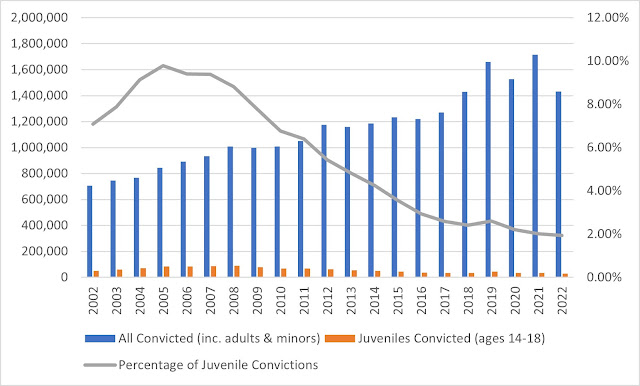
    Statistics released by the SPC and Supreme People’s Procuratorate (SPP) in 2022 reveal a continuous drop in juvenile convictions, falling by more than 50 percent since 2013. The statistics also show a sharp uptick in the number of juveniles given non-arrest and non-prosecution decisions, as well as an increase in the number of juvenile records sealed. This progress in restorative justice for juveniles has occurred in the decade since China added a new section to the Criminal Procedure Law that incorporated provisions for conditional non-prosecution, record sealing, and more non-custodial measures – topics that were discussed during Dui Hua’s US-China expert exchanges.

    Table 1. Total Convictions & Juvenile Convictions

    Source: National Court Judicial Statistics Bulletin 2002-2022
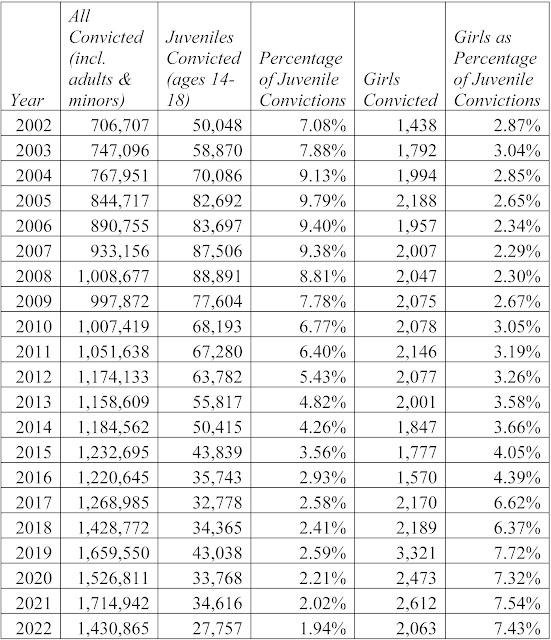
    In 2022, the number of juvenile convictions reached a record low, with only 27,757 juveniles tried nationwide. The percentage of juvenile convictions reached its peak at 9.79 percent in 2005 and remained at around 9 percent through 2008. This surge alarmed the Chinese government, and calls for juvenile justice reform increased. In 2007, senior Chinese prosecutor Dan Wei told Dui Hua executive director John Kamm that reforming the juvenile justice system had become a priority for senior leaders. The exchanges kicked off with an invitation to the SPC to study juvenile justice in the United States.
    Following the first exchange, juvenile convictions continued to decrease year-by-year. Convictions fell below 5 percent for the first time in 2013, after the revised Criminal Procedure Law came into force and codified the principle of prioritizing education over punishment. Over the last decade, the number of juvenile convictions decreased by more than 50 percent from 63,782 in 2012 to 27,757 in 2022.

    Of those 27,757 juveniles, 2,063 were girls. The number of convicted girls increased from 1,570 in 2016 to 3,321 in 2019 but dropped below 2,500 in 2020 and further to 2,000 in 2022. Despite this decrease, the number of girls convicted as a percentage of juvenile convictions has remained above 7 percent since 2019, up from 3.58 percent in 2013.

    Table 2. Total, Juvenile & Girl Convictions

    Source: National Court Judicial Statistics Bulletin 2002-2022

    Collective Efforts

    Besides fewer juvenile convictions, the SPP works in tandem with the SPC to incorporate restorative practices into its operations by approving fewer juvenile arrests and prosecutions. In 2022, prosecutors accepted and examined arrests for 49,070 minors, a drop from 55,379 in 2021. It is a sizable increase from 2020’s figure of 37,681. The approval rate for arrests of juvenile suspects in 2022 reached a record low of 31.5 percent. Of those, prosecutors approved arrests of about 15,000 minors while disapproving arrests of 34,000. The disapproval rate rose incrementally every year from 26.7 percent in 2014 to 39.1 percent in 2020. This rate exceeded 50 percent for the first time in 2021 and reached another peak of 68.5 percent in 2022.

    In the first six months of 2023, prosecutors disapproved the arrests of 20,000 juveniles. The disapproval is 67.9 percent, on par with the 2022 level.

    Table 3. Juvenile Arrests Disapproved

    Source: White Paper on Prosecutorial Practice for Minors 2014-2022

    The prosecution rate for juvenile suspects in 2022 was 47.6 percent. The number of juveniles accepted and examined for prosecution decreased year-by-year from 77,405 in 2014 to 58,307 in 2018. In 2022, the number rose back to 78,467, exceeding the 2014 prosecution rate. Despite the increase, a growing number of juvenile delinquents have been given non-prosecution over the years. In 2022, prosecutors approved the prosecution of 28,000 juveniles and disapproved 41,000 prosecutions. The disapproval rate reached a record high of 59.9 percent, up from 10.3 percent in 2013. In just one year, the number of juveniles given non-prosecution nearly doubled from 22,585 in 2021 to 41,000 in 2022.

    The non-prosecution rate in the first six months of 2023 was 56.7 percent, with a total of 18,000 juveniles given non-prosecution.

     Table 4. Juvenile Prosecutions Disapproved

    Source: White Paper on Prosecutorial Practice for Minors 2014-2022

    Of particular significance is the wider use of conditional non-prosecution, known in the United States as diversion. In 2022, 26,161 juvenile cases were diverted, and the application rate of diversion rose year-to-year from 20.8 percent in 2020 to 29.6 percent in 2021, and to 36.1 percent in 2022. In 2013, diversion was incorporated into the Criminal Procedure Law. Since 2014, the number of juveniles offered conditional non-prosecution increased eightfold.

    Table 5. Juvenile Delinquents Given Conditional Non-Prosecution
    Source: White Paper on Prosecutorial Practice for Minors 2014-2022
    Sealing Records
    Record sealing was incorporated into the Criminal Procedure Law in 2013, and prior to that it was a major topic of discussion during the expert exchanges hosted by Dui Hua. Dui Hua was assisted in preparing and conducting the exchanges by Judge Leonard Edwards of Santa Clara County, California. Judge Edwards (retired) is a recognized expert in juvenile justice in general and the sealing of juvenile records in particular.
    In China, the practice of sealing juvenile records mandates that a juvenile offender’s records be sealed after they successfully complete the probation period called for by conditional non-prosecution orders issued by the procuratorate, provided that the juvenile observes the conditions of non-prosecution and does not commit new crimes. The SPP has disclosed nationwide figures on how this restorative measure has been implemented. A total of 92,694 juveniles had their records sealed from 2020-2022. In 2022, 33,021 juvenile records were sealed, an increase from 28,163 in 2020 and 31,510 in 2021. In May 2022, the SPC, SPP and Ministry of Public Security promulgated Implementation Measures for Sealing Juvenile Criminal Records, which provides detailed standards and operational procedures for sealing juvenile criminal records.
    The drop in juvenile arrests, prosecutions, and convictions in 2022 signals a more progressive approach to juvenile justice. Although public sentiment continues to support more punitive approaches such as lowering the age of criminal responsibility from 14 to 12 in 2020, the Chinese government increasingly emphasizes rehabilitation and education as the first response to juvenile offenders. The Law on Protection of Minors, revised in 2020, refined the family guardianship system by improving guardianship measures, establishing a mandatory reporting system, and creating an information inquiry system for offenders. The law also provided more guidance on prevention and response measures for internet addiction, campus bullying, new offenses, and parental legal obligations. In the same year, the revised Juvenile Delinquency Prevention Law focused on prevention rather than punitive measures by stressing education, mental health, reduction of bullying, and multi-institutional collaboration to reduce juvenile delinquency.
    Building Safer Systems for All
    A notable omission of both laws is that they do not address gender-specific needs. It is increasingly recognized that rehabilitating girl offenders requires different approaches than those applied to boys. To raise awareness of the need for gender-specific treatment, Dui Hua formally expanded its mission in 2014 to include women and girls in conflict with the law. Later that year, Dui Hua co-hosted an international symposium on women in prison, facilitating discussions and capacity building on the Bangkok Rules, a set of regulations that provide guidance for policy makers, legislators, sentencing authorities and prison staff to meet the specific needs of women detainees and to reduce overall female imprisonment. As part of this campaign, with permission from Penal Reform International, Dui Hua released a Chinese translation of “Neglected needs: girls in the criminal justice system in 2018.” The 12-webinar International Symposium on Girls in Conflict with the Law that took place from October 2020 to March 2021, continued this campaign in an international context with input from the SPC.
    However, many countries – including both the United States and China – continue to use policies that are inadequate to address the unique needs of girls in conflict with the law. Both the Law on Protection of Minors and the revised Juvenile Delinquency Prevention Law made significant strides in improving protections for minors, but the lack of gender-specific measures needs to be addressed in the future. The drop in convictions and the rise of diversionary measures reflect the great progress made in these protections, but it is important that girls are not left behind as China’s juvenile justice system continues to reform.
  • Child Welfare with Chinese Characteristics, Part II: An All-of-Society Effort

    Child Welfare with Chinese Characteristics, Part II: An All-of-Society Effort

    Image credit: The Dui Hua Foundation

    Read Part I:  Rights & Responsibilities of Family & Schools

    The revised Law of the People’s Republic of China on Protection of Minors (hereafter Protection of Minors Law) came into effect in June 2021, introducing 60 new articles into law. During Dui Hua’s Joint Program on Child Welfare Laws (JPCW) webinar in April 2022, experts from the United States and the Supreme People’s Court of China (SPC) discussed best practices for child protection legislation and the revisions to the Protection of Minors Law across six protection areas. Part I explored the roles of family and schools in child protection. This installment looks at the roles assigned to broader society, online content providers, government, and the judiciary.

    Child Protection Online

    China’s regulation of youth gaming online drew international attention, partly because these measures were among the first of their kind. Even countries that balk at online censorship and lack of user privacy have expressed positive attitudes towards China’s efforts to set limits on youth online consumption.

    Much of this has been necessitated by the nation’s high internet penetration. According to the white paper Youth of China in a New Era, at the end of 2020 the number of netizens in China aged 6 to 18 reached 180 million, with the internet available to 94.9 percent of minors nationwide.

    Number of Chinese minors and internet accessibility rate from 2018 to 2020. Source: China Daily, Full Text: Youth of China in the New Era 
    Online content regulations focus on reducing internet addiction and cyberbullying and combating sexual exploitation of minors. Article 74 states that internet product and service providers “shall not offer minors products and services that induce addiction,” and Article 75 specifically limits the time minors spend playing online games by minors and also restricts in-game purchases.
    During the JPCW, Li Chen, Deputy Director of the Division of Supervision of Minors’ Protection at the Child Welfare Department of the Ministry of Civil Affairs, stated that the Office of the Central Cyberspace Affairs Commission and the Ministry of Industry and Information Technology have created reporting channels for minor-related issues in order to help standardize reporting mechanisms and response times. The amendments require service providers to take measures to stop cyberbullying, stipulating that the parent or guardian of a minor who is cyberbullied has the right to inform service providers to delete, block, or disconnect links. If service providers are unresponsive to these complaints, the reporting channels should be leveraged to stop the illegal behavior. If found complicit or guilty, the website, individual, or platform may have their operating licenses revoked and face fines of up to one million yuan (roughly $150,000 USD).
    In May 2022, China Daily reported that prosecutors had obtained evidence of 2,584 cyberbullying cases through the compulsory reporting system since 2020 and found 1,604 cases in which staff (those working at schools, hospitals, hotels and in other industries related to minors) failed to report violations despite having compulsory reporting obligations, with 299 individuals being held accountable.
    The United States’ approach is less centralized. According to the Cyberbullying Research Center, 48 states or territories (including Washington, DC) include cyberbullying or electronic harassment in their anti-bullying legislation. While most states have criminal and school sanctions for cyberbullying, these laws vary by state in terms of scope.
    Former Facebook product manager Frances Heughen testifying to Congress on the effects of social media on youth mental health. Image credit: C-Span YouTube account
    In terms of online regulation, the clearest equivalent in the United States would be the Children’s Online Privacy Protection Act (COPPA), which was enacted in 1998, entered into force in 2000, and was revised in 2013. COPPA places requirements on websites that are directed to children under 13, with a focus on the collection, use, and disclosure of personal information of their data. Efforts to further revise COPPA have been underway – among the most recent being the “Protecting the Information of our Vulnerable Children and Youth Act” or the “Kids PRIVCY Act” introduced in 2021 by Representative Kathy Castor (R-Fla.) – but it is unclear if these will address issues beyond data collection or those affecting adolescents older than 13. The current law has also come under fire, both for being ineffective and outdated (for example, by the CEO of NGO Common Sense Media) and for being too restrictive (Facebook founder and Meta CEO Mark Zuckerberg famously argued that these restrictions impede early child education).
    In 2019, China instituted restrictions on the amount of time minors could play online games to 90 minutes a day on weekdays, and minors were banned from online gaming from 10 PM to 8 AM. In 2021, online gaming for minors was restricted further to Fridays, weekends, and public holidays for one hour per day. Restrictions like these and limitations on in-game purchases for minors were meant to combat gaming addictions that state officials sometimes refer to as “spiritual opium.”
    While federal implementation of such a law is unlikely, the state of Utah recently approved the Utah Social Media Regulation Act restricting minors’ use of social media in ways that bear some similarities to China’s gaming restrictions. The bill, signed by Governor Cox in March 2023, requires minors to obtain the consent of a guardian before joining social media platforms, marking the most aggressive step yet by state or federal lawmakers to regulate minors’ online behavior. It requires social media platforms to conduct age verification for all Utah residents and provide parents’ access to their teens’ accounts. The law also bans all ads for minors and bans minors from using such sites from 10:30 PM to 6:30 AM.
    Judiciary, Government & the “China Dream” 
    Included in the Protection of Minors Law is the establishment of a special juvenile court office. According to the Global Times, citing Vice President of the SPC and juvenile court office director Yang Wanming, the new office is responsible for coordinating, guiding, and managing all juvenile trials and cases.
    In an effort to implement the new office’s mandate, the Protection of Minors Law amendments impose new requirements on public security organs, procuratorates, courts, and judicial administrative departments. These include Article 101 (designating dedicated institutions and appointing dedicated personnel to handle cases involving minors), Article 103 (keeping information about minors confidential), and Articles 110 to 112 (stipulating that adult representatives be present when minors – suspects, victims, or witnesses – are interviewed by judicial organs). Article 112 in particular requires female staff be present when the minor involved is female.
    (Clockwise top left) Judge Wang, Deputy Director Li, Judge Song, and Committee Member Chen during the JPCW. Image credit: The Dui Hua Foundation

    In 2021, Beijing News reported that 24,035 criminal cases involving the infringement upon the rights and interests of minors (including trafficking, child molestation, and forced begging) were tried nationwide between 2016 and 2020. Of those cases, 24,386 offenders received punishment. From 2016 to 2020, more than 1.2 million civil cases involving the upbringing and guardianship of minors were brought to trial.

    The amendments to the Protection of Minors Law speak to an increased awareness by the Supreme People’s Court and the Chinese government that China’s youth face new challenges to their welfare that require novel approaches. These amendments also call on government social service agencies to improve the quality of support received by minors without guardianship. Li Chen, speaking during the JPCW shared that in 2021 13 authorities including the Ministry of Civil Affairs – which houses the Department of Children’s Welfare Affairs – jointly issued Opinions on Further Promoting Improvement, Upgrade and Innovation-Driven Transformation of Child Welfare Institutions to Pursue High-Quality Development. The opinions aimed to improve child welfare institutions at the provincial and municipal levels, and to foster increased integration between the upbringing of children and wraparound services like community-based medical treatment, rehabilitation, education, and social work.

    The Protection of Minors Law differs from the United States’ approach to juvenile justice and child welfare, which is defined both by its child-focused, rights-based approach and its federalist orientation that creates variations between states with some federal regulation. By contrast, Beijing’s top-down approach stresses uniformity, setting responsibilities for various stakeholders to ensure compliance at the local level. A lingering question is how far the law will go in holding parents, schools, and other community stakeholders responsible for violations and derogations of child welfare.

    The Youth of China in the New Era white paper paints a rosy picture of the future of child welfare in China:

    In the future, with successive efforts from one generation of young people to the next, China will scale new heights in every dimension, achieving economic, political, cultural, ethical, social, and eco-environmental progress. The Chinese people will enjoy a happier and healthier life and the Chinese nation will become a proud and active member of the community of nations. The great Chinese Dream will eventually become a reality. 

    The continued emphasis on rule of law and legal responsibility is evident in the changes to the Protection of Minors Law. What is less clear is if these changes will yield a system that is fair, enforceable, and subject to rule of law in line with that Chinese Dream.

    An All-of-Society Effort

    The revised Protection of Minors Law also recognizes broader societal obligations to protect minors. Article 11 grants any organization or individual “the right to discourage, prevent, or report or make an accusation against an act…which is not conducive to the physical or mental health of minors or infringes upon the lawful rights and interests of minors.” These regulations share many of the same principles as those placed on schools and educational institutions. Using sexual or physical abuse as an example, Article 9 of the Opinion on Punishing Sexual Violations of Minors in Accordance of Law (2013) states that anyone with a special responsibility to minors – including supervising, educating, training, or providing medical treatment – has a right and obligation to report to the public security organ or the people’s procuratorate if they discover that a minor under their supervision has been abused.

    As with the obligations for schools, the Protection of Minors Law’s view to societal obligations has similarities to CAPTA in the United States; however, by making reporting a legal responsibility through national legislation, China’s law potentially elevates the issue and could help create a uniform process for reporting, response, and resolution. Currently in the United States, each state may or does have different definitions, processes and responses to any reported abuse, of any kind. According to a 2019 report by the Child Welfare Information Gateway, approximately 47 States, the District of Columbia, American Samoa, Guam, the Northern Mariana Islands, Puerto Rico, and the Virgin Islands designate professions whose members are mandated by law to report child maltreatment. Individuals designated as mandatory reporters are those who typically have frequent contact with children. The circumstances under which a mandatory reporter must make a report, and the process for doing so, vary by state.

    President Obama signs S. 3817, the “CAPTA Reauthorization Act of 2010.” Image credit: Pete Souza / Official White House Photo 

    According to China Daily, Chinese procuratorates nationwide prosecuted 60,553 people for crimes against minors in 2021, up 5.7 percent year-on-year, of which 27,851 were for crimes involving sexual assault against minors. The Opinions on Establishing the Compulsory Reporting System for Cases regarding Infringement on Minors (Provisional) is meant to combat this trend by standardizing the compulsory reporting procedure system and specifying the parties considered mandated reporters. The reporting procedures enabled procuratorates, public security organs, and women’s federations to set up more than 1,600 “one-stop” interview and rescue areas to shield minor victims from “secondary injuries” or re-traumatization that can occur during the reporting process.

    The revisions to the Protection of Minors Law reflect renewed appreciation for the role of society in protecting minors. The European Union’s Civil Society Roadmap for China notes that the revised Protection of Minors Law makes 13 mentions of “social organizations.” Furthermore, a State Council working group was established to assist civil society organizations focused on child protection in an effort to “achieve full coverage” of child protection by civil society organizations by 2025.

    Achieving such comprehensive child welfare mechanisms remains a challenge for any government. China’s recent developments reflect a top-down, all-of-government mentality that outlines obligations for all stakeholders, from the parent who might have to leave their child with relatives to centralized government bodies. China’s approach speaks to the adage that it “takes a village to raise a child,” and both the JPCW presenters and the legislation suggest that there is room for civil society organizations and grassroots participation. Whether or not these entities have the space and agency to fill these roles remains to be seen.

    The information in both parts of this article was gathered over the past year since the JPCW concluded. Dui Hua continues its dialogue with the SPC in an effort to stay abreast of developments and best practices for juvenile justice reform and the improvement of child welfare systems. These are areas in which countries the world over struggle to identify policies that will meaningfully address the issues facing youth, and dialogue on these issues is a reminder that sound child welfare policies help pave the way for a bright future.

  • Child Welfare with Chinese Characteristics, Part I: Rights & Responsibilities of Family & Schools

    Child Welfare with Chinese Characteristics, Part I: Rights & Responsibilities of Family & Schools

    Image credit: The Dui Hua Foundation

    On June 1, 2021, the second revision of the Law of the People’s Republic of China on Protection of Minors (hereafter Protection of Minors Law) came into effect. The revision introduced 60 new articles into law. During the Joint Program on Child Welfare Laws (JPCW) webinar hosted by Dui Hua in April 2022, panelists from the Supreme People’s Court of China (SPC) spoke in depth about the revisions to the Protection of Minors Law across six key protection areas: family, school, society, internet, government, and the judiciary.

    The current Protection of Minors Law is the result of decades of revision and reform. First adopted at the 21st Meeting of the Standing Committee of the Seventh National People’s Congress on September 4, 1991, the law was revised in 2006; in 2012, it was amended in accordance with the Decision on Revising the Law of the People’s Republic of China on Protection of Minors made by the Standing Committee of the 11th National People’s Congress at the 29th Meeting. In 2020, it was revised at 13th National People’s Congress and came into effect in its current iteration in June 2021.

    The amendments are meant to fill in the gaps of the previous law and safeguard children’s rights to the greatest extent possible. During the JPCW, Li Chen, Deputy Director of the Department of Children’s Welfare Affairs from the Ministry of Civil Affairs (MCA) stated that the revisions to the Protection of Minors Law “explicitly provide that the people’s governments at or above the county level shall establish a coordination mechanism for the protection of minors…so as to further consolidate the legal groundwork for the protection of minors (in China).” On April 21, 2022, the State Council Information Office of China issued a white paper titled Youth of China in a New Era. The paper stated that China’s aim is to “create a future of prosperity, health, safety, mutual respect, mutual learning, and shared benefits” for young people all over the world.

    China’s reforms in child welfare and juvenile justice have made strides towards a more comprehensive national policy, and certain aspects of its system stand in contrast to the US child reform and juvenile justice systems which are largely decided at the state level. Yet, the vagueness surrounding the Protection of Minors Law’s scope may open the door to practices that are harsh on parents and guardians, place undue stress on families, or present issues for enforcement.

    Screenshots from the April 7 expert exchange. (Clockwise top left) Host John Kamm, moderator Dr. Jiang Jihai, moderator Judge Len Edwards, Dr. Jiang with members of his panel. Image credit: The Dui Hua Foundation

    This article explores China’s child welfare legislation by drawing on the relevant legislation, white papers issued by Chinese Communist Party organs, and remarks made during Dui Hua’s 2022 JPCW webinar. Part I focuses on the obligations of the family unit and educational institutions in child welfare. Part II looks at the designated roles of online entities, government bodies, the judiciary, and society at large in ensuring the welfare of the child.

    “A Good, Harmonious & Civilized Family Environment” 

    Like many legal systems, China’s child welfare laws center the family as the foundation for child protection. During the JPCW, Judge Wang Wei, Deputy Chief Judge of the First Criminal Division of Jiangsu Province High People’s Court, spoke on guardianship revocation cases in China, stating that “raising children is both an ethical and affectionate need and a statutory responsibility.” The Protection of Minors Law contains ten articles that specify the guardian’s responsibility to the child, with emphasis on when and how guardianship can be revoked and possibly restored.

    Issues of guardianship and child neglect have particular relevance in China due to the number of children who are left in the care of grandparents or other relatives in rural villages while their parents work in cities. A combination of factors – among them the household registration system known as hukou, the high cost of living in cities, and limited economic opportunities in rural areas – has resulted in millions of “left behind” children (留守儿童), so-called because they live apart from their parents for much of their childhood.

    The cover of an individual household’s register, or hukou, booklet. Image credit: Wikimedia Commons / Public Domain
    Article 21, a more recent addition to the Protection of Minors Law, stipulates that children under the age of eight cannot be left unattended or in the care of unsuitable guardianship. Minors under the age of 16 should not be forced out of the home or forced to live without a guardian. Article 15 states that “parents or other guardians of minors shall learn family education, accept guidance on family education, and create a good, harmonious and civilized family environment.” Article 15 also requires any adult family members living in the same house to bear some guardianship responsibilities, which are detailed in Article 16:
    1. To provide minors with life, health, safety, and other aspects of protection;
    2. To care for the physical, psychological and emotional needs of minors;
    3. To educate and guide minors to abide by the law, to be diligent and thrifty, and to develop a good moral character and behavior habits;
    4. To conduct safety education for minors to improve their self-protection awareness and ability;
    5. To respect minors’ right to receive education and ensure that school-age minors receive and complete compulsory education in accordance with the law;
    6. To ensure the time of rest, entertainment, and physical exercise for minors, and guide them to carry out activities beneficial to their physical and mental health;
    7. To properly manage and protect the property of minors;
    8. To act for minors to carry out civil legal acts in accordance with law;
    9. To prevent and stop the bad behaviors and illegal and criminal behaviors of minors and conduct reasonable discipline; and
    10. Other duties under guardianship that should be performed.
    This list raises the issue of whether parents or guardians can be liable for violating the above responsibilities and whether courts can mandate revocation of guardianship. The broad sweep of section 10 could lead to highly discretionary implementation.

    Articles 22 and 23 address instances when a minor’s parent or guardian is temporarily unable to perform their duties. Article 22 states that the parents or guardians “shall entrust a person with full capacity for performing civil juristic acts to attend minors,” and Article 23 requires the parent or guardian to promptly inform the child’s school and local authorities of the guardianship arrangement. The articles instruct guardians to follow specific reporting mechanisms but provide little guidance about how to determine if a guardian is “temporarily unable to perform duties.” Judge Wang of the Jiangsu Province High People’s Court clarified in his remarks that revocation of guardianship “is only applicable to serious circumstances; judicial power shall only intervene in family relations in a way of minimal damage as the ‘last resort.’ It should strictly distinguish between guardianship infringement and improper education/slight physical punishment.”

    Article 36 of the Civil Code of China lists three circumstances when guardianship may be revoked either permanently or temporarily. During the JPCW, Judge Wang of Jiangsu Province High People’s Court described them thusly:

    • the guardian engaged in any act which damages the physical and mental health of the ward, such as sexual assault, sale, abandonment, abuse, and violence against the ward;
    • the guardian fails to perform the duties of guardianship or is unable to perform such duties but refuses to delegate all or part of the duties to others, i.e., drug use, gambling, or being alcoholic, in jail serving sentences, unable to perform their obligations (as a clause designed to cover all other circumstances);
    • the guardian is engaged in any other act which infringes upon the lawful rights and interests of the ward, such as instigating or using minors to commit crimes of a severe nature; coercing, deceiving, using minors to beg on the street, and refusing to rectify after censure and education being conducted three times by the public security authority.

    Dr. Jiang Jihai, then-Director of the Juvenile Justice Guidance Division of the Supreme People’s Court of China, stated that the Family Education Promotion Law, which was also revised in 2021, escalated family education from traditional “family affairs” to “state affairs.” The law stipulates that parents bear principal responsibility such that “if they fail to fulfill this responsibility, or do not implement family education correctly, they should bear the corresponding legal responsibility.”

    Safe Schools, Peaceful Campuses 

    Beyond the family, the Protection of Minors Law similarly introduced and amended regulations on the responsibility of schools in child protection. The law and its amendments provide a blueprint for child protection in educational institutions by assigning new responsibilities to institutions as well as specifying special-purpose schemes, administrative requirements, work mechanisms, and measures for support and supervision.

    Chinese elementary school students on their way to school in Nanyou. Image credit: Wabbit Wanderer Flickr Account / CC BY-SA 2.0

    Education environments – including kindergartens, special education institutions, primary, secondary, and vocational schools – have mandatory measures to fight campus bullying and sexual misconduct, and they also mandate the inclusion of sex education curriculum. Kiosks and businesses that sell alcohol, cigarettes, or lottery tickets are barred from operating near schools to prevent minors from developing unhealthy habits. To prevent sex trafficking, hotels and short-term accommodation facilities must ask underage guests for their guardians’ contact information and the nature of their relationship with fellow guests. Hotel staff are obligated to call police if they observe suspicious activity involving child sex trafficking. The Ministry of Education (MOE) and other authorities launched pilot programs at schools, organized training workshops, and provided guidance to students, including:

    • Initiating the “safe school and peaceful campus” campaign;
    • Launching a national safety education day for primary and secondary school students;
    • Holding special activities around water safety to prevent drowning accidents;
    • Launching an anti-bullying initiative for primary and secondary school students;
    • Implementing measures such as regulating extracurricular sports training and strengthening the physical health management of primary and secondary school students.

    In 2016, China Daily reported on new measures to combat school bullying, including that authorities will hold regions and schools responsible if they are found to have serious bullying problems. Issues of bullying and sexual assault continue to draw widespread public attention. A 2016 survey of seven Chinese cities found that 26 percent of urban children had been bullied during the previous year. As such, the law includes implementation rules and procedures to help schools and other authorities identify and intervene in bullying, abuse, and harassment at schools. For example, Article 130 provides a legal definition of bullying, and Article 39 provides a mandate for schools to establish a formal system of control and prevention of bullying.

    A CAPTA post. Image credit: School House Connection

    The national reach of the Protection of Minors Law is distinct from federal efforts in the United States to curtail bullying. The law is unique in its far-reaching nature and its placement of legal responsibility on multiple different actors, including schools, parents, public security organs, and law enforcement. The closest US analog to the Protection of Minors Law is the Federal Child Abuse Prevention and Treatment Act (CAPTA). CAPTA is primarily concerned with physical and sexual abuse against minors, but its impact is limited as it depends on individual states to pass legislation on mandated reporting of child abuse neglect.

    The roles of family and schools in child welfare present an emerging picture of how legislation differs between China and the United States. While both legislate obligations for different parties and manifest this largely through mandatory reporting requirements, China’s top-down legislation stands in contrast to the United States’ approach. The US system offers guidance but leaves actual definition and implementation to states to induce localized systems. How these obligations – and the differences in systems – manifest across cyberspace, government, judicial bodies, and society at large will be discussed in Part II.

    Read Part II: An All-of-Society Effort

  • Child Welfare with Chinese Characteristics, Part I: Rights & Responsibilities of Family & Schools

    Child Welfare with Chinese Characteristics, Part I: Rights & Responsibilities of Family & Schools

    Image credit: The Dui Hua Foundation

    On June 1, 2021, the second revision of the Law of the People’s Republic of China on Protection of Minors (hereafter Protection of Minors Law) came into effect. The revision introduced 60 new articles into law. During the Joint Program on Child Welfare Laws (JPCW) webinar hosted by Dui Hua in April 2022, panelists from the Supreme People’s Court of China (SPC) spoke in depth about the revisions to the Protection of Minors Law across six key protection areas: family, school, society, internet, government, and the judiciary.  

    The current Protection of Minors Law is the result of decades of revision and reform. First adopted at the 21st Meeting of the Standing Committee of the Seventh National People’s Congress on September 4, 1991, the law was revised in 2006; in 2012, it was amended in accordance with the Decision on Revising the Law of the People’s Republic of China on Protection of Minors made by the Standing Committee of the 11th National People’s Congress at the 29th Meeting. In 2020, it was revised at 13th National People’s Congress and came into effect in its current iteration in June 2021.  

    The amendments are meant to fill in the gaps of the previous law and safeguard children’s rights to the greatest extent possible. During the JPCW, Li Chen, Deputy Director of the Department of Children’s Welfare Affairs from the Ministry of Civil Affairs (MCA) stated that the revisions to the Protection of Minors Law “explicitly provide that the people’s governments at or above the county level shall establish a coordination mechanism for the protection of minors…so as to further consolidate the legal groundwork for the protection of minors (in China).” On April 21, 2022, the State Council Information Office of China issued a white paper titled Youth of China in a New Era. The paper stated that China’s aim is to “create a future of prosperity, health, safety, mutual respect, mutual learning, and shared benefits” for young people all over the world.   

    China’s reforms in child welfare and juvenile justice have made strides towards a more comprehensive national policy, and certain aspects of its system stand in contrast to the US child reform and juvenile justice systems which are largely decided at the state level. Yet, the vagueness surrounding the Protection of Minors Law’s scope may open the door to practices that are harsh on parents and guardians, place undue stress on families, or present issues for enforcement.  

    Screenshots from the April 7 expert exchange. (Clockwise top left) Host John Kamm, moderator Dr. Jiang Jihai, moderator Judge Len Edwards, Dr. Jiang with members of his panel. Image credit: The Dui Hua Foundation 

    This article explores China’s child welfare legislation by drawing on the relevant legislation, white papers issued by Chinese Communist Party organs, and remarks made during Dui Hua’s 2022 JPCW webinar. Part I focuses on the obligations of the family unit and educational institutions in child welfare. Part II looks at the designated roles of online entities, government bodies, the judiciary, and society at large in ensuring the welfare of the child. 

    “A Good, Harmonious & Civilized Family Environment” 

    Like many legal systems, China’s child welfare laws center the family as the foundation for child protection. During the JPCW, Judge Wang Wei, Deputy Chief Judge of the First Criminal Division of Jiangsu Province High People’s Court, spoke on guardianship revocation cases in China, stating that “raising children is both an ethical and affectionate need and a statutory responsibility.” The Protection of Minors Law contains ten articles that specify the guardian’s responsibility to the child, with emphasis on when and how guardianship can be revoked and possibly restored.  

    Issues of guardianship and child neglect have particular relevance in China due to the number of children who are left in the care of grandparents or other relatives in rural villages while their parents work in cities. A combination of factors – among them the household registration system known as hukou, the high cost of living in cities, and limited economic opportunities in rural areas – has resulted in millions of “left behind” children (留守儿童), so-called because they live apart from their parents for much of their childhood.

    The cover of an individual household’s register, or hukou, booklet. Image credit: Wikimedia Commons / Public Domain 

    Article 21, a more recent addition to the Protection of Minors Law, stipulates that children under the age of eight cannot be left unattended or in the care of unsuitable guardianship. Minors under the age of 16 should not be forced out of the home or forced to live without a guardian. Article 15 states that “parents or other guardians of minors shall learn family education, accept guidance on family education, and create a good, harmonious and civilized family environment.” Article 15 also requires any adult family members living in the same house to bear some guardianship responsibilities, which are detailed in Article 16: 
    1. To provide minors with life, health, safety, and other aspects of protection; 
    2. To care for the physical, psychological and emotional needs of minors; 
    3. To educate and guide minors to abide by the law, to be diligent and thrifty, and to develop a good moral character and behavior habits; 
    4. To conduct safety education for minors to improve their self-protection awareness and ability; 
    5. To respect minors’ right to receive education and ensure that school-age minors receive and complete compulsory education in accordance with the law; 
    6. To ensure the time of rest, entertainment, and physical exercise for minors, and guide them to carry out activities beneficial to their physical and mental health; 
    7. To properly manage and protect the property of minors; 
    8. To act for minors to carry out civil legal acts in accordance with law; 
    9. To prevent and stop the bad behaviors and illegal and criminal behaviors of minors and conduct reasonable discipline; and 
    10. Other duties under guardianship that should be performed. 
    This list raises the issue of whether parents or guardians can be liable for violating the above responsibilities and whether courts can mandate revocation of guardianship. The broad sweep of section 10 could lead to highly discretionary implementation. 

    Articles 22 and 23 address instances when a minor’s parent or guardian is temporarily unable to perform their duties. Article 22 states that the parents or guardians “shall entrust a person with full capacity for performing civil juristic acts to attend minors,” and Article 23 requires the parent or guardian to promptly inform the child’s school and local authorities of the guardianship arrangement. The articles instruct guardians to follow specific reporting mechanisms but provide little guidance about how to determine if a guardian is “temporarily unable to perform duties.” Judge Wang of the Jiangsu Province High People’s Court clarified in his remarks that revocation of guardianship “is only applicable to serious circumstances; judicial power shall only intervene in family relations in a way of minimal damage as the ‘last resort.’ It should strictly distinguish between guardianship infringement and improper education/slight physical punishment.” 

    Article 36 of the Civil Code of China lists three circumstances when guardianship may be revoked either permanently or temporarily. During the JPCW, Judge Wang of Jiangsu Province High People’s Court described them thusly: 

    • the guardian engaged in any act which damages the physical and mental health of the ward, such as sexual assault, sale, abandonment, abuse, and violence against the ward; 
    • the guardian fails to perform the duties of guardianship or is unable to perform such duties but refuses to delegate all or part of the duties to others, i.e., drug use, gambling, or being alcoholic, in jail serving sentences, unable to perform their obligations (as a clause designed to cover all other circumstances); 
    • the guardian is engaged in any other act which infringes upon the lawful rights and interests of the ward, such as instigating or using minors to commit crimes of a severe nature; coercing, deceiving, using minors to beg on the street, and refusing to rectify after censure and education being conducted three times by the public security authority. 

    Dr. Jiang Jihai, then-Director of the Juvenile Justice Guidance Division of the Supreme People’s Court of China, stated that the Family Education Promotion Law, which was also revised in 2021, escalated family education from traditional “family affairs” to “state affairs.” The law stipulates that parents bear principal responsibility such that “if they fail to fulfill this responsibility, or do not implement family education correctly, they should bear the corresponding legal responsibility.” 

    Safe Schools, Peaceful Campuses 

    Beyond the family, the Protection of Minors Law similarly introduced and amended regulations on the responsibility of schools in child protection. The law and its amendments provide a blueprint for child protection in educational institutions by assigning new responsibilities to institutions as well as specifying special-purpose schemes, administrative requirements, work mechanisms, and measures for support and supervision.  

    Chinese elementary school students on their way to school in Nanyou. Image credit: Wabbit Wanderer Flickr Account / CC BY-SA 2.0 

    Education environments – including kindergartens, special education institutions, primary, secondary, and vocational schools – have mandatory measures to fight campus bullying and sexual misconduct, and they also mandate the inclusion of sex education curriculum. Kiosks and businesses that sell alcohol, cigarettes, or lottery tickets are barred from operating near schools to prevent minors from developing unhealthy habits. To prevent sex trafficking, hotels and short-term accommodation facilities must ask underage guests for their guardians’ contact information and the nature of their relationship with fellow guests. Hotel staff are obligated to call police if they observe suspicious activity involving child sex trafficking. The Ministry of Education (MOE) and other authorities launched pilot programs at schools, organized training workshops, and provided guidance to students, including: 

    • Initiating the “safe school and peaceful campus” campaign;  
    • Launching a national safety education day for primary and secondary school students;  
    • Holding special activities around water safety to prevent drowning accidents;   
    • Launching an anti-bullying initiative for primary and secondary school students;  
    • Implementing measures such as regulating extracurricular sports training and strengthening the physical health management of primary and secondary school students. 

    In 2016, China Daily reported on new measures to combat school bullying, including that authorities will hold regions and schools responsible if they are found to have serious bullying problems. Issues of bullying and sexual assault continue to draw widespread public attention. A 2016 survey of seven Chinese cities found that 26 percent of urban children had been bullied during the previous year. As such, the law includes implementation rules and procedures to help schools and other authorities identify and intervene in bullying, abuse, and harassment at schools. For example, Article 130 provides a legal definition of bullying, and Article 39 provides a mandate for schools to establish a formal system of control and prevention of bullying.

    A CAPTA post. Image credit: School House Connection 

    The national reach of the Protection of Minors Law is distinct from federal efforts in the United States to curtail bullying. The law is unique in its far-reaching nature and its placement of legal responsibility on multiple different actors, including schools, parents, public security organs, and law enforcement. The closest US analog to the Protection of Minors Law is the Federal Child Abuse Prevention and Treatment Act (CAPTA). CAPTA is primarily concerned with physical and sexual abuse against minors, but its impact is limited as it depends on individual states to pass legislation on mandated reporting of child abuse neglect.  

    The roles of family and schools in child welfare present an emerging picture of how legislation differs between China and the United States. While both legislate obligations for different parties and manifest this largely through mandatory reporting requirements, China’s top-down legislation stands in contrast to the United States’ approach. The US system offers guidance but leaves actual definition and implementation to states to induce localized systems. How these obligations – and the differences in systems – manifest across cyberspace, government, judicial bodies, and society at large will be discussed in Part II. 

    Read Part II: An All-of-Society Effort

  • China’s National People’s Congress May Expand Legal Aid in Death Penalty Cases

    China’s National People’s Congress May Expand Legal Aid in Death Penalty Cases

    The closing ceremony of the 29th session of the 13th NPC Standing Committee on June 10. Image credit: NPC.gov

    China’s National People’s Congress is considering a new Legal Aid Law. Among its many provisions, Article 24 of the new law would extend access to legal aid to condemned defendants during final death penalty case review at the Supreme People’s Court.

    China’s legal system already provides legal aid to defendants in the trial phase of death penalty proceedings. However, legal aid does not currently cover the crucial final death penalty review stage of China’s capital punishment process: death penalty review at the Supreme People’s Court. Capital defense lawyers have dubbed the lack of legal aid in death penalty review the “last mile problem” of Chinese capital defense. The new law would finally address this last mile, bringing death penalty review under the scope of legal aid and guaranteeing universal representation during all stages of capital proceedings.

    The law would also improve the quality of death penalty counsel at both trial and review. The draft law mandates that legal aid lawyers representing clients in cases carrying a possible sentence of death or an indeterminate life sentence have at least three years of legal practice experience.

    The Development of the Legal Aid Law  

    If enacted, the new Legal Aid Law will be China’s first comprehensive legislation on legal aid. Up until now, China’s legal aid has been governed by State Council Regulations. Implementation of the regulations takes place at a local level, and the quality of legal assistance has been uneven. Critics charge that low funding, low status, and lack of oversight lead to substandard representation in many legal aid cases. The new law earmarks funds and sets new standards in an attempt to address these problems.

    In recent years China’s leaders have signaled their intention to overhaul state legal aid as part of the Xi administration’s comprehensive effort to increase “governance through law.” In 2015 the CCP issued “Opinions on Improving the Legal Aid System,” a policy statement setting an agenda for improvements across the legal aid system. The document placed special emphasis on capital cases, including a call for legal aid in death penalty review cases. The 2015 opinion also called for an expansion in criminal representation generally, including the use of duty lawyers—criminal attorneys who can provide basic on-site legal advice at detention centers and courts. In 2018 the Supreme People’s Court and the Ministry of Justice issued “Measures on Launching the Pilot Program for Full Coverage of Lawyers’ Defense in Criminal Cases.” That measure did not specifically provide for death penalty review representation, but it has improved standards and increased access to defense lawyers in all criminal cases.

    The new Legal Aid Law is currently under review at the National People’s Congress. The first draft of the new Legal Aid Law was released in January. A second draft was introduced for public comment in June. The second draft notably improves upon the first by including an additional provision specifying that appointed legal aid counsel must have at least three years of experience in all death penalty review proceedings and trial cases carrying the possibility of an indeterminate life sentence or death sentence.

    Legal Aid and Death Penalty Review 

    Death penalty review is the final stage of legal proceedings in China’s capital punishment system. A capital defendant in China initially undergoes a trial of the first instance, typically at an intermediate court. If found guilty, the defendant faces a trial of the second instance, typically at a provincial high court. Following a capital sentence in a second instance trial, the condemned defendant’s case will undergo a final death penalty review. In 2007 the Supreme People’s Court retook the authority to perform death penalty review from provincial courts as part of its sweeping efforts at death penalty reform. Since that time, all death penalty review proceedings have been handled by the Supreme People’s Court in Beijing.

    The Supreme People’s Court has not previously recognized a universal right to legal aid in its death penalty review proceedings. China’s Criminal Procedure Law (Art. 35) requires the provision of a legal aid lawyer in cases in which defendant faces an indeterminate life sentence or death sentence. This provision should logically extend to death penalty review. However, the Supreme People’s Court has declined to apply this provision in death penalty review.

    The conference on providing legal aid for death penalty review. Image credit: Southern Metropolitan
    Currently condemned defendants may choose to hire counsel for the proceedings; however,  if they do not do so, the state will not provide a lawyer for them. While official death penalty review data is a state secret in China, the available evidence indicates that under the current system—in which legal representation at the review is not mandatory and a defendant must hire an attorney privately—most condemned defendants do not retain a lawyer for the proceedings.

    Experts Debate the Draft Law 

    On March 27 a group of 20 scholars and lawyers in China came together to discuss the implications of the death penalty review representation provision contained in the new Legal Aid Law. The conference was hosted by China University of Political Science and Law and Shangquan Law firm, a leading criminal defense firm in Beijing. Conference participants noted both the promise of the new legal aid law and the deficiencies that still exist in death penalty in China.

    Defense lawyers pointed out that while universal legal representation in death penalty review is an important legal development, obstacles to lawyer engagement with death penalty review proceedings hinder the substantive impact of the new law. For example, although death penalty review judges are legally mandated to meet with defense counsel, attorneys report difficulty in arranging these meetings. Lawyers also report difficulty accessing casefiles, and often end up taking pictures of documents on their phones because they cannot get copies.

    Scholars at the conference expressed concern that the expansion of legal aid to death penalty review might carry unexpected consequences for the legal market: legal aid lawyers assigned to death penalty review cases may lack experience and qualifications for this technical work, and the provision of these lawyers may also crowd out competent private lawyers who currently focus on death penalty practice. It is therefore important that the legal aid system provide sufficient compensation for this representation and also establish qualifications for death penalty review representation. The second draft of the Legal Aid Law, which was released subsequent to the conference, goes some way to addressing this concern by providing that legal aid counsel in both capital trial and death penalty review cases must have more than three years of related practice experience. Standing committee representatives also included a suggestion to include legal aid costs in the government budget, beginning at the county level. However, it is unclear whether death penalty review at the SPC would be covered by such a measure at the national level.

    Since the Supreme People’s Court retook the power of death penalty review in 2007, the Shangquan law firm in Beijing has been conducting empirical work on death penalty review representation. This work has included pro bono death penalty review representation in the past. At the conference, Shangquan law firm director Mao Lixin formally announced a new pro bono program that will provide pro bono representation for indigent condemned defendants facing death penalty review. The program was intended to run through March 2021, or until the new Legal Aid Law goes into effect.

    By Tobias Smith 

  • Juvenile Justice for Girls with Chinese Characteristics: Juvenile Convictions Drop, Number of Offending Girls Remains High

    Juvenile Justice for Girls with Chinese Characteristics: Juvenile Convictions Drop, Number of Offending Girls Remains High

    Executive Director John Kamm makes introductory remarks during the webinar on March 30. Composite image credit: The Dui Hua Foundation 

    The United States is increasingly mainstreaming gender-specific justice reform, and the need has been identified in China as well. In 2019, Dui Hua found that even as the number of girls convicted by courts decreased until the end of 2016, the number of girls convicted as a percentage of juvenile convictions had increased.

    When Dui Hua published its research and analysis in December 2019, it expressed concern that the draft of a proposed law on the Prevention of Juvenile Delinquency released that autumn omitted gender-specific measures, saying that “it is increasingly accepted that gender-specific needs require different approaches.” The International Symposium on Girls in Conflict with the Law, organized by Dui Hua and its partners, explored issues related to girls’ justice in the Chinese justice system with representatives from China’s Supreme People’s Court (SPC). The webinar “China’s Supreme People’s Court: Special and Priority Protection of the Legitimate Rights and Interests of Underage Girls in Accordance with the Law” featured Dr. Jiang Jihai, Director of Juvenile Offender Office of Research Office of SPC, and Ms. Dai Qiuying, Director of Center for the Protection of Minors of Applied Law.

    Remarks by both panelists, speaking through an interpreter, provide insight into the causal factors of female juvenile offences and new laws for juvenile offenders, particularly girls. These remarks, statistics discussed during the webinar, and Dui Hua’s research provide a more informed understanding of juvenile female crime rates in China and changing approaches to juvenile crime.

    The Number of Offending Girls

    Statistics from Dr. Jiang and Dui Hua research show that beginning in 2018, there was a sustained increase in the number of offending girls overall. Furthermore, the number of offending girls as a percentage of all offending juveniles has risen every year from 2013 to 2019 with a slight drop in 2020, yet percentagewise more than doubled over seven years earlier. Figures were unavailable for 2017 other than the total number of juveniles convicted.

    Table 1: Total Convicted Juveniles by Gender and Percentage, All Chinese Courts 

    Overall indictments for juveniles decreased from 37,743 in 2016 to 33,223 in 2020, in part due to an increased emphasis on diversion. However, as seen in Table 1, the number of girl offenders convicted has increased to 7.32 percent, compared to 4.39 percent in 2016 according to Dui Hua’s research and the numbers provided by Dr. Jiang, compared with the period of 2013-2016.
    Table 2: Number of Juveniles Indicted in China, Annually

    Diversion: Reform Through Education

    The combined efforts of the SPC and the Supreme People’s Procuratorate (SPP) work to create a “whole society approach” to the criminal process for juvenile offenders that is focused on rehabilitation and education first, and punishment second. Table 2 shows that in 2019, the SPP prosecuted a total of 43,234 minors suspected of committing crimes. Table 3 shows that conditional non-prosecution (known in the United States as “diversion”) was applied for 7,663 of the juveniles who committed “minor crimes” and showed repentance in 2019, a number that had already been increasing year-by-year but had a sharp uptick between 2016 to 2019. 

    The Chinese government has been overhauling legislation for juveniles as recently as 2020, when the newest version of the Law on Protection of Minors was passed. This law works in tandem with the revised Law of the People’s Republic of China on Prevention of Juvenile Delinquency to inform policy and approach. These revisions codify previous legal provisions into black letter legal provisions, basic principles of law that are undisputed and accepted by all judges.

    Table 3: Percentage and Totals of Juveniles Diverted Annually in China

    “Important Innovations” and Criminal Law

    The increase in minors given conditional non-prosecution in 2019 points to the continued emphasis on rehabilitation and education as the first response to juvenile offenders. It also underlines the relevance of the recent changes to the Law on Protection of Minors and the revised Law of the People’s Republic of China on Prevention of Juvenile Delinquency. 

    Dr. Jiang discussed “important innovations” in the revised laws that aim to improve the treatment of juvenile offenders. These include refining the family guardianship system, improving governmental guardianship measures, establishing a mandatory reporting system, establishing an information inquiry system for criminals as well as clarifying the prevention and control of internet addiction, campus bullying, new offenses, and punishment measures for the behavior of failing to fulfill the legal obligations. 

    The newly revised law also states that if a minor below the age of criminal liability commits an act which is prohibited by law, then government agencies may conduct an evaluation and, with the approval of a special education steering committee, provide corrective education at a special school. At these special schools, offenders reportedly receive moral, legal, and psychological health education, along with appropriate vocational training.

    In December 2020, China passed 11th Amendment to the Criminal Law lowering the age of criminal responsibility from 14 to 12 years old for some serious crimes. The law holds children aged 12 to 14 criminally liable for “intentional homicide or intentional injury that leads to death or causes others severe disabilities by extremely cruel means.” If a crime not mentioned in the new law is committed by a child under the age of 14, they will be exempt from criminal punishment but may be given correctional education as mentioned above. Remaining unchanged is the law that holds those between the ages of 14 to 16 criminally responsible in serious crimes such as cases of rape, robbery, and intentional homicide. 

    The approach to “juvenile justice with Chinese characteristics,” spoken of by both Dr. Jiang and Ms. Dai, prioritizes diversion from conviction and ongoing involvement by the court as part of the rehabilitation and education process. Under these reforms, judges are responsible for building and maintaining relationships with juvenile offenders and their families to understand the causal factors of their offence and provide guidance. Courts must first conduct a comprehensive analysis of the possibility of recidivism of minor offenders, including consideration of the offender’s family and home situation, then assess the best approach for rehabilitation with an emphasis on the primary caregiver or parents as role models. According to Dr. Jiang and Ms. Dai, the courts are also in the process of drafting two pieces of legislation titled the Family Education Law and the Child Welfare Law that would allow judicial agencies to play a larger role in ensuring the proper education and mentorship of children.

    There is not much gender-specific data available to clarify what trends in diversion and education mean for girls specifically. Dr. Jiang noted that the overall age of female juvenile offenders has been getting younger. He cited the “low age” and “rebellious psychology during adolescence” of girl offenders as factors that lead them to “handle issues in a very simplified and immature way without the proper foresight and prediction of the consequence” due to their lack of legal knowledge. To address this, the government has taken efforts to help young people understand Chinese law. Such measures include events, campaigns, and educational materials for use in classrooms, judges serving as adjunct teachers on school campuses for primary and middle schools, and a moot court experience as well as online courses for older students.

    Dr. Jiang makes remarks during the webinar. Image credit: The Dui Hua Foundation

    Evidence also points to poor general education as a common causal factor for girl offenders, many with below a middle school education and a “non-existent or limited” understanding of the law according to Dr. Jiang. He also cited parents’ low education level as a causal factor for criminal behavior in both male and female minors. This lack of a basic education coupled with limited understanding of the law, can lead to the development of bad habits and criminal behavior. Both Dr. Jiang and Ms. Dai cited contexts and environmental factors as fundamental pathways to offending for girls, expressing the sentiment that “there are no problem children, only problem families.” 

    Neglect was noted as another strong contributing factor for female offenders in China. In today’s economy, many children are left home unsupervised as both parents are working. This can result in young girls being negatively influenced by older female peers or people they befriend on the internet. Judges review these types of causal factors when assessing how to handle crimes committed by female juvenile offenders and deciding which course of action will bring the offender back to a “normal law-abiding citizen and useful talent for society.”

    Ms. Dai emphasized that the family is the most important domain for the growth and improvement of minors, saying that “people should build a family upbringing model full of love, freedom, and respect.” Reflecting this emphasis, Article 7 of the Minors Protection Law in China allows the state or government to take “necessary measures” to guide, support, and supervise the parents or guardians in doing their duty” to raise law abiding citizens.

    Ms. Dai makes remarks during the webinar.

    Dr. Jiang suggested that the court is committed to continuing to improve gender-sensitive procedures for female juvenile offenders. These include increasing the use of female police officers, prosecutors, judges, and lawyers who are trained to handle girl’s cases and to protect the privacy of girl offenders. Taken together, these legislative and procedural changes suggest that juvenile justice policy reform, including gender-sensitive approaches, is increasingly seen as a priority.

    A Gender-Sensitive Future

    The comments by Dr. Jiang and Dai on changes to the SPC’s approach to juvenile justice law, including the inclusion of gender-sensitive processes, are promising. The International Symposium on Girls in Conflict with the Law produced a list of recommendations for the promotion of effective girls’ justice policy. Dr. Jiang and Ms. Dai’s remarks on community-based solutions, reducing detention, and applying non-custodial solutions/alternatives to detention are in line with these recommendations and Article 37b of the Convention on the Rights of the Child.

    The focus on addressing root causes of juvenile offending, including socio-economic vulnerability and family instability, by funding and supporting social services is promising. At the time of this writing, China does not have, and never has, gender-specific criminal laws. Similarly, such measures as the implementation of gender-specific measures like specialized training and having female personnel interact with girls have yet to materialize in legislation or official policy.

    The Symposium recommendations also stress the need to systematically collect disaggregated data in order to better understand the pathways leading children to detention globally. More transparency on figures for female juvenile offenders and diversion programs would contribute towards a collective understanding and better research. Were China to increase its engagement with the international community on girl’s justice, this could help promote best practices and effective policy at the international level.

    Finally, the issue of long-standing research gaps rooted in discriminatory thinking emerged repeatedly during the Symposium in a variety of contexts. Like other countries including the United States and Canada, funding and supporting research on girl’s lives, including a special focus on Indigenous girls and ethnic minorities, would help governments effect better policy for justice-involved girls. China’s policy success and challenges around juvenile justice are a vital part of that understanding and would be an important contribution towards greater clarity on how to address juvenile justice for girls in the future.

  • Supreme People’s Court Makes Two Announcements About Online Court Database

    Supreme People’s Court Makes Two Announcements About Online Court Database

    A screenshot of the China Judgements Online site’s announcement requiring users to register a mobile phone number. The announcement was put up on August 31, 2020, one day before the change took place. 

    In September 2020, China’s Supreme People’s Court (SPC) announced two developments concerning China Judgements Online, the country’s national public internet court case database. First, the Court announced that the database has grown to contain over 100 million judgements—a staggering figure. Second, since September 1, database users have been required to register using a mobile phone number in order to search the website—a chilling restriction. Do these two developments mean anything for the future of judicial transparency in China? On both counts, the answer is yes, but not for the obvious reasons. The growth of the database may be positive, but more cases do not necessarily signal more judicial openness; meanwhile, the registration requirement may be bad, but more access requirements don’t necessarily signal more legal repression.  

    China’s Judicial Transparency Initiative and Case Databases 

    The SPC launched China Judgements Online in 2013 as part of a commitment to increasing judicial transparency. The database is reportedly the largest of its kind in the world, and it continues to grow at a rapid pace. The database has been one of the most important court developments in China in half a century; it is a boon for lawyers and researchers, as well as ordinary citizens who want to know what the courts are doing.  

    But despite the database’s promise, those who want to use it face two major roadblocks. The first impediment is about interface: the search functions on the website are not very good. Cases are often inaccurately tagged and do not always come up in searches, even when they are available on the website. The second impediment is about content: many cases are not available on the database. In principle, all court judgements are supposed to be posted online, but some categories of cases—notably those deemed state secrets and those that might endanger social stability—are excepted from this requirement. Unfortunately, courts are not transparent about which cases are not posted. The subversion trials of human rights lawyers such as  Zhou Shifeng (周世锋), Li Heping (李和平), and Wang Quanzhang (王全璋) have garnered substantial media attention even within mainland China, but their judgments are not available on China Judgements Online. 

    Worse still, cases sometimes are removed from China Judgements Online without notice, or cease to show up in searches, even when they are still available. This means that China Judgements Online queries alone are not a reliable way to identify published cases. Finally, the contents of cases are not always disclosed, making their inclusion on the site largely uninformative. This tends to be particularly true of cases of endangering state security involving ethnic minorities in restive regions. In one example, Dui Hua found that nine Tibetans had been sentenced for inciting splittism in Ganzi, Sichuan, but the site included no information beyond their names, the charges of conviction, and the dates of the judgement.  

    Because of these shortcomings in the official China Judgements Online database, a brisk secondary market in online case databases has taken hold in China. Secondary databases include open access, such as Jufaanli, and paid databases such as LawXP and Legal Miner. Secondary databases exist in a legal grey zone. SPC guidelines prohibit duplication of the website, but the popularity of alternative databases has only grown in recent years, and the court has not seriously moved to eliminate them. That may be because the secondary databases are so useful. Not only do alternative databases offer better user interface and analytical tools, but they may also contain judgements that are not available on China Judgements Online, including cases that may have been taken down or cases from local courts that were not uploaded to the national database. For example, the case of Ismaili Rozi has never been posted on China Judgements Online but is available on an alternative site. Rozi is the first known case of educational placement, a measure imposed on prisoners who are considered “a danger to society” even after they have completed their sentences for terrorism or extremism offenses. 

    While these secondary databases provide benefits over the official Court website, they also make the user problems with the official database worse. Many users—including researchers at Dui Hua—have noted that response times on China Judgements Online queries have slowed to a crawl in recent years. This is reportedly due in large part to the increased traffic from secondary databases, which use programs to search and scrape cases from the public portal. The use of bots to harvest case data helps explain why China Daily reports that China Judgements Online has had nearly 48 billion visits (it seems unlikely that these are human visits, as this would amount to the equivalent of dozens of site visits from every person on the planet).  

    Registering for China Judgements Online 

    This brings us to the announcement that as of September 1, 2020, users who wish to query the database must first register using a mobile phone number. The registration is apparently an effort to ensure that site users are humans, rather than web crawling bots that slow down database queries. If this is indeed the court’s rationale, this is a commendable attempt to improve the experience for individual database users. Even so, requiring registration to search public cases raises fears of surveillance and may deter citizens from using the database.  

    There are many reasons people may be hesitant to register for the site. For some users, the registration requirement may raise worries that the SPC is tracking their individual case search histories. This could be a particular concern for people who search, for example, administrative lawsuits against local governments in order to bring a similar action themselves. Registration may also deter scholars who study sensitive types of cases such as political prosecutions, capital sentences, or cases from areas such as Xinjiang, Tibet, or other minority autonomous regions. These scholars may worry that if authorities track their searches, the judgements they find will be taken offline in response.  

    Dui Hua regularly uses China Judgements Online for case research, and the foundation was able to successfully register after several attempts and gain access to the site after the new requirement went into effect. The change did seem to bring desired improvements for site stability and performance. However, a faster site alone will not reduce the draw of secondary case databases. Long-standing aforementioned issues still remain. Dui Hua regularly uncovers published cases posted on alternative databases that do not appear in queries on China Judgements Online. Until the SPC can guarantee that all public cases are accessible on its own website (and not removed without notice), people will still flock to alternative databases to seek information. However, to comply with China’s internet use regulations, many alternative sites have already implemented user registration requiring a China mobile number or a WeChat account, which greatly impeded access from overseas. 

    Along the same lines, the rapid growth of China Judgements Online is a laudable feat. The number of posted judgements, 100 million online, is incredible. But transparency is not just about volume, it is also about completeness. As Dui Hua indicated in its assessment to the United Nations in preparation for China’s 2018 Universal Periodic Review, the country’s record on this matter is mixed. The sensitive cases are always the minority, but in a rule of law system, a handful of cases could also be the ones that count most. The public needs some information about all cases, even the controversial ones. Where there are legitimate reasons for withholding the publication of a judgement, the existence of the case and the reason for the restriction should still be made public in every instance. Otherwise, although China Judgements Online may provide us with more and more cases, it will not tell us anything more about what we actually need to know. 

  • Supreme People’s Court Makes Two Announcements About Online Court Database

    Supreme People’s Court Makes Two Announcements About Online Court Database

    A screenshot of the China Judgements Online site’s announcement requiring users to register a mobile phone number. The announcement was put up on August 31, 2020, one day before the change took place.

    In September 2020, China’s Supreme People’s Court (SPC) announced two developments concerning China Judgements Online, the country’s national public internet court case database. First, the Court announced that the database has grown to contain over 100 million judgements—a staggering figure. Second, since September 1, database users have been required to register using a mobile phone number in order to search the website—a chilling restriction. Do these two developments mean anything for the future of judicial transparency in China? On both counts, the answer is yes, but not for the obvious reasons. The growth of the database may be positive, but more cases do not necessarily signal more judicial openness; meanwhile, the registration requirement may be bad, but more access requirements don’t necessarily signal more legal repression.

    China’s Judicial Transparency Initiative and Case Databases 

    The SPC launched China Judgements Online in 2013 as part of a commitment to increasing judicial transparency. The database is reportedly the largest of its kind in the world, and it continues to grow at a rapid pace. The database has been one of the most important court developments in China in half a century; it is a boon for lawyers and researchers, as well as ordinary citizens who want to know what the courts are doing.

    But despite the database’s promise, those who want to use it face two major roadblocks. The first impediment is about interface: the search functions on the website are not very good. Cases are often inaccurately tagged and do not always come up in searches, even when they are available on the website. The second impediment is about content: many cases are not available on the database. In principle, all court judgements are supposed to be posted online, but some categories of cases—notably those deemed state secrets and those that might endanger social stability—are excepted from this requirement. Unfortunately, courts are not transparent about which cases are not posted. The subversion trials of human rights lawyers such as  Zhou Shifeng (周世锋), Li Heping (李和平), and Wang Quanzhang (王全璋) have garnered substantial media attention even within mainland China, but their judgments are not available on China Judgements Online.

    Worse still, cases sometimes are removed from China Judgements Online without notice, or cease to show up in searches, even when they are still available. This means that China Judgements Online queries alone are not a reliable way to identify published cases. Finally, the contents of cases are not always disclosed, making their inclusion on the site largely uninformative. This tends to be particularly true of cases of endangering state security involving ethnic minorities in restive regions. In one example, Dui Hua found that nine Tibetans had been sentenced for inciting splittism in Ganzi, Sichuan, but the site included no information beyond their names, the charges of conviction, and the dates of the judgement.

    Because of these shortcomings in the official China Judgements Online database, a brisk secondary market in online case databases has taken hold in China. Secondary databases include open access, such as Jufaanli, and paid databases such as LawXP and Legal Miner. Secondary databases exist in a legal grey zone. SPC guidelines prohibit duplication of the website, but the popularity of alternative databases has only grown in recent years, and the court has not seriously moved to eliminate them. That may be because the secondary databases are so useful. Not only do alternative databases offer better user interface and analytical tools, but they may also contain judgements that are not available on China Judgements Online, including cases that may have been taken down or cases from local courts that were not uploaded to the national database. For example, the case of Ismaili Rozi has never been posted on China Judgements Online but is available on an alternative site. Rozi is the first known case of educational placement, a measure imposed on prisoners who are considered “a danger to society” even after they have completed their sentences for terrorism or extremism offenses.

    While these secondary databases provide benefits over the official Court website, they also make the user problems with the official database worse. Many users—including researchers at Dui Hua—have noted that response times on China Judgements Online queries have slowed to a crawl in recent years. This is reportedly due in large part to the increased traffic from secondary databases, which use programs to search and scrape cases from the public portal. The use of bots to harvest case data helps explain why China Daily reports that China Judgements Online has had nearly 48 billion visits (it seems unlikely that these are human visits, as this would amount to the equivalent of dozens of site visits from every person on the planet).

    Registering for China Judgements Online 

    This brings us to the announcement that as of September 1, 2020, users who wish to query the database must first register using a mobile phone number. The registration is apparently an effort to ensure that site users are humans, rather than web crawling bots that slow down database queries. If this is indeed the court’s rationale, this is a commendable attempt to improve the experience for individual database users. Even so, requiring registration to search public cases raises fears of surveillance and may deter citizens from using the database.

    There are many reasons people may be hesitant to register for the site. For some users, the registration requirement may raise worries that the SPC is tracking their individual case search histories. This could be a particular concern for people who search, for example, administrative lawsuits against local governments in order to bring a similar action themselves. Registration may also deter scholars who study sensitive types of cases such as political prosecutions, capital sentences, or cases from areas such as Xinjiang, Tibet, or other minority autonomous regions. These scholars may worry that if authorities track their searches, the judgements they find will be taken offline in response.

    Dui Hua regularly uses China Judgements Online for case research, and the foundation was able to successfully register after several attempts and gain access to the site after the new requirement went into effect. The change did seem to bring desired improvements for site stability and performance. However, a faster site alone will not reduce the draw of secondary case databases. Long-standing aforementioned issues still remain. Dui Hua regularly uncovers published cases posted on alternative databases that do not appear in queries on China Judgements Online. Until the SPC can guarantee that all public cases are accessible on its own website (and not removed without notice), people will still flock to alternative databases to seek information. However, to comply with China’s internet use regulations, many alternative sites have already implemented user registration requiring a China mobile number or a WeChat account, which greatly impeded access from overseas.

    Along the same lines, the rapid growth of China Judgements Online is a laudable feat. The number of posted judgements, 100 million online, is incredible. But transparency is not just about volume, it is also about completeness. As Dui Hua indicated in its assessment to the United Nations in preparation for China’s 2018 Universal Periodic Review, the country’s record on this matter is mixed. The sensitive cases are always the minority, but in a rule of law system, a handful of cases could also be the ones that count most. The public needs some information about all cases, even the controversial ones. Where there are legitimate reasons for withholding the publication of a judgement, the existence of the case and the reason for the restriction should still be made public in every instance. Otherwise, although China Judgements Online may provide us with more and more cases, it will not tell us anything more about what we actually need to know.

  • Sharp Drop in Number of Juveniles Convicted by Chinese Courts

    Sharp Drop in Number of Juveniles Convicted by Chinese Courts

     
    Image Credit: Pixabay 
     

    Records of People’s Courts Historical Judicial Statistics: 1949-2016 (Renmin fayuan sifa tongji lishi dianji 人民法院司法统计历史典籍) were published by the Supreme People’s Court (SPC) at the end of 2018 and contain extensive information on the convictions of juveniles, including girls, by Chinese courts. Statistics are available for trials from 2002 to 2016, a period of 15 years.Table 1 shows the number of juveniles convicted, with a breakdown by gender. It reveals that the number of juveniles tried and convicted from 2008 to 2016 dropped by more than 60 percent. However, while the number of girls convicted by courts decreased until the end of 2016, the number of girls convicted as a percentage of juvenile convictions has increased.


    Table 1. Total Juvenile Convictions, by Gender
    Year
    All Juveniles Convicted (ages 14-18)
    All Girls Convicted
    Girls as Percentage of the Year’s Total Convictions
    All Boys Convicted
    Boys as Percentage of the Year’s Total Convictions
    2002
    50,048
    1,438
    2.87%
    48,610
    97.13%
    2003
    58,870
    1,792
    3.04%
    57,078
    96.96%
    2004
    70,086
    1,994
    2.85%
    68,092
    97.15%
    2005
    82,692
    2,188
    2.65%
    80,504
    97.35%
    2006
    83,697
    1,957
    2.34%
    81,740
    97.66%
    2007
    87,506
    2,007
    2.29%
    85,499
    97.71%
    2008
    88,891
    2,047
    2.30%
    86,844
    97.70%
    2009
    77,604
    2,075
    2.67%
    75,529
    97.33%
    2010
    68,193
    2,078
    3.05%
    66,115
    96.95%
    2011
    67,280
    2,146
    3.19%
    65,134
    96.81%
    2012
    63,782
    2,077
    3.26%
    61,705
    96.74%
    2013
    55,817
    2,001
    3.58%
    53,816
    96.42%
    2014
    50,415
    1,847
    3.66%
    48,568
    96.34%
    2015
    43,839
    1,777
    4.05%
    42,062
    95.95%
    2016
    35,743
    1,570
    4.39%
    34,173
    95.61%
    Source: Records of People’s Courts Historical Judicial Statistics: (1949-2016), 2018.
     
    Tables 2 and 3 present the types of crimes committed by all juveniles and girls, respectively, since 2002. There has been a troubling rise in the number of cases of drug crimes committed by girls in recent years.
     
     
    Table 2. Top Juvenile Crimes

    Year

    Violent

    Nonviolent


    Robbery

    Aggravated
    Assault

    Rape

    Brawls

    Murder

    Theft

    “Picking
    Quarrels and Provoking Trouble”

    Drugs* 

    200221,8464,7122,56968056413,9631,495373
    200325,6265,8142,959602644 16,8721,647400
    200429,2076,8182,81097164120,9292,202617
    200535,2888,0952,8451,31567823,9612,631874
    200634,2598,9182,5491,74176023,7633,581749
    200734,2179,2852,6672,31867225,3973,818916
    200834,3269,8222,6312,50752425,9164,1001,210
    200929,8849,2782,5932,66155020,8124,0051,268
    201024,2929,0152,5813,18246317,2443,7301,368
    201121,7149,8252,5853,72755817,3163,8651,543
    201218,5588,8922,5983,37159818,2593,9691,567
    201316,4647,8912,3103,36447014,7133,3581,748
    201414,8587,4922,2242,91233711,9663,5711,745
    201513,1646,1421,9363,1063178,9973,3231,595
    201612,4164,1521,4972,6001995,9103,0011,223
     
     
    * Drug related crimes: smuggling,
    trafficking, transporting, and manufacturing drugs


    Source:
    Records of People’s Courts Historical Judicial Statistics: (1949-2016),
    2018.
     
    Table 3. Top Crimes Committed by
    Girls
    Year
    Violent
    Nonviolent
    Robbery
    Aggravated
    Assault
    Rape
    Brawls
    Murder
    Theft
    “Picking
    Quarrels and Provoking Trouble”
    Drugs
    Fraud
    Extortion
    2002
    442
    74
    24
    5
    38
    524
    33
    54
    52
    16
    2003
    524
    99
    34
    3
    34
    738
    15
    87
    79
    15
    2004
    554
    130
    34
    11
    40
    840
    19
    89
    79
    23
    2005
    636
    115
    36
    13
    26
    850
    49
    112
    114
    30
    2006
    527
    104
    31
    22
    38
    749
    36
    103
    57
    44
    2007
    534
    157
    46
    21
    29
    709
    43
    107
    72
    31
    2008
    467
    138
    59
    24
    24
    729
    50
    122
    77
    33
    2009
    456
    158
    58
    38
    29
    641
    71
    124
    85
    45
    2010
    387
    162
    65
    74
    18
    670
    48
    163
    57
    44
    2011
    347
    186
    56
    73
    35
    650
    67
    204
    73
    20
    2012
    290
    152
    41
    63
    29
    748
    69
    218
    59
    27
    2013
    199
    164
    53
    52
    23
    651
    82
    213
    96
    22
    2014
    174
    163
    30
    63
    26
    527
    74
    230
    79
    34
    2015
    145
    126
    45
    58
    21
    427
    52
    232
    92
    19
    2016
    147
    100
    29
    66
    20
    381
    74
    189
    100
    14
     
    Source:
    Records of People’s Courts Historical Judicial Statistics: (1949-2016),
    2018.


    Political crimes – endangering state security and organizing or using a cult to undermine implementation of the law – are rare. Twenty juveniles, almost certainly Tibetans or Uyghurs, were convicted of splittism and inciting splittism during 2010-2015. Eighty juveniles were convicted of organizing or using a cult to undermine implementation of the law during the same period; these are thought to be predominantly Falun Gong practitioners.A recent article published by Beijing News suggests there was a sharp increase in the percentage of girls convicted of crimes in 2017. According to the article, girls convicted as a percentage of juveniles rose to 6.56 percent for years 2016-2017. The SPC statistics volumes only cover trials through the end of 2016. However, China Law Yearbook 2018 provides a number for juveniles convicted in 2017: 32,778. Using this number and the 2016 number of 35,743 in the SPC volumes, we calculate that the number of girls convicted in 2017 was 2,925, the highest number since at least 2002. Expressed as a percentage of all juveniles convicted by courts, girls doubled from 4.39 percent in 2016 to 8.92 percent in 2017.

    It should be noted that the statistics in the SPC volumes only cover juveniles convicted by courts. Juveniles can be held in various other carceral facilities without being tried by a court. Such alternatives include compulsory drug rehabilitation (qiangzhi jiedu 强制戒毒) centers, custody and education (shourong jiayu 收容教育) camps (for sex workers, including juveniles), “legal education” (fazhi jiaoyu 法制教育) campuses for “seriously poisoned Falun Gong practitioners,” “custody and rehabilitation” (shourong jiaoyang 收容教养) facilities for juveniles under the age of 16 who commit mostly minor offenses, and “work-study schools” (gongduxuexiao 工读学校) for juveniles who “engage in serious misbehavior.” There were 1,335 juveniles in “custody and rehabilitation” facilities in 2005, the latest year for which numbers are available. In 2013, there were 10,735 juveniles in 67 “work-study schools,” of whom 18 percent were girls.

    Juvenile Justice Reforms

    China stressed reform of the juvenile justice system in the 2002-2007 five-year judicial reform plan. During this period, emphasis was on infrastructure – specifically the creation of juvenile courts and the recruitment and training of judges for juvenile cases. During the 2008-2012 plan period, the emphasis was on process – how to best deal with juvenile crime. This period culminated in the passing of the amended Criminal Law in 2011 and the amended Criminal Procedure Law in 2012. The former recommended giving juveniles suspended sentences for minor crimes. The latter introduced a number of important reforms including “diversion” (sifa fenliu 司法分流 or fenliu chuzhi 分流处置), sometimes referred to as “postponed prosecution,” (futiaojian buqisu 附条件不起诉), sealing of juvenile records, and use of behavioral and psychological assessments at every stage of adjudication.In addition to implementing and assessing pilot projects in the provinces, the SPC also sent teams abroad to study foreign juvenile justice systems. From 2008 to 2017, Dui Hua joined with the SPC’s Office of Juvenile Courts to hold five in-depth exchanges with judges and other judicial officials and scholars – two in the United States and three in China.

    Topics covered by these exchanges included reforms that made their way into the amended CPL. Dui Hua believes that the adoption of “postponed prosecution” – a process whereby an offender can apologize and pay compensation to victims as well as undertake other steps that demonstrate “genuine repentance and a willingness to reform” – is the main reason why trials and convictions of juveniles dropped more than 60 percent since 2008.

    The Road Ahead

    In the autumn of 2019, the National People’s Congress (NPC) released the draft of a proposed Law on the Prevention of Juvenile Delinquency for public comment. The draft focuses on prevention rather than punitive measures, stressing education, mental health, reduction of bullying, and a focus on multi-institutional collaboration to reduce juvenile delinquency. It renames “custody and rehabilitation” centers as “specialized schools.”A notable omission of the draft law is that it does not propose gender-specific measures. It is increasingly accepted that gender-specific needs require different approaches. This shortcoming may be addressed during the public comment phase of consideration.

    Whether or not the age of criminal responsibility should be lowered from the current standard of 14 years old is a hotly debated topic in China. The draft does not mention this controversial proposal, but it is likely to emerge as a point of contention during the public comment phase.

  • Renewed Calls to Lower China’s Age of Criminal Responsibility Ignore Benefits of Non-Custodial Measures and Lessons from Abroad Part II of II

    Camp Glenwood One-on-One Counseling with Probation Officer. Image Credit: Dui Hua
    Can China’s Juvenile Justice Policymakers Receive Lessons from Abroad?
     

    In “Renewed Calls to Lower China’s Age of Criminal Responsibility Ignore Benefits of Non-Custodial Measures and Lessons from Abroad” (Part I), Dui Hua analyzed a number of challenges in juvenile justice, both in China and elsewhere, including deciding the age of criminal responsibility and alternatives to criminal confinement. In Part II, Dui Hua looks at promising programs and important research findings from outside China that could be useful for Chinese experts in juvenile justice to study as part of China’s ongoing juvenile justice reforms.

    World Health Initiatives Regarding Juveniles

    The experiences and practices of other countries and institutions can play an instructive role in China’s efforts to reduce violent behavior by adolescents. Relevant international human rights principles include the 1989 UN Convention on the Rights of the Child, especially articles 37 and 40. UNICEF’s Child Protection Information Sheet on Children in Conflict with the Law, in its summary of key applicable human rights principles, states that “children in conflict with the law have the right to treatment that promotes their sense of dignity and worth, takes into account their age, and aims at their reintegration into society. Further, UNICEF recommends that placing children in conflict with the law in a closed facility should be a measure of last resort, to be avoided whenever possible.” In light of these provisions, UNICEF aims to “reduce incarceration while protecting children from violence, abuse, and exploitation,” while also promoting “rehabilitation that involves families and communities as a safer, more appropriate, and effective approach than punitive measures.” Mirroring some of the policies mentioned by China’s juvenile judges at Dui Hua’s 2017 expert exchange, UNICEF also strongly advocates diversion, restorative justice, and alternatives to confinement.
    Experiences from Europe might help Chinese officials in adopting some of these principles as it adjusts its juvenile justice practices. In the European context, the World Health Organization’s (WHO) adolescent mental health programs focus on reducing depression and anxiety disorders, severe cases of which can contribute to violent acts. As evidence of the severity of mental health problems for juveniles, suicide is the “leading cause of death among 10–19-year-olds in low- and middle-income countries of the [European] Region, and the second-leading cause in high-income countries.” To reduce risk factors associated with juvenile violence, European member states of the WHO find that “supportive parenting, a secure home life and a positive learning environment in school are the key factors in building and protecting mental well-being, or mental capital, in childhood and adolescence.”
    In 2015, WHO European member states formalized their approach to supporting the mental well-being of adolescents and others experiencing major life transitions. According to the Minsk Declaration, the WHO life-course approach “encompasses actions that are taken early and appropriately to transitions in life,” recognizing that “adolescence, the transition from child to adult, marks the pivotal change to greater personal autonomy. It could signify a new beginning for those who were disadvantaged in their start in life. It also represents an opportunity for policies and programmes to influence key decision-making processes such as the timing of sexual debut and parenthood, the onset or avoidance of risky and addictive behaviours, as well as the acquisition of life skills, the start of independent living, building resilience and the capacity to bounce back in the face of adversity…Effective intervention is also essential to modify the course of other critical phases in life in which people experience dramatic changes in roles and status, such as…the transition from adolescence to adulthood.”
    Making Every School a Health Promoting School Image Credit: WHO/SEARO/Sanjit Das
    One of the policy initiatives with potential to be used in tandem with the life-course approach is the Health Promoting School concept, developed by WHO and UNESCO. According to these agencies, “Health Promoting Schools have been recognized as a strategic vehicle to promote positive development and healthy behaviours such as physical activity, physical fitness, recreation and play, balanced nutrition, prevent (sic) tobacco use, and preventing being bullied.” Chinese policymakers might gain significant insights, for instance, by comparing the role of schools, parents, and work-study institutions to the Health Promoting School concept, to see if improvements to existing Chinese institutions can be made.

    Using Lessons from Abroad to Limit Dominant Role of Police in Juvenile Cases

    In addition to improving outcomes for juveniles, thoughtful consideration of the life course approach and health promoting schools concept might help reduce the dominance of police authority in juvenile cases and alleviate the caseload burden on China’s juvenile courts. Too often, police officials focus on exercising punitive measures, like fines and/or administrative detention in juvenile cases. When the police or procurators dismiss cases (which they often do to lower the crime rate and meet bureaucratic goals), they might also be failing to redirect youth to community resources that can help them from re-offending. Taking a holistic and inclusive approach to mental health intervention could be a way to limit police dominance in juvenile justice policy implementation, as, in most cases, local police lack the necessary training or proper tools to deal with juvenile offenders. A local police inspector suggested recently that although a child’s discipline is generally a parental decision, the police could still request young offenders to be sent to government rehabilitation with parental consent. This approach could be beneficial if police officials took a consultative approach to such requests, rather than treating the case solely as a criminal investigation. In the U.S., for example, since the early 2000s US juvenile judges have been “re-establishing their authority to decide whether to transfer youth in conflict with the law from juvenile court to the criminal court and corrections system. Transfer and waiver of juvenile court jurisdiction is frequently used in cases involving serious crimes by offenders aged 16 and younger.”
    Adopting lessons from the European and U.S. experiences that incorporate a stronger role for social workers and schools might also ease the caseload burden on China’s courts, which have been hearing cases involving juveniles at least since 1984, the year that the first specialized “juvenile courtrooms” were opened. Adding more juvenile cases to court dockets might simply overwhelm overburdened juvenile judges, who have generally been focused on delivering light sentences, but a focus on light punishment does not address affirmative steps needed to address adolescent mental health through community programs and non-custodial measures. The WHO “life course” approach taken in Europe sees a prominent role for schools as well in supporting adolescent mental health, by providing “a positive learning environment” that serves a key role “in building and protecting mental well-being,” a critical process in reducing violence among juveniles.

    Towards Evidence-Based Juvenile Reform in Lieu of Lowering the Age of Criminal Responsibility

    Instead of focusing on lowering the age of criminal responsibility as a principal concern, the WHO initiatives strongly suggest that reductions in juvenile violence result from providing a safe and supportive environment for children to grow. While European member states have come together in support of a life-course approach to juvenile mental health, they have not adopted a uniform age for criminal responsibility. According to the London-based Child Rights International Network, France and the Netherlands, for instance, allow children under 14 to be criminally sentenced, while Germany and Italy do not. This seems to suggest that the critical element in European juvenile justice has less to do with selecting a minimum age of criminal responsibility and more with identifying and implementing effective policy solutions based on non-custodial and preventive measures. Similarly, Dui Hua has previously written that the age of criminal responsibility varies significantly among different U.S. states, but there has been a trend to raise the age of criminal prosecution to 18 in light of two important findings: 1) recent neuroimaging studies showing important structural differences between adolescent brains and adult brains that persist well past the age of 20, and 2) evidence that criminal penalties for juveniles lead to more, not less, teen recidivism.
    Mental health evaluations are critical for the administration of juvenile justice. Findings support legislation that would establish clear court procedures “regarding when and how juvenile defendants should receive mental health evaluations…A 2016 NCBI/NIH study on mental health and juvenile crime examined the effectiveness of various intervention and treatment programs/approaches, finding that treatment models including Cognitive-Behavioral Interventions (CBI) and Functional Family Therapy (FFT) are effective treatment frameworks for juvenile offenders.” Changes to the age of criminal responsibility in China, such as lowering it to 12 from 14, are unlikely to reduce crime, and conversely, are likely to increase juvenile recidivism. Instead, a comprehensive approach to non-custodial measures that involves a variety of actors, and not just police and prosecutors, needs to be considered for implementation.
    Although China’s courts and juvenile justice system have made great strides since the establishment of the first juvenile courtrooms in the mid-1980’s, Chinese policymakers should eschew a focus on lowering the age of criminal responsibility and instead work to fully establish a comprehensive juvenile system that focuses on non-custodial measures. Such an approach would also avoid over-reliance on the police and procuratorial organs and integrate social workers, schools, and parents into the process of promoting well-being among China’s youth.
  • Renewed Calls to Lower China’s Age of Criminal Responsibility Ignore Benefits of Non-Custodial Measures and Lessons from Abroad, Part I

    Image Credit: NYU/Counseling
    Calls for lowering the age of criminal responsibility in China have emerged again after a recent spate of violent acts committed by adolescents. Because these acts were committed by children under the age of 14, the offenders cannot be criminally punished under Chinese law, leading to societal pressure for greater criminalization of juvenile violence. Legal experts are among those calling for lowering the age of criminal responsibility.
    Violence committed by very young offenders is a serious social problem and needs fresh approaches in China and elsewhere. It should be noted initially that violence represents a small percentage of overall instances of youth in conflict with the law, and that some attention should be paid to whether the media is sensationalizing the coverage of these cases. Regarding juvenile justice policy specifically, China could strengthen its non-custodial, preventive, and community institutions to address violent acts committed by children under 14. Furthermore, the role of parents, schools, and social workers in making interventions and referrals to programs for youth in conflict with the law could be reassessed. In China, juvenile cases are often dominated by the police and procuracy, and the role for others with juvenile expertise is frequently understated. On the bright side, juvenile justice reform is a top priority in China, and later sections of this article describe several international initiatives sponsored by the World Health Organization and others that could help integrate evidence-based community solutions into these reforms.
    Lowering the Age of Criminal Responsibility?
    Juvenile justice reform need not be over-simplified and framed around a polarizing issue like the minimum age of criminal responsibility. Rather, recent events can spark a discussion regarding non-custodial and preventive measures, the proper role of police in juvenile cases, and lessons that can be learned from other legal systems about evidence-based policies to help combat violence committed by young offenders.
    There is no disputing that there have recently been disturbing cases of young people committing violent acts in China. In March, a 13-year-old Jiangsu boy killed his mother over a quarrel about money; a 13-year old Hunan boy brutally killed his parents in December 2018; and, in a case in Guangxi, a 12-year old girl killed a classmate, after which the girl did not receive punishment (financial compensation between families was arranged instead).
    Although these are tragic events, policy need not be based on a small number of cases removed from the larger context of overall juvenile criminal justice trends. According to statistics reported by Caixin, general patterns in juvenile crime do not indicate a crisis in juvenile crime: although the number of arrests of juveniles increased to 29,350 in 2018, the number of indictments of juveniles based on these arrests decreased at a much higher rate. Additionally, Professor Zhang Hongwei of Jinan University’s Juvenile and Family Law Research Center conducted a statistical analysis (Figure 1) of juvenile offenders in China, which shows that the number of offenders younger than 18 remained flat between the years of 1991-2014, even though the overall number of offenders increased dramatically over the same period.

    Figure 1. Professor Zhang Hongwei’s Multi-year Analysis of Juvenile Crime

    Nonetheless, some legal experts have called for China’s age of criminal responsibility to be lowered to 12. For example, Li Chunsheng, of the Hubei Lawyers Association, who specializes in minor protection law, said in July 2018 that the age of criminal responsibility should be lowered because “children’s mental maturity was becoming accelerated and many juvenile offenders were showing similar cognitive ability to adults.” However, Li provided no evidence, scientific or otherwise, for her assertion that children’s “maturity” is “accelerated,” and her suggestion is directly contradicted by a variety of studies indicating not only that adolescent brains in fact mature several years after the age of 14 but also that adult penalties for younger offenders produce more teen recidivism–factors which have led many U.S. states to raise the age for “adult” criminal prosecution to 18.
    Non-Custodial and Preventive Measures
    Other experts have suggested that, instead of over-criminalizing and incarcerating the youth of a nation, the proper emphasis belongs on non-custodial and preventive measures for reducing juvenile violence. These are not only more grounded in scientific evidence but are also more fiscally responsible. Non-custodial measures emphasize rehabilitation over punishment, and often include programs involving community support and mental health counseling. Social workers can be trained in providing youth psychological examinations in cooperation with schools and parents to capture a fuller picture of the conditions that lead to violence.
    In China, the Supreme People’s Procuratorate (SPP) is moving in this direction by pushing for renewed juvenile justice reform, hoping to implement preventive laws to reduce juvenile recidivism. The 2018-2022 SPP reform plan aims to reduce juvenile crime through family education, procedural adjustments, and preventive measures. In an interview, the president of the ninth procuratorate division (which is dedicated to juvenile cases) acknowledged that current law lacks effective correctional measures to address serious juvenile crime. The proposed solution: a “ladder” of different procedural levels to “realize individualized and effective correction.”
    Although China’s current juvenile system lacks effective correctional measures, there are a few non-custodial programs already in place. In 2017, Dui Hua held an expert exchange with juvenile judges from mainland China who discussed China’s community-based alternatives to confinement. These include: “help and educate” (bangjiao 帮教) measures, which are based on Confucian doctrines of caring for the young and involve efforts to reintegrate juvenile offenders into the community as a means of crime prevention; diversion (fenliu分流), similar to US programs that redirect juveniles to short-term community interventions; restorative justice, in which offenders learn of the consequences of their actions for the victims, with the larger aim of developing a sense of responsibility; and work-study schools (gongduxuexiao工读学校), which have been proposed as a way to deal with juvenile delinquency “for students who engage in repeated acts of bullying or violence and fail to respond to other disciplinary measures.” Work-study schools receive students who have been referred to the school. The Juvenile Delinquency Prevention Law states that juveniles can only be sent to a work-study school upon application by their parents, guardians, or schools, but work-study has also been criticized for disproportionately targeting “left-behind” (liushouertong 留守儿童, rural children whose parents have gone to other regions to work and have left them in the care of family members, often grandparents) and migrant children.
    Policy discussions indicate that clear alternatives to juvenile confinement exist, but that proper implementation determines outcomes. In a recent school bullying case that involved battery, none of the above interventions was attempted, and instead, a superficial “criticism and education” (piping jiaoyu批评教育) session was employed. In 2018, a 12-year old Hunan boy killed his mother, and the boy was released and later sent to a specialty school in Changsha to receive three years of “restrained education” (guanshujiaoyu管束教育). Instead of these ambiguous policies, there could be a more systematic implementation of evidence-based interventions.
    Regarding preventive measures, counselors and educators in school could be trained to identify certain behaviors and provide counseling. What kind of behaviors can raise red flags? How are they empirically determined? Can civil society organizations work in cooperation with schools and the judicial system to identify solutions early on? In looking for red flags, Chinese policymakers might find it useful to reference a comprehensive, detailed mental health intervention guide published by the World Health Organization (WHO) in 2016 that is recommended for use with adolescents. Intervention guides could be used as a reference by a variety of interested parties, including parents, school teachers, judges, and law enforcement officials. The guides might also help circumscribe the undue focus on juveniles who commit violent crimes, which ignores the fact that the overwhelming majority of juvenile offenses are non-violent.
    Continue reading Part II here.
  • Three Years On: The Anti-Domestic Violence Law

    It’s been more than three years since China’s Anti-Domestic Violence Law came into effect on March 1, 2016. The law was celebrated as an achievement for women’s rights activists who spent decades fighting for legislative reform. The law introduced safety mechanisms for domestic violence victims through the introduction of protection orders and warning systems that involve employers, local governments, social workers, and law enforcement in the effort to better protect women from the scourge of domestic violence. However, three years since the law’s passage, its shortcomings are troublingly evident.

    On November 25, 2018, International Day for the Elimination of Violence Against Women, People’s Daily reported several shocking statistics: of a sample of 270 million families, 30% of women suffer domestic violence; domestic violence is a cause of 60% of female suicide deaths annually; of women who die from homicide, more than 40% experienced domestic violence; and that women report domestic violence to police only after suffering an average of 35 incidents. Domestic violence is certainly not unique to China – one in three women suffer domestic violence globally. A study conducted by the All-China Women’s Federation and National Statistical Bureau in 2010 found that 24.7 percent of the population experiences domestic violence in their lifetime.

    “Cooling off Period” in Divorce Cases

    In June 2018, a Sichuanese woman by the name of Dong Fang (pseudonym) filed for divorce to a Chengdu court after suffering repeated domestic abuse from her husband. Dong applied for a personal safety protection order to the court after unsuccessfully filing for divorce. After three trials, the court finally permitted Dong’s request. After the initial hearing, Judge Zhang Yinbin claimed that it was necessary to give the parties a “cooling-off period” before he approved their divorce. Zhang claimed that because the abuse was not “chronic” it could not be considered domestic violence, even though the Anti-Domestic Violence Law does not require that abuse be chronic in order to constitute domestic violence and the Marriage Law mandates that domestic violence is grounds for divorce. Dong’s case received heavy media attention after she released a video describing her experience and called for “the rule of law to provide reasonable protections for vulnerable groups.” Dong’s video garnered more than ten thousand messages from supporters. The concept of a “cooling-off period” was originally designed to prevent “flash divorces” (闪离), divorces that were thought to be impulsive because of their swiftness. The fact that the concept has been applied to divorce cases involving domestic violence is a worrying sign. It reinforces the idea that victims’ testimonies are untrustworthy and that disputes should be resolved privately in the home, a dangerous message for judicial authorities to be sending to the public.

    Female Incarceration

    Although a number of Chinese courts have released guiding opinions that call for lighter sentences and sentence reductions for women who “fight violence with violence,” nationwide, most women who fight back still receive severe punishments including up to 10 years’ imprisonment, life sentences, death with reprieve, and, death sentences, as in the case of Li Yan (李彦) whose death sentence was eventually overturned. These harsh sentences do not take seriously the realities of domestic violence and do not account for the fact that women who have committed offenses while defending themselves against a family member tend not to pose a threat to society. They also fail to recognize the equal status of women by accepting domestic violence as a private affair for which the victim deserves at least some blame.

    On September 14, 2017, after suffering more than 31 years of domestic abuse, 52-year-old Li Fang (pseudonym) killed her husband. In the early morning of that day, Li’s husband beat and kicked her. When Li’s husband fell asleep, she cut his feet with a knife. When Li’s husband awoke in shock, he attempted to chase her and died shortly after from blood loss. The Changshou Hanshou County Procuratorate charged Li with intentional assault and sentenced her to eight years in prison.

    Li’s daughter later told reporters that said she understood why her mother reacted the way she did. Reporters discovered that Li had gone to the county women’s federation for help in the past and that she had visited the People’s Mediation Committee in October 2016 to apply for mediation for a divorce. On September 11, 2017 Li reported the abuse to police to no avail. The next day, Li visited her husband’s workplace community service hall to confront him in front of his colleagues. The next afternoon, two days before the incident, the community service hall leader, instead of taking Li’s complaints seriously, gave her three hours of “ideological education.”

    Domestic Violence Against Children

    The issue of domestic violence against children presents unique complications for reformers and those seeking to use the Anti-Domestic Violence Law to protect child victims. The case of fifth grader Wenwen (pseudonym) from Hangzhong, Shaanxi province who died at the hands of her abusive father illustrates the difficulty in protecting children from domestic violence.

    Wenwen was eleven years old when she died on April 4, 2016. Neighbors and teachers of Wenwen’s were interviewed by media following her death; all of them were aware of the abuse against Wenwen and had confronted her father in the past on multiple occasions pleading him to stop his behavior. In one instance, the property manager of the housing compound in which Wenwen resided, confronted her father about the abuse. One neighbor, a woman surnamed Zhang, recounted a time when she found Wenwen kicked out of her home by her father and forced to stand on the street in the pouring rain without shoes and little clothes on. While neighbors and teachers were concerned for Wenwen’s well-being, the interviews suggest that they excused her father’s behavior due to his “high expectations” of Wenwen and his time spent in the military.

    Wenwen’s case is not unique – violence against children inflicted by parents is often excused as “discipline” or as an effect of one’s parenting style. Violence takes many forms and is not always physical; neglect, abandonment, threats of intimidation, restrictions of personal freedom, witnessing violence, and mental abuse are all forms of domestic violence.

    Verbal and mental abuse can be difficult for victims and outsiders to identify. In Wenwen’s case there was no question that she was being abused; her suffering was visible and her father admitted his actions. It was Wenwen’s community and school that failed to advocate for her. Underlying the silence of those who fail to advocate on behalf of domestic violence victims, particularly child victims, is the outdated belief that domestic violence is a “family matter” to be resolved privately and that children are in effect their parent’s property.

    Media analysis by Huike News found 216 media reports about domestic violence cases involving children from September 2014 to September 2018. Of the 216 cases:

    Dating Violence

    In November 2018, Japanese model Haruka Nakaura released photos on social media revealing that her boyfriend, Jiang Jinfu, a Chinese model and actor, had been physically abusing her. Jiang admitted to beating her.

    The reaction to the story on social media in China was unexpected – netizens applauded Jiang for his honesty and bravery. Lu Pin, a prominent Chinese feminist activist criticized the reaction stating, “People are always trying to find many reasons to justify violence and one reason they’ve found is ‘This woman is not one of us,’” alluding to Nakaura’s Japanese ethnicity.

    China’s Anti-Domestic Violence Law is not limited to marriages, it also includes “persons living together other than family members.” However, in practice police are less likely to register cases where the victim and perpetrators are seen as “just dating.” In such cases, the violence inflicted is treated as a form of regular personal assault, which carries a lighter penalty. Harassment within relationships is often dismissed by authorities as simply an “emotional entanglement” (情感纠纷) and when they are brought to court, judges often treat the cases as no different from a form of intentional assault, ignoring the familial and domestic context within which the abuse occurred.

    Social Credit System

    Lü Xiaoquan, a Chinese lawyer who has represented victims in several high-profile domestic violence cases, proposes that “dating violence” should be included in the personal social credit system. Lü cites progress made in Shandong’s provincial Anti-Domestic Violence Regulations to implement this practice.

    The social credit system is a state-run national reputation management project that is due to come into full effect in the summer of 2020. The system rewards and punishes citizens depending on certain behaviors. For example, citizens can earn points for volunteering, donating blood, or practicing “family virtues” which they can exchange for benefits like discounts on public tolls or priority enrollment to schools for their children. On the other hand, citizens can lose points for tax evasion, failure to pay bills, and in some cities for domestic violence. A loss of points bars citizens from benefits like staying at luxury hotels or buying real estate. Whether including domestic violence in the social credit system will be a more effective deterrent than criminal punishment has yet to be determined. Given the obstacles that victims face in obtaining evidence of domestic abuse and in applying for protection safety orders, the social credit system – which is very controversial as it can be seen as infringing on personal freedoms – may prove to be a more accessible method for victims to report abuse.

    Progressive Reforms Underway in Yunnan

    On January 3, 2019 Yunnan province became the first province to implement a “mandatory domestic violence reporting system.” This is a significant development because under Article 260 of the Criminal Law, courts can only accept domestic violence cases under procedures for private prosecution (自诉) of criminal cases. By implicating government authorities as responsible parties in collecting and reporting evidence of domestic violence, the reporting system brings greater protection to individuals who face difficulty in filing private prosecutions such as the elderly, children, people with disabilities, or people in financially dependent relationships with their abusers.

    The reporting system was the result of Measures promulgated by the Yunnan Provincial Women’s Federation, the Provincial Department of Education, the Provincial Public Security Department, the Provincial Civil Affairs Department, and the Provincial Health Committee. The Measures stipulate that “schools, kindergartens, medical institutions, residents’ committees, village committees, social work agencies, rescue management agencies, welfare agencies and their staff” are all responsible parties in the mandatory reporting system for domestic violence. A highlight of the implementation method includes defining domestic violence to include an array of actions such as sexual violence, neglect, abandonment, forced marriage, forced begging, forced drug use, drug trafficking, and theft. The measure also includes the establishment of a risk assessment tool for victims and states that the Women’s Federation should be involved in informing the courts’ decision-making.

    The implementation of the measures has been spearheaded by the Kunming Wuhua District Mingxin Social Work Service Center. In an interview, the Center’s Director Liu Ping stated “according to the experience of our institutional services, more than 70% of women who have suffered domestic violence have experienced sexual violence, and this is difficult for them to express. The Provincial Women’s Federation is seeing the harm and prevalence of sexual violence, so it is included [in the measures].” Liu reiterated the importance of including rarer cases such as forced marriages, where domestic violence is prevalent, into the measures. Liu stressed that police should be better trained in identifying and collecting evidence and issuing warning letters and handing down administrative punishments in the many cases where the actions of perpetrators do not constitute a legal violation.

    The Yunnan implementation measures suggest incremental progress in bolstering the Anti-Domestic Violence Law and addressing the barriers victims face in reporting incidents. But simply having measures on paper is not enough. Public education that tackles the deep-rooted assumptions that normalize domestic violence must be addressed. Given that most victims of domestic violence suffer in silence, local actors must actively educate community members about how to identify signs of domestic violence, connect survivors with resources, and increase public awareness about domestic violence.

    In Shanghai, the Shanghai West Road Police Station in Jinfeng District established a complaint station for domestic violence cases however from 2016 to 2017, the station received only 63 complaints of domestic violence, which resulted in 61 criticism and education cases, one administrative detention and fine, and one warning. In 2016, the Yuzhong District Court in Chongqing received 53 cases of family disputes involving domestic violence. Of the cases, 41 were dismissed for lack of evidence and of the remaining 12 cases that provided evidence of domestic violence in the form of photographs, police records, witness testimonies or medical records, six cases were dismissed. The fact that two cities with populations as large as Shanghai and Chongqing have recorded such low numbers points to the growing need for reformers to focus on the forceful implementation of the Anti-Domestic Violence Law.