Blog

  • Dialogue – Issue 39: Hospice Care Eases Death For US Inmates

    More than 3,000 prisoners a year die of natural causes in US correctional facilities, many from terminal illness. While a few terminally ill prisoners receive compassionate release, some types of prisoners—such as death row inmates—do not qualify, and many others who do are still denied release. In California, there were 57 applications for compassionate release in 2009 but only three were granted. Those sick men and women who were not released face the demoralizing prospect of dying behind bars.

    To help make this transition easier on both inmates and the prison system, some states have established dedicated hospices. According to a 2010 report by the Vera Institute of Justice, eight state prison systems in 2008 had hospice facilities, and the National Hospice and Palliative Care Organization indicates there are programs in over 75 prisons across the country. California’s hospice program is located at California Medical Facility (CMF), a prison in northern California designed for prisoners with healthcare needs. CMF was the subject of an extended controversy in the 1980s as a result of its reportedly inadequate response to the AIDS epidemic, which inundated the facility with terminally ill patients. To partly address the problem, the prison established a 17-bed hospice facility in 1996, the first of its kind in the world.

    Hospice patients at CMF receive much of their help from inmate care-givers, whose assistance saves the state money while providing a valuable comfort for inmates. The care-giver position is in high demand, with as many as 40 applications per position. The program is rigorous: care-givers train by watching 50 videos and then proceed to one-on-one care-giving, cleaning bed pans, washing patients, and holding their hands. A care-giver’s role extends to the end of a patient’s life; final duties include washing the deceased inmate’s body, washing off the ink used for the postmortem fingerprinting, and placing the corpse in a body bag.

    One of the most successful and active hospice programs is at Louisiana State Penitentiary, also known as Angola (or “The Farm”). Founded in 1997, the hospice has assisted 134 terminally ill inmates. Regarded as one of the harshest prisons in the country, the facility may seem an unlikely place for such a program. But Angola houses 3,712 prisoners with life sentences—more than any other US prison—and with so many lifers, far more of its prisoners die in prison (32) than are paroled (four).

    Most prisoners in the United States face their final days separated from loved ones. Prison hospice programs cannot change this fact, but they can help ensure that some prisoners, no matter their crimes, can die with a measure of dignity and humanity.

    Related link:

  • Dialogue – Issue 39: Dignified Treatment? Confronting Aging & Illness in US Prisons

    As discussed in this issue’s lead story, China’s medical parole system has served as a road to release for prisoners with chronic medical problems, perhaps most notably Chinese political prisoners with health conditions that were not actually life-threatening. Many other countries have mechanisms in place to release prisoners facing extraordinary health issues. In the United States, where healthcare costs are skyrocketing at the same time that the prison population in the country is aging, humanitarians and fiscal pragmatists across the country are joining forces to try to expand the use of policies intended to release more of the oldest, sickliest, and costliest prisoners.

    More than two-thirds of US states have some form of compassionate release, which can only be considered for a terminally ill inmate with a short time left to live (typically less than either one year or six months, depending on the state). Critics of compassionate release hold that prison itself is a form of punishment and the possibility of death behind bars is part of the package. But in most states, death row prisoners and those serving life sentences are excluded from compassionate release; in other words, those sentenced to die in prison would not be extended clemency anyway.

    Policies Rarely Lead to Prisoner Releases

    For prisoners who qualify for compassionate release, the process for review and approval of applications is quite onerous and usually requires approval throughout the entire prison administration—and sometimes from the original sentencing judge and parole board as well. With so many layers of bureaucracy and so little time, only a handful of terminally ill prisoners actually gain early release.

    Some states have policies that allow for the release of not just the terminally ill, but also the aging and chronically sick. Fifteen states have geriatric release programs that allow for the release of older inmates. In most of these cases, the inmate must also have chronic medical or mental healthcare needs and have served a specified portion of his sentence. However, these provisions are rarely put to use. Oklahoma and Maryland, for example, have never released a prisoner under their laws that govern geriatric release.

    The Federal Bureau of Prisons (BOP), which houses about 10 percent of prisoners in the United States, has perhaps the most generous program, at least on paper. It allows for the release of not only infirm prisoners, but also those who face family catastrophes such as the loss of other caregivers for young children. In 1984, Congress passed the Sentencing Reform Act, which eliminated parole in federal prisons. In an attempt to create some protection for inmates who were facing extraordinary circumstances but could not receive parole, Congress also passed a bill that provides that a “court, upon motion of the Director of the Bureau of Prisons, may reduce the term of imprisonment” if “extraordinary and compelling reasons warrant such a reduction” or the defendant is at least 70 years of age, has served at least 30 years in prison, and is determined to be no longer a danger to society.

    In November 2007, the US Sentencing Commission, created by the 1984 act, published guidelines clarifying that “extraordinary and compelling reasons” include not only terminal illness, but also physical and mental conditions or aging that permanently diminishes a prisoner’s capacity for self-care, the death or incapacitation of a prisoner’s only family member capable of caring for the prisoner’s minor child or minor children, and other matters as determined by the Director of Prison Bureaus. In other words, the BOP has broad discretion to release prisoners in need, but it has refused to implement these broader guidelines, and has never released a non-terminally ill prisoner under this law.

    Aging Prisoners, Rising Costs

    The BOP’s reluctance to make more use of its power to release individuals with extraordinary needs is perplexing given the challenges that both state and federal prisons face from sick and aging prisoners. The US population is getting older and health costs are rising nationwide, but this trend is particularly pronounced in prisons. According to the Bureau of Justice Statistics, the number of elderly prisoners grew more than 75 percent between 1999 and 2007, making elderly inmates one of the fastest growing segments of the correctional population. (“Elderly” is generally defined in the corrections field as over 55 years old, though it is defined in some states to be as young as 50, and in others as old as 70.)

    Nationally, elderly prisoners cost about $70,000 per year to incarcerate—two to three times as much as their younger counterparts. There are numerous reasons for this. As in the free population, people naturally experience more health problems as they age. People who enter prison are, on average, less healthy than the population at large, due in part to high rates of drug and alcohol abuse prior to incarceration. Also, prisoners “age faster”: owing to physical and mental stress experienced behind bars, they are, on average, seven to 10 years older physiologically than they are chronologically. In addition, the cost of caring for prisoners is far higher than the cost of caring for patients in free society because prisoners require a guard detail and transportation to and from off-site hospitals.

    For policy-makers in cash-strapped states, programs that release or parole sickly and expensive prisoners make good fiscal sense on two fronts. First, states save on the costs of incarceration. Second, medical fees for state prisoners come from state funds, but in free society these individuals generally receive federally-subsidized healthcare, further shifting the burden away from local coffers. Policy-makers also know that paroling older inmates is a safe bet from a public safety perspective: the recidivism rate for 18-to-29-year-olds is over 50 percent, but the rate of recidivism for prisoners over the age of 55 is less than two percent.

    California Considers Medical Parole

    California’s massive prison system makes it a bellwether for correctional changes across the country. The state claims the nation’s largest prison population (170,000 prisoners) as well as the costliest (California’s annual prison budget exceeds $10 billion). California’s prisoners are also getting more expensive as they age. There are twice as many inmates in the state over the age of 55 as there were a decade ago, and the number of prisoners over 60 is expected to triple in the next eight years. At the same time, healthcare for inmates cost California almost $2 billion in 2009, twice as much as in 2006.

    In California, 1,300 prisoners have annual healthcare costs that exceed $100,000 per individual. Of these prisoners, a small number are permanently incapacitated, many either physically paralyzed or in vegetative states. Remarkably, just 21 such prisoners cost the state more than $40 million a year. These inmates are housed in care facilities outside prison, but still require 24-hour guard. California is already stretched for prison guards. Medical guard overtime costs the state $66 million a year, and posting round-the-clock guards for a single prisoner adds up to several hundred thousand dollars annually.

    California also has a compassionate release program, but it only applies to terminally ill patients, not the chronic care prisoners described above. A bill currently before the state’s Senate Appropriations Committee would allow for medical parole in these extreme cases. The bill’s author estimates that it would apply to about 700 inmates. Such a bill, if passed, may set an example of both compassion and fiscal responsibility that other states would be wise to follow.

    Related link:

  • Dialogue – Issue 39: Systemic Sickness: Diagnosing the Ills of Medical Parole in China

    The In early April, an appeal for the medical parole of Hu Jia, sentenced to 3-1/2 years in prison in 2008 for “inciting subversion,” was rejected. It was the second refusal in less than a year to release Hu due to his deteriorating health, with his family submitting both requests. Hu suffers from cirrhosis, an incurable progressive liver disease, and his condition has worsened in prison. The appeal was made during a spell of bad health and after a growth appeared on Hu’s liver. After medical tests, officials responded by stating Hu’s cirrhosis didn’t meet the conditions for medical parole, and he was returned to Beijing Municipal Prison to continue serving his sentence.

    This scenario invites study of how sentences can be reduced and prisoners released in China, and particularly how medical parole functions. China operates an elaborate system whereby a prisoner can receive sentence reductions and complete a sentence early. Prisoners earn points (or demerits) based on daily behavioral assessments. With a certain number of points, a prisoner can apply for a sentence reduction. The review process then requires a court—usually but not always the one that passed the original sentence—to agree to the reduction. After several reductions, courts can commute the remainder of a sentence and order a prisoner released.

    Parole may be given to a Chinese prisoner who exhibits exceptional behavior (“good behavior” parole) or performs meritorious service, like stopping a prison riot or creating a useful invention. A court must agree to the parole and the parolee must consent to conditions, such as regular reporting to the public security bureau. Official statistics and reports suggest about 25 to 30 percent of Chinese prisoners receive a reduction each year, but the number of parolees is lower, about 3 to 5 percent. Dui Hua has found that discrimination is codified in provincial regulations against prisoners convicted of “endangering state security” and “cult” crimes; parole is almost never granted to such detainees, and the percentage of them receiving sentence reductions is far lower than for “ordinary” prisoners.

    Medical Parole in China: Laws & Practice

    China’s medical parole system operates apart from the sentence reduction and parole systems. Medical parole is not as common as sentence reduction with commutation but is used about as often as regular parole. According to the “Measures for Carrying Out Medical Parole for Prisoners” issued by the Ministry of Justice in 1990, “a prisoner who has contracted a serious, chronic illness that has not been successfully treated after a long period of time. . . and who has served at least one-third of a fixed-term sentence, is eligible for medical parole.” A prisoner given a life sentence is eligible for medical parole after seven years. A warden can, in consultation with a provincial-level prison, order the release of a prisoner on medical parole for an initial period of six months. Unlike regular parole, Chinese courts do not intervene in matters of medical parole, and parolees are not required to report to the police. Probably the easiest route for a prisoner to gain early release, medical parole can be granted if a serious medical condition arises during confinement, and at any time for severe illnesses.

    Like other forms of clemency, medical parole is commonly granted in times of national celebration. For instance, 44 prisoners in Henan Province were granted medical parole around National Day in 2009, when the prison bureau reduced the sentences of 2,485 prisoners to mark the 60th anniversary of the founding of the People’s Republic of China (1,166 prisoners in the province were released by means of commutation and five were granted parole). Large-scale paroles of “elderly, infirm, or disabled” detainees, presumably many released for poor health, also take place around important dates.

    As in many other countries, Chinese authorities try to avoid having a prisoner die in detention, so terminally ill patients are occasionally released to die at home. Such was the case with Shao Liangchen, a labor leader during the spring 1989 protests. Shao developed leukemia in prison and was released on medical parole in 2004, dying over a year later. But medical parole has also been handled with less care and compassion: Chen Xiaoming, a housing rights activist, died from a hemorrhage in 2007 just hours after receiving medical parole. Though he suffered from liver cancer, Shanghai authorities had rejected many applications by Chen’s family to parole him for treatment before finally approving his release.

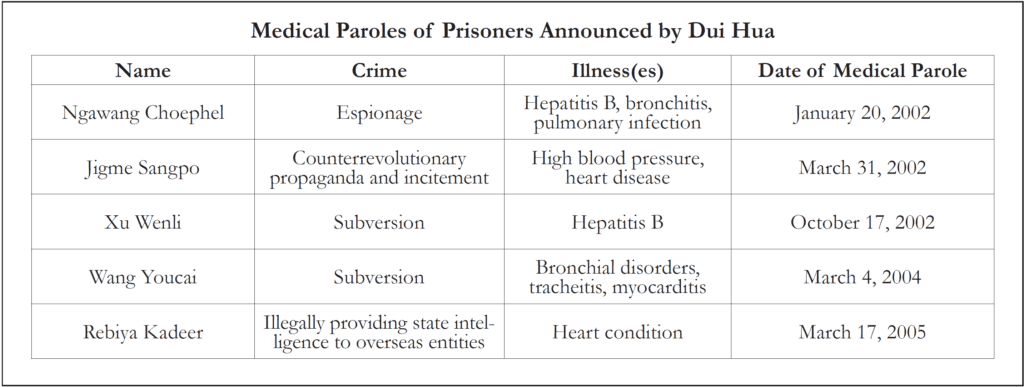
    China has granted medical parole to serve politically expedient goals, effectively forcing many Chinese prisoners into exile so they would be less of a nuisance to Chinese leaders. From the early 1990s to early 2005, when China’s campaign against color revolutions began, Beijing secured favor with foreign governments by using medical parole to release high-profile political dissidents whose cases were of great concern abroad, especially in the United States. Medical parolees sent to the United States include, among others, Wei Jingsheng, Wang Dan, Jigme Sangpo, Xu Wenli, and Rebiya Kadeer (see table below for medical paroles announced by Dui Hua). These individuals left China on the grounds that they needed to receive medical treatment—though several were not especially ill—and also with an understanding that they will be re-incarcerated if they return to China.

    Since Rebiya Kadeer’s release on medical parole in March 2005, however, no high-profile political prisoners have been given medical parole and sent to the West. Beijing, which now routinely rejects criticism of its human rights record, prefers keeping political prisoners locked up as it tightens social and political controls. And if medical parole is granted to such detainees, it is highly unlikely that they would be allowed to leave China for medical treatment.

    Examining Current Cases

    Many severely ill political prisoners are caught up in China’s hardened stance. Lobsang Tenzin, imprisoned for 22 years and due to be released in 2013, has diabetes and has suffered from gallstones. Wang Bingzhang is afflicted with multiple illnesses and had a mild stroke in prison. Wang, sentenced to life imprisonment, has served the minimum seven years needed to be eligible for medical parole under Chinese law. The case of Jiang Cunde demonstrates medical parole can be revoked and is conditional on behavior. Sentenced to life in prison in 1987, Jiang was released on medical parole in 1993 after he was certified to have a psychiatric illness. But in 1999, he was sent back to prison for violating terms of his parole—he had become politically active again—and, after having his life sentence commuted, is still not due for release until 2024.

    Perhaps no case today better illustrates Beijing’s aversion to granting medical parole to political prisoners than that of Hu Jia. He began his activism by railing against environmental degradation and the Chinese government’s slow response to AIDS, and assisted in campaigns to release political detainees. Hu was arrested in December 2007 following his video testimony at a European Parliament hearing at which he spoke out against human rights violations in China and the holding of the Olympic Games in Beijing. Hu was eventually sentenced in April 2008.

    Chinese authorities have a credibility problem when making a case that Hu does not qualify for medical parole. His wife, Zeng Jinyan, an activist in her own right, contends that Hu’s cirrhosis developed after his hepatitis B went untreated when he was “disappeared” for 41 days in 2006, though authorities claimed Hu received medication during that period. In May 2009, Hu’s family filed the first medical parole application after Zeng visited him and found him thinner and weaker, partly due to resistance to his anti-viral drug, which he had stopped using earlier in the year. On March 30, 2010, Hu was admitted to the Beijing Prison Bureau’s hospital for tests to see if he had developed liver cancer. While officials and doctors said that no malignancy was found, test results were not released to the family, but instead (as in May 2009) simply passed along verbally.

    Officials have poorly cloaked the political rationale for keeping Hu behind bars. In rejecting the recent request, officials said that releasing Hu on medical parole involved “other considerations” besides his health. In 2009, an official suggested there was a lack of “major political environment”—most likely, political intervention from above—for Hu to be paroled.

    Hu has joined other political prisoners whose activism and subsequent incarceration have garnered enormous international support. Two weeks after he was sentenced, France made Hu an honorary citizen—the Dalai Lama was bestowed the honor the same day—and the European Parliament awarded Hu its Sakharov Prize for Freedom of Thought in December 2008. Hu, his sentence scheduled to expire in June 2011, is also a perennial favorite to win the Nobel Peace Prize.

    Can Medical Parole Be Medicated?

    Beijing should root the application of medical parole in the law and base decisions on which prisoners qualify for release on medical grounds. To legitimize standards for medical parole, authorities must make conditions inside prisons and the health status of detainees more transparent—but China seems to be going in the opposite direction. Despite Beijing’s openness, declared in 1994, to consider having the International Committee of the Red Cross visit prisons, the ICRC has not yet been given the opportunity. Refusing to release medical documentation to families of prisoners further inhibits any appearance that Chinese authorities handle medical parole in a valid way.

    Though Beijing appears intractable about releasing political prisoners on medical parole, international actors should still encourage greater transparency and push for more information on prisoner health. Advocates can work through special bodies, including UN mechanisms, to urgently appeal for the release of ill prisoners, and names of prisoners who may be eligible for medical parole will no doubt continue to be raised within human rights dialogues.

    Advocating for the medical parole of a political prisoner represents a two-pronged humanitarian appeal: clemency is sought to help save the life of a detainee already believed to be illegally imprisoned for exercising protected rights. Perhaps Chinese officials, now entrenched in a “stability-above-all-else” posture, will one day be secure enough to see it is more costly to their political legitimacy for citizens to suffer physically in prison than have them released into Chinese society, or not even incarcerated in the first place.
  • Dialogue – Issue 40: Dui Hua News

    Dui Hua Completes Active Round of Spring, Summer Trips

    In recent months, Executive Director John Kamm undertook trips to Europe, Asia, and the East Coast of the United States. In late April, Kamm first traveled to Hong Kong and Beijing to prepare for the arrival of the US juvenile justice delegation to China (see cover story). In May, Kamm joined the delegation for program activities in Beijing, where he also met with representatives from Chinese ministries and foreign embassies.

    Upon his return from Asia, Kamm headed to Europe in late May for a mission that had been rescheduled after the eruption of the Eyjafjallajökull volcano. Kamm started out in Geneva, meeting with a representative of the Chinese Mission to the United Nations, the United Nations Office of the High Commissioner on Human Rights, the US ambassador, and the director of the International Institute on the Rights of the Child. In Berne, he met with the Swiss Federal Department of Foreign Affairs and then, in Zurich, with monks at the Tibetan monastery in Rikon. He went on to Paris, Oslo, Stockholm, and Copenhagen, conducting talks with representatives of foreign ministries in each country. Kamm also consulted with prominent human rights institutions in Europe, including the International Committee of the Red Cross, Norwegian Nobel Institute, Norwegian Centre for Human Rights, Stockholm International Peace Research Institute, Olof Palme Center, and the Danish Centre for Human Rights.

    Kamm returned from Europe in late June before departing in early July for Washington and New York. In the US capital, he held meetings with officials, including representatives of the House Committee on Foreign Affairs, Senate Committee on Foreign Relations, State Department, National Security Council, and the Congressional-Executive Commission on China. Kamm also met with a representative of the Chinese Embassy. In New York, Kamm saw Ambassador Li Baodong, China’s permanent representative to the United Nations.

    Research Manager Rosenzweig Presents on Liu Xiaobo Case at Hong Kong Conference

    On June 5, Senior Research Manager Joshua Rosenzweig made a presentation at a conference at the University of Hong Kong. Entitled “Charter 08 and the Challenges of Constitutional Development,” the program focused on the case of Liu Xiaobo, convicted of “inciting subversion” and sentenced to 11 years in prison last December. Rosenzweig’s presentation used Liu’s case to examine the crime of inciting subversion and arguments that Chinese lawyers make to defend clients charged with the crime. In preparing his remarks, featured later in the South China Morning Post, Rosenzweig drew upon research materials collected by Dui Hua on more than 70 cases of inciting subversion since 1997.

    The conference, co-sponsored by Hong Kong University’s Center for Chinese Law and the French Center for Research on Contemporary China, brought together an international group of scholars and researchers working in areas of law, political science, and human rights.

    Advocacy Work Boosts Media Coverage, Website Traffic

    Dui Hua’s recent advocacy has been covered widely in both US and foreign media. In particular, a press statement in early July on the Xue Feng case led to more than two dozen news pieces by, among other media, The New York Times, The Christian Science Monitor, Radio Australia, the South China Morning Post, The Irish Times, Aftenposten (Norway), and The Straits Times (Singapore). Around that period, Dui Hua’s website saw the year’s high in weekly readership, continuing an overall increase in site traffic for 2010.

    Visit www.duihua.org to follow Dui Hua on Twitter, join us on Facebook, and read program news on the Dui Hua News blog, as well as translations and commentaries on timely human rights and rule of law issues posted to the Human Rights Journal blog.

  • Dialogue — Issue 40, Summer 2010

    Juvenile Justice Delegation to China Builds on Cooperative Area for Dialogue
    Juvenile justice seminar

    In May, American and Chinese officials met in Washington to convene the 15th session of the long-running human rights dialogue and then again, in Beijing, for a strategic and economic dialogue. Both dialogues covered many subjects but failed to yield much by way of results. The same week as the human rights dialogue, however, a spirit of cooperation was on display when a US delegation organized by Dui Hua took part in juvenile justice exchanges in Beijing and Qingdao, Shandong Province.

    Related: US Delegates Tour Beijing’s Only Juvenile Reform Center

    Dui Hua Visits California Women’s Prison, Jail

    In California—as nationwide—women make up about seven percent of the prison population. Because of their small numbers, the plight of female prisoners is easily overlooked. This spring, Dui Hua staff members visited two women’s detention facilities in California—Valley State Prison for Women (VSPW) in Chowchilla, California, and the women’s section of the San Francisco County Jail—to learn more about this often unnoticed population.

    Graphic: Growth in US Female Prison Population, 1978-2008

    Of the 1.6 million people in US state and federal prisons, slightly more than 100,000 are female. Although the percentage of female prisoners is small, the growth in this population is staggering.

    Official Responses to Uyghur Prisoner List Reveal Information on Unique Cases

    In November 2009, Dui Hua compiled a list of 22 Uyghurs imprisoned or detained on political charges in the Xinjiang Uyghur Autonomous Region (XUAR). A request for information about each prisoner was submitted to a Chinese intermediary organization with channels to the prison authorities in Xinjiang. This was the first time Dui Hua had ever submitted a request for prisoner information focused solely on Xinjiang.

    Cautionary Tales: Two Americans Convicted of Espionage in China

    On July 5, 2010, the American geologist and businessman Xue Feng (薛峰) was sentenced by the Beijing Number One Intermediate Court to eight years in prison for trafficking in state secrets, an “endangering state security” (ESS) crime. (Read Dui Hua’s July 4 statement about Dr. Xue’s case.) Xue has appealed the verdict, but if his appeal is rejected—which is likely, as successful appeals of ESS convictions are very rare—he will be sent to a prison in Beijing to begin serving his sentence. Xue has already endured a long odyssey in the clutches of China’s criminal justice system. Detained in November 2007, he was arrested in April 2008, had his trial open more than a year later (in July 2009), and then saw his sentencing delayed until this July.

    Dui Hua News

    Dui Hua completes active round of spring, summer trips; Research Manager Rosenzweig presents on Liu Xiaobo case at Hong Kong conference; advocacy work boosts media coverage, website traffic

  • Dialogue – Issue 40: Cautionary Tales: Two Americans Convicted of Espionage in China

    On July 5, 2010, the American geologist and businessman Xue Feng (薛峰) was sentenced by the Beijing Number One Intermediate Court to eight years in prison for trafficking in state secrets, an “endangering state security” (ESS) crime. (Read Dui Hua’s July 4 statement about Dr. Xue’s case.) Xue has appealed the verdict, but if his appeal is rejected—which is likely, as successful appeals of ESS convictions are very rare—he will be sent to a prison in Beijing to begin serving his sentence. Xue has already endured a long odyssey in the clutches of China’s criminal justice system. Detained in November 2007, he was arrested in April 2008, had his trial open more than a year later (in July 2009), and then saw his sentencing delayed until this July.

    If sent to prison, Xue Feng will become only the second American citizen known to Dui Hua to be incarcerated in China for endangering state security. The first, David Dong Wei (董维), a businessman convicted of espionage in closed court in April 2005, received a sentence of 13 years’ imprisonment. Dong was taken into custody in Guangzhou on September 28, 2003, while on a trade delegation, and accused of spying for Taiwan and lobbying the US government on Taiwan’s behalf. Now 58 years old, Dong has been serving his sentence in Dongguan Prison, which houses most of the foreign prisoners as well as Hong Kong and Macau residents convicted by courts in the southern province of Guangdong.

    David Dong Wei: Case Background, Advocacy Efforts & Latest News

    Born in Sichuan Province, Dong worked as a correspondent for a Beijing-based newspaper before moving to the United States in 1986. He became a US citizen in 1995 and continued to work in journalism, co-authoring a book, Countdown to Tiananmen: The View from the Top, which was published in 1990. He subsequently began a career in business.

    After Dong’s arrest, a China Daily story from August 2004 provided an elaborate summary of his alleged spying activities. According to the piece, Dong was thought to have recruited “a huge network of Taiwanese spying in the Eastern United States”—where most of his activities were believed to have taken place—as part of ring of agents paid by Taiwan’s top intelligence agency. The article stated that he collected confidential information such as “speeches by China’s top leaders in closed-door meetings” as well as insights into political and economic conditions in China and the country’s policies towards Taiwan and the United States.

    The story described large amounts of cash that switched hands, including through high-stakes “dollar diplomacy” targeting Americans. According to the piece, the Taiwanese intelligence agency gave Dong $3,000 a month, other monetary support, and a house valued at $268,000. In addition, he was said to have recruited Chinese students by granting them scholarships drawn from a $1 million fund set up by the agency, and introduced others to the agency to spy against the mainland. After Dong was implicated by others in the alleged “spy ring,” he confessed, according to the article, that he and others had worked with Taiwanese lobbyists who paid “tens of millions” of dollars to American consulting firms and foundations to seek their support for Taiwan.

    Dui Hua, among others, has taken a special interest in the case of Dong Wei, whose name has appeared on lists submitted by the US government in its bilateral human rights dialogues with Beijing. He is visited regularly by officials of the American consulate in Guangzhou. In 2007, Rep. George Miller (D-California), chairman of the House Education and Labor Committee, sent a letter urging the US State Department to secure Dong’s release on humanitarian grounds. In the letter, co-signed by several members of Congress, Miller said that Dong had been hospitalized twice during pre-trial detention and once, in 2006, after his conviction. Following Miller’s intervention, Dong received a 10-month sentence reduction in April 2008.

    While in prison, Dong appears to have exhibited good behavior. Dui Hua learned through a Chinese government response from November 2007 that Dong had received nine merit citations and a good behavior commendation in the previous year alone.

    In the latest update on the case, reliable sources in the Chinese government informed Dui Hua in May 2010 of an 18-month sentence reduction that took effect on April 23, 2010. Dong is now due to be released on May 27, 2014. In the recent response, Chinese officials confirmed to Dui Hua that Dong is in poor health, suffering from coronary disease and hypertension.

    What About Xue Feng?

    Xue Feng might face a similar fate as David Dong Wei, with reductions whittling down an original, severe sentence. The climate surrounding political crimes in China may yield other clues about how Xue’s sentence will play out. In the name of “preserving stability,” Chinese courts are handing down more and stricter sentences for ESS crimes; Xue’s sentence is one in a line of convictions exemplifying this harsher stance. The Chinese government has diminished its once-convenient practice of releasing political prisoners on medical parole (see Dialogue 39), making it uncertain whether Xue, who has a heart condition, will gain clemency on health grounds.

    As with some high-profile espionage cases of Hong Kong residents, Xue might be freed early by a decision not firmly rooted in law but as a result of international campaigns and public pressure. This happened with the paroles of Hong Kong journalists Ching Cheong (程翔), released in February 2008 after serving about half of his five-year sentence, and Xi Yang (席扬), who was paroled in January 1997 after serving less than one-third of a 12-year sentence. Whatever the outcome of Xue’s case, the Chinese government will likely keep up its stern approach to handling alleged ESS crimes and, as it did in Dong’s complicated case, underscore that foreign prying into matters of China’s national interest poses security hazards to all parties involved.

  • Dialogue – Issue 40: Official Responses to Uyghur Prisoner List Reveal Information on Unique Cases

    In November 2009, Dui Hua compiled a list of 22 Uyghurs imprisoned or detained on political charges in the Xinjiang Uyghur Autonomous Region (XUAR). A request for information about each prisoner was submitted to a Chinese intermediary organization with channels to the prison authorities in Xinjiang. This was the first time Dui Hua had ever submitted a request for prisoner information focused solely on Xinjiang.

    Dui Hua has long recognized that obtaining information about Uyghur prisoners is difficult because of the sensitive nature of ethnic relations in the region. Getting a response would be especially difficult in light of the demonstrations and violent rioting that broke out in Urumqi in July 2009. To facilitate the process, Dui Hua focused mainly on individuals charged with crimes unrelated to the events of last summer. Detailed background information was included for each case, and names were provided in both Chinese characters and Uyghur script. Information about some of the cases had been previously provided by the Chinese government in its human rights dialogues, whereas other cases were more obscure.

    Over a three-month period ending in early July, Dui Hua had received information about 18 of the 22 names on its November list. Of those 18, Dui Hua was informed that records for four could not be found, which could mean that there were errors in the names provided or that those individuals had not yet entered the prison system—perhaps because their cases were still being investigated or tried. (Three of these responses were reported in Dialogue 39.)

    A particularly notable response concerned Mehbube Abrak, a 30-year-old Uyghur woman reported to be serving a three-year sentence for “splittism” in the XUAR Women’s Prison, which would make her the only female Uyghur political prisoner that the Chinese government has confirmed to be currently imprisoned. According to a 2008 report by Radio Free Asia, Abrak (referenced to in the report as “Mehbube Ablesh”) was fired from her position in the advertising department at Xinjiang People’s Radio in July or August of that year and detained on suspicion of criticizing government policies requiring the use of Chinese language in classroom instruction. Because she is rumored to have posted her criticisms on overseas websites and due to the relatively short length of the sentence, it is possible that Abrak was convicted of “inciting splittism,” rather than “splittism,” a more serious crime.

    It was also confirmed that Gheyret Niyaz, a 51-year-old former journalist and AIDS activist from Urumqi, had been formally arrested in November 2009. The response did not specify the charges against Niyaz, saying only that he had “fabricated rumors and inflamed ethnic antagonism,” suggesting a possible charge of “inciting splittism.” Niyaz, a former senior reporter for the Xinjiang Economic News, gave several interviews after the July 5 riots in Urumqi, including one in the Hong Kong news magazine Yazhou Zhoukan in which he claimed to have alerted local officials to signs of trouble and suggested that the riots appeared to have been a pre-meditated incident coordinated by members of the “Islamic Liberation Party.” (At the time of writing, it was reported unofficially that Niyaz’s case had gone to trial and that, on July 23, he had been convicted of state security charges and sentenced to 15 years in prison.)

    The responses to Dui Hua’s prisoner list included no reports of clemency, indicating that there had been “no change to the original sentence” for political prisoners, further evidence that prison authorities in the XUAR have adopted a tough line with respect to granting sentence reductions, parole, or medical parole to Uyghurs imprisoned for state security crimes. Dui Hua is not aware of a single act of clemency toward a Uyghur political prisoner since the medical parole of Rebiya Kadeer in 2005.

    In fact, the one change reported to a prisoner’s sentence involves a serious sentence extension given to a Uyghur man who has already spent many years in prison. Omer Akchi, 39, was sentenced to 14 years’ imprisonment for counterrevolution in 1997, just before the crime was eliminated from China’s Criminal Law. In December of 2006, Akchi was sentenced to life imprisonment for splittism, presumably for acts committed during his imprisonment.

  • Dialogue – Issue 40: US Delegates Tour Beijing’s Only Juvenile Reform Center

    On the morning of May 10, the American juvenile justice delegation traveled to rural Daxing District, in the Beijing suburbs. There, surrounded by acres of agricultural land and several other correctional facilities, lies the Beijing Juvenile Reform Center. It is the only juvenile reform center in Beijing, and was established in September 1955. Administered by the Beijing Prison Bureau, the center houses approximately 470 teenagers (over 95 percent boys) serving custodial sentences for offenses committed between the ages of 14 and 18. A large group of boys performed a drum-and-dance ceremonial welcome before the delegation was led inside for a tour of the facility, which was empty because the center was holding its semi-annual “sports day.”

    The delegation viewed male and female dormitories, classrooms, and other activity rooms. There were 12 female offenders incarcerated in the center, all housed in a separate cellblock that is off-limits to male staff and inmates. During the tour, the center’s warden and deputy warden responded to questions from delegates. Around 60 percent of the juveniles committed violent offenses such as assault and robbery, and there were two inmates serving life sentences. Most offenders in the center are between the ages of 14 and 17, but the average age of inmates is around 17-and-a-half years old. The average age is relatively high because inmates who turn 18 but who have two years or less left on their sentences are typically not transferred to an adult prison but remain at the juvenile prison to serve out the remainder of their terms. For the nation as a whole, 85 percent of inmates in juvenile prisons are over the age of 16.

    Delegates were introduced to the system of awarding points for good behavior. Each month, inmates can earn up to 10 points: one for showing remorse, one for performing well in “thought reform,” and eight for good behavior in areas such as observing discipline, school performance, and hygiene. Violations can result in deduction of points. Centers reward the accumulation of points with citations, which in turn form the basis of applications for sentence reduction. In the spirit of offering young offenders the chance for a new beginning, the parole rate is around 20 percent—much higher than in adult prisons.

    Teens in the center are entitled to one family visit per month, and this privilege is not restricted as a form of punishment. To facilitate family contact, offenders can also send and receive letters, make periodic telephone calls, and even send text messages. The delegates were interested to learn that there is no problem with gangs in the center, and violence between inmates is rare because vigilant monitoring allows for conflicts to be defused at an early stage. While there is a protocol for solitary confinement, center officials claimed that this measure is very seldom used. Asked to describe their biggest challenge, the center authorities responded that it was difficult to deliver vocational training given the varying ages and sentences of the youths in the center.

    Related link:

  • Dialogue – Issue 40: Dui Hua Visits California Women’s Prison, Jail

    In California—as nationwide—women make up about seven percent of the prison population. Because of their small numbers, the plight of female prisoners is easily overlooked. This spring, Dui Hua staff members visited two women’s detention facilities in California—Valley State Prison for Women (VSPW) in Chowchilla, California, and the women’s section of the San Francisco County Jail—to learn more about this often unnoticed population.

    On the surface, these two institutions are a study in contrasts: VSPW is a massive, rural prison holding felons from all over the state, while the county jail is a smaller, urban facility housing local women who are in custody for an average of four months. But Dui Hua found striking similarities in the two places: both are part of larger systems designed for the custodial supervision of men, and both are staffed by dedicated administrators using innovative programs and approaches to rehabilitate the women in their custody and ease their transition back into free society.

    Close-Up View of Massive Prison

    Valley State Prison for Women houses almost 4,000 women in four facilities laid out on 640 acres. One of three women’s state prisons in California, VSPW is located southeast of San Francisco. Just across the street is the Central California Women’s Facility, which has the state’s only death row for women, and vies with VSPW as the prison with the largest population of female inmates in the United States.

    On March 23, Executive Director John Kamm and Program Associate Tobias Smith accompanied Justice James Lambden from the California Court of Appeals on a visit to VSPW. They were escorted by then-Warden Tina Hornbeak, Lt. Michael Burns, and Associate Warden Laquitta Peterson, who gave them a full tour of the facility.

    Although the architecture of VSPW is the same as a men’s prison, its character is very different. Prison staff explained that inmates in men’s prisons often cleave along racial lines and group themselves according to gang affiliations, forcing prison administrators to segregate housing units by race and to isolate gang leaders from the general population. Men’s prisons often also divide prisoners based on a classification system reflecting an inmate’s level of security risk. At VSPW, however, women of all races and security levels are housed together. Women do not organize themselves into gangs, instead assembling into groups that resemble extended families. Staff reported that violence is not the issue at VSPW as it is in men’s facilities, and only a few inmates are isolated in the Special Housing Unit for security reasons (23 women were in the unit at the time of the visit).

    While VSPW doesn’t face the same security challenges as a men’s prison, it does face others. When Dui Hua visited, there were approximately 50 pregnant women housed at the prison. After giving birth, a mother is given 48 to 72 hours to be with her child, and then the child is turned over to social services to be placed with the inmate’s family or in foster care. Since the average length of a sentence at VSPW is 16 to 18 months, mothers have long waits before being reunited with their children, if they are at all. Still, women can see immediate family during extended overnight weekend visits. While this generous visiting policy reflects the prison’s concern for rehabilitation and re-entry into society, it’s also a result of the prison’s isolation in the middle of vast farmland—three hours from the San Francisco Bay Area and four hours from Los Angeles—which makes casual visits difficult.

    Recidivism rates for women are lower than for men but still exceed 60 percent, so VSPW does what it can to help make sure women do not return after they are released. Until recently, over 2,000 inmates participated in educational and vocational programs that included everything from basic reading classes to licensing in cosmetology and opticianry. But with the state prison system in fiscal crisis, these programs have been cut considerably. Lack of funding has reduced available placements in drug treatment programs from 750 to 175. Likewise, academic and vocational programs, which once served 2,000 inmates at VSPW, were only providing services for about 500 prisoners at the time of the visit.

    Short-Term Detention, Long-Term Goals

    On May 27, Smith and Publications Manager Martin Witte visited the San Francisco County Jail #1 in downtown San Francisco. The women’s facility houses both women awaiting trial and those serving short sentences. Women make up about 10 percent of the San Francisco Jail population; about 200 women are in the facility on any given day.

    Dui Hua staff were given a tour of the facility led by Sunny Schwartz, the program administrator for the San Francisco jail system since 1990. Schwartz is nationally recognized for innovative work that emphasizes responsibility, restorative justice, and active program participation by inmates. Upon entering the jail, almost every woman is placed in a program—typically drug treatment and counseling or an educational program.

    A look at the demographics of the jail makes it clear why programming is a priority. According to a San Francisco Sheriff’s Department study, the average female inmate is an 18-to-25-year-old woman of color with a fourth- to sixth-grade reading level. Over 80 percent of women in the jail report a history of substance abuse, and 75 percent have children, with the majority having children under the age of five. Clearly, the challenges these women face do not cease upon their release.

    Women in the jail live in secure pods in which groups of about 50 women eat, sleep, and take part in programs together. During the tour, Dui Hua staff were able to visit D Pod, which is devoted to an addiction treatment program called SISTERS (Sisters in Sober Treatment Empowered in Recovery). According to a 1996 study prepared for the jail by the University of California-San Francisco, the program “significantly reduces the likelihood that a woman will become arrested.” Moreover, rearrested participants commit significantly fewer drug offenses. Overall, the program saves the city an average of $4,500 dollars per inmate.

    Administrators at both VSPW and the San Francisco jail emphasized that whether the treatment a woman receives behind bars will have a lasting effect depends largely on what happens in the crucial first hours after she returns to society. Women who move directly into re-entry facilities or transition seamlessly into treatment are much less likely to relapse and recidivate. With this in mind, in 2006 the San Francisco Sheriff’s Department opened the Women’s Reentry Center just around the corner from the jail downtown. The center provides a full array of social services for all incarcerated women, including drug treatment, employment counseling, medical care resources, and support and empowerment classes for crime and trauma survivors.

    The program budget for the San Francisco jail system—both men’s and women’s facilities—is currently about $1 million per year, slightly more than one percent of the total jail operating budget. Belt-tightening measures continue to reduce resources for programs, halving the funding for SISTERS, for example. However, as San Francisco faces a 55 percent recidivism rate among women offenders, cutting programs proven to reduce repeat offenses may not turn out to be such a bargain after all.

    Dui Hua thanks the following people for their help in arranging and hosting the two visits: Justice James Lambden and San Francisco Superior Court Judge Susan Breall; Tina Hornbeak, Michael Burns, and Laquitta Peterson at VSPW; and Sunny Schwartz, Karen Levine, Leslie Levitas, and Jacqueline Gordon at the San Francisco Jail.

  • Dialogue – Issue 40: Juvenile Justice Delegation to China Builds on Cooperative Area for Dialogue

    In May, American and Chinese officials met in Washington to convene the 15th session of the long-running human rights dialogue and then again, in Beijing, for a strategic and economic dialogue. Both dialogues covered many subjects but failed to yield much by way of results. The same week as the human rights dialogue, however, a spirit of cooperation was on display when a US delegation organized by Dui Hua took part in juvenile justice exchanges in Beijing and Qingdao, Shandong Province. Running from May 8 to 15, the program was initiated at the invitation of the Supreme People’s Court (SPC) after Dui Hua hosted an SPC group of Chinese judges on a study tour of the American juvenile justice system in 2008 (see Dialogue 33). Chinese officials praised that first delegation as one of the most successful US-China exchanges in years, and the return trip this spring illustrates that juvenile justice will likely remain a fruitful area for further cooperation between the two countries.

    Juvenile justice is a natural topic for dialogue with China, as the country’s legal experts and legislators are creating a national system of laws to govern the handling of crimes by young offenders. The country has seen an alarming increase in juvenile crime, a crisis brought on by social changes resulting from rapid economic growth. In 2009, Chinese courts heard nearly 78,000 cases of suspects younger than 18 years of age, the vast majority involving theft, robbery, and assault. Tackling the problem head-on, China now has about 7,000 adjudicators specifically assigned to juvenile cases in more than 2,200 juvenile courts.

    Judge Lillian Sing of the San Francisco Superior Court led the US delegation, which included a strong San Francisco Bay Area contingent—Judge Julie Tang of the San Francisco Juvenile Court, Patricia Lee, managing attorney for the Juvenile Division of the San Francisco Public Defender’s Office, and Allen Nance, assistant chief probation officer of the City and County of San Francisco—as well as Laurie Garduque, program director for juvenile justice with the MacArthur Foundation, which helped fund the 2008 delegation. Joshua Rosenzweig, Dui Hua’s senior research manager, rounded out the group, and Executive Director John Kamm joined in activities in Beijing. Sonia Ng and Chi-ho Chan served as interpreters for the delegation. The head of the 2008 SPC study tour, Judge Hu Weixin, deputy director of the SPC’s Research Office, was the principal host in China for the US delegation, which was supported in part by the Hong Kong-based Fu Tak Iam Foundation.

    Windows into Juvenile Courts

    Highlights of the time in Beijing were a visit to the Beijing Juvenile Reform Center (see related article) and a tour of the Haidian District Court. Since 1992, the court has adjudicated around 6,000 cases of juvenile crime and hears 400 such cases a year. Approximately one-fourth of trials result in non-custodial sentences; juveniles were incarcerated in the other 75 percent, a rate comparable to the national average. During the visit, delegates posed questions about community corrections, pre-trial detention, factors mitigating punishment, and diversion (when juvenile cases are channeled outside the court system). They also asked about foreigners’ access to trials, and were told that two to three foreigners attend trials there each month.

    An introduction to the court’s juvenile courtroom was provided by Judge Shang Xiuyun, known in China as “Mother Judge” for her faith in the power of rehabilitation for juvenile offenders. Judge Shang explained the important design of the courtroom: participants sit at the same level in a roundtable format, with the defendant facing the “embracing arms” of the prosecution, judges, and defense. Even the courtroom wall’s warm colors are meant to promote the comfort of a classroom.

    At the China-US Juvenile Justice System Seminar in Qingdao, delegates learned that 13 juvenile courts in the city try more than 600 criminal cases a year, and around half result in non-custodial sentences. The Shinan District People’s Court operates a “Sunshine School” for judges to educate juvenile offenders on law as part of a diversion program. A local center runs corrections programs, including one that holds after-school homework sessions for offenders with non-custodial punishments.

    In Qingdao, Chinese experts and US delegates gave presentations and engaged in wide-ranging discussion at the juvenile justice seminar.

    Learning by Sharing

    US delegates and Chinese experts at the seminar gave overviews of juvenile justice work in the two countries. The host side gave positive assessments of foreign practices, some of which are taking hold in China. President Zou Chuanning of the Qingdao Intermediate People’s Court (and a member of the 2008 delegation) spoke of a local pilot program to seal criminal records for minors, a practice that exists in several jurisdictions but often without solid legal basis. Some courts have instituted “postponed prosecution” for minors, similar to diversion in the United States. A Chinese presentation was devoted to psychological evaluations of juvenile offenders, suggesting the country’s legal community is interested in adolescent brain development—the theoretical foundation for US juvenile justice reform.

    As in China’s adult criminal justice system, juvenile courts employ practical approaches for handling less serious crimes. Minor status offenses for youth in China do not require legal proceedings and are instead handled by community organizations, the family, or schools. Fines, reprimands, or warnings are often given for major offenses. Introduced by an official from the Jiangsu Higher People’s Court, a restorative justice project in Nanjing aims to resolve cases by mediating a dialogue in an effort to repair relationships damaged by a crime. Courts may consider a lighter sentence if a voluntary settlement is reached.

    The US and Chinese sides each conducted a “mock trial” to demonstrate the adjudication of a juvenile case. The Chinese case involved a motorbike theft—a crime to which a youth confessed, allowing for simplification of proceedings and the likelihood of leniency. Despite the confession, detailed evidence was presented, along with a character and background profile of the juvenile, who was eventually ordered to receive rehabilitation and education.

    With two judges presiding, the Americans presented a more complex adjudication for a girl accused of assaulting a schoolmate’s mother and threatening another girl not to discuss the incident. After hearings and a disposition—when sentencing is discussed—one judge initially ordered home custody and formal probation (with supervision by a probation officer). The second judge, however, then ordered the defendant to only informal probation, as requested by the public defender, so charges would be dismissed if the juvenile did not re-offend over a period of six months. This aspect of the adjudication showed the high degree of discretion that American judges have, an element that contrasts significantly with constraints faced by Chinese judges when deciding cases.

    The presentations, with differing substances and styles, elicited robust discussion. The US side asked about the Chinese way of introducing the case facts and applicable laws in detail despite the defendant’s confession—also a common feature of the adult criminal justice system—and observed that the formality of the court proceedings contrasted with the personalized nature of the education phase. Chinese participants sought clarification about the role of a probation department, which does not exist in China, and complimented the US side’s decision to present the mock trial case using two judges.

    Room for More Growth, Partnership

    After over a century of formulating juvenile justice laws, the United States still struggles with how to best handle its youngest offenders, while China in a short time has developed practices worthy of consideration by Americans. The US Supreme Court ruled right after the delegation that sentences of life without parole for juveniles—except in cases of homicide—are unconstitutional. In March, a Pennsylvania judge ruled that a youth would be tried as an adult for a homicide committed when he was 11 years old. This situation cannot possibly occur in China, where an individual under 14 years of age is not considered criminally responsible for any offenses.

    The merits of juvenile justice exchange do not obscure the fact that China and the United States disagree on many human rights matters. But the delegations show the two countries share much of value in pursuing common legal goals. An upcoming time to discuss points of law will be when China and the United States resume the legal experts’ dialogue, for which the juvenile justice exchanges might serve as a model of cooperation that can benefit both societies.

    Related link:

  • Op-Ed: “Is Mercy Coming to China?”

    The opinion piece below by Executive Director John Kamm was published in the August 16 edition of The Washington Post. Kamm points out that China has made strides in developing a more humane criminal justice system, particularly with changes that have curtailed use of capital punishment. Changes include new rules against using confessions obtained by torture, strict regulation of the market for transplanted organs, proposals to reduce the number of crimes that carry the death penalty, and a general prohibition on the shaming of criminal suspects.

    *

    Is Mercy Coming to China?

    John Kamm
    Executive Director
    The Dui Hua Foundation

    In a surprising response to public protests, the Chinese government recently prohibited police from publicly shaming criminal suspects through such devices as parades, used most controversially for parades of prostitutes. This is the latest in a series of developments that portend a more humane justice system, most notably in the area of capital punishment.

    Hearing the news last month, I was reminded of scenes I encountered while traveling through the countryside outside Guangzhou late in the summer of 1983. China’s “Strike Hard” campaign was underway; it was the first of many efforts to address what Chinese leaders saw as an alarming growth in lawlessness—and dissent. In August 1983 the authority to execute people was transferred from the Supreme Court in Beijing to provincial officials. Thousands were executed by the next spring festival, six months on.

    As I passed through a small town, a man and his two sons, each tilting forward from the weight of the large white boards strapped to their backs, were driven past, en route to an execution ground. The boards proclaimed their death sentences; the men’s arms were tied behind them. I remember the elder screaming his innocence as a throng of feral youth rushed ahead to get in position to witness the shootings. Farther up the road I encountered another execution scene, this time in a sports stadium with a throng of enthusiastic onlookers.

    China’s active use of the death penalty has long sparked international discomfort, particularly as evidence has mounted that the threat of capital punishment does little to deter crime. The official position is that someday China will abolish the death penalty but that “conditions aren’t right” to do so now. Yet as long ago as 1984, the Chinese government forbade the public parading of prisoners who were about to be executed. Such spectacles remained commonplace, however, especially in the countryside, prompting Beijing to issue regulations against public executions in 1986. Rumors of executions in sports stadiums plagued China’s bid for the 2000 Olympics, and when bidding for the 2008 Games, Beijing made clear that public executions were not permitted.

    Ten years ago, China was executing more than 10,000 prisoners a year. The human rights group I direct estimates the annual rate to be less than 5,000 now, a reduction due in part to President Hu Jintao’s effort to develop a “harmonious society”—and in part to withering criticism at the United Nations and in the human rights dialogue with Europe. China still executes more people every year than the rest of the world combined. Today, executions generally take place in specialized chambers or vans, away from public view. Lethal injections, as opposed to gunshots, are increasingly used.

    Last month, the day before the ban on publicly shaming criminal suspects was announced, news began circulating in Chinese media that the National People’s Congress would consider amending the criminal code. Reforms were said to include reducing from 68 the number of crimes punishable by death, as well as the age at which convicted criminals can be executed. If such reforms are enacted, nonviolent crimes in China will, for the most part, be exempted from the death penalty.

    The proposals are part of a movement aimed at reining in the indiscriminate use of the death penalty. In late July the Chinese Supreme Court tightened rules on introducing evidence obtained by torture, particularly in death penalty cases. It is not clear whether this will be effective in curbing the rampant torture used to obtain confessions in capital cases. The media have exposed a number of cases in which people were wrongfully convicted of capital crimes based on confessions obtained by torture, and a number of death sentences handed down in corruption trials are often said to be politically motivated.

    While many have thought the death penalty is invoked to deter crime, there is another reason capital punishment reached such astonishing levels in China. For years organs were harvested from executed prisoners. An August 2009 Ministry of Health statement acknowledged that 65 percent of the 10,000 transplants in China involved organs from executed prisoners. Before China’s Supreme Court reasserted its right of review over death sentences in 2007, it was not uncommon to find arrangements linking execution grounds to hospitals performing transplants, often for overseas clients. Now, transplantation of prisoners’ organs is subject to strict regulations.

    In many respects, China’s human rights record falls far short of international standards. But important progress has been made in reducing capital punishment. When Hu took office as Communist Party chairman in 2002, the country was executing as many as 12,000 convicted criminals a year. The annual number of executions could be down to roughly 2,000 by the time Hu leaves office at the end of 2012. Opponents of the death penalty will argue, passionately and correctly, that that number is still a human rights violation of the most serious kind. But the sharp drop in executions is a positive step toward the government’s goal of ensuring that only “the most vile and serious crimes” are punishable by death—and its stated goal of eventually abolishing the death penalty in China.

  • A Counterrevolutionary’s Long Road Home

    On June 27, 77-year-old Ou Shu (欧树) woke up in the suburbs of Kunming, ate breakfast, changed into a brand-new navy suit, packed all of his worldly belongings into a small valise, and then traveled nearly four hours westward by car to Midu County, the birthplace he had not seen in more than half a century.This was no ordinary homecoming for Ou Shu. Two police officers accompanied him on his journey to Midu, and the group was met on arrival by officials from the local police station. The frail man about to enter a local old-age home had just been released from Guandu Prison, after having spent his entire adult life behind bars as a “counterrevolutionary.”

    On August 4, a team of reporters from Guangzhou’s Southern Metropolis News and its sister paper in Kunming, the Yunnan Information News, published a lengthy feature article on Ou’s remarkable story, one that raises numerous questions about how China ought to treat its elderly and most disabled prisoners and highlights the impact of systemic discrimination against political prisoners in China.

    In the Blink of an Eye, Four Years Turns to Life Imprisonment

    Ou Shu was 20 years old in November 1953 when both he and his father were arrested on charges of being members of Yiguan Dao, a syncretic sect with roots in China’s long history of popular, millenarian religious movements. Soon after the Chinese Communist Party took power in 1949, sectarian religious movements like Yiguan Dao were targeted as relics of China’s feudal past. Yiguan Dao was condemned in particular as being composed of individuals with bad class backgrounds who were suspected of being Nationalist agents.

    Under the provisions of the 1951 “Regulations of the People’s Republic of China for the Punishment of Counterrevolutionaries,” sect members were subject to execution or life imprisonment, but Ou Shu was given a relatively light sentence of four years and sent to a “reform-through-labor” farm. At the end of those four years, however, he was accused of “resisting reform, playing ignorant, holding fast to reactionary positions, and having extremely antagonistic ideas”—a judgment that may have been influenced by the ongoing campaign against “rightists” going on throughout the country at the time—and given a 15-year sentence extension.

    A year later, Ou was again accused of maintaining his reactionary beliefs, as well as theft, harassing women, and attempting escape. Sentenced this time to life in prison, he was transferred to a maximum-security facility on the outskirts of Kunming that primarily housed serious drug offenders, and it was there he would remain for almost 50 years.

    Clemency Repeatedly Denied

    There is evidence to suggest that some of the behavioral problems contributing to Ou Shu’s sentence extensions may be attributable to mental illness. Records show that the provincial psychiatric hospital diagnosed him with schizophrenia in both 1963 and 1972. “He lacks the expected awareness of his personal circumstances,” wrote one evaluation. “Despite being punished with repeated sentence extensions, he shows nonchalance and says that he’s here to play and have fun, He speaks incoherently and his syntax is extremely illogical, showing clear signs of disintegrated thinking.” There is no indication that Ou ever underwent any form of treatment for mental illness, but prison authorities appear to have taken his apparent instability into account and were more lenient in their subsequent assessments of his behavior.

    In 1980, China adopted a formal criminal code. While “counterrevolutionary sect” activities remained outlawed, prisoners serving life sentences were given the opportunity to have their sentences reduced through sentence reduction and parole. In consideration of Ou’s long incarceration, prison authorities recommended that his sentence be commuted and that he be released. However, the provincial public security officials then in charge of managing penal institutions rejected the recommendation, a decision most likely colored by concerns that showing clemency for a counterrevolutionary prisoner could be politically dangerous.

    In 1997, “counterrevolution” was removed from China’s Criminal Law and the Supreme People’s Court issued additional regulations governing the process of granting sentence reductions and parole. In 1999, prison authorities recommended that Ou Shu’s life sentence be reduced to a fixed-term sentence of 10 years, but the provincial high court took a more cautious approach and reduced his sentence to 18 years’ imprisonment—which meant that Ou would be due for release in 2017.

    Without Family, No Medical Parole

    In 2005, Ou was transferred to a prison cellblock dedicated for elderly and infirm prisoners. His remaining sentence was gradually being whittled down through small reductions every two years, but his physical and mental condition had deteriorated and a younger prisoner had to be assigned to care for him.

    Ou Shu in 2010 (L) and at the time of his arrest, in 1953 (R)

    In 2008, Ou was transferred to Guandu Prison, and authorities there considered him a good candidate for medical parole. But when they contacted the local police station back in his hometown, it was discovered that he had no living close relatives and thus, under the relevant procedures, could not be released. So he remained at Guandu Prison until a final sentence reduction in June 2010 brought an end to his long incarceration. Ou was finally a free man, but now what?

    Authorities arranged for Ou to return home to Midu County and stay in an old-age home not far from the village where he grew up. At first, Ou seemed happy to return to familiar surroundings, but the sudden transition to freedom took a toll on him, and he became more and more senile and unable to care for himself. The director of the old age home sought out Ou’s distant relatives to see whether they would be willing to help take care of him, but they demurred. They had taken care of Ou’s father in his old age and had all assumed that Ou himself had been dead for years, even paying tribute to him each year during the Tomb Sweeping Festival.

    The husband of an elderly cousin put it simply: “The government should have either released him earlier or kept him locked up until he died of old age. Releasing him now is a burden to both our family and to society.”

    How Many More Prisoners Like Ou Shu?

    According to Chen Xingliang, an expert on China’s criminal justice system, most individuals sentenced to life imprisonment actually wind up serving between 12 and 22 years in prison, with the average being about 15 years. Ou Shu’s experience may seem like an anomaly, but it is an anomaly that can nevertheless be understood in terms of fairly regular practices within China’s criminal justice system.

    Ou Shu was branded as a political criminal at the age of 21, and the stigma of that charge had a lasting impact on his life. During the Maoist period, his erratic behavior was interpreted as evidence of his reactionary nature and danger to society, leading a four-year sentence to grow into life imprisonment. Even as China began taking steps to implement rule of law in the 1980s, the taint of being a “counterrevolutionary” served as an obstacle to gaining clemency. With political prisoners officially subject to “strict handling” for the purposes of sentence reduction and parole, prison authorities simply couldn’t reduce his time behind bars fast enough, and Ou was overtaken by the ailments of old age.

    Prison authorities also ran into obstacles with the current medical parole regulations, which normally require family members to take responsibility for an ill prisoner before he or she may be released. Prisons in some provinces, such as Sichuan and Jiangxi, have been making more use of medical parole as a way to release elderly and sick prisoners who are no longer a threat to society, but these practices have come under some criticism in China over allegations that prison authorities are merely “dumping” these prisoners and shifting the burden of their care back to their families.

    One wonders how many other prisoners like Ou Shu there might be in China. Members of “counterrevolutionary sects” were targeted again during the “Strike Hard” campaigns of the early 1980s and many were sentenced to life imprisonment. It is assumed that most have either been released or passed away, but there is no easy way to determine their fates without requesting an accounting from the Chinese government on a case-by-case basis.

    In recent years, Dui Hua has highlighted some cases that, while not involving incarceration for more than 50 years, share many other similar features with that of Ou Shu:

    Jiang Cunde was sentenced to life imprisonment for counterrevolution in 1987, diagnosed with schizophrenia and released on medical parole in 1993, but subsequently sent back to prison in 1999 for breaking the terms of his parole. His life sentence was commuted to a 20-year fixed-term sentence in 2004, but there has been no additional clemency since then despite acknowledgement that Jiang continues to suffer from psychotic episodes.

    Two individuals originally sentenced to suspended death sentences for acts carried out during the June Fourth demonstrations in Beijing also remain behind bars under similar circumstances. Jiang Yaqun, aged 71, had his 1990 sentence for “counterrevolutionary sabotage” commuted to 19-1/2 years’ imprisonment in 1995. Described as suffering from “mild mental retardation” (most likely senility), Jiang has received several sentence reductions but still has more than three years left to serve. Miao Deshun’s 1989 sentence for arson was eventually commuted to 20 years’ imprisonment in 1998, but he has received no clemency since then. The 46-year-old Miao, who has been acknowledged to suffer from mental illness, is due for release in 2018—nearly 30 years after his arrest.

    There are of course many other cases involving political prisoners serving comparatively shorter sentences who have been denied medical parole despite serious illness—Li Wangyang or Hu Jia, for example. Others like Wang Rongqing and Zhang Jianhong saw their medical conditions deteriorate to extreme states before being granted medical parole. The conclusion is stark: the humanitarian measure of medical parole is essentially beyond reach for most of China’s political prisoners.

    It would thus be a mistake to see Ou Shu as an anomalous case of someone who simply “fell through the cracks.” He was the victim of a criminal justice system that arbitrarily employs political punishments and that continues to discriminate against those subjected to such punishments. Ou’s life is perhaps the most extreme consequence of this situation, but he is by no means the only such victim. ■

    Related Links: