
 |
|
The campaign headquarters of non-party legislator candidate Wang Xingzhi at the north entrance of Taiwan Railways Keelung Station in Keelung City Image credit: Solomon203 / CC0 1.0 Universal |
On January 13, 2024, Lai Ching-te of the ruling Democratic Progressive Party
(DPP) won Taiwan’s presidential election in a three-way race against two
rivals who sought warmer ties with China. Reviled by Beijing for rejecting
China’s sovereignty over Taiwan, the DPP will hold onto the presidency for an
unprecedented third consecutive term following eight years under Tsai Ing-wen.
Under Lai, Taiwan will face diplomatic isolation, trade coercion, and military
threats from President Xi Jinping as China is expected to ramp up its pressure
on the island by arbitrarily arresting more people from Taiwan on the
Mainland.
Taiwan began allowing its residents to visit the Mainland in 1987. According
to
The Straits Exchange Foundation, 594 Taiwanese went missing in China from 1991-2020. In 2019,
Taiwan’s Mainland Affairs Council
said that 149 Taiwanese had disappeared since 2016, the year when Tsai began
her first term. While some of these people may have suffered accidents, been
detained, or died, 67 cases were unaccounted for due to insufficient
information or the Chinese government’s withholding of information. A number
of them are believed to be held on political charges. Months after Tsai began
her second term in 2020, China announced that its
Thunder-2020 campaign
had uncovered hundreds of cases orchestrated by Taiwan’s intelligence forces
to “infiltrate and sabotage” and to set up a network of spies.
One of the early cases Dui Hua worked on was that of Li Junmin (李俊敏),
a Taiwan “spy”
who was sentenced to death with reprieve for the now-defunct crime of
counterrevolution. Li was granted early release in 2006 despite being once
called “defiant and resistant to reform” by the Chinese government.
This post examines the cases of seven Taiwanese arbitrarily detained in China,
on charges of endangering state security, since the DPP took power in 2016.
Two of the detainees have returned to Taiwan after completing their full
prison sentences whereas the others remain in custody, either awaiting hefty
jail terms or with their fate unclear.
 |
|
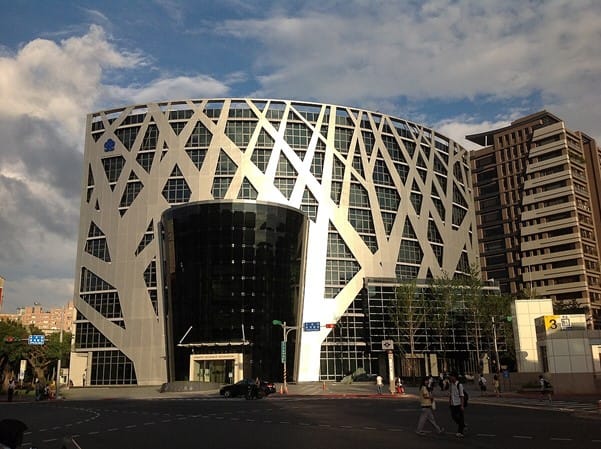
The Straits Exchange Foundation’s headquarters in Dazhi, Taipei. Image credit: Meow, Wikimedia Commons / CC BY-SA 3.0 |
Deprivation of Political Rights, Arbitrarily Applied
China’s Criminal Law stipulates that deprivation of political rights (DPR)
sentences be applied to individuals convicted of endangering state security
and other serious crimes. People serving DPR sentences lose their rights to
freedom of speech, press, assembly, association, procession, and
demonstration. While foreign nationals are typically deported immediately upon
completing their sentences, the situation remains murky for people from
Taiwan, Hong Kong, and Macau.
Lee Ming-che (李明哲) was among the first Taiwanese arbitrarily
detained in China in 2017 when Tsai began her first term as president. Lee, a
rights activist, community college administrator, and former member of the
DPP, was convicted of subversion in the same year and sentenced to five years
in prison with a supplemental two-year DPR sentence. His ordeal stemmed from
group discussions he hosted on WeChat about Taiwan democracy. Additionally, he
provided financial help to Chinese political prisoners and their families
because their stories reminded him of Taiwan under martial law (1949-1987).
When his sentence expired on April 14, 2022, he was allowed to return to
Taiwan by plane the following day without having to serve his DPR sentence.
Lee’s treatment is in stark contrast to that of another Taiwanese businessman,
Lee Meng-chu (李孟居), who completed his 22-month prison sentence for
“illegally trafficking in and gathering state secrets/intelligence for
foreigners” on July 24, 2021. Lee Ming-chu had been banned from leaving China
in order to serve his two years’ DPR sentence. Nonetheless, Lee was allowed to
move around China and he used the opportunity to travel to more than 100
cities and meeting dissidents. When his DPR sentence ended on July 24, 2023,
Lee left for Japan on the condition that he not return to Taiwan until after
the 2024 presidential elections. However, after spending five weeks in Japan,
Lee flew back to Taiwan.
 |
|
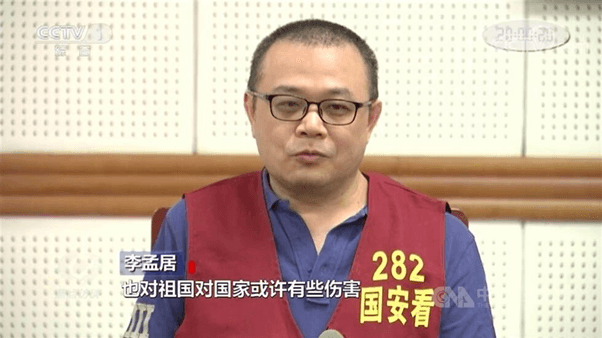
Lee gave confession in a national news program in October 2020. Image source: Focus Report, CCTV |
Lee Meng-chu was detained in Shenzhen in August 2019 at the height of the
anti-extradition bill protests in Hong Kong for possessing a card that read
“Go Hong Kong!” — at the time a common protest slogan — and snapping pictures
from his hotel of armed police gathering nearby. These actions and their
accompanying media coverage were deemed to be evidence of him acting as a
“Taiwan independence activist” attempting to foment a color revolution in Hong
Kong. Lee took the position that he was a political hostage because China was
outraged over Tsai Ing-wen’s vocal support for the Hong Kong protesters. His
case shows that Taiwanese prisoners can be subjected to exit bans when the
Chinese authorities decide to make a political point amid escalating tensions.
Still in Custody
Yang Chih-yuan (杨智渊)
While the two Lees have safely returned to Taiwan, more cases of arbitrary
detention have emerged as cross-strait relations have worsened. On August 3,
2022,
Yang Chih-yuan
was detained in Wenzhou for splittism, the first case where a Taiwanese
resident was charged with this crime. His detention came hours after Tsai
Ing-wen met with then-US House of Representatives Speaker Nancy Pelosi. China
called the visit a “provocation” and condemned the United States for
“seriously infringing on China’s sovereignty.”
 |
|
A screenshot of Yang being detained by police in Wenzhou. Image credit: CCTV |
China’s state news media claimed that Yang was appointed as the head of the
DPP youth league in Taichung and became a member of the splittist forces on
the island. In 2019, he became the vice chairman of the now defunct
Taiwan National Party, which advocated for “Taiwan independence” through a referendum. Also in
2019, he was allegedly invited by then-DPP president Chen Shui-bian to run for
a seat in the island’s legislature, albeit unsuccessfully. Yang was similarly
accused of colluding with splittist forces to support Hong Kong protesters
amid the citywide civil unrest the same year.
Li Yanhe (李延贺)
On March 23, 2023, Taiwan-based publisher Li Yanhe was placed under
residential surveillance at a designated location (RSDL) for inciting
splittism in Shanghai. RSDL is
a coercive measure condemned by the United Nations Special Procedures
as a form of enforced and involuntary disappearance. Under RSDL, a suspect can
be held for up to six months incommunicado while being denied legal counsel or
family visits.
 |
|
Gusa Press publisher Li Yanhe. Image credit: CNA via Taiwan News |
Li was born in China but settled in Taiwan in 2009 after marrying a Taiwanese
woman. He is the founder and editor-in-chief of Gusa Publishing, which is
known for publishing books on history and politics that are critical of the
Chinese Communist Party (CCP). Some critical titles focused on subjects like
CCP corruption and infiltration of global media. In March 2023, he visited
Shanghai to revoke his mainland residence registration and to visit relatives.
He had applied for citizenship in Taiwan, but to do so he was required by
Taiwan law to relinquish his mainland household registration.
Cheng Yu-chin (郑宇钦)
One day after China Central Television (CCTV) aired the confession of Lee
Meng-chu in October 2020, Cheng Yu-chin appeared in another televised
confession in which he admitted to using his academic post in the Czech
Republic to carry out espionage against China.
State news media sources
accused Cheng of infiltrating Chinese mainland organizations in Europe and
damaging China’s diplomatic ties with other countries. Cheng was placed under
criminal detention in Zhengzhou, Fujian, for espionage in April 2019. On April
15, 2024, China’s National Security Education Day, the
Ministry of State Security
reported that Cheng had been sentenced to seven years’ imprisonment. He has
two more years to serve before completing his sentence in April 2026.
Cheng claimed to be a member of the DPP and to have worked as an assistant to
former DPP chairman Cho Jung-tai, but Cho rejected this claim and denied that
he knew Cheng. Taiwan senior officials also came forward to rebuke false
claims about Cheng’s case, adding that a Taiwanese associate said to have
worked with Cheng did not even exist. Taiwan’s Mainland Affairs Council blamed
Beijing for making up the spy case. A Taiwanese professor familiar with Cheng
also
expressed disbelief
that Cheng was a spy because Cheng had set up a company to help Chinese
students gain admission to post-graduate programs in the Czech Republic. He
had worked to promote China’s Belt and Road Initiative during his stay in
Europe.
Chen Shu-kai (陈树楷)
Dui Hua’s research discovered the case of
Chen Shu-kai, who was detained for espionage in January 2017 and sentenced to 12 years
and six months’ imprisonment with three years’ DPR in August 2020 in Xiamen.
Chen was the chairman of the board of Bioil International Limited (Taiwan).
While an official document stated that he received NTD700,000 from the Taiwan
Military Intelligence Bureau to obtain 29 classified documents in China, Dui
Hua could not find other sources to verify this official account in order to
determine whether this is one of the many cases of arbitrary detention in
China. He is currently incarcerated in a prison in Fujian. In 2023, the prison
recommended a sentence reduction of four months be granted to Chen because he
had demonstrated remorse. The sentence reduction, if approved, would shorten
his release date to February 2029.
Pan-Blue Camp Also Targeted
In Taiwan, pan-blue refers to a political stance espoused by Kuomintang (KMT)
supporters who favor a dual Taiwanese Chinese identity as well as friendly
relations with China. However, people subscribing to the pan-blue view can
still face arrest in China on charges of endangering state security. At least
two pan-blue academics from Taiwan have been imprisoned in China in recent
years.
 |
|
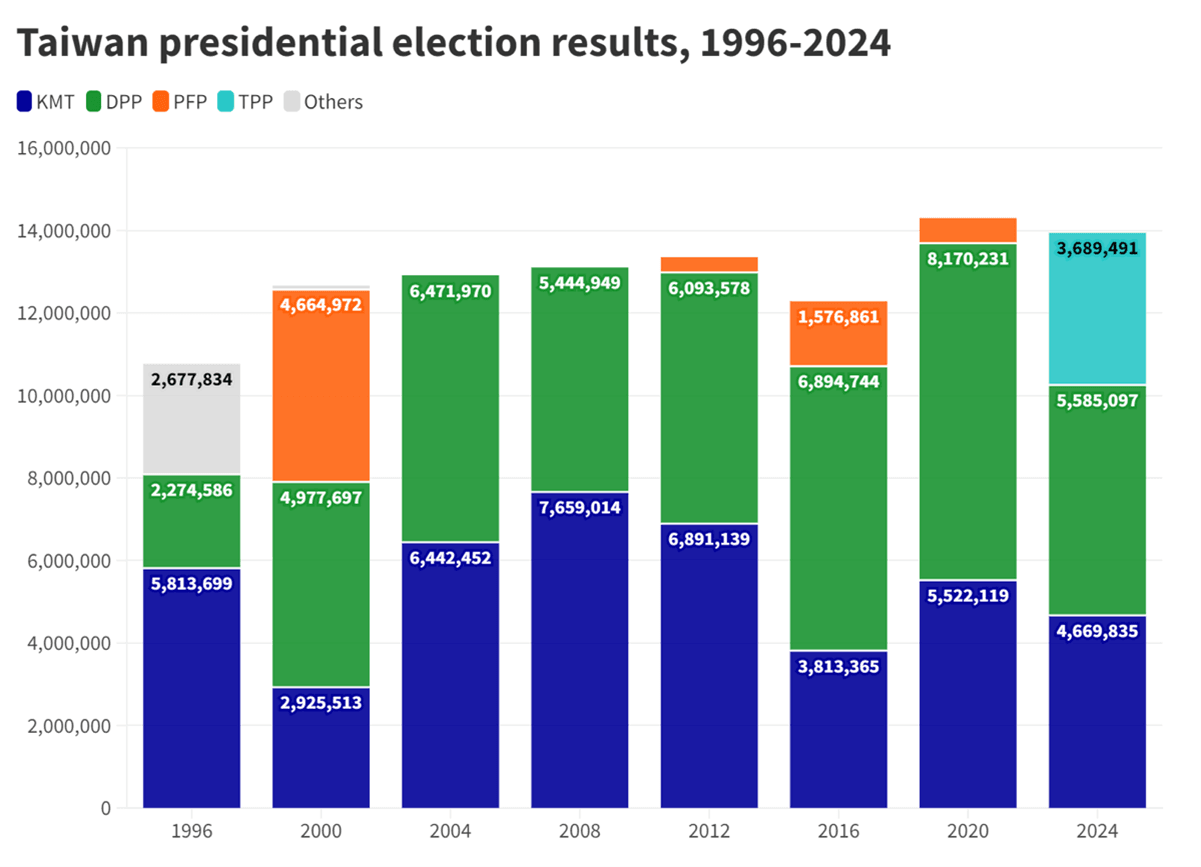
Results from presidential elections for the past eight Taiwanese elections, showing changes in support for the Pan-Blue KMT and the DPP. Image credit: Emanuelamianstrolski / CC BY 4.0 |
Shih Cheng-ping (施正屏) is a retired professor at National Taiwan Normal
University. Shih wrote op-eds critical of Tsai Ing-wen in the Taiwanese press.
In August 2022, he completed his four-year sentence for espionage in Anhui. It
is not known whether Shih has returned to Taiwan or is obliged to stay in
China to serve his two-year DPR sentence, which will end in August 2024.
Shih disappeared after traveling to China in August 2018. His case came to
light 15 months after his disappearance, when he appeared in a CCTV television
program in October 2020 confessing to spying for Taiwan. In the recording, he
admitted to passing information to Taiwan authorities from a mainland think
tank in exchange for money. As with many other televised confessions, his was
aired before he was found guilty by the court. This practice has been
condemned by human rights groups as forced confessions under duress.
Pro-unification Taiwanese scholar Tsai Chin-shu (蔡金树) was convicted of
Taiwanese espionage in July 2020, Tsai is a KMT member and has worked in
multiple capacities to promote cross-strait exchanges. He served as director
of the Kaohsiung Cross-Strait Exchanges Research Association and chaired the
Southern Taiwan Union of Cross-Strait Relations Associations, which advocated
for the Ma Ying-jeou administration’s policies of forging ties with China.
 |
|
On January 13, 2024, Taiwan Democratic Progressive Party supporters watching the election results. Image credit: Cypp0847 / CC BY-SA 4.0 |
He was released from a prison in Fujian in May 2022. Like Lee Meng-chu, Tsai
has been barred from returning to Taiwan because of the four-year DPR sentence
that was imposed on him. In June 2023, Taiwanese news media sources reported
that Tsai was placed under house arrest in Gulangyu Island of Xiamen.
China has a track record of making politically motivated arrests that
observers call “hostage diplomacy.” Since the DPP won the 2016 presidential
election, China and Taiwan have exchanged fiery rhetoric and denounced each
other as threats to national security and social stability. Days after the DPP
won the 2024 presidential election, China’s Ministry of State Security claimed
it
would intensify efforts
to crack down on “subversion, espionage and splittist struggles” related to
Taiwan. In June, judicial bodies and Ministry of State Security jointly issued
a 22-point legal opinion against “Taiwan splittism” which threatens “trial in
absentia” or even to
impose the death penalty
for “diehard” Taiwan independence splittists in extreme cases, and in August
the Taiwan Affairs Office of the State Council added 10 Taiwanese to the
list of die-hard splittists
(nearly all are members of the DPP). At the time of writing, Taiwanese
officials have confirmed to the media that
15 Taiwanese residents
are currently held in China for various crimes, “including violations of the
anti-secession law.” As cross-strait tensions escalate, more cases of
arbitrary detention are likely to emerge, leaving citizens to pay the price
for geopolitical hostility.