Tag: petitioning

  • Leftist Dissent Under Xi: The Young Leftists Part I, Who Are the Young Leftists?

    Leftist Dissent Under Xi: The Young Leftists Part I, Who Are the Young Leftists?

    Xi Jinping leads members of Politburo Standing Committee and other state leaders in celebrating the 200th birthday of Karl Marx in the Great Hall of People on May 5, 2018. Image credit: Xinhuanet
    In May 2018, Xi Jinping led a celebration of the 200th anniversary of Karl Marx’s birthday. During the event, Xi delivered a speech hailing Marx as the greatest thinker of modern times and holding up Marxism as the guiding ideology of the Chinese Communist Party (CCP). The days before and after Xi’s speech were marked by numerous celebratory events, including the placement of a golden Marx statue in Xi’s hometown.
    Just months later, the CCP would engage in a crackdown on leftist supporters who not only shared the same ideological bedrock as the CCP but were actively working to apply Marxism at the local level. The tactics used by the party may not surprise those familiar with the CCP’s handling of any dissent regardless of political ideology. However, the stark contrast between the tone struck by Xi in May and the party’s blatant rejection of those same ideals when carried out by its citizenry served as another reminder of the CCP’s intolerance for dissent, even that which seeks to bring local standards in line with the government’s stated values.
    This is the first entry in a two-part post that examines dissent among the ideological left in China. In October 2019, Dui Hua examined the grievances of the “old leftists,” including their efforts to form political parties. Dui Hua has also chronicled leftist subversion in China from 1980-2013. This post turns to a young generation of Marxists who emerged more recently and quickly faced repression in Xi’s China. The second part of this post, which will be released shortly, discusses the young leftists’ roles in the 2018 Jasic workers’ protests, as well as the consequences they faced after the government crackdown.
    The emergence of young leftist dissent, which culminated in the outbreak of workers’ protests at Jasic, a welding company, in the summer of 2018, represents an unlikely challenge for the CCP. Xi is continuing China’s decades-long effort to instill the political ideology of the CCP as the rightful successor to Marxism in the education curriculum. He also widely celebrates his own thoughts on socialism by adding “Chinese characteristics” to Marxism. To ensure loyalty and broaden the appeal of his Sinicized version of Marxism for future generations, Xi’s government launched a mobile app in early 2019 to educate school-aged children about the CCP’s ideological orthodoxy.
    Despite escalating political indoctrination among China’s youth, a group of self-declared Marxist students came to prominence under Xi’s rule. Most of them were born in the 1990s and early 2000s with no first-hand experience of Mao’s revolutionary zeal for class struggle. Growing up amid China’s economic boom, these young leftists find that the Marxist ideals trumpeted by the CCP in school do not line up with the realities of the society in which they are living. Rather, they see aggravated ideological contradictions in Xi’s “new era,” including increasing state capitalism and social injustice, especially corruption and a widening wealth gap. At the core of their disillusionment are rampant labor rights abuses, including wages in arrears, long work hours, and unlawful layoffs.
    Old leftists have joined these young dissenters and harnessed social activism when their interests conflict with government policies. Having grown up in Mao’s China without the benefit of formal Marxist education, their activism is rooted in what they perceive as the tainting of Mao’s ideals by corruption and capitalist tendencies. In contrast, many young leftists are well educated and motivated by the pursuit of social justice derived from Marxist values of equality. These young leftists come from diverse backgrounds, but they began their activism at universities with the formation of various Marxism-Leninism or Mao Zedong Thought discussion groups. In an unprecedented move, this activism would expand beyond the campus as students took their cause into society to support the Jasic workers.
    Diverse Backgrounds
    The young Marxists who emerged in Xi’s era were students or graduates from various disciplines and social backgrounds. Many of them attended China’s most prestigious universities. One student Marxist from Peking University who spoke to AFP on condition of anonymity said that he read the works of Marx to find ways to help China’s underclass. As the son of migrant farm workers, he believes that he has a sense of social responsibility.
    Other activists, like several members of a Marxism study group formed at Guangdong University of Technology in 2017, were born to less well-off families. For instance, chemical engineering student Ye Jianke(叶建科) grew up in Heping, the poorest county in Guangdong. Zheng Yongming (郑永明), a graduate of Nanjing Agricultural University, is a native of Ganzhou, a state-designated poverty city in Jiangxi. Sun Tingting(孙婷婷), a Chinese medicine graduate from Nanjing University, similarly grew up in a poor family in Jiangsu. In November 2017, the study group members took part in a group session and were detained for “gathering a crowd to disturb social order.” Afterwards, Sun released a public letter in which she described the difficulty of paying her legal fees.
    If the well-to-do backgrounds of some students made for unlikely Marxists, it did not deter the students’ convictions. For instance, Shen Mengyu (沈梦雨), whose parents are university lecturers, became a student leader who openly supported the Jasic protesters. Shen graduated with a master’s degree in computer science and mathematics from Sun Yat-sen University. Despite a family background and educational qualifications pointing to a bright future, Shen chose to work in a car factory in Guangzhou after graduation to experience life as a proletarian. In an interview with Asia Weekly (paywall), Shen said she did not consider herself a Marxist until she attended graduate school and learned about labor issues by attending talks and following leftist websites online.
    Another notable figure, Yue Xin (岳昕), was born to a typical middle-class family. Her family has an apartment in Beijing, and she had a materially trouble-free life. In a now-censored essay about social injustice and inequality published online, Yue expressed guilt for her privileged upbringing, something not afforded to many ordinary Chinese people. Yue became interested in workers’ rights in 2016 when she visited Jakarta as part of a language exchange from Peking University. Prior to her trip, she believed in constitutional democracy. Seeing that the Indonesian political system failed to improve the lives of Indonesian workers who continued to suffer capitalist exploitation, she began to follow labor issues in China more closely upon her return to China in 2017. These views led her to join various campus activities to promote workers’ rights.
    Leftist Campus Activism
    University students did not appear particularly vocal about labor issues, even after a spate of suicides at Foxconn starting in 2010 and other labor protests that rocked the manufacturing hub of Guangdong. Although many students likely experienced mistreatment while working to support themselves, there were no known collective student efforts to improve workers’ conditions until around 2014.
    That year, over 200 sanitation workers in Guangzhou University Town launched a two-week strike to seek severance pay and assurances that the new employer assuming the regional cleaning contract would continue to employ the workers. The striking workers received help from many of the area’s 200,000 students. These students signed an open letter supporting the strike, raised funds, and even brought food and water for the workers. Nevertheless, except for Shen Mengyu, who conducted on-site research about the strike, few students identified as Marxists.
    These efforts led to improvements in working conditions, including safer and more hygienic workplaces as well as better-defined work hours and duties. This success also sparked an interest among leftist student groups to improve the treatment of “campus proletarians” like cooks, construction workers, and janitors. In November 2018, Inkstone, a subsidiary of the South China Morning Post, wrote of several Marxist student groups in Jiangsu and Beijing. At Nanjing University, students from Marxist labor rights groups sympathetic to campus workers took up canteen work and organized square dance events. The New Light People’s Development Association at Renmin University supported migrant workers by organizing free clinics, night schools, and dance parties. Only months later, these groups would be suppressed by government action.
    Perhaps the best-known student group is the Peking University Marxism Study Society, which was founded in 2000. In late 2015, the society released a report detailing inadequate labor protections for the university’s maintenance staff, including unlawful pay cuts, insufficient social security coverage, and abhorrent living conditions. The report, based on responses from 100 interviewees on campus, urged the university management to act to improve working conditions in accordance with Chinese law.
    A follow-up survey conducted in 2017 by Zhan Zhenzhen(展振振) indicated that the university had made no substantive improvements to staff conditions. Perhaps recognizing the risk in making overt criticism, Zhan’s May 2018 report avoided naming and shaming, instead calling on university management to ensure the protection of basic workers’ rights. Although Zhan did not face any disciplinary action for his survey, Peking University warned workers not to cooperate with him lest they be laid off.
    While only a small minority of students are devoted to left-wing campus activism, the CCP fears a student-worker coalition that highlights labor rights and broader socio-economic inequalities. The CCP believes such criticisms undermine its vested interests in the increasingly capitalist markets. When the party believes a line has been crossed, it has not hesitated to crack down on leftist student groups, using a variety of methods including coercive measures. Zhang Yunfan (张云帆) was among the first students to have his leftist activism met with such resistance.
    A former member of the Peking University Marxism Study Society, Zhang started working in Guangzhou University Town after graduating from Peking University with a major in philosophy in 2016. In 2017, Zhang organized Marxism reading groups at Guangdong University of Technology for like-minded students and graduates. Three of the activists mentioned in this article—Sun Tingting, Ye Jianke, and Zheng Yongmin—were members. In addition to labor rights, Zhang’s reading groups were keen to discuss current affairs, even “June Fourth.”
    After a group session on November 15, 2017, Zhang, Ye, and a few other members were initially charged with “illegal business activity” but later detained for “gathering a crowd to disturb social order.” A month later, Zhang and Ye were placed under residential surveillance at a designated location and released on December 29, 2017. Sun and Zheng were also detained in early December and released on bail within a month.
    While the Marxist students shared similar passions to improve workers’ rights, some of them expanded their focus to explore women’s rights. Marxist student Yue Xin emerged as a critical voice in China’s #MeToo movement, which began in January 2018. She helped trigger a public reckoning when she began investigating an alleged rape that occurred almost 20 years ago and possibly led to the suicide of a Peking University student in 1998. In April 2018, Yue and other students requested that police disclose information about the investigation of a former literature professor who is believed to have raped the student who committed suicide and coerced other students into sexual relationships. In an open letter Yue published on April 23, 2018, she recounted intimidation by Peking University. The university said that she would not be able to matriculate unless she deleted all related information from her electronic devices.
    Many politically engaged students, including those profiled here, reached an important level of commitment with their involvement in the Jasic labor protests of summer 2018. The next post tells their story.
  • Leftist Dissent Under Xi: The Old Leftists, Part I

                                   Souvenir plates with images of Xi Jinping and Mao Zedong. The “Great Helmsman” is among the series of honorifics given to Mao. Image Credit: RFA

    In the West, Mao Zedong gained notoriety as a totalitarian dictator responsible for the deaths of millions of people. His promotion of an extreme cult of personality and two political movements in particular, the Great Leap Forward, resulting in the Great Famine, and the Cultural Revolution, which Mao masterminded to crush his political foes, were among the most destructive aspects of his leadership. Although by some estimates Mao Zedong caused more deaths in peacetime than either Adolf Hitler or Joseph Stalin, the portrait of the man who “brought calamity to an entire nation still hangs in Tiananmen Square and is still found on the banknotes we use every day,” wrote Mao Yushi in a critical essay in 2011. (Mao Yushi, who is not related to Mao Zedong, is a prominent economist who won the Cato Institute’s 2012 Milton Friedman Prize for Advancing Liberty.)

    China has allowed some room for the public to question the officially sanctioned reputation of Mao since the “Great Helmsman” died in 1976. Nonetheless, scholars, journalists, and other public figures can stand accused of “historical nihilism” if they reject Mao’s legacy of liberating China from Japanese occupation and Western imperialism, and critics may risk ruining their careers for holding “hostile” views on Chairman Mao. Because of his critical essay, Mao Yushi has even received death threats and has been widely vilified by Mao Zedong’s supporters. Criticism of Mao Zedong in the public space continues to be considered politically incorrect today, because Mao Zedong Thought, or Maoism, is enshrined in China’s constitution and represents the ideological orthodoxy of the Chinese Communist Party (CCP). Mao’s ideology provides justification for the CCP to prevent the spread of destabilizing western values, such as multiparty democracy, and maintain its “perennial ruling party” status.

    After Xi Jinping rose to power in 2012, his policies and rhetoric have often evoked memories of the Mao era. Just ahead of Mao’s 120th birthday on December 26, 2013, Xi Jinping said, during a visit to Wuhan in July 2013, “We must turn Chairman Mao’s old residence into a base for patriotism and revolutionary education.” Xi’s promotion of the singing of “red (revolutionary) songs” in official settings as diverse as government offices, schools, television stations, and even prisons strikes a chord with adherents of Mao Zedong Thought. Some observers believe that Xi manipulates Maoism to cultivate a sense of pride and consolidate support from the powerful group known as the princelings (i.e., sons and daughters of prominent CCP officials). He does so, not just to bolster ideological support for himself, but also to foster an aura of respectability on behalf of their “revolutionary” parents, who contributed to or even sacrificed for Mao’s socialist cause, according to veteran China analyst Willy Wo-Lap Lam, author of Chinese Politics in the Era of Xi Jinping: Renaissance, Reform, or Retrogression?. In 2015, one Maoist observer even lauded the Xi era as “a golden period” for the leftists, as Xi “has ushered in fundamental change to the status quo, shattering the sky.”

    But despite this leftist revival, many adherents of Mao who are nostalgic for his egalitarian ideals continue to find themselves disillusioned with Xi’s “new era of socialism with Chinese characteristics,” largely due to pervasive corruption and social inequality. They make up a large pool of leftist dissenters who refuse to acknowledge the achievements made by the CCP over the 40 years of economic reform. Leftist dissent, however, is far from being monolithic. The dissenters are from diverse backgrounds, have assorted motives, and use different means to channel discontent. There is also a generational divide within this group.

    This post defines “old leftists” as the generations who either lived through the Mao era as adults or adolescents, or have only vague but fond childhood memories of Mao before his death in 1976. Many of them are veterans and employees laid off by state-owned enterprises; both groups believe that pervasive corruption is the root cause of their problems. As many of them grew up during the Mao era with limited means and educational opportunities, they do not necessarily understand what Mao’s ideology or legacy entail. They may uphold the simple belief that Maoism is a panacea for their livelihood problems, due in part to state propaganda campaigns to deify Mao since 1949. Many old leftists take part in tens of thousands of mass incidents across China every year in the form of protests and collective petitions, whenever public policies put their material benefits at risk. A small fraction of these “old leftists” even proclaim themselves the real descendants of Communism, in the belief that China’s problems must be solved by a reversion to pre-reform era socialism, which would amount to a complete ideological overhaul of the current core philosophy of the Chinese government. They resort to forming political associations in order to challenge the CCP as the legitimate leader of the one-party state.


    State-Owned Enterprise Workers


    Leftist ideologies appeal to many grassroots workers, especially employees of state-owned enterprises. As of 2013, state-owned enterprises employed around 37 million people. Once the pillar of Mao’s planned economy, they are nostalgic for Mao’s promise of an “iron rice bowl” (i.e., guaranteed lifetime employment). The generation of the urban “sent-down youth” born in the 1940s and 1950s was ordered by Mao to “receive education from living in rural poverty” and many were consequently deprived of the opportunity to receive higher education when Mao suspended university entrance exams in 1966. Members of the generation of Mao’s sent-down youth have been less competitive in the job market than younger generations. They see economic reform and marketization as anathema because the state-owned enterprises provided a livelihood for most of them. From 1993-2003, the restructuring of state-owned enterprises resulted in around 28 million redundancies. Despite Xi’s 2018 remark that “state-owned enterprises would grow stronger, better, and larger,” labor protests against the privatization of state-owned enterprises show few signs of abating in the Xi era.

    Since 2014, China Labor Bulletin has documented hundreds of protests joined each year by state-owned enterprise workers across China. In these protests, workers sometimes employ Maoist rhetoric to advance their claims in defence of their rights. One such protest over labor retrenchment rocked Nanyang, Henan, on September 9, 2014. Hundreds of workers laid off by a state-owned pharmaceutical factory took to the streets to commemorate the 38th anniversary of Mao’s death. They chanted slogans against privatization, corruption, and capitalism, and “Only Mao Zedong Thought Can Save China!” A middle-aged female protester interviewed by the prominent Maoist website Utopia described her life during Mao’s era as “heaven” because workers enjoyed free or low-cost medical services, education, housing, and retirement benefits. She likened the plight of workers in present-day China to “having fallen through the eighteen levels of hell.”

    Laid-off workers join a spontaneous parade in Nanyang to commemorate Mao Zedong on the 38th anniversary of his death, carrying his portraits and banners, and demanding unpaid pensions from a privatized pharmaceutical factory.                    Image Credit: Utopia

    Today, many of Mao’s supporters continue to converge on Hunan, Mao’s birth province, to pay tribute to the Great Helmsman they have long revered. On April 23, 2018, around three hundred retired workers, many of whom were former state-owned enterprise workers, protested against the policies of the Shaoyang City government in Hunan. They demanded punishment for police officers who fired tear gas at them when they petitioned against cutbacks in post-retirement medical benefits. The protesters, whom unofficial media reports called “Mao’s fans,” gathered to sing red songs to express their discontent.


    Veterans


    Official statistics released in 2018 indicated that China had 57 million veterans, and the number has been increasing by several hundred thousand each year. Those who answered the party’s call to fight in the 1979 Sino-Vietnam War or other earlier wars especially feel that they are not afforded the dignity they deserve from the state. Since being demobilized, they have been assigned low-end jobs, subsequently laid off, or granted only limited medical care and other benefits. Many demobilized soldiers believed their material benefits were squeezed by corrupt officials and consequently joined the ranks of leftist protesters to defend their rights. Disaffected veterans typically wear camouflage uniforms to convey pride in their past military service. To show allegiance to the CCP, they also wave national flags, sing red songs, and carry photos of Mao. Xi’s attempts to pacify veterans, however, appear to have achieved little. The Ministry of Veterans Affairs, created in March 2018 with the goal of streamlining bureaucracy concerning veterans’ benefits, has become another site frequented by protesting veterans who feel that local officials have ignored their complaints.

    Expressions of discontent by veterans often become flashpoints across China. On September 20, 2018, a group of veterans converged on the Ministry of Veterans’ Affairs. In attendance was a 91-year old veteran who complained about local governments’ failure to comply with the CCP’s veterans’ benefits policy. Hundreds of veterans sang “Unity is Strength,” a patriotic song about the People’s Liberation Army popularized by Mao. They were soon drowned out by plainclothes police loudspeakers ordering the veterans to stop singing. A veteran petitioner reported that none of them were allowed to meet with a ministry representative. Some were sent back to the Jiujingzhuang reception center. While most were subsequently sent back to their original residences, some were sent from the reception center to the network of infamous “black jails.”

    In an undated photo, Hubei veteran petitioners hold a banner that reads, “Firmly Support Xi Jinping, Follow the Party Forever.” Image Credit: RFA

    Perhaps the most notable incident over the years was the veterans’ protest in Zhenjiang, Jiangsu, in June 2018. A group of veteran petitioners were assaulted by government-paid thugs. The incident crystalized the broader anger of veterans who came from across the nation to Zhenjiang to express solidarity with their comrades. Video footage from witnesses showed that around 100 veterans gathered outside a hospital with banners that read, “We are CCP members, not criminals.” Another online video even shows a protester shouting over a loudspeaker, “Perish together with the reactionary government.” Checkpoints were set up to prevent other veterans from entering the city. Police dispersed the protesters on June 23, injuring dozens of them, and sent many back to their home cities.

    At the time of writing, at least nine veteran protesters in the Zhenjiang protests are known to have been sentenced on April 19, 2019 to two to four years’ imprisonment on charges of “gathering a crowd to disturb social order” or aggravated assault. On the same day, the Weicheng District People’s in Shandong sentenced another group of nine veterans to three to six years’ imprisonment for similar offenses.

    Read about the old leftists attempts to actively promote neo-Maoism in Part II.
  • Complaints with Retribution: China’s Muffling of Gaoyangzhuang

    Hong Kong-based pro-Beijing newspaper Wen Wei Po accuses democratic legislators and organizers of Occupy Central, including Joshua Wong, of making complaints overseas about internal affairs of China and Hong Kong. Photo credit: Wen Wei Po
    China celebrates National Youth Day every year on May 4th, a holiday commemorating the patriotic May Fourth Movement in 1919. On this day exactly a century ago, thousands of university students assembled at Beijing’s Tiananmen Square, urging the Chinese delegation at the Paris Peace Conference not to sign the Versailles Treaty because the Allied Powers had conceded to Japan’s demand to take over the German concessions in Shandong. The procession proceeded to foreign embassies in the Legation Quarter to demand nullification of special foreign privileges, such as extraterritoriality. This was a privilege by which China was forced to yield control of sovereign powers, one of many losses as part of a series of “unequal treaties” in force since the First Opium War. Student protesters hoped that the United States would side with China over the “Shandong question,” because the U.S. was a key proponent of national self-determination and the U.S. embassy was the only foreign embassy willing to meet with their representatives and accept their petition.

    A century later, the patriotic act of petitioning westerners known as gaoyangzhuang (告洋状) carries a negative connotation. Petitioning refers to the administrative system for receiving complaints from people with grievances, mostly concerning corrupt officials. While China guarantees the right to complain so long as petitioners do not bypass local authorities, the government does not tolerate the act of complaining to foreigners, in part due to the traditional notion of “not exposing family scandals.” Recent usage of gaoyangzhuang is often associated with Taiwanese president, Tsai Ing-wen, when she speaks to foreign diplomats and journalists about her rejection of Xi’s offer of the “one country, two systems” framework for reunification with the mainland. Li Jing-yu, wife of imprisoned Taiwanese activist Lee Ming-che (李明哲), has also been accused of gaoyangzhuang for criticizing China from overseas because she was prevented from visiting her husband, who is serving a five-year sentence in Hunan for subversion. The term is no less frequently used against Hong Kong democratic legislators, supporters and localists if they tell foreigners about Beijing’s tightening control over the former British colony.

    In Taiwan and Hong Kong, complaining about the Chinese government does not land individuals in legal trouble because both regions are independent jurisdictions. By contrast, critics on the mainland face imminent threat of loss of personal liberty. In August 2013, Global Times stated that petitioners, alongside exiled democracy activists and “splittist forces overseas” headed by the Dalai Lama and Rebiya Kadeer, were the major users of gaoyangzhuang. Petitioners were accused of taking part in a number of “illegal behaviours” such as wearing clothing traditionally associated with petitioning. These included, for example, signs hanging both down the petitioner’s front and back, waving banners, and chanting slogans at Beijing-based international organizations, such as offices of the United Nations and foreign embassies, with the intention to “create international influence” (zaocheng guoji yingxiang 造成 国际 影响). Unlike those in Hong Kong and Taiwan, petitioners on the mainland with assorted grievances, from forced demolitions to land disputes, are most likely to face reprisals for complaining to foreigners.

    Hu-Wen Era

    It is unclear when the term of gaoyangzhuang entered the official lexicon. An article originally published by Phoenix Weekly in January 2009 stated that the term began to come into vogue during the Hu Jintao and Wen Jiabao administration. China’s effort to improve its global image prior to the Beijing 2008 Olympics incentivized provincial governments to track gaoyangzhuang petitioners in Beijing. In 2005, a total of 37 people from Hubei were reported to have travelled to Beijing to make complaints to foreigners, compared to 77 people from Liaoning, which was ranked as the top fourth province nationwide. In the 19 months since July 2004, over 540 people in 50 different groups had filed complaints to the Beijing offices of UNHCR and UN Development Programme, according to statistics from the Sanlitun police station. A Liaoning official was quoted as saying that gaoyangzhuang “seriously damages the country’s reputation and external image” and “creates pressure on the capital’s social security and stability.” Another Shanghai official called gaoyangzhuang “despicable,” an act tantamount to “blackmailing the Chinese people.”

    A Hebei government directive in 2007 states that gaoyangzhuang petitioners adversely affect Beijing’s social stability and vilify the national image. Underlining added by Dui Hua Foundation. Photo credit: Boxun
    Public censure achieved little to deter petitioners from complaining about local governments to foreigners. In view of this, provincial public security, procuratorial offices, and courts started to jointly push for punitive measures. Anhui was among the first to release an opinion in 2006, listing foreign embassies and international organizations as “key areas” for stability maintenance alongside the central organs of the Chinese Communist Party, and subjecting anyone who disturbed social order to punishment in accordance to the Public Security Administration Punishments Law.

    Government officials are keen to suppress gaoyangzhuang because they use low rates of gaoyangzhuang as an indicator of good governance. A performance appraisal document in Shihu Township, Jiangsu, in 2011 categorized the prevention of gaoyangzhuang under the section appraising “critical stability control” (zhongdien weiwen 重点维稳) during “sensitive days” (such as certain national holidays and anniversaries of events that are likely to inspire protests and other forms of public political expression); the section carries two evaluation points. Each occurrence of gaoyangzhuang leads to a deduction of half a point. Similar assessment mechanisms likely existed before 2011, since the 2009 Phoenix Weekly article mentions that local public security bureaus in Henan, Shanghai and Liaoning had publicized cases of petitioners apprehended or detained for gaoyangzhuang.

    In the run-up to the 2008 Olympics, both official usage of the term gaoyangzhuang and punitive measures proliferated. In June 2007, an official in Heilongjiang’s Datong District called for “detaining or giving re-education through labor (RTL)” to gaoyangzhuang petitioners before resolving their problems. Petitioners would have to pay for all expenses the government incurred for handling their petitions if deemed “unreasonable.” In January 2008, an opinion from Hebei called gaoyangzhuang an “irregular form of petitioning to Beijing” (feizhengchang jinjing shangfang非正常进京上访) and a “serious breach” of the petition regulations. The opinion recommended that public security directly detain or give RTL to gaoyangzhuang petitioners without the need to give prior admonishment or warning. In March, Liaoning followed suit and issued a similar opinion to crack down on gaoyangzhuang petitioners.

    Nor did the crackdown on gaoyangzhuang relax in the wake of the Beijing Olympics. A local government directive issued in 2009 continued to blame gaoyangzhuang petitioners for “complicating simple issues, internationalizing and politicizing domestic problems” by means of “creating international influence.” Throughout the year, a total of 2,862 gaoyangzhuang petitioners were caught in Chaoyang District, Beijing, and, of these petitioners, 1,118 were detained. In February of that year, then-Secretary of State Hillary Clinton visited China. Zhao Chunhong (赵春红) led a group of petitioners to put up a banner welcoming Clinton and called on Nancy Pelosi (scheduled for a separate visit in May of 2009) to put pressure on China over its human rights records. Zhang was subsequently sentenced to three years’ imprisonment for “picking quarrels and provoking troubles.”

    About half a year before Xi’s rise to power in 2012, blind activist Chen Guangcheng (陈光诚) made a daring escape from house arrest to the U.S. embassy. In May, Chen and his family left China for New York. Some mainland observers opined that the episode had emboldened petitioners to make complaints to foreigners in the belief that the Chinese government would ultimately address their problems. On May 8, 2012, elderly petitioner Nie Muni (聂木妮) and his wife attempted to “barge into” the U.S. embassy, but were intercepted by the embassy guards and taken to the Jiujingzhuang Reception Center in Beijing, an unofficial detention center where petitioners are held. In an interview with Voice of America (VOA), the couple said they wanted to “beat drums and cry injustice” (jigu mingyuan击鼓鸣冤) at the U.S. embassy because the U.S. “gives people a sense of trust and respect for human rights and dignity.” They claimed to have been inspired by Chen, who received medical treatment from the Chinese government after he escaped to the U.S. embassy.

    Xi’s Regime

    Despite the abolition of RTL in 2013, many gaoyangzhuang petitioners have not fared any better. They are now more likely to be convicted of “picking quarrels and provoking troubles,” which carries a maximum sentence of ten years. In 2013, over a dozen petitioners from Fuzhou, Fujian, started a series of gaoyangzhuang petitions in the hope that then-U.S. Ambassador Gary Locke would respond to their plight. In April of that year, they even planned to intercept John Kerry’s vehicle during his Beijing visit on the 13th. Upon learning that the Fuzhou government had dispatched large numbers of interceptors to Beijing, the group proceeded instead to Ambassador Locke’s residence, where they threw stacks of leaflets and some of them chained themselves to the front gate. The group of petitioners grew to over two dozen in July, but many were removed and collectively charged with “picking quarrels and provoking troubles.” Some of them were released on bail after several months in custody.

    Some of the Fuzhou gaoyangzhuang petitioners who attempted to complain about corruption and rights abuses in China to then-U.S. Ambassador Gary Locke in 2013. Photo credit: RFA
    Lin Yingqiang (林应强) continued his effort to petition Locke alongside a dozen of the Fuzhou petitioners into early November. After 15 months in criminal detention, Lin was sentenced to three years’ imprisonment in February 2015. The judgment stated that Lin circulated 68 blog posts about the “Fuzhou victims” to satisfy his greed in the name of “anti-corruption” and “whistleblowing.” Among these posts, two recounted his stories of “barging into” the American embassy, which were viewed over 9,000 times in 2013. A day after his November petition, he and other Fuzhou petitioners put up another blog post, entitled “Please Follow Fuzhou Petitioners Who Complained to Foreigners,” which was viewed 51,159 times within one month of posting. At least four other individuals surnamed Tang, Chen, Shi and He were sentenced to two and a half years for the same offense of “picking quarrels and provoking troubles.” According to a Fuzhou activist, the above-mentioned five Fuzhou petitioners were sentenced at three different locations on purpose, because putting all of them on the same trial would have attracted unwanted publicity to this significant gaoyangzhuang case.

    In February 2016, unofficial news media reported that the Ministry of Public Security would establish a “national petitioner database” as a preventive measure of stability maintenance. The database would not only track mainland petitioners, but also those who petitioned in Hong Kong, Macao, and Taiwan. An exit ban might be placed on the mainland petitioners, who also faced restrictions from entering various municipalities and cities. Public security would liaise with Chinese embassies to track and monitor petitioners who made complaints overseas.

    The petitioner database was created with the intention of curbing the rising number of petitioners who traveled abroad to voice complaints about the Chinese government, according to Bowen Press, citing an informed source. On September 25, 2015, dozens of petitioners attempted to intercept Xi’s motorcade at the end of the Obama-Xi meeting in Washington, D.C. One of them, a petitioner from Jilin, managed to stop Xi’s wife Peng Lijuan’s vehicle. Bowen reported that the incident had “frightened” Peng and made Xi “lose face.” The petitioner was taken away by police and his petition materials were subsequently received by officials from the Chinese embassy. In March 2016, another group of 50 gaoyangzhuang petitioners from 10 different provinces and municipalities were accused of “creating a nuisance” when Xi attended the Fourth Nuclear Security Summit, again in Washington, D.C. At the time of writing, Dui Hua is not aware whether the petitioner database has come into operation.

    Communicating with Foreign Media

    While petitioning is not the only channel for Chinese citizens seeking to publicize or change policies that they deem unfair, anyone who makes negative remarks about China to foreign media can face accusations of gaoyangzhuang. In May 2014, journalist Xiang Nanfu (向南夫) was detained for the offense of picking quarrels and provoking trouble, a charge stemming from his use of Boxun, a U.S.-based Chinese language news website, to “fabricate” news about organ harvesting and violent land grabs in China in exchange for article fees. It is worth noting that although Xiang was not a petitioner, Xinhua News called his act of “smearing” China in front of foreigners gaoyangzhuang.

    Lawyers, too, have been affected by Chinese government responses to communicating with foreign sources. There has been a growing trend of using administrative penalties against lawyers following the nationwide crackdown on Chinese lawyers and human rights activists that began on July 9, 2015. During the “Two Meetings” in March 2018, the Ministry of Justice (MOJ) warned lawyers not to give dissenting views on China’s constitutional amendment that removed Xi’s presidential term limit. A notice issued by a local justice bureau indicated that violators would have his/her license to practice revoked and be barred from resuming work for five years. The MOJ also explicitly warned lawyers not to give interviews to foreign media, including BBC, Voice of Russia, and American media outlets such as NBC, CBS, VOA, and Radio Free Asia (RFA). When asked by RFA about the health condition of his client Huang Qi, the webmaster of the legal rights website 64 Tianwang, in August 2018, defence attorney Liu Zhengqing apologized for not being able to give an interview because he was under a lot of pressure with regard to talking to foreign media. On December 25, 2018, Liu’s license to practice law was revoked.

    Critics in- and outside of academia frequently face harassment for speaking out to foreign media. On August 2, 2018, Shandong police broke into the home of retired professor Sun Wenguang (孙文广) while he was giving a phone interview to VOA. In the interview, Sun criticized Xi’s One Belt One Road initiative, urging Xi to spend more money in China instead of wasting money overseas on aid, loans and investments. Sun was put under house arrest for over 10 days.

    A recent case involving prison sentences for who spoke out to foreign media involved Tibetan language activist Tashi Wangchuk, who was sentenced to five years’ imprisonment for inciting splittism in May 2018. In 2015, Tashi Wangchuk gave interviews to The New York Times, in which he expressed worries about the disappearance of the Tibetan language, as the Chinese authorities have been prohibiting the use of Tibetan in spheres ranging from schools to commerce even on the Tibetan plateau. Tashi Wangchuk described China’s ethnic policy as a “systematic slaughter” of Tibetan culture. Speaking to foreign media was his last resort, because government bureaus had refused to lodge a petition for him. He had also been turned down by domestic media, nor could he bring a lawsuit against the language policy. Knowing full well of the risk of speaking to foreign media, Tashi Wangchuk stressed that he was not advocating for independence. He insisted that language rights are human rights protected by China’s constitution. However, the nine-minute film made by The New York Times was cited as evidence that landed Tashi in jail. Tashi is scheduled for release from a prison in Qinghai in January 2021.

    The frustration of those who apparently feel driven to complain to foreigners is succinctly described by a Caixin columnist who witnessed a gaoyangzhuang incident at the U.S. embassy in March 2014: a middle-aged petitioner holding two crutches, along with three people who appeared to have come from the countryside, were intercepted by a plainclothes officer after they ignored the warning that they would be arrested. Speaking from his own petitioning experience, the columnist wrote that the only response he received from the petition bureau was a receipt acknowledgement of his complaint, and despite an indefinite wait, his petition was never addressed. He guessed that gaoyangzhuang petitioners did not genuinely think they could succeed in obtaining redress from foreigners; they were simply trying their luck because they believed they had nothing more to lose by “speaking out against injustice” in front of foreigners.

    Many gaoyangzhuang petitioners who made this or similar assumptions, however, have been mistaken. The cases explored in this article demonstrate how those who complain about China to foreigners, including foreign embassies, visiting diplomats and leaders, and journalists, could very well face several forms of retribution. Not only are they stigmatized for “badmouthing” China, but they also face the risk of imprisonment for picking quarrels and provoking troubles, and even for the very serious crime of endangering state security in cases involving ethnic minorities.

    For more on petitioning in China, see also Dui Hua’s earlier reporting on the Beijing city government’s efforts to prohibit the use of “black security firms” and “black jails” to prevent petitioners from outside Beijing from coming to the capital to petition the central government, and, potentially, foreign actors.
  • Complaints with Retribution: China’s Muffling of Gaoyangzhuang

    Hong Kong-based pro-Beijing newspaper Wen Wei Po accuses democratic legislators and organizers of Occupy Central, including Joshua Wong, of making complaints overseas about internal affairs of China and Hong Kong. Photo credit: Wen Wei Po
    China celebrates National Youth Day every year on May 4th, a holiday commemorating the patriotic May Fourth Movement in 1919. On this day exactly a century ago, thousands of university students assembled at Beijing’s Tiananmen Square, urging the Chinese delegation at the Paris Peace Conference not to sign the Versailles Treaty because the Allied Powers had conceded to Japan’s demand to take over the German concessions in Shandong. The procession proceeded to foreign embassies in the Legation Quarter to demand nullification of special foreign privileges, such as extraterritoriality. This was a privilege by which China was forced to yield control of sovereign powers, one of many losses as part of a series of “unequal treaties” in force since the First Opium War. Student protesters hoped that the United States would side with China over the “Shandong question,” because the U.S. was a key proponent of national self-determination and the U.S. embassy was the only foreign embassy willing to meet with their representatives and accept their petition.
    A century later, the patriotic act of petitioning westerners known as gaoyangzhuang (告洋状) carries a negative connotation. Petitioning refers to the administrative system for receiving complaints from people with grievances, mostly concerning corrupt officials. While China guarantees the right to complain so long as petitioners do not bypass local authorities, the government does not tolerate the act of complaining to foreigners, in part due to the traditional notion of “not exposing family scandals.” Recent usage of gaoyangzhuang is often associated with Taiwanese president, Tsai Ing-wen, when she speaks to foreign diplomats and journalists about her rejection of Xi’s offer of the “one country, two systems” framework for reunification with the mainland. Li Jing-yu, wife of imprisoned Taiwanese activist Lee Ming-che (李明哲), has also been accused of gaoyangzhuang for criticizing China from overseas because she was prevented from visiting her husband, who is serving a five-year sentence in Hunan for subversion. The term is no less frequently used against Hong Kong democratic legislators, supporters and localists if they tell foreigners about Beijing’s tightening control over the former British colony.
    In Taiwan and Hong Kong, complaining about the Chinese government does not land individuals in legal trouble because both regions are independent jurisdictions. By contrast, critics on the mainland face imminent threat of loss of personal liberty. In August 2013, Global Times stated that petitioners, alongside exiled democracy activists and “splittist forces overseas” headed by the Dalai Lama and Rebiya Kadeer, were the major users of gaoyangzhuang. Petitioners were accused of taking part in a number of “illegal behaviours” such as wearing clothing traditionally associated with petitioning. These included, for example, signs hanging both down the petitioner’s front and back, waving banners, and chanting slogans at Beijing-based international organizations, such as offices of the United Nations and foreign embassies, with the intention to “create international influence” (zaocheng guoji yingxiang 造成 国际 影响). Unlike those in Hong Kong and Taiwan, petitioners on the mainland with assorted grievances, from forced demolitions to land disputes, are most likely to face reprisals for complaining to foreigners.
    Hu-Wen Era
    It is unclear when the term of gaoyangzhuang entered the official lexicon. An article originally published by Phoenix Weekly in January 2009 stated that the term began to come into vogue during the Hu Jintao and Wen Jiabao administration. China’s effort to improve its global image prior to the Beijing 2008 Olympics incentivized provincial governments to track gaoyangzhuang petitioners in Beijing. In 2005, a total of 37 people from Hubei were reported to have travelled to Beijing to make complaints to foreigners, compared to 77 people from Liaoning, which was ranked as the top fourth province nationwide. In the 19 months since July 2004, over 540 people in 50 different groups had filed complaints to the Beijing offices of UNHCR and UN Development Programme, according to statistics from the Sanlitun police station. A Liaoning official was quoted as saying that gaoyangzhuang “seriously damages the country’s reputation and external image” and “creates pressure on the capital’s social security and stability.” Another Shanghai official called gaoyangzhuang “despicable,” an act tantamount to “blackmailing the Chinese people.”
    A Hebei government directive in 2007 states that gaoyangzhuang petitioners adversely affect Beijing’s social stability and vilify the national image. Underlining added by Dui Hua Foundation. Photo credit: Boxun
    Public censure achieved little to deter petitioners from complaining about local governments to foreigners. In view of this, provincial public security, procuratorial offices, and courts started to jointly push for punitive measures. Anhui was among the first to release an opinion in 2006, listing foreign embassies and international organizations as “key areas” for stability maintenance alongside the central organs of the Chinese Communist Party, and subjecting anyone who disturbed social order to punishment in accordance to the Public Security Administration Punishments Law.
    Government officials are keen to suppress gaoyangzhuang because they use low rates of gaoyangzhuang as an indicator of good governance. A performance appraisal document in Shihu Township, Jiangsu, in 2011 categorized the prevention of gaoyangzhuang under the section appraising “critical stability control” (zhongdien weiwen 重点维稳) during “sensitive days” (such as certain national holidays and anniversaries of events that are likely to inspire protests and other forms of public political expression); the section carries two evaluation points. Each occurrence of gaoyangzhuang leads to a deduction of half a point. Similar assessment mechanisms likely existed before 2011, since the 2009 Phoenix Weekly article mentions that local public security bureaus in Henan, Shanghai and Liaoning had publicized cases of petitioners apprehended or detained for gaoyangzhuang.
    In the run-up to the 2008 Olympics, both official usage of the term gaoyangzhuang and punitive measures proliferated. In June 2007, an official in Heilongjiang’s Datong District called for “detaining or giving re-education through labor (RTL)” to gaoyangzhuang petitioners before resolving their problems. Petitioners would have to pay for all expenses the government incurred for handling their petitions if deemed “unreasonable.” In January 2008, an opinion from Hebei called gaoyangzhuang an “irregular form of petitioning to Beijing” (feizhengchang jinjing shangfang非正常进京上访) and a “serious breach” of the petition regulations. The opinion recommended that public security directly detain or give RTL to gaoyangzhuang petitioners without the need to give prior admonishment or warning. In March, Liaoning followed suit and issued a similar opinion to crack down on gaoyangzhuang petitioners.
    Nor did the crackdown on gaoyangzhuang relax in the wake of the Beijing Olympics. A local government directive issued in 2009 continued to blame gaoyangzhuang petitioners for “complicating simple issues, internationalizing and politicizing domestic problems” by means of “creating international influence.” Throughout the year, a total of 2,862 gaoyangzhuang petitioners were caught in Chaoyang District, Beijing, and, of these petitioners, 1,118 were detained. In February of that year, then-Secretary of State Hillary Clinton visited China. Zhao Chunhong (赵春红) led a group of petitioners to put up a banner welcoming Clinton and called on Nancy Pelosi (scheduled for a separate visit in May of 2009) to put pressure on China over its human rights records. Zhang was subsequently sentenced to three years’ imprisonment for “picking quarrels and provoking troubles.”
    About half a year before Xi’s rise to power in 2012, blind activist Chen Guangcheng (陈光诚) made a daring escape from house arrest to the U.S. embassy. In May, Chen and his family left China for New York. Some mainland observers opined that the episode had emboldened petitioners to make complaints to foreigners in the belief that the Chinese government would ultimately address their problems. On May 8, 2012, elderly petitioner Nie Muni (聂木妮) and his wife attempted to “barge into” the U.S. embassy, but were intercepted by the embassy guards and taken to the Jiujingzhuang Reception Center in Beijing, an unofficial detention center where petitioners are held. In an interview with Voice of America (VOA), the couple said they wanted to “beat drums and cry injustice” (jigu mingyuan击鼓鸣冤) at the U.S. embassy because the U.S. “gives people a sense of trust and respect for human rights and dignity.” They claimed to have been inspired by Chen, who received medical treatment from the Chinese government after he escaped to the U.S. embassy.
    Xi’s Regime
    Despite the abolition of RTL in 2013, many gaoyangzhuang petitioners have not fared any better. They are now more likely to be convicted of “picking quarrels and provoking troubles,” which carries a maximum sentence of ten years. In 2013, over a dozen petitioners from Fuzhou, Fujian, started a series of gaoyangzhuang petitions in the hope that then-U.S. Ambassador Gary Locke would respond to their plight. In April of that year, they even planned to intercept John Kerry’s vehicle during his Beijing visit on the 13th. Upon learning that the Fuzhou government had dispatched large numbers of interceptors to Beijing, the group proceeded instead to Ambassador Locke’s residence, where they threw stacks of leaflets and some of them chained themselves to the front gate. The group of petitioners grew to over two dozen in July, but many were removed and collectively charged with “picking quarrels and provoking troubles.” Some of them were released on bail after several months in custody.
    Some of the Fuzhou gaoyangzhuang petitioners who attempted to complain about corruption and rights abuses in China to then-U.S. Ambassador Gary Locke in 2013. Photo credit: RFA
    Lin Yingqiang (林应强) continued his effort to petition Locke alongside a dozen of the Fuzhou petitioners into early November. After 15 months in criminal detention, Lin was sentenced to three years’ imprisonment in February 2015. The judgment stated that Lin circulated 68 blog posts about the “Fuzhou victims” to satisfy his greed in the name of “anti-corruption” and “whistleblowing.” Among these posts, two recounted his stories of “barging into” the American embassy, which were viewed over 9,000 times in 2013. A day after his November petition, he and other Fuzhou petitioners put up another blog post, entitled “Please Follow Fuzhou Petitioners Who Complained to Foreigners,” which was viewed 51,159 times within one month of posting. At least four other individuals surnamed Tang, Chen, Shi and He were sentenced to two and a half years for the same offense of “picking quarrels and provoking troubles.” According to a Fuzhou activist, the above-mentioned five Fuzhou petitioners were sentenced at three different locations on purpose, because putting all of them on the same trial would have attracted unwanted publicity to this significant gaoyangzhuang case.
    In February 2016, unofficial news media reported that the Ministry of Public Security would establish a “national petitioner database” as a preventive measure of stability maintenance. The database would not only track mainland petitioners, but also those who petitioned in Hong Kong, Macao, and Taiwan. An exit ban might be placed on the mainland petitioners, who also faced restrictions from entering various municipalities and cities. Public security would liaise with Chinese embassies to track and monitor petitioners who made complaints overseas.
    The petitioner database was created with the intention of curbing the rising number of petitioners who traveled abroad to voice complaints about the Chinese government, according to Bowen Press, citing an informed source. On September 25, 2015, dozens of petitioners attempted to intercept Xi’s motorcade at the end of the Obama-Xi meeting in Washington, D.C. One of them, a petitioner from Jilin, managed to stop Xi’s wife Peng Lijuan’s vehicle. Bowen reported that the incident had “frightened” Peng and made Xi “lose face.” The petitioner was taken away by police and his petition materials were subsequently received by officials from the Chinese embassy. In March 2016, another group of 50 gaoyangzhuang petitioners from 10 different provinces and municipalities were accused of “creating a nuisance” when Xi attended the Fourth Nuclear Security Summit, again in Washington, D.C. At the time of writing, Dui Hua is not aware whether the petitioner database has come into operation.

    Communicating with Foreign Media

    While petitioning is not the only channel for Chinese citizens seeking to publicize or change policies that they deem unfair, anyone who makes negative remarks about China to foreign media can face accusations of gaoyangzhuang. In May 2014, journalist Xiang Nanfu (向南夫) was detained for the offense of picking quarrels and provoking trouble, a charge stemming from his use of Boxun, a U.S.-based Chinese language news website, to “fabricate” news about organ harvesting and violent land grabs in China in exchange for article fees. It is worth noting that although Xiang was not a petitioner, Xinhua News called his act of “smearing” China in front of foreigners gaoyangzhuang.
    Lawyers, too, have been affected by Chinese government responses to communicating with foreign sources. There has been a growing trend of using administrative penalties against lawyers following the nationwide crackdown on Chinese lawyers and human rights activists that began on July 9, 2015. During the “Two Meetings” in March 2018, the Ministry of Justice (MOJ) warned lawyers not to give dissenting views on China’s constitutional amendment that removed Xi’s presidential term limit. A notice issued by a local justice bureau indicated that violators would have his/her license to practice revoked and be barred from resuming work for five years. The MOJ also explicitly warned lawyers not to give interviews to foreign media, including BBC, Voice of Russia, and American media outlets such as NBC, CBS, VOA, and Radio Free Asia (RFA). When asked by RFA about the health condition of his client Huang Qi, the webmaster of the legal rights website 64 Tianwang, in August 2018, defence attorney Liu Zhengqing apologized for not being able to give an interview because he was under a lot of pressure with regard to talking to foreign media. On December 25, 2018, Liu’s license to practice law was revoked.
    Critics in- and outside of academia frequently face harassment for speaking out to foreign media. On August 2, 2018, Shandong police broke into the home of retired professor Sun Wenguang (孙文广) while he was giving a phone interview to VOA. In the interview, Sun criticized Xi’s One Belt One Road initiative, urging Xi to spend more money in China instead of wasting money overseas on aid, loans and investments. Sun was put under house arrest for over 10 days.
    A recent case involving prison sentences for who spoke out to foreign media involved Tibetan language activist Tashi Wangchuk, who was sentenced to five years’ imprisonment for inciting splittism in May 2018. In 2015, Tashi Wangchuk gave interviews to The New York Times, in which he expressed worries about the disappearance of the Tibetan language, as the Chinese authorities have been prohibiting the use of Tibetan in spheres ranging from schools to commerce even on the Tibetan plateau. Tashi Wangchuk described China’s ethnic policy as a “systematic slaughter” of Tibetan culture. Speaking to foreign media was his last resort, because government bureaus had refused to lodge a petition for him. He had also been turned down by domestic media, nor could he bring a lawsuit against the language policy. Knowing full well of the risk of speaking to foreign media, Tashi Wangchuk stressed that he was not advocating for independence. He insisted that language rights are human rights protected by China’s constitution. However, the nine-minute film made by The New York Times was cited as evidence that landed Tashi in jail. Tashi is scheduled for release from a prison in Qinghai in January 2021.
    The frustration of those who apparently feel driven to complain to foreigners is succinctly described by a Caixin columnist who witnessed a gaoyangzhuang incident at the U.S. embassy in March 2014: a middle-aged petitioner holding two crutches, along with three people who appeared to have come from the countryside, were intercepted by a plainclothes officer after they ignored the warning that they would be arrested. Speaking from his own petitioning experience, the columnist wrote that the only response he received from the petition bureau was a receipt acknowledgement of his complaint, and despite an indefinite wait, his petition was never addressed. He guessed that gaoyangzhuang petitioners did not genuinely think they could succeed in obtaining redress from foreigners; they were simply trying their luck because they believed they had nothing more to lose by “speaking out against injustice” in front of foreigners.
    Many gaoyangzhuang petitioners who made this or similar assumptions, however, have been mistaken. The cases explored in this article demonstrate how those who complain about China to foreigners, including foreign embassies, visiting diplomats and leaders, and journalists, could very well face several forms of retribution. Not only are they stigmatized for “badmouthing” China, but they also face the risk of imprisonment for picking quarrels and provoking troubles, and even for the very serious crime of endangering state security in cases involving ethnic minorities.
    For more on petitioning in China, see also Dui Hua’s earlier reporting on the Beijing city government’s efforts to prohibit the use of “black security firms” and “black jails” to prevent petitioners from outside Beijing from coming to the capital to petition the central government, and, potentially, foreign actors.
  • The Resurgence of Big-Character Posters and Switching Tactics of Criminalization

    Big character posters were found on Peking University’s campus calling for action on sexual assault cases. The posters were removed by authorities. Image credit: Radio Free Asia.

    The iconic big-character posters (dazibao) of the 1970s and 1980s are often thought to have lost their purpose in a China now dominated by smartphones and WeChat. Popularized during the Cultural Revolution, big-character posters were used by competing political factions to instigate “mass mobilization.” In the revision to the 1982 Constitution, the right to use big-character posters was removed. During the June Fourth protests of 1989, the posters became ubiquitous when protesters used them to criticize the path of economic reform. In official narratives, authorities used the word fandong (reactionary), implying a hindrance to progress and reform, to describe cases involving big-character posters.

    Today, these wall-mounted posters, often handwritten and on a few sheets of paper are used by activists and petitioners seeking to air grievances and direct attention on a range of issues from forced evictions, to government corruption, to wage theft. In some cases, big-character posters allow the disgruntled to circumvent the extensive surveillance and censorship of the internet.

    In December 2017, Tianjin dissident Zhang Changhong (张长虹) was sentenced for using big-character posters to call for the rehabilitation of the June Fourth protests. In June 2013, Zhang put up posters at various bus stops and subway stations and in December 2016, he filmed videos of himself in front of his posters, one of which read “Do you know about the Tiananmen Massacre?” He published videos and articles calling on the public not to forget about the bloody suppression. The court accused Zhang of provoking a serious public disturbance for disseminating “fabricated” information and sentenced him to three years and three months’ imprisonment. Zhang is scheduled for release in 2019.

    In April 2018, big-character posters appeared on the campus of Peking University. The posters were put up in support for Yue Xin, a female student who sought information from the university about an alleged rape case in the 1990s involving a former professor. Yue wrote online that she had been warned by the school to stop requesting information about the rape case, or risk facing “treason” charges. The posters were promptly removed by the school security personnel.

    The following month, during the 120th anniversary of the university, 24 big-character posters briefly appeared on Peking University’s campus. Written by alumnus Fan Liqin, the posters stated that Mao Zedong’s promotion of a personality cult was disastrous for China. Fan warned the Chinese people to be vigilant of history repeating itself under Xi Jinping’s reign, following the removal of presidential term limits and the insertion of “Xi Jinping Thought” into the party constitution. Fan was reportedly escorted away by police officers and campus security personnel; he is not known to have received any coercive measures.

    Switching Tactics of Criminalization

    As big-character posters continue to be used for political purposes, Dui Hua has noticed an increasingly prevalent tactic of criminalization – a shift from charging “reactionaries” caught with big-character posters with inciting subversion to charging them with “picking quarrels and provoking troubles.” When “endangering state security” was introduced into the 1997 Criminal Law, inciting subversion was frequently used against “reactionaries” who used big-character posters to “vilify” party and senior leaders. In recent years, the term “reactionary” has disappeared from official narratives about petitioners. Instead, petitioners are more likely to be charged with the crime of “picking quarrels and provoking troubles.” At first glance, this shift seems like a welcome reform as inciting subversion is a more serious crime carrying a harsher sentence than picking quarrels and provoking troubles. However, Dui Hua’s research shows that in cases involving big-character posters, those charged with picking quarrels and provoking troubles can still find themselves serving as harsh of a sentence as those charged with incitement for committing similar acts. The reason behind this shift is unclear, but given the similarity in the harshness of sentencing, perhaps there is an attempt to obscure cases of a political nature that attract scrutiny by putting them into a pocket crime like picking quarrels and provoking troubles. In 2016 alone, China’s public security bureau filed more than 77,000 cases involving picking quarrels and provoking troubles; the scope of acts that count under this crime is indeed obscure, ranging from criticizing local officials on Weibo to drunken assaults.

    Incitement Cases involving Big-character Posters

    Dui Hua’s library research into government gazettes has uncovered several previously unknown incitement cases involving big-character posters. One of the earliest cases concerns Ding Qingyun (丁青云), a man from Zhenjiang, Jiangsu, who was caught putting up “reactionary” big-character posters on three separate occasions. In October 1997, he put up a poster titled “New Tongmenghui Propaganda” at a farmer’s market, signed by the “New Tongmenghui Dantu Township Branch.” Tongmenghui bore the same name as the secret society and underground revolutionary movement founded by Sun Yatsen in 1905 against the Qing Dynasty. Available sources did not provide further information about Ding’s Tongmenghui.

    Ding went on to write more “reactionary” slogans in April and May of 1998. In a restroom of the Dantu Township government building, Ding hung up big-characters posters reading: “Down with the Communist Party,” “Down with Socialism,” and “Down with the proletarian dictatorship.” In May 1998, Ding was taken into custody on suspicion of inciting subversion. Although the gazette record did not reveal Ding’s fate, a government response subsequently provided to Dui Hua confirmed that Ding completed his two-year sentence for inciting subversion in May 2000.

    Dui Hua previously reported on an incitement case involving Chen Shifu (陈世富), a coffin seller from Hunan who used big-character posters to call on residents to oppose local government policies on property demolition and forced evictions. The prosecution statement claimed that Chen’s big-character posters that called on people to overthrow the CCP and reestablish Kuomintang rule posed a threat to state security. The statement also described the books Chen possessed about Kuomintang leader Chiang Kai-shek as “reactionary.”

    The Switch to Picking Quarrels and Provoking Troubles

    Today, those who use big-character posters to criticize the government and party are likely to face the charge of “picking quarrels and provoking troubles.” Dui Hua uncovered a judgment involving a farmer from Shaanxi surnamed Zhang, who was sentenced to two years’ imprisonment in December 2017. On July 1, 2017, the 96th anniversary of the founding of the CCP, Zhang stood in front of a series of big-character posters, which the court judgment later described as “distorting history,” and proceeded to deliver a three-hour long speech that “insulted the party and Chinese leaders.” Zhang had hired someone to film his speech while he delivered it on a busy street in a village in Shaanxi. The court deemed Zhang’s actions as leading to “social disorder” as crowds of onlookers gathered and vehicles stopped in the middle of the street to listen to his speech.

    In his speech, Zhang criticized a court decision to side with the township government over a longstanding property dispute. After futile attempts at petitioning, Zhang began pointing fingers at the central government. In 2000, he put up big-character posters calling past and present Chinese leaders, including Jiang Zemin, “traitors” and their rule “a disaster for the country and ruinous for the Chinese people.” Zhang accused local officials of colluding with mafia groups. His big-character posters made references to the “Tiananmen Massacre” and ridiculed Deng Xiaoping’s “black cat, white cat theory.” In 2005, Zhang was sentenced to one years’ re-education through labor for “insulting” the party and various leaders. After repeated detention and time under re-education through labor, Zhang allegedly refused to repent and continued to put up big-character posters. In December 2017, the court decided that Zhang had persistently refused to show remorse and that his slanderous remarks against the party, senior leaders, and other cadres qualified as a public disturbance. Zhang is scheduled for release in June 2019.

    In this case, the court described Zhang’s remarks about the party and leaders as “improper.” The same act would have been tantamount to a “vicious attack on the people’s government,” a phrase commonly used in official narratives about counterrevolution propaganda and former incitement cases such as that of Ding Qingyun’s and Chen Shifu’s. Although Zhang’s big-character posters were as politically charged as that of Ding and Chen’s, the political nature of Zhang’s case was obscured by its categorization under the crime of picking quarrels and provoking troubles, most telling is that the sentence he received was as harsh as Ding’s.

    Obscuring Political Cases

    The latest available statistics from China Law Yearbook shows that 576 individuals were arrested for endangering state security in 2016, a significant drop from 1,105 in 2012. However, this decline is no cause for celebration. As the big-character poster cases show, individuals previously charged with inciting subversion are now more likely to be prosecuted for picking quarrels and provoking troubles. The number of endangering state security cases alone does not give a comprehensive picture of the scale of suppression of dissent in China.

    The crime of picking quarrels and provoking troubles has long been decried as a pocket crime, meaning that because of its vague definition “anything can be stuffed into it,” after all 77,451 such cases were filed in 2016. Given the enormous variety of acts that can be prosecuted under this charge, it is no easy task to identify which ones are of a political nature. Dui Hua researchers continue to delve into government sources to uncover the names of political prisoners incarcerated for this charge.

  • Will China Retry Gao Qinrong in Light of Anti-Corruption Campaign?

    Gao Qinrong. Photo credit: bbc.com

    The case of Gao Qinrong harkens back to the earliest days of The Dui Hua Foundation, when his name was featured on many prisoner lists ahead of his early release in 2006. Ten years later, Gao is back in the news with a chance at a retrial that could clear his name.

    Gao, a former investigative reporter for the Xinhua News Agency based in Shanxi Province, was sentenced in 1999 to 12 years in prison for taking bribes, soliciting prostitution, and fraud. He has long alleged that he was framed by local officials in the city of Yuncheng in retaliation for his exposure of a corrupt irrigation project. Gao sent hundreds of appeal petitions to central and provincial authorities during his eight years in prison, but he never received a reply. Some even speculated that Gao’s letters might have been intercepted before they ever reached their intended recipients.

    Gao was released in December 2006 after several sentence reductions and was immediately greeted with sympathetic reports and interviews by some of southern China’s bolder news outlets—despite an apparent ban on reporting in Beijing. He continued to proclaim his innocence and petitioned for judicial authorities to reopen his case. Now, there is word that the Yuncheng Intermediate People’s Court has accepted his petition.

    It remains to be seen, however, whether Gao will get that new day in court. As Dui Hua recently wrote, China’s post-conviction appeal mechanism is not clearly defined under the Criminal Procedure Law, and courts have considerable discretion over reopening cases (and often little incentive to do so).

    A combination of factors connected with Xi Jinping’s assumption of power in 2012 may work in Gao Qinrong’s favor. Xi’s high-profile anti-corruption drive has brought down many current and former officials in coal-rich Shanxi, which appears to have been a particular target of the campaign. Officials with powerful backing have fallen in Yuncheng as well, possibly creating opportunities to revisit evidence of past corruption—including possible retaliation against Gao.

    Righting past wrongful convictions has been another theme of Xi Jinping’s administration. But, as noted by a recent Southern Metropolis Daily editorial (translated below), many of these overturned cases have involved death sentences or life imprisonment. The editorial echoes the call of leading Chinese legal scholars for a more formal post-conviction relief system that would make it easier to get cases of all types reviewed. It also points to something that positive coverage of recent retrials fails to acknowledge: given the systemic causes that have contributed to miscarriages of justice in the past, China needs to do much more than reopen a few selected high-profile cases.

    *

    Gao Qinrong’s Post-Conviction Appeal: Correcting Judicial Errors Should Address More Than Just Life-and-Death Cases

    *

    Southern Metropolis Daily editorial, July 29, 2016

    Jiemian News recently reported a new development in the case of reporter Gao Qinrong, whose story created quite a stir years ago. After 18 years of petitioning to have his case reopened, Gao Qinrong has had his post-conviction appeal petition accepted by Shanxi’s Yuncheng Intermediate People’s Court: “The case has been reported up the chain of command and is slated for review…The adjudication committee has to discuss whether to initiate a new trial or reject the appeal.”

    The court’s acceptance of Gao’s petition is a procedural development with next to no legal meaning. But to someone who has been unsuccessfully seeking an appeal for 18 years, this change can be seen as an exceptional, perhaps even hopeful, development.

    Gao Qinrong was a reporter for Reporter’s Notes magazine, published out of the Xinhua News Service’s Shanxi bureau. In the 1990s, he exposed shocking details of a scandal involving “fake irrigation projects” in Yuncheng, Shanxi. The story was followed up by CCTV’s “Focus” newsmagazine program and Southern Weekly, and “disciplinary actions” were taken against several local officials.

    Then, in December 1998 Gao Qinrong was arrested and subsequently sentenced to 12 years’ imprisonment for taking bribes, soliciting prostitution, and fraud. On December 7, 2006, having lost eight years and four days of freedom, Gao Qinrong left prison insisting that his imprisonment had been an act of “retaliation.” Even in prison, Gao never gave up the effort to petition for post-conviction appeal, and several delegates to the National People’s Congress and Chinese People’s Political Consultative Conference put resolutions forward on his behalf. There was media reporting at the time of Gao’s release from prison, with an editorial in Southern Metropolis Daily calling for “truth in support of the right to speak truth.” Now, a decade later, we find that Gao Qinrong’s effort to reopen his case has been unusually difficult and progress has been slow.

    From today’s vantage point, there are still quite a few things that are strange about the circumstances of Gao’s case and uncertainties about the evidence that was brought against him. According to the lawyer handling Gao’s post-conviction appeal: “The evidence used to convict was unreliable and insufficient, and there were contradictions between the main pieces of evidence used to prove the facts in the case.” Key pieces of evidence were never cross-examined in court, and signatures on transcripts of witness testimony are suspected to be forgeries.

    Besides these doubts about the circumstances and evidence, it’s still worth looking into the question of whether Gao’s case had any relation to his exposure of how local government spent hundreds of millions of yuan on “fake irrigation projects.” When the man who tipped Gao off about the projects was released from prison, he was beaten nearly to death less than 100 meters from the prison gate and is still unable to care for himself to this day. The special team investigating Gao Qinrong focused a great deal of its questioning on his source for the “fake irrigation” report, rather than the three crimes for which he was subsequently charged. Li Xiaolin, who served as Gao Qinrong’s defense attorney, recalls: “They dug up some things from years earlier that didn’t amount to crimes and had never been the subject of any police report.” And they really started digging, he recalls, after Gao “uncovered and was the first of many media to report on fake projects that had cost the prefecture 270 million yuan.”

    Doubts about this particular case haven’t dimmed after 18 years. Neither have they been answered. The embarrassment surrounding Gao Qinrong’s case is not an isolated incident. So many miscarriages of justice that were eventually corrected were once mired in this same sort of procedural despair: one of the parties in a criminal case appeals over many years, making repeated claims but failing to make “effective progress” by getting procedurally significant review of his or her case. When it comes to miscarriages of justice, rectification or exoneration has become, to a great degree, an “unexpected moment of joy”—no one has any idea when or if it will ever come.

    It’s obvious that this is not the way that rule of law is supposed to work. Criminal procedure scholar Chen Weidong has proposed reforms based on changes to the case-filing system that require courts to accept cases as long as they meet certain technical requirements. The idea is that, by putting all post-conviction appeal petitions under a formal review procedure, the process would become more litigation-based and procedural and make correction of judicial errors more transparent and predictable. In other words, it would be an attempt to prevent this “late-arriving justice” from being purely a matter of luck.

    The latest round of judicial reforms has brought with it correction of judicial errors in a number of cases. From these cases, the public might get the impression that major criminal cases are being overturned all the time. But a conclusion that is consistent with judicial logic should recognize that errors occur not only in major life-and-death cases. There must also be a certain percentage of wrongly decided cases that are not so life-and-death but have similar implications for the guilt or innocence of citizens and the line between criminal behavior and non-criminal behavior.

    If you consider the imprint that social and judicial standards have left on individual cases during certain periods, wouldn’t you expect there to be similarity between major and minor cases in terms of the rate of judicial error and the particular experiences of procedural injustice on citizens? Does extraction of confessions through torture and falsification of evidence only take place in cases where there’s been loss of life but somehow vanish entirely in other cases? Not all miscarriages of justice involve such life-and-death cases, so when it comes to correcting judicial errors, normal judicial logic dictates that you should correct all errors, both major and minor.

    Rectifying errors in the judicial system is part of the process of seeking justice—an extremely important part. In this area, there should be no differences in the way that major cases and minor cases are handled. The process of correcting errors should look at the judicial errors in a particular case and not base the urgency or degree of rectification on the severity of the original verdict in that case.

    The post-conviction appeal process in cases like Gao Qinrong’s, with its long years of petitioning without initiation of any substantive judicial review procedure, is a good example of why there is urgent need for legal reform to the system of post-conviction relief. As more and more old cases from the past are corrected and the system of correcting judicial errors starts to become more routine and institutionalized, there is one question we must take seriously: can post-conviction appeals by citizens in non-life-and-death cases receive the same sort of timely, fair, and indisputable justice from our legal system?

  • Cross-Province Wage Dispute Leads to Protests, Detentions

    A protesting worker holds a sign demanding the payment of wages. Source: news.jstv.com

    As China’s economic boom has waned, the longstanding problem of non-payment, delayed payment, or partial payment of wages has intensified. The resulting labor disputes increase social instability, demands on government, and pressures on judicial authorities. A recent dispute concerning back pay to rural miners offers a cautionary lesson that can inform the responses of Chinese authorities to this challenge.

    Iron Miners in Hebei Protest, Demand Backpay

    In October 2012, labor contractors Chen Shouyan and Wei Luntian arranged for more than 100 rural laborers from Lan’gao County, Shaanxi Province, to travel over 2,000 km to work in an iron mine run by Jiangcheng Mining Company in Qinglong County, Hebei Province. By June 2013, however, the mining company had reportedly stopped paying the workers, an apparent violation of their labor contracts.

    Chen and Wei were forced to borrow money just to pay workers a basic monthly living wage, approximately 1,000 yuan ($150 USD). In May 2015, money ran out entirely, and angry miners attacked Chen and Wei, trashing their office.

    On June 28, 2015, Chen and Wei led more than 180 miners, many from Lan’gao County, to deliver a petition outside the Qinglong County government offices. County officials met with representatives of the miners and the mining company and calculated that the workers were owed nearly 15 million yuan ($2.3 million USD) in back wages. The mining company responded that the miners had not been paid because they failed to deliver according to the contract. Discussions ended in stalemate.

    On July 3, 2015, Chen and Wei again led more than 100 miners to demonstrate outside Qinglong County government offices and demand that the county head step in to resolve the wage dispute. Police dispatched to the scene reportedly used tear gas and detained approximately 20 protesters. Of these, Chen, Wei, and four others were placed under criminal detention for gathering a crowd to disrupt social order.

    For reasons that are not entirely clear, prosecutors tried the six defendants in two separate trials. In January 2016, Chen and another defendant were sentenced by the Qinglong County People’s Court to four years and 3-1/2 years in prison, respectively, while two other defendants received suspended sentences. Three of the four defendants appealed, resulting in a trial of second instance in May 2016. At it happened, the trial of Wei and a co-defendant was also getting underway at this time.

    Tensions Arise Between County Officials in Hebei and Shaanxi

    Meanwhile, officials back in Lan’gao County had become aware of the dispute, believed that the miners’ claims were reasonable, and formed a special work team of county officials to look into the case. As a poor county located in a region that “exports” more than a third of its labor force, officials in Lan’gao were familiar with receiving petitions about wage arrears and other labor disputes. Led by Nie Bin, an official from the judicial administration bureau, the team traveled to Qinglong County five times in attempts to sit down with Qinglong officials to discuss the case. Each time, however, their mission was rebuffed.

    Finally, the Lan’gao work team returned to Qinglong in May to observe the two trials. They brought four witnesses whose testimony had been used by the prosecution in Chen’s trial, despite the fact that their testimony had been given under the watchful eye of a Jiangcheng Mining official. Two of the witnesses appeared at Wei’s trial to recant their testimony. They were then taken into custody and charged with making false statements, preventing them from appearing in court to recant a second time in Chen’s appeal. This act compounded the tension between officials from the two counties, escalating the dispute.

    Details of the case were first reported in the Chinese media in early June, around the time that the appeals court vacated the verdict against Chen and the others and remanded the case for retrial. Media attention and public outcry over the handling of the case pushed the Lan’gao and Qinglong officials to work towards paying the miners years of delinquent back wages.

    Prospects for these miners, however, remain unclear. Construction booms used to mean high demand for steel and heavy investment in the iron mines of Qinglong County. Now many of these mines are shuttered and a large number of companies have been unable to pay miners their wages.

    Perhaps in recognition that similar disputes will likely proliferate, Beijing Times columnist “Binglin” recently warned local government officials against too hastily resorting to criminal measures in dealing with protesting workers.

    *

    “Use Caution with Criminal Measures against Wage Arrears Protests” (translated excerpt)

    *

    Beijing Times, June 16, 2016

    …

    Rule by law is an important path for modern governance, but rule by law is not the same as criminal justice, and its methods do not entail the indiscriminate use of criminal measures. Local governments must realize that it is difficult to avoid some radical behavior on the part of rural laborers who are owed many years of back wages. The reasonable way to deal with them is to carry out proactive communication and negotiation in accordance with the law and come to some kind of agreement. If protesting workers engage in unlawful behavior, this must be dealt with appropriately within the scope of rule by law. But you cannot simply treat the situation as a criminal matter and be so cavalier about using the “means of last resort” to handle things.

    When rural laborers seeking payment of back wages make petitions outside government offices, it is quite possible that they might block the entrance to those offices, tie up traffic, or have a negative effect on work. For those who violate the law, it may thus be necessary to use appropriate coercive measures or punishments in accordance with the law. However, before deciding that this sort of unlawful behavior constitutes the criminal offense of “gathering a crowd to disrupt social order,” you must first consider the criminal law principle of proportionality and make a careful judgment. In applying the law, you must pay particular attention to the distinction between criminal behavior and violations of public order management, giving consideration to the subjective intent of the person who has committed the unlawful act. If the circumstances are not grave and no serious damage has been done, the act should be treated as a public-order offense and be punished accordingly.

    …

    Please click here to read the full article in Mandarin.

  • To End Arbitrary Detention, Bring Officials to Justice

    Entrance to the reprimand center at the Luoyang City Police Station in Henan’s provincial capital. Photo credit: dzjjw.gov.cn

    The formal elimination of reeducation through labor (RTL) in the final days of 2013 was greeted with widespread approval among Chinese citizens. Following a series of high-profile cases involving controversial detentions of petitioners and critics of local officials, the public had grown skeptical of this decades-old system of administrative detention and intolerant of the stability-first mentality of the officials who made use of it.

    Given that little has been said so far about what, if any, measures might be put forward to replace RTL, there is an understandable concern among many that local authorities will come up with their own solutions and proliferate practices that are even more problematic—when it comes to due legal process and protection of individual rights—than RTL.

    This vigilance about preventing the emergence of new forms of arbitrary detention was behind the outrage that erupted recently after the Beijing News reported on a system of “reprimand centers” that had been set up in Henan Province to deal with petitioners perceived to be disruptive and troublesome. Individuals were reportedly held in these facilities for days or even months at the behest of local officials without any legal process. The practice began in 2008, when provincial authorities instructed the use of “education and reprimand” to deal with people who went to Beijing to petition.

    Henan government officials responded swiftly to the exposure of the reprimand centers, ordering that they be shut down. But many are concerned that the matter will end there, without further investigation or assignment of responsibility for those involved in this system of extrajudicial detention. To this end, a group of 31 rights lawyers from around China recently submitted a request for “open government information” regarding the reprimand centers, though there has so far been no response.

    In an opinion piece published in the Shenzhen Daily Sunshine, reporter and columnist Liu Xiandong explains that local authorities are liable to continue violating the rights of citizens unless there are more serious consequences for doing so. Reminding readers that abuse of power is another form of corruption, he writes that “rights and dignity are even more precious than taxpayer money or public funds”—suggesting that the high-profile anti-corruption campaign now underway should not ignore the more routine, non-economic abuses of power.

    *
    How Could Eliminating Reprimand Centers for Abnormal Petitioning Be Enough?

    Liu Xiandong, Daily Sunshine
    18 February 2014

    Faced with public condemnation over the establishment of reprimand centers for abnormal petitioning throughout Henan, the Henan Politico-Legal Committee and Office of Letters and Visits replied that the use of reprimand centers was not in accord with laws and regulations and sent out an overnight notice announcing the immediate launch of a province-wide inspection and elimination campaign to abolish all reprimand centers for abnormal petitioning. Given that reprimand centers were set up, there must have been violations of the law or even crimes committed. Accountability and punishment ought to be placed on the agenda. Last Saturday, a Daily Sunshine editorial called on officials in Hunan to hold executive agencies accountable for unlawful acts in this affair, but the relevant departments have so far said nothing.

    First, let’s discuss how the unauthorized establishment of “reprimand centers for abnormal petitioning” is unlawful. Even though the petitioning system is, in the view of Yu Jianrong and other scholars, a mechanism for rights remedy that acts as a supplement where rule of law is insufficient, in reality the existence of this system gives a shred of hope to people who have already lost hope in the ability of ordinary legal channels to uphold their rights as citizens. In particular, crossing administrative jurisdictions to petition has the potential to strike fear in the hearts of domineering local power-holders. For this reason, some insist on declaring the practice of reporting on problems to higher officials on the outside to be “abnormal petitioning” and try to use brute force to prevent it. Everyone knows the methods used in the past, such as setting up the interception mechanisms known as “black jails” or sending petitioners to psychiatric hospitals. The biggest “innovation” of “reprimand centers for abnormal petitioning” is their attempt to legalize and regularize the dedicated black jails and psychiatric hospitals for petitioners that were denounced in the past.

    There is no denying that some petitioners fabricate facts, slander, and disrupt public order in the course of their petitioning. Existing laws and regulations may be used to respond to these sorts of acts. It’s only that when ordinary legal channels are used to regulate petitioners, it is possible that some things that the authorities would rather keep secret might get revealed once the matter goes before a court. This is something that some local governments cannot stand. So, they are compelled to employ methods that “do not accord with law and regulations”—in other words, to use illegal measures to deal with petitioners.

    The internal operations of the reprimand centers for abnormal petitioning have not yet been revealed, so we aren’t clear about whether it involved intolerable mistreatment or humiliation. But locking up citizens without due process and depriving them of their fundamental liberty in order to reprimand them is already a gross abuse of power and a violation of rights. When expanding power gets out of control, it inevitably becomes a malignant force that not only violates the lawful rights of citizens but also seriously damages the foundations of a rule of law society.

    If the matter of setting up reprimand centers for abnormal petitioning were resolved merely by abolishing them, it would mean leaving open the question of whether unlawful acts by those with power can be effectively reckoned with. If there is nearly zero cost for violating the law, can the public expect that they won’t do something even worse next time? Can they be expected to lead everyone in the construction of a rule of law society? Can one have the extravagant hope that their rule will be fair and just?

    These days there is a consensus among officials and the public about the need to fight corruption, but our understanding of corruption cannot be limited to economic acts like embezzlement or accepting bribes. We also need to pay attention to corrupt exercise of power. Power is not the same as money, but when power exceeds the boundaries set by law, it becomes a kind of rights violation and a form of corruption. What is ultimately damaged is the rights and dignity of the public. These rights and dignity are even more precious than taxpayer money or public funds and must be protected from violation and plunder.

    It is based on these reasons that construction of a rule of law society must attach importance to restricting public power and must remedy and punish each unlawful act by the authorities.

  • Petitioner’s Account of RTL Reforms

    Jiang Jiawen rents a place in the Beijing suburbs, far from the bustling city center. He remains there as he seeks his own vision of justice. (Photo credit: Zhou Xifeng)

    As part of a major new set of proposals intended to set the agenda for reform under new Chinese leader Xi Jinping, the Chinese Communist Party Central Committee recently announced its endorsement of plans to eliminate the controversial system of administrative detention known as reeducation through labor (RTL). The announcement has been expected for many months, since party and government leaders first suggested that RTL would be abolished or reformed late last year in the wake of a series of controversial cases involving the practice.

    However, it remains to be seen what will be put in place of an RTL system that, despite its many serious flaws, authorities used as a tool for maintaining the all-important tenets of social order and stability. In November 2012, a reporter from Changsha’s Xiaoxiang Morning News attempted, with limited success, to get details about pilot projects in four Chinese cities which were studying possible reform measures. One year later, the details of RTL reform remain hazy. Despite clear signs the existing system is to be eliminated, there exists little information about what sort of institutions and legislation might be introduced to fill the perceived “gap” between the system of public-order penalties and criminal punishment.

    Earlier this week, the same reporter from Xiaoxiang Morning News greeted the news of RTL’s impending demise by featuring the story of a man who has spent much of the past eight years locked up in an RTL facility. Jiang Jiawen, was sent to RTL five separate times in connection with his petitioning activity in Beijing—something that local authorities in his hometown of Dandong, Liaoning, take very seriously given the negative impact petitioning has on official evaluations of their performance in maintaining social stability.

    The account of Jiang’s experience inside RTL is not as detailed as that published earlier this year about conditions inside Liaoning’s RTL facility for women at Masanjia. Yet his experience confirms the way that, in anticipation of ending RTL, law-enforcement authorities throughout the country had quietly stopped sending people into the camps and began releasing inmates ahead of schedule this past year. By the time he was released in September, Jiang was one of six inmates still remaining in a facility that had once held several hundred.

    Jiang says that the facility he was at in Dandong will be devoted to compulsory drug treatment in the future, a shift that has already been undertaken in many RTL facilities throughout the country. But he also notes that guards from his facility were being trained in preparation for their transfer to a system providing “legal education classes,” which hints at one possible method that local authorities may use to detain some of the individuals who would have been sent to RTL in the past.

    These “legal education classes” currently have an ambiguous status under Chinese law and, like RTL, have been criticized for arbitrarily depriving individuals of their freedom without due process. Recently, a group of Chinese human rights lawyers called on officials to, among other things, eliminate “detention places used for the illegal deprivation of liberty that have all along been operated outside the legal system.”

    This serves as a reminder that, as the Xiaoxiang Morning News put it, “This is not the end, but rather a new beginning.” While China’s new commitment to eliminate RTL is welcome step in the right direction, it is important to remain aware of and to closely examine all forms of unlawful and arbitrary detention in China, as these measures could very well become the new tools with which authorities impose stability in violation of individual rights.

    *
    Sent to RTL Five Times, Six Times in the RTL Facility: RTL Inmate Recounts His Past

    Zhou Xifeng
    Xiaoxiang Morning News, November 19, 2013

    Editor’s note: On November 12, the Third Plenary Session of the 18th Chinese Communist Party (CCP) Central Committee passed a “Resolution of the CCP Central Committee Concerning Some Major Issues in Comprehensively Deepening Reform,” comprising 60 items in 16 areas. On November 15, the full text of the decision was published. The decision put forward [a plan to] abolish the reeducation through labor (RTL) system, perfect the laws for the punishment and correction of unlawful and criminal acts, and strengthen the community correction system.

    Although RTL played a positive role historically, in recent years it has been widely criticized for a series of problems in its implementation.

    Amid many years of calls from legal experts and members of the public, this institution of more than half a century is finally to be abolished. But this is not the end, rather a new beginning.

    In fact, prior to the decision to abolish RTL, RTL facilities everywhere had already been undergoing quiet changes. How exactly have RTL facilities changed or transformed? Where will the targets of RTL and the RTL guards go? Once RTL has been abolished, how will the community corrections system develop? It has been one year since this paper published a major series of reports entitled “RTL: Retention or Reform” on November 21–22, 2012. Xiaoxiang Morning News reporters have been carrying out new interviews and analysis in an attempt to think about the work that will be needed in the “post-RTL era.”

    Of the past eight years, Jiang Jiawen spent nearly five in an RTL facility.

    If it had not been for the abolition of RTL, Jiang’s time in the RTL facility would have been set to end on November 7, 2013. In fact, he was “released” early on September 18.

    At the National Conference on Politico-Legal Work held on January 7 of this year, news emerged that “the RTL system would cease [operations] this year.” Nevertheless, Jiang Jiawen was still sent to RTL in March.

    As a petitioner, Jiang has been detained in an RTL facility six times over the past eight years and sentenced to RTL five times. This rare experience has led him to be known among petitioners as the “RTL champion.”

    Jiang’s story confirms a kind of dissimilation of the RTL system: as an instrument of stability maintenance, it has continually been abused.

    And, now, in its specific operational form, the RTL system is about to die a natural death.

    Sent to RTL Five Times, Six Times in the RTL Facility

    On March 15, 2013, police took Jiang Jiawen from Shijingshan District, Beijing, back to his hometown of Dandong. The next day, he was sent to the Dandong RTL facility.

    The RTL decision found the “facts of unlawful [behavior]” as follows: Between October 22 and 27, 2012, JJW incited petitioners diverted to the Dandong Processing Center for Letters and Visits to go to Beijing to petition and create disturbances, disrupting the normal work order. It was decided to send him to RTL for one year, from November 8, 2012, to November 7, 2013.

    How, then, was it that Jiang Jiawen came to be in Beijing during his RTL sentence? “I was sent to the RTL center on November 8, 2012,” he recalled, explaining how he was sentenced five times to RTL but sent to RTL six times. “Then, 20 days later, I was released for carrying out a hunger strike in protest. There was never any paperwork when I was sent in and out of RTL, so they actually combined these two times to make a year of RTL.”

    On January 7 of this year, Jiang was in a small room in the Beijing suburbs when he heard news from the National Politico-Legal Work Conference that “the RTL system would cease [operations] this year.”

    He was therefore indignant when he was again sent to the RTL facility. “RTL has been abolished,” he thought, “so why am I being sent to RTL?” Moreover, his health was not good, as he suffered from high blood pressure and heart disease.

    On March 17, Jiang learned that State Council Premier Li Keqiang, while answering reporters’ questions at a press conference during the meeting of the 12th National People’s Congress (NPC). stated that the relevant departments were intensively studying how to enact a reform plan for RTL and that plans hopefully would be unveiled by year-end.

    This led Jiangto realize that RTL was about to become history. As he counted the days, although he was uncertain when he would be released, one thing was for certain: this would be the last time he would be sent to RTL.

    Fight Becomes a Turning Point in Life

    Jiang Jiawen is 58 years old this year and is a resident of Yuanbao District, Dandong, Liaoning. One verbal argument was the turning point in his life.

    According to Jiang’s account, at 9:30 a.m. on November 3, 2001, a man was repairing a farming tricycle under the streetlight ten meters in front of his house. He went over to have a look, and several men from the car repair shop inexplicably began to hurl insults at him. The two sides began to argue verbally, and this led to a fight. Someone grabbed a brick from Jiang’s hand and struck him with it in the face, breaking his cheekbone and leaving it dented and dislocated, fracturing his maxillary sinus and membrane, and resulting in internal bleeding in his left eye and abrasions on the left side of his face.

    Jiang spent 55 days in the Dandong Public Security Hospital. His injuries resulted in paralysis on the left side of his face, frequent headaches, and difficulty swallowing.

    Unsatisfied with the public security organ’s handling of the case, Jiang began to petition. Later on, police arrested two of the assailants, both surnamed Yu. In August 2005, a court sentenced each of the two men to prison terms for intentional assault.

    But Jiang maintains that the true attacker escaped justice. He has always alleged that the owner of the repair shop, Zhang X, was the one who attacked him with the brick. “It’s as if ‘X’ hit me with the brick, but it was ‘Y’ and ‘Z’ who were arrested and convicted.”

    In August 2005, public security organs across the country launched a major campaign to centralize the process for receiving petitions and addressing issues raised by petitioners. Jiang Jiawen went to the Liaoning Public Security Department, but it still left him dissatisfied: “The public security organ upheld the original review opinion because: one, there was insufficient evidence to pursue criminal responsibility against Zhang and two, the Jiudao Police Station did not err in enforcing the law, and this case should be considered closed.”

    Jiang was unable to provide this reporter with the case files from the assault case, and the truth [of his account] is difficult to confirm. But what is certain is that it was his dissatisfaction with the results that led him to begin petitioning in Beijing and caused his fate to become entwined with RTL.

    At that time, RTL had already begun to be criticized from all sides. In March of that year, at the Third Session of the 10th NPC, a Law on Correction for Illegal Acts, which intended to replace RTL, was included in the legislative plan of the NPC Standing Committee.

    Jiang’s final RTL decision referred to all five of his sentences: one year of RTL each in 2005, 2007, 2008, 2011, and 2012.

    Cycle of “Petitioning, Stability Maintenance, RTL”

    Originating in the 1950s, RTL was originally designed as a measure for compulsory education and reform, as well as a way of placing [individuals] into employment. After several decades of evolution, the scope of RTL expanded dramatically. Peking University law professor Jiang Ming’an calls it “+X,” explaining, “RTL became a big basket, into which anything could be placed.”

    “In fact, RTL has been dissimilated into a tool of stability preservation,” says lawyer Chi Susheng, a former NPC delegate. Criticizing RTL, she notes that some officials treat RTL like a “magic weapon” against petitioners and use it with a high degree of frequency and effectiveness to cover up social conflict and block the voices of common people. When they encounter long-term petitioners, they get the RTL committees located inside the Public Security Bureau to affix their chop and immediately send them to the RTL facility.

    Shortly after being released from RTL in March 2008, Jiang Jiawen again went to Beijing. During that year’s “two meetings,” NPC delegate and Shaanxi People’s Congress Standing Committee member Ma Kening formally made a recommendation calling for the abolition of RTL. Ma Kening held that the State Council’s administrative regulations concerning RTL ought to be abolished for violating provisions of the constitution and the Legislation Law, as well as the Administrative Penalties Law and the Public Order Management Penalty Law.

    However, Jiang faced another term of RTL. On the eve of the 2008 Olympics, when police took him to the hall of a Beijing hotel, he used a razor blade to slit his wrists. After being taken into custody back to Dandong, he was found to have disrupted the normal order of the hotel and sentenced to RTL.

    “From that point on, I basically stopped petitioning. I have no home and am just staying in Beijing.” Jiang says that each RTL has been because of petitioning; he has become a stability-maintenance headache for the local government.

    RTL, Beijing, RTL—over these years, it’s as if Jiang were shuttling back and forth between these two stations. He is almost fixated on continuing to live in Beijing and seeking what he considers to be justice.

    His rented room is in the Beijing suburbs, far from the bustling city center. It’s nearly a one-hour bus ride past the terminus of one of the city’s metro lines. Not even 10 square meters, he pays a monthly rent of 200 yuan for the room. Adding other costs, his monthly expenses total nearly 1500 yuan. For a laid-off worker such as Jiang, this is a serious economic burden.

    However, this is an unstable life. He has moved more than a dozen times. “Each time, the landlord has come under pressure from the police,” he says. “They raise the rent so we can no longer pay and have no choice but to move elsewhere, further and further from the city center.”

    After several stints in RTL, Jiang says that he no longer goes to the relevant departments seeking justice like he used to four years ago. He has just grown accustomed to staying in Beijing. After divorcing in 2003, he lives alone and no longer has a home. Support from his family is limited. When his son married at 32, he was in RTL and was unable to attend the banquet.

    Changes in the RTL Facility: Labor Time Shrinks

    As a veteran petitioner, Jiang has become accustomed to paying attention to high-level trends and policy directions. He was able to watch television and read newspapers at the RTL facility. His focus on external events, particularly policy trends, made him especially sensitive to the smallest changes in the RTL facility.

    Having been sent to the RTL facility so many times, he came to know nearly everyone who worked there. “Some really sympathized with me,” he said, “but I warned them not to lose their jobs by having too much contact with me.” On the outside, Jiang never telephoned any of the guards inside the RTL facility. “I didn’t want to get them involved.”

    At the RTL facility, labor was the primary means of “reform.” Jiang still remembers the two slogans posted on the wall of the RTL facility: “Fertile Soil for Ideological Reform and Correction” and “Harbor for Rehabilitation and Education.” In fact, when he was first sent to RTL in 2005, he was sent out to dig ditches and lay foundations. By 2008, he began to do manual labor indoors: “making watches, [plastic] flowers and the like—whatever work was at hand.”

    This year, after it was announced that RTL would cease operations within the year, the RTL facility he was at underwent a series of changes. One noticeable change was that the time spent on production shrank. “When there was no work, they had us study—legal knowledge, moral education, and so on,” he recalled. “Of course, labor still came first.”

    “I heard they set up a legal education class and even put up a new building,” he said. “Young officers at the RTL facility were being trained for transfer to the legal education class.” Jiang thinks that the methods of control and education in the RTL facility are much better than they were before. This past year, no one was sent to solitary confinement or beaten for failing to complete a work assignment.

    When he was released early, Jiang learned that the RTL faciliy was to become a drug treatment center. “In the past, those sent for RTL and those sent for compulsory drug treatment were all mixed together; later, the two were separated.”

    In the Third Plenum decision, abolishing RTL was an important aspect of the clearly proposed plan to improve the system of human rights and legal protections. In the view of experts, elimination of an old system that restricted individual liberty without legal process or judicial decision is in itself a huge contribution to the protection of human rights.

    Jiang has previously written essays criticizing RTL and posted them online. “Evil law” and “human rights” are words that appear frequently in these pieces, and the influence [of these articles] was significant.

    Some of the officers in the RTL facility were angry when they saw [the essays] and rebuked him, saying: “How can you write things like that?” But other officers expressed their agreement with his articles.

    2013: Last Days inside RTL

    “There’s an unwritten rule at the RTL facility,” says Jiang. “New arrivals are first sent to the strict-control unit and held separately there under strict control for three months before being transferred to other brigades.” Jiang explained that he was an exception: since he did not obey the guards and was a “frequent visitor” at the RTL facility, he stayed in the strict-control unit the entire time.

    This year, he noticed something strange. After his arrival, nobody new was being added to the strict-control unit. “This meant that the RTL committee wasn’t deciding any new RTL cases,” he concluded. This is consistent with reports emerging from locations across the country of public security organs stating that this year they would no longer approve any new RTL cases, signalling that RTL was no longer being used.

    The RTL facility where Jiang Jiawen was held is medium-sized. Over the past few years, he estimates that it housed at most several hundred men. In March of this year, there were approximately 90 or so at the RTL facility. At the end of June, the RTL facility began releasing people, many before their scheduled time. In early June, 16 men were transferred from an RTL facility in Dalian, including six who were sent to the strict-control unit. Less than a month later, those six had been released early. Over the next three months, others were gradually released from RTL.

    On September 18, the day before the Mid-Autumn Festival, the Dandong RTL facility gave Jiang and the other men there each a mooncake. The guards bought fruit, chicken, fish, and beverages. There were only six men remaining at the RTL facility: “The four remaining in the Fourth Brigade were combined with the strict-control unit. At that time, I was the only one left in strict control, and there was another guy in the Second Brigade.”

    But the inmates refused to accept the treats provided by the RTL facility and threw the mooncakes on the floor. Jiang said that he refused to eat as a protest against RTL.

    It all happened very suddenly, but it was all within reason. At 2 p.m. on the 18th, the head of the brigade told Jiang and the other inmates to gather their belongings and go to the management office to complete paperwork because they were all being released. Jiang did not sign the paperwork; in his mind, he never accepted that he should have been sent to RTL in the first place.

    Jiang did not take any items, such as quilts or sweaters. Carrying only a few items of seasonal clothing, he left the RTL facility. Behind him was an iron gate, four meters high.

  • Petitioning Abuse Survivor Wins Forced Commitment Suit

    Confident and relaxed, Wu Chunxia leaves Henan Province High People’s Court. Photo credit: Han Junjie, China Youth Daily

    Some observers have compared Wu Chunxia’s use of the judicial process to clear her name to the efforts of petitioning mother Tang Hui, whose challenge to reeducation through labor (RTL) helped galvanize support for RTL reform. Intercepted in Beijing, kidnapped from a Henan courtroom, detained, sentenced to RTL, and forcefully institutionalized, Wu has successfully fought back with a series of lawsuits through which she has already received more than 145,000 yuan (nearly $24,000) in compensation and civil damages. Her story is told in an investigative report (translated below) by China Youth Daily.

    A survivor of domestic abuse, Wu was detained by police after seeking the assistance of provincial and central officials in a custody dispute with her ex-husband—a matter complicated by the man’s cozy relations with local police. Perhaps responding to urgent instructions to control sources of instability surrounding the Beijing Olympics, local authorities arranged to have Wu sent for psychiatric treatment just weeks before the games opened in August 2008.

    Under the direction of local police, Wu was held without visitors in a psychiatric hospital for 132 days of treatment for “paranoid psychosis.” The primary symptoms of her condition, for which no evaluation was ever carried out, were “running around and making allegations for three years.” After she left the hospital, the formerly healthy Wu was 20kg heavier and suffered from high blood pressure and high cholesterol.

    Many of the human rights abuses reported in contemporary China share a common theme: the lengths to which local authorities are willing to go in order to control people they identify as threats to stability. Many of those who have been targeted are petitioners, often women, seeking redress for what they believe to be unjust administrative or judicial decisions. Having already won a string of lawsuits, Wu is currently awaiting the verdict in a suit against the Zhoukou Public Security Bureau for its role in her forced institutionalization.

    *
    A Life Changed by Petitioning

    Han Junjie and Zhang Yufu
    China Youth Daily, July 19, 2013

    Just as she had done in the past, at 5 p.m. on July 18, Wu Chunxia placed layer upon layer of her litigation documents in a plastic bag and carried them out of the main entrance of the Henan Province High People’s Court. This time, however, she was much more confident about her suit.

    Wu Chunxia lives in the Gaozhuang neighborhood of the Xiaoqiao Subdistrict Office, Chuanhui District, Zhoukou, Henan Province. In 2004, she petitioned about “family and village affairs” and became a “stability-preservation target” in her locality. One after another, she was detained and sent to reeducation through labor (RTL). Then as the RTL began, she was sent for 132 days of “treatment” in a psychiatric hospital.

    Since 2009, Wu Chunxia has continuously petitioned the courts, and her previous detention and RTL decisions were ultimately annulled. In June 2012, Wu Chunxia won a civil lawsuit and received a total of 145,336.70 yuan in compensation from the Henan Provincial Psychiatric Hospital and the Xiaoqiao Subdistrict Office of Chuanhui District, Zhoukou. Afterwards, Wu Chunxia continued her administrative lawsuits by taking the Zhoukou Public Security Bureau to court. On May 6, 2013, the Zhoukou intermediate court confirmed in a trial of first instance that the Sha’nan Branch of the Zhoukou Public Security Bureau acted unlawfully in sending Wu Chunxia to a psychiatric hospital.

    After the verdict was handed down, the Zhoukou Public Security Bureau did not accept it and decided to appeal. On the afternoon of July 18, the Henan high court held a trial hearing but did not announce a decision.

    “Even though it’s been a very difficult road to clear my name, I remain steadfast in my belief that all attempts at sophistry will be powerless in the face of the facts,” said Wu Chunxia.

    What sort of misfortune did Wu Chunxia, once an ordinary rural village woman, encounter so that she ended up being detained, sent to RTL, and “forcefully institutionalized in the name of mental illness ”? After being discharged from the psychiatric hospital, how did she pursue the difficult path to protect her rights? During this process, what twists and turns did she encounter along the way?

    Domestic Violence and Petitioning Lead to Calamity

    In 1998, Wu Chunxia’s older sister underwent an operation for acute appendicitis, and the 24-year-old Wu went to help her sister look after her cake shop. Wu Chunxia couldn’t make cakes, so she borrowed several books from a classmate and sat in the shop reading.

    One day, a young man selling cement next door to the cake shop came in to borrow some water to wash his hands. He asked Wu Chunxia: “What are you reading?”

    This is how the two got to know each other.

    The young man selling cement was named Li Zhenhong (pseudonym) and was born in the same year as Wu Chunxia. In April 1999, the two got married and one year later they had a son.

    After they married, Wu Chunxia went to the city to deliver purified water. Her husband stopped selling cement and also went to the city to work as a security guard. Since theirs was a marriage entered into freely without being arranged by others, up until the time that their son turned three the family enjoyed a pretty good life.

    In 2003, the family’s happiness came to an end when Li Zhenhong went off the rails. One day that year, Wu Chunxia returned home from delivering water and, following an argument, was beaten by Li Zhenhong.

    Afterwards, Li went from beating Wu Chunxia to smashing things, seizing the child, and kicking Wu out of the house. In front of a government official, Li Zhenhong even went so far as to say: “If she enters the house, I’ll beat her.”

    It was only when her husband took her to court to sue for divorce that she learned that he was having an affair. A mediation attempt by the township women’s federation failed, so Wu Chunxia had no choice but to go into hiding. Wu then complained to the village committee all the way up to the provincial women’s federation, all to no avail.

    Wu Chunxia decided to go to Beijing to seek assistance from the All-China Women’s Federation. That was the first time she went to Beijing to petition. She didn’t know anyone there and didn’t know how to get around. She stayed near the long-distance bus station at Yongdingmen.

    Hearing that she had gone to Beijing, the Shucai Township Police Station of the Sha’nan Branch of the Zhoukou Public Security Bureau sent personnel to Beijing to intercept her. When Wu Chunxia discovered her interceptors outside the gate of the State Office of Letters and Visits, she quickly ducked into a taxi.

    As soon as she got in the taxi, a police officer flashed his badge, stopped the cab, and dragged her out of the vehicle. Later, Wu was kept inside a guesthouse near Beijing’s Taoranting Overpass. The officer who flagged down the taxi was named Zhang Xiaodong, then a police instructor at the Shucai Township Police Station. He was close to the family of Wu Chunxia’s husband and Wu knew him well.

    Several days later, with the help of a long-time petitioner, Wu Chunxia found an opportunity to escape from the guesthouse. But she never imagined the consequences this petitioning episode would bring her.

    On July 16, 2008, Wu Chunxia and her husband were in court on account of their divorce. This day was the beginning of her nightmare: “I’ll never forget that day, even after I’m dead.” It was that day that she was taken directly from the courtroom and dropped into an even more dark and gloomy life.

    The day before Wu Chunxia was taken away from the courtroom, on the morning of July 15, 2008, Chuanhui District, Zhoukou, held a “Work Meeting on the Standardization of Petitioning Procedures and Combatting Illegal Petitioning Activity in Accordance with the Law” attended by officials from the four major political institutions and persons in charge of the neighborhood committees and subdistrict offices. According to reports from that time, “the goal of the meeting was to help all work units in the district clearly understand the current situation regarding petitioning.” An official from the politico-legal committee of the Chuanhui District Party Committee read aloud an Opinion on Standardizing Petitioning Procedures and Combatting Illegal Petitioning Activity in Accordance with the Law.

    This day also continues to haunt Cai Yuzhong, a judge at the Shabei Court of the Chuanhui District [People’s] Court in Zhoukou.

    Cai Yuzhong says that at the time Wu Chunxia was in a dispute with Li Zhenhong over custody of their son. The doors to the courtroom burst open and several men rushed in, the one in charge asked, “Who’s Wu Chunxia?” Wu Chunxia answered and she was bundled out of the courtroom.

    “I’ve never seen anyone dare to kidnap someone from a courtroom. Such lawlessness!” said Cai Yuzhong. He noted down the vehicle license plate number and quickly dialed 110 to report the incident to police. Very soon after, a deputy director from the Sha’nan Branch of the Zhoukou Public Security Bureau telephoned to tell Cai Yuzhong that it was the police who had taken Wu Chunxia away. This filled Cai with disbelief and anger.

    Before she realized what was going on, Wu Chunxia had already been taken to the Shucai Township Police Station. This was a familiar place to Wu Chunxia, a place where she could find her “old acquaintance”—the police station police instructor, Zhang Xiaodong.

    Wu Chunxia previously told a reporter that back in the spring of 2007, when she was suing her husband for abuse, that Zhang Xiaodong’s uncle, Zhang Hengbin, was suspected of giving false testimony in court. When Wu Chunxia confronted him about it, he beat her.

    But this time, she actually didn’t see Zhang Xiaodong. The person who interrogated her was Sergeant Zhai Wucheng. Up until the time Wu affixed her thumbprint to the interrogation transcript, [Zhang] never appeared. But afterwards, Zhang Xiaodong’s name was written on the interrogation transcript.

    Wu Chunxia clearly remembers that Zhai Wucheng was speaking on the telephone while he was questioning her, and he asked whatever the person on the phone said. The voice sounded very much like that of Zhang Xiaodong.

    “Forceful Institutionalization” of 132 Days

    On July 26, 2008, Wu Chunxia was released from detention, but she had not yet regained her freedom.

    Wu Chunxia, just released from the detention center, was once again taken to the police station. Just as night was about to fall, several people bundled the weakened Wu Chunxia into a vehicle. Someone at the police station told her: “You’re being sent to RTL!”

    Documents show: “On July 25, 2008, the RTL Committee of the Zhoukou People’s Government decided to send Wu Chunxia to one year of RTL for disturbing social order.”

    Wu Chunxia never imagined that even before she had entered the RTL center, on the night of July 26, she would be forcibly sent to the Henan Provincial Psychiatric Hospital. This hospital is located in Xinxiang, Henan, right next to the Henan No.2 Prison. Here, she spent 132 days undergoing “treatment.”

    In the middle of the night on July 26, a groggy Wu Chunxia was placed on a bed and quickly fell asleep. It was only when she awoke the next day that she realized she was in a psychiatric hospital.

    Wu Chunxia was scared and rushed to find a doctor. The doctor told her: “The local public security authorities and your sister-in-law sent you here, saying that you were ill and needed treatment.” The doctor also told Wu Chunxia that the police officer who brought her there had said: “Wang Xia (Wu Chunxia’s sister-in-law) is her only relative.”

    On the mere basis of “the local public security authorities sent you here,” Wu Chunxia received 132 days of treatment for “paranoid psychosis.” The hospital kept a record of Wu Chunxia’s illness totaling eight pages. The “primary illness symptoms” were “running around and making allegations for three years.” The doctor’s “medical advice” was: “treatment for mania,” “level-one treatment,” “electroshock treatment,” “suicide prevention,” “escape prevention”….

    Wu Chunxia says there are two records in her medical chart from October of that year [saying]: “recommend judicial [psychiatric] evaluation.”

    “This shows that even the hospital wasn’t certain whether I was sick,” Wu Chunxia says. However, until the very end, neither the public security authorities nor the hospital ever carried out any kind of evaluation.

    Wu Chunxia showed members of the media a sheet of medical advice upon which was written: “level-one management,” “visitation forbidden.” Wu Chunxia explains that level-one management is the strictest form of control involving on-duty nurses 24 hours a day.

    While Wu was in the hospital, her older sister entered the hospital posing as a relative of another patient and shouted her name in the hall. But Wu Chunxia was tightly restrained by the nurses and her sister was quickly dragged out of the hospital. A furious Wu Chunxia continually demanded to know, “What gives you the right to prevent people from visiting me?”

    In all the excitement, a nurse let slip: “The public security bureau won’t let anyone see you.”

    As for “treatment,” Wu Chunxia has written a record: “They gave me electroshock and had me take medication. Eight years after giving birth, when I took their medication white stuff began leaking from my breasts and they swelled unbearably and were very painful….”

    “The most unbearable thing was that they blindfolded me, stuck steel needles directly into my head, and turned on the current. Three times a week, there was no way to avoid or escape it, no matter how much you screamed. Anyway, in the psychiatric hospital wild shrieks and howls would come and go. Your screams only proved that you were a psychiatric patient….”

    “I pleaded over and over, saying that I wasn’t mentally ill and begged them to stop giving me medication. I was homesick and wanted to go home. I begged them to call the police station and let me go home….”

    Wu Chunxia applied to be discharged from the hospital nearly every day. Each time, however, she got the same answer: “Your discharge is up to the police station.” The days passed one by one. Wu Chunxia threatened to commit suicide multiple times. Finally, on December 5, 2008, the psychiatric hospital had the Shucai Township Police Station notify Wang Xia to come retrieve Wu Chunxia from the hospital.

    Wu Chunxia’s 132 days of “treatment” were book-ended by a commitment and a discharge both made by an organ of state power. The Xiaoqiao Subdistrict Office of Chuanhui District, Zhoukou, paid 14,758.70 yuan in medical expenses and retrieved her from the hospital.

    Sues Psychiatric Hospital, Wins 145,000 Yuan

    After she left the hospital, the formerly healthy Wu Chunxia contracted high blood pressure and high cholesterol; she was more than 20kg heavier than she had been before her “treatment” began. After a physical examination, she began to seek redress for having been “forcefully institutionalized in the name of mental illness.”

    In May 2009, she submitted documents to Yang Zhengchao, secretary of the Zhoukou Discipline Inspection Committee. Yang instructed the Zhoukou Public Security Bureau to deal with the matter. One month later, the Zhoukou RTL Committee revoked its decision of a year earlier against Wu Chunxia. In the meantime, she copied out a letter of guarantee promising not to petition anymore and received a 30,000-yuan “subsidy for difficulties.”

    Her plan to protect her rights progressed step by step: In November 2009, Wu Chunxia filed suit with the Chuanhui District [People’s] Court of Zhoukou, claiming that the Henan Provincial Psychiatric Hospital and the Xiaoqiao Subdistrict Office had violated her rights. One month later, she filed an administrative lawsuit with the same court demanding annulment of the police decision to give her a 10-day detention on July 16, 2008.

    At the beginning, the Chuanhui District court refused to hear either suit. After several complicated back-and-forths, the Zhoukou Intermediate People’s Court finally assigned the Shenqiu County court to hear the suits.

    On March 23, 2011, the Shenqiu County court annulled the detention decision against Wu Chunxia on the grounds that the defendant “had made an unclear finding of facts, had insufficient evidence, followed improper procedure, and applied the law inappropriately.” The decision was thus “annulled in accordance with the law” and Wu Chunxia received 1,423.30 yuan in state compensation.

    After both the RTL and detention decisions had been annulled, Wu Chunxia’s attorney Zhang Chungui adjusted their litigation strategy: “It was the [subdistrict] office, the public security bureau, and Wu Chunxia’s sister-in-law Wang Xia who participated in the forced [psychiatric] commitment. Wang Xia was coerced, so we can’t sue her. For the time being, we won’t sue the public security bureau either. The focus will be on suing the psychiatric hospital and the [subdistrict] office.”

    Zhang Chungui’s worry was that suing the public security bureau would make the lawsuit harder to win. It would also be easier for the court to shift responsibility [by classifying] the case as an administrative suit, but since the psychiatric hospital is considered an institutional organization [and not an administrative unit], by combining the [defendants], the suit would be hard to move forward.

    The attorneys for the psychiatric hospital appeared to see through Zhang Chungui’s strategy. They insisted on treating Wang Xia and the police as joint defendants, but Wu Chunxia refused and the court rejected this demand. The Xiaoqiao Subdistrict Office that was sued alongside the hospital also objected to making the public security bureau a joint defendant.

    The Xiaoqiao Subdistrict Office also claimed in defense that it had no idea that Wu Chunxia had been forcibly committed. The only reason it paid Wu’s medical expenses was to offer assistance to a resident under its jurisdiction.

    At the first hearing on October 27, 2011, a representative from the hospital requested to evaluate “whether Wu Chunxia is mentally ill,” but this was rejected by the court.

    Wu Chunxia claimed that she had suffered insult to her person, and her attorney Zhang Chungui answered back sarcastically to the defendant’s lawyer: “Well, I also suspect that you are mentally ill. Shall we evaluate you?”

    The representative for the Henan Provincial Psychiatric Hospital maintained that the additional defendants and subjecting Wu Chunxia to psychiatric evaluation were both extremely important to clarifying the nature of the case. Zhang Chungui argued in response that it was the plaintiff’s right to decide whom to sue and that even if an evaluation showed Wu Chunxia to be mentally ill, it would not prove that she had been mentally ill at the time she was forcibly committed.

    The two sides argued for over an hour. The representative from the psychiatric hospital also pointed out that at the time of her discharge from the hospital Wu Chunxia had refused to take along medication that would stabilize her treatment. Since “paranoid psychosis” often involves relapse or fluctuation, it would be necessary for the court to establish whether she was currently ill in order to determine whether she was in possession of [full] civil capacity and the ability to engage in litigation. He therefore submitted an application to delay the trial. According to legal statute, applications for this sort of “special procedure” should be handled by the Chuanhui District [People’s] Court, located in the place of household registration for the target of the request. Thereupon, the judge announced an adjournment.

    Immediately after exiting the court, Wu Chunxia telephoned an official at the Chuanhui District court who then promised her that [the court] would definitely not accept the request.

    Several days later, the lawyers representing the psychiatric hospital applied to file a case with the Chuanhui District court, but this was rejected, as expected: “They said Wu Chunxia again went to make a scene at the case-filing department, so no one dares accept this case.”

    In the eyes of the Henan Provincial Psychiatric Hospital, Wu Chunxia had been petitioning and filing suits for many years. Even if the police, prosecutors, and courts in Zhoukou were afraid of her, they were undermining judicial fairness in the interest of maintaining stability. Of course, Wu Chunxia doesn’t agree with this assessment: “The court should have helped me right this wrong from the beginning.”

    On March 8, 2012, a first-instance civil trial verdict from the Shenqiu County court said that the Henan Provincial Psychiatric Hospital was at fault in three ways in its treatment of Wu Chunxia as a psychiatric patient. First, according to the defendant’s Regulations for the Management of Clinical Work, only a patient’s guardian or a judicial organ can commit a patient to the hospital. But in this case it could only be established that Wu Chunxia was sent for treatment by her sister-in-law Wu Xia, who was not her legal guardian, and the psychiatric hospital could not provide evidence to prove that a judicial organ had sent [Wu] for treatment. Second, even if the person who committed [Wu] met the regulations, the defendant admitted her solely on a statement by Wang Xia and gave her treatment for “manic psychosis.” Third, plaintiff Wu Chunxia was committed on July 26, 2008, and the time of diagnosis recorded in her case file is October 23, 2008. But in a treatment summary on that date and a note recorded five days later during rounds by one of the hospital’s deputy directors, it was “recommended to conduct a judicial evaluation.” This shows that at that time the defendant had not yet established whether the plaintiff was mentally ill.

    The Shenqiu County court ruled that the Henan Provincial Psychiatric Hospital should compensate Wu Chunxia more than 110,000 yuan: 5,841.10 yuan in lost wages, 4,302.10 yuan in medical expenses, 600 yuan in transportation costs, and 100,000 yuan in damages for mental anguish.

    Following the trial of first instance, both Wu Chunxia and the hospital filed appeals. On June 15, the Zhoukou Intermediate People’s Court issued a final ruling, confirming that the Xiaoqiao Subdistrict Office had participated in committing Wu Chunxia and ruling that the Henan Provincial Psychiatric Hospital and Xiaoqiao Subdistrict Office “jointly compensate” Wu Chunxia in the amount of 145,336 yuan. Of this, 100,000 was still damages for mental anguish.

    Although the ruling spoke of “joint compensation,” the Henan Provincial Psychiatric Hospital never contacted the Xiaoqiao Subdistrict Office to discuss how to divide up the compensation payment. Lou Tao, head of the hospital’s medical section knew they “simply couldn’t count on them.” During the three trials, the subdistrict office had tried to deflect responsibility for the commitment completely.

    Recently, Wu Chunxia heard that the Shenqiu County court had checked the accounts of the Xiaoqiao Subdistrict Office and found that they had no funds to spare.

    Ultimately, the Henan Provincial Psychiatric Hospital footed the bill for the judgment and then some. In the view of the hospital, this is not unusual: “Both the court and the subdistrict office are under Zhoukou’s jurisdiction. We’re in Xinxiang. Of course they’ll do everything they can to ensure we pay….”

    In the end, nearly four years after being “forcefully institutionalized in the name of mental illness,” Wu Chunxia had the label of “mentally ill” removed. In an interview, Lou Tao, head of the medical section of the Henan Provincial Psychiatric Hospital, said that this was the first time in the 61 years since the hospital was established that it had lost a case involving a dispute over “forceful institutionalization.”

    Suing the Public Security Organ

    While she was suing the psychiatric hospital and the [subdistrict] office, Wu Chunxia was also preparing another case: a suit against the unlawful [police officers] who handled her case.

    Her suit claims that the 132 days of so-called “treatment” caused her to contract cardiovascular and cerebrovascular disease and very possibly led to her becoming infertile.

    Wu Chunxia says that she frequently has visions of a person who makes her furious beyond repair. Everything that has happened to her—from when her husband divorced her to her seizure from the courtroom, her administrative detention, and her commitment in the psychiatric hospital where she was tormented—is nearly all related to this person.

    After the RTL and detention punishments were revoked and she won her lawsuit against the psychiatric hospital, Wu Chunxia went to petition at the Zhoukou Public Security Bureau, demanding that it hold police officers Zhang Xiaodong and others accountable for her detention, RTL, and commitment.

    A person at the public security bureau once urged her: “We never sent you to RTL, the detention was annulled, and we gave you compensation. What are you suing for!?”

    “It’s precisely because the court annulled the RTL and detention [decisions]; this shows that they [i.e., the police] violated the law in handling my case,” Wu Chunxia says.

    On May 6, 2013, Wu Chunxia again won another lawsuit. On this day, the Zhoukou Intermediate People’s Court found that the former Sha’nan Branch of the Zhoukou Public Security Bureau participated in sending Wu Chunxia to the Henan Provincial Psychiatric Hospital. It acted in error and this action is considered a violation of the law.

    After the verdict was delivered, the Zhoukou Public Security Bureau filed an appeal. On the afternoon of July 18, the Henan High court held a trial hearing. In the courtroom, the two sides argued over whether the Zhoukou Public Security Bureau carried out the commitment, whether Wu Chunxia’s administrative lawsuit against the public security has passedthe [statutory] deadline, and whether, if the Zhoukou Public Security Bureau carried out the commitment, it did so in violation of the law.

    Since the lawyers willing to represent Wu Chunxia pro bono were only notified by the court on July 12 of the time the trial would commence and were [thus] unable to make it to the trial on time, Wu Chunxia decided to appear in court on her own behalf.

    “The facts are the facts—no one can change them,” Wu Chunxia repeatedly said in the courtroom. “Whoever violated the law should be held accountable.”

    Even though the Henan high court did not announce a verdict immediately, Wu Chunxia is confident that she will win this lawsuit because she has always remained steadfast in her belief that the law will ultimately give her a just response.
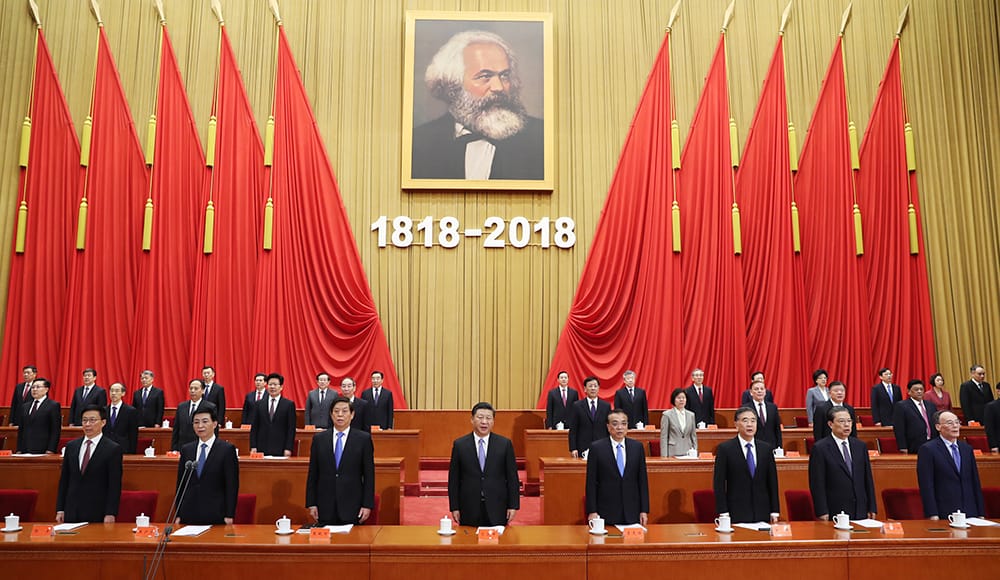
  • Hefei Petitioning Rankings Continue Despite Central Stoppage

    Hefei officials convene a petitioning work meeting in May. Photo credit: Hefei Municipal Letters and Visits Bureau

    In theory, China’s petitioning system (formally known as the system of letters and visits) is intended to provide Chinese citizens with an administrative channel to make complaints and allegations of wrongdoing at the local level. It is separate from the judicial process, which involves two parties airing a dispute before a (theoretically) neutral arbiter who makes a decision to support one side’s claim over another. The system relies on another, more traditional model of dispute resolution that assumes government officials faced with a dispute will naturally understand and pursue the proper way to resolve problems and restore social harmony.

    Because many controversial social problems involve conflict between local officials and ordinary people—land appropriations, housing demolition, and environmental protection are examples—when disputes arise, the aggrieved parties frequently eschew local channels for dispute resolution in favor of channels at the provincial or central level. One assumption is that local networks of patronage and power make it difficult for ordinary people to challenge local authorities but that higher-ranking officials are less prone to corruption and more interested in taking the side of regular folk.

    But as petitioners flock to provincial capitals or Beijing in hopes of getting the attention of the one official who can step in and save the day, they often soon find their problems compounding. This is because local authorities have many incentives to prevent petitioners from “venue skipping” and keep disputes from being aired at higher administrative levels. These incentives stem from the fact that, for many years, “petitioning work” has come to be an important measure of “stability preservation” and plays an important role in determining how local party and government officials’ performance is evaluated.

    This assessment system can place heavy demands on local officials, with even a single instance of a petitioner from their jurisdiction registering a complaint in Beijing resulting in serious consequences for future career prospects. This has resulted in an incentive system in which local authorities often place more emphasis on controlling the movement of petitioners—detaining them in “black jails,” “study classes,” reeducation through labor, psychiatric hospitals, etc.—than they do on seeking resolution to underlying disputes.

    There have been some recent indications of efforts to change this perverse incentive system, most notably in reports that, starting in March, the State Office of Letters and Visits had stopped issuing lists that ranked provinces by the occurrence of “abnormal” petitioning. To many, this signaled a potential shift away from the linkage between petitioning and official performance evaluations, which it was hoped in turn would help eliminate the abusive practices used to keep problematic petitioners under control.

    Though the central authorities’ move to cancel such rankings has reportedly prompted provincial and local authorities to follow suit, there does not appear to have been a coordinated effort that would ensure such rankings are no longer compiled at any level of government. As Yao Wenhui, a columnist for the Kunming Evening News, notes in a recent article, authorities in Anhui’s provincial capital of Hefei appear to have only just implemented a petitioning-based ranking system in an effort to pressure local authorities to resolve problems at the local level.

    Yao implies that building confidence in the legal system will ultimately reduce the number of citizens that choose to petition and thus reduce the need for rankings. But, until that time, the residual “infatuation” with petitioning-based performance rankings will be hard to overcome. This is largely because of the overriding emphasis that Chinese authorities place on stability—treating disputes as a sign of systemic failure rather than a natural part of social life to be resolved through rational means. As long as the mentality of “stability above all else” is not fundamentally adjusted, efforts to curb the abuses in the petitioning system are likely to face many further challenges.

    *
    Eradicating Local Officials’ Infatuation with Petitioning Rankings

    Yao Wenhui, Kunming Evening News
    May 23, 2013

    Wu Cunrong, member of the Anhui Provincial Party Standing Committee and party secretary of the Hefei Party Committee, recommended that from June 1 each county or district implement a system of monthly rankings based on the numbers of abnormal petitioning incidents and incidents of mass petitioning at the provincial capital. If a given county or district is ranked at the highest two positions, the three main party and government leaders will invite [responsible officials] to “tea” [a euphemism for a disciplinary meeting or questioning]. Wu Cunrong said that issuing rankings of petitioner numbers is meant to urge concerned responsible persons to resolve some matters within their grasp at the grassroots level. (Market Star, May 22)

    I recall that more than 10 days ago there were media reports saying that since March the State Office of Letters and Visits had suspended its rankings of provinces (municipalities, autonomous regions) according to their numbers of incidents of “abnormal petitioning.” At the same time, some localities had begun to eliminate petitioning assessments and rankings. This news was well received in the streets, with many people taking it as a kind of positive signal and hoping for a “permanent end to petitioning rankings.”

    Who would have imagined that no sooner had we heard this good news then Hefei went “against the tide” and started its own local version of a petitioning-ranking system? That system not only links petitioning rankings with officials’ performance assessments and posts, it also stipulates forceful, detailed rules for implementation. The top two [officials] each month are to be “invited to tea” by the responsible authorities at the city level. Being ranked in the top two for two months in a row will result in a personal meeting with the city party secretary. Being at the “top” of the rankings for three months in a row will lead to “handling through organizational measures, with responsible persons at the county or district level being relieved of duty or assigned to a new position”—in other words, people could lose their official positions.

    It seems that the public’s previous hopes for a “permanent end to petitioning rankings” were too optimistic. At least within the administrative system, it seems we are still quite a ways from having consensus about eliminating petitioner rankings, and petitioner rankings in some locales may even become stronger.

    Party Secretary Wu Cunrong says: “Issuing rankings of petitioner numbers is meant to urge concerned responsible persons to resolve some matters within their grasp at the grassroots level.” Actually, this was the original intent behind the State Office of Letters and Visits’ practice of issuing petitioning rankings for each province (municipality, autonomous region) for many years. It is said that this system has a legal basis—Article 7 of the revised Regulations on Letters and Visits that took effect on May 1, 2005, states: “People’s Governments at each level shall establish robust petitioning work responsibility systems and, for those persons responsible for dereliction and malfeasance . . . pursue responsibility and circulate notices within a particular area.” I’m not sure why, but this provision intended to force governments and officials at all levels to “resolve problems at the grassroots level” has transformed in ordinary practice into petitioning rankings at every level that are linked to official promotions and transfers.

    There have been quite serious consequences in the way that the Regulations on Letters and Visits have been thus “understood” and “implemented” in practice. [The concept of] “the fewer [the number of] abnormal petitioning [incidents] the better” means that within the administrative system, superiors evaluate inferiors’ petitioning work not on the basis of how many petitioning problems they resolve but how many petitioners they “resolve.” “Resolve problems at the grassroots level” has thus turned into “hide problems at the grassroots level.” And once petitioning rankings are linked to performance assessments and official positions, it’s not hard to guess what choice local officials will make: to use all means at their disposal to surround, pursue, block, and intercept petitioners. For the past several years, petitioners have been beaten, returned home, sent to “study classes,” imprisoned in reeducation through labor facilities, and sent to psychiatric hospitals. We often see these various miseries reported by the media, and even worse is how a small number of local governments even employ evil forces to deal with petitioners who get to Beijing. The revelations about the black jails of Beijing’s Anyuanding [Company] are a classic example. These frequent barbaric interception incidents have seriously distorted the implementation of a petitioning system intended to give citizens more channels for pursuing their rights. For this reason, in recent years there have been repeated public calls for abolition of these petitioning rankings.

    Under these circumstances, Hefei’s continued support for petitioning rankings shows how reluctant some local governments and officials are to part with some of these simplistic and crude models of social management. Apparently, “suspension of rankings” by the State Office of Letters and Visits had an insufficient modeling effect, and it was unrealistic to expect all local governments to terminate petitioning rankings voluntarily. The complete withdrawal of petitioning rankings from the historical stage will rely on resolve and action from the central level. We should also note that petitioning rankings are not the only factor leading to barbaric petitioner interceptions. Even if there were no petitioning rankings, local officials would still have intrinsic motivations to block and intercept petitioners. This is a function of the petitioning system itself. Most petitions originate from conflicts between local governments and the public. The public hopes to use the petitioning system to “get heaven’s ear,” but to local government this is “whistleblowing” and “exposure.” In order to protect their own interests, when there are conflicts between officials and the public, it’s natural for some officials’ first choice to be to block and intercept the petitioning public.

    Admittedly, in a historical phase when rule of law development is just beginning, the system of letters and visits is a channel that society gives to the public to remedy [problems]. But as we make good use of this petitioning channel, we must speed up the perfection of rule of law channels so that citizens who encounter problems are able to first consider making use of legal weapons to realize the demands of their rights and interests. A society that wants to establish benevolent rule must rely heavily on the power of the law and the judicial system. Only when society puts its common faith in the law and not some “higher authority” can all of the problems arising from the petitioning system be readily resolved.