
EVENT
Trump–Xi Washington Summit: Progress on Some Fronts
President Xi Jinping and President Donald Trump held their third summit meeting of Trump’s second term in Washington September 23 to 25, 2026. They had previously met in Busan, South Korea in October 2025 and Beijing, China in May, 2026. In Trump’s second term, the leaders have spoken on the phone on four occasions. The intensity of their engagement is unprecedented in the history of US-China relations. Two more summits are slated to take place in 2026.
Xi’s trip to Washington was his first state visit to Washington in 11 years. The summit with Trump drew mixed reviews from members of Congress and the press. Among the most scathing critics of the Xi visit was Senator Roger Wicker (R-MS), chairman of the Senate Armed Services Committee. The Trump ally called Xi a “brutal, unelected, and oppressive dictator.”
The summit probably didn’t move the needle on either Trump or China’s popularity with the American people; Polls suggest that both China and Trump are highly unpopular with the American people. The American public gives Trump the lowest approval rating of his second term: the RCP average puts his approval rating at just over 38 percent. This bodes ill for the Republican party in the November 3 midterms.
China’s approval ratings have been very low in the respected Economist/Yougov poll. Beijing’s hope that the visit by its president’s to the United States were dashed by Trump’s abrupt decision to remove journalists from three networks and ban them from the White House on the eve of Xi’s arrival in the country. Other journalists stood in solidarity with their fellow journalists, and a federal judge temporarily lifted the ban on September 23. However, the result was that there was diminished coverage of Xi’s arrival.
Trump’s move to remove the journalists from the press pool reinforces the view of Trump, held by many in Beijing, as an unpredictable, erratic leader prone to changing his position on a moment’s notice.
The GOP is tipped to lose control of the House of Representatives in the upcoming midterms. It could also lose control of the Senate. Loss of the House would result in subpoenas and hearings that target Trump and his allies. It could well result in another successful impeachment vote, though conviction in the Senate is unlikely.
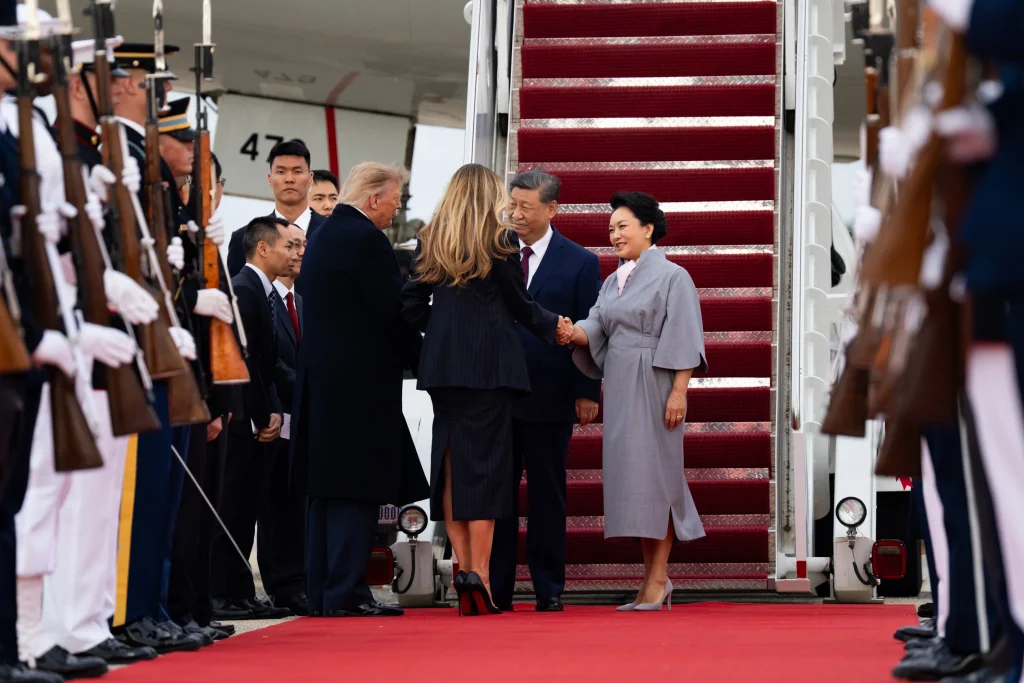
Chinese President Xi Jinping and his wife Peng Liyuan arriving at Joint Base Andrews,
Maryland, September 23, 2026. Image source: The Whitehouse
Trump showed unusual deference to the Chinese leader. The American president and his wife met him at the airport, waiting for President Xi and his wife on a red carpet at the bottom of the airplane stairs. (The last time an American leader greeted a foreign leader at the airport was in 1962.) Trump bowed to Xi’s wife. As he did in Beijing, Trump repeatedly praised Xi as a great leader, someone with whom he’s established a “great relationship.” Trump and his wife sent the Chinese couple off when they departed Washington on September 25.
Critics have slammed Trump prioritizing “pomp and ceremony” over substance, claiming that little was achieved by the summit. Prior to the summit, Dui Hua compiled a list of more than 20 issues that might be discussed by the two leaders. Such an agenda would take three days of meetings to address, not the amount of time allotted for discussions. In the event, it seems that around three hours of discussions took place.
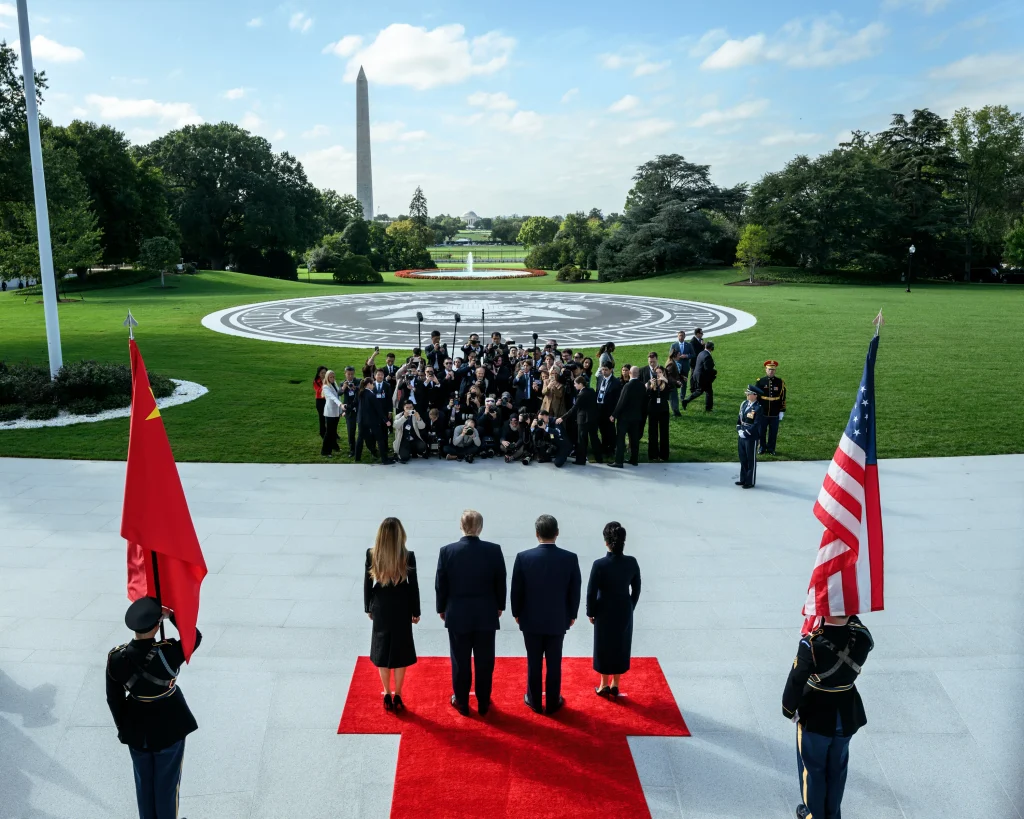
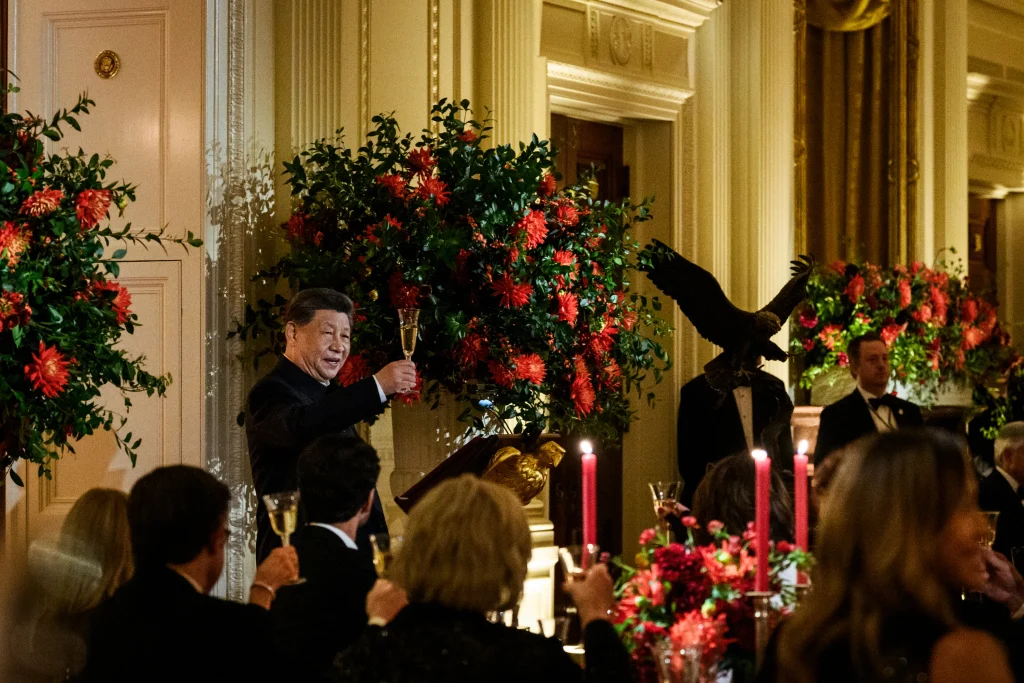
Trump takes Xi on a tour of the Whitehouse and hosts a state dinner for the Chinese president,
September 24, 2026. Image source: The Whitehouse
Reflecting concerns over the toll of the long trip from Beijing to Washington, as well recent international travel, the Chinese side requested a private room in the White House West Wing where Xi and his wife could rest. In the words of the Wall Street Journal, this move “sucked hours of meetings” from the summit. Trump spent ten minutes showing Xi the new White House helipad. The American president said his Chinese counterpart “knows a lot about stone” who “loves good granite.”
The two sides did not issue a joint statement at the end of the summit. Although achievements were limited, there were nevertheless a few notable successes, including:
* Extending the current trade and tariff truce, due to expire on November 10. 2026, to January 10, 2027. This moves the possible expiration date to past the upcoming fifth plenum of the 20th Central Committee, October 26–29, 2026.
* Agreement to cut tariffs on $30 billion of each other’s goods, about 28% of US exports to China but only around 10% of Chinese exports to the US, though neither side has said how big the cuts will be or when they take effect.
* Tariffs on soybeans were not reduced but Chinese state-owned firms bought 18 to 23 cargoes of U.S. soybeans on October 13 and 14, the first deals since the September Trump-Xi summit in Washington. Shipments start in December. China had already been buying soya beans ahead of the summit.
* Strengthening prohibitions on shipment of fentanyl precursor chemicals procurements to the United States.
* Agreement to establish an AI hotline.
* Agreement by China agreed to buy at least 10 million tons of American coal in both 2027 and 2028.
* Agreement to meet twice more in 2026. The first summit is slated to take place at the APEC meeting in Shenzhen, China in November, just over two weeks after the crucial midterms in the United States. The second summit is expected to take place at the G20 meeting in Miami in December.
Many of the most pressing issues in US-China relations were not resolved. China’s grip on exports of rare earths and minerals was not loosened, nor were American controls over semiconductors and other technologies exports to China. No purchases of Boeing planes were announced. It was originally planned that a large delegation of Chinese businessmen would join Xi for the visit. The anticipated business delegation did not accompany him.
In the most extraordinary moment of the summit, US ambassador to China David Perdue claimed that Trump offered to sell American weapons to China, which is illegal under U.S. law. The White House denied that such an offer was made.
In recent years, Xi Jinping has warned the United States not to cross four “red lines:” Support for Taiwan independence; promoting Western views of human rights and democracy; challenging China’s political system; and hindering China’s development.
Of these, the Taiwan issue is considered the most important. As it has in all previous interactions with US presidents, Taiwan was raised once again during the September summit. Xi’s goals included changing the American position from “neither supporting nor opposing independence, to “opposing independence,” as well as delaying or cancelling future arm’s sales, including a possible $14 billion sale of weapons to the island democracy. The United States is committed to selling defensive arms to Taiwan under the Taiwan Relations Act.
As for human rights, larger issues like Xinjiang, Tibet, and Hong Kong were not discussed. A few cases of Americans under coercive measures in China were raised, including two citizens labeled by the Department of State as “wrongfully detained:” Seismologist Chen Youlin and Myanmar activist U Min Zin. Dui Hua thinks both will be released by year end. Trump likely also raised the case of British citizen and Hong Kong publisher Jimmy Lai, recently sentenced to 20 years in prison for colluding with foreign forces and conspiracy to publish seditious articles.
From Businessman to Human Rights Advocate:
A Conversation with John Kamm
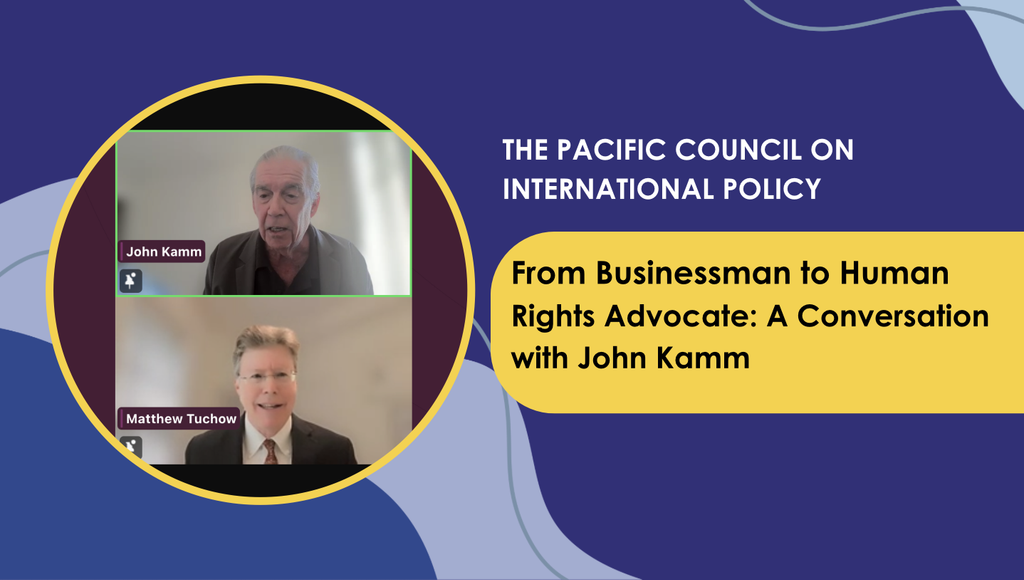
On October 15, 2026, Dui Hua Executive Director John Kamm spoke with Matthew Tuchow of the Pacific Council on International Policy about Dui Hua and its work. During the hour-long webinar, Tuchow asked Kamm about his long relationship with China and where he sees US-China relations today. The two also discussed Dui Hua’s most memorable case, why Chinese officials continue to engage with Kamm, and an important lesson he has learned over the years. We will post a recording of the webinar here as soon as it becomes available.
PUBLICATIONS HIGHLIGHTS
Dui Hua 2025 Annual Report
In 2025, Dui Hua recorded achievements and encountered challenges brought about by fraying US-China relations, and the worsening human rights environments in both countries. Despite these difficulties, we continued to advocate for at-risk detainees.We also launched our Legacy Archive project, bringing together in one place our irreplaceable collection of materials from more than 25 years of Dui Hua’s work. Read the report.
John Kamm Remembers
From John Kamm Remembers, a series written by Dui Hua’s founder recounting his advocacy for prisoners in China.
Enemy Station
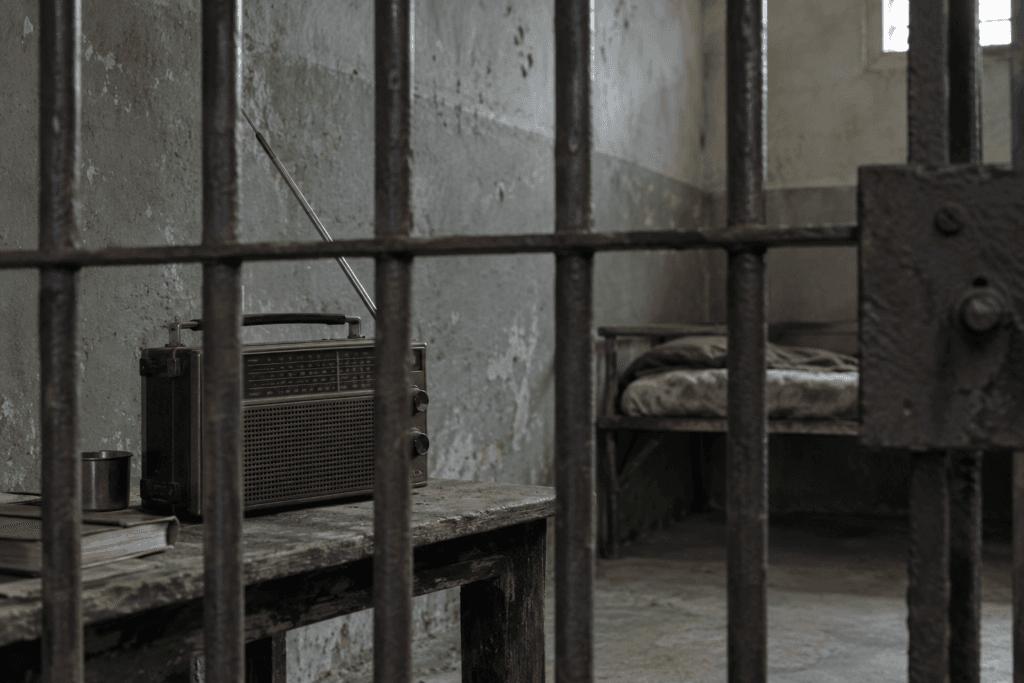
Drawing on John Kamm’s involvement and documents in the Dui Hua Legacy Archive, John Enemy Station, tells the story of Han Chunsheng, sentenced in 1996 to eight years in prison for listening to Voice of America. It looks at VOA’s place in China-US relations, China’s view of VOA as an “enemy station”, and the station’s long service as a window on the world for listeners across China. Read the story
Clinton’s Choice
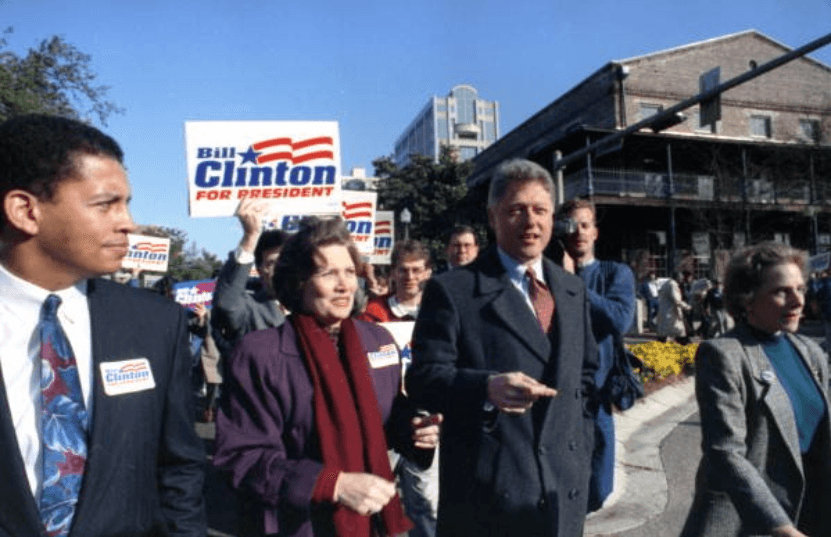
In the spring of 1993, Bill Clinton faced a decision: whether to make good on his campaign promise to hold Beijing accountable for human rights abuses, or to renew China’s trade status, subject to human rights conditions, and keep the door open to Deng Xiaoping’s economic reforms. Read the story
Prisoner Updates
Dui Hua’s Prisoner Updates provide the latest information staff researchers have uncovered through online and library research and through direct dialogue with the Chinese government.
Eight Detained for Fraud in Beijing Church Anniversary Raid
The detention of eight members of Beijing’s Jiaquan Church (佳全教会) marks yet another case in China’s intensifying religious crackdown. In an open letter, Pastor Zhou Zixun (周子逊)’s South Korean wife said more than 100 police officers raided a hotel conference room on September 4, 2026, where about 50 congregants were preparing for the church’s twentieth anniversary. Read more
Gao Zhen Sentenced to Three Years for Mao-Related Artwork
Gao Zhen (高兟) was sentenced by the Sanhe City People’s Court, Hebei, to three years in prison for “infringing the reputation and honor of heroes and martyrs.” The court found that Gao had created sculptures that deliberately distorted and vilified Mao Zedong’s image. Some of the artworks were created before China enacted the Law on the Protection of Heroes and Martyrs in 2018. Read more
China Indicts Eight Zion Church Members
Eight Beijing Zion Church leaders and staff remain detained at Beihai’s No. 1 and No. 2 detention centers in Guangxi: Wang Lin (王林), Gao Yingjia (高颖佳), Yin Huibin (尹会彬), Wang Cong (王聪), Liu Zhenbin (刘桢彬), Lin Shucheng (林书铖), Wang Zhong (汪中), and Wu Qiuyu (吴秋雨). Read more
Early Release of Erza Jin
Ezra Jin (Jin Mingri, 金明日), founder and pastor of Beijing’s Zion Church, was released on July 3 after nearly nine months in detention following the October 2025 crackdown on the church. He arrived in Los Angeles on July 4 and reunited with his family after years of separation. Read more
Dui Hua in the News
Lex 19: Family fights for American scholar detained in China
New York Times: Families Urge Trump to Press Xi to Free Detained Americans
New York Times: China Frees Pastor Detained in Crackdown on Religion After Trump’s Urging