
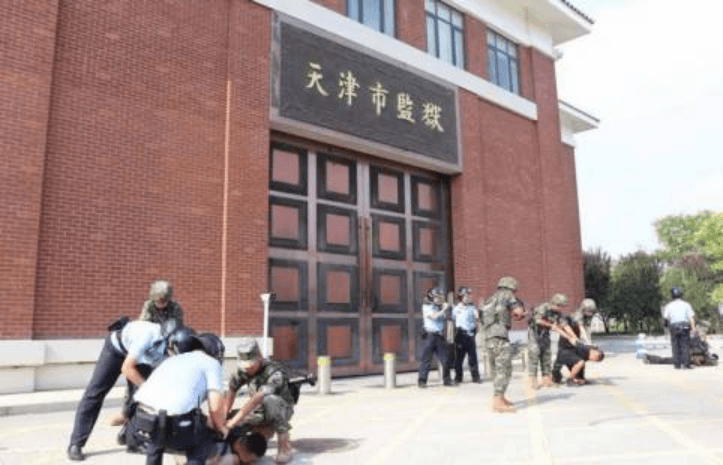
Tianjin Prison. Image source: Baidu
Baker List, Craner List
In the wake of the suppression of nation-wide protests that took place in the late spring of 1989, countries around the world imposed sanctions on the Chinese government. For the most part, the sanctions were imposed as a result of decisions by the executive branch, but in the United States, where trade and tariffs are the responsibility of the legislative branch under the constitution, sanctions took the form of bills introduced first in Congress, and then, if passed, by the Senate. The bill would then be sent to the president’s desk and then, if signed, become law. If vetoed, the bill would be sent back to Congress to face “veto-override” votes.
By law, the president was required to waive the requirement of the Trade Act of 1974 that non-market economies – a group that included Cuba, North Korea, and China – practice free emigration, known as the Jackson-Vanik Amendment before renewing the countries’ most favored nation (MFN) status. Once the waiver was issued, Congress had its say.
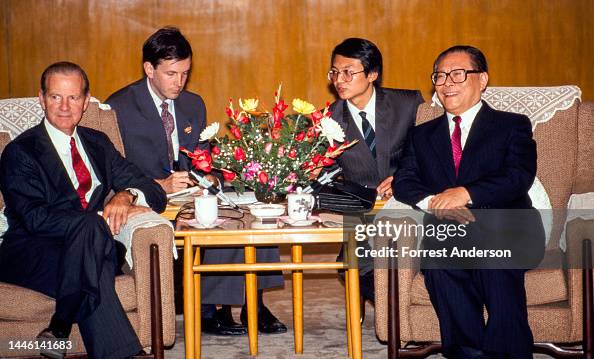
U.S. Secretary of State James Baker and Chinese Party Secretery Jiang Zemin, Beijing, China, November 1991. (Photo by Forrest Anderson/Getty Images)
In November 1991, James Baker, George H. W. Bush’s Secretary of State, visited Beijing. In advance of his visit, Baker had sent a list of more than 800 prisoners (it was a flawed list: partial names were listed, no Chinese characters were provided.) China’s Ministry of Foreign Affairs (MoFA) provided a response to the list during the meeting with Baker. (Years later, I met Mr. Baker at a private gathering at the American Consul General’s residence in Hong Kong. He told me his success in getting a response to the list was the greatest achievement of his visit to Beijing.)
Although I was not consulted in drawing up the list, I was much involved in analyzing the response.

Robin Munro. Photo by David Frazier
Working with Robin Munro of Human Rights Watch Asia, I deciphered the list. Names were presented left to right with no breaks. Names were divided into “sentenced” and “not sentenced” (a group that included those who had been detained but not charged, and those sentenced to reeducation through labor). Names were listed, again with no breaks, by province, starting with Beijing and followed by Shanghai and Guangdong, and then others but, in all only, 17 provinces were covered.
Despite these limitations, the response proved useful. Individuals thought to have been executed, including a group of workers in Shanghai, were listed as “sentenced,” suggesting they had been spared from the executioner’s bullet. And names were included in the response that were not on the list itself.
Robin Munro took a special interest in one of the names in the response: a friend by the name of Yang Lianzi (杨连子). Yang was a troubadour who sang protest songs for the students and workers in Tiananmen Square. He was arrested and subsequently sentenced to 15 years in prison by the Beijing authorities but then transferred to a prison in Gansu Province. He was released three years early. (Prior to his release, I had put Yang’s name on nine lists, receiving two responses).
In 1992, Congress passed a law that required China to meet certain conditions before MFN could be renewed. Conditions included respecting the bilateral agreement to stop the export of product made by prisoners and, most importantly for me, the accounting and freeing of prisoners jailed for their participation in the 1989 protests and the earlier Democracy Wall movement.
Later in 1992, Bill Clinton won the general election. During the campaign, Clinton pledged to get tough on China and endorsed the conditions on renewing China’s MFN included in congressional legislation. Once elected, Clinton released an executive order in May 1993 that mirrored the China MFN legislation. But then, President Clinton renewed China’s MFN in May 1994, without human rights conditions, delinking China’s trade status from its human rights record.

Lorne Craner. Image source: Archive of U.S. Department of State
In November 2000, George H.W. Bush’s son, George W. Bush, was elected president. After taking office in January 2001, he appointed Lorne Craner to be the Assistant Secretary of State for Democracy, Rights, and Labor (DRL). I had gotten to know Lorne while he was President of the International Republican Institute. In anticipation of an upcoming human rights dialogue with China, Craner asked me to suggest names for a prisoner list to be submitted to his Chinese counterpart in the Ministry of Foreign Affairs. Dui Hua, which was established in 1999, provided 50 names of counterrevolutionaries believed to be undergoing coercive measures. China responded, providing information on more than 90 percent of the names.
In subsequent testimony to Congress, I estimated that being on a prisoner list tripled the chance of clemency.
In the period from April 1999 to December 2025, Dui Hua submitted over 550 lists with more than 2,000 prisoner names. Lists were mostly submitted directly to the Chinese government, but the foundation also helped other countries – including the European Union, Switzerland, Norway and others – in compiling lists. More than 500 people on our lists received clemency in the form of sentence reductions and parole (medical and good behavior).
Potemkin Prison
A few months after Bush was inaugurated in 2001, I traveled to Beijing in March to meet with Chinese government ministries to discuss prison visits. I met with both MoFA and the Ministry of Justice (MoJ) to review prisons I had visited. We agreed that the next prison I would visit would be a “model prison” in nearby Tianjin. (Before I was banned from visiting Chinese prisons in 2005, I was taken to see prisons or detention centers in Beijing, Shanghai, Fujian, Guangdong, Hubei, and Tianjin. I later visited two prisons in Hong Kong.)
My visit to Tianjin Prison took place on March 6, 2001, the day after I met with the MoJ’s Wang Lixian.
I was picked up at my hotel in Beijing at 8 AM by officers Zhang Qing and Bai Ping. We left promptly for Tianjin where we were met by Mr. Guo Wei of the Tianjin Prison Administration Bureau, Tianjin Prison Warden Mr. Kang and his deputy Ms. Wang. After a short drive, we arrived at the gate of Tianjin Prison, a massive, multi-story structure covered from top to bottom with red tiles.
Tianjin Prison was a Potemkin Prison, no prisoners in sight (they were “working in the fields,” I was told.) We would be taken on a “tour of prison architecture,” a phrase I learned from Swiss officials who had visited many Chinese prisons. Everything in Tianjin Prison was clean and orderly. The cells, each housing six to eight prisoners, were relatively spacious with plenty of sunshine. The prisoners’ clothes were neatly folded and placed on the bunk beds
There was a television in the common area. Inmates were allowed to watch government stations presenting China’s version of the news.
I was taken to the prison hospital and classrooms, one of which was used to teach computer skills. The computers had been donated by a European company. I asked my hosts for information on a couple of people thought to be incarcerated in Tianjin Prison. My questions drew silence.
It was a short, two-hour visit. We headed to a restaurant where the prison bureau hosted us to a banquet. Alcohol was liberally consumed. Soon the Tianjin officials were tipsy. They made jokes at the expense of the female officers and played drinking games with me. After lunch, we scurried back to Beijing where I was deposited at my hotel.
In the evening, I was joined by officers from the U.S. embassy. Over dinner, I debriefed them on my disappointing visit to Tianjin Prison.