Tag: Verdict

  • Public Sentencing Rallies during the Pandemic

    Public Sentencing Rallies during the Pandemic

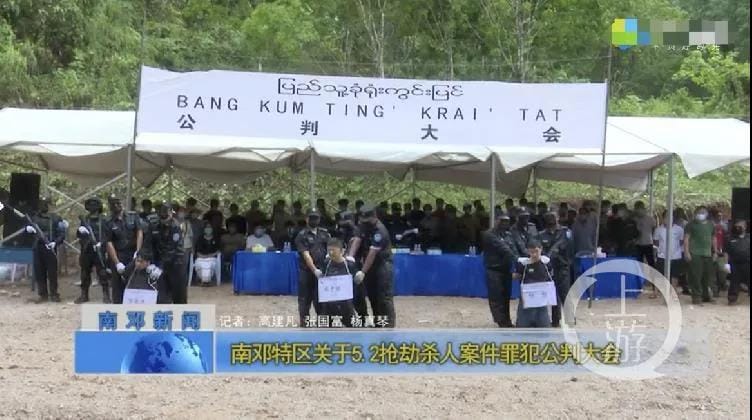
    Three Chinese nationals were executed in a public sentencing rally in Wa State, a Chinese-speaking region in Northern Myanmar on May 14, 2020. Image credit: The Paper 
    In May 2020, a video clip featuring the execution of three men in a public sentencing rally in Wa State of Myanmar became a trending topic on domestic social media. The three executed men were Chinese nationals who had reportedly robbed a gold shop and murdered the owner. While calling on the public to obey laws and customs overseas, Chinese news media sources appear to have expressed shock that the shaming ritual was replicated in Myanmar even though it has “long vanished in China.”
    Historically, public sentencing rallies were widely used in and outside China to crush political opponents and consolidate the power of the ruling class. In the first three decades of the People’s Republic of China, mass rallies served to educate the public about the errors of class enemies, including Kuomintang members and landlords.
    While there are signs that these rallies have fallen into disuse in recent years, they continue to take place in some localities where they target drug offenders and members of organized crime. In these rallies, which continue to serve as propaganda to “frighten criminals, educate people, and maintain social stability,” judges hand out mass sentencing and mete out harsh punishments, including death sentences. Because of the nationwide lockdowns and stringent social distancing measures accompanying China’s zero-COVID policy in the two full years since 2020, the rallies that are typically held in large public venues like plazas, stadiums, and auditoriums in front of crowds numbering in the thousands seemingly vanished from public sight.
    However, Chinese government sources continued to report on small rallies that have been convened. Many of these rallies appeared no different from regular court trials when they were held indoors or virtually with no or limited public attendance. Regardless of the forms and scale, Chinese courts continue to retain the campaign-style rallies which legal experts have decried for years, arguing that the rallies disregard the presumption of innocence and mainly serve to shame prisoners.
    Indoor & Virtual Rallies 
     
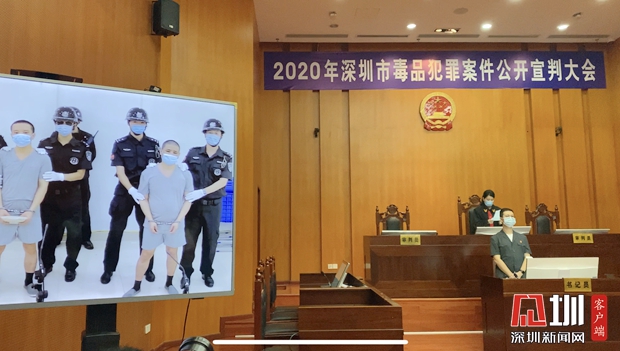
    A group of 14 drug traffickers were sentenced in what a Shenzhen court called a “public sentencing rally” on June 23, 2020. Image credit: Shenzhen News Network website
    Public sentencing rallies have long been integral to showcase the government’s efforts to combat drug crimes on the International Day against Drugs and Illicit Trafficking, observed annually on June 26. The date is of special significance in China as it serves to commemorate Lin Zexu, officially lauded as an anti-opium hero for dismantling the opium trade in Guangdong before the First Opium War in 1839.
    China continued to feature a series of high-profile public sentencing rallies on the International Day against Drugs and Illicit Trafficking amid the outbreak of the pandemic. In Shenzhen, a rally was held on June 23, 2020 to announce the death sentences of two traffickers of methamphetamine. The sentences had previously been determined by the Shenzhen Intermediate People’s Court and subsequently approved by the Supreme People’s Court. On the same day, the intermediate court also publicly sentenced ten people involved in a drug case.
    Unlike a widely reported rally in Lufeng County, Guangdong, where two courts sentenced 10 criminals to death in front of tens of thousands of people including children on December 16, 2017, the 2020 Shenzhen rally was not attended by any public spectators due to the stringent social distancing measures and anti-pandemic curbs at the time. The rally took place instead in a courtroom where only a judge and a clerk could be seen, according to an online video published on the Shenzhen News Network website. None of the defendants appeared in front of the judge to receive judgments. They were seen in a synchronous video in Shenzhen No.2 Detention Center wearing face masks, handcuffed, and escorted by security guards while the judge announced the death sentences.
    The duo was executed on the same day immediately after the rally ended. In the same rally, the judge announced that another drug trafficker was sentenced to life imprisonment and that ten other defendants were convicted of manufacturing, selling and transporting drugs, and illegal possession of firearms.
    Courts outside of Guangdong have also been eager to convene sentencing rallies in campaigns against drug abuse on or before the International Day Against Drug Abuse and Illicit Trafficking. In 2021, the Dandong Intermediate People’s Court of Liaoning Province held a rally in a courtroom where 13 handcuffed drug offenders stood in front of the judge in a courtroom to receive prison sentences ranging from nine years’ imprisonment to death with a two-year reprieve. A post published on the Liaoning High Court website claimed that the rally, which was attended by less than two dozen spectators, manifested “a high-pressure crackdown on drug crimes, effectively suppressed the arrogance of drug criminals, and contributed to the construction of a harmonious and safe Dandong.”
    Four defendants received judgments in a public sentencing rally convened by the Pingnan County People’s Court of Guangxi Zhuang Autonomous Region as part of the campaign to combat environmental pollution. Photo image: Pingnan County People’s Court website
    It must be noted that sentencing rallies are not exclusively used against drug traffickers. In May 2021, a local court in Guangxi convened a virtual rally for four people convicted of illegally disposing of hazardous substances. As with the 2020 Shenzhen rally, the defendants received their judgments via video while handcuffed in a detention center. This rally was held as part of the open day organized by the Pingnan County People’s Court to educate the public about environmental protection. It was sparsely attended by only 12 people from the local community, according to information provided by the court website.
    200-Spectator Rally in Yancheng, Jiangsu 
    Twenty-two criminal suspects were hauled into a sentencing rally attended by over 200 people in Yancheng, Jiangsu on October 28, 2020. Image credit: China Central Television 
    Despite the onerous zero-COVID measures that were in full swing in 2020, public attendees were occasionally allowed to take part in sentencing rallies of a smaller scale. The Yancheng Intermediate People’s Court in Jiangsu Province invited over 200 people from the National People’s Congress, members of the Chinese People’s Political Consultative Conference, journalists, village cadres, and resident representatives to the rally in Longgang Township on December 28, 2020. The 22 defendants manufactured banned substances including hydroxylamine hydrochloride, chlorophenyl, hydrochloric acid, and toluene. They could be seen wearing white hazmat suits with face masks while receiving judgments in front of the judge and the spectators.
    Of the 22 defendants, three were sentenced to death with a two-year reprieve. Each of them was accused of selling methamphetamine weighing 4,000 to 6,000 grams (about 8.82 to 13.23 pounds). The other defendants received prison sentences from 22 months to 11 years for manufacturing hydroxylamine hydrochloride totaling 1,106 grams (about 2.44 pounds).
    Student Spectators in Hainan 
     
    (Top to bottom) Dozens of Hainan school students, all seen wearing uniforms and face masks, sat in rows in a public sentencing rally held at the Danzhou District People’s Court on April 24, 2020. Image credit: The Paper
    As public sentencing rallies serve as sites of expressive punishment, teenage students are also required to attend such events as part of their legal education (法制教育). Images published by the Hainan court website show dozens of students in school uniforms sitting in rows to watch nine drug defendants receive prison sentences from ten months to 15 years’ imprisonment on April 24, 2020. The defendants were accused of selling large quantities of ecstasy and other counterfeit drugs.
    It was not the first time young students were required to watch public sentencing rallies. In June 2018, two drug dealers received death sentences in Haikou in front of hundreds of people, many of whom were students wearing school uniforms. The duo was executed following the rally. The executions took place elsewhere at a designated venue, so the students did not witness the actual executions.
    Outdoor Rally in Guangxi against Gangland Crimes 
    Traditional sentencing rallies held in large outdoor public spaces did not entirely vanish during the pandemic. On June 28, 2020, an outdoor rally was held in Donglan County, Guangxi, to publicly arrest and sentence gangland criminals. The rally was not held in a courtroom but in a sports stadium. Available sources did not state how many spectators attended, but the image below shows rows of police officers alongside dozens of public spectators. At the back of the crowds, criminal suspects and defendants stood in a row in front of the judge’s podium. They could be seen wearing the typical white hazmat protective suits and facing the group of public spectators.
    An outdoor rally in Donglan County, Guangxi, on June 28, 2020, during which alleged criminals were publicly arrested and sentenced. Image credit: Wei Hao / Weixin 
    Efforts to ban public executions 
     
    China’s decision to ban public executions dates back to 1979, while “perp walks” for sex workers were banned more recently in 2010. The Supreme People’s Court, Supreme People’s Procuratorate, Ministry of Public Security, and Ministry of Justice jointly issued notices in 1984 and 1986 prohibiting public parades before executions, saying that such events provided opportunities for overseas counterrevolutionary propaganda to “slander” China.
    Public executions (as well as the broader use of capital punishment) were thought to be one of many human rights-related objections to China’s bid to host the 2008 Summer Olympics in Beijing, a point Dui Hua executive director John Kamm recalled in a 2010 Washington Post op-ed. In the run-up to the opening of the Games, another joint opinion was issued in March 2007 to prohibit public parades before executions as well as to enforce the rights of the executed, including last visitation rights for the family. Criminal Procedure Law also stipulates that while the public should be notified of executions, the execution itself should not be held in public.
     
    Going Forward 
    Over the years, legal experts have spoken out against public arrests and sentencings, branding them “campaign-style justice” that emphasize swift and severe punishment. However, the general public tends to empathize with the need to deter crimes by publicly shaming the offenders. In its seventh annual report, the Collaborative Innovation Center of Judicial Civilization released its latest data collected over 24,354 surveys across 31 provinces, municipalities, and autonomous regions. It finds that over 62.5 percent of respondents expressed support for public arrest and sentencing rallies in 2018. The following year, the approval rate declined to 55.5 percent but bounced back to 61.3 percent in 2020-2021. Of them, 19.1 percent in 2020-2021 expressed strong support for retaining the practice, lower than 23.7 percent in 2018 but higher than the 15.8 percent in 2019.
    A public trial is intended to boost transparency by informing the public about who the accusers are, the nature of the charges, and the evidence against the accused. It is fundamentally different from a public sentencing rally — a form of show trial where the judgment and sentence of a criminal case already determined in court is publicly announced in front of crowds of public spectators. Such rallies serve a political agenda to demonstrate the government’s determination to fight crimes, blame and shame criminals, and educate the public about their alleged crimes. In response to a controversial sentencing rally held in Langzhong, Sichuan, in 2016, Professor Yu Qilin of China University of Political Science and Law remarked that trial fairness and justice is maintained through procedure transparency in the courtroom, not public spectacle.
    The use of public sentencing rallies to shame the accused appears to be on a downward trend in recent years thanks to China’s strict adherence to the hard-line zero-COVID policy. A decade ago, people accused of endangering state security, terrorism, and religious extremism in Xinjiang, as well as well as “wild imams” who preached illegally in the restive region, were condemned in front of crowds of thousands. At the very least, the rallies discussed in this post were downsized and used in a narrower scope to target drug traffickers and members of organized crime. Additionally, individuals shamed in the rallies were no longer seen wearing confessional placards or driven through the streets in open trucks.
    The practice of public shaming never really vanished even when strict pandemic measures were in force. On December 28, 2021, four men accused of smuggling people across an international border were publicly shamed in Guangxi. They were flanked by police officers and paraded through the streets of Jingxi City. Although authorities claimed that the parade served as a warning of what could happen if people violated the pandemic curbs, a Beijing News editorial remarked that “the measure seriously violates the spirit of the rule of law and cannot be allowed to happen again.” With the lifting of pandemic curbs following nationwide protests in late 2022, it remains to be seen whether large-scale sentencing rallies will reemerge.
  • Earthquake Victim Sentenced to Prison for Desecrating Flag

    The devastating 7.8-magnitude earthquake that rocked Nepal on April 25, 2015 also brought casualties and widespread damage to southwestern Tibet. Across the region there were 25 deaths, four missing, hundreds of injuries, and more than 47,500 people were displaced. Tingri, 150 miles southwest of Shigatse, was one of the hardest hit counties, where nearly 80 percent of housing was leveled by the quake.

    Disaster relief efforts often produce tensions between government officials and those whose lives have been most affected. This appears to have been the case for Tingri county resident Garab, whose home was destroyed in the quake and whose apparent frustration with inaction by local officials led to a symbolic act of protest that put him in prison for two and half years.

    According to the court verdict (translated below), Garab reportedly found an old PRC flag in the ruins of his former home weeks after the April quake. Prosecutors alleged that he burned holes in the flag and then used a marker to write “Free Tibet” on it. After allegedly hiding the flag under his mattress for several days, he discarded it along a path where some village children found it. Members of a work group stationed in the village noticed the children playing with the flag and reported the incident to local authorities. Garab was later taken into custody and charged with flag desecration under China’s Criminal Law.

    Garab’s November 2015 trial appears to have been only the third criminal trial filed at the court that year, making it a rather rare event for the judges of the Tingri County People’s Court. Similar acts of protest elsewhere in China have resulted in lighter sentences. But, instead of ascribing Garab’s act of protest to high emotions in the wake of tremendous personal loss, the court showed little leniency—shaving only six-months off the maximum three-year prison sentence though Garab had confessed, expressed remorse, and had no prior police record.

    The trial itself appeared perfunctory. While the verdict refers vaguely to forensic testimony, Garab’s confession seems to have been the prime piece of evidence linking him to the flag desecration. However, because his act of protest happened in an ethnic border region during a time of heightened tensions, local authorities’ need to preserve stability took priority.


    Tibet Autonomous Region Tingri County People’s Court
    Criminal Verdict

    (2015) Tingri Crim. 1st No. 3

    The prosecuting organ is the Tingri [Dingri] County People’s Procuratorate.

    The defendant Garab, male, Tibetan, born June 5, 1972, understands a little Tibetan, is a farmer from Tingri County, Tibet, and lived there prior to his arrest. He has no prior record. On June 15, 2015, the Shigatse [Rikaze] Public Security Bureau placed defendant Garab under criminal detention in accordance with the law on suspicion of desecrating the national flag. On July 17 of the same year, he was arrested in accordance with the law by the Shigatse Public Security Bureau and is currently being held in the Shigatse Public Security Bureau Detention Center.

    The defense counsel is Tenkyi, female, Tibetan, of the Chomolungma Law Firm.

    On October 23, 2015, the Tingri County People’s Procuratorate filed indictment Tingri Proc. Crim. Indict. (2015) No. 3 with this court, charging defendant Garab in a case of desecrating the national flag. This court formed a collegiate bench in accordance with the law and held an open hearing to try this case. The Tingri County People’s Procuratorate appointed procurator Kalsang Dorje and Tashi Dondrub to appear in court on behalf of the prosecution. Defendant Garab and his defense counsel Tenkyi appeared in court to participate in the proceedings. The trial has now concluded.

    The Tingri County People’s Procuratorate charged that, on May 23, 2015, as defendant Garab was cleaning up the wreckage of his earthquake-damaged home in Zuobude Village, Rongshar Township, Tingri County, he picked up an old but relatively intact PRC flag. He brought the flag back to his home in Chentang Village and used a lighter to burn the flag, leaving seven holes of different sizes. He then scrawled “Free Tibet” in Tibetan Uchen [block] script on the flag and hid it under his mattress. Three days later, he used yarn to wrap the flag in a bundle and dumped it on a path near Nyimalakang in his village. On May 30, 2015, village work team members Pemba Choedron, Sonam Purchog, Yonwa Madanzhi, and Hu Xiaoliang found village children playing with a burnt flag upon which the words “Free Tibet” had been written. It attracted their attention, so they reported the incident to the party committee and government of Rongshar Township.

    The prosecution’s charges are supported by evidence from witness statements, the defendant’s confession, and related documentary and physical evidence. On this basis, the prosecution maintains that the act of burning and defacing the national flag by defendant Garab constitutes the offense of flag desecration and recommends that, according to Article 19 of the Flag Law of the PRC and Article 299 of the Criminal Law of the PRC, defendant Garab be sentenced to 2-1/2 years’ imprisonment.

    Defendant Garab did not dispute the facts or evidence put forward in the prosecution’s allegation. However, the defendant said in his defense that the only reason he burned and defaced the flag was because he was unhappy with the inaction of the village party secretary, Dawa Tashi, during the earthquake relief period. He therefore requested that the court show lenience in sentencing.

    Defendant Garab’s defense counsel Tenkyi made the following statements in defense: (1) Defendant Garab did not intend to desecrate the national flag when he burned and defaced it, as his primary goal was to [attract] attention from “higher authorities” and have better monitoring over administrative work in the village; and (2) defendant Garab has previously made contributions to border defense work by serving as a Nepali translator.

    In the course of the trial, it was ascertained that on May 23, 2015, as defendant Garab was cleaning up the ruins of his home in Zuobude Village, Rongshar Township, Tingri County, he picked up an old but relatively intact PRC flag. He brought the flag back to his home in Chentang Village and used a lighter to burn the flag, leaving seven holes of different sizes. He then used a marker to write “Free Tibet” in Tibetan Uchen [block] script on the flag and hid it under his mattress. Three days later, he used yarn to wrap it in a bundle and dumped it on a path near Nyimalakang, Chentang Village. On May 30, 2015, village work team members Pem___, So___, Yon___ and Hu X found village children playing with a burnt flag upon which the words “Free Tibet” had been written and they reported the incident to the government of Rongshar Township.

    The aforementioned facts are confirmed by the following evidence, which was put forth by the Tingri County People’s Procuratorate and cross-examined and confirmed in court:

    1. Documents concerning the origin of the case, confirming that a case of burning and damaging the national flag was discovered in Rongshar Township, Tingri County.
    2. Case registration records, confirming the time and place that the case was discovered, along with a summary of the [registration] process and basic information about the suspect.
    3. The defendant’s identification card and certification letter of household registration, confirming defendant Garab’s place of birth and that he has reached the age of majority.
    4. The defendant’s confession, confirming that on May 23, 2015, defendant Garab used a lighter to burn seven holes of different sizes in a PRC flag and used a marker to write “Free Tibet” in Tibetan on the flag.
    5. Testimony of witness Pur___, confirming that he picked up a PRC flag in which holes had been burnt and upon which had been scrawled “Free Tibet” in Tibetan.
    6. Testimony of witnesses Yon___, Pem___, So___, and Hu X, confirming that the PRC flag in which holes had been burnt and upon which had been scrawled “Free Tibet” in Tibetan was being played with by several children.
    7. Eight identification records and photos of the scene, confirming the orientation and general overall picture of the scene where the case was discovered.
    8. Expert testimony, confirming that the words “Free Tibet” written on the burnt and deformed flag were written by defendant Garab.

    This court finds that: The PRC flag represents the entire Chinese people and symbolizes the dignity of the nation. This case occurred on our nation’s border and during the special period when resettlement was being carried out following the April 25 earthquake, when the need to maintain stability in affected villages was particularly urgent. Burning holes in the national flag and scrawling “Free Tibet” on it in Tibetan was an insult to national dignity, had a negative influence on society, and hurt the feelings of the broad popular masses. The impact on society was thus especially bad, and defendant Garab’s actions constitute the offense of desecrating the national flag. The criminal facts and crime alleged by the prosecuting organ have been established and the proposed penalty is appropriate; therefore, this court supports [the indictment].

    Defense counsel claims that defendant Garab did not intend to desecrate the national flag when he burned and defaced the flag and that his primary goal was to [attract] attention from “higher authorities” and have better monitoring over administrative work in the village. However, motivation is not an element of the crime, and therefore this court does not accept the argument.

    With respect to the [defense argument] that defendant Garab had previously made contributions to border defense work by serving as a Nepali translator, this has nothing to do with this case and this court does not accept the argument.

    Defendant Garab truthfully confessed his crimes after being taken into custody and has shown a relatively good attitude toward confessing guilt and has demonstrated sincere regret. As defendant Garab is a first-time offender with no previous record, [these circumstances] can be taken into consideration in assessing the penalty. In accordance with Article 299 of the Criminal Law of the PRC, [this court] rules as follows:

    ONE. For the crime of desecrating the national flag, defendant Garab is sentenced to 2 -1/2 years’ imprisonment. (The prison term is to be calculated from the day the verdict is implemented, with each day spent in detention prior to the verdict’s implementation to count as one day of the prison term; therefore, it will run from June 15, 2015, to December 14, 2017).

    If this verdict is not accepted, an appeal may be filed within 10 days of the second day following the receipt of this verdict, either to this court or directly to the Shigatse Intermediate People’s Court. In the case of a written appeal, the original appellate petition must be submitted together with two copies.

    Presiding Judge: Pasang
    Adjudication Officer: Tashi Drolkar
    People’s Assessor: Sodor

    November 27, 2015

    Court clerk: Tatsang Kyab

    Chinese Source(原文):
    嘎热侮辱国旗罪一案刑事判决书
    http://wenshu.court.gov.cn/content/content?DocID=a71b59f8-f8ab-49b7-92ba-e75c9f0cfb86


    西藏自治区定日县人民法院
    刑 事 判 决 书

    (2015)定刑初字第03号

    公诉机关西藏定日县人民检察院。

    被告人嘎热,男,藏族,1972年6月5日出生,略懂藏文,系西藏定日县,农民,捕前住西藏定日县,无前科。被告人嘎热因涉嫌侮辱国旗罪于2015年6月15日被日喀则市公安局依法刑事拘留,同年7月17日被日喀则市公安局依法逮捕,现羁押于日喀则市公安局看守所。

    辩护人珍吉,女,藏族,珠穆朗玛律师事务所。

    西藏定日县人民检察院以定检刑诉(2015)03号起诉书指控被告人嘎热犯侮辱国旗罪,于2015年10月23日向本院提起公诉。本院依法组成合议庭,公开开庭审理了本案。西藏定日县人民检察院检察员格桑多吉、扎西顿珠出庭支持公诉,被告人嘎热、辩护人珍吉到庭参加诉讼,本案现已审理终结。

    西藏定日县人民检察院指控:2015年5月23日,被告人嘎热到定日县绒辖乡左布德村清理震后自家废墟时检到了一面显旧但比较完整的中华人民共和国国旗,他将国旗带回陈塘村家中后,用打火机焚烧该国旗致使国旗上留下了7个大小不一的烧洞,使国旗面目全非,之后他又在国旗上涂划了翻译为“西藏独立”的四个藏文吴金字体文字后将国旗藏在床垫底下。过了三天之后他用毛线饶团后抛掷在该村玛尼拉康附近的小路上。2015年5月30日,该村驻村工作队员边巴曲珍、索朗普赤、云瓦马旦知和胡晓亮他们发现该村小孩拿着被烧过、上面写了“西藏独立”四个藏文字体的国旗玩耍,就引起注意,将此事上报给绒辖乡党委、政府。

    公诉机关指控的证据有证人证言,被告人供述及相关书证、物证等。公诉机关据此认为被告人嘎热焚烧和涂划国旗的行为构成了侮辱国旗罪。根据《中华人民共和国国旗法》第十九条,《中华人民共和国刑法》第二百九十九条之规定定罪处罚。建议对被告人嘎热判处有期徒刑两年六个月。

    被告人嘎热对公诉机关指控的犯罪事实和证据无异议,但被告人嘎热辩称,自己焚烧和涂划国旗的行为,就是因为在抗震救灾期间,我村党支部书记达瓦扎西的不作为行为有意见而侮辱国旗的,并无其他意思,请求法院量刑时予以从轻处罚。

    被告人嘎热的辩护人珍吉辩称:1、被告人嘎热损毁、涂划国旗的动机不是故意侮辱国旗。主要目的是为了“上级部门”注意,使村内行政事务得到更好的监督。2、被告人嘎热曾经在我国边防工作上做过贡献,多次为我国边防事务当过尼泊尔语翻译员。

    经审理查明,2015年5月23日,被告人嘎热清理震后左布德村的自家废墟时捡到一面中华人民共和国国旗,他将国旗带到陈塘村家中用打火机烧毁该国旗并国旗上烧出了7个不同大小的洞,之后他又用记号笔国旗上写了翻译为“西藏独立”的四个藏文吴金字体将藏在自己的床垫底下。三天之后他用毛线绕团后将国旗扔在陈塘村玛尼拉康附近的小路上。2015年5月30日,驻该村的工作队员边某、索某、云某和胡某他们发现该村小孩拿着上面写了“西藏独立”四个藏文字体并被烧过的国旗玩耍,将此事上报给绒辖乡政府。

    上述事实,由定日县人民检察院提交,并经法庭质证、认证的下列证据予以证实。

    1、案件来源材料,能够证明定日县绒辖乡发生一起烧损侮辱国旗的案件。

    2、受案登记表,能够证明案发的时间、地点、简要过程、涉案人的基本情况。

    3、被告人身份证及户籍证明信;能够证明被告人嘎热的出生地,现已成年。

    4、被告人供述;能够证明2015年5月23日,被告人嘎热用打火机将中华人民共和国国旗烧了7个大小不等的洞,并在国旗上用记号笔写了“西藏独立”四个藏文字体的事实。

    5、证人普某证言,能够证明捡到了一面被烧洞并在上面涂划“西藏独立”四个藏文字体的中华人民共和国国旗。

    6、证人云某、边某、索某、胡某的证言,能够证明被焚烧并涂划“西藏独立”四个藏文字体的中华人民共和国国旗被几个小孩拿着玩耍。

    7、现场指认笔录及照片8张,能够证明案发现场的方位及整体概貌;

    8、鉴定书一份,能够证明被烧洞变形的国旗上所写的“西藏独立”的字由被告人嘎热所写。

    本院认为,中华人民共和国国旗代表着全体中华民族,是国家尊严的象征。本案发生在我国边境一线,4.25地震安置点村正是维稳形势特别严峻的特殊时期,对国旗采取烧洞、涂划藏文“西藏独立”的字体,侮辱了国家尊严,在社会上造成了负面影响,伤害了广大人民群众的感情,社会影响极其恶劣,被告人嘎热的行为构成侮辱国旗罪。公诉机关指控的事实和罪名成立,其量刑建议适当,本院予以支持。被告人嘎热辩护人提出的被告人嘎热损毁、涂划国旗的动机不是故意侮辱国旗,主要目的是为了“上级部门”注意,使村内行政事务得到更好的监督。动机不是构成犯罪的要件,本院不予采纳。还有被告人嘎热曾经在我国边防工作上做过贡献,多次为我国边防事务当过尼泊尔语翻译员。与本案无关。本院不予采纳。被告人嘎热归案后如实供述自己的罪行,认罪态度较好,确有悔罪表现,被告人嘎热系初犯,无前科,在量刑上予以考虑。根据《中华人民共和国刑法》第二百九十九条之规定判决如下:

    一、被告人嘎热犯侮辱国旗罪,判处有期徒刑二年零六个月。(刑期从判决执行之日起计算,判决执行以前先行羁押的,羁押一日折抵刑期一日即自2015年6月15日起2017年12月14日止。)

    如不服本判决,可在接到判决书的第二日起十日内,通过本院或者直接向日喀则市中级人民法院提出上诉。书面上诉的,应当提交上诉状正本一份,副本二份。

    审 判 长 巴  桑
    审 判 员 扎西卓嘎
    人民陪审员 索  多

    二〇一五年十一月二十七日
    书 记 员 达 仓 决


  • Paraplegic Petitioner Jailed for Disturbing Real, Not Online, Space

    Police pick up leaflets scattered by Wei Biling (center left, in wheelchair) at Tiananmen Square on October 6, 2013. Image credit: boxun.com

    The crime of “provoking a serious disturbance,” Article 293 of China’s Criminal Law, has received a great deal of attention inside and outside China over the past couple of years. This is partly because Chinese authorities appear to have relied on the crime in their recent concerted campaign against rights defenders, civil-society activists, and others deemed to disrupt social order. One recent example is the detention of the “Beijing five” on the eve of International Women’s Day. The five women planned to protest sexual harassment on public transport. Zheng Churan (郑楚然), Wei Tingting (韦婷婷), Wang Man (王曼), Wu Rongrong (武嵘嵘), and Li Tingting (李婷婷) had been released on bail at the time of writing.

    Dui Hua has previously pointed out Article 293’s reputation as a “pocket crime,” or a vaguely defined catchall. But as Jeremy Daum at the China Law Translate website points out, even though Article 293 encompasses four different categories of illegal action, most of these are actually quite specific. Moreover, subsequent interpretation by the Supreme People’s Court (SPC) and Supreme People’s Procuratorate (SPP) has made headway in further defining the conditions that constitute the crime.

    It is the fourth category of Article 293, namely, “making a commotion and creating a serious disturbance in a public place,” that has been most frequently invoked during the recent crackdown on rights defenders. Petitioners are particularly vulnerable to prosecution under this category—especially those who have resorted to more unconventional methods to gain publicity.

    Wei Biling (韦碧玲) is one such petitioner. She was sentenced to four years in prison last October by a court in the city of Liuzhou, Guangxi Zhuang Autonomous Region.

    In 1997, Wei Biling was a 25-year-old employee at a state-owned car dealer, when she was hit by a car that was being test-driven outside her office. The accident left her paralyzed and confined to a wheelchair. With the incident ruled a workplace accident, Wei was awarded what she considered to be inadequate compensation. A subsequent divorce left her without a place to live.

    Wei began petitioning in Beijing in 2008, becoming a familiar and visible presence as an organizer and spokesperson for the fluid community of individuals seeking justice in the capital. One of the ways that Wei Biling tried to bring attention to her case was to scatter large piles of leaflets in high traffic areas. The leaflets detailed her story and allegations of wrongdoing. Because she often chose to do this at “sensitive” times, such as during the annual gathering of the National People’s Congress, police tasked with preserving the impression of “stability above all else” could wind up on their hands and knees, scrambling to collect the leaflets before they blew into the hands of citizens.

    These “abnormal petitioning” techniques are ultimately what led to Wei’s arrest in Beijing in February 2014 and subsequent conviction on charges of “provoking a serious disturbance” in October. At trial, prosecutors brought a total of seven separate charges against her. Four of them focused on “abnormal” petitioning activities like those described above. Three others focused on gathering petitioners to hold up banners and signs in public places as well as sending photographs and videos of those gatherings to people who posted them on Chinese-language websites published overseas.

    In their indictment, prosecutors made note of the fact that one of these videos had been viewed more than 6,000 times. This suggests that they may have been trying to argue that the social harm caused by some of Wei’s actions should not be limited to physical space. This follows a controversial 2013 interpretation by the SPC and SPP, which extends the scope of Article 293 to include the use of information networks to, among other things, “disseminate false information ” and organize or incite others to do so.

    It is noteworthy, however, that the Yufeng District People’s Court rejected the prosecution’s Internet-related charges, convicting Wei only for scattering leaflets in public places. The judicial panel’s particular reasoning, which appears to have reflected a decision by the court’s sentencing committee, is not especially clear. The court ruled only that there was no evidence to prove that the petitioner’s gatherings (and presumably the online posts as well) caused any serious disruptions to social order.

    In the end, the court did not venture into the more nebulous question of whether actions taken in virtual space can be prosecuted under Article 293. Instead, it stuck with incidents in the types of locations that have been explicitly singled out in previous judicial interpretations, such as bus stops, theaters, and busy street corners. Yet the evidence for the seriousness of the disturbances at these street-level locations is quite thin, apparently relying on general witnesses statements about the potential for disruption by petitioners, instead of specific testimony about disruption caused by Wei Biling in particular.

    Court verdicts in cases like this are increasingly available online, thanks to recent national efforts at increasing the degree of transparency of China’s judiciary. Before making Wei Biling’s verdict available to the public online, local court authorities evidently went to great efforts to conceal many of the details of her case—particularly in terms of the many locations she had gone to in search of publicity. The zeal with which these redactions were made to the verdict meant that Wei was initially identified only by her surname (common to many of the Zhuang ethnicity who live in Guangxi) and that the facts of the case were nearly incomprehensible in some places. As it turned out, however, an appellate decision from the Liuzhou Intermediate People’s Court was later published without any redaction, making it possible to fill in many details of the original verdict and locate more information about Wei Biling from non-official sources. What follows is a translation of the verdict issued by the Yufeng District People’s Court with details filled in from subsequent documents and research.


    Yufeng District (Liuzhou) People’s Court Verdict: click to expand

    Yufeng District (Liuzhou) People’s Court, Guangxi Zhuang Autonomous Region Criminal Verdict

    (2014) Yu Crim. 1st No. 445

    The prosecuting organ is the Yufeng District (Liuzhou) People’s Procuratorate, Guangxi Zhuang Autonomous Region.

    Defendant Wei [Biling], unemployed. Given 10-day administrative detention on June 30, 2012, by the Fengtai Precinct of the Beijing Public Security Bureau (PSB) for provoking a serious disturbance. On February 20, 2014, the defendant was placed under criminal detention by the Yufeng Precinct of the Liuzhou PSB on suspicion of provoking a serious disturbance. On March 6 of that year, the Yufeng District People’s Procuratorate approved the defendant’s arrest, which was carried out the next day by the Yufeng Precinct of the Liuzhou PSB. The defendant is currently detained in the Liuzhou No. 1 Detention Center.

    Defense counsel is Luo [Hongfeng], lawyer with the Guangxi Yinli Law Firm.

    On August 4, 2014, the Yufeng District People’s Procuratorate filed indictment Yu Proc. Crim. Indict. (2014) No. 488 with this court, charging defendant Wei [Biling] with provoking a serious disturbance. This court accepted the case on the same day in accordance with the decision on jurisdiction assignment issued by the Guangxi Zhuang Autonomous Region High People’s Court, formed a collegiate bench in accordance with the law, and held open hearings to try this case on August 26, 27, and 28, 2014. The Yufeng District People’s Procuratorate appointed prosecutors Li Jing, Qin Mengshu, and Huang Xuan to appear in court on behalf of the prosecution. Defendant Wei [Biling] and defense counsel Luo [Hongfeng] also appeared in court to participate in the proceedings. The trial has now concluded.

    The Yufeng District People’s Procuratorate alleged that: Defendant Wei [Biling] did not accept the official reply and arrangements made by relevant departments of the people’s government in response to her petition demands and, in order to continue seeking resolution to her demands regarding medical expenses and housing placement, first went to Beijing in 2008 to begin a long period of abnormal petitioning activity. During this period, she gathered many others to participate in abnormal petitioning and took photographs and videos that were posted to overseas websites like “Human Rights Campaign in China” and “Boxun.” Of these, a video of her scattering leaflets at Tiananmen was viewed 6,111 times. Her actions created a serious harm to social and public order.

    1. On March 8, March 11, August 31, September 24, and October 24, 2012, Wei [Biling] went to the area around [Zhongnanhai] in Beijing to engage in abnormal petitioning and was given formal warnings in accordance with the law by the public security organ;
    2. At approximately 1 p.m. on November 8, 2012, Wei [Biling] scattered leaflets containing phrases like “Disabled Petitioner Given Mysterious Injection” and “evil Guangxi government” to passers-by at the [No. 938] bus stop on the west side of the [Liyuan] metro station in Tongzhou, Beijing, resulting in many people gathering to have a closer look. On this occasion, the public security organ seized 388 copies of the leaflets in accordance with the law;
    3. On the afternoon of October 2, 2013, Wei [Biling] took advantage of the many tourists visiting during the National Day holiday to scatter leaflets to people near the bus stop at the plaza north of the [National Performing Arts Center] at [2 West Changan Avenue], Beijing;
    4. At approximately 5 p.m. on October 1, 2013, Wei [Biling] took advantage of the many tourists visiting during the National Day holiday to distribute fliers to passers-by and shout on the sidewalk at the south entrance to [Nanchizi Street], Beijing;
    5. At approximately 1 p.m. on December 14, 2013, Wei [Biling] organized approximately 30 petitioners to hold banners and take photographs outside the petition office at the [redacted] Court on [redacted] Road, Chaoyang District, Beijing. After police officers intervened, Wei [Biling] organized petitioners to gather at the east side of [redacted] Court, blocking the road on [redacted] Street, to hold banners and take photos with the court as backdrop. These photos were then published on the overseas website “Boxun” under the title “Three Elderly Women Petitioners Locked up by Guangxi Public Security (video)”;
    6. At approximately 1 p.m. on December 15, 2013, Wei [Biling] organized approximately 40 petitioners to go to the open space on the west side of an island in the center of the lake inside [Tuanjiehu] Park at [redacted address], Chaoyang District, Beijing, where they held up banners and signs and took photographs that were subsequently uploaded to the overseas website “Boxun” for publication under the title “On Sunday, Beijing Petitioners Keep Demanding Officials Make Assets Public with Park Banner Blitz.” Afterwards, Wei [Biling] organized the petitioners to go to the green space located between the south side of [redacted] office building at [redacted addresss], Chaoyang District, Beijing, and the [redacted] overpass ([redacted] Bridge), where they held up banners and signs and took photographs with the CCTV Tower as backdrop, which were then published on the overseas website “Human Rights Campaign in China” under the title “The Lie of ‘Zero Petitioners’”;
    7. At approximately 1 p.m. on December 11, 2013, Wei [Biling] organized approximately 20 petitioners to gather on the sidewalk across from the north entrance to the [Guangxi] Hotel at 21 [redacted] Road, [Panjiayuan], Chaoyang District, Beijing, where they held banners and signs and took photographs that were published on the overseas website “Boxun” under the title “Guangxi Petitioners in Beijing Demonstrate outside [the Guangxi Hotel] (Beijing Representative Office).”

    At approximately 6:30 p.m. on February 20, 2014, the public security organ took Wei [Biling] into custody in the stairwell at [redacted address], Tongzhou District, Beijing.

    With respect to the aforementioned charges, prosecutors read aloud or presented the following evidence in court: the defendant’s confession, witness statements, records of identification, written evidence, audiovisual materials, and electronic data. The prosecution maintains that, in order to vent her grievances, defendant Wei used the pretext of petitioning and, finding excuses to make trouble, on multiple occasions gathered others to go to public places such as bus stops, parks, or theaters to stir up trouble and seriously damage social order. Her behavior violated Article 293(2) of the Criminal Law of the PRC, and she ought to be held criminally responsible for the crime of provoking a serious disturbance. Citing Article 172 of the Criminal Procedure Law of the PRC, the prosecution requested that this court deliver punishment in accordance with the law.

    Defendant Wei [Biling] did not dispute the facts as alleged in charges 1–3 of the indictment but took issue with charges 5–7, claiming that she did not organize petitioners to go to [redacted] Court, [redacted] Park, or [redacted] Hotel to hold up banners and take photographs. She also denied posting or uploading photographs to overseas websites.

    Defense counsel argued that the prosecution had insufficient evidence to prove that defendant Wei [Biling] organized petitioners to engage in illegal assembly or post or upload photos to overseas websites, and he also recommended a suspended sentence in light of Wei’s physical condition.

    In the course of the trial, it was ascertained that:

    On December 1, 1997, defendant Wei [Biling] was in a vehicular accident that left her paraplegic. After the accident left her disabled, defendant Wei [Biling] made multiple requests to the relevant authorities to resolve issues related to medical treatment and [housing] placement, in response to which the relevant authorities issued a formal reply and proposed a plan. Defendant Wei [Biling] did not accept the plan proposed by the relevant authorities and, starting in 2008, commenced a long period of abnormal petitioning activity in Beijing:

    1. At approximately 1 p.m. on November 8, 2012, Wei [Biling] shouted and scattered leaflets containing phrases like “Disabled Petitioner Given Mysterious Injection” to passers-by at the [No. 938] bus stop on the west side of the [Liyuan] metro station in Tongzhou District, Beijing, resulting in many people gathering to have a closer look and causing chaos at the scene. Afterwards, the public security organ seized 388 copies of her petitioning leaflet in accordance with the law.At trial, defendant Wei [Biling] did not dispute the aforementioned facts, which are confirmed by the following evidence that was cross-examined and confirmed in court:

      (1) “Report by the Office of the Guangxi Joint Conference on Handling Conspicuous Petitioning Problems and Mass Incidents on the Matter of [Steps Taken to] Resolve Wei [Biling]’s Petitioning Demands and Her Unlawful Petitioning Activity,” confirming that, beginning in 2008, Wei [Biling] had been engaged in long-term abnormal petitioning in Beijing in the name of problems associated with medical expenses and housing. In reply to Wei’s demands, the Guangxi Commission on Industry and Information Technology ultimately issued a response offering a final opinion on her petition and making arrangements to resolve the problems of medical treatment and cost-of-living allowance raised in her petition.(2) Documents and memoranda from the Liuzhou Bureau of Housing and Urban-Rural Development and the Yufeng District Government’s Bureau [for Letters and Visits] regarding resolution of the problem of living expenses, medical treatment, and housing for Wei [Biling] and her parents, confirming that the relevant authorities had already issued formal replies offering resolution to the demands raised by Wei [Biling].

      (3) A memorandum issued by the Yufeng District Bureau [for Letters and Visits], confirming that Wei [Biling] had previously in March, April, and October of 2013 been returned from Beijing to receive treatment by hospitals in Nanning and Liuzhou.

      (4) The statement of witness Shi [redacted], head of the Yufeng District Bureau [for Letters and Visits], confirming that Wei [Biling] began petitioning in 2007 as a result of a work accident but never went to petition at the Yufeng District Bureau [for Letters and Visits]. The relevant departments in the Yufeng District Government had held multiple meetings to discuss the demands raised by Wei [Biling], out of which they developed a plan that was subsequently approved by the Guangxi Commission [on Industry and Information Technology] to resolve her problems related to housing, allowances, and medical expenses but that Wei [Biling] did not accept the plan.

      (5) The statement of witness Zeng [redacted], deputy head of the [Rongjun] Sub-District Office in Yufeng District, confirming that Wei [Biling] began petitioning in 2007 as a result of a work accident. The relevant departments in the Yufeng District Government had held multiple meetings to discuss the demands raised by Wei [Biling], out of which they developed a plan that was subsequently approved by the Guangxi Commission [on Industry and Information Technology] to resolve her problems related to housing, allowances, and medical expenses but that Wei [Biling] did not accept the plan.

      (6) Statements from the [Rongjun] Police Station and [Rongxin] Residential Community, confirming that Wei [Biling] had been seeking medical treatment outside Liuzhou for a long time and had never resided in their jurisdiction.

      (7) The statement of Lai [redacted], mother of Wei [Biling], confirming that Wei [Biling] had been seeking medical treatment outside Liuzhou for a long time and only occasionally returned home to stay for a few days. Over the past two years, Wei [Biling] had continually been in Beijing to receive medical treatment.

      (8) A memorandum, record of arrest, and inventory of seized items issued by the Tongzhou Precinct of the Beijing PSB, confirming that, at approximately 1 p.m. on November 8, 2012, public security officers on patrol near the [No. 938] bus stop on the west side of the [Liyuan] metro station in Tongzhou, Beijing, saw Wei [Biling] scattering leaflets to passers-by. The officers stopped her and took her to the public security organ for investigation, where they confiscated 388 fliers, which included the phrases “Disabled Petitioner Given Mysterious Injection” and “evil Guangxi government.”

      (9) The statement of witness Ji [redacted], confirming that, at approximately 1 p.m. on November 8, 2012, he was passing a bus stop outside [Liyuan] metro station in Beijing when he saw a flier on the ground containing petitioning information and noticed a group of people gathered around watching.

      (10) The statement of witness Zhang [redacted], confirming that he is the director of [Liyuan] station on the [No. 8] line of the Beijing Metro and began working at that station in 2009. There are bus stops outside that station with considerable pedestrian traffic. Occasionally, there are incidents of people distributing leaflets that can result in people standing around looking and affect the ability of passengers to exit the station.

      (11) Statement of witness Zhang [redacted], confirming that she is the duty officer at [Liyuan] metro station and has worked there since 2010. That station is near the offices of [Liyuan] Town Government and exits onto bus stops, making for a great deal of pedestrian traffic. People frequently come to distribute illegal fliers and hold up banners, which causes the public to stop and look, blocks traffic, and disrupts the order at the bus stops.

      (12) Statement of witness Xu [redacted], administration manager at [Jingtong] International Co. in Beijing, confirming that work often requires him to take the [No. 8] line of the Beijing Metro to [Liyuan] station. There is a commercial center in [Liyuan] Town near the station and a great deal of pedestrian traffic. If someone distributes fliers, it will lead members of the public to stop and look, causing congestion and disrupting the order at the bus stop.

    2. On October 2, 2013, Wei [Biling] distributed petitioning materials near the bus stop at the plaza north of the [National Performing Arts Center] at [2 West Chang’an Avenue], Xicheng District, Beijing, seriously disrupting public safety order in the surrounding area.At trial, defendant Wei [Biling] did not dispute the aforementioned facts, which are confirmed by the following evidence that was cross-examined and confirmed in court:

      (1) A memorandum issued by the [National Performing Arts Center] Police Station of the Xicheng Precinct of the Beijing PSB, confirming that, on October 2, 2013, Wei [Biling] was placed under control by public security officers after distributing petitioning documents in front of the bus stop at the plaza north of the [National Performing Arts Center], disrupting public safety order in the surrounding area.(2) Statement issued by the [National Performing Arts Center] Security Department, confirming that, apart from serving the general public, the theater often serves national leaders from China and abroad and that the theater and the surrounding area are a key national security control area.

      (3) Statement of witness Zhao [redacted], a deputy squadron leader of the first squadron of the [National Performing Arts Center] Security Department confirming that the theater is located on the western end of [Changan] Avenue in the political heart of the nation. Foreign and domestic leaders often come to see performances there, and petitioners frequently come to scatter leaflets and hold up banners on [Changan] Avenue. In early October 2013, he heard that a petitioner was taken away by police after distributing fliers near the bus stop on [West Changan] Avenue at the north plaza of the theater. This kind of behavior has a detrimental effect on public order.

      (4) Statement of witness Zhang [redacted], confirming that he attended a performance at the [National Performing Arts Center]. Because the [National Performing Arts Center] is geographically located in a political and tourist center, there is a great deal of pedestrian traffic. He believes that distributing fliers in such an area will cause members of the public to stop and look, disrupting normal order.

    3. At approximately 5 p.m. on October 1, 2013, Wei [Biling] shouted and distributed petitioning materials to passers-by on the sidewalk at the southern entrance to [Nanchizi Street], Dongcheng District, Beijing, seriously affecting order on the scene.At trial, defendant Wei [Biling] did not dispute the aforementioned facts, which are confirmed by the following evidence that was cross-examined and confirmed in court:

      (1) Memorandum issued by the [Donghuamen] Police Station of the Dongcheng Precinct of the Beijing PSB, confirming that, at approximately 5 p.m. on October 1, 2013, police patrolling the eastern side of the southern entrance to [Nanchizi Street] in Dongcheng District, Beijing, saw Wei [Biling] on East [Changan] Avenue shouting and distributing petitioning materials to passers-by, seriously affecting the order on the scene. They stopped her and took her back to the public security organ for investigation.(2) Witness Zhao [redacted], confirming that he is a sanitation worker for a Beijing sub-station of the Beijing Dongcheng Sanitation Bureau who is responsible for cleaning the sidewalk along East [Changan] Avenue to the southern entrance to [Nanchizi] Street. During the National Day holiday in October 2013, he saw a woman in a wheelchair on the sidewalk at the intersection of East [Changan] Avenue and [Nanchizi] Street who was taken away by police responsible for handling petitioners.

      (3) Statement of witness Liu [redacted]’ou, confirming that she works in Beijing’s [Oriental] Plaza and that there are often petitioners on [Changan] Avenue distributing petitioning leaflets and holding up banners. Because [Changan] Avenue is a political center and there are many tourists, it can lead people to stop and look and block traffic, affecting public order.

    At approximately 6:30 p.m. on February 20, 2014, public security officers took Wei [Biling] into custody in the stairwell at [redacted address], Tongzhou District, Beijing.

    The following evidence was also submitted in this case:

      1. Documentary evidence

        1. A reported-case registration form, a jurisdiction-assignment decision, and a case-filing decision, confirming that the Yufeng Precinct of the Liuzhou PSB was assigned jurisdiction over this case on February 13, 2014, and filed the case for investigation the next day.
        2. Record of arrest, confirming that, while handling the case of Tang [redacted] and Qin [redacted] for gathering a crowd to disrupt public order, the Jianpan Criminal Investigation Unit of the Liuzhou PSB Criminal Investigation Division learned through questioning the suspects that a woman named Wei [Biling] always participated [in their protests] and took responsibility for taking photographs of the gatherings and sending them to overseas websites. Through investigation, it was discovered that Wei [Biling] was located in a residential neighborhood in Tongzhou District, Beijing, and a police force was organized to go to Beijing to take her into custody. At approximately 6:30 p.m. on February 20, 2014, investigators captured defendant Wei [Biling] in the stairwell at [redacted address], Tongzhou District, Beijing, and announced that she was being placed under criminal detention.
        3. An administrative penalty decision issued by the Fengtai Precinct of the Beijing PSB, confirming that defendant Wei [Biling] was placed under administrative detention for 10 days after provoking a serious disturbance on January 30, 2012, by destroying the mirror on a car belonging to another person without cause outside the west entrance of the [China Aerospace Science and Technology Corporation] General Hospital.
        4. Household registration documents, confirming the identity details of Wei [Biling].
        5. Written reprimands issued by the Xicheng Precinct of the Beijing PSB, confirming that Wei [Biling] was reprimanded by the public security organ in accordance with the law on March 8, March 11, August 31, September 24, and October 24, 2012, for engaging in abnormal petitioning activity around [Zhongnanhai] in Beijing.
        6. A memorandum issued by the [Fuyou Street] Police Station of the Xicheng Precinct of the Beijing PSB, confirming that Wei [Biling] went to engage in abnormal petitioning in the [Zhongnanhai] area a total of 46 times between April 30, 2008, and February 2, 2014.
        7. Housing registration documents issued by the Tongzhou District Housing Ownership Management Center, confirming that Wei [Biling] became the registered owner of Flat 1203, 2/F [redacted address], Tongzhou District, Beijing, on November 15, 2011.

      1. Witness statements

        1. Witness Wang [redacted], confirmed that he was the maintenance manager for [redacted] Property Company in Tongzhou District, Beijing, and that his company was responsible for property management of the flat owned by Wei [Biling].
        2. Witness Zou [redacted] confirmed that she lived in Flat 1202, next to the flat owned by Wei [Biling] in Beijing, that remodeling of Wei’s flat began around February 2011, and that Wei ordinarily resided there alone.

      1. Defendant’s confession and defense argumentIn her confession to the public security organ, defendant Wei [Biling] said that she had petitioned in Beijing over issues related to a work accident and housing arrangements; that she told petitioners to go to the [Guangxi] Hotel to hold up banners and signs; and that she used her mobile phone to take photographs, which she subsequently sent by QQ to Old Zhang, who wrote articles and sent information about other petitioners to the overseas website “Human Rights Campaign in China.” In her confession to prosecutors, defendant Wei [Biling] said that she had been continuously petitioning in Beijing since February 28, 2008, and had scattered leaflets on the streets on many occasions in order to achieve her petitioning goals, but she denied gathering and organizing people or taking photographs and uploading them to the Internet.

    1. Search records, inventory of seized items, confirming that the public security organ conducted a search of Wei [Biling’s] residence in [redacted] Town, Beijing, on February 20, 2014, seizing a computer, camera, mobile phone, USB recorder, memory cards, SIM cards, leaflets, lists of names, notebooks, and petitioning documents.
    2. Audiovisual materials and electronic data:

      1. A total of 22 optical discs, recording the public security investigators’ questioning of Wei [Biling] and He [redacted]; the search of Wei [Biling’s] Beijing residence; and the gathering of evidence around Beijing’s [Liyuan] metro station, [Tuanjiehu] Park, the greenbelt across from CCTV Tower, and the entrance to the [Guangxi] Hotel.
      2. A record of electronic evidence inspection, photographs, use records, and a list of stored items, confirming the public security organ’s reading; extraction; and storage of photographs, images, and QQ chat records during their inspection of defendant Wei [Biling’s] mobile phone and computer.

    The aforementioned evidence is objective and authentic and was obtained in a lawful manner; [therefore,] this court can confirm it.

    The facts of this case are clear and the evidence is reliable and sufficient; [therefore,] the defendant may be found guilty of the offense.

    This court finds that defendant Wei [Biling] distributed petitioning materials and made a commotion in high-traffic public spaces such as subway stations, bus stops, and theaters, causing the public to stop and look and creating serious disorder at the scene; [therefore], her acts constitute the offense of provoking a serious disturbance. The prosecution’s allegation that Wei [Biling] committed the crime of provoking a serious disturbance is therefore valid. Because defendant Wei [Biling] truthfully admitted her crimes, a more lenient punishment may be imposed in accordance with the law.

    As for the prosecution’s allegation that Wei [Biling] engaged in abnormal petitioning on multiple occasions between March 8 and October 24, 2012, this court has determined that these actions have already been handled through reprimand by the public security organ in accordance with the law and may not be punished again.

    As for charges 5–7 of the prosecution’s indictment, this court has determined that though there is evidence proving that defendant Wei [Biling] organized petitioners to hold up banners and signs and take photos in front of state organs and symbolic places like [redacted] Court, the CCTV Tower, and the [Guangxi] Hotel and that she sent those photos to a third party to publish on overseas websites, there is no evidence proving that these actions caused serious disorder in a public place. Therefore, based on the principle that there can be no penalty without a law, this court cannot convict defendant Wei [Biling] of the crime of provoking a serious disturbance based on the facts alleged in the prosecution’s charges 5–7.

    In summary, defendant Wei [Biling] provoked serious disturbances and undermined social order, thereby constituting the crime of provoking a serious disturbance, which is punishable by up to five years’ imprisonment, penal detention, or public surveillance. This case has been discussed by this court’s sentencing committee, which has issued a decision. In accordance with Articles 293(1)(4), 67(3), and 61 of the Criminal Law of the PRC, [this court] rules as follows:

    For the crime of provoking a serious disturbance, defendant Wei [Biling] is sentenced to four years’ imprisonment.

    (The prison term is to be calculated from the day the verdict is implemented, with each day spent in detention prior to the verdict’s implementation to count as one day of the prison term; therefore, it will run from February 20, 2014, to February 19, 2018.)

    If this verdict is not accepted, an appeal may be filed within 10 days of the second day following the receipt of this verdict, either to this court or directly to the Liuzhou Intermediate People’s Court. In the case of a written appeal, the original appellate petition must be submitted together with two copies.

    Presiding Judge: Huang Yu People’s
    Assessor: Liu Jian People’s
    Assessor: Huang Fengqiong
    October 11, 2014
    Court Clerk: Chen Yingying
    Chinese Source(原文):广西壮族自治区柳州市鱼峰区人民法院

    刑事判决书 (2014)鱼刑初字第445号

    http://yj.gxfy.gov.cn

    Click on icon to expand

    韦某犯寻衅滋事罪一审刑事判决书

    公诉机关广西壮族自治区柳州市鱼峰区人民检察院。

    被告人韦某,无职业。曾因寻衅滋事,于2012年6月30日被北京市公安局丰台分局行政拘留十日。现因涉嫌犯寻衅滋事罪,于2014年2月20日被柳州市公安局鱼峰分局刑事拘留,同年3月6日经柳州市鱼峰区人民检察院批准逮捕,次日由柳州市公安局鱼峰分局执行逮捕。现羁押于柳州市第一看守所。

    辩护人罗某,广西银荔律师事务所律师。

    广西壮族自治区柳州市鱼峰区人民检察院以鱼检公刑诉(20某4)488号起诉书指控被告人韦某犯寻衅滋事罪,于20某4年8月4日向本院提起公诉。本院遵照广西壮族自治区高级人民法院指定管辖的决定于同日受理本案,并依法组成合议庭,于20某4年8月26、27、28日公开开庭审理了本案。广西壮族自治区柳州市鱼峰区人民检察院指派检察员李静、覃孟术、黄绚出庭支持公诉,被告人韦某及其辩护人罗某到庭参加诉讼。现已审理终结。

    广西壮族自治区柳州市鱼峰区人民检察院指控:被告人韦某不接受人民政府有关部门对其信访诉求的批复和安置,而以要求解决其医疗费用、住房安置等问题为由,自2008年起长期到北京市进行非正常上访活动,并多次纠集多人参与非正常上访,拍摄照片、视频,发送网贴至“权利运动”、“博讯网”等境外网站上,其到天安门撒传单的相关视频网贴被点击观看6111次,其行为给社会公共秩序造成严重影响。

    1、韦某于2012年3月8日、2012年3月11日、2012年8月31日、2012年9月24日、2012年10月24日到北京市某地区非正常上访,被公安机关依法予以训诫;

    2、2012年11月8日13时许,韦某到北某州区某地铁站西侧某路公交车站旁,向过路行人抛撒印有“黑针残害信访人员、广西区害人政府等字样”的传单,造成群众围观,被公安机关依法扣押传单388份;

    3、2013年10月2日下午,韦某到北京市某街某号某剧院大门北广场公交车站旁,趁国庆期间游人众多之机,向群众抛撒传单;

    4、2013年10月1日17时许,韦某到北京市某街某大街南口人行道上,趁国庆期间游人众多之机,向路人抛撒传单并大声叫喊;

    5、2013年12月14日某3时许,韦某组织访民约30人,到北京市朝阳区某路某法院申诉立案大厅信访接待站大门前进行拉横幅、拍照。在被公安民警劝阻后,韦某又组织访民到某法院东面某村某街东口,以法院为背景进行拉横幅、拍照,堵塞该路段,并以《三耄耋老妪上访被广西公安关押/视频》的标题,在境外“博讯网”网站上发布网贴;

    6、2013年12月15日13时许,韦某组织访民约40人,到北京市朝阳区某路某公园内湖中心岛西侧空地,进行拉横幅、举牌照相,并以《星期天在京访民继续要求官员公布财产公园里猛打横幅》的标题,在境外“博讯网”网站上发布网贴。随后,韦某又组织访民到北京市朝阳区某路某号北京某中心写字楼南侧与某高架桥(某桥)之间的绿化带上,以央视大楼为背景进行拉横幅、举牌照相,并以《广西访民集体到央视大裤衩抗议“零上访”谎言》的标题,在境外“权利运动”网站上发布网贴;

    7、2013年12月11日13时许,韦某组织访民约20人,到北京市朝阳区某园某路21号某大厦北面大门对面人行道上,进行拉横幅、举牌照相,并以《广西赴京访民到某大厦(驻京办)示威》的标题,在境外“博讯网”网站上发布网贴。

    2014年2月20日18时30分许,公安机关在北京市通州区某镇某路某小镇某号楼某单元楼梯口处,将被告人韦某抓获归案。

    对于上述指控,公诉人当庭宣读和出示了被告人供述、证人证言、辨认笔录、书证、视听资料、电子数据等证据。公诉机关认为,被告人韦某为了发泄情绪,以上访为由,借故生非,纠集他人多次到车站、公园、影剧院等公共场所起哄闹事,严重破坏社会秩序,其行为触犯了《中华人民共和国刑法》第二百九十三条第二款,应当以寻衅滋事罪追究其刑事责任。根据《中华人民共和国刑事诉讼法》第一百七十二条之规定,提请本院依法判处。

    被告人韦某对起诉书指控的第1、2、3起犯罪事实无异议,对第5、6、7起犯罪事实有异议,辩称其没有组织访民到某法院、某公园和某大厦进行拉横幅及拍照,也没有在境外网站发帖及上传照片。

    辩护人提出,公诉机关指控被告人韦某组织访民进行非法集会及在境外网站发帖和上传照片的证据不足,鉴于被告人韦某的身体状况,建议对其判处缓刑。

    经审理查明:

    被告人韦某于1997年12月1日遭遇车祸,造成高位截瘫。车祸致残后,被告人韦某多次向有关部门要求解决其医疗和安置问题,有关部门对其诉求进行了批复并提出了解决方案。被告人韦某不接受有关部门对其诉求的解决方案,自2008年起长期在北京进行非正常上访活动:

    1、2012年11月8日13时许,韦某在北京市通州区某地区某地铁站西侧某路公交车站旁,向路人抛撒印有“黑针残害信访人”字样的上访传单并大声叫喊,造成群众围观,现场混乱,后公安机关依法扣押其上访传单388张。

    上述事实,被告人韦某在庭审过程中无异议,并有以下经庭审质证、查实的证据证实:

    (1)《自治区处理信访突出问题及群体性事件联席会议办公室关于韦某有关信访诉求解决及违法上访情况的报告》,证实韦某自2008年以来,以医疗费用、住房等问题为名,长期在北京非正常上访。对韦某提出的诉求,最终由自治区工业和信息化委员会答复,已做出信访终结意见,对其提出的医疗问题、生活费补助问题已予以安排解决。

    (2)柳州市住房和城乡建设局、柳州市鱼峰区政府某局关于解决韦某父母生活、医疗、住房问题的文件、情况,证实有关部门已对韦某的诉求予以批复和解决。

    (3)柳州市鱼峰区某局出具的说明,证实韦某曾于20某3年3月、4月、10月被从北京接回南宁、柳州医院治疗。

    (4)证人史某证实,其系柳州市鱼峰区某局局长。韦某因工伤事故从2007年开始上访,但从未到鱼峰区某局上访。鱼峰政府有关部门对韦某的诉求,多次召开会议,并落实解决方案,经自治区某委答复,解决其住房、补助、医疗费用问题,但韦某不接受。

    (5)证人曾某证实,其系鱼峰区某街道办事处副主任。韦某因工伤事故从2007年开始上访,鱼峰政府有关部门对韦某的诉求,多次召开会议,并落实解决方案,经自治区某委答复,解决其住房、补助、医疗费用问题,但韦某不接受。

    (6)某派出所、某社区出具的证明,证实韦某因病长期在外治疗,未在其辖区居住。

    (7)证人赖某证实,其系韦某母亲,韦某长期在外治病,只是偶尔回家住几日,近两年来,韦某一直在北京居住治疗。

    (8)北京市公安局通州分局出具的情况说明、到案经过、扣押物品清单,证实2012年11月8日13时许,公安民警巡逻至北京通州区某地铁站西侧某路公交车站时,见韦某向过路行人抛撒传单,后被民警制止并带回公安机关调查,扣押传单388份,传单内容有:黑针残害信访人员、广西区害人政府等字样。

    (9)证人季某证实,其于2012年11月8日13时许,路过北京某地铁站的公交车站旁边时,看到地上有传单,写的是上访情况,现场有一些人围观。

    (10)证人张某证实,其系北京地铁某线某站站区长,2009年开始在该站工作。该站出口是公交车站,人流量较大,偶尔发生散发传单情况,容易造成围观,影响乘客出行。

    (11)证人张某甲证实,其系某地铁站值班班长,2010年至今在某地铁站工作,该站紧邻某镇政府,出口是公交车站,人流量非常大,经常有人散发非法传单、打横幅,会引起群众围观、堵塞交通,扰乱车站秩序。

    (12)证人徐某证实,其系北京某国际公司行政经理,因工作原因经常乘坐地铁某线到某站下,该站附近就是某镇的商业中心,人流量大,如果有人撒传单会引起群众围观,导致人群拥挤,扰乱车站秩序。

    2、2013年10月2日,韦某在北京市西城区某街某号某剧院北广场公交车站前抛撒上访材料,严重影响周边治安秩序。

    上述事实,被告人韦某在庭审过程中无异议,并有以下经庭审质证、查实的证据证实:

    (1)北京市公安局西城分局某剧院派出所出具的情况说明,证实2013年10月2日,韦某在某剧院北广场公交车站前抛撒上访材料,影响周边治安秩序,后被公安控制。

    (2)某剧院安保部出具的证明,证实该剧院除接待人民群众外,还经常接待中外国家领导人,剧院及周边为国家重点治安管控区域。

    (3)证人赵某证实,其系某剧院安保部一中队副中队长。某剧院位于国家政治中心某街西边,经常有国内外领导人来看演出,时常有上访人员在某街抛撒传单、拉横幅。2013年10月初,其听说有上访人员在大剧院北广场某街公交车站附近抛撒传单,后被警察带走,行为给公共秩序造成影响。

    (4)证人张某证实,其系到某剧院观看表演的观众,由于某剧院地理位置处于政治、旅游的中心地段,人流量大,其认为撒传单的行为会造成人群围观,影响正常秩序。

    3、2013年10月1日17时许,韦某在北京市东城区某大街南口处,向路人抛撒上访材料并大声叫喊,严重影响现场秩序。

    上述事实,被告人韦某在庭审过程中无异议,并有以下经庭审质证、查实的证据证实:

    (1)北京市公安局东城分局某派出所出具的情况说明,证实2013年10月1日17时许,巡警在北京市东城区某南口东侧,见韦某在东某街向路人抛撒上访材料并大声叫喊,严重影响现场秩序,遂制止并带回公安机关审查。

    (2)证人赵某证实,其系北京东城环卫局一所北京分站环卫工人,负责东某街至某街南口路段人行道的保洁工作。2013年10月国庆期间,其见到有一名坐轮椅的女子在东某街某街口人行道上,被处理上访人员的警察带走。

    (3)证人刘某鸥证实,其在北京市某广场内上班,经常有上访人员在某街上撒上访传单、拉横幅,因某街是政治中心、游客量大,会造成围观而堵塞交通,影响公共秩序。

    2014年2月20日18时30分许,公安人员在北京市通州区某镇某小镇小区某号某单元楼梯口处将被告人韦某抓获。

    本案还有以下证据:

    一、书证

    1、受案登记表、指定管辖决定书、立案决定书,证实柳州市公安局鱼峰分局于2014年2月13日被指定管辖本案,该局于次日决定立案侦查。

    2、到案经过,证实柳州市公安局刑事侦查支队箭盘责任区刑侦大队在办理唐某、秦某等人聚众扰乱公共秩序案中,经调查审讯,均反映有一叫韦某的女子每次都参与其中,并负责在聚众时用相机照相,之后发到境外网站上,经侦查,发现韦某身处北京市通州区一小区内,后组织警力赶赴北京进行抓捕。20某4年2月20日18时30分许,侦查人员在北京市通州区某镇某小镇小区某号某单元楼梯口处将被告人韦某抓获,并当场宣布刑事拘留。

    3、北京市公安局丰台分局行政处罚决定书,证实被告人韦某于2012年1月30日在某总医院西门无故毁坏他人汽车反光镜寻衅滋事,被行政拘留10日。

    4、户籍证明,证实韦某的身份情况。

    5、北京市公安局西城分局训诫书,证实韦某于2012年3月8日、2012年3月11日、2012年8月31日、2012年9月24日、2012年10月24日,到北京某周边非正常上访被公安机关依法训诫。

    6、北京市公安局西城分局府某派出所出具的工作说明,证实韦某自2008年4月30日至2014年2月2日期间,到某地区非正常上访共计46次。

    7、北京市通州区房屋产权籍管理中心出具的房屋档案材料,证实北京市通州区某东里某号楼某2层某单元1203号房所有人为韦某,登记日为2011年11月15日。

    二、证人证言

    1、证人王某证实,其系北京市通州区某物业公司秩序维护部经理。其物业公司负责对韦某房屋的物业管理。

    2、证人邹某证实,其系韦某北京住房的邻居,住1202号房。韦某房屋于2011年2月左右开始装修,平日一个人居住。

    三、被告人供述和辩解

    被告人韦某在公安机关供述,其因工伤和改制安置问题在北京上访,其叫访民到某大厦拉横幅举牌子,并用其手机进行拍摄,后通过QQ发送给老张,撰写文章以及将其他访民情况上传至境外“权利运动”网站。被告人韦某在检察机关供述,其从2008年2月28日起一直在北京上访,多次在大街上抛撒传单以达到上访目的,但否认纠集、组织人员以及拍照传送上网的事实。

    四、搜查笔录、扣押清单,证实公安机关于2014年2月20日搜查韦某位于北京某镇的住处,扣押电脑、相机、手机、录音机U盘、储存卡、手机卡、传单、名单、笔记本、上访资料等物品。

    视听资料、电子数据

    1、光碟22张,证实公安人员讯问被告人韦某、何某的过程,搜查被告人韦某北京住处的过程,以及在北京市某地铁站附近、北京市某公园、北京市央视大楼对面路边绿化带、北京市某大厦门前取证的过程。

    2、电子证据检查笔录、照片、使用记录、封存清单,证实公安机关对查获的被告人韦某手机、电脑内的照片、图片、QQ聊天记录进行读取、提取和封存。

    上述证据,内容客观真实,来源合法,本院予以确认。

    本案事实清楚,证据确实、充分,足以认定。

    本院认为,被告人韦某在地铁站、公交车站、影剧院等人流量大的公共场所抛撒上访材料、起哄闹事,引起群众围观,造成现场秩序严重混乱,其行为构成寻衅滋事罪。公诉机关指控被告人韦某犯寻衅滋事罪成立。被告人韦某如实供述自己的罪行,依法可以从轻处罚。关于公诉机关对被告人韦某自2012年3月8日至2012年10月24日多次到某地区非正常上访的指控,经查,该行为已被公安机关依法予以训诫,不应再被处理。对于公诉机关指控的第5、6、7起事实,经查,虽然有证据证实被告人韦某组织访民以某法院、央视大楼、某大厦等国家机关及标志性建筑为背景,进行拉横幅举牌照相,并将照片发送给他人上传至境外网站,但没有证据证实该行为已造成公共场所秩序严重混乱,根据罪刑法定原则,不能认定公诉机关指控被告人韦某的第5、6、7起事实中的行为构成寻衅滋事罪。综上所述,被告人韦某因其寻衅滋事行为,破坏了社会秩序,构成寻衅滋事罪,依法应处五年以下有期徒刑、拘役或者管制。本案经本院审判委员会讨论决定。依照《中华人民共和国刑法》第二百九十三条第一款第(四)项、第六十七条第三款、第六十一条之规定,判决如下:

    被告人韦某犯寻衅滋事罪,判处有期徒刑四年。

    (刑期从判决执行之日起计算。判决执行以前先行羁押的,羁押一日折抵刑期一日,即自2014年2月20日起至2018年2月19日止)。

    如不服本判决,可在接到判决书的第二日起十日内,通过本院或者直接向广西壮族自治区柳州市中级人民法院提出上诉。书面上诉的,应当提交上诉状正本一份,副本二份。

    审判长   黄宇
    人民陪审员   刘健
    人民陪审员   黄凤琼
    二〇一四年十月十一日
    书记员 陈莹莹

    Collapse
  • Prosecutors: Man “Should Have Known” Employer Was Taiwan Spy

    Ma Ying-jeou meets Chen Yunlin, president of China’s Association for Relations across the Taiwan Straits, in November 2008. Photo credit: Xing Guangli, Xinhua

    The cross-strait rapprochement that began when Ma Ying-jeou became Taiwanese president in 2008 marked a clear decline in the number of publicized Taiwanese espionage cases in mainland China. Based on open-source materials, Dui Hua’s Political Prisoner Database holds information on more than 90 Taiwanese “spies” detained or convicted between 2000 and 2008—during the presidency of Chen Shui-bian—compared with just five people convicted for espionage after Ma took office. Four of these convictions were for selling military secrets and led to sentences ranging from death with reprieve to 15 years’ imprisonment.

    Court records from Hunan describe the fifth case involving Long Jianbin, who was sentenced to five years’ imprisonment. The official account charges Long with collecting information about leadership changes and political, military, and economic developments for someone he “should have known” was a Taiwanese agent.

    Through an online job search, Long was hired to work part time for a man surnamed Lee, who called himself the assistant vice president of a media company. After taking on initial assignments, Long reported Lee to relevant government bodies, perhaps concerned that he had gotten involved in illegal matters. Receiving no response from the government, however, Long continued to collect materials, many of which appear to have been publically available.

    One of the collected publications, Selected Internal Reference, is a limited distribution compendium of news and opinion pieces sold principally to government bodies and work units, but often made available to their employees. As social commentator Zhang Shihe (张世和) noted in 2007, cadres often sell the publication to scrap recyclers, while other internal publications were often made widely available by profit-driven publishers. Other so-called internal publications that Long collected, like Dispatches of from the General Office of the Communist Party of China, contain articles that can be freely viewed online. Perhaps acknowledging that the information Long supplied did little harm to state security, the court meted out a relatively short sentence.

    (Article 110 of the Criminal Law prescribes 3-10 years’ imprisonment for acts of espionage with minor circumstances.)


    Zhuzhou Court Records Verdict: click to expand

    Long Jianbin Espionage Case

    Prosecutor: Zhuzhou People’s Procuratorate of Hunan Province
    Defendant: Long Jianbin.

    As the result of an online posting in which he sought part-time work, in September 2008, defendant Long Jianbin received a recruitment email for an editorial post with a generous remuneration package from someone calling himself “Assistant Vice President Lee” of Huayu Media Information Center. Long provided samples of his writing and editing ability over the Internet and expressed his interest in the job. Assistant Vice President Lee instructed Long to collect information on position changes and transfers among high-ranking officials and on political, military, and economic conditions. Long collected materials using methods such as Internet downloads, purchasing books and newspapers from local stores, and scanning Selected Internal References at the Chalin County Party Committee Office. He then used foreign computer networks to compress and encrypt the collected materials and sent them to “Assistant Vice President Lee.” Long received from “Assistant Vice President Lee” three payment transfers totaling 14,000 yuan around January 7, 2009. At this time, Long started to have suspicions about the identity of Assistant Vice President Lee and filed an online report with relevant state bodies. After receiving no reply, Long continued cooperation with Lee. During the period of September 2008 to June 2009, under the instructions of “Assistant Vice President Lee,” an agent of a Taiwanese espionage organization, Long took from the Chalin County Confidential Affairs Bureau and borrowed from his own work unit classified materials and information from 27 issues of Selected Internal References and three issues of Dispatches from the General Office of the Communist Party of China and other works. Adhering to transmission methods imparted by the agent of the espionage organization, he sent the information to Taiwanese espionage organization agent “Assistant Vice President Lee” over the Internet and received from “Assistant Vice President Lee” five payment transfers totaling 10,000 yuan. Using aliases such as “Li Xiang,” “Da Hai,” and “Song Weiping,” Long Jianbin received espionage payments totaling RMB 24,000 yuan.

    After conducting a trial, the intermediate court found that defendant Long Jianbin, under circumstances in which he should have known that “Assistant Vice President Lee” was an agent of a foreign espionage organization, accepted assignments and requests from “Assistant Vice President Lee” and used secretive online methods to provide [him] with several confidential national documents and information. His actions constitute the crime of espionage. In accordance with the law, his sentence is as follows: 1) For the crime of espionage, defendant Long Jianbin is sentenced to fixed-term imprisonment of five years and deprivation of political rights for one year with confiscation of personal assets of 10,000 yuan; 2) recovery of the 24,000 yuan [Long Jianbin] illegally obtained, transferred to the state treasury; and 3) confiscation of the tools used in committing the crime—one notebook computer, three desktop computers, and a USB flash drive.

    Chinese Source(原文):
    株洲市法院志 2011年,115-116页
    Zhuzhou Court Records, (2011), pp.115-116
    Click on icon to expand


    龙建斌间谍案。

    公诉机关湖南省株洲市人民检察院。
    被告人龙建斌。

    被告人龙建斌通过在网上求兼职,在2008年9月份收到了一个华昱传播信息中心自称是“李协理”的人,发来招聘采编人员并有优厚待遇的邮件,龙建斌通过网络将自己的文字和编辑能力进行介绍并表示愿意兼职。李协理要龙建斌收集大陆高层人员变动、政治、军事、经济等方面的情况。龙建斌即通过从网上下裁、当地购买书报和到茶陵县委领取《内参选编》扫描等方式收集资料,使用境外域网压缩加密将收集的资料发给”李协理”。并于2009年1月7日前后分三次收到了“李协理”汇来的人民币14000元。此时龙建斌开始怀疑李协理的身份,并通过网上向国家有关部门进行举报,在没有得到回应后,龙建斌又继续与李协理合作。在2008年9月至2009年6月间,龙建斌接受台湾间谍组织代理人“李协理”的指示,通过到茶陵县委机要局领取和在本单位借阅等方式,先后搜集《内参选编》27期、《中共中央办公厅通讯》3期等涉密资料和情报,按照间谍组织代理人传授的传输方式,通过互联网发送给了台湾间谍组织代理人“李协理”,又分五次收到了”李协理”汇来的人民币1万元。龙建斌分别用“李湘”、“大海”、“宋伟平”等化名领取间谍经费共计人民币24000元。

    中院审理后认为,被告人龙建斌在应当知道“李协理”为境外间谍组织代理人的情况下,接受“李协理”的任务和要求,在网上以隐秘方式向“李协理”提供多份国家秘密文件和情报,其行为巳构成间谍罪。依法判决:一、被告人龙建斌犯间谍罪,判处有期徒刑五年,剥夺政治权利一年,并处没收个人财产10000元;二、追缴非法所得24000元,上缴国库;三、对作案工具笔记本电脑一台、电脑主机三台、U 盘一个予以没收。


    Collapse

  • Verdict of a Chongqing Citizen in the Time of Bo Xilai

    Tiananmen

    On July 21, 2010, in the southwestern city of Chongqing, 47-year-old Gao Yingpu was getting ready to have dinner at his in-law’s when two local police officers barged into his home, Caijing reports. The police officers came to ask Gao about the origins of two satirical images of Mao Zedong that had been posted online. The former journalist turned businessman acknowledged that he had reposted the images on his blog. He was then told to change his clothes and accompany the officers to the local police station to “assist with the investigation,” the findings of which are detailed in the criminal verdict translated below.

    Weeks earlier, a once high-ranking police official was executed in Chongqing, marking the high tide of a conspicuous anti-mafia campaign carried out by former Chongqing Party Secretary Bo Xilai and Police Chief Wang Lijun. Although welcomed by many Chongqing residents, the campaign was criticized for allowing political interests to bulldoze due process and rule of law. Many who denounced the campaign, or other controversial policies carried out under Bo, were sent to prison or reeducation-through-labor camps.

    Gao Yingpu, who frequently engaged in online debates with supporters of Bo’s “leftist” policies, was one of dozens, perhaps hundreds, who fell victim to what some have called Chongqing’s period of “red terror.” Following a secret trial, Gao was sentenced to three years’ imprisonment for “inciting subversion” and sent to Chongqing’s Daping Prison.

    Chongqing’s political environment changed dramatically just over a year later, as first Wang Lijun and then Bo Xilai were removed from office and investigated. (Wang was sentenced to 15 years’ imprisonment in September 2012; Bo is still awaiting trial.) Not long afterwards, many of those punished for expressing criticism of Chongqing’s former power-holders began to be released from custody, and some had their sentences overturned. Having had his sentence reduced, Gao was released seven months early in January 2013. The same month, he asked his wife to petition the Chongqing High People’s Court to overturn the sentence against him on the grounds that his conviction came during an “unusual historical period.” There is no word yet on whether the court will review the case.


    Chongqing Municipality No.1 Intermeidate Court Criniminal Verdict: click to expand

    Chongqing Municipality No. 1 Intermediate People’s Court
    Criminal Verdict

    (2010) CQ No. 1 Int. Crim. First No. 189

    The prosecuting organ is the Chongqing People’s Procuratorate No. 1 Branch.

    Defendant Gao Yingpu, male, born August 17, 1963, in Yuzhong District, Chongqing Municipality, Han ethnicity, university education, unemployed, resides at [redacted] Yubei District, Chongqing Municipality (place of household registration: 201-13 Guanghe 1st Street, Tianhenanjie [Subdistrict], Guangzhou, Guangdong). On July 21, 2010, he was taken into custody on suspicion of inciting subversion and placed under criminal detention the following day. On August 26 of that year, he was formally arrested. He is currently detained in Chongqing Municipality Yubei District Detention Center.

    Defense counsel is Zhao Yang, lawyer with the Chongqing Baijun Law Firm.

    On November 25, 2010, the Chongqing People’s Procuratorate No. 1 Branch filed indictment CQ Proc. No. 1 Branch Crim. Indict. (2010) No. 238 with this court, charging defendant Gao Yingpu with inciting subversion. This court formed a collegiate bench in accordance with the law and, as this case involves state secrets, held a closed hearing to try this case. The Chongqing People’s Procuratorate No. 1 Branch appointed associate prosecutor Ma Hongwei to appear in court on behalf of the prosecution. Defendant Gao Yingpu and his defense counsel Zhao Yang appeared in court to participate in the proceedings. The trial has now concluded.

    The Chongqing People’s Procuratorate No. 1 Branch alleged that: Beginning in 2009, defendant Gao Yingpu installed anti-firewall software [e.g., a virtual private network] and browsed overseas web sites such as secretchina.com, renminbao.com, dajiyuan.com, and aboluowang.com. He also set up QQ [an online chat tool] account number 190996622 and, using the screen name “Xinan Paike” joined the “Nabaichuan,” “Law Forum,” and “Grassroots Wisdom” QQ groups. Gao Yingpu did not set a password or download limit on his Qzone [a QQ social networking and blog platform similar to MySpace] page and saved photos vilifying Mao Zedong, Hu Jintao, and other national leaders on his QQ photo storage space. On his QQ blog, he posted more than 10 articles, including “Mao Zedong: If It Weren’t for the Japanese Imperial Army, We Couldn’t Have Taken Power” and “Eleven Days of Trickery.” He shared Tombstone, Mao Zedong: An Assessment of his Crimes and Accomplishments, and 28 other documents with his QQ groups. Beginning in July 2010, Gao Yingpu posted comments on QQ group chats such as “Socialism has proven that it causes bloodshed and failure; it’s a dying system. Capitalism can improve things for the better and move towards more humane and humanitarian [conditions]. China’s Maoist socialism must die and be reborn soon”; “Patriotism is an attempt to bring back the spirit of despotism”; and “We must follow the path of European-American democracy” and uploaded two photos vilifying Mao Zedong. On July 21, 2010, defendant Gao Yingpu was captured by the public security authorities.

    In support of these charges, the prosecution produced the following evidence in court: a detention record; a record of remote inspection of electronic evidence; a certification report for the inspection of electronic evidence; the statements of witnesses Xu Tao, Chen Lin, and Tang Yi; and the confession and defense argument of defendant Gao Yingpu. Based on this evidence, the prosecution maintains that defendant Gao Yingpu used rumor, slander, and other methods to express speech that incited subversion of state power and overthrow of the socialist system. His actions violate Article 105(2) of the Criminal Law of the PRC, the facts of the crime are clear, the evidence is reliable and sufficient, and he ought to be held criminally responsible for the crime of inciting subversion. [The prosecution] requests that this court deliver punishment in accordance with the law.

    Defendant Gao Yingpu did not raise any objections to the charge or the basic facts as presented in the indictment, but he argued in his defense that the defamatory image of state leader Hu Jintao in his Qzone page photo album was not something he downloaded; rather the image was automatically saved on his Qzone page because it had been part of a group page. His defense counsel argued that Gao Yingpu was a first-time offender and that he had acknowledged guilt and regret. Moreover, his criminal act had not resulted in major damage to national interests, and the subjective evil and degree of social harm were both relatively minor. Therefore, he recommended that [Gao] be punished with lenience in accordance with the law and in consideration of the circumstances.

    In the course of the trial, it was ascertained that: Beginning in 2009, defendant Gao Yingpu used QQ account number 190996622; joined the “Grassroots Wisdom,” “Law Forum,” and “Nabaichuan” QQ groups using the screen name “Xinan Paike”; and used “Freegate” anti-firewall software to browse overseas websites such as secretchina.com, renminbao.com, dajiyuan.com, and aboluowang.com. Gao Yingpu did not set a password or download limit on his Qzone page and saved photos vilifying Mao Zedong, Hu Jintao, and other national leaders in his QQ photo storage space. On his QQ blog, he posted more than 10 articles, including “Mao Zedong: If It Weren’t for the Japanese Imperial Army, We Couldn’t Have Taken Power” and “Eleven Days of Trickery.” He shared Tombstone, Mao Zedong: An Assessment of his Crimes and Accomplishments, and 28 other documents with his QQ groups. Beginning in July 2010, Gao Yingpu posted comments on QQ group chats such as “Socialism has proven that it causes bloodshed and failure; it’s a dying system. Capitalism can improve things for the better and move towards more humane and humanitarian [conditions]. China’s Maoist socialism must die and be reborn soon”; “Patriotism is an attempt to bring back the spirit of despotism”; and “We must follow the path of European-American democracy.” On the “Nabaichuan” QQ group, he uploaded two photos vilifying Mao Zedong that he had downloaded from other websites.

    On July 21, 2010, defendant Gao Yingpu was taken into custody by public security authorities.

    The aforementioned facts are confirmed by the following evidence, which was put forth by the prosecution and cross-examined and confirmed in court:

    1. The crime registration report and case-filing decision, confirming: After the public security authority received a crime report on July 21, 2010, it filed a case for investigating Gao Yingpu that same day.
    2. Record of capture, confirming: Public security personnel took Gao Yingpu into custody on July 21, 2010, at [address redacted], Yubei District, Chongqing Municipality.
    3. Recovery record and inventory of confiscated items, confirming: On July 21, 2010, a Lenovo notebook computer related to the case was recovered from Gao Yingpu’s home and confiscated in accordance with the law.
    4. Identification of photographs of a computer and sent images: On July 21, 2010, Gao Yingpu identified the notebook computer used to commit the crimes. He also identified two images vilifying Mao Zedong that he sent; the more than 10 articles, including “Mao Zedong: If It Weren’t for the Japanese Imperial Army, We Couldn’t Have Taken Power” and “Eleven Days of Trickery” that were posted on his blog; and Tombstone, Mao Zedong: An Assessment of his Crimes and Accomplishments, and 28 other documents that were shared with his QQ groups.
    5. Record of on-scene inspection and investigation, confirming: On July 21, 2010, the Yubei Internet Inspection Police conducted an on-scene inspection of Gao Yingpu’s computer, recovering electronic information including relevant images transmitted using QQ account number 190996622 on the “Nabaichuan” QQ group and QQ chat records.
    6. Record of remote investigation, confirming: On August 17, 2010, investigators from the Chongqing Public Security Bureau conducted a remote investigation of the overseas websites Gao Yingpu visited such as secretchina.com, renminbao.com, dajiyuan.com, and aboluowang.com. It is impossible to visit the aforementioned websites through normal browsing, but they may be opened using the “Freegate” anti-firewall software. From August 8‒9, 2010, investigators from the Chongqing Public Security Bureau examined records of the QQ groups, Qzone blog, and uploaded images associated with QQ account number 190996622. From the time it was opened until the time of the remote investigation, QQ account number 190996622 had 2,042 hits and a total of 10 QQ groups. There were a total of 339 items posted to the blog associated with QQ account number 190996622, of which approximately 15 had content attacking Mao Zedong and others. There were 1,629 images on the Qzone page associated with QQ account number 190996622, of which 11 insulted leaders such as Mao Zedong and Hu Jintao. Thirty documents, including Tombstone and Mao Zedong: An Assessment of his Crimes and Accomplishments, were shared via the QQ groups.
    7. A report on the inspection of electronic evidence, confirming: A search of Gao Yingpu’s computer that was involved in the case recovered a record of 5,824 web pages browsed; 2.95MB of QQ chat records, 25,485 images, .DOC files, and other documents; 10 QQ groups including “Nabaichuan,” “Law Forum,” and “Grassroots Wisdom”; and statements in the chat records of some of these 10 QQ groups, including: “Socialism has proven that it causes bloodshed and failure; it’s a dying system. Capitalism can improve things for the better and move towards more humane and humanitarian [conditions]. China’s Maoist socialism must die and be reborn soon”; “Patriotism is an attempt to bring back the spirit of despotism”; and “We must follow the path of European-American democracy.”
    8. A report of additional investigation, confirming: The QQ groups that Gao Yingpu’s QQ account joined are listed inconsistently in the two inspection records because the remote inspection record and the electronic evidence inspection report were compiled at different times and, in the interim, the QQ group names had changed. But the QQ account number does not change. Moreover, the Qzone software does not include any automatic saving of [group] images to individual QQ users’ spaces.
    9. The statement of witness Xu Tao: I came to know “Xinan Paike” in the “Grassroots Wisdom” group. “Xinan Paike” kicked anyone out of “Grassroots Wisdom” who supported and liked Chairman Mao and didn’t allow them to express their opinions. Later, I created the “Nabaichuan” group with more than 100 members, including “Xinan Paike.” “Xinan Paike” was prejudiced against Chairman Mao and liked to post comments attacking Chairman Mao. “Xinan Paike” shared some information, documents, and books that couldn’t be found on the Internet and had a certain degree of popularity.
    10. The statement of witness Wang Kan: I saw “Xinan Paike” publish comments many times on the “Rule of Law Forum” [sic] QQ group. His main view was support for reform and opening and desire for deeper political reform, open leadership elections, and exercise of effective oversight over officials.
    11. The statement of witness Chen Lin: Many topics of discussion on the “Grassroots Wisdom” group were introduced by “Xinan Paike” He posted a lot of information to the QQ group, much of which expressed dissatisfaction or even opposition to the actions of the party and government. The discussion topics initiated by “Xinan Paike” all criticized Mao Zedong and opposed the government. The discussions he proposed did not seek truth from facts; they were very extreme or you could even say reactionary.
    12. The statement of witness Tang Yi: I joined the “Grassroots Wisdom” and “Nabaichuan” QQ groups. The comments “Xinan Paike” posted to the “Nabaichuan” QQ group mainly opposed radical “leftism.” He said that China’s present economic development model wasn’t scientific and that it should be re-adjusted as quickly as possible. He was rather opposed to Mao Zedong and, in addition to posting comments, also posted some images that vilified and insulted Mao Zedong’s image. I visited the Qzone page and blog of “Xinan Paike” and saw articles slandering Mao Zedong and [discussing] Mao Zedong’s political struggles with other leaders during the Cultural Revolution. “Xinan Paike” also shared these articles with his QQ groups.
    13. The statement of witness Liu Yuntao: I’ve been going online for three or four years. I joined the “Nabaichuan” QQ group but I don’t know “Xinan Paike.”
    14. The statement of witness Li [redacted]: I’m Gao Yingpu’s wife. Our family has two computers, one desktop computer and one Lenovo notebook computer. Gao Yingpu usually uses the notebook computer. I only use the desktop.
    15. The confession of defendant Gao Yingpu: I have a QQ account with the screen name “Xinan Paike,” account number 190996622. I joined 10 QQ groups, including “Grassroots Wisdom,” “Law Forum,” and “Nabaichuan.” I used the “Freegate” software to browse overseas websites like aboluowang.com, secretchina.com, renminbao.com, and dajiyuan.com because these web sites have things I can’t read on websites within China. I also read some books online, such as Tombstone and Mao Zedong: An Assessment of his Crimes and Accomplishments. In 2009, I began participating in discussions about Mao Zedong and uploading books, articles, and comments that cast a negative light on Mao Zedong’s life. My QQ space has no password or limit on downloading. “Mao Zedong: If It Weren’t for the Japanese Imperial Army, We Couldn’t Have Taken Power,” “China’s Super Emperor,” “Eleven Days of Trickery,” and other articles were reposted by me, and I shared Tombstone, Mao Zedong: An Assessment of his Crimes and Accomplishments, and other documents on “Grassroots Wisdom,” “Nabaichuan,” and other QQ groups. In my QQ groups, I posted comments like “We must follow the path of European-American democracy”; “Socialism has proven that it causes bloodshed and failure; it’s a dying system. Capitalism can improve things for the better and move toward more humane and humanitarian [conditions]. China’s Maoist socialism must die and be reborn soon”; and “Patriotism is an attempt to bring back the spirit of despotism.” On the afternoon of July 20, 2010, when I was online at my home, I observed an argument between leftists and rightists on the “Nabaichuan” QQ group. The leftists said that the Maoist era was good and said that the people must stand up and rid themselves of the capitalists and the capitalist reform faction. Since I am part of the reform faction, I was very angry with the leftists’ views so I posted two insulting images of Mao Zedong that I had downloaded from the “Yuan Tengfei Ba” on Baidu. The first was an image of Mao Zedong kneeling on the ground in repentance; the second was an image of a turtle’s body with Mao Zedong’s head and a person standing on the turtle’s back. As I posted these images, I added the comment, “Old Hoodlum Mao’s statue has been erected in Tiananmen Square, are you ready to kneel alongside him?” At the time, I posted these two images to attack the ideas and comments of the leftists in the group who were supporting Mao Zedong. I was mainly trying to argue against them, ridicule them, and insult their spiritual leader.

    This court finds that defendant Gao Yingpu used rumor, slander, and other methods and incited subversion of state power and overthrow of the socialist system through the online posting, reposting, and sharing of remarks and texts and the storage and uploading of images that vilified state leaders; [therefore,] his actions constitute the crime of inciting subversion and he should be punished in accordance with the law. The criminal facts alleged by the prosecution and the charged crime are both valid, but given that defendant Gao Yingpu is a first-time offender, he truthfully confessed his crimes upon arrest, he displayed a relatively good attitude towards acknowledging guilt, and the harm he caused to state security was relatively minor, he may be punished with appropriate lenience. As for Gao Yingpu’s claim that the defamatory image of state leader Hu Jintao in his Qzone photo album was not something he downloaded but, rather, was automatically saved in his Qzone space because it was part of a group’s page, [the court finds that] the supplementary investigation report produced by the public security authority confirms that the Qzone software does not include any automatic saving of [group] images to individual QQ users’ spaces; therefore this defense argument is not tenable and is not accepted. Defense counsel’s defense arguments are tenable and may be accepted. In accordance with Articles 105(2), 55(1), 56(1), and 64 of the Criminal Law of the PRC, [this court] rules as follows:

    I. For the crime of inciting subversion, defendant Gao Yingpu is sentenced to three years’ imprisonment, with subsequent deprivation of political rights for one year.

    (The prison term is to be calculated from the day the verdict is implemented, with each day spent in detention prior to the verdict’s implementation to count as one day of the prison term; therefore, it will run from July 21, 2010, to July 20, 2013.)

    II. The Lenovo notebook computer used to commit defendant Gao Yingpu’s crimes is hereby confiscated.

    If this verdict is not accepted, an appeal may be filed within 10 days of the second day following the receipt of this verdict, either to this court or directly to the Chongqing High People’s Court. In the case of a written appeal, the original appellate petition must be submitted together with two copies.

    Presiding Judge: Xiao Ming
    Judicial Officer: Li Yi
    Deputy Judicial Officer: Li Ying

    December 13, 2010

    Court Clerk: Xia Yujie

    Chinese Source(原文):
    重庆市第一中级人民法院刑事判决书
    (2010)渝一中法刑初字第189号
    Click on icon to expand

    重庆市第一中级人民法院
    刑事判决书

    (2010)渝一中法刑初字第189号

    公诉机关重庆市人民检察院第一分院。

    被告人高应朴,男,1963年8月17日出生于重庆市渝中区,汉族,大学文化程度,无业。住重庆市渝北区【略】号(户籍所在地:广东省广州市天河南街广和一街13号201房)。因涉嫌煽动颠覆国家政权罪,于2010年7月21日被捉获,次日被刑事拘留,同年8月26日被逮捕。现羁押于重庆市渝北区看守所。

    辩护人赵阳,重庆百君律师事务所律师。

    重庆市人民检察院第一分院以渝检一分院刑诉【2010】238号起诉书指控被告人高应朴犯煽动颠覆国家政权罪,于2010年11月25日向本院提起公诉。本院依法组成合议庭,因本案涉及国家秘密,不公开开庭进行了审理,重庆市人民检察院第一分院指派代理检察员马洪伟出庭支持公诉,被告人高应朴及其辩护人赵阳到庭参加诉讼。现已审理终结。

    重庆市人民检察院第一分院指控:2009年以来,被告人高应朴安装使用翻墙软件浏览境外《看中国》、《人民报》、《大纪元》、《阿波罗》等境外网站。并使用QQ号190996622,以“西南派克”的网名先后加入了“纳百川”、“法制论坛”、“草根智慧”等QQ群,高应朴在其QQ空间不设密码和下载限制,在QQ相册下载储存丑化毛泽东、胡锦涛等国家领导人的照片;在QQ日志存有《毛泽东:没有你们日本皇军,我们不可能夺取胜利》、《权谋十一天》等10余篇文章;在QQ群共享《墓碑》、《千秋功罪毛泽东》等30篇文章。2010年7月以来,高应朴在QQ群聊天时发表了“社会主义已证明更血腥更失败,是死的制度,资本主义能改恶从善,走向更人道更人性,中国的毛式社会主义要早死早投胎”、“爱国主义,是一面专制主义的招魂帆”、“要走欧美民主道路”等言论,上传丑化毛泽东的照片2张。2010年7月21日,被告人高应朴被公安机关捉获归案。

    为证明指控的事实,公诉机关当庭举示了扣押笔录,电子证据远程勘验笔录,电子证据检验鉴定报告书,证人许涛、陈琳、唐翼等的证言,被告人高应朴的供述和辩解等证据,并据此认为,被告人高应朴以造谣、诽谤等方式,在网络发表煽动颠覆国家政权、推翻社会主义制度的言论,其行为已触犯《中华人民共和国刑法》第一百零五条第二款之规定,犯罪事实清楚,证据确实、充分,应当煽动颠覆国家政权罪追究其刑事责任。提请本院依法判处。

    被告人高应朴对起诉书指控的内容及基本事实无异议,但辩称其QQ空间相册里丑化国家领导人胡锦涛的图片并非其下载储存。该图片系群空间的图片自动保存到其QQ空间中的。其辩护人提出被告人高应朴系初犯,认罪、悔罪,其犯罪行为没有为国家利益造成重大损害,主观恶性和社会危害程度相对较小。建议依法对其酌情从轻处罚的辩护意见。

    经审理查明,2009年以来,被告人高应朴使用QQ号190996622,以“西南派克”的网名加入了“草根智慧”、“法制论坛”、“纳百川”等QQ群,并安装使用“自由之门”翻墙软件浏览“看中国”、“人民报”、“大纪元”、“阿波罗”等境外网站,高应朴在其QQ空间不设密码和下载限制,在QQ相册下载储存丑化毛泽东、胡锦涛等国家领导人的照片;在QQ日志存有《毛泽东:没有你们日本皇军,我们不可能夺取胜利》、《权谋十一天》等10余篇文章;在QQ群共享《墓碑》、《千秋功罪毛泽东》等30篇文章。2010年7月以来,高应朴在QQ群聊天时发表了“社会主义已证明更血腥更失败,是死的制度,资本主义能改恶从善,走向更人道更人性,中国的毛式社会主义要早死早投胎”、“爱国主义,是一面专制主义的招魂帆”、“要走欧美民主道路”等言论,上传丑化毛泽东的照片2张。

    2010年7月21日,被告人高应朴被公安机关捉获归案。

    上述事实,有公诉机关举示并经庭审质证、认证的下列证据予以证明:

    1. 接受刑事案件登记表,立案决定书证明:2010年7月21日,公安机关接报案后,于同日依法对高应朴立案侦查。
    2. 捉获经过证明:2010年7月21日公安机关在重庆市渝北区【略】将高应朴捉获。
    3. 提取笔录及扣押物品清单证明:2010年7月21日从高应朴家中提取涉案“联想”牌笔记本电脑一台,并依法予以扣押。
    4. 指认电脑及所发图片的照片证明:2010年7月21日,高应朴对作案笔记本电脑进行指认;对所发的丑化毛泽东的图片2张进行指认;对在QQ日志中所发表的《毛泽东:没有你们日本皇军,我们不可能夺取胜利》、《权谋十一天》等10余篇文章进行指认;对在QQ群中共享的《墓碑》、《千秋功罪毛泽东》等30篇文章进行指认。
    5. 现场勘验检查工作记录证明:2010年7月21日渝北网监民警对高应朴电脑进行勘察,在电脑中获取QQ号为190996622在“纳百川”QQ群发布的相关图片及QQ聊天记录等电子信息。
    6. 远程勘验工作记录证明:2010年8月17日,重庆市公安局侦查员对高应朴访问过的“看中国”、“人民报”、“大纪元”、“阿波罗”等境外网站进行远程勘察,上述网站无法直接正常访问,但使用“自由之门”翻墙软件可以打开。2010年8月8日至9日,重庆市公安局侦查员对QQ190996622的QQ群、QQ空间日志、图片上传等情况进行固定。QQ90996622的空间从开通至远程勘验时,共有2042人/次访问过。QQ190996622共有10个QQ群。QQ90996622在空间发表日志339篇,其中有大约15篇文章有攻击毛泽东等人的内容。QQ190996622空间有图片1629张,其中有11张系毛泽东和胡锦涛等领导人的。QQ群共享《墓碑》、《千秋功罪毛泽东》等30篇文章。
    7. 电子证据检验报告书证明:对高应朴涉案电脑中恢复提取网页浏览记录5824条。QQ聊天记录2.95MB,图片、DOC后缀等文件25485个、QQ9099622共有“纳百川”、“法制论坛”、“草根智慧”等10个QQ群,其在10个QQ群中的部分聊天记录有“社会主义已证明更血腥更失败,是死的制度,资本主义能改恶从善,走向更人道更人性,中国的毛式社会主义要早死早投胎”、“爱国主义,是一面专制主义的招魂帆”、“要走欧美民主道路”等。
    8. 补充侦查报告书证明:高应朴的QQ号所加入的QQ群在两份勘察记录中记载的不一致,是因为远程勘验笔录与电子物证鉴定报告书形成时间有差异,期间,QQ群名称变更所致,但QQ群ID号不能更改,另外,QQ空间软件中没有群空间中的图片自动保存到QQ群友个人QQ空间中的功能。
    9. 证人许涛证言证明:我和“西南派克”是在“草根智慧”群中认识的,“西南派克”在“草根智慧”里把拥护和喜欢毛主席的网友踢出群,不准他们发表观点。后来,我创建了“纳百川”群,“纳百川”有100多人,也包括“西南派克”。“西南派克”对毛主席有成见,喜欢发表攻击毛主席的言论。“西南派克”在群里共享一些不能在互联网上找到的资料,文章和书籍,在群里有一定人气。
    10. 证人王侃证言证明:我在“法治论坛”这个QQ群中,多次看到“西南派克”发言,主要观点是支持改革开放,并要求进一步深化改革,公开选举领导人,对领导人实施有效监督。
    11. 证人陈琳证言证明:在“草根智慧”群里面很多讨论的话题是“西南派克”发起的,他发了很多资料到QQ群里面,这些资料很多都是对党和政府行为的一种不满甚至是持反对意见的。“西南派克”发起的讨论话题也都是批评毛泽东,反对政府的,他发起的话题不是实事求是的,很偏激或者说是反动。
    12. 证人唐翼证言证明:我加入过“草根智慧”和“纳百川”QQ群,“西南派克”在“纳百川”QQ群中发的言论主要是反对激进的“左”,他称现在国内的经济发展模式不科学,应该尽快调整,他比较反对毛泽东,除了发表的言论外还发了丑化毛泽东形象的图片,我进入过“西南派克”的QQ空间,空间日志中有污蔑毛泽东及文化大革命中毛泽东与其他领导人政治斗争等的文章,这些文章“西南派克”也传到QQ群共享空间中。
    13. 证人刘云涛证言证明:我上网三、四年了,我加入过“纳百川”QQ群,我不认识“西南派克”。
    14. 证人李XX证言证明:我与高应朴是夫妻关系,我家有两台电脑,一台台式电脑,一台“联想”笔记本电脑,高应朴一般都是用笔记本电脑,我只用台式机。
    15. 被告人高应朴供述:我有一个网名叫“西南派克”的QQ号,号码是190996622.我在网上加入了“草根智慧”、“法制论坛”、“纳百川”等10个QQ群。我通过“自由之门”软件,浏览过“阿波罗”、“看中国”、“人民报”、“大纪元”等境外网站,因为这些网站上有在国内网站上我看不到的东西,我还在上面看一些书,比如《墓碑》、《千秋功罪毛泽东》等。我从2009年开始参加有关对毛泽东的讨论和上传对毛泽东的生平有负面影响的书籍、文章及言论。我的QQ空间不设密码和下载限制,我QQ空间中的《毛泽东:没有你们日本皇军,我们不可能夺得政权》、《中国,有这样一个超级皇帝》、《权谋十一天》等文章是我转载的,在“草根智慧”、“纳百川”等多个QQ群里,共享有《墓碑》、《千秋功罪毛泽东》等文章。我在QQ群中发表了“要走欧美民主道路”、“社会主义已证明更血腥更失败,是死的制度,资本主义能改恶从善,走向更人道更人性,中国的毛式社会主义要早死早投胎”、“爱国主义,是一面专制主义的招魂帆”等言论。2010年7月20日下午,我在家中上网的时候,在名为“纳百川“的QQ群里看到左右派别的成员在进行争吵,左派的人说毛泽东时代好,并称人民要站起来对资产阶级及资改派进行清算,因为我是属于改革派,对左派的观点很生气,就在QQ群里发了两张从百度上的“袁腾飞吧”下载的侮辱毛主席的图片,一张是毛泽东跪在地上忏悔的图片,一张是毛泽东的龟身人头像,一个人站在龟背上的图片。我当时发图片的时候还发了一句话是“把毛老痞立在天安门广场的像都做好了,你做好陪跪的准备没有?”。我当时发表这两张图片是为了打击群里左派拥护毛泽东的思想和言论,我主要是要反驳他们的观点,取笑他们,侮辱他们的精神领袖。

    本院认为,被告人高应朴以造谣、诽谤等方式,在网络上发表、转载及共享煽动颠覆国家政权、推翻社会主义制度的言论、文章,储存及上传丑化国家领导人的图片,其行为已构成煽动颠覆国家政权罪,依法应予惩处。公诉机关指控的事实和罪名成立。鉴于被告人高应朴系初犯,归案后能如实供述自己的罪行,认罪态度较好,对国家安全造成的危害相对较小等情节,可对其酌情从轻处罚。关于被告人高应朴提出其QQ空间相册里丑化国家领导人胡锦涛的图片并非其下载储存,该图片系群空间的图片自动保存到其QQ空间的辩解意见,经查,公安机关出具的补充侦查报告书证明QQ空间软件中没有群空间中的图片自动保存到QQ群友个人QQ空间中的功能,故其辩解不能成立,不予采纳。其辩护人提出的辩护意见成立,予以采纳。依照《中华人民共和国刑法》第一百零五条第二款,第五十条第一款、第五十六条第一款、第六十四条之规定,判决如下:

    一、 被告人高应朴犯煽动颠覆国家政权罪,判处有期徒刑三年,剥夺政治权利一年。

    (刑期从判决执行之日起计算,判决执行以前先行羁押的,羁押一日抵刑期一日,即自2010年7月21日起至2013年7月20日止)。

    二、 对被告人高应朴犯罪所用的“联想”牌笔记本电脑一台予以没收。

    如不服本判决,可在接到判决书的第二日起十日内,通过本院或者直接向重庆市高级人民法院提出上诉。书面上诉的,应当提交上诉正本一份,副本二份。

    审判长 肖明
    审判员 李毅
    代理审判员 李颖

    二〇一〇年十二月十三日

    书记员 夏玉杰


    Collapse

  • Chinese Man Gets "Lenient" Sentence for Online Political Groups

    Gansu Qingyang Intermediate People’s Court. Photo credit: gscn.com.cn

    In February 2011, after protests swept through North Africa and the Middle East in what became known as the “Arab Spring,” Chinese security officials initiated a vigorous and widespread crackdown on potential sources of perceived political instability. This crackdown involved secret detention of human rights lawyers, arrest of Internet users who posted information about China’s elusive “Jasmine Revolution,” and heightened monitoring of social media.

    Though not taken into police custody until June 2012, Zhang Shaofeng’s conviction on charges of “inciting subversion” perhaps ought to be seen in the context of the anti-Jasmine crackdown. Little is known about Zhang, in part because the court document that Dui Hua recently discovered excludes all of his personal details. Possibly a student, Zhang lived in Qingyang in the northwestern province of Gansu and, like many young people, appears to have been an active user of social networking sites.

    Prosecutors charged that Zhang used these sites to form illegal political organizations that spread anti-government propaganda. They also charged him with using email to join the China Democracy Party and disseminating articles that advocate violent revolution. For his part, Zhang contended that he had no intention of overthrowing the political order and participated in these activities out of a belief that it would help him seek political asylum in the United States.

    Ultimately, the Qingyang Intermediate People’s Court gave Zhang a relatively lenient 18-month prison sentence on account of his cooperative and remorseful attitude during investigation and trial. As is routine in verdicts involving the crime of “inciting subversion,” the court dismissed the argument of Zhang’s lawyers that his activities fell under the scope of constitutionally protected free speech by noting that this freedom is limited by constitutional obligations that prohibit the violation of national security.

    The court also clearly explains that for the purposes of assessing culpability it is only necessary that an act of expression have the potential to incite others to commit subversion, regardless of whether subversion actually results. Accordingly, whether Zhang’s political postings were well-received or widely disseminated is not discussed. Instead, the court makes an effort to justify the potential for social harm caused by Internet speech in a very general sense. This contrasts with more widely known cases of “inciting subversion,” such as those involving Hu Jia or Liu Xiaobo, in which the courts tally recipients or viewers. This is likely because prosecutors were not attempting to prove that Zhang’s crimes were especially serious, perhaps because they were already prepared to give relatively lenient punishment.


    Qingyang Intermediate People’s Court of Gansu Province Criminal Verdict: click to expand

    Qingyang Intermediate People’s Court of Gansu Province
    Criminal Verdict

    (2012) Qingyang Int. Crim. 1st Inst. No. 35

    The prosecuting organ is the Qingyang People’s Procuratorate of Gansu Province [hereafter, “Qingyang People’s Procuratorate”].

    Defendant Zhang Shaofeng. [Personal details have been omitted in the electronic version of this verdict—Ed.] Placed under criminal detention by the Qingyang Public Security Bureau on June 13, 2012, on suspicion of inciting subversion and formally arrested on July 19 of the same year.

    Defense counsel is Ma Hongbing, lawyer with the Gansu Beidou Law Firm.

    Defense counsel is Yan Lin, lawyer with the Gansu Beidou Law Firm.

    On October 9, 2012, the Qingyang People’s Procuratorate filed indictment Qingyang Proc. Crim. Indict. (2012) No. 25 with this court, charging defendant Zhang Shaofeng in a case of inciting subversion. This court formed a collegiate bench in accordance with the law and held an open hearing to try this case on November 1, 2012. The Qingyang People’s Procuratorate appointed procurator Li Haiying to appear in court on behalf of the prosecution. Defendant Zhang Shaofeng and his defense counsel Ma Hongbing and Yan Lin all appeared in court to participate in the proceedings. The trial has now concluded.

    The Qingyang People’s Procuratorate charged that, beginning in March 2011, defendant Zhang Shaofeng used screen names such as “MZ Xixiang,” “Xixiang Xianzhi,” “MZ Xixiang Sixty-Four,” “MZ China Sixty-Four,” “MZ Xixiang Yasheng,” “Zhang Xiaofeng,” and “MZ Labi Xixiang” (all with the QQ [user] number 630004145) and employed desktop, laptop, and tablet computers and mobile phones to go online in Xifeng District at the “Sunshine Road Bar,” “Pterodactyl Internet Bar,” and “Starry Sky Network” Internet bars and his dormitory to establish the illegal organizations “Chinese People’s Democratic League” [hereafter, CPDL] and “National Freemasons”; to join the hostile organization “China Democracy Party”; and to wantonly carry out reactionary propaganda activities, viciously attack the Communist Party of China [hereafter, CPC] and the government of the People’s Republic of China [hereafter, PRC], and [express] extreme dissatisfaction with the socialist system. In support of these charges, the prosecution produced the following main evidence in court: defendant Zhang Shaofeng’s confession; statements of witnesses Zhang Qingxu, Ma Jizhong, and Zhang Yaozong; documentary evidence and a record of remote inspection and investigation; electronic data; and a certification report. [The prosecution] maintains that defendant Zhang Shaofeng went online to join hostile organizations, participated in the formation of illegal organizations, expressed reactionary speech, and incited subversion of state power and overthrow of the socialist system; [therefore,] in accordance with Article 105.2 of the Criminal Law of the PRC, he should be held criminally responsible for the crime of inciting subversion.

    In his defense, defendant Zhang Shaofeng stated that he had only been asked to draft a constitution for the CPDL and did not have any major role in its establishment or participate in the integration or formation of a new CPDL; that the “National Freemasons” was only a QQ group that could not be called an “illegal organization” and that [he had] disbanded the group in December 2011; that his only motivation for joining the China Democracy Party was to be able to apply for political asylum and emigrate to the United States and that he never participated in any of that organization’s activities; that he disseminated articles online mainly to propagate Western democratic ideas in order to pressure the government to carry out political reform and that he had no intention of subverting the government. Zhang Shaofeng reflected in court that he lacked real-life understanding, had been influenced by the overseas anti-China media’s negative news reports, and had a mistaken understanding of Western democratic system, which led him to commit offenses. He expressed regret in court and requested lenient punishment.

    [According to] the defense statement of defense lawyers Ma Hongbing and Yan Lin: Zhang Shaofeng joined illegal organizations and published articles purely out of a wish to emigrate to the United States and had no subjective intent to incite subversion of state power or overthrow the socialist system. Objectively, Zhang Shaofeng never committed any acts of inciting subversion of state power or overthrow of the socialist system, and the articles he published were not created or edited by him and did not represent his own subjective thinking or will. Moreover, the content of these articles mostly propagated Western democratic thinking and expressions of displeasure with the current social situation, which falls under the scope of freedom of expression provided in China’s constitution. Merely relying on his expression and his own volition, it would be impossible to violate the state’s political power and the socialist system. Therefore, Zhang Shaofeng’s actions do not meet the constitutive criteria for the offense of inciting subversion of state power. The evidence for the indictment’s charges against Zhang Shaofeng is lacking and flawed. Based on Zhang Shaofeng’s ordinary behavior and his behavior in custody, his overall [degree of] malice is minor and his actions did not have clear harmful consequences for society; [therefore], it is requested that his punishment be mitigated.

    It was determined in the course of the trial that: Beginning in March 2011, defendant Zhang Shaofeng used screen names such as “MZ Xixiang,” “Xixiang Xianzhi,” “MZ Xixiang Sixty-Four,” “MZ China Sixty-Four,” “MZ Xixiang Yasheng,” “Zhang Xiaofeng,” and “MZ Labi Xixiang” (all with the QQ [user] number 630004145) and employed desktop, laptop, and tablet computers and mobile phones to go online in Xifeng District at the “Sunshine Road Bar,” “Pterodactyl Internet Bar,” and “Starry Sky Network” Internet bars and his dormitory to participate in the formation of the illegal organizations CPDL and “National Freemasons;” to join the hostile organization “China Democracy Party”; and to wantonly publish articles of reactionary propaganda, viciously attack the CPC and the government of the PRC, and [express] extreme unhappiness with the socialist system.

    1. Actively participated in the organization and establishment of the illegal organizations “China’s CPDL” and “National Freemasons” and participated in the formation of another illegal organization, the new “China’s CPDL.” In March 2011, on the invitation of “Zhao Gang” (basic circumstances unclear), chairman of the illegal organization “China’s CPDL,” defendant Zhang Shaofeng joined [that organization], actively participated in [that organization’s] formation, and personally drafted [its] Constitution. In early May 2011, Zhang Shaofeng established the illegal organization “National Freemasons” and established a “National Freemasons” [QQ] group, periodically advocating Western democratic ideas to members of the group and sending emails containing reactionary propaganda such as “Freemasons Weekly,” “Freemasons Monthly,” “Guide to Non-Violence and Non-Cooperation,” and “Democracy Movement Handbook.” On May 15, 2011, Zhang Shaofeng used anti-firewall software [e.g. a virtual private network] to enter Dynaweb’s “Free China Forum Website” and gather together a “compendium of Chinese underground organizations,” which he compiled into the Latest List of Registered Political Parties and Social Groups.” Then he posted under his personal QQ name: “The ‘National Freemasons’ have compiled a Compendium of Chinese Underground Organizations – write to request a copy.” In July 2011, after Zhang Shaofeng made contact with “Zhi Bi Wen Dao” (basic circumstances unclear), the person responsible for the “Chinese Association for Promotion of Democracy” [hereafter, CAPD], he participated in the integration of the CPDL, the “National Freemasons,” and the CAPD into the new China’s CPDL, with Zhao Gang as chairman, “Zhi Bi Wen Dao” as general secretary, and defendant Zhang Shaofeng as inspector general and head of the Organization Department. Later, defendant Zhang Shaofeng, in his capacity as head of the Organization Department of “China’s CPDL,” appointed Wang Xin (basic circumstances unclear) as the person responsible for [that organization] in Zhejiang. Later, on the invitation of Zhao Gang’s successor Zhang Qingxu (screen name “Zhi Bi Jian Ke”), defendant Zhang Shaofeng consulted documents of the hostile overseas organization “China Democracy Party” to draft CPDL Temporary Measures for the Extraordinary Period and sent them multiple times to his online contacts and actively recruited others to join the illegal organization “China’s CPDL.”

    2. Actively applied to join the hostile overseas organization “China Democracy Party.” On September 30, 2011, defendant Zhang Shaofeng used anti-firewall software to enter the “China Democracy Party” website and used his Vietnamese email account “jasonbysshe@zing.vn” to send an email to “China Democracy Party” chairman Xie Wanjun as an “application to join the party.” On October 23, 2011, Xie Wanjun used email to send a China Democracy Party Cadre Appointment Notice and China Democracy Party Registration Form to Zhang Shaofeng’s Vietnamese email account, appointing Zhang Shaofeng as a “Member of the China Democracy Party Gansu Provincial Committee” and “Chair of China Democracy Party Independent Branch No. 4803.” Subsequently, Xie Wanjun again sent reactionary propaganda such as “China Jasmine Newsletter,” “China Jasmine Action Special,” and “Oppose Communism to Save the Nation, All People Rise Up” to defendant Zhang Shaofeng’s Vietnamese email account.

    3. Using Weibo, Qzone [a social networking and blog platform similar to MySpace], mobile text messages, and other methods to wantonly disseminate reactionary propaganda and actively advocate Western democratic thought and ideas about violent revolution. On April 3, 2011, defendant Zhang Shaofeng sent an email containing the “Nine Commentaries” to an online friend named “MZ Lanqing.” On May 7, 2011, Zhang Shaofeng sent an email containing “Chinese Transitional Government Voluntary Training Sessions” to an online friend named “Maple Leaf with no Maple Leaf.” On October 8, 2011, Zhang Shaofeng sent an email with “Democracy Movement Leader’s Training Manual” to an online friend named “309945463.” On April 14, 2011, Zhang Shaofeng posted “Letter to MZ Colleagues” on his blog. On September 2, 2011, Zhang Shaofeng posted “How to Apply for Political Asylum in the United States—Think it Over, Let’s Go Together” on his blog. On September 17, 2011, Zhang Shaofeng posted “How to Join the China Democracy Party” on his blog. On October 8, 2011, Zhang Shaofeng posted “How to Raise Funds for the Democracy Movement” on his blog. On December 3, 2011, Zhao Shaofeng posted “Preliminary Draft Proposal for Establishing a People’s Organization” on his blog. On January 26, 2012, Zhang Shaofeng posted many reactionary articles on his blog, including “CPC Puts Million National Flags and Leaders’ Portraits in Tibetan Village Temples, Angers Public.” The aforementioned articles were hostile to the CPC, expressed hatred for the socialist system, viciously attacked the government of the PRC, and expressed high praise for the “Falun Gong” cult’s slander of our party and government through the “Nine Commentaries on the CPC” and “Three Resigns” and “Liu Xiaobo’s 2010 Nobel win.” At the same time, he incited interest groups in China to take to the streets and express their unhappiness and demands through “rights protection” and other means, to pressure the government, to incite the public to carry out violent revolution rather than color revolution and plot the subversion of the political power of the PRC and overthrow of the socialist system.

    The aforementioned facts are confirmed by the following evidence, which was put forth by the prosecution and cross-examined and confirmed in court:

    1. A record of remote inspection and investigation work from the Qingyang Public Security Bureau Network Security Monitoring Unit, recording the remote inspection and investigation carried out on the email accounts, personal blogs, and locations where Zhang Shaofeng went online.
    2. The statements of witnesses Zhang Qingxu, Zhang Yaozong, and others.
    3. Electronic data: An email from Zhang Shaofeng’s Vietnamese mailbox with contents related to the China Democracy Party; an application to join the party, a notice of official posting in the China Democracy Party, and a China Democracy Party membership registration certificate; articles published and email correspondence with others, and the articles of constitution for the Chinese Democratic League [retrieved] from Zhang Shaofeng’s blog.
    4. Documentary evidence: A Ministry of Public Security document confirming the “China Democracy Party” to be a hostile organization and other documents.
    5. A confirmation report;
    6. Defendant Zhang Shaofeng’s confession.

    This court finds that defendant Zhang Shaofeng used the Internet to participate in the formation of illegal organizations; joined a hostile organization; used Weibo, Qzone, and mobile text messages to publish reactionary propaganda multiple times; wantonly disseminated speech damaging to state political power and the socialist system; distorted facts; maliciously attacked the CPC and PRC government; and damaged the image of the state political power. Subjectively, he possessed a criminal intent to incite subversion of state political power and, objectively, he committed acts of inciting subversion of state power; [therefore,] his actions constitute the crime of inciting subversion. The criminal facts alleged by the prosecution are clear, and the evidence is reliable and sufficient; [therefore,] he is guilty of the offense. As for defendant Zhang Shaofeng’s defense that he only joined the illegal organization in order to apply for political asylum and immigrate to the United States, that the articles he published only propagated Western democratic ideas and that he had no intention of inciting subversion of the government, these [claims] do not accord with the facts that have been ascertained. Because the Internet has a large user base, criminal information may be disseminated quickly, and the degree of harm to society is extremely great, his actions ought to be punished in accordance with the law. With respect to Zhang Shaofeng’s defense lawyers’ defense argument that Zhang’s acts do not meet the constituent criteria for the offense of inciting subversion, since Zhang Shaofeng bears full criminal responsibility [i.e., he has not been found to be mentally ill or deficient—Trans.], his speech attacking the party, the government, and the socialist system shows his clear criminal motivation, and, objectively, he also committed criminal acts that endanger state security. Moreover, the offense in question is a crime of action in which the actor only needs to commit acts that incite subversion of state power and overthrow of the socialist system and, whether the target of his incitement believes or accepts the inciting content or whether [the defendant] committed the subversive acts being incited has no bearing on whether the crime is constituted. Therefore, this defense argument of defense counsel cannot be accepted. The court [also] cannot accept defense counsel’s argument that the defendant Zhang Shaofeng’s act of publishing articles falls under the scope of the freedom of expression provided for in China’s Constitution. Although freedom of expression is a basic right granted to citizens by the constitution, citizens must exercise this right in accordance with the law and may not damage the interests or security of the state; therefore, this view of defense counsel that only emphasizes the defendant’s rights but ignores the defendant’s obligations cannot be accepted. In light of defendant Zhang Shaofeng’s voluntary disbandment of the “National Freemasons” QQ group, his truthful confession of his crimes during the investigative and trial stages, his voluntary exposure of the criminal activities of other illegal organizations, and that he displayed a relatively good attitude in acknowledging guilt and showing remorse, lenient punishment may be given in accordance with the law. Pursuant to discussion and decision by this court’s adjudication committee and in accordance with Articles 105.2, 56, and 67.3 of the Criminal Law of the PRC and Article 2(1) of the National People’s Congress Standing Committee’s Decision on Preserving Internet Security, [this court] rules as follows:

    For the crime of inciting subversion, defendant Zhang Shaofeng is sentenced to one year and six months’ imprisonment, with subsequent deprivation of political rights for one year.

    (The prison term is to be calculated from the day the verdict is implemented, with each day spent in detention prior to the verdict’s implementation to count as one day of the prison term; therefore, it will run from June 13, 2012 to December 12, 2013.)

    If this verdict is not accepted, an appeal may be filed within 10 days of the second day following the receipt of this verdict, either to this court or directly to the Gansu High People’s Court. In the case of a written appeal, the original appellate petition must be submitted together with two copies.

    Presiding Judge: Li Ying
    Deputy Judicial Officer: Yang Weirong
    Deputy Judicial Officer: Chen Yuan

    November 7, 2012

    Court Clerk: Wang Wei

    Chinese Source(原文):
    《甘肃省庆阳市中级人民法院 – 刑事判决书》
    Click on icon to expand

    甘肃省庆阳市中级人民法院
    刑事判决书

    (2012)庆中刑初字35号

    公诉机关甘肃省庆阳市人民检察院。

    被告人张绍峰。2012年6月13日因涉嫌煽动颠覆国家政权罪被庆阳市公安局刑事拘留,同年7月19日被依法逮捕。

    辩护人马红兵,甘肃北斗律师事务所律师。

    辩护人闫琳,甘肃北斗律师事务所律师。

    甘肃省庆阳市人民检察院以庆检刑诉(2012)25号起诉书指控被告人张邵峰犯煽动颠覆国家政权罪一案,于2012年10月9日向本院提起公诉。本院依法组成合议庭,于2012年11月1日公开开庭审理了本案。庆阳市人民检察院指派检察员李海英出庭支持公诉。被告人张邵峰及其辩护人马红兵、闫琳均到庭参加诉讼。现已审理终结。

    庆阳市人民检察院指控,2011年3月份以来,被告人张绍峰以“MZ西乡”、“西乡贤治”、“MZ西乡六十四”、“MZ中国六十四”、“MZ西乡崖生”、“张笑风”、“MZ拉比西乡”等网名(QQ号均为630004145),先后在西峰区“一路阳光吧”、“翼龙网吧”、“网络星空”网吧、宿舍等地,利用台式机、笔记本电脑、平板电脑、手机登录互联网,通过网络建立非法组织“华夏人民民主联盟”、“国民共济会”,加入敌对组织“中国民主党”,并大肆从事反宣活动,恶意攻击中国共产党和中华人民共和国政府,对社会主义制度极度不满。公诉机关针对上述事实,当庭出示了被告人张邵峰的供述,证人张庆旭、马继忠、张耀宗等人的证言,书证远程勘验检查笔录、电子数据、鉴定结论等主要证据。指控认为,被告人张邵峰在网上加入敌对组织,参与组建非法组织,发表反动言论,煽动颠覆国家政权,推翻社会主义制度,根据《中华人民共和国刑法》第一百零五条第二款之规定,应当以煽动颠覆国家政权罪追究其刑事责任。

    被告人张邵峰辩称,其只是受托起草了华盟章程草案,未对华盟的成立起主要作用,亦未参与整合组建新的华盟;“国民共济会”只是一个QQ群,不能称之为“非法组织”,且该群已于2011年12月解散;其加入中国民主党的目的,只是为了申请政治庇护,移民美国,未参加过该组织的任何活动;通过网络转载文章,主要是宣传西方民主思想,向政府施压,迫使政府进行政治改革,无颠覆政府之意图。张邵峰当庭反省自己是因对现实生活缺乏了解,受境外反华媒体负面新闻报道的影响,错误的认识西方民主制度,以致走向犯罪,并当庭表示悔过,请求从轻判处。

    辩护人马红兵、闫琳的辩护意见:张邵峰加入非法组织、发表文章,只是单纯的希望移民美国,主观上没有煽动颠覆国家政权、推翻社会主义制度的故意;客观上没有实施任何煽动颠覆国家政权、推翻社会主义制度的行为,发表的文章并非其创作、编辑,不能代表张邵峰本人的主观思想和意志,且文章的内容大都是宣传西方民主思想及对社会现状不满的言论,属于我国《宪法》规定的言论自由范畴;仅凭其言论和一己之力,无法侵犯国家政权和社会主义制度。因此,张邵峰的行为不符合煽动颠覆国家政权罪的犯罪构成。起诉书指控张邵峰的犯罪事实证据缺失且证据存在瑕疵。根据张邵峰平时及羁押后的表现,结合其主观恶性小,且其行为没有造成明显的社会危害后果,请求予以减轻处罚。

    经审理查明:2011年3月份以来,被告人张绍峰以“MZ西乡”、“西乡贤治”、“MZ西乡六十四”、“MZ中国六十四”、“MZ西乡崖生”、“张笑风”、“MZ拉比西乡”等网名(QQ号均为630004145),先后在西峰区“一路阳光吧”、“翼龙网吧”、“网络星空”网吧、宿舍等地,利用台式机、笔记本电脑、平板电脑、手机登录互联网,通过网络参与组建非法组织“华夏人民民主联盟”、“国民共济会”,加入敌对组织“中国民主党”,并大肆发表反宣文章,恶意攻击中国共产党和中华人民共和国政府,对社会主义制度极度不满。

    1. 积极参与组建非法组织“中国华夏人民民主联盟”、“国民共济会”,参与整合其它非法组织为新“中国华夏人民民主联盟”。2011年3月,应非法组织“中国华夏人民民主联盟”主席“赵刚”(基本情况不详)的邀请,被告人张绍峰加入“中国华夏人民民主联盟”,积极参与组建“中国华夏人民民主联盟”,并亲自起草《中国华夏人民民主联盟章程》。2011年5月初,张绍峰创建非法组织“国民共济会”,并建立“国民共济会”群,不时向该群成员宣扬西方民主理念,发送《共济周刊》、《共济月刊》、《非暴力不合作指导》、《民运手册》等反宣文章的电子邮件。2011年5月15日,张绍峰通过翻墙软件进入动态网“自由中国论坛网站”搜集“中国地下组织大全”,整理形成《最新政党社团登记排列》,以个人QQ签名方式,发布信息“《中国地下组织大全》已由“国民共济会”整理汇总,欢迎来文索取”。2011年7月,张绍峰与”中华民主弘扬会”负责人”之笔问道”(基本情况不详)取得联系后,参与将非法组织“华夏人民民主联盟”、“国民共济会”、“中华民主弘扬会”整合,组建新的“中国华夏人民民主联盟”,由赵刚任主席,“之笔问道”任总秘书长,被告人张邵峰任总监察长兼组织部长。后被告人张绍峰以“中国华夏人民民主联盟”组织部长的名义委任王欣(基本情况不详)为“中国华夏人民民主联盟”浙江负责人。后应赵刚继任者张庆旭(网名“之笔剑客”)的邀请,参照境外敌对组织“中国民主党”的文件,被告人张邵峰又制定了《非常时期华盟暂行条例》,多次向其网络联系人发送,积极拉拢他人加入非法组织“中国华夏人民民主联盟”。

    2. 积极申请加入境外敌对组织“中国民主党”。2011年9月30日,被告人张绍峰利用翻墙软件进入“中国民主党”网站,通过其越南邮箱“jasonbysshe@zing.vn”向“中国民主党”主席谢万军发送了“入党申请书”电子邮件。2011年10月23日,谢万军亦通过发送电子邮件的方式,向张绍峰越南邮箱发送了《中国民主党干部任职通知》和《中国民主党党员登记表》,并任命张绍峰为“中国民主党甘肃省委员会委员”兼任“中国民主党第4803独立支部主任”。此后,谢万军又向被告人张邵峰越南邮箱发送了《中国茉莉花通讯》、《中国茉莉花行动专辑》、《反共救国、全民起义》等反宣文章。

    3. 利用微博、QQ空间、手机短信等传播方式,大肆散布传播反宣文章,积极宣扬西方民主思想和暴力革命理念。2011年4月3日,被告人张绍峰向其网友“MZ滥情”发送《九评共产党》电子邮件。2011年5月7日,张绍峰向其网友“无枫叶的枫叶”发送《中国过渡政府义工短期培训班》电子邮件。2011年10月8日,张绍峰向其网友“309945463”发送《民运领袖培训手册》电子邮件。2011年4月14日,张绍峰在其空间发表《至MZ同仁的一封信》。2011年9月2日,张绍峰在其空间发表《如何申请美国的政治庇护,参考一下,大家一块去》。2011年9月17日,张绍峰在其空间发表《如何加入中国民主党》。2011的10月8日,张绍峰在其空间上发表《民运经费如何筹措》。2011年12月3日,张绍峰在其空间发表《关于建立人民组织的方案初稿》。2012年1月26日,张绍峰在其空间发表《中共百万国旗领像入藏村寺引民众怒潮》等多篇反宣文章。上述文章敌视中国共产党、仇视社会主义制度,恶意攻击中华人民共和国政府,对“法轮功”邪教组织诋毁我党和政府的“九评共产党”、“三退”、“刘晓波获2010年诺贝尔”表示推崇。同时煽动国内利益群体走向街头,通过“维权”等方式表达不满诉求,向政府施压,煽动民众做暴力革命不做颜色革命,阴谋颠覆中华人民共和国国家政权、推翻社会主义制度。

    上述事实,有公诉机关提交,并经庭审质证、认证的下列证据证实:

    1. 庆阳市公安局网络安全保卫支队远程勘验检查工作记录对张邵峰使用的电子邮箱、个人空间、上网地点进行的远程勘验检查笔录
    2. 证人张庆旭、张耀宗等人的证言。
    3. 电子数据:张邵峰越南邮箱内关于中国民主党内容的邮件;入党申请,中国民主党干部任职通知,中国民主党党员登记证。张邵峰空间发表的文章及与他人的邮件往来,发送华夏民主联盟章程等。
    4. 书证:公安部确认“中国民主党”为敌对组织的文件等。
    5. 鉴定结论;
    6. 被告人张邵峰的供述。

    本院认为,被告人张绍峰通过网络参与组建非法组织,加入敌对组织,利用微博、QQ空间、手机短信等传播方式,多次发表反动宣传文章,大肆散布有损于国家政权和社会主义制度的言论,歪曲事实,恶意攻击中国共产党和中华人民共和国政府,损害国家政权形象,其主观上具有煽动颠覆国家政权的犯罪故意,客观上实施了煽动颠覆国家政权的行为,其行为已构成煽动颠覆国家政权罪。公诉机关指控的犯罪事实清楚、证据确实、充分,罪名成立。关于被告人张邵峰提出其参加非法组织只是为了申请政治庇护,移民美国,发表文章只是宣传西方民主思想,并无煽动颠覆政府之意图的辩解理由,与查明的事实不符,且由于网络用户多、分布广,犯罪信息传播速度快,社会危害性极大,故对其行为应当依法惩处。关于张邵峰的辩护人提出张邵峰的行为不符合煽动颠覆国家政权罪的犯罪构成的辩护意见,因张邵峰具有完全刑事责任能力,其发表了攻击党、攻击政府、攻击社会主义制度的言论,表明其有明显的犯罪动机,客观上又实施了危害国家安全的犯罪行为,且本罪为行为犯,行为人只要具有煽动颠覆国家政权、推翻社会主义制度的行为,不管其所煽动的对象是否相信或者接受其所煽动的内容,也不管其是否去实施所煽动的有关颠覆活动,均不影响犯罪的构成。因此,辩护人的此项辩护意见不予采纳。关于辩护人提出被告人张邵峰发表文章的行为,属于我国《宪法》规定的言论自由范畴的辩护意见亦不能成立,言论自由虽是宪法赋予公民的一项基本权利,但公民必须依法行使该权利,不得损害国家利益和安全,因此,辩护人只强调被告人权利而忽视被告人义务的观点,不予采纳。鉴于被告人张邵峰能够主动解散其建立的“国民共济会”QQ群,在侦查及法庭审理过程中,能如实供述自己的犯罪事实,并主动揭发其他非法组织的犯罪行为,认罪、悔罪态度较好,依法可从轻处罚。经本院审判委员会讨论决定,依照《中华人民共和国刑法》第一百零五条第二款、第五十六条、第六十七条第三款和全国人大常委会《关于维护互联网安全的决定》第二条第(一)项之规定,判决如下:

    被告人张邵峰犯煽动颠覆国家政权罪,判处有期徒刑一年六个月,剥夺政治权利一年。

    (刑期从判决执行之日起计算,判决执行前先行羁押的,羁押一日折抵刑期一日,即自2012年6月13日起至2013年12月12日止)。

    如不服本判决,可在接到判决书的第二日起十日内,通过本院或者直接向甘肃省高级人民法院提出上诉,书面上诉的,应提交上诉状正本一份,副本二份。

    审 判 长 李 瑛
    代理审判员 杨维荣
    代理审判员 陈 媛

    二〇一二年十一月七日

    书 记 员 王 微


    Collapse

  • Court Avoids Free Speech Issue, RTL Case Lost on Technicality

    Ren Jianyu (center), with his father (left) and Pu Zhiqiang, outside the Chongqing courthouse following the November verdict. Photo credit: China Youth Daily

    If, as indications suggest, China is to undertake major reform of its reeducation through labor (RTL) system sometime this year, one factor that will have helped to catalyze this development is the opposition to RTL that has been building over the past year. Behind the negative publicity has been a series of cases involving individuals sent to RTL for critical or embarrassing online speech or seeking redress for the wrongdoing of local officials.

    One of the most well-known of these cases involves Ren Jianyu, a 25-year-old from Chongqing whose plans to pursue a civil-service career were dashed when police detained him for using social media. His Internet activity included reposting a satirical image showing Wen Jiabao saying “Down with the Communist Party” after the Wenzhou train crash and items calling for political reform and an end to one-party rule. Initially charged with “inciting subversion,” Ren was sent to Chongqing’s Fuling RTL Center in September 2011 to serve a two-year term.

    After former Chongqing party secretary Bo Xilai and his powerful police chief Wang Lijun were removed from office in early 2012, amid allegations of “severe disciplinary violations” including graft, people sent to RTL during their reign began to bring administrative lawsuits. Many did so with the help of prominent rights lawyer and free speech advocate Pu Zhiqiang. Pu’s very public advocacy has not only helped to bring attention to RTL abuses in Chongqing and elsewhere but to successfully overturn a number of RTL decisions.

    With Pu as legal counsel, Ren Jianyu filed an administrative lawsuit against Chongqing’s RTL Management Committee in August 2012, and a trial was held in October of that year. The following month, the committee unexpectedly revoked its decision against Ren and set him free. A day later, the Chongqing No. 3 Intermediate People’s Court rejected Ren’s suit (in a verdict translated below) on the grounds that it was filed after a three-month statutory deadline.

    The Chongqing No. 3 Intermediate People’s Court has overturned a number of RTL decisions in the past year. In those rulings, as in Ren’s, the court makes a point to note the need for public authority to exercise tolerance and to avoid the use of severe punishment against those who express criticism. In Ren’s case, however, the court sided with the defendant on strictly procedural grounds that hinge upon the question of whether Ren had sufficient ability to file a lawsuit while serving a custodial sentence.

    The imposition of deadlines for filing administrative lawsuits is intended to prevent plaintiffs from arbitrarily delaying the exercise of their rights. But the Supreme People’s Court has recognized in a judicial interpretation that incarceration places impediments on an individual’s ability to exercise his or her litigation rights; therefore, it has determined that time spent under “restricted personal liberty” should not be counted in determining the deadline to file an administrative lawsuit.

    Other plaintiffs—such as, Fang Hong, whose case was tried in the same court and heard by two of the same judges as Ren’s—have successfully overturned RTL decisions through suits filed after their release from custody and beyond the statutory deadline. Yet the judicial panel in Ren’s trial agreed with the defendant that, because Ren had met with his father and girlfriend on several occasions—the verdict includes a laundry list of dates—and requested that they file suit on his behalf, his incarceration did not impede his ability to exercise his litigation rights.

    In hewing to this technical ruling, the court leaves a number of important issues unaddressed. For instance, how freely can a person sent to RTL exercise his or her rights when police and even fellow inmates reiterate the futility of appeal—especially under the reign of Wang Lijun? Ren was allowed only one 20-minute meeting with his father during the three months following the RTL decision against him, and during that meeting, the two were separated by glass and forced to speak by telephone. Ren did not have access to a lawyer, and Ren’s father, a construction worker with very little education, was not in an ideal position to serve as his son’s proxy. And, even if Ren overcame the pressure not to appeal earlier, what protections would there have been against the difficulties routinely faced by those trying to get lawsuits past the courts’ powerful “gatekeepers” who decide which suits to accept?

    Since his release, Ren Jianyu has given countless interviews, had his photo featured on the cover of magazines, and appeared on national television. In many ways, his has become the face of opposition to RTL in China. Ren has vowed to continue appealing in court until the decision against him is overturned. Even though he was released ahead of schedule and the Chongqing RTL Management Committee revoked its earlier decision against him, Ren continues to seek justice through the courts because what he wants from the authorities is not simply their concession of wrongdoing but, more importantly, their affirmation of his rights and acknowledgement that they violated the law.


    Chongqing Municipality No. 3 Intermediate People’s Court Administrative Decision: click to expand

    Chongqing Municipality No. 3 Intermediate People’s Court
    Administrative Decision

    (2012) CQ 3d Int. Admin First No. 14

    Plaintiff Ren Jianyu, male, born April 15, 1987, citizen identification number [Omitted—Ed.], Han ethnicity, previously assigned as a university [educated] “village official” in the Pengshui County Yushan Town People’s Government of Chongqing Municipality, resides in [Omitted—Ed.], Jiangjin District, Chongqing Municipality.

    Legal counsel is Pu Zhiqiang, lawyer with Beijing Huayi Law Firm, and Xu Liping, lawyer with Zhejiang Wulian Law Firm.

    Defendant is the Reeducation through Labor Management Committee of the Chongqing Municipality People’s Government, located at 555 Huanglong Road, Yubei District, Chongqing Municipality.

    Legal representative is Wang Aizu, [committee] director.

    Legal counsel is Yan Gangtao, civil servant employed by the Reeducation through Labor Management Committee of the Chongqing Municipality People’s Government, and Jin Xueling, civil servant employed by the Reeducation through Labor Management Committee of the Chongqing Municipality People’s Government.

    Plaintiff Ren Jianyu did not accept the RTL decision made against him by the Reeducation through Labor Management Committee of the Chongqing Municipality People’s Government (hereafter, “Chongqing RTL Committee”) and filed an administrative lawsuit with this court on August 15, 2012. After accepting the suit on August 21, 2012, this court formed a collegiate bench in accordance with the law and held an open hearing on October 10, 2012, to try the case. Plaintiff Ren Jianyu and his counsel, Pu Zhiqiang and Xu Liping, and defendant Chongqing RTL Committee and its counsel, Yao Gangtao and Jin Xueling, all appeared in court to participate in the proceedings. The trial in this case has now concluded.

    Plaintiff Ren Jianyu claimed that the Chongqing RTL Committee’s CQ RTL Rev. (2011) No. 3954 RTL Decision issued on September 23, 2011, lacked a factual and legal basis and requested that the people’s court rule to revoke or nullify that RTL decision.

    Defendant Chongqing RTL Committee contended that the CQ RTL Rev. (2011) No. 3954 RTL Decision RTL decision was lawful. After Ren Jianyu received the RTL decision, while in the RTL facility where his rights to correspondence, communication, and visitation were amply protected, he did not file his administrative lawsuit during the statutory time period and his suit [thus] exceeds the statutory filing deadline. It requested that the people’s court rule to dismiss Ren Jianyu’s suit.

    In the course of the trial it was ascertained that: On September 23, 2011, the Chongqing RTL Committee issued CQ RTL Rev. (2011) No. 3954 RTL Decision, finding that Ren Jianyu, between April and August 2011, had used the computer in the Family Planning Office of the Pengshui County Yushan Town People’s Government many times to go on Qzone and Tencent microblog and, through following [i.e., to “follow” on social media like Facebook or Twitter—Ed.], browsing, copying, pasting, re-posting, posting, and other means published commentary about international and domestic affairs and negative speech and information [regarding] reform of the political system [totaling] more than 100 items that promoted Western political models and attacked our party and government. The facts of his incitement of subversion of state power are clear and the evidence is reliable and sufficient. The Chongqing RTL Committee, in accordance with relevant provisions including those in the State Council Decision on the Issue of RTL, Article 3 of the State Council Supplementary Regulations on RTL, and Article 10(1) of Trial Measures for RTL, which were [all] approved by the Standing Committee of the National People’s Congress, decided to send Ren Jianyu to two years of RTL. That RTL decision clearly states: “If this decision is not accepted, an administrative lawsuit may be filed with the Chongqing No. 1, 2, 3, 4, or 5 Intermediate People’s Courts within three months of receiving this decision or application for administrative reconsideration made with the Chongqing Municipality People’s Government.” On September 24 of that year, the Chongqing RTL Committee delivered that RTL decision to Ren Jianyu. On September 26 of that year, Ren Jianyu was sent to the Chongqing Fuling RTL and Drug Rehabilitation Center to serve his RTL.

    While serving his RTL, Ren Jianyu met with his father, Ren Shiliu, and his girlfriend on October 6, 2011, and April 24, June 26, and August 21, 2012; he spoke with his grandmother and his girlfriend by telephone on November 11, November 26, and December 11, 2011, and January 10, January 21, February 19, March 18, April 14, July 14, August 6, August 11, August 13, and August 18, 2012; and he corresponded by letter with his friends, classmates, and girlfriend on December 4 and December 30, 2011, and January 10, January 12, January 30, February 4, February 17, March 4, March 6, March 12, and March 23, 2012. During his meetings with his father and girlfriend, Ren Jianyu asked them to file an administrative lawsuit or request administrative reconsideration on his behalf. On August 21, 2012, Ren Shiliu filed an administrative lawsuit with this court in the name of Ren Jianyu.

    Ren Jianyu’s main argument in court for why his suit did not exceed the statutory filing deadline was that according to the provisions of Article 43 of the Supreme People’s Court’s Interpretation Regarding Several Issues Related to Implementation of the Administrative Litigation Law of the PRC, in administrative lawsuits filed by persons whose personal liberty has been restricted, the time in which their personal liberty was restricted shall not be counted toward the lawsuit [deadline] period.

    With respect to the aforementioned facts, there is evidence on file such as the statements made in court by the plaintiff and defendant; the CQ RTL Rev. (2011) No. 3954 RTL Decision; delivery receipts; a Memorandum of Explanation issued by the Chongqing Municipality Fuling RTL and Drug Rehabilitation Center; the Visitor Registration Log for Persons in RTL, Registration Log for Family Telephone Calls, and Transcripts of Telephone Conversations by Persons in RTL [provided by] the Chongqing Municipality Fuling RTL and Drug Rehabilitation Center; transcripts of conversations with police officers from the Chongqing Municipality Public Security Bureau and procurators from the Chongqing Municipality People’s Procuratorate No. 3 Branch assigned to the procuratorate office within the Chongqing Municipality Fuling RTL and Drug Rehabilitation Center; and the transcript of the Pengshui County Public Security Bureau’s police questioning of Ren Jianyu.

    While the case was being tried, the Chongqing RTL Committee revoked CQ RTL Rev. (2011) No. 3954 RTL Decision on November 19, 2012, on the grounds that the case had been handled inappropriately, and the compulsory measures restricting Ren Jianyu’s personal liberty were lifted. The Chongqing RTL Committee’s voluntary actions to correct its errors ought to be acknowledged. Any exercise of public power must be done in accordance with the law and done cautiously, especially when it involves serious punishments that restrict personal liberty. The principle of proportionality between ends and means ought to be respected, and public power ought to act with rationality and tolerance, even when faced with radical and inappropriate speech by citizens. Any administrative act that violates the law substantively or procedurally ought to be corrected.

    This court finds that: A citizen’s right to file administrative lawsuits with the people’s court ought to be protected, but that right must be exercised in accordance with the law. According to Article 39 of the Administrative Litigation Law of the PRC: “Where citizens, legal persons, or other organizations directly file suit with a people’s court, they shall do so within three months from the day when they became aware that a specific administrative act has been taken, except as otherwise provided for by law.” Article 43 of the Supreme People’s Court’s Interpretation Regarding Several Issues Related to Implementation of the Administrative Litigation Law of the PRC states: “Where restriction of personal liberty makes it impossible to file suit, the time of restricted personal liberty is not counted toward the deadline for filing suit.” In light of the legal facts ascertained in this case, although Ren Jianyu’s personal liberty was restricted during the period of RTL, his rights to visitation, correspondence, and telephone were protected, and during this period Ren instructed his father and girlfriend to file an administrative lawsuit or apply for administrative reconsideration on his behalf. This ought to confirm that Ren Jianyu was able to file suit during the time that his personal liberty was restricted; [therefore] his argument that the period of his restricted personal liberty should not be counted toward the deadline for filing suit cannot be substantiated. Plaintiff Ren Jianyu signed to acknowledge his receipt of Chongqing RTL Committee’s CQ RTL Rev. (2011) No. 3954 RTL Decision on September 24, 2011, and filed suit with this court on August 15, 2012, after the statutory filing deadline. Therefore, in accordance with Article 44.1(6) of the Supreme People’s Court’s Interpretation Regarding Several Issues Related to Implementation of the Administrative Litigation Law of the PRC, [this court] rules as follows:

    Plaintiff Ren Jianyu’s suit is rejected.

    The litigation fee of 50 yuan paid by plaintiff Ren Jianyu is to be refunded. If this decision is not accepted, an appeal may be filed with the Chongqing High People’s Court by submitting an appellate brief with this court within 10 days of the delivery of this decision, along with copies for each member of the opposite party.

    Presiding Judge: Yang Yu
    Judicial Officer: Shao Ruiyi
    Deputy Judicial Officer: Tan Xiaoqi

    [Seal: Chongqing No. 3 Intermediate People’s Court] November 20, 2012

    [Seal: There are no differences between this copy and the original]

    Court Clerk: Zheng Qin

    Chinese Source(原文):
    《重庆市第三中级人民法院 – 行政判决书》
    Click on icon to expand

    重庆市第三中级人民法院
    行政裁定书

    ( 2012 ) 渝三中法行初字第00014号

    原告任建宇,男,生于1987年4月15日,公民身份号码[编者略],汉族,原系选派到重庆市彭水县郁山镇人民政府的大学生“村官”,住重庆市江津区[编者略]。

    委托代理人浦志强,北京市华一律师事务所律师。

    委托代理人徐利平,浙江五联律师事务所律师。

    被告重庆市人民政府劳动教养管理委员会,住所地重庆市渝北区黄龙路555号。

    法定代表人王爱祖,主任。

    委托代理人姚岗涛,重庆市人民政府劳动教养管理委员会公务员。

    委托代理人金学凌,重庆市人民政府劳动教养管理委员会公务员。

    原告任建宇不服被告重庆市人民政府劳动教养管理委员会(以下简称重庆市劳教委)作出的劳动教养决定,于2012年8月15日向本院提起行政诉讼。本院于2012年8月21日受理后,依法组成合议庭,于2012年10 月10 日公开开庭审理了本案,原告任建宇及其委托代理人浦志强、徐利平,被告重庆市劳教委的委托代理人姚岗涛、金学凌出庭参加了诉讼。本案现已审理终结。

    原告任建宇诉称:重庆市劳教委于2011年9月23日作出的渝劳教审(2011)字第3954号劳动教养决定,没有事实和法律依据,请求人民法院判决撤销该劳动教养决定或确认该劳动教养决定无效。

    被告重庆市劳教委辩称:重庆市劳教委作出的渝劳教审(2011)字第3954号劳动教养决定合法。任建宇收到劳动教养决定书后,在劳动教养管理场所充分保障其通信、通讯、会见权利的情况下,未在法定期限内提起行政诉讼,其起诉已超过法定起诉期限。请求人民法院裁定驳回任建宇的起诉。

    经审理查明:2011年9月23日,重庆市劳教委作出渝劳教审(2011)字第3954号劳动教养决定书,认定任建宇于2011年4月至8月期间,先后多次在彭水县郁山镇人民政府计生办公室内用计算机上网,在其QQ空间、腾讯微博上以关注、浏览、复制、粘贴、转帖、发贴等方式发表国际国内时事评论和政治体制改革方面的负面言论和信息100 多条,鼓吹西方政权模式,攻击我党、政府,其煽动颠覆国家政权的事实清楚,证据确实充分。重庆市劳教委根据全国人民代表大会常务委员会批准的《国务院关于劳动教养问题的决定》、《国务院关于劳动教养的补充规定》第三条和《劳动教养试行办法》第十条第(一)项及有关规定,决定对任建宇劳动教养二年。该劳动教养决定书中载明:“如不服本决定,可在接到本决定书之日起三个月内直接向重庆市第一、二、三、四、五中级人民法院提起行政诉讼或在接到本决定书之日起六十日内向重庆市人民政府申请行政复议。”同年9月24日,重庆市劳教委将该劳动教养决定书送达任建宇。同年9月26日,任建宇被送到重庆市涪陵劳动教养戒毒所执行劳动教养。

    在执行劳动教养期间,任建宇先后于2011年10月6日、2012年4月24日、6月26日、8月21日会见其父任世六及其女友;于2011年11月11日、11月26日、12月11日、2012年1月10日、l月21日、2月19日、3月18日、4月14日、7月14日、8月6日、8月11日、8月13日、8月18日与其外婆、其女友通电话;于2011年12月4日、12月30日、2012年1月10日、1月12日、l月30日、2月4月、2月17日、3月4日、3月6日、3月12日、3月23日与其朋友、同学、女友通信。任建宇在会见其父亲任世六以及女友时,要求他们代为提起行政诉讼或申请行政复议。2012年8月21日,任世六以任建宇的名义向本院提起行政诉讼。

    任建宇庭审中提出其起诉未超过法定起诉期限的主要理由是,根据《最高人民法院关于执行(中华人民共和国行政诉讼法)若干问题的解释》第四十三条之规定,被限制人身自由的人提起行政诉讼,其人身自由受到限制的时间不应计入起诉期间。

    上述事实,有原、被告的当庭陈述,渝劳教审(2011)字第3954号《劳动教养决定书》,送达回证,重庆市涪陵劳动教养戒毒所出具的《情况说明》,重庆市涪陵劳动教养戒毒所《劳动教养人员会见登记表》,《亲情电话登记簿》、《劳动教养人员通话记录》,重庆市公安局民警与重庆市人民检察院第三分院派驻重庆市涪陵劳动教养戒毒所检察室检察官谈话的谈话记录,彭水县公安局民警询问任建宇的询问笔录等证据在案佐证。

    在诉讼中,重庆市劳教委于2012年11月19日以处理不当为由撤销了渝劳教审(2011) 字第3954号《劳动教养决定书》,任建宇已解除限制人身自由的强制措施。对重庆市劳教委自行纠错行为,应予认可。任何公权力的行使都须依法、审慎,尤其是采取限制人身自由的严厉处分措施时,应遵循目的与手段相适应的原则,即使面对公民的过激不当言论,公权机关也应给予合理宽容。凡实体、程序存在违法的行政行为都应予以纠正。

    本院认为:公民向人民法院提起行政诉讼的权利应当保护,但也要依法行使。根据《中华人民共和国行政诉讼法》第三十九条规定:“公民、法人或者其他组织直接向人民法院提起诉讼的,应当在知道作出具体行政行为之日起三个月内提出。法律、法规另有规定的除外。”《最高人民法院关于执行(中华人民共和国行政诉讼法)若干问题的解释》第四十三条规定:“因人身自由受到限制而不能提起诉讼的,被限制人身自由的时间不计算在起诉期间内。”从本案查明的法律事实看,任建宇在劳动教养期间虽然人身自由受到限制,但其会见、通信、通电话的权利得到保障,任建宇在此期间曾委托其父和女友代为提起诉讼或申请行政复议,应当确认任建宇在被限制人身自由期问能够提起诉讼,其主张人身自由受到限制的时间不应计入起诉期间的诉讼理由不成立;原告任建宇2011年9月24日签收重庆市劳教委作出的渝劳教审(2011)字第3954号劳动教养决定书后,于2012年8月15日向本院提起的诉讼,已超过法定起诉期限。据此,依照《最高人民法院关于执行(中华人民共和国行政诉讼法)若干问题的解释》第四十四条第一款第(六)项之规定,裁定如下:

    驳回原告任建宇的起诉。

    原告任建宇已预交的案件受理费50元,予以退还。如不服本裁定,可在裁定书送达之日起十日内,向本院递交上诉状,并按对方当事人的人数提出副本,上诉于重庆市高级人民法院。

    审判长   杨 煜
    审判员   邵瑞一
    代理审判员   谭晓琪

    [图章:重庆市第三中级人民法院] 二〇一二年十一月二十日

    [印章:本件与原本核对无异]

    书记员   郑 琴

    收起中文部分

    Collapse

  • Chongqing Court Overrules RTL Sentence for Internet Speech

    Fang Hong holding the administrative verdict outside of the Chongqing No. 3 Intermediate People’s Court. Photo credit: nfpeople.com

    Fang Hong served one year of “reeducation through labor” (RTL) for online expression, but after his release in April 2012, he successfully challenged his detention. In the administrative verdict (translated below), the court rules that the RTL decision against Fang was illegal on both substantive and procedural grounds.

    Police detained Fang in April 2011 after the civil servant used his microblog to post scatological comments criticizing then Chongqing Party Secretary Bo Xilai and police chief Wang Lijun. Police initially decided to reprimand Fang with 10 days of administrative detention but, on the same day, reneged and issued a decision of one year of RTL. By the time Fang was released, both Bo and Wang were under investigation (following Wang’s defection to the US consulate in Chengdu), and Gong Hanzhou, another Chongqing citizen put in RTL for similar allegations of disorderly Internet conduct, had won his first administrative lawsuit.

    Fang and his lawyers sued the Chongqing RTL management committee two weeks after Fang’s release, arguing that the regulations authorizing RTL were not properly enacted by the legislature and, as they conflict with state laws, should be invalidated. As a secondary challenge, they argued that even if the legal basis for his RTL was deemed valid, Fang’s comments did not meet the conditions for punishment.

    The court largely avoided the first challenge, saying only that, if Fang believed the RTL provisions to be in conflict with other law, he could seek legislative review through the proper channels. (Left unstated is the fact that, in practice, the channels for seeking this type of legislative interpretation are virtually closed.) Given that Chinese courts are principally authorized to apply laws in specific cases rather than issue general rulings about whether statutes conflict with the law or the constitution, this is perhaps unsurprising.

    The court’s key finding—that Fang’s comments did not constitute a serious threat to social order—is more significant insofar as it articulated a potential standard against which to judge critical comments involving government officials: “State civil servants ought to maintain a restrained, tolerant, and modest attitude toward citizen criticisms of their official actions.” As Yuan Yulai, one of Fang’s lawyers, notes on his blog, the court’s statement is reminiscent of the legal standard of “actual malice” set out by the US Supreme Court in New York Times Co. v. Sullivan—namely, that libel against a public official or public figure must be shown to have been carried out “with knowledge that it was false or with reckless disregard of whether it was false or not.” Even though the Chongqing court’s ruling in Fang’s case is not applicable to other cases in the same way that the Supreme Court’s ruling is in the United States, the intermediate court’s willingness to set a higher threshold for restrictions on speech aimed at officials could, if the idea becomes more widely accepted by Chinese jurists, have more long-term implications for the boundaries of free speech in China.


    Chongqing No. 3 Intermediate People’s Court
    Administrative Verdict

    (2012) CQ 3d Int. Court Adm. 1st Instance No. 00010

    Plaintiff is Fang Hong; male; born April 1, 1966; Han ethnicity; employee of the Chongqing Municipality Fuling District Forestry Bureau; resides at [Omitted—Ed.], Fuling District, Chongqing Municipality; citizen identification number [Omitted—Ed.].

    Legal counsel is Yuan Yulai, lawyer with the Zhejiang Zhixing Law Firm.

    Legal counsel is Si Weijiang, lawyer with the Shanghai Dabang Law Firm.

    Defendant is the Chongqing People’s Government Reeducation through Labor (RTL) Management Committee, located at 555 Huanglong Road, Yubei District, Chongqing Municipality.

    Legal representative is Wang Aizu, head.

    Legal counsel is Du Mingwu, civil servant with the Chongqing People’s Government RTL Management Committee.

    Legal counsel is Yao Gangtao, civil servant with the Chongqing People’s Government RTL Management Committee.

    Plaintiff Fang Hong did not accept the RTL decision issued by defendant Chongqing People’s Government RTL Management Committee and filed an administrative lawsuit with this court on May 8, 2012. After accepting the case on May 14 of the same year, this court delivered to the defendant on May 17 a copy of the bill of complaint, a notice calling for response, and a notice to produce evidence. This court formed a collegiate bench in accordance with the law and held an open hearing for this case on June 29, 2012. Appearing before the court to take part in the proceedings were plaintiff Fang Hong and his legal counsel Yuan Yulai and Si Weijiang and the defendant’s legal counsel Yao Gangtao. This trial has now concluded.

    On April 28, 2011, defendant Chongqing People’s Government RTL Management Committee issued RTL Decision RTL Rev. (2011) No. 1662, which found that Fang Hong, between April 19 and April 22, 2011, had gone online to disseminate rumors on the Tencent microblog [platform] multiple times using the screen name “Bamboo Shoot Fang,” and that the facts were clear and the evidence was reliable and sufficient that he caused a serious disruption to social management order. In accordance with the State Council Decision on the Issue of Reeducation through Labor and Article 3 of the State Council Supplementary Regulations on Reeducation through Labor, both of which were approved by the National People’s Congress Standing Committee, and Article 10.4 and related provisions of the Trial Measures on Reeducation through Labor, the defendant decided to send Fang Hong to RTL for one year.

    In support of its litigation position, the defendant provided this court within the statutory deadline with the following evidence concerning the specific administrative act at issue:

    1. The Chongqing People’s Government RTL Management Committee’s Hearing Notice; RTL Decision; RTL Notice; transcript of the questioning of Fang Hong at 11:48 p.m. on April 24, 2011; and the delivery receipt for the RTL Decision. These items intend to show that the Chongqing People’s Government RTL Management Committee followed lawful procedure in issuing its RTL decision.
    2. A transcript of the Chongqing Municipality Fuling District Public Security Bureau’s questioning of Fang Hong between 5:40 p.m. and 6:50 p.m. on April 24, 2011; a screenshot of the [micro]blog of “Bamboo Shoot Fang,” in which four posts read: “Bamboo Shoot Fang: This time Boqilai [Bo Xilai] made a big pile of shit and told Wang Lijun to eat it. Wang Lijun brought it to the procuratorate, the procuratorate brought it to the court, and the court told Li Zhuang to eat it. Li Zhuang, the former lawyer, said he said he wasn’t hungry and that whoever made it should eat it. It got sent back to Dr. Wang, and if he doesn’t eat what his boss made, who will?”; and proof of Fang Hong’s permanent resident status. These items intend to establish the fact that Fang Hong went online and used the Tencent microblog [platform] multiple times to disseminate rumors under the screen name “Bamboo Shoot Fang” and disrupted social management order.

    The defendant provided this court with the normative documents upon which the specific administrative act at issue was based, namely: State Council Decision on the Issue of Reeducation through Labor and Article 3 of the State Council Supplementary Regulations on Reeducation through Labor, both of which were approved by the National People’s Congress Standing Committee, and Article 4(1) and 10.4 of the Trial Measures on Reeducation through Labor.

    Plaintiff Fang Hong’s complaint makes [the following] statements: The plaintiff is a cadre of the Chongqing Municipality Fuling District Forestry Bureau and an Internet enthusiast who expressed his views on public matters online. On the third day of the first-instance trial in part two of the “Li Zhuang evidence fabrication case,” when the prosecution requested that the court withdraw the indictment, the plaintiff posted a comment on his Tencent microblog on April 22, 2011, under the name “Bamboo Shoot Fang”: “Boqilai [Bo Xilai] made a big pile of shit and told Wang Lijun to eat it. Wang Lijun brought it to the procuratorate to eat, the procuratorate brought it to the court to eat, and the court told Li Zhuang to eat it. Li Zhuang’s lawyer said Li Zhuang wasn’t hungry and that whoever made it should eat it.” After publishing the aforementioned microblog post, Unit Leader Xu of the Chongqing Municipality Fuling District Public Security Bureau notified the plaintiff to come to his office, where he made some notes and requested that the plaintiff delete the microblog post. The plaintiff went home and deleted the microblog post. At approximately 8 p.m. on April 24, 2011, the Chongqing Municipality Fuling District Public Security Bureau decided to place the plaintiff under administrative detention for 10 days, but later this decision was revoked. On that same day, the defendant delivered to the plaintiff a Hearing Notice from the Chongqing People’s Government RTL Management Committee, which stated that because the plaintiff had “fabricated facts and disrupted public order” it had been decided to send him to RTL for one year in accordance with Article 10.4 of the Trial Measures on Reeducation through Labor. After signing his name, the plaintiff was sent to the Chongqing Municipality Fuling RTL and Drug Treatment Center. On April 24, 2012, the plaintiff was released at the end of his term after receiving a one-day extension. The plaintiff maintains that the basis for the defendant’s administrative act is the Trial Measures on Reeducation through Labor, which were enacted by the Ministry of Public Security and reissued by the State Council, and that these measures should be considered null and void because they contravene the provisions of the Legislation Law of the People’s Republic of China (PRC), which is superior law. Even according to Article 10.4 of the Trial Measures on Reeducation through Labor, the plaintiff’s behavior is not something that is covered by RTL. The defendant’s administrative act is completely without legal basis. [The plaintiff] requests annulment of the defendant’s RTL Decision RTL Rev. (2011) No. 1662 issued on April 28, 2011.

    Plaintiff Fang Hong provided this court with the following evidence: 1. The hearing notice from the Chongqing People’s Government RTL Management Committee; 2. A notice from the Chongqing Municipality Fuling RTL and Drug Treatment Center and a transmission form for documents related to detainee Fang Hong from the Fuling RTL and Drug Treatment Center Procuratorial Office of the Chongqing People’s Procuratorate No. 3 Branch Procuratorate. This evidence is intended to show that the plaintiff’s complaint meets the statutory criteria.

    The defendant argued in defense that: Between April 19 and April 22, 2011, Fang Hong went online to disseminate rumors on the Tencent microblog [platform] multiple times using the screen name “Bamboo Shoot Fang,” causing a serious disruption to social management order. Based on the facts of Fang Hong’s illegal acts, on April 28, 2011, our committee decided, in accordance with the State Council Decision on the Issue of Reeducation through Labor and Article 3 of the State Council Supplementary Regulations on Reeducation through Labor, both of which were approved by the National People’s Congress Standing Committee, and Article 10.4 and related provisions of the Trial Measures on Reeducation through Labor, to send Fang Hong to RTL for one year for disrupting social management order. [The defendant] requests that the court make a fair ruling in accordance with the law.

    The aforementioned evidence was cross-examined by the court and this court finds that all of the evidence produced by the defendant and the evidence submitted by the plaintiff falls under the category of documentary evidence. According to the requirements for documentary evidence in the Regulations on Evidence in Administrative Litigation, submitted documentary evidence should be the master copy, an original copy, or a duplicate copy that has been verified as accurate against the master copy. The aforementioned documentary evidence provided by the plaintiff and the defendant in this case consists of duplicates that have been verified as accurate against master copies, and they possess the authenticity, legality, and connectedness of evidence and should be considered credible and able to serve as evidence upon which to decide this case.

    In the course of the trial, it was found that: Plaintiff Fang Hong is an employee of the Chongqing Municipality Fuling District Forestry Bureau. Between April 19 and April 22, 2011, Fang Hong used the screen name “Bamboo Shoot Fang” multiple times to make comments on the Tencent microblog [platform]. On April 22, 2011, when the plaintiff learned that the court had ruled to approve the prosecution’s request to withdraw the indictment against Li Zhuang for “overlooked crimes,” he posted an item on the Tencent microblog [platform] under the screen name “Bamboo Shoot Fang,” which said: “This time Boqilai [Bo Xilai] made a big pile of shit and told Wang Lijun to eat it. Wang Lijun brought it to the procuratorate, the procuratorate brought it to the court, and the court told Li Zhuang to eat it. Li Zhuang, the former lawyer, said he said he wasn’t hungry and that whoever made it should eat it. It got sent back to Dr. Wang, and if he doesn’t eat what his boss made, who will?” On April 24, 2011, the Chongqing Municipality Fuling District Public Security Bureau questioned the plaintiff and then decided to place him under administrative detention for 10 days before later revoking that decision. On April 24, 2011, the defendant delivered to the plaintiff a hearing notice from the Chongqing People’s Government RTL Management Committee, which informed plaintiff Fang Hong that [the committee] decided, in accordance with Article 10.4 of the Trial Measures on Reeducation through Labor, to send him to RTL for one year for fabricating facts that disrupted public order and, among other things, that the plaintiff had the right to apply for a hearing and retain counsel to provide legal aid. The plaintiff never applied for a hearing. On April 28, 2011, the defendant issued RTL Decision RTL Rev. (2011) No. 1662, which found that in the case of Fang Hong’s disruption of social management order, the facts were clear and the evidence was reliable and sufficient. In accordance with the State Council Decision on the Issue of Reeducation through Labor and Article 3 of the State Council Supplementary Regulations on Reeducation through Labor, both of which were approved by the National People’s Congress Standing Committee, and Article 10.4 and related provisions of the Trial Measures on Reeducation through Labor, it was decided to send Fang Hong to RTL for one year. On April 29, 2011, the defendant telephoned Fang Hong’s son, Fang Di, to notify him of the aforementioned RTL decision and then transferred the plaintiff to the Chongqing Municipality Fuling RTL and Drug Treatment Center to carry out RTL. On April 24, 2012, the plaintiff was released from RTL. On May 8, 2012, the plaintiff filed an administrative lawsuit with this court.

    It was also found that the defendant never provided this court with evidence concerning matters such as case filing or verification [procedures associated with] RTL and that the issued RTL Decision RTL Rev. (2011) No. 1662 failed to specify the commencement and conclusion dates for enforcement of RTL for one year.

    This court finds that: The State Council Decision on the Issue of Reeducation through Labor and the State Council Supplementary Regulations on Reeducation through Labor are both valid and current normative documents implemented after being approved by the National People’s Congress Standing Committee. The Trial Measures on Reeducation through Labor enacted by the Ministry of Public Security and reissued by the State Council are concretizations of the aforementioned valid normative documents. Article 4(1) of the Trial Measures on Reeducation through Labor state: “RTL management committees formed by people’s governments of provinces, autonomous regions, directly administered municipalities, and large and medium-sized cities provide leadership and management of RTL work and review, approve, and take custody of persons subject to RTL.” Defendant Chongqing People’s Government RTL Management Committee has the standing to issue the specific administrative act at issue in this case.

    According to Article 5 of the Administrative Litigation Law of the PRC, a people’s court shall, in trying an administrative case, conduct an examination of the legality of a specific administrative act. If the plaintiff considers the Trial Measures on Reeducation through Labor to be in conflict with superior law, it may, in accordance with the relevant laws and regulations, submit a recommendation for review to an authorized body.

    Looking at the legal facts revealed through investigation in this case, though the comments made by plaintiff Fang Hong under the screen name “Bamboo Shoot Fang” on the Tencent microblog [platform] were expressed indecently, they cannot be considered dissemination of rumors and did not cause any serious consequences of disrupting social management order and even less did they meet the basic criterion of a “serious threat to social order and state interests.” State civil servants ought to maintain a restrained, tolerant, and modest attitude toward citizen criticisms of their official actions. With respect to plaintiff Fang Hong’s act of posting on the Tencent microblog [platform] under the name “Bamboo Shoot Fang,” the defendant has no evidence to show that this act meets the circumstances of “disruptions of social order such as mass brawling, creating a serious disturbance, or instigating turmoil, where the act does not warrant criminal punishment” under Article 10.4 of the Trial Measures on Reeducation through Labor. Therefore, the facts are unclear and the evidence is insufficient for the defendant to issue a decision of RTL for one year against plaintiff Fang Hong for fabrication of facts and disruption of social management order. At the same time, the defendant’s failure to provide evidence concerning things such as the case filing and verification [procedures] and failure in the issued RTL decision to specify the commencement and conclusion dates for RTL constitute procedural illegality.

    In summary, with respect to the RTL decision at issue, the facts are unclear, the evidence is insufficient, and the procedure was illegal. Because enforcement of the compulsory administrative measure has already concluded, there is nothing that can be annulled and, in accordance with the law, the RTL decision ought to be confirmed as illegal. Plaintiff Fang Hong has the right, in accordance with the law, to apply for administrative compensation. Based on this, in accordance with Article 57(2)(2) of the Supreme People’s Court Interpretation on Several Questions Regarding Implementation of the Administrative Litigation Law of the PRC, [this court] rules as follows:

    To confirm that RTL Decision RTL Rev. (2011) No. 1662 issued by defendant Chongqing People’s Government RTL Management Committee on April 28, 2011, is illegal.

    The filing fee of 50 yuan in this case is to be borne by the Chongqing People’s Government RTL Management Committee.

    If this verdict is not accepted, an appeal may be made to the Chongqing High People’s Court by delivering an appellate complaint to this court within 15 days of delivery of this verdict, along with a number of copies equal to the number of opposing parties to the suit.

    Presiding Judge: Yang Yu
    Deputy Judicial Officer: Tan Xiaoqi
    Deputy Judicial Officer: Liu Houyong

    [Seal of Chongqing No. 3 Intermediate People’s Court] June 29, 2012

    [Stamp that reads: “This document has been verified as accurate against the master copy”] Clerk: Qu Xia

    Original Source:
    Chongqing No. 3 Intermediate People’s Court – Administrative Verdict
    《重庆市第三中级人民法院 – 行政判决书》
    Click on icon to expand

    重庆市第三中级人民法院
    行政判决书

    (2012) 渝三中法行初字第 00010 号

            原告方洪,男,1966 年4月1日出生,汉族,重庆市涪陵区林业局职工,住重庆市涪陵区 [编者略] ,公民身份号码 [编者略] 。

            委托代理人袁裕来,浙江之星律师事务所律师。
            委托代理人斯伟江,上海市大邦律师事务所律师。
            被告重庆市人民政府劳动教养管理委员会,住所地重庆市渝北区黄龙路555号。
            法定代表人王爱祖,主任。
            委托代理人杜明武,重庆市人民政府劳动教养管理委员会公务员。
            委托代理人姚岗涛,重庆市人民政府劳动教养管理委员会公务员。
            原告方洪不服被告重庆市人民政府劳动教养管理委员会作出的劳动教养决定,于2012年5月8日向本院提起行政诉讼。本院同年5月14日受理后,于5月17日向被告送达了起诉状副本、应诉通知书及举证通知书,并依法组成合议庭,于2012年6月29日公开开庭审理了本案。原告方洪及其委托代理人袁裕来、斯伟江,被告的委托代理人姚岗涛到庭参加了诉讼。本案现已审理终结。
            被告重庆市人民市政府劳动教养管理委员会于2011年4月28日作出劳教审(2011)字第1662号劳动教养决定书,认定方洪于2011年4月19日至4月22日,在互联网上多次用网名“方竹笋”在腾讯微博中散布谣言,严重扰乱社会治安秩序的事实清楚,证据确实充分。被告根据全国人民代表大会常务委员会批准的《国务院关于劳动教养问题的决定》、《国务院关于劳动教养的补充规定》第三条和《劳动教养试行办法》第十条第(四)项及有关规定,决定对方洪劳动教养一年。
            被告为支持其诉讼主张,在法定期限内向本院提供了作出被诉具体行政行为的如下证据:
    1. 重庆市人民政府劳动教养管理委员会聆询告知书、劳动教养决定书、劳动教养通知书、2011年4月24日23时48分询问方洪笔录、劳动教养决定书送达回执。拟证明被告重庆市人民政府劳动教养管理委员会作出的劳动教养决定程序合法。
    2. 重庆市涪陵区公安局于2011年4月24日17时40分至2011年4月24日18时50分询问方洪笔录;网络截屏“方竹笋”的博客载明:“方竹笋:这次就是勃起来屙了一坨屎叫王立军吃,王立军端给检察院,检察院端给法院,法院叫李庄吃,李庄原律师说他不饿,谁屙的谁吃,这不退给王博士了,他主子屙的他不吃谁吃”等四条言论;方洪常住人口证明。拟证明方洪在互联网腾讯微博中多次用网名“方竹笋”散布谣言,扰乱社会治安秩序的事实。
            被告向本院提供作出被诉具体行政行为的规范性文件有:全国人民代表大会常务委员会批准的《国务院关于劳动教养问题的决定》、《国务院关于劳动教养的补充规定》第三条和《劳动教养试行办法》第四条第一款、第十条第(四)项。
            原告方洪诉称:原告系重庆市涪陵区林业局干部,互联网爱好者,并在互联网上发表对公共事务的看法。“李庄伪证罪”二季一审第三天,公诉机关向法庭提请撤回起诉,原告便于2011年4月22日在腾讯微博上以“方竹笋”为网名发表了一则评论:“勃起来屙了一坨屎,叫王立军吃,王立军端给检察院吃,检察院端给法院吃,法院叫李庄吃,李庄的律师说李庄不饿,谁屙的谁吃”。上述微博发出后,重庆市涪陵区公安局徐支队长通知原告到他办公室,作了笔录并要求原告删除微博。原告回家后删除了微博。2011年4月24日晚8时许,重庆市涪陵区公安局决定对原告行政拘留10日,嗣后又予以撤销。当日,被告向原告送达《重庆市人民政府劳动教养管理委员会聆询告知书》,该告知书以原告“虚构事实扰乱公共秩序”为由,依据《劳动教养试行办法》第十条第(四)项的规定,决定对原告劳动教养一年。签完字后,原告被送进重庆市涪陵劳动教养戒毒所。2012年4月24日,原告期满后又被延长一天释放。原告认为,被告作出行政行为的依据是国务院转发公安部制定的《劳动教养试行办法》,该办法违背了上位法《中华人民共和国立法法》的规定,应属无效。即便根据《劳动教养试行办法》第十条第(四)项的规定,原告的行为也不属于劳动教养对象。被告作出的行政行为完全没有法律依据,请求撤销被告于2011年4月28日作出的劳教审(2011)字第1662号劳动教养决定。
            原告方洪向本院提交的证据有:1、重庆市人民政府劳动教养管理委员会聆询告知书;2、重庆市涪陵劳动教养戒毒所告知书、重庆市人民检察院第三分院派驻涪陵劳动教养戒毒所检察室被监管人方洪材料传递单。拟证明原告起诉符合法定条件。
            被告辨称:2011年4月19日至4月22日,方洪在互联网上多次用网名“方竹笋”在腾讯微博中散布谣言,严重扰乱社会治安秩序。基于方洪的违法事实,我委于2011年4月28日根据全国人民代表大会常务委员会批准的《国务院关于劳动教养问题的决定》、《国务院关于劳动教养的补充规定》第三条和《劳动教养试行办法》第十条第(四)项及有关规定,对方洪以扰乱社会治安秩序作出劳动教养一年的决定。请求法院依法公正判决。
            上述证据经庭审质证,本院认为被告举出的全部证据,以及原告提供的证据均系书证,根据行政诉讼证据规则对书证的要求,提供书证应当是原本、正本、或与原件核对无异的复印件。本案原,被告提供的以上书证是与原件核对无异的复印件,具有证据的真实性、合法性、关联性,均应以采信,可作为本案定案依据。
            经审理查明:原告方洪系重庆市涪陵区林业局职工。2011年4月19日至22日,方洪在腾讯微博上多次用网名“方竹笋”发表言论。2011年4月22日,原告获悉法院裁定准许公诉机关撤回李庄“漏罪”案起诉的消息后,在腾讯微博上以网名“方竹笋” 发表一则言论,内容是“这次就是勃起来屙了一坨屎叫王立军吃,王立军端给检察院,检察院端给法院,法院叫李庄吃,李庄原律师说他不饿,谁屙的谁吃,这不退给王博士了,他主子屙的他不吃谁吃”。2011年4月24日,重庆市涪陵区公安局经询问原告后决定对原告行政拘留10日,嗣后又予以撤销。2011年4月24日,被告向原告送达了重庆市人民政府劳动教养管理委员会聆询告知书,该告知书告知原告方洪因虚构事实扰乱公共秩序,根据《劳动教养试行办法》第十条第(四)项的规定,拟决定对原告劳动教养一年;原告有申请聆询和聘请代理人提供法律帮助的权利等。原告未提出聆询申请。2011年4月28日,被告作出劳教审(2011)字第1662号劳动教养决定书,认定方洪扰乱社会治安秩序一案事实清楚,证据确实充分。根据全国人民代表大会常务委员会批准的《国务院关于劳动教养问题的决定》、《国务院关于劳动教养的补充规定》第三条和《劳动教养试行办法》第十条第(四)项及有关规定,决定对方洪劳动教养一年。2011年4月29日,被告通过电话方式向方洪之子方迪告知了前述劳动教养决定后,将原告送进重庆市涪陵劳动教养戒毒所执行劳动教养。2012年4月24日,原告被解除劳动教养。2012年5月8日,原告向本院提起行政诉讼。
            另查明,被告未向本院提供劳动教养立案、审核等方面的证据;作出的劳教审(2011)字第1662号劳动教养决定书中未明确执行劳动教养一年的起止期限。
            本院认为:《国务院关于劳动教养问题的决定》和《国务院关于劳动教养的补充规定》是经全国人民代表大会常务委员会批准执行的现行有效的规范性文件。国务院转发公安部制定的《劳动教养试行办法》是前述有效规范性文件的具体化。《劳动教养试行办法》第四条第一款规定:“省、自治区、直辖市和大中城市人民政府组成的劳动教养管理委员会,领导和管理劳动教养工作,审查批准收容劳动教养人员”。被告重庆市人民政府劳动教养管理委员会具有作出本案被诉具体行政行为的主体资格。
            《中华人民共和国行政诉讼法》第五条规定,人民法院审理行政案件,对具体行政行为的合法性进行审查。原告认为《劳动教养试行办法》与上位法相抵触,可按相关法律规定向有权机关提出审查建议。
            从本案调查的法律事实看,原告方洪用网名“方竹笋”在腾讯微博上发表的言论,虽言辞不雅,但不属于散布谣言,也未造成扰乱社会治安秩序的严重后果,更不具备“严重危害社会秩序和国家利益”这一基本条件;国家公务人员对公民基于其职务行为的批评,应保持克制、包容、谦恭的态度。原告方洪用网名“方竹笋”在腾讯微博上发表言论的行为,被告没有证据证明该行为符合《劳动教养试行办法》第十条第(四)项规定的“聚众斗殴、寻衅滋事、煽动闹事等扰乱社会治安,不够刑事处分的”的情形。故被告以原告方洪虚构事实扰乱社会治安秩序对其作出劳动教养一年的决定事实不清,证据不足。同时,被告未提供立案、审核等方面的证据,以及作出的劳动教养决定未明确执行的起止期限,属于程序违法。
            综上,被诉劳动教养决定事实不清,证据不足,程序违法。由于该行政强制措施已执行完毕,不具有可撤销内容,依法应当确认该劳动教养决定违法。原告方洪依法享用申请行政赔偿的权利。据此,依照《最高人民法院关于执行〈中华人民共和国行政诉讼法〉若干问题的解释》第五十七条第二款第(二)项之规定,判决如下:
            确认被告重庆市人民政府劳动教养管理委员会于2011年4月28日作出的劳教审(2011)字第1662号劳动教养决定违法。
            本案案件受理费50元,由重庆市人民政府劳动教养管理委员会负担。
            如不服本判决,可在判决书送达之日起十五日内提起上诉,向本院递交上诉状,并按对方当事人的人数递交上诉状副本,上诉于重庆市高级人民法院。
    审判长杨 煜
    代理审判员谭晓琪
    代理审判员刘厚勇
    [图章: “重庆市第三中级人民法院”] 二〇一二年六月二十九日

    [印章: “本件与原本核对无异”]
    书记员瞿 霞

    收起中文部分