Tag: non-custodial measures

  • Turning over a New Leaf: Juvenile Offenders Benefit from Reform

    Turning over a New Leaf: Juvenile Offenders Benefit from Reform

    The delegation from China’s Supreme People’s Court visiting the Juvenile Court of the City and County of San Francisco during Dui Hua’s first expert exchange in 2008. Image credit: Dui Hua

    This year marks the 15th anniversary of Dui Hua’s first expert exchange with the Supreme People’s Court (SPC) on juvenile justice, an area of concern around the globe. Beginning in 2008, Dui Hua has hosted US-China expert exchanges related to juvenile justice, women in prison, girls in conflict with the law, and child welfare. In April 2023, Dui Hua hosted “Topics in Juvenile Justice Reform: A Sino-American Exchange,” the ninth exchange involving the SPC. These exchanges address one of the few areas of human rights issues where the United States and China still engage in dialogue, in this case a dialogue that contributes to justice system reform.

    Lower Convictions for Juveniles 

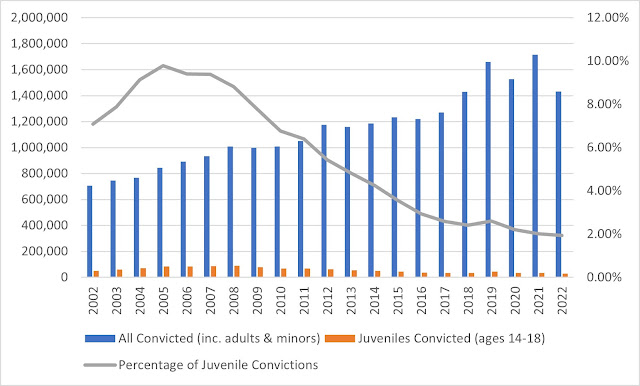
    Statistics released by the SPC and Supreme People’s Procuratorate (SPP) in 2022 reveal a continuous drop in juvenile convictions, falling by more than 50 percent since 2013. The statistics also show a sharp uptick in the number of juveniles given non-arrest and non-prosecution decisions, as well as an increase in the number of juvenile records sealed. This progress in restorative justice for juveniles has occurred in the decade since China added a new section to the Criminal Procedure Law that incorporated provisions for conditional non-prosecution, record sealing, and more non-custodial measures – topics that were discussed during Dui Hua’s US-China expert exchanges.

    Table 1. Total Convictions & Juvenile Convictions

    Source: National Court Judicial Statistics Bulletin 2002-2022
    In 2022, the number of juvenile convictions reached a record low, with only 27,757 juveniles tried nationwide. The percentage of juvenile convictions reached its peak at 9.79 percent in 2005 and remained at around 9 percent through 2008. This surge alarmed the Chinese government, and calls for juvenile justice reform increased. In 2007, senior Chinese prosecutor Dan Wei told Dui Hua executive director John Kamm that reforming the juvenile justice system had become a priority for senior leaders. The exchanges kicked off with an invitation to the SPC to study juvenile justice in the United States.
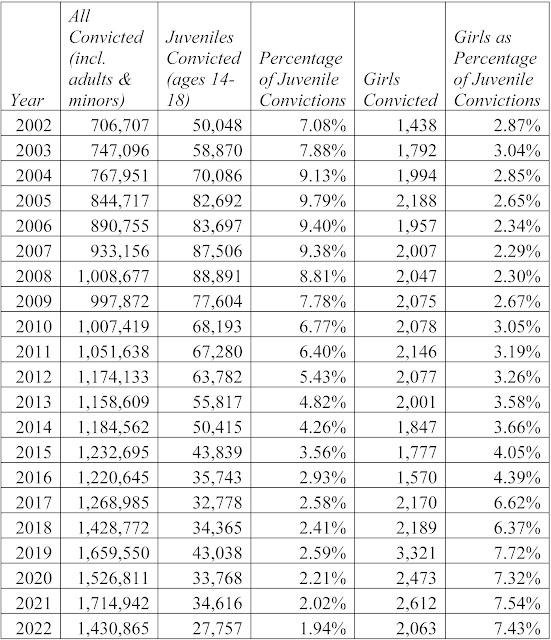
    Following the first exchange, juvenile convictions continued to decrease year-by-year. Convictions fell below 5 percent for the first time in 2013, after the revised Criminal Procedure Law came into force and codified the principle of prioritizing education over punishment. Over the last decade, the number of juvenile convictions decreased by more than 50 percent from 63,782 in 2012 to 27,757 in 2022.

    Of those 27,757 juveniles, 2,063 were girls. The number of convicted girls increased from 1,570 in 2016 to 3,321 in 2019 but dropped below 2,500 in 2020 and further to 2,000 in 2022. Despite this decrease, the number of girls convicted as a percentage of juvenile convictions has remained above 7 percent since 2019, up from 3.58 percent in 2013.

    Table 2. Total, Juvenile & Girl Convictions

    Source: National Court Judicial Statistics Bulletin 2002-2022

    Collective Efforts

    Besides fewer juvenile convictions, the SPP works in tandem with the SPC to incorporate restorative practices into its operations by approving fewer juvenile arrests and prosecutions. In 2022, prosecutors accepted and examined arrests for 49,070 minors, a drop from 55,379 in 2021. It is a sizable increase from 2020’s figure of 37,681. The approval rate for arrests of juvenile suspects in 2022 reached a record low of 31.5 percent. Of those, prosecutors approved arrests of about 15,000 minors while disapproving arrests of 34,000. The disapproval rate rose incrementally every year from 26.7 percent in 2014 to 39.1 percent in 2020. This rate exceeded 50 percent for the first time in 2021 and reached another peak of 68.5 percent in 2022.

    In the first six months of 2023, prosecutors disapproved the arrests of 20,000 juveniles. The disapproval is 67.9 percent, on par with the 2022 level.

    Table 3. Juvenile Arrests Disapproved

    Source: White Paper on Prosecutorial Practice for Minors 2014-2022

    The prosecution rate for juvenile suspects in 2022 was 47.6 percent. The number of juveniles accepted and examined for prosecution decreased year-by-year from 77,405 in 2014 to 58,307 in 2018. In 2022, the number rose back to 78,467, exceeding the 2014 prosecution rate. Despite the increase, a growing number of juvenile delinquents have been given non-prosecution over the years. In 2022, prosecutors approved the prosecution of 28,000 juveniles and disapproved 41,000 prosecutions. The disapproval rate reached a record high of 59.9 percent, up from 10.3 percent in 2013. In just one year, the number of juveniles given non-prosecution nearly doubled from 22,585 in 2021 to 41,000 in 2022.

    The non-prosecution rate in the first six months of 2023 was 56.7 percent, with a total of 18,000 juveniles given non-prosecution.

     Table 4. Juvenile Prosecutions Disapproved

    Source: White Paper on Prosecutorial Practice for Minors 2014-2022

    Of particular significance is the wider use of conditional non-prosecution, known in the United States as diversion. In 2022, 26,161 juvenile cases were diverted, and the application rate of diversion rose year-to-year from 20.8 percent in 2020 to 29.6 percent in 2021, and to 36.1 percent in 2022. In 2013, diversion was incorporated into the Criminal Procedure Law. Since 2014, the number of juveniles offered conditional non-prosecution increased eightfold.

    Table 5. Juvenile Delinquents Given Conditional Non-Prosecution
    Source: White Paper on Prosecutorial Practice for Minors 2014-2022
    Sealing Records
    Record sealing was incorporated into the Criminal Procedure Law in 2013, and prior to that it was a major topic of discussion during the expert exchanges hosted by Dui Hua. Dui Hua was assisted in preparing and conducting the exchanges by Judge Leonard Edwards of Santa Clara County, California. Judge Edwards (retired) is a recognized expert in juvenile justice in general and the sealing of juvenile records in particular.
    In China, the practice of sealing juvenile records mandates that a juvenile offender’s records be sealed after they successfully complete the probation period called for by conditional non-prosecution orders issued by the procuratorate, provided that the juvenile observes the conditions of non-prosecution and does not commit new crimes. The SPP has disclosed nationwide figures on how this restorative measure has been implemented. A total of 92,694 juveniles had their records sealed from 2020-2022. In 2022, 33,021 juvenile records were sealed, an increase from 28,163 in 2020 and 31,510 in 2021. In May 2022, the SPC, SPP and Ministry of Public Security promulgated Implementation Measures for Sealing Juvenile Criminal Records, which provides detailed standards and operational procedures for sealing juvenile criminal records.
    The drop in juvenile arrests, prosecutions, and convictions in 2022 signals a more progressive approach to juvenile justice. Although public sentiment continues to support more punitive approaches such as lowering the age of criminal responsibility from 14 to 12 in 2020, the Chinese government increasingly emphasizes rehabilitation and education as the first response to juvenile offenders. The Law on Protection of Minors, revised in 2020, refined the family guardianship system by improving guardianship measures, establishing a mandatory reporting system, and creating an information inquiry system for offenders. The law also provided more guidance on prevention and response measures for internet addiction, campus bullying, new offenses, and parental legal obligations. In the same year, the revised Juvenile Delinquency Prevention Law focused on prevention rather than punitive measures by stressing education, mental health, reduction of bullying, and multi-institutional collaboration to reduce juvenile delinquency.
    Building Safer Systems for All
    A notable omission of both laws is that they do not address gender-specific needs. It is increasingly recognized that rehabilitating girl offenders requires different approaches than those applied to boys. To raise awareness of the need for gender-specific treatment, Dui Hua formally expanded its mission in 2014 to include women and girls in conflict with the law. Later that year, Dui Hua co-hosted an international symposium on women in prison, facilitating discussions and capacity building on the Bangkok Rules, a set of regulations that provide guidance for policy makers, legislators, sentencing authorities and prison staff to meet the specific needs of women detainees and to reduce overall female imprisonment. As part of this campaign, with permission from Penal Reform International, Dui Hua released a Chinese translation of “Neglected needs: girls in the criminal justice system in 2018.” The 12-webinar International Symposium on Girls in Conflict with the Law that took place from October 2020 to March 2021, continued this campaign in an international context with input from the SPC.
    However, many countries – including both the United States and China – continue to use policies that are inadequate to address the unique needs of girls in conflict with the law. Both the Law on Protection of Minors and the revised Juvenile Delinquency Prevention Law made significant strides in improving protections for minors, but the lack of gender-specific measures needs to be addressed in the future. The drop in convictions and the rise of diversionary measures reflect the great progress made in these protections, but it is important that girls are not left behind as China’s juvenile justice system continues to reform.
  • Child Welfare with Chinese Characteristics, Part I: Rights & Responsibilities of Family & Schools

    Child Welfare with Chinese Characteristics, Part I: Rights & Responsibilities of Family & Schools

    Image credit: The Dui Hua Foundation

    On June 1, 2021, the second revision of the Law of the People’s Republic of China on Protection of Minors (hereafter Protection of Minors Law) came into effect. The revision introduced 60 new articles into law. During the Joint Program on Child Welfare Laws (JPCW) webinar hosted by Dui Hua in April 2022, panelists from the Supreme People’s Court of China (SPC) spoke in depth about the revisions to the Protection of Minors Law across six key protection areas: family, school, society, internet, government, and the judiciary.  

    The current Protection of Minors Law is the result of decades of revision and reform. First adopted at the 21st Meeting of the Standing Committee of the Seventh National People’s Congress on September 4, 1991, the law was revised in 2006; in 2012, it was amended in accordance with the Decision on Revising the Law of the People’s Republic of China on Protection of Minors made by the Standing Committee of the 11th National People’s Congress at the 29th Meeting. In 2020, it was revised at 13th National People’s Congress and came into effect in its current iteration in June 2021.  

    The amendments are meant to fill in the gaps of the previous law and safeguard children’s rights to the greatest extent possible. During the JPCW, Li Chen, Deputy Director of the Department of Children’s Welfare Affairs from the Ministry of Civil Affairs (MCA) stated that the revisions to the Protection of Minors Law “explicitly provide that the people’s governments at or above the county level shall establish a coordination mechanism for the protection of minors…so as to further consolidate the legal groundwork for the protection of minors (in China).” On April 21, 2022, the State Council Information Office of China issued a white paper titled Youth of China in a New Era. The paper stated that China’s aim is to “create a future of prosperity, health, safety, mutual respect, mutual learning, and shared benefits” for young people all over the world.   

    China’s reforms in child welfare and juvenile justice have made strides towards a more comprehensive national policy, and certain aspects of its system stand in contrast to the US child reform and juvenile justice systems which are largely decided at the state level. Yet, the vagueness surrounding the Protection of Minors Law’s scope may open the door to practices that are harsh on parents and guardians, place undue stress on families, or present issues for enforcement.  

    Screenshots from the April 7 expert exchange. (Clockwise top left) Host John Kamm, moderator Dr. Jiang Jihai, moderator Judge Len Edwards, Dr. Jiang with members of his panel. Image credit: The Dui Hua Foundation 

    This article explores China’s child welfare legislation by drawing on the relevant legislation, white papers issued by Chinese Communist Party organs, and remarks made during Dui Hua’s 2022 JPCW webinar. Part I focuses on the obligations of the family unit and educational institutions in child welfare. Part II looks at the designated roles of online entities, government bodies, the judiciary, and society at large in ensuring the welfare of the child. 

    “A Good, Harmonious & Civilized Family Environment” 

    Like many legal systems, China’s child welfare laws center the family as the foundation for child protection. During the JPCW, Judge Wang Wei, Deputy Chief Judge of the First Criminal Division of Jiangsu Province High People’s Court, spoke on guardianship revocation cases in China, stating that “raising children is both an ethical and affectionate need and a statutory responsibility.” The Protection of Minors Law contains ten articles that specify the guardian’s responsibility to the child, with emphasis on when and how guardianship can be revoked and possibly restored.  

    Issues of guardianship and child neglect have particular relevance in China due to the number of children who are left in the care of grandparents or other relatives in rural villages while their parents work in cities. A combination of factors – among them the household registration system known as hukou, the high cost of living in cities, and limited economic opportunities in rural areas – has resulted in millions of “left behind” children (留守儿童), so-called because they live apart from their parents for much of their childhood.

    The cover of an individual household’s register, or hukou, booklet. Image credit: Wikimedia Commons / Public Domain 

    Article 21, a more recent addition to the Protection of Minors Law, stipulates that children under the age of eight cannot be left unattended or in the care of unsuitable guardianship. Minors under the age of 16 should not be forced out of the home or forced to live without a guardian. Article 15 states that “parents or other guardians of minors shall learn family education, accept guidance on family education, and create a good, harmonious and civilized family environment.” Article 15 also requires any adult family members living in the same house to bear some guardianship responsibilities, which are detailed in Article 16: 
    1. To provide minors with life, health, safety, and other aspects of protection; 
    2. To care for the physical, psychological and emotional needs of minors; 
    3. To educate and guide minors to abide by the law, to be diligent and thrifty, and to develop a good moral character and behavior habits; 
    4. To conduct safety education for minors to improve their self-protection awareness and ability; 
    5. To respect minors’ right to receive education and ensure that school-age minors receive and complete compulsory education in accordance with the law; 
    6. To ensure the time of rest, entertainment, and physical exercise for minors, and guide them to carry out activities beneficial to their physical and mental health; 
    7. To properly manage and protect the property of minors; 
    8. To act for minors to carry out civil legal acts in accordance with law; 
    9. To prevent and stop the bad behaviors and illegal and criminal behaviors of minors and conduct reasonable discipline; and 
    10. Other duties under guardianship that should be performed. 
    This list raises the issue of whether parents or guardians can be liable for violating the above responsibilities and whether courts can mandate revocation of guardianship. The broad sweep of section 10 could lead to highly discretionary implementation. 

    Articles 22 and 23 address instances when a minor’s parent or guardian is temporarily unable to perform their duties. Article 22 states that the parents or guardians “shall entrust a person with full capacity for performing civil juristic acts to attend minors,” and Article 23 requires the parent or guardian to promptly inform the child’s school and local authorities of the guardianship arrangement. The articles instruct guardians to follow specific reporting mechanisms but provide little guidance about how to determine if a guardian is “temporarily unable to perform duties.” Judge Wang of the Jiangsu Province High People’s Court clarified in his remarks that revocation of guardianship “is only applicable to serious circumstances; judicial power shall only intervene in family relations in a way of minimal damage as the ‘last resort.’ It should strictly distinguish between guardianship infringement and improper education/slight physical punishment.” 

    Article 36 of the Civil Code of China lists three circumstances when guardianship may be revoked either permanently or temporarily. During the JPCW, Judge Wang of Jiangsu Province High People’s Court described them thusly: 

    • the guardian engaged in any act which damages the physical and mental health of the ward, such as sexual assault, sale, abandonment, abuse, and violence against the ward; 
    • the guardian fails to perform the duties of guardianship or is unable to perform such duties but refuses to delegate all or part of the duties to others, i.e., drug use, gambling, or being alcoholic, in jail serving sentences, unable to perform their obligations (as a clause designed to cover all other circumstances); 
    • the guardian is engaged in any other act which infringes upon the lawful rights and interests of the ward, such as instigating or using minors to commit crimes of a severe nature; coercing, deceiving, using minors to beg on the street, and refusing to rectify after censure and education being conducted three times by the public security authority. 

    Dr. Jiang Jihai, then-Director of the Juvenile Justice Guidance Division of the Supreme People’s Court of China, stated that the Family Education Promotion Law, which was also revised in 2021, escalated family education from traditional “family affairs” to “state affairs.” The law stipulates that parents bear principal responsibility such that “if they fail to fulfill this responsibility, or do not implement family education correctly, they should bear the corresponding legal responsibility.” 

    Safe Schools, Peaceful Campuses 

    Beyond the family, the Protection of Minors Law similarly introduced and amended regulations on the responsibility of schools in child protection. The law and its amendments provide a blueprint for child protection in educational institutions by assigning new responsibilities to institutions as well as specifying special-purpose schemes, administrative requirements, work mechanisms, and measures for support and supervision.  

    Chinese elementary school students on their way to school in Nanyou. Image credit: Wabbit Wanderer Flickr Account / CC BY-SA 2.0 

    Education environments – including kindergartens, special education institutions, primary, secondary, and vocational schools – have mandatory measures to fight campus bullying and sexual misconduct, and they also mandate the inclusion of sex education curriculum. Kiosks and businesses that sell alcohol, cigarettes, or lottery tickets are barred from operating near schools to prevent minors from developing unhealthy habits. To prevent sex trafficking, hotels and short-term accommodation facilities must ask underage guests for their guardians’ contact information and the nature of their relationship with fellow guests. Hotel staff are obligated to call police if they observe suspicious activity involving child sex trafficking. The Ministry of Education (MOE) and other authorities launched pilot programs at schools, organized training workshops, and provided guidance to students, including: 

    • Initiating the “safe school and peaceful campus” campaign;  
    • Launching a national safety education day for primary and secondary school students;  
    • Holding special activities around water safety to prevent drowning accidents;   
    • Launching an anti-bullying initiative for primary and secondary school students;  
    • Implementing measures such as regulating extracurricular sports training and strengthening the physical health management of primary and secondary school students. 

    In 2016, China Daily reported on new measures to combat school bullying, including that authorities will hold regions and schools responsible if they are found to have serious bullying problems. Issues of bullying and sexual assault continue to draw widespread public attention. A 2016 survey of seven Chinese cities found that 26 percent of urban children had been bullied during the previous year. As such, the law includes implementation rules and procedures to help schools and other authorities identify and intervene in bullying, abuse, and harassment at schools. For example, Article 130 provides a legal definition of bullying, and Article 39 provides a mandate for schools to establish a formal system of control and prevention of bullying.

    A CAPTA post. Image credit: School House Connection 

    The national reach of the Protection of Minors Law is distinct from federal efforts in the United States to curtail bullying. The law is unique in its far-reaching nature and its placement of legal responsibility on multiple different actors, including schools, parents, public security organs, and law enforcement. The closest US analog to the Protection of Minors Law is the Federal Child Abuse Prevention and Treatment Act (CAPTA). CAPTA is primarily concerned with physical and sexual abuse against minors, but its impact is limited as it depends on individual states to pass legislation on mandated reporting of child abuse neglect.  

    The roles of family and schools in child welfare present an emerging picture of how legislation differs between China and the United States. While both legislate obligations for different parties and manifest this largely through mandatory reporting requirements, China’s top-down legislation stands in contrast to the United States’ approach. The US system offers guidance but leaves actual definition and implementation to states to induce localized systems. How these obligations – and the differences in systems – manifest across cyberspace, government, judicial bodies, and society at large will be discussed in Part II. 

    Read Part II: An All-of-Society Effort

  • Child Welfare with Chinese Characteristics, Part I: Rights & Responsibilities of Family & Schools

    Child Welfare with Chinese Characteristics, Part I: Rights & Responsibilities of Family & Schools

    Image credit: The Dui Hua Foundation

    On June 1, 2021, the second revision of the Law of the People’s Republic of China on Protection of Minors (hereafter Protection of Minors Law) came into effect. The revision introduced 60 new articles into law. During the Joint Program on Child Welfare Laws (JPCW) webinar hosted by Dui Hua in April 2022, panelists from the Supreme People’s Court of China (SPC) spoke in depth about the revisions to the Protection of Minors Law across six key protection areas: family, school, society, internet, government, and the judiciary.

    The current Protection of Minors Law is the result of decades of revision and reform. First adopted at the 21st Meeting of the Standing Committee of the Seventh National People’s Congress on September 4, 1991, the law was revised in 2006; in 2012, it was amended in accordance with the Decision on Revising the Law of the People’s Republic of China on Protection of Minors made by the Standing Committee of the 11th National People’s Congress at the 29th Meeting. In 2020, it was revised at 13th National People’s Congress and came into effect in its current iteration in June 2021.

    The amendments are meant to fill in the gaps of the previous law and safeguard children’s rights to the greatest extent possible. During the JPCW, Li Chen, Deputy Director of the Department of Children’s Welfare Affairs from the Ministry of Civil Affairs (MCA) stated that the revisions to the Protection of Minors Law “explicitly provide that the people’s governments at or above the county level shall establish a coordination mechanism for the protection of minors…so as to further consolidate the legal groundwork for the protection of minors (in China).” On April 21, 2022, the State Council Information Office of China issued a white paper titled Youth of China in a New Era. The paper stated that China’s aim is to “create a future of prosperity, health, safety, mutual respect, mutual learning, and shared benefits” for young people all over the world.

    China’s reforms in child welfare and juvenile justice have made strides towards a more comprehensive national policy, and certain aspects of its system stand in contrast to the US child reform and juvenile justice systems which are largely decided at the state level. Yet, the vagueness surrounding the Protection of Minors Law’s scope may open the door to practices that are harsh on parents and guardians, place undue stress on families, or present issues for enforcement.

    Screenshots from the April 7 expert exchange. (Clockwise top left) Host John Kamm, moderator Dr. Jiang Jihai, moderator Judge Len Edwards, Dr. Jiang with members of his panel. Image credit: The Dui Hua Foundation

    This article explores China’s child welfare legislation by drawing on the relevant legislation, white papers issued by Chinese Communist Party organs, and remarks made during Dui Hua’s 2022 JPCW webinar. Part I focuses on the obligations of the family unit and educational institutions in child welfare. Part II looks at the designated roles of online entities, government bodies, the judiciary, and society at large in ensuring the welfare of the child.

    “A Good, Harmonious & Civilized Family Environment” 

    Like many legal systems, China’s child welfare laws center the family as the foundation for child protection. During the JPCW, Judge Wang Wei, Deputy Chief Judge of the First Criminal Division of Jiangsu Province High People’s Court, spoke on guardianship revocation cases in China, stating that “raising children is both an ethical and affectionate need and a statutory responsibility.” The Protection of Minors Law contains ten articles that specify the guardian’s responsibility to the child, with emphasis on when and how guardianship can be revoked and possibly restored.

    Issues of guardianship and child neglect have particular relevance in China due to the number of children who are left in the care of grandparents or other relatives in rural villages while their parents work in cities. A combination of factors – among them the household registration system known as hukou, the high cost of living in cities, and limited economic opportunities in rural areas – has resulted in millions of “left behind” children (留守儿童), so-called because they live apart from their parents for much of their childhood.

    The cover of an individual household’s register, or hukou, booklet. Image credit: Wikimedia Commons / Public Domain
    Article 21, a more recent addition to the Protection of Minors Law, stipulates that children under the age of eight cannot be left unattended or in the care of unsuitable guardianship. Minors under the age of 16 should not be forced out of the home or forced to live without a guardian. Article 15 states that “parents or other guardians of minors shall learn family education, accept guidance on family education, and create a good, harmonious and civilized family environment.” Article 15 also requires any adult family members living in the same house to bear some guardianship responsibilities, which are detailed in Article 16:
    1. To provide minors with life, health, safety, and other aspects of protection;
    2. To care for the physical, psychological and emotional needs of minors;
    3. To educate and guide minors to abide by the law, to be diligent and thrifty, and to develop a good moral character and behavior habits;
    4. To conduct safety education for minors to improve their self-protection awareness and ability;
    5. To respect minors’ right to receive education and ensure that school-age minors receive and complete compulsory education in accordance with the law;
    6. To ensure the time of rest, entertainment, and physical exercise for minors, and guide them to carry out activities beneficial to their physical and mental health;
    7. To properly manage and protect the property of minors;
    8. To act for minors to carry out civil legal acts in accordance with law;
    9. To prevent and stop the bad behaviors and illegal and criminal behaviors of minors and conduct reasonable discipline; and
    10. Other duties under guardianship that should be performed.
    This list raises the issue of whether parents or guardians can be liable for violating the above responsibilities and whether courts can mandate revocation of guardianship. The broad sweep of section 10 could lead to highly discretionary implementation.

    Articles 22 and 23 address instances when a minor’s parent or guardian is temporarily unable to perform their duties. Article 22 states that the parents or guardians “shall entrust a person with full capacity for performing civil juristic acts to attend minors,” and Article 23 requires the parent or guardian to promptly inform the child’s school and local authorities of the guardianship arrangement. The articles instruct guardians to follow specific reporting mechanisms but provide little guidance about how to determine if a guardian is “temporarily unable to perform duties.” Judge Wang of the Jiangsu Province High People’s Court clarified in his remarks that revocation of guardianship “is only applicable to serious circumstances; judicial power shall only intervene in family relations in a way of minimal damage as the ‘last resort.’ It should strictly distinguish between guardianship infringement and improper education/slight physical punishment.”

    Article 36 of the Civil Code of China lists three circumstances when guardianship may be revoked either permanently or temporarily. During the JPCW, Judge Wang of Jiangsu Province High People’s Court described them thusly:

    • the guardian engaged in any act which damages the physical and mental health of the ward, such as sexual assault, sale, abandonment, abuse, and violence against the ward;
    • the guardian fails to perform the duties of guardianship or is unable to perform such duties but refuses to delegate all or part of the duties to others, i.e., drug use, gambling, or being alcoholic, in jail serving sentences, unable to perform their obligations (as a clause designed to cover all other circumstances);
    • the guardian is engaged in any other act which infringes upon the lawful rights and interests of the ward, such as instigating or using minors to commit crimes of a severe nature; coercing, deceiving, using minors to beg on the street, and refusing to rectify after censure and education being conducted three times by the public security authority.

    Dr. Jiang Jihai, then-Director of the Juvenile Justice Guidance Division of the Supreme People’s Court of China, stated that the Family Education Promotion Law, which was also revised in 2021, escalated family education from traditional “family affairs” to “state affairs.” The law stipulates that parents bear principal responsibility such that “if they fail to fulfill this responsibility, or do not implement family education correctly, they should bear the corresponding legal responsibility.”

    Safe Schools, Peaceful Campuses 

    Beyond the family, the Protection of Minors Law similarly introduced and amended regulations on the responsibility of schools in child protection. The law and its amendments provide a blueprint for child protection in educational institutions by assigning new responsibilities to institutions as well as specifying special-purpose schemes, administrative requirements, work mechanisms, and measures for support and supervision.

    Chinese elementary school students on their way to school in Nanyou. Image credit: Wabbit Wanderer Flickr Account / CC BY-SA 2.0

    Education environments – including kindergartens, special education institutions, primary, secondary, and vocational schools – have mandatory measures to fight campus bullying and sexual misconduct, and they also mandate the inclusion of sex education curriculum. Kiosks and businesses that sell alcohol, cigarettes, or lottery tickets are barred from operating near schools to prevent minors from developing unhealthy habits. To prevent sex trafficking, hotels and short-term accommodation facilities must ask underage guests for their guardians’ contact information and the nature of their relationship with fellow guests. Hotel staff are obligated to call police if they observe suspicious activity involving child sex trafficking. The Ministry of Education (MOE) and other authorities launched pilot programs at schools, organized training workshops, and provided guidance to students, including:

    • Initiating the “safe school and peaceful campus” campaign;
    • Launching a national safety education day for primary and secondary school students;
    • Holding special activities around water safety to prevent drowning accidents;
    • Launching an anti-bullying initiative for primary and secondary school students;
    • Implementing measures such as regulating extracurricular sports training and strengthening the physical health management of primary and secondary school students.

    In 2016, China Daily reported on new measures to combat school bullying, including that authorities will hold regions and schools responsible if they are found to have serious bullying problems. Issues of bullying and sexual assault continue to draw widespread public attention. A 2016 survey of seven Chinese cities found that 26 percent of urban children had been bullied during the previous year. As such, the law includes implementation rules and procedures to help schools and other authorities identify and intervene in bullying, abuse, and harassment at schools. For example, Article 130 provides a legal definition of bullying, and Article 39 provides a mandate for schools to establish a formal system of control and prevention of bullying.

    A CAPTA post. Image credit: School House Connection

    The national reach of the Protection of Minors Law is distinct from federal efforts in the United States to curtail bullying. The law is unique in its far-reaching nature and its placement of legal responsibility on multiple different actors, including schools, parents, public security organs, and law enforcement. The closest US analog to the Protection of Minors Law is the Federal Child Abuse Prevention and Treatment Act (CAPTA). CAPTA is primarily concerned with physical and sexual abuse against minors, but its impact is limited as it depends on individual states to pass legislation on mandated reporting of child abuse neglect.

    The roles of family and schools in child welfare present an emerging picture of how legislation differs between China and the United States. While both legislate obligations for different parties and manifest this largely through mandatory reporting requirements, China’s top-down legislation stands in contrast to the United States’ approach. The US system offers guidance but leaves actual definition and implementation to states to induce localized systems. How these obligations – and the differences in systems – manifest across cyberspace, government, judicial bodies, and society at large will be discussed in Part II.

    Read Part II: An All-of-Society Effort

  • Patriotic Acts as Cause for Non-Prosecution

    Patriotic Acts as Cause for Non-Prosecution

    Changle government building. Image credit: Google images
    Chinese prosecutors have the discretion not to indict an accused when the evidence is insufficient or when his/her perceived threat to society is minimal. However, these are not necessarily the most important reasons. Dui Hua’s research found that criminal suspects deemed patriotic can also avoid prosecution in mainland China.
    China’s long-time conviction rate of over 99.9 percent often overshadows the judicial progress it has made in other areas. While the acquittal rate dipped to its lowest point at 0.052 percent in 2021, Chinese prosecutors have approved fewer arrests and indicted fewer suspects in recent years. Statistics released by the Supreme People’s Procuratorate in March 2022 indicated that the country’s non-prosecution rate increased from 9.9 percent in 2019 to 16.6 percent in 2021.
    Non-prosecution embodies the lenient aspect of China’s largely punitive criminal justice system. Among the major beneficiaries of non-prosecution are juvenile delinquents, the elderly, severely ill, first-time offenders, and pregnant and breastfeeding women. Prosecutors can also exercise discretion and choose to not indict suspects if they have made “major contributions to the state or society” or performed “meritorious deeds.” Existing laws and regulations leave undefined what acts are considered “major contributions,” but the following case Dui Hua discovered concerning a Hong Kong “patriot” provides insight into this term.
    On October 21, 2019, the Public Security Bureau of Changle District, Fuzhou, decided not to prosecute a Hong Kong resident surnamed Chan. The bureau carried out criminal detention in December 2013 and listed Chan as a wanted criminal online on June 18, 2014. Chan was suspected of “organizing an illegal border crossing,” for allegedly forging identity documents for a group of 11 Chinese nationals in their applications for tourist visas at the US Consulate in Guangzhou. Their application was unsuccessful because the documents were found to be counterfeit by the consulate staffers.
    Chan flew back to Fuzhou from Hong Kong and turned himself in on October 14, 2019, six years after his alleged offense took place. That same day, Chan was released on bail pending further investigation. About a week later, the procuratorate issued a non-prosecution decision, citing the various patriotic acts he had performed in Hong Kong.
    Fuzhou Changle International Airport. Chan flew here from Hong Kong before turning himself in, six years after his alleged crime. Image credit: Fuzhou Changle International Airport
    First among these acts, Chan served as the then-incumbent executive vice president of the Hong Kong Family Union (New Territories West Branch), a pro-China non-governmental organization which helps mainland residents to emigrate to Hong Kong. During his tenure, Chan allegedly organized and participated in multiple activities to promote love for the motherland and Hong Kong. Chan was given credit for carrying out stability maintenance and secret investigation work for the Hong Kong Liaison Office during “Occupy Central,” the civil disobedience movement which paralyzed parts of Hong Kong for 79 days in late 2014.
    On October 13, 2014, protestors camp out in the streets of Hong Kong as part of the Occupy Central movement. Image credit: L-BBE / CC BY 3.0
    Furthermore, Chan was commended for performing security work for the official celebrations marking the 20th anniversary of Hong Kong’s handover to Chinese rule in 2017, the only year Xi Jinping attended the handover celebrations in the former British colony as Chinese president, as of this writing. More notably, Chan was cited for his “fearless” and “tenacious struggle” against the “radical opposition forces” during the recent 2019 protests, as well as his unified actions in supporting the Hong Kong government. The decision not to prosecute Chan came as Hong Kong protesters fought citywide pitched battles with police in an eruption of public anger against an already suspended extradition bill that critics saw as a fundamental threat to the former British colony’s civic freedoms and rule of law.
    Prosecutors also outlined other reasons for not indicting Chan, but the arguments are not without flaws. For example, one reason for not indicting Chan is because he turned himself in even though he did so six years after the public security bureau carried out criminal detention. Additionally, it was argued that the seriousness of Chan’s crime was mitigated because his attempt to organize illegal crossings failed. Chan did not complete the crime; he only attempted to commit it, argued the prosecutors. Even with this reasoning, it is unclear why the prosecutors did not charge Chan with forgery, covered by Article 280 of the Criminal Law, since the non-prosecution decision found that Chan did indeed forge identity documents for 11 Chinese nationals.
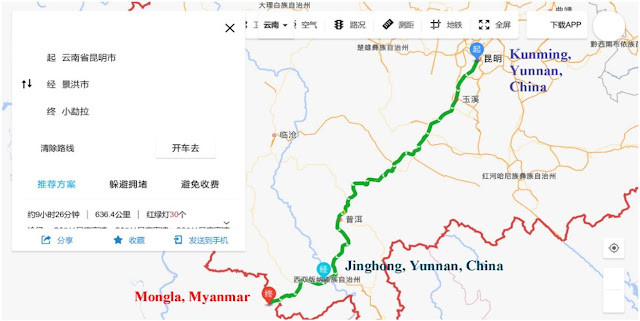
    The crime of organizing illegal border crossings is known to incur serious penalties. Dui Hua previously reported that the crime resulted in Korean missionary Cho Young-joo getting a seven-year prison sentence. Cho was not given lenient punishment for the humanitarian mission he conducted across the Yunnan-Myanmar border. Prominent house church leader Cao Sanqiang (曹三强) has more than a year to serve before completing his seven-year prison sentence in Yunnan for the same crime. Also convicted of the same crime are two Hong Kong anti-extradition bill protesters who attempted to flee to Taiwan by speedboat but were intercepted by mainland coastguards in August 2020. The duo is still serving their sentences in Guangdong.
    Map showing the route (in green) from Kunming to Jinghong, from where Cho intended to travel to Mongla. Source: Gaode Map
    The treatment given to Chan was vastly different to that of Cho, Cao, and two of the Hong Kong 12, despite all of them being accused of organizing illegal border crossings. Chan’s preferential treatment calls into question whether “patriots” enjoy impunity for the criminal offenses they committed in mainland China. This raises speculation that Chan is not the only case of prosecutors dropping criminal charges against the so-called “patriots” because of meritorious services rendered in Hong Kong, China, or elsewhere.
  • Dui Hua Book Review: The People’s Republic of the Disappeared

    Michael Caster’s The People’s Republic of the Disappeared: Stories from Inside China’s System for Enforced Disappearances. Image Credit: RSDLMonitor.Com


    Dui Hua examines the stories of dissidents held under the coercive measure “residential surveillance in a designated location” in Michael Caster’s The People’s Republic of the Disappeared: Stories from Inside China’s System for Enforced Disappearances (Safeguard Defenders, 2017).

    As the waves of repression in China have intensified over the past decade, one encounters the strange phrase “residential surveillance in a designated location” (RSDL) with greater frequency.

    It was memorably employed (though by no means for the first time) against the late Nobel Peace Prize laureate Liu Xiaobo, after the publication of “Charter 08” in December 2008. Later, it was used in the crackdown against the so-called “Jasmine Revolution” in the spring of 2011. Most recently, it has been a prominent feature of the ongoing crackdown against rights lawyers and activists that began in July 2015.

    This measure, with its relatively benign-sounding name, has been examined critically before, both inside and outside China. The new book The People’s Republic of the Disappeared makes an important contribution to this critique by collecting vivid accounts from those who have been subjected to the measure. Together, these accounts paint a damning portrait of how Chinese law enforcement agents are using the power they have been given under the law to violate human rights with impunity in the name of safeguarding state security.

    ***

    What exactly is RSDL? At first glance, it looks like it might be a form of house arrest, although “designated location” suggests that it might involve something other than being confined in one’s own home. “Surveillance” only adds to the mystery, suggesting some sort of monitoring without making exactly clear how intrusive it might be.

    In China’s Criminal Procedure Law (CPL), RSDL is what’s known as a “coercive measure.” Simply put, coercive measures authorize law enforcement agents to restrict a person’s liberty in the course of a criminal investigation. The degree and duration of that restriction depends on a variety of factors, but coercive measures are meant to serve a rather limited set of aims: preventing suspects from posing further threats to society or obstructing the investigation process and ensuring their availability to face questioning or stand trial. Coercive measures are not meant to be punitive or to be used as tools of investigation in their own right.

    In Chinese criminal procedure, “residential surveillance” exists alongside other coercive measures such as custodial detention (seen as the most restrictive measure) and “release on guarantee pending further investigation” (qubao houshen, which is much less restrictive). The ordinary form of residential surveillance—which, as the name suggests, permits suspects to remain in their homes under certain restrictions—is a relatively lenient, non-custodial measure. For that reason, the CPL allows it to be imposed for up to six months.

    Six months spent under house arrest is no picnic, but it is likely to be a more comfortable experience than being sent to a detention center. For this reason, reformers have promoted the greater use of non-custodial measures like residential surveillance as a way of reducing overuse of custodial detention.

    ***

    The book features eleven accounts, all but one of them presented in the first-person, from lawyers and political activists who were subjected to RSDL or similar measures between 2011 and 2016. These include well-known human rights lawyers, such as Tang Jitian, Liu Shihui, Sui Muqing, and Wang Yu. It also includes an account by Peter Dahlin, a Swedish human rights activist detained in 2016 for his connection with some of these lawyers and activists. Though each account is distinct, the victims’ experiences under RSDL share some key features. It is difficult to ignore how the measure of RSDL has become an integral part of a systematic regime used by authorities to target particular individuals.

    Though regulations require that the locations used for RSDL “possess conditions for ordinary living and rest,” it is clear from these accounts that disruption of routine daily activities is key to how the system operates. Sleep deprivation and the withholding of food and personal hygiene products are common practice. Detainees are cut off from communication with family, friends, and lawyers. Guards and interrogators use humiliation, enforced discipline, physical and verbal abuse, and threats to friends and family members. Family members of victims are also subject to varying degrees of surveillance, including house arrest, such as in the case of Wang Yu’s family. International law recognizes family members of victims of enforced disappearances as full victims.

    The victims’ accounts of confinement and interrogation becomes at times indistinguishable, since most detainees are subjected to questioning in the same place they are held—contrary to the provisions of RSDL. Invisible, alone, and at the mercy of guards and investigators who act with impunity, it is unsurprising that, in almost every case included in this book, involuntary confession is what brings the ordeal to an end.

    Lawyer Liu Shihui, who describes his 2011 confinement under RSDL, calls the measure “a system designed for prisoners of conscience [and] a place designed for torture.” Time and torment essentially ensure that any resistance gives way to capitulation. However, some accounts reveal that even in their acts of forced “confessions”, victims attempt to resist the abuse of state power. For example, lawyer Sui Muqing recounts the importance he placed in maintaining a degree of personal integrity and dignity by refusing to incriminate others in his confession.

    In reading these accounts one cannot escape the recurring sense that authorities use the brutal conditions of confinement in RSDL for the purpose of obtaining these confessions—the veracity and voluntariness of which does not necessarily matter. In this sense, one can certainly see how useful investigators would find RSDL—especially as a tool in sweeping crackdowns with multiple, linked suspects. Even if, as in most of the cases in this book, confessions do not lead to direct criminal prosecution, the authorities can still use them against other suspects. And by recording and broadcasting these forced confessions, the authorities can attempt to bring public discredit on both the individuals and the causes they promoted.

    Beyond confessions, the brutal confinement of RSDL constitutes a form of punishment in itself, especially when stretched to its six-month limit. Even the mere existence of RSDL seems designed to spread fear, and threat of its use can be enough, in some cases, to achieve the desired outcome.

    ***

    Of course, no matter how well RSDL might serve the aims of the Chinese authorities in terms of maintaining stability and political control, it doesn’t justify the use of torture and many other violations of individual human rights that it enables. Liu Shihui’s judgment that RSDL is a “place where law doesn’t exist” is amply backed up by the other accounts in this book.

    The similarities in these accounts unquestionably demonstrate a pattern of abuse. Yet, there may still be some who will claim that these stories are exceptional and do not represent the entirety of RSDL. For every instance of abuse under RSDL, there are sure to be examples in which the measure is being used in more benign ways. Even if these cases are exceptional, this is precisely why RSDL is so insidious. By labeling these acts a form of “residential surveillance,” Chinese authorities are engaged in a deliberate effort to obscure their use of torture and enforced disappearance. Through publishing these accounts, The People’s Republic of the Disappeared is attempting to shatter the veneer behind which these severe violations have tried to hide and expose them for the world to see. And given that the accounts are diverse in both the time frames and geographical regions they represent, it is unlikely that they are simply exceptional cases. The accounts come from two separate sweeps, one carried out in 2011 and the other in 2015-2016 and they take place across four distinct locations: Beijing, Guangzhou, Tianjin, and Changsha.

    Of all the people who should read this book, which has also recently been released in Chinese, it can only be hoped that it will be read by all of the Chinese academic legal experts who have been so instrumental in directing the reform of China’s criminal justice system. In the past, many of these experts had publicly criticized the ways Chinese investigators used residential surveillance. Yet these same experts stood by and even defended the inclusion of RSDL measures in the most recent revision to the CPL, rejecting predictions that the measure would be abused. In a perfect world, this book would prod their consciences and, in the name of human rights and rule of law, lead these influential experts to turn their efforts to stopping the outrageous abuses exercised under RSDL.

  • Violent Crime and Juvenile Justice: Lessons for China and the United States (Part II of II)

    Following “Violent Crime and Juvenile Justice: Lessons for China and the United States Part I,” Part II explores the states of California and South Dakota, characterized by their “mid-high” to “high” juvenile confinement rates. Do lower juvenile confinement rates guarantee more lenient policies regarding juvenile waiver into adult court?


    Number of Inmates Serving Life-Without-Parole Sentences for Crimes Committed as Juveniles

    Data taken from July 2015 study “No Hope: Re-Examining Lifetime Sentences for Juvenile Offenders.” Source: Philips Black.
    The US is also dealing with the issue of violent crimes committed by juveniles 15 and under, with perhaps the most famous case being the “Slender Man” incident in Wisconsin, in which two 12-year-old female defendants stabbed a classmate repeatedly and were charged with attempted homicide. Because these cases are highly complex, this article conducts in-depth case studies comparing different state approaches to high profile felonies committed by juveniles 15 and younger, similar to the Slender Man case. Two case studies involve female juvenile defendants, and two involve males. Chinese officials considering policy reforms aimed at curbing violence among very young juveniles might draw important lessons from these state-level US cases.
    California: Mid-High Confinement Rate (173-366.5 per 100,000)

    Facts: Female defendant, Sarah Weeden, who was 14 at the time of the crime, was arrested, convicted, and sentenced for the murder of Navnil Chand, killed by gunshot by 23-year-old Sertice Melonson. The crime occurred in August 2005. According to testimony at Weeden’s 2008 trial, Weeden agreed to meet Chand at a park for a date and directed him there by cellphone. When he arrived, Melonson waited to rob him. During the robbery, Melonson shot and killed Chand. In April 2017, the 9th US Circuit Court of Appeals reversed Weeden’s conviction and remanded her for a new trial, finding that Weeden’s trial attorney provided ineffective assistance of counsel for failing to have Weeden evaluated by a psychologist to determine her capacity to form criminal intent. Weeden might be re-tried in juvenile court.
    Law and Policies: California has three ways that juveniles can be prosecuted as adults:
    1. Statutory Exclusion: California has a list of offenses, which if committed by a youth aged 14 or older, require that the youth be criminally prosecuted as an adult. Cal. Welf. & Inst. Code § 602(b);
    2. Discretionary Judicial Waiver: The juvenile court has original jurisdiction over most juvenile cases, but in certain delineated cases where the child is at least 16 years old at the time of the offense, the state may request that the juvenile court transfer jurisdiction to adult criminal court. The juvenile court must conduct a hearing and consider statutorily listed factors to determine whether to transfer jurisdiction. Cal. Welf. & Inst. Code § 707;
    3. Once an Adult, Always an Adult: California has a set procedure by which if a juvenile has been adjudicated, and certain criteria are met, all future charges against them will be automatically prosecuted in adult criminal court. Cal. Welf. & Inst. Code § 707.01.
    Defendants Waived Into Adult Court? Weeden appears to have been processed automatically in adult trial court pursuant to the “statutory exclusion” provisions above. Weeden’s appellate attorney notes that prosecutors filed directly in Superior Court (i.e., “adult court”) because it was a murder case, without consideration of factors such as Weeden’s age, maturity level, or mental health. Jurors found Weeden guilty of first-degree murder as an aider and abettor to Melonson, and Sacramento Superior Court Judge Maryanne G. Gilliard sentenced her to 27 years to life in prison.
    South Dakota: High Rate of Juvenile Confinement (366.5-560 per 100,000)
    Facts: In 2000, a jury convicted Daniel Charles of first-degree murder in the sniper killing of his stepfather, Duane Ingalls. Charles was 14 at the time of the crime. Charles was sentenced to life in prison without the possibility of parole (LWOP), despite the fact that such sentences were largely ruled unconstitutional by the US Supreme Court in 2012. In March 2017, Charles was resentenced to a 92-year sentence, a decision that was upheld by the South Dakota Supreme Court.
    Law and Policies: South Dakota has three ways that juveniles can be prosecuted as adults:
    1. Discretionary waiver: for any felony; there is no minimum age requirement. S.D. Codified Laws § 26-11-4;
    2. Statutory Exclusion: required for youth age 16 and older accused of class A, B, C, 1, or 2 felonies. S.D. Codified Laws § 26-11-3.1;
    3. Once an Adult, Always an Adult (if convicted of the offense): S.D. Codified Laws § 26-11-4.
    Defendant Waived Into Adult Court? It appears that Charles was waived into adult court based on the “discretionary waiver” provisions listed above.
    Figure 1. Selected Non-custodial Measures for Women in Prison in US States
    StateConfinement Rate, 2013 (per 100,000 juveniles)Defendant Age, Sex, CrimeState Laws on Waiver into Adult CourtCase Prosecuted in Adult Court?
    Wisconsin109.5-17312-year-old girl defendants; attempted homicide, stabbingWI law requires children as young as 10 to be charged as adults for homicide crimesYes
    Massachusetts46-109.515-year-old boy defendant; homicide, stabbingJuveniles 14 and older accused of homicide are automatically tried as adultsYes
    California173-366.514-year-old girl defendant; homicide, gunshot (participant)Mandatory adult court jurisdiction for violent crimes committed by person 14 or olderYes
    South Dakota366.5-56014-year-old defendant, homicide, gunshotDiscretionary waiverYes; defendant sentenced to LWOP in 2000, later commuted to 92 years

    Reforming Juvenile Sentencing Standards
    While the case studies and data presented above are subject to multiple interpretations, the case studies curiously display little correlation between confinement rate and waiver into adult court jurisdiction laws. Where a trend can be identified is in the relationship between high confinement rates and the severity of punishment (as exemplified in the South Dakota case).
    Juvenile justice policy reformers have tended to assume that limiting adult court jurisdiction for very young juvenile offenders will help limit unnecessary juvenile confinement. In extremely serious cases involving very young defendants, however, it appears that juvenile court jurisdiction is almost never an option. The two states with the lowest juvenile confinement rates in the case study have the most restrictive laws in favor of trying very young, violent juveniles in adult criminal court: Massachusetts and Wisconsin. Rather than focusing on waiver into adult court in these cases, perhaps juvenile justice reformers should place more emphasis on reforming juvenile sentencing standards and providing defendants with mental health evaluations.
    The case study comparison suggests that harsh penalties, rather than mandatory adult court jurisdiction, might co-occur more significantly with high juvenile confinement rates. After all, the state with the highest juvenile confinement rate in the case study, South Dakota, also dealt the harshest penalty: Daniel Charles, the 14-year-old defendant in the South Dakota case, was tried in adult court without a mental health evaluation and was sentenced to life without parole. Even following US Supreme Court criticism of life sentences for juveniles in 2012, the South Dakota court still provided Charles only a nominal commutation to his sentence, reducing the life sentence to a term of 92 years in prison, allowing Charles no chance at parole until he is 60 years old. Further, it appears that only in the bizarre Slender Man case in Wisconsin were the defendants given a mental health evaluation before adjudication. In California, this omission resulted in the reversal of the defendant’s conviction. Increased attention to a defendant’s mental health status might also lower pressure on judges to impose long prison sentences on very young juveniles, thereby reducing the overall rate of confinement in the US.
  • Violent Crime and Juvenile Justice: Lessons for China and the United States (Part II of II)

    Following “Violent Crime and Juvenile Justice: Lessons for China and the United States Part I,” Part II explores the states of California and South Dakota, characterized by their “mid-high” to “high” juvenile confinement rates. Do lower juvenile confinement rates guarantee more lenient policies regarding juvenile waiver into adult court?


    Number of Inmates Serving Life-Without-Parole Sentences for Crimes Committed as Juveniles

    Data taken from July 2015 study “No Hope: Re-Examining Lifetime Sentences for Juvenile Offenders.” Source: Philips Black.
    The US is also dealing with the issue of violent crimes committed by juveniles 15 and under, with perhaps the most famous case being the “Slender Man” incident in Wisconsin, in which two 12-year-old female defendants stabbed a classmate repeatedly and were charged with attempted homicide. Because these cases are highly complex, this article conducts in-depth case studies comparing different state approaches to high profile felonies committed by juveniles 15 and younger, similar to the Slender Man case. Two case studies involve female juvenile defendants, and two involve males. Chinese officials considering policy reforms aimed at curbing violence among very young juveniles might draw important lessons from these state-level US cases.
    California: Mid-High Confinement Rate (173-366.5 per 100,000)
     
    Facts: Female defendant, Sarah Weeden, who was 14 at the time of the crime, was arrested, convicted, and sentenced for the murder of Navnil Chand, killed by gunshot by 23-year-old Sertice Melonson. The crime occurred in August 2005. According to testimony at Weeden’s 2008 trial, Weeden agreed to meet Chand at a park for a date and directed him there by cellphone. When he arrived, Melonson waited to rob him. During the robbery, Melonson shot and killed Chand. In April 2017, the 9th US Circuit Court of Appeals reversed Weeden’s conviction and remanded her for a new trial, finding that Weeden’s trial attorney provided ineffective assistance of counsel for failing to have Weeden evaluated by a psychologist to determine her capacity to form criminal intent. Weeden might be re-tried in juvenile court.
    Law and Policies: California has three ways that juveniles can be prosecuted as adults:
    1. Statutory Exclusion: California has a list of offenses, which if committed by a youth aged 14 or older, require that the youth be criminally prosecuted as an adult. Cal. Welf. & Inst. Code § 602(b);
    2. Discretionary Judicial Waiver: The juvenile court has original jurisdiction over most juvenile cases, but in certain delineated cases where the child is at least 16 years old at the time of the offense, the state may request that the juvenile court transfer jurisdiction to adult criminal court. The juvenile court must conduct a hearing and consider statutorily listed factors to determine whether to transfer jurisdiction. Cal. Welf. & Inst. Code § 707;
    3. Once an Adult, Always an Adult: California has a set procedure by which if a juvenile has been adjudicated, and certain criteria are met, all future charges against them will be automatically prosecuted in adult criminal court. Cal. Welf. & Inst. Code § 707.01.
    Defendants Waived Into Adult Court? Weeden appears to have been processed automatically in adult trial court pursuant to the “statutory exclusion” provisions above. Weeden’s appellate attorney notes that prosecutors filed directly in Superior Court (i.e., “adult court”) because it was a murder case, without consideration of factors such as Weeden’s age, maturity level, or mental health. Jurors found Weeden guilty of first-degree murder as an aider and abettor to Melonson, and Sacramento Superior Court Judge Maryanne G. Gilliard sentenced her to 27 years to life in prison.
    South Dakota: High Rate of Juvenile Confinement (366.5-560 per 100,000)
    Facts: In 2000, a jury convicted Daniel Charles of first-degree murder in the sniper killing of his stepfather, Duane Ingalls. Charles was 14 at the time of the crime. Charles was sentenced to life in prison without the possibility of parole (LWOP), despite the fact that such sentences were largely ruled unconstitutional by the US Supreme Court in 2012. In March 2017, Charles was resentenced to a 92-year sentence, a decision that was upheld by the South Dakota Supreme Court.
    Law and Policies: South Dakota has three ways that juveniles can be prosecuted as adults:
    1. Discretionary waiver: for any felony; there is no minimum age requirement. S.D. Codified Laws § 26-11-4;
    2. Statutory Exclusion: required for youth age 16 and older accused of class A, B, C, 1, or 2 felonies. S.D. Codified Laws § 26-11-3.1;
    3. Once an Adult, Always an Adult (if convicted of the offense): S.D. Codified Laws § 26-11-4.
    Defendant Waived Into Adult Court? It appears that Charles was waived into adult court based on the “discretionary waiver” provisions listed above.
    Figure 1. Selected Non-custodial Measures for Women in Prison in US States
    StateConfinement Rate, 2013 (per 100,000 juveniles)Defendant Age, Sex, CrimeState Laws on Waiver into Adult CourtCase Prosecuted in Adult Court?
    Wisconsin109.5-17312-year-old girl defendants; attempted homicide, stabbingWI law requires children as young as 10 to be charged as adults for homicide crimesYes
    Massachusetts46-109.515-year-old boy defendant; homicide, stabbingJuveniles 14 and older accused of homicide are automatically tried as adultsYes
    California173-366.514-year-old girl defendant; homicide, gunshot (participant)Mandatory adult court jurisdiction for violent crimes committed by person 14 or olderYes
    South Dakota366.5-56014-year-old defendant, homicide, gunshotDiscretionary waiverYes; defendant sentenced to LWOP in 2000, later commuted to 92 years
     
    Reforming Juvenile Sentencing Standards
    While the case studies and data presented above are subject to multiple interpretations, the case studies curiously display little correlation between confinement rate and waiver into adult court jurisdiction laws. Where a trend can be identified is in the relationship between high confinement rates and the severity of punishment (as exemplified in the South Dakota case).
    Juvenile justice policy reformers have tended to assume that limiting adult court jurisdiction for very young juvenile offenders will help limit unnecessary juvenile confinement. In extremely serious cases involving very young defendants, however, it appears that juvenile court jurisdiction is almost never an option. The two states with the lowest juvenile confinement rates in the case study have the most restrictive laws in favor of trying very young, violent juveniles in adult criminal court: Massachusetts and Wisconsin. Rather than focusing on waiver into adult court in these cases, perhaps juvenile justice reformers should place more emphasis on reforming juvenile sentencing standards and providing defendants with mental health evaluations.
    The case study comparison suggests that harsh penalties, rather than mandatory adult court jurisdiction, might co-occur more significantly with high juvenile confinement rates. After all, the state with the highest juvenile confinement rate in the case study, South Dakota, also dealt the harshest penalty: Daniel Charles, the 14-year-old defendant in the South Dakota case, was tried in adult court without a mental health evaluation and was sentenced to life without parole. Even following US Supreme Court criticism of life sentences for juveniles in 2012, the South Dakota court still provided Charles only a nominal commutation to his sentence, reducing the life sentence to a term of 92 years in prison, allowing Charles no chance at parole until he is 60 years old. Further, it appears that only in the bizarre Slender Man case in Wisconsin were the defendants given a mental health evaluation before adjudication. In California, this omission resulted in the reversal of the defendant’s conviction. Increased attention to a defendant’s mental health status might also lower pressure on judges to impose long prison sentences on very young juveniles, thereby reducing the overall rate of confinement in the US.
  • Violent Crime and Juvenile Justice: Lessons for China and the United States (Part I of II)

    In May 2014, two twelve year-old girls were charged with attempted homicide in Wisconsin. Image Credit: Newsweek.
    Recently, stories of violent crimes committed by juveniles, particularly girls, have featured widely in Chinese media. Stories include the case of a 14 year old girl in Yunnan who was charged with homicide in cooperation with her much older boyfriend and a 12 year old in Hunan who is suspected of having fatally poisoned two other primary school girls. Dui Hua’s 2014 Women in Prison symposium also features research exploring violent crimes committed by juvenile girls in Beijing courts. It found that the percentage of violent crimes committed by juvenile girls has been increasing over the past several years.
    The US is also dealing with the issue of violent crimes committed by juveniles 15 and under, with perhaps the most famous case being the “Slender Man” incident in Wisconsin, in which two 12-year-old female defendants stabbed a classmate repeatedly and were charged with attempted homicide. Because these cases are highly complex, this article conducts in-depth case studies comparing different state approaches to high profile felonies committed by juveniles 15 and younger, similar to the Slender Man case. Two case studies involve female juvenile defendants, and two involve males. Chinese officials considering policy reforms aimed at curbing violence among very young juveniles might draw important lessons from these state-level US cases.
    Putting the Case Studies in Perspective
    To better understand these case studies on violent juvenile crime, this section provides a survey of each state’s rate of juvenile confinement. State juvenile policy works best when the lowest possible proportion of the juvenile population is confined in a detention facility.
    Understanding each state’s juvenile confinement rate will then allow for the selection of state-level case studies that reflect the variation in juvenile justice policy across the United States. Using the map below, we hope to identify what conditions are operating in states that do a good job of keeping juveniles out of adult prisons.
    The data and maps used in this article come from the Office of Juvenile Justice and Delinquency Prevention (OJJDP), which collects comprehensive data for all 50 states and the District of Columbia. The following map is based on the most recent available data from 2013. [1]

    In the map above, it appears that in general, lower confinement rates are found in the Northeast and in some states in the South. (The raw data for 2013 can be found here.)
    State-Level Case Studies of Violent Crimes Committed by Young Juveniles
    Based on this map of juvenile confinement rates, case studies were selected from different states to get a sense of the variations in juvenile justice performance across the country. The case studies focus on violent crimes committed by juveniles in four states: Massachusetts, Wisconsin, California, and South Dakota, each with varying juvenile confinement rates. Massachusetts has a “low” confinement rate, Wisconsin has a “mid-low” rate, California has a “mid-high” rate, and South Dakota has a “high” rate.
    This case selection is intended to gain a better understanding of the spectrum of regional variations in juvenile justice performance across the US, even though the cases themselves likely represent a small number of recent violent juvenile crimes committed in the US.
    Massachusetts: Low Confinement Rate (46-109.5 per 100,000 juveniles)
    Facts: Fifteen year-old Mathew Borges is accused of stabbing Viloria Paulino, his Lawrence High School classmate on November 18, 2016, decapitating him and mutilating his body.
    Laws and Policies: Massachusetts has one way that juveniles can be prosecuted as adults: “Statutory exclusion: [adult court original jurisdiction is] mandatory for youth 14 and older charged with first-degree or second-degree murder. Mass. Gen. Laws Ann. ch. 119, § 72B.”
    Defendants Waived Into Adult Court? The defendant was automatically processed in adult court based on the severity of the charges: “Borges will be arraigned in Lawrence District Court…as an adult on a count of first degree murder.”
    Wisconsin: Mid-Low Confinement Rate (109.5-173 per 100,000)
    Facts: In May 2014, two 12-year-old girls stabbed another girl of the same age 19 times to impress the fictional “Slender Man” horror character; the case has received extensive media attention and the trial is now pending in adult court.
    Laws and Policies: In the “Slender Man” case, the adult court assumed mandatory “original jurisdiction” over the case, even though the defendants were 12 years-old, because under Wis. Stat. Sec. 938.183(1), “adult courts have exclusive original jurisdiction over first degree intentional homicide, attempted first degree intentional homicide, first degree reckless homicide, second degree intentional homicide.” According to the Wisconsin Council on Children and Families, “Wisconsin’s lowest age of automatic adult court jurisdiction (age 10) is the lowest in the nation,” and “Wisconsin is one of only 7 states remaining in which youth under 18 are automatically considered adults.” For less serious offenses, Wisconsin youth ages 15 and 16 can still be waived into adult court for any delinquent offense, and for a few serious offenses youth as young as 14 may be waived. Wis. Stat. Sec. 938.18(1).
    Defendants Waived Into Adult Court? The defendants were automatically placed into adult court, as mandated by law, and appealed their placement in adult court. The Wisconsin Court of Appeals upheld the placement of defendants in adult court, and denied a related motion for “reverse waiver” that would have placed defendants back in juvenile court: “Wisconsin law requires children as young as 10 to be charged as adults for the most serious crimes, but allows them to seek transfer back to juvenile court, as was recently tried, unsuccessfully, by the two 12-year-old Waukesha girls charged with trying to kill a sixth grade classmate last year to please Slender Man.”

    1. OJJDP Statistical Briefing Book. “The information in this table is based on the state where the offense was committed. However, the state of offense is not always reported. Youth for whom state of offense was unknown are included in U.S. totals (3,401 in 1997). These instances are not evenly distributed across states. As such, users should exercise caution when examining state-level trends or comparing states. Visit the EZACJRP methods section for more information. U.S. total excludes youth in tribal facilities. The residential placement rate is the number of juvenile offenders in residential placement per 100,000 juveniles age 10 through the upper age of original juvenile court jurisdiction in each state. To preserve the privacy of the juvenile residents, state cell counts have been rounded to the nearest multiple of three. Detail may not add to total because of rounding. Rates and percentages presented are also based on rounded totals. More information on this rounding rule is available on the EZACJRP Web site.” Return to article
  • Revitalization of “Work-Study Schools” for Juveniles?

    A boy work-study school in Shanghai. With difficulties in school enrollment this class only has two students. Image Credit: ThePaper.Cn

    As China’s juvenile crime rate continues to rise and panic over the prevalence of school bullying and violence sets in authorities in China are turning to new and more effective ways to deal with the problem of correcting serious misbehavior by juveniles—especially those between the ages of 13 and 16.

    Lately, there has been renewed attention on the possibility of revitalizing an institution from the past: the “work-study school (gongdu xuexiao).” In Hubei, for example, provincial authorities recently issued a joint opinion authorizing use of work-study schools for students who engage in repeated acts of bullying or violence and fail to respond to other disciplinary measures. Following recent measures adopted by several other provinces including Shandong and Jiangsu, work-study schools are poised to once again play a role in preventing and correcting juvenile crime.

    Unless the implementation of work-study schools is accompanied by national legislative reform and a commitment to providing the necessary associated resources, it is unlikely that these schools will be able to play a significant role in addressing the root causes of school-based violence or other types juvenile delinquency.

    ***

    Originally established in the Soviet Union as a means of dealing with the problem of orphans after the Second World War, work-study schools first arrived in China in 1955 and became one of several means for handling the problem of juvenile delinquency.

    As the name implies, “work-study schools” once included workshops so that students could engage in productive labor to complement their studies. Into the 1980s and early 1990s, police continued to place juveniles in work-study schools, particularly juveniles who had committed minor infractions of the law or those who committted more serious offenses but who could not be held legally responsible due to their age.

    With the passage of the Law on Prevention of Juvenile Delinquency in 1999, work-study schools became officially voluntary. Parents or guardians of school-aged children who engaged in one of nine categories of “serious misbehavior,” ranging from disruption of public order to repeated theft to drug usage, could apply to education authorities to transfer their children to a work-study school for a combined course of education, treatment, and correction.

    These reforms have generally brought significant changes and improved conditions at the schools. Though still commonly known as “work-study schools,” the institutions no longer require students to participate in productive labor. Instead, the focus is on providing students with an environment in which they can complete middle-school curriculum as part of the national nine-year compulsory education system and receive treatment targeted at correcting their behavioral issues. Though this environment remains highly regimented, with continuous monitoring and an emphasis on instilling discipline, physical punishment is a much rarer occurrence.

    But the voluntary nature of the schools has also contributed to their general decline. Stories of the prison-like conditions and corporal punishment of former work-study schools have meant that parents are often reluctant to send their children to these schools, fearing both the stigma attached and the potential for bad habits and behaviors to be reinforced through proximity to other troubled teenagers. Even with a name-change to “special education schools” (zhuanmen jiaoyu xuexiao), the negative reputation of the “work-study school” still lingers.

    ***

    As a result, across the country once-full “work-study schools” have seen their student numbers decline despite an increase in delinquency rates. In some schools, teachers have come to outnumber students. Many institutions have been forced to close. This may be one reason why supporters of these institutions are seeking to present them as a valuable asset to society that can help respond to the problem of school violence. Experts on juvenile delinquency like Yao Jianlong see work-study schools as an important form of community-based corrections that can be used as an intermediate measure between doing nothing and mobilizing the machinery of the criminal justice system. For the schools to have that impact, however, there needs to be a mechanism through which students most in need of the schools’ educational offerings would be sent there.

    This would, at the very least, necessitate amendments to the Law on Prevention of Juvenile Delinquency and would most likely require complementing legislative changes to ensure that any administrative or judicial decision compelling a child to attend a “special education school” is accompanied by a right to appeal and other procedures aimed at protecting the rights of the child and their parents. Unless such actions are taken, it seems doubtful that even widespread public concern about school violence will see a resurgence of China’s work-study schools.

  • China Could Find Lessons From the Fifty States for Reducing Recidivism of Women Offenders (Part II of II)

    Image Credit: Getty Images.
    Read part 1 of this article here.
     
    When Objectives are Clear, Non-Custodial Measures are More Effective
    In addition to the charts and statistics presented above, several recent empirical studies support the claim that targeted non-custodial treatment programs can help reduce the number of women in prison by limiting recidivism among women offenders. In California, a study carried out by researchers at UCLA found that among 1,182 women who participated in a community-based aftercare program (which included residential drug abuse treatment for 6 to 15 months, comprehensive case management, vocational assistance, and parenting and health-related services), those who completed the aftercare program were 36 percent less likely to return to prison compared with those who did not complete the treatment program. These results are summarized in Figure 4 below:
    Figure 4. Results of UCLA Study

    In a different study from 2006, funded by the National Institute of Justice, researchers found that drug offenses often lead to repeat arrests for women and recommended “enhanced substance abuse treatment in prison and in the community” to combat recidivism. Because women tend to be non-violent offenders, the researchers also recommended that re-entry and parole should emphasize the delivery of treatment and services rather than surveillance.
    The state of Oklahoma, as seen in Figure 2, features the worst record among the US states of keeping women out of prison. Surprisingly, an alternative to the prison program in Tulsa, a city in Oklahoma, called Women in Recovery has produced tangible results that demonstrate the effectiveness of non-custodial measures, even when the broader locality lacks a systematic approach to reducing recidivism. The recidivism rate for women who complete the Women in Recovery diversion program in Tulsa is only 4.9 percent; the rate for all of Oklahoma is almost three times higher. Not unexpectedly, the Tulsa Women in Recovery program addresses the underlying issues leading to the incarceration of women, including sexual and physical abuse, family separation, mental health problems, substance abuse, and employment readiness.
    Difficulties of Implementing Non-Custodial Measures
     
    Although the research and data shown above support the idea that non-custodial measures for women help to reduce recidivism, there are several challenges to the successful implementation of these alternatives to incarceration. In Massachusetts, for example, low numbers of women and girls are incarcerated and a wide variety of specialized alternatives to incarceration are available, with many of these programs demonstrating that they reduce short and long-term costs. Nonetheless, public funding for these programs remains unstable.
    Alternative custody programs can also be slowed by bureaucratic red tape. In California, alternative custody programs help women transition out of prison life, but the program’s application process is daunting—the Department of Corrections and Rehabilitation can take anywhere from six months to a year to make a decision. State officials can also have trouble convincing women to participate in alternatives to incarceration, a problem evident in the UCLA study mentioned above—even though the program reduced recidivism and proved effective, only about one-third of women participated (again see Figure 4).
    Fortunately, some states continue working to improve non-custodial measures. The Wellesley Centers for Women finds that while funding for diversion programs in Massachusetts can be unstable, other programs that feature “intermediate sanctions” and “accountability for participants’ substance use and program attendance” have proven more resilient. Further, states can become more proactive when mandated to do so, for instance, diversion programs in California began to open more quickly to comply with a court order to expand alternative to custody programs, which stemmed from a wider national effort to reduce prison overcrowding.
    Can Lessons from the Fifty States Address China’s Rising Population of Women Prisoners?
     
    The experiences of several American states show that non-custodial measures can reduce recidivism of women offenders, thereby helping to lower the number of women in prison. This lesson could be useful for China, which is dealing with its own rapidly rising prison population. As Dui Hua has pointed out, as of mid-2015, China had more than 107,000 women in prison, up 3.2 percent from the previous year, and up more than 50 percent since 2003. On the non-mainland Chinese localities of Hong Kong and Macau, the issue of women in prison is also a major problem—the World Prison Brief has noted that the proportion of women in prison in special administrative regions of China such as Hong Kong (19.4 percent) and Macau (21 percent) are the largest in the world.
    Although it is important to consider the many differences between the US and China, there are some similarities that show how the experience of the US states can be helpful for Chinese officials. Research has shown that, like the experiences of many US states, women prisoners in China suffer from mental health disorders, frayed contacts with the outside world, and drug-related arrests. Chinese prisons routinely limit women prisoners’ contact with the outside world, which can exacerbate psychological distress, disconnect from family, and lack of a support structure upon release from prison; a large majority (86 percent) of Chinese women prisoners are in prison for nonviolent crimes, nearly half of which are drug related.
    These similarities suggest that there are valuable lessons that many jurisdictions, including China, could study to limit the number of women in prison. The statistics, tables, and empirical research cited above show that targeted non-custodial measures that include mental health treatment, addiction recovery, and family support can benefit society and reduce public costs by reducing recidivism (up to 36 percent, according to the UCLA study). The similar characteristics of women in prison across countries and the positive results in several US states indicate that addressing the underlying causes of incarceration among women might prove effective in limiting incarceration in China.
  • China Could Find Lessons From the Fifty States for Reducing Recidivism of Women Offenders (Part I of II)

    Image Credit: Getty Images.
    In countries across the world, punitive policies are contributing to serious prison overcrowding issues, with many national prison systems holding more than double their official capacity. And what’s more is that the number of women in prison is growing at a faster rate than men.
    Part of the problem is incarceration itself: instead of deterring repeat offenses, prisons act as ‘schools of crime’ that increase the likelihood of women prisoners to re-offend. Prisons function to isolate offenders from their family support networks, reduce job skills, and harm the mental health of offenders. By contrast, non-custodial measures have routinely proven to prevent recidivism and lower the number of women in prison. In 2010, the United Nations issued The Bangkok Rules, which advocates for non-custodial measures for women prisoners partly because of this interrelation between prisons and recidivism : “The failure of imprisonment to address the underlying factors leading to offending behavior by women is reflected in the increasing rate of re-offending among women in some countries.”
    Substance abuse and mental health disorders are among the primary factors leading to the incarceration of women. To give just one example, The Greenhope Services for Women, an organization based in New York that provides substance abuse and mental health treatment to women offenders reported that 100% of its service users suffered from substance abuse and 70% from mental health related trauma. In addition to substance abuse and mental illness, other factors that contribute to re-offending and rising rates of women in prison include homelessness, unemployment, and loss of family support structure.
    Implementation of Non-Custodial Measures for Women Offenders in US States
     
    With the realization that prisons often serve to reinforce criminality rather than treat it, several states across the US have implemented non-custodial measures to limit the public cost of recidivism by addressing the root causes of female incarceration. Alternatives to custody include jail diversion, work release, electronic monitoring, fines, community service orders, substance abuse and mental health treatment, family reunification, and housing assistance. In general, non-custodial measures can be flexibly administered before an offender is placed in jail, before placement in prison, or after serving some time in prison.
    Dui Hua researched the alternatives to custody available to women offenders across different US states. Figure 1 is a non-exhaustive summary of the different non-custodial measures that are implemented at the state level or below in the US:
    Figure 1. Selected Non-custodial Measures for Women in Prison in US States
    Type of Non-Custodial measureWhat Stage is the Non-Custodial Measure used?Non-Custodial Programs Can Include the Following FeaturesStates in which measures have been utilized (non-exhaustive)
    Jail diversion/furlough, including for pregnant women; substance abuse and mental health treatmentPre-custodyOfficials including local police help identify mental illness or substance abuse issues in suspected offenders and provide treatment instead of incarceration.MA, NY, OK (Tulsa), NC, NY, IL
    “Intermediate” sanctionsPre-custodySubstance abuse programs offer “accountability”/harsher sanctions if substance abuse treatment/attendance goals are not met.MA
    Home detention/electronic monitoringPre-custodyInstead of prison, offenders serve sentences in specific residential locations, but offenders are required to submit to monitoring by electronic or GPS devices.CA
    Gender-specific programPre-custodySpecific “women’s track” programming aims for a gender and culturally responsive approach to women offenders.MA
    Work releasePre-prison (i.e., in-jail)Offenders are allowed to leave custody for specified periods of time to work or perform community service.CA
    Mental health treatmentPost-prisonPrograms offer comprehensive residential treatment, day treatment, or outpatient programs; non-profit organizations can act as service providers.NY, CA, CO
    Substance abuse treatmentPost-prisonPrograms designed to assist women offenders who have ongoing struggles with addiction.NY, CA, PA, WI, CO, AL, AZ, MI, NJ
    Employment coaching/job trainingPost-prisonPrograms aim to prepare candidates for job interviews and employment; non-profit organizations can act as service providersNY, WY, PA, KS, IL, WY
    Early release for prisoners, with family reunificationPost-prisonResidential programs designed to help prisoners serve limited portions of prison sentences in a non-prison residential facility; children of offenders allowed to live with their mothers.CA, MA
    Housing assistancePost-prisonPrograms help released offenders find safe and affordable housing; non-profit organizations can act as service providers.NY, PA, KS, MO, IL, MD
    Broad re-entry to societyPost-prisonPrograms do not specialize in particular areas, instead providing general assistance to women recently released from prison.MI, MD, IL, MN, TX, NY, PA, VT, CA, NY, FL, NY, AZ, NC, MO, RI
    This analysis, in combination with data on women and girls collected by The Sentencing Project, suggest that non-custodial programs tend to offer greater services, at various stages of women’s conflict with the law, and in states that have done a better job of keeping women out of prison. In states like Massachusetts, for example, the emphasis on non-custodial measures appears to contribute to its low rate of incarceration—only 15 per 100,000 women are imprisoned. For context, the average rate of women in prison across all US states is 58 per 100,000, and the state with the highest rate, Oklahoma, incarcerates 142 out of every 100,000 women. The rate of incarceration for women across US states by The Sentencing Project, as of 2014, is provided in Figure 2:
    Figure 2. Highest and Lowest Female State Sentencing Rates (per 100,000), 2014.

    In addition to the benefits of applying a gendered perspective to incarceration, a youth perspective also yields a better understanding of the benefits of using non-custodial measures. Similar to the variation in the treatment of women offenders throughout the US, there is large variation among US states regarding the treatment of girls in conflict with the law. The national rate of incarceration for female juvenile delinquents is 50 per 100,000; in Wyoming, 209 girls are incarcerated per 100,000; by contrast, in Massachusetts, only 10 per 100,000 are incarcerated.Figure 3 presents rates of incarceration of women prisoners for the top five and bottom five states, by rates of their confinement of girls.
    Figure 3. Highest and Lowest State Rates of Confinement for female juvenile prisoners (per 100,000), 2013.

    Policymakers in different countries could do well to examine the reasons why certain US states have been successful in limiting the rate of girls in confinement. [1] A recent US Department of Justice report recommends that girls in conflict with the law should be kept in the least-restrictive settings possible, mainly because “serving youth in community-based environments can reduce additional justice system involvement, lead to positive outcomes for the youth, and reduce system costs.” This advice might be particularly useful for legal reformers in China, where the juvenile corrections system has yet to create regulations or stable models for community corrections institutions aimed at reducing the number of girls in confinement. Ultimately, the recommendations are similar for both girls and women in conflict with the law: non-restrictive settings should address the underlying factors contributing to criminal activity—especially mental health, substance abuse, family support, and vocational training.
    Continue reading part II of this article here.

    1. The age limit for juvenile residential facilities in the US depends on state laws, however the approximate age range cited by the researchers in Figure 3 is from 12 to 18 years old. Source: The Sentencing Project.   Return to Article