
Tag: internet

  • Child Welfare with Chinese Characteristics, Part II: An All-of-Society Effort

    Child Welfare with Chinese Characteristics, Part II: An All-of-Society Effort

    Image credit: The Dui Hua Foundation

    Read Part I:  Rights & Responsibilities of Family & Schools

    The revised Law of the People’s Republic of China on Protection of Minors (hereafter Protection of Minors Law) came into effect in June 2021, introducing 60 new articles into law. During Dui Hua’s Joint Program on Child Welfare Laws (JPCW) webinar in April 2022, experts from the United States and the Supreme People’s Court of China (SPC) discussed best practices for child protection legislation and the revisions to the Protection of Minors Law across six protection areas. Part I explored the roles of family and schools in child protection. This installment looks at the roles assigned to broader society, online content providers, government, and the judiciary.

    Child Protection Online

    China’s regulation of youth gaming online drew international attention, partly because these measures were among the first of their kind. Even countries that balk at online censorship and lack of user privacy have expressed positive attitudes towards China’s efforts to set limits on youth online consumption.

    Much of this has been necessitated by the nation’s high internet penetration. According to the white paper Youth of China in a New Era, at the end of 2020 the number of netizens in China aged 6 to 18 reached 180 million, with the internet available to 94.9 percent of minors nationwide.

    Number of Chinese minors and internet accessibility rate from 2018 to 2020. Source: China Daily, Full Text: Youth of China in the New Era 
    Online content regulations focus on reducing internet addiction and cyberbullying and combating sexual exploitation of minors. Article 74 states that internet product and service providers “shall not offer minors products and services that induce addiction,” and Article 75 specifically limits the time minors spend playing online games by minors and also restricts in-game purchases.
    During the JPCW, Li Chen, Deputy Director of the Division of Supervision of Minors’ Protection at the Child Welfare Department of the Ministry of Civil Affairs, stated that the Office of the Central Cyberspace Affairs Commission and the Ministry of Industry and Information Technology have created reporting channels for minor-related issues in order to help standardize reporting mechanisms and response times. The amendments require service providers to take measures to stop cyberbullying, stipulating that the parent or guardian of a minor who is cyberbullied has the right to inform service providers to delete, block, or disconnect links. If service providers are unresponsive to these complaints, the reporting channels should be leveraged to stop the illegal behavior. If found complicit or guilty, the website, individual, or platform may have their operating licenses revoked and face fines of up to one million yuan (roughly $150,000 USD).
    In May 2022, China Daily reported that prosecutors had obtained evidence of 2,584 cyberbullying cases through the compulsory reporting system since 2020 and found 1,604 cases in which staff (those working at schools, hospitals, hotels and in other industries related to minors) failed to report violations despite having compulsory reporting obligations, with 299 individuals being held accountable.
    The United States’ approach is less centralized. According to the Cyberbullying Research Center, 48 states or territories (including Washington, DC) include cyberbullying or electronic harassment in their anti-bullying legislation. While most states have criminal and school sanctions for cyberbullying, these laws vary by state in terms of scope.
    Former Facebook product manager Frances Heughen testifying to Congress on the effects of social media on youth mental health. Image credit: C-Span YouTube account
    In terms of online regulation, the clearest equivalent in the United States would be the Children’s Online Privacy Protection Act (COPPA), which was enacted in 1998, entered into force in 2000, and was revised in 2013. COPPA places requirements on websites that are directed to children under 13, with a focus on the collection, use, and disclosure of personal information of their data. Efforts to further revise COPPA have been underway – among the most recent being the “Protecting the Information of our Vulnerable Children and Youth Act” or the “Kids PRIVCY Act” introduced in 2021 by Representative Kathy Castor (R-Fla.) – but it is unclear if these will address issues beyond data collection or those affecting adolescents older than 13. The current law has also come under fire, both for being ineffective and outdated (for example, by the CEO of NGO Common Sense Media) and for being too restrictive (Facebook founder and Meta CEO Mark Zuckerberg famously argued that these restrictions impede early child education).
    In 2019, China instituted restrictions on the amount of time minors could play online games to 90 minutes a day on weekdays, and minors were banned from online gaming from 10 PM to 8 AM. In 2021, online gaming for minors was restricted further to Fridays, weekends, and public holidays for one hour per day. Restrictions like these and limitations on in-game purchases for minors were meant to combat gaming addictions that state officials sometimes refer to as “spiritual opium.”
    While federal implementation of such a law is unlikely, the state of Utah recently approved the Utah Social Media Regulation Act restricting minors’ use of social media in ways that bear some similarities to China’s gaming restrictions. The bill, signed by Governor Cox in March 2023, requires minors to obtain the consent of a guardian before joining social media platforms, marking the most aggressive step yet by state or federal lawmakers to regulate minors’ online behavior. It requires social media platforms to conduct age verification for all Utah residents and provide parents’ access to their teens’ accounts. The law also bans all ads for minors and bans minors from using such sites from 10:30 PM to 6:30 AM.
    Judiciary, Government & the “China Dream” 
    Included in the Protection of Minors Law is the establishment of a special juvenile court office. According to the Global Times, citing Vice President of the SPC and juvenile court office director Yang Wanming, the new office is responsible for coordinating, guiding, and managing all juvenile trials and cases.
    In an effort to implement the new office’s mandate, the Protection of Minors Law amendments impose new requirements on public security organs, procuratorates, courts, and judicial administrative departments. These include Article 101 (designating dedicated institutions and appointing dedicated personnel to handle cases involving minors), Article 103 (keeping information about minors confidential), and Articles 110 to 112 (stipulating that adult representatives be present when minors – suspects, victims, or witnesses – are interviewed by judicial organs). Article 112 in particular requires female staff be present when the minor involved is female.
    (Clockwise top left) Judge Wang, Deputy Director Li, Judge Song, and Committee Member Chen during the JPCW. Image credit: The Dui Hua Foundation

    In 2021, Beijing News reported that 24,035 criminal cases involving the infringement upon the rights and interests of minors (including trafficking, child molestation, and forced begging) were tried nationwide between 2016 and 2020. Of those cases, 24,386 offenders received punishment. From 2016 to 2020, more than 1.2 million civil cases involving the upbringing and guardianship of minors were brought to trial.

    The amendments to the Protection of Minors Law speak to an increased awareness by the Supreme People’s Court and the Chinese government that China’s youth face new challenges to their welfare that require novel approaches. These amendments also call on government social service agencies to improve the quality of support received by minors without guardianship. Li Chen, speaking during the JPCW shared that in 2021 13 authorities including the Ministry of Civil Affairs – which houses the Department of Children’s Welfare Affairs – jointly issued Opinions on Further Promoting Improvement, Upgrade and Innovation-Driven Transformation of Child Welfare Institutions to Pursue High-Quality Development. The opinions aimed to improve child welfare institutions at the provincial and municipal levels, and to foster increased integration between the upbringing of children and wraparound services like community-based medical treatment, rehabilitation, education, and social work.

    The Protection of Minors Law differs from the United States’ approach to juvenile justice and child welfare, which is defined both by its child-focused, rights-based approach and its federalist orientation that creates variations between states with some federal regulation. By contrast, Beijing’s top-down approach stresses uniformity, setting responsibilities for various stakeholders to ensure compliance at the local level. A lingering question is how far the law will go in holding parents, schools, and other community stakeholders responsible for violations and derogations of child welfare.

    The Youth of China in the New Era white paper paints a rosy picture of the future of child welfare in China:

    In the future, with successive efforts from one generation of young people to the next, China will scale new heights in every dimension, achieving economic, political, cultural, ethical, social, and eco-environmental progress. The Chinese people will enjoy a happier and healthier life and the Chinese nation will become a proud and active member of the community of nations. The great Chinese Dream will eventually become a reality. 

    The continued emphasis on rule of law and legal responsibility is evident in the changes to the Protection of Minors Law. What is less clear is if these changes will yield a system that is fair, enforceable, and subject to rule of law in line with that Chinese Dream.

    An All-of-Society Effort

    The revised Protection of Minors Law also recognizes broader societal obligations to protect minors. Article 11 grants any organization or individual “the right to discourage, prevent, or report or make an accusation against an act…which is not conducive to the physical or mental health of minors or infringes upon the lawful rights and interests of minors.” These regulations share many of the same principles as those placed on schools and educational institutions. Using sexual or physical abuse as an example, Article 9 of the Opinion on Punishing Sexual Violations of Minors in Accordance of Law (2013) states that anyone with a special responsibility to minors – including supervising, educating, training, or providing medical treatment – has a right and obligation to report to the public security organ or the people’s procuratorate if they discover that a minor under their supervision has been abused.

    As with the obligations for schools, the Protection of Minors Law’s view to societal obligations has similarities to CAPTA in the United States; however, by making reporting a legal responsibility through national legislation, China’s law potentially elevates the issue and could help create a uniform process for reporting, response, and resolution. Currently in the United States, each state may or does have different definitions, processes and responses to any reported abuse, of any kind. According to a 2019 report by the Child Welfare Information Gateway, approximately 47 States, the District of Columbia, American Samoa, Guam, the Northern Mariana Islands, Puerto Rico, and the Virgin Islands designate professions whose members are mandated by law to report child maltreatment. Individuals designated as mandatory reporters are those who typically have frequent contact with children. The circumstances under which a mandatory reporter must make a report, and the process for doing so, vary by state.

    President Obama signs S. 3817, the “CAPTA Reauthorization Act of 2010.” Image credit: Pete Souza / Official White House Photo 

    According to China Daily, Chinese procuratorates nationwide prosecuted 60,553 people for crimes against minors in 2021, up 5.7 percent year-on-year, of which 27,851 were for crimes involving sexual assault against minors. The Opinions on Establishing the Compulsory Reporting System for Cases regarding Infringement on Minors (Provisional) is meant to combat this trend by standardizing the compulsory reporting procedure system and specifying the parties considered mandated reporters. The reporting procedures enabled procuratorates, public security organs, and women’s federations to set up more than 1,600 “one-stop” interview and rescue areas to shield minor victims from “secondary injuries” or re-traumatization that can occur during the reporting process.

    The revisions to the Protection of Minors Law reflect renewed appreciation for the role of society in protecting minors. The European Union’s Civil Society Roadmap for China notes that the revised Protection of Minors Law makes 13 mentions of “social organizations.” Furthermore, a State Council working group was established to assist civil society organizations focused on child protection in an effort to “achieve full coverage” of child protection by civil society organizations by 2025.

    Achieving such comprehensive child welfare mechanisms remains a challenge for any government. China’s recent developments reflect a top-down, all-of-government mentality that outlines obligations for all stakeholders, from the parent who might have to leave their child with relatives to centralized government bodies. China’s approach speaks to the adage that it “takes a village to raise a child,” and both the JPCW presenters and the legislation suggest that there is room for civil society organizations and grassroots participation. Whether or not these entities have the space and agency to fill these roles remains to be seen.

    The information in both parts of this article was gathered over the past year since the JPCW concluded. Dui Hua continues its dialogue with the SPC in an effort to stay abreast of developments and best practices for juvenile justice reform and the improvement of child welfare systems. These are areas in which countries the world over struggle to identify policies that will meaningfully address the issues facing youth, and dialogue on these issues is a reminder that sound child welfare policies help pave the way for a bright future.

  • “All People Act Together” Supporters Imprisoned, Part II: Public Disruption, Limited Reach

    “All People Act Together” Supporters Imprisoned, Part II: Public Disruption, Limited Reach

    A logo used by the APAT. Image credit: 時事能見度 YouTube page 
    The “All People Act Together” (APAT), or quanmin gongzhen (全民共振) social media campaign was launched in early 2018 by Chinese dissidents overseas. The campaign encourages rights defenders to engage in collective action and protests on days of importance to China and the Chinese Communist Party.  
    Part I of this article focused on how the charge of “picking quarrels and provoking trouble” is used against APAT supporters. In such cases, supporters were imprisoned for their behavior on social media, including deleted private conversations. Part II looks at cases where supporters were charged with disrupting public services and preparing for a terrorist activity. 
    Disrupting Public Services 
    Dui Hua’s research into court judgments revealed that Li Yunzhu (李韫竹) was found guilty of injuring stability maintenance officers and sentenced to eight months in prison in Yinchuan, Ningxia, in August 2019. On February 24, 2019, the officers were sent by guobao, China’s domestic security police, to Li’s home to give her “thought reform” after she circulated footage with an APAT thumbnail tag of “Down with the CCP.” The video allegedly incited the Chinese people to defend their rights and take to the streets every day at 3 PM during the “Two Sessions,” China’s biggest annual gathering of its rubber stamp parliament and political advisory body which discuss plans for national priorities. 
    It is unclear what prompted Li to circulate the video or why she was drawn to APAT. The judgment only stated that Li was planning to lodge an appeal in Beijing in December 2018 over a consumer lawsuit but was persuaded by police to stay in her home province Ningxia. The police arranged for her appellate trial to begin the following March. Li refused the arrangement. She expressed concerns about being unable to travel to Beijing during the Two Sessions, despite knowing full well that transport disruptions are commonplace in order to allow for senior government and party leaders to travel to Beijing during the Two Sessions.  
    Li was angry upon discovering that the appellate trial date was decided without her consent. She allegedly insulted the stability maintenance officers and asked them to leave her home. She ended up throwing a kitchen knife which left one of them injured. Li completed her eight-month prison sentence for disrupting public services on October 25, 2019. 
    Preparing for a Terrorist Activity  
    Ethnic Korean Jin Bo (金波) was released from a Heilongjiang prison on April 26, 2022 for plotting what prosecutors called a “violent APAT activity” on May 1, 2018. He was found guilty of preparing for a terrorist activity, one of the terrorism/extremism offenses added to the Criminal Law in 2015. The charge stemmed from him possessing explosive devices and Molotov cocktails which prosecutors believed Jin would use on the Labor Day holiday in connection with APAT. 
    Jin admitted to making the explosives primarily to seek revenge for his 444-day wrongful imprisonment. In August 2014, Jin was taken into custody on suspicion of extortion. He was later acquitted and given state compensation. Jin’s father and father-in-law passed away while he was incarcerated. Jin felt guilty for not being able to arrange for their funerals and blamed his business partners for framing him. He also expressed disillusionment with petition bureau officials who repeatedly ignored his complaints. Jin scaled China’s Great Firewall to learn about APAT and took part in online discussions after his unsuccessful attempts to seek redress.  
    Jin’s case indicates that some people who lose trust in China’s justice system find APAT appealing. A substantial portion of the prosecutor’s arguments focused on the “reactionary,” “anti-party,” and “anti-China” comments Jin made online. In April 2018, he wrote “What is APAT for? For revolution! What is Revolution? As the name suggests, it aims to overthrow the old and establish the new.” Days before he was criminally detained on April 27, 2018, he claimed to have lost confidence in China and expressed desires to begin retaliation. He ordered materials to make explosives via WeChat, claiming that he might set himself ablaze and throw bombs at his business partners. Although Jin confessed to posting radical comments online, he stated in his defense that he did not personally know any “overseas pro-democracy activists” nor did he join any overseas terrorist organizations. 
    In this case, prosecutors characterized the whole APAT campaign as a “violent political activity” organized by overseas forces because of Jin’s way of expressing grievances. However, there is insufficient evidence that other APAT supporters in China or overseas call for violent political resistance. 
    Members of San Francisco’s Chinese community participating in the “May 1st National Resonance” event in front of the Chinese Consulate. Image credit: CK via RFA 

    APAT fell flat. Fewer netizens in China have answered the APAT appeal than during 2011 “Jasmine Revolution.” Overseas APAT supporters in the United States, Canada, and Australia reportedly organized small rallies outside of the Chinese consulates in 2018-2019, but these had  limited reach in China due in part to pervasive internet censorship and surveillance. Additionally, APAT was hotly disputed even within Chinese dissident circles, with some saying that it was an entrapment attempt devised by the Ministry of State Security to round up political dissenters in one fell swoop. Regardless of the controversy, Dui Hua believes that the four people discussed in this post represent a small portion of criminal cases and more people could have been sentenced for espousing support for APAT. More research is needed to uncover the fate and the acts of other APAT supporters, as well as their motivations for sympathizing with the campaign.  
  • “All People Act Together” Supporters Imprisoned, Part II: Public Disruption, Limited Reach

    “All People Act Together” Supporters Imprisoned, Part II: Public Disruption, Limited Reach

    A logo used by the APAT. Image credit: 時事能見度 YouTube page
    The “All People Act Together” (APAT), or quanmin gongzhen (全民共振) social media campaign was launched in early 2018 by Chinese dissidents overseas. The campaign encourages rights defenders to engage in collective action and protests on days of importance to China and the Chinese Communist Party.
    Part I of this article focused on how the charge of “picking quarrels and provoking trouble” is used against APAT supporters. In such cases, supporters were imprisoned for their behavior on social media, including deleted private conversations. Part II looks at cases where supporters were charged with disrupting public services and preparing for a terrorist activity.
    Disrupting Public Services 
    Dui Hua’s research into court judgments revealed that Li Yunzhu (李韫竹) was found guilty of injuring stability maintenance officers and sentenced to eight months in prison in Yinchuan, Ningxia, in August 2019. On February 24, 2019, the officers were sent by guobao, China’s domestic security police, to Li’s home to give her “thought reform” after she circulated footage with an APAT thumbnail tag of “Down with the CCP.” The video allegedly incited the Chinese people to defend their rights and take to the streets every day at 3 PM during the “Two Sessions,” China’s biggest annual gathering of its rubber stamp parliament and political advisory body which discuss plans for national priorities.
    It is unclear what prompted Li to circulate the video or why she was drawn to APAT. The judgment only stated that Li was planning to lodge an appeal in Beijing in December 2018 over a consumer lawsuit but was persuaded by police to stay in her home province Ningxia. The police arranged for her appellate trial to begin the following March. Li refused the arrangement. She expressed concerns about being unable to travel to Beijing during the Two Sessions, despite knowing full well that transport disruptions are commonplace in order to allow for senior government and party leaders to travel to Beijing during the Two Sessions.
    Li was angry upon discovering that the appellate trial date was decided without her consent. She allegedly insulted the stability maintenance officers and asked them to leave her home. She ended up throwing a kitchen knife which left one of them injured. Li completed her eight-month prison sentence for disrupting public services on October 25, 2019.
    Preparing for a Terrorist Activity  
    Ethnic Korean Jin Bo (金波) was released from a Heilongjiang prison on April 26, 2022 for plotting what prosecutors called a “violent APAT activity” on May 1, 2018. He was found guilty of preparing for a terrorist activity, one of the terrorism/extremism offenses added to the Criminal Law in 2015. The charge stemmed from him possessing explosive devices and Molotov cocktails which prosecutors believed Jin would use on the Labor Day holiday in connection with APAT.
    Jin admitted to making the explosives primarily to seek revenge for his 444-day wrongful imprisonment. In August 2014, Jin was taken into custody on suspicion of extortion. He was later acquitted and given state compensation. Jin’s father and father-in-law passed away while he was incarcerated. Jin felt guilty for not being able to arrange for their funerals and blamed his business partners for framing him. He also expressed disillusionment with petition bureau officials who repeatedly ignored his complaints. Jin scaled China’s Great Firewall to learn about APAT and took part in online discussions after his unsuccessful attempts to seek redress.
    Jin’s case indicates that some people who lose trust in China’s justice system find APAT appealing. A substantial portion of the prosecutor’s arguments focused on the “reactionary,” “anti-party,” and “anti-China” comments Jin made online. In April 2018, he wrote “What is APAT for? For revolution! What is Revolution? As the name suggests, it aims to overthrow the old and establish the new.” Days before he was criminally detained on April 27, 2018, he claimed to have lost confidence in China and expressed desires to begin retaliation. He ordered materials to make explosives via WeChat, claiming that he might set himself ablaze and throw bombs at his business partners. Although Jin confessed to posting radical comments online, he stated in his defense that he did not personally know any “overseas pro-democracy activists” nor did he join any overseas terrorist organizations.
    In this case, prosecutors characterized the whole APAT campaign as a “violent political activity” organized by overseas forces because of Jin’s way of expressing grievances. However, there is insufficient evidence that other APAT supporters in China or overseas call for violent political resistance.
    Members of San Francisco’s Chinese community participating in the “May 1st National Resonance” event in front of the Chinese Consulate. Image credit: CK via RFA 
    APAT fell flat. Fewer netizens in China have answered the APAT appeal than during 2011 “Jasmine Revolution.” Overseas APAT supporters in the United States, Canada, and Australia reportedly organized small rallies outside of the Chinese consulates in 2018-2019, but these had  limited reach in China due in part to pervasive internet censorship and surveillance. Additionally, APAT was hotly disputed even within Chinese dissident circles, with some saying that it was an entrapment attempt devised by the Ministry of State Security to round up political dissenters in one fell swoop. Regardless of the controversy, Dui Hua believes that the four people discussed in this post represent a small portion of criminal cases and more people could have been sentenced for espousing support for APAT. More research is needed to uncover the fate and the acts of other APAT supporters, as well as their motivations for sympathizing with the campaign.
  • People’s Parties & “Picking Quarrels,” Part I: Mysterious Party Founder Charged amid Pandemic

    People’s Parties & “Picking Quarrels,” Part I: Mysterious Party Founder Charged amid Pandemic

    On January 4, 2022, a police officer from the Dongcheng Branch of the Xuchang Public Security Bureau managing the taxi rank in front of Xuchang East Station following the closure of the city. Image credit: Xuchang government 

    Dissent has fast become a victim of the coronavirus as China tightens controls on acceptable forms of speech during the pandemic. Citizen journalists who give first-hand accounts that contradict the official version of events are at risk of arrest for “picking quarrels and provoking trouble,” with a notable example being Zhang Zhan (张展).  

    The crime of “picking quarrels and provoking trouble” also targets those who take to the streets during lockdowns. China’s persistence with the zero-COVID policy, often imposing total lockdowns alongside mandatory testing programs in major cities or across entire neighborhoods, has sparked protests over overpriced groceries and poor-quality food supplies. As recently as January 2022, mass incidents broke out in Shenzhen, Tianjin, and Xi’an.

    This entry in the Human Rights Journal, the first of two installments, looks at the application of “picking quarrels and provoking trouble,” through the case of a one prisoner whose political engagement was born out of frustration with pandemic restrictions. Part II looks at how this and similar cases reflect shifts in the use of different crimes to stifle dissent.

    Images from Radio Free Asia’s reporting on mass protests in Tianjin, Shenzhen, and Xian against COVID-19 restrictions. Image credit: Radio Free Asia

    Unbeknownst to many people is that China’s heavy-handed approach to handling COVID-19 led a dissenter to form an opposition party to challenge the Chinese Communist Party. Dui Hua’s research found that a young man surnamed Li founded the “People’s Party” (人民党) in Weihui City, Henan, in March 2020, two months after the initial outbreak occurred in neighboring Hubei province.

    A document filed to the Weihui City People’s Court stated that Li became “anti-social” and resented the current political system after his sources of income were cut off as a result of pandemic containment measures. Following in the footsteps of Wuhan, the site of the first lockdown, cities and counties across Henan were soon placed under strict lockdowns with measures such as banning non-essential travel between villages and communities. Li allegedly recruited leftist supporters to join his People’s Party with a goal to save the world.

    Li’s People’s Party might have existed only in name and only in the virtual space. Li used the internet to comment on current issues, disseminate his political views, and seek members. Li founded Oriental Voice, an online journal he irregularly posted in his QQ chatgroups. In Oriental Voice, Li published his party constitution and discussed historical nihilism (i.e. the questioning of the Chinese Communist Party’s official version of Chinese history). Additionally, he collected articles on how to “drink tea,” a euphemism for being summoned or interrogated by public and state security police. His articles, published over a total of 36 issues, garnered over 150,000 views.

    Prosecutors alleged that the articles contained slanderous remarks about the socialist system and senior leaders. His personal QQ document folders also contained content described as “reactionary articles” with titles such as “Discussing Our Future during the Trough of the Communist Movement,” “A Letter to All Chinese Socialist Leftist Comrades,” “The Constitution of the People’s Party,” and “The Confidentiality Code of the People’s Party.”

    According to the document, Li was suspected of “picking quarrels and provoking trouble,” and the Weihui City Public Security Bureau decided to carry out criminal detention on March 21, 2021 after he was apprehended in a staff dormitory in Guangzhou a day earlier. The Weihui City Procuratorate approved his arrest on April 2. Li was charged with the crime of “picking quarrels and provoking trouble.” On June 2, Li was formally indicted for this crime, which has been increasingly used against peaceful protests and those who express dissent.

    The procuratorate claimed that Li had “promoted and disseminated reactionary speech in online public space and seriously disturbed social order” in violation of Article 293 of the Criminal Law. The prosecutor recommended that the court give Li a short prison sentence of 12 to 18 months in part because he was a first-time offender, admitted his guilt, and “showed repentance.”

    It is notable that Li’s crime was “picking quarrels and provoking trouble.” In the past, similar behavior—starting a political party in opposition to the CCP, publishing materials political in nature, and seeking to recruit others—would be more likely to face charges of endangering state security, mainly subversion or inciting subversion.

    Read Part II here.

    Subscribe to Dui Hua publications here.

  • China: All State Security Judgments Purged from Supreme Court Site

    China: All State Security Judgments Purged from Supreme Court Site

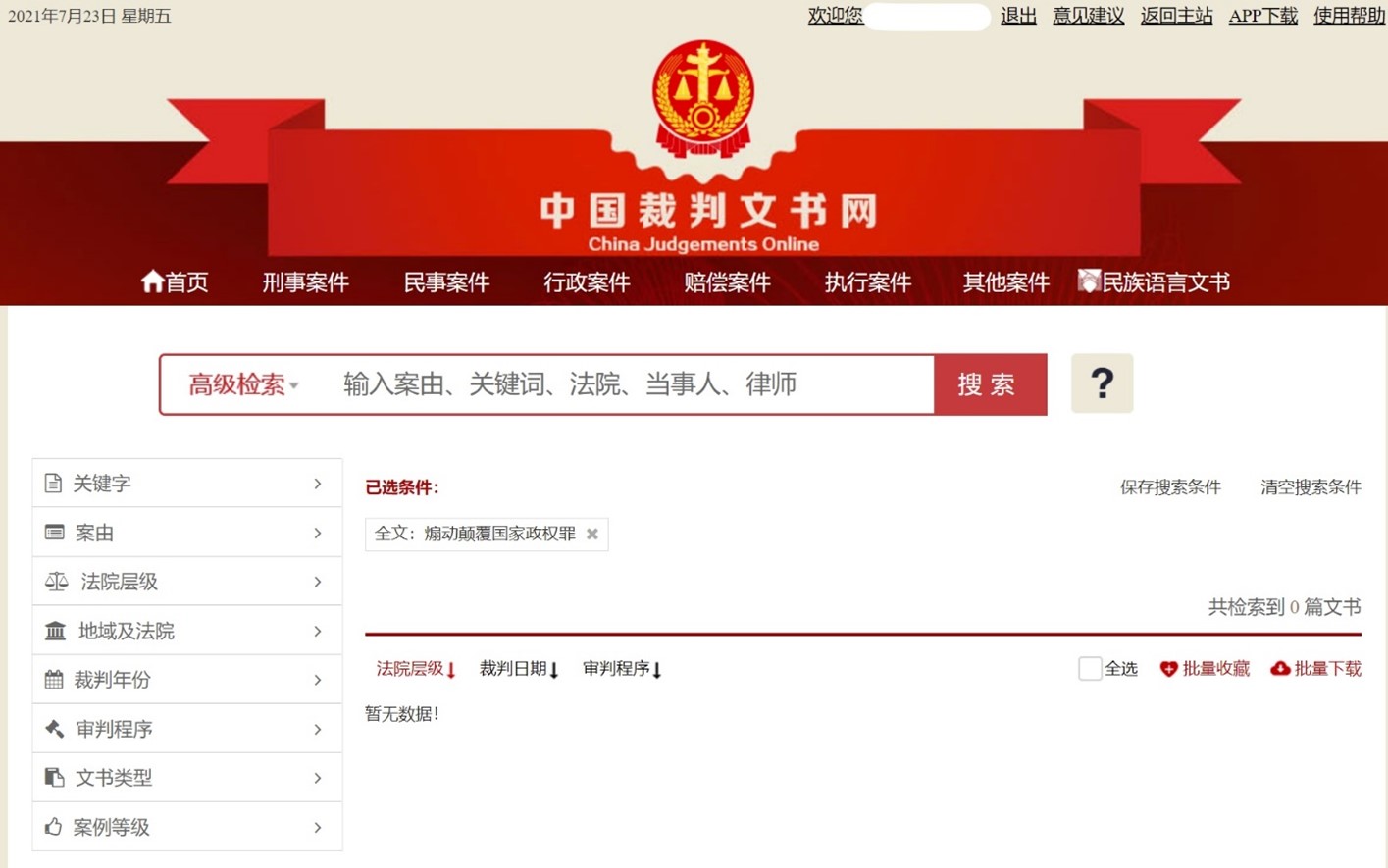
    A search for “inciting subversion of state power” yields no results as of July 23, 2021. Image credit: CJO

    In a blow to judicial transparency, all judgments and judicial decisions for endangering state security (ESS) cases, including those for sentence reduction, have been purged from the Supreme People’s Court (SPC) online judgment website China Judgements Online (CJO, 中国裁判文书网).

    The SPC has selectively removed judgments on CJO for some time, but the mass purge of a full chapter of the criminal law is unprecedented. In early 2021, the built-in crimes filter on CJO yielded over 640 ESS judgments and rulings, but the whole category of ESS judgments covering Articles 102-113 of the Criminal Law disappeared in mid-July. At the time of this posting, using the CJO’s search feature to look for ESS cases, such as inciting subversion of state power, returns not a single result even though the category has returned to the filters.  

    The removal of all ESS judgments is the culmination of a process whereby politically sensitive judgments – including for pocket crimes like picking quarrels and provoking troubles, which is often used against peaceful dissidents and petitioners – have become harder to come by. The Los Angeles Times recently told the story of Dong Zehua (董泽华), a protester who was sentenced to seven months in prison for picking quarrels and provoking troubles. Yuan Shaui (原帅), another young man who protested alongside of Dong, received six months for the same crime. Their judgment was erased from CJO. 

    The posting of judgments of sensitive cases has always been arbitrary. One of the most prominent cases to come out of the “709” crackdown on rights lawyers was the trial of veteran political dissident Hu Shigen (胡石根). Bucking the usual secretive practice, China widely publicized the trial for this subversion case. Tianjin Number Two Intermediate Court posted the court hearing and sentencing live on Weibo. The trial was hailed in Chinese official media as proof that China’s legal system secures convictions using evidence – not just witness testimony and confessions – and can withstand outside scrutiny. However, the full judgment was never posted on CJO.

    The number of trials for ESS cases is a closely guarded secret. In the annual work reports delivered by the SPC and Supreme People’s Procuratorate to the National People’s Congress, the number of ESS prosecutions and trials has been lumped together under the category of “Others” with crimes such as violation of duty by military personnel. In provincial court reports, ESS is one of the most serious organized crimes together with organized gangs, yet information is rarely given.

    Judgments for splittism and inciting splittism, crimes used almost exclusively against ethnic minorities, have always been selectively posted. Over the past four years, Dui Hua has been unable to find ESS cases in Xinjiang from CJO, despite the region making up the majority of the ESS cases nationwide. That said, intermediate people’s courts in Sichuan published no fewer than 13 inciting splittism judgments between August and December 2020. All the defendants were Tibetans.
    CJO from time to time reveals the humane side of China’s legal system. Discovery of a sentence reduction decision of a long-forgotten prisoner can provide comfort to the family and renew supporters’ hopes. Dui Hua’s research with CJO found that Tibetan monk Tsultrim Gyatso received a six-month sentence reduction in April 2021, just before judgments of a sensitive nature like these were removed from the website. Tsultrim was convicted of splittism in 2009, and very little had been known about him after his life sentence was commuted to 19.5 years in 2014. Now, his sentence reduction decision is nowhere to be found. The lack of transparency now leaves prisoners’ families and supporters in the dark and can lead to misinterpretations, speculation, and undue suffering.
    In addition to ESS, judgments involving other politically motivated criminal offenses have also disappeared. Among them are Article 300 cases, punishing those found to be “organizing/using a cult to undermine implementation of the Law.” Only a few dozen judgments can still be found, down from 4,000 judgments in early June of this year. The contents of these remaining judgments are not disclosed; they are all deemed “unsuitable for disclosure.”
    Besides cases that are of a political nature, death penalty cases, another example of closely guarded “state secrets” in China, have for the most part disappeared from CJO. Death penalty judgments, especially review decisions issued by the SPC, offer a rare window into the legal procedures governing death penalty reviews, including the investigation process, evidence gathering and review, and, most importantly, the appeals process. It is valuable to learn, although very rare, the legal basis on which the SPC chooses to reject a death penalty sentence. Along with judgments on ESS and cult cases, all SPC death penalty review decisions have been removed as well. At the time of writing, only 1,968 documents issued by SPC remain on the site, most of which are notices of rejecting petitions for retrial.
    Paradoxically, references of counterrevolution can still be found under the judgments and decisions issued for crimes abolished under the 1997 Criminal Law revision. The remaining decisions principally relate to sentence reductions. There are 25 results found for counterrevolution listed under the “pre-1997 crimes” category. Most documents suffer from the same lack of content as those noted above. Although the majority of cases are former counterrevolutionaries’ petitions for rehabilitation, the courts usually deemed these case details too “sensitive for online posting.” The box at the end of this article, however, recounts a striking case of a counterrevolutionary, still in prison, found by Dui Hua on CJO.
    Dui Hua, in its submission to China’s 2018 Universal Periodic Review (UPR) at the United Nations, hailed advances in judicial transparency. It was only in 2016 that the SPC issued the regulation about releasing judgments online. The Court has since issued numerous statements about the importance of judicial transparency and the need to “place justice under the sun.” Even with some issues along the way, the CJO enjoyed a brief boom in both the quantity and quality of the documents released in its infancy. In September 2020, China announced that CJO had reached a milestone of 100 million published cases while also implementing measures to restrict access to judgment sites. However, posting of sensitive cases such as ESS became less frequent in the past two years before stopping fully in mid-2021 and the complete removal of such cases now. The removal of sensitive judgments from CJO is a significant setback which will be brought to the attention of the United Nations Office of the High Commissioner for Human Rights.
    (Left) On November 9, 2018, Assistant Minister of Foreign Affairs of the People’s Republic of China Zhang Jun delivers final remarks during the adoption of recommendations for China’s UPR. (Right) The hall as adoption session ends. Image credit: UN Web TV
    A popular phrase among young patriotic Chinese netizens is “don’t hand knives to foreign hostile forces” – a self-imposed censorship reminder that no one should volunteer information that could be used by Western media to draw attention to problems in China. In a 2015 Central Political and Legal Affairs Commission work meeting, the Party Secretary Xi Jinping remarked that the Party must firmly grip the “knife handle” – control of the political and legal system. China now sees the outside world gaining an understanding of – and reporting on – its legal system as problematic: a questioning of the fairness of its judicial system and, thus, a direct challenge to the legitimacy of Party rule.
    Although the purging of judgments on ESS, cults, and death penalty reviews considerably diminishes the value of CJO for human rights groups like Dui Hua, that is not to say the CJO is without value. It is not unusual for political and religious prisoners to be tried for economic crimes like operating an illegal business or fraud. US citizen and pastor David Lin (林大卫) was sentenced to life in prison for fraud in December 2009. Dui Hua learned of his subsequent commutation and multiple sentence reductions in CJO. He is due to be released in 2029. News of clemency for David Lin was met with great relief by his family who feared they would never see him again.

    Lost and Found: the Case of He Shuichang

    Among the counterrevolution cases still listed without
    details, Dui Hua was able to identify a man – He Shuichang (何水长) – who is quite
    possibly one of China’s last remaining prisoners still serving a sentence for counterrevolution, a crime that
    was abolished in the 1997 revision.

    He, a 66-year-old man from Sichuan’s Meichan
    Municipality, was first convicted in 1977 – not long after the downfall of
    the Gang of Four – by the Pengshan County Court for counterrevolution. He was
    22 years old in 1977 and was one of 22,218 individuals sentenced for
    counterrevolution that year (624 of whom were between 18 and 25 years old).
    All but 243 of 23,797 tried were convicted.

    Details of He Shuichang’s offense are not known. His
    original sentence would have expired in 1989 had He not escaped from prison.
    After his recapture, the Muchuan County Court in 1981 gave him a combined
    15-year prison sentence for his escape and his previous remaining sentence.
    This sentence would have expired in 1995 had He not escaped again two years
    later, in 1983. He evaded the law for almost 15 years. In 2018, He was sent
    to Jiazhou Prison to serve out his remaining 12-year imprisonment. The
    sentence was set to expire in 2030.

    According to a decision found by Dui Hua on CJO,
    He recently received his first act of clemency: a seven-month sentence
    reduction granted by Leshan Intermediate People’s Court in 2020. With this
    reduction, the counterrevolutionary will leave prison in September 2029, when
    he will be more than 75 years old.

    China’s continued punishment of crimes abolished in its
    own legal code contravenes international legal norms, notably Article 15 paragraph One of the International Covenant on Civil and Political Rights. Dui Hua noted the
    importance of “retroactive application of ameliorative law,” citing a report by the Human Rights in Criminal Sentencing project that found that 129 of 193
    countries surveyed – 67 percent – have some provision requiring the
    retroactive implementation of a lesser penalty in their criminal law.

  • Fortifying the Great Firewall: The Criminalization of VPNs, Part II


    In “Fortifying the Great Firewall: The Criminalization of VPNs, Part I,” Dui Hua looked at the various cases where internet users were criminally punished for using unauthorized VPNs. In Part II, Dui Hua examines the crackdown on providers of VPNs.

    An individual surnamed Zhang (张) is given a two-day administration detention by cybersecurity police in 2018 for selling software that speeds up connections to overseas websites. His profits were also confiscated.
    Image Credit: Jiangsu Cybersecurity Police

    In 2017, a series of criminal cases against VPN providers and users began to surface after the Ministry of Industry and Information instituted VPN restrictions earlier that year by issuing the Notice on Cleaning Up and Regulating the Internet Access Service Market. In these cases, authorities invoked the offense of “illegally providing a tool for intruding into a computer information system.” In a legal opinion column published in October 2018, China University of Political Science and Law Professor Luo Xiang likened the offense to the now-abolished crime of “hooliganism” (liumangzui 流氓罪), calling it “cyber hooliganism” (jisuanjiliumangzui 计算机流氓罪), because it is increasingly being misused by law enforcement, as hooliganism once was, and is raising what Luo sees as “similar challenges.” Prior to its abolition in the 1997 Criminal Law, “hooliganism” was used as a catch-all offense based on weak legal logic that gave authorities discretion to punish a broad range of vaguely defined crimes. Luo uses the term cyber hooliganism as an analogy to imply that the offense of illegally providing a tool to intrude into computers has become a new “pocket crime” (kou daizui 口袋罪). Such ill-defined offenses can all too easily be used, especially by police, to criminalize cyber activities, even those which “no explicit stipulations of law deems (sic) a crime,” and for which, according to Article 3 of the Criminal Law, they should not “be convicted or given punishment.”

    An additional reason for concern is that the offence of using VPNs, which is now incorporated as Article 285 of the Criminal Law, is applicable in a broad range of circumstances, when an offender violates a decision or law formulated by the National People’s Congress (NPC) and its Standing Committee (SC), or even an administrative regulation, measure, or order issued by the State Council. In addition, the offense has been widely used even when an individual does not engage in any of the aforementioned cybercrimes: VPN providers are prosecuted simply for violating the 2017 VPN ban, an administrative notice by the Ministry of Industry and Information. As the VPN ban was not formulated by the State Council, however, violating this administrative measure should not incur criminal liability under Article 96 of the Criminal Law.


    Hooliganism in the Cyber Age: What counts as a serious crime?

    Available information shows that most offenders of cyber hooliganism were born in the 1980s to 1990s. Deng Jiewei (邓杰威) is one of the young VPN sellers known to have been convicted and sentenced to nine months’ imprisonment in Dongguan, Guangdong, in March 2017. The judgment stated that in October 2015 Deng began selling software on his website that allowed users to “visit foreign websites that could not be accessed by a mainland IP address” and “made an illegal profit of RMB 13,957.57.” Although Deng turned himself in and pleaded guilty during the trial, the court refused to mete out a lenient sentence on the grounds that Deng had been “committing the crime for a long time” and his actions “caused relatively great social harm.” Professor Luo disputed Deng’s conviction and sentencing in his column, because violating an administrative notice issued by the Ministry of Industry and Information should not have constituted a criminal offense.

    In a separate case, news media sources widely reported that an individual surnamed Dai was sentenced to three years (with a three-year suspension), in Baoshan District, Shanghai, in September 2018. Dui Hua’s research revealed that his full name is Dai Guimao (戴贵茂). Dai, a software developer for a securities management company, was accused of renting multiple servers from overseas internet service providers and providing VPN services for hundreds of mainland users from April 2016 to October 2017. The transaction records of Dai’s Wechat and Alipay accounts were cited as criminal evidence against him. Dai was also given a fine of RMB 10,000, equivalent to all the revenue he made from selling VPNs.

    Dui Hua also unearthed five other cases, in which a total of 17 individuals were sentenced for selling VPNs from 2017 to 2019 for crimes stemming from the concept of cyber hooliganism. Article 285 of the Criminal Law subjects offenders to no more than three years’ imprisonment in cases where the circumstances are “serious,” and three to seven years’ imprisonment if the circumstances are “especially serious.” In 2011, the Supreme People’s Court issued an interpretation defining both serious and especially serious circumstances. A case is considered serious if an offender provides a special program or tool that can be used for intruding into or illegally controlling a computer information system that reaches more than 20 people, or makes an illegal income of RMB 5,000. Once either the number of users or the amount reaches five times this standard, the circumstances become especially serious.

    Although the court judgments stated that all five cases were “especially serious,” their sentences varied from suspended sentences to 39 months’ imprisonment. Lu Bo (卢勃), who received the longest sentence among the 11 offenders in Henan, was accused of setting up a company that provided VPN services to 2,499 internet users and making an income of RMB 375,332 between April 1, 2015 and September 23, 2017. Lu and six other company employees, who were sentenced to 14-15 months’ imprisonment, lodged an appeal, but the Sanxiamen Intermediate People’s Court upheld the judgment on December 17, 2018.

    In a separate case, also in Henan, Liu Bingyang (刘冰洋 ) was only given a three-year sentence with a five-year suspension, even though he had earned roughly the same amount as Lu by providing VPN services to over 4,000 internet users. Another two people, surnamed Sang (桑), were also given two to three years’ imprisonment (with suspensions of two to three years) in Kunming, Yunnan, for amassing a profit of RMB 300,000. They claimed to have served 20,000 users. In another case concluded on January 29, 2019, in Hubei, Liu Xiaokang (刘小康) was also given a three-year sentence (with a suspension of four years) for making an illegal profit of RMB 2,662,280, seven times more than Lu and all his employees had made. The prosecutors found that 486,830 online users had registered for Liu’s VPNs. Of these, 37,077 were paying users. In the most recent case, concluded on April 22, 2019, six defendants who had made a profit totalling RMB 263,669 were given three-year suspended sentences. The judgment did not state how many users had purchased their VPN services.

    Evidence also suggests that promoting the use of VPNs even without an intent to profit can result in prosecution. On March 25, 2019, Sun Dongyang (孙东洋) was indicted for “illegally providing a tool for intruding into a computer information system.” Sun founded doubibackup.com, a website that provides free-of-charge instructions for online users, not only about VPNs but also about other circumvention software, such as Telegram and Shadowsocks. At the time of writing, Sun remains incarcerated in Henan’s Xinmi City Detention Center.


    Illegal Business

    Internet users who sell VPNs unapproved by the state are can also fall victim to the “illegal business activity” charge. The most severe sentence known to have been given involved Wu Xiangyang (吴向洋), a network engineer who was sentenced to five years and six months’ imprisonment in Guangxi in December 2017. Since 2013, Wu had operated an online store on his own website, popular e-shopping site Taobao, and social networking sites, where he made an “illegal profit” totalling RMB 500,000 from leasing or selling VPN software and hardware devices without applying for a business permit. Wu’s VPN service, which aimed to provide better access to overseas audio and video programs, claimed to have served 8,000 foreign clients and 5,000 businesses. Wu is expected to complete his sentence in December 2022. Dui Hua’s research recently revealed that the Guigang Intermediate People’s Court ordered the Pingnan County People’s Court to retry the case due to insufficient evidence on September 25, 2018. The outcome of the retried case remains unknown at the time of writing.

    Dui Hua’s research also discovered four similar cases involving eight defendants who were also sentenced in 2018. Their sentences ranged from suspension to nine months’ imprisonment. In one of these cases, a defendant surnamed Liao (廖) was given a prison sentence in Anhui for allegedly making revenue of about RMB 1.2 million in the 16 months from May 2016 to September 2017 from selling VPNs and EVO boosters, a software application that speeds up connections to overseas game servers, without a business license.

    The amount of proceeds made from selling VPNs and other software applications, again, does not appear to be an important factor in determining sentencing. For instance, both Wu and Liao, who received prison sentences, made substantially lower revenues, while three other people whose revenues were much higher were only given suspended sentences. The three, surnamed Chen (陈), Cao (曹) and Zeng (曾), sold VPNs for around RMB 8.8 million and made profits of RMB 250,000 each. Despite the scale of their businesses across China, the court in Hunan gave them suspended sentences, because the judgment stated that they each had surrendered RMB 500,000 before they were indicted.

    Dui Hua has previously reported that the offense of illegal business activity is also commonly used against Christian book sellers. The offense, which contains a vague clause of “other activities” in Article 225(3) of the 1997 Criminal Law, has allowed the Supreme People’s Court to issue judicial interpretations that extend the scope of criminal liabilities to violators of administrative regulations under the guise of “disrupting market order.” In the cases discussed above, VPN sellers were likewise found guilty of disrupting the market order governed by the Ministry of Industry and Information.


    The Costs of China’s Criminalization of VPNs

    China pays a high price for enforcing high-stakes and arbitrary control over the internet. Externally, it is an important irritant in U.S.-China relations. In 2016, the U.S. for the first time began calling China’s online censorship a trade barrier. According to the American Chamber of Commerce in China’s 2016 American Business in China White Paper, among the severe challenges faced by its members was the fact that “China is extending this restrictive regulatory framework beyond traditional telecommunications services into any IT sector that utilizes Internet connectivity, including…. technical standards that often diverge from global standards, Internet content restrictions, and privacy and cross-border data flow restrictions.”

    Domestically, internet users forced to spend money on VPNs to access overseas information are additionally often subjected to slow and low-capacity internet connections. The Great Firewall is detrimental to creativity and innovation, because mechanisms that block access to the web leave entrepreneurs, artists, scientists, and inventors unfamiliar with global trends and practices, and unable to communicate with peers abroad. In 2017, The Guardian, which appears intermittently on the list of blocked foreign websites, wrote that the ban on VPNs also harms academics, software developers, and foreign businesses: “For years Chinese researchers have complained they lack adequate access to overseas journals and methods to communicate with universities around the world, while developers rely on code hosted on websites based outside China.”

    While online information is not necessarily easy to access even in democratic societies, netizens there face no legal risk for using or selling VPNs. China under Xi has made the pursuit of internet freedom even more costly than under his predecessors. Since 2017, providers and users of VPNs have faced criminalization as part of Xi’s bid to fortify the Great Firewall against any ideas or information that Xi deems threatening. VPN providers can easily fall prey to charges of “illegally providing a tool for intruding into a computer information system” or illegal business activity, since, as we have seen, both “pocket crimes” effectively extend criminal liabilities to violators of administrative regulations. More research is needed to understand the rationale behind sentencing. Despite an announcement by the Beijing city government on August 15 of a three-year plan to expand openness in some areas in internet content service, it is doubtful that the trend towards increasingly strict government control over the distribution and sharing of content in cyber space that could be interpreted as political will see meaningful change. What is crystal-clear, however, is that Xi has magnified his internet control by punishing online users who access or post information that is deemed sensitive or subversive by the state, or enable others to do so, outside of China’s government-approved domestic networks.
  • Fortifying the Great Firewall: The Criminalization of VPNs, Part II


    In “Fortifying the Great Firewall: The Criminalization of VPNs, Part I,” Dui Hua looked at the various cases where internet users were criminally punished for using unauthorized VPNs. In Part II, Dui Hua examines the crackdown on providers of VPNs.

    An individual surnamed Zhang (张) is given a two-day administration detention by cybersecurity police in 2018 for selling software that speeds up connections to overseas websites. His profits were also confiscated.
    Image Credit: Jiangsu Cybersecurity Police

    In 2017, a series of criminal cases against VPN providers and users began to surface after the Ministry of Industry and Information instituted VPN restrictions earlier that year by issuing the Notice on Cleaning Up and Regulating the Internet Access Service Market. In these cases, authorities invoked the offense of “illegally providing a tool for intruding into a computer information system.” In a legal opinion column published in October 2018, China University of Political Science and Law Professor Luo Xiang likened the offense to the now-abolished crime of “hooliganism” (liumangzui 流氓罪), calling it “cyber hooliganism” (jisuanjiliumangzui 计算机流氓罪), because it is increasingly being misused by law enforcement, as hooliganism once was, and is raising what Luo sees as “similar challenges.” Prior to its abolition in the 1997 Criminal Law, “hooliganism” was used as a catch-all offense based on weak legal logic that gave authorities discretion to punish a broad range of vaguely defined crimes. Luo uses the term cyber hooliganism as an analogy to imply that the offense of illegally providing a tool to intrude into computers has become a new “pocket crime” (kou daizui 口袋罪). Such ill-defined offenses can all too easily be used, especially by police, to criminalize cyber activities, even those which “no explicit stipulations of law deems (sic) a crime,” and for which, according to Article 3 of the Criminal Law, they should not “be convicted or given punishment.”
    An additional reason for concern is that the offence of using VPNs, which is now incorporated as Article 285 of the Criminal Law, is applicable in a broad range of circumstances, when an offender violates a decision or law formulated by the National People’s Congress (NPC) and its Standing Committee (SC), or even an administrative regulation, measure, or order issued by the State Council. In addition, the offense has been widely used even when an individual does not engage in any of the aforementioned cybercrimes: VPN providers are prosecuted simply for violating the 2017 VPN ban, an administrative notice by the Ministry of Industry and Information. As the VPN ban was not formulated by the State Council, however, violating this administrative measure should not incur criminal liability under Article 96 of the Criminal Law.


    Hooliganism in the Cyber Age: What counts as a serious crime?

    Available information shows that most offenders of cyber hooliganism were born in the 1980s to 1990s. Deng Jiewei (邓杰威) is one of the young VPN sellers known to have been convicted and sentenced to nine months’ imprisonment in Dongguan, Guangdong, in March 2017. The judgment stated that in October 2015 Deng began selling software on his website that allowed users to “visit foreign websites that could not be accessed by a mainland IP address” and “made an illegal profit of RMB 13,957.57.” Although Deng turned himself in and pleaded guilty during the trial, the court refused to mete out a lenient sentence on the grounds that Deng had been “committing the crime for a long time” and his actions “caused relatively great social harm.” Professor Luo disputed Deng’s conviction and sentencing in his column, because violating an administrative notice issued by the Ministry of Industry and Information should not have constituted a criminal offense.
    In a separate case, news media sources widely reported that an individual surnamed Dai was sentenced to three years (with a three-year suspension), in Baoshan District, Shanghai, in September 2018. Dui Hua’s research revealed that his full name is Dai Guimao (戴贵茂). Dai, a software developer for a securities management company, was accused of renting multiple servers from overseas internet service providers and providing VPN services for hundreds of mainland users from April 2016 to October 2017. The transaction records of Dai’s Wechat and Alipay accounts were cited as criminal evidence against him. Dai was also given a fine of RMB 10,000, equivalent to all the revenue he made from selling VPNs.
    Dui Hua also unearthed five other cases, in which a total of 17 individuals were sentenced for selling VPNs from 2017 to 2019 for crimes stemming from the concept of cyber hooliganism. Article 285 of the Criminal Law subjects offenders to no more than three years’ imprisonment in cases where the circumstances are “serious,” and three to seven years’ imprisonment if the circumstances are “especially serious.” In 2011, the Supreme People’s Court issued an interpretation defining both serious and especially serious circumstances. A case is considered serious if an offender provides a special program or tool that can be used for intruding into or illegally controlling a computer information system that reaches more than 20 people, or makes an illegal income of RMB 5,000. Once either the number of users or the amount reaches five times this standard, the circumstances become especially serious.
    Although the court judgments stated that all five cases were “especially serious,” their sentences varied from suspended sentences to 39 months’ imprisonment. Lu Bo (卢勃), who received the longest sentence among the 11 offenders in Henan, was accused of setting up a company that provided VPN services to 2,499 internet users and making an income of RMB 375,332 between April 1, 2015 and September 23, 2017. Lu and six other company employees, who were sentenced to 14-15 months’ imprisonment, lodged an appeal, but the Sanxiamen Intermediate People’s Court upheld the judgment on December 17, 2018.
    In a separate case, also in Henan, Liu Bingyang (刘冰洋 ) was only given a three-year sentence with a five-year suspension, even though he had earned roughly the same amount as Lu by providing VPN services to over 4,000 internet users. Another two people, surnamed Sang (桑), were also given two to three years’ imprisonment (with suspensions of two to three years) in Kunming, Yunnan, for amassing a profit of RMB 300,000. They claimed to have served 20,000 users. In another case concluded on January 29, 2019, in Hubei, Liu Xiaokang (刘小康) was also given a three-year sentence (with a suspension of four years) for making an illegal profit of RMB 2,662,280, seven times more than Lu and all his employees had made. The prosecutors found that 486,830 online users had registered for Liu’s VPNs. Of these, 37,077 were paying users. In the most recent case, concluded on April 22, 2019, six defendants who had made a profit totalling RMB 263,669 were given three-year suspended sentences. The judgment did not state how many users had purchased their VPN services.
    Evidence also suggests that promoting the use of VPNs even without an intent to profit can result in prosecution. On March 25, 2019, Sun Dongyang (孙东洋) was indicted for “illegally providing a tool for intruding into a computer information system.” Sun founded doubibackup.com, a website that provides free-of-charge instructions for online users, not only about VPNs but also about other circumvention software, such as Telegram and Shadowsocks. At the time of writing, Sun remains incarcerated in Henan’s Xinmi City Detention Center.


    Illegal Business

    Internet users who sell VPNs unapproved by the state are can also fall victim to the “illegal business activity” charge. The most severe sentence known to have been given involved Wu Xiangyang (吴向洋), a network engineer who was sentenced to five years and six months’ imprisonment in Guangxi in December 2017. Since 2013, Wu had operated an online store on his own website, popular e-shopping site Taobao, and social networking sites, where he made an “illegal profit” totalling RMB 500,000 from leasing or selling VPN software and hardware devices without applying for a business permit. Wu’s VPN service, which aimed to provide better access to overseas audio and video programs, claimed to have served 8,000 foreign clients and 5,000 businesses. Wu is expected to complete his sentence in December 2022. Dui Hua’s research recently revealed that the Guigang Intermediate People’s Court ordered the Pingnan County People’s Court to retry the case due to insufficient evidence on September 25, 2018. The outcome of the retried case remains unknown at the time of writing.
    Dui Hua’s research also discovered four similar cases involving eight defendants who were also sentenced in 2018. Their sentences ranged from suspension to nine months’ imprisonment. In one of these cases, a defendant surnamed Liao (廖) was given a prison sentence in Anhui for allegedly making revenue of about RMB 1.2 million in the 16 months from May 2016 to September 2017 from selling VPNs and EVO boosters, a software application that speeds up connections to overseas game servers, without a business license.
    The amount of proceeds made from selling VPNs and other software applications, again, does not appear to be an important factor in determining sentencing. For instance, both Wu and Liao, who received prison sentences, made substantially lower revenues, while three other people whose revenues were much higher were only given suspended sentences. The three, surnamed Chen (陈), Cao (曹) and Zeng (曾), sold VPNs for around RMB 8.8 million and made profits of RMB 250,000 each. Despite the scale of their businesses across China, the court in Hunan gave them suspended sentences, because the judgment stated that they each had surrendered RMB 500,000 before they were indicted.
    Dui Hua has previously reported that the offense of illegal business activity is also commonly used against Christian book sellers. The offense, which contains a vague clause of “other activities” in Article 225(3) of the 1997 Criminal Law, has allowed the Supreme People’s Court to issue judicial interpretations that extend the scope of criminal liabilities to violators of administrative regulations under the guise of “disrupting market order.” In the cases discussed above, VPN sellers were likewise found guilty of disrupting the market order governed by the Ministry of Industry and Information.


    The Costs of China’s Criminalization of VPNs

    China pays a high price for enforcing high-stakes and arbitrary control over the internet. Externally, it is an important irritant in U.S.-China relations. In 2016, the U.S. for the first time began calling China’s online censorship a trade barrier. According to the American Chamber of Commerce in China’s 2016 American Business in China White Paper, among the severe challenges faced by its members was the fact that “China is extending this restrictive regulatory framework beyond traditional telecommunications services into any IT sector that utilizes Internet connectivity, including…. technical standards that often diverge from global standards, Internet content restrictions, and privacy and cross-border data flow restrictions.”
    Domestically, internet users forced to spend money on VPNs to access overseas information are additionally often subjected to slow and low-capacity internet connections. The Great Firewall is detrimental to creativity and innovation, because mechanisms that block access to the web leave entrepreneurs, artists, scientists, and inventors unfamiliar with global trends and practices, and unable to communicate with peers abroad. In 2017, The Guardian, which appears intermittently on the list of blocked foreign websites, wrote that the ban on VPNs also harms academics, software developers, and foreign businesses: “For years Chinese researchers have complained they lack adequate access to overseas journals and methods to communicate with universities around the world, while developers rely on code hosted on websites based outside China.”
    While online information is not necessarily easy to access even in democratic societies, netizens there face no legal risk for using or selling VPNs. China under Xi has made the pursuit of internet freedom even more costly than under his predecessors. Since 2017, providers and users of VPNs have faced criminalization as part of Xi’s bid to fortify the Great Firewall against any ideas or information that Xi deems threatening. VPN providers can easily fall prey to charges of “illegally providing a tool for intruding into a computer information system” or illegal business activity, since, as we have seen, both “pocket crimes” effectively extend criminal liabilities to violators of administrative regulations. More research is needed to understand the rationale behind sentencing. Despite an announcement by the Beijing city government on August 15 of a three-year plan to expand openness in some areas in internet content service, it is doubtful that the trend towards increasingly strict government control over the distribution and sharing of content in cyber space that could be interpreted as political will see meaningful change. What is crystal-clear, however, is that Xi has magnified his internet control by punishing online users who access or post information that is deemed sensitive or subversive by the state, or enable others to do so, outside of China’s government-approved domestic networks.
  • Fortifying the Great Firewall: The Criminalization of VPNs, Part I

    China’s Great Firewall keeps people inside the country from accessing thousands of overseas websites, 
    including Twitter, YouTube, and Facebook. Image credit: Megan Pendergrass
    With a netizen population of 829 million at the end of 2018, China is arguably the world’s most sophisticated surveillance state: with increasing effectiveness, China blocks information deemed sensitive or harmful by the party from entering its domestic network. Its notorious censorship scheme, widely known as the “Great Firewall,” came into operation not long after the internet arrived in China in 1994. The Chinese government realized the need to protect the regime from “flies” once “the window is open for fresh air,” a famous quote from Deng Xiaoping, who sought to keep the nation away from western influence, despite a commitment to economic reform.
    The Great Firewall has blocked around 10,000 domain names, including Dui Hua’s, according to Greatfire.org, a non-profit group that monitors the status of online censorship in China. Almost all popular social media websites and mobile apps are censored, including Google, Facebook, YouTube, Instagram, and Twitter. The New York Times, The Wall Street Journal, Reuters, Bloomberg, and the BBC are among the best-known foreign media outlets blocked by China’s domestic network. Just ahead of the 30th anniversary of the events of June Fourth, 1989, all versions of Wikipedia, in all languages, joined the long list of foreign websites blocked by the Chinese government. Even academic, cultural, and scientific sites can be blocked: current examples include Google Scholar, The China Quarterly, Northwestern University Medical School, and Shutterstock.
    Driven by their desire for information filtered out by the domestic network, an estimated 20-30 million internet users rely on virtual private networks (VPNs) to get unfettered access to overseas websites (commonly referred to as “scaling the wall”). They typically do so by paying a small subscription fee. The academic sector relies on VPNs for research data and to connect to libraries worldwide. VPNs are also a necessity for both Chinese companies that conduct business overseas and foreign companies that conduct business in China.
    Xi Jinping expresses his views on cybersecurity: “There is no national security without cyber security.” Image Credit: Xinhuanet

    In view of the growing number of internet users accessing overseas information, Beijing has not hesitated to target VPN providers and cripple their services. VPN service providers describe the battle against online censorship as a game of cat-and-mouse, in which they play mice trying to evade a giant cat—the Chinese government—by continuing to modify or develop new tools to skirt the increasingly fortified Firewall. The mice, however, have been playing a tougher game ever since Xi, in early 2017, called on other countries to respect different models of regulating the web space and extolled his concept of “cyber sovereignty.” A hallmark of how Xi exercises his cyber sovereignty is the launching of clean-up campaigns that periodically shut down websites and online accounts containing or propagating “harmful” online information. China’s state-owned internet service providers China Mobile, China Unicom, and China Telecom were ordered to completely block VPNs by February 2018. Green VPN, one of the most reputable China-based VPN companies, ceased service on July 1, 2017. In the same year, Apple defended its decision to remove 674 VPN apps from its China app store because they violated Chinese laws. All companies and individuals must seek government approval to use and install VPNs, effective March 31, 2018.

    In addition to expanding the list of blocked foreign IP addresses and shutting down unofficial VPN services, Xi has recently shifted to targeting individual users and providers of VPNs. Those who attempt to escape the tight leash on internet control, or those who enable others to do so, not only face fines, but also criminal detention and imprisonment for varying offenses.


    Before & Now

    China started regulating the use of VPNs with the enactment of the Regulations of the Administration of International Networking of Computer Information in 1996. Article 6 of the regulation states that “[c]omputer information networks within the territory of China, when connected with international networks, must use international inward and outward channels (guojichurukouxindao 国际出入口信道) provided by the national public telecommunication network of the Ministry of Posts and Telecommunications.” Violators shall be ordered to terminate their networking activities and are subject to a maximum fine of RMB 15,000. But in over two decades of existence, the regulation was not enforced until 2017, when Xi began tightening control over the VPN market, according to Lee Jyh-An, at the Chinese University of Hong Kong, who publishes extensively on Chinese internet law.
    An early case concerning the criminalization of internet users who bypass the Great Firewall, however, predated the VPN ban in 2017. In May 2015, Chen Lefu (陈乐福) was detained for 28 days in Shanghai on suspicion of sabotaging a computer information system. Chen promoted the use of Twister, an open source peer-to-peer (P2P) microblogging network whose decentralized platform prevents sent messages from being blocked or deleted after they are published. The tool also protects publishers’ identities from being tracked, since the posts’ IP addresses are not recorded. Exiled activist Wen Yunchao speculated that another reason for detention was that Chen helped other dissidents to circumvent the Great Firewall. Chen also published a list of Shanghai and Chongqing netizens he suspected of being the 50 Cent Army, a colloquial term referring to state-backed online commentators. Human rights lawyer Liu Xiaoyuan said that several other individuals were detained alongside Chen, but their identities are not known.
    In December 2018, news media sources began reporting more cases concerning VPN users. Zhu Yunfeng (朱云枫) was given a warning and a fine of RMB 1,000 by public security in Shaoguan, Guangdong, for “establishing or using an unauthorized channel to access the international internet” via Lantern, a globally recognized circumvention tool. The administrative punishment decision stated that Zhu had logged into the VPN 487 times in one week prior to the warning. A similar case occurred in Chongqing on January 4, 2019. Police summoned Huang Chengcheng (黄成成), on suspicion of the same offense. Huang was previously sentenced to two years’ re-education through labor in March 2011, after circulating online messages calling on netizens to “go for a stroll” to support China’s pro-democracy protests that year, known as the Chinese “Jasmine Revolution” and inspired by the Arab Spring in Tunisia.
    In addition to individual VPN users, police have also targeted unauthorized use by trading corporations. In June 2019, a news media source reported that an overseas trading company in Haining City, Zhejiang, received an administrative punishment for installing an unauthorized circumvention application. Police alleged that the use of such applications from an unidentified developer exposed the risk of privacy leakage. Nothing else is known about the administrative punishment.
    It must be noted, however, that using VPNs does not necessarily incur a penalty, nor is it necessarily criminal. Global Times editor-in-chief Hu Xijin, an active user of Twitter, is known to use a mobile circumvention tool frequently to tweet while defending China against international criticism, including over Xinjiang’s political re-education camps, which hold or have held over one million Muslims. China’s state media outlets China Daily and Xinhua, as well as Chinese telecommunications companies, rely on foreign social networking sites that are blocked in China to launch soft-power, marketing, and advertising campaigns. For example, Xinhua has accounts on both Facebook and Twitter, although these sites are blocked for most Chinese users. Similarly, despite being widely mocked online for tweeting “Happy #2019” on New Year’s Day with a “Twitter for iPhone” stamp clearly visible due to a VPN issue, Huawei continues to actively use Twitter and Facebook to rebut accusations that the telecom giant poses a threat to U.S. national security.


    “Politically harmful content”: The categories of offenses

    While the Chinese government justified its internet clean-up campaigns to combat economic crimes, online gambling, and pornography, the crackdown is also conspicuously aimed at eradicating “politically harmful content.” Within one month after the Cyberspace Administration of China launched a campaign on October 20, 2018, about 9,800 social media accounts had been scrubbed for posting sensational or vulgar content, or “spreading politically harmful information, maliciously falsifying the party history, slandering heroes and defaming the nation’s image.” As part of the internet clean-up, the crackdown has extended its reach to online users who post or circulate online messages unwanted by the party, or sometimes even local officials, beyond the Great Firewall.

    “Picking quarrels and provoking troubles”

    The offense of picking quarrels and provoking troubles is typically invoked to punish such VPN users. In November 2018, Radio Free Asia (RFA) reported that Liu Jichun (刘继春) was formally arrested in Chongqing because he refused to delete a large number of his tweets attacking social ills. Available sources, however, have not revealed the exact content of his tweets. Another case, also reported by RFA, sheds light on the political nature of offenses that resulted in imprisonment: in December 2018, Jiangsu netizen Liu Hongbo (刘红波) received a six-month sentence for picking quarrels and provoking troubles. The judgment stated that Liu Hongbo posted 72 tweets between August 2017 and August 2018 that “defamed the party and national leaders” and 329 tweets that harmed the image of the party and government. Liu Hongbo stated in his defence that the tweets were not composed by himself; he only liked and retweeted Guo Wengui’s tweets. Guo is an exiled billionaire tycoon wanted by China for a variety of crimes. He is currently seeking asylum in the U.S.
    An indictment statement recently circulated online stated that Shi Genyuan (施根源) was indicted for the same offense as Liu Hongbo in March 2019, because he used Twitter and Facebook to post 383 messages that “attacked the party and Chinese leaders, and exaggerated and distorted certain sensitive cases and incidents.” His messages, which have been discussed, forwarded, and liked 2,316 times, were said to have “caused a serious disturbance in a public place.” Since the Supreme People’s Court issued a judicial interpretation in 2015, the crime of picking quarrels and provoking troubles has extended its reach into virtual space, even though, ironically, most citizens do not have access to much of the space without VPNs.
    Dui Hua’s research into online judgments uncovered several cases that have not been reported by news media sources. A day prior to detention on October 7, 2018, Xu Nailai (许乃来) staged a solo protest on Beijing’s Wangfujing Street with a banner that read, “End the Chinese communist dictatorship; no more sexual assaults and faulty vaccines; taxpayers are in dire straits.” On March 25, 2019, Xu was sentenced to three years and six months’ imprisonment in Tianjin for picking quarrels and provoking troubles. The allegations against him also included posting a large number of tweets that “vilified the Communist Party and political system, slandered Chinese leaders, and hurled insults at public security.”
    The criminalization of VPN users also extends to critics of local officials. In a separate case also concluded in Tianjin in September 2018, Mu Zhixiang (穆志祥) was sentenced to 22 months’ imprisonment and convicted of the same offense as Xu Nailai, in addition to illegal business activity. Apart from using his personal blog and domestic online forums that required no circumvention, Mu was accused of posting multiple messages on Facebook and Twitter that allegedly attacked Tianjin public security officials and smeared the government.

    “Offenses related to defamation”

    VPN users can also stand accused of defamation. Initially detained and arrested for picking quarrels and provoking troubles in the second half of 2017, Yin Zhenglin (殷正林) was sentenced to 11 months’ imprisonment for defamation in Chongqing in July 2018. The prosecution accused Yin of obtaining a large amount of information that defamed the party and Chinese leaders concerning four issues: the Malaysian aircraft MH370 that went missing on March 8, 2014, with 153 Chinese nationals on board; the wrongful conviction and execution of Nie Shubin; the abnormal death of Lei Yang in police custody; and Guo Wengui, the tycoon mentioned above, now living in the U.S. Yin was said to have spread this negative information using three different Twitter accounts, “seriously harming the image of the party and nation, endangering state security, and disrupting social and public order.”
    Also convicted of defamation, Wang Zhiqiang (汪志强) was sentenced to one and a half years’ imprisonment in Benxi, Liaoning. Wang was found guilty of composing 412 tweets that defamed the Chinese leaders, with 637,610 views between June 2016 and September 2018. The judgment stated that his tweets “harmed the nation’s image and seriously endangered state interests.”

    Disseminating terrorist, subversive, divisive, and reactionary information

    VPN users who share dissenting versions of narratives about Xinjiang could be charged with a different set of offenses. For instance, Shandong netizen Wang Mingde (王明德) was sentenced in 2018 to 15 months’ imprisonment for “fabricating or intentionally disseminating false terrorist information,” a charge stemming from, among other things, his posting messages on Twitter and Facebook about “East Turkestan.” The Chinese government calls “East Turkestan” a terrorist group advocating both violence and Uyghur independence. In another case, Xinjiang resident Tian Weiguo (田卫国) was accused of tweeting two “fake” messages from his account, which has 98 followers. One of his tweets concerned the deadly incident in Shache, Xinjiang, that left 96 dead (including 59 terrorists) on July 28, 2014, according to official accounts. Tian called the incident the “Shache Massacre,” and claimed thousands of people were killed, many of whom were Uyghur women. Tian also called on the UN to look into the incident. In March 2016, Tian was sentenced to three years’ imprisonment for “inciting racial hatred” in Xinjiang’s Ili Autonomous Prefecture.
    More recently, Zhou Yongjun (周勇军) has been charged in Dongxing City, Guangxi, with picking quarrels and provoking troubles on the grounds of using overseas social networking media, presumably with the help of a VPN, to disseminate “reactionary information.” This is the fourth time Zhou has been taken into custody since he took part in the Tiananmen Square protests of 1989. Before he was charged with picking quarrels and provoking troubles, Zhou was initially detained for “using a cult to undermine implementation of the law” and then indicted for inciting subversion. Both charges stemmed from his alleged possession of Falun Gong materials, and his critical tweets about the Communist Party.
    Read Part II to find out about the crackdown on VPN providers.