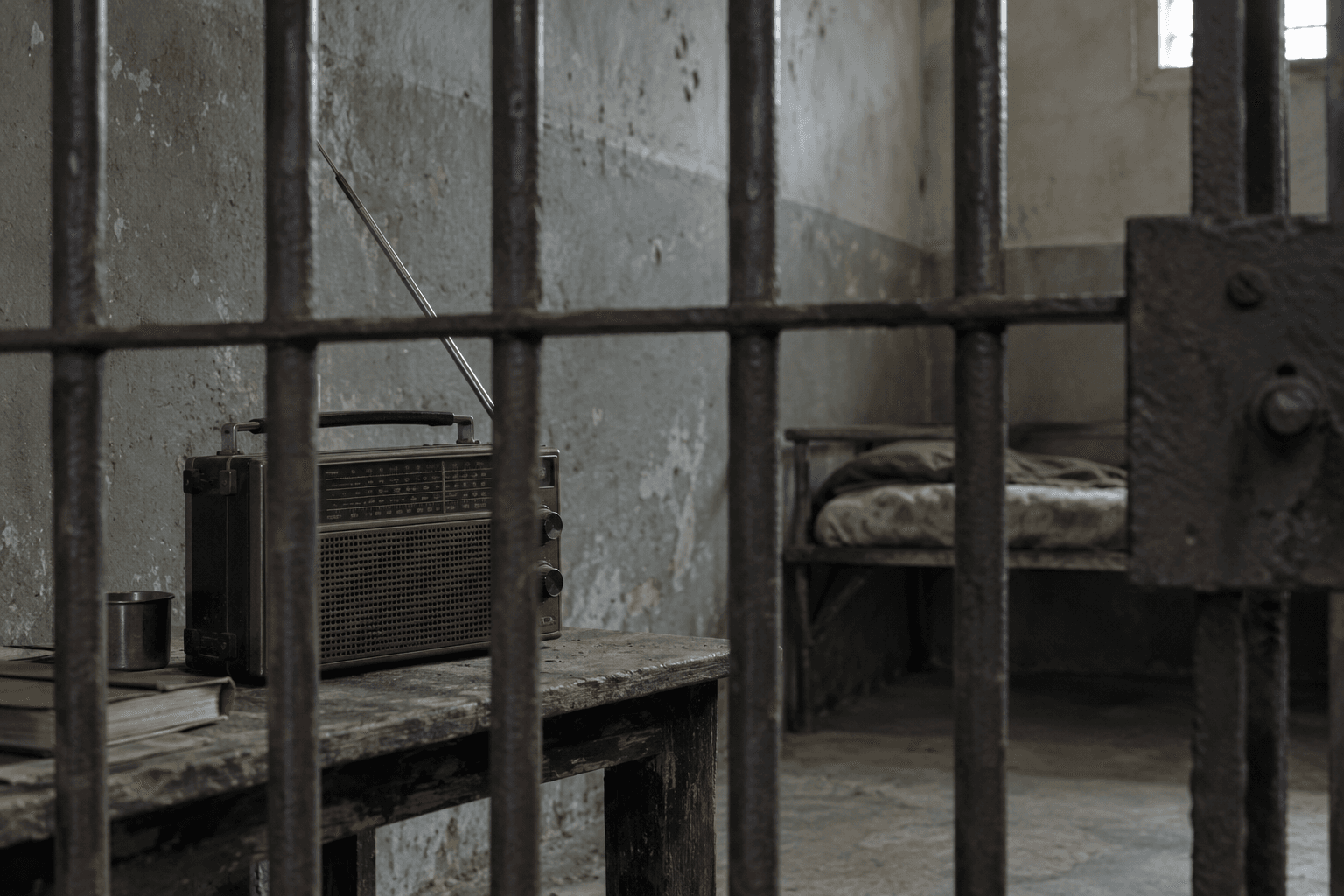
Image source: AI-generated image
After testifying to Congress in favor of keeping China’s trade status on three occasions in 1990, I became something of a celebrity in Hong Kong. USA Today called me a “Hero in Hong Kong.” I was given the 1990 “Communicator of the Year” award by the Hong Kong chapter of the International Association of Business Communicators. It was not unusual to be approached in restaurants, called “Mr. MFN,” and thanked for my efforts.
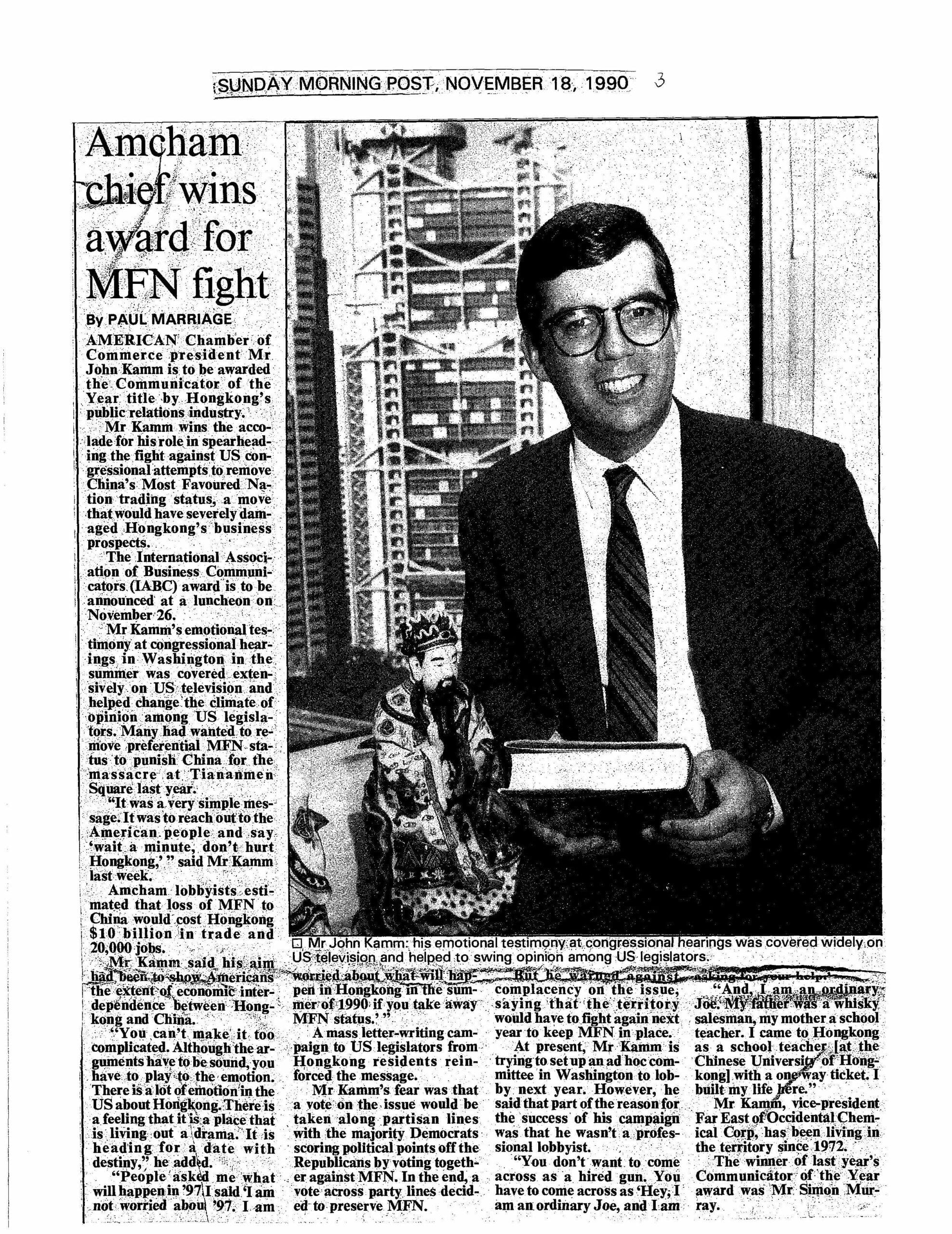
Sunday Morning Post, November 18, 1990: “AmCham chief wins award for MFN fight.”
Media coverage was extensive. It wasn’t long before I was asked to host a radio talk show on Hong Kong’s newest station, Metro, but I didn’t like the format. Sometimes no one would call in, so I had to resort to calling friends in the early evening, around cocktail hour.
Nevertheless, I was able to use my show to advocate for releasing prisoners. In May 1991, I announced the release of the Li Brothers on Metro Radio.
In those days, I was frequently asked by the Voice of America (VOA) to comment on human rights and specific prisoners for their English and Mandarin services. These commentaries were taped and broadcast to audiences in China and the United States. Eventually, I was asked to host a show on VOA’s Mandarin Service, “Issues in US-China Relations,” as a consultant. This would be an in-person event at which I would be joined by one or two guests at VOA studios in Hong Kong or Washington (some interviews were conducted by phone).
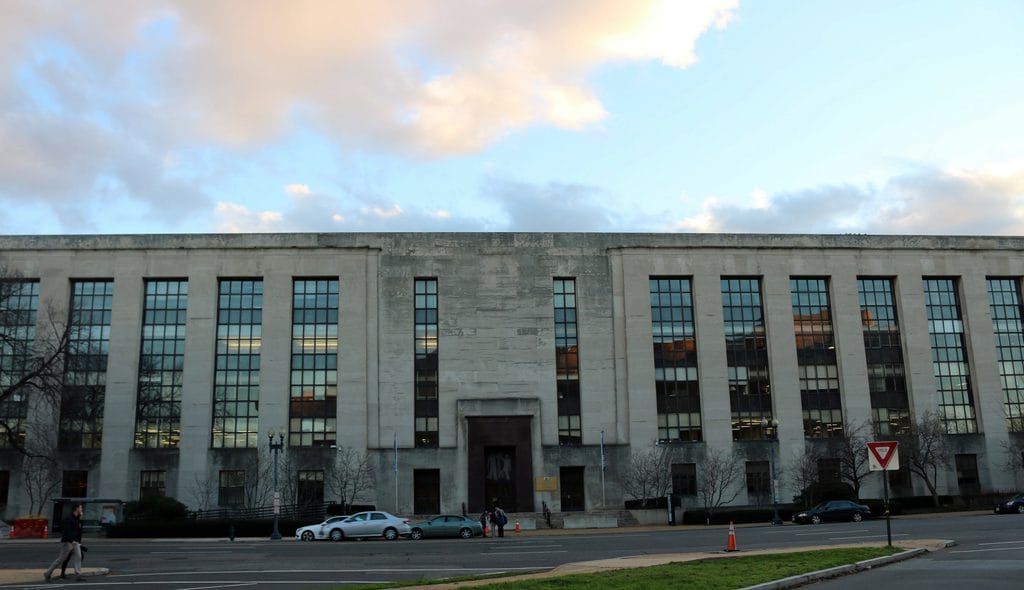
Voice of America headquarters, Washington, DC, 2016. Image source: Persian Dutch Network
I hosted the show from 2001 to 2004. The topic of human rights was again a focus. During those years, I interviewed political leaders, state department officials, human rights activists, and business leaders. I interviewed US ambassador Clark Randt at the embassy in Beijing on the impact of China’s hosting of the 2008 Olympic Games on human rights. I interviewed John Shattuck, Assistant Secretary of State for Democracy, Rights, and Labor by phone. VOA cancelled the show in 2004 to fund shows, in Arabic, that concentrated on the Iraq war that began in 2003.
In September 2001 I was in Hong Kong taping shows for my program. After I returned to my room following dinner with Chinese officials, there was a voice message on the phone. It was my producer in Washington. “Turn on your TV.” I did so and watched the second plane crash into the World Trade Center. The date was September 11. I lost a family member in the attack.
I traveled to Beijing the day after the attack. I met with Chinese officials to obtain information on political prisoners but came away empty-handed. I returned to Hong Kong and shortly after, I received a call from the hotel lobby. One of the officials I had met in Beijing had flown to Hong Kong to give me information on Takna Jigme Sangpo, an elderly Tibetan teacher serving a long sentence for counterrevolution. Jigme Sangpo was released and flown to the United States in 2002.
Han Chunsheng
Access to VOA’s English and Chinese broadcasts had long played a role in US-China relations. Millions of Chinese citizens listened to VOA English broadcasts to learn or improve their English, especially “American English.”
Chinese authorities refer to VOA and similar foreign broadcasters as “enemy stations” (敌台). Permitting access to international radio and TV broadcasts was a condition of the 1993 executive order issued by US President Bill Clinton extending China’s Most Favored Nation status.
China paid no heed. Access remained limited, and, as time went by, limitations increased. Broadcasts were jammed. Listening to foreign broadcasts deemed “enemy radio” was more or less policed according to the political climate. On important dates, like the anniversary of the June 4, 1989, suppression of protests in Beijing’s Tiananmen Square or meetings of China’s National People’s Congress, surveillance intensified.
Punishment for listening to — much less corresponding with — an “enemy station” could be severe, as the case of Han Chunsheng (韩春生) demonstrates.
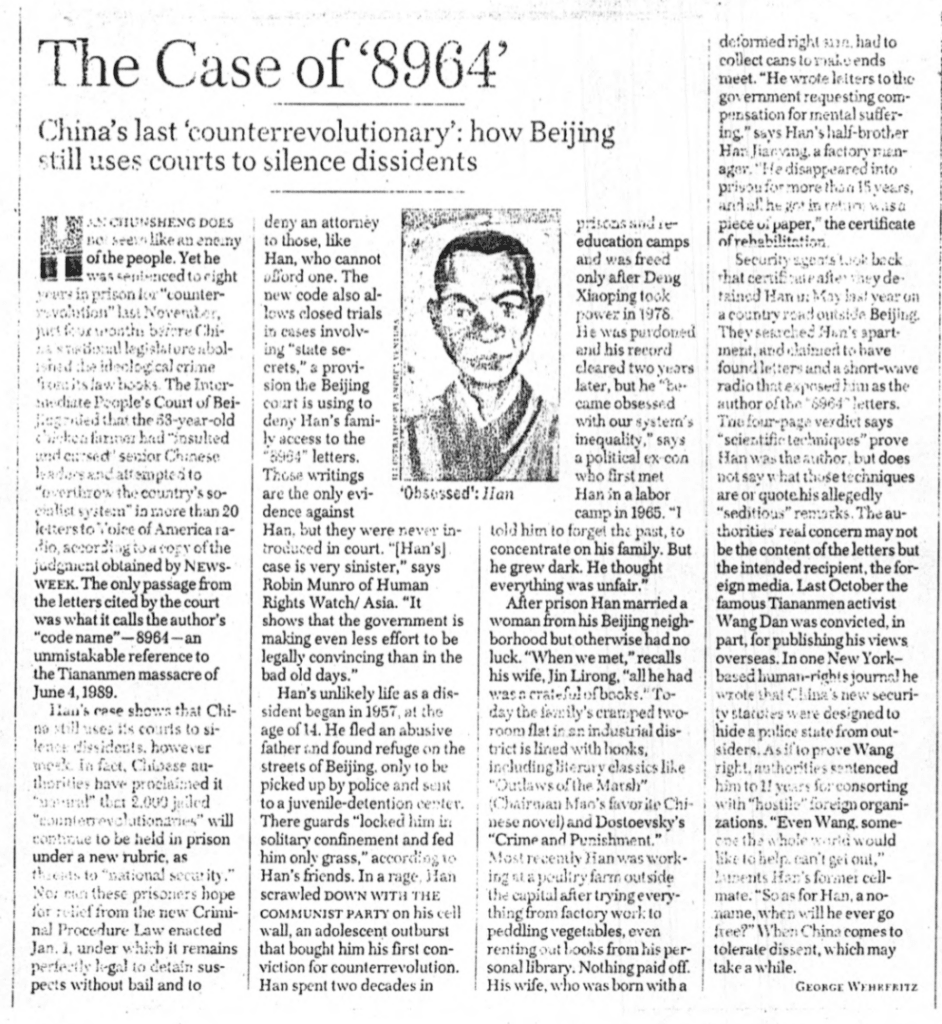
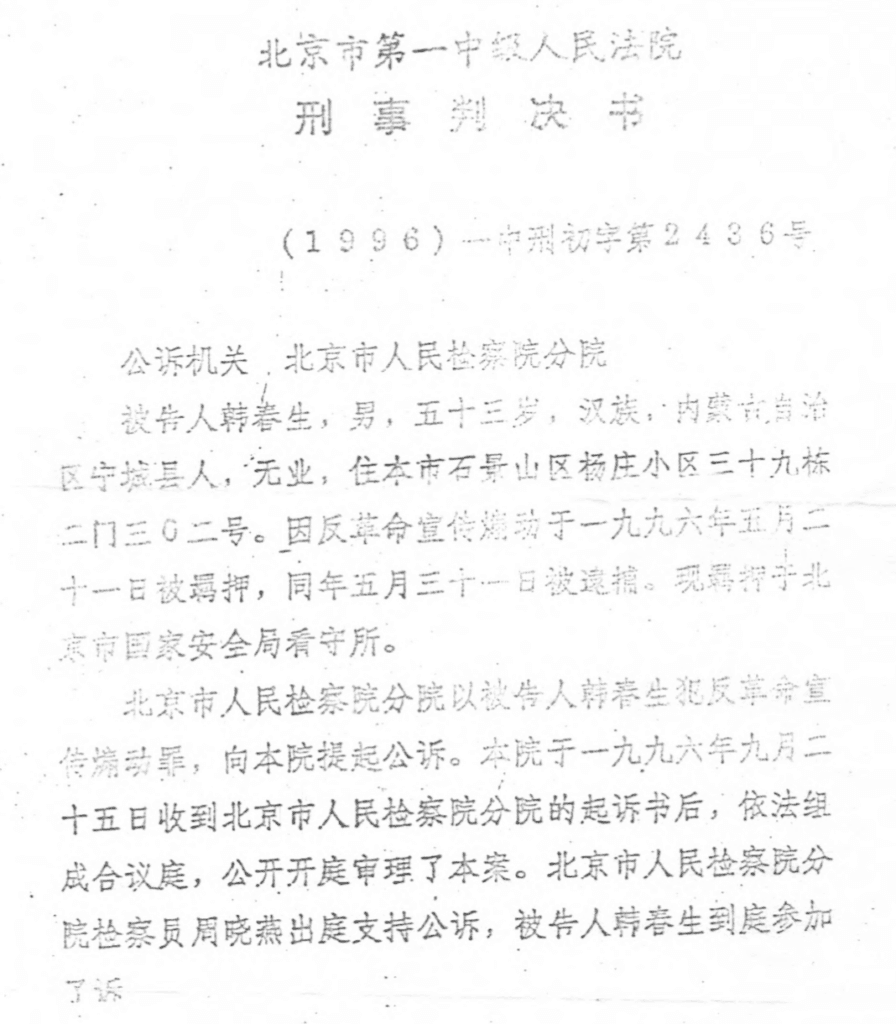
Left, article about The Case of ‘8964’ in Newsweek, September 29, 1997. Right, Criminal Judgement of Han Chunsheng
Drawing on my own involvement, as well as court judgements, responses to Dui Hua queries, and unofficial sources such as a Newsweek article, all held in Dui Hua’s Legacy Archive, this is Hans’ story:
Han was a Chinese citizen who was born in 1943 in Inner Mongolia. He’d be over 80 years old today if still alive. He later became a resident of Beijing’s Jingshan District. The official responses claim he was unemployed, a label often applied to people pushed out of state jobs for being involved in the 1989 protests. An unofficial account claims he tried his hand at chicken farming. Han was married to a woman with a disability. It is not known if they had children. They were very poor. She gathered scrap metal (cans) for resale to state collection agencies. Reflecting a scholarly bent, Han built a library. He rented books to others to earn money.
Han was an avid listener of VOA. He came to the attention of state security in August 1995, when his first letter to VOA was intercepted. When Han was detained on May 21, 1996, a short-wave radio was confiscated. He was then indicted on September 25, 1996, and sentenced to eight years in prison and two years of deprivation of political rights for the crime of counterrevolutionary incitement and propaganda by the Beijing Intermediate People’s Court on November 11, 1996.
Han was accused of sending to the VOA mailbox were signed “8964,” a not-so-subtle reference to the suppression of the protests that occurred on June 4, 1989. The letters criticized and cursed Chinese leaders and the communist party. VOA denied ever receiving the letters, and Han denied that he had sent them.
Han was one of the last people convicted of counterrevolution before it was removed from the criminal law in 1997. He spent his internment in Beijing Number Two Prison, used to house many political and religious prisoners including Xu Wenli and American citizen Pastor David Lin
My advocacy for Han began before Dui Hua was established in 1999 and continued for four years after the foundation was set up. During those years, I asked about Han, in writing, on 11 occasions, and received three responses. I asked for clemency in face-to-face meetings on several occasions. In a March 1998 meeting with Ministry of Foreign Affairs officials, I argued Han’s case, citing his pleas of innocence, the lack of evidence other than circumstantial evidence, and VOA’s claim that it never received the letters. I handed over a letter from Senator Sam Brownback (R-Kansas) that mentioned Han Chunsheng. It was of no use. I was told that the US government should raise his case directly with Beijing at senior levels.
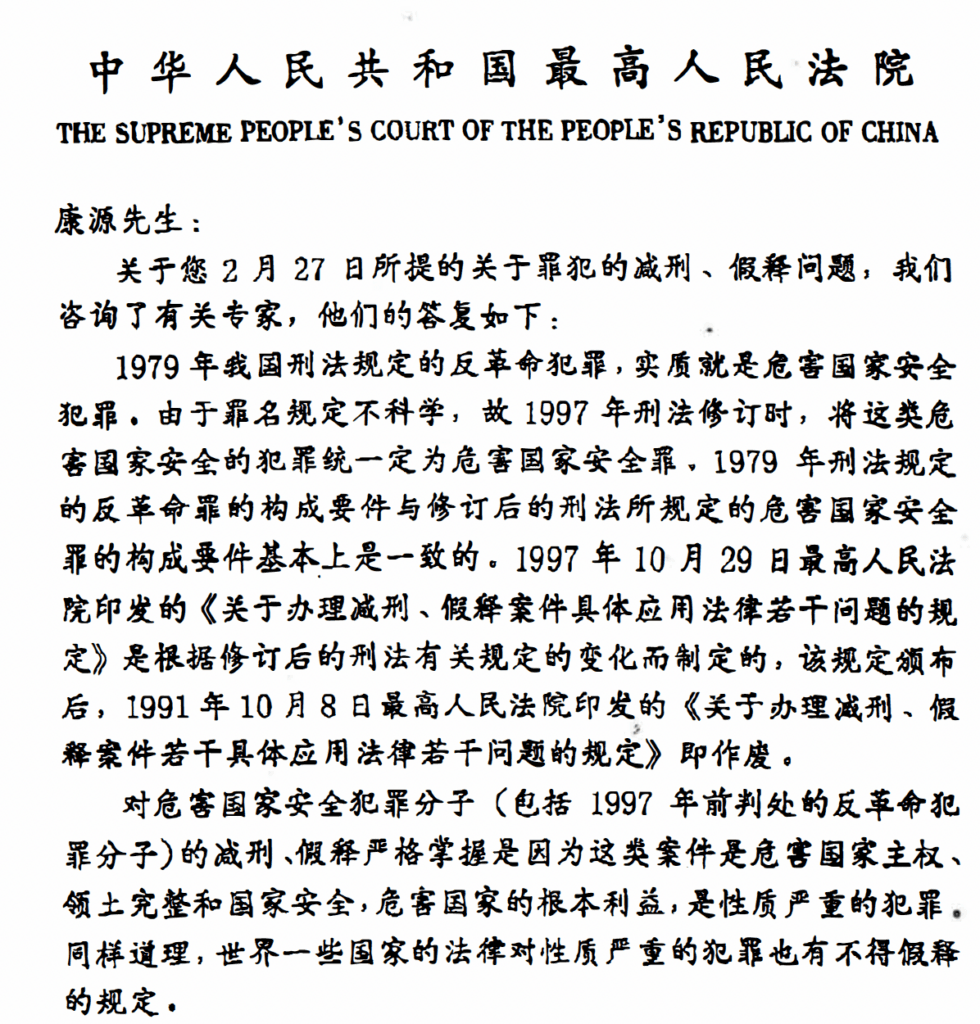
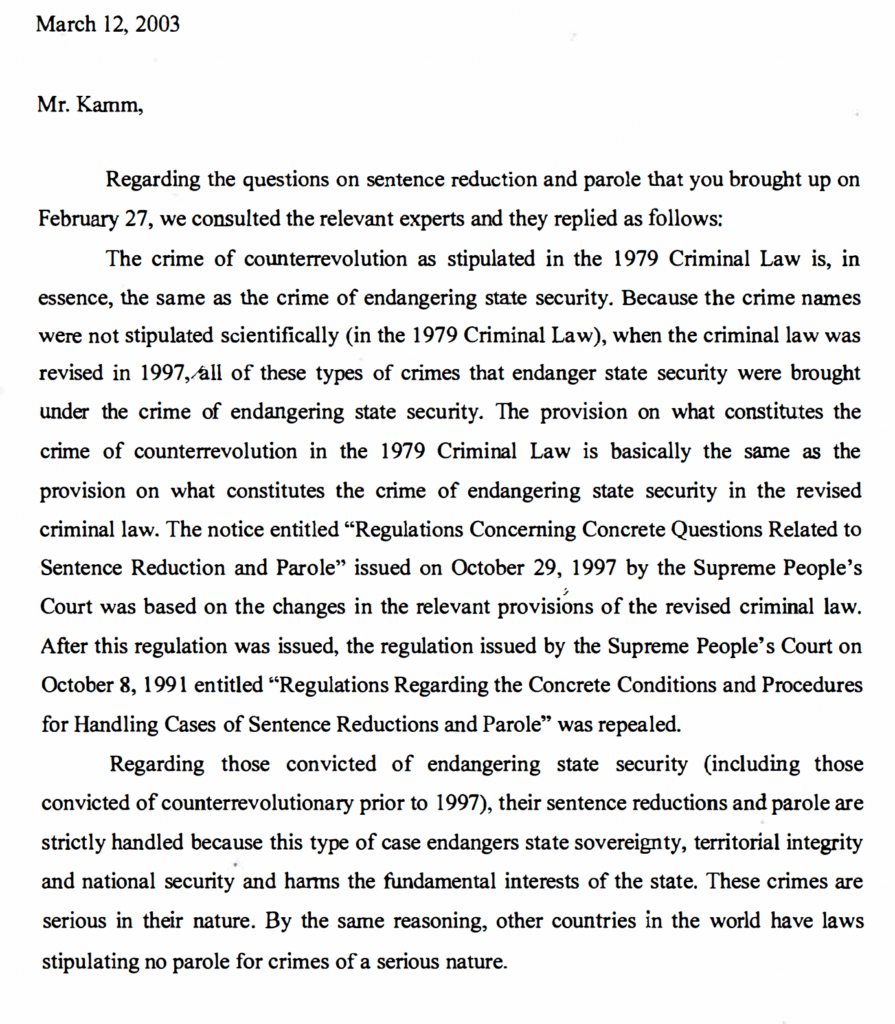
Letter to the Executive Director John Kamm from the Supreme People’s Court, March 12, 2003,
in response to Kamm’s written query about Han Chunsheng’s counterrevolution sentencing,
a crime removed from China’s Criminal Law in 1997.
Then something happened that had never happened before: As Han’s sentence drew to a close, I had written to the Supreme People’s Court (SPC) asking whether people convicted of counterrevolution — a crime removed from the Criminal Law in 1997 — were eligible for sentence reduction or parole. I received a reply dated March 12, 2003. It was the first and only time the court answered one of my queries. Dui Hua is publishing the SPC letter for the first time.
Under the pre-1997 law, counterrevolutionary incitement and propaganda included sending letters, writing slogans, “and other means” undertaken with the intention of overthrowing the socialist system and the dictatorship of the proletariat. In 1996, Chinese courts concluded 81 counterrevolutionary incitement and propaganda trials in intermediate people’s courts, involving 135 defendants. Han Chunsheng was one of them.
Han was not the only Chinese citizen punished for trying to communicate with VOA’s Mandarin Service. Shandong dissident Che Hongnian (车宏年) was sentenced to three years in a reform-through-labor facility in January 1999. He had tried to send two letters to VOA’s Hong Kong mailbox in October 1998, but both were intercepted by the authorities. Che was released in July 2001.
VOA Today
For decades, Chinese authorities have regarded VOA and other foreign broadcasters as “enemy stations.” Journalists working for foreign outlets, their local colleagues, and Chinese citizens who speak with them have faced surveillance, harassment, and other pressure. Han Chunsheng’s case shows how serious the consequences could be for a citizen accused of listening to VOA and trying to communicate with it. The stigma could continue after release. Hunan-based journalist Shi Tao (师涛) was warned, after completing both his prison term and his deprivation of political rights, not to grant interviews or otherwise communicate with VOA. When it became apparent that listening to VOA and soliciting letters was perilous, I asked VOA management to close their mailbox and warn the audience of the dangers inherent in communicating with VOA.
In March 2025, US President Donald Trump issued an executive order directing the United States Agency for Global Media (USAGM), VOA’s parent agency, to reduce its functions and personnel to the minimum required by law. USAGM subsequently placed most affected staff on paid administrative leave. The actions triggered litigation and a continuing dispute over VOA’s operations and statutory responsibilities.
Before the March 2025 reductions, VOA produced content in 49 languages. Save VOA reported that by July 2026 a skeleton staff was producing content in only six languages; by September 2026 it reported eight. Cantonese programming fell to zero after March 2025, and Tibetan programming also remained at zero. The loss of these services is especially significant for audiences that had relied on VOA for news and, in many cases, language learning.
I think of Han Chunsheng when I consider what has happened to VOA. He was accused of listening to the station, of writing to it, and of signing letters “8964.” He received an eight-year prison sentence. Whatever VOA’s future, the price paid by people like Han for seeking information from outside China should not be forgotten. They have been betrayed.